Editor's Note:
Dear Friend,
If you grew up in the 1990s, you may share some of my coming-of-age firsts: first time speaking on a cell phone (a brick-like contraption with a long antenna), first email account (remember AOL?), first time purchasing an airline ticket online (it took three days to finalize), first time calling home with a calling card (goodbye quarters!).
But while most of us were just discovering the expanse of the World Wide Web, my friend’s father had been making himself (and others) at home there for years. Rabbi YY Kazen (or “YY,” as he was known) was the pioneer who has been credited with founding the first Jewish presence on the Internet. As early as 1988, he was fielding questions and sharing Jewish texts on Fidonet, and he was among the very first to register a domain name, birthing Chabad.org in early 1994.
Today, it’s fun to work for Chabad.org. People nod with appreciation when I tell them what I do, often telling me how much they enjoy the site and its offerings. Things were different in the mid-‘90s, when most people wrote off Rabbi Kazen and his cohorts as a group of dreamy geeks.
They saw potential and they pursued it, against all odds. To use a Chanukah reference, they were modern-day Maccabees, not letting naysayers or so-called “realists” get in the way of their passion for Torah, Judaism and their love of the Jewish people.
Let’s learn from them!
Menachem Posner
On behalf of the Chabad.org Editorial Team
 Greater MiraclesThere will come a time, very soon, when we will be shown miracles so great, they will make the Ten Plagues and the splitting of the Red Sea appear as ordinary as nature itself.
So great, no mind can begin to fathom them;
so powerful, they will transform the very fabric of our world, elevating it in a way that the wonders of the Exodus could not achieve.
For then, our eyes will be opened and granted the power to see the greatest of miracles.
And what are those miracles?
Those that occur to us now, beneath our very noses, every day.[Maamar Kimei Tzeit’cha 5712.]
-------
This Week's Features
Printable Magazine
-------

A Rabbi, a Holocaust Survivor, and a Lonely Struggle in the Dark Night
A short insight on Parshat Vayishlach by Chana Weisberg

<script language="javascript" type="text/javascript" src="http://embed.chabad.org/multimedia/mediaplayer/embedded/embed.js.asp?aid=3425514&width=auto&height=auto"></script><span style="clear:both;" class="lb" id="lbdiv">Visit <a href="http://www.chabad.org/multimedia/default_cdo/aid/591213/jewish/Video.htm">Jewish.TV</a> for more <a href="http://www.chabad.org/multimedia/default_cdo/aid/591213/jewish/Video.htm">Jewish videos</a>.</span>
-------
INFO

What Is Hanukkah?
The history, the observances, and the inner significance . . .
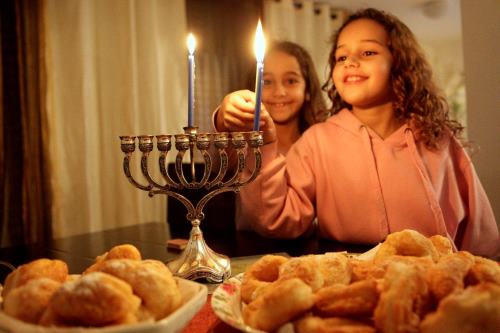 Photo credits: Flash90Chanukah is the Jewish eight-day, wintertime “festival of lights,” celebrated with a nightly menorah lighting, special prayers and fried foods.
The Hebrew word Chanukah means “dedication,” and is thus named because it celebrates the rededication of the Holy Temple (as you’ll read below). Also spelled Hanukkah (or variations of that spelling), the Hebrew word is actually pronounced with a guttural, “kh” sound, kha-nu-kah, not tcha-new-kah.
What Chanukah Commemorates
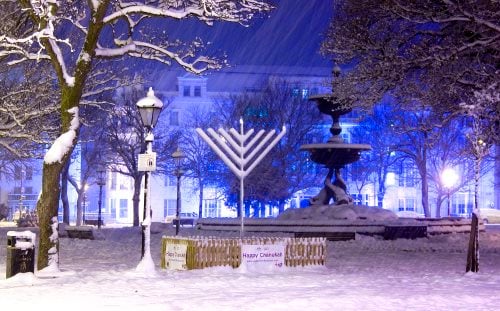 Artist Dominic Alves captured this image of a snowy Chanukah in Brighton, UK.
In the second century BCE, the Holy Land was ruled by the Seleucids (Syrian-Greeks), who tried to force the people of Israel to accept Greek culture and beliefs instead of mitzvah observance and belief in G‑d. Against all odds, a small band of faithful Jews, led by Judah the Maccabee, defeated one of the mightiest armies on earth, drove the Greeks from the land, reclaimed the Holy Temple in Jerusalem and rededicated it to the service of G‑d.
When they sought to light the Temple's Menorah (the seven-branched candelabrum), they found only a single cruse of olive oil that had escaped contamination by the Greeks. Miraculously, they lit the menorah and the one-day supply of oil lasted for eight days, until new oil could be prepared under conditions of ritual purity.
To commemorate and publicize these miracles, the sages instituted the festival of Chanukah.
Read the full story of Chanukah.
How Chanukah Is Observed
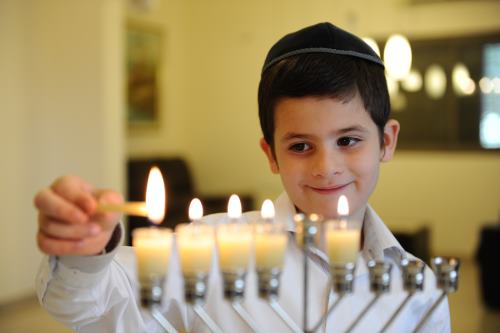 At the heart of the festival is the nightly menorah lighting. The menorah holds nine flames, one of which is the shamash (“attendant”), which is used to kindle the other eight lights. On the first night, we light just one flame. On the second night, an additional flame is lit. By the eighth night of Chanukah, all eight lights are kindled.
Special blessings are recited, often to a traditional melody, before the menorah is lit, and traditional songs are sung afterward.
A menorah is lit in every household (or even by each individual within the household) and placed in a doorway or window. The menorah is also lit in synagogues and other public places. In recent years, thousands of jumbo menorahs have cropped up in front of city halls and legislative buildings, and in malls and parks all over the world.
We recite the special Hallel prayer daily, and add V’Al HaNissim in our daily prayers and in the Grace After Meals, to offer praise and thanksgiving to G‑d for “delivering the strong into the hands of the weak, the many into the hands of the few ... the wicked into the hands of the righteous.”
Read the full menorah-lighting guide.
Learn what to expect at a public menorah lighting.
When Is Chanukah?
Chanukah begins on the eve of Kislev 25 and continues for eight days. On the civil calendar, it generally coincides with the month of December.
View (and print) a Chanukah calendar.
Chanukah Foods
 Since the Chanukah miracle involved oil, it is customary to eat foods fried in oil. The Eastern-European classic is the potato latke (pancake) garnished with applesauce or sour cream, and the reigning Israeli favorite is the jelly-filled sufganya (doughnut).
Find the perfect Chanukah recipe.
Dreidel: the Chanukah Game
 On Chanukah, it is customary to play with a “dreidel” (a four-sided spinning top bearing the Hebrew letters, nun, gimmel, hei and shin, an acronym for nes gadol hayah sham, “a great miracle happened there”). The game is usually played for a pot of coins, nuts, or other stuff, which is won or lost based on which letter the dreidel lands when it is spun.
Learn how to pay dreidel.
Chanukah Gelt
 In today’s consumer-driven society, people tend to place great importance on giving Chanukah gifts. However, the tradition is actually to give Chanukah gelt, gifts of money, to children. In addition to rewarding positive behavior and devotion to Torah study, the cash gifts give the children the opportunity to give tzedakah (charity). This has also spawned the phenomenon of foil-covered “chocolate gelt.”
Why we give gelt.
What It Means For You
Noting that one should spend time in close proximity to the Chanukah lights, the Previous Rebbe would say, “We must listen carefully to what the candles are saying.” So what are the flickering flames telling us? Here are some messages:
a. Never be afraid to stand up for what’s right. Judah Maccabee and his band faced daunting odds, but that didn’t stop them. With a prayer on their lips and faith in their heart, they entered the battle of their lives—and won. We can do the same.
b. Always increase in matters of goodness and Torah-observance. Sure, a single flame was good enough for yesterday, but today needs to be even better.
c. A little light goes a long way. The Chanukah candles are lit when dusk is falling. Perched in the doorway, they serve as a beacon for the darkening streets. No matter how dark it is outside, a candle of G‑dly goodness can transform the darkness itself into light.
d. Take it to the streets. Chanukah is unique in that its primary mitzvah is observed in public. It’s not enough to be a Jew at heart, or even at home. Chanukah teaches us to shine outwards into our surroundings with the G‑dly glow of mitzvahs.
e. Don't be ashamed to perform mitzvahs, even if you will feel different. Rather, be like a menorah, proudly proclaiming its radiant uniqueness for all to see.
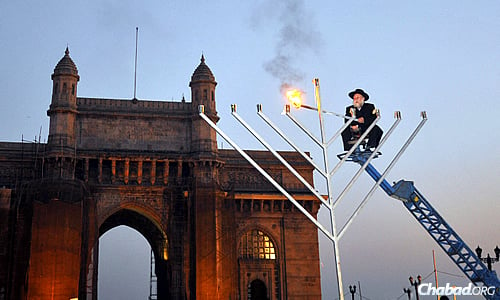 Rabbi Shimon Rosenberg of Afula, Israel, the father of Rivkah Holtzberg, lights a 25-foot steel menorah during Chanukah 2008 in front of the Gateway of India in Mumbai just weeks after his daughter and son-in-law, Rabbi Gavriel Holtzberg, were killed in a terrorist attack. Gavriel Holtzberg would light that menorah each year. (Photo by Serge Attal/Flash90)
Other important Chanukah links:
Chanukah stories to tug at your heartstrings
Chanukah videos and songs
Chanukah Q&A
Chanukah essays and more

Play Video
The Chanukah Battle Continues
<script language="javascript" type="text/javascript" src="http://embed.chabad.org/multimedia/mediaplayer/embedded/embed.js.asp?aid=235109&width=auto&height=auto"></script><span style="clear:both;" class="lb" id="lbdiv">Visit <a href="http://www.chabad.org/multimedia/default_cdo/aid/591213/jewish/Video.htm">Jewish.TV</a> for more <a href="http://www.chabad.org/multimedia/default_cdo/aid/591213/jewish/Video.htm">Jewish videos</a>.</span>
 © Copyright, all rights reserved. If you enjoyed this article, we encourage you to distribute it further, provided that you comply with Chabad.org's copyright policy.
-------

 Is It OK to Wear a Mezuzah Necklace?
There are records of people using mezuzot as amulets since ancient times. by Yehuda Shurpin
I’d like to wear a necklace with a mezuzah pendant. I know mezuzot are meant for doorways, but are there any issues with wearing one?
Reply
The Talmud explains in a number of places that a mezuzah affords protection.1 However, as you mention, the mitzvah of mezuzah is indeed to affix it to your doorway. Using it for any other purpose is in no way the fulfillment of the mitzvah. That said, there are records of people using mezuzot as amulets since ancient times. In fact, the Mishnah mentions that some had the custom to carry a hollowed-out staff containing a mezuzah for protection.2
Let’s explore the protective powers of the mezuzah.
On the outside of the mezuzah scroll, G‑d’s name Shaddai (ש-ד-י) is written. The Kabbalists explain that, in addition to being G‑d’s name, it is also the acronym for שומר דלתות ישראל, “guardian of the doors of Israel,” alluding to the protection that the mezuzah affords.3 In light of this, there is a lively discussion in post-Talmudic responsa whether protection can be obtained only through a properly placed mezuzah in fulfillment of the mitzvah, or whether it can come from any mezuzah.
Many are of the opinion that there is indeed some measure of protection from the mezuzah itself, even when not affixed to a doorway.4 Accordingly, the Lubavitcher Rebbe advised certain individuals who were dealing with health issues to carry a mezuzah with them (obviously in addition to having kosher mezuzot properly affixed to all the doorways of the house).5
(It should be noted that even when the mezuzah is on the doorway, the protection it affords is not necessarily quantifiable.6)
So yes, people have been known to carry mezuzot with them. But is it proper to have the mezuzah hanging around your neck?
Life Hanging in the Balance
Expounding on the verse “And your life will hang in suspense before you . . .,”7 the Talmud explains that this refers to one who hangs up his tefillin on a peg, which is seen as disrespectful.8 Would hanging a mezuzah around your neck be equally disrespectful?
Two preeminent halachic decisors of the last century, Rabbi MosheFeinstein9 and Rabbi Ovadia Yosef,10 both explain that the Talmud’s caution against hanging sacred items does not apply to hanging them from one's body. Indeed, in ancient times, the Jewish kings were commanded to constantly have a Torah scroll with them, so they would hang the scrolls from their arms.11
On a Practical Level
Wearing a mezuzah necklace presents some challenges. Unless it is covered by two opaque layers, a mezuzah (or any other sacred writing, for that matter) may not be brought into a bathroom or any unclean place,12 or be present in a room during intimate relations.13 Practically, this means that if you were to wear a mezuzah necklace, you would need to make sure to take it off anytime you walked into the bathroom or even just walked through an unclean place.
Though wearing a mezuzah necklace is permissible and may afford some protection, it is important not to lose sight of the mitzvah itself. Kosher mezuzot affixed properly throughout your home are much more potent than any necklace. To check if your mezuzot are kosher and affixed properly, visit our mezuzah mini-site and/or contact your local competent rabbi.
FOOTNOTES
1.See Talmud, Avodah Zarah 11a, Menachot 33b; see also Tur, Yoreh Deiah 285.
2.See Mishnah, Keilim 17:16, and Tosfot Yom Tov ad loc.
3.See Siddur HaArizal, Kavonot Mezuzah; Mishnat Chassidim 3:9; Kol Bo Hilchot Mezuzah; Darkei Moshe, Yoreh Deiah 288; see also Zohar 2:36a and Likutei Levi Yitzchak ad loc, where he explains the Zohar was alluding to this acronym (see, however, Likutei Sichot, vol. 19, p. 121, f.n. 7, for a discussion whether the Zohar was indeed alluding to this acronym).
4.See for example, Igrot Moshe, Yoreh Deah 2:141; Rabbi Ovadia Yosef in Halichot Olam, vol. 8, p. 216.
5.See, for example, Igrot Kodesh, vol. 4, p. 159; vol. 6, p. 254; vol. 10, p. 239.
6.See, for example, Igrot Moshe, Yoreh Deah 2:141.
7.Deuteronomy 28:66.
8.Talmud, Berachot 24a.
9.Igrot Moshe, Yoreh Deah 2:141.
10.Rabbi Ovadia Yosef in Halichot Olam, vol. 8, p. 216.
11.See Talmud, Sanhedrin 22a.
12.Although it is technically permitted to enter such a place with a mezuzah if it has a double opaque covering, ideally one should not do so, so that it be distinguished as a holy item. See Igrot Moshe, Yoreh Deah 2:141:3.
13.See Magen Avraham, Shulchan Aruch, Orech Chaim 40:2; Shulchan Aruch Harav 40:5-6; Mishnah Berurah 40:7.-------

Dating, Weddings and Marriage in Jewish Tradition
Two can become one—when soulmates tap into the singular soul they share. Join us as we explore this quest for oneness, as empowered by the timeless laws and traditions of the Jewish wedding and marriage.


Two can become one—when soulmates tap into the singular soul they share. Join us as we explore this quest for oneness—from the search for a marriage partner, to the particulars of the Jewish wedding ceremony, to the day-to-day of married life—as empowered by the timeless laws and traditions of the Jewish marriage. .

 ESSAYS & INSIGHTS
A Wild Idea
Split Your Sea
[more . . .]

VOICES
The Merging of Two Souls
A Jewish Love Story
[more . . .]
 STORIES
A Pittsburgh Miracle
The Iron Necklace
[more . . .]
Q & A
Why does a bride wear a veil?
Is he the right guy for me?
[more . . .]
 IN-DEPTH STUDY
 TEXTS & TOOLS BOOKS RELATED SUBJECTS AUDIO & VIDEO-------
PARSHAH
 Diary of Rachel
Much like salmon, my sister and I live in constant fear of being snatched by a grizzly bear. In our case, that would be my father. by Zalmy Labkowsky
The following is a compilation of biblical texts, talmudic insights and midrashic anecdotes rendered in the first person. This is not the actual diary of Rachel, wife of Jacob. To the best of my knowledge, no such document exists. Let a sizable quantity of salt accompany the reader, and lightly dust any part of this writing for which no source is given. Enjoy!
Dear Diary,
My sister, Leah, just started writing one of these, and she convinced me to start as well.
I have no idea how to begin, but here goes. My name is Rachel,1 with the “ch” pronounced like the “ch” in challah (kind of a throat clearing sound). Some people mistakenly call me Rachel though (pronouncing the “ch” like in chimichangas). I think it's a geographical thing. I kind of like both pronunciations.
I'm 13 years old,2 and I live in Padan Aram with my father, Lavan, and sister, Leah.3 Before I was born, things weren't looking too swell for my parents. They couldn't have children for quite some time. At long last, after many years of waiting, they were blessed with twin girls.4 They named the older one Leah, and they named the cuter one Rachel. (I'm kidding; we're identical.5)
My mother (whose name was Adina6) passed away some time after we were born.7 It's been an upstream swim since then. Much like salmon (that migrate upstream), my sister and I live in constant fear of being snatched by a grizzly bear In our case, that would be my father. His ever present idol worshipping8 and generally dishonest behavior are hard to avoid.
My sister's way of coping is to stay out of the house for as long as possible, hanging out with her friends.9 I'm more of an introvert,10 so I don't have that escape. I enjoy staying inside and hanging out with myself. (It's not so depressing. Really, I'm happy.) The problem is that the peaceful solace I seek at home is usually interrupted by the loud wailing rituals that accompany my father's idol worshipping (although I'm pretty sure he adds the screeching parts just to mess with me).
I've had many long, heart-to-heart talks with my dad about the error of his ways. During these talks I'm always convinced we're making headway, that we're actually getting somewhere. He gives me these innocent looking teddy bear eyes (get it? he was the grizzly in the metaphor before—a bit of a stretch, I know), that get me thinking, “Okay, he's a changed man.” But then the next day he's back at it.
My father has a long-standing battle with honesty. I just wish honesty would win every now and again.
But, very much like a salmon swimming upstream, I'm not going to give up so easily. My plan is to just keep swimming until I've reached my goal. I'm not giving up on you old man (in case you're reading this, Dad).
Sincerely,
Rachel
Dear Diary,
I have some exciting/sad/slightly disturbing news for you. I found out who I'm going to marry! No it wasn't from that woman in that dimly lit shop up the road who has had fewer baths than she has teeth (six).
Basically, there's been a rumor going around that my sister and I are going to marry our cousins from Canaan, who are also twins.11 Their names are Esau and Jacob. The adults liked the idea so it was arranged.12 It seems to have worked out perfectly, right? Well, not so much. See, the older one, Esau, the one assigned to my sister, is a lowlife. By the time he was 15, he had already checked murder off his bucket list. He's had a full career since then, so you can only imagine what he's been up to. The only way I can see someone wanting to marry him, is if that person has barbarism and sadism on the pro side of their wish list, and kindness and civility on the con side.
A testament to how horrible the prospect is, is the other wailing that can be heard coming from our house, from the direction of my sister’s room.13
Now picture the polar opposite of this guy. Instead of the awfulness and cruelty, imagine kindness, sensitivity and fear of G‑d. Think of the very epitome of goodness. You are currently picturing my guy. Our two cousins are as different as two humans could possibly be, and they're twin brothers.14
I'm currently torn between emotions. My indescribable joy at the thought of having such a perfect spouse is only marred by the sadness I feel for my sister.
I just wish there was something I could do to help her.
Sincerely,
Rachel
Dear Diary,
My father owns a boatload of sheep (like enough to put you to sleep for 40 years, never counting the same ones twice). It's customary that boys tend to them, but because we have no brothers, that leaves me and Leah. Because Leah is older, and consequently the one traditionally married off first, my father doesn't let her do it15 (also, because of the near constant crying, her eyes are very sensitive, and lengthy exposure to sunlight can be harmful16). So that just leaves little old me.
Thankfully, I seem to have a real knack for shepherding.17 There was a plague that struck the herd, and the only sheep to survive were the ones I was tending to.18 Dad tells me I'm the best he's ever seen, and if it weren't for my obvious talent he wouldn't let his gorgeous girl do such a degrading job.19 To be honest, if I weren’t a shepherdess I would probably never see the outdoors.20
In other news, I'm still very excited to marry Jacob, and people even say that I've gotten better looking because of my anticipation.21 But when I look in the mirror all I see is a whole lot of sheep’s wool stuck to my robes.
Sincerely,
Rachel
Dear Diary,
What a day! I have a ton to tell you.
Every morning when it comes time to give the sheep water, all the shepherds gather by the well to lift off the heavy rock that's on top of it. The rock is there for security, and it can be lifted only by a group effort, all the shepherds lifting together.22
Today, as I approached the well, with all my sheep in tow (it's not a big deal, they're just obsessed with me), I noticed a stranger standing there with all the shepherds. As he saw me approaching, he instantly grabbed hold of the stone, and single-handedly popped23 it off the top of the well.24 It was surreal. It was like watching a magic show, except without all the awful puns.
Turns out the stranger was our cousin Jacob, and he had come to town to find a wife. He was thrilled to see me, but he was disappointed that he had nothing to give me.25
Upon hearing about our impressively strong guest, my father came running out to greet him and give him a hug.26 I think he was expecting him to come bearing gifts, like Eliezer did when he came to find a wife for Isaac. My father was very disappointed at the blatant absence of any gold-laden camels. But, not being one easily deterred in his quest for treasure, he then proceeded to conduct a thorough TSA-like pat down to try and find any precious stones Jacob might be carrying on his person. He even checked in Jacob’s mouth for heaven’s sake!27 But I guess part of the job of good parents is to embarrass their children in front of their fiancés.
Oh yeah, he asked to marry me. So basically ... we're ... ENGAGED!! I almost got through that bit of news completely calmly. I'm beside myself with joy. We are so compatible, we're like two corns on a cob. I can't wait to spend the rest of my life with him.
My father told Jacob he would have to earn the right to marry me.28 The man never passes up an opportunity to make a quick buck. So Jacob offered to work for seven years as shepherd in chief to my father's flock as a down payment for my hand in marriage.29
The reason he doesn’t want to marry Leah, even though she's older, is because his brother Esau is planning to.30 A little while back, Esau and Jacob got into a little scuffle, and Esau, not one for proportionality, now wants to kill Jacob.31 I think Jacob’s reluctance to marry his assassin’s fiancée is justified, but maybe that's just me.
Sincerely,
Rachel
Dear Diary,
I left you last with Jacob’s proposal and my obvious acceptance. A short time has passed, but a lot has changed. It seems my father has other plans for us.
Since Jacob has come, our little town has been blessed with an abundance of rain. My father, being the devious fellow he is, hatched a plan with the townspeople to keep Jacob here for as long as possible. He told them he'll trick Jacob into marrying Leah first, so that he'll have to stay another seven years to marry me.32
Jacob suspected my father would pull something like this, so he explicitly asked my father to marry “Rachel, your daughter, the younger one.” He was ensuring my dad doesn't substitute me with a random girl named Rachel, or change Leah's name to Rachel, and replace me in the wedding ceremony.33He even gave me a secret code to be able to distinguish me from a different girl.34 (I can't write it here because I'm pretty sure everybody is reading this … I'm looking at you, Dad.)
My father doesn't seem fazed. He gives all the gifts Jacob sends for me to Leah.35 He plans to marry Jacob off to her instead of me, hoping that Jacob won't notice. Jacob is already on high alert, so you'd have to be a pretty convincing liar to pull this off. If there's someone out there who can pull it off better than my dad, I do not want to meet him.
Sincerely,
Rachel
Dear Diary,
The day of the wedding is finally here. The past seven years have been a tangled web of lies and deception. I’ve had to carefully toe the line between truth and falsehood. Teetering between pretending to Jacob that everything is cool and on track, and not actually lying outright. My trick is just keeping quiet. I've become like a giraffe, except less talkative (giraffes have no vocal cords). I've been biting my tongue so often these days, that were it not the fastest healing organ (it is, look it up), it would look like an intricate treasure map by now.36
I've decided I'm going along with all this. I even told my sister the secret code that Jacob gave me.37 I just couldn't bear the thought of her being humiliated in front of everyone. The thought of her standing up there as Jacob refuses to marry her is too much for me.38 Also, if she doesn't marry Jacob, she's going to have to marry Esau, and my happiness is not worth that much.39
I'm currently decked out in full bridal dress, jewelry and makeup, ready to stand by and watch as the love of my life is tricked into marrying my sister.40Lucky me!
Sincerely,
Rachel
Dear Diary,
My father's plan worked without a hitch. My father had me enter the bridal palanquin all dressed in white, then he secretly snuck Leah in, extinguished the lanterns, and arranged for me to slip out.41 Because Jacob recognizes my voice, I also had to sneak around them and respond to any question Jacob asked.42 It's not fun being forced to watch—and actively participate—as the man you love gets married to another woman.
Upon finding out that he had been duped, Jacob immediately confronted my father. My father told him that in our town we don't marry off a younger sibling before the older one. Jacob then asked to marry me in exchange for yet another seven years of labor. My father agreed, and the wedding is set for right after the customary seven celebratory days for Leah.43
Sincerely,
Rachel
Dear Diary,
I haven't been up to writing these past couple of years. I’ve been too sad. My sister, Leah, has been blessed with many children, thank G‑d. But it seems that I was not worthy. She has obviously been deemed righteous in G‑d’s eyes, and I was found wanting.
I started to become increasingly jealous of my sister's righteousness.44 I thought perhaps my sin of tricking my saintly husband has come back to haunt me. I begged my husband to pray for me, to show G‑d that he completely forgives me.45 But he informed me that he has been praying, and it's ultimately up to G‑d.46
I realized I must have a specific sin that was preventing me from this amazing blessing. After some introspection, I came to the conclusion that it must be the jealousy I was feeling toward my sister. So I decided to go to the opposite extreme of jealousy and add another co-wife to the family.47Her name is Bilhah, the woman my father appointed as my personal maid. She is so called because she is equally pained at my infertility (her name comes from the Hebrew word “behala,” which means to be alarmed and pained).48
Since then, she has begotten two children, thank G‑d. I named the first Dan, because G‑d has judged me (“dan”) and acquitted me; He has heard my voice.49
I named the second Naftali, because I have stormed (“naftulei”) the gates of heaven and finally been answered. I am accepted like my sister.50
About a year ago, I noticed Leah's eldest, Reuben, with some duda’im, which are an effective fertility treatment.51 Because Leah feels I have stolen our husband’s affection from her, because I am his favorite, I offered Leah my allotted time with Jacob in exchange for the duda’im. She agreed.52
I've heard of medication having a delayed effect, but after a year of waiting I think I can safely say the duda’im haven't worked...53
Sincerely,
Rachel
Dear Diary,
I have some AMAZING news for you. I had a son!!!54 My prayers have finally been answered! Cue the marching bands!
I named him Joseph because I'm not letting G‑d get away with just giving me one child (Joseph, or “Yosef,” means “to add”).55
Everyone thinks I'm nuts for writing in my diary so soon after childbirth, but I just couldn't wait. Also my labor really wasn't so bad!56 OK, I’ll talk to you later. I have to go, my kid is crying (listen to me, talking like a seasoned mom already).
Sincerely, and with a bursting heart,
Rachel
Dear Diary,
The inevitable day has finally come. Jacob wants to move. He heard my brothers (born after Jacob came to town57) saying that he profited at the expense of of my father, and he's had enough.58 He called me and Leah in and went into a long explanation about how faithfully he's worked and how dishonest my father has been.59 I think he was expecting some resistance. But Leah and I have watched him work loyally for my father for 20 straight years, never even getting a regular night’s sleep in a bed!60 We watched my father cheat and deceive him out of his deserved pay time and time again. My father had treated us, his two daughters, like complete strangers.61 So Jacob was preaching to the choir, and the choir was already packing to go.
The only thing gnawing at me as we prepare to escape (besides for the shooting pain in my lower belly, I think I'm pregnant again!62) is the thought that I'm leaving my poor father in his erroneous idol worshipping ways.63 Try as I might, I haven’t been successful in convincing him to abandon them. But maybe if I just steal them from him, he'll drop them for good.64
Also, my father is a talented sorcerer, and if I leave his idols here he could use them to discover our whereabouts. I will therefore place them under the saddle of my camel, and by disgracing them this way, remove any power they possess. 65
We leave at dawn. Wish us luck.
Sincerely,
Rachel
Dear Diary,
We made it.
My father found out about our escape three days after we left, and immediately began the chase. Despite our head start, he caught up to us pretty quickly. He was furious about the idol theft. Jacob, in his attempt to quell already heated emotions, was quick to tell my father that he knew nothing of the theft (he didn't), and that whoever stole them should be cursed (ouch).66
My father had a pretty heavy hunch that it was me. He kept poking around in my stuff.67 He finally approached me and asked me to get off my camel. My heart was beating fast, I told him I couldn't because I had a feminine issue.68 That usually terrifies men, so I figured that should do the trick. It didn't. He demanded that I dismount.
At this point my heart was beating so strongly, I was scared he could see it through my robes. I slowly dismounted, and lying there in all their glory were… not the idols?! I was completely floored. It took every facial contorting muscle I possessed to mask my shock and instead shoot my father a what-were-you-expecting?-look. G‑d saved me! The idols were miraculously transformed into feminine products to support my story and save me from certain awfulness.69 Phew! Dodged an arrow there!
Sincerely, and grateful to be alive,
Rachel
Dear Diary,
After having survived my father, we had another hurdle to overcome. Jacob’s brother, Esau, was still on his tail, and we had to confront him.
Jacob organized a series of gift-bearing messengers to meet Esau first, to try to placate the bloodthirsty beast. Jacob was doing a lot of praying and strategic positioning to prepare for the highly charged, long dreaded face off with his older, hairier twin brother.70
In the meantime, we had a pretty jarring experience (pardon the pun, you'll get it in a second). Just as Jacob finished transporting the entire family over a river, he went back to fetch some small jars we left behind.71 As he was bending down to lift the jars, an angel appeared (I don't believe the angel appeared as a result of his rubbing the jar). We watched in horror as the angel began wrestling with Jacob. Being on the other side of the river, we were completely powerless to help him (not that I would've been much help, my angel fighting skills are a bit rusty since the last time I never fought an angel). The scuffle lasted the entire night. I don't mean to brag but it ended with my husband pinning the angel down until he eventually let him go.72
In the morning, Jacob limped across the river toward us. He sat his eager audience down and told us what had happened. Apparently the angel he fought was Esau’s guardian angel.73 Because Jacob was victorious, he received a special name change. The angel added the name Israel because he fought (“sarisa”) with angels and men, and he was victorious.74
Without a moment's break, we looked up, and there was Esau marching toward us. He had an entourage of 400 men marching alongside him.75 He was not messing around. This was no friendly family reunion.
Jacob positioned all the children in back of their mothers and went ahead of us to protect us. He slowly walked toward Esau bowing with each step. After what seemed like an eternity, he reached his brother.76
Finally, we noticed a crack in the armor, so to speak. Esau’s rugged face seemed to soften, and he ran up and hugged his brother. He fell on Jacob’s neck and kissed him. They were both sobbing. It was a touching blend of hugging and crying, and we on the sidelines were just happy to be alive.77
Afterwards, we were introduced to Esau (he's much hairier in person than I even imagined). Each of the mothers passed by him with their kids, and bowed. My son and I went last because we are Jacob's favorites.78 But right before we passed, my little boy jumped in front of me so that the lascivious Esau wouldn’t cast his lustful gaze my way.79 Joseph is very mature for a six-year-old.
Sincerely,
Rachel
This is the last diary entry we have for Rachel, she passed away a short time later, at the tender age of 37,80 while giving birth to her second son. She was informed as she was dying that it was a healthy baby boy.81
Rachel was buried at a crossroads near Bethlehem. She was buried there and not in the traditional, more respectable burial plot in Hevron (where Adam, Eve, Abraham, Sarah, and later Isaac, Rebecca, Jacob and Leah were buried) because the Jewish people were destined to be exiled and led past that place, and it would be Rachel's tear-filled prayer that ultimately saved them.82
Rachel, in her death, as in her life, was the very picture of selflessness, sacrificing her own personal happiness for the sake of others.
DISCLAIMER: A large portion of this article is based on a literal reading of the texts. Please note: Our ancestors were vastly more spiritual and in tune with G‑d than we can ever fully grasp. The Zohar tells us that they are called chariots.83 Just as every twist and turn of a chariot is a direct result of the one guiding it, so every aspect of our ancestors’ beings was reflective of, and in tune with, their G‑dly mission. Any attempt to humanize them and bring them down to our level is usually a result of our inability to comprehend what is out of our league.
Please read these articles for more on how to find the proper balance between the literal text and its deeper meanings.
FOOTNOTES
1.She was called Rachel because it's a mashup of the words “ra’uyah she’tachel aleha Shechinah,” which translates to: “Worthy that the Shechinah [Divine Presence] rest on her.”
2.They got married at 22 (Seder Olam chapter 2), so they were 15 when Jacob came to town (this was two years before then).
3.Genesis 28:2.
4.Sefer Hayashar, p. 83.
5.Seder Olam chapter 2; Midrash Tanchuma (Buber) 12.
6.Sefer Hayashar above.
7.Bereishit Rabbi 9; Rashi 29:12.
8.Genesis 31:19; Rashi 24:31.
9.Rashi, Genesis 34:1.
10.See Ohr Hachaim 29:9.
11.Rashi, Genesis 29:17.
12.Midrash Tanchuma (Buber), Vayeitzei 12.
13.Rashi, Genesis 29:17.
14.Genesis 25:27. See Rashi ad loc.
15.Lekach Tov.
16.Ramban, Genesis 29:9.
17.Ohr Hachaim, ibid.
18.Pirkei D’Rabbi Eliezer 36.
19.Ohr Hachaim, ibid. He also writes there that Lavan saw through sorcery that Rachel would be very successful with the sheep.
20.Ohr Hachaim, ibid.
21.Midrash Tanchuma (Buber) 12.
22.Genesis 29:2-3.
23.Rashi to Genesis 29:10.
24.Genesis 29:10.
25.Bereishit Rabbi 70.
26.Pirkei D’Rabbi Eliezer, chapter 36.
27.Rashi, Genesis 29:12.
28.Rashi, Genesis 31:15.
29.Genesis 29:18-19.
30.Midrash Tanchuma (Buber), Vayetze 12.
31.Genesis 27:41.
32.Bereishit Rabba 70.
33.Rashi, Genesis 29:18.
34.Rashi, Genesis 29:25.
35.Midrash Tanchuma 6.
36.Ibid. Benjamin, Rachel’s son, also had this gift, and that's why his stone on the High Priest’s breastplate was yashpe, a contraction of the words “yesh lo peh vishotek,” “he has a mouth and he's quiet.”
37.Rashi, Genesis 29:25.
38.Megilla 13:2; Bava Batra 123:1.
39.Peticha to Eicha Rabati 24.
40.Midrash Tanchuma Hakadum 19.
41.Midrash Tanchuma 7.
42.Peticha to Eicha Rabati 24.
43.Genesis 29:25-27; See Yerushalmi, Moed Kattan 1:37; Avot D’Rabbi Natan (2), chapter 1.
44.Rashi, Genesis 30:1.
45.Alshich, Genesis 30:11.
46.Ramban, Genesis 30:1.
47.Klei Yakar, Genesis 30:2; For a more Kabbalistic explanation as to why she had Jacob marry Bilhah, see Rabbeinu Bachye 29:35 and Recanti Vayeitzei.
48.Midrash Sechel Tov. Another explanation offered there is that she was called that because she was astoundingly beautiful (also derived from “behala”).
49.Genesis 30:6.
50.Ibid., 30:8. According to Rashi, the name Naftali comes from the root “psaltol,” which means stubborn.
51.Seforno, Genesis 30:14.
52.Genesis 30:15.
53.Alshich, Genesis 30:12.
54.Genesis 30:23.
55.Ibid., 30:24.
56.Midrash Tanchuma (Buber) 19.
57.See Rashi on Genesis 30:27, which explains that Laban was blessed with sons because of Jacob's presence.
58.Genesis 31:1-2.
59.Ibid., 31:4-13.
60.Bereishit Rabba 68.
61.Genesis 31:14-16.
62.Lekach Tov 31:35. I don’t believe this Midrash fits with the timeline traditionally used that has Jacob and his family travelling for an additional two years before Rachel’s passing during childbirth.
63.Bereishit Rabba 74:4.
64.Genesis 31:19. See Rashi ad loc.
65.Zohar Vayeitzei, p. 378; Pirkei D’Rabbi Eliezer 36; Tanchuma 12.
66.Genesis 31:22-32.
67.Rashi, Genesis 31:33.
68.Genesis 31:35. For explanations on how this works with her being pregnant, see Lekach Tov above. The G”RA (Kol Eliyahu, Vayetze 32) writes that Rachel was referring to the halacha that idols transfer impurity like a nidda, a woman in a state of ritual impurity.
69.Bereishit Rabba 74:6.
70.Genesis 32:8-21; Rashi 32:9.
71.Rashi, Genesis 32:25.
72.Genesis 32:23-30.
73.Rashi, Genesis 32:25.
74.Genesis 32:29.
75.Ibid., 33:1.
76.Ibid., 33:1-3.
77.Ibid., 33:4.
78.Rashi, Genesis 33:2.
79.Rashi, Genesis 33:7. See Yalkut Shimoni (Tehillim 55, Remez 772) that states that Rachel was actually destined to marry Esau, but through Jacob and Leah’s prayers on her behalf she was saved. See also Aggadat Bereishit (chapter 52), which explains that Lavan planned to give her to Esau when she couldn’t have children. See Rashi 30:22
80.Seder Olam, chapter 2.
81.Genesis 35:16-17.
82.Rashi, Genesis 48:7.
83.Zohar 1, 210:1. It's taught that even during their sleep they were still on that level.
-------
 Wrestling With a Torch
Body and soul are in constant warfare, each trying to draw the other towards what they appreciate and enjoy. by Menachem Feldman
The Hebrew language, also called “the Holy Tongue,” has a significantly smaller vocabulary than the English language. Yet it contains deep mystical insights. Every Hebrew word has a root word of two or three letters, which can then take different forms. And so, two words that seemTo wrestle is to come up close to the enemy unrelated often have similarities at the root level. These connections between seemingly unrelated words often express deep mystical truths.
In this week’s Torah portion, there is a beautiful example of a connection between two seemingly unrelated words. The Torah tells the story of Jacobreturning to the land of Israel, traveling to meet his brother, Esau, after a 20-year stay in Haran. The night before he meets his brother, Jacob encounters a mysterious man, and they wrestle all night long: “Jacob was left alone, and a man wrestled with him until the break of dawn.”1
Who is this man? What is the meaning of this encounter? A closer look at the words used to describe the event allow us to see what is happening on a deeper level.
First, let’s examine the meaning of the Hebrew word used for “wrestle.” The Hebrew word is V-Y-A-V-K (ויאבק). The root of the word is A-V-K (אבק), which is also the root of a seemingly unrelated word, “torch” (A-V-U-K-H אבוקה).
What possible connection can there be between “wrestle” and “torch”?
There are many forms of battle. In the modern era, battles are fought from great distances. Soldiers sitting at computers in Nevada are operating drones that conduct warfare over the skies of the Middle East and Africa. Wrestling, however, is a completely different form of battle. To wrestle is to come up close to the enemy. Two people wrestling are literally hugging each other.
Let’s return to the story of Jacob wrestling with the mysterious man. The sages teach that the man wrestling with Jacob was no ordinary man. He was Esau’s guardian angel disguised as a man. Before Jacob could reconcile with his brother, Esau, he first had to wrestle with Esau's guardian angel. The Kabbalists elaborate, explaining that Jacob and Esau represent conflicting aspects of life: spiritual and material, body and soul. Body and soul are in constant warfare, each trying to draw the other towards what they appreciate and enjoy. The body tries to pull the soul towards materialism, while the soul tries to pull the body towards spirituality.
This struggle between body and soul is not fought via intercontinental ballistic missiles. Body and soul are not waging warfare from different continents. Body and soul are literally hugging each other; they are as close to each other as two entities can possibly be. Body and soul are wrestling.
With its use of a single root word for “wrestle” and “torch,” the Holy Tongue teaches us about the goal of this wrestling matchBody and soul are in constant warfare between body and soul. The goal is not to obliterate material concerns and pleasures from one’s life. The goal is to create a torch. A torch is not a single candle, but many points of combustion merged together. To create spiritual light, the soul must not retreat from the world; it must embrace the material world and fuse it into a torch of light. It must use the objects and pleasures of the material world as a tool to spread spiritual light. It must use the material blessings it has and fuse them into a torch, producing light, warmth and inspiration to illuminate the world.
We wrestle with the material, we embrace it, we elevate it. We weave it into our soul’s torch.2
FOOTNOTES
1.Genesis 32:25.
2.Based on the teachings of the Rebbe, 19 Kislev 5721.-------
 Haftarah Companion for Vayishlach
For an informed reading of the Book of Obadiah. by Mendel Dubov
Overview
The prophet Obadiah was a contemporary of Elijah the prophet. He lived in the days of King Ahab and his wicked wife Jezebel. In fact, he was the manager of their entire estate. We encounter him in the story of Elijah and his confrontations with King Ahab. When Jezebel began hunting down and killing all prophets of G‑d, Obadiah took it upon himself to hide one hundred prophets in two caves and to provide all their needs from his own pocket. The verse there calls him “a very G‑d-fearing man.”1 Albeit nameless, we also encounter him posthumously in the haftarah of Vayeira, with the miracle of Elisha and the oil (see there).
The book of Obadiah contains only one chapter, and it is entirely preoccupied with the fate of Edom—the descendants of Esau. Obadiah was specifically chosen to be the carrier of this message because he was in fact an Edomite who had converted to Judaism. Furthermore, “Obadiah, who dwelt amidst two wicked people (Ahab and Jezebel) and did not learn from their ways—let him come and prophesy the downfall of Esau, who dwelt amidst two righteous people (Isaac and Rebecca) and did not learn from their ways.”2
As we read in our Parshah extensively, Esau and his descendants lived in and ruled the region of Mount Seir known as Edom.3 The people of Edom were a continuous adversary of the Jews in the Land of Israel.4 What is interesting, though, is that Obadiah speaks of the doom that will befall Edom in the days of Moshiach. This is not unique to Obadiah—a number of other biblical prophets speak of this as well.5
The Mishnah6 states it as fact that the descendants of the biblical nations no longer inhabit their original places of origin. As far this prophecy is concerned, however, a fascinating observation is made by a number of commentaries. Rome was founded by the people and culture of Edom, the descendants of Esau. Thus the Romans, who destroyed the Second Temple, and those European nations who continued in their path with centuries of Jewish persecution and torture, are all included in the term “Edom.” It is for this reason that throughout rabbinic literature, the exile we are in now is referred to “the exile of Edom.” The book of Obadiah, then, refers to “Edom” in this broader sense.7 Although the details of how this prophecy might be fulfilled are mostly obscure, the obvious idea is that in time to come G‑d will take retribution upon Edom, who oppressed the Jewish people.8
The “Vision of Obadiah” begins with what might be a mocking statement directed at Edom’s arrogance. Notwithstanding their self-determination, G‑d will bring them down from the high place they considered themselves to be. Edom will be entirely overrun by its enemies and backstabbed by its allies. At that time it will lose both its wise and its mighty, rendering it a ridiculed and poor nation.9
Seeing far into the future, Obadiah tells of the future wrongs of Edom which would earn them this retribution. In the time of the destruction and exile of the Jews by the Babylonians, the Edomites stood by and happily watched the downfall of Israel and the exile of its people. There was not even a trace of the kinship that might have been expected from a nation who were in effect cousins to the Jews. Worse still was the destruction perpetrated by the Romans themselves some five hundred years later. The hate the Romans showed was so great that they were bent on destroying every last remnant of what once was the Jewish people.10
The prophet says that “the day is near” when all the evil done by Edom will be returned to it. (Radak explains that although this would happen in a long time from when these words were said, it could be considered “near” in the sense of “certain,” as this is a promise by G‑d.) At that time, not only will the Jews return to their rightful land and holy place, but they will also expand their territory into the lands of their former enemies. This will be the time when G‑d will be recognized as sovereign in the world.
No remnant of Esau
In verse 18 the prophet states that in time to come “there will be no remnant to the house of Esau”.
The Talmud tells many stories of the warm relationship between Rabbi Yehudah Hanassi (“Rabbi Judah the Prince,” also called simply “Rabbi” par excellence) and the Roman Emperor Antoninus (Pius?). Once the emperor asked the rabbi: “Will I enter the world to come?” “Yes!” said Rabbi. “But,” said Antoninus, “is it not written, ‘There will be no remnant to the house of Esau?’” “That,” he replied, “applies only to those whose evil deeds are like those of Esau.”11
In general, when the Talmud refers to “the world to come,” it can mean either the world the soul goes to after its passing, or the privilege of coming back to life at the resurrection of the dead.12 It seems that according to at least one source this passage does refer to the the resurrection of the dead, and that those descendants of Esau who do not follow in his ways will merit to be resurrected.13
The forest provides the axe’s handle
As mentioned before, the connection between Obadiah and his prophecy about Edom was due to the fact that he himself was originally an Edomite. The Talmud there comments: “It is regarding cases like this that people say, ‘From the very forest itself comes the handle of the axe.’” A descendant of Edom was the one found most suitable to prophesy its downfall.
Far from being just a quip, this statement is used as a guide in Divine service. Sometimes there are things that can be extracted from a domain of unholiness and used to destroy that very domain itself. An example for this is given in the Tanya, the primary book of Chabad chassidic teachings:
As a rule, any feeling of sadness is not associated with holiness. Being in G‑d’s presence, as we always are, must generate a feeling of inner joy. But there is one form of sadness which is different: the sadness over one’s lowly spiritual state. Provided that this feeling does not lead to depression, but on the contrary it is a feeling of bitterness that propels the person to improve, then it can be something positive. This feeling itself will push the person out of a spiritual state of apathy and get him or her back on track. So even though this attribute does not belong to a holy domain, it can be “extracted” and used to destroy the very unholy domain of which it is usually a part.
The Tanya explains that the reason this is so is because things are this way on a cosmic level. The truth is that everything, even an unholy attribute, ultimately comes from G‑dliness. In its source, this idea is actually something holy. It is only in an ungodly setting that this same attribute can become a force for unholiness. The way to undo this, then, is to bring to the fore this attribute in the way it exists in a holy setting. Once this attribute is brought to the fore in its original G‑dly fashion, the way it exists in a dark setting will automatically fall away.14
FOOTNOTES
1.I Kings, ch. 18.
2.Talmud, Sanhedrin 39b.
3.Today this is in Jordan, along its border with Israel between the Dead Sea and the Gulf of Aqaba.
4.See Judges 6:3 and 10:12; Amos 1:9–11.
5.See Abarbanel, who enumerates another nine prophets who speak of the future fate of Edom.
6.Mishnah, Yadayim 4:4.
7.See at length Abarbanel’s commentary to Isaiah 35, and Radak and here.
8.There are a number of sources which indicate that G‑d will bring back to life all those nations who oppressed the Jews and punish them in this world (see Zohar 2:58b).
9.The Talmud (Avodah Zarah 10a) tells us that Rome was already considered of a low status among other nations: their king was never the son of another king, and their script and language were taken from others and were not their own. .
10.This rendition of the meaning of the verses follows that of Abarbanel, Metzudat David and Malbim.
11.Talmud, ibid. 10b.
12.See Maamar Lehavin Inyan Techiyas Hameisim 5746.
13.Maharal, Be’er Hagolah, vol. 2, end of ch. 3. For further discussion on this, see Talmud, Sanhedrin 105a; Bereishit Rabbah 13:6 and commentary of Yefeh Toar ad loc.
14.Tanya, ch. 31.-------
 Vayishlach In Depth
A condensation of the weekly Torah portion alongside select commentaries culled from the Midrash, Talmud, Chassidic masters, and the broad corpus of Jewish scholarship.
Parshat Vayishlach In-Depth
Genesis 32:4-36:43
Parshah Summary
“Jacob sent messenger-angels before him to Esau his brother.” Jacob is back in the Holy Land after a 20-year stay in Charan, where he has married, fathered eleven sons and a daughter, and acquired herds of sheep and cattle and many other possessions.
Thirty-four years earlier, he had fled the wrath of Esau after stealing the blessings from their father. Now he sends angels as messengers bearing conciliatory words to his brother. The messengers, however, return to report that Esau is “coming against you, and four hundred men are with him.”
Jacob was greatly afraid, and he was distressed. He divided the people that were with him, and the flocks and the herds and the camels, into two camps.Then he prays:
He said: If Esau comes to the one camp and strikes it down, then the camp which is left shall escape.
“O G‑d of my father Abraham, and G‑d of my father Isaac . . . I am unworthy of all the mercies and of all the truth which You have shown Your servant, for with my staff I passed over this Jordan, and now I have become two camps.The third thing he does is to appease his brother by dispatching a gift of
“Now deliver me from the hand of my brother, from the hand of Esau, for I am afraid of him, lest he come and strike me, [and strike] a mother with children.”
two hundred she-goats and twenty he-goats, two hundred ewes and twenty rams, thirty milch camels with their colts, forty cows and ten bulls, twenty she-donkeys and ten he-donkeys.Alone at Night
That night, Jacob transfers his family across the ford of the Yabbok River, yet mysteriously remains behind alone on the other side, where “a man wrestled with him until the breaking of the day.”
When he saw that he did not prevail against him, he touched the hollow of his thigh, and the hollow of Jacob’s thigh was put out of joint as he wrestled with him.The Embrace
[The stranger] said: “Let me go, for the day breaks.” And he said: “I will not let you go unless you bless me.”
He said to him, “What is your name?” And he said, “Jacob.” And he said, “Your name shall be called no more Jacob, but Israel, for you have contended with [an angel of] G‑d and with men, and you have prevailed.”
The sun had risen when the two brothers meet. Jacob’s family is arrayed behind him: the two “handmaids,” Bilhah and Zilpah, with their four children; Leah and her six sons; and, bringing up the rear, Rachel with Jacob’s youngest, six-year-old Joseph.
Esau ran toward him and embraced him, and he fell on his neck and kissed him, and they wept.Esau protests that the gift which Jacob sent is really not necessary: “I have much, my brother; keep what you have to yourself.” But Jacob insists: “Now take my gift, which has been brought to you, for G‑d has favored me [with it], and I have all [I need].”
[Esau] lifted his eyes and saw the women and the children, and he said, “Who are these to you?” [Jacob] said, “The children with whom G‑d has favored your servant.”
So come with me to Seir, says Esau. But Jacob stalls:
“My master knows that the children are tender, and the flocks and the cattle, which are raising their young, depend upon me, and if they overdrive them one day, all the flocks will die.But Jacob never does get to Seir. He stays a while in Sukkot, where he “built for himself a house, and made sheds for his cattle.” He then settles near the city of Shechem, where he purchases a plot of land for 100 kesitah.
“Now, let my master go ahead before his servant, and I will move [at] my own slow pace, according to the pace of the work that is before me and according to the pace of the children, until I come to my master, to Seir.”
The Rape of Dinah
Dinah the daughter of Leah, whom she bore to Jacob, went out to see the daughters of the land.Chamor went to speak with Jacob. “The soul of my son Shechem,” he says, “longs for your daughter. Please give her to him for a wife.”
Shechem, the son of Chamor the Hivvite, prince of the country, saw her, and he took her, lay with her and violated her.
His soul was drawn to Dinah the daughter of Jacob; he loved the girl, and spoke kindly to the girl.
Shechem spoke to his father Chamor, saying, “Take this girl for me as a wife.”
Indeed, says the Hivvite prince, this can be the start of a most productive cooperation between our peoples: “Intermarry with us; you shall give us your daughters, and you shall take our daughters for yourselves. You shall dwell with us, and the land shall be before you; remain, trade in it, and take possession of it.”
Jacob’s sons, who have in the meantime returned from the field, are greatly distressed and angered. Determined to avenge their sister’s honor, they reply to Chamor’s offer with cunning:
“We cannot do this thing, to give our sister to one that is uncircumcised, for that would be a disgrace to us.Chamor and Shechem fall for the ploy, and convince the entire town to circumcise themselves.
“But with this, however, we will consent to you: if you will be like us, that every male will be circumcised. Then we will give you our daughters, and we will take your daughters for ourselves, and we will dwell with you and become one people.
“But if you do not listen to us to be circumcised, we will take our daughter and go.”
It came to pass on the third day, when they were ailing, that two of the sons of Jacob, Simeon and Levi, Dinah’s brothers, took each man his sword, and came upon the city unresisted, and killed all the males.Jacob is displeased by their action:
They killed Chamor and Shechem his son with the edge of the sword, and they took Dinah out of Shechem’s house and left.
Jacob’s sons came upon the slain, and plundered the city that had defiled their sister.
Jacob said to Simeon and Levi: “You have sullied me, making me odious among the inhabitants of the land, among the Canaanites and the Perizzites. I am few in number, and they will gather against me, and I and my household will be destroyed.”To which they reply:
“Could we have allowed our sister to be made a harlot?!”The Death of Rachel
News reaches Jacob that Deborah, his mother’s nurse, has died. A number of the commentaries see this as an allusion that Rebecca, too, passed away at this time.
G‑d appears to Jacob and reiterates the name change given him by the mysterious stranger with whom he had wrestled all night: “Your name shall not be called Jacob any longer, but Israel shall be your name.”
G‑d then blesses him:
“Be fruitful and multiply; a nation and a multitude of nations shall come into existence from you, and kings shall come forth from your loins.Jacob has now been in the Holy Land for nearly two years, making his way southward toward Hebron, where his father lives. He is nearly there when tragedy strikes:
“And the land which I gave to Abraham and Isaac, to you I will give it, and to your seed after you will I give the land.
There was but a little way to come to Ephrath, when Rachel gave birth, and she had a difficult labor . . .The Torah then mentions Reuben’s sin in “violating his father’s marriage bed.” (The verse writes that “Reuben went and lay with Bilhah his father’s concubine.” But our sages are unanimous that this is not to be understood in the literal sense, but in the figurative sense of Reuben’s interference in his father’s marital life.)
It came to pass as her soul was departing—for she died—that she called [the child’s] name Ben-Oni (“son of my grief”); but his father called him Benjamin (“son of the right”).
Rachel died, and was buried on the road to Ephrath, which is Bethlehem. Jacob set a monument upon her grave; that is the tombstone of Rachel until this day.
At long last Jacob reaches Hebron and is reunited with his father. At this point the Torah also notes that Isaac dies at the age of 180 years, and is buried by “Esau and Jacob, his sons.” (Chronologically, this places the death of Isaac 22 years hence, long after most of the events of the next Parshah; indeed, in Genesis 37:35 we find Isaac weeping with Jacob over the apparent loss of Joseph.)
The Clan of Esau
Vayishlach concludes with a detailed account of Esau’s world: the names of his wives, children and grandchildren; the chieftains of his clan, which developed into the nation of Edom; and the family histories of the people of Seir, among whom Esau’s family settled and intermarried.
It also lists eight kings who “reigned in Edom before there reigned any king over the children of Israel.”
From Our Sages
Jacob sent messenger-angels before him to Esau his brother (32:4)
Actual angels.
(Rashi)
The Hebrew word malachim means both “messengers” and “angels” (an angel being a divine messenger). Thus, the verse “Jacob sent malachim to Esau his brother” can be understood as a reference to human messengers as well. Hence Rashi’s clarification that it means “actual angels.”Chassidic master Rabbi DovBer of Mezeritch sees a deeper meaning in Rashi’s words: Jacob sent the “actuality” of his angels to Esau, but kept their higher spiritual essence with him.
He was afraid that he might be killed, and distressed that he might kill.
(Midrash Rabbah)
If Esau comes to the one camp, and smites it, then the camp which is left shall escape (32:9)
He prepared himself in three ways: he sent a gift, he prayed, and he made ready for war.
(Rashi)
I am unworthy of all the mercies and of all the truth which You have shown Your servant (32:11)
The meaning of this is that every kindness bestowed by G‑d upon a person should cause him to be exceedingly humble. For a divine kindness is an expression of “His right hand embraces me”—G‑d is literally bringing the person closer to Himself. And the closer a person is to G‑d, the greater the humility this should evoke in him, for since “all before Him is as naught,” the more “before Him” a person is, the more “as naught” does he perceive himself to be.
This is the manner of Jacob. The very opposite is the case in the contrasting realm of kelipah (evil). There, the greater the kindness shown a person, the more he grows in arrogance and self-satisfaction.
(Rabbi Schneur Zalman of Liadi)
He took his two wives, his two handmaids and his eleven sons (32:23)
And where was Dinah? Jacob had placed her in a chest and locked her in, lest Esau set his eyes on her. For this, Jacob was punished in that Dinah fell into the hands of Shechem, for had he not withheld her from his brother, perhaps she would have brought him back to the proper path.
Said G‑d to Jacob: “You wouldn’t give her in marriage to a circumcised person; behold, she is now possessed by an uncircumcised one. You wouldn’t give her in legitimate wedlock; behold, she is now taken in illegitimate fashion.”
(Rashi; Midrash Rabbah)
Jacob remained alone (32:25)
He remained for the sake of some small jars he had left behind. Hence [it is learned] that to the righteous, their money is dearer than their body.
(Talmud, Chullin 91a)
This is because the righteous know that their material possessions contain “sparks of holiness” which are redeemed and elevated when the object or resource they inhabit is utilized to fulfill the divine will. The righteous person sees these sparks of divine potential as virtual extensions of his own soul, since he understands that the very fact that Divine Providence has caused them to come into his possession indicates that their redemption is integral to his mission in life.
(The Chassidic Masters)
MoreA man wrestled with him (32:25)
This was the “prince” of Esau (the angel who embodies the spirit of Esau).
(Midrash Rabbah; Rashi)
When he saw that he could not prevail against him, he touched the hollow of his thigh (32:26)
Jacob’s struggle with Esau’s angel represents the physical suffering of galut. When the angel of Esau injured Jacob’s hip-joint, he injured his righteous descendants. In the words of the Midrash, “This is the generation of the shmad”—the cruel tortures inflicted by the Romans in Mishnaic times (1st and 2nd century CE) in their effort to eradicate the faith of Israel.
There were other generations in which the same and worse was done to us. We suffered all this and persevered, as alluded to by the verse “Jacob arrived, whole.”
(Nachmanides)
He said: “Let me go, for the day breaks” (32:27)
Said Jacob to him: “Are you a thief or a gambler, that you are afraid of the morning?” Said he: “I am an angel, and from the day that I was created, my time to sing praises to G‑d has not come until now.”
(Talmud, Chullin 91b)
[Jacob] prostrated himself to the ground seven times, until he came close to his brother. . . . The maidservants and their children drew near and prostrated themselves. And Leah and her children drew near and prostrated themselves, and after [them], Joseph and Rachel drew near and prostrated themselves (33:3–7)
When Mordechai refused to bow to Haman, they said to him: “You’re going to get us all killed! How dare you go against the decree of the king?”
Said Mordechai: “I am a Jew.”
Said they to him: “Did not [our] forefathers bow to his forefather?”
Replied Mordechai: “I am a descendant of Benjamin, who was in his mother’s womb at that time. Just as my forefather did not bow, so too I shall not kneel nor bow.”
(Midrash)
Esau ran toward him and embraced him, and he fell on his neck and kissed him (33:4)
In the Torah, the word vayishakeihu (“and he kissed him”) is dotted on top, implying that this was an exception to the rule. Said Rabbi Yannai: This is to tell us that he did not intend to kiss him, but to bite him. But Jacob’s throat turned to marble and broke the evil one’s teeth.
(Midrash Rabbah)
What was different about this kiss? Our sages debate this. There are those who say that it implies that Esau did not kiss Jacob with all his heart. Rabbi Shimon ben Yochai says: It is a well-known law that Esau hates Jacob. Here, the kiss was an exception in that he did kiss him with all his heart.
(Rashi)
I will move [at] my own slow pace . . . until I come to my master, to Seir (33:14)
Said Rabbi Abbahu: We have searched the whole of Scripture and do not find that Jacob ever went to Esau to the mountain of Seir. Is it then possible that Jacob, the truthful one, should deceive him? [No.] But when will he come to him? In the messianic era, when “the saviors shall ascend Mount Zion to judge the mountain of Esau” (Obadiah 1:21).
(Midrash Rabbah)
MoreHe built for himself a house, and made sheds for his cattle (33:17)
For “himself”—for his true self and his true priorities—Jacob constructed a “home”; for “his cattle”—his material possessions and other peripheral elements of his life—he sufficed with a minimal “shed.”
(The Lubavitcher Rebbe)
A chassid of Rabbi Sholom DovBer of Lubavitch (1860–1920) opened a plant for the manufacture of galoshes. Soon his every waking hour and thought was completely occupied in his new and flourishing business.Said the rebbe to him: “I’ve seen people put their feet into galoshes, but a head in galoshes . . . ?”
Jacob arrived, whole, in the city of Shechem (33:18)
Whole in body, for he was healed of his limp. Whole in wealth, for he sustained no loss as a result of the gift [he dispatched to Esau]. Whole in his Torah, for he forgot nothing of his learning in the house of Laban.
(Talmud; Rashi)
He bought the piece of land . . . for a hundred kesitah (33:19)
This is one of the three places regarding which the nations of the world cannot accuse Israel and say, “You have stolen them.” The three places are: the Cave of Machpelah, the site of the Holy Temple, and the tomb of Joseph at Shechem. The cave of Machpelah, as it is written (Genesis 23:16): “Abraham weighed to Ephron the silver.” The Temple: “So David gave to Ornan for the place six hundred shekels of gold” (I Chronicles 21:25). And Joseph’s tomb: “[Jacob] bought the piece of land for a hundred kesitah.”
(Midrash Rabbah)
Dinah the daughter of Leah . . . went out to see the daughters of the land (34:1)
Because of her going out, she is called “the daughter of Leah.” For Leah, too, was an “outgoer,” as it is written, “Leah went out to greet him” (Genesis 30:16). Regarding her it has been said, “Like mother, like daughter.”
(Rashi)
MoreJacob held his peace until they came (34:5)
Thus it is written, “But a man of wisdom holds his peace” (Proverbs 11:12).
(Midrash Rabbah)
Every male was circumcised, all that went out of the gate of [Shechem] (34:24)
When any one of them entered the city laden with his wares, they said to him, “Come and be circumcised,” and he would reply, “Shechem is marrying her, and Mabgai must be circumcised?!”
(Midrash Rabbah)
Simeon and Levi, Dinah’s brothers (34:25)
Was she then the sister of these two only, and not the sister of all Jacob’s sons? But she is called by their name because they risked their lives for her sake.
(Mechilta)
Each man his sword (34:25)
Our sages calculate that the younger of the two, Levi, was exactly thirteen years old at the time. The fact that the Torah refers to him as a “man” is thus one of the sources that 13 is the age at which the Jewish male attains the age of manhood and daat (intellectual maturity), rendering him a bar mitzvah, one who is bound by the commandments.
On the face of it, this seems a rather inappropriate context in which to convey the law of bar mitzvah. Simeon and Levi’s act seems the very antithesis of daat. Indeed, Jacob denounced their deed as irrational, irresponsible, and of questionable legitimacy under Torah law. Yet this is the event that the Torah chooses to teach us the age of reason, maturity, responsibility and commitment to the fulfillment of the mitzvot!
But as Simeon and Levi replied to Jacob, the situation that prompted their action did not allow them the luxury of rational consideration of its consequences. The integrity of Israel was at stake, and the brothers of Dinah could give no thought to their own person—not to the jeopardy of their physical lives, nor to the jeopardy of their spiritual selves by the violence and impropriety of their deed. In the end, their instinctive reaction, coming from the deepest place in their souls—deeper than reason, deeper than all self-consideration—was validated. G‑d condoned their deed and came to their assistance.
This is the message which the Torah wishes to convey when establishing the age of reason and the obligation of mitzvot. Rare is the person who is called upon to act as did Simeon and Levi. This is not the norm; indeed, the norm forbids it. But the essence of their deed should permeate our rational lives. Our every mitzvah should be saturated with the self-sacrifice and depth of commitment that motivated the brothers of Dinah.
(The Lubavitcher Rebbe)
They took Dinah out of Shechem’s house, and went out (34:26)
They dragged her out. . . . For at first she refused to go with them, saying, “And I, where shall I carry my shame?” (II Samuel 13:13), until Simeon swore that he would marry her.
(Midrash Rabbah)
There are those who say that Job lived in the times of Jacob, and that he married Dinah, the daughter of Jacob.
(Talmud, Bava Batra 15b)
Deborah, Rebecca’s nurse, died (35:8)
What was Deborah doing with Jacob? Since Rebecca had said to Jacob, “I will send and bring you from there” (Genesis 27:45), she sent Deborah to summon him from Charan, and Deborah died on the road.
(Rashi)
Rachel died, and was buried on the road to Ephrath, which is Bethlehem (35:19)
What was Jacob’s reason for burying Rachel at the roadside? Jacob foresaw that the exiles from Jerusalem would pass that way. Therefore he buried her there so that she might pray for mercy for them. Thus it is written (Jeremiah 31:15): “A voice is heard in Ramah . . . Rachel weeping for her children . . .”
(Midrash Rabbah)
It came to pass, when Israel sojourned in that land, that Reuben went and lay with Bilhah, his father’s concubine, and Israel heard [of it], and so the sons of Jacob were twelve (35:22)
Whoever maintains that Reuben literally sinned is simply making an error. For the Torah immediately states, “and the sons of Jacob were twelve,” teaching that they were all equally righteous. How, then, do I interpret “He lay with Bilhah, his father’s concubine”? It means that he relocated his father’s bed, for which the Torah faults him as if he had lain with his father’s wife.
(Talmud, Shabbat 55a)
In what way did Reuben violate his father’s bed? When Rachel died, Jacob took his bed, which always had stood in Rachel’s tent, and placed it in Bilhah’s tent. Reuben resented his mother’s humiliation. Said he: “If my mother’s sister was a rival to my mother, shall the handmaid of my mother’s sister be a rival to my mother?” Thereupon he arose and removed Jacob’s bed.
(Rashi)
Timna was a concubine to Eliphaz, Esau’s son, and she bore to Eliphaz Amalek (36:12)
Manasseh the son of Hezekiah examined biblical narratives to prove them worthless. Thus he jeered: Had Moses nothing better to write than “Lotan’s sister was Timna . . . and Timna was a concubine to Eliphaz”?
What, indeed, is the Torah’s purpose in writing, “Lotan’s sister was Timna”?
Timna was a royal princess, as it is written (Genesis 36:29), “Duke Lotan.” Desiring to become a proselyte, she went to Abraham, Isaac and Jacob, but they did not accept her. So she went and became a concubine to Eliphaz the son of Esau, saying, “I would rather be a servant to this people than a mistress of another nation.” From her was descended Amalek, who afflicted Israel. Why so? Because they should not have repulsed her.
(Talmud, Sanhedrin 99b)
-------STORY
 The Prayer Business
The Maggid of Mezeritch teaches how to pray profitably. by Yerachmiel Tilles
The Maggid of Mezeritch teaches how to pray profitably.
Rabbi DovBer, the Maggid of Mezeritch, used to pray at great length. Sometimes his prayers would take hours. Near Mezeritch there lived a learned man who, like the Maggid, also used to pray according to the kavanot (mystical intentions) taught by the holy Ari (Rabbi Yitzchak Luria) of Safed, but whose prayers did not take so long. When he heard about how much time the Maggid spent, he was perplexed, and wanted to know the reason. He decided to ask the Maggid himself.
Once a year this learned man, who also happened to be quite wealthy, would travel to the great fair in Leipzig. There he would invest some of his capital in merchandise, which he would then sell in his hometown upon his return at a good profit. He was able to live off the proceeds from these transactions for the rest of the year, while he devoted his time to Torahstudy and prayer. On his next such business trip, he made a point to pass through Mezeritch and stop there.Witnessing for himself the Maggid’s lengthy prayers, he was amazed . . .
Witnessing for himself the Maggid’s lengthy prayers, he was amazed. At his first opportunity to speak privately to the Maggid, the wealthy scholar said, “I also pray according to the special mystical intentions taught by the holy Ari, yet I don’t find the necessity to extend my prayers for so long.”
Instead of answering directly, the Maggid expressed interest in how his guest made a living. The man explained how it was enough for him to travel once a year to Leipzig to invest in merchandise, which he then sold for a good profit in the area where he lived.
“But how do you know that you have made a profit?” inquired the Maggid.
“Simple. I enter all my capital expenditures and traveling expenses in my ledger, and subtract their sum from the total amount of income from sales. The remainder is my profit,” replied the merchant, wondering why the rebbewas so interested in the details of his business.
“But why,” the Maggid asked innocently, “do you waste all that time and money traveling to Leipzig and back? Why don’t you just write all the credit and debit figures down in your ledger and calculate your profits that way, without fuss?”
“Ha, ha, ha!” laughed the merchant. “Is it possible to think that from writing numbers can come a profit without bothering to do anything else? Ha, ha, ha. Of course, you have to travel and buy and sell before the profit can be real, not just theoretical.”
“Well,” said the Maggid, “the kavanot are like merchandise: if they are not fully possessed in your mind and heart as if you were ‘there,’ it is like writing profit figures on a piece of paper without doing the business work. On the other hand, if you are firmly attached ‘there,’ you can then acquire some excellent ‘merchandise’ and make a handsome profit with the kavanot.
“But that,” concluded the Maggid to his astonished visitor, “requires extended time and investment in prayer.”
Translated/retold from Reshimas Devarim, vol. 4.
Biographical note:
Rabbi DovBer of Mezeritch is known as “the Maggid.” A gifted orator and original thinker, he was a maggid, or preacher. Initially a fierce opponent of the new Chassidic movement, he became the Baal Shem’s ardent follower, and after the his death, the consolidator of the Chassidic movement. Under his guidance for 11 years, the movement expanded rapidly. In time, both chassidim and their opponents came to defend a common Torah against the onslaught of the rising tide of enlightenment and secularization. Among the Maggid’s students were Rabbi Shmelke of Nikolsburg and his brother Rabbi Pinchas Horowitz of Frankfurt, Rabbi Levi Yitzchak of Berditchev, Rabbi Nachum of Chernobel, Rabbi Schneur Zalman of Liadi, Rabbi Elimelech of Lizhensk and his brother Rabbi Zusha of Anipoli, Rabbi Zev Wolf of Zhitomir, Rabbi Shlomo of Karlin, Rabbi Menachem Mendel of Vitebsk, and many others. The Maggid’s only son was the saintly Rabbi AvrahamHaMalach (“the Angel,” 1741–1776).
Copyright 2003 by KabbalaOnline.org. All rights reserved, including the right to reproduce this work or portions thereof, in any form, unless with permission, in writing, from Kabbalah Online.
-------
VIDEO
 The Triumph of Jerusalem Over Athens
The Jews' devotion to maintaining their spiritual freedom can only be described as supernatural. What gives us this miraculous strength? by Ben-Tzion Krasnianski
 Watch (42:03)
<script language="javascript" type="text/javascript" src="http://embed.chabad.org/multimedia/mediaplayer/embedded/embed.js.asp?aid=1713903&width=auto&height=auto"></script><span style="clear:both;" class="lb" id="lbdiv">Visit <a href="http://www.chabad.org/multimedia/default_cdo/aid/591213/jewish/Video.htm">Jewish.TV</a> for more <a href="http://www.chabad.org/multimedia/default_cdo/aid/591213/jewish/Video.htm">Jewish videos</a>.</span>
-------
 The Danger of Living in the USSR
Stories from the Samarkand Jewish Underground by Hillel Zaltzman
Watch (3:47)<script language="javascript" type="text/javascript" src="http://embed.chabad.org/multimedia/mediaplayer/embedded/embed.js.asp?aid=3477192&width=auto&height=auto"></script><span style="clear:both;" class="lb" id="lbdiv">Visit <a href="http://www.chabad.org/multimedia/default_cdo/aid/591213/jewish/Video.htm">Jewish.TV</a> for more <a href="http://www.chabad.org/multimedia/default_cdo/aid/591213/jewish/Video.htm">Jewish videos</a>.</span>
-------
WOMEN
 How to Serve G-d With Our Five Senses
It always astonishes me that people think our wonderfully complex bodies could have evolved on their own, when they are so clearly a work of G‑d. Just look at our five senses, through which we experience the world. They are truly miraculous! by Yvette Miller
It always astonishes me that people think our wonderfully complex bodies could have evolved on their own, when they are so clearly a work of G‑d. Just look at the five senses through which we experience the world. They are truly miraculous!
 Vision
Our eyes are amazing constructions. Fluid-filled orbs, they contain three layers: the outside cornea (the white of the eye), the iris and the retina (in the rear of the eye). Retinas contain millions of photoreceptor cells—about 120 rods, which enable us to see shade and movement; and about 7 million cones, which detect color. (Cones need bright light to function; that is why we only perceive shades of gray in dim light.) Optic nerves then send information from the retina directly to our brain.
The information that we process in this way has the power to stimulate us like no other. Our brains are wired to remember visual cues more clearly than other types. I remember talking with an elderly Holocaust survivor once in synagogue during the holiday of Shavuot, when the sanctuaries are typically decorated with flowers. “Oh, how it brings me back,” she raptured, going on to describe how the synagogue of her youth was also festooned with bright-colored blooms. This arresting sight brought back old memories effortlessly, as she “saw” her childhood recollection in her mind’s eye.
So, how can we serve G‑d using the sense of sight? We can make our mitzvah observance beautiful and visually pleasing. By covering the challahwith a beautiful cloth on Friday nights or drinking wine on Shabbat from a silver goblet, we enhance the moment and make it truly memorable.
 Art by Rae Chichilnitsky
And in the days of Moshiach, our understanding of G‑d will be as clear to us as sight, as Isaiah prophesied: “Your eyes will see your Master.”1
In the meantime, we can protect what our eyes see, since we are so likely to be affected by the images we expose ourselves to. By “guarding our eyes,” we can focus on more positive and appropriate images.
Smell
Smell is one of our strongest senses, and it has the power to move us in a way no other sense can.
The Torah relates that after the Almighty created Adam, the first human, out of earth, “He breathed into his nostrils the soul of life.”2 In Jewish mystical thinking, this connection between our noses and our souls remains. Smell has the unique ability to reach our soul, soothing it and creating a connection with our innermost selves.
Let’s look at the science. We smell with tiny hair-like receptors in an area about the size of a postage stamp located inside the roof of our noses. These hairs (called nerve fibers) absorb chemicals and relay this information to our brains. Our noses are incredibly sensitive—even just a few molecules can trigger a sensation of smelling.
Nerve fibers are connected directly to our limbic system, the part of our brains that experiences emotions. Thus, smells have a power to trigger memories and emotions like no other sense. Think of how you feel when you smell the perfume your grandmother used to wear or how a whiff of sunscreen evokes thoughts of summer.
Consider incorporating this powerful sense into your family rituals. When you make Havdalah on Saturday night, pass around a sachet of sweet spices. This comforts the soul, as the additional soul one receives on Shabbat is departing. Cook family favorites for Shabbat and holidays, ensuring that those around your table associate the scent of delicacies like fresh challah and chicken soup with holiday traditions and love.
 Smell is the most spiritually refined of all the five senses. Our sages tell us that one reason for this is that it, out of all senses, didn’t derive any pleasure from the sin of the forbidden fruit.3Thus, in a way, the sense of smell represents man prior to sin. Indeed, we all pray for the coming of the Messiah, who is described as one who judges by his sense of smell.4
Touch
While all other senses are located in specific parts of our body, only our sense of touch is distributed throughout our entire bodies. Our skin has more than 4 million sensory receptors, making touch one of our most pervasive and important senses. Touch is the first sense to develop in babies and is considered one of the most essential aspects of human development.
So take time to hug and touch your little ones, and give hugs to adult friends and family as well (in the context of appropriate halachic guidelines). And of course, the intimacy between husband and wife is considered extremely holy and a G‑dly act.
 In ancient times, when our Temple stood in Jerusalem, there were three times each year when the people of Israel would congregate in the Temple and make offerings to G‑d. At those times, the curtains in front of the Ark would part, and all of Israel would gaze at two golden figures adorning the Ark, depicting mystical cherubs, representing G‑d and the nation of Israel, embracing. There, in the holiest spot on earth, the most sacred relationship, that between Israel and the Divine, was represented through touch—the most intimate of senses.
Hearing
“Hear, Oh Israel, the Lord Our G‑d, the Lord Is One.” Judaism’s most iconic prayer, the Shema, begins with the command to “Hear!” Rabbi JonathanSacks explains that, unlike some other religions, Judaism “offered a radical alternative. It is faith in a G‑d we cannot see, a G‑d who cannot be represented visually.” In this understanding, hearing represents a deeper way to perceive the world, a way to sense the truth without being distracted by showy spectacles or misleading images.
We hear using our body’s very smallest bones. Ossicles, tiny chain-like bones, are housed in a maze-like chamber in our middle ear. The ossicles reverberate whenever our eardrum receives sounds, conveying soundwaves deep into our inner ears, where they are converted into electrical impulses that signal our brain. Our ears never stop hearing; even when we sleep, our brains are receiving a constant stream of data from the sounds around us.
Judaism has long recognized the power of sound in creating potent feelings and memories: the blast of the shofar, which wakes us out of our spiritual torpor; the beauty of music in synagogues; the warm feeling that singing traditional songs creates at home. This year, consider tapping into the unique power of hearing through learning Jewish songs, savoring the sounds of synagogue services, and creating the powerful memories and emotions that only our unique sense of hearing can afford.
 Judaism also charges us to guard what we hear. When we hear gossip or profanity, our sages advise us to walk away, if possible, to avoid negativity that can drag us and others down.
Taste
Our tongues contain about 10,000 taste buds, each with between 50 and 100 receptor cells. Detecting four primary tastes (sweet, salty, sour and bitter), they send impulses to our brains, where we interpret the impulses in the form of complex, rich flavors.
Like smell, taste bypasses the parts of our brain that are educable, going straight to a part of our brains called the insular cortex, which is closely connected to the amygdala, the part of our brain engaged in emotional learning. Tastes have the ability to transport us viscerally to a particular memory or emotion, creating and triggering deep-seated memories associated with food. That’s why sampling a food that your mother used to make can bring back a flood of emotion, helping you recall the specific moments in the past when you sampled those tastes.
In traditional Jewish communities, young children are given honey to lick the first time they learn the alef bet, the letters of the Hebrew alphabet. The idea is to help them associate Jewish learning with sweetness, to foster positive feelings towards knowledge that will last their whole lives.
Tap into the powerful sense of taste to create strong Jewish memories in your own home. Consider incorporating traditional Jewish dishes into holiday and Shabbat celebrations. Preparing (or buying) special foods not only sends a message that holiday meals are unique and different from the rest of the week, it gives us a way to viscerally connect with our tradition.
 The awesomeness of this sense also means we each have a responsibility not to misuse it. Eating kosher foods are a way to elevate our sense of taste and use its power to rise to higher spiritual levels.
G‑d gave us such wondrous senses—let’s use them to serve Him in the best possible way!
FOOTNOTES
1.Isaiah 30:20.
2.Genesis 2:7.
3.Bnei Yissaschar, Chodesh Adar 1.
4.See Isaiah 11:3 and commentaries ad loc.
-------
 Making the Most of My 90-Year-Old Father-in-Law’s Long Visit
It was almost like taking care of another child. by Elana Mizrahi
It’s an amazing feeling to look back on an experience or a period of time in your life that could have been challenging and you say, “Wow, it’s over! Thank G‑d, we made it; we did it!”
I’m going to be perfectly honest: My father-in-law’s (may G‑d bless him!) six-week visit was one of those experiences. He came for his 90th birthday and to spendIt was almost like taking care of another child the holidays with us. Let me repeat for emphasis, my father-in-law is 90 (thank G‑d)! In years, he could very easily be my grandfather, and it’s amazing that he came and that we had the honor—yes, the honor—to host him.
My father-in-law is a noble, very traditional man—a gentleman from generations ago. Being with him is like a real-life history lesson. And so, our visits are always interesting. As the years pass and the visits get longer, I reflect on my attitude towards them and on my own behavior.
My father-in-law, as I mentioned, he’s, well, old. I’m in awe of how much he can still do, though he can’t see or hear so much. Everything he does takes time and patience.
I knew what his visit would mean; it would mean, to a certain extent, a lot of work on my part. It was almost like taking care of another child, as my children pointed out to me: “Mommy, why do you have to cut the peel off Abuelito’s [Grandfather’s] apple like Yosef [our toddler]?” The toddler wobbles and waddles. We gasp as he almost falls. Abuelito leans onto my husband for support as he walks. We gasp as he almost falls. We speak loudly and slowly, pronouncing each word, not sure if Yosef, our baby, understands. We speak loudly and clearly to Abuelito, not sure if he hears or understands. This one is tired and needs a nap. This one is also tired and needs a nap. This one needs a bib, and really, so does this one. Two opposite stages in life, and yet the similarities are more than the differences. The circle of life is illustrated right in front of me.
You get the picture. It’s a month-and-a-half of juggling between a person’s physical needs and their emotional ones. A month-and-a-half of trying to make him comfortableI heard his comments and really listened to his critiques and happy, of trying to maintain his respect, keeping calm and patient. And while little Yosef is cute and can be easily made to laugh by making funny faces, Abuelito cannot.
Our first Shabbat dinner with Abuelito I made, what I was told, was his favorite traditional Syrian dishes. He was grateful, but as always, frank and a little bit too honest. “I love this dish, but I can’t eat it. It’s doesn’t taste like my mother’s or like your mother-in-law’s recipe, may they rest in peace. If you want to know how to make it, that it should really taste good, call . . . ”
I listened. I heard his comments and his critiques about almost everything. “Elana, you don’t put enough salt in the food.” I placed the salt shaker right in front of him. The water wasn’t cold enough. Thank G‑d for ice, but ice, too, becomes warmer once it’s in refrigerated cold water. If it’s new, he won’t try it because he’s sure he won’t like it—because “It’s not what I’m used to.” I listened and when I could accommodate, I really tried. When I couldn’t, I accepted that I couldn’t. Yes, I accepted that I couldn’t and I made a HUGE realization from this past visit, which was different from visits before.
I wasn’t hurt or insulted. If anything, I must say I had a good laugh about it all and smiled. What was it that was so different with this visit?
I have been working on myself!
King Solomon writes: “Everything has an appointed season, and there is a time for every matter under the heaven.” (Kohelet 3:1)
I thought to myself, “I’m not a very young newlywed woman with a 90-year-old father-in-law. I’ve been married 16 years. That’s 16 years to work on myself. Now, after all these years, I can hear a comment or a criticism and just take it or leave it. Years to learn how to accept and years to learn how to love unconditionally.”
The Talmud (Avodah Zara 3a) brings a teaching of our sages: “G‑d does not give his creations anything that they cannot handle.”
What does that mean? It means that each of us has the potential to withstand any stress, trial or tribulation that we face in our life. Whether we do withstand the test is a different story, but by definition we have to know that we can—that it’sI must say, I miss him not beyond our capabilities. This teaching comes to tell us, to guarantee us that just as G‑d gives us, His children a difficult task, He also gives us the ability to deal with that task.
But how can that be? It can be when we realize that yes, we do have the potential. But we have to work and put in our efforts to actualize it.
Abuelito returned home, and I must say I miss him. The visit wasn’t easy, but like I said, it was such an honor. I’m grateful that he could come, and I treasured every minute of it.-------
 The Soul of Two Brothers
I caught a glimpse. Just a tiny little window into the soul of two brothers. A sight that covered an expanse of time and meaningful connection. by Chana Scop
I caught a glimpse.
Just a tiny little window into the soul of two brothers. A sight that covered an expanse of time and meaningful connection.
I almost missed it, yet the tug of aI almost missed itmother’s heart made me stop and soak up the scene.
It was Simchas Torah afternoon, our guests had left, and yet our dining-room shul still rung loud with the singing and clapping and celebratory chatter from the morning festivities. I must say that while I do prefer an organized neat home, there was something so fulfilling as I took in the scene of the remains of our Yom Tov winds, which blew in some incredulous piles of dishes and clutter.
Amid the disarray was a room that boasts all things “boy.” From baseballs to soccer balls, Yom Tov suits and jackets in hues of blue and gray linen, Jewish texts and religious items to the roof. And that is where I saw with my own eyes the feelings in my heart.
My oldest son, resting on his bed, hands under his head, probably catching his breath from all the dancing with the Torah and hoisting up onto his shoulders each sibling that still could be carried.
And there, next to him was Chaim Boruch, leaning against the side of his big brother’s bed in a proud kind of way, one foot planted on the hardwood floor and one foot crossed over with pointed toes down.
Maybe it was his “super-cool, show off to his big brother” look, or maybe it was simply a testimony to how much he’s grown.
Either way, these two brothers stole my heart.
While I was still unnoticed, passing by his door, I heard my oldest son speak to Chaim Boruch in that incredibly sensitive voice, sharing with him, that in only two days, he will need to return to yeshivah.
And my little Chaim Boruch’s face became serious. His feet were now set firmly on the ground, and his gaze seemed that much more pensive as he took in the message from his big brother. They shared a special moment together. Of love, of deep understanding, of a relationship few in the world are fortunate to have.
My eyes filled with tears as I continued down the hall, placing siddurim back on the shelf, where they belong yet in a blur, not knowing quite where I belonged...
I was thinking, maybe too deeply, as I pondered about life, siblings, relationships. Do our children know what impactDo our children know what impact they have on one another? they have on one another? Do they know how incredible they are as they tap into the meaningful deep reservoir of sensitivity?
Choked with emotion, I swallowed hard and with a prayer on my lips asked Hashem for strength. Strength for all of us—to overcome whatever challenges and hardships we may face, and strength to nurture and care for our relationships with the ones we hold so dear. Strength to know how we impact those around us and the sensitivity to nurture those connections.
And with just a glimpse, a tiny little window into the souls of two brothers, my heart sang.
The songs and melodies of that morning.
The songs and melodies of my children.-------
LIFESTYLE
 Cinnamon-Sugar Doughnut Holes with a Hint of Citrus by Miriam Szokovski
These cute little doughnuts are perfect little mouthfuls of fluffy doughnut, powdery sugar, aromatic cinnamon and a refreshing hint of orange. If you're not a fan of traditional sufganiyot (jelly doughnuts), try these as an alterntaive.
Making the Most of My 90-Year-Old Father-in-Law’s Long VisitIt was almost like taking care of another child. by Elana Mizrahi
It’s an amazing feeling to look back on an experience or a period of time in your life that could have been challenging and you say, “Wow, it’s over! Thank G‑d, we made it; we did it!”
I’m going to be perfectly honest: My father-in-law’s (may G‑d bless him!) six-week visit was one of those experiences. He came for his 90th birthday and to spendIt was almost like taking care of another child the holidays with us. Let me repeat for emphasis, my father-in-law is 90 (thank G‑d)! In years, he could very easily be my grandfather, and it’s amazing that he came and that we had the honor—yes, the honor—to host him.
My father-in-law is a noble, very traditional man—a gentleman from generations ago. Being with him is like a real-life history lesson. And so, our visits are always interesting. As the years pass and the visits get longer, I reflect on my attitude towards them and on my own behavior.
My father-in-law, as I mentioned, he’s, well, old. I’m in awe of how much he can still do, though he can’t see or hear so much. Everything he does takes time and patience.
I knew what his visit would mean; it would mean, to a certain extent, a lot of work on my part. It was almost like taking care of another child, as my children pointed out to me: “Mommy, why do you have to cut the peel off Abuelito’s [Grandfather’s] apple like Yosef [our toddler]?” The toddler wobbles and waddles. We gasp as he almost falls. Abuelito leans onto my husband for support as he walks. We gasp as he almost falls. We speak loudly and slowly, pronouncing each word, not sure if Yosef, our baby, understands. We speak loudly and clearly to Abuelito, not sure if he hears or understands. This one is tired and needs a nap. This one is also tired and needs a nap. This one needs a bib, and really, so does this one. Two opposite stages in life, and yet the similarities are more than the differences. The circle of life is illustrated right in front of me.
You get the picture. It’s a month-and-a-half of juggling between a person’s physical needs and their emotional ones. A month-and-a-half of trying to make him comfortableI heard his comments and really listened to his critiques and happy, of trying to maintain his respect, keeping calm and patient. And while little Yosef is cute and can be easily made to laugh by making funny faces, Abuelito cannot.
Our first Shabbat dinner with Abuelito I made, what I was told, was his favorite traditional Syrian dishes. He was grateful, but as always, frank and a little bit too honest. “I love this dish, but I can’t eat it. It’s doesn’t taste like my mother’s or like your mother-in-law’s recipe, may they rest in peace. If you want to know how to make it, that it should really taste good, call . . . ”
I listened. I heard his comments and his critiques about almost everything. “Elana, you don’t put enough salt in the food.” I placed the salt shaker right in front of him. The water wasn’t cold enough. Thank G‑d for ice, but ice, too, becomes warmer once it’s in refrigerated cold water. If it’s new, he won’t try it because he’s sure he won’t like it—because “It’s not what I’m used to.” I listened and when I could accommodate, I really tried. When I couldn’t, I accepted that I couldn’t. Yes, I accepted that I couldn’t and I made a HUGE realization from this past visit, which was different from visits before.
I wasn’t hurt or insulted. If anything, I must say I had a good laugh about it all and smiled. What was it that was so different with this visit?
I have been working on myself!
King Solomon writes: “Everything has an appointed season, and there is a time for every matter under the heaven.” (Kohelet 3:1)
I thought to myself, “I’m not a very young newlywed woman with a 90-year-old father-in-law. I’ve been married 16 years. That’s 16 years to work on myself. Now, after all these years, I can hear a comment or a criticism and just take it or leave it. Years to learn how to accept and years to learn how to love unconditionally.”
The Talmud (Avodah Zara 3a) brings a teaching of our sages: “G‑d does not give his creations anything that they cannot handle.”
What does that mean? It means that each of us has the potential to withstand any stress, trial or tribulation that we face in our life. Whether we do withstand the test is a different story, but by definition we have to know that we can—that it’sI must say, I miss him not beyond our capabilities. This teaching comes to tell us, to guarantee us that just as G‑d gives us, His children a difficult task, He also gives us the ability to deal with that task.
But how can that be? It can be when we realize that yes, we do have the potential. But we have to work and put in our efforts to actualize it.
Abuelito returned home, and I must say I miss him. The visit wasn’t easy, but like I said, it was such an honor. I’m grateful that he could come, and I treasured every minute of it.-------
The Soul of Two BrothersI caught a glimpse. Just a tiny little window into the soul of two brothers. A sight that covered an expanse of time and meaningful connection. by Chana Scop
I caught a glimpse.
Just a tiny little window into the soul of two brothers. A sight that covered an expanse of time and meaningful connection.
I almost missed it, yet the tug of aI almost missed itmother’s heart made me stop and soak up the scene.
It was Simchas Torah afternoon, our guests had left, and yet our dining-room shul still rung loud with the singing and clapping and celebratory chatter from the morning festivities. I must say that while I do prefer an organized neat home, there was something so fulfilling as I took in the scene of the remains of our Yom Tov winds, which blew in some incredulous piles of dishes and clutter.
Amid the disarray was a room that boasts all things “boy.” From baseballs to soccer balls, Yom Tov suits and jackets in hues of blue and gray linen, Jewish texts and religious items to the roof. And that is where I saw with my own eyes the feelings in my heart.
My oldest son, resting on his bed, hands under his head, probably catching his breath from all the dancing with the Torah and hoisting up onto his shoulders each sibling that still could be carried.
And there, next to him was Chaim Boruch, leaning against the side of his big brother’s bed in a proud kind of way, one foot planted on the hardwood floor and one foot crossed over with pointed toes down.
Maybe it was his “super-cool, show off to his big brother” look, or maybe it was simply a testimony to how much he’s grown.
Either way, these two brothers stole my heart.
While I was still unnoticed, passing by his door, I heard my oldest son speak to Chaim Boruch in that incredibly sensitive voice, sharing with him, that in only two days, he will need to return to yeshivah.
And my little Chaim Boruch’s face became serious. His feet were now set firmly on the ground, and his gaze seemed that much more pensive as he took in the message from his big brother. They shared a special moment together. Of love, of deep understanding, of a relationship few in the world are fortunate to have.
My eyes filled with tears as I continued down the hall, placing siddurim back on the shelf, where they belong yet in a blur, not knowing quite where I belonged...
I was thinking, maybe too deeply, as I pondered about life, siblings, relationships. Do our children know what impactDo our children know what impact they have on one another? they have on one another? Do they know how incredible they are as they tap into the meaningful deep reservoir of sensitivity?
Choked with emotion, I swallowed hard and with a prayer on my lips asked Hashem for strength. Strength for all of us—to overcome whatever challenges and hardships we may face, and strength to nurture and care for our relationships with the ones we hold so dear. Strength to know how we impact those around us and the sensitivity to nurture those connections.
And with just a glimpse, a tiny little window into the souls of two brothers, my heart sang.
The songs and melodies of that morning.
The songs and melodies of my children.-------
LIFESTYLE
Cinnamon-Sugar Doughnut Holes with a Hint of Citrus by Miriam SzokovskiThese cute little doughnuts are perfect little mouthfuls of fluffy doughnut, powdery sugar, aromatic cinnamon and a refreshing hint of orange. If you're not a fan of traditional sufganiyot (jelly doughnuts), try these as an alterntaive.
 How did doughnuts and latkes become traditional Chanukah fare?
After winning the war against the Syrians, the Maccabees returned to Jerusalem to liberate it. They entered the Temple and cleared it of the idols placed there by the Syrian vandals. Since the Temple’s golden menorah had been stolen by the Syrians, the Maccabees now made one of cheaper metal. When they wanted to light it, they found only a small cruse of pure olive oil bearing the seal of the high priest. It was sufficient to light the menorah only for one day, but by a miracle of G‑d it continued to burn for eight days, till new oil was made available, which is why we celebrate Chanukah for eight days. Because of the miracle of the oil, it’s traditional to eat fried foods on Chanukah (like doughnuts and latkes).


Dough ingredients:
2¼ tsp. dry yeast
2 tbsp. warm water
¾ cup soy or almond milk
6 tbsp. sugar
½ tsp. kosher salt
1 egg
3 tbsp. oil
3+ cups flour
Oil for frying
For the Coating:
1 cup sugar
1 tbsp. cinnamon
zest of 1 orange
seeds of 1/2 a vanilla bean
pinch of sea salt or kosher salt
Directions:
Place yeast, warm water and 1 tsp. sugar in bowl. Let sit for 10 minutes until frothy.
Mix yeast mixture, sugar, oil, eggs, salt, sugar and soy/almond milk with 2 cups of flour on a low speed.
Slowly add in the rest of the flour until dough is no longer sticky. It should feel somewhat like a bread dough.
Knead for 5 minutes, then cover the bowl with a damp cloth and let rise approximately 1 hour, until dough has doubled in size.
Roll the dough into small balls and let rise on parchment paper for 30 minutes.
Heat oil in a frying pan or pot. Drop in a few doughnuts at a time. Flip each doughnut so both sides can brown. NOTE: If you find that the outside is becoming too dark before the centers are cooked through, your oil is too hot and you need to either add some new oil to bring the temperature down, or take it off the fire for a couple of minutes, then lower the flame and try again.
Remove the doughnuts from the oil and drain briefly on a paper towel.
Place the coating ingredients in a bowl and mix with a fork or whisk to make sure the flavors are evenly distributed. While the doughnuts are still warm, roll them in the mixture so that it sticks to all sides.
Yields: 30 doughnut holes

-------

Travels in Israel by Charlie Swerdlow

This image brings together experiences, memories and imaginings from my travels across Israel during my Birthright-sponsored trip.
Prominent among the many elements in this painting are Masada, Herzl’s tomb atop Mount Herzl, Old Jerusalem with the Western Wall, elements from Yad Vashem, the view surrounding Mount Bental in the Golan Heights, scenes from the Negev desert, and the group with which I travelled. There are also imagined scenes from the history of Jewish resistance to Roman rule and the Yom Kippur War, and symbolic responses to the testimony of Sigmund, a holocaust survivor and modern patriarch who shared his experiences.
NOTE:
1. Click the painting to see a larger, more detailed version.
2. Click here to view an accompanying guide to the places and events included.
-------
JEWISH NEWS
 As Recovery Progresses, Rabbi Adin Even-Israel (Steinsaltz) Moved to Regular Ward
Family requests ongoing prayers on behalf of Rav Adin ben Rivkah Leah. by Chabad.org Staff
Rabbi Adin Even-Israel (Steinsaltz)
Rabbi Adin Even-Israel (Steinsaltz) is progressing in his recovery from a stroke and has been moved from intensive care to a regular ward in Shaarei Tzedek Medical Center in Jerusalem, according to hospital officials.
His family confirmed that the rabbi—one of the world’s foremost Talmudists and Torah teachers—has been making steady progress. He was able to move both sides of his body late last week, and is now alert and responsive.
After being rushed to the hospital on Wednesday, the rabbi successfully underwent an angiography, and blood clots were removed.
While the family remains optimistic, they ask that the public continue to pray for their father, using the traditional formula of RavAdin ben Rivkah Leah.
The rabbi, who was born in Jerusalem in 1937, has been hailed by Time magazine as a “once-in-a-millennium scholar.”
His career of writing and teaching began when he was still in his 20s, and has continued unabated.
Even-Israel, who changed his last name in 1991 from Steinsaltz at the suggestion of the Rebbe—Rabbi Menachem M. Schneerson, of righteous memory—is best known for his comprehensive commentaries on the Talmud and the Tanya, the foundational work of Chabad-Lubavitchphilosophy penned in 1798 by the first Chabad Rebbe, Rabbi Schneur Zalman of Liadi.
In 2012, he was one of six recipients of Israel’s first Presidential Awards of Distinction.
Two years later, in 2014, he published a long-awaited biography of the Rebbe, who had mentored him from when he was a teenager in the Chabad high school in Lod, Israel.
Please recite Psalm 20 and Psalm 80 for Rav Adin ben Rivkah Leah.-------

Where Jewish Travelers and Locals in Copenhagen Feel Right at Home
Chabad House serves as a central address for Jews in Denmark. by Howard Blas
 The Chabad House of Denmark is the home of Rabbi Yitzchok (“Yitzi”) and Rochel Loewenthal, and their nine children, as well as the central address for anyone in search of a Shabbat meal, Jewish-studies class, guide to Jewish sites and kosher products, a Chanukah menorah-lighting, a sympathetic ear or just a place to hang out with friends, old and new.
COPENHAGEN—Walk down the block-long Ole Suhrs Gade Street in Copenhagen—from the Botanical Gardens at one end to Sortedams Lake at the other—and there is a certain old-world charm. Neighbors engage in quiet conversation or sip coffee at corner cafes, with dozens of bicycles parked in racks or leaning against the long rows of similar-appearing, walk-up apartment buildings that line both sides of the street. It is therefore easy to walk right past #10 Ole Suhrs Gade without noticing anything special.
A careful observer may spot a green door with a mezuzah—and a gold sign overhead that reads: “Chabad Huset.” Welcome to the Chabad House of Denmark: home of Rabbi Yitzchok (“Yitzi”) and Rochel Loewenthal, and their nine children; and the central address for anyone in search of a Shabbat meal, Jewish-studies class, guide to Jewish sites and kosherproducts, a Chanukah menorah-lighting, a sympathetic ear or just a place to hang out with friends, old and new.
The Loewenthals have learned much about the country’s rich history since arriving in Copenhagen in 1996 to serve the Danish Jewish community, and they have gotten to know local Jews who can trace their history in Denmark back to the 1600s.
In their 20 years in Denmark, the England-born Rabbi Yitzi and United States-born Rochel have learned Danish (while still speaking to their children in English and Yiddish, and a little Hebrew). The rabbi proudly displays two pieces of local history on the wall of the main room of the Chabad House: a 400-year-old coin from King Christian the Fourth, bearing the Tetragrammaton in Hebrew; and a yellow Jewish star from the Holocaust.
 The door of Denmark's Chabad House is open to residents and visitors all year long.
Ferried to Safety
Jews came to Denmark at different periods of history and for various reasons. In the early 1600s, King Christian IV founded the town of Glückstadt and allowed Albert Dionis, a Jewish merchant, to settle in the city. He later extended this right to a few other Jews in 1628. Jews were offered protection, and the right to hold private religious services and maintain their own cemetery, which they founded in 1693. Since 1900, another Jewish cemetery has been used as the burial ground in Copenhagen for more than 6,000 Jewish people.
By 1780, approximately 1,600 Jews lived in Denmark. At this time, the king instituted a number of reforms that helped Jews integrate more fully in to Danish society; they were permitted to attend university, join guilds, build schools and own real estate. In 1814, Danish Jews were granted civic equality; they received full citizenship rights in 1849—one of the first countries in Europe to do so.
Nearly 3,000 Jews came to Denmark in the early 1900s as they escaped such events in Russia as the Kishinev Pogrom of 1903 and the Russo-Japanese War of 1904.
In 1940, Nazi Germany overran Europe and occupied Denmark. For three years, the Jews were left alone, but in October 1943 this changed, and the Nazis prepared to round them up. At this point, the Jewish community experienced what could be considered a Rosh Hashanah miracle. Rabbi Marcus Melchior—the great-grandfather of the current rabbi of the main synagogue, Jair Melchior—warned the community to go in to hiding immediately. He was tipped off to the upcoming (Oct. 1) arrest and deportation of all Danish Jews. With this advance warning, only 202 were arrested.
Approximately 7,000 of Denmark’s 7,800 Jews, plus 686 non-Jewish spouses, fled to Sweden, ferried across the Øresund strait. Approximately 500 Jews were deported to the Theresienstadt concentration camp, though most were freed about a month before the end of the war and driven in Swedish Red Cross white buses to Sweden. There are subtle reminders of the Holocaust throughout Copenhagen, including a law-firm building that once served as Nazi headquarters and was rebuilt after a bombing by the Allies. In fact, the Chabad House building was also used as a Nazi headquarters.
The Loewenthals have the important responsibility of helping to look after the Danish Jewish community, which now numbers approximately 7,000. While there is one kosher shop in Copenhagen, few kosher-certified products are available in local grocery stores, challah does not sit on the shelves, and kosher meat is hard to find and expensive, mainly because of Denmark’s anti-shechita (kosher slaughter) laws. Thus, all kosher meat must be imported.
The Loewenthals seem to take the complexities of daily Jewish life in Copenhagen in stride. Even during the busy holidays of Rosh Hashanah, Yom Kippur, Sukkot and Simchat Torah, the Chabad emissaries projected both a sense of calm and excitement.
On the quiet Thursday morning between Rosh Hashanah and Yom Kippur, Rabbi Yitzi did what he does every morning: He goes to minyan. If enough men are lined up next door at Machzikei Hadas—the synagogue at Ole Suhrs Gate 12—then he davens (“prays”) there. On days when a minyan next door will not be possible, he walks 15 minutes through the Botanical Gardens or up Gothersgade Street, or even past the Rosenberg Slot (“castle”), the Danish National Gallery or Copenhagen University on his way to daven Selichot and Shacharit at the Copenhagen Synagogue. The beautiful shul, on Krystalgade 12, was built in 1833.
 Rabbi Yitzchok (“Yitzi”) and Rochel Loewenthal, and their nine children.
After prayer, the rabbi greets and has a private word with some of the 20 or so people in attendance, then heads off to do the many “ordinary,” behind-the-scenes duties a Chabad rabbi does to keep Judaism alive. Rabbi Yitzi may stop into shops, offices or homes of community members—or perhaps the hospital, senior-citizens home or even prison. He may stop by a local Danish school to teach about Judaism or lead a more advanced class at the Jewish school. He also visits companies where he oversees kosher supervision.
Back at the Chabad House, Rochel Loewenthal is finishing up baking brownies with two young children (whose faces are still covered in chocolate), supervising daughters in another room learning Torah and Hebrew online with the children of other Chabad shluchim from around the world, and fielding a call from a woman from New Jersey—due to arrive in Copenhagen in a few days from the United States for the 20,000 person European Society of Medical Oncology Conference—still in need of a place to stay.
With Shabbat dinner still a day away, the Chabad House is surprisingly quiet. Prayerbooks sit atop the piano in the large room lined with posters of beautiful destinations in Israel. Maps of Jewish Denmark, and flyers advertising classes and Sukkot events, sit neatly in racks. The kitchen will soon be churning out Shabbat dinner for more than 100 local residents and visitors, with foods such as fresh challah, Israeli salads, chicken soup, roasted chicken, rice and dessert.
When Shabbat arrives, many of the dinner guests pray at the shul next door, led by Rabbi Yitzi, who delivers a d’var Torah. Back at Chabad, the Loewenthals and a few visiting Lubavitcher yeshivah students put the finishing touches on dinner and table preparations. After Kiddush, hand-washing and hamotzi, the rabbi invites guests to share a thought or asks visitors what brought them to Copenhagen.
 In Copenhagen, as in many Chabad centers around the world, children keep up with their studies and their peers around the world as part of an international online school.
Guests With Stories to Tell
Each visitor has an interesting story. A group of religious female college students from France sits with a local Moroccan Jewish man, conversing in French. Another group of students from various universities in the United States and Canada discusses their semester abroad at the University of Copenhagen—and their plans for later in the evening. A particularly colorful graduate student in urban planning at Hebrew University in Jerusalem is here for Shabbat and Yom Kippur—on his way from Sweden to Berlin. From New Zealand, he is happy to answer questions about his kilt and special tartan pattern. Locals at dinner include a man who arrived in Copenhagen from Uruguay, via a long stint in Israel, and others who are becoming more observant. All speak with the cancer doctors and researchers in town for the oncology conference.
Rabbi Yitzi publicly acknowledges the six oncologists and researchers for the work they do, and he shares the story of his father-in-law’s amazing recovery from advanced cancer, thanks to the therapy he received. The rabbi then invites Israeli archaeologist Oren Gutfeld, spouse of an Israeli radiation oncologist, to speak and offer updates on Israeli archaeology. The audience becomes mesmerized as he describes his excavations at both the Tiferet Israel Synagogue and Hurva Synagogue in Jerusalem’s Old City.
A number of the Friday-night guests prayed Shabbat morning at the Copenhagen Synagogue, where they experienced a Danish bat mitzvahand were treated to an outdoor kiddush. Many returned to Chabad for more delicious lunch food. Some of the Shabbat guests, including some from the oncology conference, even stayed in town for Yom Kippur a few days later. Following a relaxed seudah mafseket at Chabad on erev Yom Kippur, guests went off to the shul next door or the main synagogue.
The Copenhagen Synagogue still brings to mind safety issues, and visitors seem aware of that. A Danish police officer, after questioning those seeking to enter, uses a special key to open the shul gate. Flowers outside the synagogue serve as a reminder that in February 2015, Jewish security guard Dan Uzan, 38, was killed in a terrorist attack as he stood watch outside the synagogue, as inside people were celebrating a bat mitzvah.
Kol Nidre in Copenhagen is an extraordinary communal event; there is almost a festival-like, upbeat atmosphere. Some stay for a short time (just the Kol Nidre prayer or the rabbi’s speech), while others remain for the entire service. They’re overjoyed to see friends they likely haven’t seen the entire year.
After Musaf on Yom Kippur day, many people find their way to the Chabad House for an inspiring Minchah and Neilah service. The beautiful davening by the two young Lubavitcher yeshivah bochers was accompanied by user-friendly teaching and discussions led by the rabbi. Everyone enjoyed a “break fast” meal of bagels (baked by Rachel herself), lox, hummus, vegetables and cake.
As the guests prepared to leave the Chabad House after a long Yom Kippur day, many paused to acknowledge that Sukkot was around the corner, and that the Loewenthals would soon be at it again, serving the community during the eight-day holiday with the mitzvahs of lulav and etrog, sukkahand hachnasat orchim (“welcoming guests”).
‘An Oasis of Judaism’
Dr. Marissa Dolled-Filhart of New Jersey, one of the oncology researchers in town for Shabbat, notes: “Chabad of Copenhagen was extremely warm and welcoming, despite it being a very hectic time between Rosh Hashanah and Yom Kippur—whether it was via multiple emails back and forth in advance of my arrival [they responded at all hours] to suggestions on helping me with my stay in Copenhagen during the conference comfortable. Their assistance ranged from invitations to join them for meals, recommendations of beautiful local gardens to walk through and nearby historic sites to visit if time permitted, contact information for a local taxi driver if needed, and even personally walking me to the Great Synagogue to experience davening at this unique and historic synagogue. They are a very selfless couple, caring the utmost about the safety, security and Jewish experience of their visitors any time of day or night in Copenhagen.”
Lucas Em, 36, a photographer and anthropologist originally from Colombia, South America, and now living in Copenhagen, echoes Dolled-Filhart’s words.
“Chabad has been an oasis of Judaism in a place where Jewish life is not lived much at all. Yitzi and Rochel have been some of the most open-hearted and welcoming people I have ever met,” he says. “They open their house to everyone; they open their ears to questions, doubts, stories, and they share their thoughts and words when necessary. The Chabad House is a meeting place for the Danish Jewish community. Each Friday night is a mix of locals, regulars, tourists, students and even non-Jews, who gather together under their hospitality for a night of great company, learning and food.
“For one of their daughter’s bat mitzvahs, there were—and I underestimate—about 400 people who either stayed or passed by to congratulate her and her family.
“I am not Orthodox (for those who prefer labels). There might be things I don’t understand about the ways of Chabad. But if there is something I have learned from the Loewenthals, it’s that everything starts with respect. Respect for each other and for what others believe. While you might not agree with all that’s said in the course of a conversation, you can still listen and be respectful. It is this model of respect that the Loewenthals contribute to the atmosphere of love and warmth that permeates this Chabad House.”
On Chanukah, a large menorah will be placed on Rådhuspladsen, Copenhagen’s main square. There will be a large celebration when it is lit, with hundreds of people participating. Despite the fact that many local Jews prefer to keep their identity under wraps, the annual menorah-lighting and celebration of Jewish identity attracts a large and enthusiastic crowd—proud and excited to be able to celebrate Chanukah in this public fashion.
-------

In Virginia, ‘Friends’ Bridge the Generations in Weekly Visits
Elementary-school students and the elderly form bonds as part of a new program. by Mindy Rubenstein
 Senior Circle, a new program of Friendship Circle of Virginia, brings children from Rudlin Torah Academy in Richmond, Va., to the nearby Beth Sholom Home for weekly after-school visits that benefit both the students and the residents.
Noam Cahana, a sixth-grader at Rudlin Torah Academy in Richmond, Va., was very candid about the whole experience, from start to finish. “When my dad first advised it, I was saying to myself: ‘This is something only for Scouts.’ To my surprise, I really enjoyed it.”
He was talking about an after-school visit to an elderly residential home as part of a new program called Senior Circle, courtesy of Friendship Circle.
“Just to see that they are happy is one of many things I liked,” said Noam. “I also did some projects with them. Some turned out to be very nice.”
Not only did participation gain him credit from local Jewish Boy Scouts Troup 613 for a service project, Noam decided to go a few more times as well.
Dr. Sarah Kranz-Ciment, PT, DPT, is taking a bit of a different approach with Friendship Circle of Virginia, based in Richmond, two hours south of Washington, D.C. Rather than focusing just on children and teens with disabilities, the growing program reaches out to other friends as well, such as seniors.
“It makes sense with our new vision of building an inclusive community, one friendship at a time,” she says.
As founder of Friendship Circle of Virginia and director of the Ruderman Chabad Inclusion Initiative (RCII), Kranz-Ciment has learned a lot about what inclusion means and how to implement it. RCII provides Chabad communities around the world with education and resources to advance inclusion of people with disabilities, so that all Jews feel welcome and valued in the community, the workplace, at home and in school. And like the hundred other Friendship Circle programs throughout North America, Friendship Circle of Virginia’s core program fosters companionship, social opportunities and friendship for children and adults with disabilities, their families and for the community teens who get involved.
 Making projects related to Jewish holidays or themes from the weekly Torah portion.
‘Both Sides Learn’
One notable difference is that everyone are called “friends”—volunteers, those with disabilities, seniors and others—to classify participants in the same category. A strong focus, of course, is on involvement from the younger section of the Jewish population.
“We are empowering the youth in our community, with disabilities and without, creating friendships they wouldn’t have otherwise,” she says. “Inclusion becomes part of our community in every way. It’s not just about being nice to someone; it’s about making a new friend. Both sides learn from that.”
With Senior Circle, for example, about a dozen students from Rudlin—kindergarteners through the eighth grade—travel after school on Wednesdays to visit elderly residents of the nearby Beth Sholom Home of Virginia. They are accompanied by staff from the Friendship Circle and by a staff person from the home once there.
“They are people in need of friendship,” she says, explaining that the students, by way of getting to know the seniors, become comfortable in their presence. And after just a few visits—the program started in September—the kids felt confident enough to walk over, say hello and start talking, reports Kranz-Ciment.
 Third-grader Maya Yadin makes the weekly visits, as does her older brother, Jeremy.
As part of their weekly visits, kids bring gift packages with challah and grape juice. They work with residents on Jewish-oriented projects, for instance, sukkah-decorating during the High Holiday season and making crafts based on themes from the weekly Torah portion. A Chanukah celebration is also in the works. The wide age gap—students range from 5 to 13—emphasizes that “everybody has something to offer.”
The program lasts 30 minutes, so as not to overwhelm the children or residents. Often, say those involved, the session ends with residents in tears, happily holding the children’s hands.
Just recently, adds Kranz-Ciment, a resident turned 100 the same day one of the kids turned 8: “It was so powerful. Every time we go, it’s an incredible experience.”
‘It Opened Up Their Eyes’
Leah Yadin’s children—third-grader Maya and fifth-grader Jeremy—participate in the Senior Circle program at Beth Sholom. Yadin involved them because “children are children, and they tend to think the world revolves around them. They don’t often step outside their comfort zone. We thought this could open them up to a whole other world and give of themselves without getting anything in return. And they had a blast!”
In particular, she notes, the kids has the opportunity to meet a Holocaust survivor at the home. “It opened up their eyes. They thought it was amazing.”
 Fifth-grader Amira Sherman, right, enjoys the intergenerational time at the senior center.
Tehilla Sherman’s fifth-grader, Amira, also enjoys the program and the relations it fosters. “She comes home happy every time,” says Sherman, adding that those good feelings caused her second-grader, Ahava, to join, too.
Sherman mentions that Amira and another student were brought into the dementia ward one visit, and that her daughter was “proud of herself” and how she interacted with the residents there. “I love that they’re around the elderly. Kids can be scared of older people. They get over that; they learn to relate to them and realize that everyone has something to offer.”
That’s the reaction Kranz-Ciment yearns to hear.
“It’s an intimate experience to see someone so frequently and get to know them in this way,” she says. “It changes the face of the community.”

In addition to working on crafts, students deliver challah and grape juice to residents.

Sixth-grader Noam Cahana, center, brought his brother, Shahar, left, on a visit, where they made paper chains. He got credit for his participation from his Jewish Boy Scouts Troup.
-------

Chabad Girls School in Montreal Ranks Third Among 459 High Schools
A stellar academic year, especially when most of the students' first language is English. by Faygie Levy Holt
 Beth Rivkah Academy, a Chabad-Lubavitch-affiliated girls’ school in Montreal, was recently named one of the best high schools in Québec province in Canada. It was established 60 years ago with 10 students; today, more than 500 are enrolled.
Beth Rivkah Academy, a Chabad-Lubavitch-affiliated girls’ school in Montreal, was recently named one of the best high schools in the province, according to a report by an independent educational examiner. It tied for third with two other schools in a ranking of all 459 private and public secondary schools in Québec, and was ranked the most improved secondary school in the last five years.
The Fraser Institute report found that the 133 high school students ranked high in their 2015 academic exams, all conducted in French, including math, history and science—this despite the fact that for most of the girls, French is a second language.
“This is a major achievement,” says Beth Rivkah’s principal Rabbi YosefMinkowitz. “In the province of Québec, which includes Montreal, the government requires students to receive at least 14 hours of education in French at English schools and 18 hours a week for French schools. We are considered a French school. All of our secular studies—math, science, even physical education—are taught in French. But for most of our girls, English is their first language, so that makes this even more noteworthy.
“I believe we may be the only school in the province where the majority of students are Anglophones and are taking academic exams designed for students whose primary language is French,” he says.
While news of the honor itself wasn’t so surprising to school officials after all the students’ hard work, the way it was delivered was: An employee noticed a television-news crew filming outside the building and contacted Minkowitz. The rabbi went out to greet the visitors and learned that they were there to do a story on the school’s high academic ranking.
Beth Rivkah was started by the Lubavitcher Rebbe—Rabbi Menachem M. Schneerson, of righteous memory—more than 60 years with about 10 students. Today, it educates more than 500 children—from ages 18 months to 18 years, “from chai to chai” as the rabbi says—and has always aimed for excellence.
Play Video
Beth Rivkah Academy of Montreal
<script language="javascript" type="text/javascript" src="http://embed.chabad.org/multimedia/mediaplayer/embedded/embed.js.asp?aid=3513406&width=auto&height=auto"></script><span style="clear:both;" class="lb" id="lbdiv">Visit <a href="http://www.chabad.org/multimedia/default_cdo/aid/591213/jewish/Video.htm">Jewish.TV</a> for more <a href="http://www.chabad.org/multimedia/default_cdo/aid/591213/jewish/Video.htm">Jewish videos</a>.</span>
It’s a directive that Minkowitz says come straight from the Rebbe. “The Rebbe said that no student should be left behind, and we feel that if a student comes into our school, we have a moral obligation to do the best we can to help them.
“We have a superb team of dedicated teachers and a resource center that helps students get support for any subjects they need. It’s more than just a room; we have seven different rooms available for one-on-one help or small-group learning,” explains Minkowitz. “It’s a tremendous cost, and the government supports us slightly, but we raise money for this.”
He also made it a point to note the work of executive director Rabbi Mendy Rosenfeld and the school’s board of directors.
 The rabbi learned of the honors when a television-news crew arrived at the school. (Photo: Beth Rivkah Academy)
‘Places That Match Their Values’
It’s this commitment to a thorough education that has won the school accolades from parents and former students. Montreal resident Matti Banon is both; currently, six of her 10 children attend the academy.
“The head staff is extremely dedicated to the well-being of every child, and that has a huge effect scholastically,” she says. “Each child is a gem in their eyes, and if one is having a problem, it’s as if they are the only issue in the school right now. I’m always impressed from that point of view. And I believe this has an effect on the students and their success.”
Beth Rivkah is not the only French-speaking Chabad girls’ school to rank at the top of a scholastic listing. In the spring of 2015, Beth Hanna, a Chabad-Lubavitch kindergarten through 12th-grade educational institution in Paris, was ranked the top high school in the city by Le Parisien newspaper.
Minkowitz hopes that the academic recognition at Beth Rivkah and Beth Hanna will encourage more families to give Jewish schools a try.
“People are looking for places that match their values, but they don’t want to sacrifice secular studies,” says the rabbi. “Here, they see they can have both a complete Jewish education and a proper secular education, so it definitely helps.”

(Photo: Beth Rivkah Academy)

(Photo: Beth Rivkah Academy)

(Photo: Beth Rivkah Academy)

(Photo: Beth Rivkah Academy)

(Photo: Beth Rivkah Academy)

(Photo: Beth Rivkah Academy)
-------
When Your Spouse Messes Up from Chabad Magazine Tuesday, Kislev 6, 5777 · December 6, 2016
Editor's Note:
Dear Friend,
Time really does seem to fly. Chanukah is less than three weeks away, and Judaica stores are filled with customers. Menorahs, candles, and chocolate gelt are flying off the shelves fast and furious—all on their way to Jewish homes where they will used and treasured.
But what about the homes where there is no one to purchase a menorah? What about the families for whom the light of Chanukah has been dimmed (or overshadowed by the tinsel and colored lights of the street)? They, too, deserve to experience the spiritual delight and warmth of Chanukah.
Let’s all do our part to make sure that every Jewish person gets to celebrate Chanukah. Pick up some (inexpensive) menorah kits and keep them with you. Whenever you meet a Jew in need of a menorah, just give it to him or her, and the world will be that much brighter this Chanukah.
Have you given or received a menorah kit? Please share your experience in the comments section.
Happy (almost) Chanukah!
The Chabad.org Editorial Team
-------
This Week's Features
Printable Magazine
-------
 Diary of Leah by Zalmy Labkowsky
 SPIRITUALITY
The following is a compilation of biblical texts, talmudic insights and midrashic anecdotes rendered in the first person. This is not the actual diary of Leah, wife of Jacob. To the best of my knowledge, no such document exists. Let a sizable quantity of salt accompany the reader, and lightly dust any part of this writing for which no source is given. Enjoy!
Dear Diary,
Since this is my very first entry, let me introduce myself. My name is Leah,1daughter of Lavan the Arami (that's how we describe ourselves in these “olden days”). I live in Padan Aram,2 or Charan3 as it's more commonly known, with my little sister and father. Our mother passed away not too long ago.4 Growing up with our father in this house hasn't been easy. He is constantly worshipping idols.5 He's obsessed with them. It's like he is to idols, what Pachash Krachim is to Sellat (you might not get this reference; it's a little dated).6 So my sister and I try keeping a low profile around here, doing our best to be pious and G‑d fearing, and not stir the pot too much (which is ironic, because we do all the cooking around here now that mother is gone).7
Being low key is a lot easier for my sister Rachel than it is for me. We're nearly identical,8 but we're at opposite ends of the spectrum. Rachel is an introvert. She prefers spending a quiet day indoors. I, on the other hand, love people, love interacting with them, meeting new friends, bringing them closer to G‑d. My dad hates that last part, but that kind of makes it more fun. For me, a day spent indoors is a day wasted.9
My life is not all fun and games however. Recently, my walks have been a source of great heartache for me. Let me give you some background. We have cousins who live in Canaan, and there are two boys in their family. So everyone, and I mean everyone,10 is saying that the older boy, Esau, is going to marry me, and the younger one, Jacob, will marry my sister Rachel.11 You get it? Because they are two boys and we are two girls, so, bam! Compatible! Yeah. I don't get it either. But I found out that it's not just celeb gossip (our family's so cool we get put in that category12 ), it's destiny. Also our families kind of arranged it already.13 So me being the curious and not-so-into-surprise-grooms type of gal that I am, go down to the major crossroads of town to find out about my future husband (the crossroads are like the Facebook of these days). And every person I speak to about this guy tells me awful stuff: "He's a murderer." "He's a dreadful person." "He steals." “He's super hairy.”14 "He's a dreadful person." (I get that one a lot.)15
Most of the time, I don’t listen long before I burst into tears16 (usually startling the person I'm talking to). And I can't stop crying for hours, often drifting to sleep hugging my tear-soaked pillow. Then I wake up and do it all over again. It's pure masochism. I'm crying so frequently these days that my eyelashes fell out!17 I keep praying to G‑d to reverse this destiny of mine,18a destiny I feel I've received because of my unique ability to positively affect others. But a destiny that I would be much happier without. I just want to marry someone similar to my younger sister's soulmate. From what I hear, he's quiet, studious and pious. I know, I know, he sounds perfect for my sister. But why can't I have someone like that too??
Sincerely,
Leah (Are you supposed to sign off diary entries? I'm new to this…)
Dear Diary,
It's been a while since I've last written, so I have a lot to catch you up on. The cousin I was telling you about—the one who is quiet, G‑d fearing and studious (his name is Jacob by the way)—came to town to look for a wife.19Rachel met him by the well when she was tending to our sheep.20 Father won't let me help her, because he says a girl of marriageable age shouldn't be a shepherdess.21 I've also done pretty extensive damage to my eyes with all the crying, so being in the sunlight for too long is painful.22
Fun fact about our town: it's completely unheard of for a younger sibling to get married before an older sibling.23 That puts us in a bit of a bind for a number of reasons. Firstly, as soon as Jacob and Rachel laid eyes on each other, they were smitten. Jacob even offered to do seven years of manual labor in exchange for her hand in marriage.24 Besides their clear compatibility, Jacob also prefers Rachel over me because he's scared of his brother. Esau is planning to marry me, and so Jacob is deathly afraid to. Jacob is already on his brother's hit list, and nothing says “kill me” more than marrying someone's fiancé.25
Now let me tell you a little about my father. He's known as “Lavan the Arami.” He got that nickname in part because the word arami comes from the Hebrew word that means “to trick.”26 And I can tell you that the nickname is not ironic. He didn't earn it for his many years of upstanding business practices. I can also save you a lot of time, energy and money by telling you that he isn't actually a Nigerian prince whose assets are frozen and who just needs a quick loan to access them.
Now, back to the cousin story. My father's solution to our dilemma is as simple as it is twisted. He plans to substitute me for Rachel in the wedding ceremony and then just bide his time, hoping Jacob won't realize until we're already hitched.27 (Sounds super romantic I know. I'm getting goosebumps myself). Jacob seems to suspect something. He was conspicuously descriptive in his request from my father to marry “Rachel,” “your daughter,” “the younger one” (I mean most people here just call her Rach). He seems to have covered all his bases in preventing my father's “Oh! That's who you meant?” excuse.28 This guy is not as naïve as he looks.29
As for me, I wasn't exactly given a choice in the matter,30 but I have complete trust in G‑d that everything will work out. Either way we have a solid seven years to figure it out…
Sincerely, Leah
Dear Diary,
The day has come. After seven years of ups and downs, it's finally here. It's been an emotional Ferris wheel (it was a lot slower than a roller coaster). But rather than filling me with childlike glee and giving me a spectacular view, this ride has mostly had me gripping the handlebar waiting for it to end. The thought of deceiving this saintly man keeps me awake at night, and any mention of his name puts me on edge. But, on a few rare occasions, a small glimmer of hope is kindled. I think to myself that this surprise marriage may just work out. I mean, I think he likes me.31 So even though he prefers my sister, it won't be all bad. Right? (I’m trying to convince myself, okay? Stop looking at me like that.) I almost feel as if this is the answer to all my prayers. As crazy as that answer seems to be, I have a feeling that this is my new destiny. I'm torn between feelings of gratitude and jubilation for the new journey I'm about to embark on, and feelings of guilt and nervousness for what might happen.32
In other news, Rachel just did the sweetest thing in the world. Because Jacob knows my father's a crook, he quietly arranged a secret code with her to be able to distinguish her from a random girl. So, Rachel, being the sweetheart that she is, felt bad for me and told me the code.33 She gave up her dream of marrying Jacob for me. She's letting me marry him because she knows that the alternative for me is Esau.34 She also can't bear the thought of me being embarrassed at the wedding ceremony.35 Talk about a wedding gift for the history scrolls.
On this very auspicious day, I'm trying to avoid thinking about all the frightening possibilities, and instead focus on remembering the signs Rachel gave me. Big toe, thumb, right ear. Big toe, thumb, right ear.36
Sincerely, Leah
Dear Diary,
Just a day has passed, but it feels like a lifetime. I have been showered with blessings, and I feel humbled. When Jacob found out it was me he married, he could not have reacted better. He was respectful and understanding, caring and forgiving. He is such a saintly man. I feel very lucky to be married to him.
He went to my father to request my sister's hand again (second time’s the charm I guess), and he offered to work another seven years for her (but after the wedding this time). My father agreed, and the wedding is set for right after the seven days of celebration for our marriage.37 I couldn't be happier. Rachel didn't have to give him up after all. All is right in the world.
Sincerely, and with a very full heart,
Leah
Dear Diary,
My apologies for not writing more often. I've been kept pretty busy with my children, thank G‑d. I also assumed you can hear what's going on from inside the drawer, as my boys haven't exactly been given library voices. I have four boys so far, and they've brought so much joy to our family. My relationship with my husband has been greatly enhanced as a result of these (objectively38 ) awesome kids.39 Their names reflect that.
I named my eldest son Reuben from the Hebrew “ra’ah,” “to see,” because G‑d has seen into my heart, and knows that I didn't deceive my husband willingly.40 G‑d blessed me with an exceptional kid, so my husband wouldn't hold a grudge against me.41
I named my second Simeon (Shimon), because G‑d has heard (from the Hebrew “shema”) my prayers, and blessed me with more reason for me to be loved.42
I named my third Levi (from the Hebrew word “livah,” “to accompany”). With him I've come to a deeper relationship with my husband because I've bore him a full quarter of the 12 tribes that will come forth from him.43
I named my fourth Judah (Yehudah), from the Hebrew word “hoda’ah,” “thanks,” to express the gratitude in my heart for all the blessings G‑d has heaped upon me.44
The reason I'm the one choosing the names and it's not a joint effort is because these kids (and their brothers) will become 12 Tribes of Israel. More than just 12 blood lines that trace their lineage back to the same ancestor, these tribes represent 12 distinct styles of serving G‑d that distinguish them from the others. While every Jew in his essence shares a common bond with all other Jews, the tribes form a more specific, detail-oriented group that make their constituents part of that specific tribe and no other.
A jewish name is very important.45 It's not just assigned at random. It is reflective of a person’s intricate personality and all of the traits that come with it. So when choosing a name for the tribes, one has to be cognizant of all the specific details that make them who they are and how their service of G‑d will look.46 That’s why it's entrusted to the mother.
The unique job of a mother starts at conception. Given just the most basic general concept, a mother’s job is to carry it to term, adding layer upon layer of detail and personality. Finally, at the end of 9 months, there's a fully functioning, multifaceted human being where a muddled blob once was.
A mother’s work isn't done yet. The newborn child is still as helpless as a fetus, and the path in life he or she will choose is just as nebulous. A mother has to be involved every step of the way. As the vague form of her child begins to take shape, she has to keep the devil out of the details. With her constant guidance, a mother is essentially molding the child. She has to make sure that the great ideas in theory translate properly into actuality, and that the results live up to their potential. It's only under a mother’s tender tutelage that a child's true promise could be realized.
It's because of this connection a mother has to the distinct characteristics of each of her children that I was the one tasked with choosing a suitable name for the tribes.47
On a much more somber note, I'm also writing to you with bad news. It seems that my sister Rachel is having trouble conceiving.48 She even tried an ancient trick passed down through the women of our family to have your husband marry your maidservant.49 Let's hope this works.
Sincerely, Leah
Dear Diary,
Just want to check in and tell you what happened today. Recently, I've been trying to have more children. It hasn't been working.50 Twelve tribes are destined to come forth from Jacob, and I hope to merit to have as many as possible. I've been praying hard. (I also used Rachel's trick of having Jacob marry my maidservant, Zilpa.51 She is such a sweetheart. Little known fact about her name: she's called Zilpa from the Hebrew word that means “to drip,” because she used to cry with me about my Esau predicament.52 )
My intuitive son, Reuben, sensed what was going on and surprised me today. He has procured some duda’im roots, which are a very powerful fertility medication.53
Rachel, seeing my son with the duda’im, wanted them for herself. She offered to trade quality time with Jacob in exchange for them.54 That girl knows how to get me. Spending time with my husband means so much to me. I would've given up anything.
With or without natural remedies, I trust in G‑d, ruler of nature, to help me conceive.55
Sincerely, Leah
Dear Diary,
It's me, Leah. I'm just saying that because you might not recognize me with this huge belly. Who am I kidding? After six pregnancies you probably just assume this is my regular figure. Since I last wrote, I've had two more boys, Issachar56 and Zebulun,57 and I could not be happier. I've had as many tribes as all the other wives will combined.58 G‑d has truly been kind to me. He has rewarded me59 and granted me a great portion in life. 60
But now I'm really scared I'll have a seventh boy. Rachel has yet to conceive, and the other wives each have two boys. If I have another boy, that will leave only one for Rachel to complete the twelve. (Don't be intimidated by my math skills; I'm still very approachable.) I pray every day for G‑d to make this baby a girl.61
Sincerely and with a full womb,
Leah
Dear Diary,
It was a girl! A while ago now.
Let me give you a quick recap of the past bunch of years. First, I had a girl. We named her Dina.62 Then, at long last, Rachel was blessed with a son.63She named him Joseph. My father and brothers started getting hostile toward us,64 so we hit the road.65 On the way, we confronted Esau, Jacob’s estranged brother who was after his head. Thanks to Jacob’s strategic planning, and a lot of praying, we were spared.66
Today, after a long two years of traveling,67 we arrived in Canaan. We set up camp in a town called Shechem.68 My daughter, Dina, just went out to go meet the local girls.69 It's so funny to watch her doing exactly what I did at that age. She has my personality, but more pronounced.70 She has such a way with people. People are drawn to her like thirsty hippos to a watering hole. I sometimes worry that she'll attract the wrong type of person though. It seems Jacob fears that as well. He hid her away when we met his lascivious brother, Esau, for the first time. G‑d punished him for that, because he should have let Dina work her magic on Esau. He would have been putty in her hands, and she could have revealed the potential for good that no one else saw in him. And because Jacob prevented that, he was punished. 71
Sincerely, Leah
Although Leah lived for many more years, this is the last diary entry that we have. She is buried in the Cave of Machpeila alongside her husband.72Rachel was not buried there, but rather at a crossroad near Beit Lechem.73
DISCLAIMER: A large portion of this article is based on a literal reading of the texts. Please note: Our ancestors were vastly more spiritual and in tune with G‑d than we can ever fully grasp. The Zohar tells us that they are called chariots.76 Just as every twist and turn of a chariot is a direct result of the one guiding it, so every aspect of our ancestors’ beings was reflective of, and in tune with, their G‑dly mission. Any attempt to humanize them and bring them down to our level is usually a result of our inability to comprehend what is out of our league.
Please read these articles for more on how to find the proper balance between the literal text and its deeper meanings.
FOOTNOTES
1.She was called Leah because she was filled (mi’leah) with wisdom and insight. Midrash Habiur to Genesis 29:16.
2.Genesis 28:2.
3.Genesis 28:10 29:4-5.
4.Bereishit Rabbah 9; Rashi 29:12.
5.See Genesis 31:19 and Rashi 24:31.
6.Not an actual reference.
7.Historically speaking, Lavan’s household would in fact have had a number of servants.
8.Seder Olam, chapter 2, says they were twins. Tanchuma Hakadum 12 says they were equal in beauty and stature.
9.Bereishit Rabbah 80:1; Likutei Sichot, vol. 35, p. 150.
10.See Likutei Sichot, vol. 35, p. 153, footnote 46.
11.Rashi, Genesis 29:17.
12.Bereishit Rabbah 64:6.
13.Midrash Tanchuma (Buber), Vayetzei 12.
14.Tanchuma, Vayeitzei 4.
15.Bava Batra 123:1.
16.Rashi, Genesis 29:17.
17.Bava Batra 123:1.
18.Bereishit Rabbah 70:15.
19.Genesis 29:1 and onward.
20.Ibid. 29:9-10.
21.Lekach Tov.
22.Ramban 29:9.
23.Genesis 29:26.
24.Ibid. 29:18.
25.Midrash Tanchuma (Buber), Vayeitzei 12.
26.Bereishit Rabbah 70:17.
27.
Ibid.
28.Rashi, Genesis 29:18.
29.See Rashi 29:12.
30.Ramban Genesis 29:30.
31.According to the Lekach Tov, Jacob loved Leah completely until she admonished him about misleading his father and taking Esau’s blessing. See Genesis 27.
32.Ramban, Genesis 29:30.
33.Rashi, Genesis 29:25.
34.Peticha to Eicha Rabati 24.
35.Megillah 13:2; Bava Batra 123:1.
36.Kaf Hachaim 240:64.
37.Genesis 29:27; Yerushalmi Moed Katan 1:37. For a kabbalistic explanation for Jacob’s marriage to more than one wife, see Gur Aryeh 48:7.
38.See Pirkei D’Rabbi Eliezer 36, which says that Reuben was noticeably good looking and smart.
39.Bereishit Rabbah 71:1; 47; Midrash Tanchuma (Buber), Vayeitzei 1.
40.Ramban, Genesis 29:30; Midrash Tehillim, Mizmor 1, 22.
41.Genesis 29:32; see Rashi; see Likutei Sichot, vol. 10, p. 92-99.
42.Ibid. 29:33. For why I didn't translate “snuah” literally, see Bereishit Rabbah 71; Baba Basra 123; Radak 29:31; Michtav M’Eliyahu 4, p. 269.
43.Genesis 29:34; Rashi.
44.Ibid. 29:35.
45.For more information, see The Jewish Name.
46.Ohr Hatorah (Maggid), Bereishit 4:2 and further; Likutei Torah, Behar 41:3.
47.Likutei Sichot, vol. 10, p. 96-98.
48.Genesis 30:1.
49.Ibid., 30:3. See Rashi. For a more kabbalistic approach to this, see Rabbeinu Bachye 29:35 and Recanati Vayeitzei.
50.Ibid., 29:35.
51.Ibid., 30:9. See Midrash Hagadol.
52.Midrash Sechel Tov.
53.Seforno, Genesis 30:14. Can be inferred from Alshich 30:12. See Ramban who quotes an opinion that duda’im is the mandrake plant, which in ancient times might have been used as a holistic remedy for fertility.
54.Genesis 30:15.
55.Alshich 30:12.
56.Genesis 30:17.
57.Ibidl, 30:19.
58.Rashi, Genesis 30:20.
59.Ibid., 30:18.
60.Ibid., 30:20.
61.Rashi on 30:21 comments that the fetus was transformed in Leah’s womb as a result of her prayers!
62.Genesis 30:21. See Rashi ad loc.
63.Ibid., 30:22-23.
64.Ibid., 31:1-2.
65.Ibid., 31:21.
66.Ibid., 32:4-33:15; Rashi, Genesis 32:9.
67.Rashi, Genesis 37:34.
68.Genesis, 33:18.
69.Ibid., 34:1.
70.Rashi, Genesis 34:1.
71.Rashi, Genesis 32:23. See Likutei Sichot, vol. 35, p. 150.
72.Genesis 49:31.
73.Ibid. 48:7. This was because a time would come when the Jewish people would be led into exile in chains past her resting place, and she would cry out in prayer for them.73 But because Leah had already “done her time” crying at the crossroads, she got to be buried in the coveted plot next to Jacob.74
73.Rashi ad loc.
74.Zohar Vayeitzei 242; Vayechi 270; Va’eira 146.
76.Zohar 1, 210:1. It's taught that even during their sleep they were still on that level.-------
 The Mad Psychology of Electronic Gaming
How an obsessed gamer taught me the meaning of life. by Tzvi Freeman
Not one of us is whole. We are all shattered fragments of the oneness that preceded us. If a single one of us were whole, the entire world would be whole. And if the entire world is not whole, no single individual can be whole.
But then, had we had started off whole and complete, we would never discover who we are.
Hack!
Dave had finished his masters degree in psychology and was now immersed in a full-time course to create electronic games. He was a deep spring, bubbling with originality. I was his instructor in Game Design.
“Dave,” I asked him, “why are you switching careers in midstream?”
“Because I love gaming,” he answered. “But I’m also frustrated by all the games I’ve played. After you’ve played them a little, the characters become so predictable. They’re just not real enough. So I want to apply what I’ve learned in psychology to create unpredictable characters. Real characters.”
“What would an unpredictable,What would an unpredictable, real character do? real character do?”
“Probably the same as I would do. He would hack into the code and start messing with it.”
“Dave, why would you want your characters to hack your game?”
“C’mon! That would be wild! I could so much identify with them. That would be the ultimate game!”
“And just how,” I asked Dave, “would you render your characters unpredictable? Whatever random functions you write, at the end of the day, you have control.”
And that’s a problem, a grand problem for anyone who writes code to create worlds. Because there is a solution, one that extends throughout our universe. But not one that any human creator can carry through.
Boom!
The solution is an explosion.The solution is an explosion. Not a programmed explosion, not the product of any hyper-complex algorithm to simulate randomness, nothing any code could create. No—an explosion involving infinite numbersof infinite processes, so that the resulting equilibrium—or lack of it—could never be retraced to its source. In the language of physics, an irreversible process.
In the language of Kabbalah, that was the shattering of the world of Tohu, a world that preceded the creation of our own world. And that explosion, in turn, was triggered by the utter removal of all light at the outset of creation.
It is that curtain of darkness and the resultant explosion that allows us to act as beings of our own, to choose our destinies, to create our own lives, to take the universe in our hands. To be real.
For a human being, the problem with an explosion is that you have lost control. Anything could happen. You have let go, you have opened the box, and you will never be the owner again. All the king’s men could never put those pieces back together again.
Unless you are everywhere. Everywhere, meaning that you are found in chaos as you are found in order; you are found in random chance as you are found in the predictable, you are found in every effect as you are in the prime cause; you are found in the other as you are found in your own self.
Which is what we mean when we say “G‑d.”
Flash!
Dave’s dream was an exciting dream for any programmer.That tree in the garden now made so much sense. For me, it was a flash of insight.
The story of Adam and Eve with that tree in the garden now made so much sense. Why would G‑d put a tree in the middle of the garden only to tell His creatures not to eat from it—knowing full well the nature He had given them, that deep human urge to taste the forbidden fruit, to break out of any box placed around them?
Now I had a grasp of the delight the Creator of the universe must have in our very humanness, our proclivity to failure, how we can deliberately fall outside the divine plan, and then somehow rewrite our script and make our way back on track—now with an even more exciting, wild and wonderful storyline.
Rage!
So here is this broken human beast.
A thousand voices scream within. Its mind and heart refuse to make peace, leaving its appetite for self-gratification to step in and take command. Battles rage daily, battles of passion, of obsession, of depression and self-destruction. Any movement forward is recompensed with mighty waves carrying it backwards and downwards with a vengeance.
And only with the greatest, most stubborn effort does it manage to escape its own nature,In this one beast is the entire, broken, shattered and fragmented world. perhaps for only a moment, to sneak in a lone act that is pure and innocent—before it can realize what it has done.
In this one beast is the entire, broken, shattered and fragmented world, wrapped up in a single conscious being.
And within this beast, G‑d breathes. The breath reconnects the beast back to its origin, to its place that precedes the primal disaster. Slowly, step by step, the beast is revealed for its true essence and being—the intense light of Tohu.
Yet innocence lost is never regained. No memory can be erased, no failure can be undone. You can never return to the same place; you can only rise higher. Incomparably higher.
Laughter!
In effect, another explosion must occur. A kind of nuclear fission, unleashing the power held tightly within all matter. Once that G‑d-point within the beast is touched and transformed, a chain reaction runs throughout the cosmos. Nothing remains the same.
As the Zohar says, “When the Side of Otherness is subdued in this world, there shines a light from beyond all worlds within all worlds.”
None of us is whole. None of us must make ourselves whole. But it takes only one of us to turn our beast around, if just for a moment, and do one pure, innocent deed.
With that,G‑d laughs and says, “Look what they did with my broken world!” all the world is changed.
G‑d Himself laughs, and says, “Look what they did with my broken world!”
-------VIDEO
 A Tale of Two Sisters
Which sister are you: the perfect, lovable individual or the weary, weakened, worried one? Here's how you can find your own inner light even in if you are surrounded by a harsh, wearying darkness. by Chana Weisberg
Watch (2:24)
<script language="javascript" type="text/javascript" src="http://embed.chabad.org/multimedia/mediaplayer/embedded/embed.js.asp?aid=3425512&width=auto&height=auto"></script><span style="clear:both;" class="lb" id="lbdiv">Visit <a href="http://www.chabad.org/multimedia/default_cdo/aid/591213/jewish/Video.htm">Jewish.TV</a> for more <a href="http://www.chabad.org/multimedia/default_cdo/aid/591213/jewish/Video.htm">Jewish videos</a>.</span>
-------
 I Can’t Answer the Phone Now
Prime Minister Yitzchak Rabin’s secret
By Aron Moss
Watch (1:51)
<script language="javascript" type="text/javascript" src="http://embed.chabad.org/multimedia/mediaplayer/embedded/embed.js.asp?aid=3501004&width=auto&height=auto"></script><span style="clear:both;" class="lb" id="lbdiv">Visit <a href="http://www.chabad.org/multimedia/default_cdo/aid/591213/jewish/Video.htm">Jewish.TV</a> for more <a href="http://www.chabad.org/multimedia/default_cdo/aid/591213/jewish/Video.htm">Jewish videos</a>.</span>
-------
 When Your Spouse Messes Up
Think about this strange wedding custom.
By Yacov Barber
Watch (6:26)
<script language="javascript" type="text/javascript" src="http://embed.chabad.org/multimedia/mediaplayer/embedded/embed.js.asp?aid=3512893&width=auto&height=auto"></script><span style="clear:both;" class="lb" id="lbdiv">Visit <a href="http://www.chabad.org/multimedia/default_cdo/aid/591213/jewish/Video.htm">Jewish.TV</a> for more <a href="http://www.chabad.org/multimedia/default_cdo/aid/591213/jewish/Video.htm">Jewish videos</a>.</span>
-------
YOUR QUESTIONS
 Should I Temper My Honesty? How?
Do I really have to flatter, be disingenuous and dissemble in order to get along with people? Why can't I just be honest and tell the truth? by Rosally Saltsman
Dear Rachel,
I seem to put people’s backs up because I don’t play games. I speak my truth directly and straightforwardly. I don’t like lies of any color, and I find diplomacy is another name for not being a straight shooter. Do I really have to flatter, be disingenuous and dissemble in order to get along with people? Why can’t I just be honest and tell the truth?
Honesty Is Such a Lonely Word
Dear Honest,
Judaism is a big advocate of honesty. The Torah tells us to distance ourselves from a false word,1 to stay far away from misrepresentation of any form. There is a story of a rabbi who signed a letter “Tearfully yours” and waited until he in fact cried before signing his name.
Honesty is a very important attribute. And yet, there is one proviso: We are allowed, even encouraged, to lie in order to keep the peace.
When Aaron the High Priest died, he was mourned to an even greater extent than his brother Moses was. Why? Because Moses was the epitome of truth and honesty, while Aaron was a pursuer of peace. If Reuven and Shimon were fighting, he would go to Reuven and tell him that he knew Shimon wanted to make peace but was too embarrassed to approach him. Then he’d go and tell the same thing to Shimon. And the next time these two people met, they inevitably made up.
Though Aaron wasn’t being strictly truthful, he believed that deep down, people really wanted peace. And he knew that in order to attain peace, it is permissible to stretch the truth a little bit.
So as important as honesty is, it’s not honesty at any price. Certainly not brutal honesty.
With that in mind, if you feel that it’s important or helpful to share your truth with others, here is what I would suggest:
1. Speak softly and gently. People are sensitive, insecure and have egos the size of Malta. So it’s best to follow the advice of King Solomon, the wisest of all men, who said: “The gentle words of the wise are heard above the shouts of a king over fools.”2 No one wants to listen to the truth if it’s unpleasant, especially if it’s unpleasantly said. So adopt a relaxed stance, lower your voice and smile. Take the edge off your words and tone. Say what you want to say, but gently and without strong emotion. Use words like “It seems to me” or “I feel.” The voice of truth doesn’t have to yell; it can be whispered to be heard.
2. Listen to others, even if you don’t agree. The Torah has “70 faces”—70 different ways of interpreting its truth. So when you say you just want to “be honest and and tell the truth,” realize that your truth may not be true for someone else. Let others have their say and be open to their perspectives. And people who feel listened to are more inclined to listen to you.
3. Make peace your primary objective. Even if you feel that you are objectively in the right, accept the fact that not everyone will see things as you do. Be respectful of others, whether or not they agree with you. And you’ll also become a more successful advocate of truth because you’ll become more credible.
4. Be sure that in your search for truth, you’re advancing G‑d’s agenda, not your own. People sometimes believe they are doing G‑d’s will by clinging tightly to their beliefs, even if it hurts others. By following the above suggestions, you will be honoring G‑d and honoring yourself by staying true to your Divine image.
Wishing you all the best, honestly,
Rachel
FOOTNOTES
1.Exodus 23:7.
2.Ecclesiastes 9:17.-------
 Should I Pray in Hebrew if I Don’t Understand? by Yehuda Shurpin
As you can read in Why Is Hebrew Called the “Holy Tongue”? one cannot minimize the importance and sanctity of the Hebrew language. It is the language of creation, prophecy and all spiritual energy. Additionally, the prayers were composed by the Men of the Great Assembly in Hebrew, and no translation is ever a perfectly accurate substitute for the original. So if you understand Hebrew, you should pray in Hebrew. And if you don’t understand Hebrew, you should at least try to learn the meaning of the prayers so you know what you’re saying.
But if someone doesn’t yet understand the prayers, should he nevertheless pray in Hebrew?
There seem to be two schools of thought.
Pray in Hebrew
Many, including most notably Rabbi Yisroel Meir Kagan (in his work Mishnah Berurah), are of the opinion that due to the holiness of prayer in its original Hebrew language, if one is able to pray in Hebrew, he should do so, even if he doesn’t understand what he is saying.1
Understand What You’re Saying
Others, including the Magen Avraham2 and Rabbi Schneur Zalman of Liadi (in his Shulchan Aruch Harav), take a different approach. While conceding that the common custom is to pray in Hebrew regardless of comprehension, Rabbi Schneur Zalman writes that if one does not understand the meanings of Grace after Meals, Shema, Amidah and Hallel, he should not recite them in the Holy Tongue, but in a language he does understand. And though there is room to allow the recitation of other blessings in the Holy Tongue, one should still preferably recite them in a language that he understands because “prayer without concentration is not considered prayer.”3
This view follows that of the earlier mystics, most notably Rabbi YehudaHaChassid (“the Pious”), who writes regarding people who do not understand Hebrew: “Teach them to pray in the language that they understand, for ‘prayer is only in the heart,’ and if the heart does not understand what comes out of the mouth, what benefit is there? Therefore, it is proper that they pray in the language that they understand.”4
Indeed, this strong emphasis on prayer being the “service of the heart” over mere lip service is what led Rabbi Dovber (son of Rabbi Schneur Zalman Liadi, and whose birthday and yahrtzeit we celebrate on the 9th of Kislev) to write a work called Pirush Hamilot, an explanation of the words of prayer based on Chassidic teachings. This was in addition to arranging his father’s discourses around the text of his Siddur, and publishing it under the name “Siddur im Dach.”
May the words of our heart pierce the heavens and all of our prayers be answered, including the ultimate prayer for the coming of Moshiach speedily in our days!
FOOTNOTES
1.See Mishnah Berurah 101:13.
2.Magen Avraham, Shulchan Aruch, Orach Chaim 101:5.
3.Shulchan Aruch Harav, Orach Chaim 101:5, 124:2.
4.See Sefer Chassidim 583; Asarah Mamarot, Eim Kol Chai 1:31.-------
A COUPLE SPEAKS
 Her Story: My Struggles (and Successes) With Covering My Hair
I decided to give my wig another try. by Kylie Ora Lobell
I love my hair; it’s amazing. It’s thick, perfectly ombré and smooth. I’ve always enjoyed styling and dying it, and experimenting with different lengths.
Before I got married last year, I was undecided on whether or not to cover it. Then I got some hair scarves from one of my rebbetzins for my bridal shower and asked her to teachI don’t particularly want to stand out in a crowd me how to tie them. It wasn’t too difficult, and the scarves were beautiful. The day after my wedding, I decided to wear one on my head.
I tried this for a few weeks, but the scarves kept slipping off. And I felt like I was so obviously religious in them. I’m a shy person and don’t particularly want to stand out in a crowd. I decided to wear hats instead and not cover my hair fully.
I did that for a few months. While traveling around the world on my honeymoon, airport authorities would ask me to take off my hat. I didn’t want to cause a scene, especially in places in Europe, where public anti-Semitism has occurred a lot recently, so I did, but that became uncomfortable, too.
I was told to get a sheitel (a wig) if I didn’t like hats, and that seemed a reasonable idea. Though I was against sheitels before I got married, I didn’t feel very pretty in scarves or hats. I dropped more than $1,000 on one of the least expensive wigs I could find and wore it to a wedding.
I was horrified whenI was horrified when I saw the pictures! I saw the pictures afterwards! The wig had slipped back, and you could see my hairline. The netting on the sheitel was showing in some other shots. I didn’t look like myself at all. I was so embarrassed that I put the sheitel in my closet and there it sat for several months. I gave up hats as well.
This all happened at a time when I wasn’t learning anything new about Judaism. I didn’t have a study partner, and I wasn’t even reading the Torahportion every week like I had previously done.
My husband noticed my lack of interest in spirituality and suggested that I learn with my Chabad rebbetzin. She’s a woman who radiates holiness. I’ve never seen her lose her cool or hear her talk badly of anyone or anything. I always walk away from conversations with her feeling uplifted.
She gave a class on the Rebbe’s teachings about wearing sheitels, along with the halachas behind it. I learned that blessings radiate from your hair and when you cover it, you’re protecting yourself and your family. I looked at her—a successful and centered woman—and decided that I should give it a try. I thought of my other rebbetzin, who also wears a sheitel and looks great in it. All of the women I admire in my community for their hard work and devotion wore them.
So, I decided to give my wig another try. I got it cut and dyed. I figured out how I could style it on my own and make it look more natural. When I put it on, I felt what the rebbetzin had described: safe. It looked gorgeous, especially compared to my natural hair. That was surprising.
It’s been a few months since I got my wig back from the hairdresser. Now, I wear it all the time. I wear it on Shabbat and when I’m at the comedy club with my husband, who is a comedian. I go to business meetings in it and put it on when I fly to avoid having to remove my hat again.
One of the big reasons I was hesitant to wear my wig was that I felt like it was a bold statement. I thought that my non-sheitel wearing friends would think I wasNow, I wear it all the time going extreme, and I thought the more religious ones would hold me to a higher standard. And if I thought that if I ever decide to stop wearing it for reasons that might have nothing to do with Judaism, then people would judge me and think I’ve suddenly lost the faith.
But I’ve realized that all of this is social anxiety. What matters is how my wig makes me feel now, which is a stronger connection to G‑d. It’s my personal choice to put it on or not. No one can judge me except for Him.
When I wear my wig, I’m not trying to show that I’m an observant Jew or that I’m some great holy person. I’m just doing my best—with the halachas and the guidelines I was given—to feel closer to G‑d.-------
 His Story: How I Found Myself as a Comedian and as a Jew
At that point, my entire identity was wrapped up in what I did and not how I felt, and I had no strong point of view. by Danny Lobell
I had just aced my first audition for the prestigious Montreal Comedy Festival. It felt exhilarating. I’d been doing stand-up comedy for more than 10 years, and I was ready to make it.
The judges loved me, so I got a callback. At the second audition, all of my jokes went over incredibly well, and I thought I was going to get my big chance.
A few days later, I received a call from the festival booker. “Danny, you did awesome,” he said. “There’s no question that you’re hilarious. But we just don’t get a clear sense of who you are from your act.”
I was rejected from the festival.
Though I was extremely disappointed, the truth was that I didn’t have a clear idea of who I was either. At that point, my entire identity was wrapped up in what I did and not how I felt, and I had no strong point of view. This event really got me thinking, and also sent me into a little bit of an identity crisis.
Around the time of my audition, I had been dating a non-Jewish girl, Kylie, who was converting with the help of an Orthodox rabbi. I myself was very resistant to becoming more observant. I had less than positive experiences when I was younger, and I wasn’t interested in reintroducing observance into my life. But looking at my Jewish identity a second time turned out very differently than I’d anticipated.
This time, it hadn’t been forced, but rather presented to me as an option. For the first time in many years I found myself experiencing the beauty of Shabbat. I felt more peaceful after putting on tefillin, and learned more than I ever knew about the ins and outs of kosher laws. I began to follow Kylie’s path in Jewish practice.
As this was happening, I started to get scared that I was losing my identity as a comedian. My whole identity had been wrapped up in my career, and being observant meant I would no longer perform on Friday nights. I couldn’t do my old act anymore, because it didn’t feel authentic to who I was becoming. I also didn’t want to feel like an outsider as one of the very few observant people in the largely non-religious comedy world.
VIDEOA Tale of Two SistersWhich sister are you: the perfect, lovable individual or the weary, weakened, worried one? Here's how you can find your own inner light even in if you are surrounded by a harsh, wearying darkness. by Chana Weisberg
Watch (2:24)<script language="javascript" type="text/javascript" src="http://embed.chabad.org/multimedia/mediaplayer/embedded/embed.js.asp?aid=3425512&width=auto&height=auto"></script><span style="clear:both;" class="lb" id="lbdiv">Visit <a href="http://www.chabad.org/multimedia/default_cdo/aid/591213/jewish/Video.htm">Jewish.TV</a> for more <a href="http://www.chabad.org/multimedia/default_cdo/aid/591213/jewish/Video.htm">Jewish videos</a>.</span>
-------
I Can’t Answer the Phone NowPrime Minister Yitzchak Rabin’s secret
By Aron Moss
Watch (1:51)<script language="javascript" type="text/javascript" src="http://embed.chabad.org/multimedia/mediaplayer/embedded/embed.js.asp?aid=3501004&width=auto&height=auto"></script><span style="clear:both;" class="lb" id="lbdiv">Visit <a href="http://www.chabad.org/multimedia/default_cdo/aid/591213/jewish/Video.htm">Jewish.TV</a> for more <a href="http://www.chabad.org/multimedia/default_cdo/aid/591213/jewish/Video.htm">Jewish videos</a>.</span>
-------
When Your Spouse Messes UpThink about this strange wedding custom.
By Yacov Barber
Watch (6:26)<script language="javascript" type="text/javascript" src="http://embed.chabad.org/multimedia/mediaplayer/embedded/embed.js.asp?aid=3512893&width=auto&height=auto"></script><span style="clear:both;" class="lb" id="lbdiv">Visit <a href="http://www.chabad.org/multimedia/default_cdo/aid/591213/jewish/Video.htm">Jewish.TV</a> for more <a href="http://www.chabad.org/multimedia/default_cdo/aid/591213/jewish/Video.htm">Jewish videos</a>.</span>
-------
YOUR QUESTIONS
Should I Temper My Honesty? How?Do I really have to flatter, be disingenuous and dissemble in order to get along with people? Why can't I just be honest and tell the truth? by Rosally Saltsman
Dear Rachel,
I seem to put people’s backs up because I don’t play games. I speak my truth directly and straightforwardly. I don’t like lies of any color, and I find diplomacy is another name for not being a straight shooter. Do I really have to flatter, be disingenuous and dissemble in order to get along with people? Why can’t I just be honest and tell the truth?
Honesty Is Such a Lonely Word
Dear Honest,
Judaism is a big advocate of honesty. The Torah tells us to distance ourselves from a false word,1 to stay far away from misrepresentation of any form. There is a story of a rabbi who signed a letter “Tearfully yours” and waited until he in fact cried before signing his name.
Honesty is a very important attribute. And yet, there is one proviso: We are allowed, even encouraged, to lie in order to keep the peace.
When Aaron the High Priest died, he was mourned to an even greater extent than his brother Moses was. Why? Because Moses was the epitome of truth and honesty, while Aaron was a pursuer of peace. If Reuven and Shimon were fighting, he would go to Reuven and tell him that he knew Shimon wanted to make peace but was too embarrassed to approach him. Then he’d go and tell the same thing to Shimon. And the next time these two people met, they inevitably made up.
Though Aaron wasn’t being strictly truthful, he believed that deep down, people really wanted peace. And he knew that in order to attain peace, it is permissible to stretch the truth a little bit.
So as important as honesty is, it’s not honesty at any price. Certainly not brutal honesty.
With that in mind, if you feel that it’s important or helpful to share your truth with others, here is what I would suggest:
1. Speak softly and gently. People are sensitive, insecure and have egos the size of Malta. So it’s best to follow the advice of King Solomon, the wisest of all men, who said: “The gentle words of the wise are heard above the shouts of a king over fools.”2 No one wants to listen to the truth if it’s unpleasant, especially if it’s unpleasantly said. So adopt a relaxed stance, lower your voice and smile. Take the edge off your words and tone. Say what you want to say, but gently and without strong emotion. Use words like “It seems to me” or “I feel.” The voice of truth doesn’t have to yell; it can be whispered to be heard.
2. Listen to others, even if you don’t agree. The Torah has “70 faces”—70 different ways of interpreting its truth. So when you say you just want to “be honest and and tell the truth,” realize that your truth may not be true for someone else. Let others have their say and be open to their perspectives. And people who feel listened to are more inclined to listen to you.
3. Make peace your primary objective. Even if you feel that you are objectively in the right, accept the fact that not everyone will see things as you do. Be respectful of others, whether or not they agree with you. And you’ll also become a more successful advocate of truth because you’ll become more credible.
4. Be sure that in your search for truth, you’re advancing G‑d’s agenda, not your own. People sometimes believe they are doing G‑d’s will by clinging tightly to their beliefs, even if it hurts others. By following the above suggestions, you will be honoring G‑d and honoring yourself by staying true to your Divine image.
Wishing you all the best, honestly,
Rachel
FOOTNOTES
1.Exodus 23:7.
2.Ecclesiastes 9:17.-------
Should I Pray in Hebrew if I Don’t Understand? by Yehuda ShurpinAs you can read in Why Is Hebrew Called the “Holy Tongue”? one cannot minimize the importance and sanctity of the Hebrew language. It is the language of creation, prophecy and all spiritual energy. Additionally, the prayers were composed by the Men of the Great Assembly in Hebrew, and no translation is ever a perfectly accurate substitute for the original. So if you understand Hebrew, you should pray in Hebrew. And if you don’t understand Hebrew, you should at least try to learn the meaning of the prayers so you know what you’re saying.
But if someone doesn’t yet understand the prayers, should he nevertheless pray in Hebrew?
There seem to be two schools of thought.
Pray in Hebrew
Many, including most notably Rabbi Yisroel Meir Kagan (in his work Mishnah Berurah), are of the opinion that due to the holiness of prayer in its original Hebrew language, if one is able to pray in Hebrew, he should do so, even if he doesn’t understand what he is saying.1
Understand What You’re Saying
Others, including the Magen Avraham2 and Rabbi Schneur Zalman of Liadi (in his Shulchan Aruch Harav), take a different approach. While conceding that the common custom is to pray in Hebrew regardless of comprehension, Rabbi Schneur Zalman writes that if one does not understand the meanings of Grace after Meals, Shema, Amidah and Hallel, he should not recite them in the Holy Tongue, but in a language he does understand. And though there is room to allow the recitation of other blessings in the Holy Tongue, one should still preferably recite them in a language that he understands because “prayer without concentration is not considered prayer.”3
This view follows that of the earlier mystics, most notably Rabbi YehudaHaChassid (“the Pious”), who writes regarding people who do not understand Hebrew: “Teach them to pray in the language that they understand, for ‘prayer is only in the heart,’ and if the heart does not understand what comes out of the mouth, what benefit is there? Therefore, it is proper that they pray in the language that they understand.”4
Indeed, this strong emphasis on prayer being the “service of the heart” over mere lip service is what led Rabbi Dovber (son of Rabbi Schneur Zalman Liadi, and whose birthday and yahrtzeit we celebrate on the 9th of Kislev) to write a work called Pirush Hamilot, an explanation of the words of prayer based on Chassidic teachings. This was in addition to arranging his father’s discourses around the text of his Siddur, and publishing it under the name “Siddur im Dach.”
May the words of our heart pierce the heavens and all of our prayers be answered, including the ultimate prayer for the coming of Moshiach speedily in our days!
FOOTNOTES
1.See Mishnah Berurah 101:13.
2.Magen Avraham, Shulchan Aruch, Orach Chaim 101:5.
3.Shulchan Aruch Harav, Orach Chaim 101:5, 124:2.
4.See Sefer Chassidim 583; Asarah Mamarot, Eim Kol Chai 1:31.-------
A COUPLE SPEAKS
Her Story: My Struggles (and Successes) With Covering My HairI decided to give my wig another try. by Kylie Ora Lobell
I love my hair; it’s amazing. It’s thick, perfectly ombré and smooth. I’ve always enjoyed styling and dying it, and experimenting with different lengths.
Before I got married last year, I was undecided on whether or not to cover it. Then I got some hair scarves from one of my rebbetzins for my bridal shower and asked her to teachI don’t particularly want to stand out in a crowd me how to tie them. It wasn’t too difficult, and the scarves were beautiful. The day after my wedding, I decided to wear one on my head.
I tried this for a few weeks, but the scarves kept slipping off. And I felt like I was so obviously religious in them. I’m a shy person and don’t particularly want to stand out in a crowd. I decided to wear hats instead and not cover my hair fully.
I did that for a few months. While traveling around the world on my honeymoon, airport authorities would ask me to take off my hat. I didn’t want to cause a scene, especially in places in Europe, where public anti-Semitism has occurred a lot recently, so I did, but that became uncomfortable, too.
I was told to get a sheitel (a wig) if I didn’t like hats, and that seemed a reasonable idea. Though I was against sheitels before I got married, I didn’t feel very pretty in scarves or hats. I dropped more than $1,000 on one of the least expensive wigs I could find and wore it to a wedding.
I was horrified whenI was horrified when I saw the pictures! I saw the pictures afterwards! The wig had slipped back, and you could see my hairline. The netting on the sheitel was showing in some other shots. I didn’t look like myself at all. I was so embarrassed that I put the sheitel in my closet and there it sat for several months. I gave up hats as well.
This all happened at a time when I wasn’t learning anything new about Judaism. I didn’t have a study partner, and I wasn’t even reading the Torahportion every week like I had previously done.
My husband noticed my lack of interest in spirituality and suggested that I learn with my Chabad rebbetzin. She’s a woman who radiates holiness. I’ve never seen her lose her cool or hear her talk badly of anyone or anything. I always walk away from conversations with her feeling uplifted.
She gave a class on the Rebbe’s teachings about wearing sheitels, along with the halachas behind it. I learned that blessings radiate from your hair and when you cover it, you’re protecting yourself and your family. I looked at her—a successful and centered woman—and decided that I should give it a try. I thought of my other rebbetzin, who also wears a sheitel and looks great in it. All of the women I admire in my community for their hard work and devotion wore them.
So, I decided to give my wig another try. I got it cut and dyed. I figured out how I could style it on my own and make it look more natural. When I put it on, I felt what the rebbetzin had described: safe. It looked gorgeous, especially compared to my natural hair. That was surprising.
It’s been a few months since I got my wig back from the hairdresser. Now, I wear it all the time. I wear it on Shabbat and when I’m at the comedy club with my husband, who is a comedian. I go to business meetings in it and put it on when I fly to avoid having to remove my hat again.
One of the big reasons I was hesitant to wear my wig was that I felt like it was a bold statement. I thought that my non-sheitel wearing friends would think I wasNow, I wear it all the time going extreme, and I thought the more religious ones would hold me to a higher standard. And if I thought that if I ever decide to stop wearing it for reasons that might have nothing to do with Judaism, then people would judge me and think I’ve suddenly lost the faith.
But I’ve realized that all of this is social anxiety. What matters is how my wig makes me feel now, which is a stronger connection to G‑d. It’s my personal choice to put it on or not. No one can judge me except for Him.
When I wear my wig, I’m not trying to show that I’m an observant Jew or that I’m some great holy person. I’m just doing my best—with the halachas and the guidelines I was given—to feel closer to G‑d.-------
His Story: How I Found Myself as a Comedian and as a JewAt that point, my entire identity was wrapped up in what I did and not how I felt, and I had no strong point of view. by Danny Lobell
I had just aced my first audition for the prestigious Montreal Comedy Festival. It felt exhilarating. I’d been doing stand-up comedy for more than 10 years, and I was ready to make it.
The judges loved me, so I got a callback. At the second audition, all of my jokes went over incredibly well, and I thought I was going to get my big chance.
A few days later, I received a call from the festival booker. “Danny, you did awesome,” he said. “There’s no question that you’re hilarious. But we just don’t get a clear sense of who you are from your act.”
I was rejected from the festival.
Though I was extremely disappointed, the truth was that I didn’t have a clear idea of who I was either. At that point, my entire identity was wrapped up in what I did and not how I felt, and I had no strong point of view. This event really got me thinking, and also sent me into a little bit of an identity crisis.
Around the time of my audition, I had been dating a non-Jewish girl, Kylie, who was converting with the help of an Orthodox rabbi. I myself was very resistant to becoming more observant. I had less than positive experiences when I was younger, and I wasn’t interested in reintroducing observance into my life. But looking at my Jewish identity a second time turned out very differently than I’d anticipated.
This time, it hadn’t been forced, but rather presented to me as an option. For the first time in many years I found myself experiencing the beauty of Shabbat. I felt more peaceful after putting on tefillin, and learned more than I ever knew about the ins and outs of kosher laws. I began to follow Kylie’s path in Jewish practice.
As this was happening, I started to get scared that I was losing my identity as a comedian. My whole identity had been wrapped up in my career, and being observant meant I would no longer perform on Friday nights. I couldn’t do my old act anymore, because it didn’t feel authentic to who I was becoming. I also didn’t want to feel like an outsider as one of the very few observant people in the largely non-religious comedy world.
 Danny Lobell with legendary broadcaster Larry King (provided).
One reason I had gravitated towards becoming a comedian was because I was interested in counterculture. I’m someone who breaks the rules, and that fits perfectly with stand-up. In comedy there are no rules. If anything you do seems to follow a formula, even a little, it is considered “hacky” and frowned upon. But as I was becoming an observant Jew, it dawned on me that it would mean doing the exact opposite. I found myself suddenly following rules, and no longer felt I could honestly call myself a rebel.
I also started to question why I was a comedian in the first place. Was it purely selfish? Was I making any difference in the world? What was I really saying with my act? Was I doing it purely to feed off of the high I got from the audience’s laughter and adoration? Was I just doing it because of my ego?
With all this brewing inside me, I decided to take a step back from my career. I continued to do stand-up, but not with a plan for success or an agenda to get famous. My act was going through a strange mutation.
In my spare time, rather than hanging out at the comedy clubs every night, I focused on learning more about Judaism and taking on mitzvahs as I found the meaning in them. I stopped making money from performing, since it meant I’d have to take Friday night gigs. I worked odd jobs to get by. I was very frustrated, however. I couldn’t see how to make my observance and my comedy career work in synchronicity. It was a major internal conflict.
I thought back to the Friday night dinners at Chabad that inspired my girlfriend (now-wife) to convert. These were joyous nights, sitting around communal dinners at Chabad of North Williamsburg. These dinners played a pivotal role in paving the way for me to return to observance, and left me with a special feeling for Chabad. I wanted to learn more about the Lubavitcher Rebbe, of righteous memory.
I started reading and listening to audio books about him and heard some amazing stories. I learned that, on occasion, people would go to him and say they wanted to be his followers. They expressed a desire for deeper meaning in their lives and asked for his blessing to give up their careers and become Chabad chassidim.
I was surprised to learn that, in most cases, the Rebbe would tell them to stick with what they were already doing. He encouraged people to use their strengths and talents to brighten up the world. He explained that there was meaning in everything, and that every aspect of life could be elevated to inconceivable heights.
With this new perspective, I was filled with inspiration and renewed vigor for what I do. Rather than continuing to withdraw from my career, I decided to really go for it once again, only this time keeping the teachings of the Rebbe in mind. I was going to use positive (as in optimistic) language in my stand-up, which was something the Rebbe was very keen on. I decided to treat everyone around me more warmly than I had before, regardless of whether their ideologies conflicted with mine, and I didn’t focus on the differences between us. Though we didn’t hold the same beliefs, we could find some common ground and connect. As the Rebbe taught, I looked for our similarities and built upon them.
I realized that I could use my stand-up comedy not just to make people laugh in the moment, but also to leave them with something that could contribute to their appreciation of life. I could set a good example of what it meant to be an observant Jew and a comedian, and hopefully inspire others so that they wouldn’t have to choose between Judaism and their careers.
 Dany Lobell presenting a TED Talk (provided).
The funny thing is, as an observant Jew, I have never been more countercultural than I am now. Keeping Shabbat and kosher is about as different from the current culture as you can get, and it’s breaking the rules of the “no rules” comedy community by going against their collective norms.
I also got over my fear that I would be the token observant Jewish comedian. There are great scientists, musicians, doctors, and engineers who are also religious, and they don’t have to represent all of us in their work.
This is my attitude nowadays. I don’t show my kippah on stage, and I try to keep my act relatable to everyone in a crowd from every walk of life. My act is not chock-full of Jewish references. I do talk about Judaism in my podcast, which connects comedy and philosophy, and I reflect on it in online articles like this one.
Some of my fans and followers have contacted me to discuss Judaism, and it leads to very deep and significant conversations. I’ve been fortunate to have the opportunity to inspire and influence others, and even change the preconceived notions that people have about what it means to be a believer and keep the mitzvahs. I now fully understand why the Rebbe gave his followers who wanted to give up their careers the advice he did.
After all the internal conflict, I can confidently say this: Through Judaism, I found myself. And through comedy, I am able to express who I really am.-------
WOMEN
 What I Can (and Cannot) Give My Daughter
I can relate to my daughter’s occasional all-or-nothing attitude. by Chana Sara Einseiger
That time of year came again—the time where I stand on the back porch, the sun beating down as I fill up a bright-blue kiddie pool with water from a hose. This time has come every year for nearly a decade, but as my daughter gets bigger, the pool seems smaller. It wasn’t too long ago that the filling of the kiddie pool brought so much excitement—I remember a little girl dancing around with her pigtails flopping, excitedly asking when it wasI can relate to my daughter’s occasional all-or-nothing attitudegoing to be done—but each year brings a tad less excitement. Now, I am asked: “Why can’t I get a big pool? You know, those kinds with the ladders?” I try to explain to my daughter that in a small townhouse with a yard barely large enough to push a lawn mower across it, this isn’t a possibility. She sighs and waits for her kiddie pool. Despite the growing lack of enthusiasm, I continue to fill it.
I can relate to my daughter’s occasional all-or-nothing attitude (“My friend from school has a big pool, why can’t I have one?”). I can relate to her lack of enthusiasm because sometimes it does seem rather pointless to merely splash around when you know you could be such a good diver if you just had the chance. The reason I can relate is because from time to time, I feel that way (although usually not about kiddie pools). I often hear us likened to being children in G‑d’s eyes—this I really hope is true because that would mean that He would understand my frequent childishness, my occasional “If I can’t have it this way, then I don’t want it at all” attitude.
It can be frustrating when we can’t have everything we want, and more so when we can’t give everything we want to give, especially to our children.
My daughter picks up Jewish songs from camp, and my car is flooded with music in another language. “What does this mean? What is he saying here?” she asks me. Before I know it, I am searching Google translate for 20 minutes, just so I can give her an answer. In my bones, I hate that I can’t just give her this bilingual ability that would help her in her own prayers and in school. She has books about Shabbat dinners and Chanukah parties with large families, where something chaotic always happens with the many children depicted; it seems fun and warm. Coming from a small family, I can’t give her this either. There always seems to be something lacking—something I can’t provide. The more I incorporate religion into my life, the more difficult progression seems to be. I know she could go so much further than me because many things that I find foreign have become native to her. Then I feel frustrated that I am holding her back; if I can’t give her a large family to make Shabbat so much more memorable, then what’s the point? If I can’t always give her a sukkah on Sukkot, why should I even bother with the holiday at all? If I can’t teach her another language, why am I immersing her in a religion that’s centered around one?
Then comes that all-or-nothing attitude, and I act like a child stomping her feet (I would like to tell you this stomping is figurative). That’s it; I’m totally done! I might have to be a Jew ethnically, but religiously? Nope. The last time I had what I will unflatteringly call a temper tantrum, it happened to coincide with the day of a community Shabbat dinner.
Sometimes, when you’re stuck in this mode of being frustrated, you can spend hours—days even—making yourself even more frustrated by dwelling in it. Suddenly, everything is a part of your frustration as your mind seeks justification. Everything that is happening in your life becomes an indication that your frustration is justified; that you are completely right. This was my mindset when the rabbi asked me if I was going to the dinner, and when I answered him so eloquently: “Nope.”
“Why not?”
“Because I don’t want to.”
Then the conversation ensued. Don’t you hate it sometimes when people can be so perceptive? I ranted; I went on about all that I can’t get from Judaism, all the things I can’t do right, and most importantly, all of the experiences I can’t provide for my daughter, all that I can’t give her. When I was done, he paused. I was expecting a long lecture—an extended explanation with quotes, Torah examples and somewhat similar story examples. (I mean, he is a rabbi, after all.) I was ready for it. I was so right and so justified that I would argue my way around his explanation, find some undiscovered loophole, and he would have to admit that I should step away at least a little from practicing Judaism and go on my merry way. But I didn’t receive a long-winded answer. And so the troops of my defense were thrown off their battle tactics by a simple reply: “You have to do what you always do. You give your daughter all that you can give her.”
Oh. But, what? Oh. Where’s the story I can argue with? He was right; that is what I do, and what I should do in every aspect of her life. Just those simple words deflated my tantrum and brought me back from a childish state of mind to a parental one.
That brings me back to the kiddie pool. Wouldn’t I love to give her an in-ground pool she could dive into? Of course. I would love to give her everything. But I can’t. So instead, I stand there in the sun,I would love to give her everything. But I can’t. filling the pool and ignoring her complaints. Why? Because I know that as soon as it’s full, she is going to forget the Olympic-sized pool of her dreams because she will splash around with her cousins, fill up water toys, make weird grass concoctions in the water that I have to clean up later, and basically, just have a great time.
And that is what I can give her. I can give her that and I should give her that, even if it’s not everything.
The same concept applies to Judaism.
I can’t give her a bilingual upbringing, but I can sit behind the computer and translate her songs, and maybe even learn some new words in the process. I can’t give her a huge family to run around with, but I can bring her to shul, where she plays with children she’s been growing up with for the majority of her life. I can’t always give her those full Shabbats, but I can make sure that together, we light our candles and spend some quiet time together. As she grows, I am always growing with her, and hopefully, I can give her more and more as this happens. I will give her what I can because the moments in her life—from summer days to shofar soundings—what is missing won’t be the highlight of her memory. What she has, and what I can give her, that’s what she’ll remember.-------
PARSHAH
 A Day in the Life of a Jew
The day has 12 hours; the Jewish day has the 12 sons of Jacob
Based on the teachings of the Lubavitcher Rebbe
A productive life requires an awareness of time's inexorable flow and a system for time management. To this end, we consult a variety of paper or electronic grids in which the day's expanse is segmented into hours and minutes and appropriately color-coded into time-allotments for work, meals, leisure and repose.
The reliance on calendar, clock and appointment book is one we share with all hour-conscious inhabitants of planet time. As Jews, however, we are also guided by a more subtle calendar, a more spiritual clock: the calendar and clock of history. As Jews, Abraham, Isaac and Jacob are as central to our concept of morning, noon and evening as the sun's arc across the sky; Adam, Moses and King David mark our year as prominently as the turning of the seasons; and the twelve sons of Jacob, progenitors of the twelve tribes of Israel, are as basic to our daily schedule as the twelve numerals etched on our clock-face or the twelve spiral-bound pages hanging on our wall.
The Twelve Sons of Jacob
As related in the Book of Genesis, the twelve sons of Jacob were born from four different wives and are divided into three general categories:
a) The six sons of Leah -- Reuben, Simeon, Levi, Judah, Issachar and Zebulun.
b) The two sons of Rachel, Jacob's primary wife and the mainstay of the house of Israel -- Joseph and Benjamin.
c) The four sons of the two handmaidens, Bilhah and Zilpah -- Dan, Naphtali, Gad and Asher.
A similar division defines their roles as signposts in our daily lives: the sons of Leah embody the activities on our daily schedule, the sons of Rachel represent the primary modes of Jewish life, and the sons of the handmaidens run as the auxiliary themes through our day which accompany our every action and endeavor.
Synagogue, Study Hall and Marketplace
A day in the life of a Jew begins with prayer, the service of the heart. The first conscious thought of the day, and its first uttered words, are those of the Modeh Ani, expressing our awareness of G‑ds presence in our lives and our indebtedness to Him for our every living breath. And though formal prayer must by necessity wait until one has gotten out of bed, washed, dressed and rushed to the synagogue, it is the very first item on our daily agenda. In the words of the Shulchan Aruch (Code of Jewish Law), "The time for reciting the morning prayers begins at sunrise.... From the onset of the time for prayer, a person is forbidden to visit one's friend ... to attend to one's personal affairs, or to embark on a journey, before praying the morning prayers."
After the morning prayers, the Jew proceeds "from the synagogue to the study hall" for a daily set time for Torah learning. From there he ventures out into the secular world to attend to his material affairs and the business of earning a living.
These three activities are chronicled by the sons of Leah: Reuben, Simeon, Levi and Judah represent the various phases of prayer and its service of the heart; Issachar represents the study of Torah; and Zebulun represents the Jew's foray into the marketplace.
The Service of the Heart
Prayer is "a ladder set upon the earth whose head touches the heavens" (Genesis 28:12). This ladder consists of four rungs: Reuben, Simeon, Levi and Judah; or love, awe, integration and self-abnegation.
The heart of man is home to hundreds, if not thousands, of identifiable emotions. But in a most general sense, we recognize two primary drives: the impulse to approach and come near, and the impulse to recoil and withdraw. To the first category belong such emotions as love, yearning, and kindness; to the second category, feelings such as awe, fear, reverence and humility.
The repertoire of the heart also includes emotions that combine both these motions of self. A mature emotional relationship will include feelings that are both loving and revering -- feelings that integrate a striving for closeness with a restraining awe.
Indeed, such a synthesis of love and awe is the heart's highest form of emotional expression. But an even greater achievement of the heart is the negation of emotion. For all emotions, whether of the self-extending, self-contracting or integrating sort, are a form of self-expression; and to truly relate to someone or something that lies beyond the self, one must divest oneself of every vestige of self-interest and self-regard.
These are the four rungs in the ladder of prayer. In the first phase of the service of the heart (which culminates in the first section of the Shema), the objective is to develop a feeling of love towards G‑d, a yearning and craving to draw close to Him. The second phase (coinciding with the second section of the Shema) is the development of feelings of reverence and awe toward G‑d. The third phase (associated with the blessing "True and Enduring", recited between the Shema and the Amidah) is the fusion of love and awe in our relationship with G‑d. In the fourth phase (attained during the silent recitation of the Amidah) we transcend emotion itself, abnegating all feeling and desire to achieve an utter commitment and unequivocal devotion to G‑d.
In the terminology of Kabbalah and Chassidism, love and awe are the eyes and the ears of the heart. Sight is the most intimate of the senses; hearing, the most distant and detached. Hence love -- the heart's yen to draw close -- is its faculty of sight, and awe, the heart's impulse to retreat and withdraw, is its sense of hearing.
Reuben, whose name derives from the Hebrew reiyah, sight, and who was so named by his mother because "G‑d has seen my suffering; now my husband shall love me" (Genesis 29:32), thus represents the first stage of prayer -- the element of love in our service of the heart. Simeon -- from shemiah, hearing, so named in response to the fact that "G‑d has heard that I am rejected" (ibid. v. 33) -- represents the second stage of prayer, the heart's recoil in reverence and awe. Levi, meaning "attachment" and "cleaving" (his birth prompted Leah to say, "Now my husband shall cleave to me, for I have borne him three sons" -- ibid. v. 34) represents the union of love and awe in the third stage of prayer. And Judah, whose name means "he who concedes" ("This time I shall concede thanks to G‑d" -- ibid. v. 35) represents the fourth rung in the ladder of prayer -- the self-abnegation to G‑d we express in the silent Amidah.
The Partnership
Before his passing, "Jacob summoned his twelve sons and spoke to them ... and blessed them, each according to his blessing" (Genesis 49:28). Two hundred and thirty-three years later, Moses did the same with the twelve tribes of Israel, who now each numbered several tens of thousands of souls (Deuteronomy 33). Jacob's and Moses' blessings express the individual character of each tribe and its distinct role within the community of Israel.
Jacob's blessings to Zebulun and Issachar were:
Zebulun shall dwell at the shore of the sea; a harbor for ships shall he be.... Issachar is a strong ass, couching down between the fences....
Moses parting words to the two tribes were:
Rejoice, Zebulun, in your excursions, and Issachar in your tents.
Our sages explain:
Zebulun and Issachar made a partnership between them. Zebulun dwelled at the seashore, and would go out in his ships to engage in trade and make a profit, and support Issachar, who sat and occupied himself with the study of Torah.
Issachar and Zebulun thus represent the other two major items on the Jews daily schedule. After climbing the four rungs of the heart to serve G‑d in prayer, the Jew moves from the synagogue to the study hall to bind his mind to G‑d through the study of the Torah, G‑d's communication of His wisdom and will to man. Following that, the Jew goes out into the world as a businessman or professional, to "know Him in all your ways" and "do all your deeds for the sake of Heaven" (Proverbs 3:6; Ethics of the Fathers2:12)
Every Jew, whether by vocation a Zebulun or an Issachar, includes both activities in his daily schedule. The most involved businessman or laborer is not free of the obligation to study at least "one chapter in the morning and one chapter in the evening." And even the most faithful occupant of the tents of Torah and its most ardent beast of burden is also a citizen of the material world: by necessity and design, he, too, participates in the give-and-take of economic life, and is told that this, too, must be made part and parcel of his life as a Jew and his relationship with G‑d.
Joseph and Benjamin
"All the prophets," says the Talmudic sage Rabbi Yochanan, "prophesied only regarding [the rewards of] the baal teshuvah. But regarding the perfect tzaddik-- No eye has beheld it save Yours, G‑d."
Rabbi Yochanan, remarks the Talmud, is expressing an opposite opinion from that of another sage, Rabbi Abbahu, who stated: "In the place that the baal teshuvah stands, the perfect tzaddik cannot stand."
Tzaddik means "righteous one"; baal teshuvah means "one who returns." In the most literal sense, a tzaddik is a person who lives his entire life in complete conformity with the divine will, while a baal teshuvah is a penitent -- a person who has digressed from the proper path but subsequently repents his failings and returns to a life of goodness and obedience to G‑d's will.
In a broader sense, tzaddik and baal teshuvah are two modes of existence -- two approaches to everything one does in the course of one's day, from prayer and its service of the heart, to the study of Torah, to one's dealings in the marketplace.
In the tzaddik approach to life, a person focuses wholly upon the good in himself and his world. He sees his mission in life as the endeavor to cultivate his own positive traits, the goodness he sees in others, and all that is pure and holy in G‑d's world. Anything negative is to be suppressed and rejected, and utterly disdained. When evil must, by necessity, be combated, this is to be achieved not by engaging it, but by rising above it -- by increasing the goodness in oneself and in the world so that the evil simply dissipates as darkness melts away before a great light.
The teshuvah approach is to deal with the negative in oneself and one's environment: to struggle with it rather than reject it, to transform it rather than transcend it; to uncover and extract the kernel of goodness implicit within every object and force in G‑d's creation.
As the diverse opinions of Rabbi Yochanan and Rabbi Abbahu convey, each approach has its advantages over the other: the approach of the tzaddikattains heights which no eye has beheld save G‑d's, while the approach of teshuvah achieves a place on which the perfect tzaddik cannot stand.
The tzaddik's service of the heart, undisturbed by any negative emotions and drives, unleashes the heart's holy passions with a purity and perfection that the baal teshuvah cannot even hope to approximate. The baal teshuvah's prayer, on the other hand, is a war - -a war between the good and evil strivings in his heart, between its G‑dly and animal passions. But this war, this struggle, fires his love, awe, attachment and self-abnegation to G‑d to an intensity unparalleled by that of the tzaddik. And the process of this struggle offers the opportunity to ultimately vanquish the enemy and transform it into an ally -- to strip the heart's profane strivings of their profanity and redirect them as holy strivings.
The tzaddik's Torah study, unclouded by erroneous suppositions and false leads, assimilates the divine wisdom with a purity and perfection that the baal teshuvah cannot know. On the other hand, the teshuvah mode of learning, which struggles through a maze of fallacies and misunderstandings in its pursuit of truth, attains a depth of knowledge and a degree of identification with its subject which cannot be achieved by a mind that follows an unobstructed path to the core of every idea. Indeed, in the teshuvah approach to Torah, the refuted arguments and the dispelled falsehoods themselves reveal dimensions of the divine truth that cannot be accessed by the tranquil study of the tzaddik.
When the tzaddik deals with the material world, he focuses directly and exclusively upon those resources which he enlists in his service of G‑d; everything else simply does not exist for him. Thus the tzaddik achieves a perfect sublimation of material aspects of his existence, and remains unsullied by his involvement in the give-and-take of material life. For the baal teshuvah, on the other hand, the marketplace is a minefield of negative influences and temptations, which invariably taint him and, at times, even overpower him. But his struggle with these alien elements, and his ultimate triumph over them, means that they, too, become part and parcel of his knowing G‑d "in all your ways." Hence, the baal teshuvah achieves a broader, more comprehensive service of G‑d in his material life than the tzaddik, for his relationship with G‑d includes elements of G‑d's creation which remain outside the sphere of the tzaddik's perfect service.
The name Joseph means "he shall add" -- upon Joseph's birth, his mother expressed the hope that "G‑d shall add to me another son" (Genesis 30:24). The deeper significance of these words is that Joseph represents the endeavor of teshuvah to "add an other son" -- to transform all that is other and alien in oneself and ones world into a son, thereby adding it to the positive and holy realm of one's existence.
Benjamin means "son of the right" -- Jacob so named Rachel's second child because this was the only one of his sons to be born in the Holy Land. Benjamin thus represents the utter righteousness and pristine holiness of the tzaddik.
Four Motifs
The four "sons of the handmaidens" -- Dan, Naphtali, Gad and Asher -- are four motifs that accompany the daily life of the Jew: judiciousness, engagement, blessing and saturation.
"G‑d gave me justice," proclaimed Rachel upon the birth of Jacobs first son by her handmaiden, Bilhah, and named him Dan, which means "judgment." "Dan shall be the judge of his people," said Jacob in blessing him before his passing. If you meet a person, says the Talmud, who is forever insisting on justice, this is a sure sign that he is from the tribe of Dan.
Naphtali means engagement and connection -- Bilhah's second son was so named by Rachel to signify the fact that "I have engaged my sister, and I have prevailed."
Both Jacob and Moses blessed Asher with the blessing of oil. "His bread is saturated with oil," said Jacob; "He dips his feet in oil," blessed Moses. In Torah law and Chassidic teaching, oil signifies the quality of saturation: the nature of oil is that when it comes in contact with something, it "permeates it in its entirety."
Finally, Gad means blessing and good fortune. "Good fortune has come," said Leah upon giving this name to Zilpah's elder son.
As the Jew prays (Reuben, Simeon, Levi and Judah), studies (Issachar) and deals (Zebulun), whether with the perfect holiness of the tzaddik (Benjamin) or the transforming struggles of teshuvah (Joseph), the four sons of the handmaidens attend his every deed and endeavor: a judiciousness that measures everything against exacting standards of right and wrong (Dan); a sense of connectedness to G‑d and perpetual engagement with Him (Naphtali); a holistic approach to life, in which one is fully invested in what one is doing so that it saturates ones thoughts, feelings, and every nook and cranny of one's being (Asher); and the recognition that we cannot do it on our own -- that everything we achieve must be aided by G‑d's blessing our efforts with success (Gad).-------
 Vayeitzei In Depth
A condensation of the weekly Torah portion alongside select commentaries culled from the Midrash, Talmud, Chassidic masters, and the broad corpus of Jewish scholarship.
Parshat Vayeitzei In-Depth
Genesis 28:10-32:3
Parshah Summary
“Jacob went out from Be’er Sheva, and he went toward Charan.” So opens the Parshah of Vayeitzei (“and he went out”), which describes the 20 years Jacob spent on the outside—outside of the Holy Land, and outside of the “tents of learning” within which he had been sheltered for the first half of his life.
Going towards Charan, Jacob encounters the place (as the Torah simply refers to it). Night had suddenly fallen, so Jacob “took of the stones of that place, and put them at his head, and lay down in that place.”
And he dreamed.
A ladder stood on the earth, and the top of it reached to heaven; and behold, the angels of G‑d were ascending and descending on it.
G‑d was standing over him, and He said:
“I am the L‑rd, the G‑d of Abraham your father, and the G‑d of Isaac. The land on which you lie, to you will I give it, and to your seed.
“Your seed shall be like the dust of the earth, and you shall burst forth to the west, to the east, to the north and to the south; and in you and in your seed shall all the families of the earth be blessed.”
Jacob takes “the stone which he had put under his head” and designates it as an altar by pouring oil on it. He then makes a vow:
“If G‑d will be with me, and safeguard me on this road that I am traveling, and He will provide me with bread to eat and clothes to wear—
“And I will return in peace to my father’s house; and G‑d will be my G‑d—
“And this stone, which I have erected as a monument, shall be the house of G‑d; and all that You give to me, I shall tithe to You.”
At the Well
As they speak, Rachel arrives at the well with her father’s sheep.
When Jacob saw Rachel the daughter of Laban his mother’s brother . . . he rolled the stone from the well’s mouth, and watered the flocks of Laban . . .
Jacob kissed Rachel, and raised his voice and wept.
Jacob told Rachel that he was her father’s kin, and that he was Rebecca’s son; and she ran and told her father.
The Deception
Now Laban had two daughters; the name of the elder was Leah, and the name of the younger was Rachel.
Leah’s eyes were weak; but Rachel was of beautiful form and of beautiful appearance.
Jacob loved Rachel; and he said: “I will serve you seven years for Rachel your younger daughter.”
Finally, the wedding day arrived. But then came a most bitter disappointment:
It came to pass in the morning, behold, it was Leah.
He said to Laban: “What is this that you have done to me? Did not I serve with you for Rachel? Why have you deceived me?”
He married also Rachel, and he loved Rachel more than Leah; and he served with [Laban] yet another seven years.
Eleven Sons and a Daughter
Rachel remains barren, and is jealous of her fruitful sister. Following Sarah’s example, she urges Jacob to marry her handmaid, Bilhah, so “that I may also have children, by her.”
Bilhah gives birth to a son, Dan, and then to another, Naftali. Not to be outdone, Leah gives her handmaid, Zilpah, as a wife to Jacob. Zilpah bears two children, Gad and Asher.
The competition between the sisters to bear sons for Jacob continues. On the night on which Leah “hires” Jacob from Rachel in exchange for mandrakes picked in the field by her son Reuben, Leah conceives a fifth son, Issachar. She then gives birth to yet another son, Zebulun, and to a daughter, Dinah.
Finally,
G‑d remembered Rachel; and G‑d hearkened to her [prayers], and opened her womb.
She conceived, and bore a son. . . . She called his name Joseph, to say: “G‑d shall add (‘yosef’) another son to me.”
Jacob Is Rich
But Laban was loath to let him go; his flocks had greatly prospered in the years that Jacob worked for him. “Set your wages,” he says to his son-in-law, “and I will give them to you.”
Jacob agrees that it is time that “I earn something for my own house, as well.” He proposes that in return for his labor he should be given all the sheep and goats that will be born with dark markings. Laban consents, but then attempts to minimize Jacob’s profits by changing their arrangement “tens of times”: when many spotted sheep are born, he decrees that Jacob will get the striped sheep; when many striped sheep are born, he changes that to speckled sheep.
Jacob, however, bests Laban at his own game:
Jacob took rods of fresh poplar, almond and plane trees; and he peeled white streaks in them, and made the white which was in the rods appear.
He set the rods which he had peeled before the flocks. . . . And the flocks conceived before the rods, and brought forth cattle streaked, speckled and spotted.
Flight from Charan
Jacob takes his family and possessions, and flees in secret. Before going, Rachel removes the idols from her father’s house.
Laban and his men give chase. Seven days later, they make camp on Mount Gilead; Jacob and his family are across the valley, on the opposite mountain. That night Laban has a dream in which G‑d warns him against harming Jacob.
The next day Laban confronts his son-in-law. “Why did you run away?” he cries. “And why did you steal my gods?”
“I went in stealth,” says Jacob, “because I knew that you wouldn’t let me take your daughters with me. As for your stolen gods, whoever took them shall die!” Jacob did not know that his beloved Rachel was the culprit.
Laban searches Jacob’s camp, but finds nothing. Now it is Jacob who vents his anger at Laban:
“What is my crime, and what is my sin, that you have so hotly pursued after me?
“These twenty years have I been with you; your ewes and your she-goats have not miscarried, nor have I eaten the rams of your flock. . . . In the daytime the drought consumed me, and the frost by night; and my sleep departed from my eyes . . .
“I served you fourteen years for your two daughters, and six years for your cattle; and you changed my wages tens of times.
“Were it not that the G‑d of my father, the G‑d of Abraham and the Awe of Isaac, had been with me, surely you would have sent me away empty. G‑d has seen my affliction and the labor of my hands, and He rebuked you last night.”
And Jacob went on his way. And angels of G‑d met him
From Our Sages
Jacob went out from Be’er Sheva, and he went to Charan (Genesis 28:10)
The story of Jacob’s journey to Charan is the story of every soul’s descent to the physical world.The soul, too, leaves behind the spiritual idyll of Be’er Sheva (literally, “Well of the Seven”—a reference to the supernal source of the seven divine attributes, or sefirot, from which the soul derives) and journeys to Charan (literally, “Wrath”): a place of lies, deceptions, struggle and hardship; a place in which material concerns consume one’s days and nights, sapping one’s energy, confusing one’s priorities, and all but obscuring the purpose for which one has come there in the first place.
Yet it is in Charan, in the employ of Laban the Deceiver, not in the Holy Land and its “tents of learning,” that Jacob founds the nation of Israel. It is here that he marries and fathers eleven of the twelve sons who will become the twelve tribes of Israel. Had Jacob remained in the Holy Land, the life of this pious scholar who lived 3,500 years ago would have been of no significance to us today.
The soul, too, achieves its enduring significance only upon its descent into “Charan.” Only as a physical being, invested within a physical body and inhabiting a physical environment, can it fulfill the purpose of its creation, which is to build “a dwelling for G‑d in the physical world.”
(From the teachings of the Lubavitcher Rebbe)
“The place” is Mount Moriah (the “Temple Mount” in Jerusalem, where Abraham had bound Isaac upon the altar, and where King Solomon would erect the Holy Temple).
(Rashi)
Why do we call G‑d Hamakom, “The Place”? Said Rabbi Yosei ben Chalafta: We do not know whether G‑d is the place of His world or whether His world is His place. But when the verse (Exodus 33:21) states, “Behold, there is a place with Me,” it follows that G‑d is the place of His world, but His world is not His place.
(Midrash Rabbah)
moreRabbi Joshua ben Levi said: Our patriarchs instituted the three daily prayers. Abraham instituted the morning prayer, for it says (Genesis 19:27): “Abraham got up early in the morning to the place where he had stood before G‑d.” Isaac instituted the afternoon prayer, as it says (Gen. 24:63), “Isaac went out to meditate in the field toward evening.” Jacob instituted the evening prayer, as it says, “He encountered The Place . . . because the sun had set.”
(Midrash Rabbah)
G‑d caused the sun to set prematurely, so that Jacob should sleep over. . . . For G‑d said: “Should this righteous man enter My home, and depart without staying the night?”
(Talmud; Rashi)
Here he lay down to sleep, but during the fourteen years of his seclusion in the Holy Land, when he studied under Eber, he did not lie down. . . . Here he lay down to sleep, but during the entire twenty years he spent in Laban’s house he did not lie down.
(Midrash Rabbah)
MoreThis is prayer.
(Zohar)
MoreG‑d rolled up the whole of the Land of Israel and put it under our father Jacob, to indicate to him that it would be very easily conquered by his descendants.
(Talmud, Rashi)
But earlier it says, “He took of the stones of the place and put them under his head.” This tells us that all the stones gathered themselves together into one place, and each one said: “Upon me shall this righteous man rest his head.” Thereupon all were merged into one.
(Talmud, Chullin 91b)
Monuments are built of stone. For a more monumental monument, one takes bigger and more substantial stones. What is the oil all about?
But in order for the monument to be a house of G‑d (as Jacob proclaimed, “This stone which I have set as a monument shall be the house of G‑d”), one requires oil.
Oil is extracted from the olive only when it is trodden upon and crushed. Oil thus represents a person’s self-abnegation and submission to G‑d.
To walk away from Eber’s house—to walk away from fourteen years of in-depth Torah study to begin dealing with the material world, as Jacob did with his move to Charan—requires a great deal of oil. Only one who has totally abnegated his own will to that of G‑d’s is capable of such sacrifice.
(The Lubavitcher Rebbe)
Not like Abraham, with whom it is called a “mountain” (Genesis 22:14); not like Isaac, with whom it is called a “field” (Genesis 24:63); but like Jacob, who called it a “house.”
(Talmud, Pesachim 88a)
More
[Laban] ran to meet him, embraced him and kissed him, and brought him to his house. And he told Laban all these things (29:13)
Laban reasoned: Eliezer was but an unimportant member of Abraham’s household, yet he came with ten camels laden with gifts; how much more then this man, who is the beloved of his home! But when he did not even see his wallet, “he embraced him,” thinking: perhaps he has money in his girdle. On finding nothing at all, “he kissed him,” thinking: he may have precious stones which he is hiding in his mouth. Said Jacob to him: “What do you think, that I come laden with wealth? I have come laden with nothing but words,” and so, “He told Laban all these things.”
(Midrash Rabbah)
Eliphaz the son of Esau had, at his father’s command, chased after Jacob to kill him, and had caught up with him. But since Eliphaz had grown up in Isaac’s lap, he was reluctant to kill Jacob. Said he to Jacob: “What shall I do about my father’s command?” Said Jacob: “Take everything I have, and a pauper is like a dead person.”
(Rashi)
She heard that people were saying at the crossroads: “Rebecca has two sons, and Laban has two daughters; the elder will marry the elder, and the younger will marry the younger.” And she sat at the crossroads and inquired: “How does the elder one conduct himself?” “He is a wicked man, a highway robber.” “How does the younger man conduct himself?” “A wholesome man, dwelling in tents.” And she wept until her eyelashes fell out.
(Talmud, Bava Batra 123a)
MoreWhen Jacob said to Rachel, “Will you marry me?” she replied to him: “Yes, but Father is a sharper, and you will not be able to hold your own against him.”
“I am his equal in trickery,” said Jacob.
Asked Rachel: “May the righteous indulge in trickery?”
Said Jacob: “Yes. ‘With the pure be pure, and with the crooked be crafty’ (II Samuel 22:27).”
So Jacob gave over to Rachel identifying signals [to protect themselves against Laban’s deception]. But when Leah was being led into the bridal chamber, Rachel thought, “My sister will now be disgraced,” and she entrusted her with these signals. . . . Thus Jacob did not know that it was Leah he had married, until the morning.
(Talmud; Rashi)
All that night, Leah was impersonating Rachel. When Jacob woke in the morning and saw that she was Leah, he said to her: “Daughter of the deceiver! Why have you deceived me?” Said she to him: “And you, did you not deceive your father, when he asked you, ‘Are you my son Esau?’”From this verse is derived the practice of the week of celebrations following a wedding (“Sheva Berachot”).
(Avot d’Rabbi Natan)
The Hebrew words vaye’ehav gam et Rachel mi-Leah also translate as “and he loved Rachel more from Leah”—i.e., he loved her even more because of her noble deed in giving over the identifying signals to Leah, lest her sister be shamed.
(Kedushat Levi)
Jacob served Laban as faithfully in the second seven years as he did in the first, even though he had been tricked into them by Laban’s deception.
(Rashi)
And [Leah] said: “Now this time will my husband be joined (yilaveh) to me, because I have borne him three sons”; therefore was his name called Levi (29:34)
A woman who has one child, carries it on her arm; when she has two children, both her arms are full; when her third child is born, her husband has no choice but to help her out. . . . Thus Leah said: “Now this time will my husband be joined to me, because I have borne him three sons.”
(Chizkuni)
What is meant by “afterwards”? Rav said: After Leah had passed judgment on herself, saying, “Twelve tribes are destined to issue from Jacob. Six have issued from me, and four from the handmaids, making ten. If this child will be a male, my sister Rachel will not be equal even to one of the handmaids.” So she prayed that the child should turn into a girl.
(Midrash Rabbah; Rashi)
It came to pass, when Rachel had given birth to Joseph, that Jacob said to Laban: “Send me away, that I may go to my own place, and to my country” (30:25)
As soon as Esau’s nemesis was born, Jacob no longer feared to return to the Holy Land. As it is written (Obadiah 1:18): “The House of Jacob shall be fire, the House of Joseph shall be flame, and the House of Esau—straw.”
(Rashi)
This profession is a most desirable one, seeing that all the prophets occupied themselves with it. Regarding Jacob it is written, “I will again feed and keep your flock”; regarding Moses it is written (Exodus 3:1), “Moses was shepherding the flocks of Jethro”; regarding David it is written (Psalms 78:70), “He took him from the sheep pens”; regarding Amos it is written (Amos 7:14), “I am a herdsman.”
(Mishnat Rabbi Eliezer, ch. 8)
It was told to Laban . . . that Jacob had fled. . . . He pursued after him a seven days’ journey, and overtook him on the mountain of Gilead (31:22-23)
Jacob had left behind holy letters which he had not yet extracted from Laban. This is why Laban pursued him—to give him the letters which remained with him. An entire chapter was added to the Torah by these letters.
(Ohr HaTorah)
In other words, there are two types of “sparks of holiness” that a person redeems in the course of his life. The first are those which he consciously pursues, having recognized the potential for sanctity and goodness in an object or event in his life. The second are those which pursue him: opportunities which he would never have realized on his own—indeed, he may even do everything in his power to avoid them—since they represent potentials so lofty that they cannot be identified by his humanly finite perception. So his redemption of these “sparks” can come about only unwittingly, when his involvement with them is forced upon him by circumstances beyond his control.
(The Lubavitcher Rebbe)
“Anyone with whom you find your gods, let him not live” . . . for Jacob knew not that Rachel had stolen them (31:32)
This was “like an error which proceeds from a ruler” (Ecclesiastes 10:4), which must nevertheless be carried out. It was because of these words spoken by Jacob that Rachel died in childbirth shortly thereafter.
(Midrash Rabbah)
Laban answered and said to Jacob: “These daughters are my daughters, and these children are my children, and these sheep are my sheep . . .” (31:43)
The modern-day Laban has the same argument to the “Jacobs” of the world. “The children belong to me,” says Laban. “You, Jacob, are fine the way you are: a man raised in the old country, whose natural habitat is the tents of Torah learning and prayer. But what do you want of the children? They belong to another generation, another world. They must be raised in the spirit of the times, equipped to earn a living and a place in society. Do you truly expect them to negotiate modern life with nothing but your ancient tomes? You, Jacob, are fine the way you are; but leave the children to me . . .”And Laban also says: “The sheep are my sheep, Jacob. I wouldn’t dream of interfering with your spiritual life, Rabbi—I’ll be the first to admit that I’m no authority on religion. By all means, consult your sacred books on how to keep the Shabbat or how to light your Chanukah candles. But when it comes to business affairs, do you think that the stock market conforms to the standards of the Shulchan Aruch? That you can retain both your competitive edge and your Talmudic ethics? You’ll be eaten alive out there. Reserve your piety for the synagogue and study hall, but do yourself a favor—leave the sheep to me, okay?”
(The Lubavitcher Rebbe)
Jacob went on his way, and angels of G‑d met him . . . and he called the name of that place Machanayim (“Two Camps”) (32:2–3)
There were two camps of angels: the angels connected with the world outside of the Holy Land, who had accompanied him, and angels of the Holy Land, who came toward him.
(Rashi)
But in the very next verse (32:4), we find Jacob dispatching the newly arrived Holy Land angels to Esau!Said the Rebbe of Kotzk: A Jew in the Holy Land has no need for angels. Here, where one has ready access to G‑d Himself, Jacob had no desire to deal with any divine emissary, no matter how exalted.
-------
 Haftarah Companion for VayeitzeiFor an informed reading of Hosea 11:7-12:14 by Mendel Dubov
Overview
Hosea was one of the prophets who lived at the time of the looming destruction of the northern state of Israel, which comprised ten of the twelve tribes. (He refers to the state as “Ephraim,” for its first ruler, Jeroboam benNebat, was from that tribe.) Hosea was the first of four prophets who warned of the eventual exile in similar terms, the others being Isaiah, Amosand Micah.
The beginning of the haftarah seems to be directed to the people as a whole. Although the people were very hesitant about mending their ways, G‑d still would not, nay could not, totally destroy them. After their long exile, G‑d would gather them in and return them to their land.
The people of Israel had been spending their lives in vanity, pursuing emptiness, and not in the most scrupulous of ways. If catastrophe would befall them, it could have been caused only by their own actions. “Keep lovingkindness and justice,” begs Hosea, “and hope to your G‑d always.”
The prophet reminds the people of their history—the events in this week’s Parshah. Jacob contended with his wicked brother Esau and overcame him. Moreover, he fought with an angel, and was victorious, the angel in turn pleading with Jacob to let him be. Prior to these events, Jacob arrived penniless at the home of his uncle Laban, and had to work to marry his wives. He then, however, amassed great wealth when G‑d caused the turn of events to be in his favor. If this was the history of their ancestor, the Jews could take heed and cast their lot with G‑d, and not with the emptiness of affluence or the nations they allied with.
The two Jerusalems
“In your midst is the Holy One, and I will not enter a city.”
The simple meaning of this verse, as understood by the commentaries, is that G‑d is committing here not to have His presence rest in any place other than Jerusalem. In this sense, He will not enter another city once He has promised to rest in the midst of the Jewish people. But loosely read, this verse is difficult to understand: why would G‑d not enter the city if He is in the midst of the people?
The Talmud offers a more esoteric understanding:
“Rav Nachman said to Rabbi Yitzchak: What is the meaning of the scriptural verse ‘In your midst is the Holy One, and I will not enter a city’? [Surely it cannot be that] because the Holy One is in your midst, He shall not come into the city! He replied: Thus said Rabbi Yochanan: The Holy One, blessed be He, said, ‘I will not enter the heavenly Jerusalem until I can enter the earthly Jerusalem.’ Is there then a heavenly Jerusalem?—Yes; for it is written,1 ‘The built-up Jerusalem is like a city that was joined together within itself.’”2
R. Yochanan adduces from this verse in Psalms that Jerusalem has a “companion” (or prototype) in heaven, with which it is “joined together.” The verse in Hosea is thus taken to mean: There is a holy city in your midst—referring to the earthly Jerusalem; and I, G‑d, will not enter the city—the heavenly Jerusalem—until I enter the earthly Jerusalem.
What emerges, then, from the Talmudic explanation to this verse is truly inspiring:
As of this moment, G‑d’s presence has been lifted from Jerusalem. We are bereft of the Temple and all that comes along with it, and a state of galut, exile, prevails.
Now, we might have thought that while this is true in this lowly, physical realm, the reality in a higher, G‑dly plane is different. Maybe there is a place where everything is just fine.
What Hosea is conveying in the name of G‑d is that this not the case. As long as G‑d has not entered Jerusalem below, there is no place—sublime as it may be—that benefits from G‑d’s full and open presence. G‑d, as it were, puts Himself in exile, not allowing Himself any full “comfort” in any place as long as His children below have not found the same. In the words of our sages: “The Divine Presence resides among Israel, as it were, in all the misery of their exile; and when the Jews are redeemed from their exile, G‑d writes an expression of redemption for Himself, to say that He Himself returns along with Israel’s exiles.”3
There is an additional dimension to the “two Jerusalems” that can be found in the commentary of Rashba to this Talmudic passage:
“There is a great concept to be found in this passage. One should be aware that the city of Jerusalem, the Temple Mount and the Holy Temple are all physical ‘pictures’ of very lofty and spiritual ideas. The entire Land of Israel is also included in this, for which reason it is called ‘the land of the living’ and ‘the inheritance of G‑d.’ It is for this reason that many commandments are dependent on residing in the Land of Israel.”4
Rashba further explains that this is what the Torah alludes to when G‑d tells Moses, concerning the construction of the Tabernacle, “Now see and make according to their pattern which you are shown on the mountain.” Moses was shown the concept of the Tabernacle on high, and he was to “translate” it into a physical vessel below.
Rashba then uses this concept to explain another Talmudic passage: “Whoever lives in the Land of Israel may be considered to have a G‑d, but whoever lives outside the Land may be regarded as one who has no G‑d.”5Living in the Land of Israel is living in a G‑dly space: every part of it is “live” and linked to G‑dliness.
The details of how the various parts of the Temple, Jerusalem and the Land of Israel reflect G‑dly ideas are explained at length in Kabbalah and Chassidus. What is certain is that living in or even visiting the Holy Land and the Holy City must come along with a strong cognizance of being “in the king’s palace” and acting accordingly.
The land of investment
“You are like a trader with false scales in his hand, who loves to defraud.”
Not a glowing compliment… Hosea admonishes the people for their love of money at the expense of spiritual integrity. Many of the commentaries, however, pick up on Hebrew word used here for a “trader”: canaan (כנען). The conventional word for a trader or merchant is socher (סוחר). This rare usage of the word canaan here sheds light on where we do find this word used frequently—as the name for the Land of Israel.
In the entire five books of Moses, we find that the land of our forefathers and the one promised to the Jewish people is called “Eretz Canaan”—the Land of Canaan. It is only in the ensuing books of the prophets that the land gets the name “Eretz Yisrael”—the Land of Israel. This is strange indeed, as Canaan was only one of the seven nations that inhabited the land prior to the Jews entering it. Moreover, Canaan, as an individual, was not a very worthy person at all. We encounter him in the Torah as being disrespectful to his grandfather Noah, which earned him a curse for all generations.6 Why would the Torah use this name, out of all possible names, for the Holy Land?
The answer given in chassidic thought directs our attention to this verse in the haftarah: Canaan also means “a merchant.” On an esoteric level, It is the spiritual idea of trade and business that the Torah has in mind when referring to the Holy Land as Canaan.
A business venture will always begin with an investment. Investing, on the face of it, is something that runs counter to the investor’s entire purpose: he now has less money, or no money at all! The only reason why the investor will engage in such a reckless act is because he knows that this temporary loss will hopefully yield a profit far surpassing the original investment.
On a cosmic level, the entire creation is an act of investment. G‑d created a world, contracting His presence to create a space which is very distant from G‑dliness, along with all the consequences that accompany this. G‑d sends a soul—a G‑dly being—down to this earth, and there it is subject to an experience which is anything but G‑dliness and holiness. What can be the purpose of such a descent?
It is an investment. The work of man in creation, both with himself and with the world around him, will yield a level of good that never could have been yielded without the initial loss. How this is, is a discussion on its own. The important thing is to understand is that this constitutes the meaning the entire project we call creation.
This meaning of creation at large was reflected in the particular land chosen by G‑d for the Jewish people. The Torah is quite elaborate in its description of the low spiritual state in the land before the Jewish entry therein. It is reminding us that this spiritually poor and lost situation is the doing of a Divine investment—the work of a canaan. It is specifically the work of eliminating evil and elevating the material world that will yield a result far surpassing anything that could have been achieved without it. In these terms, it means revealing how the purpose in the “Land of Canaan” was to yield “Eretz Yisrael.”7
FOOTNOTES
1.Psalms 122:3.
2.Talmud, Taanit 5a.
3.Rashi, Deut. 30:3.
4.See commentary Hakotev to Ein Yaakov, Taanit ibid.
5.Talmud, Ketubot 110b.
6.See Genesis 9:22 and Rashi ad loc.
7.Adapted from Torah Ohr, Vayeishev. See also Torat Chaim ad loc.-------
STORY
 The Arrest and Liberation of Rabbi DovBer of Lubavitch
Careful note was taken of all written materials, and anything else they considered suspicious. Additional investigators measured the rebbe’s study hall; the astonished chassidim could not figure out what they were trying to find . . . by Yerachmiel Tilles
Rabbi Pinchas Reizes was a chassid of the second Rebbe of Chabad-Lubavitch, Rabbi DovBer (known as the “Mitteler Rebbe”). When Rabbi Pinchas passed away, his only heir was a nephew, who opposed the chassidic ways.
Among the items that came into the nephew’s possession was a letter written by the rebbe to his uncle, asking Rabbi Pinchas to serve on a special committee to disburse funds for charity. The sum cited in the letter was 4,000 rubles.
The nephew showed the letter to a cousin of the Mitteler Rebbe, whose last name was Lipman. Lipman, who unfortunately was a complete scoundrel, saw this as a golden opportunity to blackmail the rebbe.
If the rebbe did not give him money, he threatened, he would go to the authorities and tell them that Rabbi DovBer was collecting funds for clandestine, illegal purposes. But the rebbe was immune to his intimidations. “Not one penny will you get from me,” he told him. “Do whatever you want, for I have done nothing wrong and am not afraid of your slander.”
Incensed by the rebbe’s response, Lipman carried out his threat. With the help of some unsavory associates, he altered the original letter to make it appear as if the rebbe had 104,000 rubles instead of 4,000—a veritable fortune in those days. The rebbe was accused of various criminal activities, such as trying to bribe the Turkish sultan, and it was also alleged that the rebbe’s study hall had been built to the exact specifications of the Holy Temple in Jerusalem, indicating his pretensions to the throne.
On Saturday night, 28 Tishrei 5587 (1826), investigators showed up at Rabbi DovBer’s house. They conducted a thorough search of the premises. Careful note was taken of all written materials, and anything else they considered suspicious. At the same time, a separate group of investigators measured the rebbe’s study hall; the astonished chassidim could not figure out what they were trying to find.
By that time a large crowd had gathered in front of the rebbe’s house, and everyone could hear the tearful pleading of the rebbe’s family with the police. The only one who seemed to be taking everything in stride was Rabbi DovBer. As if nothing unusual were going on, he withdrew to his room to write a chassidic discourse. A while later he announced that he would receive people for private audiences, which he did.
The following morning, the rebbe was ordered to accompany the police to their headquarters in Vitebsk. Word of the rebbe’s arrest quickly spread, and in every town and village along the way, hundreds of Jews came out to greet him. Thanks to the efforts of several influential Jews, it was agreed that the long journey would be made in stages, with numerous stops to allow the rebbe to rest.
When the carriage arrived in Dobromysl, the rebbe asked to be allowed to pray the afternoon service in the local synagogue. Afterwards, to everyone’s surprise, he delivered a chassidic discourse on the verse from Song of Songs, “Many waters cannot quench love.” The allusion to his present situation was clear.
The rebbe was subsequently imprisoned in the city of Vitebsk and placed under tight security. Some time later it was learned that the formal charge against him was rebellion against the government.
The rebbe was jailed for one month and ten days, but even from the beginning he was granted certain privileges. Three people were permitted to stay with him, and three times a day twenty Jews were allowed into his room to pray with him. The rebbe was also permitted to deliver a chassidic discourse twice a week in front of fifty people, after his doctor testified that it was crucial for his health.
In the meantime, efforts to secure the rebbe’s release were being made behind the scenes. Several high-ranking government officials who had heard about the rebbe and held him in great esteem tried to exert their influence. The rebbe was interrogated numerous times, during which he proved that not only were his connections to the Turkish sultan completely fabricated, but his designs on the czar’s throne were equally fictitious.
At the end of several weeks, the results of the investigation were turned over to the Minister of the Interior. The minister was very impressed by the rebbe’s responses to all the questions, and decided that a direct confrontation between Rabbi DovBer and his accuser was in order.
On the designated day, the rebbe dressed in his white Shabbat finery. When he walked into the minister’s office, the official was so disconcerted by his angelic appearance that he ordered his servants to bring the rebbe a chair.
The informer began to heap his invectives upon the rebbe, but one by one the rebbe dismissed the accusations entirely. At one point in the proceedings Lipman addressed Rabbi DovBer as “Rebbe,” prompting the rebbe to turn to the minister and remark, “Did you see that? First he calls me a charlatan and a revolutionary, and in the next breath he calls me ‘Rebbe’!”
From that point on, Lipman’s allegations became increasingly illogical. The minister was so irritated by his behavior that he ordered him to “stop barking,” and he was led away in humiliation. The rebbe was escorted back to his room with great deference, and informed that he would soon be released.
Rabbi DovBer was liberated on the 10th of Kislev, having been informed of the government’s decision while reciting the verse from Psalms 55, “He has saved my soul in peace.” Ever since, the event has been celebrated on that date by the Chabad-Lubavitch community.-------

LIFESTYLE
Sticky, Honey-Ginger Roasted Parsnip by Miriam Szokovski
Parsnip seems to have been relegated to the role of "soup vegetable" by many home cooks, but it can be so much more. I hope this recipe helps you view parsnip in a new and better light.

Here's the one rule with this recipe: do not use margarine!
The butter here is for flavor, which margarine simply cannot do (health concerns aside). If you can't make it dairy, just skip it. But Chanukah's coming up, when it's traditional to eat dairy, so you can always save it for then.


Also don't skimp on the oven time. You want these well cooked so they are crunchy, chewy, smokey tasting.
 Ingredients:
1 lb. parsnip (4 medium sized)
2-3 tbsp. butter
2 tbsp. honey
3 tbsp. light olive oil
1-inch piece fresh ginger grated
Salt
Directions:
Peel the parsnips and cut into baton-shaped pieces (see picture above).
Place parsnip in a single layer in a baking pan.
Evenly distribute the honey, butter, oil, ginger and salt over the parsnip.
Bake on 375°F covered for 40 minutes. Uncover, increase temperature to 400°F and bake for another 10-20 minutes.
 -------
Chanukah Info Center
How to Light the Menorah
Background
 Some 2100 years ago the Land of Israel came under the rule of the Syrian-Greek emperor Antiochus, who issued a series of decrees designed to force his Hellenistic ideology and rituals upon the Jewish people. He outlawed the study of Torah and the observance of its commands, and defiled the Holy Temple in Jerusalem with Greek idols.
A small, vastly outnumbered band of Jews waged battle against the mighty Greek armies, and drove them out of the land. When they reclaimed the Holy Temple, on the 25th of Kislev, they wished to light the Temple’s menorah (candelabrum), only to discover that the Greeks had contaminated virtually all the oil. All that remained was one cruse of pure oil, enough to last one night—and it would take eight days to procure new, pure oil.
Miraculously, the one-day supply of oil lasted eight days and nights, and the holiday of Chanukah was established.
To commemorate and publicize these miracles, we light the Chanukah menorah (also known as a chanukiah) on each of the eight nights of Chanukah. This year, we start lighting the menorah on Saturday night December 24, 2016.
The Menorah
 The basic elements of a kosher menorah are eight holders for oil or candles and an additional holder, set apart from the rest, for the shamash ("attendant") candle.
The Chanukah lights can either be candle flames or oil-fueled. Since the miracle of Chanukah happened with olive oil – the little cruse of oil that lasted for eight days – an oil menorah is preferable to a candle one, and olive oil is the ideal fuel. Cotton wicks are preferred because of the smooth flame they produce.
Whenever purchasing a mitzvah article, we try to buy the most beautiful one that is within our means. So, if at all possible, go for the silver menorah. Beautifying a mitzvah is our way of expressing our appreciation to G‑d, and showing how dearly we hold His commandments.
The eight candles of the menorah must be arranged in a straight, even line, not in a zigzag or with some lights higher than others. If it is an oil menorah, the oil cups must hold enough oil to burn for the required time – at least 30 minutes on weeknights, and up to one-and-a-half hours on Friday evening (see Special Shabbat Rules below). If it is a candle menorah, the candles should be large enough to burn for the required time.
Electric menorahs are great for display purposes, and are a wonderful medium for publicizing the Chanukah miracle. But the Chanukah lights used to fulfill the mitzvah should be real flames fueled by wax or oil – like the flames in the Holy Temple.
The Shamash
 The shamash – the "attendant" candle that is used to kindle the other lights – sits a bit higher or lower than the other candles, on the ninth branch of the menorah. Many Jews have a tradition to use a beeswax candle for the shamash.
Though the shamash's primary function has been served once the candles have been lit, we don't extinguish the shamash. Instead, we set it in its place adjacent to the other lights, ready to "serve" in case a candle blows out. Another reason why we leave the shamash lit is because it is forbidden to use the Chanukah lights for any practical reason. This way, if a candle is needed, the shamash is available for use, preserving the sanctity of the mitzvah lights.
Who
 Men and women alike are obligated to participate in the menorah lighting. In some families, the head of the household lights the family menorah while everyone else listens to the blessings and answers, "Amen." In many other families, all members of the household, including children, light their own menorahs. Either way, it is important for everyone to be present and involved when the Chanukah miracle is festively commemorated.
Where
Light the menorah in your own home. If you are traveling out of town, set up your menorah wherever you will be staying for the night. If you will be spending the night in a Jewish home, you have the option of giving your host a dollar or so, a symbolic contribution towardsthe menorah expenses, and then you are covered by his/her menorah lighting - or better yet, light your own menorah too. Two candles are more powerful than one!
 Students who live in dormitories or their own apartments should kindle menorahs in their own rooms or in a communal dining area. In places where this is prohibited, a rabbi should be consulted as to where to kindle the menorah.
In the home, there are two preferred locations for the menorah.
You can set up the menorah in a central doorway. Place it on a chair or small table near the doorpost that is opposite the mezuzah. This way, when you pass through the doorway, you are surrounded by two mitzvot - the mezuzah and the menorah. Ideally, the menorah lights should be between 12 and 40 inches off the ground.
Or you can set up your menorah on a windowsill facing the street. This option should only be exercised if the window is less than thirty feet above ground-level.
When
 The Chanukah lights are kindled every night of Chanukah. The Maccabees chased away the forces of darkness with swords; we do it with light.
The custom of many communities (and such is the Chabad-Lubavitch custom) is to light the menorah shortly after sunset. In other communities, the menorah is kindled after nightfall (approximately thirty minutes after sunset). Read more on the exact time to light here. Either way, the menorah must contain enough fuel to burn for at least thirty minutes after nightfall.
Note: The standard Chanukah candles only last approximately 30 minutes. If using those candles, then light after nightfall every night.
Regardless of the custom you follow on other Chanukah nights, on Friday night the menorah is lit before sunset, and on Saturday night it is lit after nightfall. (See Special Shabbat Rules below for more information.)
Ideally, you should light the menorah at the earliest possible opportunity. Only delay if you are awaiting the arrival of family members who wish to be present when the menorah is lit. The Chanukah lights may be lit as long as there are people in the streets, or as long as there is another family member awake to participate - but no later than one half hour before dawn. (If no other household member is awake and the streets are already quiet, light the menorah without reciting the blessing.)
Lighting the Menorah
 1. Arrange the lights on the menorah. Ensure that there is enough oil, or that the candles are big enough, for the lights to burn until half an hour after nightfall (or, if lighting after nightfall, for one half hour). On the first night, set one candle to the far right of the menorah. On the following night, add a second light to the left of the first one, and then add one light each night of Chanukah - moving from right to left.
2. Gather everyone in the house around the menorah.
3. Light the shamash candle. Then hold it in your right hand (unless you are left-handed).
4. While standing, recite the appropriate blessings.
5. Light the candles. Each night, light the newest (left-most) candle first and continue lighting from left to right. (We add lights to the menorah from right to left, while we light from left to right.)The Blessings
 Before lighting the Chanukah candles, we thank G‑d for giving us this special mitzvah, and for the incredible Chanukah miracles:
בָּרוּךְ אַתָּה אֲדֹנָי אֱלֹהֵינוּ מֶלֶךְ הָעוֹלָם אֲשֶׁר קִדְּשָׁנוּ בְּמִצְוֹתָיו וְצִוָּנוּ לְהַדְלִיק נֵר חֲנֻכָּה
בָּרוּךְ אַתָּה אֲדֹנָי אֱלֹהֵינוּ מֶלֶךְ הָעוֹלָם שֶׁעָשָׂה נִסִּים לַאֲבוֹתֵינוּ בַּיָּמִים הָהֵם בִּזְּמַן הַזֶּה
Ba-ruch A-tah Ado-nai E-lo-he-nu Me-lech ha-olam a-sher ki-de-sha-nu be-mitz-vo-tav ve-tzi-va-nu le-had-lik ner Cha-nu-kah.
Ba-ruch A-tah Ado-nai E-lo-he-nu Me-lech Ha-olam she-a-sa ni-sim la-avo-te-nu ba-ya-mim ha-hem bi-zman ha-zeh.
Blessed are You, Lord our G‑d, King of the universe, who has sanctified us with His commandments, and commanded us to kindle the Chanukah light.
Blessed are You, Lord our G‑d, King of the universe, who performed miracles for our forefathers in those days, at this time.
On the first night of Chanukah, Saturday, Dec. 24, 2016 (or the first time on Chanukah you perform this mitzvah), add the following blessing:
בָּרוּךְ אַתָּה אֲדֹנָי אֱלֹהֵינוּ מֶלֶךְ הָעוֹלָם שֶׁהֶחֱיָנוּ וְקִיְּמָנוּ וְהִגִּיעָנוּ לִזְּמַן הַזֶּה
Ba-ruch A-tah Ado-nai E-lo-he-nu Me-lech Ha-olam she-heche-ya-nu ve-ki-yi-ma-nu ve-higi-a-nu liz-man ha-zeh.
Blessed are You, Lord our G‑d, King of the universe, who has granted us life, sustained us, and enabled us to reach this occasion.
Relish the Lights
 After you finish kindling the menorah lights, place the shamash candle in its designated place on the menorah. At this point it is traditional to sing Chanukah hymns such as Haneirot Halalu and or Maoz Tzur.
Linger around the menorah for about half an hour (aside for Friday afternoon, when Shabbat preparations are in full gear). Share some Chanukah stories with your family, enjoy a draidel game and indulge in some traditional hot latkes (fried potato pancakes) or sufganiot (fried donuts)! (See Chanukah Foods.)
For the first half hour after the candles are lit (or until half an hour after nightfall, if the menorah was lit before dark) the menorah should not be transferred from its place. If a flame dies out during this time, it is best to relight it. After this time, the menorah can be moved if necessary, and there's no need to rekindle extinguished flames.
Many women refrain from performing household chores during the first half hour that the lights are burning, to honor the brave Jewish women who played a significant role in the Chanukah victory.
Audio of Haneirot Halalu:
Audio of Maoz Tzur:
Special Shabbat Rules
 It is forbidden to light a fire on Shabbat, which extends from sunset on Friday evening until nightfall of Saturday night. Therefore, on Friday afternoon, light the menorah before the Shabbat candles. Shabbat candles are traditionally lit eighteen minutes before sundown. Use additional oil or larger candles for the Friday night Chanukah lights, as they must remain lit until one half hour after nightfall - approximately 1½ hours after the Friday afternoon lighting time. Note: The standard 30-minute Chanukah candles cannot be used on Friday.
For the duration of Shabbat, do not relight any flames that have gone out or move the menorah, nor should you prepare the Saturday night Chanukah lights during the Day of Rest.
On Saturday night, light the menorah after Shabbat ends at nightfall. Traditionally, the menorah is kindled immediately after the havdalah service.
Public Menorahs
 In addition to the menorahs placed in the doorways and windows of Jewish homes, the sages instituted the practice of lighting the menorah in synagogues in order to further publicize the Chanukah miracle. The synagogue menorah is placed near the sanctuary's southern wall (reminiscent of the Temple menorah that was also located along the sanctuary's southern wall), and is kindled before sunset, immediately after the afternoon prayers.
Those in attendance in the synagogue, even the one who actually kindles the menorah and recites the blessings, have not fulfilled their personal menorah lighting obligation. They are still required to kindle the menorah at home.
Ideally, the synagogue menorah should be rekindled in the morning, so that it remains lit throughout the day (whenever people are present).
In times past, the synagogue was the most public Jewish venue. Today, however, the reality is such that many Jews do not visit the synagogue on a daily basis. The Rebbe, Rabbi Menachem Mendel Schneerson, of righteous memory, therefore encouraged the erection of menorahs in public areas to maximize the reach of the radiance of the Chanukah lights and to publicly proclaim the timeless message of the Chanukah victory of light over darkness.
If you are considering constructing a large outdoor menorah yourself, the maximum height of a kosher menorah is around 31 feet. People don't normally look up higher than that, and a taller menorah wouldn't serve the intended purpose.
Illustrations by Yehuda Lang. To view more artwork by this artist, click here.© Copyright 2016, all rights reserved.
-------
Chanukah Info Center
Why Insist on Depicting a Straight-Branched Menorah? by Yehuda Shurpin
 Illustration by Sefira Ross.
Despite a number of ancient depictions of the Temple menorah with rounded branches, most notably on the Arch of Titus, Chabad makes a point of depicting the menorah with straight, diagonal branches. What is this based on and why the insistence that it be depicted that way?
Reply
In short, the Rebbe—Rabbi Menachem M. Schneersohn, of righteous memory—insisted on straight branches not despite these depictions, but precisely because of them. But let’s start at the beginning.
Although it describes the design of the menorah in great detail, the Torah does not give any indication as to whether the shape of the branches were to be curved or straight. All it states is: “And six branches coming out of its sides: three menorah branches from its one side and three menorah branches from its second side.”1
There is no discussion in the Talmud or other early sources as to the proper shape of the menorah’s branches. The earliest commentator to discuss this is the great Rabbi Shlomo Yitzchaki, known as Rashi (1040-1105), who comments on the words “coming out of its sides”:
From here and there in each direction diagonally (b’alachson), drawn upwards until they reached the height of the menorah, which is the middle stem. They came out of the middle stem, one higher than the others: the bottom one was longest, the one above it was shorter than it, and the highest one shorter than that, because the height of their ends at their tops was equal to the height of the seventh, middle stem, out of which the six branches extended.2
Most read Rashi as stressing that the branches of the menorah were diagonally straight, and negating that they were rounded like an arch.
Sources for Rounded Menorah
There are two 17th-century rabbis, Rabbi Yosef Shalit ben Eliezer Riqueti in Chochmat haMishkan3 and Rabbi Emmanuel Ricci in Ma'aseh Choshev4 (more famous for his kabbalistic work Mishnat Chassidim), who describe the branches of the menorah as being rounded.
They both write that although their descriptions differ from Rashi’s, they chose to do so by virtue of the fact that Maimonides (as well as the simple reading of the Talmud) omits the word b'alachson (diagonal) when describing the branches, apparently implying that he thought them to be round. This nuance is highly relevant, as we shall see.
Additionally, to support the claim that the branches of the menorah were rounded, some have pointed to the opinion of one of the earlier biblical commentators, Rabbi Avraham ibn Ezra (1092-1167), who writes in the name of the “kadmonim”5 (the “ancients”) that the branches of the menorah were “rounded like a crown.”6 However, the simplest and most probable meaning of this description is that in Rabbi Avraham ibn Ezra’s opinion, the branches surrounded the center candle in a half-circle, i.e., if you were to look down at the menorah from above, the candles weren’t in a straight line but rather in a half-moon shape.This is in line with what Rabbi Abraham Abele Gombiner (best known for his commentary on the Shulchan Aruch, the Magen Avraham) writes in his commentary to the Midrash, which seems to be the “kadmonim” cited by Rabbi Avraham the Ibn Ezra.7
However, as Rabbi Abraham Abele points out, this opinion contradicts the accepted, authoritative view of the Mishnah and Talmud that the branches of the menorah were aligned.8 As such, this third (and mostly rejected) opinion does not have much bearing on the general straight-vs.-rounded-branch debate discussed here.
Maimonides and the Oxford Manuscript
While Maimonides does not describe the shape of the branches in his Mishneh Torah, he does address the topic in a rare manuscript of his “Commentary to the Mishnah,”9 in which he hand-draws the design of the menorah. In this drawing, the branches are depicted as straight lines from the stem to the full height of the menorah.
 Lest there be any confusion, Maimonides’ son, Rabbi Abraham ben Harambam, in his commentary to Exodus,10 writes that the branches “extend from the stem of the menorah to the top in a straight line (beyosher), as my father of blessed memory drew, not in arc-shape as others have drawn.”
Maimonides’ manuscript was sold to the University of Oxford in 1693. While Rabbi Ricci, who passed away in 1743, apparently visited London on his travels, it is highly unlikely he would have visited Oxford, and even if he did, it is unlikely he would have been given permission to enter the Bodleian library, as openly practicing Jews were allowed entry into Oxford only in 1856. Additionally, even if he were to have gained entry, he probably would not have found the manuscript, since the Hebrew manuscripts only began to be catalogued in 1868, and the complete catalogue was published 18 years later in the year 1886.11
Had Rabbi Ricci and Rabbi Riqueti seen this manuscript with Maimonides’ own hand-drawn illustrations, they would not have deduced that Maimonides’ omission of the word “diagonal” in describing the shape of the branches meant they were rounded. They would have concluded that, like the Talmud, Maimonides had not purposely omitted the word “diagonal”; he simply did not describe the trajectory of the branches.12
In light of this, the Rebbe points out that there is really no earlier source than Rabbi Ricci and Rabbi Riqueti that describes the branches of the menorah as rounded.
Arch of Titus
Let’s return to your question about the Arch of Titus and other archaeological findings that depict a rounded menorah.
 Image: Wiki/Steerpike
The Arch of Titus was constructed in the year 81 by the Emperor Domitian shortly after the death of his older brother Titus to commemorate Titus' victories, including the siege and plunder of Jerusalem just a few years earlier. The sculptural art inside the arch includes two panel reliefs commemorating the joint triumph celebrated by Titus and his father Vespasian. On one of the reliefs is the scene depicting the triumphal procession with the booty from the Temple in Jerusalem, including the sacred menorah.
The Arch became a symbol of the Jewish exile, and eventually Pope Paul IV made it the place of a yearly oath of submission of the Jews.
The menorah in the arch is depicted with circular branches. And it is based on this image that countless images of the menorah over the last 2,000 years have been circular, including the menorah symbol of modern-day Israel.
So if we are to claim that the branches of the menorah were indeed straight, then why would the Arch of Titus, which was built just a few years after the destruction and depicts the plunder of Jerusalem, depict the branches in a rounded fashion?
The Rebbe offers a number of possible explanations. Firstly, it should be noted that the design on the arch is not an exact replica of the menorah and is an artistic interpretation. For one, the Temple menorah had feet extending from its base, and the menorah on the Arch of Titus has no feet. Additionally, on the menorah’s shaft is the form of a sea dragon, one of the false deities worshiped by the Romans and something that was certainly not on the Temple menorah. Accordingly, it cannot be relied on as an accurate source regarding the design of the menorah, particularly in regard to points where it contradicts the views of leading Torah authorities.
Secondly, in addition to “the” official Temple menorah, there were ten candelabras built by King Solomon. And although improbable, it is possible that these other menorahs were rounded. If this were to be the case, then both would be accurate— Rashi and Maimonides would be referring to the original menorah made by Moses, and the Arch of Titus would be depicting one of these other menorahs that was plundered by the Romans during the destruction of the Temple.
The Rebbe’s View
We can now appreciate the Rebbe’s stance on the depiction of the menorah.
The sages of the Talmud state that the menorah was a “testimony to all the inhabitants of the world that the Divine Presence rests within Israel.”13 This was due to a number of things, including the fact that the miraculous western lamp of the menorah was never extinguished. Thus, the menorah is a symbol of the connection between G‑d and His nation Israel.
It is for this reason that the Rebbe was so insistent that the menorah not be depicted to resemble that of the Arch of Titus. For even if that were indeed a representation of one of Solomon’s menorahs, it is still not the ideal menorah. Therefore, any depiction made now with a rounded menorah is essentially based on the image on the Arch of Titus. So rather than represent our closeness to G‑d, the rounded menorah symbolizes the very opposite—the exile of the Jews and the destruction of the Holy Temple at the hands of the Roman conquerors!
This year, may we merit to light the Chanukah menorah in the Holy Temple!
Much of this article is based on Likutei Sichot, vol. 21, p. 168.
Rabbi Yehuda Shurpin responds to questions for Chabad.org's Ask the Rabbi service.
Artwork by Sefira Ross, a freelance designer and illustrator whose original creations grace many Chabad.org pages. Residing in Seattle, Washington, her days are spent between multitasking illustrations and being a mom.
FOOTNOTES
1.Exodus 25:32.
2.Rashi, Exodus, 25:32.
3.Cited in Maaseh Choshev, ch. 7.
4.Ibid.
5.Presumably, this is a reference to the Sifri Zuta quoted in Yalkut Shemoni at the beginning of Parshat Behaalotecha (remez 719).
6.See his “long” commentary to Exodus 27:21 and “short” commentary to Exodus 25:37.
7.See Zayit Ranan on Yalkut Shemoni toward beginning of Parshat Behaalotecha (remez 719). This piece seems to have been omitted in some editions, which have a shortened version of his commentary, but you can see it here in the edition printed in Venice in the year 1743. For more on all this, see Meluim to Torat Shleimah, vol. 22, p. 32, and Likutei Sichot, vol. 21, p. 169, fn. 43, and gloss ad loc.
8.Talmud, Menachot 28b,
9.Menachot, ch. 3.
10.25:32.
11.For more on this, see Eli Brackman, “Maimonides' View on the Shape of the Branches of the Menorah According to Oxford's Rare Manuscript,” (December 5, 2013). Much of what he writes overlaps with this article, as it is likewise based on the Rebbe’s writing in Likutei Sichot, vol. 21, p. 168.
12.Likutei Sichot, vol. 21, p. 168-169.
13.Talmud, Menachot 86b.© Copyright 2016, all rights reserved.
-------
Chanukah Info Center
Traveling This Chanukah? 5 Things to Remember!
1. Pack a Menorah
 Credit: Judaica of Great Neck
At very least, take with you a box of candles and a simple menorah stand. If you want to go all the way, we recommend those neat, ready-made cups with oil and wicks that you can bring with minimal mess (as well as eight beeswax candles for the shamash). Forgot to pack a menorah? See if you can get tea lights for a perfectly kosher alternative. Line them up in a row and put one candle on top of something small for a shamash. You can light the menorah in your hotel room, just as you would at home.
Get candle-lighting times for your location.
How to light the menorah.
2. Go Local
 Thousands attended the menorah lighting at Brandenburg Gate in Berlin, despite near-freezing temperatures. (Photo: David Osipov)
Locate your closest Chabad-Lubavitch center and make reservations for Chanukah parties, outdoor menorah-lightings and whatever else they may be planning. From Aruba to Alaska, from Madrid to Melbourne, you can count on a public menorah-lighting ceremony and more. Besides giving your Jewish soul some joy, you’ll be experiencing an authentic local tradition.
Find Chanukah celebrations all over the world.
3. Feed Your Soul
 They may not be a mitzvah, but traditional foods have a way of evoking special feelings and memories like nothing else. Even if you won’t be anywhere near a kosher bakery or in the position to fry up some hot potato latkes, you can still savor the oily sweetness of Chanukah with some packaged doughnuts from the kosher supermarket back home. A quick phone call to Franczoz Bakery in Brooklyn, N.Y., tells us that their legendary doughnuts can last at least a week.
Just for fun: Check our mouthwatering collection of Chanukah recipes.
4. Do It Yourself
 (Photo: Nati Shohat/Flash90)
It’s at times like this one when Jews sometimes feel lonely isolated in a sea of red, green and gold. Even if you’re on a cruise in middle of the Atlantic Ocean or in one of those rare locations without proximity to a Chabad center, you can send out feelers to fellow travelers. You’ll be delighted to discover members of the tribe with whom to celebrate Chanukah.
How One Young Woman Celebrated Chanukah Far From Hom.e
5. Go to the Top
 Las Vegas awash in even more light from these menorahs.
If you’ll be road-tripping this Chanukah, consider outfitting your car with a menorah that affixes right to the roof (and lights up, to boot). You’ll be spreading the Chanukah message wherever you go, and you’re sure to get lots of waves, smiles, cheers, and, depending where you go, some curious stares.
How Car Menorahs Became a Staple of Contemporary Chanukah.© Copyright 2016, all rights reserved.
-------
Parshah
A Cruel Uncovering by Eli Block
 Martin Greenfield was sent to the right, and found himself in the Auschwitz tailor shop. His first assignment was to clean and iron a Nazi’s shirt. He cleaned it, but ripped the collar. For this indiscretion, he was beaten. But at the end of the day, he picked up the shirt, put it on beneath his own, and buttoned it up all the way to the collar. The shirtThe shirt accompanied him until his liberation accompanied him until his liberation. “I washed the Naziness out. It’s done, in the water, in the soap, finished. It was my shirt . . . It made me feel like a person.1.”
That Jewish tailor’s insight, that clothes reflect our personhood, lend us assertiveness, and bestow dignity upon its wearer, can be traced to the biblical saga of Joseph and his misfortunes.
Two great injustices befall Joseph in his lifetime. His own brothers sell him into slavery. And once he gains prominence in the home of Potiphar, Pharaoh's Chamberlain, he is imprisoned after being framed for rape by his master’s wife.
Slavery and imprisonment rob the totality of the individual. A slave can author great accomplishments, but they are all ascribed to his owner. His creations of mind and hand are not credited to him; he or she has no identity. A prisoner, too, has no range of movement. The prisoner is denied the basic human impulse—to rove the earth unfettered.
How do Joseph’s oppressors summon the gall to strip him of his freedom? In both instances, Joseph held powerful positions. Prior to his selling, he was his father’s most cherished son. His brothers may bear a personal resentment towards him, but how do they find it within themselves to sell the apple of their father’s eye? In the home of Potiphar, Joseph found immediate success and was well liked by his master, “He made him his personal attendant and put him in charge of his household, placing in his hands all that he owned.2” Here too, what mechanism does Potiphar’s wife use to spoil the trust and prestige her husband had extended to Joseph?
There is a curious parallel in these two stories of debasement: Joseph’s garments are taken from him. Joseph approaches his brothers in the field, and when he arrives we read, “they stripped Joseph of his tunic, the ornamented tunic that he was wearing, and took him and cast him into the pit.3”
The same process unfolds in Potiphar’s home. The woman of the house attempts to seduce Joseph, but fails. He flees, leaving his garment in her hand. She holds onto this garment and uses it as damning evidence of Joseph’s guilt: “Then she told [her husband] … ‘The Hebrew slave whom you brought into our house came to me to toy with me; but when I screamed…he left his garment with me and fled outside.4’ ”
Joseph’s famous multi-colored tunic is the unmistakable marker of his identity. It was the symbol of his prestige. If a streak of color caught your eyes’ attention, you knew Joseph had passed by. Before he could be cast into a pit, he had to be stripped of his personal identity. Before his freedom was taken from him—his coat was. As long as the brothers recognized his uniqueness, they could not abuse his humanity. Only once they have averted their eyes from his individuality— “stripped of his tunic” —can they proceed to cast him in a pit.
Potiphar’s wife knew this too. The garment she grabs cannot be an unrecognizable one, a commonplace cloak. For how would it serve as proof of Joseph’s identity? It was a cloak unique to Joseph. Again, it is a metaphor for what makes him different; the thoughts and feelings that are his alone. To topple Joseph from his tower of honor, to imprison him, she had to remove his garment—deny him legitimacy as an individual. This is why she stresses to her husband, “the Hebrew slave you brought.” He is a slave. He has no garment; he is not a person with a unique inner world like me and you. That is someone you can imprison without a tinge of horror.
Unfair treatment does not spring from one’s heart without precedent. It grows from the seed of denying another’s personal identity. When you peel off the layers of thought, sentiment, elation and pain that make each of us unique, you desensitize yourself to that person’s humanity. They become whatever you want them to become. The first, and most dangerous, mistake one can make in living and interacting with a person with a disability is to loseWhat stands between respect and defilement? sight of his or her varied and vibrant life. That this person has a family, a job, interests and hobbies and ideas that make them special is the most important thing about them. But if we disregard all that, and define people solely by some external restraint, then what is left to bind you together? What prevents you from denying their basic humanity?
Norman Kunc was born with cerebral palsy; his experiences led him to become a self-advocate for himself and other people with disabilities. In his words: “The fact is that a very small part of my life gets blown up into a very big part. Unfortunately, too many people see me as nine-tenths disability, one-tenth person.5”
What stands between respect and defilement? Joseph’s colorful coat. As long as we see the colorful coat draped over each of our fellow human being’s shoulders—if we appreciate that each of us has a meaningful and valuable life—then no one will be cast into the pit of society’s neglect.
This article was produced in partnership by the Ruderman Chabad Inclusion Initiative (RCII) and the Rohr Jewish Learning Institute (JLI).
The Ruderman-Chabad Inclusion Initiative (RCII) is dedicated to building on the philosophy and mission of Chabad-Lubavitch by providing Chabad communities around the globe the education and resources they need to advance inclusion of people with disabilities. RCII engages Chabad’s network of human and educational resources to create a Culture of Inclusion so that all Jews feel welcomed, supported and valued throughout their entire lifecycle.
Artwork by Sefira Ross, a freelance designer and illustrator whose original creations grace many Chabad.org pages. Residing in Seattle, Washington, her days are spent between multitasking illustrations and being a mom.
FOOTNOTES
1.The Nazi’s Shirt
2.Genesis, 39:4.
3.Ibid, 37:23.
4.Ibid, 39: 17-18.
5.Giangreco, M.F. (2004). "The stairs didn't go anywhere!": A self-advocate's reflections on specialized services and their impact on people with disabilities. In M. Nind, J. Rix, K. Sheehy, & K. Simmons, K. (Eds.) (pp. 32-42). Inclusive education: Diverse perspectives. London: David Fulton Publishers in association with The Open University.© Copyright 2016, all rights reserved.
-------
Parshah
Answering the Call, Day and Night by Chana Weisberg
 A few weeks ago, a friend invited my family for Shabbat dinner. On the table, I noticed a highly unusual item. Alongside the delicious food and beautiful dishes was a live walkie-talkie placed close to the father.
My friend’s husband is a volunteer for Hatzalah, a Jewish volunteer ambulance service that provides emergency pre-hospital care. As a paramedic, he is on call 24 hours a day, seven days a week, providing life-saving assistance. The Torah permits (actually, commands) us to break the laws of Shabbat to save lives.
My friend told me that her husband often gets called in the middle of the night, occasionally, a few times a night. Sometimes, just as he is falling into a deep sleep, he’ll need to jump out of bed again. As the only paramedic in the area, he averages two to three calls every Shabbat.
Though her husband has a full-time job and is the father of a busy household of many children, including a toddler, he still finds time and energy for this holy work. My friend (who also works) and her children are incredibly proud of him. The kids speak passionately about his activities even though it means that their father might leave a family celebration, and that each of them has to pitch in more to help. The family understands the precious mitzvah of saving lives, and knows that their encouragement and support enables him to do it.
In this week’s Torah portion, Joseph’s brothers sell him as a slave. While deliberating what to do with him, the brothers decide to throw him into a pit. “The pit was empty; there was no water in it.” (Gen 37:24)
If the pit was empty, isn’t it obvious that there was no water in it? The Talmud (Shabbat 22a) learns from this unusual wording that although there was no water in the pit, there were scorpions inside.
The Chassidic masters comment on this passage: The mind and heart of man are never empty. If there is no life-nourishing “water,” there are “snakes and scorpions in it.”
In our lives, we need to be busy with something meaningful. Our minds and hearts are not empty vacuums; they will quickly fill. “Water” refers to Torah and its nourishing teachings. If our minds are occupied with Torah teachings—and our hearts and schedules are jam-packed with good deeds—there won’t be any space for negativity to creep in.
Not all of us need to be like my incredibly selfless friend, on call day and night saving lives. But as I left my neighbor’s home, I realized that despite how busy we all think we are, how much fuller our schedules can actually become.
Let’s find something positive that we feel passionate about and let’s work on filling up our days (to the brim!) with meaningful acts.
Chana Weisberg is the editor of TheJewishWoman.org. She lectures internationally on issues relating to women, relationships, meaning, self-esteem and the Jewish soul. She is the author of five popular books.
Artwork by Sefira Ross, a freelance designer and illustrator whose original creations grace many Chabad.org pages. Residing in Seattle, Washington, her days are spent between multitasking illustrations and being a mom.© Copyright 2016, all rights reserved.
-------
Parshah
Destiny or Free Choice? by Menachem Feldman
 Does Judaism believe in destiny? Do we believe that G‑d is in control of all that transpires in the universe, that every human being is playing a predetermined role in a vast Divine plan? Or, do we believe in the freedom of every human being to choose a path, and to experience the consequences of those decisions?
These two possibilities, destiny or free choice, seem to be mutually exclusive. If we believe that everything is determined by G‑d, seemingly we cannot also accept that a human being can be held accountable or rewarded for his or her actions. Yet Judaism teaches us that Divine destiny and free choice both exist, and are not mutually exclusive.
No biblical story expresses this lesson more powerfully than the story of Joseph and his brothers. Joseph dreamed that his brothers would bow to him. The brothers in turn viewed Joseph as a threat and planned to kill him. At the last moment, they decided to sell him as a slave. Many years later, Joseph became the viceroy of Egypt, and his brothers indeed bowed to him. Joseph was reunited with his brothers and sustained them during a terrible famine.
How should we view the actions of the brothers?
On the one hand, the brothers were certainly guilty of sin. After all, they conspired to kill Joseph, and they sold him as a slave. On the other hand, the selling of Joseph was part of the Divine plan for Joseph to achieve greatness and become the leader of the world’s superpower. Were the brothers succumbing to sin, or were they pawns in the Divine plan that would ultimately save their entire family? Was this an act of sin or was it an act of redemption?
The Torah responds to the sale of Joseph by issuing two commandments. The first is the commandment to redeem the firstborn son,1 and the second is the commandment to give a half shekel2 once a year (every Jew would give a half shekel, which would go toward paying for the Temple’s communal offerings). The Torah refers to the half shekel as an “atonement for the soul.”
The Talmud explains the connection between these commandments and the sale of Joseph:
Rabbi Berechyah and Rabbi Levi say in the name of Rabbi Shimon Ben Lakish: “Because they sold the firstborn of Rachel for 20 pieces of silver, let each one redeem his firstborn with 20 pieces of silver.”3
Rabbi Pinchas says in the name of Rabbi Levi: “Because they sold the firstborn of Rachel for 20 pieces of silver [20 dinars] and each one of the brothers received [a tibbah, which is] two dinars as his share of the proceeds, therefore let each one give for the shekel obligation [a tibbah, which is the value of] two dinars.”4
The theme of each of these two commandments is completely different. The commandment to give a half shekel is about “atonement for the soul.” Atonement implies that there is a sin. The commandment of redeeming the firstborn—commemorating the saving of the Jewish firstborn children at the time of the exodus from Egypt—is a symbol of redemption. Despite the opposing themes, sin and redemption, both these commandments are associated with the sale of Joseph.
The Talmud is teaching us how to view the actions of Joseph’s brothers, as well as how to view the broader question of free choice versus Divine destiny. The Talmud is revealing how any given scenario has multiple layers of meaning, and can therefore be viewed from multiple perspectives. Free choice and Divine destiny operate simultaneously, and without negating the other.
If we look at the sale of Joseph from the perspective of the brothers, we see sin. We look at how much each brother profited from the sale—a half shekel—and we understand that the Torah's commandment to give an annual gift of a half shekel is a reminder to correct and avoid the terrible mistake of the brothers.
If, however, we choose to look at the story from the Divine perspective, we understand that no human action can interfere with the Divine plan. While the brothers used their free choice to choose sin, G‑d used the sale of Joseph as the conduit for Joseph’s eventual greatness. If we look at the big picture, if we don’t look at the sum that each brother profited by, but rather we look at the general story, at the “combined profit” from the sale of Joseph, we see a totally different story. We see a story of salvation. We then focus on the totality of the profit earned by the sale, which symbolizes the totality of the story from G‑d’s perspective.
The lesson we learn from the story of the sale of Joseph is profound. A fellow human being can choose to harm us. We can even use our own free choice to harm ourselves. We can make a choice that will lead to failure, pain and tragedy. Yet, like Joseph, we must understand it all can be a blessing. We must remember that despite human choice, G‑d’s plan is always at work, leading us toward redemption and healing. Where the human being chooses evil, G‑d is planting seeds of redemption.5
Rabbi Menachem Feldman serves as the director of the Lifelong Learning department at the Chabad Lubavitch Center in Greenwich, Conn.
Artwork by Sefira Ross, a freelance designer and illustrator whose original creations grace many Chabad.org pages. Residing in Seattle, Washington, her days are spent between multitasking illustrations and being a mom.
FOOTNOTES
1.See Redeeming the Firstborn.
2.See Half Shekel.
3.Joseph was sold for 20 dinars, there are four dinars in a sela. The firstborn is redeemed by the father giving the priest five sela, the equivalent of the 20 dinars the brothers earned through the sale of Joseph.
4.Jerusalem Talmud, Shekalim, ch. 2, halachah 3.
5.Based on the teachings of the Rebbe, Likutei Sichot, vol. 20, Vayeshev.© Copyright 2016, all rights reserved.
-------
Parshah
Haftarah Companion Vayeishev For an informed reading of Amos 2:6–3:8 by Mendel Dubov
 Overview
Amos was a prophet who lived in the period just before the demise of the state of the ten northern tribes, known as “Israel.” Although things were doing well economically, he sternly warned the people that their actions would bring upon them a fate of destruction and exile. He especially rebuked the elite of the people for the low moral standard to which they had fallen.
The beginning of the haftarah is actually the culmination of a series of prophecies delivered in regard to many of the nation-states in the region. Due to their sins, most of which were perpetrated against the Jews, they would all soon fall under the conquest of the then rising superpower, Assyria.1 “Three rebellious sins” G‑d was willing to endure, but not when these sins amounted to four or more. (Another approach: G‑d will not punish a nation for its national wrongdoings unless they have repeated these for at least a fourth time.2) On the list of peoples chided by Amos were Damascus, Gaza, Tyre, Edom, Ammon and Moab. Last on the list were the two kingdoms of Judah and Israel.
The Jews in both states had been guilty of the three cardinal sins: idolatry, forbidden relationships and murder. But the primary sin of which they were guilty was that of corruption and injustice.3
The Jews had displayed the height of unappreciation. G‑d had elevated them both physically and spiritually. He brought them out of Egypt and led them to their land, while causing the most powerful of nations to fall before them. Spiritually, besides the general holiness that every Jew possesses, the Almighty gave His people the opportunity to attain a superior level of sanctity by becoming either a prophet or a nazirite. But people had profaned and ridiculed these very virtues, belittling the nazirites and harassing the prophets. It was because of this that G‑d would allow the enemy its victory. Even the most swift and mighty of warriors would not hold their ground when destruction would come.
Towards the end of the reading, the prophet gives a series of analogies to bring out his point. He speaks of a lion roaring and a bird falling into a trap. These occurrences, among others, would not happen unless there was a cause for them to transpire—the lion roaring because it finds prey, and the bird falling because it is caught in a trap set up by the hunter. In a similar way, the tragedy that would befall the Jews would be the effect of their wrongdoings. It for this that G‑d sent His prophets to warn the people, and they would surely convey this message without hesitation.
The connection to the Torah portion
Understanding the connection of the haftarah to our Torah portion requires some initial background. The ending of the first verse in the haftarah can be translated from the Hebrew in one of two ways:
1. “For selling a righteous man for silver, and a destitute one in order to lock [fields].” In this meaning, the prophet talks about the transgressions of the judges at that time. If a poor man had a field which adjoined that of a judge, the judge would rule in his disfavor, thus compelling him to sell his field. Now, being in desperation, the man would have to sell it for less than usual price. The judge would in turn purchase the field cheaply, thus enabling himself to further expand his own property.4
2. “For selling a righteous man for silver, and a destitute one for the sake of a pair of shoes”. (The last Hebrew word of the verse is naalayim (נעלים), the root of which can mean either “lock” or “shoe.”) According to this meaning, the prophet is describing the total corruption that prevailed in the land at the time: one could bribe a judge and get a favorable verdict for the price of a pair of shoes.
The Midrash tells us that this second meaning of the verse is in fact a description of what happened at the sale of Joseph many centuries earlier. The brothers had indeed “sold an innocent man for silver and a destitute one for the sake of a pair of shoes,” for according to the Midrash, after selling Joseph for twenty silver pieces, each brother took two pieces and bought with them a pair of shoes.5 It is for this reason that we read this particular segment of the prophets for this Parshah.6
We find this sale of Joseph for the sake of shoes being invoked many years after this, as well. It was during Roman times that ten of the greatest Jewish sages were murdered in the most horrific of ways by the Roman emperor. These sages became known as the “Ten Martyrs,” who served as the inspiration for Jewish martyrdom through the ages. We read their story in the liturgy of Tisha B’Av and in the Mussaf prayer of Yom Kippur.
The story as told in the Midrash begins with the Roman Emperor summoning these ten sages to come before him. Before they came, he filled his chamber with shoes. When they came, he told them that he intended to make up for the sin of selling Joseph by killing ten of the Jewish sages, who would correspond to the ten brothers who were involved in the sale—and to impress this upon them, he had had his entire chamber filled with shoes. The riveting account in the Midrash continues by telling how the high priest, Rabbi Yishmael, ascended to the heavenly realms and asked if this plan of the emperor was indeed a decree from above. He was answered in the affirmative. There had not been a group of ten people as holy and righteous as the ten brothers of Joseph until that time, and it had been decreed on high that they were to atone for that misdeed. Upon hearing this, the ten sages accepted their fate.7
“Only you did I love above all the families of the earth; therefore I will visit upon you all your iniquities”
Rashi and a number of other commentaries understand the verse in a reciprocal context. G‑d had extended Himself in an unparalleled way to the Jewish people. Sinning in the way they had done was a tremendous ingratitude, for which reason G‑d would particularly take retribution of the Jewish people.
Others, however, understand the verse in a context of expectation. The Jewish people are held to a higher standard. A king will expect far more from those who are in his close circle then from the primitive villagers under his rule. Being selected to a certain position carries with it a higher level of responsibility and consequence. In a similar way, the Jewish people were chosen to be the recipients of G‑d’s miracles and revelation. They were therefore held to a higher standard than all other nations of the world.8
“For the L‑rd G‑d does nothing unless He has revealed His secret to His servants, the prophets”
At the time when prophecy was accessible, this was readily understood: at every major and even minor event in history there was a prophet present, who would interpret the event in the manner G‑d wanted them to be understood.
After prophecy was removed from the Jewish people, the meaning in this verse became understood in the broader sense: Divine inspiration rests on a tzaddik, a holy person. It is worth anyone’s while to follow their advice and direction, as their perception is inspired by Ruach Hakodesh—the holy spirit.9
It is worth noting, however, that as far as recent times are concerned, this biblical statement may be taken more literally:
As the teachings of Kabbalah and Chassidut were being revealed, the tzaddikim and rebbes of those generations became known as miracle workers and “seers” of literally biblical proportions. Hundreds and thousands of stories are known about the Baal Shem Tov and his students, who performed miracles and were able to see and know well beyond the capacity of an average human being. In our day and age, numerous individuals, as well as our people at large, experienced the incredibly prophetic words and advise of the Lubavitcher Rebbe on many occasions.
In his Epistle to Yemen, Maimonides writes10 that he has it by tradition that by the year 4976 (1215–16) “prophecy will return to Israel.” “It is beyond doubt,” he continues, “that the return of prophecy will be a prelude to the coming of Moshiach.”11
Rabbi Mendel Dubov is the director of Chabad in Sussex County, NJ, and a member of faculty at the Rabbinical College of America in Morristown, NJ.
Artwork by Sefira Ross, a freelance designer and illustrator whose original creations grace many Chabad.org pages. Residing in Seattle, Washington, her days are spent between multitasking illustrations and being a mom.
FOOTNOTES
1.See Rashi, Amos 1:5.
2.See Mishneh Torah, Hil. Teshuvah 3:5.
3.See commentary of Radak, who explains that this is the meaning of the “three sins” and then the “fourth” that G‑d would not forgive.
4.See Rashi ad loc.
5.Midrash Tanchuma, Vayeishev 2.
6.See Levush, Orach Chaim 669:1.
7.Midrash Asarah Harugei Malchut (see Torah Sheleimah, Vayeishev 37:28).
8.Ibn Ezra and Radak ad loc.
9.See Sichot Kodesh 5727, vol. 1, p. 409.
10.Iggeret Teiman, ch. 3.
11.See at length Sefer Hasichot 5751, p. 780ff.© Copyright 2016, all rights reserved.
-------
Women
The Other Black Box on the Plane by Lieba Rudolph
 My husband Zev and I arrived at the airport gate for a morning flight to California. He typically goes to shul to pray, but our flight was too early. He decided that he had enough time before boarding for morning prayers (Shacharit). It’s times like these that I admire his commitment to praying“What are you doing?” she asked. three times a day—morning, afternoon and evening—no matter what he’s doing or where he is.
He was standing with his huge prayer shawl, his tallis, draped over his head, with his tefillin strapped to his head and arm when a sweet-faced little girl skipped up to him and asked plainly: “What are you doing?”
“That’s a good question,” he answered in a teacher voice I’ve never heard him use before. “We’re Jewish, and this is how we pray.” He told her how the tefillin are special boxes he wears every day. (“Except on our Sabbath,” I chimed in.) She seemed to be satisfied with that answer, and after we both praised her for her curiosity and boldness, she skipped back to her father to share her lesson.
Tefillin are known in English as phylacteries, but few people know what that word means either, and certainly not a 6-year-old. But they make a strong visual statement, especially when worn with the prayer shawl, and especially to the uninitiated.
Like every mitzvah in Judaism, tefillin are packed with spiritual energy, purpose and meaning. Inside the boxes are written parchments withThe little girl wasn’t the only one who noticed passages from the Torah; a Jewish man wears tefillin daily to remind him that, in everything he does, his head, his heart and his actions should work harmoniously and with proper intent. (In a nod to the power of Jewish women, G‑d knows we don’t need to be reminded of this.)
The little girl wasn’t the only person who noticed my husband praying. Traveling home, Zev stood up on the plane to say afternoon prayers (Mincha). When we landed in Pittsburgh, a stranger from across the aisle smiled and said: “Thank you for your work.” (If I didn’t know better, I would have thought he knew I was sharing this.) Zev and I both laughed demurely as I answered: “We try.” We laughed even more demurely when he called us “G‑d’s messengers.” The stranger was just reminding me of what I should already know—that G‑d wants me, as a Jew, to be a light unto the nations in everything I do.
Some days this work is harder than others, but I try.
Lieba Rudolph lives in Pittsburgh, PA, and writes a weekly blog about Jewish spirituality.
Artwork by Sefira Ross, a freelance designer and illustrator whose original creations grace many Chabad.org pages. Residing in Seattle, Washington, her days are spent between multitasking illustrations and being a mom.© Copyright 2016, all rights reserved.
-------
Women
One Person’s Trashmen Are a Real Treasure by Jolie Greiff
 All the trash cans on our street were identical when I was a girl.
They were large, round silver metal containers with ill-fitting lids, topped with rectangular handles. If left at the curb too long after the trash had been collected, they were super tempting forMy mother was friendly and always asked service providers their name neighborhood kids to knock over and roll down the street.
On Sunday evenings, my father rolled the trash cans down the driveway on a red dolly and left them at the curb for the Monday pickup.
On Mondays, when my mother heard the trash truck, she would walk down to collect our trash cans and bring them back to the garage area.
My mother was friendly, and always asked service providers their names. She knew the checkers at the market and the clerks at the pharmacy all by name. So, of course she knew the names of our trash collectors, too.
I imagine when she asked their names that they told her their first names. But my mom liked to be called “Mrs. Lewis,” and she wanted to show the same respect to all the people she met.
We had a gardener in those days who mowed the lawn and trimmed the bushes. I think she was his only customer who called him “Mr. Gonzales.” She always brought him a cold drink when he was working or if we kids were home, she sent one of us to offer it.
But I digress.
The trash collectors, whose names I don’t remember after all these years, I’ll call Mr. Smith and Mr. Johnson.
Messrs. Smith and Johnson always did an exemplary job. My mother told me that there were four things they did that were noteworthy.
One: They always left the cans upright; no rolling down the street for our trash cans.
Two: They always put the lids on, instead of leaving them on the street for the owners to replace.
Three: They always were careful to get out all of the trash.
Four: They were careful not to dent the cans.
My mother told me that when she was a young working woman, sometimes someone would give her a nice compliment. She, of course, would reply: “Thank you.” But she always thought, “Tell my boss!” So when someone deserved commendation for a job well done, my mother made a practice of telling the boss.
One day, she wrote to the head of the local sanitation department and told him about our exemplary trash collectors, Messrs. Smith and Johnson. She listed the four things they did which she especially appreciated.
The next week when she went to collect ourGratitude is part of our heritage trash cans from the curb Messrs. Smith and Johnson greeted her. “Heeeey, Mrs. Lewis!! Thank you for that letter you wrote about us!! Man, your letter was the talk of all the guys down at the station! No one has ever written a letter of commendation before!”
My mother had practically made our trash collectors into heroes.
This is just one example of how my mother conveyed to our family the importance of hakarat hatov, of showing gratitude.
The Hebrew word yehudi, “Jew,” comes from the verb l’hodot, “to acknowledge” and “to thank.” The first thing Jews traditionally say in the morning is the declaration modeh ani: Thankful am I before you, living and eternal King, that you have returned to me my soul within me with compassion, abundant is Your faithfulness.
Gratitude is part of our heritage.
I take my mother’s lesson with me. When someone does an extra-good job for me, I ask to speak to the supervisor. Recently, a bank employee helped me to get back extra fees charged to my son’s bank account.
Did you know that if you have a custodial account for a minor, the day your child turns 18—poof!—you may be charged with a $25 monthly fee? I did not know this, and eight months after my son’s 18th birthday, I happened to look at the monthly bank statement. I was shocked!
It took three hour-long phone calls to get the charges reversed. When finally, a bank employee returned $200 to my son’s account, I danced a jig. And I asked to speak to her supervisor. “You were so helpful!” I told her. “I really want to tell your supervisor how great you were.”
The woman, Cassy, was quiet for a moment. “I, why, oh my gosh,” she stuttered. “You don’t know how much this means to me.” There were tears in her voice.
I asked her if she had another minute for a story, and she said, “Yes, of course.” I told her about my mom and the trashmen. I told her that I try to follow my mother’s example.
Cassy transferred me her boss’s line, and I left a long voice mail, saying that I was not related to Cassy and had never even met her, but she was patient, knowledgeable and had really helped me. “She deserves a raise!” I ended.
Cassy’s manager called later to thank me. I had left my U.S. phone number and mentioned that I live in Israel, which is 10 hours ahead of Los Angeles.
“Well, that’s something we in America couldI left a long, positive voicemail for the manager learn from you Israelis, a little appreciation,” the manager said.
I told him that I am originally from Los Angeles and not a native Israeli. But I learned to offer appreciation from my mother, and that it really is a Jewish value. I asked if he had a minute for a story, and I told him about the trashmen letter, too.
“That’s a great story,” he said. “You keep up your mother’s good work. G‑d bless you!”
Jolie Greiff is a journalist and a mother. She lives with her husband and two children in Ramat Beit Shemesh, Israel.© Copyright 2016, all rights reserved.
-------
Story
Spark on a Park Bench by Chaim Drizin
 The car was magnificent. As we stood back to admire our handiwork amidst the gently swirling snowflakes, I had to admit that it was the finest Menorah Car that I had ever seen.
The ’78 Bonneville, with the huge wooden menorah on its roof, would definitely make people sit up and take notice—and that was our goal.
We planned to visit shopping malls and old age homes—anywhere that we could spread the joy and message of the festival of Chanukah.
Seven or eight of us were crammed into the smallish vehicle; the trunk was filled with tin menorahs and colored candles which we hoped to distribute. As the more technologically advanced kids discussed the intricacies of the electronic apparatus that powered the flickering lights of our menorah (was it an alternator?), I tuned out and stared out at the blackness of the winter night outside.
We presently arrived at our targeted destination for the evening, a huge residential complex in Brooklyn, situated in close proximity to our yeshivah.
In the 1970s the Russian floodgates had opened, and Trump Village was the destination of choice for thousands of newly-arrived immigrants. Often elderly, these feisty Jews had survived decades of communist rule with their Jewish identity intact; yet they knew very little about the particulars of the Torah and mitzvot, and we were hoping to kindle a spark or two.
I saw him sitting there. An elderly man of about seventy or seventy-five years of age, seated on one of those park-like benches that New Yorkers know so well. The base was concrete and the seat was wood, painted green, facing a concrete chess table. He just sat there and watched the cars go by on that frigid night.
“Ah freilichen Chanukah! Would you like to light the menorah?” I asked him, hoping that he would help me accomplish my personal goal of ten people that I had hoped to inspire that night.
“Please go away,” he replied in Yiddish. “I am not interested,” he said, perhaps a bit more softly.
I tried to change his mind. I cajoled, I explained the powerful story of Chanukah, perhaps I even pleaded a bit, yet he was pretty firm in his decision. “No, thank you. Now please have a good night.”
Sensing an opportunity slipping away, yet not quite ready to throw in the towel completely, I took the little tin menorah, placed it on the concrete chess table, inserted four colorful candles into the little slots that always seem as they were designed for candles much slimmer than mine, lit them, and turned to the old man and said: “Here is the menorah. If you want, it is yours—if you don’t want it, then it is not.”
The man said nothing, and I walked away.
We continued our rounds of the massive complex, and thank G‑d, we were extremely successful that night.
It was getting late and it was time to go home.
My mind kept on going back to the old Russian Jew sitting outside on that lonely park bench.
“Let’s drive past the place where we saw the old man.” I was curious. What had he done with the menorah? Did he throw it away, or perhaps had he just left it, a lonely menorah in a forlorn spot?
There are images that stick with you. Events that transpire that leave an indelible imprint on the psyche, that even thirty years later one can see them clearly.
This is one of them.
I see an old man sitting on a bench. His eyes filling up with tears, as one large tear courses down his left cheek.
The candles are burning low and he is staring at them. Staring and crying. Flame meets flame and a soul ignites.
I don’t know where he is now, or even his name. However, I know that I was privy to something powerful that night.
Chaim Drizin lives in Brooklyn, New York, and gives classes on Torah and Chassidism in the New York metropolitan area
Artwork by Sefira Ross, a freelance designer and illustrator whose original creations grace many Chabad.org pages. Residing in Seattle, Washington, her days are spent between multitasking illustrations and being a mom.© Copyright 2016, all rights reserved.
-------
Lifestyle
Colorful Chanukah "Paint-Splatter" Cookies by Miriam Szokovski
These cookies are fun to make for a Chanukah party, or to do as an activity at said party.

I've gone with a paint-splatter, graffiti-esque look, but if you're artsy and nifty with a paintbrush you can paint actual images/designs using this same technique.


Keep in mind, the "paint-splatter" technique is quite messy, so you'll want to set up your work area accordingly (plastic tablecloths work well).

 See how my colors bled into each other a bit? To avoid that, you'll want to wait for each color to dry before adding the next. Or stick with colors that won't go brown if they run. So for example, blues, greens and yellows together. Reds, pinks, yellows and oranges together. Pinks and purples. Purples and blues.
Cookie Ingredients:
1 cup butter
1 cup sugar
1 egg
1 tbsp. vanilla extract
3 cups flour
½ tsp. baking powder
1 tsp. salt
Cookie Directions:
Mix the sugar and butter/margarine. Add the egg and vanilla, and mix again. Add the salt, baking powder, and 2½ cups of flour. Mix until it starts to come together as a ball of dough. Add the last ½ cup of flour slowly, a little at a time, until the dough is not sticky. Stop when you get the right consistency. You might not need all the flour, or you might need a little more.
Roll the dough and cut your shapes. Gently transfer the cut-outs to a cookie sheet lined with parchment paper. Repeat until all the dough has been used. Click here for a good strategy for rolling dough so it doesn't stick.
Bake at 350° for 8 minutes.
Wait for the cookies to cool before removing from the pan.
Yields: 15–20 cookies.
Icing Ingredients:
1 lb. confectioners sugar (approximately 3 cups)
5 tbsp. water
3 tbsp. light corn syrup
2 tsp. lemon extract
optional: white food coloring
Icing Directions:
NOTE: You’ll need a mixer for the icing. Handheld or standing will both work. Do not try to make it by hand; you will end up with lumps which will lead to a lot of frustration when you’re ready to decorate.
Put the confectioner’s sugar, water, corn syrup and lemon extract in a bowl. Mix on a low speed for a couple of minutes, then turn it up to medium-high for another minute or two. When the icing is smooth with no lumps, add in a few drops of white food coloring and mix until incorporated.
Decorating Instructions:
Only begin decorating when the cookies are fully cooled.
Ice the cookies and set aside to dry for 12-24 hours. Click here for very detailed directions on how to ice them.
Use a palette or ice cube tray for the paint. Place 1-2 drops of gel food coloring into each section. Add a couple of drops of water or clear vanilla extract.
Now use the food coloring as if it were actually paint. For the paint-splatter look, dip your paintbrush in the food coloring and flick it at the cookies. For a lighter splatter, flick it in the air over the cookies. This process is messy, so make sure to set up your work area appropriately.
To paint designs or pictures on the cookies, you'll want smaller paintbrushes which give you more control. Rinse brushes between colors.
Let the food coloring dry for a few minutes, and they are ready to eat.
Miriam Szokovski is the author of the historical novel Exiled Down Under, and a member of the Chabad.org editorial team. She shares her love of cooking, baking and food photography on Chabad.org’s food blog, Cook It Kosher.© Copyright 2016, all rights reserved.
-------
Jewish News
Underground Memories: Recalling Secret 19 Kislev Gatherings in 1960s’ Moscow by Dovid Margolin
 The central Yud Tes Kislev farbrengen in Kfar Chabad, Israel, drew thousands, including high-profile dignitaries from a cross spectrum of Israeli society. The event was also broadcast on the radio and surreptitiously listened to by Jews in the Soviet Union. (Photo: Challenge)
For more than 200 years in Chabad-Lubavitch communities around the world—in the best of circumstances and the worst—these early winter days have been dedicated to preparing for the Chassidic holiday of Yud Tes Kislev, the 19th day of the Hebrew month of Kislev, which this year falls on Dec. 19 (and into Dec. 20).
Take, for example, Rabbi Berel Levertov. According to his NKVD file, in 1945 he began preparing for Moscow’s 19th of Kislev farbrengen gathering ahead of time. On Nov. 30, 1945, a Soviet secret police officer filed this report:
A week before the Chassidic holiday in Kislev, Levertov was already preparing great festivities, collecting money for vodka and food. He even approached Mr. Kushin, the Shul’s administrator, and our informer, asking them to contribute their share. Levertov organized the entire event. He led a ritual meal after the prayers for close to two hours with many Chassidim in attendance . . .
The NKVD, one of a number of precursors to the KGB, knew how significant the holiday was for the Chassidim, and they kept track. Yud Tes Kislev has for more than two centuries held a place of unparalleled importance on the Chassidic calendar—a date referred to as the Rosh Hashanah, the New Year of Chassidism. It was on this date in 1798 that Rabbi Schneur Zalman of Liadi, the founder of the Chabad-Lubavitch movement, was freed from his imprisonment in czarist Russia. More than a personal liberation, it was considered a watershed event in the history of Chassidism, heralding a new era in the revelation of the “inner soul” of Torah.
And so, in the heart of Stalin’s Moscow, Levertov went about preparing for the festive meal to be held at the little synagogue in the city’s Marina Roscha neighborhood. The NKVD officer, named Fuchs, notes that the synagogue’s event wasn’t the only one taking place in Moscow:
. . . On the night of the holiday, the Chassidim gathered in the home of Gildenblatt. Levertov was there with many others. [Our] informer could not attend due to a doctor’s appointment.
 Rabbi Berel Levertov
Levertov’s activism to sustain Jewish life in post-war Stalinist Russia led to his arrest less than two years later. Sentenced to 10 years in the Gulag by Soviet authorities, he died in the Dubrovlag labor camp in Russia’s frozen Mordovia region in 1949, physically tortured and horrifically beaten, but spiritually free. As was his goal, Moscow’s secret 19 Kislev farbrengens lived on for the duration of Soviet power.
‘That Was Our Education’
Following Stalin’s death in 1953, the noose that hung around Soviet Jewry’s neck loosened, as it did for the populace at large. But the fear—of social ostracization, job loss, possible imprisonment, of one’s children being kicked out of school or ending up punished in a psychiatric asylum—never went away.
That’s why the Chassidic children who grew up in the Moscow of the 1950s and ’60s remember their farbrengens occurring only in secret, always in private homes, and changing places year after year. With Moscow’s three official synagogues full of government informants (stukatche in Russian slang), attending a Chassidic gathering on such a noted day at any synagogue was out of the question for younger people, who ostensibly had jobs, careers and futures. Those were for the elderly, who by that point had little to lose.
 Rabbi Yitzchak Hazan, director of Chabad of Rome, grew up in Bolshevo, a neighborhood on the outskirts of Moscow. One of the places that he remembers going for the annual 19 Kislev gathering was to the home of his cousin, Rabbi Yisroel Friedman.
Rabbi Yitzchak Hazan is director of Chabad of Rome, Italy. He grew up in Bolshevo, a neighborhood on the outskirts of Moscow, and one of the places he remembers going for the annual 19 Kislev gathering was to the home of his cousin, Rabbi Yisroel Friedman, a follower of the Boyaner Chassidic dynasty who lived in the Perlovka neighborhood. Friedman’s father, Rabbi Avraham Friedman, had been arrested in Odessa in 1938 in the midst of the Great Terror and shot shortly thereafter. Like most of Stalin’s millions of victims, the date of the martyred rabbi’s execution was never released; therefore, his son did not know his father’s true yahrtzeit.
“He would make a farbrengen in his house on 19 Kislev and mark his father’s yahrtzeit then,” remembers Hazan, who left Russia with his family as a 14-year-old boy in 1966. “I think the main reason was that if it was discovered, he could say the gathering was in memory of his father and not in honor of Yud Tes Kislev.”
The Friedman family are descendants of Rabbi Dovber, the Maggid of Mezritch, whose anniversary of passing is also marked on the 19th of Kislev. It’s for this reason as well that Yisroel Friedman marked his father’s unknown yahrtzeit on this date. Recently uncovered KGB files in Odessa show that he was actually killed on 2 Nissan.
 Rabbi Yitzchak Hazan
It was a relatively sizeable Chabad Chassidic community that lived spread throughout Moscow during those years, and Hazan recalls them gathering as often as they could: For melaveh malkah meals at the conclusion of Shabbat, weddings or other dates on the Chassidic calendar.
“Any occasion was a reason for Chassidim to gather,” says Hazan. “By that point, many of us were forced to go to Soviet schools, so thefarbrengens were also a central part of the Jewish education of the children. At a melaveh malkah, we would hear stories of the Baal Shem Tov, we’d sing Jewish songs; that was our education.”
‘Like a Diamond’
But the 19th of Kislev always stood out. Hazan remembers his mother preparing buckwheat kasha and other special foods for the holiday, and a sense that a special day was upon them. And then there was the massive radio the family would gather around.
“My father was a very pious Chassidic Jew, so we never had a radio. For him, it was like a television, completely unkosher to have at home,” says Hazan’s younger brother, Rabbi Avraham Chazan, today a Chabad emissary in Lod, Israel. “What did we need it for? To listen to the Communists?
“Then one day my father comes home with this huge radio; it was like the size of a refrigerator. We were all shocked when he brought it in.”
 Farbrengens were for the young and old.
Soon enough, the children found out. Chazan’s father had discovered that Israel’s international radio station, Kol Zion Le Goleh, regularly broadcasted Rabbi Nochum Goldschmidt’s Yiddish-language classes on Tanya, the foundational text of Chabad philosophy penned by Rabbi Schneur Zalman of Liadi. In came a radio. The Soviets tried jamming the broadcasts, and it was sometimes difficult to hear the program because of that, but listen they did. On Yud Tes Kislev, the station would broadcast the central farbrengen held in Kfar Chabad, Israel—a massive event attended by a who’s who of Israel’s political and societal leaders—and the Chazan family would sit around the radio and listen to the special songs, the speeches and the Chassidic discourse given over by the same Rabbi Nochum Goldschmidt.
“My father wanted us to listen to the program,” remembers the younger Chazan. “That’s how we learned the song Padah BeShalom Nafshi and many other niggunim.”
Yet an actual farbrengen still had to be attended, and in Moscow, which can take hours to cross, especially using public transportation, there were multiple Chassidic gatherings taking place on that auspicious date. Another location was the home of Reb Chanoch Henich Rapoport. It was there that Rabbi Yitzchak Hazan recalls seeing something for the first time: A newly published Jewish book, a sefer. But not just any book—it was a Likutei Sichos, an early volume of published talks of the Lubavitcher Rebbe, Rabbi Menachem M. Schneerson, of righteous memory.
“One Yud Tes Kislev, we came to him and he had this Likutei Sichos,” says Hazan. “I remember him showing it to us; it was like a diamond. The rest of the night the men were totally immersed in discussing the contents of the Rebbe’s talks.”
It wasn’t just the uniqueness of holding the Rebbe’s talks that made an impression on Hazan, but the fact that he had never seen a new print of anything containing words of Torah. Any edition of the Talmud or Chumash had to be from before the revolution, and the books the Hazan children were using were that age. This volume was apparently smuggled in by staff of the Israeli embassy—the Soviet Union broke off diplomatic relations with Israel following the Six-Day War in 1967—who would leave Jewish materials every week at Moscow’s official synagogues.
 Rabbi Henich Rapoport, right, pictured here with immigrant children in Israel, hosted famed 19 Kislev farbrengens at his home in Moscow during dangerous times.
‘A Fiery Chassid’
Reb Henich Rapoport was, in the words of Rabbi Avraham Chazan, “a real fiery Chassid. He could also make a nice l’chaim,and when he came to our home, we knew it was going to be a joyous time.” The return visit to his home was an experience the children remembered well, too.
Rapoport’s joyful demeanor came despite himself having served eight years in Stalin’s labor camps. Born near Kiev, Rapoport studied in underground Lubavitcher yeshivahs in Berdichev, Klintsy, and Zhitomir, before going to Kursk in 1938 as a 17-year-old to head a new branch of the secret yeshivah there. It took the authorities two years to catch up with him, eventually arresting him and another student while on the run in Moscow in 1941. He was released in 1949.
“My father lived under a false name until 1961,” says Rapoport’s son, Nochum Zeev (Velvel) Rapoport.
 Rabbi Rapoport as a boy in Moscow
A Yud Tes Kislev farbrengen did not occur at the Rapoport home every year, for security reasons, but did take place more than once. Although a man who had seen much during his life, the elder Rapoport, says his son, was not the main speaker at the farbrengen, always ceding the floor to the elder Chabad statesmen who would grace his table—men like Reb Schneur Pinsky, Reb Leizer Gurevitch and the rabbi of the nearby suburb of Malakhovka, Rav Yehuda Kulasher.
“They would always retell the story of the arrest and liberation of the Alter Rebbe,” says Rapoport, referring to Rabbi Schneur Zalman of Liadi by his commonly used title. Each year, someone would also make a traditional siyum on the Tanya, marking the conclusion of the book’s study over the course of the year. Traditionally, a farbrengen is not only a time to reflect on past events but an opportunity to make positive resolutions for the future, which is what they did.
“I remember them once talking about the mikvah in the central synagogue at Archipova [Moscow’s one officially sanctioned mikvah], that it was in bad condition and needed to be fixed immediately,” recalls Rapoport. “Another time they spoke about the need for the older religious Jews to become more involved in teaching the younger ones.”
The crowds that gathered there for those late-night farbrengens were not large—five, 10, maybe a maximum of 20 people. Rapoport grew up in a home which they initially shared with a neighbor (the neighbor actually lived in one of the rooms of their home), and so Chassidim had to be more careful not to make noise. While a knock on the door by police did not mean a death or even a prison sentence, some unpleasantness, to put it mildly, could be expected.
 19 Kislev in Kfar Chabad (Photo: Challenge)
“In a way, it was easier to gather after we moved into a newer apartment in a building,” he says. “Neighbors didn’t notice anything because in Russia, it’s not a big deal for a group of people to get together and drink loudly.”
Reflecting back on the scenes he witnessed nearly 50 years ago, Rabbi Avraham Chazan says that while he may not recall the details of what the older men discussed at those hidden farbrengens, he feels their impact. “I remember the niggunim, the l’chaim, them arguing about a fine point in Chassidus. The Chassidic spirit is something we all got then. I still feel it today.”
For information about a 19 Kislev gathering near you, find and contact your local Chabad-Lubavitch center here.

19 Kislev children's farbrengen in Jerusalem (Photo: Challenge)© Copyright 2016, all rights reserved.
-------
Jewish News
Four Decades of Car Menorahs Lighting the Way by Dovid Margolin
 A menorah is attached to the back of a van in Santa Monica, Calif., circa 1986.
You know them when you see them, and when you see them, you know it’s Chanukah. The car menorah is a uniquely American innovation—a marketing gimmick created by young yeshivah students in the early 1970s as a way to spread awareness and the message of the eight-day Jewish holiday. Today, they can be found across the globe and on all kinds of vehicles. Along with the giant public menorah displays that have become synonymous with Chabad-Lubavitch, these almost accidental inventions have revolutionized the way Jews celebrate Chanukah everywhere.
It was 1973, and the Lubavitcher Rebbe—Rabbi Menachem M. Schneerson, of righteous memory—had just a few years earlier announced his Chanukah-awareness campaign, encouraging his followers and emissaries to reach out to their fellow Jews and give them the opportunity to kindle the Chanukah lights.
Rabbinical students, newlywed couples and veteran rabbis jumped at the chance to disperse throughout their respective communities each year, knocking on doors and standing on sidewalks to distribute holiday fliers and portable menorah kits.
At the time, Shmuel Lipsker was a student at the Central Lubavitch Yeshiva at Lubavitch World Headquarters, at 770 Eastern Parkway in the Crown Heights neighborhood of Brooklyn, N.Y. As he and his friends prepared to head back to their regular Chanukah spot—the corner of Fifth Avenue and 47th Street in Midtown Manhattan—the boys tried to think of something that might grab the attention of the thousands of New Yorkers who would be rushing by them over the course of the holiday.
“We decided we’d build a large menorah and bring it with us,” recalls Lipsker.
His father, Rabbi Yaakov Lipsker, was a respected Chassid who was also a talented carpenter; in fact, the large and intricately inlaid wooden ark in the main synagogue at 770 is his handiwork. “My father had a lot of building material in the basement,” explains his son, “so there was enough wood for us to play with. We went down there and built a simple wooden menorah out of two-by-fours with a cinder block for a base.”
After roping the cumbersome contraption to the roof of their station wagon, the small group headed off towards the heart of New York City, stopping at a hardware store on the way to pick up flares to light their homemade menorah.
“The whole afternoon we were announcing that we’d be lighting our menorah at 5 p.m.,” continues Rabbi Shmuel Lipsker, today the New York-based administrator of Colel Chabad, a charity founded in 1788 by Rabbi Schneur Zalman of Liadi to support Israel’s needy.
“Now, you have to remember, this was before public menorah-lightings; the concept didn’t exist. It was such a huge attraction. We were giving out menorahs, and more and more people were gathering around us. By the time we lit our menorahs with the flares, we had a huge crowd. It was unbelievable—just a knockout.”
 One of the earliest versions of a wooden menorah roped to a car. (Photo: Lubavitch Youth Organization Archives)
The group continued lighting their menorah in Manhattan, and by the next year, a new tool in the fledgling Chanukah campaign was officially born.
But it didn’t come without a few challenges.
Late one night of Chanukah around 1975, the Rebbe was concluding an unscheduled farbrengen (informalgathering) at 770. Outside the synagogue were parked a handful of cars with menorahs attached to their roofs, the vehicles having all just returned from a long evening of distributing small metal menorahs and spreading Chanukah cheer.
As the Rebbe prepared to leave the synagogue to head to his home on nearby President Street, the yeshivah students clambered onto the cars to place flares into the menorahs and light them, hoping the Rebbe would see and be pleased with their work. Seventeen-year-old Bentzion Stock found himself struggling to ignite his last flare as the Rebbe stepped outside.
“One of the flares just wouldn’t light,” recalls Stock, who is now director of Associated Beth Rivka Schools in Brooklyn. “The Rebbe came out and stood there watching me. It was windy; I was getting burnt from the flare, and I was very nervous because I knew the Rebbe was watching. After a few minutes, it still wasn’t lighting, so I climbed down off of the car. Then I see the Rebbe motioning to me that I should get back up.”
Scrambling back on, Stock finally managed to get the stubborn flare to catch fire.
“I looked up,” he says, “and I saw the Rebbe smiling.”
 The earliest menorahs were crude, made using two-by-fours with a cinder block for a base. (Photo: Lubavitch Youth Organization Archives)
Innovative Outreach
By the 1980s, many of Chabad’s various innovative outreach methods had already been introduced. Public menorah-lightings were sprouting up around the country, including the National Menorah across from the White House, which was lit by President Jimmy Carter in the midst of the Iranian hostage crisis in 1979. And then there were the RVs—known as Mitzvah Tanks—outfitted with Jewish books, tefillin and Shabbat candles, and driven along the streets of Manhattan, which also helped prompt the appearance of car menorahs.
Contrary to what many believe, the Rebbe did not himself institute the particular outreach methods that his followers developed. “Rather than giving detailed orders, the Rebbe often gave top-line assignments, leaving it to the Chassidim to determine the best strategies and tactics,” writes Rabbi Adin (Even-Israel) Steinsaltz in his recent book My Rebbe. “When the commander says only, ‘You must take that hill,’ the soldiers themselves have to find the way to do so.”
 By 1987, as shown in this photo in Newark, N.J., the menorahs had changed a bit—and they were here to stay.
A case in point was the car menorah.
“Those early car menorahs were crude wooden things,” remembers Rabbi Mendel Feller, who studied in the Oholei Torah Yeshiva in Crown Heights in the mid-1980s. “And we lit the menorah with flares, which looked great but was actually pretty dangerous,” continues Feller who today is rabbi of Upper Midwest Merkos-Lubavitch House in St. Paul, Minn.
Wood was upgraded to plastic PVC pipes until Sholom Ciment, an inquiring 19-year-old classmate of Feller’s at Oholei Torah, saw a yeshivah janitor fixing a broken brass radiator in the winter of 1987. He started asking the man questions, wondering whether he could similarly weld hollow metal tubes in the shape of a menorah, and whether they could run wires through it which they could connect to a car battery via the cigarette lighter.
 Truckin' it in Century City, Calif., 1987.
When the janitor affirmed their supposition, the boys got to work creating their light-bulb-topped metal menorahs.
“If I had to guess, I’d say our class made about 40 or 50 of them,” says Ciment, a Boston native who now serves as co-director of Chabad Lubavitch of Greater Boynton Beach in South Florida. “We started working on the menorahs every night—not during study time, of course. All of a sudden, we all became electricians.”
Although the electric lights on the menorahs weren’t suitable for making a Chanukah blessing (the blessing may only be made when kindling an actual flame), the car menorah’s goal was instead Pirsumei Nissa—publicizing the miracle of Chanukah.
“We called various community members in Crown Heights and sold our menorahs at cost to them,” he says. “That year, we made the very first car-menorah parade, which was an incredible sight.”
New Designs, New Thinking
 Rabbi M. Hurwitz in Harrisburg, Pa., lighting a menorah on a car roof, 1987.
These days, car-menorah parades can be seen throughout the world. The menorahs themselves show up atop stretch Hummers in Boston; Mini Coopers in Vancouver, British Columbia; Smart Cars in Budapest; and Bentleys in Manchester, England. Car menorahs brighten the dark winter nights as they drive by, reminding pedestrians and drivers alike of the miracle and resilience of the Chanukah story, as well as the power of light.
Development of the car menorah, however, did not end in the 1980s. In the mid-1990s, Nochum Goldschmidt was a yeshivah student studying in Sydney, Australia, when he realized that community members were starting to become more reluctant about placing the still-bulky apparatuses on their vehicles.
“We took a survey in the community, and we got three main complaints: They’re too tall and don’t fit in a garage; they’re too bulky for storage; and they were scratching up people’s cars,” explains Goldschmidt.
So he went back to the drawing board to design a new-and-improved car menorah—one that might satisfy all three issues. He met with success, and shortly thereafter, in 1998, started Carmenorah.com. Sixteen years later, he’s still at it, with thousands and thousands of car menorahs sold. Signs adorning them can be customized for different communities; Goldschmidt has printed Chanukah greetings in German, Spanish, French, Russian and Chinese.
 Complete with a light-up sign on a station wagon in Chicago, 1987.
“What’s interesting is that over the years, we’ve begun seeing more and more orders being made from outside the Chabad community,” he notes.
Goldschmidt recently added a sign that simply says “Happy Chanukah,” in addition to the standard “Chabad wishes you a Happy Chanukah.”
“There was a time,” acknowledges Ciment, “when a lot of people weren’t comfortable displaying their Judaism in the public square. Times have changed drastically, and both public menorahs and car menorahs have taken hold in all spectrums of the Jewish community.
“There are literally thousands of public Chanukah displays around the world,” he says, “and that is certainly an innovation of the Rebbe’s.”

A mitzvah tank in Netanya, Israel, 1986.

At an Israeli army base near the Syrian, Jordanian and Lebanese border, circa 1987.

Rabbi Moshe Hecht with students at the New Haven Hebrew Day School in Connecticut, 1987.
Las Vegas awash in even more light from these menorahs.

The Shaloh House Jewish Day School Hummer parade in Boston.© Copyright 2016, all rights reserved.
-------
Jewish News
Feeling the Heat Courtside in Miami at Chanukah Time by Eric Berger
 Prior to the 2015 Miami Heat game, kids took to the court as part of a Jewish Heritage Night that included the lighting of the Chanukah menorah, songs and other festive touches.
Sydney Schips of Cooper City, Fla., isn’t much of a basketball fan. Of course, he did happen to notice when the Miami Heat acquired LeBron James, and won back-to-back championships in 2012 and 2013.
Still, Schips is more interested in seeing his Chabad rabbi light a menorah on the court on Chanukah than in seeing players make a jump shot. Which is why he has attended Jewish Heritage Night at the American Airlines Arena with his wife and two sons for the last seven years.
“The celebration is meant to be a joyous occasion, and at the basketball game, what makes it unique are the Chanukah customs and singing that goes on before the game,” says Schips, 56. “It’s a really nice way to see our holiday celebrated in a fairly grand style.”
 At last year’s Miami Heat game, from left: Jewish Heritage Night organizers Rabbi Pinny Andrusier, Rabbi Chaim Lipskar, Rabbi Eli Lipskar, “Judah Maccabee” Gabe Groisman, and Bennett and Clayton Stone of Palm Beach, Fla.
Rabbi Pinny Andrusier, co-director of Chabad Lubavitch of Southwest Broward in Cooper City, Fla., has organized the Chanukah celebrations at the basketball games for nine years. The event takes place this year on the fourth night of the holiday—on Tuesday, Dec. 27—when the Heat play the Oklahoma City Thunder with NBA All-Star Russell Westbrook.
The eight-day festival recalls the story of how a small group of Jews were able to defeat a huge army of Syrian-Greeks and recapture the Holy Temple in Jerusalem. And how a one-day supply of oil miraculously lasted more than a week.
It also provides a unique opportunity for celebrations like Jewish Heritage Night because there are no religious restrictions on work and travel, so Jews can be out and about during the holiday, and able to go significant distances for the games.
“We specifically always target Chanukah for Jewish Heritage Night,” says Andrusier. “It gives us the opportunity to spread the message of the Rebbe [Rabbi Menachem M. Schneerson, of righteous memory] to dispel the darkness with light and acts of kindness.”
The menorah-lighting takes place during the actual game on a special platform in Section 124, explains Andrusier, overlooking the basket. During the 90-second timeout separating the first and second quarters, the arena announcer asks everyone “to rise in celebration of Chanukah for the special Miami Heat menorah-lighting ceremony.”
Andrusier has some teammates in his effort to spread the light: Chabad rabbis around the country often hold Chanukah celebrations at NBA and NHL games.
 Sydney Schips, who has attended Jewish Heritage Night with the Heat since 2010, especially liked the year he saw basketball Hall of Famer Alonzo Mourning, pictured here with the rabbis, participate in the menorah-lighting.
The Brooklyn Nets will host a menorah-lighting ceremony by CTeen, Chabad-Lubavitch’s global teen network, on the court along with a halftime Chanukah concert on Dec. 26. Chanukah events will be hosted at other U.S. sports venues, including the NBA arenas of the Orlando Magic (Dec. 28), Houston Rockets (Dec. 26) and Utah Jazz (Dec. 29); and the NHL arenas of the Arizona Coyotes (Dec. 29), Nashville Predators (Dec. 27), Tampa Bay Lightning (Dec. 29) and Columbus Blue Jackets (Dec. 27).
‘A Positive, Uplifting Message’
In Miami, Jewish Heritage Night typically sells out, with more than 5,000 Jews attending. Like the Schips family, many of these fans return each year.
A former risk-management consulting executive who now describes himself as a “stay-at-home dad,” Schips started going to the Chabad House in Broward County seven years ago to say the mourner’s Kaddish each day for his mother. (It is Jewish tradition to say the prayer daily for almost 11 months after a parent’s death.) He started attending services at Chabad mainly because it was close to his home, though ultimately continued his involvement after his duties as a son had passed.
“Going to say Kaddish for my mother reminded me of the kind of synagogues I went to when I was an observant Jewish boy; it brought it all back for me,” recalls Schips.
 Lots of fun (and kosher food) last year, when the Heat squeezed out a win over the Memphis Grizzlies: 100-97. (Photo: Elana Ostroff)
Now he is working to build that Jewish connection in his two sons, ages 12 and 14, and he says going to Heat games helps. Some of Schips’ favorite memories include when Heat players such as Hall of Famer Alonzo Mourning have participated in the menorah-lighting and when Chabad Rabbi Yossi Lebovics, a cantor and principal of the Chaya Aydel Seminary in Hallandale Beach, Fla., sang the national anthem before the game in 2010. Often, a choir and a band perform Chanukah songs.
“It sends a very positive, uplifting message—not just to the Jewish community but to the community at large,” says Schips.
 David Ostroff enjoys the game with his grandmother, Toni Weissberg.
‘Families Enjoy Being There’
Elana Ostroff organized buses for 250 people to travel last year from Boca Raton, Fla., to Miami for the game. The local director of PJ Library, an organization that sends free Jewish books to children around the country, Ostroff says the game serves as an opportunity for families from different parts of the Jewish community to celebrate together.
“It’s really a public venue that you could go to at any time, but when Jewish families see an opportunity to be with other Jews, it sometimes makes it more exciting,” says Ostroff, a mother of a 10-year-old son and an 11-year-old daughter.
She has enjoyed seeing her children participate in the “High Five Club,” where they slap hands with players on the court during halftime. This year, the menorah-lighting will take place between the first and second quarters of the game.
Ostroff, who acknowledges not being much of a basketball fan, did enjoy the fact that the Heat squeezed out a win over the Memphis Grizzlies—100-97—during last year’s Jewish Heritage Night.
“I enjoy seeing the faces of all the kids,” she says. “The great reward is seeing how much these families really enjoy being there.”

Jewish Heritage Night typically sells out, with more than 5,000 Jews attending.© Copyright 2016, all rights reserved.
-------
Jewish News
Detroit Yeshivah Students Set to Light Up the City for Chanukah by Liza Wiemer
 Getting ready for the Festival of Lights: The excitement is palpable as students from Lubavitch Yeshiva-Zekelman Campus in Oak Park, Mich., add menorahs, candles and Chanukah kits to their Friday routines of Torah study and tefillin with Jewish community members.
In the hallways of Lubavitch Yeshiva-Zekelman Campus in Oak Park, Mich., just miles from Detroit proper, the anticipation is palpable as the “Friday Boys”—named for their weekly journeys spreading Judaism around the metropolitan area—prepare to bring extra light and energy to the city throughout the eight days of Chanukah.
Some 1,500 menorah kits—containing a menorah, candles, a dreidel and instructions—are ready to be distributed by a cadre of 70 students. These yeshivah bochurim will spread out all over the city, going to strip malls, shopping centers, grocery stores, senior centers, businesses and private homes, including many in the Russian Jewish community, to light menorahs and celebrate Chanukah.
The yeshivah also coordinates a 75-car menorah parade through the streets of Detroit, a popular sight that has passers-by waving and cheering as drivers go by. The event, to take place on Dec. 26, is typically seen by thousands and almost always covered by local news outlets. In addition, 20 of the students will attend “Menorah in the D”—the community-wide, public menorah-lighting (complete with entertainment and holiday foods) that now takes place annually in the city’s business district. Thousands attend, often with young children in tow, where the bochurim hand out menorahs and candles to people who don’t have them.
 The boys get to their destinations in three buses that take them directly to their routes. While onboard, they share ideas and watch inspirational videos of the Lubavitcher Rebbe.
Rabbi Ezra Wiemer, 22, who runs the yeshivah’s mivtzoim program, says: “We take the Rebbe’s words to heart—that every encounter with another Jew is an opportunity to spread our love for Torah and mitzvahs, and to care about and help a fellow Jew, both physically and spiritually. During Chanukah, we take that passion, energy and enthusiasm, and share our knowledge with a jelly doughnut and chocolate gelt in one hand, and a menorah kit in the other.”
The Lubavitcher Rebbe—Rabbi Menachem M. Schneerson, of righteous memory—initiated a 10-point campaign in the late 1960s and early 1970s to connect Jews, who perform the mitzvahs, to G‑d, who has commanded them.
Though the yeshivah has always embraced the Chanukah distribution, this year’s program has expanded tremendously. Bochurim are not only going out into the community on Fridays, but their relationships have developed into such strong bonds that several of the boys learn during the week with people on their regular routes, and take time out of their busy schedules to put on tefillin daily with people who live nearby.
 Mendel Azimov and Mendel Zaklikovsky put up a mezuzah on an office doorpost. They also make time to chat, answer questions and pose for a photo or two.
Yossi Spalter, 16, says that the Friday mivtzoim (campaigns or endeavors) are the highlight of his week. “I’ve been at this yeshivah for three years,” he notes. “And this is the best year yet. There is an emphasis on a specific mitzvah each week. This gives us the opportunity to share so much more knowledge with the people on our routes. Several of us have regulars who test us on the ‘Parshah in a Nutshell’, challenging us with questions. It’s fun and something for all of us to look forward to.”
Other changes in the program have pleased the teen as well: “We’re extremely well-prepared, and every detail is taken care of—from being given a weekly brochure outlining the ‘Mitzvah of the Week’ to providing three buses that take us directly to our routes. This allows us to spend our travel time sharing ideas, discussing ways we can make a difference and offering each other encouragement. We watch videos of the Rebbe and are deeply inspired.”
 Mendel Greenberg helps a biker with tefillin, while Rabbi Ezra Wiemer, right, looks on.
‘One More Beautiful Moment’
Rabbi Shmaya Shmotkin, a member of the yeshivah’s leadership team, says such motivation and dedication goes even further. The students decided among themselves to surprise Wiemer by aiming to raise the $8,000 needed to fund the Chanukah campaign.
“To see these boys work behind the scenes—to want so much to make a difference and to have a positive impact—is so energizing,” says Shmotkin. “It’s our mission to raise the standard for our bochurim, to prepare them to be the next generation of the Rebbe’s shluchim not only through the pursuit of diligent Torah study, but to share this light, this wisdom, with every single Jew.”
Their fiscal pledge, he continues, represents “one more beautiful moment for the boys to show their love of Yiddishkeit, their compassion and their enthusiasm as emissaries of the Rebbe.”

Mendel Gopin wraps tefillin with those on his Friday route . . .

. . . as does Levi Uminer . . .

Sholom Oirechman . . .

Mendel Simmonds . . .

. . . and Avremel Weingarten.

The Chanukah items are all packed up and ready to go.© Copyright 2016, all rights reserved.
-------
Chabad.org Magazine - Editor: Yanki Tauber
-------
If a donor acting as the custodian dies before the account terminates, the account value will be included in the donor's estate for estate tax purposes. If a minor dies before the age of majority, a custodial account is considered part of the minor's estate and is distributed according to state law. See more here: how are utmas taxed .
ReplyDelete