Editor's Note:
Dear Friend,
Along with so many others worldwide, we had hoped to devote this space purely to good news, and especially to publicly recognize the extraordinary miracles that G d is performing on a daily basis in the Holy Land where, despite the best efforts of our enemies, there had been no direct loss of life from the thousand-plus missiles sent our way. Confront any military man or woman behind closed doors and they will all tell you: Iron Dome notwithstanding, the endless near misses and “open fields” defy logic. It is all truly miraculous!
Indeed, “the G d of Israel neither slumbers nor sleeps,” and we should do our part in recognizing that our existence is one determined and closely governed by a Higher Force.
Would that we could devote this space only to this all-important message that we must always remember and be thankful for. Unfortunately, as if to remind us of how dangerous the situation in Israel actually is, we all learned yesterday of the tragic death of Dror Chanin, who had gone to the Israel-Gaza border to bring food and good cheer to members of the Israel Defense Forces.
While we can never deign to understand G d’s mysterious ways, Dror's message to us is clear: Do not stand by idly; help in any way you can. And, in Dror’s memory, we all can truly support our brothers and sisters on the front lines.
How so?
The Rebbe would always remind us that we must employ not only material protection, but place equal emphasis on our spiritual defenses. As one body, the mitzvahs we perform anywhere, especially donning tefillin and performing other mitzvahs like lighting Shabbat candles, have a direct impact on our brethren in Israel and particularly the soldiers of the IDF, whose merit in risking their very lives in mesirut nefesh (self-sacrifice) to protect the rest of us is already worthy of the greatest of G d’s rewards.
May G d continue to protect His people!
The Chabad.org Editorial Team
Daily Thought:
Choose Your Strategy
How do you fix a place, a problem, a person—anything at all?
By rejecting the bad and embracing the good.
If so, you have two possible strategies:
You could focus on all that is bad, ugly and diseased, scraping it away and chasing it out, so that eventually all that’s left is pure and healthy.
Or you could focus on whatever is still healthy and functional, embracing it, fortifying it and using it for its true purpose, so that eventually the dark crust in which it was imprisoned simply falls away.
Certainly, both strategies are necessary, and both have their time and place. But where do you begin?
It depends. When the human soul shines bright and strong, with just a few details out of place—then you can focus on discarding whatever bad remains.
But when everything is a mess, when the soul lies in a deep coma, when darkness rules in every cell—then to attack the disease head-on could prove fatal. Then you have no choice but to seek out the precious sparks of life that have survived.
Those are the most precious jewels, those hidden at the bottom of a dark mine
________________________________________
 This Week's Features:
 An American Family Under Fire
Our Sabbatical in Israel by Esther Altman The sirens wail all around us in the early morning. They echo in our minds. Run, they say, run.
"Quick, Logan, grab Sadie. I have Aaron," I yell, panicking.
 My husband and I grab our children. Neither of them are dressed. I'm in my pajamas, my husband barely has time to put on his pants. With shaking hands, I open the door and we run out into the hallway. The siren continues. We run down one flight of stairs and then two. Neighbors wearily open their doors, fatigue etching lines on their faces.
We hear a BOOM and then another BOOM. My hand shakes as I update my Facebook, trying to see if the rockets landed or were shot down by Iron Dome. The siren stops. It's quiet. We all look at each other, silently agreeing we can go back to our homes. And then life begins again. The gardener outside turns on his weed wacker. The bus stops loudly at the corner. The birds sing. The news proudly proclaims Iron Dome shot down multiple rockets over Tel Aviv, where we are visiting with my parents during their vacation in Israel.
Three hours later, sirens sing again. My son is napping in the stroller. My daughter is resting on the couch. I'm still in pajamas, suffering from a fever. For a moment, I panic. And then, once again, we grab our children and run down the stairs. Our neighbors open their doors and we sit in the stairwell, waiting for the inevitable booms. The booms seem louder this time. The building shakes a little more. This is the third time my children have sat in a stairwell hiding from rockets. This time my daughter looks at me and barely whispers, "Mommy, I'm scared."
Prior to our life in Israel, we were a traditional Jewish family attending services at our local, beloved Chabad in peaceful San Diego. My four-year-old daughter attended Chabad Hebrew Academy, my husband worked long hours six days a week, and I stayed home with our one-year-old son and dog. After five years, my husband needed a sabbatical from working. He craved Torah learning. We decided to use our savings and give my husband the opportunity to learn in yeshivah for six months. We put all of our belongings into storage, gave away our dog and rented out our house.
After two months in Jerusalem, I decided I wanted to study Torah and enrolled in seminary. I enjoyed my hour-long walks with my one-year-old through the Machane Yehuda Market and the ride up the light rail to Kiryat Moshe, where I attended seminary. For the first time in my life, I learned how to read Hebrew. I spent two hours a day translating Chumash, reading the words G‑d gave my people thousands of years ago.
But five months into our spiritual journey, riots erupted in Jerusalem and rockets started raining down on southern Israel, reaching as far as Jerusalem and Tel Aviv. Prior to the riots, I was never afraid to walk alone in the streets of Jerusalem. The day the riots started, I feared for my life and the life of my children. I felt unsafe riding the light rail. My seminary has encouraged its students to avoid the Kotel and the Old City. Jerusalem transitioned from a place of safety to a place where I constantly look over my shoulder. As an American citizen, I try to emulate my Israeli family and live. I go to restaurants. I walk outside. I face life despite my fear.
 Despite the chaos and the constant threat of violence, I am in awe of the Israelis’ ability to stay calm and kind. Today, my husband and daughter were walking along a busy road. My daughter accidentally dropped her pink balloon. It rolled onto the street before my husband could catch it. A police officer on the road stopped his car, stopped all the traffic on the road and picked up the pink balloon. He walked up to my husband, handed him the balloon and waved at my daughter. I'm sure that moment will forever be etched in her mind.
Our sabbatical will be ending soon. I will miss sitting in a classroom of my peers analyzing Chumash and Navi. I hope to continue my studies in some capacity when we return to California. As I walk the streets of Jerusalem knowing it's my last Shabbat here for some time, the desire to cry burns deep within me. I want to hug the stones and touch everything. I want to imprint Jerusalem on my soul.
Good-bye, Israel. Stay safe. May G‑d watch over you always.
________________________________________
PARSHAH
 Broken Vows
My inner feminist bristles at the laws of vows described in the beginning of this week’s Parshah. by Chaya Shuchat
I am not much given to vows. Swearing off chocolate, ice cream or the Internet . . . I know myself too well. If I were to make such a promise, it would not be kept for very long. Still, my inner feminist bristles at the laws of vows described in the beginning of this week’s Parshah, Matot: If a woman makes a vow to the L‑rd, or imposes a prohibition [upon herself] while in her father's house, in her youth . . . if her father hinders her on the day he hears it, all her vows and her prohibitions that she has imposed upon herself shall not stand . . . But if she vowed in her husband’s house, or imposed a prohibition upon herself with an oath . . . if her husband revokes them on the day he hears them, anything issuing from her lips regarding her vows or self-imposed prohibitions shall not stand; her husband has revoked them, and the L‑rd shall forgive her. Any vow or any binding oath of self-affliction, her husband can either uphold it or revoke it.1 Any vow I make has to be validated by my husband first? I need his permission? Am I not an adult, capable of making my own promises and carrying them out? But before getting worked up, it pays to read the fine print. First, let’s examine the father’s role in absolving his daughter’s vow. To whom does this apply? The term the Torah uses is bineureha—“in her youth.” Rashi explains that the verse does not refer to a minor child, since her vows are not binding at all, nor to an adult single woman, because she is responsible for her own oaths. So there is only a small window when a father can repeal his daughter’s vows—when she is between the ages of 11 and 12. A single woman older than 12, a widow or a divorcee is liable for her own vows. What about a husband nullifying his wife’s vow? Here, again, there are caveats. What about a husband nullifying his wife’s vow?The type of vow that a husband can override is “an oath of self-affliction”—a vow that restricts food, drink, sleep or other physical needs, or a vow that impacts their relationship. But if a wife should pledge a large sum of her money to charity, for example, she is on her own. And the husband can nullify the vow only the day he hears it. If he waits until evening without speaking up, the vow stands. Still, even if the husband’s powers over his wife are not as sweeping as a superficial reading would suggest, there’s an asymmetry here that’s unsettling: a man can overrule his wife’s vow; a wife does not have the power to overrule her husband’s vows. What’s interesting to me is that the power of nullification given to men is within the context of a relationship. A single adult woman makes or breaks her own vow, while a husband can override his wife’s vow, and a father his daughter’s vow—but only in her youth, while she’s under his guardianship. This leads me to believe that the Torah is not making a statement here about a woman’s ability to be independent and to think for herself. Rather, the take-home message here has something to do with the bond between father and daughter, husband and wife. While all of Torah is meant to be understood on a literal level, each passage also has an eternal message on a more abstract, psycho-spiritual level. Chassidic teachings explain that all of us have a blend of masculine and feminine traits. There is a part within us that makes vows, and a part that can overrule vows. According to chassidic teachings, these two parts correspond to the two intellectual attributes of binah, which is feminine, and chochmah, which is masculine. There are many chassidic texts that explore the attributes of chochmah and binah and the relationship between them. To distill in brief, chochmah is an idea and binah is its development; chochmah is the big picture and binah is the details. Chochmah is abstract and somewhat detached from the world, while binah is more invested in this world. Since binah is predominant in women, a woman may, for example, expend great effort not only in cooking a marvelous dish, but also in presenting it and serving it. A man may be perfectly happy just to eat a warm meal. A woman may fuss over bedding sets and matching curtains, while a man is satisfied to sleep on any flat surface. This is not to say that all women are detail-obsessed and all men are oblivious Neanderthals. As mentioned, all of us have both masculine and feminine energies. Some men have a feminine side that is more strongly expressed, and vice versa. So, what does this have to do with vows? A woman who is consumed with the myriad details of running a home may become concerned that she is too frivolous, that she is wasting her time on useless activities, and thus may decide to pull back. So she takes vows upon herself to “afflict her soul.” Why read a dozen cookbooks to put together a spectacular holiday menu? Perhaps I should read a book of Psalms instead. Am I fretting too much about my clothing and appearance? Maybe I should stop buying new clothes for a while. And the attribute of chochmah, as represented by the husband or father, says no. Putting energy into worldly matters is not a bad thingYou are doing just fine. Putting energy into worldly matters is not a bad thing. In fact, G‑d placed us here in this world for a reason. He didn’t have to create a physical world at all. But He did, and He wants us to invest ourselves in it, develop it and beautify it into a place that He can call home. He doesn’t want us to pull back and become ascetics. So, please, don’t stop trying to make your home into a place of beauty, your table into a feast for the eyes. We need to work together, chochmah and binah, masculine and feminine. This is why the absolution of vows takes place only within the context of a relationship. The bond between father and daughter, or husband and wife, guarantees that there is a balance of energies. We need the masculine traits of objectivity and broad perspective, chochmah, to ensure that our mundane activities are neither neglected nor over-elaborate. Then the womanly art of binah can truly flourish, and whatever we do to beautify our homes or ourselves will serve a higher purpose. The male steps in not to suppress the female, but on the contrary—to elevate and dignify her, to make certain that she herself appreciates what she is bringing to the table. And through the bond between chochmah and binah, we draw down the highest divine energy into our midst, and make our home and our world into a true dirah, a palace where G‑d can dwell. (Based on an address of the Lubavitcher Rebbe, Shabbat Parshat Matot-Massei 5722 [1962], published in Likkutei Sichot, vol. 4, pp. 1076ff.) FOOTNOTES 1. Numbers 30:3–14. ________________________________________
More in Parshah:
 • Conflict Resolution (By Rabbi Jonathan Sacks)
One of the hardest tasks of a leader—from prime ministers to parents—is conflict resolution. Yet it is also the most vital. Where there is leadership, there is long-term cohesiveness within the group, whatever the short-term problems. Where there is a lack of leadership—where leaders lack authority, grace, generosity of spirit and the ability to respect positions other than their own—then there is divisiveness, rancor, backbiting, They care for the common goodresentment, internal politics and a lack of trust. Leaders are people who put the interests of the group above those of any subsection of the group. They care for, and inspire others to care for, the common good.
That is why an episode in this week’s Parshah is of the highest consequence. It arose like this. The Israelites were on the last stage of their journey to the Promised Land. They were now situated on the east bank of the Jordan, within sight of their destination. Two of the tribes, Reuben and Gad, who had large herds and flocks of cattle, felt that the land they were currently on was ideal for their purposes. It was good grazing country. So they approached Moses and asked for permission to stay there rather than take up their share in the Land of Israel. They said: “If we have found favor in your eyes, let this land be given to your servants as our possession. Do not make us cross the Jordan.”1
Moses was instantly alert to the danger. The two tribes were putting their own interests above those of the nation as a whole. They would be seen as abandoning the nation at the very time they were needed most. There was a war—in fact, a series of wars—to be fought if the Israelites were to inherit the Promised Land. As Moses put it to the tribes: “Should your fellow Israelites go to war while you sit here? Why do you discourage the Israelites from crossing over into the land the L‑rd has given them?”2
The proposal was potentially disastrous. Moses reminded the men of Reuben and Gad what had happened in the incident of the spies. The spies demoralized the people, ten of them saying that they could not conquer the land. The inhabitants were too strong. The cities were impregnable. The result of that one moment was to condemn an entire generation to die in the wilderness and to delay the eventual conquest by forty years. “And here you are, a brood of sinners, standing in the place of your fathers and making the L‑rd even more angry with Israel. If you turn away from following Him, He will again leave all this people in the wilderness, and you will be the cause of their destruction.”3 Moses was blunt, honest and confrontational.
What then followed is a role model in negotiation and conflict resolution. The Reubenites and Gadites recognized the claims of the people as a whole and the justice of Moses’ concerns. They propose a compromise. Let us make provisions for our cattle and our families, they say, and the men will then accompany the other tribes across the Jordan. They will fight alongside them. They will even go ahead of them. They will not return to their cattle and families until all the battles have been fought, the land has been conquered and the other tribes have received their inheritance. Essentially, they invoke what would later become a principle of Jewish law: zeh neheneh ve-zeh lo chaser, meaning that an act is permissible if “one side gains and the other side does not lose.”4 We will gain, say the two tribes, by having land good for our cattle, but the nation as a whole will not lose because we will be in the army, we will be in the front line, and we will stay there until the war has been won.We will stay there until the war has been won
Moses recognizes the fact that they have met his objections. He restates their position to make sure he and they have understood the proposal and they are ready to stand by it. He extracts from them agreement to a tenai kaful, a double condition, both positive and negative: If we do this, these will be the consequences, but if we fail to do this, those will be the consequences. He leaves them no escape from their commitment. The two tribes agree. Conflict has been averted. The Reubenites and Gadites achieve what they want, but the interests of the other tribes and of the nation as a whole have been secured. It was a model negotiation.
Quite how justified were Moses’ concerns became apparent many years later. The Reubenites and Gadites did indeed fulfill their promise in the days of Joshua. The rest of the tribes conquered and settled Israel, while they (together with half the tribe of Manasseh) established their presence in Trans-Jordan. Despite this, within a brief space of time there was almost civil war.
Joshua 22 describes how, returning to their families and settling their land, the Reubenites and Gadites built “an altar to the L‑rd” on the east side of the Jordan. Seeing this as an act of secession, the rest of the Israelites prepared to do battle against them. Joshua, in a striking act of diplomacy, sent Pinchas, the former zealot, now man of peace, to negotiate. He warned them of the terrible consequences of what they had done by, in effect, creating a religious center outside the Land of Israel. It would split the nation in two.
The Reubenites and Gadites made it clear that this was not their intention at all. To the contrary, they themselves were worried that in the future, the rest of the Israelites would see them living across the Jordan and conclude that they no longer wanted to be part of the nation. That is why they had built the altar, not to offer sacrifices, not as a rival to the nation’s sanctuary, but merely as a symbol and a sign to future generations that they too were Israelites. Pinchas and the rest of the delegation were satisfied with this answer, and once again civil war was averted.
The negotiation between Moses and the two tribes in our Parshah follows closely the principles arrived at by the Harvard Negotiation Project, set out by Roger Fisher and William Ury in their classic text, Getting to Yes.5 Essentially, they came to the conclusion that a successful negotiation must involve four processes:
Separate the people from the problem. There are all sorts of personal tensions in any negotiation. It is essential that these be cleared away first, so that the problem can be addressed objectively.
Focus on interests, not positions. It is easy for any conflict to turn into a zero-sum game: if I win, you lose. If you win, I lose. That is what happens when you focus on positions and the question becomes, “Who wins?” By focusing not on positions but on interests, the question becomes, “Is there a way of achieving what each of us wants?”
Invent options for mutual gain. This is the idea expressed halakhically as zeh neheneh ve-zeh neheneh, “both sides benefit.” This comes about because the two sides usually have different objectives, neither of which excludes the other.
Insist on objective criteria. Make sure that both sides agree in advance to the use of objective, impartial criteria to judge whether what has been agreed has been achieved. Otherwise, despite all apparent agreement, the dispute will continue, both sides insisting that the other has not done what was promised.
Moses does all four. First he separates the people from the problem by making it clear to the Reubenites and Gadites that the issue has nothing to do with who they are, and everything to do with the Israelites’ experience in the past, specifically the episode of the spies. Everyone suffered. No one gainedRegardless of who the ten negative spies were and which tribes they came from, everyone suffered. No one gained. The problem is not about this tribe or that, but about the nation as a whole.
Second, he focused on interests, not positions. The two tribes had an interest in the fate of the nation as a whole. If they put their personal interests first, G‑d would become angry and the entire people would be punished, the Reubenites and Gadites among them. It is striking how different this negotiation was from that of Korach and his followers. There, the whole argument was about positions, not interests—about who was entitled to be a leader. The result was collective tragedy.
Third, the Reubenites and Gadites then invented an option for mutual gain. If you allow us to make temporary provisions for our cattle and children, they said, we will not only fight in the army; we will be its advance guard. We will benefit, knowing that our request has been granted. The nation will benefit by our willingness to take on the most demanding military task.
Fourth, there was an agreement on objective criteria. The Reubenites and Gadites would not return to the east bank of the Jordan until all the other tribes were safely settled in their territories. And so it happened, as narrated in the book of Joshua:
Then Joshua summoned the Reubenites, the Gadites and the half-tribe of Manasseh, and said to them, “You have done all that Moses the servant of the L‑rd commanded, and you have obeyed me in everything I commanded. For a long time now—to this very day—you have not deserted your fellow Israelites, but have carried out the mission the L‑rd your G‑d gave you. Now that the L‑rd your G‑d has given them rest as He promised, return to your homes in the land that Moses the servant of the L‑rd gave you on the other side of the Jordan.”6
This was, in short, a model negotiation, a sign of hope after the many destructive conflicts in the book of Bamidbar, as well as a standing alternative to the many later conflicts in Jewish history that had such appalling outcomes.
Note that Moses succeeds, not because he is weak, not because he is willing to compromise on the integrity of the nation as a whole, not because he uses honeyed words and diplomatic evasions, but because he is honest, principled, and focused on the common good. We all face conflicts in our lives. This is how to resolve them.
FOOTNOTES
1.Numbers 32:5.
2.Numbers 32:6–7.
3.Numbers 32:14–15.
4.Talmud, Bava Kamma 20b.
5.Roger Fisher and William Ury, Getting to Yes: Negotiating Agreement Without Giving In (Random House Business, 2011).
6.Joshua 22:1–4.
________________________________________
 • Petty Theft (By Elisha Greenbaum)
You would never steal a towel or bathrobe from a friend’s house, so why are you so tempted every time you check out of a hotel?
You’d never borrow money and then falsely claim to have returned it, so why do so many people economize with the truth when filling out their tax returns?
When shopping at the local corner store, you scrupulously pay for everything in your basket and return the extra change you were given by mistake, but when negotiating on the phone with the call center of a multinational corporation, you sometimes stretch the truth and present a totally skewed perspective on the issues.
It’s not honesty that keeps you from theft; it’s empathy. When dealing with an individual you can see the direct impact of your actions, while lying to the government or ripping off a conglomerate feels like a victimless crime. The supermarket chain will never miss that grape you just popped in your mouth, and how can you trust the government to spend your tax dollars wisely? They’ll never miss what they don’t know.
But you know the truth. To steal one cent is as immoral as stealing a million dollars. It is as wrong to take something from the government as it is to take it from a neighbor. Morality is not relative; it just feels that way sometimes.
And this might explain a seeming redundancy in this week’s Parshah. The Jews were commanded to go to war against the nation of Midian. One thousand men of each tribe were drafted, and enjoyed a miraculous victory in battle. They captured tremendous treasures of booty from their victorious campaign. The Torah then goes into extreme detail to describe how these spoils were distributed amongst the warriors, the kohanim, the Levites and the rest of Israel. Not only does it enumerate the value of the gold and the exact number of sheep, cows, donkeys and slaves captured, it even calculates as a percentage and then again as an final amount how many of each item were kept by the warriors and then how much was given away (Numbers 31:26–54).
It hardly seems necessary to go into such detail. Why not just tell us that the soldiers came back with a whole heap of loot, and kicked back a percentage to those they left behind? Those Midianite sheep and cows have been dead for over 3,000 years by now; why should I care exactly how many there were in the first place?
But that’s the point the Torah is making. Every single animal was counted; every gold coin and necklace was accounted for. Not one Israelite indulged in a spot of private pillage or plunder, and nobody went looking to feather his own nest.
It would have been so tempting to skim some off the top. Doesn’t G‑d help those who help themselves? It would hardly seems like theft; it’s random Midianite treasure, belonging to no one in particular, and all the original owners are dead already anyway.
And that’s why the Torah enumerates everything that came in and everything that went out: to reaffirm for all ages that when we live life according to G‑d’s rules, every cent counts. There is no such thing as a small theft, because ultimately everything belongs to G‑d.
________________________________________
 • Matot in a Nutshell
Moses conveys the laws governing the annulment of vows to the heads of the tribes of Israel.
War is waged against Midian for their role in plotting the moral destruction of Israel, and the Torah gives a detailed account of the war spoils and how they were allocated amongst the people, the warriors, the Levites and the high priest.
The tribes of Reuben and Gad (later joined by half of the tribe of Manasseh) ask for the lands east of the Jordan as their portion in the Promised Land, these being prime pastureland for their cattle. Moses is initially angered by the request, but subsequently agrees on the condition that they first join, and lead, in Israel’s conquest of the lands west of the Jordan.
________________________________________
ISRAEL AT WAR
 A Texan In Israel
As Shabbat Approaches, Pray for the Peace and Safety of Our Brothers and Sisters
Writing of empty tourists sites and eerie quiet in the midst of the bombing, a couple takes stock of the situation by Yisroel Greenberg
Dear Friends,
This week, in honor of my father’s first yarhtzeit, Chani and I traveled to Israel to spend the day together with my family. We are currently visiting with family and touring our beautiful land. Sadly, the roads are clear of traffic, and all the tourist attractions remain eerily empty.
On Wednesday night, we strolled the Tel Aviv promenade. Usually a hub of humanity and activity, instead were empty shops and bars, and plenty of available parking spots. We also visited the “Mini Israel” exhibit—a miniature park located near Latrun. We were told that 2,000 children in summer camps across the country were scheduled to see this beautiful attraction, but alas, all camps were closed, and the museum stood empty. The generally bustling Western Wall (Kotel) plaza is strangely quiet.
Why? Our neighbors are shooting rockets morning, noon and evening. People are afraid to leave their homes with their children. Not only in the south, but in Tel Aviv! Our cousins in Kiryat Malachi are sleeping in bunkers and safe rooms. The chupah of our cousins’ wedding in Kfar Chabad (a few miles south of Tel Aviv) was “graced” with a clear view of Israel’s “Iron Dome” protective military system intercepting a rocket from Gaza. The situation is terrifying.
Thank G‑d! He has endowed our people with the wisdom and technological know-how to develop the “Iron Dome.” It is doing wonders intercepting many of the projectiles headed towards populated areas. Even more miraculous, hundreds of rockets are falling into open, deserted areas where few civilian populations are clustered, keeping damage minimal.
 Touring "Mini Israel," we couldn't even find someone to take a photo of the two of us.
I am writing on the 12th day of the Hebrew month of Tammuz. On this day in the year 1927 the Previous Lubavitcher Rebbe, Rabbi Yoseph Yitzchok Schneersohn of righteous memory, was released from Soviet imprisonment. For years, the Rebbe defied the authorities who were bent on destroying every last vestige of Judaism and valiantly set up an underground Jewish infrastructure: Jewish schools, synagogues and various community organizations. In an attempt to break this religious network, the Communist forces arrested the Rebbe, subjecting him to many hours of torture and interrogation.
During the ordeal, one of the interrogators pointed a pistol to the Rebbe and said: “This toy has made many strong men change their ways.” The Rebbe replied: “This toy intimidates one who has two G‑ds and one world. I have one G‑d and two worlds.”
‘The Soul of Our Nation’
When one has “one world”—i.e., he sees himself as the epicenter of reality—then his fundamental principles can be swayed based on the circumstances. Physical survival is the priority, and the “toy” can be very persuasive. However, when one has only “One G‑d”—i.e., the epicenter of his reality is the ultimate and unswerving truth—then all the “toys” in the world cannot sway him.
The current war is essentially a psychological one. Our enemies know that they are no match militarily. They therefore wage a war of terror. With various “toys,” they try to disrupt our peaceful way of life and cast us under the shadow of fear and uncertainty. They wish to intimidate the soul of our nation.
The redemption of the Previous Rebbe on 12 Tammuz 1927 indicates that commitment to life and peace will always prevail over the forces of darkness and terror. As our brothers and sisters scramble to the bunkers day and night, we in the Diaspora must do our part in ensuring their protection and the ultimate victory. We must add in prayer and do more mitzvot. This is what we are doing here in Israel.
 I beseech you: Commit yourselves to do an extra mitzvah in connection with Shabbat. Women, light Shabbat candles on Friday afternoon. Men, recite the Kiddush and encourage a friend to do the same.
We are one Nation with one land united by one Torah. May we merit to be rid of all threats and disturbances, and experience a blessed and calm Shabbat.
We had gone to Israel to mark my father's first yartzeit.
________________________________________
More in Israel at War:
 • 7 Things We Take For Granted That Completely Change Under Fire (By Bruria Efune)
We recently made aliyah to the wonderful city of Be’er Sheva. Seriously, the people here are so sweet. It’s fantastic. More recently, we’ve been getting some deliveries from our not-so-sweet neighbors in nearby Gaza; terrorists are throwing deadly rockets at us. Here are some of the small bits of our life that have changed:
1. Time
Some places only get fifteen seconds. We're lucky to get a full 60. That means that wherever we go, and whatever we do, we need to be within 60 seconds of safety. If you have small children like we do, you need to count that in. A simple task like getting the baby dressed turns into a complex calculation: "If I bring him to his room to dress him, and a siren goes off, will I have enough time to grab him and my toddler, and carry them to shelter?"
2. Noises
Noises used to be facts of life. But now they're terrifying. Any high-pitched sound could be the start of a siren. Sudden loud sounds can be missed sirens. The sound of a bus passing by is suddenly alarming enough to stop your heart for a moment. You could try to ignore the sounds, but the reality is that you need to be on your toes, because when that siren does go off, you have 60 seconds to run—or else. Today, my sweet little girl, who’s not yet two, jumped up at the sound of a police siren, and told me to run.
3. Showers
Relaxing showers are a thing of the past. Ask my neighbor who just had to run to shelter in nothing but a towel and soapy hair. The shorter the shower, the less likely the scenario. If you don’t have someone else at home, you might want to skip the shower altogether. The noise from the water might drown out the sound of the siren—you’ll need someone to bang on the door for you.
4. Parenting
You know how how all the parenting experts stress the importance of a good sleep schedule? Yeah, well, good luck with that one. We had to wake up our kids twice last night, for extended amounts of time. Nap time was also ruined. Parents know that kids don’t sleep in. Instead, they get super cranky. Oh, boy.
5. Outdoors
It’s a beautiful day out. But we’re staying in. No one wants to be caught outside with kids during an air raid. Even if you do make it to shelter on time, the trauma to your kid is just not worth it. Driving to indoor safe places is also a risk. When the siren goes off, you need to get out of your car and hide underneath it. Often, drivers just panic and crash instead.
6. Cooking
No big deal. Just make sure that whatever you’re cooking can be abandoned at any given moment, without the risk of burning the house down.
7. Sleeping
There are rules to this one. If you share a shelter with your neighbors, then only sleep in something that you’re okay with all of them seeing you in. Don’t sleep deeply; you need to hear the sirens. Make sure your children are nearby, and that each adult is assigned one to grab and run. Or, if you’re lucky enough to have a sweaty bomb shelter in your house, just pile the family in and have sweet, siren-filled dreams.
Honestly, all this has only made us feel terrible for the people in cities like Ashkelon and Sderot. They’ve been getting rockets non-stop, and only have 15 seconds to run for safety. May our G‑d above continue to protect them and all of Israel!
________________________________________
 • Israel at War (By Elana Mizrahi)
I thought, I hoped that maybe it had stopped, but I hear the sound again. The sound of airplanes flying over our heads and homes. The constant roar that won’t let me forget what’s going on. The constant roar that reminds me, “We are at war.” Yes, Israel is at war.
My phone rings. It’s my mother. “What’s happening?”
“Oh, nothing much,” I tell her nonchalantly, masking the anxiety that I feel. She tells me that she’s not listening to the news, that she can’t. In her case, I agree with her decision. I wish that I could say that I do the same. I don’t want to make her worry. “Everything is fine here. I stocked up on some canned foods and water. But you know, we’re safe, I just did it as a precautionary measure. The kids are fine. We are all good. Pray, but don’t worry.”
I hoped that maybe it had stopped
Pray, but don’t worry. What a line! Where did I get that one from?
“On the day when I am afraid, I put my trust in You.”1
I’m known for my calm and tranquility. But now, as the planes roar over my head, I feel anxious and scared. What is happening?
I go to sleep early, collapsing into a deep sleep. My husband has been out of town for the past two weeks, and taking care of the kids and working has caught up with me. Other times, when he’s had to leave the country, I didn’t feel so overwhelmed. But in these past few weeks, since the brutal kidnapping and murder of our beautiful boys, Israel has been in a state of suffering. It’s hard to breath. I feel tired and heavy.
An hour later, a loud siren jars me from my sleep. I feel my heart beating in my throat. My children! I jump out of bed and run to the room of my sleeping children. They will wake up at the sound of a mouse, and yet with the piercing siren, they remain in a heavy, deep sleep. I throw my body over them and start reciting Psalms. Should I wake them? No . . .
“On the day when I am afraid, I put my trust in You.”
I feel so scared, and then something happens. As I embrace my sleeping children, I keep thinking, “Thank you, G‑d. Thank you for giving me these precious gifts. Thank You for giving me life!” Suddenly, I feel an overwhelming sense of appreciation. My internal calmness is restored.
BOOM!
I hear something, an explosion? Psalms once more!
The phone rings and rings and rings. Friends calling to check up on me. I try to get ahold of my husband. At last, I get through. I go back to bed and put my head on the pillow. My eyes stare at the darkness.
That is it for the night as far as sirens, but not for the airplane roars. I can’t sleep, and with relief get out of bed when I hear the garbage truck at 4:45 a.m.
A new day. The routine continues. I see the news and I listen to the night’s miracles. “A thousand may fall at your side, and then a thousand at your right hand, but it will not come near you.”2
We go about our daily plans as usual. This one goes to school, this one to day camp, and this one to day care. I go to work. The radio is on. We hear sirens. I look at my co-workers. My hand clutches my Psalms tighter. “On the day when I am afraid, I put my trust in You.”
“It’s not here. It’s the radio. A siren going off in Ashkelon,” says a co-worker.
“Turn it off!” I plead with her.
An hour later, I am called to pick up my daughter. Camp has been canceled. And now a client calls to cancel. It’s not safe for her to drive to Jerusalem. Israel is at war.
I go to work. The radio is on. We hear sirens
Yes, Israel is at war, but don’t you see what is happening? The miracles, the prayer, the unity. My friend tells me, “Elana, all those prayers that everyone is saying? All the hafrashot challot (separating the challah) and Shabbat candles lit, all the charity given, they are protecting us. They are making an impenetrable fence. Don’t you feel it? Don’t you see it?”
“A thousand may fall at your side, and then a thousand at your right hand, but it will not come near you.”
I do! I feel it! I ask you, precious Jew, don’t stop. Grab a book of Psalms. Pray for us after lighting your Shabbat candles this Friday. Know that your prayers, your charity, your good deeds are felt by us and are helping to protect us.
The airplanes. I hear them. My lips repeat the words . . .
“On the day when I am afraid, I put my trust in You.”
FOOTNOTES
1.Psalms 56:4.
2. Ibid., 91:7.
________________________________________
WOMEN Life & Death in a Glass Jar
Birth and death—our journey’s start and end. How different, yet how similar they are. by Menucha Chana Levin
I was all alone in the house when I heard a strange whirring sound being emitted from the glass jar on the window ledge. Then I witnessed something that I’ve never forgotten in all the years since. I watched life—and death—occurring in a glass jar.
My six-year-old son, Michael, had found the small green caterpillar outside and immediately created a home for it in a glass jar with some leaves.
“Look, Mommy,” Michael exclaimed excitedly. “This caterpillar is going to make a cocoon and then it will turn into a real butterfly. I learned all about it in school.”
Smiling at his enthusiasm, I wondered if it really would happen. We’d had caterpillars before, and a few had actually spun cocoons, but none had ever emerged as butterflies. But this caterpillar was clearly I wondered if it really would happendifferent; it didn’t waste any time. By the very next day it was starting to turn white and fuzzy, and did indeed spin a tiny cocoon.
Michael felt thrilled and vindicated. “I knew he would, Mom,” he insisted.
Now, just when my husband had taken Michael and his two younger brothers for an outing, the miracle was about to happen. I felt regretful that my son was going to miss witnessing the experience.
The cocoon quickly split open, and the butterfly was ready to emerge. The strange whirring noise I’d heard was the sound of its new wings flapping urgently against the glass.
Carefully, I carried the jar outdoors and set it down on the grass. For a few moments the butterfly struggled to be free. Then, incredibly, it stretched those pristine wings and joyfully flew upward, out of the jar, into the warmth of the welcoming air.
How very odd this experience of flying must have seemed! Yet the butterfly knew instinctively what to do and where to go. It quickly floated away, and I watched in awe until it disappeared into the spring sunlight.
Left behind in the glass jar was the discarded cocoon, worn-out and useless now, its purpose fulfilled. The caterpillar had ceased to exist. The newly created butterfly had begun its existence.
I remembered the butterfly again on the day of my father’s funeral. He had struggled for five painfully long weeks, slipping in and out of consciousness, becoming more and more remote. He had stopped recognizing us or responding when we talked to him or held his hand. Surrounded by his own cocoon of tubes and wires, breathing with difficulty through a respirator, my father grew more withered with each agonizing day, the bones of his face almost visible beneath the translucent skin.
His soul eventually left his emaciated body in the middle of the night, and his funeral took place the following afternoon. His soul eventually left his emaciated bodySomehow, everything about that day seemed unreal. Though I was shivering uncontrollably in the spring sunshine, my tears did not come. All I could think of was another deeply significant moment of my life, when I gave birth to Michael, my father’s first grandchild.
In the delivery room, as he struggled to be born, I’d thought, This isn’t really happening—it’s too vivid to be real!
Then, suddenly, my son was here and I was holding him, this tiny, brand-new person, looking into his alert, navy-blue eyes. “Where am I?” he seemed to be asking. “What is this place I have come to?”
How strange and unfamiliar this world must have appeared after the warm, watery cocoon in which he’d been sheltered for nine months!
Birth and death—our journey’s start and end. How different, yet how similar they are. Death seems like such a fearful, final time to us, yet it is really no more than a stage of transformation from one form of existence to another.
I knew my father’s soul had emerged from its cocoon, its fragile, untried wings beating urgently with fresh, insistent life. And then it soared into the blueness of the new sky, toward heaven.
________________________________________
More in Women:
• A New Baby Sister (By Chana Scop)
There I was, holding my newborn baby close to my beating heart. Taking in her tiny features, pink lips and bright blue eyes. Her small fingers and soft brown hair. Witnessing the miracle of life, of becoming a mother, all over again.
 And there in my arms I held more than my new baby. I held memories of Chaim Boruch as he entered this beautiful world almost eight years ago. I closed my eyes and reminisced, turning pages of the baby album that I carried deep within me. Pictures that I had taken with my mind and cradled with my heart, when my arms could no longer hold him. When I was submerged in an intense world of insecurity, fear, questions and confusion.
Chaim Boruch had become a big brother twice already, and during those initial weeks of newborn beginnings he wished to have nothing to do with me or our new baby. So, eager to prepare Chaim Boruch, I spoke to him daily about the arrival of his new sibling, trying to infuse him with the will to accept and love this addition to our family.
I remember living with a lump in my throat that would almost obstruct my breath, as I prayed for his acceptance, his understanding and his love. And then, the moment I had dreamed of and prayed for unfolded before my eyes.
Chaim Boruch took a keen interest in his new little sister. He watched her from a few feet away, smiling a magnificent smile. Then he approached his little sister with pride that I had never seen before. He put his arm around her, touching her soft cheek with one unsteady finger. His eyes spoke volumes.
And there I stood with that familiar lump in my throat . . . yet this time, choking back deep emotions of sheer gratitude and awe.
Time stood still while pages in my mind quickly turned, reaching a new chapter in our special album of life. Chaim Boruch has made huge strides, taken gigantic steps, traveled over mountains so high. A big brother has emerged, a new relationship has sprouted, and I am inspired and overwhelmed. Inspired by what could have turned his little world upside down. Overwhelmed by his simple acceptance and love.
I am blessed. Blessed to be the mother of this little boy with a big heart.
 I think about how many times change has thrown me off my feet. I think about the stinging tears that blurred my vision, preventing me from looking past the thorns and debris of my life.
Yet this special seven-year-old holds the key to a tremendous depth of understanding, pure love and unbelievable growth. He is more than a big brother, more than a little brother. He is my hero, my mentor, my role model.
There I was, holding my Chaim Boruch and his little sister close to my beating heart.
________________________________________
 • Calm Down Right Now! (By Sarah Chana Radcliffe)
Did you ever notice how contagious hysteria is? For instance, did you ever walk into a room where your children were in the midst of roughhousing, and feel immediately and intensely agitated? And, if so, what did you do at that moment? Did you, like most parents, start screaming at your kids to calm down? It’s kind of funny how we do that—especially considering how much that technique doesn’t work.
Heart Rate Variability
In case you’re wondering why we scream at upset children, there is a scientific explanation for it. Our hearts produce an electromagnetic field in and around our bodies that extends out into the room (and probably, although we don’t have the equipment yet to measure it, into the universe). The changes in the heart rate from beat to beat produce a measure called heart rate variability (HRV), which both reflects and Did you ever notice how contagious hysteria is?induces an emotional state. A calm, loving, appreciative emotional state produces a harmonious HRV pattern, while an agitated, angry, frightened or otherwise negative emotional state produces a chaotic, choppy pattern. Whatever pattern is being produced is literally contagious, affecting the HRV of other people in the room through a process called entrainment. When you are sitting in a room with a very tense person—whether or not that person is saying a word—you may start to feel tense as well, as your heart entrains (synchronizes) to theirs.
Likewise, when you walk into a room with emotionally charged, upset children, your own heart gets immediately dysregulated, and you start to feel as if you are in a threatening, dangerous, awful emergency—when in fact you’re just in your playroom at home with your kids. Nothing terrible, awful or horrendous is going on; it’s just the usual squabble over a toy. The world is not about to collapse. There is no urgent need for everyone to calm down (unless one child has a knife in his hand). And, in fact, due to the rush of adrenalin in each child’s bloodstream, immediately calming down is not an option—it just isn’t physically possible. You are the only one in the room who can be calm at that moment—if you know how to utilize the entrainment process for your own purposes.
Get Them to Entrain to You
So, here’s the secret: When you hear a blood-curdling scream, followed by threats and more screams, and you know that this is the sound of your children “playing” as they normally do, take a moment to stabilize your heart rate variability pattern by purposely breathing a little slower for a minute or so. Then get up and walk—don’t run—calmly to where your children are and gently, slowly and quietly ask, “Hey, guys, what’s happening here?” Continue to breathe slowly. Stand near your kids so they can feel your calming presence and entrain to your heart rhythm. Even if they continue to escalate for a while, just stay there without saying anything, just concentrating on Continue to breathe slowlyyour breathing. (If someone is actually getting hurt, you can say in the same quiet and calm way, “Please move apart now, so you can tell me what happened.”) Normally, the kids will calm down quickly as their own breathing settles down, the adrenaline begins to diminish and their systems reset. You can use this same approach whenever conflict is occurring between members of your family, and enjoy the same positive results.
Wisdom of the Torah
Although we now understand the science behind the effectiveness of a calm bystander, our sages advised us centuries ago to use this approach. King Solomon taught, “The words of the wise are heard when calmly spoken.” And Nachmanides instructed, “Accustom yourself to speaking gently to all people at all times.” The ability to stay calm when confronted by chaos is a primary Torah value, one that allows us to maintain the bigger picture, to enlist our own higher self and to trigger the higher selves of those around us. With intention and practice, this skill will become “second nature,” eventually overtaking our original inclination to scream when the kids scream!
________________________________________
VIDEO
 The History and Holiness of Hebron
A class dedicated to Eyal Yifrah, Gilad Sha'er and Naftali Frenkel who were brutally murdered near the holy city of Hebron.
By Mendel Kaplan Watch (50:02)
<script language="javascript" type="text/javascript" src="http://embed.chabad.org/multimedia/mediaplayer/embedded/embed.js.asp?aid=2637543&width=auto&height=auto"></script><div style="clear:both;">Visit <a href="http://www.chabad.org/multimedia/default_cdo/aid/591213/jewish/Video.htm">Jewish.TV</a> for more <a href="http://www.chabad.org/multimedia/default_cdo/aid/591213/jewish/Video.htm">Jewish videos</a>.</div>
________________________________________
More in Video:
• Why Bad Things Happen (By Shifra Sharfstein)
<script language="javascript" type="text/javascript" src="http://embed.chabad.org/multimedia/mediaplayer/embedded/embed.js.asp?aid=2520555&width=auto&height=auto"></script><div style="clear:both;">Visit <a href="http://www.chabad.org/multimedia/default_cdo/aid/591213/jewish/Video.htm">Jewish.TV</a> for more <a href="http://www.chabad.org/multimedia/default_cdo/aid/591213/jewish/Video.htm">Jewish videos</a>.</div>
________________________________________
• Oxen Collision (By Binyomin Bitton)
<script language="javascript" type="text/javascript" src="http://embed.chabad.org/multimedia/mediaplayer/embedded/embed.js.asp?aid=2626082&width=auto&height=auto"></script><div style="clear:both;">Visit <a href="http://www.chabad.org/multimedia/default_cdo/aid/591213/jewish/Video.htm">Jewish.TV</a> for more <a href="http://www.chabad.org/multimedia/default_cdo/aid/591213/jewish/Video.htm">Jewish videos</a>.</div>
________________________________________
QUESTION
 How Can I Be a Good Boss?
 Can you advise me on how to best encourage and inspire those I will be supervising? by Eliezer Zalmanov
Question:
I have been asked to supervise a group of people. This is a role I have never undertaken before. Can you advise me on how to best encourage and inspire those I will be supervising?
Answer:
 A true leader is a person of integrity, dedicated to the cause at hand and not swayed or affected by outside influences. Our sages teach that when G‑d created the universe, all species were created in pairs, except for man. Adam was created alone, and only later did Eve come along. One reason for this is so that his worldview would not be based on peer pressure or the desire to “fit in.” G‑d wanted the human personality to be rooted in the individual’s ability to have a unique perspective.1 As descendants of Adam, we too have this innate ability to remain above the fray, to accomplish what we know to be correct regardless of the status quo.
When you are enthusiastic, it rubs off on others. As a leader, your commitment should be contagious, so that your charges will strive to be like you. Help them learn to think independently and to become leaders themselves.
Another important quality of a leader is humility. The Torah says about the greatest leader of all times, Moses, that he was the most humble person ever to walk the earth. This is not to say that you must pretend not to have whatever qualities got you to your position. Moses knew how great he was, but he also believed that these qualities were G‑d-given; and were G‑d to give these same qualities to someone else, then that person too could be a leader.2 Being humble like Moses also means respecting your “followers” rather than using the leadership position for personal advantage.3
And finally, as a result of developing true humility, you will attain another leadership quality: not fearing being wrong. Our sages say: “Who is wise? One who learns from all people.”4 A true leader accepts critique from others, even from a subordinate. Work together with your team. When they recognize that you respect their opinions and are willing to improve, your accomplishments will be greater than ever expected.
See here for a list of articles on leadership and authority.
I wish you much success in this new position.
All the best,
Rabbi Eliezer Zalmanov
for “Ask the Rabbi” @ Chabad.org
FOOTNOTES
1.Based on the teachings of the Lubavitcher Rebbe, Rabbi Menachem Mendel Schneerson, of righteous memory (Torat Menachem 5744, p. 2160).
2.The sixth Chabad rebbe, Rabbi Yosef Yitzchak Schneersohn, Sefer HaMaamarim 5710, p. 236.
3.See The Rebbe Apologizes for another lesson from Moses on leadership.
4.Ethics of Our Fathers 4:1.
________________________________________
STORY
 The Fox and the Fishes
Said the fox to the fiishes: “Why don’t you come out onto the dry land? We’ll live together, as my ancestors lived with your ancestors . . .” Talmud, Berachot 61b
Once, the wicked government [of Rome] decreed that the Jewish people were forbidden to study Torah. Pappus ben Judah saw Rabbi Akiva convening gatherings in public and studying Torah [with them]. Said he to him: “Akiva, are you not afraid of the government?”
Said [Rabbi Akiva] to him: “I’ll give you a parable.
“A fox was walking along a river and saw fish rushing to and fro. Said he to them: ‘What are you fleeing?’
“Said they to him: ‘The nets that the humans spread for us.’
“Said he to them: ‘Why don’t you come out onto the dry land? We’ll live together, as my ancestors lived with your ancestors.’
“Said they to him: ‘Are you the one of whom it is said that you are the wisest of animals? You’re not wise, but foolish! If, in our environment of life we have cause for fear, how much more so in the environment of our death!’
“The same applies to us. If now, when we sit and study the Torah, of which it is said (Deuteronomy 30:20), ‘For it is your life and the lengthening of your days,’ such is our situation, how much more so if we neglect it .
________________________________________
JEWISH NEWS
 Israeli Man, 37, Killed by Rocket Fire Near Gaza
 Dror Chanin was hit by a mortar shell at the Erez border crossing while offering aid to Israeli soldiers by Faygie Levy
The eighth day of rocket bombardment from Hamas resulted in the killing of an Israeli man who had gone to the Israel-Gaza border to bring food and good will to members of the Israel Defense Force. The man, identified as 37-year-old Dror Chanin, was at the Erez Crossing when he was struck by a mortar shell and shrapnel. He was rushed to Barzilai Medical Center in Ashkelon, where he was pronounced dead—the first Jewish fatality since the violence began. Earlier in the day, Israelis had been hoping to see the last of the rocket fire from Gaza, as Israeli Prime Minister Benjamin Netanyahu had accepted a cease-fire proposal from Egypt. Hamas, however, reportedly called the proposal a “joke,” and the rockets continued to fly, with some landing throughout southern Israel. Early reports on Twitter and online news sites from Israel suggested that he was a Chabad rabbi. The speculation may have come because volunteers from the Chabad Terror Victims Project have been in the news going to the frontlines to visit, pray with and deliver food to the soldiers. However, within a half-hour, Chabad was able to account for all of its volunteers and said the man killed was not associated with the project. “We are deeply saddened, and our hearts go out to the family of this brave man who was helping the soldiers during this hour of such great danger in Israel,” said Rabbi Yossi Swerdlov of the Chabad Terror Victims Project. “Of course, we are marching forward, and will be there tomorrow and every day until the rockets stop falling on Israel. “We will continue our work on the front lines and in the bomb shelters and, in fact, in light of the last hour’s developments, we are increasing our work. The Rebbe [Rabbi Menachem M. Schneerson, of righteous memory] taught us that the way to comfort is to increase your support and to continue building. “We pray that there will be no more loss of life, and that peace will be restored to Israel very soon.”
________________________________________
More in Jewish News:
 • Keeping Spirits Up During Sabbath Rocket Attacks in Israel (Chabad.org Staff)
Rocket fire from Gaza continued Saturday night, as in this photo from last week. (Photo: IDF)
JERUSALEM—Rocket fire from Hamas in Gaza continued in Israel over the Jewish Sabbath with mid-afternoon barrages aimed at Tel Aviv and Jerusalem, and a volley of rockets from Lebanon falling in the north on Saturday night. Throughout Shabbat and into the night, Chabad-Lubavitch representatives throughout Israel continued to bolster civilians and soldiers throughout the country.
Maintaining a positive, spiritual atmosphere in the midst of terror, synagogues and Chabad centers were overflowing for Friday-night Kabbalat Shabbat services and for Saturday services as well, with particularly joyous singing and dancing, and fervent, heartfelt prayer.
In Sabbath sermons, rabbis reassured congregants that all would be well, and called for renewed faith and the importance of maintaining an upbeat outlook. They reminded congregants of what the Rebbe—Rabbi Menachem M. Schneerson, of righteous memory—said about the Jewish nation: “Regarding Israel, the Torah states that it is a ‘land upon which G‑d has His eyes at all times.’ ”
There were special Shabbat programs for children in Chabad centers in every city, and despite the attacks, many parents brought their kids to local playgrounds for brief respites during the day. For those outdoors, Chabad emissaries and volunteers in many places entertained the children with singing and stories.
In one popular neighborhood playground in the Nachlaot section of Jerusalem, for example, the “red alert” sirens went off about a half-hour before the late-afternoon mincha prayer services. Two Chabad rabbinical students who had been entertaining the children calmly but quickly accompanied them and their parents into a nearby bomb shelter, with the children continuing to sing in the shelter. After the required 10-minute wait and the sound of three “booms” in the distance that signal reassurance to leave the shelters, the rabbinical students resumed their program outdoors before joining the prayer service in a Chabad synagogue adjacent to the park. The mothers and children returned to their homes.
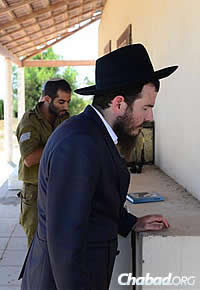 Chabad Rabbi Chaim Nochum Cunin, visiting from Chabad West Coast Headquarters in Los Angeles, prays with a soldier. (Photo: Meir Alfasi)
In Ashdod, where rocket attacks have been particularly severe, Rabbi Yosef and Chanah Friedman hosted youngsters at new a play area in their Chabad center created to give them, as well as their parents, some relief. “Some haven't been out of their homes for days, and all are thrilled to have company in a safe environment,” said Rabbi Friedman. “When the sirens blow, the children and their parents quickly go to the safe area, which is in a nearby room.”
Helping Those in the Holy Land
During the week, in synagogues and community centers, Chabad Houses, private homes and on social media—people have been discussing and dedicating themselves to different ways of helping, both spiritually and materially. Along those lines, Jews all around the globe are adding mitzvah observance in merit of the safety of the Jews in the Holy Land.
As the sages say, in times of trouble, it is important to increase Jewish commitment to prayer and mitzvot.
Over the course of last week, volunteers with the Chabad Terror Victims Project traveled to highly affected areas in the south and north, trying to help in ways they could and staying optimistic about the situation.
“We have been working nonstop,” said Rabbi Yossi Swerdlov, a representative of the Chabad Terror Victims Project, to boost morale and take people’s minds off current stressors.
 On Thursday, Rabbi Asher Pizem of Chabad of Sderot helped entertain children stuck inside all day because of the situation. Seated in front of him is Rabbi Prus of Kfar Chabad, Israel, and to Pizem's right, with the orange balloon hat, is CTVP staffer Rabbi Yossi Swerdlov. (Photo: Meir Alfasi)
Earlier this week, CTVP implemented a three-pronged emergency initiative that includes (1) organizing buses to take children to the center of Israel, out of the range of the rockets and able to have a respite from their anxiety; (2) coordinating with all of centers in the region to organize activities and visits to bomb shelters to support families; and (3) keeping up a steady stream of volunteers going to the front lines to boost the morale of the soldiers, as well as give them spiritual and physical nourishment.
Following a notification that the center of Israel was no longer considered a safe destination, the decision was made to stop busing children there. Instead, the carnival games and performers were taken south to bring a much-needed diversion to the children, right near their homes.
 Children in Sderot, close to the Gazan border and showered by rocket attacks, clutch activity bags handed out by representatives of the Chabad Victims Terror Project. (Photo: Meir Alfasi)
So on Thursday, a group of rabbis and CTVP volunteers went to hard-hit Sderot in the south with entertainers, including clowns and balloon makers. They also brought the kids games, treats and activity bags.
“We do what we can to bring happiness,” said Swerdlov.
Joining Swerdlov was Rabbi Aharon Prus of Tzerei Agudat Chabad Headquarters Israel in Kfar Chabad, Israel, and Rabbi Chaim Nochum Cunin, visiting from Chabad West Coast Headquarters in Los Angeles. They worked with Rabbi Moshe Pizem and his son, Rabbi Asher Pizem, both of Chabad of Sderot, Israel, to keep the little ones busy.
Working to Boost Morale
The group of rabbis also went to visit soldiers on the front lines and at bases. They wrapped tefillin with many of them standing beside tanks and army paraphernalia, and recited prayers for their safety. CTVP representatives also offered soldiers care packages, including food and toiletries, and spent time just talking with the men and reassuring them.
And they went out and bought pizzas to a group of reservists who follow special dietary laws above the standard kashrut of the army.
 The rabbis brought pizzas to Israeli Defense Force reservists with certain dietary restrictions beyond the kosher standards of the army. (Photo: Meir Alfasi)
Cunin recounted one particular soldier’s response to the Chabad visitors: “We sit here like it’s [the mournful day of] Tisha B’Av, and then you come along and it’s like [the joyous holiday of] Simchas Torah.”
Many Chabad communities are holding “lend an arm for Israel” campaigns—urging men and boys to don tefillin, a mitzvah the sages say strikes terror in the heart of her enemies.
 Cunin wraps tefillin with an Israeli soldier, surrounded by tanks and other military equipment. (Photo: Meir Alfasi)
In 1967, prior to the outbreak the Six-Day War, the Rebbe introduced what was to be the first of the 10 “mitzvah campaigns” (“mivtzaim”)—the campaign to don tefillin with all Jewish men.
Mirroring the Rebbe’s call, Chabad emissaries are redoubling their efforts to encourage their community members to share the mitzvah with people who may not lay tefillin on a daily basis.
And everywhere, women and girls were encouraged to light Shabbat candles.
 Chabad.org has offered a list of practical action to assist Israelis, as well as some inspiration from the Rebbe here “What Can I Do to Help Our Brothers and Sisters in Israel?”
Swerdlov, left, and Prus aboard tanks to assist soldiers wrapping tefillin. (Photo: Meir Alfasi)
________________________________________
 • Ashkelon Teen Hit by Shrapnel Begins Recovery - Prayers and psalms continue for 16-year-old Yarin Levy (By Faygie Levy)
With Hamas rockets still being hurled at Israel for the seventh straight day, Israelis found something to cheer about as Yarin Levy, a 16-year-old boy who was seriously injured yesterday in a rocket attack in Ashkelon regained consciousness this morning.
Speaking with local media, Avinoam Levy called the ongoing recovery of his son at the Barzilai Medical Center “a great miracle.”
“Yarin is an active child, a good child, a nice child and the oldest,” says Rabbi Moshe Vilenkin of Chabad Lubavitch of Ashkelon, who taught Yarin two years ago at the Ohr Menachem school there.
People across the country—and around the Jewish world, thanks to posts on social media—had been praying and performing acts of good deeds on behalf of the teenager.
Those actions were deeply personal for members of the Chabad community in the coastal city of Ashkelon, as Yarin had attended Ohr Menachem, a Chabad school there, since grade one. While he now goes to a school in Rechovot, his younger sisters and younger brother remain students in the Chabad Ashkelon schools.
According to Vilenkin, Chabad mobilized immediately upon hearing the news.
As members of the community began reciting tehillim, particularly Psalm 17, one of the local Chabad emissaries went to the hospital where Yarin was taken to meet with the family and find out if they needed anything.
Vilenkin says the family asked for people to pray and say a misheberach, a blessing for the sick.
According to Rabbi Menachem Lieberman, director of Chabad-Lubavitch of Ashkelon, the city’s Chabad emissaries have been keeping in touch with the community via What’s App. One of the more recent postings came from Itai Nagar, a former student at Ohr Menachem, who was Yarin’s “big brother” when they were in school together, said Lieberman.
“His situation has become much better. He’s regained consciousness and he is speaking a little bit with difficulty,” Nagar wrote in a message to the rabbis. “There's no question that with wonderful miracles and merit of prayers he gets stronger moment to moment. Don’t stop the prayers!”
Yarin’s recovery, says Lieberman, is just one of many miracles that people have been witnessing.
He noted that a rocket landed very close to the Ohr Chaya, Chabad’s girls’ school, shattering all the windows on one side of the building. More than 300 children from first through 12th grade attend the school.
“Hashem’s presence is felt in this unique time by everyone,” says Lieberman. “Over 800 missiles, and almost nothing has happened. There is such an awakening to do more mitzvot; it is very exciting. We feel we are in the land that Hashem’s eyes are upon us all the time.”
One of the Chabad emissaries in Ashkelon also sent a letter to the Ohel in Queens, N.Y.—the resting place of the Rebbe, Rabbi Menachem M. Schneerson, of righteous memory—about the boy and prayers for his recovery.
According to Yarin’s father, the teen had been on his way to get a haircut when the code red sirens sounded in his town, about 10 miles from the Gaza border.
Yarin told his father that he tried to get home but didn’t have enough time, so he ducked behind a wall and covered his head with his hands. The missile struck less than 100 feet from his home, with shrapnel hitting him and tearing through his chest. He was rushed to Barzilai Medical Center.
People are asked to keep praying for Yarin’s continued recovery, using his and his mother’s name: Yarin ben Mor.
Meanwhile, residents of Beersheva are hoping for a similar outcome as an elderly man sustained a serious head injury when he fell while rushing to a bomb shelter, and two girls, ages 11 and 13, were injured in a rocket attack that struck a Bedouin village near the city.
________________________________________
 • Q&A: Young Chabad Couple Settles in Under ‘Big Sky’ of Montana (By Carin M. Smilk)
Rabbi Berry and Shayna Nash—and their daughter Riva—have moved to Missoula, Montana, to serve students at the University of Montana, as well as Jewish residents and visitors in the northwestern part of the state.
At the end of May, Rabbi Berry and Shayna Nash, and their 18-month-old daughter Riva, left the Crown Heights neighborhood of Brooklyn, N.Y., and moved west—way out west. The young Chabad shluchim, or emissaries—he’s 25, she’s 24—just started Chabad of Missoula, the second such couple to serve Jewish residents and visitors in the state. They were brought on board by regional directors Rabbi Chaim and Chavie Bruk, co-directors of Chabad-Lubavitch of Montana, who serve residents and visitors to the state in Bozeman, 212 miles to the southeast, with their three children.
The Nashes are still getting situated in their rental house not far from the University of Montana in Missoula, but they took some time out to discuss their plans and goals, and how “Big Sky Country” is treating them.
Approximately how many people will you serve in Missoula and its surrounding areas?
Rabbi Berry: There are about 3,000 Jewishly-identified households in the state, with about half of them in the northwest, where we are. We have a number of contacts in Missoula and some contacts in areas outside of Missoula proper. In addition to our regular Chabad House, we’re also going to serve as the official Chabad on Campus emissaries to the University of Montana [which enrolls about 13,000 undergraduate students]. We’re here to serve and be here for everyone in the community.
The natural follow-up is: Are two Chabad centers really necessary in a state like Montana, with such a huge geographic area and such a low percentage of Jews—some estimates put it at .01 percent of the state’s population?
Rabbi Berry: Absolutely! Since 1956, the Lubavitcher Rebbe [Rabbi Menachem M. Schneerson, of righteous memory] began sending his students to Montana to reach out to the local Jews at that time. The Rebbe continued to do so many summers following Chabad’s first visit. Rabbi Chaim Bruk, our regional director, spent years visiting and working with Jewish families and individuals in northwestern Montana. He realized about two years ago that it’s time to give these precious Jews, who are growing in number, a permanent experience of Judaism. There may be more people to reach in larger cities than in our neck of the woods, but it’s not about numbers; it’s about how many we can reach. The Rebbe taught us to cherish every Jew—to teach and inspire that one Jew because he or she is a true gem.
 Riva already knows about putting coins in a tzedakah box prior to Shabbat.
What have you jump-started since you arrived, and what’s in the works?
Rabbi Berry: I started learning one-on-one with a few people and continue to offer learning for others. Many people are very interested in intellectual challenges, especially Torah, when they can identify it as a personal guide and inspiration. We recently had our first Shabbat meal, with five guests from the community—two couples and one gentleman. There are many areas to begin. We have a whole Torah with 613 mitzvot. Whatever we see that people are ready to start with, we are determined to give. Everyone has interests and a desire to grow, and we are here to provide the water.
What has it been like in Montana so far?
Shayna: It’s been really great, actually. It’s a very warm, welcoming place. Everyone we’ve met has been so friendly and helpful, offering information and tips for all sorts of random things.
What are you planning in terms of women’s programming?
Shayna: That will depend on the needs and the wants of the women I meet. I have been super busy getting the house up and running for now. Every day I’ve been adding a little more to make it a comfortable Chabad House—and a home. I have already been in touch with some women though, and I am looking forward to getting to know more out here and building relationships. We also have to think about a mikvah. There’s one in Bozeman, but that’s three hours away.
Are you both from a line of Chabad families?
Shayna: Both sets of our parents became Chabad as young adults. I have some siblings who are on shlichus, though in my husband’s family, he’s the first. He’s beginning a legacy.
 Shayna Nash talks to a house guest as she prepares the candles, wine and other necessities for Shabbat.
Where do you purchase your kosher food?
Shayna: The regular stuff I can get at local supermarkets. There’s a Costco here, Safeway, Albertsons and the like. Our dairy and our meat products need to be shipped in.
Rabbi Berry: Freezers, here we come!
What are some of your specialty dishes—the foods you make for Shabbat dinners and holidays?
Rabbi Berry: She makes the best challah, the best food!
Shayna: I made salmon with sautéed mushrooms and onions for our first Shabbat dinner, as well as some traditional foods, like chicken soup.
What are some of the specific challenges you will face, Montana being so different from New York?
 A printing of the Tanya for use at the Chabad House
Rabbi Berry: Everyone going on shlichus has challenges. Chinuch [education] for our child, Riva, will be a challenge, for sure. The fact that there is a smaller Jewish population here may be more difficult, but every person counts. Every act makes a difference. We were very impressed with Rabbi Chaim and Chavie Bruk, who started the first Chabad center here. We had a very inspirational Shabbos with them when we first considered moving here, discovering that people are looking and interested in more than we can imagine.
You traveled back east late last month to attend the Chabad on Campus International Conference, held in Rye, N.Y. What did you take away from that experience?
Rabbi Berry: It was absolutely amazing, being with a family of shluchim who all work on campus. We learn from each other, sharing ideas on personal life, on shalom bayit [peace in the home], on how to file tax papers with the government in the most professional way, on how to daven [pray] better—on every aspect of the challenges of shlichus. Besides the inspiration that it gives and the new friends you meet, it’s amazing to think that any guest you have at your Shabbat table joins the 10,000-plus guests at Shabbat tables on more than 200 Chabad on Campus centers around the world.
 Rabbi Nash toivels kitchen items in O'Brien Creek, which flows into the Bitterroot River. Before most types of dishes, pots and other utensils are used, the Torah requires them to be toiveled, ritually immersed in a mikvah or flowing body of water.
________________________________________
 • International Conference Fosters Expertise for Friendship Circle (By Faygie Levy)
Mother and blogger Sheva Givre leads a session on what parents want from Jewish organizations like the Friendship Circle at the international conference, this year held in Livingston, N.J.
What can you do with a plain white sock, some cotton swabs, a swath of bubble wrap and a box of raisins? How can you make volunteering opportunities more meaningful for teenagers? What do parents of children with special needs require from an organization that provides programming for their youngsters?
Those were just some of the questions raised last week during a two-day international conference for directors and staff who run the Friendship Circle, a Chabad-Lubavitch network of 87 independently operated programming organizations worldwide for children and teens with special needs and their families. This year’s event, attended by 65 people, was held at the Friendship Circle in Livingston, N.J., the day after the 20th yahrtzeit of the Rebbe, Rabbi Menachem M. Schneerson, of righteous memory.
Participants relayed insight into the Rebbe’s outlook on how to include children with special needs in communal life. They also discussed best practices for providing beneficial programs for children and teens with special needs.
Among the dozens of participants from across the country who attended the conference were Chanie and Naftoli Minkowitz. The parents of an 18-month-old son, they are planning to move next year to Sharon, Mass., to energize an existing Friendship Circle there, where Chanie Minkowitz had worked before she got married.
According to Minkowitz, a benefit of attending is the ability to “get in touch with shluchim [emissaries] that have a Friendship Circle, and see what programs they are doing and what is successful.”
”You gain the energy, passion and logistics to do it properly,” she adds.
Bentzion Groner, executive director of Friendship Circle International, says “when we come together as a group and unite and share our ideas, it creates a powerful vision of what we want our Friendship Circle to look like, what we want our communities to look like, and how we want our participants to grow and live a more meaningful life.”
Topics at this year’s conference included discussions on optimizing computer software, efficient fundraising practices, and how to engage and retain donors and volunteers.
Attendees also come to hear words of advice and strength from Bassie Shemtov, who along with her husband, Rabbi Levi Shemtov, created the first Friendship Circle in West Bloomfield, Mich., in 1994. Neither had any idea that the program would ever go beyond the state’s borders.
 A valuable exercise: What can you do with a plain white sock, some cotton swabs, a swath of bubble wrap and a box of raisins?
“There was no big plan, no big thinking,” explains Bassie Shemtov. “We really just put one foot in front of the other” as shluchim of the Rebbe—Rabbi Menachem M. Schneerson, of righteous memory. That it’s grown into what you see now, she continues, “is exciting, inspiring and fun to be part of. It’s the Rebbe’s army, and the Rebbe is leading it. I don’t look at it as something I did.”
If there is one area that best illuminates how far the Friendship Circle has grown, it’s been the creation of the Friendship Circle International office. In addition to offering online training classes for staffers—and printed materials like customizable fliers, calendars and more—it has also developed a number of activity kits for volunteers to use when working with children with special needs, including the aforementioned cotton swab, sock and raisin activity pack. (The pack comes with a mini booklet and suggestions of things to make, but the children and volunteers can come up with their own creative ideas on what to do with it all.)
 In addition to providing training and printed material, the Friendship Circle International office also provides activities like this puzzle to Friendship Circles around the world to help break the ice between teen volunteers and the children they are partnered with.
One thing that hasn’t changed over the years is the Friendship Circle’s initial concept of teenage volunteers.
‘Everyone Leaves Invigorated’
That may explain why many at the conference were drawn to a discussion about the role of teens in the Friendship Circle, led by Devora Krasnianski, an educational consultant who also runs Chabad’s Early Childhood Education Network. During her talk, participants discussed a wide range of topics—from the benefits of weekend retreats for the volunteers to how to make the program more interactive for teens.
The main point of the session, however, was to create a structure for teenagers to engage in making a real difference for the special-needs community during the years they are involved and then beyond, when they are adults in leadership positions.
 Educational consultant Devora Krasnianski delivers a talk on engaging teenage volunteers.
Another motivating speaker was blogger Sheva Givre, whose daughter Rozie has Down syndrome. Calling the Friendship Circle top-notch, she relayed concerns brought to her by other parents. Givre advised the group to “see children for who they are” and to use appropriate wording when referring to a child with special needs, as well as “not to refer to people by their diagnosis.”
At the end of the day, the conference seemed to instill in participants a renewed sense of mission and purpose.
“Networking with other Friendship Circles—and sharing experiences and best practices—is invaluable,” says Rabbi Zalman Grossbaum, who runs the Friendship Circle in Livingston with his wife, Toba.
 The Grossbaums organized the first few conferences; more recently, however, it has been held in other cities. “Although each Friendship Circle is run independently, we utilize multiple networking solutions to constantly stay in touch and share ideas. The conference brings all of those energies together, and everyone leaves invigorated.”
Rabbi Levi and Bassie Shemtov at a Friendship Circle event in 2012. The couple is thrilled with how the organization has progressed and how it has touched so many lives.
________________________________________
 • Torah Scroll to Honor Rabbi Dr. Jacob Immanuel Schochet (By Mindy Rubenstein)
A special Torah scroll has been commissioned to honor the memory of Rabbi Dr. Jacob Immanuel Schochet, who impacted the lives of thousands of Jews during his life through his teachings, writings and lectures around the world.
A special Torah scroll has been commissioned to honor the memory of Rabbi Dr. Jacob Immanuel Schochet, who impacted the lives of thousands of Jews during his life through his teachings, writings and lectures around the world.
Schochet, a Chabad scholar and academic—and a preeminent defender of traditional Jewish belief—passed away on July 27, 2013, following a long illness. He was 77 years old.
The first yarhtzeit (anniversary of passing) will fall on Aug. 16, on Shabbat—on the 20th day of the Hebrew month of Av, 5774. Schochet’s community plans to join together in the commemoration of the first anniversary of his passing with the completion, dedication and celebration of a special tribute Sefer Torah (Torah scroll) the next day, on Sunday, Aug. 17, at Congregation Beth Joseph Lubavitch in Toronto.
“The writing of a Sefer Torah is a singular unifying mitzvah,” said one of his sons, Rabbi Yitzchok Y. Schochet with Mill Hill United Synagogue in London. “My father committed his life to the ideal of unity—ahavat Hashem [love of G-d] and ahavat Yisrael [love of the Jewish people]. It is indeed a most fitting tribute.”
The Schochet family—the rabbi, his wife Jettie and their four children—has long been part and parcel of the Ontario Jewish community. The rabbi lived there for more than 60 years until his passing. In addition, Rabbi Dovid Schochet, the rabbi’s brother, has served as rabbi of the Chabad-Lubavitch community in Southern Ontario since 1957.
‘Available for Anyone’
From 1952 to 1959, Schochet attended the central Chabad-Lubavitch Yeshiva, Tomchei Temimim in Brooklyn, N.Y. In 1959, he became rabbi of the Kielcer Congregation in Toronto and served in that capacity until 1996. Subsequently, he served as the rabbi of Congregation Beth Joseph Lubavitch in the same city. He served as professor of philosophy at Humber College in Toronto from 1971 to 1996; as professor of Jewish philosophy, law and mysticism at Maimonides College, Toronto, from 1980 to 1990; and as adjunct professor of medical ethics at University of Toronto School of Medicine from 1983 to 1987.
He wrote 35 books, mostly on the history and philosophy of Chabad Chassidism.
And yet, said Rabbi Zalman A. Grossbaum, executive director of Chabad Lubavitch of Ontario, “Rabbi Schochet found common ground with scholars and the average man on the street. Notwithstanding his scholarship and publishing deadlines, Rabbi Schochet was always available for all and anyone who called on him.”
“Every Jew corresponds to a letter in the Torah, reflecting the paramount importance of each and every person,” added Grossbaum. “Hence, a Torah dedication in his honor is certainly a fitting tribute.”
The upcoming dedication ceremony will include the completion of the last letters of the Torah scroll, a community walking escort of the Torah, a chupah procession, crowning ceremony, music and dancing, and light buffet and refreshments.
“Some of the replies we are getting from people say he was so well-spoken and such a great person,” said Mrs. Jettie Schochet. “I meet people and they say, ‘I really want to participate.’ It’s giving others an opportunity to say thank you for all you’ve done for me and for the Jewish world at large.”
Chabad.org is host to many lectures, essays and even complete books by Rabbi Schochet, who in addition served as a rabbinic consultant to the Chabad.org editorial team.
The Ontario Chabad community notes that sponsorship opportunities are available for the Torah scroll. For more information on the dedication ceremony and sponsorship, visit www.bethjosephchabad.com.
________________________________________
LIFESTYLES
 Double Chocolate Fudge Brownies
Possibly the very best brownie you will ever eat... Every time I make these I'm hailed as the Mighty Dessert Queen! by Miriam Szokovski
It's a cake, it's a cookie... it's a brownie! But not just any brownie. Possibly the very best brownie you will ever eat.
Seriously. Every time I make these I'm hailed as the Mighty Dessert Queen. But cast away your jealousy, for you, too, can earn the title of Dessert Royalty with this recipe (provided you don't show up with it at the same time I do!). Should that happen, alas, I will have to banish you from the Sweet Kingdom and label you eternal Dessert Dunce. Apologies in advance.

All kidding aside, these brownies will make you very, very popular, very, very quickly (unless someone has a nut allergy; then you might be in trouble). And they're not hard to make.

The chocolate chips are an important component of this dish, because they provide the chocolate flavor in the batter, and they're folded through with the nuts. So I strongly suggest you buy really good quality chocolate.
Melt 1 cup of chocolate chips and the butter/margarine over a double boiler. You can make a double boiler with a pot and a bowl, as pictured. Put an inch or so of water in the pot, put the bowl on top. The bottom of the bowl should not be touching the water, so use a smaller pot and a slightly bigger bowl. Put the chocolate chips and margarine in the bowl, turn the heat on and wait for it to melt.

When fully melted, take the bowl off and stir in the sugar. Add the eggs, vanilla and salt and mix. Stir in the flour and baking powder until batter is smooth. Stir in the other cup of chocolate chips and the nuts.

Pour the batter into a greased 10 x 10 square pan, or a 9 x 13 rectangle pan. Bake on 350 for 30-40 minutes. Let the brownies cool before cutting.

While they're baking, take your favorite arm chair and decorate it with balloons and streamers so you'll have a throne upon which to accept your Dessert King/Queen coronation. Congratulations!
Alternatively, you could spend that time coming up with the ultimate hiding place so you don't have to share them. (Hint: No one ever looks in the tool box!)
Serve with a scoop of ice cream, or just plain. For breakfast, lunch, dinner or any time in between.

Ingredients:
8 Tbsp. margarine
2 cups chocolate chips, divided
1 1/2 cups sugar
3 eggs
1 tsp. vanilla
1 tsp. kosher salt
1 1/4 cups flour
1/2 tsp. baking powder
1 cup pecans
Directions:
 Melt 1 cup chocolate chips with the margarine, until smooth.
Stir in the sugar, eggs, vanilla and salt until incorporated.
Add the flour and baking powder, mix until smooth.
Fold in the pecans and the other cup of chocolate chips.
Pour the batter into a 9 x 13 rectangle pan, of a 10 x 10 square pan. Bake on 350 for 30-40 minutes.
What's your signature over-the-top decadent dessert?
________________________________________
More in Lifestyles:
• Yonati Behagvey Hasela (By Hila Ben Itzhak)

Artist’s Statement: Israel is comparable to a dove.
________________________________________
17 TAMMUZ
 17th of Tammuz: History, Laws and Customs
The Day Jerusalem’s Walls Were Breached
The fast of the 17th of Tammuz commemorates five tragic events that occurred on that date, as far back as the times of Moses . . .
The fast of the 17th of the Hebrew month of Tammuz, known as Shivah Asar B’Tammuz, is the start of a three-week mourning period for the destruction of Jerusalem and the two Holy Temples.
The fast actually commemorates five tragic events that occurred on this date:
Moses broke the tablets when he saw the Jewish people worshipping the Golden Calf.
During the Babylonian siege of Jerusalem, the Jews were forced to cease offering the daily sacrifices due to the lack of sheep.
Apostomos burned the holy Torah.1
An idol was placed in the Holy Temple.2
The walls of Jerusalem were breached by the Romans, in 69 CE, after a lengthy siege. (Three weeks later, after the Jews put up a valiant struggle, the Romans destroyed the second Holy Temple on the 9th of Av.)
The Jerusalem Talmud maintains that this is also the date when the Babylonians breached the walls of Jerusalem on their way to destroying the first Temple.
Practically speaking:
Healthy adults—bar- or bat-mitzvah age and older—abstain from eating or drinking between dawn and nightfall. Click here for exact times in your location.
Pregnant and nursing women may not have to fast. Someone who is ill should consult with a rabbi. Even those exempt from fasting, such as ill people or children, shouldn’t indulge in delicacies or sweets.A fast day is an auspicious day, a day when G‑d is accessible, waiting for us to repent
It is permitted to wake up early before the fast begins and eat, provided that prior to going to sleep one had in mind to do so.
During the morning prayers we recite selichot (penitential prayers), printed in the back of the prayerbook. The “long Avinu Malkeinu” is recited during the morning and afternoon prayers.
The Torah is read during the morning and afternoon prayers. The reading—the same for both morning and afternoon—is Exodus 32:11–14 and 34:1–10, which discusses the aftermath of the Golden Calf incident, how Moses successfully interceded on the Israelites’ behalf and attained forgiveness for their sin. After the afternoon Torah reading, the special fast-day haftarah, Isaiah 55:6–56:8, is read.
During the Amidah prayer of the afternoon service (Minchah), those who are fasting add the paragraph Aneinu in the Shema Koleinu blessing. (It is also added in the cantor’s repetition of the Amidah in both the morning and afternoon services, as its own blessing between the blessings of Re’eh and Refa’einu. Additionally, the priestly blessing is also added in the repetition of the Amidah in the afternoon service.
If the 17th of Tammuz falls on Shabbat, the fast is postponed until Sunday. Click here for more about this Shabbat.
Abstaining from food and drink is the external element of a fast day. On a deeper level, a fast day is an auspicious day, a day when G‑d is accessible, waiting for us to repent.
The sages explain: “Every generation for which the Temple is not rebuilt, it is as though the Temple was destroyed for that generation.” A fast day is not only a sad day, but an opportune day. It’s a day when we are empowered to fix the cause of that destruction, so that our long exile will be ended and we will find ourselves living in messianic times; may that be very soon.
FOOTNOTES
1.Historians have long debated when this occurred: some maintain that Apostomos was a general during the Roman occupation of Israel, while others contend that he lived years earlier and was an officer during the Greek reign over the Holy Land.
2.This event is also shrouded in controversy: some say that this too was done by Apostomos, while others say that this was done by King Manasseh of Judea.
________________________________________
More in 17 Tammuz:
 • Mommy Come Home (By Elana Mizrahi)
“Mommy, I want you home now. I want you here,” my youngest demands. “Mommy, are you coming home again?”
The sweet and simple question of my three-year-old makes my heart ache. “Of course. I will be home in two days.”
The answer doesn’t appease him, nor does he understand that I already have my return ticket home. “Mommy, I want you home now”Two days, a week, a month. Time means nothing to him. He doesn’t know the difference. And seeing me on Skype confuses him. We have no television or videos in our home. He doesn’t understand where I am, or how he can get a glimpse of me and not be with me. He doesn’t understand how I am in constant contact with him. My physical presence is not with him, but I am thinking about him and still with him—still very much connected to him, just not in the same tangible way.
It’s the first time I’ve left home, left my children, for a week-long course that will give me a tremendous amount of skills and tools to use in my practice. I felt that the one-week separation was worth it, but I am surprised by the reactions of my children, especially the youngest one. I am also surprised by how much I miss them!
I left everything ready, food cooked and frozen, a calendar of events, careful instructions for my husband, and clothes freshly laundered and put away. Knowing how much my children are close with and adore my husband, and given that all their needs were taken care of, I didn’t even think that they would miss me. To my delight, I was wrong! There is nothing like the feminine presence of a mommy.
I wish that I could put into words exactly what that presence is, but I can’t. If I close my eyes, I think of warm soft arms, a full belly, a soft shoulder, a sweet smell. I see a woman doing what only her body is capable of doing—nursing her baby. It’s not that my husband isn’t nurturing or soft. I rest assured knowing he gives them loving hugs and kisses, but he’s not mommy.
When the Holy Temple was destroyed, we didn’t just lose our physical place of national worship and service to G‑d. We lost that closeness, that physical contact with the Shechinah, the feminine attribute of G‑d—our “Mommy.”The phone calls and Skype aren't enough
We wake up in the morning, we breathe, we eat, and everything we need is prepared and provided for us. We do connect, and we do learn Torah and pray. We receive hugs and kisses, but we lack, we miss, we yearn for Mommy.
The phone calls and Skype aren’t enough. As the years go by, we begin to doubt. Will the Shechinah really come home? Will there really be a redemption? Will the lack ever be filled? Will we once again have that closeness, the closeness of a baby suckling at its mother’s breast? The child may doubt it, but I must tell you, from the perspective of the mother—it will come. She never forgets. She never stops thinking, never stops worrying, about Her children. Her love is unconditional. In fact, when we went into exile, She insisted on coming with us. She can never really part from us, and when the final redemption comes, She will reveal Herself to us. Her presence will be once again be tangible to us, and together with Her, we will all return home.
________________________________________
No comments:
Post a Comment