Editor's Note:
Dear Friend,
The first day of school . . . smiling children proudly wearing their freshly cleaned backpacks full of brand-new pencils, crayons and spiral notebooks.
As the new school year kicks off, there’s a message in this week’s Torah portion that says how to approach the task of raising children.
When bringing the first fruits, the bikkurim, to the Holy Temple in Jerusalem, our ancestors would recount G d’s kindness in taking us out of Egypt, saying that He heard our voices and saved us from “affliction, toil and oppression.” “Our toil—these are the children,” says the Midrash, alluding to G d’s alleviation of the Egyptian persecution of bnei Yisrael’s children in particular.
The Midrash provides no proof for why the words “our toil” allude to our children—because such proof is entirely superfluous! Raising children takes hard work, “toil.” This is true not only of raising our own children, but also of educating and nurturing students, whom the Torah refer to as one’s children (see Deuteronomy 6:7 and Rashi).
Let’s keep this in mind and determinedly resolve to do what it takes. When we invest ourselves to a point that can rightfully be called “toil,” we can be confident that G d will make the seeds of our efforts bear fruit—students and children who, like the beautiful bikkurim, will give us much delightful nachas, Jewish pride, for which to be thankful.
Baruch S. Davidson,
on behalf of the Chabad.org Editorial Team
____________________________
Daily Thought:
Natural Response
There is an easy path to fulfill the Torah. Not by forcing yourself, not by convincing yourself, but by achieving awareness:
A constant awareness that all you see and hear—the wind that strokes your face, the pulse of the heart within your bosom, the stars in the heavens and the earth beneath your feet, all things of this cosmos and beyond—all are but the outer garments of an Inner Consciousness, a projection of His will and thoughts. Nothing more than His words to us, within which He is concealed.
And the Master of that consciousness speaks to you and asks you to join Him in the mystic union of deed and study.
In such a state of mind, could you possibly choose otherwise?(Tanya, part 1, chapters 21 and 41)
____________________________
This Week's Feature:

|
Coming Alive
by Shimon and Chaya
Dubinsky
|
 |
One of the most celebrated days on the Chabad calendar is the eighteenth of Elul, Chai Elul. It is the birthday of both the Baal Shem Tov, founder of the chassidic movement, and Rabbi Schneur Zalman, known as the Alter Rebbe, founder of the Chabad movement. Yet it was not until the sixth rebbe of Chabad, Rabbi Yosef Yitzchak, that the day became publicly celebrated. He himself learned of its significance when his father greeted him on that day with “Good Yom Tov”—the traditional greeting for a Jewish holiday.
In the following discussion, the Rebbe, Rabbi Menachem M. Schneerson, delves into a seemingly simple question: What is so special about a birthday? And what is its connection specifically with the Baal Shem Tov and the Alter Rebbe?
The Rebbe goes on to analyze the idea of a birthday, and points out the uniqueness of these two birthdays. The Rebbe also teaches us a lesson we can take from this special day, and how we can experience “being born” in the mission we have been assigned in our life.
Doubling the Joy
It’s not as though there is no mention of birthdays in Torah. The rabbis point out that the Jewish people were saved from Haman’s decree in the month of Adar because that was the month in which Moshe was born. And then there is the story of the Mishkan and Yitzchak’s birthday:
It was the end of the month of Adar, almost a year after the exodus from Egypt. For months the Jews had collected materials, woven curtains, and hammered silver, copper and gold. On the 23rd day of the month, they first assembled the structure they would call the Mishkan, which means “place of dwelling,” because there the Shechinah, G‑d’s presence, would reside.
The Shechinah, however, was not yet to arrive. The Jews would erect and dismantle the Mishkan each day for the next seven days before the Shechinah filled its home on the eighth day, on the first of the month of Nissan. Why did they have to wait eight more days to see the reward for their labor? The Mishkan was constructed exactly the same way on the first day as on the eighth! The Midrash explains that G‑d wanted to merge the joy of the Shechinah entering the Mishkan with another celebration: the birthday of our forefather Yitzchak. This was on the first of Nissan, and that is why the Shechinah waited.
Now, this leaves us with a question. Is a birthday really such a reason to celebrate, that the entire Jewish nation should wait seven additional days, so that the Shechinah arrived specifically on Yitzchak’s birthday?
What Is So Special About a Birthday?
When seen from the baby’s perspective, his or her birthday might not be a happy day at all. For nine months he is cocooned in a safe, warm environment. All the nutrients he needs are fed to him directly from his mother, and he lacks nothing. The minute this tiny human being emerges into the world, he cries and hollers as he greets his new environment. It is cold in the winter months and hot in the summer. Sometimes he will be hungry, or tired, and he will cry to his mother for care.
The spiritual environment of the baby changes, as well. The Talmud describes the fetus’ experience during the nine months of gestation:
A candle is lit over his head, and he gazes and sees from one end of the world to the other. They (the angels) teach him the entire Torah . . . When he enters the atmosphere of the world, an angel comes and taps him on his mouth, and makes him forget the entire Torah.—Niddah 30b
Throughout his life, this same person will attempt to relearn all that Torah, spending countless hours over its holy pages. It is most likely, however, that he will not succeed in remastering what was taught to him in his mother’s womb.
Our question is now stronger: Why do we celebrate the day of birth? Why is the day the child was introduced to a spiritually and physically harsh world a day to rejoice?
Let’s examine birth from three different angles. Not only will we answer why birth is a celebrated occasion, we will see its reflection in a spiritual birth, of becoming spiritually alive.
Step 1: Coming Alive
As long as he has not entered the world’s atmosphere, he is not a living soul.—Rashi, Sanhedrin 72b, s.v. yatza rosho
Before it is born, the fetus develops all of its limbs and organs. They are fully functional, and the fetus can move around and use its senses to feel, hear, and even smell. Still, the Torah does not consider the unborn fetus to be a living being. True, it has already been given a soul, but it is like a seed locked in its shell. The fetus’ vitality comes not through its own soul, but through its mother. Through her comes food and nourishment, a heartbeat and life.
When the baby emerges, breathing in the atmosphere for the first time, something miraculous happens. Its soul breaks through its encasement and floods the body with its vitality. Now the soul is one with the body. The baby is a separate, alive being; and so, upon birth, the world celebrates the arrival of a new life.
Therefore we will rejoice in the words of Your Torah and in Your commandments forever and ever. For they are our life and the length of our days, and we will delve into them day and night.—Blessings of Shema, evening prayers
Just as a human being needs a soul to fill it to be alive, a Jew needs Torah and mitzvahs to spiritually charge. Without their energy, we are spiritually lifeless. We can, however, unite with the Torah in either of two ways. One manner is similar to a fetus, whose soul is detached from it. The other is similar to a person once born, whose soul has now entered within.
In the first case, you might even learn Torah and do its mitzvahs devotedly, enthusiastically. You could feel the surge of life; you feel inspired by the Torah. The only problem is that it hasn’t become your entire being, your identity. It hasn’t become your own. Just like the fetus: its life is not its own; it is its mother’s. If at the end of the day you come home from Torah learning, sit on the couch and say, “Finally, some time for myself,” then the Torah hasn’t become a part of you.
The second way of experiencing Torah and mitzvahs is compared to birth. What is spiritual birth?
Here, the first of the two great masters born on Chai Elul gives us insight:
The Baal Shem Tov introduced and focused on a revolutionary concept. The idea is expressed in the Baal Shem Tov’s explanation of the following verse:
You shall know today and establish in your heart that G‑d is the L‑rd . . . there is no other besides Him.—Deuteronomy 4:35
The Baal Shem Tov explains that this doesn’t just mean that there is only one G‑d. It means that there is only one real existence. There is no other: there is nothing else that exists, apart from Him. True, we find many things in the world which don’t seem G‑dly, but they too were created to fulfill G‑d’s desire. G‑d wanted His commandments to be fulfilled in this physical world, and for that He created the physical body, through which the spiritual soul can perform a mitzvah.
When you throw yourself into Torah and its mitzvahs with this mindset, there can’t be two entities—a person, and the Torah and mitzvahs you’re busy with. Rather, there is only G‑d, and His Torah and mitzvahs, which are one with Him. When you are learning Torah or doing a mitzvah, that becomes your life and soul, so that you too are absorbed in that oneness.
This is “being born” in Jewish practice: When you stop being a person who does Judaism, and start being Judaism. This is just like when the baby is born and the body and soul unite. They are so merged that we refer to them as if they are a single being. We don’t say “my head thought” or “my feet walked”; we say “I walked” and “I thought.” The thing that is called “I,” the soul inside, which is the core of the human, used the feet as a tool because it wanted to walk, and used the head because it chose to ponder on an idea, but they are one.
When a Jew does a mitzvah with the Baal Shem Tov’s mindset, he knows that his body is only a tool, employed to carry out G‑d’s commandments in the physical world, but these tools are one with their purpose: to practice Torah and its mitzvahs.
Step 2: Learning the Limbs
Being alive is not enough. The second thing that birth accomplishes is that now all the baby’s limbs and organs begin to fully function.
The Baal Shem Tov breathed a whole new charge of life, joy and enthusiasm into Jewish practice. But that new vitality was concentrated in the all-encompassing faith of the Jew.
The Alter Rebbe, the second chassidic master born on Chai Elul, taught us to see the life within each individual detail. He showed that not only does everything have one universal purpose—to serve its Creator—but that since everything is continually created by G‑d, with the unique G‑dly energy necessary for that particular thing, it must have a life and purpose of its own too. Therefore, the Alter Rebbe concluded, every energy and talent, indeed every action, must express its unique purpose of creation by serving G‑d in its unique way. The mind, for instance, must be used to understand G‑dliness as much as possible. Furthermore, it must appreciate the G‑dly presence in this world.
Now that the mind becomes alive, it affects the heart and the emotions. The emotion of love, for instance, feels that the reason G‑d created love is to love G‑d. The emotion of fear, and all the rest of the emotions, also become spiritually alive, expressing their unique role in G‑dly service.
Together, the Baal Shem Tov and the Alter Rebbe gave us the manual for a complete spiritual birth, so that we can become one with our Torah and mitzvot, and channel that spiritual life into each specific limb, so that each limb can be alive in its own right, and serve its specific purpose.
A Heavenly Teaching
On Friday night, Chai Elul 5652 (1892), the Rebbe Rashab’s soul visited the heavens. There he met the Baal Shem Tov, who taught him seven lessons. The first, he taught him after the first Shabbat prayer on Friday evening. The Baal Shem Tov took a few verses from the Torah and translated them in the classical chassidic view, as lessons in the service of G‑d.
It will be, when you come into the land which the L‑rd, your G‑d, gives you for an inheritance, and you possess it and settle in it, that you shall take of the first of all the fruit of the ground which you will bring from your land, which the L‑rd, your G‑d, is giving you. You shall put [them] into a basket, and go to the place which the L‑rd, your G‑d, will choose to have His Name dwell there.—Deuteronomy 26:1–2
The Hebrew word for land, eretz, is derived from the same root as the word “desire,” ratzon. The Baal Shem Tov interpreted the verse as follows: When a Jew “comes to desire”—when he is inspired by a strong urge to connect with G‑d—this is in fact an inspiration from above, a gift which “your G‑d gives you for an inheritance.”
What happens next? “And you possess it and settle in it.” Don’t let it be an inspiration that evaporates quickly because it did not become integrated within you. Settle it in you; “put them into a basket.” Let yourself internalize this inspiration, and have it penetrate your mind and heart so that it can change your life and have an everlasting effect.
It’s not a coincidence that the Baal Shem Tov chose to teach this to the Rebbe Rashab specifically on Chai Elul. With this instruction, he hinted to the theme of the day, and the reason the two great masters were born on that day: the necessity for inspiration in Judaism, to become “alive,” and the next necessary step of channeling it into the mind and heart.
Step 3: Making a Difference Around You
The Baal Shem Tov took the verse in Deuteronomy a step further. He taught: When you are struck with this inspiration to reconnect to G‑d, and you allow that inspiration to resonate in your mind and heart, that inevitably leads to an additional step—the third step of birth:
A baby is born, and she immediately begins to affect her surroundings. Her smile brightens everyone’s day. Her presence alone makes her mother rejoice. When she opens her eyes, or wiggles her toes, everyone who sees claps and celebrates. This is just the beginning of the baby making her difference in the world—a feat that can be accomplished only once she is born.
Spiritually speaking, as well, you know you’re alive when your presence makes a difference. This, explained the Baal Shem Tov, is hinted in the end of the second verse: “and go to the place which the L‑rd, your G‑d, will choose to have His Name dwell there.” Wherever you might travel, don’t think you are there just for business or for a vacation. G‑d directs every move that we make, bringing us wherever we are for a specific reason. The true reason you find yourself wherever you might be is because this is the place which G‑d chose to have you visit. The reason G‑d leads you to this place is to have His name dwell there: you are there to make G‑d known in that place, by speaking some words of Torah and by doing a mitzvah.
Just as that little baby began affecting her surroundings as soon as she was born, so will you transform the world once you achieve a spiritual birth. When you “come to the desire,” the desire to connect to your G‑d, and you take that desire and “put it into a basket,” you will then appreciate that every place you come to is destined by its Creator to be filled with G‑dliness—by you.
The Ultimate Birthday
Exile is compared to a pregnancy. The redemption days of Moshiach, which will be soon in our times, is compared to birth.—Torah Ohr, Va’eira 55a
Chassidic writings teach that the ultimate “spiritual birthday” will take place only in the future redemption: “Exile is compared to pregnancy, and redemption is compared to birth.”
Why is exile compared to pregnancy? Because just as the fetus’ brain does not function fully, in the time of exile our understanding of G‑dliness is limited. Compared to the vision in the days of the Temple, we are blind to G‑dliness. Only when Moshiach takes us out of exile will we open our eyes once more. In addition, the awareness that there is nothing but G‑d Himself will be realized in its completion in the future redemption. The true purpose of every being will come to light, and we will all see that G‑d is the only One.
May we merit the arrival of Moshiach quickly in our days, now.(Based on Likkutei Sichot, vol. 24, Chai Elul.)
____________________________
|
On
the Calendar
|
||
|
As any relationship
expert will tell you, while the “grand gesture” is certainly the first step
to rectifying a relationship, it cannot end there. by Nechama
Rubinstein
A husband and wife have been married for many years. They have been growing distant of late. They speak less and less, and there are days when they barely utter a word to one another. Hectic work schedules, carpools, and a barrage of extracurricular activities for the kids keep them overscheduled and harried. Date nights have become virtually nonexistent, and family dinners are accompanied by the sound of smartphones chirping with incoming messages. Date nights have become virtually nonexistentThe wife feels constantly judged by her husband, and he, in turn, becomes even more distant. The husband does his thing—his wife does hers.
One day, the wife comes home to find a handwritten note on the kitchen table. “Meet me in the garden,” it says. She notices her husband has left his phone next to the note.
She sets down her purse and her own phone, and walks over to the back door. When she opens it, she sees her husband standing in the yard. In one arm he holds some flowers he’s picked from the garden. The other arm is extended towards her. The look on his face is one of love mixed with regret.
The wife feels her heart flutter. She must admit, she’s moved. It has been ages since she’s felt loved. Does she cross the threshold and go to him, or does she turn to go inside and shut the door behind her?
The Grand Gesture
Her husband has just made the first move, which he hopes will inspire his wife’s love in return. Similarly, G‑d reaches out to us. This is what is known in chassidic thought as an “awakening from Above” (itaruta dil’eyla). This type of Her husband has just made the first move“gesture” from G‑d is often associated with signs, miracles and wonders—great testimonies to G‑d’s presence that invoke awe.
But as any relationship expert will tell you, while the “grand gesture” is certainly the first step to rectifying a relationship, it cannot end there.
Half a Loaf of Bread
No relationship can flourish one-sided. If one person gives of himself wholly and completely, and the other lives within walls, guarded and remote, the relationship is doomed to fail. As the saying goes, “Some say that one-sided love is better than none, but like half a loaf of bread, it is likely to grow hard and moldy sooner.”
We all have our reasons for building emotional walls. Past wounds and regrets may make us feel the need to protect ourselves from future emotional assaults. But for a relationship to be pure and true and honest, we must work to break down our walls and connect with one another completely.
We must also accept that our actions have a direct effect on our partner. We live not alongside one another, but in a symbiotic relationship. We are dependent on each other.
It is the same with the relationship between man and G‑d. We may view ourselves as separate, whether we blame G‑d for our past pains or refuse to believe that our actions can, and do, affect the Almighty.
G‑d is steadfast in His love of man. It is we who may stray.
And this brings us to the next form of spiritual awakening, one that comes from within.
The Real Work: Built from the Ground Up
The second kind of awakening comes from within a person himself. While it may initially be a response to divine inspiration, the “arousal from below” (itaruta dil’tata) is, in essence, initiated by mankind. It is the desire to change, brought about by a recognition that “something’s gotta give.”G‑d is steadfast in His love of man
This is where the hard work begins. This is where we work on ourselves—our actions, words and thoughts within our relationship.
So, if we view this in the context of our husband and wife above, the husband has made the grand gesture (itaruta dil’eyla) in hopes of inspiring his wife. Even if she is moved to open her heart to him, however, that inspiration will not last. She must use that inspiration as a springboard to further work on the relationship, ensuring that the inspiration endures.
In the Field: A Place Without Boundaries
Rabbi Schneur Zalman of Liadi, the founder of Chabad, explains that during the year, G‑d is like a king in His palace. He is secured behind walls and perched upon His throne, and we must seek permission to enter and approach Him. This is normally achieved through our service of the heart, our prayer.
But once a year, the King of kings leaves His palace and comes out into the field to meet His subjects. This time, it is He who makes the first move.
Why does G‑d meet man in a field? A field is an expansive place without boundaries, walls or distractions. It is a place where G‑d can communicate with man freely, and man can communicate back without inhibitions.
This brings us back to our husband standing in the garden. He did not wait for his wife in the living room or the kitchen. He asked her to meet him in the backyard, removed from their house full of distractions.
One Step
So, Will she be able to open up once again to love?what of the wife in the opening story? How does she respond to the grand gesture? Has her heart turned to stone,1 or will she be able to open up once again to love?
We can ask the same questions of our relationship with G‑d. Sadly, during the year we can grow distant from the Master of the Universe, seeing Him as an aloof ruler removed from our daily lives. But once a year, during the Hebrew month of Elul, the Holy One comes out into the field and beckons us near in an “awakening from Above.” It is a divine inspiration, an invitation for the bride to rejoin the groom.
But then it is our turn. Then it is up to us to harness that itaruta, that divine awakening, and channel it into action and commitment before it fades away.2
G‑d makes the first move, but we must then choose to walk towards Him. This is the true meaning of teshuvah, returning to G‑d out of love: “When you shall return to Hashem, your G‑d, with all your heart and all your soul."3
FOOTNOTES
1.Timtum halev, “dullness of the heart.” See Likutei Amarim, ch. 29.
2.Rabbi Sender Haber, TorahLab.org.
3.Deuteronomy 30:10.
|
|

|
Parshah
|
|||
|
How does a Moses say
goodbye? What does a leader give to sustain his students for the time when he
can’t give anymore? by Rochel Holzkenner
He knew he wouldn’t be there to hold their hand when they crossed that threshold. He had empowered them to reach for greater aspirations, and nurtured them into a people with a mission. Like all good Jewish students, they had badgered him with their questions and demands. Together they had traveled through the Sinai Peninsula towards the land of Canaan. But he wouldn’t be there for the culmination of their journey. Moses said his goodbyes at the border.How does a Moses say goodbye?
How does a Moses say goodbye? What does a leader give to sustain his students for the time when he can’t give anymore? How could Moses capture their incredible journey together, and make it last forever?
A few days before his passing, Moses asked everyone to gather around. Amongst his words of encouragement, he told them the following: “You have seen all that the L‑rd did before your very eyes in the land of Egypt, to Pharaoh, to all his servants and to all his land: the great trials which your very eyes beheld, and those great signs and wonders. But G‑d did not give you a heart to know, eyes to see and ears to hear until this day.”1
What did Moses mean by this unusual statement? What did they not know, not see and not hear? For forty years G‑d sent them manna, miraculous food that fell from heaven like rain. How could Moses say that they didn’t know about this miracle, the miracle that had sustained them in the desert? They had certainly seen the food; they had eaten it! And they knew that G‑d helped them in battle, when they defended themselves against militant enemies and won. So what did Moses mean when he told them that up until this point they hadn’t had the heart to know, the eyes to see or the ears to hear?
Maharal of Prague notes that Moses was insinuating that their appreciation of G‑d was deficient. They saw G‑d’s miraculous caretaking, but they didn’t rejoice enough in their good fortune.2
But on that day, something opened up for Moses’ students. Now they had a heart, eyes and ears. They could look back at their pre-Israel experiences and appreciate them in a completely fresh way. Now they had the tools to think with more depth, to see with more insight and precision.
How did the Jewish people come to appreciate the past in a whole new way? What changed? What did they do to deserve this new understanding? To answer, Rashi quotes a passage from the Talmud: “No one can fathom the depths of his teacher’s mind or the wisdom of his studies before forty years.”
Forty years earlier, Moses took them out of Egypt and began teaching them. Now, forty years later, he was letting them enter Israel alone. After forty years of studying with him, they would “graduate” to a new plane of understanding.
Forty is a significant landmark. The Mishnah says that when a person turns forty, he acquires binah, understanding. With binah, one can infer new ideas from the ones he’s learned. The mind works through the logical construct of an idea, analyzing the details, until a more subtle understanding emerges.
Similarly, when a student begins to learn from a teacher, he tries to understand the content the teacher presents. But after forty years of studying with his teacher, there is a shift in his understanding. The student starts to understand not only the content, but the way his teacher thinks—and he can become a teacher himself.
Moses had been a teacher to the Jewish nation for forty years. Now, he said, “For the past forty years, you didn’t really see or understand. But now, just as I leave you, you have the ability to understand with more authenticity. G‑d will give you a heart, eyes and ears to think about things in a new way. Although I won’t be there to guide you in an overt way, I’m asking you to revisit the events of the past forty years and integrate them with greater depth and personal meaning.”
Interestingly, it was the miracles, and not only the teachings, that Moses emphasized: "You have seen all that the L‑rd did before your very eyes in the land of Egypt, to Pharaoh, to all his servants and to all his land, the great trials which your very eyes beheld, and those great signs and wonders. But G‑d did not give you a heart to know, eyes to see and ears to hear until this day.”
The miracles may have been awe-inspiring, but they weren’t fully understood. Now they could look at those same miracles and see them!There was more to them than met the eye. The Jewish people lived through them, they enjoyed them, but they didn’t really get them. Perhaps they were too awe-inspired to be contemplative about the miraculous occurrences they saw. Until now. Now, after forty years, they could look at those same miracles and see them!
Seeing miracles with a sensitive heart and eyes of depth means perceiving the message behind the miracle. For in each supernatural experience, G‑d invested a timeless message for personal betterment.
This insight from the Lubavitcher Rebbe led me to reflect on the Rebbe’s own leadership. In 1951, the Lubavitcher Rebbe officially accepted the mantle of leadership, becoming the seventh Chabad rebbe. He began by teaching a chassidic discourse. From that moment on, the Rebbe taught and taught and taught. Shabbat afternoons and holidays meant that the Rebbe would teach for hours. The teachings fused intricate analysis of text with sublime Kabbalistic principles, all culminating with personal application. The Rebbe’s teachings were of the most stimulating and profound nature, compelling people from all walks of life to learn from him. The edited transcripts of his teachings fill over one hundred volumes of books. Then, in 1992, forty-one years after his first official talk as Rebbe, he suffered a stroke that left him unable to speak.
Moses told the Jews that it’s only after forty years of leadership that a student understands the teacher. After forty years, the student has the opportunity to tap into the underpinnings of the teacher’s methodology. Can we apply this to the Rebbe’s teachings as well? Can we say that after over forty years of the Rebbe’s leadership, we, his students, have the opportunity to relearn his teachings with a heart that knows and eyes that see?
In each talk of the Rebbe, there is a specific insight into the topic at hand. But then there are the underpinnings of that insight. What is the Rebbe’s overarching perspective on life’s challenges? How did he view the human condition? How would the Rebbe view this particular person? How would the Rebbe look at me?
And then there were the miracles. “Rebbe, I need a blessing,” began a letter from a pained writer, or a conversation from a person who waited in line to get a dollar from the Rebbe. People came from far and near for the Rebbe’s potent blessings. And the Rebbe’s comments often proved to be shockingly prophetic.
“When I was a young man, I entered the Rebbe’s room. I had no prior appointment; I just slipped in as someone else left the Rebbe’s room,” related a Jew from Canada. “I’d never met the Rebbe. Before I could introduce myself, the Rebbe pulled out a letter from the drawer in his desk and started reading it. A mother was writing to the Rebbe. She had been diagnosed with a fatal illness. Her greatest concern was her children, the youngest of whom was not yet bar mitzvah. She was asking the Rebbe to pray for her children after she’d passed on, that they’d grow to be upstanding Jews. Immediately, I realized that this was a letter from my mother. I was that youngest child who was not yet bar mitzvah when she’d passed on. The Rebbe told me that he rereads my mother’s letter every year before Yom Kippur. Before he blesses the yeshivah students, he reads my mother’s letter.”
How did the Rebbe know who this Jew was, if they’d never met? How did the Rebbe have the letter so accessible, if he received thousands of letters each year? Truly miraculous.
And how do we look at this story with a heart that knows, eyes that see and ears that hear? After forty years of the Rebbe’s miracles, we have the opportunity to see them as personal lessons.
To The Rebbe seemed to treasure this letterme, the letter from the dying mother is the quintessential prayer of every Jewish mother—to have upstanding children, to have kind and sensitive children, to have children who are more conscious of G‑d than of getting ahead in life. Because we never know what the outcome will be, even if we have the opportunity to guide our children.
The Rebbe seemed to treasure this letter, holding it in his desk for many years. Perhaps to the Rebbe, the heartfelt prayer of a Jewish mother was as sacred as a holy book . . .
Every year the Rebbe prayed for this woman’s children, even after they had grown to be adults. Does this perhaps model the awesome sense of responsibility that the Rebbe had for those children who were more vulnerable, who were less privileged?
For those who were not privileged to meet the Rebbe, you are his post-forty-years-of-teaching students. You automatically have a heart that knows and eyes that see. When you learn his wisdom or hear a story of his blessings, stay with it, let your heart wrestle with it, and you’ll see it with new eyes.
FOOTNOTES
1.Deuteronomy 29:1–3.
2.Gur Aryeh on the above verses.
|
||
|
More in Parshah:
|
|||
|
|
• The Evolution
of Evil (By Yaakov Brawer)
“All affairs of this world are severe and evil, and wicked men prevail . . .” (Tanya, part 1, ch. 6)
No one who is even minimally acquainted with world history, and marginally aware of current events, is likely to take issue with this assertion by the chassidic master Rabbi Schneur Zalman of Liadi. Its stark accuracy underlies one of the most disturbing questions in the annals of religious thought. Why should, and how could, the world be this way? The cruelty, violence and pain that permeate earthly life present no difficulty at all for atheists, nihilists or pagans. Anyone else, however, must square such a world with a loving, merciful, just, all-wise Creator.
This most distressing and demanding challenge to religious faith is constantly nurtured by a seemingly endless progression of individual suffering and horrendous historical upheavals. It is the subject of an entire book of scripture, Job; more recently, it has been assigned its own special title, “theodicy,” reflecting its pivotal status in modern religious philosophy.
For most of us, however, this classic quandary usually assumes a somewhat more prosaic form. Why do bad things happen to good people? Where was G‑d during the Crusades, the Holocaust, the Hebron pogrom, etc.? How could G‑d allow the Black Plague to happen? How can G‑d tolerate, much less sustain, the likes of Hitler or Stalin?
There are no answers to these questions, and misguided attempts at explaining them away invariably result in embarrassed retreats, waffling, and covering oneself with obvious platitudes regarding G‑d’s inscrutability. The subject is simply beyond us, and the questions are best left alone.
Chassidic teaching, however, does not leave them alone. Since the Torah is the foundation of all of existence, its inner facet, Chassidism, has the power to reveal G‑dly purpose and grace within life’s harshest realities. There are indeed no ultimate “answers.” Chassidism, however, does not offer answers, but rather insights that recast the questions in a broader, more sophisticated context, and that reveal layers of meaning in life’s long chain of seemingly random insults.
Brilliant Darkness
The question of earthly afflictions encompasses two dimensions: 1) the source and root of suffering, and 2) the form that suffering actually assumes in mundane life.
We can acquire insight into the first of these by examining the first blessing that introduces the morning recital of the Shema. The prayer blesses G‑d “who forms light and creates darkness, who makes peace and creates all things.” The Hebrew word used here for “forms” is yotzer, and that for “creates” is borei. These two verbs allude to two specific stages, or spiritual worlds, in the chain of cause-and-effect that extends downward from the essence of divinity to culminate in the physical universe in which we live.
The verb borei refers to the world of Beriah (“creation”), whereas yotzer denotes the world of Yetzirah (“formation”). The world of Beriah is “higher” than that of Yetzirah, which is to say that it precedes Yetzirah in the sequential process of divine emanation, and is thus closer to the divine source, the or ein sof or “infinite light.” Furthermore, in the descent from Beriah to Yetzirah, the divine creative force or “light” is condensed, restricted and obscured, such that the light, or “soul,” of Yetzirah is only a dim reflection of that of Beriah.
Beriah is thus a lofty world of dazzling illumination, compared to which lowly Yetzirah is relatively nondescript. Why then, in the above blessing, is Yetzirah characterized by light, whereas Beriah is associated with darkness?
The question is best addressed through an analogy. Newly minted academics often fall into a classic trap when they first begin to teach. They are determined to deliver lectures of such brilliance, profundity and eloquence that they will merit the adulation of their students, the admiration and recognition of their department chair, and the humble awe of their older colleagues. The outcome, of course is inevitably something else. They are indeed so brilliant, profound and eloquent that nobody can understand them, and they end up talking to themselves. The lectures are too deep and too densely packed with difficult material and advanced concepts. In short, the light is too abundant and too intense. Had the lecturer spoken in Swahili or remained silent altogether, it would have been all the same to the students, since they grasped nothing in any case. Thus, although there has truly been a great revelation of light, from the students’ viewpoint there is nothing but darkness.
Similarly, the light of Beriah is so intense that it exceeds the capacities (the “vessels” in Kabbalistic-Chassidic terminology) of the lower realms to receive it, and it is therefore perceived as an absence of light—which is to say, darkness. In the transition from Beriah to Yetzirah, however, the light is reduced and veiled to the extent that it can be captured by the diminutive vessels of Yetzirah and thus recognized and appreciated as illumination.
The inference to be drawn from this is that life’s events that are rooted in the highest levels of divine beneficence necessarily transcend the capabilities of the created intellect, and are thus, most often, interpreted as an absence of good. Revealed good of a far lesser order, however, is enthusiastically embraced and mistakenly valued as the ultimate expression of divine kindness.
Light and Vessels
Consider a parent who slaps the wrist of an eight-month-old child about to insert his finger in an electric socket. The slap is a form of communication. The parent wishes to convey to the child information essential to its very life, namely that the socket is charged with electricity of sufficient voltage to kill him should he succeed in inserting his finger. The problem is that this information or “light” infinitely transcends the intellectual capacities of the child. Eight-month-old children are incapable of relating to such advanced concepts as electricity, voltage or death.
In the case of an adult, the conceptual “light”—i.e., the information that a potential deadly electric shock awaits anyone who sticks his finger in a socket—is grasped, internalized and appreciated by the intellect. This assimilation of the light within the intellective “vessels” of the mind elicits an appropriate emotional response, alarm, which in turn evokes a determination to act. The end result is that the finger is withdrawn from the source of danger, and it is to this end that the entire process was initiated.
The mind of the child, however, can not absorb the “light,” so that the communication necessary to remove him from harm must bypass his insufficient intellectual and emotional faculties and simply activate a withdrawal from the socket. Although, in this regard, the slap is most effective, the “skipped steps” result in an unbridgeable gap between the slap and the light that motivated it. Hence, despite the fact that the slap is literally a gift of life that originates in the highest level of parental love, the child experiences only the absence of light and interprets the slap as random, meaningless suffering.
These and similar analogies help us to appreciate that the afflictions which we necessarily experience as evil and harsh are, in fact, rooted in the most sublime level of divine wisdom and love.
However, while this line of inquiry sheds some light on the origin of earthly anguish, it does not address the enormous disparity between the lofty G‑dly source of suffering and the dreadful, appalling forms that it assumes in this world. In the analogy above, for example, it is the parent him- or herself who administers the slap to the child. Despite the inexplicable suffering, the child knows intuitively that the slap, delivered by his loving parent, does not express alienation or hostility; indeed, the parent comforts the child and wipes away the tears. In our case, however, it is nigh-on impossible to discern the hand of our loving Father in the strikes that we receive through the agency of such vile, satanic creatures as Stalin, Hitler, etc. The forces and circumstances that afflict us seem to have a life of their own.
Chessed and Gevurah
The source of all mundane tribulations is the divine attribute of gevurah.
Gevurah, translated as strength, justice or severity, is one of the ten sefirot (attributes or faculties) through which the Almighty interacts with creation. As a particular expression of G‑dliness, gevurah represents perfect goodness just as do the other sefirot such as wisdom, kindness and mercy. Contrary to our intuition, gevurah is as much an expression of G‑d’s love as is chessed (“kindness”). Indeed, it is gevurah that complements and perfects chessed.
However, as manifestations of gevurah extend downward through successively lower levels of creation, they assume the properties of the worlds through which they descend, and thus become progressively distorted and coarsened. Ultimately, the influence of the divine attribute of gevurah is invested within, and gives rise to, what the Kabbalists call gevurot kashot—“harsh severities”—a medium in which divinity is concealed so deeply as to be completely unrecognizable. The cruel evils of this world, therefore, seem totally detached from any vestige of G‑dly purpose, and they appear to exist and to function independently.
This apparent dissociation of worldly afflictions from their supernal source can be appreciated, to some extent, by means of an analogy. Consider a rabbinic court of wise and compassionate judges before whom stands an individual guilty of some heinous offense. The judges understand that in order to rectify the sin and to restore the spiritual integrity of the sinner’s soul, lashes are required.
The judges abhor inflicting pain on anyone. Moreover, being extremely wise and learned, they could undoubtedly find a technicality on which to base an acquittal, thus saving the sinner from physical punishment and themselves from the anguish of causing physical suffering to another human. The judges realize, however, that a man’s spiritual life is at stake, and their love and compassion motivate them to disregard their own feelings and to save the sinning soul before them by ordering lashes.
Thus far there is only love, compassion and understanding. It is not, however, the judges, but rather a court-appointed official who carries out the sentence. This official was not privy to the judges’ deliberations, and he knows nothing of the love, compassion and understanding which is the source and cause of the punishment. His job is to administer lashes, and he is only interested in the technical performance of his job. At this stage of the procedure, the judges are no longer a reality. The power and authority to dispense lashes, once the process has been initiated, falls to the official, who neither knows nor cares why he has been ordered to lash this particular individual.
In truth, the love and wisdom of the judges underlies the entire exercise. However, the traits that qualify men as judges render them uniquely unsuitable to administer lashes. Indeed, for the lashes to be effective and to thus achieve the desired result, namely the cleansing of a soul, they must be given by someone unimpeded by the refined sensibilities and the empathetic nature required to be a judge. Thus the ideal deputy through whom judges’ prescription can be implemented is someone very different from the judges themselves.
Similarly, the divine attribute of gevurah, which is a particular manifestation of G‑d’s love and concern, of necessity appears removed from the very afflictions that it engenders. Were the hand of G‑d perceivable in each of our travails, the authenticity of the ordeal would dissipate and our free will would be compromised, thus precluding the fierce inner struggle required for our intended spiritual rectification and growth. In short, there could be no transforming spiritual crisis, and subsequently, no redemptive possibilities within the experience.
Thus, the earthly agents of suffering serve the crucial purpose of concealing the divine compassion at the core of the tribulations. In reality, however, they are nothing more than instruments of divine will, and they have no independent authority or autonomous existence.
Body and Soul
This is all very fine. There remains, however, one serious problem. In the analogies presented above, the subjects survive and benefit from their suffering. The child, saved from electrocution, can now safely grow up to lead a productive life. The erstwhile transgressor, relieved of the burden of sin, is transformed into an upstanding, valuable member of society.
But what about those who do not survive the cure? How can Jews killed by Hitler, Arafat or the Black Plague possibly profit from the experience?
The answer is quite simple: The premise on which the question is based is incorrect. No Jews died, nor ever will die. The G‑dly soul, which is the reality of a Jew, is immortal. Only the soul’s body, which is to say, the Jew’s circumstances, are subject to change.
The soul is capable of existing on a myriad of levels (this world, the Lower Garden of Eden, the Higher Garden of Eden, etc.). However, the soul itself, as an extension of pure G‑dliness, is eternal and immutable. As far as the soul is concerned, the changing circumstances signify progressively loftier manifestations of its own essence.
Furthermore, a Jew’s departure from this world is only temporary. The culmination of the soul’s quest for ultimate self-realization is techiyat ha-meitim, the resurrection of the dead. Thus “death” is simply one of the many varieties of ephemeral earthly afflictions that a soul experiences in order to achieve elevation, perfection and ultimate joy.
This is already abundantly apparent to those Jews who are, at present, unencumbered by a body. Although those of us currently residing in the physical world may have to wrestle with the problem of earthly suffering, souls see that no evil descends from on high. May the time soon arrive when this great truth is self-evident.
See also The Rebbe on the Holocaust for a discussion of the divine role in human suffering.
|
||
|
|
• Is It
Dangerous to Go to Israel? (by Shimon Posner)
 It will bem when you come the land which I have given to you . . . a land flowing with milk and honey” (Deuteronomy 27:3) It will bem when you come the land which I have given to you . . . a land flowing with milk and honey” (Deuteronomy 27:3)
Is it dangerous to go to Israel? Perhaps not as dangerous as not going.
What is the danger of going? Something may happen. Likely? No. Possible? Like anything else in life.
What is the danger of not going? Well, nothing. Nothing will happen. Nothing noticeable, nothing remarkable, nothing tangible. Only a subtle, nearly imperceptible shift will happen. Subtle can be profound.
Abraham Twerski tells of the guy who finished a night of partying and came home to his twentieth-floor Manhattan apartment. He flopped into bed and kicked off a shoe. As he was about to kick off his other shoe, he remembered that someone was sleeping in bed on the nineteenth floor; he carefully took off his other shoe and placed it on the floor. Ten minutes later, there was furious knocking on the door. It was the guy from downstairs, “Would you throw down the other shoe already!” he shrieked.
Waiting for the other shoe to fall is nerve-racking. Once the chips fall, though, you know where they are; they fall, they hit, they break, and then they sit quietly.
A lot has been said about the ghetto Jew; most of it is pejorative, and undeservedly so. Ghettoes had walls, outside of which Jews could neither live nor be found after nightfall. Edicts barred Jews from most jobs, landed them with Jew-taxes and branded them with yellow stars and hats. Death was not the exception.
Ghetto Jews knew the price the outside exacted from them for being a Jew. Ghetto Jews paid the price and got on with being Jewish. For them, being Jewish meant spiritual grandeur, intellectual profundity, timeless legacy, optimistic future: how lucky to be a Jew. As Jonathan Sacks says, while much for the ghetto Jew was problematic, Jewish identity was not.
Not so for the converso Jew, the less-spoken-of side of the medieval coin. He, afraid of being rendered a penniless wanderer on a leaky boat, allowed the village priest to sprinkle him with water. He attended church; he adapted as best he could all the manners the outside demanded of his faithless conversion.
But the outside was now in him, and the converso Jew lived his life looking over his shoulder. When will they find him out? When will the shoe drop? What will be the ultimate price of being a Jew? While much for the converso Jew was not problematic (above all, finance and bodily safety), Jewish identity was.
In the end, the converso could not remain as a Jew. While a celebrated few died a martyr’s death, most melted into Catholicism. That was his price. Not being a Jew. The Jew who chose the ghetto paid his price. His Jewish grandchildren tell his story.
Whether one should go to Israel at this time or not has a personal component; possibly what is appropriate for one is not for another. But there is a component that must be addressed. Going has a price. Not going has a price.
When I was in Morocco with ten yeshivah friends, we learned how to walk the streets. Don’t walk on sidewalks, where you can get too close to someone looking for trouble. Walk in the middle of the street, like you own it. Walk near parked cars; cars are a status symbol, and they’ll hesitate before throwing a rock if they might hit a car. Don’t walk the streets when the bars let out; a drunk coward is a stupid danger. And if you’re ever hit, hit back twice as hard, fast, and—because within moments you’ll be outnumbered 300 to 1—get lost quick. But don’t ever run.
With all the caution, one of us was hit with a rock in the eye. A well-meaning American, a visiting representative of a Jewish fundraising organization happened to come to Casablanca then. He had heard of our friend who was hit. Why don’t you guys cover your yarmulkes with caps, he suggested. We answered him with polite, noncommittal noises. Go explain it to him.
But if he’s listening, here is the best I can offer—some 26 years later:
If you want to run, you can—but you can’t just run a mile. You have to run a hundred miles. If you hide who you are, then you’re never yourself. Your kids will never know who you once were—or who they now are. If you hide your yarmulke, then you’ll hide your mezuzah necklace, and even hide your name. If you hide, you may be safe. If you’re safe, you’ll be all the more scared to not be safe. You’ll be scared to be you.
If you don’t hide, you may be hit; if you’re hit, you may be hurt. You may die: many Jews have died for no other reason than who they were. Is it worth it, to die for who you are? That’s not even the question. The real question is: is it worth it to live for who you are? If who you are is worth living for, then there is nothing to fear.
That trip to Israel you’ve been pushing off? It is safe to go, dangerous not to go. The other shoe has dropped. Enjoy the trip!
|
||
|
|
Deuteronomy 26:1–29:8
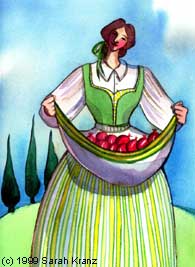 Moses instructs the people of Israel: When you enter the land that G‑d is giving to you as your eternal heritage, and you settle it and cultivate it, bring the first-ripened fruits (bikkurim) of your orchard to the Holy Temple, and declare your gratitude for all that G‑d has done for you. Moses instructs the people of Israel: When you enter the land that G‑d is giving to you as your eternal heritage, and you settle it and cultivate it, bring the first-ripened fruits (bikkurim) of your orchard to the Holy Temple, and declare your gratitude for all that G‑d has done for you.
Our Parshah also includes the laws of the tithes given to the Levites and to the poor, and detailed instructions on how to proclaim the blessings and the curses on Mount Gerizim and Mount Eival—as discussed in the beginning of the Parshah of Re’eh. Moses reminds the people that they are G‑d’s chosen people, and that they, in turn, have chosen G‑d.
The latter part of Ki Tavo consists of the Tochachah (“Rebuke”). After listing the blessings with which G‑d will reward the people when they follow the laws of the Torah, Moses gives a long, harsh account of the bad things—illness, famine, poverty and exile—that shall befall them if they abandon G‑d’s commandments.
Moses concludes by telling the people that only today, forty years after their birth as a people, have they attained “a heart to know, eyes to see and ears to hear.”
|
||

|
Your
Questions
|
|||
|
The month of Elul is
a month of preparation for Rosh Hashanah and Yom Kippur. That’s why Jews blow
the shofar (almost) every day of the month. by Menachem Posner
The month of Elul is a month of preparation for Rosh Hashanah and Yom Kippur. That’s why Jews blow the shofar (almost) every day of the month.
When to blow?
The optimum shofar-blowing time is right after morning services, when everyone is still together. Missed it? You might still want to catch a shofar-blowing some time before sundown.1 We blow the shofar every day other than Shabbat, starting from Elul 1 and ending on Elul 28. We do not blow on Elul 29, the day before Rosh Hashanah.2
What to blow?
Using a kosher ram’s horn, we blow a condensed version of the full sequence blown on Rosh Hashanah:
One long blast, three midsized blasts (with a little tiny blast), nine short blasts, one long blast.
One long blast, three midsized blasts (with a little tiny blast), one long blast.
One long blast, nine short blasts, one long blast.
That’s how it’s done in Chabad; there are others who just blow the first segment. On Rosh Hashanah, the sequence is much longer, with many more requirements and specifications.
Why blow?
For lots of reasons. Here are just a few:
a. After Israel sinned with the golden calf, Moses spent 40 days pleading for forgiveness. Then he ascended Mount Sinai once again for another 40 days—after which he descended with the second tablets. This ascent, which began on the first of Elul and lasted until Yom Kippur, was accompanied by shofar blasts. To commemorate this, we blow the shofar during the month of Elul.3
b. Elul is the month during which we search our souls in anticipation of the High Holidays. The soul-stirring shofar blasts inspire us to come closer to G‑d, as we read, “Shall a trumpet be blown in the city, and the people not be afraid?”4
c. Blowing the shofar—which is actually a Rosh Hashanah activity—for a month in advance confuses the prosecuting angel, who now has no idea what day is the real Rosh Hashanah.5
Huh? How is blowing the shofar for a month going to confuse the prosecuting angel? Nobody ever delivered a Jewish calendar to his door? Wouldn’t the crafty angel catch on after a few hundred years?
The Rebbe6 has a wonderful insight into this:
First of all, this isn’t the only time we’re out to befuddle the prosecution. On Rosh Hashanah we blow the shofar more than necessary, the Talmud tells us, “to confuse the prosecuting angel.” On that Talmudic passage, Rashi7 explains: When the prosecutor sees how we cherish G‑d’s commandments—going far beyond the strict requirements—he simply has nothing to say.
Something similar happens when we blow the shofar for an entire month before Rosh Hashanah. By doing so, inevitably we’ll feel remorse over past misdeeds and set ourselves upon a fresh new path. If so, the case is already sealed—and we won. G‑d has already inscribed us in the book of life for the coming year—even before Rosh Hashanah. This leaves the prosecutor confused. What’s left for him to do when the trial date finally arrives?
That’s the meaning of “not knowing what day is Rosh Hashanah”—he can no longer tell when the judgment occurs. Because we proactively took care of the whole thing on our own accord—sort of a backroom deal between us and G‑d.
This is also why we do not blow on the day before Rosh Hashanah: By that point we are so confident that G‑d has accepted our sincere repentance during the first 29 days that we do not even need to blow on the last day of the month.
And the prosecution is out of a job.
FOOTNOTES
1.See Nit’ei Gavriel, Rosh Hashanah 2:9, footnote 14.
2.Not blowing on this day serves to separate between the Elul blasts, which are merely a custom, and the Rosh Hashanah blasts, which are a mitzvah. In addition, it serves to confuse the Satan into thinking that we finished blowing and he missed his Rosh Hashanah court date to prosecute against Israel. See below for a deeper explanation of what “confusing Satan” actually means.
3.The earliest source for this is Pirkei d’Rabbi Eliezer (46), where the custom is mentioned only regarding the first of Elul.
4.Amos 3:6.
5.All three of these reasons are cited in Tur (by Rabbi Jacob ben Asher), Orach Chaim 581.
6.Likkutei Sichot, vol. 24, pp. 222ff.
7.Rosh Hashanah 16b, s.v. kedei le-arbev.
BY MENACHEM POSNER
Rabbi Menachem Posner serves as staff editor for Chabad.org. He lives with his family in Montreal, QC.
Illustration: Detail from a painting by Chassidic artist Zalman Kleinman.
More from Menachem Posner | RSS
© Copyright, all rights reserved. If you enjoyed this article, we encourage you to distribute it further, provided that you comply with Chabad.org's copyright policy.
|
||
|
More in Your
Questions:
|
|||
|
|
• We Can’t Make
Ends Meet! (by Rosally Saltsman)
 Dear Rachel, Dear Rachel,
I don’t know if you can help me, but we are having so many problems that I’m seriously overwhelmed. My husband takes a detour to catch the bus to work to avoid going by the grocery store where we’ve run up a colossal food bill, which we can barely make a dent in. We’re three months late on tuition payments for each of our children’s schools. I am seriously overwhelmedWe both work full-time and live modestly, but it’s just not enough. We’ve had notices from the bank about our late mortgage payments twice this year, and I don’t even have money to buy a new dress for my niece’s wedding. I’m constantly tense and I feel like I can’t breathe. What can I do?
Over My Head
Dear Over,
First of all, definitely breathe! What you’re experiencing is something many people today are facing, unfortunately—but that’s small comfort, I know.
You say you have “so many problems,” but it seems like you have only one problem—not enough money—althoughMoney is very fluid this one problem manifests in many different ways. And it appears that you have many blessings in your life, thank G‑d—a husband, jobs for both of you, healthy children learning in good schools, your own home, family, weddings. That’s a lot to be grateful for! Focus on what you do have, and this will give you some perspective and restore your life’s joy.
G‑d commands us to be happy. But how can we be commanded to feel happy when we’re going through difficulties? The answer is that most of our misery doesn’t come from our circumstances, but from the meaning we attribute to them. If you’re having money problems, you may think you’ve failed in some way—and you haven’t, because money comes from G‑d. He decides how much each person will receive and when they will receive it. As long as you’re making reasonable efforts to earn your livelihood (and it sounds like you are), then you’re creating a conduit for G‑d to supply you with your needs.
Earning a livelihood should also not be some form of drudgery. We need to use our G‑d-given talents in the world and find joy in what we do. Doing this will also increase the flow of abundance to us.
Money is very fluid. It moves from one person to another as the wheel of fortune turns. Although you might be financially strapped right now, you may find that very soon you will be blessed with more financial success. The fact that you’re currently in a rut doesn’t mean you will always be there. If you thought you would win the lottery tomorrow, you wouldn’t be anxious, would you? G‑d can bring you wealth at a moment’s notice, and putting your needs in His hands is better than buying a lottery ticket.
Having said that, each one of us has an area in our lives that we seem to constantly have to work on, a “theme” problem. G‑d gives us this challengeG‑d can bring you wealth at a moment’s notice to help us grow, just as G‑d tested the patriarchs and matriarchs because He wanted them to discover their spiritual strengths.
In the great school of life, your money problems are your “major.” But your test isn’t how you balance your budget. It’s how you work on things like gratitude, integrity, faith, kindness and generosity, despite all your financial pressures. And G‑d believes you can succeed, the same way a professor creates tests knowing his students can pass them.
Realizing it’s all a test makes it easier to sit the class.
May you merit the honor roll and have much success!
Rachel
|
||

|
Jewish
Life
|
|||
|
It had always seemed
to me that, for most of us, many of the Torah’s laws restricting relations
between the sexes are a sort of collective punishment for the sins of a few.
But recently my perspective has changed . . . by Jay Litvin
The Torah views the attraction between man and woman as natural, the sexual urge strong, powerful and urgent. It not only approves of this attraction, but exalts the resulting union in the most healthy and hearty of terms. However, it limits this instinctual urge within the confines of sanctified life, within the sacred boundary of marriage. The Torah well understands that this urge stems from the animal/instinctual part of us; reason and higher spiritual concerns are not its natural habitat. It has a life of its own. A strong life. And therefore, in order to constrain and harness its expression in appropriate ways, the Torah provides fences to protect the power of sexual attraction from itself.
Some of these “fences” have to do with discouraging men and women from pursuing situations of potential intimacy. For example, men and women not married to each other are prohibited from being alone together in the same room (and other places, like cars or elevators, as well). If they must be together, as in a work situation, then the door is kept open to a public space. There are numerous contingencies and leniencies that allow for everyday interactions, but in a way that discourages, and hopefully prevents, misplaced intimacy.
The Torah also understands that these physical urges come in different strengths and in different forms, and that some folks might need an extra fence or two to keep them out of trouble.
The Torah, however, does not make a separate list of regulations for every individual. When creating a fence to protect against some specific sexual tendency or potentially compromising situation, the Torah applies this fence equally to all of us. This “shotgun” approach can sometimes feel like “collective punishment” in which we all endure cumbersome restrictions whether or not we feel they apply to us.
But recently my perspective has changed.
An old college friend is getting divorced. Adultery the culprit. An affair between two married coworkers. I don’t want to go into more detail, only to say that he is an old acquaintance from long before I became religious, someone with whom I’ve kept in contact and whose children have been of interest as the decades have passed.
Since our college days, he is a guy who continually spurns old-fashioned mores, for whom the right of individual expression and self-actualization are the idols of modern life. Master of his fate, he believes he is in control of his emotions, in command of his urges and instincts. Rules never applied to him. Morals were an individual acquisition. As the years passed, he found my religious life quaint, charming and curious. He was so liberal as to accept my observance without challenge, an expression of my right to live the life of my choice.
As I learned the story of his pending divorce, I couldn’t help but assume that his thinking must have affected his choices. As this married man spent more and more time with his married coworker working together late at night or taking business trips or celebrating business victories, I could hear his persuasive voice assuring himself that his motives were pure, his passions under control, their separate marriages inviolable to temptation or destruction.
According to him, only when the situation had impulsively crossed all red lines did he and his coworker awaken to their predicament. Adultery and betrayal struck with devastating consequences. Children and spouses forever wounded. The couple fatefully enmeshed without possibility of retreat.
I was upset by the news; concerned for his wife and children; frightened by the fragility of human relationships, by the susceptibility of human feeling and emotion. Despite his quirks and idiosyncrasies, my old college buddy is a good guy. A thoughtful person. With a nice family. His views and philosophies are as much a product of the times and received opinion as of his own independent thought. He was both perpetrator and victim.
The combination of lust and loneliness (there were problems within the marriage that contributed to the situation, he said) had cast these people upon a path with no return. It was a path that anyone left to live without fences could have trod. Unhindered by these fences, lust and loneliness, passion and adventure found breeding ground in the unconstrained privacy of closed-door business meetings, afternoon lunches, out-of-town business trips and all the countless moments of potential intimacy that make up relationships unrestricted by Torah. If this could happen to him, it could happen to anyone, G‑d forbid.
My thoughts and reactions ricocheted between sorrow for the two families, anger at my friend, compassion for his plight, and an overall sense of dread at the growing rate of divorce and the destruction that it brings. I thought mightily about how much I valued family, how protective I felt towards his children. I cringed at the pain caused by the breakup of his, and every, family. And it was then that I gained new insight into the Torah’s approach.
Jewish law is not prescribing collective punishment for the misbehavior of a minority; it is not forcing us to observe certain cumbersome restrictions to atone for the aberrant tendencies of a few.
Rather, my willingness to live within fences, to restrain my behavior—whether or not I believe they apply to my personal version of temptation—is part of a communal response and responsibility to protect the viability of every Jewish family anywhere in the world.
So great is the tragedy of a family destroyed that the Torah asks each of us to contribute our part towards protecting this most sacred Jewish institution. So devastating is the dissolution of even one family that we are asked to eagerly participate in upholding community norms of behavior that will defend against the pain and damage created by such dissolution.
As members of one large Jewish family, we all share equally in the welfare of our brothers and sisters and of their unions and offspring. Observing these fences is not an act of submission, it is an act of cooperation and communal participation.
In this spirit, we observe laws and fences of behavior both for the welfare of our own family and for the sake of some child, somewhere, whose father, alone in an elevator or behind a closed office door with an attractive woman, may be led to one day submit his child to the caustic chaos of divorce.
No matter how unlikely the scenarios may be, no matter how rare their illicit possibilities, we willingly adhere to these often cumbersome, bothersome, tedious fences for the sake of saving one family, of preventing even one damaged child.
Rather than be seen as collective punishment, these fences are the guardians of my people, the protectors of my family—both the little family I call my own and the larger one called the Jewish people.
In the swirling, convoluted, confused and compromised vortex of modern life, thank G‑d we have an island of truth, wisdom and practicality upon which my family—and countless others—can find sanity and protection within a sea of worldly folly.
An island known as Torah, with fences to surround and safeguard us wherever we may tread.
|
||
|
More in Jewish Life:
|
|||
|
|
• Brrrrrr . . .
It’s Cold! (by Tzippy Koltenyuk)

The historic synagogue in Irkutsk was returned to the Jewish community
When you think of Siberia, you may call to mind the bitterly cold, remote area where prisoners were sent into exile under the czars and the Communists. But you may not associate Siberia with a warm, thriving Jewish community. Now, thanks to Chabad emissaries such as Rabbi Aharon and Dorit Wagner, that image is a reality.
The Wagners are Israelis, but immediately after their wedding they settled in Donetsk, Ukraine, where Aharon had worked as a Chabad emissary. After six months, they knew they wanted to go somewhere without a Chabad House, someplace where no emissaries had gone before, to revive the sparks of Judaism. They contacted Rabbi Berel Lazar, chief rabbi of Russia, and he recommended the city of Irkutsk.

People of different religions visit the synagogue in Irkutsk
“Until that day, we’d never heard of the city,” Dorit says. “We did an Internet search and found that it was in Siberia. We’d never been to Siberia, but Aharon’s brother and sister-in-law are emissaries in Krasnoyarsk, Siberia, so at least we knew where Siberia is on the map.”
The young Wagners first arrived in Irkutsk the day after Rosh Hashanah in 2003. The moment they got off the airplane, a heavy snowfall began. At that time there were no buses to ferry passengers from the airplane to the terminal, so they had to walk across the small airfield in the freezing cold. They thought it was a blizzard, but it was just their first small taste of winter in Siberia.
“When we got there, Dorit was pregnant with our first child. We had no idea whether or not there were any reliable doctors there. We didn’t know anybody,” Aharon says. “The first few months were extremely educational. Everything was complicated and required a lot of effort. We saw people pumping water from wells, and we were sure that we’d traveled back in time. We decided that it would be best to give birth in Moscow. The day that Dorit flew there, it was ‑37° F. It was our first real winter. We had no idea how we’d manage, but in the end we got used to it.”
Two years ago, on the day of the circumcision of their youngest son, the temperature was ‑43° F. The Wagners said that they were so full of joy and gratitude to G‑d, they didn’t feel the cold at all.

The Wagner family
Like all emissaries in far-off places, the Wagners face a lot of challenges: Jewish education for their four children, kosher food, fundraising, a lack of Jewish community and more. The children have private teachers, and they also use Chabad’s Online School for young emissaries. The Wagner children already know that they can’t just go to the store to buy a candy, bread or yogurt, and that they can’t eat at their friends’ houses. These limitations mean that they eat very healthfully. The only food they can buy is unprocessed: fruit, vegetables, fish, eggs and starches. Meat comes from Moscow. Dorit learned to prepare her own dairy products, like soft cheese and yogurt. She also makes sweets and baked goods.
“We’re working hard on many problems, and there’s not always a solution,” Dorit says. “The most important thing is to look at the bright side, to remember why we’re here and to be happy that we are the Rebbe’s emissaries.”
A Glorious History and a Promising Future
Irkutsk has a rich Jewish history. Jews have been living there since the 17th century, when Jewish prisoners were first exiled to Siberia. In the 18th century a Jewish community was founded, and Irkutsk eventually became the Jewish center of all of Siberia. In 1878, the Jews received permission to establish a synagogue in Irkutsk. It was built within a year, and became a second home for all the Jews in the surrounding areas.

A concert in honor of the 135th anniversary of the building of the synagogue
In 1931, the Russian police closed the synagogue, but that didn’t stop the Jews of Siberia from celebrating Shabbat and Jewish holidays secretly. They also continued to bake matzahs, marry in accordance with Jewish law and receive Jewish burials. The synagogue was returned to the Jewish community in 1990.
“A few months after we came to Irkutsk,” Aharon says, “on a historically significant date, the 9th of Av, 2004, a fire broke out in the synagogue and completely destroyed the inside. Thank G‑d, we’ve managed to repair it, and the doors of the synagogue have opened again. It’s wonderful to think that this synagogue, which was built in the 18th century, is still the heart of the Jewish community today.”
The Wagners’ Chabad House serves the 7,000–10,000 Jews who live in Irkutsk and its environs. There are public prayer services on Shabbat and holidays, meals, Passover Seders and Torah lectures. A working mikvah has been built on the site of the original mikvah, which was built in the czarist era. There’s a kosher industrial kitchen in the synagogue, which is used for all the community’s needs. There’s also an educational center for children and teens, a day center for senior citizens, a women’s center and a fully equipped kindergarten.

A Purim play put on by the kindergarten children
An emissary has a vast number of jobs. Dorit teaches, cooks, supervises the mikvah, speaks, counsels and more. Aharon is busy with building upkeep, supervising employees and fundraising—and, of course, teaching and leading prayers.
Why We’re Here
“Our kids are an integral part of the reason we’re here,” Dorit says. “They know that other kids are watching them—how they dress, pray and talk—and they try to be good examples. On Shabbat they help in the synagogue, showing people how to pray and acting as the most extraordinary hosts for the many guests who come to us for meals. The children feel they have a responsibility, and they’re proud of it.”
In the winter the Wagners enjoy trips to Lake Baikal, the largest and deepest freshwater lake in the world, which is about an hour away from Irkutsk. In the summer they try to make a short visit to Israel, so their children can experience things like sunshine, hearing Hebrew spoken in the streets, or even just going into a shop and buying a treat.
 A family of emissaries—the father, Rav Zev HaCohen, the emissary in Tula, Russia; the brother, Rav Binyamin HaCohen, the emissary in Krasnoyarsk, Russia; Rav Aharon HaCohen, the emissary in Irkutsk, Russia A family of emissaries—the father, Rav Zev HaCohen, the emissary in Tula, Russia; the brother, Rav Binyamin HaCohen, the emissary in Krasnoyarsk, Russia; Rav Aharon HaCohen, the emissary in Irkutsk, Russia
“What strengthens us in our work,” Dorit says, “is not the big projects like opening a Jewish kindergarten or restoring the synagogue, but the small things: someone from the women’s circle deciding to keep the laws of family purity, a man deciding to put ontefillin every day, one of our children bringing a new friend to the synagogue, or people who were far from Judaism beginning to feel their Jewish spark. Then I feel that our efforts are worthwhile.”
Aharon and Dorit say, “We try to live with the Rebbe’s teachings, giving to others and making the world a better place. Everyone can do that, wherever they are. They don’t have to go to Siberia.”

The mikvah in Irkutsk
|
||

|
Multimedia
|
||
|
The 18th of Elul is
the birthday of two “great luminaries,” the Baal Shem Tov and the Alter
Rebbe.
 Watch (7:09) Watch (7:09)
http://www.chabad.org/therebbe/livingtorah/player_cdo/aid/424354/jewish/A-New-Soul-A-New-World.htm
http://www.chabad.org/424354
|
|
|
More in Multimedia:
|
||
|
|
• A Royal
Encounter Not to Be Missed! (by Mendel Kaplan)
<script language="javascript" type="text/javascript" src="http://embed.chabad.org/multimedia/mediaplayer/embedded/embed.js.asp?aid=2676314&width=auto&height=auto"></script><div style="clear:both;">Visit <a href="http://www.chabad.org/multimedia/default_cdo/aid/591213/jewish/Video.htm">Jewish.TV</a> for more <a href="http://www.chabad.org/multimedia/default_cdo/aid/591213/jewish/Video.htm">Jewish videos</a>.</div>
|
|
|
|
http://www.chabad.org/kids/article_cdo/aid/470326/jewish/Fire-and-Faith.htm
http://www.chabad.org/470326
|
|

|
Story
|
||
|
The entire town
would be paying attention to the new rabbi’s first ruling. Everyone was sure
to wonder: Why is the law of the Torah so opposite to common sense?
by Yerachmiel Tilles
Less than a week after the tzaddik Rabbi Levi Yitzchak moved to Berditchev in 1785 to serve as chief rabbi there, three men knocked on his door to ask him to decide a question of Jewish law between them. It would be his very first case as a rabbinical judge in his new position.
A wealthy merchant from the nearby town of Chmielnik had brought several barrels filled with honey to sell at the big fair in Berditchev. Unfortunately, just then the price of honey dropped sharply. Not wanting to suffer a loss on his investment, he asked an acquaintance to store the honey for him until the price rose again.
The two were old friends, and the local man was happy to oblige. Knowing each other to be completely honest, they didn’t write down anything of their arrangement or call in witnesses.
Time went by. The price of honey remained low, so the barrels remained in their Berditchev cellar, untouched and unnoticed.
More time went by. The man on whose property the honey was stored contracted a fatal disease and passed away. Everything happened so quickly that he never had a chance to explain to his family anything about the state of his affairs.
More time passed. The price of honey finally began to slowly climb. When the increase became significant, the owner of the barrels showed up at his deceased friend’s house and claimed his honey from the sons who had inherited and taken over their father’s business. They, however, having heard nothing about it from their father, refused to honor the Chmielniker merchant’s claim. After some discussion, they decided to proceed to the beit din (rabbinical court) to present the case before the new rabbi.
Rabbi Levi Yitzchak listened to the litigants carefully, even though the law in such a case was clear. Of course he would have to rule against the out-of-town merchant. Even if there had been witnesses or a signed document, Torah law stipulates that no claims against “orphans” (i.e., heirs who are disadvantaged by the fact that they have no way of knowing what transpired between the deceased and their litigant) can be collected without first swearing an oath as to the validity of one’s claim; and here there were neither document nor witnesses.
Nevertheless, Rabbi Levi Yitzchak hesitated to pronounce his verdict and finalize the case. Two nagging thoughts disturbed him. Why, in his first days in his new position, did the Almighty arrange for his inaugural judgment to be something so straightforward and clear-cut, with no room left to budge and no right to attempt any sort of compromise? Could it be a hint from heaven that his practice to always pursue accommodation and compromise was not correct? That only adhering strictly to the letter of the law can be considered the way of truth?
The other thought that made him uncomfortable was: Why did the Supernal Judge arrange it so that his very first ruling in this town would be considered bizarre by the entire populace? After all, the merchant from Chmielnik was well known to everyone in town as a scrupulously honest man, as someone who was already wealthy and as such immune to monetary pressures, and as far from theft as east is from west. Furthermore, everyone knew that the merchant and the deceased were old friends who trusted each other implicitly, never resorting to documents or witnesses in their transactions. Surely, the entire town would be paying attention to the first ruling handed down by their new rabbi. Everyone was sure to wonder: Why should the law of the Torah be so opposite to common sense? “Why me, and why now?” thought Rabbi Levi Yitzchak to himself.
He couldn’t bring himself to issue the verdict just yet. The contradiction between the natural sense of what was right and the law of the Torah was too great. Even though the claimant and defendants anxiously awaited his word, he asked them to excuse him for a few more minutes. Turning aside to a corner of the room, he poured forth in silent prayer his frustration, beseeching G‑d to enlighten him with understanding.
Suddenly, the owner of the honey jumped off his seat as if struck by a bolt of lightning, and exclaimed: “I remember! I remember!” So struck was he by his recollection, and so convinced of its importance and relevance, he didn’t hesitate to interrupt the rabbi, who was standing in the corner, absorbed in his personal prayer.
“Honored Rabbi, please forgive me,” he called out excitedly. “While waiting here I had the most amazing realization! An old memory, which I haven’t thought about in many years, just flashed through my mind. Rescued from oblivion! I’m talking about something that happened fifty years ago, when I was just a young lad.
“Our father died suddenly, leaving us a large inheritance in cash and possessions. Included in this was a storage room filled with casks of wine and oil.
“One day, the father of these two young men—may his rest be peaceful—came to our home in Chmielnik. He claimed that the wine and oil were his—that he had stored it with our father for safekeeping. My brothers and I were still quite young then, and had never been involved in any of our father’s business affairs. We had no idea what we were supposed to do, but we were reluctant to give up the merchandise just like that.
“We all went to the rabbi of the town and presented our case. He ruled in our favor, explaining that nothing can be taken from the inheritance of orphans without absolute proof and an oath. The wine and oil remained in our possession. After a while, we sold the entire lot for a good price.
“What I just realized is that the money we received for that wine and oil is exactly equal to the value of my honey, which is now in the possession of the sons of my departed friend!”
Rabbi Levi Yitzchak’s face shone with inner happiness. With his apt comparison of the two parallel events fifty years apart, the merchant had conceded his own present case. For the same reason that, as an orphan, he was entitled to keep the wine and oil that long time ago, he had to relinquish his claim on these orphans for his honey today.
Now, all was clear to Rabbi Levi Yitzchak: divine providence had presented him this case, so early in his new tenure, to teach him an important lesson. Not always is what seems obvious and true to human eyes necessarily the truth, or even fair. Absolute truth resides only with the laws of the Torah. G‑d’s ledger is always open, and all accounts are forever being reckoned and balanced. Some may take fifty years for resolution, others more, others less. What is guaranteed is that the Master of the Universe constantly oversees to be sure that justice is done.
Biographical note:
Rabbi Levi Yitzchak of Berditchev (1740–1810) is one of the more popular rebbes in chassidic history. He was a close disciple of the second leader of the chassidic movement, Rabbi DovBer, the Maggid of Mezeritch. He is best known for his love for every Jew and his perpetual intercession before heaven on their behalf. Many of his teachings are contained in the posthumously published Kedushat Levi.(Dedicated to the memory of Rabbi Levi Bistritzky)
|
|

|
Jewish
News
|
|

Jorge Batlle, the
former president of Uruguay, discussed Israel, anti-Semitism and Jewish life
in Uruguay at a monthly lunch-and-learn program that has revitalized Jewish
life in a once-thriving Montevideo neighborhood. by Yaakov Ort
he former president of the Republic of Uruguay, Dr. Jorge Batlle, speaking at a Chabad lunch and learn program in Montevideo.
In April 1936, as Nazi persecutions were battering the Jews of Germany and active anti-Semitism was on the rise throughout Europe, the Jewish community of Montevideo, Uruguay, founded the “Inca Shul,” formally known as Asociación Religiosa Israelita Beis Hakneseth Harischona. It attracted community residents and, over the next decade, appealed to hundreds of Jewish families fleeing Europe.
Like many congregations, the shul on Inca Street experienced its ebbs and flows over the decades, and was eventually shuttered five years ago, the last of eight synagogues in a once vibrant Jewish neighborhood. Rabbi Mendel Shemtov of Chabad-Lubavitch of Uruguay and community leader Bernardo Kelmanzon got together three years ago to launch a monthly lunch-and-learn program for local shop owners, businessmen and professionals that has been growing ever since, revitalizing both the synagogue and the community.
“Each month there is a current-events theme that Rabbi Shemtov analyzes from the perspective of Torah and that we all then discuss,” notes Kelmanzon, who points out that Beit Knesset, or synagogue, literally means “meeting house.”
“While a Beit Knesset is primarily for prayer and study,” explains Kalmanzon, “it has always also been a place for Jews everywhere in the world to meet and debate political, cultural and social issues. The Beit Knesset can even be considered a precursor of WhatsApp, Internet forums, and social networks like Facebook and Twitter—the ‘meeting houses’ of so many Jewish people today.”
 President Batlle's talk encompassed Israel, contemporary anti-Semitism and the Uruguayan Jewish community. President Batlle's talk encompassed Israel, contemporary anti-Semitism and the Uruguayan Jewish community.
He believes, however, that conversations are so much more meaningful in person, “especially when accompanied by herring, knishes and gefilte fish.”
‘A Lesson to Be Learned’
A few weeks ago, in the midst of Israel’s war against Hamas in Gaza, and a resurgence of anti-Semitism in Europe and around the world, there was what Shemtov called “a very special guest speaker”—the former president of the Republic of Uruguay, Dr. Jorge Batlle, who served as the nation’s president from 2001 to 2005. He is the son, nephew and grandson of former presidents, and remains an active force in the country’s political life.
Shemtov introduced Batlle by noting that Judaism has a special blessing that is recited when meeting a leader of a nation, and pointed out that the former president’s attendance was particularly appropriate during the Hebrew month of Elul, when a key theme of Chassidic thought is that “The King Is in the Fields.”
“G‑d is in uniquely available and approachable in the month preceding Rosh Hashanah and Yom Kippur,” said Shemtov. “And in everything that we experience in our daily lives, there is a lesson to be learned that can be used to strengthen our relationship with G‑d.”
In a wide-ranging talk that encompassed Israel, contemporary anti-Semitism and the Uruguayan Jewish community, Batlle, who is not Jewish, spoke glowingly about Chabad’s work in the country. He also fondly recalled his meeting while president with the rabbi’s father, Rabbi Eliezer Shemtov, director of Chabad-Lubavitch of Uruguay, who presented him with a menorah.

Rabbi Mendel Shemtov, second from left, gave the former president two gifts: One was copy of “Rebbe: The Life and Teachings of Menachem M. Schneerson, the Most Influential Rabbi in Modern History.”
At the lunch and learn, Mendel Shemtov gave the former president two gifts: One was copy of “Rebbe: The Life and Teachings of Menachem M. Schneerson, the Most Influential Rabbiin Modern History,” the best-selling biography by Joseph Telushkin. The second present was something that Battle himself requested. Seeing that all the congregants were wearing either hats or skullcaps as Shemtov was about to blow the shofar, as is customary during the month of Elul, the president asked for a kipa of his own.
During his talk, Batlle expressed what Kelmanzon called a “real appreciation of the uniqueness of the Jewish people and its struggles then and now.” Picking up a broken tile from the synagogue floor, the former president humorously noted that “you still have lots of work to do.”
Yet he concluded with utmost seriousness, saying: “You people are an eternal people, and the Jewish people will live forever.”

President Batlle and congregants listen intently as Shemtov blows the shofar, as is customary during the month of Elul.
|
|
|
More in Jewish News:
|
|
|
• Prominent
Member of Jewish Community Shot and Killed in Donetsk, Ukraine (by
Dovid Margolin)

Garik Zylberbord, who was killed last Shabbat in Donetsk, Ukraine, is standing in the center with the family of Rabbi Pinchas and Dina Vishedski at their daughter's wedding in Donetsk.
Rabbi Pinchas Vishedski and Garik Zylberbord had been close for years. Zylberbord was one of Vishedski’s earliest friends and supporters when the rabbi first arrived in Donetsk, Ukraine, in 1993. The two remained in close contact as the conflict in the eastern part of the country, which began back in February, burned into war and forced the rabbi to flee to Kiev just two weeks ago.
When the two men last spoke last Friday, Garik told the rabbi that he would join him in there this Wednesday, Sept. 3.
“Unfortunately, he got here before that,” says Vishedski, the exiled chief rabbi and co-director of Chabad-Lubavitch of Donetsk.
Zylberbord, 47, was shot dead in Donetsk while trying to stop pro-Russian rebels from robbing his neighbor’s home.
“He was killed on Shabbos, and his funeral was held here in Kiev on Monday,” explains the rabbi.
Vishedski has already set up a Donetsk Jewish community office in Kiev to help the lost and struggling Jews of his city who have found refuge there and in other parts of the country.
He describes Zylberbord as someone who became closer to his Judaism over the years, being circumcised (his Jewish name was Eliyahu) and attending synagogue regularly. He was also a generous financial supporter of the community.
“Much more than that, he was a very, very good friend,” laments Vishedski. “He was like a brother.”
The rabbi’s wife, Dina Vishedski, agrees: “He was like a part of our family. The funeral was very difficult. The Donetsk Jewish community is spread throughout the country, but people came from everywhere. He was a very active person and had many friends. He was a very special person. I have no words.”
Rabbi Vishedski explains that Zylberbord served as a member of the board of directors, but filled his position more than in just name. “He didn’t just give; he gave himself to the community. He was available at any time for any question, always there to help.
“This is a very big loss—for myself personally, for my family and for our entire community.”

Zylberbord, a longtime supporter of Chabad, recites a blessing at the wedding. At the far left is Vishedski, chief rabbi and co-director of Chabad-Lubavitch of Donetsk; next to him is his father-in-law, Rabbi Eli Zilbershtrom.
A Displaced Community
When Zylberbord’s wife, daughters and parents arrived in Kiev together with their deceased loved one, they joined the thousands of refugees who have escaped from the disintegrating east.
The vast majority of Donetsk’s Jews have also fled. Today, they find themselves scattered about the country, living in refugee camps, senior centers and rented apartments in places like Kiev, Zhitomir, Odessa, Kharkov, Kremenchug and Dnepropetrovsk. Following the recent entrance of tanks, infantry and artillery from over the Russian border in the country’s southeast, those who earlier ran to Mariupol, which is just miles from the new center of fighting, find themselves in danger once again.
In Kiev, the Vishedskis have thrown themselves into organizing relief and offering help to their community. Calls and text messages flood their phones all day, according to Dina Vishedski, as community members struggle to stay afloat in their strange new predicaments.
“We are receiving phone calls not only from poor people,” explains Rabbi Vishedski, but from “regular, middle-class families that have no money and no food right now. We are assisting them every way possible, but we desperately need funds to continue helping them.”
His wife adds that they have been receiving phone calls from fellow Chabad emissaries throughout Ukraine, relaying information and regards from Donetsk refugees who have been welcomed by various other communities.

Jews from Donetsk now living in Kiev pay their respects to fallen community member Zylberbord, 47, who leaves behind a wife, daughters and his parents. (Photo: Vaad of Ukraine)
“Calls start early in the morning and don’t stop all day,” she says. “There is always more work to be done. I told myself just now that I need to work for one more hour or else tomorrow will not start right.”
Despite the Sept. 3 announcement by Ukrainian President Petro Poroshenko that he and Russian President Vladimir Putin had agreed in principle to a “permanent cease-fire regime” in the Donetsk and Lugansk regions, shelling in and around the badly damaged city of Donetsk has not stopped.
Still, Dina Vishedski remains optimistic. “I hope,” she says, “to be home for Rosh Hashanah.”
To assist the Donetsk Jewish community click here
|
|
|
• Florida Campus
Gathering Recalls Work and Life of Steven Sotloff (by Mordechai
Lightstone)

Rabbi Chaim Lipskier, co-director of Chabad at the University of Central Florida, led prayers and spoke at a candle-light vigil in memory of journalist Steven Sotloff. (Photo: Nick Russett/ KnightNews.com)
Some 500 people gathered on the University of Central Florida campus in Orlando, Fla., on Tuesday night for a candle-light vigil held for recently murdered journalist Steven Sotloff. News of his beheading at the hands of the ISIS terror group in Iraq was released on Sept. 2.
The 31-year-old, who was Jewish, attended the university for two years between 2002 and 2004, and wrote for the campus newspaper, the Central Florida Future. Last year, he was captured in Syria, where he served as a freelance journalist reporting for Time magazine, Foreign Policy, World Affairs and other publications.
According to reports, he worked hard at hiding his Judaism while in precarious places, fasting on Yom Kippur and praying towards Jerusalem.
Among those present at the vigil were university president John C. Hitt, in addition to many professors and students at the school. Rabbi Chaim Lipskier, co-director of Chabad at the University of Central Florida with his wife Rivkie, led prayers and spoke at the vigil.
The gathering grew at the suggestion of a professor at the Nicholson School of Communication at the university. According to senior Melissa Catalanotto, “we wanted to pay our respects to Steven. Though we didn’t know him personally, we felt a connection with someone who went to our school.”
Given Sotloff’s Jewish background, Catalanotto felt that it was important to contact the Chabad-Lubavitch center on campus to put together a memorial as members of the Jewish community.
“When I heard about Steven, what he represented,” Lipskier says, “I immediately recalled the UCF creed of integrity, scholarship, community, creativity and excellence. Steven, by all accounts, exemplified that.”
Though Sotloff left the school almost a decade ago, “the shock and pain,” Lipskier says, “has really hit home.”
A statement delivered on Wednesday by Sotloff family spokesman Barak Barfi noted that Sotloff “was a man who tried to find good in a world full of darkness.”

Some 500 people attended the campus vigil in Orlando, Fla. (Photo: Nick Russett/KnightNews. com)
As students grasped candles and joined in a moment of silence, Lipskier saw deep resonance between Sotloff’s life and the vigil itself.
“What can we really do when we face difficult challenges like this?” the Chabad rabbi asked the crowd. “We can light a small candle, do a good deed, to bring more light and goodness into the world.”
|
|
|
Lifestyle
|
|||
|
Somehow brisket has
become standard Rosh Hashanah fare across North America, so I would be remiss
not to share my recipe as well as a few tips I've picked up along the way. by Miriam Szokovski
Somehow, brisket has become standard Rosh Hashanah fare across North America, so I would be remiss not to share my recipe as well as a few tips I’ve picked up along the way.

I’m no meat maven, but I’m learning, and the two most important things to consider when cooking brisket are:
Let the meat shine. Often people drown brisket in all kinds of bottled sauces, but I suggest saving that for cheaper cuts. Use spices, herbs and milder liquids to enhance the flavor of the brisket.
Patience, patience, patience! Cook the meat on a low temperature for a long time. Don’t try to rush it, or you’ll end up with hard, dry, chewy meat—not the pleasant, melt-in-your-mouth texture you were hoping for.

Now, on to specifics. Cut the onions in rounds, and put them on the bottom of a baking dish. Mix the paprika, garlic powder, chives and salt in a small bowl. Pat the spice rub all over both sides of the meat, until it can hold no more. Now put the brisket on top of the onions and into the oven on 400° F for 1 hour, uncovered.

Take it out and turn the oven down to 250° F. Pour ½ cup balsamic vinegar and ⅓ cup honey over the meat. It may look like not a lot of liquid, but the meat and onions both let out lots of juices and you end up with plenty (as you can see in the pictures). Cover the pan tightly with foil and return to the oven. Cook for another 4–5 hours, until meat is fork tender—meaning a fork goes in with almost no resistance. Approximately once an hour, take it out and turn the meat, so both sides get equally moist. Cooking time will vary, depending on the size and thickness of your brisket, so make sure to use the fork test.

Once it’s ready, refrigerate the meat overnight, then remove from the sauce and cut into thin slices, against the grain. Return slices to the sauce and reheat in the oven or over a low flame on the stovetop when ready to serve. Freezes well. Serve with the sauce and onions.

Ingredients:
3 lb. first-cut brisket
2 tbsp. paprika
2 tbsp. garlic powder
2 tbsp. dried chives (optional)
1 tbsp. salt
2 large Spanish onions
½ cup balsamic vinegar
⅓ cup honey
Directions:
Slice the onions in rounds. Place them in the bottom of a baking dish.
Combine the paprika, garlic powder, chives and salt in a small bowl. Cover the brisket with the spice mixture. Pat it in gently until the meat can hold no more.
Place the meat on top of the onions and put it into the oven on 400° F for 1 hour.
Take the meat out, add the balsamic vinegar and honey, and cover the baking dish tightly. Lower the temperature to 250° F and cook for another 4–5 hours, until the meat is fork tender.
Refrigerate the meat until completely cold (preferably overnight), then cut in thin slices against the grain. Return the sliced meat to the sauce. Reheat in the oven, or over a low flame. Serve with the onions and sauce.
Yields: Approximately 40 thin slices.

Do you eat brisket on Rosh Hashanah? How do you cook it? Any special family recipes?
|
||
|
More in Lifestyle:
|
|||
|
|
• Art: Window
View of the Temple Mount (by Eduard Gurevich)

Oil on Canvas
Artist’s Statement: Old Jerusalem. View of the Temple Mount from a window.
|
||

No comments:
Post a Comment