
"What has to be true for an idea to be successful?" by David L. Odom
How do you respond when you hear a new idea, something that has real promise but is not quite right? How do you both encourage the creative juices of the presenter and introduce concerns?
Business strategist Roger Martin has formulated what he considers the most powerful consulting question: "What has to be true for this idea to be successful?"
Martin's question seems helpful regardless of your relationship to an idea. A boss can ask it as easily as can a peer, a subordinate or a consultant.
I recently witnessed the impact of this question as I was working with one of Martin's colleagues to facilitate the design of a denomination's funding model for its missions enterprise. The discussion included missionaries, governing board members and administrators. As we started testing ideas that emerged, the consultant asked Martin's question: "What has to be true for this plan to work?"
The question opened up the conversation. Participants were able to examine their assumptions and consider what would be needed for any of the ideas to be successful. The group ultimately decided to conduct more research to understand the deep trends that are impacting its congregations and patterns of giving.
In his 2015 book "Team of Teams," retired Army Gen. Stanley McChrystal argues that leaders in complex situations should think of themselves as gardeners who create the conditions for their colleagues and partners to address the challenges they face. McChrystal says this metaphor characterized how he had to learn to lead in the battle with al-Qaida. It required a completely new approach.
Martin's consulting question takes on additional power in McChrystal's metaphor. Leaders must understand the conditions to cultivate for an idea to become an effective plan. Cultivating conditions can be about securing resources, clearing obstacles and gaining support. Knowing what has to be true helps define the work ahead for everyone, not just the person with the idea.
MANAGEMENT
Dave Odom: What has to be true for an idea to be successful?

Leaders in complex situations should think of themselves as gardeners who create the conditions to address the challenges they face. They should ask: What has to be true for an idea to blossom and grow? Bigstock/Forester_
This question, suggested by business strategist Roger Martin, helps leaders and their teams turn an idea into an action plan.
How do you respond when you hear a new idea, something that has real promise but is not quite right? How do you both encourage the creative juices of the presenter and introduce concerns?
Business strategist Roger Martin has formulated what he considers the most powerful consulting question: “What has to be true for this idea to be successful?”
Martin’s question seems helpful regardless of your relationship to an idea. A boss can ask it as easily as can a peer, a subordinate or a consultant.
I recently witnessed the impact of this question as I was working with one of Martin’s colleagues to facilitate the design of a denomination’s funding model for its missions enterprise. The discussion included missionaries, governing board members and administrators. As we started testing ideas that emerged, the consultant asked Martin’s question: “What has to be true for this plan to work?”
The question opened up the conversation. Participants were able to examine their assumptions and consider what would be needed for any of the ideas to be successful. The group ultimately decided to conduct more research to understand the deep trends that are impacting its congregations and patterns of giving.
In his 2015 book “Team of Teams(link is external),” retired Army Gen. Stanley McChrystal argues that leaders in complex situations should think of themselves as gardeners who create the conditions for their colleagues and partners to address the challenges they face. McChrystal says this metaphor characterized how he had to learn to lead in the battle with al-Qaida. It required a completely new approach.
Martin’s consulting question takes on additional power in McChrystal’s metaphor. Leaders must understand the conditions to cultivate for an idea to become an effective plan. Cultivating conditions can be about securing resources, clearing obstacles and gaining support. Knowing what has to be true helps define the work ahead for everyone, not just the person with the idea.
Understanding conditions also helps set expectations. Many years ago, I was interviewed as a pastoral candidate for a congregation in western North Carolina. The pastor search committee made it clear that the congregation needed to reach young families. I was young, so surely I could attract people like me.
Since their hope sounded like that of every congregation I had ever known, I tried to understand the opportunity. I asked about the student body at the local elementary school. They responded that the school had shut down because there were not enough children to sustain it.
Hmm.
They did not see the connection between their hope and my question. What has to be true to reach young families? There have to be young families living in the community.
When an idea is new, it is often fragile. The person advocating for it often has a feeling that it will work, but the details are sketchy. Any critique can feel like a personal attack.
Martin’s question invites teams of people to come alongside the creator of an idea, figuring out together the conditions for its success. The assumption is that the idea can work. The focus of planning and action becomes, “What needs to be true for this idea to come alive?”
Monday, August 17, 2015

Former Alban senior consultant Gil Rendle provides a respectful context for understanding change, especially the experiences and resistances that people feel. Rendle pulls together theory, research, and his work with churches facing change to provide leaders with practical diagnostic models and tools. In a time when change is the norm, Leading Change in the Congregation helps to "lead change" in a spiritual and healthy way.
Buy the book »

Don't Miss the Rowman & Littlefield 35% Off Summer Sale
Use code 15SUMSALE at check-out to save 35% off on any of our in-stock print titles and eBooks. Shop onlineor call us at 1-800-462-6420. To learn more about the sale, visit the Rowman & Littlefield website.
Offer expires 8/31/2015.
Continue Your Learning with The Church Network

Keeping Ministry Peace through Effective Church Communications
A webinar with Mark MacDonald
August 27, 2015 at 2:30 p.m. EDT
Every ministry wants promotion but there's not enough time or space to do it. Should it be the loudest voice? The "pet" ministry of the Pastor? Can it be done peacefully? An effective Church Communication strategy prevents ministry silos that lead to ministry wars. During this TNC Seminar we'll talk about ministry strife and what causes it. Then we'll describe how a church communication strategy can help keep peace between all the ministries in your busy church PLUS engage more people in your congregation and community.
Learn more and register »
Ideas that Impact: Strategy
When Your Critics Set the Agenda: How to Avoid One of the Biggest Mistakes a Leader Can Make by Lee Beach
We cannot ignore criticism, but we also cannot let it set the agenda for our ministries. When my critics began to set the agenda, the progress of our church was slowed, morale diminished, and I stopped leading effectively. These are the consequences of not dealing efficiently with criticism.When Your Critics Set the Agenda: How to Avoid One of the Biggest Mistakes a Leader Can Make
For the most part, my first 11 years as a senior pastor were wonderful years. Of course no pastor is without critics, but the criticism I faced was sporadic and easy enough to put behind me. This changed drastically in my twelfth year of ministry—my seventh as a senior pastor. At that time I began to face harsh, personal criticism from other leaders, all of whom I respected and had counted as rock-solid supporters and friends. When faced with their criticism I fell prey to one of the greatest mistakes a leader can make, and it cost me dearly both as a pastor and a person.
What was the great mistake? I let my critics set the agenda. I allowed them to define reality, both about the state of the congregation and who I was as a pastor. Their story slowly began to become the narrative through which the health of the church was perceived by other leaders. Their view of who I was as a pastor and as a person began to become my own self-understanding. The result was that I became exhausted from trying to respond to the various perceived deficiencies that were being raised, and I was never able to achieve the level of performance my powerful critics set for me. The church was hindered as we became increasingly inwardly focused, and the leadership team became muddled as we struggled and sometimes fought over who we were as a church.
In the end, I was left wondering whether I even belonged in ministry.
Were the criticisms fair? In some cases they were. In others they weren’t. In many ways the issue for me as a leader was not whether the criticisms were true but how I would handle them. It was important for me to listen to my critics and seriously weigh their concerns. They deserved thoughtful consideration, a respectful response, and changed behavior, where necessary. However, in my attempt to “be open” to criticism I ended up giving it far too great a place in my life. If we are not careful, criticism can be the main lens through which we see ourselves and our ministries. When this happens, difficulties for all concerned are bound to follow.
How Did It Happen?
How does this happen? Why do we sometimes fall prey to allowing our critics to define reality and set agendas? In my case I can think of at least seven reasons.
The first was inexperience. As a young pastor I was especially vulnerable. Not having faced a similar challenge, I was not exactly sure what to do. I lacked experience to guide me. Add to this the regular, ongoing challenges of leading a church and it was easy to feel overwhelmed and unsure as to what the right move was.
I also had a misplaced sense of wanting to “be like Jesus.” I saw Jesus as someone who was meek and mild. He was the one who faced his accusers in silence and, like a sheep, went to the slaughter. If I defended myself too vigorously or stood up to people too firmly, I believed I was not being very Christ-like. In one board meeting, I challenged one of my opponents, whom I believed was directly behind some proposed changes to my job description. I asked honestly, in what I thought was an appropriate tone, if this was the case. He reacted strongly, telling me he did not think my comments were appropriate. I immediately apologized. Following the meeting, I rushed after him to apologize again. He reiterated that he thought I had been wrong in my assertions. In retrospect, however, I don’t think my questions were wrong. They were honest, even if they were uncomfortable for me to ask and for him to hear. Yet his displeasure bothered me immensely. I felt as if I had failed to act like Jesus, and that made me feel extremely guilty. To me, being like Jesus meant being gentle and essentially passive.
Through this experience I also discovered how deeply committed I was to trying to please people. I learned how much I disliked conflict and how far I would go to avoid it. I would apologize for things that I did not need to. I would make decisions I didn’t believe in or reverse previous decisions, again without conviction, all in an effort to make people happy with me. This was completely exhausting and ultimately a sin: I became more committed to pleasing people than I was to pleasing God.
Another factor that influenced my behavior was fear. I was afraid of losing my job, of losing esteem among my colleagues, and of more conflict. I was afraid that if I could not win back my critics I would end up fired (or “resigning”) and then what about my family? What about my reputation? Fear motivated me to try to meet the standards my critics were setting, in the hope that I could win their approval and a fresh vote of confidence.
Respect for my critics played into my actions as well. I honestly had great respect for the people who were telling me that I was no longer up to the job of leading our church. They were sincere followers of Christ who cared about the church and gave their energy to it as much as anyone else. Many of them had been close friends of mine. One in particular had been a trusted friend I often met for breakfast and with whom I had experienced many times of honest sharing and mutual encouragement. I believe my critics genuinely believed their motives were pure. Because of this, I wanted to respect their words and give them a place in how I was leading the church.
I had a sense of vision for the church and, along with other leaders, had sought to clarify it more fully. However, when that vision (or my ability to lead it) was challenged, I soon abandoned it and tried to conform to the vision that I thought others wanted. I neglected my central theological and methodological commitments and compromised them in an attempt to appease my critics more fully.
These trials uncovered in me a lack of confidence in who I was as a person. It showed me that deep down I suspected that I wasn’t acceptable as a person or as a pastor. I would stand in the foyer after a service on Sunday and hear people tell me how much they appreciated the message I had preached, yet inside I would never really believe they were telling me the truth. My assumption was that they were just being nice, serving me platitudes because they did not know what else to say. However, when I was attacked as a person and as a pastor, I was more than willing to accept what my critics said because I already had a voice inside of me that told me I was not worthy of respect, that my gifts were suspect, that my personality was not conducive to ministry. This brokenness in me made me ripe for letting my critics set the agenda.
Once the critical views about me and the church began to hold sway over me it was not long before they began to have influence over other leaders in our church, too. This is not to suggest that everything at the church had been wonderful before. Like every congregation we had definite issues and weaknesses, but soon after the criticism began we were being perceived by some of our leaders as an “unhealthy” church—despite the fact that we were a church that was leading people to faith in Christ, seeing solid numerical growth, developing believers, and adding new ministries.
A Healthier Response
What could have been done to thwart this trend? How could I have responded in a way that gave genuine respect to the criticism I received while at the same time preventing my critics from setting the church’s agenda?
Reading my Bible more closely—particularly certain sections of it—would have helped. The truth is, all leaders get criticized. Jesus was criticized heavily for being true to the mission he was sent for. Paul was constantly defending himself against his critics. Moses took strong criticism for his leadership. The Psalms should be regular reading when we are feeling betrayed and hurt by the criticism of others.
I personally neglected the wealth of encouragement that the scriptures offered. While I continued to read my Bible, I intentionally did not seek out passages that may have be
en particularly helpful. In fact, I became cynical toward them, thinking, “That was them. Their situation is not mine.” However, had I actually read the accounts and the responses of these leaders, I may have found great solace and direction in the midst of criticism. There is something very powerful in knowing that the great leaders of our spiritual heritage were the objects of harsh criticism as they tried to lead people in fulfilling God’s vision for them. As we allow these leaders to walk closely with us when we are under attack, they can become companions that strengthen us along the way. Add to this a little familiarity with church history, or even with the stories of secular leaders who have accomplished much, and we can take heart that everyone who ever accomplished anything important had people—and often people they had once been close to—criticize them.
In any ministry, there are always things to criticize. Sometimes all it takes for these issues to become the focal point of leadership is for someone with a little credibility to come along and start declaring these shortcomings as normative indications of the health of the organization. That is why a clear overall vision and strategy that emerge from our theology are crucial. A clear vision helps us determine our priorities. It helps us know why we do what we do. It helps us answer our critics and tell them that we will not do what they are telling us to do because it is not in keeping with what God has called us to be. A clear strategy determines how we will do ministry and allows us to hold strong to the things we are convinced contribute to our achieving God’s vision. A clear theology informs why we do what we do. It enables us to stick with our strategy and vision because we believe that ultimately they are an expression of God’s revealed will for his people.
These must be exercised with courage. As a young pastor I failed to honor my convictions. Although the congregation had a vision and strategy, and although I had some theological convictions about God and ministry, when faced with the pressure of hard questions, I deferred to my critics rather than stand up for what I truly believed was God’s calling on my life as a church leader. I did not do this consciously, but I now know that it is true. If I had understood more fully the importance of maintaining a clear vision, strategy, and theology, I would have been more inclined to stand up for my beliefs and to those who were challenging them.
For some of us, responding firmly to criticism is a natural response. However, for many pastors, this is not what we naturally do. One night in a board meeting an elder made a sweeping statement about the complete ineffectiveness of a segment of our ministry. I spoke strongly against his position and gave examples of how he was wrong, after which he backed down. Yet, as always, I felt guilty and apologized several times. The next day the chairman of the board called me. I was surprised when he asked, “Why did you apologize?” He went on to tell me that it was appropriate for me stand up to the statement and challenge what was obviously an overly negative attitude. Again, my concept of Christ was erroneous. Jesus was not one to shrink back from a fight. Many occasions in the Gospels describe Jesus pushing back against his critics. Luke 15 is a response to those who did not like his spending so much time with “sinners.” Matthew 23 is a searing criticism of the religious leaders who often strongly opposed him. Paul, too, stood up to his critics, as shown in 1 and 2 Corinthians (especially 1 Cor. 4:18-21 and 2 Cor. 10) and Galatians. Almost every Epistle includes sections where the writer challenges critics either from within the body or from outside of it.
This is not to imply that appropriate respect, love, and graciousness are not also required, but if we are to stop critical voices from taking control of the church’s agenda, it will require us to stand up to false and unfounded criticism and challenge it respectfully—not for our own sakes but for the sake of being faithful to what God has called us to lead.
It is important to not let the critics become your primary focus. Keep working with other leaders who are firmly on board. This involves at least two things. First, it is important to let them know that criticism is out there. Sometimes people criticize us and expect to fly under the radar; they don’t want others to know that they are being critical. Never give them that luxury. Tell other leaders what the criticisms are and who is making them. Get their honest feedback. They may affirm some of the criticism, in which case you need to pay attention to it and consider closely what you are going to do about it, or they may completely disagree with the criticism and thus encourage you. However, we die a slow death when we try to weather criticism alone. Second, we need to stop other leaders from getting poisoned by the criticism by making sure they do not become overly focused on it. If we do not work with other leaders and help them to keep the criticism of others in proper perspective they can easily get caught up in trying to please the critics just as we can. We need to coach other leaders through criticism and not allow them to become panicky, reactionary, or overly responsive to the critical people who are trying to set the agenda.
Essentially this means listening to the criticism but not succumbing to it. This is a difficult balance. Good leaders try to listen to criticism and learn from what is helpful. Good leaders try not to dismiss their critics completely but to find a way to work with them. That does not mean, however, that they simply do what their critics say. In fact, that is bad leadership. Three things here can help: First, recognize the spirit of the criticism. Sometimes it is lovingly and constructively delivered. When this is true, pay careful attention. Other times it is delivered in a way that clearly says, “I don’t like you and I want you gone.” When this is the case, give it far less weight. In the latter case, there still may be truth to what is said, and maybe we should make changes as a result, but do not give this kind of criticism a strong place in your life. You will never please these people. Do not let their opinions set the agenda of your organization and, more importantly, do not let them define your view of yourself.
Instead, let your vision, strategy, and theology set the agenda. The clearer you are on these things the more effectively you and other leaders will be able to evaluate the viability of the criticism. Often, if you are the key leader, it is up to you to keep reminding your leadership team of these things. Keep them faithful to what you have determined is God’s calling for your organization.
Finally, stay positive! If we become too negative or discouraged it will be contagious. In fact, I have come to believe that negative attitudes are much more contagious than positive ones. It is not hard to convince Christian leaders that they are not doing well; we are all too aware of our shortcomings. Thus, we have to try to stay realistically positive and buoy other leaders around us with a general optimism about our situation and the future.
We cannot ignore criticism, but we also cannot let it set the agenda for our ministries. When my critics began to set the agenda, the progress of our church was slowed, morale diminished, and I stopped leading effectively. These are the consequences of not dealing efficiently with criticism. We all know that criticism will come; the question is not if but when. When it does come, the question we must ask ourselves is, will we let it set the agenda or will we put it in its appropriate perspective?
________________________
Questions for Reflection
Jennifer Riel: Tackling 'Wicked' Problems
A Faith & Leadership Interview
When tackling problems that are big, complex and overwhelming, leaders should think like designers to find integrative solutions, says a University of Toronto business management specialist.
INNOVATION, MANAGEMENT
Jennifer Riel: Tackling 'wicked' problems
When tackling problems that are big, complex and overwhelming, leaders should think like designers to find integrative solutions, says a University of Toronto business management specialist.
Updated: Jennifer Riel is the managing director for knowledge infrastructure at theMartin Prosperity Institute(link is external) at the University of Toronto's Rotman School of Management.
Solving a hard problem can be vexing, as it requires working doggedly through potential solutions to find the correct answer.
But some problems are not just hard but wickedly hard in their unconventionality and scope, and the usual problem-solving skills are not effective, said Jennifer Riel, the associate director of the Desautels Centre for Integrative Thinking at the University of Toronto’s Rotman School of Management.
“As you attempt to solve the problem, it starts to change,” said Riel, citing some of the characteristics of what she and her colleagues call “wicked” problems. “There are no starting and ending rules. You don’t ever actually know when you’re done solving the problem.”
Leaders can solve wicked problems, she said, by breaking down conventional thought patterns and developing fresh ideas through the models of integrative thinking and design thinking.

Former Alban senior consultant Gil Rendle provides a respectful context for understanding change, especially the experiences and resistances that people feel. Rendle pulls together theory, research, and his work with churches facing change to provide leaders with practical diagnostic models and tools. In a time when change is the norm, Leading Change in the Congregation helps to "lead change" in a spiritual and healthy way.
Buy the book »
Don't Miss the Rowman & Littlefield 35% Off Summer Sale
Use code 15SUMSALE at check-out to save 35% off on any of our in-stock print titles and eBooks. Shop onlineor call us at 1-800-462-6420. To learn more about the sale, visit the Rowman & Littlefield website.
Offer expires 8/31/2015.
Continue Your Learning with The Church Network
Keeping Ministry Peace through Effective Church Communications
A webinar with Mark MacDonald
August 27, 2015 at 2:30 p.m. EDT
Every ministry wants promotion but there's not enough time or space to do it. Should it be the loudest voice? The "pet" ministry of the Pastor? Can it be done peacefully? An effective Church Communication strategy prevents ministry silos that lead to ministry wars. During this TNC Seminar we'll talk about ministry strife and what causes it. Then we'll describe how a church communication strategy can help keep peace between all the ministries in your busy church PLUS engage more people in your congregation and community.
Learn more and register »
Ideas that Impact: Strategy
When Your Critics Set the Agenda: How to Avoid One of the Biggest Mistakes a Leader Can Make by Lee Beach
We cannot ignore criticism, but we also cannot let it set the agenda for our ministries. When my critics began to set the agenda, the progress of our church was slowed, morale diminished, and I stopped leading effectively. These are the consequences of not dealing efficiently with criticism.When Your Critics Set the Agenda: How to Avoid One of the Biggest Mistakes a Leader Can Make
For the most part, my first 11 years as a senior pastor were wonderful years. Of course no pastor is without critics, but the criticism I faced was sporadic and easy enough to put behind me. This changed drastically in my twelfth year of ministry—my seventh as a senior pastor. At that time I began to face harsh, personal criticism from other leaders, all of whom I respected and had counted as rock-solid supporters and friends. When faced with their criticism I fell prey to one of the greatest mistakes a leader can make, and it cost me dearly both as a pastor and a person.
What was the great mistake? I let my critics set the agenda. I allowed them to define reality, both about the state of the congregation and who I was as a pastor. Their story slowly began to become the narrative through which the health of the church was perceived by other leaders. Their view of who I was as a pastor and as a person began to become my own self-understanding. The result was that I became exhausted from trying to respond to the various perceived deficiencies that were being raised, and I was never able to achieve the level of performance my powerful critics set for me. The church was hindered as we became increasingly inwardly focused, and the leadership team became muddled as we struggled and sometimes fought over who we were as a church.
In the end, I was left wondering whether I even belonged in ministry.
Were the criticisms fair? In some cases they were. In others they weren’t. In many ways the issue for me as a leader was not whether the criticisms were true but how I would handle them. It was important for me to listen to my critics and seriously weigh their concerns. They deserved thoughtful consideration, a respectful response, and changed behavior, where necessary. However, in my attempt to “be open” to criticism I ended up giving it far too great a place in my life. If we are not careful, criticism can be the main lens through which we see ourselves and our ministries. When this happens, difficulties for all concerned are bound to follow.
How Did It Happen?
How does this happen? Why do we sometimes fall prey to allowing our critics to define reality and set agendas? In my case I can think of at least seven reasons.
The first was inexperience. As a young pastor I was especially vulnerable. Not having faced a similar challenge, I was not exactly sure what to do. I lacked experience to guide me. Add to this the regular, ongoing challenges of leading a church and it was easy to feel overwhelmed and unsure as to what the right move was.
I also had a misplaced sense of wanting to “be like Jesus.” I saw Jesus as someone who was meek and mild. He was the one who faced his accusers in silence and, like a sheep, went to the slaughter. If I defended myself too vigorously or stood up to people too firmly, I believed I was not being very Christ-like. In one board meeting, I challenged one of my opponents, whom I believed was directly behind some proposed changes to my job description. I asked honestly, in what I thought was an appropriate tone, if this was the case. He reacted strongly, telling me he did not think my comments were appropriate. I immediately apologized. Following the meeting, I rushed after him to apologize again. He reiterated that he thought I had been wrong in my assertions. In retrospect, however, I don’t think my questions were wrong. They were honest, even if they were uncomfortable for me to ask and for him to hear. Yet his displeasure bothered me immensely. I felt as if I had failed to act like Jesus, and that made me feel extremely guilty. To me, being like Jesus meant being gentle and essentially passive.
Through this experience I also discovered how deeply committed I was to trying to please people. I learned how much I disliked conflict and how far I would go to avoid it. I would apologize for things that I did not need to. I would make decisions I didn’t believe in or reverse previous decisions, again without conviction, all in an effort to make people happy with me. This was completely exhausting and ultimately a sin: I became more committed to pleasing people than I was to pleasing God.
Another factor that influenced my behavior was fear. I was afraid of losing my job, of losing esteem among my colleagues, and of more conflict. I was afraid that if I could not win back my critics I would end up fired (or “resigning”) and then what about my family? What about my reputation? Fear motivated me to try to meet the standards my critics were setting, in the hope that I could win their approval and a fresh vote of confidence.
Respect for my critics played into my actions as well. I honestly had great respect for the people who were telling me that I was no longer up to the job of leading our church. They were sincere followers of Christ who cared about the church and gave their energy to it as much as anyone else. Many of them had been close friends of mine. One in particular had been a trusted friend I often met for breakfast and with whom I had experienced many times of honest sharing and mutual encouragement. I believe my critics genuinely believed their motives were pure. Because of this, I wanted to respect their words and give them a place in how I was leading the church.
I had a sense of vision for the church and, along with other leaders, had sought to clarify it more fully. However, when that vision (or my ability to lead it) was challenged, I soon abandoned it and tried to conform to the vision that I thought others wanted. I neglected my central theological and methodological commitments and compromised them in an attempt to appease my critics more fully.
These trials uncovered in me a lack of confidence in who I was as a person. It showed me that deep down I suspected that I wasn’t acceptable as a person or as a pastor. I would stand in the foyer after a service on Sunday and hear people tell me how much they appreciated the message I had preached, yet inside I would never really believe they were telling me the truth. My assumption was that they were just being nice, serving me platitudes because they did not know what else to say. However, when I was attacked as a person and as a pastor, I was more than willing to accept what my critics said because I already had a voice inside of me that told me I was not worthy of respect, that my gifts were suspect, that my personality was not conducive to ministry. This brokenness in me made me ripe for letting my critics set the agenda.
Once the critical views about me and the church began to hold sway over me it was not long before they began to have influence over other leaders in our church, too. This is not to suggest that everything at the church had been wonderful before. Like every congregation we had definite issues and weaknesses, but soon after the criticism began we were being perceived by some of our leaders as an “unhealthy” church—despite the fact that we were a church that was leading people to faith in Christ, seeing solid numerical growth, developing believers, and adding new ministries.
A Healthier Response
What could have been done to thwart this trend? How could I have responded in a way that gave genuine respect to the criticism I received while at the same time preventing my critics from setting the church’s agenda?
Reading my Bible more closely—particularly certain sections of it—would have helped. The truth is, all leaders get criticized. Jesus was criticized heavily for being true to the mission he was sent for. Paul was constantly defending himself against his critics. Moses took strong criticism for his leadership. The Psalms should be regular reading when we are feeling betrayed and hurt by the criticism of others.
I personally neglected the wealth of encouragement that the scriptures offered. While I continued to read my Bible, I intentionally did not seek out passages that may have be
en particularly helpful. In fact, I became cynical toward them, thinking, “That was them. Their situation is not mine.” However, had I actually read the accounts and the responses of these leaders, I may have found great solace and direction in the midst of criticism. There is something very powerful in knowing that the great leaders of our spiritual heritage were the objects of harsh criticism as they tried to lead people in fulfilling God’s vision for them. As we allow these leaders to walk closely with us when we are under attack, they can become companions that strengthen us along the way. Add to this a little familiarity with church history, or even with the stories of secular leaders who have accomplished much, and we can take heart that everyone who ever accomplished anything important had people—and often people they had once been close to—criticize them.
In any ministry, there are always things to criticize. Sometimes all it takes for these issues to become the focal point of leadership is for someone with a little credibility to come along and start declaring these shortcomings as normative indications of the health of the organization. That is why a clear overall vision and strategy that emerge from our theology are crucial. A clear vision helps us determine our priorities. It helps us know why we do what we do. It helps us answer our critics and tell them that we will not do what they are telling us to do because it is not in keeping with what God has called us to be. A clear strategy determines how we will do ministry and allows us to hold strong to the things we are convinced contribute to our achieving God’s vision. A clear theology informs why we do what we do. It enables us to stick with our strategy and vision because we believe that ultimately they are an expression of God’s revealed will for his people.
These must be exercised with courage. As a young pastor I failed to honor my convictions. Although the congregation had a vision and strategy, and although I had some theological convictions about God and ministry, when faced with the pressure of hard questions, I deferred to my critics rather than stand up for what I truly believed was God’s calling on my life as a church leader. I did not do this consciously, but I now know that it is true. If I had understood more fully the importance of maintaining a clear vision, strategy, and theology, I would have been more inclined to stand up for my beliefs and to those who were challenging them.
For some of us, responding firmly to criticism is a natural response. However, for many pastors, this is not what we naturally do. One night in a board meeting an elder made a sweeping statement about the complete ineffectiveness of a segment of our ministry. I spoke strongly against his position and gave examples of how he was wrong, after which he backed down. Yet, as always, I felt guilty and apologized several times. The next day the chairman of the board called me. I was surprised when he asked, “Why did you apologize?” He went on to tell me that it was appropriate for me stand up to the statement and challenge what was obviously an overly negative attitude. Again, my concept of Christ was erroneous. Jesus was not one to shrink back from a fight. Many occasions in the Gospels describe Jesus pushing back against his critics. Luke 15 is a response to those who did not like his spending so much time with “sinners.” Matthew 23 is a searing criticism of the religious leaders who often strongly opposed him. Paul, too, stood up to his critics, as shown in 1 and 2 Corinthians (especially 1 Cor. 4:18-21 and 2 Cor. 10) and Galatians. Almost every Epistle includes sections where the writer challenges critics either from within the body or from outside of it.
This is not to imply that appropriate respect, love, and graciousness are not also required, but if we are to stop critical voices from taking control of the church’s agenda, it will require us to stand up to false and unfounded criticism and challenge it respectfully—not for our own sakes but for the sake of being faithful to what God has called us to lead.
It is important to not let the critics become your primary focus. Keep working with other leaders who are firmly on board. This involves at least two things. First, it is important to let them know that criticism is out there. Sometimes people criticize us and expect to fly under the radar; they don’t want others to know that they are being critical. Never give them that luxury. Tell other leaders what the criticisms are and who is making them. Get their honest feedback. They may affirm some of the criticism, in which case you need to pay attention to it and consider closely what you are going to do about it, or they may completely disagree with the criticism and thus encourage you. However, we die a slow death when we try to weather criticism alone. Second, we need to stop other leaders from getting poisoned by the criticism by making sure they do not become overly focused on it. If we do not work with other leaders and help them to keep the criticism of others in proper perspective they can easily get caught up in trying to please the critics just as we can. We need to coach other leaders through criticism and not allow them to become panicky, reactionary, or overly responsive to the critical people who are trying to set the agenda.
Essentially this means listening to the criticism but not succumbing to it. This is a difficult balance. Good leaders try to listen to criticism and learn from what is helpful. Good leaders try not to dismiss their critics completely but to find a way to work with them. That does not mean, however, that they simply do what their critics say. In fact, that is bad leadership. Three things here can help: First, recognize the spirit of the criticism. Sometimes it is lovingly and constructively delivered. When this is true, pay careful attention. Other times it is delivered in a way that clearly says, “I don’t like you and I want you gone.” When this is the case, give it far less weight. In the latter case, there still may be truth to what is said, and maybe we should make changes as a result, but do not give this kind of criticism a strong place in your life. You will never please these people. Do not let their opinions set the agenda of your organization and, more importantly, do not let them define your view of yourself.
Instead, let your vision, strategy, and theology set the agenda. The clearer you are on these things the more effectively you and other leaders will be able to evaluate the viability of the criticism. Often, if you are the key leader, it is up to you to keep reminding your leadership team of these things. Keep them faithful to what you have determined is God’s calling for your organization.
Finally, stay positive! If we become too negative or discouraged it will be contagious. In fact, I have come to believe that negative attitudes are much more contagious than positive ones. It is not hard to convince Christian leaders that they are not doing well; we are all too aware of our shortcomings. Thus, we have to try to stay realistically positive and buoy other leaders around us with a general optimism about our situation and the future.
We cannot ignore criticism, but we also cannot let it set the agenda for our ministries. When my critics began to set the agenda, the progress of our church was slowed, morale diminished, and I stopped leading effectively. These are the consequences of not dealing efficiently with criticism. We all know that criticism will come; the question is not if but when. When it does come, the question we must ask ourselves is, will we let it set the agenda or will we put it in its appropriate perspective?
________________________
Questions for Reflection
- Is criticism setting the agenda of your church leadership team? Are the negative voices currently shaping the conversation and image of the church? If so, can you identify how?
- Are there any critics you have allowed to “fly under the radar” and whose criticisms need to be made known to others so that you can process the criticism more effectively?
- What issues in your life make you more susceptible to internalizing criticism?
- As you think of sources of criticism in your life, which ones would you identify as “constructive critics,” seemingly outright opponents who nonetheless must be paid attention to? Who are the critics in your life whose criticism you need to just walk away from?
- Are there any ideas that you can identify from the article that could help you more effectively process criticism that you are currently receiving? If so, how will you implement them?
Jennifer Riel: Tackling 'Wicked' Problems
A Faith & Leadership Interview
When tackling problems that are big, complex and overwhelming, leaders should think like designers to find integrative solutions, says a University of Toronto business management specialist.
INNOVATION, MANAGEMENT
Jennifer Riel: Tackling 'wicked' problems
When tackling problems that are big, complex and overwhelming, leaders should think like designers to find integrative solutions, says a University of Toronto business management specialist.
Updated: Jennifer Riel is the managing director for knowledge infrastructure at theMartin Prosperity Institute(link is external) at the University of Toronto's Rotman School of Management.
Solving a hard problem can be vexing, as it requires working doggedly through potential solutions to find the correct answer.
But some problems are not just hard but wickedly hard in their unconventionality and scope, and the usual problem-solving skills are not effective, said Jennifer Riel, the associate director of the Desautels Centre for Integrative Thinking at the University of Toronto’s Rotman School of Management.
“As you attempt to solve the problem, it starts to change,” said Riel, citing some of the characteristics of what she and her colleagues call “wicked” problems. “There are no starting and ending rules. You don’t ever actually know when you’re done solving the problem.”
Leaders can solve wicked problems, she said, by breaking down conventional thought patterns and developing fresh ideas through the models of integrative thinking and design thinking.
Riel, who holds an MBA from Rotman, said these thinking strategies typically have been focused on business management issues but can work just as well for other types of organizations, and even individuals.
Riel has created and led workshops for companies such as Four Seasons and AstraZeneca. She also collaborates closely with Martin on his writing, including the 2007 book “The Opposable Mind: How Successful Leaders Win Through Integrative Thinking.”
She spoke with Faith & Leadership about the nature of wicked problems and some alternative approaches to solving them.
Q: Could you explain the difference between a hard problem and a wicked problem?
There are kinds of problems in the world, in particular in public policy, where the problem is not just big but almost overwhelmingly big. And you can’t see your way clear from the beginning to the end.
So you are as much designing your process to solve the problem as you are solving it, and that’s what makes it so tricky and pernicious. The term “wicked” came to be applied to these problems in part because it really does convey this sense of just how daunting it can be to be faced with a problem like, How do you provide health care to the people of the United States or the people of Canada?
Those problems look a little different from hard problems, and they require different skill sets.
We are trained really well in school to manage hard problems. Even when you get into higher levels of education, there still tend to be these reasonably structured problems. There’s a way of working your way through this complicated case that brings you to the answer related to the lesson you’re trying to learn in that class.
Wicked problems don’t work that way. They’re not pre-structured. They cross institutional barriers. They don’t belong to any one person, any one philosophy, any one organization, and so it makes it just way harder to come to an answer.
Q: How do you know you have a wicked problem and not just a hard problem?
I think life is a wicked problem, and there are hard problems within life.
How do I help my child determine which engineering program to go to? That’s a hard problem. There are a lot of engineering programs, and so you would go through your process.
That is a very different thing from having your child coming to you and saying, “What should I do with my life? What can I do that will provide me with meaning and passion?” That’s a wicked problem. How do you even start to think about a problem like that?
Q: Can you give an example in an organizational setting of a wicked problem and how it was solved ?
Steve Jobs was a master at dealing with wicked problems, and when he came back to Apple [in 1996], it was in a very bad place. They had the success of the Macintosh, and then they really struggled.
Most CEOs would come back and say, “How do I sell more computers? We’ll have to expand the number of consumers who are interested in my products. We’ll have to hire a chief marketing officer.” It’s a hard problem -- “How do I sell more computers?”
Jobs came in and asked different kinds of questions about what could that company even be. He famously said his objective was to make a dent in the universe. He asked, “How do I transform how people interact with each other and the devices that enable them to communicate?” It’s a totally different kind of thing.
The company went on to build the iPod, which is a fun little product but not much different from a whole bunch of other MP3 players that already existed at the time. But then Apple designed a whole system, created iTunes and an integrated marketing campaign that got people very excited about it.
Steve Jobs transformed what his company was about, which was how you interact with the devices in your life, and how an MP3 player wasn’t just about music but who you are as a person.
Another example that I like is Research in Motion. The BlackBerry guys are struggling a little bit [now], but think about what they did originally, which was to say, “How do people want to connect to their office when they’re not there?”
They first made digital pagers, and the notion that you could design something that would enable you to read email didn’t seem utterly transformative until it ended up in the hands of [RIM President] Mike Lazaridis, who asked, “How would you design this in such a way that would actually connect you to the people that you have left in the office?”
And that’s really what he did. He didn’t ask, “How do I make a better pager?”
Q: When you work with organizations and people in leadership, how do you go about helping them identify and address their wicked problems?
We work with a wonderful group at the Rotman School at the University of Toronto Business Design Initiative who call themselves DesignWorks. They were created out of some work that our dean, Roger Martin, did with Procter & Gamble, along with Dave Kelley [of Stanford University’s Plattner Institute of Design] and Patrick Whitney [dean of the Institute of Design at Illinois Institute of Technology].
Procter & Gamble was interested in spurring innovation internally through design. They had this insight that designers were able to tackle wicked problems in a way that didn’t seem to be happening organizationally.
So David, Roger and Patrick created a three-part process for generating innovation around wicked problems in an organization.
They take an ethnographic approach, using qualitative research and post-quantitative research -- really attempting to understand what the needs are. From there you move into the process of “ideating,” a new term for me before I met designers. It involves trying to generate ways of dealing with that need and prototyping lots of answers, testing them, going back to the users, and playing around with the ideas.
The third stage, that is so often neglected but most important, is saying, “How do I take that insight, that new innovation, and have it make sense with what I already do, with the strategy of my organization? How do I get people in my organization to understand how it fits and how to implement it?”
Q: Can you explain the term “design thinking”?
Design thinking is connected to integrative thinking, but it’s not exactly the same thing. One way of thinking about integrative thinking is as an overarching approach to problems that boil down to a couple of options that you can’t quite imagine coming together.
First you need to do a deep dive into the models in front of you, but then you need to get creative about combining those two ideas.
Design thinking is a way of doing that. Design thinking in its most simple form is applying the tools and thinking of a designer to business problems, although it extends considerably further, to a whole process and methodology that you can apply to almost any kind of problem.
You adopt the three-step approach of deeply understanding the user, ideating around that need, and then integrating it into a business model that makes sense.
Q: What if you are a person who works in an organization where you’re not the leader? If you don’t see that kind of culture around you, how do you employ design thinking in your own work?
Roger is asked this question a lot, as am I. I always turn to his answer, because it’s an incredibly helpful one. It is that, ultimately, you can’t transform the leaders of your organization. You can’t take upon yourself that it is your job to make your organization a design-thinking or integrative-thinking organization if you’re working from within it. That’s just too big and too hard a job.
But you do have something over which you have domain. You have a little team or a project. Or you have the things that are within the scope of your work, and to those you can apply this process. Try it, experiment, play, and see what comes of it.
Over time, people will observe that you are coming to these interesting and better answers, and then you get the next-higher job. Then you have more of that big pyramid of the organization that you can influence. Eventually, you get to the very top of the organization.
When we talk about integrative thinking, we often cite examples. We can point to A.G. Lafley, former CEO of Procter & Gamble, and say, “Here’s what he was able to do with this massive global organization.”
But I find it hard to believe that he became CEO and then started being an integrative thinker. That doesn’t make a lot of sense to me. I think he applied this way of tackling difficult choices early on in his career. By the time he was CEO, he was very good at this kind of thinking, and that enabled him to tackle the really big problems.
Q: Is there application of these ideas beyond the world of business?
While most of our work has been in the world of business, I think it is a broader application than that. I think all organizations face these kinds of issues. I think individuals face these kinds of issues.
And so, even if we look at politics or what’s happening in the news -- we get a lot of questions about Occupy Wall Street -- we need to look at the two sides of that debate. In most political debates, there doesn’t seem to be any listening at all.
So either Goldman Sachs is the devil or these kids who are occupying the parks are anarchists who don’t know anything, which is not helpful.
There is a wicked problem at play in the capital markets. The 2008 financial downturn gave us a big notice that something was very wrong, and the only way for us to come to a better answer and to prevent 2008 from happening again is to really engage with both sides of that debate -- really dive in and understand what they see -- and create a better answer out of that.
Q: If you’re the leader of an organization and you’re facing a wicked problem or you know that one will come along, how do you encourage the kind of problem solving that actually results in that elusive final resolution?
I think there are a couple of key things to do. One is to demonstrate through your actions your own openness to floating ideas, to exploration and creativity. People see what their leaders do and recognize that it is what they do, rather than what they say, that reveals what truly matters. So I think you should demonstrate as much as you can that openness, curiosity.
The attitude towards failure is hugely important. If failure is punished, it will kill innovation in an organization. That’s my true belief. As soon as you start punishing people for trying new ideas, they will stop trying new ideas.
But that doesn’t happen if there’s a culture of experimentation, where you say what you want to do, predict what the outcome will be, try it, and then measure what happened versus your prediction.
If you create a culture like that, it can really help spur people to want to tackle these wicked problems and feel inspired and capable of doing so.
Read more »
Mapping the Virtuous Cycle from Managing Polarities in Congregations: Eight Keys for Thriving Faith Communities by Roy Oswald and Barry Johnson
Thriving congregations manage to support both Tradition AND Innovation. If they pursue action steps and heed early warnings, the inherent tension between these two poles becomes a virtuous circle in which Tradition becomes a platform for Innovation, and Innovation helps sustain Tradition.
Mapping the Virtuous Circle
Pastors Jill Buhler and Jack Smothers moved to new program-size congregations—that is, churches with 150–350 average worship attendance—at about the same time. Both congregations had been slowly declining over the previous ten years. Jill planned to apply a recommendation she had heard that for the first nine to twelve months, her job as pastor was to be a historian and a lover—to get to know people, to find something to love in everybody, and to learn about the congregation’s history as a way of trying to understand its personality. Certain leaders of the congregation became impatient with her. The congregation was losing members, and people wanted to know what she was going to do to help them grow again. She held her ground and insisted that she would soon get to that task, but first she wanted to explore the congregation as an organism and to get to know its people. These leaders cut her some slack and stayed off her case for the first year.
Trouble began brewing, however, when after eighteen months Jill still had not begun to explore ways the congregation might become stronger and more vibrant. During this time she had gotten to know many of the longtime members and learned that they valued their rich tradition and the stability the congregation had enjoyed over the years. Every time she thought of ways the congregation might grow, she felt a lump in her throat, because she knew that the strategy would upset some of the people she had come to know and love. At the end of twenty-four months, when Jill had still not initiated any changes, board members went to their regional executive to see about having her removed.
Jack Smothers, on the other hand, had heard somewhere that if a pastor is going to make any changes, he should do so within the first six months. A new pastor who waits longer than that may not succeed in making changes. For years, the congregation had had only one worship service, with Sunday school at 9:00 am and a traditional service at 10:15, followed by a coffee time. Within three months of arriving, Jack had persuaded the board that if the congregation wanted to grow, it would have to change its Sunday morning schedule to include a traditional service at 8:30 am, Sunday school classes at 9:45, and a contemporary service at 11:00. The congregation went along with these changes for a while. Some longtime members who loved the traditional service began to complain about having to get up so early, and attendance began to slump. The contemporary service had not really gotten off the ground because its leaders did not take time to plan it well. They did not identify a target audience for the service or plan how they would let that target audience know about the new worship service. Within two years, the grumbling and complaining had become so fierce and constant that the governing board went to the denomination’s regional executive to have Jack removed as pastor.
In each of these cases, the new pastor was attending to something important. Jill was paying attention to Tradition, including the need for stability. Jack was paying attention to Innovation, including the need for change. Each got into trouble by not seeing the underlying polarity and by over-focusing on one pole without giving adequate attention to the other pole.
A polarity is a pair of truths that are interdependent. Neither truth stands alone. They complement each other. Congregations often find themselves in power struggles over the two poles of a polarity. Both sides believe strongly that they are right. People on each side assume that if they are right, their opponents must be wrong—classic “either/or” thinking. Either we are right or they are right—and we know we are right!
Many religious systems are good at preserving their core ideology. In the corporate world, the average life of a company is about forty years, and a one-hundred-year-old company is impressive for its staying power. In the church, many faith communities are hundreds of years old; their longevity would indicate that they have managed this polarity well. None of these congregations would be around today if they hadn’t. We believe, however, that it is more challenging to manage the “Tradition and Innovation” polarity well in the twenty-first century than it was in earlier years.
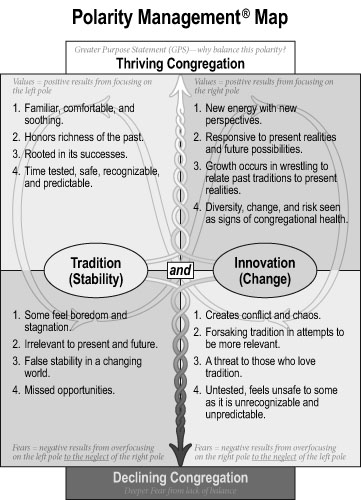
Let’s take a look at each quadrant in the “Tradition and Innovation” polarity in detail:
The Upside of Tradition
A congregation that enjoys the upside of Tradition: feels familiar, comfortable, and soothing; honors the richness of the past; is rooted in its successes; is time tested, safe, recognizable, and predictable.
The Upside of Innovation
A congregation that enjoys the upside of Innovation: brings new energy with new perspectives; responds to present realities and future possibilities; struggles to relate past tradition to present realities; sees diversity, change, and risk as signs of congregational heath.
The Downside of Tradition
The downside of Tradition causes some to feel bored and stagnant; is being out of touch with the present and future; gives rise to false security in a changing world; leads to missed opportunities.
The Downside of Innovation
The downside of Innovation can create conflict and chaos; forsakes tradition in attempts to be more relevant; threatens those who love tradition; feels unsafe to some as it is unrecognizable and unpredictable.
The more we value the upside of one pole, the more we will fear the downside of the opposite pole. The potency of the value and the fear is the same. If we value the upside of one pole at nine on a ten-point scale, we will fear its loss at nine on a ten-point scale. The more people value the upside of one pole, the more they will denigrate the opposite pole by pointing out why it is a bad idea and adding more items to the downside of that pole. So, for example, the more a congregation values the upside of Tradition (feels familiar, comfortable, and soothing), the more it will fear the downside of Innovation (can create conflict and chaos).
If we mistakenly think that only one pole can be adopted (either/or thinking) and hold strong values and fears, as above, we will find it difficult to embrace the other point of view, fearing that we must let go of something we value dearly.
A polarity is managed well when a congregation is maximizing both upsides through action steps and minimizing both downsides through early warnings. Thriving congregations manage to support both Tradition AND Innovation. If they pursue action steps and heed early warnings, the inherent tension between the two poles becomes a virtuous circle in which Tradition becomes a platform for Innovation, and Innovation helps sustain Tradition. Doing this well helps congregations thrive, even if they have never heard of Polarity Management.
__________________________________________________________
Adapted from Managing Polarities in Congregations: Eight Keys for Thriving Faith Communities by Roy M. Oswald and Barry Johnson, copyright © 2010 by the Alban Institute. All rights reserved.
Read more »
Visit Alban.org
STAY CONNECTED


____________________________
Alban
Riel has created and led workshops for companies such as Four Seasons and AstraZeneca. She also collaborates closely with Martin on his writing, including the 2007 book “The Opposable Mind: How Successful Leaders Win Through Integrative Thinking.”
She spoke with Faith & Leadership about the nature of wicked problems and some alternative approaches to solving them.
Q: Could you explain the difference between a hard problem and a wicked problem?
There are kinds of problems in the world, in particular in public policy, where the problem is not just big but almost overwhelmingly big. And you can’t see your way clear from the beginning to the end.
So you are as much designing your process to solve the problem as you are solving it, and that’s what makes it so tricky and pernicious. The term “wicked” came to be applied to these problems in part because it really does convey this sense of just how daunting it can be to be faced with a problem like, How do you provide health care to the people of the United States or the people of Canada?
Those problems look a little different from hard problems, and they require different skill sets.
We are trained really well in school to manage hard problems. Even when you get into higher levels of education, there still tend to be these reasonably structured problems. There’s a way of working your way through this complicated case that brings you to the answer related to the lesson you’re trying to learn in that class.
Wicked problems don’t work that way. They’re not pre-structured. They cross institutional barriers. They don’t belong to any one person, any one philosophy, any one organization, and so it makes it just way harder to come to an answer.
Q: How do you know you have a wicked problem and not just a hard problem?
I think life is a wicked problem, and there are hard problems within life.
How do I help my child determine which engineering program to go to? That’s a hard problem. There are a lot of engineering programs, and so you would go through your process.
That is a very different thing from having your child coming to you and saying, “What should I do with my life? What can I do that will provide me with meaning and passion?” That’s a wicked problem. How do you even start to think about a problem like that?
Q: Can you give an example in an organizational setting of a wicked problem and how it was solved ?
Steve Jobs was a master at dealing with wicked problems, and when he came back to Apple [in 1996], it was in a very bad place. They had the success of the Macintosh, and then they really struggled.
Most CEOs would come back and say, “How do I sell more computers? We’ll have to expand the number of consumers who are interested in my products. We’ll have to hire a chief marketing officer.” It’s a hard problem -- “How do I sell more computers?”
Jobs came in and asked different kinds of questions about what could that company even be. He famously said his objective was to make a dent in the universe. He asked, “How do I transform how people interact with each other and the devices that enable them to communicate?” It’s a totally different kind of thing.
The company went on to build the iPod, which is a fun little product but not much different from a whole bunch of other MP3 players that already existed at the time. But then Apple designed a whole system, created iTunes and an integrated marketing campaign that got people very excited about it.
Steve Jobs transformed what his company was about, which was how you interact with the devices in your life, and how an MP3 player wasn’t just about music but who you are as a person.
Another example that I like is Research in Motion. The BlackBerry guys are struggling a little bit [now], but think about what they did originally, which was to say, “How do people want to connect to their office when they’re not there?”
They first made digital pagers, and the notion that you could design something that would enable you to read email didn’t seem utterly transformative until it ended up in the hands of [RIM President] Mike Lazaridis, who asked, “How would you design this in such a way that would actually connect you to the people that you have left in the office?”
And that’s really what he did. He didn’t ask, “How do I make a better pager?”
Q: When you work with organizations and people in leadership, how do you go about helping them identify and address their wicked problems?
We work with a wonderful group at the Rotman School at the University of Toronto Business Design Initiative who call themselves DesignWorks. They were created out of some work that our dean, Roger Martin, did with Procter & Gamble, along with Dave Kelley [of Stanford University’s Plattner Institute of Design] and Patrick Whitney [dean of the Institute of Design at Illinois Institute of Technology].
Procter & Gamble was interested in spurring innovation internally through design. They had this insight that designers were able to tackle wicked problems in a way that didn’t seem to be happening organizationally.
So David, Roger and Patrick created a three-part process for generating innovation around wicked problems in an organization.
They take an ethnographic approach, using qualitative research and post-quantitative research -- really attempting to understand what the needs are. From there you move into the process of “ideating,” a new term for me before I met designers. It involves trying to generate ways of dealing with that need and prototyping lots of answers, testing them, going back to the users, and playing around with the ideas.
The third stage, that is so often neglected but most important, is saying, “How do I take that insight, that new innovation, and have it make sense with what I already do, with the strategy of my organization? How do I get people in my organization to understand how it fits and how to implement it?”
Q: Can you explain the term “design thinking”?
Design thinking is connected to integrative thinking, but it’s not exactly the same thing. One way of thinking about integrative thinking is as an overarching approach to problems that boil down to a couple of options that you can’t quite imagine coming together.
First you need to do a deep dive into the models in front of you, but then you need to get creative about combining those two ideas.
Design thinking is a way of doing that. Design thinking in its most simple form is applying the tools and thinking of a designer to business problems, although it extends considerably further, to a whole process and methodology that you can apply to almost any kind of problem.
You adopt the three-step approach of deeply understanding the user, ideating around that need, and then integrating it into a business model that makes sense.
Q: What if you are a person who works in an organization where you’re not the leader? If you don’t see that kind of culture around you, how do you employ design thinking in your own work?
Roger is asked this question a lot, as am I. I always turn to his answer, because it’s an incredibly helpful one. It is that, ultimately, you can’t transform the leaders of your organization. You can’t take upon yourself that it is your job to make your organization a design-thinking or integrative-thinking organization if you’re working from within it. That’s just too big and too hard a job.
But you do have something over which you have domain. You have a little team or a project. Or you have the things that are within the scope of your work, and to those you can apply this process. Try it, experiment, play, and see what comes of it.
Over time, people will observe that you are coming to these interesting and better answers, and then you get the next-higher job. Then you have more of that big pyramid of the organization that you can influence. Eventually, you get to the very top of the organization.
When we talk about integrative thinking, we often cite examples. We can point to A.G. Lafley, former CEO of Procter & Gamble, and say, “Here’s what he was able to do with this massive global organization.”
But I find it hard to believe that he became CEO and then started being an integrative thinker. That doesn’t make a lot of sense to me. I think he applied this way of tackling difficult choices early on in his career. By the time he was CEO, he was very good at this kind of thinking, and that enabled him to tackle the really big problems.
Q: Is there application of these ideas beyond the world of business?
While most of our work has been in the world of business, I think it is a broader application than that. I think all organizations face these kinds of issues. I think individuals face these kinds of issues.
And so, even if we look at politics or what’s happening in the news -- we get a lot of questions about Occupy Wall Street -- we need to look at the two sides of that debate. In most political debates, there doesn’t seem to be any listening at all.
So either Goldman Sachs is the devil or these kids who are occupying the parks are anarchists who don’t know anything, which is not helpful.
There is a wicked problem at play in the capital markets. The 2008 financial downturn gave us a big notice that something was very wrong, and the only way for us to come to a better answer and to prevent 2008 from happening again is to really engage with both sides of that debate -- really dive in and understand what they see -- and create a better answer out of that.
Q: If you’re the leader of an organization and you’re facing a wicked problem or you know that one will come along, how do you encourage the kind of problem solving that actually results in that elusive final resolution?
I think there are a couple of key things to do. One is to demonstrate through your actions your own openness to floating ideas, to exploration and creativity. People see what their leaders do and recognize that it is what they do, rather than what they say, that reveals what truly matters. So I think you should demonstrate as much as you can that openness, curiosity.
The attitude towards failure is hugely important. If failure is punished, it will kill innovation in an organization. That’s my true belief. As soon as you start punishing people for trying new ideas, they will stop trying new ideas.
But that doesn’t happen if there’s a culture of experimentation, where you say what you want to do, predict what the outcome will be, try it, and then measure what happened versus your prediction.
If you create a culture like that, it can really help spur people to want to tackle these wicked problems and feel inspired and capable of doing so.
Read more »
Mapping the Virtuous Cycle from Managing Polarities in Congregations: Eight Keys for Thriving Faith Communities by Roy Oswald and Barry Johnson
Thriving congregations manage to support both Tradition AND Innovation. If they pursue action steps and heed early warnings, the inherent tension between these two poles becomes a virtuous circle in which Tradition becomes a platform for Innovation, and Innovation helps sustain Tradition.
Mapping the Virtuous Circle
Pastors Jill Buhler and Jack Smothers moved to new program-size congregations—that is, churches with 150–350 average worship attendance—at about the same time. Both congregations had been slowly declining over the previous ten years. Jill planned to apply a recommendation she had heard that for the first nine to twelve months, her job as pastor was to be a historian and a lover—to get to know people, to find something to love in everybody, and to learn about the congregation’s history as a way of trying to understand its personality. Certain leaders of the congregation became impatient with her. The congregation was losing members, and people wanted to know what she was going to do to help them grow again. She held her ground and insisted that she would soon get to that task, but first she wanted to explore the congregation as an organism and to get to know its people. These leaders cut her some slack and stayed off her case for the first year.
Trouble began brewing, however, when after eighteen months Jill still had not begun to explore ways the congregation might become stronger and more vibrant. During this time she had gotten to know many of the longtime members and learned that they valued their rich tradition and the stability the congregation had enjoyed over the years. Every time she thought of ways the congregation might grow, she felt a lump in her throat, because she knew that the strategy would upset some of the people she had come to know and love. At the end of twenty-four months, when Jill had still not initiated any changes, board members went to their regional executive to see about having her removed.
Jack Smothers, on the other hand, had heard somewhere that if a pastor is going to make any changes, he should do so within the first six months. A new pastor who waits longer than that may not succeed in making changes. For years, the congregation had had only one worship service, with Sunday school at 9:00 am and a traditional service at 10:15, followed by a coffee time. Within three months of arriving, Jack had persuaded the board that if the congregation wanted to grow, it would have to change its Sunday morning schedule to include a traditional service at 8:30 am, Sunday school classes at 9:45, and a contemporary service at 11:00. The congregation went along with these changes for a while. Some longtime members who loved the traditional service began to complain about having to get up so early, and attendance began to slump. The contemporary service had not really gotten off the ground because its leaders did not take time to plan it well. They did not identify a target audience for the service or plan how they would let that target audience know about the new worship service. Within two years, the grumbling and complaining had become so fierce and constant that the governing board went to the denomination’s regional executive to have Jack removed as pastor.
In each of these cases, the new pastor was attending to something important. Jill was paying attention to Tradition, including the need for stability. Jack was paying attention to Innovation, including the need for change. Each got into trouble by not seeing the underlying polarity and by over-focusing on one pole without giving adequate attention to the other pole.
A polarity is a pair of truths that are interdependent. Neither truth stands alone. They complement each other. Congregations often find themselves in power struggles over the two poles of a polarity. Both sides believe strongly that they are right. People on each side assume that if they are right, their opponents must be wrong—classic “either/or” thinking. Either we are right or they are right—and we know we are right!
Many religious systems are good at preserving their core ideology. In the corporate world, the average life of a company is about forty years, and a one-hundred-year-old company is impressive for its staying power. In the church, many faith communities are hundreds of years old; their longevity would indicate that they have managed this polarity well. None of these congregations would be around today if they hadn’t. We believe, however, that it is more challenging to manage the “Tradition and Innovation” polarity well in the twenty-first century than it was in earlier years.
Let’s take a look at each quadrant in the “Tradition and Innovation” polarity in detail:
The Upside of Tradition
A congregation that enjoys the upside of Tradition: feels familiar, comfortable, and soothing; honors the richness of the past; is rooted in its successes; is time tested, safe, recognizable, and predictable.
The Upside of Innovation
A congregation that enjoys the upside of Innovation: brings new energy with new perspectives; responds to present realities and future possibilities; struggles to relate past tradition to present realities; sees diversity, change, and risk as signs of congregational heath.
The Downside of Tradition
The downside of Tradition causes some to feel bored and stagnant; is being out of touch with the present and future; gives rise to false security in a changing world; leads to missed opportunities.
The Downside of Innovation
The downside of Innovation can create conflict and chaos; forsakes tradition in attempts to be more relevant; threatens those who love tradition; feels unsafe to some as it is unrecognizable and unpredictable.
The more we value the upside of one pole, the more we will fear the downside of the opposite pole. The potency of the value and the fear is the same. If we value the upside of one pole at nine on a ten-point scale, we will fear its loss at nine on a ten-point scale. The more people value the upside of one pole, the more they will denigrate the opposite pole by pointing out why it is a bad idea and adding more items to the downside of that pole. So, for example, the more a congregation values the upside of Tradition (feels familiar, comfortable, and soothing), the more it will fear the downside of Innovation (can create conflict and chaos).
If we mistakenly think that only one pole can be adopted (either/or thinking) and hold strong values and fears, as above, we will find it difficult to embrace the other point of view, fearing that we must let go of something we value dearly.
A polarity is managed well when a congregation is maximizing both upsides through action steps and minimizing both downsides through early warnings. Thriving congregations manage to support both Tradition AND Innovation. If they pursue action steps and heed early warnings, the inherent tension between the two poles becomes a virtuous circle in which Tradition becomes a platform for Innovation, and Innovation helps sustain Tradition. Doing this well helps congregations thrive, even if they have never heard of Polarity Management.
__________________________________________________________
Adapted from Managing Polarities in Congregations: Eight Keys for Thriving Faith Communities by Roy M. Oswald and Barry Johnson, copyright © 2010 by the Alban Institute. All rights reserved.
Read more »
Visit Alban.org
STAY CONNECTED
____________________________
Alban
312 Blackwell Street, Suite 101
Durham, North Carolina 27701 United States
___________________________
Alban Weekly - "Sharing Stories of Failure Can Give People the Power to Succeed" A Faith & Leadership Interview with Jonathan Williams for Monday, 24 Augus 2015
___________________________
Alban Weekly - "Sharing Stories of Failure Can Give People the Power to Succeed" A Faith & Leadership Interview with Jonathan Williams for Monday, 24 Augus 2015
"Sharing Stories of Failure Can Give People the Power to Succeed" A Faith & Leadership Interview with Jonathan Williams
By showcasing personal stories of failure, Failure:Lab helps people "pave the way for change" by realizing they are not alone in their struggles, says one of the company's founding partners, Jonathan Williams.
Located in Grand Rapids, Michigan, Failure:Lab stages TED-like events at which successful people talk about their own failures and struggles. The storytellers offer no lessons or prescriptions for success, which frees their listeners to find their own meaning in the stories.
"It gives you hope when you see someone who looks so successful but the truth is, they've gone through all of these tough times just like you are," Williams said. "It encourages you to say, 'All right! If they can overcome it, I can overcome it.'"
Failure:Lab is not about failure but about resiliency, he said.
"In many ways, we're exploring the difference between someone who goes through something and just quits and lies down versus someone who goes through something and gets back up, and continues to get back up," Williams said.
Williams works primarily in business development and strategy for a digital agency called brightly. He's also an entrepreneur, business growth consultant and TEDx alum. He spoke recently with Faith & Leadership.
Q: What is Failure:Lab?
Failure:Lab is an event company that showcases personal stories of failure. We take successful people and put them on a stage where they talk about a personal struggle or failure that they've gone through.
Basically, it shares the context -- the back story -- behind success, in order to help people learn from failure, grow from it, be more comfortable talking about it and ultimately get rid of some of the stigma and fear around failure.
Our format, as far as we know, is the only one in the world that shares failures without sharing a lesson. That's our magic ingredient.
Usually, we have six pre-vetted and pre-coached storytellers, who each talk about 10 minutes. And the clincher is this kind of backward story crafting. They build up to the bottom -- they build up to the lowest point of their story -- and they leave the audience with that as a cliffhanger.
We then invite the audience to share the lessons that they took away from it or what it made them think about. What happens when you don't justify or blame-shift what you did is that you get people being very introspective, and they're thinking about how the story connected in their own lives.
Then we allow people to either tweet the hashtag #failure:lab or write their lessons in the program, and then all of this is published online, which then becomes a kind of growing, living conversation that is pushing back on the stigma and the fear.
Read more »
MANAGEMENT, LEARNING FROM FAILURE
Jonathan Williams: Sharing stories of failure can give people the power to succeed

Failure:Lab holds TED-like events at which successful people talk about a personal struggle or failure.
Photo courtesy of Failure Lab
Honest conversations about failure help people realize that they are not alone in their struggles, and that can give them the encouragement to succeed, says a founding partner of Failure:Lab.
By showcasing personal stories of failure, Failure:Lab helps people “pave the way for change” by realizing they are not alone in their struggles, says one of the company’s founding partners, Jonathan Williams.
Located in Grand Rapids, Michigan, Failure:Lab(link is external) stages TED-like events at which successful people talk about their own failures and struggles. The storytellers offer no lessons or prescriptions for success, which frees their listeners to find their own meaning in the stories.
“It gives you hope when you see someone who looks so successful but the truth is, they’ve gone through all of these tough times just like you are,” Williams said. “It encourages you to say, ‘All right! If they can overcome it, I can overcome it.’”
Failure:Lab is not about failure but about resiliency, he said.
“In many ways, we’re exploring the difference between someone who goes through something and just quits and lies down versus someone who goes through something and gets back up, and continues to get back up,” Williams said.

Williams works primarily in business development and strategy for a digital agency called brightly. He’s also an entrepreneur, business growth consultant and TEDx alum. He spoke recently with Faith & Leadership. The following is an edited transcript.
Q: What is Failure:Lab?
Failure:Lab is an event company that showcases personal stories of failure. We take successful people and put them on a stage where they talk about a personal struggle or failure that they’ve gone through.
Basically, it shares the context -- the back story -- behind success, in order to help people learn from failure, grow from it, be more comfortable talking about it and ultimately get rid of some of the stigma and fear around failure.
Our format, as far as we know, is the only one in the world that shares failures without sharing a lesson. That’s our magic ingredient.
Usually, we have six pre-vetted and pre-coached storytellers, who each talk about 10 minutes. And the clincher is this kind of backward story crafting. They build up to the bottom -- they build up to the lowest point of their story -- and they leave the audience with that as a cliffhanger.
We then invite the audience to share the lessons that they took away from it or what it made them think about. What happens when you don’t justify or blame-shift what you did is that you get people being very introspective, and they’re thinking about how the story connected in their own lives.
Then we allow people to either tweet the hashtag #failure:lab or write their lessons in the program, and then all of this is published online, which then becomes a kind of growing, living conversation that is pushing back on the stigma and the fear.
Q: So at the actual event, there isn’t an audience discussion? It’s all just tweeted or posted online?
Yeah. After each story, a giant clock on the back wall counts down from 90 seconds, and that’s everyone’s time to reflect and tweet or write. But it’s not discussion. During the events, it feels very much like an intimate play.
The events are minimally produced. There’s not a host or an emcee or programming in between. It goes from storyteller to musician to storyteller, so it’s kind of this roller coaster of stories and music.
And then at the end, we always throw an after-party, where people can talk with the storytellers.
Our special ingredient is that when you don’t tell people what to think, you actually get to hear what they’re thinking. That’s our magic of leaving people with a cliffhanger, so that they really have to think about it themselves.
Q: So the storytellers don’t share any lessons. They don’t say, “Here’s what I learned.”
Yes. It’s very counterintuitive.
If you and I are sitting down and you’re telling me about your success and your accomplishments, sometimes that can shut people down. Maybe I’m going through a tough struggle, and I’m like, “Man! I am so far behind this person.”
But with our format, first, you’re being vulnerable. You’re being honest. You’re talking about some of the struggles that you’ve gone through.
That’s universal. All of us have struggles.
But what’s funny about humans is, more often than not when we’re going through a struggle, we feel like we’re alone. So that’s what we’re tapping into by not sharing those lessons -- just leaving it out there. Instantly, that vulnerability goes around all of our defenses.
Whereas if [the storyteller] is instantly justifying or laying blame or getting angry or bitter, then we as listeners kind of have our defenses up. We’re saying, “Well, it wasn’t your fault. Whose fault was it?”
Well, we’re not talking about fault. We’re just talking about the actual situation, and it allows us to think of our own situations, and that’s where it’s really been very special and very impactful.
Again, it’s counterintuitive, and it’s unlike any event that I’ve ever been to. It opens people up where they want to share their own stuff. And that’s kind of the whole purpose of it. If you want to have honest conversations about success, you need to be able to have conversations about what isn’t going well.
Q: Does the storyteller, the one who went through the failure, often find new insights? Maybe the lesson wasn’t what he or she thought it was?
I would say every time -- and we’ve had 54 storytellers.
If you ask people, “What would you like to share about an impactful fork in the road or struggle in your life?” everyone has something. They think about it, maybe for the first time in 10 years. So it’s almost like reopening a case file and looking at it with a new lens to say, “What did I actually do wrong? How did I feel during that? How did that affect other people?”
It’s been incredibly cathartic for almost all the storytellers. A lot of them say, “I absolutely needed to say this. I needed to be able to do this.”
It impacts the audience members, but it also impacts the people that are sharing.
Q: The Failure:Lab website(link is external) talks about helping “pave the way for change by crushing the isolation and stigma around failure.” So what’s the role of failure in the process of change?
We’re living in times of exponential change that is massively affecting every part of our lives -- home, work, how we communicate, business, government. All of it is changing so fast, and it’s kind of an adapt-or-die situation.
So we’re forced, whether we like it or not, to try new things. And ultimately, if you’re going to be trying a bunch of new things, then you’re going to be screwing up more than you were before.
At the same time, as we’re more digitally connected than ever, more and more people are becoming physically disconnected.
So those two things combined mean that in a lot of ways, all we’re looking at is digital veneers, pictures of people with their best face forward. We’re missing the sitting-around-the-campfire sharing of real stories. We’re missing that community. We’re missing the face-to-face.
Failure:Lab does an amazing job of bringing people together and really digging into some honest narrative. And that helps people to change -- to remember that they’re not alone, to remember that a ton of other people are struggling.
It gives you hope when you see someone who looks so successful but the truth is, they’ve gone through all of these tough times just like you are. It encourages you to say, “All right! If they can overcome it, I can overcome it.”
In many ways, we’re exploring the difference between someone who goes through something and just quits and lies down versus someone who goes through something and gets back up, and continues to get back up.
That’s the crux of the change that we’re trying to create: to encourage people to keep going. In many ways, what Failure:Lab is about is resiliency. It’s not actually about failure. It’s that these people aren’t failures. They’re resilient individuals.
They have this attitude of not giving up. They’re willing to keep trying and be strong. They have this perception of, “You know what? I’m not a failure. This event was a failure, but I’m not a failure.”
Q: How did Failure:Lab start?
My friend Jordan O’Neil went to TEDx Detroit about four years ago now and heard a talk by a man named Randal Charlton, a wealthy businessman in his 70s.
Years ago, he’d moved to America from Europe with a dream of starting a restaurant and bar and had sunk his entire fortune into this. He ended up losing his business and all of his money. His wife left him. He got pneumonia. And then his daughter committed suicide.
He was raw and emotional [during the talk], and you could tell that it still hurt. And at the end, he wrapped it up by saying he eventually moved to Detroit and found a new purpose and moved on with his life.
The whole drive back to Grand Rapids, Jordan kept thinking about Randal’s talk and how it stood out because of the vulnerability and the honesty.
And Jordan thought, “What if we did an event that was just that? No bow at the end, no wrapping up. What if we just shared that?”
We talked about it for a while and wrote the format, a two-hour event with six speakers and music blended in. When we did the first event, we were terrified, because it had never been done that way with no lessons, and we didn’t know if it was going to be depressing -- or if people were going to come.
And we ended up selling it out in advance, which made us even more terrified, because we’re like, “What if everyone comes and they all hate it?”
The first one was just phenomenal. It was just such a fun, amazing experience. And since then, we’ve done 10 events in three years in two countries and maybe eight cities. And yeah, it’s just been phenomenal.
Q: And as you said, this is a company; this is a business, right?
Yeah. We’re a [limited liability company] with three partners. We realized if we wanted to grow in the same way that TED did, then we can only organize so many events a year.
So about three or four months ago, we launched an independent license model. So now anyone anywhere can organize their own Failure:Lab(link is external). For a small license fee, you get access to all of our guidelines, our how-to’s, our branded documents, our program templates, poster templates, press-release templates. You get a page on our website.
Oddly enough, our first independent event was in Chandigarh, India. They organized it in three weeks and sold it out.
And we had this “Nemo” moment where, like, “My goodness! Our little idea was exported around the world.” And since then, we’ve just been growing.
We’ve also created a curriculum for organizations and companies(link is external), a course that allows people to explore what’s holding people back in their organization. What are they afraid of? Why are they not trying new things? Why are they not communicating well? Why is your environment not safe for innovation?
We’re really excited about this. A lot of the pushback that TED gets is that the seminars get everyone jazzed up for a day and then nothing happens.
That was what we wanted to solve. Like, “All right. We’re actually stirring things up in people, getting them to think. They’re opening some of the things from their past, looking at their pattern. We want to give them an ability to actually do some of this.”
Monday, August 24, 2015

In Blessed Connections, seminary professor Judith Schwanz focuses on the person of the minister and the relational system of the minister's life. She spotlights three areas of connection --relationship with self, relationships with other people, and relationship with God. Attending to these three primary connections will strengthen the pastor and cushion her or him against the pressures and stresses of daily ministry. Blessed Connections is ideal for seminary students and new pastors and includes "Assessment Journal" questions at the end of each chapter for personal application.
Buy the book »

It's the Last Days of the Rowman & Littlefield 35% Off Summer Sale
Use code 15SUMSALE at check-out to save 35% off on any of our in-stock print titles and eBooks. Shop onlineor call us at 1-800-462-6420. To learn more about the sale, visit the Rowman & Littlefield website.
Offer expires 8/31/2015.
Continue Your Learning with The Church Network
Keeping Ministry Peace through Effective Church Communications
A webinar with Mark MacDonald
August 27, 2015 at 2:30 p.m. EDT
Every ministry wants promotion but there's not enough time or space to do it. Should it be the loudest voice? The "pet" ministry of the pastor? Can it be done peacefully? An effective church communication strategy prevents ministry silos that lead to ministry wars. During this seminar we'll talk about ministry strife and what causes it. Then we'll describe how a church communication strategy can help keep peace between all the ministries in your busy church PLUS engage more people in your congregation and community.
Learn more and register »
Ideas that Impact: Learning from Failures
Success as the Byproduct of Repeated Failures by L. Gregory Jones and Nathan Jones
A young scientist was discouraged by how often his experiments led nowhere. And then he figured out that repeated experimenting and failure was the path to groundbreaking solutions.
Read more »
CHRISTIAN LEADERSHIP,MANAGEMENT,LEARNING FROM FAILURE
L. Gregory Jones and Nathan Jones: Success as the byproduct of repeated failure

A young scientist was discouraged by how often his experiments led nowhere. And then he figured out that repeated experimenting and failure was the path to groundbreaking solutions.
In October of this year, the Nobel committee rewarded Dr. Robert Lefkowitz for solving a wicked problem.
For decades, biologists and chemists had struggled to understand the nature and function of G protein-coupled receptors, which are essential components of the cell membrane. They knew that these receptors were involved in the cell’s communication with the rest of the body, and that understanding them fully would open up exciting new research avenues.
But they also found it extremely difficult to understandhowthis process works. With so many chemical factors, on such a microscopic scale, how would you go about solving the mystery? Lefkowitz and his team discovered a strategy for finding the solution, and it won them the Nobel Prize in chemistry.
What it all boils down to, according to Lefkowitz, is a single word: chutzpah. Yiddish for audacity, “chutzpah” aptly describes his approach to research. “I’m probably working on the most challenging problems I’ve ever worked on,” he said in an interview with Duke Magazine. “I have no idea whether I can solve them.”
What he does have is a methodology to match his audacious approach to research: Think big, experiment, expect failure, learn from failure. Experiment again, fail again.
The willingness to experiment and fail didn’t come easy to Lefkowitz, however. As a young scientist at the National Institutes of Health (NIH), his first year was filled with nothing but failure, he said in the Duke interview. As one might expect, he despaired. “Now, for the first time in my life,” he said, “I didn’t know what the hell I was doing. … And I concluded, erroneously, that I had no talent for this at all.”
Yet after his second year at NIH, in which he fared much better, he began to reconceptualize failure. “What I subsequently came to realize is that a year’s failure is nothing -- nothing. I remember one prominent scientist telling me, ‘The difference between a really successful scientist and an average scientist is that for the average scientist, maybe 0.5 to 1 percent of his experiments work. For an absolutely fabulous scientist, it could be as high as 2 percent.’” Likewise, he began to re-imagine success: “Success is, in a very real sense, just the product of repeated failure.”
Not all wicked problems are like the scientific ones that make up Lefkowitz’s research, but all of them require his habits of experimentation and learning from failure.
After all, ifwicked problemsare distinguished from hard problems by their complexity and the way their character changes the more you work on them, there will be no single way to solve a wicked problem. Experimentation, then, is crucial to a process of discovering generative solutions; you have to be willing to test different strategies that address different aspects of the wicked problem.
In the attempt to solve a wicked problem such as poverty, for example, we can design experiments from different perspectives: What kind of effect would affordable housing for single mothers have? What about private school vouchers? Or we can design experiments from within a single perspective, but with differing contexts: Does the effect of private school vouchers depend upon class alone, or is there a significant racial component at play?
In gleaning insights as we develop such experiments, we are likely to discover new aspects of the wicked problem in question. Maybe the experiment on affordable housing revealed the importance of affordable transportation to and from work, or the voucher experiment revealed the social danger of extracting kids from their neighborhoods. None of these connections can be made without trying, even if many of them fail to deliver the results we had hoped.
One of the daunting challenges Christian institutional leaders face, though, is that we often lack sufficient resources to think we can afford to undertake experiments that might -- indeed, likely will -- fail.
And many of the foundations and donors who support our institutions pay lip service to the importance of “experiments” and “learning from failure,” even as their funding decisions seem structured to reward only unambiguous success. In resource-constrained environments, playing it safe with programs that seem to show progress, if only on a “tactical” rather than a “strategic” level, seems the wisest course, even if it only defers grappling with the deeper dimensions of wicked problems.
We can overcome this predicament byworking with stakeholders, including funders, at the outset, carefully framing wicked problems and possible experiments -- and acknowledging that many of those experiments might fail. Hence, we will allocate our resources to multiple provisional experiments rather than any single grand design.
Failing with a grand design will be a grand failure; failing with multiple provisional experiments will make failure absorbable (and not all of those experiments will likely fail). Each experiment can grow out of the lessons learned from the previous one, transforming failure into an educational tool. The IDEO design firm has a motto that encourages people to “fail often to succeed sooner.”
Yet when solving a wicked problem, not all failure is good failure.
We must be careful, therefore, to distinguish between different types of failure. We Christians ought to have a rich vocabulary for doing so. Failure can result from culpable, sinful mistakes. Or failure can result from the unwillingness to take a risk on an intriguing hunch. These kinds of failures will hamper the problem-solving process and should be resisted.
But failure can also be the natural byproduct of an innovative experiment, and this kind of failure should be embraced and even encouraged. Indeed, when the practice of learning from experimental failure becomes a part of our institution’s DNA, we will be more capable of identifying wicked problems and discovering generative solutions.
Just look at Lefkowitz’s institutional attachments. Yes, he is the James B. Duke Professor of Biochemistry at Duke University. But he also works at the Howard Hughes Medical Institute (HHMI), a nonprofit medical research organization located in Maryland. HHMI’s “investigator” program, of which Lefkowitz is a part, urges its researchers “to take risks, to explore unproven avenues, and to embrace the unknown --even if it means uncertainty or the chance of failure.”
In his book “Adapt: Why Success Always Starts with Failure,” economist Tim Harford contrasts this risk-taking approach with that of the more traditionally minded NIH. “The NIH’s expert-led, results-based, rational evaluation of projects,” he writes, “is a sensible way to produce a steady stream of high-quality, can’t-go-wrong scientific research.”
What it often fails to do, however, is fund those “revolutionary breakthrough” projects like Lefkowitz’s. Research has shown that the HHMI pattern of experimentation yields more failures over time -- and also more breakthrough successes.
To put the matter another way, NIH might be the world’s best solver of hard problems. But when it comes to wicked ones, we need institutions like HHMI, who embrace experimental risks and the inevitable failures that accompany them.
And we need Christian institutions and institutional leaders who are committed to Lefkowitz’s formula for discovering breakthrough, generative solutions: Think big, experiment, expect failure, learn from failure. Experiment again, fail again.
The Impossible Task of Ministry from Cross-Shaped Leadership: On the Rough and Tumble of Parish Practice by John A. Berntsen
Once we've accepted the truth that ministry is hard -- even impossible -- once we've stopped living in denial of this reality, or perhaps whining about it -- it becomes the truth that sets us free.
Q: What is Failure:Lab?
Failure:Lab is an event company that showcases personal stories of failure. We take successful people and put them on a stage where they talk about a personal struggle or failure that they’ve gone through.
Basically, it shares the context -- the back story -- behind success, in order to help people learn from failure, grow from it, be more comfortable talking about it and ultimately get rid of some of the stigma and fear around failure.
Our format, as far as we know, is the only one in the world that shares failures without sharing a lesson. That’s our magic ingredient.
Usually, we have six pre-vetted and pre-coached storytellers, who each talk about 10 minutes. And the clincher is this kind of backward story crafting. They build up to the bottom -- they build up to the lowest point of their story -- and they leave the audience with that as a cliffhanger.
We then invite the audience to share the lessons that they took away from it or what it made them think about. What happens when you don’t justify or blame-shift what you did is that you get people being very introspective, and they’re thinking about how the story connected in their own lives.
Then we allow people to either tweet the hashtag #failure:lab or write their lessons in the program, and then all of this is published online, which then becomes a kind of growing, living conversation that is pushing back on the stigma and the fear.
Q: So at the actual event, there isn’t an audience discussion? It’s all just tweeted or posted online?
Yeah. After each story, a giant clock on the back wall counts down from 90 seconds, and that’s everyone’s time to reflect and tweet or write. But it’s not discussion. During the events, it feels very much like an intimate play.
The events are minimally produced. There’s not a host or an emcee or programming in between. It goes from storyteller to musician to storyteller, so it’s kind of this roller coaster of stories and music.
And then at the end, we always throw an after-party, where people can talk with the storytellers.
Our special ingredient is that when you don’t tell people what to think, you actually get to hear what they’re thinking. That’s our magic of leaving people with a cliffhanger, so that they really have to think about it themselves.
Q: So the storytellers don’t share any lessons. They don’t say, “Here’s what I learned.”
Yes. It’s very counterintuitive.
If you and I are sitting down and you’re telling me about your success and your accomplishments, sometimes that can shut people down. Maybe I’m going through a tough struggle, and I’m like, “Man! I am so far behind this person.”
But with our format, first, you’re being vulnerable. You’re being honest. You’re talking about some of the struggles that you’ve gone through.
That’s universal. All of us have struggles.
But what’s funny about humans is, more often than not when we’re going through a struggle, we feel like we’re alone. So that’s what we’re tapping into by not sharing those lessons -- just leaving it out there. Instantly, that vulnerability goes around all of our defenses.
Whereas if [the storyteller] is instantly justifying or laying blame or getting angry or bitter, then we as listeners kind of have our defenses up. We’re saying, “Well, it wasn’t your fault. Whose fault was it?”
Well, we’re not talking about fault. We’re just talking about the actual situation, and it allows us to think of our own situations, and that’s where it’s really been very special and very impactful.
Again, it’s counterintuitive, and it’s unlike any event that I’ve ever been to. It opens people up where they want to share their own stuff. And that’s kind of the whole purpose of it. If you want to have honest conversations about success, you need to be able to have conversations about what isn’t going well.
Q: Does the storyteller, the one who went through the failure, often find new insights? Maybe the lesson wasn’t what he or she thought it was?
I would say every time -- and we’ve had 54 storytellers.
If you ask people, “What would you like to share about an impactful fork in the road or struggle in your life?” everyone has something. They think about it, maybe for the first time in 10 years. So it’s almost like reopening a case file and looking at it with a new lens to say, “What did I actually do wrong? How did I feel during that? How did that affect other people?”
It’s been incredibly cathartic for almost all the storytellers. A lot of them say, “I absolutely needed to say this. I needed to be able to do this.”
It impacts the audience members, but it also impacts the people that are sharing.
Q: The Failure:Lab website(link is external) talks about helping “pave the way for change by crushing the isolation and stigma around failure.” So what’s the role of failure in the process of change?
We’re living in times of exponential change that is massively affecting every part of our lives -- home, work, how we communicate, business, government. All of it is changing so fast, and it’s kind of an adapt-or-die situation.
So we’re forced, whether we like it or not, to try new things. And ultimately, if you’re going to be trying a bunch of new things, then you’re going to be screwing up more than you were before.
At the same time, as we’re more digitally connected than ever, more and more people are becoming physically disconnected.
So those two things combined mean that in a lot of ways, all we’re looking at is digital veneers, pictures of people with their best face forward. We’re missing the sitting-around-the-campfire sharing of real stories. We’re missing that community. We’re missing the face-to-face.
Failure:Lab does an amazing job of bringing people together and really digging into some honest narrative. And that helps people to change -- to remember that they’re not alone, to remember that a ton of other people are struggling.
It gives you hope when you see someone who looks so successful but the truth is, they’ve gone through all of these tough times just like you are. It encourages you to say, “All right! If they can overcome it, I can overcome it.”
In many ways, we’re exploring the difference between someone who goes through something and just quits and lies down versus someone who goes through something and gets back up, and continues to get back up.
That’s the crux of the change that we’re trying to create: to encourage people to keep going. In many ways, what Failure:Lab is about is resiliency. It’s not actually about failure. It’s that these people aren’t failures. They’re resilient individuals.
They have this attitude of not giving up. They’re willing to keep trying and be strong. They have this perception of, “You know what? I’m not a failure. This event was a failure, but I’m not a failure.”
Q: How did Failure:Lab start?
My friend Jordan O’Neil went to TEDx Detroit about four years ago now and heard a talk by a man named Randal Charlton, a wealthy businessman in his 70s.
Years ago, he’d moved to America from Europe with a dream of starting a restaurant and bar and had sunk his entire fortune into this. He ended up losing his business and all of his money. His wife left him. He got pneumonia. And then his daughter committed suicide.
He was raw and emotional [during the talk], and you could tell that it still hurt. And at the end, he wrapped it up by saying he eventually moved to Detroit and found a new purpose and moved on with his life.
The whole drive back to Grand Rapids, Jordan kept thinking about Randal’s talk and how it stood out because of the vulnerability and the honesty.
And Jordan thought, “What if we did an event that was just that? No bow at the end, no wrapping up. What if we just shared that?”
We talked about it for a while and wrote the format, a two-hour event with six speakers and music blended in. When we did the first event, we were terrified, because it had never been done that way with no lessons, and we didn’t know if it was going to be depressing -- or if people were going to come.
And we ended up selling it out in advance, which made us even more terrified, because we’re like, “What if everyone comes and they all hate it?”
The first one was just phenomenal. It was just such a fun, amazing experience. And since then, we’ve done 10 events in three years in two countries and maybe eight cities. And yeah, it’s just been phenomenal.
Q: And as you said, this is a company; this is a business, right?
Yeah. We’re a [limited liability company] with three partners. We realized if we wanted to grow in the same way that TED did, then we can only organize so many events a year.
So about three or four months ago, we launched an independent license model. So now anyone anywhere can organize their own Failure:Lab(link is external). For a small license fee, you get access to all of our guidelines, our how-to’s, our branded documents, our program templates, poster templates, press-release templates. You get a page on our website.
Oddly enough, our first independent event was in Chandigarh, India. They organized it in three weeks and sold it out.
And we had this “Nemo” moment where, like, “My goodness! Our little idea was exported around the world.” And since then, we’ve just been growing.
We’ve also created a curriculum for organizations and companies(link is external), a course that allows people to explore what’s holding people back in their organization. What are they afraid of? Why are they not trying new things? Why are they not communicating well? Why is your environment not safe for innovation?
We’re really excited about this. A lot of the pushback that TED gets is that the seminars get everyone jazzed up for a day and then nothing happens.
That was what we wanted to solve. Like, “All right. We’re actually stirring things up in people, getting them to think. They’re opening some of the things from their past, looking at their pattern. We want to give them an ability to actually do some of this.”
Monday, August 24, 2015
In Blessed Connections, seminary professor Judith Schwanz focuses on the person of the minister and the relational system of the minister's life. She spotlights three areas of connection --relationship with self, relationships with other people, and relationship with God. Attending to these three primary connections will strengthen the pastor and cushion her or him against the pressures and stresses of daily ministry. Blessed Connections is ideal for seminary students and new pastors and includes "Assessment Journal" questions at the end of each chapter for personal application.
Buy the book »
It's the Last Days of the Rowman & Littlefield 35% Off Summer Sale
Use code 15SUMSALE at check-out to save 35% off on any of our in-stock print titles and eBooks. Shop onlineor call us at 1-800-462-6420. To learn more about the sale, visit the Rowman & Littlefield website.
Offer expires 8/31/2015.
Continue Your Learning with The Church Network
Keeping Ministry Peace through Effective Church Communications
A webinar with Mark MacDonald
August 27, 2015 at 2:30 p.m. EDT
Every ministry wants promotion but there's not enough time or space to do it. Should it be the loudest voice? The "pet" ministry of the pastor? Can it be done peacefully? An effective church communication strategy prevents ministry silos that lead to ministry wars. During this seminar we'll talk about ministry strife and what causes it. Then we'll describe how a church communication strategy can help keep peace between all the ministries in your busy church PLUS engage more people in your congregation and community.
Learn more and register »
Ideas that Impact: Learning from Failures
Success as the Byproduct of Repeated Failures by L. Gregory Jones and Nathan Jones
A young scientist was discouraged by how often his experiments led nowhere. And then he figured out that repeated experimenting and failure was the path to groundbreaking solutions.
Read more »
CHRISTIAN LEADERSHIP,MANAGEMENT,LEARNING FROM FAILURE
L. Gregory Jones and Nathan Jones: Success as the byproduct of repeated failure
A young scientist was discouraged by how often his experiments led nowhere. And then he figured out that repeated experimenting and failure was the path to groundbreaking solutions.
In October of this year, the Nobel committee rewarded Dr. Robert Lefkowitz for solving a wicked problem.
For decades, biologists and chemists had struggled to understand the nature and function of G protein-coupled receptors, which are essential components of the cell membrane. They knew that these receptors were involved in the cell’s communication with the rest of the body, and that understanding them fully would open up exciting new research avenues.
But they also found it extremely difficult to understandhowthis process works. With so many chemical factors, on such a microscopic scale, how would you go about solving the mystery? Lefkowitz and his team discovered a strategy for finding the solution, and it won them the Nobel Prize in chemistry.
What it all boils down to, according to Lefkowitz, is a single word: chutzpah. Yiddish for audacity, “chutzpah” aptly describes his approach to research. “I’m probably working on the most challenging problems I’ve ever worked on,” he said in an interview with Duke Magazine. “I have no idea whether I can solve them.”
What he does have is a methodology to match his audacious approach to research: Think big, experiment, expect failure, learn from failure. Experiment again, fail again.
The willingness to experiment and fail didn’t come easy to Lefkowitz, however. As a young scientist at the National Institutes of Health (NIH), his first year was filled with nothing but failure, he said in the Duke interview. As one might expect, he despaired. “Now, for the first time in my life,” he said, “I didn’t know what the hell I was doing. … And I concluded, erroneously, that I had no talent for this at all.”
Yet after his second year at NIH, in which he fared much better, he began to reconceptualize failure. “What I subsequently came to realize is that a year’s failure is nothing -- nothing. I remember one prominent scientist telling me, ‘The difference between a really successful scientist and an average scientist is that for the average scientist, maybe 0.5 to 1 percent of his experiments work. For an absolutely fabulous scientist, it could be as high as 2 percent.’” Likewise, he began to re-imagine success: “Success is, in a very real sense, just the product of repeated failure.”
Not all wicked problems are like the scientific ones that make up Lefkowitz’s research, but all of them require his habits of experimentation and learning from failure.
After all, ifwicked problemsare distinguished from hard problems by their complexity and the way their character changes the more you work on them, there will be no single way to solve a wicked problem. Experimentation, then, is crucial to a process of discovering generative solutions; you have to be willing to test different strategies that address different aspects of the wicked problem.
In the attempt to solve a wicked problem such as poverty, for example, we can design experiments from different perspectives: What kind of effect would affordable housing for single mothers have? What about private school vouchers? Or we can design experiments from within a single perspective, but with differing contexts: Does the effect of private school vouchers depend upon class alone, or is there a significant racial component at play?
In gleaning insights as we develop such experiments, we are likely to discover new aspects of the wicked problem in question. Maybe the experiment on affordable housing revealed the importance of affordable transportation to and from work, or the voucher experiment revealed the social danger of extracting kids from their neighborhoods. None of these connections can be made without trying, even if many of them fail to deliver the results we had hoped.
One of the daunting challenges Christian institutional leaders face, though, is that we often lack sufficient resources to think we can afford to undertake experiments that might -- indeed, likely will -- fail.
And many of the foundations and donors who support our institutions pay lip service to the importance of “experiments” and “learning from failure,” even as their funding decisions seem structured to reward only unambiguous success. In resource-constrained environments, playing it safe with programs that seem to show progress, if only on a “tactical” rather than a “strategic” level, seems the wisest course, even if it only defers grappling with the deeper dimensions of wicked problems.
We can overcome this predicament byworking with stakeholders, including funders, at the outset, carefully framing wicked problems and possible experiments -- and acknowledging that many of those experiments might fail. Hence, we will allocate our resources to multiple provisional experiments rather than any single grand design.
Failing with a grand design will be a grand failure; failing with multiple provisional experiments will make failure absorbable (and not all of those experiments will likely fail). Each experiment can grow out of the lessons learned from the previous one, transforming failure into an educational tool. The IDEO design firm has a motto that encourages people to “fail often to succeed sooner.”
Yet when solving a wicked problem, not all failure is good failure.
We must be careful, therefore, to distinguish between different types of failure. We Christians ought to have a rich vocabulary for doing so. Failure can result from culpable, sinful mistakes. Or failure can result from the unwillingness to take a risk on an intriguing hunch. These kinds of failures will hamper the problem-solving process and should be resisted.
But failure can also be the natural byproduct of an innovative experiment, and this kind of failure should be embraced and even encouraged. Indeed, when the practice of learning from experimental failure becomes a part of our institution’s DNA, we will be more capable of identifying wicked problems and discovering generative solutions.
Just look at Lefkowitz’s institutional attachments. Yes, he is the James B. Duke Professor of Biochemistry at Duke University. But he also works at the Howard Hughes Medical Institute (HHMI), a nonprofit medical research organization located in Maryland. HHMI’s “investigator” program, of which Lefkowitz is a part, urges its researchers “to take risks, to explore unproven avenues, and to embrace the unknown --even if it means uncertainty or the chance of failure.”
In his book “Adapt: Why Success Always Starts with Failure,” economist Tim Harford contrasts this risk-taking approach with that of the more traditionally minded NIH. “The NIH’s expert-led, results-based, rational evaluation of projects,” he writes, “is a sensible way to produce a steady stream of high-quality, can’t-go-wrong scientific research.”
What it often fails to do, however, is fund those “revolutionary breakthrough” projects like Lefkowitz’s. Research has shown that the HHMI pattern of experimentation yields more failures over time -- and also more breakthrough successes.
To put the matter another way, NIH might be the world’s best solver of hard problems. But when it comes to wicked ones, we need institutions like HHMI, who embrace experimental risks and the inevitable failures that accompany them.
And we need Christian institutions and institutional leaders who are committed to Lefkowitz’s formula for discovering breakthrough, generative solutions: Think big, experiment, expect failure, learn from failure. Experiment again, fail again.
The Impossible Task of Ministry from Cross-Shaped Leadership: On the Rough and Tumble of Parish Practice by John A. Berntsen
Once we've accepted the truth that ministry is hard -- even impossible -- once we've stopped living in denial of this reality, or perhaps whining about it -- it becomes the truth that sets us free.
Read more »
The Impossible Task of MinistryAs all leaders of Christian congregations understand, when we speak of the cross we are talking about more than the crucifixion on Good Friday. Speaking of the cross is really shorthand for the whole drama of salvation. The cross is God’s decisive act of reconciling the world to God. The cross is about dying and rising with Christ. It is about what we undergo, and therefore what we lose and gain, in this dying and rising. The cross is about the death of our old self, the self born of Adam and Eve, and the rising up of a new self born of “the Spirit of him who raised Jesus from the dead” (Rom. 8:11).
The cross has a way of inserting itself into our lives. Often knowledge of the cross goes hand in hand with the experience of some significant life failures. To recognize that you are, after all, a broken vessel can sober you up a bit about your quest for glory.
In our culture the quest for glory, and so the failure to achieve it, wears many faces. The recent cult of celebrity seduces many of us, and not least those who crave the food of endless attention, praise, and adoration. The neurotic need for order and security beckons those whose quest is for an ultimate safety that the world cannot give short of the grave. And many cannot live their lives except through others and with their approval.
We are loath to acknowledge any of this, of course. We have become practiced at “keeping our game face on” and “never letting them see you sweat”—unless it’s to make a spectacle of our woes by turning life into another second-rate reality show. Perhaps the starkest reality is being useless in a global marketplace whose mythology is that you can “be all that you can be” if only you will reinvent yourself daily. As the social scientist Richard Sennett reminds us, “Failure is the great modern taboo.”1
At a deeper level, the cross is the story of the world’s resistance to grace. The cross is the showdown—yes, the confrontation—between a steadfastly loving God who wills and calls a world into covenant partnership and a world that wants to live in its own strength, playing God for itself. Jesus comes preaching a kingdom of righteousness, justice, and unconditional love, and the world says, “No thanks. We think our system of merit and scorekeeping and judgment is safer. We prefer the reign of our marketplace to your upside-down kingdom that reckons by grace. So count us out.”
But public leadership in the church is subject to a continuous cycle of death and resurrection. The very initiatives, actions, and plans of leaders undergo the cross. Under the cross, the moment-by-moment doings of ministry are subject to countless deaths and resurrections, few of which are heroic or glorious. So how does this transformation take place amid the rough and tumble of parish practice—through what I call cross-shaped leadership?
First, cross-shaped leadership is not only about taking an initiative but also aboutreceiving the initiative of others—the divine Other and the others of the world. In this aspect of cross-shaped leadership, ministry can be viewed in terms of what leaders undergo, rather than what they do. Leadership is about what I like to call action in passion. The very act of leading is subject to or “suffers” the event of the Word’s proclamation and the world’s resistance to that proclamation. Leadership is caught up in, and so is a response to, the undergoing of this event. In practice this means that what leaders do is always provisional, contextual, and fallible. It is always interim in nature.
Second, the struggle within us between the true self and the false self is the root of vocational discernment and ministry formation. Rediscovering our true self is the central challenge of the Christian life and identity. The challenges of leadership magnify the vulnerability of the self in its true and false guises.
Third, humility marks cross-shaped leadership. There’s not much humility in evidence among today’s heralded “visionary” or “purpose-driven” leaders. Yet strong-willed humility (a paradox, of course!) is the most noticeable mark on leaders left by the cross.
Fourth, cross-shaped leaders are focused on people before ideas, answers, or master plans. They are listeners and questioners before they are visionaries or seers. Cross-shaped leaders focus first on the Who of God and the who of the people in covenant, and only secondly on the what of the leader’s supposed vision. Biblically, vision arises from, and remains grounded in, a community of people in partnership or covenant. Vision is always responsive; it is a function of the call and response of a living dialogue. Otherwise, as is so often the case in institutional life, when vision becomes detached from partnerships and covenants (spoken or unspoken), it deteriorates into an ideology or an agenda. It hardens into an abstraction, and then it commands by coercion instead of willing obedience.
Fifth, cross-shaped leaders live a double life. Every group has its stated mission for work and an unspoken, usually unconscious, emotional contract about why people have come together. Leadership is a dance: it always means getting on with the mission at the same time that one tends to the unconscious life and health of the body. Ministry is always “in sickness and in health.” It means befriending the imperfect and sometimes the irrational. Moreover, our life together under God’s Word calls for mutual love and discipline of one another as members of the assembly. In this regard, the clinical/health model of community life (“healthy vs. unhealthy” congregations) is rooted and grounded in what the confessional tradition calls the “marks of the church,” such as the Office of the Keys, the Offices of Ministry, and so forth.
Sixth, humor is a sign of our need for grace. Cross-shaped leaders take themselves less seriously, because they take God’s grace more seriously. Laughter, with its recognition of the contradictions that make up our life together, can keep us honest about our allotted place as creatures and even call us to that repentance, to that change of mind and heart, which prepares us to hear once again the good news of God’s forgiveness and unconditional love.
Ministry is hard. Ministry is, in fact, impossible. (Just try to referee a fair fight about the virtues of “contemporary” versus “traditional” worship if you need any reminders about that.) It’s a perfect storm in which leaders are pressured either to pick winners and losers or to feed the multitudes by offering a cafeteria of consumer choices. Here’s the good news, though. Once we’ve accepted the truth that ministry is hard, even impossible—once we’ve stopped living in denial of this reality, or perhaps whining about it—it becomes the truth that sets us free. We cease being gloomy servants, weighed down by our resentful conviction that we are all alone in our work, and instead become joyful coworkers of a strong, wise, and consoling Lord.
1. Richard Sennett, The Corrosion of Character (New York: W.W. Norton, 1997), 118.
_____________________________________
Adapted from Cross-Shaped Leadership: On the Rough and Tumble of Parish Practice by John A. Berntsen, copyright © 2008 by the Alban Institute. All rights reserved.
Copyright © 2008, the Alban Institute. All rights reserved. We encourage you to share Alban Weekly articles with your congregation. We gladly allow permission to reprint articles from the Alban Weekly for one-time use by congregations and their leaders when the material is offered free of charge. All we ask is that you write to
us at alban@div.duke.edu and let us know how Alban Weekly is making an impact in your congregation. If you would like to use any other Alban material, or if your intended use of Alban Weekly does not fall within this scope, please submit ourreprint permission request form.
Subscribe to The Alban Weekly.
Archive of past issues of The Alban Weekly.
_____________________________________
FEATURED RESOURCES

The Impossible Task of MinistryAs all leaders of Christian congregations understand, when we speak of the cross we are talking about more than the crucifixion on Good Friday. Speaking of the cross is really shorthand for the whole drama of salvation. The cross is God’s decisive act of reconciling the world to God. The cross is about dying and rising with Christ. It is about what we undergo, and therefore what we lose and gain, in this dying and rising. The cross is about the death of our old self, the self born of Adam and Eve, and the rising up of a new self born of “the Spirit of him who raised Jesus from the dead” (Rom. 8:11).
The cross has a way of inserting itself into our lives. Often knowledge of the cross goes hand in hand with the experience of some significant life failures. To recognize that you are, after all, a broken vessel can sober you up a bit about your quest for glory.
In our culture the quest for glory, and so the failure to achieve it, wears many faces. The recent cult of celebrity seduces many of us, and not least those who crave the food of endless attention, praise, and adoration. The neurotic need for order and security beckons those whose quest is for an ultimate safety that the world cannot give short of the grave. And many cannot live their lives except through others and with their approval.
We are loath to acknowledge any of this, of course. We have become practiced at “keeping our game face on” and “never letting them see you sweat”—unless it’s to make a spectacle of our woes by turning life into another second-rate reality show. Perhaps the starkest reality is being useless in a global marketplace whose mythology is that you can “be all that you can be” if only you will reinvent yourself daily. As the social scientist Richard Sennett reminds us, “Failure is the great modern taboo.”1
At a deeper level, the cross is the story of the world’s resistance to grace. The cross is the showdown—yes, the confrontation—between a steadfastly loving God who wills and calls a world into covenant partnership and a world that wants to live in its own strength, playing God for itself. Jesus comes preaching a kingdom of righteousness, justice, and unconditional love, and the world says, “No thanks. We think our system of merit and scorekeeping and judgment is safer. We prefer the reign of our marketplace to your upside-down kingdom that reckons by grace. So count us out.”
But public leadership in the church is subject to a continuous cycle of death and resurrection. The very initiatives, actions, and plans of leaders undergo the cross. Under the cross, the moment-by-moment doings of ministry are subject to countless deaths and resurrections, few of which are heroic or glorious. So how does this transformation take place amid the rough and tumble of parish practice—through what I call cross-shaped leadership?
First, cross-shaped leadership is not only about taking an initiative but also aboutreceiving the initiative of others—the divine Other and the others of the world. In this aspect of cross-shaped leadership, ministry can be viewed in terms of what leaders undergo, rather than what they do. Leadership is about what I like to call action in passion. The very act of leading is subject to or “suffers” the event of the Word’s proclamation and the world’s resistance to that proclamation. Leadership is caught up in, and so is a response to, the undergoing of this event. In practice this means that what leaders do is always provisional, contextual, and fallible. It is always interim in nature.
Second, the struggle within us between the true self and the false self is the root of vocational discernment and ministry formation. Rediscovering our true self is the central challenge of the Christian life and identity. The challenges of leadership magnify the vulnerability of the self in its true and false guises.
Third, humility marks cross-shaped leadership. There’s not much humility in evidence among today’s heralded “visionary” or “purpose-driven” leaders. Yet strong-willed humility (a paradox, of course!) is the most noticeable mark on leaders left by the cross.
Fourth, cross-shaped leaders are focused on people before ideas, answers, or master plans. They are listeners and questioners before they are visionaries or seers. Cross-shaped leaders focus first on the Who of God and the who of the people in covenant, and only secondly on the what of the leader’s supposed vision. Biblically, vision arises from, and remains grounded in, a community of people in partnership or covenant. Vision is always responsive; it is a function of the call and response of a living dialogue. Otherwise, as is so often the case in institutional life, when vision becomes detached from partnerships and covenants (spoken or unspoken), it deteriorates into an ideology or an agenda. It hardens into an abstraction, and then it commands by coercion instead of willing obedience.
Fifth, cross-shaped leaders live a double life. Every group has its stated mission for work and an unspoken, usually unconscious, emotional contract about why people have come together. Leadership is a dance: it always means getting on with the mission at the same time that one tends to the unconscious life and health of the body. Ministry is always “in sickness and in health.” It means befriending the imperfect and sometimes the irrational. Moreover, our life together under God’s Word calls for mutual love and discipline of one another as members of the assembly. In this regard, the clinical/health model of community life (“healthy vs. unhealthy” congregations) is rooted and grounded in what the confessional tradition calls the “marks of the church,” such as the Office of the Keys, the Offices of Ministry, and so forth.
Sixth, humor is a sign of our need for grace. Cross-shaped leaders take themselves less seriously, because they take God’s grace more seriously. Laughter, with its recognition of the contradictions that make up our life together, can keep us honest about our allotted place as creatures and even call us to that repentance, to that change of mind and heart, which prepares us to hear once again the good news of God’s forgiveness and unconditional love.
Ministry is hard. Ministry is, in fact, impossible. (Just try to referee a fair fight about the virtues of “contemporary” versus “traditional” worship if you need any reminders about that.) It’s a perfect storm in which leaders are pressured either to pick winners and losers or to feed the multitudes by offering a cafeteria of consumer choices. Here’s the good news, though. Once we’ve accepted the truth that ministry is hard, even impossible—once we’ve stopped living in denial of this reality, or perhaps whining about it—it becomes the truth that sets us free. We cease being gloomy servants, weighed down by our resentful conviction that we are all alone in our work, and instead become joyful coworkers of a strong, wise, and consoling Lord.
1. Richard Sennett, The Corrosion of Character (New York: W.W. Norton, 1997), 118.
_____________________________________
Adapted from Cross-Shaped Leadership: On the Rough and Tumble of Parish Practice by John A. Berntsen, copyright © 2008 by the Alban Institute. All rights reserved.
Copyright © 2008, the Alban Institute. All rights reserved. We encourage you to share Alban Weekly articles with your congregation. We gladly allow permission to reprint articles from the Alban Weekly for one-time use by congregations and their leaders when the material is offered free of charge. All we ask is that you write to
us at alban@div.duke.edu and let us know how Alban Weekly is making an impact in your congregation. If you would like to use any other Alban material, or if your intended use of Alban Weekly does not fall within this scope, please submit ourreprint permission request form.
Subscribe to The Alban Weekly.
Archive of past issues of The Alban Weekly.
_____________________________________
FEATURED RESOURCES
Cross-Shaped Leadership: On the Rough and Tumble of Parish Practice by John A. Berntsen
For Lutheran pastor John Berntsen, those who lead are subject to the cross no less than others. Cross-shaped leaders are not primarily the providers of master plans, nor are they master builders. Cross-shaped leadership is provisional, contextual, and fallible—an open-ended ministry that is always under construction and revision. Our moment-by-moment functioning in ministry is subject to countless deaths and resurrections, few of which are heroic or glorious. But Berntsen offers good news within this potentially dismal perspective. With optimism, humor, and deep empathy, Berntsen’s Cross-Shaped Leadershipoffers hope and challenge in the midst of the rough and tumble of parish practice.

For Lutheran pastor John Berntsen, those who lead are subject to the cross no less than others. Cross-shaped leaders are not primarily the providers of master plans, nor are they master builders. Cross-shaped leadership is provisional, contextual, and fallible—an open-ended ministry that is always under construction and revision. Our moment-by-moment functioning in ministry is subject to countless deaths and resurrections, few of which are heroic or glorious. But Berntsen offers good news within this potentially dismal perspective. With optimism, humor, and deep empathy, Berntsen’s Cross-Shaped Leadershipoffers hope and challenge in the midst of the rough and tumble of parish practice.
The Grace of It All: Reflections on the Art of Ministry by F. Dean Lueking
Dean Lueking shares the fruits and foibles of his 50 years in parish ministry, 44 of them in the same congregation, Grace Lutheran in River Forest, Illinois. A lively storyteller, Lueking writes as the wise friend and colleague every pastor would hope to have. He gives life to a truth many congregational leaders will recognize: a congregation never stands still but is at once new and old, vexing and inspiring, lively and dull. It is life-giving year after year, in quiet moments and in open view.

Dean Lueking shares the fruits and foibles of his 50 years in parish ministry, 44 of them in the same congregation, Grace Lutheran in River Forest, Illinois. A lively storyteller, Lueking writes as the wise friend and colleague every pastor would hope to have. He gives life to a truth many congregational leaders will recognize: a congregation never stands still but is at once new and old, vexing and inspiring, lively and dull. It is life-giving year after year, in quiet moments and in open view.
In Dying We Are Born: The Challenge and the Hope for Congregations by Peter Bush
Deeply ingrained in Western culture, and in the minds of most church leaders, is the belief that there is a solution to every problem. Peter Bush offers a powerful challenge to this approach, arguing that for new life, energy, and passion to arise in congregations, they must die—die to one way of being the church in order that a new way may rise. All congregations, even ones that see themselves as healthy, need to be prepared to die, to take up their cross, so God can make them alive.
Try, Fail, Adapt by the Rt. Rev. Scott Benhase
What would congregations be like if they experimented more with trial, error and adaptation?
Deeply ingrained in Western culture, and in the minds of most church leaders, is the belief that there is a solution to every problem. Peter Bush offers a powerful challenge to this approach, arguing that for new life, energy, and passion to arise in congregations, they must die—die to one way of being the church in order that a new way may rise. All congregations, even ones that see themselves as healthy, need to be prepared to die, to take up their cross, so God can make them alive.
Try, Fail, Adapt by the Rt. Rev. Scott Benhase
What would congregations be like if they experimented more with trial, error and adaptation?
Read more »
MANAGEMENT, LEARNING FROM FAILURE
Scott Benhase: Try, fail, adapt
What would congregations be like if they experimented more with trial, error and adaptation?
In his book, “Adapt: Why Success Always Starts with Failure(link is external),” Tim Harford brings the disciplines of psychology, evolutionary biology, anthropology, physics and economics to make a profoundly simple argument: life cannot be lived well if all we seek are easy solutions or even expert opinions. Our world is too chaotic and complex for such facile approaches or an over-reliance on ivory tower pronouncements. Harford rather contends that it is all about how we adapt and respond to our failures through trial and error.
Harford’s basic lesson is this: We have to design our efforts to make effective use of our failures. We have to design into our life’s efforts ways to experiment with trial and error.
Most efforts, he argues, succeed by stumbling and adapting, not by meticulous planning or grand schemes. He lays out a three-point process: (1) Discover new ideas and new ways of doing things; (2) Try them on a small scale so if you fail you can survive the consequences; and, (3) Establish a feedback loop so you can find out what is failing and what is working. He argues this process works in almost all contexts from business to war to writing.
MANAGEMENT, LEARNING FROM FAILURE
Scott Benhase: Try, fail, adapt
What would congregations be like if they experimented more with trial, error and adaptation?
In his book, “Adapt: Why Success Always Starts with Failure(link is external),” Tim Harford brings the disciplines of psychology, evolutionary biology, anthropology, physics and economics to make a profoundly simple argument: life cannot be lived well if all we seek are easy solutions or even expert opinions. Our world is too chaotic and complex for such facile approaches or an over-reliance on ivory tower pronouncements. Harford rather contends that it is all about how we adapt and respond to our failures through trial and error.
Harford’s basic lesson is this: We have to design our efforts to make effective use of our failures. We have to design into our life’s efforts ways to experiment with trial and error.
Most efforts, he argues, succeed by stumbling and adapting, not by meticulous planning or grand schemes. He lays out a three-point process: (1) Discover new ideas and new ways of doing things; (2) Try them on a small scale so if you fail you can survive the consequences; and, (3) Establish a feedback loop so you can find out what is failing and what is working. He argues this process works in almost all contexts from business to war to writing.
The author is an economist, so he doesn’t write about the spiritual practices and disciplines we need to live with trial, error and adaption in the church. But if we translate some of his terms into our language of faith, then he describes a useful road map for people trying to live as faithful disciples in the world as it really is. In our congregations, as we seek to develop faithful efforts at evangelism and thus fulfill the Great Commission “to make disciples,” Harford’s approach is right on target. We have to be willing to try new approaches to reach people with the gospel that we have not reached before. And we will have to be open to failure in these efforts because some of them will fail.
But failure is not the problem. The problem is not learning from failure through a feedback loop.What would our congregations be like if we opened ourselves to more trial, error and adaptation? My hunch is we would be less concerned with phrases like: “we never do things that way here” or “we tried something similar ten years ago and it didn’t work.” We rather would be constantly trying new approaches, learning from how those approaches worked or didn’t work, and then trying new variations on our successful efforts.
Let me be clear: I am not suggesting a new gospel. The one we have now is perfect in every way. So the content of our message is without flaw. It is our approach to sharing the message that needs constant scrutiny and a willingness to adapt as we learn from our mistakes.
This is an exciting and stimulating approach to our common life and ministry. Clearly, making disciples in the 21st century will require our best creative efforts. I believe the success we will have will be directly related to our willingness to listen to people like Harford, for he and others have a lot to teach us about how we will achieve success in making disciples.
Scott Benhase is the Episcopal Bishop of the Diocese of Georgia.
Visit Alban.org
STAY CONNECTED
Alban
312 Blackwell Street, Suite 101
Durham, North Carolina 27701 United States___________________________

No comments:
Post a Comment