
 |  |
This Week's Lectionary:
25th Sunday after Pentecost/in Kingdomtide – Green
1 Samuel 1:4-20
1 Samuel 2:1-10 or Psalm 113
Hebrews 10:11-14 (15-18) 19-25
Mark 13:1-8
25th Sunday after Pentecost/in Kingdomtide – Green
1 Samuel 1:4-20
1 Samuel 2:1-10 or Psalm 113
Hebrews 10:11-14 (15-18) 19-25
Mark 13:1-8
Lectionary Readings
Sunday, 15 November 2015
(Courtesy of Vanderbilt Divinity Library)
1 Samuel 1:4-20
Psalm 16
Hebrews 10:11-25
Mark 13:1-8
Sunday, 15 November 2015
(Courtesy of Vanderbilt Divinity Library)
1 Samuel 1:4-20
Psalm 16
Hebrews 10:11-25
Mark 13:1-8
Lectionary Scriptures
1 Samuel 1:4 One day, when Elkanah was sacrificing, he gave a portion of the sacrifice to his wife P’ninah and portions to each of her sons and daughters; 5 but to Hannah he gave a double portion, because he loved Hannah, even though Adonai had kept her from having children. 6 Her rival taunted her and made her feel bad, because Adonai had kept her from having children. 7 He did the same every year; and each time she went up to the house of Adonai, she taunted her so much that she would cry and not eat. 8 Her husband Elkanah said to her, “Hannah, why are you crying, and why aren’t you eating? Why be so sad? Am I not better to you than ten sons?” 9 So Hannah got up after they had finished eating and drinking in Shiloh. ‘Eli the cohen was sitting on his seat by the doorpost of the temple of Adonai. 10 In deep depression she prayed to Adonai and cried. 11 Then she took a vow; she said, “Adonai-Tzva’ot, if you will notice how humiliated your servant is, if you will remember me and not forget your servant but will give your servant a male child, then I will give him to Adonai for as long as he lives; and no razor will ever come on his head.” 12 She prayed for a long time before Adonai; and as she did so, ‘Eli was watching her mouth. 13 Hannah was speaking in her heart — her lips moved, but her voice could not be heard — so ‘Eli thought she was drunk. 14 ‘Eli said to her, “How long are you going to stay drunk? Stop drinking your wine!” 15 But Hannah answered, “No, my lord, I am a very unhappy woman. I have not drunk either wine or other strong liquor; rather, I’ve been pouring out my soul before Adonai. 16 Don’t think of your servant as a worthless woman; because I have been speaking from the depth of my distress and anger.” 17 Then ‘Eli replied, “Go in peace. May the God of Isra’el grant what you have asked of him.” 18 She replied, “May your servant find favor in your sight.” So the woman went on her way, and she ate, and her face was no longer sad. 19 They got up early in the morning and worshipped before Adonai, then returned and came to their house in Ramah.
2 I said to Adonai, “You are my Lord;
I have nothing good outside of you.”
3 The holy people in the land are the ones
who are worthy of honor; all my pleasure is in them.
Elkanah had sexual relations with Hannah his wife, and Adonai remembered her. 20 She conceived; and in due time she gave birth to a son, whom she named Sh’mu’el, “because I asked Adonai for him.”
Psalm 16:(0) Mikhtam. By David:
(1) Protect me, God,
for you are my refuge.2 I said to Adonai, “You are my Lord;
I have nothing good outside of you.”
3 The holy people in the land are the ones
who are worthy of honor; all my pleasure is in them.
4 Those who run after another god
multiply their sorrows;
To such gods I will not offer
drink offerings of blood
or take their names on my lips.
5 Adonai, my assigned portion, my cup:
you safeguard my share.
6 Pleasant places were measured out for me;
I am content with my heritage.
7 I bless Adonai, my counselor;
at night my inmost being instructs me.
8 I always set Adonai before me;
with him at my right hand, I can never be moved;
9 so my heart is glad, my glory rejoices,
and my body too rests in safety;
10 for you will not abandon me to Sh’ol,
you will not let your faithful one see the Abyss.
11 You make me know the path of life;
in your presence is unbounded joy,
in your right hand eternal delight.
Hebrews 10:11 Now every cohen stands every day doing his service, offering over and over the same sacrifices, which can never take away sins. 12 But this one, after he had offered for all time a single sacrifice for sins, sat down at the right hand of God, 13 from then on to wait until his enemies be made a footstool for his feet.[Hebrews 10:13 Psalm 110:1] 14 For by a single offering he has brought to the goal for all time those who are being set apart for God and made holy.
15 And the Ruach HaKodesh too bears witness to us; for after saying,
16 “ ‘This is the covenant which I will make
with them after those days,’ says Adonai:
‘I will put my Torah on their hearts,
and write it on their minds . . . ,’ ”[Hebrews 10:16 Jeremiah 31:32(33)]
17 he then adds,
“ ‘And their sins and their wickednesses
I will remember no more.’ ”[Hebrews 10:17 Jeremiah 31:33(34)]
18 Now where there is forgiveness for these, an offering for sins is no longer needed.
19 So, brothers, we have confidence to use the way into the Holiest Place opened by the blood of Yeshua. 20 He inaugurated it for us as a new and living way through the parokhet, by means of his flesh. 21 We also have a great cohen over God’s household. 22 Therefore, let us approach the Holiest Place with a sincere heart, in the full assurance that comes from trusting — with our hearts sprinkled clean from a bad conscience and our bodies washed with pure water.[Hebrews 10:22 Ezekiel 36:25] 23 Let us continue holding fast to the hope we acknowledge, without wavering; for the One who made the promise is trustworthy. 24 And let us keep paying attention to one another, in order to spur each other on to love and good deeds, 25 not neglecting our own congregational meetings, as some have made a practice of doing, but, rather, encouraging each other.
And let us do this all the more as you see the Day approaching.
Mark 13:1 As Yeshua came out of the Temple, one of the talmidim said to him, “Look, Rabbi! What huge stones! What magnificent buildings!” 2 “You see all these great buildings?” Yeshua said to him, “They will be totally destroyed — not a single stone will be left standing!”
3 As he was sitting on the Mount of Olives opposite the Temple, Kefa, Ya‘akov, Yochanan and Andrew asked him privately, 4 “Tell us, when will these things happen? And what sign will show when all these things are about to be accomplished?”
5 Yeshua began speaking to them: “Watch out! Don’t let anyone fool you! 6 Many will come in my name, saying, ‘I am he!’ and they will fool many people. 7 When you hear the noise of wars nearby and the news of wars far off, don’t become frightened. Such things must happen, but the end is yet to come. 8 For peoples will fight each other, and nations will fight each other, there will be earthquakes in various places, there will be famines; this is but the beginning of the ‘birth pains.’
John Wesley's Notes-Commentary for 1 Samuel 1:4-20
Verse 4
[4] And when the time was that Elkanah offered, he gave to Peninnah his wife, and to all her sons and her daughters, portions:
Portions — Out of the sacrifice of his peace-offerings, the greatest part whereof fell to the offerer, and was eaten by him, and his friends or guests, before the Lord. And out of this he gave them all portions, as the master of the feast used to do to the guests.
Verse 5
[5] But unto Hannah he gave a worthy portion; for he loved Hannah: but the LORD had shut up her womb.
Shut up her womb — Yet Elkanah did not withdraw his love from her. To abate out just love to any relation, for the sake of any infirmity which they cannot help, is to add affliction to the afflicted.
Verse 6
[6] And her adversary also provoked her sore, for to make her fret, because the LORD had shut up her womb.
Her adversary — Peninnah: so her envy or jealousy made her though so nearly related.
[4] And when the time was that Elkanah offered, he gave to Peninnah his wife, and to all her sons and her daughters, portions:
Portions — Out of the sacrifice of his peace-offerings, the greatest part whereof fell to the offerer, and was eaten by him, and his friends or guests, before the Lord. And out of this he gave them all portions, as the master of the feast used to do to the guests.
Verse 5
[5] But unto Hannah he gave a worthy portion; for he loved Hannah: but the LORD had shut up her womb.
Shut up her womb — Yet Elkanah did not withdraw his love from her. To abate out just love to any relation, for the sake of any infirmity which they cannot help, is to add affliction to the afflicted.
Verse 6
[6] And her adversary also provoked her sore, for to make her fret, because the LORD had shut up her womb.
Her adversary — Peninnah: so her envy or jealousy made her though so nearly related.
Verse 7
[7] And as he did so year by year, when she went up to the house of the LORD, so she provoked her; therefore she wept, and did not eat.
When she went-This circumstance is noted as the occasion of the contention, because at such times they were forced to more society with one another, by the way, and in their lodgings; whereas at home they had distinct apartments, where they might be asunder; and then her husband's extraordinary love and kindness was shewed to Hannah, whereby Peninnah was the more exasperated; then also Hannah prayed earnestly for a child, which hitherto she had done in vain; and this possibly she reproached her with.
Did not eat — Being overwhelmed with grief, and therefore unfit to eat of the sacred food. Which they were not to eat in their mourning.
Verse 8
[8] Then said Elkanah her husband to her, Hannah, why weepest thou? and why eatest thou not? and why is thy heart grieved? am not I better to thee than ten sons?
Ten sons — Oughtest thou not to value my hearty love to thee, more than the having of as many sons as Penninah hath? She would willingly change conditions with thee.
Verse 9
[9] So Hannah rose up after they had eaten in Shiloh, and after they had drunk. Now Eli the priest sat upon a seat by a post of the temple of the LORD.
A seat — Or, throne; for it is manifest it was raised higher than ordinary, chap. 4:18. Here he might sit, either as the judge; or rather as high-priest, to hear and answer such as came to him for advice, and to inspect and direct the worship of God.
Temple — That is, of the tabernacle, which is frequently so called.
Verse 10
[10] And she was in bitterness of soul, and prayed unto the LORD, and wept sore.
Bitterness — That is, oppressed with grief.
Prayed unto the Lord — They had newly offered their peace-offerings, to obtain the favour of God, and in token of their communion with him, they had feasted upon the sacrifice: and now it was proper to put up her prayer, in virtue of the sacrifice. For the peace-offerings typified Christ's mediation, as well as the sin-offerings: since by this not only atonement is made for sin, but an answer to our prayers obtained.
Verse 11
[11] And she vowed a vow, and said, O LORD of hosts, if thou wilt indeed look on the affliction of thine handmaid, and remember me, and not forget thine handmaid, but wilt give unto thine handmaid a man child, then I will give him unto the LORD all the days of his life, and there shall no razor come upon his head.
Give him — That is, consecrate him to God's service in his temple.
No razor — That is, he shall be a perpetual Nazarite.
Verse 12
[12] And it came to pass, as she continued praying before the LORD, that Eli marked her mouth.
Continued — Heb. multiplied to pray. By which it appears that she said much more than is here expressed. And the like you are to judge of the prayers and sermons of other holy persons recorded in scripture, which gives us only the sum and substance of them. This consideration may help us much to understand some passages of the bible.
Verse 13
[13] Now Hannah, she spake in her heart; only her lips moved, but her voice was not heard: therefore Eli thought she had been drunken.
Drunken — Because of the multitude of her words, and those motions of her face and body, which the vehemency of her passion, and the fervency in prayer occasioned.
Verse 16
[16] Count not thine handmaid for a daughter of Belial: for out of the abundance of my complaint and grief have I spoken hitherto.
Count not, … — Thus when we are unjustly censured, we should endeavour not only to clear ourselves, but to satisfy our brethren, by giving them a just and true account of that which they misapprehended.
Verse 18
[18] And she said, Let thine handmaid find grace in thy sight. So the woman went her way, and did eat, and her countenance was no more sad.
Find grace — That favourable opinion and gracious prayer which thou hast expressed on my behalf, be pleased to continue towards me.
Sad — Her heart being cheared by the priest's comfortable words, and especially by God's spirit setting them home upon her, and assuring her that both his and her prayers should be heard, it quickly appeared in her countenance.
Verse 19
[19] And they rose up in the morning early, and worshipped before the LORD, and returned, and came to their house to Ramah: and Elkanah knew Hannah his wife; and the LORD remembered her.
Remembered — Manifested his remembrance of her by the effect.
Verse 20
[20] Wherefore it came to pass, when the time was come about after Hannah had conceived, that she bare a son, and called his name Samuel, saying, Because I have asked him of the LORD.
Samuel — That is, Asked of God.
Psalm 16
Verse 2
[2] O my soul, thou hast said unto the LORD, Thou art my Lord: my goodness extendeth not to thee;
To thee — Thou dost not need me or my service, nor art capable of any advantage from it.
Verse 3
[3] But to the saints that are in the earth, and to the excellent, in whom is all my delight.
But — I bear a singular respect and love to all saints, for thy sake, whose friends and servants they are, and whose image they bear. This more properly agrees to David, than to Christ, whose goodness was principally designed for, and imparted to sinners.
Verse 4
[4] Their sorrows shall be multiplied that hasten after another god: their drink offerings of blood will I not offer, nor take up their names into my lips.
Sorrows — Having shewed his affection to the servants of the true God, he now declares what an abhorrency he has for those that worship idols.
[2] O my soul, thou hast said unto the LORD, Thou art my Lord: my goodness extendeth not to thee;
To thee — Thou dost not need me or my service, nor art capable of any advantage from it.
Verse 3
[3] But to the saints that are in the earth, and to the excellent, in whom is all my delight.
But — I bear a singular respect and love to all saints, for thy sake, whose friends and servants they are, and whose image they bear. This more properly agrees to David, than to Christ, whose goodness was principally designed for, and imparted to sinners.
Verse 4
[4] Their sorrows shall be multiplied that hasten after another god: their drink offerings of blood will I not offer, nor take up their names into my lips.
Sorrows — Having shewed his affection to the servants of the true God, he now declares what an abhorrency he has for those that worship idols.
Offerings — In which the Gentiles used sometimes to drink part of the blood of their sacrifices.
Names — Of those other gods mentioned before.
Verse 5
[5] The LORD is the portion of mine inheritance and of my cup: thou maintainest my lot.
The Lord — I rejoice in God as my portion, and desire no better, no other felicity.
Cup — The portion which is put into my cup, as the ancient manner was in feasts, where each had his portion of meat, and of wine allotted to him.
Lot — My inheritance divided to me by lot, as the custom then was.
Verse 6
[6] The lines are fallen unto me in pleasant places; yea, I have a goodly heritage.
Lines — My portion, which was measured with lines.
Are fallen — In a land flowing with milk and honey, and above all, blessed with the presence and knowledge of God.
Verse 7
[7] I will bless the LORD, who hath given me counsel: my reins also instruct me in the night seasons.
The Lord — Hath inspired that wisdom into me, by which I have chosen the Lord for my portion, and am so fully satisfied with him.
Reins — My inward thoughts and affections, being inspired and moved by the holy spirit.
Instruct — Direct me how to please God, and put my whole trust in him.
Night — Even when others are asleep, my mind is working upon God, and improving the silence and solitude of holy meditations.
Verse 8
[8] I have set the LORD always before me: because he is at my right hand, I shall not be moved.
I have set — I have always presented him to my mind, as my witness and judge, as my patron and protector. Hitherto David seems to have spoken with respect to himself, but now he is transported by the spirit of prophecy, and carried above himself, to speak as a type of Christ, in whom this and the following verses were truly accomplished. Christ as man did always set his father's will and glory before him.
Right-hand — To strengthen, protect, assist, and comfort me: as this assistance of God was necessary to Christ as man.
Moved — Though the archers shoot grievously at me, and both men and devils seek my destruction, and God sets himself against me as an enemy, yet I am assured he will deliver me out of all my distresses.
Verse 9
[9] Therefore my heart is glad, and my glory rejoiceth: my flesh also shall rest in hope.
My glory — My tongue, which is a man's glory and privilege, above all other living creatures.
Rejoiceth — Declares my inward joy. For this word signifies not so much eternal joy, as the outward demonstrations of it.
My flesh — My body shall quietly rest in the grave.
Shall rest — in confident assurance of its incorruption there, and of its resurrection to an immortal life: the flesh or body is in itself, but a dead lump of clay; yet hope is here ascribed to it figuratively, as it is to the brute creatures, Romans 8:19.
Verse 10
[10] For thou wilt not leave my soul in hell; neither wilt thou suffer thine Holy One to see corruption.
Hell — In the state of the dead.
Holy one — Me thy holy son, whom thou hast sanctified and sent into the world. It is peculiar to Christ, to be called the holy one of God.
To see — To be corrupted or putrefied in the grave, as the bodies of others are.
Verse 11
[11] Thou wilt shew me the path of life: in thy presence is fulness of joy; at thy right hand there are pleasures for evermore.
Life — Thou wilt raise me from the grave, and conduct me to the place and state of everlasting felicity.
Presence — In that heavenly paradise, where thou art gloriously present, where thou dost clearly and fully discover the light of thy countenance; whereas in this life thou hidest thy face and shewest us only thy back-parts.
Right-hand — Which he mentions as a place of the greatest honour, the place where the saints are placed at the last day, and where Christ himself is said to sit, Psalms 110:1.
Pleasures — All our joys are empty and defective: But in heaven there is fulness of joy. Our pleasures here are transient and momentary; but those at God's right hand are pleasures for evermore. For they are the pleasures of immortal souls, in the enjoyment of an eternal God.
Hebrews 10:11-25
Verse 11
[11] And every priest standeth daily ministering and offering oftentimes the same sacrifices, which can never take away sins:
Every priest standeth — As a servant in an humble posture.
Verse 12
[12] But this man, after he had offered one sacrifice for sins for ever, sat down on the right hand of God;
But he — The virtue of whose one sacrifice remains for ever.
Sat down — As a son, in majesty and honour.
Verse 13
[13] From henceforth expecting till his enemies be made his footstool.
[11] And every priest standeth daily ministering and offering oftentimes the same sacrifices, which can never take away sins:
Every priest standeth — As a servant in an humble posture.
Verse 12
[12] But this man, after he had offered one sacrifice for sins for ever, sat down on the right hand of God;
But he — The virtue of whose one sacrifice remains for ever.
Sat down — As a son, in majesty and honour.
Verse 13
[13] From henceforth expecting till his enemies be made his footstool.
Psalms 110:1.
Verse 14
[14] For by one offering he hath perfected for ever them that are sanctified.
He hath perfected them for ever — That is, has done all that was needful in order to their full reconciliation with God.
Verse 15
[15] Whereof the Holy Ghost also is a witness to us: for after that he had said before,
In this and the three following verses, the apostle winds up his argument concerning the excellency and perfection of the priesthood and sacrifice of Christ. He had proved this before by a quotation from Jeremiah; which he here repeats, describing the new covenant as now completely ratified, and all the blessings of it secured to us by the one offering of Christ, which renders all other expiatory sacrifices, and any repetition of his own, utterly needless.
Verse 16
[16] This is the covenant that I will make with them after those days, saith the Lord, I will put my laws into their hearts, and in their minds will I write them;
Jeremiah 31:33, etc.
Verse 19
[19] Having therefore, brethren, boldness to enter into the holiest by the blood of Jesus,
Having finished the doctrinal part of his epistle, the apostle now proceeds to exhortation deduced from what has been treated of Hebrews 5:4, which he begins by a brief recapitulation.
Having therefore liberty to enter, —
Verse 20
[20] By a new and living way, which he hath consecrated for us, through the veil, that is to say, his flesh;
By a living way — The way of faith, whereby we live indeed.
Which he hath consecrated — Prepared, dedicated, and established for us.
Through the veil, that is, his flesh — As by rending the veil in the temple, the holy of holies became visible and accessible; so by wounding the body of Christ, the God of heaven was manifested, and the way to heaven opened.
Verse 22
[22] Let us draw near with a true heart in full assurance of faith, having our hearts sprinkled from an evil conscience, and our bodies washed with pure water.
Let us draw near — To God.
With a true heart — In godly sincerity.
Having our hearts sprinkled from an evil conscience — So as to condemn us no longer And our bodies washed with pure water - All our conversation spotless and holy, which is far more acceptable to God than all the legal sprinklings and washings.
Verse 23
[23] Let us hold fast the profession of our faith without wavering; (for he is faithful that promised;)
The profession of our hope — The hope which we professed at our baptism.
Verse 25
[25] Not forsaking the assembling of ourselves together, as the manner of some is; but exhorting one another: and so much the more, as ye see the day approaching.
Not forsaking the assembling ourselves — In public or private worship.
As the manner of some is — Either through fear of persecution, or from a vain imagination that they were above external ordinances.
But exhorting one another — To faith, love, and good works.
And so much the more, as ye see the day approaching — The great day is ever in your eye.
Mark 13:1-8
Verse 4
[4] Tell us, when shall these things be? and what shall be the sign when all these things shall be fulfilled?
Two questions are here asked; the one concerning the destruction of Jerusalem: the other concerning the end of the world.
---------------------
Upper Room Ministries
[4] Tell us, when shall these things be? and what shall be the sign when all these things shall be fulfilled?
Two questions are here asked; the one concerning the destruction of Jerusalem: the other concerning the end of the world.
---------------------
Upper Room Ministries
PO Box 340004
Nashville, Tennessee 37203-0004 | United States
---------------------
Sermon Story "Answered Prayer out of Deep Depression" by Gary Lee Parker for Sunday, 15 November 2015 with Scripture: 1 Samuel 1:4 One day, when Elkanah was sacrificing, he gave a portion of the sacrifice to his wife P’ninah and portions to each of her sons and daughters; 5 but to Hannah he gave a double portion, because he loved Hannah, even though Adonai had kept her from having children. 6 Her rival taunted her and made her feel bad, because Adonai had kept her from having children. 7 He did the same every year; and each time she went up to the house of Adonai, she taunted her so much that she would cry and not eat. 8 Her husband Elkanah said to her, “Hannah, why are you crying, and why aren’t you eating? Why be so sad? Am I not better to you than ten sons?” 9 So Hannah got up after they had finished eating and drinking in Shiloh. ‘Eli the cohen was sitting on his seat by the doorpost of the temple of Adonai. 10 In deep depression she prayed to Adonai and cried. 11 Then she took a vow; she said, “Adonai-Tzva’ot, if you will notice how humiliated your servant is, if you will remember me and not forget your servant but will give your servant a male child, then I will give him to Adonai for as long as he lives; and no razor will ever come on his head.” 12 She prayed for a long time before Adonai; and as she did so, ‘Eli was watching her mouth. 13 Hannah was speaking in her heart — her lips moved, but her voice could not be heard — so ‘Eli thought she was drunk. 14 ‘Eli said to her, “How long are you going to stay drunk? Stop drinking your wine!” 15 But Hannah answered, “No, my lord, I am a very unhappy woman. I have not drunk either wine or other strong liquor; rather, I’ve been pouring out my soul before Adonai. 16 Don’t think of your servant as a worthless woman; because I have been speaking from the depth of my distress and anger.” 17 Then ‘Eli replied, “Go in peace. May the God of Isra’el grant what you have asked of him.” 18 She replied, “May your servant find favor in your sight.” So the woman went on her way, and she ate, and her face was no longer sad. 19 They got up early in the morning and worshipped before Adonai, then returned and came to their house in Ramah.
Elkanah had sexual relations with Hannah his wife, and Adonai remembered her. 20 She conceived; and in due time she gave birth to a son, whom she named Sh’mu’el, “because I asked Adonai for him.”
---------------------
We have story of Hannah who was one of to wives to her husband, Elkinah. Even though Elkinah loved her more than the other wife, she was unable to conceive a child for her husband. During their trips to the Tabanacle or Temple where Eli was the High Priest, the other wife would give Hannah a hard time because she has not given their husband any children and she did. This made Hannah weep and unable to eat anything in their campsite. Yes, Elkinah said to Hannah that he loved her so much and gave her double the portion for sacrifice being better to her than 10 sons. This comforted her enough to eat and drink after they provided the sacrifice of the peace offerings. Hannah after she was done with the meal, she went into the sanctuary to pray to God from her deep depression to anser her pray to allow her to conceive a son with her husband, Elkinah. Even though whe was praying with out words and was not drunk, the High Priest, Eli, thought she was and told her so. Hannah defended herself saying to Eli that he should not think she is drunk and a loose woman because she is grieved in prayer to God for something to be given to her. Eli said to Hannah to go in peace and may both our prayers for your need to be answered. This reminds me of today how there are people who desire a child or something to be given to them to be a blessing from God. When God does answer their prayers and give them a child, when the child turned out to be a child with disabilities, they went into a deep depression asking God how coul He give them a child with a disability because how society and the church treats people with disabililties. They began to realize that through this child God has given to them, they began to see more of God's Love for His all of His Creations. An added blessing from God was learning new ways God teaches them about His faithfulness and love as well as His Mercy and Peace. We come to realize how much we miss all of God's blessings and teachings by not fully including people with disabilities within all aspects of the church activities as we come and eat the Body of Jesus and drink His Blood through the Holy Sacrament of the Holy Eucharist. We come to receive from God singing the Hymn "My soul is filled with joy in God my Savior" by Emily R. Brink (1986) or "A Mother’s Prayer (HANNAH'S SONG)" by Rachel Aldous
Verse:
My sweet baby on loan from above.
No better treasure could I more love.
I stand here beside your bed as I pray
Ilay my hand on your head and I say:
Chorus:
May you grow up to serve Him
all of your days.
May He lead you and guide you
in all of your ways.
May His hand bless your future with
friendships that last.
May you cherish your youth
and not grow up too fast
Verse:
I stare in wonder at your tiny frame.
Just to think that God knows you by name.
He knows every hair on your beautiful head.
He knows all your thoughts before they are said.
Chorus:
May you grow up to serve Him
all of your days
May He lead you and guide you
in all of your ways.
May His Hand bless your future with
friendships that last.
May you cherish your youth
and not grow up too fast.
Prayer:
May God grant you peace
in the midst of a storm.
May God give you strength even
when you’re forlorn.
May you answer the door when
Jesus comes knocking.
May wisdom guide when
your mouth is talking.
May discretion protect you
and keep you pure.
May you never stumble
or fall for a lure.
May your heart remain humble
to the very end.
May uprightness and truth
be what you defend.
May the world not ensnare
or change who you are.
May the light that's within you
shine like the stars.
May angels surround you
body, spirit, mind.
May favor and peace be yours to find.
May rejection and pain
never reach you.
May your spirit grow bold
for what you’re called to.
As you rest in God’s care I will rest, too.
Knowing that Jesus is watching over you.
Amen.
---------------------
Gary Lee Parker
4147 Idaho Street, Apt. 1
San Diego, California, United States
---------------------
 The Upper Room Daily Devotion in Nashville, Tennessee, United States "What Weeds?" for Monday, 16 November 2015 - Scripture: Mark 4:3“Listen! A farmer went out to sow his seed. 4 As he sowed, some seed fell alongside the path; and the birds came and ate it up. 5 Other seed fell on rocky patches where there was not much soil. It sprouted quickly because the soil was shallow; 6 but when the sun rose, the young plants were scorched; and since their roots were not deep, they dried up. 7 Other seed fell among thorns, which grew up and choked it; so that it yielded no grain. 8 But other seed fell into rich soil and produced grain; it sprouted, and grew, and yielded a crop — thirty, sixty, even a hundred times what was sown.” 9 And he concluded, “Whoever has ears to hear with, let him hear!”
10 When Yeshua was alone, the people around him with the Twelve asked him about the parables. 11 He answered them, “To you the secret of the Kingdom of God has been given; but to those outside, everything is in parables, 12 so that
they may be always looking but never seeing;
always listening but never understanding.
Otherwise, they might turn and be forgiven!”[Mark 4:12 Isaiah 6:9–10]
13 Then Yeshua said to them, “Don’t you understand this parable? How will you be able to understand any parable? 14 The sower sows the message. 15 Those alongside the path where the message is sown are people who no sooner hear it than the Adversary comes and takes away the message sown in them. 16 Likewise, those receiving seed on rocky patches are people who hear the message and joyfully accept it at once; 17 but they have no root in themselves. So they hold out for a while, but as soon as some trouble or persecution arises on account of the message, they immediately fall away. 18 Others are those sown among thorns — they hear the message; 19 but the worries of the world, the deceitful glamor of wealth and all the other kinds of desires push in and choke the message; so that it produces nothing. 20 But those sown on rich soil hear the message, accept it and bear fruit — thirty, sixty or a hundredfold.”
---------------------
Those sown among the thorns . . . are the ones who hear the word, but the cares of the world, and the lure of wealth, and the desire for other things come in and choke the word, and it yields nothing.[Mark 4:18-19 (NRSV)]
I enjoy gardening and love to share the fruits of my labor with neighbors and friends. My least favorite task, however, is keeping up with pesky weeds. Left unattended, they choke off otherwise healthy plants, reducing the harvest. I have to take the time to pull or dig out the weeds, making sure to get the roots so that they don’t grow right back.
Weeding my garden reminds me how easy it is to allow “weeds” to grow in my spiritual life. Distractions, negativity, and temptations can quickly grow deep roots. When they are left unattended, they keep us from bearing spiritual fruit. Jesus’ parable of the sower teaches us not to let “the cares of the world, and the lure of wealth, and the desire for other things come in and choke the word.” It takes work to keep the “weeds” out of our daily lives. But with diligence, we can put distractions behind us and replace them with Christ’s love. We can then share the love of Christ with everyone we meet.
Read more from the author, here."More from Ray Appel"

 The Upper Room Daily Devotion in Nashville, Tennessee, United States "What Weeds?" for Monday, 16 November 2015 - Scripture: Mark 4:3“Listen! A farmer went out to sow his seed. 4 As he sowed, some seed fell alongside the path; and the birds came and ate it up. 5 Other seed fell on rocky patches where there was not much soil. It sprouted quickly because the soil was shallow; 6 but when the sun rose, the young plants were scorched; and since their roots were not deep, they dried up. 7 Other seed fell among thorns, which grew up and choked it; so that it yielded no grain. 8 But other seed fell into rich soil and produced grain; it sprouted, and grew, and yielded a crop — thirty, sixty, even a hundred times what was sown.” 9 And he concluded, “Whoever has ears to hear with, let him hear!”
10 When Yeshua was alone, the people around him with the Twelve asked him about the parables. 11 He answered them, “To you the secret of the Kingdom of God has been given; but to those outside, everything is in parables, 12 so that
they may be always looking but never seeing;
always listening but never understanding.
Otherwise, they might turn and be forgiven!”[Mark 4:12 Isaiah 6:9–10]
13 Then Yeshua said to them, “Don’t you understand this parable? How will you be able to understand any parable? 14 The sower sows the message. 15 Those alongside the path where the message is sown are people who no sooner hear it than the Adversary comes and takes away the message sown in them. 16 Likewise, those receiving seed on rocky patches are people who hear the message and joyfully accept it at once; 17 but they have no root in themselves. So they hold out for a while, but as soon as some trouble or persecution arises on account of the message, they immediately fall away. 18 Others are those sown among thorns — they hear the message; 19 but the worries of the world, the deceitful glamor of wealth and all the other kinds of desires push in and choke the message; so that it produces nothing. 20 But those sown on rich soil hear the message, accept it and bear fruit — thirty, sixty or a hundredfold.”
---------------------
Those sown among the thorns . . . are the ones who hear the word, but the cares of the world, and the lure of wealth, and the desire for other things come in and choke the word, and it yields nothing.[Mark 4:18-19 (NRSV)]
I enjoy gardening and love to share the fruits of my labor with neighbors and friends. My least favorite task, however, is keeping up with pesky weeds. Left unattended, they choke off otherwise healthy plants, reducing the harvest. I have to take the time to pull or dig out the weeds, making sure to get the roots so that they don’t grow right back.
Weeding my garden reminds me how easy it is to allow “weeds” to grow in my spiritual life. Distractions, negativity, and temptations can quickly grow deep roots. When they are left unattended, they keep us from bearing spiritual fruit. Jesus’ parable of the sower teaches us not to let “the cares of the world, and the lure of wealth, and the desire for other things come in and choke the word.” It takes work to keep the “weeds” out of our daily lives. But with diligence, we can put distractions behind us and replace them with Christ’s love. We can then share the love of Christ with everyone we meet.
Read more from the author, here."More from Ray Appel"
After 30 years in full-time law enforcement, working my way up from patrol officer to chief, it was time for me to leave the stresses behind and retire. We moved to the Nicolet National Forest in northern Wisconsin and built a house where we previously had a cottage. My first task was to put in a large garden. Our property had once been a farm and the area I set my garden had been the barnyard, so the soil was very fertile. Preparing the soil--removing rocks and weed roots and setting up fences--took a great deal of time, but the rewards were more than worth the toil. The second task was getting involved with church life in a new community. That grew and I soon found myself providing pulpit supply for a number of small churches. A stickler for truth and detail (the legacy of my former career) I studied diligently for each sermon I wrote. I always tried to relate the topic of the sermon with life experiences and in terms that fellow congregants could relate to.
Ironically, my gardening provided insights for sermon writing that I had not expected. Jesus used a plethora of parables, many of which were related to plant growth, harvest, and death. The cycle of life I had experienced in my law enforcement career, often violent and traumatic, contrasts the growing cycle of my garden, but now I also see parallels. I can more readily relate to nurturing relationships and these correlate to our relationship with Christ.
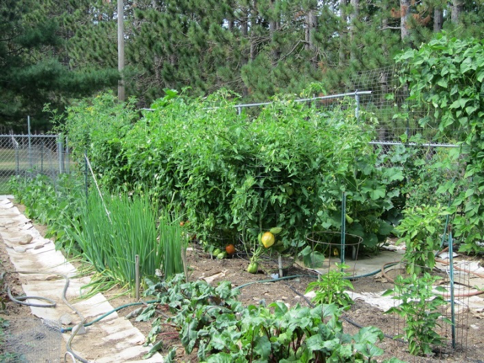
Ironically, my gardening provided insights for sermon writing that I had not expected. Jesus used a plethora of parables, many of which were related to plant growth, harvest, and death. The cycle of life I had experienced in my law enforcement career, often violent and traumatic, contrasts the growing cycle of my garden, but now I also see parallels. I can more readily relate to nurturing relationships and these correlate to our relationship with Christ.
Many of the “weeds” I refer to in my meditation have very deep roots. Memories of a stressful career that entailed watching how cruel people can be, coupled with many poorly nurtured (and failed) relationships often cloud my thinking and demeanor. The weeds drain me of strength and happiness while negatively affecting my family and friends. “Weeding” is hard work and tedious, but the results are worth the toil, just like in my garden.
Quiet time in my garden is a great time to reflect on God’s Word, examine my heart, and be inspired by how God provides. [Ray Appel]
The Author: Ray Appel (Wisconsin, USA)
Thought for the Day: What do I need to uproot from my life to be more fruitful for God?
Prayer: Dear Lord, help us to rid our lives of distractions and to fill our thoughts and hearts with your love. Amen
Prayer focus: GARDENERS ---------------------
Quiet time in my garden is a great time to reflect on God’s Word, examine my heart, and be inspired by how God provides. [Ray Appel]
The Author: Ray Appel (Wisconsin, USA)
Thought for the Day: What do I need to uproot from my life to be more fruitful for God?
Prayer: Dear Lord, help us to rid our lives of distractions and to fill our thoughts and hearts with your love. Amen
Prayer focus: GARDENERS ---------------------
Contact Information:
Great Plains Episcopal Office
9440 E Boston, Suite 160
Wichita Kansas 67207, United States
316-686-0600
800-745-2350
info@greatplainsumc.org
____________________________
Great Plains Episcopal Office
9440 E Boston, Suite 160
Wichita Kansas 67207, United States
316-686-0600
800-745-2350
info@greatplainsumc.org
____________________________

No comments:
Post a Comment