democracynow.org
Stories:

Pakistan Mourns New Taliban School Massacre in Latest Blowback from Internal Conflict, Afghan War
Pakistan is once again mourning mass casualties from an armed assault on one of its schools. At least 20 people were killed and dozens injured on Wednesday when gunmen stormed the northwest Bacha Khan University under the cover of morning fog. The four attackers scaled the school’s rear wall before storming through the campus, gunning down students and teachers in classrooms and halls. The attack comes just weeks after Pakistan marked the first anniversary of the December 2014 Taliban massacre at a school in Peshawar. More than 150 people were killed in the massacre, most of them children from military families. It was the deadliest militant attack in Pakistan’s history. The Taliban faction that committed the Peshawar massacre has also taken responsibility for Wednesday’s attack, calling it revenge for the military’s intensified crackdown on its members. We are joined by two guests: Jibran Nasir, a Pakistani political activist and lawyer, and Tariq Ali, a political commentator, historian, activist, filmmaker, novelist and author of several books on Pakistani politics and history.
TRANSCRIPT
This is a rush transcript. Copy may not be in its final form.
NERMEEN SHAIKH: Pakistan is once again mourning mass casualties from an armed assault on one of its schools. At least 20 people were killed and dozens injured on Wednesday when gunmen stormed the northwest Bacha Khan University under the cover of morning fog. The four attackers scaled the school’s rear wall before storming through the campus, gunning down students and teachers in classrooms and halls. One witness described the scene.
WITNESS: [translated] I was sitting in class when the firing started. There was lots of fog, and the visibility was very poor. Then the security personnel came and asked us to leave. We ran away from there. We went upstairs on the third floor of the vice chancellor’s office. When I was waiting at the stairs, a terrorist came there and opened fire at me. I escaped the gunfire. I ran upstairs and jumped from the third floor. Then I fell unconscious.
NERMEEN SHAIKH: The rampage ended when Pakistani security forces cornered the attackers, killing them before they could detonate their suicide vests. At least some of the gunmen were apparently teenagers.
The assault came on the 28th anniversary of the death of Pashtun nationalist leader Bacha Khan, the university’s namesake. Khan’s party, the Awami National Party, is known for its anti-Taliban views. The attack also comes just weeks after Pakistan marked the first anniversary of the December [ 2014 ] Taliban massacre at a school in Peshawar. More than 150 people were killed in the massacre, most of them children from military families. It was the deadliest militant attack in Pakistan’s history.
AMY GOODMAN: The Taliban faction that committed the Peshawar massacre in 2014 has also taken responsibility for Wednesday’s attack, calling it revenge for the military’s intensified crackdown on its members. Pakistan has hanged over 300 alleged Taliban members over the past year as part of a wider offensive launched in June 2014. But Pakistan’s main Taliban group, the Tehrik-i-Taliban Pakistan, quickly disavowed Wednesday’s massacre, calling it an "un-Islamic act." The Pakistani Taliban is an offshoot of the Taliban movement in neighboring Afghanistan. The Afghan Taliban remains divided over whether to join peace talks to end Afghanistan’s more than 14-year war.
For more, we’re joined by Tariq Ali. He is a well-known political analyst. He is Pakistani-British. We’re going to London to speak with him, a political commentator, historian, activist, filmmaker and editor of New Left Review. His most recent book, The Extreme Centre: A Warning. He’s also author of several books on Pakistani politics and history.
Tariq, welcome back to Democracy Now! Can you explain what’s taken place, your response, and, for a global audience, where this is and the significance of this?
TARIQ ALI: Well, Amy, of course, every atrocity comes as a shock and a surprise, but I have to point out that this has been going on now for several years. And when the Afghanistan War began, I pointed out that one of the side effects of this war was going to be the destabilization of Pakistan, especially in the northern province which borders Afghanistan and where people, the Pashtun people, speak the same language as many Afghans. So there are very close links between Pashtun, the Pakhtunkhwa province in Pakistan, and the Pashtun people in Afghanistan, who form a majority. So, when you wage war on one country, and the way you wage that war, it’s very difficult to stop that war from spilling over.
And the effects of this spillage now in Pakistan have become completely uncontrollable. Every time there is an atrocity, not just the schoolchildren who were killed a few years ago or the tragedy that happened two days ago—it’s not just them, it has been attacks in different parts of the country by different jihadi fundamentalist groups. Every time it happens, the prime minister of the country vows in public to end this menace forever. The army tells the public and actually does mount some operations, but these operations then are temporary affairs, and they can’t be anything else. They come back from the area, and more recruits are found by the Tehrik-i-Taliban Pakistan and some of the other groups.
So, the attack on this particular university seems to be motivated by little else than symbolism. The university was—is in the name of Bacha Khan, which was the nickname of Khan Abdul Ghaffar Khan, one of the pre-partition leaders of the national movement for Indian independence, together with Gandhi and Nehru and others. And his most important contribution in this region was to teach the Pashtun people the value of nonviolence. All his work, his political work, in this area was carried out on the basis of nonviolence. And it was successful. Even when the British committed atrocities, like the massacres that took place in Qissa Khawani Bazaar in Peshawar during British rule, his response was, "We will fight them via mass movements, by civil disobedience. We will not use violence." And he, of course, is seen today as a progressive, secular, nonviolent leader who fought for his people against the British. And this, they don’t like, because they don’t like him. Ghaffar Khan was imprisoned by virtually every single Pakistani government when he was alive—military dictatorships and civilian governments. And when he died, his will said he wanted to be buried in Afghanistan in Jalalabad, and that is where he was buried. So this is a symbolic attack, to stop the university from marking his anniversary, by a group of total fanatics.
And the serious question that we have to ask is this: What are the transmission belts that supply these young fanatics to organizations like the Tehrik-i-Taliban Pakistan or the Jaish-e-Mohammed or other smaller groups that exist in the country? And this is a question that the ruling elites in Pakistan never actually ask themselves, because if they ask this question, then they themselves are partially guilty.
NERMEEN SHAIKH: But, Tariq Ali, in addition to the problem that you point to, many commentators say that the Pakistani state and military deliberately turn a blind eye to a number of these militant groups operating in Pakistan. Could you respond to that? Is that true?
TARIQ ALI: Well, I think this has certainly been true over the last 20 years, Nermeen, because Pakistan feels it has a stake in Afghanistan. And don’t forget that the capture of Afghanistan by the Taliban, when it happened, was backed by Pakistani troops, by Pakistani Air Force units, by undercover people, organized, armed, funded by the ISI, the Inter-Services Intelligence. So, after 9/11, when the United States compelled them—actually forced them, at the point of a gun—to withdraw support and to bring the Taliban out of there, they did so, but reluctantly. And they have been waiting for a long, long time to go back in there. And this is one reason why some groups, not all, are not touched by them, because they see them as a strategic asset which might need to be used again once the U.S. withdraws.
AMY GOODMAN: I want to bring Jibran Nasir into this conversation, Pakistani political activist and lawyer, launched a popular campaign called Reclaim Your Mosques following the 2014 Peshawar school attacks. He’s joining us by Democracy Now! video stream from Islamabad. The reaction inside Pakistan to this latest horror, not so far from the attack last year, and what this means for Pakistan right now, before we talk about U.S.-Pakistan relations, as well?
JIBRAN NASIR: Well, I think, first of all—well, let us be clear: We’ve been using the term "the war against terror" for a long time, but I think that’s a misnomer, because war seems to have an end. This madness does not seem to have an end, and it’s better to call it a struggle, a struggle for peace, which the world is part of it right now. The university in Garissa in Kenya was attacked, as well, in 2015, earlier last year. And, of course, these differencies of attacks have been taking place in the region wherever the terrorists get to find a soft target. And, of course, the reaction in Pakistan, everybody is up in arms and all appalled.
This was expected because, of course, a full-fledged military operation has been launched against the Taliban in the northern province, not in the entire Pakistan region. When I say a "full-fledged military operation," it’s specifically launched in the northern belt of Pakistan. I do not know what the extent of the operation is in the other parts of Pakistan, but, of course, this was a reaction to that. And wherever they’re going to find a soft target, they’re going to come back and attack us. And with every such attack, they’re laying it bare that they don’t really have any morals or any codes or any rule of law of war they would like to follow. It’s simple terror they want to spread. And it’s simple—one message they want to give, that they would go to any extent to achieve their ends and aims. And what I would like to also stress here is that, of course, this attack is in Pakistan, but it is against Pakistan, it is against the state and the citizens of Pakistan. And we here are victims of terrorists, terrorism, in this instance.
NERMEEN SHAIKH: Jibran Nasir, could you also say who Umar Mansoor is, the senior Pakistani Taliban commander who was apparently responsible for the 2014 attack on the Peshawar school and who initially claimed responsibility for yesterday’s attack?
JIBRAN NASIR: To the best of my knowledge, all I can say is Umar Mansoor is a face or profile, because [inaudible] were coming from there. I’ve not seen any of his video messages or any other things. See, these personalities, these cults can be created. At the end, you also—again, the question, which was asked earlier by you, we need to answer: Who are the transmission belts for these things? And we need to look at that. And Umar Mansoor, of course, one of those beneficiaries of those transmission belts. This entire nexus of terrorism in Pakistan, be it the Tehrik-i-Taliban Pakistan, the Tehrik-i-Taliban Mohmand or Bajaur or Jamaat-ul-Ahrar or other of these factions which keep on cropping up, they’re all connected. They’re all getting funding from some end. One has to, of course, take into account the fact that this attack took place not on the border of Pakistan, it took place in Charsadda. The distance from the Afghani border all the way to Charsadda, there are various security points throughout that way. How were these people able to carry these weapons, walk through all the security checks and enter that university? It’s one thing, yes, that the Pakistan military was great enough to react on time and secure the place within six hours and curtail the extent of damage. But the failure happened where the security breach happened. So it could be Umar Mansoor or anybody else. What we need to know is what precautions and what measures are being taken by the state of Pakistan, and how were these people able to carry out this attack, going through all those security checks, and be able to enter the university.
NERMEEN SHAIKH: Jibran Nasir, so what do you think accounts for the fact that they were able to breach all of the security checkpoints and gain access to this university campus?
JIBRAN NASIR: See, the thing here is that this is not a war between two countries where identities are clearly drawn. This is an ideological war where religion has been brought into the picture, and religion does really know caste, creed, culture or borders, for that matter. It’s an ideological battle. And we need to realize this, that because Pakistan has been part of this war for the past 40 years, this wave of radicalization, which was imposed on us—and at that time, of course, when the Taliban were created in the ’90s, and General Musharraf says that was created by Pakistani intelligence, they were not seen as terrorists at that time. They were actually recognized as a legitimate government by many countries at that time. But, of course, since 9/11, as the scale has changed around the world, they are now being seen as terrorists. And, of course, their motives are also becoming more clear with this widespread wave of violence.
We are going through a state of self-denial, through a state of conflict, where I think the society of Pakistan, as well, is conflicted on certain areas, on religious grounds and other grounds, because religion is presented to us in various forms and interpretations through these radical outfits. And it all comes down to which ideology do you want to prescribe to. So you may be sitting in a judiciary, you may be a bureaucrat, you may be a military officer, you may be a politician, you may be a journalist. At the same time, are you keeping your Pakistani identity first, your human identity first? Are you keeping your political or religious affiliation first? And that is where the conflict occurs. And yes, Pakistan, of course, will have to create its lines in every aspect, in every area, because we are trying to get over a perversion of mental corruption which took—or which went on for three decades. And undoing that will take a lot of time, because of people who are still refusing to let go of this ideology, which the Taliban tries to legitimize.
AMY GOODMAN: And, Jibran Nasir, finally, how does U.S. relationship with Pakistan affect what’s going on, the longest war in U.S. history going on right next door in Afghanistan?
JIBRAN NASIR: I think U.S. can learn a lot of lessons in what is going on in Pakistan. U.S. itself is right now facing and seeing, because of social media, a lot incidents coming of racial violence and divisive [inaudible] ideology taking the main stage now. And it is, again, when certain humans assume that they have a God-given right to delegate themselves as a superior being and they can cause violence on somebody else who they do not consider able enough. So just like there’s a racial battle going on in America, there is a religious battle going on in Pakistan, where people from different sects and different factions of within Islam think that they are better, in a position to do—and they’re more virtuous and pious, and those who are infidels should be killed.
So there are lessons to learn. And just like U.S. is struggling, this is a human war. This is a war of ideology, which is supposed to be won by dialogue, by education reforms, by awareness. And methods which U.S. has been using, be it drone attacks or be it arbitrary measures like that, would not really do good—Pakistan much good. And U.S., of course, needed to—need to [inaudible] of the matter that we are dealing with humans here, we are dealing with ideologies here. The same measures that President Obama is at pains right now to implement in U.S. to get rid of racial violence in America, we are trying to implement in Pakistan to get rid of religious violence. But this ideology, of course, is going to take a long time before we get rid of it.
NERMEEN SHAIKH: And, Tariq Ali, could you talk about how the Pakistani state has responded to the attack and also what you think accounts for the rise of Islamic militancy in Pakistan?
TARIQ ALI: Well, the Pakistani state has responded to the attack as it always does. It has denounced it, and it has pledged that it will discover the people who ordered the attack, since the perpetrators have already been killed. And, no doubt, there will be an army—units will be sent out to try and find a few people. But that is not going to be sufficient. It is a long haul, this.
As for how these groups developed, there’s no doubt. We know it. They developed when the Soviet Union, as it then was, entered Afghanistan to try and save a pro-Soviet government, and the United States decided that this was their opportunity, as Brzezinski said, to get revenge for the defeat in Vietnam and teach the Russians a lesson they wouldn’t forget. So the United States poured in money into the region, armed religious groups, helped to create them. Brzezinski stood on the border with Afghanistan with religious leaders and said, "Go and wage the jihad." That’s how it all started. The money created these groups. They did not rise spontaneously from below. They were created from above with the support of Washington, London and the local ISI and the military dictator, General Zia-ul-Haq. That’s when they started.
Now, the fact that they were created in this way doesn’t mean that they’re still totally controlled by the military or the ISI. Many of these monsters have developed their own patterns of functioning. Some of them fight against the military, kill military officers, kill their children, etc., etc. The thing is: How can we bring this under control? In my opinion, two things are absolutely necessary. One is peace in Afghanistan. At whatever cost, with whatever government, we need to end. You know, Afghanistan has now been fighting wars, and subjected to wars, longer than the first and second World Wars put together. And you can only imagine the effect that leaves on the population. This is a appalling society.
AMY GOODMAN: Tariq—
TARIQ ALI: And that degree of appallingness is now existing inside Pakistan.
Secondly, while one can blame the United States—and I often do—there is no doubt, in my opinion, that the atmosphere created in Pakistan by successive military and civilian governments has made it impossible to challenge any of this. The fact that religious schools teach people violence—in many cases, not in every case—that they basically provide transmission belts, where young kids are taught lessons which lead them to become sympathetic to these groups, the fact that religiosity has now reached such a height that just a few days ago, almost at the same time as the attack in Charsadda near Peshawar, you had a young boy who had been incited by a mullah and told, "You committed some blasphemy," and this boy went and cut off his own hand to repent—now, when you have a situation like this, we have to say that the fault lies largely within Pakistani society, which has failed to educate its people. It educates the elite, educates itself. For the children of the elite, there are great schools, great hospitals, in many parts of Pakistan. But there is nothing for the poor. There is nothing for the bulk of the population. So they’re very vulnerable—
AMY GOODMAN: Tariq—
TARIQ ALI: —to appeals from religious groups, because they have nothing else left.
AMY GOODMAN: Tariq—
TARIQ ALI: And so, a government in Pakistan—no government, neither the PPP nor Nawaz Sharif nor the military, has spent any money in creating an education system where everyone is educated, free of charge, by teachers.
... Read More →
The 1% Economy: The World's Richest 62 People Now Have as Much as Poorest 3.6 Billion
A new report from Oxfam on global inequality finds the world’s richest 62 billionaires now own as much wealth as half the world. The wealth of the poorest half—3.6 billion people—has fallen by $1 trillion since 2010. At the same time, the wealth of the world’s richest 62 people has increased by more than half a trillion dollars. Oxfam faults a global financial system that has "supercharged the age-old ability of the rich and powerful to use their position to further concentrate their wealth." The report singles out deregulation, privatization and offshore tax havens that have let trillions of dollars go untaxed. The Oxfam report is timed to coincide with the meeting of global elites at the World Economic Forum in Davos, Switzerland. We are joined by Raymond Offenheiser, president of Oxfam America.
Watch Part 2 || Oxfam Says Privatization, Tax Havens Drive Global Inequality to Staggering Levels
TRANSCRIPT
This is a rush transcript. Copy may not be in its final form.
NERMEEN SHAIKH: Five years ago, the combined wealth of the globe’s top 388 billionaires was equal to half the world’s population. If that contrast is shocking, consider how many billionaires it takes for that same divide today: 62. According to a new report from Oxfam on global inequality, it’s now just 62 of the world’s richest billionaires who own as much wealth as half the world’s population. The wealth of the poorest half—that’s 3.6 billion people—has fallen by $1 trillion since 2010. At the same time, the wealth of the world’s richest 62 people has increased by more than half a trillion dollars. Oxfam faults a global financial system that has, quote, "supercharged the age-old ability of the rich and powerful to use their position to further concentrate their wealth."
AMY GOODMAN: The report singles out deregulation, privatization, offshore tax havens that have let trillions of dollars go untaxed. Oxfam says denying governments of this massive source of revenue has hampered efforts to provide basic social services and tackle inequality. A review of some 200 major companies shows 90 percent operate in at least one tax haven. The Oxfam report is timed to coincide with the meeting of the global elites at the World Economic Forum in Davos, Switzerland.
For more, we turn to Raymond Offenheiser, president of Oxfam America.
So, give us these figures. Sixty-two of the world’s wealthiest people have more wealth than half the world’s population. Sixty-two individuals?
RAYMOND OFFENHEISER: That’s correct. And as you noted, that this has been an accelerating pattern. I think what our report is trying to do is really point out the fact that I think we have a global inequality crisis, and we’re trying to legitimize that narrative and through the use of these kinds of numbers. I think what’s been stunning to us is not only the fact that we have, you know, that level of concentration, but the process is accelerating. And I think what we’re trying to understand is, if we allow this process to accelerate, not only here in the United States, but literally in countries around the world and in regions where you’d not expect it—in the Chinas and the Indias and even in Africa—it raises a lot of questions about some of the things you talked about in your earlier broadcast about Michigan, which is: How do we fund public services for the poor? How do we finance development into the future? How do we alleviate poverty, if in fact we’re seeing, you know, underfinancing of infrastructure and schools and health systems and so forth? So, we’re really trying to underline the fact that there is an inequality crisis, and we’ve got to really address directly this accelerating concentration of wealth and the mechanisms and systems, really, that enable it.
NERMEEN SHAIKH: And, Ray Offenheiser, can you explain specifically what the role of tax havens are in this quite staggering inequality that the report points to?
RAYMOND OFFENHEISER: Well, tax havens basically is a mechanism that’s been created by the financial industry and corporations to allow them to basically produce value in one location and then transfer that value—that may have a high tax base or tax rate, and then transfer it, in some fashion or another, to another location with a much lower tax rate, and then pay the tax rate in those locations where it’s much more favorable. And there’s all sorts of accounting mechanisms that allow this to happen, and also legislation that provides loopholes that enable companies to move value overseas. So, for example, here in the United States, companies actually can deduct the cost of moving jobs overseas, in one case. They can actually move the value of brands and trademarks overseas. They can actually—they’re exempt from, for example, taxing the value of subsidiaries overseas. So there’s a variety of ways these tax havens—that tax rules enable the tax havens to work. The banking industry has been a major beneficiary of all this, because this money is then put in bank accounts in these tax havens, so you’ve seen an explosion of banking—you know, offshoring of the banking industry to the Cayman Islands and the British Virgin—
AMY GOODMAN: What’s the Stop Tax Haven Abuse Act?
RAYMOND OFFENHEISER: Well, this is an act that’s been put forward in Congress by Carl Levin and Senator Whitehouse from Rhode Island—Carl Levin from Michigan, Whitehouse from Rhode Island, and Lloyd Doggett from Texas. And it’s an act—it now has 41 sponsors in the House, three in the Senate—that basically tries to close exactly the loopholes I just mentioned and a variety of other ones. Quite frankly, what it really does is it closes those loopholes, and it tries to force, through SEC regulation, greater levels of transparency, and try to get rid of this disconnect between where you generate value and where you report it. And what we really want to force the companies to do is to say—if you produce value in the United States, you know, and you produce value overseas, that should be fully transparent to citizens, so we actually can get a fair deal on taxation of corporations, because it’s that diminished corporate taxation that’s creating the situations we see in Flint and a variety of other locations around the United States and around the world.
NERMEEN SHAIKH: Well, a large number of the billionaires listed in Forbes have inherited their wealth. Could you talk about the importance of estate tax?
RAYMOND OFFENHEISER: Well, I think we believe that the whole issue of wealth of individuals is as important in corporate tax. We’ve been focusing on corporate tax, in some sense, because we see it as really a global issue. I think 47 of the 62 [billionaires] are actually Americans, so we have a really particular problem here at home. But what Oxfam is really focused on is: What does this mean for developing countries, where we’re trying to address poverty issues? What does it mean in Africa? And what does it mean in some of these emerging economies where we see actually wealth and high rates of growth? What we’re trying to focus on is, if we allow the system to continue in the way it’s continuing, those countries will lose critical value they need now to fund their own development. And the endgame we seek is actually one in which countries are taking responsibility for their own development by building strong institutions and building a tax system that will fund their citizens’ welfare.
AMY GOODMAN: What’s the real price of tax dodging?
RAYMOND OFFENHEISER: Well, it varies country to country. I think here in the United—
AMY GOODMAN: Right here.
RAYMOND OFFENHEISER: Right here in the United States, I think we estimate that if we close the loopholes through the Stop Haven Abuse Act, we’d probably have—we’d probably have 220 billion additional dollars that we could invest in the economy over about a five- to 10-year period.
AMY GOODMAN: We’re going to continue this conversation and post it online at democracynow.org. Raymond Offenheiser is president of the international relief and development organization Oxfam America. We’ll link to the report it’s just put out, "An Economy for the 1%: How privilege and power in the economy drive extreme inequality and how this can be stopped."
That does it for the broadcast. We have two job openings: a director of finance and operations and a director of development. Go to democracynow.org for more information.
... Read More →
British Lawmakers Debate Banning "Fool," "Buffoon" Donald Trump over Anti-Muslim Views
British lawmakers held a three-hour debate Monday on the possibility of banning Republican presidential front-runner Donald Trump from entering the country. More than 570,000 people signed a petition in favor of the ban—more than any other petition submitted to the current Parliament—after Trump called for banning Muslims from entering the United States. While they condemned Trump as a "buffoon" and a "dangerous fool," British lawmakers do not actually have the power to ban him from the country. We get reaction from political commentator and historian Tariq Ali.
TRANSCRIPT
This is a rush transcript. Copy may not be in its final form.
AMY GOODMAN: Tariq Ali, we’re going to have to break, but I do want to ask you a question, where you just have 30 seconds to respond, and it’s wading into U.S. politics and where you are, in Britain. The British Parliament had a debate over whether to ban Donald Trump—they decided not to—because of his statement that he wanted to ban all Muslims from coming into the United States. The significance of this?
TARIQ ALI: Well, it’s significant, but it’s—it was not a surprising decision. And I, myself—Amy, I have to say that, you know, I’m not in favor of banning people, because once you start banning people from the right who are mouthing extreme-right rubbish, this then leads to similar bans against progressive people, people on the left accused of being terrorists, etc. It’s better to debate these people out rather than to ban them. That’s my opinion.
AMY GOODMAN: I want to thank you for being with us, Tariq Ali, a British-Pakistani political commentator, written a number of books on Pakistani politics and history and on global politics, and Jibran Nasir, joining us from Islamabad, Pakistani political activist and lawyer.
This is Democracy Now! When we come back, we go directly to Detroit. Stay with us.
... Read More →
Detroit Student: "I Want to Be Able to Go to School Without Worrying About Being Bitten by Mice"
Image Credit: Kate Levy
As a federal emergency is declared over lead poisoning in the Flint water supply, the state of Michigan is facing another crisis over basic services—this time in Detroit. Dire conditions under an unelected emergency manager have led schoolteachers to declare an emergency of their own. On Wednesday, 88 of Detroit’s roughly 100 public schools were closed in the latest mass teacher "sickouts" protesting underfunding, black mold, rat infestations, crumbling buildings and inadequate staffing. We get a report from journalist Kate Levy.
TRANSCRIPT
This is a rush transcript. Copy may not be in its final form.
NERMEEN SHAIKH: President Obama has made his first public comments on the water contamination crisis in Flint, Michigan. Flint’s water was poisoned with lead in 2014 after an unelected emergency manager, appointed by Governor Rick Snyder, switched the city’s water supply to the long-contaminated and highly corrosive Flint River in a bid to save money. On Wednesday, Governor Snyder released copies of his emails that show he was made aware of the water contamination issues as early as February 1st, 2015, but that his administration was dismissive of residents’ concerns. Some pages of the emails are entirely redacted. The Flint engine plant of the auto giant General Motors [...] stopped using Flint’s water in October 2014, saying it was rusting its parts. Speaking Wednesday at the United Auto Workers’ General Motors training center in Detroit, Obama said he would be "beside himself" if he were the parent of a Flint child. He added that the crisis serves as a, quote, "reminder of why you can’t shortchange basic services."
PRESIDENT BARACK OBAMA: I am very proud of what I’ve done as president, but the only job that’s more important to me is the job of father. And I know that if I was a parent up there, I would be beside myself that my kids’ health could be at risk. ... Yesterday, I met with Mayor Weaver in the White House, in the Oval Office, and I told her that we are going to have her back and all the people of Flint’s back as they work their way through this terrible tragedy. It is a reminder of why you can’t shortchange basic services that we provide to our people and that we, together, provide as a government to make sure that public health and safety is preserved.
AMY GOODMAN: There is another crisis over basic services in Michigan that Obama did not address. During his visit to Detroit, dire conditions under an unelected emergency manager have led schoolteachers to declare an emergency of their own. On Wednesday, 88 of Detroit’s roughly 100 public schools were closed in the latest mass teacher "sickouts" protesting underfunding, black mold, rat infestations, crumbling buildings, inadequate staffing. Detroit’s public schools are under the control of unelected emergency manager Darnell Earley. He’s none other than the unelected emergency manager who presided over the water contamination in Flint. He was then moved to Detroit. Journalist Kate Levy has been speaking to students, teachers and parents in Detroit about the crisis.
WISDOM MORALES: I’ve gotten used to seeing rats everywhere. I’ve gotten used to seeing the dead bugs. I’ve tried to ignore all the graffiti when I’m trying to use the bathroom. But any way it goes, still, I’m still bothered by these things. And it makes me feel sick, and it doesn’t good.
PROTESTERS: Dirty water! Dirty food! Dirty politics!
PROTESTER: Say what?
PROTESTERS: Dirty water! Dirty food! Dirty politics!
KATE LEVY: In Detroit, almost the entire public school district was closed Wednesday because of the latest teacher sickout.
ALISE ANAYA: OK, my name’s Alise Anaya. I work at Clippert Academy. My daughter Analise and Victor, who’s marching, my son and daughter, go to the Academy of the Americas. So the buildings in DPS, especially their building, the Academy of the Americas, it’s an old building. It’s falling apart. We were trying to move—they were trying—there was a movement to move the building a couple years ago. It didn’t work. They’re still there. I’m sure there’s rats and mold, you can smell when you open the door. And it’s just not a good environment for the kids to be in all day.
PROTESTERS: Shut it down!
CARL BAXTER: My name is Carl Baxter, and I’m out here to support the teachers as a parent, because I have children that actually attend DPS. But when you have mold growing in a building, the long-term effects, there’s no telling.
PROTESTERS: DPS! Fight back! DPS! Fight back! DPS! Fight back!
KATE LEVY: Like the city of Flint, which is experiencing a public health crisis over poisoned water, Detroit’s public school district is run by a state-appointed, unelected emergency manager. In fact, Detroit schools are run by Darnell Earley, the same emergency manager who presided over Flint’s change in water sources. Since 2009, Detroit residents, parents and even the elected school board have had no say in how the district is run. Tawanna Simpson is an elected school board member.
TAWANNA SIMPSON: Emergency management has created public safety and health crises in our school district here in Detroit. Irreparable harm has been done to our students, as well as our teachers and our parents and our community as a whole. We’re not able to help because of a law, PA 436, in Michigan, which allows the governor to assume all the authority of the elected officials.
KATE LEVY: Since emergency management began, over 75 school buildings have been closed in the city of Detroit. Since 2009, hundreds of millions of taxpayer dollars have been spent repairing school buildings that were subsequently closed down or handed over to an alternative state-run district that is currently under federal investigation for widespread corruption. Three top officials in this district have already pled guilty. Meanwhile, for many Detroit public school students, the remaining open schools are often worse off than the ones the students came from. Al Wright’s son Timothy has cerebral palsy and attended Oakman Elementary School, which was the only school in the district built specifically for special needs students. It was closed down in 2013.
AL WRIGHT: Initially, after Oakman first closed, they sent Timothy to Henderson. When you get there, you pass this man-sized hole in the ceiling that was leaking for the time we did the inspection to the school to this year. And all they did was put some cones around and a garbage can to collect the water. We had fire exits that were blocked, fire windows that had security bars on it.
KATE LEVY: Under emergency management since 2009, the number of Detroit Public Schools service workers has dropped from over 2,000 to 820. The number of skilled craft workers has dropped from 405 to only 13. Jim Arini is an engineer and the treasurer of the engineers’ union, Local 324.
JIM ARINI: The summer of 2014, while Detroit Public School was under emergency manager, the school requested from the city of Detroit a variance to their ordinance that requires an engineer to be on staff whenever a boiler is operating. We feel that it puts the children’s lives, the teacher’s lives and the general public’s lives in jeopardy of a boiler explosion. We can kind of relate to the Flint water crisis, the fact that we’ve poisoned kids in Flint under this emergency manager rule, and now the same emergency manager is operating Detroit Public Schools. We’re afraid that this is going to cause a safety issue and potentially lives at risk.
KATE LEVY: For student Wisdom Morales, the situation has created increasing anxiety.
WISDOM MORALES: I want to be able to go to school and not have to worry about being bitten by mice, being knocked out by the gases, being cold in the rooms.
KATE LEVY: And elected school board member Tawanna Simpson says the crisis is a result of state control.
TAWANNA SIMPSON: The educations is mandatory for our children here in Detroit. It’s mandatory for all young people in this country. And it’s not a good thing to suspend democracy. And emergency management does not care about our students. They’re there for the bottom line. It’s a very unjust thing to try to run a school district as a corporation.
KATE LEVY: For Democracy Now!, I’m Kate Levy in Detroit.
AMY GOODMAN: The Detroit Public Schools system is seeking a restraining order and preliminary injunction that would force teachers to stop the sickouts and return to work. We’re going to go to break. When we come back, we’ll be joined by two guests: an education activist and a retired teacher in Detroit. Stay with us.
... Read More →
Detroit Rocked by Teachers' "Sickout" Protesting Dire Conditions Under Emergency Management
Image Credit: Kate Levy
On Wednesday, 88 of Detroit’s roughly 100 public schools were closed in the latest mass teacher "sickouts" protesting underfunding, black mold, rat infestations, crumbling buildings and inadequate staffing. Detroit Public Schools are under the control of unelected emergency manager Darnell Earley—none other than the unelected emergency manager who presided over the water contamination in Flint. We discuss the sickout and the state of Detroit’s schools with two guests: Victor Gibson, a retired Detroit public school teacher and active union member, and Russ Bellant, an education advocate and the former education director for the stationary engineers union, where he trained engineers working in the Detroit Public Schools.
TRANSCRIPT
This is a rush transcript. Copy may not be in its final form.
NERMEEN SHAIKH: On Wednesday, 88 of Detroit’s roughly 100 public schools were closed in the latest mass teacher "sickouts" protesting underfunding, black mold, rat infestations, crumbling buildings and inadequate staffing. Detroit’s public schools are under the control of unelected emergency manager, Darnell Earley. He’s none other than the unelected emergency manager who presided over the water contamination in Flint.
AMY GOODMAN: We’re joined by two guests right now: Victor Gibson, retired Detroit public school teacher and active union member, and Russ Bellant, an education advocate and the former education director for the stationary engineers union, where he trained engineers working in the Detroit Public Schools.
Victor Gibson, let’s go to you. Talk about your school—you retired from it last year as a teacher—that is one of the schools that was closed by the sickout on the day that President Obama was in Detroit hailing the success of the auto industry.
VICTOR GIBSON: Yes. Let me be clear that my school is—the name is Paul Robeson Malcolm X, but it’s the combination of both schools from an earlier combination of closing of schools. My school is the school that—where the three ladies who have been, thus far, very active in getting the main body of teachers to stand up for themselves, after being quietly left into the classrooms for so long. And these—this school is one of the schools that have said enough is enough. And these teachers have finally kind of listened to themselves, listened to their students and their parents, who have stated that these children and our children have been under such great duress and strain from not learning, but not for being educated, but as opposed to being just constantly tested, tested, tested. I know most of your listeners should be aware of these whole phenomena of reform for schools that have gone on since 2005, 2006, and even before that. So, this whole thing of changing the curriculum from one where you are nurturing children to their fullest potential to one where they’re being just put in front of computers and lab-rat-tested on any particular curriculum they happen to come along—
AMY GOODMAN: I mean, I think—I think "rat" is the operative word here, and not just lab rats, but actually rats in the schools.
VICTOR GIBSON: Yes, exactly.
AMY GOODMAN: Can you talk about the astounding conditions that we just saw described? When, you know, we’re dealing—a lot of the nation’s focus is now on Flint. But black mold, rats, mice in the schools? How has it come to this point?
VICTOR GIBSON: Well, if you look at it as a homeowner, if you buy a home and you don’t invest in your infrastructure of your home, the longer you stay in that building, the building is going to deteriorate. That just goes without saying. And with this deficit spending, where the home for—for the money that’s being channeled away from the structure of the buildings, yes, the roof has leaked. This is our—for Paul Robeson Malcolm X, this is our third—no, this is our fourth school that we’ve been placed in, and each school is getting progressively worse. We’re now a K-through-eight school, but now we’re being housed in a building that was originally built for K through five. So, everything is primarily on a smaller scale. But when you look at the roof, that has been gone neglected.
If you look at the—just the electrical infrastructure, let’s talk about that. We have all of this high-tech equipment they’re trying to interface and infuse into the school system, but you’re in a building that doesn’t carry that kind of electrical load. And so, even if you get the technology in there, there’s a good chance it will not work. So that’s—I mean, as far as the structure of the building, windows—I mean, we look at the windows that were made for schools back in the 1940s, 1950s, I mean, these windows are still in place. I mean, there might have been upgrades here and there, but between the water system and the pipes and the plumbing—I remember this one water system that we had, I had to prevent the children from actually drinking from that water back in 2012, when we moved into the building, because I noticed the grey—the orange-yellowish tint that was coming out the faucet. So I made the administration aware of that, but the only change they—the only thing they did was just try to shut down that particular drinking stations that were in the school. So—
AMY GOODMAN: Let me bring Russ Bellant into this conversation.
VICTOR GIBSON: —if we look at the age of the pipe—yes.
AMY GOODMAN: I just want to bring Russ in, before we wrap up the discussion. Darnell Earley, the emergency manager who was responsible for the water change in Flint, using—instead of the Detroit water system that Flint had used for 50 years—the dirty, corrosive, polluted Flint River, has now been moved to oversee the DPS, the Detroit Public Schools. Can you explain the connection and what’s happening now?
RUSS BELLANT: Well, the common thread there, of course, is the governor of the state of Michigan—in this case, Rick Snyder. But he’s one of three governors since 1999 who have been systematically dismantling the Detroit Public Schools system, looting it and taking it from a big surplus it had under the elected school board and rising enrollment and rising test scores up through 1999—they took it over. And it’s—what we’re looking at, Amy, is a 17-year process of dismantling the Detroit Public Schools system, of eroding its capacity for education, for service in this community.
And, you know, the governor is still not even fully telling the truth, not only on the Flint water situation, but on the Detroit Public Schools. He said in October that the debt will be about $515 million. Well, if you look at the audited financial reports from 2013, it was $686 million. June 2015, they’re reporting $786 million. He’s saying $515 million maybe. So, you know, this is a governor who hasn’t got the commitment to education, and he follows in a line of several others that have systematically exploited DPS and created lies and—you know, frankly, to mislead the public, so people would buy into the support and the end of democracy in Detroit and for dictatorship from Lansing.
NERMEEN SHAIKH: Russ Bellant, you’re right to point this out, and now the situation is such that Detroit Public Schools could run out of money as early as April. Could you talk about what that would mean?
RUSS BELLANT: Well, when they say run out of money, they’re saying that teachers wouldn’t get paid, the staff wouldn’t get paid. And they paint a bleak—a vague picture of a system being shut down. But they—I think what the other thing that this talks to, Amy, is that the state of Michigan has never done an analysis of what it costs to educate a child. They were mandated by the Legislature to come up with a cost estimate to use for funding education in Detroit and across the state. They failed to do so. And so, what they’re really suggesting—and this is—there’s other school districts suffering in Michigan, as well, on the funding side. They’re really saying that they’re not adequately funding education. And—
AMY GOODMAN: Just let me ask you quickly—it’s not just about not having money, right? You’ve got two, amazingly enough, state-run city school systems.
RUSS BELLANT: Yes.
AMY GOODMAN: Can you talk about where that money is going? Because there are millions of dollars going into the schools.
RUSS BELLANT: Yeah. A huge amount of the money is going to contractors and to investors for—where the district—and this goes back some years under the period when our elected board was actually dismantled by law. It was—ceased to exist. And they did huge financial deals that we paid 50 percent financial costs for, for hundreds of millions of dollars. We’re still paying that, as well as a whole set of new loans, short- and long-term loans, and bond programs that were unnecessary. And all this was to enrich contractors. And many of us in the community believe that the real reason for the takeover of the Detroit Public Schools system by these successive governors was about a looting operation and using it as a cash cow for friends and contractors and investors. The district right now is being run by a consulting company out of New York City.
AMY GOODMAN: Called?
RUSS BELLANT: And they’re not putting any top talent in there. They’re putting college graduates in there, and they’re making decisions that the educators should be making in the city, and the parents and the community.
AMY GOODMAN: What’s it called, the contractor in New York?
RUSS BELLANT: Parthenon Group.
AMY GOODMAN: Well, we’re going to have to leave it there, but we’ll continue to cover this story. Russ Bellant, education advocate, and Victor Gibson, retired Detroit public school teacher. This is Democracy Now!, democracynow.org, The War and Peace Report. I’m Amy Goodman, with Nermeen Shaikh.
... Read More →Headlines:
Obama Addresses Flint Water Poisoning Crisis
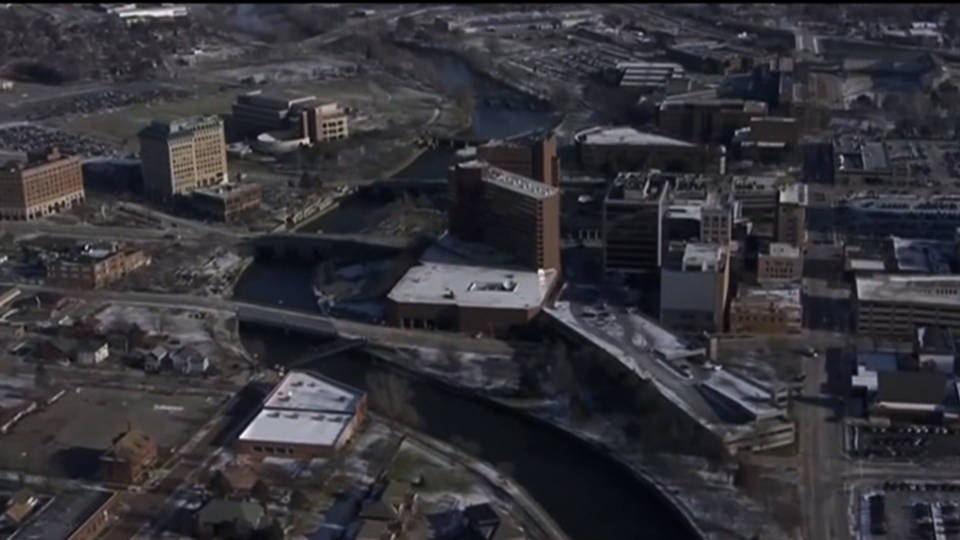
On Wednesday, President Obama visited Michigan, where he issued his first public statements about the Flint water crisis. The water contamination began after a state-appointed unelected emergency manager switched the city’s drinking water to the corrosive Flint River in a bid to save money. Speaking Wednesday, Obama said he would be beside himself if he were a Flint parent.
President Barack Obama: "I am very proud of what I’ve done as president, but the only job that’s more important to me is the job of father. And I know that if I was a parent up there, I would be beside myself that my kids’ health could be at risk."
Obama met with newly elected Flint Mayor Karen Weaver in Washington on Tuesday.
Michigan Gov. Snyder Releases Redacted Emails Amid Flint Crisis
This comes as Governor Rick Snyder has released copies of his emails that show he was made aware of the water contamination issues as early as February 1, 2015, but that his administration was dismissive of residents’ concerns. Some pages of the emails are entirely redacted.
Detroit School System Files Injunction to Stop Teacher "Sickout" Protests
Meanwhile, the Detroit public school system, which is run by the same emergency manager who switched Flint’s drinking water, has filed an injunction to stop teachers from their "sickout" protests. Nearly all of Detroit’s public schools were closed Wednesday amid teacher protests over black mold, rat infestations, crumbling buildings and overcrowded classrooms. We’ll have more on the Detroit Public Schools later in the broadcast.
2015 was Hottest Year Ever on Record—By Far

Scientists have reported 2015 was the hottest year on record by far. The experts pinned the record-breaking heat on long-term global warming caused by the emission of greenhouse gases. 2015’s record breaks the previous record set the year before, in 2014. In response to the findings, Gerald Meehl, a scientist at the National Center for Atmospheric Research, said, "The whole system is warming up, relentlessly."
Afghanistan: Suicide Bomb Kills 6 Employees of Tolo TV
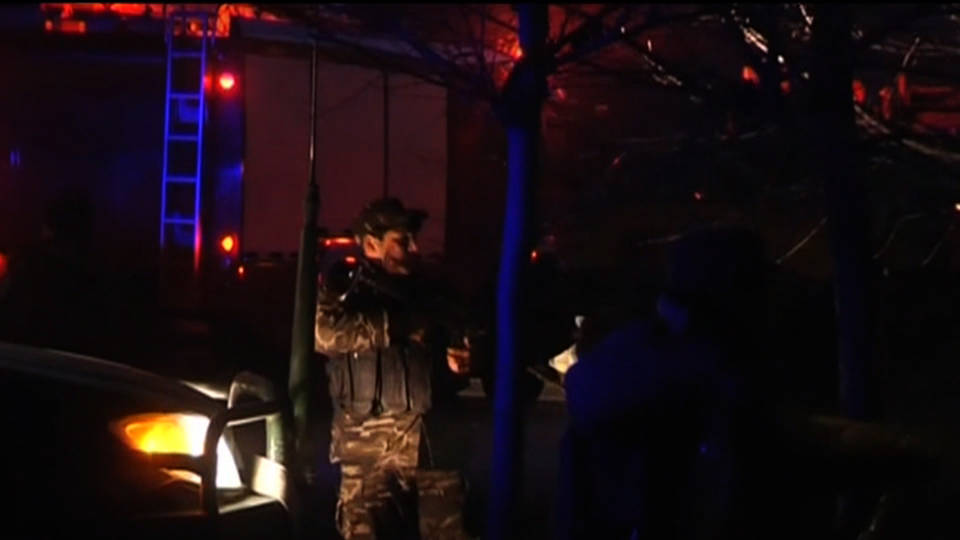
In Afghanistan, a suicide bomb has killed at least six employees of the Afghan station Tolo TV. Four of the victims are reported to be women. No one has claimed responsibility for the attack, but the Committee to Protect Journalists has documented a Taliban website threatening Tolo TV journalists with "elimination." Meanwhile, at least four people were killed in a separate suicide bomb attack near the Russian Embassy in Kabul.
Report: Western-Backed Kurdish Fighters May Be Committing War Crimes
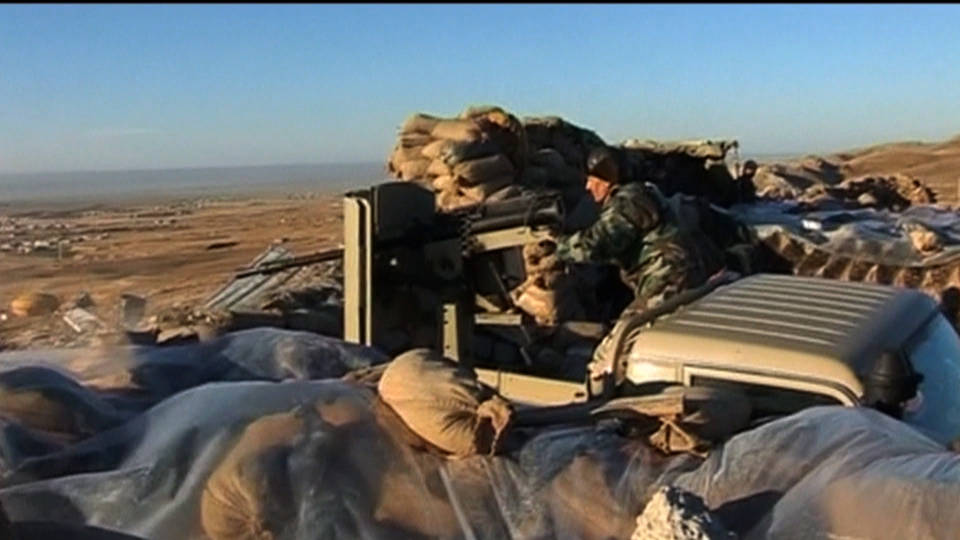
Amnesty International is accusing Western-backed Kurdish fighters of possible war crimes over the "large-scale destruction" of thousands of Arab homes in northern Iraq. Amnesty says Kurdish forces "appear to be spearheading a concerted campaign to forcibly displace Arab communities." Meanwhile, satellite photographs show the self-proclaimed Islamic State has destroyed one of the oldest Christian sites in Iraq. The 1,400-year-old monastery of St. Elijah stood south of Mosul. Photographs show the site was destroyed in late August or September 2014, a few months after ISILfighters seized control of Mosul.
Egypt: Mubarak Begins Trial over Killing of Protesters in 2011

In Egypt, former President Hosni Mubarak begins his second trial today over the killing of protesters during the 2011 uprising against his rule. Mubarak was originally sentenced to life in prison for conspiring to murder demonstrators, but a retrial was ordered on appeal. This comes as CIA Director John Brennan has finished a two-day visit to Cairo after meeting with Egyptian President Abdel Fattah el-Sisi. It was Brennan’s second visit to Cairo in less than a year. The U.S. has restored diplomatic and military ties with Egypt despite President Sisi’s crackdown on human rights, including the increasing jailing of journalists.
Jailed Former Maldives President Allowed to Travel to U.K. for Surgery
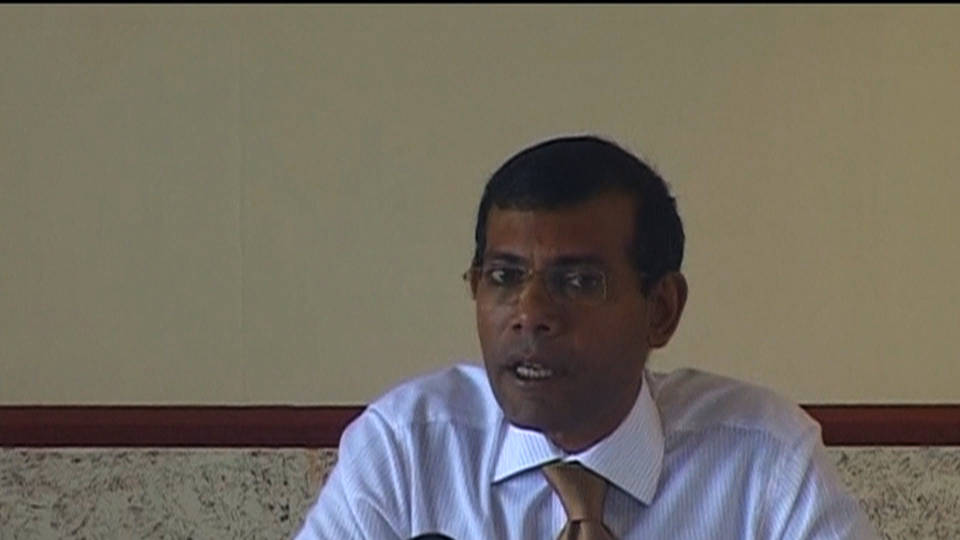
The former president of the Maldives, Mohamed Nasheed, has been temporarily released from prison and permitted to travel to Britain for back surgery. Nasheed was the Maldives’ first democratically elected president, known internationally for his work on climate change. He was ousted in 2012 in what he called an armed coup by supporters of his predecessor, Maumoon Abdul Gayoom. Nasheed is serving a 13-year sentence under antiterrorism laws.
Report: Putin "Probably Approved" Murder of Former KGB Officer & Whistleblower

A British investigation says Russian President Vladimir Putin "probably approved" the 2006 murder of Alexander Litvinenko, a former KGB officer who blew the whistle on corruption inside Moscow’s security services. Litvinenko died after ingesting green tea poisoned with a toxic, radioactive isotope. The 328-page report was issued by retired British High Court Judge Robert Owen. Russia’s foreign minister has dismissed the report as "politically motivated."
#BlackLivesMatter Activists Disrupt U.S. Conference of Mayors
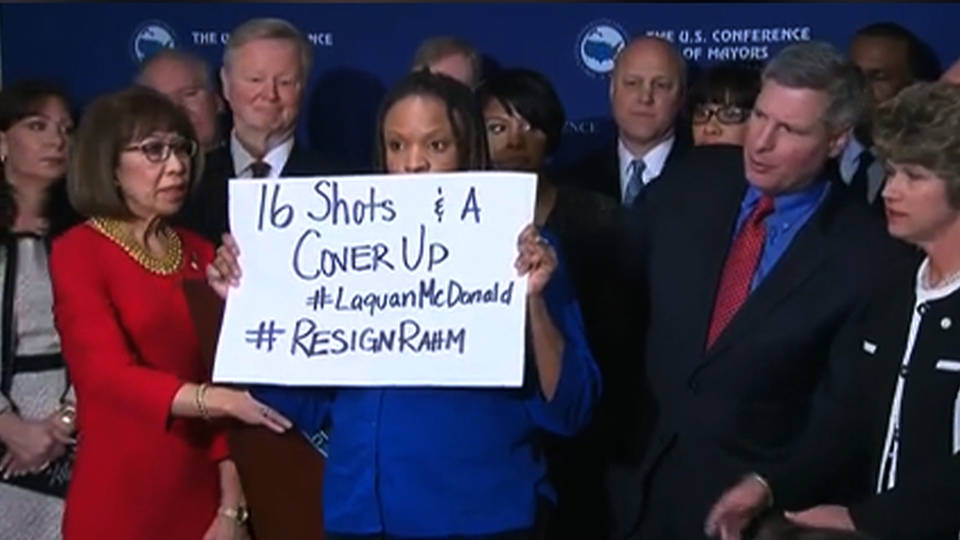
Back in the United States, Black Lives Matter activists have repeatedly disrupted the U.S. Conference of Mayors meeting in Washington, D.C., to protest police killings of unarmed African Americans across the country. Protesters held signs reading "16 Shots is a cover up. #LaquanMcDonald #ResignRahm"—a reference to Chicago Mayor Rahm Emanuel. He’s facing increasing protests over a possible cover-up of the police killing of unarmed African-American teenager Laquan McDonald, who was shot 16 times by white police officer Jason Van Dyke more than one year ago. Activists also disrupted the speech of Baltimore Mayor Stephanie Rawlings-Blake by shouting, "You failed us!" This comes as the trial of three Baltimore police officers charged in the death of unarmed African American Freddie Gray is slated to resume Friday, after a judge denied a motion that would have compelled a fellow officer to testify in their cases, threatening to postpone the trials indefinitely.
Hundreds of Minneapolis Students Walk Out to Protest Deportations

In Minneapolis, hundreds of students have walked out of class to protest the Obama administration’s new round of raids against Central American families. The raids have targeted people who sought asylum in the United States after fleeing violence in their home countries. On Wednesday, students staged the walkout and then rallied at Martin Luther King Jr. Park to demand an end to deportations.
Arizona: John Legend Holds Concert Outside Eloy Detention Facility

Meanwhile, in Arizona, Grammy-winning singer John Legend and Colombian musician Juanes held a concert outside the Eloy Detention Facility to draw attention to the long-term detention of immigrants. Eloy is run by the for-profit company Corrections Corporation of America. The facility has long drawn criticism for alleged mistreatment of detainees and inadequate medical care. John Legend spoke about the concert’s purpose.
John Legend: "We want to affirm their humanity and their right to exist, their right to life, liberty and the pursuit of happiness, no matter where they’re from, no matter where they were born."
During the concert, John Legend and Juanes sang Bob Marley’s "Redemption Song."
Complaint: NYC's Charter School Chain Violates Rights of Special Needs Students
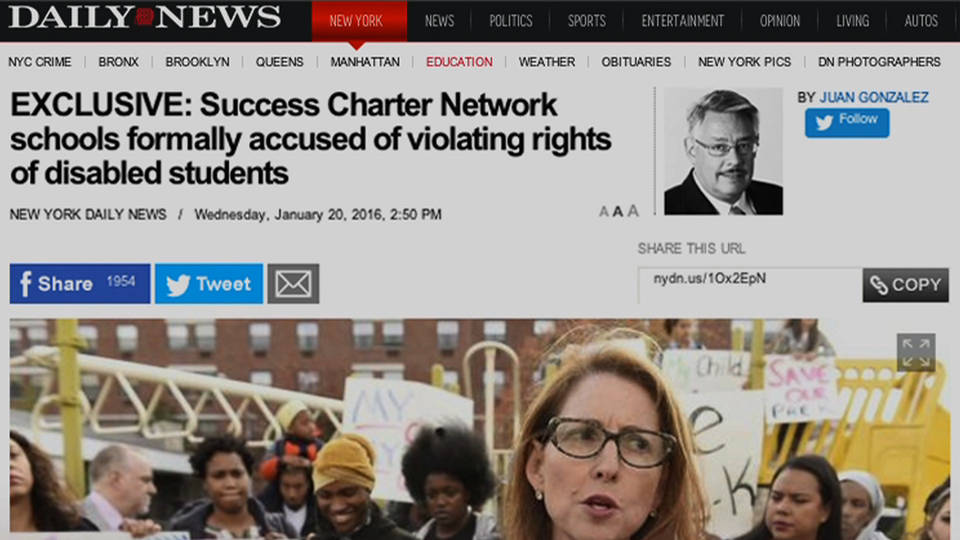
A group of parents have lodged a formal complaint against New York City’s largest charter school chain, Success Charter Network, for violating the rights of students with disabilities. Democracy Now! co-host Juan González was the first to break the story in his column for the New York Daily News. The complaint alleges Success Charter Network has denied special education services to students and instead forced them to repeat grades; has suspended special needs students multiple times without keeping records; and has harassed parents to move their students back into regular public schools.
After 23 Years, David Koch Leaves Board of American Museum of Natural History

And billionaire Republican donor David Koch has left the board of the prestigious American Museum of Natural History after 23 years. This comes after a campaign called on the American Museum of Natural History and other top scientific institutions to divest from the fossil fuel industry and cut ties with David Koch, whose company, Koch Industries, has poured millions into climate denial. Earlier this week, we spoke with award-winning New Yorker writer Jane Mayer about the Koch brothers’ interest in funding climate denial.
Jane Mayer: Their fortune is built on fossil fuels. I mean, they are refiners, and they have tremendous numbers of pipelines, and they own a huge amount of the tar sands that are up in Canada. And so, if America moved off fossil fuels, it would be catastrophic for their business. It’s a direct interest that they’ve got in this. And so, one of the things I do is try to follow the money in the denial of climate change, and an awful lot of it goes back to the Kochs and their circle."
David Koch says the campaign did not influence his decision to leave the board of the American Museum of Natural History. He still sits on the advisory board of the Smithsonian National Museum of Natural History.
Donate today:
Follow:


WEB EXCLUSIVE

Breaking: Daniel Holtzclaw Faces Sentencing for Rapes of Black Women
COLUMN

"A Tale of Two Grandmothers" by

"Part 2: Oxfam Says Privatization, Tax Havens Drive Global Inequality to Staggering Levels"
WORK WITH DN!

Director of Finance and Operations
Director of Development
---------------------
207 West 25th Street 11th Floor
Follow:
WEB EXCLUSIVE
Breaking: Daniel Holtzclaw Faces Sentencing for Rapes of Black Women
COLUMN
"A Tale of Two Grandmothers" by
Amy Goodman & Denis Moynihan
On a recent snowy January night in upstate New York, a grandmother turned herself in to the Jamesville Correctional Facility, to serve a six-month sentence. Her crime? Taking photos. Mary Anne Grady Flores was photographing eight others protesting at the gates of Hancock Field Air National Guard Base outside Syracuse, N.Y. The group, the Upstate Coalition to Ground the Drones and End the Wars, gathered there on Ash Wednesday, Feb. 13, 2013, protesting the weaponized drones used in the Obama administration’s targeted killing program. It was only one of many of the group’s peaceful vigils.
“It was Ash Wednesday, it’s a day of atonement in our tradition ... as Catholic workers,” Grady Flores told me on the ""Democracy Now! news program, hours before turning herself in. "It’s really important to get the word out of what’s going on at the base, which are war crimes." Hancock Field is the home of the 174th Attack Wing of the Air National Guard, which operates a fleet of MQ-9 Reaper drones, "a persistent hunter-killer of emerging targets," in the U.S. Air Force’s own words.
Grady Flores stood away from the vigil, taking photos, in part because a judge had issued an "order of protection" against her and other protesters as the result of a 2012 protest, when the group managed to block three entrances to the base for an hour. The order was issued at the request of the 174th Attack Wing’s Mission Support Group commander, Col. Earl A. Evans. Violation of the order to stay away from Evans’ home, school or "business" is considered a felony punishable by up to seven years in prison. Grady Flores learned upon her arrest that the base’s property reached well beyond the gate, across the road to where she was standing.
"Taking photographs, of course, is a First Amendment-protected activity. Demonstrating is a First Amendment-protected activity," Jonathan Wallace told us, appearing with Grady Flores on our program. Wallace is an attorney who has worked extensively with the drone resistance movement. "These orders of protection are a pre-printed form with blanks that police and prosecutors fill out every day to protect battered spouses and witnesses who are assaulted."
Another colonel weighed in on the case. Col. Ann Wright served in the military for 29 years, then as a high-level State Department official. In 1997, she was given the State Department Award for Heroism for helping evacuate thousands during the civil war in Sierra Leone. She was deputy chief of mission when the U.S. embassy reopened in Afghanistan in 2001. In 2003, she resigned her post to protest the war in Iraq. “I find it quite embarrassing and ludicrous that a U.S. military commander decided that his personal security is so threatened by peaceful, nonviolent protesters of the drone policies of the U.S.,” Wright wrote in support of Grady Flores. “I would have expected a U.S. commander to have had the courage to meet with the group of concerned citizens rather than obtaining a cowardly order of protection.”
Two months after the Ash Wednesday protest where Grady Flores was charged with violating the order, on May 23, 2013, President Barack Obama delivered a speech at the National Defense University defending his drone program: “Before any strike is taken, there must be near-certainty that no civilians will be killed or injured—the highest standard we can set.” Despite his pledges, the civilian death toll from U.S. drone strikes continues to climb.
We all too rarely learn the names of these victims. On Oct. 24, 2012, for example, the CIA launched a drone strike in North Waziristan, Pakistan. Mamana Bibi, a 67-year-old grandmother who was picking okra, was killed. Bibi’s grandson, 12-year-old Zubair Rehman, and his 8-year-old sister, Nabila, were among the injured. After multiple surgeries, Zubair and Nabila came to the United States with their father, Rafiq, a schoolteacher, to testify before Congress. After they testified, they made their way to our studios in New York City, where we interviewed them. In his congressional testimony, little Zubair said: "I no longer love blue skies. In fact, I now prefer gray skies. The drones do not fly when the skies are gray. ... When the skies brighten, though, the drones return, and so, too, does the fear."
Mary Anne Grady Flores was wearing a scarf on the day she went to prison—but not for protection from the snow. "I’m wearing a blue scarf today, and the kids from Afghanistan were the ones that sent this bolt of cloth," she told us, so "that someday we could live with the vision of the future of blue skies, of peace."
WEB EXCLUSIVE"Part 2: Oxfam Says Privatization, Tax Havens Drive Global Inequality to Staggering Levels"
WORK WITH DN!
Director of Finance and Operations
Director of Development
---------------------
207 West 25th Street 11th Floor
New York, New York 10001, United States
---------------------
---------------------
No comments:
Post a Comment