democracynow.org
Stories:

Democracy Spring: Over 400 Arrested at U.S. Capitol Protesting Corruption & Money in Politics
More than 400 people were arrested Monday in a massive sit-in on the steps of the U.S. Capitol to protest the influence of big money and corporate lobbying in politics. The protest, organized under the name Democracy Spring, brought together activists from about 140 organizations who marched from Philadelphia to Washington last week. Similar acts of civil disobedience are scheduled throughout the week in Washington. We speak to Kai Newkirk, campaign director of Democracy Spring and co-founder and an organizer with 99Rise. He was arrested yesterday in the action at the U.S. Capitol.
TRANSCRIPT
This is a rush transcript. Copy may not be in its final form.
AMY GOODMAN: Yes, this is Democracy Now! We’re on the road as part of the 100-city tour, now in San Francisco, headed to Stanford University this afternoon and to Santa Clara tonight.
But in Washington, D.C., more than 400 people were arrested Monday in a massive sit-in on the steps of the U.S. Capitol to protest the influence of big money and corporate lobbying in politics. The protest, organized under the name Democracy Spring, brought together activists from about 140 organizations who marched from Philadelphia to Washington last week. Similar acts of civil disobedience are scheduled throughout the week in Washington. This is Democracy Spring campaign organizer Kai Newkirk speaking during yesterday’s action.
KAI NEWKIRK: [echoed by the Peoples’ Mic] The American people won’t take this anymore! We’re going to end this corruption! This is just the beginning! This is just the beginning! Join us! Join us! Join us! Join us! Join us!
AMY GOODMAN: The Democracy Spring action comes in a presidential election cycle in which campaign finance reform, super PACs and dark money have made headlines. The Washington Post reports, through the end of January, 680 corporations had given nearly $68 million to super PACs in this election cycle—12 percent of the $549 million raised by such groups. This figure does not include the untold amounts of dark money contributions to other groups that are not disclosed by the donor or the recipient.
For more, we’re joined by two guests. Kai Newkirk is campaign director of Democracy Spring, co-founder and organizer with 99Rise. He was arrested yesterday in the action at the Capitol. And Lee Fang is with us here in San Francisco, investigative journalist at The Intercept covering the intersection of money and politics.
We welcome you both to Democracy Now! Let’s go directly to D.C. Kai Newkirk, you just recently got out of jail. Talk about this mass civil disobedience that took place yesterday, leading to the arrest of more than 400 people.
KAI NEWKIRK Thank you, Amy. It’s great to be with you, and it’s an honor to be on the show.
We think that yesterday can be the beginning of the end of this corruption and inequality in our democracy. It was so inspiring to see people come together at the People’s House and say, "We are going to take it back," people from across the political spectrum, many of whom had walked all the way from Philadelphia, from the Liberty Bell, to Washington, D.C., almost 150 people who did that, and, we believe, over 500 people who sat in and sent a message to Congress that we will not accept inaction to save our democracy, and sent a message to anyone who’s running for office in our country that you have to make a decision: Are you going to stand on the side of democracy and on the side of the people or on the side of big money and corruption? And if you choose to defend the status quo of corruption, we believe there’s going to be growing nonviolent resistance in the streets, at the Capitol, at your fundraisers and in the polls, to say, "We will not take it anymore. We demand an equal voice in our democracy." And, yes, it’s right. It’s just the beginning. And we call on people to join us here. We’re going to be back at the Capitol today and tomorrow and the next day.
AMY GOODMAN: Kai Newkirk, can you talk about how you and who were the others who organized Democracy Spring?
KAI NEWKIRK Sure. We had this vision well over a year ago. We had led a march in California from Los Angeles to Sacramento, 99Rise, the organization that I co-founded. It was very powerful. It was an inspiration to many people. And we thought, "What if we could take that national? What if we could give people across the country an opportunity to participate?" and have been able to bring together an incredible coalition, as you said, over 140 organizations from across the spectrum of the progressive movement and even beyond. And leaders from different parts of the movement—Cenk Uygur from The Young Turks sat in yesterday. Frances Moore Lappé, a leader around food justice for many years; Umi Selah from the Dream Defenders; Jodie Evans from CodePink; John Pudner from a conservative organization Take Back Our Republic marched with us and joined with us.
And when we were at the Capitol today, you could feel the energy that this can be a moment that can really turn the tide around this. And it’s because of the hard work of so many people who have built this coalition and brought people together and given them an opportunity to express what the vast majority of people in our country feel, which is that the political system is not representing us, that it is corrupt, and that, because of that, we have a rigged economy. We want a government of, by and for the people, not the 1 percent. And we stood up and sent a message that we’re going to win that, one way or another, yesterday.
AMY GOODMAN: Kai Newkirk, you also snuck a camera into the Supreme Court. Can you talk about what you did back in 2014 and why you were there?
KAI NEWKIRK Yes, that was on the eve of the expected decision in the McCutcheon v. FEC ruling, which was another—ultimately, another wrecking ball to the wall of separation between wealth and state in our society, Citizens United 2.0. And we felt like we needed to call attention to this crisis and the Supreme Court’s role in deepening it, and do so in a way that would inspire people to stand up. So, myself and one other person, Ryan Clayton from Wolf PAC, who also sat in with us yesterday, we went into the court, and I stood up and gave a short speech, was arrested. But we got it on video, the first video ever from inside the Supreme Court. We’ve done two similar actions, 99Rise, since then, with seven people and five people.
And I’m very proud, because the goal, in many ways, of that was to inspire other people to step up and to be willing to do something similar. And yesterday was a tremendous fulfillment of that, to see hundreds of people, over 500. It took them hours to get people processed and out. They had to get another bus, because they were not prepared. There were so many people. And more are going to be joining today and tomorrow. And we call on people, wherever you are this country, if you agree with us, get in your car, get on the bus, get a ticket, do whatever it takes to get to D.C. and be part of this moment.
AMY GOODMAN: Kai Newkirk, what are the bills before Congress right now that addresses campaign finance?
KAI NEWKIRK There are many steps that Congress could take. We’re calling on them to take immediate action to end the corruption of big money in politics and ensure free and fair elections that give us all an equal voice. And there are four bills, in particular, that we’ve identified—two that deal with big money in politics and two that will protect and expand the right to vote and voter access. One would set up public finance, a citizen funding of elections, so that anyone can run for office without raising money from billionaires. Another is an amendment that would overturn Citizens United. The third would restore the damage that was done to the Voting Rights Act by the Supreme Court, the Voting Rights Advancement Act. And the fourth, the Voter Empowerment Act, would do many positive things to make it easier for people to get to the polls and to be able to vote. And in the wake of Justice Scalia’s death, there’s a fifth step that we’re calling on Congress to take, which is to confirm a nominee to the Supreme Court who will vote to uphold the principle of political equality, to end this corruption of big money in politics and ensure that all have the right to vote.
And what we’re saying is that even though the conventional wisdom is that Congress won’t do anything with Republican leadership, we don’t accept that. You know, we feel that conscience demands that we ask what is right, what is just, what is consistent with our principles as a country. And the vast majority of the American people—Republican, Democrat, independent—want change on this. And we’re saying to Congress, "You can’t just hide. You can’t just be resigned. You can’t just pretend that we don’t know that you could solve this problem right now. We’re going to demand that you do so. And if you don’t, you’re going to have to send hundreds of people to jail, day after day, and expose this problem and shine a spotlight on it and force yourselves to take a stand and make a decision." And those who don’t stand with the people, and stand on the side of corruption, we believe that there will be a growing political price to pay.
AMY GOODMAN: Kai, have any presidential candidates endorsed Democracy Spring?
KAI NEWKIRK I don’t know if we could call it an endorsement, but there were two tweets that went out from the Bernie Sanders account yesterday lifting up what we did. We want to be clear this is a nonpartisan, independent campaign. There are many Bernie supporters that are part of it, but I’ve talked to many Hillary supporters and even some Trump supporters. And it’s welcome to everyone. And what we’re saying is that we’re not going to endorse candidates, but we are calling on them to endorse the movement. Whatever office you’re running for, from president on down to city council, you need to let the American people know, those who you would want to represent, if you will work and fight to solve this problem, if you will work to make sure that we have a government that represents us all, not just the 1 percent. We were pleased to see those tweets from the Bernie Sanders campaign. We hope that Hillary Clinton, Trump and anyone who’s running for office in our country will stand with us in this cause to save our democracy.
AMY GOODMAN: Kai, can you talk about how Democracy Spring fits into Democracy Awakening and what that is?
KAI NEWKIRK Yes, I like to think of it as two wings of the same bird, one democracy mobilization that’s coming to D.C. this spring. All told, I think over 300 organizations are part of it. We kicked things off with this march from Philadelphia to D.C. and are sitting in at the Capitol this week and building, going at least through the week. We will carry forward until either Congress does something or they send so many of us to jail that it will be, we believe, the largest civil disobedience in our country in this 21st century.
And this weekend, we’ll be joined by many more with the Democracy Awakening; on the 17th, there will be a huge family-friendly rally. We call on everyone to come out into the streets to march, to walk, to join with us then. And then, on Monday, Congress of Conscience, lobbying direct action going back to the Capitol, we’ll be there, we’ll be organizing. It may go beyond that.
And we’re calling on people across the country, wherever you are, to be part of this moment. If enough of us come together, Amy, in D.C., we can make this the turning of the tide. We can shine a spotlight on this issue like never before in our country and lift it up in the middle of this presidential election in a way that Occupy Wall Street did for economic inequality. We can do that for this critical issue of political inequality. Solving it is the key to making progress on so many other urgent issues in our country, from catastrophic climate change to mass incarceration. We lit a spark yesterday, and we need to fan the flames and build this into something that changes the political weather in this country.
AMY GOODMAN: Kai Newkirk, I want to thank you for being with us, campaign director of Democracy Spring, co-founder of 99Rise.
When we come back, Intercept investigative reporter Lee Fang on money in politics—oh, also on skin care. Why would the CIA be interested in a cream that takes away your blemishes and softens your skin? Stay with us., ... Read More →

Death by Gentrification: Alex Nieto Killed by Hail of Police Bullets in a Changing San Francisco
We look at the case of Alex Nieto, a 28-year-old Latino man fatally shot by San Francisco police in March 2014. The police officers accused in the killing claimed that Nieto pointed a stun gun at them, which they mistook for a pistol. Officers Richard Schiff, Nathan Chew, Roger Morse and Lt. Jason Sawyer fired dozens of shots at Nieto. According to the medical examiner, he was hit by at least 10 bullets. Last month, a jury unanimously found that the police did not use excessive force in responding to Nieto. Nieto’s family had filed a federal wrongful death civil lawsuit in August 2014, arguing in court that Nieto did not act aggressively and was carrying the weapon for his job as a security guard. We speak with Adriana Camarena, a writer, community advocate and co-founder of the Justice for Alex Nieto Coalition; and author Rebecca Solnit, who wrote a piece for The Guardian headlined "Death by gentrification: the killing that shamed San Francisco." Camarena also talks about last week’s San Francisco police killing of a homeless man, Luis Gongora, within 30 seconds of their arrival.
TRANSCRIPT
This is a rush transcript. Copy may not be in its final form.
AMY GOODMAN: "California Dreaming" by Afrolicious. Antonio Theodore of the band Afrolicious was a witness to the police killing of Alex Nieto. This is Democracy Now!, democracynow.org, The War and Peace Report. I’m Amy Goodman. We’re on the road in San Francisco.
"Death by gentrification: the killing that shamed San Francisco." That’s the name of a recent article by the acclaimed writer Rebecca Solnit about the 2014 police killing of Alex Nieto. In the early evening of March 21st, 2014, Alex Nieto was sitting in a San Francisco park eating a burrito. He was wearing a Taser that he carried for his job as a bouncer at a nightclub. Someone called 911. Police soon arrived. Within minutes, Nieto was killed in a hail of police bullets. One officer shot 23 bullets; another fired 20 times. Police claimed Nieto had pointed the Taser at them, which they mistook for a pistol. Last month, a jury found the police did not use excessive force. This is Alex Nieto’s family lawyer, Adante Pointer, speaking just after the decision.
ADANTE POINTER: They claim a man’s hand was in front of him, but yet his wrist bone is in his pocket. They claim a Taser was on and it pointed at them and fired at them, but not a single officer says that they saw it fired, nor did a single officer see the Taser wires in terms of right there when it happened. So, the issue is, when you have officers whose stories are not matching up, and then you’re able to demonstrate and show through the physical evidence that it’s just a flat-out fabricated lie, what will a jury need to accept more than that? ... And speculation is what much of the defense case was about, was speculating as to how a Taser, that officers have claimed were on, could be photographed at the scene being off. ... In this situation right here, what you have is essentially a green light to fire 59 bullets in a residential and public park setting and result in someone being dead. You know, so, it’s a sad day, like I said, for the city and county of San Francisco.
AMY GOODMAN: Alex Nieto died in the San Francisco neighborhood he grew up in, the rapidly gentrifying area of Bernal Hill. His death sparked protests against police racial profiling and gentrification. Many people ask, "Did Alex Nieto die because a few white newcomers saw the young Latino man as a menacing outsider?"
To talk more about the case, we’re joined by two guests. Adriana Camarena is a writer and community advocate based in San Francisco. She attended Alex Nieto’s trial and is co-founder of the Justice for Alex Nieto Coalition. We’re also joined by Rebecca Solnit, writer, historian, activist, author of over a dozen books, including, most recently, Men Explain Things to Me. Her recent piece, "Death by gentrification: the killing that shamed San Francisco," appeared in The Guardian. She’s lived in the Bay Area for 50 years, 36 of them in San Francisco.
We welcome you both to Democracy Now! Before we talk about the decision by the jury, Rebecca Solnit, your piece, "Death by gentrification," is chilling. Go back in time, for people who don’t know this case, to what happened to Alex Nieto, March 2014, March 21st.
REBECCA SOLNIT: Yeah, Alex Nieto was a young man with big hopes, aspiring to be a probation officer. He was a Buddhist. And a young Buddhist Chicano friend of his said they wanted to be pure lotuses, you know, to really serve the community, to be great people. And so he worked as a security guard, bouncer at a nightclub and really took care of his parents, who were retired, and was close to—sort of beloved by a lot of people, participated in community campaigns, political campaigns and things like that. And he had been born and raised on Bernal Hill. He’d spent his whole life there. And I think he felt really at home there.
He went up there one evening to eat a burrito, and—as was his habit. And a series of unfortunate things happened to him. First, he got attacked by an out-of-control dog owned by a newcomer techie in the neighborhood, and the dog cornered him on a park bench, sort of howling and lunging at him. And that turned into an altercation with the owner, who called him alleged—reports he called him a racial slur and then texted a friend that he wished it was Florida so he could do what George Zimmerman did to Trayvon Martin, more or less. So, it was—you know, there’s just this sense that he was sort of in peril by people who were going to see him as dangerous, because he was wearing a 49ers jacket, which is red, and there’s also a gang that wears red, so, you know, even though lots of guys in the Bay Area love the 49ers and wear these red jackets, if you’re Latino, you might get profiled for it.
So then some other man saw him—he had his Taser on—and decided that he was potentially dangerous, and called 911. So, and some police arrived and did what the police should have done, which is to sort of create a secure perimeter, and were preparing to move prudently, so far as we can tell, but they were sort of overrun by a rookie cop driving a car with a senior officer in it, who went through that perimeter, went a lot closer to Nieto as he walked down the hill, unaware 911 had been called, unaware that anybody saw him as a menace in the place he had been since he was a baby. And the police claim he pointed his Taser at them. Nobody has ever explained—given a good reason, a reason I can believe, of why he would pull out his Taser, point it at them, turned on, etc. He studied criminal justice. He had interned as a probation officer. He understood how things worked. So, but the police claim he did that and that they were in fear for their life, and that’s why they fired 59 bullets at him, those two officers who fired 43 and two officers who pulled up shortly afterward. Within two minutes of the police arriving, Nieto had 14 bullets in his body and was fatally wounded.
AMY GOODMAN: And what happened next?
REBECCA SOLNIT: Well, at the—
AMY GOODMAN: The police then started to gather evidence.
REBECCA SOLNIT: The police started to do what they often do with victims of police killings, just—as happens with rape victims, as well—to discredit and sort of dishonor the victim and to look around for things to suggest that what they did was justified. The story we’re supposed to buy is: Why did he point his Taser at them? Because he was mentally ill. How do we know he was mentally ill? Oh, because he pointed his Taser at them. But the one eyewitness, Antonio Theodore, who viewers just saw, says that Alex never pointed his Taser at them.
AMY GOODMAN: Antonio is with Afrolicious.
REBECCA SOLNIT: Yes.
AMY GOODMAN: And talk about this, any eyewitness accounts. It looks like it was just him?
REBECCA SOLNIT: He’s the only eyewitness to the shooting. And he was on the hill above. He says Nieto never pulled—pointed his Taser at the officers.
AMY GOODMAN: And he was just walking his dog?
REBECCA SOLNIT: Yeah, he was just—
AMY GOODMAN: Is this how he ended up seeing this?
REBECCA SOLNIT: Yes, yes, he was also living in the neighborhood, as he still does. He was taking an evening walk. It was a beautiful March evening of 2014.
AMY GOODMAN: And what does he say he saw?
REBECCA SOLNIT: He says Nieto’s hands were in his pockets the whole time. And he has—you know, he has no motives to lie. He was—he’s afraid of the police. He didn’t even come forward for several months. And that’s the story he told when Adante Pointer examined him in court in the trial.
AMY GOODMAN: The lawyer for—
REBECCA SOLNIT: The lawyer for the Nieto family, who brought the civil lawsuit.
AMY GOODMAN: And explain that. What is this trial, this jury trial? It wasn’t actually a trial brought by a prosecutor against the police officers.
REBECCA SOLNIT: No, a criminal trial for shooting somebody death—for the police shooting someone to death is too much to hope for in San Francisco. This was a civil trial brought by the family and for wrongful death and excessive use of force and violation of civil rights.
AMY GOODMAN: Adriana Camarena, you sat with the family throughout the trial? You also would serve as an interpreter for them. They don’t speak English; they speak Spanish?
ADRIANA CAMARENA: They speak Spanish, and I have been accompanying the Nietos since shortly after Alex died. So, I am one of the members of the coalition who have been close to the family, so I know—I was not an official interpreter, but I have interpreted for them, because they faced—it was clear to me since the very beginning that they faced very big barriers to even understanding the legal case, let alone because it’s all in English, but also because there’s technical language involved. And it was just a very traumatic moment for them. Fortunately, community gathered around them. I was one of the community members that have accompanied them throughout this whole process for the last two years.
AMY GOODMAN: And talk about being in the courtroom every day and then your reaction, the reaction of the Nietos, of his parents and his brother, when the jury came down with a not guilty verdict, saying that the police had not used excessive force.
ADRIANA CAMARENA: It was, to say the least, very emotional. Even though we got a jury verdict that was not—that was against the Nietos, it was—the trial itself was a victory for us, because rarely do police shootings end up in a public trial. And for the first time, we were able to hear information that for two years we had been wanting to hear, like the 911 call. So, to be there with the Nietos—
AMY GOODMAN: This is the 911 call—
ADRIANA CAMARENA: Yeah.
AMY GOODMAN: —of the young techie who had just moved into the area, whose dog first went after Alex?
ADRIANA CAMARENA: No, there’s two different incidents. There was an earlier incident that happens maybe—we don’t know exactly when, 30 to 40 minutes before Alex is actually shot. It depends on the variations of what the witness has said. But then there’s another moment where two young men, walking their dogs—it’s the time of the day where everybody’s walking their dog in Bernal Heights—walk by, and they call the police because one of them sees what they think is a weapon on Alex’s hip. And that was the only reason they called the police. They didn’t interact with him. They didn’t talk to him. They just saw him. And one of them, Tim Isgitt, became very nervous about it. So he had his partner, Justin Fritz, call 911. Justin Fritz actually never saw anything. He was just relating to 911—excuse me—what Tim was telling him he saw. So, that’s the 911 call that provoked this.
AMY GOODMAN: I want to go to that 911 call. Justin Fritz, the man who set the wheels in motion that night of Alex Nieto’s death by calling 911. In 2014, Fritz testified in San Francisco federal court he and his partner were walking their dogs when they spotted a seemingly suspicious person, and so they made that police call. The operator asked for a description. Let’s listen to part of that 911 call.
JUSTIN FRITZ: He had a red jacket, probably six-one, 200 pounds.
911 OPERATOR: What race is he?
JUSTIN FRITZ: Race?
911 OPERATOR: Is he Hispanic? African—
JUSTIN FRITZ: It looks like he may be Hispanic.
AMY GOODMAN: Fritz then stated, without equivocation, that the man had a gun.
911 OPERATOR: The gun is visible?
JUSTIN FRITZ: Yeah.
911 OPERATOR: OK. What type of gun is it? Is it a handgun?
JUSTIN FRITZ: Yeah, I would say a black handgun.
AMY GOODMAN: However, Fritz reportedly never saw Alex Nieto with any kind of weapon. He was apparently just repeating what his partner had said. Fritz’s partner apparently mistook Nieto’s Taser for a gun, despite it having bright yellow stripes. Nieto used the Taser for his job as nightclub bouncer, where he was headed to next after eating his burrito. On the stand, Fritz testified he saw police arrive and open fire. In the 911 call, you hear the police gunshots and then Fritz crying for help.
JUSTIN FRITZ: They’re firing at me. They’re firing at me. Help! Help!
911 OPERATOR: All right. Stay—stay on the line.
JUSTIN FRITZ: Help!
AMY GOODMAN: Nieto’s former middle school teachers from Horace Mann spoke to CBS San Francisco. Teacher Barbara Duhl remembered Nieto as a good-natured kid.
BARBARA DUHL: Boys at that age, they want to—they want to show that they’re—you know, they’re growing up. But, you know, he just couldn’t help himself. He’d just break out into a big old smile whenever he tried to act tough.
AMY GOODMAN: Adriana Camarena, go back to that 911 call, the call that made—set this whole thing in motion. So, you hear basically the whole thing. I mean, in the end, you hear the gunshots. And, I mean, this put not only—well, ended up in the death of Nieto, but put bystanders at risk everywhere. Clearly, Fritz thought he was going to be shot.
ADRIANA CAMARENA: It’s one of the most remarkable things of this trial, is to realize how scared even the witnesses were. There were 59 shots fired. And what the witness is saying, Justin Fritz, at that moment is that the shots were flying over his head. If you’re in the park, you understand this is even off the line of fire where Alex Nieto was. If the police say they were shooting at Alex here, they would have had to be shooting in this direction into the trees below which Justin Fritz was running. So, it was just reckless disregard for the safety of people in this park by shooting those 59 bullets in the manner that it was done.
AMY GOODMAN: Rebecca Solnit, you wrote the piece, "Death by gentrification." What are the linkages you’re making here?
REBECCA SOLNIT: Of course, that’s my editor’s title, but one of—and there’s a bunch of different pieces. One is the larger picture. A lot of—71 percent of the homeless people in San Francisco were previously housed and lost their housing, and there’s been a number of cases of elderly people evicted who died during or immediately after the eviction process, because you don’t start your life over again when you’re in your nineties.
And then also gentrification in the Bay Area has brought a lot of white people who are not comfortable around people of color into historically nonwhite neighborhoods, leading to a lot of racial profiling, calls to police, harassment, etc. And I documented in the article people using the website Nextdoor.com in Oakland, for example, to talk about, "Oh, there’s a black man in the neighborhood," or, "There’s a black man getting in and out of his car." Well, it’s like, you know, maybe he’s lived there for 40 years. Maybe he’s lived—you know, maybe he’s visiting his grandmother who’s lived there for 60 years. And so there’s a lot of different kinds of tension, a lot of different ways that death by gentrification happens now in the kind of housing crisis, economic crisis and cultural crisis that is the Bay Area.
AMY GOODMAN: And, Adriana, I wanted to ask you about the most recent killing of a homeless man here in San Francisco named Luis Gongora. It happened last Thursday. What happened?
ADRIANA CAMARENA: From what we know, police arrived. They say they were called in. We haven’t even heard whether it was a 911 call. It’s unclear how they arrived. But we do know, even now, with a surveillance video camera, that they, within 30 seconds of their arrival—you can’t see what Luis is doing, but you can see what the police are doing. And they—within 30 seconds, they shoot rounds of bean bags—bean bag rounds, and they immediately shoot him to death with seven shots.
But what eyewitnesses say, this is a homeless encampment on the street, what used to be an industrial part of the Mission. So you have several eyewitnesses—you have three eyewitnesses who are residents of this homeless encampment, and you also have neighbors who saw the incident. So you have four eyewitnesses saying that Luis wasn’t doing anything. He was approached by police, where they were asking, "Where’s the knife? Where’s the knife?" And he didn’t—doesn’t speak English. In fact, he is of Mayan descent from Yucatán. So he knew enough to know that—maybe what the word "knife" was. So he was trying to cooperate. He huddled against the wall. They started shooting bean bag rounds at him. So he got up, and he was running around kind of like—because he was being hurt by the bean bags. And that was sufficient provocation for the cops to kill him. But there is no sense that he had a knife in his hand. One of the witnesses told me that what he picked up for a moment, thinking that—trying to comply, was a cake spatula.
AMY GOODMAN: A cake spatula?
ADRIANA CAMARENA: Yes, and with a—and that’s what one of the witnesses told me, that that’s what he picked up, kind of trying to show, to comply with police orders.
AMY GOODMAN: We have 10 seconds. How are you organizing?
ADRIANA CAMARENA: Oh, we are, by now, several coalitions—the Justice for Alex Nieto Coalition, Justice for Amilcar Pérez-López and also Mario Woods—who have been asking for a federal investigation.
AMY GOODMAN: We’re going to continue this conversation and post it at democracynow.org. Thank you both so much for being with us, Adriana Camarena and Rebecca Solnit.
ADRIANA CAMARENA: You’re welcome.
AMY GOODMAN: And we’ll link to your piece, "Death by gentrification."
We’re on the road here in San Francisco. We’re speaking at Stanford University tonight—this afternoon at 3:30 and tonight at Santa Clara Convention Center Theatre. ... Read More →

Lee Fang: Dark Money & Lobbyists Serving as Superdelegates Could Decide the 2016 Race
We continue our coverage of Democracy Spring and the influence of dark money in the presidential elections with Lee Fang, investigative journalist at The Intercept focusing on the intersection of money and politics. He has revealed that several of the Democrats’ superdelegates now work as lobbyists for banks, oil companies, foreign governments and payday lenders, among other special interests. In a close race, these superdelegates could determine the party’s nominee.
TRANSCRIPT
This is a rush transcript. Copy may not be in its final form.
AMY GOODMAN: Willie Nelson singing "On the Road Again." And that’s just where we are. This is Democracy Now!, democracynow.org, The War and Peace Report. I’m Amy Goodman. And we’re on the road again as part of a 100-city tour, now in San Francisco, California.
But back in Washington, D.C., 400 people were arrested in a massive sit-in on the steps of the U.S. Capitol to protest the influence of big money and corporate lobbying in politics. We continue our coverage looking at the influence of dark money by speaking with investigative reporter Lee Fang, a journalist at The Intercept who focuses on the intersection of money and politics. His recent piece we’ll talk about in a moment, but I want to talk about the protests that are taking place and what you’re finding as you sniff the money trail on the presidential campaign trail, Lee.
LEE FANG: Well, Amy, welcome to San Francisco. Thank you so much for having me.
I thought the protests yesterday were very interesting, and they kind of connect to a broader movement, this kind of return to civil disobedience that we’ve seen in recent years, everything from Occupy Wall Street to the Black Lives Matter protests. You know, in the waning years of the Bush administration, we saw a lot of activists shifting their focus to electoral politics, focusing on electing Democrats or left-of-center politicians like Barack Obama. But with some of the failures of Obama—failure to achieve real universal healthcare, a failure to really tackle climate change or growing income inequality—we’re seeing this kind of return to civil disobedience, these tactics from the 1960s, or even going back to the 1930s, that are returning to the mainstream in American politics. And I think that’s very interesting. And it’s very savvy, I should add, for all of these protesters to make corruption, money in politics, their focus, because that’s what kind of threads the needle here. No matter what issue you care about, it’s very difficult to see reform when big money, special interests dominate the policymaking process.
AMY GOODMAN: Lee Fang, you write about a significant number of superdelegates are also lobbyists?
LEE FANG: Yeah, so, there’s also—I focus now on the way the Democratic Party nominates its candidate for the presidency. There are about 4,000 pledged delegates, folks that are committed based on how each primary or caucus state votes, but there are also a little over 700 unpledged delegates, known as superdelegates. Most of these are members of Congress, but some of them, a significant number, are actually party insiders or lobbyists and former politicians who now work in the lobbying industry. So it’s very interesting to see this broader discussion, really in both parties, about the role of money in politics, at the same time you have actual lobbyists, folks who are registered to represent big banks, even in some cases foreign governments, and they have incredible power over the nomination process. And in one potential scenario, we could have these lobbyists selecting the nominee, if Hillary and Bernie have about the same number of pledged delegates going into the convention later this summer.
AMY GOODMAN: You’ve also written about Hillary Clinton’s ties to fracking internationally. What do you mean?
LEE FANG: Well, yeah, this is an interesting subject. And as both candidates, Bernie and Hillary, discuss fracking, I think this is an important element of the story the mainstream media has not covered very closely. Hillary Clinton, in her time at the State Department, there’s been a lot of focus on her role in Libya, in the Arab Spring, but a significant part of her legacy is really promoting American-style fracking across the world. She, in fact, reorganized the State Department to create a whole new bureau, a 60-plus-staff bureau, focused on energy resources, with a special focus on promoting fracking. And she traveled the world, partnering with American companies like Chevron, going to countries such as Bangladesh, Papua New Guinea, Bulgaria, and convincing these governments to take this American technology, this directional drilling hydraulic fracturing known as fracking, and trying to convince these countries to adopt American-style fracking. So this is a significant part of her legacy. And as we talk about the role of fossil fuel money in politics, of where she stands on these important issues, I think her role and her legacy at the State Department is important to scrutinize.
AMY GOODMAN: Bernie Sanders has proposed a national ban on fracking.
LEE FANG: Yeah, and that’s a very clear-cut issue. Hillary Clinton has a less-than-clear position on this. In recent days, I believe with her recent interview with the New York Daily News, she said that she would defer to some states and municipal governments that might ban fracking, and that, in some cases, she would hope for fracking that is environmentally sound, that is well regulated. But we really haven’t seen a scenario where fracking is closely regulated. We still haven’t—the federal government doesn’t have a handle on how methane is leaked from these fracked gas well sites. Of course, methane is a very powerful greenhouse gas. So, for Hillary Clinton to take a position that she would allow fracking in an environmentally sound way is troubling, because we still don’t have those regulations.
AMY GOODMAN: Lee Fang, you’ve also written about pro-TPP op-eds remarkably similar to drafts by foreign government lobbyists.
LEE FANG: Yeah, so, we’ve had this big debate over the Trans-Pacific Partnership agreement, this massive trade deal being negotiated now. Of course, part of this debate is in the public realm, right? News programs, newspapers covering the debate, trying to explain it to readers, but we found a number of op-eds in California newspapers that were lifted directly from lobbyists working for the Japanese government, who were retained by the Japanese government to promote the TPP. So as we talk about money in politics, it’s important to realize, you know, campaign contributions, Citizens United are only one small part of the puzzle here. If you’re a special interest or, in this case, a foreign government, you can buy out a think tank to produce reports. You can pay off PR consultants to place these types of op-ed in newspapers. You can control the policymaking process in so many different ways that it’s important to realize that, you know, the media is part of the problem here. ... Read More →

Beauty Secrets of the Spies: CIA Begins Investing in Skin Care Products That Collect DNA
The Intercept’s Lee Fang discusses his recent exposé on how In-Q-Tel, the venture capital arm of the Central Intelligence Agency, is funding the manufacturer of Clearista, a popular beauty product. Clearista’s parent company, Skincential Sciences, has developed a patented technology that removes a thin outer layer of the skin, revealing unique biomarkers that can be used for a variety of diagnostic tests, including DNA collection.
TRANSCRIPT
This is a rush transcript. Copy may not be in its final form.
AMY GOODMAN: All right, this piece that you just wrote about the CIA’s venture capital arm funding skin care products that collect DNA, what is this all about, if you buy this cream that, oh, erases blemishes and softens your skin?
LEE FANG: We did a story on Friday that revealed for the first time that In-Q-Tel, which is the venture capital arm of the CIA, had invested—is investing in Skincential Sciences. This is a company that developed a special patented technology that combines water, detergent and a pen-like device to rub against the skin and remove an upper—thin upper layer of skin in a painless way for diagnostic purposes. This could be used for medical purposes, early detection of melanoma, but also for collecting DNA for potential identification purposes or other purposes. As this company progressed, they realized that this technology also had a cosmetic value. So, the public-facing side of this company has a product line called Clearista. And you—
AMY GOODMAN: Clearista.
LEE FANG: Clearista. And you might have seen it on YouTube. They market it very heavily on social media, in Oprah’s magazine, O magazine, and other places. And, you know, this is an interesting product line. But what hasn’t been acknowledged or publicly reported is that this company also has a partnership with the CIA. And the CIA is very interested in developing technology where they can use biomarkers to collect DNA.
AMY GOODMAN: So, explain more how it works.
LEE FANG: It’s kind of like a Tide pen. You know, instead of rubbing this pen against your clothes to remove stains, this is a special pen used to rub against the skin and removing a thin upper layer.
AMY GOODMAN: So it removes a thin upper layer of the skin?
LEE FANG: Right, and clearly, it also has a cosmetic value, because folks have used it, and it’s been modified to be used to erase blemishes, to get rid of dark patches on the skin. But the CIA is also interested because they’re interested in ways to collect DNA, though they haven’t been more specific about their intent on how to use this technology.
AMY GOODMAN: So, it’s called Skincential Science?
LEE FANG: Yes. This company is one of hundreds of companies invested in by In-Q-Tel. In-Q-Tel, the CIA’s venture capital arm, was founded in 1999 by then-CIA Director George Tenet as a way for the CIA to develop partnerships in Silicon Valley and to find cutting-edge technology that could then be used by either the CIA or other partner intelligence agencies. We don’t know much beyond that, because In-Q-Tel does not disclose all of its investments. Our disclosure of the relationship with Skincential Sciences was new; it was not previously reported. And we don’t know exactly how they use the technology that they gather through these venture capital partnerships. Very little is reported out. In-Q-Tel reports to the CIA’s inspector general and through classified briefings to the Senate Select Intelligence Committee. But beyond that, there’s very little revealed to the public.
AMY GOODMAN: So, you interviewed the chief executive of Skincential Sciences, Russ Lebovitz?
LEE FANG: Yes, that’s right. We had a long interview. And Russ Lebovitz said he was very confident in the partnership with the CIA. He called them "great partners." But he said that he didn’t know the exact intent of the CIA in why they’re investing in this company. He suggested maybe that this technology could be used by law enforcement, perhaps at crime scene DNA collection, for those purposes, or potentially for drug tests, you know, testing for drugs through the skin rather than perhaps hair or blood tests. But he didn’t know, beyond that, why the CIA is investing in his company. And I found that very interesting.
AMY GOODMAN: The CIA fund has described human skin as a "unique, underutilized source for sample collection"?
LEE FANG: Yeah, that’s right. You know, In-Q-Tel, the CIA’s venture capital arm, has invested in several hundred tech companies, but a small handful of biotech companies. And they’ve published some research, that we featured in this article, showing that they’re very interested in harnessing the latest developments in medical-type technology for intelligence purposes.
AMY GOODMAN: David Petraeus, what was his role as director of the CIA, talking about In-Q-Tel?
LEE FANG: Well, there’s been some published criticism of In-Q-Tel, even from folks who are sympathetic to the intelligence agency, saying that, you know, we really don’t know if this taxpayer-funded effort to partner with Silicon Valley really provides useful intelligence technology. But David Petraeus was very supportive of In-Q-Tel, giving a speech a few years ago saying that these technological breakthroughs are critical for the CIA and other partner intelligence agencies. So, he gave it a ringing endorsement.
AMY GOODMAN: Well, it sounds like people should beware of Clearista. They may be revealing more than they are concealing. Thank you very much, Lee Fang.
LEE FANG: Thank you, Amy.
AMY GOODMAN: Lee Fang, investigative journalist at The Intercept covering the intersection of money and politics. We’ll link to his piece, "CIA’s Venture Capital Arm Is Funding Skin Care Products That Collect DNA," the headline, "Beauty Secrets of the Spies." We’ll link to it at democracynow.org.
When we come back, we look at police killings here in California of a homeless man, most recently, and we’ll talk about the story of Alex Nieto. Stay with us. ... Read More →
Headlines:400 Arrested in "Democracy Spring" Sit-in Against Big Money in Politics

More than 400 people have been arrested in a massive sit-in on the steps of the U.S. Capitol to protest the influence of big money and corporate lobbying in politics. Monday’s protest, organized under the name Democracy Spring, brought together activists from about 140 organizations who marched from Philadelphia to Washington, D.C., last week. Similar acts of civil disobedience are scheduled throughout the week in Washington. We’ll have more on the protest after headlines.
TOPICS:
Money & Politics
Sanders Calls for National Fracking Ban; Clinton Attacks Him on Gun Control
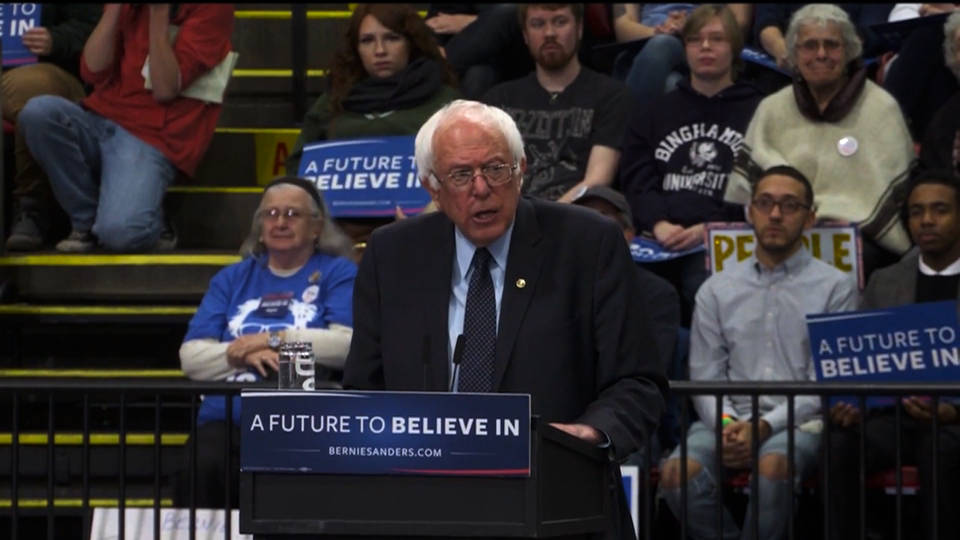
Presidential candidates continue to campaign in New York one week ahead of the primary. Speaking in Long Island, Democratic candidate Hillary Clinton attacked Vermont Senator Bernie Sanders on the issue of gun control.
Hillary Clinton: "Most of the guns that are used in crimes and violence and killings in New York come from out of state. And the state that has the highest per capita number of those guns that end up committing crimes in New York come from Vermont."
Federal data shows that of the nearly 4,600 out-of-state guns recovered in New York in 2014, just 55 came from Vermont. Speaking in Binghamton, Bernie Sanders proposed a national ban on the oil and gas drilling process known as "fracking."
Sen. Bernie Sanders: "What you have done is prove to the world that when people stand up and form a grassroots movement of environmentalists, public health advocates, farmers, working families and religious leaders, there is nothing that we cannot accomplish."
TOPICS:
Bernie Sanders
Hillary Clinton
Fracking
Gun Control
2016 Election
Donald Trump: Delegate System is "Rigged"
Donald Trump campaigned in Rochester, New York, Monday after Texas Senator Ted Cruz won all of Colorado’s 34 delegates over the weekend. Trump said the system is rigged.
Donald Trump: "We’ve got a corrupt system. It’s not right. We’re supposed to be a democracy. We’re supposed to be—we’re supposed to be: You vote, and the vote means something. All right? You vote, and the vote means something. ... Because what they’re doing, and whether it’s me or whether it’s Bernie Sanders, when I look at it and I see all these victories that I have, all these victories that he’s got, and then you look at the establishment, and I want to tell you, it’s a corrupt deal going on in this country, and it’s not good. It’s not good."
TOPICS:
Donald Trump
Republican Party
2016 Election
U.N. Agency Condemns Use of Tear Gas on Refugees Stranded in Greece
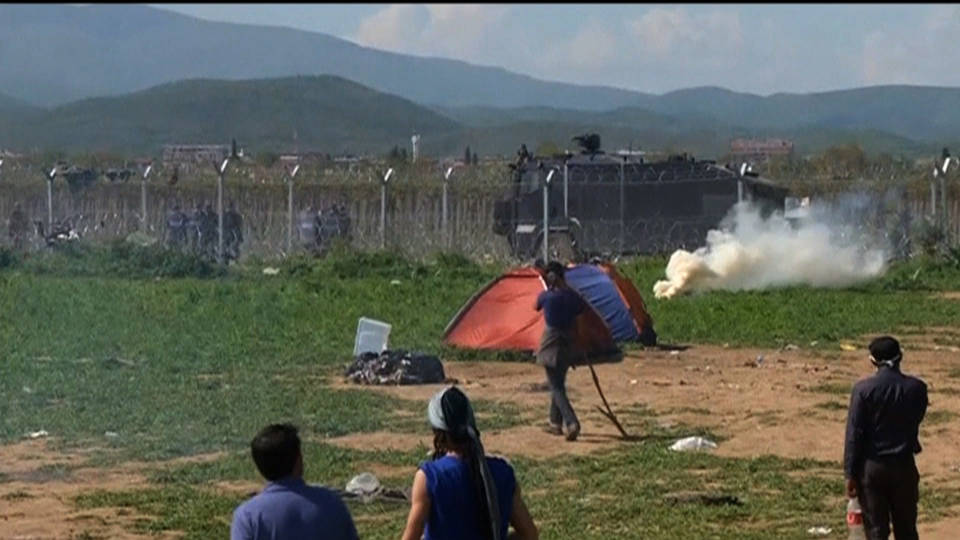
The United Nations refugee agency has condemned the use of tear gas by Macedonian police against refugees stranded on the Greek side of the border. More than 10,000 people have been stranded at the Greek border outpost of Idomeni since February, after a series of border shutdowns across the Balkans closed off their route to Central and Western Europe. On Sunday, dozens were wounded when police fired tear gas and rubber bullets. Among those treated for tear gas was Taha, an engineer from Syria.
Taha: "We saved our children from death. If they had died in Syria under the airstrikes, it would have been better than living in this humiliation. We ran away from humiliation. We thought Europe would open its arms for us and treat us with dignity; instead, it’s been humiliation."
TOPICS:
United Nations
Greece
Refugees
Syria
U.S. "Very, Very Concerned" About Increase in Syria Violence
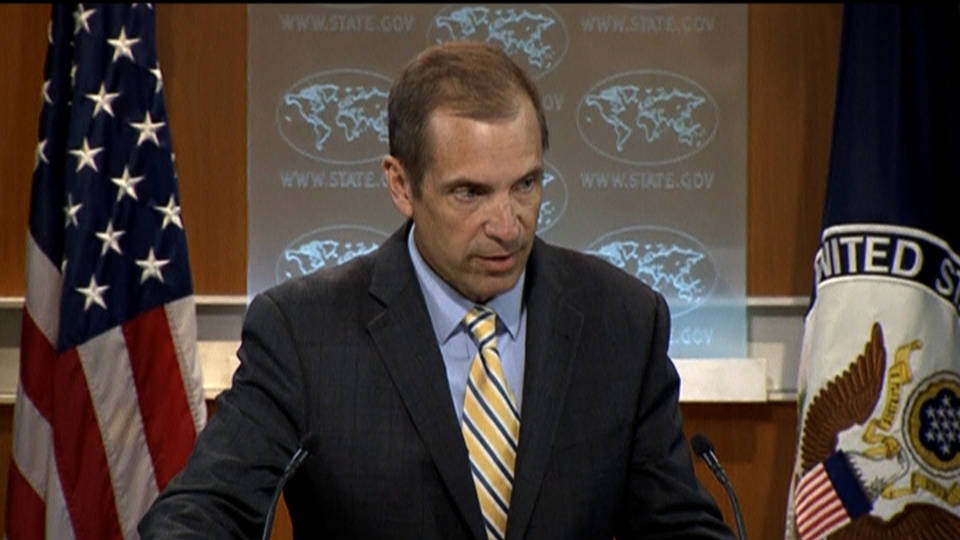
The refugees’ plight comes as U.S. State Department spokesperson Mark Toner says the United States is concerned with escalating violence in Syria ahead of peace talks planned for Wednesday.
Mark Toner: "We are very, very concerned about the recent increase in violence, and that includes actions we believe are in contravention to the cessation of hostilities. And Secretary Kerry, in fact, expressed this concern to Foreign Minister Lavrov and also discussed how to make certain in the next days that every extra effort is made in order to sustain and solidify the cessation of hostilities."
TOPICS:
Syria
Israel Acknowledges Launching Dozens of Strikes in Syria
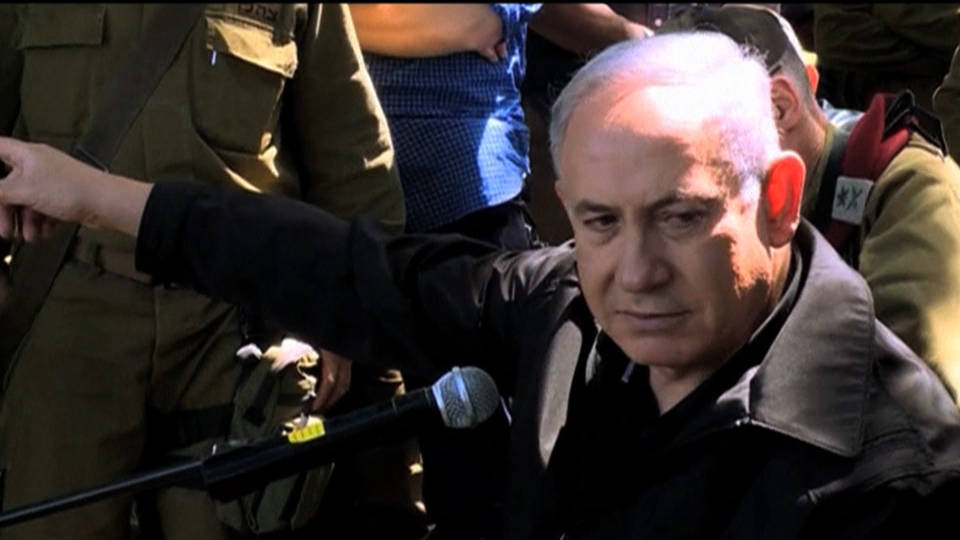
Israeli Prime Minister Benjamin Netanyahu has acknowledged Israel launched dozens of strikes in Syria, targeting what he said were suspected arms transfers to the group Hezbollah. Netanyahu provided few details about the strikes.
Prime Minister Benjamin Netanyahu: "We act when we need to act, including here across the border with dozens of strikes meant to prevent Hezbollah from obtaining game-changing weaponry."
TOPICS:
Syria
Israel
Brazil: Congressional Panel Recommends Impeachment of Dilma Rousseff
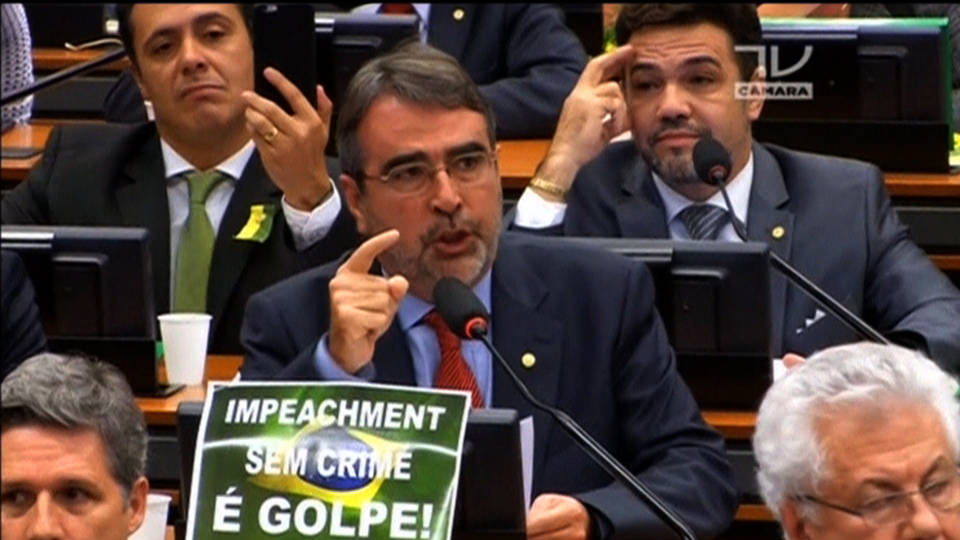
In Brazil, a congressional committee has voted to recommend the impeachment of President Dilma Rousseff as part of what her supporters call an attempted coup by her right-wing opponents. Rousseff has been accused of manipulating government accounts. Her fate will ultimately be left to a full session of the lower house of Congress, with a final vote expected this Sunday. Brazil faces a dire financial crisis and corruption scandal that spans political sides.
TOPICS:
Brazil
Peru Faces Runoff Between 2 Right-Wing Presidential Candidates
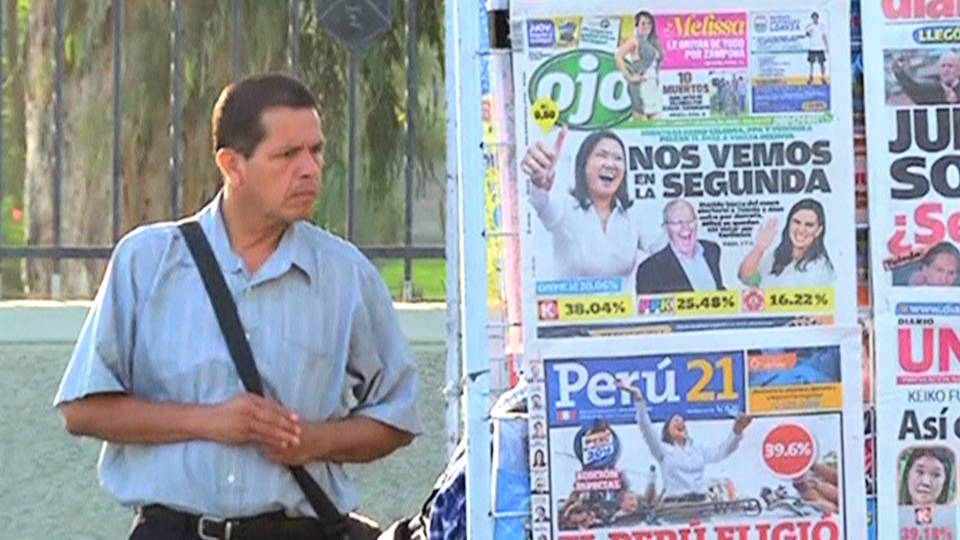
Peru faces a presidential runoff between two right-wing candidates after a leftist candidate was apparently eliminated in the first round of voting. The June runoff pits former World Bank economist and Wall Street favorite Pedro Kuczynski against Keiko Fujimori, the daughter of former President Alberto Fujimori, who is in prison for crimes including ordering massacres by death squads.
TOPICS:
Peru
Anti-Drug War Caravan Arrives in Mexico from Honduras
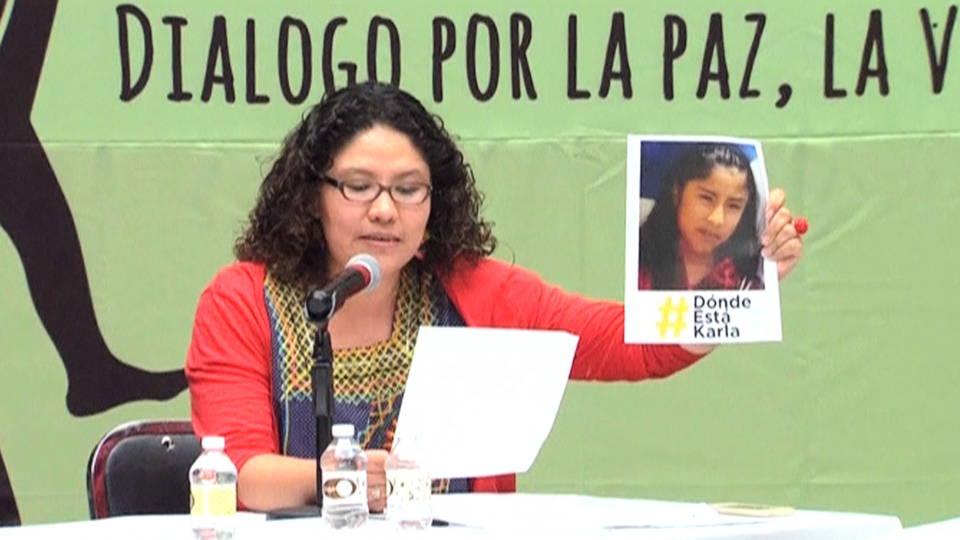
Activists from across the Americas have converged on Mexico City as part of a caravan calling for an end to the U.S.-backed war on drugs. The Caravan for Peace, Life and Justice departed Honduras last month and has traveled through El Salvador, Guatemala and much of Mexico, with the goal of reaching New York City ahead of a U.N. special assembly on drugs next week. Among the activists is Erika Llanos, whose child went missing in Mexico.
Erika Llanos: "It is children and women who are the main victims of this criminal war that has seen this become an armed conflict."
TOPICS:
Mexico
Drug War
Canada: First Nations Community Declares Emergency over Suicide Attempts
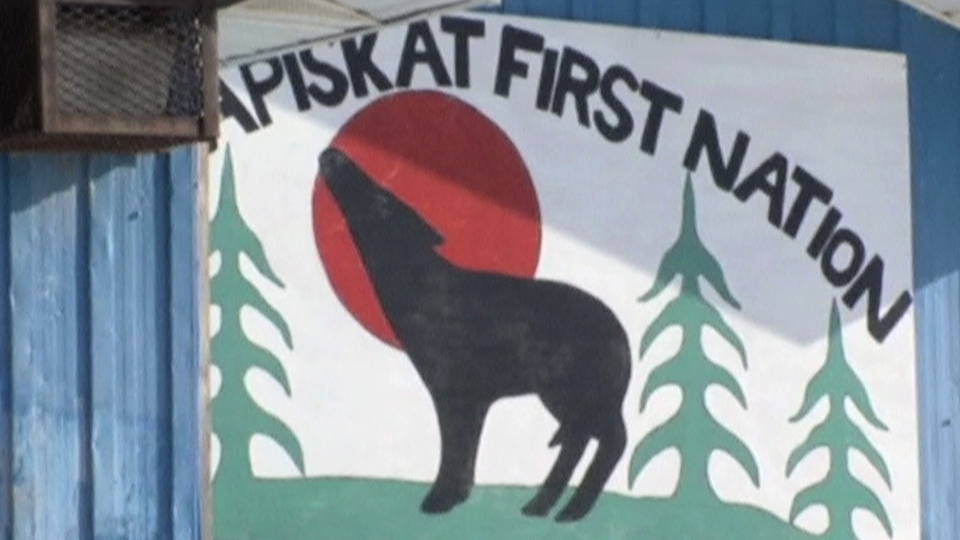
In Canada, a small First Nations community has declared a state of emergency after 11 people attempted suicide in a single day. The Attawapiskat First Nation in Ontario saw 28 suicide attempts last month within a population of 2,000 people, and 11 attempts on Saturday alone. Canadian First Nations people suffer from higher levels of poverty, addiction and incarceration. Local Parliament member Charlie Angus said indigenous communities need aid.
Charlie Angus: "If these were non-aboriginal children, all the resources would be in their schools. When they’re aboriginal children, well, hey, you can take a number and stand in line. And meanwhile, kids are dying every day."
TOPICS:
Canada
Indigenous
Goldman Sachs Agrees to $5 Billion "Non-Punishment" over Role in 2008 Crisis
Goldman Sachs has agreed to pay $5.1 billion to settle state and federal probes into its sale of toxic mortgage-backed securities that helped cause the 2008 financial crisis. New York Attorney General Eric Schneiderman announced the deal on Monday.
Eric Schneiderman: "This settlement will help thousands of families with principal forgiveness to obtain write-downs of their mortgage debts so they can avoid foreclosure and stay in their homes. It will help to finance multi-family affordable housing projects. It will fund land banks and local code enforcement efforts and is really another major step in the fight for justice for the families and communities that were devastated when a combination of reckless deregulation and abusive practices by a relatively small number of financial firms brought the American economy to its knees in 2008."
But the deal includes a generous package of tax credits and other incentives that could see Goldman pay far less than the total announced. Any money Goldman spends on consumer relief under the deal is tax-deductible, meaning U.S. taxpayers will foot the bill. The advocacy group Better Markets called the settlement "more of the same non-punishment, non-accountability ritual that will do nothing to stop the Wall Street crime spree."
TOPICS:
Goldman Sachs
Financial Meltdown
Bryan Adams Cancels Concert in Mississippi over Anti-LGBT Law
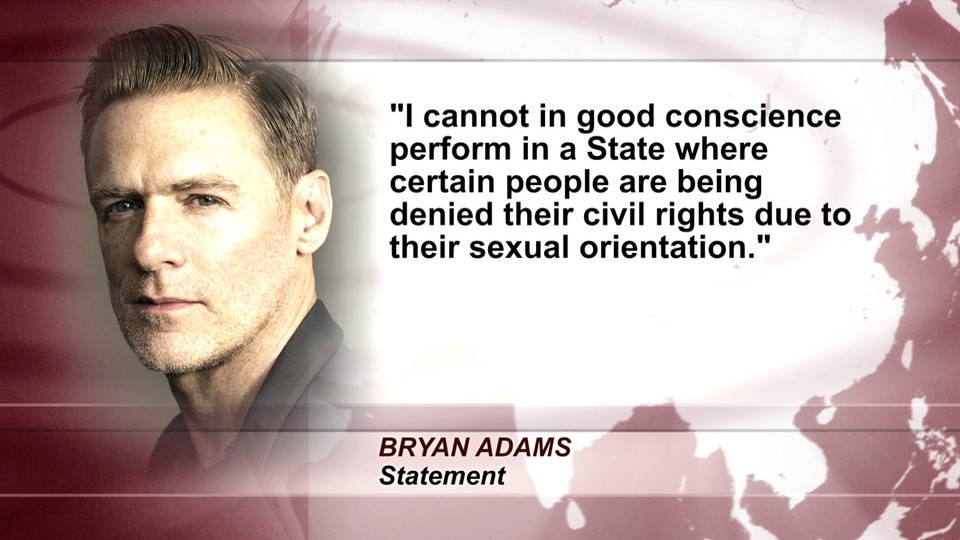
Musician Bryan Adams has canceled a Thursday concert in Biloxi, Mississippi, to protest the state’s new law allowing some groups and businesses to deny service toLGBT people. Adams said in a statement: "I cannot in good conscience perform in a State where certain people are being denied their civil rights due to their sexual orientation." His move comes after Bruce Springsteen canceled a show in North Carolina to protest another new anti-LGBT law in that state.
TOPICS:
LGBT
Mississippi
Chicago Aldermen OK $6.5 Million Payments over 2 Deaths in Police Custody
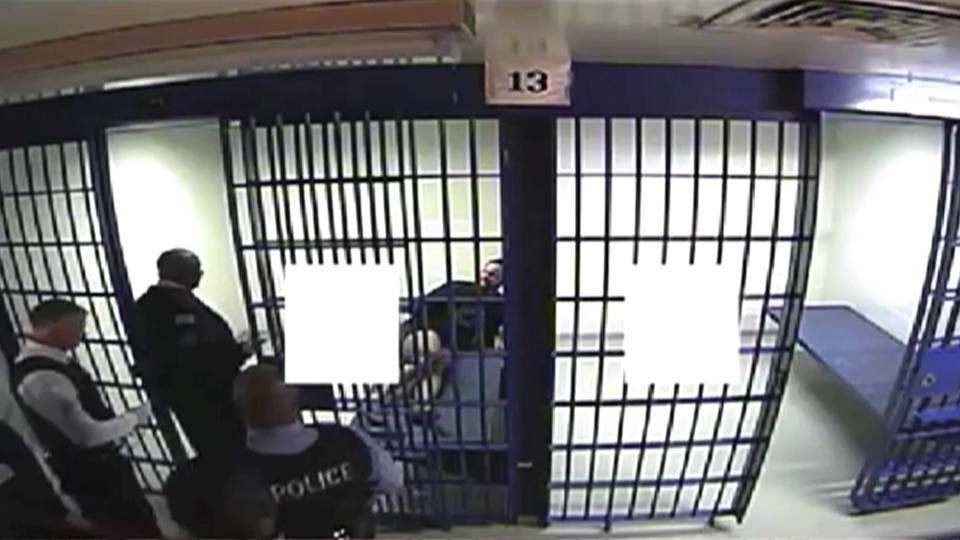
In Chicago, aldermen have approved nearly $6.5 million to settle lawsuits involving Chicago police and the deaths of two African-American men. The largest settlement goes to the family of Philip Coleman, who died in 2012 after being repeatedly tased and dragged from his cell. Coleman had reportedly suffered a mental health crisis; when his parents pleaded with officers to take him to a hospital instead of jail, a sergeant allegedly told them, "We don’t do hospitals, We do jail." The second settlement goes to the family of Justin Cook, who in 2014 was stopped for a traffic violation, suffered an asthma attack and died after Chicago police refused to give him his inhaler. Witnesses said officers taunted Cook and sprayed the inhaler into the air. During a debate Monday, Chicago Alderman Anthony Beale said officers involved in the two cases should no longer be on the force.
Alderman Anthony Beale: "They need to be fired. Here we are, paying out millions of dollars in settlements, and nobody’s being terminated."
Chicago has spent more than a half-billion dollars settling police cases since 2004, despite punishing few officers.
TOPICS:
Chicago
Police Brutality
Police
South Carolina: Officer Avoids Jail Time After Killing Motorist in His Driveway
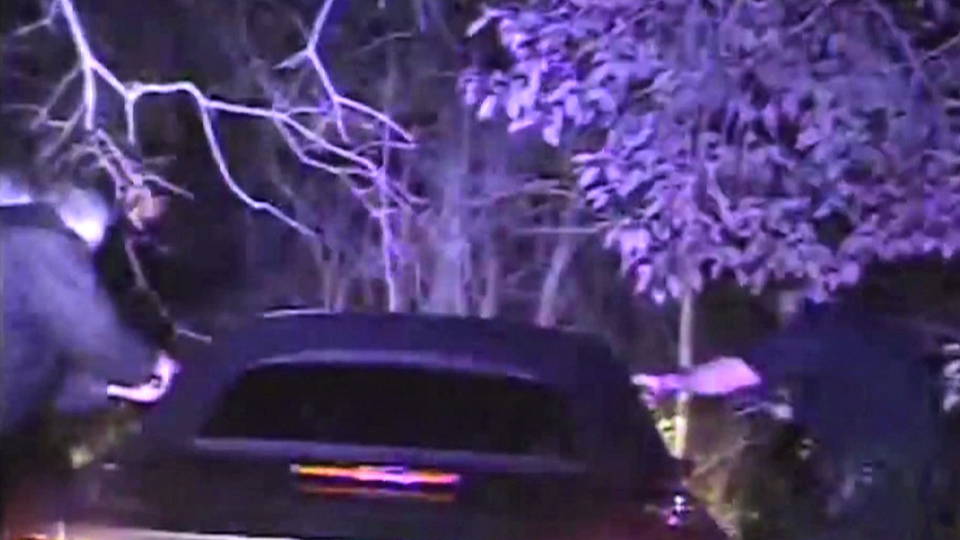
And in South Carolina, a white police officer has been sentenced to three years’ probation, avoiding any prison time, after killing an African-American motorist in his own driveway. North Augusta police officer Justin Craven shot Ernest Satterwhite after a 13-minute car chase in 2014. Dashboard camera video, which authorities refused to release until Monday, after Craven pleaded guilty to misdemeanor misconduct, shows Craven sticking his gun through Satterwhite’s open driver’s side window. Satterwhite’s arm appears briefly before Craven fires several shots. Craven claimed Satterwhite tried to grab his gun. Prosecutors initially sought to charge Craven with voluntary manslaughter, which carries up to 30 years in prison, but a grand jury refused to indict him.
TOPICS:
Police Brutality
Police
Donate today:
Follow:


SPEAKING EVENTS

4/12 Palo Alto, CA
4/12 Santa Clara, CA
4/13 Santa Cruz, CA
4/14 Claremont, CA
4/14 Los Angeles, CA
4/15 Los Angeles, CA
4/15 Studio City, CA
4/16 Santa Rosa, CA
4/16 Willits, CA
4/16 Redway, CA
4/17 Davis, CA
4/17 Chico, CA
4/17 Berkeley, CA
4/18 Salt Lake City, UT
4/19 Idaho Springs, CO
4/19 Denver, CO
more
NEW BOOK


Panama Papers: Could Pirate Party Co-Founder Birgitta Jónsdóttir Become Iceland's Next PM?
WORK WITH DN!

Broadcast Engineer
Director of Finance and Operations
WEB EXCLUSIVE

Watch: Ex-Death Row Prisoner Moreese Bickham on WBAI in 1996 Days After Being Freed
207 West 25th Street, 11th Floor
New York, New York 10001, United States
-------------------
-------------------
No comments:
Post a Comment