democracynow.org
Stories:

"I Refuse to Serve as an Empire Chaplain": U.S. Army Minister Resigns over Drone Program
An unlikely voice has emerged challenging the drone warfare program: former U.S. Army Reserve Chaplain Captain Chris Antal, who spent time based in Afghanistan. In April, he wrote an open letter to President Obama detailing his reasons for leaving the U.S. Army Reserves, citing his opposition to the administration’s use of drone strikes, its policy on nuclear proliferation, and what he calls the executive branch’s claim of "extraconstitutional authority and impunity for international law."
TRANSCRIPT
This is a rush transcript. Copy may not be in its final form.
AMY GOODMAN: During a commencement speech on Thursday, President Obama defended his foreign policy, including targeted assassinations and drone warfare. Obama made the remarks at the U.S. Air Force Academy in Colorado Springs.
PRESIDENT BARACK OBAMA: As commander-in-chief, I have not hesitated to use force unilaterally where necessary to protect the American people. Thanks to our military, intelligence and counterterrorism professionals, bin Laden is gone. Anwar Awlaki, a leader of the al-Qaeda affiliate in Yemen, is gone. Ahmed Abdi Godane, the al-Qaeda leader in Somalia, he’s gone. Ahmed Abu Khattala, accused in the attacks in Benghazi, captured. Mohammad Mansour, the leader of the Taliban, gone. Leader after leader in ISIL—Haji Mutazz, their number two; Mohammed Emwazi, who brutally murdered Americans; Abu Nabil, the ISIL leader in Libya—all gone. Abu Dawud, a leader of their chemical weapons program, captured. The list goes on, because if you target Americans, we will find you, and justice will be done, and we will defend our nation.
AMY GOODMAN: That was President Obama delivering the commencement speech at the U.S. Air Force Academy in Colorado Springs on Thursday. With only a small number of U.S. Special Forces on the ground, Iraq and Syria have become new fronts in the global drone war that has launched thousands of strikes in Pakistan, Afghanistan, Yemen and Somalia. The exact number of civilians killed by drones is unknown, because the program operates in secret.
We turn now to an unlikely voice challenging the drone warfare program: former U.S. Army Reserve Chaplain Chris Antal, who recently resigned his post in protest. In April, Reverend Antal wrote a letter to President Obama detailing his reasons for leaving the U.S. Army Reserves, citing his opposition to the administration’s use of drone strikes, its policy on nuclear proliferation, and what he calls the executive branch’s claim of "extraconstitutional authority and impunity for international law," unquote.
This is not the first time Reverend Antal has voiced his concerns. In 2012, he delivered a sermon in Afghanistan and anonymously [sic] posted the text on a Unitarian Universalist website. At the time, he identified himself only as an Army chaplain in Afghanistan. The sermon read in part, quote, "We have sanitized killing and condoned extrajudicial assassinations: ... war made easy without due process, protecting ourselves from the human cost of war. We have deceived ourselves, ... denying the colossal misery our wars inflict on the innocent." Reverend Antal’s superiors discovered the sermon, and he was reprimanded, nearly losing his job. Then, mid-April, he decided to voluntarily resign over his continued concerns about drone warfare. In doing so, Reverend Antal forfeits benefits that otherwise would have accrued to him through his eight years of service in the U.S. Army Reserve.
Reverend Chris Antal joins us now in our New York studio. He is a minister for the Unitarian Universalist Congregation of Rock Tavern, New York, and a founder of the Hudson Valley, New York, chapter of Veterans for Peace.
Reverend Chris Antal, welcome to Democracy Now!
REV. CHRIS ANTAL: Amy, thank you. I’m glad to be here.
AMY GOODMAN: You’re still in the Army, is that right?
REV. CHRIS ANTAL: I’m on my way out, but the paperwork hasn’t been completed yet.
AMY GOODMAN: But you have resigned.
REV. CHRIS ANTAL: I’ve submitted my resignation, but the Army is a big bureaucracy, and it takes time to get all the signatures.
AMY GOODMAN: So, really, you’re still a U.S. Army chaplain.
REV. CHRIS ANTAL: I am. I can’t speak from that capacity on this program, but on paper, yes.
AMY GOODMAN: So talk about your decision. How long did you serve as an Army chaplain, and where did you serve?
REV. CHRIS ANTAL: Sure. I served for five years—eight years in the Reserve, five years as a chaplain, and most of that time was as a Reserve chaplain. I did spend about two years on active duty, and altogether, about six months in Afghanistan.
AMY GOODMAN: And talk about your decision to leave.
REV. CHRIS ANTAL: Sure. Well, before I can talk about my decision to leave, I need to say why I got in in the first place. As a minister, I was driven by compassion to care for the wounded; and as a citizen, driven by a sense of civic duty to carry my fair share in our nation’s wars. I think I did both of those things during my time in service, but eventually began to feel a role conflict between my role as a military officer and my role as an ordained minister. And I couldn’t reconcile that role conflict, so I decided to resign.
AMY GOODMAN: Talk about the speech I just quoted from. Where did you give that speech?
REV. CHRIS ANTAL: Sure. Well, it was a sermon. And it was never anonymous, as you said. When I posted it, I identified myself. I gave that sermon on Veterans Day, which was on a Sunday in 2012, at Kandahar Airfield to a gathered—a community gathered for worship in my tradition, a Unitarian Universalist service. And that was about six weeks into my deployment. When I had witnessed drones, I had learned about practices that violate my sense of what is right. And I decided it was my prerogative as a religious leader to address that in the context of a religious service, a form of lamentation, a confession. And that is what I did in my sermon. And because I think the issues I raise are of concern for a larger audience, for the whole nation, I made that available through a church website that is sponsored by my denomination.
AMY GOODMAN: And talk about what happened then. How was it discovered, and what was the response by the military?
REV. CHRIS ANTAL: Well, two days after it appeared online, I was contacted by an Army lawyer who had read the post. He forwarded it to my commander. I was summoned to the commander’s office. He told me that my message doesn’t support the mission. He told me that I make us look like the bad guys. He asked me to take it down, which I did, and immediately. Nevertheless, I was subjected to an investigation. It’s called an Article 15-6 investigation. I had to get a trial defense lawyer in Afghanistan, that was provided to me by the Army. And that process drew out for about two months, and it ended with what’s called a general officer memorandum of reprimand. I was handed an official reprimand that said I had made politically inflammatory statements, and I was, on that basis, released from active duty in Afghanistan, sent home with a "do not promote" evaluation, which is really a career killer in the military.
AMY GOODMAN: You quit in a very public way, with a letter to President Obama, your letter of resignation. And in it, you said, "I resign because I refuse to serve as an empire chaplain." Explain.
REV. CHRIS ANTAL: Well, sure. For me, democracy is about checks and balances. Democracy is about due process. These drone wars have blown due process up in smoke. They’ve blown checks and balances up in smoke. And democracy is also about no establishment and free exercise of religion. We have in our nation an established religion. It’s not Christianity. Jeremy Gunn calls it American National Religion. It has—consists of the unholy trinity of governmental theism, military supremacy and an understanding of capitalism as freedom. And as a religious leader, I feel it’s my prerogative to differentiate myself from this state-sanctioned religion and speak from my authentic tradition in a way that resists these national policies. And that’s what I’ve done in offering my resignation and stating quite clearly that I will not serve as an empire chaplain. I will not lend religious legitimacy to this state-sanctioned violence.
AMY GOODMAN: Have you received a response from President Obama, since that’s who you wrote your resignation letter to?
REV. CHRIS ANTAL: I have not.
AMY GOODMAN: You also have become a shareholder of Honeywell?
REV. CHRIS ANTAL: I am a shareholder of Honeywell, yes.
AMY GOODMAN: Is this how you plan to support yourself now?
REV. CHRIS ANTAL: Well, I’ve never been a shareholder before of anything, and I only own one share. And the reason why I became a shareholder is because I was frustrated with the lack of progress through legislative advocacy, and I believe what we are facing in our country is not just a military-industrial complex, that Eisenhower wrote about, it’s a military-industrial-congressional complex. And we cannot do legislative advocacy without doing shareholder advocacy and confronting some of the corporations that are profiting and that are lobbying our elected officials in order to influence the militarization of U.S. foreign policy.
AMY GOODMAN: Can you talk about attending the Honeywell shareholders’ meeting and what you did?
REV. CHRIS ANTAL: Sure. I’ve been to two shareholder meetings now, the first one in 2015, where I addressed the CEO, David Cote, on their profiting from armed drones proliferation. This year, I went, as I did last year, with my fellow veteran, Nick Mottern, and he addressed the drone profiting, and I chose to address Honeywell’s profiting from nuclear weapons. So I asked Mr. Cote how much Honeywell is profiting from the administration’s investment of trillions of dollars in the modernization of our nuclear arsenal. I asked him how much Honeywell is profiting from the administration’s decision to launch a new airdropped nuclear cruise missile. And I asked Mr. Cote if he’d ever been to Hiroshima, because I’ve been there twice, and whether he had faced the horror that this technology produces.
AMY GOODMAN: Your wife of 18 years is Japanese?
REV. CHRIS ANTAL: Yes, I’ve been married 18 years, and we have five children.
AMY GOODMAN: And what was your response to President Obama just last week going to Hiroshima?
REV. CHRIS ANTAL: Well, I was glad and proud of our president for visiting Hiroshima; however, I am disappointed that although he talks the talk of nuclear abolition, the actions of his administration are not consistent with what he’s saying. I agree that Hiroshima calls for a moral revolution, a revolution of consciousness, and an awakening of America. And I hope, and I remain hopeful, that the administration will cancel plans for the new airdropped nuclear cruise missile and take the thousand nuclear warheads off launch-on-warning status.
AMY GOODMAN: Reverend Chris Antal, can you talk about how those you’ve ministered to have responded to your resignation? Who did you serve in Afghanistan?
REV. CHRIS ANTAL: Well, I served as an Army chaplain. And as an Army chaplain, I’m responsible for the soldiers in my assigned unit, but also soldiers in my area of operations, as well as contractors and servicemembers from all branches. And I served all of those people during my deployment to Afghanistan. I can say that when I preached the sermon that led to my reprimand, I had the full support of the community of faith that attended that service. When I appealed the letter of reprimand, I appealed with more than 30 letters of support from everyone in that congregation, as well as concerned clergy, chaplains and citizens across America. So I have had a lot of support.
AMY GOODMAN: I wanted to get your response to this presidential election. I want to turn to Democratic presidential candidate former Secretary of State Hillary Clinton. In 2014, The Guardian columnist Owen Jones questioned her about the use of drone warfare.
OWEN JONES: You’re a loving parent. What would you say to the loving parents of up to 202 children who have been killed by drones in Pakistan in a program which you escalated as secretary of state?
HILLARY CLINTON: Well, I would argue with the premise, because, clearly, the efforts that were made by the United States, in cooperation with our allies in Afghanistan and certainly with the Afghan government, to prevent the threat that was in Pakistan from crossing the border, killing Afghans, killing Americans, Brits and others, was aimed at targets that had been identified and were considered to be threats. The numbers about potential civilian casualties, I take with a somewhat big grain of salt, because there has been other studies which have proven there not to have been the number of civilian casualties.
AMY GOODMAN: And last October on NBC’s Meet the Press, Chuck Todd asked Democratic presidential candidate Bernie Sanders about his position on drones.
CHUCK TODD: What does counterterrorism look like in a Sanders administration? Drones? Special Forces? Or what does it look like?
SEN. BERNIE SANDERS: Well, all of that and more.
CHUCK TODD: You would—you’re OK with the drone, using drones as—
SEN. BERNIE SANDERS: Look, drone is a weapon. When it works badly, it is terrible and it is counterproductive. When you blow up a facility or a building which kills women and children—
CHUCK TODD: Sure.
SEN. BERNIE SANDERS: —you know what? It not only doesn’t do us—it’s terrible.
CHUCK TODD: But you’re comfortable with the idea of using drones if you think you’ve isolated an important terrorist?
SEN. BERNIE SANDERS: Well, yes, yes, yes.
CHUCK TODD: So, that continues in a Sanders administration.
SEN. BERNIE SANDERS: Yes. And look, look, we all know, you know, that there are people, as of this moment, plotting against the United States. We have got to be vigorous in protecting our country, no question about it.
AMY GOODMAN: That’s Senator Bernie Sanders and, before that, Secretary of State Hillary Clinton.
REV. CHRIS ANTAL: Yeah, what they’re not saying is the numbers. And the Bureau of Investigative Journalism released just two days ago that there have been 7,142 people killed with U.S. drone strikes, most of those in Pakistan. Now, my question is: Where is the necessity? Where is the imminent threat to my family, to our families here in the United States, when we kill people halfway around the world with a drone strike? ... Read More →

"I Refuse to Support U.S. Armed Drone Policy": Army Chaplain Reads Resignation Letter to Obama
Former U.S. Army Reserve Chaplain Captain Chris Antal reads his resignation letter to President Obama. "I resign because I refuse to support U.S. armed drone policy," Antal wrote. "The Executive Branch continues to claim the right to kill anyone, anywhere on earth, at any time, for secret reasons, based on secret evidence, in a secret process, undertaken by unidentified officials. I refuse to support this policy of unaccountable killing."
TRANSCRIPT
This is a rush transcript. Copy may not be in its final form.
AMY GOODMAN: Reverend Chris Antal, I was wondering if we could end with you reading your resignation letter to President Obama in your own words.
REV. CHRIS ANTAL: I’d be glad to do that.
“Dear Mr. President:
“I hereby resign my commission as an Officer in the United States Army.
“I resign because I refuse to support U.S. armed drone policy. The Executive Branch continues to claim the right to kill anyone, anywhere on earth, at any time, for secret reasons, based on secret evidence, in a secret process, undertaken by unidentified officials. I refuse to support this policy of unaccountable killing.
“I resign because I refuse to support U.S. nuclear weapons policy. The Executive Branch continues to invest billions of dollars into nuclear weapons, which threaten the existence of humankind and the earth. I refuse to support this policy of terror and mutually assured destruction.
“I resign because I refuse to support U.S. policy of preventive war, permanent military supremacy and global power projection. The Executive Branch continues to claim extra-constitutional authority and impunity from international law. I refuse to support this policy of imperial overstretch.
“I resign because I refuse to serve as an empire chaplain. I cannot reconcile these policies with either my sworn duty to protect and defend America and our constitutional democracy or my covenantal commitment to the core principles of my religion faith. These principles include: justice, equity and compassion in human relations, a free and responsible search for truth, a commitment to the democratic process, and the inherent worth and dignity of every person.
“Respectfully submitted,
"Christopher John Antal"
AMY GOODMAN: Reverend Chris Antal, minister for the Unitarian Universalist Congregation now at Rock Tavern, New York, founder of the Hudson Valley, New York, chapter of Veterans for Peace. He has served as a U.S. Army chaplain in Afghanistan, before publicly resigning over the Obama administration’s drone warfare program. He wrote that letter to President Obama in April.
This is Democracy Now! When we come back, we hear more about the story of Kalief Browder. Kalief, a 16-year-old arrested in New York, falsely accused of taking someone’s backpack, he spent three years at Rikers Island without trial. Ultimately, he was released. He would commit suicide a few years later. Today, we bring you Part 2 of the story of the life and death of Kalief Browder. Then, the former president of the Maldives, known around the world as a voice dealing with climate change, now freed from the Maldives. He’s gotten political asylum in Britain. He’ll speak to us from London. Stay with us. ... Read More →

"A School for Suicide": How Kalief Browder Learned to Kill Himself During 3 Years at Rikers Jail
Kalief Browder, who spent three years in jail in New York without ever being convicted of a crime, took his own life nearly one year ago, on June 6, 2015. In 2010, when Kalief was just 16, he was sent to Rikers Island on suspicion of stealing a backpack. He spent the next nearly three years imprisoned at Rikers, even though he was never tried or convicted. For nearly 800 days of that time, he was held in solitary confinement. A new piece in The New Yorker details how Kalief actually learned how to commit suicide at Rikers, after seeing another prisoner attempt to take his own life. The piece also details how, before taking his own life, Kalief recounted prison guards goading him on during suicide attempts, saying, "If you don’t jump, we’re going to go in there anyway, so you might as well go ahead and jump, go ahead and jump." We speak with reporter and author Jennifer Gonnerman, who first recounted Kalief Browder’s story in 2014 in her article for The New Yorker, "Before the Law: A boy was accused of taking a backpack. The courts took the next three years of his life." In her latest piece, Gonnerman details Browder’s experiences with suicide attempts at Rikers. "His description of Rikers and his time on Rikers was almost as if it were a school for suicide," Gonnerman says.
TRANSCRIPT
This is a rush transcript. Copy may not be in its final form.
AMY GOODMAN: We turn to Rikers Island and new revelations in the tragic case of Kalief Browder, who took his own life nearly a year ago, on June 6, 2016—2015. At the time of his death, Kalief was a 22-year-old New York student who spent three years at Rikers Island jail without being convicted of a crime. In 2010, when he was just 16, he was sent to Rikers Island, without trial, on suspicion of stealing a backpack. He spent the next nearly three years at Rikers, even though he was never tried or convicted. For nearly 800 days of that time, he was held in solitary confinement. Kalief always maintained his innocence, requesting a trial, but was only offered plea deals while the trial was repeatedly delayed. Near the end of his time in jail, the judge offered to sentence him to time served if he entered a guilty plea, and told him he could face 15 years in prison if he went to trial and was convicted. Kalief still refused to accept the plea deal. He was only released when the case was dismissed.
During Kalief Browder’s time at Rikers, he struggled with depression and suicidal thoughts stemming from his incarceration. He attempted suicide multiple times. Now, in a new piece for The New Yorker magazine, Jennifer Gonnerman details how Kalief actually learned how to commit suicide at Rikers, after seeing another prisoner attempt to take his own life. The piece also details how, before taking his own life, Kalief recounted prison guards goading him on during suicide attempts, saying, quote, "If you don’t jump, we’re going to go in there anyway, so you might as well go ahead and jump, go ahead and jump."
These revelations in Kalief Browder’s case come amidst increasing scrutiny of the infamous prison, where currently 85 percent of the 10,000 prisoners at Rikers have not yet been tried. On Wednesday, The Intercept reported on the case of Jairo Pastoressa, who has been waiting nearly six years for a trial, after having been arrested in 2010. Rikers also made headlines this week for the case of Aitabdel Salem, who spent five months in Rikers because no one told him his bail was only $2.
Well, to talk now about Kalief Browder’s case and Rikers Island, we’re joined once again by Jennifer Gonnerman, reporter, author, contributing editor at The New Yorker magazine. She first recounted Kalief Browder’s story in a 2014 article called "Before the Law: A boy was accused of taking a backpack. The courts took the next three years of his life."
Jennifer, welcome back to Democracy Now! Explain what you have learned since Kalief’s suicide last year.
JENNIFER GONNERMAN: Yeah, the one-year anniversary of Kalief’s suicide is coming up on Monday, which is June 6th. And I was planning to write about him, and went and tracked down and managed to get three depositions that he gave in the last year of his life, in which he was interviewed by an attorney for New York City for hours at a stretch about his time in Rikers. And the last one that was conducted a year ago May focused largely on his suicide attempts in Rikers. And I didn’t actually plan to write anymore—anything about these depositions, but as I was reading them, there were a few moments when I almost fell off my chair. I was just so disturbed by some of the revelations that I ended up having to write about it, and we published a story on The New Yorker’s website yesterday, that you just summarized.
AMY GOODMAN: Talk about those revelations.
JENNIFER GONNERMAN: Essentially—I mean, he doesn’t use this phrase, but his description of Rikers and his time on Rikers was almost as if it were a school for suicide. You know, he had never attempted suicide before, never really thought about it before he was arrested. And this is when he was 16 he went into the jail system, and this is the spring of 2010. At some point, he sees another young—another adolescent boy in his jail, down the cell block, with a sheet tied around his neck, who has just been taken out of his cell. He was—you know, he did not take his life, but he attempted. And so there was almost like a culture of suicide attempts that he was exposed to and he started to internalize and think about a lot. And he spent much of his time, as you mentioned, in solitary confinement when he was locked up.
AMY GOODMAN: Eight hundred days.
JENNIFER GONNERMAN: And, you know, on Rikers, in many places, the only way—so, it’s a little bit complicated how the sort of world of—I mean, it’s just completely upside down, you know, the world of Rikers. And the only way some—there’s sort of perception among officers, among some of the employees, that when a person attempts to harm themselves in solitary, that they’re only doing it to get out of solitary, to get into general population, to fix their housing situation, so there’s sort of this deep skepticism. And that’s what you see coming through in the story. You know, obviously, Kalief is truly depressed and having serious suicidal thoughts, but in that context, things aren’t taken seriously. And it’s just—you know, this is sort of what happens when we turn our—you know, turn our jails into sort of mental hospitals almost.
AMY GOODMAN: I want to turn to Kalief Browder in his own words. This was December 2013 in an interview with HuffPost Live’s Mark Lamont Hill, Browder talking about his suicide attempts at Rikers and his efforts to get psychiatric help.
KALIEF BROWDER: I would say I committed suicide about five to six—five or six times.
MARC LAMONT HILL: OK, you attempted suicide five to six times.
KALIEF BROWDER: Yes.
MARC LAMONT HILL: All while still in prison?
KALIEF BROWDER: Yes.
MARC LAMONT HILL: Wow.
KALIEF BROWDER: And I tried to resort to telling the correction officers that I wanted to see a psychiatrist or counselor, something. I was telling them I needed mental help, because I wasn’t feeling right. All the stress from my case, everything was just getting to me, and I just—I just couldn’t take it, and I just needed somebody to talk to. I needed to just let—I just needed to be—I just needed to talk and be stress-free. But the correction officers, they didn’t want to hear me out. Nobody wanted to listen.
AMY GOODMAN: So, that was Kalief soon after he was released from prison. And for people who haven’t followed Kalief’s story, Jennifer Gonnerman—you’ve just done such an amazing job bringing his story to life—explain again how he went to Rikers at the age of 16.
JENNIFER GONNERMAN: Sure. He was walking home from a party late one night in the Bronx, the spring of 2010. He was a sophomore in high school at the time, 16, just about to turn 17. And a police car drives up, and there’s somebody in the backseat who points him out and says—you know, points to him and says that this young man and another person he was with had robbed him prior, you know a week or two prior, and accused him of stealing his backpack. And that set in motion a chain of events. Kalief, you know, insisted that he was innocent. He was taken to the precinct. He says he was told, "Well, don’t worry about it. We’re just going to straighten a few things out, some paperwork. You’ll be going home soon." So he thought it was just a sort of routine matter in which he would, you know, be getting home by the morning.
And instead, it ended up turning into a three-year odyssey. And he was in this sort of perverse catch-22 situation where in order to prove his innocence he had to stay in jail and, as you mentioned, repeatedly refuse the prosecutor’s plea offers, because he said, "I’m not guilty. I’m not going to plead to something that I didn’t do. I want my trial. Where is my right to a trial?" And what he didn’t understand is that trials barely ever happen in the Bronx and across the country. Almost everybody gets out by pleading to something. But it was his insistence on his innocence, and it’s his insistence on not pleading to something that he said he had not done, that kept him in jail all that time. And in—the Bronx is notorious for a complete lack of sort of speedy trials, and the court delays are outrageous. And that’s—so it’s, you know, dysfunction in the courts, dysfunction in the jail system. He’s going back and forth between two of the most dysfunctional systems in New York City, and that’s what led to him spending so much time locked up.
AMY GOODMAN: And then there were the beatings, the horror of the release of the video from inside the prison. As a guard escorts Kalief to the showers, Kalief appears to speak. And then the guard suddenly violently hurls him to the floor as he’s already handcuffed. In a separate video from 2010, he’s attacked by almost a dozen other teenage prisoners after he punches a gang member who spat in his face. The other prisoners pile on Browder and pummel him until guards intervene. And that first one, again, that image of the prison guard, you see him flexing his muscles—
JENNIFER GONNERMAN: Right, right.
AMY GOODMAN: —before he takes Kalief out, and then he takes him down.
JENNIFER GONNERMAN: You know, the craziest thing is, when I met Kalief not long after he got out of jail, he told me about this incident. And he said, "Get the video." And I’m thinking, "How am I possibly ever going to get that video?" And the incident upset him so much, not because it was the worst thing that happened to him on Rikers, but because he knew it had happened in full view of the cameras, and there had been no consequences for the officer. And he never got a chance to get any justice in that situation. And ultimately, in 2015, we did—The New Yorker did get this video, we did post it on our website. And I watched it with Kalief the first time he saw it. And it was just unbelievable. It was just unbelievable.
AMY GOODMAN: And so, as we wrap up, talk about this latest piece, "Kalief Browder Learned How to Commit Suicide on Rikers," the takeaway almost a year after Kalief did succeed in committing suicide.
JENNIFER GONNERMAN: You know, this piece that just came out on our website yesterday is actually part of a package, and the rest is going to be posted on The New Yorker’s website today. We did a audio piece, a radio piece, that will be airing on The New Yorker Radio Hour, which is on NPR, this weekend, also on our website today. And then you can hear Kalief talk about what it was like to be in solitary in his own words, and this is using interview tapes that I conducted with him back in 2014, and we also put together a video montage.
You know, he’s gotten a lot of attention in the months and the year since his death, but it doesn’t detract from the fact this was, you know, a straight-up American tragedy that never should have happened. And, you know, there have been some reform efforts on Rikers, around the country. Obama cited Kalief when he talked about reducing the use of solitary in federal prisons. And there’s been a number of other initiatives. But I think, a year later, as the attention has waned and time has gone on, there’s also been a lack of urgency about these same issues. And I thank you, Amy, for keeping his story alive here on Democracy Now!
AMY GOODMAN: And thank you, Jennifer Gonnerman, staff writer for The New Yorker magazine. We will link to her piece headlined "Kalief Browder Learned How to Commit Suicide on Rikers."
This is Democracy Now!, democracynow.org, The War and Peace Report. When we come back, we go across the pond to London to speak with a man who was also imprisoned, this by the coup government who replaced him, the former president of the Maldives, Mohamed Nasheed. Stay with us. ... Read More →

Climate Hero & Former Maldives President Mohamed Nasheed Gets U.K. Asylum After Ouster & Jailing
Seven years ago, Maldives President Mohamed Nasheed became a hero of the climate justice movement with his impassioned pleas to address global warming. But recently Nasheed has largely been silenced after being ousted in a coup and then jailed by his political opponents. He has just received political asylum in Britain and joins us today.
TRANSCRIPT
This is a rush transcript. Copy may not be in its final form.
AMY GOODMAN: This is Democracy Now!, democracynow.org, The War and Peace Report. I’m Amy Goodman, as we turn to Britain, where the former president of the tiny Indian Ocean state of the Maldives has been granted political refugee status. Mohamed Nasheed was the Maldives’ first democratically elected president, known internationally for his work on climate change. In 2009, he pleaded with world leaders in Copenhagen to do more to tackle the climate crisis.
PRESIDENT MOHAMED NASHEED: Our task now is to unite the world behind a shared vision of low-carbon growth. The Maldives is trying to lead the way. I call upon every country in this room to join us, not just for the sake of the Maldives, but for the sake of the entire planet.
AMY GOODMAN: Months before the Copenhagen talks, President Nasheed made international headlines when he held an underwater Cabinet meeting in an attempt to bring attention to the dire consequences of global warming. President Nasheed and 11 members of his government, 11 of his government ministers, wore scuba gear and plunged nearly 20 feet into the Indian Ocean.
PRESIDENT MOHAMED NASHEED: We are actually trying to send our message, let the world know what is happening and what might—what will happen to the Maldives if climate change is not checked. This is a challenging situation. And we want to see that everyone else is also occupied as much as we are, and would like to see that people actually do something about it.
AMY GOODMAN: While President Mohamed Nasheed was hailed as a climate hero by many in the international community, back home in the Maldives it was a different story. In 2012, he was ousted in what he called an armed coup by supporters of former dictator Maumoon Abdul Gayoom. Then in 2015, President Nasheed was sentenced to 13 years in prison after being convicted under the Maldives’ Anti-Terrorism Act.
Well, in January, Mohamed Nasheed was released from prison to travel to Britain for back surgery, where he sought and received political asylum. On Wednesday, Nasheed brought together political rivals in London to announce the creation of an opposition-in-exile group armed at toppling—aimed at toppling Yameen’s government.
Well, for more, we go to London, where we’re joined by Mohamed Nasheed, the former president of the Maldives.
Welcome back to Democracy Now! Can you talk about your freedom, after you spent, in this last period, more than a year in prison in the Maldives?
MOHAMED NASHEED: Well, thank you very much, and it’s nice to be back again with you. I was imprisoned after a trial that has been widely condemned by every single institution, country and commentator on the trial. The charges were wrong. The trial was wrong. The sentence was wrong. The U.N. Working Group on Arbitrary Detention has specifically, in very much detail, outlined where it went wrong. We all knew this was a politically motivated trial. It’s not just me; all of the Maldives opposition are now behind bars. The conservative Adhaalath Party’s leader, Sheikh Imran, is behind—is in jail. Colonel Nazim, the defense minister for President Yameen, he is in jail. His former vice president, Adeeb, is in jail. Their own elected vice president is in exile. Everyone, all the opposition leaders in the Maldives are now either in jail or having to live in exile.
We think—we feel that this is a very grave situation. And we want to see how we may be able to overcome this and get the country back on a more democratic track. We would like to see the international community more engaged and more focused on the gravity of the issues in the Maldives. We feel that these issues are very closely connected to the stability of the Indian Ocean. We have Islamic radicalism; we have people going to jihad from the Maldives. At the same time, we have strongly and rising powers, specifically China and Saudi Arabia, also seeking for a foothold in the Maldives. And I think that would be disturbing, not only to our immediate neighbors, but also to the many, many number of other countries at large.
AMY GOODMAN: When you were ousted, President Nasheed, in 2012, what was the response of the U.S. government?
MOHAMED NASHEED: Well, unfortunately, the U.S. government recognized the coup regime instantly. I have a view that they read the story wrong at that instance. They must have got the wrong end of the stick. And I am hopeful and I am happy to see that the U.S. government is now coming to understand the realities in the Maldives. The Congress and the Senate have passed a resolution indicating their sense of the gravity of the issue in the Maldives, and we are hopeful that the State Department will follow suit from what the Senate has said and the Congress has said. The Treasury and the Justice Department is very clearly aware of the money laundering issues and the implications and the connections that it has to President Yameen. We are seeking targeted sanctions on regime leaders. We think that it is absolutely necessary now, and we are hopeful that the Justice Department and the Treasury and the State Department would come to understand it and would come to lead targeted sanctions against regime leaders in the Maldives.
AMY GOODMAN: Human rights advocates are increasingly concerned about the conditions in the Maldives. This is your lawyer, human rights lawyer Amal Clooney, speaking last September to journalists in the Maldives during your imprisonment.
AMAL CLOONEY: I’m here to represent President Nasheed, your former president, who fought so hard to bring human rights and democracy to this country, and is now a political prisoner here—one of many, unfortunately. I’m arriving in Malé, in your beautiful country, at, unfortunately, a time when the human rights situation and security situation is deteriorating by the day.
AMY GOODMAN: Amal Clooney is married to the actor George Clooney, and in the United States she’s mainly known for that. But she is a well-know, world-renowned human rights lawyer, and she represents you, Mohamed Nasheed. Can you talk about getting political asylum in Britain, or political refugee status? If you could explain what that is?
MOHAMED NASHEED: Well, basically, I believe that it is providing a safe haven, where I can exercise my freedom of expression and other basic rights. So, we have a view that we must have—we must get all the opposition groups in the Maldives together and to see how we may be able to get the country back on—back on a democratic path. For that, we have been able to come out with a united opposition, where most of its—most of its shadow leaders are behind bars, in jail. But we have a shadow Cabinet that would push for reforms, that would also, hopefully, look to see how we may be able to have a transitional arrangement that would take us to free and fair elections.
Both Amal and Jared and Ben Emmerson, all the three international lawyers, and my legal team in the Maldives have fought very hard, and I’m extremely thankful to Amal and Jared and everyone else for having fought so beautifully and having had all these results come out, so that we may be able to be—are able to engage in peaceful political activity. I think it’s very important that the international community understands the gravity of the issues in the Maldives.
AMY GOODMAN: Can you talk about how your ouster, the coup against you in the Maldives in 2012, affected the island’s position on climate change? It was well known the coup was perpetrated by friends and allies of the current president, Abdulla Yameen. And this certainly, and especially when you were imprisoned, silenced your voice for a period around the issue of climate change. What is Yameen’s position? And what are you saying now that you’re out?
MOHAMED NASHEED: Well, I think—I very strongly feel that we must find a low-carbon development strategy. In my view, the science for such a strategy is there. It’s available now. It’s clean energy, better ways of waste disposal and recycling. There is a good, complete development strategy that developing countries can adhere to and can follow. It’s not fossil fuel-based. So I think—I think it’s very, very important for multinational organizations, especially the World Bank and the IMF and other big banks, to clearly understand these strategies, and when they push governments and when they push agencies on development strategies, to have these strategies, the low-carbon development strategies. And I think it’s very important that some country or people advocate for these strategies.
Unfortunately, President Yameen has decided to drill for oil. Unfortunately, President Yameen has decided to drill for oil in the Maldives, and has also decided to increase carbon emission by 300 percent. Of course, what the Maldives does is not going to affect the planet. But for us to be leading the argument, the advocacy, we must have the moral high ground, and we must be able to say that there is another development strategy. We all need a good life. We all need refrigerators, washing
machines—
AMY GOODMAN: We have five seconds.
MOHAMED NASHEED: —and all the appliances. But we must find a good development strategy.
AMY GOODMAN: Mohamed Nasheed, I want to thank you very much for being with us, ousted president of the Maldives, has just received political refugee status in Britain. We will continue this conversation.
This is Democracy Now! Democracy Now! is hiring a news producer as well as an office coordinator, both full-time jobs in New York. Check our website at democracynow.org. The job openings are immediate. ... Read More →
Headlines:California: Scuffles Break Out After Trump Rally in San Jose
In San Jose, California, clashes broke out between supporters of presumptive Republican presidential nominee Donald Trump and hundreds of protesters who gathered outside the Trump rally to condemn Trump’s rhetoric against Mexicans and Muslims. The San Jose Mercury News called it the "biggest and most violent political protest San Jose has seen in decades." Dozens of scuffles broke out, with reports multiple people were punched. San Jose Mayor Sam Liccardo, a Democrat, criticized Trump for sparking problems that fall upon local police departments. "At some point Donald Trump needs to take responsibility for the irresponsible behavior of his campaign."
TOPICS:
California
Donald Trump
2016 Election
House Speaker Paul Ryan Endorses Donald Trump

House Speaker Paul Ryan has endorsed Donald Trump. Ryan, the top elected Republican in the country, had previously criticized Trump, saying his proposal to bar Muslims from entering the United States was "not what this country stands for." Last month, Ryan told CNN he was "just not ready" to endorse Trump. But on Thursday Ryan said he had changed his mind. In a column submitted to his hometown paper, the Janesville Gazette, Ryan wrote: "It’s no secret that [Trump] and I have our differences. I won’t pretend otherwise. And when I feel the need to, I’ll continue to speak my mind. But the reality is, on the issues that make up our agenda, we have more common ground than disagreement."
TOPICS:
2016 Election
Republican Party
Donald Trump
Report: Trump Held Private Meeting with GOP Strategist Karl Rove

In an another potential sign of support from the Republican establishment, Trump has held a private meeting with Karl Rove, the architect of George W. Bush’s presidential campaigns. Rove, who has launched a vast network of political fundraising organizations, has publicly criticized Trump, calling him a "complete idiot." But The New York Times reports Rove and Trump met two weeks ago at the home of a mutual friend, casino magnate Steve Wynn.
TOPICS:
Republican Party
Donald Trump
2016 Election
Trump: Judge's Mexican Heritage Represents "Conflict of Interest"
Meanwhile, Trump has continued to attack the judge overseeing a fraud lawsuit against the for-profit Trump University, which is now defunct. Trump told The Wall Street Journal Thursday U.S. District Judge Gonzalo Curiel had "an absolute conflict" in presiding over the litigation because he is "of Mexican heritage" and a member of a Latino lawyers’ association. Trump cited his pledge to build a wall along the U.S.-Mexico border, saying, "I’m building a wall. It’s an inherent conflict of interest."
Clinton Attacks Trump: "This Is Not Someone Who Should Ever Have the Nuclear Codes"

Democratic presidential candidate Hillary Clinton took aim at Donald Trump Thursday with some of her harshest criticism to date. Speaking in San Diego ahead of Tuesday’s California primary, Clinton said electing Trump would be a "historic mistake."
Hillary Clinton: "This is not someone who should ever have the nuclear codes, because it’s not hard to imagine Donald Trump leading us into a war just because somebody got under his very thin skin."
Trump responded by blasting Clinton’s decision to "stupidly raise her hand" for the Iraq War.
TOPICS:
Hillary Clinton
2016 Election
Donald Trump
Sanders Criticizes Clinton's Stance on Fossil Fuels
Meanwhile, speaking in Modesto, California, Clinton’s Democratic rival, Vermont Senator Bernie Sanders, said he was the best candidate to defeat Trump. Sanders also took aim at Clinton’s policies on climate change.
Sen. Bernie Sanders: "Of course she recognizes the reality of climate change. But I want her to join me in supporting a tax on carbon. I want her to change her views on the very important issue of fracking. She supports fracking. She wants to regulate fracking, but there are people who think you really, by definition, cannot effectively regulate fracking. And when she was secretary of state, she pushed the fracking technology on countries all over the world."
TOPICS:
Bernie Sanders
Hillary Clinton
Climate Change
Sanders: DNC Rejected Nurses' Union Leader for Platform Committee
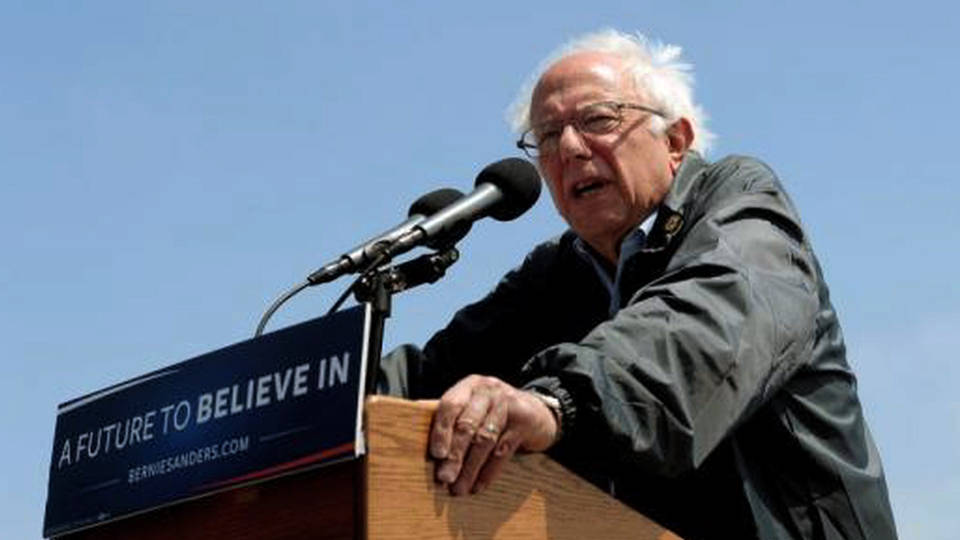
Bernie Sanders says the Democratic National Committee vetoed his nomination of a labor union leader to the committee that will write the party platform. Sanders was allowed to choose five of the 15 platform members. One of the people he tapped was RoseAnn DeMoro, head of National Nurses United, but Sanders said the DNC rejected her. DNC platform committee spokesperson Dana Vickers Shelley told The Washington Post, "Because union leadership was represented on the full platform committee, a decision was made no union leadership would be represented on the platform drafting committee." The DNC did approve a labor union pick by Hillary Clinton: Paul Booth of the American Federation of State, County and Municipal Employees.
TOPICS:
Bernie Sanders
Unions
Democratic Party
2016 Election
German Parliament Recognizes 1915 Armenian Genocide

The German Parliament has voted to call the 1915 massacre of Armenians by Ottoman Turks during World War I a "genocide." The Turkish government continues to deny the genocide, which saw an estimated 1.5 million Armenians exterminated through direct killing, starvation, torture and forced death marches. In response to the German vote, Turkey recalled its ambassador to Germany and said it would consider further actions.
TOPICS:
Germany
Texas: Fort Hood Flooding Kills 5 Soldiers; 4 Missing

In Texas, massive flooding around Fort Hood has killed five soldiers and left four missing. The soldiers died after their Army truck overturned in a swollen creek. May was Texas’ wettest month on record.
TOPICS:
Texas
Climate Change
Flooding Closes Louvre Museum in Paris, Kills 6 in Germany

Massive flooding has also struck Europe, where Paris’ Louvre Museum closed today as artwork was moved to higher areas. In southern Germany, flooding has killed at least six people in recent days. Scientists say such heavy rains and flooding are linked to climate change.
TOPICS:
France
Germany
Climate Change
Brazil: Suspended President Dilma Rousseff Addresses Women's March
In Brazil, suspended President Dilma Rousseff joined protesters in Rio de Janeiro denouncing what they consider a coup against her. Congress suspended Rousseff purportedly for manipulating budget accounts, but leaked transcripts showed at least one official plotted to oust Rousseff in order to end a corruption investigation that was targeting him. Brazil’s political crisis has coincided with protests over the gang rape of a 16-year-old girl by more than 30 men. On Thursday, Rousseff addressed the Women’s March for Democracy.
Dilma Rousseff: "We know that what happened here was a gang rape. And at the same time, one of the elite country clubs has clearly shown its prejudice against a nanny, prohibiting her from sitting or from using the bathroom. This culture of rape against women, and at the same time this culture of social exclusion, is something that we know needs to be defeated."
Rousseff was Brazil’s first woman president. Her replacement, Michel Temer, appointed an all-male Cabinet.
TOPICS:
Brazil
ACLU Sues Alabama over Law Treating Abortion Clinics Like Sex Offenders
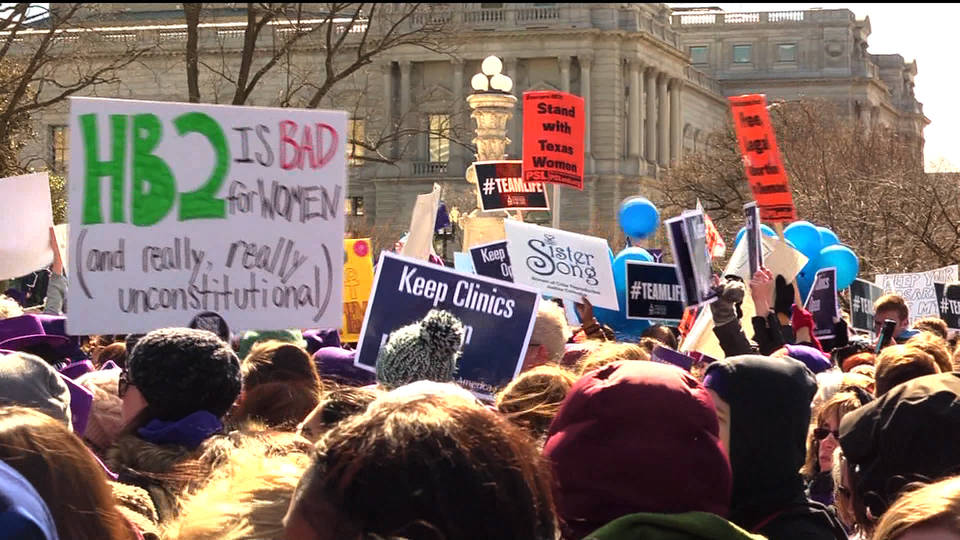
The American Civil Liberties Union is suing Alabama over anti-choice restrictions, including a law that treats abortion clinics like sex offenders. The measure banning abortion clinics from operating within 2,000 feet of a K-through-8 public school would shutter the only abortion clinics in Huntsville and Tuscaloosa, which together provide more than half of all abortions in the state. The Alabama Women’s Center in Huntsville is located across from a school; it was forced to move there to comply with other anti-choice restrictions. The ACLU also challenged restrictions that ban a safe abortion method and force abortion providers to give every patient a copy of her medical records, even if she doesn’t want them.
TOPICS:
Alabama
Abortion
UCLA Suspect Killed Ex-Wife in Minnesota Before Shooting Professor
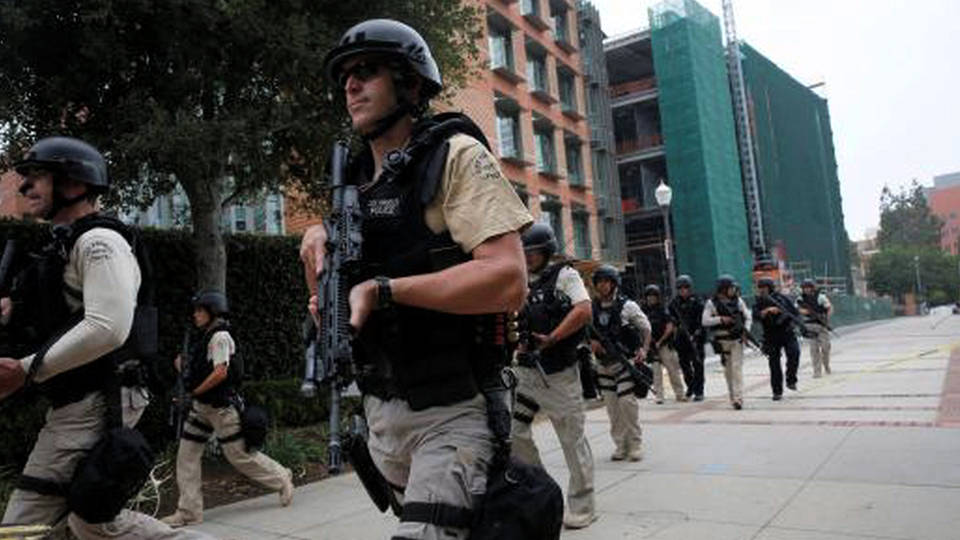
The man accused of killing a professor at UCLA in what authorities called a murder-suicide appears to have killed his ex-wife first. Authorities said they found a "kill list" in the home of accused gunman Mainak Sarkar, which included three names: William Klug, the UCLA professor who was shot to death on Wednesday; another UCLAprofessor; and a woman identified as Sarkar’s ex-wife, Ashley Hasti. Hasti was found shot to death in her home in Minnesota.
TOPICS:
Domestic Violence
NYC: Hundreds of Macy's Workers Rally to Demand Fair Contract

Here in New York City, hundreds of Macy’s workers rallied outside the retailer’s flagship store in Herald Square to call for a living wage, reliable schedules and affordable healthcare. Thousands of Macy’s workers have authorized their union to call a strike if Macy’s doesn’t meet their demands for a fair contract by June 15. Stuart Appelbaum, president of the Retail, Wholesale and Department Store Union, said Macy’s is seeking unreasonable cuts.
Stuart Appelbaum: "Macy’s is looking to take away pensions from senior employees, reduce commissions for commission workers, refuses to provide affordable healthcare coverage. The workers are angry, the workers are upset. The workers have taken a strike vote, and it was unanimous. People are prepared to strike if Macy’s refuses to give them the respect they’ve earned and deserve."
TOPICS:
New York
Labor
Tests Show Prince Died from Opioid Overdose

Toxicology tests have revealed the legendary singer Prince died from an accidental overdose of the opioid fentanyl. Fentanyl is many times more powerful than heroin and morphine. Seventy-eight Americans die every day from opioid overdoses.
TOPICS:
Music
Addiction
Longtime Prisoner Mohaman Koti Dies at 89, 2 Months After Release
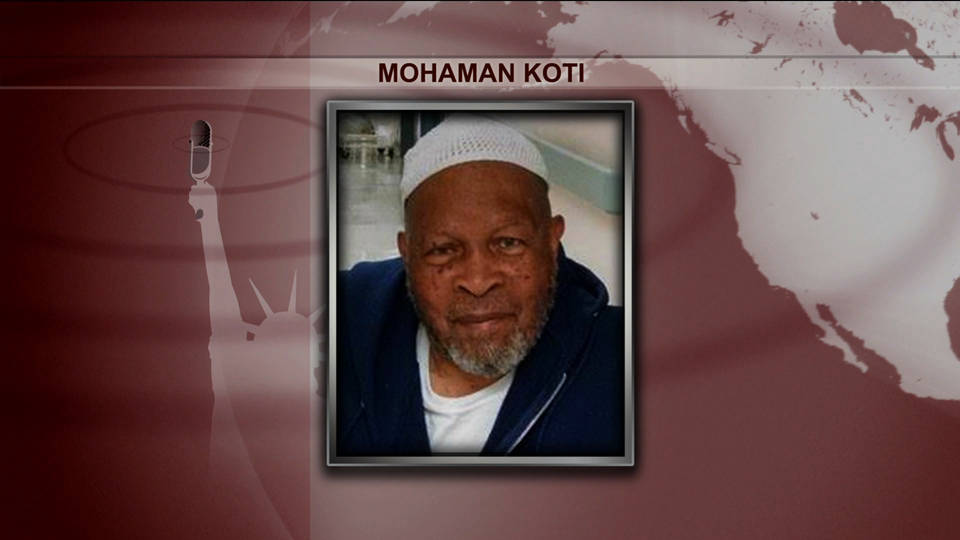
And an elderly New York prisoner who won wide support for his freedom has died just two months after he was released to a nursing home in Staten Island. Mohaman Koti was 89 years old. In 1978, Koti was convicted of attempted murder after he shot a New York City police officer during a traffic stop in which he says the officer drew his gun first. The officer later recovered, and Koti was offered a plea deal of seven-and-a-half years. When he demanded a trial, he was sentenced to 25 years to life. He spent the next several decades mentoring young male prisoners. A corrections officer at Sing Sing said he had never met anyone so well respected on both sides of the bars. Ten years after Koti was eligible for parole, he was profiled in a 2013 New York Times column about prisoners over the age of 60 who are denied release based on their original crime, instead of an accurate assessment of the threat they pose. It described a parole board hearing where commissioners had to repeat questions to Koti because he was hard of hearing. He suffered from several medical problems and used a wheelchair, but he was still found to be at risk of committing another crime. Koti was ultimately granted parole in September 2014, when a judge ruled the previous denials were irrational and called for a new hearing. Then, because of a pending bank robbery charge from the time of his arrest, he was ordered to serve an additional year in prison at a federal medical center in Butner, North Carolina. Koti was finally freed in March. His longtime lawyer and friend Susan Tipograph told Democracy Now!, "The kind of life Koti lived when he got out—confined to a nursing home because he was not able to care for himself—shows that it was ludicrous to think he would have posed a threat to society all these years."
Donate today:
Follow:


SPEAKING EVENTS


Dave Zirin & Jules Boykoff on the 2016 Rio Olympics & Brazil's Collapsing Political System
WORK WITH DN!

News Producer
Office Coordinator
207 West 25th Street, 11th Floor
New York, New York 10001, United States
---------------------
---------------------
No comments:
Post a Comment