democracynow.org
Stories:

Chris Hedges vs. Robert Reich on Clinton, Third Parties, Capitalism & Next Steps for Sanders Backers
The Green Party’s national convention opens today in Houston, Texas, and Dr. Jill Stein is expected to win the party’s nomination. But will she win the support of former Bernie Sanders supporters? Last week, Democracy Now! hosted a debate between the Pulitzer Prize-winning journalist Chris Hedges and former Labor Secretary Robert Reich about the presidential race. Hedges has endorsed Jill Stein. Reich is backing Hillary Clinton after endorsing Bernie Sanders during the primaries. Reich served in Bill Clinton’s Cabinet as labor secretary from 1993 to 1997.
TRANSCRIPT
This is a rush transcript. Copy may not be in its final form.
AMY GOODMAN: A week ago today, Hillary Clinton made history by becoming the first woman to accept a major-party presidential nomination. But Clinton is not the only woman running for president this year. The Green Party’s national convention opens today in Houston, Texas, and Dr. Jill Stein is expected to win the party’s nomination.
Last week, Juan González and I hosted a debate between the Pulitzer Prize-winning journalist Chris Hedges and former Labor Secretary Robert Reich about the presidential race. Hedges has endorsed Dr. Jill Stein. Reich is backing Hillary Clinton, after endorsing Bernie Sanders during the primaries. Reich served in Bill Clinton’s Cabinet as Labor Secretary from ’93 to 1997. He now teaches at University of California, Berkeley. We began the debate by asking Robert Reich about whether the Democratic Party would unite behind Hillary Clinton or whether a group of Sanders supporters would go on to back Dr. Jill Stein.
ROBERT REICH: Well, it’s very hard to tell what the delegates are going to do. And it’s very hard to tell—even harder to tell what the electorate is going to do. You know, this is a very agonizing time for many Bernie Sanders supporters. I, with a great deal of reluctance initially, because I’ve known Hillary Clinton for 50 years—50 years—endorsed Bernie Sanders and worked my heart out for him, as many, many people did. And so, at this particular juncture, you know, there’s a great deal of sadness and a great deal of feeling of regret. But having worked so long and so many years for basically the progressive ideals that Bernie Sanders stands for, I can tell you that the movement is going to continue. In fact, it’s going to grow.
And right now, at this particular point in time, I just don’t see any alternative but to support Hillary. I know Hillary, I know her faults, I know her strengths. I think she will make a great president. I supported Bernie Sanders because I thought he would make a better president for the system we need. But nonetheless, Hillary Clinton is going to be the nominee. I support her. And I support her not only because she will be a good president, if not a great president, but also, frankly, because I am tremendously worried about the alternative. And the alternative, really, as a practical matter, is somebody who is a megalomaniac and a bigot, somebody who will set back the progressive movement decades, if not more.
AMY GOODMAN: Chris Hedges?
CHRIS HEDGES: Well, reducing the election to personalities is kind of infantile at this point. The fact is, we live in a system that Sheldon Wolin calls inverted totalitarianism. It’s a system where corporate power has seized all of the levers of control. There is no way to vote against the interests of Goldman Sachs or ExxonMobil or Raytheon. We’ve lost our privacy. We’ve seen, under Obama, an assault against civil liberties that has outstripped what George W. Bush carried out. We’ve seen the executive branch misinterpret the 2001 Authorization to Use Military Force Act as giving itself the right to assassinate American citizens, including children. I speak of Anwar al-Awlaki’s 16-year-old son. We have bailed out the banks, pushed through programs of austerity. This has been a bipartisan effort, because they’ve both been captured by corporate power. We have undergone what John Ralston Saul correctly calls a corporate coup d’état in slow motion, and it’s over.
I just came back from Poland, which is a kind of case study of how neoliberal poison destroys a society and creates figures like Trump. Poland has gone, I think we can argue, into a neofascism. First, it dislocated the working class, deindustrialized the country. Then, in the name of austerity, it destroyed public institutions, education, public broadcasting. And then it poisoned the political system. And we are now watching, in Poland, them create a 30,000 to 40,000 armed militia. You know, they have an army. The Parliament, nothing works. And I think that this political system in the United States has seized up in exactly the same form.
So, is Trump a repugnant personality? Yes. Although I would argue that in terms of megalomania and narcissism, Hillary Clinton is not far behind. But the point is, we’ve got to break away from—which is exactly the narrative they want us to focus on. We’ve got to break away from political personalities and understand and examine and critique the structures of power. And, in fact, the Democratic Party, especially beginning under Bill Clinton, has carried water for corporate entities as assiduously as the Republican Party. This is something that Ralph Nader understood long before the rest of us, and stepped out very courageously in 2000. And I think we will look back on that period and find Ralph to be an amazingly prophetic figure. Nobody understands corporate power better than Ralph. And I think now people have caught up with Ralph.
And this is, of course, why I support Dr. Stein and the Green Party. We have to remember that 10 years ago, Syriza, which controls the Greek government, was polling at exactly the same spot that the Green Party is polling now—about 4 percent. We’ve got to break out of this idea that we can create systematic change within a particular election cycle. We’ve got to be willing to step out into the political wilderness, perhaps, for a decade. But on the issues of climate change, on the issue of the destruction of civil liberties, including our right to privacy—and I speak as a former investigative journalist, which doesn’t exist anymore because of wholesale government surveillance—we have no ability, except for hackers.
I mean, this whole debate over the WikiLeaks is insane. Did Russia? I’ve printed classified material that was given to me by the Mossad. But I never exposed that Mossad gave it to me. Is what was published true or untrue? And the fact is, you know, in those long emails—you should read them. They’re appalling, including calling Dr. Cornel West "trash." It is—the whole—it exposes the way the system was rigged, within—I’m talking about the Democratic Party—the denial of independents, the superdelegates, the stealing of the caucus in Nevada, the huge amounts of corporate money and super PACs that flowed into the Clinton campaign.
The fact is, Clinton has a track record, and it’s one that has abandoned children. I mean, she and her husband destroyed welfare as we know it, and 70 percent of the original recipients were children. This debate over—I don’t like Trump, but Trump is not the phenomenon. Trump is responding to a phenomenon created by neoliberalism. And we may get rid of Trump, but we will get something even more vile, maybe Ted Cruz.
AMY GOODMAN: Robert Reich, I remember you, on Democracy Now!, talking about your time as labor secretary when President Clinton signed off on welfare reform, and you described walking the streets of Washington, D.C., wondering where the protests were, that you had vigorously objected. And it was also an issue, a bill that Hillary Clinton had supported. So, can you respond to Chris Hedges on these three points, including, so, you take a walk in the political wilderness for a little while?
ROBERT REICH: Well, Amy, it’s not just taking a walk in the political wilderness. If Donald Trump becomes president, if that’s what you’re referring to, I think it is—there are irrevocable negative changes that will happen in the United States, including appointments to the Supreme Court, that will not be just political wilderness, that will actually change and worsen the structure of this country. I couldn’t agree with Chris Hedges more about his critique, overall, of neoliberalism and a lot of the structural problems that we face in our political economy today. I’ve written about them. But I’ve done more than write about them. I’ve actually been in the center of power, and I have been doing everything I possibly can, as an individual and also as a mobilizer and organizer of others, to try to change what we now have.
I think that voting for Donald Trump or equating Hillary Clinton with Donald Trump is insane. Donald Trump is certainly a product of a kind of system and a systematic undermining that has occurred in the United States for years with regard to inequality of income and wealth and political power. But we don’t fight that by simply saying, "All right, let’s just have Donald Trump and hope that the system improves itself and hope that things are so bad that actually people rise up in armed resistance." That’s insane. That’s crazy.
What we have to do is be—we’ve got to be very, very strategic as progressives. We’ve got to look at the long term. We’ve got to understand that Bernie Sanders brought us much further along than we were before the Sanders campaign. We owe a lot to Bernie Sanders, his courage, his integrity, his power, the fact that most people under 30 voted for Bernie Sanders. In fact, if you look at the people who voted for Bernie Sanders under 30, that was more people than voted for Donald Trump and Hillary Clinton together under the age of 30. We are building a progressive movement in this country. But over the next four years, I don’t want Donald Trump to irretrievably make it difficult, if not impossible, for us to move forward with that progressive movement.
Now, I understand Hillary Clinton is not perfect. I’ve known her, as I said before, for 50 years. I met her when she was 19 years old. I know her strengths, and I know, pretty well, her weaknesses. She is not perfect. And as Chris says, you know, she is also very much a product of many of the problems structurally in this country right now. We fight those structural problems, yes. Hand in hand, Chris, with you, shoulder to shoulder—I’m very short, maybe it’s my shoulder, and it’s your rib cage—but it doesn’t matter, we continue to fight. I will continue to fight. Many people who are watching and listening will continue to fight. We must continue to mobilize. I hope Bernie Sanders does what he implied he would do last night—that is, carry the movement forward, lend his name, his energy, his email list. This is not the end of anything. But we have got to be, at the same time, very practical about what we’re doing and very strategic about what we’re doing. This is not just a matter of making statements. It’s a matter of actually working with and through, and changing the structure of power in this country.
JUAN GONZÁLEZ: Chris, I’d like to ask you—you’ve written that liberals are tolerated by the capitalist elites because they do not question the virtues of corporate capitalism, only its excesses, and call for tepid and ineffectual reforms. Could that have also have been said of FDR in the 1930s? Because you were one of the folks who did not back Bernie Sanders from the beginning.
CHRIS HEDGES: That’s right.
JUAN GONZÁLEZ: So, you’ve—
CHRIS HEDGES: Well, I didn’t back Bernie Sanders because—and Kshama Sawant and I had had a discussion with him before—because he said that he would work within the Democratic structures and support the nominee. And I think we have now watched Bernie Sanders walk away from his political moment. You know, he—I think he will come to deeply regret what he has done. He has betrayed these people who believed in this political revolution. We heard this same kind of rhetoric, by the way, in 2008 around Obama.
A political campaign raises consciousness, but it’s not a movement. And what we are seeing now is furious spin—I listened to Ben Jealous just do it—from the self-identified liberal class. And they are tolerated within a capitalist system, because, in a moment like this, they are used to speak to people to get them to betray their own interests in the name of fear. And I admire Robert and have read much of his stuff and like his stuff, but if you listen to what he’s been saying, the message is the same message of the Trump campaign, and that his fear. And that is all the Democrats have to offer now and all the Republicans have to offer now.
And the fact is, from climate change alone, we have no time left. I have four children. The future of my children, by the day, is being destroyed because of the fact that the fossil fuel industry, along with the animal agriculture industry, which is also as important in terms of climate change, are destroying the ecosystem on which we depend for life. And neither party has any intention to do anything about it.
AMY GOODMAN: What should Bernie Sanders have done?
CHRIS HEDGES: Bernie Sanders should have walked out and run as an independent.
AMY GOODMAN: Take—
CHRIS HEDGES: And defied the Democratic Party.
AMY GOODMAN: Take up the invitation of Dr. Jill Stein—
CHRIS HEDGES: Yes.
AMY GOODMAN: —and run on a ticket with—
CHRIS HEDGES: She offered to let him run on the top of the ticket. That’s what he should have done. And the fact is, you know, let’s not forget that Bernie has a very checkered past. He campaigned for Clinton in '92. He campaigned for Clinton again in ’96, after NAFTA—the greatest betrayal of the working class in this country since the Taft-Hartley Act of 1948—after the destruction of welfare, after the omnibus crime bill that exploded the prison population, and, you know, we now have—I mean, it's just a monstrosity what we’ve done; 350,000 to 400,000 people locked in cages in this country are severely mentally ill. Half of them never committed a violent crime. That’s all Bill Clinton. And yet he went out and campaigned. In 2004, he called on Nader not to run, to step down, so he could support a war candidate like John Kerry. And I’m listening to Jealous before talk about the Iraq War. Sixty percent of the Democratic senators voted for the war, including Hillary Clinton. The idea that somehow Democrats don’t push us into war defies American history.
AMY GOODMAN: Robert Reich?
ROBERT REICH: Well, all I can say is that at this particular point in time—I mean, again, many of the things that Chris Hedges is saying, I completely agree with. The real question here is: What do we do right now? And what do we do to mobilize and organize a lot of people out there who right now are not mobilized and organized? And how do we keep the energy building? I disagree with Chris with regard to Bernie Sanders. I think Bernie Sanders has been a great and is a great leader right now of the progressive cause.
What I think we ought to do is develop a third party outside the Democratic and Republican parties, maybe the Green Party, so that in the year 2020, four years from now, we have another candidate—it may be Bernie Sanders, I think he’s probably going to be too old by then—but we have a candidate that holds the Democrats accountable, that provides a vehicle for a lot of the energy of the Bernie Sanders movement to continue to develop, that fields new candidates at the Senate, in Congress, at the state level, that actually holds Democrats’ feet to the fire and Republicans’ feet to the fire, that develops an agenda of getting big money out of politics and severing the link between extraordinarily concentrated wealth and political power in this country. That’s what we ought to be doing.
Now, we can—but in order to do that, we cannot have—and, you know, I think that Hillary will be a good president, if not a great president. This is not just trucking in fear, Chris. But I do fear Donald Trump. I fear the polls that I saw yesterday. Now, polls, again, this early in a campaign still—we’re still months away from the election, but they are indicative. They show Donald Trump doing exceedingly well, beating Hillary Clinton. And right now, given our two-party system, given our winner-take-all system with regard to the Electoral College, it’s just too much of a risk to go and to say, "Well, I’m going to vote—I’m not going to vote for the lesser of two evils, I’m going to vote exactly what I want to do." Well, anybody can do that, obviously. This is a free country. You vote what you—you vote your conscience. You have to do that. I’m just saying that your conscience needs to be aware that if you do not support Hillary Clinton, you are increasing the odds of a true, clear and present danger to the United States, a menace to the United States. And you’re increasing the possibility that there will not be a progressive movement, there will not be anything we believe in in the future, because the United States will really be changed for the worse.
That’s not a—that’s not a risk I’m prepared to take at this point in time. I’m going to move—I’m going to do exactly what I’ve been doing for the last 40 years: I’m going to continue to beat my head against the wall, to build and contribute to building a progressive movement. The day after Election Day, I am going to try to work with Bernie Sanders and anybody else who wants to work in strengthening a third party—and again, maybe it’s the Green Party—for the year 2020, and do everything else I was just talking about. But right now, as we lead up to Election Day 2016, I must urge everyone who is listening or who is watching to do whatever they can to make sure that Hillary Clinton is the next president, and not Donald Trump.
AMY GOODMAN: Former Clinton Labor Secretary Robert Reich and Pulitzer Prize-winning journalist Chris Hedges. Hold onto your hats, because we’ll return to the debate in a minute.
[break]
AMY GOODMAN: "Rich" by Yeah Yeah Yeahs, here on Democracy Now!, democracynow.org, The War and Peace Report. I’m Amy Goodman, as we return to our debate between former Labor Secretary Robert Reich and the Pulitzer Prize-winning journalist Chris Hedges. Juan González and I spoke to them last week during the Democratic National Convention. Chris Hedges was with us in Philadelphia. Robert Reich joined us from the University of California, Berkeley, where he teaches. We started this section of the debate with a clip from Donald Trump’s nomination speech at the Republican National Convention.
DONALD TRUMP: I have seen firsthand how the system is rigged against our citizens, just like it was rigged against Bernie Sanders. He never had a chance, never had a chance. But his supporters will join our movement, because we will fix his biggest single issue—trade deals that strip our country of its jobs and strip us of our wealth as a country. Millions of Democrats will join our movement, because we are going to fix the system so it works fairly and justly for each and every American.
JUAN GONZÁLEZ: That was Donald Trump talking at the convention in Cleveland. Robert Reich, interestingly, Donald Trump and Chris Hedges agree on one thing, that free trade deals that the—that both the Republicans and Democrats have negotiated over the past few years, especially NAFTA, have been disastrous for the American people. You were part of the Clinton administration when NAFTA was passed. Talk about this, the impact that Trump is utilizing among white workers in America over the issue of free trade.
ROBERT REICH: Well, Donald Trump is clearly using trade and also immigration as vehicles for making the people who have really been hurt by trade, by globalization, feel that he is going to somehow be on their side. He’s not going to be on their side.
Trump is right in a very, very narrow respect, that trade has hurt very vulnerable people, working-class people. The burdens of trade have been disproportionately fallen on those people who used to have good unionized jobs in America. And the failure of NAFTA and also the WTO, the World Trade Organization, Chinese ascension into the WTO, all of those Clinton-era programs—the failure was, number one, not to have nearly strong enough and enforceable enough labor and environmental side agreements; number two, not to have adjustment mechanisms here in the United States for people who lost their jobs to help them get good jobs, that were new jobs, for the jobs they lost. The winners in trade could have compensated the losers and still come out ahead, but they did not. And that is a structural, political problem in this country that we have to address.
It is also a problem with regard to technological displacement. It’s not just trade. Technology is displacing and will continue to displace and will displace even more good jobs in the future, but we have absolutely no strategy for dealing with that. And right now, the burdens of technological displacement are falling, once again, on the working middle class, lower-income people, who have very, very few alternatives, driving a greater and greater wedge between those who are lucky enough to be—to have rich parents or be well educated or be well connected, and everybody else.
We cannot go on like this. This is unsustainable. And Donald Trump and Bernie Sanders are symptomatic, their rise, are both symptomatic of this great wave of antiestablishment anger that is flooding American politics, although on the one side you have authoritarian populism, and on the Bernie Sanders side you have a political revolution. I prefer the political revolution myself. I’m going to continue to work for that political revolution.
CHRIS HEDGES: Well, I think we have to acknowledge two facts. We do not live in a functioning democracy, and we have to stop pretending that we do. You can’t talk about—when you eviscerate privacy, you can’t use the word "liberty." That is the relationship between a master and a slave. The fact is, this is capitalism run amok. This whole discussion should be about capitalism. Capitalism does what it’s designed to do, when it’s unfettered or unregulated—as it is—and that is to increase profit and reduce the cost of labor. And it has done that by deindustrializing the country, and the Clinton administration, you know, massively enabled this.
And, you know, we’re sitting here in Philadelphia. The last convention was in Cleveland. These are Potemkin villages, where the downtowns are Disneyfied, and three and four blocks away people are living in appalling poverty. We have responded to surplus labor, as Karl Marx says, in our deindustrialized internal colonies, to quote Malcolm X, by putting poor people of color in cages all across the country. Why? It’s because surplus labor—corporate entities cannot make money off of surplus or redundant labor. But when you lock them in a cage, they make $40,000 or $50,000 a year. This is the system we live in.
We live in a system where, under Section 1021 of the National Defense Authorization Act, the executive branch can put the soldiers in the streets, in clear violation of the 1878 Posse Comitatus Act, to see—carry out extraordinary rendition of American citizens who are deemed to be, quote-unquote, "terrorists," strip them of due process and hold them indefinitely in military facilities, including in our black sites. We are a country that engages in torture.
We talk—Robert talks about, you know, building movements. You can’t build movements in a political system where money has replaced the vote. It’s impossible. And the Democrats, you know, their bedside manner is different from the Republicans. You know, Trump is this kind of grotesque figure. He’s like the used car salesman who rolls back the speedometer. But Hillary Clinton is like, you know, the managers of Goldman Sachs. They both engage in criminal activities that have—and Clinton’s record, like Trump, exposes this—that have preyed upon the most vulnerable within this country and are now destroying the middle class. And to somehow speak as if we are in a functioning democracy, or speak as if there are any restraints on capitalism, or speak as if the Democratic Party has not pushed forward this agenda—I mean, Obama has done this. You know, he has been as obsequious to Wall Street as the Bush administration. There’s no difference.
AMY GOODMAN: Robert Reich?
ROBERT REICH: Chris, you know, I—again, I find this a frustrating conversation, because I agree with so much of what you have said, but the question is: What do we do about it? I mean, we are in a better position today, in the sense that Bernie Sanders has helped mobilize, organize and energize a lot of Americans, and educated a lot of Americans about the very issues that you have talked and written about and I have talked and written about. But it is—the question is: What is the action? What is the actual political strategy right now?
CHRIS HEDGES: Well, let me—let me answer that.
ROBERT REICH: And I think the political—
CHRIS HEDGES: Let me answer that.
ROBERT REICH: Well, let me just—let me just put in my two cents. I think political strategy is not to elect Donald Trump, to elect Hillary Clinton, and, for four years, to develop an alternative, another Bernie Sanders-type candidate with an independent party, outside the Democratic Party, that will take on Hillary Clinton, assuming that she is elected and that she runs for re-election, and that also develops the infrastructure of a third party that is a true, new progressive party.
CHRIS HEDGES: Well, that’s precisely what we’re trying to do. There is a point where you have to—do I want to keep quoting Ralph?—but where you have to draw a line in the sand. And that’s part of the problem with the left, is we haven’t.
I covered the war in Yugoslavia, and I find many parallels between what’s happening in the United States and what happened with the breakdown of Yugoslavia. What is it that caused this country to disintegrate? It wasn’t ancient ethnic hatreds. It was the economic meltdown of Yugoslavia and a bankrupt liberal establishment that, after the death of Tito, until 1989 or 1990, spoke in the language of democracy, but proved ineffectual in terms of dealing with the plight of working men and women who were cast out of state factories, huge unemployment and, finally, hyperinflation.
And the fact is that these neoliberal policies, which the Democratic Party is one of the engines for, have created this right-wing fascialism. You can go back—this proto-fascism. You can go back and look at the Weimar, and it—Republic—was very much the same. So it’s completely counterintuitive. Of course I find Trump a vile and disturbing and disgusting figure, but I don’t believe that voting for the Democratic establishment—and remember that this—the two insurgencies, both within the Republican Party and the—were against figures like Hillary Clinton, who spoke in that traditional feel-your-pain language of liberalism, while assiduously serving corporate power and selling out working men and women. And they see through the con, they see through the game.
I don’t actually think Bernie Sanders educated the public. In fact, Bernie Sanders spoke for the first time as a political candidate about the reality the public was experiencing, because even Barack Obama, in his State of the Union address, was talking about economic recovery, and everything was wonderful, and people know that it’s not. And when you dispossess—
ROBERT REICH: Well, let me—let me—
CHRIS HEDGES: Let me just finish. Let me finish. When you dispossess that segment, as large as we have—half the country now lives in virtual poverty—and you continue to essentially run a government that’s been seized by a cabal, in this case, corporate, which uses all of the machinery of government for their own enrichment and their own further empowerment at the expense of the rest of the citizenry, people finally react. And that is how you get fascism. That is what history has told us. And to sit by—every time, Robert, you speak, you do exactly what Trump does, which is fear, fear, fear, fear, fear. And the fact that we are going to build some kind of—
ROBERT REICH: Well, let me—let me try to—
CHRIS HEDGES: —amorphous movement after Hillary Clinton—it’s just not they way it works.
ROBERT REICH: Let me try to inject—let me—let me try to inject—
AMY GOODMAN: Former Clinton Labor Secretary Robert Reich?
ROBERT REICH: Let me try to inject some hope in here, in this discussion, rather than fear. I’ve been traveling around the country for the last two years, trying to talk to tea partiers and conservatives and many people who are probably going to vote for Donald Trump, to try to understand what it is that they are doing and how they view America and why they’re acting in ways that are so obviously against their self-interest, both economic self-interest and other self-interest. And here’s the interesting thing I found.
This great antiestablishment wave that is occurring both on the left and the right has a great overlap, if you will, and that overlap is a deep contempt for what many people on the right are calling crony capitalism—in fact, many people on the left have called crony capitalism. And those people on the right, many, many working people, they’re not all white. Many of them are. Many of them are working-class. Many of them have suffered from trade and technological displacement and a government that is really turning its back on them, they feel—and to some extent, they’re right. Many of them feel as angry about the current system and about corporate welfare and about big money in politics as many of us on the progressive side do.
Now, if it is possible to have a multiracial, multiethnic coalition of the bottom 90 percent that is ready to fight to get big money out of politics, for more equality, for a system that is not rigged against average working people, where there are not going to be all of these redistributions upward from those of us who have paychecks—and we don’t even realize that larger and larger portions of those paychecks are going to big industries, conglomerates, concentrated industries that have great market power, because it’s all hidden from view—well, the more coalition building we can do, from right to left, multiethnic, multiracial, left and right, to build a movement to take back our economy and to take back our democracy, that is—
JUAN GONZÁLEZ: Robert Reich—Robert Reich, I’d just like to interrupt you for a second, because we only have a minute left, and I just wanted to ask Chris one last question. In less than a minute, if you can, regardless of—you’re voting for Jill Stein, other folks are going to vote for Clinton and Trump. Where do you feel this massive movement that has developed over the last few years, this people movement, would have a better opportunity to grow, under a Trump presidency or under a Clinton presidency, assuming that one of those two will eventually be elected?
CHRIS HEDGES: I don’t think it makes any difference. The TPP is going to go through, whether it’s Donald Trump or Hillary Clinton. Endless war is going to be continued, whether it’s Trump or Clinton. We’re not going to get our privacy back, whether it’s under Clinton or Trump. The idea that, at this point, the figure in the executive branch exercises that much power, given the power of the war industry and Wall Street, is a myth. The fact is—
ROBERT REICH: Equating—I’m sorry. I’m sorry.
JUAN GONZÁLEZ: Even on immigration?
CHRIS HEDGES: What? On?
JUAN GONZÁLEZ: Even on immigration?
CHRIS HEDGES: What? On immigration? I mean, let’s look at Obama’s record on immigration. Who’s worse?
AMY GOODMAN: We’ve got 10 seconds.
CHRIS HEDGES: I mean, you know, you can’t get worse than Obama.
ROBERT REICH: And can I just say something?
CHRIS HEDGES: I mean, the idea is, the Democrats speak, and the—
AMY GOODMAN: Robert Reich, 10 seconds.
CHRIS HEDGES: Yeah.
ROBERT REICH: I just want to say, equating Donald Trump and Hillary Clinton is absolute nonsense. I just—anybody who equates the two of them is not paying attention. And it’s dangerous kind of talk.
CHRIS HEDGES: That’s not what I—that’s not what I did.
AMY GOODMAN: We’re going to have to leave it there, but this is a discussion that will continue.
AMY GOODMAN: And that debate held during the Democratic convention. Chris Hedges is a Pulitzer Prize-winning journalist. His most recent book, Wages of Rebellion: The Moral Imperative of Revolt. Robert Reich served as labor secretary under President Clinton, is a professor at University of California, Berkeley. His most recent book, Saving Capitalism: For the Many, Not the Few. Today, the Green Party convention opens in Houston, Texas. To get a copy of the show, you can go to democracynow.org.
When we come back, an exposé on foreign influence in the U.S. elections. Stay with us. ... Read More →

First Evidence Surfaces of Foreign Money Pouring into U.S. Elections After Citizens United
Six years ago, President Obama warned the nation that foreign corporations could soon pour money into the U.S. election system thanks to the Supreme Court Citizens United decision. Now, direct evidence has emerged for the first time showing a foreign company has indeed donated money to a federal campaign. Documentation obtained by The Intercept shows a company owned by Chinese nationals donated $1.3 million to Jeb Bush’s super PAC after receiving advice from a prominent Republican lawyer. To talk more about the exposé, we are joined by The Intercept’s Lee Fong, who co-wrote the multi-part series "Foreign Influence."
TRANSCRIPT
This is a rush transcript. Copy may not be in its final form.
AMY GOODMAN: Six years ago, President Obama warned the nation that foreign corporations could soon pour money into the U.S. election system, thanks to the Supreme Court Citizens United decision. Obama made the warning during his 2010 State of the Union speech as members of the Supreme Court looked on.
PRESIDENT BARACK OBAMA: With all due deference to separation of powers, last week the Supreme Court reversed a century of law that I believe will open the floodgates for special interests, including foreign corporations, to spend without limit in our elections. I don’t think American elections should be bankrolled by America’s most powerful interests or, worse, by foreign entities. They should be decided by the American people. And I’d urge Democrats and Republicans to pass a bill that helps correct some of these problems.
AMY GOODMAN: That was President Obama speaking in 2010. Now, for the first time, direct evidence has emerged showing a foreign company has indeed donated money to a federal campaign. Documentation obtained by The Intercept shows a company owned by Chinese nationals donated $1.3 million to Jeb Bush’s super PAC after receiving advice from a prominent Republican lawyer. On Wednesday, The Intercept published a multi-part series looking at the actions of two Chinese citizens living in Singapore who own a U.S.-based firm called American Pacific International Capital, that has ties to the Bush family. Jeb’s brother, Neil, serves on the corporation’s board. The Intercept reports suggest there might be more such instances of foreign contributions, as the 2016 election has witnessed a surge of contributions to super PACs by so-called ghost corporations, whose ownership remains unknown.
To talk more about the exposé, we’re joined by The Intercept’s Lee Fang, who co-wrote the series, "Foreign Influence."
Welcome back to Democracy Now! It’s great to have you in studio live for the first time.
LEE FANG: Thank you for having me, Amy.
AMY GOODMAN: So, Lee, why don’t you start off by talking about how Citizens United opened up the floodgates for money—now, in fact, foreign money—and where super PACs fit into this?
LEE FANG: In 2010, the Supreme Court decision Citizens United rolled back about a hundred years of campaign finance law, basically doing two things: one, allowing corporations and unions to spend unlimited amounts in this election; and, two, separating the way we look at campaign finance. No longer can we trace all donations back to individuals; instead, fictions of the state, corporations and other legal entities, could contribute unlimited amounts.
AMY GOODMAN: So talk about this many-month investigation that you have done and, again, how super PACs fit into this and open up the floodgates.
LEE FANG: We worked on this for several months. I wrote this with my colleague, Jon Schwarz, and a freelancer, Elaine Yu, along with a fantastic team at The Intercept of researchers and editors. We simply looked at some of the largest corporate donations to presidential super PACs and tried to find out their ownership structure. By chance, we found that one of the largest corporate donors to the Jeb Bush super PAC, Right to Rise, was owned—or, is owned by two Chinese nationals. They’re permanent residents of Singapore. And they gave $1.3 million to the Jeb Bush super PAC.
They were advised by one of the most prominent Republican campaign lawyers in the country, Charlie Spies. Charlie Spies has a very long history in big money politics. He was an adviser to George W. Bush’s campaign, to the Republican Governors Association. He helped set up the massive Mitt Romney super PAC. And he set up the Jeb Bush super PAC. He, in fact, wrote a memo that is essentially a roadmap for how foreign-controlled domestic corporations may give in U.S. federal elections, basically setting all the parameters and rules inviting these types of donations. So this wasn’t an anomaly. And he wrote this memo, that we obtained and published with the story, in February of 2015. And the donation from the American Pacific International Capital Company—this is the company controlled by two Chinese foreign nationals—provided their $1.3 million donation to the Jeb Bush super PAC one month later.
AMY GOODMAN: And explain who this couple is.
LEE FANG: Gordon Tang and Serena Chen, they’re Chinese nationals. They amassed their wealth living in southern China, in Shantou. They had an import-export business with various goods that they sent abroad. They now have a very large diversified company that has a biofuel refinery, various investment properties, luxury towers, malls, other commercial property in southern China, Malaysia, Singapore. And over the last seven years, they’ve been amassing a large portfolio in the U.S., as well.
AMY GOODMAN: And Jeb Bush’s brother, George W. Bush’s brother, Neil Bush, sits on the board of APIC?
LEE FANG: That’s right. Neil Bush was appointed to both APIC’s board and a sister company also controlled by Gordon Tang called the SingHaiyi Group. We don’t know the compensation from APIC, but through the Singapore Stock Exchange, we know that Neil Bush has been paid at least $700,000 for serving on the SingHaiyi board. And he’s been a prominent kind of figurehead for the company, appearing on company documents, giving speeches and appearing in the Singapore media on behalf of the company.
AMY GOODMAN: And how does Gordon Tang also connect with the former governor of Washington, Gary Locke?
LEE FANG: Yeah, this is an interesting angle to the story. In addition to providing the first documented case of a foreign-controlled corporation giving to an American super PAC, a presidential election vehicle, this is also a story about incredible influence peddling. Gordon Tang and his company worked meticulously to gain U.S. political friends, as his brother-in-law called it, bringing U.S. politicians to his ribbon cuttings, and also soliciting the help from Gary Locke, the former governor of Washington, former secretary of commerce for Obama and the former U.S. ambassador for Obama to China. Locke worked briefly for APIC in 2008, went into government serving the Obama administration, and while serving as ambassador to China, was looking to sell his house, and sold his home in Bethesda to the—to Tang’s family for $1.6 million. It was a very unusual transaction for a sitting ambassador to sell their home to a foreign national of the country they were serving in.
AMY GOODMAN: I want to get to an exchange between Gordon Tang and reporter Elaine Yu, who is working with you at The Intercept. When she asked him about rumors about his past, he offered her a bribe. This is an excerpt from an audio recording of their exchange.
GORDON TANG: [translated] I’ll come to Hong Kong later and give you a red packet of $200,000, so we can be friends. I shall arrive at Hong Kong on July 20th, for five days, and leave on the 25th. I hope to see you, and then we can be friends. I don’t even know why you want to be a reporter. Reporters make so little money.
ELAINE YU: [translated] OK, we’re really more interested in the Sino-U.S. relationship. What about SingHaiyi, Neil Bush? What do you think are his good qualities? I want to understand the attitude of how Americans do business.
GORDON TANG: [translated] Once we’re friends, I’ll have a lot to tell you. And we shall be friends if you don’t write about the last three points [i.e., the rumors about his past].
AMY GOODMAN: That’s Gordon Tang speaking to Intercept reporter Elaine Yu. And he called her from the airport in Hong Kong to say he had an envelope for her, a red envelope.
LEE FANG: That’s right. He had a lai see, which is a traditional Chinese envelope for giving gifts. But he offered what is essentially a bribe not to report certain aspects of the story, offering $200,000 in unspecified currency.
AMY GOODMAN: What was he so concerned about?
LEE FANG: He was concerned about allegations about a company he controlled that was investigated for smuggling and tax evasion in Shantou.
AMY GOODMAN: And was he implicated?
LEE FANG: Members of his family and his business were implicated.
AMY GOODMAN: Well, we’re going to do Part 2 of this conversation. It’s a lengthy exposé, and we want to really dig into it. And you can watch it at democracynow.org. Lee Fang, investigative journalist at The Intercept covering the intersection of money and politics. This series is called "Foreign Influence."
And that does it for our show. We have two job openings. We have a development manager and a senior video producer. Go to democracynow.org for the information. ... Read More →
Headlines:
VP Nominee Mike Pence Contradicts Trump, Endorses Paul Ryan
In election news, Republican presidential nominee Donald Trump’s campaign appears to be in turmoil, with widening divisions both inside the Trump campaign, and between Trump and Republican Party leaders. On Tuesday, Trump’s running mate, Indiana Governor Mike Pence, endorsed House Speaker Paul Ryan in his Wisconsin congressional race, after Trump refused to endorse Ryan earlier this week. Instead, Trump has praised Ryan’s opponent in the race, saying he was "running a very good campaign." Ryan’s opponent, Paul Nehlen, has defended Trump’s attack on Khizr and Ghazala Khan, the parents of a U.S. Army captain who died serving in Iraq in 2004. Ryan, however, publicly distanced himself from Trump over the comments.
TOPICS:
DNC 2016
Trump's Campaign in Turmoil, Staffers are "Suicidal"
Trump’s refusal to endorse Ryan comes amid reports Trump’s campaign staff are beginning to panic. On Monday, Trump’s campaign announced the firing of two senior advisers, including longtime GOP strategist Ed Brookover, who had been Trump’s liaison to the Republican National Committee. Then, on Wednesday, a Trump campaign staffer told CNBC Trump’s staff were "suicidal" and that campaign manager Paul Manafort was unable to control Trump and was "mailing it in." This comes as a number of top Republicans have said in recent days they would support Trump’s rival, Hillary Clinton. On Wednesday, Newt Gingrich—who until two weeks ago was considered a possible running mate for Trump—criticized Trump.
Newt Gingrich: "Trump is still behaving like as though it was the primaries and there were 17 candidates. He has not made the transition to being the potential president of the United States, which is a much tougher league. People are going to watch you every single day. They’re going to take everything they can out of context. And he is not yet performing at the level that you need to."
Later, Newt Gingrich walked back his comments, saying he’s behind Trump 100 percent. At a campaign rally in Florida yesterday, Trump sought to assure voters his campaign is fine.
Donald Trump: "I would say right now it’s the best in terms of being united that it’s been since we began. We’re doing incredibly well. We’re leading in the state of Florida. You saw the poll. We’re leading in Ohio. We’re about tied in Pennsylvania, but I think we’re going to be leading the next time. So I think we—I think we’ve never been this united. And I just want to thank everybody for being here. This is incredible."
TOPICS:
2016 Election
Donald Trump
Clinton Tours Factory, Chastises Trump for Using Chinese Manufacturers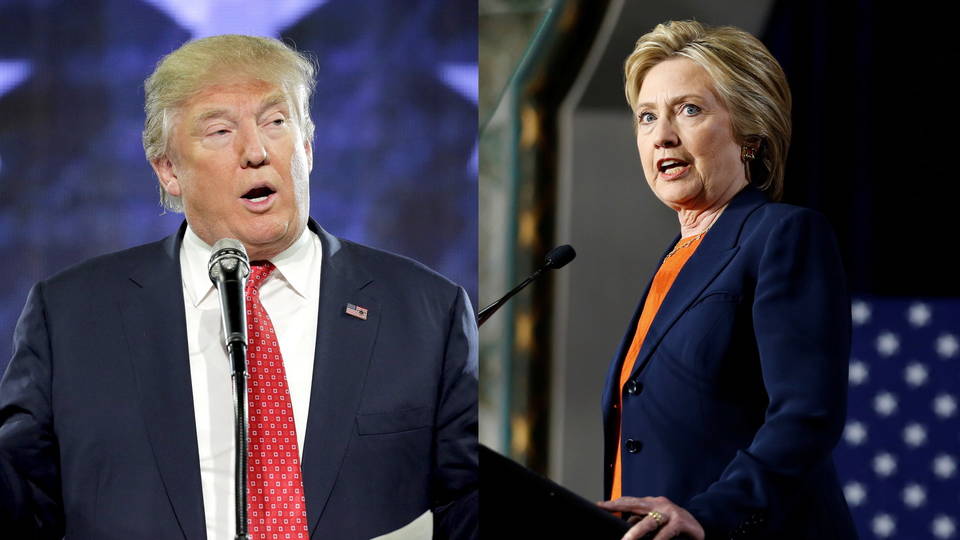
And as Hillary Clinton campaigned on Wednesday, she used a visit to a Colorado tie factory to chastise Donald Trump for manufacturing ties in China. Clinton said, "If he wants to make America great again, he should start by making things in America—and there’s a lot he could learn by coming here."
TOPICS:
Hillary Clinton
2016 Election
Report: Trump Asks About Nukes "If We Have Them, Why Can't We Use Them?"

Meanwhile, Trump’s grasp of foreign policy has come up repeatedly as a potential issue if he were elected president. On MSNBC on Tuesday, host Joe Scarborough made this troubling claim about Trump.
Joe Scarborough: "Several months ago, a foreign policy expert, on the international level, went to advise Donald Trump, and three times he asked about the use of nuclear weapons. Three times, he asked, at one point, 'If we have them, why can't we use them?’"
TOPICS:
Donald Trump
2016 Election
Green Party Presidential Convention Begins in Houston, TX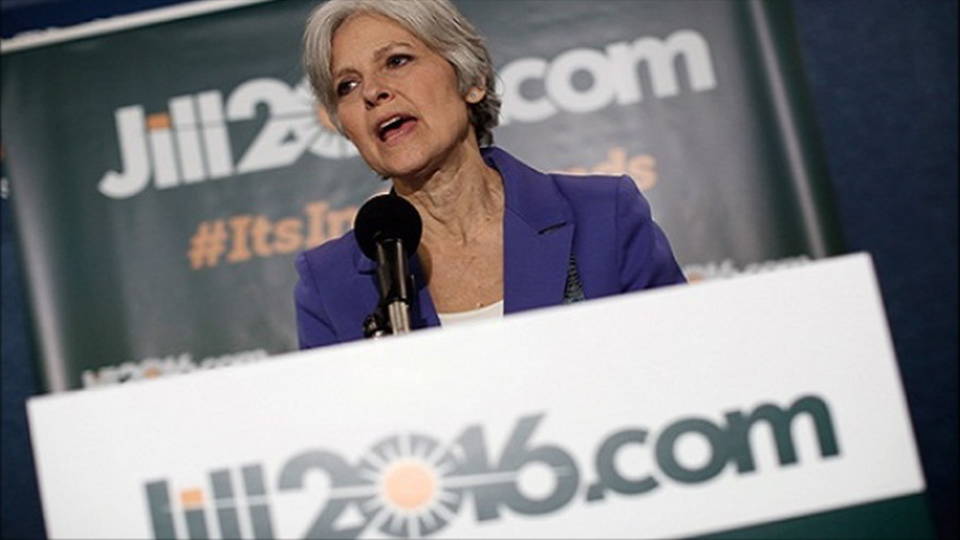
The Green Party presidential convention begins today in Houston, Texas. The agenda includes workshops on abolishing constitutional rights for corporations and how to run for public office. Presumptive Green Party presidential nominee Jill Stein will be there with her running mate, human rights activist Ajamu Baraka.
TOPICS:
2016 Election
Progressive Pramila Jayapal Wins Washington Primary in Landslide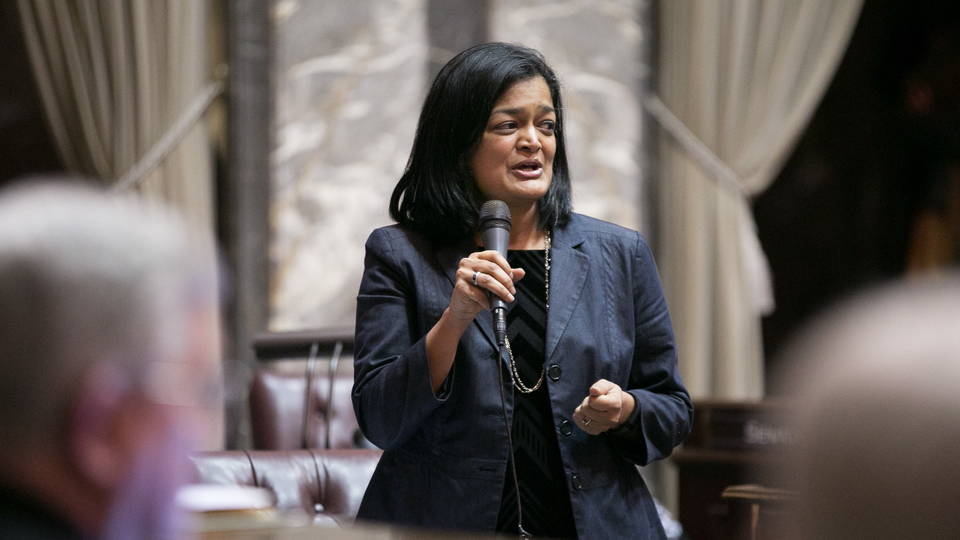
In more election news, progressive candidate Pramila Jayapal has won a congressional primary in Washington state with 38 percent of the vote. Jayapal was one of the first candidates to receive an endorsement from Bernie Sanders. Jayapal has championed initiatives that include expanding Social Security benefits, debt-free college and a $15 minimum wage. Her win follows other congressional primary victories for progressives, including Zephyr Teachout in New York and Jamie Raskin in Maryland. Meanwhile, in a congressional primary in Kansas on Tuesday, tea party Congressmember Tim Huelskamp lost in a landslide to John Marshall, a political novice. Congressmember Huelskamp was a part of the right-wing Freedom Caucus, which battled repeatedly with former House Speaker John Boehner. A widely circulated photo showed Boehner toasting Huelskamp’s defeat.
TOPICS:
2016 Election
White House Denies $400 Million Cash Payment to Iran was Ransom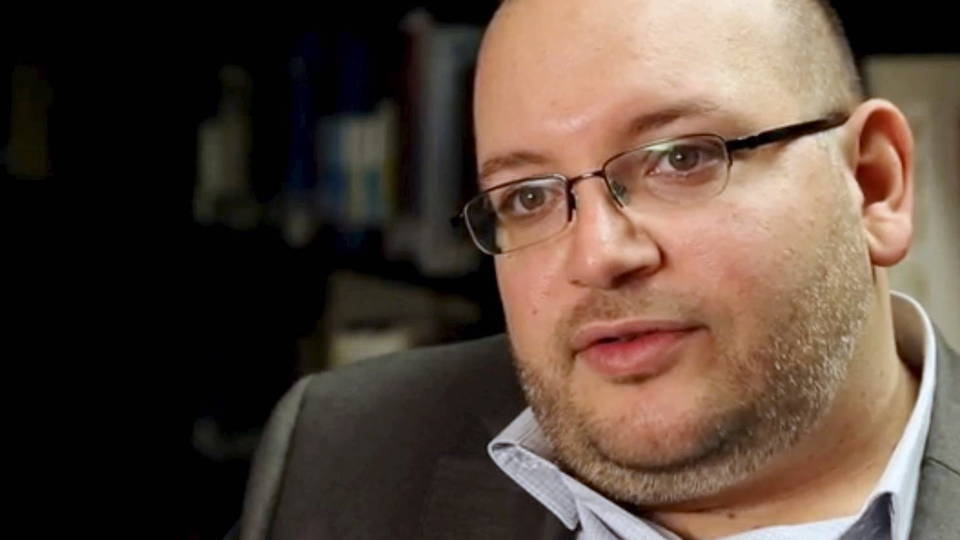
The Obama administration said on Wednesday that $400 million in cash paid to Iran the same day as the release of Americans detained there was not a ransom, as some Republicans have charged. The five prisoners, including Washington Post reporter Jason Rezaian, were released in January. The White House had announced before the prisoners’ release that it would send Iran $400 million in funds as part of the landmark nuclear deal. The money has been owed to Iran since the 1970s, when the U.S. refused to give them weapons Iran had already paid for, following the Iranian revolution. But the timing of the transfer was only first reported in The Wall Street Journal this week, fueling allegations it was linked to the release of the prisoners.
TOPICS:
Iran
Discriminatory Texas Voter ID Law Will Be Changed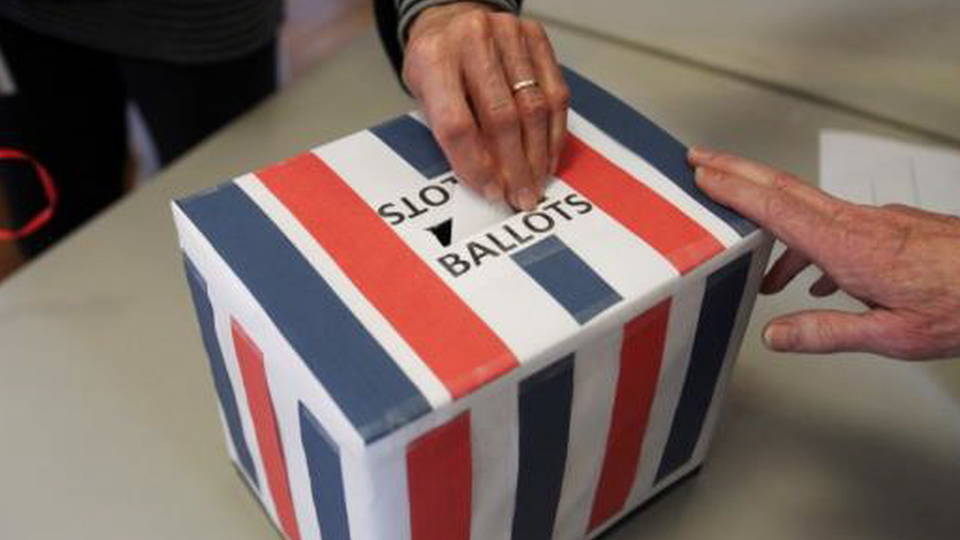
Civil rights groups, the Justice Department and the state of Texas have reached an agreement over the state’s voter ID laws. A federal court ruling last month ordered the law be changed, after finding it discriminated against African-American and Latino voters. Texas residents will now be allowed to cast ballots in November’s election even if they have none of the seven identifying documents that the law had required. This comes less than a week after courts nullified a similar voter ID law in North Carolina and ordered Wisconsin to expand its list of valid ID cards and do away with other voting restrictions.
TOPICS:
Voting
2016 Election
SCOTUS Blocks Ruling Allowing Trans Student to Boys' Bathroom
The Supreme Court has blocked a court order requiring a Virginia school district to accommodate a transgender student’s request to use the male restroom. A Virginia appeals court ruled in favor of high school student Gavin Grimm in April, saying that the federal law Title IX protects the rights of students to use the bathroom that corresponds with their gender identity. But on Wednesday, the Supreme Court blocked this ruling, saying it wanted to "preserve the status quo," until the court decides whether to hear Grimm’s challenge to the school board. Wednesday’s announcement marks the first time the Supreme Court has become involved with the issue of transgender bathroom rights.
TOPICS:
LGBT
Federal Judge Blocks Release of Alton Sterling Autopsy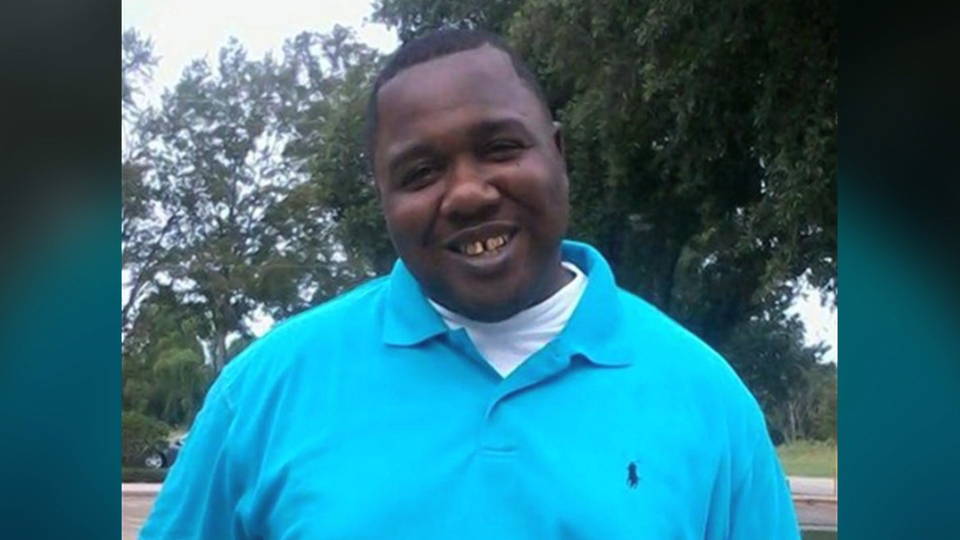
A federal judge has ordered a coroner’s office not to publicly release an autopsy report on the death of Alton Sterling, the African-American man shot and killed by police officers in Baton Rouge, Louisiana. East Baton Rouge Parish Coroner Beau Clark said it is the first time in his three years as coroner that a court order has sealed one of his office’s reports. Sterling’s death sparked nationwide protests against police brutality.
TOPICS:
Police Brutality
Police
Maryland: Police Change Story in Fatal Shooting of Korryn Gaines
Meanwhile, in Maryland, new details have emerged in the police shooting of an African-American woman after an armed standoff. Police say they shot and killed Korryn Gaines Monday after she pointed a rifle at them. Her five-year-old son was in the apartment with her and was injured by gunfire. Police initially said they entered Korryn Gaines’s apartment with a key obtained from her landlord. But court documents say police kicked down the door. Police were at Gaines’s apartment to execute an arrest warrant related to a traffic violation. Police have not said who fired the shot that injured Gaines’ son.
TOPICS:
Police
Police Brutality
North Korea Continues Ballistic Missile Tests
Turning to North Korea, the government launched a ballistic missile on Wednesday that crashed into the ocean near Japan. It is the latest in a series of test launches by North Korea and comes as a decision by the U.S. to place an anti-missile system in South Korea has raised tensions in the region.
TOPICS:
North Korea
South Koreans Continue Daily Protest Against U.S. Missile Base
In South Korea, daily protests against the deployment the U.S.’s THAAD missile system continued into their second week today. Residents of Seongju County, southeast of Seoul, have held daily demonstrations since their area was announced as the location for a missile base. The South Korean government says it needs the missiles to counter threats from North Korea, but not all South Koreans agree. This is South Korean National Assemblymember Kim Han Jung.
Kim Han Jung: "The motivation of the Seongju residents’ fight is not only about protecting their own interests, and they are not fighting alone. They fight for peace in the Korean Peninsula, for the good of their homeland."
TOPICS:
South Korea
North Korea
Philippines: 400+ Killed in President Duterte's "War on Drugs"
Filipino police, military and vigilantes have killed more than 400 people in a crackdown against drug crime since President Rodrigo Duterte took office a month ago. Human rights groups say many of those killed have been summarily shot or had nothing to do with the drug trade. More than 100,000 people have turned themselves in to police for drug offenses to avoid the prospect of a violent arrest. Prior to his election, Duterte admitted to his role in death squads, joked about the gang rape of an Australian missionary and pledged to kill tens of thousands of people.
TOPICS:
Philippines
Obama Sets Record by Granting 214 Prisoners Clemency in One Day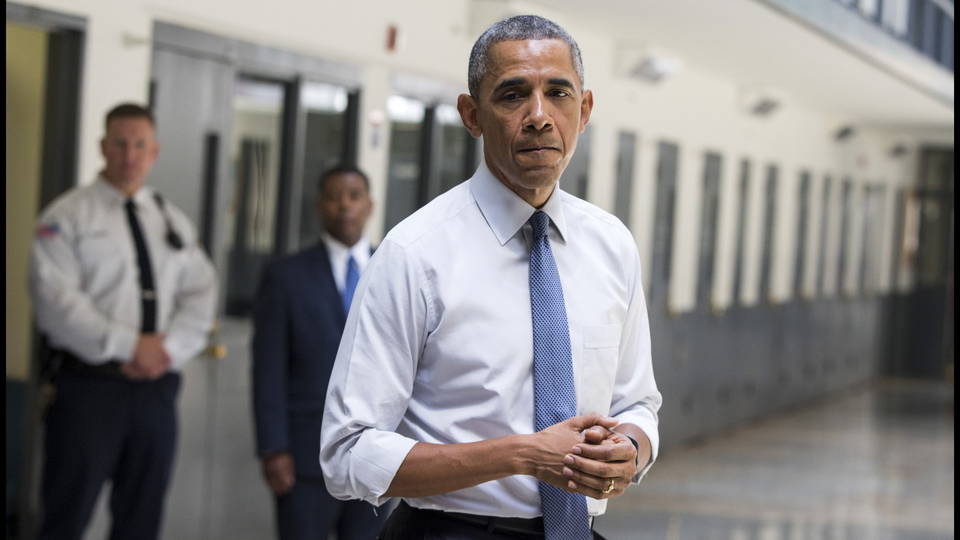
President Obama commuted the sentences of 214 federal prisoners on Wednesday. The White House says it is the largest number of prisoners granted clemency on a single day in at least the last 100 years. Almost all of those released had been convicted of nonviolent drug crimes. To date, Obama has commuted the sentences of 562 federal prisoners, more than the previous nine presidents combined.
TOPICS:
Prison
MO Public Defender Gives Case to Governor to Protest Lack of Funds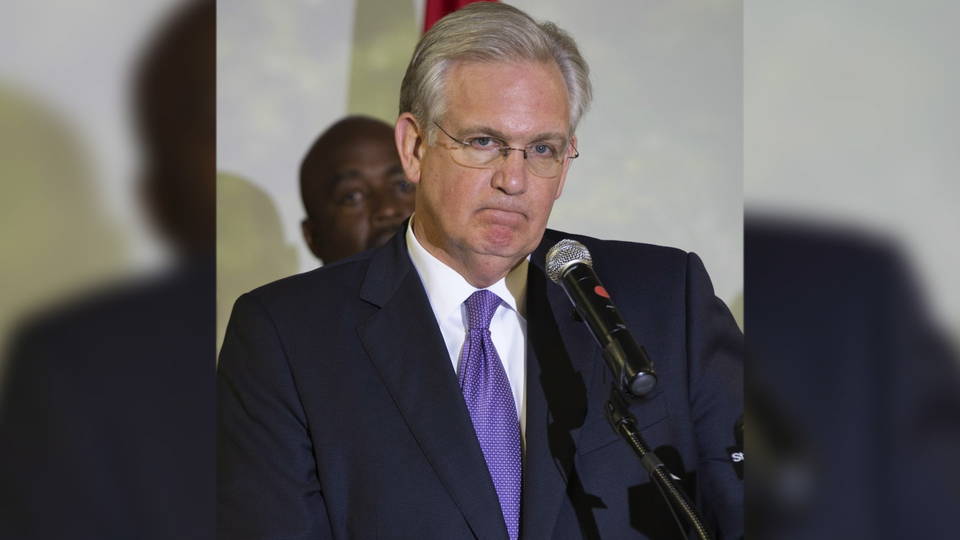
And Missouri’s lead public defender has ordered Missouri Governor Jay Nixon to represent a poor defendant in court later this month, in efforts to protest Nixon’s refusal to sufficiently fund the Public Defender’s Office. Public defender Michael Barrett says he is using a state law that allows him to delegate a client’s legal representation to any lawyer in Missouri. Governor Nixon is a lawyer. Barrett said Nixon has declined to give the public defender system the money it requests. Nixon is also withholding promised funding increases this year.
Donate today:
Follow:


COLUMN

"The Voting Rights Acts in the Era of Jim Crow 2.0" by Amy Goodman & Denis Moynihan
The Voting Rights Act, signed into law by President Lyndon Johnson on Aug. 6, 1965, helped enfranchise millions of African-Americans over the decades. Speaking before a bipartisan gathering of members of Congress, his Cabinet, civil-rights leaders and the press, Johnson said of African-Americans: "They came in darkness and they came in chains. And today we strike away the last major shackle of those fierce and ancient bonds."
The Voting Rights Act was renewed and extended several times during the last half-century. Then, in June 2013, a divided U.S. Supreme Court, voting 5-4, gutted the law. Almost immediately, Southern states began passing restrictive voting laws, disenfranchising hundreds of thousands, if not millions, of voters. Three years later, however, this new generation of Jim Crow-style laws is facing federal court challenges, and they are being thrown out or significantly weakened, one by one.
The most recent, and perhaps most sweeping, of the court decisions came down last Friday in North Carolina. There, a controversial law signed by Republican Gov. Pat McCrory just weeks after the Supreme Court gutted the Voting Rights Act, eliminated many provisions of the state’s election laws that had extended the vote to many, mostly African-American North Carolinians. The law imposed a strict photo-identification requirement in order to vote. It did away with much of the state’s early voting, including Sunday voting, which is very important to the African-American community, as church congregations go together after services in what is called "souls to the polls." The state eliminated countywide voting, allowing people to vote outside their specific precinct, and eliminated same-day registration and preregistration of 16- and 17-year-olds. All these were improvements to the state’s voter- enfranchisement laws that had been enacted when the state government was under Democratic control.
The appeals court wrote, "The new provisions target African Americans with almost surgical precision." The judges found that the North Carolina Legislature and governor, under Republican control since early 2011, offered no proof of voter fraud — the primary Republican justification for enacting restrictive voting laws. Or as Republican presidential candidate Donald Trump warned with no evidence, "We may have people vote 10 times."
This has become a principal electoral strategy of Republicans, especially since the election of President Barack Obama in 2008. Ari Berman, a writer for The Nation and author of the must-read book "Give Us the Ballot: The Modern Struggle for Voting Rights in America," subtitled his most recent piece, summarizing the court decisions that are rejecting these restrictive voting laws, "The Republican war on voting rights is backfiring." He writes about court victories for those challenging these laws in North Carolina, Wisconsin, Texas, Michigan, Ohio and Kansas.
Berman told us on the "Democracy Now!" news hour about Elizabeth Gholar, one person whose right to vote was denied:
"She’s an elderly woman who was born in Jim Crow North Carolina, and then she moved to Texas. She had a Louisiana driver’s license, which was not accepted as valid voter ID in Texas. And her birth certificate was not accepted as a valid form of ID to be able to get a government-issued ID in Texas. Because she was born at home to a midwife, she basically had to retain a lawyer to be able to get all her documentation in Louisiana. This was incredibly emotional. She testified in federal court and basically said: 'I was born in Jim Crow before African-Americans were able to vote in Louisiana, and now I can't vote again. For the first time in 60 years, I am not able to vote in the state of Texas, and this breaks my heart.’"
For people like Gholar, this new tide of disenfranchisement may be turning, but whether it happens in time for the November presidential election remains to be seen. As Berman notes: "We’re less than 100 days from the election now, and this is the first presidential election in 50 years without the full protections of the Voting Rights Act. Seventeen states have new restrictions in place for the first time ... it’s still a very uncertain situation."
The North Carolina court decision, like the passage of the Voting Rights Act itself, was preceded by years of nonviolent protest. In 1965, the center of activity was Selma, Alabama, where peaceful marchers were brutally attacked by state police as they crossed the Edmund Pettus Bridge, named for a Confederate general and Ku Klux Klan Grand Dragon. In North Carolina, the state NAACP chapter has organized thousands to engage in civil disobedience during its weekly "Moral Mondays" protests. Over half a century after the Voting Rights Act became law, the struggle continues.
NEW BOOK

Democracy Now!: Twenty Years Covering the Movements Changing America
WORK WITH DN!

Senior TV Producer
Development Manager
207 West 25th Street. 11th Floor
VP Nominee Mike Pence Contradicts Trump, Endorses Paul Ryan
In election news, Republican presidential nominee Donald Trump’s campaign appears to be in turmoil, with widening divisions both inside the Trump campaign, and between Trump and Republican Party leaders. On Tuesday, Trump’s running mate, Indiana Governor Mike Pence, endorsed House Speaker Paul Ryan in his Wisconsin congressional race, after Trump refused to endorse Ryan earlier this week. Instead, Trump has praised Ryan’s opponent in the race, saying he was "running a very good campaign." Ryan’s opponent, Paul Nehlen, has defended Trump’s attack on Khizr and Ghazala Khan, the parents of a U.S. Army captain who died serving in Iraq in 2004. Ryan, however, publicly distanced himself from Trump over the comments.
TOPICS:
DNC 2016
Trump's Campaign in Turmoil, Staffers are "Suicidal"
Trump’s refusal to endorse Ryan comes amid reports Trump’s campaign staff are beginning to panic. On Monday, Trump’s campaign announced the firing of two senior advisers, including longtime GOP strategist Ed Brookover, who had been Trump’s liaison to the Republican National Committee. Then, on Wednesday, a Trump campaign staffer told CNBC Trump’s staff were "suicidal" and that campaign manager Paul Manafort was unable to control Trump and was "mailing it in." This comes as a number of top Republicans have said in recent days they would support Trump’s rival, Hillary Clinton. On Wednesday, Newt Gingrich—who until two weeks ago was considered a possible running mate for Trump—criticized Trump.
Newt Gingrich: "Trump is still behaving like as though it was the primaries and there were 17 candidates. He has not made the transition to being the potential president of the United States, which is a much tougher league. People are going to watch you every single day. They’re going to take everything they can out of context. And he is not yet performing at the level that you need to."
Later, Newt Gingrich walked back his comments, saying he’s behind Trump 100 percent. At a campaign rally in Florida yesterday, Trump sought to assure voters his campaign is fine.
Donald Trump: "I would say right now it’s the best in terms of being united that it’s been since we began. We’re doing incredibly well. We’re leading in the state of Florida. You saw the poll. We’re leading in Ohio. We’re about tied in Pennsylvania, but I think we’re going to be leading the next time. So I think we—I think we’ve never been this united. And I just want to thank everybody for being here. This is incredible."
TOPICS:
2016 Election
Donald Trump
Clinton Tours Factory, Chastises Trump for Using Chinese Manufacturers
And as Hillary Clinton campaigned on Wednesday, she used a visit to a Colorado tie factory to chastise Donald Trump for manufacturing ties in China. Clinton said, "If he wants to make America great again, he should start by making things in America—and there’s a lot he could learn by coming here."
TOPICS:
Hillary Clinton
2016 Election
Report: Trump Asks About Nukes "If We Have Them, Why Can't We Use Them?"
Meanwhile, Trump’s grasp of foreign policy has come up repeatedly as a potential issue if he were elected president. On MSNBC on Tuesday, host Joe Scarborough made this troubling claim about Trump.
Joe Scarborough: "Several months ago, a foreign policy expert, on the international level, went to advise Donald Trump, and three times he asked about the use of nuclear weapons. Three times, he asked, at one point, 'If we have them, why can't we use them?’"
TOPICS:
Donald Trump
2016 Election
Green Party Presidential Convention Begins in Houston, TX
The Green Party presidential convention begins today in Houston, Texas. The agenda includes workshops on abolishing constitutional rights for corporations and how to run for public office. Presumptive Green Party presidential nominee Jill Stein will be there with her running mate, human rights activist Ajamu Baraka.
TOPICS:
2016 Election
Progressive Pramila Jayapal Wins Washington Primary in Landslide
In more election news, progressive candidate Pramila Jayapal has won a congressional primary in Washington state with 38 percent of the vote. Jayapal was one of the first candidates to receive an endorsement from Bernie Sanders. Jayapal has championed initiatives that include expanding Social Security benefits, debt-free college and a $15 minimum wage. Her win follows other congressional primary victories for progressives, including Zephyr Teachout in New York and Jamie Raskin in Maryland. Meanwhile, in a congressional primary in Kansas on Tuesday, tea party Congressmember Tim Huelskamp lost in a landslide to John Marshall, a political novice. Congressmember Huelskamp was a part of the right-wing Freedom Caucus, which battled repeatedly with former House Speaker John Boehner. A widely circulated photo showed Boehner toasting Huelskamp’s defeat.
TOPICS:
2016 Election
White House Denies $400 Million Cash Payment to Iran was Ransom
The Obama administration said on Wednesday that $400 million in cash paid to Iran the same day as the release of Americans detained there was not a ransom, as some Republicans have charged. The five prisoners, including Washington Post reporter Jason Rezaian, were released in January. The White House had announced before the prisoners’ release that it would send Iran $400 million in funds as part of the landmark nuclear deal. The money has been owed to Iran since the 1970s, when the U.S. refused to give them weapons Iran had already paid for, following the Iranian revolution. But the timing of the transfer was only first reported in The Wall Street Journal this week, fueling allegations it was linked to the release of the prisoners.
TOPICS:
Iran
Discriminatory Texas Voter ID Law Will Be Changed
Civil rights groups, the Justice Department and the state of Texas have reached an agreement over the state’s voter ID laws. A federal court ruling last month ordered the law be changed, after finding it discriminated against African-American and Latino voters. Texas residents will now be allowed to cast ballots in November’s election even if they have none of the seven identifying documents that the law had required. This comes less than a week after courts nullified a similar voter ID law in North Carolina and ordered Wisconsin to expand its list of valid ID cards and do away with other voting restrictions.
TOPICS:
Voting
2016 Election
SCOTUS Blocks Ruling Allowing Trans Student to Boys' Bathroom
The Supreme Court has blocked a court order requiring a Virginia school district to accommodate a transgender student’s request to use the male restroom. A Virginia appeals court ruled in favor of high school student Gavin Grimm in April, saying that the federal law Title IX protects the rights of students to use the bathroom that corresponds with their gender identity. But on Wednesday, the Supreme Court blocked this ruling, saying it wanted to "preserve the status quo," until the court decides whether to hear Grimm’s challenge to the school board. Wednesday’s announcement marks the first time the Supreme Court has become involved with the issue of transgender bathroom rights.
TOPICS:
LGBT
Federal Judge Blocks Release of Alton Sterling Autopsy
A federal judge has ordered a coroner’s office not to publicly release an autopsy report on the death of Alton Sterling, the African-American man shot and killed by police officers in Baton Rouge, Louisiana. East Baton Rouge Parish Coroner Beau Clark said it is the first time in his three years as coroner that a court order has sealed one of his office’s reports. Sterling’s death sparked nationwide protests against police brutality.
TOPICS:
Police Brutality
Police
Maryland: Police Change Story in Fatal Shooting of Korryn Gaines
Meanwhile, in Maryland, new details have emerged in the police shooting of an African-American woman after an armed standoff. Police say they shot and killed Korryn Gaines Monday after she pointed a rifle at them. Her five-year-old son was in the apartment with her and was injured by gunfire. Police initially said they entered Korryn Gaines’s apartment with a key obtained from her landlord. But court documents say police kicked down the door. Police were at Gaines’s apartment to execute an arrest warrant related to a traffic violation. Police have not said who fired the shot that injured Gaines’ son.
TOPICS:
Police
Police Brutality
North Korea Continues Ballistic Missile Tests
Turning to North Korea, the government launched a ballistic missile on Wednesday that crashed into the ocean near Japan. It is the latest in a series of test launches by North Korea and comes as a decision by the U.S. to place an anti-missile system in South Korea has raised tensions in the region.
TOPICS:
North Korea
South Koreans Continue Daily Protest Against U.S. Missile Base
In South Korea, daily protests against the deployment the U.S.’s THAAD missile system continued into their second week today. Residents of Seongju County, southeast of Seoul, have held daily demonstrations since their area was announced as the location for a missile base. The South Korean government says it needs the missiles to counter threats from North Korea, but not all South Koreans agree. This is South Korean National Assemblymember Kim Han Jung.
Kim Han Jung: "The motivation of the Seongju residents’ fight is not only about protecting their own interests, and they are not fighting alone. They fight for peace in the Korean Peninsula, for the good of their homeland."
TOPICS:
South Korea
North Korea
Philippines: 400+ Killed in President Duterte's "War on Drugs"
Filipino police, military and vigilantes have killed more than 400 people in a crackdown against drug crime since President Rodrigo Duterte took office a month ago. Human rights groups say many of those killed have been summarily shot or had nothing to do with the drug trade. More than 100,000 people have turned themselves in to police for drug offenses to avoid the prospect of a violent arrest. Prior to his election, Duterte admitted to his role in death squads, joked about the gang rape of an Australian missionary and pledged to kill tens of thousands of people.
TOPICS:
Philippines
Obama Sets Record by Granting 214 Prisoners Clemency in One Day
President Obama commuted the sentences of 214 federal prisoners on Wednesday. The White House says it is the largest number of prisoners granted clemency on a single day in at least the last 100 years. Almost all of those released had been convicted of nonviolent drug crimes. To date, Obama has commuted the sentences of 562 federal prisoners, more than the previous nine presidents combined.
TOPICS:
Prison
MO Public Defender Gives Case to Governor to Protest Lack of Funds
And Missouri’s lead public defender has ordered Missouri Governor Jay Nixon to represent a poor defendant in court later this month, in efforts to protest Nixon’s refusal to sufficiently fund the Public Defender’s Office. Public defender Michael Barrett says he is using a state law that allows him to delegate a client’s legal representation to any lawyer in Missouri. Governor Nixon is a lawyer. Barrett said Nixon has declined to give the public defender system the money it requests. Nixon is also withholding promised funding increases this year.
Donate today:
Follow:
COLUMN
"The Voting Rights Acts in the Era of Jim Crow 2.0" by Amy Goodman & Denis Moynihan
The Voting Rights Act, signed into law by President Lyndon Johnson on Aug. 6, 1965, helped enfranchise millions of African-Americans over the decades. Speaking before a bipartisan gathering of members of Congress, his Cabinet, civil-rights leaders and the press, Johnson said of African-Americans: "They came in darkness and they came in chains. And today we strike away the last major shackle of those fierce and ancient bonds."
The Voting Rights Act was renewed and extended several times during the last half-century. Then, in June 2013, a divided U.S. Supreme Court, voting 5-4, gutted the law. Almost immediately, Southern states began passing restrictive voting laws, disenfranchising hundreds of thousands, if not millions, of voters. Three years later, however, this new generation of Jim Crow-style laws is facing federal court challenges, and they are being thrown out or significantly weakened, one by one.
The most recent, and perhaps most sweeping, of the court decisions came down last Friday in North Carolina. There, a controversial law signed by Republican Gov. Pat McCrory just weeks after the Supreme Court gutted the Voting Rights Act, eliminated many provisions of the state’s election laws that had extended the vote to many, mostly African-American North Carolinians. The law imposed a strict photo-identification requirement in order to vote. It did away with much of the state’s early voting, including Sunday voting, which is very important to the African-American community, as church congregations go together after services in what is called "souls to the polls." The state eliminated countywide voting, allowing people to vote outside their specific precinct, and eliminated same-day registration and preregistration of 16- and 17-year-olds. All these were improvements to the state’s voter- enfranchisement laws that had been enacted when the state government was under Democratic control.
The appeals court wrote, "The new provisions target African Americans with almost surgical precision." The judges found that the North Carolina Legislature and governor, under Republican control since early 2011, offered no proof of voter fraud — the primary Republican justification for enacting restrictive voting laws. Or as Republican presidential candidate Donald Trump warned with no evidence, "We may have people vote 10 times."
This has become a principal electoral strategy of Republicans, especially since the election of President Barack Obama in 2008. Ari Berman, a writer for The Nation and author of the must-read book "Give Us the Ballot: The Modern Struggle for Voting Rights in America," subtitled his most recent piece, summarizing the court decisions that are rejecting these restrictive voting laws, "The Republican war on voting rights is backfiring." He writes about court victories for those challenging these laws in North Carolina, Wisconsin, Texas, Michigan, Ohio and Kansas.
Berman told us on the "Democracy Now!" news hour about Elizabeth Gholar, one person whose right to vote was denied:
"She’s an elderly woman who was born in Jim Crow North Carolina, and then she moved to Texas. She had a Louisiana driver’s license, which was not accepted as valid voter ID in Texas. And her birth certificate was not accepted as a valid form of ID to be able to get a government-issued ID in Texas. Because she was born at home to a midwife, she basically had to retain a lawyer to be able to get all her documentation in Louisiana. This was incredibly emotional. She testified in federal court and basically said: 'I was born in Jim Crow before African-Americans were able to vote in Louisiana, and now I can't vote again. For the first time in 60 years, I am not able to vote in the state of Texas, and this breaks my heart.’"
For people like Gholar, this new tide of disenfranchisement may be turning, but whether it happens in time for the November presidential election remains to be seen. As Berman notes: "We’re less than 100 days from the election now, and this is the first presidential election in 50 years without the full protections of the Voting Rights Act. Seventeen states have new restrictions in place for the first time ... it’s still a very uncertain situation."
The North Carolina court decision, like the passage of the Voting Rights Act itself, was preceded by years of nonviolent protest. In 1965, the center of activity was Selma, Alabama, where peaceful marchers were brutally attacked by state police as they crossed the Edmund Pettus Bridge, named for a Confederate general and Ku Klux Klan Grand Dragon. In North Carolina, the state NAACP chapter has organized thousands to engage in civil disobedience during its weekly "Moral Mondays" protests. Over half a century after the Voting Rights Act became law, the struggle continues.
NEW BOOK
Democracy Now!: Twenty Years Covering the Movements Changing America
WORK WITH DN!
Senior TV Producer
Development Manager
207 West 25th Street. 11th Floor
New York, New York 10001, United States
----------------------------
----------------------------

No comments:
Post a Comment