democracynow.org
Stories:

Green Party Nominee Jill Stein: "We Are Saying No to the 'Lesser Evil' and Yes to the Greater Good"
In Houston, Texas, Dr. Jill Stein formally accepted the Green Party’s nomination for president at the party’s convention over the weekend. Interest in the Green Party has jumped in recent weeks since Hillary Clinton won the Democratic nomination, defeating Bernie Sanders. In 2012, Dr. Stein ran on the Green ticket and won less than 1 percent of the national vote. But according to CNN’s Poll of Polls, Stein is now polling at 5 percent. The same poll finds Clinton at 45 percent, Republican Donald Trump at 35 percent and Libertarian Gary Johnson at 9 percent. Neither Stein nor Johnson will be invited to take part in this fall’s presidential debates, however, unless they top 15 percent in national polls. For more, we hear excerpts of Dr. Jill Stein speaking at the Green Party convention.
TRANSCRIPT
This is a rush transcript. Copy may not be in its final form.
AMY GOODMAN: This is Democracy Now!, democracynow.org. We are "Breaking with Convention: War, Peace and the Presidency." I’m Amy Goodman. Dr. Jill Stein has accepted the Green Party’s presidential nomination at the party’s convention in Houston. Stein is running alongside longtime human rights activist Ajamu Baraka.
Interest in the Green Party has jumped in recent weeks since Hillary Clinton won the Democratic nomination, defeating Bernie Sanders. In 2012, Dr. Stein ran on the Green ticket and won less than 1 percent of the national vote. But according to CNN’s Poll of Polls, Stein is now polling at 5 percent. The same poll finds Clinton at 45 percent, Republican Donald Trump at 35 percent and Libertarian Gary Johnson at 9 percent.
Despite Stein and Johnson’s rise in the polls, neither will be invited to take part in this fall’s presidential debates unless they top 15 percent in national polls. Last week, a federal judge threw out a lawsuit by Johnson and Stein against the Commission on Presidential Debates over the debate rules.
Well, we’ll spend the rest of the hour airing excerpts from the Green Party convention in Houston. We begin with Dr. Jill Stein speaking Saturday as she accepted the Green Party nomination.
DR. JILL STEIN: You know, hold onto your hat, folks, because we are in a whirlwind right now, a whirlwind that is way bigger than any of us. We have a job to do. We have a role to play that will not be played by anybody but us. We are the ones we’ve been waiting for. When they tell us to, you know, get out of the way, because we’re standing in the way of the lesser evil, you know, the answer to that is that this politics of fear, which we’ve been told to bow down to, has only delivered everything we were afraid of. All those reasons we were told to vote for the lesser evil—because we didn’t want the offshoring of our jobs, the meltdown of the climate, the massive bailouts for Wall Street, the expanding prison state, the attack on our civil liberties and on immigrant rights—all those things we didn’t want is exactly what we got by allowing ourselves to be silenced and letting a lesser evil speak for us.
Remember, when they try to tell you you are powerless, remember what Alice Walker says: The biggest way people give up power is by not knowing we have it to start with. We have it. We are going to use it in this election.
We are saying no to the lesser evil and yes to the greater good, because we are not only deciding what kind of a world we will have; in this election, we are deciding whether we will have a world or not, going forward into the future. The day of reckoning is coming closer and closer. On climate change, we are told that there will be a civilization-ending development in the form of massive sea level rise as soon as 2050. Anybody plan to be here in 2050? I think a few of us do, myself included. So, we cannot wait, because we have to act now if we want to stop that sea level rise from happening in 2050. We need to declare a state of emergency right now and undertake a wartime-scale mobilization to create those 20 million jobs and create that 100 percent clean energy now. We have a crisis in nuclear weapons, and again thanks very much to the Democrats. Bill Clinton, who removed us from the Anti-Ballistic Missile Treaty framework for nuclear disarmament, and then Barack Obama, who created a trillion-dollar budget for us to spend on a new generation of nuclear weapons and modes of delivery.
So, on the count of climate, on the count of nuclear weapons and this insane nuclear arms race that we are once again headlong plunging into, and on account of these endless and expanding wars, that are blowing back at us all around the world, we cannot afford to sit this one out. The lesser evil is a losing strategy, because people stop coming out to vote for lesser evil politicians throwing them under the bus. So the Republicans will win anyhow.
And to look at Donald Trump, Donald Trump does not stand alone. Donald Trump is about the rise of right-wing extremism, not only in this country, but in Europe. And as Bernie Sanders himself so often said, the only solution to the likes of Donald Trump is a truly radical, progressive agenda that restores our needs and ends the economic misery that promotes the kinds of demagogues we are seeing in Donald Trump. We are the ones we’ve been waiting for. Hillary Clinton is the problem; she is not the solution to Donald Trump. We are the solution. We are the ones we’ve been waiting for. This is our moment. Together, we do have the power to create an America and a world that works for all of us. The power to create that world is not just in our hopes. It’s not just in our dreams. Right here and now, it’s in our hands. We will make this happen together. We are unstoppable. Thank you so much. On we go. Thank you.
AMY GOODMAN: That was Green Party presidential nominee Jill Stein speaking Saturday at her party’s convention in Houston. When we come back from break, you’ll hear from her running mate, human rights activist Ajamu Baraka. Stay with us.
The original content of this program is licensed under a Creative Commons Attribution-Noncommercial-No Derivative Works 3.0 United States License. Please attribute legal copies of this work to democracynow.org. Some of the work(s) that this program incorporates, however, may be separately licensed. For further information or additional permissions, contact us. ... Read More →

WikiLeaks' Julian Assange: Attacks Against Jill Stein Are "Going to Go Through the Roof"
WikiLeaks founder Julian Assange spoke via video stream to the Green Party convention in Houston, Texas, about the corporate control of information during the 2016 election. He also predicted that attacks against Green Party nominee Dr. Jill Stein would surge ahead of November’s election.
TRANSCRIPT
This is a rush transcript. Copy may not be in its final form.
DAVID COBB: Julian, Greens, like most Americans, are civil libertarians at heart. We believe in personal privacy. We believe in internet freedom, even as we call for complete public transparency and accountability. My question to you is: What can we do as individuals to protect ourselves, and what can we do to help build the movement for keeping the internet free and open, so we, the people, can talk to ourselves?
JULIAN ASSANGE: All right, great question. Well, first of all, have coherency in your own movement. I mean, you have to have coherency to be able to understand your own view of the world and the attacks that are occurring, which—let me tell you that I’ve just seen that the attacks have started to ramp up on Jill Stein. They are going to go through the roof. I’ve had attacks from what is effectively the Clinton threat machine. They’re now post-convention. You guys are going to be post-convention. Those attacks are going to be ferocious. But you’ll see from that and learn lessons from that about how the media works and how one can defend your principles and ideas in the face of that kind of media corruption.
So, to defend civil liberties and the internet, the first thing is to practice it. That’s the number one thing. That’s what we do. We defend the First Amendment and similar constitutional amendments in other states by practicing them. We have won every single court case that we have been involved in over the last 10 years. And that any right that is not fought for through practice and defense is very, very quickly lost. It is just a piece of paper unless you actually fight for it and practice for it.
Then there’s a range of technical measures and some good people, researchers, trying to push out those technical measures. WikiLeaks tweets about that. Edward Snowden tweets about what some of those technical measures are. Support those people who are engaged in trying to engineer, in a practical sense, how to protect people’s privacy. And the other is to support the various groups that are doing it and to build the ideological understanding that it is an important thing, because—let’s go back and look at Google.
Google is very different, in an important way, from Lockheed Martin. Yes, Google is building drones. Yes, Lockheed Martin was and is building F-16s. But Google also controls how we communicate with each other. So, Google is, in a sense, like HIV. It doesn’t—it’s not just something that afflicts your arm; it afflicts your ability to understand and fight the infection. That’s true of all media, libraries, communication services, etc. They’re involved in that part of society that we use to understand ourselves, and that is the freedom of communication. So, the freedom of communication, in some sense, is the fundamental right, because it is the enabling right that allows us to speak to each other to understand the importance of all our other rights. And so, when the freedom of communication is degraded or maligned, when whistleblowers are prosecuted, when one organization starts to develop a monopoly on the internet and interfere with our communication, then all our rights suffer, because this fundamental enabling right is degraded.
As the editor of WikiLeaks, I have gone through a lot of battles. I have seen corrupt mainstream media outlets try to not report initially on some of our materials, spin them in other directions—that’s happened just recently. And I have also seen good journalists, embedded in those institutions, fighting to be accurate and truthful. There are good people even in bad institutions. Most of our sources are good people wanting to do good things, within the U.S. military or intelligence or political parties.
So, my strong advice is to understand, first of all, the necessity to be very skeptical of the traditional media apparatus, which is ultimately owned by some of the largest industrial conglomerates in the world, that’s firmly connected to other points of power; work around it; become your own media in practice, in small ways, in big ways; to keep—to keep your principles and sense of clarity on principles.
What the Clinton campaign is doing at the moment is trying to say, "Well, OK, yes, maybe we’re connected to arms dealers and to Saudi Arabia, and, yes, maybe we subverted the integrity of the Democratic primaries, etc., etc., but you will just have to swallow that. You will just have to swallow that, or else you will get Donald Trump." That’s a form of extortion. And—well, it is. It is a form of extortion. And—
DAVID COBB: You have elicited applause, Julian.
JULIAN ASSANGE: And you can’t—you can’t permit—it’s very important not to allow the political process to suffer from extortion, or even yourself to be susceptible to extortion. One says one has certain principles. If these principles are not followed, then there is a price to be paid. And that creates a standard and a general deterrent. And I think it is important for those people who feel that their principles have been violated, in the way that the Democratic primary process has been run, or how Chelsea Manning has been imprisoned for 35 years and tortured, or the Espionage Act crackdowns, or many other things, to go, "OK, well, there’s a cost to violating principles," even if—even if there’s also a cost to yourself, even if you don’t like the risk, which seems to be getting very small, but the risk that Donald Trump becomes president, that one has to have a line somewhere. Otherwise, as each election cycle proceeds, you are pushed further and further into the corner.
AMY GOODMAN: That’s WikiLeaks founder Julian Assange speaking at the Green Party convention in Houston via video stream from the Ecuadorean Embassy in London, where he’s been holed up for more than four years. He was speaking with the Green Party’s David Cobb. For transcript, podcast, more, go to democracynow.org. Special thanks to John Hamilton. ... Read More →

Google in the White House? Assange Warns of Close Ties Between Hillary Clinton & Internet Giant
During the Green Party convention in Houston, Texas, over the weekend, WikiLeaks founder Julian Assange spoke via video stream about his book "When Google Met WikiLeaks" and the relationship between Hillary Clinton, the State Department and the internet giant Google.
TRANSCRIPT
This is a rush transcript. Copy may not be in its final form.
DAVID COBB: I’m reminded of the great political philosopher Lily Tomlin, who said, "No matter how cynical I get, it’s hard to keep up." Julian, Greens, like most Americans, are disgusted by the collusion between Wall Street, multinational corporations and our own government. We know, as most Americans do, that these large corporations are no longer merely exercising power, they are literally ruling over us. In your book, When Google Met WikiLeaks, you describe, quote, "a special relationship," end-quote, between Google, the U.S. State Department and Hillary Clinton. Could you talk about that, please?
JULIAN ASSANGE: Well, I just want to correct, very quickly, some false reporting. So, very interestingly, when we published the DNC leaks, The New York Times, which has picked its favorite candidate, as has Bloomberg, which is Hillary Clinton, said that I intended to harm Hillary Clinton. This is what we’ve been doing for 10 years. It was a completely fabricated story by Charlie Savage. OK.
But, yes, we are very interested in power and publishing the truth about power, so people can work out however they choose to reform power. And so, Google is a kind of new power on the block, so we are interested in it, and we’re also interested in Hillary Clinton, when she was secretary of state and now, I mean, the presidential candidacy. So, these two powers have merged at a kind of personal level and political level, and even, to a small extent, at the organizational level. So, that book, written three years ago, has been proved to be very prescient.
The chairman of Google, who was the CEO of Google, Eric Schmidt, has started, about a year ago, a company to run Hillary Clinton’s digital campaign. Google has been to the White House, on average over the last four years, once per week—more than any other single company. It spends more money lobbying Washington, D.C., than any other single company. Hillary Clinton’s former staffer, Jared Cohen, was hired by Google in 2009 to head up Google’s internal think tank. There’s a lot of other interconnections between Google and the state. Eric Schmidt is now also, at the same time as being chairman of what is now Google’s parent company, Alphabet, is chairman of the Pentagon innovation board.
So you have a connection between Google, the Clinton campaign, which will be almost certainly the next White House, and the Pentagon. And this triangle is extremely worrying, because, as time goes by, Google is understanding that it does have an ability to influence election campaigns. It’s also bought more than 10 drone companies. It’s integrating its mapping data in order to better be able to fly and navigate drones around the world, is expanding into every country in the world.
And it has a very strange, quasi-religious vision of the future, of this vision of the singularity. It’s really a—I’ve done research that it’s very disturbing what they believe in Silicon Valley, that they believe they can create a massive artificial intelligence, more powerful than any human being or any society’s ability to think. And, of course, we all know what happens when such power is in limited hands.
And so, Google in the White House will be, essentially, an unregulatable company. It’s a question whether it’s already unregulatable, but you can—you can just completely forget about any kind of antitrust legislation being used on Google if there is a Hillary Clinton White House.
DAVID COBB: Julian, I’m reminded that Benito Mussolini, the fascist dictator, said that fascism more appropriately should be called corporatism, because it merges the private power of corporations with the military might of the nation-state. And, of course, he thought that was a good thing. It occurs to me that you were describing our newer, kinder, gentler, smiling face of fascism, where all of the information that we receive is controlled by that same collusion between government and major transnational corporations, and now our ability to even talk to myself, or ourselves. Am I being overdramatic, or do I understand you correctly?
JULIAN ASSANGE: Well, it could be both. It could be both. No, it is—it is possibly the most serious issue. The potential threat of nuclear war, I think, is perhaps the other one. Yes, there is a merger going on at a rapid pace between the largest American corporations and the traditional aspects of the U.S. state, the military intelligence aspects. I mean, that’s been there for a long time, frankly, with Northrop Grumman, General Dynamics, General Electric, etc. But this is a new generation. And Eric Schmidt wrote in his book about Google and the world that what Lockheed Martin and other aerospace companies were to the 20th century, high-tech companies will be to the 21st century. And that’s very much their vision, to integrate with Washington, to prevent antitrust regulation and to be part of that family of traditional D.C.-mediated power.
DAVID COBB: Julian, Greens, like most Americans, have been horrified to learn—and, for many of us, have it objectively collaborated—that multinational corporations and wealthy oligarchs are literally directing U.S. foreign policy. So I have a question for you, because of your unique vantage point: What advice, if any, would you give the next president of the United States about how to shift that policy, given the reality that she might be facing?
JULIAN ASSANGE: Well, that’s a very interesting question. Does it make any difference who is president or not? A very, very interesting question. It certainly doesn’t make as much difference as people say. What really makes a difference is what the environment is in which the president has to work. And that is the environment of critique, on the one hand, to how free the media is, how much opposition organizations are doing their job in holding government to account. And it’s the economic and corporate environment, and then, to a degree, the international foreign affairs environment. And the president is much more a spokesperson for these forces around them.
Where they do make a big difference is in their initial appointments, so the people that they choose to fill those spots in government that then reactively makes policy. But as you can see with Barack Obama, most of the time is spent reading out teleprompters. There’s just not enough time to do much else than be a spokesperson for these groups. So, what is happening now, with the Green Party and Gary Johnson and the Bernie Sanders campaign and so on, is very, very important, but it must be seen past the moment, past this political moment. That’s a moment to build a movement and build pressure. And having built it, then one can discipline and hold to account and check the abuses of government during the next four years.
AMY GOODMAN: WikiLeaks founder Julian Assange speaking at the Green Party convention in Houston, being interviewed by former Green Party presidential candidate David Cobb. Assange’s books include When Google Met WikiLeaks, which is based on Assange’s meeting with Google CEO Eric Schmidt five years ago, when Assange was under house arrest in England, before he was granted political asylum in Ecuador, now living in the Ecuadorean Embassy in London, afraid if he steps foot outside, he’ll be arrested and ultimately extradited to the United States, where there, it is believed, a sealed indictment against him for WikiLeaks. We’ll be back with more of the conversation between Julian Assange and David Cobb in a minute. ... Read More →

Julian Assange: Leaked DNC Emails Show Democrats Waged "Propaganda" Campaign Against Sanders
WikiLeaks founder Julian Assange spoke via video stream at the Green Party convention in Houston, Texas, over the weekend. Assange has been confined to the Ecuadorean Embassy in London for more than four years, fearing that if he were to attempt to leave, he would be arrested by British police and ultimately extradited to the U.S., where it is believed there is a sealed indictment against him over WikiLeaks’ release of documents. Assange was speaking with former Green Party presidential candidate David Cobb. He began by speaking about WikiLeaks’ release of 20,000 internal DNC emails.
TRANSCRIPT
This is a rush transcript. Copy may not be in its final form.
AMY GOODMAN: That’s Green Party vice-presidential nominee Ajamu Baraka speaking at the Green Party convention in Houston on Saturday, as did WikiLeaks founder and editor Julian Assange. He was interviewed via video stream by former Green Party presidential candidate David Cobb. Julian Assange has been holed up in the Ecuadorean Embassy in London for more than four years, fearing that if he were to attempt to leave, he would be arrested by British police and ultimately extradited to the United States, where it’s believed there’s a sealed indictment against him over WikiLeaks’ release of documents. David Cobb started by asking Julian Assange about the recent DNC email leaks.
JULIAN ASSANGE: We published 20,000 [inaudible] emails from the DNC, from Debbie Wasserman Schultz, from the communications director, Luis Miranda, from the chief financial officer and so on, and also communications [inaudible] and to the Hillary Clinton campaign and a number of other groups. What they show is not only was there a sort of internal view or discussions about how to undermine Bernie Sanders and support Hillary Clinton—not surprising, given that Debbie Wasserman Schultz used to work for Hillary Clinton’s campaign—but rather, there were formal instructions made to DNC staff to execute a campaign of black propaganda against Bernie Sanders. For example, Luis Miranda, the communications chief, instructed his staff to put out, in a, quote, "unattributable manner," allegations that Bernie Sanders’ supporters were engaged in acts of violence. Similarly, there was discussions to expose—or, rather, claim that Bernie Sanders was an atheist and that this would harm him in the South, to use his religious beliefs, or, rather, his lack of religious beliefs, against him.
Yeah, so, then there’s aspects to do with how financing was being bounced around between the DNC and the state parties and the Hillary Clinton Victory Fund. To my mind, I think the most ongoing interesting material, which has been picked up by—now, by a wide range of state-based investigative journalists in the U.S., is the influence-peddling structure of the DNC—who goes to what private conventions at particular people’s houses with Barack Obama or with the vice president, Joseph Biden, and the sort of—some of the things that they get into—get in exchange, for example, being put on federal government boards and commissions.
The third big revelation that comes out, which is—I didn’t mention it, because, as someone who’s having to deal with the media all the time, I understand how real this is, but the general public is—it is proof of something important, which is the direct connections between the Hillary Clinton faction in the DNC and the president of MSNBC. For example, Debbie Wasserman Schultz called up the president of NBC in order to haul Morning Joe into line, because they were speaking about the bias of the DNC. Talking points were constructed for Jake Tapper, for example, on CNN. Of course, we don’t know whether he was willing to use them. He has denied that. But at least from the DNC end, they constructed the questions that he was to ask them, even saying—watching coverage live and calling up the networks to say, you know, "Put a stop to that chain of communication right now."
DAVID COBB: Julian, Greens, like most Americans, are grateful for people and organizations that inform and expose illegal or illicit activity on the part of government. That is the very definition of a whistleblower, blowing the whistle on crime. And yet, the U.S. government, under President Obama and Secretary of State Clinton, has prosecuted more whistleblowers than all past presidents combined, and sought and obtained longer jail sentences than previous presidents. Why do you think that is true? And what lessons can be learned there?
JULIAN ASSANGE: Well, I’m afraid it’s much worse than that. The Obama administration has gone after more whistleblowers using the Espionage Act not only than all previous presidents combined back to 1917, when the act was first passed in World War I to deal with World War I spies, but, in fact, now three times as many. So this is really an epidemic to abuse the national security law in order to stop whistleblowers and journalists and publishers. So the attempted prosecution, the pending prosecution of WikiLeaks in the United States, uses the Espionage Act, uses a computer terrorism act, etc. etc. But the same act, the 1917 Espionage Act, was used to go after and obtain subpoenas in relation to a Fox News reporter reporting on information allegedly obtained from the State Department, similarly going after Associated Press’s telephone call records.
So, it’s a—you know there’s a galloping epidemic of abuse of national security law under this Democratic administration, which Hillary Clinton was part of. She and Obama were involved in placing one of my alleged sources, Chelsea Manning, into prison for 35 years, only for communicating truthful information to the public. There’s no other allegation, no allegation about working with spies or anything like that, just communicating truthful information to the press and to the public. That situation is so bad. Chelsea Manning was tortured in prison—it’s a formal finding of the U.N., even a finding by the U.S. military justice system that illegal punishments occurred during imprisonment. And just a week and a half ago, unfortunately, she attempted suicide because of the difficulty in the conditions. ...Read More →

Julian Assange on the Green Party's Rising Popularity & the November Election: "Anything is Possible"
WikiLeaks founder Julian Assange spoke via video stream to the Green Party convention in Houston, Texas, over the weekend about the Green Party’s rising popularity ahead of the November general election. This comes as CNN’s Poll of Polls shows Stein polling at 5 percent—five times more than the 1 percent of the national vote she won in 2012.
TRANSCRIPT
This is a rush transcript. Copy may not be in its final form.
AMY GOODMAN: This is Democracy Now! We are "Breaking with Convention: War, Peace and the Presidency." I’m Amy Goodman. We continue our coverage of the Green Party convention in Houston with the party’s 2004 presidential candidate, David Cobb, interviewing WikiLeaks founder Julian Assange.
JULIAN ASSANGE: It is a remarkable moment in U.S. politics. For the Greens, it’s—I mean, the Greens, if they pursue this campaign, as they do seem to be doing so, can and, I believe, probably will produce a very solid bloc after. And I think that’s really heartening. It’s a horrific vision—I mean, who’s going to be U.S. president, next U.S. president, is a horrific vision. I was asked this question: Did I prefer Clinton or Trump? And, I mean, the answer is: Well, you’re asking do I prefer cholera or gonorrhea. I mean, it’s a very sad situation.
But I think, given the reality has always been that the presidency pretty quickly merges with the bureaucracy that is around it, because bureaucracy is enormous, and the corporate lobbyists are enormous compared to the political parties, that actually it could be a net positive to have a president, in the form of Hillary or Trump, probably—who knows? You never know what happens in a campaign. Maybe Jill Stein will be president. Maybe Gary Johnson will be president. No, I’m serious. You never know. Like, it’s—who knows what happens during a campaign? Anything is possible, and you have to be ready for that. But if it is Hillary Clinton or Donald Trump, then that’s a very adverse environment. But the nature of those—I like things to look like what they are. I think Hillary Clinton, in her statements, demeanor and associations and track record, looks like the power that she actually does represent. Similarly with Donald Trump, maybe even—maybe even Donald Trump even looks more like what the power he’ll end up representing than he does actually represent it. But that’s a situation that generates resistance and accountability, and that is what really checks the behavior of government over time. It is the various pressures that exist on the presidency. That’s what checks their behavior. So, these are two characters that are the most unpopular pair of presidential candidates in U.S. history. And going into the presidency, they are going to continue to generate oversight and resistance, which will not only create a fertile field for Gary Johnson and Jill Stein to grow their support, but will create a very fertile field to understand and hold government to account.
DAVID COBB: So take a note, Greens and Americans everywhere, it is social movements that will actually bring corporate America to heel. Julian, Greens—
JULIAN ASSANGE: That’s right, and—that’s right, and a few whistleblowers.
DAVID COBB: Yes. I stand corrected.
JULIAN ASSANGE: I mean, I’m here in the United—well, I’m here in Ecuador in the United Kingdom with a pending U.S. prosecution. It’s very strange. I’ve become quite a multijurisdictional creature. But the Corbyn phenomenon in the U.K. really does show that something important, very important, is happening. There is a political moment in the English-speaking world that the Greens should and, it looks like, are seizing upon. It’s a very important moment.
DAVID COBB: I do think that North Americans need to have a little more humility as we look to our sisters and brothers in the Global South, who have been fighting empire for 500 years. They have a more acute understanding of actually social movements and the electoral arm of their social movements, so we should be humble and learn that lesson. ... Read More →

A New Day & Another Way: Green VP Nominee Ajamu Baraka Urges Progressives to Reject Two-Party System
The Green Party nominated human rights activist Ajamu Baraka to be Dr. Jill Stein’s vice-presidential running mate during the party’s convention in Houston, Texas, over the weekend. Baraka is the founding executive director of the US Human Rights Network and coordinator of the U.S.-based Black Left Unity Network’s Committee on International Affairs. He has served on the boards of Amnesty International USA, the Center for Constitutional Rights and Africa Action. These are excerpts of Baraka speaking in his acceptance speech and at a news conference during the party convention.
TRANSCRIPT
This is a rush transcript. Copy may not be in its final form.
AMY GOODMAN: This is Democracy Now!, democracynow.org. This is "Breaking with Convention: War, Peace and the Presidency. I’m Amy Goodman. Today we’re looking at the weekend’s Green Party convention in Houston, where Dr. Jill Stein accepted the party’s presidential nomination. Her running mate is Ajamu Baraka, the founding executive director of the US Human Rights Network. He spoke on Saturday in Houston.
AJAMU BARAKA: Brothers and sisters, friends, we are at a critical moment—as Jill says, a transformational moment. We have tremendous opportunities before us. The American people are longing for a change. They are ready to do something different. And we have to be the vehicle for that difference.
You know, there are difficult conditions that the people face. You know, they tell us that there has been a recovery and things are all right from the crisis. But you know what? There are millions of people, people who we work with, who haven’t experienced any kind of recovery. There are millions of people who still don’t have a place to lay their head at night. There’s a reason why the fastest-growing population of homeless people are black women with children. There are millions of people who would like to have a job where they can live a decent life, but they don’t have it. And if they have a job, that basically they are making starvation wages; they’re working two and three different jobs just to make ends meet. But they tell us things are better.
We have a situation where, as a consequence of austerity, across this country, in communities where we live and work, they’re closing down schools. People live in communities where they can’t go to the store, because there’s no store. So you have like 48 million people who are living in situations where they are going to bed every night hungry. We have a situation where, basically, even with so-called Obamacare, we have millions still without healthcare.
These are difficult conditions, difficult conditions. And people are wondering why. Why do we have to—why do we have to accept this kind of situation? And so, when the two parties attempt to try to herd people based on fear, we find that today there are millions of people who are prepared to do something different, who are prepared to go another way. And we are going to be there to provide that opportunity for a new day and another way.
My brothers and sisters, I have lived my entire life committed to the notion of independent politics, building alternative power. I understood that, basically, we had some real possibilities in advancing that struggle for political independence using the electoral process. And that’s where Dr. Stein and the Green Party comes in, for me, personally, because you all get it. Dr. Stein understands that you can’t transform a—you can’t transform a system without struggle, that you have to organize the people, that the electoral process is in fact a process by how we build power. And for me, that is what is attractive to this process and was the basis for me accepting when Dr. Stein called and said, "Ajamu, are you ready to join me?" And I said, "Dr. Stein, I thought about it, I know where you’re coming from, and you can count me in. I’m with you."
It is that commitment to building popular power, it is that commitment to the people, it is that understanding that we have to build a multinational movement here in this country based on the needs and the aspirations of working people, that I joined this effort. It is that commitment, that I stand here proudly and say to all of you it is my honor to accept the nomination for the vice presidency of the United States from the Green Party.
AMY GOODMAN: That’s Green Party vice-presidential nominee Ajamu Baraka speaking in Houston Saturday at the Green Party convention. He’s founding executive director of the US Human Rights Network, coordinator of the U.S.-based Black Left Unity Network’s Committee on International Affairs. He has served on the boards of Amnesty International USA and the Center for Constitutional Rights, as well as Africa Action. On Saturday, he also spoke about police brutality at a news conference during the convention.
AJAMU BARAKA: Black males are always suspicious, even when we have the right uniform on. And as Dr. Stein said, this is something that we have to address here in this country, and we really intend to. You know, one of the things that really is still—is outrageous to me is that one of the reasons why police forces appear to operate with impunity is that there doesn’t appear to be a consequence for these kinds of actions. Not only do we have someone being detained for 35 minutes, which is an assault on your dignity, we’re having—we have people who are being murdered now almost every week, it appears. But yet, we have an administration that is supposed to be responsible for protecting the rights of all citizens, and they have a Civil Rights Division, and they have the power to intervene and to conduct investigations and to prosecute, and out of all of the examples we know of, all of these shootings of unarmed black men—and women now—we have one indictment, over all of these years. That’s outrageous.
While at the same time, what many people don’t know is that in Baltimore and in Ferguson, the young, primarily black, poor folks who involved in—were involved in acts of resistance, they ended up feeling the full weight of the federal government. The federal government intervened into the state and brought indictments against a number of protesters in both Ferguson and in Baltimore. We have people in Baltimore right now who are now serving draconian time now—eight years, 12 years—for things that, in the past, would have been maybe a misdemeanor or probation, because they were prosecuted directly by the federal government. So, you know, when you see these—this kind of imbalance, you know, would we be surprised that the police forces would be emboldened, knowing that basically they can almost do anything without any kind of repercussions? That’s got to be reversed.
AMY GOODMAN: That’s Green Party vice-presidential nominee Ajamu Baraka speaking at the Green Party convention in Houston on Saturday. ... Read More →
Headlines:
Chicago: Video of Police Killing Unarmed Teen Sparks Days of Protests
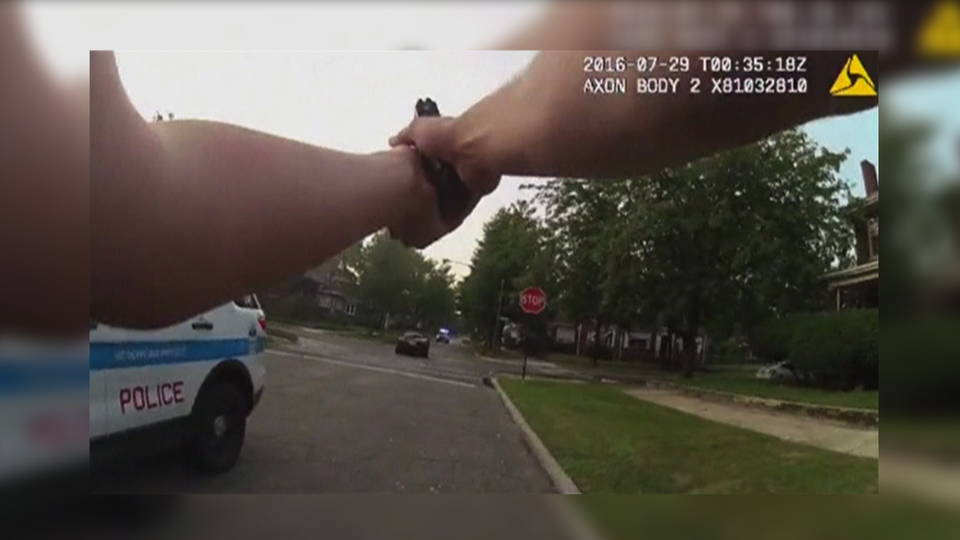
In Chicago, hundreds of protesters marched through the streets and blocked traffic in a series of demonstrations following the release of video showing the fatal police shooting of an unarmed African-American teenager. The newly released video from police body cameras shows the moments before and after police killed 18-year-old Paul O’Neal on July 28. In the video, police are seen shooting repeatedly at the car O’Neal was driving, which police say was stolen. The video then shows a police officer running over to O’Neal, who is lying face down in a growing pool of blood surrounded by other officers. The officers then handcuff O’Neal with his arms behind his back and search his backpack, as he continues bleeding. Afterward, one of the officers can be heard complaining that he’ll be on desk duty for 30 days. Listen carefully.
Police officer: "[Expletive] I’m going to be on a desk for 30 goddamn days now. [Expletive] desk duty for 30 days now. [Expletive]!"
Paul O’Neal died shortly afterward at Northwestern Memorial Hospital. The Cook County Medical Examiner’s Office says he was shot in the back. Police say they are investigating why the body camera worn by the police officer who shot O’Neal did not capture the actual moments of the fatal shooting, why it wasn’t on. This is Michael Oppenheimer, the O’Neal family’s attorney.
Michael Oppenheimer: "Officers cannot exact their own street justice. They cannot play judge, jury and executioner. That’s what happened here today. And their attitude after the shooting, while Paul lay dying on the ground handcuffed, demonstrates that."
Chicago Police Superintendent Eddie Johnson said people "have a right to be upset." He spoke Saturday.
Superintendent Eddie Johson: "I was concerned by some of the things that I saw in the videos, and that’s why we took such a swift action, such a swift action that we did last week."
Police say three officers have been suspended in relation to the shooting. The release of the video comes as Chicago police face ongoing accusations of racism and a federal investigation into their practices after Chicago waited more than a year to release video of the fatal police shooting of African-American teenager Laquan McDonald in 2014.
TOPICS:
Police Brutality
Chicago
Green Party Convention Selects Ticket of Jill Stein and Ajamu Baraka
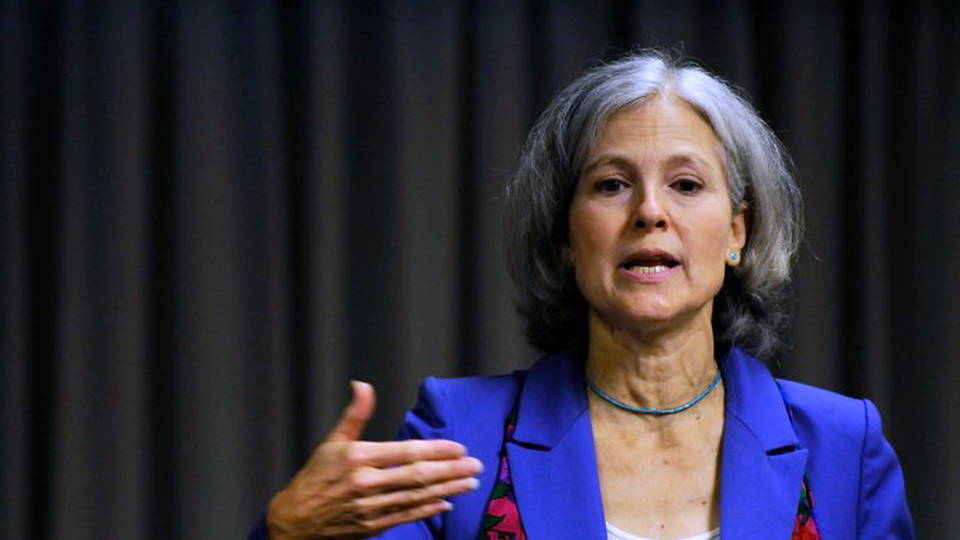
In news from the campaign trail, Dr. Jill Stein formally accepted the Green Party’s nomination for president at the party’s convention in Houston, Texas. The Green Party nominated human rights activist Ajamu Baraka to be her running mate. This is Dr. Jill Stein in her acceptance speech Saturday.
Dr. Jill Stein: "It is such an honor to be your candidate in this historic moment of unprecedented crisis and unstoppable momentum for transformational change. We have—we have not only an historic opportunity, we have a historic responsibility to be the agents of that transformational change. As Martin Luther King said, the arc of the moral universe is long, but it bends towards justice."
We’ll play excerpts of Dr. Jill Stein’s speech, as well as her running mate, human rights activist Ajamu Baraka, from the Green Party convention after headlines.
TOPICS:
Green Party
2016 Election
Kaine Says He'll Oppose TPP over Labor and Environmental Provisions
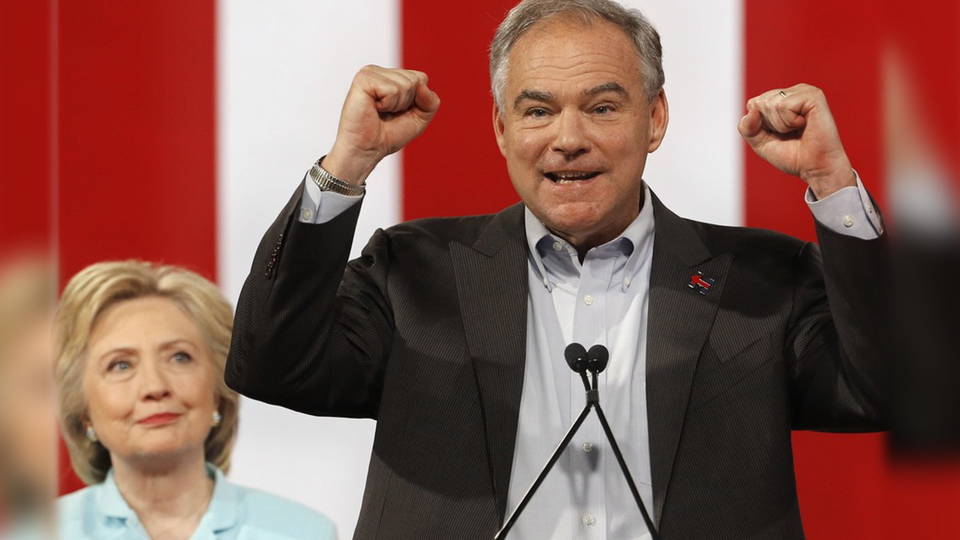
In more news from the campaign trail, Democratic vice-presidential nominee Tim Kaine said he will oppose the Trans-Pacific Partnership, a trade deal that would encompass 12 Pacific Rim nations, including the U.S. Both Hillary Clinton and Donald Trump have come out opposing the deal amid a wave of public protest by those who say it benefits corporations at the expense of health and environmental regulations. This is Senator Kaine speaking Sunday on NBC.
Sen. Tim Kaine: "Companies were given rights to enforce provisions, but the labor and environmental provisions could not be effectively enforced. That was never fixed. I’ve asked again and again to understand this piece of the TPP, and I’ve never gotten a good answer. We can’t have a deal that cannot be enforced."
Tim Kaine had previously supported the TPP. He was one of 13 Democratic senators to vote to give President Obama power to fast-track the TPP through Congress.
TOPICS:
TPP
2016 Election
Iranian TV Footage Claims to Show Cash Paid by U.S. in Nuclear Deal
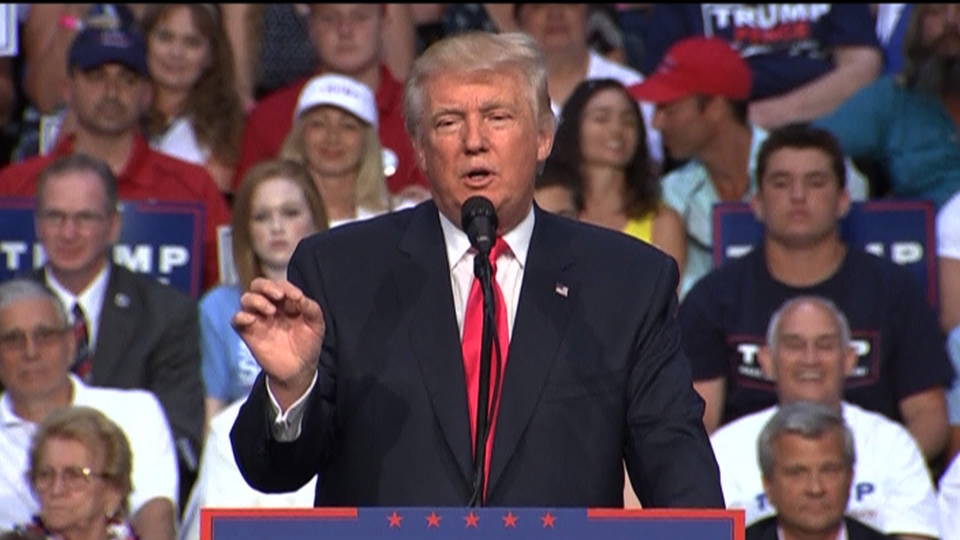
A video from an Iranian state television documentary has emerged purporting to show pallets of cash delivered to Iran by the U.S. in January. Republicans, including Donald Trump, have said the money was a ransom for five U.S. prisoners held by Iran. Last week, Trump claimed to have seen "top secret" video of the transfer before walking back his claim. The Obama administration said Wednesday the $400 million in cash paid to Iran in January was a pre-planned transfer that was part of the landmark nuclear deal. The money has been owed to Iran since the 1970s, when the U.S. refused to send weapons Iran had already paid for following the Iranian revolution. The new video does not appear to contradict that claim in any way. Trump’s criticism of Obama appears to be a reversal of his previous position regarding U.S. prisoners in Iran. Last year, Trump criticized Obama for making a deal with Iran that did not include the return of American prisoners there. This is Trump speaking at the first Republican debate in Cleveland, Ohio, one year ago.
Donald Trump: "Now, with Iran, we’re making a deal. You would say, 'We want him. We want him. We want our prisoners. We want all these things.' We don’t get anything. We’re giving them $150 billion plus. They are going to be—I’ll tell you what, if Iran was a stock, you folks should go out and buy it right now, because you’ll quadruple. This, what’s happening in Iran, is a disgrace, and it’s going to lead to destruction in large portions of the world."
TOPICS:
Iran
Trump Economic Team: Billionaires, Oil Baron, Poker Player & No Women
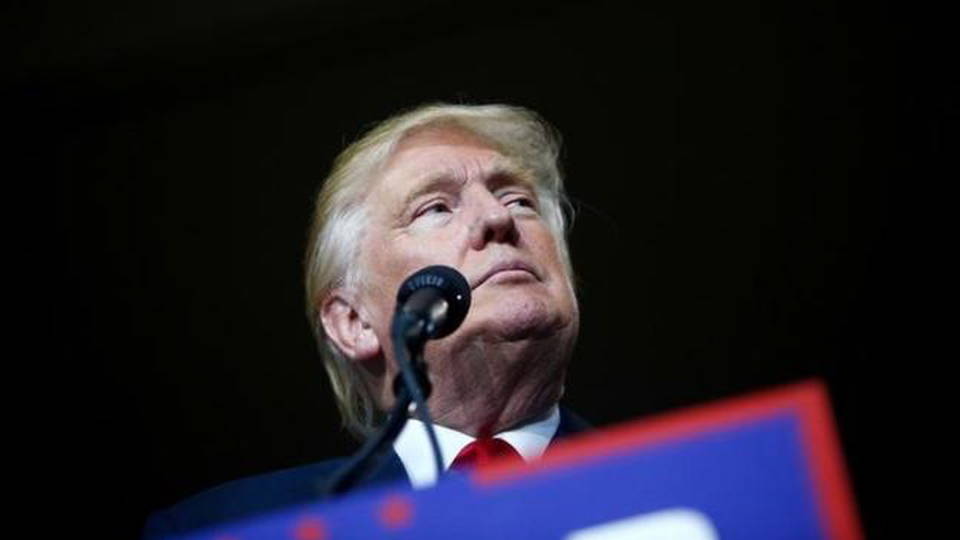
Hillary Clinton is campaigning in St. Petersburg, Florida, today, where she’s expected to visit a small brewery and then host a rally about jobs. Meanwhile, Donald Trump is slated to give an economic speech at the Detroit Economic Club today. On Friday, Trump announced his economic team, which includes 13 men, no women, several billionaires, an Oklahoma oil baron and one part-time professional poker player. Most notably, his team includes John Paulson, who made billions by betting against the housing market in the lead-up to the 2008 crash.
TOPICS:
Donald Trump
2016 Election
U.S. Nazi Party Leader: Trump Presidency Would Be "Opportunity"
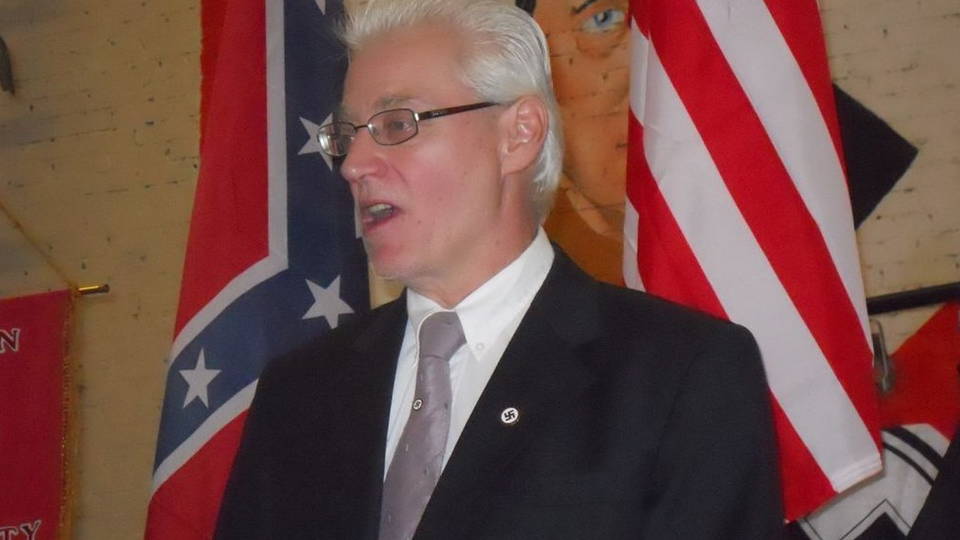
American Nazi Party Chair Rocky Suhayda said on his radio program in July that a Donald Trump presidency would be an opportunity for white nationalists to build political coalitions.
Rocky Suhayda: "Now, if Trump does win, OK, it’s going to be a real opportunity for people like white nationalists, OK, acting intelligently to build upon that and to go and start—OK, you know how you have the black political caucus and whatnot, all right, again, in Congress and everything—to start building on something like that, OK?"
TOPICS:
Donald Trump
Racism
Brazil: Thousands Protest the Beginning of Rio Olympics
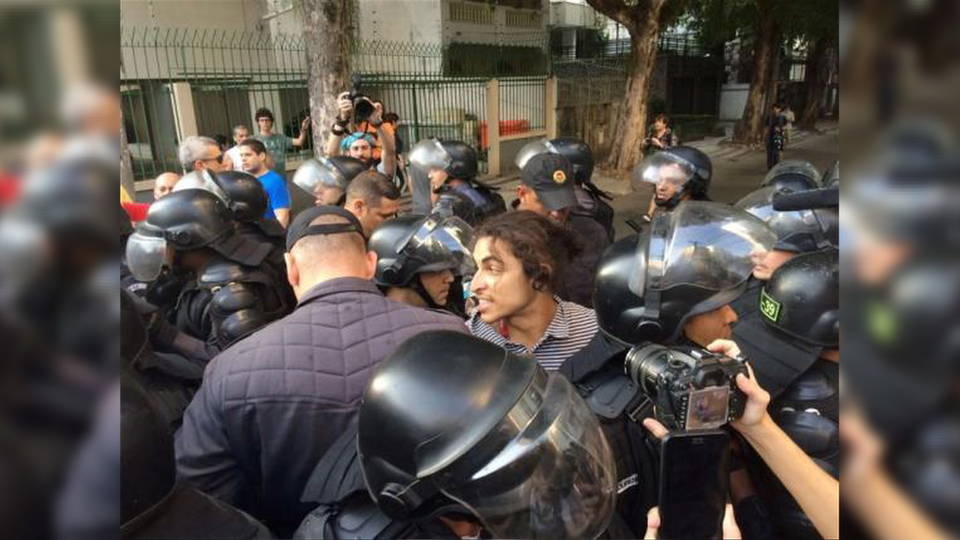
In Brazil, thousands protested Friday in Rio de Janeiro as the 2016 Summer Olympic Games opened. Police fired tear gas at crowds protesting police brutality and the displacement of working-class neighborhoods ahead of the Games. This is protestor Orlando Santos.
Orlando Santos: "This is a demonstration to denounce the innumerous human rights violations and to denounce the project associated with the Olympics whereby people are excluded. The winners were those with large economic interests, sponsors, the press, and the losers are Rio’s population."
Click here to see our interview with sports writer Dave Zirin about the Olympics.
TOPICS:
Olympics
Brazil
Turkey: More Than 1 Million Rally to Denounce Failed Military Coup
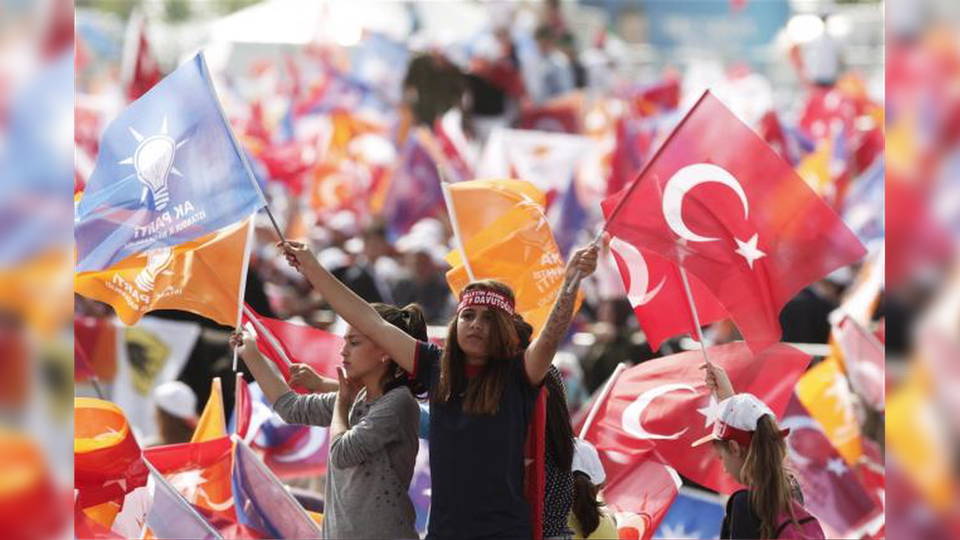
In Turkey, more than a million people gathered Sunday in Istanbul for a rally to denounce last month’s failed military coup. Turkish authorities have detained more than 10,000 people in a widespread crackdown following the coup, sparking human rights concerns.
TOPICS:
Turkey
Yemen Peace Talks End Without Deal to End 16-Month War
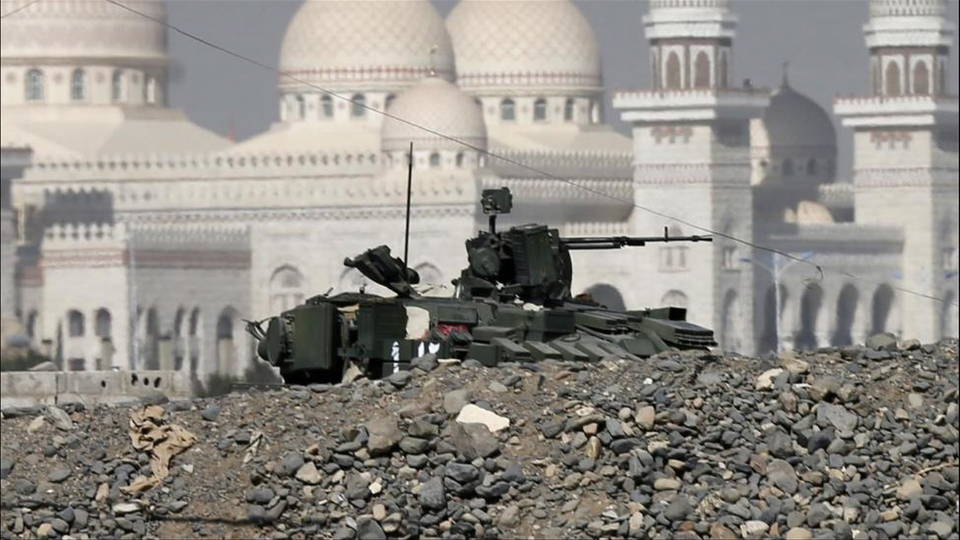
U.N.-sponsored peace talks to end Yemen’s 16-month-old war have ended without a deal. The conflict in Yemen has left thousands dead since Houthi rebels took over the capital Sana’a in January 2015, kicking out a government supported by Saudi Arabia. With U.S. backing, Saudi Arabia responded with an aerial bombing campaign that U.N. officials say is responsible for the majority of the conflict’s civilian casualties, including at least 500 children last year.
Iran Executes Nuclear Scientist Who Said He Was Abducted by U.S.
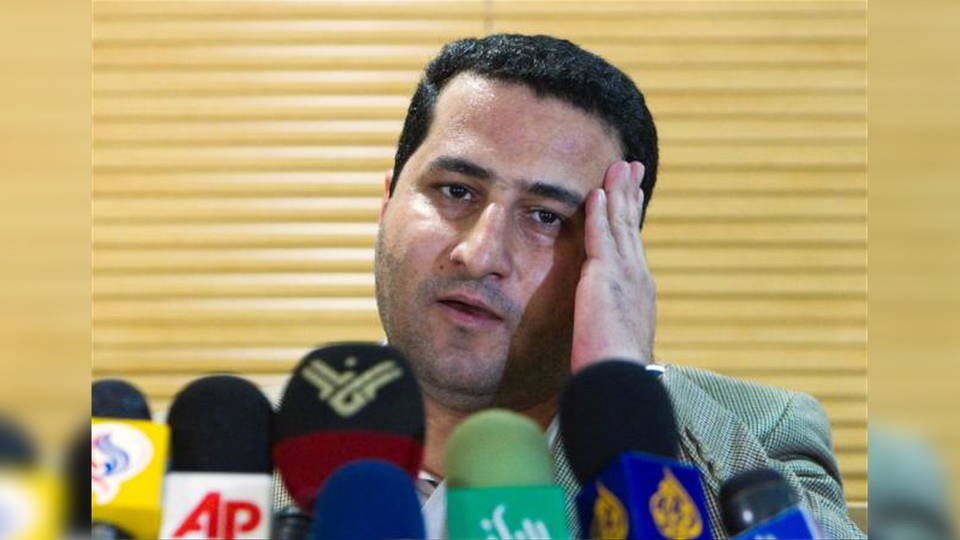
Iran has executed nuclear scientist Shahram Amiri on charges of spying for the United States. Amiri disappeared during a pilgrimage to Saudi Arabia in 2009 and later surfaced in the U.S., before returning to Iran and claiming he had been kidnapped by the CIA. The U.S. government has denied kidnapping Amiri.
TOPICS:
Iran
N. Miami: Therapist Sues Police After He Was Shot Caring for His Autistic Patient
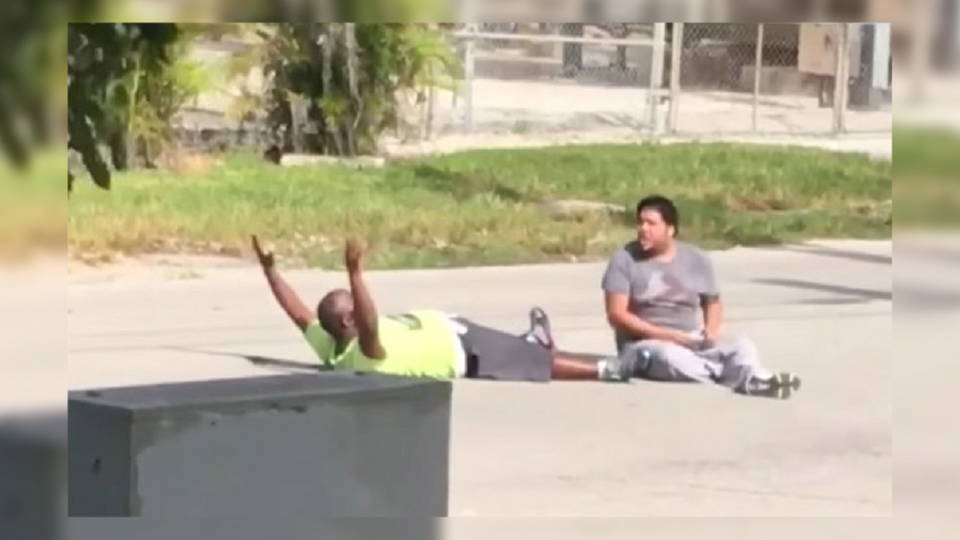
Charles Kinsey, the unarmed African-American behavioral therapist who was lying on his back when he was shot by North Miami police, has filed a federal lawsuit against the officer who shot him. Kinsey claims officer Jonathan Aledda violated his civil rights and used excessive force when he shot Kinsey in the leg last month. At the time of the shooting, Kinsey was helping to calm his patient, Arnaldo Rios Soto, a young autistic man who had wandered away from a group home. Video of the shooting shows Kinsey lying on his back with his hands in the air and telling police, "All he has is a toy truck. A toy truck." This is Kinsey’s lawyer, Hilton Napoleon, speaking on Democracy Now! last week.
Hilton Napoleon: "But the really troublesome part and the part that, you know, we’re really trying to wrap our heads around is that—what happened afterwards. If they really made a mistake and shot my client, there was no reason to handcuff him, and there was definitely no reason to fail to render aid. I mean, they basically left him there bleeding in the street and didn’t render him any aid."
TOPICS:
Police Brutality
Washington, D.C.: Dakota & Lakota Teens Protest Bakken Pipeline
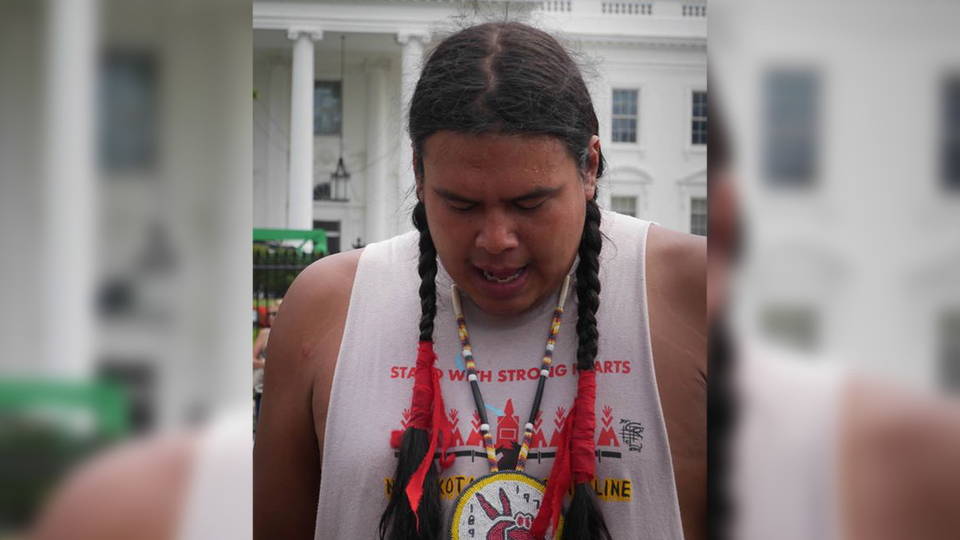
In Washington, D.C., Native American youth demonstrated in front of the White House on Saturday to protest a proposed oil pipeline. The youth had run more than 2,000 miles in a relay race from North Dakota to D.C. before Saturday’s protest. The proposed pipeline would run less than a mile from the Standing Rock Reservation in North Dakota. Protesters say an oil spill could contaminate the reservation’s drinking water. Members of the Standing Rock Sioux Tribe also continue to occupy a camp between the pipeline’s proposed river crossing and the water intake valves for the tribe.
TOPICS:
Pipeline
North Carolina Marks 51st Anniversary of Voting Rights Act
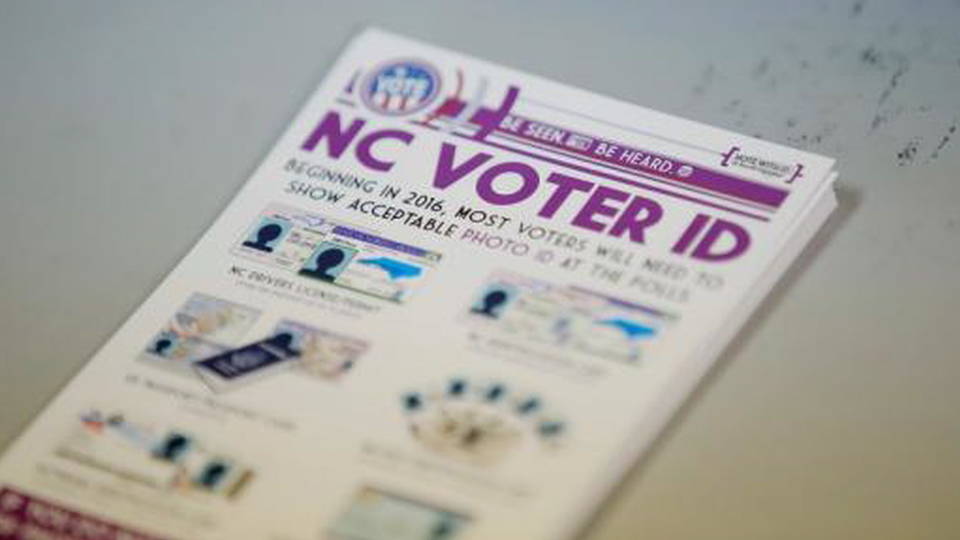
And the North Carolina NAACP marked the 51st anniversary of the Voting Rights Act on Saturday by celebrating its recent federal court victory against North Carolina’s voter ID law. The court’s decision last month found the law targeted African Americans with "almost surgical precision." This is North Carolina NAACP President William Barber speaking to Democracy Now!
Rev. William Barber: "The fact that we have less voting rights today, and the attorney general has less power to enforce voting rights today, than we had in August 6, 1965, when Voting Rights Act was passed, is a travesty."
TOPICS:
Voting
Donate today:
Follow:


COLUMN

The Voting Rights Acts in the Era of Jim Crow 2.0
WEB EXCLUSIVE

Lee Fang on HowCitizens United Opened Floodgates for Foreign Corporate Money in U.S. Elections
NEW BOOK

Democracy Now!: Twenty Years Covering the Movements Changing America
WEB EXCLUSIVE

Chase Strangio on the ACLU's Fight to Overturn North Carolina's Anti-LGBT Law HB 2
WORK WITH DN!

Senior TV Producer
Development Manager
SPEAKING EVENT

8/19 Seattle, WA
-------
Democracy Now! Daily Digest: A Daily Independent Global News Hour with Amy Goodman & Juan González for Friday, August 5, 2016
democracynow.org
Stories:

30 Years of Doonesbury on Donald Trump: Cartoonist Garry Trudeau on the GOP's "Natural Born Toon"

Dave Zirin: Protests by Athletes and Displaced Rio Residents Accompany Opening of 2016 Olympic Games

Brazil's Dance with the Devil: 2016 Rio Olympics Begin with Government Dysfunction & Police Violence
Chicago: Video of Police Killing Unarmed Teen Sparks Days of Protests
In Chicago, hundreds of protesters marched through the streets and blocked traffic in a series of demonstrations following the release of video showing the fatal police shooting of an unarmed African-American teenager. The newly released video from police body cameras shows the moments before and after police killed 18-year-old Paul O’Neal on July 28. In the video, police are seen shooting repeatedly at the car O’Neal was driving, which police say was stolen. The video then shows a police officer running over to O’Neal, who is lying face down in a growing pool of blood surrounded by other officers. The officers then handcuff O’Neal with his arms behind his back and search his backpack, as he continues bleeding. Afterward, one of the officers can be heard complaining that he’ll be on desk duty for 30 days. Listen carefully.
Police officer: "[Expletive] I’m going to be on a desk for 30 goddamn days now. [Expletive] desk duty for 30 days now. [Expletive]!"
Paul O’Neal died shortly afterward at Northwestern Memorial Hospital. The Cook County Medical Examiner’s Office says he was shot in the back. Police say they are investigating why the body camera worn by the police officer who shot O’Neal did not capture the actual moments of the fatal shooting, why it wasn’t on. This is Michael Oppenheimer, the O’Neal family’s attorney.
Michael Oppenheimer: "Officers cannot exact their own street justice. They cannot play judge, jury and executioner. That’s what happened here today. And their attitude after the shooting, while Paul lay dying on the ground handcuffed, demonstrates that."
Chicago Police Superintendent Eddie Johnson said people "have a right to be upset." He spoke Saturday.
Superintendent Eddie Johson: "I was concerned by some of the things that I saw in the videos, and that’s why we took such a swift action, such a swift action that we did last week."
Police say three officers have been suspended in relation to the shooting. The release of the video comes as Chicago police face ongoing accusations of racism and a federal investigation into their practices after Chicago waited more than a year to release video of the fatal police shooting of African-American teenager Laquan McDonald in 2014.
TOPICS:
Police Brutality
Chicago
Green Party Convention Selects Ticket of Jill Stein and Ajamu Baraka
In news from the campaign trail, Dr. Jill Stein formally accepted the Green Party’s nomination for president at the party’s convention in Houston, Texas. The Green Party nominated human rights activist Ajamu Baraka to be her running mate. This is Dr. Jill Stein in her acceptance speech Saturday.
Dr. Jill Stein: "It is such an honor to be your candidate in this historic moment of unprecedented crisis and unstoppable momentum for transformational change. We have—we have not only an historic opportunity, we have a historic responsibility to be the agents of that transformational change. As Martin Luther King said, the arc of the moral universe is long, but it bends towards justice."
We’ll play excerpts of Dr. Jill Stein’s speech, as well as her running mate, human rights activist Ajamu Baraka, from the Green Party convention after headlines.
TOPICS:
Green Party
2016 Election
Kaine Says He'll Oppose TPP over Labor and Environmental Provisions
In more news from the campaign trail, Democratic vice-presidential nominee Tim Kaine said he will oppose the Trans-Pacific Partnership, a trade deal that would encompass 12 Pacific Rim nations, including the U.S. Both Hillary Clinton and Donald Trump have come out opposing the deal amid a wave of public protest by those who say it benefits corporations at the expense of health and environmental regulations. This is Senator Kaine speaking Sunday on NBC.
Sen. Tim Kaine: "Companies were given rights to enforce provisions, but the labor and environmental provisions could not be effectively enforced. That was never fixed. I’ve asked again and again to understand this piece of the TPP, and I’ve never gotten a good answer. We can’t have a deal that cannot be enforced."
Tim Kaine had previously supported the TPP. He was one of 13 Democratic senators to vote to give President Obama power to fast-track the TPP through Congress.
TOPICS:
TPP
2016 Election
Iranian TV Footage Claims to Show Cash Paid by U.S. in Nuclear Deal
A video from an Iranian state television documentary has emerged purporting to show pallets of cash delivered to Iran by the U.S. in January. Republicans, including Donald Trump, have said the money was a ransom for five U.S. prisoners held by Iran. Last week, Trump claimed to have seen "top secret" video of the transfer before walking back his claim. The Obama administration said Wednesday the $400 million in cash paid to Iran in January was a pre-planned transfer that was part of the landmark nuclear deal. The money has been owed to Iran since the 1970s, when the U.S. refused to send weapons Iran had already paid for following the Iranian revolution. The new video does not appear to contradict that claim in any way. Trump’s criticism of Obama appears to be a reversal of his previous position regarding U.S. prisoners in Iran. Last year, Trump criticized Obama for making a deal with Iran that did not include the return of American prisoners there. This is Trump speaking at the first Republican debate in Cleveland, Ohio, one year ago.
Donald Trump: "Now, with Iran, we’re making a deal. You would say, 'We want him. We want him. We want our prisoners. We want all these things.' We don’t get anything. We’re giving them $150 billion plus. They are going to be—I’ll tell you what, if Iran was a stock, you folks should go out and buy it right now, because you’ll quadruple. This, what’s happening in Iran, is a disgrace, and it’s going to lead to destruction in large portions of the world."
TOPICS:
Iran
Trump Economic Team: Billionaires, Oil Baron, Poker Player & No Women
Hillary Clinton is campaigning in St. Petersburg, Florida, today, where she’s expected to visit a small brewery and then host a rally about jobs. Meanwhile, Donald Trump is slated to give an economic speech at the Detroit Economic Club today. On Friday, Trump announced his economic team, which includes 13 men, no women, several billionaires, an Oklahoma oil baron and one part-time professional poker player. Most notably, his team includes John Paulson, who made billions by betting against the housing market in the lead-up to the 2008 crash.
TOPICS:
Donald Trump
2016 Election
U.S. Nazi Party Leader: Trump Presidency Would Be "Opportunity"
American Nazi Party Chair Rocky Suhayda said on his radio program in July that a Donald Trump presidency would be an opportunity for white nationalists to build political coalitions.
Rocky Suhayda: "Now, if Trump does win, OK, it’s going to be a real opportunity for people like white nationalists, OK, acting intelligently to build upon that and to go and start—OK, you know how you have the black political caucus and whatnot, all right, again, in Congress and everything—to start building on something like that, OK?"
TOPICS:
Donald Trump
Racism
Brazil: Thousands Protest the Beginning of Rio Olympics
In Brazil, thousands protested Friday in Rio de Janeiro as the 2016 Summer Olympic Games opened. Police fired tear gas at crowds protesting police brutality and the displacement of working-class neighborhoods ahead of the Games. This is protestor Orlando Santos.
Orlando Santos: "This is a demonstration to denounce the innumerous human rights violations and to denounce the project associated with the Olympics whereby people are excluded. The winners were those with large economic interests, sponsors, the press, and the losers are Rio’s population."
Click here to see our interview with sports writer Dave Zirin about the Olympics.
TOPICS:
Olympics
Brazil
Turkey: More Than 1 Million Rally to Denounce Failed Military Coup
In Turkey, more than a million people gathered Sunday in Istanbul for a rally to denounce last month’s failed military coup. Turkish authorities have detained more than 10,000 people in a widespread crackdown following the coup, sparking human rights concerns.
TOPICS:
Turkey
Yemen Peace Talks End Without Deal to End 16-Month War
U.N.-sponsored peace talks to end Yemen’s 16-month-old war have ended without a deal. The conflict in Yemen has left thousands dead since Houthi rebels took over the capital Sana’a in January 2015, kicking out a government supported by Saudi Arabia. With U.S. backing, Saudi Arabia responded with an aerial bombing campaign that U.N. officials say is responsible for the majority of the conflict’s civilian casualties, including at least 500 children last year.
Iran Executes Nuclear Scientist Who Said He Was Abducted by U.S.
Iran has executed nuclear scientist Shahram Amiri on charges of spying for the United States. Amiri disappeared during a pilgrimage to Saudi Arabia in 2009 and later surfaced in the U.S., before returning to Iran and claiming he had been kidnapped by the CIA. The U.S. government has denied kidnapping Amiri.
TOPICS:
Iran
N. Miami: Therapist Sues Police After He Was Shot Caring for His Autistic Patient
Charles Kinsey, the unarmed African-American behavioral therapist who was lying on his back when he was shot by North Miami police, has filed a federal lawsuit against the officer who shot him. Kinsey claims officer Jonathan Aledda violated his civil rights and used excessive force when he shot Kinsey in the leg last month. At the time of the shooting, Kinsey was helping to calm his patient, Arnaldo Rios Soto, a young autistic man who had wandered away from a group home. Video of the shooting shows Kinsey lying on his back with his hands in the air and telling police, "All he has is a toy truck. A toy truck." This is Kinsey’s lawyer, Hilton Napoleon, speaking on Democracy Now! last week.
Hilton Napoleon: "But the really troublesome part and the part that, you know, we’re really trying to wrap our heads around is that—what happened afterwards. If they really made a mistake and shot my client, there was no reason to handcuff him, and there was definitely no reason to fail to render aid. I mean, they basically left him there bleeding in the street and didn’t render him any aid."
TOPICS:
Police Brutality
Washington, D.C.: Dakota & Lakota Teens Protest Bakken Pipeline
In Washington, D.C., Native American youth demonstrated in front of the White House on Saturday to protest a proposed oil pipeline. The youth had run more than 2,000 miles in a relay race from North Dakota to D.C. before Saturday’s protest. The proposed pipeline would run less than a mile from the Standing Rock Reservation in North Dakota. Protesters say an oil spill could contaminate the reservation’s drinking water. Members of the Standing Rock Sioux Tribe also continue to occupy a camp between the pipeline’s proposed river crossing and the water intake valves for the tribe.
TOPICS:
Pipeline
North Carolina Marks 51st Anniversary of Voting Rights Act
And the North Carolina NAACP marked the 51st anniversary of the Voting Rights Act on Saturday by celebrating its recent federal court victory against North Carolina’s voter ID law. The court’s decision last month found the law targeted African Americans with "almost surgical precision." This is North Carolina NAACP President William Barber speaking to Democracy Now!
Rev. William Barber: "The fact that we have less voting rights today, and the attorney general has less power to enforce voting rights today, than we had in August 6, 1965, when Voting Rights Act was passed, is a travesty."
TOPICS:
Voting
Donate today:
Follow:
COLUMN
The Voting Rights Acts in the Era of Jim Crow 2.0
WEB EXCLUSIVE
Lee Fang on HowCitizens United Opened Floodgates for Foreign Corporate Money in U.S. Elections
NEW BOOK
Democracy Now!: Twenty Years Covering the Movements Changing America
WEB EXCLUSIVE
Chase Strangio on the ACLU's Fight to Overturn North Carolina's Anti-LGBT Law HB 2
WORK WITH DN!
Senior TV Producer
Development Manager
SPEAKING EVENT
8/19 Seattle, WA
-------
Democracy Now! Daily Digest: A Daily Independent Global News Hour with Amy Goodman & Juan González for Friday, August 5, 2016
democracynow.org
Stories:
30 Years of Doonesbury on Donald Trump: Cartoonist Garry Trudeau on the GOP's "Natural Born Toon"
Cartoonist Garry Trudeau has been writing about Trump and a possible run for the presidency for nearly 30 years, prompting Trump to call him "a third-rate talent," "a sleazeball," "a jerk" and "a total loser." Trudeau is the creator of the popular comic strip "Doonesbury" and the first cartoonist to win the Pulitzer Prize. In September 1987, Trudeau published a series of comic strips that now seem prophetic. In one strip, reporters ask Trump a series of questions about his political ambitions to run for Congress, and Trump responds, "President, think president." Trump has remained a frequent character in "Doonesbury" ever since, giving Trudeau a chance to make fun of everything from Trump’s hair to his ego to his rampant use of insults. His cartoons have just been collected in a new book titled "Yuge!: 30 Years of Doonesbury on Trump."
TRANSCRIPT
This is a rush transcript. Copy may not be in its final form.
AMY GOODMAN: We turn now to a man who’s been described by Donald Trump as "overrated," "a sleazeball," "a jerk" and "a total loser." He’s a man who’s been writing about Donald Trump and a possible run for the presidency for nearly 30 years. We’re talking about the cartoonist Garry Trudeau, creator of the popular comic strip Doonesbury. He’s the first cartoonist to win the Pulitzer Prize.
In September 1987, Trudeau published a series of comic strips that now seem prophetic. In one strip, reporters are asking Trump a series of questions: "Mr. Trump, your denials notwithstanding, don’t the ads you took out suggest a testing of the political waters?" Trump responds, "As I have said before, I was simply acting as a concerned citizen! At this time, I have no, repeat no, political ambitions whatsoever!" A reporter then asks, "Okay, but if you did run for Congress..." Trump then responds, "President, think president."
Another strip from 1987 features Trump being asked, "Mr. Trump, as a developer of luxury condos and casinos, do you think you’d have any rapport at all with voters of modest means?" Trump responds, "Are you kidding? I’ve spent my whole life working with people of modest means!" "In what capacity?" he’s asked. Trump says, quote, "Evicting them! I’ve seen how these people live!"
Trump has remained a frequent character in Doonesbury ever since, giving Trudeau a chance to make fun of everything from Trump’s hair to his ego to his rampant use of insults. These cartoons have just been collected in a new book; it’s titled Yuge!: 30 Years of Doonesbury on Trump.
Garry Trudeau joins us in studio now.
Welcome to Democracy Now!
GARRY TRUDEAU: Well, thank you. It’s such a pleasure.
AMY GOODMAN: It’s great to have you with us. So, are you surprised at everything that has unfolded in this past year?
GARRY TRUDEAU: Yes. I’m no smarter than anyone else in terms of understanding where this was all going to go. My assumption, after 2012, when he was attacking the president and he got his first taste of double-digit poll numbers, that he would make a run this time around. But I thought it would be just as part of the—his normal brand enhancement and that once he’d gotten the maximum promotional value out of a run, that he would step out. Who knew he would catch on like this? Certainly not me.
AMY GOODMAN: So, talk about when you first started covering him in Doonesbury. And for people who don’t know Doonesbury, why don’t you start off by explaining this comic strip.
GARRY TRUDEAU: Wow!
AMY GOODMAN: I don’t know if there’s anyone who doesn’t know, but go ahead.
GARRY TRUDEAU: It’s a comic strip that began life, when I was in college, as a one-off. It was a sports strip that was about a particularly outstanding football player on my college campus. And it caught the eye of a syndicate chief, who wrote me in my junior year and said, "How would you like to do this for a living?" So, that’s the—I didn’t have a particularly long period of paying dues. I jumped in right after graduation, and I’ve been writing this daily comic strip, which was about collegiate life, but which became about the broader world and all the many issues I’m interested in.
AMY GOODMAN: How often did your comic strip get banned or dumped for a week, if they didn’t like what you were doing?
GARRY TRUDEAU: Oh, it’s impossible to say how often, but in the early years, it was every other week or so some newspapers would decide to remove it from the pages. And I’ve never regarded it as censorship; it’s simply editing. Editors decide every day about dozens of things that don’t make it into their papers. So, I never took it seriously. The problem was that it would generate local news. Their reporter would call me. And it became a very sort of self-conscious thing for me to write, because I had to be prepared to defend it, after it was published, to multiple clients. So, I just sort of stepped back from that. And I wasn’t on shows like yours for many, many years, just so I could focus on the work. But now it’s all hands on deck, right? I’m delighted to be here to talk about the work.
AMY GOODMAN: OK, so you’re—you’ve been following Donald Trump for decades.
GARRY TRUDEAU: Right.
AMY GOODMAN: Tell us when he first became a character in Doonesbury.
GARRY TRUDEAU: He became a character in response, a kind of prophylactic response, to his series of ads that he took out in The Boston Globe and The Washington Post and The New York Times, in which we learned for the first time that the rest of the world was laughing at us. And there were a few trial balloons that went up along with that from other—others of his friends, and I thought, "Wow! I have to respond to that, because we’ve been living in this city with this guy for 10 years. His grandiosity is just over the top, and this is laughable." And so I just put him in the strip.
And it was an early transfer—easy transfer. He wasn’t a parody exactly; he was really more like a natural born toon. I just took him out of the box, removed the tags and put him right into the strip. And I think he’s—you know, he’s like a version of Daffy Duck, I mean, in terms of his appearance, the silly way in which he talks, the over-the-top self-regard. All these things just made him a perfect cartoon character. And so, I just had him interact with the other characters as a peer, and they interact with him as just a, you know, comic strip colleague. And I didn’t have to make any adjustments. I would take the things he said and reframe them in a way, you know, to maximize the satiric purpose of it, but I didn’t have to do much in terms of exaggerating, the way you normally do in a parody.
AMY GOODMAN: I want to go to 1999. You have a cartoon with Donald Trump saying, quote, "A lot of people have been asking what this election is really about. Well, it’s not about the economy, stupid! And it’s not character, stupid! And it’s not authenticity, stupid! It’s not even about the issues, stupid! You want to know what this election is about?" Someone then says, "You, stupid?" Trump replies, "Exactly! People are begging me to run! Begging me!"
GARRY TRUDEAU: Oh, they’re always begging him, and there are always hundreds of calls. And what’s astonishing is these things are obviously made up. But what’s most astonishing about his lack of truth is that he wheels it out for the most banal and trivial of reasons. I was talking to a crew member on CNN who said he was in his office setting up a camera—this was a while back—and he overheard Trump talking to his daughter in the outer office. And he said, "Well, there are five cameras in my office." And he said, "Five? There was one. I was setting up one camera." Why lie to your daughter about how many cameras in your—I mean, the most, you know, insignificant things get lied about, and right up to last night, when he was imagining a video he never saw.
AMY GOODMAN: Imagining?
GARRY TRUDEAU: Fabricating, whatever. I mean—
AMY GOODMAN: Talked about a secret video he had seen.
GARRY TRUDEAU: Oh, secret. I missed that detail.
AMY GOODMAN: Although, today, now tweeting out, in maybe one of his first tweet corrections, oh, it wasn’t a [video] of $400 million being brought in to the Iranian government—
GARRY TRUDEAU: Which he described vividly.
AMY GOODMAN: And said the Iranian government did this to embarrass the U.S., released this video.
GARRY TRUDEAU: Yeah, yeah.
AMY GOODMAN: Right? And this morning, tweeted, no, he was watching on TV the video of the hostages being released in Geneva.
GARRY TRUDEAU: Yeah.
AMY GOODMAN: I want to go to 2011. This comic strip begins with Donald Trump saying, "Novelty candidate? What’re you talking about? Have you seen my polls? They’re extraordinary! I’m polling 41% against Obama! 41%! And I’m not even running yet!" This was 2011.
GARRY TRUDEAU: Yeah, I think that’s what really—you know, that was when, I think, he thought it was possible. He had a brief interest in running for governor, but then that just didn’t seem grand enough, so he started making his early moves towards the presidency last year.
AMY GOODMAN: We’re going to go to break, and then we’re going to come back with Garry Trudeau. He is the Pulitzer Prize cartoonist, creator of the comic strip Doonesbury, which appears daily in over 1,400 newspapers. In 1975, Garry Trudeau became the first comic strip artist ever to be awarded a Pulitzer Prize for Editorial Cartooning. He’s been described as the most influential editorial cartoonist in, oh, over a quarter of a century. His new book is called Yuge!: 30 Years of Doonesbury on Trump. Stay with us.
[break]
AMY GOODMAN: "It’s the Right Time to Be Rich," from the 1983 Broadway production of Doonesbury. And, yes, our guest today is Garry Trudeau, the Pulitzer Prize-winning comic, the creator of the comic strip Doonesbury, which appears in well over a thousand newspapers. Can you talk about that, the music we just heard and the Broadway musical?
GARRY TRUDEAU: The music we just heard was from a Broadway musical called Doonesbury, and that was a song that was sung by the reporter Roland Burton Hedley Jr. in the second act. And I haven’t heard it in years. Obviously, it’s always a good time to be rich, but I’m glad you dug that one out.
AMY GOODMAN: So, I wanted to go back in your history, Garry. Since you don’t come out and talk to the world very much, except through your comic strip, Doonesbury, your grandfather ran a tuberculosis sanatorium upstate?
GARRY TRUDEAU: My great-grandfather. And he opened the first sanatorium in North America for the treatment of tuberculosis. And that has been the tradition in my family for three generations.
AMY GOODMAN: It’s so interesting, because my grandmother went to a tuberculosis sanatorium. When she was like 50, she got TB and meningitis, and she went to one of these places. And I wonder if it was—if it was his. They didn’t know if she’d last the year, and she lived ’til she was 108.
GARRY TRUDEAU: It was helpful for some people. I mean, there weren’t any antibiotics in those days, and that’s what eventually shut down the sanatoriums. But what his insight was remains important. It was about a holistic approach to health. And he was very, very committed to creating the conditions by which the body and the immune system can optimize its own recovery processes. So there was fresh air, there was, you know, good hygiene, healthy food, occupational therapy—all these things that were a little ahead of their time and have been important in treating all kinds of disease.
AMY GOODMAN: And how did that influence you?
GARRY TRUDEAU: Well, I grew up kind of in awe of my own heritage, as did my father and his father, because Edward Trudeau, my great-grandfather, was a great man in his day. Tuberculosis was the number one killer. And he was well known around the world. So, yeah, you grew up in a shadow in my little town, a very big shadow. And I never felt any pressure to go into medicine. And once I had left and went to college, and it was offered, an alternative employment that I really loved, I never looked back.
AMY GOODMAN: And your family was involved with politics in New York?
GARRY TRUDEAU: No. My mother was a volunteer for Eisenhower.
AMY GOODMAN: Back further? Yeah?
GARRY TRUDEAU: Yeah, I grew up in a moderate Republican household, a Rockefeller Republican household. And my best friend, who lived next door, his father was the publisher of the local paper and was a Democrat, and eventually became an ambassador. And we rather regarded politics as one might regard the difference between the Dodgers and the Yankees, being New Yorkers. It was a friendly rivalry; it wasn’t something that drove families apart and tore communities apart.
AMY GOODMAN: And so, their feelings about you becoming a comic strip—
GARRY TRUDEAU: Whose feel—whose—
AMY GOODMAN: Your family’s feelings about you?
GARRY TRUDEAU: They’re fine with it. I think, you know, my father worried for some years that there wouldn’t be a living in it, and he just waited for me to pivot into a career that seemed more stable to him. I did go to graduate school in graphic design, and I did set up a graphic studio, where I was doing that work in addition to the strip. But eventually I had to pick between the two.
AMY GOODMAN: I wanted to go to a quote of yours a few years ago. You said, "Traditionally, satire has comforted the afflicted while afflicting the comfortable. Satire punches up, against authority of all kinds, the little guy against the powerful. ... Ridiculing the non-privileged is almost never funny—it’s just mean. By punching downward, by attacking the powerless, disenfranchised minority with crude, vulgar drawings closer to graffiti than cartoons, Charlie wandered into the realm of hate speech." You were talking about Charlie Hebdo—
GARRY TRUDEAU: Right
AMY GOODMAN: —the magazine in Paris.
GARRY TRUDEAU: Right.
AMY GOODMAN: And the—this, after the attack that took place that killed a number of the cartoonists. Explain what you were saying.
GARRY TRUDEAU: I did. And that was very controversial at the time, to my great surprise. It didn’t seem like I was saying anything particularly controversial. But feelings were still raw. This was only a few months after the killings. And although I had honored the cartoonists in the strip, by name, and including their drawings in a Sunday section, I nonetheless disagreed with what—you know, what they were trying to do with their art. I just simply wouldn’t have done it. Life is full of editing decisions. You can’t go through a day without making a dozen decisions not to do something. Editors do that with newspapers. We do it in relationships. It’s just something I wouldn’t do, and most cartoonists in this country wouldn’t do. You don’t do it just because you can. We all understand that you can. That’s—we all get the First Amendment. But each person has to decide for themselves when you cross a line.
AMY GOODMAN: So, let’s go back to Yuge!: 30 Years of Doonesbury on Trump. And talk about why the title Yuge!
GARRY TRUDEAU: Well, hopefully, that’s self-explanatory. The practical reason for it was that there’s only four letters, so you can make them very big on a cover. And that seemed to be not just a metaphor, but also helpful in terms of people spotting it in a bookstore.
AMY GOODMAN: I’m going to go to one of the cartoon strips where you have your character on the radio. "He’s in! He’s out! He’s keeping his options open! He may be hard to pin down, but one thing remains the same—a deep, pathological need for attention! As far back as 1987, he’s pretended to run for president, freshening his tacky brand with free media, but always wimping out before the first primary! So here he is, the man with the piggy eyes, contemptuous scowl, and hair like orange cotton candy! Welcome, sir!" "You didn’t say my name, you freakin’ pinhead!" "Sorry, sir, I’m blanking on it. How embarrassing!" "It’s..." "Ooh, we’re out of time! Our thanks to the caller!"
GARRY TRUDEAU: It’s almost like I was baiting him, right? Yeah, I mean, it was a pretty obvious cartoon to kind of wander into, just in terms of he was right on the precipice, and I was just as uncertain as anyone else that he would actually go for it.
AMY GOODMAN: And now I want to go to the cartoon that you’re going to read. This is April 17th, 2016. You show Trump talking to a group of middle-schoolers, saying, "Hey, kids! Tired of getting killed on insults in the cafeteria? Then start fighting back with my quality Trump brand insults! Choose from over 500 tremendous insults I’ve tweeted out since last June, including..." Could you read what happens next in the cartoon?
GARRY TRUDEAU: Well, it’s just a sampling, a carefully curated sampling of these copyrighted insults. And I’m loathe to read them, simply because I’m sure they would—it would invite a suit. But let’s get right into it: "Lightweight!" "Embarrassment!" "Choker!" "Disaster!" "Phony!" "Hypocrite!" "Dope!" "Fraud!" "Arrogant!" "Loser!" "Grubby!" "Wacko!" "Third-rate!" "Clown!" "Dumb!" "Clueless!" "Nasty!" "Failed!" "Terrible!" "Ridiculous!" "Deceptive!" "Weak!" "Sad!" "Crazy!" "Totally corrupt!" "Dumb as a rock!" "Reckless!" "Totally flawed!" "Not nice!" "Nervous wreck!" "Zero talent!" "Sloppy!" "A real nut job!" "Blowhard!" "Overrated!" "Truly weird!" "A joke!" "Unattractive!" "Disgusting!" "Irrelevant!" "Spoiled brat!" "Low-class slob!" "Goofball atheist!" "Hater and racist!" "Failing!" "Fool!" "Worthless!" "Garbage!" "Pure scum!" "Crude!" "Biased!" "Kooky!" "Awkward!" "Dishonest!" "Hopeless!" "Dummy!" "Liar!" "Disgrace!" "Basket case!" "Disloyal!" and "Really pathetic!" And then he says, "Stop being a total loser, huge loser—Use Trump brand insults and start winning today!"
AMY GOODMAN: So, your thoughts today, 30 years—
GARRY TRUDEAU: Well, there are far more. This was just a sampling. But 30 years later? You know, I don’t want to think beyond November. I hope I have no reason to think beyond November. I look forward to passing him on Fifth Avenue on his way to work on November 9th, and without incident and with him getting on with his life and the rest of the country getting on with its.
AMY GOODMAN: How much have you interacted with him? He’s got a lot of names for you.
GARRY TRUDEAU: No, I’ve observed him in the wild numerous occasions, most recently at the New Hampshire debates. He came out into the press area, and I could not take my eyes off the back of his head. It is something that photography just can’t quite capture. It’s like a panel of gossamer that has been lacquered onto the back of his head with a kind of golden slurry. And I wanted to find the words or the imagery to share that with my readers, but really drawing Trump is a journey. It’s not a destination. You just have to keep after it.
AMY GOODMAN: Has he ever threatened to sue you.
GARRY TRUDEAU: No.
AMY GOODMAN: Well, Garry Trudeau, I want to thank you for being with us. Garry Trudeau, creator of the comic strip Doonesbury, which appears daily in over, oh, 1,400 newspapers. In ’75, Garry Trudeau became the first comic strip artist ever to be awarded the Pulitzer Prize for Editorial Cartooning, one of the most influential editorial cartoonists in decades. His new book is called Yuge!: 30 Years of Doonesbury on Trump. ... Read More →
Dave Zirin: Protests by Athletes and Displaced Rio Residents Accompany Opening of 2016 Olympic Games
Dave Zirin, sports editor for The Nation magazine, says protests highlighting racial and economic injustice are expected from athletes attending the 2016 Olympics in Brazil, such as tennis champion Serena Williams and players from the NBA, WNBA and other countries. Polls show more than 60 percent of Brazilians think hosting the Games will hurt their country. He says that ahead of today’s opening ceremony, residents of heavily policed and displaced neighborhoods plan a major march to Rio’s "Olympic City."
TRANSCRIPT
This is a rush transcript. Copy may not be in its final form.
AMY GOODMAN: I wanted to turn to the American tennis star Serena Williams, who just arrived in Rio and was asked about the Republican presidential nominee, Donald Trump.
SERENA WILLIAMS: I am—I don’t involve myself in politics. I think it’s really important for me to really pass the message of love and unity across all nations. Doesn’t matter what race. Obviously, with me being African-American, I’m very sensitive over a lot of things. But I think it’s important that, you know, we should pass a message of love as opposed to hate.
AMY GOODMAN: Dave Zirin, talk about the significance of Serena Williams speaking out.
DAVE ZIRIN: I mean, I think for her to say, "I don’t talk about politics, but I believe in love over hate," I mean, that just says something about these elections, that to say I’m for love over hate is actually a political message. Like, what in previous election cycles might sound like a Hallmark card, tragically, is, in 2016, a cry of resistance, because Donald Trump actually does represent that kind of organized hate.
And Serena Williams, also, she makes that statement with a kind of—with a background, if you will, with a legacy that she’s built over the last couple of years of being someone who has strongly spoken out against the extrajudicial killings of young black men and women, and someone who has linked her career to raising funds for the Equal Justice Initiative, which is a tremendous organization that does work in terms of fighting the new Jim Crow and mass incarceration. So, everything that Serena Williams says, I think, is just fraught with meaning. And it really—seriously, it doesn’t take an advanced American studies degree from a university to read between the lines in terms of what she’s saying there.
But if people want more explicit political talk at these Olympics, please keep a close eye at Ibtihaj Muhammad. She is a U.S. fencer, and she is the first U.S. athlete to ever compete wearing a hijab. And she has already been explicit in her condemnation of Donald Trump, and so proud of the fact that she is a Muslim representing the United States.
AMY GOODMAN: We’re going to break and come back to this discussion. We’re talking to Dave Zirin, sports editor for The Nation magazine. He’s headed to Rio, and we’re going to be talking to him there, but getting a preview as the Rio Olympics are about to begin. His latest book—"The Last Dance: On Heading to Olympic Rio," his latest piece. His book, Brazil’s Dance with the Devil: The World Cup, the Olympics, and the Fight for Democracy. Stay with us.
[break]
AMY GOODMAN: "Funeral do Lavrador," "Funeral of a Worker," by Zélia Barbosa. This is Democracy Now!, democracynow.org, The War and Peace Report. I’m Amy Goodman, as we talk to Dave Zirin about the opening of the Olympics.
Talk about other athletes you’re following, but start off by talking about what’s happening with Russia right now. How many Russian athletes have been banned? Is it something like 118?
DAVE ZIRIN: Yeah. Yeah, that’s right. And each federation now gets to judge which Russian athletes get to compete and which Russian athletes don’t get to compete. And this is so interesting, because it’s very difficult to separate what’s happening right now with Russia in the Olympics with a lot of the anti-Putin, anti-Russia hysteria that’s become so linked with Donald Trump in these elections. I mean, you look at the coverage, and if you look at the pressure that was put on the International Olympic Committee by the West to ban Russia wholesale and just not even have their flag fly at the Olympic Games—and it is because there is credible evidence that Russia ran an entire state-run doping operation.
But the problem of what this has exposed is that the International Olympic Committee is an utterly untransparent cartel. I mean, it is a 19th century organization in a WikiLeaks world. And that’s just not going to be acceptable going forward. So they have produced this report where Russia has no rights to appeal, no rights to even look at the evidence that’s been presented, and it’s presented as fiat for the judgment of Thomas Bach, the head of the International Olympic Committee. And what Bach has said is, he’s delivered an opinion that’s the equivalent of "It tastes like chicken," like it doesn’t really satisfy anybody, because what it’s done is it’s effectively put a scarlet S on the chests of all Russian athletes, and, at the end, it’s banned all of the Russian officials from even coming to the Olympics, but at the same time, it didn’t—he didn’t do the kind of wholesale ban, the wholesale nationwide condemnation, because he said that collective punishment is against the Olympic ethos.
And so, now we have situations where, in some events, there will be Russian participation, like in swimming; in other events, like the entire Paralympics, there will be no Russian participation. And it’s been left up, really, to the political intricacies of every individual federation themselves as they govern their sport. And, by the way, they’re trying to figure all of this out in real time, as I’m talking to you, Amy. Like these decisions haven’t been made yet, and the Olympics are already officially underway. So it is a mess, and it’s exposing that the IOC has no consistent policy on performance-enhancing drugs, no way to control them and no way to really resist the kinds of broader geopolitical pressures that are put on the Olympic movement.
AMY GOODMAN: So, there are 118 Russian athletes banned, but there are over, what, 400 Russian athletes, so most will be in the Olympics.
DAVE ZIRIN: Right, but there’s no real way of understanding how many of the ones that are competing might be competing clean or how many of the ones banned might actually have been clean, as well. And that’s part of the problem, is that each of these federations are governed by their own politics, their own infighting, and it creates a situation where nobody really knows what the results are going to be. And so, this isn’t just about like we’re seeing how the sausage is made. I mean, this is about, I mean, actually being inside the sausage factory and being so repulsed, that the sausage itself becomes irrelevant.
AMY GOODMAN: So, Venus and Serena Williams—Serena, who has spoken out against Donald Trump—are in Rio to play tennis. Explain.
DAVE ZIRIN: Yeah. I mean, they’re part of the Olympic team. I mean, this is part of what they’re there to do. And unlike some of the athletes who are concerned about issues like Zika—and I think that they’re not going to be the only athletes who have something to say about Trump when they’re down there. I think that we, I think, can expect this to be one of the more political Olympics that we’ve seen since 1968. I already know of athletes who plan on making political stands while they’re down there, whether those stands are connected to Black Lives Matter and police, or whether those stances are directly related to the U.S. elections and a feeling like they have a moral obligation to stand up to Donald Trump. Those are the general things I’m hearing.
And I think that’s going to be a very interesting challenge for the International Olympic Committee, because they have rules against athletes speaking out politically. And they say there is no politics that belongs on the Olympic field. Of course, they allow sponsors that are incredibly political, like Bechtel and whatnot, like companies that have incredibly politicized agendas. And, of course, the Olympics themselves are a deeply politicized spectacle of nationalism and whatnot, and, of course, the mere fact that there’s going to be something like 45 heads of states at the opening ceremonies. I mean, this is a political operation in so many respects. The only people who aren’t allowed to be political are the athletes, other than wearing their sponsors’ brands.
And it’s going to—and I think this is the year, though, where we’re going to see that crack. There were suspicions that it would crack around Sochi around LGBT rights, but it really didn’t, except for a couple of quick things. I think this is going to be the one where athletes are going to be more outspoken, and they’re going to feel a need to say something, whether that something is about the situation in Brazil itself or whether it’s U.S. athletes or athletes in Western Europe saying something for the rights of migrants.
AMY GOODMAN: Dave Zirin, do you—can you give us a preview, what you’ve heard, who might be speaking out, who has spoken out in a big way before going?
DAVE ZIRIN: Well, yeah. I mean, first of all, you’ve got the whole basketball teams from the United States. I mean, the women’s basketball team has several players on it who were making political stands in the WNBA, standing for Black Lives Matter. Now they’re bringing all of that to Rio, to an international stage. They stood up to their own league, the WNBA, who tried to fine them. They resisted those fines and said, "No, we dare you to fine us and keep fining us." And they had—they turned it into a big public spectacle. And the WNBA—
AMY GOODMAN: And explain why they were being fined.
DAVE ZIRIN: They were being fined because they were wearing shirts in pre-game that said "Black Lives Matter," that said the names Philando Castile and Alton Sterling, but also said "Dallas 5" for the five police officers killed in Dallas. And the WNBA said, "If you keep wearing those shirts, we will fine you." And the fines actually—they really bit, because WNBA players do not make a lot of money. Average salary is about 50 grand a year. And so, they said, "No, we’re going to keep wearing them, and we refuse to talk to the media about anything except Black Lives Matter issues," which was really powerful. So they weren’t cooperating with the media afterwards, except to talk about these politics. And the WNBA rescinded. They blinked. They backed off. And it’s going to be very interesting to see if they bring that to Rio.
Now, one player in the NBA expressed his explicit solidarity with the WNBA players, and that is Carmelo Anthony. And Carmelo Anthony is on the men’s U.S.A. basketball team. And he is the elder statesman and de facto leader of that team, and he is down there in Rio, as well. It would not surprise me at all if Carmelo Anthony had something to say.
And then there are the lesser-known athletes. A name for folks to think about is a guy named Laurence Halsted, who’s a fencer for Great Britain. I mean, he is somebody who—he has a Twitter feed, Olympians’ Voice. And he has been actively trying to fight and resist the idea that Olympians have no right to speak out. And he plans to test the elasticity, or lack thereof, of the bonds that keep Olympic athletes from speaking out.
And then, of course, there’s the specter of the fact that the Olympics are actually sponsoring an all-refugee team this year. And these are world-class athletes who come from Syria and South Sudan and the Democratic Republic of the Congo. And they are going to be competing in Olympic events. And they’re going to be arriving not under any national flag, but under the Olympic flag. And the whole point of it is to raise consciousness and humanity about refugee issues. But the—and this is kind of like the IOC is using this as a form of public relations, like "Look how great the Olympics is: We even support the refugee crisis that’s happening globally." And yet, that could easily spiral to somewhere politically that they don’t want it to go, particularly if the refugees have criticisms of some of the countries that expelled them or did not play a role in helping them or their families. And—and this is the trickiest part, is—what about the internally displaced people or internal refugees inside Rio, the 77,000 people who were displaced in the eight years to make way for the Olympic Games? That will be very difficult, if Thomas Bach or anyone in the IOC is asked, "Gee, so you have this refugee team, but what about all the homeless people in Rio?"
AMY GOODMAN: Well, let’s go to Rio. In May, the mayor of Rio de Janeiro, Eduardo Paes, unveiled a new terminal at Rio’s international airport. It’s expected to receive one-and-a-half million passengers during the Olympics, cost an estimated $500 million. Speaking at a news conference, he stressed the importance of the legacy following the game.
MAYOR EDUARDO PAES: [translated] The Olympics is an event which lasts 17 or 18 days, with a more intense impact over one or two months. The real reason for bringing the Olympics to a country or a city is what we can leave that country or city afterwards—a physical, tangible and objective legacy. I think it is becoming increasingly clear the amount of things that have been done because of Olympic inspiration, which are not necessarily for the Olympics.
AMY GOODMAN: So, talk about that, Dave, and Mayor Eduardo Paes’s comments.
DAVE ZIRIN: Yeah, I interviewed Eduardo Paes face to face for about 45 minutes in May. And let’s just put it like this: I was interviewing him in a nonsmoking government building, and the man’s ashtrays were overflowing. I mean, because—partly because of the crisis that’s taken place in Brasília with Dilma and the impeachment and the fact that her replacement, Michel Temer, is such a train wreck, Eduardo Paes is basically the political face of these Olympics. He’s also bilingual. He has huge aspirations to become the president of the country. And the Olympics coming off without a hitch is a huge part of it. And what you just heard him doing, Amy, is him spinning the fact that so many of the Olympic legacy promises that were made when Brazil was enjoying 9 percent annual growth rates are not going to come to pass. They’re just not. And so, now it’s "Hey, you know, what about things inspired by the Olympics?" Like, you know—and it’s a way of trying to say that we’ll be ready, we’ll figure it out, and if it’s not great, just remember that we did our best. And I think—
AMY GOODMAN: We’re talking to Dave Zirin, sports editor for The Nation magazine. His recent article, "The Last Dance: On Heading to Olympic Rio." He’s also the author of Brazil’s Dance with the Devil: The World Cup, the Olympics, and the Fight for Democracy. Dave, you mentioned displacement, the displacement of people in the area. There’s a few figures that are interesting. Nearly two-thirds of Brazilians, 63 percent, think hosting the Olympics will hurt Brazil. According to a recent study, only 16 percent said they’re enthusiastic about the Games; 51 percent, they said they have no interest in the Games. But talk about the turmoil in the area, the people we won’t see interviewed when the networks are down there.
DAVE ZIRIN: Yeah. I mean, the people who won’t be interviewed are going to be protesting today. There’s a large protest planned in Rio for today. And these are the people who have been displaced. These are the people who have been the victims of police violence. And these are the people who the Olympic monolith has basically landed on top of over the last eight years. And these are also the folks who feel lied to, because when the Olympics came in, they were brought in with a promise that they would be used as a tool to tackle inequality inside of Rio, and the opposite has taken place. As one councilman said to me, Rio is now a more unequal place than it was before the Olympics came. Now, some of that is due to the economic crisis, but people, I think, have to understand that the Olympics do not exist on a parallel realm to the economic crisis in Rio. They have been an aggravator of that very crisis, because they’ve taken out infrastructure funds at a moment when people need them desperately, particularly around issues of health and education.
AMY GOODMAN: Dave, I want to thank you for being with us, and look forward to talking to you in Rio. Dave Zirin is sports editor for The Nation magazine. His recent article is called "The Last Dance: On Heading to Olympic Rio." Author of Brazil’s Dance with the Devil: The World Cup, the Olympics, and the Fight for Democracy. He’s host of Edge of Sports.
And that does it for our show. We have two job openings: development manager and senior video producer. Check our website at democracynow.org for details.
And a belated fond farewell to our producer Amy Littlefield, whose commitment to social justice reporting is unparalleled. Amy, we wish you all the best in the future. ... Read More →
Brazil's Dance with the Devil: 2016 Rio Olympics Begin with Government Dysfunction & Police Violence
More than 10,000 athletes across the world have convened in Rio de Janeiro, Brazil, for the 2016 Summer Olympics. Rio is the first South American city ever to host the Games, which come as Brazil is battling an economic recession, a massive Zika outbreak and the recent ouster of its democratically elected president, Dilma Rousseff. Human rights organizations have also expressed concern about the impact of the Games on Rio’s most vulnerable communities. Residents of Rio’s favelas have spoken of battles against forced evictions, police violence and wasted spending. About 85,000 police, soldiers and other security officials will patrol the city during the Games. We get the latest from Dave Zirin, sports editor for The Nation magazine and author of "Brazil’s Dance with the Devil: The World Cup, the Olympics, and the Fight for Democracy."
TRANSCRIPT
This is a rush transcript. Copy may not be in its final form.
AMY GOODMAN: This is Democracy Now!, democracynow.org, The War and Peace Report, as we turn now south to the Olympics. The 2016 Summer Olympics open tonight in Rio de Janeiro, Brazil, the first South American city ever to host the Games. More than 10,000 athletes across the world have convened in Rio’s Olympic City for one of the most widely watched sporting events of the year. This comes as Brazil is battling an economic recession, a massive Zika outbreak and the recent ouster of its democratically elected president, Dilma Rouseff. Human rights organizations have also expressed concern about the impact of the Games on Rio’s most vulnerable communities. Residents of Rio’s favelas have spoken of battles against forced evictions, police violence and wasted spending. About 85,000 police, soldiers and other security officials will patrol the city during the Games. Chair of the International Olympic Committee Thomas Bach said, despite the difficulties, the city is prepared to host the event.
THOMAS BACH: There were huge, huge challenges, if not a deep crisis. And nevertheless, you see that this country, that this city, this Organizing Committee has managed to transform a city and to put Olympic Games on a stage.
AMY GOODMAN: Well, to talk more about the Rio Olympics, we’re joined now by Dave Zirin in Washington, D.C., a sports editor for The Nation magazine. His recent article is called "The Last Dance: On Heading to Olympic Rio." He’s the author of Brazil’s Dance with the Devil: The World Cup, the Olympics, and the Fight for Democracy, also host of Edge of Sports.
Welcome to Democracy Now!, Dave. So tell us about the significance of these Olympics and where they’re happening, in Brazil.
DAVE ZIRIN: Well, I mean, the significance is that they’re happening in a city that was not the same city that won the Olympics eight years ago. The Rio that won the Olympic bid in 2008 was a Rio that was experiencing stratospheric economic growth rates. It was a city that was fighting inequality. It was a city that actually argued—their leadership argued, and people believed, that hosting the Olympics would be a tool for fighting inequality, that would help and aid the social democratic vision that was being put forth by the president of the time, Lula, and his successor, Dilma Rousseff. So, the Olympics were seen as something that was integrated into a broader project of a more democratic and more just Brazil.
Fast-forward eight years later, and it’s a dystopia, relative to that original vision. Unemployment is skyrocketing, I mean, almost double what it was even a couple of years ago in Rio, when the situation was even stagnating then, and a lot of unrest. At this point, we’re talking about about 61 percent of people in the whole entire nation of Brazil say they wish the Olympics had never darkened their door. All they’ve brought is debt, displacement and hypermilitarization.
And I got to tell you, Amy, in looking at this closely, one of my deep concerns about the media coverage from Western Europe and the United States is that it looks at all these issues that Rio is facing, and it looks at them from the perspective of this is about Brazil’s governmental dysfunction, this is about Rio’s inability to host these Games. And what they don’t look at is that what we’re seeing is a feature of what happens when the Olympics come to town, because you know this, Amy, because I’ve been coming on your show to talk about the Olympics since, I think, Beijing in 2008, and we have this same discussion. The only thing that changes is the scenery.
AMY GOODMAN: Well, talk about the police.
DAVE ZIRIN: Yes.
AMY GOODMAN: Amnesty International says police killings are up over 103 percent in the last year. In 2015, one in every five homicides in Rio was a killing by police.
DAVE ZIRIN: I mean, this is absolutely stunning. I mean, say that statistic again so the audience hears it. Rio, which is one of the most dangerous cities in the Western world, one out of five homicides are committed by police. Relative to a year ago, police killings are up 135 percent.
And when I was in Rio in May, I interviewed politicians across the board and people who live in favelas, pro-Olympic people, anti-Olympic people, and I asked them this very basic question, Amy. I said, "Is this increase in police violence, is this because the Olympics are coming to town? Is this a pre-Olympic crackdown like we’ve seen in so many other cities?" And interestingly, there was broad-based agreement across the board that this actually was not because of the Olympics, that all of these recent killings has much more to do with the economic crisis, which has meant the starving of a community policing program that had actually helped decrease violence in the favelas. And what it’s been replaced with instead is what is referred to as BOPE policing, or think about it as SWAT team policing, because it’s much more cost-effective. And the more cost-effective way of policing poor neighborhoods in Brazil—and this might sound familiar to some neighborhoods in the United States—is you just go in with a militarized police force, shoot and ask questions later.
And so, even—and this is the thing, though, that you can’t separate that from the Olympics, because whether we’re talking about shoddy policing that’s done on the cheap with a high body count, whether you’re talking about the 30 percent cuts that have taken place in health in the state of Rio, while they’re trying to control the Zika outbreak, or whether you’re talking about cuts in education that are so extreme you’ve had hundreds of high schools occupied by students and teachers, all of these crises are taking place side by side with a $12 [billion] to $20 billion Olympic project that’s just swallowing money.
AMY GOODMAN: Can you talk about Dilma Rousseff now? I mean, as they say, they’re going to put her on trial, that could lead to impeachment. They’ve already removed her as president.
DAVE ZIRIN: Yeah. I mean, and this is going—this is beginning to take place just this week. And it’s interesting that it happens the same week that her predecessor, the person who got the Olympics, Lula da Silva, once the most popular politician, literally, in the world, has been brought up on obstruction charges, obstructing the investigation into the bribery scandals that have affected every facet of Brazilian politics.
I think what’s so interesting right now is that their plans—when I say "their plans," I’m talking about the people who organized the coup against Dilma—aren’t quite working out as they thought. Like, their plan, I believe—and I think this is what a lot of observers inside of Brazil believe—is that they impeached her very specifically at a time so they could wait the six months, because that’s what it says in Brazil’s constitution—it’s a six-month wait between impeachment and conviction—so it could take place within the shadow of these Olympics as a kind of kabuki theater to say to the world, "Brazil is now under new management. The economy is up and running again. We’re now a safe place to invest. You don’t have to worry about, you know, any of our profits being used to fight inequality or all the things that were objectionable about the Workers’ Party."
And yet a funny thing’s happened on the way to that neoliberal paradise. And that funny thing is that the economy has not stabilized. The new president, Michel Temer, is more unpopular than ever. And so, we’re in a situation now where I think there’s a lot of uncertainty about what’s going to happen when Dilma finally goes up for that final vote to actually be removed from office, because there’s a vacuum at work right now. There’s no credible political voice that’s in a position to take her place.
And that’s why one of the most widely spread photos that’s going viral right now is a torchbearer named Tarcisio Gomes, and people can look this up and find it online. It’s on my Twitter feed. He was one of the torchbearers for the Olympics. And right in the middle, what he did was he dropped trou. He dropped his shorts. He was wearing a leopard thong, and on each side of his thong he had the words "impeach Temer." So, you had a little bit of protest going on that we might call "cheeky." ... Read More →
Headlines:
Trump Repeats False Claim About Iran Ransom Before Admitting Lie
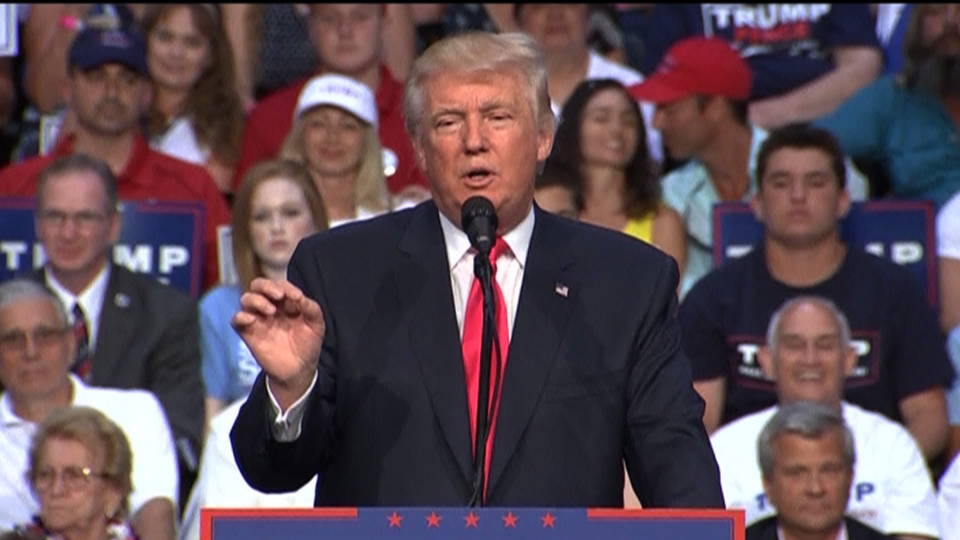
Republican presidential nominee Donald Trump has repeated a claim he watched a "top secret" video showing Iranian officials receiving money from the U.S. in exchange for five prisoners, even after one of his staffers admitted no such video exists. This is Trump speaking on the campaign trail on Wednesday in Florida.
Donald Trump: "I’ll never forget the scene this morning. And remember this: Iran—I don’t think you’ve heard this anywhere but here—Iran provided all of that footage, the tape, of taking that money off that airplane. Right? $400 million in cash. How does a president do that?"
Trump repeated the claim on Thursday in Maine. But then, on Friday, Trump tweeted, "The plane I saw on television was the hostage plane in Geneva, Switzerland, not the plane carrying $400 million in cash going to Iran!" Some Republicans, including Trump, have said the money was a ransom for five prisoners, including Washington Post reporter Jason Rezaian, released by Iran. The Obama administration said Wednesday the $400 million in cash paid to Iran in January was a pre-planned transfer that was part of the landmark nuclear deal. The money has been owed to Iran since the 1970s, when the U.S. refused to send weapons Iran had already paid for following the Iranian revolution.
TOPICS:
2016 Election
Donald Trump
Congresswoman Calls for Mental Health Evaluation of Trump
Ten thousand people have signed a petition circulated by California Congressmember Karen Bass calling on mental health professionals to determine whether Donald Trump is fit to be president. Bass says Trump exhibits all the symptoms of narcissistic personality disorder. The petition reads: "It is entirely possible that some individuals with NPD can successfully function in many careers, but not the Presidency of the United States. We deserve to have the greatest understanding of Mr. Trump’s mental health status before we head to the polls."
TOPICS:
Donald Trump
2016 Election
Military Veterans Call on McCain to Withdraw Endorsement of Trump
Meanwhile, a group of military veterans is calling on Arizona Senator John McCain to withdraw his endorsement of Donald Trump after Trump attacked the Khans, the parents of a U.S. Army captain who died serving in Iraq in 2004. McCain served in the U.S. Navy and was held as a prisoner of war in Vietnam. The veterans announced their initiative at a press conference Thursday in Washington, D.C. This is Marine veteran Alexander McCoy.
Alexander McCoy: "Senator McCain, this is my message to you. You served and you sacrificed in ways Donald Trump cannot begin to understand. You have heard enough, too. Now, I am joining, and I am proud to join, hundreds of—a hundred thousand veterans, military family members and voters across this country in demanding that you, John McCain, act. We cannot afford Donald Trump to be our commander-in-chief."
Trump has previously attacked McCain and his military record, saying, "I like people who weren’t captured." McCain has so far refused to retract his endorsement of Trump. But he became evasive on Wednesday when asked by a reporter about the idea of Trump having control of nuclear weapons. This clip starts with the reporter.
Reporter: "Are you comfortable with Donald Trump possibly having control of the nuclear arsenal?"
Sen. John McCain: "Anyone that the people of this country choose to be the commander-in-chief and the president of the United States, therefore, can lead this country and will lead in a responsible fashion—anyone who is elected president fairly in this country. And that’s the way that our democratic system works."
TOPICS:
2016 Election
Donald Trump
Polls Say Clinton Lead Over Trump Widened After Conventions
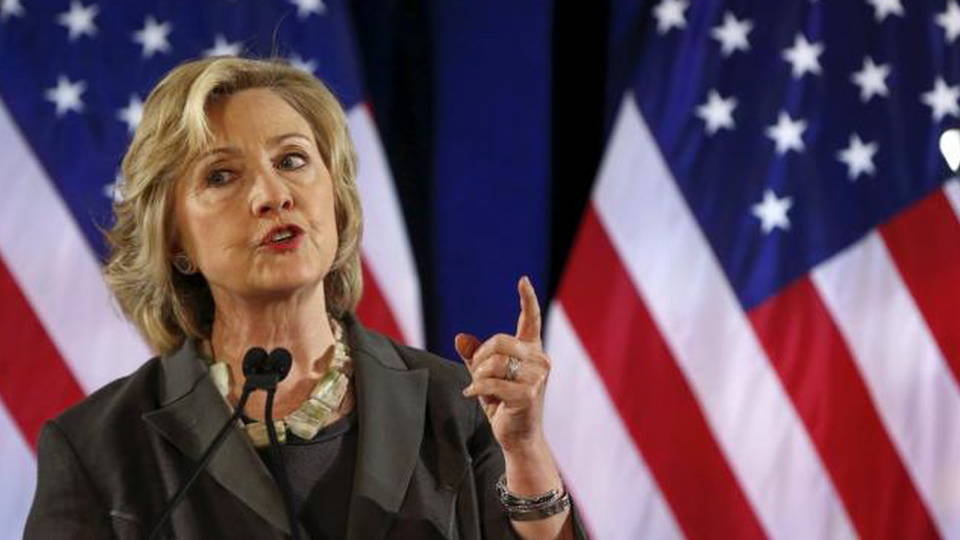
Multiple polls suggest Hillary Clinton has gained in popularity over Donald Trump since the conventions last month. A new NBC News/Wall Street Journal poll has Clinton leading Trump by 9 points in November’s election. Meanwhile, a McClatchy-Marist poll that had Clinton leading by 3 points before the conventions now shows her leading Trump by 15 points.
TOPICS:
Donald Trump
Hillary Clinton
2016 Election
Trump Taj Mahal Casino to Close After Workers Strike for 34 Days
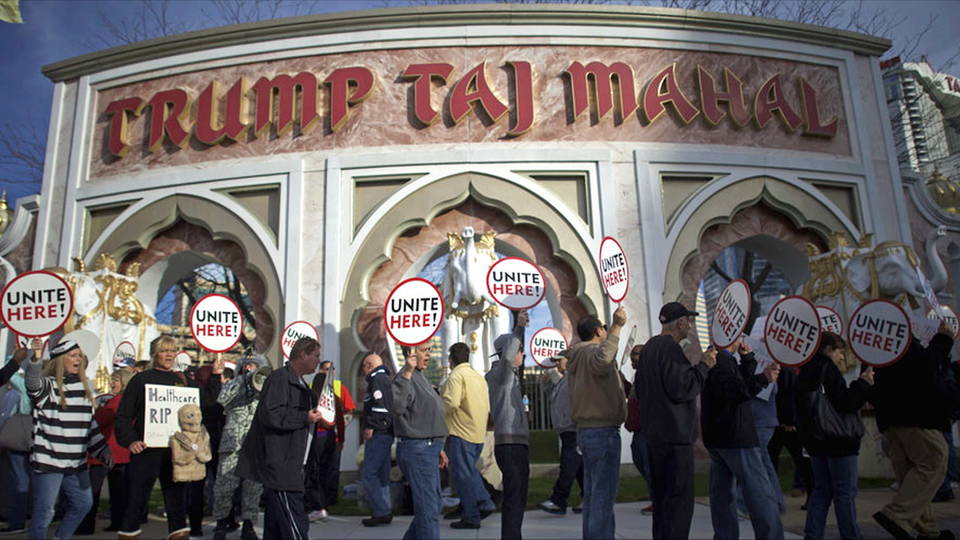
The owners of the Trump Taj Mahal Casino said Wednesday the Atlantic City landmark will close after a 34-day workers’ strike. Donald Trump opened the Taj Mahal 26 years ago, but it now belongs to Trump’s friend and fellow billionaire Carl Icahn. Icahn said the strike was costing him millions of dollars a month. Even after the closing was announced, workers continued to picket, demanding reinstatement of health, pension and other benefits eliminated during 2014 bankruptcy proceedings. This is Diana Hussein from the union UNITE HERE.
Diana Hussein: "The plan is to continue to hold down the line and continue to fight for what was taken away and to continue to fight for the healthcare and continue to fight and stand up to the billionaire bully Carl Icahn."
TOPICS:
Donald Trump
Labor
U.S. Labor Protests
Brazil: Impeachment Proceedings Move Forward for Suspended President
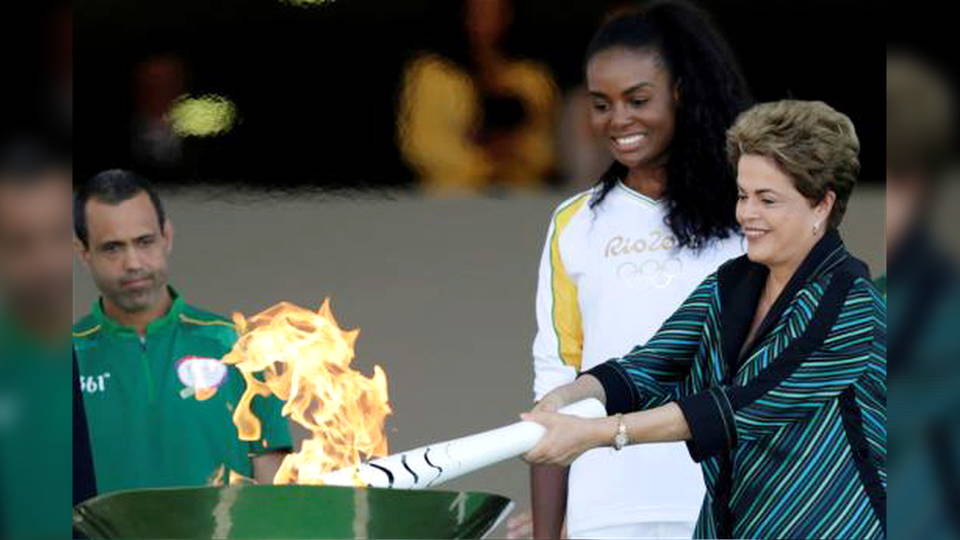
The Summer Olympic Games begin today in Rio de Janeiro against a backdrop of political turmoil in Brazil. A Brazilian Senate committee voted Thursday to put suspended President Dilma Rousseff on trial for breaking budget laws. The entire Senate will vote Tuesday on whether to move forward with a trial, which could lead to Rousseff’s impeachment. Lawmakers voted to suspend Rousseff in May in what many consider a coup by her right-wing opponents. Leaked transcripts show at least one official plotted to oust Rousseff in order to end a corruption investigation targeting him. This is Rousseff’s lawyer, José Eduardo Cardozo.
José Eduardo Cardozo: "Do I think it has been a fair trial, based on all relevant evidence? In summary, no. Unfortunately, what dominated were affirmations which were not based on fact. Everything is in place for her to leave. That is not what was predicted, but unfortunately that was the majority."
TOPICS:
Brazil
VA Officer Sentenced to 2.5 Years for Killing of Unarmed African American
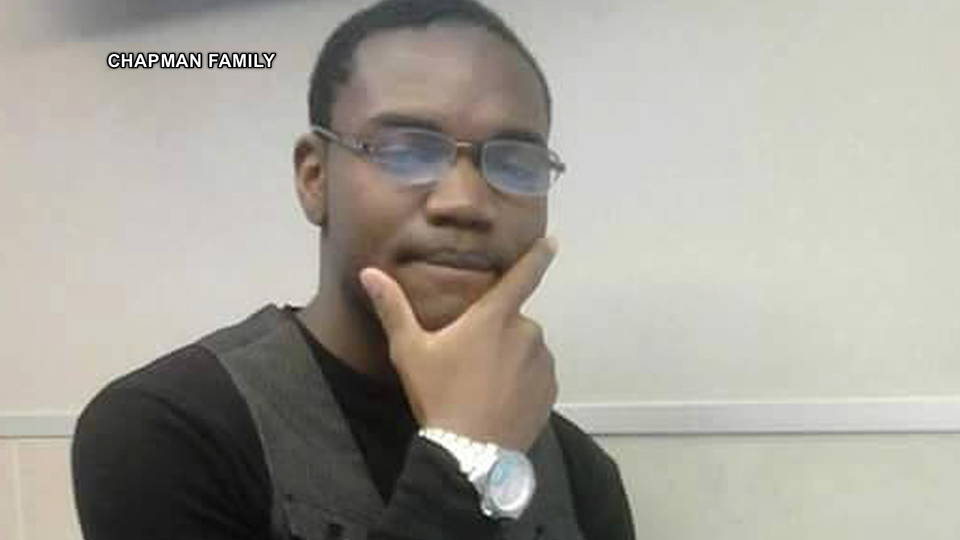
A jury has recommended a sentence of two-and-a-half years for Virginia police officer Stephen Rankin, who was convicted of shooting an unarmed African-American man he had suspected of shoplifting. The killing of William Chapman was Officer Rankin’s second fatal shooting of an unarmed man.
TOPICS:
Police Brutality
Police
Black Lives Matter Demonstrators Shut Down Roads in U.K.
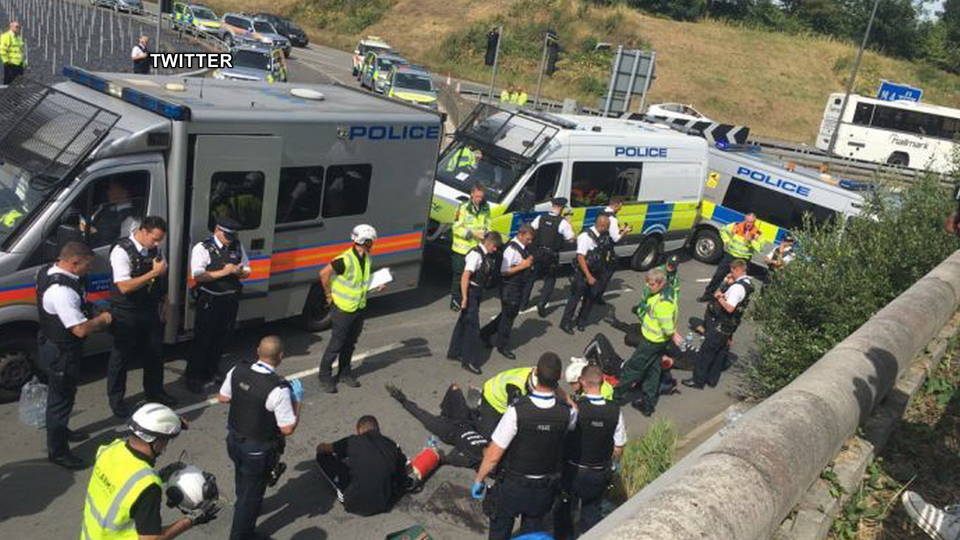
In Britain, Black Lives Matter movement demonstrators have blocked a road leading to London’s Heathrow Airport and held protests in other cities. In addition to drawing attention to British police discrimination against communities of color, demonstrators were marking the fifth anniversary of the shooting death by police of Mark Duggan. Duggan’s killing sparked protests and the worst civil unrest in the U.K. in decades. The officer who shot Duggan claimed he had pointed a gun at police, but a jury decided Duggan was unarmed when he was shot.
TOPICS:
Black Lives Matter
Israel Claims U.S. Evangelical Christian Charity Sent Funds to Hamas
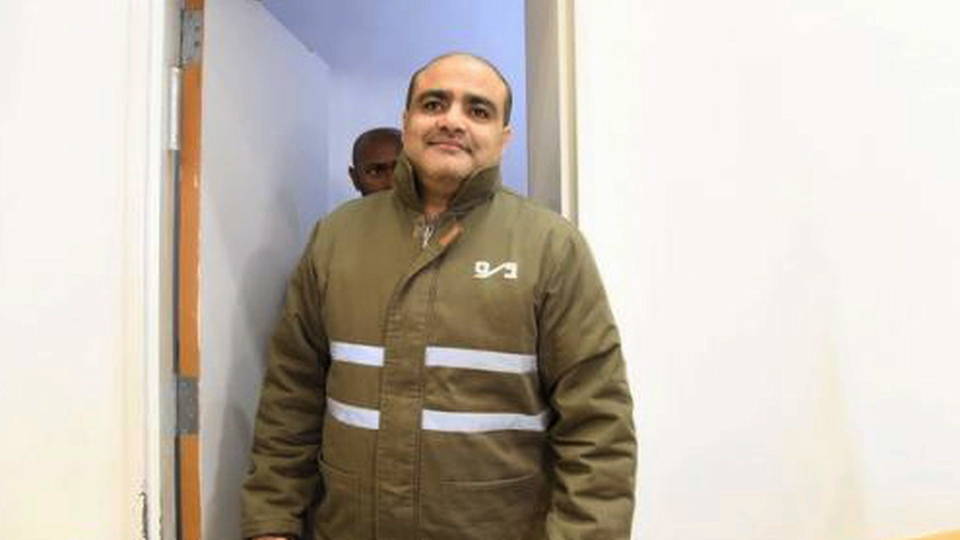
The Israeli government has accused a representative of a U.S. evangelical Christian charity of providing millions in aid money to Hamas. Israel arrested Mohammad El Halabi, World Vision’s manager of operations in Gaza, last month. He has been held incommunicado by Israeli authorities since then and accused of funneling more than $50 million to Hamas in his decade working for World Vision. World Vision has denied the allegations and said that the amount of money Israel claims was given to Hamas exceeds World Vision’s total budget for Gaza during that time. Hamas has also denied the Israeli government’s claim.
TOPICS:
Hamas
Israel
Parole Board Clears Another Guantánamo Prisoner for Release
On Thursday, the parole board at Guantánamo said prisoner Hayl Aziz al-Maythali no longer posed a danger, and cleared him for release. The 39-year-old Yemeni was once accused of having plotted the 9/11 attacks and had been considered one of the prison’s "forever prisoners"—those least likely to ever be released. Thirty-four of the remaining 76 detainees at Guantánamo have now been cleared for release. Some have been cleared for years.
TOPICS:
Guantanamo
Psychological Assoc. Considers Changing Rules on Interrogations
Meanwhile, the American Psychological Association will vote today on whether to roll back some of its new rules prohibiting its members from participating in interrogations that could lead to torture. The APA is the world’s largest professional association of psychologists. In a historic vote last year, the APA banned its members from such work after an independent investigation documented how the APAleadership actively colluded with the Pentagon and the CIA torture programs. Click here to see all our past coverage of the APA, including the 2015 vote.
TOPICS:
Psychology & Torture
Japan Marks 71st Anniversary of U.S. Atomic Bombing of Hiroshima
And tomorrow is the 71st anniversary of the atomic bombing of Hiroshima. The bombing killed 140,000 people and seriously injured another 100,000. Three days later, the U.S. dropped a second atomic bomb on Nagasaki, killing another 74,000 people. In May, President Barack Obama became the first sitting U.S. president to visit Hiroshima. He spoke at a memorial for victims of the attack, but disappointed some by failing to offer a formal apology for the bombing. The U.S. is the only country ever to have dropped an atomic bomb.
TOPICS:
Japan
Atomic Bomb
Donate today:
Follow:
COLUMN
The Voting Rights Acts in the Era of Jim Crow 2.0
WEB EXCLUSIVE
Lee Fang on HowCitizens United Opened Floodgates for Foreign Corporate Money in U.S. Elections
NEW BOOK
Democracy Now!: Twenty Years Covering the Movements Changing America
WEB EXCLUSIVE
Chase Strangio on the ACLU's Fight to Overturn North Carolina's Anti-LGBT Law HB 2
WORK WITH DN!
Senior TV Producer
Development Manager
SPEAKING EVENT
8/19 Seattle, WA
207 West 25th Street, 11th Floor
Trump Repeats False Claim About Iran Ransom Before Admitting Lie
Republican presidential nominee Donald Trump has repeated a claim he watched a "top secret" video showing Iranian officials receiving money from the U.S. in exchange for five prisoners, even after one of his staffers admitted no such video exists. This is Trump speaking on the campaign trail on Wednesday in Florida.
Donald Trump: "I’ll never forget the scene this morning. And remember this: Iran—I don’t think you’ve heard this anywhere but here—Iran provided all of that footage, the tape, of taking that money off that airplane. Right? $400 million in cash. How does a president do that?"
Trump repeated the claim on Thursday in Maine. But then, on Friday, Trump tweeted, "The plane I saw on television was the hostage plane in Geneva, Switzerland, not the plane carrying $400 million in cash going to Iran!" Some Republicans, including Trump, have said the money was a ransom for five prisoners, including Washington Post reporter Jason Rezaian, released by Iran. The Obama administration said Wednesday the $400 million in cash paid to Iran in January was a pre-planned transfer that was part of the landmark nuclear deal. The money has been owed to Iran since the 1970s, when the U.S. refused to send weapons Iran had already paid for following the Iranian revolution.
TOPICS:
2016 Election
Donald Trump
Congresswoman Calls for Mental Health Evaluation of Trump
Ten thousand people have signed a petition circulated by California Congressmember Karen Bass calling on mental health professionals to determine whether Donald Trump is fit to be president. Bass says Trump exhibits all the symptoms of narcissistic personality disorder. The petition reads: "It is entirely possible that some individuals with NPD can successfully function in many careers, but not the Presidency of the United States. We deserve to have the greatest understanding of Mr. Trump’s mental health status before we head to the polls."
TOPICS:
Donald Trump
2016 Election
Military Veterans Call on McCain to Withdraw Endorsement of Trump
Meanwhile, a group of military veterans is calling on Arizona Senator John McCain to withdraw his endorsement of Donald Trump after Trump attacked the Khans, the parents of a U.S. Army captain who died serving in Iraq in 2004. McCain served in the U.S. Navy and was held as a prisoner of war in Vietnam. The veterans announced their initiative at a press conference Thursday in Washington, D.C. This is Marine veteran Alexander McCoy.
Alexander McCoy: "Senator McCain, this is my message to you. You served and you sacrificed in ways Donald Trump cannot begin to understand. You have heard enough, too. Now, I am joining, and I am proud to join, hundreds of—a hundred thousand veterans, military family members and voters across this country in demanding that you, John McCain, act. We cannot afford Donald Trump to be our commander-in-chief."
Trump has previously attacked McCain and his military record, saying, "I like people who weren’t captured." McCain has so far refused to retract his endorsement of Trump. But he became evasive on Wednesday when asked by a reporter about the idea of Trump having control of nuclear weapons. This clip starts with the reporter.
Reporter: "Are you comfortable with Donald Trump possibly having control of the nuclear arsenal?"
Sen. John McCain: "Anyone that the people of this country choose to be the commander-in-chief and the president of the United States, therefore, can lead this country and will lead in a responsible fashion—anyone who is elected president fairly in this country. And that’s the way that our democratic system works."
TOPICS:
2016 Election
Donald Trump
Polls Say Clinton Lead Over Trump Widened After Conventions
Multiple polls suggest Hillary Clinton has gained in popularity over Donald Trump since the conventions last month. A new NBC News/Wall Street Journal poll has Clinton leading Trump by 9 points in November’s election. Meanwhile, a McClatchy-Marist poll that had Clinton leading by 3 points before the conventions now shows her leading Trump by 15 points.
TOPICS:
Donald Trump
Hillary Clinton
2016 Election
Trump Taj Mahal Casino to Close After Workers Strike for 34 Days
The owners of the Trump Taj Mahal Casino said Wednesday the Atlantic City landmark will close after a 34-day workers’ strike. Donald Trump opened the Taj Mahal 26 years ago, but it now belongs to Trump’s friend and fellow billionaire Carl Icahn. Icahn said the strike was costing him millions of dollars a month. Even after the closing was announced, workers continued to picket, demanding reinstatement of health, pension and other benefits eliminated during 2014 bankruptcy proceedings. This is Diana Hussein from the union UNITE HERE.
Diana Hussein: "The plan is to continue to hold down the line and continue to fight for what was taken away and to continue to fight for the healthcare and continue to fight and stand up to the billionaire bully Carl Icahn."
TOPICS:
Donald Trump
Labor
U.S. Labor Protests
Brazil: Impeachment Proceedings Move Forward for Suspended President
The Summer Olympic Games begin today in Rio de Janeiro against a backdrop of political turmoil in Brazil. A Brazilian Senate committee voted Thursday to put suspended President Dilma Rousseff on trial for breaking budget laws. The entire Senate will vote Tuesday on whether to move forward with a trial, which could lead to Rousseff’s impeachment. Lawmakers voted to suspend Rousseff in May in what many consider a coup by her right-wing opponents. Leaked transcripts show at least one official plotted to oust Rousseff in order to end a corruption investigation targeting him. This is Rousseff’s lawyer, José Eduardo Cardozo.
José Eduardo Cardozo: "Do I think it has been a fair trial, based on all relevant evidence? In summary, no. Unfortunately, what dominated were affirmations which were not based on fact. Everything is in place for her to leave. That is not what was predicted, but unfortunately that was the majority."
TOPICS:
Brazil
VA Officer Sentenced to 2.5 Years for Killing of Unarmed African American
A jury has recommended a sentence of two-and-a-half years for Virginia police officer Stephen Rankin, who was convicted of shooting an unarmed African-American man he had suspected of shoplifting. The killing of William Chapman was Officer Rankin’s second fatal shooting of an unarmed man.
TOPICS:
Police Brutality
Police
Black Lives Matter Demonstrators Shut Down Roads in U.K.
In Britain, Black Lives Matter movement demonstrators have blocked a road leading to London’s Heathrow Airport and held protests in other cities. In addition to drawing attention to British police discrimination against communities of color, demonstrators were marking the fifth anniversary of the shooting death by police of Mark Duggan. Duggan’s killing sparked protests and the worst civil unrest in the U.K. in decades. The officer who shot Duggan claimed he had pointed a gun at police, but a jury decided Duggan was unarmed when he was shot.
TOPICS:
Black Lives Matter
Israel Claims U.S. Evangelical Christian Charity Sent Funds to Hamas
The Israeli government has accused a representative of a U.S. evangelical Christian charity of providing millions in aid money to Hamas. Israel arrested Mohammad El Halabi, World Vision’s manager of operations in Gaza, last month. He has been held incommunicado by Israeli authorities since then and accused of funneling more than $50 million to Hamas in his decade working for World Vision. World Vision has denied the allegations and said that the amount of money Israel claims was given to Hamas exceeds World Vision’s total budget for Gaza during that time. Hamas has also denied the Israeli government’s claim.
TOPICS:
Hamas
Israel
Parole Board Clears Another Guantánamo Prisoner for Release
On Thursday, the parole board at Guantánamo said prisoner Hayl Aziz al-Maythali no longer posed a danger, and cleared him for release. The 39-year-old Yemeni was once accused of having plotted the 9/11 attacks and had been considered one of the prison’s "forever prisoners"—those least likely to ever be released. Thirty-four of the remaining 76 detainees at Guantánamo have now been cleared for release. Some have been cleared for years.
TOPICS:
Guantanamo
Psychological Assoc. Considers Changing Rules on Interrogations
Meanwhile, the American Psychological Association will vote today on whether to roll back some of its new rules prohibiting its members from participating in interrogations that could lead to torture. The APA is the world’s largest professional association of psychologists. In a historic vote last year, the APA banned its members from such work after an independent investigation documented how the APAleadership actively colluded with the Pentagon and the CIA torture programs. Click here to see all our past coverage of the APA, including the 2015 vote.
TOPICS:
Psychology & Torture
Japan Marks 71st Anniversary of U.S. Atomic Bombing of Hiroshima
And tomorrow is the 71st anniversary of the atomic bombing of Hiroshima. The bombing killed 140,000 people and seriously injured another 100,000. Three days later, the U.S. dropped a second atomic bomb on Nagasaki, killing another 74,000 people. In May, President Barack Obama became the first sitting U.S. president to visit Hiroshima. He spoke at a memorial for victims of the attack, but disappointed some by failing to offer a formal apology for the bombing. The U.S. is the only country ever to have dropped an atomic bomb.
TOPICS:
Japan
Atomic Bomb
Donate today:
Follow:
COLUMN
The Voting Rights Acts in the Era of Jim Crow 2.0
WEB EXCLUSIVE
Lee Fang on HowCitizens United Opened Floodgates for Foreign Corporate Money in U.S. Elections
NEW BOOK
Democracy Now!: Twenty Years Covering the Movements Changing America
WEB EXCLUSIVE
Chase Strangio on the ACLU's Fight to Overturn North Carolina's Anti-LGBT Law HB 2
WORK WITH DN!
Senior TV Producer
Development Manager
SPEAKING EVENT
8/19 Seattle, WA
207 West 25th Street, 11th Floor
New York, New York 10001, United States
-------
-------

No comments:
Post a Comment