democracynow.org
Stories:
 Chicago Cops Who Broke "Code of Silence" to Report Police Drug Gang Face Deadly Retaliation
Two Chicago police officers say they have faced retaliation and suffered from PTSD since they blew the whistle on a gang of their fellow cops who were demanding bribes from drug dealers in the housing projects of Chicago. We speak with one of the whistleblowers, Shannon Spalding, and with reporter Jamie Kalven, who documented their ordeal in a major investigation for The Intercept called "Code of Silence."
TRANSCRIPT
This is a rush transcript. Copy may not be in its final form.
JUAN GONZÁLEZ: We begin today’s show with an explosive story of two Chicago police officers who blew the whistle on a gang of their colleagues after they discovered they were demanding bribes from drug dealers in the housing projects of Chicago, arresting their rivals and blocking any internal investigations into their actions. The two whistleblowers, Shannon Spalding and her partner Danny Echeverria, spent five years working with the Chicago Police Department and the FBI in their case, only to be sidelined, outed as informants, threatened and eventually forced out of the police department. In contrast, the named senior officials and cops who helped cover for their fellow officers were able to retire from the force with their pensions intact and faced no punishment for their role in the cover-up. Spalding says she has even received death threats. She and her partner both took stress-related medical leave, and she has been diagnosed with post-traumatic stress disorder.
AMY GOODMAN: Their ordeal is chronicled in a four-part investigation published by The Intercept called "The Code of Silence." Part 1 is headlined "In the Chicago Police Department, If the Bosses Say It Didn’t Happen, It Didn’t Happen." It’s written by the award-winning Chicago journalist Jamie Kalven, who’s made a career of exposing police misconduct in Chicago. He spent three years interviewing Spalding for the report. He’s also known for uncovering the autopsy report that showed Laquan McDonald was shot 16 times by Chicago police in [ 2014 ], and was the first to report on the existence of the video of the shooting, which was released 400 days after McDonald was killed. Thursday marked the second anniversary of the killing. Kalven is now working with Spalding on a project called the Invisible Institute, which has set up an encrypted drop box for Chicago police officers to anonymously upload evidence of corruption. They also offer to link whistleblowing cops to mental health and legal resources.
For more, we go to Chicago, where Jamie Kalven joins us to discuss the investigation. And we’re joined by the whistleblower at the center of his story, Shannon Spalding.
We welcome you both to Democracy Now! Jamie, let’s begin with you. Lay out this story.
JAMIE KALVEN: So, this is really a Serpico saga for our time, of two undercover—two narcotics officers who undercover a massive criminal enterprise, as your setup said, in high-rise public housing in Chicago during its last decade of existence. It’s all been demolished now, so the scene of the crime has essentially disappeared. They make conscientious efforts to bring this criminal activity to the attention of their superiors. They’re blown off, ultimately go to the FBI and provide information. It’s not conclusive information, but grounds for investigation. They then are detailed to work undercover with the FBI and pursue this investigation for a number of years, are at the point of breaking the case wide open when they are outed within the department, and have since suffered constant retaliation.
I think part of what is really important about this story is what it illustrates about the nature of the code of silence. You know, I think the common understanding of the code of silence is it’s a kind of peer-to-peer phenomena of the rank and file: "We’re in the foxhole together. You’ve got my back. I’ve got mine. Nobody likes a tattletale." There certainly is that dimension within police culture, but what’s so striking about this story is that the retaliation against these officers is ordered by high-ranking supervisory officials within the department. So it’s really a story, in great detail, of how the code of silence operates at the center of the Chicago Police Department.
JUAN GONZÁLEZ: Well, Jamie, about this issue of retaliation being ordered at high levels. How was that documented in the lawsuit? And also, the city settled for $2 million before there was a trial. Could you talk about the tactic of the city of settling the suit?
JAMIE KALVEN: Right. So, there was a—in the midst of this ordeal, the two officers, Shannon and Danny, brought a whistleblower lawsuit—really, an employment suit—hoping, above all, to be protected from further retaliation. It only compounded and intensified the retaliation at that point. There are a number of allegations in the lawsuit, and The Intercept piece links to all the underlying legal documents. But, you know, supervisors—the commander of narcotics, the chief of organized crime—made it clear that they did not want these officers working in units that they controlled. They went so far, in one instance, of really delivering a threat—and, paradoxically, the threat was conveyed by the chief of Internal Affairs, who’s charged with investigating this sort of thing—a threat against their personal safety. You know, I believe the quote was "If they call for backup, it’s not coming."
So, you know, this was not just a matter of being ostracized or shunned within the department, although it certainly was that. These—as Shannon says at one point in the article, I quote her saying, you know, "We were officers without a department." So they’re left out on the streets in this really dangerous investigation, investigating a team of officers who are thought to have been implicated in two murders. It hasn’t been proven yet, but it’s scarcely been investigated, apart from Shannon and Danny’s work. And they’re kind of left wholly exposed. So—and this was coming from the top. This wasn’t some kind of, you know, aberrant behavior. This is really the machinery of how the Chicago Police Department controls the narrative. Amy quoted the line about, you know, if the bosses say it didn’t happen, it didn’t happen. That’s really what’s at the center of this story.
AMY GOODMAN: So, let’s go to Shannon Spalding, former Chicago police officer. On May 31st, Chicago agrees to settle a whistleblower lawsuit brought by Shannon Spalding and her colleague, Daniel Echeverria, who alleged they suffered retaliation for reporting and investigating criminal activity by fellow officers. Shannon Spalding, tell us: What was it that you were investigating? When did it happen? And when did the cover-up, do you feel, and the retaliation against you start?
SHANNON SPALDING: My partner Danny and I started investigating allegations that kept surfacing. There was a sergeant, Ronald Watts, and members of his TAC team, who worked directly underneath him, that were imposing what they called on the street a "Watts tax." Basically, he was extorting the drug dealers. He was receiving money from drug dealers that ran different drug lines within the Ida B. Wells housing projects and the surrounding area. And in exchange for that money, they were guaranteed protection from prosecution and arrest. In addition to that, the allegations were that this crew of rogue officers, under the command of Ronald Watts, were also planting narcotics on innocent individuals and falsifying police reports, falsely arresting them, putting them in prison for false allegations. There’s also the allegations of, you know, physical violence, of being beaten, if they didn’t want to comply and pay this tax, as well as warrantless seizures, kicking in doors and going through people’s apartments, stealing everything that wasn’t nailed down. And the allegations kept being repeated over and over again from every individual that we would do intelligence debriefings with, along with our confidential informants.
And I think you said, "When did the retaliation begin on this investigation?" We began to investigate it and brought it to the FBI in 2006. We were not officially assigned with our department to work with the FBI at that time. We were doing this on our own time. In 2007, we were assigned by the Chicago Police Department to work with the FBI solely on what was dubbed Operation Brass Tax, "brass" meaning the top officials in the police department—"brass" refers to a boss—"tax," because that’s what they were implementing on the drug dealers and the gangbangers. It was about—I believe it was 2010, August of 2010, when I realized that our identity had been compromised and that we were now out in the open. This was supposed to remain a strictly confidential investigation. And it was imperative that our identities not be revealed, because the targets of this investigation were officers and bosses, and we didn’t know how far up the chain it would go, which meant that they had access to all of our personal information—where we lived, our children, anything that they wanted, which made us very vulnerable. So, to expose our identity is basically throwing us to the wolves. These targets could now know who we are, what we’re investigating. And you have to remember, these are police officers. They know what they did. And now they know we know. And that—with that comes the implication of federal prison time, losing your job, losing your livelihood. That makes us targets and makes it very dangerous for us to work.
JUAN GONZÁLEZ: Well, I want to turn to Janet Hanna, a 20-year veteran of the Chicago Police Department. She says she witnessed the harassment of you, Shannon, and your partner, Danny Echeverria. On one occasion, Hanna said she overheard a sergeant warning you about her own safety. This is Hanna telling NBC Chicago’s Phil Rogers what she overheard.
JANET HANNA: That she better where her bulletproof vest. She may go home in a casket, and he doesn’t want have to call her daughter and tell her that she’s—you know, she’s gone.
PHIL ROGERS: And that was because she would be in danger from bad guys and they wouldn’t protect her from the bad guys, or she’d be in danger from her fellow officers?
JANET HANNA: Both.
JUAN GONZÁLEZ: What about that? What kind of retaliation did you feel when you were still working there?
SHANNON SPALDING: Oh, the retaliation was horrific. I actually felt so anxious walking into work every day, because once I filed the whistleblower lawsuit, I am now working for the defendants of my lawsuit. So can you just imagine what that was like? I felt like I was walking into the lion’s den with a steak around my neck every single day.
And I recall that incident. That incident is just burned into my memory. It was my direct supervisor at the time within Fugitive Apprehension that was telling me that because we had investigated other officers, because we had basically broken the code of silence and we had gone against other sworn members, that the officers within that unit—the supervisors were relaying to me that the officers on the team and in this unit "will not back you up. You’re on your own. You’re in—you’re in a lot of danger." And he went so far as to saying—as to say, "You’re going to end up in a box, and I’m going to be the one knocking on the door and telling your daughter you’re coming home in a box." And those were the type of threats that would happen just on a regular basis. It was almost—the retaliation was relentless, and it was daily.
JUAN GONZÁLEZ: I wanted to also ask Jamie Kalven—you’ve been investigating both police abuse and now this entire police corruption scandal. For those of us who have been following crime stories and police departments now for decades, this is almost likedéjà vu all over again, if it wasn’t Serpico in the 1960s here in New York City, and then in the '90s there was a similar type of scandal with a corrupt group of officers named—headed by a guy named Michael Dowd, and, again, a whistle—a police officer within the department, Joe Trimboli, trying to ferret them out. But the Dowd criminal group was only revealed when Long Island police arrested him on charges. And it seems to me that there's always been sort of a link between corruption in police departments and abuse within police departments, that there seem to be upsurges in abuse at the same time that there are upsurges in corruption. I’m wondering your understanding of what’s been going on in Chicago.
JAMIE KALVEN: Yeah, well, I think that’s—that’s well put. And a huge part of that is the war on drugs and the way in which we’ve conducted it. I mean, I think we’ve found consistently, in, you know, multiple, multiple scandals, that it happens in sort of specialized units working in supposedly combating the war on drugs. And—but again and again, that proves to be a sort of setting and medium for corruption and all the attendant abuse.
So, what Shannon was describing was this sort of protection racket that—you know, hugely corrupt. The officers are really an integral part of the drug trade. At the same time, as part of that, they are daily, multiple times, violating the constitutional rights of citizens—false arrest, excessive force, the fabrication of evidence, on and on. So this all goes together.
And I think we will continue to have recurring scandals of this nature until we can address the—you know, we use this term, "the code of silence," to describe a kind of culture within the department, a, really, mode of governance within the department. And until officers like Shannon and Danny are held up as models of good police officers and good police work, until the incentive-disincentive sort of scheme shifts, right now, for officers to break ranks and come forward and report really grievous abuse by fellow officers requires them to be heroic almost to the point of self-sacrifice.
AMY GOODMAN: So, in—
JAMIE KALVEN: That can’t work.
AMY GOODMAN: In February of 2015, the former Chicago Police Department superintendent, Garry McCarthy, releases a statement to NBC Chicago saying, quote, "Superintendent McCarthy and the CPD [Chicago Police Department] have zero tolerance for retaliation against whistleblowers. ... However, the City believes the claims of these particular plaintiffs are without merit. The City will continue to vigorously litigate this case." That was in February 2015. Shannon, the day you were going to trial, right, in May of 2016, they settled with you and Danny, your fellow police officer, for $2 million?
SHANNON SPALDING: That is correct. They waited until the last minute, and then they decided to settle. And I personally believe that’s because they did not want me getting on the stand and telling everything that I know about how the operation within the police department really works. And they didn’t want that on public record. So, they would rather settle than have me expose all of their dirty laundry in a courtroom.
AMY GOODMAN: How much money were you talking about, by the way, when it came to what these officers were doing?
SHANNON SPALDING: Oh, you know, we’ll never have a final count. But, you know, the range varied. We got information that some of the drug lines would pay a couple thousand dollars a week. We had several sources say that one of the biggest dope lines that was run in the city of Chicago was named "Obama," and they would pay as much as $50,000. So, it depended on the drug dealer. The amount of money they were bringing in, the amount of protection that they would need, how many locations they were running would vary. It was—it was really a criminal enterprise. It was a complete business, a criminal business.
AMY GOODMAN: Has anyone been prosecuted?
SHANNON SPALDING: Ronald Watts, Sergeant Ronald Watts, and Kallatt Mohammed pled guilty, and they served their sentences in federal prison. I believe it was 18 and 22 months, Ronald—Sergeant Ronald Watts doing 22 months, and I believe Kallatt Mohammed did 18 months.
JUAN GONZÁLEZ: And, Jamie Kalven, you were interviewing these officers off and on for several years before you actually were able to—The Intercept story came out. Could you talk about the difficulties in getting this story out?
JAMIE KALVEN: Yeah, so, this is a—I mean, this is a complicated story for a journalist to figure out how to bring to the public. You know, when an Edward Snowden comes to us with a treasure trove of documents, we know what to do with that sort of whistleblower. When somebody like Shannon and her partner Danny come with a compelling story that they have—that’s cost them, and they’ve taken great risks to tell, but it—by the nature of the story, it can’t be fully corroborated. You can’t, you know, double source. Other people who were in the room for various conversations won’t talk to you. And it’s fundamentally a story about the code of silence, which we should really call by its true name, which is "official lying," concerted, sustained lying by high officials. You know, the question of how to tell that story in a way that is consistent with journalistic ethics and standards of rigor and care, you know, I struggled with that and found, ultimately, with The Intercept, a great partner in bringing this story out.
And where the story sort of ends—and I urge people to go to The Intercept site and read it. It really—you know, partly because of Shannon’s great storytelling ability, it reads like a novel. But it ends at a point where I want to leave the reader with a question, which is: If Shannon and Danny are telling the truth—and you’ve read this long story, you can make your own judgments about credibility—if they are telling the truth, then a whole array of high officials are lying, and lying in concert. So, the story really ultimately hinges on arriving at that question. And that question remains open for the city of Chicago. You know, the settlement of the case did not resolve the—of Shannon’s case did not resolve the issues raised by the case. And what we hope to do through the reporting and ongoing reporting about this is to keep those issues very centrally in the public eye.
AMY GOODMAN: Very quickly, late last year, Chicago Mayor Rahm Emanuel apologized for Laquan McDonald’s death. In his speech to the Chicago City Council, Emanuel broke with the city’s long history of denying the existence of the code of silence.
MAYOR RAHM EMANUEL: As we move forward, I am looking for a new leader of the Chicago Police Department to address the problems at the very heart of the policing profession. The problem is sometimes referred to as "the thin blue line." The problem is other times referred to as "the code of silence." It is this tendency to ignore. It is the tendency to deny. It is the tendency, in some cases, to cover up the bad actions of a colleague or colleagues. No officer should be allowed to behave as if they are above the law, just because they are responsible for upholding the law. Permitting and protecting even the smallest acts of abuse by a tiny fraction of our officers leads to a culture where extreme acts of abuse are more likely—just like what happened to Laquan McDonald.
AMY GOODMAN: This comes as Thursday marked the second anniversary of the death of Laquan McDonald, fatally shot by Chicago police officer Jason Van Dyke in 2014. Jamie Kalven, you were the first to report the existence of the video of the shooting, which was released 400 days after McDonald was killed, released after Mayor Rahm Emanuel was re-elected. As we wrap up, can you talk about the significance of here he’s acknowledging the code of silence, and what this case has meant for the city? Basically, Laquan McDonald, shot 16 times, that’s almost one bullet for every year of his life. He died at the age of 17.
JAMIE KALVEN: No, it’s an extraordinary—it’s an extraordinary moment for the city. And I’ve now compared the public narrative of Laquan McDonald to the story of Emmett Till, another—another child of Chicago, that so illuminated the underlying violence of the Jim Crow era. The revelations about Laquan McDonald, not simply the atrocity of his death, but the institutional response after, which is really a classic illustration of the code of silence as control of the narrative—you know, the suppression of evidence, the intimidation of witnesses, fabrication of reports—that now has become a sort of framing narrative in Chicago and caused a political earthquake, changed the landscape of the city.
So we have, amid all of the sort of bad news and all the disclosures of wrongdoing and corruption within the department—I think it’s important to emphasize that as a consequence of the McDonald tragedy, there is an historic opening in Chicago for really meaningful police reform. The language quoted from the—that was one of the mayor’s better moments, acknowledging the existence of the code of silence. And so, there really is, going forward, I believe, a kind of irresistible momentum towards reform. But it’s a big challenge. It’s going to be a long slog. And only by addressing the culture within the department that we refer to as the code of silence will change really be meaningful and endure. We can make all sorts of changes in institutions, tweak procedures, but culture will always trump procedure.
AMY GOODMAN: Jamie Kalven, we want to thank you for being with us. We will link to your series, "Code of Silence," at democracynow.org. And, Shannon Spalding, thank you for your bravery and for speaking out here today on Democracy Now!, former Chicago police officer, whistleblower featured in the series. She says she suffered retaliation for reporting and investigating criminal activity by fellow Chicago officers.
This is Democracy Now! When we come back, Shaun King joins us to talk about many issues. Stay with us. ... Read More → Former Bernie Sanders Supporter Shaun King Now Backs Hillary Clinton, Says She Has "Evolved"
With the election just 18 days away and three presidential debates behind them, Hillary Clinton and Donald Trump are campaigning across the country. Clinton is scheduled to spend Sunday in Raleigh, North Carolina, where she will be joined by the Mothers of the Movement—women who lost their children to police-involved incidents and gun violence. We discuss the election with former Bernie Sanders supporter Shaun King, senior justice writer for the New York Daily News. "We learned a lot of tough lessons" from the Sanders campaign, King says. But, he adds, "I think [Clinton] has evolved, and we’ll have to see, if she is elected, what that evolution means in terms of policy and practices."
TRANSCRIPT
This is a rush transcript. Copy may not be in its final form.
JUAN GONZÁLEZ: And speaking of the moment that we have, we’re obviously in the final days of the presidential race, and you’ve also written extensively about the campaign. And the—you were initially a big supporter of Bernie Sanders, and now you’re faced with—or all of us are faced with this choice between Donald Trump and Hillary Clinton and then the other independent-party figures. What’s your take now as we’re heading into the final days of the election?
SHAUN KING: Well, it’s been a frustrating experience. I’m still brokenhearted that Bernie didn’t win. I didn’t—I didn’t think it would sting as much as it did, not just because I loved Bernie, but I respected his ideas and values. I don’t really see those ideas and values so much in either major-party candidate. I joined Bernie in this idea that it was essential for us to stop Donald Trump. And I believe that. I believe, as many others do, that he was as grave a danger as we say he is. I don’t believe he’ll win, but I believe all of us will have to go out and vote and do what we have to do to stop him, for sure, yeah.
AMY GOODMAN: I’ve always wondered, if Donald Trump—if Bernie Sanders had gotten anything like the television attention, the media attention of Donald Trump—
SHAUN KING: Sure.
AMY GOODMAN: I mean, the studies that show back in 2015, what, Trump got like 28 times. And then you still had Bernie Sanders getting these massive crowds—
SHAUN KING: Sure.
AMY GOODMAN: —with no amplifying of his view, very little in the corporate media, until the very end—what that would have meant, as now the media decries whoever created Donald Trump, which, of course, was them.
SHAUN KING: Absolutely. I think there are a lot of lessons we learned there. One, you know, Bernie still won 21 states without that. And I think what a lot of us are taking is that there is a progressive movement in this country that came very close to having Bernie Sanders elected, without the media machine behind him. We learned a lot of tough lessons. We learned a lot of things that we’ll have to adjust if we go back to the table again.
But none of us are really pleased, at least no true progressives are pleased, with Hillary Clinton’s platform or commitment—even on issues of police brutality. I have grown to believe that she does care, in part because she has spent a lot of time with families affected by police brutality. And so, even those of us who are deeply skeptical of her commitment—I think she has evolved. And we’ll have to wait and see, if she’s elected, what that evolution means in terms of policies and practices.
AMY GOODMAN: I mean, isn’t there a major difference between President Obama getting elected and if Hillary Clinton were to get elected? President Obama, the movements elect him. There’s a racist backlash—the birther movement. One of those that led it is Trump.
SHAUN KING: Sure.
AMY GOODMAN: And people step back. And on so many of the issues people cared about in the movements, from peace to Guantánamo to racial justice, all of these issues, people felt that the movements weren’t carried forward, because they stepped back. But now there’s such skepticism about Hillary Clinton that they are ready to go at the gate, that November 9th might be a massive point of mobilization as opposed to of stepping back.
SHAUN KING: I think it should be. And I think we would all be making a huge mistake if we—if we did step back. I think now is the time for all of us to push forward, to hold whoever is elected—I believe she’ll be elected—to hold her accountable. I think we put so much faith in the election of President Obama, that we—when we stepped back, we missed an opportunity. And I’m disappointed with a lot of the things that he’s been hands-off on. Again, those are the hard lessons that we’ve learned about what it means to hold elected leaders that we respect, and maybe even admire, to hold them accountable on the things that matter to us.
JUAN GONZÁLEZ: And speaking of President Obama, in the last debate, I think one of the most telling moments was toward the end of the debate when Trump says, "And if you want four more years of Obama, elect her."
SHAUN KING: Right, right.
JUAN GONZÁLEZ: It was almost as if his people are still fighting—
SHAUN KING: Yeah.
JUAN GONZÁLEZ: —to delegitimize or remove Obama from the American conscience.
SHAUN KING: Which is—which is a weird strategy, though, because President Obama, for what any of us think about him, is at his most popular right now. And so, there are a lot of times where it seems as if Trump does not have a strategy to win. And he continues to just double down to appeal to his base, which is dangerous. And Trump’s base is fueled by white supremacy and bigotry. So he continues to do everything he can to appeal to them, and do nothing to broaden that base.... Read More → New York Mayor Apologizes for Police Killing of Mentally Ill Woman, But Will Accountability Follow?
New Yorkers are protesting yet another fatal police shooting after 66-year-old African American Deborah Danner was killed by a New York Police Department sergeant Tuesday. Danner had mental health issues, including schizophrenia. Police say she was shot and killed in her own home in the Bronx, after a neighbor called 911. When police arrived, they found Danner naked in her bedroom holding a pair of scissors. Authorities say Sergeant Hugh Barry fatally shot her after she picked up a baseball bat. Mayor Bill de Blasio said her death "should never have happened." We get response from Shaun King, senior justice writer for the New York Daily News. "It wasn’t just a mistake," King says. "A woman who deserved treatment and compassion was shot and killed. We’re talking about a crime."
TRANSCRIPT
This is a rush transcript. Copy may not be in its final form.
JUAN GONZÁLEZ: The election is just 18 days away, and, three presidential debates behind them now, Hillary Clinton and Donald Trump are campaigning across the country. Clinton is scheduled to spend Sunday in Raleigh, North Carolina, where she will be joined by the Mothers of the Movement—women who lost their children to police-involved incidents and gun violence, among them, Sybrina Fulton, the mother of Trayvon Martin; Gwen Carr, the mother of Eric Garner; and Geneva Reed-Veal, the mother of Sandra Bland.
AMY GOODMAN: The event comes as residents in New York protest yet another fatal police shooting. Sixty-six-year-old African American Deborah Danner was killed by a New York police officer, a sergeant, on Tuesday. Danner had mental health issues, including schizophrenia. Police say she was shot and killed in her own home in the Bronx after a neighbor called 911. When police arrived, they found Danner naked in her bedroom holding a pair of scissors. Authorities say Sergeant Hugh Barry fatally shot her after she picked up a baseball bat. This is New York Mayor Bill de Blasio.
MAYOR BILL DE BLASIO: Deborah Danner, 66 years old, and known to the NYPD as someone who suffered from mental illness. And the shooting of Deborah Danner is tragic, and it is unacceptable. It should never have happened. It’s as simple as that. It should never have happened.
AMY GOODMAN: Sergeant Hugh Barry had been sued twice in recent years for brutality. Deborah Danner has previously expressed concern about police violence against those living with mental illness. In a 2012 essay, she wrote, quote, "We are all aware of the [all] too frequent news stories about the mentally ill who come up against law enforcement instead of mental health professionals and end up dead," unquote.
For more, we are joined by Shaun King, Black Lives Matter activist, senior justice writer for the New York Daily News.
It’s great to have you with us, Shaun.
SHAUN KING: Yeah, good to be here.
AMY GOODMAN: Talk about this case.
SHAUN KING: Well, I’m disturbed. And so many of us, when we see Deborah Danner, think of our own mothers and grandmothers. And the possibility that, one time, in this country, somebody facing mental illness and battling through it would be shot and killed by police is disturbing, but the truth is, this happens hundreds of times every year, year in, year out, and she’s just the latest. And so, it shouldn’t have happened, that’s right, and I actually appreciate Mayor de Blasio and what he’s saying. I think he’s helped frame it as the problem that it is. But we’ve seen tough talk on police brutality in the city many times. What her family and what those of us who care about her and others want is justice. The officer should have been fired immediately. And we hope that charges will be filed, as well.
JUAN GONZÁLEZ: Well, and then we got the news that the state’s attorney general, Eric Schneiderman, has decided not to intervene as a special prosecutor in the case—
SHAUN KING: Yeah.
JUAN GONZÁLEZ: —because, supposedly, he’s only supposed to investigate fatal police shootings where the citizens are unarmed. And he’s taken the position that since she was holding a bat, supposedly, that that means that she was armed?
SHAUN KING: Yeah, I was surprised by that. And a lot of us, we’ve—you know, everybody is looking for an advocate. And a lot of us thought that he was an advocate in this situation that we could count on. And so, when he made the decision that he was kind of taking his hands off of it, I was really surprised. He’s left it now to the Bronx DA to file charges.
What happened was not just wrong. And that’s part of what bothers me about some of what Mayor de Blasio and the police commissioner have said. It’s not—it wasn’t just a mistake. A woman who deserved treatment and compassion was shot and killed. And we’re talking about a crime. At the very least, it was a negligent homicide or manslaughter. It was completely avoidable. One of us could have found a way to take her to the hospital. And so, a police officer, who’s trained, a sergeant, should have been able to do this.
AMY GOODMAN: What about this history of brutality he had? And what actually has happened to him at this point?
SHAUN KING: Yeah, well, right now, even though he’s off of active duty, people have reported him many times. There’s even a video of him in another case of police brutality. And what we see in New York is similar to what we see in Chicago and cities all over the country, that people on the streets are suffering this violence, they do their very best to report it, and police departments and city governments are not doing what they can do to hold bad police accountable.
JUAN GONZÁLEZ: And especially in the situation where so many times it’s the family who call the police for help with an emotionally disturbed person, and rather than either retreat from a situation or wait for specialized units to come in, or even taser the individual—
SHAUN KING: Sure.
JUAN GONZÁLEZ: —they pull out a gun.
SHAUN KING: Yeah, and this officer had a Taser. And there were so many other ways that this could have been handled. And so, it’s at a point now where there’s really a movement of families of the mentally ill across the country saying, "I think we should no longer call 911," that 911 is such a danger for them. And there are now hundreds of examples of people who called, thinking they were going to get medical help, only for their loved one to be shot and killed or brutalized in some other way.
AMY GOODMAN: So you wrote a 25-part series for the New York Daily News outlining 25 ways to reduce police brutality. Name some of them.
SHAUN KING: Yeah. Well, it could have been a hundred-part series, because what causes police brutality is actually incredibly complex, and there are a series of issues that we have to address. One of them, that’s very relevant for this, is that when people call 911 for medical help, they get a one-size-fits-all solution that ultimately ends with an armed officer arriving at the scene. And so, one of the solutions is, when you call 911, we need a much more nuanced, complicated system that routes a mental health call to a mental health team, that shows and maybe has support from an officer. I liken it to this. Imagine every time someone called 911 for a fire, they brought a bulldozer and said, "We’re going to bulldoze this house. It’s a danger to the neighborhood." And that would be—although it may solve the situation in total, it would be—it would be ridiculously destructive. And that’s what mentally ill families often deal with. They need a careful, crafted solution. Instead, they get someone with their gun drawn. And it’s a terrible thing.
JUAN GONZÁLEZ: And in terms of the overall situation now with the Black Lives Matter movement, the enormous impact it’s had on the public conversation over police brutality, yet the lack of substantive reform to address the problem?
SHAUN KING: Yeah, I think that’s accurate, Juan, that the past two years—and a lot of people asked me, "Well, what has the Black Lives Matter movement achieved?" I think the past two years have achieved massive awareness of injustice in America, not just here, but people all around the world are now aware of it. And it’s easy to underestimate how difficult that was to achieve. Even though we’re having this conversation, even that the piece that we just talked about in The Intercept was released, that was difficult to achieve.
But we’re pivoting now from what does it take—now that we are all fully aware of this problem, what does it take to make this hard change possible? Some of it is typical means that we’ve used, like the federal government providing some type of sweeping legislation. I really don’t think that will work. Police brutality is highly local, with local police departments, local city governments, local laws. And there are 20,000 police departments in our country. So what we’re really talking about is 20,000 battles, 20,000 different series of reforms that have to happen. And it’s incredibly difficult.
AMY GOODMAN: We want to talk about athletes and what they’re doing, but we’re going to go to break first. We’ll talk about Colin Kaepernick. This is Democracy Now! Our guest is Shaun King, Black Lives Matter activist, senior justice writer for the New York Daily News. Stay with us. ... Read More → Shaun King on Colin Kaepernick: He is Enormously Courageous and Has Sparked a Movement Among Athletes
Shaun King, Black Lives Matter activist and the senior justice writer for the New York Daily News, discusses NFLquarterback Colin Kaepernick, who continued his protest Sunday against racial oppression and police brutality by kneeling on one knee during the pre-game national anthem ahead of his first game of the year for the San Francisco 49ers. His actions have sparked similar protests across the country among professional, college and even high school and middle school athletes.
TRANSCRIPT
This is a rush transcript. Copy may not be in its final form.
AMY GOODMAN: We’re talking to Shaun King, Black Lives Matter activist, senior justice writer for the New York Daily News. Let’s turn right now to a story, Shaun, that you’ve been covering for quite some time, and that’s the NFL quarterback Colin Kaepernick, who started his first game of the year for the San Francisco 49ers this past Sunday. Before the game, he continued his protest against racial oppression and police brutality by kneeling on one knee during the pre-game national anthem. After Sunday’s game, Kaepernick defended his actions, which have sparked similar protests across the country.
COLIN KAEPERNICK: I don’t understand what’s un-American about fighting for liberty and justice for everybody, for the equality that this country says it stands for. You know, to me, I see it as very patriotic and American to uphold the United States to the standards that it says it lives by. You know, that’s something that needs to be addressed.
AMY GOODMAN: So, that’s NFL quarterback Colin Kaepernick. Shaun King, you’ve written so much about this in the New York Daily News and beyond. Your take?
SHAUN KING: Yeah. Well, I respect Colin a great deal, and it takes an enormous amount of courage to do what he’s done, to be able to protest police brutality and racial violence on an NFL field with millions of people watching. I think some of us have underestimated the courage that it takes, with so many eyeballs on you, to make that statement. But Colin is just trying to do what all of us are going, is to continue to keep these problems in the limelight so that we can get closer to having these solutions. He’s a brilliant guy. And I think when people think of NFL athletes, they forget that they are citizens of this country, that they are bothered by the problems that we all face. And so, Colin is enormously courageous. And he’s sparked a movement. And I think, in essence, in a lot of ways, there’s also a youth movement that is not being talked about. Kids in 38 states have taken a knee on football fields in high schools all over the country, high school volleyball teams, basketball teams and—
AMY GOODMAN: You wrote about 11- and 12-year-olds in Beaumont, Texas?
SHAUN KING: Yeah, absolutely. Young boys who play in a youth football league have done that and paid an enormous price, those kids. First their coach was suspended. And their coach was not just a coach, he was a father figure to them. He was suspended for the entire year. And then their season was disbanded by the league. And so, we’re finding a lot of people paying a huge price for taking a knee. And people continue to miss the point of why they’re doing it. It has nothing to do with war or military. It has everything to do with them just saying, "We want to use this moment that we have, while eyeballs are on us, to say how frustrated we are about injustice in America."... Read More → Shaun King: Black Lives Matter is Not a Carbon Copy of Black Panther Party, Our Time is Different
On the 50th anniversary of the Black Panther Party, some are comparing the party to the Black Lives Matter movement. We get response from Shaun King, a Black Lives Matter activist and senior justice writer for the New York Daily News, who has recently spent time with the party’s co-founder, Bobby Seale. "If you look at where we are now versus where the Black Panther Party was at the same time, I think we’re doing well," King says. Still, he notes, "The Black Lives Matter movement is not a carbon copy of what the Black Panther Party did. How we do what we do will be uniquely different. Our time is different."
TRANSCRIPT
This is a rush transcript. Copy may not be in its final form.
AMY GOODMAN: It is the 50th anniversary of the Black Panthers. This week, the British website Spiked published an article in which Elaine Brown, former chair of the Black Panther Party, said, quote, "Black Lives Matter has a plantation mentality." She added, quote, "The next wave of young people running out here, who are complaining and protesting about the murders of young black men and women by the police all over the country, they will protest but they will not rise up in an organized fashion, with an agenda, to create revolutionary change. … We advocated community self-defense organizations to be formed, so that we would not be assaulted by the police, so that we would bear arms and assume our human rights." Your response to Elaine Brown’s critique, and then the trajectory from Black Panthers to Black Lives Matter?
SHAUN KING: Well, you know, I love the Black Panther Party. I spent some time over the past few weeks with Bobby Seale, the co-founder of the Black Panther Party. And he loves the Black Lives Matter movement and has been immensely supportive, encouraging, not only to me but to many activists. So I was disappointed in what—in what Elaine said. And I know Elaine. I’ve talked with her many times.
When Elaine got involved in the Black Panther Party, it was about two years old. And that’s where we are in the Black Lives Matter movement, as well. And so, I think some of what she did was she evaluated the totality of the Black Panther Party and all that it accomplished in 10 years, and compared it to where we are right now in year two. And so, it’s an unfair comparison to say where we are in year two compared to where the Black Panther Party was in year two. Two years in, it literally only had 4,000 or 5,000 people, the Black Panther Party, that were committed to it, to its practices. And it was still trying to determine where it went and what it would do. And so, I think if you look at where we are now versus where the Black Panther Party was at this same time, I think we’re doing well.
I understand her criticism saying, you know, what are they doing compared to what they accomplished. But even some of us look at the dangers of what happened to Black Panther leaders, from targeted assassinations to COINTELPRO, and some of the lessons that we learned from them has caused us to change our methods. And so, the Black Lives Matter movement is not a carbon copy of what the Black Panther Party did. How we do what we do will be uniquely different. Our time is different. So, I respect her, revere her and admire her, but I was disappointed to read some of what she said.
JUAN GONZÁLEZ: And more importantly, the Black Panther Party was an organization, Black Lives Matter is a movement, which has come up, really, in a spontaneous fashion from all around the country, whereas the Panthers started in one place as a disciplined organization. It’s a very different form of attempting to achieve social change.
SHAUN KING: Sure. And what I found is, not just with Elaine, but with many of our elders, is that they are unaware that the Black Lives Matter movement does have a comprehensive platform, that there are hundreds of organizations that see themselves as a part of this movement in all 50 states all across the country, and they have the own policy platforms. And it’s difficult for one person, her or anybody else, to wrap their mind around the specific fights and battles that we are fighting. So a lot of people just aren’t informed to how organized this movement really is.
AMY GOODMAN: Shaun King, before we wrap, injustice boycott initiative, explain what it is in this last minute.
SHAUN KING: Yeah, on December the 5th, hundreds of thousands of us are coming together to boycott injustice in this country. And what we mean by that is, we believe there are not only cities and states which continue to underwrite the cost of injustice, that continue to back it and support it, be it police brutality or racial violence, but also corporations that are behind it and either say nothing or do nothing or, even worse than that, are specifically backing the police departments which continue to be brutal all over this country. So we’re launching a targeted boycott on December the 5th, not for a day or two days, but our model really is the Montgomery Bus Boycott, which lasted for 381 days until they saw change. So—
AMY GOODMAN: Do you have corporations targeted?
SHAUN KING: We do, and we’ll be announcing those on December the 5th. And we’re holding our cards close to our chest until then, but we do have corporations we’ll be targeting, as well.
AMY GOODMAN: So, Shaun King, we want to thank you so much for being with us, Black Lives Matter activist, senior justice writer for the New York Daily News. And we will link to your columns at democracynow.org.
SHAUN KING: Thank you. ... Read More →Headlines:Trump: I Will Accept Election Results…If I Win
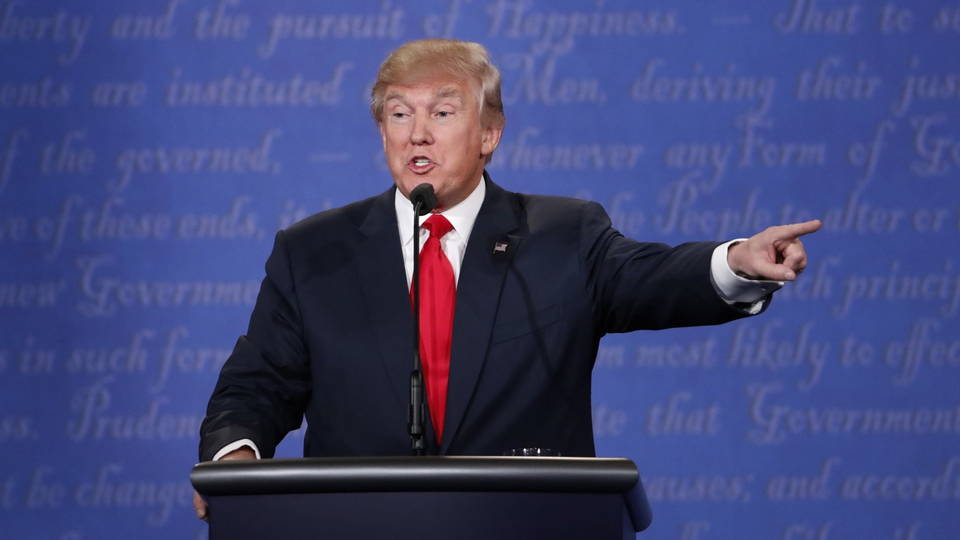 Republican presidential nominee Donald Trump campaigned in Ohio Thursday and announced that he will accept the results of November’s election—under one condition.
Donald Trump: "I want to make a major announcement today. I would like to promise and pledge to all of my voters and supporters and to all of the people of the United States that I will totally accept the results of this great and historic presidential election, if I win."
Trump’s remarks came one day after the final presidential debate, when he refused to say if he will accept the election results. President Obama and other political leaders have sharply criticized Trump’s remarks.
President Barack Obama: "That is dangerous, because when you try to sow the seeds of doubt in people’s minds about the legitimacy of our elections, that undermines our democracy."
TOPICS:
Donald Trump
2016 Election
Trump Booed at Catholic Charity Dinner in New York
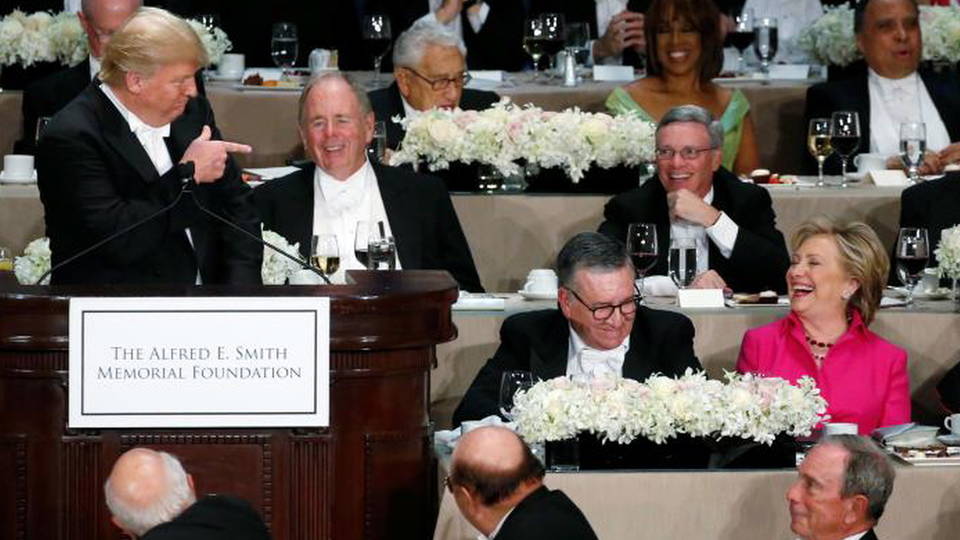 On Thursday night, Trump and Hillary Clinton both spoke here in New York at the Alfred E. Smith Memorial Foundation Dinner in New York to raise money for Catholic charities. Trump was repeatedly heckled and booed during the event.
Donald Trump: "We learned so much from WikiLeaks. For example, Hillary believes that it’s vital to deceive the people by having one public policy and a totally different policy in private. That’s OK. I don’t know who they’re angry at, Hillary, you or I. For example, here she is tonight in public pretending not to hate Catholics."
Hillary Clinton poked fun at Trump’s claim that he might not accept the result of the November election.
Hillary Clinton: "You know, come to think of it, it’s amazing I’m up here after Donald. I didn’t think he’d be OK with a peaceful transition of power."
The two candidates sat at the same table during the dinner, separated only by Cardinal Timothy Dolan, the archbishop of New York.
TOPICS:
Donald Trump
Hillary Clinton
2016 Election
Tenth Woman Claims She Was Sexually Assaulted by Donald Trump
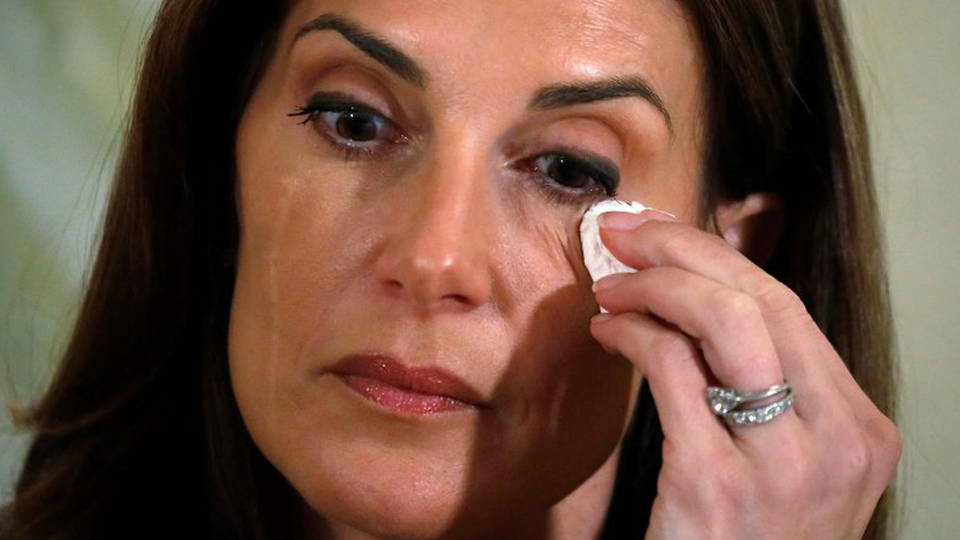 In other campaign news, a 10th woman has come forward to say she was sexually assaulted by Donald Trump. Karena Virginia said Trump approached her in 1998 outside the U.S. Open tennis tournament and grabbed her breast. Virginia said, after she initially flinched, Trump remarked, "Don’t you know who I am?" Virginia spoke out on Thursday with a message to the Republican nominee.
Karena Virginia: "Your random moment of sexual pleasure came at my expense and affected me greatly. Mr. Trump revealed his true character in his own words on tape, which indicated that he felt entitled to grab women by their private parts."
TOPICS:
Donald Trump
2016 Election
ISIS Attacks Kills 16 in Kirkuk as U.S.-Backed Mosul Offensive Continues
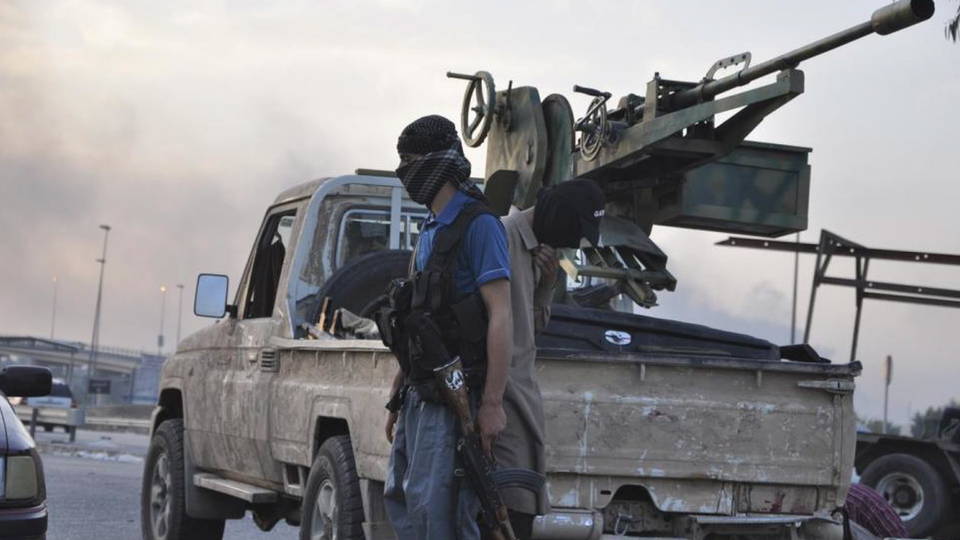 In news from Iraq, at least 16 people have died after ISIS militants attacked a power station in the oil-rich city of Kirkuk. This came as U.S.-backed forces continued their assault on Mosul, which fell to the Islamic State two years ago. The United Nations has warned the attack on Mosul could force up to a million people being displaced. On Thursday, the Pentagon announced the first U.S. soldier had died in the attempt to retake Mosul.
TOPICS:
Iraq
U.N.: Aleppo Siege & Strikes Constitute "Crimes of Historic Proportions"
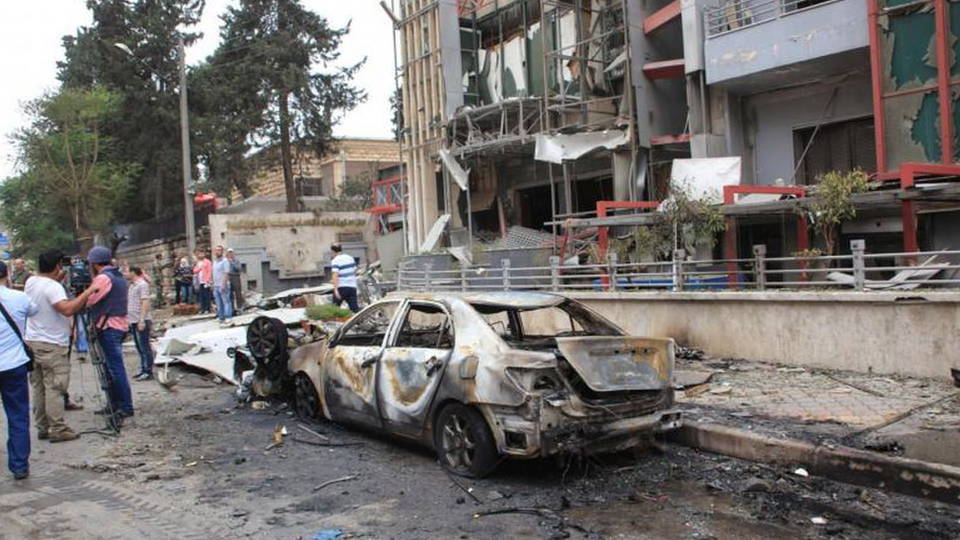 The top United Nations human rights official has said that the siege and bombing of eastern Aleppo in Syria has constituted "crimes of historic proportions." Zeid Ra’ad al-Hussein spoke earlier today during a special session of the U.N. Human Rights Council.
Zeid Ra’ad al Hussein: "Armed opposition groups continue to fire mortars and other projectiles into civilian neighborhoods of western Aleppo, but indiscriminate airstrikes across the eastern part of the city by government forces and their allies are responsible for the overwhelming majority of civilian casualties. And these violations constitute war crimes. And if knowingly committed as part of a widespread or systematic attack directed against civilians, they’d constitute crimes against humanity."
TOPICS:
Syria
South Africa & Burundi Move to Pull Out of International Criminal Court
South Africa has begun the formal process to withdraw from the International Criminal Court. The news comes just two days after another African nation, Burundi, became the first country to ever pull out of the court. Over the years, the court has been accused of disproportionately targeting African leaders. Human Rights Watch criticized South Africa’s move. The group said, "South Africa’s proposed withdrawal from the International Criminal Court shows startling disregard for justice from a country long seen as a global leader on accountability for victims of the gravest crimes.”
TOPICS:
South Africa
Honduran Security Forces Fire Tear Gas & Water Cannons at Protesters
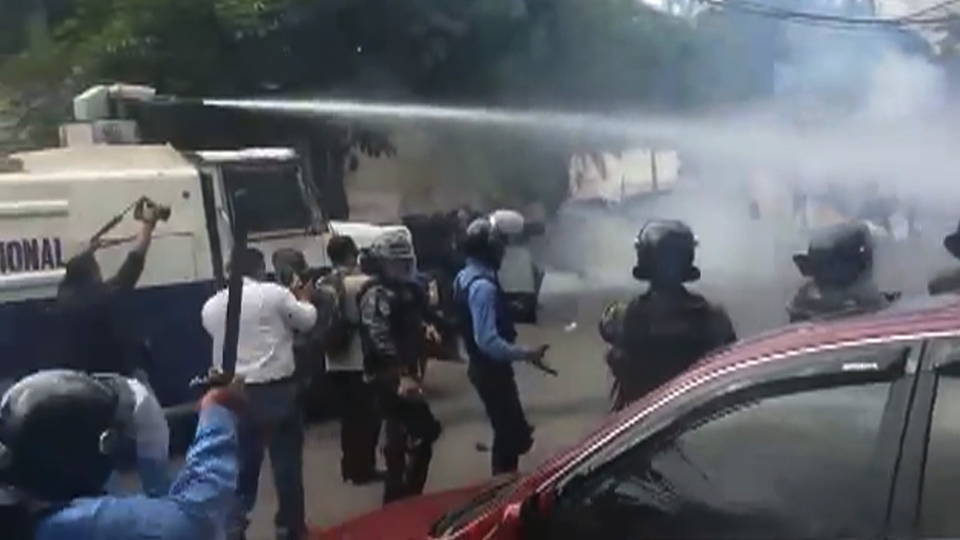 In news from Latin America, Honduran security forces fired water cannons and tear gas at protesters Thursday in the Honduran capital of Tegucigalpa. The protest was led byCOPINH, the Civic Council of Popular and Indigenous Organizations of Honduras. The leader of COPINH, Berta Cáceres, was assassinated in March. Thursday’s protest came just days after two Honduran campesino leaders were also assassinated.
TOPICS:
Honduras
Philippines Announce "Separation" from U.S.
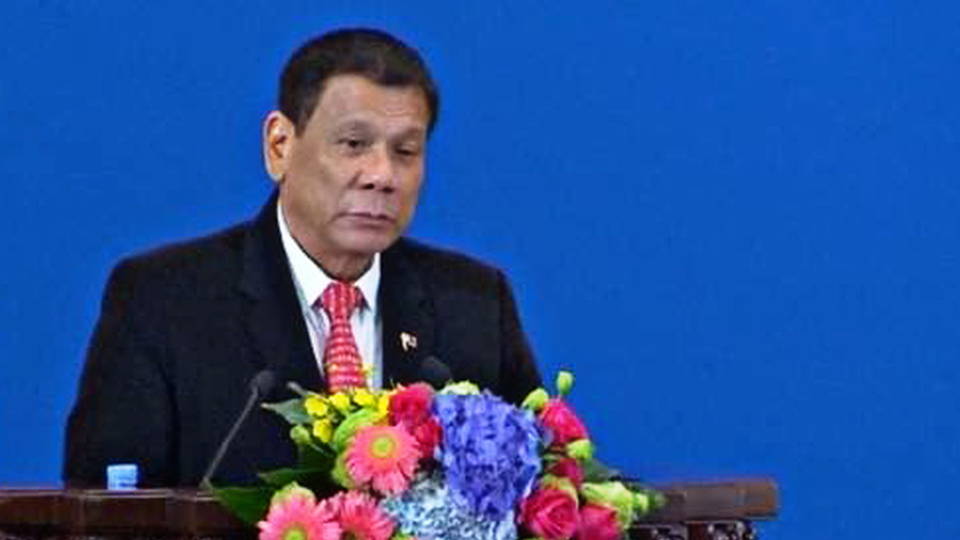 Tension is escalating between Washington and Manila after recently elected Filipino President Rodrigo Duterte announced what he described as a "separation" from the United States and realignment with Beijing.
President Rodrigo Duterte: "America has lost me. And I realign myself in your ideological flow, and maybe I will also go to Russia to talk to Putin and tell him that there are three of us against the world: China, Philippines and Russia. It’s the only way."
The Philippines is a former U.S. colony and a longtime military ally. Meanwhile in other news from the Philippines, dozens of protesters were injured during a demonstration Wednesday outside the U.S. Embassy in Manila when a police van repeatedly rammed into the crowd. The protesters were calling for an end to the U.S. military presence in the Philippines.
TOPICS:
Philippines
New Nuclear Reactor Goes Online in Tennessee
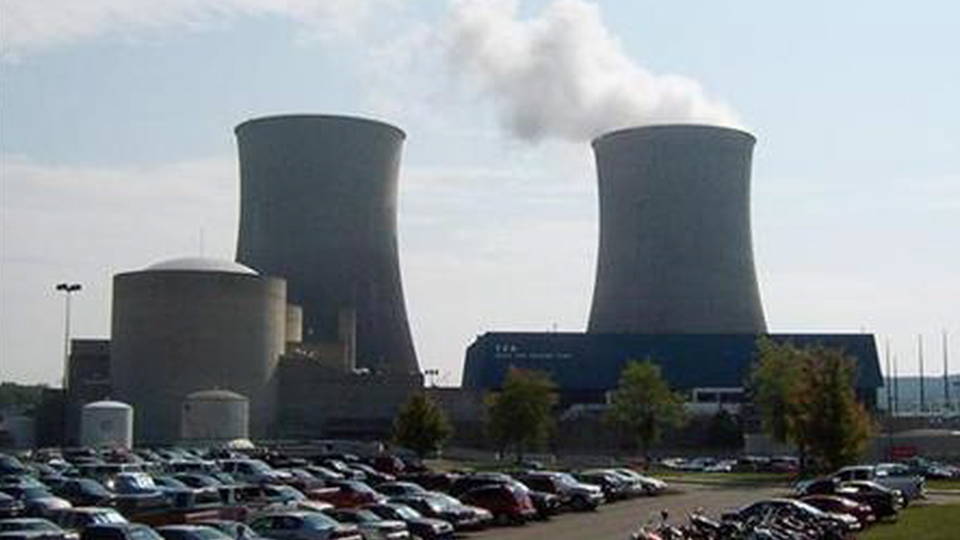 For the first time in two decades, a new nuclear reactor has gone online in the United States. The Tennessee Valley Authority announced Watts Bar Unit 2 began generating energy on Wednesday. Construction on the $4.7 billion reactor began in 1973. Four other reactors are being constructed in Georgia.
TOPICS:
Nuclear Power
Two Arrested for Locking Themselves Inside Bank Protesting Dakota Pipeline
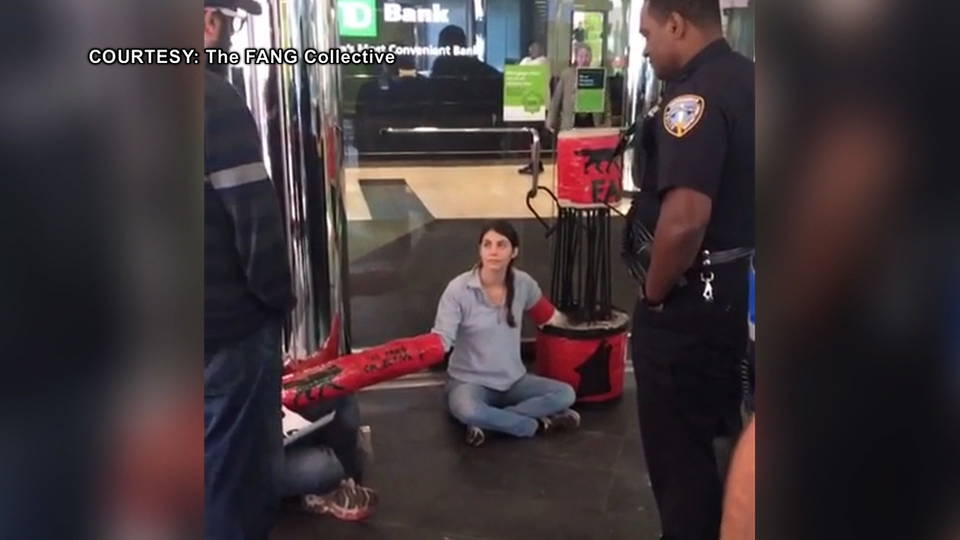 In Rhode Island, two activists from a group called The FANG Collective were arrested Thursday when they chained themselves to a concrete device inside a TD Bank in Providence to protest the bank’s financial support of the Dakota Access pipeline.
TOPICS:
Dakota Access Pipeline
Feds to Charge NSA Contractor Under Espionage Act
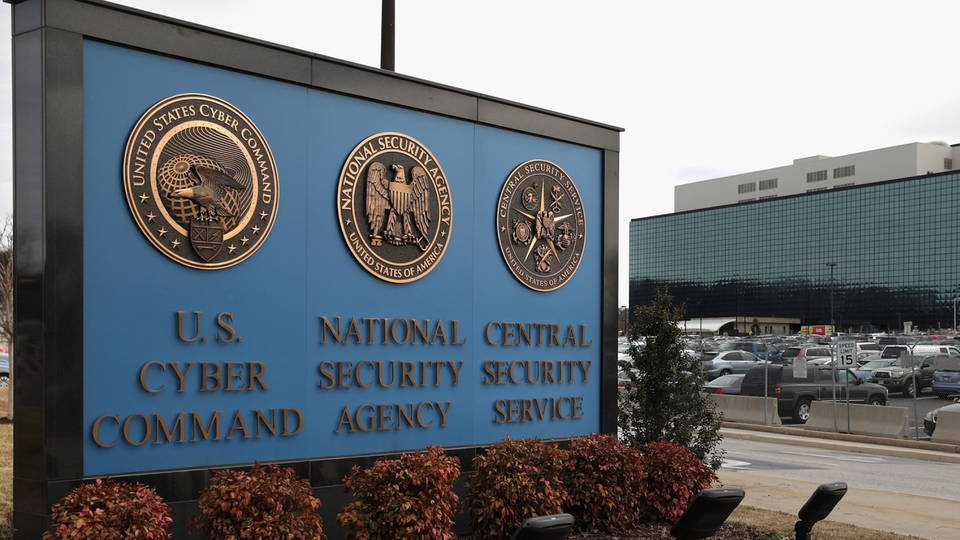 Federal prosecutors have announced they plan to charge a former National Security Agency contractor with violating the Espionage Act in what’s been described as the largest theft of classified government material ever. Prosecutors accuse Harold Thomas Martin III, an employee of Booz Allen Hamilton, of stealing classified material from the NSA over a 20-year period, but there is no evidence he shared the information. Martin is scheduled to appear in court today.
TOPICS:
NSA
EPA Criticized for Waiting to Warn Residents of Flint, Michigan
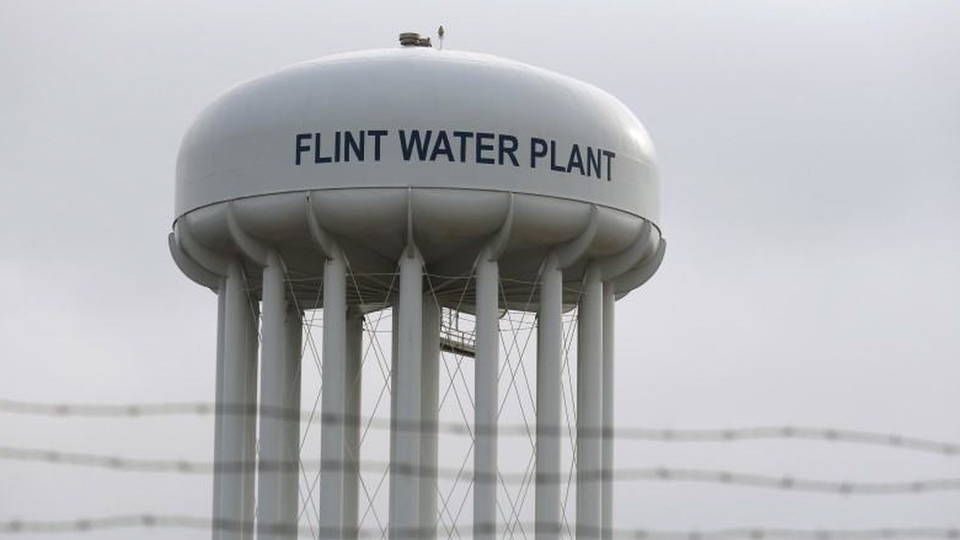 A new report from the Environmental Protection Agency’s inspector general has concluded the agency took seven months longer than necessary to warn residents of Flint, Michigan, about lead contamination in their water. The report found the EPA had enough information in June 2015 to issue an emergency order under the Safe Drinking Water Act, but the agency didn’t act until January of this year. Flint’s lead poisoning began when an unelected emergency manager appointed by Michigan Governor Rick Snyder switched the source of the city’s drinking water to the corrosive Flint River in 2014.
TOPICS:
Flint Water Crisis
Britain to Pardon Men Convicted Under Laws Criminalizing Homosexuality
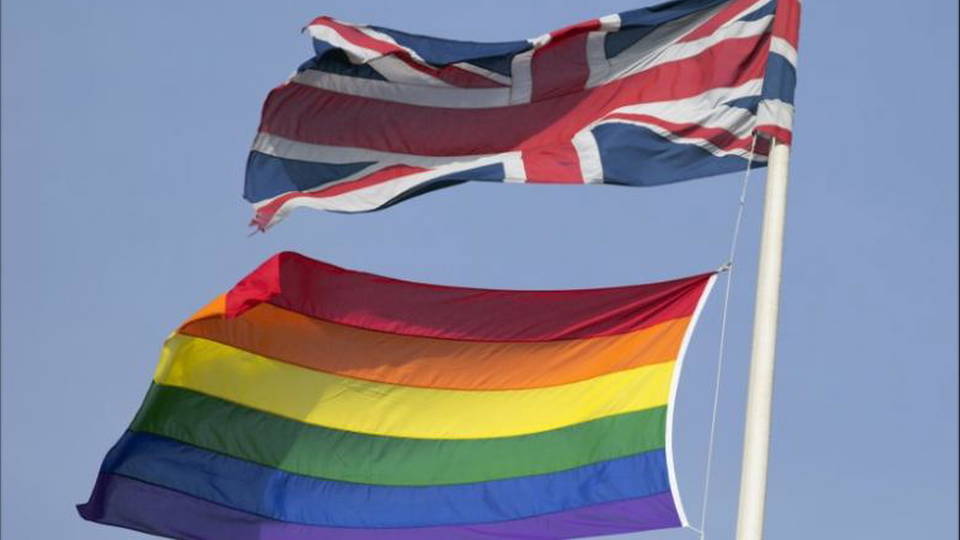 And Britain has announced it will pardon up to 15,000 gay and bisexual men who were convicted under old laws that criminalized homosexuality. The pardons are being done under the so-called Turing law, named after Alan Turing, who cracked Nazi Germany’s "unbreakable" Enigma code but was later prosecuted for being gay. He committed suicide in 1954 at the age of 41.
-------
Donate today:
Follow:


SPEAKING EVENTS


50 Years After Founding of Black Panther Party, Some Members Still Locked Up As Political Prisoners
DN! IN THE NEWS


Senior TV Producer
-------
Democracy Now! Daily Digest: A Daily Independent Global News Hour with Amy Goodman & Juan González for Thursday, October 20, 2016
democracynow.org
Stories:
 Chris Hedges vs. Eddie Glaude: Should Progressives Vote for Hillary Clinton or Jill Stein?
Pulitzer Prize-winning journalist Chris Hedges and Eddie Glaude, chair of the Department of African American Studies at Princeton University, debate the issue of strategic voting and the role of third-party candidates.
TRANSCRIPT
This is a rush transcript. Copy may not be in its final form.
AMY GOODMAN: We end today’s show with Pulitzer Prize-winning journalist Chris Hedges and Eddie Glaude, chair of the Department of African American Studies at Princeton University. Chris Hedges began by talking about his newpiece, "Donald Trump: The Dress Rehearsal for Fascism."
CHRIS HEDGES: Well, that’s what we’re watching. Trump, for all his shallowness and narcissism and imbecility and self-destructiveness, nevertheless has been able to run a fairly close race with Hillary Clinton. We saw from the leaked Podesta emails that the Clinton machine promoted, consciously promoted, especially through the press, what they call these "Pied Piper" candidates, listing Trump, Cruz and—I forget the third—Trump and Carson. And the idea was that they wanted to give them legitimacy. They wanted to push the more mainstream candidates, like Jeb Bush, closer to the lunatic fringe. And that’s because, fundamentally, there is no difference between Hillary Clinton and a figure like Mitt Romney. You know, what they’re battling about is what Freud called the narcissism of minor difference.
And the danger with this election is that the longer the policies of neoliberalism, austerity, the security and surveillance state—in essence, the paralysis on the part of our corporate state to deal with the suffering, grievances and mounting rage of now over half the country who live in poverty—the more these lunatic fringe candidates like Trump, these figures of ridicule—reminds me very much of what happened in Yugoslavia. The economic meltdown of Yugoslavia vomited up figures like Radovan Karadzic, Slobodan Milosevic, Franjo Tudman, who were buffoonish figures before they achieved political power, much like much of the Nazi Party in Weimar. And I think that’s what we’re watching. And if we don’t reverse the structural mechanisms by which we are disenfranchising and refusing to deal with the most fundamental rights and issues affecting now a majority of the American population, then we will get a fascist or a kind of quasi-protofascist, Christianized fascism, embodied in a figure with a little more intelligence and political savvy than Trump. And that’s why I find this election so frightening and so dangerous.
I think it’s the fact that the power elites, embodied by figures like the Clintons and Barack Obama, have been utterly, utterly tone deaf to what’s happening, and are playing a very, very dangerous game by, on the one hand, promoting a figure like Trump, because, of course, his outrageousness gives her a kind of credibility, without understanding that another four years of what’s been happening—and it won’t be an effective political strategy anymore, and it won’t be funny.
NERMEEN SHAIKH: Professor Eddie Glaude, let’s get your perspective on this. Earlier in the summer, you wrote a piece called "My Democratic Problem with Voting for Hillary Clinton." Now, some say that Clinton’s victory is now more or less a foregone conclusion. You also talked about the necessity of strategic voting. Can you talk about both the arguments that you’ve made in light of where we stand today in the campaign and with the election less than a month away?
EDDIE GLAUDE: Sure. You know, I think that it is—it is reasonable to conclude that Hillary Clinton is going to win. I think the internal polling for the Republican—on the Republican side suggests that Donald Trump is going to go down pretty badly, that it’s going to be a pretty decisive victory. Some, like Steve Schmidt, are predicting that she’s going to win upward to 400—get to 400 in the Electoral College, some at 380. People are declaring that this is going to be the destruction of the Republican Party.
And a lot of this has to do with, right, the fact that Donald Trump moves between being, as I’ve said before, a lunatic and an adolescent. And we can talk about him, but in kind of orienting us to this campaign, to this election cycle, by emphasizing the ridiculousness of and the bombasity of Donald Trump, we have turned our attention away from, I think, Hillary Clinton and the policies that have defined the Democratic Party up to this point. And I think Donald Trump is just an exaggerated indication of the rot that’s at the heart of the country, and that Hillary Clinton is the poster child for, I think, a failed economic policy that has left so many fellow Americans behind, and particularly the most vulnerable.
So what I’ve said is that we needed to suggest to Hillary Clinton that—and suggest to the Democratic Party that business as usual was no longer acceptable and that I couldn’t vote for and I couldn’t do that—I can do that because I’m in a blue state, and that there are some who are in a red state who can vote their conscience, but if you’re in a battleground state, it makes all the sense in the world, given who Trump is, to not vote for her—to vote for—to not to vote for Hillary Clinton—I mean, to not vote for Trump and to vote for Hillary Clinton.
So, in this case, part of what I’m trying to suggest is that we need to be very mindful in this moment, even as we say she’s going to win. We need to understand who she’s appointing as her transition team. We need to understand that personnel is policy. We need to see what her position will really be in terms of how she will govern economically, who she’s going to pick and choose for attorney general position, who’s going to populate her government. And I think once we get a better sense or if we pay attention to what she’s doing, we will be even better mobilized and organized to bring pressure to bear on her presidency, once November 8th happens.
AMY GOODMAN: So, what do you think about this, Chris Hedges, this idea of strategic voting?
CHRIS HEDGES: I think it’s an utter failure. I mean, one of the things that the WikiLeaks Podesta emails showed is that they were putting in place this neoliberal policy—Froman, who was then a—he’s now a U.S. trade representative. He, at the time, was at Citibank. In October, before Obama even achieved power, he’s sending out a list of Cabinet positions, all of which—most all of which came to pass. That’s certainly happening now.
I think that we have to step outside this corporate, two-party duopoly and begin to empower right now the third party, you know, that I think represents or challenges corporate power most effectively, is the Green. It has issues. You know, it functions well in cities like Richmond, California, doesn’t function as well in other places. But if they can poll 15 percent, that gives them ballot access in 2020 in a few dozen states, and it gives them $10 million. And I think that now is the time to, as Syriza did a decade ago, to fight back, because we have very little time left.
One of the things we have to remember is that we have a large number of supporters of Donald Trump who celebrate American violence through the gun culture, open racism, neo-Confederist movements, nativist movements. And Trump, I think, has made clear now, on the campaign trail, that he will essentially attempt to discredit the system if he loses. And right now they are working within the system. But unleashing that rage, you know, or essentially legitimizing that rage and that kind of violence after the election will begin to really rend the fabric of American society.
We have no more time to play around. We haven’t even spoken about the issue of climate change. We know, from the leaked emails, that Hillary Clinton is a fan of fracking. She brags about promoting fracking in Poland and other places as secretary of state. We just—the kind of weakness of the system itself cannot, I think, sustain much more of this assault without dramatic and frightening blowback and ramifications. And I think Trump is systematic of that.
So, as I’ve said many times, I think we have to do what many—Podemos and many parties in Europe have done. We have to walk into the political wilderness. We have to build movements, and we have to build alternative third parties that challenge this system, because the inevitable result is a kind of frightening police state. Well, legally, it’s already in place, physically, in marginal communities. They’ve been turned virtually into mini police states. The system of mass incarceration will not be affected in any meaningful way. Of course, it was the Clintons that put much of it in place. We just saw this very courageous prisoner strike, where the prisoners did work stoppages because, they said, the only way to stop this system of neoslavery is to stop being a slave. And I think that is a level of political consciousness that the rest of us have to begin to attain.
AMY GOODMAN: So, Professor Glaude, your response to Chris Hedges’ rejection of strategic voting?
EDDIE GLAUDE: Well, I think we agree on principle. And part of what I think—where we agree is that we have to keep Trump out of office. And the question for me is that: How do we do that? And one of the ways I’m thinking we need to do it is to vote strategically. And that is, in those places where we can, for me, blank out or vote for Jill Stein, we should. And in those places where—the battleground states, where it matters, where Trump has a chance to win, I think we need to turn out in massive numbers and make sure that he doesn’t win those states. I think we have to do two things simultaneously.
AMY GOODMAN: Eddie Glaude, chair of the Department of African American Studies at Princeton University, and Pulitzer Prize-winning journalist Chris Hedges. We spoke to them Wednesday night during our debate night special broadcast. To watch the full special, you can go to our website at democracynow.org. And that does it for our show. ... Read More →And I think he’s right in this regard: I think that what we’ve seen and what we’ve witnessed in this moment is the bankruptcy of a particular economic ideological philosophy that has left so many—so many people behind. And I think we need to dare to imagine a new world. But I think it’s going to require strategic and tactical thinking. And I think, on its face, Chris and I aren’t disagreeing. I just think there are ways to get to the same—to the same end.
 Green Party's Jill Stein on "Donald Trump's Psychosis and Hillary Clinton's Distortions"
After Wednesday’s debate, Democracy Now! spoke to Dr. Jill Stein, the Green Party’s presidential nominee. She and Libertarian nominee Gary Johnson were excluded from the debate under stringent rules set by the Commission on Presidential Debates, which is controlled by the Democratic and Republican parties.
TRANSCRIPT
This is a rush transcript. Copy may not be in its final form.
NERMEEN SHAIKH: After Wednesday’s debate, Democracy Now! got response from Jill Stein, the Green Party’s presidential nominee.
DR. JILL STEIN: What a—what a distressing, you know, hour and a half to sit through: Donald Trump’s psychosis and Hillary Clinton’s distortions of her record and what the future would look like. And the picture they paint of unbridled militarism, which is already robbing us blind, taking up more than half of our discretionary budget, almost half of your income taxes, only making the world a more dangerous place, you know, that’s terrifying enough. Add to that, you know, what they want to do with the economy. Donald Trump is all about more—more trickle-up. Actually, it’s not trickle-down: He wants more tax breaks. But, you know, Hillary is also not being clear with us about where we’re going and what her track record is. Hillary laid the groundwork for the financial crash of 2008—not Hillary alone, of course, but she was certainly supporting the policies of Bill Clinton that not only sent our jobs overseas, but which also laid the groundwork for Wall Street deregulation and, in fact, you know, enacted Wall Street deregulation, not to mention the anti-immigrant legislation, the anti-African-American legislation that opened the floodgates to this racist war on drugs and the endless expansion of mass incarceration, particularly of people of color. It’s a very dystopic future.
And, you know, I think it’s really important for us, as Americans, to look at what we’re facing. You know, this is a race to the bottom. We have to exit this—this incredible spiral downward. The sooner we exit this, the better. Those who would say that you have to vote for the lesser evil now, you know, it’s really important to look at the track record for that, because the lesser evil simply paves the way to the greater evil, because people just stop coming out to vote for a lesser evil politician and a lesser evil party that’s throwing you under the bus. The base doesn’t come out, so the Congress flips from being blue to being red, as the Democratic Party has thoroughly established itself in a lesser evil party. So, when is it going to get better? You know, if we don’t stand up and fight now, when exactly are we going to stand up and fight?
And what is really important to remember is that there are actually enough people right now, 43 million young people locked in debt, that if that word alone got out, we have the numbers. That is a plurality. That’s a winning plurality, let alone 27 million Latinos who have had it, who understand that the Republicans are the party of hate and fear and the Democrats are the party of deportation, detention and night raids and imprisonment of children and families in these horrific private prisons.
So, you know, we have a very bleak reality. And for people—you know, everybody knows that Donald Trump is, you know, terrifying and dangerous. But to think that we are secure with Hillary Clinton in the White House, where Hillary Clinton is telling us right now that she wants to start a war with Russia over Syria, creating a no-fly zone, which means, folks, get ready. It’s going to be very hard not to slide—excuse me—into World War III here with Hillary at the helm, starting off her four years, or whatever her term is—starting off with declaring war against Russia by enacting a no-fly zone.
We need a weapons embargo to the Middle East. We need to put a freeze on the bank accounts of our supposed allies who are continuing to fund terrorist enterprises. We got this mess going. We can shut it down. We need a new offensive in the Middle East. It’s called a peace offensive. We’re not going to hear that from either of the corporate-sponsored political parties who are rolling in dough from the weapons industry, from the fossil fuel giants, from the war profiteers, from the big banks. We are the ones we’ve been waiting for. In the words of Alice Walker, the biggest way people give up power is by not knowing we have it to start with.
AMY GOODMAN: Let me ask you the question that was put to Donald Trump and to Hillary Clinton around whether you will accept the results of the November election, Dr. Jill Stein.
DR. JILL STEIN: Well, put it this way: If there’s evidence of fraud, we would certainly challenge that in court. And in the Green Party, you know, we have sort of led the charge in pursuing election fraud. So, we wouldn’t be—we wouldn’t hesitate to do that, you know, to the extent that it’s possible.
However, let me just tell you, there’s no question about there being a rigged election here, not in the terms that Donald Trump is saying. But, you know—and, actually, the media has been enormously rigged on his behalf: $4 billion of free prime-time media. Hillary had over $2 billion. Bernie Sanders had under half a billion. And, of course, I’ve had practically zero. So, you know, between that and the rigged debates, which the League of Women Voters themselves called a fraud being perpetrated on the American voter, the silencing of opposition voices through the fear campaigns and the smear campaigns, we don’t create a better democracy out of our wounded democracy by silencing opposition voices. We could move to a ranked choice voting system in the blink of an eye. That could be done right now on an emergency basis, so that we actually liberate voters to vote their values. They can rank their choices. If your first choice loses, your vote is automatically reassigned to your second choice, but the Democrats won’t pass it. My campaign had filed this bill in the Democratic Legislature of Massachusetts, you know, 16 years ago. They won’t let it out of committee—
AMY GOODMAN: Let me ask you—
DR. JILL STEIN: —because they rely on fear, because they know they can’t—
AMY GOODMAN: Let me something—ask you something very quickly, before the end of the show, Jill.
DR. JILL STEIN: Sure.
AMY GOODMAN: And that is, 5 percent of the vote nationally is a very important threshold. Can you talk about what would happen, what the Green Party needs to reach and how much money they would get in matching funds from the government?
DR. JILL STEIN: Thank you, Amy. Five percent would be an absolute game changer. And the polls suggest we are something under that, but not by far. And, in fact, the polls do not tap unlikely voters, which is our base. That is millennials. That is people of color and Latinos—really, disenfranchised voters. That’s who will be coming out to vote for us. So, we may be actually very close to that 5 percent threshold. We could even be beyond it. So, you know, it’s really important for people to stand up—
AMY GOODMAN: But if you get it, what happens?
NERMEEN SHAIKH: That’s Jill Stein, the Green Party’s presidential nominee, speaking last night. ... Read More →DR. JILL STEIN: If we get that 5 percent, we not only have ballot access then in most states, so that when we begin the election campaign, not only in the next presidential but on all the down-ballot races, as well, we don’t have to first fight for ballot status, which has taken us like the first year of the campaign. It means we can hit the ground running. It also means that we are then—we receive $10 million as a legitimate major party.
 "I'll Keep You in Suspense": Trump Refuses to Say He Will Accept Election Results
Republican Donald Trump and Democrat Hillary Clinton faced off Wednesday night in Las Vegas in the final debate before the November 8 election. Trump continued to claim the election has been rigged, and said he would not commit to accepting the outcome of the vote if he loses. Trump’s comment sparked an outcry, even from within his own party. We air part of the debate and get response from Kristen Clarke, president and executive director of the Lawyers’ Committee for Civil Rights Under Law.
TRANSCRIPT
This is a rush transcript. Copy may not be in its final form.
NERMEEN SHAIKH: Republican Donald Trump and Democrat Hillary Clinton faced off Wednesday night in Las Vegas in the final debate before the November 8th election. Trump continued to claim the election has been rigged, and said he would not commit to accepting the outcome of the vote if he loses. Trump’s comment sparked an outcry, even from within his own party. Republican Senator Jeff Flake of Arizona tweeted that Trump, quote, "saying that he might not accept election results is beyond the pale." Republican strategist Steve Schmidt described the comment as a, quote, "disqualifying moment" for Trump.
The debate was filled with personal attacks between the two candidates. Clinton accused Trump of being a puppet of Russian President Vladimir Putin, while Trump called Clinton a, quote, "nasty woman." Trump also rejected the claims of nine women who have come forward to say they were sexually assaulted by him. Trump accused Clinton of being behind the claims.
AMY GOODMAN: Well, today we will air highlights from the debate and get response from Green Party nominee Jill Stein. We’ll also host a debate between Pulitzer Prize-winning journalist Chris Hedges and Eddie Glaude, chair of the Center for African American Studies at Princeton University. But first we play the part of the debate dominating today’s headlines. Debate moderator Chris Wallace of Fox News.
CHRIS WALLACE: Mr. Trump, I want to ask you about one last question in this topic. You have been warning at rallies recently that this election is rigged and that Hillary Clinton is in the process of trying to steal it from you. Your running mate, Governor Pence, pledged on Sunday that he and you—his words—"will absolutely accept the result of this election." Today, your daughter Ivanka said the same thing. I want to ask you here on the stage tonight: Do you make the same commitment that you will absolutely—sir, that you will absolutely accept the result of this election?
DONALD TRUMP: I will look at it at the time. I’m not looking at anything now. I’ll look at it at the time. What I’ve seen—what I’ve seen is so bad. First of all, the media is so so dishonest and so corrupt, and the pile-on is so amazing. The New York Times actually wrote an article about it, that they don’t even care. It’s so dishonest. And they’ve poisoned the minds of the voters. But unfortunately for them, I think the voters are seeing through it. I think they’re going to see through it. We’ll find out on November 8th, but I think they’re going to see through it.
CHRIS WALLACE: But, sir, there’s a—
DONALD TRUMP: If you look—excuse me, Chris—if you look at your voter rolls, you will see millions of people that are registered to vote—millions—this isn’t coming from me; this is coming from Pew report and other places—millions of people that are registered to vote that shouldn’t be registered to vote.
So, let me just give you one other thing. So I talk about the corrupt media. I talk about the millions of people. Tell you one other thing: She shouldn’t be allowed to run. It’s crook—she’s—she’s guilty of a very, very serious crime. She should not be allowed to run. And just in that respect, I say it’s rigged, because she should never—
CHRIS WALLACE: But—
DONALD TRUMP: Chris, she should never have been allowed to run for the presidency based on what she did with emails and so many other things.
CHRIS WALLACE: But, sir, there is a tradition in this country—in fact, one of the prides of this country is the peaceful transition of power and that no matter how hard-fought a campaign is, that at the end of the campaign, that the loser concedes to the winner—not saying that you’re necessarily going to be the loser or the winner, but that the loser concedes to the winner and that the country comes together, in part for the good of the country. Are you saying you’re not prepared now to commit to that principle?
DONALD TRUMP: What I’m saying is that I will tell you at the time. I’ll keep you in suspense. OK?
HILLARY CLINTON: Well, Chris, let me respond to that, because that’s horrifying. You know, every time Donald thinks things are not going in his direction, he claims whatever it is is rigged against him.
The FBI conducted a year-long investigation into my emails. They concluded there was no case. He said the FBI was rigged. He lost the Iowa caucus. He lost the Wisconsin primary. He said the Republican primary was rigged against him. Then Trump University gets sued for fraud and racketeering. He claims the court system and the federal judge is rigged against him. There was even a time when he didn’t get an Emmy for his TV program three years in a row, and he started tweeting that the Emmys were rigged against him.
DONALD TRUMP: Should have gotten it.
HILLARY CLINTON: This—this is a mindset. This is—this is how Donald thinks. And it’s funny, but it’s also really troubling.
CHRIS WALLACE: OK.
HILLARY CLINTON: No, that is not the way our democracy works. We’ve been around for 240 years. We’ve had free and fair elections. We’ve accepted the outcomes when we may not have liked them. And that is what must be expected of anyone standing on a debate stage during a general election.
You know, President Obama said the other day, when you’re whining before the game is even finished—
CHRIS WALLACE: Hold on, folks. Hold on, folks.
HILLARY CLINTON: —it just shows you’re not up to doing the job. And let’s—you know, let’s be clear about what he is saying and what that means. He is denigrating, he’s talking down our democracy. And I, for one, am appalled that somebody who is the nominee of one of our two major parties would take that kind of position.
DONALD TRUMP: I think what the FBI did and what the Department of Justice did, including meeting, with her husband, the attorney general in the back of an airplane on the tarmac in Arizona—I think it’s disgraceful. I think it’s a disgrace.
CHRIS WALLACE: All right.
DONALD TRUMP: I think we’ve never had a situation so bad in this country.
CHRIS WALLACE: Hold on, folks.
AMY GOODMAN: An excerpt from last night’s debate in Los Vegas.
Joining us now in Washington, D.C., Kristen Clarke, president and executive director of the Lawyers’ Committee for Civil Rights Under Law.
Can you respond to president—to Donald Trump saying he does not know at this point—he’ll leave it up to, well, a surprise—whether he will support the results of the November elections?
KRISTEN CLARKE: You know, in my view, this was one of the most jarring moments during the evening. This notion, this conspiracy theory that suggests that our elections are rigged, you know, is incredibly dangerous. It casts a dark cloud over American democracy. We know that our elections are closely watched all across the globe. We hold our democracy out as one of the greatest on Earth. And while there may be imperfections, what we certainly know is that the outcomes, the process itself, is not broken and that there is—this is a mythology. This notion that you can, you know, distort or change or alter the outcome of a presidential election is just completely baseless and false.
What we do know is that the reality is that there have been many states around the country that have worked to lock people out of the process. So if we want to talk about ways to strengthen our democracy, let’s talk about why states have raced forward with restrictive photo ID requirements that lock voters out of the ballot box. Let’s talk about states that are purging people from the registration rolls. We’ve got a lawsuit in Hancock County, Georgia, where they have purged and removed legitimately registered African Americans from the registration rolls, and they have the sheriff’s office go to your home to issue a summons telling you that you’ve got to come down to the local registrar’s office to provide proof of your eligibility. Let’s talk about places like Macon-Bibb County, Georgia, where they are moving polling sites to hostile locations there. They moved a polling site out of a majority-black school and to the local sheriff’s office, a location deemed hostile by African-American voters there. So, if we want to talk about the real issues that we’re up against in our democracy today, let’s talk about voter suppression, because there is a track record of intense voter suppression efforts all across our country. And I hear silence on that point, and it’s troubling to me.
AMY GOODMAN: And specifically on this issue of not accepting the election, now his handlers are saying, "Well, it’s just like Al Gore challenging in 2000 in Florida." Your quick response to that?
KRISTEN CLARKE: We’re not going to relitigate Bush v. Gore. You know, I didn’t hear complaints about the Republican primary. You know, Trump was far ahead of, you know, many of his candidates and seemed fine and didn’t argue that the outcome was rigged. You know, this conspiracy theory suggesting that elections are rigged seems to be one that candidates resort to when they feel that they’re on the losing side and that the American people are not on their side. It’s an old and, you know, familiar tactic. If we care about strengthening American democracy, let’s talk about the real issues and problems that lock people out of the ballot box. Let’s talk about the fact that in 2014 only 37 percent of Americans participated in the midterm election cycle. And a lot of that low voter turnout is attributable to voter suppression. But rigged elections? Pure fiction. Pure mythology. Casts a dark cloud over our democracy. And, you know, let’s talk about the real issues.... Read More → Bruce Springsteen: Donald Trump is a "Flagrant, Toxic Narcissist"
In an interview with Channel 4 in Britain, the legendary musician Bruce Springsteen shared his thoughts on the race. "[Donald Trump]'s going to lose, and he knows that. He knows he's going to lose. And he’s such a flagrant, toxic narcissist that he wants to take down the entire democratic system with him if he goes," Springsteen said. "And the words that he’s been using over the past several weeks really are an attack on the entire democratic process."
TRANSCRIPT
This is a rush transcript. Copy may not be in its final form.
AMY GOODMAN: Well, you might have heard Professor Glaude reference "The Boss." Let’s turn to Bruce Springsteen in his own words, speaking to Channel 4 in Britain.
BRUCE SPRINGSTEEN: I mean, I know some Trump voters, you know. But I think that he’s really—he’s really preyed upon that part of the country, because he gives these very glib and superficial answers to very, very entrenched and very difficult problems, but they’re answers that sound pretty good if you’ve struggled for the past 20 or 30 years. So—
MATT FREI: You can understand his appeal?
BRUCE SPRINGSTEEN: Yeah, yeah, I can understand that there’s somebody with simple answers to very complicated questions, who sound like they’re listening to you for the first time.
MATT FREI: Do you think the people who like him are racists?
BRUCE SPRINGSTEEN: No, no, I don’t believe that—you can’t generalize like that. You know, I think—I think there’s all kinds of people that are interested in him for a variety of different reasons.
MATT FREI: Do you think that rage will go away after this election?
BRUCE SPRINGSTEEN: No, no. I don’t know how it’s going to manifest itself, but it will manifest itself somehow, you know?
MATT FREI: Do you think there might be some trouble? I mean, you know, we’ve already seen some strife on the streets and—
BRUCE SPRINGSTEEN: Well, the trouble at the moment is, is you have Donald Trump who is talking about rigged elections. And he’s not—he has a feeling he’s going to lose now, which he—of course, he is going to lose.
MATT FREI: You’re confident?
BRUCE SPRINGSTEEN: Oh, yeah. Oh, yeah. He’s going to lose. And he knows that. He knows he’s going to lose. And he’s such a flagrant, toxic narcissist that he wants to take down the entire democratic system with him if he goes. If he could reflect on these things, maybe he’d have—but he’s such an unreflective person. And he doesn’t—he simply has no sense of decency and no sense of responsibility about him. And the words that he’s been using over the past several weeks really are an attack on the entire democratic process.
MATT FREI: And is that dangerous?
BRUCE SPRINGSTEEN: Yeah, it is. I think it’s very dangerous. He does have a lot of people’s ears. And I don’t think he’s going to go quietly into the—you know, gently into the good night. I think he’s going to make a big a mess as he can. And I don’t know what that’s going to mean, but we’ll find out shortly.
AMY GOODMAN: That’s Bruce Springsteen, speaking to Channel 4 in Britain. This isDemocracy Now! We’ll be back in a minute.
[break]
AMY GOODMAN: "Mansion on the Hill" by Bruce Springsteen, here on Democracy Now!, democracynow.org, The War and Peace Report. I’m Amy Goodman, with Nermeen Shaikh. ... Read More → From Palestine to Black Lives Matter: Alicia Garza & Phyllis Bennis on Issues Ignored at the Debates
In our special broadcast of the final 2016 U.S. presidential debate, we asked Black Lives Matter co-founder Alicia Garza what the major-party candidates should have addressed in their exchange: "I want to see more conversation about what it is going to take to preserve the quality of life of black people in this country, who are being systematically murdered, incarcerated, and otherwise marginalized and disenfranchised."
TRANSCRIPT
This is a rush transcript. Copy may not be in its final form.
NERMEEN SHAIKH: Let’s go back to last night’s showdown in Las Vegas. This is debate moderator Chris Wallace.
CHRIS WALLACE: What I’m asking you, sir, is: Do you want to see the court overturn—you’ve just said you want to see the court protect the Second Amendment. Do you want to see the court overturn Roe v. Wade?
DONALD TRUMP: Well, if we put another two or perhaps three justices on, that’s really what’s going to be—that will happen. And that’ll happen automatically, in my opinion, because I am putting pro-life justices on the court. I will say this: It will go back to the states, and the states will then make a determination.
HILLARY CLINTON: I do not think the United States government should be stepping in and making those most personal of decisions. So, you can regulate, if you are doing so with the life and the health of the mother taken into account.
CHRIS WALLACE: Mr. Trump, your reaction, and particularly on this issue of late-term, partial birth abortion?
DONALD TRUMP: Well, I think it’s terrible. If you go with what Hillary is saying, in the ninth month, you can take the baby and rip the baby out of the womb of the mother just prior to the birth of the baby.
NERMEEN SHAIKH: After this last presidential debate before the election, we asked Alicia Garza, co-founder of Black Lives Matter, about Donald Trump’s comments.
ALICIA GARZA: You know, it’s hard for me to take him seriously, to be honest with you. He essentially says that he single-handedly is going to change the course of this country’s future. He continues to use really egregious, less than factual stories that stoke fear, that stoke anxiety, and that defy logic and reason. And so, whether it was, you know, the conversation around abortion, or whether it’s the conversation around immigration reform, or even if it’s this conversation that he continues to bring up around law and order but then says that he’s going to be the best friend to African Americans that we’ve ever had, I mean, honestly, it’s hard to take him seriously.
The thing that just strikes me is that he is speaking to a set of audiences that are scared. They’re terrified about the future of this country. They feel disenfranchised. They feel left out. They feel like they’re being left out of decision making. And that’s not going to go away after Trump. Thank goodness Trump will go away, but, unfortunately, that level of anxiety, that level of fear, that level of distrust will not go away.
AMY GOODMAN: Wait, you said that Donald Trump—
ALICIA GARZA: And so, we’ve got to really pay attention to that.
AMY GOODMAN: You said Donald Trump will go away? Are you sure? We just heard this discussion about he will leave the country in suspense as to what he will do, if he lost the election.
ALICIA GARZA: You know, he keeps saying he’s got these surprises, that somehow never materialize. Donald Trump, in my estimation, is not going to win the presidency. And if he does, then we’ve got a lot of reckoning to do. But the thing that I’m more concerned about, quite frankly, again, is the millions of people that he has galvanized, who feel like they’re on the outside. And that is something that both parties are going to have to address. And quite frankly, it’s something that all of us are going to have to pay attention to.
NERMEEN SHAIKH: And what would you have liked, Alicia, for the candidates to be asked, I mean, including Donald Trump with, as you described, some of his more outrageous positions and postures? What should he have been asked? What should they both have been asked to address?
ALICIA GARZA: I mean, I think they addressed many of the major issues that are facing our country, but, quite frankly, over these last three debates, I have still been wanting to see more conversation around criminal justice reform. I want to see more conversation about what it’s going to take to preserve the quality of life of black people in this country, who are being systematically murdered, incarcerated, and otherwise marginalized and disenfranchised. I wanted to hear more from each of the candidates about how these movements that have emerged over the last few years have influenced their thinking around how they want to bring America into its future.
And quite frankly, just talking about gun control doesn’t cut it. We have an epidemic in this country of police murders and police violence, and neither candidate is addressing it, because, clearly, it’s not politically expedient to address it. But what’s at stake here is the lives of our families. What’s at stake are mothers who are losing their children at astronomical rates. And also what’s at stake are the attacks that are coming in more form recently against folks who have disabilities or other illnesses. These are things that we need to pay attention to. It’s not just a crisis of whether a toddler gets a hold of a loaded gun. Quite frankly, every 28 hours in this country, a black person is murdered by police, vigilantes or security guards. And if it’s not by police, then it’s by policies that strip black people of our right to dignity, to respect and to living a full and good life.
We have black people throughout the South that are being denied medical care and being denied insurance. Donald Trump talked about how ineffective Obamacare was. And, in fact, we should stop calling it that, right? It’s he Affordable Care Act. He talked about how ineffective it is, but, quite frankly, he didn’t address the fact that thousands of black people lack access to that very healthcare because Republican governors and Republican senators refuse—refuse—to take funding to expand Medicaid programs.
Things like that are things that black folks across the country are looking to hear, and we’re not hearing it. And I’m hoping that in this last 20 days both candidates get a little less tone deaf, stop using us as bait, and instead address the issues that we care about.
NERMEEN SHAIKH: During our debate night special, we took questions via social media from our audience.
AMY GOODMAN: One of the questions came into us from Twitter just now: "Do you support the ongoing MSM [mainstream media] self-imposed blackout on reporting on apartheid and Israel’s inhumane treatment of Palestinians?" I want to ask this to Phyllis Bennis, but first to Alicia Garza, because in the Black Lives Matter movement’s many-point plan, you address the issue of Palestinians.
ALICIA GARZA: Yeah. I mean, I think what’s important for folks to understand here is that there is lots of common cause between African Americans and Palestinians, and that is not a new relationship. That’s a relationship that has been forged over decades as a result of very similar feeling conditions that folks are existing in. And so, I think that it’s important that we open up these conversations to really address the concerns and the issues that are important to all of us. I think that what’s happening in Palestine and I think what we’ve seen through the Movement for Black Lives policy platform, certainly, is that there is a desire for social movements to connect to movements around the world and to support movements who are struggling and fighting for self-determination, as many of the movements here are, as well.
AMY GOODMAN: And, Phyllis Bennis, you’re a longtime observer and activist around the issue of Israel-Palestine. I don’t think there’s been a time recently where it’s been talked about less than in these last few months. Talk about the situation on the ground and what you think has to happen right now. We actually just recently had Ann Wright onDemocracy Now!, the colonel, the former American diplomat, who attempted to get to Gaza to challenge the naval blockade there with a group of women from around the world. They were taken into custody at Ashdod, the Israeli Navy, and she was sent back to this country.
PHYLLIS BENNIS: You know, I think it’s very important to keep in mind both the situation on the ground and the situation of the discourse here in the United States. What Alicia was just talking about is crucially important, the rising focus of the Movement for Black Lives on this connection, as Alicia said, a long-standing connection, but one that is getting new attention with the black community in the United States looking at the question of Palestine and the links of solidarity with Palestinians, something that emerged so sharply and so powerfully at the time of the uprising in Ferguson, when Palestinian activists were tweeting instructions for the—for their comrades and colleagues in Ferguson about how to deal with tear gas, because the tear gas used by the Israeli military against Palestinians is made in the United States. It’s the same tear gas. So they had a lot of experience with it. And that kind of immediacy made it rise to a new level.
But what we’re seeing is a scenario where we have an extraordinary shift in the public discourse on this question in the last five years, 10 years, really 15 years, where things that had never made it before to public discourse is now talked about quite normally. The question of Israeli apartheid was anathema a decade ago. Now it’s even talked about by top Israeli officials, who say—they differ on the timing: We say it’s already there; they say that if we don’t do something different, we’re going to face apartheid. So we have this massive shift in the discourse; a significant shift, not quite there, but a significant shift in the media coverage; only a tiny shift in some political discourse. The decision of 60 members of Congress to skip the speech of the Israeli prime minister this past year would never have happened before. But on the ground, the situation gets worse. So, it’s this dichotomy, the new challenge that we face to transform that discourse shift into a real policy shift, where we don’t see—instead of ending U.S. military aid to the 23rd wealthiest country to use for its consistent violations of international law and human rights, we see the Obama administration escalating the annual amount of aid, so that Israel will now start each year with almost $4 billion, with $3.8 billion a year of military aid coming from our tax money to support its military, without any restrictions on how it makes—how it uses that money, what weapons in the U.S. it’s able to buy.
So, we’re having a moment when, as we saw in all of these debates, the question of Israel, the relationship of Israel and the United States, did not come up. It didn’t come up again tonight. But we do see that there has been this extraordinary shift in the public discourse. The fact that it was addressed as, for Bernie Sanders’ campaign, the main foreign policy issue that he took up, that was then reflected in the debate over the Democratic Party platform. It didn’t end up well; the platform was as bad or perhaps worse than in 2012. But the fact that it was made an item that had to be fought for was very, very different. So I think there’s something to recognize the power of social movements here, but also recognize how far we still have to go, similar to the situation that we’re facing with—with refugees.
AMY GOODMAN: Phyllis Bennis is a fellow at the Institute for Policy Studies. She’s written several books, including, most recently, Understanding ISIS and the New Global War on Terror. Thanks also to Alicia Garza, co-founder of Black Lives Matter. To watch our full three-and-a-half-hour debate night special, that includes the full Trump-Clinton showdown uninterrupted, go to democracynow.org. Also, today we did a special two-hour extended broadcast. Just go to our website, as well. Mark your calendars for November 8th, for our five-hour election night special broadcast. You can follow us on Facebook, Twitter,Instagram and Snapchat.... Read More →We heard tonight this claim from Donald Trump that Hillary Clinton had let in, as he said, tens of thousands of refugees from Syria who were all tied to ISIS. Wrong on all fronts. The fact that the U.S. government was proud of allowing in only 10,000 Syrian refugees in an entire year, in a period where for months Germany was taking in 20,000 a day during the height of the refugee crisis, was one more example. We don’t have a refugee crisis here; we have a racism crisis here. And the kind of Islamophobia, the ISIS bashing that we were hearing from Trump about these refugees, what that says about how far we have to go, the kinds of movements that we need to build, linking the antiwar work with the refugee support work in this country to transform how refugees are treated, so that they are welcomed, not grudgingly accepted—"Well, OK, if we have to take just 10,000 in a whole year, I guess we can"—but to say we welcome people. Young people should be demanding the right to go to school with Syrians. You know, we weren’t hearing any challenge to this sort of mainstream assumption that the refugees are inevitably dangerous, possibly violent, need to be vetted more than any other country in the world even imagines vetting. We heard no challenge to that tonight, and I don’t think we can assume that we will hear leadership from the candidates. It’s going to have to come from our movements.
 In Warmest Year Ever, Climate Change Ignored Again at Debate
The presidential and vice-presidential debates have concluded without a single question about climate change, even though 2016 is on pace to be the warmest year on record. We speak to May Boeve, executive director of 350 Action.
TRANSCRIPT
This is a rush transcript. Copy may not be in its final form.
NERMEEN SHAIKH: During Wednesday’s debate, the phrase "climate change" only came up one time.
HILLARY CLINTON: I want us to have the biggest jobs program since World War II, jobs in infrastructure and advanced manufacturing—I think we can compete with high-wage countries, and I believe we should—new jobs in clean energy, not only to fight climate change, which is a serious problem, but to create new opportunities and new businesses.
AMY GOODMAN: On Wednesday night, I got response from May Boeve, executive director of 350 Action, about the failure of the candidates and debate moderators to address the issue of climate change in the debates.
MAY BOEVE: Right, and we all deserve so much better than the political conversation that has been had in this debate and in all of the debates. And the debates are obscuring serious issues, like climate change and like so many other problems that we’re facing in this country and around the world. And it’s true, the question was not asked. It was brought up in the context of a question about jobs.
But there’s something important in the answer, which is that Clinton is speaking to progressives. She’s speaking to the progressive movement. The way that we’ve been trying to build a much bigger movement that’s focused on the economy, the climate crisis, injustices of all kinds, and weaving those movements together, that was what that answer was trying to speak to. She tied it to debt-free college. She tied it to Bernie Sanders. She tied it to having the wealthy pay for these things. So, those are clues. And she’s going to need progressives to win, and she’s going to need us to govern. And so, that’s important, and we’re going to keep pushing. And as many of the guests have said tonight, it is all about the movements.
But one thing that was, I think, shocking and scary here is that we know that to get the climate policy that we need, we need a functional democracy. And questioning the very idea that that can work is as big of a threat to climate change as any number of other issues. So, that was shocking, and we’re paying extra close attention to that. And I think Donald Trump’s disastrousness just reached another level tonight.
AMY GOODMAN: That’s May Boeve. She’s head of 350 Action, a climate justice group.
Historian Eric Foner: Trump is Logical Conclusion of What the GOP Has Been Doing for Decade
 Historian Eric Foner: Trump is Logical Conclusion of What the GOP Party Has Been Doing for Decades
For a historical perspective on the 2016 race, we speak to Eric Foner, the Pulitzer Prize-winning historian and professor at Columbia University. His books include “Gateway to Freedom: The Hidden History of the Underground Railroad.”
TRANSCRIPT
This is a rush transcript. Copy may not be in its final form.
AMY GOODMAN: Well, during our debate special on Wednesday night, we spoke to Pulitzer Prize-winning historian Eric Foner of Columbia University and with Eddie Glaude, chair of the Department of African American Studies at Princeton University. Nermeen Shaikh began by asking Professor Foner a question.
NERMEEN SHAIKH: Well, one of the reasons, just to bring in Professor Eric Foner, that this election season has been so extraordinary, as many people have pointed out, has to do with the rise of a candidate like Donald Trump. So, as an American historian, Professor Foner, could you explain what you think accounts for this extraordinary rise?
ERIC FONER: Well, you know, looking at history, I think Trump is almost a combination of a number of figures, both in our history and abroad. There’s no individual predecessor to Trump, really, but there are precedents, and he didn’t just come out of the blue. You might say he’s a combination of George Wallace, who really was the first to show how white resentment against the gains of the civil rights movement, overt racism, could be really mobilized in a modern campaign and be pretty successful, not only in the South, but he did very well in primaries in Michigan and other states like that—but Wallace was not really talking about the economic issues that Trump is.
You might throw into the hopper Ross Perot in 1992, who is the model of the sort of businessman who had no political experience, and came in with that as his selling point, you know? "Nobody can bribe me; I’m a billionaire. And, you know, I can fix things. I know how to get things done." But Perot was also the guy who introduced trade into the political dialogue. Perot was the first one to say, "We are losing jobs because of these trade agreements." Trump, of course, has picked that up.
But on the more personal element and the really, you know, wilder element of Trump, you have to go to a guy like Berlusconi maybe in Italy, who also had this kind of sexual element to his appeal, with his going to sex clubs and parties with young prostitutes and, you know, kind of reveled in this. And I think many of his supporters thought that was pretty cool, as—the male supporters, let us say—as many of Trump’s male supporters don’t seem to be pretty bothered by all the revelations that have come out.
So, there are precedents, but you put them all together, and, as was said, it’s a kind of oddball election, no question about it.
NERMEEN SHAIKH: So, Professor Eddie Glaude, you know, this election—tonight’s debates come as both Clinton and Trump are among the most unpopular candidates, I mean, in decades, in American history. And younger voters are reportedly especially dismayed by the state of the race. A recent survey, which was reported in the BBC, found that many younger voters would rather see a giant meteor destroy the Earth than vote for either Hillary Clinton or Donald Trump. So, Professor Eddie Glaude, can you talk about that, first what Springsteen said about Trump’s appeal and then where young voters stand today in this race?
EDDIE GLAUDE: Well, really quickly, I want us to be very careful in terms of how we characterize Trump. We try to characterize him in this way, and I think, for the most part, Bruce Springsteen is right, but we’re describing him in such a way that it almost distances him from what the Republican Party has been doing for decades.
So, talk of voter fraud, this is the justification that was used for voter ID laws in North Carolina, in Texas, the attempt in Pennsylvania. We’ve heard this language before. And when Donald Trump talks about "Look at Philadelphia, look at Chicago, look at St. Louis," I mean, that’s not a racial dog whistle, that’s a foghorn. He’s saying to his voters, "These black and brown voters are going to steal your election." We’ve heard this before.
When he talks about a liberal media stealing or rigging the election, we’ve heard this going all the way back to the '80s and even before then. We've seen it on the attack of PBS, on the attack of NPR, even the attack of Sesame Street. There has been this idea that there’s a conspiracy on the part of the liberal media to kind of—to block out conservative views. So, he’s just ratcheted up.
And this question about the legitimacy or the illegitimacy of the election of Hillary Clinton, we’ve been experiencing this for the last eight years around President Obama’s election. So, the fact that you have this manufactured outrage on the part of Republicans about what Donald Trump is doing, he’s just simply transporting what they have been doing over the last few years, over the last decade or so, into the presidential campaign season. So that’s the first thing. So we don’t want to make that differentiation to start.
In terms of young voters, I think what we see, right, is the fact that they are, in some significant way, fed up with this duopoly. They’re fed up with this two-party system, many of them are. And they see that their life chances cannot be defined, right, by business as usual. So, the Republican Party is bankrupt, right? The Democratic Party is hardly distinguishable, and they’re bankrupt. And so, what you see are millennials, in interesting sorts of ways, groping for a different kind of politics, trying to speak to the fact that their student debt, right, has overwhelmed, right, credit card debt, trying to—trying to understand how they’re going to enter into a labor market where they don’t seem to have a place, even though they may have a college degree, trying to understand, right, what does it mean to imagine the U.S. as an imperial power under these conditions and to be wholly against this fact. They’re growing up amid five wars. How are they going to talk about that we’ve just went through or experienced the hottest month or year on record, right, in terms of our stewardship of the planet?
So I think what we’re seeing—and this is really important for long-term implications, right, of the election cycle—I think we’re seeing young people, I think we’re seeing people of color, right, look at what’s going on in this election cycle, and I think they’re drawing a number of conclusions. But one conclusion that they’re drawing is that it seems as if white people are losing their damn minds.
NERMEEN SHAIKH: So, Professor Foner, on that, do you think that—to comment on what Professor Glaude said, you spoke earlier of the historical antecedents to Trump. Would you go so far as to say that Trump is the natural culmination of where the Republican Party—what the trajectory has been of the Republican Party?
ERIC FONER: Well, what Professor Glaude just said is quite right. Yeah, much of what—much of what Trump is saying is in—a much more kind of forthright and extreme version of things that have gone back to Nixon’s Southern strategy. It was Vice President Agnew who launched the attack on the press—that’s a long time ago—and certainly voter suppression, all those sorts of things, yes. But it’s a little bit different, you know, just the way he does it.
But I think, you know, Trump has—according to the polls, which may or may not be accurate, you know, 85 percent of Republicans are going to vote for Trump. So, he is, in many ways, a mainstream Republican candidate, even though he’s a little more—you know, the way he goes about it is not quite the same as, let us say, Jeb Bush or someone like that in the language he uses. But most Republicans recognize him as a, you know, acceptable Republican. Now, he’s lost some. Hillary is getting 95 percent of the Democratic vote, according to these, so there’s a gap. But that’s not that gigantic a number of Republicans who are saying, "No, I’m fed up with Trump. I can’t stand Trump. He’s impossible. He’s, you know, a demagogue," etc.
AMY GOODMAN: Professors Eric Foner of Columbia and Eddie Glaude of Princeton.... Read More →So, yes, Trump is the logical conclusion of a lot of things the Republican Party has been doing. Really, I think Nixon, for all his sins, was also the father of a lot of this with the Southern strategy, which was based on, you know, getting whites in the South to shift from the Democratic Party, which they had been in for almost a century, to the Republican Party based on resentment over the gains of the civil rights movement. And that’s really planted the seeds for the transformation of the Republican Party into what we see today. And Trump is the conclusion of that.
 Trump Says Appointing Anti-Choice Judges Will "Automatically" Overturn Roe v. Wade If He's Elected
In Wednesday night’s third and final presidential debate in Las Vegas, Donald Trump and Hillary Clinton sparred over abortion access and the future of Roe v. Wade. Trump claimed Roe v. Wade would be "automatically" overturned if he is elected, pledging to appoint anti-choice judges and saying that Roe v. Wade would eventually be decided by states. Trump also claimed, incorrectly, that some late-term abortions terminate pregnancies "as late as one or two or three or four days prior to birth." Clinton responded, "That is not what happens in these cases."
TRANSCRIPT
This is a rush transcript. Copy may not be in its final form.
NERMEEN SHAIKH: Well, let’s go to one of the issues that was raised last night. This is debate moderator Chris Wallace.
CHRIS WALLACE: What I’m asking you, sir, is: Do you want to see the court overturn—you’ve just said you want to see the court protect the Second Amendment. Do you want to see the court overturn Roe v. Wade?
DONALD TRUMP: Well, if we put another two or perhaps three justices on, that’s really what’s going to be—that will happen. And that’ll happen automatically, in my opinion, because I am putting pro-life justices on the court. I will say this: It will go back to the states, and the states will then make a determination.
HILLARY CLINTON: I do not think the United States government should be stepping in and making those most personal of decisions. So, you can regulate, if you are doing so with the life and the health of the mother taken into account.
CHRIS WALLACE: Mr. Trump, your reaction, and particularly on this issue of late-term, partial-birth abortions?
DONALD TRUMP: Well, I think it’s terrible. If you go with what Hillary is saying, in the ninth month, you can take the baby and rip the baby out of the womb of the mother just prior to the birth of the baby.
NERMEEN SHAIKH: Kristen Clarke, your response to what Trump said last night?
KRISTEN CLARKE: You know, first of all, we need to recognize that we’ve got an eight-member Supreme Court right now. Our highest court in the nation is broken and without a critical ninth member, needed to ensure that we can resolve some of the gravest issues that come before the court each term. You know, I am deeply concerned. You know, I heard one candidate last night talking about the Senate needing to do its job right now to recognize that there is a nominee pending for that vacancy: Merrick Garland. I heard one candidate talking about the need for the Senate to move right now on Garland’s vacancy. Come January, whoever is taking over the White House will have a constitutional duty and obligation to fill any vacant seats that may exist at that moment for the Supreme Court.
But an important part of the narrative right now needs to be, you know, the fact that we have a Senate that is about political obstruction. We have a Senate that refuses to move on the pending nomination of Merrick Garland and now thrusting the nation, you know, into a constitutional crisis. This is the longest period that we’ve gone without an unfilled Supreme Court seat. Throughout history, there have been vacancies that have arisen during presidential election years, and Congress has done its job to consider, provide advice and consent, is what the Constitution says. They’ve considered nominees. But the—you know, I’m deeply concerned about this era of obstruction, political obstruction, that we are in. As we look ahead for 2017, I think it’s important that we have a leader in place who can get us past this era of political obstruction and move the Senate to a place where it does its job, one of the most important of which is filling that vacant seat on the Supreme Court.
AMY GOODMAN: Kristen Clarke, we want to thank you for being with us, president and executive director of the Lawyers’ Committee for Civil Rights Under Law. This isDemocracy Now! When we come back, more from the showdown in Vegas. And then we’ll bring you response from Dr. Jill Stein, Green Party presidential candidate, and a debate on how progressives should vote in November between Chris Hedges and Eddie Glaude. Stay with us. ... Read More → "All Fiction": Trump Dismisses Claims of Accusers, Saying They Want "Fame" & Work for Clinton
Following the release of a 2005 video in which Donald Trump brags to TV host Billy Bush about sexual assault, Trump’s campaign is reeling from a series of accusations of sexual assault from nine different women. In Wednesday night’s third and final presidential debate in Las Vegas, Trump denied the accusations, saying his nine accusers are either looking for "fame" or work for Clinton’s campaign. "Nobody has more respect for women than I do," Trump insisted.
TRANSCRIPT
This is a rush transcript. Copy may not be in its final form.
AMY GOODMAN: This is Democracy Now!, democracynow.org, The War and Peace Report. I’m Amy Goodman, with Nermeen Shaikh, as we turn to some highlights from last night’s showdown in Vegas, the last presidential debate between the November elections. Let’s go to Fox News moderator Chris Wallace.
CHRIS WALLACE: Secretary Clinton, I want to clear up your position on this issue, because in a speech you gave to a Brazilian bank for which you were paid $225,000, we’ve learned from the WikiLeaks that you said this, and I want to quote: "My dream is a hemispheric common market with open trade and open borders." So, that’s the question—
DONALD TRUMP: Thank you.
CHRIS WALLACE: That’s the question. Please, quiet, everybody. Is that your dream, open borders?
HILLARY CLINTON: Well, if you went on to read the rest of the sentence, I was talking about energy. You know, we trade more energy with our neighbors than we trade with the rest of the world combined. And I do want us to have a—an electric grid, an energy system that crosses borders. I think that would be a great benefit to us.
But you are very clearly quoting from WikiLeaks. And what’s really important about WikiLeaks is that the Russian government has engaged in espionage against Americans. They have hacked American websites, American accounts of private people, of institutions. Then they have given that information to WikiLeaks for the purpose of putting it on the internet. This has come from the highest levels of the Russian government, clearly from Putin himself, in an effort, as 17 of our intelligence agencies have confirmed, to influence our election.
So I actually think the most important question of this evening, Chris, is: Finally, will Donald Trump admit and condemn that the Russians are doing this, and make it clear that he will not have the help of Putin in this election, that he rejects Russian espionage against Americans, which he actually encouraged in the past? Those are the questions we need answered. We’ve never had anything like this happen—
CHRIS WALLACE: Well—
HILLARY CLINTON: —in any of our elections before.
DONALD TRUMP: That was a great pivot off the fact that she wants open borders, OK? How did we get on to Putin?
CHRIS WALLACE: Hold on. Hold on.
DONALD TRUMP: No, no. That—
CHRIS WALLACE: Wait, wait. Hold on, folks, because we could—this is going to end up getting out of control. Let’s try to keep it quiet so—for the candidates and for the American people. Go ahead.
DONALD TRUMP: So, just to finish on the borders—
CHRIS WALLACE: Yes?
DONALD TRUMP: She wants open borders. People are going to pour into our country. People are going to come in from Syria. She wants 550 percent more people than Barack Obama, and he has thousands and thousands of people. They have no idea where they come from. And you see. We are going to stop radical Islamic terrorism in this country. She won’t even mention the words, and neither will President Obama. So, I just want to tell you: She wants open borders.
Now we can talk about Putin. I don’t know Putin. He said nice things about me. If we got along well, that would be good. If Russia and the United States got along well and went after ISIS, that would be good. He has no respect for her. He has no respect for our president. And I’ll tell you what: We’re in very serious trouble, because we have a country with tremendous numbers of nuclear warheads—1,800, by the way—where they expanded and we didn’t—1,800 nuclear warheads. And she’s playing chicken. Look, Putin—
CHRIS WALLACE: Wait, but—
DONALD TRUMP: —from everything I see, has no respect for this person.
HILLARY CLINTON: Well, that’s because he’d rather have a puppet as president of the United States.
DONALD TRUMP: No puppet. No puppet.
HILLARY CLINTON: And it’s pretty clear—
DONALD TRUMP: You’re the puppet!
HILLARY CLINTON: It’s pretty clear you won’t admit that the Russian—
DONALD TRUMP: No, you’re the puppet.
HILLARY CLINTON: And I think it’s time you take a stand, because if—
DONALD TRUMP: She has no idea whether it’s Russia, China or anybody else.
HILLARY CLINTON: I am not quoting myself. I am quoting 17—
DONALD TRUMP: She has no idea. Hillary, you have no idea.
HILLARY CLINTON: Seventeen—do you doubt? Seventeen military and civilian agencies.
DONALD TRUMP: Our country has no idea.
HILLARY CLINTON: Well—
DONALD TRUMP: Yeah, I doubt it. I doubt it.
HILLARY CLINTON: He’d rather believe Vladimir Putin than the military and civilian intelligence professionals who are sworn to protect us. I find that just absolutely frightening.
CHRIS WALLACE: Secretary, Mr. Trump—
DONALD TRUMP: She doesn’t like Putin, because Putin has—
CHRIS WALLACE: Mr. Trump?
DONALD TRUMP: —outsmarted her at every step of the way.
CHRIS WALLACE: Mr. Trump—
AMY GOODMAN: Let’s go to more of Wednesday night’s debate between Hillary Clinton and Donald Trump. This, again, moderator Chris Wallace.
CHRIS WALLACE: The next segment is fitness to be president of the United States. Mr. Trump, at the last debate, you said your talk about grabbing women was just that—talk—and that you’d never actually done it. And since then, as we all know, nine women have come forward and said that you either groped them or kissed them without their consent. Why would so many different women from so many different circumstances over so many different years—why would they all, in this last couple of weeks, make up—you deny this—why would they all make up these stories? And since this is a question for both of you, Secretary Clinton, Mr. Trump says what your husband did and that you defended was even worse. Mr. Trump, you go first.
DONALD TRUMP: Well, first of all, those stories have been largely debunked. Those people, I don’t know those people. I have a feeling how they came. I believe it was her campaign that did it, just like if you look at what came out today on the clips, where I was wondering what happened with my rally in Chicago and other rallies where we had such violence. She’s the one, and Obama, that caused the violence. They hired people. They paid them $1,500. And they’re on tape saying, "Be violent. Cause fights. Do bad things."
I would say the only way—because those stories are all totally false, I have to say that. And I didn’t even apologize to my wife, who’s sitting right here, because I didn’t do anything. I didn’t know any of these women. I didn’t see these women. These women—the woman on the plane, the woman—I think they want either fame, or her campaign did it.
And I think it’s her campaign, because what I saw—what they did, which is a criminal act, by the way, where they’re telling people to go out and start fist fights and start violence—and I’ll tell you what. In particular in Chicago, people were hurt and people could have been killed in that riot. And that was—now, all on tape—started by her. I believe, Chris, that she got these people to step forward. If it wasn’t, they get their 10 minutes of fame. But they were all totally—it was all fiction. It was lies, and it was fiction.
HILLARY CLINTON: Well—
CHRIS WALLACE: Secretary Clinton?
HILLARY CLINTON: At the last debate, we heard Donald talking about what he did to women. And after that, a number of women have come forward saying that’s exactly what he did to them. Now, what was his response? Well, he held a number of big rallies where he said that he could not possibly have done those things to those women, because they were not attractive enough for them to be assaulted.
DONALD TRUMP: I did not say that. I did not say that.
HILLARY CLINTON: In fact, he went on to say—
CHRIS WALLACE: Her two minutes—sir, her two minutes. Her two minutes.
DONALD TRUMP: But did not say that.
CHRIS WALLACE: It’s her two minutes.
HILLARY CLINTON: He went on to say, "Look at her. I don’t think so." About another woman, he said, "That wouldn’t be my first choice." He attacked the woman reporter writing the story, called her "disgusting," as he has called a number of women during this campaign. Donald thinks belittling women makes him bigger. He goes after their dignity, their self-worth. And I don’t think there is a woman anywhere who doesn’t know what that feels like. So we now know what Donald thinks and what he says and how he acts toward women. That’s who Donald is.
I think it’s really up to all of us to demonstrate who we are and who our country is, and to stand up and be very clear about what we expect from our next president, how we want to bring our country together, where we don’t want to have the kind of pitting of people one against the other, where instead we celebrate our diversity, we lift people up, and we make our country even greater. America is great, because America is good. And it really is up to all of us to make that true, now and in the future, and particularly for our children and our grandchildren.
CHRIS WALLACE: Mr. Trump—
DONALD TRUMP: Nobody has more respect for women than I do. Nobody. Nobody has more respect.
CHRIS WALLACE: Please, everybody.
DONALD TRUMP: And frankly, those stories have been largely debunked. And I really want to just talk about something slightly different. She mentions this, which is all fiction, all fictionalized, probably or possibly started by her and her very sleazy campaign. But I will tell you, what isn’t fictionalized are her emails, where she destroyed 33,000 emails criminally—criminally—after getting a subpoena from the United States Congress.
What happened to the FBI? I don’t know. We have a great general, four-star general, today—you read it in all the papers—going to potentially serve five years in jail for lying to the FBI. One lie. She’s lied hundreds of times to the people, to Congress and to the FBI. He’s going to probably go to jail. This is a four-star general. And she gets away with it, and she can run for the presidency of the United States? That’s really what you should be talking about, not fiction, where somebody wants fame or where they come out of her crooked campaign.
CHRIS WALLACE: Secretary Clinton?
HILLARY CLINTON: Well, every time Donald is pushed on something which is obviously uncomfortable, like what these women are saying, he immediately goes to denying responsibility. And it’s not just about women. He never apologizes or says he’s sorry for anything. So we know what he has said and what he’s done to women. But he also went after a disabled reporter, mocked and mimicked him—
DONALD TRUMP: Wrong.
HILLARY CLINTON: — on national television. He went after Mr. and Mrs. Khan, the parents of a young man who died serving our country, a Gold Star family, because of their religion. He went after John McCain, a prisoner of war, said he prefers people who aren’t captured. He went after a federal judge, born in Indiana, but who Donald said couldn’t be trusted to try the fraud and racketeering case against Trump University because his parents were Mexican.
So, it’s not one thing. This is a pattern, a pattern of divisiveness, of a very dark and, in many ways, dangerous vision of our country, where he incites violence, where he applauds people who are pushing and pulling and punching at his rallies. That is not who America is. And I hope that as we move in the last weeks of this campaign, more and more people will understand what’s at stake in this election. It really does come down to what kind of country we are going to have.
DONALD TRUMP: So sad when she talks about violence at my rallies, and she caused the violence. It’s on tape.
CHRIS WALLACE: During the last—
AMY GOODMAN: Donald Trump and Hillary Clinton facing off in their last presidential debate before the November election. When we come back, we get response from third-party, Green Party presidential candidate Dr. Jill Stein. Stay with us. ... Read More →DONALD TRUMP: The other things are false, but, honestly, I’d love to talk about getting rid of ISIS, and I’d love to talk about other things.
 In Final Debate, Trump Pledges to Deport "Bad Hombres," Calls Clinton "A Nasty Woman"
Donald Trump and Hillary Clinton squared off at the third and final debate at the University of Nevada, Las Vegas, Wednesday night. In one of the most extreme statements of the night, Donald Trump said he might not accept the results of the November election, instead saying, "I will keep you in suspense." He also repeated his call to build a massive wall along the Mexican border. "We have some bad hombres here, and we’re going to get them out," Trump said.
TRANSCRIPT
This is a rush transcript. Copy may not be in its final form.
NERMEEN SHAIKH: Republican Donald Trump and Democrat Hillary Clinton faced off Wednesday night in Las Vegas in the final debate before the November 8th election. Trump continued to claim the election has been rigged, and said he would not commit to accepting the outcome of the vote if he loses. Trump’s comments sparked an outcry even from within his own party. Republican Senator Jeff Flake of Arizona tweeted, quote, Donald Trump "saying that he might not accept election results is beyond the pale." Republican strategist Steve Schmidt described the comment as a, quote, "disqualifying moment" for Trump.
The debate was filled with personal attacks between the two candidates. Clinton accused Trump of being a puppet of Russian President Vladimir Putin, while Trump called Clinton a, quote, "nasty woman." Trump also rejected the claims of nine women who have come forward to say they were sexually assaulted by him. Trump accused Clinton of being behind the claims.
AMY GOODMAN: Well, today we’ll air highlights from the debate and get response from Black Lives Matter co-founder Alicia Garza, Pulitzer Prize-winning historian Eric Foner, Phyllis Bennis of the Institute for Policy Studies, and more. We begin the hour looking at the issue of immigration. This is Donald Trump speaking at the debate in Las Vegas.
DONALD TRUMP: Now, I want to build the wall. We need the wall. The Border Patrol, ICE, they all want the wall. We stop the drugs. We shore up the border. One of my first acts will be to get all of the drug lords, all of the bad ones—we have some bad, bad people in this country that have to go out. We’re going to get them out. We’re going to secure the border. And once the border is secured, at a later date, we’ll make a determination as to the rest. But we have some bad hombres here, and we’re going to get ’em out.
CHRIS WALLACE: Mr. Trump, thank you. Same question to you, Secretary Clinton. Basically, why are you right and Mr. Trump is wrong?
HILLARY CLINTON: Well, as he was talking, I was thinking about a young girl I met here in Las Vegas, Carla, who is very worried that her parents might be deported, because she was born in this country, but they were not. They work hard. They do everything they can to give her a good life.
And you’re right: I don’t want to rip families apart. I don’t want to be sending parents away from children. I don’t want to see the deportation force that Donald has talked about in action in our country.
We have 11 million undocumented people. They have 4 million American citizen children. Fifteen million people. He said as recently as a few weeks ago in Phoenix that every undocumented person would be subject to deportation. Now, here’s what that means. It means you would have to have a massive law enforcement presence, where law enforcement officers would be going school to school, home to home, business to business, rounding up people who are undocumented. And we would then have to put them on trains, on buses, to get them out of our country. ...
When it comes to the wall that Donald talks about building, he went to Mexico, he had a meeting with the Mexican president, didn’t even raise it. He choked and then got into a Twitter war because the Mexican president said, "We’re not paying for that wall."
CHRIS WALLACE: Thank you, Secretary Clinton. I want to follow up—
DONALD TRUMP: Chris, I think it’s—
CHRIS WALLACE: OK.
DONALD TRUMP: I think I should respond to that. First of all, I had a very good meeting with the president of Mexico, very nice man. We will be doing very much better with Mexico on trade deals. Believe me. TheNAFTA deal signed by her husband is one of the worst deals ever made of any kind, signed by anybody. It’s a disaster.
Hillary Clinton wanted the wall. Hillary Clinton fought for the wall in 2006 or thereabouts. Now, she never gets anything done, so naturally the wall wasn’t built. But Hillary Clinton wanted the wall.
CHRIS WALLACE: Well, let me—
DONALD TRUMP: We are a country of laws.
CHRIS WALLACE: Wait, wait. Sir, let me—let me—
DONALD TRUMP: We either have—and, by the way—
CHRIS WALLACE: No, wait. I’d like to hear from—
DONALD TRUMP: Well—well, but she said one thing.
CHRIS WALLACE: I’d like to hear from—I’d like to hear from Secretary Clinton.
HILLARY CLINTON: I voted for border security. And there are some—
DONALD TRUMP: And the wall.
HILLARY CLINTON: There are some limited places where that was appropriate. There also is necessarily going to be new technology and how best to deploy that. But it is clear, when you look at what Donald has been proposing—he started his campaign bashing immigrants, calling Mexican immigrants rapists and criminals and drug dealers—that he has a very different view about what we should do to deal with immigrants.
NERMEEN SHAIKH: During the debate, Donald Trump and Hillary Clinton also sparred over who is best prepared to be president.
DONALD TRUMP: For 30 years, you’ve been in position to help, and if you say that I use steel or I use something else, I—make it impossible for me to do that. I wouldn’t mind. The problem is, you talk, but you don’t get anything done, Hillary. You don’t. Just like when you ran the State Department, $6 billion was missing. How do you miss $6 billion? You ran the State Department. Six billion dollars was either stolen—they don’t know. It’s gone, $6 billion. If you become president, this country is going to be in some mess. Believe me.
HILLARY CLINTON: Well, first of all, what he just said about the State Department is not only untrue, it’s been debunked numerous times.
But I think it’s really an important issue. He raised the 30 years of experience, so let me just talk briefly about that. You know, back in the 1970s, I worked for the Children’s Defense Fund, and I was taking on discrimination against African-American kids in schools. He was getting sued by the Justice Department for racial discrimination in his apartment buildings. In the 1980s, I was working to reform the schools in Arkansas. He was borrowing $14 million from his father to start his businesses. In the 1990s, I went to Beijing, and I said women’s rights are human rights. He insulted a former Miss Universe, Alicia Machado, called her an "eating machine."
DONALD TRUMP: Give me a break.
HILLARY CLINTON: And on the day when I was in the Situation Room monitoring the raid that brought Osama bin Laden to justice, he was hosting the Celebrity Apprentice. So, I’m happy to compare my 30 years of experience, what I’ve done for this country, trying to help in every way I could, especially kids and families get ahead and stay ahead, with your 30 years, and I’ll let the American people make that decision.
DONALD TRUMP: Well, I think I did a much better job. I built a massive company, a great company, some of the greatest assets anywhere in the world, worth many, many billions of dollars. I started with a $1 million loan. I agree with that. It’s a $1 million loan. But I built a phenomenal company.
AMY GOODMAN: Moderator Chris Wallace of Fox News asked the candidates about Social Security.
CHRIS WALLACE: So, in effect, the final question I want to ask you in this regard is—and let me start with you, Mr. Trump: Would President Trump make a deal to save Medicare and Social Security that included both tax increases and benefit cuts—in effect, a grand bargain on entitlements?
DONALD TRUMP: I’m cutting taxes. We’re going to grow the economy. It’s going to grow at a record rate of growth.
CHRIS WALLACE: That’s not going to help on entitlements.
DONALD TRUMP: No, it’s going to totally help you. And one thing we have to do: repeal and replace the disaster known as Obamacare. It’s destroying our country. It’s destroying our businesses, our small business and our big businesses. We have to repeal and replace Obamacare. You take a look at the kind of numbers that that will cost us in the year '17, it is a disaster. If we don't repeal and replace—now, it’s probably going to die of its own weight. But Obamacare has to go. It’s—the premiums are going up 60, 70, 80 percent. Next year they’re going to go up over 100 percent. And I’m really glad that the premiums have started—at least the people see what’s happening, because she wants to keep Obamacare, and she wants to make it even worse. And it can’t get any worse—bad healthcare at the most expensive price. We have to repeal and replace Obamacare.
CHRIS WALLACE: And, Secretary Clinton, same question, because at this point Social Security and Medicare are going to run out, the trust funds are going to run out of money. Will you, as president, entertain—will you consider a grand bargain, a deal that includes both tax increases and benefit cuts, to try to save both programs?
HILLARY CLINTON: Well, Chris, I am on record as saying that we need to put more money in the Social Security Trust Fund. That’s part of my commitment to raise taxes on the wealthy. My Social Security payroll contribution will go up, as will Donald’s, assuming he can’t figure out how to get out of it. But what we want to do is to replenish the Social Security Trust Fund—
DONALD TRUMP: Such a nasty woman.
AMY GOODMAN: And that was Donald Trump interrupting a few seconds before Hillary Clinton finished, saying, "Such a nasty woman," Hillary Clinton and Donald Trump facing off Wednesday night in Las Vegas in the final presidential debate before the November 8th elections. When we come back, they spar over the Clinton Foundation. Stay with us. ... Read More →HILLARY CLINTON: —by making sure that we have sufficient resources. And that will come from either raising the cap and/or finding other ways to get more money into it. I will not cut benefits. I want to enhance benefits for low-income workers and for women who have been disadvantaged by the current Social Security system.
 Trump Calls Clinton Foundation "Criminal Enterprise" & Denounces Haiti Earthquake Response
In Wednesday’s debate at the University of Nevada, Las Vegas, moderator Chris Wallace of Fox News asked Hillary Clinton about allegations of "pay-to-play" corruption involving Clinton Foundation donors during Clinton’s time as secretary of state. Trump called the Clinton Foundation’s actions in Haiti after the devastating 2010 earthquake "a disgrace."
TRANSCRIPT
This is a rush transcript. Copy may not be in its final form.
AMY GOODMAN: This is Democracy Now!, democracynow.org, The War and Peace Report. I’m Amy Goodman, with Nermeen Shaikh.
NERMEEN SHAIKH: Republican Donald Trump and Democrat Hillary Clinton faced off Wednesday night in Las Vegas in the final debate before the November 8th election.
AMY GOODMAN: We turn now to look at the Clinton Foundation, or at least their debate over it. This is debate moderator Chris Wallace of Fox News.
CHRIS WALLACE: In this bucket about fitness to be president, there’s been a lot of developments over the last 10 days, since the last debate. I’d like to ask you about—about them. These are questions that the American people have.
Secretary Clinton, during your 2009 Senate confirmation hearing, you promised to avoid even the appearance of a conflict of interest with your dealing with the Clinton Foundation while you were secretary of state, but emails show that donors got special access to you. Those seeking grants for Haiti relief were considered separately from non-donors, and some of those donors got contract—government contracts, taxpayer money. Can you really say that you kept your pledge to that Senate committee? And why isn’t what happened and what went on between you and the Clinton Foundation—why isn’t it what Mr. Trump calls "pay to play"?
HILLARY CLINTON: Well, everything I did as secretary of state was in furtherance of our country’s interests and our values. The State Department has said that. I think that’s been proven.
But I am happy, in fact, I am thrilled, to talk about the Clinton Foundation, because it is a world-renowned charity, and I am so proud of the work that it does. You know, I could talk for the rest of the debate; I know I don’t have the time to do that. But, just briefly, the Clinton Foundation made it possible for 11 million people around the world withHIV/AIDS to afford treatment, and that’s about half of all the people in the world who are getting treatment. In partnership with the American Health Association—
CHRIS WALLACE: Secretary Clinton—
HILLARY CLINTON: —we have made environments in schools healthier for kids, including healthier lunches.
CHRIS WALLACE: Secretary Clinton, respectfully, this is—this is an open discussion.
HILLARY CLINTON: Well, it is an open discussion. And you—
CHRIS WALLACE: I understand. And the specific question went to pay for play. Do you want to talk about that, Mr. Trump?
HILLARY CLINTON: Well, but there is no—
DONALD TRUMP: Well, I think—
HILLARY CLINTON: But there is no evidence—but there is—
DONALD TRUMP: Look, I think that it’s been very well studied—
CHRIS WALLACE: Let’s ask Mr. Trump.
HILLARY CLINTON: There is a lot of evidence about the very good work—
DONALD TRUMP: It’s been very well studied.
HILLARY CLINTON: —and the high rankings—
DONALD TRUMP: And it’s a criminal enterprise, and so many people know it.
CHRIS WALLACE: Please let Mr. Trump speak.
HILLARY CLINTON: —that the children—that the Clinton Foundation have gotten for their work.
DONALD TRUMP: It’s a criminal enterprise. Saudi Arabia giving $25 million, Qatar, all of these countries. You talk about women and women’s rights? So, these are people that push gays off business—off buildings. These are people that kill women and treat women horribly. And yet you take their money. So I’d like to ask you right now: Why don’t you give back the money that you’ve taken from certain countries that treat certain groups of people so horribly? Why don’t you give back the money? I think it would be a great gesture.
HILLARY CLINTON: Well—
DONALD TRUMP: Because she takes a tremendous amount of money. And you take a look at the people of Haiti. I was in Little Haiti the other day in Florida. And I want to tell you, they hate the Clintons, because what’s happened in Haiti with the Clinton Foundation is a disgrace. And you know it, and they know it, and everybody knows it.
CHRIS WALLACE: Secretary Clinton?
HILLARY CLINTON: Well, very quickly, we at the Clinton Foundation spend 90 percent—90 percent—of all the money that is donated on behalf of programs of people around the world and in our own country. I’m very proud of that. We have the highest rating from the watchdogs that follow foundations. And I’d be happy to compare what we do with the Trump Foundation, which took money from other people and bought a six-foot portrait of Donald. I mean, who does that? It just was astonishing.
But when it comes to Haiti, Haiti is the poorest country in our hemisphere. The earthquake and the hurricanes, it has devastated Haiti. Bill and I have been involved in trying to help Haiti for many years. The Clinton Foundation raised $30 million to help Haiti after the catastrophic earthquake and all of the terrible problems the people there had. We’ve done things to help small businesses, agriculture and so much else. And we’re going to keep working to help Haiti—
CHRIS WALLACE: All right.
HILLARY CLINTON: —because it’s an important part of the American experience.
CHRIS WALLACE: I want to—
DONALD TRUMP: They don’t want you to help them anymore.
CHRIS WALLACE: I wanted—I want to—
DONALD TRUMP: I’d like to—I’d like to mention one thing. Trump Foundation, small foundation. People contribute, I contribute. The money goes 100 percent—100 percent goes to different charities, including a lot of military. I don’t get anything. I don’t buy boats. I don’t buy planes. What happens is, the money goes in—
CHRIS WALLACE: Wasn’t some of the money—wasn’t some of the money used to settle your lawsuits, sir?
DONALD TRUMP: No, it was—we put up the American flag. And that’s it. They put up the American flag. We fought for the right in Palm Beach to put up the American flag.
CHRIS WALLACE: Right, but there was a—there was a penalty that was imposed by Palm Beach County.
DONALD TRUMP: There was.
CHRIS WALLACE: And the money came from your foundation—
DONALD TRUMP: There was. And, by the way, the money—
CHRIS WALLACE: —instead of Mar-a-Lago or yourself, sir.
DONALD TRUMP: —the money went to Fisher House, where they build houses—the money that you’re talking about went to Fisher House, where they build houses for veterans and disabled vets.
CHRIS WALLACE: I want to get into one last—
HILLARY CLINTON: But, of course, there’s no way we can know whether any of that is true, because he hasn’t released his tax returns. He is the first candidate ever to run for president, in the last 40-plus years, who has not released his tax returns. So, everything he says about charity or anything else, we can’t prove it. You can look at our tax returns. We’ve got them all out there.
But what is really troubling is that we learned in the last debate he has not paid a penny in federal income tax. And we were talking about immigrants a few minutes ago, Chris. You know, half of all immigrants, undocumented immigrants in our country, actually pay federal income tax. So, we have undocumented immigrants in America who are paying more federal income tax than a billionaire.
CHRIS WALLACE: I want to ask—
HILLARY CLINTON: I find that just astonishing.
DONALD TRUMP: So let me just tell you, very simply, we’re entitled, because of the laws that people like her pass, to take massive amounts of depreciation on other charges, and we do it. And all of her donors, just about all of them—I know Buffett took hundreds of millions of dollars. Soros, George Soros, took hundreds of millions of dollars.
CHRIS WALLACE: We—we—
DONALD TRUMP: Let me just explain.
CHRIS WALLACE: But, no, but we’ve heard this—
DONALD TRUMP: All of her donors—most of her donors—
CHRIS WALLACE: Mr. Trump—
DONALD TRUMP: —have done the same thing as I do.
CHRIS WALLACE: We—OK. We—
HILLARY CLINTON: Well, in fact—
DONALD TRUMP: And you know what she should have done?
CHRIS WALLACE: Folks, we heard this in—
DONALD TRUMP: And, you know, Hillary, what you should have done? You should have changed the law when you were a United States senator, if you don’t like it.
CHRIS WALLACE: Folks, we heard this—
HILLARY CLINTON: Yeah.
DONALD TRUMP: —because your donors and your special interests are doing the same thing as I do, except even more so.
HILLARY CLINTON: Well, you know—
DONALD TRUMP: You should have changed the law. But you won’t change the law, because you take in so much money. I mean, I sat in my apartment today on a very beautiful hotel down the street, known as Trump—
HILLARY CLINTON: Made with Chinese steel.
DONALD TRUMP: But I will tell you, I sat there. I sat there watching ad after ad after ad—false ad—all paid for by your friends on Wall Street that gave so much money because they know you’re going to protect them. And, frankly, you should have changed the laws.
CHRIS WALLACE: Mr. Trump—
NERMEEN SHAIKH: That’s Donald Trump and Hillary Clinton sparring in the last debate before the November 8th election. ... Read More →DONALD TRUMP: If you don’t like what I did, you should have changed the laws.
Headlines:
Donald Trump & Hillary Clinton Squared Off in Final Debate
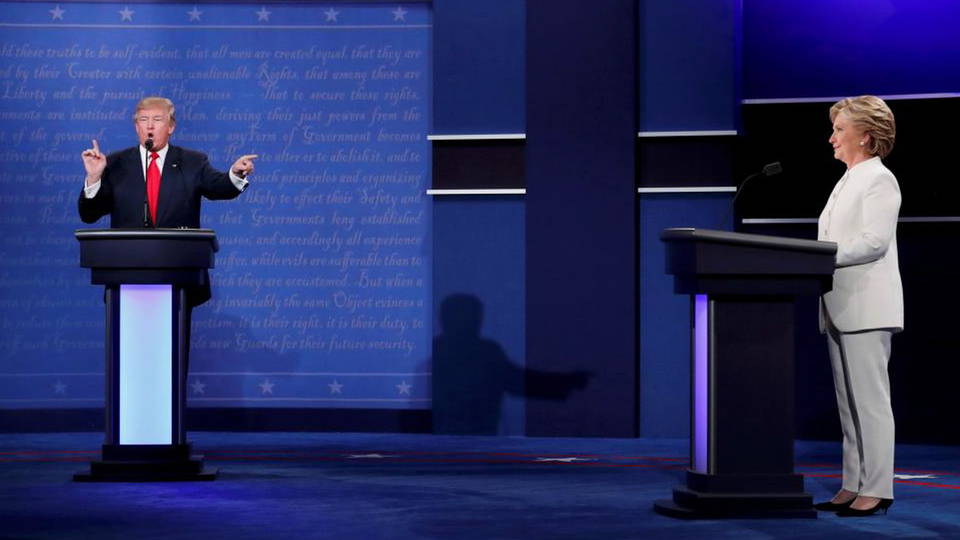 Donald Trump and Hillary Clinton squared off at the third and final debate at the University of Nevada, Las Vegas, Wednesday night. In one of the most extreme statements of the night, Donald Trump said he might not accept the results of the November election, instead saying, "I will keep you in suspense." This comes as Trump is continuing to claim the election has been rigged. Throughout the debate, the two faced off on topics ranging from sexual assault to social security to Russia.
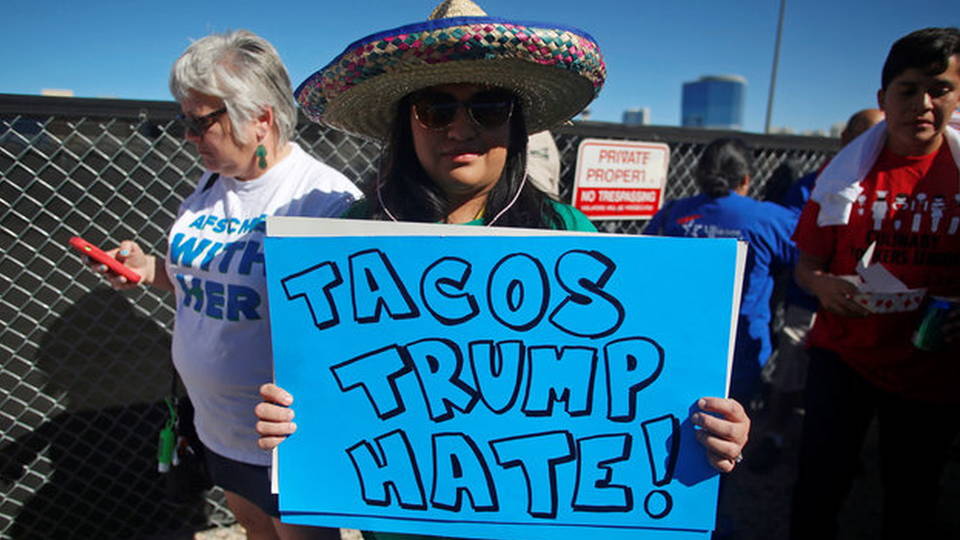 Hundreds protested at the University of Nevada outside the presidential debate last night. Hundreds more rallied outside Donald Trump’s Las Vegas hotel, where some vendors used their carts to build a "wall of taco trucks" to protest Trump’s calls to increase the massive border wall between the U.S. and Mexico. This is Adelina Catota, who works in housekeeping at the Trump Hotel.
 California Attorney General Kamala Harris has launched an investigation into whether Wells Fargo engaged in criminal identity theft by creating 2 million fake accounts, which employees opened in order to meet grueling sales targets. Wells Fargo is currently embroiled in a massive scandal over the creation of the fake bank accounts, which led to the resignation of former CEO John Stumpf.
 Turkish state media is reporting the Turkish military killed as many as 200 Syrian Kurdish fighters Wednesday night, although this figure is being disputed by the Syrian Kurdish forces. The Syrian Kurdish fighters, known as the YPG, were killed after Turkish jets attacked their bases north of Aleppo. A YPG leader says only 10 Syrian Kurdish fighters were killed in the attacks. The United States is militarily backing both Turkey and the Syrian Kurds.
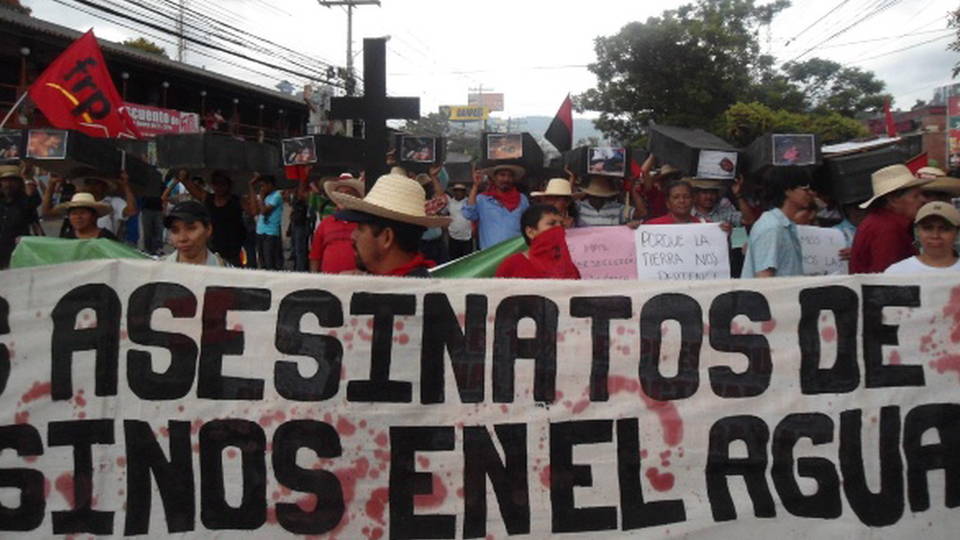 In Honduras, two campesino leaders have been assassinated. José Ángel Flores was the president of MUCA, that’s the Aguán Unified Campesino Movement. Silmer Dionisio George was one of the group’s lead organizers. Both were killed by gunmen Tuesday night after leaving the MUCA office in the community of La Confianza in northern Honduras in the valley of Aguán. Flores had repeatedly reported facing death threats as a result of his land defense work, and the Inter-American Commission on Human Rights had ordered the Honduran government to provide both him and Silmer protection. MUCA members have cooperative land holdings, and the group is under pressure to sell off their land so private corporations can build massive palm oil plantations. Tuesday’s assassinations were in a region of Honduras where a special development zone, also known as a model city, is currently being developed, which would create a special free trade zone operating outside the law of the Honduran government. Many of the companies pushing for special development zones in Honduras are supported by the World Bank.
 In Egypt, American citizen Aya Hijazi has now been imprisoned without trial for more than 900 days. Hijazi, who grew up in Virginia and is a dual citizen of Egypt, was arrested on May 2, 2014, along with her husband and others, while running a nonprofit seeking to help homeless children in Cairo. She and her husband were accused of paying the children to participate in anti-government protests.
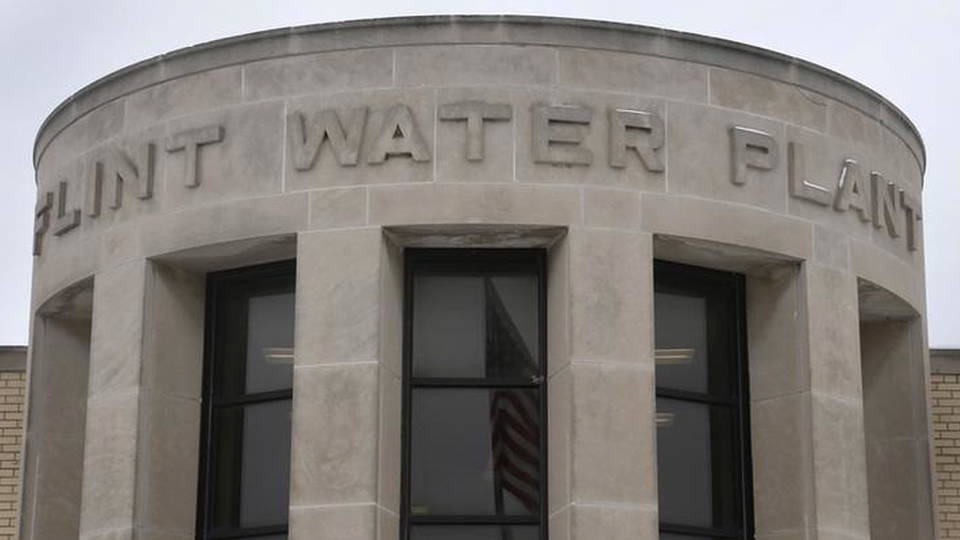 In Flint, Michigan, the ACLU has filed a class action lawsuit arguing the public school system has not done enough to provide children exposed to lead with sufficient educational services. Flint’s lead poisoning began when an unelected emergency manager appointed by Michigan Governor Rick Snyder switched the source of the city’s drinking water to the corrosive Flint River in 2014. Lead is a known neurotoxin, which can cause significant developmental delays, especially in children. The lawsuit, filed in the U.S. District Court in the Eastern District of Michigan, argues the school system is not adequately screening lead-exposed children for disabilities and providing educational interventions, and that the Michigan Department of Education has not sufficiently funded the Flint school district.
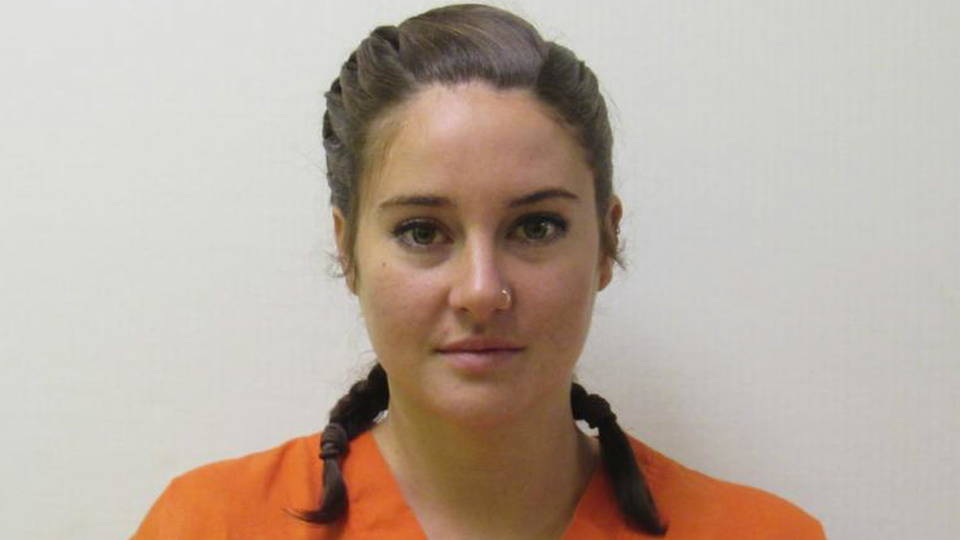 Actress Shailene Woodley pleaded not guilty on charges related to the resistance to the $3.8 billion Dakota Access pipeline on Wednesday. She was arrested along with 27 others in North Dakota on October 10 during actions to mark Indigenous Peoples’ Day. Woodley was strip-searched and then put in an orange jump suit in the Morton County jail, which appears to be a common practice even for low-level misdemeanor charges. Woodley told Democracy Now!, "Never did it cross my mind that while trying to protect clean water, trying to ensure a future where our children have access to an element essential for human survival, would I be strip-searched. I was just shocked." Standing Rock Sioux Tribal Chair Dave Archambault II and others have also been strip-searched after being arrested for nonviolent civil disobedience against the pipeline.
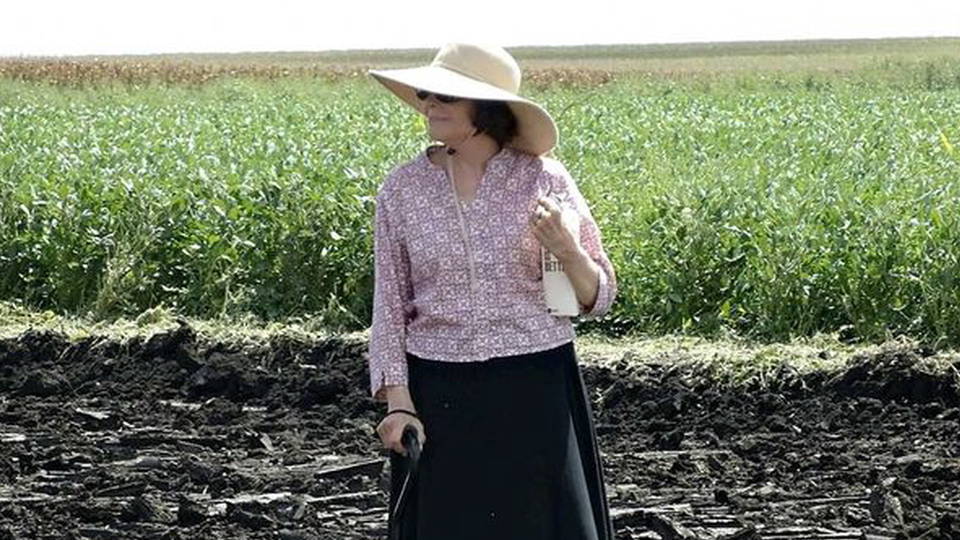 Meanwhile, in Iowa, landowner Cyndy Coppola was arrested protesting against the $3.8 billion Dakota Access pipeline on her family’s farm in Calhoun County, Iowa, over the weekend. Coppola’s land is one of multiple properties where the Dakota Access pipeline company used eminent domain to secure easements to build the pipeline, despite the objection of the landowners. Coppola and her friend were arrested blockading Dakota Access pipeline company trucks Saturday.
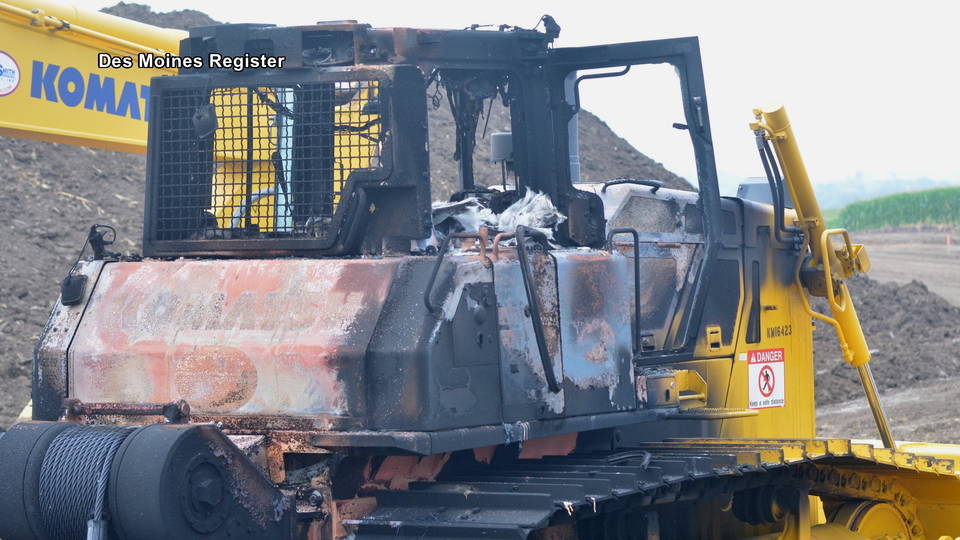 Meanwhile, also in Iowa, authorities say an excavator and three bulldozers being used to construct the Dakota Access pipeline were burned over the weekend, destroying up to $2 million worth of equipment. It’s the second suspected case of arson against Dakota Access pipeline company equipment. All the groups in Iowa fighting the pipeline have condemned the alleged arson. Christine Nobiss of Indigenous Iowa said, "We promote only peaceful and prayerful action."
 In New York City, residents are protesting the fatal police shooting of 66-year-old African American Deborah Danner, who was killed by a New York Police Department sergeant Tuesday. Danner had mental health issues, including schizophrenia. Police say she was shot and killed in her own home in the Bronx after a neighbor called 911. When police arrived, they found Danner naked in her bedroom holding a pair of scissors. Authorities say Sergeant Hugh Barry fatally shot her after she picked up a baseball bat. This is New York Mayor Bill de Blasio.
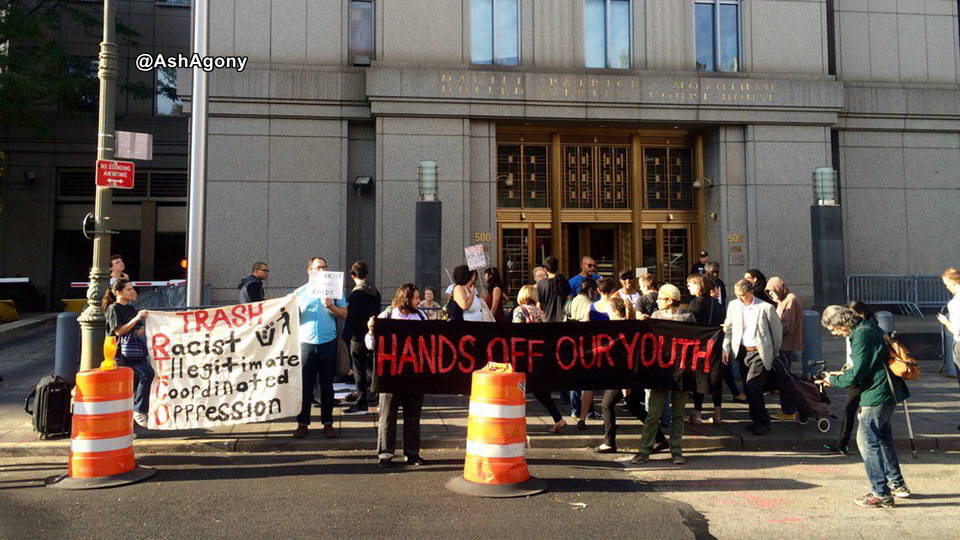 Meanwhile, also in New York City, dozens of people rallied outside a Manhattan courthouse Wednesday amid the beginning of the federal trial for "The Bronx 120"—120 young men from the Bronx who were arrested en masse on April 27 in what’s being described as the largest police raid in New York City history. The massive operation included at least 700 law enforcement agents, including SWAT teams, police helicopters, and federal agents from the Drug Enforcement Agency, the U.S. Marshals and Immigration and Customs Enforcement. Police say those arrested are part of two gangs that are linked to a number of murders. The young men have been charged with racketeering, as well as drug and firearm offenses. But family members and residents say the raids racially targeted young black men, many of whom, they say, were not part of the gangs.
 A new report finds law enforcement databases nationwide have collected facial recognition information for 117 million Americans—meaning about half of all adults in the United States now have their faces and other biometrics information recorded in these databases. The report was released Tuesday by the Center for Privacy & Technology at the Georgetown University Law Center.
 In technology news, a new lawsuit accuses another Samsung smartphone of being explosive. The suit claims a Samsung Galaxy S6 Active exploded, burst into flames five inches high and melted the flesh of its owner. This comes after Samsung ended the production of its Galaxy Note 7 smartphone, because the device is prone to catching on fire, and recalled 2.5 million phones after complaints the batteries were exploding.
 And in Argentina, thousands of women walked out of work on Wednesday for a women’s strike, protesting gender violence and the brutal rape and murder of a 16-year-old Argentine girl named Lucía Pérez earlier this month. Protesters held signs reading "If you touch one of us, we all react." Solidarity protests were also held in Mexico, Bolivia, Chile, Paraguay, Uruguay and the United States. This is Argentine protester Andrea Vázquez.
-------
And in Argentina, thousands of women walked out of work on Wednesday for a women’s strike, protesting gender violence and the brutal rape and murder of a 16-year-old Argentine girl named Lucía Pérez earlier this month. Protesters held signs reading "If you touch one of us, we all react." Solidarity protests were also held in Mexico, Bolivia, Chile, Paraguay, Uruguay and the United States. This is Argentine protester Andrea Vázquez.
-------
Donate today:
FollowL:
SPEAKING EVENTS
Donald Trump and Hillary Clinton squared off at the third and final debate at the University of Nevada, Las Vegas, Wednesday night. In one of the most extreme statements of the night, Donald Trump said he might not accept the results of the November election, instead saying, "I will keep you in suspense." This comes as Trump is continuing to claim the election has been rigged. Throughout the debate, the two faced off on topics ranging from sexual assault to social security to Russia.Donald Trump: "Look, Putin—"
Chris Wallace: "Wait, but—"
Donald Trump: "—from everything I see, has no respect for this person."
Hillary Clinton: "Well, that’s because he’d rather have a puppet as president of the United States."
Donald Trump: "No puppet. No puppet."
Hillary Clinton: "And it’s pretty clear—"
Donald Trump: "You’re the puppet!"
Hillary Clinton: "It’s pretty clear you won’t admit—"
Donald Trump: "No, you’re the puppet."
The debate frequently veered from political discussion into personal attacks.
Hillary Clinton: "That’s part of my commitment to raise taxes on the wealthy. My Social Security payroll contribution will go up, as will Donald’s, assuming he can’t figure out how to get out of it. But what we want to do is to replenish the Social Security Trust Fund—"
Donald Trump: "Such a nasty woman."
That was Republican presidential nominee Donald Trump. We’ll air more excerpts from last night’s third and final presidential debate after headlines.
TOPICS:
Las Vegas: Vendors Build "Wall of Taco Trucks" to Protest Trump
Hundreds protested at the University of Nevada outside the presidential debate last night. Hundreds more rallied outside Donald Trump’s Las Vegas hotel, where some vendors used their carts to build a "wall of taco trucks" to protest Trump’s calls to increase the massive border wall between the U.S. and Mexico. This is Adelina Catota, who works in housekeeping at the Trump Hotel.Adelina Catota: "I’ve been working here at Trump’s hotel for nine years, and all I want to say is that we should all be equal, because we came to this country to work and not to ask things of the government. So, here we are, united."
TOPICS:
California AG Investigating Wells Fargo for Criminal Identity Theft
California Attorney General Kamala Harris has launched an investigation into whether Wells Fargo engaged in criminal identity theft by creating 2 million fake accounts, which employees opened in order to meet grueling sales targets. Wells Fargo is currently embroiled in a massive scandal over the creation of the fake bank accounts, which led to the resignation of former CEO John Stumpf.TOPICS:
Syria: Turkish Jets Attack U.S.-Backed Syrian Kurdish Fighters
Turkish state media is reporting the Turkish military killed as many as 200 Syrian Kurdish fighters Wednesday night, although this figure is being disputed by the Syrian Kurdish forces. The Syrian Kurdish fighters, known as the YPG, were killed after Turkish jets attacked their bases north of Aleppo. A YPG leader says only 10 Syrian Kurdish fighters were killed in the attacks. The United States is militarily backing both Turkey and the Syrian Kurds.Honduras: Two Campesino Leaders Assassinated
In Honduras, two campesino leaders have been assassinated. José Ángel Flores was the president of MUCA, that’s the Aguán Unified Campesino Movement. Silmer Dionisio George was one of the group’s lead organizers. Both were killed by gunmen Tuesday night after leaving the MUCA office in the community of La Confianza in northern Honduras in the valley of Aguán. Flores had repeatedly reported facing death threats as a result of his land defense work, and the Inter-American Commission on Human Rights had ordered the Honduran government to provide both him and Silmer protection. MUCA members have cooperative land holdings, and the group is under pressure to sell off their land so private corporations can build massive palm oil plantations. Tuesday’s assassinations were in a region of Honduras where a special development zone, also known as a model city, is currently being developed, which would create a special free trade zone operating outside the law of the Honduran government. Many of the companies pushing for special development zones in Honduras are supported by the World Bank.TOPICS:
Egypt: American Citizen Aya Hijazi Imprisoned Without Trial for 900 Days
In Egypt, American citizen Aya Hijazi has now been imprisoned without trial for more than 900 days. Hijazi, who grew up in Virginia and is a dual citizen of Egypt, was arrested on May 2, 2014, along with her husband and others, while running a nonprofit seeking to help homeless children in Cairo. She and her husband were accused of paying the children to participate in anti-government protests.TOPICS:
Flint: Lawsuit Accuses School System of Failing Lead-Exposed Kids
In Flint, Michigan, the ACLU has filed a class action lawsuit arguing the public school system has not done enough to provide children exposed to lead with sufficient educational services. Flint’s lead poisoning began when an unelected emergency manager appointed by Michigan Governor Rick Snyder switched the source of the city’s drinking water to the corrosive Flint River in 2014. Lead is a known neurotoxin, which can cause significant developmental delays, especially in children. The lawsuit, filed in the U.S. District Court in the Eastern District of Michigan, argues the school system is not adequately screening lead-exposed children for disabilities and providing educational interventions, and that the Michigan Department of Education has not sufficiently funded the Flint school district.TOPICS:
Shailene Woodley Pleads Not Guilty to Charges Related to Pipeline Protest
Actress Shailene Woodley pleaded not guilty on charges related to the resistance to the $3.8 billion Dakota Access pipeline on Wednesday. She was arrested along with 27 others in North Dakota on October 10 during actions to mark Indigenous Peoples’ Day. Woodley was strip-searched and then put in an orange jump suit in the Morton County jail, which appears to be a common practice even for low-level misdemeanor charges. Woodley told Democracy Now!, "Never did it cross my mind that while trying to protect clean water, trying to ensure a future where our children have access to an element essential for human survival, would I be strip-searched. I was just shocked." Standing Rock Sioux Tribal Chair Dave Archambault II and others have also been strip-searched after being arrested for nonviolent civil disobedience against the pipeline.TOPICS:
Iowa: Landowner Arrested Blocking Dakota Access Trucks on Her Farm
Meanwhile, in Iowa, landowner Cyndy Coppola was arrested protesting against the $3.8 billion Dakota Access pipeline on her family’s farm in Calhoun County, Iowa, over the weekend. Coppola’s land is one of multiple properties where the Dakota Access pipeline company used eminent domain to secure easements to build the pipeline, despite the objection of the landowners. Coppola and her friend were arrested blockading Dakota Access pipeline company trucks Saturday.TOPICS:
Iowa: $2 Million Worth of Dakota Access Pipeline Machinery Burned
Meanwhile, also in Iowa, authorities say an excavator and three bulldozers being used to construct the Dakota Access pipeline were burned over the weekend, destroying up to $2 million worth of equipment. It’s the second suspected case of arson against Dakota Access pipeline company equipment. All the groups in Iowa fighting the pipeline have condemned the alleged arson. Christine Nobiss of Indigenous Iowa said, "We promote only peaceful and prayerful action."TOPICS:
NYC: Residents Protest Fatal Police Shooting of Elderly Black Woman
In New York City, residents are protesting the fatal police shooting of 66-year-old African American Deborah Danner, who was killed by a New York Police Department sergeant Tuesday. Danner had mental health issues, including schizophrenia. Police say she was shot and killed in her own home in the Bronx after a neighbor called 911. When police arrived, they found Danner naked in her bedroom holding a pair of scissors. Authorities say Sergeant Hugh Barry fatally shot her after she picked up a baseball bat. This is New York Mayor Bill de Blasio.Mayor Bill de Blasio: "Deborah Danner, 66 years old, and known to theNYPD as someone who suffered from mental illness. And the shooting of Deborah Danner is tragic, and it is unacceptable. It should never have happened. It’s as simple as that. It should never have happened."
Sergeant Hugh Barry has been sued twice in recent years for brutality. Deborah Danner has previously expressed concern about police violence against those living with mental illnesses. In a 2012 essay, Danner wrote, "We are all aware of the all too frequent news stories about the mentally ill who come up against law enforcement instead of mental health professionals and end up dead." On Tuesday night, dozens rallied in the Bronx to demand justice for Deborah Danner.
TOPICS:
NYC: Federal Trial Begins for The Bronx 120
Meanwhile, also in New York City, dozens of people rallied outside a Manhattan courthouse Wednesday amid the beginning of the federal trial for "The Bronx 120"—120 young men from the Bronx who were arrested en masse on April 27 in what’s being described as the largest police raid in New York City history. The massive operation included at least 700 law enforcement agents, including SWAT teams, police helicopters, and federal agents from the Drug Enforcement Agency, the U.S. Marshals and Immigration and Customs Enforcement. Police say those arrested are part of two gangs that are linked to a number of murders. The young men have been charged with racketeering, as well as drug and firearm offenses. But family members and residents say the raids racially targeted young black men, many of whom, they say, were not part of the gangs.TOPICS:
Report: Law Enforcement Has Facial Recognition Data for 117M Americans
A new report finds law enforcement databases nationwide have collected facial recognition information for 117 million Americans—meaning about half of all adults in the United States now have their faces and other biometrics information recorded in these databases. The report was released Tuesday by the Center for Privacy & Technology at the Georgetown University Law Center.Lawsuit Accuses Another Samsung Smartphone Model of Exploding
In technology news, a new lawsuit accuses another Samsung smartphone of being explosive. The suit claims a Samsung Galaxy S6 Active exploded, burst into flames five inches high and melted the flesh of its owner. This comes after Samsung ended the production of its Galaxy Note 7 smartphone, because the device is prone to catching on fire, and recalled 2.5 million phones after complaints the batteries were exploding.Argentina: Thousands Strike to Protest Gender Violence
And in Argentina, thousands of women walked out of work on Wednesday for a women’s strike, protesting gender violence and the brutal rape and murder of a 16-year-old Argentine girl named Lucía Pérez earlier this month. Protesters held signs reading "If you touch one of us, we all react." Solidarity protests were also held in Mexico, Bolivia, Chile, Paraguay, Uruguay and the United States. This is Argentine protester Andrea Vázquez.Andrea Vázquez: "Because I don’t want to be the next woman in plastic [meaning a body bag]. The clock is ticking, and there is scarcely 30 hours until another body appears. So we all have to be here—men, women, boys, girls, teenagers. And here we are representing society, shouting, "Not one less!" because I was a victim, too, and they also are victims."
TOPICS:
Donate today:
FollowL:
SPEAKING EVENTS

"On Strip Searches and Press Freedom in North Dakota" by Amy Goodman & Denis MoynihanMonday was a cold, windy, autumnal day in North Dakota. We arrived outside the Morton County Courthouse in Mandan to produce a live broadcast of the “Democracy Now!” news hour. Originally, the location was dictated by the schedule imposed upon us by the local authorities; one of us (Amy) had been charged with criminal trespass for Democracy Now!’s reporting on the Dakota Access Pipeline company’s violent attack on Native Americans who were attempting to block the destruction of sacred sites, including ancestral burial grounds, just north of the Standing Rock Sioux Reservation.
Pipeline guards unleashed pepper spray and dogs on the land and water defenders. Democracy Now! video showed one of the attack dogs with blood dripping from its nose and mouth. The video went viral, attracting more than 14 million views on Facebook alone. Five days later, North Dakota issued the arrest warrant.
When responding to an arrest warrant, one must surrender to the jail by about 8 a.m. if one hopes to see a judge that day and avoid a night in jail. So we planned to broadcast live from 7-8 a.m., then head to the jail promptly at 8 a.m. to get processed through the jail and fight the trespass charge in court.
To our surprise, as we landed in Bismarck on Friday, we learned that the prosecutor, Ladd Erickson, had dropped the trespass charge, but filed a new one: “riot.” We were stunned. In an email to both the prosecutor and our defense attorney, Tom Dickson, Judge John Grinsteiner wrote, “The new complaints, affidavits, and summons are quite lengthy and I will review those for probable cause on Monday when I get back into the office.” We were told by several lawyers familiar with North Dakota criminal law that judges almost never reject a prosecutor’s complaint. The arraignment was set for 1:30 p.m. local time, Monday.
We spent the weekend reporting on the controversial Dakota Access Pipeline, with the threat of the riot charge never far from our minds. The 1,100-mile-long, $3.8 billion pipeline is designed to carry almost 500,000 barrels of crude oil from the fracking oil fields of North Dakota to Illinois, then onward to the Gulf of Mexico. That is why thousands of people have been at the resistance camps where the Dakota Access Pipeline is slated to cross under the Missouri River. If the pipeline leaks there, the fresh-water supply for millions of people downstream will be polluted.
Morton County Sheriff Kyle Kirchmeier runs the jail in Mandan and is responsible for how people are processed there. As the protests have mounted during the past six months, Kirchmeier and the local prosecutors have been leveling more and more serious charges against the land and water protectors, with an increasing number of felony charges. More than 140 people have been arrested so far. Those we spoke to told us a shocking detail: When getting booked at the jail, they were all strip searched, forced to “squat and cough” to demonstrate they had nothing hidden in their rectums, then were put in orange jumpsuits. The treatment was the same for Chairman of the Standing Rock Sioux Tribe Dave Archambault, to a pediatrician from the reservation, Dr. Sara Jumping Eagle, to actress Shailene Woodley, star of the films “Divergent” and “Snowden,” among others.
I asked Chairman Archambault if strip searching was common for low-level misdemeanors. “I wouldn’t know, because that was the first time I ever got arrested,” he replied. Dr. Jumping Eagle remarked, “It made me think about my ancestors, and what they had gone through.” Shailene Woodley told us, “Never did it cross my mind that while trying to protect clean water, trying to ensure a future where our children have access to an element essential for human survival, would I be strip searched. I was just shocked.”
As we prepared to enter the courthouse for the 1:30 p.m. arraignment on Monday, 200 people rallied in support of a free press, demanding the charges be dropped. A row of close to 60 riot police were lined up in a needless display of force in front of a peaceful gathering, threatening to arrest anyone who stepped off the curb. Then word came from our lawyer: The judge had refused to sign off on the riot charge. The case was dismissed, and we marked an important victory for a free press.
The free press should now focus a fierce spotlight on the standoff at Standing Rock—a critical front in the global struggle to combat global warming and fight for climate justice. Indigenous people and their non-native allies are confronting corporate power, backed up by the state with an increasingly militarized police force. Attempts to criminalize nonviolent land and water defenders, humiliate them and arrest journalists should not pave the way for this pipeline.
-------
NEW BOOK

Actress Shailene Woodley Reveals She Was Strip-Searched After Her Arrest Protesting Dakota Pipeline
WORK WITH DN!
Senior TV Producer
SPECIAL BROADCAST

Watch: Full Presidential Debate & Democracy Now! Special Coverage
207 West 25th Street, 11th Floor
New York, New York 10001, United States
-------
-------
No comments:
Post a Comment