 "Leading Ideas: 10 Qualities Your Church Doesn't Need to Grow Young | 7 Ways to Help Unchurched Guests Feel Welcome without Selling Out" from Lewis Center for Church Leadership from The Wesley Theological Seminary of Washington, D.C., United States for Wednesday, November 30, 2016
 10 Qualities Your Church Doesn't Need to Grow Young by Kara Powell, Brad Griffin And Jake Mulder
 What types of churches attract young people? Kara Powell, Jake Mulder, and Brad Griffin, the authors of Growing Young, dispel a number of common myths. Their research indicates that size, location, denominational tradition, worship style, and several other variables don't matter as much as imagined and that congregations of all types have the potential to "grow young."
Whether you’re a senior pastor, church staff member, ministry volunteer, parent, teenager, or young adult, if you are like us, you may be hindered by your preconceived image of what it takes to grow young. Odds are good that your picture of a thriving congregation has had branch after branch grafted on to it over time. Most of these branches stem from the experience of one person — either you or another (likely well-known) leader.
Even your images of successful ministry that are rooted in broader research are often several years — or decades — old. At this point, it’s hard to tell which branches have the potential to bear fruit and which are dead weight that drain the life from your congregation. Your ministry efforts are left wilting under the heavy burden of too many unrealistic expectations.
Granted, several of the congregations and leaders bubbling to the top of our research have a certain hip factor. But those were in the minority. For young people today, relational warmth is the new cool.
We need to prune distractions so the only branches remaining are those that help our churches grow young. Thanks to our research team’s surveys, interviews, and site visits with churches across the US, we can cross off these ten qualities from our list of what churches need to grow young.
1. A precise size. Don’t buy into the Goldilocks fantasy that some churches are too big, others are too small, and some are “just right.” We saw no statistical relationship between church size and effectiveness. Size doesn’t matter.
2. A trendy location or region. Did our data unearth churches flourishing near bustling urban centers and dynamic college campuses? Sure. But we also uncovered equally robust ministry in rural one-stoplight towns and middle-class suburbia. Your location does not have to be a limitation.
3. An exact age. We applaud how God is working through new church plants. We love what we learned from churches that are less than five years old. But we learned just as much, and recorded just as much life change, in churches over a century old. When it comes to churches that grow young, there is no age discrimination.
4. A popular denomination … or lack of denomination. When we started our study, we wondered if the churches that rose to the top would skew toward particular denominational, or nondenominational, leanings. While it’s true that some denominations are shrinking or aging faster than average, our fear was unfounded. No need to apologize for your tradition or the fact that you are part of a denomination at all. God is working powerfully through churches of all stripes (and plaids too).
5. An off-the-charts cool quotient. Granted, several of the congregations and leaders bubbling to the top of our research have a certain hip factor. But those were in the minority. For young people today, relational warmth is the new cool.
6. A big modern building. Some of the congregations that are most effective with young people have new, state-of-the-art facilities. But not all. The majority of the effective churches we studied gather in decent, but not spectacular, spaces. Some don’t own their facilities and are creatively meeting in local schools, community centers, and living rooms. For teenagers and young adults, feeling at home transcends any building.
7. A big budget. Churches that grow young intentionally invest in young people, and most often that translates into a financial investment. But not always. Less resourced congregations creatively support young people in other ways, proving that a small budget does not have to mean small impact.
A “contemporary” worship service. Our data indicated that while many young people are drawn to “casual and contemporary” worship, others are drawn to “smells and bells” high-church liturgy and everything in between. While the churches we visited were likely to prefer modern worship in some or all of their worship contexts, they didn’t depend on that alone as a magnet to draw young people.
8. A watered-down teaching style. It’s often assumed that we have to whitewash the teachings of Scripture and somehow make them seem less radical in order to appeal to teenagers and young adults. That’s not what we found. For today’s young people, growing young doesn’t mean we talk about Jesus or the cost of following him any less.
9. A hyper-entertaining ministry program. The entertainment options available to young people in our culture are endless. We don’t have to compete. If we try, we will almost certainly lose. Our research highlighted that faith communities offer something different. 10. Slick is no guarantee of success.
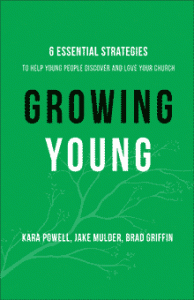 Excerpted from Growing Young: Six Essential Strategies to Help Young People Discover and Love Your Church. Baker Books, a division of Baker Publishing Group, 2016. Used by permission. BakerPublishingGroup.com, available at ChurchesGrowingYoung.org.
Related Resources:
- What Churches Do Young Adults Attend? by Lovett H. Weems, Jr.
- Lessons from Churches that Reach Young Adults by Lovett H. Weems, Jr.
- Leading Ideas To Reach Young Adults, Lewis Center e-book
Read more.
-------
 7 Ways to Help Unchurched Guests Feel Welcome without Selling Out by Rich Birch
Making new people feel welcome isn't a sell out to a marketing and customer service mentality, says Rich Birch. It's consistent with Scripture's overarching theme of making space for the outsider. He outlines seven basic ways of making sure guests feel welcome.
Some church leaders look down their noses at churches that go out of their way to create environments that unchurched people love to attend. They’re concerned about growing Christ-followers and don’t want to worry about marketing, customer service, communications, or similar issues. They don’t concern themselves with pedestrian matters such as how people feel when they come to church.
The problem is that the Scriptures are clear that to worry about the outsider is core to being a follower of Christ. In fact, the entire weight of Scripture is about creating space for people who are outside of the faith to join us. In the Old Testament, we see God instructing people to defer to strangers and make room for them at the table. In an age when faiths were divided along racial and ethnic lines, Jesus presented the crazy notion that anyone from any background can gain access to God through faith in Christ alone. We see New Testament leaders attempting to live out a faith that created space for a broader community of people. They made space for outsiders.
Communicate that you are ready and expecting guests. Include signs in the parking lot for new guests, a gift ready for them at an information desk, or trained volunteers at the kids’ check-in.
How can we create spaces where people feel welcome at our churches regardless of their spiritual background? What can we do to ensure that unchurched people know they are welcome to our experiences every weekend? How can we do this in a way that doesn’t compromise the core of our experiences? Here are seven ways to help unchurched people feel welcome.
1. Create Helpful Signage
Do people know how to find their way around your facility? Can they easily get from their cars to wherever they drop off their kids to their seats in the main auditorium? Most churches I’ve been to don’t have enough signage. They assume people know way too much. Exterior signage lets newcomers know they are in the right place. Interior signage should guide them through the experience while reducing stress.
2. Introduce People
When someone gets up to talk, make sure they introduce themselves or that someone else does a quick introduction. “Hi, my name is James and I’m one of the pastors here.” A simple introduction helps unchurched people get a sense of who everyone is and helps them know whom they should talk to afterward. When people just get up and start talking or leading without any context, it leaves guests wondering who the person is and why they are talking.
3. Expect Guests
You know that feeling when you go to a friend’s house, and it feels like they were ready for you? It feels great, right? What about the opposite feeling: when you go over to someone’s house and you get the distinct feeling that they aren’t ready for you? It’s easy to start wondering whether they want you over at all, isn’t it? The same is true when guests visit your church. Even a few things that anticipate guests communicate that you are ready and expecting them. Examples include signs in the parking lot for new guests, a gift ready for them at an information desk, or trained volunteers at the kids’ check-in who know how to handle new guests well.
4. Explain What’s Happening
Every church has some form of ritual or patterns that it follows. If we don’t take a moment to explain them to people, they can be confusing to follow. Don’t assume people understand what is happening or that they know how they should engage. Communion is a particularly thorny one for people. Slowing down and giving a brief explanation of what is taking place goes a long way in making sure people feel welcome! Taking time to frame what’s happening in your church during the announcements is also an important part of making guests feel welcome!
5. Give Context to Passages
Many people don’t know the Bible, but they want to understand it better. That’s why they are coming to your church! Don’t assume people know anything about the passages that you are talking about; instead, provide a little context. Help them understand where the verses fall into the broader narrative. Give some context so people can dig into the content.
6. Serve Their Kids Well
When parents come to your church, they usually look at the experience through the eyes of their kids. When you go out of your way to serve their kids, you also serve their parents. Often, kids are nervous when they go into a new space. Make sure your team is ready to receive new kids well. Have activities that can engage kids right away. Guests often arrive earlier than your typical church attendee, so make sure your team is in place in plenty of time to greet guests well. Work hard to make sure the check-in process is smooth, simple, and secure.
7. Fix Your Website
Church guests say that a church’s website was important in picking a church to visit. It really is the front door to your church. Chances are good that your guests will check out your site before they check out your services. Make sure the basic contact information is easy to find, including service times, the location, and the phone number to call if people have any questions. Let people know what to expect by answering key questions, such as how long the service will be, what people usually wear, and what services are provided for kids. Make sure your site is mobile-friendly so people can use it on their phones or tablets.
This material is adapted from a recent post that appeared on Rich Birch’s blog “unSeminary” and used by permission. Rich Birch’s new book, Unreasonable Churches: 10 Churches Who Zagged When Others Zigged and Saw More Impact Because of It (CreateSpace, 2016) is available from Amazon.
Related Resources:
- 50 Ways to Welcome New People, a free resource from the Lewis Center
- Welcoming Newcomers to Your Congregation by Jessicah Krey Duckworth
- The New Welcome Video Tool Kit
-------
The Right Question
Leaders do not need answers. Leaders must have the right questions.
Joseph L. Badaracco teaches business ethics at Harvard Business School and has written extensively about the importance of character in leadership. He recently wrote about five practical questions that can help improve decision-making when information is incomplete and opinions divided.
- What are the net, net consequences of all my options?
- What are my core obligations?
- What will work in the world as it is?
- Who are we?
- What can I live with?
-------
 Learn to Welcome and Engage New People with "The New Welcome" Video Tool Kit
Learn concepts and strategies to welcome and respond to your first-time and repeat visitors, reach younger generations, expand your church's entry points, and get new people involved. The New Welcome Video Tool Kit helps you open your church to the transformative presence of new people -- welcoming newcomers by acknowledging the changing ways that people enter into the life of churches.
Learn more and watch introductory videos now.
-------
Quotable Leadership
Generosity is a fruit of God's grace, the product of a transformed heart, and it develops in an atmosphere that encourages it, celebrates it, and reproduces it consistently over time.[Chris Willard and Jim Sheppard]
-------
 50 Ways to Welcome New PeopleOne key to effective outreach is making sure that worship visitors feel truly welcome. The strategies and tips in "50 Ways to Welcome New People" will help your congregation make a good first impression and extend hospitality in meaningful ways.
 Download for free now.
-------
Editors: Dr. Ann A. Michel and Dr. Lovett H. Weems, Jr.
Lewis Center for Church Leadership of Wesley Theological Seminary
Connect with the Lewis Center:


Lewis Center for Church Leadership
Wesley Theological Seminary
4500 Massachusetts Avenue NorthWest
Washington, D.C. 20016, United States
-------

No comments:
Post a Comment