
PRACTICAL WISDOM FOR LEADING CONGREGATIONS:
"Small church upholds history of outreach to make a big impact on a frontier town"
Faith & Leadership
CONGREGATIONS, MISSIONS & EVANGELISM
Small church upholds history of outreach to make big impact on frontier town

The Rev. Melinda Bobo and parishioner Kerry Sprouse share a hug before Sunday services at St. Thomas Episcopal Church. Photos by John Slaughter
Continuing a long tradition of service and good works, St. Thomas Episcopal Church in Dubois, Wyoming, is an essential part of the town’s religious life -- and its community life as well.Early on a Sunday morning in May, the main street in Dubois, Wyoming, is quiet and still. Nothing stirs but a breeze and the cold, clear Wind River as it flows along the edge of town. Sublime vistas rise in all directions -- sprawling valley ranchlands and red rock cliffs, and above all that, rugged snow-capped mountains.


 But where U.S. 26 turns a hard right, heading south out of town, cars fill the small parking lot at St. Thomas Episcopal Church. A few dozen Dubois residents shake hands and greet each other warmly as they head into the 107-year-old log-cabin sanctuary for worship.
Led since 2013 by the Rev. Melinda Bobo, St. Thomas Episcopal Church is the faithful keeper of a long tradition of service and good works, one that has made it an essential part of not only the town’s religious life but its community life as well.
St. Thomas may be small, but it has a very big impact on Dubois (pronounced DEW-boyz).
In an era when many traditional churches are becoming less visible in their communities, St. Thomas has for decades been a large presence in Dubois, mounting a broad array of outreach ministries and programs that would be the envy of churches 10 times its size. About 40 people attend the traditional Episcopal worship service on Sundays, but the church plays a vital role in many aspects of life in this town of about 1,000 people.
 As it says on the sign out front, eveyone is welcome at St. Thomas Episcopal Church.
The church’s ministries include a thrift shop, a food bank, a community garden, and free overnight housing for hikers and bikers passing through the area, less than 90 miles away from the tourist meccas of Yellowstone National Park and Jackson Hole. A church of its place and context, St. Thomas has for more than 50 years hosted a weekly square dance during the summer, drawing tourists and locals alike. That and other social events, such as smorgasbord dinners and ice cream socials, raise money to support programs that help people throughout the region.
How is your church’s place and context reflected in its ministry?
The reason for the church’s active role in Dubois life is simple: that’s the way it’s always been, right from the beginning of both the church and the town. From the days when Dubois was a rough frontier outpost, to the years when it was a prospering mill town, to today, when it faces challenges common to rural America, St. Thomas has always ministered to and helped anybody who needed it, Bobo said.
“Dubois has this sense of independence, and relying on each other,” she said. “That is its community identity. History here plays a role in everything. The past is what shapes you now.”
 Crucifer Kay Jacoby pauses a moment before worship begins at St. Thomas.
Episcopal history in Wyoming
The Episcopal presence in Wyoming was established in the 1880s by the Rev. John Roberts, a frontier missionary. Born in Wales in 1853, he wanted to serve where Christianity was not yet known and to show how the gospel could, as he believed, lead to a better life. In 1883, he got his wish when the bishop of Colorado and Wyoming sent him to minister to the Shoshone and Arapaho tribes on the Wind River Indian Reservation.
With a style that one Wyoming historian described as “loving paternalism,”(link is external) Roberts respected the native peoples and earned their respect and trust in return, Bobo said. Over his 66 years of ministry in Wyoming, he served as a bridge between those on the reservation and the white culture that surrounded them.
In addition to his mission work on the reservation, Roberts also organized eight Episcopal congregations throughout the territory, including St. Thomas in Dubois, then a small settlement adjacent to the reservation. Dubois’ first -- and for many years only -- church, St. Thomas became the default church for the entire community, providing baptisms, weddings, funerals, religious support and help to anyone who needed it.
Today, St. Thomas still lives out that tradition of helping throughout the community, Bobo said.
How has your church’s history shaped its approach to ministry?
With 1,000 city residents and another 1,100 in the surrounding area, Dubois faces challenges common to many small towns, primarily a stagnant economy and a declining population, said Mayor Twila Blakeman, a longtime resident and St. Thomas member.
For more than 60 years, Dubois was home to a thriving timber industry, but after the sawmill closed in 1988, many people moved away.
 The Rev. Melinda Bobo greets church members.
“It’s a strange demographic here now,” said Ellen Jungck, a U.S. Forest Service employee and the president of Needs of Dubois, a nonprofit that provides financial help to residents facing temporary hardships. “You have a few very wealthy families with ranchlands, a growing summer population of retired people, and then very poor, low-income families,” she said.
How can your church better collaborate with other congregations, so as to leverage the overall impact in the community?
St. Thomas(link is external) is no longer the only church in town. Dubois now has eight congregations -- including Catholic, Missouri Synod Lutheran, Southern Baptist and Mormon -- but St. Thomas remains the one to emulate, said Jungck, whose organization works closely with the congregation. A member of Our Lady of the Woods Catholic Church, Jungck said that Bobo has brought a new vitality to programs and interdenominational collaboration.
“She has really taken the bull by the horns,” Jungck said. “Melinda spearheads things, organizes the churches to work together, so outreach makes a bigger difference in the community.”
Ministering to the community for decades
Many of St. Thomas’ most effective ministries have been staples of the community for decades, back to when the church was the only place to go for help. Located in a log building next door to the church, the Opportunity Shop is the town’s thrift store -- one of the few shops in town where people can purchase clothes, toys, household goods and more.
Known to locals as the “Op Shop,” the store traces its roots back to a 1924 church rummage sale that generated funds to help people in Dubois. Today, the store’s proceeds still go back to the community in the form of grants and donations, awarded twice a year. In April, the store gave $15,600 to 12 local charities and nonprofits.
 The Opportunity Shop traces its roots back to a 1924 rummage sale fundraiser. Likewise, the church’s food bank is a longtime fixture in Dubois, serving residents since the 1980s. Staffed by National Honor Society students from the local high school and other volunteers, the food bank, open every Saturday morning, is supported by donations and grants.
“It made the difference in our lives when I was laid off from the oil fields,” said a man named Rick on a recent Saturday. “It let us maintain a proper diet. I work whenever I can pick up a job, and I hope to go back to the fields. But for now, this is a blessing.”
But the food bank is about much more than food, said Roger, another client. Like most St. Thomas ministries, it is, at a deeper level, about community and relationship.
“The biggest reason I come is seeing you people,” Roger told the food bank volunteers. “I live in an isolated place and could forget how to talk and laugh. And [now] I have some food that I can share with a neighbor like my son did, before his death. You saw me through that hard time.”
 Members pass the peace during Sunday worship at St. Thomas Episcopal.
Mary Ellen Honsaker, who recently stepped down after more than 10 years as food bank director, created additional programs to complement the ministry, including a backpack program for children to take food home and a community garden to supply the food bank and the church’s farmers market.
St. Thomas also helps those just passing through the area through its bicyclist/hiker ministry. Dubois is a popular stopping point for both hikers on the north-south Continental Divide Trail and bicyclists on the east-west TransAmerica Trail. St. Thomas offers its community room as safe shelter for the night, free of charge.
But perhaps the church’s most unusual ministry is the summer square dance series, held in the Frontier Room of the Rustic Pine Tavern every Tuesday night, June through August. Dating back to 1948, the dance is popular not just with tourists from area dude ranches looking for a taste of the West; it is an energetic, genuinely all-inclusive event that attracts the locals, from kids and teens to cowboys and senior citizens.


 People ready to help
These and other St. Thomas programs, in turn, help strengthen the church and its members, Honsaker said.
“I honestly think that the energy, and knowing the church is doing good things, spills over into the congregation,” she said. “Since I’ve been here, we’ve had periods with no priest, a year here and there. The lay leaders just jump in and keep everything going, which makes for a really strong congregation. People are just ready to help when they can.”
It’s a foundation that serves the church well today, Bobo said.
“Every time I am thinking about something I want to do but I am not sure we have the people, someone shows up,” she said.
Blakeman, the Dubois mayor and St. Thomas member, said that the church’s many ministries do not create stress for the congregation.
 Mayor Twila Blakeman is a longtime Dubois resident and St. Thomas member.“It doesn’t create pressure -- maybe motivation,” she said. “If there was no St. Thomas, we would be missing a tremendous element. In most places, things might be handled by the county. But here, we are so far from everything, the county doesn’t pay much attention.”
Even if they never set foot in St. Thomas or any other church, many Dubois residents feel that they have a stake in St. Thomas, Honsaker said. They consider it their church.
“Melinda is out there, being visible,” she said. “And with the outreach that we do, we are trusted to be accepting.”
What stake, if any, do non-churchgoers in your community have in your church?
In recent years, St. Thomas has been growing, netting two or three new members annually, over those who have died or moved away. And while that is gratifying, it’s not the church’s ultimate goal, Bobo said.
“We have grown,” she said. “But if you focus only on the numbers, you’ll fail as a church, because you will only be doing what it takes to be popular. We can focus on spiritual growth, which will make us stronger and healthier, and people will come to us because of that.”
‘I wanted to come home’
Born in Washington, D.C., Bobo spent almost five years in Dubois as a child when the U.S. Forest Service stationed her father there in the late 1960s. She came back for summers in the 1980s, and in 2006, she moved back permanently after serving churches in Minnesota.
“This place has always just felt like home to me, and I wanted to come home,” Bobo said.
Today, she lives a Dubois life to the fullest -- hunting elk, gardening, quilting, ministering to her congregation -- and is widely recognized and appreciated around town. Growing up in an African-American family in the rural West in the late 1960s, Bobo learned to deal gracefully with adversity and misunderstandings among people.
“My mother always told my sister and me to think of ourselves as ambassadors to other people,” she said.
When Bobo moved back to Dubois, St. Thomas already had a rector. So for years, she worked multiple jobs to make ends meet. By the time the church brought her on part time in 2013, and then full time in 2016, she deeply understood the challenges her fellow Dubois residents face.
To her and many others in Dubois, St. Thomas is an example of what can happen when people take responsibility for helping each other. It’s simply what the church should be doing.
 The Rev. Melinda Bobo leads Eucharist at St. Thomas Episcopal Church.
“That’s how we are supposed to be as Christians,” Bobo said. “Jesus said to get out there.”
“There is so much outreach you can see making a difference in this small community. The motivation is the body of Christ working in the world. This is what the gospel looks like on the ground.”
Questions to consider
CONGREGATIONS, MISSIONS & EVANGELISM
Small church upholds history of outreach to make big impact on frontier town
The Rev. Melinda Bobo and parishioner Kerry Sprouse share a hug before Sunday services at St. Thomas Episcopal Church. Photos by John Slaughter
Continuing a long tradition of service and good works, St. Thomas Episcopal Church in Dubois, Wyoming, is an essential part of the town’s religious life -- and its community life as well.Early on a Sunday morning in May, the main street in Dubois, Wyoming, is quiet and still. Nothing stirs but a breeze and the cold, clear Wind River as it flows along the edge of town. Sublime vistas rise in all directions -- sprawling valley ranchlands and red rock cliffs, and above all that, rugged snow-capped mountains.
It’s a classic Western landscape, a vast open space that dwarfs the tiny town. All that’s missing are tumbleweeds blowing across the road, bumping up to the historic buildings that have lined the road for more than a century.
Led since 2013 by the Rev. Melinda Bobo, St. Thomas Episcopal Church is the faithful keeper of a long tradition of service and good works, one that has made it an essential part of not only the town’s religious life but its community life as well.
St. Thomas may be small, but it has a very big impact on Dubois (pronounced DEW-boyz).
In an era when many traditional churches are becoming less visible in their communities, St. Thomas has for decades been a large presence in Dubois, mounting a broad array of outreach ministries and programs that would be the envy of churches 10 times its size. About 40 people attend the traditional Episcopal worship service on Sundays, but the church plays a vital role in many aspects of life in this town of about 1,000 people.
The church’s ministries include a thrift shop, a food bank, a community garden, and free overnight housing for hikers and bikers passing through the area, less than 90 miles away from the tourist meccas of Yellowstone National Park and Jackson Hole. A church of its place and context, St. Thomas has for more than 50 years hosted a weekly square dance during the summer, drawing tourists and locals alike. That and other social events, such as smorgasbord dinners and ice cream socials, raise money to support programs that help people throughout the region.
How is your church’s place and context reflected in its ministry?
The reason for the church’s active role in Dubois life is simple: that’s the way it’s always been, right from the beginning of both the church and the town. From the days when Dubois was a rough frontier outpost, to the years when it was a prospering mill town, to today, when it faces challenges common to rural America, St. Thomas has always ministered to and helped anybody who needed it, Bobo said.
“Dubois has this sense of independence, and relying on each other,” she said. “That is its community identity. History here plays a role in everything. The past is what shapes you now.”
Episcopal history in Wyoming
The Episcopal presence in Wyoming was established in the 1880s by the Rev. John Roberts, a frontier missionary. Born in Wales in 1853, he wanted to serve where Christianity was not yet known and to show how the gospel could, as he believed, lead to a better life. In 1883, he got his wish when the bishop of Colorado and Wyoming sent him to minister to the Shoshone and Arapaho tribes on the Wind River Indian Reservation.
With a style that one Wyoming historian described as “loving paternalism,”(link is external) Roberts respected the native peoples and earned their respect and trust in return, Bobo said. Over his 66 years of ministry in Wyoming, he served as a bridge between those on the reservation and the white culture that surrounded them.
In addition to his mission work on the reservation, Roberts also organized eight Episcopal congregations throughout the territory, including St. Thomas in Dubois, then a small settlement adjacent to the reservation. Dubois’ first -- and for many years only -- church, St. Thomas became the default church for the entire community, providing baptisms, weddings, funerals, religious support and help to anyone who needed it.
Today, St. Thomas still lives out that tradition of helping throughout the community, Bobo said.
How has your church’s history shaped its approach to ministry?
With 1,000 city residents and another 1,100 in the surrounding area, Dubois faces challenges common to many small towns, primarily a stagnant economy and a declining population, said Mayor Twila Blakeman, a longtime resident and St. Thomas member.
For more than 60 years, Dubois was home to a thriving timber industry, but after the sawmill closed in 1988, many people moved away.
“It’s a strange demographic here now,” said Ellen Jungck, a U.S. Forest Service employee and the president of Needs of Dubois, a nonprofit that provides financial help to residents facing temporary hardships. “You have a few very wealthy families with ranchlands, a growing summer population of retired people, and then very poor, low-income families,” she said.
How can your church better collaborate with other congregations, so as to leverage the overall impact in the community?
St. Thomas(link is external) is no longer the only church in town. Dubois now has eight congregations -- including Catholic, Missouri Synod Lutheran, Southern Baptist and Mormon -- but St. Thomas remains the one to emulate, said Jungck, whose organization works closely with the congregation. A member of Our Lady of the Woods Catholic Church, Jungck said that Bobo has brought a new vitality to programs and interdenominational collaboration.
“She has really taken the bull by the horns,” Jungck said. “Melinda spearheads things, organizes the churches to work together, so outreach makes a bigger difference in the community.”
Ministering to the community for decades
Many of St. Thomas’ most effective ministries have been staples of the community for decades, back to when the church was the only place to go for help. Located in a log building next door to the church, the Opportunity Shop is the town’s thrift store -- one of the few shops in town where people can purchase clothes, toys, household goods and more.
Known to locals as the “Op Shop,” the store traces its roots back to a 1924 church rummage sale that generated funds to help people in Dubois. Today, the store’s proceeds still go back to the community in the form of grants and donations, awarded twice a year. In April, the store gave $15,600 to 12 local charities and nonprofits.
“It made the difference in our lives when I was laid off from the oil fields,” said a man named Rick on a recent Saturday. “It let us maintain a proper diet. I work whenever I can pick up a job, and I hope to go back to the fields. But for now, this is a blessing.”
But the food bank is about much more than food, said Roger, another client. Like most St. Thomas ministries, it is, at a deeper level, about community and relationship.
“The biggest reason I come is seeing you people,” Roger told the food bank volunteers. “I live in an isolated place and could forget how to talk and laugh. And [now] I have some food that I can share with a neighbor like my son did, before his death. You saw me through that hard time.”
Mary Ellen Honsaker, who recently stepped down after more than 10 years as food bank director, created additional programs to complement the ministry, including a backpack program for children to take food home and a community garden to supply the food bank and the church’s farmers market.
St. Thomas also helps those just passing through the area through its bicyclist/hiker ministry. Dubois is a popular stopping point for both hikers on the north-south Continental Divide Trail and bicyclists on the east-west TransAmerica Trail. St. Thomas offers its community room as safe shelter for the night, free of charge.
But perhaps the church’s most unusual ministry is the summer square dance series, held in the Frontier Room of the Rustic Pine Tavern every Tuesday night, June through August. Dating back to 1948, the dance is popular not just with tourists from area dude ranches looking for a taste of the West; it is an energetic, genuinely all-inclusive event that attracts the locals, from kids and teens to cowboys and senior citizens.
These and other St. Thomas programs, in turn, help strengthen the church and its members, Honsaker said.
“I honestly think that the energy, and knowing the church is doing good things, spills over into the congregation,” she said. “Since I’ve been here, we’ve had periods with no priest, a year here and there. The lay leaders just jump in and keep everything going, which makes for a really strong congregation. People are just ready to help when they can.”
It’s a foundation that serves the church well today, Bobo said.
“Every time I am thinking about something I want to do but I am not sure we have the people, someone shows up,” she said.
Blakeman, the Dubois mayor and St. Thomas member, said that the church’s many ministries do not create stress for the congregation.
Even if they never set foot in St. Thomas or any other church, many Dubois residents feel that they have a stake in St. Thomas, Honsaker said. They consider it their church.
“Melinda is out there, being visible,” she said. “And with the outreach that we do, we are trusted to be accepting.”
What stake, if any, do non-churchgoers in your community have in your church?
In recent years, St. Thomas has been growing, netting two or three new members annually, over those who have died or moved away. And while that is gratifying, it’s not the church’s ultimate goal, Bobo said.
“We have grown,” she said. “But if you focus only on the numbers, you’ll fail as a church, because you will only be doing what it takes to be popular. We can focus on spiritual growth, which will make us stronger and healthier, and people will come to us because of that.”
‘I wanted to come home’
Born in Washington, D.C., Bobo spent almost five years in Dubois as a child when the U.S. Forest Service stationed her father there in the late 1960s. She came back for summers in the 1980s, and in 2006, she moved back permanently after serving churches in Minnesota.
“This place has always just felt like home to me, and I wanted to come home,” Bobo said.
Today, she lives a Dubois life to the fullest -- hunting elk, gardening, quilting, ministering to her congregation -- and is widely recognized and appreciated around town. Growing up in an African-American family in the rural West in the late 1960s, Bobo learned to deal gracefully with adversity and misunderstandings among people.
“My mother always told my sister and me to think of ourselves as ambassadors to other people,” she said.
When Bobo moved back to Dubois, St. Thomas already had a rector. So for years, she worked multiple jobs to make ends meet. By the time the church brought her on part time in 2013, and then full time in 2016, she deeply understood the challenges her fellow Dubois residents face.
To her and many others in Dubois, St. Thomas is an example of what can happen when people take responsibility for helping each other. It’s simply what the church should be doing.
“That’s how we are supposed to be as Christians,” Bobo said. “Jesus said to get out there.”
“There is so much outreach you can see making a difference in this small community. The motivation is the body of Christ working in the world. This is what the gospel looks like on the ground.”
Questions to consider
- How is your church’s place and context reflected in its ministry?
- How has your church’s history shaped its approach to ministry?
- How can your church better collaborate with other congregations, so as to leverage the overall impact in the community?
- What stake, if any, do non-churchgoers in your community have in your church? What does it mean to be a church for people who don't go to church?
 Read more about St. Thomas Church »
IDEAS THAT IMPACT: OUTREACH
What can the rural church offer a declining community? Hope.
Many rural communities face decline. The church has a unique ability to stand in the hard realities and still preach hope, writes a rural pastor.
Faith & Leadership
CONGREGATIONS, CHRISTIAN LEADERSHIP
Allen T. Stanton: What can the rural church offer a declining community? Hope

Photo illustration Bigstock / Arrant Pariah / RubioMany rural communities face decline. The church has a unique ability to stand in the hard realities and still preach hope, writes a rural pastor.
About a year and a half ago, I met with a group of pastors, nonprofit leaders and laypeople to talk about how the rural church could strengthen its impact in the community.
We started by sharing stories about the needs that we saw: high poverty, few jobs and limited education. We also talked about what we saw working in the community, like the way the farmers market had begun accepting SNAP benefits.
Finally, we discussed what we thought each group could bring to the table, ending with the question, “What can the church do for the community?”
This is familiar territory for me, since I serve as a rural church pastor in North Carolina and previously worked in public policy.
What surprised me was that the most theological insight came not from any of the pastors but from the county planner.
In a struggling community, she said, where everyone is craving better days, the church does not have the luxury of pessimism. The church has a responsibility to cultivate an atmosphere of hope.
Her frame of reference was practical. After all, a hopeful and optimistic community is more likely to entice new businesses or attract potential residents.
But I think her comments also had a deeper theological meaning. In a community of decline, hope becomes countercultural. While it would be wrong to foster a false sense of optimism or to promise that manufacturing and young adults will return, the church has a unique ability to stand in the hard realities and still preach hope.
After all, our faith is rooted in a hope that comes even while staring at the face of death. We believe that hope persists even when our data and statistics tell us otherwise.
Chatham County, where I serve, benefits from its proximity to the Research Triangle in North Carolina. Still, large swaths of the county are impoverished, and many of the small towns farther from the ever-expanding suburbs are struggling. My parishioners, like their neighbors, are not immune.
A couple of weeks ago, one of my lay leaders and I shared a five-hour car ride. During the drive, she told her story of starting a small business. Like many during the Great Recession, she lost her job when her position was eliminated. Along with her husband and son, she started a business making and selling jerky. They perfected a recipe and began producing the jerky in a community kitchen.
She learned how to get a small-business loan for rural entrepreneurs and how to pass a USDA inspection. Eventually, the product was stocked in retail stores across the state.
She said that she thought it would be worthwhile for her to help others learn to create effective business plans. After all, hers was successful, and she knew what it took. She could share that know-how with others.
Slowly, the conversation wound its way back to our church. We thought about all the resources in our small parish. In my congregation, we have retired teachers, small-business owners, nurses, scientists, a retired farmer and a salesman, among others.
Many other organizations, we realized, worked hard to amass a group like that. For us, though, it’s just our church. We gather at least once a week to show the world exactly what a community looks like.
As we drove, we dreamed about how our congregation might leverage those resources to help our community. We imagined what it would mean to deepen our participation in the conversation on the future of our county.
What if we could help others develop skills? Or connect people to job opportunities? Recently, we received a funded summer fellow from a secular nonprofit with whom we had previously partnered. With that resource, we hope to move those dreams toward reality by creating sustainable plans to capitalize on our existing partnerships.
I am convinced that churches can and should learn a discipline of evangelism that confronts difficult realities yet still teaches the hope that God is at work in our world. On the surface, it might feel weird to talk about evangelism in places of decline, particularly since many rural communities are struggling with a shrinking population.
At its core, though, evangelism is about inviting people to participate in the kingdom of God, to see and experience what Christ is doing in the world around us, with us and through us. Our rural churches have the ability to present good news -- to offer hope -- in places that have given up on it.
Before I began my pastorate, I worked for a public policy organization that linked statewide resources to rural churches. In my conversations with those policymakers, advocates and nonprofits, I always heard the same thing: we need churches to be at the table.
As a small-church pastor, I’ve discovered just how serious those voices were. My congregation lacks the resources of a tall-steeple church; I am keenly aware that I am the single largest expense of our budget.
Yet other organizations and community leaders constantly remind me of the value that churches hold in community development.
A local food bank requested our fellowship hall for a food distribution program, because we have a large, centrally located building with willing volunteers. Youth empowerment agencies have asked what works in our church, because our small parish offers our youth space to exercise leadership, fostering their self-worth and highlighting their potential.
Community leaders recognize the value of the rural church, whether for securing the faith community’s support for a bill that funds grants to rural convenience stores or providing volunteers for a community outreach initiative.
Usually, these conversations and partnerships come about simply -- arranging a phone call with another organization, talking to a community leader over coffee. Oftentimes, organizations already have programs designed to include churches in the conversation, and they are eager to bring new congregations into what is already happening.
In that car ride with my entrepreneurial congregant, I once again recognized what that county planner had implored me to see: our small congregation has a lot to offer our community, because we can offer hope. When rural churches embody and give that hope, we provide leadership in even the most challenging of settings. And that, I am convinced, is a worthy and needed ministry.
Read more from Allen Stanton »
A Detroit pastor and her church are building something big with tiny homes
As both pastor and nonprofit executive director, the Rev. Faith Fowler is known for her outreach to the poor. Her latest effort: a village of tiny homes that will allow people to become stakeholders in their neighborhood and in their city.
CHRISTIAN LEADERSHIP, PASTORAL LEADERSHIP, INNOVATION, CONGREGATIONAL INNOVATION, MISSIONS & EVANGELISM
A Detroit pastor and her church are building something big with tiny homes

The Rev. Faith Fowler stands in front of the first of 25 new tiny homes that will be built in Detroit by Cass Community Social Services. Photo by Diane Weiss As both pastor and nonprofit executive director, the Rev. Faith Fowler is known for her outreach to the poor. Her latest effort: a village of tiny homes that will allow people to become stakeholders in their neighborhood and in their city.
In Detroit’s urban core -- ravaged by depopulation, unemployment and abandonment -- the Rev. Faith Fowler is building something big with tiny homes.
The pastor of Cass Community United Methodist Church, known for her innovative, entrepreneurial outreach to the poor, has conceived and captained a project to build a village of 25 very small houses that the working poor or formerly homeless can rent to own.
“People will come here to see these tiny homes; they will become a destination,” said Fowler, 57, as she stood before the first Cass house, a neat 300-square-foot stucco Tudor with a stone faux chimney.
But the homes are about more than a place to live, Fowler said. More importantly, they will be a foundation for the low-income poor to grow and hold an asset, to become stakeholders, literally and figuratively, in their neighborhood and in Detroit.
“When the community is completed,” Fowler said, “there will be 25 new taxpayers on what was once vacant land.”
What does it mean to be a stakeholder? To what extent is your church a stakeholder in its neighborhood?
The tiny homes are just the latest in a long string of creative initiatives by Fowler and her church to fight poverty in Detroit, using an asset-based approach to community development. Founded in 1883, Cass Community UMC is the third-oldest United Methodist Church in Detroit. The church today may be small -- only about 100 or so attend worship in the historic Romanesque building on Cass Avenue -- but it makes a very big impact through its nonprofit, Cass Community Social Services(link is external).
Like all the Cass programs, the Tiny Homes project is the result of much planning and thought. These are not cookie-cutter fabrications, mobile trailers or recycled shipping containers; the homes are designed to be not only efficient but eye-catching. Even darling.
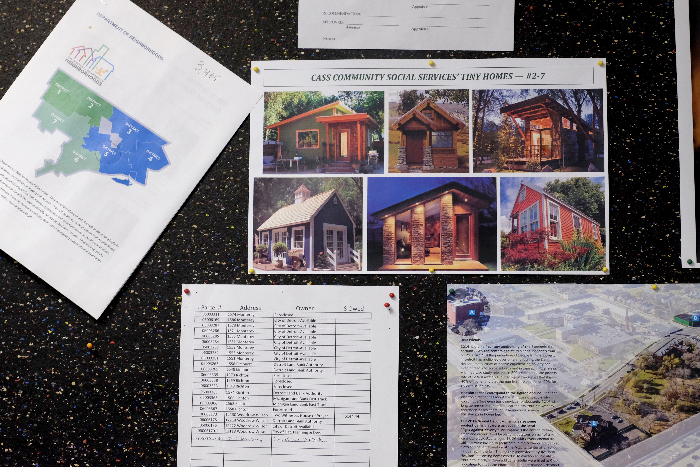
Different styles of the houses are displayed on a cork board in the Rev. Faith Fowler's office. Photo by Diane Weiss
Ranging from 250 to 400 square feet, they will have unique exteriors, evoking styles from mountain-lodge rustic to midcentury modern to New Orleans French Quarter. They will have decks and front porches and be built on individual lots.
The Tudor house -- in effect, the development’s model -- has a good-sized bathroom plus a single main room that features a sleeping nook, a living area, a washer-dryer and a full kitchen with donated granite countertops.
Seven years to home ownership
By year’s end, Fowler aims to have seven homes built and occupied. So far, more than 600 people have requested applications, hoping to meet the project’s financial qualifications to rent to own. Rent will be based on square footage, generally $1 a square foot -- $300 a month for the Tudor home. If residents keep up rent payments for the first three years, they’ll qualify to make monthly payments on a subsequent four-year land contract, offering them full ownership in a total of seven years.

Sitting in the Tudor model, Dewayne Hooper, 26, fills out an application for his own tiny home. Photo by Diane Weiss
Tiny homes have enchanted segments of popular culture, with cable network shows appealing to those who want to downsize, economize and live simply. And communities across the country are turning to them as a solution to the problem of homelessness.
An effort for the homeless in Austin, Texas, has created a village of pint-size individual shelters(link is external) much smaller than the Cass homes. And San Jose, California, recently enacted measures(link is external) permitting individual structures as small as 70 square feet for housing the homeless.
But the Cass development is not intended to be a glorified homeless shelter. Fowler says she’s aiming for a diverse group of inhabitants “so people won’t drive by and say, ‘That’s where the homeless live.’”


Some residents will likely be employees of Cass Community Social Services -- many of them once homeless or former addicts who’ve remade their lives through various Cass Community programs. The nonprofit agency, which Fowler heads as executive director, grew out of her ministry at the church, which for decades has been a haven for the addicted, disabled and homeless of Detroit’s now-gentrifying skid row.
The church’s history
For its first 40 years or so, Cass Community UMC served a mostly well-to-do congregation, traces of which can still be seen in the sanctuary’s Tiffany windows and Johnson tracker pipe organ. Just north of downtown Detroit, the neighborhood was originally a fashionable upper-class enclave, but as residents began moving farther north in the 1920s, it began a long decline.

Founded in 1883, Cass Community UMC has a long history of ministry, mission and advocacy. Photo by Rebecca CookFor much of the past 60-plus years, the area has been known as the Cass Corridor. But today, positioned on the edge of Wayne State University and Detroit’s cultural institutions, it is a hip, millennial magnet rebranded as Midtown.
Despite the gentrification, Fowler and the church still deal mostly with folks more emblematic of Detroit’s 40 percent poverty rate and big-city struggles.
“Every Sunday service, you see her stand at the front of the church, and there’s at least one person there who asks for help,” said head usher Keith Hill. “They’re homeless, or they’re about to be homeless, or they need assistance.”
Fowler’s first Sunday preaching before the congregation, a woman with developmental disabilities -- a frequent Cass usher -- yelled from the back of the church mid-sermon: “Hey lady! We’re out of toilet paper!” Fowler stopped to get her a roll.
“From prayers to giving you the resources or the connections to make everything better, she tries to help,” Hill said. “Some people have passion in this world. She has fire.”

Standing on her tiptoes, a shoeless Faith Fowler leads Sunday worship at Cass Community UMC. Photo by Rebecca Cook
Hill knows it to his core. When he was a teenager, Fowler helped him escape an abusive home and gave him a place to live. His mother’s boyfriend, having forced Hill to drop out of school to work, had pointed a gun at the teen’s head when he refused to turn over a paycheck.
Now 38, Hill works at the Cass Activity Center, assisting with training and work for adults with developmental disabilities.
Fowler describes Hill’s story, and the toilet paper sermon, in her book “This Far by Faith,” which was produced through another of Fowler’s innovations, Cass Community Publishing House(link is external).
CCSS, a $6 million nonprofit
As the executive director of Cass Community Social Services, Fowler manages a $6 million nonprofit that has created programs to aid people dealing with homelessness, hunger, addiction, HIV/AIDS, disabilities and job preparedness.

Cri Cri Snead plays the tambourine as the choir sings at the Warehouse Worship service at Cass Community Social Service on a Wednesday night. Photo by Diane Weiss
Among CCSS enterprises are programs that put people to work recycling tires -- 45,000 picked up from city streets -- into mud mats and flip-flops, available for purchase on the nonprofit’s website(link is external). Reclaimed wood from abandoned Detroit houses is crafted into holders for coasters, which depict vintage Detroit landmarks. A shredding business is also flourishing. And the CCSS kitchen dishes out 1 million meals a year, seven days a week.
The Tiny Homes project will cost about $1.5 million, more than half of which Fowler has already raised from private donations and grants. Each house will cost about $40,000 to $50,000 to build, and volunteer groups, including United Methodist teams, will help with finishing touches, such as drywalling, painting and sodding lawns.
“What makes Cass Community unique -- and Faith, in particular -- is they’re working on transformative projects that break the cycle of poverty,” said Jim Vella, the president of the Ford Motor Co. Fund, which donated $400,000 to the enterprise.
“They take people who are unemployable and don’t have skills and really make a difference in their lives,” said Vella, who also sits on the CCSS board.
Vella describes Fowler as a visionary who gets things done -- “a combination of CEO, COO, CFO and Mother Teresa all rolled into one.”
Fowler’s impact has drawn widespread accolades, both in church circles and in the Detroit area. She recently was honored with an annual Shining Light Award, sponsored by the Detroit Free Press and the Metropolitan Affairs Coalition to recognize outstanding community contributions. Last month, she had to skip the church’s weekly Wednesday night service to attend her induction ceremony into the Michigan Women’s Hall of Fame.
And she’s a premier teacher and preacher for UMC events. Next spring, for the third year in a row, Fowler and Cass Community will host about 40 pastors and lay staff in Detroit for a UMC training event entitled “Ministry with the Poor.” Drawing upon Fowler’s approach to ministry, the sessions are about service “with” and not “to” people and communities in need, said the Rev. Nora Colmenares, community engagement leader with the UMC General Board of Global Ministries.

Chosen Bishop, 13, reads along with his grandmother Esther Bishop-Files during Sunday worship at Cass Community UMC. Photo by Rebecca Cook
Asset-based perspective
“Most churches and others do ministries with the poor as a charity, and from a needs-based perspective,” Colmenares said. “We’re intentionally trying to lead the church away from a needs-based perspective.”
Colmenares said Fowler approaches ministry from an asset-based perspective, drawing upon the talents and labor of people in the community.
What are the needs and assets in your community and how might your church or organization respond?
“She sees that those who have disabilities have assets,” Colmenares said. “Those who were in jail have assets. Those who were addicted and homeless -- they have assets.”
Cass Community UMC has a long history of outreach, dating back to the Great Depression. In 2002, Fowler spun off the church’s social services efforts into the CCSS nonprofit agency when the various programs and ministries began to overwhelm the church’s capacity.
“Every room, every wall was filled with food and medical supplies; people were everywhere,” Fowler said. “My office was used as an examining room for the medical clinic. And the associate’s office was floor-to-ceiling macaroni and cheese.”
What is the relationship between innovation, evolution and sustainability?
Now, the nonprofit provides food, housing, health care, jobs and job training from a campus of buildings about four miles north of the church. It receives funding through government grants, fees for service, foundation and corporate giving, and donations from other churches and individuals. Fundraisers provide about $1 million annually, including an upcoming “Roastin’ the Rev” dinner.
The Cass congregation is supported by offerings, donations and fundraisers. The church pays its own bills, “including my salary and housing, which wasn’t the case when I arrived,” Fowler said. It’s also paid its UMC apportionments in full for 20 years.

The Rev. Faith Fowler leads Sunday worship at Cass Community UMC, where she has served as pastor since 1994. Photo by Rebecca CookNavigating her roles as pastor and CCSS executive director can be tricky. Some parishioners receive services through Cass or work at the nonprofit. To minimize conflicts, Fowler relies on the nonprofit’s staff to make decisions about employment or who receives assistance. (Fowler herself hires only executive-level personnel.)
“Occasionally, a church member gets fired or a member of the congregation might feel they deserve preferential treatment,” she said. “I try to allow agency staff members to deal with most situations. Nevertheless, it gets complicated at times.”
A daughter of Detroit
Fowler grew up in the Detroit suburb of Royal Oak, with three brothers, a schoolteacher father, and a mother who was an active union rep at the chain grocery where she worked. She lives in a historic 1864 Victorian a 1.5-mile bike ride from the church.
“I had a safety net,” Fowler said. “Poor people don’t. If I screwed up, my family might give me a lecture -- but also give me a check.”
The services provided by CCSS make a difference in the lives of hundreds every day. But when clients are ready to move on, they often have few places where they can go. That’s what the Tiny Homes project seeks to address.
When Fowler wanted to explore building tiny homes, she turned to CCSS aide and development coordinator Stacy Conwell-Leigh to do the research.
“She could be the billionaire CEO, but she’s got the heart of a minister,” said Conwell-Leigh, who shows the Tudor model to potential applicants -- and the simply curious -- each Wednesday afternoon.
How can you and your organization nurture people with innovative, theologically robust imaginations?
At a recent open house, one visitor asked Conwell-Leigh why the houses aren’t designed to accommodate several individuals in shared living space. Conwell-Leigh explained that many poor people live communally out of necessity -- in shelters, or with relatives and eating their meals at soup kitchens.
“Faith wants our folks to have what she had and so many of us have -- a backyard, a place of our own,” she said. “Faith had a happy life and wants to pass it on.”
But whoever lives in the Cass tiny homes won’t be alone. They can get help and community services just across the street.
“They can earn a GED, learn job training, use the gym facilities and get a free daily meal in our programs across the street,” Fowler said.
The Tiny Homes project is on the CCSS campus in central Detroit -- not a current hotspot in Detroit’s comeback. The neighborhood has 500 blighted buildings and 300 vacant lots, and the CCSS buildings and services provide a harbor of stability.

A construction worker excavates the foundations for the next phase of Cass Community Social Services' project. Photo by Diane WeissMark Linton, 54, who lives in the low-rent apartments that CCSS renovated adjacent to the project, recently toured the showcase tiny home.
He’s on disability. He likes the Tudor’s curb appeal and the 300 square feet of efficient living space, “but it’s smaller than what I’ve got now,” he said.
When he hears about plans for three streets full of similar houses, Linton’s eyes widen, and he smiles.
“We need it around here. We have all these eyesores,” Linton said. “This will be beautiful.”
Questions to consider
- Faith Fowler paid attention to the needs -- and assets -- of her community and then responded in creative, innovative ways. What are the needs and assets in your community and how might your church or organization respond?
- Cass Community leveraged their available land for the Tiny Homes project. What assets do you have that are underutilized that could be put in service of ministry?
- Part of the story of Cass Community is the evolution of the nonprofit independent from the church. In your own experience, what is the relationship between innovation, evolution and sustainability?
- How can you and your organization nurture people like Faith Fowler, with innovative, theologically robust imaginations?
- To what extent is your church a stakeholder in its own neighborhood and community?
A small NC church reaches out in big ways
At Saint Andrew's Episcopal Church in Haw River, NC, numbers don't matter, as the small rural church becomes a model of a kind of community outreach that many larger churches can only dream of.
Faith & Leadership
MISSIONS & EVANGELISM, CONGREGATIONS
A small N.C. church reaches out in big ways

Sharon Ranew, "the cake lady," bakes birthday cakes for every foster child in Burlington County, N.C. Photo by Alex ManessAt Saint Andrew's Episcopal Church in Haw River, NC, numbers don't matter, as the small rural church becomes a model of a kind of community outreach that many larger churches can only dream of.St. Andrew’s Episcopal Church resembles a chapel more than a church.
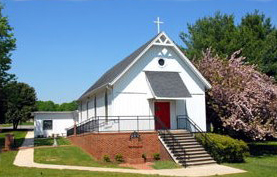
St. Andrew's Episcopal is a model for outreach.
Photo courtesy of St. Andrews Episcopal ChurchIt sits on the main drag in the town of Haw River, North Carolina, sandwiched between a trailer park and a plastics fabrication plant.
Apart from its signature red door -- a telltale mark of many Episcopal churches -- the white frame building is not particularly distinctive. Built in the 1940s, with a fellowship hall added in the 1960s, it has no vestibule and no choir loft. Indeed, the church has no choir.
The stained-glass windows are generic. One depicts a robed, long-haired Jesus with his hands extended and the words “Come unto me.” In another, Jesus stands beside a door with the words “Behold I stand at the door and knock.”
Yet this modest rural church of nearly 70 members has become a model for a kind of community outreach that many larger, more-storied churches can only dream of.
On Tuesdays and Thursdays, the parish hall bustles with up to a dozen children and a handful of adult church volunteers, who help them with their homework in math and English.
North of town, a retired telephone marketer and church member has been baking cakes for every foster child in the county for the past 10 years.
Soon, the church will plow a 10,000-square-foot plot of land in the rear of the sanctuary to prepare the soil for next spring’s planting season. Ten neighboring families will grow fruits and vegetables in the community garden as they have for the past three years.
Now, Advent is beginning, and the church will adopt several needy families and shower them with gifts on Christmas.
“This is a community of less than 70 people, and they’re doing more than churches with 200 people,” said Bishop Michael Curry of the Episcopal Diocese of North Carolina. “They don’t tell people what they do. They just love Jesus, and they love people.”
While the number of Americans worshipping in rural churches is declining, congregations such as St. Andrew’s can offer valuable lessons for living out Jesus’ mandate to love thy neighbor.
Those lessons are not about state-of-the-art programming or motivational techniques to recruit volunteers but about a congregation’s ability -- regardless of size -- to take simple actions that can make a difference in the lives of others.
“The strength of the rural churches is their ability to love one another,” said Robb Webb, the director of the Rural Church program area at The Duke Endowment. “A church that takes that love into the community can have tremendous impact.”
After-school program
On a recent Thursday afternoon, eight children fanned out in groups of twos and threes across the St. Andrew’s social hall, hoisting their heavy backpacks onto round plastic tables.
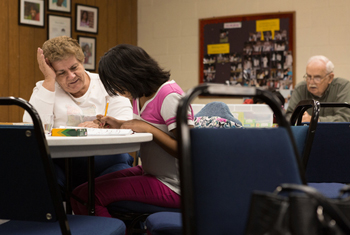
Maria Duvall and Paul McCue help students with homework.
Photo by Alex Maness
Out spilled math textbooks, folders, loose papers with typed instructions, stickers and art projects.
Maria, who is 9, needed help with math. Linda Duvall, the church treasurer, was there to assist.
“How many times does 3 go into 12?” she asked Maria.
As the two worked on the answer, 5-year-old Edith drew an owl in a coloring book.
Maria and Edith -- as well as Yadhira, Mariela, Irma and a handful of others -- are children of Hispanic immigrants navigating a new life in a strange land.
St. Andrew’s began offering the after-school program this fall as a way to help its neighbors -- literally. Most of the children who take advantage of the program live in the trailer park next to the church.
During the first three months of the school year, the children and volunteers sat outside at the picnic tables behind the church, so parents could keep an eye on the goings-on.

Numbers don't matter in ministry, but they do in math.
Photo by Alex Maness“It’s important that they see we aren’t proselytizing or converting their children,” said Paul McCue, one of the church volunteers. “Hopefully, we’re doing it out of love and kindness.”
When the weather turned brisk, the program moved indoors. Soon, children weren’t the only ones seeking the church’s help.
Jorge, one of the children’s grandparents, popped in, too.
“He said, ‘I want to learn how to take the citizenship test,’” said church volunteer Norine McArthur. The two sat down over the course of several afternoons to test his knowledge of American history and government.
Jorge was followed by Margarita, a mother of two girls, who asked for tutoring in English. Jane Gould, a church member and a teacher of English as a second language, happily accommodated.
For church volunteers, the program is a natural way to reach out to a community in need. Haw River, a former mill town and once the largest producer of corduroy in the world, has stalled in recent years. The mills lie shuttered, and the old high school has long since closed. The town of 2,300 residents has a median household income of $38,000, well below the national average of $53,000.
But for McArthur, a 72-year-old retiree, who helped Jorge with his citizenship test, it was not economics that drove her to volunteer but faith.
“Isn’t all this about love?” she said. “You’re doing what God asks you to do. Your job is to make this place better because we were here.”
The cake lady
Holy Eucharist services at St. Andrew’s typically draw between 30 and 35 people. On many Sundays, Sharon Ranew isn’t among them. A member for the past 12 years, Ranew follows Jesus in her own way.
For more than a decade, Ranew has baked a birthday cake for every foster child in Alamance County. The white or yellow cakes with cream cheese frosting, brightly colored sprinkles and a “Happy Birthday” inscription are a gift from Ranew and St. Andrew’s to an all-but-invisible segment of the population in need.
“I’ve always thought foster children need people to be in their corner,” said Ranew, 67. “I could see things they didn’t have and couldn’t get. They need people to care for them.”
On a recent weekday, she decorated a cake for a 4-year-old girl, whose name and birthday were provided to Ranew by the N.C. Division of Social Services. On a nearby counter lay a notebook with the names and dates of eight other foster children with November birthdays.
Ranew bakes between 80 and 100 cakes a year, which her husband, Larry, drops off at the Burlington social services office on each child’s birthday.
St. Andrew’s supports the ministry with $2,000 annually to pay for flour, sugar, butter and eggs. The money also pays for each child to receive a card, a picture frame and enough candles to stick on top of the cake.

Sharon Ranew puts the finishing touches on another cake.
Photo by Alex ManessRanew, who is known throughout town as “the cake lady,” says she began daydreaming about the project when she was still working as a marketer for a telephone company.
When she asked the church vicar about it, he smiled and said, “Can I give you a hug?”
That was all she needed.
“Smaller churches can be more nimble,” said Brad Thie, the director of Thriving Rural Communities, a partnership of Duke Divinity School, the North Carolina and Western North Carolina conferences of the United Methodist Church, and The Duke Endowment. “They don’t have large committee structures to slow things down. They can make decisions quickly.”
At St. Andrew’s, it’s the laypeople who come up with the outreach programs, and the leadership follows. A few years back, the bishop awarded Ranew with a prize he gives annually to a person, congregation or ministry that inspires and touches lives.
The work the cake lady does is a classic example of the way rural churches can transform communities, said Thie.
“If a church does nothing more than bake a cake for foster children -- that’s enough,” Thie said. “That’s a miraculous way people experience the grace of Jesus Christ.”
The kingdom is here
On a recent Sunday, the Rev. Miriam Saxon, the church’s new part-time vicar, gave a homily in which she talked about waiting for Jesus.
Many Christians, she said, wonder what they’re supposed to do in the interval before the second coming. This, she said, is misguided, because the kingdom of God is already here, even if it is incomplete.
The work of Christians is simply to serve -- “to live our lives as Jesus taught and modeled for us,” she said.
It’s a lesson the people of St. Andrew’s take to heart, using it to inspire and guide their many ministries to the community. It was this same concern that led the church to create a community garden four years ago.
Dick Ling, a longtime church member, said a man who lived in the trailer park came to him asking whether he could rent some of the land in the back of the church for a garden.
Instead of renting the land, the church decided to let the man and his neighbors plant gardens for free. A year later, the church applied for and received a small grant to install an aboveground irrigation system.
An empty field behind the church became a
community garden.
Photo courtesy of St. Andrews Episcopal Church
Each spring, 10 families are each awarded a 100-by-20-foot plot, where they plant tomatoes, peppers, squash and watermelon.
The church’s willingness to tackle small, practical problems reminds Curry, the bishop, of the story of Gideon’s army.
The biblical hero was ready to fight the Midianites and the Amalekites with 32,000 volunteer soldiers, but God had him winnow them down to 300.
The lesson here, he said, is that “numbers don’t matter.”
“You can have thousands of people, but if they’re not participating, it won’t do any good,” he said.
The people of St. Andrew’s want to do some good. And that, he said, can change everything.
community garden.
Photo courtesy of St. Andrews Episcopal Church
Each spring, 10 families are each awarded a 100-by-20-foot plot, where they plant tomatoes, peppers, squash and watermelon.
The church’s willingness to tackle small, practical problems reminds Curry, the bishop, of the story of Gideon’s army.
The biblical hero was ready to fight the Midianites and the Amalekites with 32,000 volunteer soldiers, but God had him winnow them down to 300.
The lesson here, he said, is that “numbers don’t matter.”
“You can have thousands of people, but if they’re not participating, it won’t do any good,” he said.
The people of St. Andrew’s want to do some good. And that, he said, can change everything.
Questions to consider:
- What makes your church distinctive, not in architecture or design, but in its ministry?
- Where and how is your church making a difference in the lives of others? How would you assess that impact on a “per member” basis?
- Who are the “all-but-invisible” people who need you in their corner? How can you help your congregation see them?
- How nimble is your church? Does your organizational structure help or hinder ministry? How can it be improved?
- Is it true that “numbers don’t matter” in ministry? Why or why not?
- What new ministries could your church launch if it was larger? Why can’t you do them anyway?
 How Your Congregation Learns: The Learning Journey from Challenge to Achievement by Tim Shapiro
Change isn't always easy or intuitive. How Your Congregation Learns introduces churches and leaders-both lay and ordained-to the process of the learning journey. By understanding learning dynamics and working to become a learning community, the congregation will be able to move more purposefully to achieve its goals.
Congregations face many kinds of challenges. Some are mundane: the roof leaks; the parking lot needs repaving; the microphones don't work well. Some tests are transcendent: How should lives be honored? What is God calling the congregation to do and be? How can generosity be taught? Throughout life people face challenges for which they are not prepared-the death of a parent, a new job offer, making a decision about where to live. So it goes that congregational leaders face challenges that are just beyond the grasp of their abilities. This book addresses the just-beyond-the-grasp challenges and shows how real congregations can learn from them.
Learn more and order the book »
SAVE 30%
ORDER HOW YOUR CONGREGATION LEARNS NOW & SAVE
Use promo code 4ALBWK617 when you order "How Your Congregation Learns" on the Rowman & Littlefield website or order by phone at 800-462-6420.
Offer expires July 31, 2017. Discount cannot be combined with other special offers.
Follow us on social media:


Copyright © 2016. All Rights Reserved.
Alban at Duke Divinity School
1121 West Chapel Hill Street, Suite 101
Durham, North Carolina 27701, United States
-------
No comments:
Post a Comment