
Lausanne Global Analysis · July 2018
SHARE:


Welcome to the July issue of Lausanne Global Analysis, which is also available in Portuguese and Spanish. We look forward to your feedback on it.In this issue we examine how faulty foundations bring nations to their knees, drawing on the Sierra Leone experience; we address the global abuse of women and how women flourishing in church reflects the Imago Dei and is a witness to unbelievers; we ask how and why Christians should be involved in providing quality aftercare for survivors of trafficking and trauma; and we revisit the issue of balancing grace and truth in our approach to Muslims and Islam.

David Taylor
Welcome to the July issue of Lausanne Global Analysis, which is also available in Portuguese and Spanish. We look forward to your feedback on it.In this issue we examine how faulty foundations bring nations to their knees, drawing on the Sierra Leone experience; we address the global abuse of women and how women flourishing in church reflects the Imago Dei and is a witness to unbelievers; we ask how and why Christians should be involved in providing quality aftercare for survivors of trafficking and trauma; and we revisit the issue of balancing grace and truth in our approach to Muslims and Islam.
‘Sierra Leone illustrates the often-forgotten role foundations play in determining the fortunes of a nation’, writes Bowenson Phillips (former Chief Administrator for Freetown) with Jenny Taylor (British journalist and author). Sierra Leone pioneered Christianity, commerce, and civilization in colonial Africa. The freed slaves—later known as Creoles—who made their way across the Atlantic from Nova Scotia were Christians who saw themselves as Israelites delivered from slavery in Egypt. They founded Free Town and dedicated it by covenant to God. Sierra Leone flourished as a beacon of light for over 150 years, known as the ‘Athens of Africa’.
However, its fortunes collapsed very quickly, after laying ungodly or idolatrous foundations at independence on 27 April 1961. It slid from prosperity to dirt-poverty, in the midst of abundant resources, coupled with multiple catastrophes, including war and pestilence. Mercifully, in 2014, the church began to come to an understanding of Sierra Leone’s bloody April 27th foundations and commenced the process of redeeming the land, with encouraging results. Like Sierra Leone, many nations are tottering on ungodly foundations. Experts struggle to contain the physical effects—crime, corruption, violence, vice, and poverty—of spiritual causes. The good news is that there are clear biblical principles, precepts, and precedents underpinning the Sierra Leone experience, from which the church in other nations can learn. ‘This will enable them to address hidden roots of foundational problems that frustrate their national efforts at sustainable advancement’, he concludes.
‘Harassment, assault and abuse are part of the same package whereby women are vulnerable and preyed upon by men in societies around the world’, writes Tamie Davis (partner with Church Missionary Society of Australia, living in Tanzania). #metoo is a Twitter hashtag that has gone viral, giving a sense of the magnitude of the problem of sexual harassment and abuse. This is an issue for the church as well. A prevailing strategy for addressing this has been to argue for the equality of women as key to raising them up. However, the meaning of ‘equality’ may not be consistent across cultures. With equality a vexed concept in a global world, a more fruitful way to shape our response to abuse of women is with the Imago Dei, or the image of God. Together male and female image God; they are like him and bring glory to him. The doctrine of Imago Dei locates women’s dignity not so much in their status in relation to men (their ‘equality’, or lack thereof), but in their imaging of the Creator. While equality cannot appeal to both hierarchical and less hierarchical cultures, the Imago Dei provides the currency for both to honour women. In the Imago Dei, Christians have the theological resources to pursue the flourishing of women. ‘When unbelievers look at the church, if they are to see Christ with any clarity, they must see women flourishing’, she concludes.
‘More that 40 million people were victims of modern slavery in 2016’, writes Kit Ripley (program advisor at the New Life Center Foundation in northern Thailand). Some 71 percent of them were women and girls. Drawing from over 30 years of grass-roots experience , the New Life Center Foundation has gained a unique perspective on providing aftercare services for survivors of trafficking and other kinds of trauma. The following principles may be adapted to fit other ministry contexts. If you serve in a cross-cultural setting, it is important to work collaboratively with locals from the people group you are serving. Organizational programming should never become rigid and policy-driven: each survivor has distinctive needs. One of the key tasks for survivors of trauma is building resilience: social competence is developed within the context of community systems. If reintegration with family is possible, every effort should be made to achieve it. It is not helpful to create a program simply because a particular donor wishes to fund it. Working with survivors of trauma is not easy, but it is purposeful and rewarding. Evangelical Christians should be at the forefront of providing quality aftercare for survivors of trafficking and trauma. ‘As we invest in the healing and restoration of survivors, we reflect the compassionate nature of God and offer a glimpse into that coming kingdom in which all will be made well’, she concludes.
‘Many Christians in the West think that they are in a position to know what Islam is, and that the jihadi Islam of Islamic State is nearer to “true Islam” or “real Islam” than so-called “moderate Islam”’, write Colin Chapman (author and lecturer in Islamic studies) and John Azumah (Professor of World Christianity and Islam at Columbia Theological Seminary, Decatur, Georgia). When there have been so many recent examples of jihadi violence in different countries, it is easy to conclude that it tells us something about the essential nature of Islam. Many Muslims have sympathy—either openly or secretly—with some of the objectives of political Islam. However, the vast majority dissociate themselves from jihadism and regard it as a complete distortion of Islam. Moreover, while texts are important, they cannot be taken in isolation from all the other factors which contribute to jihadism. Some of them are historical, political, social, economic, religious, and psychological. Some jihadis who have come from Europe to join IS may have known little about Islamic ideology or the Qur’an. Trying to understand the many different motives does not mean justifying murderous actions. Many Christians are very ignorant about Islam. We need to own up to our stereotypes of Muslims and our prejudices. While not excusing violence, we may need to acknowledge that in some cases Muslims have good reason to be angry. ‘The grace approach is sufficient to reach Muslims’, they conclude.
We hope that you find this issue stimulating and useful. Our aim is to deliver strategic and credible analysis, information and insight so that as a leader you will be better equipped for the task of world evangelization. It’s our desire that the analysis of current and future trends and developments will help you and your team make better decisions about the stewardship of all that God has entrusted to your care.
Please send any questions and comments about this issue to analysis@lausanne.org. The next issue of The Lausanne Global Analysis will be released in September.

Bowenson F. Phillips with Jenny James-Taylor
FoundationReference
Purpose
Godly nations governed according to Kingdom principles ‘…spiritual war is for the sake of the nations; the disciples were sent to make the nations disciple-nations under Jesus. So first of all: Is the Church aware of this primary task?’[1]
Precept
‘If the foundations be destroyed, what can the righteous do?’ Psalm 11:3.
Precedent
Abraham and Israel covenant.
Practice
Sierra Leone laid a godly foundation and its people and land flourished.
Sierra Leone laid another, ungodly foundation, and its people and land floundered.
Pattern
Ungodly foundation leads to a troubled nation.
Godly foundation leads to a peaceful and prosperous nation.
Revelation; Repentance; Reconciliation; Restoration
‘Without salvation from sin there is no salvation from “evil powers” either.’ Keith Ferdinando[2]
Overview
The collapse of the Twin Towers on 11 September 2001 with the loss of over 5,000 lives was not a problem with their foundations. It was directly attributed to the impact of the aircraft.
However, the real, albeit indirect, cause of the physical collapse was non-physical. It was the failure of security systems that would have prevented the attack in the first place. Nations may not collapse as dramatically as the Twin Towers. However, nations flounder or flourish ultimately based on the spiritual strength of their foundations: either sandy and shifting, or concrete and stable.
Sierra Leone illustrates the often forgotten role foundations play in determining the fortunes of a nation. Sierra Leone pioneered Christianity, commerce, and civilization in colonial Africa. The freed slaves—later known as Creoles—who made their way across the Atlantic from Nova Scotia with the help of the Clapham Sect in London were Christians who saw themselves as Israelites delivered from slavery in Egypt. Upon landing on 11 March 1792 they founded Free Town, Sierra Leone, and dedicated it by covenant to God.
Sierra Leone flourished as a beacon of light for over 150 years, famously known as the ‘Athens of Africa’ for pioneering the first university and secondary schools in sub-Saharan Africa: Fourah Bay College in 1827, the Grammar School in 1845, and the Annie Walsh school for girls in 1849, established with the help of the Church Mission Society.
However, Sierra Leone’s fortunes collapsed very quickly, after laying ungodly or idolatrous foundations at independence on 27 April 1961. It slid from prosperity to dirt-poverty, in the midst of abundant resources, coupled with multiple catastrophes, such as war, pestilence, poverty, and disasters.
Mercifully, in 2014, the church began to come to an understanding of Sierra Leone’s bloody April 27th foundations and commenced the process of redeeming the land, with encouraging results. This piece focuses on Sierra Leone’s destabilizing faulty foundation and lessons learnt.
The good news is that there are clear biblical principles, precepts, and precedents underpinning the Sierra Leone experience, from which the church in other nations can learn. This will enable them both to undress and address hidden roots of foundational problems that frustrate their national efforts at sustainable advancement.

The April 27th massacre
A massacre was launched on 27 April 1898 in the south of the British Protectorate of Sierra Leone, later known as the ‘Hut Tax War’. The war boys of the dreaded Poro secret society rose up all over Mende land in a surprise attack on missionaries and Christians (Creoles), aligned to the British. Charles Braithwaite Wallis helpfully records:One of the worst murders that took place during the whole outbreak was the killing of Mr. T. Johnson and his sister, a girl of eighteen, who were caught hiding in a village called Deparli, in the Jong country. They were tied together, stripped naked, and terribly flogged. They were then made to walk to Tihun in the Small Boom country, several hours’ journey away, where they were brought before the chief, a man named Vandi, who immediately ordered them to be killed. They were then flogged again in the presence of a large number of people, and had to walk back, in the charge of a party of war boys, to Deparli. When they arrived there, the war boys tied Johnson to one tree, and his sister to another, both in view of each other. A man then appeared with a knife, and after some difficulty succeeded in cutting of one of Johnson’s ears. Miss Johnson’s ear was also cut off. Then several ruffians held first one, and then the other, down and slit their tongues. In this position they were left for some hours, and then conveyed into the bush and flung into a fire which was made ready to receive them. Whether they were dead or not when this happened I could not ascertain. Let us hope they were. There were three other murders committed in or near this village of Deparli, and the perpetrators of them have unfortunately never been caught.[3]
So horrendous was this April 27th massacre of over 2,000 Creoles and missionaries that on 18 June 1898, Queen Victoria commissioned an enquiry into ‘an insurrection of the Natives of our Protectorate . . . accompanied by murders of and outrages upon our subjects and other persons.’[4]
Laying the foundation
Strikingly, the descendants of the perpetrators of the massacre chose 27 April to inaugurate the Sierra Leone People’s Party (SLPP) in 1951. Ten years later in 1961 at independence, the ruling SLPP party chose the same date for the British to hand Sierra Leone over to them. It seemed that overnight the worship of God was erased from the governance and socio-economic life of this fledgling nation. On the eve of independence, some 1,200 masked devils descended on Freetown in a ritual victory parade. This is repeated every Independence Day, with devil masquerades replacing thanksgiving in all the major towns of Sierra Leone—but not without dire consequences. As Habakkuk says: ‘Woe to him who builds a town with bloodshed, who establishes a city by iniquity’ (Hab 2:12). Sierra Leone has indeed seen more than its share of woes.

A plaque on this memorial at Tikonko, in Bo District says: ‘In Memoriam—Timothy Campbell, Theo Roberts & Rev. J.C. Johnson, 1898’. Missionary victims of the ‘Hut Tax War’. Photo: Paul Basu
ConsequencesFrom the slaughter of righteous Abel, judgment has always responded to the cry of unjust bloodshed; and, ‘precious in the sight of the Lord is the death of his saints’ (Psalm 116:15).
Idolatry and devil worship also attract sorrows, according to the Bible. For, ‘their sorrows shall be multiplied that hasten after another god’ (Psalm 16:4). Indeed, divine judgement seems to be manifest in three main forms according to Jeremiah: ‘I will consume them by the sword, and by the famine, and by the pestilence’ (Jeremiah 14:12); and Sierra Leone has witnessed all three to devastating effect.
Judgement of famine—1980 fiscal collapse
In spite of being one of the richest nations in terms of natural resources (from minerals to marine and agricultural produce), Sierra Leone is always trailing among the poorest. From an economy the size of Malaysia and Singapore combined in the 1960s, it now rates third from bottom in the Global Hunger Index, a Harvard-based monitor. Lebanese and Chinese businesses are consuming its abundant gold, diamonds, iron ore, and rutile, with little benefit to the nation. In 1964, the Leone was higher in value than the pound sterling. Today, there are over Le9,000 to the pound.
Judgment of the sword—1991 – 2002 war
Over 50,000 Sierra Leoneans perished in the senseless but barbaric eleven-year war. Infrastructure was destroyed and near-anarchy prevailed. It provoked the biggest UN peace-keeping mission in history.
Judgment of pestilence—Ebola epidemic 2014 – 2015
On 25 May 2014, Ebola struck Sierra Leone, paralyzing the country for almost a year. The conservative official death toll reached almost 4,000; and many more survivors remain scarred for life.
Dealing with evil foundations: Practical lessons from Sierra Leone
Many Christians in Sierra Leone believe that before God will redeem Sierra Leone from its struggles, Christians must first come together to confront the ‘marine kingdom’.[5] The marine kingdom is a reference to the powerful spirit forces believed to operate in rivers, lakes, and the oceans. They are the source of power wielded by secret societies—‘Mermaids’, or the ‘Queen of the coast’ (Mammy wata) culture.[6]
Revelation: God reveals to redeem.
After much soul searching, research, and prayer, the truth of Sierra Leone’s predicament seemed to become clear to us; and it is our belief that it has to do with the spiritual contest signified by the March 11th covenant (see below), and the bloody April 27th foundation.
Repentance: When righteous blood is shed, it always carries grave consequences.
We draw encouragement from the experience of the church in Fiji, documented in the film ‘Fiji Transformation’. There the church underwent—en masse—repentance for the slaughter and cannibalizing of a white missionary by Fijians more than a century earlier. The people believe that revival of fortunes became possible once the curse over Fiji was lifted through repentance.
Among much else, a notable ceremony of repentance and rededication on the 222nd anniversary of the Sierra Leone Covenant was held on 11 March 2014. It attracted key dignitaries, including ministers of the state and of the church. An excerpt from Freetown’s Mayor Sam F. Bode Gibson’s prepared proclamation reads:
We have today repented of our erring ways that saw us slide from the top to the bottom of the human development indicator. We fell from a people of enlightenment, a nation of teachers, now reduced to a people of ignorance, illiterates, in need of teachers. Our Grace has turned to grass. Our sweet has turned to sour. Our light has turned to darkness. Reduced to a valley of dry bones . . . . We proclaim divine judgement on all forms of idolatry! We proclaim this an annual pilgrimage to renew this covenant of the land with the Most High![7]
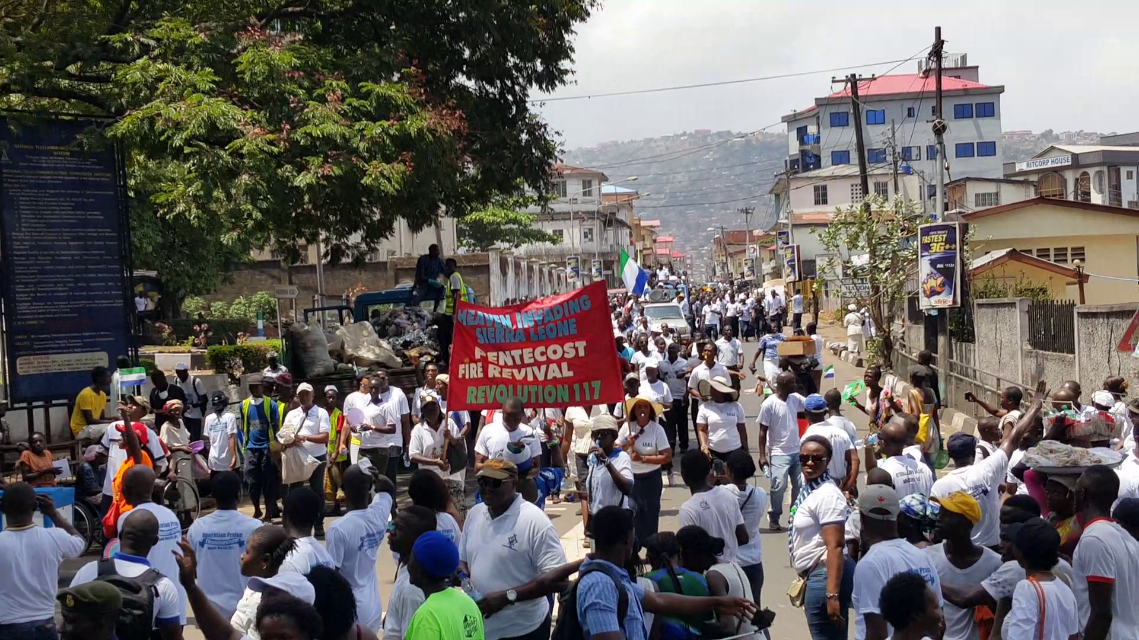
Last year, for the first time, on the April 27th anniversary, the church took to the streets of Freetown and elsewhere in a prophetic praise and prayer march. This represented a turning point for the country, since even on Christian holidays such as Easter street festivals there are ‘devil masquerades’. Through the coordinating role of the Intercessors for Sierra Leone (IFSL), spearheaded by the School of the Apostles and Prophets (SOAP), and in collaboration with the body of Christ and state authorities, several activities to seek reclamation of the land have taken place. These include:
Nationally coordinated prayer and fasting.
Prophetic operations against idolatrous cults and devil masquerades in which Parliament, State House, and the judiciary are all implicated.
Teaching pastors and intercessors on the March 11th covenant and the faulty April 27th foundation: training them to take dominion over occult forces in mountains and rivers.

Sam F.B. Gibson makes his Mayoral proclamation in 2014.
ConclusionLike Sierra Leone, many nations are tottering on ungodly foundations. Experts struggle to contain the physical effects—crime, corruption, violence, vice, and poverty—of spiritual causes. Only Christians can begin the work of discipling their nation, by tracing and redeeming the root cause—rotting foundations. It is this awareness that this piece hopes to bring.
Endnotes
- Pieter Bos, The Nations Called (Sovereign World, 2002), 314. ↑
- Keith Ferdinando, The Triumph of Christ in African Perspective: A Study of Demonology and Redemption in the African Context (Carlisle: Paternoster, 1999), 397. ↑
- Charles Braithwaite Wallis, The Advance of Our West African Empire (London: TF Unwin, 1903), 139-40. ↑
- See ‘Report by Her Majesty’s Commissioner and Correspondence on the Subject of the Insurrection in the Sierra Leone Protectorate, 1898’ (London: Darling & Son, 1899), 3. ↑
- Editor’s Note: No source cited for this quotation. ↑
- For similar descriptions in ancient biblical culture, see Psalm 74:13-15. ↑
- Editor’s Note: No source cited for this quotation. ↑


Tamie Davisy a friend in Tanzania to speak to a group of vulnerable young men and women. Their backgrounds were ones of poverty, abandonment, and unemployment. I asked my friend whether sexual abuse was in the mix for them as well. In my home country of Australia, they say one in five women have experienced sexual abuse. UN Women suggests it is about double in Tanzania.[1] My friend told me that at a gathering of university students in Kenya they had asked the girls to raise their hand if they had experienced sexual assault. He was staggered that 80 percent raised their hands.
Global problem
There are some technicalities around the differences between sexual harassment, assault, and abuse which may be part of what skews the statistics, but these are matters of degree. Harassment, assault, and abuse are part of the same package whereby women are vulnerable and preyed upon by men in societies around the world. #metoo is a Twitter hashtag which has gone viral, giving a sense of the magnitude of the problem of sexual harassment and abuse:[2]
The hashtag, used in 85 countries,[3] has brought to light thousands of stories from the US entertainment industry to politics to sport to waitressing.[4]
Although it has been less popular in Africa, the #metoomovement suggests that Western women’s experience mirrors that of their Kenyan and Tanzanian sisters.[5]
A spinoff hashtag, #churchtoo, saw women and girls share their experiences of similar harassment and abuse in the church.[6] They spoke of being blamed, disbelieved, discouraged from going to police, and made to apologise for the sexual assault they received. Furthermore, there were stories of perpetrators who stood up and apologised publicly for their behaviour, with no further consequences. The abuse of women is not just an issue in society at large. It is an issue for the church as well.
Other types of abuse that women experience globally include Female Genital Mutilation (FGM), forced prostitution, slavery,[7] child marriage, and domestic and family violence (DFV).
 Equality
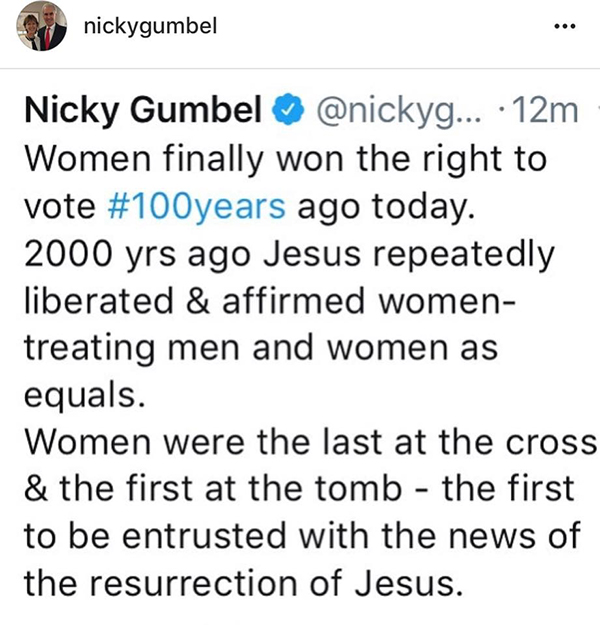
In this global climate where women are vulnerable and it is a normal experience for them to be abused, a prevailing strategy for addressing this has been to argue for the equality of women as key to raising them up. This has been the case in the church too. Groups like Christians for Biblical Equality[8] have the word in their name. It has become shorthand for Jesus’ treatment of women too, as in Nicky Gumbel’s tweet from February 2018[9] which equates liberation and affirmation of women with being treated as equal to men.
 However, the meaning of ‘equality’ may not be consistent across cultures. For example, Tanzanian women affirm equality but are much more comfortable with hierarchy than me:
To an Australian with in-built egalitarian ideals, hierarchy seems opposed to equality, as a system that inevitably oppresses those at the bottom. My cultural instinct is to dismantle and flatten hierarchies.
Although Tanzanian women acknowledge, experience, and grieve over abuse of women, many insist that abuse comes from the misuse of hierarchy rather than being inherent in hierarchy itself.[10] In their view, hierarchy does not necessarily threaten equality.
Attempts to see this cultural understanding rejected as unbiblical must wrestle with James’ assumption that there will be economic inequality in the church, and Paul’s nuanced use of ‘equality’ in 2 Corinthians 8:13-15 where his emphasis is on the needs of poverty-stricken Christians being met in friendship.[11]
Imago Dei
With equality a vexed concept in a global world, a more fruitful way to shape our response to abuse of women is with the Imago Dei, or the image of God.
In Genesis 1:27, humankind is created in God’s image:
 While equality cannot appeal to both hierarchical and less hierarchical cultures, the Imago Dei provides the currency for both to honour women. When Jesus heals and affirms the woman bent double in Luke 13, he speaks of her as a daughter of Abraham whom Satan has bound. That is, he speaks of her as a part of God’s family and an inheritor of God’s promises, without reference to her standing in comparison with men. What is on view is this woman’s dignity. Irrespective of our cultural views of hierarchy, we can be united with Jesus in caring for her and seeing her restored. One ministry to women university students in Tanzania is called ‘Soaring Women’, which encapsulates this idea. The doctrine of the Imago Dei gives us a biblical language that can unite us across cultures to pursue the flourishing of women.
What next?
In the Imago Dei, Christians have the theological resources to pursue the flourishing of women. What practical resources could we avail ourselves of to help us live out and apply this doctrine to the abuse of women? If Christian leaders are to pursue a restoration of women’s dignity, they will need to dismantle several obstacles, and undertake a process of education, restitution, and restructuring. Here are three suggestions:
 1. Train pastors better about what abuse is, how to recognise an abuser, and how to respond to the abused.
Pastors without categories of abuse (physical, emotional, financial, verbal, spiritual, sexual) may struggle to identify why a man who does not beat his wife but constantly belittles her and controls all their money is abusive. Without an adequate understanding of grooming, a pastor may find it hard to believe that a man who seems so charming and godly at church could be the abuser his wife describes. Pastors may be tempted to blame the victim for the abuse, asking her how she provoked it, or telling her to act or dress differently in the future, thereby placing the responsibility on her rather than squarely where it belongs: on the abuser. ‘Safer’ is a good resource from Australia.[12]
 2. Include more women in Christian leadership, including staff teams.
Whether from theological conviction or happenstance, Christian leadership is male dominated. This means that male perspectives are preferenced in institutional structures and theology,[13] and they can be quick to assert #notallmen[14] or slow to listen to women because they find offensive the forthrightness with which women have brought it to their attention.[15] The solution must be to hear more from women, that male leaders may broaden their perspective and gain greater empathy.
I suggest that every Christian staff team ensures that it has at least two women on it. One woman is easily dismissed, and with women’s voices generally being considered less authoritative than men’s, it takes more of them speaking for them to be heard.[16] Having multiple women guards against making one woman’s experience universal and allows us to see the shades in women’s experiences and perspectives. Finally, being the lone woman on a staff team can be very isolating. The two or more women can offer support to one another as well as amplifying one another’s voices.[17]
 3. Seek restitution and reconstruction.
Every organisation will have women it has failed. Consider a process of some years, identifying, listening to these women, and asking them what they want to change. Make public apologies, ask them what they want you to do, and do it, even if it means a loss of status or face for you or their abuser. Do not engage in cover-ups, deal with issues ‘quietly’, or sweep allegations under the carpet, never to be dealt with.[18] Put into place line management and grievance procedures. Bring in women from outside to consult with you on the culture of your staff team and your church or organisation. Pay them well, and accept their findings and action points.
An American atheist friend of mine remarked that he was surprised that I would consider Christianity a source of life and flourishing for women, since in his view Christianity has been a source of oppression of women. His comments brought home to me that our ability to deal with the abuse of women in the church has an element of witness to it as well. If we say we are without sin, we deceive ourselves and the truth is not in us (1 John 1:8); so we must pursue the One who can purify us from all unrighteousness and eagerly take the opportunities we are presented with to make things right. When unbelievers look at the church, if they are to see Christ with any clarity, they must see women flourishing.
Endnotes
 Tamie Davis is an Australian educator and intercultural practitioner living in Tanzania. She is a partner with the Church Missionary Society of Australia and an associate of Tanzania Fellowship of Evangelical Students. She writes about women, theology and living cross-culturally for online magazines and at meetjesusatuni.com.
 Kit Ripley[1] was born in Burma. At aged five, she was taken to China to live with her older brother and work as a maid in his household. When she turned nine, her brother took her to Thailand to work in a straw-making factory. Having received an advance on her paycheck, her brother left her at the factory and never returned. During the three years that she worked in the factory, she worked more than 17 hours per day. She was not allowed to attend school and never received any wages.
A global evil
Human trafficking cases like this one occur in every corner of the world.[2] In 2017, the International Labor Organization (ILO) and the Walk Free Foundation, in partnership with the International Organization for Migration (IOM) released research results[3] asserting that:
The recruitment, transportation, transfer, harboring or receipt of persons, by means of the threat or use of force or other forms of coercion, of abduction, of fraud, of deception, of the abuse of power or of a position of vulnerability or of the giving or receiving of payments or benefits to achieve the consent of a person having control over another person, for the purpose of exploitation. Exploitation shall include, at a minimum, the exploitation of the prostitution of others or other forms of sexual exploitation, forced labor or services, slavery or practices similar to slavery, servitude or the removal of organs.[4]
Prevention and aftercare
In the case described above, Manaw was an underage child who was a survivor of forced labor. This work damaged her developmental health because she was denied the right to attend school and the nurturing environment of a safe family. She was threatened that, if she ran away, the police would arrest her for living and working in Thailand without citizenship or legal documentation.
Yet at twelve years old, she was able to summon the courage to escape. She requested assistance from a local shop owner who took her to the police station. Manaw was placed in a government shelter for a few months while her case was investigated and was subsequently referred to the New Life Center Foundation (NLCF) for aftercare.
 The NLCF is a legally registered non-governmental organization in northern Thailand that was founded in 1987 by missionaries serving with International Ministries of the American Baptist Churches. The NLCF serves hilltribe minority girls and young women who are at high risk for or survivors of sexual abuse, domestic violence, and human trafficking.
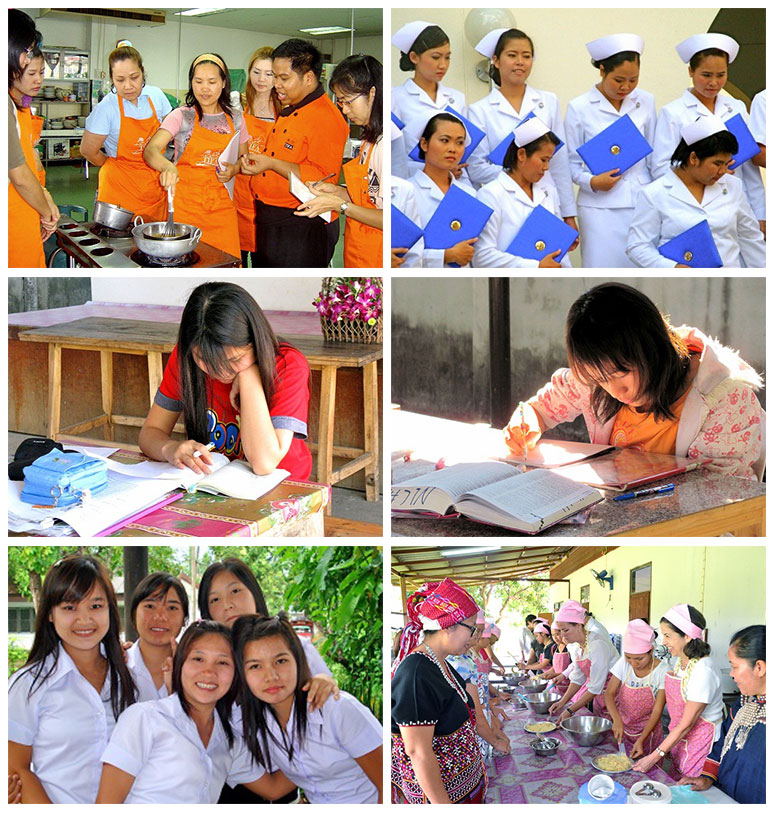
The organization provides comprehensive residential care, education, life-skills training, and therapeutic services for an average of 70 residential students. Additionally, over 200 non-residential students receive university scholarships, mentoring, and case management. The NLCF also conducts prevention campaigns throughout the region to educate rural tribal villagers about human trafficking, sexual abuse, and domestic violence. Students conduct campaigns in their own minority languages using drama, music, and dance.
Drawing from over 30 years of grass-roots experience, the NLCF has gained a unique perspective that informs how we provide aftercare services for survivors of trafficking and other kinds of trauma. The recommendations below are offered with the humble recognition that our experience emerges from a particular context. The reader is encouraged to consider how these principles may be adapted to fit other ministry contexts.
 Cross-cultural collaboration as an asset
If you serve in a cross-cultural setting, it is important to work collaboratively with locals from the people group you are serving. At the New Life Center, one of our greatest resources is the broad multicultural blend of our stakeholders:
Responsiveness and flexibility
Organizational programming should never become rigid and policy-driven. Each survivor has distinctive needs, interests, and abilities. Beneficiaries should have a forum to express their desires and frustration. Reasonable accommodation should be made to respond to each person as an individual.
For example, the New Life Center received a referral of a girl who was part of a street gang and had been forced to sell her body as part of her gang membership. She had a weak internal locus of control and expressed her anger by becoming violent toward other residents. After some discussion, staff learned that she wanted to learn how to play the drums. Drum lessons were offered as a reward for controlling her aggressive behavior towards others and gave the child an appropriate venue for releasing pent-up emotions.
Local staff also bring particular skills and gifts and should be encouraged to use them to benefit the organization. An open flow of information should be encouraged across the organizational chart. Sometimes responding to a new opportunity requires administration to practice flexibility and creative thinking:
Do not miss an opportunity for growth due to rigid adherence to established practices.
Likewise, if an activity ceases to meet the changing needs of beneficiaries, retire it.
The organization exists for the beneficiaries, not for the staff who may prefer to continue familiar programming.
 Integration with the surrounding community
One of the key tasks for survivors of trauma is building resilience. This occurs through the establishment of inner and outer resources:
In order to achieve integration with the community, organizational programming should make every effort to take advantage of appropriate community resources such as public schools, libraries, vocational training programs, churches and sports activities. Beneficiaries must become competent to live in the real world after they leave the program. The best way to achieve that is to support and enable them to do so while they are under the care of your program.
Additionally, local schools and training programs provide accredited diplomas and licensures that in-house programs may not. Such locally recognized accreditation makes beneficiaries more employable in the future.
Relying on local resources also reflects good stewardship of organizational funding and benefits the community, as tuition, tithing and membership fees are channeled to local organizations. Being a good neighbor enables us to build relational bridges that, in turn, allow us to shine the light of Jesus Christ in our community.
Family matters, even if less than ideal
If reintegration with family is possible, every effort should be made to achieve it:
If survivors are willing, they should be encouraged to reconnect with their family and community of origin as much as is safely possible, either through full reintegration or supervised family visits.
Family should also be encouraged to visit the beneficiary at appropriate times.
Often, survivors of trauma come from troubled family backgrounds. They may have endured abuse or neglect by family members and have mixed feelings about them. However, it is important to recognize that family dynamics can improve with training and support from effective social workers. People need their families, even if they are complex and imperfect.
At the New Life Center, residents who have parents and guardians are encouraged to bring at least one family member to an annual orientation at the beginning of the school year. During this orientation, staff emphasize that the family continues to play an important role in the life of the beneficiary. Children and parents are invited to express their expectations and hopes for one another. During orientation, the senior social worker also educates family members about Thai laws regarding child rights, abuse, and domestic violence. Improving family health goes a long way toward protecting communities from traffickers.
Programming driven by vision, not donor priorities
Every organization should have a clearly stated vision, mission, and values that guide its work. All staff should understand the vision, mission, and values and be able to state them in their own words. You and the staff with whom you work know the needs of your beneficiaries better than donors do. Therefore, it is not helpful to create a program simply because a particular donor wishes to fund it. The organization should seek funding and educate donors based on beneficiaries’ expressed needs.
Suggested responses
Working with survivors of trauma is not easy, but it is purposeful and rewarding. Evangelical Christians should be at the forefront of providing quality aftercare for survivors of trafficking and trauma:
As we invest in the healing and restoration of survivors, we reflect the compassionate nature of God and offer a glimpse into that coming kingdom in which all will be made well.
Endnotes
Photos from New Life Center Foundation web site.
 Rev Catherine ‘Kit’ Ripley has served as program advisor at the New Life Center Foundation in northern Thailand for the last 15 years. She does administration, guest relations, spiritual formation, and therapeutic art. She is a missionary with International Ministries of the American Baptist Churches USA. Kit received her Master of Divinity from Fuller Theological Seminary in Pasadena, California.
 Colin Chapman and John AzumahLausanne Global Analysis included an article entitled ‘Why Grace is not Enough to Reach Muslims: Balancing grace and truth in outreach’.[1] The author, Jenny Taylor, was critical of some writers like Colin Chapman, arguing that they emphasise the need for grace in approaching Muslims at the expense of truth, downplaying the differences between Islam and Christianity and refusing to engage ‘the dark side’ of Islam.
 In this article, Colin Chapman and John Azumah, the co-catalyst of the Lausanne Islam Network, suggest that there are other ways of thinking about Islamism and violence in the name of Islam.
We must allow Muslims to define what is ‘true Islam’ and remember Muslims are not all the same
Many Christians in the West think that they are in a position to know what Islam is, and that the jihadi Islam of Islamic State (IS) is nearer to ‘true Islam’ or ‘real Islam’ than so-called ‘moderate Islam’. When there have been so many recent examples of jihadi violence in different countries, it is easy to conclude that it tells us something about the essential nature of Islam.
Many Muslims have sympathy—either openly or secretly—with some of the objectives of political Islam, or ‘Islamism’. However, the vast majority dissociate themselves from jihadism and regard it as a complete distortion of Islam.[2] So we must be willing to listen to Muslims and allow them to tell us what Islam is for them. We may well want to challenge them over the Qur’anic verses about jihad and warfare if they think that these justify violence today, but we have no right to think that we know better than they regarding what is ‘real Islam’.
This is perhaps one example of how the Golden Rule—treating others as we ourselves would like to be treated—should work out in practice. When Muslims challenge us about difficult issues, like the Crusades or same-sex marriage, many of us inevitably want to dissociate ourselves from beliefs or practices of other Christians which we think are misguided. So in the same way, we must allow Muslims to dissociate themselves and their faith from the violence of the jihadis.
We may find their arguments unconvincing. However, even more unconvincing is the suggestion that the interpretations of Islamic texts given by Abu-Bakr al-Baghdadi of IS and Abu-Bakr Shekau of Boko Haram are more representative of ‘true’ Islam than those of all the leading Muslim scholars around the world who condemn and reject such views.
Does this approach amount to ‘imposing reality’ on Islam, ‘Anglicising’ it, or making their ideas ‘familiar, and therefore comfortable to handle,’ as Taylor suggests? Far from imposing our (outsider) interpretations on Islam, this approach does justice to the diversity of views expressed by Muslims at various points throughout Islamic history on many issues including war and violence. When we have listened carefully to all the sides, we may well want to engage in further ‘hard talk’; but we do so recognising the huge differences among them, and refusing to impose our understanding of what we think Islam really is.
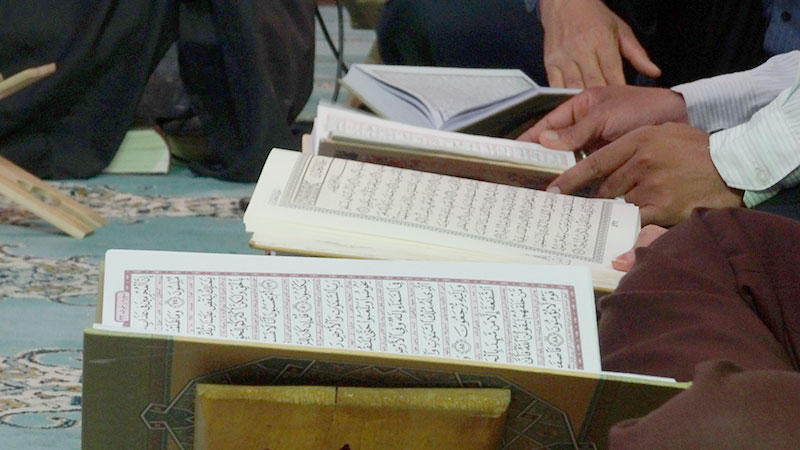 Texts are important, but they cannot be considered in isolation
‘Textualism’ is the approach that seeks to explain ideas or actions primarily, if not essentially, by reference to texts. Islamic texts—especially the Qur’an, Hadith, the early biographies, Qur’anic commentaries, and legal texts—must clearly be taken very seriously:
When jihadis in Iraq or Syria have offered Christians the choice between paying the jizya tax, conversion to Islam or death, they believe they are following the example of the Prophet and the first generations of Muslims as described in the earliest texts.[3]
The writings of influential Muslims in the 20th century such as Abul A’la Mawdudi in Pakistan and Sayyid Qutb in Egypt clearly support supremacist ideas and have had a profound influence on both jihadis and more mainstream voices.
However, these views have not gone unchallenged by other leading Muslims.
We therefore need to take note of how mainstream Muslims today challenge the jihadi interpretations. They point out, for example, that the jihadis completely ignore and bypass the legal texts which were elaborated by the four schools of law over many centuries and laid down strict regulations about the conduct of jihad.[4] Tim Winter of Cambridge University uses this illustration to point out the difference of approach between jihadis and mainstream Muslim leaders: the jihadis are like people who observe the stars with the naked eye, while the others use a telescope to see the stars more clearly. The telescope of course represents centuries of theological and legal reflection on the Islamic sources, providing the lens through which they interpret them.[5]
Moreover, while texts are important, they cannot be taken in isolation from all the other factors which contribute to jihadism. All the Islamists who have turned to violence in recent years have done so in a particular context and in response to something that they perceive as an injustice, whether in Kashmir, Chechnya, Iraq, Syria, Israel/Palestine, or recent attacks in the West. Some of these factors are historical, political, social, economic, religious, and psychological. So while texts are important, we must also engage with the different contexts in which Muslims find themselves and the grievances which they harbour. We should be cautious about any reductionism that says ‘This is the main or the only cause of jihadi violence.’
Muslims from the very beginning worked for the territorial spread of Islam, and for centuries this was the basic meaning of jihad. The different expressions of Islamism in the modern period cannot be understood outside the context of Western interference in the Muslim world, the sterility and weakness of much traditionalist Islam, Zionism, the failure of pan-Islamism and Arab nationalism, and the military dictatorships which have become corrupt one-party states.
Most of the video messages left behind by suicide bombers hardly refer to Islamic scripture or traditions but to existential issues, most of which are political. Palestinian resistance to the colonial-settler Zionist movement, for example, has to be understood primarily in the context of their experience of displacement. Because most Palestinians are Muslims, it was inevitable that they would use Islamic ideology to support their struggle. However, the original problem was not Islam, but displacement.
 The Transformation article[6] referred to by Taylor speaks of ‘nine examples of Islamist movements that used violence,’ and points out that in every case ‘there is something contextually specific—a perceived injustice.’ Without engaging any of these examples, Taylor minimises the importance of political issues when she says, ‘This is not necessarily true’. She then goes on to say that ‘two recent commentators attribute violence in the Levant to “testosterone” and sexual frustration’. These can certainly be added as additional explanations behind jihadi violence and included under the psychological factors, but they cannot be offered as an alternative explanation which bypasses the political factors.
Taylor quotes with approval several passages from Shiraz Maher’s Salafi-Jihadism: The History of an Idea, which explains how jihadis appeal to scriptural texts to support their actions. This same writer, however, is in no doubt about the importance of political issues in recent years:
All the major periods of ideational shift [in Salafi-Jihadism] have come in response to war. . . . The idea [of the need for political reform] was born from the colonial experience of Muslims in British India when theorists first began imagining how to secure God’s rights within the political system. . . . What becomes clear is that war and its associated nomenclature have driven intellectual changes within Salafi-Jihadism.[7]
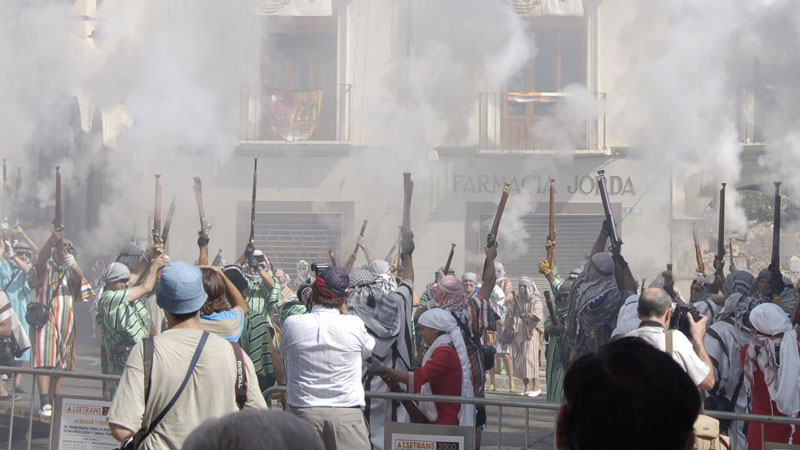 Understanding jihadi violence does not mean justifying it
Taylor quotes a sentence from the Transformation article saying that it is not hard to understand ‘how some Islamists . . . can conclude—from their scriptures, dogma and history—that they have justification for turning to violence.’ She suggests that this sentence amounts to a justification of violence.
Understanding the motivation behind an action does not mean justifying that action. The goal of IS in Iraq and Syria was to establish an Islamic state led by a caliph who hoped that Muslims all over the world would unite and swear allegiance to him. If Muslims have always looked back to the first Islamic state established by Muhammad in Medina as a kind of golden age, it is not surprising when some of them want today to establish a thoroughly Islamic polity in which sharia is supreme.
Some jihadis who have come from Europe to join IS may have known little about Islamic ideology or the Qur’an, and may have seen fighting as a way of escaping from problems at home, finding their identity or proving their manliness. Some from Arab countries may have been motivated by anger directed at autocratic Arab governments and/or the West. Palestinian suicide bombers have been motivated by anger, despair, and no doubt the promise of instant access to Paradise. Trying to understand the many different motives that have driven these people to engage in violence does not mean justifying their murderous actions.
We too have our failings, and we need to find ways of addressing these problems within our own communities
Taylor quite rightly wants Christians to ‘face and engage “the dark side” of Islam’. However, focusing too much on this side of Islam can easily divert attention away from our failings and make us focus only on their failings. Such an approach tends to leave many Christians paralysed by fear, with defensive and suspicious attitudes that make it difficult to reach out and form relationships.
Throughout the world—and especially in the West—many Christians are very ignorant about Islam. We need to own up to our stereotypes of Muslims and our prejudices, both racial and religious. While not excusing violence, we may need to acknowledge that in some cases Muslims have good reason to be angry. Western Christians might also be much more critical of the policies of their governments that have contributed to conflicts in different countries. We cannot pretend that the rise of IS in Iraq and Syria has nothing to do with the invasion of Iraq in 2003 and the vacuum that followed.
Taylor cites Mark Durie where he points to Ethiopia as ‘a testimony to the effectiveness of Christian resistance to jihad’. However, she does not mention that Ethiopia is best known in Islamic history as the place of refuge for the first wave of Muslim refugees in 615. This was a gesture that won Ethiopia a special exemption from official jihad for centuries, broken only by a 15-year stint of jihadi violence in the 16th century. Ethiopia, which has just appointed a Muslim Prime Minister, appears bent on turning away from the scourge of religious nationalism, which in fact brought as much hardship to Muslims as it did to evangelical Christians.
Taylor’s mention of the impact of the ministry of the lone Ethiopian seminary student is interesting. The student adopted the ‘grace’ approach that Taylor is questioning in her article, and did so at a time when the rest of the church had retreated into the bunker with the ‘truth’ approach. In times of fear and conflict, it is the compassion and courage exhibited by the lone seminary student that win the day; the grace approach is sufficient to reach Muslims (cf 2 Corinthians 12:9).
Endnotes
 Colin Chapman worked for 18 years with the Church Mission Society in the Middle East, mostly in Egypt and Lebanon. He was lecturer in Islamic Studies at the Near East School of Theology in Beirut until 2003, and has recently taught at the Arab Baptist Theological Seminary in Beirut and Bethlehem Bible College. He is now retired in Cambridge, UK. His books include Cross and Crescent: Responding to the Challenges of Islam (IVP), and Whose Promised Land?: The Continuing Conflict over Israel and Palestine (Lion).
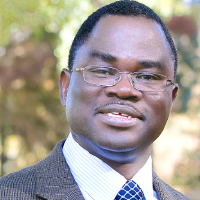 John Azumah is Professor of World Christianity and Islam, and Director of International Programs, at Columbia Theological Seminary, Decatur, Georgia. John specializes in Islam and Christian-Muslim Relations and has published widely in this field, including The Legacy of Arab-Islam in Africa: A Quest for Inter-Religious Dialogue, My Neighbour’s Faith: Islam Explained for Christians, two co-edited volumes and several journal articles and book chapters. He serves as a Lausanne Catalyst for Islam.
Lausanne Global Analysis seeks to deliver strategic and credible information and insight from an international network of evangelical analysts to equip influencers of global mission. Browse all the past issues at lausanne.org/lga. The publication of the LGA is overseen by its Editorial Advisory Board. Articles represent a diversity of viewpoints within the bounds of our foundational documents. The views and opinions expressed in these articles are those of the authors and do not necessarily reflect the personal viewpoints of Lausanne Movement leaders or networks. Inquiries regarding the Lausanne Global Analysis may be addressed to analysis@lausanne.org.
***
Global problem
There are some technicalities around the differences between sexual harassment, assault, and abuse which may be part of what skews the statistics, but these are matters of degree. Harassment, assault, and abuse are part of the same package whereby women are vulnerable and preyed upon by men in societies around the world. #metoo is a Twitter hashtag which has gone viral, giving a sense of the magnitude of the problem of sexual harassment and abuse:[2]
The hashtag, used in 85 countries,[3] has brought to light thousands of stories from the US entertainment industry to politics to sport to waitressing.[4]
Although it has been less popular in Africa, the #metoomovement suggests that Western women’s experience mirrors that of their Kenyan and Tanzanian sisters.[5]
A spinoff hashtag, #churchtoo, saw women and girls share their experiences of similar harassment and abuse in the church.[6] They spoke of being blamed, disbelieved, discouraged from going to police, and made to apologise for the sexual assault they received. Furthermore, there were stories of perpetrators who stood up and apologised publicly for their behaviour, with no further consequences. The abuse of women is not just an issue in society at large. It is an issue for the church as well.
Other types of abuse that women experience globally include Female Genital Mutilation (FGM), forced prostitution, slavery,[7] child marriage, and domestic and family violence (DFV).
In this global climate where women are vulnerable and it is a normal experience for them to be abused, a prevailing strategy for addressing this has been to argue for the equality of women as key to raising them up. This has been the case in the church too. Groups like Christians for Biblical Equality[8] have the word in their name. It has become shorthand for Jesus’ treatment of women too, as in Nicky Gumbel’s tweet from February 2018[9] which equates liberation and affirmation of women with being treated as equal to men.
To an Australian with in-built egalitarian ideals, hierarchy seems opposed to equality, as a system that inevitably oppresses those at the bottom. My cultural instinct is to dismantle and flatten hierarchies.
Although Tanzanian women acknowledge, experience, and grieve over abuse of women, many insist that abuse comes from the misuse of hierarchy rather than being inherent in hierarchy itself.[10] In their view, hierarchy does not necessarily threaten equality.
Attempts to see this cultural understanding rejected as unbiblical must wrestle with James’ assumption that there will be economic inequality in the church, and Paul’s nuanced use of ‘equality’ in 2 Corinthians 8:13-15 where his emphasis is on the needs of poverty-stricken Christians being met in friendship.[11]
Imago Dei
With equality a vexed concept in a global world, a more fruitful way to shape our response to abuse of women is with the Imago Dei, or the image of God.
In Genesis 1:27, humankind is created in God’s image:
‘So God created mankind in his own image,
in the image of God he created them;
male and female he created them’ (NIV).
Together male and female image God; they are like him and bring glory to him. If one part of this partnership is diminished, humanity is impoverished, and the glory of God is tarnished. Abuse of God’s images is insulting to their Creator. The doctrine of Imago Dei locates women’s dignity not so much in their status in relation to men (their ‘equality’, or lack thereof), but in their imaging of the Creator. It is because of who God is that women ought to be afforded their full dignity. From a Christian perspective, addressing the abuse of women has a fundamentally theocentric reason: to mistreat those he loves is to grieve the Creator; to deface his image is to tarnish his glory.What next?
In the Imago Dei, Christians have the theological resources to pursue the flourishing of women. What practical resources could we avail ourselves of to help us live out and apply this doctrine to the abuse of women? If Christian leaders are to pursue a restoration of women’s dignity, they will need to dismantle several obstacles, and undertake a process of education, restitution, and restructuring. Here are three suggestions:
Pastors without categories of abuse (physical, emotional, financial, verbal, spiritual, sexual) may struggle to identify why a man who does not beat his wife but constantly belittles her and controls all their money is abusive. Without an adequate understanding of grooming, a pastor may find it hard to believe that a man who seems so charming and godly at church could be the abuser his wife describes. Pastors may be tempted to blame the victim for the abuse, asking her how she provoked it, or telling her to act or dress differently in the future, thereby placing the responsibility on her rather than squarely where it belongs: on the abuser. ‘Safer’ is a good resource from Australia.[12]
Whether from theological conviction or happenstance, Christian leadership is male dominated. This means that male perspectives are preferenced in institutional structures and theology,[13] and they can be quick to assert #notallmen[14] or slow to listen to women because they find offensive the forthrightness with which women have brought it to their attention.[15] The solution must be to hear more from women, that male leaders may broaden their perspective and gain greater empathy.
I suggest that every Christian staff team ensures that it has at least two women on it. One woman is easily dismissed, and with women’s voices generally being considered less authoritative than men’s, it takes more of them speaking for them to be heard.[16] Having multiple women guards against making one woman’s experience universal and allows us to see the shades in women’s experiences and perspectives. Finally, being the lone woman on a staff team can be very isolating. The two or more women can offer support to one another as well as amplifying one another’s voices.[17]
Every organisation will have women it has failed. Consider a process of some years, identifying, listening to these women, and asking them what they want to change. Make public apologies, ask them what they want you to do, and do it, even if it means a loss of status or face for you or their abuser. Do not engage in cover-ups, deal with issues ‘quietly’, or sweep allegations under the carpet, never to be dealt with.[18] Put into place line management and grievance procedures. Bring in women from outside to consult with you on the culture of your staff team and your church or organisation. Pay them well, and accept their findings and action points.
An American atheist friend of mine remarked that he was surprised that I would consider Christianity a source of life and flourishing for women, since in his view Christianity has been a source of oppression of women. His comments brought home to me that our ability to deal with the abuse of women in the church has an element of witness to it as well. If we say we are without sin, we deceive ourselves and the truth is not in us (1 John 1:8); so we must pursue the One who can purify us from all unrighteousness and eagerly take the opportunities we are presented with to make things right. When unbelievers look at the church, if they are to see Christ with any clarity, they must see women flourishing.
Endnotes
- http://evaw-global-database.unwomen.org/fr/countries/africa/united-republic-of-tanzania. ↑
- Internet movements ought not to be dismissed for their popular nature. The democratising force of social media has allowed the exposure and discussion of a widespread problem that had previously not been dealt with. From a Christian perspective, this can be seen be seen as the Holy Spirit’s work of bringing sin to light (see Eph 5:11-14). ↑
- https://www.cbsnews.com/news/metoo-reaches-85-countries-with-1-7-million-tweets/. ↑
- http://time.com/time-person-of-the-year-2017-silence-breakers/, https://edition.cnn.com/2018/01/24/us/larry-nassar-sentencing/index.html ↑
- Indeed the Australian Institute of Criminology estimated in 2007 that only 30 percent of sexual assaults are reported. https://aic.gov.au/publications/cfi/cfi162. ↑
- https://relevantmagazine.com/slice/on-churchtoo-people-share-their-stories-of-sexual-harassment-in-the-church-imagenew/. ↑
- Editor’s Note: See article by Kit Ripley in this July 2018 issue. ↑
- https://www.cbeinternational.org/. ↑
- https://twitter.com/nickygumbel/status/960953450510069760 ↑
- This may resonate with Asian Christians as well. Simon Chan argues in Grassroots Asian Theology that ‘hierarchical orders or classes need not be oppressive; the alternative to order is not a classless society but disorder’, and that exploitation that results from it is ‘an abuse of the order; it is not due to the nature of the order itself’. Simon Chan, Grassroots Asian Theology, Downers Grove, IL: IVP Academic, 2014 (Kindle locs 883-893, 1181). ↑
- See Craig Keener’s comments on reciprocation. Craig S Keener, 1-2 Corinthians, (NCBC; Cambridge: Cambridge, 2005), 205. ↑
- http://www.saferresource.org.au ↑
- This is an excellent Bible study resource from Africa on passages in the Bible where women are abused, which may help pastors to include them in their preaching. http://sidebysidegender.org/wp-content/uploads/2015/12/GBV-Tamar-Campaign-Contextual-Bible-Study-Manual-English-Version.pdf ↑
- This was another viral hashtag in which some men attempt to defend their own reputation and say that, while some men abuse, they do not. While they claimed to be horrified at abuse, the attention was effectively shifted from the experiences of abused women to the men who felt slighted. See https://twitter.com/hashtag/notallmen?lang=en and http://time.com/79357/not-all-men-a-brief-history-of-every-dudes-favorite-argument/ ↑
- This is called ‘tone policing’. The substance of the woman’s argument is dismissed because she is too angry or emotional be taken seriously, as determined by the man or men to whom she is speaking. The effect is that she has to moderate her tone to suit them, or they do not engage her argument. See Bailey Poland (2016) Haters: Harassment, Abuse, and Violence Online, p. 46. University of Nebraska Press. ↑
- https://www.nytimes.com/2018/02/04/opinion/metoo-law-legal-system.html ↑
- For more on amplification see https://www.washingtonpost.com/news/powerpost/wp/2016/10/25/how-a-white-house-womens-office-strategy-went-viral/?utm_term=.08f961b3bee2 ↑
- In Australia the recent Royal Commission into Institutional Responses to Child Sexual Abuse has exposed some of these: http://www.abc.net.au/news/2017-12-14/royal-commission-child-sex-abuse-case-studies/9250972 ↑
A global evil
Human trafficking cases like this one occur in every corner of the world.[2] In 2017, the International Labor Organization (ILO) and the Walk Free Foundation, in partnership with the International Organization for Migration (IOM) released research results[3] asserting that:
- More than 40 million people were victims of modern slavery in 2016.
- Some 71 percent of them were women and girls.
- Women and girls comprised 84 percent of victims of forced marriage and 99 percent of victims of forced labor in commercial sexual exploitation.
- A quarter of victims of modern slavery were children.
The recruitment, transportation, transfer, harboring or receipt of persons, by means of the threat or use of force or other forms of coercion, of abduction, of fraud, of deception, of the abuse of power or of a position of vulnerability or of the giving or receiving of payments or benefits to achieve the consent of a person having control over another person, for the purpose of exploitation. Exploitation shall include, at a minimum, the exploitation of the prostitution of others or other forms of sexual exploitation, forced labor or services, slavery or practices similar to slavery, servitude or the removal of organs.[4]
Prevention and aftercare
In the case described above, Manaw was an underage child who was a survivor of forced labor. This work damaged her developmental health because she was denied the right to attend school and the nurturing environment of a safe family. She was threatened that, if she ran away, the police would arrest her for living and working in Thailand without citizenship or legal documentation.
Yet at twelve years old, she was able to summon the courage to escape. She requested assistance from a local shop owner who took her to the police station. Manaw was placed in a government shelter for a few months while her case was investigated and was subsequently referred to the New Life Center Foundation (NLCF) for aftercare.
The organization provides comprehensive residential care, education, life-skills training, and therapeutic services for an average of 70 residential students. Additionally, over 200 non-residential students receive university scholarships, mentoring, and case management. The NLCF also conducts prevention campaigns throughout the region to educate rural tribal villagers about human trafficking, sexual abuse, and domestic violence. Students conduct campaigns in their own minority languages using drama, music, and dance.
Drawing from over 30 years of grass-roots experience, the NLCF has gained a unique perspective that informs how we provide aftercare services for survivors of trafficking and other kinds of trauma. The recommendations below are offered with the humble recognition that our experience emerges from a particular context. The reader is encouraged to consider how these principles may be adapted to fit other ministry contexts.
If you serve in a cross-cultural setting, it is important to work collaboratively with locals from the people group you are serving. At the New Life Center, one of our greatest resources is the broad multicultural blend of our stakeholders:
- We have staff, missionaries, board members, and donors who come from a variety of cultures.
- They bring creative suggestions based on their unique cultural perspectives that can spark innovative solutions to persistent problems.
- Foreigners may have permission to implement necessary change that could be difficult for local staff to initiate.
- National staff from three different ethnic tribal groups contribute ideas based on a deep well of contextual wisdom and experience.
Responsiveness and flexibility
Organizational programming should never become rigid and policy-driven. Each survivor has distinctive needs, interests, and abilities. Beneficiaries should have a forum to express their desires and frustration. Reasonable accommodation should be made to respond to each person as an individual.
For example, the New Life Center received a referral of a girl who was part of a street gang and had been forced to sell her body as part of her gang membership. She had a weak internal locus of control and expressed her anger by becoming violent toward other residents. After some discussion, staff learned that she wanted to learn how to play the drums. Drum lessons were offered as a reward for controlling her aggressive behavior towards others and gave the child an appropriate venue for releasing pent-up emotions.
Local staff also bring particular skills and gifts and should be encouraged to use them to benefit the organization. An open flow of information should be encouraged across the organizational chart. Sometimes responding to a new opportunity requires administration to practice flexibility and creative thinking:
Do not miss an opportunity for growth due to rigid adherence to established practices.
Likewise, if an activity ceases to meet the changing needs of beneficiaries, retire it.
The organization exists for the beneficiaries, not for the staff who may prefer to continue familiar programming.
One of the key tasks for survivors of trauma is building resilience. This occurs through the establishment of inner and outer resources:
- Inner resources include education, life-skills, aspirations, self-regulation, self-confidence, and a sense of agency.
- Outer resources include the ability to use public transportation, having supportive friends, developing relationships with responsible adults in your neighborhood, and the ability to negotiate cultural expectations in your community.
In order to achieve integration with the community, organizational programming should make every effort to take advantage of appropriate community resources such as public schools, libraries, vocational training programs, churches and sports activities. Beneficiaries must become competent to live in the real world after they leave the program. The best way to achieve that is to support and enable them to do so while they are under the care of your program.
Additionally, local schools and training programs provide accredited diplomas and licensures that in-house programs may not. Such locally recognized accreditation makes beneficiaries more employable in the future.
Relying on local resources also reflects good stewardship of organizational funding and benefits the community, as tuition, tithing and membership fees are channeled to local organizations. Being a good neighbor enables us to build relational bridges that, in turn, allow us to shine the light of Jesus Christ in our community.
Family matters, even if less than ideal
If reintegration with family is possible, every effort should be made to achieve it:
If survivors are willing, they should be encouraged to reconnect with their family and community of origin as much as is safely possible, either through full reintegration or supervised family visits.
Family should also be encouraged to visit the beneficiary at appropriate times.
Often, survivors of trauma come from troubled family backgrounds. They may have endured abuse or neglect by family members and have mixed feelings about them. However, it is important to recognize that family dynamics can improve with training and support from effective social workers. People need their families, even if they are complex and imperfect.
At the New Life Center, residents who have parents and guardians are encouraged to bring at least one family member to an annual orientation at the beginning of the school year. During this orientation, staff emphasize that the family continues to play an important role in the life of the beneficiary. Children and parents are invited to express their expectations and hopes for one another. During orientation, the senior social worker also educates family members about Thai laws regarding child rights, abuse, and domestic violence. Improving family health goes a long way toward protecting communities from traffickers.
Programming driven by vision, not donor priorities
Every organization should have a clearly stated vision, mission, and values that guide its work. All staff should understand the vision, mission, and values and be able to state them in their own words. You and the staff with whom you work know the needs of your beneficiaries better than donors do. Therefore, it is not helpful to create a program simply because a particular donor wishes to fund it. The organization should seek funding and educate donors based on beneficiaries’ expressed needs.
Suggested responses
Working with survivors of trauma is not easy, but it is purposeful and rewarding. Evangelical Christians should be at the forefront of providing quality aftercare for survivors of trafficking and trauma:
- Find ways to get involved in this restorative work in your own community.
- Advocate for marginalized survivors.
- Oppose unjust systemic forces that protect oppressors and disempower victims.
- Dedicate your time, expertise, prayer and resources to support organizations that are involved with prevention, protection and prosecution.
As we invest in the healing and restoration of survivors, we reflect the compassionate nature of God and offer a glimpse into that coming kingdom in which all will be made well.
Endnotes
- A pseudonym is used to protect the confidentiality of the survivor. ↑
- Editor’s Note: See article by Abraham (Abey) George entitled, ‘Human Trafficking and the Response of the Global Church’, in January 2014 issue of Lausanne Global Analysishttps://www.lausanne.org/content/lga/2014-01/human-trafficking-and-the-response-of-the-global-church ↑
- Global estimates of modern slavery: Forced labor and forced marriage (Geneva: International Labor Organization, Walk Free Foundation and International Organization for Migration, 2017) http://www.alliance87.org/global_estimates_of_modern_slavery-forced_labour_and_forced_marriage.pdf ↑
- United Nations Convention Against Transnational Organized Crime and the Protocols Thereto. (New York: United Nations Office on Drugs and Crime, 2004) https://www.unodc.org/documents/treaties/UNTOC/Publications/TOC%20Convention/TOCebook-e.pdf. ↑
Photos from New Life Center Foundation web site.
We must allow Muslims to define what is ‘true Islam’ and remember Muslims are not all the same
Many Christians in the West think that they are in a position to know what Islam is, and that the jihadi Islam of Islamic State (IS) is nearer to ‘true Islam’ or ‘real Islam’ than so-called ‘moderate Islam’. When there have been so many recent examples of jihadi violence in different countries, it is easy to conclude that it tells us something about the essential nature of Islam.
Many Muslims have sympathy—either openly or secretly—with some of the objectives of political Islam, or ‘Islamism’. However, the vast majority dissociate themselves from jihadism and regard it as a complete distortion of Islam.[2] So we must be willing to listen to Muslims and allow them to tell us what Islam is for them. We may well want to challenge them over the Qur’anic verses about jihad and warfare if they think that these justify violence today, but we have no right to think that we know better than they regarding what is ‘real Islam’.
This is perhaps one example of how the Golden Rule—treating others as we ourselves would like to be treated—should work out in practice. When Muslims challenge us about difficult issues, like the Crusades or same-sex marriage, many of us inevitably want to dissociate ourselves from beliefs or practices of other Christians which we think are misguided. So in the same way, we must allow Muslims to dissociate themselves and their faith from the violence of the jihadis.
We may find their arguments unconvincing. However, even more unconvincing is the suggestion that the interpretations of Islamic texts given by Abu-Bakr al-Baghdadi of IS and Abu-Bakr Shekau of Boko Haram are more representative of ‘true’ Islam than those of all the leading Muslim scholars around the world who condemn and reject such views.
Does this approach amount to ‘imposing reality’ on Islam, ‘Anglicising’ it, or making their ideas ‘familiar, and therefore comfortable to handle,’ as Taylor suggests? Far from imposing our (outsider) interpretations on Islam, this approach does justice to the diversity of views expressed by Muslims at various points throughout Islamic history on many issues including war and violence. When we have listened carefully to all the sides, we may well want to engage in further ‘hard talk’; but we do so recognising the huge differences among them, and refusing to impose our understanding of what we think Islam really is.
‘Textualism’ is the approach that seeks to explain ideas or actions primarily, if not essentially, by reference to texts. Islamic texts—especially the Qur’an, Hadith, the early biographies, Qur’anic commentaries, and legal texts—must clearly be taken very seriously:
When jihadis in Iraq or Syria have offered Christians the choice between paying the jizya tax, conversion to Islam or death, they believe they are following the example of the Prophet and the first generations of Muslims as described in the earliest texts.[3]
The writings of influential Muslims in the 20th century such as Abul A’la Mawdudi in Pakistan and Sayyid Qutb in Egypt clearly support supremacist ideas and have had a profound influence on both jihadis and more mainstream voices.
However, these views have not gone unchallenged by other leading Muslims.
We therefore need to take note of how mainstream Muslims today challenge the jihadi interpretations. They point out, for example, that the jihadis completely ignore and bypass the legal texts which were elaborated by the four schools of law over many centuries and laid down strict regulations about the conduct of jihad.[4] Tim Winter of Cambridge University uses this illustration to point out the difference of approach between jihadis and mainstream Muslim leaders: the jihadis are like people who observe the stars with the naked eye, while the others use a telescope to see the stars more clearly. The telescope of course represents centuries of theological and legal reflection on the Islamic sources, providing the lens through which they interpret them.[5]
Moreover, while texts are important, they cannot be taken in isolation from all the other factors which contribute to jihadism. All the Islamists who have turned to violence in recent years have done so in a particular context and in response to something that they perceive as an injustice, whether in Kashmir, Chechnya, Iraq, Syria, Israel/Palestine, or recent attacks in the West. Some of these factors are historical, political, social, economic, religious, and psychological. So while texts are important, we must also engage with the different contexts in which Muslims find themselves and the grievances which they harbour. We should be cautious about any reductionism that says ‘This is the main or the only cause of jihadi violence.’
Muslims from the very beginning worked for the territorial spread of Islam, and for centuries this was the basic meaning of jihad. The different expressions of Islamism in the modern period cannot be understood outside the context of Western interference in the Muslim world, the sterility and weakness of much traditionalist Islam, Zionism, the failure of pan-Islamism and Arab nationalism, and the military dictatorships which have become corrupt one-party states.
Most of the video messages left behind by suicide bombers hardly refer to Islamic scripture or traditions but to existential issues, most of which are political. Palestinian resistance to the colonial-settler Zionist movement, for example, has to be understood primarily in the context of their experience of displacement. Because most Palestinians are Muslims, it was inevitable that they would use Islamic ideology to support their struggle. However, the original problem was not Islam, but displacement.
Taylor quotes with approval several passages from Shiraz Maher’s Salafi-Jihadism: The History of an Idea, which explains how jihadis appeal to scriptural texts to support their actions. This same writer, however, is in no doubt about the importance of political issues in recent years:
All the major periods of ideational shift [in Salafi-Jihadism] have come in response to war. . . . The idea [of the need for political reform] was born from the colonial experience of Muslims in British India when theorists first began imagining how to secure God’s rights within the political system. . . . What becomes clear is that war and its associated nomenclature have driven intellectual changes within Salafi-Jihadism.[7]
Taylor quotes a sentence from the Transformation article saying that it is not hard to understand ‘how some Islamists . . . can conclude—from their scriptures, dogma and history—that they have justification for turning to violence.’ She suggests that this sentence amounts to a justification of violence.
Understanding the motivation behind an action does not mean justifying that action. The goal of IS in Iraq and Syria was to establish an Islamic state led by a caliph who hoped that Muslims all over the world would unite and swear allegiance to him. If Muslims have always looked back to the first Islamic state established by Muhammad in Medina as a kind of golden age, it is not surprising when some of them want today to establish a thoroughly Islamic polity in which sharia is supreme.
Some jihadis who have come from Europe to join IS may have known little about Islamic ideology or the Qur’an, and may have seen fighting as a way of escaping from problems at home, finding their identity or proving their manliness. Some from Arab countries may have been motivated by anger directed at autocratic Arab governments and/or the West. Palestinian suicide bombers have been motivated by anger, despair, and no doubt the promise of instant access to Paradise. Trying to understand the many different motives that have driven these people to engage in violence does not mean justifying their murderous actions.
We too have our failings, and we need to find ways of addressing these problems within our own communities
Taylor quite rightly wants Christians to ‘face and engage “the dark side” of Islam’. However, focusing too much on this side of Islam can easily divert attention away from our failings and make us focus only on their failings. Such an approach tends to leave many Christians paralysed by fear, with defensive and suspicious attitudes that make it difficult to reach out and form relationships.
Throughout the world—and especially in the West—many Christians are very ignorant about Islam. We need to own up to our stereotypes of Muslims and our prejudices, both racial and religious. While not excusing violence, we may need to acknowledge that in some cases Muslims have good reason to be angry. Western Christians might also be much more critical of the policies of their governments that have contributed to conflicts in different countries. We cannot pretend that the rise of IS in Iraq and Syria has nothing to do with the invasion of Iraq in 2003 and the vacuum that followed.
Taylor cites Mark Durie where he points to Ethiopia as ‘a testimony to the effectiveness of Christian resistance to jihad’. However, she does not mention that Ethiopia is best known in Islamic history as the place of refuge for the first wave of Muslim refugees in 615. This was a gesture that won Ethiopia a special exemption from official jihad for centuries, broken only by a 15-year stint of jihadi violence in the 16th century. Ethiopia, which has just appointed a Muslim Prime Minister, appears bent on turning away from the scourge of religious nationalism, which in fact brought as much hardship to Muslims as it did to evangelical Christians.
Taylor’s mention of the impact of the ministry of the lone Ethiopian seminary student is interesting. The student adopted the ‘grace’ approach that Taylor is questioning in her article, and did so at a time when the rest of the church had retreated into the bunker with the ‘truth’ approach. In times of fear and conflict, it is the compassion and courage exhibited by the lone seminary student that win the day; the grace approach is sufficient to reach Muslims (cf 2 Corinthians 12:9).
Endnotes
- Editor’s Note: See article by Jenny Taylor entitled, ‘Why Grace is not Enough to Reach Muslims’, in the March 2018 issue of Lausanne Global Analysis, https://www.lausanne.org/content/lga/2018-03/grace-not-enough-reach-muslims. ↑
- See for example Martin Accad, ‘ISIS and the Future of Islam’, Institute of Middle Eastern Studies, 6 November, 2015. The Institute of Middle East Studies, based at the Arab Baptist Theological Seminary in Beirut, is at present engaged in a project to document all the pronouncements of Islamic institutions and conferences which have responded to the emergence of ISIS in 2014. ↑
- Editor’s Note: See article by anonymous contributor entitled, ‘What is the Islamic Caliphate and Why Should Christians Care?’, in the May 2017 issue of Lausanne Global Analysis, https://www.lausanne.org/content/lga/2017-05/islamic-caliphate-christians-care. ↑
- See the 2014 Open Letter to Al-Baghdadi signed by 126 leading Muslim scholars and figures from around the world. ↑
- Abdel Hakim Murad (Tim Winter), Understanding the Four Madhhabs: The Facts about Ijtihad and Taqlid, The Muslim Educational Trust, London, 2012. ↑
- Colin Chapman, ‘Christian Responses to Islamism and Violence in the Name of Islam,’ Transformation, 34:2 (March 2017), pp 115-30. ↑
- Shiraz Maher, Salafi-Jihadism: The History of an Idea, Penguin, 2016, p 208. ↑
Lausanne Global Analysis seeks to deliver strategic and credible information and insight from an international network of evangelical analysts to equip influencers of global mission. Browse all the past issues at lausanne.org/lga. The publication of the LGA is overseen by its Editorial Advisory Board. Articles represent a diversity of viewpoints within the bounds of our foundational documents. The views and opinions expressed in these articles are those of the authors and do not necessarily reflect the personal viewpoints of Lausanne Movement leaders or networks. Inquiries regarding the Lausanne Global Analysis may be addressed to analysis@lausanne.org.
***

No comments:
Post a Comment