
PRACTICAL WISDOM FOR LEADING CONGREGATIONS

AN EPISCOPAL PRIEST AND SCHOLAR OFFERS AN ALTERNATIVE VISION FOR BIVOCATIONAL MINISTRY IN NEW BOOK
Mark Edington: A vision for bivocational ministry
So, you’ve just graduated from divinity school. You’ve just been ordained. You’re finally ready to be set loose on the church, to do the work you’ve felt so called to do for so long.
There’s just one problem: There aren’t that many jobs. In fact, as you study your student loan and contemplate your repayment obligations, churches around the country are confronting a difficult reality: They may no longer be able to afford you.
Since the founding of the church, we have understood ministry to be a matter of vocation—of calling. It is an alignment of one’s passions and gifts with the church’s needs and purpose.
But in the last hundred years or so, particularly in the context of mainline Protestant traditions in the United States, we have also understood ministry as a profession. Indeed, the establishment of a set of professional norms around ministry was an important means of asserting our importance as an institution; the leaders of our communities were professionals, prepared by extensive and specialized study and accorded the same social status as others in traditional professions, like lawyers and doctors.
Much of the life of our churches is shaped by an understanding that at the very core of our institutions is a full-time, benefitted professional called the minister, or the pastor, or the rector. Our denominational structures command considerable resources in order to define and maintain the qualifying requirements for admission into the ranks of those professionals. Often they devote effort and energy into maintaining benefits systems for the professions in ministry—pension funds, insurance programs, and so forth.
In this moment of change in the circumstances of churches across the nation, the time may be coming for us to gain some perspective on this trend toward professionalization and to see clearly both the benefits it has given us and the costs it has imposed. Two things seem uncontroversial:
- In mainline traditions, the well-established norm for determining the viability and vitality of a congregation was whether it could support an economic structure shaped around the costs of a full-time, fully benefitted professional.
- This meant that weighing the call of any given individual for ordained ministry implied the expectation that they would enter fully into the ministerial profession and forsake all others.
And at the same time a number of immensely capable women and men are being kept out of ordained roles in the church—or not bothering even to consider them—because of a time-honored, but possibly outdated, expectation that to be ordained is to leave all other pursuits.
There are practical considerations to take in view in thinking about stepping away from the decades-long trend throughout the church of greater and greater professionalization. But exactly because we are the church, we need to start with a different question: Are the limits we have accepted both on the economic structures of congregations and the inclusion of some people in ordained ministry, limits that arise from the expectation that ministry comprises a professional class, the desire of the Holy Spirit? Or have we, in a search for social status and economic security, accepted limits on our imagination that are getting in the way of innovative responses to God’s call to the whole church in ministry?
The church existed for hundreds of years—and indeed grew for hundreds of years—before the coming of professionalization. What’s more, in many traditions (notably Anabaptist communities) the idea of tentmaker ministry has endured as the norm for pastoral leadership in the community.
The idea that ordination would confer on those seeking it the social and economic status of professionalism may have been sources of comfort for those of us who came into this work—but it is by no means clear that it is necessary to the flourishing of the church. In the scale of its long journey through history, this idea of how ministry should be arranged is a relatively recent idea; new ideas may now be ready to emerge.
Many of the ideas that have been tried – part-time ministry (or, as a mentor of mine often calls it, “partially compensated ministry”) or team ministry (in which two or more churches band together to create a single position) still have as a central reference point the norm of the full-time professional.
What may open new possibilities for more congregations is the more intentional development of bivocational ministry—one in which both the ordained leader and the whole membership of the congregation understand themselves to be ministers in both the church and in the world, with different gifts and different roles.
Bivocational doesn’t really work—at least, it doesn’t change anything—if it is merely a way of understanding the employment status of one person in the congregation. Instead it is more appropriately viewed as an ethos for the ministry of the whole community—one in which the whole people of the church, ordained and lay, see themselves as more alike each other than different, and more joined in a common ministry expressed in different ways and through the use of different gifts.
Writing forty years ago, Donald Scott traced the evolution of ordained ministry in the context of New England in his elegant book From Office to Profession. We may be seeing the next unfolding of that story—from office, to profession, to partnership. It may feel a bit disorienting, and even a bit disillusioning. But it may be where the Spirit is calling us. And as Richard Holloway has written, “It may indeed be the case that the world has ceased to respond to the church because the church has ceased to respond to the Spirit, and it is only as the Spirit’s agent that it can win a hearing.”
Mark Edington is the rector of Saint John’s Parish (Episcopal) in Newtonville, Massachusetts, and the director of the Amherst College Press. He is the author ofBivocational: Returning to the Roots of Ministry (Church Publishing, 2018)
Read more from Mark Edington »

SAVE 25%
Use coupon code CPIGC18 when ordering Bivocational: Returning to the Roots of Ministry -- and save!
Offer Expires 8/31/2018. Offer only valid when ordering through Church Publishing, Inc.
CAN THESE BONES PODCAST: ALMEDA WRIGHT

What if, instead of fixing or teaching young people, we listened to them? Really listened?
For the Rev. Dr. Almeda M. Wright, the notion of radical listening changed her ministry and her research into the spiritual lives of young people as a professor at Yale Divinity School. In her conversation with "Can These Bones" co-host Laura Everett, this engineer-turned-pastor-turned-professor talks about how a youth program influenced her as a young African-American woman, how spoken-word poetry is a spiritual practice, and what it means to employ radical improvisational pedagogy. She also reflects on how the learnings from her book on youth spirituality can be employed immediately in many contexts
Episode 6: Almeda M. Wright on the act of radical listening to young Christians

In this episode of “Can These Bones,” co-host Laura Everett talks with Almeda M. Wright, Yale Divinity School professor and the author of “The Spiritual Lives of Young African Americans,” about her training and background as an engineer and her work with young people in ministry.What if, instead of fixing or teaching young people, we listened to them? Really listened? For the Rev. Dr. Almeda M. Wright, the notion of radical listening changed her ministry and her research into the spiritual lives of young people as a professor at Yale Divinity School. In her conversation with “Can These Bones” co-host Laura Everett, this engineer-turned-pastor-turned-professor talks about how a youth program influenced her as a young African-American woman, how spoken-word poetry is a spiritual practice, and what it means to employ radical improvisational pedagogy. She also reflects on how the learnings from her book on youth spirituality can be employed immediately in many contexts.
This episode is part of a series. Learn more about Can These Bones or learn how to subscribe to a podcast.
Listen and subscribe



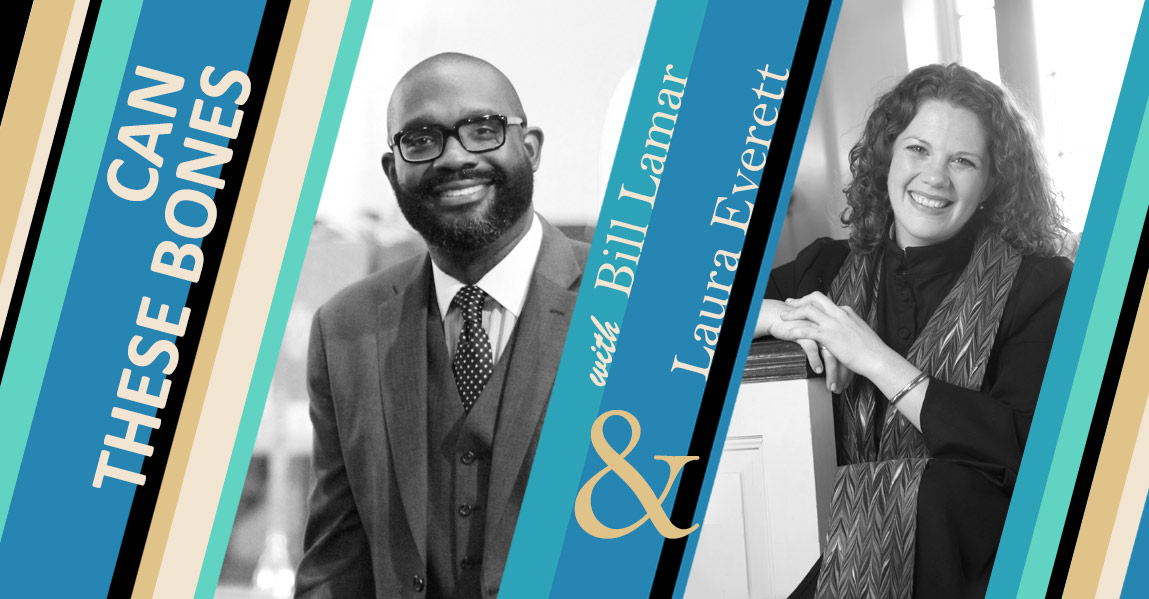
Listen to all the episodes and learn more about the hosts.
More from Almeda M. Wright“The Spiritual Lives of Young African Americans”(link is external)
Yale Divinity School course: “Radical Pedagogy(link is external)”
Emory University formation program: Youth Theological Initiative(link is external)
MIT enrichment camp: MITES(link is external)
Transcript
Bill Lamar: From Faith & Leadership, this is “Can These Bones,” a podcast that asks a fresh set of questions about leadership and the future of the church. I’m Bill Lamar.

Laura Everett: And I’m Laura Everett. This is episode 6 of a series of conversations with leaders from the church and other fields. Through this podcast, we want to share with you our hope in the resurrection and perhaps breathe life into leaders struggling in the “valley of dry bones.”
Bill Lamar: You spoke with Almeda Wright, an assistant professor of religious education at Yale Divinity School. Almeda shared her own vocational journey with you, and it’s tied to her research into youth and spirituality. Share a little bit with us about that.
Laura Everett: Bill, Almeda is a fascinating human being, and in full disclosure, Almeda is a friend from seminary, and she has been my writing partner for a number of years now. But she’s got this, like, unbelievable background.
She is a pastor and a professor with a degree in electrical engineering from MIT. And there are these amazing parallels between her own life and her research, because she had the experience of being a young scholar who had the opportunity to go to a summer youth program at MIT. And it really helped spark her imagination as a young black woman that she could actually be an engineer.
And so that experience of sort of seeing what your life could be on a college campus is part of what she brought into her work at the Youth Theological Initiative, which is called YTI. It’s at Emory University. At YTI, Almeda and others helped young people discover their own possibility of theological engagement, the possibility that they might be called to be pastors and teachers and scholars and missionaries in service of the church.
That same experience of going on a college campus and seeing people who could mentor you and lead you and give you a model for the kind of vocation you would have in the world -- she got to do that with some budding theologians.
So Almeda took her commitment to youth and formation and brought it to her research. She began to research her new book, “The Spiritual Lives of Young African Americans.”
Now, Bill, I don’t regularly work with adolescents, but Almeda has really convinced me that the radical act of listening is necessary for everyone in Christian community. I think we can all find some wisdom in this interview.
Bill Lamar: Laura, I -- at Metropolitan, we are really trying our best to help form young folks, and so I’m excited about your conversation. Let’s listen.
Laura Everett: Hi, this is Laura Everett, and it is a great delight today to get to talk with a dear friend of mine. The Rev. Dr. Almeda M. Wright is an assistant professor of religious education at Yale Divinity School. She’s also an ordained pastor in the American Baptist Churches.
The Rev. Dr. Wright has a bachelor of science from the Massachusetts Institute of Technology, a master of arts in teaching from Simmons, a master of divinity from Harvard, a Ph.D. from Emory, and if she were not a dear friend, I would be mightily intimidated by all of these degrees.
Miss Almeda, it is good to be with you.
Almeda Wright: It is great to be with you guys this morning.
Laura Everett: Thanks for joining us. So all of these degrees and all of these possibilities in front of you -- why would you devote yourself and your scholarship to the church?
Almeda Wright: Well, that’s a great question, one that my parents probably are still wrestling with now. But the truth be told, it’s been an interesting and amazing journey to get from engineering to studying young people, and to think about the life of faith writ large for a lot of folk.
But it started out for me -- I grew up in a very religious home, and there was never a time when we were not religious or never a time when we were not involved in faith. However, I never saw that as a career path for myself. I thought it was something that others did, primarily because I grew up in a small, rural black Baptist church where there weren’t that many women in ministry or women in leadership.
It was when I got to college, when I was studying engineering, that I actually got exposed to more women doing ministry full time as a profession. And so that kind of started the shift and started the journey toward not just being a practitioner of faith but wanting to help people develop and grow in their faith on their own.
Laura Everett: It’s not just that you went to MIT; you had a vision of your life as an electrical engineer. How did you know that that was something you could be good at?
Almeda Wright: Well, electrical engineering actually came from a sixth-grade teacher, because I was very good at math and very good at science and actually had a pretty good sense of wanting to fix things and/or blow things up.
[Laughter]
Well, a general sense of experimentation. I’d been taking apart clock radios since I was 3 and 4 and building things with circuits. And so I was the kid who -- nerd camp was built for me; science camp was built for me. I ate it up; I loved it.
And it was only in sixth grade that I determined -- I had a teacher, and she was like, “Well, maybe you should be an engineer.” And I was like, “Oh, OK, so this actually has a name; it’s not just something fun that I could do.” And so from then on, I was like, “I’m going to go and be the best engineer I can be.”
And I didn’t even know where MIT was. I couldn’t tell you if it was in Maine or Michigan or Massachusetts until about the 11th grade. And so I went and did a summer enrichment camp called MITES that’s still going on to this day on campus at MIT in Boston.
And it was amazing. And so that started the journey. But even while I was an undergraduate at MIT, I was leading campus fellowship. I was part of the gospel choir; I was leading Black Christian Fellowship.
And so my life of faith was always a part of it; it never, ever stopped. And it was somewhere around junior year, I think I was 19 years old, where I really sensed a call to ministry but didn’t know what to do with that, had no idea what that was going to look like, what that would mean, because all I had been preparing for at this point was to be an engineer.
And so I went and I lived abroad, I studied abroad in Spain, and that was the first time probably in 13 years that I’d done something that wasn’t math- or science-oriented and could begin to kind of breathe and think, “Wait a minute, there might be something else out there that I could do.”
Laura Everett: So I want to go back to that campus program. Because for you, the experience of being on a college campus, in the lab, working in an environment, helped you envision yourself in a role. Because let’s be clear: as a black woman, the models for becoming an electrical engineer when you grow up were probably not readily present to you, right?
Almeda Wright: Nonexistent.
Laura Everett: Right.
Almeda Wright: Yes. So in some ways, MIT, because of just the fact that it was all focused on science and engineering, was the first place that I’d actually encountered other black women who were interested in science -- and in some ways, other black people.
Now, my dad worked as a quality assurance engineer, so I at least had some access to other people who were doing engineering before I got there, but there were no other black women in my high school or in any of the places that I frequented as a teenager that were thinking about engineering and science.
And so it became a great opportunity to be on campus, and the MITES program was for African-Americans, for Native Americans, for Latinos. I remember the one thing that we were charged to do was to design a robot to play soccer. We had this major competition, and we got a box of scrap materials and a motor, and they told us to go at it.
And I remember, I had a team -- it was all women on my team -- and we did fairly well. But it was one of those empowerment moments where you were -- it felt like you finally could find other people who are of like mind and like skills and like interest to really just kind of go full steam ahead.
One of the things that we were doing at Emory with the Youth Theological Initiative, or YTI, is that we were inviting some of the best and the brightest of young people from around the country to spend about three or four weeks on campus learning theology, rubbing elbows with some of the best professors at Emory and in Atlanta, but also living in community.
One of the things at YTI was that we could not plan for the types of relationships that they would develop. We could plan the service projects; we could plan the theological reflection. But the most transformative part of that program was what was happening in the dorms, and the late-night conversations when they were sitting in the cafeteria together and just actually getting to know each other.
Laura Everett: It’s so clear how the investment that other people made in taking you seriously as a young person is something that you continue to do with the young people in your life. As long as I’ve known you, you’ve carried this deep commitment that youth and young adults are already capable of deep theological reflection.
But I know you’ve come up against times in local congregations where the church doesn’t act like youth are capable of deep theological reflection. Tell me, how did you notice that gap between what we profess and what we practice?
Almeda Wright: Well, for me, it was because I was working as a middle school math and science teacher for a couple of years, and at the same time, I was volunteering at my local congregation teaching youth Sunday school.
And Monday through Friday, I would teach critical thinking and higher-level math and algebra and have young people doing projects on, like, AIDS and HIV in sub-Saharan Africa -- in a sixth- and fifth-grade classroom.
And then I would go and teach seventh- and eighth-graders in the basement of a church, and all we expected them to do was to regurgitate Scripture and/or to create simplistic art projects out of it, and not actually ever critically engage.
And part of -- it was a moment of, “What the heck?” Because it didn’t make any sense to me that I expected kids in a school setting, a public school setting, to be able to be critical engagers, critical interlocutors.
And then on Sundays, I expected them just to tell me exactly what was in the text and not challenge it at all. I didn’t feel good about myself as a teacher in the church setting. And so I went looking for other ways or other models of engaging in religious education so that young people could use the totality of who they are as learners and thinkers and humans to engage their faith as well.
Often, and this is one of the things that both I encountered as a teenager but also that I see in young people that I work with even till today, 20-some years later -- it’s always interesting when young people say, “No one’s ever really listened to me.” Not, and this is the difference, they don’t ever say, “I didn’t have anything to say”; they’re like, “No one’s really taking the time to listen.”
And so one of the biggest gifts that I try to give to young people, and one of the biggest pedagogical pieces that I try to push, is really active listening, and to take seriously not just what we might do with young people or with kids but also what we will learn from them.
One of the things that has transformed my way of doing research, my way of doing ministry, is walking with young people and actually just taking time to get to know them, not have an agenda, but to say, “I know that you are coming into this community and into this conversation as an equal partner, and I respect that.”
And that’s one of the things that young people are searching for, in a lot of ways. But also when they’re given that opportunity, they share stuff that blows your mind.
For example, there’s this one young woman, Kira, who really helped me to start thinking differently about how I was approaching or thinking about violence and African-American youth, and even just how it connected with their spiritual lives. I didn’t think it did connect with their spiritual lives.
And she reminded me, she’s like, “No, I mean, I have to remind myself to pray whenever I hear that someone has been shot in my community, or remind myself to witness.” And I was like, “What do you mean, ‘witness’?”
And part of her narrative, and what it taught me with listening to her carefully, is she’s like, “No, I want to tell other young people that they are loved, that I love them, that God loves them, that they are respected.”
And she’s like, “I need them to know this, because if they’re going to die tomorrow, I need them to know today that somebody loves them.”
And it blew my mind. It took me to a place of not [just] trying to figure out what’s the best programming or what’s the best kind of, like, conflict resolution thing but also, out of the depth and the core of her faith, she was like, “I’ve got to share love.” And I was like, “OK, you are so right.”
Laura Everett: How has that changed how you think of yourself as a pastor?
Almeda Wright: Well, it changes a lot, partly because I am a doer. I am a fixer.
Laura Everett: [Laughter] You’re an engineer!
Almeda Wright: Right, I am. And not that those things aren’t good or necessary, but they probably shouldn’t be first.
And so it has made me shift, sometimes, the way I move, or the way I operate. And it has caused me to really re-prioritize, re-valueize the time that I can spend just being in conversation. And not to say that that’s a means to an end, because often I would say, “OK, I’m going to listen a little bit, and I’m only listening so that we can get to the strategies.” But it’s pushed me to listen for listening’s sake.
Laura Everett: It’s changed you as a researcher, right, this radical act of listening?
Almeda Wright: It really has. It’s changed both what some of the questions and themes [are] that come up in my analysis, but it’s definitely most clearly changed my methodologies.
So often, we want to do research, especially with young people and children, with interventions in mind. Where you think, “Well, what are the places where I can fix something or teach them something?”
Whereas, for the most part, this last research project that I’ve been finishing really had to push me to think about, “How do I give them a platform to teach the world? How do I amplify their voices, and not necessarily think about how we teach young people, but what young people teach us?”
Because often, young African-Americans are doing a dance where they are definitely committed to their spiritual formation, whether it looks like formal attendance in church and worship or community practices of spiritual belief and formation, but they’re also definitely trying to be about a life of justice, committed to social transformation.
And the traditional church, African-American or not, has not always been a place that’s encouraged that type of critical engagement and reflection, as quiet as it’s kept. It’s not always been the major support system.
In some ways, [spiritual formation] was about just homing in on respectability or “Do this” and “Do the other,” giving young people a lot of things to do or not to. And so as a result, young African-Americans have been doing a dance of trying to hold on to their spiritual lives, and to respect that, but also trying to push beyond it and to take their real passion and a real sense of call to transform the society around them.
A couple of young people have written directly to me, saying, “Thank you for reminding us that we’re doing this dance. And sometimes the tension is an easy one and sometimes it’s not, and thank you for helping other people to see the ways that we’re not complacent or nihilistic or anything like that, but we’re actually critically thinking about and negotiating all these different areas of our lives.”
Laura Everett: That core concept you’re working with around the fragmented spirituality -- that sometimes it’s a strategy for self-preservation, it’s a way of making sense of the world and both the church’s drive to a personal relationship with Jesus and an awareness of just the larger cultural problems and struggles of growing up as a young African-American -- do you think the goal is an integrated spirituality? Or has your sense of, like -- what you’re hoping for has changed?
Almeda Wright: Well, and I play with words here, and so I say my goal is an integrating spirituality. And part of it -- I’ve changed, probably over the seven or eight years that I’ve been doing this research, from just integrated, because that felt too fixed.
And I don’t actually think that the goal of having a unified or completely coherent spirituality -- I think that’s impossible, both because of postmodernity but also just the way life kind of ebbs and flows and how as humans we evolve and life circumstances change.
But for me, an integrating spirituality, as I kind of define it in the book, is one that actually allows you to continue the cycle of bringing these things back into conversation. So it’s never, ever fixed or rigid, but it’s one that is really giving you tools or resources to think about, “How do I make sense, in an ongoing, daily, continual way, of all the different parts of my life?”
Laura Everett: It’s a helpful concept, that integrating spirituality. It strikes me that at the end of the day, your book, “The Spiritual Lives of Young African Americans,” doesn’t prescribe a shiny new youth program to get to integrating spirituality or 12 easy steps to grow your youth group.
How would you hope that this concept of an integrating spirituality might inform youth pastors, pastors of churches, parents and peers?
Almeda Wright: Well, and that’s one thing that’s interesting. Now, there are a few practical things in the back of the book. But you’re right; it’s not going to give you these programmatic things.
And what the practical parts of -- or just even the questions that it raises at the end -- it’s really trying to help people to roll up their sleeves and do the hard work.
And part of what I mean by that is that because I see that this is an ongoing daily struggle, I also see that the types of programmatic changes are going to have to be ongoing and open to evolution or open to, like, the way that people will need to grow as they go through the cycles of life, as they go through the cycle of faith.
And so what I hope that they will get out, or what I hope the legs that this concept of an integrating spirituality will have, is one in which we actually take stock of the fact that we will need to attend to personal relationships with the divine, but we will also need to attend to systemic and communal issues of injustice.
And we don’t get to pick one or the other, but we have to think about how they all are working together.
And one of the things that I try to point to at the end of the book is also the reminder that there are practices that communities of faith, and particularly my tradition, the African-American Christian community, have done for years that should not be lost.
So I talk about the prayer tradition. I talk about the tradition of singing together. I talk about the tradition of critical reflection and prophetic voice. All of these are part of a historical Christian tradition that should be in conversation with some of the innovations and new things that young people will want to do.
So for me, it’s not an either/or -- that we get rid of older traditions and only listen to what young people are bringing -- but that we invite young people into these age-old traditions and be open to the way that their lives and their narratives also continue to shape them or transform them.
It’s integrating the best of the tradition with the best of the critiques and the best of the reflection so that something new and amazing emerges.
One of the major things that I loved about doing this book is that I got to hang out with a lot of spoken-word poets, and to listen to the way that they were doing theological reflection in poetry that I only used to see, say, in sermons or in hymns.
And so there’s an innovation and a way that they’re taking a genre that is their own. And it connects with -- or at least I see connections with -- traditional themes within African-American churches. And some of the ways that this looks on a congregational level are for us to be open to different genres, even if they’re having similar themes.
And to kind of parse out the ways that young people are thinking about the symbols that we’ve given them.
For example, one young woman writes a poem about suicide and death and heaven and how heaven may not be something that she wants to go to, if all we know about heaven is that it’s white and the streets are paved with gold and it’s beautiful. And she’s like, “So racism and racial divides and colorism still happen in heaven?”
She unpacks it in a way that I was like, “Oh, I never thought about that.” She’s, like -- she’s pushing back against some of the symbol systems that Christianity has offered and saying, “Let’s rethink what this looks like.”
And let’s also make it clear that in the world as it is, in the world that we’re living in currently, we’re going to have to do a lot more than give people pie in the sky or images that might be somewhat anesthetized and distant from the realities that young people are encountering right now.
Laura Everett: I am so grateful for your work in this area, Almeda. The radical act of listening, not to solve a problem, but as, it sounds to me like, as a commitment to the dignity and the spiritual wisdom of the young people you’re encountering is something that need not have a budget line item, or need not have a program or a designated pastor, but it is something that every community of faith can practice.
Almeda Wright: And that’s one of the things that I’m trying to get people to see, that this is complicated, but pretty simple as well, and something that we can commit to doing right now pretty easily.
Laura Everett: So I want to shift just a bit and ask about some of your teaching. Clearly, you think carefully about how people learn, how young adults learn, how youth learn. You have a degree in teaching, and you teach one of my favorite-titled courses, called “Radical Pedagogy.”
So I want to know from you, what makes pedagogy radical?
Almeda Wright: Well, in that particular class, I always make the joke that “Radical Pedagogy,” the course, is what would emerge if a community organizer and a religious educator had a baby. It would be this course.
[Laughter]
And so it’s an interesting wedding of the best of what I consider the social justice thread of religious education and the faith-based community organizing. And there is a tradition of critical, or radical, pedagogy that looks at thinkers like Freire, Paulo Freire, or bell hooks or Henry Giroux. And I build on some of those traditions. But we also start with thinkers like King and Dorothy Day and Heschel.
It’s an interesting thing to do this kind of radical pedagogy and to think about it in terms of religious education or religious formation. Because many of the young people or the students, divinity students, who come and take this course have never, ever thought about religious education being connected to social transformation.
And it boggles my mind, because I’m like, “That’s what I’m about; that’s all I do.” But that’s the reality, that often in their congregations, or even in their personal experiences, they think Sunday school is where you learn, you know, Scriptures, and you recite particular creeds. But you don’t actually see that it has feet or that it has legs that take you into the street to do something with it.
And so the gift of this particular type of class is that we are thinking through social change movements, but we’re also thinking through theological visions and how they get operationalized, or how people are able to be inspired by the convictions of their character or the convictions of their faith to work and to operate in the world.
But what’s also interesting is that every week in that class, I start with a segment where I put up a figure from contemporary news, and I ask them each week, “Is this person radical? Is this an example of radical pedagogy?”
And so as we go through the semester, we are building theoretically our visions, or our understanding, of what it means to be a radical leader, a radical pedagogue. And the students come out in different places, because some also come thinking, “Well, ‘radical’ is a negative thing; like, the only time we hear ‘radical’ is as a modifier for, say, ‘radical Islam.’”
But others come out and say, “Well, I thought I was a radical, but maybe I haven’t really gone far enough.”
So it’s interesting to see how they construct different visions of what radical pedagogy and radical social transformation looks like as we go through the semester.
Laura Everett: I long for the sort of artistry and intentionality that you’re engendering in your students.
Almeda Wright: You have to be very skillful as a teacher; you have to know your stuff. But you also have to kind of hold what you know loosely, so that if it doesn’t work, you let it go and you try something else that’s new.
And that’s one of the other gifts of learning and really thinking about how do we teach in community and how do we teach both religious truths but force transformation -- you’ve got to figure out that what worked last time may not work this time. And you have to be OK as that moves forward.
Laura Everett: I’m going to borrow that, the radical improvisational pedagogy.
Almeda Wright: Yes, it’s the major bumper sticker, I guess. I should make T-shirts: “Try some stuff; see if it works.” Because that’s the core idea.
[Laughter]
Laura Everett: Wait, wait, wait! So the tagline for your Yale Divinity School course on radical pedagogy is “Try some stuff; see if it works”?
Almeda Wright: Exactly. I think that’s the way forward.
Laura Everett: I could imagine in an academic environment that is invested in excellence that cultivating a community to try and risk would be hard. How do you encourage people to take risks -- to fail -- in your courses?
Almeda Wright: Well, that’s one thing that is kind of interesting. It’s a philosophy that I didn’t actually originate. I’ve borrowed it from great teachers that I’ve had. I am there with a few cute pictures and slides, but it takes on an organic life of its own. The first two classes are the hardest, because [the students] don’t actually believe you, that that’s actually what you want.
Laura Everett: They don’t trust you yet.
Almeda Wright: Or that is what a professor really is looking for. And I remember the first couple of classes, where they would volley back and forth and come back and say, “Well, wait a minute, I’m trying to talk to you.” And I’m like, “I’m not going to call on you. You’ve got to talk to your colleague, and you’ve got to figure out if you’ve spoken too much or too little, or if you’ve given them a fair chance, because this is on you.”
Because these are skills that you have, and they are skills that most adults, most students have, and empowering them to bring them into the classroom is interesting to watch -- how it transforms the learning environment.
Laura Everett: I’m so grateful that you do this work.
Almeda Wright: It’s risky, but it’s so rewarding. [Laughter] No, seriously, every semester I’m like, “Oh my God, maybe I should just lecture. I could control it better.”
But no, it actually -- every semester, every time I teach this course, every time I teach every course, I learn so much, and I never, ever can anticipate all that I’m going to learn from the students and from what they bring. Because every one of my students has a rich history, a rich set of experiences and expertise. And only by getting out of the way do we all get to learn from those things.
Laura Everett: So, Almeda Wright, the title of this podcast is called “Can These Bones.” And I know, being a sufficiently good Baptist, you could cite me chapter and verse on where this comes from.
But this is our big question, right? Like, is there life in the bones of these institutions? And I’m curious, as you think about the formation of spiritual lives, of young African-Americans, of young people in the church, do you think there’s life in these bones?
Almeda Wright: I have always been accused of hoping too much or expecting too much out of churches and institutions. But the reality is I don’t feel the need to give up on that hope yet. So yes, there is life.
And one of the things that continue to remind me that there is life is whenever I encounter a young person who finds a church or community or religious group that is supporting them or is affirming of some of the passion and the commitments that they have.
There’s one woman in particular I remember. She broke into tears at a national youth conference because she was, like, “I didn’t know this kind of church existed.”
And what it said to me was that she was looking for that kind of church -- a church where her voice could be heard, a church that was going to teach her and encourage her to do justice work, a church that was going to teach her and encourage her to do her own self-care and spiritual formation and to really kind of push and support her.
And the fact that there are still young people looking tells me that there is still work and there’s still life and there’s still a call and a commission for us. So for me, it’s always a sense of urgency to make sure that we be the best and be the church that the world and society and young people need.
Laura Everett: Well, you are part of the community of learners that I need -- to be the kind of pastor, and frankly to be the kind of Christian, that I think God longs for me [to be]. I am so grateful to be in conversation with you. Thank you so much for your time today.
Almeda Wright: Thank you.
Bill Lamar: That was my co-host Laura Everett’s conversation with Almeda Wright, an assistant professor at Yale Divinity School.
What I find fascinating about Almeda, beyond the fact that she likes math and science, is the fact that she is trying to help the church to understand that young people are not becoming leaders; they are leaders.
That we should not prompt them to share easy stuff but prompt them to share their deepest longings, and understand them as human beings who already have theological wisdom to share.
Laura, say more about that, because I think that that gives you as much energy as it gives me.
Laura Everett: Oh, it gives me a ton of hope -- and not just for young people. Almeda’s process of active listening is something that every pastor knows and we are really bad at practicing. I know that I have that struggle, that I want to listen with an end goal in mind and listen in a way that I’m already filtering the conversation.
Almeda’s practice of listening to young people is radical, because she’s not fixing them or trying to push them in a direction; she’s taking them on their own terms. And especially for young people, especially for young African-Americans, that act of listening is the kind of attentiveness that I think God offers creation. Right?
Like, that what she is doing with that act of listening, hopeful listening, attentive listening, is memetic of who God is. I find so much that I can learn from how carefully she is experiencing the wisdom of what youth in her presence can teach her and not just what she can offer them.
Bill Lamar: I think, too, Laura, reflecting as a black man in America, a person of African descent here -- these voices of young black women and black men, from the time of the encounter in the American space, these are voices that have been told to be quiet, and dreams that really, to borrow from Langston Hughes, that should have been left to rot and explode.
But to offer space, which the black church has traditionally done for these persons, to share their theological imagination and their humanity -- it’s nothing short of a profound spiritual necessity, especially in today’s culture.
And I think one of the things that we learn beautifully from Almeda’s work is that we have to hold things together that folks would want us to pull apart. We have to do that as individuals, and we have to do that as churches and institutions.
People want to pull young people away from deep discussions around who God is, around what it means to live a bodily existence, around what it means to have a vision for peace or for justice -- all of these kinds of things, we want to wait until they have gotten to a certain age.
But I think Almeda’s work says offer the space for them to give the fullness of who they are as soon as they’re ready to disclose it.
How can we do a better job, Laura, as individuals and in our work, of holding together the things that people want to pull apart? Because that pulling apart makes our work as leaders and servants all the more difficult.
Laura Everett: Bill, I think one of the things that Almeda does so well is notice the spaces where people are making meaning, where the youth are making theological sense of their lives. Certainly, church is one of those spaces, but a lot of her research happens in looking at spoken-word poetry. Right?
So we tend to parse spaces as sacred and secular, as religious and nonreligious. And she certainly is doing primary research in studying Sunday school curricula and studying youth group programming, but she goes to what is perceived as a secular space to study the spoken-word poetry of these youth, and the massive theological claims and commitments they are making there.
And so part of the lesson that I extract from this is to not presume I know that a space is either sacred or secular. Certainly, there are times when language is clearly expressing theological convictions. But what Almeda does so beautifully is trust that the spirit of God is at work in places like spoken-word poetry and that that is a place where the youth she is encountering are making sense of their world.
It’s this concept, right, of an integrating spirituality, that we keep coming back again and again, that our spiritual lives are not just one thing that is fixed and rigid, but again and again the youth that she is studying are re-integrating their experiences in the church, beyond the church, back into their lives.
And to ask people -- I think the practice that I want to take from this is to ask people open and generous questions about how they understand themselves in the world and, when appropriate, how they see God at work.
Bill, do you have ideas about how you want to hold together the things that would otherwise be pulled apart?
Bill Lamar: I think [through] good conversations with partners who are struggling to keep things together. One of the things that I believe I wrestle with at Metropolitan is that we are a church with a grand tradition -- and I absolutely love that. I am drawn into it rapturously every Sunday and every day I enter that beautiful space.
But holding together that tradition with fresh expressions of what it means to worship God, fresh liturgical innovation, fresh theological wisdom around who God is and who we are as God’s people. I have surrounded myself with persons who understand the value of our tradition -- I mean, we cannot destroy that and diminish that -- but we must marry that with the innovation that is going on all around us.
And one of the things that I learned from your interview, Laura, is Almeda seems to be bent on listening and not fixing. So one of the issues is when we go into spaces -- churches, institutions -- we don’t go to fix but we go to listen and to learn and to discern and cast a shared vision to move the institutions forward. One of my sources of humility, and I know anybody that says they have humility may not have it, but something that keeps me, I guess for lack of a better word, really in a space of humility is understanding how much larger Metropolitan is as a church and how much larger the African Methodist Episcopal Church is as a denomination than I am.
And so I see myself as a temporary steward of these riches. And part of my vocation, also, is to help to discern who the next temporary stewards are. So we are not here to fix something, but we are here to listen and to learn and to help that institution or that church live into its vocation in the contemporary moment.
As the hymn says, “to serve the present age, our calling to fulfill.” It does not say we fix but we serve the present age. And I really feel like Almeda’s work is pointing us toward how we serve the present age, keeping those who are at the vanguard of this generation -- the younger brothers and sisters -- in the midst of the conversation, not casting them to the outskirts to some young-people ghetto in the church, but allowing them to sit in the center and to teach as well as learn.
Laura Everett: Oh, Bill, I had a good dose of that humility thrown at me. Part of my ministry with the [Massachusetts] Council of Churches is to go around and visit churches, and I like to imagine that I’m listening when I’m there.
I went to visit a church that once had a sanctuary that could seat 1,000. They were worshipping 20 in a chapel. The big business, the big industry that had been in the town had left, and there were like four or five churches in this small community.
And I walked the building with the interim pastor and the chair of the board of deacons, and they have this giant fellowship hall. And up along the top were these old Sunday school rooms that were filled with clutter, and we were dreaming and scheming and talking and asking what the community needed. And it’s a pretty rural place, and a bunch of folks telecommute.
And I, like, thought I had found the solution and said, “You need to be a telecommuting center and get -- I know a strong wireless signal has been a problem in this rural community -- set up a hub here, and all of those Sunday school classrooms can be office spaces you can rent out by the hour.”
And the deacon turned to me, Bill, and said, “You and your big-city ideas.” And I was so humbled. I was so ashamed. I had come in with like -- you know, my sense of what would work, and I wasn’t really carefully listening to the community. I was just -- I was fixing. I was doing what Almeda had warned against, fixing. Not because it was a bad idea necessarily, but because it wasn’t a shared vision, and they weren’t at a place of doing that.
But, man, I got my ego handed to me by that deacon.
[Laughter]
Bill Lamar: Yes, it’s good to have things handed to you sometimes; it can help you.
Laura Everett: Oh, that one was handed so clearly. I didn’t think I had “big-city ideas” before that.
Bill Lamar: Well, I think it’s interesting to listen, because then we learn the things about ourselves that we often deceive ourselves about, and ...
Laura Everett: Oh, and the truth is not in us.
Bill Lamar: Oh, God, yes, you know ...
Laura Everett: I want to reflect on that sort of pitifully low expectation of Sunday school that Almeda talked about. The juxtaposition of teaching her sixth-graders higher level math and then going into Sunday school and making popsicle crosses.
She really had a lived experience of the intellectual curiosity her students had Monday through Friday and the sort of regurgitation model that was offered on Sunday morning.
I also sometimes feel like there’s sort of a creeping clericalism that has low expectations of our lay leaders. And I’ve heard the conversations among my colleagues, and I know I’ve done it, too, where it becomes something like, “How do I convince them of doing X -- of removing the pews, of turning the Sunday school classrooms into telecommuting centers?” instead of a shared experience of, “How do I as the pastor or I as the executive director create a setting where we can listen together for what our community needs, what this institution needs, and what we think God might be up to in this space?”
Has that been your experience, Bill?
Bill Lamar: It has been my profound experience that if we offer an opportunity for people to fly, they will fly, intellectually, theologically, relationally.
But if we cage them -- so, for example, to go directly to the popsicle crosses and the high-level math, I walked into a church school class recently and one of our bright young ladies was asking a question. I hate walking into this class, because they’re either talking about something that is highly theological or they are talking about sex or politics; it’s never easy stuff.
So she asked the question, “How could Moses write about his own death?” And I said, “OK, how nerdy would you like for me to be?”
Because one of the things that I’m clear about is you do not douse that intellectual and theological flame. You find ways to help them to continue to ask the questions that will help them to see the largeness of God, and the largeness of God’s vision -- not only for them, but for the world.
And I believe that this is this amazing pedagogy that Almeda offers to us, which is essentially, you know, “Let’s try and see what works. If what we’re doing is not captivating, let’s try some new stuff; let’s see if it works.”
And that, my friend, is how this institutional life continues to be both crazy and beautiful and something well worth giving our lives to.
Laura Everett: Listeners, we want you to have permission to practice some of your own radical improvisational pedagogy. Try some stuff and see if it works and know that we go with you.
Bill, thanks for the conversation today.
Bill Lamar: Thank you.
Laura Everett: Thank you for listening to “Can These Bones.” I hope you enjoyed this conversation as much as we did. There’s more about Almeda Wright, including a link to her new book, “The Spiritual Lives of Young African Americans,” at www.canthesebones.com.(link is external)
This episode marks the halfway point in the first season of “Can These Bones.” We’ll be back after a break with six more episodes. We’ll be talking with church leaders and people outside the church world about everything from fiction writing to airlines to teaching. We hope you’ll stay with us and join us for these next episodes.
So Bill, who will you be talking to when we resume?
Bill Lamar: Laura, I’m thrilled about my conversation with Daniel Black, a writer and scholar and the author of one of my favorite books, “The Coming.”
Laura Everett: Oh Bill, I’m really looking forward to that.
Bill Lamar: “Can These Bones” is brought to you by Faith & Leadership, a learning resource for Christian leaders and their institutions from Leadership Education at Duke Divinity. It’s produced by Sally Hicks, Kelly Ryan Gilmer and Dave Odom. Our theme music is by Blue Dot Sessions. And Almeda Wright’s interview was recorded at Yale University. Funding is provided by Lilly Endowment Inc.
Listeners, we’d love to hear from you. Please share your thoughts about this podcast on social media. I’m on Twitter @WilliamHLamarIV(link is external), and you can reach Laura on Twitter @RevEverett.(link is external) You can also find us on our website, www.canthesebones.com(link is external).
I’m Bill Lamar, and this is “Can These Bones.”
This transcript has been edited for clarity..
Read or listen to this podcast »
How do I listen to a podcast? »
IDEAS THAT IMPACT: BIVOCATIONAL MINISTRY
Faith & Leadership
It's time to recalibrate expectations of the clergy
CHRISTIAN LEADERSHIP, CONGREGATIONS, VOCATION, BIVOCATIONALISM
It’s time to recalibrate expectations for clergyDenominations and congregations have based their expectations on full-time, paid ministry -- and yet the trend is toward part-time, bivocational and unpaid clergy.
Earlier this year, I taught an introductory parish leadership class to 40 part-time local church pastors. Most of them were bivocational, balancing the demands of ministry with their obligations as police officers, truck drivers, school teachers, nurses and social workers. Many were serving congregations at considerable distances from their homes (one had a 100-mile roundtrip journey on winding North Carolina back roads every Sunday morning). All of them were in congregations that would be without a ministerial presence if not for their service.
Those 40 are part of a steadily increasing number of American clergy who are part-time, bivocational or unpaid. Hartford Seminary’s 2010 Faith Communities Today survey(link is external) indicated that about 30 percent of American congregations are served by paid, part-time clergy (2 percent are served by unpaid clergy). A thought-provoking essay(link is external) by the Rev. Carol Howard Merritt(link is external) in the August 2013 issue of the The Christian Century offers a slightly starker picture, saying that roughly half -- though it could be as high as 70 percent -- of American congregations are finding themselves unable to afford a full-time clergyperson today.
This trend toward part-time, bivocational and unpaid clergy raises a whole host of questions for denominations and congregations that have based their expectations for clergy on a model of full-time, paid ministry.
Some of these questions are seemingly small and insignificant. What to do, for example, about a monthly, weekday clergy meeting when such a gathering might necessitate a person’s absence from her other job? Should a part-time pastor be excused from the meeting, recognizing that a two-hour meeting might represent as much as 20 percent of her compensated hours that week? Should the meeting be held on a Saturday to accommodate bivocational folks, even if that takes full-time and part-time clergy away from family and other obligations? All of these choices have pitfalls. Few have upsides.
Other questions are more vexing still, in some cases pitting long-held convictions against each other.
Some denominations are finding their commitment to a “learned clergy” in conflict with a missional need to serve smaller congregations and underserved communities. The question becomes how much training can a denomination reasonably expect a part-time or unpaid clergyperson to have? If not a three (or four) year master’s degree, then what? What are the non-negotiable elements of that training, and what are the elements that would be nice but are not essential? Must training precede ministerial service, or could people be trained concurrently with their service? There are no easy answers. In many denominations, no one is happy with a compromise.
Likewise, congregations have difficult decisions to make.
Imagine that a church can only afford compensation equal to quarter-time employment (which, in most cases, means that the clergyperson has to find additional paid employment to balance his personal budget). What can that congregation reasonably expect of that clergyperson, and what is the work of ministry must laity assume? This will require renewed education about the calling and ministry of the laity (a clear good in all of this!), and it will mean -- and in some places, already does mean -- that some ministries will no longer happen. Prioritizing the pastoral workload will be a new practice required of vestries, sessions and personnel committees.
In many settings, denominations and congregations have relied on the goodwill of part-time, bivocational and unpaid clergy and have not recalibrated their expectations about ministerial role and work. That is an unsustainable solution. Now is the time for creativity, innovation and experimentation to adjust to what is increasingly the new normal for congregations around the country.
Read more from Nathan E. Kirkpatrick »
The bivocational congregation
Churches of tomorrow will need to be bivocational congregations, local churches that operate upon two callings -- the calling of function and the calling of mission.
The Bivocational Congregation
Any garden-variety atheist, agnostic, or even religiously indifferent materialist knows that if—and we do mean if—the church is to survive well into the future in the northern hemisphere it won’t be through a linear extension of today’s church. Every index of the church as it has been indicates a decline, and many indicate a precipitous decline. So what might tomorrows different church look like? What should we call it? And what are its qualities?
We believe the bivocational congregation (not to be confused with but related to bivocational pastors) offers a viable model for tomorrow’s church. A bivocational congregation is a local church that operates upon (and may even self-consciously understand) two callings: the calling of function and the calling of mission. We believe the bivocational congregation is more likely to survive into tomorrow to do God’s will and be God’s people because it is essentially organized around spiritual realities in tune with God’s redemptive work. These include:
The Always-Been Bivocational Congregation
In a little town there is a small church with two to three dozen people that gather on Sunday mornings. They know each other well, and each of them has a role to play that helps keeps the church going. A shopkeeper is their pastor, a school teacher their treasurer, and a retired woman their clerk. This congregation needs someone to fill the pastoral role, but a very strictly defined role of preaching and pastoral care. Otherwise, the people expect to work together to accomplish whatever needs doing
The members’ relationships with one another have morphed over the years so that they function as a team. People realize that energy is limited and do not waste much of it on turf battles. New members are incorporated slowly into this dynamic organism. Giftedness and interest are discerned over time and offered and used for the common good. This bivocational congregation functions as a simple organism. Each part has a role to play. The pastor is important but not crucial. In fact, this type of congregation can keep on going for long periods of time without a pastor, if need be.
They know what needs to be done (and what doesn’t) and who is going to do it (and who isn’t). Yes, their ministry is basic and not extensive. But they own it, they do it, and they will keep on doing it indefinitely. And maybe that is enough.
The Rooted-Here Bivocational Church
In an ethnic, blue-collar section of a large city, a federated church has over the years combined congregations from several different faith traditions. The parish has existed for over a century to minister to the people of its neighborhood and is an example of what happens when a congregation is truly bivocational. When, after a successful 20-year part-time ministry, the pastor left , the congregation began a search process for a new pastor. Their goal was clear: they desired a clergy companion for a bivocational ministry. There were no illusions about getting a replica of their outgoing pastor nor any about switching to a full-time pastor. They sought someone who could serve as pastor and who was as committed to bivocational ministry in this place as they were. That meant having local roots and being committed to doing outreach to the local community. They understand the need for a presence in the local setting—a presence from which outreach programs can flow. Members told us that even if they had the funds available for a full-time pastor, they would use those funds in other ways, especially for community outreach. The congregation understands the need for roots in a community, and it also understands that the concept of bivocational ministry is not just a clergy thing—that it needs to be imbedded in the minds and hearts of all of the members.
This bivocational congregation was missional long before the term came into vogue. They know that their internal life and health depend on their external service. Churches in their neighborhood that didn’t understand this have long since closed while this congregation lives incarnational ministry right there in their neighborhood, and consequently it, too, lives.
The Transitional Bivocational Congregation
One congregation emerged from the closing of three Methodist churches in 1966. Today it is in the midst of what it calls its Five-Year Holy Experiment, which involves two congregations working together in the same building. One is a small congregation of English descent and the other is a new, large, and growing congregation primarily of Korean heritage. The English congregation is bivocational, with a call to live its own life as a congregation, yet also with a call to house and nourish the Korean congregation.
A church council, made up of five members from each congregation, meets monthly. Church committees also comprise members from each congregation. The treasurer of the church was appointed from the Korean congregation, a move supported by the English congregation. The budget for the church is supported by both congregations, with some help from the Methodist District organization. Lay leaders in the English congregation monitor telephone calls coming to the church answering machine and follow up as needed—for both congregations. They also lead a weekly Bible study session open to all. One Sunday a month both congregations worship together.
The English-speaking congregation is concerned about its continuing decline in numbers, but its overall attitude is one of joyful celebration for the blessings of the present and the unknown but promising future of this vibrant parish venture. Where will they end up? God only knows, but this transitional bivocational congregation is enjoying the ride! It is ready to die to self—the worship style they are accustomed to, their identification with “our” pastor and building, indeed their whole self, if need be—to see that ministry to their community continues. Unlike so many other congregations that ensure their death by holding on tightly to life as they have known it, this congregation will live on—possibly in resurrected form and speaking Korean! They understand that letting go of what has been is the only way to see what will be.
An Experimental Bivocational Congregation
Five small, centuries-old Episcopal churches sit sprinkled around a river valley. A few decades ago, each struggled to make ends meet, to maintain its high-maintenance building, to keep its Sunday school staffed, and to manage with a part-time rector. Then along came a rector who introduced to them a concept he called “clustering,” an arrangement in which certain functions are collectively managed by a board comprising members from the different churches in the cluster.
Under the cluster arrangement, each parish maintains its own building and vestry. Each votes its own budget and raises its own funds. Each may have its own ministry in its own community. And each sends representatives to the cluster board. There such synergies as common missions, Christian education, music, and social activities may be developed. Clergy coverage for the worship of each parish is arranged on a rotating basis. Other staff members contribute from their skills and calling as the cluster board determines best. What this means in practice is that any one parish has access to a wider array of skills than it could afford on its own. But it also means that their pastor is a functionary, rotating in and out of their pulpit every eight weeks or so, according to a set schedule. So parishioners do not develop the same kind of dependence on their pastor that they might otherwise. Clusters call forth the lay leadership of the congregation. Clusters clearly say: The responsibility is yours. The rector will assist you in achieving your call, but he or she is not going to do for you what is yours to do. You are the permanent part of this equation.
The We-Backed-Into-It-and-We-Want-Out-of-It Bivocational Congregation
Unless the concept of bivocational ministry is firmly rooted in the minds and hearts of the congregation, it can fall apart when the pastor leaves. One congregation that was originally organized in 1893 as a mission in recent years has not been able to afford a full-time pastor. They have been served by a succession of bivocational pastors and strong lay leadership has emerged in order to maintain and expand the ministry of the congregation. The Sunday school, youth ministry, routine pastoral care, and outreach efforts are organized by members of the congregation. The pastor orders the worship services, presides over the parish vestry, gives encouragement and counsel to the lay volunteers, and makes emergency calls on parishioners.
After their last “permanent” part-time pastor of seven years retired, the congregation struggled to find a successor. In the course of searching for three years, the vestry decided to use the congregation’s small endowment to seek a full-time pastor. They hope to be able to support this person at full time for three years, during which time the congregation may grow sufficiently to be self-supporting. If not, they will have exhausted their financial reserves, failed at growing, and possibly become terminally discouraged. Though the laity have taken on significant and fruitful responsibilities in mission and in the life of their church, this church seems to have been simply a congregation with a bivocational pastor rather than a bivocational congregation.
This example, replicated so very often, is not a particularly hopeful one, barring a miracle. The desires deeply rooted in the hearts of the parishioners for their own full-time pastor, to be a “legitimate” church, and to have someone to define and do ministry represent a model of doing church that is unlikely to lead us very far into the future. Exhausting resources in that quest will not be as productive as learning the lessons God desires to teach us in order to move into a new future.
Embodiments of Change
Each of the first of these examples lift up qualities of faithful congregations that may foreshadow the characteristics of the church in the future: the power of focus and complimentary functions; the value of presence, rootedness, and the primacy of mission; the importance of willingness to take risks and even die to self, if need be. The cluster model demonstrates a willingness to experiment and take responsibility for one’s congregation. And the last example teaches us of the danger of giving in to the constant temptation to slip back into old patterns.
Does a congregation need to have a bivocational pastor to exhibit the positive qualities of a bivocational congregation? We think that, though it may help, it is not necessary. What makes a congregation bivocational and more likely to thrive into the future is the dual calling of the congregation to fresh understandings of mission and function—mission that is rooted locally, focused, and so primary that the church is willing to risk self in the cause, and functioning that is responsible, complementary, experimental, and not pastor-dependent but lay-owned. Such a church, we believe, will warm God’s heart and serve its neighbors for years to come.
Bill Lamar: You spoke with Almeda Wright, an assistant professor of religious education at Yale Divinity School. Almeda shared her own vocational journey with you, and it’s tied to her research into youth and spirituality. Share a little bit with us about that.
Laura Everett: Bill, Almeda is a fascinating human being, and in full disclosure, Almeda is a friend from seminary, and she has been my writing partner for a number of years now. But she’s got this, like, unbelievable background.
She is a pastor and a professor with a degree in electrical engineering from MIT. And there are these amazing parallels between her own life and her research, because she had the experience of being a young scholar who had the opportunity to go to a summer youth program at MIT. And it really helped spark her imagination as a young black woman that she could actually be an engineer.
And so that experience of sort of seeing what your life could be on a college campus is part of what she brought into her work at the Youth Theological Initiative, which is called YTI. It’s at Emory University. At YTI, Almeda and others helped young people discover their own possibility of theological engagement, the possibility that they might be called to be pastors and teachers and scholars and missionaries in service of the church.
That same experience of going on a college campus and seeing people who could mentor you and lead you and give you a model for the kind of vocation you would have in the world -- she got to do that with some budding theologians.
So Almeda took her commitment to youth and formation and brought it to her research. She began to research her new book, “The Spiritual Lives of Young African Americans.”
Now, Bill, I don’t regularly work with adolescents, but Almeda has really convinced me that the radical act of listening is necessary for everyone in Christian community. I think we can all find some wisdom in this interview.
Bill Lamar: Laura, I -- at Metropolitan, we are really trying our best to help form young folks, and so I’m excited about your conversation. Let’s listen.
Laura Everett: Hi, this is Laura Everett, and it is a great delight today to get to talk with a dear friend of mine. The Rev. Dr. Almeda M. Wright is an assistant professor of religious education at Yale Divinity School. She’s also an ordained pastor in the American Baptist Churches.
The Rev. Dr. Wright has a bachelor of science from the Massachusetts Institute of Technology, a master of arts in teaching from Simmons, a master of divinity from Harvard, a Ph.D. from Emory, and if she were not a dear friend, I would be mightily intimidated by all of these degrees.
Miss Almeda, it is good to be with you.
Almeda Wright: It is great to be with you guys this morning.
Laura Everett: Thanks for joining us. So all of these degrees and all of these possibilities in front of you -- why would you devote yourself and your scholarship to the church?
Almeda Wright: Well, that’s a great question, one that my parents probably are still wrestling with now. But the truth be told, it’s been an interesting and amazing journey to get from engineering to studying young people, and to think about the life of faith writ large for a lot of folk.
But it started out for me -- I grew up in a very religious home, and there was never a time when we were not religious or never a time when we were not involved in faith. However, I never saw that as a career path for myself. I thought it was something that others did, primarily because I grew up in a small, rural black Baptist church where there weren’t that many women in ministry or women in leadership.
It was when I got to college, when I was studying engineering, that I actually got exposed to more women doing ministry full time as a profession. And so that kind of started the shift and started the journey toward not just being a practitioner of faith but wanting to help people develop and grow in their faith on their own.
Laura Everett: It’s not just that you went to MIT; you had a vision of your life as an electrical engineer. How did you know that that was something you could be good at?
Almeda Wright: Well, electrical engineering actually came from a sixth-grade teacher, because I was very good at math and very good at science and actually had a pretty good sense of wanting to fix things and/or blow things up.
[Laughter]
Well, a general sense of experimentation. I’d been taking apart clock radios since I was 3 and 4 and building things with circuits. And so I was the kid who -- nerd camp was built for me; science camp was built for me. I ate it up; I loved it.
And it was only in sixth grade that I determined -- I had a teacher, and she was like, “Well, maybe you should be an engineer.” And I was like, “Oh, OK, so this actually has a name; it’s not just something fun that I could do.” And so from then on, I was like, “I’m going to go and be the best engineer I can be.”
And I didn’t even know where MIT was. I couldn’t tell you if it was in Maine or Michigan or Massachusetts until about the 11th grade. And so I went and did a summer enrichment camp called MITES that’s still going on to this day on campus at MIT in Boston.
And it was amazing. And so that started the journey. But even while I was an undergraduate at MIT, I was leading campus fellowship. I was part of the gospel choir; I was leading Black Christian Fellowship.
And so my life of faith was always a part of it; it never, ever stopped. And it was somewhere around junior year, I think I was 19 years old, where I really sensed a call to ministry but didn’t know what to do with that, had no idea what that was going to look like, what that would mean, because all I had been preparing for at this point was to be an engineer.
And so I went and I lived abroad, I studied abroad in Spain, and that was the first time probably in 13 years that I’d done something that wasn’t math- or science-oriented and could begin to kind of breathe and think, “Wait a minute, there might be something else out there that I could do.”
Laura Everett: So I want to go back to that campus program. Because for you, the experience of being on a college campus, in the lab, working in an environment, helped you envision yourself in a role. Because let’s be clear: as a black woman, the models for becoming an electrical engineer when you grow up were probably not readily present to you, right?
Almeda Wright: Nonexistent.
Laura Everett: Right.
Almeda Wright: Yes. So in some ways, MIT, because of just the fact that it was all focused on science and engineering, was the first place that I’d actually encountered other black women who were interested in science -- and in some ways, other black people.
Now, my dad worked as a quality assurance engineer, so I at least had some access to other people who were doing engineering before I got there, but there were no other black women in my high school or in any of the places that I frequented as a teenager that were thinking about engineering and science.
And so it became a great opportunity to be on campus, and the MITES program was for African-Americans, for Native Americans, for Latinos. I remember the one thing that we were charged to do was to design a robot to play soccer. We had this major competition, and we got a box of scrap materials and a motor, and they told us to go at it.
And I remember, I had a team -- it was all women on my team -- and we did fairly well. But it was one of those empowerment moments where you were -- it felt like you finally could find other people who are of like mind and like skills and like interest to really just kind of go full steam ahead.
One of the things that we were doing at Emory with the Youth Theological Initiative, or YTI, is that we were inviting some of the best and the brightest of young people from around the country to spend about three or four weeks on campus learning theology, rubbing elbows with some of the best professors at Emory and in Atlanta, but also living in community.
One of the things at YTI was that we could not plan for the types of relationships that they would develop. We could plan the service projects; we could plan the theological reflection. But the most transformative part of that program was what was happening in the dorms, and the late-night conversations when they were sitting in the cafeteria together and just actually getting to know each other.
Laura Everett: It’s so clear how the investment that other people made in taking you seriously as a young person is something that you continue to do with the young people in your life. As long as I’ve known you, you’ve carried this deep commitment that youth and young adults are already capable of deep theological reflection.
But I know you’ve come up against times in local congregations where the church doesn’t act like youth are capable of deep theological reflection. Tell me, how did you notice that gap between what we profess and what we practice?
Almeda Wright: Well, for me, it was because I was working as a middle school math and science teacher for a couple of years, and at the same time, I was volunteering at my local congregation teaching youth Sunday school.
And Monday through Friday, I would teach critical thinking and higher-level math and algebra and have young people doing projects on, like, AIDS and HIV in sub-Saharan Africa -- in a sixth- and fifth-grade classroom.
And then I would go and teach seventh- and eighth-graders in the basement of a church, and all we expected them to do was to regurgitate Scripture and/or to create simplistic art projects out of it, and not actually ever critically engage.
And part of -- it was a moment of, “What the heck?” Because it didn’t make any sense to me that I expected kids in a school setting, a public school setting, to be able to be critical engagers, critical interlocutors.
And then on Sundays, I expected them just to tell me exactly what was in the text and not challenge it at all. I didn’t feel good about myself as a teacher in the church setting. And so I went looking for other ways or other models of engaging in religious education so that young people could use the totality of who they are as learners and thinkers and humans to engage their faith as well.
Often, and this is one of the things that both I encountered as a teenager but also that I see in young people that I work with even till today, 20-some years later -- it’s always interesting when young people say, “No one’s ever really listened to me.” Not, and this is the difference, they don’t ever say, “I didn’t have anything to say”; they’re like, “No one’s really taking the time to listen.”
And so one of the biggest gifts that I try to give to young people, and one of the biggest pedagogical pieces that I try to push, is really active listening, and to take seriously not just what we might do with young people or with kids but also what we will learn from them.
One of the things that has transformed my way of doing research, my way of doing ministry, is walking with young people and actually just taking time to get to know them, not have an agenda, but to say, “I know that you are coming into this community and into this conversation as an equal partner, and I respect that.”
And that’s one of the things that young people are searching for, in a lot of ways. But also when they’re given that opportunity, they share stuff that blows your mind.
For example, there’s this one young woman, Kira, who really helped me to start thinking differently about how I was approaching or thinking about violence and African-American youth, and even just how it connected with their spiritual lives. I didn’t think it did connect with their spiritual lives.
And she reminded me, she’s like, “No, I mean, I have to remind myself to pray whenever I hear that someone has been shot in my community, or remind myself to witness.” And I was like, “What do you mean, ‘witness’?”
And part of her narrative, and what it taught me with listening to her carefully, is she’s like, “No, I want to tell other young people that they are loved, that I love them, that God loves them, that they are respected.”
And she’s like, “I need them to know this, because if they’re going to die tomorrow, I need them to know today that somebody loves them.”
And it blew my mind. It took me to a place of not [just] trying to figure out what’s the best programming or what’s the best kind of, like, conflict resolution thing but also, out of the depth and the core of her faith, she was like, “I’ve got to share love.” And I was like, “OK, you are so right.”
Laura Everett: How has that changed how you think of yourself as a pastor?
Almeda Wright: Well, it changes a lot, partly because I am a doer. I am a fixer.
Laura Everett: [Laughter] You’re an engineer!
Almeda Wright: Right, I am. And not that those things aren’t good or necessary, but they probably shouldn’t be first.
And so it has made me shift, sometimes, the way I move, or the way I operate. And it has caused me to really re-prioritize, re-valueize the time that I can spend just being in conversation. And not to say that that’s a means to an end, because often I would say, “OK, I’m going to listen a little bit, and I’m only listening so that we can get to the strategies.” But it’s pushed me to listen for listening’s sake.
Laura Everett: It’s changed you as a researcher, right, this radical act of listening?
Almeda Wright: It really has. It’s changed both what some of the questions and themes [are] that come up in my analysis, but it’s definitely most clearly changed my methodologies.
So often, we want to do research, especially with young people and children, with interventions in mind. Where you think, “Well, what are the places where I can fix something or teach them something?”
Whereas, for the most part, this last research project that I’ve been finishing really had to push me to think about, “How do I give them a platform to teach the world? How do I amplify their voices, and not necessarily think about how we teach young people, but what young people teach us?”
Because often, young African-Americans are doing a dance where they are definitely committed to their spiritual formation, whether it looks like formal attendance in church and worship or community practices of spiritual belief and formation, but they’re also definitely trying to be about a life of justice, committed to social transformation.
And the traditional church, African-American or not, has not always been a place that’s encouraged that type of critical engagement and reflection, as quiet as it’s kept. It’s not always been the major support system.
In some ways, [spiritual formation] was about just homing in on respectability or “Do this” and “Do the other,” giving young people a lot of things to do or not to. And so as a result, young African-Americans have been doing a dance of trying to hold on to their spiritual lives, and to respect that, but also trying to push beyond it and to take their real passion and a real sense of call to transform the society around them.
A couple of young people have written directly to me, saying, “Thank you for reminding us that we’re doing this dance. And sometimes the tension is an easy one and sometimes it’s not, and thank you for helping other people to see the ways that we’re not complacent or nihilistic or anything like that, but we’re actually critically thinking about and negotiating all these different areas of our lives.”
Laura Everett: That core concept you’re working with around the fragmented spirituality -- that sometimes it’s a strategy for self-preservation, it’s a way of making sense of the world and both the church’s drive to a personal relationship with Jesus and an awareness of just the larger cultural problems and struggles of growing up as a young African-American -- do you think the goal is an integrated spirituality? Or has your sense of, like -- what you’re hoping for has changed?
Almeda Wright: Well, and I play with words here, and so I say my goal is an integrating spirituality. And part of it -- I’ve changed, probably over the seven or eight years that I’ve been doing this research, from just integrated, because that felt too fixed.
And I don’t actually think that the goal of having a unified or completely coherent spirituality -- I think that’s impossible, both because of postmodernity but also just the way life kind of ebbs and flows and how as humans we evolve and life circumstances change.
But for me, an integrating spirituality, as I kind of define it in the book, is one that actually allows you to continue the cycle of bringing these things back into conversation. So it’s never, ever fixed or rigid, but it’s one that is really giving you tools or resources to think about, “How do I make sense, in an ongoing, daily, continual way, of all the different parts of my life?”
Laura Everett: It’s a helpful concept, that integrating spirituality. It strikes me that at the end of the day, your book, “The Spiritual Lives of Young African Americans,” doesn’t prescribe a shiny new youth program to get to integrating spirituality or 12 easy steps to grow your youth group.
How would you hope that this concept of an integrating spirituality might inform youth pastors, pastors of churches, parents and peers?
Almeda Wright: Well, and that’s one thing that’s interesting. Now, there are a few practical things in the back of the book. But you’re right; it’s not going to give you these programmatic things.
And what the practical parts of -- or just even the questions that it raises at the end -- it’s really trying to help people to roll up their sleeves and do the hard work.
And part of what I mean by that is that because I see that this is an ongoing daily struggle, I also see that the types of programmatic changes are going to have to be ongoing and open to evolution or open to, like, the way that people will need to grow as they go through the cycles of life, as they go through the cycle of faith.
And so what I hope that they will get out, or what I hope the legs that this concept of an integrating spirituality will have, is one in which we actually take stock of the fact that we will need to attend to personal relationships with the divine, but we will also need to attend to systemic and communal issues of injustice.
And we don’t get to pick one or the other, but we have to think about how they all are working together.
And one of the things that I try to point to at the end of the book is also the reminder that there are practices that communities of faith, and particularly my tradition, the African-American Christian community, have done for years that should not be lost.
So I talk about the prayer tradition. I talk about the tradition of singing together. I talk about the tradition of critical reflection and prophetic voice. All of these are part of a historical Christian tradition that should be in conversation with some of the innovations and new things that young people will want to do.
So for me, it’s not an either/or -- that we get rid of older traditions and only listen to what young people are bringing -- but that we invite young people into these age-old traditions and be open to the way that their lives and their narratives also continue to shape them or transform them.
It’s integrating the best of the tradition with the best of the critiques and the best of the reflection so that something new and amazing emerges.
One of the major things that I loved about doing this book is that I got to hang out with a lot of spoken-word poets, and to listen to the way that they were doing theological reflection in poetry that I only used to see, say, in sermons or in hymns.
And so there’s an innovation and a way that they’re taking a genre that is their own. And it connects with -- or at least I see connections with -- traditional themes within African-American churches. And some of the ways that this looks on a congregational level are for us to be open to different genres, even if they’re having similar themes.
And to kind of parse out the ways that young people are thinking about the symbols that we’ve given them.
For example, one young woman writes a poem about suicide and death and heaven and how heaven may not be something that she wants to go to, if all we know about heaven is that it’s white and the streets are paved with gold and it’s beautiful. And she’s like, “So racism and racial divides and colorism still happen in heaven?”
She unpacks it in a way that I was like, “Oh, I never thought about that.” She’s, like -- she’s pushing back against some of the symbol systems that Christianity has offered and saying, “Let’s rethink what this looks like.”
And let’s also make it clear that in the world as it is, in the world that we’re living in currently, we’re going to have to do a lot more than give people pie in the sky or images that might be somewhat anesthetized and distant from the realities that young people are encountering right now.
Laura Everett: I am so grateful for your work in this area, Almeda. The radical act of listening, not to solve a problem, but as, it sounds to me like, as a commitment to the dignity and the spiritual wisdom of the young people you’re encountering is something that need not have a budget line item, or need not have a program or a designated pastor, but it is something that every community of faith can practice.
Almeda Wright: And that’s one of the things that I’m trying to get people to see, that this is complicated, but pretty simple as well, and something that we can commit to doing right now pretty easily.
Laura Everett: So I want to shift just a bit and ask about some of your teaching. Clearly, you think carefully about how people learn, how young adults learn, how youth learn. You have a degree in teaching, and you teach one of my favorite-titled courses, called “Radical Pedagogy.”
So I want to know from you, what makes pedagogy radical?
Almeda Wright: Well, in that particular class, I always make the joke that “Radical Pedagogy,” the course, is what would emerge if a community organizer and a religious educator had a baby. It would be this course.
[Laughter]
And so it’s an interesting wedding of the best of what I consider the social justice thread of religious education and the faith-based community organizing. And there is a tradition of critical, or radical, pedagogy that looks at thinkers like Freire, Paulo Freire, or bell hooks or Henry Giroux. And I build on some of those traditions. But we also start with thinkers like King and Dorothy Day and Heschel.
It’s an interesting thing to do this kind of radical pedagogy and to think about it in terms of religious education or religious formation. Because many of the young people or the students, divinity students, who come and take this course have never, ever thought about religious education being connected to social transformation.
And it boggles my mind, because I’m like, “That’s what I’m about; that’s all I do.” But that’s the reality, that often in their congregations, or even in their personal experiences, they think Sunday school is where you learn, you know, Scriptures, and you recite particular creeds. But you don’t actually see that it has feet or that it has legs that take you into the street to do something with it.
And so the gift of this particular type of class is that we are thinking through social change movements, but we’re also thinking through theological visions and how they get operationalized, or how people are able to be inspired by the convictions of their character or the convictions of their faith to work and to operate in the world.
But what’s also interesting is that every week in that class, I start with a segment where I put up a figure from contemporary news, and I ask them each week, “Is this person radical? Is this an example of radical pedagogy?”
And so as we go through the semester, we are building theoretically our visions, or our understanding, of what it means to be a radical leader, a radical pedagogue. And the students come out in different places, because some also come thinking, “Well, ‘radical’ is a negative thing; like, the only time we hear ‘radical’ is as a modifier for, say, ‘radical Islam.’”
But others come out and say, “Well, I thought I was a radical, but maybe I haven’t really gone far enough.”
So it’s interesting to see how they construct different visions of what radical pedagogy and radical social transformation looks like as we go through the semester.
Laura Everett: I long for the sort of artistry and intentionality that you’re engendering in your students.
Almeda Wright: You have to be very skillful as a teacher; you have to know your stuff. But you also have to kind of hold what you know loosely, so that if it doesn’t work, you let it go and you try something else that’s new.
And that’s one of the other gifts of learning and really thinking about how do we teach in community and how do we teach both religious truths but force transformation -- you’ve got to figure out that what worked last time may not work this time. And you have to be OK as that moves forward.
Laura Everett: I’m going to borrow that, the radical improvisational pedagogy.
Almeda Wright: Yes, it’s the major bumper sticker, I guess. I should make T-shirts: “Try some stuff; see if it works.” Because that’s the core idea.
[Laughter]
Laura Everett: Wait, wait, wait! So the tagline for your Yale Divinity School course on radical pedagogy is “Try some stuff; see if it works”?
Almeda Wright: Exactly. I think that’s the way forward.
Laura Everett: I could imagine in an academic environment that is invested in excellence that cultivating a community to try and risk would be hard. How do you encourage people to take risks -- to fail -- in your courses?
Almeda Wright: Well, that’s one thing that is kind of interesting. It’s a philosophy that I didn’t actually originate. I’ve borrowed it from great teachers that I’ve had. I am there with a few cute pictures and slides, but it takes on an organic life of its own. The first two classes are the hardest, because [the students] don’t actually believe you, that that’s actually what you want.
Laura Everett: They don’t trust you yet.
Almeda Wright: Or that is what a professor really is looking for. And I remember the first couple of classes, where they would volley back and forth and come back and say, “Well, wait a minute, I’m trying to talk to you.” And I’m like, “I’m not going to call on you. You’ve got to talk to your colleague, and you’ve got to figure out if you’ve spoken too much or too little, or if you’ve given them a fair chance, because this is on you.”
Because these are skills that you have, and they are skills that most adults, most students have, and empowering them to bring them into the classroom is interesting to watch -- how it transforms the learning environment.
Laura Everett: I’m so grateful that you do this work.
Almeda Wright: It’s risky, but it’s so rewarding. [Laughter] No, seriously, every semester I’m like, “Oh my God, maybe I should just lecture. I could control it better.”
But no, it actually -- every semester, every time I teach this course, every time I teach every course, I learn so much, and I never, ever can anticipate all that I’m going to learn from the students and from what they bring. Because every one of my students has a rich history, a rich set of experiences and expertise. And only by getting out of the way do we all get to learn from those things.
Laura Everett: So, Almeda Wright, the title of this podcast is called “Can These Bones.” And I know, being a sufficiently good Baptist, you could cite me chapter and verse on where this comes from.
But this is our big question, right? Like, is there life in the bones of these institutions? And I’m curious, as you think about the formation of spiritual lives, of young African-Americans, of young people in the church, do you think there’s life in these bones?
Almeda Wright: I have always been accused of hoping too much or expecting too much out of churches and institutions. But the reality is I don’t feel the need to give up on that hope yet. So yes, there is life.
And one of the things that continue to remind me that there is life is whenever I encounter a young person who finds a church or community or religious group that is supporting them or is affirming of some of the passion and the commitments that they have.
There’s one woman in particular I remember. She broke into tears at a national youth conference because she was, like, “I didn’t know this kind of church existed.”
And what it said to me was that she was looking for that kind of church -- a church where her voice could be heard, a church that was going to teach her and encourage her to do justice work, a church that was going to teach her and encourage her to do her own self-care and spiritual formation and to really kind of push and support her.
And the fact that there are still young people looking tells me that there is still work and there’s still life and there’s still a call and a commission for us. So for me, it’s always a sense of urgency to make sure that we be the best and be the church that the world and society and young people need.
Laura Everett: Well, you are part of the community of learners that I need -- to be the kind of pastor, and frankly to be the kind of Christian, that I think God longs for me [to be]. I am so grateful to be in conversation with you. Thank you so much for your time today.
Almeda Wright: Thank you.
Bill Lamar: That was my co-host Laura Everett’s conversation with Almeda Wright, an assistant professor at Yale Divinity School.
What I find fascinating about Almeda, beyond the fact that she likes math and science, is the fact that she is trying to help the church to understand that young people are not becoming leaders; they are leaders.
That we should not prompt them to share easy stuff but prompt them to share their deepest longings, and understand them as human beings who already have theological wisdom to share.
Laura, say more about that, because I think that that gives you as much energy as it gives me.
Laura Everett: Oh, it gives me a ton of hope -- and not just for young people. Almeda’s process of active listening is something that every pastor knows and we are really bad at practicing. I know that I have that struggle, that I want to listen with an end goal in mind and listen in a way that I’m already filtering the conversation.
Almeda’s practice of listening to young people is radical, because she’s not fixing them or trying to push them in a direction; she’s taking them on their own terms. And especially for young people, especially for young African-Americans, that act of listening is the kind of attentiveness that I think God offers creation. Right?
Like, that what she is doing with that act of listening, hopeful listening, attentive listening, is memetic of who God is. I find so much that I can learn from how carefully she is experiencing the wisdom of what youth in her presence can teach her and not just what she can offer them.
Bill Lamar: I think, too, Laura, reflecting as a black man in America, a person of African descent here -- these voices of young black women and black men, from the time of the encounter in the American space, these are voices that have been told to be quiet, and dreams that really, to borrow from Langston Hughes, that should have been left to rot and explode.
But to offer space, which the black church has traditionally done for these persons, to share their theological imagination and their humanity -- it’s nothing short of a profound spiritual necessity, especially in today’s culture.
And I think one of the things that we learn beautifully from Almeda’s work is that we have to hold things together that folks would want us to pull apart. We have to do that as individuals, and we have to do that as churches and institutions.
People want to pull young people away from deep discussions around who God is, around what it means to live a bodily existence, around what it means to have a vision for peace or for justice -- all of these kinds of things, we want to wait until they have gotten to a certain age.
But I think Almeda’s work says offer the space for them to give the fullness of who they are as soon as they’re ready to disclose it.
How can we do a better job, Laura, as individuals and in our work, of holding together the things that people want to pull apart? Because that pulling apart makes our work as leaders and servants all the more difficult.
Laura Everett: Bill, I think one of the things that Almeda does so well is notice the spaces where people are making meaning, where the youth are making theological sense of their lives. Certainly, church is one of those spaces, but a lot of her research happens in looking at spoken-word poetry. Right?
So we tend to parse spaces as sacred and secular, as religious and nonreligious. And she certainly is doing primary research in studying Sunday school curricula and studying youth group programming, but she goes to what is perceived as a secular space to study the spoken-word poetry of these youth, and the massive theological claims and commitments they are making there.
And so part of the lesson that I extract from this is to not presume I know that a space is either sacred or secular. Certainly, there are times when language is clearly expressing theological convictions. But what Almeda does so beautifully is trust that the spirit of God is at work in places like spoken-word poetry and that that is a place where the youth she is encountering are making sense of their world.
It’s this concept, right, of an integrating spirituality, that we keep coming back again and again, that our spiritual lives are not just one thing that is fixed and rigid, but again and again the youth that she is studying are re-integrating their experiences in the church, beyond the church, back into their lives.
And to ask people -- I think the practice that I want to take from this is to ask people open and generous questions about how they understand themselves in the world and, when appropriate, how they see God at work.
Bill, do you have ideas about how you want to hold together the things that would otherwise be pulled apart?
Bill Lamar: I think [through] good conversations with partners who are struggling to keep things together. One of the things that I believe I wrestle with at Metropolitan is that we are a church with a grand tradition -- and I absolutely love that. I am drawn into it rapturously every Sunday and every day I enter that beautiful space.
But holding together that tradition with fresh expressions of what it means to worship God, fresh liturgical innovation, fresh theological wisdom around who God is and who we are as God’s people. I have surrounded myself with persons who understand the value of our tradition -- I mean, we cannot destroy that and diminish that -- but we must marry that with the innovation that is going on all around us.
And one of the things that I learned from your interview, Laura, is Almeda seems to be bent on listening and not fixing. So one of the issues is when we go into spaces -- churches, institutions -- we don’t go to fix but we go to listen and to learn and to discern and cast a shared vision to move the institutions forward. One of my sources of humility, and I know anybody that says they have humility may not have it, but something that keeps me, I guess for lack of a better word, really in a space of humility is understanding how much larger Metropolitan is as a church and how much larger the African Methodist Episcopal Church is as a denomination than I am.
And so I see myself as a temporary steward of these riches. And part of my vocation, also, is to help to discern who the next temporary stewards are. So we are not here to fix something, but we are here to listen and to learn and to help that institution or that church live into its vocation in the contemporary moment.
As the hymn says, “to serve the present age, our calling to fulfill.” It does not say we fix but we serve the present age. And I really feel like Almeda’s work is pointing us toward how we serve the present age, keeping those who are at the vanguard of this generation -- the younger brothers and sisters -- in the midst of the conversation, not casting them to the outskirts to some young-people ghetto in the church, but allowing them to sit in the center and to teach as well as learn.
Laura Everett: Oh, Bill, I had a good dose of that humility thrown at me. Part of my ministry with the [Massachusetts] Council of Churches is to go around and visit churches, and I like to imagine that I’m listening when I’m there.
I went to visit a church that once had a sanctuary that could seat 1,000. They were worshipping 20 in a chapel. The big business, the big industry that had been in the town had left, and there were like four or five churches in this small community.
And I walked the building with the interim pastor and the chair of the board of deacons, and they have this giant fellowship hall. And up along the top were these old Sunday school rooms that were filled with clutter, and we were dreaming and scheming and talking and asking what the community needed. And it’s a pretty rural place, and a bunch of folks telecommute.
And I, like, thought I had found the solution and said, “You need to be a telecommuting center and get -- I know a strong wireless signal has been a problem in this rural community -- set up a hub here, and all of those Sunday school classrooms can be office spaces you can rent out by the hour.”
And the deacon turned to me, Bill, and said, “You and your big-city ideas.” And I was so humbled. I was so ashamed. I had come in with like -- you know, my sense of what would work, and I wasn’t really carefully listening to the community. I was just -- I was fixing. I was doing what Almeda had warned against, fixing. Not because it was a bad idea necessarily, but because it wasn’t a shared vision, and they weren’t at a place of doing that.
But, man, I got my ego handed to me by that deacon.
[Laughter]
Bill Lamar: Yes, it’s good to have things handed to you sometimes; it can help you.
Laura Everett: Oh, that one was handed so clearly. I didn’t think I had “big-city ideas” before that.
Bill Lamar: Well, I think it’s interesting to listen, because then we learn the things about ourselves that we often deceive ourselves about, and ...
Laura Everett: Oh, and the truth is not in us.
Bill Lamar: Oh, God, yes, you know ...
Laura Everett: I want to reflect on that sort of pitifully low expectation of Sunday school that Almeda talked about. The juxtaposition of teaching her sixth-graders higher level math and then going into Sunday school and making popsicle crosses.
She really had a lived experience of the intellectual curiosity her students had Monday through Friday and the sort of regurgitation model that was offered on Sunday morning.
I also sometimes feel like there’s sort of a creeping clericalism that has low expectations of our lay leaders. And I’ve heard the conversations among my colleagues, and I know I’ve done it, too, where it becomes something like, “How do I convince them of doing X -- of removing the pews, of turning the Sunday school classrooms into telecommuting centers?” instead of a shared experience of, “How do I as the pastor or I as the executive director create a setting where we can listen together for what our community needs, what this institution needs, and what we think God might be up to in this space?”
Has that been your experience, Bill?
Bill Lamar: It has been my profound experience that if we offer an opportunity for people to fly, they will fly, intellectually, theologically, relationally.
But if we cage them -- so, for example, to go directly to the popsicle crosses and the high-level math, I walked into a church school class recently and one of our bright young ladies was asking a question. I hate walking into this class, because they’re either talking about something that is highly theological or they are talking about sex or politics; it’s never easy stuff.
So she asked the question, “How could Moses write about his own death?” And I said, “OK, how nerdy would you like for me to be?”
Because one of the things that I’m clear about is you do not douse that intellectual and theological flame. You find ways to help them to continue to ask the questions that will help them to see the largeness of God, and the largeness of God’s vision -- not only for them, but for the world.
And I believe that this is this amazing pedagogy that Almeda offers to us, which is essentially, you know, “Let’s try and see what works. If what we’re doing is not captivating, let’s try some new stuff; let’s see if it works.”
And that, my friend, is how this institutional life continues to be both crazy and beautiful and something well worth giving our lives to.
Laura Everett: Listeners, we want you to have permission to practice some of your own radical improvisational pedagogy. Try some stuff and see if it works and know that we go with you.
Bill, thanks for the conversation today.
Bill Lamar: Thank you.
Laura Everett: Thank you for listening to “Can These Bones.” I hope you enjoyed this conversation as much as we did. There’s more about Almeda Wright, including a link to her new book, “The Spiritual Lives of Young African Americans,” at www.canthesebones.com.(link is external)
This episode marks the halfway point in the first season of “Can These Bones.” We’ll be back after a break with six more episodes. We’ll be talking with church leaders and people outside the church world about everything from fiction writing to airlines to teaching. We hope you’ll stay with us and join us for these next episodes.
So Bill, who will you be talking to when we resume?
Bill Lamar: Laura, I’m thrilled about my conversation with Daniel Black, a writer and scholar and the author of one of my favorite books, “The Coming.”
Laura Everett: Oh Bill, I’m really looking forward to that.
Bill Lamar: “Can These Bones” is brought to you by Faith & Leadership, a learning resource for Christian leaders and their institutions from Leadership Education at Duke Divinity. It’s produced by Sally Hicks, Kelly Ryan Gilmer and Dave Odom. Our theme music is by Blue Dot Sessions. And Almeda Wright’s interview was recorded at Yale University. Funding is provided by Lilly Endowment Inc.
Listeners, we’d love to hear from you. Please share your thoughts about this podcast on social media. I’m on Twitter @WilliamHLamarIV(link is external), and you can reach Laura on Twitter @RevEverett.(link is external) You can also find us on our website, www.canthesebones.com(link is external).
I’m Bill Lamar, and this is “Can These Bones.”
This transcript has been edited for clarity..
Read or listen to this podcast »
How do I listen to a podcast? »
IDEAS THAT IMPACT: BIVOCATIONAL MINISTRY
Faith & Leadership
It's time to recalibrate expectations of the clergy
CHRISTIAN LEADERSHIP, CONGREGATIONS, VOCATION, BIVOCATIONALISM
It’s time to recalibrate expectations for clergyDenominations and congregations have based their expectations on full-time, paid ministry -- and yet the trend is toward part-time, bivocational and unpaid clergy.
Earlier this year, I taught an introductory parish leadership class to 40 part-time local church pastors. Most of them were bivocational, balancing the demands of ministry with their obligations as police officers, truck drivers, school teachers, nurses and social workers. Many were serving congregations at considerable distances from their homes (one had a 100-mile roundtrip journey on winding North Carolina back roads every Sunday morning). All of them were in congregations that would be without a ministerial presence if not for their service.
Those 40 are part of a steadily increasing number of American clergy who are part-time, bivocational or unpaid. Hartford Seminary’s 2010 Faith Communities Today survey(link is external) indicated that about 30 percent of American congregations are served by paid, part-time clergy (2 percent are served by unpaid clergy). A thought-provoking essay(link is external) by the Rev. Carol Howard Merritt(link is external) in the August 2013 issue of the The Christian Century offers a slightly starker picture, saying that roughly half -- though it could be as high as 70 percent -- of American congregations are finding themselves unable to afford a full-time clergyperson today.
This trend toward part-time, bivocational and unpaid clergy raises a whole host of questions for denominations and congregations that have based their expectations for clergy on a model of full-time, paid ministry.
Some of these questions are seemingly small and insignificant. What to do, for example, about a monthly, weekday clergy meeting when such a gathering might necessitate a person’s absence from her other job? Should a part-time pastor be excused from the meeting, recognizing that a two-hour meeting might represent as much as 20 percent of her compensated hours that week? Should the meeting be held on a Saturday to accommodate bivocational folks, even if that takes full-time and part-time clergy away from family and other obligations? All of these choices have pitfalls. Few have upsides.
Other questions are more vexing still, in some cases pitting long-held convictions against each other.
Some denominations are finding their commitment to a “learned clergy” in conflict with a missional need to serve smaller congregations and underserved communities. The question becomes how much training can a denomination reasonably expect a part-time or unpaid clergyperson to have? If not a three (or four) year master’s degree, then what? What are the non-negotiable elements of that training, and what are the elements that would be nice but are not essential? Must training precede ministerial service, or could people be trained concurrently with their service? There are no easy answers. In many denominations, no one is happy with a compromise.
Likewise, congregations have difficult decisions to make.
Imagine that a church can only afford compensation equal to quarter-time employment (which, in most cases, means that the clergyperson has to find additional paid employment to balance his personal budget). What can that congregation reasonably expect of that clergyperson, and what is the work of ministry must laity assume? This will require renewed education about the calling and ministry of the laity (a clear good in all of this!), and it will mean -- and in some places, already does mean -- that some ministries will no longer happen. Prioritizing the pastoral workload will be a new practice required of vestries, sessions and personnel committees.
In many settings, denominations and congregations have relied on the goodwill of part-time, bivocational and unpaid clergy and have not recalibrated their expectations about ministerial role and work. That is an unsustainable solution. Now is the time for creativity, innovation and experimentation to adjust to what is increasingly the new normal for congregations around the country.
Read more from Nathan E. Kirkpatrick »
The bivocational congregation
Churches of tomorrow will need to be bivocational congregations, local churches that operate upon two callings -- the calling of function and the calling of mission.
The Bivocational Congregation
Any garden-variety atheist, agnostic, or even religiously indifferent materialist knows that if—and we do mean if—the church is to survive well into the future in the northern hemisphere it won’t be through a linear extension of today’s church. Every index of the church as it has been indicates a decline, and many indicate a precipitous decline. So what might tomorrows different church look like? What should we call it? And what are its qualities?
We believe the bivocational congregation (not to be confused with but related to bivocational pastors) offers a viable model for tomorrow’s church. A bivocational congregation is a local church that operates upon (and may even self-consciously understand) two callings: the calling of function and the calling of mission. We believe the bivocational congregation is more likely to survive into tomorrow to do God’s will and be God’s people because it is essentially organized around spiritual realities in tune with God’s redemptive work. These include:
- healthy team functioning
- a high commitment to place and to being a ministering presence in that place
- a willingness to die to self, if need be, in the cause of serving others
- an acceptance of this expression of the church as a fullexpression of the church, not a second-rate, temporary, expedient form of the church
- a willingness to experiment and trust that a higher power has something wonderful in store for tomorrow
The Always-Been Bivocational Congregation
In a little town there is a small church with two to three dozen people that gather on Sunday mornings. They know each other well, and each of them has a role to play that helps keeps the church going. A shopkeeper is their pastor, a school teacher their treasurer, and a retired woman their clerk. This congregation needs someone to fill the pastoral role, but a very strictly defined role of preaching and pastoral care. Otherwise, the people expect to work together to accomplish whatever needs doing
The members’ relationships with one another have morphed over the years so that they function as a team. People realize that energy is limited and do not waste much of it on turf battles. New members are incorporated slowly into this dynamic organism. Giftedness and interest are discerned over time and offered and used for the common good. This bivocational congregation functions as a simple organism. Each part has a role to play. The pastor is important but not crucial. In fact, this type of congregation can keep on going for long periods of time without a pastor, if need be.
They know what needs to be done (and what doesn’t) and who is going to do it (and who isn’t). Yes, their ministry is basic and not extensive. But they own it, they do it, and they will keep on doing it indefinitely. And maybe that is enough.
The Rooted-Here Bivocational Church
In an ethnic, blue-collar section of a large city, a federated church has over the years combined congregations from several different faith traditions. The parish has existed for over a century to minister to the people of its neighborhood and is an example of what happens when a congregation is truly bivocational. When, after a successful 20-year part-time ministry, the pastor left , the congregation began a search process for a new pastor. Their goal was clear: they desired a clergy companion for a bivocational ministry. There were no illusions about getting a replica of their outgoing pastor nor any about switching to a full-time pastor. They sought someone who could serve as pastor and who was as committed to bivocational ministry in this place as they were. That meant having local roots and being committed to doing outreach to the local community. They understand the need for a presence in the local setting—a presence from which outreach programs can flow. Members told us that even if they had the funds available for a full-time pastor, they would use those funds in other ways, especially for community outreach. The congregation understands the need for roots in a community, and it also understands that the concept of bivocational ministry is not just a clergy thing—that it needs to be imbedded in the minds and hearts of all of the members.
This bivocational congregation was missional long before the term came into vogue. They know that their internal life and health depend on their external service. Churches in their neighborhood that didn’t understand this have long since closed while this congregation lives incarnational ministry right there in their neighborhood, and consequently it, too, lives.
The Transitional Bivocational Congregation
One congregation emerged from the closing of three Methodist churches in 1966. Today it is in the midst of what it calls its Five-Year Holy Experiment, which involves two congregations working together in the same building. One is a small congregation of English descent and the other is a new, large, and growing congregation primarily of Korean heritage. The English congregation is bivocational, with a call to live its own life as a congregation, yet also with a call to house and nourish the Korean congregation.
A church council, made up of five members from each congregation, meets monthly. Church committees also comprise members from each congregation. The treasurer of the church was appointed from the Korean congregation, a move supported by the English congregation. The budget for the church is supported by both congregations, with some help from the Methodist District organization. Lay leaders in the English congregation monitor telephone calls coming to the church answering machine and follow up as needed—for both congregations. They also lead a weekly Bible study session open to all. One Sunday a month both congregations worship together.
The English-speaking congregation is concerned about its continuing decline in numbers, but its overall attitude is one of joyful celebration for the blessings of the present and the unknown but promising future of this vibrant parish venture. Where will they end up? God only knows, but this transitional bivocational congregation is enjoying the ride! It is ready to die to self—the worship style they are accustomed to, their identification with “our” pastor and building, indeed their whole self, if need be—to see that ministry to their community continues. Unlike so many other congregations that ensure their death by holding on tightly to life as they have known it, this congregation will live on—possibly in resurrected form and speaking Korean! They understand that letting go of what has been is the only way to see what will be.
An Experimental Bivocational Congregation
Five small, centuries-old Episcopal churches sit sprinkled around a river valley. A few decades ago, each struggled to make ends meet, to maintain its high-maintenance building, to keep its Sunday school staffed, and to manage with a part-time rector. Then along came a rector who introduced to them a concept he called “clustering,” an arrangement in which certain functions are collectively managed by a board comprising members from the different churches in the cluster.
Under the cluster arrangement, each parish maintains its own building and vestry. Each votes its own budget and raises its own funds. Each may have its own ministry in its own community. And each sends representatives to the cluster board. There such synergies as common missions, Christian education, music, and social activities may be developed. Clergy coverage for the worship of each parish is arranged on a rotating basis. Other staff members contribute from their skills and calling as the cluster board determines best. What this means in practice is that any one parish has access to a wider array of skills than it could afford on its own. But it also means that their pastor is a functionary, rotating in and out of their pulpit every eight weeks or so, according to a set schedule. So parishioners do not develop the same kind of dependence on their pastor that they might otherwise. Clusters call forth the lay leadership of the congregation. Clusters clearly say: The responsibility is yours. The rector will assist you in achieving your call, but he or she is not going to do for you what is yours to do. You are the permanent part of this equation.
The We-Backed-Into-It-and-We-Want-Out-of-It Bivocational Congregation
Unless the concept of bivocational ministry is firmly rooted in the minds and hearts of the congregation, it can fall apart when the pastor leaves. One congregation that was originally organized in 1893 as a mission in recent years has not been able to afford a full-time pastor. They have been served by a succession of bivocational pastors and strong lay leadership has emerged in order to maintain and expand the ministry of the congregation. The Sunday school, youth ministry, routine pastoral care, and outreach efforts are organized by members of the congregation. The pastor orders the worship services, presides over the parish vestry, gives encouragement and counsel to the lay volunteers, and makes emergency calls on parishioners.
After their last “permanent” part-time pastor of seven years retired, the congregation struggled to find a successor. In the course of searching for three years, the vestry decided to use the congregation’s small endowment to seek a full-time pastor. They hope to be able to support this person at full time for three years, during which time the congregation may grow sufficiently to be self-supporting. If not, they will have exhausted their financial reserves, failed at growing, and possibly become terminally discouraged. Though the laity have taken on significant and fruitful responsibilities in mission and in the life of their church, this church seems to have been simply a congregation with a bivocational pastor rather than a bivocational congregation.
This example, replicated so very often, is not a particularly hopeful one, barring a miracle. The desires deeply rooted in the hearts of the parishioners for their own full-time pastor, to be a “legitimate” church, and to have someone to define and do ministry represent a model of doing church that is unlikely to lead us very far into the future. Exhausting resources in that quest will not be as productive as learning the lessons God desires to teach us in order to move into a new future.
Embodiments of Change
Each of the first of these examples lift up qualities of faithful congregations that may foreshadow the characteristics of the church in the future: the power of focus and complimentary functions; the value of presence, rootedness, and the primacy of mission; the importance of willingness to take risks and even die to self, if need be. The cluster model demonstrates a willingness to experiment and take responsibility for one’s congregation. And the last example teaches us of the danger of giving in to the constant temptation to slip back into old patterns.
Does a congregation need to have a bivocational pastor to exhibit the positive qualities of a bivocational congregation? We think that, though it may help, it is not necessary. What makes a congregation bivocational and more likely to thrive into the future is the dual calling of the congregation to fresh understandings of mission and function—mission that is rooted locally, focused, and so primary that the church is willing to risk self in the cause, and functioning that is responsible, complementary, experimental, and not pastor-dependent but lay-owned. Such a church, we believe, will warm God’s heart and serve its neighbors for years to come.
____________________________________________
Adapted from “The Bivocational Congregation: Tomorrow’s Church?” in Congregations Winter 2009 (vol. 35, no. 1), copyright © 2009 by the Alban Institute. All rights reserved.
Read more from Anthony Pappas, Norm Faramelli, and Ed Pease »
We may all be headed to bivocational ministry
Faith & Leadership
VOCATION, BIVOCATIONALISM
Jason Byassee: We may all be headed to bivocational ministry
 Our institutions have to become more nimble, more entrepreneurial, more missional if they’re going to have futures, says a theologian and pastor. And that means a change in the nature of ministry.
Editor’s note: This is adapted from a talk given to the Association of Presbyterian Tentmakers at Austin Presbyterian Theological Seminary in Austin, Texas, on Nov. 2, 2012.
Bivocational ministry was once seen as a sort of niche ministry, confined to rural and underfunded parishes, out in the wilderness. But surprise! -- it now looks as if some form of bivocational ministry is the future of the church of Jesus Christ as a whole. We may all be headed to bivocational ministry, like it or not.
So what can the wisdom of the ages of bivocational ministry teach us about faithful missional forms of church life in the future? In the ancient church, so many monks and nuns fled to the desert that, it was said, “the desert became a city.” What if the desert of bivocational ministry is becoming the city of God?
I want to distinguish such ministry very sharply from multitasking, our age’s great distraction. I am arguing that the church as a whole, not just individuals, must recover our gift of founding institutions, generating entrepreneurship, innovating in ways that are faithful to the gospel and fund ministry. I don’t have a magic bullet, but the church is very old and very wise and has resources we can draw on.
There are hints in the prophets and Jesus of a miraculous crop -- God’s doing, but the people still have to work for it. Irenaeus looks forward to vines of 10,000 tendrils, each with 10,000 bunches of 10,000 grapes, each producing oceans of wine, which would make for quite a Eucharist. Work is a basic human good, original to Eden, continuing in the eschaton, dependent on God’s blessing. Human work is a reflection of God, the first worker.
Psalm 104 describes in detail God’s work of creation:
You stretch out the heavens like a tent,
you set the beams of your chambers on the waters,
you make the clouds your chariot,
you ride on the wings of the wind,
you make the winds your messengers,
Every imaginable human act of ingenuity is taken up in the Old Testament to be blessed. They’re all used to describe God as a worker. God purifies Israel like a refiner, like a fuller. David is so bold as to think he’ll build a house for God, but God says, “No no no, I’ll be building the house for you.”
So God’s a builder, a temple maker, a priest houser. And amidst all this work God also rests. God is not ceaseless labor; God is also useless delight, seen most clearly in practices of sabbath. The sharpest patristic scholarship these days points to the importance of the Son’s working wherever the Father is. “Whenever my Father is working, I am also working,” Jesus says over and over in John 5. Who can do the works of God? Only one who is himself divine.
David Jensen, a theologian at Austin Presbyterian Theological Seminary, writes that “isolation in work is foreign to the triune God.” But our human work is not foreign to the triune God. Jesus joins our labors. Then he works on our behalf in salvation in a way we could never work. In salvation, God is like an artist in the zone, creating beauty, all her media responding to her desires, making something beautiful of God’s world.
Only God really works. He lets us join in, blesses our labors, takes them up into his saving work. Because God works, we can work, too.
Here’s the thing: that portrait of God working in creation and redemption, of our joining in by grace, of a city of God at the eschaton that’s a hum of human activity, can, like all theological portraits, be misused.
My fear is that it presents an image of ceaseless human work, frenzied work, without sabbath or grace. And my fear is that bivocational work can do that, too. Ah, just work more, and we’ll turn this negative (not having parishes for you graduates) into a positive and claim your exhaustion is because you’re being like God!
Matthew 6:22 is translated in the King James, “If therefore thine eye be single, thy whole body shall be full of light.” How do we work bivocationally with a single eye, not with diffused or exhausting labor, but with multiple forms of the same work?
At Leadership Education at Duke Divinity, where I have worked for some years, we’ve noticed a need to reclaim entrepreneurship as a gift from the Holy Spirit. Our institutions have to become more nimble, more entrepreneurial, more missional, if you like, if they’re going to have futures.
It’s not the worst thing in the world to close, but if our heritage still has gifts to bear to the world, so that we need to stay open for a bit, how do we make space for that?
I don’t know. But I know it can be done. We’ve done it before in our history. And some people do it now. So I want to tell some stories of folks who have. Here are some folks whose work is double but whose eye is single, as Jesus commands.
I want to tell you about the world’s best church member. Bobby Sharp is his name. He’s an economist by training; runs the office at our local university that develops long-term strategy. He’s the kind of man at Appalachian State University that’s behind anything that actually gets done, and he’s the same way at our church, serving as lay leader, teaching a Sunday school class, chairing our worship committee, chairing our capital campaign exploratory committee. We vastly overuse him, because he’s so capable.
While he was in seminary, he worked at Duke’s Ormond Center on a sociological project on the changing nature of the church. That bore fruit, as he became a demographer in real life. He studies how our town and state are changing and how App ought to change in strategy to meet those changes.
Can you see why his day job is so valuable to us as a church? App employs him full time. He pays us to come to church. And that’s why he’s a treasure. You can’t have a church without women and men like this.
Being a strategist, Bobby thinks that more bivocational ministry is coming. It offers freedom. In his sector, state funding for public education is not going to come back. Drawing security from elsewhere means one can follow a strong calling. And it allows us, the church, to help people find their passion. “Folks will stay up at night and pursue a passion,” he says. As he has.
I want to tell you about another innovator in my town, named Carson Coatney, better known locally as Stick Boy. Carson grew up as a member of a group of sectarian Christians, first in Kentucky and then in the North Carolina mountains. The group has a peculiar genius for innovation. In our town, Boone, they run several profitable fast food and dessert places. Carson was put in management positions early on as the group noticed his energy and intelligence. They even blessed him as he gained admission to and went off to Duke University as an undergraduate.
There he noticed a business opportunity: students hate doing laundry. So for a fee, Carson and his multiplying business partners would pick up laundry and go sit at the laundromat, doing their homework as it cycled, before returning it to the dorms, folded and bundled, at a handsome profit. He made a killing.
He also broadened his religious views and realized he had to leave the group. He left without their blessing and without a dime to his name. He borrowed on credit cards to open the Stick Boy Bread Company, a bakery, in Boone. Not because he knew how to bake -- he didn’t. But he knew he could learn that, so he took courses, practiced and mastered it.
And Carson gives generously to his church, to the Christian school his kids attend, to his community. Stick Boy stickers adorn cars all over Boone. He has paid that initial slew of credit cards off and expanded. The store is a hodgepodge of local Booniana -- books by local authors, locally made pasta, a signed drawing by Eric Carle, who has a house in the mountains (“Eric Carle is the very hungry caterpillar,” Carson says). Stick Boy has a second store now in Apex, N.C.
I admire these initiatives, obviously. Christians applying their gifts, utilizing virtues of wisdom and hard work, banking on a little serendipity. Their ideas and partnerships often originate in the church. Their financial success certainly goes back and benefits the church. I’m also struck by their singleness of purpose. Their entrepreneurial efforts are not a matter of multitasking; their efforts are not diffused. They have to concentrate to get good at what they’re doing. Even though they’re doing multiple things, they do them with Jesus’ single eye.
Christians have, deep in our bones, a memory of practices of entrepreneurship. This can be used for good or for ill. But it’s a sign of our creation in the image of a triune God who is forever working; of our descent from Adam and Eve, for whom work became a curse; of our lineage with the prophets, who promised a day of rewarded work; and of our formation in the body of Jesus, whose work is for our salvation.
Read more from Jason Byassee »
FROM THE ALBAN LIBRARY
 Heart, Mind, and Strength: Theory and Practice for Congregational Leadershipby Jeffrey D. Jones
Leadership, observes Jeffrey Jones, is never about you. What happens to you as a leader stems from a vast array of issues and dynamics over which you have little or no control.
Leadership, Jones also insists, is always about you -- Christ's disciple, part of the system, an individual with your own anxieties and a personal life that shapes both your personhood and your relationships.
Heart, Mind, and Strength is about dealing with the tension between these two realities. What we know is important. So is who we are -- maybe even more so. Of course, admits Jones, no book can tell us everything we need to know about leadership -- the "what" of it. And certainly no book can shape our personhood -- the "who" of leadership. Jones, however, shares both theoretical and practical insights that will inform the "what' and influence the "who" of your leadership in transformative ways. Jones organizes the book around the daily practices of leadership, treating it as both a skill and an art.
Heart, Mind, and Strength will enhance your practice of ministry by providing well-grounded theory related to the practical concerns you encounter in the daily work of balancing what you know with who you are.
Learn more and order the book »


Adapted from “The Bivocational Congregation: Tomorrow’s Church?” in Congregations Winter 2009 (vol. 35, no. 1), copyright © 2009 by the Alban Institute. All rights reserved.
Read more from Anthony Pappas, Norm Faramelli, and Ed Pease »
We may all be headed to bivocational ministry
Faith & Leadership
VOCATION, BIVOCATIONALISM
Jason Byassee: We may all be headed to bivocational ministry

Editor’s note: This is adapted from a talk given to the Association of Presbyterian Tentmakers at Austin Presbyterian Theological Seminary in Austin, Texas, on Nov. 2, 2012.
Bivocational ministry was once seen as a sort of niche ministry, confined to rural and underfunded parishes, out in the wilderness. But surprise! -- it now looks as if some form of bivocational ministry is the future of the church of Jesus Christ as a whole. We may all be headed to bivocational ministry, like it or not.
So what can the wisdom of the ages of bivocational ministry teach us about faithful missional forms of church life in the future? In the ancient church, so many monks and nuns fled to the desert that, it was said, “the desert became a city.” What if the desert of bivocational ministry is becoming the city of God?
I want to distinguish such ministry very sharply from multitasking, our age’s great distraction. I am arguing that the church as a whole, not just individuals, must recover our gift of founding institutions, generating entrepreneurship, innovating in ways that are faithful to the gospel and fund ministry. I don’t have a magic bullet, but the church is very old and very wise and has resources we can draw on.
There are hints in the prophets and Jesus of a miraculous crop -- God’s doing, but the people still have to work for it. Irenaeus looks forward to vines of 10,000 tendrils, each with 10,000 bunches of 10,000 grapes, each producing oceans of wine, which would make for quite a Eucharist. Work is a basic human good, original to Eden, continuing in the eschaton, dependent on God’s blessing. Human work is a reflection of God, the first worker.
Psalm 104 describes in detail God’s work of creation:
You stretch out the heavens like a tent,
you set the beams of your chambers on the waters,
you make the clouds your chariot,
you ride on the wings of the wind,
you make the winds your messengers,
fire and flame your ministers. (Psalm 104:2-4 NRSV)
Looks here like God is the original tentmaker, stretching out the heavens like a tent. The ancient church would have read the winds, fire and flame as references to the Holy Spirit; God always works as Father, Son and Spirit, not as a cumbersome committee, but as a communion of persons in perfect mutual regard.Every imaginable human act of ingenuity is taken up in the Old Testament to be blessed. They’re all used to describe God as a worker. God purifies Israel like a refiner, like a fuller. David is so bold as to think he’ll build a house for God, but God says, “No no no, I’ll be building the house for you.”
So God’s a builder, a temple maker, a priest houser. And amidst all this work God also rests. God is not ceaseless labor; God is also useless delight, seen most clearly in practices of sabbath. The sharpest patristic scholarship these days points to the importance of the Son’s working wherever the Father is. “Whenever my Father is working, I am also working,” Jesus says over and over in John 5. Who can do the works of God? Only one who is himself divine.
David Jensen, a theologian at Austin Presbyterian Theological Seminary, writes that “isolation in work is foreign to the triune God.” But our human work is not foreign to the triune God. Jesus joins our labors. Then he works on our behalf in salvation in a way we could never work. In salvation, God is like an artist in the zone, creating beauty, all her media responding to her desires, making something beautiful of God’s world.
Only God really works. He lets us join in, blesses our labors, takes them up into his saving work. Because God works, we can work, too.
Here’s the thing: that portrait of God working in creation and redemption, of our joining in by grace, of a city of God at the eschaton that’s a hum of human activity, can, like all theological portraits, be misused.
My fear is that it presents an image of ceaseless human work, frenzied work, without sabbath or grace. And my fear is that bivocational work can do that, too. Ah, just work more, and we’ll turn this negative (not having parishes for you graduates) into a positive and claim your exhaustion is because you’re being like God!
Matthew 6:22 is translated in the King James, “If therefore thine eye be single, thy whole body shall be full of light.” How do we work bivocationally with a single eye, not with diffused or exhausting labor, but with multiple forms of the same work?
At Leadership Education at Duke Divinity, where I have worked for some years, we’ve noticed a need to reclaim entrepreneurship as a gift from the Holy Spirit. Our institutions have to become more nimble, more entrepreneurial, more missional, if you like, if they’re going to have futures.
It’s not the worst thing in the world to close, but if our heritage still has gifts to bear to the world, so that we need to stay open for a bit, how do we make space for that?
I don’t know. But I know it can be done. We’ve done it before in our history. And some people do it now. So I want to tell some stories of folks who have. Here are some folks whose work is double but whose eye is single, as Jesus commands.
I want to tell you about the world’s best church member. Bobby Sharp is his name. He’s an economist by training; runs the office at our local university that develops long-term strategy. He’s the kind of man at Appalachian State University that’s behind anything that actually gets done, and he’s the same way at our church, serving as lay leader, teaching a Sunday school class, chairing our worship committee, chairing our capital campaign exploratory committee. We vastly overuse him, because he’s so capable.
While he was in seminary, he worked at Duke’s Ormond Center on a sociological project on the changing nature of the church. That bore fruit, as he became a demographer in real life. He studies how our town and state are changing and how App ought to change in strategy to meet those changes.
Can you see why his day job is so valuable to us as a church? App employs him full time. He pays us to come to church. And that’s why he’s a treasure. You can’t have a church without women and men like this.
Being a strategist, Bobby thinks that more bivocational ministry is coming. It offers freedom. In his sector, state funding for public education is not going to come back. Drawing security from elsewhere means one can follow a strong calling. And it allows us, the church, to help people find their passion. “Folks will stay up at night and pursue a passion,” he says. As he has.
I want to tell you about another innovator in my town, named Carson Coatney, better known locally as Stick Boy. Carson grew up as a member of a group of sectarian Christians, first in Kentucky and then in the North Carolina mountains. The group has a peculiar genius for innovation. In our town, Boone, they run several profitable fast food and dessert places. Carson was put in management positions early on as the group noticed his energy and intelligence. They even blessed him as he gained admission to and went off to Duke University as an undergraduate.
There he noticed a business opportunity: students hate doing laundry. So for a fee, Carson and his multiplying business partners would pick up laundry and go sit at the laundromat, doing their homework as it cycled, before returning it to the dorms, folded and bundled, at a handsome profit. He made a killing.
He also broadened his religious views and realized he had to leave the group. He left without their blessing and without a dime to his name. He borrowed on credit cards to open the Stick Boy Bread Company, a bakery, in Boone. Not because he knew how to bake -- he didn’t. But he knew he could learn that, so he took courses, practiced and mastered it.
And Carson gives generously to his church, to the Christian school his kids attend, to his community. Stick Boy stickers adorn cars all over Boone. He has paid that initial slew of credit cards off and expanded. The store is a hodgepodge of local Booniana -- books by local authors, locally made pasta, a signed drawing by Eric Carle, who has a house in the mountains (“Eric Carle is the very hungry caterpillar,” Carson says). Stick Boy has a second store now in Apex, N.C.
I admire these initiatives, obviously. Christians applying their gifts, utilizing virtues of wisdom and hard work, banking on a little serendipity. Their ideas and partnerships often originate in the church. Their financial success certainly goes back and benefits the church. I’m also struck by their singleness of purpose. Their entrepreneurial efforts are not a matter of multitasking; their efforts are not diffused. They have to concentrate to get good at what they’re doing. Even though they’re doing multiple things, they do them with Jesus’ single eye.
Christians have, deep in our bones, a memory of practices of entrepreneurship. This can be used for good or for ill. But it’s a sign of our creation in the image of a triune God who is forever working; of our descent from Adam and Eve, for whom work became a curse; of our lineage with the prophets, who promised a day of rewarded work; and of our formation in the body of Jesus, whose work is for our salvation.
Read more from Jason Byassee »
FROM THE ALBAN LIBRARY
Leadership, observes Jeffrey Jones, is never about you. What happens to you as a leader stems from a vast array of issues and dynamics over which you have little or no control.
Leadership, Jones also insists, is always about you -- Christ's disciple, part of the system, an individual with your own anxieties and a personal life that shapes both your personhood and your relationships.
Heart, Mind, and Strength is about dealing with the tension between these two realities. What we know is important. So is who we are -- maybe even more so. Of course, admits Jones, no book can tell us everything we need to know about leadership -- the "what" of it. And certainly no book can shape our personhood -- the "who" of leadership. Jones, however, shares both theoretical and practical insights that will inform the "what' and influence the "who" of your leadership in transformative ways. Jones organizes the book around the daily practices of leadership, treating it as both a skill and an art.
Heart, Mind, and Strength will enhance your practice of ministry by providing well-grounded theory related to the practical concerns you encounter in the daily work of balancing what you know with who you are.
Learn more and order the book »
Follow us on social media:
Copyright © 2018. All Rights Reserved.
Alban at Duke Divinity School
1121 West Chapel Hill Street, Suite 200
Durham, North Carolina 27701, United States

No comments:
Post a Comment