
"A Congregation Deepens Worship with Collaborative Visual Displays" by Edie Gross
With its elegant stained-glass windows and imposing stone columns, Tabernacle Baptist Church swallows the corner of Grove Avenue and Meadow Street in Richmond's historic Fan District, making it easy for Paul and Lugene Fernald to find.
For months, they'd talked about worshipping at Tabernacle Baptist, ever since Paul heard the Rev. Sterling Severns speak at a seminar about Tabernacle's approach, which the pastor described as "creative traditional."
So on Epiphany Sunday 2014, they set out from their shady suburban neighborhood in Midlothian, Virginia. Instead of going to their church, they drove east across the James River into downtown Richmond, in search of something a little different.
The structure of the Tabernacle sanctuary felt fairly conventional, with its rows and rows of weathered pews and its choir loft nestled beneath the Tiffany-style glass depicting Jesus' baptism in the Jordan.
But Lugene caught her breath when she saw how the congregation had transformed that timeworn space into "a living, breathing thing."
Brilliant Moravian stars hung suspended from the sanctuary's ceiling, reminiscent of the bright star that guided the magi to Christ's birthplace. Bolts of blue fabric cascaded from the rafters like water, recalling Jesus' baptism. The installation would change over the coming weeks, becoming brighter, as the season that began with a single star in the sky culminated in Jesus' glorious transfiguration atop a mountain.
Though her own church had incorporated some creative music and drama into its Easter and Christmas services, it had never celebrated Epiphany.
Lugene Fernald wept during the service -- and every Sunday for the next five or six weeks.
"I felt like I'd been checking in and checking out for too long ... and not really becoming engaged in worship. I knew something was missing, but I didn't know what it was," she said. "This was something very visually engaging and very purposeful. We could tell that from the beginning, even though we didn't know what it was all about. Everything was there to support the idea of worship."
Tabernacle's pastor, the Rev. Sterling Severns, works with his staff and congregation to create stunning visual installations that are incorporated into traditional worship at the 128-year-old church. Guided by Scripture, he and his staff establish a theme for each liturgical season. They then invite church members to bring that theme to life visually inside the sanctuary. There, using recycled craft materials and a fair amount of duct tape, congregants young and old create vivid installations that evolve with the season.
A congregation deepens worship with collaborative visual displays

Installations in the sanctuary at Tabernacle Baptist Church are designed to enhance the worship experience. This year's Lenten installation features a crown of thorns with long swaths of cheesecloth dyed in many colors to illustrate the theme of reconciliation.
Photos courtesy of Tabernacle Baptist Church
Using materials as simple as duct tape, cloth and cinder block, the staff and laypeople at Tabernacle Baptist Church create visual installations that immerse the congregation -- including a significant population of Burmese refugees -- in the worship experience.
With its elegant stained-glass windows and imposing stone columns, Tabernacle Baptist Church swallows the corner of Grove Avenue and Meadow Street in Richmond’s historic Fan District, making it easy for Paul and Lugene Fernald to find.
For months, they’d talked about worshipping at Tabernacle Baptist, ever since Paul heard the Rev. Sterling Severns speak at a seminar about Tabernacle’s approach, which the pastor described as “creative traditional.”
So on Epiphany Sunday 2014, they set out from their shady suburban neighborhood in Midlothian, Virginia. Instead of going to their church, they drove east across the James River into downtown Richmond, in search of something a little different.
The structure of the Tabernacle(link is external) sanctuary felt fairly conventional, with its rows and rows of weathered pews and its choir loft nestled beneath the Tiffany-style glass depicting Jesus’ baptism in the Jordan.
What about your institution's tradition is worth keeping and where are the places you can begin to innovate?
But Lugene caught her breath when she saw how the congregation had transformed that timeworn space into “a living, breathing thing.”
Brilliant Moravian stars hung suspended from the sanctuary’s ceiling, reminiscent of the bright star that guided the magi to Christ’s birthplace. Bolts of blue fabric cascaded from the rafters like water, recalling Jesus’ baptism. The installation would change over the coming weeks, becoming brighter, as the season that began with a single star in the sky culminated in Jesus’ glorious transfiguration atop a mountain.
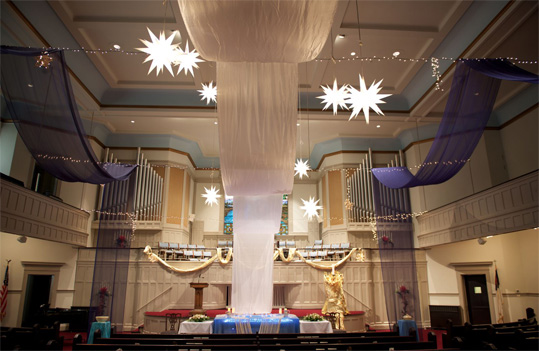
During Epiphany, this installation grew brighter and brighter as the season progressed.
Each season, a musical theme is integrated into the experience as well.
Though her own church had incorporated some creative music and drama into its Easter and Christmas services, it had never celebrated Epiphany.
Lugene Fernald wept during the service -- and every Sunday for the next five or six weeks.
“I felt like I’d been checking in and checking out for too long … and not really becoming engaged in worship. I knew something was missing, but I didn’t know what it was,” she said. “This was something very visually engaging and very purposeful. We could tell that from the beginning, even though we didn’t know what it was all about. Everything was there to support the idea of worship.”
Interested in trying this at your church? Read Severns' tips andwatch a video(link is external) explaining the installation process in depth.
Tabernacle’s pastor, the Rev. Sterling Severns, works with his staff and congregation to create stunning visual installations that are incorporated into traditional worship at the 128-year-old church. Guided by Scripture, he and his staff establish a theme for each liturgical season. They then invite church members to bring that theme to life visually inside the sanctuary. There, using recycled craft materials and a fair amount of duct tape, congregants young and old create vivid installations that evolve with the season.

These decorations, made of plastic flowers, paper and paint sticks, were handed out by the children during Lent. Congregents then stuck them in the pews, creating a symbolic garden. This became a visible sign to the children of their role in worship leadership.
Though they are eye-catching, and once in a while eyebrow-raising, the installations came about for practical reasons rather than aesthetic ones, Severns said. They were a way to communicate.
Creativity as a common language
When Severns arrived at Tabernacle Baptist in 2004, the church was grieving the loss of its previous pastor, who’d died of a brain tumor, and struggling with the same dramatic decline in membership that plagues many urban churches. Still standing only yards from where it had sprouted in 1887 as a mission school, Tabernacle Baptist Church once boasted the largest Sunday school on the Eastern seaboard.
But the church had watched its pews empty over the previous three decades, as young families moved into the suburbs and its aging membership passed away. Average Sunday attendance numbered around 100 when Severns came to the church, and there were very few children among the congregation.
The church prayed for renewal, which came several years later by way of Burma. Fleeing violence in their home country, a contingent of Burmese refugees had resettled in Richmond and were looking for a place to worship. Tabernacle Baptist Church welcomed the new arrivals, many of whom carried with them Baptist hymnals in their native tongue. The refugees spoke little English. And the church’s existing members spoke no Burmese.
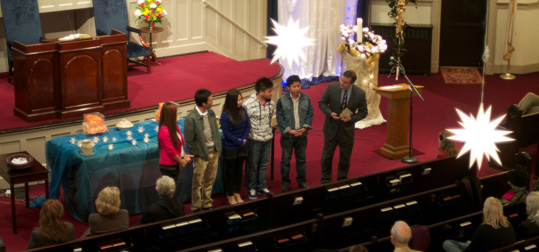
The Rev. Sterling Severns, right, introduced the installations into the church, but at this point the congregation expects to see -- and take part in creating -- the visual displays.
“We had this creative, crazy, beautiful chaos, and we needed to look past the language barrier,” said Severns, who had studied fine-art photography while majoring in religion at Carson-Newman College and had used his camera skills to help pay his way through Baptist Theological Seminary at Richmond. “We basically started to find ways to use visuals to go past that barrier.”
As part of the priesthood of all believers, everyone in the church is a leader and equal participant, Severns said. The refugees, then, weren’t a “project” or a separate subgroup within the church. They were full-fledged members of a congregation that was determined to worship together.
Unlike words on a page, the installations could be understood by all worshippers, regardless of age or native language. And constructing the installations was a way to engage the new arrivals immediately, because everyone was encouraged to participate.
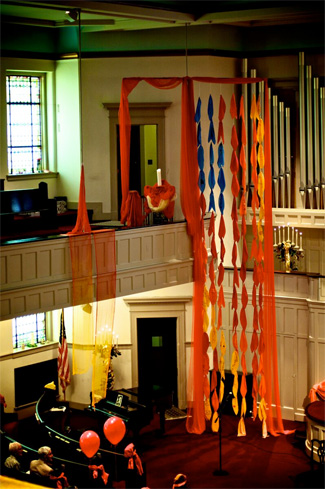
On Pentecost Sunday, children burst into the sanctuary,
releasing red, yellow and orange balloons.
Judy Fiske, the church’s longtime minister of music and worship, recalls using hand motions to ask a group of Burmese women to sew a tablecloth for an early Pentecost installation. The result was a gorgeous length of red, orange and yellow fabric, embellished with knots of material that resembled flames. Creativity became the common language of worship for Tabernacle’s increasingly diverse congregation.
The first Burmese refugees to join the church occupied one pew. Today, refugees make up about one-fourth of the church’s membership. Though the majority of each service is still in English, most Sundays also include prayers and hymns led by Burmese members in their own dialects.
The visual installations conceived to bridge the language barrier still serve as a way to engage refugees. But they’ve also evolved into teaching aids for others -- those who have come from different religious backgrounds, for example, or even just different Baptist traditions, where Epiphany, Lent and Pentecost aren’t observed.
And since each one is a multigenerational group effort, the installations have helped build community within the church, which now counts between 200 and 250 people in its pews and nursery on Sundays.
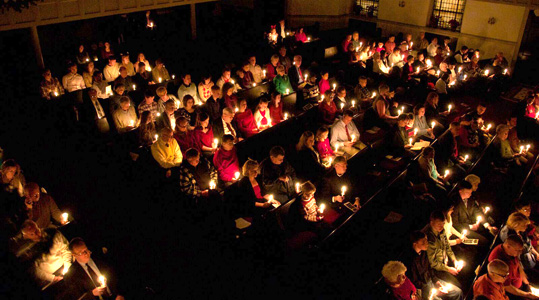
The installations began as a way to bridge the language gap with members of the church from Burma, who now make up about one-quarter of the congregation.
“It’s very participatory. What you do has meaning. What you do has significance. It’s not just decorating,” said Lugene Fernald, who officially joined Tabernacle around Easter 2014. “You feel like you’re participating in something that’s going to bring meaning to worship. And it does.”
Starting small
The church intentionally started with a relatively small project for Pentecost, which, unlike Christmas and Easter, didn’t already have an established tradition at Tabernacle Baptist. It was the first time many of the church’s members had observed the season.
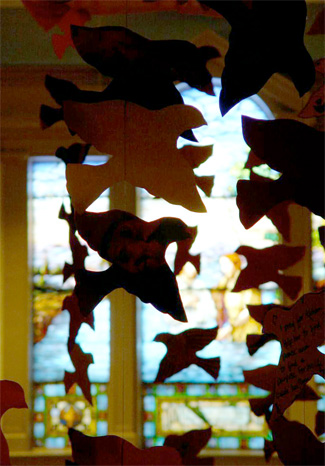
The first installation incorporated doves with prayers
in English and Burmese.
A picture of each church member was printed on a piece of paper that was then cut into the shape of a dove. On the back of each dove, worshippers were urged to write prayers for the person pictured. Some were in English. Others, in Burmese. Many were in the awkward script of children.
Severns asked a congregant who was a welder to fashion three metal rings that could be suspended from the sanctuary’s ceiling. Members then tied the doves to the rings with fishing line from Wal-Mart. Severns figures the whole project cost about $100.
“The doves hovered over the heads of the people. They could look up and see [the pictured] faces, and even if they couldn’t read the prayer, it wasn’t written to them. It was written to God,” he said.
The congregation embraced the concept, and since then, some of its installations have grown more complex.
For Lent one year, members moved the pulpit aside and constructed a sandbox on the chancel, tilting it so worshippers could see inside. Each Sunday, children would come to the front of the sanctuary and place marbles in the sand, gradually creating a path through the metaphorical wilderness. On Good Friday, members stripped the chancel, plucking each marble from the path and dropping it into a bucket with a loud plink that reverberated throughout the sanctuary.
Worshippers have a good deal of freedom in constructing the installations, but the final product is not the result of creativity run amok. Severns describes it as traditional "with a creative twist." Guided by the four-year cycle of the Narrative Lectionary -- and before that, the three-year cycle of the Revised Common Lectionary -- Severns and his staff pore over biblical passages, looking for consistent threads they can weave together into a common theme.
Members of the church are then invited to interpret that theme, relying on a shoestring budget and whatever craft materials they can uncover in the church’s storage room to create a seasonally appropriate installation. Members donate their time, expertise, and occasionally money, and the church also has a small budget of between $200 and $400 annually to support the projects.
The initial construction effort usually takes one night of hard work, but the piece also changes throughout the season. Though the installations don’t run year-round, Severns said, congregants have come to expect one for each major liturgical season.
When participants gather to build the project, Severns first gives them what one member calls “a history lesson,” explaining the context of the season and the relevance of the chosen theme. Members often incorporate images from key scriptural passages, such as doves or fire, as well as seasonal colors.
They also recycle materials from previous installations; a storage area behind the sanctuary overflows with bolts of dyed cheesecloth, king-size sheets and ethnic Burmese fabrics. And Fiske, a Tabernacle staff member for 35 years, keeps a sewing machine under her desk.
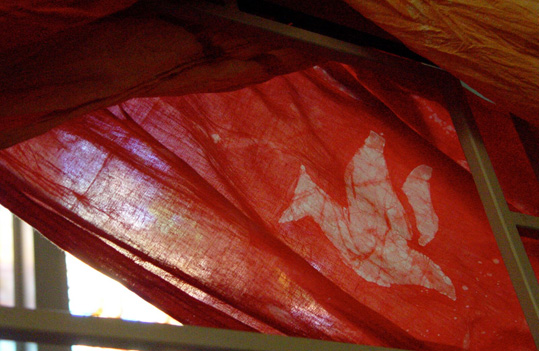
Inexpensive cheesecloth banners, dyed in a washing machine in the church basement, often are part of the installations.
“You have to be sure what you are doing has theological significance and purpose, and if you’re going to put stuff up, there should be a reason why it’s there,” said Fiske, who also comes up with a song of reflection to accompany each season, so there’s continuity from week to week.
New ways to engage with God
The theme for Lent this year was reconciliation. A member who had worked in theater created a massive papier-mâché crown of thorns, while Fiske dyed long swaths of cheesecloth in rainbow colors. One set was soiled, and the idea was that the soiled cloths would flow through one side of the crown of thorns, which was suspended over the sanctuary, while the clean cloths would emerge from the other side and spill down to the floor near the Christ candle, the focal point of each installation.

About 15 people, including staff, children and senior adults, brainstormed the concept and details of this Lenten display. The planning began during the Epiphany season.
Lugene Fernald showed up to help, and as Severns and Fiske shared their vision, she imagined that the soiled cloths were chaotic and knotted, while the clean ones were neatly arranged. She suggested the idea to the group, which welcomed it.
“It was a spiderweb of colors from the side where the soiled cloth was. The other side came out in a much more orderly fashion,” said Fernald, recalling the season’s theme. “Reconciliation brings order to our lives, brings us closer to God.”
The installations are integral to the church’s worship experience, and like worship, they’re a community effort, Severns said. The “new” sanctuary, completed in 1923, is hemmed in by streets on two sides and a sprawling network of church offices, classrooms and fellowship space on the others. But within that finite sacred space, worshippers have embraced a variety of ways to engage with God.
Is worship the most important thing your church does? What are the factors that would make you answer “yes” or “no”?
“We’re not trying to create a new church and plop it on an old church,” Severns said. “The space is not malleable, but the church is full of creative thinkers.”
Many of those creative thinkers are quite young. Worship is the most important thing a church does, Severns said, so its children should be deeply involved in every aspect of it. They bring their own special chaos to the process, noted Severns, but they’re always invited to participate, and sometimes asked to lead the way.
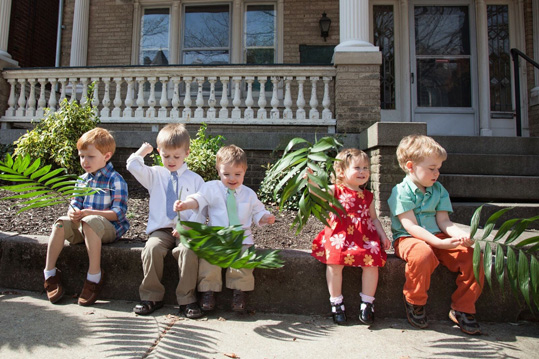
Even children too young to read can engage in worship at Tabernacle through the visual and musical themes.
Just before Pentecost last year, Laura Jones’ son, Jack, who wasn’t quite 11, was asked to teach other church members how to make origami cranes and doves.
On Pentecost Sunday, as the passage from Acts 2 was read, describing the Holy Spirit descending upon the apostles and Jesus’ followers, causing them to speak in tongues, at least a dozen members of the church rose and simultaneously began to read Scripture in other languages, Jones recalled. In the midst of that cacophony, children burst into the sanctuary from every door and released red, yellow and orange helium balloons, each carrying an origami bird upward.
Her children, now 12 and 9, feel like valued members of the congregation because of how regularly they’ve been encouraged to participate in the installations, she said. The projects offer a concrete way for the entire family to connect to worship, Jones said.
“I’m so busy these days that I don’t have the time I used to have to sit and contemplate. To be able to participate in this way helps me mark the changing of the church calendar, the different seasons,” she said. “It’s something, too, for us to talk about as a family. It’s real; it’s tangible. When you participate, it feels like we were there, we were part of the story. We are still part of the story.”
Expecting change
Severns is quick to say that Tabernacle Baptist Church doesn’t consider itself a trendsetter. The initial idea for each installation usually starts with Severns and Fiske, but the two of them say they draw inspiration from other churches, articles in Reformed Worship magazine, Pinterest and other social media sites.
Fiske noticed that an Episcopal church near East Carolina University, where she happened to know the organist, had used about two dozen cinder blocks and candles along with some red fabric for a Taizé service.
At Tabernacle, that morphed into a Pentecost installation featuring 200 cinder blocks, secured by a member who’s a contractor, each with a tea light inside. Every Sunday, members would light the candles and shift the blocks, which symbolized building the church with the Holy Spirit. The installation included an old wooden door that would be moved as well, serving one week as the Communion table and another as a pathway to the baptistry.
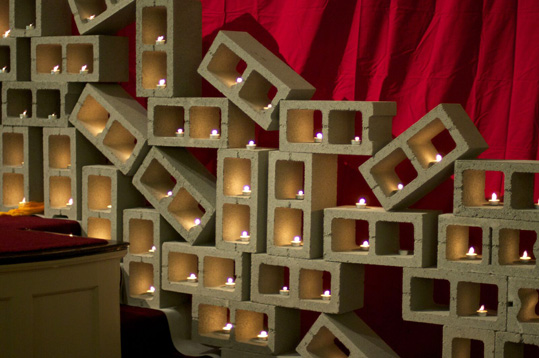
The idea of using cinder blocks was borrowed from another church. Ideas and materials for the installations are loaned and shared with other congregations.
Door imagery is used in many of the church’s installations to symbolize the way the congregation welcomes all in and sends many back out to serve others around the world, Severns said.
The cinder blocks, like the dead crape myrtle branches used one year to convey the wilderness associated with Lent, were not pretty -- and they weren’t intended to be, said Bill Welstead, a member of the church for 50 years. He was skeptical of how they would look in the sanctuary, but in the end, he said, “We just had wonderful worship experiences with cinder blocks.
“It worked. It’s always worked. There’s never been a time when I said, ‘Well, this just falls flat,’” Welstead said. “It’s not routine; it’s not rote. There’s always a message in it that enhances the experience.”
In your congregation, is there is space for aesthetics that are not pleasing?
The installations are never static. Each week, an element is removed, added or altered in some way that reflects the direction of that week’s worship. There’s an air of anticipation each Sunday as worshippers enter the sanctuary and try to track the transformation, said Severns.
“The change isn’t just for the sake of change. It’s more that God is changing us,” said Severns, noting that a member recently shared the following observation: “My assumption,” she said, “is when I walk in the room, something will have changed, and that reminds me that change is expected in me, too.”
Questions to consider:
- The Rev. Sterling Severns describes Tabernacle's approach as traditional worship “with a creative twist.” There is actually only one twist to their worship, but it has a significant impact. What one thing could you do in your institution that would have a significant impact?
- Tabernacle uses visual arts to help overcome the language barrier for 25 percent of their membership. What creative tools does your community use to overcome barriers?
- Severns leads Tabernacle in traditioned innovation by creating new ways to worship in a traditional space. What about your institution's tradition is worth keeping and where are the places you can begin to innovate?
- Severns emphasizes the importance of intergenerational participation in the implementation of the installations. What would happen in your institution if the children burst into a service and released helium balloons?
- Is worship the most important thing your church does? What are the factors that would make you answer “yes” or “no”?
- In the accompanying list of tips, Severns reminds us in No. 4 that the goal is not a pleasant appearance, but one that is immersive and explanatory. In your congregation, is there is space for aesthetics that are not pleasing?
Monday, August 10, 2015

10 Tips for Incorporating Installations into Worship
1. Follow the liturgical year, and start with a season -- such as Epiphany or Pentecost -- with which the congregation isn't overly familiar. Don't change cherished traditions at Easter and Christmas, at least not early on.
2. Trained theological thinking should guide the installations, and more than one trained person should be involved with developing a theme. The Rev. Sterling Severns notes that he's the abstract thinker at Tabernacle Baptist, while Dr. Judy Fiske, the church's minister of music and worship, is more nuts-and-bolts. "I'm more comfortable with ambiguity," Severns said. "Judy's really good about going, 'What's the point? What are you trying to say?'"
3. When developing a theme, know that the feel of the season won't necessarily match the feel of each biblical passage covered within that season.An installation may reflect the entire season or a particular passage within it. The installation should not remain static from week to week; allow room for it to evolve over time.
CONGREGATIONS, WORSHIP, LITURGICAL SEASONS
10 tips for incorporating installations into worship

Cheesecloth banners, papier-mâché and other inexpensive materials are used to create the installations in the 128-year-old sanctuary of Tabernacle Baptist Church.
Photo courtesy of Tabernacle Baptist Church
Vivid installations that change with the liturgical seasons are an integral part of worship at Tabernacle Baptist Church in Richmond, Virginia. The Rev. Sterling Severns shares advice for congregations that wish to experiment with this kind of creative visual approach to worship.
Want to learn more? Watch a 25-minute video of the Rev. Sterling Severns describing the process.(link is external)
1. Follow the liturgical year, and start with a season -- such as Epiphany or Pentecost -- with which the congregation isn’t overly familiar. Don’t change cherished traditions at Easter and Christmas, at least not early on.
2. Trained theological thinking should guide the installations, and more than one trained person should be involved with developing a theme. The Rev. Sterling Severns notes that he’s the abstract thinker at Tabernacle Baptist, while Dr. Judy Fiske, the church’s minister of music and worship, is more nuts-and-bolts. “I’m more comfortable with ambiguity,” Severns said. “Judy’s really good about going, ‘What’s the point? What are you trying to say?’”
3. When developing a theme, know that the feel of the season won’t necessarily match the feel of each biblical passage covered within that season. An installation may reflect the entire season or a particular passage within it. The installation should not remain static from week to week; allow room for it to evolve over time.
4. Remember that the goal is not to decorate the sanctuary so it’s pretty but to offer a more immersive and explanatory experience for worshippers.
5. This is worship, so laypeople, including children, should be involved.
6. Rely on the talents of your members, whether they are welders, theater set designers, quilters, etc. Borrow ideas and materials from other churches.
7. Recognize that some installations will take one night of hard work, while others might require several months of planning.
8. Identify which elements of your sacred space cannot be manipulated. For instance, the stained-glass window of Jesus’ baptism in the Jordan, which hangs above Tabernacle Baptist’s choir loft, is never obscured by an installation (nor is the camera that live-streams each service over the Internet). And the focal point of every installation at Tabernacle Baptist is its Christ candle.
9. Use the photographers in your congregation to document everything you do, and incorporate those images into future installations. Tabernacle Baptist issues a weekly bulletin, and the image on the front is often from that week’s installation.
10. Recycle materials for use in future installations. If the work is meant to be destroyed -- Tabernacle once ripped a large banner progressively over a period of weeks until it was parted at the end of the season -- consider sending pieces home with congregants as bookmarks or keepsakes.
10 Tips for Incorporating Installations into Worship
1. Follow the liturgical year, and start with a season -- such as Epiphany or Pentecost -- with which the congregation isn't overly familiar. Don't change cherished traditions at Easter and Christmas, at least not early on.
2. Trained theological thinking should guide the installations, and more than one trained person should be involved with developing a theme. The Rev. Sterling Severns notes that he's the abstract thinker at Tabernacle Baptist, while Dr. Judy Fiske, the church's minister of music and worship, is more nuts-and-bolts. "I'm more comfortable with ambiguity," Severns said. "Judy's really good about going, 'What's the point? What are you trying to say?'"
3. When developing a theme, know that the feel of the season won't necessarily match the feel of each biblical passage covered within that season.An installation may reflect the entire season or a particular passage within it. The installation should not remain static from week to week; allow room for it to evolve over time.
CONGREGATIONS, WORSHIP, LITURGICAL SEASONS
10 tips for incorporating installations into worship
Cheesecloth banners, papier-mâché and other inexpensive materials are used to create the installations in the 128-year-old sanctuary of Tabernacle Baptist Church.
Photo courtesy of Tabernacle Baptist Church
Vivid installations that change with the liturgical seasons are an integral part of worship at Tabernacle Baptist Church in Richmond, Virginia. The Rev. Sterling Severns shares advice for congregations that wish to experiment with this kind of creative visual approach to worship.
Want to learn more? Watch a 25-minute video of the Rev. Sterling Severns describing the process.(link is external)
1. Follow the liturgical year, and start with a season -- such as Epiphany or Pentecost -- with which the congregation isn’t overly familiar. Don’t change cherished traditions at Easter and Christmas, at least not early on.
2. Trained theological thinking should guide the installations, and more than one trained person should be involved with developing a theme. The Rev. Sterling Severns notes that he’s the abstract thinker at Tabernacle Baptist, while Dr. Judy Fiske, the church’s minister of music and worship, is more nuts-and-bolts. “I’m more comfortable with ambiguity,” Severns said. “Judy’s really good about going, ‘What’s the point? What are you trying to say?’”
3. When developing a theme, know that the feel of the season won’t necessarily match the feel of each biblical passage covered within that season. An installation may reflect the entire season or a particular passage within it. The installation should not remain static from week to week; allow room for it to evolve over time.
4. Remember that the goal is not to decorate the sanctuary so it’s pretty but to offer a more immersive and explanatory experience for worshippers.
5. This is worship, so laypeople, including children, should be involved.
6. Rely on the talents of your members, whether they are welders, theater set designers, quilters, etc. Borrow ideas and materials from other churches.
7. Recognize that some installations will take one night of hard work, while others might require several months of planning.
8. Identify which elements of your sacred space cannot be manipulated. For instance, the stained-glass window of Jesus’ baptism in the Jordan, which hangs above Tabernacle Baptist’s choir loft, is never obscured by an installation (nor is the camera that live-streams each service over the Internet). And the focal point of every installation at Tabernacle Baptist is its Christ candle.
9. Use the photographers in your congregation to document everything you do, and incorporate those images into future installations. Tabernacle Baptist issues a weekly bulletin, and the image on the front is often from that week’s installation.
10. Recycle materials for use in future installations. If the work is meant to be destroyed -- Tabernacle once ripped a large banner progressively over a period of weeks until it was parted at the end of the season -- consider sending pieces home with congregants as bookmarks or keepsakes.


Don't Miss the Rowman & Littlefield 35% Off Summer Sale
Use code 15SUMSALE at check-out to save 35% off on any of our in-stock print titles and eBooks. Shop onlineor call us at 1-800-462-6420. To learn more about the sale, visit the Rowman & Littlefield website.
Offer expires 8/31/2015.
Continue Your Learning at Duke Divinity School

2015 Convocation
& Pastors' School
Duke University | Durham, North Carolina
October 12-13, 2015
How might the church serve as a place of welcome and belonging, nurturing wholeness in every possible sense? How does the church, as Christ's body, walk with those whose bodies or minds act and respond differently? How might Christians helpfully engage in practices of modern healthcare?
Join professor John Swinton, Episcopal priest Claire Wimbush, pastors Deb Richardson-Moore and William Lee and others as we explore the difference Christ's body makes for the way that we care for our communities and ourselves.
Learn more and register »
Ideas that Impact: Congregational Worship
"What Comes After 'Contemporary' Worship? The Return of 'Traditional'" by Prince Raney Rivers
The usual story is of a pastor who staunches a church's decline by introducing "contemporary" worship. But Macedonia Baptist in Pittsburgh capped its growth with a return to "traditional."
Prince Raney Rivers: What comes after "contemporary" worship? The return of "traditional"
The usual story is of a pastor who staunches a church’s decline by introducing “contemporary” worship. But Macedonia Baptist in Pittsburgh capped its growth with a return to “traditional.”
Several years ago I visited the Rev. Jason Barr, senior pastor of Macedonia Baptist Church in Pittsburgh, Pennsylvania. I saw firsthand what transition looks like after change has run its course.
When Barr arrived at Macedonia 15 years ago, the church used a pipe organ and primarily sang anthems. When he introduced drums to worship, a church officer removed them from the sanctuary. Barr brought the drums back in and chained them to the floor.
Under his leadership one traditional service at Macedonia became three contemporary services. A few hundred members mushroomed into 2,500. I always assumed the contemporary worship at Macedonia was simply an expression of Barr’s theology or perhaps a sign of pragmatic pastoral savvy. But recently, I heard Macedonia was planning to reintroduce traditional worship to the congregation.
I had to find out why.
Much to my surprise, Macedonia’s services became contemporary in the first place partly because Barr couldn’t recruit musicians who read music. He could only hire those who play by ear. That changed when Macedonia hired a new worship pastor who plays by ear and is trained academically in music, worship and theology (such a combination is the Holy Grail in African American church musicianship).
What intrigued me even more was Barr’s theological rationale for reintroducing traditional worship. He said that he hopes to eliminate the “hip hop chatter” in worship, referring to the continual prodding of people to be demonstrative during singing and between songs. He finds this approach to worship emphasizes the immanence of God and excludes the transcendence of God.
This switchback highlights the perennial challenge leaders face in navigating the waters between tradition and innovation. As our churches think deeply about shaping future generations of Christians, Barr’s story shows why somebody needs to stop and ask the question, ‘to what end are we innovating?’
Andy Crouch’s “Culture Making” is a must read for anyone serious about leading change. Crouch claims that culture comes from “particular human acts of cultivation and creativity.” We make the specific “artifacts” or “goods” that become a part of a larger framework. In the example above, the drums and the particular style of music in worship would be considered cultural artifacts.
According to Crouch, it is essential to ask “what does a cultural artifact make possible or impossible (or at least very difficult)?” We might add a further question: “What do we stand to gain or lose here?”
Leaders are catalysts for change. Change is what leaders do. But before we sign off on the next new thing, perhaps Christian leaders might be able to chart a better course if we stopped to consider why we’re headed where we’re going in the first place, and how this change helps us get there.
Prince Raney Rivers is pastor of United Metropolitan Missionary Baptist Church in Winston-Salem, North Carolina.
Read more »
"Spiritual Identity and Worship Planning" by P. Alice Rogers
Dr. Corinne Ware has identified four types of spiritual identity -- mystic, feeling, thinking, and visionary. In their worship planning, congregations should attend both to the dominant type while being sensitive to the presence of the other three."Spiritual Identity and Worship Planning" by P. Alice Rogers
Most people who participate in congregational worship services can describe a service they experienced in which they connected with God in a profound way. When I have asked people to describe such a service, I have heard stories similar to these:
- The sanctuary was very dark with candles producing the only light. We listened to Scripture readings, spent time in silent prayer and ended the service by partaking of Holy Communion while kneeling at the altar rail.
- The music was lively—people were clapping and swaying and singing their hearts out. The preacher preached a powerful sermon, and she did not use a single note! People were moved to tears and laughter all in the same service.
- Oh, we sang the great hymns of the church accompanied by a magnificent pipe organ. The preacher preached one of the most well-crafted sermons I have ever heard on the Magnificat. The gothic architecture lifted my very soul heavenward.
- I entered the sanctuary and saw ladders, paint cans, saw horses, and dozens of other tools arranged in the chancel area. The youth had just returned from a mission trip, and they told incredible stories about their week of service. They taught us songs they had sung while they worked, we took up a special collection for missions, and we closed with the entire congregation walking out to the front lawn as a symbol of taking our Christian witness to the world. Now that was a worship service.
- It was the most BORING service I ever attended. All they did was sit in the dark and read Scripture. There were these long periods of silence where I almost fell completely asleep.
- It was the NOISIEST service I ever attended. I didn’t want to stand during every single song, and I certainly didn’t want to clap. I don’t think the preacher had prepared her sermon at all. She didn’t even stand behind the pulpit, and she didn’t have any notes. I was embarrassed for the people around me who were so emotional.
- The service was held in this cavernous, cold building that must have cost a fortune to build. That money could have been used to feed the poor. We sang old, tired hymns, but I couldn’t hear anyone singing because the organ music was deafening. The preacher just stood behind the pulpit and read. What is a magnificat anyway?
- I think that the chancel area is sacred and should never have objects that are not approved. I was horrified to walk in to find paint cans and saw horses and ladders cluttering up the chancel. I expected to have a worship service, not hear youth talk about their vacation. When the congregation got up to walk to the front lawn, I walked to the parking lot and got in my car.
All of the ways people experience God are real and valid. There is no right way or wrong way to experience God. In fact, many people may say that while they identify more strongly with one of the particular scenarios depicted above than the others, that does not mean they do not appreciate various types of worship. They simply are more comfortable with certain styles of worship. So what makes this experience so different for different people, and why does it matter to those of us who lead worship?
Much research has been conducted as to why people are different in their behavior, in their personality, in the way they relate to the world. But the most helpful research I found in understanding the spiritual identity of people who gather to worship was conducted by Dr. Corinne Ware, an Episcopal priest who serves as Assistant Professor of Ascetical Theology at Seminary of the Southwest. Her research, which grew out of a typology articulated by the late Urban T. Holmes, and is related in her book Discover Your Spiritual Type, presents four types of spiritual identity, which when matched with the scenarios above are: mystic, feeling, thinking, and visionary.1 These categories could also be labeled: contemplative, charismatic, intellectual, and crusader. But they are not just categories. They represent the spiritual identities of real people who gather to worship each Sunday.
While many congregations manifest a dominant corporate spiritual type, I am convinced that on any given Sunday, in most congregations, there are people gathered in the pews who represent all four spiritual types. They come week after week expectant and hopeful they will experience God in profound ways, that they will connect to God in a way that brings them strength, hope, and peace. As worship leaders, we have the unique and awesome task of designing worship to help that happen. But this task, this opportunity, requires sensitivity, intentionality, and creativity.
First, the task of designing worship that is inclusive of all of the spiritual types requires sensitivity—a sensitivity to our own dominant spiritual type and sensitivity to the spiritual types of others. As worship leaders, we cannot assume that our dominant way of experiencing God is the best and most effective way for every member of our congregation. Conflict and frustration often arise when a “contemplative” pastor prepares highly contemplative services every single Sunday for a congregation that also has thinking, feeling and visionary types. The contemplatives of the congregation leave each week feeling spiritually renewed and refreshed, while the others depart frustrated and empty. The same is true if a “thinking” pastor has the feeling, contemplative, and visionary members of the congregation read long prayers and litanies each week and writes every sermon as if it were an exegesis to be delivered in a classroom. It is imperative that we know and understand our own dominant spiritual type in such a way that we do not unconsciously and exclusively force it upon others.
A good exercise to develop such sensitivity is to attend a worship service at a church where you have never been. As you experience that worship service, look for the ways in which it allows space for all of the spiritual types to connect with God. Of course, the service might not have been designed with conscious attention to the spiritual types, but look at it from that point of view. How were the different types engaged? Was anyone left out? What parts of the service could have focused on a particular spiritual type? Developing a sensitivity to the variety of ways people experience God will enhance our ability to design effective worship.
Second, if we believe we are called to help all people experience God through worship, then we must be intentional in our planning of each and every service. While there may be other activities throughout the week where individuals have the opportunity to nurture their spiritual identity, such as Bible studies for the thinkers, prayer groups for the contemplatives, or mission activities for the visionaries, the time of corporate worship is the one time of the week when the congregation as a whole gathers. It is the primary time when the body of Christ comes together with their variety of gifts to worship the living God. The preparation for this sacred time should be approached with great intentionality.
That intentionality can be generated by choosing persons who represent each spiritual type for a worship planning team that will design weekly worship together. They will need to be knowledgeable and sensitive to all spiritual types as well, but they will be able to contribute to the design of worship out of their particular spiritual identity. They also will be valuable to the ongoing evaluation of worship as it is experienced each week.
Intentionality also requires constant and ongoing research for resources available for worship design. The internet provides a plethora of worship resources and a planning team can help a very busy pastor search and sort through that information.
A third requirement for designing worship that embraces all of the spiritual types requires working creatively within the basic structures of Word and table and the church year. These structures allow us to design services that are true to the order of worship but with a variety of experiences. For instance, the season of Lent tends towards a spirit of contemplation and also provides a time for focusing on the missional aspect of Christian service. Many congregations choose a mission emphasis during the season of Lent, therefore the design for the gathering time during that season might be very contemplative and the going forth very visionary. The hymns and prayers chosen for those Sundays in Lent might be chosen with more sensitivity to the thinking and feeling types.
The high celebrations of Christmas, Easter, Pentecost, All Saints’ Day, and Christ the King allow for a triumphant focus that speaks not only to our hearts and moves our emotions, but allows us to celebrate the theology of the great hymns and traditions in creative ways. During these high celebrations, the basic order of worship continues to provide room for intentionally connecting with all of the spiritual types.
A good exercise in creativity is to take a particular Sunday in the church year, such as Baptism of our Lord, and to design three or four services that mix up the experience of the spiritual types. For example, this grid outlines a planning order for three separate worship services with an emphasis on a different spiritual type in each of the four components of a Word service.
Such an exercise opens us up to the variety of ways we can creatively design a service for all of the spiritual types without falling into the dangerous practice of assuming only prayer is for contemplatives, or the hearing of the Word is only for thinking types, or the gathering is only for feeling types. Redundancy will kill creativity!
It is a great and wonderful gift to be called by God to officiate worship, and it is an awesome task to facilitate the experience of others in connecting with God. The research provided by Corinne Ware on spiritual types gives us a foundation from which to be sensitive, intentional, and creative in our worship planning such that all persons may experience God in profound ways
__________
Note
1. Ware, Corinne. Discover Your Spiritual Type: A Guide to Individual and Congregational Growth. Herndon, VA: Alban Institute, 1995.
_________________________
Questions for Reflection:
- What is your preferred style of worship? When have you felt the most connected to God in a worship service? Which of Corinne Ware’s spiritual types do you most relate to?
- How can your congregation appeal to many different worship preferences? As a worship leader, how can you create a worship style that is both personal to you and effective for the congregation?
- Where could you go to experience worship in a new way so as to expand your worship horizons?
- Every congregation has people that prefer each worship style mentioned in the article. Who could you ask to be a part of a worship planning committee so as to include all kinds of worship?
Volume 1 2011, Number 1
Read more »
"Generational Worship in a Multigenerational World" by Gil Rendle
While many congregations are aware of and try to respond to generational differences, the better approach is for leaders to attend more to the major generational value shifts rather than the fine-tuned differences so well mapped by the advertising and marketing world.
"Generational Worship in a Multigenerational World"
Most American congregations are already multigenerational, and those that are not are usually intentional about wanting to be. Congregations that hold only one generation are the exception to the rule. Such single generation congregations are more commonly new church starts designed to attract a singular generational cohort. However, given the overwhelming pattern of multigenerational congregations, the pressing issue for leaders is not only how does the church speak to new generations but how does the church hold together multiple generations in one time. “Family” and “community” are still dominant (although limited) metaphors we use to describe congregations. These other two places in our lives are also where multigenerational expectations are confronted and negotiated. With the increase of life expectancy we now experience differences spanning up to five generations in all of these places-congregation, family, and community.
The reality of already existing multigenerational settings means that most congregations are seeking to find forms of worship that (1) live well across these differences, (2) give voice to the various and often competing preferences that live side by side among the multiple generations in the pew, and (3) prepare an expression of faith that will be sustained into a changing future. The better approach is for leaders to attend more to the major generational value shifts rather than the fine-tuned generational differences so well mapped by the advertising and marketing world.
Joseph Turrow, professor at the Annenberg School for Communication at the University of Pennsylvania, has demonstrated the way in which technology and advertising have contributed to a marketing industry that has developed fine-tuned ways to segment (differentiate) and target people according to even the smallest differences in their preferences and behavior.1 A highly complex and comprehensive marketing industry now collects huge amounts of demographic and economic information at the individual level so that each of us can be “assigned” to one of a number of categories based on lifestyle and preferences. Among other things, this is how the world knows which mail-order catalogs to send us. More important, it trains us to think of ourselves individually and to give priority to our perceived personal needs over others.
This sensitivity to differences has heightened generational disparities. Take for instance TV commercials that are so generationally focused–using the images and metaphors of a single generational cohort–that others cannot even identify the product being sold. This same sensitivity has also given people an increasing sense of entitlement when it comes to having “things” (including worship) “their way.” For most congregations such fine-tuning may not serve the sense of “community” well. Heightening and focusing on generational preferences may lead to a trendiness that will not bear the long term fruit of the faith. In fact, leaders need to practice caution in following generational preferences too closely. The results are not yet in, but it appears that early trends of megachurches, worship designed explicitly for the seeker, and fully contemporary worship, while clearly viable, will not be dominant expressions of worship and faith. We are still on the way to “something else” or “something more.”
As leaders trying to understand generational differences, it is more helpful to back away from all of the reified and magnified differences between early baby-boomers, late baby-boomers, gen-Xrs, millenials…and so on down the line. All of these generational cohorts do, in fact, have their own preferences and life lessons that make them different from one another. But each of these generational cohorts shares a need for a personal faith lived in community (a congregation), and each of these generational cohorts lives, daily, in a multigenerational environment.
The more productive approach in understanding generations in worship is not to drill deeply into the smaller differences but to attend to the larger “watershed” divide of cultural values. Jackson Carroll, project director of the Pulpit and Pew research on Pastoral Leadership at Duke Divinity School points to a “major generational watershed” that lies between those who are Pre-boomers (born prior to 1946) and those who have come after.2 He notes, for example, that “although Boomers (born 1946 – 1964) and Xers (born 1965 – 1979) differ in some respects, they are much more like each other than like Pre-boomers.
For the purpose of this brief article we can look quickly at one of the watershed value differences-the life lesson to see oneself as primarily a part of a larger group (Pre-boomer “GI” value) or the life lesson of seeing oneself primarily as an individual (Boomer -and following-“consumer” value).3 When seen through the lens of the GI value of “group,” it is easily assumed that there is one way for everyone to worship and that it is the way that has been shaped by past and present tradition. In this value system people who have different preferences are expected to conform to the group and not seek to change things. This voice in the multigenerational congregation can often be heard to argue that:
In a fast-paced world it may feel outdated to be concerned about the values and preferences of persons born prior to 1946. However, the reality is that many, if not most, established Mainline Protestant, Roman Catholic, and Jewish congregations are still anchored in the value system of the Pre-boomers. All living communities and organizations develop norms of practice to follow. Norms are the usually silent and often invisible practices and agreements that we develop by common consent in human groups. These norms (such as “it is inappropriate to bring coffee into the sanctuary” or “the pastor alone decides whether Christmas hymns can be sung in the Advent season”) provide the guidelines for how the community will behave. Because norms are often hidden and unquestioned, they are difficult to change. In many of our North American congregations the norms practiced by leaders and members are still heavily guided by the values and preferences of the Pre-boomer people since these norms were established in years past. This is how people learned to do worship over the years and it is ingrained in the assumptions of most people in the pews.
We need to become more aware of the tacit norms that guide us. The way in which we worship and express faith must remain supple and open to the change necessary to be heard in a changing world. Like any living language that constantly adapts to use by adding new words, deleting words that have lost meaning, and becoming more or less formal as the pendulum of culture sways, our worship practices also need to constantly change in order for worship to live. Not to adapt is to die. Not to be changed by use is to lose usefulness.
The task of leadership is not to proclaim what form of worship is “right” or to point out who is “wrong.” The more important question is how, within this specific congregation, do we need to worship? The answer to the question comes as a dialogue between God, the people of the congregation, and the culture in which we live. An intriguing, and healthy, model for such conversation was developed by Dan Schechter, who was a vice chair of the Union of American Hebrew Congregations. Designed for use in synagogue discussions of worship, it is equally adaptable for use in Christian congregations. A worship self-study team of eight to twelve people who represent the membership of the congregation agree to study, participate in worship, and keep a “worship diary” on their experience. The pastor and others lead the group in an initial period of study in which the purpose of worship and the purpose of the components of the liturgy are explored. Context and purpose is offered to questions such as “Why do we sing?” “Why do we pray?” “Why do we have assigned roles for clergy and lay people to play?” “Why are there times of silence in our worship?” Being careful to avoid the temptation to teach people how they “should” worship, the pastor helps people turn to church and denominational history in order to understand the intent-the purpose-of forms of worship. With some idea of what the worship is meant to do, the study team members then spend several weeks in worship attending to their own experience. Using their worship diaries they begin to track their own response to the intent of the worship. The team then joins together to begin a conversation about worship in their own particular church asking:
A version of this article was originally published as “Beginning a Communal Conversation: A Process for Developing Intergenerational Worship” in Reformed Worship, Number 76 (June 2005).
______________
1. Joseph Turrow, Breaking Up America, (University of Chicago Press, 1997).
2. Jackson Carroll, “Bridging Worlds: The Generational Challenge to Congregational Life”, Circuit Rider 22:5 (September – October, 1999).
3. For a full discussion of generational value systems see, Gil Rendle, The Multigenerational Congregation, (Alban Institute, 2002).
4.Daniel Schechter, Synagogue Boards: A Sacred Trust, Appendix E: “Procedure for Self-Study of Congregational Worship” (UAHC Press, 2000).
Read more »
Visit Alban.org
STAY CONNECTED


____________________________
Alban
"Generational Worship in a Multigenerational World"
Most American congregations are already multigenerational, and those that are not are usually intentional about wanting to be. Congregations that hold only one generation are the exception to the rule. Such single generation congregations are more commonly new church starts designed to attract a singular generational cohort. However, given the overwhelming pattern of multigenerational congregations, the pressing issue for leaders is not only how does the church speak to new generations but how does the church hold together multiple generations in one time. “Family” and “community” are still dominant (although limited) metaphors we use to describe congregations. These other two places in our lives are also where multigenerational expectations are confronted and negotiated. With the increase of life expectancy we now experience differences spanning up to five generations in all of these places-congregation, family, and community.
The reality of already existing multigenerational settings means that most congregations are seeking to find forms of worship that (1) live well across these differences, (2) give voice to the various and often competing preferences that live side by side among the multiple generations in the pew, and (3) prepare an expression of faith that will be sustained into a changing future. The better approach is for leaders to attend more to the major generational value shifts rather than the fine-tuned generational differences so well mapped by the advertising and marketing world.
Joseph Turrow, professor at the Annenberg School for Communication at the University of Pennsylvania, has demonstrated the way in which technology and advertising have contributed to a marketing industry that has developed fine-tuned ways to segment (differentiate) and target people according to even the smallest differences in their preferences and behavior.1 A highly complex and comprehensive marketing industry now collects huge amounts of demographic and economic information at the individual level so that each of us can be “assigned” to one of a number of categories based on lifestyle and preferences. Among other things, this is how the world knows which mail-order catalogs to send us. More important, it trains us to think of ourselves individually and to give priority to our perceived personal needs over others.
This sensitivity to differences has heightened generational disparities. Take for instance TV commercials that are so generationally focused–using the images and metaphors of a single generational cohort–that others cannot even identify the product being sold. This same sensitivity has also given people an increasing sense of entitlement when it comes to having “things” (including worship) “their way.” For most congregations such fine-tuning may not serve the sense of “community” well. Heightening and focusing on generational preferences may lead to a trendiness that will not bear the long term fruit of the faith. In fact, leaders need to practice caution in following generational preferences too closely. The results are not yet in, but it appears that early trends of megachurches, worship designed explicitly for the seeker, and fully contemporary worship, while clearly viable, will not be dominant expressions of worship and faith. We are still on the way to “something else” or “something more.”
As leaders trying to understand generational differences, it is more helpful to back away from all of the reified and magnified differences between early baby-boomers, late baby-boomers, gen-Xrs, millenials…and so on down the line. All of these generational cohorts do, in fact, have their own preferences and life lessons that make them different from one another. But each of these generational cohorts shares a need for a personal faith lived in community (a congregation), and each of these generational cohorts lives, daily, in a multigenerational environment.
The more productive approach in understanding generations in worship is not to drill deeply into the smaller differences but to attend to the larger “watershed” divide of cultural values. Jackson Carroll, project director of the Pulpit and Pew research on Pastoral Leadership at Duke Divinity School points to a “major generational watershed” that lies between those who are Pre-boomers (born prior to 1946) and those who have come after.2 He notes, for example, that “although Boomers (born 1946 – 1964) and Xers (born 1965 – 1979) differ in some respects, they are much more like each other than like Pre-boomers.
For the purpose of this brief article we can look quickly at one of the watershed value differences-the life lesson to see oneself as primarily a part of a larger group (Pre-boomer “GI” value) or the life lesson of seeing oneself primarily as an individual (Boomer -and following-“consumer” value).3 When seen through the lens of the GI value of “group,” it is easily assumed that there is one way for everyone to worship and that it is the way that has been shaped by past and present tradition. In this value system people who have different preferences are expected to conform to the group and not seek to change things. This voice in the multigenerational congregation can often be heard to argue that:
- There should be only one large worship service where we can all be together and get to know one another.
- We need to affirm the liturgy, the roles of leadership, the roles of adults and children, and the time of worship as practiced over the years.
- There is a fairly narrow range of music appropriate to worship (sometimes limited to as few as 25 “approved” hymns).
- Children (members with minority status) should be seen and not heard.
- Multiple choices in the time and format of worship
- Choices about liturgy based on how it influences one’s own spiritual needs, informal roles that blend leaders and participants in shared action, and experiments that may reach either ahead to untried practices or reach back to ancient traditions once forgotten
- A wide range of music that reflects the global world that people experience daily
- An inclusion and accommodation of children similar to the role given children in the current culture
In a fast-paced world it may feel outdated to be concerned about the values and preferences of persons born prior to 1946. However, the reality is that many, if not most, established Mainline Protestant, Roman Catholic, and Jewish congregations are still anchored in the value system of the Pre-boomers. All living communities and organizations develop norms of practice to follow. Norms are the usually silent and often invisible practices and agreements that we develop by common consent in human groups. These norms (such as “it is inappropriate to bring coffee into the sanctuary” or “the pastor alone decides whether Christmas hymns can be sung in the Advent season”) provide the guidelines for how the community will behave. Because norms are often hidden and unquestioned, they are difficult to change. In many of our North American congregations the norms practiced by leaders and members are still heavily guided by the values and preferences of the Pre-boomer people since these norms were established in years past. This is how people learned to do worship over the years and it is ingrained in the assumptions of most people in the pews.
We need to become more aware of the tacit norms that guide us. The way in which we worship and express faith must remain supple and open to the change necessary to be heard in a changing world. Like any living language that constantly adapts to use by adding new words, deleting words that have lost meaning, and becoming more or less formal as the pendulum of culture sways, our worship practices also need to constantly change in order for worship to live. Not to adapt is to die. Not to be changed by use is to lose usefulness.
The task of leadership is not to proclaim what form of worship is “right” or to point out who is “wrong.” The more important question is how, within this specific congregation, do we need to worship? The answer to the question comes as a dialogue between God, the people of the congregation, and the culture in which we live. An intriguing, and healthy, model for such conversation was developed by Dan Schechter, who was a vice chair of the Union of American Hebrew Congregations. Designed for use in synagogue discussions of worship, it is equally adaptable for use in Christian congregations. A worship self-study team of eight to twelve people who represent the membership of the congregation agree to study, participate in worship, and keep a “worship diary” on their experience. The pastor and others lead the group in an initial period of study in which the purpose of worship and the purpose of the components of the liturgy are explored. Context and purpose is offered to questions such as “Why do we sing?” “Why do we pray?” “Why do we have assigned roles for clergy and lay people to play?” “Why are there times of silence in our worship?” Being careful to avoid the temptation to teach people how they “should” worship, the pastor helps people turn to church and denominational history in order to understand the intent-the purpose-of forms of worship. With some idea of what the worship is meant to do, the study team members then spend several weeks in worship attending to their own experience. Using their worship diaries they begin to track their own response to the intent of the worship. The team then joins together to begin a conversation about worship in their own particular church asking:
- Does this do it for us? Does the way we now worship fulfill the purpose for which we gather? (The key word is “us.” This is a communal conversation. It is not about the singular “I” and the particular preference of the way I like to do it.)
- How can we best do this, not only for ourselves, but to be welcoming to the people who are not yet here?
A version of this article was originally published as “Beginning a Communal Conversation: A Process for Developing Intergenerational Worship” in Reformed Worship, Number 76 (June 2005).
______________
1. Joseph Turrow, Breaking Up America, (University of Chicago Press, 1997).
2. Jackson Carroll, “Bridging Worlds: The Generational Challenge to Congregational Life”, Circuit Rider 22:5 (September – October, 1999).
3. For a full discussion of generational value systems see, Gil Rendle, The Multigenerational Congregation, (Alban Institute, 2002).
4.Daniel Schechter, Synagogue Boards: A Sacred Trust, Appendix E: “Procedure for Self-Study of Congregational Worship” (UAHC Press, 2000).
Read more »
Visit Alban.org
STAY CONNECTED
____________________________
Alban
312 Blackwell Street, Suite 101
Durham, North Ccarolina 27701 United States
___________________________
___________________________

No comments:
Post a Comment