Editor's Note:
Dear Friend,
By all accounts, Rachel lived a difficult life.
As a young woman she forfeited her own marriage to Jacob in order to spare her sister, Leah, embarrassment. The years passed and she stoically watched her sister give birth to child after child while she struggled to conceive. Even in death, she was buried on the side of the road, leaving her rightful place next to her husband in the Cave of Machpela to her sister, Leah.
Centuries later, when the Jewish people were exiled from Israel, they passed Rachel's tomb, drawing strength and comfort from her presence, and she beseeched G-d on their behalf to restore Israel and return her children to their land.
This week we mark her passing on Tuesday, Cheshvan 11th. When we face hardships and struggles, we can draw strength and inspiration from the way Rachel dealt with hers.
And Rachel waits, patiently, at the side of the road, for the day that G-d will return her children to the Land of Israel permanently, with the coming of Moshiach. May it happen soon!
Miriam Szokovski
on behalf of the Chabad.org Editorial Team
How does Rachel inspire you? Share your thoughts with us.
Daily Thought:
Prison
Torah has no concept of prison as a punishment. Why? Because prison is a futile place. A place where you are told, "You must be here, but you must not change what this place is. You will grow older, but you must not take charge of your life. You will live, but you must not give life."
But a living human being must make change in his world, must take charge of his life, must give life to others.[18 Elul 5710:3; Purim 5736:4; Tzav 5736: 2.]
This Week's Features:
 How Can I Pray to a G-d I Can’t See?
Stepping Into Reality by Tzvi Freeman
Hello Rabbi,
Here I am facing a wall, or the back of some other congregant, or just a row of empty chairs, and I’m talking to someone. Who? An Infinite Being I cannot see, nor hear, nor touch, nor fathom, or even shake His hand. And I’m supposed to relate to this Being with all my heart. Can you give me a handle on this?—B. Wildered
Hello B,
The short story is, you’re starting from the wrong end. You’ve got a wall, a chair and a self and all that is all very concrete, occupying real, hi-definition space. Then you’ve got this infinite, invisible G‑d. And you’ve got to fit Him somewhere in there. But, of course, He doesn’t fit.
The truth is the opposite way around. G‑d is all that’s real. To pray demands that you first step out of your highly limited context into a much greater reality.
Try this meditation: Imagine you’re in a cramped hotel room in Manhattan. Rain is beating down on the window, sirens are heard in the distance. Too distant. Your beloved lies on the floor before you, gasping her last breaths. Your knees shiver as you kneel to hold her cold, limp hand. You have words to say, but they just can’t come out.
You pause. Then you stand up and yell, “Cut the lights!”
At which point, the hotel room is no longer a hotel room, the sirens are silenced and the beloved on the floor is no longer dying (nor beloved). An entirely reality dissolves. You turn to the director.
“Look,” you say, “I really respect you as a director and I know it’s your script and your movie. But these lines, this whole scene—it’s really not working. Can we try something a little more hopeful?”
If you’re a real actor you can do that. Because a real actor is capable of living in two realities at once. He’s totally invested in his part in this story. And at the same time, he remembers that he is an actor, and this is a story.
There’s a lot of parallels there with our world. It’s a story. There’s a director. You need to play your part as best you can. But at the same time, you need to be ready to step out of that story at any time into a much wider context, into the realm of the Grand Director, and from there see things as they really are.
Someone once pounced on Rabbi Menachem Mendel of Kotz and demanded, “Rebbe, where is G‑d?”
To which the rabbi calmly answered, “Wherever you let him in.”
If you’re playing your part in a movie, where is the director/writer/producer in the movie? He’s not a character. He’s not the background. He’s not a prop, or the theme, or the plot. He’s present in all those things. But if you want to speak to him, he’s wherever you let him in.
Now take three steps back, three steps forward, put your feet together, and say the Amidah prayer.1
FOOTNOTES
1.The prevalent custom is to take three steps back, then three steps forward before the Amidah—the silent prayer said standing three times a day. The steps backward are a preparation for speaking to your Creator just as the steps forward. See Kaf Hachaim 95:7.
PARSHAH
"Abraham?" "Here I Am"
 Is G-d looking to trip me up? Is He punishing me? Ignoring me? Am I just plain old unlucky? by Rochel Holzkenner
“And it was after these things, and G‑d tested Abraham, and He said to him, ‘Abraham,’ and he responded, ‘Here I am.’”1
Isn’t that an intriguing sentence? It’s more than a cordial formality—because why would the Torah bother to record that? It’s like eavesdropping on an intimate dialogue between G‑d and Abraham. Can you hear the love in their words?
Isn’t that an intriguing sentence?
“Abraham.”
Pause.
“Hineini. I am here.” Fully present. Mindful of this moment, this divine dialogue.
And then the Torah launches into the dramatic story of the binding of Isaac. “And He said to him, ‘Take your son, your only son, the son that you love, and bring him up as a sacrifice on the mountain that I will show you.’”
The story would read the same without that first verse. But that verse sets the tone for the subsequent dialogue.
The binding of Isaac was the last of ten tests with which G‑d tested Abraham’s faith,2 beginning with the time Abraham was thrown into a fiery furnace for his monotheistic beliefs—and miraculously survived.3 His faith, like a muscle, grew stronger with each challenge.
Note that every other test is described by the Torah4 without any introductory remarks about G‑d’s intentions. For example, when Abraham was 75, G‑d challenged him by asking him to move to Canaan: “And the L‑rd said to Abram, ‘Go forth from your land and from your birthplace and from your father's house, to the land that I will show you.’”5
The Torah doesn’t say, “And G‑d tested Abraham and said, ‘Go forth from your land . . .’” Likewise, when G‑d told Abraham to circumcise himself,6 and when He told him to send away Hagar,7 the Torah jumps right into the dialogue without a lead-in sentence.
Yet when G‑d tells Abraham to sacrifice his son, we need an opening remark, a framework for this shocking request. Heads up—it’s just a test. It’s not really going to happen. The previous nine tests were experiences that Abraham actually endured—and emerged at the other end a better person. But this time around, it was just a test. Abraham would not be killing his son.
It is in this story that the Hebrew word for “test,” “nissah,” makes its debut in the Torah. (For the prior nine tests, the word “nissah” was not used.)
The power behind any object or phenomenon can be traced back to the Hebrew letters that make up its name. G‑d created the universe with words.8 Each Hebrew letter is a thread of divine creative energy. When G‑d spoke the words “Let there be light,” the letters aligned to produce the specific formula for light.
It is for this reason that Kabbalists consider homographs, words that are spelled the same but have different meanings, to be quite significant. In English, a word can have two meanings that are not at all connected; for example, the word “can” means “cylindrical metal container” and “be able to.” But in Hebrew, a word that has two meanings is very telling, because both meanings share the same energetic root and therefore must be interconnected. Studying their underlying similarity exposes the true nature of both words. For example, the Hebrew word “nissah,” “test,” shares the same root letters as the Hebrew word “nes,” a word that has two alternate meanings: “miracle” and “banner.” (In the Amidah prayer, we say, “V’sa nes l’kabetz galuyoteinu—Raise a banner to gather our exiles.”)
Studying the interconnection of these three homographs clues us in to one of the most perplexing questions of all time: Why does G‑d test me? Why didn’t my car start this morning? Why is my spouse so difficult? Why can’t I make ends meet?
Is G‑d looking to trip me up? Is He punishing me? Ignoring me? Am I just plain old unlucky?
Is G‑d looking to trip me up?
Nachmanides asks this question: Why would G‑d test Abraham? Why would He test anyone? The test, he explains, is a character-builder. A challenge in life can force us to flex a new character muscle, pushing us to develop parts of ourselves we never would’ve otherwise developed. A parent with a special needs child tends to build incredible patience—more patience than he ever thought himself capable of. A person in a financial crisis can become much more resourceful in order to make money again. A law student may not know how hard she can study until she is forced to take the bar exam.
People who are tested will often say, “I never thought I could do that!” They are amazed at their own strength as they overcome the challenge. They look at their accomplishments as miraculous: “I’m naturally an impatient person; the fact that I became a patient parent is miraculous.”
Why does G‑d test us? The answer lies in the very word for “test,” “nes,” a word that means “miracle” as well. The test is there to bring out the miracle in you. To elicit strength that is uncharacteristic and unfamiliar. G‑d’s not ignoring you, He’s training you to be miraculous.
The Malbim9 notes that this test was much more difficult than the previous nine, hence the introduction “And G‑d tested Abraham.” The purpose of a test, he writes, is not to evaluate a person’s courage as much as to push him to take action that is completely out of character for him. Abraham’s commitment to doing G‑d’s will pushed him to do something that was completely unnatural to him.10
The Midrash brings several fascinating analogies to explain why G‑d would test Abraham so intensely. One analogy compares G‑d to a hackler, a person who refines flax seeds. The process of refining flax is arduous and lengthy: first, they’re put in water for a prolonged period of time to break down the sticky pectins, then they’re crushed and scraped until the fibers are soft and refined, transforming the dark seeds into a luscious linen fabric.
But the Midrash offers another analogy to explain why G‑d tested Abraham. This one compares G‑d to a marketer who is looking to sell pots. He brings them to the marketplace and bangs on them, boasting of their durability. “This pot doesn’t bend under pressure,” he advertises. “It’s solid.”11
This excruciating challenge was an opportunity to expose all of Abraham’s strength, courage and faith. “Hineini. I’m present. I’m not afraid. What can I do for You?” The beauty in that surrender brought dignity to his identity.
Abraham’s response to G‑d went viral. He became a hero, a legend. We read about him on the holiest day of the year, and the binding of Isaac is the only biblical story included in our daily prayers. G‑d hammered on Abraham’s equilibrium, threatening to shatter what Abraham had spend a lifetime building.12 G‑d banged and music emerged—Abraham’s unique melody, “Hineini.” Abraham’s melody became an immortal song of true faith.
If G‑d tests you, you have a song to sing
If G‑d tests you, you have a song to sing. It’s tender music that only you can play, and only in a challenging circumstance. And it’s a song that will uplift all who hear it.
“Nes” means “test,” and it means “banner.” When we're tested, we advertise our faith. Our reaction to the challenge makes a statement about who we think is running the show of our lives.
A child spills orange juice on a clean floor. He wasn’t supposed to pour it for himself. The mother notices, and she’s angry. “I told you that you’re not allowed to pour by yourself. You never listen! I’m so angry at you! Go to your room.” Quite an understandable reaction. As for the child, he’s probably learned one important lesson: when someone disappoints you, it’s okay to lash out at him. Suppose the mother has the self-control to speak with dignity to her child, even though she is pent up with frustration. The child will learn, even when you are disappointed with someone, you can still speak to him with respect. And perhaps that is the whole reason that G‑d challenges her with the spilled juice. It gives her the opportunity to teach her children more about self-control than a long lecture would.
Rabbi Yitzi Hurwitz is the executive director of Chabad of Temecula, CA. He was diagnosed with ALS and now is unable to speak or move any part of his body, except for his right thumb. Before Yom Kippur, he wrote: “Teshuvah (return) doesn’t ask me to become someone new, but invites me on a journey to uncover my deepest self. Being infinite, the soul is actually a part of G‑d, hence there is infinite depth and always there are more layers to uncover.”13
A man with a devastating disease is thinking about uncovering his deepest self?! To me, he is a banner of heroism and faith. When I look at his reaction to his challenge, I am deeply inspired. He’s taught me so much about the value of life and the power of the soul despite the limitations of the body.
Abraham’s reaction to his tenth test made him a banner of faith for all time. Every time we keep the faith in spite of the challenge, we inspire faith in others as well.
FOOTNOTES
1.Genesis 22:1.
2.Maimonides commentary on Avot 5:3.
3.Rashi on Genesis 11:28, quoting Bereishit Rabbah 38:13.
4.Either explicitly in the text or alluded to in the text and elucidated in the Midrash.
5.Genesis 13:1.
6.Genesis 17:24.
7.Genesis 21:12.
8.Genesis 1:3.
9.Meïr Leibush ben Yehiel Michel Weiser, better known by the acronym Malbim, was a rabbi, master of Hebrew grammar and Bible commentator. The name "Malbim" is derived from the Hebrew initials of his name, and became his nickname by frequent usage.
10.See commentary of the Malbim on Genesis 22:1.
11.Malbim on Genesis 22:1.
12.Abraham had spent his life spreading monotheism and speaking out against human sacrifices. Killing Isaac would silence the only other person who could continue spreading monotheism after Abraham would pass on. It would also make Abraham look like a hypocrite for sacrificing his son after crusading against human sacrifice.
13.Lubavitch International Magazine, vol. 3, issue 10.
More in Parshah:
• Can a Change of Name Create a Change of Destiny? (By Chana Weisberg)
 What’s in a name?
Have you ever thought about what influence your name has on you—on your personality, behavior patterns and life choices?
A growing body of research suggests that an individual’s name can have a profound impact that can reverberate from childhood to adulthood. A study by professors at the University of Melbourne and New York University found that people with simple, easy-to-pronounce names are more likely to be favored for a promotion at work. “The impact of names comes from how people expect to see you,” says a professor from Ohio University. And while pre-judging people based on their name might seem unfair, we sometimes do so subconsciously when making decisions.
An individual’s name can have a profound impact
A recent article in the Wall Street Journal describes how in Thailand, when faced with a patch of bad luck, many are changing their names to create better prospects. Businesses advising Thais how to choose new names are becoming a booming new industry.
So research indicates that a person’s name can even affect career choices. But is the significance of a name just about perceptions, or is there something innately spiritual about the name itself that has a power over the individual?
Names are considered very significant in Judaism. Your Jewish name is the channel by which life reaches you from Above. In fact, the Kabbalists say that when parents name a child, they experience a minor prophecy—because, somehow, that child’s destiny is wrapped up in the combination of Hebrew letters that make up his or her name. The sages of the Midrash recommend that “one should name one’s child after a righteous person, for sometimes the name influences the person’s behavior and destiny” (Midrash Tanchuma, Haazinu 7).
If a name has an intrinsic effect on the person, can a change of name change one’s destiny?
Changing one’s name to create a change of fortune actually has its roots in Judaism. That’s why if someone is dangerously ill, we might provide him with an additional name, like Chaim (or Chaya), meaning “life,” or Refael (or Refaela), “cure.”
The first recorded story of a name change that led to an incredible change of destiny wasIf someone is dangerously ill, we might provide him with an additional name that of Sarah and Abraham.
The episode took place when Abraham was 90 years old. G‑d appeared to him and told him that He would be making an everlasting covenant with him, and that he and Sarah would be blessed with a child of their own. Let’s see how the text reads:
And Abram was ninety-nine years old, and G‑d appeared to Abram, and He said to him, "I am the Almighty God; walk before Me and be perfect. And I will place My covenant between Me and between you, and I will multiply you very greatly… And your name shall no longer be called Abram, but your name shall be Abraham, for I have made you the father of a multitude of nations. And I will make you exceedingly fruitful, and I will make you into nations, and kings will emerge from you. (Gen. 17: 1-2, 4-5)
G‑d then commanded Abraham that he and all his male children should be circumcised as a sign of the covenant. His wife’s name, Sarai, should also be changed, and then she would experience the miracle of childbirth despite her old age.
And G‑d said to Abraham, "Your wife Sarai--you shall not call her name Sarai, for Sarah is her name. And I will bless her, and I will give you a son from her, and I will bless her, and she will become a mother of nations; kings of nations will be from her.” And Abraham fell on his face and rejoiced, and he said to himself, "Will a child be born to one who is a hundred years old, and will Sarah, who is ninety years old, give birth?" (Gen. 17: 15-17)
The Talmud explains that Abraham and Sarah’s change of name created a change in their status--rather than a particular mission, they now assumed a universal mission. The Talmud (Brachot 13a) explains:
Abram who is Abraham. In the beginning he was the father to Aram, in the end he became the father of the world. Sarai, this is Sarah. In the beginning she was Sarai to this nation and in the end she became Sarah to the whole world.
AbramRather than a particular mission, they now assumed a universal mission means “Av Ram,” father of Aram, since he originated from the city of Aram Naharayim. His name was changed to Abraham, “Av Hamon Goyim,” father of a multitude of nations.
The Malbim (Gen. 17:15) expounds:
Sarai, given her name by Abraham, means “Sharasi Sheli,” my princess and superior. Abraham was now commanded that in his new status of“Av Hamon Goyim,” the father of a multitude of nations, his wife, too, was to take on a more universal status which would be reflected in the name, Sarah, princess par excellence and not just princess of Abraham.
Let’s take a closer look at the text describing these name changes. G‑d told Abraham, “Your name shall become Abraham.” Regarding Sarah’s name change, on the other hand, the text reads, “Sarah is her name.”
Abraham required an added dimension and spiritual transformation to become Abraham. Sarah, though, already was Sarah.
The Talmud (Yerushalmi, Sanhedrin 2;6) explains:
Rabbi Huna said, quoting Rabbi Acha: The letter yud which was removed from Sarai’s name was divided into two letters, one hei was added to Abram and the other to Sarah.
The change in Sarai’s name involved the division of the yud of Sarai into two heis. Yud, numerically equivalent to ten, was split into two heis, numerically equivalent to 5, to share of Sarai’s spirituality. Therefore, the text reads, “Sarah is her name;” Sarai already represented all the spirituality of Sarah.
In fact this yud taken from Sarai’s name was later added to her descendant’s name, Joshuah, Moses’ successor. He was one of the 12 spies sent to survey the land of Israel. Though his name was originally Hoshea, Moshe changed his name to Yehoshuah, Joshua, gifting him with the present of Sarah’s spiritual yud. This gave him an added dimension of spirituality, so that he would have the courage to withstand the plot of the spies and bring back a true, positive report about the Land to the Jewish people. His new name achieved the sought after results, as only he and one other spy refuted the others’ negative report.
Aside from teaching us about Sarah’s incredible spiritual strength and her ability to share it with others, the episode demonstrates that there’s more to a name than meets the eye.
So what’s in a name? Apparently lots.
A name connects us to our soul. It provides us with spiritual ammunition, allowing usA name connects us to our soul. to access spiritual strengths we may have never known we had.
How about you? What’s your Jewish name? Do you use it proudly? Is it time to research what it means and what hidden spiritual powers it holds?
Let’s Review:
When Abram was 90, G‑d appeared to him to make an everlasting covenant, change his name, and inform him that he would have a child from Sarah.
Abram’s name was changed to Abraham, meaning “the father of a multitude of nations.” With this new name, he underwent a spiritual transformation and was entrusted with a universal mission.
G‑d also informed Abraham that Sarai’s name would now be Sarah, “a princess for the whole world.”
The letter yud, which is numerically ten, was taken off of Sarai’s name and split into two heis, numerically five. One hei was added to Abram’s name and the other one to Sarah’s name. Therefore the text says, “Sarah is her name.” She already encompassed the full spirituality of her name.
Sarah’s yud was later added to Joshuah’s name to provide him with extra spiritual strength to negate the spies’ evil report on the Land.
When parents name their child, they experience a minor prophecy. A name connects an individual to his soul and can affect his destiny.
What’s your Jewish name? Do you use it proudly? What does it mean and what hidden powers does it hold?
<script language="javascript" type="text/javascript" src="http://embed.chabad.org/multimedia/mediaplayer/embedded/embed.js.asp?aid=2084929&width=auto&height=auto"></script><div style="clear:both;">Visit <a href="http://www.chabad.org/multimedia/default_cdo/aid/591213/jewish/Video.htm">Jewish.TV</a> for more <a href="http://www.chabad.org/multimedia/default_cdo/aid/591213/jewish/Video.htm">Jewish videos</a>.</div>
• Does Judaism Believe in Human Sacrifice? (By Rabbi Jonathan Sacks)
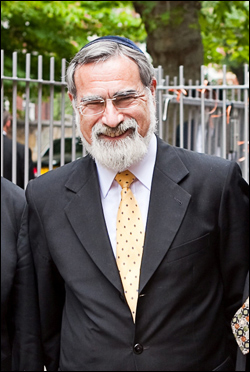 “Take your son, your only son, the one you love—Isaac—and go to the land of Moriah. Offer him there as a burnt offering on a mountain I will show you.” Thus begins one of the most famous episodes in the Torah, but also one of the most morally problematic.
The conventional reading of this passage is that Abraham was being asked to show that his love for G-d was supreme. He would show this by being willing to sacrifice the son for whom he had spent a lifetime waiting.
Why did G-d need to “test” Abraham, given that He knows the human heart better than we know it ourselves? Maimonides answers that G-d did not need Abraham to prove his love for Him. Rather the test was meant to establish for all time how far the fear and love of G-d must go.1
OnWhy did G-d need to “test” Abraham this principle there was little argument. The story is about the awe and love of G-d. Kierkegaard wrote a book about it, Fear and Trembling,2 and made the point that ethics is universal. It consists of general rules. But the love of G-d is particular. It is an I-Thou personal relationship. What Abraham underwent during the trial was, says Kierkegaard, a “teleological suspension of the ethical,” that is, a willingness to let the I-Thou love of G-d overrule the universal principles that bind humans to one another.
Rav Soloveitchik explained the episode in terms of his own well-known characterization of the religious life as a dialectic between victory and defeat, majesty and humility, man-the-creative-master and man-the-obedient-servant.3 There are times when “G-d tells man to withdraw from whatever man desires the most.” We must experience defeat as well as victory. Thus the binding of Isaac was not a once-only episode but rather a paradigm for the religious life as a whole. Wherever we have passionate desire – eating, drinking, physical relationship – there the Torah places limits on the satisfaction of desire. Precisely because we pride ourselves on the power of reason, the Torah includes chukkim, statutes, that are impenetrable to reason.
These are the conventional readings and they represent the mainstream of tradition. However, since there are “seventy faces to the Torah,” I want to argue for a different interpretation. The reason I do so is that one test of the validity of an interpretation is whether it coheres with the rest of the Torah, Tanakh and Judaism as a whole. There are four problems with the conventional reading:
We know from Tanakh and independent evidence that the willingness to offer up your child as a sacrifice was not rare in the ancient world. It was commonplace. Tanakh mentions that Mesha king of Moab did so. So did Jepthah, the least admirable leader in the book of Judges. Two of Tanakh’s most wicked kings, Ahaz and Manasseh, introduced the practice into Judah, for which they were condemned. There is archaeological evidence – the bones of thousands of young children –– that child sacrifice was widespread in Carthage and other Phoenician sites. It was a pagan practice.
Child sacrifice is regarded with horror throughout Tanakh. Micah asks rhetorically, “Shall I give my firstborn for my sin, the fruit of my body for the sin of my soul?” and replies, “He has shown you, O man, what is good. And what does the Lord require of you? To act justly and to love mercy and to walk humbly with your G-d.” How could Abraham serve as a role model if what he was prepared to do is what his descendants were commanded not to do?
Specifically, Abraham was chosen to be a role model as a father. G-d says of him, “For I have chosen him so that he will instruct his children and his household after him to keep the way of the Lord by doing what is right and just.” How could he serve as a model father if he was willing to sacrifice his child? To the contrary, he should have said to G-d: “If you want me to prove to You how much I love You, then take me as a sacrifice, not my child.”
As Jews – indeed as humans – we must reject Kierkegaard’s principle of the “teleological suspension of the ethical.” This is an idea that gives carte blanche to a religious fanatic to commit crimes in the name of G-d. It is the logic of the Inquisition and the suicide bomber. It is not the logic of Judaism rightly understood.4 G-d does not ask us to be unethical. We may not always understand ethics from G-d’s perspective but we believe that “He is the Rock, His works are perfect; all His ways are just” (Deuteronomy 32:4).
To understand the binding of Isaac we have to realize that much of the Torah, Genesis in particular, is a polemic against worldviews the Torah considers pagan, inhuman and wrong. One institution to which Genesis is opposed is the ancient family as described by Fustel de Coulanges in The Ancient City (1864)5 and recently restated by Larry Siedentop in Inventing the Individual: The Origins of Western Liberalism.6
BeforeHe had power of life and death over his wife and children the emergence of the first cities and civilizations, the fundamental social and religious unit was the family. As Coulanges puts it, in ancient times there was an intrinsic connection between three things: the domestic religion, the family and the right of property. Each family had its own gods, among them the spirits of dead ancestors, from whom it sought protection and to whom it offered sacrifices. The authority of the head of the family, the paterfamilias, was absolute. He had power of life and death over his wife and children. Authority invariably passed, on the death of the father, to his firstborn son. Meanwhile, as long as the father lived, children had the status of property rather than persons in their own right. This idea persisted even beyond the biblical era in the Roman law principle of patria potestas.
The Torah is opposed to every element of this worldview. As anthropologist Mary Douglas notes, one of the most striking features of the Torah is that it includes no sacrifices to dead ancestors.7 Seeking the spirits of the dead is explicitly forbidden.
Equally noteworthy is the fact that in the early narratives succession does not pass to the firstborn: not to Ishmael but Isaac, not to Esau but Jacob, not to the tribe of Reuben but to Levi (priesthood) and Judah (kingship), not to Aaron but to Moses.
The principle to which the entire story of Isaac, from birth to binding, is opposed is the idea that a child is the property of the father. First, Isaac’s birth is miraculous. Sarah is already post-menopausal when she conceives. In this respect the Isaac story is parallel to that of the birth of Samuel to Hannah, like Sarah also unable naturally to conceive. That is why, when he is born Hannah says, “I prayed for this child, and the Lord has granted me what I asked of him. So now I give him to the Lord. For his whole life he will be given over to the Lord.” This passage is the key to understanding the message from heaven telling Abraham to stop: “Now I know that you fear G-d, because you have not withheld from Me your son, your only son” (the statement appears twice, in Genesis 22:12 and 16). The test was not whether Abraham would sacrifice his son but whether he would give him over to G-d.
The same principle recurs in the book of Exodus. First, Moses’ survival is semi-miraculous since he was born at a time when Pharaoh had decreed that every male Israelite child should be killed. Secondly, during the tenth plague, when every firstborn Egyptian child died, the Israelite firstborn were miraculously saved. “Consecrate to me every firstborn male. The first offspring of every womb among the Israelites belongs to Me, whether human or animal.” The firstborn were originally designated to serve G-d as priests, but lost this role after the sin of the golden calf. Nonetheless, a memory of this original role still persists in the ceremony of pidyon ha-ben, redemption of a firstborn son.
What G-d was doing when he asked Abraham to offer up his son was not requesting a child sacrifice but something quite different. He wanted Abraham to renounce ownership of his son. He wanted to establish as a non-negotiable principle of Jewish law that children are not the property of their parents.
That is why three of the four matriarchs found themselves unable to conceive other than by a miracle. The Torah wants us to know that the children they bore were the children of G-d rather than the natural outcome of a biological process. Eventually, the entire nation of Israel would be called the children of G-d. A related idea is conveyed by the fact that G-d chose as his spokesperson Moses who was “not a man of words.” He was a stammerer. Moses became G-d’s spokesman because people knew that the words he spoke were not his own but those placed in his mouth by G-d.
The clearest evidence for this interpretation is given at the birth of the very first human child. When she first gives birth, Eve says: “With the help of the Lord I have acquired [kaniti] a man.” That child, whose name comes from the verb “to acquire,” was Cain who became the first murderer. If you seek to own your children, your children may rebel into violence.
If the analysis of Fustel de Colanges and Larry Siedentop is correct, it follows that something fundamental was at stake. As long as parents believed they owned their children, the concept of the individual could not yet be born. The fundamental unit was the family. The Torah represents the birth of the individual as the central figure in the moral life. Because children – all children – belong to G-d, parenthood is not ownership but guardianship. As soon as they reach the age of maturity (traditionally, twelve for girls, thirteen for boys) children become independent moral agents with their own dignity and freedom.8
Sigmund Freud famously had something to say about this too. He held that a fundamental driver of human identity9 is the Oedipus Complex, the conflict between fathers and sons as exemplified in Aeschylus’ tragedy. By creating moral space between fathers and sons, Judaism offers a non-tragic resolution to this tension. If Freud had taken his psychology from the Torah rather than from Greek myth, he might have arrived at a more hopeful view of the human condition.
Slavery had not yet been abolished
Why then did G-d say to Abraham about Isaac: “Offer him up as a burnt offering”? So as to make clear to all future generations that the reason Jews condemn child sacrifice is not because they lack the courage to do so. Abraham is the proof that they do not lack the courage. The reason they do not do so is because G-d is the G-d of life, not death. In Judaism, as the laws of purity and the rite of the Red Heifer show, death is not sacred. Death defiles.
The Torah is revolutionary not only in relation to society but also in relation to the family. To be sure, the Torah’s revolution was not fully completed in the course of the biblical age. Slavery had not yet been abolished. The rights of women had not yet been fully actualized. But the birth of the individual – the integrity of each of us as a moral agent in our own right – was one of the great moral revolutions in history.
FOOTNOTES
1.Guide for the Perplexed 3: 24.
2.Søren Kierkegaard. Fear and Trembling, and the Sickness Unto Death. Garden City, NY: Doubleday, 1954.
3.Joseph B. Soloveitchik, “Majesty and Humility,” Tradition 17:2, Spring. 1978, pp. 25–37.
4.This is a large subject in its own right, that I hope to be able to address elsewhere.
5.Fustel De Coulanges, The Ancient City: A Study on the Religion, Laws, and Institutions of Greece and Rome. Garden City, NY: Doubleday, 1956.
6.Larry Siedentop, Inventing the Individual. London: Penguin, 2014.
7.Mary Douglas, Leviticus as Literature. Oxford: Oxford UP, 1999.
8.It is perhaps no accident that the figure who most famously taught the idea of “the child’s right to respect” was Janusz Korczak, creator of the famous orphanage in Warsaw, who perished together with the orphans in Treblinka. See Tomek Bogacki, The Champion of Children: The Story of Janusz Korczak (2009).
9.He argued, in Totem and Taboo, that the Oedipus complex was central to religion also.
• Vayeira in a Nutshell
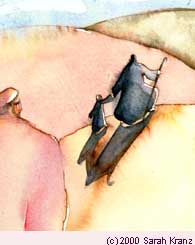 G‑d reveals Himself to Abraham three days after the first Jew’s circumcision at age ninety-nine; but Abraham rushes off to prepare a meal for three guests who appear in the desert heat. One of the three—who are angels disguised as men—announces that, in exactly one year, the barren Sarah will give birth to a son. Sarah laughs.
Abraham pleads with G‑d to spare the wicked city of Sodom. Two of the three disguised angels arrive in the doomed city, where Abraham’s nephew Lot extends his hospitality to them and protects them from the evil intentions of a Sodomite mob. The two guests reveal that they have come to overturn the place, and to save Lot and his family. Lot’s wife turns into a pillar of salt when she disobeys the command not to look back at the burning city as they flee.
While taking shelter in a cave, Lot’s two daughters (believing that they and their father are the only ones left alive in the world) get their father drunk, lie with him and become pregnant. The two sons born from this incident father the nations of Moab and Ammon.
Abraham moves to Gerar, where the Philistine king Abimelech takes Sarah—who is presented as Abraham’s sister—to his palace. In a dream, G‑d warns Abimelech that he will die unless he returns the woman to her husband. Abraham explains that he feared he would be killed over the beautiful Sarah.
G‑d remembers His promise to Sarah, and gives her and Abraham a son, who is named Isaac (Yitzchak, meaning “will laugh”). Isaac is circumcised at the age of eight days; Abraham is one hundred years old, and Sarah ninety, at their child’s birth.
Hagar and Ishmael are banished from Abraham’s home and wander in the desert; G‑d hears the cry of the dying lad, and saves his life by showing his mother a well. Abimelech makes a treaty with Abraham at Beersheba, where Abraham gives him seven sheep as a sign of their truce.
G‑d tests Abraham’s devotion by commanding him to sacrifice Isaac on Mount Moriah (the Temple Mount) in Jerusalem. Isaac is bound and placed on the altar, and Abraham raises the knife to slaughter his son. A voice from heaven calls to stop him; a ram, caught in the undergrowth by its horns, is offered in Isaac’s place. Abraham receives the news of the birth of a daughter, Rebecca, to his nephew Bethuel.
ESSAY
A Lesson from a Robot
The line between creator and creation has gotten blurrier lately, thanks to sophisticated robots that are smart enough to invent technologies of their own. Who has the right to patent these cybersolutions, the inventor of the robot, or the robot itself? by Arnie Gotfryd
 The line between creator and creation has gotten blurrier lately, thanks to sophisticated robots that are smart enough to invent technologies of their own. These are not simplistic gadgets the likes of which you might concoct while daydreaming at a red light or doodling on a napkin. We are speaking about innovative pharmaceutical formulations and genetic fixes that might normally take dozens of scientists many years and millions of dollars to develop.
The robot itself has become the scientist's scientistThis new breed of robot has taken information technology to a whole new level. What once was called the science of automation has been overturned to become the automation of science. Yes, the robot itself has become the scientist's scientist.
Divine Providence is often credited with providing the remedy before the affliction. The modern affliction is complexity. For example, the problems that scientists face today in biotechnology involve thousands of variables, each having various states and interactions with other variables and environmental elements, resulting in millions of possible outcomes that all have to be evaluated before you even get to the stage of making an experiment to physically test anything. Whew!
The cure is processing power. Today's robots can identify problems, review existing options, design new alternatives, test them all theoretically, and determine the most effective and robust solutions. Amazing.
But the new cures generate their own set of afflictions, one of which is legal. Who has the right to patent these cybersolutions, the inventor of the robot, or the robot itself? Believe it or not, according to the journal, SCIENCE, it depends on where you (or the robot) lives. In the USA, only inventions by humans can be protected by patents. In Europe, it seems, the laws governing intellectual property extend to any legal entity, possibly even robots.
What can we learn from all this? First let's look at things from the robot's perspective. Left to its own devices, such a smartbot could look at himself proudly and proclaim, "Wow, I'm amazing! I've studied everything out there and there's nothing that can analyze problems and create solutions like I can."
Your scope is limited, your intelligence artificial, your personality vacuousWell hang on there, Mr. Bot. You are yourself a mere creation, the product of analysis and design by a creative intelligence greater than yours. True, you too can invent, and brilliantly at that, but your scope is limited, your intelligence artificial, your personality vacuous, your circuitry simplistic. And besides, the very tasks you have been hardwired from the outset to perform are the very tasks you falsely pride yourself in. If anyone deserves the credit, it is the creative genius that made you the creative genius you are.
And the same may be said of us.
Man, the inventor, is the invention of an inventive mind like his, but infinitely greater still. True, his analytic and creative prowess is incomparable in all the world, but man would do well to heed the Torah's admonition in Deuteronomy 7:12-11:25: "And you think, 'My strength and the power of my hand acquired this wealth for me.'"
Is it any more ludicrous for our techno-babies to take exclusive credit for their inventions than it is for us to boast of ours? Honesty demands that we too look upstream to acknowledge our source and recognize who owns what.
There's another lesson to learn from robots. As sophisticated as they get, they only appear to be conscious, sentient and free-willed. To equate robots with humans is not only a false vaunting of their qualities, it is an abdication and gross neglect of ours. And if that happens, G‑d forbid, then indeed they would deserve their patent rights – at least more than we would.
Vive la difference.
WOMEN
From a Disco Miracle to Wigs for Sick Women
At a young age, she announced that she was going to have a home just like theirs when she grew up, with a big Shabbat table and many children... by Tzippy Koltenyuk
Chagit’s family was not observant, but as a young child she spent a lot of time in the home of her religious neighbors. She loved their home, which was filled with children, joie de vivre and the special atmosphere of Shabbat and the Jewish holidays. At a young age, she announced that she was going to have a home just like theirs when she grew up, with a big Shabbat table and many children. Chagit grew up and achieved her dream. Today she is the mother of seven children, and has hosted thousands at her Shabbat table.
Chagit owns a wig-making business, and she founded and runs an organization that provides free wigs to women who have lost their hair due to illness. Chagit’s generosity is inseparable from the way she does business.

The Biton family
An Ordinary, Traditional Family“I was born in Ashdod, the third of four children, to a traditional Moroccan family. My mother lit candles for Shabbat, and my father made kiddush with the television on in the background. We kept a minimal standard of kosher and observed the holidays symbolically, but not religiously. From a young age, I loved to visit my religious neighbors and join them when they went to synagogue. These neighbors had a large family, and the atmosphere in their home was joyous. On Shabbat, all the children and grandchildren came to visit, and I loved the bustle and fun. Sometimes they would catch me wearing their mother’s hair covering. I would put it on and look in the mirror, loving the reflection I saw. I announced that one day, I would cover my hair. Even back then, I knew that when I grew up I wanted a home and a family like that.”
Then Chagit’s parents divorced. Her mother remarried and moved into her new husband’s house, while her father raised and educated the children. Chagit graduated high school and was granted an exemption from the army because she had asthma. After travelling abroad, Chagit returned to Ashdod and began working in a discotheque, as well as in a wedding hall supervising the waiters. She occasionally attended lectures on Torah subjects, and she had religious friends in the neighborhood. She knew she wanted to raise her level of Jewish observance one day, but she didn’t take any steps in that direction.
Miracle in a Disco
One night, Chagit was working in the wedding hall during a religious wedding. The videographer was a young man who had become religious abroad.
“He wore a beard and a skullcap, while I was wearing pants, a tank top and long hair, but apparently he felt that deep down I wanted to change, and that it was just a matter of time. We became a couple. Because of our relationship, I stopped working on Shabbat and became a little closer to authentic Judaism.
“One Friday, a few months after we met, we had a huge argument. That Saturday night, he surprised me by showing up at my father’s house. He wanted to talk to me, and asked that I skip my shift at the disco. I argued with him, but in the end, he convinced me, and I found a replacement. We sat and spoke until late that night, and then I went to sleep. When I woke up at 6 a.m., I saw that there were many messages on my phone. I called my friend who had left all the messages, and he was hysterical. ‘Are you okay?’ he asked. I told him that everything was fine. ‘Were you at work last night?’ he asked. I told him no, and then he told me that the night before, a man had walked into the disco, shot in all directions, and killed my boss.
“When we hung up, I knew with clarity that G‑d was looking out for me. I felt it so deeply that, that very day, I decided to change my way of life. I’d known for a long time that I had to make the change. I called my boyfriend, and we decided that we would both go to Tzfat, where he would attend a Chabad yeshiva, and I would go to Machon Alte, a school for girls who want to learn to lead a religious life.”

The Shabbat table
The Whole FamilyThe staff at Machon Alte accepted Chagit with open arms and lots of love, and they made her feel connected from day one.
“I became religious very quickly. It wasn’t at all hard. I wanted the change with all my heart. I was just waiting for them to tell me what I had to do and how to do it. I was very happy to throw away my immodest clothes and to keep Shabbat.
“One Shabbat, my sister came to visit me in Machon Alte. She connected to the place immediately and decided that she also wanted to become religious. When I went home, I made the kitchen kosher and bought new dishes. Then my brothers decided to become religious. My father wasn’t interested, but in deference to us, he brought home only kosher food. Eventually, we influenced our mother, and she also became religious and connected to Chabad.”
Chagit and her boyfriend ended up going separate ways. Chagit still feels gratitude towards him, whom she feels was sent to help her become religious, and to influence almost her entire family to become religious too.
Three Dates and a Proposal
“After a year and a half in Machon Alte, I returned to Ashdod and went to a friend’s henna (pre-wedding) party. The groom’s mother blessed me to soon begin to build my own home. I said, ‘Amen’ and told her I wanted to marry a Chabad chassid. She was shocked and said, ‘I have a son, Eli, who’s a Chabadnik, in America! He’s coming for the wedding. You two have to meet each other!’ The next day, a good friend approached me to say, ‘You have to meet my cousin Eli from America. He’s coming in for a wedding, and you two would really like each other.’ After hearing the same suggestion from two people, I felt there had to be something to it. Eli and I spoke a bit at the wedding. He told me that he was working in New York and that he could only stay in Israel for three days. We met the next day, and the next, and then it was time for him to leave. We’d only met each other three times, but I knew he was destined to be my husband. I didn’t know what to do. Then he said to me, ‘I don’t know what to tell you. I have to go. Should we get married?’”

Eli and Chagit
Chagit immediately said yes. Eli had to return to his real estate business in America, so Chagit organized the entire wedding herself. The wedding took place on the 18th of Elul. Rabbi Rosenfeld, director of Machon Alte, was the officiating rabbi. After the wedding, Chagit found herself standing in front of a mirror tying a head-scarf over her hair, just as she’d announced she would when she was 10 years old.To New York and Back
Chagit didn’t forget the second part of her promise to herself either. The couple moved to Crown Heights and had seven children. The Biton home was a center of hospitality. Everyone who took a trip to New York, or who came to spend the holidays in the Rebbe’s synagogue, knew they had a place to eat and sleep in the Biton’s home. Eli’s real estate business flourished, and the family shared their abundance with others. After a couple of years, they rented an apartment just for guests. They hosted tens, and sometimes hundreds, of guests at their Shabbat table, everyone enjoying the hearty meals and heartfelt joy. Everyone was received warmly, and some guests returned in the following years sporting skullcaps, or wigs and modest clothing.
For the 13 years that they lived in America, Chagit worked with wigs. Her mother was a hairdresser, and from a young age Chagit had combed wigs in the hair salon. Once she turned 13, she began to wash and dye women’s hair when her mother needed help.
Then the real estate market in America collapsed, taking Eli’s business down with it. The Bitons had to lower their standard of living, but they continued hosting guests, even though it was very difficult. They also found it difficult to disappoint fundraisers who were used to receiving large checks from them.
“When I read what the Rebbe wrote about moving to Israel, I showed it to my husband, who had been living in America for 25 years. It wasn’t easy, but we decided to move. I went first, with the children, while Eli stayed behind to close the business.
“It was very hard in the beginning. I had to start from scratch. We lived with my in-laws for a month, until our shipping container arrived. I rented an apartment and dealt with the children alone. In America, I had everything and was well-known, and now I was starting all over again. What strengthened me at that difficult time was my faith and my strong desire to succeed. In America, I didn’t even know how to pay bills or shop. Eli had taken care of all that. My only jobs had been to look after the children, to keep the unending hospitality going, and to do a little work with wigs, for fun.
“I found out that I was able to handle everything. I organized the house, enrolled the children in school, and registered at an employment agency, seeking work as a caretaker for children with special needs. I told the woman in charge that I hadn’t been trained in special education, but that I loved children. She said, ‘Because of your chutzpah, I’ll take you.’ So I worked as a caretaker while building my wig business on the side.”
Seven months later, Eli returned to Israel. He was astounded at the long and difficult road Chagit had travelled without him. By that time, Chagit was selling wigs of various brands, and through word-of-mouth, she had a growing customer base. Eli suggested that she start making wigs herself, and with his support, she successfully launched her own brand.

The sign over Chagit’s wig salon
A Wig: The Ultimate in ModestySome religious people don’t consider a wig the most modest head-covering for married women. However, Chagit follows the Rebbe’s opinion that a wig is the best way for a woman to cover her hair.
“Recently, the mother of a bride came to me. The mother covers her hair very modestly with a kerchief, with not a hair showing. But her daughter wants to wear a wig. The mother was crying, sure that her daughter was doing the wrong thing. We sat together, and I comforted her. I showed her what the Rebbe wrote on the subject, and I stressed that even though she’s careful about covering all her hair with a kerchief, she has to know that many women have a hard time with it. I explained to her that having a pretty, respectable-looking wig will ensure that her daughter will keep the mitzvah of covering her hair in the best way.
“Other times, women who are considering taking on the mitzvah of covering their hair come to me, and when they see the selection of wigs that are available, they’re happy to take on this mitzvah.”
Lilach and the Free Wigs
About a year ago, Chagit received a call about Eli’s relative, Lilach. Lilach was a 29-year-old woman who was nine months pregnant with her second child, and she was ill. Chemotherapy was causing her hair to fall out. Chagit packed a suitcase full of wigs and went to visit her. She found a wig that suited Lilach beautifully, and tried her best to boost Lilach’s spirits while she was there. Sadly, Lilach died several months later.
Two days later, Chagit got a phone call about a young girl on the same ward who had no money for a wig and refused to leave her room because she was embarrassed of her baldness. Chagit sent her a wig, thinking, There must be many more women who are ill and lack the means to buy a wig. She decided to open a free-loan organization named after Lilach: “Lilach’s Gemach.”

The newspaper article about Lilach’s Gemach
Lilach’s family was extremely excited. Lilach’s sister-in-law, who worked for a newspaper in Kiryat Gat, wrote an article about the wonderful organization, asking women to donate wigs they didn’t wear to the Lilach Gemach. Thanks to that article and to Facebook posts, Chagit has received tens of wigs from all over the country.When a wig is donated, Chagit washes, styles and upgrades it. Word of “Lilach’s Gemach” has spread among women who are ill. When they come to Chagit, they are treated like queens, and when they look into the mirror and see themselves in the wigs, they are thrilled. If Lilach’s Gemach doesn’t have a wig that suits them, Chagit will sell them a wig from her collection for half-price.
“I don’t feel like I’m doing anything special. If the Rebbe, who was so busy, cared about every single Jew, wherever he was in the world, and did what he could to help each one, how can I turn away without helping someone who’s right in front of me? After everything I experienced in life, I know that money comes from G‑d alone, and that we have to use all the means at our disposal to help other Jews and to spread light and loving-kindness in the world,” Chagit says.
Translated by Esther Rabi
More in Women:
• The Blessing of Peace (by Yetta Krinsky)
 To be honest, I never would have thought I would write an article entitled “The Blessing of Peace.” Peace? Blessing? Wishy-washy words, a cop-out, not really in the vernacular of my strident feminist, social activist, pre-Chassidut persona.
But through my life experience, my work as a psychiatrist, and the privilege of beginning to learn the deeper levels of the Torah, I now know that these two words, blessing and peace, are potent, focused tools. Tools we can all access, tools that transform this muddled and confusing world to one of truth, light and unity. All within the power of each one of us at each moment.
How so?
Word Building/World Building
According to Chassidic thought, we create worlds through our words. G‑d created the world through 10 utterances, and likewise, each word we utter has the power to create a new reality.
How we think about something and speak about it creates what happens next. When we speak about someone’s positive potential, we introduce the possibility for that potential to be actualized, while negative words close off that possibility.
So let’s look at these two simple words, blessing and peace . . .
Blessing
G‑d told Abraham, “Until now, all blessings were in My hand. I would bless whomever I pleased, as I blessed Adam and Noah. But from now on, all blessings are given to you, and you will be able to bless whomever you please . . .”1 And the Tanya teaches that we all have a spark of our patriarchs within us. We all have the power to bless.
What a world we would live in if we utilized our power, blessing others to become the people they are meant to be and to fulfill their unique role in the healing and transformation of the world.
“But I’m not so holy,” I can hear you saying. Actually you are. We all are. “But people will think I’m crazy if I start talking like that.” So what? Try it anyway. You might be surprised by the result.
Peace
How do we define peace? It is certainly more than just the absence of strife. Perhaps true peace might come from deep understanding, not just of the complexities of this world, but of the very purpose of creation and our soul’s descent into this world.
At this level of awareness, all contradictions and discord are automatically nullified by a deeper understanding of the fundamental unity between our Creator, ourselves and our world.
Using the Blessing of Peace
In my own life and in my therapeutic work, I for some time have encouraged the giving of blessings to change the dynamic of an interaction. For example, if a spouse is feeling misunderstood, he or she could say to the other, “You should have a blessing to see who I really am.”
This often works quite well. More recently, however, I have come to understand that this still implies a degree of separation. You have to understand me. In certain situations, this is a necessity, but it is still coming from a conceptual framework of separation.
Recently, I have been suggesting a different blessing in times of potential or actual conflict: “We should have a blessing to fully understand each other.” I want to understand you too. There is a possibility here for deeper understanding if we can access it. There is the One beyond us who bestows blessings and can bless us to understand each other even if we are coming from completely different places.*
The resulting communication for a number of couples has been at a completely different level of closeness, understanding and unity. This is something we could all try in situations of misunderstanding or conflict, even if we don’t actually say this blessing in front of the other person, but say it quietly to ourselves. And G‑d will surely say Amen.
Torah’s wisdom teaches us that to fully understand others, we have to first try to see things from their standpoint. Not just their current situations, backgrounds, formative experiences, family and individual values, health and socioeconomic statuses, the challenges they have faced and are facing, but also their spiritual makeup—the source and root of their souls, their souls’ descent through the spiritual worlds to this world, their intellectual and emotional attributes, and the particular mission their souls have in coming down to this world.
As you can see, there are so many factors that contribute to a person’s mental, emotional, and spiritual makeup that it is totally impossible for us to understand anyone without the blessings and help of our Creator.
With a willingness to understand the viewpoint of another, and by utilizing our power to bestow blessings in order to actualize positive potential, we can create beautiful new realities in our lives.
May we all be blessed with true peace, recognizing that our souls are all one, that we all have one Father, and that it is only our bodies that separate us.
*This does not apply to abusive situations where safety issues are our primary concern.
FOOTNOTES
1.Me'am Loez, Genesis, book 2, p. 20, citing Rashi, Bereishit Rabbah on Genesis 12: 2-3
• Slow and Steady Salvation (By Elana Mizrahi)
 “Was this the most unique birth experience that you’ve been to?”
I wanted to answer in the affirmative for the new father, but it wouldn’t have been true. Every birth that I attend (I am a doula) is a unique experience and truly a miracle, but this one more than others taught me a valuable lesson.
Sara came to me the night before. She was a day short ofShe had never been this late before completing week 42, and her doctor informed her that if she didn’t go into labor by the next day, she would be induced. It was her third birth, and she had never been this late before.
I gave her a massage and reflexology. She left feeling relaxed and calm, and I wasn’t surprised when she called me the next morning to tell me that her body kicked in naturally and that she was in labor.
By three o’clock in the afternoon, the contractions were strong and close together. We met at the hospital. She was already in active labor, and I figured that given that this was her third birth and that the previous two had been “fast and furious,” she would no doubt give birth within the next few hours. I was wrong! Sara labored for nine more hours, for a total of nineteen hours!
With each contraction, I knew that Sara made progress, but that progress was so slow. She labored beautifully, totally connected to the birth. She changed positions, and went in and out of the shower. We used the physiotherapy ball, herbs, massage, reflexology. The heartbeat, thank G‑d, never dropped. For me, it felt like a long time, so I’m sure it felt that way for her, but at least there was movement.
At last, it was time for the baby to be born. I whispered in her ear, “You can do this. Not too fast, not too hard, let G‑d take your baby out for you.” He did. The baby gently came out healthy and crying, even though his umbilical cord was wrapped twice around his neck.
What did I learn from these miracles? The birth in itselfWho in the world isn’t suffering? wasn’t the miracle—it was the slow and steady process. Maybe if the birth had been fast like her previous births, the cord would have pulled at the baby’s neck. Maybe the slow descent of the baby allowed him to come out healthy and breathing, even with the cord wrapped twice around its neck. The slow yet constant progression was the salvation itself.
We each are growing through our own difficult challenges. Really, who in the world isn’t suffering? But if only we could understand that the challenges themselves bring the salvation, that the slow process, the waiting, the longing, the laboring in itself is the redemption.
 MULTIMEDIA
How One Little Candle Changed a Family
The Rebbe tells how the Shabbat candle lighting campaign has yielded far-reaching results. Watch Watch (8:09)
<script language="javascript" type="text/javascript"
src="http://embed.chabad.org/multimedia/mediaplayer/embedded/embed.js.asp?aid=818257&width=auto&height=auto"></script><div style="clear:both;">Visit <a href="http://www.chabad.org/multimedia/default_cdo/aid/591213/jewish/Video.htm">Jewish.TV</a> for more <a href="http://www.chabad.org/multimedia/default_cdo/aid/591213/jewish/Video.htm">Jewish videos</a>.</div>
More in Multimedia:
• Did Abraham's Angels Really Eat or Did They Just Pretend? (By Moishe New)
<script language="javascript" type="text/javascript" src="http://embed.chabad.org/multimedia/mediaplayer/embedded/embed.js.asp?aid=2026193&width=auto&height=auto"></script><div style="clear:both;">Visit <a href="http://www.chabad.org/multimedia/default_cdo/aid/591213/jewish/Video.htm">Jewish.TV</a> for more <a href="http://www.chabad.org/multimedia/default_cdo/aid/591213/jewish/Video.htm">Jewish videos</a>.</div>
• Why? (A Song) (By Chaim Fogelman)
http://www.chabad.org/multimedia/media_cdo/aid/901497/jewish/8-Why.htm
http://www.chabad.org/901497
Why
Why must the nations say
Tell us where your G-d’s today
Why must the nations say
You’re all alone and you were left astray
Aren’t we your children
In the land you promised Abraham
So why must your children cry, oh why?
It started long ago
With a little boy, only three years old
Abraham was his name
That You exist, he did proclaim
And as a gift You promised him
The land of Cnaan, to his children
To make a home, and to dwell
In this holy land of Israel
So why must your children die
Just because they love your gifts
And why must your children die
Shouldn’t they be on the top of your list
Aren’t we your children
In the land you promised Abraham
So why must your children die, oh why?
For two thousand years
Every Jew had the very same plan
That some day with G-d’s help
We all will live in the Promised Land
Oh my dear G-d
We need your help more than ever now
Come on, save the Jew
Show the world what you can do
Oh why…
STORY
 The Czar's Rubles
A Russian peasant once said to his friend: "You know, Ivan, I have been thinking, it is really very stupid for us to pay taxes to the Czar." by Tuvia Bolton

Chassidim would resort to the following parable:
A Russian peasant once said to his friend: "You know, Ivan, I have been thinking, it is really very stupid for us to pay taxes to the Czar."
"Why is that, Igor?" asked Ivan.
"Because do you know where all our rubles come from? Well, I'll tell you where from. The Czar himself has them minted in his palace, that's where."
"So what?" asked Ivan.
"So what? So why doesn't he just keep all the rubles he needs in the first place, and we'll keep ours!"
"Ah, Igor, you are very stupid" replied Ivan "That's the whole point! The Czar doesn't want his rubles. He wants your ruble!"
 LIFESTYLE
Fall Favorite: Butternut Squash Soup
Butternut squash soup is such a classic and this is an easy one. by Miriam Szokovski
Butternut squash soup is such a classic and this is an easy one. A little white wine ramps up the flavor, and a garnish of roasted, salted pumpkin or sunflower seeds makes it a little fancier.

Start by cutting the onion into quarter rounds. Peel and cut the butternut squash and sweet potato into chunks.
Sauté the onion in the olive oil and 1 tsp. of salt until translucent—approximately 15-20 minutes. Add the butternut squash and sweet potato to the pot and sauté with the onion for a few more minutes. Add the rest of the ingredients, cover the pot and bring to a boil. Lower the heat and simmer until vegetables are soft. Blend and serve. Garnish with sunflower or pumpkin seeds, if you like.

I recently heard that you can cook the butternut squash with the skin still on, without altering the taste or texture once blended, but I haven't yet tried it myself. So if you're struggling to peel the squash, try it and let us know how it comes out.
Soup keeps in the fridge for about a week, and freezes well too.

Ingredients
1 onion
2 tbsp. oil
3 tsp. kosher salt (divided)
2.5 lbs. butternut (1 medium)
0.5 lb. sweet potato (1 smallish)
3 cups water
½ tsp. nutmeg
¼ tsp. pepper
½ cup white wine
Directions
Cut and sauté the onions in the olive oil and 1 tsp. kosher salt for 15-20 minutes, until translucent.
Peel and cut the butternut squash and sweet potato into chunks. Add to the pot and sauté with the onions for a few minutes.
Add the water, white wine, nutmeg, pepper and the rest of the salt. Cover the pot and bring to a boil. Reduce to a simmer and cook until the butternut squash is tender.
Blend. Taste the soup and adjust seasonings to taste.
Optional—garnish with roasted, salted pumpkin or sunflower seeds when serving.
Yields:6-8 serves

What's your favorite winter soup?
More in Lifestyle:
• Starry Shema (By Alyse Radenovic)

Acrylic on Stretched Canvas
Artist’s Statement: This is a painting of the repeated letters of the words “Hear, O Israel, the L-rd is our G-d, the L-rd is One,” in Hebrew in gold on dark blue with silver, white, and light blue.
• Abraham, Abraham (By Yoram Raanan)

And an angel of G-d called to him from heaven, and said, "Abraham, Abraham!" And he said, "Here I am." And he said, "Do not stretch forth your hand to the lad, nor do the slightest thing to him, for now I know that you are a G-d fearing man, and you did not withhold your son, your only one, from Me." (Genesis 22:11-12)
And an angel of the L-rd called to Abraham a second time from heaven. And he said, "By Myself have I sworn, says the L-rd, that because you have done this thing...I will greatly multiply your offspring...and through your children shall be blessed all the nations of the world, because you hearkened to My voice." (Genesis 22:15-18)
Artist's Statement: The primal and simple palette of earthy browns reflects this poignant moment when the angel appears to Abraham at the Akeida telling him not to sacrifice his son. The painting evolved as a result of both emotional struggle and intellectual grappling with the ephemeral world in search of eternal truths. A lot of revision went into the creation of this painting—passages were reworked extensively so that the resulting layers of brushwork take on a life of their own. The sheer physicality of paint becomes as central to the work as the chosen subject. Much depends on a willingness to make drastic changes, and to take advantage of Divine flow that arises during the creative process.
JEWISH NEWS
 1,000 Women Share the Mitzvah of Baking Challah, in Memory of Rashi Minkowicz
Like rising dough, the attendee list for Chabad of Georgia’s “Mega Challah Bake” just kept growing and the largest meeting room in the state was filled wall to wall, and all the way to the back doors. by Mindy Rubenstein

More than 1,000 women came together in Atlanta for a “Mega Challah Bake” in memory of Rashi Minkowicz of Chabad of North Fulton in Alpharetta, Ga. So many registered for the event that organizers had to find a larger venue to accommodate them. (Photo: Duane Stork Photography)
Like rising dough, the attendee list for Chabad of Georgia’s “Mega Challah Bake” just kept growing—so much so that organizers had to find a new location to accommodate the huge crowd of more than 1,000 women on Wednesday night. Even so, the enormous banquet hall in downtown Atlanta—the largest meeting room in the state—was filled wall to wall, and all the way to the back doors as women came together to share in baking of challah.
“The crowd just grew and grew,” said Dassie New, co-director of Chabad of Georgia, which includes 11 Chabad centers around the state.
The Oct. 29 event took place in honor of Rashi Minkowicz, the beloved co-director of Chabad of North Fulton in Alpharetta, Ga., a suburb north of Atlanta. She passed away suddenly this year at the age of 37, leaving behind her husband, Rabbi Hirshy Minkowicz, and eight children, the youngest just 2 years old.
Rashi’s daughters, Tonia and Henya, chanted Psalm 20, and community members and Chabad rebbetzins took to the stage to share personal memories of Rashi. They spoke about her amazing and characteristically large challahs, the way she put people at ease with her warmth and generosity, and regaled all with stories behind the mikvah that she built—a huge undertaking in an area lacking in many Jewish services and institutions when the Minkowicz family moved there from New York in 1998.
The Talmud says that even after someone passes away, they live on in the mitzvahs others do in their merit.
Early in the program, a video was shown of the Lubavitcher Rebbe—Rabbi Menachem M. Schneerson, of righteous memory—discussing the mitzvah of challah for women and girls, and its importance.
New also emphasized to the enormous gathering of the need and urgency for Jewish unity: “Jewish women in Georgia unite through the mitzvah of challah with all Jewish women around the world.”

Indeed, hundreds of challah bakes have taken place the world over—from the United States to South Africa, which last October held one of the largest-ever such events, with a whopping 2,000 participants.
‘A Very Auspicious Time’
“It’s amazing to see what a group of powerful women can achieve,” said Chani Silverman, co-director of Chabad Lubavitch of Cobb County, Ga., who helped organize the event, including recruiting volunteers to help fill thousands of pre-measured containers of flour, sugar, salt and oil to use to make the challah.
Each woman had all the ingredients set out in front of her, as well as orange “Mega Challah Event” aprons, gloves, a large mixing bowl and a cookie sheet.
Miriam Lipskier, co-director of Chabad of Emory University in Atlanta, led a lively, fast-paced challah mini-demonstration.
She also instructed the women to set aside a small portion of the dough, explaining that doing so is a biblical commandment. In Jewish communities for thousands of years, she said, people would give a portion of their food and other items to a Kohen, the spiritual leaders of the community.
Giving and sharing are part of the fabric of the Jewish people, continued Lipskier, and the mitzvah of separating challah is a reminder of this.

“The crowd just grew and grew,” said Dassie New, co-director of Chabad of Georgia, who spoke to the audience about the need for Jewish unity. (Photo: Duane Stork Photography)
“When saying the blessing on challah, the gates of Heaven are open to our prayers,” added Silverman. “It’s a very auspicious time to pray to G‑d on behalf of sick people, in addition to family and friends.” The women then joined together in reciting the prayers as a group as names scrolled across the screen of those in need of healing.
Later, they took some time to be joyous, clasping hands and dancing around the perimeter of the room.
“It was an awesome, inspiring and touching evening,” said Heidi Herman, who has lived in the Alpharetta community for 10 years. “I was very proud to be a part of the event. Rashi was a very kind, caring and approachable person.”
Of there being more 1,000 women gathered in a single venue doing a mitzvah in her honor, Herman said: “I would have expected nothing less. She deserved to have 20,000 people there.”

Mixing the dough. (Photo: Duane Stork Photography)

The community joined for a show of support for a Jewish tradition and on behalf of a beloved local Chabad emissary. (Photo: Duane Stork Photography)

Flour power: The need for those aprons is real. (Photo: Duane Stork Photography)

Tzedakah is an essential part of Jewish life and getting ready for Friday night, along with challah and candle-lighting. (Photo: Duane Stork Photography)

Setting aside a portion of dough, a biblical commandment (Photo: Duane Stork Photography)

Braiding the dough (Photo: Duane Stork Photography)

Ready to be baked, in various shapes and sizes (Photo: Duane Stork Photography)

The final product: fresh challah for the Shabbat table. (Photo: Duane Stork Photography)
More in Jewish News:
• Undeterred, Milwaukee Teens Find New Site for Holiday Sukkah (By Menachem Posner)

Teens in Wisconsin work to get a sukkah built near their public school, so they could celebrate the holiday at lunchtime.
When Leigh Bojan entered ninth grade at Nicolet High School in Glendale, Wis., in the fall of 2013, it was a big change from the close-knit Jewish atmosphere she was accustomed to at the nearby Hillel Academy.
The transition was softened, however, a few weeks later, when she and several dozen fellow Jewish students gathered in the school courtyard to celebrate the Jewish holiday of Sukkot, complete with a kosher lunch in a sukkah.
This fall, she and fellow students expecting a similar experience were saddened to learn that the school had been advised due to legal concerns not to allow a sukkah on the premises.
“So many of us enjoyed it, and we were disappointed,” said Bojan. “So we and our parents put our heads together and started thinking of possible solutions.”
In a meeting with school principal Greg Kabara, the students explored a number of alternatives, including busing them to the Milwaukee Jewish Federation’s Hillel Academy campus in nearby Fox Point—just a few minutes’ drive away—so they could celebrate in the sukkah there.
“We were discussing the issue over Shabbat dinner,” says Leigh’s dad, Steve Bojan, “when one of our guests mentioned that he knew someone who lived right next door to Nicolet who might let the students use their driveway.”

After talking to fellow students, the neighbor and school faculty, Leigh and a number of other friends began making plans to build a sukkah on the nearby driveway. One of the drawbacks to an off-site location was that only students whose parents called in advance would be allowed to leave campus for lunch. On the plus side, the new spot offered ample room to build a 384-square-foot sukkah, which could seat as many as 50 people at a time.
Together with Rabbi Mendy and Mussie Bronstein of the nearby Shul Center, they strategized on how to make sure that Sukkot would be observed in the most fitting manner by all interested students.
On Sunday morning during Sukkot, a dozen teens and parents gathered to put up the oversized structure under the rabbi’s direction.
‘People Were So Supportive’
Meanwhile, the students’ plight had made it to the local news, and sympathy began pouring in.
“People in the community sponsored catered meals each day, and a group of mah-jongg ladies donated desserts,” said Leigh. “People were so supportive of us trying to figure it all out.”
 .
.In order to make sure that everyone knew about the sukkah, the students printed up small menu leaflets to hand out each day to their peers, letting them know where the sukkah would be situated, and that they needed parental permission to join. A generous sponsor even donated specially designed T-shirts that were given out to students as a souvenir.
“This was something that the teens pulled off through their own initiative,” says Bronstein. “We and their parents were there to support and to advise, but these young people showed resourcefulness that ultimately allowed for a negative to become a positive.”
“I don’t have a sukkah at home,” says ninth-grader Emily Chester, “so it was my sukkah experience for this year. It was a really awesome time for me.”
Besides just eating, Emily said she and her schoolmates enjoyed sitting around and talking under the sukkah’s covering of unprocessed flora, in addition to passing around the lulav and etrog in keeping with the holiday’s other major observances.

Since the school of 1,100 students staggers its lunch breaks, meals were served in the sukkah twice daily. Nearly 200 students joined the festivities in the sukkah during the three school days it was active.
Steve Bojan reports that the sukkah’s success has already spread beyond the Milwaukee community, as CTeen (Chabad Teen Network) groups as far as New York and Maryland erected similar sukkahs on school campuses.
Of this holiday’s challenge, he made it a point to note that “it was really a community effort. For these young people, it was a great lesson in how to stand tall, be proud of who you are and do good things. We’re so proud of Leigh and all the young people involved.
“They faced a challenge head on,” he said, “and made it into a positive thing.”

Teens finalize the roof with its sechach on top—branches that allow visible access to the sky and light to filter through.

Jewish students from Nicolet High School partake in a catered kosher lunch in the newly built sukkah on a neighbor's nearby driveway.

Students enjoy lunch during Sukkot in the three days it was active. Locals wound up donating dessert and T-shirts for the occasion.

Ninth-grader Emily Chester, center, with friends. She said:“I don’t have a sukkah at home, so it was my sukkah experience for this year. It was a really awesome time for me.”
• Violence Overwhelms Donetsk; Danger for Remaining Jews (By Dovid Margolin)

Despite a war going on, Dontesk's synagogue draws a daily minyan, or prayer quorum, though many have fled, leaving mostly the elderly.
As heavy rocket and artillery fire pounded the eastern Ukrainian city of Donetsk last week, teachers at the city’s Ohr Avner Jewish Day School rushed their students into a room in the building’s center, where they silently waited for the barrage to end. Classes were dismissed early that day, and the 20 children in attendance—a small fraction of the amount the school had before the war—were sent home for the rest of the week.
Fortunately, the only damage suffered at the school was some falling plaster and jangled nerves. There have been, however, dozens of deaths recorded as fighting continues daily in and near the city.
“Usually, most of the fighting takes place on the outskirts of the city, and it is rare for anything to land in the city center,” says Rabbi Aryeh Shvartz, 31, a Chabad emissary who serves as assistant to Donetsk’s chief rabbi and head Chabad emissary Rabbi Pinchas Vishedski. “Last week, it was heavy everywhere. One day there was five minutes straight of constant bombing; the whole city shook. Many people died here last week.”
Donetsk’s airport continues to be the scene of some of the war’s heaviest fighting--despite the ceasefire agreed to in Minsk on Sept. 19th,--as pro-Russian fighters attempt to capture the airport, the Ukrainian military’s last stronghold in the city. The airport remains in Ukrainian hands, and until last week almost all military action took place near and around it. It was the first time that the city center itself was hit, sending even some of the most jaded of Donetsk’s citizens running for cover.

‘To the Synagogue and Back’
Although the school was closed during the worst of the shelling, Donetsk’s synagogue—which Shvartz has been appointed by Vishedski to temporarily oversee—continues to function, albeit at a diminished capacity. A large percentage of the Donetsk’s citizens have fled, but an even larger proportional amount of its Jews have left—between 80 percent and 90 percent—leaving behind mostly the elderly.
Still, some 110 people attended services on Rosh Hashanah, and nearly as many turned out for Yom Kippur. About 50 people came to services each day of Sukkot, Shemini Atzeret and Simchat Torah, the joyous holidays that comes at the conclusion of the Jewish month of Tishrei.
“We have, thank G‑d, a minyan every day,” reports Shvartz of the quorum of 10 Jewish men needed to pray, “but the atmosphere is quite heavy here. People do not walk around freely because they know that all of it can start again at any moment. I go from my house to the synagogue and back. Others go from their home to work and back. That’s life here now.”
As a result of the heavy fighting in the city center, the windows of many homes have been blown clear out of their frames. The synagogue also suffered some minor damage—a crack now appears on one of the building’s walls. Like the school, the synagogue does not have a basement underneath it for protection in case of a heavy attack. Shvartz, who spent most of the summer in Donetsk as well, recalls one particularly intense day of fighting in the summer when everyone at shul huddled together in the small basement room under the synagogue’s kitchen.

The small group of men at shul enjoy their cake in an atmosphere of growing fear and worry.
“One member of the community came back here from Israel for a few days at the end of Sukkot to see how things were going and whether it was safe to return,” reports Shvartz. “We were expecting him in the synagogue for Simchat Torah; it ended up that he was stuck in his basement the whole holiday because of fighting in his neighborhood. I drove him to Dnepropetrovsk on the Sunday after the holiday, and he went back to Israel.”
Shvartz, who stays in close daily contact with Vishedski, says that the city has calmed down in the last few days, with the fighting returning to the area around Donetsk’s airport. School reopened on Monday; and there are even plans for the Jewish community’s preschool to reopen in the coming weeks.
Nonetheless, Shvartz says everyone knows they must remain vigilant.
“It is scary here even when it’s calm; you have to be careful at all times. All anyone talks about here is war, and all they want is for all of this to end.”

A worshipper shakes the lulav, one of the mitzvahs of Sukkot. On any other year, hundreds of people would fill the synagogue at holiday time.

The Jewish holidays drew between 50 and 100 people to shul. The rabbi himself says he goes from home to shul and back; people don't walk around freely outside anymore.

Congregants in the Donetsk synagogue prior to Yom Kippur, with Rabbi Yehoshua Vishedski, head of the Donetsk-based Kashrus Council of Ukraine, in the top row, second from left. The synagogue has since sustained some damage as a result of local violence.
• Bereaved Parents of Terror Victim: Light Shabbat Candles for Our Baby (By Mordechai Lightstone)

Jewish women and girls were asked to light Shabbat candles in memory of Chaya Zisel Braun, a three-month-old baby girl who was killed last week in a terror attack in Jerusalem.
It was just a week ago when Abed a-Rahman a-Shaludi, a 20-year-old Palestinian, rammed his car into the crowded Ammunition Hill light-rail station in Jerusalem as part of a terror attack designed to harm as many Israelis as possible. Eight people were injured in the crash, with two of them later dying from their wounds.
Among those hit and critically injured was three-month-old Chaya Zisel Braun, an American citizen who died of her wounds.
In memory of the infant, the Chabad Terror Victims Project (CTVP) launched a campaign encouraging Jewish women and girls throughout the world to light Shabbat candles. The “ADD LIGHT!” campaign encourages the message that “when there is darkness in the world, we should all try to add light” to that same world. The promotional and educational materials are being distributed throughout Israel.
During the shiva—the mourning period—for Braun, CTVP representatives paid a visit to her parents’ home, bringing with them a poster they created for the campaign.
According to CTVP associate director Rabbi Yossi Swerdlov, the family was deeply moved by the campaign and its goals.
“Family members asked that we encourage as many people as possible to take part in this,” reports Swerdlov. “They asked us to thank everyone who does so, and who will thereby bring more light into the world after the darkness of their daughter’s death.”
Rabbi Yosef Aharonov, chairman of Agudas Chasidei Chabad of Israel, said in a statement that “this campaign is vitally important, both toward the memory of this precious baby girl and to bring more light into the world through Shabbat candles.”
____________________________

No comments:
Post a Comment