Editor's Note:
Dear Friend,
It's rare that turning on the radio brings a smile to one's face. But while driving a few nights ago, I was amused when one of the top stories was about the bitter cold hitting parts of the U.S. They were interviewing some poor guy in Michigan who was breathlessly retelling how his thermometer even hit 19 degrees Fahrenheit!
Glancing down at my own temperature gauge, I couldn’t help but smile upon seeing that it was well into the single digits and barely making the local news here in Minnesota.
This week we learn about how, after toiling for his treacherous father-in-law, Laban, for twenty years, Jacob decides it’s time to travel back home. After a confrontation between him and Laban, Jacob proclaims that if not for the fact that G‑d was with him throughout the twenty year ordeal, he could not have flourished through all the treachery and tricks Laban tried to play on him.
Like the weather, we all have our own unique obstacles, and what is easy for one, is hard for another. But knowing that G‑d is always with us, we know that even if it takes twenty years, ultimately we will succeed.
Yehuda Shurpin
on behalf of the Chabad.org Editorial Team
P.S. You may notice a change in this week’s magazine. For the past many years, we’ve featured the Parshah in a Nutshell every week—and it’s been very popular. This week, we’ve replaced it with the Parshah in Depth. What do you think? Which do you prefer? Please share your feedback in the comments. We’d love to hear your thoughts.
Daily Thought:
Childish Love
A child gives love for the sake of love.
Yet an adult can also learn to do the same.
This Week's Features:

By Yuli Edelstein
|
Speaker of the Knesset Yuli Edelstein at the Conference of Chabad Emissaries by Yuli Edelstein
<script language="javascript" type="text/javascript" src="http://embed.chabad.org/multimedia/mediaplayer/embedded/embed.js.asp?aid=2770919&width=auto&height=auto"></script><div style="clear:both;">Visit <a href="http://www.chabad.org/multimedia/default_cdo/aid/591213/jewish/Video.htm">Jewish.TV</a> for more <a href="http://www.chabad.org/multimedia/default_cdo/aid/591213/jewish/Video.htm">Jewish videos</a>.</div>
PARSHAH
 A Tale of Two Very Different Sisters
They were sisters but also rivals—married to the same man, competing for his affection and for the privilege of bearing his children. by Chaya Shuchat
They were sisters but also rivals—married to the same man, competing for his affection and for the privilege of bearing his children. In this week’s Parshah, Jacob meets Rachel, loves her, and works for her father Laban for seven years to earn her hand in marriage. Laban then tricks Jacob and gives him Leah in Rachel’s stead—whereupon Jacob agrees to work another seven years for Rachel.
At firstAt first glance, Leah seems like the underdog glance, Leah seems like the underdog in this scenario. Leah is described in the Torah as having “weak eyes”1—eyes weakened by weeping. Throughout her youth, people would say, “Laban has two daughters and his sister Rebecca has two sons. The older daughter, Leah, will marry the older son, Esau, and Rachel, the younger one, will marry Jacob.”2 Leah does not want to marry the wicked Esau, and she prays endlessly to be spared this fate. But although she merits to marry Jacob, it is Rachel whom Jacob loves and desires. Leah is the unwanted wife, thrust upon Jacob against his will. And, apparently, she never ceases to feel this way. With the birth of each of her children, she expresses the hope that finally, this time, her husband will love her.
But Rachel is no less deserving of sympathy. While Leah is giving birth to child after child, Rachel remains childless. When she finally expresses her bitterness to Jacob, saying, “Give me children! If not, I am dead,”3 his response is less than sympathetic. He gets angry and says, “Am I instead of G‑d, Who has withheld from you the fruit of the womb?”4
The Or Hachaim explains that Jacob’s anger was not at her complaint but at her choice of words. He feared that Rachel had brought a curse upon herself by saying, “I am dead.”5
Indeed, the final blow comes when Rachel dies while giving birth to her youngest son, Benjamin, and does not even receive the dignity of a burial in the Cave of Machpelah, where her beloved Jacob is to be buried. Instead, she is buried alone on the side of the road in Bethlehem.
Reading this story, I can’t help but wonder—why did it have to be this way? Why did the mothers of the Jewish people have to pay such a high personal price to bring forth the 12 tribes?
The relationship between G‑d and the Jewish people is often likened to a marital bond. Rachel and Leah, in their relationship with Jacob, each exemplify a different aspect of our relationship with G‑d.6
Leah’s relationship with Jacob is complex, marred by feelings of rejection and alienation. This parallels the conflicted relationship of a ba’al teshuvah, returnee, with G‑d. The ba’al teshuvah has not always been perfect. There was a sinful past, there was distance from G‑d that had to be overcome. We see this form of service reflected in Leah’s children. Reuben, Leah’s firstborn son, sins by mixing into his father’s marital arrangement, and spends the rest of his life repenting for this misdeed. All of Leah’s sons sin when they sell their brother Joseph into slavery. Leah’s eyes, weak with weeping, reflect the constant self-reproach that characterizes the work of the ba’al teshuvah.
In contrast, Rachel’s relationship with Jacob is straightforward. She never has reason to doubt his love. She is the one he desires; she is the one for whom he serves Laban for fourteen years. Rachel is described as having “beautiful features and a beautiful complexion”7—her external appearance reflects her internal state of grace and perfection. Rachel’s relationship represents the service of a tzadik, whose relationship with G‑d is whole and unblemished. This is reflected in her children, Joseph and Benjamin, as well. Joseph remains righteous despite being sold into slavery in Egypt. Benjamin, as the youngest of the brothers, is the only one who has no part in the sale of Joseph.
Yet, despite their perfect relationship with G‑d, tzadikim still struggle. Their battles are not internal but external: Rachel and her childlessness, Joseph and his brothers’ jealousy.
Throughout our lives, we are given challenges to confront. Sometimes we battle internal enemies such as depression, lack of confidence, or rejection. Or our battles may be external—illness,Our struggles are uniquely ours infertility, financial woes. Sometimes our conflicts are a combination of the two. Our struggles are uniquely ours—the divine portion we were given, custom-made to fulfill our soul’s mission in this world.
Some of us may identify strongly with Leah, with the feelings of rejection and alienation. We look on enviously at those with more Rachel-like qualities, the ones who seem so effortlessly talented and put-together, the ones to whom everyone is drawn because of their beauty and charm. But we don’t know the struggles of the Rachels among us. Perhaps they show a beautiful face to the world while hiding the sorrows that lurk deep within.
This is why I find the tale of two sisters so meaningful and empowering. Whatever our struggle in life, it was meant to be this way and no other. Something positive will come out of the endless battle with self, with hurt feelings, with hopelessness and dejection. Both of the sisters were destined to be foremothers of the Jewish people, and each filled a unique role that could not have been filled by the other.
In Rachel’s short life filled with sorrow, she merited to give birth to two exemplary sons. And her burial at the side of the road reflected her true inner desire to comfort her children in future generations when they were led out of Israel into exile.
In spite of her pain, Leah’s loyalty to Jacob and her desire to bear his children never ceased. She named her firstborn son Reuben, saying, “The L‑rd has seen my affliction, for now my husband will love me.”8 Similarly, when G‑d reflects on the Jewish people, He will see how we remained loyal to Him despite the constant stress of exile, and how we continuously endeavor to bear Him spiritual “children”—our mitzvahs, good deeds. Then “my husband will love me”—G‑d’s love for us will be openly expressed, with the coming of the Redemption with our righteous Moshiach.
Chaya Shuchat is a mother of eight and the author of many popular articles on the interface between chassidic philosophy and modern life. She holds a master’s degree in pediatric nursing from Columbia University and works as a nurse practitioner, specializing in asthma and allergy.
FOOTNOTES
1.Genesis 29:17.
2.Rashi, ibid; based on Baba Batra 123a.
3.Genesis 30:1.
4.Genesis 30:2.
5.Or Hachaim commentary on Genesis, ibid.
6.Likutei Sichot, vol. 35, p. 153; Torah Ohr, Parshat Vayechi.
7.Genesis 29:17.
8.Genesis 29:32.
More in Parshah:
• Are the Jewish People Sheeple? (Based on the teachings of the Lubavitcher Rebbe)
 This week’s Torah reading, Vayeitzei (Genesis 28:10–32:3), is veritably glutted with sheep: Laban’s sheep and Jacob’s sheep; white sheep, dark sheep, spotted sheep, speckled sheep, sheep with rings around their ankles. Jacob arrives in Charan, and the first sight to greet him is that of several flocks of sheep congregated around a sealed well; the second is his future wife, Rachel—the name is Hebrew for “sheep”—shepherding her father’s sheep. Soon Jacob is a shepherd himself, caring for sheep, receiving his wages in sheep, breeding sheep with special markings, dreaming of sheep, amassing a fortune in sheep, and finally leading his flocks back to the Holy Land where he will present his brother Esau with a huge gift comprised largely of . . . sheep.
Between flocks, we also read of Jacob’s marriages to Leah and Rachel, and the birth of eleven of his twelve sons, progenitors of the twelve tribes of Israel. What are we to learn from the fact that the nation of Israel was founded in such sheepish surroundings?
The First Metaphor
“I am my beloved’s and my beloved is mine, he who shepherds [me] among the roses” (Song of Songs 2:16). The voice of this verse, explains the Midrash Rabbah, is that of the community of Israel, speaking of her relationship with G‑d. “He is my shepherd, as it is written (Psalms 80:1), ‘Shepherd of Israel, hearken’; and I am His sheep, as it is written (Ezekiel 34:31), ‘And you, My sheep, the sheep of My pasture’” (Midrash Rabbah on this verse).
The same Midrashic passage also describes our relationship with G‑d as that of a child to his father, a sister to her brother, a bride to her groom, a vineyard to its watchman, among others. Each of these metaphors expresses another facet of the relationship: the inherent bond between G‑d and Israel, the love and affection, G‑d’s guardianship over us, our being a source of joy to Him, etc. What does the sheep/shepherd metaphor represent? If the point is that G‑d provides for us and protects us, or that we are subservient and devoted to Him, these elements also exist in the father/child relationship. What unique aspect of our relationship with G‑d can be expressed only by describing us as His sheep?
The sheep’s dominant trait is its docility and obedience. The child obeys his father, but does so out of an appreciation of his father’s greatness; the sheep does not obey for any reason—it is simply obedient by nature. It is this element of our relationship with G‑d that the sheep represents: an unquestioning subservience which derives not from our understanding of His greatness and our feelings toward Him (in which case it would be defined by the limits of our understanding and feelings), but from the recognition that “I am His sheep.”
The Jewish nation was founded amidst sheep because our self-negation and unquestioning obedience to G‑d is the foundation of our Jewishness. Of course, we are not only G‑d’s sheep—we are also His children, His bride, His sister and His vineyard. By the same token, the Torah tells us that when Jacob left Charan after twenty years of shepherding, his wealth consisted not only of sheep: “He had much sheep, maids and servants, camels and donkeys.” We have just read that Laban paid him his wages in sheep, and that his flocks multiplied exceedingly; but where did his other possessions come from? Rashi explains that “he sold his sheep for high prices and bought all these.” Spiritually, too, Jacob’s “wealth” did not consist solely of docility and self-negation, but also included feeling and understanding, fortitude and vigor. But the source and basis of it all was his “sheep.”
Being a Jew means studying the divine wisdom (revealed to us in His Torah), developing a passionate love and reverent awe for G‑d, and teaching His wisdom and implementing His will in an oft-times hostile world—all of which require the optimal application of our mental, emotional and assertive powers. But the foundation of it all, the base from which all these derive and upon which they are all predicated, is our simple commitment to G‑d—a commitment that transcends reason and emotion.
Based on the teachings of the Lubavitcher Rebbe, Rabbi Menachem Mendel Schneerson; adapted by Yanki Tauber.
Originally published in Week in Review.
Republished with the permission of MeaningfulLife.com. If you wish to republish this article in a periodical, book, or website, please email permissions@meaningfullife.com.
© Copyright 2014, all rights reserved.
• Learn the Parshah In Depth with Commentary
 It seems like it was only yesterday that I was a young teenager wearing a dish-dasha (white robe) in Kuwait, and now I wear a kipah and live in Jerusalem.
Jerusalem is where my grandparents on my mother’s side met. My Jewish grandmother met my Palestinian Muslim grandfather when they were both in their late teens. She later converted to Islam, got married to my grandfather, and lived in Shechem for many years. Following the 1970 Black September uprising, my grandfather—who was a high-ranking officer in Jordan’s Arab Legion—was cashiered when King Hussein purged his army of Palestinians. The family relocated to Kuwait, where oil profits were fueling huge business and construction projects. In Kuwait, my mother met my father and got married.
 My grandfather, Mohammad Al-Masri (3rd from the right) with King Hussein of Jordan (3rd from the left).
My father was born in Beisan (Beit She’an in Hebrew), Israel, and owned a successful construction company in Kuwait that built some of Kuwait’s popular landmarks (which I proudly show off to my friends over Google Earth today). My father attended university in Egypt and was a staunch follower of the Nasser school of thought, Pan Arabism—the unification of the Arab World. I was brought up to believe that Israel was the only obstacle to Arab unity, a satellite presence planted by Western colonial powers to keep the Arab world divided. Therefore, Israel had to be destroyed.
Our family was as secular as a family can be in Arabia. My father was more of a deist than an atheist—he believed in a creator, but strongly rejected all religions, especially Islam. My mother wasn’t into religion either at the time, as her priorities were our home and social events. At home we were loosely traditional; we partially observed Ramadan (not the fasting part) and celebrated the two Eid holidays by hosting feasts and visiting friends, family and business partners.
The only religious influence around was my grandfather. Out of love for him, I accompanied him to mosque several times. I never really learned how to pray; I’d stand, kneel and bow in sync with everyone else, then sit on the ground and listen to the sermon. The “sermon” often consisted of the imam’s nonstop screaming and shouting about the evils of the Jews. The imam would tell many stories of the horrible things Jews did to Prophet Mohammad, and explain how Allah doomed them to the level of animals, and that fighting the Jews was the duty of every Muslim who loved his religion.
 My grandmother was born to a Jewish family in Jerusalem.
I’ll never forget how the Imam described Joseph’s brothers as “evil Jewish brothers of the prophet of Islam, who threw him down the well and then sold him into slavery.” The imam then said, “You see how Jews treat their own brothers!” That story angered me. Then, according to custom, the imam finished his sermon with a stream of supplications calling for the destruction of the Jewish people, while the crowd responded to each supplication with a thunderous “Amen!” Even then, as a ten-year-old, this was quite chilling.
After an eventful prayer session, we’d walk back together to my grandparents’ home to have lunch with everyone. The smells of my grandmother’s delicious food took my mind off of the horrible stories I heard at mosque. But as we ate, I’d think to myself, How could my sweet grandmother have belonged to an evil Jewish cult built on killing of innocent people? Is that why she left? And was she a descendant of pigs and monkeys? Or perhaps the imam was exaggerating? After all, my father told me that religious people were crazy: “Never trust people with beards! “
 With my grandfather.
When my parents went on vacation, they usually left us with our grandparents. As kids will do, I snooped around in my grandparents’ room, and once found my grandmother’s birth certificate, along with old pictures. The last name on the birth certificate was Mizrahi. It struck me as an odd name that I had never heard of. The header on the document was in Arabic, Hebrew and English. I didn’t know what Hebrew looked like, but I recognized the letters I had seen in the small book my grandmother would sometimes read from when she sat alone in the guest room, tears trickling down her face. I suspected my grandmother was reciting Jewish prayers, because on the news, I had seen Jews praying by “Ha’it al Mabka”—the Wailing Wall in Arabic.
Anti-Semitism was commonplace in Kuwait. I remember a show that the Palestinian boy scouts would put on, which ended with the burning of the Israeli flag. One year, I took part in one of the shows. In a twisted way, the organizers wanted to show their success in creating a generation of defenders of the “cause,” which helped them raise millions in donations from sympathizers.
My father was a strong supporter of the PLO himself. Since the 1960s, a portion of his monthly salary was deducted and sent to the organization founded by Yasser Arafat (also an engineer working in Kuwait at the time), which promised to finance armed groups to liberate Palestine one day. Arafat raised money from wealthy Palestinians working in Kuwait, as well as from Kuwaitis and the Kuwaiti government. Later, he’d turn against the same government that helped him become a political force, by aligning with Saddam Hussein against Kuwait. My father said that with the hundreds of millions of dollars Arafat raised, he could’ve created five-star services and infrastructure in the West Bank, but he decided to appropriate the money instead.
In the summer of 1990, when I was 12 years old, our lives changed completely. We were on vacation when Iraqi dictator Saddam Hussein invaded and annexed Kuwait. My father's business—along with much of the country—was ravaged. Our savings became worthless pieces of paper. We could not return to Kuwait, so we immigrated to Canada. My father managed to sneak back into Kuwait for a few days to retrieve important business documents that would later be useful in recovering compensation from a United Nations fund.
But life in the new world didn’t suit my family well, and they returned to the Middle East, while I stayed in Canada to attend university.
During my final year at the University of Western Ontario, while I was studying at the Weldon Library, I went down to use the pay phone and found a man sitting at a small table cutting up a green apple. From his dress, he looked Jewish, so I went up to him and asked him straightforwardly, “Hi, are you a Jew?”
He looked up with a smile and answered “No, but I like to dress this way.”
 At a Torah welcoming ceremony in Toronto (credit: Jack Beker Photo, Thornhill, Ont.).
I wondered to myself, Are Jewish people supposed to be funny? I introduced myself and told him that I wanted to do something to advance peace in the Middle East. I added that I didn’t believe in religion and didn’t completely hate Jews because my grandmother was Jewish.
He introduced himself to me as Dr. Yitzchok Block, a professor of philosophy from Harvard who taught at UWO. He invited me to sit down, and cut me a piece of his apple. He asked me, “Which side of the family is that grandmother from?”
I replied, “My mother’s side. My father’s parents died before I was born.”
Dr. Block said gently, “If that’s the case, then by Muslim law you’re Muslim, and by Jewish law you’re a Jew. A Jew can convert 10 times and he’ll still be a Jew, and by Jewish law religion is transferred by the mother, which makes your mother Jewish, and makes you a Jew. “
I was completely dumbfounded. Memories flooded into my mind—my grandmother, the “evil Jews,” mosque sermons, Israeli TV . . .
I ran home and told my roommate, who said, “So that makes you a ‘Mus-Jew.’” I was not amused.
 In Jerusalem with the Temple Mount and a model of the Holy Temple in the background (photo: Dafna Tal).
I went up to my room, called my mom, and told her what happened. She told me to stay away from Dr. Block. But I called my grandmother, and we spoke for quite some time, and she told me about her family and younger brother who died in the early days of the establishment of Israel. I finally mustered the courage to ask her, “Tata, are you Jewish?” I never heard my grandmother as distressed in all my life. She cried and told me more stories about her family and how Jews and Arabs used to be friends.
I decided not to pursue the idea that I was a Jew, as I was finishing university and this wasn’t a topic worth upsetting my family over. I did speak on the phone once with Dr. Block and met with his son-in-law, Rabbi Lazer Gurkow, who was a rabbi of a congregation close by. He recommended books to read and mentioned his synagogue.
One evening, while rollerblading on the street, I suddenly fell to the ground, although the street was smooth and there was no visible cause for the fall. I immediately felt that it was a “push” from up above. My right wrist was sprained and bandaged, and I couldn’t go to work for some time.
That Saturday morning, I remembered that Jews went to synagogue on Saturdays. I contemplated going to Dr. Block’s synagogue to check it out, but I was hesitant, thinking, “I look so Middle Eastern; I’ll probably scare people off.” I decided to go anyway. I looked up the address and called a cab, not knowing it would be the last time I would ride in a cab on Shabbat.
When I arrived at the shul, I thought, I’ll just go in, how bad could it be? If worst comes to worst, I won’t come back again. I opened the door, and there stood an Indian gentleman, who handed me a kipah and greeted me with “Shabbat Shalom.” Cool, I thought. I looked around for Dr. Block, and found him standing all the way in the back, with a book in his hands. He greeted me with the same reassuring, warm smile and said, “Good Shabbos.”
I asked him, “What are you reading?”
 Learning Torah (credit: Dafna Tal).
He replied, “I like to learn on Shabbos.”
“Aren’t you done studying by now?” I asked, thinking to myself that he must be retired at this age.
He answered, “Even if I would live another lifetime, I wouldn’t be done learning.” That sentence didn’t register until much later in life.
The congregation was a mix of all ages, and everyone was responding to the rabbi enthusiastically. I was handed a prayerbook, and someone was calling out the page numbers. Soon I found myself reading a song that I’d be reading every Shabbat from then on:
“Ve-shamru v'nei Yisrael et ha-Shabbat, la'asot et ha-Shabbat le-dorotam berit olam. Bei-ni u-vein b'nei Yisrael ot hi le-olam, ki shei-shet ya-mim ah-sah A-do-nai, et ha-sha-mayim ve-et ha-aretz uva-yom ha-shevi'i shavat va-yi-nafash.”
“And the Children of Israel observed the Sabbath, to make the Sabbath for their generations an eternal covenant. Between Me and the Children of Israel it is a sign forever, that in six days did G‑d make the heaven and the earth, and on the seventh day He rested and was refreshed.”
I didn’t understand Hebrew, but between my Arabic and the English translation, I could understand the words. “Between Me and the Children of Israel it is a sign forever.” It was true. By then, my tears were streaming down.
I met a few people over Kiddush, including an African Falasha gentleman and an Egyptian couple who, when they learned of my birthplace, asked me in Arabic, “Do you speak Arabic?” I felt like saying, “Shush, the Jews are here!”
 Rabbi Gurkow is spiritual leader of Congregation Beth Tefilah in London, Ontario.
After the Kiddush, Dr. Block invited me to his home for lunch. I wasn’t used to accepting too much from people, so I politely declined, but he said, “We’re having several guests, and one more won’t be a bother. My wife makes delicious chicken.”
I gave him a big smile and told him it would be my pleasure.
At Dr. Block’s home, there were around 10 people at that table, a mix of students and professionals. The conversation was lively, and people were encouraged to ask challenging questions. Later, we read parts of a story about a queen named Esther and how she strived to save her people from an evil man who wanted to destroy the Jews. It reminded me of the systematic anti-Jewish indoctrination I grew up with. We didn’t finish the story of Esther, and I wondered whether the Jews were saved in the end.
Dr. Block was a great host. He walked me to the door and thanked me for coming over. I told him it felt like I’d done this before—it was weird. He said, “It’s not hard to believe. Every Jew is born with a little Torah and a little menorah inside.” He nudged me with his shoulder and said, “All it takes is for another Jew to bump into him to light it up.”
When I got home, I waited until after sunset to turn my computer on, like I was advised, and I started searching until I found “The Book of Esther.” I devoured the story until the end, sighing with relief that G‑d had saved the Jews from the plot of those who wanted their destruction. I felt a sense of ownership of my newfound Jewish identity, and decided I wanted to experience Shabbat some more. I spoke with my employer, and I started observing Shabbat regularly.
A few months later, I moved to Toronto for further university studies. I started going to shul there too, and I studied at the Lubavitch yeshivah every Tuesday to learn more about my newfound background. The more I learned, the more I wanted to learn. I also taught myself Hebrew, and became more observant of Shabbat laws. Life started to have more meaning for me, and I felt comfortable telling my friends and family I was a Jew.
 Harvesting lulavim in Abu Dhabi
Initially, my family was tolerant of my Jewish involvement, viewing it as a passing phase. Then my mother started to become more religious as a Muslim. I learned that she had started to cover her hair after my aunt died in a car accident. As she became more observant, she started attacking me with the same words and phrases Muslims use against Jews. My mother’s extreme religious level clashed with my father’s anti-religious beliefs, and they eventually divorced.
I didn’t fare well with my father, either. Once, while we were discussing how terrorism and crime was becoming out of control in the Middle East, I asked, “Why is the life of an Israeli soldier fighting for his people worth less than that of a terrorist civilian aiming to kill and maim others because he was told to do so by a fanatic?” My dad himself had taught me that fanatics brainwash children into becoming suicide bombers, but when the topic involved Jews, the narrative suddenly changed. He called me a Zionist and threatened to remove me from his will.
One day, a rabbi told me that since I didn’t have physical proof of my Jewish claims, and my family had been outside of Jewish life for a few generations, I’d have to convert. I had a difficult time wrapping my head around the idea of conversion. My family didn’t want to speak with me, I had shed the skin I’d worn for the past 26 years of my life to become a completely different person—and now I had to convert? I reminded myself that deep inside, the main reason I wanted to be Jewish was to marry a Jewish girl and continue the family line.
I decided to take the plunge and went to the Beit Din in Toronto. We started the process, and later I was advised to spend some time at a yeshivah in Israel. I went to Israel and fell in love with the land and the people I had been told were “animals” and “killers.” I found a genuine family of Jews from all around the world. Jews of all colors and nationalities, Jews who were creative, innovative, accepting and loving . . . just like the first Jew I encountered at UWO.
 Touching down in Ben Gurion Airport in Tel Aviv.
After three years of learning Jewish law and philosophy, I was invited for an interview with the Beit Din of Rav Nissim Karelitz. I was tested thoroughly on various topics of law, and I passed flawlessly. I was officially accepted as a member of the Jewish people. My dream finally came true—I could marry and have Jewish children, as Jewish as everyone else.
On August 6, 2014—the day right after Tisha b’Av—I made my way to a Second Temple-period mikvah by the Western Wall in preparation for my wedding ceremony.
It was a beautiful summer day in Nes Harim, at the outskirts of Jerusalem, overlooking the Judean hills. Our guests included close friends from Israel, Canada, the United States, Finland, Sweden and the United Arab Emirates. My yeshivah rabbis, classmates and business associates also attended. Rabbi Israel Weisel officiated.
 Praying with tefillin on a recent trip to Abu Dhabi
My bride Linda and I came from different sides of the planet, both geographically and culturally. Linda grew up the daughter of a Lutheran priest in Finland, and I a secular Muslim in Kuwait, but after our individual journeys to Judaism, this was more than we could both have dreamed of.
Today, I live in Jerusalem with my wife, where we plan to raise a family and build a Jewish home for generations to come, continuing where my grandmother left off.
 (Photo: Yonit Schiller)
Mark Halawa is a business conduit connecting Western companies with the Middle East, and a public speaker. He is based in Jerusalem, and can be reached at mizrahi.yid@gmail.com.
© Copyright 2014, all rights reserved.
FIRST PERSON
My Journey from Kuwaiti Arab to Jerusalemite Jew
It was only yesterday that I wore a white dish-dasha, and now I sport a kipah. by Mark Halawa
More in First Person:
• ‘I Was Part of Chabad’s Underground in the Soviet Union’ - Speaker of the Knesset Yuli Edelstein to keynote at emissaries’ conference (By Menachem Cohen)
 Israeli Speaker of the Knesset Yuli Edelstein will deliver the keynote address at this week’s Kinus Hashluchim, the International Conference of Chabad-Lubavitch Emissaries.
Israel’s Speaker of the Knesset Yuli Edelstein will deliver the keynote address at this week’s Kinus Hashluchim, the International Conference of Chabad-Lubavitch Emissaries, which takes place Nov. 19 through Nov. 24 in New York. Here, he discusses his lifelong connection with the Rebbe and his emissaries.
“Did I have a connection with the Rebbe?” Knesset Speaker Yuli Edelstein repeats during an interview granted to Kfar Chabad magazine. There’s a short pause as he overcomes his reluctance to reveal something he’s always kept to himself. “Look,” he finally says, “conditions weren’t so pleasant, but since you’re asking, I’ll answer.”
Edelstein casts his thoughts back 30 years when he lived in the Soviet Union. For partaking in activities frowned upon by the KGB, he was under house arrest while he waited for his sentence, which turned out to be three years in a Soviet labor camp. In the gulag, Edelstein fell from a guard tower and broke a number of bones. His wife, Tania, who was working unceasingly for his freedom, began a hunger strike.
“The Rebbe sent a number of messengers,” Edelstein reveals. “One of the messengers brought a letter of encouragement from the Rebbe, another brought a dollar for tzedakah from the Rebbe [Rabbi Menachem M. Schneerson, of righteous memory], and a third even brought a l’chaim from the Rebbe. The Rebbe was trying to convince her to quit the hunger strike—to tell her that everything would turn out all right in the end.”
Edelstein’s modest personality is an unusual trait for one with his job title: Speaker of the Knesset. Israeli Prime Minister Benjamin Netanyahu catapulted him to this influential post last winter, when he organized his new government.
The Speaker of the Knesset is addressed with the same formality used in speaking to the prime minister or to the president, which gives some insight into the importance of the position in Israeli politics. “The Speaker of the Knesset said ‘no’ to tens of requests for interviews. The reason he agreed to this one is because he has such warm feelings for Chabad,” says one of his inner circle.
Longing for Earlier Days
When Edelstein—a “prisoner of Zion,” as Soviet Jews were once called—speaks about Chabad’s activities in those days, he sounds like one who is “in the know.” The nuances of his conversation, his familiarity with Chassidic names like Reb Mottel (Mottel der Shoichet, Rabbi Boruch Mordechai Lifshitz) and the ease with which he describes the situation all vouch for his being an insider. He was born in Ukraine and made aliyah more than 25 years ago, after a prolonged fight with the Russian government over his right to go to Israel.
But let’s start at the beginning.
Edelstein spent his childhood in Moscow, after his parents moved there to pursue higher education. They became English professors, and their home was filled with secular culture. “You couldn’t even call our house ‘assimilated,’” Edelstein once told Rabbi Aharon Dov Halprin, in an interview granted many years ago. He was surrounded by thousands of secular books and not exposed to even a speck of Jewish awareness.
Life was pleasant, he recalls, except for his longing for his grandfather, who had stayed behind in Ukraine. “Unlike my parents, who never knew any other life, my grandfather left Judaism and became assimilated. Such a man is always longing for his past. I never saw him go to shul or keep even one mitzvah, but every erev Pesach, I noticed that he went secretly to the old ladies of the city and bought scraps of matzah from them.
“When grandfather was in his 80s, he decided to learn Hebrew. He bought some books and a Hebrew-Russian dictionary, and dedicated himself to learning the language with exceptional diligence for many hours a day. After a short time, he passed away, and I, who loved my grandfather very much, started to leaf through the books that had occupied him in his last days. When I realized what he was learning, I felt it would be right for me to continue what he had begun. I began to learn Hebrew myself, and in a very short time span went from being a student to being a teacher. With that, my process of coming closer to Judaism began—not like a spark that suddenly caught fire, but slowly, stage after stage.
“My rebellion began in my university days. Unlike most students, I was against the whole Communist ideology. I didn’t waste even a minute thinking about our dictator, Joseph Stalin. Here I have to tell you that my opposition to Communism didn’t stem from Jewish considerations or Zionistic ones. Since I was a rebel, it was natural for me to form a connection with the refuseniks, who were also fighting Communism. It didn’t take long for me to understand and decide that my place was in Eretz Yisrael, too.”
Edelstein married in the Jewish year 5737 (1977).
tes at the wedding of Yudi Edelstein, center, in the Soviet Union.
 Rabbi Jacob Immanuel Schochet, right, officates at the wedding of Yudi Edelstein, center, in the Soviet Union.
“After the wedding, friends from abroad sent us a ‘Request for Family Unification’ letter so that I could immigrate to Israel. At that time, I was reading about Israel’s wars, especially the [1948] War of Independence. I was enormously excited about Israel and inspired by the living examples of proud Jews who were returning to the birthplace of their forefathers and fighting for the right to live there. I decided that in any case—whether I was in Russia or in Israel—I would always be a proud Jew.
“One Friday night I asked one of my Jewish friends if he remembered any Jewish traditions that had to do with Shabbat, and he told me there was some Jewish prayer called ‘Kiddush’ that ushers in the Shabbat. After he explained what it was, I picked up a cup of wine and uttered some words. I didn’t understand much, but while I was doing it, I felt a rush of joy at connecting to the Jewish nation.
“The years passed. I continued learning about Judaism, but I didn’t know about more than a very few mitzvah. The situation changed when our daughter turned 5, and I felt that she was having trouble relating to my wife’s and my own foggy notions about our identity.
“She would tell us: ‘You tell me stories from the Torah, but you switch on the lights on Shabbbat.’ She understood; we didn’t. We decided that we had to be more serious about Judaism. When I tried to find out where I could do that, I found the Chabad underground. We joined a few other young Jewish intelligentsia who were learning the laws of Judaism, about mitzvah and Torah, with guidance from some elderly Chabadniks, among them Rabbi Mottel Lifshitz. Once we were sufficiently committed to Judaism, two Chabad rabbis arranged a wedding so that my wife and I could be married in accordance with Jewish law.”
Edelstein smiles when he speaks about the wedding. “When the Chassidim sat down to write our ketubah, they wrote my Jewish name, Yoel. I was sure that when they wrote my wife Tania’s Jewish name, they’d write ‘Tova’ or something similar, but they wrote ‘Tania,’ assuming that that was how it was spelled. In those days, the Chassidim used to called me ‘ba’al’ (husband or master of) HaTania.”
 Edelstein being led to the chuppah by Chabad Chassidim.
The Dedication of a Chassid
Edelstein gets emotional when he describes the dedication of the elderly Chassidim in those days. “In the beginning, I didn’t understand that kind of dedication. I didn’t understand what motivated them. They never turned down an invitation to a bris or any other Jewish event. They would come even though just coming put them at tremendous risk.
“The Chabadniks organized any kind of help that anyone needed for daily Jewish life, whether it had to do with obtaining kosher food, a place to daven [pray], putting on tefillin or making a bris. Reb Mottel himself was a shochet and a mohel, and wore other hats as well. … Unlike the mohels today, who are always in a hurry, Reb Mottel would spend an hour at a bris. When there was a bris for an adult, a Jewish doctor would always be brought to monitor the medical situation.”
Edelstein has more to say about Reb Mottel’s dedication. “Children today think that a hero is a person who battles evil and is always victorious, and there are many comic and movie superheroes like that. But in my eyes, a real hero is something completely different,” he states, lost in thoughts about days gone by.
“I’ll never forget how, one time, everyone was invited to a bris milah in a relatively large apartment in the middle of Moscow. Everyone was waiting for the mohel—Reb Mottel—to come and do the bris. Suddenly, there was a banging at the door. A policeman was standing at there, insisting that the neighbors had complained about the noise we were making. He wanted to come in and see what we were doing. The police had obviously been informed in advance about the gathering. We said were celebrating a birthday, but he demanded to see everyone’s identity card. Whoever didn’t produce his card would immediately be registered with the police.
 In 1987, Reb Boruch Mordechai Lifshitz, right—or Mottel der Shoichet, as he was affectionately known—received a lulav and etrog set for the holiday of Sukkot as a gift from the Rebbe.
“He only left the apartment 45 minutes later. We breathed a sigh of relief, but we were sure there would be no bris. They were standing outside the apartment and stopping everyone who wanted to enter. In those days, before the era of cellphones and beepers, it was impossible to contact other people immediately.
“While we were still deciding what to do, we saw Reb Mottel at the door, as pale as whitewash. Whitewash? What had happened? He was on his way to the apartment when he saw the officer come in, so he hid nearby in a pile of plaster and waited until the policeman left. Then he hurried into the apartment to make the bris.
“What do we have here? A man who knows he’s going to do an illegal act; after all, he’s not a doctor. It’s illegal for him to ‘harm’ someone else. This is unquestionably illegal. What does a ‘normal’ person in Soviet Russian do in such a situation when he sees the police? He leaves! But Reb Mottel sat and waited, and waited, until they left, and then he immediately made his way to the apartment. This is a different kind of heroism. It’s a simple case of, ‘If I am not for myself (in this case, the Jewish people), who will be for me?’ He knew that no one else would do the bris, that there was no one else nearby who could, and that it was completely up to him.”
 Yuli Edelstein dancing with Reb Mottel der Shoichet
In 1979, Edelstein made his first request to leave Russia. “I went to the dean of the university in which I taught and asked for a number of documents that I needed for my emigration request. The dean provided them for me, along with another document—a notice that I was immediately fired—and then he shook hands with me and said goodbye.”
Initial Problems
Edelstein expresses that he is impressed by Chabad’s extensive international activities. “I was in many places, and I saw a lot of activity. A few years ago, I was in Odessa with my colleague Moshe Kachlon and fellow Member of the Knesset Amnon Cohen. The Jewish community was initiating a number of big events, among them opening a preschool for Jewish children, and was celebrating with the mayor and senior city officials.
“During the Shabbat meals, we sat together with other honored guests and philanthropists. There was good food and good drink, and as it says, ‘Our hearts were joyful with wine.’ I asked permission to say a few words. After we all drank a l’chaim, I said, ‘Friends, I think my colleagues are going to think that life here is so good that it’s just a string of banquets. I’m going to tell you that until just a few years ago, most of the shluchim didn’t even have cucumbers and tomatoes. It took a long time until they were established, until they found sponsors and a place to daven and ways to fill all their other needs.’
“After the meal, the wife of the shaliach in Odessa, Rabbi Avraham Wolff, approached me and said: ‘When you spoke, I sat and cried. I remembered that the first time I went back to Israel, after half a year of shlichus in Odessa, I told my mother, “Ima, I want a vegetable salad.” Ima didn’t understand why I was so insistent. She didn’t know that I’d seen neither tomato nor cucumber for six months!’
“It’s true, not every shlichus starts out this way, but all of the emissaries experienced it, even those who built large empires, like Rabbi (Shmuel) Kaminetsky from Dnieper and Rabbi (Avraham) Wolff of Odessa.”
The Speaker of the Knesset has thought a lot about Chabad’s activities. It’s clear from his manner that he’s not just speaking lightly. “The activities, which provide continuity for the ways of the Jewish people, have saved millions of |Jews, against all odds, and I’m not exaggerating. Today, the saying ‘Wherever you are in the world, you’ll find Coca-Cola and Chabad’ is an old joke, but it used to be far from true. When the Rebbe of Lubavitch announced the need to connect to the Jews of the USSR, it sounded like a joke. Those Jews, at least, some of them, didn’t want to connect to the larger Jewish world. You couldn’t force them. If nuclear weapons didn’t scare the USSR, what were a few old men going to do?”
 Edelstein and Rabbi Berel Lazar, the chief rabbi of Russia, met earlier this year in the Knesset with a group of deaf students from Russia.
Edelstein is amazed at how Chabad has gotten stronger and more widespread since the Rebbe passed away on the third of Tammuz in 1994. “This is the main point,” he emphasizes. “Everyone had a feeling—I did, too—that, as is the way of the world, within a year or two of the Rebbe’s passing away, everyone would be fighting with everyone else, and the great man’s enterprise would crumble. It didn’t happen. The activists just got stronger.”
Regarding this week’s International Conference of Chabad-Lubavitch Emissaries in New York, he says: “Every emissary is a part of a huge picture, so I respect Chabad ceremonies and conferences.”
This article is adapted from an interview conducted by Menachem Cohen for Kfar Chabad magazine. Our thanks to the magazine for permitting Chabad.org to republish it.
Translated from Hebrew by Esther Rabi
© Copyright 2014, all rights reserved.
MOURNING IN HAR NOF
Will the War on Terror Ever End?
But there was another martyr in this attack, an Israeli policeman by the name of Zidan Saif. by Aron Moss
 The terrorist massacre in Jerusalem has hit all of us hard. There are now five more widows and many more orphans. It just seems to reinforce the hopelessness of this conflict. Will it ever end? Is there any hope? How are we going to win this?
Answer:
The Jewish nation stands together in mourning yet again. Those holy brothers, who returned their souls to their Maker while in the midst of prayer, will join the long list of innocent martyrs throughout the ages whose lives were cruelly taken from them for no other reason than that they were Jews.
But there was another martyr in this attack, an Israeli policeman by the name of Zidan Saif. He heroically entered the synagogue after hearing that terrorists were on a killing rampage inside, and though he was a traffic policeman, ill-equipped for such a mission, he saved hundreds of lives. But Zidan himself was shot and died of his wounds, leaving behind a wife and seven-month-old daughter.
Zidan is a hero of Israel. But Zidan was not Jewish. He was an Arab. Although ethnically he was closer to the terrorists than their Jewish victims, ideologically he couldn't be further.
 Zidan Sayif, 30. (Photo: Israel Police)
Zidan was a member of the Druze community, a monotheistic religious group that emerged from Islam but differs from Islam in many ways. One is that the Druze preach loyalty to their host country, wherever they live. In Israel, they serve in the army, and many Druze, like Zidan, have made the ultimate sacrifice for their country.
The Druze revere Jethro, Moses' father-in-law, as their major prophet. Curiously, Jewish tradition teaches that after Jethro converted to Judaism, he did not accompany the Israelites on their journey to the Promised Land, but returned to his own people to teach them Torah. There is no record in Jewish writings of how successful he was in spreading the message of Moses. But perhaps the Druze are the fruits of his efforts. To this day, they uphold the Seven Laws of Noah, the Torah's moral code for all humanity.
Zidan's story makes it clear that the battle in Israel is not about race, it is not about land—it is about ideology. There is one ideology that refuses to live peaceably with others. That is radical Islam.
The Talmudic tradition records a chilling prophecy about the End of Time, when the children of Ishmael—the Arabs—will inflict horrible pain on the children of Israel. But the very name Ishmael means "G‑d will hear." G‑d will hear the cry of the victims and respond, and that's when Moshiach will come.
We need to pray. Pray for the victims, cut down in the middle of their prayers. Pray for their bereaved families, that G‑d should hear their cries. Pray that our leaders have the strength and clarity to fight this battle to its end. And pray that Moshiach should come now.
Zidan was laid to rest, surrounded by his Druze brethren and hundreds of black-hatted Jews who came to pay respect to a righteous gentile. In the midst of this tragedy, we must hold on to this display of unity among people of different religions, serving G‑d side by side with mutual respect. A small light can dispel a lot of darkness. Goodness will win.
Aron Moss is rabbi of the Nefesh Community in Sydney, Australia, and is a frequent contributor to Chabad.org.
© Copyright 2014, all rights reserved.
More in Mourning in Har Nof:
• The View from Har Nof - A neighbor speaks about the slain and the wounded. (Chabad.org Staff)
We all ran out of the local grocery when we heard the gunshots early Tuesday morning. Two young Arab men were shooting and stabbing the men in the synagogue down the street—just because they were Jews.
Our friendly Jerusalem neighborhood of Har Nof—home to many Anglo immigrants—has been in shock ever since. Even as we go about the motions of living life, our thoughts are constantly with our dear friends who have lost their lives, those who are still battling for theirs, and the many families whose lives have been turned upside down.
 Rabbi Moshe Twersky, 59.
Rabbi Moshe Twersky was stabbed to death while he stood praying in his tallit and tefillin. He was a formidable Torah scholar, and known to be very exacting in his personal compliance with Jewish law. The Twerskys are private people, but all the neighbors know they’re there for them in any way. When one neighbor was contemplating a risky solution to a problem, Rabbi Twersky stepped in and forbid him to do it, insisting that it was too dangerous.
He was remarkably dedicated to his family, and his grandchildren’s faces lit up when they saw him.
Houses in Jerusalem are small, and the Twersky clan is large. Since his is a close-knit and friendly building, neighbors offer each other the use of their own homes when people are celebrating a family affair. So when the Twerskys made a party in honor of their daughter’s engagement, the neighbors downstairs and across the hall both offered the use of their apartments. One served as catering headquarters and the other as the men’s section, while the women gathered in the Twerskys’ home. As soon as the party was over, Moshe Twersky removed his rabbinic frock coat and hat, and went to the neighbors to make sure everything had been cleaned up satisfactorily. Unhappy with the caterer’s mopping, he picked up the broom and cleaned the room himself.
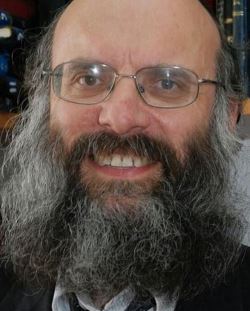
 R' Kalman Levine, 55
R' Kalman Levine was killed walking up the steps to the synagogue, which is next to his house. He was going to ask the rabbi a question in Talmud when he was gunned down.
Even in a neighborhood where many of the men learn Torah full-time, Kalman was known as a genuine Torah scholar. Although he grew up with scanty Jewish education in Kansas City, once he was exposed to Judaism, he dived headfirst into the sea of Talmud. He quickly caught up with people his age who’d spent their youth in yeshivahs, and then surpassed them in his breadth and depth of Torah knowledge.
Kalman lived life with such enthusiasm. He awoke early every day, praying at sunrise, and learning Torah until late at night. At the funeral, his son related that sometimes he’d wake up at 2 a.m. to get a drink, and his father would still be swaying away, deep in thought over his Talmud.
Kalman was a small man with a big bushy silver beard and an even bigger smile. He was a warm man who wasn’t shy about showing his concern for people. When someone needed to talk, he was completely there for them. He listened with his whole being; his eyes were focused on the speaker and he leaned in, to make sure he heard everything. When people insisted that he speak at an event and he felt that the audience was tired, Kalman made sure to only speak for five minutes.
But don’t think that his intensity was off-putting. His smile always reached his eyes, and people knew he was glad to see them. And no one who knew Kalman can ever forget the Mickey Mouse costume that he wore every Purim for decades, until it wore out.
 R' Avraham Shmuel Goldberg, 68. (Photo: Israel Ministry of Foreign Affairs)
R' Avraham Shmuel Goldberg’s love for the Land of Israel was apparent when he left his comfortable home in England to move to the town of Ofakim about 15 years ago. Rabbi Goldberg was known as a truth-seeker who sought out relationships with great Jewish leaders, becoming close to rabbis wherever he lived.
His sweet, shy smile rarely left his face, and people always felt comfortable turning to him. He would help people in any way he could. Anyone who was having trouble finding the source of a Jewish law or a parable knew they could turn to Avraham Shmuel, who always had a clear grasp of what he had learned. But he never expected any special respect because of it. He humbly submitted himself to men who were greater than him in Torah knowledge, following their advice thoroughly.
Avraham Shmuel was one of those people who always knew what to do—and what not to do. He didn’t hesitate to step forward when he could be of use, but he never trod on anyone’s toes, either. When one of his oldest friends was left a widower a year and a half ago, he called every single day to cheer him up, without ever staying on the phone long enough to be an inconvenience.
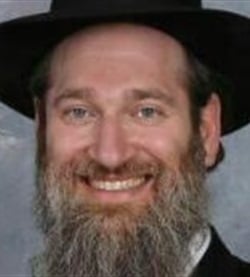 R' Ari Kupinsky, 43.
R' Ari Kupinsky was a neighbor whom I knew less well. But whenever I called on him to help the local paramedic organization with its yearly fundraising drive, he stepped up to the plate. Even when he’d barely gotten over the shock of losing his adolescent daughter, who’d passed away in her sleep without any warning; even when he’d just moved to a new building and didn’t know most of his new neighbors; even when he was just much too busy to do it that year—he always ended up agreeing to help.
These are the four beautiful souls who left this world for the afterlife. But two of my neighbors are still battling to stay in this world . . .
Shmuel Yerucham ben Baila is the red-headed father of a large family. He was stabbed repeatedly in the head, the back and the arm, but, thank G‑d, the vicious stabbing missed his brain, spine and all his vital organs. He was conscious enough before undergoing surgery to ask after his son, who had been in the synagogue with him, and who had crawled under the tables to safety.
Chaim Yechiel ben Malka is in more serious condition. Stabbed three times in the head and four times in the arm, he’s received 16 pints of blood as of now. No stranger to tragedy, his oldest child, Eli, passed away around 10 years ago. He’d gone swimming in the local reservoir during his yeshivah’s lunch break and hit his head while climbing back up to his bike.
Thank G‑d, he also knows good times. The other day, when I wished him mazal tov for his second son’s engagement, he was beaming with joy.
Everyone calls him Howie, and he’s known for being scrupulously honest. While many men in the community learn Torah full-time, Howie works as a matter of principle, but it doesn’t lessen his devotion to Torah study. When one of our neighbors expressed sympathy for him, on the assumption that he couldn’t find enough time for study, Howie was incredulous. He said, “I work eight hours a day. That leaves eight hours a day to learn Torah. How much time do I spend eating and praying anyway?!”
Howie’s family is asking people to donate money to funds for poor brides in his merit.
Please pray for the full, speedy recovery of my two wounded neighbors, and for G‑d to comfort their four widows and the many orphans.
Zidan Sayif, 30. (Photo: Israel Police)After these words were written, the news broke about the death of police officer Zidan Sayif, who was one of the first on the scene of the attack and died of gunshot wounds hours later. Most in our neighborhood didn't really know him but many of us traveled by bus up north to the town of Yanuh-Jat to say good-bye. Rabbi Mordechai Rubin, the rabbi of the Har Nof Bnei Torah synagogue where Zidan gave his life, said to his wife, young child, parents and fellow Druze. “We came from Jerusalem, from the place of the massacre . . . simply to be with you and to cry with you. Zidan showed courage. He was the first at the battle. He stood like a wall, with his body, with his head, in order to save the souls of those in the synagogue. The loss of Zidan is our loss as well as that of the Druze community and we feel, especially at times like this, a kinship with the Druze community. The devotion and the determination of Zidan should be an example to us all — to the Druze and to the Jews.”
© Copyright 2014, all rights reserved.
• The Har Nof Synagogue Massacre
On Tuesday morning, Nov. 18, 2014, two Arab terrorists armed with guns and axes burst into a synagogue in the quiet Har Nof section of Jerusalem. They left four worshippers and a brave policeman dead and many wounded in their bloody wake.
© Copyright 2014, all rights reserved.
YOUR QUESTIONS
Where Can I Apply to Become a Chabad Emissary?
How Can I Join? Will You Pay for My Airfare?
Of the hundreds of e-mails we receive every day at Chabad.org, many are from adventuresome, idealistic young men and women seeking to work at a Chabad house in an exotic location. by Mendy Kaminker
 Of the hundreds of e-mails we receive every day at Chabad.org, many are from adventuresome, idealistic young men and women seeking to work at a Chabad house in an exotic location.
We imagine the writers to be young men or women hoping for a They must need volunteers, no? reply that will provide them with an airfare and meaningful work. After all, Chabad has hundreds of branches all over the world. Surely, one of them can use a baker, assistant teacher or at least a babysitter. They must need volunteers, no? It seems simple enough.
Unfortunately, our answer is almost always in the negative. Every Chabad center is responsible for its own activities, including recruiting its own staff. If the Chabad emissary in Thailand needs a chef, he will probably search for one from among his own network of associates. It’s very likely that he will not turn to headquarters to help find a candidate (although some emissaries do). The best way to find work in a Chabad House is to apply directly to the emissary there.
Ladies and gentlemen, we can’t offer you any work. But we won’t send you away empty-handed.
Many of you write, “This is holy work.” You’re willing to share the burden of ensuring the future of the Jewish people. You’re concerned about the assimilation statistics and the very real difficulties facing the Jewish people in the 21st century. You see Chabad emissaries going to far-flung places to help every Jew, no matter where he is, and you’re so impressed that you want to join them.
Here is some encouraging news:
You don’t have to put on a black hat or a wig to join Chabad’s activities. You don’t even have to declare yourself to be a Lubavitcher chassid. All you need is a good Jewish heart.
Before running off to foreign lands, sit down and think:
Are there Jews in my area who would be interested in learning about Judaism, about the weekly Torah portion, or about Jewish mysticism?
Is there a family in the neighborhood that would appreciate a Friday night meal invitation?
Are there children in my neighborhood who would be able to join in some organized Jewish activities every Shabbat?
If you can answer one of these questions in the affirmative, then there’s ample room in your city for Chabad activities. The thirst is there, the need is great—and you need to get moving.
Whether you’re married or single, a young parent or a grandparent, you can find a way to help other Jews in your city. Don’t be embarrassed to invite a family you don’t know to your Shabbat table, and don’t hesitate to start a weekly Torah class, even if you’re not a rabbi or a rebbetzin.
You can find a way to help Jews in your city
Thank G‑d, the Internet can supply plenty of material. Our site can provide you with information on how to conduct a Shabbat meal (including the text of Kiddush), articles about the weekly Torah portion, stories and more. But you have to take the initiative. Decide on a project that feels right and get going!
We wish you much success, and of course we’re always happy to help.
If you would like to help your nearest Chabad emissaries, you can locate them here.
Rabbi Mendy Kaminker is the editor of Beit Chabad, the Hebrew edition of Chabad.org.
© Copyright 2014, all rights reserved.
More in Your Questions:
• You're Madly in Love (By Tzvi Freeman)
 Question
There is a woman whom I knew for a long time. I love her so much, but we're not together anymore. It's been more than a year since she broke off all contact with me. In two months she's getting married. What should I do? I am still convinced that she is the only one in the world for me.
Answer
Your situation is obviously a very difficult one. It is also a dangerous one, because she is marrying another man and you certainly don't want to destroy her marriage.
One thing I must explain to you about what we call "love": The One who created us wishes us to marry and have children. This is His greatest gift to us, for this is how we become most like Himself -- creators of life. But He knows that if we were all sane, controlled people we would never do these things. So, when we get into a relationship with a member of the opposite sex, He arranges for us to go insane and lose all trace of common sense.
This insanity is a very good thing. But the problem is that it has been made to be part of our natures, so it is indiscriminate. Meaning that it can work against us, too. We see, over and over, how destructive this wonderful insanity can sometimes become.
You are young. Like they say in America, there are plenty more fish in the sea. Especially wonderful Jewish girls. My advice: Save your beautiful insanity for another one. Let this woman marry and raise a family in peace. And you will merit to do the same.
Rabbi Tzvi Freeman, a senior editor at Chabad.org, also heads our Ask The Rabbi team. He is the author of Bringing Heaven Down to Earth. To subscribe to regular updates of Rabbi Freeman's writing, visit Freeman Files subscription.
© Copyright 2014, all rights reserved.
 VIDEO
VIDEOMiri Meets the Transport Angels
Miri gets a hi-tech lesson on “How Do Prayers Work?” We’re still waiting for the app. by Tzvi Freeman
Watch Watch (1:30)
<script language="javascript" type="text/javascript" src="http://embed.chabad.org/multimedia/mediaplayer/embedded/embed.js.asp?aid=1482496&width=auto&height=auto"></script><div style="clear:both;">Visit <a href="http://www.chabad.org/multimedia/default_cdo/aid/591213/jewish/Video.htm">Jewish.TV</a> for more <a href="http://www.chabad.org/multimedia/default_cdo/aid/591213/jewish/Video.htm">Jewish videos</a>.</div>
More in Video:
• The Significance of Tefillah - Discussions on Prayer, Lesson 1 (By Shmuel Kaplan)
<script language="javascript" type="text/javascript" src="http://embed.chabad.org/multimedia/mediaplayer/embedded/embed.js.asp?aid=2754038&width=auto&height=auto"></script><div style="clear:both;">Visit <a href="http://www.chabad.org/multimedia/default_cdo/aid/591213/jewish/Video.htm">Jewish.TV</a> for more <a href="http://www.chabad.org/multimedia/default_cdo/aid/591213/jewish/Video.htm">Jewish videos</a>.</div>
• Be Like a Redwood
http://www.chabad.org/therebbe/livingtorah/player_cdo/aid/2755548/jewish/Be-Like-a-Redwood.htm
http://www.chabad.org/2755548
WOMEN
From Dutch Theater to Challah Workshops
Smadar Morag used to try hard to hide her Judaism, which she considered a burden . . . by Tzippy Koltenyuk
 The Morag family
A star in the world of Dutch entertainment, Smadar Morag was an actress and singer who lived with her non-Jewish boyfriend and tried hard to hide her Judaism. Then, at the peak of her career, Smadar was given a role in Fiddler on the Roof. She was to play Chava, the rebellious daughter who marries a non-Jew. Playing this role, Smadar’s spark of Jewish identity was kindled.
Today, she lives in Israel and is mitzvah observant. Smadar continues to act, but the setting has changed; she no longer appears in theaters, but in synagogues, community centers and homes, and her audience is limited to women. She uses her talents for events that are in line with Jewish values—such as running a function that promotes the mitzvah of separating challah, telling the story of her life, and singing stirring Jewish songs.
The Burden of Being a Jew
Smadar was born in Israel in 1970. Her father was of Egyptian ancestry; her mother, Evelina, was originally from Holland. Evelina was a Holocaust survivor, saved because of her mother’s resourcefulness in convincing a non-Jew to adopt her. She was raised as a Christian, and was only told that she was Jewish when she was 20 years old. At that point, Evelina moved to Israel.
After Smadar and her three younger brothers were born, their parents decided to move to Holland. Though their home was traditional, Smadar didn’t feel connected to her Jewishness. She knew her mother’s entire family had been killed in the Holocaust, and felt that being Jewish was about being “different." So she did her best to be just like all her Dutch friends.
Smadar was the class clown. She was always singing and acting, whether it was in the school’s theater productions or at recess. When she was 14, Smadar’s family moved back to Israel. But Smadar didn’t acclimate well and returned to Holland when she turned 18.
Smadar lived alone in Amsterdam and decided to seek work in entertainment. She attended a theater school and lived a typical liberal student life. Disconnected from Judaism, Smadar lived with her non-Jewish boyfriend for seven years. Her parents were upset about the relationship, and her father cut off all contact with her. For seven years, Smadar didn’t return home. The lack of connection with her family left Smadar feeling abandoned and lonely, but she was determined to live her life the way she saw fit, without bowing to her parents’ expectations. After she graduated from theater school, Smadar became a successful actress, performing in many prominent shows.
 Danel and Elyana Morag
Theater of the Absurd
Fasting on Yom Kippur was Smadar’s only connection to Judaism. Apart from that, she hid her Jewishness for fear that it would stand in the way of her receiving good roles.
When she auditioned for Fiddler on the Roof, Smadar was given the role of Chava, the rebellious daughter of religious parents who marries a non-Jew. The producers knew that she was Jewish and felt that her Jewish appearance would give them an excellent advantage in marketing the show.
It was the first time in her life that Smadar found a benefit in being Jewish.
Fiddler on the Roof’s Chava has a lot in common with Smadar. Both are the oldest of four children, and both decide to spend years of their lives with a non-Jew. Chava’s father tears his clothes in mourning for the loss of his daughter, and, like Smadar’s father, he severs contact with her.
While in rehearsals in her role as Chava, Smadar found herself wearing modest clothing, lighting Shabbat candles and listening to Jewish music. She also found herself answering countless questions from her non-Jewish co-actors and actresses, who wanted her to help them “get into” the story. They expected Smadar to give them a full understanding of what it is to be Jewish. Before Passover they even asked her to supply them with matzah. Their encouragement led her to become a more observant Jew.
Meeting Father
Smadar’s father came to the first performance of Fiddler on the Roof. She was very surprised and touched. Her father’s childhood dream had been to become an actor and singer, but his life hadn’t worked out that way, and he was now living his dream vicariously through Smadar.
Smadar knew how her father would feel when he saw her acting the part of Chava. When Chava says to her father, Tevye, that she has chosen to marry a non-Jew, Tevye decides to act as though she is dead. After the performance, Smadar’s father came to see her and, by way of breaking the ice, said, “Do you see? Tevye agrees with me.”
After opening night, Smadar was interviewed by all the Dutch media. They all wanted to feature the Jew who performed in the show. Smadar was famous.
 A Performance of Fiddler on the Roof. Smadar is on the left.
An Earthquake
On August 17, 1999, an earthquake shook Turkey. Tens of thousands died. Smadar was deep into filming a reality show (Tehilla) when her mother called to tell her the news: Smadar’s father’s family—his sister, her husband, their son and daughter-in-law and their two children—were killed in the earthquake.
Smadar left the film set to attend the funerals of her aunt’s family. Her father took the tragedy very hard. He said that his wife had survived one Holocaust and this was his Holocaust. Smadar then returned to Holland to extricate herself from her long-term relationship with her boyfriend.
He’s Religious and She’s Not
Smadar met Yigal at a party for Israelis. They hit it off right away, and six months later, in 2002, they married.
A few months after the wedding, Yigal became interested in Torah and mitzvahs. Smadar would have none of it. Previously, when kippah-wearing men had been suggested to her as dates, she had refused to meet them. She was disappointed in Yigal. His budding connection to Judaism felt like a betrayal.
Yigal didn’t pressure her to change or to start keeping mitzvahs, but Smadar did her utmost to convince him to return to being the irreligious man she’d married. It didn’t work. Yigal became increasingly religious.
Two years later, Smadar became pregnant, but the differences between her and her husband were growing. He was keeping Shabbat and going to the synagogue; she was spending Shabbat acting in theaters and on television.
“What kept us together in the end was our respect for each other and our excellent communication. He respected me even though I was not religious. I had less respect for his mitzvah observance, but I loved him anyway.”
Smadar gave birth to their firstborn son, Danel, and took a year and a half off work to spend time with him. But the feelings of terror she had experienced after the destruction of her father’s family in the Turkish earthquake resurfaced after the birth. She went for psychotherapy, and at the same time started discussing her fears with her husband. She saw faith as the best remedy for fear, so they began discussing faith regularly. As a result, Smadar grew much stronger emotionally and learned to cope.
 Smadar on a cooking show aired on the Hidabroot channel
A Fateful Shabbat in a Hotel
Smadar continued to act in shows on Shabbat. One week, her husband suggested that they spend some time together in a hotel over Shabbat. “We went to a hotel in Belgium, where I was acting. My husband brought everything: a hot plate, candles, a Shabbat kettle, meals and dishes. I saw the effort he made to spend Shabbat with me. I was appearing in The Jungle Book, which was geared to families, so it ended early. After the show, all the performers went to a restaurant, and they invited me, but I went back to my hotel room. I was enchanted by what I saw. A white tablecloth had been spread on the table I’d used while applying my makeup a few hours ago. The candles were lit, and there was an incredible smell wafting from the food on the hot plate. Danel was sleeping, and we made Kiddush, washed our hands and ate. I was hypnotized. I felt like my husband had brought Shabbat to me. I experienced the special connection Shabbat makes between the members of a family, and everything in me that was antagonistic began to fade.” Shortly after that, Smadar decided to keep Shabbat.
The Revolution Is Complete
The theater world didn’t take well to Smadar's refusing to work on Shabbat. She lost her main source of income and had to think of creative ways to continue working as an actress and singer while keeping Shabbat.
“I became a freelance actress and a moderator on television,” she says.
At the same time, Smadar continued to become more religious. She went to Torah lectures and became friendly with people in the religious community. After a while, she began keeping more mitzvahs, such as kosher, modest dress, and family purity.
At the height of their teshuvah (returning to their Jewish roots), Yigal and Smadar decided to move to Israel. They didn’t want to raise Danel in Holland, where skullcaps and other signs of Jewish identity had to be hidden. Immediately before Passover, the holiday celebrating the Jews’ exodus from Egypt, the Morags told their parents that they were moving to Israel.
Epilogue
A few months ago, Smadar attended a wedding in Kfar Chabad, where she met Rabbi Biyomin Jacobs, a Chabad emissary in Holland. Smadar had known Rabbi Jacobs since she was a little girl. “Rabbi Jacobs had been part of my life forever, but we hadn’t run into each other since I became religious. When we were little kids living in Holland, we were in a Christian school. My parents asked the Chabad rabbi to come once every two weeks to teach us a little about Judaism.
“The rabbi came every two weeks. He travelled a long way to teach two children about Judaism, at no charge. Later, when I was living a non-Jewish lifestyle, he came to my house to have a heart-to-heart talk. He didn’t try to convince me to leave my boyfriend, because he knew I’d throw him out of the house. He just asked that I make every effort to patch up my relationship with my father and show him some respect, as Jewish law demands."
 Lecturing to women
Rabbi Jacob's recognized her and was amazed to see the changes she had made in her life, as well as the two young children at her side. He told her, "Who would have believed that you would become religious, move to Israel, and raise two children as Jews?!"
“I was lucky,” Smadar says today. “It’s true that I no longer appear on stage in front of thousands of people as I used to, and I’m not a star like I was in Holland. But I’m doing what I love. I’m making women happy, singing, acting, doing stand-up, and getting incredible, warm feedback.
“I used to be a theater star, but the satisfaction and the joy I get now from doing a challah workshop in someone’s home is far greater. I know that I’m doing something that has a real spiritual effect. I’m not working to satisfy my ego or for fame, but because I have a mission.”
Translated from Hebrew by Esther Rabi
Tzippy Koltenyuk is a public speaker, singer and creative writer.
© Copyright 2014, all rights reserved.
More in Women:
• The Greatest Gift (By Chana Scop)
 I was engrossed in one of those deep conversations with my teenage daughter—the kind of conversation that occurs between two best friends about how we live life and make choices. Ultimately it was about facing reality—a reality that includes hardship, tears and worry, and also sparks growth, fulfillment and strength.
I ventured deep into the recesses of my heart to share with my daughter my most raw experience of facing reality—an experience that drastically changed my life, and hers as well.
Ultimately, it was about facing reality
I told her about the day I found out about the complications with my pregnancy, and subsequently, with the very precious baby kicking within me.
I told her about my initial feelings of fear, sadness, loss, anger, resentment, wonder, helplessness, hopelessness and pain.
I talked about how I confronted this reality at the time, and how there is a place for such deep, incredulous emotions. But, I told her, there is also a way to shift these feelings so that you can step forward in your life.
I will never forget the day that I made this internal shift, taking my tiny tiptoe of a step forward, on ground that I felt would certainly swallow me up in the depths of despair.
It was when I stood there, in the NICU ward, looking at my baby, hooked up to monitors, oxygen and constantly beeping machines, only minutes after his surgery at a mere nine hours old.
I stood there with my heart shattered into pieces, into shards with deep-cutting edges, each one a different emotion, and all of them bound together by the invisible string of a mother’s endless love.
And that is where my deeper-than-rock-bottom low raised me up.
I closed my eyes and let the tears stream down my cheeks.
Dear G‑d, I have a deal to make. Please. Please G‑d, I cried. Please help me leave this nightmare and take my baby home. I promise that I will handle this with a smile. I will be grateful for this gift, and I will show you, each and every day. I will show you that I can smile and laugh. Just please let my baby be okay.
And I did leave that nightmare behind. I saw my prayer answered with miracles. And I accepted my reality. Not a reality of despair that would take me no further than those incessant beeping machines assessing every moment of life and vitality. Rather, I accepted a reality that would allow me to really live, to love and to be grateful. A reality that would welcome blessings, laughter and growth. A reality that left those beeping machines behind.
It was a risk I took, “unplugging” myself long before we left the nightmare of the NICU ward, taking that deep, invigorating breath, and putting aside the the reality of pain to focus on what I needed to do to survive.
My teenage daughter looked at me with her deep brown eyes, and I saw her taking in each word I shared.
Our Chaim Boruch, I explained, is only as incredible as he is because of our attitude as a family. He can sit, crawl, stand, walk, eat, play and love only because we believe in him, only because we transformed our despair into the luminous, passionate and positive emotions of gratitude, faith and strength.
Where would we be if I had returned home from my nightmare in the NICU ward and turned our family life into a continuous nightmare? Where would we be if I infused our days with anger, depression, sadness and resentment?
You see, I told my dear daughter, we have a choice. We can accept reality, feel the hard, tugging emotions, and then lift up our heads, wipe our tears and smile.
Hard? Yes. Impossible? No.
My daughter smiled. She understood.
And then, after a moment of silence, she said, “Well, what’s so bad about having a special needs child anyway?”
Hard? Yes. Impossible? No.
And at that moment, I let out a breath I had taken eight years earlier, unknowingly holding it deep within my chest and lungs all that time. At that moment, I felt I had made the home run of a lifetime. I had crossed the finish line in my own endurance race.
In my daughter’s words, I received the gift of knowing that I had indeed changed my reality, not only for myself, but for my entire family, to the point that my children see more beauty and gratitude than challenge.
My eyes filled with tears, and I thanked my daughter for this gift that I didn't even know I needed.
“My dear daughter,” I said, “now do you understand that your reality is spacious? That whatever challenges you face, there is room to feel very real, often difficult, emotions? And there is also room to choose your attitude and your mindset. To choose to work hard, to grow from challenge, and to decide who you want to be at the end of the game.”
(Author’s note: This blog post reflects my own personal experience. Raising a special needs child evokes many different experiences and fluctuating emotions, which all deserve to be honored and respected.)
Chana is a proud wife and mother of eight living in Mill Valley, California. She is inspired by the colors and textures of everyday life, and loves sharing her creative ideas with her community. Chana writes DIY projects, crafts and recipes celebrating her Jewish life and shlichus on her blog Chana’s Art Room, and is the co-director of Chabad of Mill Valley with her husband, Rabbi Hillel Scop. To read more about Chaim Boruch, and Chana’s journey, take a look at her personal special-needs blog, Life of Blessing.
© Copyright 2014, all rights reserved.
STORY
The Miser's Slippers
It was a cold and miserable night, snow and sleet blew through the deserted streets. The miser asked the rabbi in, as usual. But the rabbi refused. "'No," he said, "I won't be long...." by Shoshannah Brombacher
 In a town lived a very rich miser. Every time the local rabbi came to his door to collect funds for the poor, the miser would invite the rabbi in, offer the rabbi a glass of tea and talk about his business. When the rabbi started talking about the plight of the poor people in winter, the miser would brush him off and tell him that poor people like to complain--it wasn't all as bad as the rabbi thought. In any case, he had no cash in the house at the moment, and couldn't give anything right now. Could the rabbi come back another time? The miser would then escort the rabbi to the door, go back to his warm and comfortable room and settle down in his favorite chair near the fireplace, very pleased with himself.
But the rabbi was not pleased. The poor had no money for food or for wood for their stoves and they were cold and hungry.
One evening, the rabbi knocked on the rich miser's door. It was a cold and miserable night, snow and sleet blew through the deserted streets. The miser asked the rabbi in, as usual. But the rabbi refused. "'No," he said, "I won't be long." And then he inquired after the miser's health, and after the health of his family, and asked him about his business, and spoke about affairs of the community for a long time. The miser could not send the rabbi away, of course; he had opened the door for him himself. But he was getting quite uncomfortable. He had come to the door in his slippers and skullcap, dressed in a thin shirt and his house pants. The rabbi, wearing a warm coat with a fur lining, his biggest shtraymel covering his ears and heavy winter boots encasing his feet and legs, talked on and on. No, he didn't want to come in. No, really, he was on his way. The miser's toes became ice and stone.
Suddenly the miser understood. "Oh, Rabbi!" he cried. "Those poor people with no warm clothes or firewood for winter... I never knew. I never imagined it could be like this. This is miserable. It is horrible. I never knew, honestly! Something must be done!" He went into the house and returned with a purse full of gold coins. He wanted to go back to his fireplace as soon as he could. He needed hot tea. The rabbi thanked him and took the money. He, too, was cold after that long talk, but he didn't mind. The poor people would have a good winter this year.
The miser changed his ways that night. He became a regular contributor to the rabbi's funds for the poor, for poor brides, for poor students, for Passover money and for many other causes. He had learned a good lesson that night.
Text and image by chassidic artist Shoshannah Brombacher. To view or purchase Ms. Brombacher's art, click here.
© Copyright 2014, all rights reserved.
More in Story:
• A Connoisseur of Souls (By Yanki Tauber)
Your descendants shall be as the dust of the earth (28:14)
For you shall be a desirable land to Me…(Malachai 3:12)
 Rabbi Israel Baal Shem Tov taught that the Jewish people are like a plot of land: earthy, one might even say downright rough, but replete with potential treasure. Beneath the surface are vast stores of precious gems and metals, life-giving waters, and great reserves of energy. Its soil is alive with the promise of lush crops, ready to break surface upon a proper investment of devoted toil.
To access these treasures, one must first have the insight and foresight to look beyond the pedestrian grit. One must carefully probe the terrain and faithfully drill, mine, pump, plow, sow and water in order to reap his rewarding return.
Every individual - surface topology notwithstanding - is rich, fertile soil. Incumbent upon him and his fellows is both an opportunity and responsibility: to unearth and develop his diverse and fruitful resources to the utmost.
- Rabbi Menachem M. Schneerson, the Lubavitcher Rebbe, of righteous memory
On Simchat Torah of 1888, Rabbi Sholom DovBer of Lubavitch delivered the discourse Ein Hakodosh Boruch Hu Ba B'terunya ("G-d does not come with unreasonable demands to his creatures"), which discusses the special qualities of the simple Jew. He cited the metaphor of 'the heel and the hot water': the heel lags far behind the head in intellectual capacity, but when a person is required to enter a tub of hot water, the heel ventures forward while the head is reluctant to proceed. Simple Jews, explained the Rebbe, are blessed with a greater degree of self-sacrifice and wholehearted devotion to the Almighty than their more learned brethren.
Present at the Rebbe's discourse was a fellow known as Dovid Shlomo's Matti Yossi1, a jolly community activist and member of the Lubavitch firefighters brigade. He was the first to respond to the Rebbe's words. As soon as the Rebbe finished speaking, he sprang up, pounded on his heart, and announced: "Rebbe! I will found a Po'alei Tzeddek2society!"
The members of the society would rise at three o'clock in the morning to recite the book of Psalms in the synagogue known as 'Reb Binyomin's Shtibl.' They also scheduled classes in Jewish law. One would see them in the streets of Lubavitch, walking home from one of their classes and reviewing the laws they had just learned. Rabbi Sholom DovBer derived great pleasure from their activities and often praised their sincerity and wholesomeness. On one occasion (at the wedding of his sister, Rebbetzin Chaya Mushka Horenstein) he asked to dance with the members of Po'alei Tzeddek. He returned to his seat drenched in sweat and said to two of his foremost 'intellectual' chassidim: "I have just bathed in the merit of Israel…"
One of the prestigious chassidim of Rabbi Sholom DovBer was the learned diamond merchant, Reb Monia Moneson. Once, Reb Monia expressed his bewilderment at the Rebbe's veneration of these simple folk. "Why does the Rebbe devote so much of his invaluable time to them?" he asked. Rabbi DovBer began to tell Reb Monia of the special qualities which so endeared them to him. "Rebbe, I don't see it," objected Reb Monia.
"Do you have any of your diamonds with you?" asked the Rebbe. Reb Monia said he did and, as man discussing his profession is wont to do, began to excitedly describe his most recent acquisitions. "This time, Rebbe, I managed to acquire some real beauties," he exclaimed, "but I cannot show them to you just now - the sun is shinning too brightly."
Later, the diamond merchant was sufficiently satisfied with the lighting to spread his wares on the table. "Look at this one" he prompted the Rebbe preceding to extol its particular virtues. But the Rebbe failed to understand the specialness of the stone. "I just don't see it," he protested. "Ah, Rebbe," said Reb Monia "on a diamond, one must be a maiven."
"Ah, Reb Monia," countered the Rebbe, "on a Jew, one must be a maiven…"
Yanki Tauber is content editor of Chabad.org.
FOOTNOTES
1.i.e. Matti Yossi, the son of Dovid Shlomo.
2.'Doers of Righteousness'
© Copyright 2014, all rights reserved.
LIFESTYLE
Our Food Blog Celebrates Two Years
with carrot cake and cream cheese frosting. Come taste! bBy Miriam Szokovski
I can't believe it's been two years since I started this blog. It's been an exciting journey and I am grateful to all of you—my readers—for your comments, suggestions and feedback. You've helped shape this blog, so this is a celebration for all of us.
Last year for our birthday I taught you how to make fancy decorated cookies; this year we'll tackle layer cakes. I chose carrot cake with cream cheese frosting but the same techniques can be used with different flavors.
 NOTE: If you prefer things less sweet, I definitely recommend reducing the amount of sugar in this recipe. I found it very sweet, but my taste-testers thought it was just right, so it all comes down to personal preference.
 This cake make two 9-inch round cakes or three 6-inch round cakes. Bake the cakes, take them out of the oven and let cool in the pans for 10-15 minutes. Then gently tip them out onto a wire rack to cool completely.
In order to build the cakes, you need to cut the tops off. You can do it once the cakes have cooled, or you might find it easier to do after you freeze the cakes for 30-60 minutes.
While the cakes are cooling, prepare the cream cheese frosting. You MUST use room-temperature butter. If the butter is cold you will end up with ugly, unappetizing lumps in the frosting (trust me). Do not be impatient! To bring the butter up to room temperature faster, cut it into pieces.
 Mix the butter and cream cheese until smooth. Add the confectioners sugar, salt and vanilla and mix until incorporated. Do not over-whip. Refrigerate frosting for 15-20 minutes before using. Scoop frosting into a Ziploc bag, seal the bag and make a hole in one corner. Use this makeshift piping bag to squeeze out the frosting neatly.
Cover the top of the first cake with frosting, place the second cake on top. Frost the second cake, then put the third cake on top. Now it's up to you to decide if you want to frost the cake traditionally, covering the entire cake with frosting, or you want make it a "naked cake" and just frost the top. As you can see, I like this newish "naked cake" trend.
 Carrot Cake Ingredients
2 cups white sugar (or 1 cup white and 1 cup brown)
1 ¼ cups oil
4 eggs
1 lb. grated carrots
2 cups flour
2 tsp. baking powder
2 tsp. baking soda
½ tsp. kosher salt
1 tsp. vanilla
1 tsp. cinnamon
1 tsp. nutmeg
Optional: raisins, chopped pecans
Carrot Cake Directions
Cream the sugar, oil and eggs.
Add in the flour, baking powder, baking soda, salt, cinnamon, nutmeg and vanilla. Mix well.
Stir in the grated carrots (and pecans or raisins if desired).
Pour batter into 3 well greased 6-inch round pans and bake for approximately 30-40 minutes on 350° (until a toothpick or skewer comes out clean).
Leave the cakes in the pans for 10 minutes, then gently tip them out onto a baking rack to cool fully.
Cream Cheese Frosting Ingredients
1/4 cup butter, at room temperature
12 oz. cream cheese
1 ½ cups confectioners sugar
1/8 tsp. kosher salt
2 tsp. vanilla
Cream Cheese Frosting Directions
Let the butter come to room temperature—otherwise you'll end up with lumps.
Mix the butter and cream cheese until smooth.
Add the confectioners sugar, salt and vanilla and mix until smooth. Refrigerate frosting for 15-20 minutes before using.
To assemble
- Cut the tops off the cakes to make them level. (You might find it easier to freeze the cakes first for half an hour—it makes them firmer and easier to cut.)
- Cover the top of the first cake with frosting.
- Put the second cake on top.
- Cover the top of the second cake with frosting.
- Put the third cake on top.
- Cover the top of the third cake with frosting. Serve. (Optional: You can also frost the sides if you'd like.)
 Are you celebrating a birthday? Birthdays have an important place in Jewish life, and I encourage you to browse our birthday site and read up on some of the beautiful birthday traditions.
Thank you to all my wonderful readers, and I look forward to another year of delicious kosher recipes and good conversation. Do you have a recipe you'd like to share? Let us know—we'd love to add it to our collection.
 Happy birthday Cook It Kosher!
Miriam Szokovski is the author of historical novel Exiled Down Under, and a member of the Chabad.org editorial team. She enjoys tinkering with recipes, and teaches cooking classes to young children. Miriam shares her love of cooking, baking and food photography on Chabad.org’s food blog, Cook It Kosher and in the N'shei Chabad Newsletter.
© Copyright 2014, all rights reserved.
More in Lifestyle:
• The Torah Goes out from Zion (By Yoram Raanan)
 Acrylic on canvas with collaged oil on book cover
Artist’s Statement: The curtains have opened and the Torah is shining. Zion is a concept. It is a place. It is a sign and it is our home. This painting began as a landscape, painted in earth tones of the hills surrounding Jerusalem. Two years later I added the magenta curtains. They frame the pathway and form a doorway into the bright landscape. A few years later I collaged half a book cover painted with Torah scrolls onto the landscape. Only then was the picture of Jerusalem complete and the painting got its name "The Torah goes out from Zion."
Yoram Raanan takes inspiration from living in Israel where he can fully explore and express his Jewish consciousness. The light, the air, the spirit of the people and the land, energize and inspire him. His painting include modern Jewish expressionism with a wide range of subjects ranging from abstract to landscape, Biblical and Judaic.
© Copyright 2014, all rights reserved.
JEWISH NEWS
Celebration and Inspiration Resonate at Annual Chabad Gala Banquet
Some 5,200 rabbis and guests focused on the Rebbe’s ongoing influence at the annual banquet of the Kinus Hashluchim, the International Conference of Chabad-Lubavitch Emissaries. by Karen Schwartz
 Some 5,200 rabbis and guests from more than 80 countries attended the closing banquet of the International Conference of Chabad-Lubavitch Emissaries at the South Brooklyn Marine Terminal in Brooklyn, N.Y. (Photo: Adam Ben Cohen/Chabad.org)
Berel Pewzner, 26, has been to the annual Kinus Hashluchim—the International Conference of Chabad-Lubavitch Emissaries—before, but this year was different.
This was his first time attending the event as an official shaliach—a Chabad emissary—as co-director of Chabad of the Cayman Islands, which he leads with his wife, Rikal.
He and thousands of other participants—a total of 5,200 people, including 4,200 emissaries, and another 1,000 or so supporters and students from around the world—were seated Sunday night around round tables draped in white linen beneath elaborate chandeliers at the South Brooklyn Marine Terminal in Brooklyn, N.Y. It was the culminating event of an extended weekend of learning, workshops, inspiration and camaraderie that started last Wednesday and ended on Monday.
At the gala banquet dinner, they heard from Rabbi Yehuda Krinsky, chairman of Merkos L’Inyonei Chinuch, the educational arm of the Chabad-Lubavitch movement; Rabbi Moshe Kotlarsky, vice chairman of Merkos; Yuli Edelstein, Speaker of Israel’s parliament, the Knesset;and keynote speaker Rabbi Nissan Dovid Dubov, co-director of Chabad Lubavitch of South London.
The theme of this year’s conference focused on the concept of the Rebbe—Rabbi Menachem M. Schneerson, of righteous memory—continuing to accompany each individual emissary in his work. It also took place 20 years after the Rebbe’s passing, a significance not lost on those gathered for the annual event.
Recalling how the Rebbe’s disposition would become palpably uplifted when the shluchim would arrive for the conference each year, Krinsky said the Kinus served as a family reunion of sorts: “It was more like children coming home together to visit their father.”
As Rabbi Krinsky emphasized, “the Rebbe wanted us to change the world today. Shluchim around the world dedicate their lives to this ideal, this goal,” he said, acknowledging the important work of the emissaries and the leadership they provide to Jewish communities around the world. “The future of the Jewish people,” he declared, “is in your hands.”
‘Spreading Torah and Values’
In his introductory remarks before the evening’s speakers, Rabbi Kotlarsky explained that “we spent days and nights in seminaries and plenary sessions, strengthening our motivation and our goals and our commitment, and forging the future of the Jewish people for the next year.”
And while he recognized the ongoing work of the emissaries, he also encouraged the strong momentum to keep moving forward.
“The Rebbe wasn’t looking for complacency,” stressed Kotlarsky. “He was looking to make a radical change in the world; he was looking to reach each and every Jew; and we see now 20 years after Gimmel Tammuz, we see the effect of the Rebbe’s teachings on the world. We see how many people are yearning and striving to connect to the Rebbe’s teachings, to the teachings of Torah. We see, on a daily basis, how the world has changed.”
Such change can be illustrated by the life and background of Edelstein, the guest speaker.
Born in Ukraine in 1958, he developed a strong interest in Judaism and his heritage as a young man. In 1977, he applied for a visa to leave for Israel, which was denied, resulting in his being expelled from university, and harassed by the KGB and the local police.
 Speaker of the Knesset Yuli Edelstein (Photo: Adam Ben Cohen/Chabad.org)
He eventually discovered Chabad and joined its underground movement. In 1980, he married in secret under the chuppah; four years later, he was arrested by the KGB and sentenced to three years in the Gulag. Edelstein was released in 1987, at which time he and his wife, Tania, received their visas, left for Israel and settled in Jerusalem, where he became involved in politics and steadily climbed up the Israeli political ranks.
“The real reason I’m here,” he said, “is the debt—the debt I can never pay back, the debt that doesn’t disappear even on this shemittah [sabbatical] year, the debt I owe to the Rebbe and the shluchim of that generation, the debt for being Jewish.”
In a tone of steadfast seriousness, he looked at the emissaries around the room and said: “Your mission, spreading the Rebbe’s Torah and values, remains constant, remains eternal. Wherever you are in the world, you are there because the Rebbe wanted every Jew, in every far-flung location, to have access to Torah and mitzvahs. He knew that uniting Jews by connecting them to their heritage will bring redemption to this world. For the Rebbe, every Jew—no matter his background or her level of observance—was a key part in the worldwide effort to bring Moshiach now. These are lessons that you, the Chabad shluchim, have clearly taken to heart.”
The Speaker of the Knesset stated that he wanted to convey his gratitude for Chabad’s moral support to the soldiers of the Israel Defense Forces during Israel’s summer war with Hamas in Gaza. He poignantly described Chabad rabbis visiting Israeli soldiers at the border, bringing them spiritual and emotional sustenance, whether through tefillin, prayers and letters of encouragement from around the world.
“To all those who were there, I want to say thank you on behalf of the State of Israel and on behalf of the Jewish people.”
Keynote speaker Rabbi Dovid Dubov, co-director of Chabad Lubavitch of South London, grew up in Manchester, England, attending yeshivahs there and in Jerusalem. He earned his rabbinical ordination in Montreal. In 1988, Dubov and his wife, Sarah, went on shlichus to Wimbledon, England.
 Rabbi Nissan Dovid Dubov (Photo: Adam Ben Cohen/Chabad.org)
The author of 13 books on Jewish life, law and customs, Dubov also serves as a board member of Chabad-Lubavitch of the United Kingdom and as a director of the Gan Israel overnight-camp network in the United Kingdom. In 1991, the Dubovs built the first mikvah in South London.
He also is one of two representatives who serves the Jewish community at the international Wimbledon tennis tournament—the oldest in the world—with co-emissary Rabbi Dovid Cohen, also of Chabad of South London. And that position has led to some eye-opening observations.
“Now when playing tennis, love equals the score zero,” he noted. “However, in Chabad, love means everything.”
He went on to say that “we in Wimbledon have discovered the secret of Chabad, and it is this: If you want to raise a racket and you want to create advantage Chabad, then serve with love.
“Friends, tonight at this Kinus, look at this room. Chabad wins game, set and match!”
In a more serious turn, he urged the work of the Rebbe and the advancing of acts of kindness: “Any single good deed can be the one that tips the balance of the entire world towards redemption.”
To the colleagues who were present Sunday night, Dubov also encouraged the work they do, reaching out to Jews everywhere.
“Chazak, chazak, vnischazek! (“Be strong, be strong, and we will gather strength!”), declared the rabbi.
“Be strong and proud Jews. Be proud of Eretz Yisroel. Be proud of Am Yisroel. Be proud of Toras Hashem, and counter the forces of darkness with acts of goodness and kindness, and with the tested ways of the Rebbe’s mitzvah campaigns: One mitzvah at a time, one Jew at a time.”
The formal program ended with the famed international roll call led by Rabbi Kotlarsky, who recognized Chabad’s presence in countries near and far around the globe.
 Rabbi Yehuda Krinsky (Photo: Adam Ben Cohen/Chabad.org)
‘A Piece of the Excitement’
All the while, Pewzner had been leaning forward in his chair, listening.
“It is very humbling to be here,” he said, taking in the podium and hordes of tables packed with men dedicated to the same cause of fulfilling the tasks set before them by the Rebbe.
Pewzner, having grown up the child of emissaries in Harrisburg, Pa., noted that he and his family used to listen to tapes of the annual event before bed.
“We would follow it before the days of live broadcast,” he said. “It was an integral part of our upbringing as young emissaries; we’d always get a piece of the excitement.”
Rabbi Yisrael Deren, regional director of Chabad of Stamford in Connecticut, was one of the organizers of the very first such gathering in the early 1980s. “The first Kinus took pace in a library on the fourth floor of Lubavitch World Headquarters, 770 Eastern Parkway” in the Crown Heights neighborhood of Brooklyn, he recalled.
Attending were emissaries from the United States, and they participated in a relatively informal program, where each man stood up, introduced himself and gave an overview of what was happening in his community. They shared ideas and raised questions that others might be able to help address.
Each emissary contributed $100. When the Rebbe found out, he insisted on giving each one back the $100, then to add another $100 as a gift—with the $200 not to be kept, but to be used. Then he gave each emissary an additional $2 to keep for themselves.
“It’s grown to begin to reflect the Rebbe’s vison for what he wanted, which was to transform the entire world,” said Deren at the banquet. “Perhaps in the last couple of years, the Kinus is really a reflection of that—every single place that has any form of organized Jewish community is represented in this room tonight.
 Rabbi Moshe Kotlarsky (Photo: Adam Ben Cohen/Chabad.org)
“The shluchim are touching, affecting and materially changing the face of these communities, making them warmer and brighter places where Judaism flourishes, reflecting the Rebbe’s message that the world we live in is waiting to hear words of Torah, the guidance of mitzvot and the hope for Moshiach [messiah].”
‘The Message Hasn’t Changed’
Rabbi Zelig Rivkin, regional director of Chabad-Lubavitch of Louisiana in New Orleans, who was sent out on shlichus in 1973, also came to that very first Kinus so long ago. “It was very friendly and comfortable,” he said. “There was frank discussion among people with the same task; issues that were important to us all.”
Though the format has changed to accommodate a much larger group, there are still ways to meet with smaller parties throughout the weekend. And the Rebbe’s message has remained the same, he stressed: “As far as inspiring other people to do mitzvot, learn Torah, to strengthen our Jewish identities and create Jewish communities we’re all proud of—that message hasn’t changed. It’s just grown stronger and more powerful every year.”
Pewzner, who left last March for the Caymans, concurred: “We can learn from the stars and their initial challenges; they have paved the way for us.”
Now, 20 years after the passing of the Rebbe, he and the other rabbis heading out to connect with Jews wherever they are—both physically and spiritually—are taking on the Rebbe’s mission
 This year’s conference carried an added significance as millions around the world mark 20 years since the passing of the Rebbe, Rabbi Menachem M. Schneerson, of righteous memory. (Photo: Adam Ben Cohen/Chabad.org)
“This is a testament to the Rebbe’s legacy and his influene on us,” said the young rabbi.
For Rabbi Alter Goldstein, co-director of the Chabad House of Ann Arbor in Michigan, the evening could be divided into two parts. “There’s what you get, and what you give,” he said. “What you get is inspiration; what you give is increased vigor to what the Rebbe established.”
He spoke to the milestone nature of the year, but also to the responsibility that comes with representing the Rebbe’s teachings. “At first, it was the idea of continuing that legacy. Now, it’s making sure we keep up with the demand of those thirsty to tap into it,” he said.


 “Half the shluchim here didn’t see the Rebbe, maybe,” he estimated, looking out into the sea of faces filling the Brooklyn Marine Terminal. But that’s not the point, he suggested; that fact hasn’t stopped the momentum. “The Rebbe, even though he’s physically not here, he’s still with us deeply and in the most important ways.”
Thousands dance in celebration. (Photo: Adam Ben Cohen/Chabad.org)
The Kinus is an opportunity for emissaries and their supporters to connect. (Photo: Adam Ben Cohen/Chabad.org)
The celebrating lasted well into the night. (Photo: Adam Ben Cohen/Chabad.org)
© Copyright 2014, all rights reserved.
More in Jewish News:
• The Extensive Reach of the Rebbe’s Emissaries: It’s Never Been Greater (By Faygie Levy)
 The past: Chabad of Texas was founded on May 10, 1972, by Rabbi Shimon and Chiena Lazaroff. Five years later, more than 400 people attended the groundbreaking ceremony for the Houston Chabad House, known as the Chabad Lubavitch Center at 10900 Fondren Road. (Chabad of Texas Archives)
This is the first in a series of articles on the growth and impact of Chabad-Lubavitch worldwide.
In the past several months, a group of young married couples, many with a baby or young children by their sides, left their home towns destined for cities and towns across the United States, including Frisco, Texas; Biloxi, Miss.; and Pittsburgh, Pa.
They joined some 90 other young Jewish couples who have moved out of New York, some going far overseas, since the start of 2014—as well as many of their contemporaries waiting to do so—in an effort to spread the light of Torah and Judaism throughout the world.
Called shluchim, or “emissaries” in English, they are following a directive that was given to them—and in many cases, to their parents and grandparents—by the Lubavitcher Rebbe, Rabbi Menachem M. Schneerson, of righteous memory. The 20th anniversary of the Rebbe’s passing—his yahrtzeit—on the third day of the Hebrew month of Tammuz fell this year on July 1.
“Shlichus is really a lifestyle,” says Rabbi Henoch Rosenfeld, 25, who along with his wife, Sarah, 22, and 8-month-old son Mendel moved to Pittsburgh to join a large contingent of established shluchim, including his parents, Rabbi Yisroel and Blumi Rosenfeld.
“As much as the Rebbe left us with his teachings,” the young rabbi says, “he left us with a timeless mission to bring every Jew closer to Judaism and their roots. [It’s a mission] that is as present today as it was 30 years ago, when the Rebbe sent them personally.”
That so many young people continue to go on shlichus is an amazing feat considering that in the days and weeks after the Rebbe’s passing, many predicted that the movement would decline—that it would not be able to sustain its energy and vision after the loss of their leader.
Not only has that proven not to be the case, a renewed vigor propelled the movement forward. Honoring the memory of the Rebbe, his adherents plunged full force into their work.
In fact, a great number of these worldwide emissaries are gathering this week in Brooklyn, N.Y., for the annual Kinus Hashluchim, the International Conference of Chabad-Lubavitch Emissaries, which takes place Nov. 19 through Nov. 24.
 Rabbi Yehuda Krinsky, chairman of Merkos L’Inyonei Chinuch, the educational arm of the Chabad-Lubavitch movement
“When the Rebbe passed away, there were maybe 1,500 shluchim,” according to Rabbi Shimon Lazaroff, who along with his wife, Chiena, were sent to Texas by Rebbe in 1972. “Now there are approximately 4,000 shluchim. We have more than doubled because of that vision of the Rebbe to go and follow his directive.”
Rabbi Yehuda Krinsky, chairman of Merkos L’Inyonei Chinuch, the educational arm of the Chabad-Lubavitch movement, states that “when you look at the panorama of Chabad around the world, it’s beautiful. There’s nothing like it. But we must remember that we haven’t even begun to scratch the surface.
“It’s amazing to see the respect people have in the community for the shluchim,” he continues. “They don’t just run a synagogue or a center on campus; they are involved with the entire community and in the whole kaleisdoscope of people’s lives. People trust them; they are comfortable with them.”
Still, he emphasizes: “We can’t relax until we reach every Jew. We have a long way to go.”
Reach and Engage
The actual number of shluchim couple serving today is 4,187, though swells to more than 25,000 people worldwide when adding in the children of those couples (the Rebbe considered the children ofshluchim to be emissaries in their own right); yeshivah students, or bochurim, who help out in the summer and during holidays; and young unmarried women, who serve as camp counselors and assist with schools and programming as well.
 Rabbi Mendy and Mushkie Kesselman, and their son Nosson, now in Frisco, Texas
“The Rebbe wanted to reach each and every Jew with the light of Torah and mitzvot, and until that’s accomplished, we can’t rest,” says Rabbi Mendy Kotlarsky, executive director of Merkos 302, which provides programming support to Chabad Houses around the world. “As the number of shluchim grows, we are constantly looking for ways to further empower them in their work, and provide them with tools to reach and engage with more Jews than ever before.”
Chabad may not be everywhere, but it does run centers in more than 80 different countries. In many of these places, Chabad serves as the only link to organized Jewish life for residents and visitors, offering Torah study and classes on Judaism, Shabbat observance, kashrut, Jewish holidays, Rosh Chodesh and more.
Nationwide, that presence is reaching far beyond the confines of major cities like Los Angeles and Miami, where the Rebbe personally sent his emissaries in the 1950s and 1960s. Small towns, far-flung suburbs and even deep into the West—in geographically large states like Wyoming and Montana, where few Jews live percentage-wise—have seen the arrival of Chabad couples, who often work out of their homes at first.
Chabad has a footprint in more than 45 cities and towns across New Jersey, and more than 100 in both California and in Florida respectively.
Even the Hawaiian Islands are host to four different Chabad Houses. (Chabad also has a growing presence in Mexico and the Caribbean, a popular tourist destination, with more and more Jewish individuals choosing to live or retire there.)
 Rabbi Akiva and Hannah Hall, and their daughter Leah, now in Biloxi, Miss.
In fact, of the 50 U.S. states, only one lacks a permanent Chabad presence: South Dakota. Mississippi became the 49th state to have a Chabad House when Rabbi Akiva and Hannah Hall, and their baby daughter Leah, settled in Biloxi earlier this fall. South Dakota, meanwhile, will be served by “Roving Rabbis,” who come in for various programs, holidays and more.
Canada has also seen plenty of growth over the last 20 years in the number of Chabad Houses and emissaries serving the Great White North, estimated at about 250. More than half-a-dozen centers have opened throughout Alberta and British Columbia, including Kelowna, B.C., which recently also got its first Torah scroll. Farther east, Montreal and its surrounding neighbors can count approximately 100 shluchim in the region.
“In the past 20 years, the network of Chabad-Lubavitch in Canada has literally quadrupled,” says Rabbi Mendel Kaplan, who co-directs of Chabad @ Flamingo in Thornhill, Ontario, with his wife, Faygie. “From a prominent presence on the Jewish landscape during the past two decades, Chabad has flowered in an unprecedented fashion. In communities both large and small, Chabad centers and the shluchim of the Rebbe are now seen as trendsetters and at the vanguard of the future of Canadian Jewry.”
Along those lines, Rabbi Yossi Groner, the head emissary in the Carolinas, notes that “the Rebbe generated an energy that was unstoppable.”
 Rabbi Henoch and Sarah Rosenfeld, and their son Mendel, now in Pittsburgh, Pa.
“In the old days,” he explains, “they used to give a lot of credit to the shluchim on their own, and say they were dynamic, charismatic people. Now they realize it wasn’t that way in a vacuum, but that the young people were trained in the way of the Rebbe, and he inspired them. They realize the power of the Rebbe even more today because while he’s physically absent, his ideas and presence are still growing and growing.”
That influence is felt across Groner’s adopted home state of North Carolina and neighboring South Carolina, as the Charlotte-based rabbi has been instrumental in bringing new shluchim to his region.
To date, the two states have 12 Chabad Houses between them, and Groner isn’t done with his recruiting.
“We believe there will be more couples coming,” he predicts. “There are bedroom communities that need a Chabad, so we will probably aim to send them there.”
Also planning to expand is Rabbi Sholom Ber Levitin, who oversees Chabad-Lubavitch of the Pacific Northwest, which includes parts of the United States and western Canada. The region is currently home to 40-plus emissaries and a number of different Chabad centers, schools and more.
“We just had someone call to apply for shlichus in Washington,” Levitin says, adding that already, “there are four shluchim who are in the initial stages of discussing their potential shlichus” in the region.
 Rabbi Shimon Lazaroff of Chabad Lubavitch Center Regional Headquarters in Houston, Texas
Not Lonely in the ‘Lone Star’ State
That news would have certainly pleased the Rebbe, who once asked his followers to mark his 70th birthday by creating 71 new Chabad centers to reach out to other Jews. The Rebbe personally provided seed money for those ventures—some 10 percent of the operating costs.
Among those who answered the call were the Lazaroffs.
“The Rebbe sent me to Texas and told me it wasn’t decided where I should live, so we checked out San Antonio, Dallas, Houston, and then I gave a report. The Rebbe circled Houston, so we went there—me, my wife and my four children.”
Today, more than 30 shluchim work in the Lone Star state from El Paso in the west to the Galveston Bay area in the east.
Rabbi Mendy and Mushkie Kesselman—25, and 22, respectively—are among the newest. Mushkie Kesselman’s parents, Rivka and Rabbi Menachem Block, are shluchim in Texas, where Mushkie was raised. This July, she and her husband, with their 6-month-old son Nosson in tow, moved to Texas to build their own Chabad community in the town of Frisco.
“My parents are in Plano, 30 minutes away, and a lot of people were coming to them from Frisco and wishing they were closer,” explains Kesselman. She notes that a wealth of job opportunities in Dallas and Plano has prompted young couples to move out to Frisco, where there is more affordable housing.
 Rabbi Mendy Kotlarsky, executive director of Merkos 302 in Brooklyn, N.Y.
Kesselman and fellow new shaliach Henoch Rosenfeld, along with their spouses, are examples of a growing trend of younger couples who were raised on shlichus returning to their home communities to continue the work of Chabad emissaries before them.
But a desire to return to one’s roots doesn’t guarantee that a shaliach will be placed there. Rather, an aspiring emissary must demonstrate a need for their services and gain approval from the head shaliach in the region.
At other times, the creation of a new Chabad center comes after yeshivah students return home from their summer or winter touring, where they travel to population centers that don’t have a lot of Jewish infrastructure, indicating that a community could support a Chabad House.
According to Rosenfeld, that’s exactly what transpired in the town of Altoona, Pa., several years ago when he and a group of friends traveled through Western Pennsylvania’s smaller communities and saw an interest for a stronger Jewish presence.
“The follow-up to our visit,” he says proudly, “was that a rabbi moved there.”
 The present: Chabad of Texas sports a state-of-the-art new building, an example of Chabad's continued growth over the past 20 years.
A Paradigm Shift
Regardless of how a Chabad House gets started, they all have one thing in common.
As Groner explains: “There needs to be interest from the local community. It has to be in both the desire to learn and connect with Chabad. Also, we try to raise 50 percent of the budget of the first two years from the local community. This forms a solid partnership with the existing community.”
There also must be a commitment by the aspiring emissaries to move to their new city for the long haul.
Despite the massive growth of shluchim around the country and world over the last 20 years, some young Chabad couples remain challenged in finding a place to go.
“If there were a thousand more places, there would be a thousand more shluchim,” states Kotlarsky. “Thank G‑d, Chabad is almost everywhere geographically, so we are now turning our focus to demographic outreach by creating programming specific to different age groups, including kids, teens and young adults just starting out in the business world.”
“There’s a need for a paradigm shift in shlichus itself,” says Groner. “New shluchim who enter the system should be willing to bolster existing Chabad institutions—they could bring new life to the infrastructure of these institutions.”
The bottom line, however, is that Chabad’s youth will continue to leave their home communities ad their academic institutions, and reach out to other Jews wherever they are because that was what the Rebbe asked of them—indeed, expected of them.
“The Rebbe once said he would be very satisfied with a small minyan [in his shul] if he knew everyone was going out doing shlichus,” Groner recounts. “And the greatest happiness is to see how many people have been affected and connected as a result of those going out.”
Articles on the growth of Chabad in other parts of the world over the past 20 years will follow in coming weeks.
© Copyright 2014, all rights reserved.
• Miami Jewish Life and Chabad Engagement Are Booming (By Adam Bell)
 The new Rok Family Shul, Chabad Downtown Jewish Center in Miami offers 20,000 more square feet of space than its former site in an office tower. It is just one of many Chabad centers in the Miami-Dade area that's responding to the growth of the Jewish population in South Florida.
The Miami area is hotter than ever, according to a new study that found that participation in Chabad-Lubavitch programs is simply booming there.
More than one-in-four Jewish households in Miami-Dade County—some 26 percent—have engaged with Chabad programming during the past year, including 42 percent of Jewish households with children at home, according to “The 2014 Greater Miami Jewish Federation Population Study: A Portrait of the Miami Jewish Community.”
“When I saw that number, my jaw dropped,” said Ira Sheskin, director of the Jewish Demography Project of the Sue and Leonard Miller Center for Contemporary Judaic Studies at the University of Miami, and professor and chair of geography at the same institution. “I was thinking maybe 10 or 15 percent.”
Sheskin, who has completed 42 major Jewish-community studies for Jewish Federations throughout the country, offered some theories on the reason for the big Chabad numbers. “I think a good part of it is it’s welcoming and it’s open to everyone,” he said. Additionally, “Chabad is viewed as a very authentic Jewish experience, and they don’t charge any dues. That’s always helpful.”
This is the first time the once-a-decade report detailed Chabad engagement, according to Michelle Labgold, chief planning officer of the Greater Miami Jewish Federation. The question was broadly worded and covered a range of activities, from attending services and classes at Chabad centers to to joining in a range of holiday programming.
 Ira Sheskin, demographer and director of the research team for “The 2014 Greater Miami Jewish Federation Population Study”
“We’re glad we asked the question,” said Labgold. “What’s striking is the evident reach of Chabad in reaching a part of our population.”
Chabad itself has grown greatly over the years in the Miami-Dade area, Sheskin said, from five centers in 1994 to 23 centers this year.
The survey found that Chabad attracted relatively young households. Nearly half of all Jewish households led by people under age 35—some 47 percent—visited a Chabad center or participated in a Chabad-related activity within the past year. And 36 percent of the homes in the 35-to-49-year-old demographic went to Chabad as well.
Among the other findings:
25 percent of the households who went to a Chabad activity identified themselves as Orthodox, while the vast majority of attendees—the other 75 percent—identified themselves as Conservative (32 percent), Reconstructionist (1 percent), Reform (19 percent) or “just Jewish” (23).
Only half of the households that attended Chabad are synagogue members, and merely 1 in 5 belongs to a Jewish Community Center.
Chabad also proved a hit with households with children: 42 percent of the people in those homes attended Chabad.
‘The Growth Is Unbelievable Here’
The numbers in the study didn’t come as a surprise to Chabad rabbis in the Miami area.
Rabbi Chaim and Deenie Lipskar, co-directors of the Shul of Downtown, helped lead the grand opening in February of a new facility in Miami proper—the Rok Family Shul, Chabad Downtown Jewish Center. It saw 1,200 people come to the center on its opening weekend. Also working at the new center are Rabbi Eli and Rochie Lipskar.
The downtown shul was founded by The Shul of Bal Harbour under the leadership of Rabbi Sholom Lipskar, who started it nearly 30 years ago as a place of worship and respite for businesspeople.
 Rabbi Chaim and Deenie Lipskar, co-directors of the Downtown Jewish Center
“The [study] numbers definitely validate our hard work,” said Rabbi Chaim Lipskar. “We built our center in downtown Miami with the belief that there would be thousands of young people who would live and work here.”
Young people, he said, are interested in exploring their spirituality, and are “not set in their ways.”
Mosaic in Miami
Greater Miami is an area ripe for study. South Florida as a whole boasts the third-largest Jewish population in the United States, behind New York and Los Angeles, said Sheskin, who was a member of the committee that completed both the 1990 and 2000-01 National Jewish Population Surveys.
And it’s not just the elderly who call the area home anymore. Young families have been moving into the region for the weather, cost of living, available housing, and the boom in Jewish life and activities.
Apart from providing a still-rare scientific look at Chabad demographic engagement, the Miami Federation study looked at a range of issues. Among the other highlights:
There are 55,700 Jewish households in Miami-Dade, a 3 percent increase from a decade ago.
After what the report called decades of decline, the total number of Jews in Miami increased by 9 percent over the past decade and now stands at 123,200.
More than eight of 10 Jewish children have participated in some type of formal Jewish education.
Jews in the area are highly educated, with 71 percent of adults 25 or older holding at least a four-year college degree. That compares to 28 percent of the overall U.S. population.
The fastest-growing ethnic group within the community is Hispanic Jews.
One-third of adult Jews in Miami were born in another country.
© Copyright 2014, all rights reserved.
____________________________

No comments:
Post a Comment