 "Peter replied, 'Master, to whom would we go? You have the words of real life, eternal life. We’ve already committed ourselves, confident that you are the Holy One of God.'"(John 6:68-69)
Tuesday of the Thirty-third Week of Ordinary Time
Feast of the Church:
Saints of the Day:
Rose Philippine Duchesne
Religious, of the Society of the Sacred Heart of Jesus
(1769-1852)
 Rose Philippine Duchesne was born August 29, 1769 in Grenoble, France. She was baptized in the Church of St. Louis and received the name of Philip, the apostle, and Rose of Lima, first saint of the new continent. She was educated at the Convent of the Visitation of Ste. Marie d'en Haut, then, drawn to the contemplative life, she became a novice there when she was 18 years old.
At the time of the Revolution in France, the community was dispersed and Philippine returned to her family home, spending her time nursing prisoners and helping others who suffered. After the Concordat of 1801, she tried with some companions to reconstruct the monastery of Ste. Marie but without success.
In 1804, Philippine learned of a new congregation, the Society of the Sacred Heart of Jesus, and offered herself and the monastery to the Foundress, Mother Madeleine Sophie Barat. Mother Barat visited Ste. Marie in 1804 and received Philippine and several companions as novices in the Society.
Even as Philippine's desire deepened for the contemplative life, so too her call to the missions became more urgent - a call she had heard since her youth. In a letter she wrote to Mother Barat, she confided a spiritual experience she had had during a night of adoration before the Eucharist on Holy Thursday: "I spent the entire night in the new World ... carrying the Blessed Sacrament to all parts of the land ... I had all my sacrifices to offer: a mother, sisters, family, my mountain! When you say to me 'now I send you', I will respond quickly 'I go"'. She waited, however, another 12 years.
In 1818 Philippine's dream was realized. She was sent to respond to the bishop of the Louisiana territory, who was looking for a congregation of educators to help him evangelize the Indian and French children of his diocese. At St. Charles, near St. Louis, Missouri, she founded the first house of the Society outside France. It was in a log cabin - and with it came all the austerities of frontier life: extreme cold, hard work, lack of funds. She also had difficulty learning English. Communication at best was slow; news often did not arrive from her beloved France. She struggled to remain closely united with the Society in France.
Philippine and four other Religious of the Sacred Heart forged ahead. In 1820 she opened the first free school west of the Mississippi. By 1828 she had founded six houses. These schools were for the young women of Missouri and Louisiana. She loved and served them well, but always in her heart she yearned to serve the American Indians. When she was 72 and no longer superior, a school for the Potawatomi was opened at Sugar Creek, Kansas. Though many thought Philippine was too sick to go, the Jesuit head of the mission insisted: "She must come; she may not be able to do much work, but she will assure success to the mission by praying for us. Her very presence will draw down all manner of heavenly favors on the work".
She was with the Potawatomi but a year; however, her pioneer courage did not weaken, and her long hours of contemplation impelled the Indians to name her, Quah-kah-ka-num-ad,
"Woman-Who-Prays-Always". But Philippine's health could not sustain the regime of village life. In July 1842, she returned to St. Charles, although her heart never lost its desire for the missions: "I feel the same longing for the Rocky Mountain missions and any others like them, that I experienced in France when I first begged to come to America...".
Philippine died at St. Charles, Missouri, November 18, 1852 at the age of 83.
© Copyright 2000 - Libreria Editrice Vaticana
Dedication of the Basilicas
of the Apostles
Peter and Paul
in Rome
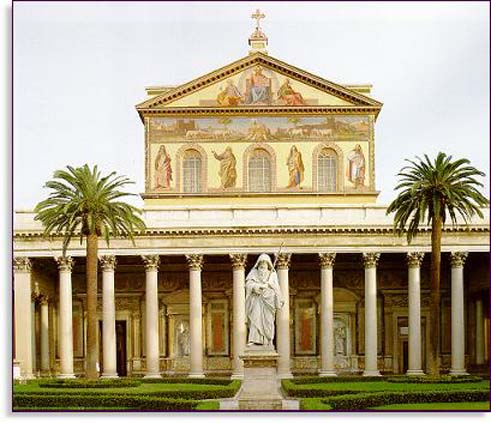 Among the holy places venerated by the Christians from the beginning, the chief has always been the Confession of St. Peter on Vatican Hill, hallowed by the tomb of the Prince of the Apostles. Here the Emperor Constantine is said to have come and, taking a shovel and a two-pronged fork, to have broken the sod to designate the site of the basilica which he built at his own expense. Pope Sylvester dedicated it on the fourteenth of the Calends of December and decreed that from that time henceforth all altars must be of stone. In later years when it became ruinous with age, it was rebuilt from the foundations through the piety and zeal of several Pontiffs. Urban VIII solemnly dedicated it on this same day in the year 1626.
Sylvester, likewise, dedicated the basilica of St. Paul the Apostle on the Ostian Way. It had been most sumptuously built by the same Emperor Constantine. After it was completely destroyed by fire, it was rebuilt more magnificently than before through the tireless efforts of four Pontiffs. Pius IX, taking advantage of the most auspicious occasion of the definition of the dogma of the Immaculate Conception of the Blessed Virgin Mary, surrounded by a host of bishops, solemnly consecrated it.
O God,
who for us bring each year
the recurrence of the consecration day of this your holy temple,
and always bring us back safely to the sacred rites, hear the payers of your people
and grant that whoever enters this temple to pray for blessings,
may rejoice in having obtained whatever he sought.
Roman Breviary - Benziger Brothers, 1964SAINT ODO OF CLUNY
(† 942)
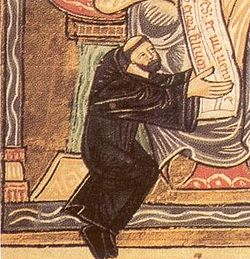 On Christmas-eve, 877, a noble of Aquitaine implored Our Lady to grant him a son. His prayer was heard; Odo was born, and his grateful father offered him to St. Martin. Odo grew in wisdom and in virtue, and his father longed to see him shine at court. But the attraction of grace was too strong. Odo's heart was sad and his health failed, until he forsook the world and sought refuge under the shadow of St. Martin at Tours.
Later on he took the habit of St. Benedict at Baume, and was compelled to become abbot of the great abbey of Cluny, which was then building. He ruled it with the hand of a master and the winningness of a Saint.
The Pope sent for him often to act as peacemaker between contending princes, and it was on one of those missions of mercy that he was taken ill at Rome. At his urgent entreaty he was borne back to Tours, where he died at the feet of «his own St. Martin," in 942.
Lives of the Saints, by Alban Butler, Benziger Bros. ed. [1894]
Tuesday of the Thirty-third Week of Ordinary Time
Book of Revelation 3:o Sardis
1 Write this to Sardis, to the Angel of the church. The One holding the Seven Spirits of God in one hand, a firm grip on the Seven Stars with the other, speaks:
“I see right through your work. You have a reputation for vigor and zest, but you’re dead, stone-dead.
2-3 “Up on your feet! Take a deep breath! Maybe there’s life in you yet. But I wouldn’t know it by looking at your busywork; nothing of God’s work has been completed. Your condition is desperate. Think of the gift you once had in your hands, the Message you heard with your ears—grasp it again and turn back to God.
“If you pull the covers back over your head and sleep on, oblivious to God, I’ll return when you least expect it, break into your life like a thief in the night.
4 “You still have a few followers of Jesus in Sardis who haven’t ruined themselves wallowing in the muck of the world’s ways. They’ll walk with me on parade! They’ve proved their worth!
5 “Conquerors will march in the victory parade, their names indelible in the Book of Life. I’ll lead them up and present them by name to my Father and his Angels.
6 “Are your ears awake? Listen. Listen to the Wind Words, the Spirit blowing through the churches.”
To Laodicea
14 Write to Laodicea, to the Angel of the church. God’s Yes, the Faithful and Accurate Witness, the First of God’s creation, says:
15-17 “I know you inside and out, and find little to my liking. You’re not cold, you’re not hot—far better to be either cold or hot! You’re stale. You’re stagnant. You make me want to vomit. You brag, ‘I’m rich, I’ve got it made, I need nothing from anyone,’ oblivious that in fact you’re a pitiful, blind beggar, threadbare and homeless.
18 “Here’s what I want you to do: Buy your gold from me, gold that’s been through the refiner’s fire. Then you’ll be rich. Buy your clothes from me, clothes designed in Heaven. You’ve gone around half-naked long enough. And buy medicine for your eyes from me so you can see, really see.
19 “The people I love, I call to account—prod and correct and guide so that they’ll live at their best. Up on your feet, then! About face! Run after God!
20-21 “Look at me. I stand at the door. I knock. If you hear me call and open the door, I’ll come right in and sit down to supper with you. Conquerors will sit alongside me at the head table, just as I, having conquered, took the place of honor at the side of my Father. That’s my gift to the conquerors!
22 “Are your ears awake? Listen. Listen to the Wind Words, the Spirit blowing through the churches.”
Psalms 15:2 “Walk straight,
act right,
tell the truth.
3-4 “Don’t hurt your friend,
don’t blame your neighbor;
despise the despicable.
5 “Keep your word even when it costs you,
make an honest living,
never take a bribe.
“You’ll never get
blacklisted
if you live like this.”
Holy Gospel of Jesus Christ according to Saint Luke 19: Zacchaeus
1-4 Then Jesus entered and walked through Jericho. There was a man there, his name Zacchaeus, the head tax man and quite rich. He wanted desperately to see Jesus, but the crowd was in his way—he was a short man and couldn’t see over the crowd. So he ran on ahead and climbed up in a sycamore tree so he could see Jesus when he came by.
5-7 When Jesus got to the tree, he looked up and said, “Zacchaeus, hurry down. Today is my day to be a guest in your home.” Zacchaeus scrambled out of the tree, hardly believing his good luck, delighted to take Jesus home with him. Everyone who saw the incident was indignant and grumped, “What business does he have getting cozy with this crook?”
8 Zacchaeus just stood there, a little stunned. He stammered apologetically, “Master, I give away half my income to the poor—and if I’m caught cheating, I pay four times the damages.”
9-10 Jesus said, “Today is salvation day in this home! Here he is: Zacchaeus, son of Abraham! For the Son of Man came to find and restore the lost.”
Tuesday of the Thirty-third Week of Ordinary Time
Commentary of the Day:Saint John-Mary Vianney (1786-1859), priest, curé of Ars
Sermon for the 3rd Sunday after Pentecost
"The Son of Man has come to seek and to save what was lost"
Not content with calling us by his grace and providing us with every means for our sanctification, see how Jesus Christ runs after his straying sheep ; see how he goes through town and countryside in search of them and brings them back to the place of his mercy. See how he leaves behind his apostles so as to go and wait for the Samaritan woman beside Jacob’s well, where he knew she would come (Jn 4,6f.)… See him in the house of Simon the Leper: it wasn’t to have a meal there that he went, but he knew a sinful Magdalen would come (Mk 14,3f)… See him follow the road to Capernaum so as to go and find another sinner in his office: this was Saint Matthew; it was to make a zealous apostle of him (Mt 9,9).
Ask him why he takes the road to Jericho : he will tell you there is a man called Zacchaeus who passes for a public sinner and he wants to go to see if he will be able to save him. In order to make a perfect penitent of him, he acts like a good father who has lost his child: he calls him. “Zacchaeus!” he cries, “come down, for it is at your house I must stay today. I am coming to grant you your grace.” As though he were to say: “Zacchaeus, leave this pride and attachment to worldly goods; come down” – that is to say, choose humility and poverty. So as to make it well understood, he said to all those with him: “Salvation has come to this house today.” O my God! How great is your mercy for sinners!...
After everything we’ve seen Jesus Christ to have done to save us, how can we despair of his mercy since his greatest pleasure is to forgive us ? In such a way that, however many our sins are, if we want to forsake them and repent of them, we are sure of our pardon.
_____________________________

No comments:
Post a Comment