 "Peter replied, 'Master, to whom would we go? You have the words of real life, eternal life. We’ve already committed ourselves, confident that you are the Holy One of God.'"(John 6:68-69)
Tuesday of the Thirty-first Week in Ordinary Time
Feast of the Church:
Saints of the Day:
SAINT CHARLES BORROMEO
Archbishop of Milan
(1538-1584)
 About fifty years after the Protestant heresy had broken out, Our Lord raised up a mere youth to renew the face of His Church. In 1560 Charles Borromeo, then twenty-two years of age, was created cardinal, and by the side of his uncle, Pius IV., administered the affairs of the Holy See.
His first care was the direction of the Council of Trent. He urged forward its sessions, guided its deliberations by continual correspondence from Rome, and by his firmness carried it to its conclusion. Then he entered upon a still more arduous work-the execution of its decrees.
As Archbishop of Milan he enforced their observance, and thoroughly restored the discipline of his see. He founded schools for the poor, seminaries for the clerics, and by his community of Oblates trained his priests to perfection. Inflexible in maintaining discipline, to his flock he was a most tender father. He would sit by the roadside to teach a poor man the Pater and Ave, and would enter hovels the stench of which drove his attendants from the door.
During the great plague he refused to leave Milan, and was ever by the sick and dying, and sold even his bed for their support. So he lived and so he died, a faithful image of the Good Shepherd, up to his last hour giving his life for his sheep.
Lives of the Saints, by Alban Butler, Benziger Bros. ed. [1894]
SAINT FELIX OF VALOIS
Hermit and co-founder of the Trinitarians
(1127-1212)
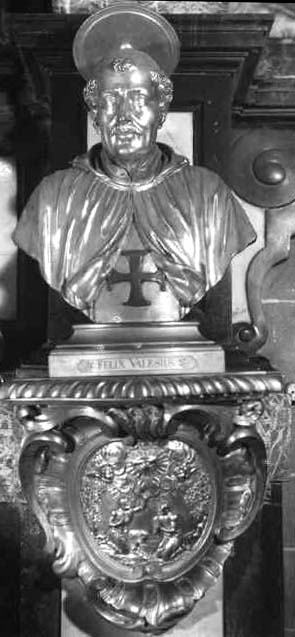 St. Felix was son of the Count of Valois. His mother throughout his youth did all she could to cultivate in him a spirit of charity. The unjust divorce between his parents matured a long-formed resolution of leaving the world; and, confiding his mother to her pious brother, Thibault, Count of Champagne, he took the Cistercian habit at Clairvaux.
His rare virtues drew on him such admiration that, with St. Bernard's consent, he fled to Italy, where he led an austere life with an aged hermit. At this time he was ordained priest, and his old counsellor having died, he returned to France, and for many years lived as a solitary at Cerfroid. Here God inspired him with the desire of founding an Order for the redemption of Christian captives, and moved St. John of Matha, then a youth, to conceive a similar wish. Together they drew up the rules of the Order of the Holy Trinity.
Many disciples gathered round them; and, seeing that the time had come for further action, the two Saints made a pilgrimage to Rome to obtain the confirmation of the Order from Innocent III. Their prayer was granted, and the last fifteen , years of Felix's long life were spent in organizing and developing his rapidly increasing foundations.
He died in 1212.
Lives of the Saints, by Alban Butler, Benziger Bros. ed. [1894]
Tuesday of the Thirty-first Week in Ordinary Time
Letter to the Philippians 2:5-8 Think of yourselves the way Christ Jesus thought of himself. He had equal status with God but didn’t think so much of himself that he had to cling to the advantages of that status no matter what. Not at all. When the time came, he set aside the privileges of deity and took on the status of a slave, became human! Having become human, he stayed human. It was an incredibly humbling process. He didn’t claim special privileges. Instead, he lived a selfless, obedient life and then died a selfless, obedient death—and the worst kind of death at that—a crucifixion.
9-11 Because of that obedience, God lifted him high and honored him far beyond anyone or anything, ever, so that all created beings in heaven and on earth—even those long ago dead and buried—will bow in worship before this Jesus Christ, and call out in praise that he is the Master of all, to the glorious honor of God the Father.
Psalm 22:25-26 Here in this great gathering for worship
I have discovered this praise-life.
And I’ll do what I promised right here
in front of the God-worshipers.
Down-and-outers sit at God’s table
and eat their fill.
Everyone on the hunt for God
is here, praising him.
“Live it up, from head to toe.
Don’t ever quit!”
27-28 From the four corners of the earth
people are coming to their senses,
are running back to God.
Long-lost families
are falling on their faces before him.
God has taken charge;
from now on he has the last word.
29 All the power-mongers are before him
—worshiping!
All the poor and powerless, too
—worshiping!
Along with those who never got it together
—worshiping!
30-31 Our children and their children
will get in on this
As the word is passed along
from parent to child.
Babies not yet conceived
will hear the good news—
that God does what he says.
Holy Gospel of Jesus Christ according to Saint Luke 14: The Story of the Dinner Party
15 That triggered a response from one of the guests: “How fortunate the one who gets to eat dinner in God’s kingdom!”
16-17 Jesus followed up. “Yes. For there was once a man who threw a great dinner party and invited many. When it was time for dinner, he sent out his servant to the invited guests, saying, ‘Come on in; the food’s on the table.’
18 “Then they all began to beg off, one after another making excuses. The first said, ‘I bought a piece of property and need to look it over. Send my regrets.’
19 “Another said, ‘I just bought five teams of oxen, and I really need to check them out. Send my regrets.’
20 “And yet another said, ‘I just got married and need to get home to my wife.’
21 “The servant went back and told the master what had happened. He was outraged and told the servant, ‘Quickly, get out into the city streets and alleys. Collect all who look like they need a square meal, all the misfits and homeless and wretched you can lay your hands on, and bring them here.’
22 “The servant reported back, ‘Master, I did what you commanded—and there’s still room.’
23-24 “The master said, ‘Then go to the country roads. Whoever you find, drag them in. I want my house full! Let me tell you, not one of those originally invited is going to get so much as a bite at my dinner party.’”
Tuesday of the Thirty-first Week in Ordinary Time
Commentary of the Day:Blessed Teresa of Calcutta (1910-1997), founder of the Missionary Sisters of Charity
No Greater Love, p. 93
"Go out quickly into the streets and alleys of the town and bring in here the poor"
Poverty doesn't only consist of being hungry for bread, but rather it is a tremendous hunger for human dignity. We need to love and to be somebody for someone else. This is where we make our mistake and shove people aside. Not only have we denied the poor a piece of bread, but by thinking that they have no worth and leaving them abandoned in the streets, we have denied them the human dignity that is rightfully theirs as children of God. The world today is hungry not only for bread but hungry for love, hungry to be wanted, to be loved. They're hungry to feel the presence of Christ. In many countries, people have everything except that presence, that understanding.
In every country there are poor. On certain continents poverty is more spiritual than material, poverty that consists of loneliness, discouragement and the lack of meaning in life. I have also seen in Europe and America very poor people sleeping on newspapers or rags in the streets. There are those kind of poor in London, Madrid, and Rome. It is too easy simply to talk or concern ourselves with the poor who are far away. It is much harder and, perhaps, more challenging to turn our attention and concern toward the poor who live right next door to us.
When I pick up a hungry person from the streets, I give him rice and bread, and I have satisfied that hunger. But a person who is shut out, feels unwanted by society, unloved and terrified — how much more difficult is it to remove that hunger? You in the West have the spiritually poorest of the poor much more than you have the physically poor. Often among the rich are very spiritually poor people. I find it is easy to give a plate of rice to a hungry person, to furnish a bed to a person who has no bed, but to console or to remove the bitterness, anger and loneliness that comes from being spiritually deprived, that takes a long time.
_____________________________

No comments:
Post a Comment