
Wichita, Kansas, United States - Great Plains Conference of the United Methodist Church Daily Devotional for Wednesday, 19 & Thursday, 20 & Friday, 21 & Saturday, 22 November 2014

Countryside
Ebenezer UMC
Wakefield
Salina District
|


Courtland
Scandia
Salina District
| 
Beverly
Lincoln
Salina District
|

Enterprise
Solomon
Salina District
| 
Chapman
Salina District
|

Kenny Stout
Bethany
Talmage
Salina District
| 
Ada
Minneapolis
Salina District
|
23rd Sunday after Pentecost/in Kingdomtide – Green
This Week's Lectionary Scriptures:
Lectionary Scriptures:
Judges 4:1-7
Psalm 123
1 Thessalonians 5:1-11
Matthew 25:14-30
Judges 4: Deborah
1-3 The People of Israel kept right on doing evil in God’s sight. With Ehud dead, God sold them off to Jabin king of Canaan who ruled from Hazor. Sisera, who lived in Harosheth Haggoyim, was the commander of his army. The People of Israel cried out to God because he had cruelly oppressed them with his nine hundred iron chariots for twenty years.
4-5 Deborah was a prophet, the wife of Lappidoth. She was judge over Israel at that time. She held court under Deborah’s Palm between Ramah and Bethel in the hills of Ephraim. The People of Israel went to her in matters of justice.
6-7 She sent for Barak son of Abinoam from Kedesh in Naphtali and said to him, “It has become clear that God, the God of Israel, commands you: Go to Mount Tabor and prepare for battle. Take ten companies of soldiers from Naphtali and Zebulun. I’ll take care of getting Sisera, the leader of Jabin’s army, to the Kishon River with all his chariots and troops. And I’ll make sure you win the battle.”
Psalm 123: A Pilgrim Song
1-4 I look to you, heaven-dwelling God,
look up to you for help.
Like servants, alert to their master’s commands,
like a maiden attending her lady,
We’re watching and waiting, holding our breath,
awaiting your word of mercy.
Mercy, God, mercy!
We’ve been kicked around long enough,
Kicked in the teeth by complacent rich men,
kicked when we’re down by arrogant brutes.
Psalm 76: An Asaph Psalm
1-3 God is well-known in Judah;
in Israel, he’s a household name.
He keeps a house in Salem,
his own suite of rooms in Zion.
That’s where, using arrows for kindling,
he made a bonfire of weapons of war.
4-6 Oh, how bright you shine!
Outshining their huge piles of loot!
The warriors were plundered
and left there impotent.
And now there’s nothing to them,
nothing to show for their swagger and threats.
Your sudden roar, God of Jacob,
knocked the wind out of horse and rider.
7-10 Fierce you are, and fearsome!
Who can stand up to your rising anger?
From heaven you thunder judgment;
earth falls to her knees and holds her breath.
God stands tall and makes things right,
he saves all the wretched on earth.
Instead of smoldering rage—God-praise!
All that sputtering rage—now a garland for God!
11-12 Do for God what you said you’d do—
he is, after all, your God.
Let everyone in town bring offerings
to the One Who Watches our every move.
Nobody gets by with anything,
no one plays fast and loose with him.
1 Thessalonians 5:1-3 I don’t think, friends, that I need to deal with the question of when all this is going to happen. You know as well as I that the day of the Master’s coming can’t be posted on our calendars. He won’t call ahead and make an appointment any more than a burglar would. About the time everybody’s walking around complacently, congratulating each other—“We’ve sure got it made! Now we can take it easy!”—suddenly everything will fall apart. It’s going to come as suddenly and inescapably as birth pangs to a pregnant woman.
4-8 But friends, you’re not in the dark, so how could you be taken off guard by any of this? You’re sons of Light, daughters of Day. We live under wide open skies and know where we stand. So let’s not sleepwalk through life like those others. Let’s keep our eyes open and be smart. People sleep at night and get drunk at night. But not us! Since we’re creatures of Day, let’s act like it. Walk out into the daylight sober, dressed up in faith, love, and the hope of salvation.
9-11 God didn’t set us up for an angry rejection but for salvation by our Master, Jesus Christ. He died for us, a death that triggered life. Whether we’re awake with the living or asleep with the dead, we’re alive with him! So speak encouraging words to one another. Build up hope so you’ll all be together in this, no one left out, no one left behind. I know you’re already doing this; just keep on doing it.
Matthew 25: The Story About Investment
14-18 “It’s also like a man going off on an extended trip. He called his servants together and delegated responsibilities. To one he gave five thousand dollars, to another two thousand, to a third one thousand, depending on their abilities. Then he left. Right off, the first servant went to work and doubled his master’s investment. The second did the same. But the man with the single thousand dug a hole and carefully buried his master’s money.
19-21 “After a long absence, the master of those three servants came back and settled up with them. The one given five thousand dollars showed him how he had doubled his investment. His master commended him: ‘Good work! You did your job well. From now on be my partner.’
22-23 “The servant with the two thousand showed how he also had doubled his master’s investment. His master commended him: ‘Good work! You did your job well. From now on be my partner.’
24-25 “The servant given one thousand said, ‘Master, I know you have high standards and hate careless ways, that you demand the best and make no allowances for error. I was afraid I might disappoint you, so I found a good hiding place and secured your money. Here it is, safe and sound down to the last cent.’
26-27 “The master was furious. ‘That’s a terrible way to live! It’s criminal to live cautiously like that! If you knew I was after the best, why did you do less than the least? The least you could have done would have been to invest the sum with the bankers, where at least I would have gotten a little interest.
28-30 “‘Take the thousand and give it to the one who risked the most. And get rid of this “play-it-safe” who won’t go out on a limb. Throw him out into utter darkness.’
John Wesley's Notes-Commentary:
Judges 4:1-7
Verse 2
[2] And the LORD sold them into the hand of Jabin king of Canaan, that reigned in Hazor; the captain of whose host was Sisera, which dwelt in Harosheth of the Gentiles.
Of Canaan — That is, of the land where most of the Canaanites, strictly so called, now dwelt, which seems to be in the northern part of Canaan. This seems to be of the posterity of that Jabin, whom Joshua slew, Joshua 11:11, who watched all opportunities to recover his ancient possessions, and to revenge his own and his father's quarrel.
In Hazor — In the territory or the kingdom of Hazor, which might now be restored to its former largeness and power.
Of the Gentiles — So called, because it was much frequented and inhabited by the Gentiles; either by the Canaanites, who being beaten out of their former possessions, seated themselves in those northern parts; or by other nations coming there for traffick, whence Galilee, where this was, is called Galilee of the Gentiles.
Verse 3
[3] And the children of Israel cried unto the LORD: for he had nine hundred chariots of iron; and twenty years he mightily oppressed the children of Israel.
Mightily oppressed — More than former tyrants; from his malice and hatred against the Israelites; and from God's just judgment, the growing punishment being suitable to their aggravated wickedness.
Verse 4
[4] And Deborah, a prophetess, the wife of Lapidoth, she judged Israel at that time.
A prophetess — As there were men-prophets, so there were also women-prophetesses, as Miriam, Exodus 15:20. Huldah, 2 Kings 22:14, and divers others; but the word prophets or prophetesses is ambiguous, sometimes being used of persons extraordinarily inspired by God, and endowed with the power of working miracles, and foretelling things to come; and sometimes of persons endowed with special gifts or graces, for the better understanding and discoursing about the word and mind of God. Of this sort were the sons of the prophets, or such as were bred in the schools of the prophets. who are often called prophets, as 1 Samuel 10:5,10. And because we read nothing of Deborah's miraculous actions, perhaps she was only a woman of eminent holiness, and knowledge of the holy scriptures, by which she was singularly qualified for judging the people according to the laws of God.
Judged Israel — That is, determined causes and controversies arising among the Israelites, as is implied, verse 5. And this Jabin might suffer to be done, especially by a woman. Yet the frequent discharge of this part of the judge's office, whereby she gained great power and authority with the people, did notably (though not observed by the tyrant) prepare the way for her sliding into the other part of her office, which was to defend and rescue the people from their enemies.
Verse 5
[5] And she dwelt under the palm tree of Deborah between Ramah and Bethel in mount Ephraim: and the children of Israel came up to her for judgment.
And she dwelt — Or, she sat: she had her judgment-seat in the open air, under the shadow of that tree; which was an emblem of the justice she administered there: thriving and growing against opposition, as the palm-tree does under pressures.
Came to her — To have their suits and causes determined by her sentence.
Verse 6
[6] And she sent and called Barak the son of Abinoam out of Kedeshnaphtali, and said unto him, Hath not the LORD God of Israel commanded, saying, Go and draw toward mount Tabor, and take with thee ten thousand men of the children of Naphtali and of the children of Zebulun?
Called Barak — By virtue of that power which God had given her, and the people owned in her.
Kedesh Naphtali — So called, to distinguish it from other places of that name, one in Judah, and another in Issachar.
Hath not the Lord, … — That is, assuredly God hath commanded thee; this is not the fancy of a weak woman, which peradventure thou mayst despise; but the command of the great God by my mouth.
Mount Tabor — A place most fit for his purpose, as being in the borders of divers tribes, and having a large plain at the top of it, where he might conveniently marshal and discipline his army.
Naphtali and Zebulun — These she names because they were nearest and best known to Barak, and therefore soonest brought together, because they were nearest to the enemy, and therefore might speedily be assembled, whilst the other tribes, being at a distance, had better opportunity of gathering forces for their succour; and because these had most smarted under this oppressor, who was in the heart of their country; but these are not named exclusively, as appears by the concurrence of some other tribes.
Verse 7
[7] And I will draw unto thee to the river Kishon Sisera, the captain of Jabin's army, with his chariots and his multitude; and I will deliver him into thine hand.
Draw to Thee — By my secret and powerful providence, ordering and over-ruling his inclinations that way. In fixing the very place, she gave him a sign, which might confirm his faith, when he came to engage.
Psalm 123
Verse 2
[2] Behold, as the eyes of servants look unto the hand of their masters, and as the eyes of a maiden unto the hand of her mistress; so our eyes wait upon the LORD our God, until that he have mercy upon us.
Look — For supply of their wants, and for help and defence against their oppressors.
Until — Until he help and save us.
Psalm 76
Verse 2
[2] In Salem also is his tabernacle, and his dwelling place in Zion.
Salem — In Jerusalem, which was anciently called Salem.
Zion — Largely so called, as it includes Moriah, an adjoining hill.
Verse 3
[3] There brake he the arrows of the bow, the shield, and the sword, and the battle. /*Selah*/.
There — At Jerusalem.
Sword — Both offensive and defensive weapons.
Battle — All the power of the army, which was put in battle-array.
Verse 4
[4] Thou art more glorious and excellent than the mountains of prey.
Thou — O God.
Than — The greatest kings and empires of the earth, which in prophetic writings are often compared to mountains. And they are called mountains of prey, because they generally were established by tyranny, and maintained by preying upon their own subjects, or other kingdoms.
Verse 5
[5] The stouthearted are spoiled, they have slept their sleep: and none of the men of might have found their hands.
Sleep — Even a perpetual sleep.
Verse 6
[6] At thy rebuke, O God of Jacob, both the chariot and horse are cast into a dead sleep.
Chariot — The men who rode upon, and fought from chariots and horses.
Verse 8
[8] Thou didst cause judgment to be heard from heaven; the earth feared, and was still,
Thou — Didst execute judgment upon thine enemies, by an angel from heaven: which is said to be heard, either because it was accompanied with thunders and earthquakes, or because the fame of it was quickly spread abroad.
Feared — The rest of the world were afraid to disturb Israel.
Verse 10
[10] Surely the wrath of man shall praise thee: the remainder of wrath shalt thou restrain.
Surely — The furious attempts of thine enemies, shall cause thy people and others to praise thee for thy admirable wisdom, power, and faithfulness.
Verse 11
[11] Vow, and pay unto the LORD your God: let all that be round about him bring presents unto him that ought to be feared.
Vow — A sacrifice of thanksgiving for this wonderful deliverance.
Let all — All the neighboring nations submit to the God of Israel.
Verse 12
[12] He shall cut off the spirit of princes: he is terrible to the kings of the earth.
Cut off — As men do their grapes in time of vintage; so the Hebrew verb implies.
The spirit — Their breath and life, as he did in the Assyrian army.
1 Thessalonians 5:1-11
Verse 1
[1] But of the times and the seasons, brethren, ye have no need that I write unto you.
But of the precise times when this shall be.
Verse 2
[2] For yourselves know perfectly that the day of the Lord so cometh as a thief in the night.
For this in general ye do know; and ye can and need know no more.
Verse 3
[3] For when they shall say, Peace and safety; then sudden destruction cometh upon them, as travail upon a woman with child; and they shall not escape.
When they — The men of the world say.
Verse 4
[4] But ye, brethren, are not in darkness, that that day should overtake you as a thief.
Ye are not in darkness — Sleeping secure in sin.
Verse 6
[6] Therefore let us not sleep, as do others; but let us watch and be sober.
Awake, and keep awake — Being awakened, let us have all our spiritual senses about us.
Verse 7
[7] For they that sleep sleep in the night; and they that be drunken are drunken in the night.
They usually sleep and are drunken in the night - These things do not love the light.
Verse 9
[9] For God hath not appointed us to wrath, but to obtain salvation by our Lord Jesus Christ,
God hath not appointed us to wrath — As he hath the obstinately impenitent.
Verse 10
[10] Who died for us, that, whether we wake or sleep, we should live together with him.
Whether we wake or sleep — Be alive or dead at his coming.
Matthew 25:14-30
Verse 14
[14] For the kingdom of heaven is as a man travelling into a far country, who called his own servants, and delivered unto them his goods.
Our Lord proceeds by a parable still plainer (if that can be) to declare the final reward of a harmless man. May God give all such in this their day, ears to hear and hearts to understand it! The kingdom of heaven - That is, the King of heaven, Christ. Mark 13:34; Luke 19:12.
Verse 15
[15] And unto one he gave five talents, to another two, and to another one; to every man according to his several ability; and straightway took his journey.
To one he gave five talents, to another two, and to another one — And who knows whether (all circumstances considered) there be a greater disproportion than this, in the talents of those who have received the most, and those who have received the fewest? According to his own ability - The words may be translated more literally, according to his own mighty power.
And immediately took his journey — To heaven.
Verse 18
[18] But he that had received one went and digged in the earth, and hid his lord's money.
He that had received one — Made his having fewer talents than others a pretence for not improving any.
Went and hid his master's money — Reader, art thou doing the same? Art thou hiding the talent God hath lent thee?
Verse 24
[24] Then he which had received the one talent came and said, Lord, I knew thee that thou art an hard man, reaping where thou hast not sown, and gathering where thou hast not strawed:
I knew thou art a hard man — No. Thou knowest him not. He never knew God, who thinks him a hard master.
Reaping where thou hast not sown — That is, requiring more of us than thou hast given us power to perform. So does every obstinate sinner, in one kind or other, lay the blame of his own sins on God.
Verse 25
[25] And I was afraid, and went and hid thy talent in the earth: lo, there thou hast that is thine.
And I was afraid — Lest if I had improved my talent, I should have had the more to answer for. So from this fear, one will not learn to read, another will not hear sermons!
Verse 26
[26] His lord answered and said unto him, Thou wicked and slothful servant, thou knewest that I reap where I sowed not, and gather where I have not strawed:
Thou knewest — That I require impossibilities! This is not an allowing, but a strong denial of the charge.
Verse 27
[27] Thou oughtest therefore to have put my money to the exchangers, and then at my coming I should have received mine own with usury.
Thou oughtest therefore — On that very account, on thy own supposition, to have improved my talent, as far as was possible.
Verse 29
[29] For unto every one that hath shall be given, and he shall have abundance: but from him that hath not shall be taken away even that which he hath.
To every one that hath shall he given — So close does God keep to this stated rule, from the beginning to the end of the world. Matthew 13:12.
Verse 30
[30] And cast ye the unprofitable servant into outer darkness: there shall be weeping and gnashing of teeth.
Cast ye the unprofitable servant into the outer darkness — For what? what had he done? It is true he had not done good. But neither is he charged with doing any harm. Why, for this reason, for barely doing no harm, he is consigned to outer darkness. He is pronounced a wicked, because he was a slothful, an unprofitable servant. So mere harmlessness, on which many build their hope of salvation, was the cause of his damnation! There shall be the weeping - Of the careless thoughtless sinner; and the gnashing of teeth - Of the proud and stubborn. The same great truth, that there is no such thing as negative goodness, is in this chapter shown three times: 1. In the parable of the virgins; 2. In the still plainer parable of the servants, who had received the talents; and 3. In a direct unparabolical declaration of the manner wherein our Lord will proceed at the last day. The several parts of each of these exactly answers each other, only each rises above the preceding.
____________________________
Today’s Devotion:
 Nashville, Tennessee, United States - The Upper Room Daily Devotional “In Prayer” for Wednesday, 19 November 2014 - Scripture: Psalm 109: A David Prayer
1-5 My God, don’t turn a deaf ear to my hallelujah prayer.
Liars are pouring out invective on me;
Their lying tongues are like a pack of dogs out to get me,
barking their hate, nipping my heels—and for no reason!
I loved them and now they slander me—yes, me!—
and treat my prayer like a crime;
They return my good with evil,
they return my love with hate.
6-20 Send the Evil One to accuse my accusing judge;
dispatch Satan to prosecute him.
When he’s judged, let the verdict be “Guilty,”
and when he prays, let his prayer turn to sin.
Give him a short life,
and give his job to somebody else.
Make orphans of his children,
dress his wife in widow’s weeds;
Turn his children into begging street urchins,
evicted from their homes—homeless.
May the bank foreclose and wipe him out,
and strangers, like vultures, pick him clean.
May there be no one around to help him out,
no one willing to give his orphans a break.
Chop down his family tree
so that nobody even remembers his name.
But erect a memorial to the sin of his father,
and make sure his mother’s name is there, too—
Their sins recorded forever before God,
but they themselves sunk in oblivion.
That’s all he deserves since he was never once kind,
hounded the afflicted and heartbroken to their graves.
Since he loved cursing so much,
let curses rain down;
Since he had no taste for blessing,
let blessings flee far from him.
He dressed up in curses like a fine suit of clothes;
he drank curses, took his baths in curses.
So give him a gift—a costume of curses;
he can wear curses every day of the week!
That’s what they’ll get, those out to get me—
an avalanche of just deserts from God.
21-25 Oh, God, my Lord, step in;
work a miracle for me—you can do it!
Get me out of here—your love is so great!—
I’m at the end of my rope, my life in ruins.
I’m fading away to nothing, passing away,
my youth gone, old before my time.
I’m weak from hunger and can hardly stand up,
my body a rack of skin and bones.
I’m a joke in poor taste to those who see me;
they take one look and shake their heads.
26-29 Help me, oh help me, God, my God,
save me through your wonderful love;
Then they’ll know that your hand is in this,
that you, God, have been at work.
Let them curse all they want;
you do the blessing.
Let them be jeered by the crowd when they stand up,
followed by cheers for me, your servant.
Dress my accusers in clothes dirty with shame,
discarded and humiliating old ragbag clothes.
30-31 My mouth’s full of great praise for God,
I’m singing his hallelujahs surrounded by crowds,
For he’s always at hand to take the side of the needy,
to rescue a life from the unjust judge.
The psalmist wrote, “But I am a man of prayer.”(Psalm 109:4 (NIV))
When I first stumbled upon this passage it was almost shocking to me. At the time I was very concerned about a friend’s situation. I was praying earnestly for my friend and to be honest, I found myself wondering just how effective prayer really was in situations like my friend’s. And then I read the psalmist’s words.
What makes today’s quoted verse so remarkable are the verses that precede it. Though David did not write all the psalms, he was likely the writer of this one. In the first few verses of this psalm he writes some awful and even scary things. He says wicked and deceitful men have told lies about him. They have surrounded him with words of hatred. They have fought against him without cause. In return for his friendship they have accused him. Then he writes, “But I am a man of prayer.”
David could have fought against these men. He was a mighty warrior. He could have judged them because he was the king. But what did he choose to do instead? He prayed. David, the soldier and king, considered prayer his best defense against these enemies. What a powerful model for us to live by!
The Author: Harriet Michael (Kentucky, USA)
Thought for the Day: When we are troubled, prayer is our best choice.
Prayer: Dear heavenly Father, thank you so much for the privilege of prayer. Regardless of our circumstances, help us to be people of prayer. ln your son’s name. Amen.
Prayer focus: My enemies
"Whose Way?" for Thursday, 20 November 2014 - Scripture: Isaiah 55:6-7 Seek God while he’s here to be found,
pray to him while he’s close at hand.
Let the wicked abandon their way of life
and the evil their way of thinking.
Let them come back to God, who is merciful,
come back to our God, who is lavish with forgiveness.
8-11 “I don’t think the way you think.
The way you work isn’t the way I work.”
God’s Decree.
“For as the sky soars high above earth,
so the way I work surpasses the way you work,
and the way I think is beyond the way you think.
Just as rain and snow descend from the skies
and don’t go back until they’ve watered the earth,
Doing their work of making things grow and blossom,
producing seed for farmers and food for the hungry,
So will the words that come out of my mouth
not come back empty-handed.
They’ll do the work I sent them to do,
they’ll complete the assignment I gave them.
Jesus said, “This is my commandment: love each other just as I have loved you.”(John 15:12 (CEB))
Twice I dreamed that I was driving on a two-lane road and a car appeared in my lane, coming from the opposite direction. I glanced at the other lane and saw another car moving in the same direction as I was. I was driving in the wrong lane.
When I awoke, I thought about my dreams. I recalled that when I drove in Jordan for the first time, even though I knew cars drive on the right side of the road, I failed to do so. When I drove up a slope to a traffic light, I faced many cars in front of me waiting for the traffic light to change and heading in the opposite direction. I was stunned, and I quickly turned around.
Finally, I understood my dreams. Reading Isaiah 55:6-11, that day’s Bible reading in The Upper Room, I thought about my recent struggles in faith. God’s way is different from mine. I wish to follow the commandment in John 15:12, but I easily slip back into old familiar ways. Nevertheless, God helps me return to the right way. The more I struggle to get closer to God, the more I focus on the words of scripture. The word of God is holy promise: “Love each other, just as I have loved you” (John 15:12) and “If you remain in me and my words remain in you, ask for whatever you want and it will be done for you” (John 15:7).
The Author: Kazumi Munehiro (Fukuoka, Japan)
Thought for the Day: Focusing on scripture draws us closer to God.
Prayer: Loving God, thank you for your care and guidance. Keep us open to your promises and obedient to your commandments. In Jesus’ name we pray. Amen.
Prayer focus: International travelers
"A Better Future" for Friday, 21 November 2014 - Scripture: Isaiah 43: You Didn’t Even Do the Minimum
14-15 God, your Redeemer,
The Holy of Israel, says:
“Just for you, I will march on Babylon.
I’ll turn the tables on the Babylonians.
Instead of whooping it up,
they’ll be wailing.
I am God, your Holy One,
Creator of Israel, your King.”
16-21 This is what God says,
the God who builds a road right through the ocean,
who carves a path through pounding waves,
The God who summons horses and chariots and armies—
they lie down and then can’t get up;
they’re snuffed out like so many candles:
“Forget about what’s happened;
don’t keep going over old history.
Be alert, be present. I’m about to do something brand-new.
It’s bursting out! Don’t you see it?
There it is! I’m making a road through the desert,
rivers in the badlands.
Wild animals will say ‘Thank you!’
—the coyotes and the buzzards—
Because I provided water in the desert,
rivers through the sun-baked earth,
Drinking water for the people I chose,
the people I made especially for myself,
a people custom-made to praise me.
The Lord says, “Do not remember the former things, or consider the things of old. I am about to do a new thing; now it springs forth, do you not perceive it? I will make a way in the wilderness and rivers in the desert.”(Isaiah 43:18-19 (NRSV))
While on a cruise on the Yangtze river in China, we were instructed to look for old shoes floating by. Our guide explained that when people suffer illness, unemployment, or divorce they let go of the past and its painful memories by putting their old shoes in the river. With new shoes they hope to walk into a better future.
In Isaiah 43:18, the Lord encouraged a sad and exiled people to let go of the grief of the past and instead to trust the Lord’s leadership to enter a new place. With God’s help, we too can be refreshed. When I struggled with painful feelings of rejection after my divorce, I didn’t understand how the Lord could bring anything good out of it. But this verse gave me courage to believe that God would lead me to a better life. As I did my best to trust and obey, our Lord brought me fresh joy and new purpose. God asks us to learn from our failures and mistakes but not to live in our past pain.
In Romans 6:4 Paul wrote, “We have been buried with him by baptism into death, so that, just as Christ was raised from the dead by the glory of the Father, so we too might walk in newness of life.” We take steps toward newness of life as we daily turn from the temptation of despair and put our hope in God.
Read more from the author, here.
"The Little Things"
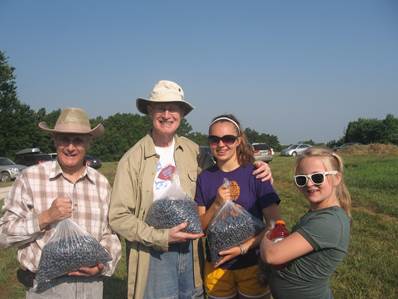 The value of doing little things to draw near to God is found also in service activities. Here is a picture of me with two grand daughters and a close friend holding up our harvest of picking blueberries. I am the tall guy with the white floppy hat.
We pick each summer at a special farm dedicated to helping with water development projects around the world. The “Blue Berry Patch” has 2,000 plants on 4 acres near Seymour, Missouri.
Of course we enjoyed taking the delicious berries home! We like blueberries on ice cream, in pancakes, in muffins, and on cereal. The picture shows us with our 30 pounds we just picked.
This unique farm gives 100% of their profits after production expenses to Catholic Outreach and Cross International ministry for people who need sustainable clean water. From 2008 to 2010 they gave $43,814 to the Dominican Republic to provide safe water instead of from contaminated creeks. From 2010 to 2012 they gave $25,874 to Kenya for wells in drought-vulnerable tribal areas.
In our world there is a great need for clean water to drink and for agriculture, and it can be overwhelming to ponder how to help. I know that my little efforts will not solve this problem. But I rejoice that in a small way our blueberry picking at a world wide ministry farm will make a difference for people in distress.
The power of small acts of kindness and service is a witness we make that God's Kingdom is at work to bring hope to the destitute. We are just a few people among hundreds each summer who contribute their picking to see a cumulative positive difference.
It brings me joy to do this annual picking with friends and family. This little activity on an early summer morning brings us closer together. I find great meaning in finding ways we can do the Lord's work of mercy with small actions of service.
The prophet Zechariah and his people faced big problems to rebuild the ruins of their worship building, the temple. He encouraged them to remember the joy and value of each man doing his part. They were faithful with the vision of his words in 4:10, “Who despises the day of small things?”. I pray to be faithful with the small things I am able to give for this time and place. Taking our little gifts together the Lord does great work to relieve suffering and hopelessness.(Cliff Rawley)
The Author: Clifford B. Rawley (Missouri, USA)
Thought for the Day: Jesus can make all things new. (See Rev. 21:5.)
Prayer: Dear Lord, in the light of your forgiveness and leadership, may we follow you into a future of hope. Amen.
Prayer focus: Those struggling through a divorce
"Spiritual Growth" fpr Saturday, 22 November 2014 - Scripture: Hebrews 5:7-10 While he lived on earth, anticipating death, Jesus cried out in pain and wept in sorrow as he offered up priestly prayers to God. Because he honored God, God answered him. Though he was God’s Son, he learned trusting-obedience by what he suffered, just as we do. Then, having arrived at the full stature of his maturity and having been announced by God as high priest in the order of Melchizedek, he became the source of eternal salvation to all who believingly obey him.
Re-Crucifying Jesus
11-14 I have a lot more to say about this, but it is hard to get it across to you since you’ve picked up this bad habit of not listening. By this time you ought to be teachers yourselves, yet here I find you need someone to sit down with you and go over the basics on God again, starting from square one—baby’s milk, when you should have been on solid food long ago! Milk is for beginners, inexperienced in God’s ways; solid food is for the mature, who have some practice in telling right from wrong.
Paul wrote, “I fed you with milk, not solid food, for you were not ready for solid food. Even now you are still not ready.”(1 Corinthians 3:2 (NRSV))
In my student days I was addressed as “Didi” (which means “elder sister”) by the children and teens in the neighborhood. Several years later I became known as “Aunty,” which means an older person, like a mother. I did not like being addressed that way because it reminded me that I was aging. Still a few years later, I moved to another state where I was even called “Granny” by a few children. Soon I discovered that in that part of the state girls were given in marriage in their teens and became grandparents in their early forties. So I accepted the new name gracefully — though it took time. My image in the eyes of others changed with the passage of time — neither of which took any extra effort on my part.
But achieving spiritual maturity requires our effort and intention. Born into God’s family, we begin to grow spiritually when we hunger for God’s word, meditate on it regularly, and apply it in our lives. The pure milk and then the solid food of the word of God help us to grow from infancy to childhood, then on to adulthood, and finally into mature Christians. In each step of the way we can become more and more like Jesus.
Read more from the author, here.
"The Next Chapter"
At the time of writing this meditation, I had started praying that God would give me an appetite for the Word, and that I would grow in my faith. All glory to God for granting the desire of my heart! I started reading the Bible wanting to learn what God was trying to teach me through the scriptures. I can honestly say that I have better understanding of the Word than I had two years ago. This has not been limited to my mind, but it has also touched my heart to respond to God’s love unreservedly. I am still in the process of yielding myself to God’s will.
Growing in the Lord enabled me to move to a rural community last month after my retirement. I had been used to a spacious house with most of the modern facilities. But in this new place electricity is only available for a limited number of hours, internet access is not easy, and the house is small so that I can keep only what is needed for daily living. Moreover this is an area with problems of poverty, lack of awareness on health issues, lack of education, political unrest, insurgency etc.
I was surprised that all these things did not cause bitterness or resentment in my heart. Instead I feel grateful that God is giving me grace to accept the situation gladly and giving me the opportunity to work in such a place where the good news of love and peace is needed. I have not always been someone who accepts inconveniences easily, but glory to God for the transformation which has taken place in me by reading the Bible and applying it to my life in faith.(Pramila Barkataki)
The Author: Pramila Barkataki (Uttar Pradesh, India)
Thought for the Day: How is my spiritual growth evident to those around me?
Prayer: O God, we want to grow in our faith and in the likeness of Jesus. Help us, we pray. Amen.
Prayer focus: Those who haven’t heard God’s word
____________________________
Great Plains Conference of the United Methodist Church
9440 E Boston, Suite 160
Wichita KS 67207
316-686-0600
800-745-2350
info@greatplainsumc.org
________________________


No comments:
Post a Comment