democracynow.org
Stories:

Before Her Assassination, Berta Cáceres Singled Out Hillary Clinton for Backing Honduran Coup
Former Secretary of State Hillary Clinton is facing a new round of questions about her handling of the 2009 coup in Honduras that ousted democratically elected President Manuel Zelaya. Since the coup, Honduras has become one of the most violent places in the world. Last week, indigenous environmental activist Berta Cáceres was assassinated in her home. In an interview two years ago, Cáceres singled out Clinton for her role supporting the coup. "We’re coming out of a coup that we can’t put behind us. We can’t reverse it," Cáceres said. "It just kept going. And after, there was the issue of the elections. The same Hillary Clinton, in her book, 'Hard Choices,' practically said what was going to happen in Honduras. This demonstrates the meddling of North Americans in our country. The return of the president, Mel Zelaya, became a secondary issue. There were going to be elections in Honduras. And here she [Clinton] recognized that they didn’t permit Mel Zelaya’s return to the presidency." We play this rarely seen clip of Cáceres and speak to historian Greg Grandin.
TRANSCRIPT
This is a rush transcript. Copy may not be in its final form.
AMY GOODMAN: Let’s talk about Honduras. I want to go to Hillary Clinton in the 2009 coup in Honduras that ousted the democratically elected President Manuel Zelaya. In her memoir, Hard Choices, Hillary Clinton wrote about the days following the coup. She wrote, quote, "In the subsequent days I spoke with my counterparts around the hemisphere, including Secretary [Patricia] Espinosa [in] Mexico. We strategized on a plan to restore order in Honduras and ensure that free and fair elections [could] be held quickly and legitimately, which would render the question of Zelaya moot," unquote.
Since the coup, Honduras has become one of the most dangerous places in the world. In 2014, the Honduran environmental activist Berta Cáceres spoke about Hillary Clinton’s role in the 2009 coup. This is the woman who was assassinated last week in La Esperanza, Honduras. But she spoke about Hillary Clinton’s role in the 2009 coup with the Argentine TV program Resumen Latinoamericano.
BERTA CÁCERES: [translated] We’re coming out of a coup that we can’t put behind us. We can’t reverse it. It just kept going. And after, there was the issue of the elections. The same Hillary Clinton, in her book, Hard Choices, practically said what was going to happen in Honduras. This demonstrates the meddling of North Americans in our country. The return of the president, Mel Zelaya, became a secondary issue. There were going to be elections in Honduras. And here, she, Clinton, recognized that they didn’t permit Mel Zelaya’s return to the presidency. There were going to be elections. And the international community—officials, the government, the grand majority—accepted this, even though we warned this was going to be very dangerous and that it would permit a barbarity, not only in Honduras but in the rest of the continent. And we’ve been witnesses to this.
AMY GOODMAN: That was Honduran environmental activist Berta Cáceres speaking in 2014. She was murdered last week in her home in La Esperanza in Honduras. Last year, she won the Goldman Environmental Prize. She’s a leading environmentalist in the world. Professor Grandin?
GREG GRANDIN: Yeah, and she criticizes Hillary Clinton’s book, Hard Choices, where Clinton was holding up her actions in Honduras as an example of a clear-eyed pragmatism. I mean, that book is effectively a confession. Every other country in the world or in Latin America was demanding the restitution of democracy and the return of Manuel Zelaya. It was Clinton who basically relegated that to a secondary concern and insisted on elections, which had the effect of legitimizing and routinizing the coup regime and creating the nightmare scenario that exists today.
I mean—and it’s also in her emails. The real scandal about the emails isn’t the question about process—you know, she wanted to create an off-the-books communication thing that couldn’t be FOIAed. The real scandal about those emails are the content of the emails. She talks—the process by which she works to delegitimate Zelaya and legitimate the elections, which Cáceres, in that interview, talks about were taking place under extreme militarized conditions, fraudulent, a fig leaf of democracy, are all in the emails.
JUAN GONZÁLEZ: And particularly what does she say in them?
GREG GRANDIN: Well, she talks about trying to work towards a movement towards legitimating—getting other countries, pressuring other countries to accept the results of the election and give up the demand that Zelaya be returned and basically stop calling it a coup.
AMY GOODMAN: Let’s go to March 2010. This is Secretary of State Hillary Clinton traveling to meet with the Honduran president, Porfirio "Pepe" Lobo, whose election was boycotted by opponents of the coup that overthrew Zelaya. She urged Latin American countries to normalize ties with the coup government.
SECRETARY OF STATE HILLARY CLINTON: We think that Honduras has taken important and necessary steps that deserve the recognition and the normalization of relations. I have just sent a letter to the Congress of the United States notifying them that we will be restoring aid to Honduras. Other countries in the region say that, you know, they want to wait a while. I don’t know what they’re waiting for, but that’s their right, to wait.
AMY GOODMAN: That was Secretary of State Hillary Clinton endorsing the coup. What is the trajectory of what happened then to the horror of this past week, the assassination of Berta Cáceres?
GREG GRANDIN: Well, that’s just one horror. I mean, hundreds of peasant activists and indigenous activists have been killed. Scores of gay rights activists have been killed. I mean, it’s just—it’s just a nightmare in Honduras. I mean, there’s ways in which the coup regime basically threw up Honduras to transnational pillage. And Berta Cáceres, in that interview, says what was installed after the coup was something like a permanent counterinsurgency on behalf of transnational capital. And that was—that wouldn’t have been possible if it were not for Hillary Clinton’s normalization of that election, or legitimacy.
AMY GOODMAN: Greg Grandin, we’re going to have to leave it there. Greg Grandin, professor of Latin American history at New York University, his most recent book titled Kissinger’s Shadow: The Long Reach of America’s Most Controversial Statesman.
This is Democracy Now! When we come back, we’re going to look at Argentina and what is a billionaire Republican donor, hedge fund financier, to do with Argentina. Stay with us. ... Read More →

As Trump's Rallies Become "Racism Summits," Linda Sarsour & Mohamed Elibiary Debate Islamophobia
In the final debate before Tuesday’s primaries in Florida, Ohio, Illinois, North Carolina and Missouri, the four remaining Republican candidates sparred on Thursday in a CNN debate in Miami. Donald Trump defended his remark that "Islam hates us" and brushed aside criticism that his rallies were becoming violent. We hold a debate between Mohamed Elibiary, a Republican Muslim, and Linda Sarsour, co-founder of the Muslim Democratic Club of New York.
TRANSCRIPT
This is a rush transcript. Copy may not be in its final form.
JUAN GONZÁLEZ: In the final debate before Tuesday’s primaries in Florida, Ohio, Illinois, North Carolina and Missouri, the four remaining Republican candidates sparred on Thursday night in a CNN debate in Miami. They discussed trade policy, immigration, Cuba, Israel and Palestine and more. Front-runner Donald Trump, who has called for a ban on Muslims from the United States, came under criticism for his most recent comments about Muslims. This is CNN moderator Jake Tapper.
JAKE TAPPER: Last night, you told CNN, quote, "Islam hates us." Did you mean all 1.6 billion Muslims?
DONALD TRUMP: I mean a lot of them. I mean a lot of them.
JAKE TAPPER: Do you want to clarify the comment at all?
DONALD TRUMP: Well, you know, I’ve been watching the debate today, and they’re talking about radical Islamic terrorism or radical Islam. But I will tell you, there’s something going on that maybe you don’t know about and maybe a lot of other people don’t know about, but there’s tremendous hatred. And I will stick with exactly what I said to Anderson Cooper.
JAKE TAPPER: Senator Rubio, your supporter, Republican Senator Jeff Sessions, said in response to Mr. Trump’s comment last night—I’m sorry, Senator Jeff Flake, I apologize—your supporter, Republican Senator Jeff Flake, said in response to that comment, "Republicans are better than this." Do you agree?
SEN. MARCO RUBIO: Well, let me say, I know that a lot of people find appeal in the things Donald says, because he says what people wish they could say. The problem is, presidents can’t just say anything they want. It has consequences, here and around the world.
DONALD TRUMP: Marco talks about consequences. Well, we’ve had a lot of consequences, including airplanes flying into the World Trade Center, the Pentagon, and could have been the White House. There have been a lot of problems. Now you can say what you want, and you can be politically correct if you want. I don’t want to be so politically correct. I like to solve problems. We have a serious, serious problem of hate.
AMY GOODMAN: To talk more about last night’s Republican debate in the 2016 presidential race, we’re joined by two guests. From Dallas, Mohamed Elibiary is with us, a homeland security expert who has advised the U.S. government on counterterrorism and countering violent extremism issues. He also identifies as a "proud Texas Muslim Republican" who’s been involved with the GOP for over 20 years. And here in New York, we’re joined by Linda Sarsour, director of the first Muslim online organizing platform, MPower Change, and co-founder of the Muslim Democratic Club of New York.
Linda Sarsour, why don’t you respond to what Donald Trump said yesterday and repeated the day before, as well?
LINDA SARSOUR: I mean, obviously, his commentary has been consistent since he started running for president. I mean, it’s absurd and ridiculous. "Islam hates us." Who is Islam, and who’s the "us" that he’s talking about? He disregards us as American Muslims. We’re about 7 million who live in this country. He’s talking about a religion that is an ideology, not a human being who has feelings. I mean, this is really ridiculous that the GOP is actually not speaking up against him. Where is the chairman of the Republican Party? This is not a reality television show. These are people that are trying to be the next president of the United States, and we are outraged as a Muslim community.
JUAN GONZÁLEZ: And, Mohamed Elibiary, your response to some of the comments of Trump in the last—in the last debate?
MOHAMED ELIBIARY: Well, I would—good morning, first of all. I personally, obviously, feel just as bothered by Trump’s comments as any other individual, including Linda, across the political aisle. But this is kind of a—a phase in the nomination process that I don’t think the whole Republican Party should, frankly, be held responsible for. Trump is trying to appeal to a certain demographic in the electoral base, and that’s the base that’s—frankly, feels more than it understands. And he’s using imprecise language, on purpose.
AMY GOODMAN: Who are you supporting of the Republican candidates?
MOHAMED ELIBIARY: So I endorsed Jeb Bush back in 2014, stayed with him about two years and then switched to Marco Rubio about three months ago. And that’s who I voted for during the Texas primary.
AMY GOODMAN: What is your response to Linda Sarsour saying that the head of the GOP should be condemning what Donald Trump says about Muslims?
MOHAMED ELIBIARY: Well, I understand the condemnation thing, a technique. Sometimes it’s more effective than others. As an American Muslim, I want effectiveness more than, frankly, just making me feel comfortable. And right now if Reince Priebus was to come out and just condemn, condemn, condemn every silly statement that has come out of whether Trump or other candidates, frankly, over the past eight months, it would actually end up empowering those individuals in the party and weakening the more moderate and balanced and more sophisticated, nuanced voices.
JUAN GONZÁLEZ: Linda, I wanted to ask you, the Trump supporters—I know you’ve expressed comments that you’re more afraid of his supporters than you are of some of his statements. What is your sense of what is happening in terms of the anger and the fury that he’s been able to marshal at many of his rallies?
LINDA SARSOUR: I mean, you’re watching people cheer on an American fascist. I mean, he has asked people to pledge to him. I mean, we’ve seen this all publicly. His rallies, I don’t think they’re rallies; I think they’re racism summits. I mean, we had immigrant rights activists beat. We’ve seen a black woman shoved aggressively and assaulted. We’ve watched people being removed just for the virtue of who they are, just for peacefully expressing their freedom of speech.
And the irony about what Mohamed, who actually is a colleague of mine and definitely a member of my community, is—the irony around the condemnation is that when something happens and Muslims do it, everybody wants the Muslims to condemn it. Everyone’s calling on the moderate Muslims—"Where are the moderate Muslims?"—when the Muslims perpetrate violence or are saying outrageous things. But here we are. We have a person calling for shooting Muslims with bullets soaked in pig’s blood. He’s telling the whole American public that Islam hates us all. He’s advocating a banning of Muslims and building walls and all these outrageous things. And no one seems—it’s acceptable, and no one seems to be up in arms about it. His supporters are coming out in the droves, in the thousands. They’re going to the polls. And you know what? We might come out in November with next president of the United States is Donald Trump, so the Republican Party has to understand that he could be the next president.
AMY GOODMAN: I want to go back to the debate on this—on this issue of violence. CNN’s Jake Tapper, who was the moderator, asked Trump about the growing number of reports of violence at his campaign rallies.
JAKE TAPPER: Earlier today, a man was arrested and charged with assault after sucker-punching a protester in the face at your rally in Fayetteville, North Carolina. This is hardly the first incident of violence breaking out at one of your rallies. ... Do you believe that you’ve done anything to create a tone where this kind of violence would be encouraged?
DONALD TRUMP: I hope not. I truly hope not. I will say this. We have 25-30,000 people. You’ve seen it yourself. People come with tremendous passion and love for the country. And when they see protest, in some cases—you know, you’re mentioning one case, which I haven’t seen. I heard about it, which I don’t like. But when they see what’s going on in this country, they have anger that’s unbelievable. They have anger. They love this country. They don’t like seeing bad trade deals. They don’t like seeing higher taxes. They don’t like seeing a loss of their jobs, where our jobs have just been devastated. And I know—I mean, I see it. There is some anger. There’s also great love for the country. It’s a beautiful thing in many respects. But I certainly do not condone that at all, Jake.
JAKE TAPPER: Some of your critics point to quotes that you’ve made at these debates—at these rallies, including February 23rd, "I’d like to punch him in the face," referring to a protester; February 27th, "In the good ol’ days, they’d have ripped him out of that seat so fast"; February 1st, "Knock the crap out of him, would you? Seriously, OK, just knock the hell. I promise you I will pay for the legal fees. I promise, I promise."
DONALD TRUMP: We have some protesters who are bad dudes. They have done bad things. They are swinging. They are really dangerous. And they get in there, and they start hitting people. And we had a couple big, strong, powerful guys doing damage to people, not only the loudness—the loudness I don’t mind—but doing serious damage. And if they’ve—going to be taken out, I—to be honest, I mean, we have to run something.
AMY GOODMAN: And as we reported in headlines, that white Donald Trump supporter who punched an African-American protester in the North Carolina rally, saying next time he might kill him. And this is video clip of the footage of the 26-year-old protester, Rakeem Jones, being escorted out. Then he’s sucker-punched by this protester. And when the protester was interviewed by Inside Edition afterwards, the attacker, John McGraw—yeah, this is what he said.
REPORTER: Did you like the event?
JOHN McGRAW: You bet I liked it.
REPORTER: Yeah? What did you like about it?
JOHN McGRAW: Knocking hell out of that big mouth. We don’t know who he is, but we know he’s not acting like an American.
REPORTER: So he deserved it?
JOHN McGRAW: Every bit of it.
REPORTER: What was that?
JOHN McGRAW: Yes, he deserved it. The next time we see him, we might have to kill him.
AMY GOODMAN: Well, he was arrested the next day. But, Mohamed Elibiary, on this same issue of whether the Republican Party, the head of the Republican Party, should condemn this kind of violence? I mean, the fact of the matter is, Reince Priebus did address the audience last night before the major debate.
MOHAMED ELIBIARY: I was a little disappointed that Reince didn’t include at least one sentence about the Republican Party being a big tent party, which would have been a good signal to put out there to not only the candidates but also the audience, in the debate and those watching on TV.
Amy, I would like to kind of explain something here. I personally see this issue through a—you know, my experience working counterradicalization issues for the past dozen years or so is that I see the Trump base as a politically radicalized—not a violently radicalized, but a politically radicalized—which means they’re toward the extreme on the political spectrum. And the more you move towards the edges of the political spectrum, the more that you’re going to end up finding the people are more emotionally charged, and they’re not really thinking rationally, they’re not civil, they’re not looking to compromise, they’re extremely frustrated—all of those attributes.
Now, I saw that segment as existing and, more than eight months ago, was one of the—a very early vocal critic of Trump, from the first day he announced, because I was encouraging the Jeb Bushes of the party to come out and challenge him from day one, because I saw him as a businessman. He looks at this as a marketplace that he can capitalize on. So, I don’t look at Trump and say he created this constituency. I saw that it existed, with all its hate and xenophobia and anger. But he’s coming to lead it.
And, you know, ideally, I would have preferred for this constituency to not find a leader and to fragment and have to support multiple leaders, multiple candidates, like the Ted Cruz and others, and basically fragment even further. That would have been better for us in the political system. But as a consequence of the party elders making the miscalculation that he was going to flame out, he’s now kind of solidified that base and is going to move, most likely, towards accepting the nomination in a few months. ... Read More →

Linda Sarsour: Sanders' Michigan Win "Sent Loud & Clear Message" Not to Discount Arab-American Vote
In the wake of Bernie Sanders’ upset victory in Michigan, some media commentators have expressed shock Arab-American and Muslim voters in the state voted overwhelmingly for the Vermont senator. In Dearborn, which has the largest concentration of Arab Americans in the nation, Sanders won about 60 percent of the vote. We speak to Linda Sarsour and Mohamed Elibiary.
TRANSCRIPT
This is a rush transcript. Copy may not be in its final form.
JUAN GONZÁLEZ: Linda Sarsour, I’d like to change gears a little bit to talk about the Democratic race and especially what happened in Michigan recently in the primary, the surprise win of Bernie Sanders. And Michigan has a large Muslim community. And your sense of what happened there and how the Muslim community responded to the race between Hillary Clinton and Bernie Sanders?
LINDA SARSOUR: I think that Michigan sent a very loud and clear message, is never to underestimate the Arab-American and the American Muslim vote. Bernie Sanders—there was not even one poll out there that said Bernie was anywhere near winning Michigan, and he came out, and he won big. I think that is credit to the civic participation of the American Muslim community. I mean, Dearborn, the most highly concentrated Arab-American community in the country, came out in full force for Bernie Sanders. And I have hope in Illinois, I have hope in Florida. And I think that the party establishment is scratching their heads, saying, "Maybe this is a community we need to pay attention to." And guess who started paying attention to us. Bernie Sanders.
AMY GOODMAN: Let’s go to Bernie Sanders at a rally at George Mason University in Virginia. After a student named Remaz Abdelgader started questioning him about Islamophobia, Sanders invited her on the stage, gave her a hug, then allowed her to speak from the podium.
REMAZ ABDELGADER: As an American Muslim student who aspires to change the world, currently majoring in—an international conflict analysis and resolution major, and I hope to be a human rights attorney. Hearing the rhetoric that’s going on in the media makes me sick, because I, as an individual, am constantly trying to raise awareness and make sure that everyone is treated equally in this country. So, president—to the next president of the United States, what do you think about that?
SEN. BERNIE SANDERS: This is what I think. This is—this is what I think. Let me be very personal here, if I might. I’m Jewish. My father’s family died in concentration camps. I will do everything that I can to rid this country of the ugly stain of racism, which has existed for far too many years.
AMY GOODMAN: Linda Sarsour? And as you said—I mean, he was talking there in Virginia, but Dearborn, the largest Arab-American population in the country, voted overwhelmingly for a Jewish democratic socialist.
LINDA SARSOUR: I mean, it broke down stereotypes that I think should never have existed, that the Arab-American Muslim community wouldn’t actually vote for the first Jewish president of the United States. And he’s carrying the Muslim vote across the country. I think in New York, we might surprise—you know, maybe we won’t take it, but we’ll surprise the establishment. And I’ll tell you, it’s not just in Virginia. He was in Tampa. He allowed Muslims to be surrogates and speak at a large rally with about 10,000 people. He’s been meeting with people from multiple segments of the Muslim community. He is making—he’s finally saying, "You’re part of this—our community. You’re part of our nation. I want to hear what you have to say." That’s all we’re asking for.
AMY GOODMAN: Mohamed Elibiary, your response to this kind of Arab-American support for Bernie Sanders?
MOHAMED ELIBIARY: Well, my response, as a Republican, is, obviously, I’m a little disappointed, because I would rather have the Arab Americans voting as they—that community was doing, what, 12 years ago or so, more towards the Republican Party. But it’s not really just their fault. I think the Republican Party, during the previous reign of Michael Steele—I went through the surrogate training program at the RNC. There was a big effort to try to expand the base, to grow the party, bring in a lot of diversity and inclusion. And I saw a lot of outreach in the Arab-American, Muslim American community back then. But today, there’s a whole different case. Right now, the campaigns themselves are actually the ones leading. We have a party in name only, so to speak. Most of what’s generally called establishment party structures across the country in the GOP are not in a position to really do anything. They’re just kind of sitting on their hands and waiting for this big food fight to end at the national level between the presidential campaigns. And the Arab-American community does not really have an opportunity to plug into these campaigns at the moment—or so far, at least.
JUAN GONZÁLEZ: You mentioned that—you mentioned that 12 years ago there was a big difference. You’re obviously referring to the period of George W. Bush as president. What was different then in terms of how the Republican Party approached the Arab-American or Muslim community that you’re not seeing now in your—in the Republican Party leadership?
MOHAMED ELIBIARY: I would say that the base wasn’t thinking for itself. We didn’t have the internal revolutionary fervor that we’ve got today in 2016 back in the 2000 campaign. Back then, we did not have as much of, you know, the manufacturing loss, the small-town economic collapses that have happened around the country, a lot of rural counties. We didn’t have large government programs that—at least to our base in the Republican Party. You look at Obamacare. We look a lot of other things. And the sense in the GOP base is that these are overreaches by the federal government. They’re centralization solutions, while people would like to see a lot more localized. If we honestly had in this country a little bit faster of an economic growth, instead of a 2 percent, make it 3 percent or 4 percent, I honestly think that a lot of this anger will defuse, and the GOP itself would go back to the days of George Bush in the 2000 campaign. ... Read More →

The Vulture: How Billionaire Rubio Backer Paul Singer Made Billions off Argentina Debt Crisis
Argentina has reached an agreement to pay U.S. hedge funds that have sought for 14 years to profit off the country’s debt. The hedge funds bought up Argentina’s debt for bargain prices after its financial crisis, then demanded full repayment. Former Argentine President Cristina Fernández de Kirchner had refused to pay the firms, calling them "vulture funds." But under new right-wing President Mauricio Macri, Argentina has agreed to pay $4.65 billion to four hedge funds, including Elliott Management, run by billionaire Paul Singer. The deal would see the hedge funds take about 75 percent of what they demanded from Argentina—several times more than what they actually paid for the debt. Singer’s fund itself netted $2.4 billion—10 to 15 times its original investment. We speak to journalist Greg Palast. His recent article is called "Rubio’s Billionaire Wins Ransom from Argentina."
TRANSCRIPT
This is a rush transcript. Copy may not be in its final form.
JUAN GONZÁLEZ: Argentina has reached an agreement to pay U.S. hedge funds that have sought for 14 years to profit off the country’s economic crisis. The hedge funds bought up Argentina’s debt for bargain prices after its financial crisis, then demanded full repayment. Former Argentine President Cristina Fernández de Kirchner had refused to pay the firms, calling them vulture funds. But under the new right-wing President Mauricio Macri, Argentina has agreed to pay $4.65 billion to four hedge funds, including Elliott Management, run by billionaire Paul Singer. The deal would see the hedge funds take about 75 percent of what they demanded from Argentina—several times more than what they actually paid for the debt. Singer’s fund itself netted $2.4 billion—10 to 15 times his original investment.
AMY GOODMAN: Paul Singer is the longtime Republican fundraiser who has endorsed Republican establishment favorite Marco Rubio in this election cycle.
For more, we go to Los Angeles, where we’re joined by journalist Greg Palast, Puffin Foundation fellow for investigative reporting. His recent article, "Rubio’s Billionaire Wins Ransom from Argentina."
Greg Palast, explain.
GREG PALAST: Well, what happened is, is that Paul "The Vulture" Singer, who we’ve been—I’ve been following him for BBC and for Democracy Now! for about nine years. This is the guy who does—he’s called "The Vulture" not just by Argentina; he’s known by that by his friends in the banking industry. He grabs old debts of dying nations, dying companies, even dying people, and when there’s a famine or a war, for example, in Argentina, during the military dictatorship when Argentina went broke, he bought up old bonds for $50 million, just sold them back to the government of Argentina, a government he helped place in power, for two-and-a-half billion dollars. And he does this—he did this through what the Argentine government and the United States Treasury call extortion. He says, "If you don’t pay me, I’m going to stop you from borrowing money. I’m going to choke your nation to death." He even seized an Argentine naval ship on the high seas. I mean, he’s basically a privateer or pirate.
And his—what’s important about what’s coming up in this election, the reason he influenced the Argentine election was to get a puppet president who would write him a check, which would give him a 10,000 percent profit. He’s looking for the same in the United States. Paul "The Vulture" Singer is the number one donor to the Republican Party—not the Kochs, by the way; Paul Singer. He’s the number one donor to American Crossroads, run by Karl Rove, which is basically your racial-vote-suppression-on-an-industrial-scale operation.
So, he is—why is he involved in the U.S. elections? Because during his attack on Argentina, the secretary of state, working with the president, the secretary of state sent her lawyers into a U.S. federal court and said, "Don’t force Argentina to pay off this guy." She tried to stop the extortion on Argentina, and the president joined her and the U.S. Justice Department. And she even said, her lawyers said, that Paul Singer’s business model is a threat to the entire world financial order. This guy is like a kind of financial terrorist, actually. And that’s what Hillary Clinton accused him of. By the way, Bernie Sanders has taken a similar, very tough position against these vulture financiers.
So, Paul Singer—this issue of Argentina ain’t just 11,000 miles away, Amy and Juan. It is coming home to roost, literally, because he’s got to make sure that there is no Hillary president or President Bernie that will put him out of business. Hillary’s action probably cost him a half-billion or a billion dollars. And he’s going to—he wants blood. And he wants his guy in the White House, which means anyone but Bernie, anyone but Hillary.
JUAN GONZÁLEZ: Well, but, Greg, so why did he come behind Marco Rubio? Because, obviously—well, obviously, in Donald Trump, Trump is a candidate who’s never seen a bankruptcy he didn’t like. But what—on what basis did he go behind Rubio?
GREG PALAST: Well, Rubio did his work for him. Rubio made an unethical, frankly—it horrified a lot of people. He made direct approaches to the State Department on behalf of his top donor. Paul "The Vulture" Singer is the number one donor to Marco Rubio. And Rubio kept banging on the State Department to back his vulture donor against our ally, Argentina. This is just way out of line, even in a country where money talks. This was money screaming.
And the other thing is that, for example, Rubio was trying to help Puerto Rico by allowing Puerto Rico to have bankruptcy rights, like any American state, and then suddenly another vulture financier friend of Singer called Herenstein held a big fundraiser for Rubio. Rubio flipped around his position on Puerto Rico and said, "No, they shouldn’t have any rights. They should fire teachers and firemen and policemen, and cut pensions," rather than cut payments to vultures like Singer and Herenstein and his donors. He literally flipped, literally within days of being funded by these guys. So Rubio showed that he’s a perfect puppet.
Now, do understand, I don’t think they expect Rubio to pull it off at this point. That would be their dream. But, you know, they’re happy with a Trump, who’s actually, you know, a member of the club. And they’re happy with any Republican at this point, mainly because both Democratic Party candidates have not only said that they don’t—that they’re not going to do what Singer wants, that they might actually put him out of business. And that, he is not going to tolerate. That’s why he’s backing Karl Rove and American Crossroads, because no matter who is there, he’s got to make sure that the—if all the votes are counted and you count the Puerto Rican-American vote in the United States, and, you know, if you count the progressive vote and the minority vote, they can’t win, so he’s got to come up with other ways of doing it. That’s—so, Singer is not just—it’s not just backing Rubio. It’s backing the whole vote suppression machinery that’s being run by the Republican Party. I’m not being partisan. You know, I’m an investigative reporter. I’ve been—
AMY GOODMAN: We have five seconds, Greg.
GREG PALAST: —following this guy for years around the planet. OK.
AMY GOODMAN: Greg, I want to thank you very much for being with us from L.A., journalist and Puffin Foundation fellow for investigative reporting. His recent piece, we’ll link to, "Rubio’s Billionaire Wins Ransom from Argentina."
And that does it for the show. Democracy Now! has three job openings: broadcast engineer, a director of finance and operations and a director of development. Visit democracynow.org for more information. ... Read More →

"Old-Fashioned Redbaiting": Hillary Clinton Bashes Sanders as GOP Candidates Clash on Cuba
We turn now to the issue of U.S. policy in Latin America and how it’s been raised in the 2016 presidential election. During Thursday’s debate, Marco Rubio and Ted Cruz slammed President Obama for moving to normalize relations with Cuba. Trump, who had endorsed Obama’s efforts, backed away, saying a better deal should have been struck. Meanwhile, on Wednesday night, former Secretary of State Hillary Clinton criticized Bernie Sanders over comments he made during the 1980s about Cuba and Nicaragua.
TRANSCRIPT
This is a rush transcript. Copy may not be in its final form.
JUAN GONZÁLEZ: As we continue discussing last night’s Republican debate, let’s turn to the issue of Cuba, where there was an interesting interchange between or exchange between them. This clip begins with CNN moderator Dana Bash.
DANA BASH: Mr. Trump, you said the concept of opening Cuba is fine. You said the concept of opening Cuba is fine. Why do you agree with President Obama and disagree with what Senator Rubio just said?
DONALD TRUMP: Well, I don’t really agree with President Obama. I think I’m somewhere in the middle. What I want is I want a much better deal to be made, because right now Cuba is making—as usual with our country, we don’t make good deals. We don’t have our right people negotiating. We have people that don’t have a clue. As an example, I heard recently where the threat was made that they want reparations for years of abuse by the United States, and nobody’s talking about it, and they’ll end up signing a deal, and then we’ll get sued for $400 billion or a trillion dollars. ...
DANA BASH: Mr. Trump, are you saying that if you were president, you would continue the diplomatic relations, or would you reverse them?
DONALD TRUMP: I would want to make a good deal. I would want to make a strong, solid, good deal, because right now everything is in Cuba’s favor. Right now everything, every single aspect of this deal, is in Cuba’s favor. It’s the same way as the Iran deal. We never walked—we never—all we do is keep giving. We give and give and give.
DANA BASH: Mr. Trump, just to be clear, there is an embassy that you would have to decide whether it would be open or whether you would close it. Which would it be? In Havana.
DONALD TRUMP: I would probably have the embassy closed until such time as a really good deal was made and struck by the United States.
SEN. MARCO RUBIO: All right, first of all, the embassy is the former consulate. It’s the same building, so it could just go back to being called a consulate. We don’t have to close it that way. Second of all, I don’t know where Cuba is going to sue us, but if they sue us in a court in Miami, they’re going to lose. Third—third, on the issue of a good deal, I know what the good deal is. I’ll tell you what the good deal now is, already codified. Here’s a good deal: Cuba has free elections; Cuba stops putting people in jail for speaking out; Cuba has freedom of the press; Cuba kicks out the Russians from Lourdes and kicks out the Chinese listening station in Bejucal; Cuba stops helping North Korea invade [sic] U.N. sanctions; Cuba takes all of those fugitives of American justice, including that cop killer from New Jersey, and send her back to the United States and to jail where she belongs. And you know what? Then we can have a relationship with Cuba. That’s a good deal.
DANA BASH: Thank—thank you, Senator Rubio. Senator Cruz, if you become president—Senator Cruz, if you become president, would you reverse course and once again break diplomatic relations with Cuba?
SEN. TED CRUZ: Yes, I would. And, you know, I think this exchange actually highlights a real choice for Republican primary voters. When it comes to foreign policy, do you want to continue on the same basic trajectory as the last seven years of the Obama foreign policy?
JUAN GONZÁLEZ: That was—that was Ted Cruz in the exchange between the three of the candidates over the issue of Cuba. And as Linda mentioned before, this debate, there were a few areas where Donald Trump seemed almost like the most reasonable one—on Cuba, on Israel and Palestine and also on Social Security. He also was the only one defending or preserving Social Security as it is. Greg Grandin, your response to this Cuba exchange?
GREG GRANDIN: Yeah, well, I think you’re seeing Donald Trump is challenging the orthodoxy, both the Republican orthodoxy but also the Clintonian orthodoxy, about neoconservativism and militarism. And in Cuba, in particular, that has collapsed. It’s collapsed because the Obama administration and Raúl Castro have moved to normalize relations. And what—that had the effect of kind of nationalizing the question, so no more do candidates have to go to Florida and prove they’re going to be tougher than the next on Cuba. Now, whoever wins the Republican primary is going to have to go to Iowa or Ohio and say why they want to go back to the past and not be able to trade with Cuba. So I think it’s completely shifted, and I think Trump is ahead of the curve here. I also think there’s demographic changes in Florida. And it’s just the complete collapse of neoconservative interventionism and militarism, neoliberal and neoconservative interventionism, of which Cuba was one particular plank of that platform. And it’s just the ruins of that, and whoever is a candidate of the future is going to have to figure out a new policy. And I think Trump here is speaking the language of the future, as are the Democrats now.
AMY GOODMAN: I wanted to turn to the Democrats now on Cuba. During Wednesday’s Democratic debate on Univision, Bernie Sanders was questioned about comments he made during the 1980s about Cuba and Nicaragua.
MARÍA ELENA SALINAS: In 1985, you praised the Sandinista government, and you said that Daniel Ortega was an impressive guy. This is what you said about Fidel Castro. Let’s listen.
MAYOR BERNIE SANDERS: You may recall way back in—when was it?—1961, they invaded Cuba. And everybody was totally convinced that Castro was the worst guy in the world, all the Cuban people were going to rise up in rebellion against Fidel Castro. They forgot that he educated their kids, gave them healthcare, totally transformed the society.
MARÍA ELENA SALINAS: In South Florida, there are still open wounds among some exiles regarding socialism and communism. So please explain what is the difference between the socialism—
SEN. BERNIE SANDERS: Well—
MARÍA ELENA SALINAS: —that you profess and the socialism in Nicaragua, Cuba and Venezuela.
SEN. BERNIE SANDERS: Well, let me just answer that. What that was about was saying that the United States was wrong to try to invade Cuba, that the United States was wrong trying to support people to overthrow the Nicaraguan government, that the United States was wrong trying to overthrow in 1954 the government—democratically elected government of Guatemala. Throughout the history of our relationship with Latin America, we’ve operated under the so-called Monroe Doctrine. And that said that the United States had the right do anything that they wanted to do in Latin America.
So I actually went to Nicaragua, and I very strongly opposed the Reagan administration’s effort to overthrow that government. And I strongly opposed earlier Henry Kissinger and the—to overthrow the government of Salvador Allende in Chile. I think the United States should be working with governments around the world, not get involved in regime change. And all of these actions, by the way, in Latin America brought forth a lot of very strong anti-American sentiments. That’s what that was about.
HILLARY CLINTON: And I just want to add one thing to the question you were asking Senator Sanders. I think in that same interview he praised what he called the revolution of values in Cuba and talked about how people were working for the common good, not for themselves. I just couldn’t disagree more. You know, if the values are that you oppress people, you disappear people, you imprison people, even kill people, for expressing their opinions, for expressing freedom of speech, that is not the kind of revolution of values that I ever want to see anywhere.
AMY GOODMAN: That’s Hillary Clinton and Bernie Sanders and a clip of Bernie Sanders from the ’80s that Univision played. Greg Grandin?
GREG GRANDIN: Well, one, I don’t think that redbaiting is going to work. I think the demographics have changed. I think the frame has changed. I think that people’s concerns are changed. I think the generations have changed. I think Clinton was going for an old-fashioned redbaiting of Bernie Sanders.
What’s interesting about that Bernie Sanders clip is that it’s from 1985. And if you go back to 1985, it was a mainstream, establishment liberal position to be opposed to Contra funding. The Boland Amendment had overwhelming liberal mainstream support. Jim Wright, the speaker of the House in Texas, who used to—who used to be a Somocista money man, he had close ties to Nicaraguan dictatorships; he a good things to say about the Sandinistas.
So, in Hillary Clinton’s worldview, interventionist worldview, she has come so far that to say good things about the Sandinistas in 1985 is supposedly outside the mainstream—I think she’s completely wrong. I think it’s going to backfire. And I think Bernie Sanders, by doing that, and by not—by not ceding ground, by not apologizing, I think he’s actually doing a service. He’s educating the electorate once again about not interventionism.
JUAN GONZÁLEZ: Well, that’s what it seemed to me, that, in essence, he was doing a history lesson to the—
GREG GRANDIN: Yeah.
JUAN GONZÁLEZ: —to the audience about the nature of American interventionism over the past century, really.
GREG GRANDIN: Yeah, this primary campaign is an education, especially for many of his millennial voters—right?—who are too young to know half of the names that he drops. I mean, in his interview with Chris Matthews, he name-dropped Patrice Lumumba, Trujillo in Dominican Republican, Allende, Árbenz, all of these people. And what he’s trying to do is he’s trying to insert the importance of history, of cause and effect, of blowback, that if the U.S. does something, it might actually have an effect, a negative effect, and might actually have consequences. Clinton, I think, lives in that world in which we can act, and the negative consequences of that action, whether it be the rise of radical Islam or whether it be the destruction of Honduras, doesn’t matter; we can just act again. ... Read More →

As Trump Calls Himself "Very, Very Pro-Israel," Rubio & Cruz Accuse Him of Being Too Neutral
At the Republican debate in Miami, Marco Rubio, Ted Cruz and John Kasich all came out opposing any negotiations between the Israelis and Palestinians. "Maybe we can have an Israel-Palestine peace deal in 30 years," said Rubio, who referred to the occupied West Bank as Judea and Samaria. Trump was the only candidate to support negotiations.
TRANSCRIPT
This is a rush transcript. Copy may not be in its final form.
AMY GOODMAN: I want to turn to the issue of Israel-Palestine that came up in Thursday night’s Republican debate in the line of questioning by moderator Hugh Hewitt. This exchange begins with Marco Rubio, who referred to the occupied West Bank as Judea and Samaria.
SEN. MARCO RUBIO: The Palestinian Authority is not interested in a serious deal, and they are now in union with Hamas, an organization whose specific purpose is the destruction of the Jewish state. Every time that Israel has turned over territory of any kind, be it Gaza or now in Judea and Samaria, it is used as a launching pad to attack Israel. And that’s what will happen again. These groups are not interested in a deal with Israel. What they are interested in is ultimately removing the Jewish state and occupying its entire territory. So maybe in 30 years the conditions will exist, but they do not exist now.
HUGH HEWITT: So, Mr. Trump? And then I’ll come to you, Governor Kasich.
SEN. MARCO RUBIO: And to have a president forcing the Israelis to the table is harmful to Israel—
HUGH HEWITT: Thank you, Senator.
SEN. MARCO RUBIO: —and emboldens Israel’s enemies.
HUGH HEWITT: Mr. Trump, a response? Then we’ll go to Governor Kasich.
DONALD TRUMP: If—if I become president of the United States, one of the things that will be an absolute priority is, number one, protection of Israel, but also seeing if a deal can be made, the toughest deal, the toughest negotiation there probably is of any kind, no matter where you look, no matter how hard you look. But I would like to give it a shot. Very, very pro-Israel, nobody more pro-Israel. But I would love to give it a shot. And I have to tell you this, Hugh. I have friends, Israelis, non-Israelis, people from New York City that happen to be Jewish and love Israel. Every single—and some are very tough people. Every single one of them, they know it’s tough, but every single one of them wants to see if we could ever have peace in Israel. And some believe it’s possible. It may not be, in which case we’ll find out. But it would be a priority, if I become president, to see if I could do it.
HUGH HEWITT: Governor Kasich, do you agree with the Israeli government that the Palestinian Authority is inciting this violence?
GOV. JOHN KASICH: Well, there’s no question. They were saying that the Israelis intended to go to the Dome of the Rock. And, I mean, when you think about this, thank goodness we work with the Israelis to give them the Iron Dome and—you know, where they can protect themselves against all the missiles that were flying in. Could you imagine living in—like in Miami here and have people shooting missiles in? ...
And I just have to tell you this: I don’t believe there is any long-term, permanent peace solution. And I think pursuing that’s the wrong thing to do. I believe that every day that we can have stability in that region, by supporting the Israelis and making sure they have the weapons and the security—
HUGH HEWITT: Thank you.
GOV. JOHN KASICH: —that they need, with our 100 percent backing, is the way to proceed in the Middle East in regard to Israel.
HUGH HEWITT: Thank you, Governor.
AMY GOODMAN: That was John Kasich, Donald Trump and Marco Rubio. Linda Sarsour, your response? And they were particularly attacking Donald Trump for saying he would want to be a kind of neutral broker when he brokered the deal. He said, "But I am very pro-Israel." It’s sort of like, "Don’t tell them, but that’s what’s going on behind the scenes," he said.
LINDA SARSOUR: The irony of the exchanges in the Republican debate about Palestine-Israel is that Donald Trump comes off the most reasonable. That’s the really interesting part. As a Palestinian American myself, Amy, I wish for the day that I live in a country where pledging allegiance to Israel is not the litmus test to running for political office. This was absolute pandering. And there was a time where Rubio talked about Palestinians being terrorists, you know, that they train their children to bomb Jews—I mean, anti-Arab, anti-Palestinian, absolutely no inclination that anyone in the Republican Party would ever help—and, I mean, no one has been able to—broker any deals. I mean, I want a president that says end military occupation, that sees the opportunity for Palestinian sovereignty to bring peace to the region. These are warmongers. They’re people who support torture. So I wasn’t very impressed by any of them.
AMY GOODMAN: Do you think Bernie Sanders, who you support, has laid out his position on Israel-Palestine?
LINDA SARSOUR: I think Bernie Sanders hasn’t been super clear. I think Bernie Sanders is a realist. He understands the challenges that come with it. But I do think that he is open to the conversation and at least understands that Palestinians are human beings, that we must end military occupation in Palestine. And I think that there’s an opportunity for us to continue that discussion with him as the next president of the United States.
JUAN GONZÁLEZ: And, Mohamed Elibiary, your response to the exchange between the candidates over Israel and Palestine?
MOHAMED ELIBIARY: Well, I would disagree a little bit with Linda, that I don’t see it as anti-Arab or anti-Muslim. I see it as pandering, that’s for sure. She’s right on that. But I don’t think it’s so much pandering to our base voter. Me being in the party for more than 20 years, the base is not really voting on this issue. But the base does have a bias on the issue, culturally, just like most Americans. I see it as pandering to a certain donor segment in the GOP. You know, this is the kind of rhetoric that a Sheldon Adelson and that wing of our donor community has been demanding as a litmus test for a long time in order to throw a lot of money at these campaigns. And as proof that it’s not really anti-Muslim or anti-Arab in whole is because the same people that you saw saying that same stuff about the Israeli-Palestinian issue were the same ones that were turning around, like Marco Rubio, and defending Muslims and Islam and challenging Donald Trump on that just a few seconds or a few minutes earlier.
AMY GOODMAN: Well, we’re going to leave it there, but I want to thank you both for being with us, Mohamed Elibiary, homeland security expert, speaking to us from Dallas, a "proud Texas Muslim Republican, and Linda Sarsour, director of the first Muslim online organizing platform, MPower Change, and head of the Muslim Democratic Club of New York.
This is Democracy Now! When we come back, we’re going to look at some other issues that were raised, particularly around Cuba, both the Republicans and the Democrats. Stay with us ... Read More →
Headlines:Japan Marks Fifth Anniversary of Fukushima Disaster

Japan is marking the fifth anniversary of the meltdown of the Fukushima nuclear plant. On March 11, 2011, a massive earthquake and tsunami hit the northeast coast of Japan, killing 20,000 people. Another 160,000 then fled the radiation in Fukushima. It was the world’s worst nuclear disaster since Chernobyl. At least 100,000 people from the region have not yet returned to their homes. A full cleanup of the site is expected to take at least 40 years. A representative of the families of the victims spoke during Friday’s memorial ceremony in Tokyo.
Kuniyuki Sakuma: "For those who remain, we are seized with anxieties and uncertainties that are beyond words. We spend life away from our homes. Families are divided and scattered. As our experiences continue into another year, we wonder: 'When will we be able to return to our homes? Will a day come when our families are united again?'"
The Fukushima nuclear meltdown sparked massive anti-nuclear protests across Japan and led to a four-year nationwide moratorium on nuclear plants. The moratorium was lifted, despite sweeping opposition, last August.
TOPICS:
Japan
Nuclear Power
Florida: Nuclear Power Station Leaking Radiation into Sea
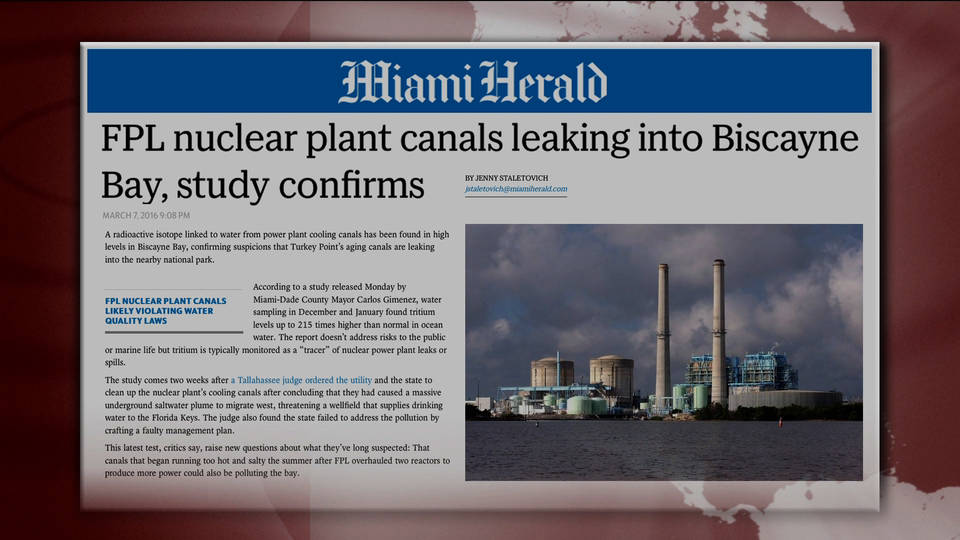
Meanwhile, in Florida, the Turkey Point nuclear power station appears to be leaking radiation into the waters off the coast of Miami. A recent study by scientists at the University of Miami found tritium levels up to 215 times higher than normal in the water of the Biscayne Bay. Tritium is a radioactive isotope produced by nuclear reactors. The site’s cooling canals, which are the part of the facility that appear to be leaking the radiation, are currently permitted to operate at 104 degrees—the hottest in the nation.
TOPICS:
Florida
Nuclear Power
At FL Debate, GOP Candidates Call for More U.S. Troops in Iraq
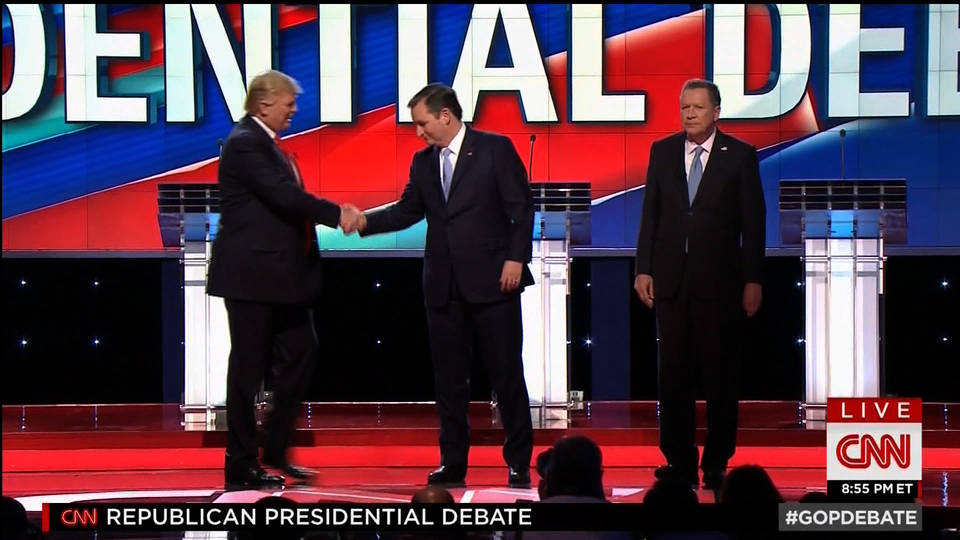
The four remaining Republican presidential candidates squared off in a debate in Florida Thursday night. Among the topics of debate was the war against ISIL. Candidates Texas Senator Ted Cruz, Ohio Governor John Kasich and real estate billionaire Donald Trump all said they would send additional U.S. troops to Iraq to fight ISIL militants. Trump said he’d send 20,000 to 30,000 U.S. forces to Iraq. Florida Senator Marco Rubio didn’t have a chance to answer the question, although he did join other candidates in calling for the imprisonment of ISIL fighters at Guantánamo. We’ll have more on the GOP debate after headlines.
TOPICS:
Iraq
2016 Election
Donald Trump Fan Punches Black Protester at Rally
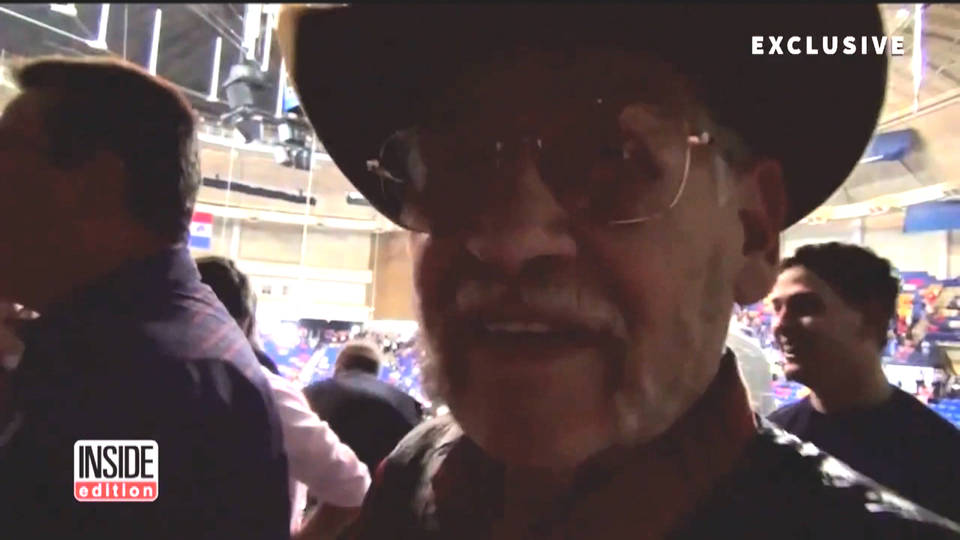
Meanwhile, a white Donald Trump supporter who punched an African-American protester during a Trump rally in Fayetteville, North Carolina, has threatened the protester, saying next time he might kill him. Video footage shows 26-year-old protester Rakeem Jones being escorted out of the Trump rally when a white man in a cowboy hat steps toward the aisle and sucker-punches Jones in the eye. The attacker, John McGraw, has been charged with assault. Speaking to a journalist after the event, McGraw threatened the protester’s life.
Reporter: "Did you like the event?"
John McGraw: "You bet I liked it."
Reporter: "Yeah? What did you like about it?"
John McGraw: "Knocking hell out of that big mouth. We don’t know who he is, but we know he’s not acting like an American."
Reporter: "So he deserved it?"
John McGraw: "Every bit of it."
Reporter: "What was that?"
John McGraw: "Yes, he deserved it. The next time we see him, we might have to kill him."
TOPICS:
2016 Election
Donald Trump
Washington Post Runs 16 Anti-Sanders Ads in 16 hours
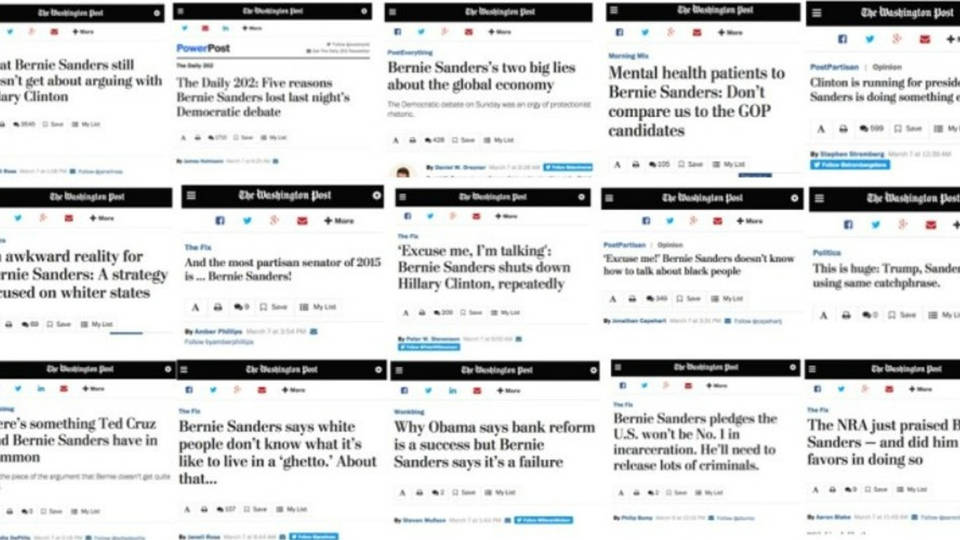
Meanwhile, The Washington Post is receiving criticism for running a total of 16 negative stories about Bernie Sanders in only 16 hours. From Sunday, March 6, to Monday, March 7—which included the time period of the Democratic debate in Flint, Michigan—The Washington Post ran more than a dozen articles criticizing Sanders. This follows a trend of mainstream media coverage either ignoring or scorning Sanders. Data from the Tyndall Report showed that Donald Trump received up to 23 times as much coverage on mainstream media networks than Democratic presidential candidate Bernie Sanders in 2015.
TOPICS:
Journalism
Bernie Sanders
Flint Temporarily Suspends Sending Out Residents' Water Bills
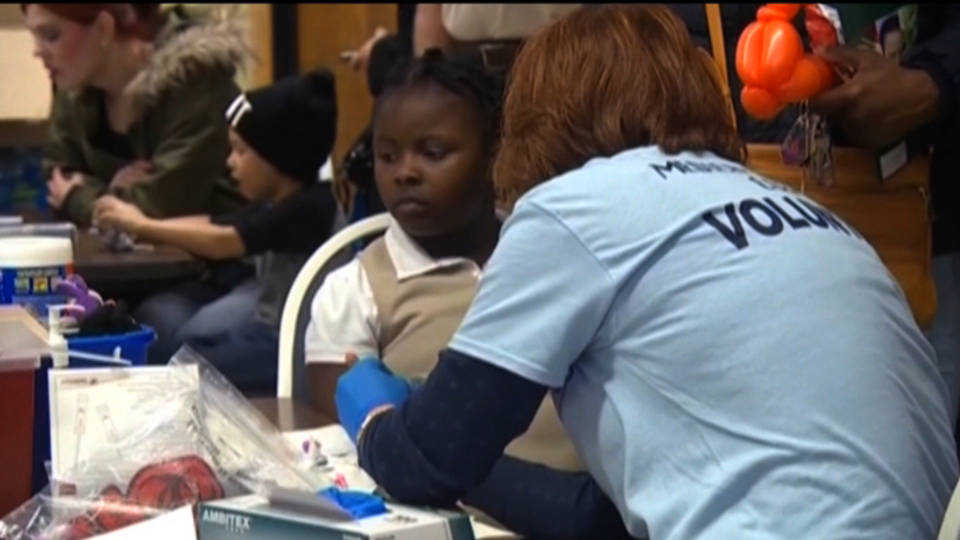
In news from Flint, Michigan, Mayor Karen Weaver has announced residents won’t receive any more water bills until the city can recalculate costs, in efforts to avoid billing residents for lead-poisoned water they can’t use. The city is in the midst of a water contamination crisis that began when Flint’s state-appointed, unelected emergency manager switched the source of the city’s drinking water to the corrosive Flint River in an apparent bid to save money. Flint’s water bills are among the highest in the country—even though the water is unusable. Last week, the state of Michigan approved a $30 million plan to help Flint residents pay a portion of their water bills. The mayor had demanded far more money from the state to replace the city’s aging lead service pipes.
TOPICS:
Flint Water Crisis
Newark, NJ Schools Test for High Levels of Lead
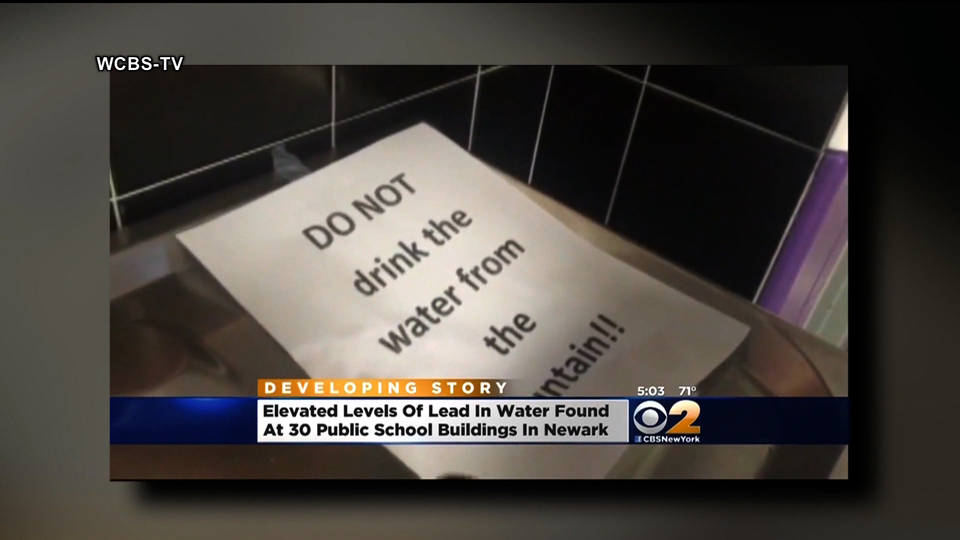
Meanwhile, in Newark, New Jersey, officials have blocked access to water fountains in at least 30 school buildings after annual testing recorded elevated levels of lead in the drinking water.
TOPICS:
New Jersey
Water
U.N.: U.S.-Based Companies Violated Arms Embargo Against Libya

United Nations investigators say dozens of companies, countries and individuals have violated an arms embargo against Libya—including at least two U.S.-based weapons companies. The U.S. companies—Turi Defense Group and Dolarian Capital—are accused of brokering an arms deal to Libya in 2011, after the U.N. Security Council’s arms embargo took effect. The U.N. report also accused countries including United Arab Emirates, Egypt and Turkey of selling military equipment to various warring factions inside Libya.
TOPICS:
Libya
Arms Trade
U.N.: South Sudan Gov't Forces Committing War Crimes

A new U.N. report accuses South Sudan’s pro-government forces of crimes against humanity and war crimes, including systematic rape of civilians. United Nations High Commissioner for Human Rights Zeid Ra’ad al-Hussein called the ongoing conflict "one of the most horrendous human rights situations in the world." Tens of thousands of people have died since 2013. The United States backed South Sudan’s independence in 2011 and the country’s president, Salva Kiir, whose troops are now accused of carrying out the majority of the crimes in the ongoing civil war.
TOPICS:
United Nations
BP Cuts Ties with the Tate, After Facing Protests
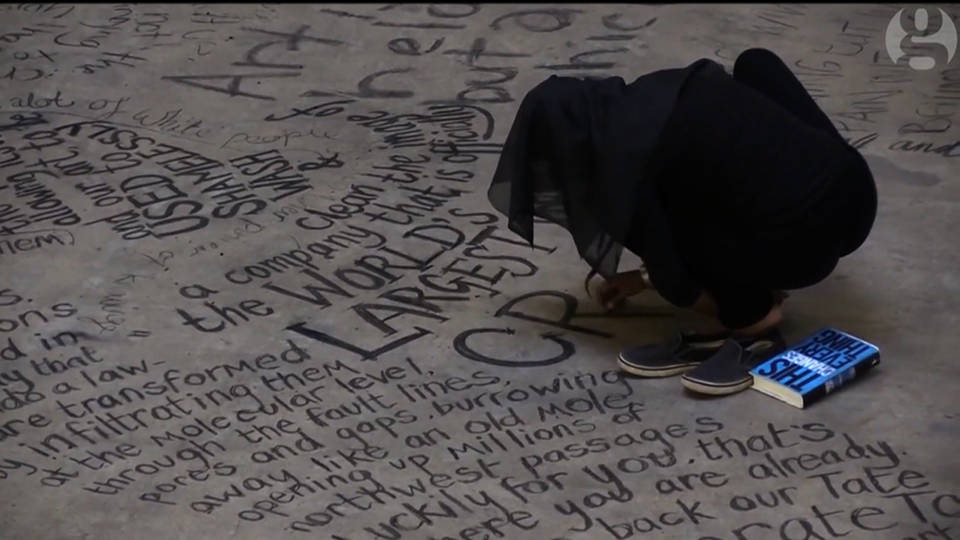
Oil giant BP has announced it is ending its sponsorship of the Tate, London’s prestigious four art institutions, after facing massive opposition. Activists with the art collective Liberate Tate have staged a series of protests demanding the Tate end its contract with BP, which has been funding the Tate for more than 26 years. This comes amid international campaigns demanding scientific and cultural institutions cut ties with the fossil fuel industry.
TOPICS:
Climate Change
Natural Gas & Oil Drilling
PA: Fracking Company Ordered to Pay for Well Water Contamination
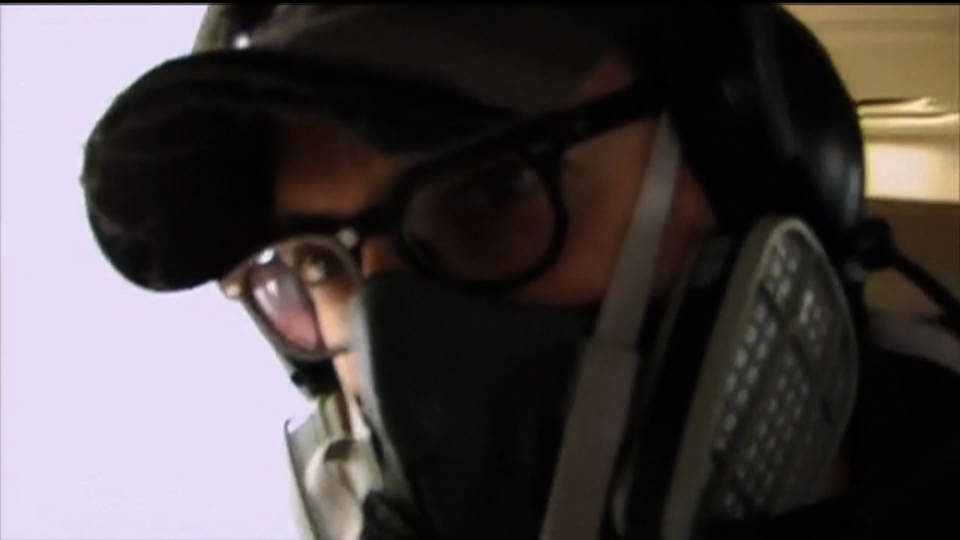
In Pennsylvania, a court has ordered fracking company Cabot Oil & Gas to pay more than $4 million to families whose well water was contaminated by fracking. The landmark legal ruling comes after an eight-year battle between residents and Cabot. Filmmaker Josh Fox, who featured some of the families in his film "Gasland 2," said the case sets a legal precedent for holding fracking companies responsible for water contamination.
TOPICS:
Fracking
Water
Montana: Arch Coal Suspends Plans for Major Mine, After Years of Resistance

And in Montana, Arch Coal has suspended its application for a major new coal mine in the Powder River Basin, following years of resistance from the Northern Cheyenne Nation and local ranchers. The move comes two months after Arch Coal declared bankruptcy amid the decline of the U.S. coal industry at large. The construction of Otter Creek mine, which would have extracted up to 20 million tons of coal, was delayed by years of legal and political opposition, which was featured in Naomi Klein and Avi Lewis’ film "This Changes Everything." Here is a clip from the film of Cheyenne environmental organizer Vanessa Braided Hair speaking at a hearing against the mine.
Vanessa Braided Hair: "My name is Vanessa Braided Hair. I requested this informal conference on behalf of the Northern Cheyenne homesteaders. Last night, over 200 Cheyennes, Three Affiliated Tribes, the Oglala Lakota Nation, Yakama Nation gathered in Lame Deer to oppose any development of the Otter Creek and Tongue River Valley. ... If you don’t want the Cheyennes to take over public meetings, then listen to us. If you don’t want anger, then hear us."
TOPICS:
Montana
Coal
Donate today:
Follow:


WEB EXCLUSIVE

The Life and Legacy of Berta Cáceres
FEATURED TOPIC

Fukushima
WORK WITH DN!

Broadcast Engineer
Director of Finance and Operations
Director of Development
---------------------
207 West 25th Street, 11th Floor
New York, New York 10001, United States
---------------------
---------------------

No comments:
Post a Comment