democracynow.org
Stories:

Slain Activist Berta Cáceres' Daughter: US Military Aid Has Fueled Repression & Violence in Honduras
Another indigenous environmentalist has been murdered in Honduras, less than two weeks after the assassination of renowned activist Berta Cáceres. Nelson García was shot to death Tuesday after returning home from helping indigenous people who had been displaced in a mass eviction by Honduran security forces. García was a member of COPINH, the Civic Council of Popular and Indigenous Organizations of Honduras, co-founded by Berta Cáceres, who won the prestigious Goldman Environmental Prize last year for her decade-long fight against the Agua Zarca Dam, a project planned along a river sacred to the indigenous Lenca people. She was shot to death at her home on March 3. On Thursday, thousands converged in Tegucigalpa for the start of a mobilization to demand justice for Berta Cáceres and an end to what they say is a culture of repression and impunity linked to the Honduran government’s support for corporate interests. At the same time, hundreds of people, most of them women, gathered outside the Honduran Mission to the United Nations chanting "Berta no se murió; se multiplicó – Berta didn’t die; she multiplied." We speak with Cáceres’s daughter, Bertha Zúniga Cáceres, and with Lilian Esperanza López Benítez, the financial coordinator of COPINH.
TRANSCRIPT
This is a rush transcript. Copy may not be in its final form.
AMY GOODMAN: We begin today’s show in Honduras, where another indigenous environmentalist has been murdered, less than two weeks after the killing of renowned activist Berta Cáceres. Nelson García was shot to death Tuesday after returning home from helping indigenous people who had been displaced in a mass eviction by Honduran security forces. García was a member of COPINH, the Civic Council of Popular and Indigenous Organizations of Honduras, co-founded by Berta Cáceres. She won the prestigious Goldman Environmental Prize last year for her decade-long fight against the Agua Zarca Dam, a project planned along a river sacred to the indigenous Lenca people. She was shot to death at her home on March 3rd. In a statement, Honduran police said the two killings were unrelated. They called Nelson García’s murder a, quote, "isolated" act.
But Honduran activists disagree. On Thursday, thousands converged in Tegucigalpa for the start of a mobilization to demand justice for Berta Cáceres and an end to what they say is a culture of repression and impunity linked to the Honduran government’s support for corporate interests. Ten buses of indigenous and black Hondurans were reportedly stopped en route to the capital. Activists said some began walking toward Tegucigalpa after being forced to leave the buses.
In the capital, demonstrators walked past the Mexican Embassy to show solidarity with Gustavo Castro Soto, the sole witness to Berta Cáceres’s murder, who remains inside the embassy. After Cáceres died in his arms at her home, Castro was interrogated and blocked from leaving Honduras to return to his native Mexico, even though he was accompanied by the Mexican ambassador and shot twice himself. One of Berta Cáceres’ daughters, Olivia, spoke to Democracy Now! at the mobilization in Tegucigalpa.
OLIVIA ZÚNIGA CÁCERES: [translated] Today, we are here to demand justice and an explanation for the crime of the death of my mother, Berta Cáceres. I’m her oldest daughter. And we’ve launched a struggle, a battle at the international level, to exert pressure in order to demand that the aid agencies that fund these multinational corporations that come to plunder, to exterminate our people, to spill our blood in our territories, to create territorial conflicts, that they stop being financed and that they leave our country, because we don’t want international companies that come to finance death, blood and extermination in our communities.
AMY GOODMAN: In a victory for Berta Cáceres’s supporters on Wednesday, the Dutch development bank FMO and the Finnish development bank Finnfund said they would suspend their funding of the Agua Zarca Dam. In a statement, FMO said it was "shocked" by Nelson García’s murder and would halt all activities in Honduras.
Meanwhile, in Washington, D.C., two activists scaled an art installation in front of the U.S. Agency for International Development Monday to oppose the agency’s support for the dam. They unfurled a banner reading "Stop funding murder in Honduras." Honduran activists say five members of COPINH working to stop the Agua Zarca Dam have been murdered since construction began in 2013. On Wednesday, at another action in Washington, D.C., two activists interrupted a meeting of the Council of the Americas. They targeted the U.S. ambassador to Honduras, James Nealon, saying he has blood on his hands.
PROTESTER 1: He has the blood of Berta Cáceres! He has the blood of Nelson García! The United States has been funding—the United States has been funding [inaudible].
AMY GOODMAN: In New York City on Thursday, hundreds of people, most of them women, gathered outside the Honduran Mission to the United Nations, chanting "Berta didn’t die, she multiplied." Among those who participated was one of Berta Cáceres’s three daughters, also named Bertha, and a Lenca activist from Berta Cáceres’s organization COPINH. We’re going to speak with them shortly, but first, in an international broadcast exclusive, we turn to new footage filmed by COPINH members and its supporters in the hours before and days after Berta’s assassination in Honduras. The video begins with Berta Cáceres herself conducting a training on March 2nd. Only hours later, she would be assassinated.
BERTA CÁCERES: [translated] We have to understand why these projects are so important. The government has all of its institutions at the service of these companies, because they are capable—as in Río Blanco, in the defense that we had in Gualcarque—because these businesses are capable of moving antiterrorism commandos, like the Tigre commandos, the military police, the national police, security guards, hit men, etc. It’s not a simple thing. There has to be something else deeper, underneath the surface, that moves all of that power. And we want to understand that better. We have to understand that, because we have the obligation as members of COPINH to have these debates anywhere. And this will help these resistance struggles that you’re fighting there in your communities.
AMY GOODMAN: Only hours later, early in the morning of March 3rd, Berta Cáceres was murdered in her home in La Esperanza. As the authorities took her body away, her brother Gustavo reacted to her death.
GUSTAVO CÁCERES: [translated] And what I ask of Juan Orlando Hernández, look, here lies a true Lenca, who was never ashamed to be indigenous. What she did was defend her people with her life, and she gave her life. And now we have her here in the back of a truck in a bag, in a plastic bag, like any thing. This can’t happen in our country. What is happening? We demand, we demand, we demand, in the name of my family, my mother, this people, thousands and thousands of us, that they immediately investigate and that they not say things that aren’t true, and that they stick to the truth of what happened to my sister.
AMY GOODMAN: Berta had been a frequent voice on the local community radio station, La Voz Lenca. After her death, fellow activists took to the airwaves to denounce the murder.
ACTIVIST 1: [translated] We have to be alert, compañeros and compañeras. And we are not to be brought to our knees. At no point will we surrender. At no point will they sell us. If the dictatorship of Mr. Juan Orlando Hernández Alvarado, if the executives of the company DESA and the hit men, if they are thinking that they are going to stop the struggle of our organization, ladies and gentlemen in power, you are wrong.
PROTESTERS: ¡Justicia! ¡Justicia! ¡Justicia!
AMY GOODMAN: The news of Berta’s assassination spread quickly, and on March 5th, thousands gathered for her funeral in La Esperanza.
PROTESTER 2: [translated] We reject the patriarchal victimization that the Honduran state and the states in the region want to impose on us. We, the women and the people, reject it, together, brothers and sisters. We reject it because we are criminalized women, who are also living under death threats for shattering this power imposed by neoliberalism in our territories.
AMY GOODMAN: People took to the streets across Honduras to denounce her killing and to accuse the state of being complicit in her murder. Outside the local public prosecutor’s office, activists said authorities have repeatedly ignored their reports of death threats.
ACTIVIST 2: [translated] When we come here to the public prosecutor’s office—I’ve been present many times when people have come here to report complaints; I’ve come here to accompany comrades—and the public prosecutor’s office, or the people who work here, say that they are rabble-rousers and that they are against development. What kind of development, my friends? Killing comrades? Is that development?
AMY GOODMAN: One of the activists to denounce Berta’s murder was Miriam Miranda, a leader of the Garífuna community in Honduras. The Garífuna are descendants of indigenous Caribbean people and African slaves.
MIRIAM MIRANDA: [translated] We want our children to breathe clean air for generations to come. We want to have rivers. We don’t just want to wash our clothes. We also want to be able to drink the water, to be able to have water in our homes! That is the struggle we are fighting. For that, they kill us. For that, they killed Berta Cáceres.
AMY GOODMAN: One of Berta’s three daughters, Laura, resolved her mother’s fight would continue.
LAURA ZÚNIGA CÁCERES: [translated] My mother has not been killed. My mother has been planted, and she is born and reborn. And this, which they tried to put out today, this fire that is the struggle of the people, the only thing they did was ignite it more, because they tried to put out the fire with gasoline!
PROTESTERS: ¡Justicia! ¡Justicia! ¡Justicia!
AMY GOODMAN: That was Berta Cáceres’s daughter Laura, speaking after her mother’s death in Honduras. When we come back from break, we’ll be joined by Laura’s sister—that is, Berta’s daughter—Bertha Zúniga Cáceres. And we’ll be joined by Lilian Esperanza López, who is with COPINH, the Civic Council of Popular and Indigenous Organizations of Honduras. That’s the group that Berta Cáceres founded. This is Democracy Now! We’ll be back in a minute.
[break]
AMY GOODMAN: Karla Lara, "La Casa de la Justicia," "The House of Justice." This is Democracy Now!, democracynow.org, The War and Peace Report. I’m Amy Goodman. We’re talking about Honduras, where another indigenous environmentalist has been murdered, this less than two weeks after the killing of the renowned environmental activist Berta Cáceres. Nelson García was shot to death Tuesday after returning home from helping indigenous people who had been displaced in a mass eviction by Honduran security forces. García was a member of COPINH, the Civic Council of Popular and Indigenous Organizations of Honduras, co-founded by Berta Cáceres. She won the prestigious Goldman Environmental Prize last year for her decade-long fight against the Agua Zarca Dam, a project planned along a river sacred to the indigenous Lenca people.
We’re joined right now by Berta’s daughter, by Bertha Zúniga Cáceres, and by Lilian Esperanza López, financial coordinator of COPINH, the organization Berta co-founded.
We welcome you both Democracy Now! Bertha, first of all, and Lilian, my condolences on the death of your mother.
BERTHA ZÚNIGA CÁCERES: [translated] Thank you, and I’d like to thank you for giving us this opportunity, the media that follow up on the struggles and don’t just put out news.
AMY GOODMAN: Bertita, Bertha, why are you here in the United States?
BERTHA ZÚNIGA CÁCERES: [translated] We’re here because we want to continue denouncing what happened to my mother. We want to tell the truth about her assassination. In Honduras, the situation is very much manipulated by the media, and the way the government is dealing with it is truly lamentable. So we want to struggle with those who are engaged in social struggle, women and men, but also with authorities and persons who can listen, so that the demands that we have put forward to the government of Honduras can actually receive attention and be acted upon.
AMY GOODMAN: What are you demanding of the U.S. government?
BERTHA ZÚNIGA CÁCERES: [translated] Well, I think one of the key demands is that we be accompanied in our demands. We have put forth an array of points that have received very little attention in our country. It seems that the government of Honduras is only concerned about what is said internationally, but not about really following up on or really verifying what it is that happened in the assassination of my mother. So, it’s crucial that an independent investigative commission be formed, that it be made up of experts who enjoy the trust of the family and the organization, for the investigation that has been carried out thus far is very limited, and the results that it might yield would not be considered reliable by us. And we would like the government of the United States and many others to pressure the government of Honduras to make it possible for such a commission to participate in the investigation, for the Inter-American Commission on Human Rights has said that it is ready and willing, but it needs an invitation from the government of Honduras in order for its investigation to be considered relevant in the overall investigation.
AMY GOODMAN: I really—I really hate to ask you this, Bertita. What do you understand happened to your mother when she was assassinated? She was at your home in La Esperanza, in Honduras. This was two weeks ago. Well-known figure around the world, leading environmentalist. What do you understand happened to her in the home where you grew up?
BERTHA ZÚNIGA CÁCERES: [translated] Well, as soon as I found out about her assassination, I immediately thought, "Who was really behind this?" because we knew of the recurrent threats that she faced. And in the last week, there had been an escalation in threats. And this happened in the context of the struggle against this hydroelectric dam known as Agua Zarca. We’ve always feared for her safety and for her life, because we knew that these threats included participation by or also came from the repressive forces in Honduras, that the police and the military had been safeguarding the facilities of the hydroelectric plant. And rather than seeing how to protect human rights, they’re always trying to figure out how to protect the interests of the private company. So we knew that there were big interests that wanted to bring an end to her life and the struggle of the organization, because the struggle was not only hers, it was the struggle of an entire people and also a struggle of the Honduran social movement.
AMY GOODMAN: Just hours before Nelson García was assassinated—and this was just a few days ago, and this is after Berta’s assassination—more than 60 members of Congress signed a letter to Secretary of State John Kerry and Treasury Secretary Jacob Lew calling for a review of U.S. security aid to Honduras and an independent investigation into the killing of Berta Cáceres. They wrote in part, quote, "We are profoundly saddened and angered by the brutal assassination of Berta Cáceres, and appalled by our government’s continuous assistance to Honduran security forces, so widely documented to be corrupt and dangerous." Where does that U.S. military aid go, Bertita?
BERTHA ZÚNIGA CÁCERES: [translated] I think that the military aid is like the classic form of aid that the United States has given to the Latin American region. In Honduras, it was bolstered as of the 2009 coup d’état, which saw an increase in the national budget earmarked to security. But at the same time, they created special forces, supposedly, to watch out for security in the country. But quite to the contrary, what has happened has been an increase in insecurity, violence and repression, very much directed against the Honduran social movement. So I believe that the role of the security forces is extremely important when one looks at the barriers being put up to the Honduran social movement and to the exercise of human rights. We’re also concerned that this is continuing, this cooperation, because it has shown that these security forces do not serve the purpose for which they were supposedly created. For the indigenous peoples, in particular, the presence of armed forces represents a great danger, because they have a different life of harmony, and this merely steps up conflicts within the communities.
AMY GOODMAN: I want to talk about—I mean, something very interesting here in the 2016 presidential election in the United States is there is a relationship between Hillary Clinton, who was the secretary of state who basically accepted the coup of 2009, and the government, the coup government, in Honduras. But before I do that, I want to turn to our second guest, to Lilian Esperanza López Benítez, who is the financial coordinator of COPINH. Now, COPINH is the environmental organization, the indigenous organization, the Civic Council of Popular and Indigenous Organizations of Honduras, that Berta Cáceres co-founded. Lilian, how many times have you been interrogated since Berta’s assassination?
LILIAN ESPERANZA LÓPEZ BENÍTEZ: [translated] Up until the assassination of Berta, I have been interrogated four times, and I have received many phone calls from the office of the attorney general. And we asked ourselves, why are those of us who are part of this organization being interrogated? And we—they are denouncing members of our organization, COPINH. We ask, why are they interrogating us?
AMY GOODMAN: So they have interrogated you since Berta was killed?
LILIAN ESPERANZA LÓPEZ BENÍTEZ: [translated] Yes. I have been at the office of the prosecutor for whole days in interrogations.
AMY GOODMAN: Why do you think they are questioning you? And who is doing it?
LILIAN ESPERANZA LÓPEZ BENÍTEZ: [translated] Those who interrogate us or question us are the office of the prosecutor, because they want to tie her assassination to some sort of internal problem, even though we’ve never had such an internal problem in the organization during the various years in which I have shared the struggle with her. All that the government wants is to tear the organization apart. That’s what the government wants to achieve. But as women and as a strong organization, we hope that they’re not going to accomplish that. Rather, we have become strengthened to continue working in the organization to defend natural resources.
AMY GOODMAN: Lilian, first Berta Cáceres, the founder of your organization COPINH, was assassinated. Then, tell us what happened to Nelson García just in the last days.
LILIAN ESPERANZA LÓPEZ BENÍTEZ: [translated] The assassination of Berta, these—days earlier, there had also been an eviction in Río Lindo, in the department of Cortés, and persons were displaced once again. The government could have stopped this, because if it does not want to be—had it not wanted to be involved or had it not been involved in the assassination of Berta, they would have detained, they would have arrested the assassination. And there was an eviction by police, by military and by a court. And in the wake of that, our colleague Nelson García was assassinated. Just as he was arriving at his home, paid hit men were there waiting to assassinate him.
AMY GOODMAN: Are you afraid for your life?
LILIAN ESPERANZA LÓPEZ BENÍTEZ: [translated] Yes, we do have fear. We feel fear. Yet this is a struggle that we have undertaken. It is a road that we have headed down, that is to become stronger and to continue working as Berta always did. And this is a tribute to her. We have committed ourselves to continue along the same path to defend the struggle, because if, as women, we are not struggling in Honduras, but we know that it is a violent country and that they assassinate us just for being women and for standing up for the natural resources of the Lenca people.
AMY GOODMAN: Tell us what COPINH does, your organization that Berta founded.
LILIAN ESPERANZA LÓPEZ BENÍTEZ: [translated] For the last 21 years, has been struggling. On 27 March, that will be 22 years. COPINH has been an organization that defends natural resources in the Lenca communities, because the Lenca communities have their own title, their own legal status. They are protected by ILO Convention 169. The only thing we do is support the Lenca communities to defend their own resources and their own rights. This is what we do as an organization, because many communities have had their lands taken from them. Their crops have been destroyed once the company comes into these communities. Those rights are not respected. And that is what the organization has done. It has undertaken a struggle as of a long time ago, and we’re going to continue that struggle, knowing that our colleague, Berta, was assassinated and that many of us women might be assassinated in this effort. But the government will continue to bloody its hands with many women.
AMY GOODMAN: What is your message—what is your message, Lilian, to the U.S. government?
LILIAN ESPERANZA LÓPEZ BENÍTEZ: [translated] My message would be that these countries that are financing and the banks that are financing and providing this aid to the multinational companies should no longer do so, because due to this financing and due to these multinationals that are in our country, Honduras, Berta was assassinated, and many community leaders have been assassinated. They don’t care, but we continue to struggle. And they are not going to stop us women. They are not going to stop us, the Lenca people. We continue in going forward in this strong struggle in order to pay tribute to and honor our colleague Berta.
AMY GOODMAN: Bertha Cáceres, again, Berta Cáceres’s daughter, who has come to the United States, talk about the dam your mother has fought against for so long, the Agua Zarca Dam, and what it actually does, why she was so fiercely opposed to it.
BERTHA ZÚNIGA CÁCERES: [translated] I believe that the position taken not only by my mother, but also by the Lenca indigenous people and the Honduran social movement, is aimed at preserving the life of the communities and to preserve life, not only for ourselves but for the entire world. It’s very important to understand the difference between the worldview of the indigenous communities and an extractivist model that really means dispossession, pillage of the natural goods of nature, and, over time, the death of the communities and of their way of life. That is why my mother so fervently and so firmly opposed these projects, because they don’t bring about the supposed development that they talk about. They really represent death for the communities.
AMY GOODMAN: What role, Bertha, did the coup play in 2009 in what has happened in these years that have ensued, the coup that ousted the democratically elected president of Honduras, Mel Zelaya?
BERTHA ZÚNIGA CÁCERES: [translated] I think that the role of the coup is, well, the reason for the deaths of hundreds of activists and defenders of life, because at the root of the problem that the indigenous peoples are facing is this, for it’s since the coup that hundreds of concessions were given for hydroelectric exploitation, for mining. Model cities were established, also sales of oxygen and a number of projects aimed at dispossessing the population. So, we are actually experiencing the coup d’état now with the establishment of a whole series of projects that are strengthening an economic model that represents the pillage of the common goods of nature. So it is very significant, and we are seeing the consequences in the situations we’re now experiencing.
AMY GOODMAN: Since the coup, Honduras has become one of the most dangerous places in the world. A few days ago, we were speaking to Greg Grandin, who is a professor of history at New York University, and asked him about what Berta Cáceres said about Hillary Clinton’s role in the 2009 coup, when she was secretary of state. In this clip, we hear Berta Cáceres and then the response by Greg Grandin. Juan González and I were interviewing him. Cáceres appeared on the Argentine TV program Resumen Latinoamericano.
BERTA CÁCERES: [translated] We’re coming out of a coup that we can’t put behind us. We can’t reverse it. It just kept going. And after, there was the issue of the elections. The same Hillary Clinton, in her book, Hard Choices, practically said what was going to happen in Honduras. This demonstrates the meddling of North Americans in our country. The return of the president, Mel Zelaya, became a secondary issue. There were going to be elections in Honduras. And here, she, Clinton, recognized that they didn’t permit Mel Zelaya’s return to the presidency. There were going to be elections. And the international community—officials, the government, the grand majority—accepted this, even though we warned this was going to be very dangerous and that it would permit a barbarity, not only in Honduras but in the rest of the continent. And we’ve been witnesses to this.
AMY GOODMAN: That was Honduran environmental activist Berta Cáceres speaking in 2014. She was murdered last week in her home in La Esperanza in Honduras. Last year, she won the Goldman Environmental Prize. She’s a leading environmentalist in the world. Professor Grandin?
GREG GRANDIN: Yeah, and she criticizes Hillary Clinton’s book, Hard Choices, where Clinton was holding up her actions in Honduras as an example of a clear-eyed pragmatism. I mean, that book is effectively a confession. Every other country in the world or in Latin America was demanding the restitution of democracy and the return of Manuel Zelaya. It was Clinton who basically relegated that to a secondary concern and insisted on elections, which had the effect of legitimizing and routinizing the coup regime and creating the nightmare scenario that exists today.
I mean—and it’s also in her emails. The real scandal about the emails isn’t the question about process—you know, she wanted to create an off-the-books communication thing that couldn’t be FOIAed. The real scandal about those emails are the content of the emails. She talks—the process by which she works to delegitimate Zelaya and legitimate the elections, which Cáceres, in that interview, talks about were taking place under extreme militarized conditions, fraudulent, a fig leaf of democracy, are all in the emails.
JUAN GONZÁLEZ: And particularly what does she say in them?
GREG GRANDIN: Well, she talks about trying to work towards a movement towards legitimating—getting other countries, pressuring other countries to accept the results of the election and give up the demand that Zelaya be returned.
AMY GOODMAN: And let’s go to March 2010. This is Secretary of State Hillary Clinton traveling to meet with the Honduran president, Porfirio "Pepe" Lobo, whose election was boycotted by opponents of the coup that overthrew Zelaya. Hillary Clinton urged Latin American countries to normalize ties with the coup government. After this, we hear response from professor Greg Grandin.
SECRETARY OF STATE HILLARY CLINTON: We think that Honduras has taken important and necessary steps that deserve the recognition and the normalization of relations. I have just sent a letter to the Congress of the United States notifying them that we will be restoring aid to Honduras. Other countries in the region say that, you know, they want to wait a while. I don’t know what they’re waiting for, but that’s their right, to wait.
AMY GOODMAN: That was Secretary of State Hillary Clinton endorsing the coup. What is the trajectory of what happened then to the horror of this past week, the assassination of Berta Cáceres?
GREG GRANDIN: Well, that’s just one horror. I mean, hundreds of peasant activists and indigenous activists have been killed. Scores of gay rights activists have been killed. I mean, it’s just—it’s just a nightmare in Honduras. I mean, there’s ways in which the coup regime basically threw up Honduras to transnational pillage. And Berta Cáceres, in that interview, says what was installed after the coup was something like a permanent counterinsurgency on behalf of transnational capital. And that was—that wouldn’t have been possible if it were not for Hillary Clinton’s normalization of that election.
AMY GOODMAN: That’s New York University professor Greg Grandin responding to Secretary of State Hillary Clinton. And we heard Berta Cáceres herself talking about Clinton’s role in the coup. We are with her daughter, Bertha Zúniga Cáceres. Was your mother, after the coup, put on a death list in Honduras? Was she the number one person on that list, Bertha?
BERTHA ZÚNIGA CÁCERES: [translated] She was figured on the lists of persons for whom the Inter-American Commission on Human Rights issued precautionary measures. And these precautionary measures were granted to persons who exercised major leadership in the movement opposing the coup d’état. The entire organization COPINH was also one of the organizations that spoke out entirely against the coup d’état. It participated in hundreds of mobilizations that organized after the coup d’état, and they always declared their opposition to this being called a presidential succession. Also, COPINH called for the population to not participate in elections, which it thought should not be held, because we were in a coup d’état situation, and one could not say that that was any sort of democratic succession.
AMY GOODMAN: Bertha, finally, you have said your mother was not the first activist to be assassinated, and she won’t be the last. Are you afraid for your life.
BERTHA ZÚNIGA CÁCERES: [translated] Well, I believe that fear exists. It is a reality. But now, more than ever, what we insist on is that my mother’s assassination be a precedent for justice. That is why it is so important that this crime be investigated, because we know that the government fears an independent commission coming to say who’s really behind this assassination and that it might reveal the ties under which the oligarchical powers operate in our country, the ties that the companies have that are protected by Honduran institutions, in which a justice system supports these facilities even though they violate human rights. And they are also operating in alliance with security forces.
AMY GOODMAN: I want to thank you both for being with us. Our guests have been Bertha Isabel Zúniga Cáceres, the daughter of Berta Cáceres, who was assassinated two weeks ago at her home in La Esperanza, in Honduras, and Lilian Esperanza López Benítez with COPINH, the Civic Council of Popular and Indigenous Organizations of Honduras, which Berta Cáceres co-founded. I thank you both for being with us. Again, thank you so much and condolences. And special thanks to our translator, Charlie Roberts. If you want to see all of our coverage of Honduras, right after Berta Cáceres’s assassination, but well before—Democracy Now! was on the plane covering Manuel Zelaya returning to his country after he had been couped out, as they say, after the coup, when he returned from Nicaragua to Honduras, as well as the time of the coup and our interviews with President Zelaya and indigenous activists in Honduras.
This is Democracy Now! When we come back, we’re talking Flint, Michigan. We’re talking about the continued poisoning of the water supply and what activists are doing about it, following two congressional hearings this week where one of the heads of the EPA spoke and for the first time the governor of Michigan, Rick Snyder, appeared. Stay with us.
... Read More →
Flint Residents: "We Need a Public Health Disaster Declaration from President Obama"
This week Michigan Republican Governor Rick Snyder testified for the first time before Congress about lead poisoning in the water supply of Flint, Michigan, which began after he appointed an unelected emergency manager who switched the source of the city’s drinking water to the corrosive Flint River. Snyder testified along with EPA Administrator Gina McCarthy and Flint’s former emergency manager, Darnell Earley, who refused to appear at last month’s hearing despite a subpoena from the U.S. House Oversight and Government Reform Committee. We play highlights from the hearing and speak with two Flint residents who attended. Melissa Mays is an activist and founder of Water You Fighting For?, a Flint, Michigan-based research and advocacy organization founded around the city’s water crisis. She and her three children suffer from long-term exposure to heavy metals because of the water supply. Nayyirah Shariff is a coordinator with the Flint Democracy Defense League.
TRANSCRIPT
This is a rush transcript. Copy may not be in its final form.
AMY GOODMAN: This week, Congress held additional hearings on lead poisoning in the water supply of Flint, Michigan. The crisis began after an unelected emergency manager appointed by the Michigan Republican governor, Rick Snyder, switched the source of Flint’s drinking water to the corrosive Flint River. Snyder testified on Thursday and acknowledged his role in the crisis.
GOV. RICK SNYDER: Let me be blunt: This was a failure of government at all levels. Local, state and federal officials, we all failed the families of Flint. This isn’t about politics nor partisanship. I’m not going to point fingers or shift blame. There’s plenty of that to share, and neither will help the people of Flint. Not a day or night goes by that this tragedy doesn’t weigh on my mind—the questions I should have asked, the answers I should have demanded, how I could have prevented this.
AMY GOODMAN: Among those who testified this week are EPA Administrator Gina McCarthy, Flint’s former emergency manager, Darnell Earley, who refused to testify at last month’s hearing, despite a subpoena from the U.S. House Oversight and Government Reform Committee. The hearings took place—well, took on a partisan tone, with Republicans going after the EPA’s McCarthy and Democrats grilling Snyder.
Well, for more on the congressional hearings into Flint’s water crisis, we’re joined by two guests. Melissa Mays, activist and founder of Water You Fighting For?—that’s W-A-T-E-R, Water You Fighting For?—and she is a Flint, Michigan-based research and advocacy organization head. It was founded around the city’s water crisis. She and her three children suffer from long-term exposure to heavy metals because of the water supply. And Nayyirah Shariff is with us, coordinator of the Flint Democracy Defense League. They both attended the congressional hearing.
Nayyirah Shariff, your response to what the governor said yesterday? It was his first time speaking at the hearing.
NAYYIRAH SHARIFF: Well, it was interesting, because the governor has not yet spoken or come to Flint to speak to residents in a public setting. So it was very interesting for him to go down there. And we sent over 150 people from Flint down to the hearing.
AMY GOODMAN: And did you hear anything new, Melissa Mays?
MELISSA MAYS: The only thing that was different was this was the first time that he even slightly admitted that he knew anything was wrong with the water in 2014. He has tried to stand by the "I didn’t know anything until October of 2015," but then he said, "Well, there were 'issues' with the water—discoloration and foul smell," like that was OK, just because there wasn’t lead in it. However, the test results show that there was lead in 2014, as well.
AMY GOODMAN: The partisan divide was on display during Thursday’s hearing on the Flint water crisis, with Democrats calling for the resignation of Governor Rick Snyder, and Republicans doing the same with the EPA administrator, Gina McCarthy. This is an exchange between Congressmember Jason Chaffetz, a Utah Republican and chair of the Oversight and Reform Committee, and EPA head Gina McCarthy.
REP. JASON CHAFFETZ: In February is when you first arrived on the scene, and it wasn’t until January of the next year that you actually did something. That’s the fundamental problem! Don’t look around like you’re mystified!
GINA McCARTHY: No.
REP. JASON CHAFFETZ: That’s what happened! Miguel Del Toral showed up in February! You didn’t take action. You didn’t. And you could have pulled that switch.
GINA McCARTHY: We consistently took action from that point forward, consistently.
REP. JASON CHAFFETZ: There is—there are a lot of people in this audience from Flint.
GINA McCARTHY: Sir—
REP. JASON CHAFFETZ: Nobody believes that you took action. You had those levers there. Marc Edwards from Virginia Tech, bless his heart—
GINA McCARTHY: Sir, we—
REP. JASON CHAFFETZ: No, just listen for a second.
GINA McCARTHY: OK.
REP. JASON CHAFFETZ: —had the opportunity. They have said things like, "We failed to get EPA to take lead-in-the-water risks seriously." It’s possible—another quote of his: "And this is possible because the EPA has effectively condoned cheating on the Lead and Copper Rule monitoring since 2006." He read your op-ed that you put out, that was one of the most offensive things I could possibly imagine. And he says, about you, EPA Administrator Gina McCarthy, that effectively absolved EPA of any wrongdoing or any role in creating the Flint disaster. If you want to do the courageous thing, like you said Susan Hedman did, then you, too, should resign.
AMY GOODMAN: After a tense exchange, Congressman Matt Cartwright, a Pennsylvania Democrat, called for Snyder’s resignation.
REP. MATT CARTWRIGHT: I’ve had about enough of your false contrition and your phony apologies. Susan Hedman from the EPA bears not one-tenth of the responsibility of the state of Michigan and your administration, and she resigned. And there you are, dripping with guilt, but drawing your paycheck, hiring lawyers at the expense of the people, and doing your dead level best to spread accountability to others and not being accountable. It’s not appropriate. Pretty soon, we will have men who strike their wives saying, "I’m sorry, dear, but there were failures at all levels." People who put dollars over the fundamental safety of the people do not belong in government, and you need to resign, too, Governor Snyder.
AMY GOODMAN: Again, Pennsylvania Democrat Matt Cartwright telling Governor Rick Snyder to resign. Melissa Mays, how is this helping what is happening in Flint? And what would that mean if the governor resigned?
MELISSA MAYS: Well, the biggest thing, I think, that the hearings are showing is that we matter. For two years we’ve been yelling and screaming about the water, and we didn’t matter, no one listened. So here it is on a national scale. It’s in front of Congress. And that just shows that what happened to us is indeed a crime, it’s wrong, we’re not crazy. And so, we’re hoping that this will further any criminal investigation. I mean, they were both sworn in. There were lies told. We sat there and just screamed in the audience. But if he resigns, obviously he’s not going to do anything to help. But he’s doing very little being in office as he is. So the only thing that we can hope for is that whoever follows him behind actually steps up, takes responsibility and fixes our city.
AMY GOODMAN: What do you feel is Governor Rick Snyder’s responsibility? For someone tuning in today for the first time—they don’t know what happened in Flint, Michigan—why do you feel the governor is responsible?
MELISSA MAYS: Well, because we were under a state of emergency management, meaning he appointed one person to run our city. That one person made all of these decisions as for switching our water source and to ignore us. And that one person reported back only to the governor and treasurer. So this is on the state. They knew that there were problems in 2014, and they let us continue to drink the water for 18 months.
AMY GOODMAN: So, in April of 2014, they switched the water supply of Flint that, what, Flint had for like 50 years—
MELISSA MAYS: Yes.
AMY GOODMAN: —the Detroit water supply, to the corrosive Flint River.
MELISSA MAYS: Yes.
AMY GOODMAN: Did you, at home, immediately notice something wrong?
MELISSA MAYS: It was soon after. We started smelling open sewer coming out of our taps, and our water started turning yellow. And we just—I mean, we knew it wasn’t going to be great. We thought it was a joke that we were going to the Flint River. But as soon as the discoloration happened and the foul smells and then the rashes started, we knew it was bad. And they just told us, "It’s hard water. It’s safe. You’ll be fine."
AMY GOODMAN: Earlier in the week, former EPA offical Susan Hedman, who resigned in the wake of the Flint water crisis, testified before the House Oversight Committee hearing. California Democratic Congressman Ted Lieu asked Hedman why it took so long for the agency to warn residents.
REP. TED LIEU: You knew, EPA knew in April, corrosive agents not done. In June, you were notified of that. And then you were given a report that said "lots of lead in this drinking water." And then nothing is done ’til December. There is no excuse for that. Someone needed to have yelled and screamed and said, "Stop this! People are being poisoned." Should have been done in at least July or August, maybe September, at least by October. That was so wrong. This was a crime of epic proportions that could have been prevented. I yield back.
AMY GOODMAN: So, explain, Melissa Mays, who Susan Hedman was, regional director of the EPA. She has resigned.
MELISSA MAYS: Yes.
AMY GOODMAN: And explain who Miguel Del Toral is.
MELISSA MAYS: Well, he’s part of the water division, and he’s an expert as for, you know, water treatment. And he asked—in February of 2015, he asked the state Department of Environmental Quality, "Are you using corrosion control?" because he saw the high lead levels already occurring. And he said, "Are you using corrosion control?" And they said yes. They lied to the EPA. Well, he didn’t believe them, because we were turning in more and more test results that showed high lead, so he kept digging into it. In June, he released an interim report saying that there’s problems, they’re not doing their job at the state level.
AMY GOODMAN: And what did Hedman do with that report?
MELISSA MAYS: Said that it wasn’t finished, it wasn’t finalized, it was full of errors, and that they did not back him. They did not back him. And then, we weren’t allowed to speak to him for weeks.
AMY GOODMAN: And she then was forced to resign. Finally, Nayyirah Shariff, as you see these two hearings this week, what are you going back to? What are you demanding now?
NAYYIRAH SHARIFF: Well, Flint needs a full-on humanitarian effort, because Snyder has said that all levels of government have failed Flint. Really, there was only one level, and that was because of the emergency manager law. We did not have access to local democracy. We did not have agency. And we really need—this is a public health disaster. We—at the state sites, we can only get one case of water per day. And that is not enough to meet the needs of the community.
AMY GOODMAN: We have five seconds. Right now, your most important demand?
NAYYIRAH SHARIFF: We need a public health disaster declaration by President Obama.
AMY GOODMAN: We’re going to leave it there. We’re going to continue the conversation and post it online at democracynow.org. Nayyirah Shariff, coordinator with Flint Democracy Defense League, and Melissa Mays, activist and founder of Water You Fighting For?
... Read More →GOP Establishment Consider Unity Ticket to Stop Trump
In the 2016 race for the White House, leading Republican Party establishment members met in Washington, D.C., Thursday to continue efforts to try to block a Donald Trump nomination. Led by RedState.com founder Erick Erickson, the group is calling for a unity ticket that could prevent Trump from winning the 1,237 delegates he needs to secure the nomination outright. This comes as the chair of the Joint Chiefs of Staff, General Joseph Dunford, described some of Donald Trump’s military proposals as illegal. Speaking to the Senate Armed Services Committee Thursday, Dunford answered questions from South Carolina Senator Lindsey Graham, who did not mention Trump by name but asked about tactics he has proposed.
Sen. Lindsey Graham: "What effect, if any, would this have on the war fighter if we started telling our men and women in uniform to intentionally target civilian noncombatants and engage in techniques such as waterboarding or more extreme forms of interrogation?"
Gen. Joseph Dunford: "You know, our men and women—and we ought to be proud of it—when they go to war, they go to war with the values of our nation. And those kind of activities that you’ve described are inconsistent with the values of our nation. And quite frankly, I think it would have an adverse effect. There’s many adverse effects it would have, one that would be on the morale of the force. And frankly, they would—what you’re suggesting are things that actually aren’t legal for them to do anyway."
TOPICS:
2016 Election
Obama Tells Donors to Throw Weight Behind Clinton

Meanwhile, on the Democrat side, President Obama reportedly threw his weight behind former Secretary of State Hillary Clinton by telling a group of Democratic donors to unite behind her. The New York Times reports Obama made the comments during a private meeting with donors after a fundraising event last Friday in Austin, Texas, for the Democratic National Committee. This comes as Sanders is favored to win a string of upcoming caucuses in Idaho, Alaska, Hawaii, Washington and Wyoming. Clinton currently leads Sanders in the delegate count: 1,139 to 825.
TOPICS:
2016 Election
In Hearings, Lawmakers Call for MI Gov. Rick Snyder's Resignation
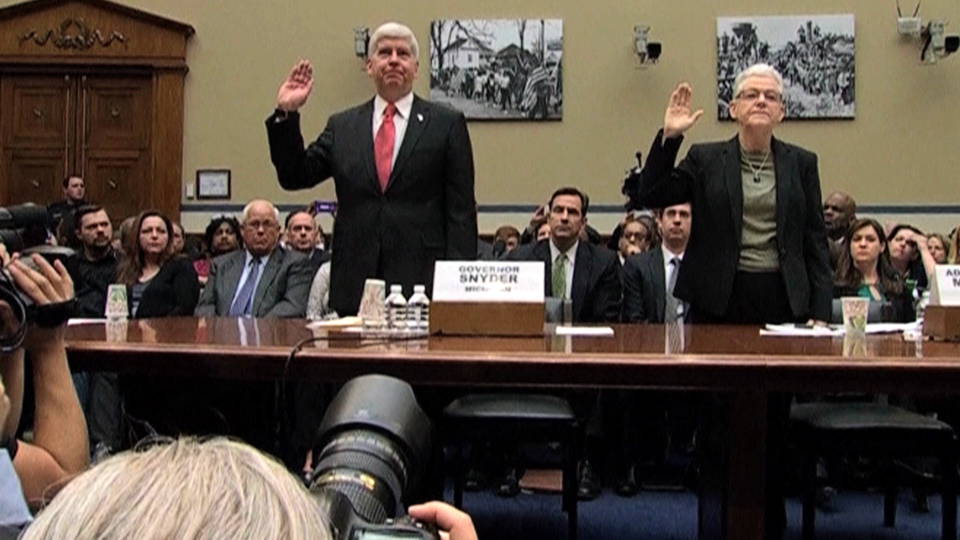
U.S. lawmakers called for Michigan Governor Rick Snyder to resign during congressional hearings Thursday over the ongoing crisis of lead-poisoned water in Flint, Michigan. This is Pennsylvania Congressmember Matt Cartwright.
Rep. Matt Cartwright: "I’ve had about enough of your false contrition and your phony apologies. Susan Hedman from the EPA bears not one-tenth of the responsibility of the state of Michigan and your administration, and she resigned. And there you are, dripping with guilt, but drawing your paycheck, hiring lawyers at the expense of the people, and doing your dead level best to spread accountability to others and not being accountable. It’s not appropriate. Pretty soon, we will have men who strike their wives saying, ’I’m sorry, dear, but there were failures at all levels.’ People who put dollars over the fundamental safety of the people do not belong in government, and you need to resign, too, Governor Snyder."
TOPICS:
Flint Water Crisis
No Criminal Charges for U.S. Soldiers Involved in Kunduz Bombing
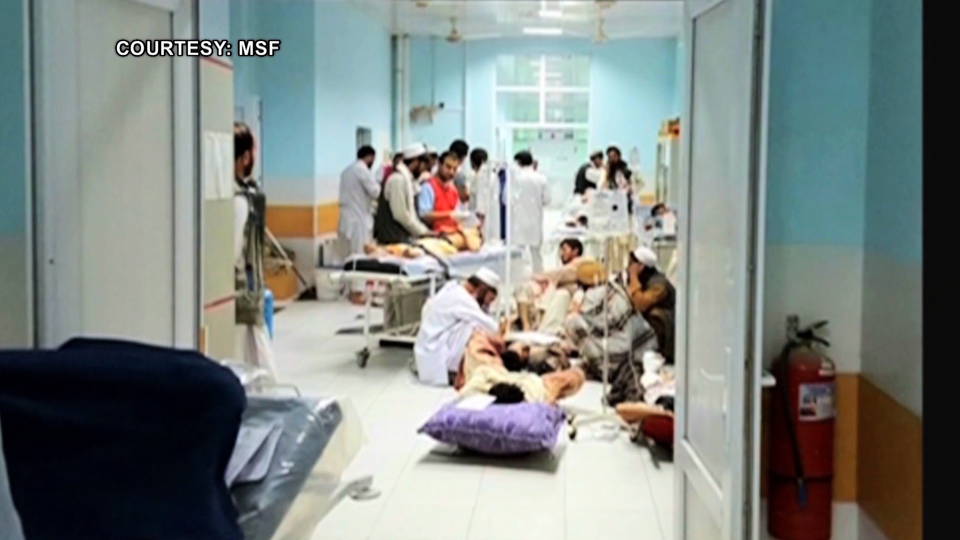
The Pentagon says at least a dozen U.S. military members have received administrative punishments as a result of the October 2015 U.S. airstrike on a Doctors Without Borders hospital in Kunduz, Afghanistan, which killed 42 people—but none are facing criminal charges. The Pentagon continues to call the attack an accident, although a report from Doctors Without Borders concluded, "The view from inside the hospital is that this attack was conducted with a purpose to kill and destroy." Human Rights Watch has called for a criminal investigation. Doctors Without Borders has called the strike a possible war crime.
TOPICS:
Afghanistan
John Kerry: ISIL Committing Genocide
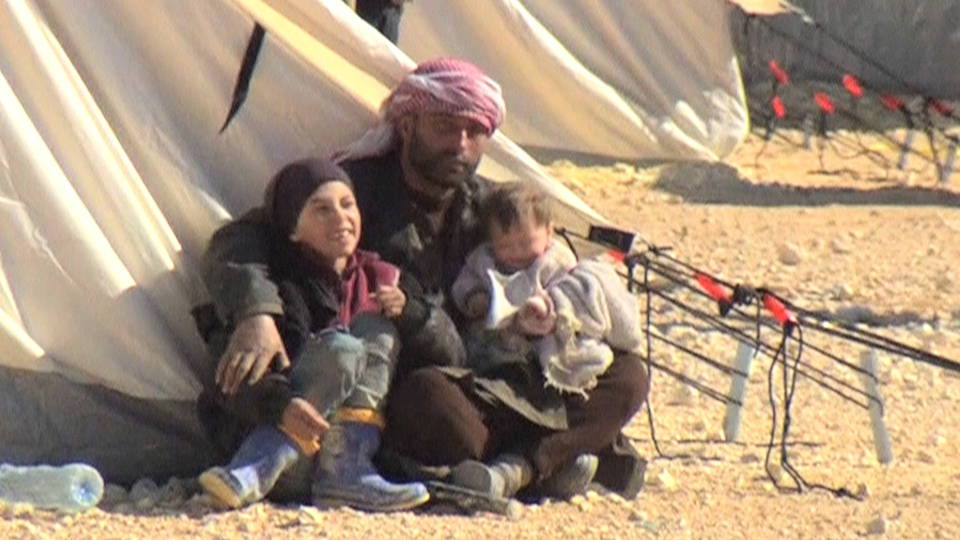
Secretary of State John Kerry says that ISIL is committing genocide against Christians, Yazidis and Shiite Muslims in Iraq and Syria. This comes less than a week after the U.S. Central Command chief, General Lloyd Austin, told Congress the Pentagon wants more resources in the fight against ISIL, though he stopped short of explicitly calling for more U.S. troops to be deployed to Iraq and Syria. There are currently more than 4,000 U.S. soldiers in Iraq and at least 50 U.S. soldiers in Syria.
TOPICS:
Iraq
Syria
U.N.: U.S.-Backed, Saudi-Led Airstrike on Yemen Market Killed 119
In news from Yemen, the United Nations said at least 119 people were killed in a U.S.-backed, Saudi-led airstrike on a market Tuesday—three times the previously reported death toll from the attack. The strike hit a crowded market in the northwest. At least 22 children were killed in the strike.
TOPICS:
Yemen
EU Proposes Controversial Plan to Deport Refugees Back to Turkey
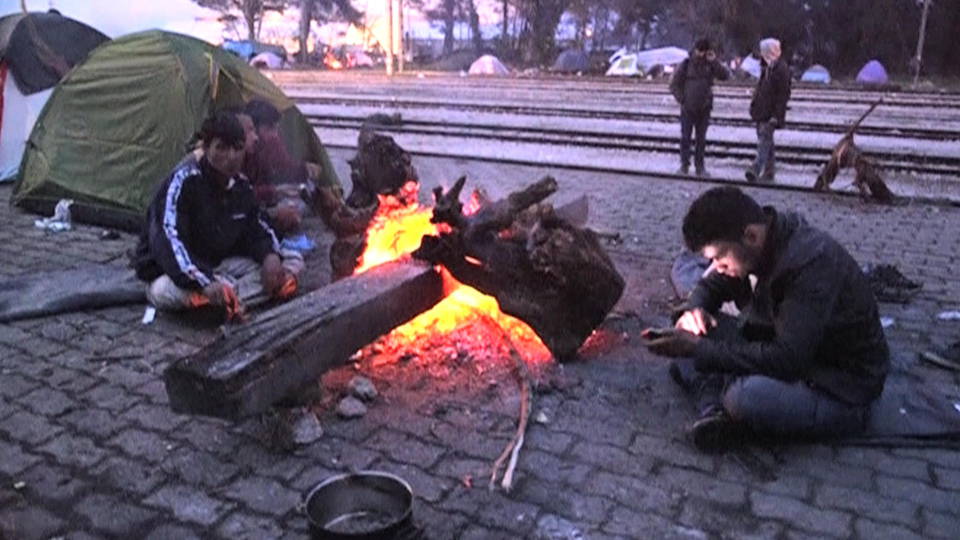
European Union leaders are proposing a controversial new plan which would entail deporting refugees who reach Greece back to Turkey. Human rights groups have criticized the plan, saying mass deportations violate international law. While the plan calls for European countries to commit to resettling Syrians currently living in Turkish refugee camps, there do not appear to be provisions for what to do with refugees coming from other war-torn countries in the Middle East and North Africa. This comes as British Prime Minister David Cameron has sparked controversy with his calls for more patrol ships in the Mediterranean to intercept boats carrying refugees and turn them back to Libya, where human rights groups say refugees face violence in the ongoing conflict and imprisonment by the government. On Thursday, the Libyan coast guard intercepted 123 refugees at sea and returned them to the capital Tripoli, where they were detained.
TOPICS:
Refugees
Turkey
U.S. and Cuba Continue Easing Relations Ahead of Obama's Trip

The United States and Cuba continue to ease diplomatic and economic relations ahead of President Barack Obama’s upcoming trip to Havana next week. Obama will become the first sitting U.S. president to visit Cuba in 88 years. On Wednesday, direct postal service between the two countries resumed after a half-century. On Thursday, Cuban Foreign Minister Bruno Rodríguez said Cuba would remove a 10 percent tax on U.S. cash dollars as soon as it verifies that the United States has lifted currency restrictions against Cuba.
TOPICS:
Cuba
SeaWorld to End Breeding Program for Killer Whales

SeaWorld has announced it will stop breeding killer whales—nearly three years after the documentary "Blackfish" sparked intense criticism of SeaWorld’s treatment of the animals and their trainers. Since the documentary aired, SeaWorld has faced increasing pressure from animal rights activists, including PETA, People for the Ethical Treatment of Animals, to end the killer whale breeding program. SeaWorld’s announcement comes only weeks after the theme park operator acknowledged that it sent an employee to pose as an animal rights activist to infiltrate PETA. According toPETA, SeaWorld employee Paul McComb took part in numerous PETA protests against SeaWorld while undercover and repeatedly used social media in an effort to incite other activists, stating that it’s time to "grab pitchforks and torches" and time to "burn SeaWorld to the ground."
TOPICS:
Animal Rights
France: 150,000 Protest Proposed Labor Reforms

And in France, as many as 150,000 students and union members participated in mass protests across the country over the government’s proposed labor reforms, which would lengthen the French work week and make it easier for bosses to fire employees. University student Arnaud Carbone spoke out.
Arnaud Carbone: "This is a law that will allow employers to do whatever they want with us and to decide our lives. And that’s simply not possible. Already, studies are a struggle. Today, students are struggling. Students are forced to get a job on the side, which makes them flunk out. We can’t allow them to worsen job instability."
TOPICS:
France
Labor
Donate today:
Follow:


WEB EXCLUSIVE

Exclusive Video: NYPD Arrests Bill de Blasio Adviser for Filming Arrest of Homeless Man
DN! IN THE NEWS

Reliable Sources onSunday, March 20
WEB EXCLUSIVE
WEB EXCLUSIVE


Fascism: Can It Happen Here?
---------------------
Democracy Now! Daily Digest: A Daily Independent Global News Hour with Amy Goodman & Juan González for Thursday, March 17, 2016
democracynow.org
Stories:

Buck v. Bell: Inside the SCOTUS Case That Led to Forced Sterilization of 70,000 & Inspired the Nazis
As President Obama nominates centrist Judge Merrick Garland to replace late Justice Antonin Scalia on the Supreme Court, we take a look at what’s been described as one of the worst Supreme Court rulings in history. In the 1927 case Buck v. Bell, the court upheld a statute that enabled the state of Virginia to sterilize so-called mental defectives or imbeciles. The person in question was Carrie Buck, a poor, young woman then confined in the Virginia State Colony for Epileptics and the Feebleminded, though she was neither epileptic nor mentally disabled. In the landmark decision, eight judges ruled that the state of Virginia had the right to sterilize her. Justice Oliver Wendell Holmes Jr. wrote the majority opinion concluding, "Three generations of imbeciles are enough." The decision resulted in 60,000 to 70,000 sterilizations of Americans considered "unfit" to reproduce. At the Nuremberg trials, lawyers for Nazi scientists cited the opinion in defense of their actions. We speak to Adam Cohen, author of "Imbeciles: The Supreme Court, American Eugenics, and the Sterilization of Carrie Buck."
TRANSCRIPT
This is a rush transcript. Copy may not be in its final form.
NERMEEN SHAIKH: We turn now to look at what’s been described as one of the worst Supreme Court rulings in history. In the 1927 case Buck v. Bell, the court upheld a statute that enabled the state of Virginia to sterilize so-called mental defectives or imbeciles. The person in question was Carrie Buck, a poor, young woman then confined in the Virginia State Colony for Epileptics and the Feebleminded, though she was neither epileptic nor mentally disabled. In the landmark decision, eight judges ruled that the state of Virginia had the right to sterilize her. Her mother, Emma, as well as Carrie’s daughter, Vivian, then only eight months old, were deemed similarly deficient. Justice Oliver Wendell Holmes Jr. wrote the majority opinion concluding, quote, "Three generations of imbeciles are enough."
AMY GOODMAN: The decision resulted in 60,000 to 70,000 sterilizations of Americans considered "unfit" to reproduce. The Supreme Court decision had its origins in the eugenics movement then thriving in the United States. The 1924 Immigration Act was passed with similar intent—to prevent immigration by genetically inferior groups, which included Italians, Jews, Eastern Europeans and countless others, in an attempt to improve the genetic quality of the American population.
Author Adam Cohen writes about the case in his new book, Imbeciles: The Supreme Court, American Eugenics, and the Sterilization of Carrie Buck. Adam was previously a member of The New York Times editorial board and a senior writer for Time magazine. He is the co-editor of TheNationalBookReview.com.
Adam Cohen, welcome back to Democracy Now! It’s great to have you with us.
ADAM COHEN: Great to be here, Amy.
AMY GOODMAN: Tell us the story of Carrie Buck. In a moment, we’ll hear all about how it ties into immigration, eugenics, parallels to what we’re seeing today. But start back in the 1920s with Carrie Buck.
ADAM COHEN: So she’s a young woman who is growing up in Charlottesville, Virginia, being raised by a single mother. Back then, there was a belief that it was better often to take poor children away from their parents and put them in middle-class homes. So she was put in a foster family that treated her very badly. She wasn’t allowed to call the parents "mother" and "father." She did a lot of housekeeping for them and was rented out to the neighbors. And then, one summer, she was raped by the nephew of her foster mother. She becomes pregnant out of wedlock. And rather than help her with this pregnancy, they decide to get her declared epileptic and feebleminded, though she was neither, and she’s shipped off to the Colony for Epileptics and Feebleminded outside of Lynchburg, Virginia.
AMY GOODMAN: And what happened to her there?
ADAM COHEN: So she gets there at just the wrong time. Virginia has just passed an eugenics sterilization law, and they want to test it in the courts. So they seize on Carrie Buck as the perfect plaintiff in this lawsuit. So they decide to make her the first person in Virginia who will be eugenically sterilized, and suddenly she’s in the middle of a case that’s headed to the U.S. Supreme Court.
NERMEEN SHAIKH: And, Adam Cohen, could you explain what kind of medical tests were employed to determine that she was a so-called imbecile?
ADAM COHEN: Yeah, terrible testing. These were very primitive IQ tests from the time, that really didn’t test intelligence at all. One question she was asked was: What do you do when a playmate hits you? And whatever her answer was to that was somehow deemed to be relevant to whether or not she was an idiot, an imbecile or a moron.
AMY GOODMAN: Those were the categories?
ADAM COHEN: Yes, those were the three categories. And this was a formal hierarchy that was established by the psychological profession at the time and was actually in government pamphlets. So, if you were of a mental age of two or younger, you were called an idiot. If you were between three and seven, you were called an imbecile. And if you were eight and—from between eight and 12, you were called a moron. And Carrie and her mother, who was also at the colony, were deemed to be morons.
NERMEEN SHAIKH: And so, explain what happened to Carrie after that.
ADAM COHEN: Yeah, so, they decide to put her in the middle of this test case to see if the Virginia law is constitutional. And they give her a lawyer who’s actually not on her side. It’s a former chairman of the Colony for Epileptics and Feebleminded’s own board of directors. He clearly wants to see her sterilized. He does a terrible job writing short briefs that don’t cite the relevant cases. It goes up to the Supreme Court, and the court rules eight to one that, yes, the Virginia law is constitutional, and, yes, Carrie, who there’s nothing wrong with, should be sterilized against her will.
NERMEEN SHAIKH: And who was responsible for appointing this lawyer to her?
ADAM COHEN: It was the colony itself, so they chose one of their friends. And she truly had no advocate of any kind on her side. Back then, the American Civil Liberties Union, which had just started up, really was kind of pro-eugenics, or at least some of the members around it were, and there were no advocacy groups to look out for people like Carrie.
AMY GOODMAN: So, explain what this term "eugenics" was, what the whole movement was, and who was a part of it, Adam.
ADAM COHEN: Sure. So, it started in England by—it was—the phrase—the word was coined by Francis Galton, who was a half-cousin of Charles Darwin. So this was right after Darwin had discovered evolution and survival of the fittest. Galton and his followers said, "Well, if nature does this naturally, we can speed survival of the fittest along if we decide who gets to reproduce and who doesn’t, if we get the fit people to reproduce and we stop the unfit from reproducing." So that was the idea in England.
It comes over to America, and it’s greatly adopted by the leaders in America. I mean, the people who supported eugenics included the president of Harvard University, the first president of Stanford, Theodore Roosevelt, Alexander Graham Bell. And universities across the country taught eugenics. It was very popular in the popular press and in best-selling books. This was a mass movement. People believed we needed to uplift the race by changing our gene pool.
AMY GOODMAN: Where did Margaret Sanger fit into this picture?
ADAM COHEN: She was a eugenicist. And this is a big controversy, where exactly she fit in. She wasn’t a leader in the movement. She was, in part, a—
AMY GOODMAN: And explain who she was.
ADAM COHEN: Sure. Margaret Sanger was the founder of Planned Parenthood. She formed a strategic alliance with the eugenicists, in part to get more support for her birth control movement. But she also believed some of this stuff, and she said some bad things at the time. This is a big controversy, though. And on the right, they use it to taint the whole idea of Planned Parenthood, which I think is unfair, because Margaret Sanger was actually in the mainstream of a lot of progressive thought at the time.
AMY GOODMAN: As is evidenced by the Supreme Court decision.
ADAM COHEN: Eight to one.
AMY GOODMAN: Now, explain who was on the Supreme Court, who wrote the decision, what these justices believed themselves.
ADAM COHEN: Yeah, so this was actually a very fancy court at the time. The chief justice was William Howard Taft, who had been president of the United States before he became chief justice, the only president to do that. He had also been a professor at Yale Law School. Louis Brandeis, who was known as "the people’s attorney" before he joined the court, a great progressive hero, he was on the court. And then, of course, Oliver Wendell Holmes, probably the most revered justice in American history, he was a legendary figure. There have been—there’s a movie about him. There was a play on Broadway, cover of Time magazine. He was thought to be the wisest of the judges. And he wrote this terrible decision.
NERMEEN SHAIKH: Well, I want to go to something that he said in the decision. This is Oliver Wendell Holmes Jr., who wrote in the majority opinion for the court, the nation must sterilize those who, quote, "sap the strength of the State [to] prevent our being swamped with incompetence." He declared, quote, "It is better for all the world if, instead of waiting to execute degenerate offspring for crime or to let them starve for their imbecility, society can prevent those who are manifestly unfit from continuing their kind."
ADAM COHEN: Very shocking. Sorry, yeah.
NERMEEN SHAIKH: So I wanted to ask you about the fact—you studied Harvard Law School. And at the time, this justice was considered a hero of the American legal system. So could you explain who he was, what kinds of positions he took, and how he was still revered?
ADAM COHEN: Sure. He was a heroic figure. He had actually been a professor at Harvard Law School before he joined the U.S. Supreme Court. And even when I was at Harvard Law school, there were portraits of him everywhere. He’s still a very revered justice.
But he came out of a certain tradition. He was a so-called Boston Brahmin. He was from some of the fanciest families in Boston. The Olivers, Wendells and the Holmes were all old New England families. He was raised by a father, Oliver Wendell Holmes Sr., who had been the dean of Harvard Medical School. Oliver Wendell Holmes Sr. actually coined this phrase "Boston Brahmin." And the idea was that these fancy families in Boston were like the Brahmins in India, that they were the highest caste.
So he believed this. He wrote about eugenics even before this case came along, wrote about it favorably. So when the case gets to him, he believes that people like Carrie Buck—poor, white, uneducated people—are much lesser than him, so it’s very natural for him to say, "Of course we don’t need more people like Carrie Buck; we need more people like me and my Boston Brahmin neighbors." So that was the philosophy.
And it is amazing that, to this day, he’s still revered in law schools, because these were some pretty repugnant views. But one reason that can still be the case is that this case is not talked about. When I took constitutional law at Harvard Law School, it was not taught. The leading American constitutional treatise, 1,700 pages that goes into great detail about many, many cases, has half a sentence about Buck v. Bell. They’ve just sort of forgotten about it and made it not part of Holmes’s legacy.
AMY GOODMAN: Where do the Nazis fit into this picture, Adam Cohen?
ADAM COHEN: Yeah, so one of the shocking things about that is that the Nazis actually followed us. We were the leaders in eugenic sterilization. Indiana passed a eugenic sterilization law in 1907, well before the rise of the Nazi Party. They were looking to America. And one of the villains in my book is a man named Harry Laughlin, who runs the—ran the Eugenics Record Office on Long Island. And he was in correspondence with the Nazi scientists throughout this whole period. They were looking to him for advice about how to set up a eugenics sterilization program. He wrote with pride in his eugenics magazine that they based the Nazi eugenic law on his American law.
NERMEEN SHAIKH: Well, can you explain—
AMY GOODMAN: So that’s key.
ADAM COHEN: Absolutely.
AMY GOODMAN: We’re not talking about Americans looking to the Nazis, who supported the Nazis. We’re talking about the Nazis using American precedent.
ADAM COHEN: Absolutely. And it’s shocking also the degree to which there was friendship and cooperation between the America eugenicists and important scientists in America and the Nazis. So, Harry Laughlin, this villain of the book, he actually is given a honorary degree from the University of Heidelberg in 1936. That’s a year after they purged all the Jews from the faculty. He was fine with that, because he was actually a Nazi sympathizer.
AMY GOODMAN: Let’s go to a break, and when we come back, we’re going to continue on this discussion. We’ll talk about the U.S. model being a model for the Nazis, but also then how immigration law fits into this picture and what are the parallels with today. We’re talking with Adam Cohen, journalist and lawyer, previously a member of The New York Times editorial board and senior writer for Time magazine. His brand new book is called Imbeciles: The Supreme Court, American Eugenics, and the Sterilization of Carrie Buck. Stay with us.
[break]
AMY GOODMAN: Coon Creek Girls, "Flowers Blooming in the Wildwood." This is Democracy Now!, democracynow.org, The War and Peace Report. I’m Amy Goodman, with Nermeen Shaikh. Our guest is Adam Cohen, author of the new book, Imbeciles: The Supreme Court, American Eugenics, and the Sterilization of Carrie Buck. Nermeen?
NERMEEN SHAIKH: So I wanted to turn to a clip from the 1961 film Judgment at Nuremberg, which references the 1927 case, Buck v. Bell. This clip begins with Maximilian Schell playing German defense attorney Hans Rolfe. Then we hear from John Wengraf playing Dr. Karl Wieck, former minister of justice in Weimar Germany.
HANS ROLFE: [played by Maximilian Schell] "Society can prevent their propagation by medical means in the first place. Three generations of imbeciles are enough." You recognize it now, Dr. Wieck?
DR. KARL WIECK: [played by John Wengraf] No, sir, I don’t.
HANS ROLFE: Actually, there is no particular reason you should, since the opinion upholds a sterilization law in the state of Virginia, of the United States, and was written and delivered by that great American jurist, Supreme Court Justice Oliver Wendell Holmes.
NERMEEN SHAIKH: That was a clip from the film Judgment at Nuremberg. So, Adam Cohen, in this film, they actually cite Supreme Court Justice Oliver Wendell Holmes.
ADAM COHEN: And this happened in history, as well. This happened at the actual Nuremberg trials. So, after World War II, we put the leading Nazis on trial for some of the worst things that the Nazis did. One of those very bad things was they set up a eugenics program where they sterilized as many as 375,000 people. So we put them on trial for that. And lo and behold, as the movie shows, their defense was: "How can you put us on trial for that? Your own U.S. Supreme Court said that sterilization was constitutional, was good. And it was your own Oliver Wendell Holmes, one of your most revered figures, who said that. So, why are we the bad guys in this story?" They had a point.
NERMEEN SHAIKH: So can you explain when and why the eugenics movement took hold in the U.S.?
ADAM COHEN: Yeah. So, it came over in the early '10s and ’20s, 1910s and 1920s. This was actually a very nervous time. You know, you see movies now about the 1920s, you see flappers and Prohibition and parties. But America was actually at a time of quiet turmoil. There were the highest rates of immigration that there had been in American history, so the nation's cities were flooded with new immigrants, often with different religions, different nationalities from the people who were already here. Also, people were leaving the farms and moving to the cities. So it was a time of instability. And historians suggest that in this time of instability, the upper classes, the Anglo-Saxons in the United States, wanted to somehow control a changing country. And the way they saw of controlling it was eugenics: "We need to firm up our gene pool." So it was that anxiety that got moved into this eugenics movement. And they combined it with the new science of genetics that was emerging, and they came up with these crazy sterilization laws.
AMY GOODMAN: So, at the time, the establishment of the United States saw the threat as the mass of immigration, the waves of immigration of Jews, of Italians.
ADAM COHEN: Yes, and there were best-selling books, a book by Madison Grant called The Passing of the Great Race. And this was about how whites around the world were in danger. They were being swamped by the so-called colored people everywhere. These were real anxieties, adopted at the highest levels. And in The Great Gatsby, there’s actually a scene in which Daisy Buchanan’s husband Tom, at a party, begins going off about this book he’s read about how the colored people are taking over the world. That actually was representative of the fears of the upper classes of America. And it got channeled into eugenics.
AMY GOODMAN: A few years after leaving the White House, President Theodore Roosevelt wrote in a magazine, quote, "I wish very much that the wrong people could be prevented entirely from breeding ... Feeble-minded persons [should be] forbidden to leave offspring behind them."
ADAM COHEN: He did say that. And, you know, I was on the Amtrak the other day, and I just happened to be sitting next to a revered American historian, Richard Reeves, and we were talking about this. And he had just finished a book about the Japanese interment. And he said he was shocked to learn that FDR was actually a eugenicist, too. And one of the things animating the Japanese interment was that FDR thought that the Japanese were, you know, inferior. So this was widely held by people that we as a country still admire.
NERMEEN SHAIKH: Well, in your book, you also talk about the U.S. 1924 Immigration Act and how it was praised by Hitler in Mein Kampf. So could you talk about the act itself and how it was linked to this growing support for eugenics?
ADAM COHEN: Yes, it was largely, in large part, motivated by eugenics. So, this hero—this villain of the book that I mentioned, Harry Laughlin, he was actually appointed expert eugenics agent to Congress. There’s letterhead from the U.S. House Committee on Immigration that says "expert eugenics agent." He testified about the eugenic advantages and disadvantages of various nationalities, and he persuaded Congress that Eastern European Jews, Italians, Asians were genetically inferior and we had to keep them out. That ends up being translated into the 1924 law, which puts in place for the first time national quotas. So you can no longer just show up at Ellis Island. If you’re coming from some countries, we don’t want you. If you’re coming from England and northern Europe, we do want you. So, this ended up completely changing the national composition of immigration, and it was because certain people were deemed to be inferior.
And one thing that I thought about when I wrote the book is, when we read The Diary of Anne Frank and we realize that she died in a concentration camp, we think about how the Nazis thought the Jews were a lesser race, and that’s why they were put in concentration camps. What we don’t think about it is, Anne Frank’s father was actually trying to get her and the family to America. He was writing repeatedly to the State Department for visas. He was turned down. He was turned down because of this 1924 act. So when we hear that Anne Frank died in a concentration camp, it’s also because the U.S. Congress, like the Nazis, thought the Jews were an inferior race.
AMY GOODMAN: Now, interestingly, on the Supreme Court and one of those who believed in eugenics, was the Jewish Supreme Court justice, Louis Brandeis?
ADAM COHEN: That’s absolutely right. And, you know, it’s one of the great mysteries, is why someone like that would take that view. And Louis Brandeis never talked about it. And again, it’s part of our history that’s been airbrushed out. When I started working on this book, I was very excited to get a major biography of Louis Brandeis, written by a very respected law professor, 900 pages. And I was looking to see how he explains this. It only mentions Buck v. Bell in a footnote. No one wants to talk about this part of Louis Brandeis’s legal career.
NERMEEN SHAIKH: Well, Buck v. Bell was decided eight to one, so who was the one dissenting judge?
ADAM COHEN: The one dissenting judge was actually the one Catholic on the court. And interestingly, the one group that really did oppose the eugenics movement was the Catholic Church. They believe both in the idea of reproduction, which we see in the abortion issue, but also they believe that people should be judged on their spiritual qualities, on who they are inside, not by these external qualities that the eugenicists were focusing on. So, when there were sterilization law bills that were put up before legislatures around the country, the one group that would consistently show up to oppose them was Catholics—nuns, priests, Catholic laypeople. And there were states like Louisiana with large Catholic populations, where bills were voted down really because of the opposition of the Catholic Church.
AMY GOODMAN: So, let’s talk about sterilization. What actually happened to—we’re talking about up to 70,000 people, mainly women, but a number of men? What were the operations they were put through? Where did this happen?
ADAM COHEN: Yeah, it’s kind of barbaric to think about. And actually, before, in the early stage of eugenics, it started out with castration. And the eugenicists were having trouble getting legislatures to adopt eugenic sterilization laws, because people didn’t like the idea of actually castrating people. And it was actually the medical advances—the rise of the vasectomy and the salpingectomy, which is what was done to women, the cauterizing of the Fallopian tubes—that made it a little bit more palatable. But these were still terrible operations, and you can imagine what surgery was like in the 1920s. So someone like Carrie Buck was sterilized at the Colony for Epileptics and Feebleminded by the man, the doctor, who was the superintendent of the colony, and it was a terribly invasive operation. She had to recover for two weeks. They cut her open. And, you know, all kinds of anesthesia and medical procedures were rather primitive then.
So this is what the government was doing. I mean, you think about governmental invasion of your rights. Now we’re concerned, as we should be, about the government, you know, reading our emails and listening in to our phone calls. They are operating on women and men in this most barbaric way. And, I mean, it’s really shocking. And as we’ve seen, the Supreme Court, eight to one, said not only that this is fine, but the Supreme Court encouraged the nation to do more. It said, you know, not only is the Virginia law constitutional, not only is it OK to sterilize Carrie Buck, we need more of these operations.
AMY GOODMAN: So first it’s the vilification of immigrants, and then it’s this step.
ADAM COHEN: Yes. You know, the eugenicists were trying to protect the gene pool, so they saw an external threat and an internal threat, and they were addressing them at the same time. Externally, they thought these lesser people are coming into the country, they’re going to harm our gene pool, we have to keep them out. And internally, they started looking around the country and asking, "Who are the people here who have bad genes who we need to eliminate?" So, they looked at people like Carrie Buck, who was poor, who was undereducated, and they said, "That’s the kind of people we need to stop internally."
AMY GOODMAN: What happened to Carrie Buck afterwards?
ADAM COHEN: Well, you know, her story is so sad. So, she did have a baby that was a result of this rape that ended up putting her in the Colony for Epileptics and Feebleminded. They had promised her throughout the proceeding—and this is in the legal briefs—that one good thing about her being sterilized is she would be returned to her foster family, which was actually raising her baby, so at least she would be able to spend her life raising her daughter Vivian. But, in fact, as soon as they get the court order that she can be sterilized and she’s sterilized, they ask the Dobbs family, her foster family, to take her back, and the Dobbs family said, "Well, no, actually, we don’t want her." So she doesn’t get to live with her baby. And then she gets put in a series of household placements, where she becomes a housekeeper. She marries a couple of times. But she always wanted babies. And at the end of her life, she said that she really wished she had had a family, and she didn’t.
And one other sad part of the story is that people who knew her later in life said she absolutely was not feebleminded. When she was at a retirement home, she loved getting the newspaper every day, and she used to work on the crossword puzzle.
And one other sad—there are so many sad parts of the story, but she had a sister, Doris, who was also at the colony. Doris was sterilized shortly after she was. Years later, when she was an old woman, she wanted to get Social Security, and she wrote to the colony to find out how old she was, because she didn’t know. And the colony director came and visited her and told her that she was old enough for Social Security. He also told her that she had been sterilized. She and her husband began crying, because they had been trying their whole lives to have children. No one had ever told her that the government had sterilized her. She had been told that she had an appendectomy. And when she went to the doctor, he said, "You have this scar." And she said, "Yeah, it’s because they did an appendectomy on me." They had actually sterilized her, and her whole life, she never knew.
NERMEEN SHAIKH: Well, last your, Virginia agreed to compensate victims of state-sponsored forced sterilization. The state agreed to pay each surviving victim $25,000. Lewis Reynolds is among those who received compensation. At the age of 13, Reynolds was incorrectly diagnosed with epilepsy, resulting in his forced sterilization. Reynolds wasn’t even aware that the state had conducted the operation until he and his wife encountered trouble starting a family years later. Reynolds spoke to RT about the pain of never being able to have children.
LEWIS REYNOLDS: I would love to have had a family and children and grandchildren, too. And I wonder sometimes what would I be like, a father to my children, if I could have any—excuse me—and play with them and everything, just like everybody else does.
NERMEEN SHAIKH: That was Lewis Reynolds speaking to RT, a victim, one of the many surviving victims of forced sterilization. So could you talk about Virginia’s decision to compensate victims, surviving victims? And also, much like Carrie Buck, Lewis Reynolds also wasn’t told that he had been subjected to forced sterilization. So why did the government not tell people that this is what they were doing?
ADAM COHEN: Well, I don’t think that they wanted opposition, right? It’s much easier to sterilize someone against their will if you don’t tell them what’s going on. As with Doris Buck, they said, you know, "You have a medical problem. You have appendicitis. We have to operate on you." You know, if you say, "We want to stop you from having children," maybe you get some pushback. So I think it was easier for the doctors involved.
And then, yeah, they have begun a process of reparations, but it was so slow in coming. On the 75th anniversary of this case, in 2002, the governor Virginia apologized for the sterilizations that occurred, but they didn’t begin to compensate people then. They just did that this year. So, as a result, I was actually in Virginia yesterday, and someone told me that what they had heard is that only eight people so far have actually applied for reparations, because so many have died now. If you think about all the people who were sterilized in the 1920s and 1930s, they lived their whole lives and died never being in any way compensated.
AMY GOODMAN: What happened with the law upheld by Buck v. Bell?
ADAM COHEN: So it actually remained in place for a long time. There was a lot more sterilization after the Supreme Court ruling. Other states began to adopt such laws. Mississippi passed a eugenic sterilization law in 1928. Virginia kept its on the books until the 1970s, and it was actually sterilizing people through the 1970s.
AMY GOODMAN: And Buck v. Bell itself?
ADAM COHEN: Is still the law the land. In 1942, the Supreme Court got another eugenic sterilization case, out of Oklahoma. They had the opportunity to overturn Buck v. Bell. You might think they would have, because at that point we were at war with the Nazis, the idea of a master race had really been discredited. But the Supreme Court, in striking down the Oklahoma law, did it very narrowly. And the justice who wrote the decision later said they didn’t want to overturn Buck v. Bell. And incredibly, in 2001, the U.S. Court of Appeals in Missouri, which is one step below the U.S. Supreme Court, cited Buck v. Bell in a case involving sterilization of a mildly mentally retarded woman. It is still the law of the land today.
AMY GOODMAN: The parallels today?
ADAM COHEN: The parallels are very strong, right? So, first of all, there is some subterranean eugenic sterilization going on right now. We hear about cases in prisons where women are sterilized without their consent. There was a case in Tennessee a couple years ago where a prosecutor was fired allegedly for making eugenic sterilization part of his plea negotiations.
And the danger is, as we know, we’re in rather strange political times, as we talked about at the beginning of the show. We don’t know if there’s going to be another eugenics movement. We don’t know if states will start to pass these laws. We don’t know if Congress might pass these laws. There’s a lot of fear in the land. Well, it would be nice to think that the U.S. Supreme Court would defend the victims of these laws, but right now they’re on record saying it is constitutional.
AMY GOODMAN: We talked about immigrants. What about African Americans through the ’20s and the ’30s?
ADAM COHEN: Well, it’s a strange story. So, in the 1920s, the same day that Virginia passed the eugenic sterilization law, they passed their Racial Purity Act, the exact same day. The reason they did that was that the eugenicists of that time were so racist that they actually didn’t bother with eugenics for blacks. They thought the black race was beyond saving. Their whole focus was uplifting the white race. So they did two things. They built a wall of separation between the white and black races. They imposed large penalties for any kind of sexual unions between blacks and whites. And once they built that wall, they focused on uplifting the white race. So that’s why they were focused on white women like Carrie Buck. But then, over the years, many blacks were sterilized. And in places like North Carolina in the ’70s, it was a lot of poor black people who were sterilized.
NERMEEN SHAIKH: Just before we end, explain when and why the U.S. scientific community gave up on eugenics.
ADAM COHEN: Yeah, so, at the beginning, they were among the biggest cheerleaders. The medical journals of the 1910s and ’20s were enthusiastic about eugenics. Harvard geneticists were in favor of eugenics. Over time, though, it became discredited, I think, in part because of the rise of the Nazis. So this Eugenics Record Office, which was a scientific pro-eugenics operation, was funded by the Carnegie Institution. They lost their funding in the late ’30s because of the rise of Nazism.
AMY GOODMAN: Well, Adam Cohen, it’s an astounding book. The book is called Imbeciles: The Supreme Court, American Eugenics, and the Sterilization of Carrie Buck. Adam Cohen is journalist and lawyer, previously member of The New York Times editorial board, former senior writer for Time magazine. He’s the co-editor of TheNationalBookReview.com.
This is Democracy Now!, democracynow.org. Happy birthday to Ariel Boone. Democracy Now! has three job openings.
... Read More →
Merrick Garland: Where Does Supreme Court Pick Stand on Guantánamo, Death Penalty, Abortion?
As Democrats and Republicans gear up for a battle over whether the Republican-controlled Congress will hold hearings to consider President Obama’s Supreme Court nomination of Judge Merrick Garland, we take a look at Garland’s judicial record. Merrick Garland is the chief judge for the U.S. Court of Appeals for the D.C. Circuit. He was named to his current post by Bill Clinton in 1997, winning confirmation from a Republican-led Senate in a 76-23 vote. Prior to that, Garland worked in the Justice Department, where he prosecuted the Oklahoma City bombing case. Garland is widely viewed as a moderate judge, who he has received bipartisan support in the past. With the nine-member Supreme Court now evenly split with four liberal and four conservative justices, Garland could tilt the court to the left for the first time in decades. But some organizations have expressed concern that his record on certain issues, including abortion rights, is unclear. To examine his views, we are joined by Terry O’Neill, president of the National Organization for Women, and Ian Millhiser, author of the book "Injustices: The Supreme Court’s History of Comforting the Comfortable and Afflicting the Afflicted."
TRANSCRIPT
This is a rush transcript. Copy may not be in its final form.
NERMEEN SHAIKH:After weeks of speculation, President Obama has announced his nominee to replace the late Justice Antonin Scalia on the Supreme Court.
PRESIDENT BARACK OBAMA: I’ve selected a nominee who is widely recognized not only as one of America’s sharpest legal minds, but someone who brings to his work a spirit of decency, modesty, integrity, evenhandedness and excellence. These qualities and his long commitment to public service have earned him the respect and admiration of leaders from both sides of the aisle. He will ultimately bring that same character to bear on the Supreme Court, an institution in which he is uniquely prepared to serve immediately. Today I am nominating Chief Judge Merrick Brian Garland to join the Supreme Court.
AMY GOODMAN: Republicans have vowed to block the nomination of Judge Merrick Garland. Senate Majority Leader Mitch McConnell said the Senate will wait until a new president is in place next January before even holding a hearing on a nominee.
MAJORITY LEADER MITCH McCONNELL: President Obama made this nomination not—not with the intent of seeing the nominee confirmed, but in order to politicize it for purposes of the election.
AMY GOODMAN: President Obama criticized Republicans for threatening not to hold confirmation hearings.
PRESIDENT BARACK OBAMA: It is tempting to make this confirmation process simply an extension of our divided politics—the squabbling that’s going on in the news every day. But to go down that path would be wrong. It would be a betrayal of our best traditions and a betrayal of the vision of our founding documents.
NERMEEN SHAIKH: Many analysts say Obama chose Judge Garland to make it harder for Republicans to outright reject him without facing a political backlash. Merrick Garland is the chief judge for the U.S. Court of Appeals for the D.C. Circuit. He’s widely viewed as a moderate judge who has received bipartisan support in the past. He was named to his current post by Bill Clinton in 1997, winning confirmation from a Republican-led Senate in a 76-to-23 vote. Prior to that, Garland worked in the Justice Department, where he prosecuted the Oklahoma City bombing case. At 63 years old, Garland is the oldest Supreme Court nominee in four decades, a move some consider a concession by President Obama. The nine-member Supreme Court is now evenly split with four liberals and four conservative justices. Garland could tilt the court to the left for the first time in decades, though some organizations have expressed concern that his record on certain issues, including abortion rights, is unclear. On Wednesday, Merrick spoke briefly about his legal views.
JUDGE MERRICK GARLAND: Fidelity to the Constitution and the law has been the cornerstone of my professional life, and it is the hallmark of the kind of judge I have tried to be for the past 18 years. If the Senate sees fit to confirm me to the position for which I have been nominated today, I promise to continue on that course.
AMY GOODMAN: For more, we’re joined by two guests. Terry O’Neill is president of the National Organization for Women. NOW released a statement on Wednesday calling Judge Garland, quote, "a real nowhere man." And we’re joined by Ian Millhiser, senior fellow at the Center for American Progress Action Fund and the editor of ThinkProgress Justice. He’s the author of the book Injustices: The Supreme Court’s History of Comforting the Comfortable and Afflicting the Afflicted.
We welcome you both to Democracy Now! Ian Millhiser, why don’t you review his record? Talk about Judge Garland, what he is known for, the decisions that he has made.
IAN MILLHISER: Sure. I mean, he is definitely to the left of center, but, you know, I think it’s accurate to call him a fairly centrist judge. He comes from a long-standing progressive tradition of judicial restraint that really stretches back to the Roosevelt administration. And what that means is that as a justice, I think that he is likely to want the courts to do much less than conservatives have wanted them to do in the last seven years over the course of Obama’s presidency. A big reason I think that Obama probably picked Garland is because Obama has spent his presidency being harassed by lawsuits, and I think he’s tired of that. He wants a little more judicial restraint. What it means if Garland is confirmed is that the sort of aggressive judicial activism we’ve seen over the last seven years probably gets halted. It also means, however, that some things that liberals might want from the court, they’re probably not going to get from Judge Garland.
AMY GOODMAN: Well, talk about some of his key decisions.
IAN MILLHISER: Well, I mean, I think that since he’s a judge on the D.C. Circuit—the D.C. Circuit’s primary role is reviewing the regulatory actions of federal agencies. And there, he’s been fairly deferential, and generally deference to federal agencies is something that’s going to be good for the party that wants to be able to govern.
Two areas where he has shown a strain of conservatism: He is a federal prosecutor, and he does tend to be more conservative than other Democratic appointees on criminal justice; there’s also a Guantánamo Bay opinion where he sided with the Bush administration. It’s worth noting that the precedents that were in place at the time of that opinion were not good precedents. They were written in haste. They go back to World War II. And so, some people have defended him by saying that he was just following precedents. But he was also reversed by the Supreme Court, and he was reversed to his left. So, you know—
AMY GOODMAN: And explain what he ruled.
IAN MILLHISER: Sure. So there was a question then dealing with whether or not Guantánamo Bay detainees were allowed to go to civilian courts or whether they had to go through the military tribunal system. He joined a ruling saying that they had to go through the tribunal system. At the—I believe he relied on a World War II precedent called Eisentrager, which is not a great decision. And that—and then his opinion was reversed by the Supreme Court five to four in the Rasul case.
NERMEEN SHAIKH: And, Terry O’Neill, your organization, the National Organization for Women, has called Judge Garland a "nowhere man." What are some of the concerns that you have about Judge Garland?
TERRY O’NEILL: You know, Amy, we don’t know where Judge Garland stands on some key issues for women. And this, actually—this concern actually sort of predates the nomination of Judge Garland. For a long time, it seems, presidents have decided that they must nominate people that we don’t have much of a record on.
I think it’s time for us to take a step back and look at values. President Obama is absolutely right: You want to put a person on the Supreme Court who has impeccable credentials, who is—who really, truly has a strong intellectual capability and a record of excellent performance. But we also need justices on the Supreme Court who will uphold the values that this country stands for—equality, a recognition of basic human rights, expansion of voting and political engagement for all of our citizens. If—we need to have some assurance that those values are held by the Supreme Court nominee. And this is what I was getting at when I said, OK, so, "Nowhere Man" from The Beatles, a little quote there. But my point is that we don’t know.
I also think it’s important to have more diversity on the Supreme Court. I have joined with other women’s—women of color organizations. NOW has joined in calling for the appointment of an African-American woman. There are many highly qualified African-American women that could fill that seat.
NERMEEN SHAIKH: And, Terry O’Neill, what have you heard or what do you know about the position that Judge Garland has taken on women’s issues?
TERRY O’NEILL: Honestly, Amy, I just don’t know. We are obviously digging into it now, and we are trying to find out. But let’s be clear: The United States Congress, certainly the House of Representatives, has been very aggressive at trying to block women’s access to basic healthcare. We know that state after state after state is not only going after basic reproductive healthcare, but in another area, states are suppressing the vote. It turns out when you target communities of color and immigrant communities and older people and younger people to suppress the vote, women are disproportionately impacted by that. So there’s a range of issues that are coming, that have been before the Supreme Court, are going to be before the Supreme Court, that dramatically impact women. And we are trying to dig through and find out what we can about Judge Garland on those issues.
AMY GOODMAN: Actually, Terry, Nermeen asked you those questions. But I did want to ask Ian Millhiser, how is it—I mean, isn’t he the longest-reigning judge of any—
IAN MILLHISER: Right.
AMY GOODMAN: —Supreme Court justice, any Supreme Court justice ever did—what was he? Eighteen years on the bench? It’s interesting that there is no record of his stand on women’s reproductive rights.
IAN MILLHISER: Right. I mean, I actually don’t think that’s unusual. I mean, big abortion cases are not very common in the federal courts. Most federal court of appeals judges will go their entire career, never hear an abortion case. You know, this issue we have coming up now that’s now in front of the Supreme Court again, dealing with whether or not women’s bosses get to decide if they have access to birth control, that’s a fairly new issue. That issue really didn’t exist in the federal courts five years ago. And so, most federal judges just haven’t heard those sorts of cases, either. There was a case in the D.C. Circuit, but Garland was not on that panel. So, I mean, I don’t think that it would be fair to accuse him of being evasive. When you’re a U.S. court of appeals judge, you are randomly assigned to panels, and I believe a computer does it. And if there was an abortion case that came up during his tenure, he just wasn’t randomly assigned to the panel. It’s fair to say that we don’t know as much about him as we might want to know, because he wasn’t randomly assigned to it. But I think that this is just simply a creature of the fact that those cases aren’t particularly common, they’re randomly assigned, and Garland didn’t draw that straw.
AMY GOODMAN: He’s most well known for overseeing the prosecution and investigation of the Oklahoma City bomber Timothy McVeigh, which would put him also on the side of the death penalty?
IAN MILLHISER: Potentially, yes. Now, a lot has happened in the death penalty since then. There’s a lot of new concerns that have been raised about not just racial profiling in the death penalty, but about the method we use to execute people and whether it amounts to torture. You know, Hillary Clinton said the other night that she supports the death penalty for someone like Timothy McVeigh, but she thinks that the states shouldn’t be using it. So, you know, there are nuanced positions between total abolitionism and using it with the frequency that we use it now. And I could only speculate, based on his record, whether he would join some of the more nuanced cases saying, for example, that lethal injection is too cruel—is too cruel a method of execution and shouldn’t be used, or that there need to be more protections to prevent race from playing the role that it does right now.
NERMEEN SHAIKH: And, Ian, since Judge Garland has had largely bipartisan support 'til now, what do you make of President Obama's decision to nominate him?
IAN MILLHISER: I think there’s two things at play. I mean, one is simply that I think this is the person that Obama wanted. You know, Obama believes in judicial restraint. I think that his experience as president has enhanced that belief. And this is someone who aligns with what Obama believes.
I also think there’s a strategic play here, which is that as it becomes clearer and clearer that Senate Majority Leader McConnell’s position is that Donald Trump should get to pick the next Supreme Court justice and not Barack Obama, the fact that Obama has offered a very moderate, very reasonable guy, who’s had a lot of bipartisan support, I think the White House is hoping that that puts Republican senators in a box, and it might be possible to peel some of them off. I don’t know if I necessarily agree with that calculation, but I think that’s part of the calculation, is he thinks that, faced with constant attacks, pointing out that their position is Donald Trump should pick the next Supreme Court nominee, eventually, he thinks, some of them are going to buckle.
AMY GOODMAN: Prior to his time as federal judge, Merrick Garland served as a prosecutor in the Clinton Justice Department, as we said, overseeing the prosecution of Timothy McVeigh. That was April 19, 1995, killing 168 people. Merrick Garland spoke about the case on Wednesday.
JUDGE MERRICK GARLAND: Years later, when I went to Oklahoma City to investigate the bombing of the federal building, I saw up close the devastation that can happen when someone abandons the justice system as a way of resolving grievances and instead takes matters into his own hands. Once again, I saw the importance of assuring victims and families that the justice system could work. We promised that we would find the perpetrators, that we would bring them to justice and that we would do it in a way that honored the Constitution. The people of Oklahoma City gave us their trust, and we did everything we could to live up to it.
AMY GOODMAN: Ian Millhiser, if you can talk about now the politics of what’s going to happen, the whole issue of who will meet with him, who won’t? Senator Grassley, who’s going to come under a lot of pressure because he’s up for re-election this year, has said he will meet with him. Mitch McConnell spoke to him on the phone but says he will not meet with him. Talk about precedent for this.
IAN MILLHISER: Well, this is completely unprecedented. A third of all presidents have had someone confirmed during the last year of—the last year of their presidency to the Supreme Court. This idea that there’s some sort of rule that you are less—that Barack Obama is less the president because he’s in his last year, that’s something that hasn’t existed before. And Mitch McConnell has said that he will not guarantee the next president’s nominee a vote, depending on who that president is. So what’s really going on here is that the rule that the Senate Republicans want to set is that you don’t get your nominee confirmed if you are a Democrat.
The question is whether they’re going to be able to hold to that. And, you know, there’s going to be a lot of silly dances going on. You know, who’s going to meet with him? Who’s going to not meet with him? Is he going to get a hearing? Is he not going to get a hearing? At the end of the day, though, Obama has offered them a pretty good deal. You know, Obama has offered them a pretty moderate guy. He’s offered them an older justice, who won’t serve as long as someone younger would. And if they hold out too long, they risk having President Clinton come in next year and pick a 49-year-old. So, at the end of the day, I think that Republicans need to be smart about this and realize that Obama has put a deal on the table that’s actually a pretty good deal for them. And if they want to hold out for Donald Trump or whoever they want the next president to be, they can try to do that, but they could wind up with President Clinton in the White House picking someone that they’re going to like even less.
AMY GOODMAN: I want to thank you both for being with us, Ian Millhiser, senior fellow at the Center for American Progress Action Fund and editor of ThinkProgress Justice. And I also want to thank Terry O’Neill, president of the National Organization for Women.
This is Democracy Now!, democracynow.org, The War and Peace Report. When we come back, one of the worst Supreme Court decisions ever. We’ll speak with Adam Cohen, author of a new book called Imbeciles: The Supreme Court, American Eugenics, and the Sterilization of Carrie Buck. Stay with us.
... Read More →Obama Names Merrick Garland as Nominee to Supreme Court
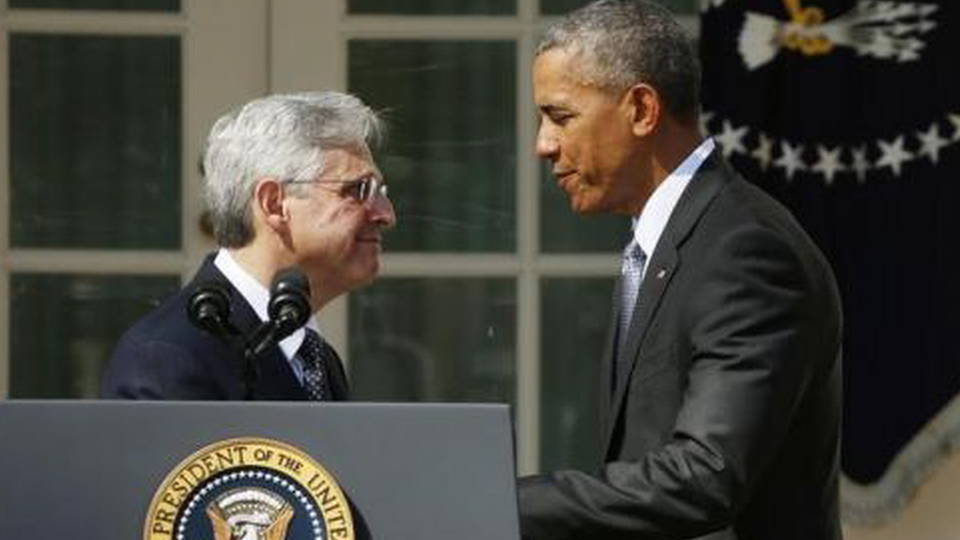
After weeks of speculation, President Obama has announced his nominee to replace the late Justice Antonin Scalia on the Supreme Court. Merrick Garland is the chief judge for the U.S. Court of Appeals for the D.C. Circuit. He is widely viewed as a moderate judge, who has received overwhelming bipartisan support in the past. He is most well known for overseeing the investigation and prosecution of Oklahoma City bomber Timothy McVeigh. Republicans have vowed to block the nomination of Merrick Garland. Senate Majority Leader Mitch McConnell said the Senate will wait until a new president is in place next January before even holding a hearing on a nominee. With the death of Antonin Scalia, the nine-member Supreme Court is now evenly split with four liberals and four conservative justices. Garland could tilt the court to the left for the first time in decades, though some on the left are concerned that his record on progressive issues is unclear. We’ll have more on the Supreme Court nomination after headlines.
TOPICS:
Supreme Court
Trump Claims There Will Be Riots If He's Not Named GOP Nominee
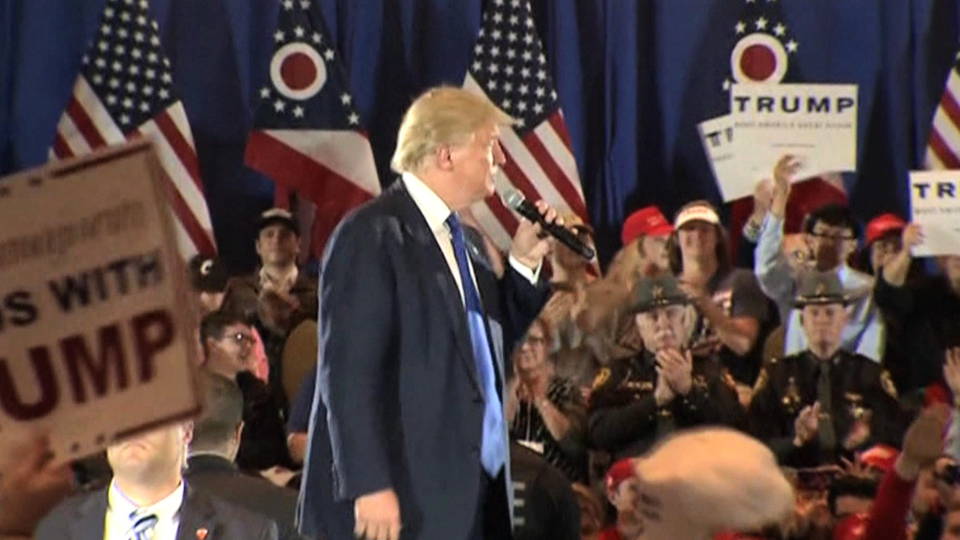
In news from the campaign trail, Republican front-runner Donald Trump has claimed in an interview with CNN that there would be riots if he is not nominated to be the party’s candidate at the Republican convention this summer.
Donald Trump: "I think we’ll win before getting to the convention. But I can tell you, if we didn’t and if we’re 20 votes short or if we’re—if we’re, you know, a hundred short, and we’re at 1,100 and somebody else is at 500 or 400—because we’re way ahead of everybody—I don’t think you can say that we don’t get it automatically. I think it would be—I think you’d have riots. I think you’d have riots."
Trump currently has 673 delegates—the most of any Republican candidate. He needs to secure 1,237 delegates to win the nomination outright. This comes as a British research organization has ranked the possibility of a Donald Trump presidency as one of the top 10 risks facing the world. The Economist Intelligence Unit ranked a Trump presidency as just as much of a global threat as the possibility that jihadi terrorism could destabilize the global economy.
TOPICS:
Donald Trump
2016 Election
Honduras: Another Indigenous Organizer with COPINH Murdered
In Honduras, another indigenous environmental activist has been murdered—less than two weeks after the assassination of famed environmental organizer Berta Cáceres. Thirty-eight-year-old Nelson García was a member of the group COPINH, the Civic Council of Popular and Indigenous Organizations of Honduras, which Berta Cáceres co-founded 22 years ago. He was shot in the face and killed by gunmen on Tuesday in Rio Lindo, about 100 miles south of La Esperanza, where Cáceres was murdered on March 3.
TOPICS:
Honduras
Syria: Russia Continues Withdrawing Air Force

Russia is continuing to withdraw its air force from Syria, following Russian President Vladimir Putin’s announcement Monday that Russia would be ending the five-month bombing campaign. A Reuters analysis estimates that Russia has already withdrawn just under half the jets it had stationed at a base in eastern Syria. The U.S.-led coalition, meanwhile, has continued to launch airstrikes against ISIL inside Syria.
TOPICS:
Russia
Syria
Syrian Kurds Declare Semi-Autonomous Region in North

This comes as the Syrian Kurds have declared a semi-autonomous federal region in northern Syria, as the group pushes for self-administration under a future decentralized government. The announcement comes in the midst of U.N.-sponsored peace negotiations in Geneva. The Syrian Kurds have been excluded from the talks.
TOPICS:
Syria
Turkey: Kurdish Group Claims Responsibility for Sunday Bombing
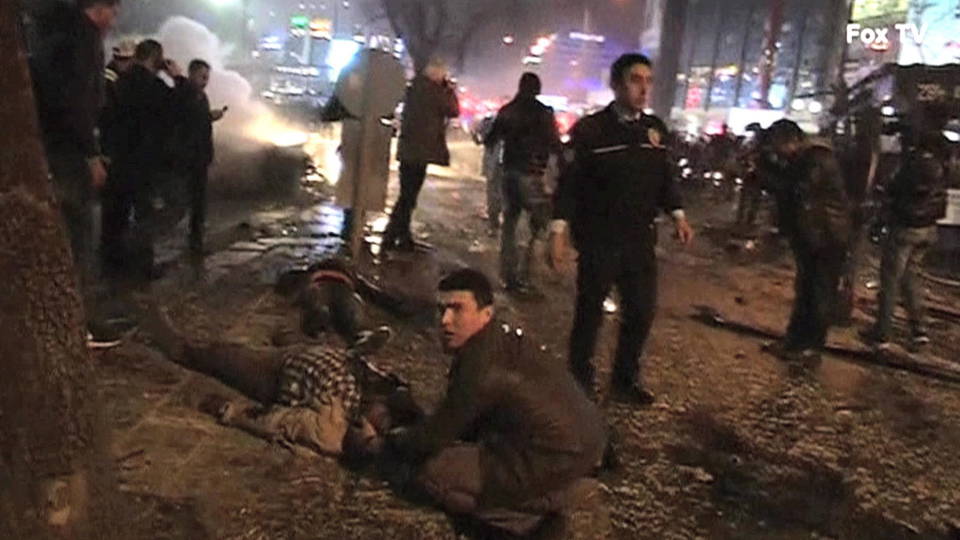
Meanwhile, in Turkey, a breakaway faction of the Kurdistan Workers’ Party has claimed responsibility for Sunday’s car bombing in Ankara, which killed 37 people. The faction, the Kurdistan Freedom Hawks, said the attack was in retaliation for Turkish military crackdowns in the majority Kurdish communities in the southeast.
TOPICS:
Turkey
Nigeria: Bombings Kill 22 in Borno State

In Nigeria, two suicide bomb attacks killed 22 people Wednesday at a mosque in the northeastern Borno state. The Nigerian military says the attack was carried out by two female suicide bombers. It struck the mosque during morning prayers. No one has claimed responsibility for the attack, but Borno state has been the center of attacks by Boko Haram in recent months.
TOPICS:
Nigeria
Qatar: Poet Jailed for Arab Spring-Inspired Poem Freed
In Qatar, a prominent poet has been pardoned and released from prison after serving more than three years for writing and reciting a poem inspired by the Arab Spring. Rashid al-Ajami was jailed in November 2011 after a video surfaced of him reading a poem entitled "Tunisian Jasmine," which celebrated Tunisia’s popular uprising. He was charged with insulting Qatar’s ruling emir and "inciting to overthrow the ruling system."
TOPICS:
Qatar
Arab Spring
Brazil: Rousseff Appoints Lula to Cabinet; Judge Releases Taped Calls
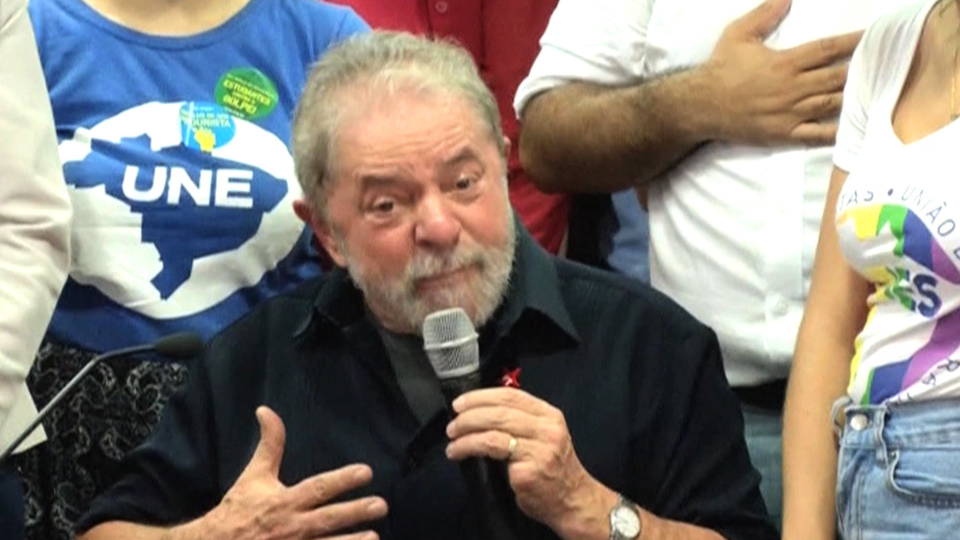
In Brazil, President Dilma Rousseff has appointed her predecessor Luiz Inácio Lula da Silva to be her chief of staff, in what she says is an effort to strengthen her government. A judge then released secretly recorded phone calls between Rousseff and Lula da Silva, which members of the opposition say demonstrate the appointment was actually intended to shield Lula da Silva from prosecution on corruption charges. Rousseff is currently facing impeachment proceedings. The political turmoil has sparked massive protests across Brazil.
TOPICS:
Brazil
Texas: Police Officer Arrested for Murder After Killing 16-Year-Old
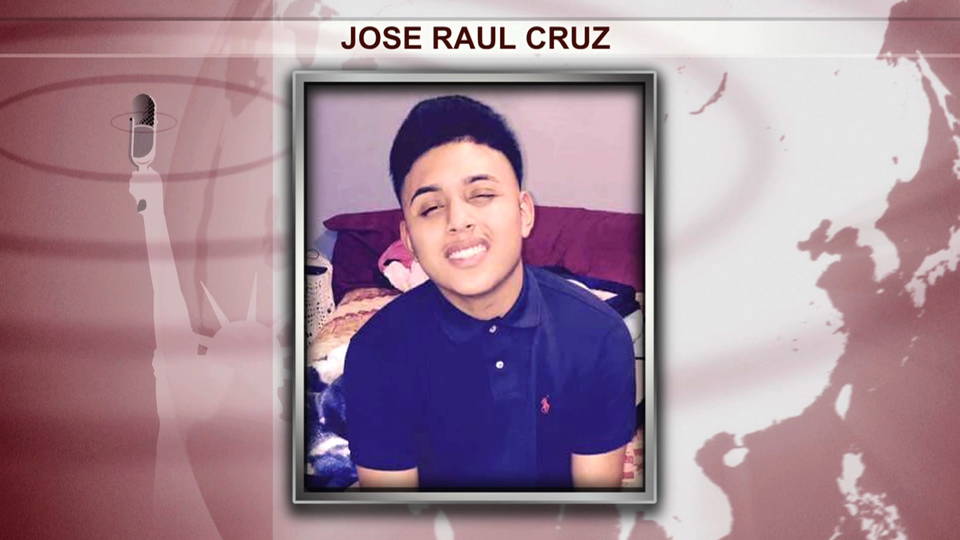
In Texas, an off-duty suburban Dallas police officer has been arrested on charges of murder after fatally shooting 16-year-old Jose Raul Cruz on Sunday night. Authorities say officer Ken Johnson was off duty when he thought he saw a car being burglarized in the parking lot of his apartment complex. This set off a car chase, which ended with Officer Johnson killing Cruz and shooting another teenager, Edgar Rodríguez, in the head. Rodríguez survived. Authorities have not said whether either of the teenagers were armed.
TOPICS:
Texas
Police Brutality
University of Puerto Rico Student Shut Down Continues

The University of Puerto Rico remains shut down amid a three-day student strike in protest of austerity cuts. Student activist Gabriel Casal Nazario spoke at one of the university’s blocked entrances.
Gabriel Casal Nazario: "Students, we decided to shut down university, in a general assembly we held the 15th, Tuesday 15th, in a historic assembly, where there were more than 4,000 students, and we filled more than 13 amphitheaters. We decided that it is necessary to shut down the university, because in the past five years they have cut more than $542 million from our budget, and it’s affecting us. Every semester there’s less classes, there’s less professors. And we students have decided to take a stand."
TOPICS:
Puerto Rico
Student Protests
UC Davis Students Stage Sit-in to Demand Chancellor Resign
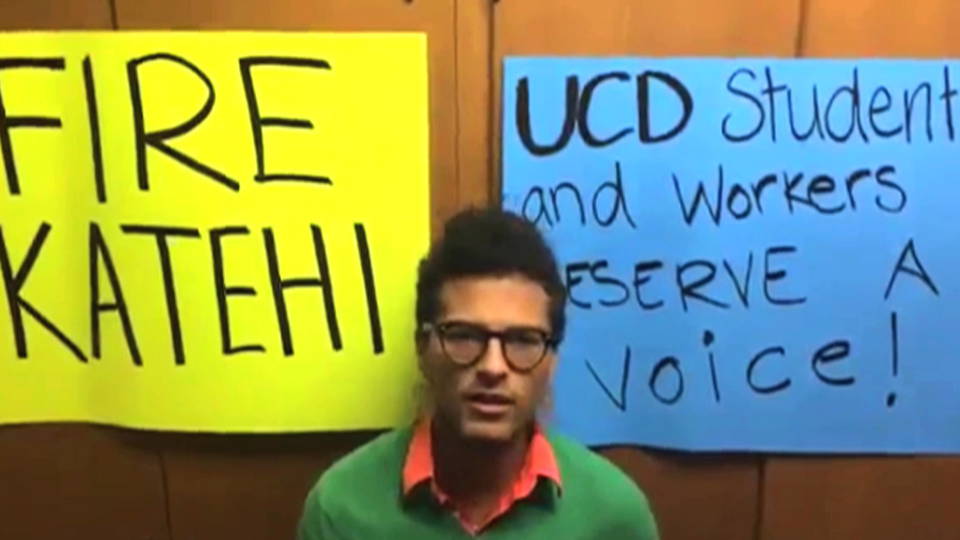
Meanwhile, at the University of California, Davis, a student sit-in outside the chancellor’s office is entering its sixth day. The students are demanding Chancellor Linda Katehi resign over her involvement with private corporate boards, including the for-profit college DeVry University, the expensive textbook maker Wiley & Sons and the controversial Saudi school King Abdulaziz University, which has been accused of paying for affiliations with top professors in efforts to boost its global rankings. Protesting graduate student Brandon Buchanan spoke from the sit-in.
Brandon Buchanan: "We, the occupiers of Mrak Hall, call for the resignation and/or firing of Linda B. Katehi, our chancellor. This chancellor has proven time and time again, from DeVry University to King Abdulaziz University to Wiley & Sons textbook co., that she doesn’t make decisions based on student interests. This isn’t new for her. This is old hat. She has a long history, dating back to 2011 with the pepper-spray incident, of putting her own interests over the interests of students."
TOPICS:
California
Student Protests
NYPD: Prison Reform Advocates Five Mualimm-ak and Others Arrested
And in New York City, prison reform activist Five Mualimm-ak has been released from jail after he and a fellow activist Joseph "Jazz" Hayden were arrested while attempting to mediate a police confrontation with a homeless man on Tuesday. The arrest came only moments after Mualimm-ak and Hayden left a book launch event, where Mualimm-ak had read his essay "Hell is a Very Small Place," about his five years in solitary confinement. Mualimm-ak spoke after being released Wednesday night.
Five Mualimm-ak: "I have just been released after being incarcerated for a day or two, after a big event that we had at Soros Foundation. The other night, we had a big book launch, 'Hell is a Very Small Space,' with Solitary Watch and Soros Foundation, and when we came outside, Joseph 'Jazz' Hayden, who is the founder of Incarcerated Nation Corporation, our collective of projects, was videotaping an arrest of an emotionally disturbed person. And I felt committed because I’m on the mayor’s behavioral health task force, and we’ve created a system to basically avoid the occurrences that a person has going through the system. There’s a special way to treat people with emotional disturbances that was not being respected that night. Jazz being arrested, I stepped in, to not intervene but to try to mediate the problem, and was arrested, accosted, assaulted, as well, injured to the point that I’m getting medical attention. And we will be defending charges that are placed against us."
To see our extended interview with Five Mualimm-ak and Jazz Hayden after the release from prison, go to democracynow.org.
TOPICS:
Police Brutality
Donate today:
Follow:
WEB EXCLUSIVE

Sunday, March 20
WEB EXCLUSIVE
WEB EXCLUSIVE
"Fascism: Can It Happen Here?" by
Amy Goodman & Denis Moynihan
"When Fascism comes to America, it will be wrapped in the flag and carrying a cross," goes a saying that is widely attributed to the first American to win the Nobel Prize for Literature, Sinclair Lewis. In 1935, Lewis wrote a novel called "It Can’t Happen Here," positing fascism’s rise in the United States. We were taught that fascism was defeated in 1945, with the surrender of Germany and Japan in World War II. Yet the long shadows of that dark era are falling on the presidential campaign trail this year, with eruptions of violence, oaths of loyalty complete with Nazi salutes and, presiding over it all, Republican front-runner Donald Trump.
"Those who cannot remember the past are condemned to repeat it," the 20th-century philosopher George Santayana wrote. He lived in Europe through both world wars, and witnessed Italian fascism firsthand. Fascism was the violent political movement founded by Benito Mussolini, who took control of Italy in 1922. Mussolini had his political opponents beaten, jailed, tortured and killed, and ruled with an iron fist until he was deposed as Italy surrendered to the Allies in 1943. He was known as "Il Duce," or "The Leader," and provided early support to the nascent Nazi movement in Germany as Adolf Hitler rose to power in the 1930s.
Why is this relevant today? It was Donald Trump who recently retweeted one of Mussolini’s quotes: "It is better to live one day as a lion than 100 years as a sheep." When NBC confronted Trump for retweeting the fascist’s words, he replied, "Sure, it’s OK to know it’s Mussolini. Look, Mussolini was Mussolini. ... It’s a very good quote, it’s a very interesting quote."
If only the fascist comparisons were limited to his tweets. His rallies have become hotbeds of violent confrontations, consistently fanned by Trump’s heated rhetoric from the podium. After a Black Lives Matter protester was kicked and punched at one of his rallies, Trump said, approvingly, "Maybe he should have been roughed up." At a rally in Las Vegas in February, after an anti-Trump protester disrupted the event and was escorted out, Trump bellowed: "You know what they used to do to guys like that when they were in a place like this? They’d be carried out on a stretcher, folks." He went on, "I’d like to punch him in the face, I’ll tell you that."
Weeks later, a protester was punched in the face at a Trump rally. Rakeem Jones, a 26-year-old African-American man, was being led out of a stadium event by security guards in Fayetteville, North Carolina, when John McGraw, a white Trump supporter, sucker-punched Jones in the face. The local sheriff’s deputies then wrestled the man to the ground—not McGraw, who threw the punch, but Jones, the victim. The TV program "Inside Edition" interviewed McGraw immediately after the assault.
"The next time we see him, we might have to kill him," McGraw said. He was arrested the next day. Trump has personally pledged to pay the legal defense bills for any rally supporter charged with violence against protesters, including those of McGraw’s. Trump also waffled when asked to disavow the support of the Ku Klux Klan and its onetime Grand Wizard, David Duke.
"Donald Trump shows a rather alarming willingness to use fascist themes and fascist styles. The response this gets, the positive response, is alarming," said Robert Paxton on the "Democracy Now!" news hour. Considered the father of fascism studies, he is professor emeritus of social science at Columbia University.
Paxton gave a short history of the rise of fascism in Germany: "In the election of 1924, [Hitler] did very poorly, for a marginal party. Then you have the Depression in 1929 and 1930. ... There’s this huge economic crisis with tens of millions unemployed, and there’s also a governmental deadlock. You cannot get any legislation passed." Paxton continued, "The German Weimar Republic really ceased to function as a republic in 1930, because nothing could be passed. ... So, between 1930 and 1933, President von Hindenburg ruled by decree. And the political elites are desperate to get out of that situation. And here’s Hitler, who has more votes by this time than anybody else. He’s up to 37 percent. He never gets a majority, but he’s up to 37 percent. And they want to bring that into their tent and get a solid mass backing. And so ... they bring him in."
The partnership that the German elites forged with Hitler and his Nazi Party didn’t work out quite the way they hoped. He took power by subterfuge and by force, arrested and killed his opponents, and plunged Europe into the deadliest war in human history.
Donald Trump is fanning the flames of bigotry and racism. He is exploiting the fears of masses of white, working-class voters who have seen their economic prospects disappear. Should the Republican nominating process end in a contested convention this summer in Cleveland, Trump told CNN Wednesday morning, "I think you’d have riots. I’m representing ... many, many millions of people."
Democracy Now! Daily Digest: A Daily Independent Global News Hour with Amy Goodman & Juan González for Wednesday, March 16, 2016
democracynow.org
Stories:

Hillary Clinton Has Big Night; Media Moves to Silence Bernie Sanders Campaign
In the Democratic race, Hillary Clinton won Florida, Illinois, North Carolina and Ohio, and leads Senator Bernie Sanders by only about 1,500 votes in Missouri. As Sanders began his address on Tuesday night, Fox News, CNN and MSNBC all declined to cut away, instead offering pundits’ commentary and graphics promising they would soon go to Donald Trump’s address. We hear from both candidates and host a debate between former Ohio state Senator Nina Turner, a Sanders surrogate, and Geneva Reed-Veal, the mother of Sandra Bland, whose death last year in a Texas jail cell following a traffic stop sparked national protests.
TRANSCRIPT
This is a rush transcript. Copy may not be in its final form.
AMY GOODMAN: In the Democratic race, Hillary Clinton won Florida, Illinois, North Carolina, Ohio, and leads Bernie Sanders by about 1,500 votes in Missouri, too close to call at the time of this broadcast. Clinton spoke Tuesday night in Palm Beach, Florida.
HILLARY CLINTON: You know, to be great, we can’t be small. We can’t lose what made America great in the first place. And this isn’t just about Donald Trump. All of us have to do our part. We can’t just talk about economic inequality; we have to take on all forms of inequality and discrimination. Together, we have to defend all of our rights—civil rights and voting rights, workers’ rights and women’s rights, LGBT rights and rights for people with disabilities. And that starts by standing with President Obama when he nominates a justice to the Supreme Court. Our next president will face all these challenges and more. You know, running for president is hard, but being president is harder.
AMY GOODMAN: As Senator Bernie Sanders began his address on Tuesday night, Fox News, CNN and MSNBC all declined to cut away, instead just continuing with their pundits’ commentary and graphics promising they would soon go to Donald Trump’s speech. So we’re going to do something we didn’t consider particularly revolutionary in this 2016 year: We’re going to actually play an excerpt of what Bernie Sanders had to say.
SEN. BERNIE SANDERS: We’re a democracy. People have different points of view. But what is not acceptable, no matter what your point of view is, is to throw racist attacks against Mexicans. The reason that Donald Trump will never be elected president is the American people will not accept insults to Mexicans, Muslims or women. ... What Trump is about and other demagogues have always been about is scapegoating minorities, turning one group against another group. But we are too smart to fall for that.
AMY GOODMAN: Bernie Sanders, speaking last night in Phoenix, Arizona.
Joining us from Cleveland is former Ohio state Senator Nina Turner, national surrogate for Senator Bernie Sanders. In Chicago, we’re joined by Hillary Clinton supporter Geneva Reed-Veal. Yes, she is the mother of Sandra Bland, whose death last year in a Texas jail cell followed a traffic stop which sparked national protests. And still with us in New York is John Nichols.
We welcome you both to Democracy Now! I want to go to our guest first in Chicago, to Geneva Reed-Veal. Talk about how—the victory that you saw last night in your own state, in Illinois, and the sweep that Hillary Clinton, even perhaps to her own surprise, experienced, achieved last night.
GENEVA REED-VEAL: Well, good morning. Thank you for having me.
The victory last night was overwhelming. Of course, I am Hillary-excited this morning. And when I tell you that when you think about a race that is so close, you are watching the television with your nails biting, and you’re looking, and you’re saying, "OK, come on, come on, come on." So, the excitement went on until about 3:30 this morning. And so, when you look at all of the sweeping that was done on last evening, it puts you in a better position to say, "OK, we can do this. We can take her all the way to the top." I totally believe that.
AMY GOODMAN: Nina Turner, your response to what happened last night? It’s now still too close to call at the time of this broadcast in Missouri. But, yes, Bernie Sanders, while he may have been surprised by the Michigan miracle, did not achieve that miracle last night, not in Ohio, not in Illinois. He knew he wouldn’t be winning Florida.
NINA TURNER: Well, Amy, we’ve certainly come a long way in this campaign. And let us not forget that Senator Sanders is a senator from Vermont, with about 600,000 people, not a terribly diverse state. People wrote him off from the time he made his announcement to become the president of the United States of America. And look at him now. And to the credit of Democracy Now!, and I want to thank you so much for even playing a portion of his speech. A lot of this has to do with the corporate media structure, who—they have locked him out. And so they don’t want people to hear his message. So it’s either about Mr. Trump—he gets the overwhelming majority—or it’s about Secretary Clinton.
But we’re going to continue to push. Senator Sanders has some bright lights coming. We knew that the first few waves of Tuesdays were certainly more toward Secretary Clinton. But we are moving to the west, where we will see states that are more—that will be much more competitive for Senator Bernie Sanders. But we’re going to keep on pushing no matter what. We’re going all the way to the convention. And let us not forget: In 2008, when then-Senator Clinton was competing against then-Senator Obama, they went all the way to the convention. And we are going there, as well.
AMY GOODMAN: John Nichols, what are those states coming up that you think Bernie Sanders could take?
JOHN NICHOLS: Well, I’ve been out on the road, so I’ve been to a lot of them recently. And there’s simply no question that Bernie Sanders has a tremendous level of on-the-ground organization, I think better than in some of the states that have voted so far—in Utah, in Arizona, in Washington state, in Hawaii. All these states are going to vote in the next couple weeks. And then you move, in short order, to Wisconsin, where polls show that he’s actually leading or at least narrowly ahead. And so, the chances are that Sanders will continue to post a number of wins.
And this is an important thing about this race. No one should deny that Hillary Clinton is the front-runner. She is. No one should deny that she just had a great night. No doubt about that. But the majority of delegates have not been chosen. Most states have not voted. And it’s awfully important to, A, make sure that we maintain a democracy here, where we actually, at least in this process, let people participate, and also recognize that, as Nina Turner said, this initial calendar was quite favorable to Hillary Clinton. What comes next is a number of states that—where Hillary Clinton is not as strong and where Bernie Sanders could continue to post significant wins.
AMY GOODMAN: Geneva Reed-Veal, can you talk about why you decided to support and speak out for Hillary Clinton? What happened after your daughter’s horrific death in Texas, after she was—
GENEVA REED-VEAL: Absolutely.
AMY GOODMAN: —stopped in a traffic stop, then taken to jail, then found dead three days later?
GENEVA REED-VEAL: Absolutely. Of course, the family was devastated. We were all devastated. And I just did not know what to do at that time. I was in a sort of a daze. And so, Hillary Clinton’s camp, Hillary’s was the only one that contacted my family to find out what it was that I needed at that time. And so she met with 12 families, and the Mothers of the Movement are a part of those families. She met with us privately in Chicago at a Sweet Maple restaurant. That’s what the restaurant was called. No media involvement. She came into that room as a secretary of state, as the former first lady, and she walked out of there as grandmother, as mother. She allowed us to sit around the table with her and literally give her our stories about our children. As we were talking, she was writing down notes. We were asked what we would like to see her do or what would we think should be the best thing for her to do in cases like ours to assist additional families, as well as ours. And we gave her some thoughts. And she made no promises. She wrote a lot. And when we left that meeting—that meeting was supposed to be a half-hour meeting, which turned into two hours, OK? No media involved.
She followed up with us throughout the months. I received two personal letters from her, one at a very crucial time, when there is no indictment in my daughter’s case. The second one was right around the holidays, when she was telling the family, "Hey, you know, I know this is your first holiday without your baby. I’m sorry, thinking of you at this time." It was the most moving thing you ever want to see. She followed up throughout all those months, invited us to the Democratic National Convention in South Carolina. Didn’t announce it. Nobody even knew that she was the person that had us there. And at that point, the pivotal thing for me was when she asked me, "What is it that you want for your daughter?" And when I explained to her that justice for me would mean accountability, and I will seek that relentlessly, she listened, she nodded. And I am telling you right now, I believe that there will be an outside investigation very soon. And so, at that point, I said, "OK, I have to back this woman." But I was already a Hillary supporter before I lost Sandy. We were dating, and she didn’t even know it.
AMY GOODMAN: Now, on—just on the topic of the officer, the officer who stopped Sandra—
GENEVA REED-VEAL: Yes.
AMY GOODMAN: —Encinia, can you talk about what’s happened to him and your response to that? He was charged with perjury?
GENEVA REED-VEAL: Right, he was charged with perjury, and which, of course, was a—the lowest charge on the totem pole, as far as I’m concerned, because there should have been assault and battery charges. The tape shows everything. He was then dismissed from his job, which, if I am not mistaken, I believe he’s still able to appeal. We will be in court next Tuesday at his arraignment, and we’ll see what happens there. But as far as right now, today, he is completely terminated from the DPS.
AMY GOODMAN: But he has not been charged with responsibility for her death, and neither has any other police officer inside the jail.
GENEVA REED-VEAL: Correct. And the issue that I have with that is, well, we know that he’s been indicted for lying, so there is a possibility to be indicted for lying. There are quite a few lies that are going on here, and I believe that that should have also extended over into the Waller County Jail.
AMY GOODMAN: Former state Senator Nina Turner, you’re in Ohio. Talk about why you decided to go with Bernie Sanders. And also talk about why you think he didn’t win Ohio. I mean, after Michigan, what they call the Michigan miracle, it was felt that maybe he could take Ohio, as well.
NINA TURNER: Yeah, Amy, we were certainly hoping for that Michigan miracle. I think one of the biggest differences between Michigan and Ohio is that in Michigan independents could vote. And we know that Senator Bernie Sanders wins independents overwhelmingly across this country. We have what you call in Ohio a semi-open primary process, so independents are locked out. They cannot vote unless they declare—you know, declare themselves to be a Democrat or a Republican. So that certainly has a lot of impact.
But I will tell you this: Senator Sanders was 30 points behind in Ohio months ago, so he has certainly come a mighty long way. In the campaign, we are so proud of all of his accomplishments, in states like Missouri, which we know that it is still a toss-up; you know, in Illinois, I mean, a virtual tie. So, it’s kind of curious to me that even when Republicans, who are in the second, third tier of the race, are almost in a virtual tie, they declare victory, but Senator Sanders does not get that same benefit.
Amy, I’m supporting Senator Sanders because he has that heart-soul agreement. He doesn’t say one thing in front of one audience and another thing in front of another audience. He doesn’t politic tragedies. Senator Sanders has been a champion all of his conscious life, from his work, as we all know, in the 1960s as a young college student. He didn’t have to step into that divide, but he did, chained to an African-American woman, arrested for fighting for civil rights. As a mayor of Burlington, we all know that he stood up for Reverend Jesse Jackson, when the Democratic Party itself, the status quo, turned their back on him. And he was only one of three white folks, white elected officials, who would dare stand up for Reverend Jesse Jackson in the—in 1988, to say that he should and could be the president of the United States of America.
And whether people know it or not, Amy, this senator from Vermont has continued to stand up for the working poor in this country. He is not afraid to say the word "poor." And he stands up for the middle class in this country. He filibustered, as we all remember—and I know John remembers this, too—for eight hours on the Senate floor against the extension of the Bush tax cuts. He doesn’t lead by polls. He stands up for folks, whether he gets—whether it will harm his political career or not. And that is the kind of leader that we need. He’s speaking out firmly about an increase in the minimum wage of $15 an hour, that folks will have a living wage in this country.
He talks about the five violences against black and brown folks in this country. And as a former mayor, he certainly understands what the relationship with police needs to be. He talks about the accountability that a police officer, like any other public servant, if they have committed a crime, they need to be prosecuted, they need to answer that. So he totally understands that. So, his honesty and integrity, and that is why, overwhelmingly, over 80 percent, almost 90 percent, of millennials, ages 17 to 29, they believe in Senator Sanders. They believe that he is the leader to lead us into the future.
And my final point on that is that, to me, he has the foundation of Congresswoman Barbara Jordan, when she said, "What the people want is simple: They want an America as good as its promise." That is what he is running for. And he’s asking the working poor and middle class in this country, don’t accept shorts, that if we can bail out Wall Street, certainly we can make the requisite investments in everybody in this country, that universal healthcare is a moral imperative in this country, and that we should indeed make the same investments in our young people in terms of tuition-free colleges and universities. He is a man of honesty and integrity, not just when the cameras are on.
AMY GOODMAN: Let me ask Geneva Reed-Veal—you’re in Chicago. It’s where Trump canceled his rally this weekend. We’re talking about Hillary Clinton versus Bernie Sanders. But what about Donald Trump, Geneva Reed-Veal?
GENEVA REED-VEAL: I have no comment on Donald Trump. I cannot comment and will not do that. I just won’t do it.
AMY GOODMAN: Why?
GENEVA REED-VEAL: Media hogs love that. I will not do it.
AMY GOODMAN: Because?
GENEVA REED-VEAL: Because it’s just not necessary for me to comment. I’ll let the rest of the world continue to comment on that.
AMY GOODMAN: Are you—
GENEVA REED-VEAL: I support and endorse Hillary Clinton.
AMY GOODMAN: John Nichols?
JOHN NICHOLS: I kind of like what she just did there. You know, I mean, look, one of the challenges with Donald Trump is that everybody does talk about him. And I’m as guilty as anybody. And there is a reality that this guy is so overcovered that he sucks the air out of the Democratic race. You just had one of the best discussions between two very thoughtful, engaged people about this race. That rarely happens. What we end up with—do you know that, Amy, what happens now is? Democrats come on television, or Democratic candidates even, you know what the first thing they ask them about? Donald Trump.
AMY GOODMAN: Geneva Reed-Veal, how do you respond to Nina Turner on what Bernie Sanders represents?
GENEVA REED-VEAL: I—
AMY GOODMAN: And could you—go ahead.
GENEVA REED-VEAL: Go ahead. Go ahead.
AMY GOODMAN: I want to ask each of you this, Nina Turner and Geneva—and, Geneva Reed-Veal, if Bernie Sanders was the candidate, would you vote for him? And I want to ask Nina Turner, if Hillary Clinton is the candidate, will you vote for her? But, Geneva Reed-Veal, you first.
GENEVA REED-VEAL: Well, I can say to you right now, I’m not going to focus on if Bernie Sanders is the candidate, so I won’t answer that question, because I don’t know what I will be feeling at that time. I don’t know what will have happened at that time. So, I will say to you, I won’t make any back-and-forth with the other person that you have on the panel, won’t do that, because I just don’t intend on taking the focus off of what the focus should be. And for me, that focus is getting Hillary straight to the White House. And so, all of the outside commentary, I will not make any statement about.
But I will say to you, because I’ve heard it more than once, Hillary is not politicking tragedy, our tragedies. We are adults who have decided to back her. And it should not be a problem that a person who makes a choice to endorse an individual—you shouldn’t have to be vilified for backing that individual. And I’m not saying that the other individual is stating that. We’ve just heard that across the country. And so, I want the world to know, no, we’re not being exploited. We made our own choices. And I am just saying, may the best individual win. Go, Hillary.
AMY GOODMAN: And, Nina Turner, if Hillary Clinton were the candidate? And the issue of enthusiasm on the Democratic side?
NINA TURNER: Well, I certainly want to say that I agree with Mrs. Veal about people not being vilified. This is America, and people have a choice. And I certainly know a lot about being vilified for deciding to choose to back Senator Bernie Sanders. So, in that, Mrs. Veal and I certainly, totally, 100 percent agree with that. In terms of Senator Bernie Sanders versus Secretary of State Clinton, I, too, am here to push for Senator Bernie Sanders. I am not entertaining a thought about voting for the secretary, because this race is not over for us in the Sanders campaign, and I want to see him become the president of the United States of America.
AMY GOODMAN: Nina Turner, I don’t know if this is true, but CNN has a chart, and it says, in terms of voter turnout, it was way up for Republicans.
NINA TURNER: Yes.
AMY GOODMAN: And until now, it has also been up, but not as up, for Democrats. But this one shows Democrats way down, particularly in Ohio, down 49 percent.
NINA TURNER: Yes.
AMY GOODMAN: That was in—oh, that was comparing it to 2008.
NINA TURNER: Amy, Democrats should be concerned about that. I mean, we want folks to vote. And where Senator Sanders has been, we know that he pushes out especially that youth vote. Democrats should be concerned. And, Nancy—I mean, excuse me, Amy, one of the problems is, for both parties, but particularly for the Republicans, who tend to try to suppress the vote—and they use public policy to do it—that in a democracy, we should want each and every person to vote. It makes us stronger. And so, to the extent, especially in places like North Carolina, and even in my home state—and, Amy and John, you both may know this—I mean, just recently, within a couple of days before the primary, Secretary Jon Husted—Secretary of State Jon Husted came out with a directive to try to block 17-year-olds from voting in the primary. We had to take that to court. And thank God, Senator Sanders did file a lawsuit, and a judge saw right through that. And so, we can’t nation-build every four years. That is my message to your viewers, no matter if they’re voting Democrat, Republican or Libertarian, that to nation-build, we must vote every single year, and that electing a school board member is just as important as electing the president of the United States of America.
AMY GOODMAN: We’re going to have to leave it there. And I thank you so much to both of you for joining us, former Ohio state Senator Nina Turner, speaking to us from Cleveland, as well I want to thank Geneva Reed-Veal, the mother of Sandra Bland, who is a supporter of Hillary Clinton, speaking to us from Chicago. And, John Nichols, stay with us. After break, I want to get a quick take from you on the Supreme Court nominee. Stay with us.
... Read More →
Dream Defenders Launch #SquaDD2016 "Presidential" Campaign: "We're Black, Brown, Radical & Tired as Hell"
As Florida voters went to the polls to cast their votes based on a narrow list of candidates—two Democrats and four Republicans—organizers across the state were launching their own community-led presidential campaign, dubbed SquaDD2016. It’s the latest initiative from the Florida activist group the Dream Defenders, which formed in the wake of the death of Trayvon Martin. In 2013, the group occupied the Florida state House for 31 days to protest Florida’s controversial "Stand Your Ground" laws. Since then, the Dream Defenders has organized around voting rights and access. And now the group is imagining what the country would look like if its organizers occupied Washington, D.C., itself. In the launch video, SquaDD2016 explains, "We are the future of this yet-to-be-great country: black, brown, radical and tired as hell. Imagine with us, what would be possible if we ran for the highest offices in this country?" SquaDD2016 already has a presidential Cabinet, complete with a vice president, secretary of commerce, secretary of education, two secretaries of state, an attorney general and a newly created position, the "secretary of shade," to keep people honest.
TRANSCRIPT
This is a rush transcript. Copy may not be in its final form.
AMY GOODMAN: As we move now to our last segment, we’re going to go right now to Florida. Ashley Green is the president of Dream Defenders. As Florida voters went to the polls to cast their votes based on a narrow list of candidates—two Democrats, four Republicans—organizers across the state were launching their own community-led presidential campaign, dubbed SquaDD2016. It’s the latest initiative from the Florida activist group the Dream Defenders, which formed in the wake of the death of Trayvon Martin. In 2013, the group occupied the Florida state House for 31 days to protest Florida’s controversial "Stand Your Ground" laws. Since then, the Defenders have organized around voting rights and access. Now the group is imagining what the country would look like if its organizers occupied Washington, D.C., itself. SquaDD2016 Vice President Umi Selah said he and the other Cabinet members are, quote, "the future of this yet-to-be-great country."
We turn now to Tampa, Florida, where we’re joined by Ashley Green, a Florida labor organizer, SquaDD2016’s nominee for president.
Ashley, welcome to Democracy Now! Explain what you’re doing.
ASHLEY GREEN: Really, we’re trying to address the real dissatisfaction that’s happening right now within our political process. We have a very limited list of political candidates, who speak more about us than they do to us. And so, SquaDD2016 is really an effort to reclaim our own voices within this process, not to be treated as tokens from a very selective menu of political issues when we talk about black and brown votes, particularly young black and brown votes, and to really make sure that we, ourselves, understand our power and our responsibility in this election to carve out a better future for this country than what’s being presented right now.
AMY GOODMAN: So, talk about the Cabinet.
ASHLEY GREEN: Well, the Cabinet is our effort to really make sure that sort of the diverse voices across the state of Florida, across Dream Defenders, and really across this movement that’s emerging right now between black and brown bodies, are really represented. And so, we have a secretary of commerce, secretary—a couple of secretaries of state, attorney general, secretary of education—my own personal favorite, secretary of shade—who all bring their unique voice and perspective into this conversation and really get down to the issues that we feel are relevant, that are only being superficially discussed in this election right now.
AMY GOODMAN: Very quickly, as president of—president in this new SquaDD2016, your key core issues? We have 30 seconds.
ASHLEY GREEN: Oh, we’re looking to really review and completely, radically change our foreign policy approach, our immigration approach, our approach to prison and detention, our approaches to education. They’re common issues that are still only surfacely addressed right now. We need radical solutions. And the way that we’re talking about reform of these systems are simply not meeting the needs of our communities.
AMY GOODMAN: Well, we will link to your website at ours, democracynow.org. Ashley Green, president of the Dream Defenders’ new SquaDD2016, newly launched community-led presidential campaign and alternative political platform, speaking to us from Tampa, Florida.
We have three job openings: broadcast engineer, director of finance and operations and director of development. Visit democracynow.org for more information.
... Read More →
North Carolina Voter ID Law Takes Effect, Disproportionately Bars Blacks, Young People from Polls
We turn now to North Carolina, where one of the country’s most controversial and restrictive voter identification laws took effect for the first time in Tuesday’s primary elections. The law, which was passed by the Republican-dominated North Carolina state Legislature in 2013, limits the forms of ID acceptable at polling places. As a result, about 5 percent of the state’s registered voters, primarily African-American, are excluded from being able to cast a ballot. Under the law, student IDs, government employee IDs and public assistance IDs—forms of identification disproportionately held by African Americans—are no longer accepted. Passports, Motor Vehicle Department IDs and expired IDs for people over 70—identification disproportionately held by whites—are allowed. We speak to Bob Hall, executive director of Democracy North Carolina, a nonpartisan organization to increase voter participation.
TRANSCRIPT
This is a rush transcript. Copy may not be in its final form.
AMY GOODMAN: We turn now to North Carolina, where one of the country’s most controversial and restrictive voter ID laws took effect for the first time in Tuesday’s primary elections. The law, which was passed by the Republican-dominated North Carolina state Legislature in 2013, limits the forms of ID acceptable at polling places. As a result, about 5 percent of the state’s registered voters, primarily African-American, are excluded from being able to cast a ballot.
We’re joined now by Bob Hall, executive director of Democracy North Carolina, a nonpartisan group to increase voter participation.
Bob, welcome to Democracy Now! Very quickly, what did you find in yesterday’s race?
BOB HALL: Well, it was both encouraging, to see so many people turning out—people are committed to vote, to push back against the attempts to make it harder—it also was disappointing. There were long lines. There were IDs that were rejected, that were—should have been accepted. Provisional ballots were not offered to voters. There were a lot of problems.
AMY GOODMAN: What were the—what was the response to the new ID? What kind of ID do people need to show? And did you see this affecting Republicans or Democrats more?
BOB HALL: Well, it’s affecting young people particularly, because there’s not a provision that allows a broader range of IDs to be used, and a provision to use provisional ballots, that says that if you don’t have one of the acceptable IDs, then you can fill out a form, a bunch of forms, two forms. So, young people were, particularly with out-of-state licenses—their student IDs would not be acceptable. They had out-of-state licenses, but those weren’t acceptable. So they had to fill out this paperwork in order to have their ballot counted. People that move around, poor people, people who are more transient, they had problems, because they don’t have the IDs that ordinary folks typically have in their pocket. So, it was a burden for people.
But it was not just the ID that’s a problem. They eliminated—they tried to eliminate same-day registration. They tried to eliminate out-of-precinct voting. Those were provisions that help people. Because of a court order, those two provisions were actually in play. We had them still in this primary election. And you could see that with same-day registration we had over 8,000 voters able to vote, able to use same-day registration. That is, they were not registered, but they showed up during early voting, and they were able to use that provision to vote. It’s disproportionately African-American, disproportionately young people. They want to get rid of that. You can actually see the numbers there. You talked about the number of people that don’t have IDs. That’s very hard to quantify. But it’s—one-and-a-half percent is 100,000 people in North Carolina, one-and-a-half percent of registered voters. So, this is a—it’s going to have—it’s a burden. We don’t need to be adding burdens.
AMY GOODMAN: Interesting, because the—at least what CNN put out last night on turnout, now versus 2008, North Carolina was down 30 percent.
BOB HALL: But 2008 was huge. And 2016 general could be huge. If it’s a Trump-versus-Hillary contest, North Carolina will be ground zero for a huge turnout.
AMY GOODMAN: Well, Bob—
BOB HALL: But compared to 2012, the primary was up in many, many places. But we had long lines. The election officials were not prepared. We tried to tell them after 2014, the changes that were made, that they needed more staff. There need to be major changes in the administration. We’ve got 10,000 poll workers who need to be better trained, with all the different changes that have gone on.
AMY GOODMAN: Well, Bob Hall, we’re going to leave it there. I want to thank you for being with us. Of course, we’ll continue to follow this issue, executive director of Democracy North Carolina, a [nonpartisan] group to increase voter participation.
. ... Read More →
Donald Trump & His Enablers: John Nichols Calls Out Trump-Obsessed Media for Wall-to-Wall Coverage
Donald Trump and Hillary Clinton moved closer to securing their respective party’s nomination with a series of victories Tuesday night. In the Republican race, Trump won Illinois, North Carolina and Florida—where his commanding victory pushed Florida Senator Marco Rubio out of the race. Trump also has a narrow lead over Senator Ted Cruz in Missouri. Trump’s one loss was in the key winner-take-all state of Ohio, where Ohio Governor John Kasich earned his first victory of the race. We speak to The Nation’s John Nichols about the results and the media coverage.
TRANSCRIPT
This is a rush transcript. Copy may not be in its final form.
AMY GOODMAN: Donald Trump and Hillary Clinton move closer to securing their respective party’s nomination with a series of victories Tuesday night. In the Republican race, Trump won Illinois, North Carolina and Florida, where his commanding victory pushed Florida Senator Marco Rubio out of the race. Trump also has a narrow lead over Senator Ted Cruz in Missouri. Trump’s one loss was in the key winner-take-all state of Ohio, where Ohio Governor John Kasich earned his first victory of the race. In order to secure the Republican nomination, Trump now has to win 54 percent of the roughly 1,100 delegates still up for grabs. During his victory speech at Mar-a-Lago resort in Palm Beach, Florida, Trump pointed to the influence last year’s attacks on Paris had on his campaign.
DONALD TRUMP: So, we started, and something happened called Paris. Paris happened. And Paris was a disaster. That was—there have been many disasters, but it was Paris. And then we had a case in Los Angeles, where it was in California, where the 14 young people were killed. And it just goes on and on and on. And what happened with me is this whole run took on a whole new meaning—not just borders, not just good trade deals—and we’re going to make the best trade deals you’ve ever seen. We’ve got such endorsements from Carl Icahn and the smartest people in business, and these people are going to be negotiating our deals, and they’re the best in the world. We have the best business people in the world. They’re going to know—we’re going to have such great deals. We’re going to do so good with trade. We’re going to do so good on the border. But it took on a whole new meaning. And the meaning was very simple: We need protection in our country. And that’s going to happen.
AMY GOODMAN: Earlier in the evening, Ohio Governor John Kasich addressed a crowd of supporters in Ohio after winning his home state.
GOV. JOHN KASICH: Now, I want you to know the campaign goes on. And I also want you to know that it’s been my intention to make you proud. It’s been my intention to have young people all across this country watch somebody enter into politics, even though I labored in obscurity for so long, people counting me out, people in Ohio saying, "Why don’t they ever call on him?" OK? We get all that. But we put one foot in front of the other. And I want to remind you again tonight that I will not take the low road to the highest office in the land. ... We’ve got one more trip around Ohio this coming fall, where we will beat Hillary Clinton, and I will become the president of the United States.
AMY GOODMAN: The Associated Press is reporting, even before Tuesday’s results came in, a group of conservatives began planning to meet to discuss new ways to stop Donald Trump, including a brokered convention or rallying around a third-party candidate.
Joining us now is John Nichols, political writer for The Nation, co-author with Robert McChesney of the new book, People Get Ready: The Fight Against a Jobless Economy and a Citizenless Democracy.
Welcome to Democracy Now! In our next segment, we’re going to be talking about the Democrats, John. And we’re also going to play a speech that was not played on either—any of the three major news networks last night. They played every single address of the winners and the losers, except Bernie Sanders’, inexplicably. They instead, while he was starting to speak, kept talking about who they were going to be going to soon, who was, yes, the winner of the night of the Republicans in a broad sweep, Donald Trump. Talk about what happened last night, how significant is the sole victory of John Kasich in Ohio, but Donald Trump, looks like, sweeping the rest. At the time of this broadcast, Missouri is a little too close to call, though he is ahead.
JOHN NICHOLS: That’s exactly right. Look, you summed it up, in a sense, in that comparison right at the start, where you said, you know, here, Bernie Sanders, who remains a viable contender, is not paid attention to, because they were waiting to make sure they didn’t miss a second of Donald Trump.
AMY GOODMAN: They were waiting. He hadn’t even started speaking.
JOHN NICHOLS: Yeah. It’s a speech by an actual candidate who, by the way, is winning more primaries than all these Republicans who are trying to take down Trump, is not going to get anywhere near airtime, because we have a fully Trump-obsessed media. And they live for it. And if Trump might come on any time in the next 10 minutes, nobody else get near that camera time. And this is the explanation for why Trump is doing so very, very well. He is surfing a wave of media attention. Even when he does something wrong, he still is wall-to-wall. And he knows that most of our media is a dumb beast. He just feeds it. And the fact of the matter is, if he says something that’s obnoxious, if his supporters do something that’s obnoxious, if something horrible happens, he’ll just feed them something new the next day and be right in the middle of it.
We see the playout, literally, on Tuesday, because here he had easily the most controversial weekend of his campaign, I would argue—he’s certainly had many of them, but over the weekend you saw literal, you know, deep concern among all sorts of people about how his rallies have gotten so out of control, violence, cancellation of a rally in Illinois—all this discussion about where Trump is taking all of this stuff, and yet, does he get knocked down? Does he fail? No, he sweeps across major states—Florida, North Carolina, which is, by the way, a very important state as we head toward the fall race, and an easy win in, you know, these key states. But also, then, Ohio, he does lose to John Kasich, but would note he did really well. He was very competitive there. He’s probably going to win Missouri.
And so, this is a candidate who continues to dominate the Republican field. He is not dominating it because he’s all that popular. This is a fascinating thing. He’s playing—he’s gaming the rules here in some amazing ways. This is a guy who’s getting 35, 40 percent of the vote in a lot of these states. But so, most people don’t want him, but he is dominating.
AMY GOODMAN: And the significance of John Kasich winning his own state and the only state he has won so far—
JOHN NICHOLS: Yeah.
AMY GOODMAN: —but a winner-take-all state, and what it means actually, even though he does not have a lot of delegates—a bit more than 60 for this win—what it means for the convention, and what a brokered convention looks like?
JOHN NICHOLS: Sure, yeah.
AMY GOODMAN: I mean, the rules—it’s very hard to understand both the Democrats and the Republican Party rules.
JOHN NICHOLS: Well, understand—they kind of write their own rules along the way. One of the things is, we sort of obsess on the rules that are in place, but, remember, conventions are the party. Once you’re there, you have a lot of flexibility to alter and change things. And so, here’s what’s important about the win in Ohio by Kasich. Historically, winning your home state was nothing, right? I mean, it’s sort of—you’re expected to win your home state. Bernie Sanders won Vermont. People did not think that was a definitional moment in the 2016 race. But in this case, our media, again, is so—
AMY GOODMAN: Although Illinois, though Hillary did take it, it was close.
JOHN NICHOLS: Very close.
AMY GOODMAN: And she was very nervous she wasn’t going to.
JOHN NICHOLS: Oh, and I think—
AMY GOODMAN: And, of course, Rubio didn’t and then dropped out.
JOHN NICHOLS: Yeah. Well, that’s right. You do have to win your own state, historically. Now, Hillary Clinton has many home states, so we should be conscious of that. But that here’s the important thing, though: Again, our media today is so Trump-obsessed that—they’re both obsessed with him, but they’re also obsessed with the opposition to him, so this win for Kasich becomes a huge deal. And everybody is going to talk about it, and everybody’s going to focus on it.
But the question really becomes: Where does he go next? In many senses, his best next state has already passed. It was Michigan. He was supposed to do really well there. He talked about it a lot. And he did not make it in Michigan. He didn’t pull it off there. In fact, he didn’t do all that well there. And as he heads out on the trail, the reality, Amy, is that it’s very unlikely that Kasich’s the likely alternative. The likely alternative is Cruz. Now, the problem for the Republican establishment—and, frankly, for a lot of the media that covers it—is that they know that Cruz is, in many ways, as unpopular or more unpopular than Trump.
AMY GOODMAN: Why is he unpopular?
JOHN NICHOLS: People don’t like him. I mean, I’m not—I don’t know the guy that well. I’ve covered him quite a bit. But there’s an awfully lot of evidence that he just doesn’t rub people the right way. And in politics, that’s sort of part of the game.
AMY GOODMAN: What about—
JOHN NICHOLS: I should say also he is a very doctrinaire player, and I think the—we should go beyond personalities. That’s silly, in some senses. His willingness to shut down the government, his willingness to go to extremes, I think, unsettles even some conservatives.
AMY GOODMAN: What about a man from your own state, from Wisconsin, Paul Ryan? CNBC headline, "Paul Ryan Won’t Categorically Rule Out Accepting GOP [Nomination]." Though he didn’t run, he’s declined to rule out accepting, if a deadlocked party convention turns to him this summer. He will be chairing the Republican convention, would become a leading prospect if delegates decided to turn to someone outside the current field.
JOHN NICHOLS: Oh, yeah, he is the leading prospect, there’s no doubt of that—the immediate former vice-presidential candidate, the guy that they all think is their sort of young favorite. But more than that, this is an interesting thing, not talked about much: He has headed the trust that the RNC sets up to raise money in anticipation of the November race for president. So he’s been out literally raising money, supposedly to give over to the candidate. He has better contacts with all the financiers of the Republican Party than anybody else. So he’s a very logical establishment pick.
But here’s the problem. I mean, the notion of imposing a candidate if Trump comes in there with an overwhelming plurality of the delegates, that’s really messy stuff. You look at a Trump rally now, and you think the floor of the Republican National Convention is going to be a calm place in that circumstance? You’re imposing somebody? I think—I’ve been around Paul Ryan a lot. I’ve covered him in a lot of settings. I think he’s a wise enough man to know that’s a—he could only do that in a deal with Trump, not forcing it. And that’s one of the interesting things. This last week or so, he’s been on the phone with Trump quite a bit. Trump talks about it all the time.
And we should understand, above all, Paul Ryan is the number one enabler of Donald Trump. He is the leading figure in Congress, much more than McConnell. He’s the camera time guy. He’s the guy, the immediate former candidate for vice president, their key man on economics. At a number of points, he’s had a chance to call out Trump. He mildly rebukes Trump on some of the worst stuff. But then they always ask him, "Well, would you support Trump if he’s the nominee?" "Of course I would." So...
AMY GOODMAN: John Nichols, we’re going to break, and then we’re going to come back to this discussion, but we’re going to look at the other side of the aisle, at the Democrats, though, you know, these days it looks like aisles weave around a bit, that Republican, Democratic lines, they sometimes get blurred. John Nichols is a political writer for The Nation, co-author with Robert McChesney of the new book, People Get Ready: The Fight Against a Jobless Economy and a Citizenless Democracy. This is Democracy Now! Back in a minute.
, ... Read More →
John Nichols: GOP Threats to Block Supreme Court Nominee are Wrong & Absurd
As President Obama nominates Merrick Garland to the Supreme Court to replace the late Supreme Court Justice Antonin Scalia, what will Republicans do? Garland is considered a moderate who serves as the chief judge of the United States Court of Appeals for the District of Columbia Circuit. At 63, Garland is also the oldest person nominated to the Supreme Court in 45 years. Republicans have vowed to block any Obama nominee. We spoke to John Nichols of The Nation just before the announcement was made.
TRANSCRIPT
This is a rush transcript. Copy may not be in its final form.
AMY GOODMAN: President Obama says he’ll announce his nominee to replace the late Justice Antonin Scalia on the Supreme Court today. Many who are watching, he will already have made the announcement. It’s at 11:00 a.m. Eastern time. Republicans have vowed to block any Obama nominee. Still with us in New York, John Nichols of The Nation magazine. Talk about what we are—the battle that’s going to go down.
JOHN NICHOLS: Well, it’s going to be a battle. In fact, you know, we’ve just spent a good deal of time talking about the presidential race. President Obama today is going to do the one thing that could push aside even Trump coverage, at least for a little bit. And that is, select somebody for this lifelong appointment on the U.S. Supreme Court. Now, we know that the Republicans have said that they will block. But this is where it gets important. There are a number of Republicans who are up for re-election this year. They’re in tough positions all over the place. And the president has a new card to play. And that is to say, if, for instance, he nominates a very mainstream, very appealing pick, who has already perhaps been approved by the Senate—and he’s got a couple on his list—if he picks one of these people, you say, "Do you, Republican senators, really want to wait and give a pick to Donald Trump, when I have just nominated a very capable person who’s been approved by Republicans in the past?" The president has a potential here to play some very smart politics and maybe move this thing beyond where it is right now.
AMY GOODMAN: So, the three that are being talked about now—and who knows if this is true?
JOHN NICHOLS: Of course.
AMY GOODMAN: Merrick Garland, Sri Srinivasan, as well as Paul Watford. Paul Watford, African American. Judge Sri Srinivasan has won unanimous support from Democrats and Republicans. He was born in India. He would be the first Hindu on the court and the first Asian American. Talk about them.
JOHN NICHOLS: Well, with Srinivasan, he’s a fascinating figure, because he’s one of these people where everyone agrees this guy is such a good lawyer, such a good—good man of the law, for lack of a better term. He really knows the turf. And there’s a universal agreement that he’d be a great Supreme Court justice. If Obama picks him, he basically is putting a marker down and saying, "Look, you know, I’m ready to have this fight this year. I want to push this. I want to get this guy on the court. And I’m willing to go senator by senator, call out their hypocrisy, challenge the absurdity of this claim that presidents cannot pick justices in the last year of their tenure, which many presidents have, and really have the fight now." Now, that’s important to understand, because with some other—perhaps with Watford, that’s a tougher pick to sell to the Republicans. But that is a pick that I think would energize, you know, huge numbers of Americans and illustrate some of the profound challenges that you have with the Republicans.
AMY GOODMAN: I want to play a comment of Senator Lindsey Graham last week.
SEN. LINDSEY GRAHAM: We’re setting a precedent here today—Republicans are—that in the last year at least of a lame-duck, eight-year term—I would say it’s going to be a four-year term—that you’re not going to fill a vacancy of the Supreme Court, based on what we’re doing here today. That’s going to be the new rule. When y’all changed the rules about appellate judges and district court judges to get your way, I thought it was a really abuse of power. And what you have done here is you’ve made the caucuses—the Republican and Democratic caucuses are now not going to have to reach across the aisle, when it comes to appellate judges and district court judges, to get input from us, or we get input from you. So what does that mean? That we’re going to pick the most hard-ass people we can find and dare somebody in the conference to vote against that person. You’re going to have the most liberal members of your caucus pushing you to pick the most liberal judges, because you don’t need to have to reach across the aisle to get any of our input. And we’ll do the same. So, over time, the judiciary is going to be more ideologically driven, because the process in the Senate now does not require you to get outside your own party.
AMY GOODMAN: That’s South Carolina Senator Lindsey Graham. You’ve got 15 seconds, John.
JOHN NICHOLS: Lindsey Graham is just wrong. Presidents have historically picked Supreme Court justices in the last year of their first four years and even in the latter tenure—or latter part of their second term. He’s setting new rules, and then he’s accusing others of being partisan. That’s absurd.
AMY GOODMAN: John Nichols, I want to thank you for being with us. The new book, People Get Ready: The Fight Against a Jobless Economy and a Citizenless Democracy. We’ll talk about that in the future.
... Read More →Trump, Clinton Secure Key Victories in Tuesday Primaries
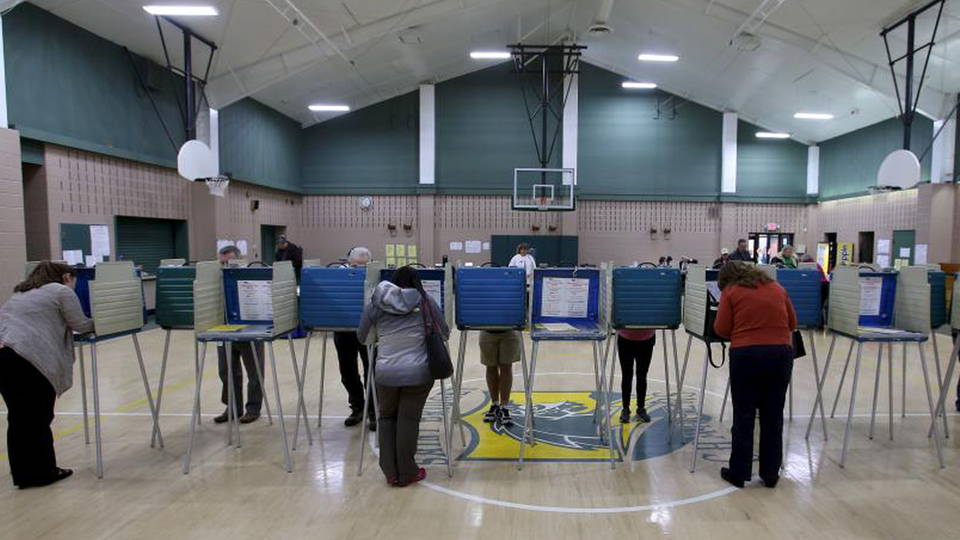
Donald Trump and Hillary Clinton moved closer to securing their respective party’s nomination with a series of victories Tuesday night. In the Republican race, Trump won Illinois, North Carolina and Florida—where his commanding victory pushed Florida Senator Marco Rubio out of the race. Trump also has a narrow lead over Senator Ted Cruz in Missouri. Trump’s one loss was in the key winner-take-all state of Ohio, where Ohio Governor John Kasich earned his first victory of the race. On the Democratic side, Hillary Clinton won Florida, Illinois, North Carolina and Ohio, and leads Sanders by only about 1,500 votes in Missouri. Clinton spoke Tuesday night in West Palm Beach, Florida.
Hillary Clinton: "You know, to be great, we can’t be small. We can’t lose what made America great in the first place. And this isn’t just about Donald Trump. All of us have to do our part. We can’t just talk about economic inequality; we have to take on all forms of inequality and discrimination."
TOPICS:
Donald Trump
Hillary Clinton
2016 Election
TV Networks Ignore Bernie Sanders' Speech Tuesday Night
As Clinton’s Democratic rival, Vermont Senator Bernie Sanders, began his speech on Tuesday night, Fox News, CNN and MSNBC all declined to cut away, instead offering pundits’ commentary and graphics promising they would soon go to Donald Trump’s address.
TOPICS:
Bernie Sanders
2016 Election
Chicago: State's Attorney Loses Re-election Bid After Protests over Laquan McDonald Shooting
In Chicago, Cook County State’s Attorney Anita Alvarez has conceded the Democratic nomination to challenger Kim Foxx following an activist campaign to oust her over her handling of the Laquan McDonald police shooting. McDonald was shot 16 times in October 2014, but video of the shooting wasn’t released until more than a year later after a judge’s order. The same day, Alvarez announced murder charges against the officer, Jason Van Dyke.
TOPICS:
Chicago
Police Brutality
Police
Obama to Name Nominee to Supreme Court
President Obama says he will announce his nominee to replace the late Justice Antonin Scalia on the Supreme Court today. Among the three male contenders is Sri Srinivasan, who was confirmed to his current appeals court post by a unanimous Senate vote. He would be the first Asian American and first Hindu on the high court. The announcement is due at 11 a.m. Eastern, just after our show. Republicans have vowed to block any Obama nominee.
TOPICS:
Supreme Court
Yemen: 41 Civilians Killed in U.S.-Backed, Saudi-Led Strike
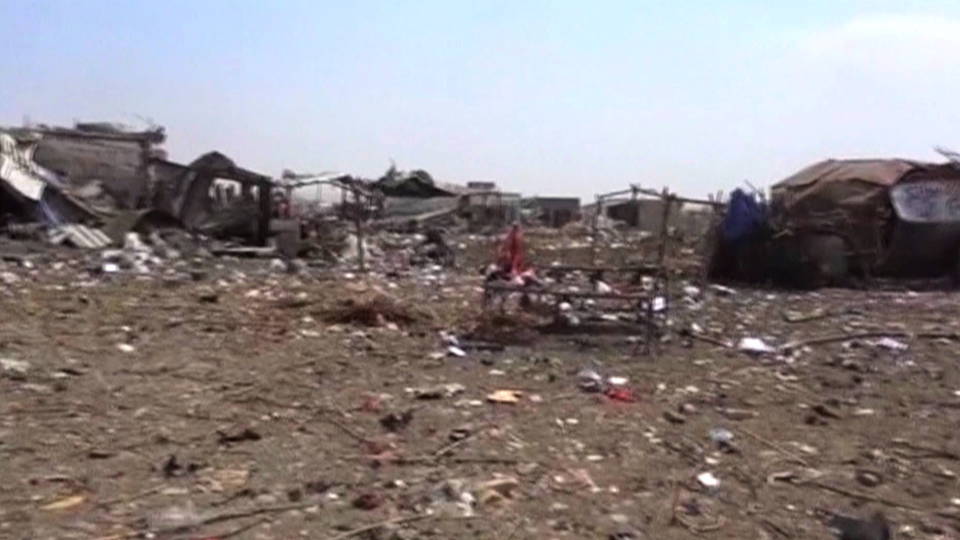
In Yemen, at least 41 civilians have been killed and 75 wounded after U.S.-backed, Saudi-led airstrikes hit a crowded market in the northwest. More than 6,000 people, about half of them civilians, have been killed in the Yemen conflict since the Saudis began targeting Houthi rebels. The vast majority of civilian deaths have been caused by the U.S.-backed strikes.
TOPICS:
Yemen
Saudi Arabia
ISIL Commander Dies After U.S. Airstrike in Syria; Peace Talks Enter 3rd Day
An alleged ISIL commander has died of his injuries following a U.S. airstrike in Syria. Omar al-Shishani reportedly died Monday evening. Meanwhile, Russian warplanes continue to depart Syria after Russia announced it would remove the bulk of its forces there in a surprise move. Peace talks aimed at ending the now-five-year-old conflict in Syria have entered a third day in Geneva.
TOPICS:
Islamic State
Syria
U.S. Loosens Restrictions on Travel & Trade with Cuba Ahead of Obama's Visit
The Obama administration has loosened restrictions on travel and trade with Cuba just days before Obama is set to become the first sitting U.S. president to visit the country in 88 years. The new measures allow Americans to travel to Cuba if they plan educational activities, including interacting with Cuban people or visiting museums. They also allow Cubans to have U.S. bank accounts and earn salaries from U.S. companies, and permit the use of U.S. dollars in transactions with Cuba. White House spokesperson Josh Earnest said the shift could advance economic reforms in Cuba.
Josh Earnest: "It also could apply more pressure to the Cuban government to implement additional reforms to the Cuban economy. All of that would be a good thing, and all of that would be in service of the basic policy goals that we’ve laid out from the beginning. I would just observe that those were also the policy goals under—that were prioritized by the U.S. government for 50 years under a Cuba embargo and attempts to isolate the Cuban nation."
TOPICS:
Cuba
Burma Gets Civilian Leader After 50 Years of Military Rule
In Burma, the Parliament has elected a civilian president after more than 50 years of military rule. The new leader, Htin Kyaw, is a close ally of Aung San Suu Kyi, the pro-democracy leader who is barred from becoming president herself because of a provision in the military-drafted constitution.
TOPICS:
Burma
Brussels: 1 Killed in Police Raid Linked to Paris Attacks
In Brussels, Belgium, authorities shot and killed one person during a raid linked to a probe of the November Paris attacks that killed 130 people. The suspect was identified as Mohammed Belkaid. Authorities said they found an ISIL flag in the residence. Two other suspects have been arrested.
TOPICS:
Islamic State
Lawmakers Grill EPA Official over Flint Water Crisis, Calling It a "Crime of Epic Proportions"
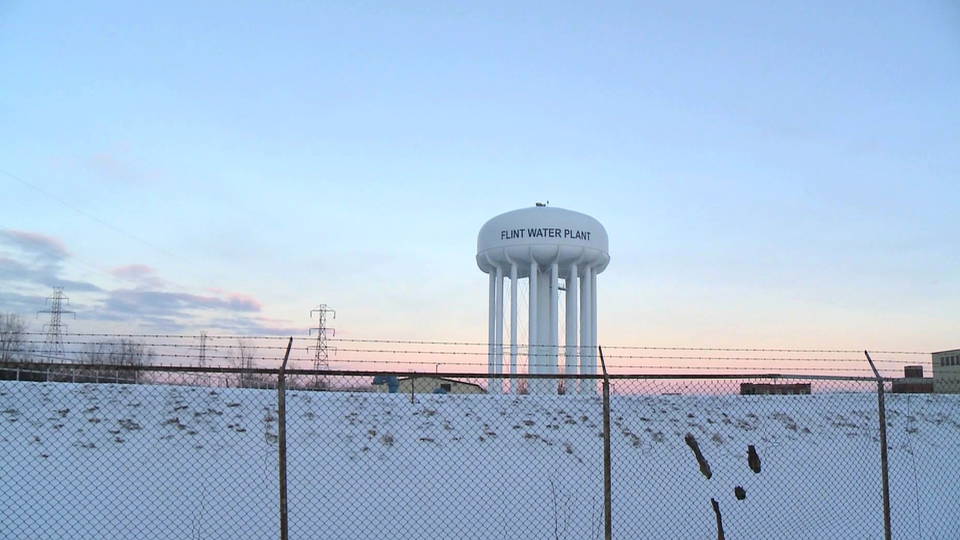
A U.S. congressional panel grilled a former Environmental Protection Agency official Tuesday over her handling of the water crisis in Flint, Michigan. In April 2014, an unelected emergency manager appointed by Michigan Governor Rick Snyder switched Flint’s water source to the corrosive Flint River. The river water ate away at the lead pipes, poisoning the drinking water. In June 2015, an internal report by anEPA scientist raised the alarm about high lead levels and about Flint’s lack of corrosion control. At Tuesday’s hearing, California Democratic Congressmember Ted Lieu asked former EPA official Susan Hedman why it took so long for the agency to warn residents.
Rep. Ted Lieu: "You knew, EPA knew in April, corrosive agents not done. In June, you were notified of that. And then you were given a report that said 'lots of lead in this drinking water.' And then nothing is done 'til December. There is no excuse for that. Someone needed to have yelled and screamed and said, ’Stop this! People are being poisoned.' Should have been done in at least July or August, maybe September, at least by October. That was so wrong. This was a crime of epic proportions that could have been prevented. I yield back."
Susan Hedman resigned in January as head of the EPA regional office in charge of Michigan. Utah Republican Congressmember Jason Chaffetz asked her whether anyone at the agency had done anything wrong.
Rep. Jason Chaffetz: "Did anybody at the EPA do anything wrong?"
Susan Hedman: "Are you asking me the question if in—if I could do this all over again, is there something I would do"—
Rep. Jason Chaffetz: "No, I’m asking you—you were in charge. Did anybody at the EPA do anything wrong?"
Susan Hedman: "I don’t think anyone at EPA did anything wrong, but I do believe we could have done more."
Rep. Jason Chaffetz: "Wow."
Georgia Republican Congressmember Earl Carter joined the criticism of Susan Hedman, saying, "There’s a special place in hell for actions like this." Also testifying at Tuesday’s hearing were Flint’s former emergency manager Darnell Earley and former Mayor Dayne Walling. On Thursday, EPA administrator Gina McCarthy and Michigan Governor Rick Snyder are set to appear before the same committee. Click here to see our special report on Flint.
TOPICS:
Flint Water Crisis
Michigan
Detroit: Police Fire Tear Gas on High School Students, Arrest Over 12
In other news from Michigan, police in Detroit fired tear gas on students at Detroit’s Central Collegiate Academy on Tuesday, sickening a number of people and arresting more than a dozen students. Police responded after they say fights broke out during a false fire alarm at the school. There were reports of asthma attacks, and reporters said they saw some students bent over, coughing uncontrollably.
TOPICS:
Michigan
Police Brutality
Police
University of Puerto Rico Students Vote to Shut Down Campus over Austerity Cuts

In Puerto Rico, thousands of college students from the University of Puerto Rico in Río Piedras have approved a three-day, full-campus shutdown to protest recent austerity measures they say endanger the higher education system. After the meeting, students marched through the university and closed all entrances to the campus. The students also called for the resignation of top university officials and left open the possibility of an indefinite strike if their demands are not met.
TOPICS:
Puerto Rico
Education
Alabama: Holman Prisoners Release List of Demands After Staging 2 Uprisings
In Alabama, inmates at Holman prison have released a set of demands after reportedly staging two uprisings in recent days. On Friday, prisoners set fires, and a guard and warden were stabbed and injured. On Monday, dozens of prisoners reportedly barricaded themselves in a dormitory. The prisoners’ demands include releasing prisoners who have served excessive time, classes to help prisoners reintegrate back into society, and financial compensation for "mental pain and physical abuse." Alabama’s prisons hold nearly twice as many people as they are designed to contain.
TOPICS:
Alabama
Prison
Indiana Governor Urged to Veto Sweeping Anti-Choice Bill; Judge Blocks Restrictions in Arkansas
Indiana Republican Governor Mike Pence is facing calls to veto a sweeping anti-choice bill that would make Indiana the second state to ban abortions sought because of fetal disabilities. The measure also requires abortion providers to obtain hospital admitting privileges, requires women to have an ultrasound and listen to the fetal heartbeat 18 hours before an abortion, and mandates that fetal tissue be buried or cremated after an abortion or miscarriage, potentially imposing additional costs on women. A number of anti-choice, Republican women in the Indiana Legislature have denounced the measure as punitive and overreaching. Meanwhile, Florida lawmakers have passed a sweeping anti-choice bill that, among other provisions, redefines the trimesters of pregnancy and threatens to shut down clinics. In South Carolina, Governor Nikki Haley has indicated she plans to sign yet another anti-choice measure banning abortion at 20 weeks. But in a victory for reproductive rights, a federal judge has blocked Arkansas from enforcing its restrictions on medication abortions.
TOPICS:
Indiana
Abortion
Arkansas
Florida
Tennessee Lawmakers Advance Anti-Transgender Bathroom Bill
And Tennessee state lawmakers have advanced a bill that would ban transgender students at public grade schools and universities from using bathrooms that correspond to their gender identity. Last month, South Dakota passed a similar measure, but Republican Governor Dennis Daugaard vetoed it amid nationwide protest.
TOPICS:
LGBT
Donate today:
Follow:
WEB EXCLUSIVE


Is Donald Trump a Fascist? Part 2 of Interview with Robert Paxton, Father of Fascism Studies
WORK WITH DN!

Broadcast Engineer
Director of Finance and Operations
Director of Development
---------------------
207 West 25th Street, 11th Floor
New York, New York 10001, United States
--------------------
--------------------

No comments:
Post a Comment