
Wichita, Kansas, United States - Great Plains Conference of the United Methodist Church Daily Devotional for Tuesday, 28 October 2014

18th Sunday after: Pentecost/in Kingdomtide – Green
This Week's Lectionary Scriptures:
Scripture Texts:
Scripture Texts:
Deuteronomy 34:1-12
Psalm 90:1-6, 13-17
1 Thessalonians 2:1-8
Matthew 22:34-46
Scripture Texts:
Deuteronomy 34: The Death of Moses
4 Then and there God said to him, “This is the land I promised to your ancestors, to Abraham, Isaac, and Jacob with the words ‘I will give it to your descendants.’ I’ve let you see it with your own eyes. There it is. But you’re not going to go in.”
5-6 Moses died there in the land of Moab, Moses the servant of God, just as God said. God buried him in the valley in the land of Moab opposite Beth Peor. No one knows his burial site to this very day.
7-8 Moses was 120 years old when he died. His eyesight was sharp; he still walked with a spring in his step. The People of Israel wept for Moses in the Plains of Moab thirty days. Then the days of weeping and mourning for Moses came to an end.
9 Joshua son of Nun was filled with the spirit of wisdom because Moses had laid his hands on him. The People of Israel listened obediently to him and did the same as when God had commanded Moses.
10-12 No prophet has risen since in Israel like Moses, whom God knew face-to-face. Never since has there been anything like the signs and miracle-wonders that God sent him to do in Egypt, to Pharaoh, to all his servants, and to all his land—nothing to compare with that all-powerful hand of his and all the great and terrible things Moses did as every eye in Israel watched.
Psalm 90: A Prayer of Moses, Man of God
1-2 God, it seems you’ve been our home forever;
long before the mountains were born,
Long before you brought earth itself to birth,
from “once upon a time” to “kingdom come”—you are God.
3-11 So don’t return us to mud, saying,
“Back to where you came from!”
Patience! You’ve got all the time in the world—whether
a thousand years or a day, it’s all the same to you.
Are we no more to you than a wispy dream,
no more than a blade of grass
That springs up gloriously with the rising sun
and is cut down without a second thought?
Your anger is far and away too much for us;
we’re at the end of our rope.
You keep track of all our sins; every misdeed
since we were children is entered in your books.
All we can remember is that frown on your face.
Is that all we’re ever going to get?
We live for seventy years or so
(with luck we might make it to eighty),
And what do we have to show for it? Trouble.
Toil and trouble and a marker in the graveyard.
Who can make sense of such rage,
such anger against the very ones who fear you?
12-17 Oh! Teach us to live well!
Teach us to live wisely and well!
Come back, God—how long do we have to wait?—
and treat your servants with kindness for a change.
Surprise us with love at daybreak;
then we’ll skip and dance all the day long.
Make up for the bad times with some good times;
we’ve seen enough evil to last a lifetime.
Let your servants see what you’re best at—
the ways you rule and bless your children.
And let the loveliness of our Lord, our God, rest on us,
confirming the work that we do.
Oh, yes. Affirm the work that we do!
1 Thessalonians 2:1-2 So, friends, it’s obvious that our visit to you was no waste of time. We had just been given rough treatment in Philippi, as you know, but that didn’t slow us down. We were sure of ourselves in God, and went right ahead and said our piece, presenting God’s Message to you, defiant of the opposition.
No Hidden Agendas
3-5 God tested us thoroughly to make sure we were qualified to be trusted with this Message. Be assured that when we speak to you we’re not after crowd approval—only God approval. Since we’ve been put through that battery of tests, you’re guaranteed that both we and the Message are free of error, mixed motives, or hidden agendas. We never used words to butter you up. No one knows that better than you. And God knows we never used words as a smoke screen to take advantage of you.
6-8 Even though we had some standing as Christ’s apostles, we never threw our weight around or tried to come across as important, with you or anyone else. We weren’t aloof with you. We took you just as you were. We were never patronizing, never condescending, but we cared for you the way a mother cares for her children. We loved you dearly. Not content to just pass on the Message, we wanted to give you our hearts. And we did.
Matthew 22: The Most Important Command
34-36 When the Pharisees heard how he had bested the Sadducees, they gathered their forces for an assault. One of their religion scholars spoke for them, posing a question they hoped would show him up: “Teacher, which command in God’s Law is the most important?”
37-40 Jesus said, “‘Love the Lord your God with all your passion and prayer and intelligence.’ This is the most important, the first on any list. But there is a second to set alongside it: ‘Love others as well as you love yourself.’ These two commands are pegs; everything in God’s Law and the Prophets hangs from them.”
David’s Son and Master
41-42 As the Pharisees were regrouping, Jesus caught them off balance with his own test question: “What do you think about the Christ? Whose son is he?” They said, “David’s son.”
43-45 Jesus replied, “Well, if the Christ is David’s son, how do you explain that David, under inspiration, named Christ his ‘Master’?
God said to my Master,
“Sit here at my right hand
until I make your enemies your footstool.”
“Now if David calls him ‘Master,’ how can he at the same time be his son?”
46 That stumped them, literalists that they were. Unwilling to risk losing face again in one of these public verbal exchanges, they quit asking questions for good.
John Wesley Notes-Commentary:
Deuteronomy 34:1-12
Verse 1
[1] And Moses went up from the plains of Moab unto the mountain of Nebo, to the top of Pisgah, that is over against Jericho. And the LORD shewed him all the land of Gilead, unto Dan,
And Moses went up — When he knew the place of his death he chearfully mounted a steep hill to come to it. Those who are well acquainted with another world, are not afraid to leave this. When God's servants are sent for out of the world, the summons runs go up and die! Unto Dan - To that city which after Moses's death was called so.
Verse 2
[2] And all Naphtali, and the land of Ephraim, and Manasseh, and all the land of Judah, unto the utmost sea,
All Naphtali — The land of Naphtali, which together with Dan, was in the north of Canaan, as Ephraim and Manasseh were in the midland parts, and Judah on the south, and the sea, on the west. So these parts lying in the several quarters are put for all the rest. He stood in the east and saw also Gilead, which was in the eastern part of the land, and thence he saw the north and south and west.
The utmost sea — The midland sea, which was the utmost bound of the land of promise on the west.
Verse 3
[3] And the south, and the plain of the valley of Jericho, the city of palm trees, unto Zoar.
The south — The south quarter of the land of Judah, which is towards the salt sea, the city of palm-trees - Jericho, so called from the multitude of palm-trees, which were in those parts, as Josephus and Strabo write. From whence and the balm there growing it was called Jericho, which signifies, odoriferous or sweet smelling.
Verse 4
[4] And the LORD said unto him, This is the land which I sware unto Abraham, unto Isaac, and unto Jacob, saying, I will give it unto thy seed: I have caused thee to see it with thine eyes, but thou shalt not go over thither.
I have caused thee to see it — For tho' his sight was good, yet he could not have seen all Canaan, an hundred and sixty miles in length, and fifty or sixty in breadth, if his sight had not been miraculously assisted and enlarged. He saw it at a distance. Such a sight the Old Testament believers had of the kingdom of the Messiah. And such a sight believers have now of the glory that shall he revealed. Such a sight have we now, of the knowledge of the glory of the Lord, which shall cover the earth. Those that come after us shall undoubtedly enter into that promised land: which is a comfort to us, when we find our own carcases falling in this wilderness.
Verse 5
[5] So Moses the servant of the LORD died there in the land of Moab, according to the word of the LORD.
So Moses the servant of the Lord died — He is called the servant of the Lord, not only as a good man, (all such are his servants) but as a man eminently useful, who had served God's counsels in bringing Israel out of Egypt, and leading them thro' the wilderness. And it was more his honour, to be the servant of the Lord, than to be king in Jeshurun. Yet he dies. Neither his piety nor his usefulness would exempt him from the stroke of death. God's servants must die, that they may rest from their labours, receive their recompense, and make room for others. But when they go hence, they go to serve him better, to serve him day and night in his temple. The Jews say, God sucked his soul out of his body with a kiss. No doubt he died in the embraces of his love.
Verse 6
[6] And he buried him in a valley in the land of Moab, over against Bethpeor: but no man knoweth of his sepulchre unto this day.
He — The Lord, buried him either immediately, or by the ministry of angels, whereof Michael was the chief or prince.
Of his sepulchre — Of the particular place where he was buried: which God hid from the Israelites, to prevent their superstition and idolatry, to which he knew their great proneness. And for this very reason the devil endeavoured to have it known and contended with Michael about it, Jude 1:9. God takes care even of the dead bodies of his servants. As their death is precious, so is their dust. Not one grain of it shall be lost, but the covenant with it shall be remembered.
Verse 7
[7] And Moses was an hundred and twenty years old when he died: his eye was not dim, nor his natural force abated.
His eye was not dim — By a miraculous work of God in mercy to his church and people.
Verse 8
[8] And the children of Israel wept for Moses in the plains of Moab thirty days: so the days of weeping and mourning for Moses were ended.
Thirty day's — Which was the usual time of mourning for persons of high place and eminency. 'Tis a debt owing to the surviving honour of deceased worthies, to follow them with our tears, as those who loved and valued them, are sensible of the loss, and humbled for the sins which have provoked God to deprive us of them.
Verse 9
[9] And Joshua the son of Nun was full of the spirit of wisdom; for Moses had laid his hands upon him: and the children of Israel hearkened unto him, and did as the LORD commanded Moses.
Wisdom — And other gifts and graces too, but wisdom is mentioned as being most necessary for the government to which he was now called.
Upon him — And this was the thing which Moses at that time asked of God for him.
Verse 10
[10] And there arose not a prophet since in Israel like unto Moses, whom the LORD knew face to face,
Whom the Lord — Whom God did so freely and familiarly converse with.
Verse 12
[12] And in all that mighty hand, and in all the great terror which Moses shewed in the sight of all Israel.
Moses was greater than any other of the prophets of the Old Testament. By Moses God gave the law, and moulded and formed the Jewish church. By the other prophets he only sent particular reproofs, directions and predictions. But as far as the other prophets came short of him, our Lord Jesus went beyond him. Moses was faithful as a servant, but Christ as a son: his miracles more illustrious, his communion with the father more intimate: for he is in his bosom from eternity. Moses lies buried: but Christ is sitting at the right-hand of God, and of the increase of his government there shall be no end.
Psalm 90:1-6, 13-17
Verse 2
[2] Before the mountains were brought forth, or ever thou hadst formed the earth and the world, even from everlasting to everlasting, thou art God.
Thou — Thou hadst thy power, and all thy perfections, from all eternity.
Verse 3
[3] Thou turnest man to destruction; and sayest, Return, ye children of men.
Turnedst — But as for man, his case is far otherwise, though he was made by thee happy. and immortal, yet for his sin thou didst make him mortal and miserable.
Saidst — Didst pronounce that sad sentence, return, O men, to the dust out of which ye were taken, Genesis 3:19.
Verse 4
[4] For a thousand years in thy sight are but as yesterday when it is past, and as a watch in the night.
Past — Indeed time seems long when it is to come, but when it is past, very short and contemptible.
A watch — Which lasted but three or four hours.
Verse 5
[5] Thou carriest them away as with a flood; they are as a sleep: in the morning they are like grass which groweth up.
Them — Mankind.
Away — Universally, without exception or distinction.
A sleep — Short and vain, as sleep is, and not minded 'till it be past.
Verse 13
[13] Return, O LORD, how long? and let it repent thee concerning thy servants.
Return — To us in mercy.
How long — Will it be before thou return to us? Repent thee - Of thy severe proceedings against us.
Verse 14
[14] O satisfy us early with thy mercy; that we may rejoice and be glad all our days.
Early — Speedily.
Verse 17
[17] And let the beauty of the LORD our God be upon us: and establish thou the work of our hands upon us; yea, the work of our hands establish thou it.
The beauty — His gracious influence, and glorious presence.
In us — Do not only work for us, but in us,
1 Thessalonians 2:1-8
Verse 1
[1] For yourselves, brethren, know our entrance in unto you, that it was not in vain:
What was proposed, 1 Thessalonians 1:5,6, is now more largely treated of: concerning Paul and his fellowlabourers, 1 Thessalonians 2:1-12; concerning the Thessalonians, 1 Thessalonians 2:13-16.
Verse 2
[2] But even after that we had suffered before, and were shamefully entreated, as ye know, at Philippi, we were bold in our God to speak unto you the gospel of God with much contention.
We had suffered — In several places.
We are bold — Notwithstanding.
With much contention — Notwithstanding both inward and outward conflicts of all kinds.
Verse 3
[3] For our exhortation was not of deceit, nor of uncleanness, nor in guile:
For our exhortation — That is, our preaching. A part is put for the whole.
Is not, at any time, of deceit — We preach not a lie, but the truth of God.
Nor of uncleanness — With any unholy or selfish view. This expression is not always appropriated to lust, although it is sometimes emphatically applied thereto.
Nor in guile — But with great plainness of speech.
Verse 5
[5] For neither at any time used we flattering words, as ye know, nor a cloke of covetousness; God is witness:
Flattering words — This ye know.
Nor a cloak of covetousness — Of this God is witness. He calls men to witness an open fact; God, the secret intentions of the heart. In a point of a mixed nature, 1 Thessalonians 2:10, he appeals both to God and man.
Verse 6
[6] Nor of men sought we glory, neither of you, nor yet of others, when we might have been burdensome, as the apostles of Christ.
Nor from others — Who would have honoured us more, if we had been burdensome - That is, taken state upon ourselves.
Verse 7
[7] But we were gentle among you, even as a nurse cherisheth her children:
But we were gentle — Mild, tender.
In the midst of you — Like a hen surrounded with her young.
Even as a nurse cherisheth her own children — The offspring of her own womb.
Verse 8
[8] So being affectionately desirous of you, we were willing to have imparted unto you, not the gospel of God only, but also our own souls, because ye were dear unto us.
To impart our own souls — To lay down our lives for your sake.
Matthew 22:34-46
Verse 34
[34] But when the Pharisees had heard that he had put the Sadducees to silence, they were gathered together.
Mark 12:28; Luke 10:25.
Verse 35
[35] Then one of them, which was a lawyer, asked him a question, tempting him, and saying,
A scribe asking him a question, trying him — Not, as it seems, with any ill design: but barely to make a farther trial of that wisdom, which he had shown in silencing the Sadducees.
Verse 37
[37] Jesus said unto him, Thou shalt love the Lord thy God with all thy heart, and with all thy soul, and with all thy mind.
Deuteronomy 6:5.
Verse 39
[39] And the second is like unto it, Thou shalt love thy neighbour as thyself.
Leviticus 19:18.
Verse 42
[42] Saying, What think ye of Christ? whose son is he? They say unto him, The Son of David.
Luke 20:41.
Verse 43
[43] He saith unto them, How then doth David in spirit call him Lord, saying,
How doth David then by the Spirit — By inspiration, call him Lord? If he be merely the son (or descendant) of David? If he be, as you suppose, a mere man, the son of a man?
Verse 44
[44] The LORD said unto my Lord, Sit thou on my right hand, till I make thine enemies thy footstool?
The Lord said to my Lord — This his dominion, to which David himself was subject, shows both the heavenly majesty of the king, and the nature of his kingdom.
Sit thou on my right hand — That is, remain in the highest authority and power. Psalms 110:1.
Verse 46
[46] And no man was able to answer him a word, neither durst any man from that day forth ask him any more questions.
Neither durst any question him any more — Not by way of ensnaring or tempting him.
____________________________
Today’s Devotion:
 Nashville, Tennessee, United States - The Upper Room Daily Devotional "Camp Grace" for Tuesday, 28 October 2014 - Read John 15:5-8 “I am the Vine, you are the branches. When you’re joined with me and I with you, the relation intimate and organic, the harvest is sure to be abundant. Separated, you can’t produce a thing. Anyone who separates from me is deadwood, gathered up and thrown on the bonfire. But if you make yourselves at home with me and my words are at home in you, you can be sure that whatever you ask will be listened to and acted upon. This is how my Father shows who he is—when you produce grapes, when you mature as my disciples.
9-10 “I’ve loved you the way my Father has loved me. Make yourselves at home in my love. If you keep my commands, you’ll remain intimately at home in my love. That’s what I’ve done—kept my Father’s commands and made myself at home in his love.
11-15 “I’ve told you these things for a purpose: that my joy might be your joy, and your joy wholly mature. This is my command: Love one another the way I loved you. This is the very best way to love. Put your life on the line for your friends. You are my friends when you do the things I command you. I’m no longer calling you servants because servants don’t understand what their master is thinking and planning. No, I’ve named you friends because I’ve let you in on everything I’ve heard from the Father.
16 “You didn’t choose me, remember; I chose you, and put you in the world to bear fruit, fruit that won’t spoil. As fruit bearers, whatever you ask the Father in relation to me, he gives you.
17 “But remember the root command: Love one another.
The Spirit helps us in our weakness; for we do not know how to pray as we ought, but that very Spirit intercedes with sighs too deep for words.(Romans 8:26 (NRSV))
For three decades, adults with special needs, along with many volunteers, have attended Camp Grace in the mountains of North Carolina. At this “family reunion” I have found the campers’ love for one another and their love and acceptance of me very moving. The highlight is Saturday’s talent show in which nearly all the campers select a talent to share.
Susan, who rarely speaks, usually dances. However, this year, she wanted to sing “Jesus Loves Me.”She stood, quite anxious, in front of the microphone and said, “Hi.”As our accompanist quietly tried to prompt her with the words, she said “hi” again. Then, voices began to arise from Susan’s Camp Grace family, until we were all singing “Jesus Loves Me,” softly and sweetly, on her behalf. Susan grinned as she received our love and affirmation and knew she was not alone.
Through the Holy Spirit, God was illustrating Romans 8:26. When Christ ascended, he left us a Comforter who intervenes for us with God when we struggle. As we lifted Susan’s song to God, we were bearing the fruit of God’s love.(See John 15:16-17.)
Read more from the author, here.
"Camp Grace"
Camp Grace (in operation for over 30 years)
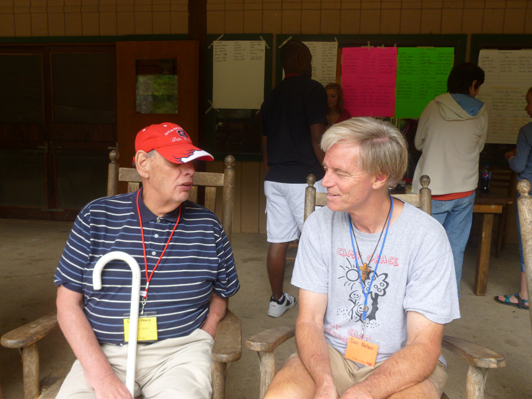 My first time serving at this camp for mentally challenged adults, I was a bit anxious until I saw the love the returning “special friends” (the volunteers) and campers (those who are mentally challenged) felt for one another when they were reunited. Each camper is paired with a special friend. My first camper, John was about my age. He was sight impaired and physically disabled. So, while the others hiked or swam, he and I sat on the porch, laughed, talked about our daily lives, and looked at the beautiful mountains of North Carolina. During the weekend, I met friends from his group home, and others he is excited to see each year. We talked about our families, old TV shows (e.g., “Andy Griffith” and “I Love Lucy”), his job, group-home staff, music, food, and our faith. I helped him with his shower, carried his food, and just participated. Our interactions were always affirming.
Sunday morning I awoke early. John was still asleep;. He did not snore; nor had he needed to go to the bathroom all night. This was a time for reflection as we all prepared to return to our “normal” lives. Certain realities became clear to me: The love overflowing from the lives of the campers into my heart originated from their “child,” and had reawakened the child in me. John and the other campers had revealed a “disability” in me and had caused me to reassess their disability.
[A journal excerpt from my 5th year] ‘Each year, I’m moved by the campers’ love for one another, and their love and acceptance of me. It’s like a family reunion as we visit with old and new friends. The highlights are the Talent Show and our Dance Saturday night. The dance is a grand mixture of fellowship, music, and energy. The food at the dance is the highlight for John. Earlier, Jane (a camper) and I had enjoyed talking and knew each other from previous weekends so I asked her to dance. She’s a gentle, shy woman who avoids eye contact. As we danced to “Bless the Broken Road,” I saw her tears through mine and told her: “This song always makes me cry.” She said: “Me too.” I can’t know the emotions behind Lisa’s memory, but mine were that God had loved and pursued me for decades before I chose the road that led me straight to Him.
Sunday morning, I lay in my bunk and considered what God had revealed about the campers and me this year: Though society separates us for practical reasons, Jane and I are both clay jars with God’s light shining through our cracks — each blessed with unique gifts and a special purpose in Christ’s Body. Praise God!’(Dan Nelson)
The Author: Daniel R. Nelson (North Carolina)
Thought for the Day: Jesus loves me.
Prayer: Dear Lord, help us to bring your comfort to others in their times of hardship. Amen.
Prayer focus: People with special needs
____________________________
Great Plains Conference of the United Methodist Church
9440 E Boston, Suite 160
Wichita KS 67207
316-686-0600
800-745-2350
info@greatplainsumc.org
________________________

No comments:
Post a Comment