
Today's mainline denominations are doing plenty of fighting. Some of the disagreements break into the news and public consciousness, while others only affect the faithful.
All of this fighting is deeply unsettling, but it also reflects what one observer calls "a seismic shift" in the denominational terrain.
"The denominational level, whether it's the middle judicatory or national level, is going through a seismic shift, and the whole idea of denominationalism is going through a very profound [cultural] shift," said Susan Nienaber, a former Alban Institute consultant specializing in church conflict. "[Denominations] have been shaken -- and not just in terms of the highly controversial issues that have been publicized."
Challenges of this magnitude are felt acutely by denominational leaders.
"Conflict is a huge test of our capacity to stay engaged in the immediate challenge but not give ourselves over to it," said the Rev. Dr. Jim Antal, president and conference minister of the United Church of Christ's Massachusetts Conference. "When somebody's mad as heck at you, and they're coming at you with words and emotions, most of us get riled up, our primitive emotions get activated. We end up taking the bait, getting combative."
If, on occasion, conflict brings out the worse angels of our natures, sometimes conflict also can be constructive. Even those caught in denominational discord -- conflicts so deep and emotional that sometimes people can't even agree on what the disagreement is really about -- see conflict as an opportunity for transformation. It's not easy. But some denominational leaders who have weathered -- or are weathering -- conflict and controversy say that positive change can emerge.
How can leaders in conflict-riven systems help achieve resolution, transformation and even reconciliation?
Rooted in the tradition
Of course, faith fights and doctrinal divisions are as ancient as Christianity itself.
"We sometimes in our day think conflict in the church is new, but you only have to go to the New Testament to see conflict in the church," said Bishop Chris Epting, the ecumenical officer for the Episcopal Church.
Even in modern conflicts, ancient practices can offer help. Confronted by challenges and their collateral damage, many denominational leaders turn to conflict resolution or conflict management strategies, with varying degrees of success. But real transformation -- as opposed to mere management -- begins with work on the individual level, said the Rev. Dr. Marcia Mount Shoop, who serves as a moderator of the Presbyterian Multicultural Network.
"It's certainly a matter of deep trust," she said. "This kind of transformation asks for you to show up with your whole self. That means being vulnerable. That is an act of deep, deep trust with God, so I always start with prayer.
"I often invite congregations and governing bodies...I invite them to spend time together quiet with open hands, asking 'God what are you doing here, and what do you want to do with me?'" Mount Shoop said. "And I find, especially with people who are accustomed to having a lot of power and decision making, people accustomed to being part of groups with lots of power in our society, this is very difficult."
MANAGEMENT, CONFLICT
Hope in conflict
Can conflict be constructive? Christian leaders turn denominational battles into opportunities for transformation and reconciliation.
Today’s mainline denominations are doing plenty of fighting. Some of the disagreements break into the news and public consciousness, while others only affect the faithful.
All of this fighting is deeply unsettling, but it also reflects what one observer calls “a seismic shift” in the denominational terrain.
“The denominational level, whether it’s the middle judicatory or national level, is going through a seismic shift, and the whole idea of denominationalism is going through a very profound [cultural] shift,” said Susan Nienaber, an Alban Institute consultant specializing in church conflict. “[Denominations] have been shaken -- and not just in terms of the highly controversial issues that have been publicized.”
Challenges of this magnitude are felt acutely by denominational leaders.
“Conflict is a huge test of our capacity to stay engaged in the immediate challenge but not give ourselves over to it,” said the Rev. Dr. Jim Antal, president and conference minister of the United Church of Christ’s Massachusetts Conference. “When somebody’s mad as heck at you, and they’re coming at you with words and emotions, most of us get riled up, our primitive emotions get activated. We end up taking the bait, getting combative.”
If, on occasion, conflict brings out the worse angels of our natures, sometimes conflict also can be constructive. Even those caught in denominational discord -- conflicts so deep and emotional that sometimes people can’t even agree on what the disagreement is really about -- see conflict as an opportunity for transformation. It’s not easy. But some denominational leaders who have weathered -- or are weathering -- conflict and controversy say that positive change can emerge.
How can leaders in conflict-riven systems help achieve resolution, transformation and even reconciliation?
Rooted in the tradition
Of course, faith fights and doctrinal divisions are as ancient as Christianity itself.
“We sometimes in our day think conflict in the church is new, but you only have to go to the New Testament to see conflict in the church,” said Bishop Chris Epting, the ecumenical officer for the Episcopal Church.
Even in modern conflicts, ancient practices can offer help. Confronted by challenges and their collateral damage, many denominational leaders turn to conflict resolution or conflict management strategies, with varying degrees of success. But real transformation -- as opposed to mere management -- begins with work on the individual level, said the Rev. Dr. Marcia Mount Shoop, who serves as a moderator of the Presbyterian Multicultural Network.
Questions to consider:
- When a topic gets hot in a meeting, how do you respond? What questions do you ask yourself and others about what might be at stake in the conversation?
- What makes a conflict destructive or constructive?
- What are the leadership “moves” that move a conflict toward a transformative resolution?
- How do you determine what the deeper issues are in a conflict? How do you respond to the “presenting issue” as well as the deeper one?
“It’s certainly a matter of deep trust,” she said. “This kind of transformation asks for you to show up with your whole self. That means being vulnerable. That is an act of deep, deep trust with God, so I always start with prayer.
“I often invite congregations and governing bodies…I invite them to spend time together quiet with open hands, asking ‘God what are you doing here, and what do you want to do with me?’” Mount Shoop said. “And I find, especially with people who are accustomed to having a lot of power and decision making, people accustomed to being part of groups with lots of power in our society, this is very difficult.”
When conflict hits, leaders also should seek corporate discernment, Epting said. Along with the interplay of Scripture, tradition and reason, denominational leaders must collectively seek God’s guidance and try to sense the historical momentum on an issue.
“One person cannot hear God all by themselves, so you draw the circle wider and wider. In our church that would be going to the dioceses, national church, ecumenical church and internationally to consider what other churches are doing,” he said.
Such vulnerability helps unlock conflict’s transformative potential, so denominational leaders can adopt appropriate self-scrutiny and internal critique.
“Sometimes conflict forces us to see things about ourselves that we had been failing to see,” said Bishop Jeffrey N. Leath of the African Methodist Episcopal Church. “A crisis can become an opportunity for us to assess: What did we do to contribute to the crisis?”
“We tend to be the David who has not yet heard from Nathan instead of being the Nathan who is speaking to ourselves.”
Choose to heal
Trials, tribulations and turmoil can lead to transformation -- if an organization is willing to “shapeshift” or continuously adapt and change, Nienaber said.
Four years ago, she studied 12 congregations identified by denominational leaders as having been transformed in the wake of “big-league tragedies and conflict,” such as sexual misconduct, pastoral leadership, suicide and natural disasters. She presented her research in an article called “Leading into the Promised Land: Lessons Learned From Resilient Congregations.”
In findings Neinaber said are instructive to denominational leaders, she discovered that transformation is not attained by the “problem-focused, deficit-based language and theories” so often employed by people rocked by conflict.
Rather, “At the core of [the resilient churches’] success in bouncing back from their conflict, I believe, lies a simple yet profound decision: They chose to heal. They made an intentional decision to get healthy and focused their efforts toward that goal. They saw an opportunity in their crisis, and they acted upon it.”
Leath said leaders need to seize the opportunity to help move beyond the crisis.
"The chances of transformation, I think, are minimal if there is no followup by the mentoring senior administrative person who is guiding, hopefully, through a process of transformation,” he said. “The leaders are responsible for bringing that to pass."
Often the “presenting dispute” is rooted in a deeper, less immediately obvious conflict institutional leaders must grapple with.
Currently, the UCC is wrestling with significant restructuring of its national governance structure, “which on the face of it doesn’t seem like a big deal,” said the Rev. John H. Thomas, who stepped down in June from his post as UCC general minister and president. “But it is a big deal.”
What has emerged as the deeper issue: the anxieties of the racial minorities who had equated equality with the number of seats in the governing body. They feared a smaller board and more unified governance structure would limit their presence and the progress that’s being made, Thomas said.
At the General Synod this summer, the church identified that its priority in moving toward single governance was reconciliation of those who feel excluded, and the denomination now is engaging in a “sacred conversation on race.” (link is external)
‘It feels like the cross’
On the way to transformation, hope resides in a renewed theological perspective.
“God’s power is so unique and distinctive that in every difficulty, in every hardship, in every difference that we encounter that really challenges us, there is this offer that God makes for our lives to be enriched, for us to be transformed, for the world to be a better place,” Mount Shoop said.
“It’s not that I believe God is visiting suffering on us to teach us a lesson,” Mount Shoop said. “I think [with] God in every situation -- sometimes especially in contradictions and conflict -- there’s a healing opportunity.”
Healing an organization demands more than gaining mass acquiescence to a black-and-white assessment of right and wrong.
“Paul says we see through a glass darkly…we don’t always fully understand and grasp even the scriptural mandates,” Epting said. “We can rely on the Spirit to guide us, but that’s not apparently infallible because even faithful people can disagree.”
As he started in the work of the priesthood fresh out of seminary, Epting entered a church embroiled with the debate over women preachers. It was a tough fight because when it came to women preachers, “You can find texts on both sides. You can find history on both sides,” Epting said.
Epting was in favor of the ordination of women as priests. His stand on the issue wasn’t without its consequences. “In the middle of these things, it feels like the cross. It’s painful,” he admits. “I had people I’ve known since my childhood who wrote me off as a heretic.”
Looking back, he said the conflict proved transformative. For one thing, it forced his denomination to go back to its roots and to ask: What is a priest? Together they affirmed that “women have all the capabilities for doing that [ministry],” Epting said.
In the early days, women often argued it was their right to enter the priesthood, he said. But Epting said he found it more persuasive when women said they were called to the office.
“We could then begin to test that calling as we were testing other [candidates for priesthood],” he said, as part of their established traditions and ordinances. “We don’t think we’ve changed the office of being a priest or pastor or preacher. We’ve simply opened it up to the other half of the human race because we believed God was calling women to that position.”
Discernment and discussion
Often, the path of least resistance is to avoid discussing and addressing difficult topics. That’s also the course of action that can turn conflict destructive, particularly for denominational leaders, Thomas said. “The reasons you have conflict are first, some people disagree. Second, a lot of the church isn’t focused on that particular issue, so [a move on the denominational level] appears as a political pronouncement.”
Despite the temptation to defuse conflict, leaders do well to avoid acting as gatekeepers barring engagement with combustible topics, Thomas said. “When people just avoided it, it allowed things to fester and then allowed unhealthy interventions from people with unhealthy agendas.”
Like many denominations, the UCC has grappled with questions of human sexuality -- one of the most fraught issues of the day.
Although the UCC’s 2005 General Synod decision to promote marriage equality for gays and lesbians was contentious, it “was part of a long trajectory of reflection, discernment, decisions,” he said, so it wasn’t an issue that appeared out of the blue.
Inviting gay and lesbians into the church, affirming their ordinations, working to protection them against violence -- all of these actions had been taken by the UCC long before the vote on marriage, he said.
While Thomas found the experience to be transformative, it was not without cost: The United Church News has reported that during the 20 months following that decision, 163 UCC churches officially left the denomination, with 90 of them citing support for same-gender marriage as the reason.
Ultimately, the question becomes not who wins and who loses, but how has this conflict transformed the community and allowed its members to live deeper, richer lives in Christ? Have its members made the journey from conflict to reconciliation?
“When pastors and leaders said up front, ‘Let’s confront that and look at it head on. Let’s convene and talk,’ people didn’t necessarily end up agreeing and feeling happy, but they discovered a strength in the church,” Thomas said.
“It wasn’t as vulnerable to fragmentation as they feared, but rather there was a community of faith that could survive disagreement,” he said. “There was a community they had not experienced or claimed before.”
____________________________
Monday, February 16, 2015
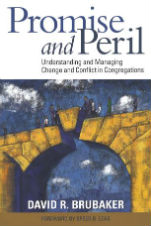
Congregations cannot exist without finances, priorities, leadership, worship, and decision making, yet these five aspects breed the most conflict between church members and clergy. This book will help congregations avoid the pitfalls of conflict and instead head toward a healthy relationship between and among church staff and members.

Divided into three sections that explore the dynamics of conflict, conflict management techniques, and dealing with conflict in specific contexts, Conflict Management in Congregations serves as a comprehensive primer that no pastor or congregational leader will want to be without.
 More about Congregational Conflict
How Common is Congregational Conflict?
Mark Chaves
Everyone knows that congregations experience conflict, but how common is such conflict, especially serious conflict? Is there a lot or a little? It turns out that we get a different picture of the extent of congregational conflict depending on the time frame and depending on whether we focus on occasional or persistent conflict.
Do We Really Need Conflict Resolution?
W. Craig Gilliam
I often get phone calls from pastors and other congregational leaders who want help resolving conflict -- as soon as possible. Usually I decline, at least initially, telling them that I probably can't be much help if conflict resolution is their goal. Indeed, I explain, resolution may not be desirable or even possible in most conflicts. And almost never is a quick fix a good idea.
CONGREGATIONS, MANAGEMENT, CONFLICT
Do we really need conflict resolution?
When pastors call for help resolving congregational conflict, Craig Gilliam usually declines. Conflict resolution, he says, may not be a good idea.
THURSDAY, JANUARY 8, 2009
I often get phone calls from pastors and other congregational leaders who want help resolving conflict -- as soon as possible. Usually I decline, at least initially, telling them that I probably can’t be much help if conflict resolution is their goal. Indeed, I explain, resolution may not be desirable or even possible in most conflicts. And almost never is a quick fix a good idea.
But if they are interested and willing, I offer to work with them as they and their congregations learn from, grow through and are transformed by the heat of conflict. I offer to assist them as they are “redeemed from fire by fire,” as the poet T.S. Eliot wrote. No, I can’t help them resolve their conflict. But I can help them learn to live with the tension, moderate the anxiety and grow from conflict. For me, “conflict resolution” is not about resolving anything. It is about maturity, not resolution; growth, not comfort; deepening the soul, not simply easing the spirit.
The problem with “conflict resolution” is that it creates or reinforces the notion that conflict is bad, sinful and destructive and should not exist. Once we stop seeing resolution as an end in itself, we can understand more clearly the real nature of the underlying conflict -- what it says about the system, the living body and its needs.
“Conflict resolution” tends to focus on “fixing what’s wrong,” while ignoring process. Yet process is the very thing of which relationships are made. Processing is learninghow to relate to and how to connect with the other person or group while remaining self-differentiated or self-defined. Typically, when conflicts are “resolved,” either no one is happy or everyone is happy but isolated -- still trapped in their own egocentric selves, having achieved no deeper sense of community. The basic problem is not how to resolve conflict but how to be in conflict.
Sometimes communities that are in conflict and chaos focus on the need for “healing.” But what do people mean when they say they want to be healed? Often, I find that what people really mean is that they want things the way they want them. They want things as they were before. They want to feel secure or to have their own way.
When I work with congregations, I have three assumptions about healing:
People can only be healed if they want to be healed and are willing to take responsibility for it.
People have healing resources within themselves. Healing is an inner process and responsibility that cannot come from external sources. Although outside forces can help people find inner strength, healing must ultimately be found within. As the writer Marc Barasch notes, “Healing is more a process of uncovering what we already posses rather than manufacturing a ‘better self’.”
As mindfulness researcher Jon Kabat-Zinn writes, healing is largely about coming to terms with and accepting things as they are. In my experience, most systems in chaos do not need to focus as much on healing as they do on maturity and quality of life for the community.
As long as a community focuses on healing, it continues to focus on pathology. It lives into being victims and adapts to its weaknesses. Of course the underlying hurts and grievances should not be ignored. But by focusing on maturity, meaning, direction and purpose, a community has a greater chance to obtain genuine healing and move forward. Healing is a by-product of maturity and growth, not the goal.
Whenever I work with congregations, one of my basic premises is that where they are is where they need to be. If they can accept and be where they are and listen into their system/community, they will hear what the living body, the body of Christ, is telling them and us. They will hear and see what is trying to emerge and where it is leading them to go for their own and the community’s growth and evolution.
Eventually, when the time is right, the tension will resolve itself. With that knowledge, we can relax and try not to solve it too quickly. In Unfolding Meaning, David Bohm writes, “Tension is almost essential for harmony. It is not stillness; it is more an active stillness. If you take a musical composition, harmony is the harmony of movement, and movement of various themes which have tension between them.”
Out of the tension comes the music.
____________________________
Featured Program:
Duke Divinity School's Center for Reconciliation Summer Institute
The Ministry of Reconciliation in a Divided World
Duke University | Durham, North Carolina
June 1 - 6, 2015
Rooted in Duke Divinity School's conviction that reconciliation is at the heart of the gospel, the Summer Institute for Reconciliation draws on the strengths of a faculty of world-class scholars and practitioners.The institute is nurtured by the deepening formation, teaching, and content of a biblical vision of reconciliation that inspires a movement of transformed communities and relationships. Learn more »
INITIATIVES & CENTERS » CENTER FOR RECONCILIATION » PROGRAMS
Duke Summer Institute for Reconciliation
The Ministry of Reconciliation in a Divided World
Duke Divinity School
June 01, 2015 to June 06, 2015
Home
Institute Overview
Schedule
Faculty and Speakers
Seminars
Fees
Accommodations, Meals & Travel
Application & Scholarships
Contact Us

How Common is Congregational Conflict?
Mark Chaves
Everyone knows that congregations experience conflict, but how common is such conflict, especially serious conflict? Is there a lot or a little? It turns out that we get a different picture of the extent of congregational conflict depending on the time frame and depending on whether we focus on occasional or persistent conflict.
Do We Really Need Conflict Resolution?
W. Craig Gilliam
I often get phone calls from pastors and other congregational leaders who want help resolving conflict -- as soon as possible. Usually I decline, at least initially, telling them that I probably can't be much help if conflict resolution is their goal. Indeed, I explain, resolution may not be desirable or even possible in most conflicts. And almost never is a quick fix a good idea.
CONGREGATIONS, MANAGEMENT, CONFLICT
Do we really need conflict resolution?
When pastors call for help resolving congregational conflict, Craig Gilliam usually declines. Conflict resolution, he says, may not be a good idea.
THURSDAY, JANUARY 8, 2009
I often get phone calls from pastors and other congregational leaders who want help resolving conflict -- as soon as possible. Usually I decline, at least initially, telling them that I probably can’t be much help if conflict resolution is their goal. Indeed, I explain, resolution may not be desirable or even possible in most conflicts. And almost never is a quick fix a good idea.
But if they are interested and willing, I offer to work with them as they and their congregations learn from, grow through and are transformed by the heat of conflict. I offer to assist them as they are “redeemed from fire by fire,” as the poet T.S. Eliot wrote. No, I can’t help them resolve their conflict. But I can help them learn to live with the tension, moderate the anxiety and grow from conflict. For me, “conflict resolution” is not about resolving anything. It is about maturity, not resolution; growth, not comfort; deepening the soul, not simply easing the spirit.
The problem with “conflict resolution” is that it creates or reinforces the notion that conflict is bad, sinful and destructive and should not exist. Once we stop seeing resolution as an end in itself, we can understand more clearly the real nature of the underlying conflict -- what it says about the system, the living body and its needs.
“Conflict resolution” tends to focus on “fixing what’s wrong,” while ignoring process. Yet process is the very thing of which relationships are made. Processing is learninghow to relate to and how to connect with the other person or group while remaining self-differentiated or self-defined. Typically, when conflicts are “resolved,” either no one is happy or everyone is happy but isolated -- still trapped in their own egocentric selves, having achieved no deeper sense of community. The basic problem is not how to resolve conflict but how to be in conflict.
Sometimes communities that are in conflict and chaos focus on the need for “healing.” But what do people mean when they say they want to be healed? Often, I find that what people really mean is that they want things the way they want them. They want things as they were before. They want to feel secure or to have their own way.
When I work with congregations, I have three assumptions about healing:
People can only be healed if they want to be healed and are willing to take responsibility for it.
People have healing resources within themselves. Healing is an inner process and responsibility that cannot come from external sources. Although outside forces can help people find inner strength, healing must ultimately be found within. As the writer Marc Barasch notes, “Healing is more a process of uncovering what we already posses rather than manufacturing a ‘better self’.”
As mindfulness researcher Jon Kabat-Zinn writes, healing is largely about coming to terms with and accepting things as they are. In my experience, most systems in chaos do not need to focus as much on healing as they do on maturity and quality of life for the community.
As long as a community focuses on healing, it continues to focus on pathology. It lives into being victims and adapts to its weaknesses. Of course the underlying hurts and grievances should not be ignored. But by focusing on maturity, meaning, direction and purpose, a community has a greater chance to obtain genuine healing and move forward. Healing is a by-product of maturity and growth, not the goal.
Whenever I work with congregations, one of my basic premises is that where they are is where they need to be. If they can accept and be where they are and listen into their system/community, they will hear what the living body, the body of Christ, is telling them and us. They will hear and see what is trying to emerge and where it is leading them to go for their own and the community’s growth and evolution.
Eventually, when the time is right, the tension will resolve itself. With that knowledge, we can relax and try not to solve it too quickly. In Unfolding Meaning, David Bohm writes, “Tension is almost essential for harmony. It is not stillness; it is more an active stillness. If you take a musical composition, harmony is the harmony of movement, and movement of various themes which have tension between them.”
Out of the tension comes the music.
____________________________
Featured Program:
Duke Divinity School's Center for Reconciliation Summer Institute
The Ministry of Reconciliation in a Divided World
Duke University | Durham, North Carolina
June 1 - 6, 2015
Rooted in Duke Divinity School's conviction that reconciliation is at the heart of the gospel, the Summer Institute for Reconciliation draws on the strengths of a faculty of world-class scholars and practitioners.The institute is nurtured by the deepening formation, teaching, and content of a biblical vision of reconciliation that inspires a movement of transformed communities and relationships. Learn more »
INITIATIVES & CENTERS » CENTER FOR RECONCILIATION » PROGRAMS
Duke Summer Institute for Reconciliation
The Ministry of Reconciliation in a Divided World
Duke Divinity School
June 01, 2015 to June 06, 2015
Home
Institute Overview
Schedule
Faculty and Speakers
Seminars
Fees
Accommodations, Meals & Travel
Application & Scholarships
Contact Us
Home›‹
Refresh your spirit. Renew your mind and ministry. Expand your Christian community.
“As a senior leader in a Christian organization that is committed to ethnic reconciliation and justice, I was energized by the biblical teaching and theological reflection, enriched by the diversity of the participants and experienced faculty, and inspired to continue the journey as we celebrated the wonders of reconciliation and lamented the deep places of pain and division in our world. I highly recommend the Summer Institute for leaders who are in search of biblical instruction, relationship-building with experienced practitioners, and personal renewal." —Paula Fuller, Vice President and Director of Multiethnic Ministries, InterVarsity Christian Fellowship
Our focus on reconciliation is grounded in a distinctively Christian vision and a framework that is richly practical, contextual, and theological. Rooted in Duke Divinity School’s conviction that reconciliation is at the heart of the gospel, the Summer Institute for Reconciliation draws on the strengths of a faculty of world-class scholars and practitioners. The institute is nurtured by the deepening formation, teaching, and content of a biblical vision of reconciliation that inspires and ferments a movement of transformed communities and relationships. This formation of communities is nurtured by each other’s witness that Christ is strengthening us to the end, affirming us so that we do not “lack any spiritual gift” in our life together (1 Corinthians 1: 4-9).
“The components of Christ-based reconciliation go beyond strategies of peacemaking or conflict resolution…A Christian vision of reconciliation is not just another program to help us get along with our neighbor. It is an invitation to enter a new reality that God has created, another vision of life where we are called to be God’s new creation.” (Chris Rice and Emmanuel Katongole,Spring 2012 Divinity Magazine)
Come expand your theological imagination, grapple together with practical problems, and be equipped to continue a journey of faithfulness within a wider community.
Durham, North Carolina 27701 United States
____________________________
Refresh your spirit. Renew your mind and ministry. Expand your Christian community.
“As a senior leader in a Christian organization that is committed to ethnic reconciliation and justice, I was energized by the biblical teaching and theological reflection, enriched by the diversity of the participants and experienced faculty, and inspired to continue the journey as we celebrated the wonders of reconciliation and lamented the deep places of pain and division in our world. I highly recommend the Summer Institute for leaders who are in search of biblical instruction, relationship-building with experienced practitioners, and personal renewal." —Paula Fuller, Vice President and Director of Multiethnic Ministries, InterVarsity Christian Fellowship
Our focus on reconciliation is grounded in a distinctively Christian vision and a framework that is richly practical, contextual, and theological. Rooted in Duke Divinity School’s conviction that reconciliation is at the heart of the gospel, the Summer Institute for Reconciliation draws on the strengths of a faculty of world-class scholars and practitioners. The institute is nurtured by the deepening formation, teaching, and content of a biblical vision of reconciliation that inspires and ferments a movement of transformed communities and relationships. This formation of communities is nurtured by each other’s witness that Christ is strengthening us to the end, affirming us so that we do not “lack any spiritual gift” in our life together (1 Corinthians 1: 4-9).
“The components of Christ-based reconciliation go beyond strategies of peacemaking or conflict resolution…A Christian vision of reconciliation is not just another program to help us get along with our neighbor. It is an invitation to enter a new reality that God has created, another vision of life where we are called to be God’s new creation.” (Chris Rice and Emmanuel Katongole,Spring 2012 Divinity Magazine)
Come expand your theological imagination, grapple together with practical problems, and be equipped to continue a journey of faithfulness within a wider community.
STAY CONNECTED 

 Alban
Alban
12 Blackwell Street, Suite 101 AlbanDurham, North Carolina 27701 United States
____________________________

No comments:
Post a Comment