
Lausanne Global Analysis · March 2018
SHARE:


Welcome to the March issue of the Lausanne Global Analysis, which is also available in Portuguese and Spanish. We look forward to your feedback on it.In this issue, we examine India’s water crisis and ask how Christians can be part of the solution; we consider how a global versus international organizational model can help in the unfinished task of reaching the unreached; we ask what it means to live in global integrity; and we analyse the challenges of the grace approach to Muslims and the need to balance grace with truth.
 March 2018 Issue Overview
David Taylor
Welcome to the March issue of the Lausanne Global Analysis, which is also available in Portuguese and Spanish. We look forward to your feedback on it.
In this issue, we examine India’s water crisis and ask how Christians can be part of the solution; we consider how a global versus international organizational model can help in the unfinished task of reaching the unreached; we ask what it means to live in global integrity; and we analyse the challenges of the grace approach to Muslims and the need to balance grace with truth.
‘Access to fresh water is becoming critical in parts of Asia and Africa’, write Atul Aghamkar (Director, National Centre for Urban Transformation) and Ken Gnanakan (Founder, ACTS Group of Institutions). Reasons for India’s water scarcity include global warming and climate change, population growth and urbanization, the demands of agriculture, increasing demand for electricity, and increases in industrial demand for water. In India, water conflicts exist at various levels from fights beside the village well to inter-state water disputes. Major issues include religious and caste oppression, demands for equitable access to drinking water, dams and displacement of people and water privatization. Some Christian organizations have already started responding to the water crisis in central India but the church in India needs consciously to address and speak out against unjust access to and usage of water by the powerful and stand for equal rights to water. South Asia, particularly India, faces acute water shortages. Lack of access to drinking water, hunger, disease, and sanitation issues are all interlinked. Increasing urbanization will soon make these challenges increasingly unmanageable. Only good and responsible governance and individual resolve will bring much-needed change. ‘The Church in India has a great responsibility to take the initiative, in partnership with the global church, to inaugurate projects that would not only address the water issue but also provide lasting solutions to the water crisis in line with its commitment to demonstrating Christ-like love to those affected by it’, they conclude.
‘Between 1910 and 2010, the number of missionaries increased from 62,000 to 400,000. Yet, despite the increase, mission and development agencies are still struggling to reach the unreached with the gospel’, writes Ben Thomas (Director, Kigali International Community School). The author argues that one of the key reasons for this is that many organizations are operating from an international model rather than a global model. Global organizations are more effective in representing the diversity of Global Christianity and are more likely to encourage local contextualization of the gospel. Global organizations serve multiple countries, often with a matrix structure where each subsidiary is deliberately sharing information and expertise with the others and headquarters, and learning from each other to best serve their constituents in each country. Ideas and practices are shared across borders. Constituents and leaders in the global south must be heard as they are closest to the challenges of the unreached. Intentional collaboration processes are vital to an organization’s ability to learn. Each leader and organization should consider doing a brief self-study to determine if they are global or international. What is one area they can move forward in to be more global? ‘As a result of implementing some of the global leadership principles found above, may more Hindus, Muslims, Buddhists and other not-yet believers come to know Jesus through personal relationships with Christ-followers’, he concludes.
‘How much integrity do you have? If you are like most people, your response is a definite “lots!”’, write Kelly and Michele O’Donnell (consulting psychologists with Member Care Associates). Yet our self-appraisals of integrity can be seriously influenced by our own self-serving distortions: namely rationalizing away inconsistencies between our purported values and our actual actions. This article distils some of the lessons the authors have learned over 15 years in promoting integrity and confronting corruption. Why is it hard to live up to our moral and ethical aspirations? They reflect on the reality of dysfunction and deviance, highlight the challenge of self-deception, describe anti-corruption resources, and summon the church-mission community to a global integrity movement marked by righteousness and relevance. Global integrity is moral wholeness at all levels in our world. Living in global integrity is essential for sharing the good news among all peoples. Our common identity and shared responsibility as Christians who are global citizens can be leveraged to integrate integrity into the individual-institutional-international levels, and everything in-between. It is a propitious season to invest in global integrity through a growing, sustainable Global Integrity Movement. Global integrity requires ongoing, honest reflection at all levels. Like the character and virtue in which it is embedded, it is refined in the caldron of life’s tough challenges and choices. We are the light—or the darkness—of the world. ‘We can be keys to influencing moral wholeness for a whole world’, they conclude.
‘The “grace approach” to Muslims . . . represents the noblest attributes in the Christian faith’, writes Jenny Taylor (writer, journalist, and consultant). However, it is an approach that can only emerge from the truth. Anything else cheapens the cost. An eyes-wide-open capacity to face and engage ‘the dark side’ of Islam is our missionary calling in a culture too used to its ease. However, it is proving difficult to balance truth with grace. There is a homogenising tendency prevalent in Western culture. All faiths are not the same and their devotees are exposed to massively dissonant influences that are too easy for us to ignore, especially if we fall into the trap of ‘Anglicising’ Islam. Others, less charitably, call it ‘colonialism’, attributing to Islam and its followers motives and manners that colonise their thought worlds, rendering them familiar, and therefore comfortable to deal with. With Islam now dispersed throughout the West, we must become wise to constant war-mongering by Salafi-Jihadis, as the fear it causes, especially to Muslims themselves, infects the broader populace. The ‘grace approach’ to Muslims recognizes the use of Islamic scripture to control and terrify, while at the same time discerning the spiritual need of individual Muslims, and challenging them with the freedom from fear that Christ promises in scriptures for which Mohammed himself commanded respect. ‘The good news of Jesus is the only antidote to the fear and hatred Islam sometimes justifies. The possibilities of authentic, courageous outreach are there to be had’, she concludes.
We hope that you find this issue stimulating and useful. Our aim is to deliver strategic and credible analysis, information and insight so that as a leader you will be better equipped for the task of world evangelization. It’s our desire that the analysis of current and future trends and developments will help you and your team make better decisions about the stewardship of all that God has entrusted to your care.
Please send any questions and comments about this issue to analysis@lausanne.org. The next issue of the Lausanne Global Analysis will be released in May.
 David Taylor serves as the Editor of the Lausanne Global Analysis. David is an international affairs analyst with a particular focus on the Middle East. He spent 17 years in the UK Foreign and Commonwealth Office, most of it focused on the Middle East and North Africa. After that he spent 14 years as Middle East Editor and Deputy Editor of the Daily Brief at Oxford Analytica. David now divides his time between consultancy work for Oxford Analytica, the Lausanne Movement and other clients, also working with Christian Solidarity Worldwide (CSW), the Religious Liberty Partnership and other networks on international religious freedom issues.
 India’s Water Crisis - How the church can be part of the solution
Ken Gnanakan & Atul Aghamkar
Water is an absolute necessity for human survival. However, access to fresh water is becoming critical, particularly in parts of Asia and Africa. Some 54 percent of India faces extremely high water stress. The crisis has become increasingly evident in recent years as much of central India is facing a severe water shortage.
Reasons for India’s water scarcity
 Global warming and climate change
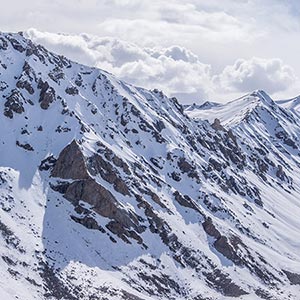
The global environmental crisis affects India along with the entire world.[1]Prof V Ramanathan, in a lecture back in 2009, warned about Himalayan glaciers being the ‘most threatened by global warming.’[2] The Himalayan glaciers, that span about 1,200 miles crossing eight countries, are the source of drinking water, irrigation, and hydroelectric power for about 1.5 billion people. These glaciers are depleting at alarming rates and will reduce water levels in major Indian rivers such as the Ganges and Brahmaputra.
 Population growth and urbanization
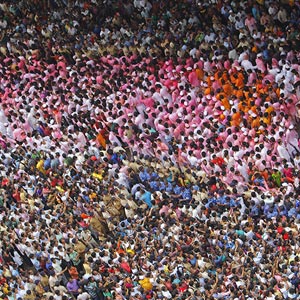
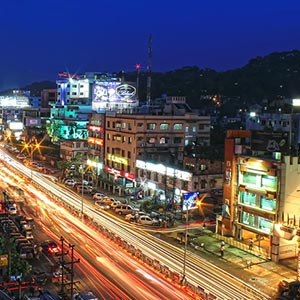
Population analysts project that, by 2050, about 60 percent of Indians will be living in urban areas, where there is an increasing gap between supply and demand of fresh water. The growing demand for urban domestic use of water places immense pressure on diminishing resources.
 Agriculture
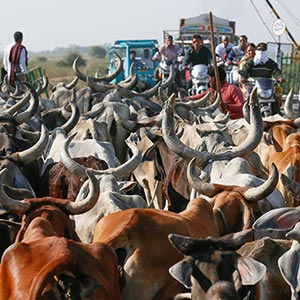
Agriculture is the mainstay of large sections of the population. Nearly 50 percent of the total water available is consumed in agriculture, which, along with increases in population, causes scarcity.[3] It is a global problem too; it is estimated that by 2050 the global agricultural sector will need double the amount of water used to feed the world.
Electricity production
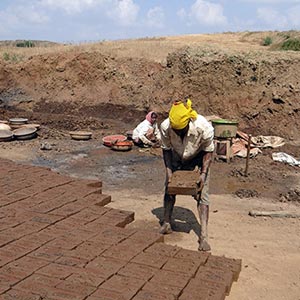 With rapid economic growth and increasing per capita power consumption, the demand for energy resources is ever rising. The energy sector, especially hydro thermal units, requires huge amounts of water. Much of this energy is diverted to the cities, leaving nearly 40 percent of rural households electricity deprived.
Industry
Various industries consume water in large quantities. The perpetual increase in industrial demand for water threatens a further depletion of surface level water.
Water conflicts
Water being such an essential natural resource, it is not surprising that the World Bank predicts it will become a major cause of wars in the twenty-first century. In India, water conflicts exist at various levels from fights beside the village well to interstate water disputes. These minor water conflicts could become major water wars in the future. The following are some major issues in India:
THE WORLD BANK PREDICTS IT WILL BECOME A MAJOR CAUSE OF WARS IN THE TWENTY-FIRST CENTURY.
Religious and caste oppression
Often the so-called ‘lower caste’ communities are denied access to public drinking water wells and other water resources in rural areas. Upper caste Hindus have often ensured that lower castes and especially ‘outcastes’ have no access to water. Disturbingly, such acts have been provided with religious sanction. Such oppression often leads to protests. B.R Ambedkar, the legendary leader of the Dalits, launched a Water Satyagraha (a policy of passive political resistance), in Maharashtra, by marching to a public tank protesting against this prejudice. Recent conflicts show how centuries of caste-based prejudice, deeply rooted in cultures and traditions, have not been eradicated.[4]
However, long before Ambedkar protested over water issues, Christian missionaries had attempted to address the issue by providing equal access to water for all and especially to the outcaste people. This missionary initiative, among others, demonstrated how Christians put into practice biblical principles of dignity, respect, and justice for all people.
Equitable access to drinking water
Equitable access to water has become a demand in contexts where water rights are contested. For instance, in South Maharashtra state, drought-affected farmers have been organizing protests aimed at restructuring some irrigation projects in the area on more equitable lines.[5]
Some Christian organizations have already started responding to the water crisis in central India by assisting drought-stricken people to have access to clean drinking water. Borewells are being dug, villagers are being educated in how to conserve and utilize water, and community committees are being organized so that the water is equally accessed by all. India needs more such initiatives.
 Dams and displacement of people
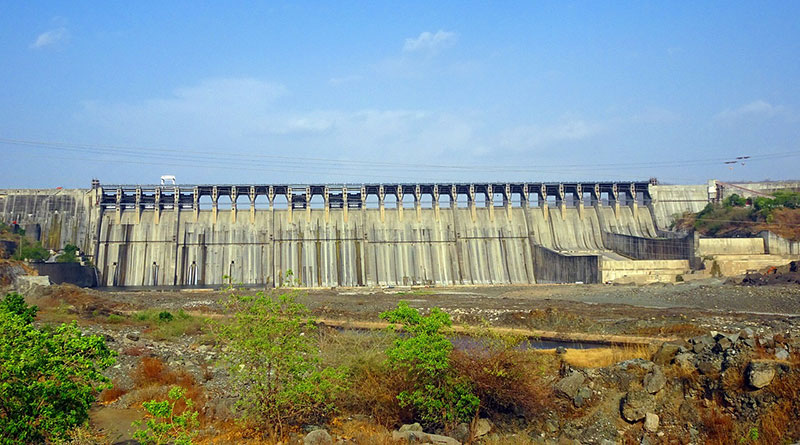
The Sardar Sarovar Project in the Narmada Valley has, for some years now, become a rallying point for protests against large dams. Most countries in South Asia receive the majority of their rainfall during the monsoons. Hence dams are necessary for storage and use during the rest of the year. However, these projects have caused endless political and communal conflicts over issues of unequal sharing and of displaced people.[6] Most Christian NGOs and churches are yet to become seriously involved with those displaced by building of huge dams.
WATER PRIVATIZATION WILL BECOME A POTENT CONFLICT AREA IN MOST SOUTH ASIAN COUNTRIES, ESPECIALLY INDIA.
Privatization of water
Water privatization will become a potent conflict area in most South Asian countries, especially India. Privatization involves the transfer of ownership of water resources from the public sector to the private sector. The first National Water Policy drafted in 1987 by the Government of India stated, ‘Private sector participation should be encouraged in planning, development and management of water resources projects for diverse uses, wherever feasible.’[7] This applied to hydropower, industrial and domestic water supply, and even irrigation. Within a decade, more than 300 private sector participation projects were commissioned.
However, they resulted in an increase in water tariffs, undermining of water quality, non-accountability to customers, reduced local control and public rights, loss of jobs, and impacts on the poor.[8] In the wake of globalization, many multinational companies are competing for access to major water resources, causing depletion of water levels in many parts of India. Christians in India needs to consciously address and speak out against unjust access and usage of water by the powerful and to stand for equal rights to water.
INDIA HAS HAD TRANS-BOUNDARY RIVER WATER CONFLICTS WITH NEIGHBORING COUNTRIES SUCH AS PAKISTAN, BANGLADESH, AND NEPAL.
Trans-boundary conflicts
Trans-boundary water conflicts occur when disagreements escalate with regard to sharing water from rivers that flow across national or state boundaries. India has had trans-boundary river water conflicts with neighboring countries such as Pakistan, Bangladesh, and Nepal.[9] The Indo-Bangladesh conflict over the Ganges is a case in point. Various diplomatic efforts are being undertaken to resolve these trans-national issues on water sharing.
Within India, each state enjoys considerable freedom in deciding issues related to water, and most of the inter-state rivers have become an area of conflict in recent decades. The Cauvery water between Tamil Nadu and Karnataka and the Baghlighar Hydropower Project in Jammu and Kashmir are two examples of inter-state water conflicts. There is ample scope for the Indian Christians to use their influence and to be a catalyst to resolve such trans-boundary water conflicts.
Potential solutions
While there are many solutions being offered to the escalating water crisis, some require huge investments as well as much more research. However, here are two very down-to-earth and feasible solutions:
Various industries consume water in large quantities. The perpetual increase in industrial demand for water threatens a further depletion of surface level water.
Water conflicts
Water being such an essential natural resource, it is not surprising that the World Bank predicts it will become a major cause of wars in the twenty-first century. In India, water conflicts exist at various levels from fights beside the village well to interstate water disputes. These minor water conflicts could become major water wars in the future. The following are some major issues in India:
THE WORLD BANK PREDICTS IT WILL BECOME A MAJOR CAUSE OF WARS IN THE TWENTY-FIRST CENTURY.
Religious and caste oppression
Often the so-called ‘lower caste’ communities are denied access to public drinking water wells and other water resources in rural areas. Upper caste Hindus have often ensured that lower castes and especially ‘outcastes’ have no access to water. Disturbingly, such acts have been provided with religious sanction. Such oppression often leads to protests. B.R Ambedkar, the legendary leader of the Dalits, launched a Water Satyagraha (a policy of passive political resistance), in Maharashtra, by marching to a public tank protesting against this prejudice. Recent conflicts show how centuries of caste-based prejudice, deeply rooted in cultures and traditions, have not been eradicated.[4]
However, long before Ambedkar protested over water issues, Christian missionaries had attempted to address the issue by providing equal access to water for all and especially to the outcaste people. This missionary initiative, among others, demonstrated how Christians put into practice biblical principles of dignity, respect, and justice for all people.
Equitable access to drinking water
Equitable access to water has become a demand in contexts where water rights are contested. For instance, in South Maharashtra state, drought-affected farmers have been organizing protests aimed at restructuring some irrigation projects in the area on more equitable lines.[5]
Some Christian organizations have already started responding to the water crisis in central India by assisting drought-stricken people to have access to clean drinking water. Borewells are being dug, villagers are being educated in how to conserve and utilize water, and community committees are being organized so that the water is equally accessed by all. India needs more such initiatives.
The Sardar Sarovar Project in the Narmada Valley has, for some years now, become a rallying point for protests against large dams. Most countries in South Asia receive the majority of their rainfall during the monsoons. Hence dams are necessary for storage and use during the rest of the year. However, these projects have caused endless political and communal conflicts over issues of unequal sharing and of displaced people.[6] Most Christian NGOs and churches are yet to become seriously involved with those displaced by building of huge dams.
WATER PRIVATIZATION WILL BECOME A POTENT CONFLICT AREA IN MOST SOUTH ASIAN COUNTRIES, ESPECIALLY INDIA.
Privatization of water
Water privatization will become a potent conflict area in most South Asian countries, especially India. Privatization involves the transfer of ownership of water resources from the public sector to the private sector. The first National Water Policy drafted in 1987 by the Government of India stated, ‘Private sector participation should be encouraged in planning, development and management of water resources projects for diverse uses, wherever feasible.’[7] This applied to hydropower, industrial and domestic water supply, and even irrigation. Within a decade, more than 300 private sector participation projects were commissioned.
However, they resulted in an increase in water tariffs, undermining of water quality, non-accountability to customers, reduced local control and public rights, loss of jobs, and impacts on the poor.[8] In the wake of globalization, many multinational companies are competing for access to major water resources, causing depletion of water levels in many parts of India. Christians in India needs to consciously address and speak out against unjust access and usage of water by the powerful and to stand for equal rights to water.
INDIA HAS HAD TRANS-BOUNDARY RIVER WATER CONFLICTS WITH NEIGHBORING COUNTRIES SUCH AS PAKISTAN, BANGLADESH, AND NEPAL.
Trans-boundary conflicts
Trans-boundary water conflicts occur when disagreements escalate with regard to sharing water from rivers that flow across national or state boundaries. India has had trans-boundary river water conflicts with neighboring countries such as Pakistan, Bangladesh, and Nepal.[9] The Indo-Bangladesh conflict over the Ganges is a case in point. Various diplomatic efforts are being undertaken to resolve these trans-national issues on water sharing.
Within India, each state enjoys considerable freedom in deciding issues related to water, and most of the inter-state rivers have become an area of conflict in recent decades. The Cauvery water between Tamil Nadu and Karnataka and the Baghlighar Hydropower Project in Jammu and Kashmir are two examples of inter-state water conflicts. There is ample scope for the Indian Christians to use their influence and to be a catalyst to resolve such trans-boundary water conflicts.
Potential solutions
While there are many solutions being offered to the escalating water crisis, some require huge investments as well as much more research. However, here are two very down-to-earth and feasible solutions:
 Rain-water harvesting
India has adequate rainfall, and, with better management of rainwater, the crisis could be handled effectively. Rainwater harvesting, the accumulation and storage of rainwater, must be urgently considered. There are several success stories, but much more needs to be done. Harvested rainwater can be used for irrigation, and with proper treatment even for drinking. An immediate benefit could be a groundwater recharge, which will address the major problem of decreasing water levels.
Christians in India should to find ways to partner with the Government and social NGOs that are involved in such initiatives. This will demonstrate Christians’ commitment to stand with the community for a common cause.
 Waste water reuse
Reclaimed water, sometimes called recycled water, is wastewater that has been treated to remove solids and impurities. It is then reused for a variety of applications including landscaping, irrigation, and recharging groundwater aquifers. Treating water for reuse is an important part of water conservation efforts, and in some regions of the world is becoming a common feature. There is much written on the subject and being implemented, even in India.[10] This is a viable source of water, particularly suited for agriculture as several nutrients could be recovered and used productively.
Some Christian institutions and NGOs have already started putting into practice waste water re-usage. More of such initiatives could be undertaken by Christians so as to demonstrate their commitment to water conservation as well as re-usage of waste water.
Christian compassion as part of the solution
South Asia, particularly India, faces acute water shortages. Lack of access to drinking water, hunger, disease, and sanitation issues are all interlinked. Increasing urbanization will soon make these challenges increasingly unmanageable. Only good and responsible governance and individual resolve will bring much-needed change.
Christians in India have a great opportunity to take the initiative, in partnership with the global church, to inaugurate projects that would not only address the water issue but also provide lasting solutions to the water crisis in line with its commitment to demonstrating Christ-like love to those affected by it. Christians have the potential to demonstrate compassion during this time of crisis. During any such time, the weak and the lower-caste people become more vulnerable and are deprived. Christians have the opportunity to initiate the tasks of educating the people in preservation and usage of water, equal and just distribution, and of ensuring that the weakest segment of the community is not deprived of access to water. This can all be done in the most Christ-like manner so that all people, regardless of caste or religion, are given equal access to water in India.
Endnotes
Editor’s Note: See article by Ed Brown entitled, ‘Climate Change after Paris: What it means for the evangelical church’, in May 2016 issue of Lausanne Global Analysis https://www.lausanne.org/content/lga/2016-05/climate-change-after-paris. ↑
- The Hindu, November 9, 2009, Updated December 17, 2016. See http://www.thehindu.com/news/national/ldquoHimalayan-glaciers-most-threatened-by-global-warmingrdquo/article16890969.ece#, accessed on 04/01/2017. Prof V. Ramanathan is Director of the Centre for Clouds, Chemistry and Climate, Scripps Institution of Oceanography, San Diego, USA. ↑
- Maryam Mastoor, ‘Environmental Degradation: Focus on Water Scarcity in South Asia,’ Regional Studies, 27:1 (Winter 2008 – 2009), 7. ↑
- K. J. Joy and SuhasParanjape, ‘Understanding Water Conflicts in South India,’ 14, available online as PDF at https://www.academia.edu/, accessed on 17 October 2017. ↑
- K. J. Joy and SuhasParanjape, ‘Understanding Water Conflicts in South India,’13. Available online as PDF at https://www.academia.edu/, accessed on 17 October 2017. Reference to K. J., et al (ed.), Water Conflicts in India: A Million Revolts in the Making (London, New York, New Delhi: Routledge,2007), 98-104. ↑
- K. J. Joy and SuhasParanjape, ‘Understanding Water Conflicts in South India,’ 16-17. ↑
- National Water Policy (April 2002), available online at http://pib.nic.in/newsite/PrintRelease.aspx?relid=70832, accessed on 20 October 2017. ↑
- ‘MakarantPurohit, Privatising India’s Water Is a Bad Idea’, 17 October 2016, https://thewire.in/73597/water-privatisation/, accessed on 20 October 2017. ↑
- For a detailed discussion, see Amit Ranjan, ‘Water Conflicts in South Asia: India’s Transboundary River Water Conflicts with Pakistan, Bangladesh and Nepal,’BIISS Journal, 36:1 (January 2015), 37-55. ↑
- Several waste water projects have been pioneered all over the world, even India, by the International Ecological Engineering Society. See https://iees.ch/, accessed on 20 December 2017. ↑
 Dr Ken Gnanakan founded the ACTS Group of Institutions, International Council for Higher Education and Theological Book Trust, and heads up various other ministries in India and across the world. He is a theologian, environmentalist and philosopher of education, residing in Bangalore, India.
 Having served as a pastor and church planter with the Christian and Missionary Alliance in India, and then as a professor and Head of the Department of Missiology first at Union Biblical Seminary (Pune) and later at South Asia Institute of Advanced Christian Studies (Bangalore), Dr.Atul Aghamkar is currently serving as the director for the National Center for Urban Transformation, an EFI (Evangelical Fellowship of India) initiative.
 How can We Finally Reach the Unreached? - A global versus international model can help
Ben Thomas
The landscape of global Christianity has changed dramatically since 1910. Between 1910 and 2010, the number of missionaries increased from 62,000 to 400,000.[1]Yet, despite the increase, mission and development agencies are still struggling to reach the unreached with the gospel. I argue that one of the key reasons for this is that many organizations are operating from an international model rather than a global model:
- Many mission and development agencies operate from what Gundling, Hogan, and Cvitkovich describe as an ‘International Company: Mother Ship/Baby Ship Model as opposed to a Global Company: The Horizontal Network’.[2]
- By applying principles of global leadership, mission and development agencies can move from being international organizations to global ones.
- They will as a result better serve the unreached.
Here are some definitions for key terms related to global leadership that will be critical in understanding how organizations can become global, rather than just international:
 Global: a connectedness and collaboration between multiple entities within an organization, across cultures and nations, to produce end products that serve local needs.
 International: an arm or extension of a national company doing work in another country or countries.
 Global leader: a lifelong learner who has a God-given capacity to influence a specific group of people towards God’s purposes across cultures and nations, while accomplishing personal and organizational objectives.
 Global leadership: a dynamic and active process that leads people from multiple countries and cultures towards accomplishing the vision regardless of the multiplexities that are present.
 Global organizations: operate in or serve multiple countries, often with a matrix structure where each subsidiary is deliberately sharing information and expertise with the others and headquarters, and learning from each other to best serve their constituents in each country.
 Global mindset: what you know about other cultures/countries; your desire to learn more about them; and how you put your knowledge into action as you engage and interact with people from other cultures and countries.
MISSION AND DEVELOPMENT AGENCIES NEED TO MAKE DRASTIC CHANGES AS THEY FACE THE CHALLENGES OF THE NEXT HUNDRED YEARS.
How do we know we have a problem?
Key data points collected by Johnson and Ross suggest that mission and development agencies need to make drastic changes as they face the challenges of the next hundred years, particularly in relation to serving the unreached:
- The most eye-opening number is that, as of 2010, ‘Buddhists, Hindus and Muslims have relatively little contact with Christians. In each case, over 86% of these religionists globally do not personally know a Christian’.[3] While mission and development agencies have worked hard, something is clearly off in our strategies to reach non-Christians, if religionists from these three groups do not know a Christian. The remaining three data points offer an explanation as to why this number is correct: the strategies of mission and development agencies match the results that are being seen.
- Over 85 percent of evangelism offers are directed at current Christians whereas only two percent are directed at the unevangelised. ‘Evangelism offers to already Christians account for over 85%, Muslims receive 2.2% of evangelism offers, Hindus receive 0.9% of evangelism offers, and Buddhists receive 0.7% of total evangelism offers.’[4] Put another way, the unevangelised receive two percent of evangelism offers, the already evangelized but not yet Christian receive 12.6 percent and already Christians receive 85.4 percent.[5]
- In 2010, there were nearly 10 times as many missionaries operating in North America (40,200) as there were in Northern Africa (4,300).[6] Far fewer missionaries are being sent to the unevangelised than to the already Christian. ‘Missionaries today are sent from everywhere and are received everywhere. But from the standpoint of evangelising non-Christians, one can see a problem: countries with largely Christian populations receive relatively more missionaries than majority non-Christian countries. One dramatic example of this is Brazil (a largely Christian country), which receives a total of 20,000 missionaries, whereas Bangladesh, with nearly as many people, only receives 1,000 missionaries’.[7]
- Christians are directing less than one percent of their giving towards unevangelised non-Christians. ‘At present, about 82% of Christian expenditure is dedicated to the pastoral ministries of the churches in the home countries of the givers, mostly in the heartlands of the Christian faith. Another 12% is spent on home missions in those same countries, with 5.6% going to foreign missions. Much of this money, however, is spent on work among Christians (in the case of foreign missions) or in affluent countries that already have large Christian populations (in the case of home missions). As a result, only 0.3% of total Christian expenditures is actually directed towards unevangelised non-Christians’.[8]
Need for change
After absorbing these four data points, mission and development agencies need to be intentional in changing their approach to their work. The remainder of this article will examine whether operating like a global organization could help mission and development agencies better achieve their goals, and allow them to do a better job of reaching the unreached.
Key Findings on Global Agencies
Research into a small sample size of NGOs and mission agencies operating in Rwanda that have an international or global headquarters elsewhere has yielded the following findings[9] on the distinct characteristics that distinguish global from international organizations:
- Global agencies do not drive their national agendas from headquarters, but from their national offices.
- Strategy decisions that pertain to the national offices are determined by the national offices.
- Global agencies share the funding responsibility between the national offices and the global headquarters.
- Final staffing decisions are made by the national office, in conjunction with headquarters where appropriate.
- National directors have access to the highest level of leadership of the organization.
- Thorough training of national directors is a key part of the process.
- Global agencies have proper systems in place for collaboration between national offices and headquarters.
- They also have proper systems for collaboration between countries and within strategies across the organization, regardless of where anyone in the organization is located.
There are different ways to accomplish a mission. While there were similarities in how some of the agencies functioned, and similar goals for their mission and vision, each was unique in how it sought to accomplish its mission.
- The most satisfied leaders were those whose organizational structures and processes were people-driven and not structure-driven.
- All organizations and leaders should seek to be globally sensitive as they move towards accomplishing their mission at every level of the organization.
- Organizations and leaders who serve globally must be intentional about their training and leadership development, specifically in the area of training in a global mindset.
- To become more global, ideas and practices need to be shared across borders. Constituents and leaders in the Global South must be heard as they are closest to the challenges of the unreached.
- To become more global, organizations must learn how headquarters can share more power with the field.
- In various interviews with the leaders of national offices, frustrations were evident when the board comprised primarily members of the founding country. As an organization grows from a national one to a global one, board members must reflect the diversity of the whole organization, and not just the founding country.
- Intentional collaboration processes are vital to an organization’s ability to learn.
- An intentional posture of learning is key for the success of any global organization or global leader.
In many ways, this study continues and is unfinished business. The author is making changes in his own life and ministry to focus more on serving the unreached through the platform of education. The author does not have data points to offer from organizations that are currently serving the unreached, as Rwanda does not have unreached people groups. That being said, the author would suggest the following applications for the church and mission/development agencies to consider in reaching the unreached:
 Each leader and organization should consider doing a brief self-study to determine if they are global or international. Depending on the result, they can then determine their next steps to move toward greater effectiveness in reaching the unreached. If organizations and leaders wish to be more intentional, what is one area they can move forward in to be more global?
 Within every organization there are already useful strategies to consider in serving the unreached. Leaders and organizations could consider taking what is working well and growing their strengths. They could consider shifting their resources to take what they have learned to focus on the unreached. How can they empower themselves or those with a call to the unreached, even if they are not in their organization, to be equipped within a proven strategy for mission to the unreached?
 How can each leader and organization commit to serving better within the global community of Christians for the sake of the gospel?In our time, there are so many divisions within the global family of Christ. What single step can each leader and organization take to learn more about a fellow member of the body of Christ? How might this better show the world Christ’s love? How might this further each leader and organization’s ability to serve the unreached?
THE UNEVANGELIZED ARE BEST SERVED BY ORGANIZATIONS FEATURING GLOBAL LEADERSHIP.
Conclusion
Though the data points shared above are limited to organizations in Rwanda, the author believes these can be applied to mission and development agencies worldwide. The author is looking to expand his data to include organizations serving among the unreached in order to better formulate his conclusions. That being said, the author believes that our strategies in mission and development clearly need to change since many current mission efforts are directed at the wrong targets.
Based on his research, the author believes that the unevangelized are best served by organizations featuring global leadership. These organizations are more effective in representing the diversity of global Christianity and are more likely to encourage local contextualization of the gospel. While the author believes organizations that display global leadership principles will be better suited to serving the unreached with the Gospel, he invites readers to join a discussion to test the correlations that seem to exist. As a result of implementing some of the global leadership principles found above, may more Hindus, Muslims, Buddhists and other not-yet believers come to know Jesus through personal relationships with Christ-followers.
Endnotes
- Todd M. Johnson and Kenneth R. Ross, Atlas of Global Christianity 1910 – 2010 (Edinburgh: Edinburgh University Press, 2009), 261. ↑
- Ernest Gundling, Terry Hogan, and Karen Cvitkovich, What is Global Leadership?: 10 Key Behaviors that Define Great Global Leaders (Boston: Nicholas Brealey Publishing, 2011),79-80. ↑
- Johnson and Ross, Atlas of Global Christianity, 316. ↑
- Ibid, 318. ↑
- Ibid, 318. ↑
- Ibid, 261. ↑
- Ibid, 261. ↑
- Ibid, 296. ↑
 Benjamin Thomas, Global Leadership: Helping Mission & Development Organizations and Leaders Navigate the Path From Being International to Being Global, Dissertation for Gordon-Conwell Theological Seminary, Hamilton, MA, 2016. ↑
Ben Thomas and his wife Susie lead the Kigali International Community School in Kigali, Rwanda. They are co-founders of B2theworld, an organization focused on blessing children, families, and communities in countries recovering from war through transformational educational institutions. In 2016 Ben completed his Doctor of Ministry in Global Christianity and Development from Gordon-Conwell Theological Seminary.
 A Summons to a Global Integrity Movement - Fighting self-deception and corruption
Kelly and Michèle O’Donnell
How much integrity do you have? If you are like most people, your response is a definite ‘lots!’ Yet in spite of our character strengths such as courage and loyalty, our self-appraisals of integrity can be seriously influenced by our own self-serving distortions—namely, rationalizing away inconsistencies between our purported values and our actual actions. ‘I am a moral person and a model person’ can be one of the greatest self-evident truths of human history, at least to ourselves.[1]
In this article we distill some of the lessons we have learned over the past 15 years in promoting integrity and confronting corruption. Why is it hard to live up to our moral and ethical aspirations? We reflect on the reality of dysfunction and deviance, highlight the challenge of self-deception, describe anti-corruption resources, and summon the church-mission community (CMC) to a global integrity movement marked by righteousness and relevance.
- We are the light—or the darkness—of the world

- Integrity is moral wholeness—living consistently in moral wholeness. Its opposite is corruption: the distortion, perversion, and deterioration of moral goodness, resulting in the exploitation of people and planet.[3]
- Global integrity is moral wholeness at all levels in our world—from the individual to the institutional to the international and everything in-between. Living in global integrity is essential for sharing the good news and good works among all peoples. It is also requisite for fostering sustainable development-transformation, health-wellbeing, and peace-security in our world. Integrity is not easy, it is not always black and white, and it can be risky.[4]
Searching for integrity
About 10 years ago I (Kelly) was in conversation with one of my closest friends, lamenting why it can be so hard for good people simply to try to do good in an organizational context. Why can organizational life, especially in Christian organizations, sometimes be so bleak? Why can integrity be so elusive?
An hour into this discussion of leadership hubris, systemic dysfunction, and wrongful dismissals, my friend gently offered me two words of advice: ‘Read Machiavelli’.
Manipulating virtue and vice
He was referring to the sixteenth-century treatise on power by Nicolò Machiavelli, The Prince.[5] Machiavelli resolved to develop a reasoned argument for leadership that was practical and reality-based, and not simply idealistic or solely virtue-centered. Power could be ‘legitimately’ unencumbered by ethical values.
So I read and reread Machiavelli, determined to upgrade my understanding of how the organizational world often works. Especially illuminating was a core principle from Chapter 15:
A MAN WHO WISHES TO ACT ENTIRELY UP TO HIS PROFESSIONS OF VIRTUE SOON MEETS WITH WHAT DESTROYS HIM AMONG SO MUCH THAT IS EVIL.
A man who wishes to act entirely up to his professions of virtue soon meets with what destroys him among so much that is evil. Hence it is necessary for a prince wishing to hold his own to know how to do wrong, and to make use of it or not according to necessity.[6]
Machiavelli’s work was a major influence in the realpolitik thinking that has impacted governance practices for the last five centuries, which has crept into the CMC, and which has undermined the global integrity so desperately needed in our world today.[7]
Exposing dysfunction and deviance
Unfortunately we can all be seriously duped and disabled by Machiavellian-type people and processes (Luke 16:8). We call these DD Realities (DD): personal and organizational dysfunction (distortion of reality for one’s own ends) and deviance (exploitation of others for one’s own ends).[8]
DD is often disguised as ‘virtuous’ or ‘necessary for the greater good’. In organizations, managing DD is especially tricky when there is insufficient understanding, accountability, or political will to enforce good practice standards resolutely. Above all, DD is reinforced when people compromise their integrity by looking the other way, rationalizing their responsibility, and ultimately becoming polluted themselves (see Prov 16:2 and 25:26).[9]
Tactics for sustaining DD
This grid helps recognize the presence and progression of DD in organizational settings. These five tactics can overlap. The grid can also be used as a mirror into one’s own integrity:[10]
Cognitive dissonance is a powerful concept from social psychology that can help us to understand our propensity to deceive ourselves while still believing we are living in integrity (Jer 17:9). It refers to the self-serving rationales that we use to calm our disturbing, internal incongruence and harmonize discrepant thoughts about ourselves—who we want to be versus who we actually are.
 Illustration courtesy Marc Rosenthal (www.marc-rosenthal.com)
Tavris and Aronson (2007) shed light on how our inner moral maneuvers help us feel good about ourselves:[12]
These four tactics illustrate what not to do when we are asked to give an account for a possible mistake or misconduct. Use this as a mirror into your own life and integrity:
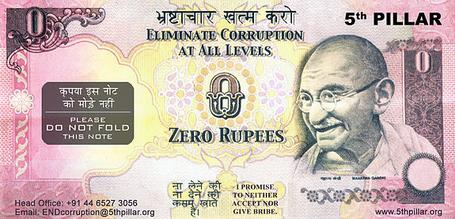 The Zero Rupees banknote, part of a major anti-corruption campaign in India.[18]
Fortunately, many publicized scandals and campaigns have sensitized us to the grim realities of corruption.[22] To combat corruption, we urge colleagues to:
a) cultivate a life of integrity: ‘Your task is to be true, not popular’ (Luke 6:26, The Message);[23]
b) appreciate your own vulnerability to temptation, including propensities to distort and justify mistakes and misdeeds (Prov 20:6); and
c) connect and contribute across sectors as people of integrity, keeping current with multi-sectoral resources on integrity and corruption such as those listed/linked at the end of the article and in the endnotes.[24]
Summons: A global integrity movement

About 10 years ago I (Kelly) was in conversation with one of my closest friends, lamenting why it can be so hard for good people simply to try to do good in an organizational context. Why can organizational life, especially in Christian organizations, sometimes be so bleak? Why can integrity be so elusive?
An hour into this discussion of leadership hubris, systemic dysfunction, and wrongful dismissals, my friend gently offered me two words of advice: ‘Read Machiavelli’.
Manipulating virtue and vice
He was referring to the sixteenth-century treatise on power by Nicolò Machiavelli, The Prince.[5] Machiavelli resolved to develop a reasoned argument for leadership that was practical and reality-based, and not simply idealistic or solely virtue-centered. Power could be ‘legitimately’ unencumbered by ethical values.
So I read and reread Machiavelli, determined to upgrade my understanding of how the organizational world often works. Especially illuminating was a core principle from Chapter 15:
A MAN WHO WISHES TO ACT ENTIRELY UP TO HIS PROFESSIONS OF VIRTUE SOON MEETS WITH WHAT DESTROYS HIM AMONG SO MUCH THAT IS EVIL.
A man who wishes to act entirely up to his professions of virtue soon meets with what destroys him among so much that is evil. Hence it is necessary for a prince wishing to hold his own to know how to do wrong, and to make use of it or not according to necessity.[6]
Machiavelli’s work was a major influence in the realpolitik thinking that has impacted governance practices for the last five centuries, which has crept into the CMC, and which has undermined the global integrity so desperately needed in our world today.[7]
Exposing dysfunction and deviance
Unfortunately we can all be seriously duped and disabled by Machiavellian-type people and processes (Luke 16:8). We call these DD Realities (DD): personal and organizational dysfunction (distortion of reality for one’s own ends) and deviance (exploitation of others for one’s own ends).[8]
DD is often disguised as ‘virtuous’ or ‘necessary for the greater good’. In organizations, managing DD is especially tricky when there is insufficient understanding, accountability, or political will to enforce good practice standards resolutely. Above all, DD is reinforced when people compromise their integrity by looking the other way, rationalizing their responsibility, and ultimately becoming polluted themselves (see Prov 16:2 and 25:26).[9]
Tactics for sustaining DD
This grid helps recognize the presence and progression of DD in organizational settings. These five tactics can overlap. The grid can also be used as a mirror into one’s own integrity:[10]
- Deny. Conceal DD. ‘Don’t ask about problems (even obvious ones), don’t tell about problems, and don’t rock the boat’ is a pervasive, core, unwritten rule.
- Downplay. Minimize DD’s negative impact. State that it is probably ‘normal’. Relational unity and conformity trump truth and genuine relationships.
- Distract. Distract from the real DD issues. ‘Feign pain’ and get sympathy; or admit that something is ‘not exactly right’ and refer to problems as being largely a matter of having different perspectives/preferences–a need to agree to disagree.
- Discredit. Belittle those who point out or inquire about DD. Silence them. Instill an atmosphere of fear of reprisals and intimidation to prevent people from speaking up or calling for good practice.
- Destroy. Demolish people’s reputations, contributions, relationships, and wellbeing. Use half-truths, spin, lies, rumors, threats, false accusations, and dismissals. Reap the benefits of control, position, respect, status quo, and revenue streams.
Cognitive dissonance is a powerful concept from social psychology that can help us to understand our propensity to deceive ourselves while still believing we are living in integrity (Jer 17:9). It refers to the self-serving rationales that we use to calm our disturbing, internal incongruence and harmonize discrepant thoughts about ourselves—who we want to be versus who we actually are.
Tavris and Aronson (2007) shed light on how our inner moral maneuvers help us feel good about ourselves:[12]
- Most people, when directly confronted by evidence that they are wrong, do not change their point of view or course of action but justify it even more tenaciously. Even irrefutable evidence is rarely enough to pierce the mental armor of self-justification….Yet mindless self-justification, like quicksand, can draw us deeper into disaster. It blocks our ability even to see our errors, let alone correct them. It distorts reality, keeping us from getting all the information we need and assessing issues clearly. It prolongs and widens rifts between lovers, friends, and nations. It keeps us from letting go of unhealthy habits. It permits the guilty to avoid taking responsibility for their deeds. (pp. 2, 9-10)
- Self-justification to minimize cognitive dissonance is a big reason why any leader can become a ‘bad’ leader—Machiavellian. One international survey assessing the experiences/views of Christian leaders identified three main categories of negative characteristics of fellow leaders: ‘Prideful, always right, and always the big boss; lack of integrity, untrustworthy; harsh, uncaring, refused to listen, critical’.[13]
- Robert Sternberg’s extensive research consistently finds that bad leaders see themselves as being above accountability—‘ethics are for other people’. They do not avail themselves of needed input from others to complement, balance, and correct themselves. They lapse into an unrealistic and often disguised sense of omnipotence, inerrancy, unrealistic optimism, and invulnerability. They become entrenched in their ways, even when it is obvious to others that they are digging a bigger pit of mistakes into which they and others will fall.[14]
These four tactics illustrate what not to do when we are asked to give an account for a possible mistake or misconduct. Use this as a mirror into your own life and integrity:
- Distance yourself from the issue. Dodge, reword, or repackage it. Obfuscate the facts, talk tentatively or vaguely about concerns or ‘mistakes in the past’. Disguise any culpability.
- Appeal to your ‘integrity’ and acting with the ‘highest standards’. Point out your past track record, your current contributions, and that you are doing your best. Punctuate it all with the language of transparency and accountability without demonstrating either.
- State that you are being attacked, being treated unfairly, and that people do not understand. Remind everyone that leadership is hard and full of ambiguities and tough choices. Mention other peoples’ problems; question their motives and credibility.
- Hold out until the uncomfortable stuff goes away. Sack staff but do not change the system. Maintain your lifestyle, affiliations, and illusions of moral congruity. Remember, you are special. Cognitive dissonance applies to others but not to you.
- Corruption is commonly defined as the abuse of entrusted power for private gain.[15] It especially preys on the poor, with estimates of over one trillion dollars being siphoned off each year from developing countries.[16] Within the CMC, an estimated USD 63 billion are stolen through ‘ecclesiastical crime’. This figure is more than the estimated USD 56 billion of income for ‘global foreign missions’![17]
- Corruption is not just about financial fraud.[19] It also manifests as ‘bribery, law-breaking without dealing with the consequences in a fair manner, unfairly amending election processes and results, and covering mistakes or silencing whistle blowers (those who expose corruption in hope that justice would be served).’[20]
- In the humanitarian sector corruption extends into ‘nepotism/cronyism, sexual exploitation and abuse, coercion and intimidation of humanitarian staff or aid recipients for personal, social or political gain, manipulation of assessments, targeting and registration to favor particular groups, and diversion of assistance to non-target groups.’[21]
Fortunately, many publicized scandals and campaigns have sensitized us to the grim realities of corruption.[22] To combat corruption, we urge colleagues to:
a) cultivate a life of integrity: ‘Your task is to be true, not popular’ (Luke 6:26, The Message);[23]
b) appreciate your own vulnerability to temptation, including propensities to distort and justify mistakes and misdeeds (Prov 20:6); and
c) connect and contribute across sectors as people of integrity, keeping current with multi-sectoral resources on integrity and corruption such as those listed/linked at the end of the article and in the endnotes.[24]
Summons: A global integrity movement
- Our globalized world is marked by extraordinary progress alongside unacceptable—and unsustainable—levels of want, fear, discrimination, exploitation, injustice and environmental folly at all levels….We have the know-how and the means to address these challenges, but we need urgent leadership and joint action now….I urge Governments and people everywhere to fulfill their political and moral responsibilities. This is my call to dignity, and we must respond with all our vision and strength (excerpts from Paragraphs 11, 13, 25). UN Secretary-General Ban Ki-moon (2014)[25]
- We believe our common identity and shared responsibility as Christians who are global citizens can be leveraged to integrate integrity into the individual-institutional-international levels, and everything in-between.[26] We believe it is a propitious season to invest in global integrity.
- We envision a growing, sustainable Global Integrity Movement, perhaps catalyzed by the Lausanne Movement[27] in collaboration with other major groups. It would be a platform for ‘connecting influencers, integrity, and ideas for global mission’.[28]
Gazing into the global mirror, contemplating our global integrity.[29]
We call upon righteous and relevant people, committed to Jesus Christ and the good news, to work together resolutely and across sectors on behalf of the wellbeing of all people and the planet.
Global integrity requires ongoing, honest reflection at all levels. Like the character and virtue in which it is embedded, it is refined in the caldron of life’s tough challenges and choices. We are the light—or the darkness—of the world. We can be keys to influencing moral wholeness for a whole world.[30]
Resources
Church-Mission Community
—Globethics (online resources)
—The Name of God is Mercy (2016), Pope Francis (chapter seven: ‘Sinners Yes, Corrupt No’)
—Thirty Pieces of Silver: An Exploration of Corruption in the Christian Scriptures (2014) Paula Gooder, Bible Society UK
—Salt and Light: Christians’ Role in Combating Corruption (2010) Paul Batchelor and Steve Osei-Mensah, Lausanne Global Conversation
—Corruption-Free Churches Are Possible: Experiences, Values, Solutions. (2010), Christof Stückelberger, Globethics
Corporate Sector
—Fraud Magazine (online resources)
—Toolkit for Business Leaders on Ethical and Transparent Business Practice (2014), EXPOSED Campaign
—Transparency: How Leaders Create a Culture of Candor (2008), Warren Bennis et al.
—Snakes in Suits: When Psychopaths Go to Work (2006), Paul Babiak and Robert Hare
—UN Global Compact (2002/2004), (Principle 10, anti-corruption for businesses)
Humanitarian Sector
–Collective Resolution to Enhance Accountability and Transparency in Emergencies: Synthesis Report (2017), Transparency International
—Corruption: A Challenge that Does Not Escape the Humanitarian Sector (2016), Malika Aït-Mohamed Parent
–Fighting Fraud and Corruption in the Humanitarian and Global Development Sector (2016), Oliver May
—Humanitarian Accountability Report (2015), CHS Alliance (chapter nine on corruption)
—Core Humanitarian Standard on Quality and Accountability (2014) and Guidance Notes and Indicators (2015), CHS Alliance (Principle 9)
United Nations
—UN Office on Drugs and Crime (online resources)
—International Anti-Corruption Day (9 December)
—Transforming Our World: The 2030 Agenda for Sustainable Development (2015), (Goal 16 highlights corruption)
—UN Competency Development: A Practical Guide (2010), (rating and developing integrity, pp. 12-18)
—Convention Against Corruption (2005), United Nations
Various (government and civil society)
—Transparency International (online resources, including the new Anti-Corruption Knowledge Hub)
—Global Declaration Against Corruption (2016); Anti-Corruption Summit, London
—Corruption Perception Index (2016), Transparency International
—Moral Disengagement: How People Do Harm and Live with Themselves (2016), Albert Bandura
—Curtailing Corruption: People Power for Accountability and Justice (2014), Shaazka Beyerle
Videos
—Why Can’t Grace Go to School (2014), EXPOSED Campaign (three minutes)
—The Dangers of Willful Blindness (2013), Margaret Heffernan, TedTalk (15 minutes)
—Courage or Cowardice (2013), Mukesh Kapila, TedxTalk (14 minutes)
—Time to Wake Up (2012), Transparency International (one minute)
—The Psychology of Evil: How Good People Become Evil (2008), Phil Zimbardo, TedTalk (23 minutes)
—Confronting Idols—with Humility, Integrity, and Simplicity (2010), Chris Wright, Lausanne Movement (23 minutes)
Endnotes
We call upon righteous and relevant people, committed to Jesus Christ and the good news, to work together resolutely and across sectors on behalf of the wellbeing of all people and the planet.
Global integrity requires ongoing, honest reflection at all levels. Like the character and virtue in which it is embedded, it is refined in the caldron of life’s tough challenges and choices. We are the light—or the darkness—of the world. We can be keys to influencing moral wholeness for a whole world.[30]
Resources
Church-Mission Community
—Globethics (online resources)
—The Name of God is Mercy (2016), Pope Francis (chapter seven: ‘Sinners Yes, Corrupt No’)
—Thirty Pieces of Silver: An Exploration of Corruption in the Christian Scriptures (2014) Paula Gooder, Bible Society UK
—Salt and Light: Christians’ Role in Combating Corruption (2010) Paul Batchelor and Steve Osei-Mensah, Lausanne Global Conversation
—Corruption-Free Churches Are Possible: Experiences, Values, Solutions. (2010), Christof Stückelberger, Globethics
Corporate Sector
—Fraud Magazine (online resources)
—Toolkit for Business Leaders on Ethical and Transparent Business Practice (2014), EXPOSED Campaign
—Transparency: How Leaders Create a Culture of Candor (2008), Warren Bennis et al.
—Snakes in Suits: When Psychopaths Go to Work (2006), Paul Babiak and Robert Hare
—UN Global Compact (2002/2004), (Principle 10, anti-corruption for businesses)
Humanitarian Sector
–Collective Resolution to Enhance Accountability and Transparency in Emergencies: Synthesis Report (2017), Transparency International
—Corruption: A Challenge that Does Not Escape the Humanitarian Sector (2016), Malika Aït-Mohamed Parent
–Fighting Fraud and Corruption in the Humanitarian and Global Development Sector (2016), Oliver May
—Humanitarian Accountability Report (2015), CHS Alliance (chapter nine on corruption)
—Core Humanitarian Standard on Quality and Accountability (2014) and Guidance Notes and Indicators (2015), CHS Alliance (Principle 9)
United Nations
—UN Office on Drugs and Crime (online resources)
—International Anti-Corruption Day (9 December)
—Transforming Our World: The 2030 Agenda for Sustainable Development (2015), (Goal 16 highlights corruption)
—UN Competency Development: A Practical Guide (2010), (rating and developing integrity, pp. 12-18)
—Convention Against Corruption (2005), United Nations
Various (government and civil society)
—Transparency International (online resources, including the new Anti-Corruption Knowledge Hub)
—Global Declaration Against Corruption (2016); Anti-Corruption Summit, London
—Corruption Perception Index (2016), Transparency International
—Moral Disengagement: How People Do Harm and Live with Themselves (2016), Albert Bandura
—Curtailing Corruption: People Power for Accountability and Justice (2014), Shaazka Beyerle
Videos
—Why Can’t Grace Go to School (2014), EXPOSED Campaign (three minutes)
—The Dangers of Willful Blindness (2013), Margaret Heffernan, TedTalk (15 minutes)
—Courage or Cowardice (2013), Mukesh Kapila, TedxTalk (14 minutes)
—Time to Wake Up (2012), Transparency International (one minute)
—The Psychology of Evil: How Good People Become Evil (2008), Phil Zimbardo, TedTalk (23 minutes)
—Confronting Idols—with Humility, Integrity, and Simplicity (2010), Chris Wright, Lausanne Movement (23 minutes)
Endnotes
- The opening paragraphs are adjusted from Kelly O’Donnell and Michèle Lewis O’Donnell, Living in Global Integrity, Global Integration Update: Common Ground for the Common Good (April 2017). http://globalintegrators.blogspot.com/2017/04/. ↑
- M. C. Escher, Circle Limit IV (1960)https://www.wikiart.org/en/m-c-escher/circle-limit-iv. ↑
- We are grateful for David Bennett’s helpful discussion of integrity in ‘Integrity, the Lausanne Movement, and a Malaysian Daniel’, Lausanne Global Analysis (January 2015), https://www.lausanne.org/content/lga/2015-01/integrity-the-lausanne-movement-and-a-malaysian-daniel. ↑
- See the 25 entries on ‘Global Integrity: Moral Wholeness for A Whole World’ in CORE Member Care: Reflections, Research, and Resources for Good Practice (2016), http://coremembercare.blogspot.fr/search/label/global%20integrity. ↑
- Nicolò Machiavelli, The Prince (1515), http://www.gutenberg.org/files/1232/1232-h/1232-h.htm. ↑
- Ibid. Chapter 15 concisely summarizes, in about 500 words, much of Machiavelli’s advice for maintaining positions of power: ‘Concerning Things for which Men, and Especially Princes, Are Praised or Blamed,’ http://www.gutenberg.org/files/1232/1232-h/1232-h.htm#link2HCH0015. ↑
- Many of the references to ‘integrity’ from the Cape Town Commitment (2010) are cited in ‘Global Integrity—21’, CORE Member Care: Reflections, Research, and Resources for Good Practice (12 November 2016),http://coremembercare.blogspot.fr/search/label/Cape%20Town%20Commitment. ↑
- See the various terms used in the New Testament to describe evil people within the church and warnings to not be naïve. ‘Member Care: Tares, Tears, and Terrors,’ CORE Member Care: Reflections, Research, and Resources for Good Practice(6 November 2008) http://coremembercare.blogspot.fr/search/label/na%C3%AFve. ↑
- The lesson from Machiavelli was a prelude to the learning that we were to undergo in dealing with corruption. Starting in 2007 we have joined with colleagues to expose a long-term, international fraud. Together we contacted and consulted with four governments and called upon the assistance of several organizations and people primarily in the church-mission community to disclose how they had been affected (PETRA People Network). https://sites.google.com/site/petrapeople/. ↑
- Adapted from Kelly O’Donnell, ‘Wise as Doves and Innocent as Serpents? Doing Conflict Management Better,’ Evangelical Missions Quarterly (2007). This article is available in 12 languages on the Reality DOSE web page (https://sites.google.com/site/mcaresources/) and is expanded in Part Two of Global Member Care (volume one): The Perils and Perils of Good Practice (Pasadena, CA USA: William Carey Library, 2011) https://www.amazon.in/Global-Member-Care-Pearls-Practice-ebook/dp/B00IK71QM6 and Member Care in India: From Ministry Call to Home Call(Vellore, TN India: Missionary Upholders Trust, 2012). ↑
- Adapted from: Kelly O’Donnell, ‘Integrity and Accountability for United Nations Staff: Navigating the Terrain,’ UN Special, Issue 767 (March 2017, pp. 40-41), https://www.unspecial.org/2017/03/integrity-and-accountability-for-un-staff/. ↑
- Carol Tavris and Eliot Aronson, Mistakes Were Made (but not by me): Why We Justify Foolish Beliefs, Bad Decisions, and Hurtful Acts, (Orlando: Harcourt, 2007). ↑
- Lausanne Movement. We Have a Problem!—But There is Hope (2010), https://www.lausanne.org/content/we-have-a-problem-but-there-is-hope-results-of-a-survey-of-1000-christian-leaders-from-across-the-globe. ↑
- This summary of bad leader qualities is based on a presentation by Robert Sternberg given at Tuft’s University in 2009. A longer summary is in ‘Resources for Good Practice’ (chapter 8), Global Member Care (volume one): The Pearls and Perils of Good Practice (Pasadena: William Carey Library, 2011), Kelly O’Donnell https://www.amazon.in/Global-Member-Care-Pearls-Practice-ebook/dp/B00IK71QM6. ↑
- This is Transparency International’s succinct definition of corruption. https://www.transparency.org/what-is-corruption. ↑
- ONE. ‘Trillion Dollar Scandal Report’ (2014), https://www.one.org/international/policy/trillion-dollar-scandal/. ↑
- Johnson, Todd, Gina Zurlo, Peter Crossing, and Bert Hickman, ‘Christianity 2018: More African Christians and Christian Martyrs,’ International Bulletin of Mission Research (January 2018, Vol. 42, No. 1). See also Todd Johnson, Gina Zurlo, and Albert Hickman, ‘Embezzlement in the Global Christian Community,’ The Review of Faith and International Affairs (2015, 13(2) pp. 74-94), https://www.researchgate.net/publication/277977397_EMBEZZLEMENT_IN_THE_GLOBAL_CHRISTIAN_COMMUNITY. ↑
- For more information on the Zero Rupees banknote campaign against corruption, see https://www.weforum.org/agenda/2015/12/the-power-of-a-zero-rupee-note/. ↑
- See the list of 60 categories in Transparency International’s Anti-Corruption Glossary. ↑
- Time and Date, ‘International Anti-Corruption Day,’https://www.timeanddate.com/holidays/un/international-anti-corruption-day. ↑
- Feinstein International Center, Humanitarian Policy Group, and Transparency International, Preventing Corruption in Humanitarian Assistance: Final Research Report (2008), http://www.odi.org.uk/sites/odi.org.uk/files/odi-assets/publications-opinion-files/1836.pdf. ↑
- For a composite case study on corruption, including Biblical and psychological perspectives, see Kelly O’Donnell and Michèle Lewis O’Donnell, ‘Loving Truth and Peace: A Case Study of Family Resilience in Mission/Aid Corruption,’ Family Accountability in Missions: Korean and Western Case Studies. (New Haven, CT: OMSC Publications, 2013, pp. 175-86) http://membercareassociates.org/wp-content/uploads/2017/11/Loving-Truth-and-Peace-Mission-Aid-Corruption-ODonnells.pdf See also the anti-corruption campaigns by Transparency International (https://www.transparency.org/), ONE (https://www.one.org/international/), and the EXPOSED Campaign (https://www.eauk.org/current-affairs/news/exposing-corruption.cfm). ↑
- See the resources for developing integrity in Kelly O’Donnell ‘Integrity and Accountability for United Nations Staff: Staying the Course,’ UN Special, Issue 768 (April 2017), pp. 40-41) https://www.unspecial.org/2017/04/integrity-and-accountability-for-un-staff-2/. ↑
- For suggestions about connecting and contributing across sectors these two resources: Kelly O’Donnell, ‘Charting Your Course through the Sectors’ (chapter 2) in Kelly O’Donnell and Michèle Lewis O’Donnell (Eds.), Global Member Care (volume two): Crossing Sectors for Serving Humanity (Pasadena: William Carey Library, 2013), https://www.amazon.com/Global-Member-Care-Crossing-Humanity-ebook/dp/B00HX6WZLQ/ref=pd_sim_351_1?_encoding=UTF8&psc=1&refRID=4J0CZBSRGVKC4SG6HME9) and Kelly O’Donnell and Michèle Lewis O’Donnell, ‘GIobal Grids: New Strategies for Staying Informed,’ Global Integration Updates (October 2016, Number 11) https://us10.campaign-archive.com/?u=e83a5528fb81b78be71f78079&id=417e55ffc6. ↑
- Ban Ki-moon, The Road to Dignity by 2030: Ending Poverty, Transforming All Lives, and Protecting the Planet. Synthesis Report of the Secretary-General on the Post-2015 Sustainable Development Agenda (December 2014)https://sustainabledevelopment.un.org/majorgroups/post2015/synthesisreport; for additional quotes by influential organizations regarding the urgent need and responsibility to address the issues in our world, see Kelly O’Donnell and Michèle Lewis O’Donnell, ‘Doomsday: Next Stop, Global Dis-Integration?,’ Global Integration Update (June 2017) http://mailchi.mp/24d24e690a01/doomsday-global-integration-update-special-issue-1013925. ↑
- Over the past seven years we have been developing and widely sharing about Global Integration (GI). Integrity is a core component. GI is a framework to help us connect relationally and contribute relevantly on behalf of human wellbeing and the major issues facing humanity, in light of our integrity and core values (eg, ethical, humanitarian, faith-based) for God’s glory. For more information and examples see: http://membercareassociates.org/?page_id=373. ↑
- The Global Integrity Network, for example, was set up by the Lausanne Movement in response to the Cape Town Declaration and Congress in 2010. https://www.lausanne.org/networks/issues/integrity-and-anti-corruption. ↑
- This is the Lausanne Movement’s strap line. We added the word ‘integrity’ as it is also a central part of the Lausanne Movement’s values as well as a moral safeguard and missional strategy. ↑
- Image source unknown. We encourage colleagues to reflect on the Scriptures referenced in this article as well as the two sets of ‘tactics’ described for sustaining dysfunction-deviance and for feigning integrity. Confessing our sins to one another and praying for one another is a normal, ongoing process for Christians (James 5:16). ↑
 Kelly and Michèle O’Donnell are consulting psychologists based in Geneva with Member Care Associates (MCA). They focus their work on staff wellbeing and effectiveness, good practice and ethics, global mental health and sustainable development, and unreached peoples. Kelly and Michèle are representatives at the United Nations for the World Federation for Mental Health. Their resources and recent publications are listed on the MCA website. MCAresources@gmail.com
 Why Grace Is Not Enough to Reach Muslims - Balancing grace and truth in outreach
Jenny Taylor
The ‘grace approach’ to Muslims—a resonant phrase adopted by mission leader Steve Bell as the title for his important book[1]—represents the noblest attributes in the Christian faith. ‘But I tell you, love your enemies and pray for those who persecute you’ (Matt 5:44). After a year of violence across the Muslim world, much of it affecting traditional missionary-sending countries of Europe too, it is good to remind ourselves of the high standard of Christ.[2] However, as Bell makes clear, it is an approach that can only emerge from the truth. Anything else cheapens the cost.
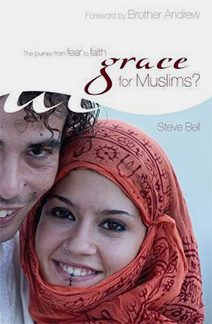 Grace for Muslims?: The Journey from Fear to Faith by Steve Bell
Balancing grace and truth
Bell himself has been ‘beaten at a North African border-crossing; spat at on a Cairo street; threatened on separate occasions with an iron bar, a cane, and a knife to my throat; lied to, and used’ by Muslims.[3] He was eventually thrown out of Cairo by Egypt’s notorious Secret Police. He has read and studied many of the writings of the fathers of the modern reincarnation of the jihad.[4] When he speaks of love, based now in Interserve’s new home in the area of Birmingham, Alum Rock, where a soldier was threatened with beheading for serving in the British Army, he speaks with authority.
An eyes-wide-open capacity to face and engage ‘the dark side’ of Islam is our missionary calling in a culture too used to its ease. However, as the following examples show, it is proving difficult to balance truth with grace. Anything less does not carry the imprimatur of the Holy Spirit and risks begetting more violence.
‘Desperation’
An English vicar last year chose an unusual topic for a sermon on Trinity Sunday: Islamic radicalism. Just three weeks before, 22 people, mostly children, out enjoying a concert at the Manchester Arena had been killed in cold blood as they left for home. Just eight days before, eight pedestrians on London Bridge and diners in Borough Market had been set upon with huge knives and had their throats slit. The vicar hit on his theme of the ‘rational incomprehensibility’ of the Trinity and the ‘irrational comprehensibility’ of these massacres. ‘They must have been desperate,’ he said. Their ‘desperation’ ‘explained’ their motives.
This is untrue, but manifests a homogenising tendency prevalent in Western culture. All faiths are not the same and their devotees are exposed to massively dissonant influences that are too easy for us to ignore.
ALL FAITHS ARE NOT THE SAME AND THEIR DEVOTEES ARE EXPOSED TO MASSIVELY DISSONANT INFLUENCES THAT ARE TOO EASY FOR US TO IGNORE.
‘Anglicising’ Islam
Colin Chapman, formerly the Archbishop of Canterbury’s Special Envoy to Al-Azhar University in Cairo and a Principal of the Church Mission Society training college in Birmingham, UK, is another Christian who has lived and worked among educated Muslims. However, he downplays the differentness, or as Steve Bell puts it, the ‘strangeness’ of Islamic culture to many non-Muslims.
His generous concern for Muslims risks lulling his readers into a false sense of the adequacy of our responses through, in the words of the anthropologist Roger Ballard, ‘Anglicising’ Islam. Others, less charitably, call it ‘colonialism’, attributing to Islam and its followers motives and manners that colonise their thought worlds, rendering them familiar, and therefore comfortable to handle.
Chapman, an influential writer, lived for many years in Beirut. He regards Islam as generally more sinned against than sinning. Like the vicar, he finds reasons for atrocities. In a long piece for Fulcrum[5] last year, which was reprinted from Transformation,[6] he gives nine examples of Islamist—political—movements that used violence: ‘In every case there has been something contextually specific—a perceived injustice—which has driven Muslims to take action and often to resort to violence.’ This is not necessarily true. Two recent commentators attribute violence in the Levant to ‘testosterone’ and sexual frustration,[7] as does much of an issue of the Muslim Institute’s acclaimed Critical Muslim journal devoted to ‘Men in Islam’.[8]
While acknowledging ‘that political Islam does not necessarily sanction violence’, he goes on to justify it in a generalisation that appears to disavow Islam’s own highly complex categories of violence and the discussions that surround its use. Says Chapman: ‘At the same time it is not hard to understand how some Islamists, who are frustrated at the slow progress in creating a more Islamic society or who suffer extreme violence from their opponents, can conclude—from their scriptures, dogma and history—that they have adequate justification for turning to violence.’
On jihad Chapman asserts, ‘As is well known, the basic meaning of the word jihad is ‘to strive’, and has little to do with the idea of ‘holy war’—an assertion that is roundly contradicted by, for instance, Saudi scholar Madawi al-Rasheed at King’s College, London.’[9]
Chapman rightly and strenuously seeks ways to approach and humanise Islamists, but in such a way that leads Melbourne-based Anglican priest and Quran specialist Dr Mark Durie to accuse him of ‘imposing reality’ on Islam: a missionary tactic that ‘does not promote peace’[10], he adds.

Shiraz Maher, former member of terror group Hizb ut Tahrir, is now Deputy Director of the International Centre for the Study of Radicalisation (ICSR) at King’s College London. Last August, Penguin published his doctorate on the scriptural and traditional roots of Salafi-Jihadism.[11] ‘For every act of violence, they [IS] will offer some form of reference to scriptural sources—however tenuous, esoteric, or contested.’ Tom Holland interviews Maher in his film, ‘IS: the Origins of Violence’. He compares Quranic texts to ‘unexploded bombs’, lying in wait for centuries for the next grievance to co-opt them into murderous service.[12] Maher says: ‘Yes, Islamic State is more brazen and ruthless than its predecessors but the ideas that guide it are well established in radical Sunni thought. . . . This is a broad and varied ecosystem of dense Islamic jurisprudence that has licensed the actions of militant movements across the world. Islamic State is just the latest and most successful group it has spawned.’
THE ‘GRACE APPROACH’ TO MUSLIMS RECOGNIZES THIS USE OF SCRIPTURE TO CONTROL AND TERRIFY, WHILE AT THE SAME TIME DISCERNING THE SPIRITUAL NEED OF INDIVIDUAL MUSLIMS.
As missionary-minded Christians we should know about this killing code, which finesses to an astonishing degree when it is right to kill for the faith. Take one example: the law of qisas of equal retaliation: ‘When militants apply qisas as an instrument of international law they hold every citizen-stranger of an enemy state liable for the action of their government’—liable in fact to be killed for apostasy.
The leader of al-Qaida Ayman al-Zawahiri believed that ‘forfeiting the faith was a much greater harm than forfeiting money or lives.’[13] Even some jihadi leaders find it hard to stomach the blanket anathemas against Muslims of their peers, according to Maher. Yet Chapman dismisses as ‘textualism’ the attempt to take seriously Islam’s own huge internal literary dynamic, rooted and justified in scripture and the traditions to a degree only now coming to wider notice. The ‘grace approach’ to Muslims recognizes this use of scripture to control and terrify, while at the same time discerning the spiritual need of individual Muslims, and challenging them with the freedom from fear that Christ promises in scriptures for which Mohammed himself commanded respect.[14]
Jihad is the predominant virtue in a hierarchy of virtues for this kind of Islam. ‘At its core the contemporary Salafi-Jihadi movement regards physical struggle in the cause of God as the pinnacle of Islam, its zenith and apex.’[15] With Islam now dispersed throughout the West—the former dar-ul-harb or ‘land of war’—that means total and constant war-mongering for its own sake by Salafi-Jihadis to which we must become wise, as the fear it causes, especially to Muslims themselves, infects the broader populace.
Islam must defend itself, until it is vindicated by its dominance and we must understand this, and learn to resist it. Where Islam is dominant, churches will burn—as they have done in recent years in Egypt, Iraq, Turkey, Kosovo, Algeria, Kuwait, Pakistan, Iran, South Sudan, Mali, and elsewhere.[16] Mark Durie, who recently led a mission into Ethiopia, a Christian majority country, recounts how churches have, nonetheless, burned in the Muslim-majority north:[17]
ETHIOPIA STANDS AS A TESTIMONY TO THE EFFECTIVENESS OF CHRISTIAN RESISTANCE TO JIHAD, AND ALSO TO INDIGENOUS AFRICAN CHRISTIANITY.
Ethiopian Christians oppose Islamisation and resist it in many ways. Surrounded by Muslim nations, Ethiopia stands as a testimony to the effectiveness of Christian resistance to jihad, and also to indigenous African Christianity. Christians here have had a lot of experience in learning how not to surrender power to Muslims. However some regions of the country have very high percentages of Muslims, particularly those in the north east, and in these regions Christians can be persecuted, e.g. by church burnings or attacks on believers. Apparently the same does not happen to Muslims in Christian-majority areas.
The good news
- The good news of Jesus is the only antidote to the fear and hatred Islam sometimes justifies. The possibilities of authentic, courageous outreach are there to be had.
One further example – from Ethiopia – illustrates the grace and truth approach:
Years ago there was a news report that a church had been burned and Christians from that church had had their throats cut by their Muslim neighbours. A young seminary student was moved with compassion for the Muslim community connected to that atrocity, and wanted to go to share Jesus with them. When he could find no church to back him, he stepped out on his own, trusting God to provide. It was not easy. He did find one Muslim man who wanted to follow Jesus and discipled him. That one man then led his family to Christ, and the ministry began to expand. That once-young evangelist is now the middle-aged pastor over a rapidly growing movement.[19]
Endnotes
- Steve Bell, Grace for Muslims?: The Journey from Fear to Faith (Milton Keynes and Hyderabad: Authentic, 2006). ↑
- Editor’s Note: See article by Wafik Wahba entitled, ‘Witnessing to the Gospel through Forgiveness: a living example from the persecuted Christians in Egypt’, in the January 2018 issue of Lausanne Global Analysishttps://www.lausanne.org/content/lga/2018-01/witnessing-gospel-forgiveness. ↑
- Bell relates this in his article ‘Grace for the Dark Side’ published by Interserve, New Zealand in Go magazine, Issue 1, 2010. ↑
- Editor’s Note: See article by an author whose name is withheld (not Steve Bell) entitled, ‘What is the Islamic Caliphate and Why Should Christians Care’, in May 2017 issue of Lausanne Global Analysis https://www.lausanne.org/content/lga/2017-05/islamic-caliphate-christians-care. ↑
- https://www.fulcrum-anglican.org.uk/articles/christian-responses-to-islamism-and-violence-in-the-name-of-islam/ ↑
- An International Journal of Holistic Mission Studies, 34:2 (March 2017), 115-30. ↑
- http://www.telegraph.co.uk/comment/11041338/The-science-behind-Isils-savagery.html ↑
- Critical Muslim Volume 08 – Men in Islam – edited by Ziauddin Sardar and Robin Yassin-Kassab. ↑
- Madawi al-Rasheed, ‘Rituals of Life and Death: the Politics and Poetics of Jihad in Saudi Arabia’ in Madawi Al-Rasheed and Marat Shterin, Dying for Faith (Tauris 2009), 81. ↑
- See Durie’s comment at the end of Chapman’s article ‘Christian Responses to Islamism’. ↑
- Shiraz Maher, Salafi-Jihadism: the History of an Idea (London: Penguin, 2017). ↑
- Jonathan Birt has researched, as a participant observer, the development of a ‘grievance theology’ by young British Muslims, for whom Chechnya was considered too distant, and the local Muslim community ‘morally corrupt’. ‘It was necessary to look outside for a grand cause – in this case, the cause of global jihad’. In ‘The Radical Nineties Revisited: Jihadi Discourses in Britain’ in Madawi al-Rasheed & Marat Shterin (eds) Dying for Faith: Religiously Motivated Violence in the Contemporary World (London & New York: I B Tauris, 2009), 107. ↑
- Shiraz Maher, Salafi-Jihadism: The History of an Idea (London: Penguin, 2017), 63. ↑
- Editor’s Note: See article by Ida Glaser entitled, ‘How Should Christians Relate to Muslims: Developing a Biblical Worldview on Islam’, in May 2017 issue of Lausanne Global Analysis https://www.lausanne.org/content/lga/2017-05/christians-relate-muslims. ↑
- Shiraz Maher, Salafi-Jihadism, 32. ↑
- https://www.gatestoneinstitute.org/7542/churches-under-islam ↑
- Author’s personal correspondence with intercessors. ↑
- http://www.lapidomedia.com/abyssinian-moment-in-chiltern-hills ↑
- Prayer letter to author. ↑
Feature image from ‘Love is stronger than Fear‘ by Viv Lynch (CC BY-NC-ND 2.0).
 Jenny Taylor is a writer, journalist and consultant who has worked across the media, including the Independent, the Times, the Spectator and the BBC. She worked and travelled with missions for ten years before setting up Lapido Media, Centre for Religious Literacy in Journalism. She was awarded her doctorate on Islam and Secularization in Britain from the School of Oriental and African Studies in London in 2001. Her writings include - with Bishop Lesslie Newbigin and Professor Lamin Sanneh - Faith and Power: Christianity and Islam in Secular Britain published twice (by SPCK and Wipf and Stock), and A Wild Constraint: the Case for Chastity available from Bloomsbury.
Lausanne Global Analysis seeks to deliver strategic and credible information and insight from an international network of evangelical analysts to equip influencers of global mission. Browse all the past issues at lausanne.org/lga. The publication of the LGA is overseen by its Editorial Advisory Board. Articles represent a diversity of viewpoints within the bounds of our foundational documents. The views and opinions expressed in these articles are those of the authors and do not necessarily reflect the personal viewpoints of Lausanne Movement leaders or networks. Inquiries regarding the Lausanne Global Analysis may be addressed to analysis@lausanne.org.
***

No comments:
Post a Comment