
"Lord, to whom shall we go? You have the words of eternal life."[John 6:68]
Fourth Sunday of Lent (Laetare) - Year C
Saints of the day: St. Colette, Virgin (+ 1447)

SAINT COLETTE
Virgin
(+ 1447)
Virgin
(+ 1447)
After a holy childhood, Colette joined a society of devout women called the Beguines; but not finding their state sufficiently austere, she entered the Third Order of St. Francis, and lived in a hut near her parish church of Corbie in Picardy.
Here she had passed four years of extraordinary penance when St. Francis, in a vision, bade her undertake the reform of her Order, then much relaxed. Armed with due authority, she established her reform throughout a large part of Europe, and, in spite of the most violent opposition, founded seventeen convents of the strict observance.
By the same wonderful prudence she assisted in healing the great schism which then afflicted. the Church. The Fathers in council at Constance were in doubt how to deal with the three claimants to the tiara-John XXIII., Benedict XIII., and Gregory XII. At this crisis Colette, together with St. Vincent Ferrer, wrote to the Fathers to depose Benedict XIII., who alone refused his consent to a new election. This was done, and Martin V. was elected, to the great good of the Church.
Colette equally assisted the Council of Basle by her advice and prayers; and when, later, God revealed to her the spirit ' of revolt that was rising, she warned the bishops and legates to retire from the council.
St. Colette never ceased to pray for the Church, while the devils, in turn, never ceased to assault her. They swarmed round her as hideous insects, buzzing and stinging her tender skin. They brought into her cell the decaying corpses of public criminals, and assuming themselves monstrous forms struck her savage blows; or they would appear in the most seductive guise, and tempt her by many deceits to sin. St. Colette once complained to Our Lord that the demons prevented her from praying. "Cease, then," said the devil to her, "your prayers to the great Master of the Church, and we will cease to torment you; for you torment us more by your prayers than we do you." Yet the virgin of Christ triumphed alike over their threats and their allurements, and said she would count that day the unhappiest of her life in which she suffered nothing for her God.
She died March 6, 1447, in a transport of intercession for sinners and the Church.[Lives of the Saints, by Alban Butler, Benziger Bros. ed. [1894]]
Fourth Sunday of Lent (Laetare) - Year C
Book of Joshua 5:9 Adonai said to Y’hoshua, “Today I have rolled off from you the stigma of Egypt.” This is why the place has been called Gilgal [rolling] ever since. 10 The people of Isra’el camped at Gilgal, and they observed Pesach on the fourteenth day of the month, there on the plains of Yericho. 11 The day after Pesach they ate what the land produced, matzah and roasted ears of grain that day. 12 The following day, after they had eaten food produced in the land, the man ended. From then on the people of Isra’el no longer had man; instead, that year, they ate the produce of the land of Kena‘an
Psalms 34:2 (1) I will bless Adonai at all times;
Commentary of the day:
Saint Augustine (354-430), Bishop of Hippo (North Africa) and Doctor of the Church
A Commentary on the Psalms, Ps 139[138], 5-6; CCL 40, 1992-1993 (©Friends of Henry Ashworth, alt.)
“While he was still a long way off, his father caught sight of him”
Daily Gospel for
Saturday, 05 March 2016
"Lord, to whom shall we go? You have the words of eternal life."[John 6:68]
Saturday of the Third Week of Lent
Saints of the day: Sts. Adrian and Eubulus, Martyrs (+ 309)
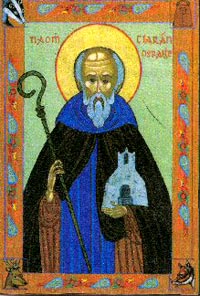 St. Kieran of Saigir
Book of Hosea 6:1 Come, let us return to Adonai;
for he has torn, and he will heal us;
he has struck, and he will bind our wounds.
2 After two days, he will revive us;
on the third day, he will raise us up;
and we will live in his presence.
3 Let us know, let us strive to know Adonai.
That he will come is as certain as morning;
he will come to us like the rain,
like the spring rains that water the earth.
4 “Efrayim, what should I do to you?
Y’hudah, what should I do to you?
For your ‘faithful love’ is like a morning cloud,
like dew that disappears quickly.
5 This is why I have cut them to pieces by the prophets,
slaughtered them with the words from my mouth —
the judgment on you shines out like light.
6 For what I desire is mercy, not sacrifices,
knowledge of God more than burnt offerings.
Psalms 51:3 (1) God, in your grace, have mercy on me;
in your great compassion, blot out my crimes.
4 (2) Wash me completely from my guilt,
and cleanse me from my sin.
18 (16) For you don’t want sacrifices, or I would give them;
you don’t take pleasure in burnt offerings.
19 (17) My sacrifice to God is a broken spirit;
God, you won’t spurn a broken, chastened heart.
20 (18) In your good pleasure, make Tziyon prosper;
rebuild the walls of Yerushalayim.
21 (19) Then you will delight in righteous sacrifices,
in burnt offerings and whole burnt offerings;
then they will offer bulls on your altar.
Holy Gospel of Jesus Christ according to Saint Luke 18:9 Also, to some who were relying on their own righteousness and looking down on everyone else, he told this parable: 10 “Two men went up to the Temple to pray, one a Parush and the other a tax-collector. 11 The Parush stood and prayed to himself, ‘O God! I thank you that I am not like the rest of humanity — greedy, dishonest, immoral, or like this tax-collector! 12 I fast twice a week, I pay tithes on my entire income, . . . ’ 13 But the tax-collector, standing far off, would not even raise his eyes toward heaven, but beat his breast and said, ‘God! Have mercy on me, sinner that I am!’ 14 I tell you, this man went down to his home right with God rather than the other. For everyone who exalts himself will be humbled, but everyone who humbles himself will be exalted.”Saturday of the Third Week of Lent
Commentary of the day:
Saint John Climacus (c.575-c.650), monk on Mount Sinai
The Ladder of Divine Ascent, ch.28
"Be merciful to me a sinner"
Let your prayer be entirely simple. One word was enough for the publican and for the prodigal son to obtain God’s forgiveness (cf. Lk 15,21)… No pretentiousness in the words of your prayers; how often it is that the simple and unadorned stammerings of children sway their father! So don’t launch into long discourses lest you weaken your spirit through verbal affectation. A single word from the publican moved the mercy of God; one word full of faith saved the good thief (Lk 23,42). Prolixity in prayer often fills up the spirit with images and dissipates it, whereas a single word often has the effect of recollecting it. Do you feel consolation, gripped by a word of prayer? Remain there, for it is then that our angel prays with us. Don’t be too sure of yourself, even if you have attained to purity; rather, have a great humility and you will then feel a greater confidence. Even if you have scaled the ladder of perfection, pray for forgiveness for your sins; pay heed to Saint Paul’s cry: “I am the foremost among sinners” (1Tim 1,15)… If you are clothed with gentleness and free of anger little else is required to free your soul from its bondage.
Daily Gospel for Friday, 04 March 2016
"Lord, to whom shall we go? You have the words of eternal life."[John 6:68]
Friday of the Third Week of Lent
Saints of the day: St. Casimir, Prince (1458-1484) - Memorial
Book of Hosea 14:2 (1) Return, Isra’el, to Adonai your God,
for your guilt has made you stumble.
3 (2) Take words with you, and return to Adonai;
say to him, “Forgive all guilt,
and accept what is good;
we will pay instead of bulls
[the offerings of] our lips.
4 (3) Ashur will not save us,
we will not ride on horses,
and we will no longer call
what we made with our hands our gods.
For it is only in you
that the fatherless can find mercy.”
5 (4) “I will heal their disloyalty,
I will love them freely;
for my anger has turned from him.
6 (5) I will be like dew to Isra’el;
he will blossom like a lily
and strike roots like the L’vanon.
7 (6) His branches will spread out,
his beauty be like an olive tree
and his fragrance like the L’vanon.
8 (7) Again they will live in his shade and raise grain;
they will blossom like a vine,
and its aroma will be
like the wine of the L’vanon.
9 (8) Efrayim [will say], ‘What have I
to do any more with idols?’
And I, I answer and affirm him;
I am like a fresh, green cypress tree;
your fruitfulness comes from me.”
10 (9) Let the wise understand these things,
and let the discerning know them.
For the ways of Adonai are straight,
And the righteous walk in them,
but in them sinners stumble.
Psalms 81:6 (5) He placed it as a testimony in Y’hosef
when he went out against the land of Egypt.
I heard an unfamiliar voice say,
7 (6) “I lifted the load from his shoulder;
his hands were freed from the [laborer’s] basket.
8 (7) You called out when you were in trouble,
and I rescued you;
I answered you from the thundercloud;
I tested you at the M’rivah Spring [by saying,] (Selah)
9 (8) “‘Hear, my people, while I give you warning!
Isra’el, if you would only listen to me!
10 (9) There is not to be with you any foreign god;
you are not to worship an alien god.
11 (10) I am Adonai your God,
who brought you up from the land of Egypt.
Open your mouth, and I will fill it.’
14 (13) How I wish my people would listen to me,
that Isra’el would live by my ways!
7 (16) They would be fed with the finest wheat,
and I would satisfy you with honey from the rocks.”
Holy Gospel of Jesus Christ according to Saint Mark 12:28 One of the Torah-teachers came up and heard them engaged in this discussion. Seeing that Yeshua answered them well, he asked him, “Which is the most important mitzvah of them all?” 29 Yeshua answered, “The most important is,
‘Sh’ma Yisra’el, Adonai Eloheinu, Adonai echad [Hear, O Isra’el, the Lord our God, the Lord is one], 30 and you are to love Adonai your God with all your heart, with all your soul, with all your understanding and with all your strength.’[Mark 12:30 Deuteronomy 6:4–5]
31 The second is this:
‘You are to love your neighbor as yourself.’[Mark 12:31 Leviticus 19:18]
There is no other mitzvah greater than these.” 32 The Torah-teacher said to him, “Well said, Rabbi; you speak the truth when you say that he is one, and that there is no other besides him; 33 and that loving him with all one’s heart, understanding and strength, and loving one’s neighbor as oneself, mean more than all the burnt offerings and sacrifices.” 34 When Yeshua saw that he responded sensibly, he said to him, “You are not far from the Kingdom of God.” And after that, no one dared put to him another sh’eilah.
Friday of the Third Week of Lent
Commentary of the day:
Vatican Council II
Dogmatic Constitution on the Church in the Modern World “ Gaudium et spes ”, § 23-24
"There is no other commandment greater than these"
One of the salient features of the modern world is the growing interdependence of men one on the other, a development promoted chiefly by modern technical advances. Nevertheless brotherly dialogue among men does not reach its perfection on the level of technical progress, but on the deeper level of interpersonal relationships. These demand a mutual respect for the full spiritual dignity of the person. Christian revelation contributes greatly to the promotion of this communion between persons, and at the same time leads us to a deeper understanding of the laws of social life which the Creator has written into man's moral and spiritual nature.
Daily Gospel for Sunday, 21 February 2016
"Lord, to whom shall we go? You have the words of eternal life."[John 6:68]
Second Sunday of Lent - Year C
Saints of the day: St. Peter Damian, Bishop and Doctor of the Church (1007-1072)

Book of Genesis 15:5 Then he brought him outside and said, “Look up at the sky, and count the stars — if you can count them! Your descendants will be that many!” 6 He believed in Adonai, and he credited it to him as righteousness.
(vi) 7 Then he said to him, “I am Adonai, who brought you out from Ur-Kasdim to give you this land as your possession.” 8 He replied, “Adonai, God, how am I to know that I will possess it?” 9 He answered him, “Bring me a three-year-old cow, a three-year-old female goat, a three-year-old ram, a dove and a young pigeon.” 10 He brought him all these, cut the animals in two and placed the pieces opposite each other; but he didn’t cut the birds in half. 11 Birds of prey swooped down on the carcasses, but Avram drove them away.
12 As the sun was about to set, a deep sleep fell on Avram; horror and great darkness came over him.
17 After the sun had set and there was thick darkness, a smoking fire pot and a flaming torch appeared, which passed between these animal parts. 18 That day Adonai made a covenant with Avram: “I have given this land to your descendants — from the Vadi of Egypt to the great river, the Euphrates River —
Psalms 27:1(0) By David:
(1) Adonai is my light and salvation;
whom do I need to fear?
Adonai is the stronghold of my life;
of whom should I be afraid?
7 Listen, Adonai, to my voice when I cry;
show favor to me; and answer me.
8 “My heart said of you, ‘Seek my face.’”
Your face, Adonai, I will seek.
9 Do not hide your face from me,
don’t turn your servant away in anger.
You are my help; don’t abandon me;
don’t leave me, God my savior.
13 If I hadn’t believed that I would see
Adonai’s goodness in the land of the living, . . .
14 Put your hope in Adonai, be strong,
and let your heart take courage!
Yes, put your hope in Adonai!
Letter to the Philippians 3:17 Brothers, join in imitating me, and pay attention to those who live according to the pattern we have set for you. 18 For many — I have told you about them often before, and even now I say it with tears — live as enemies of the Messiah’s execution-stake. 19 They are headed for destruction! Their god is the belly; they are proud of what they ought to be ashamed of, since they are concerned about the things of the world. 20 But we are citizens of heaven, and it is from there that we expect a Deliverer, the Lord Yeshua the Messiah. 21 He will change the bodies we have in this humble state and make them like his glorious body, using the power which enables him to bring everything under his control.
4:1 So, my brothers, whom I love and long for, my joy and my crown, my dear friends, keep standing firm in union with the Lord.
Holy Gospel of Jesus Christ according to Saint Luke 9:28b-36Second Sunday of Lent - Year C
Commentary of the day:
Theophanes of Keramea
Homily on the Transfiguration ; PG 132, 1021f.
“Then the righteous will shine like the sun in the Kingdom of their Father” (Mt 13,43)
The hour of the Passion draws near… Now, it must not come about that the disciples should find themselves crushed in spirit at that hour; it must not happen that those who had confessed through Peter’s mouth that he was the Son of God shortly before (Mt 16:16) should believe he was merely a man when they saw him fastened to the cross like a criminal. That is why he has strengthened them by means of this wonderful vision.
his praise will always be in my mouth.
3 (2) When I boast, it will be about Adonai;
the humble will hear of it and be glad.
4 (3) Proclaim with me the greatness of Adonai;
let us exalt his name together.
5 (4) I sought Adonai, and he answered me;
he rescued me from everything I feared.
6 (5) They looked to him and grew radiant;
their faces will never blush for shame.
7 (6) This poor man cried; Adonai heard
and saved him from all his troubles.
Second Letter to the Corinthians 5:17 Therefore, if anyone is united with the Messiah, he is a new creation — the old has passed; look, what has come is fresh and new! 18 And it is all from God, who through the Messiah has reconciled us to himself and has given us the work of that reconciliation, 19 which is that God in the Messiah was reconciling mankind to himself, not counting their sins against them, and entrusting to us the message of reconciliation. 20 Therefore we are ambassadors of the Messiah; in effect, God is making his appeal through us. What we do is appeal on behalf of the Messiah, “Be reconciled to God! 21 God made this sinless man be a sin offering on our behalf, so that in union with him we might fully share in God’s righteousness.”
Holy Gospel of Jesus Christ according to Saint Luke 15:1 The tax-collectors and sinners kept gathering around to hear Yeshua, 2 and the P’rushim and Torah-teachers kept grumbling. “This fellow,” they said, “welcomes sinners — he even eats with them!” 3 So he told them this parable:
Holy Gospel of Jesus Christ according to Saint Luke 15:1 The tax-collectors and sinners kept gathering around to hear Yeshua, 2 and the P’rushim and Torah-teachers kept grumbling. “This fellow,” they said, “welcomes sinners — he even eats with them!” 3 So he told them this parable:
11 Again Yeshua said, “A man had two sons. 12 The younger of them said to his father, ‘Father, give me the share of the estate that will be mine.’ So the father divided the property between them. 13 As soon as he could convert his share into cash, the younger son left home and went off to a distant country, where he squandered his money in reckless living. 14 But after he had spent it all, a severe famine arose throughout that country, and he began to feel the pinch.
15 “So he went and attached himself to one of the citizens of that country, who sent him into his fields to feed pigs. 16 He longed to fill his stomach with the carob pods the pigs were eating, but no one gave him any.
17 “At last he came to his senses and said, ‘Any number of my father’s hired workers have food to spare; and here I am, starving to death! 18 I’m going to get up and go back to my father and say to him, “Father, I have sinned against Heaven and against you; 19 I am no longer worthy to be called your son; treat me like one of your hired workers.” ’ 20 So he got up and started back to his father.
“But while he was still a long way off, his father saw him and was moved with pity. He ran and threw his arms around him and kissed him warmly. 21 His son said to him, ‘Father, I have sinned against Heaven and against you; I am no longer worthy to be called your son — ’ 22 but his father said to his slaves, ‘Quick, bring out a robe, the best one, and put it on him; and put a ring on his finger and shoes on his feet; 23 and bring the calf that has been fattened up, and kill it. Let’s eat and have a celebration! 24 For this son of mine was dead, but now he’s alive again! He was lost, but now he has been found!’ And they began celebrating.
25 “Now his older son was in the field. As he came close to the house, he heard music and dancing. 26 So he called one of the servants and asked, ‘What’s going on?’ 27 The servant told him, ‘Your brother has come back, and your father has slaughtered the calf that was fattened up, because he has gotten him back safe and sound.’ 28 But the older son became angry and refused to go inside.
“So his father came out and pleaded with him. 29 ‘Look,’ the son answered, ‘I have worked for you all these years, and I have never disobeyed your orders. But you have never even given me a young goat, so that I could celebrate with my friends. 30 Yet this son of yours comes, who squandered your property with prostitutes, and for him you slaughter the fattened calf!’ 31 ‘Son, you are always with me,’ said the father, ‘and everything I have is yours. 32 We had to celebrate and rejoice, because this brother of yours was dead but has come back to life — he was lost but has been found.’”
Fourth Sunday of Lent (Laetare) - Year CCommentary of the day:
Saint Augustine (354-430), Bishop of Hippo (North Africa) and Doctor of the Church
A Commentary on the Psalms, Ps 139[138], 5-6; CCL 40, 1992-1993 (©Friends of Henry Ashworth, alt.)
“O Lord, you have read my thoughts from afar; you have marked my path and my journey's end; you have foreseen all my ways.” In other words, while I am still a pilgrim and have not yet reached my true country, my thoughts are an open book to you. Think of the younger son of the parable… Not so the elder son; he stayed at home and worked in the fields, representing those holy men of the Old Testament who carried out the duties imposed by the law and obeyed its precepts.
But the rest of the human race by its lapse into idolatry, had left for a distant country. Nothing, in fact, re moves us further from the God who made us than the false gods we make! for ourselves.
The younger son, then, left for a distant country, taking his money with him, and, as the gospel tells us, he squandered it... When he was worn out by hard labor, affliction, and want, his thoughts turned to his father, and he made up his mind to return to him. “I will arise,” he said, “and go to my father”… But is not he whom I have forsaken everywhere? “You have read my thoughts from afar.” In the gospel story the Lord tells us that the boy's father went out to meet him because he had read his thoughts from afar, he had marked all his paths. What was this path but the ill-chosen road which the boy took when he left his father, furtively trying to escape observation and punishment? Would he have been worn out by hardship or sent to feed pigs unless his father had wanted him to be punished in his absence so that he could welcome him on his return?... So he was caught like a runaway slave, overtaken by the well-deserved chastisement of God who punishes us for our unlawful desires, no matter where we go or how far we travel. So, like a slave caught on the run, the son says: “You have marked my path and seen all my ways.” However long my path, it could not hide me from your eyes. I had walked a great distance but you were there at my destination. Before I had even entered, before I had even set out, you saw it all beforehand. And you allowed me to follow my paths in hard labor so that, if I should not want to labor any more, I might return to your ways… I confess my sin before you: I went my own way and wandered far from you; I left you with whom my best interests lay, and it was for my own good that everything went wrong for me without you, for if all had gone well for me without you, the chances are that I would never have returned to you.
---------------------But the rest of the human race by its lapse into idolatry, had left for a distant country. Nothing, in fact, re moves us further from the God who made us than the false gods we make! for ourselves.
The younger son, then, left for a distant country, taking his money with him, and, as the gospel tells us, he squandered it... When he was worn out by hard labor, affliction, and want, his thoughts turned to his father, and he made up his mind to return to him. “I will arise,” he said, “and go to my father”… But is not he whom I have forsaken everywhere? “You have read my thoughts from afar.” In the gospel story the Lord tells us that the boy's father went out to meet him because he had read his thoughts from afar, he had marked all his paths. What was this path but the ill-chosen road which the boy took when he left his father, furtively trying to escape observation and punishment? Would he have been worn out by hardship or sent to feed pigs unless his father had wanted him to be punished in his absence so that he could welcome him on his return?... So he was caught like a runaway slave, overtaken by the well-deserved chastisement of God who punishes us for our unlawful desires, no matter where we go or how far we travel. So, like a slave caught on the run, the son says: “You have marked my path and seen all my ways.” However long my path, it could not hide me from your eyes. I had walked a great distance but you were there at my destination. Before I had even entered, before I had even set out, you saw it all beforehand. And you allowed me to follow my paths in hard labor so that, if I should not want to labor any more, I might return to your ways… I confess my sin before you: I went my own way and wandered far from you; I left you with whom my best interests lay, and it was for my own good that everything went wrong for me without you, for if all had gone well for me without you, the chances are that I would never have returned to you.
Daily Gospel for
Saturday, 05 March 2016
"Lord, to whom shall we go? You have the words of eternal life."[John 6:68]
Saturday of the Third Week of Lent
Saints of the day: Sts. Adrian and Eubulus, Martyrs (+ 309)
SAINTS ADRIAN and EUBULUS
Martyrs
(+ 309)
Martyrs
(+ 309)
In the seventh year of Diocletian's persecution, continued by Galerius Maximianus, when Firmilian, the most bloody governor of Palestine, had stained Cæsarea with the blood of many illustrious martyrs, Adrian and Eubulus came out of the country called Magantia to Cæsarea, in order to visit the holy confessors there.
At the gates of the city they were asked, as others were, whither they were going, and upon what errand. They ingenuously confessed the truth, and were brought before the president, who ordered them to be tortured and their sides to be torn with iron hooks, and then condemned them to be exposed to wild beasts.
Two days after, when the pagans at Cæsarea celebrated the festival of the public Genius, Adrian was exposed to a lion, and not being despatched by that beast, but only mangled, was at length killed by the sword.
Eubulus was treated in the same manner two days later. The judge offered him his liberty if he would sacrifice to idols; but the Saint preferred a glorious death, and was the last that suffered in this persecution at Cæsarea, which had now continued twelve years, under three successive governors, Flavian, Urban, and Firmilian.[Lives of the Saints, by Alban Butler, Benziger Bros. ed. [1894]]
St. Kieran of Saigir
Feastday: March 5
Patron of The diocese of Ossory
Birth: 501
Death: 530
The "first born of the saints of Ireland," sometimes listed as Kieran Saighir or Kevin the Elder. He was a native of Ossory, and after living for a time as a hermit, he is believed to have been consecrated a bishop by St. Patrick, taking his place as the first bishop of Ossory. Another tradition states that he was consecrated in Rome. Legends attribute remarkable miracles to Kieran.
Saturday of the Third Week of LentBook of Hosea 6:1 Come, let us return to Adonai;
for he has torn, and he will heal us;
he has struck, and he will bind our wounds.
2 After two days, he will revive us;
on the third day, he will raise us up;
and we will live in his presence.
3 Let us know, let us strive to know Adonai.
That he will come is as certain as morning;
he will come to us like the rain,
like the spring rains that water the earth.
4 “Efrayim, what should I do to you?
Y’hudah, what should I do to you?
For your ‘faithful love’ is like a morning cloud,
like dew that disappears quickly.
5 This is why I have cut them to pieces by the prophets,
slaughtered them with the words from my mouth —
the judgment on you shines out like light.
6 For what I desire is mercy, not sacrifices,
knowledge of God more than burnt offerings.
Psalms 51:3 (1) God, in your grace, have mercy on me;
in your great compassion, blot out my crimes.
4 (2) Wash me completely from my guilt,
and cleanse me from my sin.
18 (16) For you don’t want sacrifices, or I would give them;
you don’t take pleasure in burnt offerings.
19 (17) My sacrifice to God is a broken spirit;
God, you won’t spurn a broken, chastened heart.
20 (18) In your good pleasure, make Tziyon prosper;
rebuild the walls of Yerushalayim.
21 (19) Then you will delight in righteous sacrifices,
in burnt offerings and whole burnt offerings;
then they will offer bulls on your altar.
Holy Gospel of Jesus Christ according to Saint Luke 18:9 Also, to some who were relying on their own righteousness and looking down on everyone else, he told this parable: 10 “Two men went up to the Temple to pray, one a Parush and the other a tax-collector. 11 The Parush stood and prayed to himself, ‘O God! I thank you that I am not like the rest of humanity — greedy, dishonest, immoral, or like this tax-collector! 12 I fast twice a week, I pay tithes on my entire income, . . . ’ 13 But the tax-collector, standing far off, would not even raise his eyes toward heaven, but beat his breast and said, ‘God! Have mercy on me, sinner that I am!’ 14 I tell you, this man went down to his home right with God rather than the other. For everyone who exalts himself will be humbled, but everyone who humbles himself will be exalted.”Saturday of the Third Week of Lent
Commentary of the day:
Saint John Climacus (c.575-c.650), monk on Mount Sinai
The Ladder of Divine Ascent, ch.28
So long as we have not attained to true prayer we are like people who teach their children to take their first steps. Try hard to lift up your thought or, rather, to contain it within the words of your prayer. If a childish weakness causes it to fall, raise it up. For our minds are naturally volatile but He who can strengthen all things can also stabilise the mind… Thus the first degree of prayer consists in dispelling the suggestions of the mind with a simple word as soon as they arise. The second is to keep our thought solely on what we are saying and thinking. The third is the soul’s fixation in the Lord.
---------------------Daily Gospel for Friday, 04 March 2016
"Lord, to whom shall we go? You have the words of eternal life."[John 6:68]
Friday of the Third Week of Lent
Saints of the day: St. Casimir, Prince (1458-1484) - Memorial
SAINT CASIMIR
Prince
(1458-1484)
Prince
(1458-1484)
Casimir, born of kings and in line (third among 13 children) to be a king himself, was filled with exceptional values and learning by a great teacher, John Dlugosz. Even his critics could not say that his conscientious objection indicated softness. Even as a teenager, Casimir lived a highly disciplined, even severe life, sleeping on the ground, spending a great part of the night in prayer and dedicating himself to lifelong celibacy.
When nobles in Hungary became dissatisfied with their king, they prevailed upon Casimir’s father, the king of Poland, to send his son to take over the country. Casimir obeyed his father, as many young men over the centuries have obeyed their government. The army he was supposed to lead was clearly outnumbered by the “enemy”; some of his troops were deserting because they were not paid. At the advice of his officers, Casimir decided to return home.
His father was irked at the failure of his plans, and confined his 15-year-old son for three months. The lad made up his mind never again to become involved in the wars of his day, and no amount of persuasion could change his mind. He returned to prayer and study, maintaining his decision to remain celibate even under pressure to marry the emperor’s daughter.
He reigned briefly as king of Poland during his father’s absence. He died of lung trouble at 23 while visiting Lithuania, of which he was also Grand Duke. He was buried in Vilnius, Lithuania. He is the patron saint of Poland and Lithuania.[AmericanCatholic.org]
Friday of the Third Week of LentBook of Hosea 14:2 (1) Return, Isra’el, to Adonai your God,
for your guilt has made you stumble.
3 (2) Take words with you, and return to Adonai;
say to him, “Forgive all guilt,
and accept what is good;
we will pay instead of bulls
[the offerings of] our lips.
4 (3) Ashur will not save us,
we will not ride on horses,
and we will no longer call
what we made with our hands our gods.
For it is only in you
that the fatherless can find mercy.”
5 (4) “I will heal their disloyalty,
I will love them freely;
for my anger has turned from him.
6 (5) I will be like dew to Isra’el;
he will blossom like a lily
and strike roots like the L’vanon.
7 (6) His branches will spread out,
his beauty be like an olive tree
and his fragrance like the L’vanon.
8 (7) Again they will live in his shade and raise grain;
they will blossom like a vine,
and its aroma will be
like the wine of the L’vanon.
9 (8) Efrayim [will say], ‘What have I
to do any more with idols?’
And I, I answer and affirm him;
I am like a fresh, green cypress tree;
your fruitfulness comes from me.”
10 (9) Let the wise understand these things,
and let the discerning know them.
For the ways of Adonai are straight,
And the righteous walk in them,
but in them sinners stumble.
Psalms 81:6 (5) He placed it as a testimony in Y’hosef
when he went out against the land of Egypt.
I heard an unfamiliar voice say,
7 (6) “I lifted the load from his shoulder;
his hands were freed from the [laborer’s] basket.
8 (7) You called out when you were in trouble,
and I rescued you;
I answered you from the thundercloud;
I tested you at the M’rivah Spring [by saying,] (Selah)
9 (8) “‘Hear, my people, while I give you warning!
Isra’el, if you would only listen to me!
10 (9) There is not to be with you any foreign god;
you are not to worship an alien god.
11 (10) I am Adonai your God,
who brought you up from the land of Egypt.
Open your mouth, and I will fill it.’
14 (13) How I wish my people would listen to me,
that Isra’el would live by my ways!
7 (16) They would be fed with the finest wheat,
and I would satisfy you with honey from the rocks.”
Holy Gospel of Jesus Christ according to Saint Mark 12:28 One of the Torah-teachers came up and heard them engaged in this discussion. Seeing that Yeshua answered them well, he asked him, “Which is the most important mitzvah of them all?” 29 Yeshua answered, “The most important is,
‘Sh’ma Yisra’el, Adonai Eloheinu, Adonai echad [Hear, O Isra’el, the Lord our God, the Lord is one], 30 and you are to love Adonai your God with all your heart, with all your soul, with all your understanding and with all your strength.’[Mark 12:30 Deuteronomy 6:4–5]
31 The second is this:
‘You are to love your neighbor as yourself.’[Mark 12:31 Leviticus 19:18]
There is no other mitzvah greater than these.” 32 The Torah-teacher said to him, “Well said, Rabbi; you speak the truth when you say that he is one, and that there is no other besides him; 33 and that loving him with all one’s heart, understanding and strength, and loving one’s neighbor as oneself, mean more than all the burnt offerings and sacrifices.” 34 When Yeshua saw that he responded sensibly, he said to him, “You are not far from the Kingdom of God.” And after that, no one dared put to him another sh’eilah.
Friday of the Third Week of Lent
Commentary of the day:
Vatican Council II
Dogmatic Constitution on the Church in the Modern World “ Gaudium et spes ”, § 23-24
God, Who has fatherly concern for everyone, has willed that all men should constitute one family and treat one another in a spirit of brotherhood. For having been created in the image of God, Who "from one man has created the whole human race and made them live all over the face of the earth" (Acts 17:26), all men are called to one and the same goal, namely God Himself. For this reason, love for God and neighbor is the first and greatest commandment. Sacred Scripture, however, teaches us that the love of God cannot be separated from love of neighbor: "If there is any other commandment, it is summed up in this saying: Thou shalt love thy neighbor as thyself.... Love therefore is the fulfillment of the Law" (Rom. 13:9-10; cf. 1 John 4:20). To men growing daily more dependent on one another, and to a world becoming more unified every day, this truth proves to be of paramount importance.
Indeed, the Lord Jesus, when He prayed to the Father, "that all may be one. . . as we are one" (John 17:21-22) opened up vistas closed to human reason, for He implied a certain likeness between the union of the divine Persons, and the unity of God's sons in truth and charity. This likeness reveals that man, who is the only creature on earth which God willed for itself, cannot fully find himself except through a sincere gift of himself.
---------------------Indeed, the Lord Jesus, when He prayed to the Father, "that all may be one. . . as we are one" (John 17:21-22) opened up vistas closed to human reason, for He implied a certain likeness between the union of the divine Persons, and the unity of God's sons in truth and charity. This likeness reveals that man, who is the only creature on earth which God willed for itself, cannot fully find himself except through a sincere gift of himself.
Daily Gospel for Sunday, 21 February 2016
"Lord, to whom shall we go? You have the words of eternal life."[John 6:68]
Second Sunday of Lent - Year C
Saints of the day: St. Peter Damian, Bishop and Doctor of the Church (1007-1072)
SAINT PETER DAMIAN
Bishop and Doctor of the Church
(1007-1072)-
Bishop and Doctor of the Church
(1007-1072)-
St. Peter Damian was born in 1007, and lost both parents at an early age. His eldest brother, in whose hands he was left, treated him so cruelly that a younger brother, a priest, moved by his piteous state, sent him to the University of Parma, where he acquired great distinction. His studies were sanctified by vigils, fasts, and prayers, till at last, thinking that all this was only serving God by halves, he resolved to leave the world.
He joined the monks at Font-Avellano, then in the greatest repute, and by his wisdom and sanctity rose to be Superior. He was employed on the most delicate and difficult missions, amongst others the reform of ecclesiastical communities, which was effected by his zeal.
Seven Popes in succession made him their constant adviser, and he was at last created Cardinal Bishop of Ostia. He withstood Henry IV. of Germany, and labored in defence of Alexander II. against the Antipope, whom he forced to yield and seek for pardon.
He was charged, as Papal Legate, with the repression of simony; again, was commissioned to settle discords amongst various bishops, and finally, in 1072, to adjust the affairs of the Church at Ravenna. He was laid low by a fever on his homeward journey, and died at Faenza, in a monastery of his order, on the eighth day of his sickness, whilst the monks chanted matins around him.[Lives of the Saints, by Alban Butler, Benziger Bros. ed. [1894]]
Second Sunday of Lent - Year CBook of Genesis 15:5 Then he brought him outside and said, “Look up at the sky, and count the stars — if you can count them! Your descendants will be that many!” 6 He believed in Adonai, and he credited it to him as righteousness.
(vi) 7 Then he said to him, “I am Adonai, who brought you out from Ur-Kasdim to give you this land as your possession.” 8 He replied, “Adonai, God, how am I to know that I will possess it?” 9 He answered him, “Bring me a three-year-old cow, a three-year-old female goat, a three-year-old ram, a dove and a young pigeon.” 10 He brought him all these, cut the animals in two and placed the pieces opposite each other; but he didn’t cut the birds in half. 11 Birds of prey swooped down on the carcasses, but Avram drove them away.
12 As the sun was about to set, a deep sleep fell on Avram; horror and great darkness came over him.
17 After the sun had set and there was thick darkness, a smoking fire pot and a flaming torch appeared, which passed between these animal parts. 18 That day Adonai made a covenant with Avram: “I have given this land to your descendants — from the Vadi of Egypt to the great river, the Euphrates River —
Psalms 27:1(0) By David:
(1) Adonai is my light and salvation;
whom do I need to fear?
Adonai is the stronghold of my life;
of whom should I be afraid?
7 Listen, Adonai, to my voice when I cry;
show favor to me; and answer me.
8 “My heart said of you, ‘Seek my face.’”
Your face, Adonai, I will seek.
9 Do not hide your face from me,
don’t turn your servant away in anger.
You are my help; don’t abandon me;
don’t leave me, God my savior.
13 If I hadn’t believed that I would see
Adonai’s goodness in the land of the living, . . .
14 Put your hope in Adonai, be strong,
and let your heart take courage!
Yes, put your hope in Adonai!
Letter to the Philippians 3:17 Brothers, join in imitating me, and pay attention to those who live according to the pattern we have set for you. 18 For many — I have told you about them often before, and even now I say it with tears — live as enemies of the Messiah’s execution-stake. 19 They are headed for destruction! Their god is the belly; they are proud of what they ought to be ashamed of, since they are concerned about the things of the world. 20 But we are citizens of heaven, and it is from there that we expect a Deliverer, the Lord Yeshua the Messiah. 21 He will change the bodies we have in this humble state and make them like his glorious body, using the power which enables him to bring everything under his control.
4:1 So, my brothers, whom I love and long for, my joy and my crown, my dear friends, keep standing firm in union with the Lord.
Holy Gospel of Jesus Christ according to Saint Luke 9:28b-36Second Sunday of Lent - Year C
Commentary of the day:
Theophanes of Keramea
Homily on the Transfiguration ; PG 132, 1021f.
Thus, when they should see him betrayed and in agony, praying that the chalice of death should pass him by and dragged into the high priest’s court, they might remember Mount Thabor and understand that it is of his own free will that he is delivered up to death… When they should see the blows and spittle on his face they would not be scandalized, calling to mind his radiance surpassing the sun. When they should see him derisively draped in a mantle of purple they would remember that this same Jesus had been clothed in light on the mountain. When they should see him crucified on the gallows between two criminals they would know he had appeared between Moses and Elijah as their Lord. When they should see him buried in the earth like a dead man they would think of the bright cloud with which he had been covered.
Here, then, is one motive for the Transfiguration and perhaps there is another: the Lord exhorted his disciples not to try to save their own lives. He said to them: “Whoever wishes to come after me must deny himself, take up his cross and follow me” (Mt 16:24). But to deny oneself and go towards a shameful death, that seems hard! Hence our Savior shows his disciples with what kind of glory those who have imitated his Passion will be judged worthy. Indeed, the Transfiguration is nothing other than the manifestation beforehand of the last day “when the righteous will shine in the presence of God” (Mt13:43).
---------------------Here, then, is one motive for the Transfiguration and perhaps there is another: the Lord exhorted his disciples not to try to save their own lives. He said to them: “Whoever wishes to come after me must deny himself, take up his cross and follow me” (Mt 16:24). But to deny oneself and go towards a shameful death, that seems hard! Hence our Savior shows his disciples with what kind of glory those who have imitated his Passion will be judged worthy. Indeed, the Transfiguration is nothing other than the manifestation beforehand of the last day “when the righteous will shine in the presence of God” (Mt13:43).

No comments:
Post a Comment