democracynow.org
Stories:

EXCLUSIVE: WikiLeaks' Julian Assange on Releasing DNC Emails That Ousted Debbie Wasserman Schultz
WikiLeaks founder and editor-in-chief Julian Assange joins us from London about their release of nearly 20,000 emails revealing how the Democratic Party favored Hillary Clinton and worked behind the scenes to discredit and defeat Bernie Sanders. This comes as the Democratic National Convention is opening today in Philadelphia, Pennsylvania, amid massive party turmoil. The DNC chair, Florida Congressmember Debbie Wasserman Schultz, has resigned following the leak. The emails also reveal a close relationship between mainstream media outlets and the DNC.
TRANSCRIPT
This is a rush transcript. Copy may not be in its final form.
JUAN GONZÁLEZ: The Democratic National Convention is opening today in Philadelphia, Pennsylvania, amid massive party turmoil. Democratic National Committee chairwoman and Florida Congresswoman Debbie Wasserman Schultz has resigned following the release of nearly 20,000 emails revealing how the Democratic Party favored Hillary Clinton and worked behind the scenes to discredit and defeat Bernie Sanders. The emails were released Friday by WikiLeaks.
In one email, DNC Chief Financial Officer Brad Marshall suggested someone ask Sanders about his religion ahead of the Kentucky and West Virginia contests. Brad Marshall wrote, quote, "It might may no difference, but for KY and WVA can we get someone to ask his belief. Does he believe in a God. He had skated on saying he has a Jewish heritage. I think I read he is an atheist. This could make several points difference with my peeps. My Southern Baptist peeps would draw a big difference between a Jew and an atheist," unquote. In another email, Debbie Wasserman Schultz calls Sanders’ campaign manager Jeff Weaver a, quote, "Damn liar."
AMY GOODMAN: A third email shows National Press Secretary Mark Paustenbach writing, quote, "Wondering if there’s a good Bernie narrative for a story, which is that Bernie never ever had his act together, that his campaign was a mess," unquote. Multiple emails show the DNC complaining about MSNBC coverage of the party and of Communications Director Luis Miranda once writing, quote, "F***ing Joe claiming the system is rigged, party against him, we need to complain to their producer," unquote, referring to Joe Scarborough. Other emails suggest the DNC was gathering information on Sanders’ events and that a super PAC was paying people to counter Sanders supporters online.
On Sunday, Bernie Sanders reacted to the emails during an interview with ABC’s George Stephanopoulos.
SEN. BERNIE SANDERS: I told you a long time ago that the—that the DNC was not running a fair operation, that they were supporting Secretary Clinton. So what I suggested to be true six months ago turns out, in fact, to be true. I’m not shocked, but I am disappointed. ... What I also said many months ago is that, for a variety of reasons, Debbie Wasserman Schultz should not be chair of the DNC. And I think these emails reiterate that reason why she should not be chair. I think she should resign, period. And I think we need a new chair who is going to lead us in a very different direction.
AMY GOODMAN: WikiLeaks has not revealed the source of the leaked emails, although in June a hacker using the name Guccifer 2.0 claimed responsibility for the hacking into the DNC’s computer network. On Sunday, however, Clinton’s campaign manager claimed the emails were leaked, quote, "by the Russians for the purpose of helping Donald Trump," unquote.
We go now to London for an exclusive interview with WikiLeaks founder Julian Assange, who has been holed up in the Ecuadorean Embassy for more than four years. He was granted political asylum by Ecuador, but he fears if he attempts to go to Ecuador, if he attempts to step foot outside the Ecuadorean Embassy, that he will be arrested by British police and ultimately extradited to the United States to face, well, it’s believed, possibly treason charges for the documents WikiLeaks has released.
Julian Assange, editor-in-chief of WikiLeaks, welcome to Democracy Now! Can you talk about this email—these emails, these 20,000 emails you have released?
JULIAN ASSANGE: Yeah, it’s quite remarkable what has happened the last few days. I think this is a quite a classical release, showing the benefit of producing pristine data sets, presenting them before the public, where there’s equal access to all journalists and to interested members of the public to mine through them and have them in a citable form where they can then be used to prop up certain criticisms or political arguments. Often it’s the case that we have to do a lot of exploration and marketing of the material we publish ourselves to get a big political impact for it. But in this case, we knew, because of the pending DNC, because of the degree of interest in the U.S. election, we didn’t need to establish partnerships with The New York Times or The Washington Post. In fact, that might be counterproductive, because they are partisans of one group or another. Rather, we took the data set, analyzed it, verified it, made it in a presentable, searchable form, presented it for all journalists and the public to mine. And that’s exactly what has happened.
JUAN GONZÁLEZ: And, Julian, your reaction to the announced resignation of Debbie Wasserman Schultz shortly after the release of these emails?
JULIAN ASSANGE: Well, I mean, that’s interesting. We have seen that with a lot of other publications. I guess there’s a question: What does that mean for the U.S. Democratic Party? It is important for there to be examples of accountability. The resignation was an example of that. Now, of course, Hillary Clinton has tried to immediately produce a counter-example by putting out a statement, within hours, saying that Debbie Wasserman Schultz is a great friend, and she’s incorporating her into her campaign, she’s going to be pushing for her re-election to the Congress.
So that’s a very interesting signaling by Hillary Clinton that if you act in a corrupt way that benefits Hillary Clinton, you will be taken care of. Why does she need to put that out? Certainly, it’s not a signal that helps with the public at all. It’s not a signal that helps with unity at the DNC, at the convention. It’s a signal to Hillary Clinton partisans to keep on going on, you’ll be taken care of. But it’s a very destructive signal for a future presidency, because it’s—effectively, it’s expanding the Overton window of corruption. It doesn’t really matter what you do, how you behave; as long as that is going to benefit Hillary Clinton, you’ll be protected.
AMY GOODMAN: I mean, it’s very interesting, because Hillary Clinton and Tim Kaine appeared together, as Mike Pence and Donald Trump did the week before, on 60 Minutes. And Hillary Clinton distanced herself from all these emails and the DNC, saying, "These people didn’t work for me." And yet immediately upon the forced resignation of Deborah Wasserman Schultz, she said she’s a good friend, and immediately hired her. But, Julian, I was wondering if you can say, from your point of view, what do you think are the most significant emails that have been released, that you have released?
JULIAN ASSANGE: Well, actually, I think the most significant ones haven’t been reported on, although The Washington Post late last night and McClatchy did a first initial stab at it. And this is the spreadsheets that we released covering the financial affairs of the DNC. Those are very rich documents. There’s one spreadsheet called "Spreadsheet of All Things," and it includes all the major U.S.—all the major DNC donors, where the donations were brought in, who they are, identifiers, the total amounts they’ve donated, how much at a noted or particular event, whether that event was being pushed by the president or by someone else. That effectively maps out the influence structure in the United States for the Democratic Party, but more broadly, because the—with few exceptions, billionaires in the United States make sure they donate to both parties. That’s going to provide a scaffold for future investigative journalism about influence within the United States, in general.
JUAN GONZÁLEZ: Julian, on that issue, clearly, a lot of the emails talk about the actual amounts of money that were being offered to donors for the opportunity to—I mean, asked of donors for the opportunity to sit at different events next to President Obama, especially, the use of President Obama as a fundraiser. Now, most people in the political world will consider this business as usual, but the actual mechanics of how this operates and the degree to which the DNC coordinates with the president, his marketability, is—I don’t think has ever been revealed in this detail. Would you agree?
JULIAN ASSANGE: That’s right. And it’s not just that the president holds fundraisers. That’s nothing new. But rather, what you get for each donation of a particular sort. There’s even a phrase used in one of the emails of, quote, "pay to play." So, yeah, I think it’s extremely interesting. There’s emails back and forth also between the Hillary Clinton campaign and the DNC. So, you see quite elaborate structures of money being funneled to state Democratic Party officers and then teleported back, seemingly to get up certain stats, maybe to evade certain campaign funding restrictions.
In relation to what has become the most significant political discussion as a result of the publication, which is that the DNC higher-ups, including Debbie Wasserman Schultz, were clearly against Bernie Sanders and trying to subvert his campaign in a whole raft of ways, that’s true. That’s the—the atmosphere that is revealed by hundreds of emails is that it’s perfectly acceptable to produce trenchant internal criticisms of Bernie Sanders and discuss ways to undermine his campaign. So, whether that’s calling up the president of MSNBC—Debbie Wasserman Schultz called the president of MSNBC to haul Morning Joe into line, which it subsequently has done. I noticed this morning, Morning Joe actually discussed it themselves, trying to shore up their own presentation of, you know, a TV program that can’t be pushed around. But, in fact, they did not mention the call to the president. That was something that is still unspeakable. And it was a 180-degree flip in that coverage.
And you see other, you know, quite naked conspiracies against Bernie Sanders. While there’s been some discussion, for example, about—that there was a plan to use—to expose Bernie Sanders as an atheist, as opposed to being a religious Jew, and to use that against him in the South to undermine his support there. There was an instruction by the head of communications, Luis Miranda, to take an anti-Bernie Sanders story, that had appeared in the press, and spread that around without attribution, not leaving their fingerprints on it. And that was an instruction made to staff. So, it wasn’t just, you know, a plan that may or may not have been carried out. This was an instruction that was pushed to DNC staff to covertly get out into the media anti-Bernie Sanders stories. Another thing that—
AMY GOODMAN: On Sunday, Hillary—
JULIAN ASSANGE: Another aspect that is—
AMY GOODMAN: On Sunday, Hillary Clinton’s campaign manager, Robby Mook, cited experts saying that the DNC emails were leaked by the Russians in an attempt to help Republican presidential nominee Donald Trump. Mook was speaking to CNN. This is what he said.
ROBBY MOOK: What’s disturbing to us is that we—experts are telling us that Russian state actors broke into the DNC, stole these emails, and other experts are now saying that they are—the Russians are releasing these emails for the purpose of actually helping Donald Trump. I don’t think it’s coincidental that these emails were released on the eve our convention here. We also saw last week at the Republican convention that Trump and his allies made changes to the Republican platform to make it more pro-Russian. And we saw him talking about how NATO shouldn’t intervene to defend—necessarily should intervene to defend our Eastern European allies if they’re attacked by Russia. So, I think when you put all this together, it’s a disturbing picture.
AMY GOODMAN: So, that was Robby Mook citing experts saying the DNC emails were leaked by the Russians. You were the one who released these 20,000 emails, Julian Assange. Where did you get them?
JULIAN ASSANGE: Well, what’s not in that clip there by Robby is that, just afterwards, he was asked by Jake Tapper, "Who are these experts? Can you name them?" The answer was no, a refusal to name the experts. But we have seen one of the experts, so-called experts, that the Democratic Party is trying to base its incredible conspiracy theory on about WikiLeaks. And that is this—what we jokingly refer to as the NSA dick pic guy. He’s a former National Security Agency agent who started to produce conspiracy theories about us in 2013, when we were involved in the Edward Snowden rescue, as a means to try and undermine the Snowden publications, subsequently embroiled in some amateur pornography scandal. That’s why they don’t want to name their experts, because they are people like this.
In relation to sourcing, I can say some things. A, we never reveal our sources, obviously. That’s what we pride ourselves on. And we won’t in this case, either. But no one knows who our source is. It’s simply speculation. It’s, I think, interesting and acceptable to speculate who our sources are. But if we’re talking about the DNC, there’s lots of consultants that have access, lots of programmers. And the DNC has been hacked dozens and dozens of times. Even according to its own reports, it had been hacked extensively over the last few years. And the dates of the emails that we published are significantly after all, or all but one—it’s not clear—of the hacking allegations that the DNC says have occurred. ... Read More →

Julian Assange: Choosing Between Trump or Clinton is Like Picking Between Cholera or Gonorrhea
Following the end of the Republican National Convention, Donald Trump has received a surge in his popularity. He’s now leading Hillary Clinton 44 to 39 percent in a four-way match-up, according to the most recent CNN poll. Libertarian presidential candidate Gary Johnson received 9 percent, and Green Party candidate Dr. Jill Stein received 3 percent. But for WikiLeaks founder Julian Assange, the threat of a Donald Trump presidency doesn’t inspire him to back Hillary Clinton. When asked, Assange said: "You’re asking me, do I prefer cholera or gonorrhea?”
TRANSCRIPT
This is a rush transcript. Copy may not be in its final form.
AMY GOODMAN: Finally, Julian, we cut you off earlier when you were talking about what you felt were the most significant emails that you have released. Is there any last one that you’d like to mention? And also, do you have any thoughts on Donald Trump? I mean, just before we went to air, a CNN poll came out that says Donald Trump is ahead by 5 percentage points of Hillary Clinton. Now, he did just come off of the Republican convention, but many called it the worst convention in history, so it’s not automatic that he should have had this percentage lead. Of course, though, you have the crisis, the disarray, the Democratic Party is in because of these emails that you’ve released.
JULIAN ASSANGE: Well, you’re asking me, do I prefer cholera or gonorrhea? Personally, I would prefer neither. Look, I think—you know, we know how politics works in the United States. Whoever—whatever political party gets into government is going to merge with the bureaucracy pretty damn fast. It will be in a position where it has some levers in its hand. And so, as a result, corporate lobbyists will move in to help control those levers. So it doesn’t make much difference in the end. What does make a difference is political accountability, a general deterrence set to stop political organizations behaving in a corrupt manner. That can make a difference, because that changes the perception of what you can do or not do. And so, always—well, almost always, you should choose the principled position, which is to set a disciplinary signal about acting in a corrupt way, and take a philosophical position, which is our institutions can only be as good as our understanding of our institutions.
AMY GOODMAN: We want to—
JULIAN ASSANGE: Now, are you asking—the other—
AMY GOODMAN: Yes, go ahead, Julian.
JULIAN ASSANGE: The other top emails, well, as I said, I think this instruction by Luis Miranda, the head of communications, to go out and covertly spread anti-Bernie Sanders propaganda is a clear instruction combined with a chain of command. It’s not simply expressing a sentiment. It is expressing an instruction within the DNC to subvert the Bernie Sanders campaign.
Then there’s a lot of emails about the close relationship between the DNC and the media—The Washington Post involved in a co-fundraising party, an off-list co-fundraising for the DNC, calling up MSNBC during the middle of a program and saying, "Pull that segment now," Debbie Wasserman Schultz calling up the president of MSNBC in order to discipline Morning Joe, etc. That’s, you know, of course, something that we’ve all suspected happens, but this is concrete proof of it.
But, you know, I really encourage people to research the more than 8,000 attachments that we put out, separate files, including more than 175 spreadsheets. That has the real core, the financial core, of the power structure and the exercise of monetary influence over the DNC. And that’s something that’s going to seed journalistic investigations for years.
AMY GOODMAN: Julian Assange, we want to thank you for being with us. Julian Assange, founder and editor-in-chief of WikiLeaks. This is Democracy Now! You can go online at democracynow.org to read the transcript or to hear again either the audio podcast or the video, see the video of this interview. We’re broadcasting from the Democratic convention in Philadelphia. It’s the first day. It will be gaveled in in just a couple of hours from this broadcast. I’m Amy Goodman, with Juan González. When we come back, a debate. Stay with us. ... Read More →

Assange: Why I Created WikiLeaks' Searchable Database of 30,000 Emails from Clinton's Private Server
In March, WikiLeaks launched a searchable archive for over 30,000 emails & email attachments sent to and from Hillary Clinton’s private email server while she was secretary of state. The 50,000 pages of documents span from June 2010 to August 2014; 7,500 of the documents were sent by Hillary Clinton. The State Department released the emails as a result of a Freedom of Information Act request.
TRANSCRIPT
This is a rush transcript. Copy may not be in its final form.
JUAN GONZÁLEZ: Julian, I want to mention something else. In March, you launched a searchable archive for over 30,000 emails and email attachments sent to and from Hillary Clinton’s private email server while she was secretary of state. The 50,547 pages of documents span the time from June 2010 to August 2014; 7,500 of the documents were sent by Hillary Clinton herself. The emails were made available in the form of thousands of PDFs by the U.S. State Department as the result of a Freedom of Information Act request. Why did you do this, and what’s the importance, from your perspective, of being able to create a searchable base?
JULIAN ASSANGE: Well, WikiLeaks has become the rebel library of Alexandria. It is the single most significant collection of information that doesn’t exist elsewhere, in a searchable, accessible, citable form, about how modern institutions actually behave. And it’s gone on to set people free from prison, where documents have been used in their court cases; hold the CIA accountable for renditions programs; feed into election cycles, which have resulted in the termination of, in some case—or contributed to the termination of governments, in some cases, taken the heads of intelligence agencies, ministers of defense and so on. So, you know, our civilization can only be as good as our knowledge of what our civilization is. We can’t possibly hope to reform that which we do not understand.
So, those Hillary Clinton emails, they connect together with the cables that we have published of Hillary Clinton, creating a rich picture of how Hillary Clinton performs in office, but, more broadly, how the U.S. Department of State operates. So, for example, the disastrous, absolutely disastrous intervention in Libya, the destruction of the Gaddafi government, which led to the occupation of ISIS of large segments of that country, weapons flows going over to Syria, being pushed by Hillary Clinton, into jihadists within Syria, including ISIS, that’s there in those emails. There’s more than 1,700 emails in Hillary Clinton’s collection, that we have released, just about Libya alone. ... Read More →

"We Want to Stop Fracking Now": Up to 10,000 Rally on Eve of DNC to Demand Climate Justice
Democracy Now! hit the streets Sunday to speak to some of the thousands of protesters who marched through the streets of Philadelphia to demand a ban on fracking and a transition to clean energy. Despite a scorching heat wave, up to 10,000 people took to the streets for hours. This comes as climate change-fueled extreme weather continues across the world. In California, a wildfire north of Los Angeles doubled in size Sunday, just one day after a burned body was discovered outside a home in Santa Clarita north of Los Angeles.
TRANSCRIPT
This is a rush transcript. Copy may not be in its final form.
AMY GOODMAN: This is Democracy Now!, democracynow.org. We’re "Breaking with Convention: War, Peace and the Presidency." We’re broadcasting from PhillyCAM. We are right across the street from where Thomas Jefferson wrote the Declaration of Independence. PhillyCAM is Philadelphia’s public access TV station. Juan?
JUAN GONZÁLEZ: Well, on Sunday, thousands of protesters marched through the streets of Philadelphia to demand a ban on fracking and a transition to clean energy. Despite a scorching heat wave, up to 10,000 people took to the streets for hours. This comes as climate change fueled extreme weather conditions across the world. In California, a wildfire north of Los Angeles doubled in size Sunday, just one day after a burned body was discovered outside a home in Santa Clarita, north of L.A. Well, Democracy Now!'s Mike Burke was at Sunday's march and filed this report.
TRACY CARLUCCIO: My name is Tracy Carluccio. I’m with Delaware Riverkeeper Network and Pennsylvanians Against Fracking and Green Justice Philly. We’re carrying this coffin today for Pennsylvanians Against Fracking, because the coffin represents the things that fracking has taken from us. It has taken clean air and clean water. It has taken people, our friends, such as Terry Greenwood, who we can never get back. It has taken the critters from the streams, our fish and wildlife. It’s taken justice away from us. It has taken our democracy. It’s taken environmental protection away. And we are here today to say we are taking it back. We are taking Pennsylvania back. That’s why we’re here today.
MIKE BURKE: What is your message to Hillary Clinton?
TRACY CARLUCCIO: Hillary Clinton, we want a ban on fracking. Bernie Sanders called for a ban. We want you to call for a ban on fracking. We want a national ban on fracking. And we want to stop fracking now, immediately, Governor Wolf, in Pennsylvania.
PROTESTERS: One, we are the people! Two, you can’t ignore us! Three, we will not let you wreck our planet!
DEBBIE DEFREESE: I am Debbie DeFreese. I am from the Ramapough Lunaape Tribe in upstate New York and New Jersey. And I’m here for the march for clean air and clean water. A lot of our lakes, where we usually fish, can’t fish anymore, because the water’s polluted. The animals, there’s pollutants in the ground. Our people are dying constantly. I’ve probably been to a funeral every week for a month, and that’s ongoing.
WENONAH HAUTER: I am Wenonah Hauter. I’m the executive director of Food & Water Watch. And we are here today to tell the Democratic Party that their base wants to put an end to fossil fuels and to ban fracking. And we are so excited that we have more than a thousand groups from all 50 states, that this movement has grown so large that they are not going to be able to hide from it. We’re demanding a ban on fracking and an end to fossil fuel infrastructure and to keep it in the ground. It’s time to really demand what we want and not half-measures. And that’s what makes this movement to ban fracking so amazing is, you know, a few years ago, many people said, "Ah, it’s naive, no way you can ban fracking." And since that time, we’ve banned fracking in New York, had a moratorium in Maryland. More than 500 communities around the country have taken local action against fracking. And there is a nationwide—in fact, there’s a worldwide movement.
MIKE BURKE: Can you talk about Hillary Clinton, and specifically her role as secretary of state, when it came to fracking internationally?
WENONAH HAUTER: Hillary Clinton was a big cheerleader for fracking in her role at the State Department. For instance, when Bulgaria passed a ban on fracking, she sent State Department personnel there to twist their arms and try to stop the ban and have them actually allow fracking in Bulgaria.
PATTY CRONHEIM: My name is Patty Cronheim, and I’m with ReThink Energy New Jersey. And we’re here today because of the onslaught of pipelines that are coming through New Jersey. New Jersey is going in the wrong direction. We need to take our foot off the gas, and we need to actually start making some real investments in renewable energy and energy efficiency.
MIKE BURKE: And can you describe the environmental impact these pipelines have had in New Jersey?
PATTY CRONHEIM: Well, these pipelines threaten our drinking water, our health and safety of our communities in New Jersey. They—the companies, like PSE&G, New Jersey Resources, Elizabethtown Gas, South Jersey Industries, Spectra, UGI and Williams Transco, are threatening New Jersey’s well-being with their projects. And New Jersey needs to wake up, and we need to actually move forward with energy efficiency and with renewables. The people in New Jersey, four out of five people in New Jersey think renewables are the future of the state, and we want to be part of that vibrant, you know, energy economy revolution, too. It’s good news, but we just need to make sure that we stop these destructive projects that want to come through New Jersey.
MIKE BURKE: And what is your message to Hillary Clinton and the Democratic leadership?
PATTY CRONHEIM: Renewables now.
PEARL ROBINSON: My name is Pearl Robinson. I actually work for the Rainforest Action Network. I’m a national organizer with them. And this past weekend, I was doing workshops for Power Shift. It’s a national conference that organizes youth around climate justice work.
MIKE BURKE: And if you had a chance to meet with Hillary Clinton, what would be your message to her?
PEARL ROBINSON: If I had a message for Hillary Clinton right now, it probably wouldn’t be about climate. It would be for the struggle in the Movement for Black Lives, and what is she going to do to undo the unjust burden that the black community has faced, and, more importantly, you know, by her husband’s legislation and her lobbying for that, too. So, I think that there seriously needs to be some reparations and restitutions for the black community across the country.
XIUHTEZCATL TONATIUH: My name is Xiuhtezcatl Tonatiuh. I’m 16 years old. I’m a representative of the Earth Guardian Crew, representing Latino indigenous and youth voices, and I’m part of the global climate movement. I’m here to fight for justice and stand for change and have our voices heard in the streets, because our government and our politicians are not hearing us. Bernie is an exception, but other than that, we are not being heard by our leaders, so we are here out today to have the world hear our voices, demand justice, demand a ban on fracking, demand a ban on all fossil fuel extraction that is damaging our planet and our environment, and fight for solutions for the next generation, so we can build a legacy we’re proud of passing to the next generation.
MIKE BURKE: And can you talk about some of the work that the Earth Guardians do, especially with your groundbreaking lawsuit?
XIUHTEZCATL TONATIUH: That’s what’s up. Yeah, so, the Earth Guardians—several members of the Earth Guardian Crew are part of a national lawsuit that is holding our federal government accountable for failing to act upon climate change. We are demanding that they acknowledge our constitutional right to life, property, liberty and justice by taking action on climate change. None of those things are going to matter if our planet is destroyed by a changing climate. We’re demanding that they honor our constitutional right, as well as our public trust and our right to a healthy atmosphere and a healthy planet.
MIKE BURKE: And what is your message to Hillary Clinton and the Democratic leadership?
XIUHTEZCATL TONATIUH: To the Democratic leadership, it is time to back away and get our money off of fossil fuels and get—stop letting fossil fuels fund our campaigns. It is so unfair for Hillary Clinton to go and actually see climate change as a problem and talk about how that needs to be solved, and then go and support fracking. Hillary Clinton, get your money and get your support off of the fossil fuel industry. We cannot support an industry that threatens lives like my own and all the other young people in our community, communities here in Pennsylvania, across New York, across the country, that are already being affected by the effects of fracking and other forms of fossil fuel extraction. We need 100 percent renewable energy by 2026. We need action now.
TIM JUDSON: My name is Tim Judson. I’m with a group called the Nuclear Information and Resource Service based in Washington, D.C., and I’m here with the Nuclear-Free, Carbon-Free contingent to the March for a Clean Energy Revolution. We’re here to send the message that a clean energy future has got to be both nuclear-free and carbon-free. Right now, there’s, you know, attempts to bail out the nuclear industry going on across the country, including in New York state, where Governor Cuomo is trying to build a reputation for himself as a clean energy governor, is trying to do a seven-point—include a $7.6 billion bailout to nuclear power plants in a supposed clean energy standard that he wants to pass in a week. And this is going to be a disaster for renewable energy and our clean energy future. There’s nothing about bailing our nuclear power plants that puts any solar panels on anybody’s roofs, builds any windmills or gets anybody energy efficiency. It’s really going to prop up the energy status quo.
MIKE BURKE: And what do you say to the environmentalists who say nuclear energy should be part of the mix, should be part of the carbon-free mix, when it comes to future energy needs?
TIM JUDSON: Sure, well, there aren’t any environmentalists who say that we need nuclear power. There’s a bunch of front groups being funded by the nuclear industry wanting to paint themselves, you know, as environmental groups. But if you look at the platform of every environmental organization across this country, every real environmental organization, from the NRDC all the way down to grassroots groups, nobody is endorsing nuclear power. In fact, NRDC’s—NRDC, Environment America and Friends of the Earth just signed a historic agreement to close and phase out the Diablo Canyon Nuclear Power Plant in California, and replace it with clean, renewable energy. And what that thing—what that agreement shows, which includes a just transition, is that we actually have a path to get to a clean energy future faster without nuclear power than with it.
VICTORIA BARRETT: My name is Victoria Barrett. I’m with Earth Guardians. I’m from New York state.
MIKE BURKE: If you had a chance to speak to Hillary Clinton, what would your message be?
VICTORIA BARRETT: I’d tell her to make sure she stops with her fracking bull that she’s got going on right now and to make sure that she’s trying to find a way to fit into her campaign, to fit into her policy, effectively, tangibly, a clean transition. It’s not impossible. We just need to start. We should have started yesterday. We should have started years ago. But now, we need to start now.
AMY GOODMAN: Special thanks to Mike Burke and Democracy Now!’s Sam Alcoff for that report from the streets of Philadelphia, some of the thousands of protesters who were out on Sunday, the day before the convening of the Democratic National Convention. This is Democracy Now! Stay with us. ... Read More →

Clinton Running Mate Tim Kaine Supported TPP, Offshore Drilling & Anti-Union Right-to-Work Measures
As the Democratic National Convention begins in Philadelphia, tension is rising between supporters of Hillary Clinton and Bernie Sanders. The Democratic National Committee chair, Florida Congressmember Debbie Wasserman Schultz, resigned Sunday following WikiLeaks’ release of nearly 20,000 emails revealing how the Democratic Party favored Hillary Clinton and worked behind the scenes to discredit and her rival, Senator Bernie Sanders. When Sanders speaks tonight at the Democratic convention, he is expected to praise the Democrats for agreeing to what he describes as the most progressive platform in Democratic Party history. But he lost a major battle with the platform when the Democratic National Committee defeated an amendment brought by his delegates to abolish superdelegates. We speak with Zaid Jilani of The Intercept, who reported on how the "DNC Votes to Keep Superdelegates, But Sets Some Conditions."
TRANSCRIPT
This is a rush transcript. Copy may not be in its final form.
JUAN GONZÁLEZ: The Democratic National Convention begins here today in Philadelphia, but tension is rising among supporters of Hillary Clinton and Bernie Sanders. On Sunday, Democratic National Committee chairwoman and Florida Congresswoman Debbie Wasserman Schultz resigned following the release of nearly 20,000 emails revealing how the Democratic Party favored Hillary Clinton and worked behind the scenes to discredit and defeat Bernie Sanders. The emails were released Friday by WikiLeaks.
AMY GOODMAN: Senator Sanders is scheduled to speak at the Democratic convention tonight. According to his campaign, Sanders will state Hillary Clinton is by far superior to Donald Trump. He’s also expected to praise the Democrats for agreeing to what he describes as the most progressive platform in Democratic Party history. But Sanders lost one major battle with the platform when the Democratic National Committee defeated an amendment brought by Sanders delegates to abolish superdelegates.
Joining us now is Zaid Jilani with The Intercept. His most recent article, "DNC Votes to Keep Superdelegates, But Sets Some Conditions."
Welcome, Zaid. It’s great to have you with us, to be in person with you here in Philadelphia. Talk about this superdelegate challenge.
ZAID JILANI: So, the Sanders campaign brought a challenge to what’s called the DNC’s Rules Committee. The Rules Committee sets up various party functions and rules, and basically creates sort of the template for how presidential primaries are run every four years for the Democratic Party. Sanders’s delegates brought a resolution basically saying that we should just abolish the superdelegate system. The superdelegates are basically unelected party elites who have basically an equal vote per delegate versus every pledged delegate, which are the delegates who are elected by the voters. Roughly 15 percent of the total delegate count is the superdelegates, and they tend to be party elites, such as former mayors or former elected officials. Some of them actually are currently paid lobbyists either for multinational corporations or for foreign governments. So the Sanders campaign was arguing that basically this was an undemocratic setup, that hundreds of these superdelegates had pledged their support to Clinton before even a single state had voted, tilting the race in her favor, tilting the delegate counts in her favor, and also using their own constituent list to back her. That amendment failed; 58 to, I believe, 108, that amendment was defeated.
There were a number of folks at the Rules Committee who had argued the current system allows for more diversity, which is sort of a curious argument, given that something like 58 percent of the superdelegates are men, which is nowhere near gender parity, which is actually a law for the pledged delegates, that each state convention has to send sort of a gender-paired delegation. And we had a number of sort of arguments like that, that were somewhat curious. And that amendment was defeated. However, there was another amendment that was offered later as a compromise, that basically said that the Clinton campaign and the Sanders campaign and the DNC would set up a so-called unity commission, and they recommended to that commission that all of the superdelegates who aren’t currently elected officials or in high positions in the party, that their votes for presidential nominee would have to be bound to how their states voted in the actual election. So, that would actually pare back some of the power the superdelegates have in the system.
JUAN GONZÁLEZ: And for those who are not aware, how did the superdelegate situation develop originally?
ZAID JILANI: I mean, basically, it’s a matter of, over a number of decades, we saw party leaders look at their own voters as sort of activists that would create a situation where, you know, maybe they would bring a candidate to the fore that the party elders oppose, that maybe is unelectable. You know, it was a way, basically, for the party to assert some level of control over the election. And the actual power of the superdelegates has diminished somewhat since they were first started. I think it was something closer to like 20 percent of delegates in 2008 were superdelegates, and this year it’s 15 percent. So it’s not—it’s not necessarily that they played a decisive role, but they’ve always sort of played a role in signaling where the party wants its nominee to be.
AMY GOODMAN: I wanted to ask you about the leaked Democratic National Committee emails revealing how the Democratic Party favored Hillary Clinton and worked behind the scenes to discredit and defeat Bernie Sanders. Sunday night, Hillary Clinton appeared on 60 Minutes with her running mate, Tim Kaine, and she was asked by Scott Pelley about the leaked emails.
SCOTT PELLEY: You have people in the Democratic National Committee who are supposed to be, if you will, agnostic about who the nominee is going to be. And they seem to have their thumb on the scale for you. They seem to be working against Bernie Sanders, their fellow Democrat.
HILLARY CLINTON: Again, I don’t know anything. I don’t know anything about—about these emails. I haven’t followed it. But I’m very proud of the campaign that I ran, and I’m very proud of the campaign that Senator Sanders ran.
SCOTT PELLEY: In your view, any effort in the DNC to favor one candidate or another would have been improper?
HILLARY CLINTON: Again, I don’t have—I don’t have any information about this, and so I can’t answer specifically.
AMY GOODMAN: That was Hillary Clinton on 60 Minutes. Zaid Jilani, the significance of what she said?
ZAID JILANI: Well, it’s interesting that Clinton was saying that, because her campaign actually put out a statement—I believe it was either—believe it was Saturday, but may have been Sunday—saying that, "Hey, you know, these emails, they’re part of a Russian conspiracy to hack the DNC to help Donald Trump." So, you know, her campaign had quite a bit more to say about it than she herself was willing to say. And they seem to be taking a posture of saying it’s not really a big deal what’s in these, you know, it’s just a plot by a foreign government. So, it’s interesting to see, you know, the candidate herself and the campaign sort of give conflicting messages there. But, you know, it is something that she should speak to. I think that there are a lot of people who voted in this primary, certainly the 13 million who backed Sanders, and I’m sure many other people who wanted to see, you know, if this process was run fairly. And I think these emails, to a large extent, show that it wasn’t.
JUAN GONZÁLEZ: And the signal that she sends for when Debbie Wasserman Schultz resigns as chair, but then is immediately hired as Hillary Clinton—into her campaign?
ZAID JILANI: Well, it’s interesting. It’s sort of a lateral move for Debbie Wasserman Schultz, you could say, in the sense that the DNC was typically favoring Clinton. But also, you know, viewers should remember that Debbie Wasserman Schultz was actually one of the—I believe one of the co-chairs of Clinton’s primary campaign in 2008, right? You know, she had been loyal to Clinton for years and years and years. And it’s simply not surprising that, you know, despite her stepping down at the DNC, that Clinton would feel like she owes her something. I mean, she’s done a lot of work for her over the years.
AMY GOODMAN: So, let’s talk for a minute about Tim Kaine, Hillary Clinton’s pick for vice president. This is Senator Sanders speaking on Meet the Press about Senator Kaine.
SEN. BERNIE SANDERS: Tim is a very, very smart guy. He’s a very nice guy. His political views are not my political views. He is more conservative than I am. Would I have preferred to see somebody like an Elizabeth Warren selected by Secretary Clinton? Yes, I would have.
AMY GOODMAN: That was Bernie Sanders. Zaid Jilani?
ZAID JILANI: Well, here, actually, another curious story we broke. So, on Thursday, which was two days before Kaine was picked, I actually spoke to Kaine. I interviewed him about the Trans-Pacific Partnership, and he said that he was undecided on voting, you know, in favor or against. He said that in many ways it’s an improvement over the status quo. He likes the intellectual property protections, which would, of course, raise drug prices for the very poor. Two days later, the Clinton campaign did damage control. An anonymous aide told The Huffington Post, "Oh, you know, Kaine, he opposes the Trans-Pacific Partnership now, just like we do, because in this form, you know, it’s not acceptable." So it’s interesting that in two days there was such a swing in what he was saying publicly about this.
And I think that’s what Sanders is talking about. You know, Kaine, I’ve known him for years. I’ve followed his career. I think he’s an ethical man. He’s a public servant. There’s no doubt about that. But he tends to side with business interests over labor. You know, he supported so-called right to work. He has, in the past, until two days ago, supported the Trans-Pacific Partnership. He has supported offshore drilling off the coast of Virginia. He has definitely deferred to business and corporations in ways that I think Bernie Sanders doesn’t want, and I think probably the majority of Democratic voters in America don’t want.
AMY GOODMAN: Zaid, you wrote a piece, "Chamber of Commerce May Prefer Hillary Clinton to Donald Trump," suggesting that Clinton would implement TPP.
ZAID JILANI: Yeah. So, Tom Donohue is the head of the U.S. Chamber of Commerce, probably the most powerful corporate lobbying group and the longest-running one. And basically what he said quite recently was that he believes that Clinton would implement the TPP, despite what she’s saying now. He made a point to say that he doesn’t necessarily buy the election rhetoric coming from the political parties, and that, you know, he may very well have a preference for Clinton. I believe it was last week he was interviewed—or, earlier this month, he was interviewed, and he was asked, you know, "Does business prefer Clinton or Trump?" And he said, "Well, we don’t know yet. We’d love to see the debates. We’d love to see, you know, so on and so forth." It’s a very unusual question—or, answer from Tom Donohue, given the fact that the Chamber of Commerce has traditionally been allied with the Republicans. They spent tens of millions of dollars wiping out House Democrats in 2010. And yet, when it comes to this race, Tom Donohue is saying favorable things about Hillary Clinton, not quite as favorable about Trump, but it seems to be undecided. It’s just—it’s a bizarre realignment of the business community.
AMY GOODMAN: Well, Zaid, we want to thank you for being with us. We’ll continue to follow your work, and we’ll link to your piece at The Intercept at democracynow.org. Zaid Jilani is a staff reporter at The Intercept. We’re all here in Philadelphia at the Democratic National Convention with expanded two-hour daily coverage of Democracy Now! Stay with us. ... Read More →

Clinton vs. Bernie Debate: As Turmoil Rocks Democratic Party, How Can Progressives Move Forward?
With the Democratic National Convention about to begin in Philadelphia, we look at the state of the Democratic Party. Many party leaders were hoping to use the convention to display party unity after the long primary fight between Hillary Clinton and Bernie Sanders. But on Friday, Hillary Clinton named Virginia Senator Tim Kaine to be her running mate, angering many Bernie Sanders supporters who had hoped she would have picked a more progressive vice president. On that same day, WikiLeaks released 20,000 internal Democratic National Committee emails showing that some party operatives worked behind the scenes to discredit and defeat Bernie Sanders, and by Sunday Florida Congressmember Debbie Wasserman Schultz had resigned her post as DNC chair just hours before the convention. We are joined by Jess McIntosh, director of communications outreach for Hillary Clinton’s campaign, and Norman Solomon, coordinator of the Bernie Delegates Network and a delegate from California.
TRANSCRIPT
This is a rush transcript. Copy may not be in its final form.
AMY GOODMAN: This is Democracy Now!, democracynow.org. We are "Breaking with Convention: War, Peace and the Presidency." I’m Amy Goodman, with Juan González, and we’re in Philadelphia, Pennsylvania.
JUAN GONZÁLEZ: Well, with the Democratic National Convention about to begin here in the City of Brotherly Love, we look at the state of the Democratic Party. Many party leaders were hoping to use the convention to display party unity after the long primary fight between Hillary Clinton and Bernie Sanders. But the past 72 hours have been surprisingly tumultuous. On Friday, Hillary Clinton named Virginia Senator Tim Kaine to be her running mate, angering many Bernie Sanders supporters who had hoped she would have picked a more progressive vice president. On that same day, WikiLeaks released 20,000 internal Democratic National Committee emails showing that some party operatives worked behind the scenes to discredit and defeat Bernie Sanders.
AMY GOODMAN: Then on Sunday, Florida Congresswoman Debbie Wasserman Schultz resigned her post as Democratic National Committee chairwoman just hours before she was set to chair the Democratic convention. Party Vice Chair Donna Brazile will act as the DNC’s interim head through the election in November.
To talk about these issues and more, we’re joined by two guests. Jess McIntosh is with us. She’s director of communications outreach for Hillary Clinton’s campaign. And Norman Solomon is also joining us. He’s coordinator of the Bernie Delegates Network. He is a delegate from California.
Well, there has been a great deal of disarray in the Democratic Party, Jess, this weekend as a result of the emails that were released by our previous guest, by Julian Assange. Can you talk about what’s happening right now?
JESS McINTOSH: Well, I think that Democrats are looking forward to the week ahead. I’m glad that we moved past the story yesterday. I think Debbie Wasserman Schultz didn’t want to be the story, and so she resigned. We saw a lot of very positive comments coming out from both former, both camps—now we’re all on the same team—the Bernie folks and the Hillary folks saying that Donna Brazile was an excellent neutral choice, who everyone felt confident going forward. So, hopefully, that means that this week we get to focus on our really compelling message of putting families first and working for an economy that works for everybody, not just those at the top, because last week was terrifying.
And I want to make sure that we take this minute, when the American public is tuned into politics—I mean, obviously, if you’re watching this show, if you’re one of us, you’re tuned in all the time. But most folks, this is the beginning of it. And we are going to be able to show a really clear contrast between the Republicans last week, if we can focus on what our message is this week. So we have some amazing speakers tonight. We’re going to hear from Senator Sanders. We’re going to hear from Elizabeth Warren. I think it’s going to be a dramatic difference from what we saw yesterday, and I’m excited to get started.
JUAN GONZÁLEZ: And, Norman, your reaction to the past week? I think Bernie Sanders is having a big meeting with his supporters before the opening of the convention today, and you’re—I guess you’ll be there. Talk about that.
NORMAN SOLOMON: That’s right. Well, we’re expecting a lot of discourse today, publicly and privately, and through the week. There’s no doubt that a very sharp contrast will be drawn between the Democratic and Republican Party nominees and hopefuls. That’s a high jump over very degraded standards. You know, anybody, almost, would be a contrast to Donald Trump. And so I think a political context for all this is that there is a real possibility that Donald Trump could be elected president. And some people, for whatever reasons, have convinced themselves that it cannot happen. And I remember when it could not happen that Ronald Reagan could be elected president. I remember when it could not happen when George W. Bush could be elected president. So that is, I think, an overlap between the Clinton and the Bernie Sanders delegates: We understand the vital need to defeat Donald Trump.
That said, the conduct of the Clinton campaign in recent days is a continuation of a policy which is corporate, which is disingenuous, and that represents the antithetical perspective from what progressives bring to the table. And so, even without the leaked emails, even without the Tim Kaine choice, which I think is highly egregious, from any progressive standard, there still would be enormous dissension at this convention. The mainstream media have totally missed that. They thought it was going to be tranquil. No way, because at the grassroots, where the punditocracy doesn’t bother to delve, people are very upset.
AMY GOODMAN: Norman Solomon, talk about this. I saw you at a news conference yesterday. Talk about the pick of Tim Kaine, and then I’d like to get Jess’s response—
JESS McINTOSH: Sure.
AMY GOODMAN: —as the vice-presidential running mate. Why are you so concerned?
NORMAN SOLOMON: Well, in contrast to the front page of The New York Times and Washington Post and the spinmeisters, so many progressive delegates and progressives around the country are upset because, rather than have any sort of olive branch, rather than reach out towards the 45 percent of the primary and caucus voters who opted for Bernie Sanders in the last many months, the Clinton campaign has stayed in the corporate mold, has chosen somebody for the VP slot who has opposed raising taxes on millionaires, who voted—only one of a dozen Democrats in the Senate voting for fast track last year, somebody who denigrated those who want a more progressive economic policy as "losers," quote-unquote. This is a guy, contrary to the PR, who’s very much in the Clinton corporate mode.
So we’ve got to get real about how she has chosen, I mean, the two symbolic—I’d summarize it this way: Two symbolic and substantive choices that Hillary Clinton has made in the last few days is to take Debbie Wasserman Schultz out of a scandal and give her—not throw her overboard, but put her high up in an executive suite of the steamer that she is running for a campaign, and actually put Debbie Wasserman Schultz in a high position of her own campaign this fall, the Clinton campaign—so that is a symbolic thumbing of the nose at progressive sensibilities—and then the choice of Kaine is a profound abuse of progressive constituencies that we are going to have to deal with for many years to come, probably.
JUAN GONZÁLEZ: Jess, your response?
JESS McINTOSH: Sure. I mean, I think we saw this morning Bernie Sanders’s campaign manager, Jeff Weaver, sit on the stage with Jennifer Granholm and say, "We are on the same page, because right now we’re on the same page. We’re on the same team. And it is so important that we talk about making our progressive ideals reality and stopping the barbarians at the gates, that we heard from last week." And so, that’s what I want to focus on. I think it’s the only productive thing to do, honestly. I love what the Sanders enthusiasm has done. I love the way it has pushed our platform farther to the left. I believe in those politics, and we have the most progressive party platform the Democrats have ever had. So, coming into a convention, I want to celebrate that, so that’s—that’s what I’m going to do.
I think Tim Kaine is somebody that we’re all going to get to know a lot. I thought his roll-out, his big speech with Hillary on Saturday was absolutely wonderful. And I love the fact that he’s a liberal from Virginia who is a civil rights attorney, which is something I didn’t know, who is focused on immigration, who is focused on housing discrimination and redlining. I think there are things to love and dislike about every possible pick, but I’m excited to hear from him on Wednesday. I think that people are going to get to know more about him. And I’m looking forward to the ticket.
JUAN GONZÁLEZ: I’d like to ask Norman about the issue of the platform. Is it—it seemed to me that there was quite a few changes from the original Clinton platform as result of the pressure of Bernie Sanders on a variety of issues—Social Security, minimum wage, college tuition. So there was a substantive change. But then, I guess your perspective is that the Tim Kaine choice was tacking to a little bit more to the center, right?
NORMAN SOLOMON: There’s only one decision that Hillary Clinton and her forces have made that can’t be revoked or weaseled out of, and that is the choice of the vice-presidential pick. So, the platform is important, but at the end of the day we don’t remember platforms. They can be ignored. I don’t think there’s any question that we have the same enemy: Donald Trump, the neofascist, racist campaign of Donald Trump. We have the same enemy, the Clinton and the Sanders delegates. But we are not on the same page. When you read that platform, especially the foreign policy platform dictated by Hillary Clinton, it is a warmonger platform. Let’s be blunt about it. And so, there should not be a nanosecond of honeymoon between progressives in this country and a prospective or actual Hillary Clinton presidency. We’ve got to oppose all of these Wall Street and militaristic policies that are embodied, frankly, in what Hillary Clinton is saying and doing.
AMY GOODMAN: Jess McIntosh?
JESS McINTOSH: Obviously, I disagree. There’s a reason why Bernie Sanders is going to be on the stage tonight. There’s a reason why Elizabeth Warren is going to be on the stage tonight. There is a reason why our campaigns are coming together to make sure that we are not only defeating Donald Trump, but doing some really exciting things that put families first for a change in the country. I think that there is a lot to talk about in terms of the Democratic platform this week. I think we’re going to talk about the economy, we’re going to talk about national security.
We’re going to learn a little bit more about Hillary Clinton, because as much as she has saturated politics for as long as I have been paying attention to politics, there’s a lot about her biography that people don’t actually know. There’s a lot about her motivations and what drives her and what were the early fights of her life. And I think we’re going to hear a lot about that from her friends and her family and the people who she has helped along the way.
I mean, this is an incredible woman. And coming from the feminist wing of the progressive movement, I want to celebrate that, too. We’re nominating a woman for president for the first time. And I think we have devalued people who put women and families center in their platform in the progressive movement, just as we do everywhere else. And I think it’s incredible to have a moment to do that. So, I’m really looking forward to this week. And I’m looking forward to working with my friends in the Bernie Sanders campaign. I’ve had them on along. I’ve kept them, and I think we’re—you know, we’re excited to have a beer together after the end of the day.
AMY GOODMAN: We’re going to break and then come back to this discussion. Our guests are Jess [McIntosh] of the Clinton campaign and Norman Solomon, a Bernie Sanders delegate from California. Stay with us.
[break]
AMY GOODMAN: This is Democracy Now!, democracynow.org. We are "Breaking with Convention: War, Peace and the Presidency," a whole week from the Democratic convention, as we did in Cleveland with the Republicans, expanded two-hour daily broadcast, this week from Philadelphia. That’s where the Democratic National Convention is taking place. Our guests at this hour, as we talk about the Hillary Clinton-Tim Kaine candidacy, are Jess McIntosh, who is the—with the Clinton campaign. She is the director of communications outreach for Hillary Clinton. And Norman Solomon, coordinator of the Bernie Delegates Network, delegate from California.
So, Jess raised this issue of Hillary Clinton, a woman candidate, would be the first woman president. Norm Solomon?
NORMAN SOLOMON: Well, you know, hagiography leaves a lot out. I doubt that tonight or during the week we’ll hear that she was a Barry Goldwater enthusiast. She said she still is proud of having been a Barry Goldwater supporter—
JESS McINTOSH: As a 16-year-old, I’m so sorry.
NORMAN SOLOMON: —in 1964. In 19—I’m talking about Hillary Clinton.
JESS McINTOSH: Yeah.
NORMAN SOLOMON: In 1968 and then on from there, she said at one point, when her husband was governor of Arkansas, "Well, for gosh’ sakes, all lawyers have to represent banks." On the board of Wal-Mart, on and on and on, at their most horrible era of Wal-Mart union busting and anti-employee operations, did not raise her voice. But all that said, I think we’ve got to look at the fact that in swing states, voters will decide whether Donald Trump becomes the next president of the United States. And we have to recognize that with all of our necessary challenge to Hillary Clinton and the forces she represents, in swing states, from a progressive standpoint, if you want to stop the neofascist, as Noam Chomsky said, the way to do it is you hold your nose and you vote for Hillary Clinton.
JESS McINTOSH: So, not so much excited about the first woman president then.
NORMAN SOLOMON: Well, Margaret Thatcher was a woman, as far as I know. I’m not excited about Thatcherism and the decimation of the working class in Britain.
JESS McINTOSH: Yeah, no, I think it’s—I think it’s important to be able to understand that Hillary has always centered women and families in her politics. She did it as senator. She did it as secretary of state. She did it when she decided to become a lawyer for the Children’s Defense Fund, before—when she got out of law school. She did it when she worked for the McGovern campaign. And I think sometimes our movement doesn’t give that work the same amount of credit. This is—
NORMAN SOLOMON: Would you say that she did that when she pushed for the welfare reform of 1996 that decimated the families of poor women and children? Do you think that was advocacy for women?
JESS McINTOSH: Norm, I think that she did a lot of really good work as first lady to put women and families first, too. I also think that now is the time for this debate to be done, just like your candidate says and my candidate says.
NORMAN SOLOMON: Well, there’s a difference between candidates, even the best ones—and we love Bernie—
JESS McINTOSH: Sure.
NORMAN SOLOMON: —and grassroots movements. We’re not going to pipe down. As Bernie said, all significant social change comes from the grassroots. It doesn’t come from the top.
JESS McINTOSH: Absolutely. But I don’t intend to spend any of my time telling you why I had issues with your candidate or the reasons why I was so excited to support mine over yours.
NORMAN SOLOMON: There’s a difference. Yours will be, we hope, under the circumstances, the next president of the United States.
JESS McINTOSH: Yeah, absolutely.
NORMAN SOLOMON: And we have to get in a mode of saying, not for a moment we accept destructive policies out of some sort of misbegotten party loyalty.
JESS McINTOSH: All right. So we’re arguing on the margins of holding our elected officials accountable, and I can be OK with that. But I do think it is important, in fact, for our movement to celebrate the fact that we have done something revolutionary. This week, we do something revolutionary.
NORMAN SOLOMON: What’s that?
JESS McINTOSH: A woman is going to take the nomination for president from the Democratic Party. And that is a really important thing.
NORMAN SOLOMON: It’s historic. There’s—objectively, it’s historic.
JESS McINTOSH: It’s also important. It’s not just objectively historic.
NORMAN SOLOMON: Well, Indira Gandhi was important, too, and she was repressive in India. We have many examples of world leaders, who happened to be women, who exacted enormous suffering out of their population.
JESS McINTOSH: Norman, you get to vote. You’re going to vote for Hillary Clinton, I’m assuming, given what you’ve been—
NORMAN SOLOMON: When is that?
JESS McINTOSH: I’m assuming that you’re planning on voting—
NORMAN SOLOMON: In November?
JESS McINTOSH: —for her in November.
NORMAN SOLOMON: I live in California. There’s no reason for me, as a progressive, to vote for Hillary Clinton.
JESS McINTOSH: Oh, all right.
NORMAN SOLOMON: If I lived in Virginia—
JESS McINTOSH: I was assuming that you were in the fight.
NORMAN SOLOMON: I am in the fight. If I lived in Virginia, if I lived in Florida, if I lived in New Hampshire or Ohio—
JESS McINTOSH: You would.
NORMAN SOLOMON: —I definitely would vote for Hillary Clinton, absolutely.
JESS McINTOSH: And you don’t think that it sends an awesome signal to be able to tell your daughters or granddaughters or the children of your friends that you got to pull the lever for a woman who you thought would do a better job advancing your ideals than the other guy on the ticket? I mean, I’m excited about that. And I think that’s OK. More than OK, I think it’s important for our movement. I think women and girls need to see us being excited about this thing.
JUAN GONZÁLEZ: Well, I’d like to—
NORMAN SOLOMON: It’s a tragedy that we don’t have a role model who is not corporate and militaristic who can become president of the United States as a woman.
JUAN GONZÁLEZ: Well, I’d like to ask Norman, in terms of the conversation we had earlier about the—about Donald Trump, your assessment of what that convention last week, the signal that it sent to the American people, and what the opportunity is for the Democratic Party to present a different perspective or signal this week?
NORMAN SOLOMON: Yes. Well, I think the contrast will be very clear, because the reliance on not even a dog whistle, but the amplifier of voices of racism, of xenophobia, of hostility to immigrants, of misogyny, in some important respects, this is a major difference between not only the conventions, but the two constituencies. And I think people on the left, sometimes they forget. They start talking about, "Oh, we’re going to have a third party, and that’s going to defeat Trump." Nonsense. There’s nothing—the Green Party is going to do nothing to defeat Trump. It’s up to us to find tactical ways to do that. And in the case of the Republican Party, we’ve got to recognize those forces. People underestimate. It’s not just who’s going to be president. They fill hundreds of Cabinet and sub-Cabinet positions and the courts with their constituency. To elect Donald Trump is to empower an entire nativist and racist base in this country and give them enormous power. And we’ve got to make sure that doesn’t happen.
AMY GOODMAN: Norman Solomon, who will you be voting for?
NORMAN SOLOMON: I live in California. I know I won’t be voting for Donald Trump. I know that I will not be voting for Hillary Clinton, because it’s a safe state, just as New York is a safe state.
AMY GOODMAN: So, who will you vote for?
NORMAN SOLOMON: Well, I’m going to have to make that decision, but it won’t be either one of those two.
AMY GOODMAN: Jess McIntosh?
JESS McINTOSH: Well, obviously, I’m really excited to cast my ballot for my candidate, Hillary Clinton. And I’m excited that there have been—I mean, she won so many more million—I mean, three more million votes than Bernie Sanders did in the primaries. She got more delegates. She got more of the superdelegates. And this is the week that we’re all going to come together. And she is happy to talk to the people who went the other way. And I think we’re going to carry on those conversations, and it’s going to be a really unified party, going forward.
AMY GOODMAN: And what can we expect at the opening today, Norman Solomon? There’s been a lot of talk among Bernie delegates with the gaveling, opening of the Democratic convention by Debbie Wasserman Schultz.
NORMAN SOLOMON: Well, I think that Debbie Wasserman Schultz, if she does speak today, will not be well received. If she’s badly received, it will be well deserved. But I think she’s, in a way, being made a scapegoat—appropriately so, because she’s been very egregious—but, wow, she represents and is working for, and now she’s just shifting from the DNC over to the Clinton campaign formally, but her role is not changing. She’s working for a corporate, militarist candidate. And I think we recognize that as delegates for Bernie Sanders.
AMY GOODMAN: Jess McIntosh?
JESS McINTOSH: Well, obviously, I disagree entirely. I think this week is about advancing our progressive agenda. And I’m sorry that you’re not on board, but I’m really excited to be here.
AMY GOODMAN: Well, we’re going to leave it there, but this discussion will continue. Jess McIntosh, director of communications outreach for Hillary Clinton’s campaign. And thank you to Norman Solomon, Bernie Sanders delegate from California, coordinator of the Bernie Delegates Network.
That does it for our broadcast. I’ll be doing a report back from the conventions in two talks: Friday, July 29th, in Provincetown, Massachusetts at the Town Hall, and Saturday, July 30th, on Martha’s Vineyard at Old Whaling Church. Go to our website at democracynow.org.
Follow our team for the latest updates from the convention this week: Facebook, Twitter, Instagram, now Snapchat. ... Read More →

National Puerto Rican Agenda: New Group Forms to Address Island's Unprecedented Economic Crisis
Some 150 Puerto Rican elected officials, community leaders and activists from across the United States gathered Sunday near Philadelphia ahead of the Democratic National Convention to found the National Puerto Rican Agenda to organize support for Puerto Rico during the island’s unprecedented financial and economic crisis. This comes a month after Congress passed, and President Obama signed, the controversial PROMESA law, which provides a way for Puerto Rico to restructure its $70 billion debt but also creates a new financial control board to oversee the island’s financial affairs. Today, on the 118th anniversary of the U.S. invasion of Puerto Rico during the Spanish-American War, and on the 64th anniversary of the creation of the Commonwealth of Puerto Rico, the new group plans to press its concerns to Democratic Party delegates with a rally near Philadelphia’s City Hall. We speak with two of its newly elected leaders, Roseni Plaza and Natascha Otero-Santiago.
TRANSCRIPT
This is a rush transcript. Copy may not be in its final form.
AMY GOODMAN: We are "Breaking with Convention: War, Peace and the Presidency," broadcasting from PhillyCAM—that’s Philadelphia’s public access TV station—for this full week, two hours a day, expanded coverage of the Democratic National Convention. I’m Amy Goodman, with Juan González.
JUAN GONZÁLEZ: Well, some 150 Puerto Rican elected officials, community leaders and activists from across the United States gathered for an all-day assembly Sunday, just before the opening of the Democratic National Convention, to found the National Puerto Rican Agenda, an organization that will seek to organize support for Puerto Rico during the island’s unprecedented financial and economic crisis.
The new group of stateside Puerto Ricans convened in Camden, New Jersey, just across the river from Philadelphia, less than a month after Congress passed and President Obama signed the controversial PROMESA law, which provides a way for Puerto Rico to restructure its $70 billion debt, but which also creates a new financial control board to oversee the island’s financial affairs.
AMY GOODMAN: Its members approved a program, bylaws, and elected officers, and vowed to monitor how the new PROMESA law is implemented. They approved plans to marshal pressure on lawmakers in Washington, D.C., to equalize funding for Medicaid and Medicare in Puerto Rico, to exempt Puerto Rico from onerous U.S. shipping laws that drive up the cost of goods entering Puerto Rico, and to advocate for Congress to finally begin the process of decolonizing Puerto Rico in accordance with international law. And today, on the 118th anniversary of the U.S. invasion of Puerto Rico during the Spanish-American War, and the 64th anniversary of the creation of the Commonwealth of Puerto Rico, the new group plans to press its concerns to Democratic Party delegates with a rally near Philadelphia’s City Hall.
To talk more about the new group, we are joined by two of its leaders who were elected yesterday. Roseni Plaza was elected treasurer of the new national organization, and Natascha Otero-Santiago is the board member in charge of social media.
We welcome you both to Democracy Now! Why don’t we begin with Natascha? Tell us what you’re planning to do.
NATASCHA OTERO-SANTIAGO: Well, The National Puerto Rican Agenda, that we had started in October, we actually have had a communications plan through Facebook and Twitter and NationBuilder, and I’m part of that communications team. I’m also the chairman of the South Florida chapter that was just incorporated yesterday. It’s very necessary. There are more than 300,000 Puerto Ricans in the South Florida area, in the Tri-County area, which a lot of—a lot of people give attention to the Puerto Ricans in Orlando, Tampa, I-4 corridor, but a lot of people don’t know about how many Puerto Ricans have moved and migrated to South Florida in the last 10 years. So, I think it’s necessary to pay attention to that Puerto Rican community of professionals that are moving to South Florida.
JUAN GONZÁLEZ: And in terms of this meeting, which I had the opportunity to attend the entire thing, it was a long, long day. In terms of what you are hoping to accomplish by actually formalizing a structure, officers and leaders of the Puerto Rican community in the United States?
JUAN GONZÁLEZ: Well, it’s an advocate group. It’s an advocate group that is looking to have connections in Washington, D.C., with senators and councilmembers in all the major areas where there are Puerto Rican communities, like Connecticut, Pennsylvania, Philadelphia, Lancaster, New York and Florida and Chicago. And that’s one of the things that we are—we are the most interested in, finding new political leaders, adhering ourselves to political leaders that are right now, letting them know that we are a watchdog now for the PROMESA and the fiscal board, and I think that’s one of the things that is most important for us.
AMY GOODMAN: Roseni, can you talk about what’s happening in Puerto Rico right now and how it relates to these conventions and what’s happening in the U.S. Congress?
ROSENI PLAZA: Well, you know, at this point in Puerto Rico, there are so many people that are actually suffering over there, and this humanitarian crisis has really brought us to form this organization. And, you know, as people in the United States, we really have a sense of responsibility for the people in Puerto Rico. You know, one of the major things that I always even speak to my son, my niece, my family here, is to help them understand that when you are in Puerto Rico, you cannot vote for the president of the United States, but once you fly into the mainland, as we call it, you’re able to vote for the president. So, for us, it’s a very big responsibility that we actually speak for our Puerto Ricans in Congress and we do that, you know, the way we’re trying to do it, in an organized fashion, getting all our elected officials to really go in for us.
AMY GOODMAN: This is an issue that’s close to your heart, Juan. Talk about why that is, people in Puerto Rico not voting for president of the United States. And what’s happening right now with PROMESA and the control board?
JUAN GONZÁLEZ: Well, obviously, one of the issues that folks have to deal with is the reality, as—and one of the planks of the new organization is to finally get a decolonization process, because as long as Puerto Rico remains a territory of the United States, where the residents of the island are citizens of the U.S. but do not have the chance to vote for president, do not elect members to the United States Senate—
AMY GOODMAN: Unless you move to New York, Pennsylvania or Florida.
JUAN GONZÁLEZ: —or to elect members of the House of Representatives. So, the problem when the PROMESA bill was being debated in the House and in the Senate, that the very people that it affected had no voting representation in the House or the Senate. They only had one nonresident commissioner, who had a voice in the House of Representatives, but no vote. So, the reality is that the elected officials here and the community leaders here become, as you were saying, the voice of the Puerto Rico community, because they have no actual voice in Congress. But I wanted to ask you, one of the things that you apparently—that was decided at the assembly yesterday was to especially focus efforts, advocacy efforts, in three states—Ohio, Pennsylvania and Florida. Why?
ROSENI PLAZA: Because this is where we have a major shift in population. You know, there are many Puerto Ricans who are now moving to these very specific states because of the fact that they’re looking for jobs. They’re looking to—you know, to come here and get away from what is happening in Puerto Rico. And being that we’re here, now we want them to vote. We want them to register to vote. And we want them to activate that voice that’s been silenced by just living in Puerto Rico.
AMY GOODMAN: So, you’re also talking about battleground states.
ROSENI PLAZA: Absolutely, absolutely. And we are trying to get them out voting, all the Puerto Ricans that have moved over here. We want them to be registered right here to vote and understand the importance of our political voice.
JUAN GONZÁLEZ: And why here at the Democratic convention? And why have a rally here at the Democratic convention today, this afternoon?
NATASCHA OTERO-SANTIAGO: Well, I think it’s very important. I think that it’s to represent, to let them know that this national gathering of more than 150 people, and actually, we’re expecting more for the rally, but yesterday we were 150 delegates from throughout the United States, and that we have this voice. And it’s necessary for both Hillary Clinton’s campaign, the DNC, even the Bernie Sanders campaign, to understand the importance of the Puerto Rican voice and vote in the United States.
ROSENI PLAZA: And we also want to show that we’re united. We’re a united front. And this is something that is very important to the Puerto Ricans here in the United States. So we need to absolutely demonstrate that to all the delegates that are going to be around town.
AMY GOODMAN: And, Juan, the significance of these anniversaries—118, 64—for people who aren’t familiar with U.S. colonial history in Puerto Rico?
JUAN GONZÁLEZ: Well, July 25th happens to have a special meaning in Puerto Rico, because it was on July 25th, 1898, that General Nelson Miles and several thousand U.S. Navy troops landed in Guánica, Puerto Rico, during the Spanish-American War to supposedly liberate the people of Puerto Rico. But then the Navy and the military never left, and Puerto Rico then was—remained a colonial territory of the United States. And then, in 1952, when the Commonwealth of Puerto Rico was created, it was created specifically on July 25th to commemorate the original American invasion. And so, it is sort of the founding day of the Commonwealth of Puerto Rico, July 25th, 1952.
And what we’ve seen in the last few weeks, through the decisions in the Supreme Court, through the Obama administration’s arguments in those cases, and through the actions of the Congress in PROMESA, is that all branches of the United States government—the Supreme Court, the White House and Congress—have all said, "Guess what, Puerto Rico didn’t really get autonomy in 1952 when the commonwealth was declared. We lied to the United Nations that the people of Puerto Rico had self-government, because we are now imposing a financial control board, and we’re arguing before the Supreme Court that there is no sovereignty on the part of the Puerto Rican people."
AMY GOODMAN: And, of course, we’re going to continue to follow this issue, as we always do. We want to thank you, Natascha Otero-Santiago and Roseni Plaza, for joining us.
ROSENI PLAZA: Thank you.
AMY GOODMAN: Officials with the newly formed National Puerto Rican Agenda. This is Democracy Now! We are "Breaking with Convention: War, Peace and the Presidency." ... Read More →

Bernie Backers Speak Out: WikiLeaks DNC Emails Show Clinton Had Unfair Advantage from Day One
As Senator Bernie Sanders prepares to address the Democratic National Convention tonight we end today’s show with the voices of some of the hundreds of Sanders supporters who rallied at City Hall Plaza on Sunday. Despite a blistering heat wave, they gathered for hours to denounce the Democratic National Committee bias against Sanders, which was revealed by WikiLeaks on Friday, and to demand the party adopt a more progressive agenda.
TRANSCRIPT
This is a rush transcript. Copy may not be in its final form.
AMY GOODMAN: As Senator Sanders prepares to address the Democratic National Convention tonight, we were out on the streets yesterday, when hundreds of Sanders supporters rallied near City Hall Plaza.
JESSA LEWIS: My name is Jessa Lewis. I’m representing Seattle, Washington, as a pledged delegate for Bernie Sanders. We are still pledged. We’re committed. The campaign has not conceded yet. We’re fighting for every single inch we can get at the DNC.
AMY GOODMAN: What are you hoping to accomplish?
JESSA LEWIS: We want to move the party back to the left and have it represent the needs of the people.
AMY GOODMAN: What are the most important issues to you?
JESSA LEWIS: Single-payer healthcare, student debt relief and real action on climate change. We need that to change now. And no TPP.
AMY GOODMAN: And what do you think of the choice of Tim Kaine for Hillary’s running mate?
JESSA LEWIS: It’s underwhelming, and it’s a signal that they’re not really concerned about the progressive wing of the party. They’re more interested in attracting moderates and Republicans.
AMY GOODMAN: So, what are your plans for the opening of the convention?
JESSA LEWIS: At this point, a lot is in flux. We’re just going to show up and see what the tone is, and we’re going to see what he says when we meet with him at 2:00.
AMY GOODMAN: We’re looking at a bus right now that says "Black Men for Bernie," and on top, people are—have just stood up a coffin that says DNC on it. Can you explain it to me?
JESSA LEWIS: To me—to me, it’s a warning that if the party does not represent the will and needs of the people, that the party’s going to fracture. We have a record-high 42 percent of people identify as independent. That tells me something. And when we’ve lost so many progressive seats in races across the country in the last eight years, that tells me that the voter turnout is not high enough. When the voter turnout is high, progressives win. And we need to win, and we need to start moving the country back to the left.
JOHN MACK: First name in John, last name is Mack. And the reason I’m here is, I do support Bernie, but I also support Hillary. And I support their policies. And I support that we do need a revolution in this country, a political revolution, but a peaceful revolution. Things has to acquiesce, or we’ll go back to the days of the early 1900s and Jim Crow. So things has to change. And it has to start today.
KANTI DEVI: My name is Kanti Devi. I’m from Seattle, Washington. I’ve been here for two days. I’m a member of Bernie’s Peacekeeper organization. We’re here to uphold the peace.
AMY GOODMAN: Can you tell me a little more about who the Bernie Peacekeepers are?
KANTI DEVI: Bernie Peacekeepers is a group of volunteers from all over the place, all different ages, all different ethnic groups. We’re here as volunteers to keep the peace and to send the message for Bernie coming out in a peaceful revolution.
JAMES PARIS: My name is James Paris. I’m from Los Angeles, California. I’m a filmmaker. And I’m one of these guys.
AMY GOODMAN: And these guys are?
JAMES PARIS: Are—we’re out here showing solidarity with Senator Bernie Sanders.
AMY GOODMAN: Is this your bus?
JAMES PARIS: No, actually, this isn’t my bus, but it pulled up. And I said, "Oh, wow! I’m a black man. I’m for Bernie. I think I should be here."
ALEX BOWMAN: Hi. My name is Alex Bowman. I’m 18 years old. I’m from Minneapolis, And my sign says, "I can’t believe we still have to protest this [bleep]."
AMY GOODMAN: Why?
ALEX BOWMAN: Because we’ve been doing this since the '20s, in like the labor union marches, women's right movement; 1960s, we had civil rights. And we’re still at it again, and we just don’t change. And yet, we come out here, and we protest, and they give us a little, and then they pull it right back, and we’ve got to do this again.
AMY GOODMAN: How do you know this as an 18-year-old? Will it be your first time voting?
ALEX BOWMAN: This will be my first time voting, yes.
IAN O’MALLEY: Hi, my name’s Ian O’Malley from Media, Pennsylvania. I’m here mostly because of the DNC WikiLeaks. They showed us that Hillary was given an unfair advantage from the get-go, and Bernie was given a disadvantage. I’ve also, like many of us here, have donated money to the cause, and my time, and if they’re going to show us that it wasn’t a fair election, then we absolutely should be given our money back for our cause.
AMY GOODMAN: And why don’t you read me what your quilt says.
IAN O’MALLEY: "When will the madness end?" "When will the madness end?" That’s—this one is, above all, how I’m feeling right now. I don’t think there’s a bottom to this pit. Next week, what are we going to learn? Every week, we learn something else. And it’s—I don’t think there’s a bottom to this Hillary Clinton pit. I don’t think it’s a good way to [inaudible] a presidency, either. I don’t think the Republicans are going to leave this alone, ever.
AMY GOODMAN: What most disturbed you about those emails within the DNC?
IAN O’MALLEY: Well, what disturbed me was that we knew this all along for the last year, and we’ve been trying to say it. And we all feel a little crazy in the backs of our heads, thinking, yeah, well, we know it’s all corrupt to begin with, but now to have it spelled out for you in 20,000 emails, I don’t think it gets any clearer. And I don’t think it gets any more disturbing than that.
AMY GOODMAN: That’s Bernie Sanders supporters rallying at Philadelphia’s City Hall Plaza. That does it for today’s show. ... Read More →

Philadelphia's Chinatown in Spotlight: Locals Successful Fight Gentrification in Decade Before DNC
As the the Democratic National Convention gets underway today in Philadelphia, residents and elected officials hope to bring attention to the city’s Chinatown, one of the last low-income communities of color in the Center City corridor. Over the last few decades, the area has lost a third of its housing and half of its land to development projects, "urban renewal" and gentrification, which threatens to displace residents. But for the past 15 years, Chinatown’s residents have organized and fought back. They’ve successfully fended off a plan to build a $600 million baseball stadium, and pushed back on a proposal to put a casino in the heart of Chinatown. We speak with longtime community activist Helen Gym, who was recently elected to the Philadelphia City Council, the first Asian-American woman ever to serve on the council.
TRANSCRIPT
This is a rush transcript. Copy may not be in its final form.
AMY GOODMAN: We are "Breaking with Convention: War, Peace and the Presidency." I’m Amy Goodman, with Juan González.
JUAN GONZÁLEZ: Well, the nation’s spotlight is on Philadelphia as the Democratic National Convention gets underway today. Fifty thousand visitors are descending upon the city, including delegates, the media and activists. Many will seem out well-known historic sites such as the Liberty Bell and Independence Hall, just a couple of blocks away from here, site of the signing of the Declaration of Independence and the U.S. Constitution.
But local residents and elected officials hope to bring attention to a lesser-known site in the City of Brotherly Love: Philadelphia’s Chinatown, one of the last low-income communities of color in the Center City corridor. Over the last few decades, the area has lost a third of its housing and half of its land to development projects, to urban renewal and to gentrification, which threatens to displace residents.
AMY GOODMAN: But the last 15 years, Chinatown’s residents have organized and fought back. They’ve successfully fending off a plan to build a $600 million baseball stadium, and pushed back on a proposal to put a casino in the heart of Chinatown.
Well, for more, we’re joined by longtime community activist Helen Gym, recently elected to the Philadelphia City Council, the first Asian-American woman ever to serve on the council.
We welcome you to Democracy Now!
HELEN GYM: Thank you so much.
AMY GOODMAN: So, you have a big event taking place here, the Democratic convention. How does it profit Philadelphia? And talk about these struggles you’ve been involved with. You’re our tour guide for the whole world right now for Philadelphia.
HELEN GYM: Absolutely. Well, I mean, I think it’s amazing to have the eyes of the nation on our city. We’ve wanted them to be on the city for a long time. Philadelphia is the poorest large city in the country. We’ve got a lot of vibrant, active organizing from communities that are deep in our housing movement, in our disability rights movement, in our immigrant rights movement. And we’re hoping that while the mainstream media’s attention may be on the Wells Fargo stage, for good reason, that there will be a lot of democracy in our streets, as well, that there’s a lot of great organizing that’s happening in our city, that it’s birthplace of democracy—it’s great to have it being created in our communities and in our streets, and not just in our politics, as well.
JUAN GONZÁLEZ: And tell us something about this long grassroots struggle to preserve the Chinatown community here. And that’s how you first became really well known in the city of Philadelphia.
HELEN GYM: That’s right. Thank you so much, Juan. I mean, we—I mean, it’s wonderful to be in a city that has such a vibrant Asian-American movement here. It came out of a 1970s ethnic power and black power struggles with a newspaper called Yellow Seeds, that was kind of the birthplace of a lot of radical thinking within Asian-American groups and really was invested heavily in trying to think more broadly about Asian America rather than just a census category that we have right now, but in a deeply political movement. And for many of us, the battleground was Chinatown, because it was one of—a home, an immigrant place for many Asian Americans in Philadelphia, that there weren’t that many places that we are struggling to find language access, refugee resettlement, that this was a place where we could have those conversations.
But like most major urban cities in the 1970s and on, Chinatown and other places were targeted for massive urban renewal projects, that were really meant to kind of whitewash out things and redevelop for an urban corridor that wasn’t really meant for a lot of diverse communities and families. We had lost a lot of communities in that process here in Philadelphia. Chinatown learned from that struggle. So we pushed back. We’ve gotten very organized. And through those types of struggles that have put us at the forefront, we’ve been able to talk about Chinatown more than just a place to get dim sum and restaurants and places like that, but as a vibrant community of people who deserve to have access to public education, who want to talk about immigrant rights issues, who have important conversations about workers’ rights, as well.
AMY GOODMAN: Speaking of education, your activism really began around being a parent and a public education activist. Can you talk about what’s happening here in Philadelphia, and also relate it to the Democratic Party platform and the Republican Party platform, if you will? Talk about the major candidates’ positions on education?
HELEN GYM: Absolutely. Well, so, not only is Philadelphia the poorest large city in the country, we’re in a state that has the worst funding gap in the nation between the poorest school districts and the wealthiest school districts. And those two factors, poverty and inequality, are at the heart of the education justice struggle here in Philadelphia. We’re 16 years post the state takeover of the Philadelphia public schools, that has basically run it into the ground. Last year, there were thousands of schoolchildren that went to—that are going to go to summer school because they didn’t have a teacher in the classroom for the majority of the year. We’ve seen thousands of teachers stripped from our classrooms and from programs. We’ve lost nurses and counselors. Our kids struggle for water access in schools and in, you know, buildings that are in grave disrepair because we don’t put money into school construction. And we’ve closed 30 schools in a very short window of time.
So, these kinds of things have formed the basis of a lot of parents, youth, community members and educators, in particular, getting involved and engaged with the rethinking out of a public institution that we think is core to our city’s revival. It’s great to look at Center City and see all these really great buildings and construction going up and new homes, and Philadelphia’s, you know, growth has been reversed after five decades of population decline, in part because we have new birth rates and immigrants coming in, but both new families and immigrants need public schools. And if we don’t give them to them, we’re not going to see that happen. So—
JUAN GONZÁLEZ: Quickly, the state took over the running of the public schools supposedly to improve them—
HELEN GYM: That’s right.
JUAN GONZÁLEZ: —but has there been any improvement? And also, there’s been a huge growth in charters schools, as there has been all around the country.
HELEN GYM: Yes. So, in 2001, the state took over the Philadelphia public schools. At the time, they wanted to give Philadelphia, as the largest school district, over to a for-profit management company called Edison Schools Inc., which no longer exists, in fact. And, you know, in between, we’ve been subjected to all manner of experimentation and reckless, in my mind, reckless privatization of our—of a very central public institution. We have one of the larger school—charter school expansion systems in our city. It has not stabilized things for our public schools. It hasn’t necessarily led to more financing or more money, that is, more resources going into our classrooms. And so, we have a big struggle right now between, you know, a massively expanding system, but at the private end and on the individual single school model. We’re looking at an investment in a public school system overall.
The encouraging thing is, is that the Democratic Party has starting to shift around this a little bit. And I think that has a lot to do with the movement and organizing of people on the ground. So, there’s been a huge pushback on high-stakes testing—those led to the closing of our public schools, teacher evaluations, that are leading to high turnover in our teaching force. So, for the first time, the Democratic Party has made a very clear statement that high-stakes testing shouldn’t be used for teacher evaluations and to make school-closing decisions. And they’ve also started to push back on charter schools, that there is a support for charter schools, but not at the expense of the traditional public school. And that is a very, very important distinction to make.
AMY GOODMAN: And the Democratic platform, how it jibes with the kind of work that you’re doing here in Philadelphia?
HELEN GYM: It’s evolving. So, you know, we’re clearly much further along. We need to see a huge investment in our public education system. I would like to see an invigorated Department of Education that goes in and does investigations all across the nation about funding gaps and inequities, that we’re seeing and experiencing on the ground. This is not just a states’ problem. This has got to be the federal government coming in and very clearly showing how black, brown and immigrant children in our country are not getting the access to basic levels of resources that their counterparts should get in a public education system. Furthermore, I think that there needs to be a more aggressive investigation around how privatization is working, that we’ve got lots of problems, questions and corruption investigations that are going on. We need to take that very, very seriously. It’s federal money that’s going in. We take it seriously in our politics. We should take it seriously in our education system, too.
AMY GOODMAN: Helen Gym, thank you so much for being with us.
HELEN GYM: Thank you.
AMY GOODMAN: Longtime community activist recently elected to the Philadelphia City Council. ... Read More →
Headlines:DNC Chair Debbie Wasserman Schultz Resigns After Emails Leak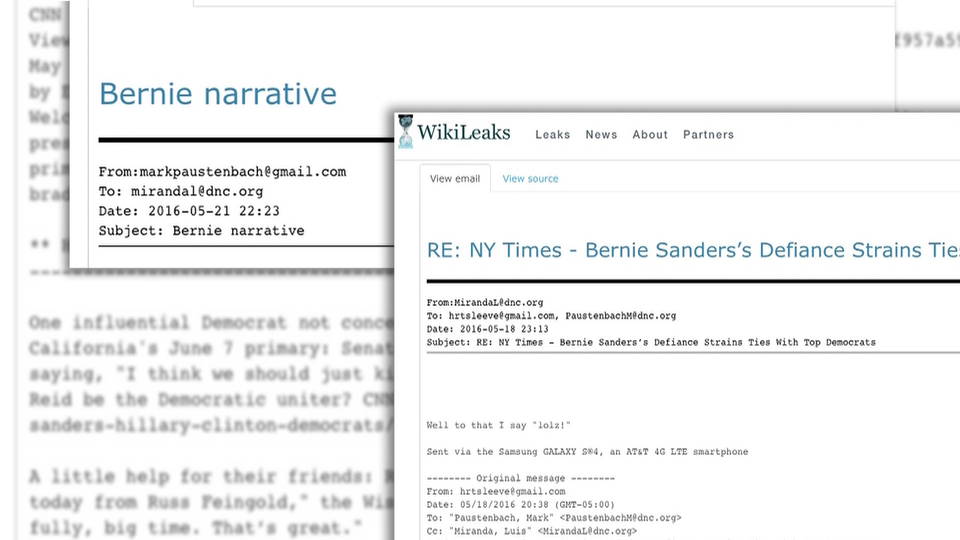
The Democratic National Convention is opening today in Philadelphia, Pennsylvania, amid massive party turmoil. DNC Chair Debbie Wasserman Schultz says she is stepping down following the release of nearly 20,000 emails revealing how the Democratic Party favored Hillary Clinton and worked behind the scenes to discredit and defeat Bernie Sanders. The emails were released Friday by WikiLeaks. In one email, DNC Chief Financial Officer Brad Marshall suggested someone ask Sanders about his religion, writing, "For KY and WVA can we get someone to ask his belief. ... He has skated on saying he has a Jewish heritage. I think I read he is an atheist. ... My Southern Baptist peeps would draw a big difference between a Jew and an atheist." Another email shows DNC staffers suggesting planting a news story that Sanders’ campaign was a "mess." Bernie Sanders reacted to the emails during an interview with ABC’s George Stephanopoulos Sunday.
Sen. Bernie Sanders: "I told you a long time ago that the DNC was not running a fair operation, that they were supporting Secretary Clinton. So what I suggested to be true six months ago turns out, in fact, to be true. I’m not shocked, but I am disappointed."
Party Vice Chair Donna Brazile will act as the DNC’s interim head through the election in November. Following the leak, Clinton announced Wasserman Schultz will serve as the honorary chair of the Clinton campaign’s 50-state program. Clinton called Wasserman Schultz a "longtime friend" and said she will support her congressional re-election race in Florida. Sanders has backed Wasserman Schultz’s primary opponent in the race, Tim Canova. We’ll have more on the emails after headlines with WikiLeaks founder
The Democratic National Convention is opening today in Philadelphia, Pennsylvania, amid massive party turmoil. DNC Chair Debbie Wasserman Schultz says she is stepping down following the release of nearly 20,000 emails revealing how the Democratic Party favored Hillary Clinton and worked behind the scenes to discredit and defeat Bernie Sanders. The emails were released Friday by WikiLeaks. In one email, DNC Chief Financial Officer Brad Marshall suggested someone ask Sanders about his religion, writing, "For KY and WVA can we get someone to ask his belief. ... He has skated on saying he has a Jewish heritage. I think I read he is an atheist. ... My Southern Baptist peeps would draw a big difference between a Jew and an atheist." Another email shows DNC staffers suggesting planting a news story that Sanders’ campaign was a "mess." Bernie Sanders reacted to the emails during an interview with ABC’s George Stephanopoulos Sunday.
Sen. Bernie Sanders: "I told you a long time ago that the DNC was not running a fair operation, that they were supporting Secretary Clinton. So what I suggested to be true six months ago turns out, in fact, to be true. I’m not shocked, but I am disappointed."
Party Vice Chair Donna Brazile will act as the DNC’s interim head through the election in November. Following the leak, Clinton announced Wasserman Schultz will serve as the honorary chair of the Clinton campaign’s 50-state program. Clinton called Wasserman Schultz a "longtime friend" and said she will support her congressional re-election race in Florida. Sanders has backed Wasserman Schultz’s primary opponent in the race, Tim Canova. We’ll have more on the emails after headlines with WikiLeaks founder
Julian Assange.
TOPICS:
DNC 2016
Democratic Party
Hillary Clinton Names Virginia Senator Tim Kaine as Running Mate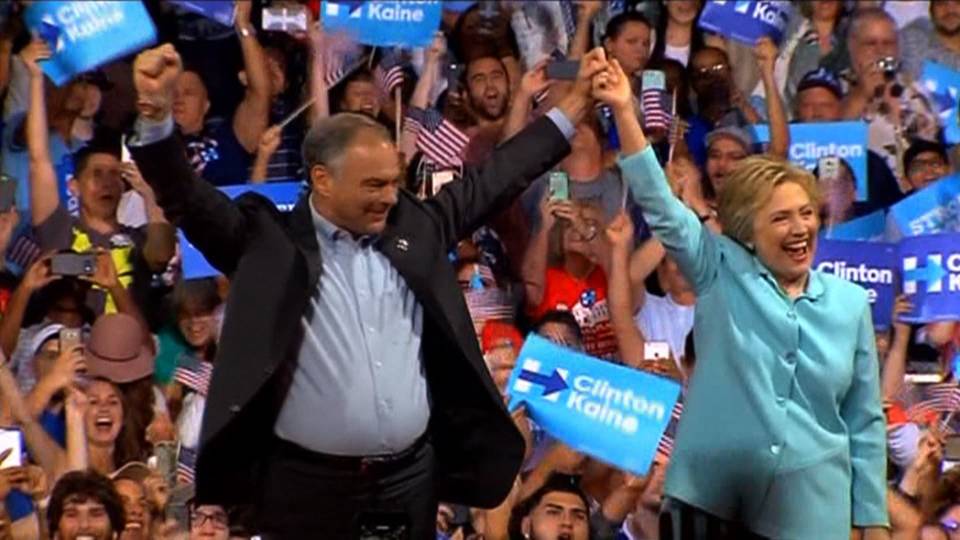
Hillary Clinton has named Virginia Senator Tim Kaine to be her running mate. Kaine was elected to the Senate in 2012. Before that, he was the chair of the DNC. Clinton and Kaine spoke at an event in Miami Saturday, where Kaine spoke in both English and Spanish.
Sen. Tim Kaine: "Hey, guys. Thank you. Hello, Miami. Hello, FIU. Bienvenidos a todos! Bienvenidos a todos. En nuestro país, ¿verdad? Porque somos americanos todos!"
That’s Tim Kaine speaking in Miami. "Welcome everyone. In our country, right? Because we are all Americans." Kaine learned Spanish when he spent a year in Honduras with Jesuit missionaries during the U.S.-backed dirty war in the 1980s. Many believe Kaine’s fluency will help him with the Latino vote, although a 2015 Univision poll found nearly seven in 10 Latinos say a candidate’s ability to speak Spanish would not affect their vote. Meanwhile, many progressives are concerned about Kaine’s track record of supporting so-called free trade agreements, including voting to fast-track the TPP. We’ll have more on Tim Kaine later in the broadcast.
TOPICS:
Hillary Clinton
DNC 2016
Democratic Party
Poll Shows Trump Leading Clinton 44-39 in General Election
A new CNN poll shows Donald Trump leading Hillary Clinton 44 to 39 percent in a four-way match-up. In the poll, Libertarian presidential candidate Gary Johnson received 9 percent, and Green Party candidate Dr. Jill Stein received 3 percent.
TOPICS:
Donald Trump
2016 Election
DNC: Sanders Supporters Demonstrate in Philadelphia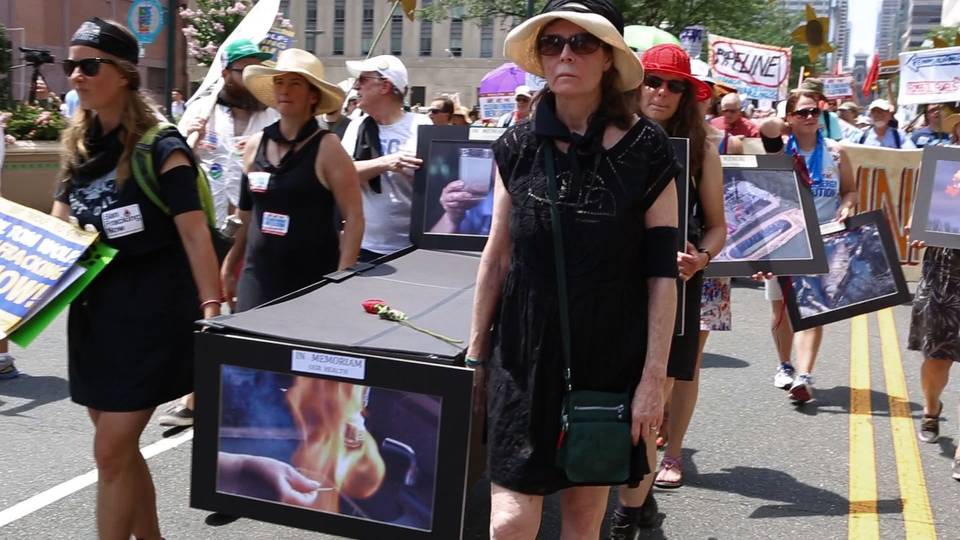
On Sunday in Philadelphia, hundreds of Bernie Sanders supporters rallied ahead of the opening of the DNC—many outraged by the Democratic Party’s bias against Sanders.
Ian O’Malley: "I’m here mostly because of the DNC WikiLeaks. They showed us that Hillary was given an unfair advantage from the get-go, and Bernie was given a disadvantage. What disturbed me was that we knew this all along for the last year, and we’ve been trying to say it. And we all feel a little crazy in the backs of our heads, thinking, yeah, well, we know it’s all corrupt to begin with, but now to have it spelled out for you in 20,000 emails, I don’t think it gets any clearer. And I don’t think it gets any more disturbing than that."
Meanwhile, thousands more protesters marched through the streets of Philadelphia Sunday to demand a ban on fracking and a transition to clean energy. This is one of the protesters.
Xiuhtezcatl Tonatiuh: "My name is Xiuhtezcatl Tonatiuh. I’m 16 years old. I’m a representative of the Earth Guardian Crew, representing Latino indigenous and youth voices, and I’m part of the global climate movement. Hillary Clinton, get your money and get your support off of the fossil fuel industry. We cannot support an industry that threatens lives like my own and all the other young people in our community, communities here in Pennsylvania, across New York, across the country, that are already being affected by the effects of fracking and other forms of fossil fuel extraction. We need 100 percent renewable energy by 2026. We need action now."
TOPICS:
DNC 2016
Bernie Sanders
Trump Defends Roger Ailes, Ousted by Sexual Harassment Claims
This comes as Donald Trump has defended Roger Ailes, who has resigned from Fox News amid multiple accusations of sexual harassment. This is Trump speaking with MSNBC’s Chuck Todd.
Donald Trump: "Well, I don’t want to comment, but he’s been a friend of mine for a long time. And I can tell you that some of the women that are complaining, I know how much he’s helped them, and even recently. And when they write books that are fairly recently released, and they say wonderful things about him, and now all of a sudden they’re saying these horrible things about him, it’s very sad, because he’s a very good person. I’ve always found him to be just a very, very good person and, by the way, a very, very talented person. Look what he’s done. So I feel very badly. But a lot of people are thinking he’s going to run my campaign. My campaign’s doing pretty well."
About a dozen women have spoken anonymously to The New York Times about experiencing sexual harassment at Fox News; one reporter said Roger Ailes began and ended every meeting by hugging and kissing her.
TOPICS:
Donald Trump
Donald Trump Compares Immigration to "Suicide"
Meanwhile, Trump also told Chuck Todd that he expanded his call for a ban on immigration during his speech at the RNC Thursday.
Chuck Todd: "This feels like a slight rollback."
Donald Trump: "I don’t think I’d pull back."
Chuck Todd: "Should we interpret that as that?"
Donald Trump: "I don’t think so."
Chuck Todd: "OK."
Donald Trump: "I actually don’t think it’s a pullback. In fact, you could say it’s an expansion. I’m looking now at territories. People were so upset when I used the word 'Muslim.' Oh, you can’t use the word 'Muslim.' Remember this. And I’m OK with that, because I’m talking territory instead of Muslim. But just remember this: Our Constitution is great. But it doesn’t necessarily give us the right to commit suicide, OK? Now, we have a religious—you know, everybody wants to be protected. And that’s great, and that’s the wonderful part of our Constitution. I view it differently. Why are we committing suicide?"
TOPICS:
Donald Trump
2016 Election
Former KKK Leader David Duke Launches U.S. Senate Bid
Former Ku Klux Klan Grand Wizard David Duke is running for U.S. Senate in Louisiana. Duke said he’s "overjoyed to see Donald Trump and most Americans embrace most of the issues that I’ve championed for years." Earlier this year, Donald Trump refused to disavow David Duke’s support, although Trump has since repeatedly disavowed him.
TOPICS:
Racism
Lt. Gen. Flynn Retweets Anti-Semitic Message
Meanwhile, retired Lt. Gen. Michael Flynn—who was on Donald Trump’s vice-presidential short list and who spoke at the convention—has sparked controversy by re-tweeting an anti-Semitic message. On Sunday, he shared a tweet reading, "Cnn implicated. 'The USSR is to blame!' … Not anymore, Jews. Not anymore." The tweet was a reference to Hillary Clinton’s campaign manager claiming on CNN that Russia was behind the DNC email hack. Flynn deleted the tweet and apologized a few hours later.
TOPICS:
2016 Election
VA Gov. to Individually Pardon Ex-Felons to Restore Voting Rights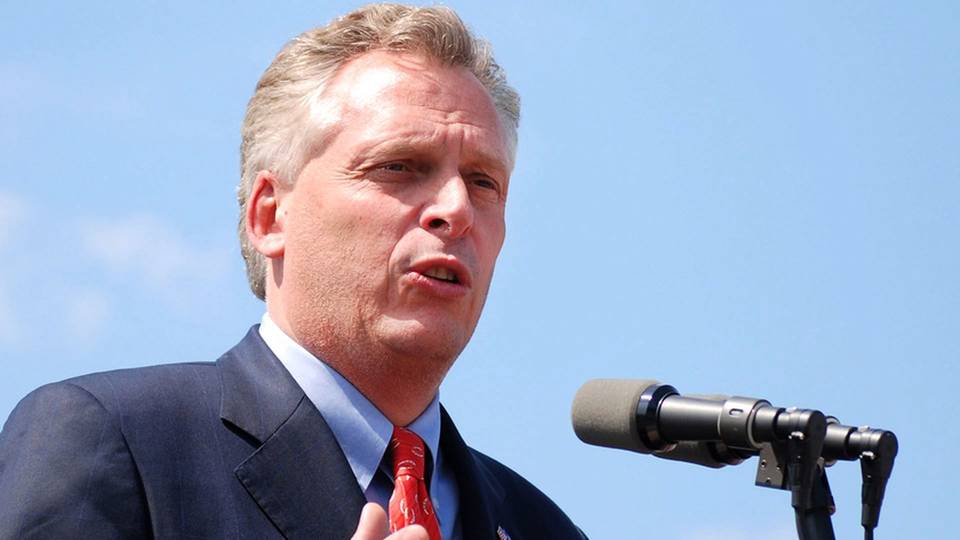
Virginia Governor Terry McAuliffe says he will sign individual clemency grants for tens of thousands of former felons. The promise comes after the Virginia state Supreme Court ruled against an executive order McAuliffe signed in April that would have restored voting rights to about 200,000 people former felons in Virginia who have completed their sentences.
TOPICS:
Voting
Florida: 2 Killed, At Least 16 Wounded in Nightclub Shooting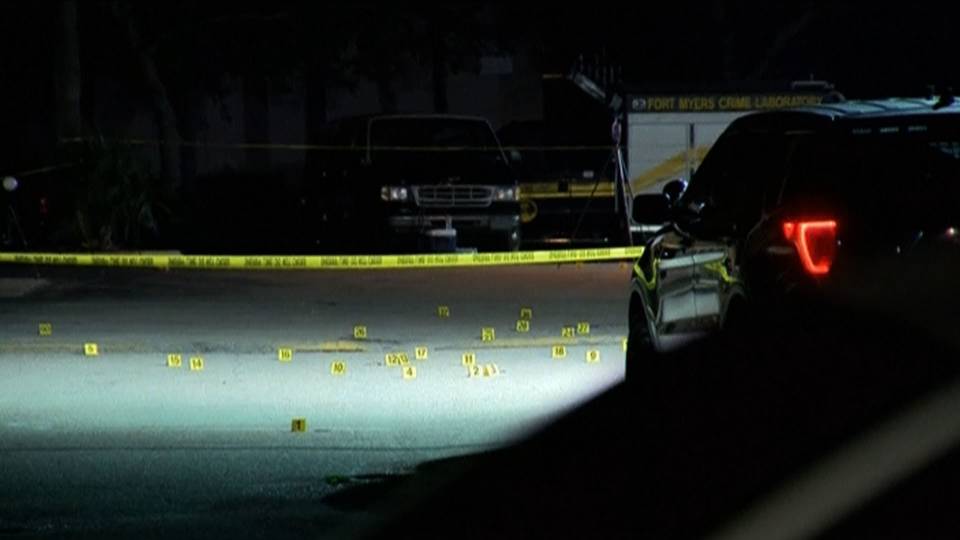
Two people were killed and at least 16 wounded in a shooting early this morning at a nightclub in Fort Myers, Florida. Police said they were investigating the shooting and did not offer a potential motive or suspects for the attack. The attack at the Club Blu nightclub comes a little more than a month after a gunman attacked an LGBTnightclub in Orlando, killing 49 people in one of the deadliest mass shootings in U.S. history.
Afghanistan: ISIS Bombing Kills More Than 80 Protesters in Kabul
Afghanistan observed a national day of mourning Sunday, a day after a suicide bomber killed at least 80 people demonstrating peacefully in Kabul. The Islamic State claimed responsibility for the attack. The demonstrators were asking the Afghan government to build a high-power electrical transmission line in the impoverished northern province of Bamyan. This is Jawad Rezayee, a relative of one of the bombing victims.
Jawad Rezayee: "Yesterday’s incident was a tragic incident against the movement of justice. This is the first attack against a justice movement. We have lost many of our family and friends here. We have come here to bury our martyred and name the hill 'the martyrs' hill.’"
TOPICS:
Afghanistan
Germany: Man Kills 9 in Mass Shooting Near Shopping Center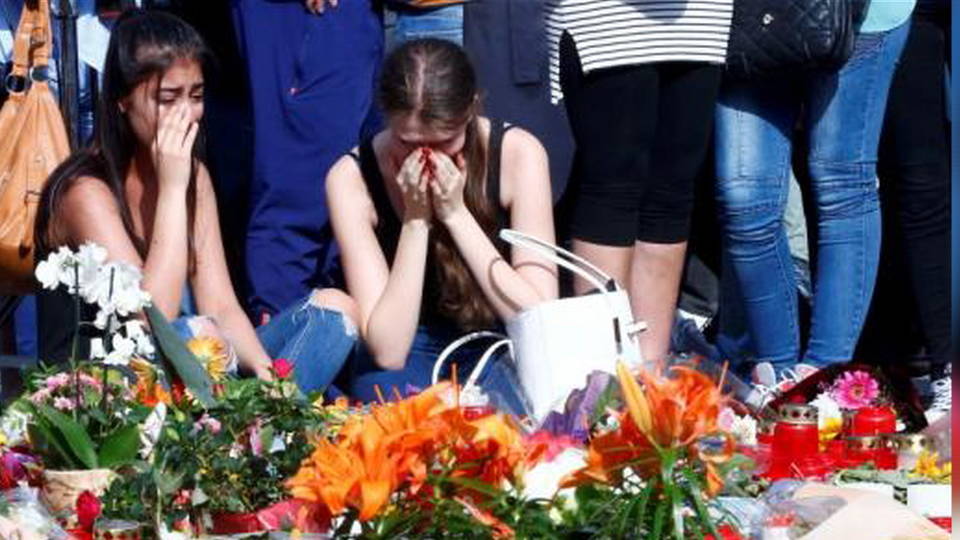
Memorials were held this weekend in Germany for victims of a mass shooting on Friday near a shopping center in Munich. German police say 18-year-old Ali Sonboly killed nine people with a handgun in an apparently random attack before killing himself. An investigator said Sonboly appeared to have been obsessed with mass shootings and began planning his attack after visiting the site of a school shooting that left 15 dead in the German town of Winnenden. The shooting took place on the fifth anniversary of a mass shooting in Norway that left 77 people dead. Police said Sonboly had pictures of that shooter, Anders Breivik, on his computer. Police also said Sonboly had been hospitalized for two months last year for psychiatric care.
Syria: Assad Government Kill 5 in Strikes on Medical Facilities
Syrian government air raids over the weekend struck five medical facilities in and around the city of Aleppo. Five people were killed in the strikes. The Syrian Observatory for Human Rights said all five clinics remained closed after the bombings. Physicians for Human Rights says 750 medical personnel have been killed in Syria since 2011—698 in attacks carried out by government forces and their allies.
TOPICS:
Syria
N. Miami: Autistic Man's Family Says He's Traumatized After Police Shot His Therapist
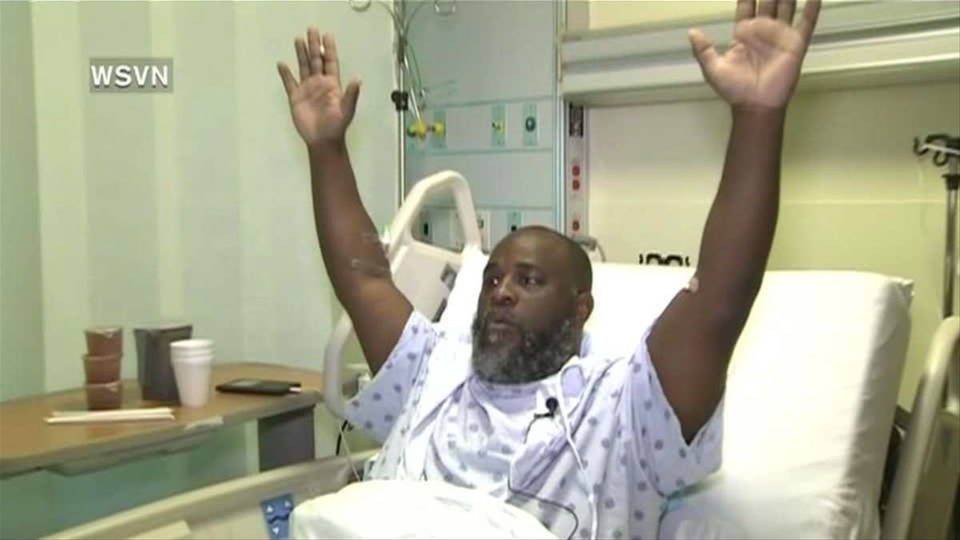
The family of a North Miami autistic man who police say was the target of a shooting last week says he has been traumatized by the incident. Arnaldo Rios-Soto was being treated by a behavioral therapist, Charles Kinsey, after wandering away from a group home. When police arrived, Kinsey lay down on the ground with his hands in the air. He told police no one was armed and that Rios-Soto was playing with a toy truck. An officer opened fire, shooting Kinsey in the leg. The police later said the officer meant to shoot Rios-Soto. Since the shooting, Rios-Soto’s family said he is not sleeping or eating. His sister Miriam Soto spoke to local news.
Miriam Rios: "Own up to your mistakes and let people know that you’re trying to change. Because this is not the first time that it has happened. When I got home, I noticed my mom was crying, nervous. She had no answers, and she explains to me what she saw. Later on that they realized that it was a toy, he didn’t have a gun. Come on, now. It’s just too many lies."
TOPICS:
Police Brutality
Police
#BlackLivesMatter Protests Held Across U.S., 7 Arrested in Asheville, NC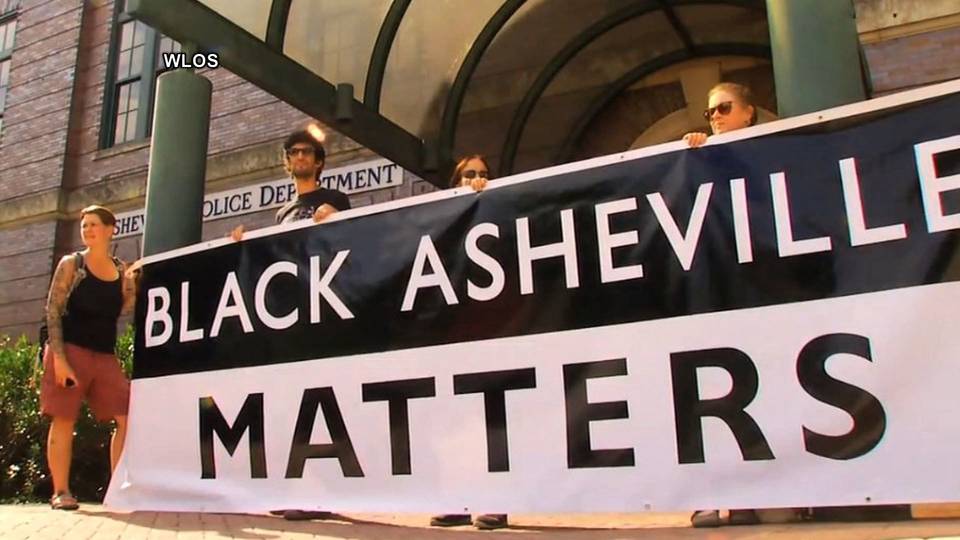
Black Lives Matter activists held demonstrations in at least half a dozen cities in the U.S. over the weekend, including in Houston, Texas; Springfield, Missouri; Apopka, Florida; and Asheville, North Carolina, where seven people were arrested after a sit-in at police headquarters on Friday. The demonstrators staged the 30-hour sit-in to demand answers in the case of the fatal police shooting earlier this month of a 35-year-old African-American man. Police say the man was carrying an assault rifle. His family has hired a lawyer and questioned whether the shooting was justified.
TOPICS:
Black Lives Matter
Police
Police Brutality
WNBA Reverses Fine for Players Wearing T-Shirts for Victims of Police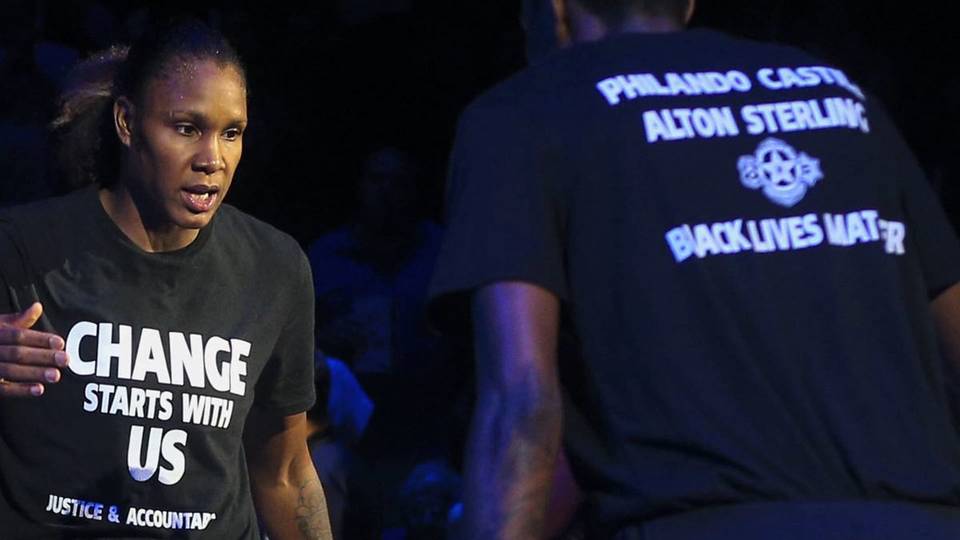
Meanwhile, the WNBA has reversed its decision to fine players for wearing black T-shirts to honor recent victims of police violence in the U.S. The players wore the shirts earlier this month after the killings by police of two African-American men, Alton Sterling in Baton Rouge, Louisiana, and Philando Castile in Falcon Heights, Minnesota. The WNBA announced fines of $5,000 for three teams last week, saying players had violated the league’s "uniform regulations."
TOPICS:
Black Lives Matter
Ohio Judge Jails Lawyer for Refusing to Remove BLM ButtonA judge had an Ohio attorney handcuffed and taken into custody after she refused to take off a Black Lives Matter button. Youngstown Municipal Court Judge Robert Milich found attorney Andrea Burton in contempt of court and sentenced her to five days in jail. Burton said her First Amendment rights had been violated.
Andrea Burton: "It’s an act of civil disobedience, I understand that. I’m not anti-police. I work with law enforcement every day, and I hold them in the highest regard. And just to say for the record, I do believe all lives matter, but at this point they don’t all matter equally, and that’s a problem in the justice system."
Burton was released Friday pending appeal.
TOPICS:
Black Lives Matter
Father of Missing Mexican Student Asks for Meeting with Obama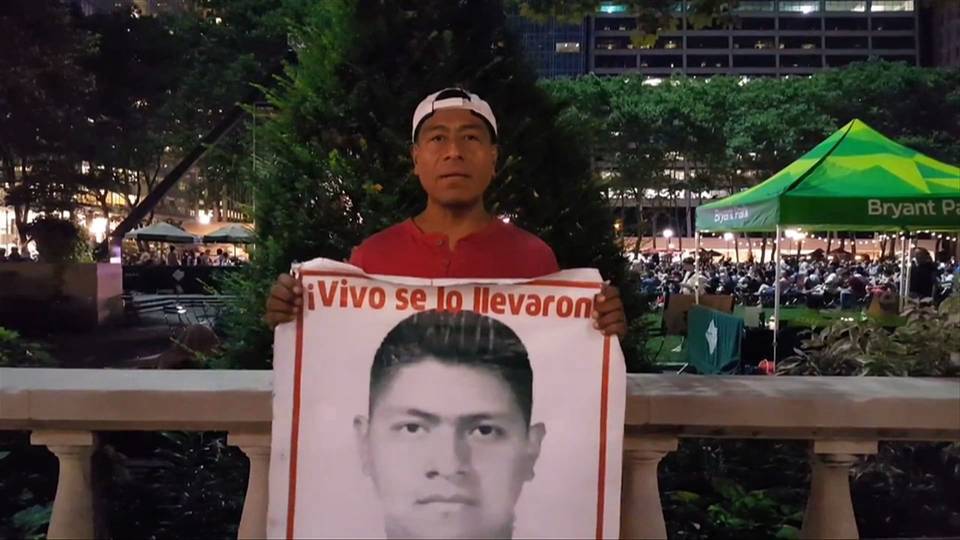
And the father of one of the 43 Mexican students who disappeared in September 2014 is asking for a meeting with President Obama.
Antonio Tizapa: "Mr. President Barack Obama, my name is Antonio Tizapa. I’m the father of Jorge Antonio Tizapa Legideño, one of the students disappeared by the Mexican government. Mr. President, how is possible that you’re going to meet with Mexican President Enrique Peña Nieto tomorrow, when this person is repressing, killing and disappearing my Mexican brothers? Mr. President, I would like to receive an invitation to meet you and explain to you what is really happening in my country. Thank you very much."
President Obama met with Mexican President Enrique Peña Nieto in Washington on Friday.
TOPICS:
Mexico
Today Would Have Been Emmett Till's 75th Birthday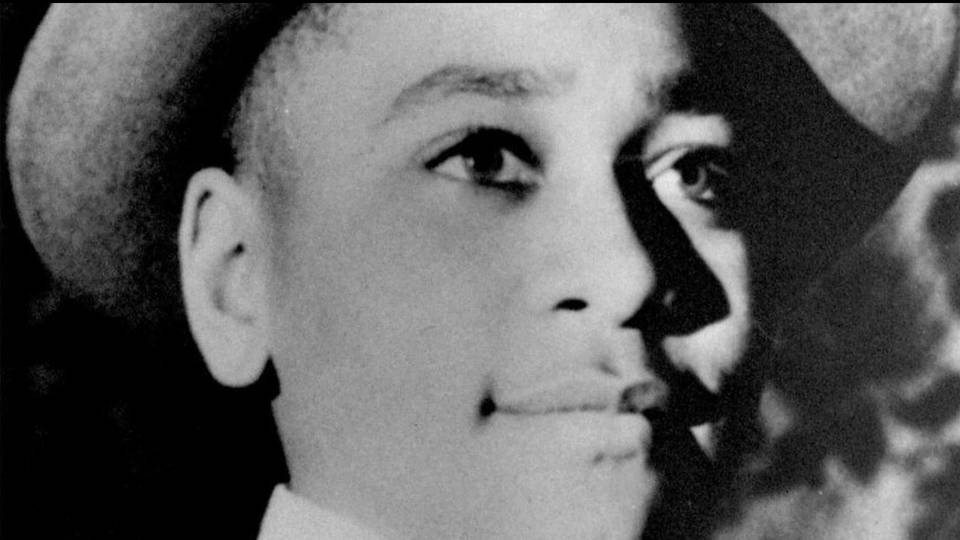
And today would have been the 75th birthday of Emmett Till, the 14-year-old African-American boy from Chicago who was murdered on August 28, 1955, while visiting his aunt, uncle and cousins in Money, Mississippi. Till was abducted, beaten and shot after he allegedly wolf-whistled at a white female store clerk named Carolyn Bryant. His corpse was found three days later in the Tallahatchie River with a bullet hole in his head, barbed wire wrapped around his neck and a cotton-gin fan weighing down his body. Till’s mother, Mamie Till Mobley, held an open-casket funeral for her son in Chicago, and the published images of his brutalized body galvanized the civil rights movement. This is Mamie Till Mobley speaking after the death of her son.
Mamie Till Mobley: "I believe that the whole United States is mourning with me. And if the death of my son can mean something to the other unfortunate people all over the world, then for him to have died a hero would mean more to me than for him just to have died."
TOPICS:
Civil Rights
Black Lives Matter
Donate today:
Follow:


SPEAKING EVENTS

7/29 Provincetown, MA
7/30 Martha's Vineyard, MA
8/19 Seattle, WA
more
COLUMN

Terror, Tennis Balls and Tamir Rice
NEW BOOK

Democracy Now!: Twenty Years Covering the Movements Changing America
WEB EXCLUSIVE

Part 2: Color of Change's Rashad Robinson Confronts Fraternal Order of Police over Racial Profiling
WORK WITH DN!

Office Coordinator
Senior TV Producer
Development Manager
COMING UP

Special Expanded 2-Hour Broadcasts from the RNC and DNC—July 18-29
207 West 25th Street 11th Floor
TOPICS:
DNC 2016
Democratic Party
Hillary Clinton Names Virginia Senator Tim Kaine as Running Mate
Hillary Clinton has named Virginia Senator Tim Kaine to be her running mate. Kaine was elected to the Senate in 2012. Before that, he was the chair of the DNC. Clinton and Kaine spoke at an event in Miami Saturday, where Kaine spoke in both English and Spanish.
Sen. Tim Kaine: "Hey, guys. Thank you. Hello, Miami. Hello, FIU. Bienvenidos a todos! Bienvenidos a todos. En nuestro país, ¿verdad? Porque somos americanos todos!"
That’s Tim Kaine speaking in Miami. "Welcome everyone. In our country, right? Because we are all Americans." Kaine learned Spanish when he spent a year in Honduras with Jesuit missionaries during the U.S.-backed dirty war in the 1980s. Many believe Kaine’s fluency will help him with the Latino vote, although a 2015 Univision poll found nearly seven in 10 Latinos say a candidate’s ability to speak Spanish would not affect their vote. Meanwhile, many progressives are concerned about Kaine’s track record of supporting so-called free trade agreements, including voting to fast-track the TPP. We’ll have more on Tim Kaine later in the broadcast.
TOPICS:
Hillary Clinton
DNC 2016
Democratic Party
Poll Shows Trump Leading Clinton 44-39 in General Election
A new CNN poll shows Donald Trump leading Hillary Clinton 44 to 39 percent in a four-way match-up. In the poll, Libertarian presidential candidate Gary Johnson received 9 percent, and Green Party candidate Dr. Jill Stein received 3 percent.
TOPICS:
Donald Trump
2016 Election
DNC: Sanders Supporters Demonstrate in Philadelphia
On Sunday in Philadelphia, hundreds of Bernie Sanders supporters rallied ahead of the opening of the DNC—many outraged by the Democratic Party’s bias against Sanders.
Ian O’Malley: "I’m here mostly because of the DNC WikiLeaks. They showed us that Hillary was given an unfair advantage from the get-go, and Bernie was given a disadvantage. What disturbed me was that we knew this all along for the last year, and we’ve been trying to say it. And we all feel a little crazy in the backs of our heads, thinking, yeah, well, we know it’s all corrupt to begin with, but now to have it spelled out for you in 20,000 emails, I don’t think it gets any clearer. And I don’t think it gets any more disturbing than that."
Meanwhile, thousands more protesters marched through the streets of Philadelphia Sunday to demand a ban on fracking and a transition to clean energy. This is one of the protesters.
Xiuhtezcatl Tonatiuh: "My name is Xiuhtezcatl Tonatiuh. I’m 16 years old. I’m a representative of the Earth Guardian Crew, representing Latino indigenous and youth voices, and I’m part of the global climate movement. Hillary Clinton, get your money and get your support off of the fossil fuel industry. We cannot support an industry that threatens lives like my own and all the other young people in our community, communities here in Pennsylvania, across New York, across the country, that are already being affected by the effects of fracking and other forms of fossil fuel extraction. We need 100 percent renewable energy by 2026. We need action now."
TOPICS:
DNC 2016
Bernie Sanders
Trump Defends Roger Ailes, Ousted by Sexual Harassment Claims
This comes as Donald Trump has defended Roger Ailes, who has resigned from Fox News amid multiple accusations of sexual harassment. This is Trump speaking with MSNBC’s Chuck Todd.
Donald Trump: "Well, I don’t want to comment, but he’s been a friend of mine for a long time. And I can tell you that some of the women that are complaining, I know how much he’s helped them, and even recently. And when they write books that are fairly recently released, and they say wonderful things about him, and now all of a sudden they’re saying these horrible things about him, it’s very sad, because he’s a very good person. I’ve always found him to be just a very, very good person and, by the way, a very, very talented person. Look what he’s done. So I feel very badly. But a lot of people are thinking he’s going to run my campaign. My campaign’s doing pretty well."
About a dozen women have spoken anonymously to The New York Times about experiencing sexual harassment at Fox News; one reporter said Roger Ailes began and ended every meeting by hugging and kissing her.
TOPICS:
Donald Trump
Donald Trump Compares Immigration to "Suicide"
Meanwhile, Trump also told Chuck Todd that he expanded his call for a ban on immigration during his speech at the RNC Thursday.
Chuck Todd: "This feels like a slight rollback."
Donald Trump: "I don’t think I’d pull back."
Chuck Todd: "Should we interpret that as that?"
Donald Trump: "I don’t think so."
Chuck Todd: "OK."
Donald Trump: "I actually don’t think it’s a pullback. In fact, you could say it’s an expansion. I’m looking now at territories. People were so upset when I used the word 'Muslim.' Oh, you can’t use the word 'Muslim.' Remember this. And I’m OK with that, because I’m talking territory instead of Muslim. But just remember this: Our Constitution is great. But it doesn’t necessarily give us the right to commit suicide, OK? Now, we have a religious—you know, everybody wants to be protected. And that’s great, and that’s the wonderful part of our Constitution. I view it differently. Why are we committing suicide?"
TOPICS:
Donald Trump
2016 Election
Former KKK Leader David Duke Launches U.S. Senate Bid
Former Ku Klux Klan Grand Wizard David Duke is running for U.S. Senate in Louisiana. Duke said he’s "overjoyed to see Donald Trump and most Americans embrace most of the issues that I’ve championed for years." Earlier this year, Donald Trump refused to disavow David Duke’s support, although Trump has since repeatedly disavowed him.
TOPICS:
Racism
Lt. Gen. Flynn Retweets Anti-Semitic Message
Meanwhile, retired Lt. Gen. Michael Flynn—who was on Donald Trump’s vice-presidential short list and who spoke at the convention—has sparked controversy by re-tweeting an anti-Semitic message. On Sunday, he shared a tweet reading, "Cnn implicated. 'The USSR is to blame!' … Not anymore, Jews. Not anymore." The tweet was a reference to Hillary Clinton’s campaign manager claiming on CNN that Russia was behind the DNC email hack. Flynn deleted the tweet and apologized a few hours later.
TOPICS:
2016 Election
VA Gov. to Individually Pardon Ex-Felons to Restore Voting Rights
Virginia Governor Terry McAuliffe says he will sign individual clemency grants for tens of thousands of former felons. The promise comes after the Virginia state Supreme Court ruled against an executive order McAuliffe signed in April that would have restored voting rights to about 200,000 people former felons in Virginia who have completed their sentences.
TOPICS:
Voting
Florida: 2 Killed, At Least 16 Wounded in Nightclub Shooting
Two people were killed and at least 16 wounded in a shooting early this morning at a nightclub in Fort Myers, Florida. Police said they were investigating the shooting and did not offer a potential motive or suspects for the attack. The attack at the Club Blu nightclub comes a little more than a month after a gunman attacked an LGBTnightclub in Orlando, killing 49 people in one of the deadliest mass shootings in U.S. history.
Afghanistan: ISIS Bombing Kills More Than 80 Protesters in Kabul
Afghanistan observed a national day of mourning Sunday, a day after a suicide bomber killed at least 80 people demonstrating peacefully in Kabul. The Islamic State claimed responsibility for the attack. The demonstrators were asking the Afghan government to build a high-power electrical transmission line in the impoverished northern province of Bamyan. This is Jawad Rezayee, a relative of one of the bombing victims.
Jawad Rezayee: "Yesterday’s incident was a tragic incident against the movement of justice. This is the first attack against a justice movement. We have lost many of our family and friends here. We have come here to bury our martyred and name the hill 'the martyrs' hill.’"
TOPICS:
Afghanistan
Germany: Man Kills 9 in Mass Shooting Near Shopping Center
Memorials were held this weekend in Germany for victims of a mass shooting on Friday near a shopping center in Munich. German police say 18-year-old Ali Sonboly killed nine people with a handgun in an apparently random attack before killing himself. An investigator said Sonboly appeared to have been obsessed with mass shootings and began planning his attack after visiting the site of a school shooting that left 15 dead in the German town of Winnenden. The shooting took place on the fifth anniversary of a mass shooting in Norway that left 77 people dead. Police said Sonboly had pictures of that shooter, Anders Breivik, on his computer. Police also said Sonboly had been hospitalized for two months last year for psychiatric care.
Syria: Assad Government Kill 5 in Strikes on Medical Facilities
Syrian government air raids over the weekend struck five medical facilities in and around the city of Aleppo. Five people were killed in the strikes. The Syrian Observatory for Human Rights said all five clinics remained closed after the bombings. Physicians for Human Rights says 750 medical personnel have been killed in Syria since 2011—698 in attacks carried out by government forces and their allies.
TOPICS:
Syria
N. Miami: Autistic Man's Family Says He's Traumatized After Police Shot His Therapist
The family of a North Miami autistic man who police say was the target of a shooting last week says he has been traumatized by the incident. Arnaldo Rios-Soto was being treated by a behavioral therapist, Charles Kinsey, after wandering away from a group home. When police arrived, Kinsey lay down on the ground with his hands in the air. He told police no one was armed and that Rios-Soto was playing with a toy truck. An officer opened fire, shooting Kinsey in the leg. The police later said the officer meant to shoot Rios-Soto. Since the shooting, Rios-Soto’s family said he is not sleeping or eating. His sister Miriam Soto spoke to local news.
Miriam Rios: "Own up to your mistakes and let people know that you’re trying to change. Because this is not the first time that it has happened. When I got home, I noticed my mom was crying, nervous. She had no answers, and she explains to me what she saw. Later on that they realized that it was a toy, he didn’t have a gun. Come on, now. It’s just too many lies."
TOPICS:
Police Brutality
Police
#BlackLivesMatter Protests Held Across U.S., 7 Arrested in Asheville, NC
Black Lives Matter activists held demonstrations in at least half a dozen cities in the U.S. over the weekend, including in Houston, Texas; Springfield, Missouri; Apopka, Florida; and Asheville, North Carolina, where seven people were arrested after a sit-in at police headquarters on Friday. The demonstrators staged the 30-hour sit-in to demand answers in the case of the fatal police shooting earlier this month of a 35-year-old African-American man. Police say the man was carrying an assault rifle. His family has hired a lawyer and questioned whether the shooting was justified.
TOPICS:
Black Lives Matter
Police
Police Brutality
WNBA Reverses Fine for Players Wearing T-Shirts for Victims of Police
Meanwhile, the WNBA has reversed its decision to fine players for wearing black T-shirts to honor recent victims of police violence in the U.S. The players wore the shirts earlier this month after the killings by police of two African-American men, Alton Sterling in Baton Rouge, Louisiana, and Philando Castile in Falcon Heights, Minnesota. The WNBA announced fines of $5,000 for three teams last week, saying players had violated the league’s "uniform regulations."
TOPICS:
Black Lives Matter
Ohio Judge Jails Lawyer for Refusing to Remove BLM ButtonA judge had an Ohio attorney handcuffed and taken into custody after she refused to take off a Black Lives Matter button. Youngstown Municipal Court Judge Robert Milich found attorney Andrea Burton in contempt of court and sentenced her to five days in jail. Burton said her First Amendment rights had been violated.
Andrea Burton: "It’s an act of civil disobedience, I understand that. I’m not anti-police. I work with law enforcement every day, and I hold them in the highest regard. And just to say for the record, I do believe all lives matter, but at this point they don’t all matter equally, and that’s a problem in the justice system."
Burton was released Friday pending appeal.
TOPICS:
Black Lives Matter
Father of Missing Mexican Student Asks for Meeting with Obama
And the father of one of the 43 Mexican students who disappeared in September 2014 is asking for a meeting with President Obama.
Antonio Tizapa: "Mr. President Barack Obama, my name is Antonio Tizapa. I’m the father of Jorge Antonio Tizapa Legideño, one of the students disappeared by the Mexican government. Mr. President, how is possible that you’re going to meet with Mexican President Enrique Peña Nieto tomorrow, when this person is repressing, killing and disappearing my Mexican brothers? Mr. President, I would like to receive an invitation to meet you and explain to you what is really happening in my country. Thank you very much."
President Obama met with Mexican President Enrique Peña Nieto in Washington on Friday.
TOPICS:
Mexico
Today Would Have Been Emmett Till's 75th Birthday
And today would have been the 75th birthday of Emmett Till, the 14-year-old African-American boy from Chicago who was murdered on August 28, 1955, while visiting his aunt, uncle and cousins in Money, Mississippi. Till was abducted, beaten and shot after he allegedly wolf-whistled at a white female store clerk named Carolyn Bryant. His corpse was found three days later in the Tallahatchie River with a bullet hole in his head, barbed wire wrapped around his neck and a cotton-gin fan weighing down his body. Till’s mother, Mamie Till Mobley, held an open-casket funeral for her son in Chicago, and the published images of his brutalized body galvanized the civil rights movement. This is Mamie Till Mobley speaking after the death of her son.
Mamie Till Mobley: "I believe that the whole United States is mourning with me. And if the death of my son can mean something to the other unfortunate people all over the world, then for him to have died a hero would mean more to me than for him just to have died."
TOPICS:
Civil Rights
Black Lives Matter
Donate today:
Follow:
SPEAKING EVENTS
7/29 Provincetown, MA
7/30 Martha's Vineyard, MA
8/19 Seattle, WA
more
COLUMN
Terror, Tennis Balls and Tamir Rice
NEW BOOK
Democracy Now!: Twenty Years Covering the Movements Changing America
WEB EXCLUSIVE
Part 2: Color of Change's Rashad Robinson Confronts Fraternal Order of Police over Racial Profiling
WORK WITH DN!
Office Coordinator
Senior TV Producer
Development Manager
COMING UP
Special Expanded 2-Hour Broadcasts from the RNC and DNC—July 18-29
207 West 25th Street 11th Floor
New York, New York 10001, United States
---------------------
---------------------

No comments:
Post a Comment