democracynow.org
Stories:

Japanese Nobel Laureate Kenzaburo Oe on 70th Anniv. of U.S. Atomic Bombings of Hiroshima and Nagasaki
eventy years ago today, at 8:15 in the morning, the U.S. dropped the world’s first atomic bomb on the Japanese city of Hiroshima. Destruction from the bomb was massive. Shock waves, radiation and heat rays took the lives of some 140,000 people. Three days later, the U.S. dropped a second atomic bomb on the Japanese city of Nagasaki, killing another 74,000. President Harry Truman announced the attack on Hiroshima in a nationally televised address on August 6, 1945. Today, as the sun came up in Hiroshima, tens of thousands began to gather in Hiroshima’s Peace Memorial Park to commemorate the world’s first nuclear attack. We are joined by the acclaimed Japanese novelist and winner of the 1994 Nobel Prize for Literature, Kenzaburo Oe, whose books address political and social issues, including nuclear weapons and nuclear power. "If Mr. Obama were to come to the memorial ceremonies in Hiroshima or Nagasaki, for example, what he could do is come together with the hibakusha, the survivors, and share that moment of silence, and also express considering the issue of nuclear weapons from the perspective of all humanity and how important nuclear abolition is from that perspective—I think, would be the most important thing, and the most important thing that any politician or representative could do at this time," says Oe, who has also spoken out in defense of Japan’s pacifist constitution, which Prime Minister Shinzo Abe has pushed to amend in order to allow the country to send troops into conflict for the first time since World War II.
TRANSCRIPT
This is a rush transcript. Copy may not be in its final form.
AMY GOODMAN: Seventy years ago today, at 8:15 in the morning, the U.S. dropped the world’s first atomic bomb on the Japanese city of Hiroshima. Destruction from the bomb was massive. Shock waves, radiation and heat rays took the lives of some 140,000 people. Three days later, the U.S. dropped a second atomic bomb on Nagasaki, killing another 74,000 people. President Harry Truman announced the attack on Hiroshima in a nationally televised address August 6, 1945.
PRESIDENT HARRY TRUMAN: A short time ago, an American airplane dropped one bomb on Hiroshima and destroyed its usefulness to the enemy. That bomb has more power than 20,000 tons of TNT.
AMY GOODMAN: Well, today, as the sun came up in Hiroshima, tens of thousands began to gather in Hiroshima’s Peace Memorial Park to commemorate the world’s first nuclear attack. At 8:15 a.m., temple bells tolled as the solemn crowd observed a moment of silence.
AMY GOODMAN: Among those gathered for the memorial were the U.S. ambassador to Japan, Caroline Kennedy, as well as survivors known as the hibakusha, or an atomic-bombed person. Their average age now is 80 years old. They listened as Hiroshima Mayor Kazumi Matsui called for nuclear weapons to be abolished.
MAYOR KAZUMI MATSUI: [translated] In order for us to live together, we need to end the use of all nuclear weapons—the ultimate in inhumane, pure evil. And the moment to get this done is now.
AMY GOODMAN: This year’s memorial comes just days before the scheduled restart of the first nuclear reactor in southern Japan to go back online since the 2011 earthquake and tsunami that killed some 18,000 people and set off a nuclear meltdown at the Fukushima power plant. Japan’s prime minister, Shinzo Abe, has pushed to revive Japan’s nuclear energy program despite major opposition. During his remarks at today’s memorial ceremony, Abe said Japan still had an important mission to promote nuclear disarmament at the U.N. General Assembly and to put it on the agenda for G7 meetings to be held in Hiroshima next year.
PRIME MINISTER SHINZO ABE: [translated] Japan intends to renew its efforts to bring about a world without nuclear weapons, with the cooperation of both the nuclear powers and the non-nuclear powers. And that resolve translates to us proposing a new draft resolution at the United Nations in the fall on nuclear disarmament.
AMY GOODMAN: The conservative Japanese prime minister, Shinzo Abe, has pushed to change Japan’s pacifist constitution to send troops into conflict for the first time since World War II. The new legislation is under debate in Parliament, was raised by Hiroshima bombing survivors who met with Abe today. Yukio Yoshioka, representative of the Hiroshima A-bomb survivors network, spoke.
YUKIO YOSHIOKA: [translated] The erosion of the constitution will change Japan into a nation that will go to war and bring upon us tragedy once more. We should not allow this nation to become one that repeats the mistakes of its past and does not let the souls of the atomic bomb victims rest in peace.
AMY GOODMAN: Well, on this 70th anniversary of the U.S. bombing of Japan, we turn to acclaimed Japanese novelist, winner of the 1994 Nobel Prize for Literature, Kenzaburo Oe, who has spoken out in defense of Japan’s pacifist constitution. He is now 80 years old and one of Japan’s most respected intellectuals and humanitarians. Among his books, A Personal Matter, The Silent Cry, A Quiet Life, Hiroshima Notes and A Healing Family. They address political and social issues, including nuclear weapons and nuclear power.
When Democracy Now! was in Japan last year, I sat down with him in the Tokyo offices of Iwanami, his publisher. I started by asking Kenzaburo Oe to explain a comment he made about Hiroshima in which he said, quote, "Hiroshima must be engraved in our memories: It’s a catastrophe even more dramatic than natural disasters, because it’s man-made. To repeat it, by showing the same disregard for human life in nuclear power stations, is the worst betrayal of the memory of the victims of Hiroshima."
KENZABURO OE: [translated] So, when I was a child at the age of 12 was when Japan was involved in the war, and this was of course at the end of the war, when Japan experienced the bombings of Hiroshima and Nagasaki. At the time, what was a great shock to me, myself, but also my mother, our families, all the people at that time, was of course the atomic bomb. And at that time, this was a greater catastrophe than anything we had ever known. And so, the feeling of having to survive this, go beyond this and renew from this was great.
The people in Hiroshima who were forced to suffer the greatest sacrifice was the tens of thousands of people who were killed in an instant. However, there were, of course, many survivors. Following the end of the war and the bombing, for the five years following this, of course, Japan was under occupation, and so at that time it was not possible for the hibakusha, which is what we call the survivors of the atomic bombs, to create any kind of organization of their own. And five years following the bombings was when they were first able to create their own organization. And at that time, their lone slogan was to never allow this to be repeated, never to allow any more hibakusha to be created.
And so, the thing that I feel the most at this time, as we’re suffering from the disaster in Fukushima, is that we must follow the wishes and the will of the hibakusha, and not betray them. Of course, in the following 50 or more years since the end of the war, we have not created any more hibakusha or survivors of nuclear weapons, as such. Despite this fact, it is now after we are experiencing this nuclear power plant disaster, which was created by us, a self-made, man-made disaster, on such a great scale, this has led to so many new hibakusha, or people surviving this nuclear disaster. We have done what we promised following the war to never allow to be repeated, to never allow to happen again. And so, we, the Japanese people, I believe, have been responsible for the greatest betrayal to ourselves, even, betrayal to the Japanese people, by being responsible for this man-made nuclear power plant disaster.
AMY GOODMAN: You led a protest last year against nuclear power in Japan, yet the government today, the most conservative since World War II, is pushing for more nuclear power plants here in Japan.
KENZABURO OE: [translated] So, three years ago, the day after the disaster, the weeks after the disaster, I believe that all Japanese people were feeling a great regret. And the atmosphere in Japan here was almost the same as following the bombing of Hiroshima at the end of the war. And at that time, because of this atmosphere, the government at the time, which is the Democratic Party of Japan, with the agreement of the Japanese people, pledged to totally get rid of or decommission the more than 50 nuclear power plants here in Japan. However, the situation following the disaster, particularly in Fukushima, where so many people are suffering from this, has not changed at all. And the current atmosphere or attitude of the government now in Japan has totally changed. And the current government, which took over from the DPJ, the Liberal Democratic Party, which had long ruled Japan, the conservative government led by Prime Minister Abe, is not only having a totally different policy, but also it’s completely having no regret and no looking back on the nuclear power plant situation or also even on what happened to Japan, and is instead actually actively pushing this forward. And I’m very fearful now that actually all throughout Japan and through the Japanese people, the atmosphere which is now growing and increasing is a spreading of this Prime Minister Abe’s ideology and worldview.
AMY GOODMAN: Yet he was elected as prime minister.
KENZABURO OE: [translated] Yes, he has won in two elections until now. But, however, now, because he has the majority in both of the houses of the Japanese Parliament, it means he is, in essence, able to do anything, go forward anything. And the first thing he is also trying to do now is to revise the constitution, which was created democratically by the Japanese people following the loss in World War II and Hiroshima and Nagasaki experience.
AMY GOODMAN: And explain what Article 9 is and the push to have it removed from the constitution.
KENZABURO OE: [translated] And so, first of all, at the time of the war, of course, Japan was an imperial dictatorship under the leadership of the emperor. However, the first thing that’s an important issue within this new constitution that was created after the war was deciding that the emperor would no longer have any political authority. And following this, the next important point in this new constitution was, of course, Article 9 of the constitution. This lays out that the Japanese people will never again wage war and will not accept war as a means to be used for the resolution of international conflicts. And furthering that also, the second important pillar is that Japan will also not maintain any war potential. However, this second pillar is becoming quite ambiguous, as you are maybe aware that Japan also has, of course, the Japanese Self-Defense Forces, which fulfills the role of an army. And now, under the current Prime Minister Abe administration, Japan is moving toward actively participating in United States wars. And what I am now most fearful about is the unfortunately likely possibility under Prime Minister Abe that this second pillar of Article 9 will be in danger, but not only this, that even the first pillar, that Japan may actually, within the next year or two or three or four years, actually directly participate in war.
AMY GOODMAN: You write about the effect of the birth of your son, Hikari, on your family, on your work. He’s in your books—for example, in A Personal Matter. He was born in 1963 with a birth defect, a hole in his skull. Talk about how that influenced your work and your life.
KENZABURO OE: [translated] So when my oldest son was born, he was born with a mental—or disease. And so, at the time of his birth, when we were thinking or I was deciding what name to give him, because of the dark feelings that I was feeling as a young novelist at the time, I was considering giving him a name which would also resemble this darkness. I’m originally from Shikoku, which is an island in Japan that’s covered with deep forest. And when my mother came from Shikoku to our house in Tokyo, and she told me instead to call him Hikari, which in Japanese means "light." And I have been living with Hikari ever since then.
So, in my book, which was published in the United States, we have this photograph of me with my son Hikari riding on the bicycle. And this child is now 50 years old this year. And I believe in these 50 years that I spent together living with Hikari, living with my child, he’s really taught me or made me realize that innocence is actually at the core of human nature, the core of humanity. And so, my son, this child, although he is not able to speak very much, every now and then sometimes he comes up with very important words, very important things that he shares with us. And I believe this really shows, or it’s very human in really showing the essential nature of human beings. And so, although I myself am perhaps quite a dark novelist, I believe that also my novels show a kind of trust in human beings. And this has come from my son.
AMY GOODMAN: Can you talk about when Hikari first spoke?
KENZABURO OE: [translated] So, at the time when my son was born 50 years ago, medicine at the time, although he was born with a large almost sort of a lump formation on his head, the medicine at the time wasn’t able to see whether—nature or the situation of his brain at the time, whether it was actually—they were fearing that perhaps it was coming somewhat out of place, shall we say? After consulting many, many times with the doctors, we took the courage to actually have that opened up to be checked. And so, at the time, they opened up to check, and it seemed that the brain wasn’t in fact coming out of its place, as they had—but to cover that up, they put almost a plastic lid or a plastic cover on part of his head to repair the surgery, and that is how he has been living for the 50 years since then.
For the first 10 years of his life, he never responded at all to anything that we said. However, one day, we started to be able to hear the sounds of the call of a wild bird. And this was actually coming from the television. And this was the first time he actually showed response or attention to a particular sound, and he really followed this. He turned his face to the direction where he could hear the sound coming from. And so, because he was responding to the sound of the wild bird’s call coming from the television, it made me think that the sound which would be the signal which would be most close for him to respond to would be this kind of pitch and the quality of tone of this bird’s voice. And so I went and bought a recording of wild birds’ calls, and we were playing this in our room all day throughout the day. And he eventually learned to remember these bird calls. And so, this record which we bought and were playing all the time had all different kinds of birds’ calls, including nightingales and other kinds. And the way that the record would play, first you would hear the actual call of the bird, and then one second later it would be followed by a female announcer who would be saying the name. So first there would be the bird’s call, and then, following that, this voice coming on and saying, "Dove," for example. And this went for three hours.
And so, this continued for six months. And we had a summer home in the mountains, where we would go to spend time. Then we went there together with our son. One night, late at night, we could hear the voice or the call of the bird. And so, at that time, our son, who until then had been totally silent, after hearing this voice, he would say the name of the bird. And so, following this, my wife and I opened the windows of our home to wait and hear for the next bird call. And then, in the morning, we heard the same bird calling. And then again, our son said the name of the bird. "Uzura desu." "Uzura" is the name of the bird. And, of course, becoming morning, all of a sudden we started to be able to hear all different kinds of birds. And then, following this, my son, he would sit there and hear all of the different cries of the birds and repeat the name of each one, whether it was a crow or a dove. That was the biggest surprise in my life until this day.
And so, because he had learned to recognize the names of the voices of the birds and so on, we started to think how he could learn the names of other things. So, for example, we’d be drawing or writing together, and then I would hold the pen and say to him, "This is a pen." And then he would repeat, saying, "A pen." And this was the beginning our conversation with my son.
AMY GOODMAN: Acclaimed Japanese novelist, winner of the 1994 Nobel Prize for Literature, Kenzaburo Oe, one of Japan’s most respected intellectuals and humanitarians, describing his relationship with his son, whose music we’ll play for break.
[break]
AMY GOODMAN: A composition of Hikari Oe, the son of Kenzaburo Oe. Hikari is a composer now of classical music. This is Democracy Now!, democracynow.org, The War and Peace Report. I’m Amy Goodman. On this 70th anniversary of the U.S. bombing of the Japanese cities of Hiroshima and Nagasaki, we continue with my interview with the acclaimed Japanese novelist, winner of the 1994 Nobel Prize for Literature, Kenzaburo Oe, who has spoken out in defense of Japan’s pacifist constitution. He’s now 80 years old, one of Japan’s most respected intellectuals and humanitarians. I met with him in Tokyo at his publisher’s office and asked him about his book Okinawa Notes, where he wrote about the mass suicide of Okinawans.
KENZABURO OE: [translated] So I believe that following the war when I was 10 years old is when Japan became a democratic country. And I believe Japan at this time also became a pacifist country. However, at this time, the archipelago of islands known as Okinawa, which is quite a far distance away from the Japanese mainland, was separated from Japan. And at this time, the islands of Okinawa became a base for the United States. And this became perhaps not the largest, but one of the largest United States bases within Asia. And this is continuing until today.
And so, because of this, it is in one sense a reality or a fact that the presence of the United States bases here in Okinawa have meant that, in a sense, Japan has been protected from foreign invasions in this time, and also Japan is part of or within the United States’ nuclear umbrella. And so, it is also a reality that we Japanese are living under the peace constitution, and this is one aspect, but at the same time, we have this huge presence of United States bases in Okinawa, including the great military and also many U.S. soldiers. And so, it is a fact that while we, as Japan, are not maintaining a military or war potential ourselves, we do have this huge U.S. presence.
However, following the war, of course, Japan then went into the process of forming the peace treaty with the United States and its allies. And at that time, the Japanese people cut Okinawa off from the country of Japan. And Okinawa was placed under the political control of the United States. And this continued for many years, and following this, Okinawa was returned to Japan. However, during this time, the Okinawan people were not citizens of Japan. And even today, 70 percent of the United States’ bases which are positioned in Japan are in Okinawa. And so, my book, Okinawa Notes, what I was doing with this is interviewing many people from Okinawa to see what kind of discrimination from the mainland Japanese against the Okinawan people, and not only that, but of people from the same generation, the same youth as us.
And actually, just until last year, for many years I was going through a lawsuit, which has been brought about because of the Okinawa book. And this lawsuit was on the issue of including the—during the war in Japan at the time, when the Japanese army was fighting against the U.S. and its allies in Okinawa. And so, in my book, I write about, during the time of the war, the Japanese military—actually, I use the word "forcing" or "forced" citizens or the islanders of Okinawa to commit collective suicide—so, women, children, elderly people—so as not to be in the way as the battle between the United States and allies and Japan was coming forward. So I say they were forced in this way, because we look at the case of one particular island where 600 women, children and elderly people, under the instructions of the Japanese army, committed collective suicide. And until then, this forced mass suicide in Okinawa had been written in some history books, and at that time, it was first published in a history textbook. And this is when the nationalist movement against this started to become stronger. And so, at this time, as one of the writers who had been writing about these facts of this forced mass suicide in Okinawa, some former Japanese soldiers forced a lawsuit against me, saying that I was bringing dishonor to their name, or libel. However, after many long years struggling with this lawsuit, we were successful. And what pleases me about our success in the lawsuit is that this means that now the Japanese children are able to learn about what happened in Okinawa, and this is able to be now published in their textbooks.
AMY GOODMAN: The lawsuit, though it was beaten, is also expressed in Prime Minister Abe’s efforts to change textbooks, not only around the mass suicide, but around Japan’s role in the period leading up to and through World War II. Can you explain the role of Japan and what you feel needs to be told and what you feel is trying to be erased?
KENZABURO OE: [translated] So, in Japan, under the Meiji Restoration, you know, more than 150 years ago, was when the modernization process started to occur. And within this process of modernization, Japan became a large militaristic state. And there was this discrimination against Okinawa, as I mentioned. And following the war, with the creation of the new constitution, Japan started a new departure as a democratic state. However, despite this, under the current prime minister, Abe, Japan is now looking to become this kind of supra or superpower again, as well. And within this, it is trying to erase what Japan was responsible for domestically, in Okinawa and in the whole of Asia with Japan’s war of invasion. And so, although Japan is responsible for such tragedies all around, what we really need to be doing is remembering what happened, telling this to our children, conveying it to them, and ensuring that it is written in the history textbooks. But rather than this, the strong efforts now is trying to erase this. And at the center of this, responsible for this, I believe, is Prime Minister Abe.
I believe you are probably familiar with the issue of the so-called former comfort women, which was, at the time, Korea, in particular, had been annexed as part of Japan within colonialism. And so, the issue of the former so-called comfort women is when the Japanese imperial army took young women, particularly from Korea, but also from other places, and forced them to work sexually for Japanese soldiers, bringing them to the Japanese mainland and also to the battlefield. And, of course, the Japanese soldiers who returned, who came back from the war, all know about the existence of this comfort system. However, the Japanese people at the time did not speak of this, did not write of this. And years later, Japan and Korea built a treaty amongst the two countries. And at the time, the issue of the comfort women was not raised as an issue within this treaty. I believe this was the year 1961.
Actually, sorry, 26 years later, one Korean woman came out in the media to talk of her experiences and to say that she had been forced to work as a so-called comfort woman. And this news and movement started to spread throughout the whole of Korea. And three years later, finally, after they set the time, there was a cabinet minister called Kono. And Kono, at this time, made an official statement saying that Japan had forced these women into the comfort women system. However, the Japanese government, to this day, even now, refuses to officially recognize these comfort women or former military sexual slavery. And in Korea, the movement to call for formal recognition of these women and for an apology for these women continues to this day very strongly. And this is an international issue.
Then, in 2007—of course, I probably don’t need to explain this to you, but the U.S. Congress released a statement about this, or a resolution. And this resolution called upon Japan to recognize the fact that Japan had been responsible for forcing these women into sexual slavery, and calling on the Japanese prime minister to officially recognize this fact. And the third point which really reminds me of the democratic education which we experienced as young children under the United States, and what really moved me about the resolution from the U.S. Congress, was that it also said that Japan should write about this issue in its textbooks and should teach its children about this issue. I really, deeply from the heart, agree with this. However, the Abe administration refuses to even acknowledge this issue, to acknowledge that these comfort women existed.
And now, we are also seeing the situation where Japan and Korea are experiencing a conflict over territory, over what Korea refers to as the island of Dokdo, about whether this island belongs to Japan or Korea. And I believe that this issue should be dealt with by international legal mechanisms, to look at the different sides of this and how to deal with this issue. Japan refuses to take this to an international legal mechanism for resolution, and Korea is also not doing this. But the reason for Korea refusing to do this is because Japan is still refusing to face up or to recognize its past history, to recognize the comfort women. And so, this is the response for this failure of Japan to deal with its historical recognition issues. And actually, in the two years since the Abe government has come into place, there has been no official leaders meeting between the Korean president and the Japanese prime minister. And also, the same can be said for Japan and China. So, because these issues of the historical recognition and Japan’s failure to deal with its war past are still there, this is meaning that we are having a kind of international relations in this region here which is almost unthinkable in different parts of the world, because of this lack of dealing with the past.
AMY GOODMAN: We’ve talked about Japanese imperialism. I’d like to ask you now about the United States dropping the atomic bombs on Hiroshima and Nagasaki.
KENZABURO OE: [translated] First of all, I believe the fact that human beings created nuclear weapons is a crime of all humanity. However, I am also aware of the fact that it was said within the time of World War II that Nazi Germany was trying to perhaps develop nuclear weapons, and so the U.S., France and the United Kingdom were trying to develop these before Germany could get that far. And so, the United States and the Allied forces did create their atomic bombs. And Nazi Germany was not successful in building nuclear weapons. And in actual fact, nuclear weapons were dropped on the Japanese cities of Hiroshima and Nagasaki, where many people were. I do believe that Japan also bears responsibility for World War II. This war, which so many large powers were involved in, caused great suffering for people all over the world, including people of Japan and especially people of Asia. And it is a reality that within this immense war, nuclear weapons were created and in reality used.
And so, when we consider from the perspective the 21st century and the global situation now, I believe that it was a great mistake that nuclear weapons were created. And I believe it’s extremely necessary to abolish all nuclear weapons for the purpose of the whole of humanity and the future of all of humanity. And so, within this overall situation, I have long been active in calling for the abolition of nuclear weapons.
However, of course, it is also a fact the United States did drop the bombs on Hiroshima and Nagasaki. And I believe that this is something that humanity should not be proud of. However, while remembering this, we also need to, at the same time, remember what Japan and what Nazi Germany was responsible for during the war also, and when we are recording history, ensure that we record both of these realities together. And so, I believe if we’re looking at a concrete program to really rid the world of nuclear weapons, and if we consider we’ll have to achieve this, for example, by the mid-21st century, and we consider this kind of future that we might have, where for the first time humanity could be freed from nuclear weapons, and when you sincerely deny the past nuclear war and aggression, and create a new real kind of nuclear weapon-free world, I believe that what we as Japanese people can do for this is ensure that we do not participate in the nuclear regime that we have now. And this is something which I have been long appealing for and also working toward.
AMY GOODMAN: Can you talk about the significance of the Hiroshima peace ceremony that takes place every year in Hiroshima on August 6, the day the bomb was dropped in 1945, and the significance of U.S. officials going to that ceremony, and what you would like to hear from U.S. officials?
KENZABURO OE: [translated] I believe that the fundamental purpose of the memorial service which is held, which of course has the hibakusha, the survivors of the atomic bombing, at the center, is the message to never again create more hibakusha. And it is the hibakusha, the survivors, who are at the center of this ceremony, who have always been at the center of this ceremony, both literally but also of course spiritually. And so, I am also active in participating together with the survivors, the hibakusha, to go to these kind of gatherings and to also consider how we can call for a world free of nuclear weapons.
And I believe that the participation of representatives, of politicians or diplomats from large countries who do possess nuclear weapons at the ceremony in Hiroshima has a very significant meaning. And so, the ceremony, which is held in Hiroshima, having U.S., for example, embassy officials or its government officials there, and of course also from other countries, has a huge meaning in terms of showing the current nuclear regime which is still existing in the world and remembering how inhumane nuclear weapons are. And this is a really important part for our movement. And so, within my position as an individual citizen of Japan, I believe that the presence or attendance of U.S. politicians at this ceremony holds a very important meaning, or it’s very important.
AMY GOODMAN: Would you like to hear President Obama apologize for the droppings of the bombs on Hiroshima and Nagasaki?
KENZABURO OE: [translated] I am not seeking an apology, whether from the president or from any kind of person, in regards to this issue. And I believe the fact that humanity did create these nuclear weapons is a crime that all of humanity is responsible for. And I believe this is an issue of a much greater scale than any individual politician could make an apology for. I believe that it would have great meaning if Obama, for example, was to come to Hiroshima and hear the experiences or the testimony of the survivors. But I don’t believe that what we should be seeing here is an apology from someone on behalf of the United States’ people for dropping the bomb.
So I believe that if Mr. Obama were to come to the memorial ceremonies in Hiroshima or Nagasaki, for example, what he could do is come together with the hibakusha, the survivors, and share that moment of silence, and also express considering the issue of nuclear weapons from the perspective of all humanity and how important nuclear abolition is from that perspective—I think, would be the most important thing, and the most important thing that any politician or representative could do at this time. I believe that the issue or the experience of nuclear weapons is something too large for any individual to apologize for, and it’s the responsibility of all humanity to take on board. So rather than an apology, I believe that what’s important is to call for an expression of the will and the dedication to create a world free of nuclear weapons. And so, if any influential U.S. politicians, or, for example, even French, were to come to Hiroshima and Nagasaki, that is what I would like to hear.
AMY GOODMAN: You write about your mother’s friend surviving the bombing of Hiroshima but witnessing two children there vaporized in the blink of an eye. "'I just felt outraged,' she told my mother, weeping," you wrote. And you go on to say, "Even though I didn’t fully grasp its import at the time, I feel that hearing that horrifying story (along with the word outrage, which put down deep, abiding roots in my heart) is what impelled me to become a writer. But I’m haunted by the thought that, ultimately, I was never able to write a 'big novel' about the people who experienced the bombings and the subsequent 50-plus years of the nuclear age that I’ve lived through—and I think now that writing that novel is the only thing I ever really wanted to do." Are you writing it?
KENZABURO OE: [translated] No, no, I haven’t. As a novelist, I believe that this is actually my greatest regret. Although I have never once written a sentence which would be in support of nuclear weapons or the regime around them, I have never been able to write this novel. In Japan, there are many novelists who have actually written great novels about hibakusha—for example, the female writer Kyoko Hayashi—and spending many years thinking about the experience of hibakusha to create these powerful novels. However, I, in myself, do not have this capacity. And this is something which I feel as a longtime—as my longest regret and perhaps one of the largest shames of my life. And I believe that when I die, although maybe there will be many things which I will feel shame for, I believe that this will be one of the greatest amongst them, not being able to perhaps write one powerful novel about one individual hibakusha survivor. And although I have several hibakusha who are friends, not having been able to do this, despite respecting such great novels which are achieving this, and I believe that this will be my greatest self-disappointment and also shame when I pass.
AMY GOODMAN: You talk about regret, but what are you most proud of? What do you want to be remembered for?
KENZABURO OE: [translated] I don’t think I’ve really thought of anything in particular as being proud of, as such, personally. But the other day, I was also thinking, well, I do believe that, you know, my life had meaning. And so, in regards to my son, Hikari, in our home, actually, on the first floor, we have the living room, and his room is just next door to that. And so, when he was able to wake up himself and go to the bathroom himself when he needed to in the middle of the night, and he can return to his bed, and he can lie down by himself, but he’s not able to actually bring the covers up on himself. If he wakes up in the night and goes to the bathroom and comes back, he can lay down, and he can go back to sleep by himself, but he’ll be laying there without a blanket on him for the whole night. However, as long as we are living together, because I am perhaps also working late into the night, so when he goes to the bathroom at maybe 1:00 or 2:00 in the morning, and he comes back to his own room, and so I go into his room, and I bring the covers up over him and put him to bed. And so, until he was about 10 years old, he would sleep actually by his mother. And so, since then, it’s been 40 years since he’s been sleeping in his own room. And so, whenever I am in Japan, even if I’m traveling within the country, I’m always sure to be home at night so I can, every night, tuck my son into bed like this. And I’ve been doing this for 40 years. That’s one of the things I personally am proud of within my life.
AMY GOODMAN: That was Kenzaburo Oe, winner of the 1994 Nobel Peace Prize for Literature. I spoke to him in January 2014 in his publisher’s offices in Tokyo, Japan. Special thanks to Meri Joyce for translating and to our Democracy Now! team—John Hamilton, Sam Alcoff, Pedro Rodriguez, Juan Carlos Dávila, Denis Moynihan and Neil Shibata. This is Democracy Now! We’ll be back in a moment.

On Hiroshima Anniv. Peacemakers March on Los Alamos Nuclear Weapons Lab, Birthplace of Atomic Bomb
On the 70th anniversary of the U.S. bombing of Hiroshima and Nagasaki, we are joined by peace activists from across the nation who are convening in Los Alamos, New Mexico, birthplace of the atomic bomb and home to the country’s main nuclear weapons laboratory and the site of ongoing nuclear development. This afternoon, activists will march toward the laboratory’s main entrance calling for nuclear disarmament. We speak with Rev. John Dear, author of "The Nonviolent Life" and "Thomas Merton, Peacemaker." He helped organize this weekend’s Campaign Nonviolence National Conference to mark the 70th anniversary of the Hiroshima and Nagasaki bombings. We’re also joined by the conference’s keynote speaker, Rev. James Lawson, civil rights icon and Holman United Methodist Church pastor emeritus. Rev. Martin Luther King Jr. called Lawson "the leading theorist and strategist of nonviolence in the world."
TRANSCRIPT
This is a rush transcript. Copy may not be in its final form.
AMY GOODMAN: We turn from the target of the atomic bomb to its birthplace, on this 70th anniversary of the atomic bombings of Hiroshima and Nagasaki. Today, hundreds of peace activists from across the nation are convening in Los Alamos, New Mexico, where the atomic bomb was built. Los Alamos is also the birthplace of the nation’s main nuclear weapons laboratory and the site of ongoing nuclear development. This afternoon, the peace activists will march up Trinity Drive toward the laboratory’s main entrance calling for nuclear disarmament.
For more, we go to Santa Fe, New Mexico, where we’re joined by two of the nation’s leading civil rights and peace activists. Reverend John Dear, author of over two dozen books on peace and nonviolence, including, most recently, The Nonviolent Life and Thomas Merton, Peacemaker, he has led peace vigils at Los Alamos for the last 12 years and helped organize this weekend’s Campaign Nonviolence National Conference to mark the 70th anniversary of the Hiroshima and Nagasaki bombings. We’re also joined by the conference’s keynote speaker, the Reverend James Lawson, civil rights icon, Holman UMC pastor emeritus. Dr. Martin Luther King Jr. called Reverend Lawson, quote, "the leading theorist and strategist of nonviolence in the world."
We welcome you both to Democracy Now! Reverend Lawson, let’s begin with you. Can you tell us your memories of August 6, 1945? Where were you? How old were you?
REV. JAMES LAWSON: I was 17 years old. I was a junior in high school, getting ready to start my final year in Washington High School in Massillon, Ohio. I will never forget, because shortly after the bomb was dropped on the 6th of August, the National Forensic League changed its debate topic for schools across the country from whatever it was already designated to a new topic. And that topic went something like this: Does the atomic bomb make mass armies obsolete? Which meant, for us at Washington High School, an enormous amount of work of study, of research, of reading. So that was our debate topic from September until June of that ’45, ’46.
AMY GOODMAN: Did you—
REV. JAMES LAWSON: So this is all planted pretty indelibly in my ears.
AMY GOODMAN: Did you have any sense of the mass casualties? I remember the stories, hearing about the stories, especially at Los Alamos, of the footage that was classified, the video footage that the military took of the devastation of Hiroshima and Nagasaki, playing it for the scientists at Los Alamos. They described weeping, throwing up, and then that footage was put away for many years. Did you have a sense of the more than 200,000 Japanese who were killed 70 years ago today and on August 9?
REV. JAMES LAWSON: From the very beginning, there was, on the one side, the government’s attempt not to get full information available. So, from the very beginning, there was a conflict over how many people were actually killed, how many people were injured. From the very beginning, the issue of radiation of the GIs who moved in to occupy Hiroshima was controversial, and whether that radiation was dangerous. The pain and suffering of the entire city and it having been literally vanquished from the Earth, that issue was rarely talked about and was considered maybe classified, but our own government did not want to reveal the awesome character of the devastation.
AMY GOODMAN: Reverend John Dear, you are leading a series of actions beginning today in Los Alamos. Can you talk about your response to what took place 70 years ago and what you think needs to happen today?
REV. JOHN DEAR: Well, thank you, Amy. Yeah, we’re just continuing to try to build up the movement to call for the total abolition of nuclear weapons. And Los Alamos is the birthplace of the bomb, and business is booming, and so we’re going there to, in a spirit of nonviolence, invite the 20,000 employees who build the heart of every bomb, nuclear bomb, to quit their jobs and to call for the closing of Los Alamos.
As you know, two years ago, the United States Congress approved spending $1 trillion over the next three decades to upgrade our nuclear arsenal. This is insanity. And very few people are talking about it. Los Alamos has more millionaires per capita than any city in the country, the richest county in the country, sitting above the Santa Clara Pueblo, the second-poorest county in the country. You know, they continue to—they spend $2 billion a year building new bombs. President Obama is trying to upgrade the whole nuclear facility there, in effect building a state-of-the-art plutonium bomb factory.
What do you do? In solidarity with our people and our brothers and sisters in Japan, we’re going to march in silence, we’re going to sit in silence, we’re going to have a rally in the park on the physical spot where they actually built the Hiroshima bomb 70 years ago. We’ll do it again on Sunday with hundreds of people from across the country and, maybe most importantly, local New Mexicans. And we’re saying, you know, the place has to close, it’s a threat to the environment out here, it’s a waste of money, it’s not making us safe, and so forth and so on, trying to keep the movement alive and trying to build the movement. And meanwhile, we’re having the conference on nonviolence, as well.
AMY GOODMAN: I want to turn to Yuko Nakamura, a survivor of the U.S. bombing of Hiroshima. In 2007, [she] appeared on Democracy Now! and described what happened that day. At the time of the bombing, she was 13 years old.
YUKO NAKAMURA: [translated] We saw the big lightning, and I felt like that big blast is coming. And the blast is contaminated with glass and dust, and blew through the inside of our factory. And I was knocked down to the floor. All the little pieces of the glasses is stuck in my body. It’s all over my body, the whole entire body. And it got—my uniform got red and stained with blood, and I had a bloody nose and bleeding all over my body.
AMY GOODMAN: A Hiroshima survivor speaking with us, Yuko Nakamura, remembering the bombing of Hiroshima that she survived. The name given to the survivors is hibakusha, atomic bomb survivor. John Dear, for many years hibakusha would come to Los Alamos. I remember one year covering them as they spread seeds over the site where the bombs were built.
REV. JOHN DEAR: Yes, two years ago we hosted a delegation of 25 hibakusha and their children. Imagine, they had never left Hiroshima, and they got off the plane and came into New Mexico, up—and we took them up to Los Alamos. And they wept and told us their stories. But they were also very moved to find out that ordinary Americans are calling for the abolition of nuclear weapons with them. And so there was hope there, I thought, as we befriended each other and continue to build connections, especially from Los Alamos and Santa Fe, in New Mexico, with Hiroshima and Nagasaki. And this is our hope. We continue to build global solidarity, a global movement to abolish these weapons once and for all, and take that trillion dollars to end poverty, clean up the environment and fund nonviolent conflict resolution.
AMY GOODMAN: In 2013, President Obama spoke in Berlin, Germany, and called for nuclear reductions.
PRESIDENT BARACK OBAMA: Peace with justice means pursuing the security of a world without nuclear weapons, no matter how distant that dream may be. And so, as president, I’ve strengthened our efforts to stop the spread of nuclear weapons, and reduced the number and role of America’s nuclear weapons. Because the New START Treaty, we’re on track to cut American- and Russian-deployed nuclear warheads to their lowest levels since the 1950s.
AMY GOODMAN: That was President Obama speaking in Berlin in 2013. Shortly afterwards, Fox News contributor Charles Krauthammer criticized Obama for discussing nuclear arms reduction.
CHARLES KRAUTHAMMER: The idea that we’re going to be any safer if we have a thousand rather than 1,500 warheads is absurd. So why is he doing this? Number one, he’s been obsessed with nuclear weapons and reducing them ever since he was a student at Columbia and thought that the freeze, which was the stupidest strategic idea of the '80s, wasn't enough of a reduction, and second, because I think that’s all he’s got.
AMY GOODMAN: Reverend James Lawson, your response?
REV. JOHN DEAR: His earpiece came off there.
AMY GOODMAN: Well, Reverend John Dear, your response, as you just heard?
REV. JOHN DEAR: Well, yeah, you know, President Obama has said great things about the need to abolish nuclear weapons, but the practice is we continue to fund developing them and upgrading, at an enormous cost, where that money is needed for just basic human needs here in the United States. So, you know, this is the great problem we’re facing with our government right now. And the solution is, we need a new, stronger, grassroots movement in the United States, connected with the global movement, to say, "We need to start working for the abolition of nuclear weapons now."
AMY GOODMAN: In this last—
REV. JOHN DEAR: We can’t wait. And we can’t have just one or two. We need to get rid of all of them.
AMY GOODMAN: In this last minute we have together, Reverend James Lawson, it’s also the 50th anniversary of the signing of the Voting Rights Act, August 6, 1965. The significance of what the Voting Rights Act means to all of these different issues?
REV. JAMES LAWSON: Well, the—making the democratic experiment from July 4th, 1776, in the United States accessible to all the citizens, to all the people, is a part of the major task that has to be continued within the United States. The Voting Rights Act of 1965, therefore, is one of the most important tools for that. It broke open, especially in the South, but also in places like New Mexico and California—it broke open the possibilities of people with a different language and of black people, especially, being allowed to vote, being able to vote without all the hatred and rage against their voting and their right to vote. They were acknowledged as citizens.
AMY GOODMAN: Reverend Lawson, we’re going to continue the discussion on the Voting Rights Act after the show and post it at democracynow.org. I want to thank Reverend James Lawson and Reverend John Dear.
That does it for our show. I’ll be speaking tonight in Manhasset on the 70th anniversary of the bombing of Hiroshima and Nagasaki. Check our website.
Headlines:
Obama: Choice over Iran Nuclear Deal is Between Diplomacy and War
President Obama has ramped up his push for Congress to approve the historic nuclear deal with Iran, comparing arguments against the deal to those heard in the lead-up to the invasion of Iraq. In his speech Wednesday, Obama said Iranian hardliners who reject the nuclear deal and chant "Death to America" are "making common cause with the Republican caucus." Ultimately, Obama said, the decision to support or reject the nuclear deal comes down to a choice between diplomacy with Iran and war.
President Obama: "Rejection of this deal leaves any U.S. administration that is absolutely committed to preventing Iran from getting a nuclear weapon with one option: another war in the Middle East."
More than 100 Feared Dead as Migrant Boat Capsizes in Mediterranean
In news from Europe, an overcrowded fishing boat carrying as many as 700 migrants capsized in the Mediterranean Sea off the coast of Libya Wednesday. At least 25 people died, and as many as 100 more are feared to have drowned, according to Italian officials. Human rights groups say at least 2,000 migrants have died this year trying to cross the Mediterranean to reach Europe.
Australia Reveals It Turned Away over 600 Asylum Seekers at Sea
Meanwhile, Australian officials have announced they have turned away more than 600 asylum seekers at sea under harsh border controls enacted under Prime Minister Tony Abbott. In addition to turning away boats, Australia has also sent migrants who do reach Australian shores to long-term detention camps on the islands of Papua New Guinea and Nauru. The United Nations has criticized the harsh border controls for potentially breaking international law. On Thursday, Immigration Minister Peter Dutton hailed the results of the measures.
Australian Immigration Minister Peter Dutton: "The fact that today we celebrate that we have not had a successful people-smuggling venture in a year, and that over the course of the last 18 months or so we’ve turned back 20 boats and stopped 633 people from arriving in our country, is a significant achievement of the Abbott government."
Egypt: ISIL-Linked Group Threatens to Kill Croatian Hostage in 48 Hrs
An Egyptian militant group linked to ISIL has released a video threatening to kill a Croatian hostage within 48 hours unless Egypt releases female Muslim prisoners. The video shows a man kneeling in a jumpsuit in front of a masked man with a knife. He identifies himself as Tomislav Salopek, an employee of a French geoscience company that provides seismic data for the oil and gas industry. The militant group behind the video and the kidnapping is reported to be the Sinai Province, which pledged allegiance to ISIL in 2014. The video’s release comes as Egypt prepares to host hundreds of foreign officials at today’s inauguration of the $8.5 billion expansion of the Suez Canal.
Pentagon: U.S. Launches First Drone Strike in Syria from Turkey Base
Pentagon officials say the United States has launched its first drone strike into Syria from Turkey’s Incirlik Air Base. Turkey opened the airbase to U.S. strike aircraft last month, following the deadly attack in the Kurdish city of Suruc. The airstrike comes as the U.S. and Turkey are planning a joint campaign to push ISIL from a 60-mile-long strip of northern Syria along the Turkish border.
Japan: Hiroshima Marks 70 Years Since U.S. Dropping of Atomic Bomb
In Hiroshima, Japan, temple bells tolled this morning as a solemn crowd marked 70 years since the United States dropped the world’s first atomic bomb on the city. Shock waves, radiation and heat rays took the lives of some 140,000 people — nearly half of the town’s population. Hiroshima Mayor Kazumi Matsui marked the anniversary by calling for the abolition of nuclear weapons.
Hiroshima Mayor Kazumi Matsui: "In order for us to live together, we need to end the use of all nuclear weapons — the ultimate in inhumane, pure evil. And the moment to get this done is now."
Three days after the atomic bombing of Hiroshima, the United States dropped a second atomic bomb on the Japanese city of Nagasaki, killing another 74,000 people. We’ll have more on the bombings with Nobel Prize-winning Japanese novelist Kenzaburo Oe after headlines.
Japan: 25 Have Died Amid Tokyo’s Longest Heat Wave on Record
In other news from Japan, at least 25 people have died amid record-breaking heat. Tuesday marked Tokyo’s fifth consecutive day of temperatures over 95 degrees Fahrenheit, making it the longest such heat wave on record.
Puerto Rico: Extreme Drought Prompts Extended Water Rationing
In another sign of climate change, Puerto Rico is also facing an extreme drought. Dry conditions have prompted the government to extend water rationing, meaning a total of 400,000 residents will now receive water only every third day.
California: Drought-Fueled Wildfires Rage Across 106 Sq. Miles
In California, meanwhile, the largest of many drought-fueled wildfires has grown to 106 square miles, crossing highways and defying attempts to bring it under control. This year is on pace to become the warmest on record.
Palestine: Unexploded Israeli Bomb Detonates, Kills 4 in Refugee Camp
At least four members of a Palestinian family have been killed and 30 other people wounded after a previously unexploded Israeli bomb detonated in a home in a refugee camp in Rafah. The bomb, thought to be from the Israeli assault of Gaza last year, reportedly exploded as workers helped the family clear rubble from a house destroyed in the assault. At least 82 Palestinians have been killed by unexploded ordnance since the assault ended.
Appeals Court: Texas Voter ID Laws Violate 1965 Voting Rights Act
A federal appeals panel has ruled Texas’ strict voter ID law discriminates against African Americans and Latinos and violates the Voting Rights Act of 1965. Wednesday’s ruling came one day before today’s 50th anniversary of the signing of the Voting Rights Act. Texas’ voter ID law is among the strictest in the country, requiring all voters to bring a government-issued photo ID to the polls. The appeals panel ruled the law has a discriminatory effect on voters of color. But in a partial defeat for voting rights advocates, the court also ordered a lower court to re-examine its previous ruling Texas lawmakers acted with racial discrimination in mind when they passed the law. If the courts ultimately do decide lawmakers acted with discriminatory intent, it could lead to the reinstatement of federal oversight over Texas voting laws, a mechanism gutted nationwide by a Supreme Court ruling in 2013.
SWAT Team Kills Mentally Ill Man with Hatchet at TN Movie Theater
In Tennessee, a SWAT team shot and killed a man with a history of mental illness after he set off pepper spray inside a Nashville-area movie theater. Vincente Montano was reportedly armed with a hatchet and pellet gun, but no one was seriously injured by his attack. He was shot dead by authorities while attempting to leave the theater through a back door.
Malaysia PM: Debris Found on French Island Belongs to Flight 370
Malaysia’s prime minister has announced that debris found on the French island of Réunion comes from Malaysia Airlines Flight 370. The Boeing 777 plane disappeared in March 2014 with 239 passengers aboard. Prime Minister Najib Razak spoke Wednesday.
Malaysian Prime Minister Najib Razak: "Today, 515 days since the plane disappeared, it is with a very heavy heart that I must tell you that an international team of experts have conclusively confirmed that the aircraft debris found on Réunion Island is indeed from MH370."
Mexico: 1 Suspect in Custody over Murder of Journalist Rubén Espinosa
In news from Mexico, police are holding one suspect in connection with the murders of photojournalist Rubén Espinosa, human rights activist Nadia Vera and three other women. According to human rights advocates, Espinosa’s death last week signals a new level of violence against journalists in Mexico, who had previously considered Mexico City a safe zone.
SEC: Public Companies Must Disclose CEO-to-Worker Pay Ratio
In the United States, the Securities and Exchange Commission has voted to adopt a rule that will require public companies to publish the pay ratio between CEOs and their workers’ median pay. The United States has the highest ratio between CEO and worker pay of any country. On average, CEOs in the U.S. make 350 times more than their workers.
Republican Candidates Preparing for First Debate of 2016 Election
The Republican presidential candidates are preparing for the first debate of the 2016 election season. Ten candidates will appear in a prime-time debate, while seven candidates who did not make the cut will participate in another debate in the afternoon. Fox News said it calculated its top 10 list by averaging five national polls, a process which came under fire from polling agencies earlier this week. The Marist Institute for Public Opinion temporarily suspended its polling, saying Fox’s criteria ignores the margin of error.
Donate today:Follow:


COLUMN

"Hiroshima and Nagasaki, 70 Years After the Atomic Bombs Were Dropped" by Amy Goodman and Denis Moynihan

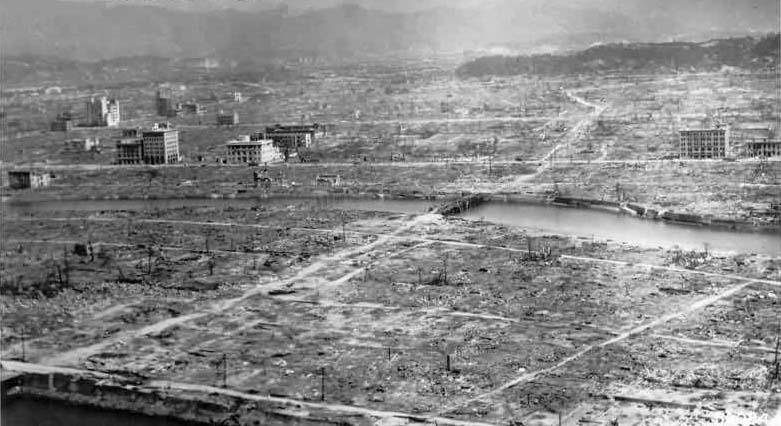
The aftermath of the Aug. 6, 1945, atomic bombing of Hiroshima, Japan. (U.S. Navy Public Affairs Resources Website / CC BY-SA 3.0)
The world changed irrevocably 70 years ago, on Aug. 6, 1945, when the United States dropped the first nuclear weapon in history on the civilian population of Hiroshima, Japan. Three days later, the second and, to date, final atomic weapon used against human targets was dropped on Nagasaki, Japan. Hundreds of thousands were killed. Many were horrifically burned, and thousands suffered the long-term impacts of radiation poisoning. Survivors of those two horrible blasts, called “hibakusha” in Japanese, still live, and still recount their experiences. While the world has avoided nuclear attacks since those two days in 1945, the potential for nuclear devastation is forever hanging over us. Born from the ashes of those two awful bomb blasts, however, was a nuclear abolition movement that still wages a peaceful campaign to eliminate these weapons.
“I was a child at the age of 10 ... when Japan experienced the bombings of Hiroshima and Nagasaki,” Kenzaburo Oe told me in Tokyo last year. Now 80 years old, Oe is the 1994 winner of the Nobel Prize for Literature, and is one of Japan’s most highly respected intellectuals and humanitarians. “At the time, what was a great shock to me, but also my mother, our families, all the people at that time, was of course the atomic bomb. This was a greater catastrophe than anything we had ever known.”
For all of his great writings, known around the world, Oe said it is his greatest shame that he never wrote a novel about the atomic bombings. He gives great credit to the wounded survivors for keeping the stories alive: “Japan was under [U.S. military] occupation, and at that time it was not possible for the hibakusha, which is what we call the survivors of the atomic bombs, to create any kind of organization of their own. And five years following the bombings was when they were first able to create their own organization. At that time, their lone slogan was to never allow this to be repeated, never to allow any more hibakusha to be created.”
The hibakusha have served as the core of the Japanese peace movement ever since, taking as their symbol the origami peace crane. Sadako Sasaki was a 2-year-old girl when Hiroshima was leveled by the bomb. Sadako lived, but at the age of 12 was diagnosed with leukemia, one of the diseases caused by the bomb’s lingering radiation. A friend in the hospital told her that if she folded 1,000 origami cranes, she would be granted a wish. Hoping to defeat her disease, she began making the intricate paper cranes. She died on Oct. 25, 1955.
The peace movement in Japan still lives, though, as people there organize to abolish nuclear weapons, but also to eliminate nuclear power plants. Oe told the French newspaper Le Monde, ““Hiroshima must be engraved in our memories: It’s a catastrophe even more dramatic than natural disasters, because it’s man-made ... by showing the same disregard for human life in nuclear power stations, [it] is the worst betrayal of the memory of the victims of Hiroshima.” The movement to permanently shut down Japan’s fleet of nuclear power plants seemed on the verge of success after the Fukushima disaster in March 2011. The conservative government of Prime Minister Shinzo Abe that came to power after the disaster, however, has vowed to revive nuclear power there, restarting dormant plants and even building new ones.
Across the world, at Los Alamos, New Mexico, the birthplace of the atomic bomb, research is still conducted on making newer and “better” nuclear weapons. To commemorate the 70th anniversary of the bombings of Hiroshima and Nagasaki, peace activists are holding a conference in nearby Santa Fe, as well as vigils at the gates of the top-secret national nuclear-weapons research laboratory in Los Alamos. As organizer and longtime peace activist Father John Dear says, “We said to God, what it took you 15 billion years to make, we can end in 15 minutes.”
Dear’s words echo those of one of the bomb’s architects, J. Robert Oppenheimer. He was a physicist and leader of the Manhattan Project, the massive U.S. project that built the bombs. The first atomic detonation happened on July 16, 1945 in the New Mexico desert, at a test site called Trinity. Watching the blast and the ensuing mushroom cloud, Oppenheimer recalled the words of Vishnu from the Hindu scripture, the Bhagavad Gita:
“Now I am become death, the destroyer of worlds.”
Hiroshima stands as a monument to the madness of nuclear weapons. Last year, walking the grounds of the Hiroshima Peace Museum, we saw the Children’s Peace Monument, in honor of Sadako Sasaki and the thousands of child victims of the blasts. The monument is adorned with thousands of paper cranes. Engraved at its base is a plea to us all:
“This is our cry. This is our prayer. Peace in the world.”
Amy Goodman is the host of “Democracy Now!,” a daily international TV/radio news hour airing on more than 1,300 stations. She is the co-author, with Denis Moynihan, of “The Silenced Majority,” a New York Times best-seller.
(c) 2015 Amy Goodman
Distributed by King Features Syndicate
SPEAKING EVENTS

8/6 Manhasset, NY
8/11 Venice, Italy
WORK WITH DN!

Social Media Editor
207 West 25th Street, 11th Floor
New York, New York 10001 United States
____________________________
____________________________

No comments:
Post a Comment