
Click here for the Aug. 12 printable version of GPconnect.
In this edition of GPconnect:
ANNOUNCEMENTS
Administrative assistant added to clergy excellence team
Ministry grants available from Nebraska UM Foundation
Help your ministry by shopping at the UMC Market
Anne Gahn to share spiritual journey
EQUIP DISCIPLES
Camp Fontanelle celebrates summer highlights
Register now for October lay servant training at Camp Comeca
Give an extra boost to the faith life of your youth
Success Stories: Grand Island Trinity United Methodist Church
Keep campus ministries in college plans
I built a church with a $1,000 investment
St. Mark’s UMC to host Thrive Event
Outside in service
CLERGY EXCELLENCE
Drew offers webinar series for continuing education
SMU announces appointment of Dr. Evelyn Parker to Susanna Wesley Centennial Chair in Practical Theology
Course of Study student graduates from Duke
MERCY AND JUSTICE
Churches encouraged to schedule disaster response trainings
Pastors fight racism, move forward after Ferguson
Raising our voices – speaking out so families can stay together
OTHER NEWS
Newsletters
Classifieds
Press Clips
Administrative assistant added to clergy excellence team

Regina Bergman has joined the Lincoln office as part-time administrative assistant to the Rev. Nancy Lambert, director of Clergy Excellence. Regina has been working part-time on a temporary basis in the office for two years, helping the administrative services staff manage the volume of financial information that was involved in the creation of the new conference. That work finished up in May and left her available to now help out in Clergy Excellence. Her responsibilities began July 1 when Dana Reinhardt went on maternity leave and she will continue part-time, sharing the responsibilities of the position with Dana later this fall.
Ministry grants available from Nebraska UM Foundation

The Nebraska United Methodist Foundation awards a limited number of small grants to Nebraska churches and affiliated agencies of the Great Plains United Methodist Conference.
Through these awards of grant dollars, The Foundation seeks to enhance and expand their ministries. The ultimate goal of these awards is to provide assistance whether it be a one-time grant or a grant that will help a ministry become self-sustaining.
These grants are made only for programs and activities — including operating expenses and supplies necessary for those programs or activities. They are not made for building repair, replacement or expansion.
The application deadline is Sept. 30, 2015. For application materials and more information, please visit numf.org/churches/grants.
Please review the ministry grant criteria, information and application carefully before applying, and allow enough time to gather the necessary information.
If you have questions about the application process or would like to talk to The Foundation about how you can help fund these types of grants, please call us at 877-495-5545.
Help your ministry by shopping at the UMC Market

If you’re looking for ways to bring more money into your church, one possibility is the UMC Market website. By making purchases online that you would make anyway, you can bring a portion of each sale back to a church of your choosing.
Here’s how it works:
Go to umcmarket.org and follow the instructions to select your state, city and church.
You’ll be asked to provide an email address and set up a username and password.
Then, you start shopping online from such well-known stores and products as Target, Best Buy, Dell, Avon, Macy’s, New Balance and Kohl’s, among many others.
You make your purchases by going to umcmarket.org and then to the stores via the UMC Market website. Your purchases will result in anywhere from 1 percent to 10 percent or more of the value coming back to the churches via a check from the market. An alternative is to use the “support button,” which has simple instructions to follow by going to umcmarket.org/dn-umc/#settings/faq. The button on certain browsers allows you to skip logging in to the UMC Market site first.
Don’t forget to check the “Offers” tab on the UMC Market site (or have that support button installed) so you can obtain coupon codes for up to 70 percent off of some items. The deals change, so be sure to check the site on a regular basis.
Churches are issued the funds designated for them on a regular basis.
Anne Gahn to share spiritual journey

Anne Gahn presents “Journey of Faith” on Aug. 29, at First United Methodist Church, at 50th and St. Paul Streets, in Lincoln.
Anne Gahn has a passion for connecting people through stories, the study of the Scriptures, and engagement in spiritual practices in order to help them articulate their passions and serve others. She teaches, listens and leads in a way that honors each person's individuality and experiences and seeks to connect people with a wholeness that can only be found in relationship to God.
Anne has served in children and youth ministry, as Christian education director for all ages and plans to pursue certification as a spiritual director following the completion of her Masters of Divinity degree from Saint Paul School of Theology. She is a member of Trinity UMC Lincoln and is a certified candidate for ministry on the elder track in The United Methodist Church.
She currently resides in Lincoln with her husband, the Rev. Doug Gahn, and youngest daughter Emmaly, who will be a senior at Lincoln East this year. Anne also has two adult daughters with families.
Call 402-464-0325 to register. Cost is $10.
Camp Fontanelle celebrates summer highlights

Extraordinary. That is the only word to describe Camp Fontanelle's 2015 Summer Camping Ministry. Some highlights from the camp incude:
Camp Fontanelle had 714 campers. That is a more than 17 percent increase from 2014 and a new record for the number of campers having the chance to connect with God
There were 329 new to camping at Camp Fontanelle
A total of 101 United Methodist churches sent campers to Fontanelle
Out of the total campers, 53 percent received a discount or scholarship
Summer staff who truly became part of the Camp Fontanelle family
Remarkable cooking from this summer's kitchen staff
A colorful celebration for full-time staff
At the end of June, when it looked like the camp could surpass the 700 camper total, a challenge was given to the three full-time staff members from the summer staff: "If we go passed 700 campers, you need to get your hair colored!"
The challenge was accepted and when the last two camps checked in on Aug. 3 and the camp total was 714, the summer staff went out and purchased pink highlights for Site Director Trent Meyer and Program Director Derek Bergman. Meyer and Bergman received their highlights in the basement of the main lodge. Jane Van Horn, camp coordinator, chose to go to a salon to have purple put in her hair.
Van Horn reflects on what a great summer it was, "God blesses the camp every year, but it was a special blessing to have the opportunity to have so many campers here to listen for God in worship, music, laughter and play. Never in my dreams could I have imagined such an increase in camp numbers. Our previous camp record was 625 in 2013. But it is not about numbers; it is about lives affected, people getting a real chance to connect with God in nature with us here at camp."
The work at camp does not end with the end of summer programming. The full-time staff, with help from great volunteers, is working hard to prepare for their annual barbecue and auction and the opening of their Second Season Pumpkin Patch and Corn Maze. The barbecuce will be held on Sunday, Sept. 20, which is also the opening day for the pumpkin patch and corn maze. The second season will run through Sunday, Nov. 1st. More information on the second season will be available in future issues of GPconnect and at campfontanelle.com.
Register now for October lay servant training at Camp Comeca

Oct. 23-24, 2015 will find course leaders and lay servants gathering at Camp Comeca for a 24-hour retreat and course study. Four courses will be offered; each participant will choose one course from these:
Accountable Discipleship — This course focuses on the concept of the household of God, the importance of scripture as divine revelation, Wesleyan understandings of grace and the importance of the office of class leader in the development of the Methodist movement. You are encouraged to look at your own faith community and see how it is (or is not) a reflection of genuine Christian community.
Devotional Life in the Wesleyan Tradition — Structured around Wesley’s “Means of Grace,” this study covers, among other topics, prayer, scripture, the Lord’s Supper and fasting — major features in John Wesley’s devotional life. Participants will learn how they can apply Wesley’s ministry to their own life.
Planning Worship — This course builds on the courseLeading Worship, and it is grounded in the principles and practices of worship planning. Leading Worship is, however, not a prerequisite for registration for this course. Readers, liturgists, worship leaders and members of church worship committees will all benefit from understanding the concepts included in this course.
You Can Preach! — This course is designed for those who have not completed formal preaching training, for pastors seeking a basic refresher course and for others who are called upon to preach in a pastor’s absence.
All of these count as advanced courses toward certification as lay servants or lay speakers. Anyone can take a course whether he/she has attended the required basic course or not.
Built into the 24-hour retreat are worship, recreation and study — all are offered in a relaxing setting away from daily routines and responsibilities. Course leaders and classmates will contribute to your spiritual life and learning.
For more information or to register for a class, contact Peg at the Gateway District office at pmccollough@greatplainsumc.org or Ardith Davenport, Gateway director of lay servant ministries, ata.r.davenport@gmail.com.
Give an extra boost to the faith life of your youth

How far would you go so that your youth would have a deeper faith, be more connected to their Methodist roots, and be more effective leaders? Help your youth go deeper in the faith, by connecting them with the life-changing, faith engendering, tradition orienting youTheology Journey With High School Students.
For more information and to reserve your spot, go to my.youtheology.orgor contact Dr. Claire Smith, director of youTheology atclaire.smith@youtheology.org or 913-538-1783.
Reservations and applications are being accepted through Sept. 15, 2015.
Success Stories: Grand Island Trinity United Methodist Church

Our communications team’s success stories series resumes with a video story about Trinity United Methodist Church in Grand Island, Nebraska. The story idea started off as a look at the church’s Sundayworship service for Sudanese immigrants, but then expanded to other aspects of ministry at Trinity.
Click here to see the video.
Keep campus ministries in college plans

As we prepare to go back to school, if you know any college students connect them with faith opportunities through campus ministries and surrounding United Methodist churches. You can make a difference in the faith and leadership of young adults. Submit the students name, email or cell number at greatplainsumc.org/studentcontact and we'll help connect them today.
I built a church with a $1,000 investment

Editor’s note: the following story is by Dick and Cheryl Lewis of Wichita, Kansas, and was provided by the Kansas Area United Methodist Foundation. To read more about the story below, and view other stories, visit the Foundation’s website at www.kaumf.org. The Foundation’s Certificate of Participation August rate for one year is 1.05 percent; two year is 1.35 percent.
“My husband and I have been investors with the Kansas Area United Methodist Foundation for many years. I don’t remember when we first invested but we have continued to have investments there since the beginning.
We chose to invest with the Foundation’s Certificate of Participation program for a couple of reasons. The Foundation offers better interest rates than many places. More importantly, it is a way to support the Foundation Church Loan Fund that assists United Methodist churches. We believe our church, University United Methodist Church of Wichita, was a recipient of the Foundation’s loan program for a short period of time when we were raising funds for an expansion. It helped the church start on the project before all pledged funds were received. We have a beautiful multi use addition that has provided much needed space and bathrooms. We also now have an elevator for handicapped to better access the basement and fellowship hall. We call our new addition the “Gathering Place,” which it is. It is such a warm and inviting space that you see as you walk in the front door. It is wonderful for meetings, lunches, and so nice for families at the time of funerals.
My husband and I imagine the Foundation partners with many churches so that the church may expand or remodel their buildings when they might not be able to do otherwise. We are happy to know that we are making a difference participating in the Foundation’s mission. We believe the Kansas Area United Methodist Foundation provides very important support for United Methodist churches. We are glad to be a part of the Foundation.”
St. Mark’s UMC to host Thrive Event

St. Mark’s UMC in Lincoln, Nebraska, is hosting Lina AbuJamra onSaturday, Sept. 12 from 9 a.m. to 12:30 p.m. for the Thrive Event: Living Your Life as God Intended. The event is an opportunity to learn how to find amazing joy in living, a Biblical framework for personal fulfillment and the tools for thriving.
AbuJamra, born and raised in Beirut, Lebanon, is an author, ministry leader, and pediatric ER doctor now living in Chicago. She travels the globe speaking to groups of men and women of all ages. She loves speaking about Jesus and sharing the message of hope to a hurting world. Her passion is to share Biblical truth for everyday life. Also, this year, she has turned her focus to the Middle East where she wants to spread the message of hope to the Syrian refugees and many who long to find the answers to their questions about life.
To learn more about AbuJamra visit her website at livingwithpower.org.
Tickets are $15 in advance and $18 at the door. To purchase tickets call402-489-8885 or visit stmarks.org. To reserve event childcare call 402-489-8885 by Sept. 4.
Outside in service

Some congregations might get a little alarmed if their service was to get turned inside out, but Trinity UMC in Lincoln, Nebraska, embraced the opportunity to go outside in service. On Sunday, Aug. 2, members gathered at 9 a.m. to receive communion, then left the building to serve others.
Groups divided up to mark storm drains and provide information to the neighborhood for Keep Lincoln and Lancaster County Beautiful, tend a garden for Community Crops and pick up trash in the Village Gardens neighborhood. One group traveled to the Near South neighborhood to help a member with yard work. Another group traveled to Hill Elementary to provide landscaping at the Outdoor Classroom. Trinity Infant and Child Care at 16th and A streets received a face lift with the sanding and painting of the front columns to help them celebrate 40 years of child care service to the community. The media specialist at McPhee Elementary received a helping hand organizing the books and preparing for back to school. A large group traveled to Peoples City Mission to clean and set up for their annual back to school event where children would receive haircuts, dental checks, clothes and school supplies. Not everyone left the building as a wonderful group stayed behind to stuff teacher appreciation bags and tie fleece blankets for Hill Elementary and send cards to members of the church who are no longer able to attend services due to health issues.
So while Trinity UMC didn't have "church" last Sunday, they were the "church" living out their mission to be "A courageous community inspired by Christ. Passionately turning faith to action. Expanding the circle of God's love."
Drew offers webinar series for continuing education
Drew Theological School in Madison, New Jersey, will Technology and Christian Values Webinar Series. The series will at 2-3:30 p.m. EST and will run weekly on Wednesdays from Sept. 16 through Oct. 7. Cost is $20 per session.
Living as a Christian in a digital world calls us to rethink faith values and practices with new optics. This series offers a new perspective on how to assess digital technology use, development and expansion through a lens of Christian values. The first session will explore how to begin Thinking Theologically About Technology. The next three sessions will consider specific ethical issues related to technological changes, such as online activism in #TwitterActivism, Crowd Source Funding, Blogging; communication and privacy issues in Tech Etiquette; and sexting, pornography use and cheating in Technology and Sexuality.
A .5 CEU credit is available. Learn more and register at drew.edu/techvalues.
SMU announces appointment of Dr. Evelyn Parker to Susanna Wesley Centennial Chair in Practical Theology

Dr. Evelyn Parker, associate dean for Academic Affairs at Perkins School of Theology/Southern Methodist University, has been named as the inaugural holder of the Susanna Wesley Centennial Chair in Practical Theology.
A member of the Perkins faculty in the field of practical theology since 1998, Dr. Parker’s appointment became effective June 1, 2015.
The new chair was established in 2014 by a $2.5 million gift made by an anonymous donor through the Texas Methodist Foundation. It honors Susanna Wesley, frequently referred to as “the mother of Methodism.” Her sons, John and Charles Wesley, led a revival within the 18th century Anglican Church that sparked the emergence of global Methodism generally and the Methodist Episcopal Church in the American colonies. Historians point to her “practical theology” as a source of inspiration for her sons.
Read the full announcement.SMU Announces Appointment of Dr. Evelyn Parker to Susanna Wesley Centennial Chair in Practical Theology
DALLAS – Dr. Evelyn Parker, Associate Dean for Academic Affairs at Perkins School of Theology/Southern Methodist University, has been named as the inaugural holder of the Susanna Wesley Centennial Chair in Practical Theology.
A member of the Perkins faculty in the field of practical theology since 1998, Dr. Parker’s appointment became effective June 1, 2015.
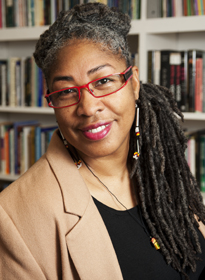
Dr. Evelyn Parker
The new chair was established in 2014 by a $2.5 million gift made by an anonymous donor through the Texas Methodist Foundation. It honors Susanna Wesley, frequently referred to as “the mother of Methodism.” Her sons, John and Charles Wesley, led a revival within the 18th century Anglican Church that sparked the emergence of global Methodism generally and the Methodist Episcopal Church in the American colonies. Historians point to her “practical theology” as a source of inspiration for her sons. Read more about the Susanna Wesley Centennial Chair in Practical Theology, the 100th endowed chair at Southern Methodist University.
Perkins School of Theology Dean William B. Lawrence expressed gratitude to Dr. Harold W. Stanley, vice president for academic affairs and provost ad interim, and to the former provost Dr. Paul Ludden, for Dr. Parker’s appointment.
“Evelyn Parker is an exemplary scholar, leader, and practician in both the academy and the church. Her knowledge and expertise, which bridge theological reflection and real-life issues and ministry, are unparalleled and we celebrate her appointment to this new role,” he said.
Dr. Parker earned the Ph.D. degree in 1996 from the Joint Program of Garrett-Evangelical Theological Seminary/Northwestern University in Religious and Theological Studies with an interdisciplinary emphasis in Christian Education, Womanist approaches to religion and society, and education and public policy. She received the Master of Religious Education degree in 1991 from Perkins School of Theology/Southern Methodist University, the Master of Science degree from Prairie View A&M University in 1983, and the Bachelor of Science degree in 1974 from Lambuth College in Jackson, Tenn.
She is the editor of The Sacred Selves of Adolescent Girls: Hard Stories of Race, Class, and Gender (Pilgrim Press, 2006) and author of Trouble Don’t Last Always: Emancipatory Hope Among African American Adolescents(Pilgrim Press, 2003). Dr. Parker co-authored In Search of Wisdom: Faith Formation in the Black Church(Abingdon, 2002) and has also published several chapters and journal articles on adolescent spirituality. Her forthcoming book is titled Between Sisters: Emancipatory Hope Out of Tragic Relationships (Cascade Books).
Dr. Parker is a member of the Christian Methodist Episcopal Church (CME) and has served as a local and district Director of Christian Education. She has also taught numerous educational ministry workshops and seminars on local, district, Annual Conference and Connectional levels.
She represented the CME Church on the World Council of Churches (WCC) Faith and Order Plenary Commission from 1996 to 2006. She was elected to the Central Committee during the WCC 9th Assembly in 2006 and served as co-secretary/reporter for the Nominations Committee. She was also a member of the Planning Committee for the WCC 10th Assembly held in Busan, South Korea in 2013, where she led Bible study and served as delegate representing the Christian Methodist Episcopal Church. Following the 10th Assembly, Dr. Parker was elected to serve an eight-year term on the Commission of the Churches on International Affairs, where she moderates the Statelessness and Migrants’ Rights Working Group.
Dr. Parker is an active member of the American Academy of Religion, and the Association of Practical Theology, the International Academy of Practical Theology, and the Religious Education Association, where she has chaired groups, presented papers, coordinated segments of consultations and convened sessions. She served on the Board of Advisors for the Princeton Theological Seminary Institute for Youth Ministry from 1995 to 2003 and served as a member of the grant writing team for the Perkins Youth School of Theology, a $1.4 Million theological program for high school youth funded by the Lilly Endowment.
A native of Hattiesburg, Mississippi, Dr. Parker is an active member of the Kirkwood Temple C.M.E. Church in Dallas, Texas, where she serves as Christian Education Coordinator.
###
Perkins School of Theology, founded in 1911, is one of five official University-related schools of theology of The United Methodist Church. Degree programs include the Master of Divinity, Master of Sacred Music, Master of Theological Studies, Master of Arts in Ministry, Master of Theology, Doctor of Ministry, and Doctor of Pastoral Music (June 2016) as well as the Ph.D., in cooperation with The Graduate Program in Religious Studies at SMU’s Dedman College of Humanities and Sciences.
Course of Study student graduates from Duke

On Thursday, July 30, 2015, Beth Wilke graduated from Duke Divinity School's Course of Study. Wilke is serving as the associate pastor at First UMC in Winfield, Kansas. Congratulations, Beth!
Churches encouraged to schedule disaster response trainings

As we begin to get back in our fall routine, what a great time to become a host church for Disaster Response trainings. As a host church you provide a space, table, chairs, screen and projector. The church also secures snacks, drinks and lunch, yet you are reimbursed for this. Trainings include:
Early Response
Who:
Individuals, 18 years of age and older, who make up a team up to seven people.
Individuals who have completed the Safe Gatherings Training (www.safegatherings.com) and completed an eight hour UMCOR training. Cost for Safe Gatherings is $30 and ERT is $25.
Ability to work long days in all types of weather, not afraid of heights, able to work on the ground, carry heavy objects and perform other needed job functions. These are just some examples of what might be called upon to perform.
Individuals who can give three days at a time for deployment and be self-sustaining.
Tasks may include, yet are not limited to:
Tarp holes in roofs to help prevent further damage.
Muck out (clean out) homes after flooding.
Remove debris outside the home.
Teams can also assist with known pre-flooding by sandbagging and moving items to higher ground.
Spiritual and Emotional Care
(beginning in November)
Who:
Clergy (active or retired).
Stephen ministers.
Mental health providers who are active in United Methodist churches.
Other trained individuals in crisis intervention.
Caring, compassionate, sensitive individuals.
All individuals must be 21 years or older.
While teams do not provide traditional individual or ongoing counseling, their purpose is to:
Offer a caring, Christian presence for the church.
Offer a listening presence.
Reduce the aloneness survivor experience.
Connect survivors with long-term disaster recovery systems.
Provide support to community clergy, congregations, first responders (at times), communities as a whole, and others present.
Requirements:
Safe Gatherings Certification ($30, www.safegatherings.com).
Complete an eight hour UMCOR Basic Spiritual and Emotional Care Training ($15).
Upon completion of Safe Gatherings and training, individuals will be badged for two years. Recertification is required after two years.
Individuals interested in being a team leader must complete four more hours of additional training, have two personal recommendations (pastor and one other, not a family member), and be approved by the Great Plains Conference Disaster Response Committee.
To schedule your church to host a training event, contact the Rev. Hollie Tapley, Great Plains Conference Disaster Response coordinator at htapley@greatplainsumc.org.
Pastors fight racism, move forward after Ferguson
On Aug. 9, 2014, the shooting death of 18-year-old Michael Brown by a police officer set off days of dramatic demonstrations in Ferguson, Missouri. The eyes of the world turned to images on TV of police in riot gear and crowds of protesters in the St. Louis suburb.
The Rev. F. Willis Johnson and his congregation at Wellspring United Methodist Church had a front row seat. The predominantly African-American church is located not far from the Ferguson police department and the epicenter of the unrest. On Sunday morning, August 10, as protesters were gathering in the streets, Wellspring opened its doors as a refuge. “We became very much a communal space,” recalls Johnson. “It was a natural kind of assumption that this would be a place where people would come and be able to pray, or be able to kind of get their bearings.”
In nearby St. Louis, on that same Sunday morning, the Rev. Matt Miofsky’s mostly white United Methodist congregation, The Gathering, turned their attention to their neighbors. “We simply prayed in worship for Michael Brown and his family and the officer and the situation in Ferguson. We spent that next week then really listening, learning, going up to Ferguson, being on the ground,” recalls Miofsky.
Read the full article on The United Methodist Church’s website.


Pastors fight racism, move forward after Ferguson
A UMC.org Feature by Lilla Marigza*
On August 9, 2014, the shooting death of 18-year-old Michael Brown by a police officer set off days of dramatic demonstrations in Ferguson, Missouri. The eyes of the world turned to images on TV of police in riot gear and crowds of protesters in the St. Louis suburb.
The Rev. F. Willis Johnson and his congregation at Wellspring United Methodist Church had a front row seat. The predominantly African-American church is located not far from the Ferguson police department and the epicenter of the unrest. On Sunday morning, August 10, as protesters were gathering in the streets, Wellspring opened its doors as a refuge. “We became very much a communal space,” recalls Johnson. “It was a natural kind of assumption that this would be a place where people would come and be able to pray, or be able to kind of get their bearings.”
In nearby St. Louis, on that same Sunday morning, the Rev. Matt Miofsky’s mostly white United Methodist congregation, The Gathering, turned their attention to their neighbors. “We simply prayed in worship for Michael Brown and his family and the officer and the situation in Ferguson. We spent that next week then really listening, learning, going up to Ferguson, being on the ground,” recalls Miofsky.
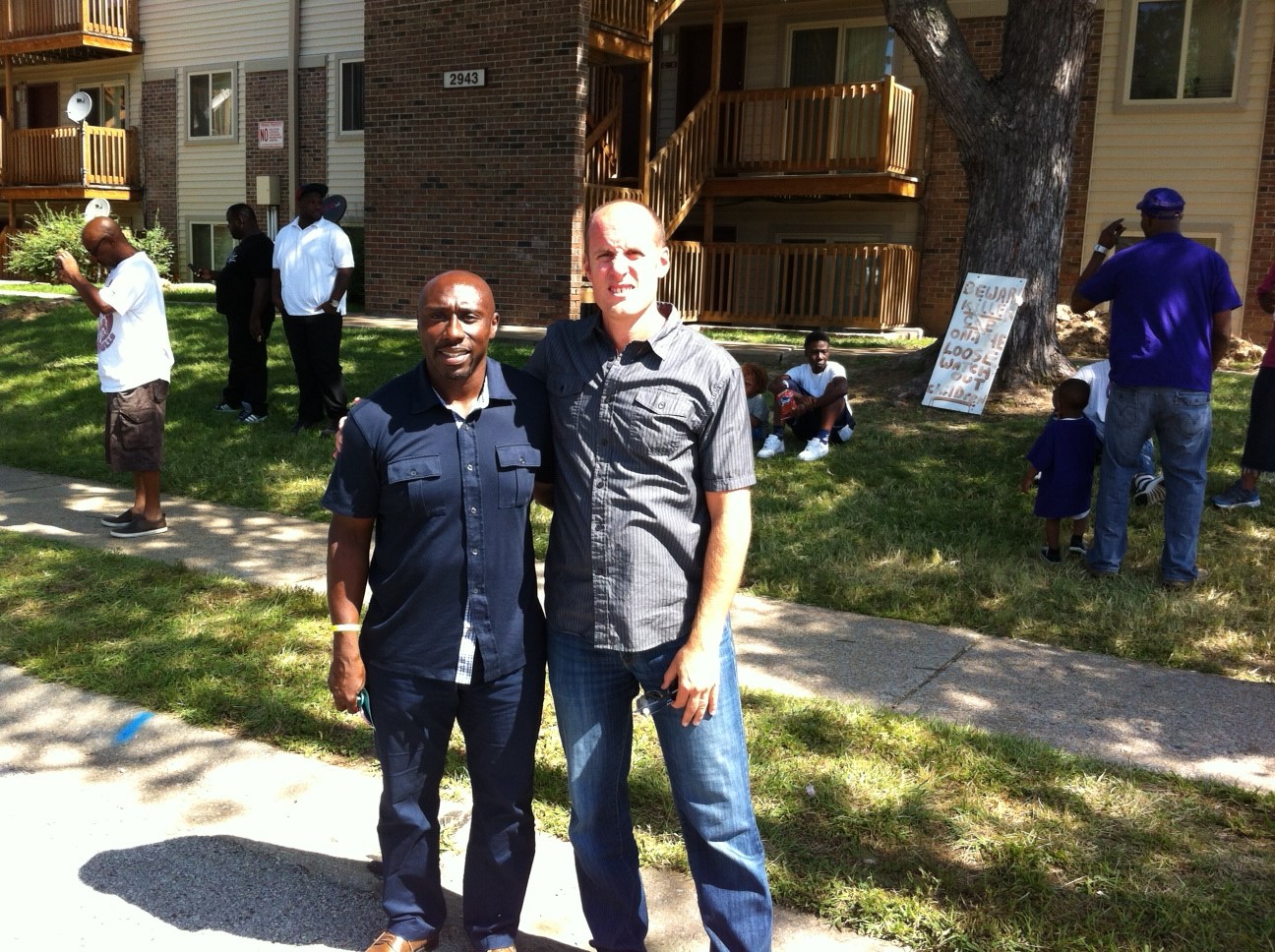
The Rev. Willis Johnson (left) and the Rev. Matt Miofsky stand near the site where Michael Brown was killed in August, 2014.
As violence escalated in Ferguson, Miofsky called his friend and fellow church planter, F. Willis Johnson, to offer support. The challenges were great and Wellspring welcomed the help. “We were very intentional and purposeful to say, ‘Okay, what are the needs at this particular time and how do we help to meet ‘em?’ Whether that’s educational, respite or counseling or some type of crisis intervention,” recalls Johnson.
While other United Methodist churches in the connection also reached out, many of the volunteers in those first few days were from Miofsky’s congregation. Wellspring opened its doors to provide daycare when safety concerns led the local school district to cancel classes. Members from The Gathering also took part in a prayer vigil near the site where Michael Brown was killed.
Being in Ferguson gave Miofsky a clearer view of what was happening behind the headlines to his own neighbors. “I learned that racism is more real than I wanted to admit. I found that we weren’t as far along as I thought we were. There’s a lot of pain and hurt in our own community that I had failed to recognize,” admits the young pastor.
Racial tensions may have gone unnoticed by some but Johnson says the unspoken divide is a reality for the black community. “This is just the point in which it has gone viral. But this has been an experience and an epidemic in the lives and communities of particular people for far too long.”
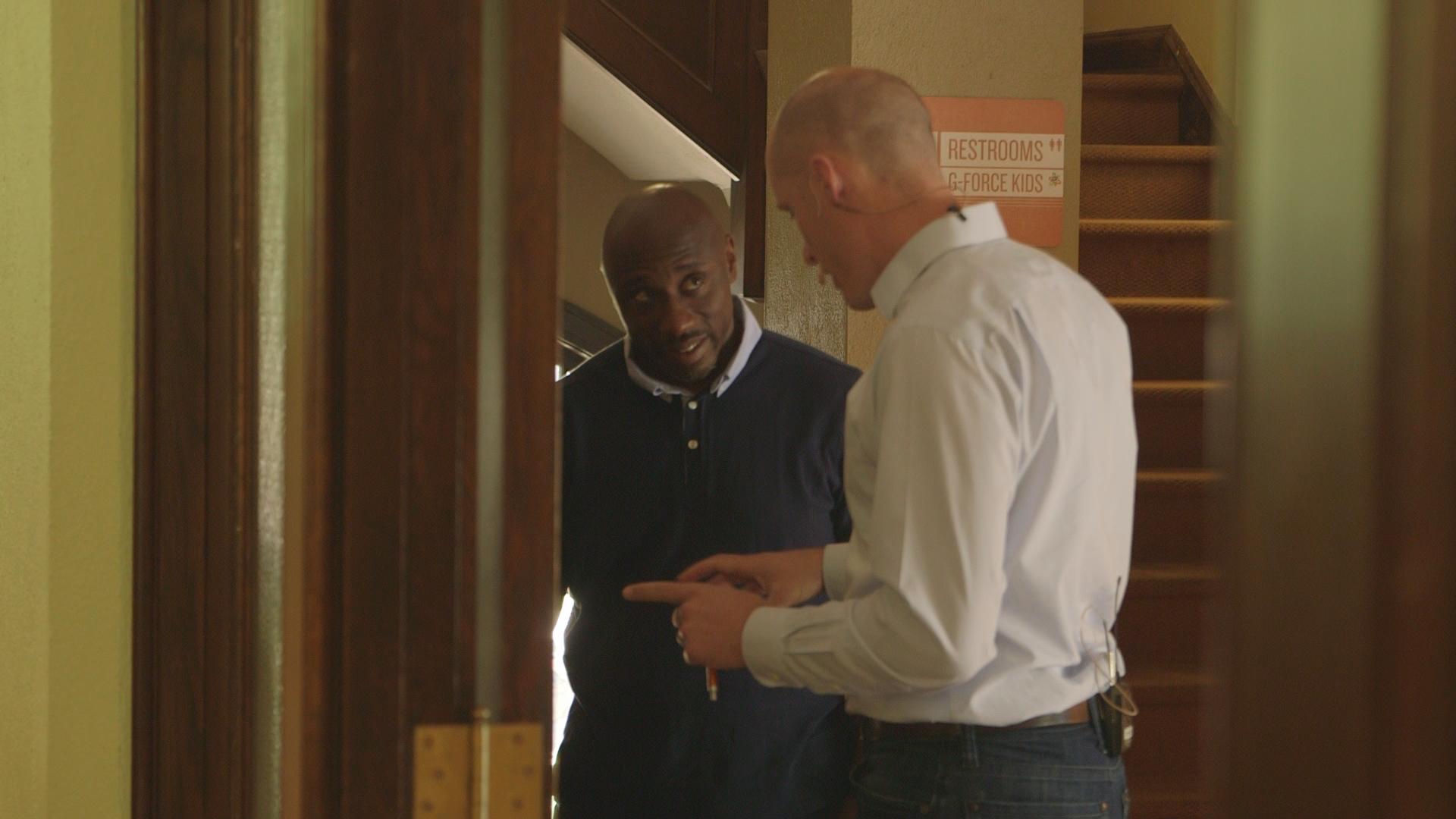
Willis Johnson (left) and Matt Miofsky collaborated on a sermon about racism that was shared on August 1, 2015 at The Gathering United Methodist Church in St. Louis, Missouri.
In the year since the death of Michael Brown, members of The Gathering have begun an open dialogue on topics of racism and white privilege. Miofsky asked his mostly white congregation to look in the mirror and make a conscious effort to diversify friendship circles.
Johnson says from his perspective, there are some first steps churches and individuals can take down the road to understanding. They should start by acknowledging that inequality exists and seeking to better understand the black experience in a non-judgmental way.
Both pastors agree that fundamental change is a relationship that cannot be rushed. “I heard a lot of people trying to offer words of peace and hope for reconciliation,” recalls Miofsky. “We wanted to move quickly to the nice stuff, and we missed the hard stuff—confronting the sin and righting the wrongs that exist.”
Real change also means addressing the inequities that divide people within communities. Members of Wellspring have launched a ministry called The Center for Social Empowerment and Justice. The Center will be a community think tank to address issues such as access to education, affordable housing, and business development in Ferguson. “I think we’ve been challenged and charged to be even more intentional, even more attentive to making sure that the work and the witness that we provide really is relevant,” says Johnson. “Not just the preaching on Sunday, but from every opportunity and point of engagement.”
olunteers from The Gathering helped renovate dedicated space at Wellspring for the Center. The congregation will also lend support to the new ministry, but the hope is that leadership will come from within. “The young men and women who live in Ferguson, those new generations of black men and women who are leading the movement against what’s happening in our city and all around our country, they’re really the voices that we ought to be spotlighting. And my primary role is to listen, to reflect, to pray and to serve when I can,” says Miofsky.
Johnson says he is humbled by the response of fellow United Methodist churches who offered monetary and spiritual support since the events in Ferguson. “It’s a beautiful thing to see the connection at work,” says Johnson. Being United Methodist brought these two faith families together to form a natural partnership. Miofsky and Johnson have been friends for a long time but Ferguson made them stronger. “There’ve been many moments where we’ve picked up the phone to talk about, you know, what’s happening in our congregations, how to get over some mundane challenge, all the way to these really big events like the events of Ferguson,” says Miofsky.
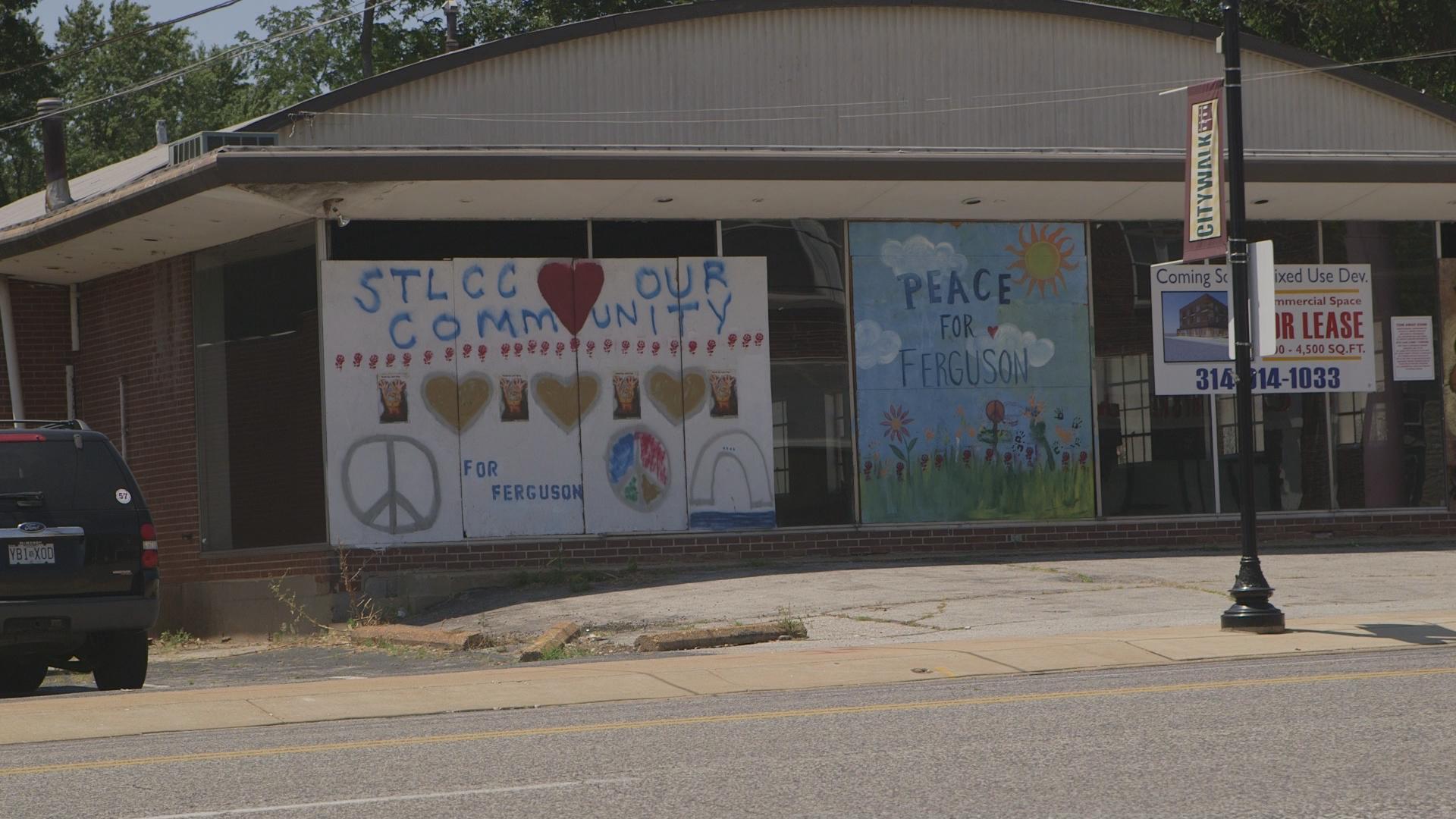
Businesses in downtown Ferguson, Missouri display messages of hope one year after protests filled the streets here.
Miofsky and Johnson’s churches are building bridges in a community that has become synonymous with the racial tensions of a nation but they hope other churches are also taking steps to better understand the complex issues that divide people living side-by-side. Miofsky points out, “You don’t have to go up to Ferguson to work on the problems of Ferguson. Those are in your own backyard.” “We are in the spirit ‘We are all Ferguson.’ We all have a responsibility to our own and our collective healing. Though it’s not our fault, so to speak, it is our responsibility,” says Johnson.
*Lilla Marigza works for UMC.org at United Methodist Communications. Contact her at lmarigza@umcom.org or call 615-742-5131.
Raising our voices – speaking out so families can stay together

Editor’s note: the following was submitted by Andrea Paret, Great Plains Peace with Justice coordinator.
“Incredible to be able to voice your concerns and for someone to listen,” said Elysee Mahangama while making visits on Capitol Hill in Washington D.C. Elysee is one of the our Micah Corps interns who originally comes from the Republic of Congo. “Back home, it’s kind of impossible to meet with someone in power and voice your concerns. If you express an opposing opinion you might find yourself in the hospital,” he adds. The issue the Micah Corps interns discussed with staff persons of two of our senators was immigration legislation regarding refugees. Staff from National Justice For Our Neighbors (National JFON) had helped arrange the visits.
Families continue to be torn apart. Children, youth and adults continue to die trying to reach safety in our country. People live in constant fear of getting deported. Families languish in for-profit detention facilities. Our immigration system is broken. God calls us to welcome and love the stranger. But how can we do that?
Questions that are often asked are: Why do they not come legally? Why do they not stand in line and apply? The simple but often overlooked answer to these questions is that for a majority of immigrants there is no line to stand in and that their situation in their home country is often so desperate that they are willing to risk their lives to come here.
The Nebraska Immigration Legal Assistance Hotline (NILAH) that was started in 2013 by Justice For Our Neighbors- Nebraska (JFON-NE) in collaboration with several other partners has made it easier for immigrants seeking legal help to connect with service providers. Supporting such organizations to sustain their work or even increase capacity is very important. But many immigrants seeking help have to be turned away and be told: “Sorry, under current law there is no option available for you.” In the first year of operation, NILAH turned away 17 percent of callers. And Mindy Rush Chipman, Rural Capacity Building attorney for JFON-NE, adds: “It is important to note that the NILAH screening is very liberal,” which means even applicants that are referred might have to be told in the end that they do not have any options to adjust their legal status.
Therefore the need to advocate for changes in our immigration laws is immense. The Great Plains Immigration Rapid Response Team (GPRRT) as well as many others across Kansas and Nebraska are doing just that. “It’s such a wonderful opportunity that Americans have,” Elysee says. “They shouldn’t take it for granted.”
Please prayerfully consider contacting your senators to oppose anti-immigrant legislation that is going to get discussed this fall. Find more information as well as a sample letter to use with a church group or with friends and a phone script.
Read the article by National JFON about the Micah Corps visits with senatorsNational Justice For Our Neighbors
August 2015 Update
_______________________
Quick Links
Our Website
Donate Now
Facebook
A UMC.org Feature by Lilla Marigza*
On August 9, 2014, the shooting death of 18-year-old Michael Brown by a police officer set off days of dramatic demonstrations in Ferguson, Missouri. The eyes of the world turned to images on TV of police in riot gear and crowds of protesters in the St. Louis suburb.
The Rev. F. Willis Johnson and his congregation at Wellspring United Methodist Church had a front row seat. The predominantly African-American church is located not far from the Ferguson police department and the epicenter of the unrest. On Sunday morning, August 10, as protesters were gathering in the streets, Wellspring opened its doors as a refuge. “We became very much a communal space,” recalls Johnson. “It was a natural kind of assumption that this would be a place where people would come and be able to pray, or be able to kind of get their bearings.”
In nearby St. Louis, on that same Sunday morning, the Rev. Matt Miofsky’s mostly white United Methodist congregation, The Gathering, turned their attention to their neighbors. “We simply prayed in worship for Michael Brown and his family and the officer and the situation in Ferguson. We spent that next week then really listening, learning, going up to Ferguson, being on the ground,” recalls Miofsky.
The Rev. Willis Johnson (left) and the Rev. Matt Miofsky stand near the site where Michael Brown was killed in August, 2014.
As violence escalated in Ferguson, Miofsky called his friend and fellow church planter, F. Willis Johnson, to offer support. The challenges were great and Wellspring welcomed the help. “We were very intentional and purposeful to say, ‘Okay, what are the needs at this particular time and how do we help to meet ‘em?’ Whether that’s educational, respite or counseling or some type of crisis intervention,” recalls Johnson.
While other United Methodist churches in the connection also reached out, many of the volunteers in those first few days were from Miofsky’s congregation. Wellspring opened its doors to provide daycare when safety concerns led the local school district to cancel classes. Members from The Gathering also took part in a prayer vigil near the site where Michael Brown was killed.
Being in Ferguson gave Miofsky a clearer view of what was happening behind the headlines to his own neighbors. “I learned that racism is more real than I wanted to admit. I found that we weren’t as far along as I thought we were. There’s a lot of pain and hurt in our own community that I had failed to recognize,” admits the young pastor.
Racial tensions may have gone unnoticed by some but Johnson says the unspoken divide is a reality for the black community. “This is just the point in which it has gone viral. But this has been an experience and an epidemic in the lives and communities of particular people for far too long.”
Willis Johnson (left) and Matt Miofsky collaborated on a sermon about racism that was shared on August 1, 2015 at The Gathering United Methodist Church in St. Louis, Missouri.
In the year since the death of Michael Brown, members of The Gathering have begun an open dialogue on topics of racism and white privilege. Miofsky asked his mostly white congregation to look in the mirror and make a conscious effort to diversify friendship circles.
Johnson says from his perspective, there are some first steps churches and individuals can take down the road to understanding. They should start by acknowledging that inequality exists and seeking to better understand the black experience in a non-judgmental way.
Both pastors agree that fundamental change is a relationship that cannot be rushed. “I heard a lot of people trying to offer words of peace and hope for reconciliation,” recalls Miofsky. “We wanted to move quickly to the nice stuff, and we missed the hard stuff—confronting the sin and righting the wrongs that exist.”
Real change also means addressing the inequities that divide people within communities. Members of Wellspring have launched a ministry called The Center for Social Empowerment and Justice. The Center will be a community think tank to address issues such as access to education, affordable housing, and business development in Ferguson. “I think we’ve been challenged and charged to be even more intentional, even more attentive to making sure that the work and the witness that we provide really is relevant,” says Johnson. “Not just the preaching on Sunday, but from every opportunity and point of engagement.”
olunteers from The Gathering helped renovate dedicated space at Wellspring for the Center. The congregation will also lend support to the new ministry, but the hope is that leadership will come from within. “The young men and women who live in Ferguson, those new generations of black men and women who are leading the movement against what’s happening in our city and all around our country, they’re really the voices that we ought to be spotlighting. And my primary role is to listen, to reflect, to pray and to serve when I can,” says Miofsky.
Johnson says he is humbled by the response of fellow United Methodist churches who offered monetary and spiritual support since the events in Ferguson. “It’s a beautiful thing to see the connection at work,” says Johnson. Being United Methodist brought these two faith families together to form a natural partnership. Miofsky and Johnson have been friends for a long time but Ferguson made them stronger. “There’ve been many moments where we’ve picked up the phone to talk about, you know, what’s happening in our congregations, how to get over some mundane challenge, all the way to these really big events like the events of Ferguson,” says Miofsky.
Businesses in downtown Ferguson, Missouri display messages of hope one year after protests filled the streets here.
Miofsky and Johnson’s churches are building bridges in a community that has become synonymous with the racial tensions of a nation but they hope other churches are also taking steps to better understand the complex issues that divide people living side-by-side. Miofsky points out, “You don’t have to go up to Ferguson to work on the problems of Ferguson. Those are in your own backyard.” “We are in the spirit ‘We are all Ferguson.’ We all have a responsibility to our own and our collective healing. Though it’s not our fault, so to speak, it is our responsibility,” says Johnson.
*Lilla Marigza works for UMC.org at United Methodist Communications. Contact her at lmarigza@umcom.org or call 615-742-5131.
Raising our voices – speaking out so families can stay together
Editor’s note: the following was submitted by Andrea Paret, Great Plains Peace with Justice coordinator.
“Incredible to be able to voice your concerns and for someone to listen,” said Elysee Mahangama while making visits on Capitol Hill in Washington D.C. Elysee is one of the our Micah Corps interns who originally comes from the Republic of Congo. “Back home, it’s kind of impossible to meet with someone in power and voice your concerns. If you express an opposing opinion you might find yourself in the hospital,” he adds. The issue the Micah Corps interns discussed with staff persons of two of our senators was immigration legislation regarding refugees. Staff from National Justice For Our Neighbors (National JFON) had helped arrange the visits.
Families continue to be torn apart. Children, youth and adults continue to die trying to reach safety in our country. People live in constant fear of getting deported. Families languish in for-profit detention facilities. Our immigration system is broken. God calls us to welcome and love the stranger. But how can we do that?
Questions that are often asked are: Why do they not come legally? Why do they not stand in line and apply? The simple but often overlooked answer to these questions is that for a majority of immigrants there is no line to stand in and that their situation in their home country is often so desperate that they are willing to risk their lives to come here.
The Nebraska Immigration Legal Assistance Hotline (NILAH) that was started in 2013 by Justice For Our Neighbors- Nebraska (JFON-NE) in collaboration with several other partners has made it easier for immigrants seeking legal help to connect with service providers. Supporting such organizations to sustain their work or even increase capacity is very important. But many immigrants seeking help have to be turned away and be told: “Sorry, under current law there is no option available for you.” In the first year of operation, NILAH turned away 17 percent of callers. And Mindy Rush Chipman, Rural Capacity Building attorney for JFON-NE, adds: “It is important to note that the NILAH screening is very liberal,” which means even applicants that are referred might have to be told in the end that they do not have any options to adjust their legal status.
Therefore the need to advocate for changes in our immigration laws is immense. The Great Plains Immigration Rapid Response Team (GPRRT) as well as many others across Kansas and Nebraska are doing just that. “It’s such a wonderful opportunity that Americans have,” Elysee says. “They shouldn’t take it for granted.”
Please prayerfully consider contacting your senators to oppose anti-immigrant legislation that is going to get discussed this fall. Find more information as well as a sample letter to use with a church group or with friends and a phone script.
Read the article by National JFON about the Micah Corps visits with senatorsNational Justice For Our Neighbors
August 2015 Update
_______________________
Quick Links
Our Website
Donate Now
Twitter
Welcome to the Family!
A Grand Opening and First Clinic at
Justice For Our Neighbors Houston/East Texas
The groves that gave Pecan Park its name are long gone, replaced by tract houses, strip malls and shrubs and trees that don’t demand so much attention in Houston’s humid, sub-tropical climate. Nearly half of all residents in this sprawling East End neighborhood were born in a foreign country. The majority of residents speak Spanish as their primary language at home. Almost a third of the children of Pecan Park are living below the poverty line.

Welcome to the Family!
A Grand Opening and First Clinic at
Justice For Our Neighbors Houston/East Texas
The groves that gave Pecan Park its name are long gone, replaced by tract houses, strip malls and shrubs and trees that don’t demand so much attention in Houston’s humid, sub-tropical climate. Nearly half of all residents in this sprawling East End neighborhood were born in a foreign country. The majority of residents speak Spanish as their primary language at home. Almost a third of the children of Pecan Park are living below the poverty line.
This is the community, these are the neighbors, that Mission Milby—a covenant ministry from the nearby Servants of Christ United Methodist Church—serves lovingly and faithfully. Each week, hundreds of people walk through their doors to use the computer lab, participate in the after-school program, or take classes in technology, ESL, and a myriad of other subjects.
There was one service Mission Milby couldn’t offer their neighbors, many of whom are low-income immigrants: affordable, high-quality immigration legal assistance. It was a lack that the people of Mission Milby and other advocates for immigrant justice felt very keenly. They resolved to do something about it.
Last month, after four years of planning, hoping, praying—and a huge fundraising effort—JFON Houston/East Texas (HETX) finally celebrated its grand opening and its very first clinic. This newest JFON site is not only located in the neighborhood where its clients live, but in Mission Milby, a trusted and beloved institution of Pecan Park and the surrounding East End.
The importance of this trust cannot be overstated. Far too many immigrants have been swindled in their home countries, by employers, by corrupt officials, by the people who may have led them across the border. Once here, they are often victims of the notarios, the so-called “immigration consultants” who prey on the newly arrived and uninformed, promising them green cards and leaving them with empty pockets. Far too many of these immigrants have also experienced tragedy and fear for their lives. They need a place to feel safe.
“Our clients have been through so much already,” explains Joy Green, JFON HETX’s new attorney. “So many are fleeing violence. They are in the U.S. because they need protection. Some of them have seen their family members killed right in front of them.”
“Here,” she adds, “they feel safe. They know they can trust the people who work here.” Houston, like all JFON clinics, also offers hospitality—childcare, food, friendly people—so the clients feel very welcome, too. “It’s a safe haven,” Joy says.

JFON HETX had a truly joyous grand opening with plenty of happy faces, good local cuisine, and lively music provided by Mariachi Guadalupano. JFON HETX Board Chair Pat Holmes was present to introduce the speakers, among whom was the Rev. Diane McGehee, Director of TAC Center for Missional Excellence and longtime JFON supporter, as well as the Rev. Will Reed, the senior pastor at Servants of Christ UMC and also a JFON HETX board member and its interim clinic coordinator.
Bishop Janice Riggle Huie of the Texas Annual Conference of the United Methodist Church characterized the treatment of immigrants in our society as a “core religious value,” adding that “the opening of the Justice for Our Neighbors clinic is a sign of our love for the sojourner in our midst that Jesus taught and demonstrated to his disciples.”

Texas State Senator Sylvia Garcia with JFON HETX's Executive Director Brenda Diaz and Site Attorney Joy Green
“All our speakers were very inspirational,” confirmed Brenda Diaz, JFON HETX’s executive director, when the party was over and she had a minute to breathe. “They reminded us why JFON HETX exists and the commitment we all have to our most vulnerable immigrant brothers and sisters.”
Brenda was equally content with their first clinic—a resounding and, perhaps more importantly for the very first one, a glitch-free triumph. Brenda attributes this seamless success to the hard work put in by board members, staff, and especially the many volunteers.
“The operation of this clinic could not have been a success had it not been for the overwhelming compassion and love they have for what JFON represents in this community,” she states emphatically. “All of our first clients left our office with much gratitude and appreciation.”

Not the type of people to rest on their laurels, the JFON Houston team is charging ahead, Texas-style, and is already making plans to add more clinics in East Texas.
“Right now there is just one of me, and I am essentially wearing a lot of different hats," says Joy. “But we are creating the systems to be set up for growth in the future.”
Meanwhile, at Mission Milby, Joy already has a very special client—the 5-year old son of a family who arrived from Honduras a year ago. Eddie finished his first year of American school—kindergarten—learning English at break-neck speed. Eddie is now charming everyone in two languages. “I wish you could meet him,” says Joy, chuckling. “He gives me a hug every time he sees me. He looks at my books—he has no clue what’s in there, but he likes to see what I’m doing. He’s just so happy and so cute.” She pauses. “You would never know his family had been through such tragedy in Honduras.”
Joy doesn’t elaborate. She doesn’t need to, not really. She has heard so many horrific stories of tragedy and unimaginable loss. How does she cope with it?
“I don’t think anybody gets used to it,” Joy says carefully. “It’s not a life we see so much in the U.S. But I can’t get too caught up in the emotions of it. I have to take that…” she searches for the word "...passion and use it to do my best as an attorney for my clients.”
Seeing the energy, enthusiasm, and dedication of Joy, Brenda, the board members and volunteers, it’s obvious that everyone at JFON HETX is being driven by a similar passion: working towards justice for all our immigrant neighbors.
_______________________
The Micah Corps Takes the Hill
Do Justice. Love Kindness. Walk humbly with God. Micah 6:8
Each summer, the Great Plains Conference of the United Methodist Church brings together a group of outstanding college-age students and sets them to work to live out the words of Micah 6:8. Over the course of 10 long and productive weeks, the Micah Corps interns tackle the tough social justice issues of our day through prayer, study and, most significantly, action.
Leaving their home base of North Omaha, this year’s team came to Washington, D.C., to advocate for laws and policies that positively impact the issues important to them—poverty, food security, nonviolence, the environment and immigration.
See the Hill, Take the Hill
Led by Andrea Paret, Great Plains Peace with Justice Coordinator and a tireless advocate for Justice For Our Neighbors Nebraska, four of these excellent young people prepared to lobby their Nebraska representatives on various immigration issues.
Ama Agyabeng, from Ghana, is a rising senior at Iowa’s Ashford University. She hopes to go on to medical school next year. Amy Kenyon, a native Nebraskan, plans to teach high school English when she finishes her studies. She believes her Micah Corps experience will help her become a better teacher. Ella Sherman is intense, passionate, and very smart. This is her second year with the Micah Corps and her first opportunity to really focus on immigration issues. Elysee Mahangama, soft-spoken and thoughtful, studies industrial systems technology in Atlanta. He has been focused on peace and non-violence issues this summer, particularly significant for a young man coming from the Republic of the Congo.
“Back home, it’s kind of impossible to meet with someone in power and voice your concerns,” he says, somewhat wistfully. “If you express an opposing opinion you might find yourself in the hospital.”

It’s a hot July day as we walk past the Supreme Court and toward the Cannon House Office Building. Ella is recounting some of the conversations she and her fellow interns have had with people about migrants coming across the border. The “us vs. them” mindset of too many Americans, she says, has effectively stripped these immigrants of their humanity.
“We don’t think about people dying in the desert. We don’t think about the women and children seeking asylum.” Ella adds, “We also don’t consider that immigrants who come here oftentimes don’t want to.”
People look at the pictures of the harsh conditions at the border, she says, and seem genuinely perplexed. “Why would these migrants do that to themselves?” they demand. “Why would they put their children in so much danger?”
“You’re right,” is Ella’s answer. “It was a horrible experience. Why do you think they would take that risk?”
Fighting the Good Fight
Our first stop is the office of Rep. Brad Ashford, (D-NE 02) representing the greater Omaha metropolitan area. The Micah Corps interns have an appointment with the congressman’s legislative director (LD).
Ama takes the lead, asking for the congressman’s support for HR 2798: The Strengthening Refugee Resettlement Act of 2015. Ama, graceful and poised, reads her prepared talking points, powerfully representing the values that require us to support all families, both immigrant and non-immigrant.
Others chime in, reminding us that Nebraska has become a magnet for many refugee communities, including the mostly-Christian Karen ethnic minority of Burma, fleeing persecution and violence in their home country.
A bill to streamline refugee processing abroad and provide resources for them to more quickly integrate into their new communities may not seem very controversial. In the present congressional climate, however, anything that smacks of immigration appears to have little hope of getting very far.

There was one service Mission Milby couldn’t offer their neighbors, many of whom are low-income immigrants: affordable, high-quality immigration legal assistance. It was a lack that the people of Mission Milby and other advocates for immigrant justice felt very keenly. They resolved to do something about it.
Last month, after four years of planning, hoping, praying—and a huge fundraising effort—JFON Houston/East Texas (HETX) finally celebrated its grand opening and its very first clinic. This newest JFON site is not only located in the neighborhood where its clients live, but in Mission Milby, a trusted and beloved institution of Pecan Park and the surrounding East End.
The importance of this trust cannot be overstated. Far too many immigrants have been swindled in their home countries, by employers, by corrupt officials, by the people who may have led them across the border. Once here, they are often victims of the notarios, the so-called “immigration consultants” who prey on the newly arrived and uninformed, promising them green cards and leaving them with empty pockets. Far too many of these immigrants have also experienced tragedy and fear for their lives. They need a place to feel safe.
“Our clients have been through so much already,” explains Joy Green, JFON HETX’s new attorney. “So many are fleeing violence. They are in the U.S. because they need protection. Some of them have seen their family members killed right in front of them.”
“Here,” she adds, “they feel safe. They know they can trust the people who work here.” Houston, like all JFON clinics, also offers hospitality—childcare, food, friendly people—so the clients feel very welcome, too. “It’s a safe haven,” Joy says.
JFON HETX had a truly joyous grand opening with plenty of happy faces, good local cuisine, and lively music provided by Mariachi Guadalupano. JFON HETX Board Chair Pat Holmes was present to introduce the speakers, among whom was the Rev. Diane McGehee, Director of TAC Center for Missional Excellence and longtime JFON supporter, as well as the Rev. Will Reed, the senior pastor at Servants of Christ UMC and also a JFON HETX board member and its interim clinic coordinator.
Bishop Janice Riggle Huie of the Texas Annual Conference of the United Methodist Church characterized the treatment of immigrants in our society as a “core religious value,” adding that “the opening of the Justice for Our Neighbors clinic is a sign of our love for the sojourner in our midst that Jesus taught and demonstrated to his disciples.”
Texas State Senator Sylvia Garcia with JFON HETX's Executive Director Brenda Diaz and Site Attorney Joy Green
“All our speakers were very inspirational,” confirmed Brenda Diaz, JFON HETX’s executive director, when the party was over and she had a minute to breathe. “They reminded us why JFON HETX exists and the commitment we all have to our most vulnerable immigrant brothers and sisters.”
Brenda was equally content with their first clinic—a resounding and, perhaps more importantly for the very first one, a glitch-free triumph. Brenda attributes this seamless success to the hard work put in by board members, staff, and especially the many volunteers.
“The operation of this clinic could not have been a success had it not been for the overwhelming compassion and love they have for what JFON represents in this community,” she states emphatically. “All of our first clients left our office with much gratitude and appreciation.”
Not the type of people to rest on their laurels, the JFON Houston team is charging ahead, Texas-style, and is already making plans to add more clinics in East Texas.
“Right now there is just one of me, and I am essentially wearing a lot of different hats," says Joy. “But we are creating the systems to be set up for growth in the future.”
Meanwhile, at Mission Milby, Joy already has a very special client—the 5-year old son of a family who arrived from Honduras a year ago. Eddie finished his first year of American school—kindergarten—learning English at break-neck speed. Eddie is now charming everyone in two languages. “I wish you could meet him,” says Joy, chuckling. “He gives me a hug every time he sees me. He looks at my books—he has no clue what’s in there, but he likes to see what I’m doing. He’s just so happy and so cute.” She pauses. “You would never know his family had been through such tragedy in Honduras.”
Joy doesn’t elaborate. She doesn’t need to, not really. She has heard so many horrific stories of tragedy and unimaginable loss. How does she cope with it?
“I don’t think anybody gets used to it,” Joy says carefully. “It’s not a life we see so much in the U.S. But I can’t get too caught up in the emotions of it. I have to take that…” she searches for the word "...passion and use it to do my best as an attorney for my clients.”
Seeing the energy, enthusiasm, and dedication of Joy, Brenda, the board members and volunteers, it’s obvious that everyone at JFON HETX is being driven by a similar passion: working towards justice for all our immigrant neighbors.
_______________________
The Micah Corps Takes the Hill
Do Justice. Love Kindness. Walk humbly with God. Micah 6:8
Each summer, the Great Plains Conference of the United Methodist Church brings together a group of outstanding college-age students and sets them to work to live out the words of Micah 6:8. Over the course of 10 long and productive weeks, the Micah Corps interns tackle the tough social justice issues of our day through prayer, study and, most significantly, action.
Leaving their home base of North Omaha, this year’s team came to Washington, D.C., to advocate for laws and policies that positively impact the issues important to them—poverty, food security, nonviolence, the environment and immigration.
See the Hill, Take the Hill
Led by Andrea Paret, Great Plains Peace with Justice Coordinator and a tireless advocate for Justice For Our Neighbors Nebraska, four of these excellent young people prepared to lobby their Nebraska representatives on various immigration issues.
Ama Agyabeng, from Ghana, is a rising senior at Iowa’s Ashford University. She hopes to go on to medical school next year. Amy Kenyon, a native Nebraskan, plans to teach high school English when she finishes her studies. She believes her Micah Corps experience will help her become a better teacher. Ella Sherman is intense, passionate, and very smart. This is her second year with the Micah Corps and her first opportunity to really focus on immigration issues. Elysee Mahangama, soft-spoken and thoughtful, studies industrial systems technology in Atlanta. He has been focused on peace and non-violence issues this summer, particularly significant for a young man coming from the Republic of the Congo.
“Back home, it’s kind of impossible to meet with someone in power and voice your concerns,” he says, somewhat wistfully. “If you express an opposing opinion you might find yourself in the hospital.”
It’s a hot July day as we walk past the Supreme Court and toward the Cannon House Office Building. Ella is recounting some of the conversations she and her fellow interns have had with people about migrants coming across the border. The “us vs. them” mindset of too many Americans, she says, has effectively stripped these immigrants of their humanity.
“We don’t think about people dying in the desert. We don’t think about the women and children seeking asylum.” Ella adds, “We also don’t consider that immigrants who come here oftentimes don’t want to.”
People look at the pictures of the harsh conditions at the border, she says, and seem genuinely perplexed. “Why would these migrants do that to themselves?” they demand. “Why would they put their children in so much danger?”
“You’re right,” is Ella’s answer. “It was a horrible experience. Why do you think they would take that risk?”
Fighting the Good Fight
Our first stop is the office of Rep. Brad Ashford, (D-NE 02) representing the greater Omaha metropolitan area. The Micah Corps interns have an appointment with the congressman’s legislative director (LD).
Ama takes the lead, asking for the congressman’s support for HR 2798: The Strengthening Refugee Resettlement Act of 2015. Ama, graceful and poised, reads her prepared talking points, powerfully representing the values that require us to support all families, both immigrant and non-immigrant.
Others chime in, reminding us that Nebraska has become a magnet for many refugee communities, including the mostly-Christian Karen ethnic minority of Burma, fleeing persecution and violence in their home country.
A bill to streamline refugee processing abroad and provide resources for them to more quickly integrate into their new communities may not seem very controversial. In the present congressional climate, however, anything that smacks of immigration appears to have little hope of getting very far.
The interns then ask the LD about the future of immigration reform in general. They’re very good. Remembering their training (provided by our friends at the General Board of Church and Society) they pause frequently to listen and give the LD plenty of opportunity to talk.
The LD is sympathetic, but his prognosis for comprehensive immigration reform isn’t an encouraging one.
“This is one issue which will not go anywhere,” he says. “It’s unfortunate, because it’s the right thing to do and the system we have in place obviously does not work.”
They are, however, not to give up hope, he tells them emphatically. “It has to change,” he says. “We can’t just keep kicking the can down the road.”
Our next stop is the office of Rep. Jeff Fortenberry (R-NE 01), representing Lincoln and other areas of Eastern Nebraska. We meet with his senior legislative assistant (LA).
Amy, the future teacher, tells us that Lincoln has 32 languages spoken in its public schools and that no school district in Nebraska is without its share of immigrant students. Both Lincoln and Omaha—the two major cities in Nebraska—are centers for refugee relocation, including those fleeing horrific violence from Sudan and South Sudan.
Rep. Fortenberry’s LA quickly points out that her boss is co-chair of the Congressional Caucus on Sudan and South Sudan and is the author of the Child Soldiers Prevention Act. She promises to give the congressman their information about the Refugee Resettlement bill.
As for the undocumented immigrants already living in the United States, she tells the interns that border security is the most pressing problem. Her prediction for the future of meaningful immigration reform is decidedly bleak.
“The issue,” she tells these young people so full of hope and promise, “is too polarized and too politicized.”

Ama, Andrea Paret, Elysee, Ella and Amy at Rep. Fortenberry's Capitol Hill Office
The meetings are over. The Micah Corps interns are kept very busy, and it’s time for them to move on to the next activity. Although they didn’t receive any optimistic news from either office, they don’t view the day as a defeat. This was their first time in a sit-down meeting on Capitol Hill. It won’t be their last. They aren’t giving up and they are absolutely coming back.
They are still talking excitedly about their meetings as they walk back to their home base at the Methodist Building.
“Amazing experience,” says Ella. She looks ready to take on the world.
“Incredible,” Elysee agrees. “To be able to voice your concerns at any time and for someone to listen.” He stops as we wait at the crosswalk. The U.S. Capitol, the shining beacon for justice and democracy, is right above us. Once again, the building is undergoing some much-needed renovations. The dome is covered in ugly scaffolding. But it remains the City on the Hill.
“It’s such a wonderful opportunity that Americans have,” Elysee says. “They shouldn’t take it for granted.”
_______________________
The Immigration Game
Are you on the path to citizenship or stuck in the "limbo loop?"
Ama Agyabeng and Ella Sherman came to their Micah Corps internship with a very particular interest in immigration reform. As part of their social justice outreach, they visited a church congregation to lead a discussion on the realities of being an undocumented immigrant in America.
But first they showed their elders how to play the Immigration Board Game.

Six teams (or players) get a story card. Four are in the U.S. without documentation for various reasons, and two are on their way to becoming citizens. The four undocumented players start on the “limbo loop” and the two documented ones start on the path to citizenship.

The LD is sympathetic, but his prognosis for comprehensive immigration reform isn’t an encouraging one.
“This is one issue which will not go anywhere,” he says. “It’s unfortunate, because it’s the right thing to do and the system we have in place obviously does not work.”
They are, however, not to give up hope, he tells them emphatically. “It has to change,” he says. “We can’t just keep kicking the can down the road.”
Our next stop is the office of Rep. Jeff Fortenberry (R-NE 01), representing Lincoln and other areas of Eastern Nebraska. We meet with his senior legislative assistant (LA).
Amy, the future teacher, tells us that Lincoln has 32 languages spoken in its public schools and that no school district in Nebraska is without its share of immigrant students. Both Lincoln and Omaha—the two major cities in Nebraska—are centers for refugee relocation, including those fleeing horrific violence from Sudan and South Sudan.
Rep. Fortenberry’s LA quickly points out that her boss is co-chair of the Congressional Caucus on Sudan and South Sudan and is the author of the Child Soldiers Prevention Act. She promises to give the congressman their information about the Refugee Resettlement bill.
As for the undocumented immigrants already living in the United States, she tells the interns that border security is the most pressing problem. Her prediction for the future of meaningful immigration reform is decidedly bleak.
“The issue,” she tells these young people so full of hope and promise, “is too polarized and too politicized.”
Ama, Andrea Paret, Elysee, Ella and Amy at Rep. Fortenberry's Capitol Hill Office
The meetings are over. The Micah Corps interns are kept very busy, and it’s time for them to move on to the next activity. Although they didn’t receive any optimistic news from either office, they don’t view the day as a defeat. This was their first time in a sit-down meeting on Capitol Hill. It won’t be their last. They aren’t giving up and they are absolutely coming back.
They are still talking excitedly about their meetings as they walk back to their home base at the Methodist Building.
“Amazing experience,” says Ella. She looks ready to take on the world.
“Incredible,” Elysee agrees. “To be able to voice your concerns at any time and for someone to listen.” He stops as we wait at the crosswalk. The U.S. Capitol, the shining beacon for justice and democracy, is right above us. Once again, the building is undergoing some much-needed renovations. The dome is covered in ugly scaffolding. But it remains the City on the Hill.
“It’s such a wonderful opportunity that Americans have,” Elysee says. “They shouldn’t take it for granted.”
_______________________
The Immigration Game
Are you on the path to citizenship or stuck in the "limbo loop?"
Ama Agyabeng and Ella Sherman came to their Micah Corps internship with a very particular interest in immigration reform. As part of their social justice outreach, they visited a church congregation to lead a discussion on the realities of being an undocumented immigrant in America.
But first they showed their elders how to play the Immigration Board Game.
Six teams (or players) get a story card. Four are in the U.S. without documentation for various reasons, and two are on their way to becoming citizens. The four undocumented players start on the “limbo loop” and the two documented ones start on the path to citizenship.
“The loop and the path do not connect,” says Ella. “At no point do they connect.”
Players roll dice and move through the brightly colored bubbles, experiencing normal life events—marriage, birth of a child—as well as the normal-for-the-undocumented events—ICE raids, being caught driving without a license because your state won’t issue you one.
“The events are supplemented by cards with real immigration stories,” explains Ella. “In addition, players may have to draw a card which either states that there are no visas available, or that their waiver for marriage was denied or something like that.”

Players roll dice and move through the brightly colored bubbles, experiencing normal life events—marriage, birth of a child—as well as the normal-for-the-undocumented events—ICE raids, being caught driving without a license because your state won’t issue you one.
“The events are supplemented by cards with real immigration stories,” explains Ella. “In addition, players may have to draw a card which either states that there are no visas available, or that their waiver for marriage was denied or something like that.”
After a few rounds Ella and Ama stopped the game and asked the players what they thought.
There really is no good news in this game. There is no way for the loop (undocumented) and path (to citizenship) to connect. No, you can’t just go “get a visa.” Many members of the congregation hadn’t realized that.
“It was a very divided classroom,” remembers Ella. “Some said, ‘Yes, we should do something about immigration reform.’ Others said, ‘They’re illegal, that’s their problem.’ The discussion kind of got out of hand.”
At the end of the discussion, Ama read from Scripture, because “it’s hard to argue with the New Testament in a church setting.” She chose, of course, Matthew 25, putting firm emphasis on the section 44-46:
44 They also will answer, ‘Lord, when did we see you hungry or thirsty or a stranger or needing clothes or sick or in prison, and did not help you?
45 He will reply, ‘Truly I tell you, whatever you did not do for one of the least of these, you did not do for me.
46 Then they will go away to eternal punishment, but the righteous to eternal life.

Ama and Ella lead the discussion. Photo courtesy of Mustard Seed.
“The room went very quiet,” remembers Ella. “It was definitely an ‘uh-oh’ moment. People were thinking, ‘Maybe I shouldn’t have said what I just said.’
“I’m not sure we changed any minds,” she concludes, smiling. “But at least we got them thinking!"

Please visit The Alliance for a Just Society to download the game Ama and Ella used to demonstrate the difficulty of being an undocumented immigrant in the United States.
Ama blogged about a presentation provided by Justice For Our Neighbors-Nebraska at The Micah Corps Journal.
Ella reflects on the issue of Immigration and its link to Scripture in her blog.To join the GPRRT or get more information, please contact Sandy Sypherd at ssypherd@windstream.net or Andrea Paret atamparet08@yahoo.com.
Photo: Family members reunite through the mesh of the U.S.–Mexico border fence at Friendship Park in San Diego for a few hours on a weekend.
Newsletters
Discipleship Ministries: Five Ways You Can Better Equip Vital Congregations
Kansas Area UM Foundation: Aug. 11, 2015
Lewis Center for Church Leadership: Leading Ideas
Ministry Matters: Aug. 12, 2015
UMC Development Center: Spiritual Giving
UM Communications: MyCom
Classifieds
Director of children and youth education needed at Trinity UMC in Ralston
Ichtus Campus Ministry at Washburn University seeks director of resident and community life
K-State Wesley seeking director of residential life
Music director and worship leader sought at Trinity UMC
View these and other classifieds at greatplainsumc.org/classifieds.
Press Clips
Congregations across the Great Plains Conference are making the news in their local newspapers. View our newspaper clipping reports to see if there are stories, ideas and ministry happenings you can learn from to use in your own congregation. Press clips can be found at greatplainsumc.org/inthenews. You can see education partnership ideas at greatplainsumc.org/education.
Editorial Policy: The content, news, events and announcement information distributed in GPconnect is not sponsored or endorsed by the Great Plains Methodist Conference unless specifically stated.
To submit a letter to the editor, send it to info@greatplainsumc.org.

Want More?






Episcopal Office: 9440 E Boston Suite 160 Wichita, KS 67207 316-686-0600
Topeka Office: 4201 SW 15th Street PO Box 4187 Topeka, KS 66604 785-272-9111
Wichita Office: 9440 E Boston Suite 110 Wichita, KS 67207 316-684-0266
Lincoln Office: 3333 Landmark Circle Lincoln, NE 68504-4760 402-464-5994
____________________________
There really is no good news in this game. There is no way for the loop (undocumented) and path (to citizenship) to connect. No, you can’t just go “get a visa.” Many members of the congregation hadn’t realized that.
“It was a very divided classroom,” remembers Ella. “Some said, ‘Yes, we should do something about immigration reform.’ Others said, ‘They’re illegal, that’s their problem.’ The discussion kind of got out of hand.”
At the end of the discussion, Ama read from Scripture, because “it’s hard to argue with the New Testament in a church setting.” She chose, of course, Matthew 25, putting firm emphasis on the section 44-46:
44 They also will answer, ‘Lord, when did we see you hungry or thirsty or a stranger or needing clothes or sick or in prison, and did not help you?
45 He will reply, ‘Truly I tell you, whatever you did not do for one of the least of these, you did not do for me.
46 Then they will go away to eternal punishment, but the righteous to eternal life.
Ama and Ella lead the discussion. Photo courtesy of Mustard Seed.
“The room went very quiet,” remembers Ella. “It was definitely an ‘uh-oh’ moment. People were thinking, ‘Maybe I shouldn’t have said what I just said.’
“I’m not sure we changed any minds,” she concludes, smiling. “But at least we got them thinking!"
Please visit The Alliance for a Just Society to download the game Ama and Ella used to demonstrate the difficulty of being an undocumented immigrant in the United States.
Ama blogged about a presentation provided by Justice For Our Neighbors-Nebraska at The Micah Corps Journal.
Ella reflects on the issue of Immigration and its link to Scripture in her blog.To join the GPRRT or get more information, please contact Sandy Sypherd at ssypherd@windstream.net or Andrea Paret atamparet08@yahoo.com.
Photo: Family members reunite through the mesh of the U.S.–Mexico border fence at Friendship Park in San Diego for a few hours on a weekend.
Newsletters
Discipleship Ministries: Five Ways You Can Better Equip Vital Congregations
Kansas Area UM Foundation: Aug. 11, 2015
Lewis Center for Church Leadership: Leading Ideas
Ministry Matters: Aug. 12, 2015
UMC Development Center: Spiritual Giving
UM Communications: MyCom
Classifieds
Director of children and youth education needed at Trinity UMC in Ralston
Ichtus Campus Ministry at Washburn University seeks director of resident and community life
K-State Wesley seeking director of residential life
Music director and worship leader sought at Trinity UMC
View these and other classifieds at greatplainsumc.org/classifieds.
Press Clips
Congregations across the Great Plains Conference are making the news in their local newspapers. View our newspaper clipping reports to see if there are stories, ideas and ministry happenings you can learn from to use in your own congregation. Press clips can be found at greatplainsumc.org/inthenews. You can see education partnership ideas at greatplainsumc.org/education.
Editorial Policy: The content, news, events and announcement information distributed in GPconnect is not sponsored or endorsed by the Great Plains Methodist Conference unless specifically stated.
To submit a letter to the editor, send it to info@greatplainsumc.org.
Want More?
Episcopal Office: 9440 E Boston Suite 160 Wichita, KS 67207 316-686-0600
Topeka Office: 4201 SW 15th Street PO Box 4187 Topeka, KS 66604 785-272-9111
Wichita Office: 9440 E Boston Suite 110 Wichita, KS 67207 316-684-0266
Lincoln Office: 3333 Landmark Circle Lincoln, NE 68504-4760 402-464-5994
____________________________

No comments:
Post a Comment