Editor's Note:
It’s important to see things clearly, and it’s easy for things to cloud our good judgment. When a politician accepts campaign contributions from vested interests, for example, it’s hard to imagine that they will have the public’s interests in mind. When a businessman accepts large personal gifts from a supplier, can he really have his company’s needs at heart?
When the Torah forbids judges from taking a bribe, it’s because it is only natural that a bribe will impact their objective judgement.
But, the Rebbe explains, it’s not only bribes that most often clouds our ability to see things objectively. It’s our ego.
In the same way a material bribe will influence a person’s decision-making, so too self-importance and arrogance will obstruct anyone’s ability to make a wise and correct decision.
And this is a lesson for us all, even if we are neither politicians nor judges. When making a decision, are we seeing things clearly, or is our ego getting in the way? When thinking about another, do we really have them and their best interests in mind, or are we thinking about our own wants and needs, and projecting those onto them?
Etti Hazan,
on behalf of the Chabad.org Editorial Team

Fire Burning Fire
Life is fire. It can burn with the angst of survival in a hostile world. Or it can be harnessed to consume all fear.
Stop, contemplate, meditate and pray. Fan a fire of love and awe for the One that transcends this world.
One fire swallows another and you are set free. Liberated from your fears, you face the world no longer as its slave, but as its master.[Tanya, chapter 3. Bati Legani 5710:2]
This Week's Features:
Printable Magazine

Elul Observances in a Nutshell

VIDEO

The Mitzvah Campaign of Torah Study
The Rebbe urged all Jews to do the mitzvah of daily Torah study. Why is learning Torah so important for all stripes of Jews, even for those that aren’t necessarily intellectually inclined?
By Mendel Kaplan
 Watch (46:52)
<script language="javascript" type="text/javascript" src="http://embed.chabad.org/multimedia/mediaplayer/embedded/embed.js.asp?aid=3023029&width=auto&height=auto"></script><span style="clear:both;" class="lb" id="lbdiv">Visit <a href="http://www.chabad.org/multimedia/default_cdo/aid/591213/jewish/Video.htm">Jewish.TV</a> for more <a href="http://www.chabad.org/multimedia/default_cdo/aid/591213/jewish/Video.htm">Jewish videos</a>.</span>
More in Video:
• How Prayer Evolved (By Shifra Sharfstein)
<script language="javascript" type="text/javascript" src="http://embed.chabad.org/multimedia/mediaplayer/embedded/embed.js.asp?aid=3006403&width=auto&height=auto"></script><span style="clear:both;" class="lb" id="lbdiv">Visit <a href="http://www.chabad.org/multimedia/default_cdo/aid/591213/jewish/Video.htm">Jewish.TV</a> for more <a href="http://www.chabad.org/multimedia/default_cdo/aid/591213/jewish/Video.htm">Jewish videos</a>.</span>
Chabad.org Magazine - Editor: Yanki Tauber
Elul Observances in a Nutshell
Heralding the High Holidays: The Month of Elul
|
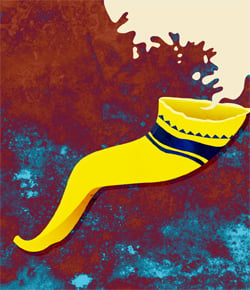
As the last month of the Jewish year, Elul is traditionally a time of introspection and stocktaking—a time to review one’s deeds and spiritual progress over the past year, and prepare for the upcoming “Days of Awe” of Rosh Hashanah and Yom Kippur.
As the month of divine mercy and forgiveness, Elul is a most opportune time for teshuvah (“return” to G‑d), prayer, charity, and increased ahavat Yisrael (love for a fellow Jew), in the quest for self-improvement and coming closer to G‑d. Chassidic master Rabbi Schneur Zalman of Liadi likens the month of Elul to a time when “the king is in the field” and, in contrast to when he is in the royal palace, “everyone who so desires is permitted to meet him, and he receives them all with a cheerful countenance, showing a smiling face to them all.” The following are some of the basic customs and practices for the month of Elul:
Painting by Chassidic artist Zalman Kleinman.
© Copyright 2015, all rights reserved.
|
Heralding the High Holidays: The Month of Elul
| ||||||||||||||||||||||||||||||||||||||||||||||||||||||||

Dear reader,
Can I tempt you? Invest 3 minutes of your time for the next month or so. In return you will find hope, faith and consolation that will invigorate your soul while keeping you in tune with the mood of this time of year. What do you need to do? From the first day of Rosh Chodesh Elul until Hoshana Rabbah on the holiday of Sukkot, we’ve begun reciting an extra psalm at the end of our prayers. This psalm (chapter 27) begins with the words “G‑d is my light and my salvation, whom shall I fear? The L‑rd is the strength of my life, whom shall I dread? . . . For He will hide me in His tabernacle on a day of adversity . . .” This prayer is appropriate for this time of year, since it hints to the upcoming holidays. “Light” refers to Rosh Hashanah which, like light, wakes us from our slumber to remind us to return to G‑d. “Salvation” refers to the holy day of Yom Kippur, when we take leave of all our wrongs from the past year through forgiveness and atonement. And “tabernacle” (sukkahin Hebrew) refers to the holiday of Sukkot. In this psalm, King David eloquently begs G‑d to save him from his many enemies. As his adversaries pursue him, he enumerates three stages of deliverance. First, G‑d illuminates his path so he can flee. Then, G‑d protects him and removes the danger. And lastly, G‑d brings him to a place of refuge. Whether we find ourselves in the throes of a terrible illness, a financial crisis or a severe emotional problem, these are the three stages of deliverance we all seek. Worry, sadness and despair associated with a challenge can be overwhelming. Darkness haunts and immobilizes us, blocking our path so we cannot see. The first step to recovery is finding a ray of light or hope to illuminate the enveloping darkness. Next we need a path, a real solution for our problem, so that the severity of the danger or difficulty is eased. And finally, even after a solution is in place, we need to learn how to find serenity—a calm state of mind, a place of refuge which can handle the inevitable struggles. As the year draws to a close and a new one full of promise peeks around the corner, we ask G‑d to help us through our personal trials. The concluding words of the prayer are the foundation for improving our mindset. “Hope in the L‑rd, be strong and let your heart be valiant, and hope in the L‑rd.” May the coming year be a year of blessing for us all, where we find salvation from our challenges as well as a year of deliverance and redemption for our nation and our entire world. Chana Weisberg, Editor, TJW P.S.: How do you deal with the challenges of your life?
Chana Weisberg is the editor of TheJewishWoman.org. She lectures internationally on issues relating to women, relationships, meaning, self-esteem and the Jewish soul. She is the author of five popular books.
© Copyright 2015, all rights reserved.
| ||||||||||||||||||||||||||||||||||||||||||||||||||||||||
Heralding the High Holidays: The Month of Elul
| ||||||||||||||||||||||||||||||||||||||||||||||||||||||||

We are beginning to understand the power in small things.
Large, cumbersome computers are now extinct; we are moving toward the smallest of microchips. Supersized Slurpees and long buffet lines are frowned upon; smaller portions of food and tiny tequila shots of wheatgrass are now the order of the day. We are recognizing the impact of small acts of kindness on those we love. We are grasping that small steps toward a goal are often more productive than large ones. The power of “small” is unfolding in our personal and collective lives.We are beginning to understand the power of small things Judaism has always recognized “small”’s dynamic influence. In Jewish thought, “small” is connected to the quality of humility. Humility is the conduit for true greatness in our tradition: G‑d’s chosen people were the smallest of nations. G‑d chose Mount Sinai, a small, “humble” mountain, as the birthplace for our people. Our outstanding leader Moses’ greatest attribute was his “small” ego, his unpretentiousness. And then there is the yud. Of all 22 letters of the Hebrew alphabet, the yud is the smallest. Despite its stature, Rav Dov Ber Pinson notes that the yud is the bedrock of the alphabet—its form is the beginning point of all the letters. Sefer Yetzirah, a Kabbalistic text, accords each month of the Jewish calendar a corresponding Hebrew letter. The letter that corresponds with the month of Elul is the humble yud. The month of Elul is a time of introspection and repentance. In Elul we are charged with examining the events of the past year and gleaning the lessons they have taught us. Sometimes this is a gentle process. But when dealing with more painful aspects of the past year, placing ourselves under the microscope does not always feel so gentle. Is there an antidote to this challenge? When we combine the contemplation of Elul with the knowing energy of yud, we create an atmosphere of enhanced self-awareness, gratitude and growth. As a result, perhaps soul-searching can become more manageable. Let us take a closer look at the self-effacing letter yud. According to Rav Pinson, the yud, which looks like a point, is the source of wisdom and goodness in every life experience. That’s right, this demure letter holds tremendous power and healing. In Jewish thought, the letters in a name represent qualities or energies the possessor of the name has. In Hebrew, one of the names of G‑d starts with a yud. The names of the Jewish people also begin with yud: We are called the children of Yisrael (Israel), the kingdom of Yehudah (Judah), the house of Yaakov (Jacob), the house of Yosef (Joseph). We understand that the divine is the only true goodness and wisdom in the world, but the simple Yid (Jew)? Yes. We too have access to these powers. When we make use of our personal, inner yud, we can be our own source of wisdom and goodness in every life experience. How do we connect and tap into our “inner yud”? Look back at the past year . . . The kids were whining, screaming, wrestling in the back seat of the car. You were sweaty and agitated and volcanic. You could have reacted, you could have blown up . . . but remember? You breathed, you said your mantras, you internalized their messages . . . and you didn’t blow up! No one applauded, no one acknowledged this feat of transcendence. But now you can. How could you forgive her? Your mother wasn’t there for you, and then, after all those years, she wanted a connection? How could you trust a real relationship with her? The fact that you were even willing to try was miraculous. You moved toward forgiveness and letting go, even when it hurt. . . . You worked on yourself this year, coming closer toward a new relationship. Your inner yud was working overtime, and you probably didn’t even know it. Your husband was still in the midst of his midlife crisis. No matter what you said or how you said it, there was “no one home.” He was marching to the beat of his own drum this year, and you couldn’t change his rhythm. After years of marriage, you deeply understood that this would be a year of surrendering and acceptance. Eventually he would have to find his own inner wisdom, but you had already found yours: we are not in control of others, even the ones we love. When we grasp that both the pain and the joy of the past year helped us grow and expand, we are seizing our inner yud. When we had patience at a time of discontent, when we flourished despite falling, when we accepted and accommodated, we followed our inner wisdom. And what about the times when we remained agitated, broken and destructive? We are not in control of others, even the ones we loveWhen we blew up, remained detached, gave up, gave in? What happened to the inner yud? Well, if we start now, forgive ourselves, reevaluate and commit to do differently next time, then we are absolutely working that inner yud. As with any genuine process, the results of this soul-accounting will not always be streamlined and packaged perfectly. We may have to confront contradictions that lie within us and our choices. That is natural; we are human. But in doing so, we may learn about ourselves and our desires, forging a gateway to our true essence. We will perceive points of goodness where we once saw only confusion. Amazing how out of such “small” and humble analysis comes such great truth and depth. Elul’s arrival signals a time for contemplation and reflection. As this month aligns itself with the energy of the yud, may we truly harness our divine intelligence and understand how to accept, change and trust our choices. May we see the good in others, may we see the good in ourselves, and may we embrace the bigness of that small but all-important point within.
Karen Wolfers-Rapaport is a psychotherapist specializing in Narrative Therapy. She holds a BA from UCLA and an MA in Counseling Psychology from Boston College. She received her training from Tufts University. In addition to her therapeutic work and freelance writing, Karen works with families from Israel’s Prime Minister’s office and Ministry of Defense, teaching them English in preparation for their diplomatic posts abroad. A proud mother, she is blessed to live in Israel.
© Copyright 2015, all rights reserved.
| ||||||||||||||||||||||||||||||||||||||||||||||||||||||||
Your Questions
| ||||||||||||||||||||||||||||||||||||||||||||||||||||||||

We Jews light a whole lot of candles for the dead. I have seen candles lit at a shivah house of mourning, on the yahrtzeit (anniversary of passing), and even for the entire first year of mourning. What is the reason behind the candle, and when did the custom begin?
Early PrecedentThere is evidence of Jews lighting candles to honor the deceased as far back as the Mishnaic period, approximately 2,000 years ago: the Mishnah states that one cannot use the “fire of the dead” for the havdalah blessing on Saturday night because it was lit not for the living, but to honor the dead.1Additionally, we find that Rabbi Judah the Prince, who was actually the compiler of the Mishnah, commanded his household before his passing “to leave a lamp lit in its place.”2Although this phrase is usually understood to refer to the Shabbat lamp, some point to this as a precedent for lighting a candle for the departed soul.3 But Why?The verse states, “The soul of man is the lamp of G‑d.”4 As such, the candle serves as a remembrance of the departed soul. Additionally, based on this soul-lamp comparison, there are many reasons given for lighting a candle, several of which we will touch on here.Filling a VoidWhen a soul departs from this world, it leaves behind a dark void. The memorial candle serves to replenish this light.5Bringing Joy to the SoulRabbi Bechayei ben Asher (1255–1340) explains6 that the soul derives joy from the candle’s light. As the verse states, “The light of the righteous will rejoice.”7 How come? The soul is made up of divine light, and it is natural to delight in something that is of a similar makeup. This is the case even though the candle generates mere physical light, whereas the soul’s light is spiritual.Atonement for the SoulWith regard to the custom of lighting a memorial candle before Yom Kippur, Rabbi Asher ben Yechiel (1250[?]–1327) explains that we light a candle to atone for the souls of the departed. The verse states, “For the lights honor the L‑rd.”8 When we light a candle to honor G‑d in the merit of the departed, G‑d promises to forgive and watch over their souls.9Wick and Flame: Body and SoulOn a more mystical level, a candle represents a person’s connection to the divine. The lamp, including the wick, represents the body, and the flame represents the divine soul. When a candle is lit, both the wick and the fuel combust in an upward-licking flame of light. Through learning Torah and doing mitzvahs, the body is subsumed by the soul and becomes spiritual energy.10A flame has three components: There is the inner blue (or blackish) part of the flame, which hugs the wick and consumes the oil. Then there is the bright body of the flame, which provides the light. Lastly, there’s the third level, the subtle aura that surrounds the flame. These three parts correspond to the three components of the soul11 that are most closely associated with the physical body: nefesh, ruach and neshamah.12 (Some, including Chabad, have the custom to light five candles during prayers throughout the eleven months that kaddish is recited, as well as during prayers on the yahrtzeit,13 corresponding to all five levels of the soul:nefesh, ruach, neshamah, chayah and yechidah.14) When to Light a Candle?We light a candle when the soul is more present in our world.Since the soul begins its upward journey in gradual stages (akin to an aroma that slowly dissipates), the custom developed to light the candle during the first week of shivah, when the soul is most present.15 And since the soul’s ascent is not completed until the end of the first year, Chabad and others keep the candle lit until the year has passed.16 17 During the times when we are to remember the deceased, we light a candle in memory of the soul. On these days—yahrtzeit and when Yizkor is recited—the soul has permission to travel back to this world that it left behind, so we light a candle for its delight and memory.18 Some, including Chabad, have the custom not to light a candle on the days Yizkor is recited,19 except for Yom Kippur (for then, as explained above, the souls are judged and we light in their merit20). The custom is to light the candle after sunset on the eve of the yahrtzeit.21 If the yahrtzeit is on Shabbat, the candle is lit before lighting the Shabbat candles. The candle should burn at least until after nightfall the next day (i.e., the end of the yahrtzeit) and should be left to burn out on its own.22 If the yahrtzeit is on Sunday, then the candle should be lit after evening prayers and havdalah. What Kind of Candle?For mystical reasons, some have the custom to specifically use an oil lamp for the memorial candle.23 Others, including Chabad, try—only if easily obtainable24—to use a candle made out of beeswax. The reason for this25 is that the Hebrew word for beeswax is shaavah (שעוה), which is an acronym (albeit rearranged) for הקיצו ורננו שוכני עפר—“Awaken and sing, you who dwell in the dust.”26 This verse is an allusion to the time of the resurrection, when we will all be reunited with those who have passed on.When even an ordinary candle is not available, one can use an electrical lamp instead.27 While candles are important, remember that there is something even more beneficial for the soul. The soul, once it ascends to heaven, can no longer perform any mitzvahs. However, when we, especially the person’s descendants, learn Torah, do mitzvahs or give charity in the merit of the departed soul, we are giving the greatest gift and honor to the departed. The merit of these good deeds benefits both the departed soul as well as those down here in this world doing the mitzvahs.
Rabbi Yehuda Shurpin responds to questions for Chabad.org's Ask the Rabbi service.
© Copyright 2015, all rights reserved.
| ||||||||||||||||||||||||||||||||||||||||||||||||||||||||
Your Questions
| ||||||||||||||||||||||||||||||||||||||||||||||||||||||||
 Question:My father-in-law passed away recently. I knew him for many years, during which time I disliked him and was critical and unhelpful to him. Now I understand what he was going through, how wrong I was to be judgmental, and that I should have been helpful and understanding. How can I make amends to a deceased person? What can I do to soothe his soul? What can I do to obtain forgiveness?Answer:How often do we wish that we could turn the clock back and change our behavior, because in retrospect we understand things so differently? We cannot turn the clock back; we can only move ahead. What is impressive is that you admit your mistake and you wish to make amends for it. Your father-in-law is now in the World of Truth, and as such can see beyond the pettiness of our world.I would suggest that, if he is buried near where you live, you visit his grave and ask him for forgiveness for your past conduct. Speak openly and honestly and with a humbled heart. Ask for him to pray on your behalf and on behalf of your family. If at all possible, take along a minyan (a quorum of ten adult Jewish men) to the cemetery, and ask for forgiveness in their presence. I would also suggest that you do on his behalf things that he no longer can do. I am referring to mitzvot, which—no matter what his attitude was while alive—in the World of Truth he appreciates their real value. He can no longer do good deeds on his own behalf, but you can do it in his merit, and he will greatly appreciate this. You can choose any good deed, whether it be giving extra charity, or extra carefulness in any of the mitzvot—kosher, mezuzah, Shabbat candles, family purity, or whatever it is that you choose. You might choose something that might have been especially meaningful to him during his lifetime. This is something that he will eternally appreciate and will be meaningful for him, and can atone for your past behavior. Wishing you well, Chana Weisberg for Chabad.org
Chana Weisberg is the editor of TheJewishWoman.org. She lectures internationally on issues relating to women, relationships, meaning, self-esteem and the Jewish soul. She is the author of five popular books.
All names of persons and locations or other identifying features referenced in these questions have been omitted or changed to preserve the anonymity of the questioners.
© Copyright 2015, all rights reserved.
| ||||||||||||||||||||||||||||||||||||||||||||||||||||||||
Story
| ||||||||||||||||||||||||||||||||||||||||||||||||||||||||
Life was hard in the village of Chernestra (Chernyy Ostrov), Ukraine, in the early 20th century. So hard that Yisroel Dov Waxman, whom everyone called Berel, decided to leave his wife, Rochel, and growing family behind for America. He hoped to be able to bring in enough money to feed his family, and perhaps even have them join him one day on America’s faraway shores.
Before Berel boarded the train that would take him to the port city, where a steamship would take him to New York, Berel’s father, Meshulem Zushia, pulled him aside for a few moments. “My son,” said the elder man, “I want you to swear to me that no matter what happens, you will never, ever work on Shabbat, our holy day.”1 A devout chassid, Berel was taken aback. Would my father even suspect that I would break Shabbat? he wondered to himself. Yet he shook his father’s hand, gravely promising never to work on the holy day. Upon his arrival in New York, he went to the address of a landsman, a fellow from the same village who had immigrated to New York. The landsman was an overseer in one of the many sweatshops on the Lower East Side. The fellow gave him a job pressing shirts. The work was hard, and Berel would work from early in the morning to late at night for six days a week. Every Friday he would take a few pennies from his meager earnings to buy some groceries for Shabbat and the coming week. The rest he saved for his family. 
Many of New York’s Jews eked out a living working in the garment industry’s infamous sweatshops.
Berel hurried into the street and retrieved his board. Where would he go? Shabbat was coming, and he had no time to take his ironing board to his boarding house before Shabbat would begin and he would no longer be allowed to carry. “I stood there in middle of the street staring at my only possible means to support my family, and wondered what I would do with it,” he would later tell. 
The streets of the Lower East Side of New York were typically bustling with pedestrians, pushcarts and more.
It was a difficult Shabbat. Berel was all alone in a strange country with no source of income. But his faith in G‑d was strong. Shabbat ended, and Berel traced his footsteps back to the laundry. He asked the attendant behind the counter if perhaps he would return the ironing board, knowing full well that this person could deny ever having taken it. To his relief, the attendant handed it to him without a question. As he walked down the street to no place in particular, he heard a voice calling. “I see that you have an ironing board,” a strange man said. “You know, I have a lot of extra pressing work to be done right now. Can you please work for me? I can use a good fellow to work overtime.” That week Berel worked as much as he could, knowing that come Friday afternoon he would probably lose this job as well. 
A quiet moment on the Lower East Side’s normally teeming streets.
“Sir,” he said, “it seems that you made a mistake and gave me the wrong envelope.” “Oh, don’t worry,” said the man, “I did not make a mistake. I’ll take care of your overtime soon as well.” 
Reb Yisroel Dov Waxman in his later years.
“At that moment it struck me,” he would later tell his children. “If I would have kept my old job and worked on Shabbat, I would have lost not only my share in the world to come, but my rightful portion of this world as well!” Berel kept that job until he was able to find something better, and several years later he brought over his wife and children to join him in New York. Now, 100 years later, Berel’s grandchildren, great-grandchildren and great-great-grandchildren keep Shabbat (and much more!), just like he did so many years before. 
Reb Yisroel Dov Waxman celebrating the second time he completed studying the entire Talmud (he would go on to do so one more time).
Rabbi Menachem Posner serves as staff editor for Chabad.org.
© Copyright 2015, all rights reserved.
| ||||||||||||||||||||||||||||||||||||||||||||||||||||||||
Story
| ||||||||||||||||||||||||||||||||||||||||||||||||||||||||
In the summer of 5689 (1929) the sixth Lubavitcher rebbe, Rabbi Yosef Yitzchak Schneersohn, of righteous memory, traveled from Riga, Latvia, to the Land of Israel to pray at the gravesites of tzaddikim (righteous people). He visited the four holy cities of Hebron, Jerusalem, Tiberias and Safed, and other locations as well.
According to the itinerary, the rebbe and his entourage were to arrive in Safed in the daytime of 5 Av, the yahrtzeit of the Holy Ari, Rabbi Yitzchak Luria, leader of the Safed Kabbalists in the last few years of his life (1570–1572). This would be a most auspicious day to pray at the Ari’s burial site. However, car problems temporarily derailed the plan, and they were forced to stop in Rosh Pina, a town in the Galilee a ten-minute drive from Safed. Enter Aviv Keller, the primary source for the events that followed, which were never recorded in the rebbe’s diary, nor did any of the other passengers write anything about them. In 1878, Aviv’s grandfather, Aharon Yirmiyahu Keller, built the first Jewish home in the area that today is the town of Rosh Pina. Aviv himself was born in that home on December 27, 1918. At the time of the writing of this article he is 96 years old and still going strong. His mind is sharp, his speech is clear, and he relates events from his long life, including his childhood, as if they occurred yesterday. Although he was but 10 years old at the time, he insists that he recalls every detail of the remarkable event, 86 years later. The door upon which the rebbe knocked was to the home of Aviv’s uncle, Shimon Keller, fifty feet or so from Aviv’s home. The custom of the Keller clan in those days was to gather every late afternoon at Shimon’s house between 4 and 5 PM to drink tea together. “As everyone was relaxing and conversing,” recalls Keller, “a large automobile pulled over to the side of the road near the house. None of us had ever seen such a car before. It was huge. In addition to the driver, it must have had space for nine riders, including a specially elevated, padded seat in the front for the most important passenger. 
The Keller home in Rosh Pina (Photo: Mrs. Shulamit Tilles)
“However, my grandfather, who had studied in a yeshivah in his youth, recognized him right away. ‘This is the Lubavitcher Rebbe!’ he proclaimed excitedly. Although he had never seen him, he had read about his visit to Israel in one of the newspapers. We all noticed that the long coat he was wearing was made of some special sort of material. “When my uncle opened the door, the rebbe introduced himself and asked if we were a Jewish family. My grandfather jumped up and hurried over to the doorway. He pointed to the mezuzah and said, ‘Look! Of course we are Jewish.’ He invited the rebbe to come inside. He also sent someone right away to summon the village blacksmith to help fix the tire rim. “The rebbe seemed quite tall. My grandfather came up only to his shoulder. He requested a quiet place to pray Minchah (the afternoon service). My uncle escorted him to a private spot, and the men in our family that were present joined him in prayer. When they finished, my uncle offered the rebbe a glass of tea, which he accepted. Uncle Shimon added in freshly picked lemon leaves from one of our trees, which produced an enticing aroma. “I was just a child. I decided I would go close and touch the interesting-looking visitor. When I did, he looked at me and smiled.” The driver, a hired non-Jewish German, came in to announce that the car, which turned out to be a Mercedes-Benz, was repaired and they could travel on. Before the rebbe left the house, he gazed at each member of the family and blessed them all with long life. “I remember his exact words: ‘Lange leben und gezunte yahren’—‘[You should] live long and healthy years.’” Aviv smiled and continued, “The blessing materialized, and is still materializing. My uncle—the host—lived till 96. My grandfather lived until 89, and my grandmother, Sarah Lipsha, until 92. She, by the way, knew the entire Rosh Hashanah and Yom Kippur prayer service by heart, and from the women’s section would correct the cantor if ever he made a mistake. “As for me, I’ll turn 97 on 24 Tevet, G‑d willing, and I hope to merit even longer life if the Almighty so decides.” And so the unplanned visit to the Keller family in Rosh Pina came to an end, and the rebbe and his entourage resumed their journey up the steep hill to Safed. “We escorted them until the first curve. We actually ran in front of the car, as it was moving very slowly.” 
The old road from Rosh Pina to Safed.
Today he lives alone in the (remodeled) house he was born and grew up in. He has 3 children, 7 grandchildren, 11 great-grandchildren, and numerous nieces, nephews, grandnieces and grandnephews. Nearly all call him and visit him on a regular basis. His eldest son, a “youngster” of 72, also still lives in Rosh Pina; he provides hands-on help and daily meals. Aviv enjoys visitors (call a day in advance!), whom he enchants with detailed recollections of the history of Rosh Pina. May he continue to do so, in good health and with clear mind, until at least 120. Source: Interview with Aviv Keller on June 30 and July 14, 2015, inspired by an interview with him in the Hebrew weekly Sichat HaShavua three years earlier. Aviv’s relative, Chaim Tzvi HaKohen Schechter of Safed, set up the first appointment. Editor’s note: It was thrilling to see in Aviv Keller the living fulfillment of the rebbe’s blessing. Aviv said that before then no one in his family had ever lived nearly so long. His own father and mother, who were not in the house at the time of the blessing, lived to “only” 68 and 72 respectively, even though they were both always healthy.
A master storyteller with hundreds of published stories to his credit, Rabbi Yerachmiel Tilles is co-founder of Ascent of Safed, and managing editor of the Ascent and Kabbalah Online websites.
Republished with permission from AscentofSafed.com.
© Copyright 2015, all rights reserved.
| ||||||||||||||||||||||||||||||||||||||||||||||||||||||||
Women
| ||||||||||||||||||||||||||||||||||||||||||||||||||||||||

Okay, so maybe I was looking a little harried that day last week in the supermarket. My four kids, ranging in age from seven and a half to one and a half, were all with me as we made a quick stop to pick up a few items we needed. The baby was in the stroller, trying to jump out, and yes, all the kids were clamoring for a sample of the treat I’d just bought for them. But I think it was the fact that I’d mistakenly left half the items I’d bought at the register that prompted the lady behind me to take a long look and weigh in on my situation.
“Wow,” she commented, “I’m not jealous of you.” Unsure of how to take her words, I answered something about how we were managing okay, and tried to flash my most reassuring smile. On the way home, I pondered the stranger’s comment and tried out different responses in my head. From her reaction, I realized we did not share a similar lifestyle, and I imagined how extreme I must have seemed to her. Why have so many kids in so few years? she must have wondered. Why choose such a difficult, harried existence, when life could be so much calmer? Trips to the store could be relaxing. I could have so much more time to myself. Why, indeed? I’m not going to lie. There are days when my mommy duty seems like an almost impossible task: take care of everyone’s physical, psychological and emotional needs while remaining calm and pleasant in the face of a whole range of childish behaviors and often irrational demands. And while my own needs for time, space and nourishment of body and soul must be given the proper attention and cannot be overlooked, there’s no doubt that being a parent requires sacrifices, both large and small. Whether it’s cleaning up that raw egg the toddler grabbed and cracked on the floor, or working for hours with the seven-year-old who just isn’t learning how to read, there are moments of challenge when every parent needs an answer to that unspoken question—“Why?” Of course, being their mother, I love my children and can’t imagine trading them in for an easier life, even when they are throwing tantrums or fighting with each other. But there must be a deeper reason why it’s not merely worth it to have kids, but absolutely awesome and utterly fulfilling. The answer must go beyond the standard cliché “My baby smiling back at me makes it all worth it.” As I pushed the stroller and tried to keep my eyes on my young charges, it came to me: It’s all a matter of your point of view. If life is about me and how much pleasure I can squeeze out of every moment, then the lady behind me was right. There’d be nothing to be jealous of; in fact, my life would be considered quite difficult! Constantly having to focus on the needs of four little people rather than my own wants and needs—who would choose such a life? But viewed from a different perspective, everything changes: in truth, one of the main reasons we’re in this world is to give to others. We are commanded to emulate G‑d, and G‑d is the quintessential giver. He gives us everything we have. We are like His needy, demanding children. And although giving is something anyone at any stage of life can do, it is parents in particular who are likened to G‑d because of the altruistic, never-ending fashion in which they give. In this light, each child is viewed as a blessing and an opportunity for the parents, rather than a burden that takes away precious time and energy. In our increasingly self-centered world, it’s become harder than ever to focus on the needs of others. We are bombarded with subtle messages that “it’s all about me.” But last week’s encounter in the supermarket really got me thinking about my everyday struggles. So, when the kids are being especially demanding, I’ve now got a powerful tool to take things to a whole new level and turn frustration into patience. Whether I’m dealing with the chaos of bath and bedtime or a spilled drink on the new tablecloth, I can stop, take a deep breath, and remember that this isn’t just something to “get through”—this is the purpose of life itself.
Rochel Leah (Margaretten) Fuchs lives in Jerusalem with her husband and 4 children. She has written for Mishpacha magazine and Aish.com, and is active in Jewish outreach.
© Copyright 2015, all rights reserved.
| ||||||||||||||||||||||||||||||||||||||||||||||||||||||||
Parshah
| ||||||||||||||||||||||||||||||||||||||||||||||||||||||||

This week’s Torah portion begins with Moses’ eloquent cry to the Jewish people to establish courts and to pursue justice:
You shall set up judges and law enforcement officials for yourself in all your cities that the L‑rd, your G‑d, is giving you for your tribes, and they shall judge the people [with] righteous judgment.All agree that justice is important, but justice is elusive. Even in this great country, in the 21st century, there are serious questions whether our criminal justice system has a long way to go to ensure that every individual can expect equal access to justice. One scholar recently made this argument in an op-ed piece: Our justice system has become inaccessible to millions of poor people and so every day, we violate the “equal justice under law” motto engraved on the front of the grand United States Supreme Court. Americans who cannot afford legal help routinely forfeit basic rights as a result. Because the law does not enforce itself, veterans seeking benefits the nation has guaranteed, victims of domestic violence needing legal protection, and tenants and homeowners pursuing their rights since the financial disaster all need advisors and guides through the law and its agencies and courts.2Writers often save the most powerful point for last. The last sentence is your chance to emphasize your point and to shape the impression your reader will take away. The last section of this week's Torah portion highlights the true test of justice. The final section describes the law of an unidentified murder victim lying in the field. The victim is not a prominent member of society who travels with an entourage. He is not a celebrity who is well known. The true test of justice is whether society will care about this crime. Whether society values the most vulnerable, lonely, least respected, unknown members of society. How do we respond when an unknown victim is found slain? Do we ignore the case because there is no one to lobby for justice? On the contrary, the Torah demands that the most prominent members of society come down to the crime scene to investigate, to declare that they did not ignore the plight of this person, and to force the story into the headlines: If a slain person be found in the land which the L‑rd, your G‑d is giving you to possess, lying in the field, [and] it is not known who slew him.3The Torah commands the members of the supreme court of Israel to drop everything they are doing, and they—not their assistants or surrogates—should show up at the crime scene: Then your elders and judges shall go forth, and they shall measure to the cities around the corpse.4In the pre-mass-media world, the surest way to create news, which in turn may encourage a possible witness to the crime to come forward, is for the members of the court to come and draw attention to the crime. They then proceed to perform an unusual ritual. It's purpose is to turn people's attention to the terrible crime committed against someone they never heard of: And it will be, [that from] the city closer to the corpse, the elders of that city shall take a calf with which work has never been done, [and] that has never drawn a yoke. And the elders of that city shall bring the calf down to a rugged valley, which cannot be worked and cannot be sown, and there in the valley, they shall decapitate the calf.5The valley "cannot be worked and cannot be sown," which means that there is a valuable piece of real estate that cannot be used until the case is solved. That serves two purposes: the fallow valley does not allow the murder to be forgotten, and the owner of the valley has a financial incentive to keep the pressure on the authorities to investigate the case.6 The Torah understands that the test of justice is not “at your gates”; it’s not how we treat the prominent members of society. Rather, the test of justice is whether the “elders and judges” will leave their ivory tower, leave the city, and search for justice for the unknown stranger.
Rabbi Menachem Feldman serves as the director of the Lifelong Learning department at the Chabad Lubavitch Center in Greenwich, CT.
© Copyright 2015, all rights reserved.
| ||||||||||||||||||||||||||||||||||||||||||||||||||||||||
Parshah
| ||||||||||||||||||||||||||||||||||||||||||||||||||||||||

There was once a king who was very fond of target shooting. He practiced daily and arranged competitions. With time, he felt that he had gotten pretty good at the sport, yet he continued trying to improve.
One day, as he was traveling through the countryside, the king noticed several target boards near a small peasant hut. Looking closely, he was astonished to see that every one of the many darts on the boards was precisely in the center! This simple peasant was apparently an expert; he had hit a bull’s-eye with every try! Often, we may be swayed by bribes – personal concerns, interests and feelingsCurious to learn how the man had done it, the king knocked on the door of the hut. The peasant who answered laughed heartily at the the king's question. "Why, it's very simple," he replied naively. "Instead of drawing the target and aiming towards it, I throw the darts, and then draw the circles around them. It works every time..." The Torah portion of Shoftim (Deuteronomy 16:18-21:9) includes a prohibition for judges to take bribes. The Torah then explains the reason for this commandment: "For bribery blinds the eyes of the wise." Now, you're probably thinking, "No kidding, that's the definition of a bribe! What kind of reason is that?" Good point. But, actually, the Torah is not trying to explain what's wrong with paying off a judge; it's obvious that corrupting fair judgment is immoral. Rather, the Torah seeks to clarify a fact. Often, people say, "I can be objective in this case, despite my connection to it." Recognizing the difficulty of proper judgment when personal concerns are involved, we may nonetheless convince ourselves that we are immune to bribery, intellectually and emotionally capable of separating fact from feeling. Yet the Torah cautions us that the danger of bribery is not merely a possibility, nor even a probability. It is an automatic effect. Bribery – monetary or otherwise – skews one's perception, literally "blinding" him to reality. No one is immune. We are all judges, all of the time. There are important decisions to be made constantly, and these require clear thinking and examination of facts. But often, we may be swayed by bribes – personal concerns, interests and feelings. We may have the best of intentions, yet the possibility of a purely objective decision is, technically, out of our reach "for bribery blinds the eyes of the wise." For this reason, it is crucial that every one of us have a mentor, an objective individual upon whom we rely to help us make decisions. Before signing the dotted line, run it by someone out of the picture. It's a sort of reality check, a way to make sure that we are aiming towards the target, rather than adjusting the goal to suit us.
Rabbi Mendy Wolf is the director of Project LIFE, an organization promoting Jewish awareness throughout the business community in NYC. Rabbi Wolf is known for his popular “Discussion of the Week” lunch and learn classes hosted in various offices in the city.
© Copyright 2015, all rights reserved.
| ||||||||||||||||||||||||||||||||||||||||||||||||||||||||
Parshah
| ||||||||||||||||||||||||||||||||||||||||||||||||||||||||

What makes a hero?
In this week's Parshah, the Torah discusses the laws of war and some of the moral imperatives that apply even under fire. Specifically, we read of the exemptions that entitled a soldier to leave the battlefront. One of these was "the man who is fearful and fainthearted." The Torah rules that "he should go and return to his home" and join the civil service, lest his cowardice "melt the hearts" of his comrades in arms and demoralize them (Deuteronomy 20:8). Interestingly, Maimonides rules that this exemption only applied to wars which were optional for political or territorial reasons (milchemet ho'reshut), but not to obligatory wars where the Torah itself mandates that we go to battle (milchemet mitzvah), such as a war of self defense or the wars to conquer the Promised Land. But what is the logic here? Why the distinction? If the problem is that the coward's fear will have a negative effect on his fellow combatants, then that is a psychological fact of life. What difference does it make if the war is mandated by G-d or by Jewish leadership of the day? Surely a coward is a coward whatever the war! But Maimonides is sharing with us a striking analysis of human nature. Fear and anxiety are magnified when there is more than one option open to us. When we have the choice of fighting or not, when war is not strictly commanded by G-d and it's a government decision, then I may very well choose to retreat. But when there is no choice, when it is a non-negotiable mitzvah from G-d that this war be fought, then even cowards become heroes. I am fond of quoting that famous American philosopher, John Wayne, who once said, "True courage is not the absence of fear. True courage is being scared like hell and saddling up anyway." Now that's a wise cowboy. The fearless few who heedlessly plunge into every offered challenge are indeed strange exceptions to our race. Most normal people experience fear in scary situations. Those of good courage face up to the fear and confront it. I can tell you many stories of ordinary people who became heroes. How? By overcoming their fears and doing whatever deed had to be done. My friends' father, Pinne Merkel, once ran into a synagogue in the old neighborhood of Doornfontein, Johannesburg to rescue the Torahs from the Holy Ark. The firemen warned him not to, but he ran in anyway. Pinne was not a religious man. But for him, saving the Torah scrolls was something that just had to be done, so an ordinary Jew became a holy hero. My congregant's son, Hugh Raichlin, is not a doctor. He's a lawyer. But when his wife was in labor and suddenly things started happening much too quickly, he delivered his own child inside the car in the parking lot of the maternity hospital. He wasn't looking for heroism. He had no option and heroism found him. When something just has to happen, we find a way to make it happen. We pluck up the courage and act valiantly. My own father, may he be well, used to be a chain smoker (thank G-d, he gave up the habit long ago). It often amazed me that the same person who would never be without a cigarette between his fingers six days a week was able to go cold turkey every Shabbat. For six days he couldn't wait two minutes, but once a week he waited for 25 hours! How? The answer is that keeping Shabbat for him was simply a non-negotiable commitment, so he had no option and persevered. As soon as Shabbat was over, though, he and his fellow Shabbat-observant smokers would make a mad dash for the nearest pack. It applies to life, to marriage, to business, to everything. If something is so important to us that to lose it would be unthinkable, we discover that we really can find a way, after all. In our Jewish lives, too, when we accept that a particular mitzvah is a sacred principle and inviolate, we will observe it no matter what the challenge. So, cowards of the world, unite! Let us do what we know must be done. That's how ordinary people become heroes.
Rabbi Yossy Goldman was born in Brooklyn, New York. In 1976 he was sent by the Lubavitcher Rebbe, of righteous memory, as a Chabad-Lubavitch emissary to serve the Jewish community of Johannesburg, South Africa. He is Senior Rabbi of the Sydenham Shul since 1986, president of the South African Rabbinical Association, and a frequent contributor to Chabad.org. His book From Where I Stand: Life Messages from the Weekly Torah Reading was recently published by Ktav, and is available at Jewish bookshops or online.
Artwork by Sarah Kranz.
© Copyright 2015, all rights reserved.
| ||||||||||||||||||||||||||||||||||||||||||||||||||||||||


The Mitzvah Campaign of Torah Study
The Rebbe urged all Jews to do the mitzvah of daily Torah study. Why is learning Torah so important for all stripes of Jews, even for those that aren’t necessarily intellectually inclined?
By Mendel Kaplan
Watch (46:52)<script language="javascript" type="text/javascript" src="http://embed.chabad.org/multimedia/mediaplayer/embedded/embed.js.asp?aid=3023029&width=auto&height=auto"></script><span style="clear:both;" class="lb" id="lbdiv">Visit <a href="http://www.chabad.org/multimedia/default_cdo/aid/591213/jewish/Video.htm">Jewish.TV</a> for more <a href="http://www.chabad.org/multimedia/default_cdo/aid/591213/jewish/Video.htm">Jewish videos</a>.</span>
More in Video:
• How Prayer Evolved (By Shifra Sharfstein)
<script language="javascript" type="text/javascript" src="http://embed.chabad.org/multimedia/mediaplayer/embedded/embed.js.asp?aid=3006403&width=auto&height=auto"></script><span style="clear:both;" class="lb" id="lbdiv">Visit <a href="http://www.chabad.org/multimedia/default_cdo/aid/591213/jewish/Video.htm">Jewish.TV</a> for more <a href="http://www.chabad.org/multimedia/default_cdo/aid/591213/jewish/Video.htm">Jewish videos</a>.</span>
Lifestyle
| ||
Somehow, brisket has become standard Rosh Hashanah fare across North America, so I would be remiss not to share my recipe as well as a few tips I’ve picked up along the way.
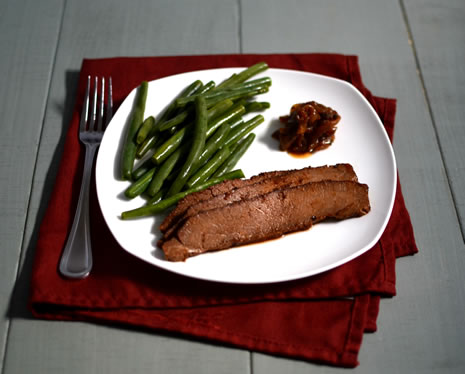 I’m no meat maven, but I’m learning, and the two most important things to consider when cooking brisket are:
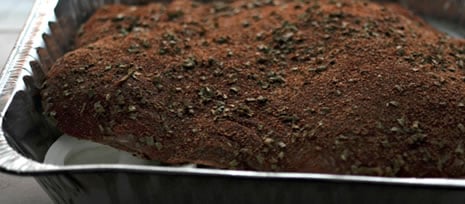 Now, on to specifics. Cut the onions in rounds, and put them on the bottom of a baking dish. Mix the paprika, garlic powder, chives and salt in a small bowl. Pat the spice rub all over both sides of the meat, until it can hold no more. Now put the brisket on top of the onions and into the oven on 400° F for 1 hour, uncovered. 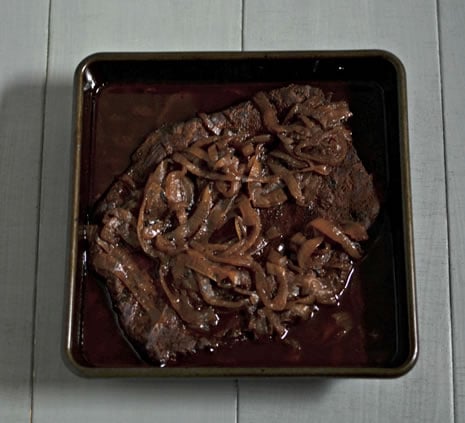 Take it out and turn the oven down to 250° F. Pour ½ cup balsamic vinegar and ⅓ cup honey over the meat. It may look like not a lot of liquid, but the meat and onions both let out lots of juices and you end up with plenty (as you can see in the pictures). Cover the pan tightly with foil and return to the oven. Cook for another 4 hours, until meat is fork tender—meaning a fork goes in with almost no resistance. Approximately once an hour, take it out and turn the meat, so both sides get equally moist. (If you're busy, you can skip the turning, just make sure to turn it once, about half-way through). Cooking time will vary, depending on the size and thickness of your brisket, so make sure to use the fork test. 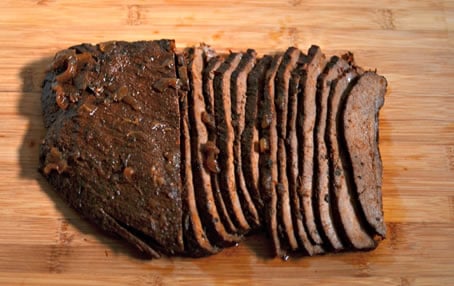 Once it’s ready, refrigerate the meat overnight, then remove from the sauce and cut into thin slices, against the grain. Return slices to the sauce and reheat in the oven or over a low flame on the stovetop when ready to serve. Freezes well. Serve with the sauce and onions. 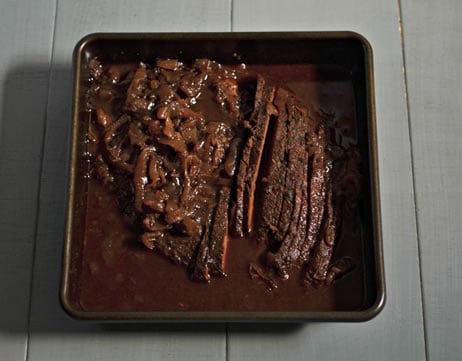 Ingredients:
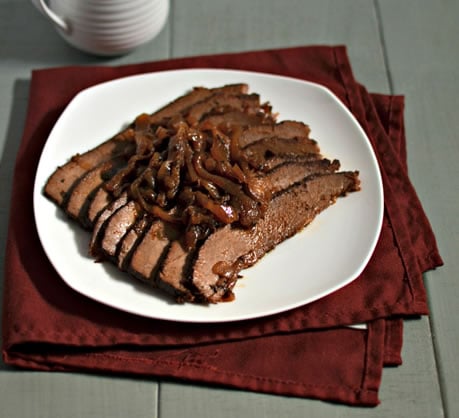 Do you eat brisket on Rosh Hashanah? How do you cook it? Any special family recipes?
Miriam Szokovski is the author of the historical novel Exiled Down Under, and a member of the Chabad.org editorial team. She enjoys tinkering with recipes, and teaches cooking classes to young children. Miriam shares her love of cooking, baking and food photography on Chabad.org’s food blog, Cook It Kosher, and in the N’shei Chabad Newsletter.
© Copyright 2015, all rights reserved.
| ||
Lifestyle
| ||
 there is a compelling awareness that the Kind is within reach. So potent that it pulls us out of the darkest places, and arouses the desire to be one with Him.
Michoel is an innovative educator, outdoor enthusiast and avid photographer. Michoel grew up in Australia where he used the 'Outback' to refine his photography skills. He pursued studies at Mayanot in Israel, the Rabbinical College of America in New Jersey and Rabbinical studies at Kollel Menachem in Brooklyn NY. He lives in Brooklyn with his wife, Sarah, and daughter. Read more about his organization at Oneinfocus.org.
© Copyright 2015, all rights reserved.
| ||
Jewish News
| ||
Recognizing 10 years since Hurricane Katrina (Aug. 23-31, 2005)
First in a series of articles on the storm, its aftermath and the ensuing growth of Chabad-Lubavitch of Louisiana As Hurricane Katrina raged on for nearly a week in August of 2005, the situation grew increasingly dire for the people left in its wake, with frantic pleas from around the world from those trying to reach family and friends in Louisiana, Mississippi and Alabama. Amid harrowing images of catastrophic devastation, discussions immediately began at Lubavitch World Headquarters, at 770 Eastern Parkway in the Crown Heights neighborhood of Brooklyn, N.Y., of how to help those in need. Katrina was proving to be the third deadliest storm in U.S. history, claiming more than 1,800 lives, and was by far the most expensive, causing more than $100 billion in property damage. Katrina came in over the Gulf of Mexico and devastated most of the coastline from Louisiana to Alabama. It arrived as a Category 4 storm with winds of more 140 miles per hour and a storm surge of almost 20 feet. The city of New Orleans—below sea level and surrounded by water—was devastated. About 80 percent of the city was flooded, with most areas under 10 to 20 feet of water. Hundreds of thousands of people had to evacuate the city, with many fleeing north to Baton Rouge, La., and due west to Houston, Texas. Within a few days, several rabbinical students in their early 20s were dispatched to Baton Rouge in the hopes of helping displaced Jewish residents of New Orleans and beyond. 
Satellite photo of Hurricane Katrina bearing down on New Orleans. (Photo: NOAA)
Though the men largely operated on their own, Rabbi Zelig and Bluma Rivkin, longtime co-directors of Chabad-Lubavitch of Louisiana, provided logistical information on the area and its Jewish residents. Their sons, Rabbi Mendel Rivkin and Yochanan Rivkin, also shluchim in New Orleans, add that Shmotkin and Druk were “very effective.” The Rivkins left New Orleans for Houston after it became too untenable for them to stay, though they remained in touch with search-and-rescue teams, coordinating with them in getting crucial items out of Chabad. Rabbi Zelig Rivkin and Rabbi Mendel Rivkin later met Druk and Shmotkin in Baton Rouge to help in the aftermath. Today, both men are married with families and serve as Chabad-Lubavitch emissaries—Rabbi Shmotkin in New York City, and Rabbi Druk in Cancun, Mexico. Though a decade has passed and some of the details have faded, the memories of the destruction and of assisting those in great need remain. One memory that remains crystal clear, they say, is that their responses and actions were based on the influence and wisdom of the Lubavitcher Rebbe—Rabbi Menachem M. Schneerson, of righteous memory. 
Levi Shmotkin gets a debriefing with medical and rescue personnel before heading out to help. “The local community in Baton Rouge was like ‘all-hands on deck’ in terms of helping each other,” he recalls.
Another group of students—Mendy Dubrowski, Mendy Horowitz, Shlame Landa and Pinny Backman—also went South after Katrina hit. The young men started out in Biloxi, Miss., and fanned out through other neighboring towns. Though there were no official shluchim in Mississippi at that time, yeshivah students did visit the area regularly, which gave the group a starting point when they arrived. (Unfortunately, street signs had been torn from the ground and rendered useless; it made finding neighborhoods and individuals that much more difficult.) The rabbis-in-training offered a helping hand, both financial and physical, to those who needed it. They provided self-heating kosher food and mezuzahs for those who requested such. And, of course, they offered the proverbial shoulder to cry on—there to listen and assist in ways they could. Hurricane Katrina was the costliest natural disaster in U.S. history, as well as one of the five deadliest hurricanes in the United States. Nearly 2,000 people perished in the storm and resulting floods, with nearly 1,000 categorized as missing. Total damages surpassed $100 billion, with the storm adversely affecting some 90,000 square miles. Recovery continues in many of the most hard-hit areas, particularly in New Orleans. 
Taking Torahs to safety from a local synagogue.
Rabbi Shmotkin: “After the hurricane struck, we knew it was really bad, and that people were suffering. We realized that the vast network of people that Chabad could help were those wondering about their relatives and if they were safe. We knew we had to get involved, had to get boots on the ground, so to speak.” Rabbi Druk: “Initially, when we got to Baton Rouge, we didn’t know what to expect or what our work would entail. We only knew that there had been some sick and elderly Jewish people who had not been able to evacuate in time. We also had a list of people who had not been heard from by relatives and friends.” Rabbi Shmotkin: “There was no Chabad presence in Baton Rouge at the time, so we got an apartment and worked out of there. We visited shelters armed with the list of names we’d been given and started looking for them. We worked on helping people who had nowhere to go get plane tickets or other transportation to family and friends in other cities. “The local community in Baton Rouge was like ‘all-hands on deck’ in terms of helping each other. The people from New Orleans seemed completely shocked, like they weren’t quite sure about what to do and where they were going. “We were on our own working with a New York-based search team. We had some addresses of people we knew were ‘stuck’ or left behind in New Orleans, and we went to go find them and offer them assistance.” 
Druk, left, and Shmotkin, right, work with others to evacuate Torahs and religious materials.
“I found it remarkable that with the enormous damage that the hurricane caused it did not destroy the faith of people. “I learned that tragedies can bring out the best and worst in people. Some used the opportunity of the chaos and confusion to take advantage of people and their possessions, while others left everything of material value behind in order to be there for the less healthy and fortunate. We saw doctors providing and assisting patients in need of medical attention, and random strangers providing basic needs to people they have never met.” Rabbi Shmotkin: “There’s one particularly beautiful story that I recall. There was an older gentleman who insisted on staying in his home during the storm, and his sister in Boston was really concerned about him. When we came to his door, he was extremely defensive about opening up. When he heard we were rabbis, he broke down and told us he hadn’t eaten in days and was so happy we were there. “He was extremely grateful to see us. He told us that he didn’t necessarily practice his faith, but that during and after the storm, he turned to his Judaism and sang, over and over again, the only thing he knew in Hebrew—a song. “We ended up helping him out and getting him to his sister.” 
Druk takes a break from a planning meeting at a staging area for volunteers on the ground.
Rabbi Shmotkin: “Yes. One thing I definitely know is that when people are involved in helping or wanting to help in a disaster situation, sometimes they are out of sync with what needs to be done. The Talmud says that more than the calf wants to drink, the mother wants to give milk—and the same is true after a disaster. More often than not, the aid being offered is something that is neither wanted nor needed. “You can’t assume a specific need just because you are in a position to give and they are in a position to take.” Rabbi Druk: “Still, there is no question that we would do the same thing all over again. We are soldiers in the Rebbe’s army; you go when you are dispatched for a cause or need to provide spiritual or physical support.” Rabbi Shmotkin: “The Rebbe’s entire message in everything he spoke of and lived by was about helping others—no matter when, no matter where.” Next: Demographic changes in New Orleans and their effect on Chabad 
The two men discuss their next moves.

Working with other Jewish volunteers to get basic necessities to those in need.

Packing a truck with supplies they will deliver to people and to local shelters.

Major floodwaters followed the wake of the storm.

Roads became completely submerged. Hurricane Katrina was the costliest natural disaster in U.S. history; total damages surpassed $100 billion.

Water rose to the roofs of homes in the hardest-hit areas.

Storm surges brought boats towards the shore, where they crashed into docks.

Damaged boats heaped in a pile; they were pulled in from the water, some all the way onto land.
© Copyright 2015, all rights reserved.
| ||
Jewish News
| ||
Rabbi Zushi Rivkin, 25, and Rabbi Mendy Wilschanski, 24, just completed a five-week assignment in which they visited Jewish communities and individuals from South Florida to Southern California. As part of the Merkos Shlichus Chabad “Roving Rabbis” program, they shared the beauty of Judaism wherever they went—helping men and boys wrap tefillin, handing out Shabbat candles to women and girls, hanging mezuzahs, answering all sorts of Jewish-related questions and offering Torah study.
During the time the spent on the road, the two met a total of 192 Jewish people from state to state. Rivkin shares some of their experiences and newfound inspiration from the trip. Q: You’ve met many, many Jewish people with a variety of backgrounds. What is it that unites them all? A: If there is one common thread that we found, I’d say it is the genuine desire that everyone had to come closer to G‑d, each one in his or her own way. We suggested to those we met to add one mitzvah to their lives, and not one person told us that they weren’t interested. Some affixed mezuzahs to their doors. Others took it upon themselves to study Torah. Still others lit Shabbat candles. Everyone seemed to do something—and they seemed genuinely happy to do so. Q: In most places you went, you had very few contacts to start out with initially. How did you manage to connect to local Jewish people? A: As anyone who has ever participated in the “Roving Rabbis” program can tell you, this is a business where you very clearly see G‑d’s hand in everything you do. 
A woman in Rio Rancho, N.M., burned a CD of Jewish music for their travels.
Another amazing example was in Pratt, Kan., which has a population of 6,835. We stopped to change drivers, pulling over in the lot of a furniture store call Aaron’s. It’s a national chain, but we didn’t know that. We wondered if Aaron was perhaps Jewish and went in to find out. Of course, Aaron was not there; he may never have stepped foot in that store. But we did meet a Jewish person behind the counter. He was originally from Alaska and going through a very difficult time in his life. He introduced us to his cousin, the only other Jew in town. They had been looking for a synagogue (there is none there); instead, we brought the synagogue to them. 
Armed with a box of vital items for those they met: tefillin, kipahs, mezuzahs, books and more.
A: Every individual made an impression. But here are a few who stood out. In New Mexico, we met a woman with significant medical expenses who lives pension check to pension check. She told us that she wanted to improve her prayer experience and learn what each section of the prayers mean. At the end of our visit, we showed her that we had book called My Prayer that does a superb job at explaining the meaning of each one. She wanted to buy it, but asked that we wait until her next check was deposited, casually mentioning that she would need to go a month without meat in order to do so, but that it would be worth it. Of course, we just gave it to her. There are so many others ... like the man who does his Jewish learning via computer. He showed us the tiny sukkah he built in his yard, using the guidelines he had read online. 
A selfie in one of the many hotel rooms they stayed along the way, with their makeshift kosher breakfast.
Another act of kindness that was very touching came from a woman who met us together with her 95-year-old father at a Barnes & Noble bookstore in Rio Rancho, N.M. After we talked about various Jewish subjects, she handed us a CD she had burned for us in advance. “I know you guys drive a lot,” she said. “So I made you this CD of nice Jewish music.” It was wonderful to hear that she enjoyed such music at home. As for us, as we drove through Kansas—which is flatter than flat—you can be sure we made good use of that CD. Q: Where did you celebrate Shabbat, and with whom did you celebrate? A: Our first Shabbat was in Harbor Beach, Fla., where our friend Rabbi Eliezer Perlstein recently opened a new Chabad center. In fact, the Shabbat we celebrated there was the first time he offered Saturday-morning services to the community. The next week, we were way west in Shreveport, La., where there is a core of inspired young people who really make a difference in the local community. After a whole week of meeting people, we felt we were able to host Shabbat there. On Friday morning, after studying and praying, we drove to Dallas to pick up a complete catered Shabbat meal. There was couple who had just moved to town three weeks beforehand. They told us the first Shabbat there, they cried as they sat among the boxes. The next week, they hosted their parents who were visiting, and it was a bit better. They could not believe that their third Shabbat was among so many of their fellow Jews. It was beautiful! Shabbat following that was in Kansas City, where we were able to be near an established congregation (Chabad has been there since 1970), since Sunday was the fast of 9 Av, Tisha B’Av. 
Helping put up a new mezuzah for this very active Jewish member in 4S Ranch, an unincorporated community of San Diego County. His former one disappeared.
Our last Shabbat was in Poway, Calif. In a sense, it was our quietest one. We celebrated it with our friend, Rabbi Mendy Goldstein and his wife, Shterna, who recently joined his parents in running the local Chabad. It was a really nice way to cap off what had been five weeks of nonstop travel and talk. Q: As you traveled across America and had the chance to absorb the landscape, what are some memorable sights that you encountered? A: Probably the most beautiful were the breathtaking rock formations in the deserts of New Mexico. In fact, we took a few hours to enjoy the Grand Canyon in neighboring Arizona and actually spoke with a Jewish park ranger who was happy to put on tefillin. 
A child puts coins in a tzedakah box, which the young rabbis explained to him and his siblings that their change turns into food or something else that a person really needs.
It worked, causing us to slow down and listen to the music. It really drives home the adage that you can accomplish more with honey than with vinegar. Q: Was it challenging to find kosher food during your travels, aside from the hot meals eaten on Shabbat? A: We ate a lot of tuna wraps, rice cakes, guacamole and other foods that stay well outside of a fridge. And we brought packs of kosher gum and mints with us from New York to keep us busy while driving. You’d be surprised by how many things you can get at large retail stores or even a local shop. Of course, every once in a while eating like this causes cravings for a warm meal. Many times the closest we would have to that would be using a coffee-maker in a hotel room to add hot water to instant soups, or coffee or tea. Q: You mention some other surprises in terms of meeting people—people, perhaps, you didn’t expect? What is a lasting message there? A: So many people inspired us. But what we didn’t expect was the reaction we got from children of the Chabad-Lubavitch emissaries we met along the way. They have the strength and inspiration to be different, to be unique, in places where there aren’t so many other kids like themselves. They set a Jewish example. And that’s what we hope we helped impart—be yourself, be Jewish, be proud. That message comes from the very young and reaches those of every age. 
This tiny sukkah was built by a Jewish man in Wichita, Kan., made using guidelines he found online.

A table set for Shabbat in Albuquerque, N.M., where the two men actually stepped in to run services.

Wrapping tefillin with a park ranger from the Grand Canyon.
© Copyright 2015, all rights reserved.
| ||
Jewish News
| ||
More than 250 people filed into the stately stone building after a picture-perfect summer day at the Jersey shore—bright sun, low humidity, a breeze off the sea. Hours earlier, many in this crowd could have been found biking, boating or enjoying the beach, but on this night they were gathered for a singular reason: to celebrate the opening of the new Chai Center (Chabad at the Shore) in Ventnor, N.J., one block from the Atlantic Ocean.
A good portion were year-round community members, including retirees who have settled in the area, but a number of others delayed their Sunday commutes back from their summer homes to Pennsylvania, New York and other parts of New Jersey to witness a milestone. Chabad at the Shore and the Ventnor Shul had acquired a home of its own. Chabad had been working out of rented storefronts since Rabbi Avrohom and Mashie Rapoport established the center in 2006. Their goal was to reach Jewish residents, tourists and second-home owners in Ventnor and Margate, just a few miles south of Atlantic City, N.J., where the rabbi’s parents, Rabbi Shmuel and Tova Rapoport, have run Chabad Lubavitch of Atlantic & Cape May County for more than 30 years. “I grew up with sand between my toes and a siddur [prayerbook] in my hand,” says the younger Rabbi Rapoport, 33, the eldest of 14 children. “Atlantic City was a hub of Jewish activity for a very long time. My best memories were around my family’s Shabbat table.” Now, he says, “to have our own place is a beautiful thing. This center is for residents, for visitors—our focus is on every single Jew.” 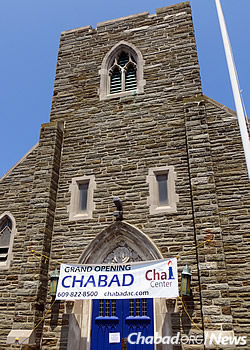
The new facility sits a block away from the Atlantic Ocean. (Photo: Carin M. Smilk)
The rabbi acknowledges that “the space is larger than we had in mind; it’s a big canvas.” The price was also more than expected, but, he says, “when an opportunity like this comes along, you take it.” That opportunity comes with a story. Reach More PeopleBack in January, explains Rapoport, Friday-night services were taking place as usual in their storefront space when a pipe in the walls suddenly burst. Water started pouring in, flooding the floor and forcing the congregants out into the winter night.“We grabbed the Torahs—there is an eruv—and walked home,” he recounts. And the shul moved into his living room. But that wasn’t feasible for long, and as the summer approached, they grew concerned. There seemed to be nothing out there that could accommodate their programs. Then, in mid-June, the rabbi learned of a property that suddenly came on the market, a church. The next morning, with local support, he made an offer. The seller accepted and, notes the rabbi, seemed glad that the building would be kept for religious use. 
Rabbi Sholom Rapoport blows the shofar at the event, which took place a week before the start of the Hebrew month of Elul. (Photo: Greg Styer)
Plenty of people were reached on Sunday as they came to see the new Chai Center for themselves. Accompanying the throngs of Jewish supporters were local representatives, including New Jersey State Sen. Jim Whelan; Ventnor Mayor Mike Bagnell; and Ventnor Commissioner Theresa Kelly. The building is dedicated by Dr. Morris and Norma Antebi in memory of his parents, Ezra and Grace Antebi, who were active members of the Jewish community of Aleppo, Syria, before arriving to the United States in 1981. ‘There’s a Warmth’
Announcement sign (Photo: Carin M. Smilk)
Their friends and fellow retirees in Margate, Richard and Carole Couzens, agreed. “There’s a warmth that comes from Chabad that I don’t experience other places,” says Carole Couzens. “They’re looking at your soul—not your level of observance. They see you.” Just as important, add Greg and Jodi Bernhardt of New York, who have a second home in the area, is the effect they have on young people. “Our 9-year-old is so energized by the services, by having a place to go to meet other children,” says Greg Bernhardt, whose has family ties to Atlantic City and Ventnor, and spent time there growing up. “It’s something special for him, something very significant. What they’re creating here is nothing short of a miracle.” 
The Chabad center fosters community, education and tradition through its services, programs, classes and events. (Photo: Carin M. Smilk)
That’s in addition to services, Shabbat dinners, adult-education classes, Hebrew school and more. At the new facility, a shady backyard area will be ideal for cookouts, and a separate schoolhouse and room for offices are also available out back. A commercial kosher kitchen will be built on the main building’s first floor, next to the social hall. The sanctuary, with its wooden pews in mint condition, sits on the floor above. Rapoport credits the driving force behind their work to the Lubavitcher Rebbe—Rabbi Menachem M. Schneerson, of righteous memory. “The Rebbe encouraged us to push the limits, to think big—that we’re capable of more than we know,” he says. The elder Rabbi Rapoport echoed those words while addressing the audience on Sunday night. After sharing an encouraging letter the Rebbe wrote for a different synagogue dedication, he glanced around the room from the bimah and asked, referring to the evening’s proceedings: “So what would the Rebbe say about such an occasion?” He paused before answering: “Soon, you’ll have to build an addition.” 
From left: Rabbi Avrohom Rapoport, co-director of the Chai Center; Tova Rapoport, director of Chabad Lubavitch of Atlantic & Cape May County; Norma Antebi; Dr. Morris Antebi; and Rabbi Shmuel Rapoport, executive director of Chabad Lubavitch of Atlantic & Cape May County. (Photo: Greg Styer)

Rabbi Rapoport and his wife, Mashie, right, recognize Mike and Beth Shor for dedicating the lobby. (Photo: Greg Styer)

Spontaneous dancing following the official ribbon-cutting. (Photo: Greg Styer)

A trio of string instruments played in the lobby area. (Photo: Carin M. Smilk)

Says the rabbi: “To have our own place is a beautiful thing. This center is for residents, for visitors—our focus is on every single Jew.” (Photo: Carin M. Smilk)

A shady backyard is ideal for cookouts, including Lag BaOmer celebrations. (Photo: Carin M. Smilk)

Also out back: a separate schoolhouse and room for offices. (Photo: Carin M. Smilk)
© Copyright 2015, all rights reserved.
| ||
Jewish News
| ||
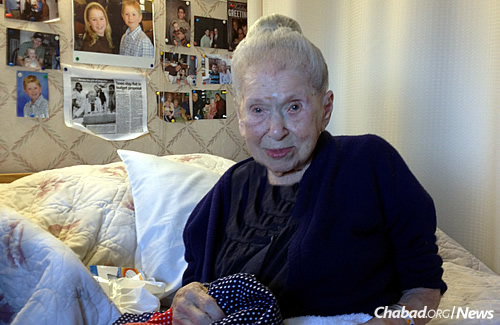
Goldie Steinberg, the sixth-oldest person in the world and the oldest Jew, passed away yesterday at age 114 in Long Beach, N.Y. She was just two months shy of her 115th birthday and remained mentally sharp until her last moments.
Born Oct. 30, 1900 in Kishinev in the Russian Empire (today, Chisinau, Moldova), Steinberg was a survivor of the infamous 1903 Kishinev pogrom, during which 47 Jews were killed and hundreds more wounded; a second, smaller one, took place in 1905. Steinberg was likely the last living survivor of the massacres. “We were saved by a Russian neighbor who made sure nothing would happen to us,” she recalled during an interview in the fall of 2013. “He told them that we weren’t Jewish.” Steinberg was one of eight children born to Chazkel and Devorah Garfunkel, Chazkel being a respected member of Kishinev’s enormous Jewish community. “My father dealt with customers, and he always had a name for honesty; he was known as an honest man,” Steinberg recalled, adding that when her father offered to serve as a guarantor for a 1,500 ruble loan, the lender trusted him immediately. “He said ‘[Chazkel] doesn’t need to sign; I trust him.’” Her Life: ‘A History Lesson’Steinberg moved to America in 1923 together with her two sisters, Raizel and Sura, where they were taken in by their father’s brother, Max Garfunkel. She lived with her uncle and aunt in the Bensonhurst neighborhood of Brooklyn, N.Y., until she met and married fellow Kishinev immigrant Philip Steinberg in 1932. The couple had two children, Don Sargent and Ann Teicher. Steinberg’s husband worked as a jeweler until his passing in 1967, after which Steinberg continued to support her family as a seamstress, working until she retired at 80. 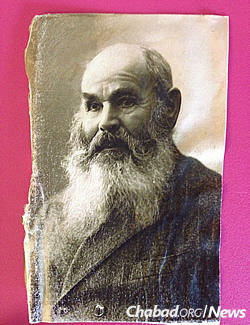
Steinberg's father, Chazkel Garfunkel (Photo: Dovid Margolin)
At 104, Steinberg moved into the Grandell Rehabilitation and Nursing Center in Long Beach, N.Y., where she was known for her warmth and consideration for others. Just prior to her 113th birthday, the staff at Grandell traded stories about “Goldie,” including one about her waking up in the middle of the night to offer her coughing roommate a throat candy. “She was a tremendously special person,” says Rabbi Eli Goodman, co-director of Chabad of the Beaches in Long Beach. “Each year there was a birthday party for her. I attended a number of them, and children from the local Jewish schools would come and sing, and bring her presents. It wasn’t just her old age that made her special; everyone truly looked up to her.” When Kutner got a call yesterday from the doctor at Grandell telling him that his grandmother wasn’t feeling well, he drove over with his wife and mother. “A lot of the family was there, and we Facetimed with those who weren’t, so they could all say their last goodbyes,” he says. “After she spoke to my cousin Steven and we shut the phone, we saw that she was gone. She waited until the last person.” In addition to her two children, Steinberg is survived by four grandchildren and seven great-grandchildren.
© Copyright 2015, all rights reserved.
|


____________________________

No comments:
Post a Comment