
From the Lewis Center for Church Leadership of Wesley Theological Seminary
 "Leading Ideas: Lessons from Churches that Reach Young Adults | Is Your Coffee Hour Chaotic Enough?" Lewis Center for Church Leadership of The Wesley Theological Seminary in Washington, D.C., United States for Wednesday, August 3, 2016
Lessons from Churches that Reach Young AdultsLovett Weems examines the findings of a new report on engaging young adults and shares clues for improving ministry with younger people. He notes that churches that assume they can engage young adults in the same manner as anyone else virtually always fail. To have young adults involved beyond a token level, there must be a specific strategy to reach them.
Read more.
Lessons from Churches that Reach Young Adults by Lovett H. Weems, Jr.
Lovett Weems examines the findings of a new report on engaging young adults and shares clues for improving ministry with younger people. He notes that churches that assume they can engage young adults in the same manner as anyone else virtually always fail. To have young adults involved beyond a token level, there must be a specific strategy to reach them.
The longstanding challenge of engaging young adults in church is far more difficult today. Fewer persons overall participate in church. In young adult culture, church is even less a factor. The young are disproportionately represented among those who choose “none” for their religious affiliation. The aging of membership in many congregations does not help.
The first question for any congregation is, “Do we really care deeply about reaching young adults — so much so that we will do what it takes for that to happen?”
A major new report, Engaging Young Adults, studies the practices of a cross-section of American congregations that reach young adults as well as those that fail to reach younger people. Author Kristina Lizardy-Hajbi has done a splendid job of organizing and interpreting data collected in the American Congregations 2015 survey by the Faith Communities Today project. She provides many clues for improving ministry with young adults.
The good news is that young adults are far from missing in most congregations. There may only be one young adult participant, but the young are not totally absent. The question for congregations is not whether an 18 to 34 year old participates in their congregation, but whether there will be more than token engagement.
Passion
The first question for any congregation is, “Do we really care deeply about reaching young adults — so much so that we will do what it takes for that to happen?” This is a question of the heart, not of programs or tactics. This report confirms what previous research has documented: Many congregations say they want to reach younger people, but most are unwilling to change their worship or priorities to make it happen. Paradoxically, while many church members bemoan that the young lack interest in the church, they themselves show little interest in reaching emerging generations. And, when church members’ engagement with the young is minimal, they are more prone to negative assumptions and stereotypes about younger people. When there is little openness to change, reaching young adults is unlikely.
Strategy
Some churches seek the engagement of young adults in the same way they do for anyone else. That strategy virtually always fails. Young adult participation in churches that assume what they are already doing is sufficient is only 3.5 percent! To have young adults involved beyond a token level, there must be a specific strategy to reach them. Ninety percent of churches with thriving young adult ministries have such a strategy.
Leadership
Is there someone in your church responsible for engaging young adults? Only one-third of churches have such a person; yet two-thirds of thriving young adult ministry churches have at least one designated leader. And churches declining in young adults typically have no designated leader. Most of these leaders are young adults themselves, especially in churches with thriving young adult ministries. But, whatever the age of the leader, the presence of a designated person, paid or unpaid, responsible to lead young adult engagement is crucial. The majority of young adult ministry leaders are unpaid volunteers. Even larger churches with paid staff make all the more use of volunteers.
Time
While having a young adult as the leader helps, there is another even more important factor: how many hours this leader devotes to the task. The more hours spent, the more likely there will be a growing young adult ministry. Churches with thriving young adult ministries report that a leader spends on average 20 hours per week. While having financial resources to apply to such ministry helps, calling upon volunteers and unpaid staff has been shown to be effective, especially if they are young adults themselves.
“We can no longer expect that young adults will come through the doors of congregations on their own. Instead, we must make it a priority to go beyond our walls in order to engage this generation….” This is the challenge laid out in this important report. Creating a future for our congregations in which all generations are appropriately represented is a task well worth the effort to accomplish.
The full report is available in a free PDF version at http://www.faithcommunitiestoday.org/sites/default/files/Engaging-Young-Adults-Report.pdf. Kristina Lizardy-Hajbi, author of Engaging Young Adults, is with the Center for Analytics, Research, and Data of the United Church of Christ.
Related Resources:
- Lessons on Engaging Young Adults Effectively by Asa J. Lee
- Leading Ideas to Reach Young Adults by Lovett H. Weems, Jr.
- Think Bigger: The Challenge of Reaching Millennials by David McAllister-Wilson
 Lovett H. Weems, Jr.
Lovett H. Weems, Jr., is director of the Lewis Center for Church Leadership.

Is Your Coffee Hour Chaotic Enough? Researcher Kirk Hadaway has discovered that coffee hour in rapidly growing Episcopal churches is different than in the average congregation. It tends to be more vibrant, even chaotic, but in a good way! Taking steps to make coffee hour more vibrant and engaging is a simple way for any church to develop a sense of community and draw in new people.
Read more.
Is Your Coffee Hour Chaotic Enough? by Kirk Hadaway, Ph.D.
Researcher Kirk Hadaway has discovered that coffee hour in rapidly growing Episcopal churches is different than in the average congregation. It tends to be more vibrant, even chaotic, but in a good way! Taking steps to make coffee hour more vibrant and engaging is a simple way for any church to develop a sense of community and draw in new people.
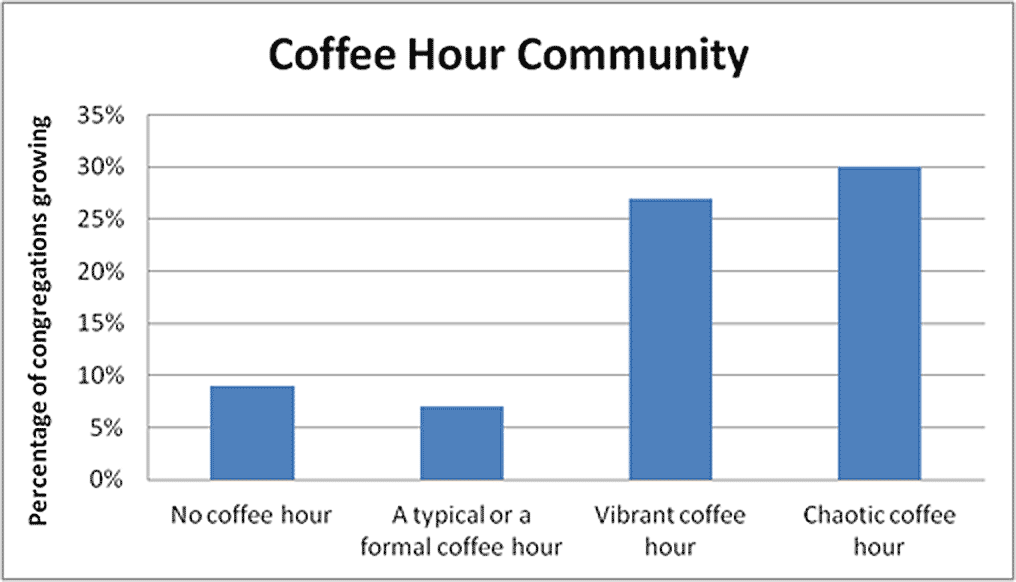
It is typical in many, many churches for a coffee hour to follow the worship service. For example, 93 percent of Episcopal churches host a coffee hour. Often, the coffee hour features drinks (including coffee, of course), light snacks, and casual conversation among members. If a church has visitors who find their way to the coffee hour, they sometimes feel awkward, as if they are attending a party without knowing anyone. To visitors, the gathering may seem stilted and formal, but to members it is not. Churches that do not have a coffee hour at all tend to be declining rather than growing, as do churches that describe their coffee hour as “typical” or “formal.”
In studying vital, growing Episcopal congregations, it was observed that many had a coffee hour that was much different from the average congregation. In some rapidly growing congregations the coffee hour was almost chaotic, but in a good way.
In studying vital, growing Episcopal congregations, it was observed that many had a coffee hour that was much different from the average congregation (in any denomination). Rather than sedate clusters of members standing around or sitting at tables drinking coffee for a few minutes, these churches had lively conversation that drew in newcomers. They were vibrant rather than stilted situations. In some rapidly growing congregations the coffee hour was almost chaotic, but in a good way.
For instance, at St. Luke’s Episcopal Church, in Montclair, New Jersey, the coffee hour featured all sorts of food and drink. There was ham on biscuits, homemade cookies and brownies, quiches, cider, punch, etc. It was quite a spread, prepared by different teams each week. Essentially it was an after-church brunch with coffee and dessert. With food placed on tables in the center of the room, people gathered at round tables surrounding the food to eat and talk. Children were running around somewhat wildly. Visitors were drawn into the chaos, sitting at the crowded tables with newer and older members and with some members who were on the lookout for visitors. It was impossible to be ignored in the setting, and no one was.
In this church and in many others that do something similar, the coffee hour creates community and provides an initial entry for visitors into the life of the congregation. So, although “chaotic” sounds bad and somewhat non-Episcopalian, 24% of Episcopal congregations described their coffee hours as “chaotic,” and these congregations were more likely to be growing and less likely to be declining than any other type of congregation. Although it may seem mundane, a vitalized coffee hour is a tangible thing that a congregation can do that helps it develop a sense of community and draws new people into it.
This material is reprinted with permission from New FACTs on Episcopal Church Growth and Decline(2015), a publication of the Domestic and Foreign Missionary Society of the Episcopal Church.
Related Resources:
- 50 Ways to Welcome New People
- Church as an Uncommon Community by Henry G. Brinton
- Ten Best Practice Tips for Hospitality Teams by Fiona Haworth and Jim Ozi

Kirk Hadaway, Ph.D.
Kirk Hadaway, Ph.D., is head of research for the Episcopal Church.
The Right Question
Leaders do not need answers. Leaders must have the right questions.
Pastors often get compliments on their sermons. One pastor makes it a practice to use one of these right questions when people indicate that a sermon was particularly meaningful for them.

Learn to Reach Others through Hospitality and Worship
Worship attendance is vital to the mission of the church. The Reaching Others through Worship Video Tool Kit provides tools and strategies to help you improve hospitality and worship attendance. Topics include: How Do People See Your Church?; Putting out the Welcome Mat; The Ministry of Greeting; The Sermon Series as Outreach Tool; and Ways to Improve Summer Attendance. Learn more and watch introductory videos now.
Quotable Leadership:
Leadership is legitimated from within the community, and in this time of growing anti-institutionalism the demands for community legitimation, legitimation from below, are increasing.[Penny Jamieson]

Poll Reveals Top Reasons Young Adults Go to Church
Opportunities for spiritual growth and authentic community are top motivators for churchgoing, says a newly released survey conducted by Barna Group on behalf of United Methodist Communications. Read"What Draws People to Church? Poll has Insights" by Heather Hahn now.

Photo courtesy of Sabra Engelbrecht
Members of The Gathering United Methodist Church near St. Louis prepare for a baptism at the congregation’s Clayton site. Jordan Glaser was baptized at the church last month.


What draws people to church? Poll has insights by Heather Hahn, UMNS
Friends got Jennifer and Ben Bienvenu to visit a United Methodist church. The lessons they learned kept the young couple coming back.
“Every time we left Pulaski Heights (United Methodist Church), we always left feeling like we had been challenged or we had something to think about into the week,” Jennifer Bienvenu said of the Little Rock, Arkansas congregation.
“Those things were important to us — that we weren’t just fulfilling a routine.”
The church’s challenge to discipleship is one main reason the couple took membership vows June 26. Jennifer Bienvenu, who grew up unchurched, made a public commitment to Christ and joined by baptism.
The couple, both in their 20s, are not unique in what they look for in congregational life. Opportunities for spiritual growth and authentic community are top motivators for churchgoing, says a newly released survey conducted by Barna Group on behalf of United Methodist Communications.
Barna’s study sought insights about what young-adult spiritual “seekers” in the United States expect from churches. The Christian research organization defined these seekers as Americans currently ages 18 to 34 who are not active churchgoers or committed to a congregation but nevertheless indicate interest in spiritual matters.
Survey respondents cited the following top reasons to head to church:
“Young adults are connected to social media nearly every waking hour, but four of the top-five reasons they might attend church point to a profound need for community that is deeper than what's available virtually,” Kinnaman said in a statement to United Methodist Communications. “In fact, twice the number of U.S. adults tell us they are lonely compared to 10 years ago — and that relational gap represents a real opportunity for churches that want to reach young seekers.”
The survey findings resonate with Jennifer Bienvenu. She and her husband joined the church just weeks before they were due to become parents of a little girl.
“We wanted to find community that is welcoming and inclusive,” she said. “We felt we really had found that at Pulaski Heights.”
BARNA POLL METHODOLOGY
Barna’s Seeker Study used a national, random and representative sample of 406 young adults across the United States, drawn from an online panel. Individuals on the panel were screened to identify people who met the criteria of a seeker.
To be considered a seeker, a person must be: currently ages 18 to 34, not affiliated with The United Methodist Church, not an active churchgoer (infrequent church attendance)or not committed to a church (frequent church attendance).
The person also needed to answer “yes” to at least four of the following statements:
To see complete study
Defying decline
The United Methodist Church long has faced decreasing membership and attendance in the United States. However, empty pews are not just a problem for this denomination.
For example, the Southern Baptist Convention in June reported declining membership for the ninth consecutive year. Its worship attendance and baptisms also are on the downswing.
In researching the book Churchless, Barna found that each younger generation in the U.S. is less religious than earlier cohorts. The group reported that nearly half of Americans born in 1984 to 2002 are unchurched, compared to 28 percent of Americans born in 1945 or earlier.
No question: Today’s faith communities have their work cut out for them when it comes to reaching new people.
However, Kinnaman pointed to Barna research that indicates The United Methodist Church in particular benefits from some built-in good will.
The group’s survey found that favorable impressions of The United Methodist Church have increased from 25 percent in 2011 to 40 percent in 2015. In the most recent survey, nearly three-quarters ─ 74 percent ─ liked the denomination’s tagline “Open Hearts. Open Minds. Open Doors.”
A number of United Methodist churches already counter the cultural trends that keep Americans otherwise occupied on Sunday mornings. In fact, as of 2014, about 30 percent of U.S. United Methodist congregations were growing in worship attendance.
Among those is the 114-year-old congregation Pulaski Heights United Methodist Church. Between 2004 and 2014, its average worship attendance has grown from 859 to 1,080.
“While we receive our usual share of transfers from other United Methodist churches, we are drawing increasing numbers of unchurched and de-churched persons seeking answers through spiritual exploration and development,” said the Rev. Britt Skarda, the church’s senior pastor.
“We have also made it clear to the public that we are a faith community that is open and welcomes all.”
“People think, ‘Oh, if we can just get them to come,’ but that’s not enough,” said Sabra Engelbrecht, executive director of ministries for The Gathering United Methodist Church.
The multi-site congregation in the St. Louis area is one of those rare churches where regular worship attendance exceeds the membership rolls. Since its first service in September 2006, the church’s average attendance has grown to 1,200.
Engelbrecht said the church relies largely on word of mouth to get visitors. Many of those individuals are totally new to the church or previously hurt by the church, she said.
The church developed a streamlined process for engaging these seekers in congregational life.
“From the minute they pull into the parking lot, there is someone at the front door greeting them and someone is helping them find a seat,” she said.
Church leaders then invite newcomers to one of the regular coffees with the pastor. Next, the church steers newcomers toward an introductory small group called the “Living Room,” which offers faith basics. After that, they can get involved in one of the congregation’s CoreGroups, which meet weekly, and possibly one of the volunteer teams.
The goal is for worshippers to feel part of the Christian community long before attending The Gathering’s membership classes, offered about once a quarter.
Jordan Glaser still remembers the second she walked into the Gathering two years ago. “The place just hugged me,” she said. “It was aesthetically, emotionally, spiritually perfect for me — and I knew before I even sat down.”
Like Bienvenu, she too grew up with no church involvement. But she was baptized last month.
“I've always worried that trying to get back into a church and get back into my faith would be riddled with stares, and judgement, and confusion on my behalf as I didn't understand what the pastor was saying,” she said. “At The Gathering none of that exists. All are welcome.”
Bienvenu and Glaser both exemplify the kind of engagement church leaders like to see. Bienvenu said she sees her baptism as both an important step for her growing family and a pledge to her Pulaski Heights church community.
“We’re not just showing up every week visiting,” she said. “We are truly there to show our commitment.”[Hahn is a multimedia news reporter for United Methodist News Service. Contact her at (615) 742-5470 or newsdesk@umcom.org.]
Leaders do not need answers. Leaders must have the right questions.
Pastors often get compliments on their sermons. One pastor makes it a practice to use one of these right questions when people indicate that a sermon was particularly meaningful for them.
- What makes you say that?
- What made it meaningful for you?
- What about it meant the most to you? Can you tell me more?
Learn to Reach Others through Hospitality and Worship
Worship attendance is vital to the mission of the church. The Reaching Others through Worship Video Tool Kit provides tools and strategies to help you improve hospitality and worship attendance. Topics include: How Do People See Your Church?; Putting out the Welcome Mat; The Ministry of Greeting; The Sermon Series as Outreach Tool; and Ways to Improve Summer Attendance. Learn more and watch introductory videos now.
Quotable Leadership:
Leadership is legitimated from within the community, and in this time of growing anti-institutionalism the demands for community legitimation, legitimation from below, are increasing.[Penny Jamieson]
Poll Reveals Top Reasons Young Adults Go to Church
Opportunities for spiritual growth and authentic community are top motivators for churchgoing, says a newly released survey conducted by Barna Group on behalf of United Methodist Communications. Read"What Draws People to Church? Poll has Insights" by Heather Hahn now.
Photo courtesy of Sabra Engelbrecht
Members of The Gathering United Methodist Church near St. Louis prepare for a baptism at the congregation’s Clayton site. Jordan Glaser was baptized at the church last month.
What draws people to church? Poll has insights by Heather Hahn, UMNS
Friends got Jennifer and Ben Bienvenu to visit a United Methodist church. The lessons they learned kept the young couple coming back.
“Every time we left Pulaski Heights (United Methodist Church), we always left feeling like we had been challenged or we had something to think about into the week,” Jennifer Bienvenu said of the Little Rock, Arkansas congregation.
“Those things were important to us — that we weren’t just fulfilling a routine.”
The church’s challenge to discipleship is one main reason the couple took membership vows June 26. Jennifer Bienvenu, who grew up unchurched, made a public commitment to Christ and joined by baptism.
The couple, both in their 20s, are not unique in what they look for in congregational life. Opportunities for spiritual growth and authentic community are top motivators for churchgoing, says a newly released survey conducted by Barna Group on behalf of United Methodist Communications.
Barna’s study sought insights about what young-adult spiritual “seekers” in the United States expect from churches. The Christian research organization defined these seekers as Americans currently ages 18 to 34 who are not active churchgoers or committed to a congregation but nevertheless indicate interest in spiritual matters.
Survey respondents cited the following top reasons to head to church:
- Church helps my spiritual development (39 percent)
- Opportunity to find out more about God (38 percent)
- Opportunity to make friends and nurture friendships (38 percent)
- Knowing that anyone will be welcomed into the church community (38 percent)
- Opportunity for support during difficult times (37 percent)
“Young adults are connected to social media nearly every waking hour, but four of the top-five reasons they might attend church point to a profound need for community that is deeper than what's available virtually,” Kinnaman said in a statement to United Methodist Communications. “In fact, twice the number of U.S. adults tell us they are lonely compared to 10 years ago — and that relational gap represents a real opportunity for churches that want to reach young seekers.”
The survey findings resonate with Jennifer Bienvenu. She and her husband joined the church just weeks before they were due to become parents of a little girl.
“We wanted to find community that is welcoming and inclusive,” she said. “We felt we really had found that at Pulaski Heights.”
BARNA POLL METHODOLOGY
Barna’s Seeker Study used a national, random and representative sample of 406 young adults across the United States, drawn from an online panel. Individuals on the panel were screened to identify people who met the criteria of a seeker.
To be considered a seeker, a person must be: currently ages 18 to 34, not affiliated with The United Methodist Church, not an active churchgoer (infrequent church attendance)or not committed to a church (frequent church attendance).
The person also needed to answer “yes” to at least four of the following statements:
- Searching for meaning and purpose
- Something feels missing from your life
- Have emotional pain or frustration that you’d like to resolve
- A spiritual person
- Seeking something better spiritually in life
- On a quest for spiritual truth
- Want to have a difference with your life
- Have a passion for social justice
- Contribute to the common good of your community
To see complete study
Defying decline
The United Methodist Church long has faced decreasing membership and attendance in the United States. However, empty pews are not just a problem for this denomination.
For example, the Southern Baptist Convention in June reported declining membership for the ninth consecutive year. Its worship attendance and baptisms also are on the downswing.
In researching the book Churchless, Barna found that each younger generation in the U.S. is less religious than earlier cohorts. The group reported that nearly half of Americans born in 1984 to 2002 are unchurched, compared to 28 percent of Americans born in 1945 or earlier.
No question: Today’s faith communities have their work cut out for them when it comes to reaching new people.
However, Kinnaman pointed to Barna research that indicates The United Methodist Church in particular benefits from some built-in good will.
The group’s survey found that favorable impressions of The United Methodist Church have increased from 25 percent in 2011 to 40 percent in 2015. In the most recent survey, nearly three-quarters ─ 74 percent ─ liked the denomination’s tagline “Open Hearts. Open Minds. Open Doors.”
A number of United Methodist churches already counter the cultural trends that keep Americans otherwise occupied on Sunday mornings. In fact, as of 2014, about 30 percent of U.S. United Methodist congregations were growing in worship attendance.
Among those is the 114-year-old congregation Pulaski Heights United Methodist Church. Between 2004 and 2014, its average worship attendance has grown from 859 to 1,080.
“While we receive our usual share of transfers from other United Methodist churches, we are drawing increasing numbers of unchurched and de-churched persons seeking answers through spiritual exploration and development,” said the Rev. Britt Skarda, the church’s senior pastor.
“We have also made it clear to the public that we are a faith community that is open and welcomes all.”
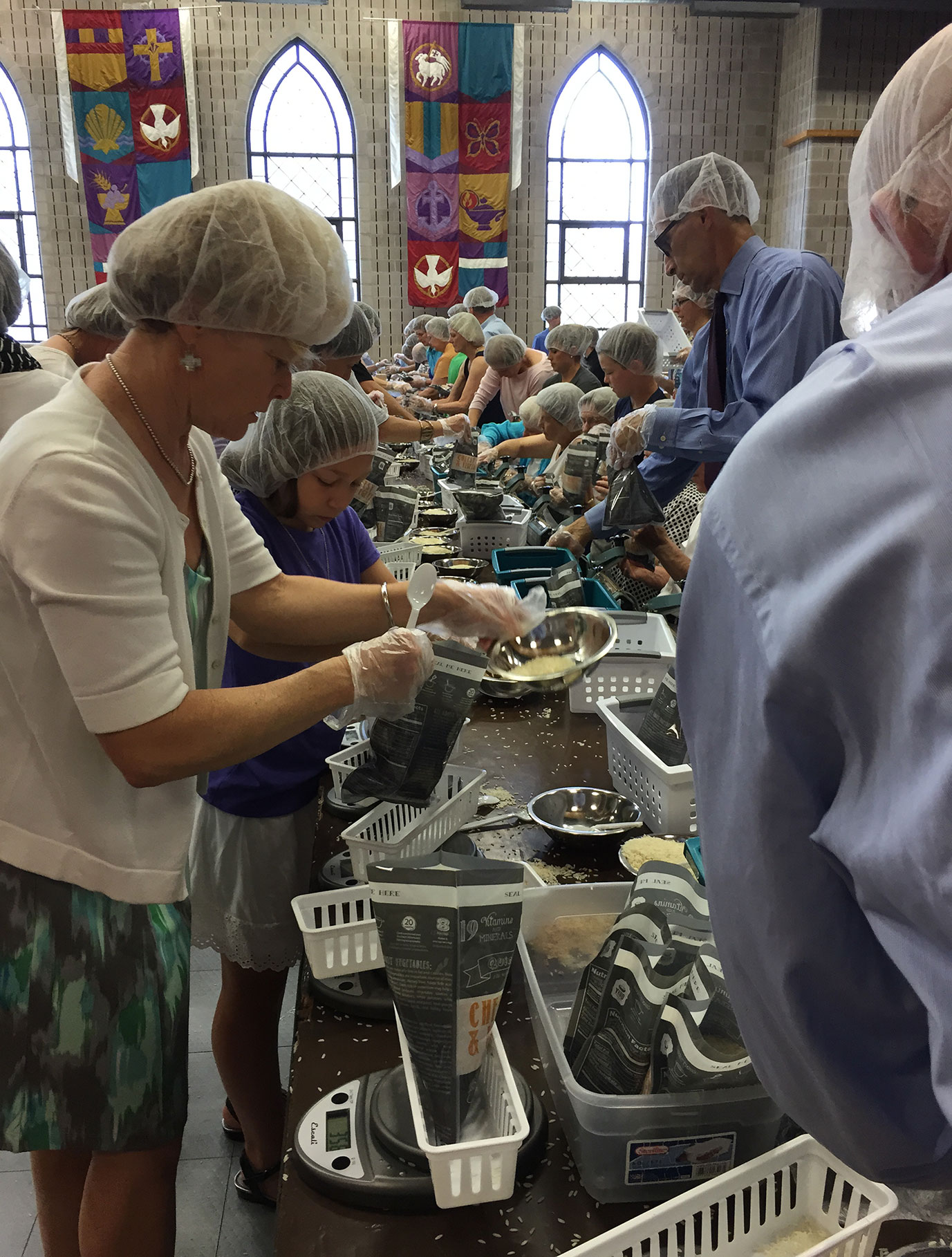
Members of Pulaski Heights United Methodist Church in Little Rock, Ark., pack meals for hungry families in the state. The church is among the congregations growing in worship attendance. Photo courtesy of Andrea Wymes
Making disciples
Getting people to darken the church door is tough enough, but congregations also have a deeper calling to turn seekers into disciples. Successful churches know that evangelism doesn’t stop with a greeting and a church bulletin.“People think, ‘Oh, if we can just get them to come,’ but that’s not enough,” said Sabra Engelbrecht, executive director of ministries for The Gathering United Methodist Church.
The multi-site congregation in the St. Louis area is one of those rare churches where regular worship attendance exceeds the membership rolls. Since its first service in September 2006, the church’s average attendance has grown to 1,200.
Engelbrecht said the church relies largely on word of mouth to get visitors. Many of those individuals are totally new to the church or previously hurt by the church, she said.
The church developed a streamlined process for engaging these seekers in congregational life.
“From the minute they pull into the parking lot, there is someone at the front door greeting them and someone is helping them find a seat,” she said.
Church leaders then invite newcomers to one of the regular coffees with the pastor. Next, the church steers newcomers toward an introductory small group called the “Living Room,” which offers faith basics. After that, they can get involved in one of the congregation’s CoreGroups, which meet weekly, and possibly one of the volunteer teams.
The goal is for worshippers to feel part of the Christian community long before attending The Gathering’s membership classes, offered about once a quarter.
Jordan Glaser still remembers the second she walked into the Gathering two years ago. “The place just hugged me,” she said. “It was aesthetically, emotionally, spiritually perfect for me — and I knew before I even sat down.”
Like Bienvenu, she too grew up with no church involvement. But she was baptized last month.
“I've always worried that trying to get back into a church and get back into my faith would be riddled with stares, and judgement, and confusion on my behalf as I didn't understand what the pastor was saying,” she said. “At The Gathering none of that exists. All are welcome.”
Bienvenu and Glaser both exemplify the kind of engagement church leaders like to see. Bienvenu said she sees her baptism as both an important step for her growing family and a pledge to her Pulaski Heights church community.
“We’re not just showing up every week visiting,” she said. “We are truly there to show our commitment.”[Hahn is a multimedia news reporter for United Methodist News Service. Contact her at (615) 742-5470 or newsdesk@umcom.org.]
-------
Editors: Dr. Ann A. Michel and Dr. Lovett H. Weems, Jr.
Lewis Center for Church Leadership of Wesley Theological Seminary
Connect with the Lewis Center:


Lewis Center for Church Leadership
Lewis Center for Church Leadership of Wesley Theological Seminary
Connect with the Lewis Center:
Lewis Center for Church Leadership
Wesley Theological Seminary
4500 Massachusetts Avenue North West
Washington, DC 20016, United States
---------------------
---------------------

No comments:
Post a Comment