 Alban Weekly at Duke Divinity School in Durham, North Carolina, United States "Austin Church is a Voice of Grace for a Rapidly Changing City" for Monday, 6 June 2016 "PRACTICAL WISDOM FOR LEADING CONGREGATIONS"
"Austin Church is a 'Voice of Grace' for a Rapidly Changing City"
On an overcast Sunday morning in April, the sanctuary of Vox Veniae in Austin, Texas, buzzes with young people: filmmakers, artists, musicians and assorted others who typify the city's creative scene. They are mostly white -- including quintessential hipsters sporting tattoos and vintage clothes -- with a few African-Americans and Hispanics and several Asian-American families mixed in.
They sip locally roasted coffee brewed in the Chemex pour-over system -- taken black, no cream or sugar -- while volunteers hurriedly set up metal folding chairs. The worship space, a renovated former nightclub in East Austin, is a one-story building with a concrete floor, exposed ductwork and elegantly strung Christmas lights. Murals and paintings of Jesus and saints -- made by church members -- line the cinder block walls.

When Tsang helped launch Vox in 2006, it was a church plant sponsored by the Austin Chinese Church. Wanting to create a community that better connected with Austin, Tsang and the church set out to capture and reflect the city's authentic flavor.
"I wanted people when they walk into the church to feel like they're in Austin," he said.

In a recent multimedia sermon, the Rev. Gideon Tsang asked members, “Can you allow yourself to be loved by God completely?”
Today, the city’s young, quirky, creative vibe clearly pulses through the congregation of about 300. But Vox Veniae(link is external) is a church constantly grappling with complex issues of identity: What does it mean to be a multiethnic congregation with Chinese immigrant roots? A church that planted itself in a historically black neighborhood that is rapidly being gentrified? A church that, in seeking to reflect its home city, has become mostly white?
What is your church willing to change, or even give up, in order to connect better with the local community?
Tsang concedes that he has far more questions than answers. As he and Vox Veniae negotiate those and other tensions, they try to be a church that serves the entire community, not just the congregation, by sharing space and resources and being good neighbors.
“We sound better on paper than in reality,” he said. “We’re a small, messy little community trying to do our best, live life together, find our vocation and find roots in the city.”
During the week, the sanctuary doubles as a community center, yoga studio, art gallery and office space for several nonprofits. Many church members live in the neighborhood in an effort to be in community with each other and a once-neglected part of Austin.
And as they navigate a shifting landscape, Vox members are finding stability and guidance from an unexpected source -- a denomination. Initially nondenominational, Vox Veniae deliberately sought denominational ties a few years ago, affiliating with the Evangelical Covenant Church(link is external), a growing multiethnic denomination founded by 19th-century Swedish Lutheran immigrants.
For Vox Veniae, a church that has welcomed experiment and resisted comfort from the beginning, the journey sometimes feels frustrating and uncertain. But, Tsang said, “There’s beauty in it.”

Members line up for Eucharist at Vox Veniae, where worship combines ancient and contemporary practices.
A church for artists and innovators
Vox Veniae’s story began in 2006 when the Austin Chinese Church, an immigrant congregation founded in 1982, asked Tsang and a few others to start a church that would reach Austin’s young artists and innovators.
The original congregation of 300 to 400 was 99 percent college students and 99 percent Asian, Tsang said. They wanted to find their niche in Austin. But they knew they needed to diversify if they were going to speak to the unique culture of a place widely regarded as one of America’s “coolest”(link is external) cities.
What is your city’s unique culture? How well does your church reflect it?
In the beginning, leaders sensed that they were going in the wrong direction. The trendy office space they rented near downtown went unused for much of the week. And it felt too comfortable. Something needed to change.
In 2007, after months of prayer, several Vox members moved to a predominantly African-American neighborhood in East Austin.
Separated from the more affluent parts of Austin by Interstate 35, the area bore a grim legacy of racial segregation and neglect, high crime rates and struggling schools. Not exactly a locale where educated, middle-class Asian-Americans intentionally settle. But church members were sure this was where Jesus wanted them to be.
They weren’t there to rescue poor people or to impose what Tsang calls the “evangelical subculture.” The Rev. Harmon Li, Vox’s pastor of worship and liturgy, said the goal was to create a church that felt indigenous to the area.
“We just wanted to be good neighbors,” Li said.
That year, riding his bike along East 12th Street, Tsang stumbled on a vacant building for rent -- a recently shuttered nightclub called Chester’s. The after-hours BYOB bar, which had closed after the fatal shooting of a patron by an Austin police officer, was littered with used condoms and drug needles and needed major renovation. But Vox needed somewhere to worship, and the place was affordable.
Space12
Members of Vox Veniae -- which is Latin for “voice of grace” or “voice of forgiveness” -- are the kind of people who see beauty in broken things, so they worked for months to clean and renovate the building, rechristening it as Space12.(link is external)

Space12, home to Vox Veniae and a host of other programs, is covered in stunning designs painted by members.
The notion of a church building serving only one purpose once or twice a week seemed wasteful to the pastors. Jesus, they believed, called them to share their resources.
They invited nonprofits, neighborhood and school groups, and artists to use Space12 -- named for the street where it is located -- throughout the week. Inside Books Project(link is external), which sends books to Texas prisoners, Allies Against Slavery(link is external) and other organizations now operate out of the building.
The symbolic renewal of the place felt powerful, Tsang said.
Church members forged community ties individually as well. While many East Austin residents saw the Asian-American newcomers as an oddity at first, Tsang said his new neighbors looked after him. One mowed his lawn while he was out of town. The Tsangs’ young sons made friends with other children in the neighborhood.
But the neighbors did not join Vox, at least not in large numbers. Only about five or six longtime residents from the neighborhood attend the church.
“We knew that the music we play and how I speak isn’t an easy fit for the historic black community,” he said.
Tsang toyed with the idea of making his church more culturally appealing. He considered incorporating hip-hop music into the liturgy or changing his preaching style. But such moves seemed disingenuous.
What factors should a church consider in weighing proposals aimed at becoming more culturally appealing?
The church stayed on the path that felt most natural.
Blending ancient and contemporary
Worship at Vox blends ancient and contemporary traditions. Greek iconography-inspired art, including a painting of the Sacred Heart of Jesus, adorns the walls. Members burn frankincense, receive the Eucharist and pass the peace.
The Rev. Jason Minnix, Vox’s pastor of community and care, said the congregation is “coming back to the historical church through the back door,” reclaiming ancient practices that make the mystery of Christ more accessible.
Much like their approach to the neighborhood, the pastors’ goal with the congregation is not to impose their beliefs on people. Instead, they aim to meet them where they are in their context. And it’s working, members say.
“It was really easy to connect with immediately,” said Alison Boland, a 31-year-old filmmaker, who grew up without religion and joined Vox three years ago. “They talked in vocabulary I could connect with and linked things to secular ideas that I had already been exposed to.”

The Rev. Jason Minnix, left, leads newly married couples in a marital discussion group at Space12.
On a recent Sunday, Tsang’s multimedia homily posed the question, “Can you allow yourself to be loved by God completely?”
With his mellow voice and occasional upward inflection, Tsang sounded like he could be narrating a “This American Life” episode. He read passages from the Gospel, riffed on Mr. T when quoting the apostle Peter, and wove in references to Catholic intellectuals Richard Rohr and Thomas Merton.
He also showed a clip from a 1981 “Mr. Rogers’ Neighborhood” episode in which the late children’s TV host sang “It’s You I Like”(link is external) to a young boy who had been left quadriplegic after surgery for a spinal tumor.
People wiped tears from their eyes.
The aesthetics and preaching style resonate with young, “right-brained creative” types, Tsang said. Like the rest of the church, most of the black and Hispanic members who worship at Vox are artists or other creative types.
That, if anything, is what sets Vox Veniae apart, he said.
“Our folks -- Latino, black, Asian, white -- are creative,” he said. “We have some multiethnicity, but we’re not that multicultural. The unifying culture is that it feels like Austin.”

Beneath a mural of Mary and the Christ child, members wait for services to begin.
Challenges of diversity
Tsang still wishes some of the friends he has made in the neighborhood would join, because he believes their voices “would change who we are.” But he doesn’t force the issue.
The attempt to integrate what the Rev. Martin Luther King famously described as the most segregated hour in America is fraught with challenges, said W. David O. Taylor, a professor of theology and culture at Fuller Theological Seminary and a former Austin pastor.
“To my mind, this desire is at the center of the gospel,” he said. “Yet as many have discovered over the years, it’s not a straightforward affair. It’s hard business, for all sorts of reasons.”
Much depends on particularities of culture, language and other identity-shaping factors, Taylor said. For many, the liturgical style is so important that “to ask [people] to sing or pray or preach otherwise would result in an experience of alienation rather than affirmation.”
Vox’s original members, many of whom grew up in immigrant congregations, are sensitive to those concerns. They understand the need to tell God’s story in culturally specific ways, Tsang said.
Complicating the effort to create a more diverse church is gentrification. Developers were already starting to reshape pockets of East Austin when Vox members relocated there nine years ago. Since then, members have witnessed dramatic transformation(link is external) as new condos and hip eateries -- along with climbing property taxes -- have displaced longtime residents.
Austin was experiencing staggering growth generally, but nowhere was the population surge felt more acutely than in the historically black enclaves east of the interstate. In the course of a decade, the number of white residents in the neighborhoods east of downtown rose by 40 percent, according to the 2010 U.S. Census, while the African-American population shrank by 27 percent.
Reflecting Austin’s demographic shift
East Austin’s urban neighborhoods have become more homogenous and monocultural, Tsang said.
And Vox’s congregation reflects this demographic shift.
Most of the original Asian-American church members did not make the leap to East Austin in 2007. The church dwindled to 70 members, and when it began to grow again, the newcomers were mostly white.
Five years ago, the congregation was about 40 percent white, 30 percent Asian, and 30 percent black and Hispanic, Tsang said. Today, it’s roughly 60 percent white, 20 percent Asian, 10 percent Hispanic and 10 percent black.
The demographic trend -- both in Vox Veniae and in East Austin -- is a concern for the congregation, which talks openly about diversity. Leaders encourage Vox members to build relationships with their black and Hispanic neighbors outside worship and to be, as Tsang likes to say, “the hands and feet of Christ” in their community throughout the week.
How well does your church serve its surrounding neighborhood? Does it expect anything in return?
“There are definitely conscious efforts to not just be 11 a.m. Sunday people,” said Melissa Martinez, 27, who joined Vox two years ago and now lives within walking distance of Space12.
Vox members partner with neighbors to clean up the local creek and organize neighborhood fairs and safety forums. The church teams with St. James Missionary Baptist, a historic black church, on their annual 5K event for Alzheimer’s research.
If Vox members learn that a neighbor needs help paying a utility bill or covering a home repair, they can tap the church’s Good Neighbor Fund to cover the costs.
Tsang hopes to see more collaboration and more honest dialogue about racial and economic tensions. He realizes this can be a delicate undertaking, especially now that so many Vox members are new to East Austin.
“We’re not going to stop gentrification,” Tsang said. “The only thing we’ve tried to do is humanize it. We try to get people in the same room.”

McKinley Heights Neighborhood Association is one of many community groups that meet at Space12.
Finding stability in a denomination
While the church tackles questions of evolving identity -- both in the congregation and in the neighborhood -- Vox leaders have found stability and context within the Evangelical Covenant Church.
Vox aligned with the Chicago-based denomination in 2011 after enduring years of challenge. Tsang said the church was trying to do too much. People -- including himself -- were burning out.
The church was young, small and inexperienced. It needed guidance.
“We wanted to be part of something bigger and older,” he said.
In an age when young adults are eschewing such formal affiliations, Vox members were surprisingly supportive of the move. The denomination connected them with individuals and organizations doing mission work abroad. And the alliance suited their affinity for historic Christian tradition.
“For us, what that means is it connects us to our history and our global significance,” Martinez said. “We are not isolated in Austin; we are part of a bigger picture.”
The ECC gathers a wide range of Christians, including urban multiethnic communities, under its tent -- the diversity Tsang was looking for -- and encourages interaction among the congregations.
ECC congregations represent a mix of theological and political views, too, some of which Vox members don’t agree with.
But that’s part of the challenge of diversity, Tsang acknowledged. And it suits the ethos Vox Veniae has embraced from the beginning.
“It’s not always a comfortable fit for us,” he said. “But I think that’s healthy.”
Questions to consider
- What is your church willing to change, or even give up, in order to connect better with the local community?
- How could your church building be used more effectively during the week to serve community needs?
- How do you describe your city’s unique culture? How well does your church reflect that culture?
- What factors should a church consider in weighing proposals aimed at becoming more culturally appealing?
- Can an organization’s culture help bridge differences in race and ethnicity? Why or why not?
- How well does your church serve its surrounding neighborhood? What, if anything, does the church expect in return?
-------
IDEAS THAT IMPACT
Stanley Hauerwas: What Only the Whole Church Can Do
Leadership can't be abstracted from the communities that make it possible, says Stanley Hauerwas, a Duke Divinity School professor considered to be one of the nation's most influential theologians.
Faith & Leadership: A learning resource for Christian leaders and their institutions from Leadership Education at Duke Divinity
THEOLOGICAL REFLECTION, CHRISTIAN LEADERSHIP
Stanley Hauerwas: What only the whole church can do
Theologian Stanley Hauerwas discusses the term “leadership” and how he prepares his students to provide it.
Updated: Stanley Hauerwas retired in 2013 and is now the Gilbert T. Rowe Professor Emeritus of Divinity and Law.
Leadership can’t be abstracted from the communities that make it possible, says Stanley Hauerwas, a Duke Divinity School professor considered to be one of the nation’s most influential theologians.
Hauerwas, Gilbert T. Rowe Professor of Theological Ethics, has sought to recover the significance of the virtues for understanding the nature of the Christian life. He emphasizes the importance of the church and narrative in understanding Christian existence, and his interests range widely, including systematic theology, philosophical theology and ethics, political theory, and the philosophy of social science and medical ethics.
Hauerwas’ book, “A Community of Character: Toward a Constructive Christian Social Ethic,” was selected as one of the 100 most important books on religion of the 20th century by Christianity Today. In 2001, he was named by Time magazine as “America’s best theologian,” published “The Hauerwas Reader” and delivered the Gifford Lecture at the University of St. Andrews in Scotland.
In an interview with Faith & Leadership, Hauerwas discusses whether “leadership” is a proper topic for theological conversation at all, some current faithful examples of it (including Barack Obama, Jean Vanier and Rowan Williams), how he trains his students to exercise it and how institutions provide space for its flourishing.
The video above comprises short excerpts from this interview.
Q: Is leadership a proper subject for theology?
I have a Yoderian reaction. “Leadership” is a term that’s in play: We can use it and subvert it. I don’t have any intrinsic difficulty about the language of leadership, though I think many of the proposals about leadership are quite perverse. These can give the impression that you know what leadership is abstracted from communities that make leadership possible.
I’m sure that you must discuss these matters because it is about power. Power is rightly one of the gifts God has given us for the formation of good communities and good people. The way you put the question presupposes that you might have an alternative. You don’t. You have to discuss questions of how you discover those among you with gifts necessary for the whole community.
In the Book of Acts, the disciples chose Matthias the way the Mennonite sometimes still choose their leadership: by lot. What kind of community do you need to be that you can choose your leadership by lot? Whether you’ve done it officially by lot, that’s the way it turns out!
Q: Are you of two minds on this? Is there a Mennonite part of your brain on the one hand, while on the other hand you want your people in positions of power in the institutions you care about?
I don’t feel like I’m of two minds about it, but I may be.
One of the most important things that those set aside to help communities make decisions do is to know how to acknowledge that a decision was wrong, to know how to go on from having made a mistake. Communities that only want those in authority who never make mistakes will always be oppressive.
I’m very interested in how, under conditions of uncertainty, we set aside some people that say, “We probably don’t have adequate information, but given who we’ve been, this is what we’re going to do.”
I served as of director of graduate studies at Notre Dame and Duke for six years each. I learned that what people cannot stand is for you not to make a decision. So I would. Then you find out through time what wasn’t a good idea and what was.
It is always persuasion, all the way down. So much of how creative authority works is by being articulate for the community about what needs to be done in a way that defies limits. It often comes by reframing and helping us discover ways to understand where we are in terms that do not reproduce the necessities of the past.
Q: Can you think of an example of that sort of reframing?
The Obama Administration’s beginning to back off of the phrase “war on terror.” That’s been very deliberate. I give them good credit for that.
How can you reframe the financial challenges facing the modern university? We’ve been living beyond our means. Now we have an opportunity to discover what we ought to be about. The recognition of limit is a good discipline for discovering what kind of institution you actually should be.
Q: What can we learn about leadership from Jean Vanier?
One, be ready to be surprised. Vanier didn’t start off to be Jean Vanier. He started off because a priest told him to live with these two mentally handicapped men. Then it just happened that the institution set aside for the care of mentally handicapped in [the town of] Trosly-Breuil was no longer able to do that. He thought something needed to be done. L’Arche is the result. He’s been pulled into an international effort through the talented people that got attracted to what he was about.
It’s absolutely crucial for Vanier to know when to let talented people do better what he would not be able to do. One of the things that authority does is not to be afraid of more talented people than you yourself are.
Q: How would you describe Rowan Williams’ leadership of the Anglican Communion as Archbishop of Canterbury?
He’s a servant. If you really want the exemplification of a servant leadership, I think Rowan is it. He’s refusing to be a hero. Many people want him to take the bull by the horns and to force onto the Anglican Church an order that makes it look decisive. He is refusing to do that. I think he’s providing a paradigm of what a genuine leadership should look like.
Rupert Shortt’s biography criticizes him for being politically naïve. I think Rupert is just dead wrong on that. Rowan recognizes the intractability of many of the challenges facing the Anglican Communion and is ready to suffer through them. Suffering is a very important part of his leadership.
Rupert also meant that Rowan doesn’t know how to interact in the halls of power in Parliament and at 10 Downing Street. But Rowan thinks what the church has to say is not just another policy alternative.
He could do better at positioning himself in terms of the media. But God knows how anyone, when in the public eye that way, even begins to get it right.
Q: How is teaching graduate students an act of leadership?
Every graduate student is different. You have to let them find different levels of relationship to you. But if you think it’s anything other than a paternal role, you’re kidding yourself. You have to remember that you are an adult parent to adult children. I try to be as directive as sometimes I need to be with certain students. With other students you just let them go.
I want them to care about what I care about. I’m ambitious for my graduate students. I want them to make a difference in the world, in a Yoderian sense of difference. I’m very proud of the kind of teaching and publishing they’ve been doing.
Q: Your forthcoming memoir often has the names of institutions as chapter titles. How have those vibrant institutions been important to you as bearers of the Holy Spirit?
The Holy Spirit’s task is always to point to Jesus. I want to be careful about using the word “vibrant” as an indication of the work of the Holy Spirit. Vibrant institutions can also be extraordinarily demonic. I admire energy, but energy can also get you into a lot of trouble.
We can forget readily what an extraordinary thing it is that someone thought to have a place where the sick are not abandoned. The hospital: what an extraordinary idea to come up with something like a hospital! Whether it is counterproductive today is an interesting question, but you don’t take those gifts lightly.
My own life has been wonderfully sustained by institutions that are gifts that I want to continue to serve.
Think of the church. What’s remarkable is that there is one. I just find that remarkable. That’s the Holy Spirit for sure. I have often been identified as someone who is very critical of the institutions of which I’m part. I oftentimes am, but that’s a lovers’ quarrel. I’m, I hope, a very institutional person.
Q: What do you make of the fact that up until the early 20th century Protestants had enormous energy for founding institutions in this country? Why don’t we do that now?
I honestly don’t know. I wonder where that energy came from. I think oftentimes they didn’t have any idea what they were doing. If you look at the Methodists running around this country putting in one institution after another, I suspect oftentimes they said, “Well, if Nashville has Vanderbilt, Durham needs Duke.” You don’t presume that it was always with the best of motives. But I think imitation is a very important aspect of institutional formation.
But I don’t know if it’s right to say that we’re not forming institutions. How do we know? They may be there more than we know. What people are doing through communication could be a very early development of certain kinds of institutions today.
For me, of course, habit is crucial. Creativity is caring through habit. We associate habit with doing the same thing over and over again. But you can’t do the same thing over and over again, because the world around you is changing, so even if you think you’re doing the same thing, you’re doing something different.
Habits create necessities through which imagination is required to do something different than you thought you were doing in the past. The developments of the virtues, and the discovery of virtues that we didn’t know we had, are a real resource for development of institutions that hopefully have promise for the future. Universities, for example, are constantly recreating themselves through basic habits.
Q: Any interesting innovation is always at least partially a reaching back into what we’ve done previously. And you can’t just be antiquarian as you reach back.
Yeah, but I’m an antiquarian. When I go to morning prayer, I want to do the same thing every morning: I want to read the psalms. I don’t know if you want to call that “antiquarian.” Obviously, the church’s liturgy has been a history of constant innovation. Innovation should occur in a way that we recognize continuities through time.
It was a bad innovation when the revivalistic structure overtook the church’s primary liturgical form in a way that charismatic preachers replaced the centrality of Eucharist. We’ve suffered from that.
Q: I was struck in your autobiography by the importance of competent leaders for the sake of an institution’s entire life.
Robert Wilkin, the historian of doctrine now at the University of Virginia, once told me when I got in political controversy at Notre Dame, “Stanley, you live in a way that you need a prince to protect you.”
Q: You are a Reformed person.
He said “the way you just let it stick out there and then you’re without protection” and it is true. I’m not very protective and sometimes I have found myself outmaneuvered by people who are adept at playing the political game.
I do think that people called to administrative positions have to undergo a deep ascetical discipline. You’re dealing with people who have possibilities and limits, the limits sometimes will drive you crazy, and you cannot take it personally.
You do this to provide space for the different gifts of the community. I’m very Pauline in this. Communities have diversities of gifts. Part of your responsibility as an administrator and leader is to help members of the community own them as contributing to the overall good of the community. To be in a position of power means that you recognize how fragile the power is. You wouldn’t have it otherwise. And you have enough confidence that you don’t have to win all the time. That’s a real ascetic discipline, a discipline of the ego, that is absolutely crucial for being an administrator and to allow the institution to go on once you’re no longer there.
Q: How does it change our notion of leadership to think of it liturgically?
I’m a lay person, so I’ve never presided [at the Eucharist.] I would be very afraid to preside, as a matter of fact.
But why is it that some are set aside to do for the church what only the whole church can do? What does that mean for their own self-understanding? They’ve been set aside to do that. The Christological notions of such servanthood are fundamental.
The problem with servanthood language is it can be such a passive/aggressive form of manipulation. Some people get very good at that exactly because they don’t want to say, “We need to do this.”
The primary title of a pope is “servant of servants.” It’s a little hard to remember that when you’re carried around on a chair! I prefer descriptions that remind me that I’ve got some self-interest involved here.
Q: What do you tell seminary students who have designs on leadership?
Don’t lie. It’s just very simple. Don’t lie to me. You may oftentimes not know what the truth is. Tell me that. Just don’t lie to me. It kills you, it kills me and it kills the community.
Just don’t lie to me. There is nothing more important than that. We want to be the kind of community that doesn’t want to be lied to.
Q: What’s an example of a time a leader told the truth in the way you’re suggesting?
Martin Luther King Jr. told the truth at Riverside Church when he came out against the war in Vietnam. It didn’t particularly allow us to flourish, but it provided a benchmark that we knew as American people that there was a truth-teller among us. That was an indication that we could be better than we were.
We’re trying to come to terms with what it means to be a divinity school in a church that is very unclear what its future may be. There is a positive response here to what may be a very bleak future for Protestantism.
The bottom line: politics is people. For any person that wants to be in leadership, if they try to lead in a way that means they don’t have to deal with people, they automatically defeat community. It is everyday interactions that make it possible for there to be people who tell the truth to us one at a time in the hopes that in that process we will be a truthful community.
Read more »
-------
Knowing Your Community, Defining Your MissionIt is pretty easy to stay within the four walls of the church and make assumptions about the lives of the people in the broader community, but getting outside the walls is essential for the development of a faithful and robust mission.
Knowing Your Community, Defining Your Mission
There are tremendous advantages, however, to building your congregation’s ministries on what the community says it wants. If you take the time to build these relationships, your congregation will focus its efforts on meeting unmet needs rather than duplicating what other groups are already doing. You will also have a strong foundation for sustaining your programs; strong relationships with your community make it easier to recruit participants and volunteers and raise money.
Sunny Kang, pastor of Woodland United Methodist Church in Duluth and a partnership advocate for the Self Development of People Committee (PCUSA), describes a process that one of his churches used to get to know the community:
So how can you get to know the community? I am not necessarily defining community as a geographic area, though many congregations are focused on a neighborhood, town, or region. Your community might be a certain group of people—for example, people living with HIV/AIDS. Here are some strategies to help you connect with the people your congregation aims to serve.
Connect with key leaders of the community on a one-to-one basis and build relationships with them. They will be able to introduce you to others you need to know and will help educate you on the needs and desires of the community. Start by asking them to teach you about the community. Everyone likes to share what he or she knows. Key leaders could include:
Connect with the community through your church members. Members of your church may live in the area you aim to serve or work in professions that would provide needed contacts. For example, if your downtown church wants to provide an outreach to the business community through the congregation, business leaders in your church could help you accomplish your goal.
Join community organizations or boards. If a group of people from the community is working on an issue you would like to address, consider joining the group. As you work side by side, you will hear community concerns articulated over and over again. You will also build new relationships with community leaders; for example, a crime task force for the neighborhood or town you hope to serve would be a great place to connect. Always ask: What can the church do to support the neighborhood?
Attend community meetings. When community members get together for discussions or celebrations, make sure there is at least one member of your church in attendance. You may want to consider building a portable booth for community events to promote the visibility of the congregation.
Walk around the community. There is no substitute for seeing the people of your community and their needs with your own eyes. If you are open to spontaneous conversations, you will learn a great deal from people you meet on the street. Find out where people “hang out” in your community—it could be the neighborhood park or the diner in your rural town. If your community is not geographically based, just plan on being in attendance whenever the people of your “community” get together. It might be a national conference on a particular topic or a denominational gathering.
Gather the opinions of the community. If the people you want to serve have a positive impression of the church, they may be willing to participate in a survey or focus group. Invite some folks over for dinner at the church and ask them what they think. Brief door-to-door surveys might also do the trick. Try to find a volunteer who has the expertise to help you develop a survey. For instance, there may be someone in your congregation who has worked with focus groups. Also, your local neighborhood organization or United Way might be able to advise you on how to design a questionnaire. Questions for surveys or focus groups should focus around the questions: What do you see as the major issues for this community? How would you like to see this church respond to those issues? How can the church serve you?
Taking a big dream and molding it into a mission can be exhausting work. In my experience, the dream stage is more fun, because working on the mission brings home the stark reality of just how much work needs to be done. But try to think of it this way: developing the mission gives “legs” to your dream, helping people outside of your congregation understand what it is you are trying to do. As more people understand your dream and become committed to making it a reality, this helps the dream take flight.
_____________________________________
Adapted from Starting a Nonprofit at Your Church, copyright © 2002 by the Alban Ins
titute. All rights reserved.
Copyright © 2008, the Alban Institute. All rights reserved. We encourage you to share Alban Weekly articles with your congregation. We gladly allow permission to reprint articles from the Alban Weekly for one-time use by congregations and their leaders when the material is offered free of charge. All we ask is that you write to us at alban@div.duke.edu and let us know how Alban Weekly is making an impact in your congregation. If you would like to use any other Alban material, or if your intended use of Alban Weekly does not fall within this scope, please submit ourreprint permission request form.
Subscribe to The Alban Weekly.
Archive of past issues of The Alban Weekly.
Read more »
-------
Death and Resurrection of an Urban ChurchBroadway United Methodist Church in Indianapolis has redefined what it means to serve its urban community. Their approach is simple: See your neighbors as children of God.
Faith & Leadership: A learning resource for Christian leaders and their institutions from Leadership Education at Duke Divinity
CONGREGATIONS, GROWTH & RENEWAL
Death and resurrection of an urban church
The Rev. Mike Mather walks with the youth at Broadway United Methodist Church in Indianapolis. The church has closed many of its traditional helping ministries and created new ways to connect and support the community surrounding it. Photos by Kelly Wilkinson
Broadway United Methodist Church in Indianapolis has redefined what it means to serve its urban community. The approach is simple: See your neighbors as children of God.
For an idea of how Broadway United Methodist Church is turning the model of the urban church inside out, look for a moment at its food pantry, clothing ministry and after-school program.
They’ve been killed off.
In many cases, they were buried with honors. But those ministries, staples of the urban church, are all gone from Broadway. Kaput.
Broadway’s summer youth program, which at one point served 250 children a day -- bringing them in for Girl Scouts and basketball, away from the violence and drugs of Broadway’s neighborhood -- is gone, too. Broadway let the air out of the basketballs. Sent the Girl Scouts packing.
Then peek into the comfortably cluttered office of the Rev. Mike Mather, who is prone to putting his feet on his desk and leaning so far back in his swivel chair that you expect him to go flying at any moment.
IDEAS THAT IMPACT
Stanley Hauerwas: What Only the Whole Church Can Do
Leadership can't be abstracted from the communities that make it possible, says Stanley Hauerwas, a Duke Divinity School professor considered to be one of the nation's most influential theologians.
Faith & Leadership: A learning resource for Christian leaders and their institutions from Leadership Education at Duke Divinity
THEOLOGICAL REFLECTION, CHRISTIAN LEADERSHIP
Stanley Hauerwas: What only the whole church can do
Theologian Stanley Hauerwas discusses the term “leadership” and how he prepares his students to provide it.
Hauerwas, Gilbert T. Rowe Professor of Theological Ethics, has sought to recover the significance of the virtues for understanding the nature of the Christian life. He emphasizes the importance of the church and narrative in understanding Christian existence, and his interests range widely, including systematic theology, philosophical theology and ethics, political theory, and the philosophy of social science and medical ethics.
Hauerwas’ book, “A Community of Character: Toward a Constructive Christian Social Ethic,” was selected as one of the 100 most important books on religion of the 20th century by Christianity Today. In 2001, he was named by Time magazine as “America’s best theologian,” published “The Hauerwas Reader” and delivered the Gifford Lecture at the University of St. Andrews in Scotland.
In an interview with Faith & Leadership, Hauerwas discusses whether “leadership” is a proper topic for theological conversation at all, some current faithful examples of it (including Barack Obama, Jean Vanier and Rowan Williams), how he trains his students to exercise it and how institutions provide space for its flourishing.
The video above comprises short excerpts from this interview.
Q: Is leadership a proper subject for theology?
I have a Yoderian reaction. “Leadership” is a term that’s in play: We can use it and subvert it. I don’t have any intrinsic difficulty about the language of leadership, though I think many of the proposals about leadership are quite perverse. These can give the impression that you know what leadership is abstracted from communities that make leadership possible.
I’m sure that you must discuss these matters because it is about power. Power is rightly one of the gifts God has given us for the formation of good communities and good people. The way you put the question presupposes that you might have an alternative. You don’t. You have to discuss questions of how you discover those among you with gifts necessary for the whole community.
In the Book of Acts, the disciples chose Matthias the way the Mennonite sometimes still choose their leadership: by lot. What kind of community do you need to be that you can choose your leadership by lot? Whether you’ve done it officially by lot, that’s the way it turns out!
Q: Are you of two minds on this? Is there a Mennonite part of your brain on the one hand, while on the other hand you want your people in positions of power in the institutions you care about?
I don’t feel like I’m of two minds about it, but I may be.
One of the most important things that those set aside to help communities make decisions do is to know how to acknowledge that a decision was wrong, to know how to go on from having made a mistake. Communities that only want those in authority who never make mistakes will always be oppressive.
I’m very interested in how, under conditions of uncertainty, we set aside some people that say, “We probably don’t have adequate information, but given who we’ve been, this is what we’re going to do.”
I served as of director of graduate studies at Notre Dame and Duke for six years each. I learned that what people cannot stand is for you not to make a decision. So I would. Then you find out through time what wasn’t a good idea and what was.
It is always persuasion, all the way down. So much of how creative authority works is by being articulate for the community about what needs to be done in a way that defies limits. It often comes by reframing and helping us discover ways to understand where we are in terms that do not reproduce the necessities of the past.
Q: Can you think of an example of that sort of reframing?
The Obama Administration’s beginning to back off of the phrase “war on terror.” That’s been very deliberate. I give them good credit for that.
How can you reframe the financial challenges facing the modern university? We’ve been living beyond our means. Now we have an opportunity to discover what we ought to be about. The recognition of limit is a good discipline for discovering what kind of institution you actually should be.
Q: What can we learn about leadership from Jean Vanier?
One, be ready to be surprised. Vanier didn’t start off to be Jean Vanier. He started off because a priest told him to live with these two mentally handicapped men. Then it just happened that the institution set aside for the care of mentally handicapped in [the town of] Trosly-Breuil was no longer able to do that. He thought something needed to be done. L’Arche is the result. He’s been pulled into an international effort through the talented people that got attracted to what he was about.
It’s absolutely crucial for Vanier to know when to let talented people do better what he would not be able to do. One of the things that authority does is not to be afraid of more talented people than you yourself are.
Q: How would you describe Rowan Williams’ leadership of the Anglican Communion as Archbishop of Canterbury?
He’s a servant. If you really want the exemplification of a servant leadership, I think Rowan is it. He’s refusing to be a hero. Many people want him to take the bull by the horns and to force onto the Anglican Church an order that makes it look decisive. He is refusing to do that. I think he’s providing a paradigm of what a genuine leadership should look like.
Rupert Shortt’s biography criticizes him for being politically naïve. I think Rupert is just dead wrong on that. Rowan recognizes the intractability of many of the challenges facing the Anglican Communion and is ready to suffer through them. Suffering is a very important part of his leadership.
Rupert also meant that Rowan doesn’t know how to interact in the halls of power in Parliament and at 10 Downing Street. But Rowan thinks what the church has to say is not just another policy alternative.
He could do better at positioning himself in terms of the media. But God knows how anyone, when in the public eye that way, even begins to get it right.
Q: How is teaching graduate students an act of leadership?
Every graduate student is different. You have to let them find different levels of relationship to you. But if you think it’s anything other than a paternal role, you’re kidding yourself. You have to remember that you are an adult parent to adult children. I try to be as directive as sometimes I need to be with certain students. With other students you just let them go.
I want them to care about what I care about. I’m ambitious for my graduate students. I want them to make a difference in the world, in a Yoderian sense of difference. I’m very proud of the kind of teaching and publishing they’ve been doing.
Q: Your forthcoming memoir often has the names of institutions as chapter titles. How have those vibrant institutions been important to you as bearers of the Holy Spirit?
The Holy Spirit’s task is always to point to Jesus. I want to be careful about using the word “vibrant” as an indication of the work of the Holy Spirit. Vibrant institutions can also be extraordinarily demonic. I admire energy, but energy can also get you into a lot of trouble.
We can forget readily what an extraordinary thing it is that someone thought to have a place where the sick are not abandoned. The hospital: what an extraordinary idea to come up with something like a hospital! Whether it is counterproductive today is an interesting question, but you don’t take those gifts lightly.
My own life has been wonderfully sustained by institutions that are gifts that I want to continue to serve.
Think of the church. What’s remarkable is that there is one. I just find that remarkable. That’s the Holy Spirit for sure. I have often been identified as someone who is very critical of the institutions of which I’m part. I oftentimes am, but that’s a lovers’ quarrel. I’m, I hope, a very institutional person.
Q: What do you make of the fact that up until the early 20th century Protestants had enormous energy for founding institutions in this country? Why don’t we do that now?
I honestly don’t know. I wonder where that energy came from. I think oftentimes they didn’t have any idea what they were doing. If you look at the Methodists running around this country putting in one institution after another, I suspect oftentimes they said, “Well, if Nashville has Vanderbilt, Durham needs Duke.” You don’t presume that it was always with the best of motives. But I think imitation is a very important aspect of institutional formation.
But I don’t know if it’s right to say that we’re not forming institutions. How do we know? They may be there more than we know. What people are doing through communication could be a very early development of certain kinds of institutions today.
For me, of course, habit is crucial. Creativity is caring through habit. We associate habit with doing the same thing over and over again. But you can’t do the same thing over and over again, because the world around you is changing, so even if you think you’re doing the same thing, you’re doing something different.
Habits create necessities through which imagination is required to do something different than you thought you were doing in the past. The developments of the virtues, and the discovery of virtues that we didn’t know we had, are a real resource for development of institutions that hopefully have promise for the future. Universities, for example, are constantly recreating themselves through basic habits.
Q: Any interesting innovation is always at least partially a reaching back into what we’ve done previously. And you can’t just be antiquarian as you reach back.
Yeah, but I’m an antiquarian. When I go to morning prayer, I want to do the same thing every morning: I want to read the psalms. I don’t know if you want to call that “antiquarian.” Obviously, the church’s liturgy has been a history of constant innovation. Innovation should occur in a way that we recognize continuities through time.
It was a bad innovation when the revivalistic structure overtook the church’s primary liturgical form in a way that charismatic preachers replaced the centrality of Eucharist. We’ve suffered from that.
Q: I was struck in your autobiography by the importance of competent leaders for the sake of an institution’s entire life.
Robert Wilkin, the historian of doctrine now at the University of Virginia, once told me when I got in political controversy at Notre Dame, “Stanley, you live in a way that you need a prince to protect you.”
Q: You are a Reformed person.
He said “the way you just let it stick out there and then you’re without protection” and it is true. I’m not very protective and sometimes I have found myself outmaneuvered by people who are adept at playing the political game.
I do think that people called to administrative positions have to undergo a deep ascetical discipline. You’re dealing with people who have possibilities and limits, the limits sometimes will drive you crazy, and you cannot take it personally.
You do this to provide space for the different gifts of the community. I’m very Pauline in this. Communities have diversities of gifts. Part of your responsibility as an administrator and leader is to help members of the community own them as contributing to the overall good of the community. To be in a position of power means that you recognize how fragile the power is. You wouldn’t have it otherwise. And you have enough confidence that you don’t have to win all the time. That’s a real ascetic discipline, a discipline of the ego, that is absolutely crucial for being an administrator and to allow the institution to go on once you’re no longer there.
Q: How does it change our notion of leadership to think of it liturgically?
I’m a lay person, so I’ve never presided [at the Eucharist.] I would be very afraid to preside, as a matter of fact.
But why is it that some are set aside to do for the church what only the whole church can do? What does that mean for their own self-understanding? They’ve been set aside to do that. The Christological notions of such servanthood are fundamental.
The problem with servanthood language is it can be such a passive/aggressive form of manipulation. Some people get very good at that exactly because they don’t want to say, “We need to do this.”
The primary title of a pope is “servant of servants.” It’s a little hard to remember that when you’re carried around on a chair! I prefer descriptions that remind me that I’ve got some self-interest involved here.
Q: What do you tell seminary students who have designs on leadership?
Don’t lie. It’s just very simple. Don’t lie to me. You may oftentimes not know what the truth is. Tell me that. Just don’t lie to me. It kills you, it kills me and it kills the community.
Just don’t lie to me. There is nothing more important than that. We want to be the kind of community that doesn’t want to be lied to.
Q: What’s an example of a time a leader told the truth in the way you’re suggesting?
Martin Luther King Jr. told the truth at Riverside Church when he came out against the war in Vietnam. It didn’t particularly allow us to flourish, but it provided a benchmark that we knew as American people that there was a truth-teller among us. That was an indication that we could be better than we were.
We’re trying to come to terms with what it means to be a divinity school in a church that is very unclear what its future may be. There is a positive response here to what may be a very bleak future for Protestantism.
The bottom line: politics is people. For any person that wants to be in leadership, if they try to lead in a way that means they don’t have to deal with people, they automatically defeat community. It is everyday interactions that make it possible for there to be people who tell the truth to us one at a time in the hopes that in that process we will be a truthful community.
Read more »
-------
Knowing Your Community, Defining Your MissionIt is pretty easy to stay within the four walls of the church and make assumptions about the lives of the people in the broader community, but getting outside the walls is essential for the development of a faithful and robust mission.
Knowing Your Community, Defining Your Mission
- Getting to know the community that your congregation will focus on is a critical step in defining your mission. To start, work on getting answers to several key questions: What are the primary issues in your community? How do the people in the community want the church to respond to those issues? And probably most important: do the people in your community actually want the ministry you are proposing? Your congregation will be most successful if you can answer yes to this question.
There are tremendous advantages, however, to building your congregation’s ministries on what the community says it wants. If you take the time to build these relationships, your congregation will focus its efforts on meeting unmet needs rather than duplicating what other groups are already doing. You will also have a strong foundation for sustaining your programs; strong relationships with your community make it easier to recruit participants and volunteers and raise money.
Sunny Kang, pastor of Woodland United Methodist Church in Duluth and a partnership advocate for the Self Development of People Committee (PCUSA), describes a process that one of his churches used to get to know the community:
- A church I was pastor of did research for six months before we opened our doors to the community. We talked to the kids at the high school next door to the church and asked them, “What is the problem in the community, what can we do to help, how can we serve you?” They were real reticent at first, but eventually they did tell us “there are a few things you could do.”
So how can you get to know the community? I am not necessarily defining community as a geographic area, though many congregations are focused on a neighborhood, town, or region. Your community might be a certain group of people—for example, people living with HIV/AIDS. Here are some strategies to help you connect with the people your congregation aims to serve.
Connect with key leaders of the community on a one-to-one basis and build relationships with them. They will be able to introduce you to others you need to know and will help educate you on the needs and desires of the community. Start by asking them to teach you about the community. Everyone likes to share what he or she knows. Key leaders could include:
- political leaders
- denominational staff
- pastors of other churches
- law enforcement officers
- staff at the neighborhood public school
- leaders of other congregations
- program specialists in the program area that is your focus (for example, youth development, family counseling, or chemical dependency treatment)
Connect with the community through your church members. Members of your church may live in the area you aim to serve or work in professions that would provide needed contacts. For example, if your downtown church wants to provide an outreach to the business community through the congregation, business leaders in your church could help you accomplish your goal.
Join community organizations or boards. If a group of people from the community is working on an issue you would like to address, consider joining the group. As you work side by side, you will hear community concerns articulated over and over again. You will also build new relationships with community leaders; for example, a crime task force for the neighborhood or town you hope to serve would be a great place to connect. Always ask: What can the church do to support the neighborhood?
Attend community meetings. When community members get together for discussions or celebrations, make sure there is at least one member of your church in attendance. You may want to consider building a portable booth for community events to promote the visibility of the congregation.
Walk around the community. There is no substitute for seeing the people of your community and their needs with your own eyes. If you are open to spontaneous conversations, you will learn a great deal from people you meet on the street. Find out where people “hang out” in your community—it could be the neighborhood park or the diner in your rural town. If your community is not geographically based, just plan on being in attendance whenever the people of your “community” get together. It might be a national conference on a particular topic or a denominational gathering.
Gather the opinions of the community. If the people you want to serve have a positive impression of the church, they may be willing to participate in a survey or focus group. Invite some folks over for dinner at the church and ask them what they think. Brief door-to-door surveys might also do the trick. Try to find a volunteer who has the expertise to help you develop a survey. For instance, there may be someone in your congregation who has worked with focus groups. Also, your local neighborhood organization or United Way might be able to advise you on how to design a questionnaire. Questions for surveys or focus groups should focus around the questions: What do you see as the major issues for this community? How would you like to see this church respond to those issues? How can the church serve you?
Taking a big dream and molding it into a mission can be exhausting work. In my experience, the dream stage is more fun, because working on the mission brings home the stark reality of just how much work needs to be done. But try to think of it this way: developing the mission gives “legs” to your dream, helping people outside of your congregation understand what it is you are trying to do. As more people understand your dream and become committed to making it a reality, this helps the dream take flight.
_____________________________________
Adapted from Starting a Nonprofit at Your Church, copyright © 2002 by the Alban Ins
titute. All rights reserved.
Copyright © 2008, the Alban Institute. All rights reserved. We encourage you to share Alban Weekly articles with your congregation. We gladly allow permission to reprint articles from the Alban Weekly for one-time use by congregations and their leaders when the material is offered free of charge. All we ask is that you write to us at alban@div.duke.edu and let us know how Alban Weekly is making an impact in your congregation. If you would like to use any other Alban material, or if your intended use of Alban Weekly does not fall within this scope, please submit ourreprint permission request form.
Subscribe to The Alban Weekly.
Archive of past issues of The Alban Weekly.
Read more »
-------
Death and Resurrection of an Urban ChurchBroadway United Methodist Church in Indianapolis has redefined what it means to serve its urban community. Their approach is simple: See your neighbors as children of God.
Faith & Leadership: A learning resource for Christian leaders and their institutions from Leadership Education at Duke Divinity
CONGREGATIONS, GROWTH & RENEWAL
Death and resurrection of an urban church
The Rev. Mike Mather walks with the youth at Broadway United Methodist Church in Indianapolis. The church has closed many of its traditional helping ministries and created new ways to connect and support the community surrounding it. Photos by Kelly Wilkinson
Broadway United Methodist Church in Indianapolis has redefined what it means to serve its urban community. The approach is simple: See your neighbors as children of God.
For an idea of how Broadway United Methodist Church is turning the model of the urban church inside out, look for a moment at its food pantry, clothing ministry and after-school program.
They’ve been killed off.
In many cases, they were buried with honors. But those ministries, staples of the urban church, are all gone from Broadway. Kaput.
Broadway’s summer youth program, which at one point served 250 children a day -- bringing them in for Girl Scouts and basketball, away from the violence and drugs of Broadway’s neighborhood -- is gone, too. Broadway let the air out of the basketballs. Sent the Girl Scouts packing.
Then peek into the comfortably cluttered office of the Rev. Mike Mather, who is prone to putting his feet on his desk and leaning so far back in his swivel chair that you expect him to go flying at any moment.
 Watch him, inverted like this, until he suddenly gets animated, drops his feet to the floor, leans over, elbows on knees, and shares this: “One of the things we literally say around here is, ‘Stop helping people.’
“I’m serious.”
He is serious. Mather has given years of thought to this, and he’s as sure about it as anything he learned in seminary.
Broadway UMC's leaders have changed the way they view their neighbors -- as people with gifts, not just needs. In what ways does this view reframe the conversation? What difference does reframing the relationship make in the outcomes achieved?
“The church, and me in particular,” Mather said, “has done a lot of work where we have treated the people around us as if, at worst, they are a different species and, at best, as if they are people to be pitied and helped by us.”
With that in mind, Broadway(link is external) has -- for more than a decade now -- been reorienting itself. Rather than a bestower of blessings, the church is aiming to be something more humble.
 “The church decided its call was to be good neighbors. And that we should listen and see people as children of God,” said De’Amon Harges, a church member who sees Broadway’s transformation in terms not unlike Christ’s death, burial and resurrection.
Rejecting charity
In 2004, Mather hired Harges to be Broadway’s first “roving listener,” a position that is exactly what it sounds like. Harges’ job was to rove the neighborhood, block by block at first, spending time with the neighbors, not to gauge their needs but to understand what talents lay there.
“I was curious about what was good in people, and that was what I was going to find out,” he said.
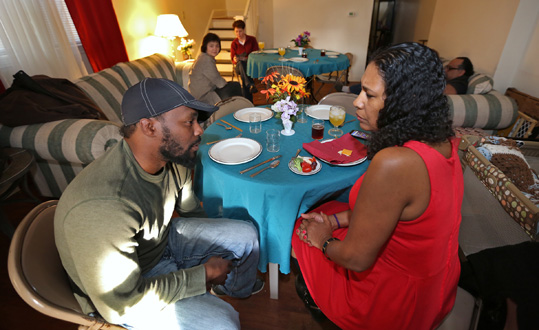
De'Amon Harges, Broadway's "roving listener," listens to Sheila Arnold as she talks about helping youth with her organization, Cornerstone City Mission. They have gathered with others to share a meal and discuss entrepreneurship. These meals are one way that Broadway members and people living in the neighborhood around the church connect and work together.
Harges wound up spending hours sitting on people’s porches and hovering near them as they worked in their backyard gardens. He began listening for hints about their gifts.
“I started paying attention” he said, “to what they really cared about.”
Mather, meanwhile, was drawing deeply from the philosophical well of “asset-based community development” -- the notion of capitalizing on what’s good and working in a place rather than merely addressing its deficiencies.
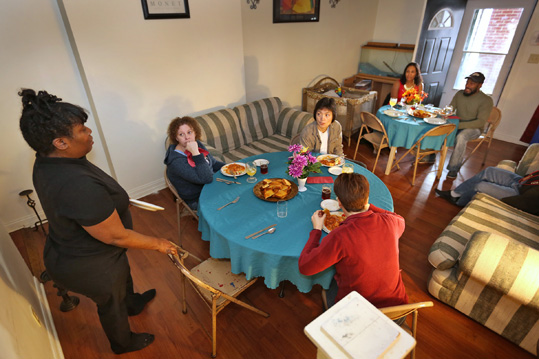
Sarah Killingsworth, left, hosted the meal and discussion about entrepreneurship.
John McKnight, a professor emeritus at Northwestern University, is one of the founders of the approach. He literally wrote the book on building communities from the inside out. He describes Mather and Harges as a “God-given team.”
When Broadway invited him to come speak, McKnight spent some time walking the church’s neighborhood with Harges.
“What he’s listening for is their gifts -- ‘What has God given you?’” McKnight said. He doesn't advocate ignoring people's needs and problems, but rather to look first for solutions within the community itself. Later, he said, institutions and services can help.
“John 15:15 tells us that, at the Last Supper, Jesus said to the disciples, ‘I no longer call you servants. … I call you friends.’ So the final way of defining what Christianity is based on is friendship, not service. … I think Mike and De’Amon are guided by that spiritual principle.”
A key to what’s going on now at Broadway, McKnight says, is the church’s brutally honest view of charity, which McKnight defines as “a one-way compensatory activity that never changes anything.”
Seeing and serving needs
Like so many older, urban churches, Broadway came to its charitable ways honestly, and with the best of intentions.
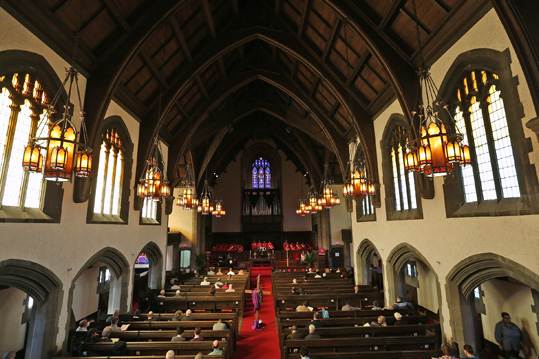
Broadway was once a thriving church. It experienced steep decline but now has about 200 in worship.
When the current building was erected, in 1927, the church along the banks of Fall Creek was on the northern outskirts of Indianapolis. It was then a flourishing area primed for growth. Within a decade, Broadway had 2,300 members. The pews were packed. The Sunday school rooms were buzzing.
But by the late 1950s, Indianapolis began to experience white flight to newer suburbs. The neighborhood began a long, slow decline. And so did the church.
By the mid-1990s, weekly attendance was down to 75. The pews were empty. The Sunday school was dark.
Amid the surrounding decay, the church assumed a new role: caregiver.
Broadway, Mather says now, came to see its neighborhood for all of its problems -- poverty and abandoned houses, drugs and the related violence, high teen pregnancy and dropout rates.
Mather confesses to being part of that history. He has been pastor of Broadway twice, and during his first stint, from 1986 to 1991, he retooled the church’s summer youth program -- the one with the basketballs and the Girl Scouts -- and injected it with a new spiritual theme each week. And it took off.
“We felt so good about it,” Mather said, “that I broke my arm patting myself on the back.”
But then Mather was confronted with a heavy dose of reality. In a nine-month span, nine young men within a four-block radius of the church died violent deaths. Some of them had come through that great youth program at Broadway, a program that had done nothing to inoculate them against street violence.
Mather was left to bury them -- along with the sense that what Broadway had been doing for its neighborhood all those years had been effective.
Asking new questions
Mather carried that sense with him to another United Methodist church in South Bend, Indiana, where he was assigned in 1992.
Again, he was a pastor in an urban setting. But this time Mather began to probe more deeply into McKnight’s philosophies, into what it meant to be an urban preacher. Finally, he asked himself whether he was living out what he believed, and what he had been preaching.
Questions to learn about people's gifts
- What three things do you do well enough that you could teach others how to do them?
- What three things would you like to learn?
- Who, besides God and me, is going with you along the way?
“And in the last days it will be,” God says, “that I will pour out my Spirit on all people, and your sons and your daughters will prophesy, and your young men will see visions, and your old men will dream dreams. Even on my servants, both men and women, I will pour out my Spirit in those days, and they will prophesy.”(Acts 2:17-18 NET)
At a congregational meal after the service, a parishioner asked Mather pointedly, “So how come we don’t treat people like that?”
Mather didn’t understand. Then the woman explained that she was talking about the government food giveaway hosted by the church. To get food, participants had to fill out a form that basically asked, “How poor are you?”
Nowhere on the form were there questions about people’s gifts.
“If we believe that God’s spirit is flowing down on all people, old and young, women and men -- and on the poor,” the woman continued, “why don’t we treat people like that’s true?”
Mather saw where she was going. He put aside the government form and, in a number of ways, began asking people new questions. One of his favorites: “What three things do you do well enough that you could teach others how to do it?”

Sarah Killingsworth shows a blanket she crocheted, during a dinner at her house with neighbors and church members.
Soon, the church was tapping into people who could repair cars, make quilts, paint, and cook some of the best Mexican food Mather had ever eaten. Through that, some neighbors found new livelihoods. More found a community.
By the time the church reassigned him back to Broadway in 2003, Mather was fully committed to this inside-out approach.
He hired Harges as the roving listener, then started closing ministries from the charity era. The moves were as practical as they were oriented to the new philosophy.
For 30 years, Broadway had tutored neighborhood kids after school. And for 30 years, the neighborhood dropout rate kept climbing higher. So Broadway stopped tutoring.
For decades, the church had been feeding people out of its pantry. But local health officials were telling Mather that the No. 1 health problem facing the neighborhood wasn’t starvation.
It was obesity -- often leading to diabetes.
To Mather, it made no sense to hand out carbs in a box and peaches in cans of heavy syrup to people who were overweight.
“We’re not only not helping,” he concluded. “We’re actively making people sicker.”
Instead of handing out food, Mather hopes to help people find long-lasting solutions to problems such as hunger. He likes to tell the story of Adele(link is external), who came to the food pantry for supplies for her family and ended up, a year and a half later, using her gifts as a cook to open her own restaurant.
But giving up old ways is difficult. Mather tried to ease the shock to Broadway’s system. He devoted part of one Sunday service to bidding farewell to the dead ministries. That included the thrift shop, which by then was being run by women in their 80s and 90s.
During the service, Mather asked everyone who had ever worked in the thrift shop or had ever donated to it to stand. Many did. Then, in unison, the congregation said, “Well done, good and faithful servants.”
Convincing the doubters
Not everyone cared for Broadway’s new approach.
Neighbors were grumbling about services the church had cast aside. There were even doubters among the Broadway staff. Among them was Cathy Pilarski.
Before moving to Indianapolis in 2008, Pilarski had run a mobile latte business in Tucson, Arizona. She needed work in Indy and found it at Broadway -- as a janitor. Six months in, Mather wanted to promote her to facilities manager.
Pilarski knew nothing about mechanics or wiring or other building systems. Besides, her head was spinning from everything going on at Broadway.
She responded to Mather’s offer with disdain.
“No, Mike,” she told the pastor. “No, because I think you’re crazy, and I think there are some other people who think you are crazy, too.”
As soon as she spoke the words, Pilarski regretted them. She had always fancied herself as someone who liked to think outside the box. Here was a pastor taking a chainsaw to the box. And she was resisting. That revelation told her that maybe she should trust Mather and his vision.
When she did, Pilarski came to see that Mather was less interested in her cleaning skills and her knowledge of building mechanics than in her social skills and her experience as an entrepreneur. More than the building itself, he was concerned about building community.
Such rewiring was going on across the church.
The church’s governing council stopped rehashing committee reports at its quarterly meetings and instead began inviting people from the neighborhood and the congregation to come in and tell them about the work they’d been up to.
Harges began connecting people with common interests. Within four blocks of the church -- the same area where young people had been dying years before -- Harges found 45 backyard gardeners. He brought them together around a meal. With no agenda.
The gardeners liked it enough that they began to meet monthly. None of them individually had seen their green thumbs as a gift. Together, they began to realize that they had something valuable. In a neighborhood that’s part of an urban food desert, they’ve begun planning their own farmer’s market.
Broadway is even passing on the art of listening to young people.

The Rev. Mike Mather talks with the youth during a service at Broadway United Methodist Church.
In each of the last six years, the church has hired 15 to 20 kids from the neighborhood to learn from Harges and then head out into the neighborhood as part-time roving listeners.
The information they’ve been bringing back has enabled other interest groups to form in areas such as art, poetry, music, law and education.
From these gatherings, people have found jobs, collaborators and friends. There are still hungry people who need a meal. They just find it now among friends.
“The whole idea is that we extend beyond the physical structure of our church and that we grow community -- and that we know community -- in real ways,” said Seana Murphy, who lives near the church.
Recently, she invited people from the church and the neighborhood with an interest in education for conversation over meatloaf and mashed potatoes.
The people around her table included a woman who grew up in a housing project who’s now attending a community college, a dropout who got a high school equivalency diploma and plans to be a nurse, a college administrator, and an assistant pastor with a Ph.D.
At the meal, one woman mentioned she had struggled with depression. Now, Murphy said, others will know to check on her from time to time.
Making connections
Tamara Leech, an associate professor at the Indiana University Fairbanks School of Public Health, has been studying what Broadway is doing for the past six years.
Social cohesion, Leech said, is a key to improving life in what she calls “neighborhoods of the concentrated disadvantaged.”
“The neighbors see Broadway as a place where you can go and ask for help. Not for goods or services,” she said. “You go there for connections.”
Leech hopes to win a grant to do a long-term study of Broadway and its neighborhood. But, for now, hard data is scarce. At least from a theoretical basis, Leech said, “What I do know is that Broadway takes an approach that makes the most sense to me.”
Anecdotally, both she and Mather have heard about people finding jobs through their Broadway community connections. Others have found the encouragement to enter college or technical programs. Leech points to a partnership with the state health department in which the church brought together teen mothers, many intent on having more babies right away, with older women. Two years later, none of the girls has had another child.
Mather says the neighborhood is much less violent than in the 1990s, but he concedes the causes of that are hard to isolate. For one thing, some homes that were once abandoned or occupied by the poor are now being inhabited by middle class families.
Change also is evident in what’s going on in Sunday school classrooms that sat dark for decades.
Today, they are filled with an unusual collection of small businesses that rent space, together with fledgling organizations that get space for free. Meeting in the church now is a metropolitan youth orchestra and an eclectic mix of artists and, on Sunday nights, 50 or more gamers.
There’s a dance studio and a pottery shop and an office for a small architectural firm. The church acquired a commercial kitchen license, and now people from the neighborhood use it for catering startups.
Pilarski, the onetime doubter, is in charge of managing all this. She still thinks her pastor is crazy. “Certifiable,” she said, joking.
But in each busy corner of the church, in each of the hundreds of faces that now pass under its roof each week, she sees something that was missing for a long time -- the majesty of God.
“I want to make sure that God is glorified not only in that sanctuary but in every corner of this building,” she said.
Some of that bustle has spilled over into the sanctuary. Sunday morning attendance has climbed past 200. But in the Broadway economy, that’s almost an afterthought.
Broadway has died to its old self, giving up the things that were holding it back, said Harges, the roving listener. The church’s resurrection has come from seeking the gifts of others.
“Our role in this place is to become like yeast -- that invisible agent for social change. It is not about us as an agency inviting people to witness God here. Instead, what we want to do is to see God out of this place.”
How do you get started with asset-based community development?
Three steps in the process
1. Listen
Learn about your community by paying attention to its people and environment, including individuals; associations and other community groups; institutions such as clinics, schools and grocery stores; local economics; physical characteristics such as highways and valleys; and natural areas such as parks and woodlands.
2. Connect the dots
See relationships between ideas, resources and opportunities that others have not seen. Connecting the dots requires practice and collaboration; no one person can see the whole network.
3. Take action
Asset-based processes engage the gifts of people who are motivated to act. Meetings should end with a clear plan about who will take what steps.
For a practical guide to an asset-based approach to ministry, read “Discovering the Other(link is external)” by Cameron Harder.
Questions to consider
- Who do you serve? With whom do you partner? What difference does framing the relationship make in the outcomes achieved?
- The Rev. Mike Mather asks people, “What three things do you do well enough that you could teach others how to do it?” How does a question like that shift the conversation?
- Is anyone assigned to listen to your congregation and community? If so, do those listeners compare notes and connect what they are learning?
- Mather realized that his church's food pantry might be contributing to obesity and diabetes. Do your ministries produce unintended consequences? How do you envision the impact of your projects? How do you assess their impact?

CONTINUE YOUR LEARNING: FOUNDATIONS OF CHRISTIAN LEADERSHIP

Foundations of Christian Leadership benefits those who care about the Church in the world and want to build skills to lead Christian institutions with joy and creativity. The program brings together emerging leaders from a variety of faith-based organizations as colleagues in an encouraging and collaborative learning environment.
Each Foundations participant will have the opportunity to apply for a $5,000 grant to promote innovation in his or her institution.
Now accepting applications for sessions in Houston and New England.
LEARN MORE AND APPLY

FROM THE ALBAN LIBRARY
SAVE 30%
ALBAN eBOOKS ON SALE
Use promo code ALBAN16 when you order on the
Rowman & Littlefield website
to take 30% off any eBook from Alban Books! Offer ends on June 30, 2016.
Discount cannot be combined with other special offers and only applies to purchases made directly from Rowman & Littlefield. eBooks must be ordered online and cannot be combined with print orders.

Congregations increasingly find themselves in the business of establishing and supporting community ministries -- daycare for infants and toddlers, respite care for elders, and programs for housing rehab and home repair, tutoring, and social justice advocacy. This book explores how to engage in those ministries effectively.

Focusing on six congregations, the author shows us the joys and struggles in intentional pursuits of a more diverse and just community. The stories in the book will inspire leaders to explore their congregation's history, study their community's demographics, and search their souls for ways they can develop and celebrate the diversity in their midst.

is an introduction to two tools that community builders have found helpful: appreciative inquiry and asset mapping. These tools help congregations see that all of life is saturated by the sacred and give them energy to begin living as if it were so.
Follow us on social media:


VISIT OUR WEBSITE

Alban at Duke Divinity School
1121 West Chapel Hill Street, Suite 101
Durham, North Carolina 27701, United States
----------------------------
----------------------------

No comments:
Post a Comment