
The Upper Room Daily Reflections from Nashville, Tennessee, United States "Ecclesiastes" for Monday, 20 June 2016
Today’s Reflection:


FROM THE OPENING WORDS OF ECCLESIASTES, the reader is invited to hang on for a wild ride, an adventure, a struggle, a question that never ends. If you believe scripture carries authority and embodies truth, then what to make of the book of Ecclesiastes?
Ecclesiastes tests everybody’s spiritual comfort level. Is the book of Ecclesiastes God-inspired, God-breathed? Did God bless every word? Is it holy? Is it true? … Can a person embrace the hard-edged spirit of Ecclesiastes and still be a good Jew, a good Christian? Or is Ecclesiastes a bizarre mistake, an aberration, a curmudgeon who slipped past security and wandered into the holy corridors of the canon?
“All things are wearisome…” and “For in much wisdom is much vexation…” and “So I hated life, because what is done under the sun was grievous to me” - Ecclesiastes is full of passages that embarrass any picture-perfect version of biblical orthodoxy. …And now, in chapter 4, Ecclesiastes takes a different line of attack – a heartfelt outburst on behalf of the oppressed. He implies we should do something about oppression.
I read every sentence of Ecclesiastes as if the Bible’s stoutest public defenders are right when they say scripture should be taken as truth. There’s no use pretending Ecclesiastes and his passionate warnings don’t exist. All right then: Who were the oppressed, and who are they to me?[Ray Waddle, Against the Grain]
From pages 63-64 of Against the Grain: Unconventional Wisdom from Ecclesiastes by Ray Waddle. Copyright © 2005 by Ray Waddle. All rights reserved. Used by permission of Upper Room Books. http://bookstore.upperroom.org/ Learn more about or purchase this book.
Today’s Question:
Read Ecclesiastes this week. Ecclesiastes 1:1 The words of Kohelet the son of David, king in Yerushalayim:
2 Pointless! Pointless! — says Kohelet —
Utterly meaningless! Nothing matters!
3 What does a person gain from all his labor
at which he toils under the sun?
4 Generations come, generations go,
but the earth remains forever.
5 The sun rises, the sun sets;
then it speeds to its place and rises there.
6 The wind blows south,
then it turns north;
the wind blows all around
and keeps returning to its rounds.
7 All the rivers flow to the sea,
yet the sea is not full;
to the place where the rivers flow,
there they keep on flowing.
8 Everything is wearisome,
more than one can express;
the eye is not satisfied with seeing,
the ear not filled up with hearing.
9 What has been is what will be,
what has been done is what will be done,
and there is nothing new
under the sun.
10 Is there something of which it is said,
“See, this is new”?
It existed already in the ages before us.
11 No one remembers the people of long ago;
and those to come will not be remembered
by those who come after them.
12 I, Kohelet, have been king over Isra’el in Yerushalayim. 13 I wisely applied myself to seek out and investigate everything done under heaven. What a bothersome task God has given humanity to keep us occupied! 14 I have seen all the activities that are done under the sun, and it’s all pointless, feeding on wind.
15 What is crooked can’t be straightened;
what is not there can’t be counted.
16 I said to myself, “Look, I have acquired much wisdom, more than anyone ruling Yerushalayim before me.” Yes, I experienced a great deal of wisdom and knowledge; 17 yet when I applied myself to understanding wisdom and knowledge, as well as stupidity and folly, I came to see that this too was merely feeding on wind.
18 For in much wisdom is much grief;
the more knowledge, the more suffering. 2:1 I said to myself, “Come now, I will test myself with pleasure and enjoying good things”; but this too was pointless. 2 Of laughter I said, “This is stupid,” and of pleasure, “What’s the use of it?”
3 I searched my mind for how to gratify my body with wine and, with my mind still guiding me with wisdom, how to pursue foolishness; my object was to find out what was the best thing for people to do during the short time they have under heaven to live. 4 I worked on a grand scale — I built myself palaces, planted myself vineyards, 5 and made myself gardens and parks; in them I planted all kinds of fruit trees. 6 I made myself pools from which to water the trees springing up in the forest. 7 I bought male and female slaves, and I had my home-born slaves as well. I also had growing herds of cattle and flocks of sheep, more than anyone before me in Yerushalayim. 8 I amassed silver and gold, the wealth of kings and provinces. I acquired male and female singers, things that provide sensual delight, and a good many concubines. 9 So I grew great, surpassing all who preceded me in Yerushalayim; my wisdom, too, stayed with me. 10 I denied my eyes nothing they wanted. I withheld no pleasure from myself; for I took pleasure in all my work, and this was my reward for all my work. 11 Then I looked at all that my hands had accomplished and at the work I had toiled at; and I saw that it was all meaningless and feeding on wind, and that there was nothing to be gained under the sun.
12 So I decided to look more carefully at wisdom, stupidity and foolishness; for what can the man who succeeds the king do, except what has already been done? 13 I saw that wisdom is more useful than foolishness, just as light is more useful than darkness.
14 The wise man has eyes in his head,
but the fool walks in darkness.
Yet the same fate awaits them all.
15 So I said to myself, “If the same thing happens to the fool as to me, then what did I gain by being wise?” and I thought to myself, “This too is pointless. 16 For the wise man, like the fool, will not be long remembered, inasmuch as in the times to come, everything will long ago have been forgotten. The wise man, no less than the fool, must die.”
17 So I came to hate life, because the activities done under the sun were loathesome to me, since everything is meaningless and feeding on wind. 18 I hated all the things for which I had worked under the sun, because I saw that I would have to leave them to the man who will come after me. 19 Who knows whether he will be a wise man or a fool? Yet he will have control over all the things I worked for and which demonstrated how wise I am under the sun. This too is pointless. 20 Thus I came to despair over all the things I had worked for under the sun. 21 Here is a man whose work is done with wisdom, knowledge and skill; yet he has to leave it to someone who has put no work into it. This is not only pointless, but a great evil. 22 For what does a person get from all his efforts and ambitions permeating the work he does under the sun? 23 His whole life is one of pain, and his work is full of stress; even at night his mind gets no rest. This too is pointless. 24 So there is nothing better for a man to do than eat, drink and and let himself enjoy the good that results from his work. I also realized that this is from God’s hand. 25 For who will eat and who will enjoy except me? 26 For to the man who is good from [God’s] viewpoint he gives wisdom, knowledge and joy; but to the sinner he gives the task of collecting and accumulating things to leave to him who is good from God’s viewpoint. This too is pointless and feeding on wind. 3:1 For everything there is a season,
a right time for every intention under heaven
2 a time to be born and a time to die,
a time to plant and a time to uproot,
3 a time to kill and a time to heal,
a time to tear down and a time to build,
4 a time to weep and a time to laugh,
a time to mourn and a time to dance,
5 a time to throw stones and a time to gather stones,
a time to embrace and a time to refrain,
6 a time to search and a time to give up,
a time to keep and a time to discard,
7 a time to tear and a time to sew,
a time to keep silent and a time to speak,
8 a time to love and a time to hate,
a time for war and a time for peace.
9 What does the worker gain from his efforts? 10 I have seen the task God has given humanity to keep us occupied. 11 He has made everything suited to its time; also, he has given human beings an awareness of eternity; but in such a way that they can’t fully comprehend, from beginning to end, the things God does. 12 I know that there is nothing better for them to do than to be happy and enjoy themselves as long as they live. 13 Still, the fact that everyone can eat and drink and enjoy the good that results from all his work, is a gift of God. 14 I know that
whatever God does will last forever;
there is nothing to add or subtract from it;
and God has done it so that people will fear him.
15 That which was is here already;
and that which will be has already been,
but God seeks out what people chase after.
16 Another thing I observed under the sun:
There, in the same place as justice, was wickedness;
there, in the same place as righteousness, was wickedness.
17 I said to myself, “The righteous and the wicked God will judge, because there is a right time for every intention and for every action.”
18 Concerning people, I said to myself, “God is testing them, so that they will see that by themselves they are just animals. 19 After all, the same things that happen to people happen to animals, the very same thing — just as the one dies, so does the other. Yes, their breath is the same; so that humans are no better than animals; since nothing matters, anyway. 20 They all go to the same place; they all come from dust, and they all return to dust. 21 Who knows if the spirit of a human being goes upward and the spirit of an animal goes downward into the earth?” 22 So I concluded that there is nothing better for a person to do than take joy in his activities, that that is his allotted portion; for who can enable him to see what will happen after him? 4:1 But I turned away and thought about all the kinds of oppression being done under the sun.
I saw the tears of the oppressed,
and they had no one to comfort them.
The power was on the side of their oppressors,
and they had no one to comfort them.
2 So I considered the dead happier, because they were already dead, than the living, who must still live their lives; 3 but happier than either of them is the one who has not yet been born, because he has not yet seen the evil things that are done under the sun.
4 Next I realized that all effort and achievement stem from one person’s envy of another. This too is futility and feeding on wind.
5 Fools fold their arms together
and eat their own flesh away.
6 Better an armload with tranquillity
than both arms full of effort and feeding on wind.
7 Then I turned my attention to something else under the sun that is pointless: 8 the situation in which a solitary individual without a companion, with neither son nor brother, keeps on working endlessly but never has enough wealth. “For whom” [he should ask], “am I working so hard and denying myself pleasure?” This too is truly pointless, a sorry business.
9 Two are better than one, in that their cooperative efforts yield this advantage: 10 if one of them falls, the other will help his partner up — woe to him who is alone when he falls and has no one to help him up. 11 Again, if two people sleep together, they keep each other warm; but how can one person be warm by himself? 12 Moreover, an attacker may defeat someone who is alone, but two can resist him; and a three-stranded cord is not easily broken.
13 Better a youth who is poor but wise
than a king who is old but foolish,
no longer willing to listen to advice.
14 True, he rose from prison to be king;
yet, while ruling, he became poor.
15 I observed that all who live and walk under the sun took the side of the youth mentioned first who would rule in place of the king, 16 and that no limit was set for the number of his subjects. Nevertheless, those who come afterwards will not regard him highly. This too is certainly pointless and feeding on wind.
17 (5:1) Watch your step when you go to the house of God. Offering to listen is better than fools offering sacrifices, because they don’t discern whether or not they are doing evil. 5:1 (2) Don’t speak impulsively — don’t be in a hurry
to give voice to your words before God.
For God is in heaven, and you are on earth;
so let your words be few.
2 (3) For nightmares come from worrying too much;
and a fool, when he speaks, chatters too much.
3 (4) If you make a vow to God, don’t delay in discharging it. For God takes no pleasure in fools, so discharge your vow! 4 (5) Better not to make a vow than to make a vow and not discharge it. 5 (6) Don’t let your words make you guilty, and don’t tell the temple official that you made the vow by mistake. Why give God reason to be angry at what you say and destroy what you have accomplished? 6 (7) For [this is what happens when there are too] many dreams, aimless activities and words. Instead, just fear God!
7 (8) If you see the poor oppressed, rights violated and justice perverted in the province, don’t be surprised; for a high official has one higher watching him, and there are others above them. 8 (9) But the greatest advantage to the country is when the king makes himself a servant to the land.
9 (10) The lover of money never has enough money;
the lover of luxury never has enough income.
This too is pointless.
10 (11) When the quantity of goods increases,
so does the number of parasites consuming them;
so the only advantage to the owner is
that he gets to watch them do it.
11 (12) The sleep of a working man is sweet,
whether he eats little or much;
but the overfullness of the rich
won’t let them sleep at all.
12 (13) Here is a gross evil which I have seen under the sun: the owner of wealth hoards it to his own hurt.
13 (14) Due to some misfortune,
the wealth turns to loss;
and then if he has fathered a son,
he has nothing to leave him.
14 (15) Just as he came from his mother’s womb,
so he will go back naked as he came,
and for his efforts he will take nothing
that he can carry away in his hand.
15 (16) This too is a gross evil, that in every respect as he came, so will he go; thus what profit does he have after toiling to earn the wind? 16 (17) All his life he eats in darkness, in frustration, in sickness and in anger.
17 (18) This is what I have seen to be good: that it is appropriate for a person to eat, drink and enjoy the good that results from all his work that he engages in under the sun for all the days of his life that God has given him, for this is his allotted portion. 18 (19) Also, everyone to whom God has given riches and wealth, along with the power to enjoy it, so that he takes his allotted portion and finds pleasure in his work — this is a gift of God; 19 (20) for he will not brood over the fact that his life is short, since God keeps him occupied with what will bring him joy. 6:1 I have seen another evil under the sun, and it weighs heavily on people: 2 the case in which God gives someone riches, wealth and honor, so that he lacks nothing that he wants; but God does not give him the power to enjoy them, and some stranger gets to enjoy them — this is meaningless, evil, sick.
3 Suppose a man fathers a hundred children and lives many years, so that he has a long life, but he fails to enjoy himself; then, even if he were to [live indefinitely and therefore] never be buried, I say that it would be better to be born dead. 4 For the arrival of a stillborn baby is a futile thing, and its departure is in darkness; its name is [forgotten,] covered in darkness; 5 and although it has never seen or known the sun, it is more content than he is, 6 without enjoying himself, even if he were to live a thousand years twice over. Doesn’t everyone go to the same place?
7 The purpose of all toil is to fill the mouth,
yet the appetite is never satisfied.
8 What advantage has the wise over the fool,
or the person with experience, if he is poor?
9 Better what the eyes can see
than meandering desire.
Yet this too is pointless
and feeding on wind.
10 Whatever he is, he was named long ago,
and it is known that he is merely human;
moreover, he cannot defeat
what is mightier than he [death].
11 There are many things that only add to futility,
so how do humans benefit from them?
12 For who knows what is good for someone during life,
during the days of his pointless life spent like a shadow?
Who can tell what will happen under the sun
after a person is gone? 7:1 A good name is better than perfumed oil,
and the day of death better than the day of birth.
2 Better to go to a house of mourning
than to go to a house of feasting,
for all are destined to be mourned;
the living should lay this to heart.
3 Grief is better than laughter,
for sadness can improve a person.
4 The thoughts of the wise are in the house of mourning,
but the thoughts of fools are in the house of pleasure.
5 It is better to hear the rebukes of the wise
than to listen to the songs of fools.
6 For the laughter of fools is like the crackling of thorns
burning under a pot; this too is pointless.
7 But oppression can make a wise man stupid;
also a gift can destroy understanding.
8 The end of something is better than its beginning,
so the patient are better than the proud.
9 Don’t be quick to get angry,
for [only] fools nurse anger.
10 Don’t ask why the old days were better than now,
because that is a foolish question.
11 Wisdom is good, along with possessions,
an advantage to all who see the sun.
12 For wisdom is a shelter,
and money is a shelter,
but the advantage of knowledge is
that wisdom keeps the one who has it alive.
13 Consider the work of God:
who can make straight what he has made crooked?
14 When things are going well, enjoy yourself;
but when things are going badly, consider
that God made the one alongside the other,
so that people would learn nothing of their futures.
15 In my pointless life, I’ve seen everything —
from the righteous person perishing in his uprightness
to the wicked one who lives a long life
and keeps on doing wrong.
16 So don’t be overly righteous or overly wise;
why should you disappoint yourself?
17 But don’t be overly wicked, and don’t be foolish;
why should you die before your time?
18 Don’t grasp just one of these rules;
take hold of the other as well;
for he who is in fear of God
will live by both of them.
19 To a wise man wisdom is better protection
than ten rulers in a city.
20 For there isn’t a righteous person on earth
who does [only] good and never sins.
21 Also, don’t take seriously every word spoken,
such as when you hear your servant speaking badly of you;
22 because often, as you yourself know,
you have spoken badly of others.
23 All this I have put to the test of wisdom;
I said, “I will acquire wisdom”;
but wisdom remained far away from me.
24 That which exists is far away
and deep, so deep, that it can’t be discovered.
25 So I turned myself and my thoughts to know, search out and seek wisdom and the reasons behind things, also to know how foolish it is to be wicked and how stupid to act like a fool.
26 I found more bitter than death
the woman who is a trap,
whose heart is a snare
and whose hands are like prison chains.
The man who pleases God will escape from her,
but the sinner will be caught by her.
27 I have found this — says Kohelet —
adding one thing to another to reach a conclusion,
28 I searched a long time without finding it:
one man in a thousand I have found,
but a woman among all those I have not found.
29 This is the only thing I have found,
that God made human beings upright,
but they have devised many schemes. 8:1 Who can be compared with a wise person?
Who else knows what a thing means?
Wisdom lights up the face
and softens a grim appearance.
2 Keep the king’s command
because of the oath before God.
3 Don’t be quick to leave his presence,
and don’t persist in doing what is wrong,
for he does whatever he pleases.
4 After all, his word is final;
who can challenge him, “Why are you doing that?”
5 Whoever obeys his command
will never come to harm,
and the wise person will know
the right time and judgment.
6 For to everything there is
a right time and a judgment,
since people are greatly troubled
7 by uncertainty over the future;
even when the event takes place,
who will tell them about it?
8 Just as no one has the power
to keep the wind from blowing,
so no one has power
over the day of death.
If one is drafted to fight a war,
one can’t send a substitute;
likewise the wicked won’t escape death
by their wickedness.
9 All this I have seen, as I applied my mind to everything done under the sun when one person tyrannizes another. 10 Thus I saw the wicked buried; they had even come from the Holy Place. But those who had acted uprightly were forgotten in the city. This too is a futile thing; 11 because the punishment decreed for an evil act is not promptly carried out; therefore people who plan to do evil are strengthened in their intentions. 12 For a sinner can do evil a hundred times and still live a long life; although I know that in the end things will go well with those who fear God, because they fear him. 13 But things will not go well with the wicked; and, like a shadow, he will not prolong his days; because he doesn’t fear God.
14 There is something frustrating that occurs on earth, namely, that there are righteous people to whom things happen as if they were doing wicked deeds; and, again, there are wicked people to whom things happen as if they were doing righteous deeds. I say that this too is pointless.
15 So I recommend enjoyment — a person can do nothing better under the sun than eat, drink and enjoy himself; this is what should accompany him as he does his work for as long as God gives him to live under the sun.
16 When I applied myself to gain wisdom and to observe how people occupy themselves on earth, that people’s eyes don’t see sleep either by day or by night, 17 then, on looking over all of God’s work, I realized that it is impossible to grasp all the activity taking place under the sun; because even if a person works hard at searching it out, he won’t grasp it; and even if a wise person thinks he knows it, he still won’t be able to grasp it. 9:1 I applied myself to all of this, sifted through it and concluded that the righteous and the wise, along with their deeds, are in God’s hands — a person cannot know whether these people and deeds will be rewarded with love or with hatred; all options are open. 2 Anything can happen to anyone; the same thing can happen to the righteous as to the wicked, to the good and clean and to the unclean, to someone who offers a sacrifice and to someone who doesn’t offer a sacrifice; it is the same for a good person as for a sinner, for someone who takes an oath rashly as for someone who fears to take an oath. 3 This is another evil among all those done under the sun, that the same events can occur to anyone. Truly, the human mind is full of evil; and as long as people live, folly is in their hearts; after which they go to be with the dead. 4 For as long as a person is linked with the living, there is hope — better to be a living dog than a dead lion! 5 For the living know that they will die, but the dead know nothing; there is no longer any reward for them, because all memory of them is lost. 6 What they loved, what they hated and what they envied all disappeared long ago, and they no longer have a share in anything done under the sun.
7 So go, eat your bread with joy,
and drink your wine with a happy heart,
for God has already accepted your deeds.
8 Let your clothing always be white,
and never fail to perfume your head.
9 Enjoy life with the wife you have loved throughout your meaningless life that he has given you under the sun, all the days of your futility; for that is your allotted portion in life and in your labor that you work at under the sun. 10 Whatever task comes your way to do, do it with all your strength; because in Sh’ol, where you will go, there is neither working nor planning, neither knowledge nor wisdom.
11 Yet another thing I observed under the sun is that races aren’t won by the swift or battles by the strong, and that food doesn’t go to the wise or wealth to the intelligent or favor to the experts; rather, time and chance rule them all. 12 For people don’t know when their time will come any more than fish taken in the fatal net or birds caught in a snare; similarly, people are snared at an unfortunate time, when suddenly it falls on them.
13 Here is something else I have seen as wisdom under the sun, and it seemed important to me: 14 there was a small town with few people in it; and a great king came to attack it; he surrounded it and built massive siege-works against it. 15 Now there was found in it a man who was poor but wise, and by his wisdom he saved the city; yet afterwards, nobody remembered that poor man. 16 So, although I say that wisdom is better than strength, nevertheless the poor man’s wisdom is despised; nobody pays attention to what he says.
17 A wise man speaking quietly is more worth heeding
than the shouts of a ruler commanding fools.
18 Wisdom is better than weapons of war,
but a person who makes a mistake can destroy much good. 10:1 Just as dead flies make perfumed oil stink,
so a little folly outweighs wisdom and honor.
2 A wise man’s heart leads him rightly,
but a fool’s heart leads him astray;
3 and when a fool travels, he has no good sense,
thus showing everyone that he is a fool.
4 If a ruler gets angry at you, stay at your post,
because calmness soothes great offenses.
5 Another evil I have seen under the sun,
the kind of mistake rulers make, is that
6 fools are promoted to high positions,
while the rich occupy humble places.
7 I have seen servants riding horses,
while princes walk on foot like slaves.
8 He who digs a pit may fall into it;
he who breaks through a wall may be bitten by a snake.
9 He who quarries stones may get hurt by them,
he who chops wood puts himself in danger.
10 If the [hatchet’s] iron [blade] is blunt,
and [its user] doesn’t sharpen it,
he will have to exert more effort;
but the expert has the advantage of his skill.
11 If a snake bites before it is charmed,
the snake-charmer has no advantage.
12 The words spoken by the wise bring them favor,
but the lips of a fool swallow him up.
13 What he says starts with foolishness
and ends with wicked madness.
14 A fool keeps talking and talking,
yet no one knows what the future will bring —
can anyone tell a person
what will happen after he’s gone?
15 The efforts of a fool wear him out;
he doesn’t even know the way to town!
16 Woe to you, land, when your king is a child,
and your leaders start their parties in the morning!
17 Happy are you, land, when your king is well-born,
and your princes eat at the proper time,
in order to stay strong, not to get drunk!
18 When the owner is lazy, the roof sags;
when hands are idle, the house leaks.
19 Parties are made for having a good time,
wine adds cheer to life,
and money has an answer for everything.
20 Don’t insult the king, not even in your thoughts;
and don’t insult the wealthy, not even in your bedroom;
for a bird in the air might carry the news,
a creature with wings might repeat what you said. 11:
1 Send your resources out over the seas;
eventually you will reap a return.
2 Divide your merchandise into seven or eight shares,
since you don’t know what disasters may come on the earth.
3 If the clouds are full of rain,
they empty themselves on the earth.
Whether a tree falls toward the north or the south,
the place where the tree falls is where it stays.
4 He who keeps watching the wind will never sow;
he who keeps looking at the clouds will never reap.
5 Just as you don’t know the way of the wind
or how bones grow in a pregnant woman’s womb,
so you don’t know the work of God,
the maker of everything.
6 In the morning, sow your seed;
and don’t slack off until evening;
for you don’t know which sowing will succeed,
this, or that, or if both will do well.
7 Then the light will be sweet,
and it will be a pleasure to see the sun.
8 For if a person lives many years,
let him take joy in them all;
yet remembering that there will be many days of darkness,
that all to come is futile.
9 Young person, if you spend your youth only having fun,
if you use your early years just to entertain yourself,
if you follow your heart as you live your life,
and let your eyes be your guide;
understand that for all these things
God will bring you to judgment.
10 Therefore, remove anger from your heart;
and keep from harming your body;
for neither adolescence nor youth
has any lasting value.
12:1 So remember your creator while you are young,
before the evil days come,
and the years approach when you will say,
“They no longer give me pleasure”;
2 before the sun and the light grow dim,
also the moon and the stars;
before the clouds return after the rain;
3 on the day when the guards of the house are trembling,
and men of courage are bent over double;
when the women stop grinding grain,
because there are so few;
when the women at the windows
can no longer see out;
4 when the doors to the streets are kept shut;
when the noise from the grain-mill fades;
when a person is startled by the chirp of a bird,
yet their singing is hard to hear;
5 when they will be afraid to go up a hill,
and terrors will stalk the way,
even though the almond tree is in bloom;
when the locust can only drag itself along,
and the caper berry has no [aphrodisiac] effect —
because the person is headed for his eternal home,
and the mourners are already gathering
in the marketplace —
6 before the silver cord is snapped
the bowl of gold is cracked,
the pitcher is shattered at the spring,
the pulley is broken at the cistern,
7 the dust returns to earth, as it was,
and the spirit returns to God, who gave it!
8 Pointless! Meaningless! — says Kohelet,
Nothing matters at all!
9 Not only was Kohelet wise, he also taught the people what he knew; also he weighed, researched and corrected many ethical sayings. 10 Kohelet worked to develop an attractive writing style, in which he expressed the truth straightforwardly. 11 The sayings of the wise are as sharp as goads, and those given by leaders of assemblies are like well-fixed nails; [in this case,] they are presented by a single shepherd. 12 In addition, my son, take heed: one can write many books — there’s no end to it; and one can study so much that it wearies the flesh.
13 Here is the final conclusion, now that you have heard everything: fear God, and keep his mitzvot; this is what being human is all about. 14 For God will bring to judgment everything we do, including every secret, whether good or bad.
[Here is the final conclusion, now that you have heard everything: fear God, and keep his mitzvot; this is what being human is all about.].
Today’s Scripture:
He took the mantle of Elijah that had fallen from him, and struck the water, saying, “Where is the LORD, the God of Elijah?” When he had struck the water, the water was parted to the one side and to the other, and Elisha went over.[2 Kings 2:14, NRSV]
This Week: pray for someone with physical challenges.

He took the mantle of Elijah that had fallen from him, and struck the water, saying, “Where is the LORD, the God of Elijah?” When he had struck the water, the water was parted to the one side and to the other, and Elisha went over.[2 Kings 2:14, NRSV]
This Week: pray for someone with physical challenges.
-------
Did You Know?
In need of prayer? The Upper Room Living Prayer Center is a 7-day-a-week intercessory prayer ministry staffed by trained volunteers. Call 1-800-251-2468 or visit The Living Prayer Center website.
-------
This week we remember: Ephrem (June 18).
Did You Know?
In need of prayer? The Upper Room Living Prayer Center is a 7-day-a-week intercessory prayer ministry staffed by trained volunteers. Call 1-800-251-2468 or visit The Living Prayer Center website.
-------
This week we remember: Ephrem (June 18).
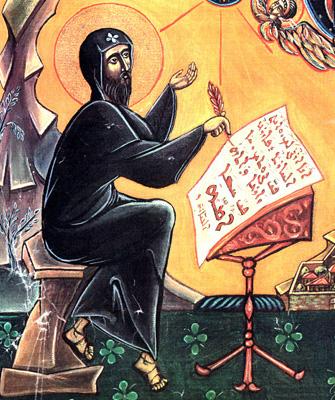
Ephrem
June 18
Ephrem of Syria was born about 306 in Nisibis, Syria, and was baptized Christian in 324. After he was ordained a deacon he was the leader at a cathedral school. When the Persians captured Nisibis in 363, Ephrem and thousands of other refugees fled. He lived an acetic life as a monk in a cave, praying, fasting, and studying holy scripture.
While Ephrem lived in this remote location he composed countless hymns (between four and five hundred songs and hymns still exist), poetic sermons, and other theological writings, all based on scripture. Some called him "the Harp of the Holy Spirit."
In 373 in the last months of his life, Ephrem organized a relief effort for famine relief in the Edessa area. He died a month later.
Ephrem is the patron saint of spiritual directors and spiritual leaders.
If Ephrem had taken the Spiritual Types Test, he probably would have been a Mystic. Ephrem is remembered on June 18.
"Mor Ephrem icon" by Anonymous - [1] [2] [3] [4] [5]. Licensed under Public Domain via Wikimedia Commons - https://commons.wikimedia.org/wiki/File:Mor_Ephrem_icon.jpg#/media/File:Mor_Ephrem_icon.jpg
June 18
Ephrem of Syria was born about 306 in Nisibis, Syria, and was baptized Christian in 324. After he was ordained a deacon he was the leader at a cathedral school. When the Persians captured Nisibis in 363, Ephrem and thousands of other refugees fled. He lived an acetic life as a monk in a cave, praying, fasting, and studying holy scripture.
While Ephrem lived in this remote location he composed countless hymns (between four and five hundred songs and hymns still exist), poetic sermons, and other theological writings, all based on scripture. Some called him "the Harp of the Holy Spirit."
In 373 in the last months of his life, Ephrem organized a relief effort for famine relief in the Edessa area. He died a month later.
Ephrem is the patron saint of spiritual directors and spiritual leaders.
If Ephrem had taken the Spiritual Types Test, he probably would have been a Mystic. Ephrem is remembered on June 18.
"Mor Ephrem icon" by Anonymous - [1] [2] [3] [4] [5]. Licensed under Public Domain via Wikimedia Commons - https://commons.wikimedia.org/wiki/File:Mor_Ephrem_icon.jpg#/media/File:Mor_Ephrem_icon.jpg
-------
Lectionary Readings
Sixth Sunday after Pentecost
Sunday, June 26, 2016
(Courtesy of Vanderbilt Divinity Library)
2 Kings 2:1-2, 6-14
Psalm 77:1-2, 11-20
Galatians 5:1, 13-25
Luke 9:51-62
Scripture Texts for: 2 Kings 2:1 The time came for Adonai to take Eliyahu up into heaven in a whirlwind. Eliyahu and Elisha were on their way from Gilgal, 2 when Eliyahu said to Elisha, “Please wait here, because Adonai has sent me all the way to Beit-El.” But Elisha said, “As Adonai lives, and as you live, I will not leave you.” So they went down to Beit-El.
6 Eliyahu said to him, “Please wait here, because Adonai has sent me to the Yarden.” He replied, “As Adonai lives, and as you live, I will not leave you.” So the two of them went on. 7 Fifty of the guild prophets went and stood watching them from a distance, while they stood by the Yarden. 8 Then Eliyahu took his cloak, rolled it up and struck the water with it; and the water divided itself to the left and to the right; so that they crossed on dry ground. 9 After they had crossed, Eliyahu said to Elisha, “Tell me what I can do for you before I am taken away from you.” Elisha said, “Please! Let a double share of your spirit be on me!” 10 He replied, “You have requested a hard thing. Nevertheless, if you see me when I am taken from you, you will get what you asked for; but if not, you won’t.”
11 Suddenly, as they were walking on and talking, there appeared a fiery chariot with horses of fire; and as it separated the two of them from each other, Eliyahu went up into heaven in a whirlwind. 12 Elisha saw it and cried out, “My father! My father! The chariots and horsemen of Isra’el!” Then he lost sight of him. Seizing his clothes, he tore them in half. 13 Then he picked up Eliyahu’s cloak, which had fallen off him. Standing on the bank of the Yarden, 14 he took the cloak that had fallen off Eliyahu, struck the water and said, “Where is Adonai, the God of Eliyahu?” But when he actually did strike the water, it divided itself to the left and to the right; then Elisha crossed over.
Psalm 77:1 (0) For the leader. For Y’dutun. A psalm of Asaf:
2 (1) I cry aloud to God,
aloud to God; and he hears me.
11 (10) Then I add, “That’s my weakness —
[supposing] the Most High’s right hand could change.”
12 (11) So I will remind myself of Yah’s doings;
yes, I will remember your wonders of old.
13 (12) I will meditate on your work
and think about what you have done.
14 (13) God, your way is in holiness.
What god is as great as God?
15 (14) You are the God who does wonders,
you revealed your strength to the peoples.
16 (15) With your arm you redeemed your people,
the descendants of Ya‘akov and Yosef. (Selah)
17 (16) The water saw you, God;
the water saw you and writhed in anguish,
agitated to its depths.
18 (17) The clouds poured water, the skies thundered,
and your arrows flashed here and there.
19 (18) The sound of your thunder was in the whirlwind,
the lightning flashes lit up the world,
the earth trembled and shook.
20 (19) Your way went through the sea,
your path through the turbulent waters;
but your footsteps could not be traced.
Galatians 5: What the Messiah has freed us for is freedom! Therefore, stand firm, and don’t let yourselves be tied up again to a yoke of slavery.
13 For, brothers, you were called to be free. Only do not let that freedom become an excuse for allowing your old nature to have its way. Instead, serve one another in love. 14 For the whole of the Torah is summed up in this one sentence: “Love your neighbor as yourself”;[Galatians 5:14 Leviticus 19:18] 15 but if you go on snapping at each other and tearing each other to pieces, watch out, or you will be destroyed by each other!
16 What I am saying is this: run your lives by the Spirit. Then you will not do what your old nature wants. 17 For the old nature wants what is contrary to the Spirit, and the Spirit wants what is contrary to the old nature. These oppose each other, so that you find yourselves unable to carry out your good intentions. 18 But if you are led by the Spirit, then you are not in subjection to the system that results from perverting the Torah into legalism.
19 And it is perfectly evident what the old nature does. It expresses itself in sexual immorality, impurity and indecency; 20 involvement with the occult and with drugs; in feuding, fighting, becoming jealous and getting angry; in selfish ambition, factionalism, intrigue 21 and envy; in drunkenness, orgies and things like these. I warn you now as I have warned you before: those who do such things will have no share in the Kingdom of God!
22 But the fruit of the Spirit is love, joy, peace, patience, kindness, goodness, faithfulness, 23 humility, self control. Nothing in the Torah stands against such things.
24 Moreover, those who belong to the Messiah Yeshua have put their old nature to death on the stake, along with its passions and desires. 25 Since it is through the Spirit that we have Life, let it also be through the Spirit that we order our lives day by day.
Luke 9:51 As the time approached for him to be taken up into heaven, he made his decision to set out for Yerushalayim. 52 He sent messengers ahead of him, who went and entered a village in Shomron to make preparations for him. 53 However, the people there would not let him stay, because his destination was Yerushalayim. 54 When the talmidim Ya‘akov and Yochanan saw this, they said, “Sir, do you want us to call down fire from heaven to destroy them?”[Luke 9:54 2 Kings 1:9–16] 55 But he turned and rebuked them.[Luke 9:55 Some manuscripts have verses 9:55b–56a: . . . and he said, “You don’t know what Spirit you are of; 56 for the Son of Man did not come to destroy people’s lives, but to save.”] 56 And they went on to another village.
57 As they were traveling on the road, a man said to him, “I will follow you wherever you go.” 58 Yeshua answered him, “The foxes have holes, and the birds flying about have nests, but the Son of Man has no home of his own.” 59 To another he said, “Follow me!” but the man replied, “Sir, first let me go away and bury my father.” 60 Yeshua said, “Let the dead bury their own dead; you, go and proclaim the Kingdom of God!” 61 Yet another said, “I will follow you, sir, but first let me say good-by to the people at home.” 62 To him Yeshua said, “No one who puts his hand to the plow and keeps looking back is fit to serve in the Kingdom of God.”
-------
Lectionary Readings
Sixth Sunday after Pentecost
Sunday, June 26, 2016
(Courtesy of Vanderbilt Divinity Library)
2 Kings 2:1-2, 6-14
Psalm 77:1-2, 11-20
Galatians 5:1, 13-25
Luke 9:51-62
Scripture Texts for: 2 Kings 2:1 The time came for Adonai to take Eliyahu up into heaven in a whirlwind. Eliyahu and Elisha were on their way from Gilgal, 2 when Eliyahu said to Elisha, “Please wait here, because Adonai has sent me all the way to Beit-El.” But Elisha said, “As Adonai lives, and as you live, I will not leave you.” So they went down to Beit-El.
6 Eliyahu said to him, “Please wait here, because Adonai has sent me to the Yarden.” He replied, “As Adonai lives, and as you live, I will not leave you.” So the two of them went on. 7 Fifty of the guild prophets went and stood watching them from a distance, while they stood by the Yarden. 8 Then Eliyahu took his cloak, rolled it up and struck the water with it; and the water divided itself to the left and to the right; so that they crossed on dry ground. 9 After they had crossed, Eliyahu said to Elisha, “Tell me what I can do for you before I am taken away from you.” Elisha said, “Please! Let a double share of your spirit be on me!” 10 He replied, “You have requested a hard thing. Nevertheless, if you see me when I am taken from you, you will get what you asked for; but if not, you won’t.”
11 Suddenly, as they were walking on and talking, there appeared a fiery chariot with horses of fire; and as it separated the two of them from each other, Eliyahu went up into heaven in a whirlwind. 12 Elisha saw it and cried out, “My father! My father! The chariots and horsemen of Isra’el!” Then he lost sight of him. Seizing his clothes, he tore them in half. 13 Then he picked up Eliyahu’s cloak, which had fallen off him. Standing on the bank of the Yarden, 14 he took the cloak that had fallen off Eliyahu, struck the water and said, “Where is Adonai, the God of Eliyahu?” But when he actually did strike the water, it divided itself to the left and to the right; then Elisha crossed over.
Psalm 77:1 (0) For the leader. For Y’dutun. A psalm of Asaf:
2 (1) I cry aloud to God,
aloud to God; and he hears me.
11 (10) Then I add, “That’s my weakness —
[supposing] the Most High’s right hand could change.”
12 (11) So I will remind myself of Yah’s doings;
yes, I will remember your wonders of old.
13 (12) I will meditate on your work
and think about what you have done.
14 (13) God, your way is in holiness.
What god is as great as God?
15 (14) You are the God who does wonders,
you revealed your strength to the peoples.
16 (15) With your arm you redeemed your people,
the descendants of Ya‘akov and Yosef. (Selah)
17 (16) The water saw you, God;
the water saw you and writhed in anguish,
agitated to its depths.
18 (17) The clouds poured water, the skies thundered,
and your arrows flashed here and there.
19 (18) The sound of your thunder was in the whirlwind,
the lightning flashes lit up the world,
the earth trembled and shook.
20 (19) Your way went through the sea,
your path through the turbulent waters;
but your footsteps could not be traced.
Galatians 5: What the Messiah has freed us for is freedom! Therefore, stand firm, and don’t let yourselves be tied up again to a yoke of slavery.
13 For, brothers, you were called to be free. Only do not let that freedom become an excuse for allowing your old nature to have its way. Instead, serve one another in love. 14 For the whole of the Torah is summed up in this one sentence: “Love your neighbor as yourself”;[Galatians 5:14 Leviticus 19:18] 15 but if you go on snapping at each other and tearing each other to pieces, watch out, or you will be destroyed by each other!
16 What I am saying is this: run your lives by the Spirit. Then you will not do what your old nature wants. 17 For the old nature wants what is contrary to the Spirit, and the Spirit wants what is contrary to the old nature. These oppose each other, so that you find yourselves unable to carry out your good intentions. 18 But if you are led by the Spirit, then you are not in subjection to the system that results from perverting the Torah into legalism.
19 And it is perfectly evident what the old nature does. It expresses itself in sexual immorality, impurity and indecency; 20 involvement with the occult and with drugs; in feuding, fighting, becoming jealous and getting angry; in selfish ambition, factionalism, intrigue 21 and envy; in drunkenness, orgies and things like these. I warn you now as I have warned you before: those who do such things will have no share in the Kingdom of God!
22 But the fruit of the Spirit is love, joy, peace, patience, kindness, goodness, faithfulness, 23 humility, self control. Nothing in the Torah stands against such things.
24 Moreover, those who belong to the Messiah Yeshua have put their old nature to death on the stake, along with its passions and desires. 25 Since it is through the Spirit that we have Life, let it also be through the Spirit that we order our lives day by day.
Luke 9:51 As the time approached for him to be taken up into heaven, he made his decision to set out for Yerushalayim. 52 He sent messengers ahead of him, who went and entered a village in Shomron to make preparations for him. 53 However, the people there would not let him stay, because his destination was Yerushalayim. 54 When the talmidim Ya‘akov and Yochanan saw this, they said, “Sir, do you want us to call down fire from heaven to destroy them?”[Luke 9:54 2 Kings 1:9–16] 55 But he turned and rebuked them.[Luke 9:55 Some manuscripts have verses 9:55b–56a: . . . and he said, “You don’t know what Spirit you are of; 56 for the Son of Man did not come to destroy people’s lives, but to save.”] 56 And they went on to another village.
57 As they were traveling on the road, a man said to him, “I will follow you wherever you go.” 58 Yeshua answered him, “The foxes have holes, and the birds flying about have nests, but the Son of Man has no home of his own.” 59 To another he said, “Follow me!” but the man replied, “Sir, first let me go away and bury my father.” 60 Yeshua said, “Let the dead bury their own dead; you, go and proclaim the Kingdom of God!” 61 Yet another said, “I will follow you, sir, but first let me say good-by to the people at home.” 62 To him Yeshua said, “No one who puts his hand to the plow and keeps looking back is fit to serve in the Kingdom of God.”
-------
John Wesley's Notes-Commentary for: 2 Kings 2:1-2, 6-14
Verse 1
[1] And it came to pass, when the LORD would take up Elijah into heaven by a whirlwind, that Elijah went with Elisha from Gilgal.
About to take, … — It is supposed, (tho' not expressly revealed) that Elijah flourished about twenty years, before he was translated, body and soul, to heaven, only undergoing such a change, as was necessary to qualify him for being an inhabitant in that world of Spirits. By translating him, God gave in that dark and degenerate age, a very sensible proof of another life, together with a type of the ascension of Christ, and the opening of the kingdom of heaven to all believers.
Verse 2
[2] And Elijah said unto Elisha, Tarry here, I pray thee; for the LORD hath sent me to Bethel. And Elisha said unto him, As the LORD liveth, and as thy soul liveth, I will not leave thee. So they went down to Bethel.
Tarry here — This he desires, either, 1. That being left alone, he might better prepare himself for his great change. Or, 2. Out of indulgence to Elisha, that he might not be overwhelmed with grief at so sad a sight. Or, 3. That he might try his love, and whet his desire to accompany him; it being highly convenient for God's honour, that there should be witnesses of so glorious a translation.
To Beth-el — Which was truth, tho' not the whole truth: for he was to go a far longer journey. But he was first to go to Beth-el, as also to Jericho, to the schools of the prophets there, that he might comfort, and strengthen their hearts in God's work, and give them his dying counsels.
Verse 7
[7] And fifty men of the sons of the prophets went, and stood to view afar off: and they two stood by Jordan.
To view — To observe this great event, Elijah's translation to heaven, which they expected every moment: and whereof they desired to be spectators, not to satisfy their own curiosity, but that they might be witnesses of it to others.
Verse 8
[8] And Elijah took his mantle, and wrapped it together, and smote the waters, and they were divided hither and thither, so that they two went over on dry ground.
Smote the waters — These waters of old yielded to the ark, now to the prophet's mantle; which to those that wanted the ark, was an equivalent token of God's presence. When God will take his children to himself, death is the Jordan, which they must pass through. And they find a way thro' it, a safe and comfortable way. The death of Christ has divided those waters, that the ransomed of the Lord may pass over.
Verse 9
[9] And it came to pass, when they were gone over, that Elijah said unto Elisha, Ask what I shall do for thee, before I be taken away from thee. And Elisha said, I pray thee, let a double portion of thy spirit be upon me.
A double portion — Or, rather double to what the rest of the sons of the prophets receive at thy request. He alludes to the double portion of the first-born, Deuteronomy 21:17. But though Elisha desired no more, yet God gave him more than he desired or expected; and he seems to have had a greater portion of the gifts of God's Spirit, than even Elijah had.
Verse 10
[10] And he said, Thou hast asked a hard thing: nevertheless, if thou see me when I am taken from thee, it shall be so unto thee; but if not, it shall not be so.
A hard thing — A rare and singular blessing, which I cannot promise thee, which only God can give; and he gives it only when, and to whom he pleaseth.
If thou seest — This sign he proposed, not without the direction of God's Spirit, that hereby he might engage him more earnestly to wait, and more fervently to pray for this mercy.
Verse 11
[11] And it came to pass, as they still went on, and talked, that, behold, there appeared a chariot of fire, and horses of fire, and parted them both asunder; and Elijah went up by a whirlwind into heaven.
A chariot of fire — In this form the angels appeared. The souls of all the faithful, are carried by an invisible guard of angels, into the bosom of Abraham. But Elijah being to carry his body with him, this heavenly guard appeared visibly: Not in an human shape, tho' so they might have borne him in their arms, but in the form of a chariot and horses, that he may ride in state, may ride in triumph, like a prince, like a conqueror. See the readiness of the angels to do the will of God, even in the meanest services for the heirs of salvation! Thus he who had burned with holy zeal for God and his honour, was now conveyed in fire into his immediate presence.
Verse 12
[12] And Elisha saw it, and he cried, My father, my father, the chariot of Israel, and the horsemen thereof. And he saw him no more: and he took hold of his own clothes, and rent them in two pieces.
My father — So he calls him for his fatherly affection to him, and for his fatherly authority which he had over him, in which respect the scholars of the prophets are called their sons. He saw his own condition like that of a fatherless child, and laments it accordingly.
The chariot, … — Who by thy example, and counsels, and prayers, and power with God, didst more for the defence and preservation of Israel than all their chariots and horses. The expression alludes to the form of chariots and horses which he had seen.
Verse 13
[13] He took up also the mantle of Elijah that fell from him, and went back, and stood by the bank of Jordan;
Which fell — God so ordering it for Elisha's comfort, and the strengthening of his faith, as a pledge, that together with Elijah's mantle, his Spirit should rest upon him. And Elijah himself was gone to a place, where he needed not the mantle, either to adorn him, or to shelter him from weather, or to wrap his face in.
Verse 14
[14] And he took the mantle of Elijah that fell from him, and smote the waters, and said, Where is the LORD God of Elijah? and when he also had smitten the waters, they parted hither and thither: and Elisha went over.
The Lord — Who at Elijah's request divided these waters, and is as able to do it again.
Psalm 77:1-2, 11-20
Verse 2
[2] In the day of my trouble I sought the Lord: my sore ran in the night, and ceased not: my soul refused to be comforted.
Night — Which to others was a time of rest and quietness.
Verse 13
[13] Thy way, O God, is in the sanctuary: who is so great a God as our God?
In holiness — God is holy and just, and true in all his works.
Verse 16
[16] The waters saw thee, O God, the waters saw thee; they were afraid: the depths also were troubled.
Afraid — And stood still, as men astonished, do.
Verse 17
[17] The clouds poured out water: the skies sent out a sound: thine arrows also went abroad.
Poured — When the Israelites passed over the sea.
Arrows — Hail-stones or lightnings.
Verse 19
[19] Thy way is in the sea, and thy path in the great waters, and thy footsteps are not known.
Not known — Because the water returned and covered them.
Verse 20
[20] Thou leddest thy people like a flock by the hand of Moses and Aaron.
Leddest — First through the sea, and afterwards through the wilderness, with singular care and tenderness, as a shepherd doth his sheep.
Galatians 5:1, 13-25
Verse 1
[1] Stand fast therefore in the liberty wherewith Christ hath made us free, and be not entangled again with the yoke of bondage.
Stand fast therefore in the liberty — From the ceremonial law.
Wherewith Christ hath made us — And all believers, free; and be not entangled again with the yoke of legal bondage.
Verse 13
[13] For, brethren, ye have been called unto liberty; only use not liberty for an occasion to the flesh, but by love serve one another.
Ye have been called to liberty — From sin and misery, as well as from the ceremonial law.
Only use not liberty for an occasion to the flesh — Take not occasion from hence to gratify corrupt nature.
But by love serve one another — And hereby show that Christ has made you free.
Verse 14
[14] For all the law is fulfilled in one word, even in this; Thou shalt love thy neighbour as thyself.
For all the law is fulfilled in this, Thou shalt love thy neighbour as thyself — inasmuch as none can do this without loving God, 1 John 4:12; and the love of God and man includes all perfection. Leviticus 19:18.
Verse 15
[15] But if ye bite and devour one another, take heed that ye be not consumed one of another.
But if — On the contrary, in consequence of the divisions which those troublers have occasioned among you, ye bite one another by evil speaking.
And devour one another — By railing and clamour.
Take heed ye be not consumed one of another — By bitterness, strife, and contention, our health and strength, both of body and soul, are consumed, as well as our substance and reputation.
Verse 16
[16] This I say then, Walk in the Spirit, and ye shall not fulfil the lust of the flesh.
I say then — He now explains what he proposed, Galatians 5:13.
Walk by the Spirit — Follow his guidance in all things.
And fulfil not — In anything.
The desire of the flesh — Of corrupt nature.
Verse 17
[17] For the flesh lusteth against the Spirit, and the Spirit against the flesh: and these are contrary the one to the other: so that ye cannot do the things that ye would.
For the flesh desireth against the Spirit — Nature desires what is quite contrary to the Spirit of God.
But the Spirit against the flesh- — But the Holy Spirit on his part opposes your evil nature.
These are contrary to each other — The flesh and the Spirit; there can be no agreement between them.
That ye may not do the things which ye would- — That, being thus strengthened by the Spirit, ye may not fulfil the desire of the flesh, as otherwise ye would do.
Verse 18
[18] But if ye be led of the Spirit, ye are not under the law.
But if ye are led by the Spirit — Of liberty and love, into all holiness.
Ye are not under the law — Not under the curse or bondage of it; not under the guilt or the power of sin.
Verse 19
[19] Now the works of the flesh are manifest, which are these; Adultery, fornication, uncleanness, lasciviousness,
Now the works of the flesh — By which that inward principle is discovered.
Are manifest — Plain and undeniable. Works are mentioned in the plural because they are distinct from, and often inconsistent with, each other. But "the fruit of the Spirit" is mentioned in the singular, Galatians 5:22, as being all consistent and connected together.
Which are these — He enumerates those "works of the flesh" to which the Galatians were most inclined; and those parts of "the fruit of the Spirit" of which they stood in the greatest need.
Lasciviousness — The Greek word means anything inward or outward that is contrary to chastity, and yet short of actual uncleanness.
Verse 20
[20] Idolatry, witchcraft, hatred, variance, emulations, wrath, strife, seditions, heresies,
Idolatry, witchcraft — That this means witchcraft, strictly speaking, (not poisoning,) appears from its being joined with the worship of devil-gods, and not with murder. This is frequently and solemnly forbidden in the Old Testament. To deny therefore that there is, or ever was, any such thing, is, by plain consequence, to deny the authority both of the Old and New Testament.
Divisions — In domestic or civil matters. Heresies are divisions in religious communities.
Verse 21
[21] Envyings, murders, drunkenness, revellings, and such like: of the which I tell you before, as I have also told you in time past, that they which do such things shall not inherit the kingdom of God.
Revellings — Luxurious entertainments. Some of the works here mentioned are wrought principally, if not entirely, in the mind; and yet they are called "works of the flesh." Hence it is clear, the apostle does not by "the flesh" mean the body, or sensual appetites and inclinations only, but the corruption of human nature, as it spreads through all the powers of the soul, as well as all the members of the body.
Of which I tell you before — Before the event, I forewarn you.
Verse 22
[22] But the fruit of the Spirit is love, joy, peace, longsuffering, gentleness, goodness, faith,
Love — The root of all the rest.
Gentleness — Toward all men; ignorant and wicked men in particular.
Goodness — The Greek word means all that is benign, soft, winning, tender, either in temper or behaviour.
Verse 23
[23] Meekness, temperance: against such there is no law.
Meekness — Holding all the affections and passions in even balance.
Verse 24
[24] And they that are Christ's have crucified the flesh with the affections and lusts.
And they that are Christ's — True believers in him. Have thus crucified the flesh - Nailed it, as it were, to a cross whence it has no power to break loose, but is continually weaker and weaker.
With its affections and desires — All its evil passions, appetites, and inclinations.
Verse 25
[25] If we live in the Spirit, let us also walk in the Spirit.
If we live by the Spirit — If we are indeed raised from the dead, and are alive to God, by the operation of his Spirit.
Let us walk by the Spirit — Let us follow his guidance, in all our tempers, thoughts, words, and actions.
Luke 9:51-62
Verse 51
[51] And it came to pass, when the time was come that he should be received up, he stedfastly set his face to go to Jerusalem,
The days are fulfilled that he should be received up — That is, the time of his passion was now at hand. St. Luke looks through this, to the glory which was to follow.
He steadfastly set his face — Without fear of his enemies, or shame of the cross, Hebrews 12:2.
Verse 52
[52] And sent messengers before his face: and they went, and entered into a village of the Samaritans, to make ready for him.
He sent messengers to make ready — A lodging and needful entertainment for him and those with him.
Verse 53
[53] And they did not receive him, because his face was as though he would go to Jerusalem.
His face was as though he would go to Jerusalem — It plainly appeared, he was going to worship at the temple, and thereby, in effect, to condemn the Samaritan worship at Mount Gerizim.
Verse 54
[54] And when his disciples James and John saw this, they said, Lord, wilt thou that we command fire to come down from heaven, and consume them, even as Elias did?
As Elisha did — At or near this very place, which might put it into the minds of the apostles to make the motion now, rather than at any other time or place, where Christ had received the like affront.
Verse 55
[55] But he turned, and rebuked them, and said, Ye know not what manner of spirit ye are of.
Ye know not what manner of spirit — The spirit of Christianity is. It is not a spirit of wrath and vengeance, but of peace, and gentleness, and love.
Verse 57
[57] And it came to pass, that, as they went in the way, a certain man said unto him, Lord, I will follow thee whithersoever thou goest.
Matthew 8:19.
Verse 58
[58] And Jesus said unto him, Foxes have holes, and birds of the air have nests; but the Son of man hath not where to lay his head.
But Jesus said to him — First understand the terms: consider on what conditions thou art to follow me.
Verse 61
[61] And another also said, Lord, I will follow thee; but let me first go bid them farewell, which are at home at my house.
Suffer me first to bid them farewell that are in my house — As Elisha did after Elijah had called him from the plough, 1 Kings 19:19; to which our Lord's answer seems to allude.
Verse 62
[62] And Jesus said unto him, No man, having put his hand to the plough, and looking back, is fit for the kingdom of God.
Is fit for the kingdom of God — Either to propagate or to receive it.
Verse 1
[1] And it came to pass, when the LORD would take up Elijah into heaven by a whirlwind, that Elijah went with Elisha from Gilgal.
About to take, … — It is supposed, (tho' not expressly revealed) that Elijah flourished about twenty years, before he was translated, body and soul, to heaven, only undergoing such a change, as was necessary to qualify him for being an inhabitant in that world of Spirits. By translating him, God gave in that dark and degenerate age, a very sensible proof of another life, together with a type of the ascension of Christ, and the opening of the kingdom of heaven to all believers.
Verse 2
[2] And Elijah said unto Elisha, Tarry here, I pray thee; for the LORD hath sent me to Bethel. And Elisha said unto him, As the LORD liveth, and as thy soul liveth, I will not leave thee. So they went down to Bethel.
Tarry here — This he desires, either, 1. That being left alone, he might better prepare himself for his great change. Or, 2. Out of indulgence to Elisha, that he might not be overwhelmed with grief at so sad a sight. Or, 3. That he might try his love, and whet his desire to accompany him; it being highly convenient for God's honour, that there should be witnesses of so glorious a translation.
To Beth-el — Which was truth, tho' not the whole truth: for he was to go a far longer journey. But he was first to go to Beth-el, as also to Jericho, to the schools of the prophets there, that he might comfort, and strengthen their hearts in God's work, and give them his dying counsels.
Verse 7
[7] And fifty men of the sons of the prophets went, and stood to view afar off: and they two stood by Jordan.
To view — To observe this great event, Elijah's translation to heaven, which they expected every moment: and whereof they desired to be spectators, not to satisfy their own curiosity, but that they might be witnesses of it to others.
Verse 8
[8] And Elijah took his mantle, and wrapped it together, and smote the waters, and they were divided hither and thither, so that they two went over on dry ground.
Smote the waters — These waters of old yielded to the ark, now to the prophet's mantle; which to those that wanted the ark, was an equivalent token of God's presence. When God will take his children to himself, death is the Jordan, which they must pass through. And they find a way thro' it, a safe and comfortable way. The death of Christ has divided those waters, that the ransomed of the Lord may pass over.
Verse 9
[9] And it came to pass, when they were gone over, that Elijah said unto Elisha, Ask what I shall do for thee, before I be taken away from thee. And Elisha said, I pray thee, let a double portion of thy spirit be upon me.
A double portion — Or, rather double to what the rest of the sons of the prophets receive at thy request. He alludes to the double portion of the first-born, Deuteronomy 21:17. But though Elisha desired no more, yet God gave him more than he desired or expected; and he seems to have had a greater portion of the gifts of God's Spirit, than even Elijah had.
Verse 10
[10] And he said, Thou hast asked a hard thing: nevertheless, if thou see me when I am taken from thee, it shall be so unto thee; but if not, it shall not be so.
A hard thing — A rare and singular blessing, which I cannot promise thee, which only God can give; and he gives it only when, and to whom he pleaseth.
If thou seest — This sign he proposed, not without the direction of God's Spirit, that hereby he might engage him more earnestly to wait, and more fervently to pray for this mercy.
Verse 11
[11] And it came to pass, as they still went on, and talked, that, behold, there appeared a chariot of fire, and horses of fire, and parted them both asunder; and Elijah went up by a whirlwind into heaven.
A chariot of fire — In this form the angels appeared. The souls of all the faithful, are carried by an invisible guard of angels, into the bosom of Abraham. But Elijah being to carry his body with him, this heavenly guard appeared visibly: Not in an human shape, tho' so they might have borne him in their arms, but in the form of a chariot and horses, that he may ride in state, may ride in triumph, like a prince, like a conqueror. See the readiness of the angels to do the will of God, even in the meanest services for the heirs of salvation! Thus he who had burned with holy zeal for God and his honour, was now conveyed in fire into his immediate presence.
Verse 12
[12] And Elisha saw it, and he cried, My father, my father, the chariot of Israel, and the horsemen thereof. And he saw him no more: and he took hold of his own clothes, and rent them in two pieces.
My father — So he calls him for his fatherly affection to him, and for his fatherly authority which he had over him, in which respect the scholars of the prophets are called their sons. He saw his own condition like that of a fatherless child, and laments it accordingly.
The chariot, … — Who by thy example, and counsels, and prayers, and power with God, didst more for the defence and preservation of Israel than all their chariots and horses. The expression alludes to the form of chariots and horses which he had seen.
Verse 13
[13] He took up also the mantle of Elijah that fell from him, and went back, and stood by the bank of Jordan;
Which fell — God so ordering it for Elisha's comfort, and the strengthening of his faith, as a pledge, that together with Elijah's mantle, his Spirit should rest upon him. And Elijah himself was gone to a place, where he needed not the mantle, either to adorn him, or to shelter him from weather, or to wrap his face in.
Verse 14
[14] And he took the mantle of Elijah that fell from him, and smote the waters, and said, Where is the LORD God of Elijah? and when he also had smitten the waters, they parted hither and thither: and Elisha went over.
The Lord — Who at Elijah's request divided these waters, and is as able to do it again.
Psalm 77:1-2, 11-20
Verse 2
[2] In the day of my trouble I sought the Lord: my sore ran in the night, and ceased not: my soul refused to be comforted.
Night — Which to others was a time of rest and quietness.
Verse 13
[13] Thy way, O God, is in the sanctuary: who is so great a God as our God?
In holiness — God is holy and just, and true in all his works.
Verse 16
[16] The waters saw thee, O God, the waters saw thee; they were afraid: the depths also were troubled.
Afraid — And stood still, as men astonished, do.
Verse 17
[17] The clouds poured out water: the skies sent out a sound: thine arrows also went abroad.
Poured — When the Israelites passed over the sea.
Arrows — Hail-stones or lightnings.
Verse 19
[19] Thy way is in the sea, and thy path in the great waters, and thy footsteps are not known.
Not known — Because the water returned and covered them.
Verse 20
[20] Thou leddest thy people like a flock by the hand of Moses and Aaron.
Leddest — First through the sea, and afterwards through the wilderness, with singular care and tenderness, as a shepherd doth his sheep.
Galatians 5:1, 13-25
Verse 1
[1] Stand fast therefore in the liberty wherewith Christ hath made us free, and be not entangled again with the yoke of bondage.
Stand fast therefore in the liberty — From the ceremonial law.
Wherewith Christ hath made us — And all believers, free; and be not entangled again with the yoke of legal bondage.
Verse 13
[13] For, brethren, ye have been called unto liberty; only use not liberty for an occasion to the flesh, but by love serve one another.
Ye have been called to liberty — From sin and misery, as well as from the ceremonial law.
Only use not liberty for an occasion to the flesh — Take not occasion from hence to gratify corrupt nature.
But by love serve one another — And hereby show that Christ has made you free.
Verse 14
[14] For all the law is fulfilled in one word, even in this; Thou shalt love thy neighbour as thyself.
For all the law is fulfilled in this, Thou shalt love thy neighbour as thyself — inasmuch as none can do this without loving God, 1 John 4:12; and the love of God and man includes all perfection. Leviticus 19:18.
Verse 15
[15] But if ye bite and devour one another, take heed that ye be not consumed one of another.
But if — On the contrary, in consequence of the divisions which those troublers have occasioned among you, ye bite one another by evil speaking.
And devour one another — By railing and clamour.
Take heed ye be not consumed one of another — By bitterness, strife, and contention, our health and strength, both of body and soul, are consumed, as well as our substance and reputation.
Verse 16
[16] This I say then, Walk in the Spirit, and ye shall not fulfil the lust of the flesh.
I say then — He now explains what he proposed, Galatians 5:13.
Walk by the Spirit — Follow his guidance in all things.
And fulfil not — In anything.
The desire of the flesh — Of corrupt nature.
Verse 17
[17] For the flesh lusteth against the Spirit, and the Spirit against the flesh: and these are contrary the one to the other: so that ye cannot do the things that ye would.
For the flesh desireth against the Spirit — Nature desires what is quite contrary to the Spirit of God.
But the Spirit against the flesh- — But the Holy Spirit on his part opposes your evil nature.
These are contrary to each other — The flesh and the Spirit; there can be no agreement between them.
That ye may not do the things which ye would- — That, being thus strengthened by the Spirit, ye may not fulfil the desire of the flesh, as otherwise ye would do.
Verse 18
[18] But if ye be led of the Spirit, ye are not under the law.
But if ye are led by the Spirit — Of liberty and love, into all holiness.
Ye are not under the law — Not under the curse or bondage of it; not under the guilt or the power of sin.
Verse 19
[19] Now the works of the flesh are manifest, which are these; Adultery, fornication, uncleanness, lasciviousness,
Now the works of the flesh — By which that inward principle is discovered.
Are manifest — Plain and undeniable. Works are mentioned in the plural because they are distinct from, and often inconsistent with, each other. But "the fruit of the Spirit" is mentioned in the singular, Galatians 5:22, as being all consistent and connected together.
Which are these — He enumerates those "works of the flesh" to which the Galatians were most inclined; and those parts of "the fruit of the Spirit" of which they stood in the greatest need.
Lasciviousness — The Greek word means anything inward or outward that is contrary to chastity, and yet short of actual uncleanness.
Verse 20
[20] Idolatry, witchcraft, hatred, variance, emulations, wrath, strife, seditions, heresies,
Idolatry, witchcraft — That this means witchcraft, strictly speaking, (not poisoning,) appears from its being joined with the worship of devil-gods, and not with murder. This is frequently and solemnly forbidden in the Old Testament. To deny therefore that there is, or ever was, any such thing, is, by plain consequence, to deny the authority both of the Old and New Testament.
Divisions — In domestic or civil matters. Heresies are divisions in religious communities.
Verse 21
[21] Envyings, murders, drunkenness, revellings, and such like: of the which I tell you before, as I have also told you in time past, that they which do such things shall not inherit the kingdom of God.
Revellings — Luxurious entertainments. Some of the works here mentioned are wrought principally, if not entirely, in the mind; and yet they are called "works of the flesh." Hence it is clear, the apostle does not by "the flesh" mean the body, or sensual appetites and inclinations only, but the corruption of human nature, as it spreads through all the powers of the soul, as well as all the members of the body.
Of which I tell you before — Before the event, I forewarn you.
Verse 22
[22] But the fruit of the Spirit is love, joy, peace, longsuffering, gentleness, goodness, faith,
Love — The root of all the rest.
Gentleness — Toward all men; ignorant and wicked men in particular.
Goodness — The Greek word means all that is benign, soft, winning, tender, either in temper or behaviour.
Verse 23
[23] Meekness, temperance: against such there is no law.
Meekness — Holding all the affections and passions in even balance.
Verse 24
[24] And they that are Christ's have crucified the flesh with the affections and lusts.
And they that are Christ's — True believers in him. Have thus crucified the flesh - Nailed it, as it were, to a cross whence it has no power to break loose, but is continually weaker and weaker.
With its affections and desires — All its evil passions, appetites, and inclinations.
Verse 25
[25] If we live in the Spirit, let us also walk in the Spirit.
If we live by the Spirit — If we are indeed raised from the dead, and are alive to God, by the operation of his Spirit.
Let us walk by the Spirit — Let us follow his guidance, in all our tempers, thoughts, words, and actions.
Luke 9:51-62
Verse 51
[51] And it came to pass, when the time was come that he should be received up, he stedfastly set his face to go to Jerusalem,
The days are fulfilled that he should be received up — That is, the time of his passion was now at hand. St. Luke looks through this, to the glory which was to follow.
He steadfastly set his face — Without fear of his enemies, or shame of the cross, Hebrews 12:2.
Verse 52
[52] And sent messengers before his face: and they went, and entered into a village of the Samaritans, to make ready for him.
He sent messengers to make ready — A lodging and needful entertainment for him and those with him.
Verse 53
[53] And they did not receive him, because his face was as though he would go to Jerusalem.
His face was as though he would go to Jerusalem — It plainly appeared, he was going to worship at the temple, and thereby, in effect, to condemn the Samaritan worship at Mount Gerizim.
Verse 54
[54] And when his disciples James and John saw this, they said, Lord, wilt thou that we command fire to come down from heaven, and consume them, even as Elias did?
As Elisha did — At or near this very place, which might put it into the minds of the apostles to make the motion now, rather than at any other time or place, where Christ had received the like affront.
Verse 55
[55] But he turned, and rebuked them, and said, Ye know not what manner of spirit ye are of.
Ye know not what manner of spirit — The spirit of Christianity is. It is not a spirit of wrath and vengeance, but of peace, and gentleness, and love.
Verse 57
[57] And it came to pass, that, as they went in the way, a certain man said unto him, Lord, I will follow thee whithersoever thou goest.
Matthew 8:19.
Verse 58
[58] And Jesus said unto him, Foxes have holes, and birds of the air have nests; but the Son of man hath not where to lay his head.
But Jesus said to him — First understand the terms: consider on what conditions thou art to follow me.
Verse 61
[61] And another also said, Lord, I will follow thee; but let me first go bid them farewell, which are at home at my house.
Suffer me first to bid them farewell that are in my house — As Elisha did after Elijah had called him from the plough, 1 Kings 19:19; to which our Lord's answer seems to allude.
Verse 62
[62] And Jesus said unto him, No man, having put his hand to the plough, and looking back, is fit for the kingdom of God.
Is fit for the kingdom of God — Either to propagate or to receive it.
-------
The Upper Room Ministries
The Upper Room Ministries
PO Box 340004
Nashville, Tennessee 37203-0004, United States
---------------------
---------------------

No comments:
Post a Comment