 Daily Gospel for Wednesday, 24 September 2014
"Peter replied, 'Master, to whom would we go? You have the words of real life, eternal life. We’ve already committed ourselves, confident that you are the Holy One of God.'"(John 6:68-69)
Wednesday of the Twenty-fifth Week in Ordinary Time
Feast of the Day:
OUR LADY OF MERCY
 St. Peter, of the noble family of Nolasco, was born in Languedoc, about 1189. At the age of twenty-five he took a vow of chastity, and made over his vast estates to the Church. Some time after, he conceived the idea of establishing an order for the redemption of captives. The divine will was soon manifested. The Blessed Virgin appeared on the same night to Peter, to Raymund of Pennafort, his confessor, and to James, King of Arragon, his ward, and bade them prosecute without fear their holy designs. After great opposition, the Order was solemnly established, and approved by Gregory IX., under the name of Our Lady of Mercy.
By the grace of God, and under the protection of His Virgin Mother, the Order spread rapidly, its growth being increased by the charity and piety of its members, who devoted themselves not only to collecting alms for the ransom of the Christians, but even gave themselves up to voluntary slavery to aid the good work.
It is to return thanks to God and the Blessed Virgin that a feast was instituted which was observed in the Order of Mercy, then in Spain and France, and at last extended to the whole Church by Innocent XII., and the 24th September named as the day on which it is to be observed.
Lives of the Saints, by Alban Butler, Benziger Bros. ed. [1894]
Saints of the Day:
Saimt Pacific of San Severino
Saint Pacific of San Severino
(San Pacifico di San Severino)
Feast Day – September 24
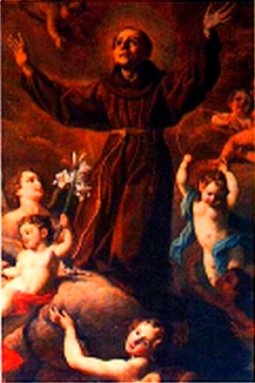 Saint Pacific of San Severino was born of a distinguished family in the Italian city of San Severino. As a child he evinced unusual seriousness, great piety, and love of mortification.
Early in his youthful life this spirit of mortification was put to the test. He was quite young when he became an orphan, and was taken to the home of his uncle, who brought him up very strictly. Two servants in his uncle’s home could not bear the sight of the boy and caused him many unpleasant experiences. If anything went wrong in the house, even if they were to blame for it, they accused the boy; and his uncle would then punish him severely for it. Pacific accepted the punishment in the spirit of mortification, bore it with remarkable patience, and so advanced in virtue.
Our Lord saw to it that his virtue was made manifest. One day a servant knocked the spigot of a wine barrel loose and all the wine ran out into the cellar. She blamed Pacific for it. His uncle took the boy down into the cellar with him to show him what he had done and to give him the punishment he deserved. The boy went along calmly. When they reached the cellar, they found the floor quite dry and the barrel full of wine. The maid was called, and when she saw the miracle, she admitted her fault and praised the holiness of the innocent boy.
When he was seventeen years old, Pacific entered the Order of Friars Minor. After the year of probation, he made his vows, and from that time took great pains to observe them perfectly. He was ordained to the priesthood when he was twenty-five years old. He was first assigned to the surrounding villages of the Apennines, where he found the greatest delight in preaching the Gospel to the poor and the uneducated. No road was too rough, no mountain too steep for him. He looked up the poor shepherds in their out-of-the-way huts in order to instruct and guide them on the road that leads to God.
Saint Pacific of San Severino was not long to enjoy this apostolic work. After a few years, he became ill and never completely recovered his health, so that he was obliged to serve God patiently with an infirm body for more than thirty years.
Pacific was completely satisfied with God’s designs in his regard. “God wills it,” he said in a cheerful way, “and so may His will be done.”
The painful suffering he had to endure, and the many acts of mortification he performed in addition, he joined to his unceasing prayers and offered them up for the salvation of souls and the conversion of sinners. Even in his sickness he was so modest that he would never allow anyone else to dress the ugly sores on his legs, but always took care of them himself.
When he was able to say holy Mass, Saint Pacific did it with the utmost fervor and devotion. In his later years he was often favored with ecstasies after the elevation at holy Mass. His countenance shone with a radiance like that of the sun. The sick were miraculously cured by him, and he foretold many future events.
When death finally summoned him and he had received Holy Communion for the last time with admirable devotion, he once more expressed his gratitude to God for all His benefits, and then, with his hands crossed upon his breast, surrendered his soul to his Creator. The day was September 24, 1721.
Many miracles occurred at his grave, and two dead persons were restored to life after his holy relics were applied to them. He was buried in a common grave used by his deceased brothers in the community, but his body was found incorrupt after four years, even though he was given no coffin.
When the body was moved, the head of the saint was accidently struck so hard against a stairway that the head of the corpse detached from the body. Blood flowed freely from the neck, splattering blood as if the body were still alive. The blood was sopped up with a shirt and kept as a relic.
Pope Gregory XVI cononized Saint Pacific in 1839.
from The Franciscan Book of Saints, edited by Marion Habig, OFM
Wednesday of the Twenty-fifth Week in Ordinary Time
Book of Proverbs 30:5-6 The believer replied, “Every promise of God proves true;
he protects everyone who runs to him for help.
So don’t second-guess him;
he might take you to task and show up your lies.”
7-9 And then he prayed, “God, I’m asking for two things
before I die; don’t refuse me—
Banish lies from my lips
and liars from my presence.
Give me enough food to live on,
neither too much nor too little.
If I’m too full, I might get independent,
saying, ‘God? Who needs him?’
If I’m poor, I might steal
and dishonor the name of my God.”
Psalms 119:25-32 I’m feeling terrible—I couldn’t feel worse!
Get me on my feet again. You promised, remember?
When I told my story, you responded;
train me well in your deep wisdom.
Help me understand these things inside and out
so I can ponder your miracle-wonders.
My sad life’s dilapidated, a falling-down barn;
build me up again by your Word.
Barricade the road that goes Nowhere;
grace me with your clear revelation.
I choose the true road to Somewhere,
I post your road signs at every curve and corner.
I grasp and cling to whatever you tell me;
God, don’t let me down!
I’ll run the course you lay out for me
if you’ll just show me how.
65-72 Be good to your servant, God;
be as good as your Word.
Train me in good common sense;
I’m thoroughly committed to living your way.
Before I learned to answer you, I wandered all over the place,
but now I’m in step with your Word.
You are good, and the source of good;
train me in your goodness.
The godless spread lies about me,
but I focus my attention on what you are saying;
They’re bland as a bucket of lard,
while I dance to the tune of your revelation.
My troubles turned out all for the best—
they forced me to learn from your textbook.
Truth from your mouth means more to me
than striking it rich in a gold mine.
89-96 What you say goes, God,
and stays, as permanent as the heavens.
Your truth never goes out of fashion;
it’s as up-to-date as the earth when the sun comes up.
Your Word and truth are dependable as ever;
that’s what you ordered—you set the earth going.
If your revelation hadn’t delighted me so,
I would have given up when the hard times came.
But I’ll never forget the advice you gave me;
you saved my life with those wise words.
Save me! I’m all yours.
I look high and low for your words of wisdom.
The wicked lie in ambush to destroy me,
but I’m only concerned with your plans for me.
I see the limits to everything human,
but the horizons can’t contain your commands!
97-104 Oh, how I love all you’ve revealed;
I reverently ponder it all the day long.
Your commands give me an edge on my enemies;
they never become obsolete.
I’ve even become smarter than my teachers
since I’ve pondered and absorbed your counsel.
I’ve become wiser than the wise old sages
simply by doing what you tell me.
I watch my step, avoiding the ditches and ruts of evil
so I can spend all my time keeping your Word.
I never make detours from the route you laid out;
you gave me such good directions.
Your words are so choice, so tasty;
I prefer them to the best home cooking.
With your instruction, I understand life;
that’s why I hate false propaganda.
161-168 I’ve been slandered unmercifully by the politicians,
but my awe at your words keeps me stable.
I’m ecstatic over what you say,
like one who strikes it rich.
I hate lies—can’t stand them!—
but I love what you have revealed.
Seven times each day I stop and shout praises
for the way you keep everything running right.
For those who love what you reveal, everything fits—
no stumbling around in the dark for them.
I wait expectantly for your salvation;
God, I do what you tell me.
My soul guards and keeps all your instructions—
oh, how much I love them!
I follow your directions, abide by your counsel;
my life’s an open book before you.
Holy Gospel of Jesus Christ according to Saint Luke 9: Keep It Simple
1-5 Jesus now called the Twelve and gave them authority and power to deal with all the demons and cure diseases. He commissioned them to preach the news of God’s kingdom and heal the sick. He said, “Don’t load yourselves up with equipment. Keep it simple; you are the equipment. And no luxury inns—get a modest place and be content there until you leave. If you’re not welcomed, leave town. Don’t make a scene. Shrug your shoulders and move on.”
6 Commissioned, they left. They traveled from town to town telling the latest news of God, the Message, and curing people everywhere they went.
Wednesday of the Twenty-fifth Week in Ordinary Time
Commentary of the Day:
Pope Francis
Apostolic Exhortation « Evangelii Gaudium / The Joy of the Gospel» § 181-183 (trans. © copyright Libreria Editrice Vaticana)
"They went from village to village proclaiming the good news"
Our mandate is to “go into all the world and proclaim the good news to the whole creation” (Mk 16,15), for “the creation waits with eager longing for the revealing of the children of God” (Rom 8,19). Here, “the creation” refers to every aspect of human life… The Church’s teachings concerning contingent situations are subject to new and further developments and can be open to discussion, yet we cannot help but be concrete… The Church’s pastors, taking into account the contributions of the different sciences, have the right to offer opinions on all that affects people’s lives, since the task of evangelization implies and demands the integral promotion of each human being.
It is no longer possible to claim that religion should be restricted to the private sphere and that it exists only to prepare souls for heaven. We know that God wants his children to be happy in this world too, even though they are called to fulfilment in eternity, for he has created all things “for our enjoyment” (1 Tim 6,17), the enjoyment of everyone. It follows that Christian conversion demands reviewing especially those areas and aspects of life “related to the social order and the pursuit of the common good” (St John Paul II).
Consequently, no one can demand that religion should be relegated to the inner sanctum of personal life, without influence on societal and national life, without concern for the soundness of civil institutions, without a right to offer an opinion on events affecting society. Who would claim to lock up in a church and silence the message of Saint Francis of Assisi or Blessed Teresa of Calcutta? They themselves would have found this unacceptable. An authentic faith – which is never comfortable or completely personal – always involves a deep desire to change the world, to transmit values, to leave this earth somehow better that we found it.
____________________________

No comments:
Post a Comment