 Nashville, Tennessee, United States - Upper Room Daily Reflections - daily words of wisdom and faith “Life Interrupted" for Monday, 14 September 2014
Today’s Reflection:
 SOMETIMES, WHEN LIFE IS INTERRUPTED, we feel confused. What is God up to? we wonder. Why is this happening? Our heads spin. We all face questions with no easy answers. We easily get caught up in all the question. Let’s not forget – questions are good!
May we ask questions and bring them before God. Jesus will be with us always, even in the questions. He sees our hearts. He sees our pain. Like the paralyzed man, we need healing, and Jesus desires to give it. Like the scribes, we also have questions in our hearts. We are welcome to ask them, and Jesus meets us in our questioning.(Jacob Armstrong, Interruptions)
From page 50 of Interruptions: A 40-Day Journey with Jesus by Jacob Armstrong. Copyright © 2014 by Jacob Armstrong. All rights reserved. Used by permission of Upper Room Books. http://bookstore.upperroom.org/ Learn more about or purchase this book.
Today’s Question:
What questions would you bring before God today?
Today’s Scripture:
The whole congregation of the Israelites complained against Moses and Aaron in the wilderness.
The Israelites said to them, “If only we had died by the hand of the LORD in the land of Egypt, when we sat by the fleshpots and ate our fill of bread; for you have brought us out into this wilderness to kill this whole assembly with hunger.”(Exodus 16:2-3, NRSV)
This Week: pray for struggling friendships.
___________________________
Did You Know?
In need of prayer? The Upper Room Living Prayer Center is a 7-day-a-week intercessory prayer ministry staffed by trained volunteers, call 1-800-251-2468.
___________________________
This week we remember:
Hildegard of Bingen (September 17).
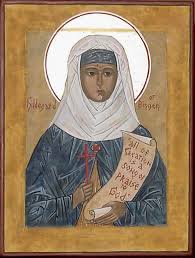 St. Hildegard began having visions in 1101, when she was just three years old. When she was eight, she joined a Benedictine monastery, and took her vows there at age fifteen. In 1136 Hildegard was elected abbess, and began writing and composing hymns. Her most famous work is Scivias (short for Scito vias Domini, or "Know the Ways of the Lord"), in which she detailed twenty-six of her revelations.
Hildegard founded a monastery near Bingen, Germany, in 1147, a facility large enough to support fifty nuns. Visited by visions all her life, she used her insights to guide others on the proper spiritual path for nearly eighty years. Hildegard died in 1179, leaving behind her Scivias as well as a book on medicine and another on natural history.
If Hildegard had taken the Spiritual Types Test, she probably would have been a Mystic. Hildegard is remembered on September 17.
____________________________
Lectionary Readings
(Courtesy of Vanderbilt Divinity Library)
Lectionary Scriptures:
Exodus 16:2-15
Psalm 105:1-6, 37-45
Philippians 1:21-30
Matthew 20:1-16
Scripture Text:
Exodus 16:1-3 On the fifteenth day of the second month after they had left Egypt, the whole company of Israel moved on from Elim to the Wilderness of Sin which is between Elim and Sinai. The whole company of Israel complained against Moses and Aaron there in the wilderness. The Israelites said, “Why didn’t God let us die in comfort in Egypt where we had lamb stew and all the bread we could eat? You’ve brought us out into this wilderness to starve us to death, the whole company of Israel!”
4-5 God said to Moses, “I’m going to rain bread down from the skies for you. The people will go out and gather each day’s ration. I’m going to test them to see if they’ll live according to my Teaching or not. On the sixth day, when they prepare what they have gathered, it will turn out to be twice as much as their daily ration.”
6-7 Moses and Aaron told the People of Israel, “This evening you will know that it is God who brought you out of Egypt; and in the morning you will see the Glory of God. Yes, he’s listened to your complaints against him. You haven’t been complaining against us, you know, but against God.”
8 Moses said, “Since it will be God who gives you meat for your meal in the evening and your fill of bread in the morning, it’s God who will have listened to your complaints against him. Who are we in all this? You haven’t been complaining to us—you’ve been complaining to God!”
9 Moses instructed Aaron: “Tell the whole company of Israel: ‘Come near to God. He’s heard your complaints.’”
10 When Aaron gave out the instructions to the whole company of Israel, they turned to face the wilderness. And there it was: the Glory of God visible in the Cloud.
11-12 God spoke to Moses, “I’ve listened to the complaints of the Israelites. Now tell them: ‘At dusk you will eat meat and at dawn you’ll eat your fill of bread; and you’ll realize that I am God, your God.’”
13-15 That evening quail flew in and covered the camp and in the morning there was a layer of dew all over the camp. When the layer of dew had lifted, there on the wilderness ground was a fine flaky something, fine as frost on the ground. The Israelites took one look and said to one another, man-hu (What is it?). They had no idea what it was.
15-16 So Moses told them, “It’s the bread God has given you to eat. And these are God’s instructions: ‘Gather enough for each person, about two quarts per person; gather enough for everyone in your tent.’”
Psalm 105:1-6 Hallelujah!
Thank God! Pray to him by name!
Tell everyone you meet what he has done!
Sing him songs, belt out hymns,
translate his wonders into music!
Honor his holy name with Hallelujahs,
you who seek God. Live a happy life!
Keep your eyes open for God, watch for his works;
be alert for signs of his presence.
Remember the world of wonders he has made,
his miracles, and the verdicts he’s rendered—
O seed of Abraham, his servant,
O child of Jacob, his chosen.
23-42 Then Israel entered Egypt,
Jacob immigrated to the Land of Ham.
God gave his people lots of babies;
soon their numbers alarmed their foes.
He turned the Egyptians against his people;
they abused and cheated God’s servants.
Then he sent his servant Moses,
and Aaron, whom he also chose.
They worked marvels in that spiritual wasteland,
miracles in the Land of Ham.
He spoke, “Darkness!” and it turned dark—
they couldn’t see what they were doing.
He turned all their water to blood
so that all their fish died;
He made frogs swarm through the land,
even into the king’s bedroom;
He gave the word and flies swarmed,
gnats filled the air.
He substituted hail for rain,
he stabbed their land with lightning;
He wasted their vines and fig trees,
smashed their groves of trees to splinters;
With a word he brought in locusts,
millions of locusts, armies of locusts;
They consumed every blade of grass in the country
and picked the ground clean of produce;
He struck down every firstborn in the land,
the first fruits of their virile powers.
He led Israel out, their arms filled with loot,
and not one among his tribes even stumbled.
Egypt was glad to have them go—
they were scared to death of them.
God spread a cloud to keep them cool through the day
and a fire to light their way through the night;
They prayed and he brought quail,
filled them with the bread of heaven;
He opened the rock and water poured out;
it flowed like a river through that desert—
All because he remembered his Covenant,
his promise to Abraham, his servant.
43-45 Remember this! He led his people out singing for joy;
his chosen people marched, singing their hearts out!
He made them a gift of the country they entered,
helped them seize the wealth of the nations
So they could do everything he told them—
could follow his instructions to the letter.
Hallelujah!
Philippians 1:18-21 So how am I to respond? I’ve decided that I really don’t care about their motives, whether mixed, bad, or indifferent. Every time one of them opens his mouth, Christ is proclaimed, so I just cheer them on!
And I’m going to keep that celebration going because I know how it’s going to turn out. Through your faithful prayers and the generous response of the Spirit of Jesus Christ, everything he wants to do in and through me will be done. I can hardly wait to continue on my course. I don’t expect to be embarrassed in the least. On the contrary, everything happening to me in this jail only serves to make Christ more accurately known, regardless of whether I live or die. They didn’t shut me up; they gave me a pulpit! Alive, I’m Christ’s messenger; dead, I’m his bounty. Life versus even more life! I can’t lose.
22-26 As long as I’m alive in this body, there is good work for me to do. If I had to choose right now, I hardly know which I’d choose. Hard choice! The desire to break camp here and be with Christ is powerful. Some days I can think of nothing better. But most days, because of what you are going through, I am sure that it’s better for me to stick it out here. So I plan to be around awhile, companion to you as your growth and joy in this life of trusting God continues. You can start looking forward to a great reunion when I come visit you again. We’ll be praising Christ, enjoying each other.
27-30 Meanwhile, live in such a way that you are a credit to the Message of Christ. Let nothing in your conduct hang on whether I come or not. Your conduct must be the same whether I show up to see things for myself or hear of it from a distance. Stand united, singular in vision, contending for people’s trust in the Message, the good news, not flinching or dodging in the slightest before the opposition. Your courage and unity will show them what they’re up against: defeat for them, victory for you—and both because of God. There’s far more to this life than trusting in Christ. There’s also suffering for him. And the suffering is as much a gift as the trusting. You’re involved in the same kind of struggle you saw me go through, on which you are now getting an updated report in this letter.
Matthew 20: A Story About Workers
1-2 “God’s kingdom is like an estate manager who went out early in the morning to hire workers for his vineyard. They agreed on a wage of a dollar a day, and went to work.
3-5 “Later, about nine o’clock, the manager saw some other men hanging around the town square unemployed. He told them to go to work in his vineyard and he would pay them a fair wage. They went.
5-6 “He did the same thing at noon, and again at three o’clock. At five o’clock he went back and found still others standing around. He said, ‘Why are you standing around all day doing nothing?’
7 “They said, ‘Because no one hired us.’
“He told them to go to work in his vineyard.
8 “When the day’s work was over, the owner of the vineyard instructed his foreman, ‘Call the workers in and pay them their wages. Start with the last hired and go on to the first.’
9-12 “Those hired at five o’clock came up and were each given a dollar. When those who were hired first saw that, they assumed they would get far more. But they got the same, each of them one dollar. Taking the dollar, they groused angrily to the manager, ‘These last workers put in only one easy hour, and you just made them equal to us, who slaved all day under a scorching sun.’
13-15 “He replied to the one speaking for the rest, ‘Friend, I haven’t been unfair. We agreed on the wage of a dollar, didn’t we? So take it and go. I decided to give to the one who came last the same as you. Can’t I do what I want with my own money? Are you going to get stingy because I am generous?’
16 “Here it is again, the Great Reversal: many of the first ending up last, and the last first.”
John Wesley Notes-Commentary:
Exodus 16:2-15
Verse 2
[2] And the whole congregation of the children of Israel murmured against Moses and Aaron in the wilderness:
Then the whole congregation murmured against Moses and Aaron — God's viceregents among them.
Verse 3
[3] And the children of Israel said unto them, Would to God we had died by the hand of the LORD in the land of Egypt, when we sat by the flesh pots, and when we did eat bread to the full; for ye have brought us forth into this wilderness, to kill this whole assembly with hunger.
They so undervalue their deliverance, that they wish, they had died in Egypt, nay, and died by the hand of the Lord too. That is, by some of the plagues which cut off the Egyptians; as if it were not the hand of the Lord, but of Moses only, that brought them into this wilderness. 'Tis common for people to say of that pain, or sickness, which they see not second causes of, It is what pleaseth God, as if that were not so likewise which comes by the hand of man, or some visible accident. We cannot suppose they had any great plenty in Egypt, how largely soever they now talk of the flesh-pots, nor could they fear dying for want in the wilderness while they had their flocks and herds with them; but discontent magnifies what is past, and vilifies what is present, without regard to truth or reason. None talk more absurdly than murmurers.
Verse 4
[4] Then said the LORD unto Moses, Behold, I will rain bread from heaven for you; and the people shall go out and gather a certain rate every day, that I may prove them, whether they will walk in my law, or no.
Man being made out of the earth, his Maker has wisely ordered him food out of the earth, Psalms 104:14. But the people of Israel typifying the church of the first-born that are written in heaven, receiving their charters, laws and commissions from heaven, from heaven also they received their food. See what God designed in making this provision for them, that I may prove them whether they will walk in my law or no - Whether they will trust me, and whether they would serve him, and be ever faithful to so good a master.
Verse 5
[5] And it shall come to pass, that on the sixth day they shall prepare that which they bring in; and it shall be twice as much as they gather daily.
They shall prepare — Lay up, grind, bake or boil.
Verse 6
[6] And Moses and Aaron said unto all the children of Israel, At even, then ye shall know that the LORD hath brought you out from the land of Egypt:
The Lord — And not we, (as you suggest) by our own counsel.
Verse 10
[10] And it came to pass, as Aaron spake unto the whole congregation of the children of Israel, that they looked toward the wilderness, and, behold, the glory of the LORD appeared in the cloud.
The glory of the Lord — An extra-ordinary and sudden brightness.
Verse 12
[12] I have heard the murmurings of the children of Israel: speak unto them, saying, At even ye shall eat flesh, and in the morning ye shall be filled with bread; and ye shall know that I am the LORD your God.
And ye shall know that I am the Lord your God — This gave proof of his power as the Lord, and his particular favour to them as their God; when God plagued the Egyptians, it was to make them know that he is the Lord; when he provided for the Israelites, it was to make them know that he was their God.
Verse 13
[13] And it came to pass, that at even the quails came up, and covered the camp: and in the morning the dew lay round about the host.
The quails came up, and covered the camp — So tame that they might take up as many of them as they pleased. Next morning he rained manna upon them, which was to be continued to them for their daily bread.
Verse 15
[15] And when the children of Israel saw it, they said one to another, It is manna: for they wist not what it was. And Moses said unto them, This is the bread which the LORD hath given you to eat.
What is this? Manna descended from the clouds. It came down in dew melted, and yet was itself of such a consistency as to serve for nourishing strengthening food, without any thing else: It was pleasant food; the Jews say it was palatable to all, according as their tastes were. It was wholesome food, light of digestion. By this spare and plain diet we are all taught a lesson of temperance, and forbidden to desire dainties and varieties.
Psalm 105:1-6, 37-45
Verse 3
[3] Glory ye in his holy name: let the heart of them rejoice that seek the LORD.
Glory — Glory in the God whom you serve, as the only true God.
Verse 4
[4] Seek the LORD, and his strength: seek his face evermore.
Seek — The Lord in his strength, in his sanctuary, or before the ark, which is called God's strength.
Face — His gracious presence.
Verse 5
[5] Remember his marvellous works that he hath done; his wonders, and the judgments of his mouth;
Judgments — The punishments which he brought upon Egypt by his mere word.
Verse 6
[6] O ye seed of Abraham his servant, ye children of Jacob his chosen.
Of Jacob — The only branch of Abraham's seed to whom the following blessings belong.
Verse 37
[37] He brought them forth also with silver and gold: and there was not one feeble person among their tribes.
Feeble — Diseased or unable for his journey: which in so vast a body, and in a people who had been so dreadfully oppressed, was wonderful.
Verse 39
[39] He spread a cloud for a covering; and fire to give light in the night.
Covering — To protect them from the heat of the sun.
Verse 40
[40] The people asked, and he brought quails, and satisfied them with the bread of heaven.
Quails — He speaks of the first giving of quails, Exodus 16:13, which God gave them as a refreshment, notwithstanding their sin in desiring them, which he graciously pardoned.
Bread — With manna which came out of the air, commonly called heaven.
Verse 41
[41] He opened the rock, and the waters gushed out; they ran in the dry places like a river.
River — They flowed in channels which God provided for them, and followed the Israelites in their march.
Verse 44
[44] And gave them the lands of the heathen: and they inherited the labour of the people;
Labour — The fruits of their labour; their cities, vineyards, olive-yards.
Philippians 1:21-30
Verse 21
[21] For to me to live is Christ, and to die is gain.
To me to live is Christ — To know, to love, to follow Christ, is my life, my glory, my joy.
Verse 22
[22] But if I live in the flesh, this is the fruit of my labour: yet what I shall choose I wot not.
Here he begins to treat of the former clause of the preceding verse. Of the latter he treats, Philippians 2:17.
But if I am to live is the flesh, this is the fruit of my labour — This is the fruit of my living longer, that I can labour more. Glorious labour! desirable fruit! in this view, long life is indeed a blessing.
And what I should choose I know not — That is, if it were left to my choice.
Verse 23
[23] For I am in a strait betwixt two, having a desire to depart, and to be with Christ; which is far better:
To depart — Out of bonds, flesh, the world.
And to be with Christ — In a nearer and fuller union. It is better to depart; it is far better to be with Christ.
Verse 25
[25] And having this confidence, I know that I shall abide and continue with you all for your furtherance and joy of faith;
I know — By a prophetic notice given him while he was writing this. That I shall continue some time longer with you - And doubtless he did see them after this confinement.
Verse 27
[27] Only let your conversation be as it becometh the gospel of Christ: that whether I come and see you, or else be absent, I may hear of your affairs, that ye stand fast in one spirit, with one mind striving together for the faith of the gospel;
Only — Be careful for this, and nothing else.
Stand fast in one spirit — With the most perfect unanimity.
Striving together — With united strength and endeavours.
For the faith of the gospel — For all the blessings revealed and promised therein.
Verse 28
[28] And in nothing terrified by your adversaries: which is to them an evident token of perdition, but to you of salvation, and that of God.
Which — Namely, their being adversaries to the word of God, and to you the messengers of God.
Is an evident token — That they are in the high road to perdition; and you, in the way of salvation.
Verse 29
[29] For unto you it is given in the behalf of Christ, not only to believe on him, but also to suffer for his sake;
For to you it is given — As a special token of God's love, and of your being in the way of salvation.
Verse 30
[30] Having the same conflict which ye saw in me, and now hear to be in me.
Having the same kind of conflict with your adversaries, which ye saw in me - When I was with you, Acts 16:12,19, etc.
Matthew 20:1-16
Verse 2
[2] And when he had agreed with the labourers for a penny a day, he sent them into his vineyard.
The Roman penny was about seven pence halfpenny. [About thirteen and three quarter cents, American.] This was then the usual price of a day's labour.
Verse 6
[6] And about the eleventh hour he went out, and found others standing idle, and saith unto them, Why stand ye here all the day idle?
About the eleventh hour — That is, very late; long after the rest were called.
Verse 8
[8] So when even was come, the lord of the vineyard saith unto his steward, Call the labourers, and give them their hire, beginning from the last unto the first.
In the evening — Of life; or of the world.
Verse 9
[9] And when they came that were hired about the eleventh hour, they received every man a penny.
Who were hired about the eleventh hour — Either the Gentiles, who were called long after the Jews into the vineyard of the Church of Christ; or those in every age who did not hear, or at least understand the Gospel call, till their day of life was drawing to a period. Some circumstances of the parable seem best to suit the former, some the latter of these senses.
Verse 10
[10] But when the first came, they supposed that they should have received more; and they likewise received every man a penny.
The first supposed they should have received more — Probably the first here may mean the Jews, who supposed they should always be preferred before the Gentiles.
Verse 12
[12] Saying, These last have wrought but one hour, and thou hast made them equal unto us, which have borne the burden and heat of the day.
Thou hast made them equal to us — So St. Peter expressly, Acts 15:9. God-hath put no difference between us (Jews) and them, (Gentiles,) purifying their hearts by faith. And those who were equally holy here, whenever they were called, will be equally happy hereafter.
Verse 14
[14] Take that thine is, and go thy way: I will give unto this last, even as unto thee.
It is my will to give to this last called among the heathens even as to the first called among the Jews: yea, and to the late converted publicans and sinners, even as to those who, were called long before.
Verse 15
[15] Is it not lawful for me to do what I will with mine own? Is thine eye evil, because I am good?
Is it not lawful for me to do what I will with my own? — Yea, doubtless, to give either to Jew or Gentile a reward infinitely greater than he deserves. But can it be inferred from hence, that it is lawful, or possible, for the merciful Father of spirits to "Consign an unborn soul to hell? Or damn him from his mother's womb?" Is thine eye evil because I am good - Art thou envious, because I am gracious? Here is an evident reference to that malignant aspect, which is generally the attendant of a selfish and envious temper.
Verse 16
[16] So the last shall be first, and the first last: for many be called, but few chosen.
So the last shall be first, and the first last — Not only with regard to the Jews and Gentiles, but in a thousand other instances.
For many are called — All who hear the Gospel; but few chosen - Only those who obey it. Matthew 19:30; 22:14.
____________________________
Upper Room Daily Reflections, a ministry of Global Board of Discipleship
PO Box 340004
Nashville, TN 37203-0004 United States
____________________________

No comments:
Post a Comment