 |  |
Alumni Hall of Fame Nominations Alumni Hall of Fame nominations are now being accepted! The Alumni Hall of Fame recognizes alumni who have distinguished themselves since graduation and exemplify the Grand Canyon University spirit. Nominations can be submitted here by Dec. 31, 2014. Alumni can nominate themselves or other GCU graduates. The Office of Alumni Relations will be announcing the inductees at the Alumni Hall of Fame Ceremony on Feb. 14, 2015 during the annual Homecoming event. Alumni Hall of Fame nominations are now being accepted! The Alumni Hall of Fame recognizes alumni who have distinguished themselves since graduation and exemplify the Grand Canyon University spirit. Nominations can be submitted here by Dec. 31, 2014. Alumni can nominate themselves or other GCU graduates. The Office of Alumni Relations will be announcing the inductees at the Alumni Hall of Fame Ceremony on Feb. 14, 2015 during the annual Homecoming event. | Fall Festival is Thursday, Oct. 30 The annual Fall Festival is a Grand Canyon University tradition that brings more than 5,000 community members to campus and provides a safe place for local children to trick-or-treat. GCU employees and students come together to volunteer at the festival, donate candy for trick-or-treating and more. Interested in volunteering or attending this family-friendly event? Learn more. The annual Fall Festival is a Grand Canyon University tradition that brings more than 5,000 community members to campus and provides a safe place for local children to trick-or-treat. GCU employees and students come together to volunteer at the festival, donate candy for trick-or-treating and more. Interested in volunteering or attending this family-friendly event? Learn more. |
 |  |
Alumni Spotlight: Gustavo Anton.jpg "alumni spotlight") Gustavo Anton, B.S. in Biology with an Emphasis in Pre-Medicine, ’12 was a hard-working student during his time here at Grand Canyon University and has proved that you can do anything you set your mind to. After graduating from GCU with a 3.9 GPA, Anton was accepted into Midwestern University’s medical program where he continues to shine in his role as a Work-Study student. Watch to see how this GCU alumnus has overcome dyslexia and is working toward his dream of becoming a doctor. Gustavo Anton, B.S. in Biology with an Emphasis in Pre-Medicine, ’12 was a hard-working student during his time here at Grand Canyon University and has proved that you can do anything you set your mind to. After graduating from GCU with a 3.9 GPA, Anton was accepted into Midwestern University’s medical program where he continues to shine in his role as a Work-Study student. Watch to see how this GCU alumnus has overcome dyslexia and is working toward his dream of becoming a doctor. | Alumnus Gets a Great Lesson in Colombia Jim Mostofo, B.A. in History, ’91 volunteered for two months as an English teacher at two universities in Medellin, Colombia this past April. He had such a great experience that he applied for a Fullbright Scholarship, which would allow him to spend a whole semester in Colombia, where he is hoping to teach English. Read moreabout Mostofo’s experience. Jim Mostofo, B.A. in History, ’91 volunteered for two months as an English teacher at two universities in Medellin, Colombia this past April. He had such a great experience that he applied for a Fullbright Scholarship, which would allow him to spend a whole semester in Colombia, where he is hoping to teach English. Read moreabout Mostofo’s experience.A teacher gets a great lesson in Colombia
By Rick Vacek
GCU News Bureau
A guy who says his job is to “teach teachers how to teach” went to Colombia to get an education.
That’s Colombia, the country, not Columbia University in New York City.
Jim Mostofo, an assistant professor in the College of Education at Grand Canyon University and also a GCU graduate, left in late April for a one-month volunteer assignment helping teach English at two universities in Medellin, Colombia. He loved it so much – and was learning so much – that one month became two even though it cost him $370 to change his plane ticket. Now, he’s applying for a Fulbright Scholarship, which would mean teaching there for an entire semester.

Jim Mostofo (top left) with some of the Colombian students and the professor he shadowed, Juan Gomez (far right). (Photos courtesy of Jim Mostofo)
“I would have stayed longer,” he said, “but I was running out of money.”
As many might, Mostofo pictured Medellin as a drug-infested, violent culture virtually devoid of anyone outside the beaten-down local populace. What he found was a cosmopolitan, growing city that has transformed itself from its former reputation as “the world’s most dangerous city” under the domination of Pablo Escobar, “The King of Cocaine.”
After Escobar was killed in a shootout with Colombian security forces on Dec. 2, 1993, authorities eventually were able to set Medellin on a new course. As a sign of that turnaround, the city was host this year to the World Urban Forum. Tourism, including visitors from the United States, is up. Colombia has become a destination.
“There are a lot of foreigners there now,” he said. “I didn’t stand out like I thought I would.”
Mostofo worked at two universities shadowing Juan Gomez, a professor from New York who has been in Colombia for two decades. And while Mostofo didn’t stand out when he walked down the streets of the city of 2.1 million, his accent certainly fascinated his students.
“They loved the way I talked, just because it was different,” he said. “They would listen and they would understand, but they would not speak because they were afraid to make a mistake. And I understand that because it’s the same as when I try to speak Spanish. I know a limited amount, but I have trouble speaking in complete sentences.”
Mostofo also found, much to his surprise, that teaching English can be a challenge. It’s one thing to know grammar, but it’s quite another to be able to explain grammatical terms you haven’t studied religiously since you were in school.
Most of the students were about halfway to what is considered the top level of spoken English, and Mostofo found they were much more comfortable writing English than speaking it. But that didn’t prevent him from having conversations with the students, and what he learned from them is intriguing.
“They wanted to hear American stories,” he said. “And they had a lot of questions. For example, they wanted to know why Americans are fat.”
As a fitness enthusiast, Mostofo is anything but fat, but he explained to them that many restaurants offer free soda refills and large food portions, and that many Americans avoid exercise. In Medellin, he said, drinks are served in small glasses and most families have only one car, if that. When Colombians need to travel, they walk long distances, take public transportation or both.
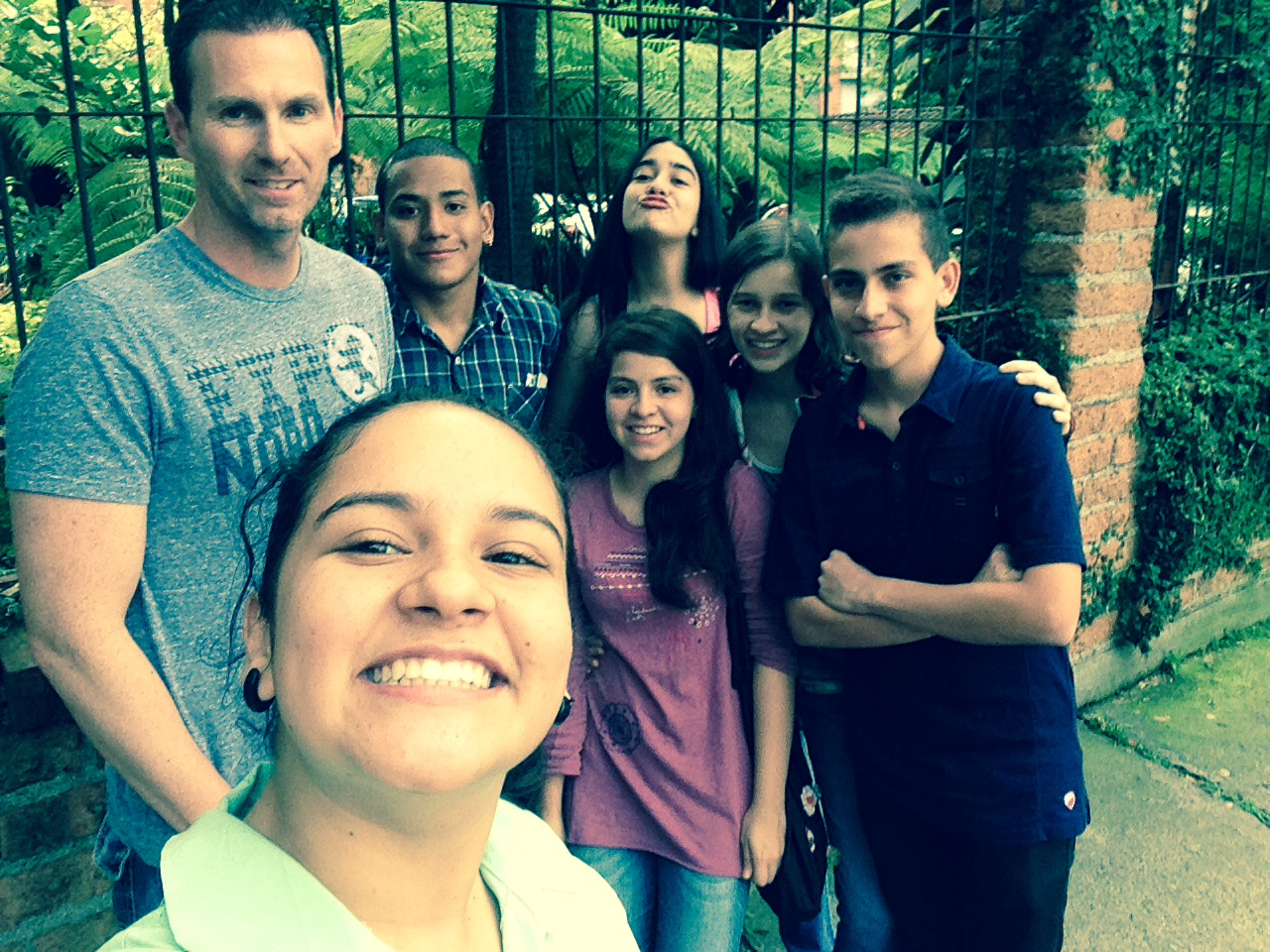
Members of a youth group at Jim Mostofo’s church showed him around Medellin.
The students also wanted to know what Americans think of Colombia. When Mostofo told them the perception of danger still lives on in the minds of many people, the students were incensed. They are proud of their country’s progress and want the world to know about it.
Mostofo said Medellin’s neighborhoods are divided into six categories, with 6 being the richest and 1 being the poorest. As long as the area in which he was walking was at least a 3, he felt safe.The Colombians he encountered thought nothing of going out of their way to help visitors who were lost. Once, he exited the wrong door of a theatre in a “2″ neighborhood, was unable to hail a taxi and was not sure where he was going. Seemingly out of nowhere, a woman appeared and shepherded him to safety.
The locals told him visitors usually stand out in their cargo shorts and flip-flops. Unfortunately, Mostofo saw more than a few examples of Americans not putting their best flip-flop forward, behavior-wise. One Colombian man told him, “You’re the first nice American I’ve ever met.”
There were days when Mostofo felt lonely, being in a foreign country where he barely knew the language. One of his greatest victories was connecting with the local cable-television provider and figuring out how to watch programs in English. His fitness regimen, which included daily workouts at a third university, put him in touch with people who expressed interest in having him come back to teach.
It’s all part of the educational process. And here’s the funny part: Mostofo’s never been to New York. The students in Medellin, fascinated by American culture and figuring that it all starts with the Big Apple, found that unconscionable. So he intends to get there someday, too.
___
To see a GCU video about Mostofo’s passion for teaching, click here.
Contact Rick Vacek at 602.639.8203 or rick.vacek@gcu.edu.
|
 |  |
GCU Partners with Midwestern University Grand Canyon University has partnered with Midwestern University to reserve dozens of seats in medical school and other health care graduate programs for some of GCU’s top graduates. Midwestern receives a stream of well-trained future doctors and other health care professionals from GCU, which has continued to offer undergraduate biology programs that help prepare students for rigorous graduate program admissions requirements. Read more about this exciting partnership! Grand Canyon University has partnered with Midwestern University to reserve dozens of seats in medical school and other health care graduate programs for some of GCU’s top graduates. Midwestern receives a stream of well-trained future doctors and other health care professionals from GCU, which has continued to offer undergraduate biology programs that help prepare students for rigorous graduate program admissions requirements. Read more about this exciting partnership!GCU inks med school partnership with Midwestern
By Michael Ferraresi
GCU News Bureau
Grand Canyon University has partnered with Midwestern University on a series of agreements that reserve dozens of seats in medical school and other health care graduate programs for some of GCU’s top students.
GCU’s main campus and Midwestern University’s campus in Glendale are separated by 15 miles. But the universities are bound together for the foreseeable future with a dedicated pipeline of GCU students filling spots in Midwestern’s highly competitive graduate programs in osteopathic medicine, podiatry and biomedical sciences and in other health care graduate fields.

Midwestern University in Glendale will provide seats in its medical school and other health care graduate programs to GCU students that meet its standards for excellence. (Photo: Midwestern University)
By reserving those seats, Midwestern receives a stream of well-trained future doctors and other health care professionals from GCU, which for years has built undergraduate biology programs to prepare students for rigorous graduate program admissions requirements. GCU students have been accepted at some of the top medical schools in the U.S., including those at Harvard University, Cornell University and University of Michigan.
Dr. Mark Wooden, dean of GCU’s College of Science, Engineering and Technology, said Midwestern has become so familiar with GCU’s standards for excellence over the past few years that the new agreement seems like a natural fit.
“They recognize that we are putting out a lot of strong applicants,” Wooden said. “Even without articulations, we’ve put a lot of students in their programs over the past few years.”
Midwestern and GCU have 14 articulation agreements, which document student transfer policies, that reserve as many as 66 graduate program seats in several academic areas.
At Midwestern’s Arizona College of Osteopathic Medicine in Glendale, 10 seats are reserved for GCU students who meet the academic requirements and Medical College Admission Test standards for acceptance. Additional seats are reserved at Midwestern’s Glendale-based programs in podiatric medicine, biomedical sciences, cardiovascular science and clinical psychology (6 seats each), pharmacy (5), physical therapy (4), occupational therapy (3), veterinary medicine (2) and physician assistant (1).
Midwestern has nearly 4,000 students on its Glendale campus and more than 2,900 at its campus in Downers Grove, Ill., west of Chicago, where GCU students can apply for reserved seats in the programs in biomedical sciences and clinical psychology (6 seats each), occupational therapy (3) and physical therapy (2).
University leaders are discussing additional agreements, including placing GCU students in Midwestern’s dental and optometry programs.
Wooden said Arizona faces the challenge of losing talented students to out-of-state medical schools, who then don’t return to Arizona to practice. With the Midwestern agreement, more students who want to stay close to their homes or families in Arizona will have the opportunity to do so, he said.
Also, standards for acceptance to Midwestern – grade-point-average and Medical College Admission Test scores — will be high for articulation students. So Midwestern potentially could admit GCU graduates who excel in their Midwestern interviews who would be considered excellent candidates at other medical schools, which would help keep top local medical students in Phoenix.
“If a student hits that bar we’ve set with Midwestern, they’re a strong applicant anywhere,” Wooden said.
Dr. Kathy Player, Midwestern’s chief academic officer and vice president of health sciences, characterized the agreements as essential to both universities’ growth.
They’re also a boon to GCU’s medical school applicants, Player said. Some GCU graduates applying to medical schools don’t hear from those schools until late in the summer, just before the start of the fall semester. It’s a stressful process that both Midwestern and GCU hope to solve by identifying the most qualified candidates who want to stay close to home.
“It’s like an early admission process specific to GCU students,” Player said. “It keeps them from being put on a wait list to hear the news.”
Like GCU, Midwestern prides itself on smaller class sizes and intimate instructor-student relationships that emphasize state-of-the-art learning environments with real-world or clinical applications of classroom material.
Large state universities frequently share students and resources, often through pipelines between undergraduate programs and graduate programs on separate campuses. GCU and Midwestern officials decided it was time to do the same since both universities share similar philosophies about science-oriented pedagogy.
“It only makes sense to embrace that partnership,” said Player, who joined Midwestern in January after 16 years at GCU during which she served as president, chief academic officer, provost and dean of theCollege of Business. “I have first-hand knowledge of the high quality students GCU produces and know the high quality programs Midwestern University offers. This partnership creates as seamless a transition as possible between two local private institutions with the mutual goal of producing the best health care professionals dedicated to serving the needs of the future.”
Dr. Perry Baker, associate dean over CSET’s health care programs, said Midwestern has a reputation as a private graduate school that develops thoughtful doctors and other health care professionals. He said GCU graduates attending Midwestern likely will find the smaller class sizes and access to professors comparable to what they experienced at GCU.
Baker served as program coordinator and professor of biomedical sciences at Midwestern’s Glendale campus before shifting over to GCU, his alma mater, this summer.
“We’re very much on the same page as far as our philosophies,” Baker said. “Instructors are there because they want to teach as opposed to doing research all the time.”
Reach Michael Ferraresi at 602-639-7030 or michael.ferraresi@gcu.edu.
|
Communication Styles in the Office
 Career Services provides some great advice on how to better understand your co-workers’ communication styles as well as your own, in order to work more collaboratively with each other and improve the overall effectiveness of your organization. Learn more about the significant differences in communication styles and personality traits as well as how to improve your self-awareness in the workplace. Career Services provides some great advice on how to better understand your co-workers’ communication styles as well as your own, in order to work more collaboratively with each other and improve the overall effectiveness of your organization. Learn more about the significant differences in communication styles and personality traits as well as how to improve your self-awareness in the workplace. |
 |  |
Lopes Give Hope Alumni volunteers are needed on Friday, Nov. 7 to help pack nutritious meals for those in need. There are two available shifts: 9:30-11:30 a.m. and noon-2 p.m. Volunteers will meet at Feed My Starving Children in Tempe, AZ, a non-profit Christian organization that provides hand-packed meals formulated for malnourished children. Join GCU alumni and students on this community outreach project to help those in need. For more information and to RSVP click here. Please indicate desired shift in email. Alumni volunteers are needed on Friday, Nov. 7 to help pack nutritious meals for those in need. There are two available shifts: 9:30-11:30 a.m. and noon-2 p.m. Volunteers will meet at Feed My Starving Children in Tempe, AZ, a non-profit Christian organization that provides hand-packed meals formulated for malnourished children. Join GCU alumni and students on this community outreach project to help those in need. For more information and to RSVP click here. Please indicate desired shift in email. |
Colangelo College of Business Unveiled
 Jerry Colangelo has long been a nationally renowned leader in sports. He is easily one of the most influential business and community icons in the Valley and a valued adviser for Grand Canyon University. His integrity and expertise will command an even larger presence at GCU now that his name will be on the business college as the Colangelo College of Business. Read more about the announcementhere. Jerry Colangelo has long been a nationally renowned leader in sports. He is easily one of the most influential business and community icons in the Valley and a valued adviser for Grand Canyon University. His integrity and expertise will command an even larger presence at GCU now that his name will be on the business college as the Colangelo College of Business. Read more about the announcementhere. |
| “Be strong and courageous. Do not be afraid or terrified because of them, for the Lord your God goes with you; he will never leave you nor forsake you.” (Deuteronomy 31:6) |

Grand Canyon University
3300 W. Camelback Road
Phoenix, Arizona 85017. United States

No comments:
Post a Comment