NOTE: This is a digest of news features provided by United Methodist Communications for Oct. 13-17. It includes summaries of United Methodist News Service stories and additional briefs from around the United Methodist connection. Full versions of the stories with photographs and related features can be found at umc.org/news.
Top Stories:
Church agency uses animation to battle Ebola
NASHVILLE, Tenn. (UMNS) — by Kathy L. Gilbert and Joey Butler, NASHVILLE, Tenn. (UMNS)
http://vimeo.com/108650573
View on Vimeo | Download HD Video (794 MB)
Just before he dies from Ebola, the sick boy in the animation video pleads with his mother: “I know you yearn to hold and care for me … to bathe your child in the cool shade of our home. But because you love me, Mama, I need you to be stronger than your tears.”
Phileas Jusu Jr., 11, reads the script with the conviction of someone who knows the story is true. Thousands have died of Ebola in his home country of Sierra Leone.
Young Jusu is one of the voices used for the animated video “Ebola: A Poem for the Living,” created by Chocolate Moose Media and mobile-health-education innovator iHeed in collaboration with United Methodist Communications.
His younger brother, Peter, 9, reads the Krio version. Krio is one of the country’s indigenous languages. Both boys are sons of Sierra Leone United Methodist communicator Phileas Jusu.
The video is available in eight languages, all using young voices.
“It was our biggest problem,” said Chocolate Moose Media founder Firdaus Kharas. “We had to get the exact age and accent because we were speaking directly to West Africans. The emotions would be the toughest because this was a life-and-death situation. I didn’t want something too flat or too emotional; the balance was crucial.”
“I feel proud that the whole country will be listening to animations from The United Methodist Church done through the voices of my children,” Jusu said.
The video was created for use in West Africa to help dispel myths about how Ebola is spread and promotes prevention of the disease. The video can be viewed and downloaded free at ebolavideo.com. United Methodist Communications provided partial funding for Chocolate Moose Media to create the video, which will be produced in various languages. iHeed served as executive producer.
“Our goal is to provide education that leads to better understanding of the disease and how to prevent infections,” said the Rev. Larry Hollon, chief executive of United Methodist Communications. “Ebola gains its foothold in poor communities where mistrust, resistance to proper care, and lack of understanding of the virus and how it is transmitted is widespread. The church’s advantage lies in its grassroots network of trusted clergy and leaders who live in the affected regions.”
Kharas said he co-created the animation to “give Africans a voice.”
Kharas is an award-winning animator whose shorts addressing health, violence, literacy, malaria and cultural differences have been shown in more than 150 countries and adapted into more than 90 languages. He said the 30-second spots are the easiest way to reach large numbers and are accessible directly by the end user, the person whose behavior he’s trying to change.
“I create a cultural shift,” he said. “As human beings, we share values in common, so it is possible to communicate across borders and cultures using things like humor and animation.”
Kharas was one of the keynote speakers at the September 2014 Game Changers Summit hosted by United Methodist Communications. He debuted the script at that event.
iHeed is an Irish social enterprise dedicated to innovation in global health worker training.
“Digital media and animation can help fill the awareness and educational gaps in regards to the Ebola epidemic,” said Dr. Kunal D. Patel, medical director of iHeed. “In combination with technologies such as mobile phones, mobile cinemas, projectors and tablets, animated information can rapidly help counter the spread of Ebola."
Communication aids prevention
United Methodist Communications, the global communications agency of The United Methodist Church, is using a variety of approaches to help educate people in Ebola-affected areas about prevention, diagnosis and treatment of the disease, including providing text messages to clergy in Sierra Leone and Liberia, where nearly 70 percent of the population owns cell phones. Commentaries on television, radio and in print by trusted leaders are helping to correct misinformation and encourage cooperation with health programs to halt the spread of the disease.
The United Methodist Church is also responding to the 2014 Ebola outbreak in West Africa in a number of other ways, including treatment and prevention. The response is a joint effort by the United Methodist Committee on Relief, West African United Methodist church leaders and regional health boards, denominational health facilities, and others. For more information, visit umc.org/ebola.
Hollon said that United Methodist Communications is increasing its focus on using communications technology for humanitarian aid. “Lack of communications capacity has exacerbated this crisis. Those concerned with humanitarian assistance to people in crisis situations must be at the forefront of this new era of technology,” he said.
“The world has evolved the wrong way in regards to health. We’re better at treating disease after it happens. We should work on prevention,” Kharas said. “Ebola will rear its ugly head again unless we engage in preventative education before the next outbreak.”
Primarily accessed through download for local playback, all partners will use their various networks and channels to distribute the video widely in order to reach as many people as possible. Distribution channels include many international organizations, non-governmental organizations, civil society and churches and through social media using the hashtag #Ebolavideo.
Jusu said the idea is “brilliant.”
“I think the Ebola animation is a brilliant idea and will influence many people in Sierra Leone, especially when it will be in children's voices.”
*Gilbert is a multimedia news reporter for United Methodist News Service. Butler is a multimedia editor/producer for United Methodist Communications. Contact them at (615) 742-5470 or newsdesk@umcom.org.
Mission agency prepares long-term response to Ebola
Ebola Response
Since June 2014, the Global Health unit of the General Board of Global Ministries of The United Methodist Church and the United Methodist Committee on Relief (UMCOR) has been working in collaboration on a global scale to coordinate an integrated approach in response to the Ebola crisis in West Africa. To date, UMCOR and the Global Health unit have worked together to ensure that $400,000 of educational programs, protective equipment, and other Ebola-related supplies have been provided to the health boards in Sierra Leone, Liberia, and Cote d’Ivoire.
It has now become apparent to the international humanitarian community and the various governments involved with this crisis that this epidemic will likely have long-term negative impact on the health systems, the economies, and social practices of these countries. Global Ministries and UMCOR are partnering with local health boards, bishops, missionaries, UMCOR technical offices and others to enable a long-term approach that not only responds to the current Ebola crisis, but helps to strengthen health-care capacity in the region to be better prepared for any possible future crisis.
This long-term, integrated approach reflects the established standard of response to health crises and issues of sustainable development.
If you would like to give financially to support these immediate and long-term goals, please remember to write “Ebola response” in the memo section of your check. This will ensure that the funding goes where intended. Please give to one or more of the following Advance projects:
• 982450 International Disaster Response
• 3021951 UMCOR Sustainable Recovery and Development
• 3021770 UMCOR Global Health
• 15124A Pastors and District Superintendent Salary Support – Liberia
• 14552A Salary Support and Training for Pastoral Leaders – Sierra Leone
Churches Play Important Role in Fighting Stigma
In West Africa, The United Methodist Church is helping communities prevent the spread of Ebola while offering compassion to those who are feeling stigmatized by the virus. Bishop Yambasu of Sierra Leone shared with the General Board of Global Ministries that during the passing of the peace, church members now place their hands on their hearts and bow to one another rather than embracing. Hand washing stations are also at the entrance of houses of worship.
In the U.S., many United Methodists have been in prayer with those in West Africa who are affected by the outbreak. Now that Ebola has been identified in the U.S., there is concern that people from West Africa will experience stigma and discrimination.
Dr. Olusimbo Ige from Global Ministries’ United Methodist Global Health unit said that the Center for Disease Control has stated that Ebola causes no significant threat to the United States. “Ebola is not an airborne disease,” she said. Referring to a CDC graphic, “You can only get Ebola from: touching the blood or body fluids of a person who is sick with or has died from Ebola; touching contaminated objects, like needles; or touching infected animals.”
The Rev. Dr. J. Denise Honeycutt, who leads the United Methodist Committee on Relief (UMCOR), encourages congregations to respond with love rather than fear. “There is no legitimate reason to limit interactions with people from West Africa,” she said. “As people of faith, we are called to walk with our brothers and sisters, particularly those who might be grieving or concerned for their loved ones who are at risk in their home country.” She added, “We want to welcome and care for others as Christ has done for us.”
Contact: Melissa Hinnen, Director of Content and Public Information, mhinnen@umcmission.org.
Resources: Bulletin Inserts
Resources for you and your congregation to learn more about responding to Ebola:
Ebola response (color) pdf Ebola response (black and white) pdf - See more at: http://www.umcmission.org/give-to-mission/ebola-response#sthash.wKlF5AzN.dpuf
United Methodist missionary shares her story of Ebola
<iframe width="690" height="388" src="//www.youtube.com/embed/cUiW6pq1INg" frameborder="0" allowfullscreen></iframe>
On October 6, 2014, Beatrice Gbanga, the United Methodist missionary and medical coordinator for the Sierra Leone Conference, served as an expert witness on the Ebola epidemic for some 50 clergy and laity who filled a meeting room at the North Texas Conference headquarters in Plano, near Dallas. United Methodist News Service reporter Sam Hodges asked her a series of questions about the hard realities those in West Africa are facing and what United Methodists across the globe can do to help. The North Texas Conference shared this video of her response.
Transcript:
Beatrice, could you talk a little bit about what you’ve been doing here in the United States the last few weeks in terms of educating United Methodists about Ebola?
I came here in July to have meetings with community-based summer healthcare projects. But then the Ebola incident escalated, widespread in Sierra Leone. So I have been visiting churches and speaking. I have been to like 17. I’ve been to Texas now. I’ve been to Nebraska. I’ve been to Indiana, all speaking on Ebola.
What is the summary of the message you are telling United Methodists about where the situation stands in Sierra Leone?
I’m telling the United Methodists in the United States what activities the United Methodists in Sierra Leone have been involved in and making requests as to what United Methodists here can do to help us in put a stop to Ebola.
You mentioned in your talk here today in the North Texas Conference that the disease has devastated Sierra Leone in different ways. Can you summarize some of the ways in which Sierra Leone is suffering from Ebola?
The disease not only affected the fabric of our humanness. It has affected the economy of the country. The health systems have all broken down, the means of living, you know for common people. Like markets, markets cannot meet. So people are not raising the basic monies that they are used to for their survival. Markets cannot meet. Only a few people can even go to the market because of the fear of Ebola. Educational system is closed. Schools have been closed since June. And now we have the challenge to keep those young people out of school in homes. Some of them, I’m sure, have been infected and died. So that’s how much, the industries, all those educational institutions have been closed. Also the social life, our social fabric, our cultural fabric, all is broken down. For example, we are a touching community. We touch people. We greet by shaking hands. We greet by hugging. Ebola has made us to learn not to greet, not to shake hands. We bow down with our arms crossed across our chests. To honor people you could wave or gives a thumbs up, which is very difficult to adopt. But we have had to adopt it to save our lives.
The United Methodist Church and other religious groups there, including Muslim groups, have come together to communicate that message.
Yes, they have. One of the first responses we had was by the leaders...religious leaders task force that was formed, which included Muslim, Catholics, all the religious denominations, they came together and said, ‘We came together to help end the civil war; we have to work together to end the Ebola from our community.’ So they were the first organization that started giving education for the prevention of Ebola. That education based on giving authority to all their leaders--the Muslim clerics who would cooperate, the pastors, everybody-- has been admonished to speak on Ebola at each sermon, speak on Ebola at every Friday meeting for Muslims. It is the first time those two have really come together to make an impact. And now they continue...that task force continues to meet, to educate, to know what are the issues, and to work constructively for education on Ebola.
Talk a little bit about malaria and Ebola and the confusion you see in Sierra Leone about that.
The transmitting...the symptoms of Ebola is so similar to that of malaria. With Ebola you have malaise...general malaise, you have a headache, you have fever and sometimes you vomit. Those are the same symptoms you have if you have malaria. So it’s been so difficult to be able to differentiate between an infection of Ebola and an infection of malaria. Hence we lost a lot of health workers because they have been treating Ebola patients for malaria...as malaria patients. And in the process they got themselves infected. And we lost more than 150 health workers in Sierra Leone to Ebola. So that’s how difficult that means for health workers to be able to differentiate between the two disease conditions that are so similar in symptoms.
Speak a little, if you would, about what specifically you would encourage United Methodist individuals and churches to do to be of help at this point.
We want to ask our brothers and sisters who are United Methodists and even those who may hear our voice message, help us with funds, with materials so that if we have funds, we have money, we could buy some materials that we need in country. But there are a lot of materials that cannot be...that are not available in Sierra Leone. But those funds, give thanks to UMCOR—the United Methodist Committee on Relief—at the General Board of Global Ministries, New York. They’re the ones who can get to us so that we can buy the necessary materials. And they, too, can use those funds to buy materials and things we need that are not available in country.
Also, we are asking our brothers and sisters to continue in prayer, to pray for us, to pray for our leaders, to pray for even the countries that are willing to help us so that their hearts can be with us, so that together we can be able to eradicate Ebola.
You mentioned how difficult the situation is, but you are hopeful. Speak about that.
Yes. It is devastating. It is difficult. But for me nothing is impossible for God. For God all things are possible. And I know soon we are going to see Ebola as history. Can you imagine a Sierra Leone without Ebola? Can you imagine all our schools, our colleges would be in session? Can you imagine if we didn’t have Ebola how much economic development could continue? Can you imagine how many lives can be saved without Ebola? That would be a big achievement not only for Sierra Leone, but mankind, for even the world generally.
You’re speaking here from Dallas. It has been emotional to you to witness all the attention on one case of Ebola here in Dallas. Speak about the disparity you mentioned.
I was really taken the day I saw the response on TV (I saw it on TV) ...the response to the Ebola incident of one family. And today they want to take the family to be quarantined. You have a fire truck. You have a private cleaning agent. You have the police. You have so many workers, so many people, all just to work with a family of four. If we in Sierra Leone and in Liberia had a third of those facilities...if we had a third of those facilities, I am sure we would have controlled Ebola by now. It just started to touch me and I was so... I just thought... I froze in the chair. I said, ‘For one family look at how much services are available.’ Will that happen to us? This is the appeal we are making, just let us have even just a third of that facility. Those facilities are very good to our communities, to our countries that are infected with Ebola.
When are you scheduled to return to Sierra Leone?
I am scheduled to return on the 21st of October. And I don’t even know what I am going to do once I get in country.
But you’re not afraid to go? You want to go?
It’s a calling. I’m a missionary for the United Methodist Church. I’m a health worker and I’m a family member. I have those three aspects compelling me to go back.
Taking Ebola help to remote villages Editor's note: A diary of an Ebola relief trip to remote villages by Phileas Jusu, FREETOWN, Sierra Leone (UMNS)
As the Ebola epidemic spreads with ferocious speed, The United Methodist Church in Sierra Leone is intensifying the fight against the outbreak by joining efforts to reach remote villages.
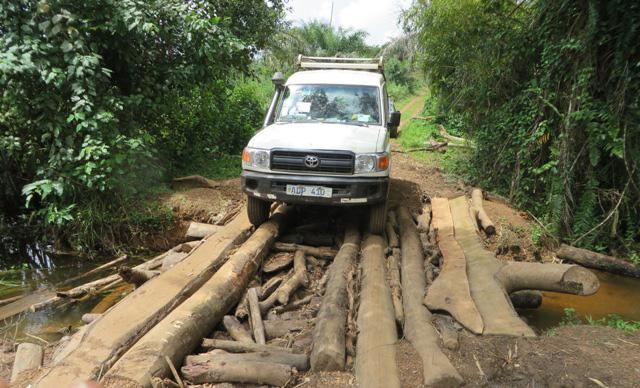
National infection rates continue to rise. The epidemic has travelled from the far eastern districts of Kailahun and Kenema – which previously recorded the highest numbers of deaths – to the capital city of Freetown. More than 4,000 people have died in West Africa since the epidemic began. Ben Bawoh, the community health officer of Mercy Hospital in Bo, died Oct. 12 of Ebola. Bawoh is believed to be the first United Methodist health-care worker to die of Ebola.
Smart Senesie, director of Community Empowerment for Livelihood and Development for The United Methodist Church in Sierra Leone, announced that his department received funding from United Methodists in Norway – in collaboration with the Norwegian government – for anti-Ebola campaigns in areas where they support projects. The church in Norway partners with the church in Sierra Leone and funds the community empowerment projects.
Those areas are below the poverty line even during normal times and with the Ebola outbreak interfering with commerce, the survival of families in these communities is threatened.
The community empowerment department put together a relief package that includes 103 bags of rice, sanitizer buckets and bars of soap, together with Ebola information packages to deliver to remote communities.
Louisa Kamada, community empowerment coordinator, says she hopes our group can reconnect with the communities, pray with them, educate them about Ebola and assure them of our love and care. The relief package is worth $12,000 U.S.
October 2: Departure
Borrowing from recent efforts by young adults to dramatize anti-Ebola tactics, our Ebola Response Team convoy of two vans and a four-wheel drive truck leaves the United Methodist House in Freetown on Oct. 2. Ebola message songs blast from the public address system mounted in the truck.
Our easy drive through what would normally be chaotic traffic reminds me of the economic devastation from Ebola – no schools are open and several road construction projects around the city have been suspended.
I find more Ebola checkpoints than the last time I visited. At the checkpoints, people get out of their vehicles for Ebola screening – a scan on the head with infrared thermometers that will determine if the traveler is feverish. The screening, at its best, is poorly coordinated. People either escape the queue or drive through without being checked.
Worse still, some poorly trained volunteers get false readings. I remember all three of us on a previous trek had the same temperature reading of 36.4 Celsius (97.6 Farenheit).
To a large extent, the checkpoints create fear. I have yet to hear of a single case of an Ebola patient being found at a checkpoint.
Be sure to add the alt. text
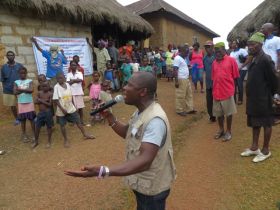 The Rev. Michael Gbenday gives an educational program about Ebola in Mende, the local language of the people of Moyollo village in Sierra Leone. Photo by Phileas Jusu, UMNS
First stop at Mamakah
Our first stop will be Mamakah in the Tonkolili District.
The Mamakah residents call Andrew Momoh repeatedly to ask where we are. Momoh, a Community Empowerment project field officer, replies in Krio: “We dae cam, we nor dae far again.” (In English, that means “We are coming, we are now very close to the village.”)
We are actually some 40 kilometers (25 miles) away when the engine of our vehicle shuts down and we have to call for help.
About five kilometers to the village, our public address system breaks down, too. The music team can’t get it fixed, so Momoh unwraps the megaphone that is part of our gift package.
The villagers are called to the meeting hut, where there is a hand-pump well built by the Community Development project. Parouk Sesay, the section chief, tells us the pump is the only source of pure water that the community has.
No public official has visited Mamakah since the Ebola outbreak began, and the villagers are touched that United Methodists are delivering food and information. Sesay appeals to us for another well, since the village demand for water outweighs what the lone well provides. He says the Community Development well worked even through the worst months of the dry season.
Mamakah has not recorded a single case of Ebola yet. We hope our information will help them keep it out.
The Rev. Winston Ashcroft, director of connectional ministries, brings greetings from Bishop John K. Yambasu. He tells the villagers of the church’s concern and love for them and preaches the ways to prevent Ebola.
Daniella Charles teaches hand-washing. We give them the soap and three sanitizer buckets to be used at the village community hut, the church and the mosque.
On to Yonibana
We proceed about 18 kilometers (11 miles) to Yonibana village, home of the Rev. Elizabeth Kamara, the district superintendent.
We repeat the same messages and learn from Pa MB Kamara that The United Methodist Church has been in the community exactly 115 years at the time of our visit. He expresses his joy that the denomination came during their time of need and could celebrate the anniversary.
The district superintendent gives us a generator, since our music team has discovered that was the problem with the PA system. We address the residents of Yonibana, then hurry away, hoping to reach Levulema before nightfall and before threatening rainfall begins.
Levulema and Moyamba
At Levulema, we repeat our messages of hope and teach hand-washing.
We head for Moyamba, one of several districts now isolated due to high Ebola death rates. Police and military men guard the security checkpoints. No vehicle can drive through unless the occupants have passes, which we do.
“Where are you from and where are you going?” a solider asks us, peeping through the window of our van. His breath reeks of alcohol. We refer him to the Rev. Winston Ashcroft in the car ahead of us.
Just a few kilometers away at Jaagbahun Junction, we slow down for another security check. As we leave, a man shouts at us in Mende, “Bring us food on your next visit.”
We go through one more checkpoint on the outskirts of the town, finally entering Moyamba.
Just as in Freetown, road construction projects have been abandoned. On the muddy streets, a few motorbike taxis hoot their horns to attract passengers, but no one comes.
We head straight to a low-cost guesthouse where we spend the night.
October 3: Lungi and Moyollo
At dawn, we go to a community store to buy more rice for the remaining villages in the Moyamba district. The shopkeeper looks excited. It appears he has few customers these days.
Our convoy has grown. We’ve been joined by the Rev. David Foray, the district superintendent, and Isatu Peacock, principal of Harford School for Girls in Moyamba – the oldest United Methodist girls’ school in Sierra Leone.
We pass four quarantined houses. At one of the quarantined homes, I catch a glimpse of a teenage girl standing outside the house and fiddling with her phone.
I see at least four policemen and soldiers in the compound just outside the quarantined homes. As we pass, I wonder what that girl might want to communicate through her phone. Is she calling a family member to ask them to send her food or a bar of soap? Or does she need water to wash her clothes in a community that does not enjoy pipe-born water?
Just a few meters down the road, near what I guess is a market area, a man in the crowd shouts in Krio “Na una nor more dae enjoy the Ebola moni.” Roughly translated into English, he is complaining that we were the few people privileged to enjoy the millions of dollars that the Ebola crisis has attracted into the country while the vast majority suffer.
A shabbily attired man we pass next yells: “Una all dae die; arsweh to God,” meaning “You’re all going to die, I swear to God.”
I think the remarks are evidence of bitterness I have sensed among many other Sierra Leoneans. Many are complaining through social media about corruption among public officials in charge of donations coming into the country to fight the Ebola virus.
Finally, we leave for Lungi, where the Community Empowerment group has been installing community toilets.
We pass a newly constructed Ebola holding center, where I see a few people in personal protection gear. I want to take a picture, but Isatu Peacock thinks they might not allow it. She urges the driver to speed past the holding center.
I see that she is terrified by the sight of the holding center and probably of the men in personal protection gear. In talking with her later, I learn that she would do anything to avoid direct contact with Ebola or any Ebola-related environment.
Two of our men in the pickup are using microphones to act an Ebola drama in the local Mende language. The drama covers what Ebola is, how it infects, what to do when infected and how to prevent infection.
One character is a health professional, the other is an illiterate villager with no knowledge at all about the Ebola outbreak. The character of the villager is curious to know about Ebola and the professional answers them well. People come out in droves as they hear the music accompanied by conversation in their language.
Our men unload the rice, buckets and other materials. Then, we are asked to leave and come back later because the villagers have a meeting with the district health management team.
Later, when we return from Moyollo, I learn that there was a questionable death in the village and that the villagers were awaiting approval of the health team from Moyamba to allow them to bury their dead. The team arrived while we were away and gave permission for burial.
THE CHURCH RESPONSE TO EBOLA
Latest coverage
United Methodist News Coverage
Donate through UMCOR
Donate to the emergency communications response
Ebola checklist for pastors
and church leaders
Warm welcome at Moyollo
At Moyollo, a smiling Joseph Genda welcomes us. Genda, a United Methodist pastor, says we are demonstrating love and concern for the community. He is especially touched that we have come during the rainy season, when the road is so muddy.
Town Chief Daniel Ansumana Bindi is also pleased. “This is the first time we in this community are enjoying such a recognition and honor from our denomination,” he says.
Momoh gives the message of hope and prayers from The United Methodist Church in Norway.
The village imam thanks us and prays for God’s blessing for The United Methodist Church and staff.
Foray, the district superintendent in Moyamba, expresses sadness over the plight of people in Moyollo, since the community is both quarantined and isolated. He tells them Yambasu is still abroad looking for help and support for communities like Moyollo. He asks them all to continue to pray for the bishop.
Hannah Massaquoi, a United Methodist, listens to Ashcroft’s explanations of the seriousness of the Ebola crisis and asks what villagers could do to stay alive.
“With the new disease, how do we now sit in church?” she asks.
The Connectional Ministries director responds swiftly: “Sit apart to stay alive.”
We leave late in the evening for Bo, where we take full advantage of the empty streets to play our Ebola message songs. Small groups of people gather on the edges of their compounds, waving and congratulating us.
United Methodists are especially proud of our work and yell encouragement.
“Well done, United Methodist Church, we are proud of you,” a youth in a T-shirt with cross and flames shouts.
October 4: Mongere
In Mongere the next day, Paramount Chief James Vonjo, is proud to tell us there are no confirmed cases of Ebola in his chiefdom of Valunia.
But, he says, the community shares borders with nine other chiefdoms. And, since his chiefdom has diamond and gold deposits, people come from all over the country and stealthily enter the bush to compete for the chiefdom’s mineral resources.
He says he is proud of the leadership of The United Methodist Church and is elated that his chiefdom is benefiting from the kindness of the people of Norway.
Our team will be the first to reach most of the communities we are visiting with aid and Ebola messages. It is clear from our conversations in those villages that rural and hard to reach communities need more Ebola information.
Jusu is the communicator for The United Methodist Church in Sierra Leone.
Church brings hope to Ebola infected families by Kathy L. Gilbert, (UMNS)
One Sunday morning, a young man called the local radio station in Ganta, Liberia, and threatened to take his Ebola-infected family into the streets because no one would help them.
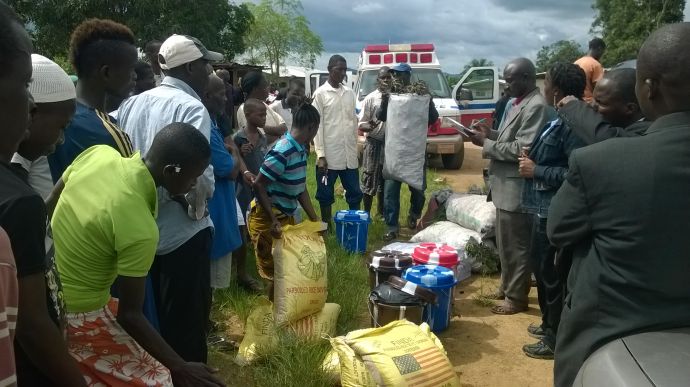
Ten members of his family had already died and their bodies were still in the home. The rest of the family was under quarantine. Some family members were sick. They had no food or medication.
FOUNDED BY MISSIONARIES
Miller McAllister is at the Ganta United Methodist Mission Station. In addition to the church, the station is home to the United Methodist Hospital, schools, the Mission Station Maintenance Ministry, the College of Health Sciences of the United Methodist University in Liberia, housing facilities, as well as the Gompa District Office.
Labala is a graduate of Perkins School of Theology at Southern Methodist University in Dallas, with a master’s degree in church ministries. She also graduated with a doctorate of ministry from Wesley Theological Seminary, in Washington, D.C. She is married to the Rev. James Z. Labala, district superintendent of the Gompa District who is also senior pastor of Miller McAllister. The Rev. Roger S. W. Y. Domah is also an associate pastor.
The people of Miller McAllister United Methodist Church, started by U.S. missionaries in 1926, answered his plea.
“Their situation was so grave that they needed immediate response. This led us to challenge the church to lift a special offering to respond to the needs of several homes that were victimized by the Ebola virus,” said the Rev. Anna Kaydor Labala, associate pastor at Miller McAllister.
In August, the church started sending out a team of three pastors and two lay members to visit homes of people affected by the deadly virus that has killed nearly 4,500 in West Africa.
“We delivered food and non-food supplies to the affected families, interacted and prayed with them. We trusted God for our safety and we ventured out into areas where nobody wanted to go. It was indeed a risk-taking mission as only health workers were allowed to go that close to Ebola victims,” Labala said.
Labala explained that the team wears long-sleeve shirts with jackets and long trousers. They put the food and supplies on the ground and the people pick them up.
“We do not touch anybody. We stand several feet away from the sick people and their family members. We wash our hands each time we interact with a family,” she said.
“I had some fears, but we all believed that God wanted us to feed the people who were isolated and hungry, and to give them hope by our presence. Our presence with them helped to remove the stigma and they saw a sign of hope.”
Since the first visit, the church has helped 15 families, Labala said.
‘Bishop, we are hungry’
Bishop John G. Innis, episcopal leader of the denomination in Liberia, said the country’s whole economic system has collapsed and he gets hundreds of calls every day asking for help.
“Bishop, we are hungry,” the callers say.
While Innis is grateful that the U.S. is sending soldiers to help build health-care facilities, he worries that there is going to be “another epidemic” if the problem of hunger is not addressed.
“We want to go well-fed to God,” he said.
GET INVOLVED
Donate through UMCOR
"Ebola: A Poem for Living" animated video for use in West Africa to dispel myths about Ebola
Ebola checklist for pastors and church leaders
Donate online to the United Methodist Women's efforts to fight Ebola.
Read full coverage of The United Methodist Church’s response to the Ebola outbreak
Donate online to United Methodist Communication’s efforts to help the denomination distribute information about the disease.
Other United Methodist groups, including United Methodist Women and Love Beyond Borders, are now distributing food along with Ebola information and prevention tools like soap and buckets.
Ganta hit hard by Ebola
Ganta has the second largest population in Liberia and was hit hard by the Ebola viral disease in July. In the months of July and August, more than 100 people died of the virus, Labala said.
People panicked when Ebola was first diagnosed because they were told there was no cure. However, as people started going into treatment centers in Monrovia and recovering, hope has returned.
The economy is still suffering, she said. Schools and markets are closed and no one knows when they will reopen.
Most people in the area are business people who depend on the markets. Many of them went to the Republic of Guinea, a neighboring country, to sell their products and bring goods into Liberia. The first case in the recent Ebola outbreak was in Guinea. After the border was closed, many people went out of business, Labala said.
Traveling around the country has been discouraged so that people will not spread the virus. That also has curtailed business opportunities and increased economic hardship in Ganta.
“The church has been working in the community to give hope to the people. The church meets for prayers every evening. Our members who are health workers provide regular education on how people can prevent themselves from contacting Ebola,” Labala said.
Labala remembers on one of their first visits a man told them, “You have brought us food and water and we appreciate it. Please come again. We will drink this water and it will get finished. And we will have no more water. Nobody wants to sell anything to us so please come back.”
His words inspired the church to do weekly outreach.
“During our second outreach, a lady said that she would come to our church if she survived the crisis. I believe that the prayers and love we showed the victims brought them hope and recovery.”
Labala said a pastor from another faith group recently returned to the church to tell his story.
He had been in a treatment center for three weeks and recovered from Ebola. Church members had visited him and prayed with him before he went for treatment.
“On the day he went home he thanked us for being the first church that had reached out to him to pray for him,” she said.
Since then, two more families have come to the church to offer thanks and report some members of their family have survived and are doing well.
“We will continue to go out every week as we are able,” she said.
Gilbert is a multimedia news reporter for United Methodist News Service. Contact her at (615) 742-5470 or newsdesk@umcom.org.
____________________________
How technology could help General Conference delegates
LAKE JUNALUSKA, N.C. (UMNS) — by Heather Hahn, LAKE JUNALUSKA, N.C. (UMNS)
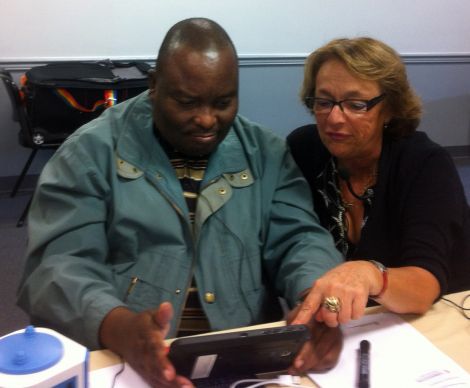
For United Methodists from outside the United States, one of the biggest challenges of going to General Conference is simply getting ready.
Too often, delegates receive volumes of proposed legislation only days before their departure for The United Methodist Church’s top lawmaking assembly. The bulk of those volumes can make it difficult to know what to pack.
“We have to start weighing what clothes we would bring to make room for the materials … the weight of the materials takes up almost all our weight allowance,” said the Rev. Damião Elias of Mozambique through an interpreter. He has attended two General Conference sessions.
“Trying to read everything and keep it in your mind is impossible.”
You’ve heard the old line that Ginger Rogers did everything Fred Astaire did but backwards and in heels. Delegates from central conferences — church regions in Africa, Asia and Europe — do everything their U.S. counterparts do. They do their work despite language barriers, poor Internet access and far less time to study legislation that could affect the church for years to come.
The Commission on General Conference has started a pilot project that members hope will overcome some of these obstacles, including the packing conundrum.
For the next two years, nine commission members from the central conferences are testing e-tablets.
The tablets include a Bible app, Skype and the 2012 Book of Discipline, the denomination’s law book. The plan is for the tablets ultimately to contain the proposed legislation months in advance of the next General Conference, which is scheduled May 10-20, 2016, in Portland, Oregon.
Commission members have agreed to personally donate or raise $8,000 to buy the tablets for General Conference delegates, particularly heads of delegations from Africa and the Philippines.
The 2012 General Conference charged the commission with exploring how technology could improve future gatherings but allotted no funds to support that work, said the Rev. L. Fitzgerald “Gere” Reist II, secretary of General Conference.
The benefits and cost of technology
The commission members are using Samsung Galaxy Tab 4 devices for the pilot project. United Methodist Communications recommended them because they work with a variety of carriers and are relatively easy to use.
Each costs about $300 with a case and SIM card to store contacts.
The tablets are not gifts but remain the property of the general church through the commission.
The commission also is working with United Methodist Communications to develop a message board exclusively for delegates.
And, United Methodist Communications plans to set up the tablets to use a text-messaging system that does not depend on the Internet. Often, poor roads and unreliable Internet service means African delegations can’t confer with each other before the big assembly.
“We’re trying to work out a number of issues,” Reist told United Methodist News Service. “The fundamental thing is people have to have access to the technology or none of it works.”
Of the 864 delegates allotted for the 2016 General Conference, 350 delegates — nearly 42 percent — will come from outside the United States. Thirty percent will come from Africa alone.
Providing all central conference delegates in 2016 with tablets would cost about $105,000, Reist said.
Commission member Bill Haden of the Oregon-Idaho Conference suggested the commission look for ways to purchase tablets for all the central conference delegates who need them.
“In the grand scheme of things, $100,000 is both a great deal of money and not that much if you take it in the context that we will spend in this quadrennium the better part of $12 million to put together General Conference,” Haden said. He is the chair of the 2016 General Conference host committee.
Reist said he already is in conversations with various general church agencies to find denominational funding for more tablets.
What the tablets can do
On Oct. 13, United Methodist Communications staff trained the commission members to use the devices. The members learn how to search, highlight passages, look up words and take notes on documents. They also learned how to build contact lists and send group messages.
In previous years, the Advance Daily Christian Advocate — the volumes that include proposed legislation — was available digitally in PDF. But users can’t make notes on PDFs and depending on their device, the documents can be difficult to read and search.
In 2016, the Advance Daily Christian Advocate will be available in the EPUB (electronic publication) format, which allows copious digital note taking for anyone with a tablet.
The United Methodist Publishing House does provide copies of proposed legislation at General Conference. But Reist noted that people often want to bring the copies they have already heavily annotated.
Commission members participating in the pilot project are enthusiastic about the tablets’ potential to help them deliberate on legislation and lighten their suitcases.
“This will help facilitate our communication and it will facilitate documentations,” Elias of Mozambique said through an interpreter. “With the training I received here, I am going to share that with delegates.”
Hahn is a multimedia news reporter for United Methodist News Service. Contact her at (615) 742-5470 or newsdesk@umcom.org
____________________________
Christians call for dialogue in Hong Kong protests
HONG KONG (UMNS) — by Linda Bloom, NEW YORK (UMNS)
Methodists in Hong Kong have called for calm and restraint following continuing clashes between the government and protesters and joined in a statement from the Hong Kong Christian Council urging both parties to engage in dialogue.
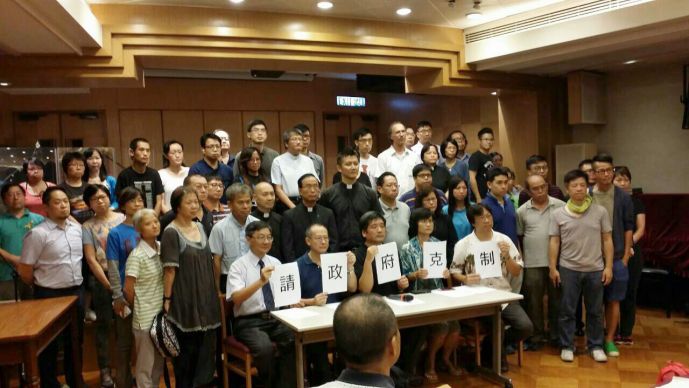
As student-led demonstrations continue for a third week in Hong Kong, Christians are repeating their calls for dialogue between the government and the protesters.
In its statement promoting dialogue, the Hong Kong Christian Council appealed “to all parties involved to try their best to engage in rational discussion on further implementation of constitutional reform under the framework of the Basic Law,” an agreement reached prior to the handover of Hong Kong from Great Britain to China in 1997.
Christians, who make up 11.7 percent of the Hong Kong population, have been active in the protests, which began in late September as a demand for greater freedom in the election of the city’s chief executive in 2017.
According to news reports, the current executive, Leung Chun-ying, said on Oct. 16 that the city government would meet with protest leaders but did not promise concessions.
The Rev. Tin-YauYuen, head of the council and The Methodist Church, Hong Kong and pastor of the Chinese Methodist Church, has taken the lead on this issue, said the Rev. G. Howard Mellor, pastor of the English-speaking Methodist International Church, Hong Kong. Both churches are in the Wan Chai district near Harcourt Road, a main area for demonstrations.
In an Oct. 4 letter to the Methodist congregations of Hong Kong, Yuen said the Chinese Methodist Church had provided shelter and supplies since the protests began “not because we support ‘Occupy Central’ but because of our position as a church in Wan Chai.”
The situation has provided an opportunity to serve in the name of Christ, he wrote. “Our church is becoming a church without barriers, welcoming people to pray, rest, enjoy their lunch box and use the toilet. Because our church is located at a road crossing, with lots of protesters with different political views passing by, we welcome them all in to have a short rest here.”
A member of the World Methodist Council and World Federation of Chinese Methodist Churches, The Methodist Church, Hong Kong retains ties with British Methodists and The United Methodist Church.
Careful judgment and restraint
The Hong Kong Christian Council has urged the government to re-open the Civic Square and Tamar Park for peaceful protest. The council also asked the police to use careful judgment and restraint and appealed to the students and protesters “to negotiate with the related authorities so that the public can re-use the blocked roads.”
Mellor said he found himself in the middle of a “fracas” over blocked roads earlier this week when taxi drivers and about 50 men “started removing barriers on Queensway and shouting abuse at students. The police were caught in the middle of this and in my view handled it all well keeping the groups apart.”
The result, however, was an increase in the number of students and tents blocking the road, he added.
“The politicians seem to fear reasonable dialogue and protestors will find the move from the street to the negotiating table to be much more demanding,” Mellor observed. “However, many senior commentators believe there is room for maneuvering within the framework laid down by the Communist leaders.”
Mei Yan “Kennis” Lam, a missionary assigned to Japan by the United Methodist Board of Global Ministries in partnership with the Methodist Church of Hong Kong, said she has followed the situation with concern.
“Hong Kongers are always calm and well-ordered. Demonstrations in Hong Kong are always peaceful,” she told United Methodist News Service. “But because the government has been ignoring the voices of Hong Kong citizens on genuine universal suffrage, it creates the rebound reaction of the citizens.”
The solution, Lam believes, “is genuine conversation” between the government and those citizens.
Mellor, who prays for “a positive way forward,” said the situation will “boil over” without dialogue. “The refusal to engage in detailed negotiation is an abrogation of responsibility by politicians and student leaders,” he added. “Hong Kong deserves better.”
Lam, who holds a Master of Divinity degree from the Chinese University of Hong Kong, has watched from afar as friends, colleagues and teachers from the divinity school there participate in the protests.
She is “relieved” by the response at Chinese Methodist Church, where she spent a year as an intern while in theology school. Yuen always taught the congregation to be a church without barriers, she noted, serving the community and society “with all we have,” including the church building.
“I am proud of my faith and my church in such a critical moment,” Lam said. “I think what we are doing showed the true meaning of the Gospel.”
Bloom is a United Methodist News Service multimedia reporter based in New York. Follow her at http://twitter.com/umcscribe or contact her at (646) 369-3759 or newsdesk@umcom.org
_______________________________
Bishops find urban ministry ideas in Detroit
DETROIT (UMNS) — MARK DOYAL, Michigan Area Director of Communication
DETROIT MI… In the 1940s, Metropolitan United Methodist Church on Woodward Avenue in Detroit, Michigan was the largest United Methodist congregation in the world. Each Sunday, over 7,000 members filled the enormous sanctuary. Today, Metropolitan has about 400 members and approximately 240 in attendance, but that is good news for the church. Attendance is up about 15% this year and for those pouring themselves out to care for the needs of a recovering city, it is a sign that The United Methodist Church is growing once again in the city of Detroit.
Last Friday, Michigan Area Bishop Deborah Lieder Kiesey invited a group of US urban bishops and their staff to talk about new life in the church and visit entrepreneurial ministries in the city of Detroit. The tour is part of a multi-year effort by six bishops who are seeking how to best lead the church in urban ministry.
Two years ago, with the encouragement of the Residential Bishop’s Learning Forum, this learning cohort was formed to explore effective new forms of urban ministry. The bishops have sought out ministries trying new styles of worship, that engage in sustainable community economic development and embrace all including the poor, those in recovery, former inmates and people with developmental issues.
The cohort comprised of Bishops Sally Dyck (Northern Illinois), Gregory Palmer (West Ohio), Deborah Lieder Kiesey (Michigan Area), Michael McKee (North Texas) and John Schol (Greater New Jersey) have visited two major cities each year. Bishop Martin McLee (New York Area) also took part in the cohort until his death in September. His delegation continues to actively participate in this initiative.
After decades of decline, Detroit is working to recover. Covering more than 139 square miles, the city bottomed out in 2013 when it became the largest municipality in US history to declare bankruptcy. For more than half a century Detroit experienced the departure of millions of people fleeing the city for the suburbs. Like other main-line denominations, United Methodist membership mirrored that decline. Since 1959, 60 local churches have closed their doors. Today 16 Detroit churches remain and only nine are able to support full-time pastors.
Still, like Lazarus coming back from the dead, there is a spirit of determination and creativity that has taken over in the aptly named Detroit Renaissance District of United Methodist churches.
“When all things are falling down you have the opportunity to be incredibly creative.” shared the Rev. Dr. Melanie Lee Carey, District Superintendent of the Detroit Renaissance District and one of the planners for the cohort city tour, “It’s a fresh start and we can try anything.”
The cohort visited about a half dozen ministries while in Detroit including Cass Community United Methodist Church where the Rev. Faith Fowler and her mission ministry staff have brought sensible solutions to the spiritual and human needs of the area. “They didn’t need handouts,” Fowler explained, “They needed jobs.” Cass Community Social Services, founded by the church, now employs over 100 local people, most of whom would struggle to find jobs with living wages.
Cass has accomplished this by capitalizing on the traits most employers would consider weakness. Realizing area neighborhoods were filled with thousands of abandoned tires, the church collected them and recycled them into mud mats and stylish sandals called Detroit Treads which are sold through a website. To help employ those with developmental disabilities, Cass started a document shredding company, hiring those who cannot read the confidential legal and medical documents they destroy. In addition, Cass operates medical clinics, a series of homeless shelters and other resource service programs to support their community. The impact has been incredible and has, in turn, helped keep the church vibrant. On Friday evening, in one of the toughest neighborhoods in Detroit, the bishops were able to witness and participate in a standing room only worship service in the Cass warehouse.
In 2012, when the Rev. Patricia Gandarilla arrived at her new church El Buen Pastor on Detroit’s southeast side there was no heat and more mice than members. She explained to the cohort how she went door-to-door to meet families and build trust in the mostly Hispanic and Latino neighborhood. “I knew if we put our hands in with the people it would be possible,” said Gandarilla. Many in the neighborhood felt that main line churches had abandoned them over the years. Her embracing ministry led to a core group of families attending. Soon, they were able to raise $50,000 to repair the church. A Facebook page created a tight knit community of hundreds of un-churched members who gather to celebrate and worship. The church has built a community soccer field and developed out-of-the-box partnerships with area businesses. In two years, the ministry has grown from ten people to hundreds attending their events.
What links Detroit’s thriving ministries and those the cohort witnessed across the country is creativity, local relevance, permission giving, inclusivity, diversity, encouragement of new and self-differentiated leaders and a focus on outreach. The bishop’s cohort is planning to visit more cities in 2015 and they will report on their findings. The group is encouraging prayer for our cities and commitments from annual conferences to invest in collaboration and new models of urban ministry.
To see photos of the Detroit tour and listen to reactions click here, 2014 Bishop Cohort

Watch video
<iframe src="//player.vimeo.com/video/108961069" width="500" height="281" frameborder="0" webkitallowfullscreen mozallowfullscreen allowfullscreen></iframe> <p><a href="http://vimeo.com/108961069">UMC Bishop Cohort 2014</a> from <a href="http://vimeo.com/user18083327">Michigan Area UMC</a> on <a href="https://vimeo.com">Vimeo</a>.</p>
 UMC Bishop Cohort 2014 from Michigan Area UMC
 In October, Michigan Area Bishop Deborah Lieder Kiesey invited a group of US urban bishops and their staff to talk about new life in the church and visit entrepreneurial ministries in the city of Detroit. The tour is part of a multi-year effort by six bishops who are seeking how to best lead the church in urban ministry. Two years ago, with the encouragement of the Residential Bishop’s Learning Forum, this learning cohort was formed to explore effective new forms of urban ministry. The bishops have sought out ministries trying new styles of worship, who engage in sustainable community economic development and embrace all including the poor, those in recovery, former inmates and people with developmental issues. The cohort comprised of Bishops Sally Dyck (Northern Illinois), Gregory Palmer (West Ohio), Deborah Lieder Kiesey (Michigan Area), Michael McKee (North Texas) and John Schol (Greater New Jersey) have visited two major cities each year. Bishop Martin McLee (New York Area) also participated in the cohort until his death in September. His delegation continues to actively participate in this initiative.
____________________________
Commentary: Bringing the gospel's light to HIV in Africa
KIGALI, Rwanda (UMNS) — by Donald E. Messer, KIGALI, Rwanda (UMNS)
Editor’s Note: Donald E. Messer traveled to Rwanda July 16-22 to speak at a workshop for United Methodist pastors on HIV and AIDS counseling. He also conducted interviews and met Rwandan pastors and laity on behalf of the Office of Christian Unity and Interrreligious Relationships of The United Methodist Church.
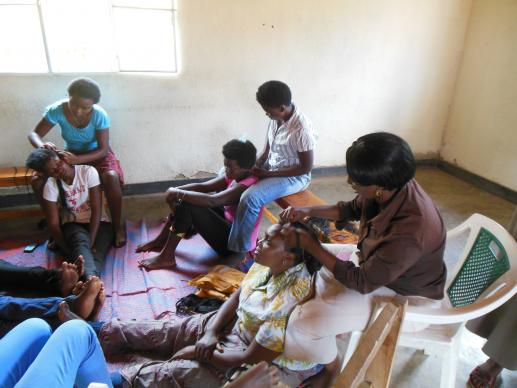
No one living with HIV was willing to speak at the AIDS workshop in Kigali, Rwanda, for United Methodist pastors.
That’s how pervasive the stigma and discrimination is against those with the disease.
But on that day last July, Katrina — a middle-aged HIV positive woman from a rural church two hours away — offered to speak privately to me, a representative of the international United Methodist Global AIDS Fund.
She feared sharing her story publicly, however, lest word of her status become the subject of shame and gossip.
Walking with her head down, seeking not to draw attention, she chose to sit near the back. While the pastors were listening to lectures, the Rev. Marc Baliyanga, Kigali district superintendent and legal representative of The United Methodist Church in Rwanda, arranged for us to slip away to a distant private room.
Looking at the floor, Katrina began to tell the story of how she had been infected with HIV by her husband, who then deserted her and their two elementary-age daughters.
Destitute, she struggles for survival, begging for food and clothing from other family members. The government provides her anti-retroviral medicine, but without regular food the powerful medicine is hard to digest, resulting in painful side-effects.
Above all, she is embarrassed by what neighbors routinely say about people infected and affected by HIV. Even in church, she believes people would look down on her if they knew her health status.
Stigma and isolation
Katrina’s story, unfortunately, is not unique. Women comprise nearly half of the 35 million people infected worldwide; in sub-Saharan Africa that number is 58 percent. Though many are infected by their husbands, the women bear the blame and often suffer stigma, isolation and extreme poverty. Many are forced to engage in "survival sex," or what we typically call prostitution. Violence against women is prevalent.
When I asked Katrina how she thought she could become self-supporting, she said she wanted to sell used clothing in the market place. Getting started would take about $200, but in a country where poor people usually earn less than $2 a day this was an impossible dream.
Then, we told her we could help her dream become a reality, thanks to gifts from United Methodists with the Center for the Church and Global AIDS. Her head jerked up in shock and surprise and she began to cry in gratitude. After a minute or two of prayer, however, it became clear Katrina had been filled with the power of the Holy Spirit; hope had replaced despair and her faith had overcome fear.
When she walked back to the conference, she held her head high and there was a bounce to her step. It was as if I had witnessed the gospel lesson in which the woman stooped over for 18 years had approached Jesus to ask for help and he declared she was healed. "Immediately, she stood up straight and began praising God." (Luke 13:13 NRSV)
In Katrina's case, she is not healed. She continues to live with HIV since there is neither a cure nor vaccine for HIV and AIDS. But because of a small economic empowerment grant, she is now an entrepeneuer, gainfully employed.
"Katrina has a renewed sense of self-worth and is able to feed her family. She is speaking out and active in the church,” reported Baliyanga, the district superintendent. “Unfortunately, hundreds of persons live in the shadow of shame within our churches and we lack financial resources to help them."
Growing and caring
Due to financial concerns over financial mismanagement in the Uganda offices of The United Methodist Church in East Africa, the General Council on Finance and Administration, the denomination’s finance agency, has restricted funds for evangelical, educational and mission work in Rwanda since 2012.
Despite that disconnection from the larger church, United Methodism in Rwanda continues to grow in members and seeks to serve the community. Still recovering from the devastating consequences of the genocide just 20 years ago — when some 800,000 Rwandans were massacred — every church is asked by the government to contribute to the well-being of the society by submitting plans of action.
Those who joined the church after the genocide were mostly poor. They were people who had fled from persecution and the mayhem of death. The church welcomed multitudes of widows and orphans. Many lacked education and suffered from hunger, AIDS, malaria, and other diseases of poverty. The denomination’s Wesleyan theology, especially its focus of ministry with the poor, has proved attractive, especially to young people.
For Rwandan United Methodists, caring for people with AIDS and malaria remains a priority, although they receive no funds from the denomination to help with either disease.
I preached in Katrina's church two days after we met, to nearly 700 people crammed into the tiny tin shack-like building held up by wooden poles. Children were everywhere. Sunlight streamed through open cracks in the ceiling. During the five-hour worship service, people listened attentively to scripture and sermons, regularly came forward to offer gifts during various offerings, sang with unrestrained joy and danced in praise.
When Katrina emerged from the back of the sanctuary to join the choir and then reached out her hand, inviting me to join in a dance of celebration, it was an unforgettable moment. As tears streamed down my face, I was touched by the power of the Holy Spirit and remembered anew that United Methodism, at its best, can be defined as "love in action."
Make a contribution to the United Methodist Global AIDS Fund
*Messer, executive director of the Center for the Church and Global AIDS, Centennial, Colorado, also is co-chair of the United Methodist Global AIDS Fund.
Dealing as a church with HIV
Lawson, an activist working on issues of HIV and AIDS since 1994, serves as vice-chair of the international reference group of the Ecumenical HIV and AIDS Initiative in Africa (EHAIA) of the World Council of Churches.
The churches in Togo, Lawson says, have not been fully engaged in addressing the issue of HIV which has affected the Western African region over many years. “Churches have been struggling with theologizing an appropriate stance on the use of condoms, for example, an issue deeply linked with the spread of HIV and prevention,” he says.
Now, however, Lawson observes, churches in Africa are showing more concern. “Through the EHAIA supported programmes we are promoting tools to combat the pandemic, while simultaneously offering a comprehensive and contextual response to HIV and AIDS,” he says.
Lawson explains, “In the EHAIA projects we are targeting the ‘key population’. This ‘key population’ includes people who inject drugs, sex workers, men having sex with men (MSM) and groups comprised of lesbian, gay, bisexual, and transgender (LGBT) persons. This is one segment of society that is highly vulnerable to HIV and AIDS. Surveys have shown that MSM make up about 17 to 20 percent of the people living with the virus, while sex workers and people injecting drugs make up roughly 29 percent each.
“Up till now churches have not been fully engaged in rescuing these vulnerable people,” says Lawson, who himself has lost friends and colleagues to HIV.
“What we don’t realize is that people in this category have families. Many of these people are married. And this factor eventually becomes a link in the spread of HIV to the general population. In this situation, churches must not say they cannot help people,” he said.
This is an area that EHAIA is focusing on, Lawson says. “To help vulnerable people, we have initiatives offering protection, access to care and treatment, and counseling. This is a new area for the churches, but an important one, due to the rigid cultural mindset in our societies,” he adds.
Challenges, achievements and responsibility
Lawson calls it a challenge to talk about the sexual orientation with people. “Although we know in our families, among our friends, we have such people, we still do not talk about these brothers and sisters of ours,” he said. Lawson explained that EHAIA programmes have mobilized funds and offered opportunities to vulnerable groups to express themselves in the face of stigma and discrimination.
“Among these groups, many have considered suicide for not being able to express their pain. This is a significant field for pastoral counseling for the churches,” Lawson said.
In this situation, Lawson calls this a “responsibility of the churches to contextualize a Bible study which gives an opportunity to those who are seen as excluded so they can become part of the whole process of the renewal of life in Christ in the church.”
In dealing with HIV, Lawson sees progress in some areas, especially in West Africa. EHAIA, he explains, is partnering with national AIDS commissions in Togo and Burkina Faso. “We are in a process of creating an observatory on stigma and discrimination. We are fully engaged with the state actors to see how we can contribute our expertise as churches in dealing with HIV,” he says.
Lawson particularly pointed out the importance of chaplaincies in the churches, since they work outside congregations in different fields. He said the chaplains in West Africa are not fully trained to address HIV and AIDS-related issues effectively. It is even more important to have training for chaplaincies in the armies, he points out. “With the prevalent threat of HIV and AIDS we are witnessing in West Africa, the army is where we can find vulnerable groups like MSM,” Lawson said.
Lawson added that if chaplaincies working in the prisons, industries, markets and other spheres are trained, a more effective and viable response to HIV could be possible.
More information on Ecumenical HIV and AIDS Initiative in Africa
WCC member churches in Togo
___________________________
Worship goes on in Côte d'Ivoire despite destruction
ABIDJAN, Côte d'Ivoire (UMNS) — by Isaac Broune
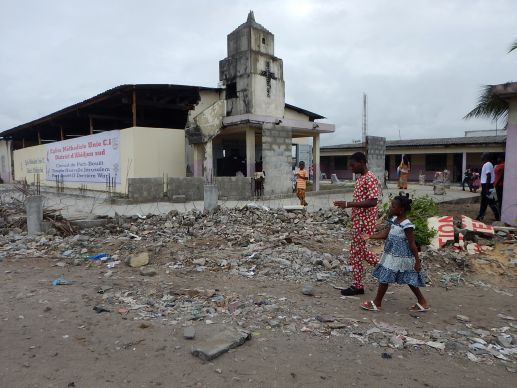
Bulldozers took down a fence and half the building at a United Methodist church here, but hand-clapping and shouts of “Hallelujah” during a recent service showed the community’s spirit was untouched by the destruction.
Worship continues at Port-Bouët 2 - Derrière Wharf Nouvelle Jérusalem United Methodist Church, amid what is left of the building after a path was cleared for the construction of the Abidjan-Grand-Bassam highway. The congregation's name translates to New Jerusalem.
HOW YOU CAN HELP
Donations can be sent to the Central Conference External bank accout, with the name of the church, Port-Bouët 2 - Derrière Wharf Nouvelle Jérusalem United Methodist Church, in the memo line of the check.
Wire transfer information: Account No. 0111617081-75
Account name: Emuci-Fonds Exterieurs
Address: Eglise Methodist Unie Conference Annuelle de la Côte d'Ivoire, 41 Boulevard de la République, 01 BP 1282 Abidjan 01.
On a recent Sunday, shouts of “Hallelujahs” and “Praise the Lord” came from all sides. At the invitation of Cyrille Mawuena, a singer, some people wandered between rows praying aloud. Others, like lay preacher Emmanuel Flito Houenou, knelt at their seats in prayer.
Those who were praying in silence still had their hands raised to the sky as they prayed for nations in wars, Côte d'Ivoire, the church universal, The United Methodist Church in Côte d'Ivoire – but not for their own building.
"What happens to us is typical to Africa. People are allowed to build with their meager means and routes are created after," explained the Rev. Fulgence Koffi, pastor of the church.
He acknowledged the importance of highways in the development of a nation, but said an urban development plan would have helped avoid this situation, which affects not only the church but also the homes and businesses of many in the community.
Koffi and Barthélemy Atémenou, the local president of the laity, had tried earlier to get accurate information about the highway’s path from the Ministry of Construction and Housing.
"Some officials told us that the current road would be widened to 11 meters (36 feet), others to 20 meters (66 feet). To our surprise, the last option affected us," Atémenou said.
"If the state destroys its police station and mosques, what else can we do?" he asked in resignation.
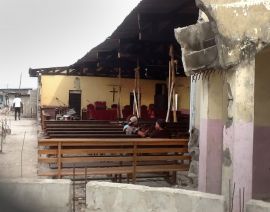 Another view of damage to the church. Photo by Isaac Broune, UMNS
Repairs and worship
The community has been promised compensation for its loss in a memorandum of understanding signed between government and church officials.
Meanwhile, the church is still going strong. Wooden walls replaced the demolished cement walls. The building has a new roof, and the church’s furniture and equipment are stored in a temporary location.
Sara Zannou Epse Djohi firmly believes that "like the temple of Jerusalem, the temple's destruction is not the destruction of God."
With the fence gone, she said, the church is more visible to outsiders and people who use the busy road.
Koffi shares Djohi’s beliefs about the positive benefits. He cites the biblical text of Haggai 2:9, which refers to the glory of the present house being greater than the glory of the first.
"The church still exists. It has not been destroyed. It will build a new temple that will be another new Jerusalem,” Koffi said. An architect has already committed to designing a new building to fit the smaller property.
The current site is the second site for the church. Founded in 1963 by four women and three girls, the church’s first site was threatened by encroachment of the sea. In 1976, the church moved to the current location.
Two other United Methodist churches, Adjouffou’s Mount Carmel and Anani’s City of Peace, will be completely cleared away because of the highway.
Broune is the communicator for The United Methodist Church in Côte d’Ivoire.
____________________________
FCC should turn on mobile phone radio chips
 NASHVILLE, Tenn. (UMNS) — Having radio chips activated in their mobile phones would enable users to listen to over-the-air radio in the event of an emergency. Photo illustration by Kathleen Barry, typhoon aftermath photo by Mike DuBose, United Methodist Communicationsd
When Typhoon Yolanda caused extensive
amage in the Tacloban region of the Philippines a year ago, it wiped out major parts of the communications infrastructure. Mobile phone and Wi-Fi towers were so damaged these communications systems were inoperable.
The result was that people across the region were unable to communicate, and those who came to provide emergency aid were unable to locate people in great distress. The situation led the Philippines government to issue a request for assistance to rebuild the communications infrastructure.
April Mercado, United Methodist Communications staff in the Philippines, told the Game Changers Summit last month that in the earliest days of the emergency the most reliable means of communication was radio.
In most emerging nations, radio is the most effective and efficient way to reach broad numbers of people, and it becomes even more important during emergencies. For example, The United Methodist radio station, “Voice of Hope,” in Abidjan, Côte d’Ivoire, remained on the air during an armed conflict in the country a few years ago, one of the few stations to continue broadcasting during that crisis.
In the United States, floods, ice storms, tornadoes and other disasters often require emergency communications, so emerging nations aren’t alone in using radio for good ends.
I reflected on this recently when I learned that mobile phones in the U.S. come with a chip that will receive FM radio signals over the air, but many service providers disable them. The chips allow mobile phones to act like a transistor radio, without data charges.
As we move to all-in-one handheld devices such as tablets, cellphones and “phablets,” this function becomes more important, it seems to me. As a resident in an area where Internet service is frequently down, and satellite television can be interrupted by thunderstorms, over-the-air radio is a useful way to get important information.
As a result of this concern, I wrote to FCC Chairman Tom Wheeler to request that the Federal Communications Commission consider requiring these chips to be activated on smartphones sold in the U.S., so that we all can benefit from this important function. It’s a feature that we should have not only for convenience, but for our well-being when emergency circumstances demand it.
Here is the letter:
Dear Chairman Wheeler,
I write to request favorable action by the FCC to require mobile telephone manufacturers and operators to provide access to FM radio through mobile devices including smartphones, tablets and “phablets.”
This is a matter of public safety in addition to convenience for individual users of these devices. A report from the International Telecommunication Union states the need succinctly:
“For many decades, radio and television broadcasters have been the primary source of critical information to the public in the event of disasters such as tornadoes, hurricanes, tropical storms, floods, snowstorms, earthquakes, tsunamis, solar storms, terrorist violence, mass transportation accidents, and industrial or technological catastrophes. This important role can be both before an impending event and also after an event. On these occasions, radio and television broadcasting provides reliable point-to-everywhere delivery of essential information and safety advice to the public, to first responders and others via widely available consumer receivers, both mobile and fixed. In many cases the major broadcasting facilities have their own independent power supply facilities to maintain communications even if utility supplies are lost.”
Examples abound of the need for this service on mobile devices from ice storms in Kentucky to tornadoes in the Midwest to hurricanes on the Gulf Coast. When residential power is out, often cell service and Internet are also out. The only battery device may be a smart phone, but it is useless without cell service. With an activated radio chip, however, it will function similar to a transistor radio providing people with information essential for survival.
This includes where food, water and shelter are available; where FEMA and other humanitarian assistance is located; when there are curfew hours and road closings; when there are school closings and the status of hospital physical plants.
Portable radios as we have known them are important, but society is depending more and more on smart devices as a primary tool to receive information. Today, societies the world over are transitioning to mobile handset devices for their information. FM receivers in smart devices should be activated as a matter of public safety just as air bags and seatbelts in automobiles were required years ago. While information increasingly flows through mobile devices, broadcast services remain the most effective and efficient means of reaching the widest audience.
In an emergency, the role of broadcasters is even more important because they serve local communities with essential, fact-checked, reliable information, and they distribute it to all within the broadcast signal.
When cell signals are not in service, over-the-air FM radio is the most reliable means of delivering information in critical events. It is our experience at United Methodist Communications, which is the global communications agency for The United Methodist Church with audiences in the Philippines, Eastern and Central Europe, Africa, and the United States, that radio is a key tool to deliver life-saving information. Our experience in Typhoon Yolanda in the Philippines and in the current Ebola crisis in West Africa reinforces the value of radio as a means of informing persons about circumstances essential to their well-being in emergency situations such as those the ITU report identifies.
For these important reasons, I request the FCC mandate that over-the-air radio chips be activated in mobile phones in the United States so that FM radio is available to all who desire and who would benefit from this important service.
Sincerely,
Larry Hollon
General Secretary
United Methodist Communications
_____________________________
Finance agency partnership seeks to expand electronic giving
MINNEAPOLIS (UMNS) — Vanco Expands Strategic Partnership with GCFA
Electronic Payments Company Vanco Services Announces Strategic Sponsorship with the General Council on Finance and Administration (GCFA)
MINNEAPOLIS, Minn. — Vanco Services, LLC, a leading provider of electronic payment solutions, today announced it has expanded its strategic sponsorship with the General Council on Finance and Administration (GCFA)—the administrative and financial body of The United Methodist Church.
The multi-year sponsorship marks a significant expansion of an electronic giving program that has been in place since 2002 when GCFA first approved Vanco as the administrator for the United Methodist Electronic Funds Transfer (UM EFT) program. The program, which began as an easy way for churches to receive regular contributions via electronic funds transfer, has since expanded to include credit card, debit card, online and mobile giving.
The goal of the expanded partnership is to accelerate the adoption of electronic giving methods in United Methodist congregations. GCFA recognizes that the way people made payments ten years ago is not the way they make payments today.
“GCFA serves the people of The United Methodist Church by exploring and vetting opportunities to increase funds for ministry by reducing administrative expenses. Vanco offers products that can help churches achieve that goal,” said Moses Kumar top executive of GCFA.
“The original program has been a great success,” said Jeanne Spencer Rose, President and General Manager for Vanco Services. “It was exciting to be part of their original efforts and we look forward to helping them take electronic giving to the next level.”
About Vanco Services, LLC
Vanco Services, LLC is a payments company that processes electronic transactions for more than 30,000 businesses and organizations, including more than 15,000 churches and nonprofits. Vanco offers several proprietary web-based electronic payment solutions that may be deployed as a comprehensive suite or implemented individually to meet specific needs. Vanco is a PCI (Payment Card Industry) Level 1 Compliant Service Provider.
____________________________
What does The United Methodist Church say about Halloween?NASHVILLE, Tenn. (UMNS) —
Does The United Methodist Church have a position about Halloween?

The United Methodist Church does not have an official statement or position regarding Halloween. Church members are free to make their own decisions about participating in Halloween activities.
Many local churches offer safe alternatives to traditional door-to-door trick-or-treating. Others turn the focus to more on giving than receiving. Collecting for UNICEF or giving Fair Trade chocolateare ideas for using the occasion to "treat" or give to others.
Learn more
_____________________________Native American leaders work to expand ministries
INDIANAPOLIS (UMNS) — Native American ministry establishes new fellowship during Indianapolis conference

INDIANAPOLIS – The beat of a tribal drum punctuated a long weekend for more than 50 United Methodist Native American leaders from 17 states to expand their ministry across the United States. They learned and celebrated Oct. 9-12 at a hotel near the Indianapolis International Airport and at St. Andrew’s United Methodist Church on the city’s southeast side.
Participants were greeted by Miami Nation of Indiana Chief Brian Buchanan and Vice Chief John Dunnagan, who shared the history and culture of their tribe which was in Indiana centuries before European explores wrote about them beginning in the 1540s. They were joined by other leaders of the tribe who sang, drummed and prayed at the beginning of the conference.
“We live two lives – Indian life and American society life,” said Buchanan, an aerospace engineer. “We live by faith – native faith. What we do is for our fathers, mothers, grandfathers and grandmothers. We’ve been in many schools, nursing homes and camps – all in the name of the Creator.”
Dunnagan explained the only thing we know about the origin of the Miami is “we came out of the water after a storm. A woman came out of the water first, near the mouth of (what is today) the St. Joseph River near South Bend, Ind.” From then until the mid-1800s, he said 13 treaties have whittled away all their land. Today, the Miami are two tribes – the Indiana Miami and the Western Miami who live in Oklahoma having been moved there in the 1850s.
There are an estimated 60,000 American Indians who live in Indiana, including 4,000 who live in greater Indianapolis. Most are Miami and Potawatomi.
Conference
The Rev. Anita Phillips, executive director of the United Methodist Native American Comprehensive Plan (NACP), led the four-day conference. NACP directs and aids Native American ministries nationwide.
In her greeting, Phillips said this conference was a new effort of NACP to provide education for local church efforts in ministering to the needs of American Indians in congregations across the county. She also said the conference was an attempt to define Indian culture rather than letting institutions define who we are. She said native people have a history of “letting others define us rather than claim what our Creator God claimed us to be.”
She continued, “We are called by a God who offers us abundance – claim it – to celebrate God who has called our many people… This is about being the beloved people of God.” She also challenged each participant to “make your mark in a world that doesn’t give us recognition.”
The conference was hosted by the Indiana Conference Native American Committee, led by Linda Madagame of Indianapolis – an Ottawa, and the Rev. Ron Haun, pastor of St. Andrew’s UMC, and his wife, Marilyn Haun, a Cherokee, both of Indianapolis.
Through workshops and plenary sessions, the conference concentrated its efforts to enhance local church ministries to American Indians including small church ministries, leadership within tribal communities, youth ministries and in other leadership issues unique to Native American ministries.
Worship included flute, drums and the singing of familiar hymns in English and native languages.
During closing moments of the conference, Susanne Ware-Diaz, a Wesley Foundation minister at the Native American UMC of Anaheim, Calif., challenged participants to continue the connections formed during the weekend. “When you are called, have perseverance. God will walk with us… Look at one gift you can bring. Look at goals you set during this conference.”
She also pointed out the lack of Native American representation in executive positions in The United Methodist Church, including the Council of Bishops. “The church needs us at many levels. We bring resilience and (our) heritage.”
New fellowship established
The conference culminated Sunday morning, Oct. 12, with the establishment of a Native American Fellowship at St. Andrew’s UMC, the first United Methodist Native American congregation in Indiana, during a 90-mimute worship service.
“We are going to join in a new journey with the United Methodists,” said Marilyn Haun at the beginning of the service that committed the congregation to a ministry of Native Americans living in Indiana.
In his remarks, Chief Buchanan said, “I can’t tell you how special it is to have God-sent angels to us. The United Methodist Church has done much in establishing this relationship.”
Addressing the congregation in establishing this new fellowship (a congregation within an existing congregation), Phillips said, “You have taken a major step in the life story of St. Andrews. I am thankful that I am here at the very beginning of this new journey.”
After outlining the history and plight of native peoples in the United States even today, she said, “St. Andrew’s, you will make a safe place for native people to come and just be (themselves). To those in prison, those suffering from alcohol and other addictions, who need someone to walk with them, you can truly be a sanctuary – a safe place. I lay before you my hope, my claim to our Creator God, who has showed us the way through Jesus Christ to lift us out of a valley of grief. Our God does not abandon His children.”
Pastor Haun called on his congregation to walk with him. He said this was his destiny. “As the Native American Fellowship, we claim the journey.”
Daniel R. Gangler serves as a retired United Methodist communicator and lives in Indianapolis.
A photo gallery is available here.
____________________________
Mission agency to match $1 million on #GivingTuesday
NEW YORK (UMNS) — Resources for #GivingTuesday
We are excited to let you know that plans are under way for this year’s UMC #GivingTuesday!
On Dec. 2, you can extend the spirit of giving thanks into the Advent season by participating in UMC #GivingTuesday. Every gift made online through The Advance at www.umcmission.org/give on Dec. 2 will be matched up to $1 million.
*Global Ministries will allocate the matching funds dollar for dollar up to the first $1 million in gifts to Advance projects received online on Dec. 2 between 12 a.m. and 11:59 p.m. EST. A maximum of $2,500 per individual gift to a project will be dispersed as matching funds. A project may receive a maximum of $25,000 in matching funds.
As you may remember, last year on UMC #GivingTuesday, United Methodists collectively raised a record $6.5 million on line in through The Advance. 11,000 individuals and churches in 34 countries gave more than 16,300 gifts to mission and ministries they believe in. It was a wonderful sign of commitment and extravagant generosity, maximizing the impact of thousands of United Methodists coming together on one day to transform the world.
Visit www.umcmission.org/give to search for Advance projects and give.

When Methodists are United...
When Methodists are united . . . we provide an alternative to the recent US consumer driven shopping traditions of Black Friday, Local Business Saturday, and Cyber Monday. UMC #GivingTuesday offers an opportunity to start off the holiday season by giving instead of getting through supporting organizations and missionaries that have been researched and approved by the United Methodist General Board of Global Ministries. And 100% of all gifts made through The Advance are given directly to the designated project.
Thanks to United Methodists’ participation in last year’s UMC #GivingTuesday:
- ministries purchased new land in places like Cambodia and Tanzania.
- an entire community in the Philippines is rebuilding after being devastated by a typhoon.
- families in Guatemala are generating income and improving their diets through gardening.
- youth in the US repaired homes for families in need while being trained to be servant leaders.
- UMCOR responded globally to disasters that weren’t in the news spotlight.
- a health care center in Haiti now offers increased access to care.
- a community in Sierra Leone finished digging a well to provide clean safe drinking water.
When Methodists are united . . . and support any one of the 850 United Methodist related Advance projects, together we meet a range of needs, from helping survivors cope with natural or civil disasters to helping communities build churches, feed and educate children, and equip hospitals and clinics.
Since its founding in 1948, The Advance has helped channel more than 3 million gifts totaling more than $1 billion dollars to thousands of projects and ministries.
While people can give through The Advance any time of year, having one day when Methodists are united in supporting The Advance together, shifts energy away from secular consumerism and back into a spirit of cheerful Christian giving. It shows the world the transformational power that can happen in one day . . . when Methodists are united.
This is a great opportunity to build awareness and maximize support for a project or missionary that is meaningful to you.
Social Media and Other Networks
You are also invited to raise awareness about UMC #GivingTuesday through your personal networks. Banners, worship resources, and other ideas for promotion are available for your use on the UMC #GivingTuesday resource page. Please ask your church to post the UMC #GivingTuesday logo prominently on its home page with a description and links to projects and missionaries supported by the church or the conference.
Do you have a Twitter or Facebook account? Share an “unselfie” using one of the graphics from the resource page, share posts from UMCmission.org, and help us promote the event with messages like these:
- Maximize impact with your gift on 12/2 UMC #GivingTuesday. www.umcmission.org/give
- When Methodists are united . . . ministries purchase new land in Cambodia & Tanzania. UMC #GivingTuesday 12/2 www.umcmission.org/give
- When Methodists are united . . . a community in the Philippines rebuilds after a typhoon UMC #GivingTuesday 12/2 www.umcmission.org/give
- When Methodists are united . . . families in Guatemala generate income & improve their diets. UMC #GivingTuesday 12/2 www.umcmission.org/give
- When Methodists are united . . . youth repair homes for families & become servant leaders UMC #GivingTuesday 12/2 www.umcmission.org/give
- When Methodists are united . . . UMCOR responds globally to disasters not in the news UMC #GivingTuesday 12/2 www.umcmission.org/give
- When Methodists are united . . . a health care center in Haiti offers increased access UMC #GivingTuesday 12/2 www.umcmission.org/give
- When Methodists are united . . . a Sierra Leone community digs a well to provide drinking water UMC #GivingTuesday 12/2 www.umcmission.org/give
- When Methodists are united . . . together we transform the world! UMC #GivingTuesday 12/2 www.umcmission.org/give
- Perfect antidote to overspending on #BlackFriday? UMC #GivingTuesday coming on Dec. 2! #umcmission
- Think one day of giving thanks isn't enough? Get ready for UMC #GivingTuesday. Dec. 2 #umcimission
Selfless Selfies (post photo of yourself holding this sign)
On UMC #GivingTuesday I’m going to maximize impact with support for ________________, an Advance project of the United Methodist Church. Will you join me? December 2 umcmission.org/give
Make sure to include www.umcmission.org/give and tag @umcmission in the post so we can share it.
UMC #GivingTuesday Quotes for memes:
“I read in a book that a man called Christ went about doing good. It is very disconcerting to me that I am so easily satisfied with just going about.” -- Toyohiko Kagawa
“Having, First, gained all you can, and, Secondly saved all you can, Then give all you can." – John Wesley
“Whoever has two coats must share with anyone who has none; and whoever has food must do likewise.” Jesus (Luke 3:11)
“I was hungry and you gave me food, I was thirsty and you gave me something to drink.” – Jesus (Matthew 25:35)
“Do all the good you can, in all the ways you can, to all the souls you can, in every place you can, at all the times you can, with all the zeal you can, as long as ever you can.” John Wesley
Alternative Giving
As we look for ways to break out of the consumer driven shopping traditions of Black Friday, Local Business Saturday, and Cyber Monday and start of the holiday season by giving instead of getting, consider these alternatives:
- Ask that Christmas gifts be made as a donation in your name to your favorite Advance project and encourage that friends and family make a gift on December 2 to maximize the impact.
- Identify projects and missionaries that have special meaning to the people on your Christmas list and make a Christmas gift in their honor on December 2. Want to present a wrapped gift?
- Accompany the notification with a token representation of the project (a framed map of the region, a water bottle for a water project, a hammer for a construction project, etc.).
- Design or purchase a card that reflects the project theme or include a photo of the missionary.
Thank you for your commitment to living out God’s mission. Should you have any questions or suggestions about UMC #GivingTuesday, please contact advance@umcmission.org.
_____________________
Hope of Hearing team assists children in Haiti
PORT AU PRINCE, Haiti (UMNS) — News
Mission team witnesses miracle of children hearing for the first time
 Gil Hanke meets with Joulie who had just been fit with new hearing aids from Hear the World Foundation.
PORT AU PRINCE, Haiti––It’s a miracle of biblical proportions, says Gil Hanke, top staff executive of the General Commission on UM Men.
During the week of Oct. 6, a six-member Hope of Hearing mission team tested 351 children and fit 97 with hearing aids.
It was Hanke’s 26th trip to the poorest nation in the Western Hemisphere. This time he led a team of three audiologists, one audiometric technician, a college freshman. Hanke served as the speech pathologist. Most of the team was from Texas with support from Texas Annual Conference, UM Men and others.
“Each day we were at a different location, and each day was a special blessing,” said Hanke.
“Eight days before we left the US we did not have enough hearing aids to do what we expected to do,” said Hanke. “But within that last week, donations came in from several sources and every child we tested who could benefit from a hearing aid got one. God is good.”
Improvements
“The roads are much better, and overall the country is cleaner,” said Hanke, who also led two mission teams rebuilding the area following the 2010 earthquake.
“There continues to be massive construction, including a high rise Marriott Hotel in downtown Port au Prince. There are no longer tent cities, and most of the damaged buildings have been cleared, but not rebuilt.”
While working at the Haiti Deaf Children’s Home at the Mission of Hope, Executive Director Kathryn Montoya gave the team a tour of the school. They were joined by a team from Hear the World Foundation.
She explained the newest students who are deaf share the same classroom. They are of different ages, but are on the same communication level. Many of these children have been abandoned by their parents due to their disability.
“They come to us without anything; no possessions of any kind and our newest student came to us without even a name” said Montoya.
The next classroom they visited was filled with active children, making some speech attempts and signing to their two teachers. Both teachers remembered Hanke; one from another school where she taught over a decade ago, and the other teacher had been a student in another school where Hanke and his team had worked.
Hanke says the Hear the World Foundation and the Hope of Hearing teams worked well together. “The Foundation fit children from the home, and our team worked with some of the more than 300 adults who are deaf in that community,” says Hanke.
Assistance for Hope of Hearing comes from several sources. The team receives donations of hearing aids and batteries from individuals and manufacturers. Several civic clubs, churches, UM Men groups, and individuals also provide funding.
______________________
Order Rethink Church Advent resources by Nov. 1
NASHVILLE, Tenn. (UMNS) — Rethink Church shares a free video about making Christmas less complicated by focusing on helping others and sharing the greatest gift of all. New Advent resources, including sermon starters, bulletin covers, invitation cards and door hangers are available. For delivery by Thanksgiving, order by Nov. 1. For a limited time, door hangers will be printed with your church information.
Order resources and view video
<iframe width="690" height="388" src="//www.youtube.com/embed/_7UqizsCKoU" frameborder="0" allowfullscreen></iframe>
Invite Your Community to Share in the Greatest Gift of All
Our national advent advertising launches November 17th. We invite you to look for this video intelevision and in digital advertising spaces. Check local TV stations for the cities listed and look for us on your favorite cable networks in the CTV areas. If we are not in your area for TV, go to the online digital sites listed and look for our ad placement.
Visit the Rethink Church store to download :30 and :15 video for free. Order a customizable :23 video by emailing us as mediaservices@umcom.org. Deadline to order is December 1st.
Visit the Rethink Church store to download :30 and :15 video for free. Order a customizable :23 video by emailing us as mediaservices@umcom.org. Deadline to order is December 1st.
Resources
We’ve put together some valuable communication tools to assist in your community outreach efforts.
For a limited time only receive 100 FREE door-hangers printed with your church information. Items must be ordered by November 1st to arrive by Thanksgiving.
We also have a NEW sermon starter with worship slides, bulletin covers, and invitation cards to welcome people into your worship services.
When using our door hangers and invitation cards, we want you to measure your visitor response. You will notice a message on each "Please bring this by our welcome table when you visit." We are urging churches to be ready for visitors when they come to your church. Also, use our Advent Visitor Tracker with these items to record how many visitors bring these items to your church. Then email this document back to us at rethinkchurch@umcom.org. This helps give us feedback on how we are doing as we continue to develop resources for churches to use.
Go online today to order all these resources!
Here is some great content you can use to remind others about how to find the true meaning of Christmas from rethinkchurch.org.
Here are some of the activities ahead for United Methodists across the connection. If you have an item to share, email newsdesk@umcom.org and put Digest in the subject line.
Sunday, Oct. 19
Laity Sunday — The United Methodist Board of Discipleship has worship resources.
Monday, Oct. 20 to Friday, Oct. 31
"Living into the Answers: A Workshop on Personal Spiritual Discernment" — Online course from Upper Room. This workshop provides students with the opportunity to explore the process of discernment in an online setting. Details.
You can see more educational opportunities and other upcoming events in the life of the church here.
_________________________________
 United Methodist News Service is a ministry of:
United Methodist Communications
810 12th Avenue South
Nashville, Tennessee 37203-4704 United States
NewsDesk@umcom.org
Phone: (615)742-5400
____________________________

No comments:
Post a Comment