NOTE: This is a digest of news features provided by United Methodist Communications for Nov. 10-14. It includes summaries of United Methodist News Service stories and additional briefs from around the United Methodist connection. Full versions of the stories with photographs and related features can be found at umc.org/news.
Top Stories
United Methodist surgeon may come to U.S. for Ebola treatment
Dr. Martin Salia, shown at the United Methodist Church's Kissy Hospital outside Freetown, Sierra Leone, in April, has tested positive for Ebola. He is being evaluated and may be transferred to Nebraska Medical Center for treatment.
FREETOWN, Sierra Leone (UMNS) — Editor's note: UPDATES with bishop confirming Salia will be taken to U.S. by Kathy L. Gilbert, (UMNS)
Dr. Martin Salia, chief medical officer and surgeon at United Methodist Kissy Hospital, may be coming to Nebraska Medical Center for treatment for Ebola.
United Methodist Bishop John K. Yambasu confirmed that Salia will be evacuated if he is judged able to travel and will arrive in Nebraska on Saturday afternoon. Nebraska hospital officials said a patient will be evaluated. Taylor Wilson, hospital spokesman, said hospital officials are awaiting word on the patient's condition for travel. Wilson said he could not confirm the name of the patient because of privacy regulations.
Yambasu said Friday that he had spoken with Dr. Salia's wife, Isatu, at her home in Maryland both after her husband was diagnosed with Ebola and after he received word that Salia might be flown to the United States for treatment.
He said she was extremely upset and crying the first time he spoke with her, partly because she had not been able to speak with her husband. He said he was able to arrange for her to talk with her husband and that when he spoke with her again she was in much better spirits.
"She was relieved that she was able to talk with her husband and that he may be flown to the U.S. for medical treatment," said Yambasu, who added that he prayed with Mrs. Salia each time he spoke with her. Yambasu said Mrs. Salia is a U.S. citizen.
Dr. Braima Kargbo, the Sierra Leone government's chief medical officer, told The Associated Press that Salia will be taken to Nebraska for treatment.
The Omaha facility, which has already treated two patients with Ebola, is one of four centers in the United States designated to treat Ebola patients. Two Americans, Dr. Rick Sacra and Ashoka Mukpo, a freelance cameraman who worked for NBC, were treated there and released last month.
Kissy United Methodist Hospital was closed Nov. 11 after Salia tested positive for Ebola. He is the sixth doctor in Sierra Leone to be infected with the deadly virus and was taken to the Hastings Ebola Treatment Center near Freetown. The other five doctors died.
‘Trained as a Christian surgeon’
In an interview with United Methodist Communications earlier this year, Salia talked about how important it was for him to work at a Christian hospital.
“I knew it wasn’t going to be rosy, but why did I decide to choose this job? I firmly believe God wanted me to do it. And I knew deep within myself. There was just something inside of me that the people of this part of Freetown needed help," Salia said.
"I see it as God’s own desired framework for me. I took this job not because I want to, but I firmly believe that it was a calling and that God wanted me to. . . . And I’m pretty sure, I’m confident that I just need to lean on him trust him, for whatever comes in, because he sent me here. And that’s my passion,” Salia said.
He talked about his training as a Christian surgeon.
“And so by the time you finish your training, you are more or less like the pastor, you become a pastor. … Whenever we want to start surgery, we pray. I am just being used as an instrument or as a surgeon to carry out God’s own plan for that person’s life.”
Kissy serves one of the poorest neighborhoods in Freetown. The 60-bed United Methodist hospital is part of a larger community outreach that includes a school, an eye clinic, and a newly updated maternal and child health facility.
Bishop Yambasu says the doctors working there know they are part of a mission hospital.
“We tell our doctors that we are a mission hospital. First, give the treatment to the person. Make sure the person receives the best treatment, and then you ask for money. About 60 to 70 percent of the patients that come into this hospital really do not have the resources to pay their bills. And, so, we augment that. We underwrite that. And that’s where we need partners to come in.”
Salia said his philosophy is simple: “God will heal them. And money comes.
“I firmly believe God wanted me to do this job. It was a calling.”
Protecting the staff
After Salia’s condition was known, Yambasu and Beatrice Gbanga, the United Methodist Sierra Leone Conference’s medical coordinator, held an emergency meeting at the hospital to talk about steps to protect the staff and disinfect the hospital immediately.
“I was emotionally disturbed when I got news this morning that Dr. Salia had tested positive of Ebola. I prayed that the news might turn out to be false,” Yambasu said at the meeting.
It is not clear how Dr. Salia contracted the virus. But health ministry sources say the doctor worked at least three other medical facilities in addition to Kissy Hospital.
Several units of Kissy Hospital, including surgical wards, were shut down last month when a patient who was admitted to the hospital for other health conditions manifested signs of Ebola. That patient was taken to the Government Connaught Hospital in central Freetown where he died.
Salia’s infection comes several weeks after the 21-day quarantine imposed on all staff who had direct dealing with the patient who died.
Hospital staff will be quarantined for 21 days. The Sierra Leone Conference Ebola response team will provide a 50-kilogram (110-pound) bag of rice, sugar, milk, soap, water and other food to the quarantined staff. The staffers will also be given minutes for their cell phones so they can report on their health condition in case of any emergency or deteriorating health.
The Sierra Leone Ministry of Health and Sanitation were immediately informed and the national Ebola response team will visit the hospital in the coming days to carry out fumigation of the entire hospital premises.
Gilbert is a multimedia reporter for United Methodist News Service. Phileas Jusu, director of communications for The United Methodist Church in Sierra Leone, contributed to this story.
News media contact: Diane Degnan at (615) 483-1765 or DDegnan@umcom.org.
____________________________
Dr. Martin Salia (left) performs surgery at the United Methodist Church's Kissy Hospital outside Freetown, Sierra Leone in April. The hospital was closed Nov. 11 after Salia, chief medical officer and surgeon, tested positive for Ebola.
Sierra Leone hospital closes after doctor gets Ebola by Phileas Jusu, FREETOWN, Sierra Leone (UMNS)
Kissy United Methodist Hospital was closed Nov. 11 after Dr. Martin Salia, chief medical officer and surgeon, tested positive for Ebola.
Salia, the sixth doctor in Sierra Leone to be infected with the deadly virus, was taken to the Hastings Ebola Treatment Center near Freetown.
Sierra Leone United Methodist Bishop John K. Yambasu and Beatrice Gbanga, the United Methodist Sierra Leone Conference’s medical coordinator, held an emergency meeting at the hospital to talk about steps to protect the staff and make sure the hospital is disinfected immediately.
“I was emotionally disturbed when I got news this morning that Dr. Salia had tested positive of Ebola. I prayed that the news might turn out to be false,” Yambasu said at the meeting.
It is not clear how Salia contracted the virus, but health ministry sources say the doctor worked at least three other medical facilities in addition to Kissy Hospital.
Be sure to add the alt. text
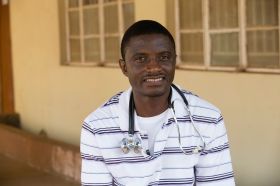 Dr. Martin Salia, shown at the United Methodist Church's Kissy Hospital outside Freetown, Sierra Leone, in March, has tested positive for Ebola. Photo by Mike DuBose, UMNS.
Quarantines
Several units of Kissy Hospital, including surgical wards, were shut down last month when a patient who was admitted for other health conditions manifested signs of Ebola. That patient was taken to the Government Connaught Hospital in central Freetown, where he died.
Salia’s infection comes several weeks after the 21-day quarantine imposed on all staff in direct contact with the patient who died.
A reporter witnessed patients, including some mothers who had just given birth overnight, fleeing from the hospital after the news of Salia’s infection.
Hospital staff will be quarantined for the next 21 days. The Sierra Leone Conference Ebola response team will provide a 50-kilogram (110-pound) bag of rice, sugar, milk, soap, water and other food to the quarantined staff. The staffers also will receive minutes for their cell phones so they can report on their health condition in case of any emergency or deteriorating health.
The Sierra Leone Ministry of Health and Sanitation was immediately informed and the national Ebola response team will visit the hospital in the coming days to carry out fumigation of the entire hospital premises.
Yambasu expressed concern about hospital staff working at other health facilities and said that practice puts the United Methodist hospitals at risk while the conference is working so hard to ensure the safety of the facilities and medical teams.
United Methodist hospitals – Kissy in Freetown and Mercy Hospital in Bo — have been besieged with large numbers of patients in recent weeks following the closure of several private and government hospitals across the country.
Mercy and Kissy hospitals have remained opened despite increasing infection rates of Ebola across the country. At least one patient who was hospitalized at Mercy for another ailment was later diagnosed with Ebola.
GET INVOLVED
Donate through UMCOR
Donate to the emergency communications response
"Ebola: A Poem for Living" animated video for use in West Africa to dispel myths about Ebola
Recovering
Two staff nurses of the United Methodist Mercy Hospital—Dennis Karimu and Alima Koroma—are showing signs of recovery at the same Hastings Ebola Treatment Center where Salia is now being treated after catching the Ebola virus. The two nurses caught the virus from a patient who recently died of Ebola at Mercy.
The patient, Momodu Bah Kamara, was admitted for another health condition but later showed Ebola symptoms. Hospital authorities decided to do an Ebola test but the patient died on Oct. 16, just a few hours before the result was processed.
Karimu and Koroma are the first United Methodist health workers to catch the virus at a United Methodist health facility. Mercy Hospital was shut down and quarantined Oct. 17 so that hospital staff could be observed for the usual 21-day period. The quarantine period ended last week and plans are underway for the hospital to resume operations on Nov. 17.
Mercy Hospital’s community health officer, Ben Bawoh, was the first United Methodist health worker to die of Ebola in early October after privately treating and caring for a brother whom laboratory results later proved to be positive of Ebola.
Bishop Yambasu told Kissy hospital staff before they went home Nov. 11, that only staff ready to relinquish working at other health facilities would be encouraged to stay when the quarantining ends in three weeks.
Jusu is director of communications for The United Methodist Church in Sierra Leone.
News media contact: Kathy L. Gilbert at (615) 742-5470 or newsdesk@umcom.org.
____________________________
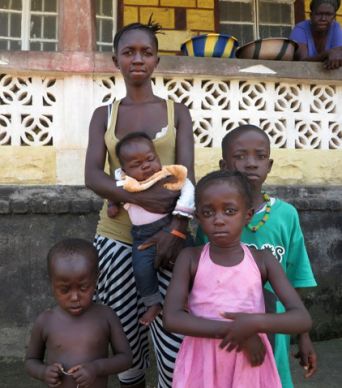
Joseph Turay thanks United Methodist Ebola response team for their show of love and concern as he mourns the loss of his wife Mariatu Sankoh, 22, and daughter, Fatmata. A third family member, his nephew Augustine, is reported to be doing well at Kailahun Ebola Epicenter in eastern Sierra Leone.
United Methodists provide food, consolation to Ebola victims
Share via EmailPrint by Phileas Jusu, |MAKENI, Sierra Leone (UMNS)
Ebola cases are rising sharply in Sierra Leone with 111 new cases reported Sunday, Nov. 9.
The United Methodist Ebola Response Team based in Freetown is responding with spiritual and physical nourishment in the north and west areas of the country where the disease is spreading rapidly.
Mohamed Dumbuya was overcome with emotion when the team from the Sierra Leone Conference arrived with gifts of food and words of consolation for the passing of his wife, Mariatu Kamara, who recently died from Ebola. Kamara, 38, was a teacher at the United Methodist primary school in Makeni.
“The only way I am coping is by trying to accept that Mariatu is gone forever and that she will never come again. That is the reality of my situation but it is difficult to accept,” he said between sobs.
“She has been my friend since school days. I wonder what life is going to be like without her ...”
Mariatu Kamara left behind two children, Abu G. Dumbuya, 16; and Memuna G. Dumbuya, 7. Much as Dumbuya misses the love of his late wife, whom he describes as “hard working and sincere,” he is also worried about the future because the family will miss Kamara’s income and support.
“She always spent all her income in running the home and making sure our children were comfortable,” Dumbuya said.
Dumbuya, also a teacher at the Saint Francis Secondary School in Makeni, said his family had not received support from any agency since he and his two children were quarantined following Kamara’s death about two weeks ago.
Isatu Koroma and her 9-month-old baby died of Ebola, and her husband “was taken away by persons unknown to the other neighbors now in quarantine, thereby creating the possibility of spreading the virus to wherever he was taken to,” said a neighbor John M. Kanu.
Kanu, who is living in quarantine with 36 people, said he understands and agrees with quarantines to prevent the spread of Ebola. He and his family opted for voluntary quarantine.
However, he said people might “slip into the quiet of night and go in search of food.”
“You might control quarantined residents in the day using police or soldiers, but you cannot at night,” Kanu said.
Be sure to add the alt. text
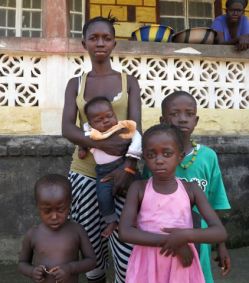 The Ebola virus has taken the life of the husband of Hassanatu Jalloh, leaving her with four children to support. Photo by Phileas Jusu, UMNS
Rapid increase of Ebola
A recent presidential declaration isolated the Bombali District, which includes Makeni, as well as two other areas because of the rapid increase of Ebola in the districts.
Makeni is the provincial headquarters of the north and home of President Ernest Bai Koroma. Before the Ebola quarantines, it was a business hub known for its busy streets. It was also a popular place for relaxation for employees of two nearby mining companies—African Minerals and London Mining.
The streets, hotels and entertainment centers are now empty.
Many grieving families
The United Methodist task force members visited several families who all told tragic stories about lost loved ones.
At another quarantine home, Hawa Bockarie, widowed by the death of her husband, the Rev. Samuel Bockarie, looked confused and was unable to talk about the future prospect of their four children. Her husband was the sole breadwinner for the family, she said.
Bockarie was taken to the Makeni Government Hospital for high blood pressure and caught the Ebola virus while there, she said.
Margaret Bockarie, 9, Theresa Bockarie, 6, Matilda Bockarie, 4 and a 21-month old boy will have an uncertain future after the 21-day quarantine, the worried mother said.
“Margaret was promoted to class three and Theresa to class one at the end of last academic year. Matilda was to start school this year,” she said. Now, the unemployed mother is responsible for their school fees and care.
The team donated a bag of rice, bars of soap and a sanitizing bucket, and encouraged the mother of four to practice regular hand-washing.
At another home, 37-year old Joseph Turay mourns the loss of his wife Mariatu Sankoh, 22, and daughter, Fatmata. A third family member, his nephew Augustine, is reported to be doing well at Kailahun Ebola Epicenter in eastern Sierra Leone.
Turay said the last two tests showed that despite improving, Augustine still had the Ebola virus, so it was not safe for him to come home yet.
Hawa Conteh, a single mother under forced quarantine, was comforted by the United Methodist team and given food and cleaning supplies.
“I am a tenant here in this house. A man who travelled from abroad died here before I became a tenant. I am told that the family secured a certificate to allow them bury him. Another person died again in this same home one week after the burial. Health officials came to quarantine our home afterwards. I later learned the deaths were Ebola cases,” Conteh explained through his tears.
Teams of United Methodists have been taking the life-saving messages of how to avoid Ebola, when to seek medical attention, and ways to prevent the disease from spreading since the outbreak in West Africa started in May.
Confirmed cases of Ebola in Sierra Leone from the National Ebola Response Center are 4,435 with 1,133 deaths.
Jusu is director of communications for The United Methodist Church in Sierra Leone.
News media contact: Kathy L. Gilbert at (615) 742-5470 or newsdesk@umcom.org.
____________________________
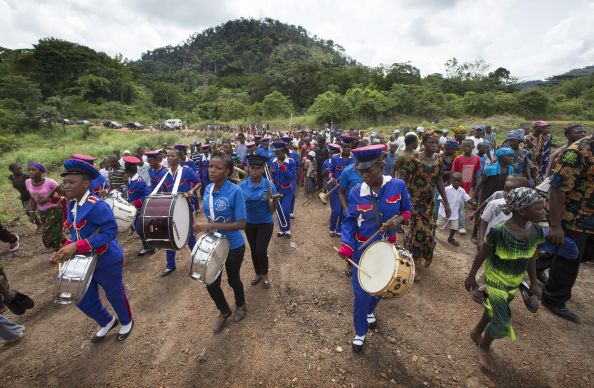
A marching band from Queen of the Rosary School in Bo, Sierra Leone, leads a parade in celebration of the dedication of Valunia United Methodist Church in Monghere, outside Bo.
United Methodists fill churches during Ebola outbreak by Kathy L. Gilbert and Phileas Jusu, FREETOWN, Sierra Leone (UMNS)
June 8 was a bright and happy Sunday at the dedication and opening of Valunia United Methodist Church in the village of Monghere.
Sierra Leone Bishop John K. Yambasu was among the distinguished guests, who also included the Paramount Chief James B.N. Vonjo III, the Queen of the Rosary School marching band and most of the village.
A mini-mob scene ensued when the doors opened and excited worshipers rushed to fill every plastic chair inside the new sanctuary.
That was one of the first Sundays Yambasu warned the community about Ebola.
Now, months later, the Monghere community knows the grief of losing families and friends to Ebola. But church members still rush through the church doors anytime they open.
“In situations of distress and calamity, Africans draw closer to God for divine intervention,” Yambasu said. “This is especially so when every attempt to contain Ebola seems not to work.”
Buy more chairs
On the first Sunday in November, members of Charles Davies United Methodist Church had a dedication service for 40 new chairs purchased by the men of the church. The chairs help with overcrowding.
“People believe the house of worship is a place of solace,” the Rev. Sahr Fallah said. “So when they feel hopelessness; when they feel all is lost, the only place they can find hope is in the church.”
Since Ebola has devastated Sierra Leone, some things have changed at church. People try to adhere to the new ABC rule – Avoid Body Contact.
It’s hard for people to not hug, Fallah said, but they are adapting.
“Today, after sharing the communion, Rev. (Georginia E.M.) Maligi wanted to hold hands with colleagues but was swiftly reminded about the ABC rule and she quickly withdrew her hands. That is how difficult it is even for us pastors,” Fallah said.
Better communication
Early in the outbreak, some people did avoid churches and other crowded places because they did not know how the disease spread, said the Rev. Solomon Rogers, Yambasu’s assistant and a member of the Sierra Leone Conference Ebola Response Team.
Now, people know a victim has to show strong signs of the disease before they are infectious, he said.
“Besides, people are crowding into the churches as a desperate way to seek God’s divine intervention for a disease that now seems to defy all human efforts to contain it. Hence the churches have become overcrowded even by far more than before the Ebola outbreak,” Rogers said.
Yambasu said churches have suspended all baptisms and laying on of hands.
“We pass the peace by laying our right hand on the chest and gently bowing before the person you wish to greet or shake hands with,” the bishop said.
Holy Communion is a must in almost every United Methodist church, so that continues.
“Both the wafer and the wine are received from the tray by the worshiper,” he said. Shared communion cups are washed in a bowl of chlorinated water or soap water and rinsed before being used by another worshiper.
Behind quarantine lines
The Kenema District, near the epicenter of the outbreak in Sierra Leone, has been under quarantine for months. The people are suffering from a lack of resources since the restrictions have stopped businesses.
“It is feared a good number might not resume business after the quarantine because they would have used up all their savings,” said the Rev. Andrew Forbie, district superintendent in Kenema.
“The experience of people here is scary,” he added. “There are days we lose to Ebola loved ones we just joked with the previous day. Hence God becomes our only source of hope and consolation.”
Changes to burial practices
Some of the most difficult cultural changes have involved funerals for those who have died of Ebola.
The World Health Organization has released a 12-step routine for burial teams to make sure everyone stays safe, since the bodies of those who die from Ebola are even more infectious than those who are ill.
“We don’t go to the homes of members who die of Ebola; neither do we attend the burials. Like in the case of Dr. Rogers (Dr. Sahr Rogers worked at a hospital in Kenema) who was our member, we held a funeral service in the church here about the same time he was being taken to be buried. We here still do not attend Ebola burials and we advise our membership not to,” Forbie said.
Burial teams, dressed in protective clothing, remove bodies from homes. They are told to include the family in any burial arrangements.
The Ebola outbreak in West Africa began in March in Guinea and quickly spread to neighboring Sierra Leone and Liberia. The number of cases worldwide is more than 13,000 and 4,818 have died mostly in the West Africa countries.
Since the start of the outbreak Bishops Yambasu and John G. Innis, Liberia, have worked with United Methodist Communications to send out SMS Frontline text messages daily with information on how the disease is spread and how to keep from being infected with the virus. Included in those messages are Scriptures and words of comfort and hope.
New text messages now include guidelines for Christian burials.
Forbie said an Ebola task force from the Sierra Leone Conference donates food to churches to distribute to people under quarantine.
“For our members who lose loved ones, we visit them and give money to the family after the 21 day quarantine period. We do pray for them on the phone during their moments of grief while in quarantine,” he said.
Forbie is willing to make phone calls at anytime of the day or night.
“I wake up about 2 a.m. and call people who are going through stressful moments and pray with them.”
Jusu is a communicator for The United Methodist Church in Sierra Leone. Gilbert is a UMNS multimedia reporter based in Nashville, Tennessee. Contact her at (615) 742-5470 or newsdesk@umcom.org.
____________________________
Letter urges compassion, not stigmatization in Ebola crisis
United Methodist Council of Bishops
100 Maryland Ave. NE
Washington, D.C. 20002
FOR IMMEDIATE RELEASE
November 7, 2014
Letter urges compassion, not stigmatization in Ebola crisis
Oklahoma City, Okla.: Representatives of the Council of Bishops and the General Board of Global Ministries issued a letter to the people of The United Methodist Church on behalf of the Council of Bishops in response to the Ebola crisis affecting West Africa. The epidemic has been responsible for nearly 5,000 deaths with more than 13,000 cases of disease reported. (Read the letter in its entirety.)
“Our hearts go out to families, communities and all those suffering as a result of the epidemic. We assure them of our prayers for divine assistance as they go through this period of pain, trauma and grief,” states the letter.
United Methodists are urged to “offer compassion to our sisters and brothers who are suffering, and support to those who walk with them.”
The letter acknowledges that fear is understandable in the face of Ebola, yet sometimes “leads to unnecessary stigmatization of any persons from or believed to be from those countries or even coming from other parts of Africa.” The leaders urge United Methodists to “be realistic and diligent in confronting fear and stigma as our brothers and sisters in West Africa are in a front-line encounter with Ebola,” noting that accurate information that “increases understanding and decreases stigma is a matter of urgency, justice, and fairness for all members of our human family.”
The letter cautions against travel bans, which “have been judged by airlines to be unenforceable and by health authorities as likely to severely restrict the movement of overseas health workers in and out of Guinea, Liberia and Sierra Leone,” noting that as many as 5,000 workers are needed to bring Ebola under control. It also notes that quarantines should be “required on a case by case basis when medically required and then implemented with a great sense of respect.”
None of the missionaries of the General Board of Global Ministries have been infected with Ebola, and several have volunteered to return to Liberia from the U.S.
The letter is signed by Bishop Warner Brown, president of the Council, Bishop John K. Yambasu of the Sierra Leone Episcopal Area, Bishop John Innis of the Liberia Episcopal Area, Bishop Hope Morgan Ward, president of the General Board of Global Ministries and Thomas Kemper, General Secretary of the General Board of Global Ministries.
Sierra Leone, Liberia and Guinea, the three countries most affected, are within the church’s connectional system with a district in Guinea being part of the Liberia Annual Conference. United Methodists in these countries are “strongly committed to efforts with their neighbors of all faiths to safely confront and control Ebola.”
###
Media contact:
Diane Degnan ddegnan@umcom.org
615.742.5406 (o) 615.483.1765 (c)
____________________________
As a medical disaster, Ebola calls for new strategies
NEW YORK (UMNS) — Linda Bloom
Five months after Ebola began to escalate in West Africa, United Methodists have refined the tactics they hope will slow it to a halt: protection, education, support and prayer.
While Ebola’s impact has been as devastating as a hurricane or earthquake, the epidemic has required religious and humanitarian groups to look beyond traditional disaster response and devise new strategies.
United Methodists in Liberia, Sierra Leone and other countries organized themselves to respond both as a denomination and as interfaith and community partners.
Various forms of communication – text messages, radio broadcasts, drama and song – have been used to relay facts about Ebola. Church-related health centers and health care workers have worked on the front lines of treatment. Prevention information and sanitizing supplies have been carried to remote villages. Food and supplies have been left at the homes of infected families.
The Rev. Jack Amick, who heads the international disaster response unit of the United Methodist Committee on Relief, characterized the reaction to the Ebola crisis in this way:
“People are looking to humanitarian assistance agencies to put out the fire, when typically what humanitarian assistance agencies do is help people who have been burned by the fire or are running from the fire.”
To date, UMCOR has dispersed $401,138 in grants for the denomination’s Ebola response from the agency’s International Disaster Response fund. As of Nov. 7, UMCOR had received $235,748.87 in specific donations for Ebola.
Defining the church’s role
The rapid spread of Ebola in Liberia and Sierra Leone prompted the denomination to consider its most effective role in containing the outbreak, said Dr. Olusimbo Ige, senior program manager for Imagine No Malaria and Global Health for the United Methodist Board of Global Ministries.
Médecins San Frontières (Doctors Without Borders) and the African governments are handling the existing Ebola cases, she noted, and the church cannot compete with larger organizations, such as the World Health Organization, Centers for Disease Control or UNICEF.
“The challenge right now is there are so many players on the field,” said Ige, who is an infectious disease specialist. “How best can we respond without duplicating our efforts and spreading ourselves thin?”
The answer to that question: Using the church’s connections and its position of respect to help support and educate people about Ebola at the community level.
The United Methodist response has been coordinated with West African church leaders and the health boards of the denomination’s conferences in Liberia, Sierra Leone and even Cote d’Ivoire. The church’s health facilities, missionaries and other church agencies are also involved.
Weekly telephone calls that include the bishop, health board chair and health coordinator for each conference have helped United Methodists in Liberia and Sierra Leone set Ebola-related priorities and work through the grant process, Ige said.
A Nov.7 joint letter on Ebola from the Council of Bishops and Board of Global Ministries noted the collaborative work with West Africa episcopal leaders and health boards pointed to the church’s “front-line opportunity and responsibility for palliative and preventive service” in response to the Ebola crisis.
“The United Methodists of Guinea, Liberia and Sierra Leone are strongly committed to efforts with their neighbors of all faiths to safely confront and control Ebola,” the letter said. “They invited their fellow Methodists around the world to join in this essential ministry of compassion and healing. This is an international and interfaith cause.”
Global Ministries is placing three of its veteran missionaries – Mary Randall Zigbuo, Helen Roberts-Evans and Priscilla Jaiah – on special assignment for the next six months to respond to the Ebola emergency. The trio, who received a special blessing at the board’s New York headquarters, left Nov. 6 for Liberia.
Two missionaries from Liberia --Victor Taryor, the hospital administrator, and Dr. Albert Willicor, chief medical officer -- have remained at the United Methodist Ganta Hospital throughout the Ebola crisis.
Beatrice Mamawah Gbanga, a missionary based in Sierra Leone, continues to lead Ebola response efforts there in her role as the conference’s medical coordinator.
Supporting the health boards
Through activity-focused grants, UMCOR is “doing what we can” to support the work of the health boards and various partners, Amick said.
“The initial grants were responses to requests from the health boards to provide personal protective equipment that was not available in country,” he explained. “For the most part, the need to ship things in, relative to Ebola, has diminished.”
What has not diminished is the need to educate a fearful population about Ebola to slow the spread of the disease. The church has become a major proponent of the use of education as a prevention method.
Thanks to donations to the International Disaster Response Advance, UMCOR is funding the grants more quickly, Amick said. Money can be distributed within 10 days to two weeks after a grant proposal is submitted if the paperwork is in order.
As of Sept. 29, UMCOR grants had been used to by the church’s health boards to:
Distribute 400 personal protection kits and provide funds for gloves and gowns at United Methodist health facilities in Liberia.
Distribute 400 personal protection kits, along with other supplies, to United Methodist health facilities; construct a holding unit at Mercy Hospital; train 200 health workers about Ebola and provide public awareness messages to impacted communities in Sierra Leone.
Implement an Ebola public awareness campaign and purchase supplies for United Methodist health facilities in Cote d’Ivoire.
In addition, GlobalMedic used an UMCOR grant to distribute 38,000 face masks, 3,800 protective suits and 60,000 pairs of gloves in Sierra Leone and Liberia, along with essential medicines and five pop-up tents for use as holding units in each country.
ACT Alliance in Liberia provided funding to support training for 70 trainers on Ebola awareness and to hold prevention workshops for 960 participants.
Other ways to support
Pending grant proposals address the education of communities on how to support children orphaned because of Ebola. Humanitarian food distribution is another need. “We’re looking at a couple of possibilities for that,” Amick said. “It’s best for the economy, best for the recovery of the country, if they can buy food locally.”
Recently, the Liberian church received about $20,000 from United Methodist Discipleship Ministries, formerly the Board of Discipleship, and the United Methodist Church in Germany. The money is intended to address the acute food insecurity that is now facing every Liberian, said the Rev. George Wilson, chairperson of the church’s anti-Ebola task force.
GET INVOLVED
More suited for content, but you can also include an image.
Donate through UMCOR
Donate to the emergency communications response
"Ebola: A Poem for Living" animated video for use in West Africa to dispel myths about Ebola
Ebola checklist for pastors and church leaders
Each district superintendent was expected to receive $500 by Nov. 10 to buy food items to distribute to church members. Church staff and others also will receive food assistance.
“We are aware of the enormous role our global partners are playing in Liberia as the Ebola virus continues to ravage our country,” Wilson said during a recent meeting of the task force.
Another role for the global church is to work to prevent “future recurrences” of such infectious disease epidemics, says the denomination’s social justice agency.
A Nov. 10 statement from the United Methodist Boar of Church and Society emphasized the need to eliminate underlying issues -- such as adequate health care, better infrastructure and debt relief – that helped fuel the current Ebola crisis.
“We encourage United Methodists to advocate in their national and regional governing bodies for significant funding for the fight against Ebola,” the statement said. “Such advocacy must also ensure that funding remains robust for other ongoing global health and development efforts.”
Donate to UMCOR International Disaster Response, Advance #982450.
Julu Swen, a Liberian communicator, contributed to this story. Bloom is a United Methodist News Service multimedia reporter based in New York. Follow her at http://twitter.com/umcscribe or contact her at (646) 369-3759 or newsdesk@umcom.org
____________________________
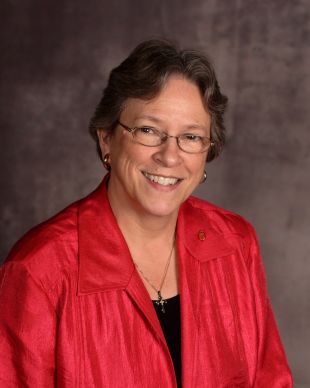
United Methodist Bishop Deborah Kiesey.
Same-sex marriage complaint against Michigan pastors resolved
FLINT, Mich. (UMNS) — by Kathy L. Gilbert, (UMNS)
Two United Methodist pastors in Michigan will not go to trial for officiating at same-sex unions, Bishop Deborah Kiesey announced.
Kiesey would not comment on terms of the just resolution, citing the denomination’s lawbook that complaint procedures are private and confidential. The complainants have not made their identities public and have not issued statements about the decision.
Kiesey, leader of the Michigan Area which includes the Detroit and West Michigan conferences, said the conferences are exploring the possibility of holding discussions based on the “Truth and Reconciliation Commission” model used in South Africa following the end of apartheid.
The Rev. Mike Tupper, who officiated at his daughter’s same-sex wedding, and the Rev. Ed Rowe, who officiated at the wedding of two of his church members, said they were thankful for Kiesey’s decision.
“I’m thankful to Bishop Kiesey for choosing to give precedence to Jesus’ law of love and inclusion,” Tupper said. “I appreciate the many frank discussions we had about the full inclusion of LGBT (lesbian, gay, bisexual and transgender) people in our churches—especially since the topic threatens to divide our denomination.”
Tupper and Rowe will be at a public celebration of the decision planned Nov. 12 at University United Methodist Church in East Lansing, Michigan.
Everybody’s talking
On Nov. 7, the United Methodist Council of Bishops issued a statement calling for prayer about the differences in the church concerning human sexuality.
Last month, Philadelphia area Bishop Peggy Johnson announced a resolution of a complaint filed against 36 United Methodist pastors who officiated at a same-sex union in Arch Street United Methodist Church. Part of that agreement also calls for meetings between United Methodists on both sides of the issue.
This announcement also comes on the heels of a Judicial Council decision Oct. 27 that the Rev. Frank Schaefer will remain a clergyman in the denomination. Schaefer was charged for officiating at his son’s same sex wedding in 2013 and found guilty by a church trial. After several twists and turns, Schaefer was frocked, defrocked and re-refrocked.
Rowe said after reading about the trial and defrocking of Schaefer that the same-sex couple whose wedding he officiated said they were considering leaving the church. He said officiating at their wedding was a “God-sent” opportunity to keep them from leaving.
“If we allow it, God can flow through us to use this just resolution process and others like it to contribute to the transformation of the church beyond our wildest imagination. Not to take that opportunity would be in itself a cause for harm,” Rowe said.
Gilbert is a multimedia news reporter for United Methodist News Service. Contact her at (615) 742-5470 or newsdesk@umcom.org.
____________________________
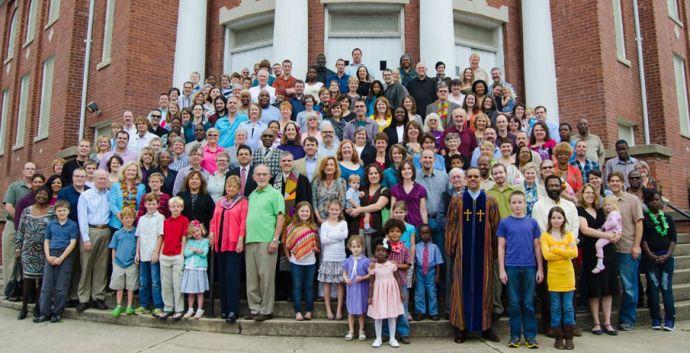
Green Street Church's pastor is facing a complaint for not officiating at a same-sex wedding. The Rev. Kelly Carpenter is sympathetic to the couple filing the complaint. He sees the congregation's inclusiveness as key to its growth.
Gay couple files complaint for refusal of wedding
WINSTON-SALEM, N.C. (UMNS) — by Heather Hahn, (UMNS)
A United Methodist pastor is facing a complaint under church law because he declined to officiate at a same-sex wedding.
A gay couple at Green Street Church, a United Methodist congregation in Winston-Salem, North Carolina, has filed the formal complaint against their pastor, the Rev. Kelly P. Carpenter.
The couple, Kenneth Barner and Scott Chappell, charge Carpenter under the Book of Discipline with “failure to perform the work of ministry.” Their complaint also accuses Carpenter of “gender discrimination” in not officiating at their ceremony. Gender discrimination is also a chargeable offense under church law.
The United Methodist Book of Discipline, the denomination’s book of church law and teachings, also states that all people are of sacred worth but the practice of homosexuality is incompatible with Christian teaching,” It is a chargeable offense under church law for clergy to preside at same-sex unions.
In the complaint, the couple says the denomination’s rules are contradictory.
“God’s grace is available to all and so should the pastoral ministry (be),” the complaint said.
Carpenter said he has followed the church’s prohibition against same-gender weddings because he does not want to jeopardize his work for the church or harm the other ministries of Green Street Church.
Church law also gives pastors discretion in deciding whether to marry a couple. However, Carpenter welcomes the complaint from Barner and Chappell.
“If there was a way for me to be a co-signer with the complaint, I think it’s right on the money,” he said. “It really calls out the contradictions in our Book of Discipline, which calls us to be ministry with all people.”
Chappell made a similar argument.
“Rules are being violated in our Book of Discipline already,” he told United Methodist News Service. “Are we going to violate the rule that bans discrimination? Or are we going to violate the rule that bans same-sex ceremonies?”
MORE INFORMATION ON COMPLAINT
Complaint filed with Bishop Goodpaster
The Rev. Carpenter's response to the complaint
Frequently asked questions from Green Street Church
Earlier witness: No I do’s until all can marry
Green Street United Methodist Church made national headlines in March 2013 when the church’s leadership council decided not to hold any weddings in the church sanctuary until the denomination lifts its ban on same-sex marriage.
Initially, people protested the church’s decision outside worship services and through emails. But eventually the church attracted supporters, too. Since the leadership council’s decision, Carpenter said worship attendance has risen from around 160 to consistently more than 200 each Sunday.
Carpenter said he has honored the leadership council’s request since 2013, but he has officiated at one opposite-sex wedding outside the sanctuary. At the church’s request, he did not sign the civil marriage license, requiring the couple to get a local magistrate to sign.
In its 2013 public statement on marriage, the church also said its pastors still would offer premarital counseling for “all couples, regardless of orientation.”
It said pastors, at their discretion, could perform a service of relationship blessing for couples. Such a service, the statement said, would not include vows, exchange of rings, a pronouncement of marriage or covenant-making language. The services can include a Scripture lesson, an exchange of blessings written by the couple and prayers.
Carpenter has performed five such blessings for both straight and gay couples. He offered to do the same for Barner and Chappell, but they declined. Instead they asked for him to perform their wedding off-site from the church.
“Separate is never equal,” Chappell told UMNS. “It’s the same reason why we didn’t leave the state when other states had marriage equality. It felt like having to go elsewhere or having an altered ceremony in order to comply with United Methodist rules seemed diminished in some way. We declined to do that and chose to this instead so we can start this conversation.”
Ultimately, he said, the couple hopes one day to “actually exchange our vows in front of God and our church family, our biological families and friends.”
Barner and Chappell, together for nine years, have been active members of the church for four. Barner was the lay leader of the church when it released its statement on marriage and was in full support of it. He is now the chair of the church’s leadership council.
In October of this year, a U.S. federal judge overturned North Carolina’s ban on legal recognition of same-gender couples. But the church has maintained its policy.
The denomination’s stance on same-sex marriage can only be changed by General Conference, its top lawmaking body. General Conference will next convene in 2016 in Portland, Oregon.
What happens now?
The complaint is now in the hands of Bishop Larry M. Goodpaster, the resident bishop of the Western North Carolina Conference.
“I have initiated the proper response according to The Book of Discipline,” the bishop told UMNS. “Because this is now a personnel matter of the annual conference, it will need to remain confidential until further notice.”
As bishop, Goodpaster is charged with following a process that encourages finding a resolution that satisfies the bishop, the individuals lodging a complaint, and the one facing the complaint.
Carpenter said he didn’t know how the process would go “mostly because we are pretty much in agreement about the problem in the church. We need to figure that out.”
He said he thinks the church’s public witness in this dispute has the potential to be “uniting” for the congregation. Carpenter stressed that Barner and Chappell are serious about the complaint, but he commended them for finding a creative way designed not to harm the church.
“This may get me in some trouble, but it may be the kind of trouble I’ve been looking for,” Carpenter said.
Hahn is a multimedia news reporter for United Methodist News Service. Contact her at (615) 742-5470 or newsdesk@umcom.org .
____________________________
Bishops: Pray for us amid sexuality debate by Heather Hahn, OKLAHOMA CITY (UMNS)
The bishops of The United Methodist Church said in a statement addressing the denomination’s human sexuality debate that “our hearts break because of the divisions that exist within the church.”
The Council of Bishops issued the statement Nov. 7 after hours of closed-door discussions on the subject throughout their meeting this week.
They asked that United Methodists pray for their leaders and one another. They reiterated their consecration vows and a commitment to “be in ministry for and with all people.”
“As bishops of The United Methodist Church, our hearts break because of the divisions that exist within the church. We have been in constant prayer and conversation and affirm our consecration vow `to guard the faith, to seek the unity and to exercise the discipline of the whole church,’” the statement said.
The bishops wrote that they recognized the church exists in a variety of contexts around the world and that bishops and the church are not of one mind about human sexuality.
“Despite our differences, we are united in our commitment to be in ministry for and with all people. We are also united in our resolve to lead the church together to fulfill its mandate — to make disciples of Jesus Christ for the transformation of the world. As we do so, we call on all United Methodists to pray for us and for one another.”
The statement comes at a time when the denomination debate over human sexuality seems to have reached a fever pitch.
Concerns about unity
The Book of Discipline, the denomination’s law book, since 1972 has proclaimed all people are of sacred worth but “the practice of homosexuality is incompatible with Christian teaching.”
Debate over that teaching has surfaced at each subsequent General Conference, the denomination’s top lawmaking body that meets every four years. But the debate has intensified in recent years as more states in the United States and more nations around the globe have legalized same-gender civil marriage.
Since 2011, more than 1,000 United Methodist clergy have announced their willingness to defy the prohibition against performing same-gender unions.
Earlier this year, a group of United Methodists who champion the church’s current stance on homosexuality suggested the church might consider an “amicable” split over the differences.
In the summer, those United Methodists met again. They stopped short of calling for a split. But in a statement titled Methodist Crossroads, the group said bishops must enforce and publicly support church law restrictions against same-sex marriage if the denomination is to hold together. More than 8,400 United Methodists have endorsed the statement as of Nov. 4.
Divisions among bishops
Bishops themselves openly acknowledge that they are divided on human sexuality teachings and how to interpret Scripture on the subject.
“Because we are divided, we are all struggling to see how we can actually help everybody in the church,” said Nigeria Area Bishop John Wesley Yohanna. “We are working to see how we can serve all people.”
Yohanna, during last year’s Council of Bishops meeting, preached that a problem with The United Methodist Church is that its love is overflowing, and like too much water, it is making a mess.
On Nov. 7, he said, he does endorse the calling that United Methodists are to be in ministry with all, including gay and lesbian individuals. But he noted that what that means differs among bishops.
Last year, retired Bishop Melvin G. Talbert officiated at a ceremony at a United Church of Christ church in Birmingham, Alabama, that celebrated the union of Joe Openshaw and Bobby Prince. At the request of active bishops, Talbert now faces a complaint in the Western Jurisdiction from which he retired.
Talbert told United Methodist News Service that he considered the bishops’ Nov. 7 statement “responsible.”
“I think it’s a positive, straightforward statement stating the reality of what’s going on,” he said.
Michigan Area Bishop Deborah Lieder Kiesey said an important part of the statement is the reminder “of our consecration vows” as bishops.
“It also reminds us that we want to focus on the mission of our church,” she said. “We don’t want to lose that in the midst of all these discussions.
Bishop Warner Brown Jr., during his first address as the Council of Bishops president earlier in the week, asked his fellow episcopal leaders to affirm the vows they took when they were consecrated as bishops. The bishops, including Talbert, stood in unison to show their assent.
Church has been here before
Brown, who also leads the San Francisco Area where Talbert once served, pointed out in his closing sermon that the Methodist movement has faced deep divisions before.
In recent history, those differences were especially apparent during the fight against U.S. racial segregation.
Brown noted that Alabama Gov. George Wallace — one of the most vocal of segregationists — was Methodist. But during his lifetime, he underwent a change of heart. United Methodist Bishop William W. Morris, who is African American, presided at Wallace’s funeral.
“How we go forward as a people remains to be seen,” Brown said. “But it is important that we understand that it is not about us.
“As different as our opinions will be and what we think is right or wrong, we are called to be a light that shines in the darkness around us. And a part of that light is the love with which we continue not to give up on another.”
Hahn is a multimedia news reporter for United Methodist News Service. Contact her at (615) 742-5470 or newsdesk@umcom.org .
____________________________
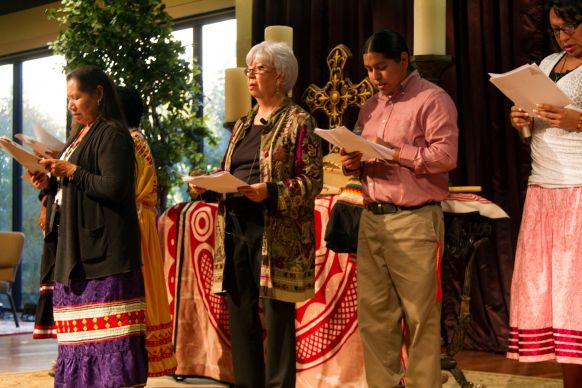
Tribal members from Oklahoma participate in readings (skits) that explain challenges facing indigenous peoples during the Act of Repentance service.
Native Americans share struggles, hopes
OKLAHOMA CITY (UMNS) — by Heather Hahn, OKLAHOMA CITY (UMNS)
Save a language, and you can save a people.
Tamara Wilson, a United Methodist and member of the Yuchi people, shared that message with bishops and other denominational leaders during a Nov. 6 service of repentance.
She was one of three Native-American women who shared their struggles in trying to sustain a way of life that was often suppressed by U.S. churches. Wilson, a teacher preparing to be a United Methodist deaconess, spoke passionately about her efforts to preserve the Yuchi language.
“Saving a language is saving children,” said Wilson, a member of Kvncate (Concharty) United Methodist Church in Okmulgee, Oklahoma. With knowledge of their ancestors’ language, the children she teaches will know their identity and know they are precious, Wilson said. They will be less likely to accept abuse or to abuse others.
“If you save these languages and they don’t disappear, then the people will live better lives,” she said, translating advice from her elders.
Wilson spoke at a service at St. Luke’s United Methodist Church in Oklahoma City that blended worship of God, education about the challenges Native Americans still face and a call for United Methodists to love their indigenous neighbors more faithfully.
Worshipers included members of the Council of Bishops and Connectional Table, the United Methodist body that coordinates ministry and resources. Also present were leaders of the Oklahoma and Oklahoma Indian Missionary conference as well as Native American leaders and Oklahoma state officials, including two state Supreme Court justices.
During the worship, the prayers were offered in Yuchi, Maskoke, Kiowa, Choctaw and Lakota.
Be sure to add the alt. text
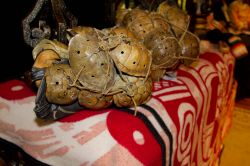 Turtle shells worn by Native women during traditional stomp-dance ceremonies adorn the altar during the Act of Repentance service Photo by Ginny Underwood, UMNS
Preserving a way of life
Those prayers in multiple languages marked a significant change from what many Native Americans experienced when they first encountered Methodism.
Wilson said that Methodist missionaries told her great-grandmother that she would “burn in hell” if she continued her tribal ways. When Wilson’s grandmother was orphaned at the age of 13, she was taken to an Indian boarding school where she was beaten whenever she used the Yuchi language.
Her grandmother did not teach her children her language. “When she did not teach her children their language, they did not have a deeply instilled understanding of who they were, where they came from and how blessed they were to be as God created them,” Wilson said.
But now she and others in the Yuchi are teaching the language to a new generation. Wilson joked that her infant son “cries in Yuchi.” To church leaders looking for ways to help Native Americans, she suggested they consider supporting projects that preserve Native-American languages.
The worshipers also heard from Denicia Wilson, who is Sioux and Kickapoo. She spoke of efforts to make Native Americans choose between the Bible and their ceremonial traditions. She suggested forcing such choices rarely works long-term and can hinder evangelism.
The last Native-American woman to address the worshippers was Deb Echo-Hawk, the Pawnee Nation’s Keeper of the Seed. She has worked to save breeds of corn that almost went extinct after the Pawnee people were exiled from their lands in Nebraska to Oklahoma in the 1870s.
She told those gathered that the Pawnee now have 14 gardens of their corn in Nebraska and seven in Oklahoma.
Road of repentance
The service continued a journey The United Methodist Church began in 2012 at General Conference, its top lawmaking assembly. At that gathering, United Methodists participated in an Act of Repentance Toward Healing Relationships with Indigenous People service. The U.S. government also celebrates November as Native American Heritage Month.
A General Conference resolution also charged the denomination’s Council of Bishops with carrying out an ongoing process to improve relations with indigenous individuals including local or regional acts of repentance.
During the service this week, worshippers also heard about other struggles among Native Americans today. These include poverty, substance abuse and domestic abuse.
The Rev. Chebon Kernell, executive secretary for the Native American and Indigenous Ministries at the United Methodist Board of Global Ministries, organized the service. Kernell commended conferences that have participated in acts of repentance and exhorted United Methodists to continue the work of healing.
He ended his sermon with a reminder of the sort of welcoming spirit that led to the first Thanksgiving in the American colonies.
“It’s time,” he said, “to entertain our guests and visitors in the way that represents the hospitality that indigenous peoples have shown the non-native world since we first shook hands with each other.”
Hahn is a multimedia news reporter for United Methodist News Service. Contact her at (615) 742-5470 or newsdesk@umcom.org
____________________________
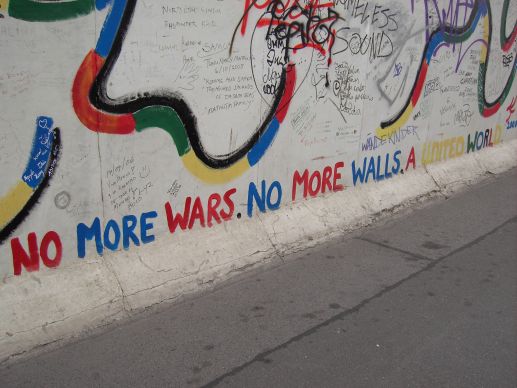
Oct. 2006 image shows graffiti on East side of Berlin Wall. November 9, 2014 is the 25th anniversary of the fall of the Berlin Wall.
Berlin Wall: Call for freedom everywhere
FRANKFURT, Germany (UMNS) — By Bishop Rosemarie Wenner
There are very few German citizens older than 35 years or so, who do not know where they were when they heard the news: “The borders in Berlin are open!” The people of East Berlin went immediately to see if that was true. They passed Checkpoint Charlie and other entrance gates. And quite soon they danced in the streets of the western part, and yes, some even literally climbed over the wall.
My husband and I were vacationing on the Azores on November 9, 1989. We could not believe what we saw by chance in the news. And we weren’t able to understand what the Portuguese journalist was saying. Through a phone call with our family in Germany we were able to assure ourselves that in fact a dream had come true!
This happened 25 years ago. Watching the pictures and remembering the excitement of those days my first comment on what came about in the night from Nov. 9 to 10, 1989 is: “Thanks be to God!” I well know: The opening of the border that divided my home country and the whole process of the reunification did not fall from nowhere. Thus I see the fact that the struggle of many citizens of the German Democratic Republic (the then Communist part of Germany) led to a peaceful change as a huge gift from God, as many Christians do. The prayers were answered, as the demonstrations in Leipzig, Dresden and elsewhere at that time in Autumn 1989 started.
For me God’s gift of the unification of my nation is also a call. There are far too many walls in our world that seem to be too big and strong to pull them down, countless people longing for a life of freedom and dignity.
The Korean nation has been divided since 1948. The Korean War ended in 1953 with a ceasefire, but there is no peace contract even today. During my visits in South Korea, I was frequently asked: “Pray with us, so that we will overcome our division as well!” I took this as my task.
Since I worshipped at the wall that divides the USA and Mexico near San Diego a few years ago together with fellow bishops, I also pray that the American nation might overcome fear and welcome neighbors.
Because I am grateful for my unified country, I encourage my fellow Germans to share what we received. Many of us, myself included, have far more than enough. We can make room for refugees that arrive in Germany. Distrust and worse, hostility and hatred towards strangers should not be allowed to grow in our society.
We Germans have two commemorations on Nov. 9. The night of Nov. 9, 1938, the Nazis burned down many synagogues throughout Germany. And the vast majority of the German population, including many faithful Christians, observed what happened and were quiet.
This commemoration is a legacy too. We have not only the history of a peaceful fight against a dictatorship, but also a history of oppression towards Jewish people alongside with Roma people and others, including homosexuals.
And yet, by God’s grace today, we are a blessed country. The work of many to build up a stable democracy in Germany bears fruits. We have to keep it, to multiply it, and to pass it on to others. From what happened Nov. 9, 1938 and Nov. 9, 1989, we can learn to do no harm, to do good and to be part of God’s work so that dreams can come true.
Wenner is the current presiding bishop of The United Methodist Church in Germany.
____________________________
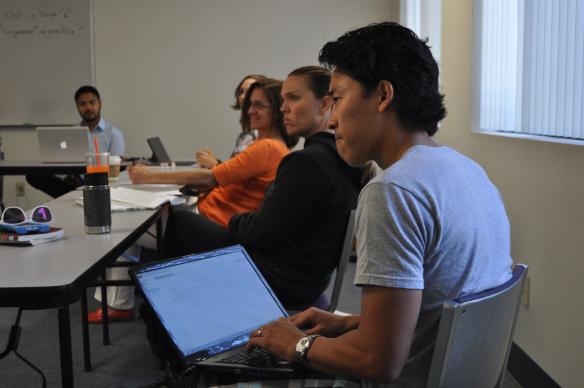
Students practice listening in class on Buddhist-Christian thought and spiritual care at the Claremont School of Theology in Claremont, Calif.
Students say Claremont mirrors society's diversity
CLAREMONT, Calif. (UMNS) — by Natalie Bannon*
It’s not just the sunny southern California forecast that attracts students to United Methodist-affiliated Claremont School of Theology. Set in one of the most religiously-diverse communities in the world, future United Methodist leaders say it is the school’s focus on interreligious education that has called them to study there.
With cross-registration agreements with the University of the West, a Buddhist institution, the Academy for Jewish Religion, and Bayan Claremont, a Muslim graduate school, students of all traditions interact on a daily basis in the classroom, in chapel and during social activities.
Students say a campus that mirrors the diversity of society not only prepares them for effective leadership, it also strengthens their personal faith as United Methodists.
As the son of two United Methodist elders, Master of Divinity student Juan Garay has spent his life in church. “I grew up in the pews, and ministry was not very appealing to me,” he said. “It was too rigid and I had problems understanding God’s grace. However, when I got married, I received a calling from God that I couldn’t deny, but I felt like God was calling me to raise a different kind of church.”
For Garay, that means planting a multicultural, multiracial and multilingual church in the heart of Milwaukee, Wisconsin.
“Claremont is preparing me to be a Christian leader in a city that’s segregated by boundaries and lines that have been drawn,” said Garay. “My education and experiences can help me find healthier ways to re-engage in conversations where lines have been drawn. After all, that’s exactly what Jesus did.”
Claremont School of Theology president Dr. Kah-Jin Jeffrey Kuan says that interreligious engagement is no longer a choice. “It is a reality for the world in which we live,” he said. “Communities of faith are now wrestling with theological and practical questions of what it means to live, work and raise families beside people who claim traditions and beliefs that differ from their own. It is critical that religious leaders, both ordained and lay people, are capable of helping families and communities navigate their way through those challenging questions.”
Ph.D. candidate Christopher Carter anticipates his education at Claremont will enable him to do just that. Carter feels called to use his degree teaching at a seminary. “I want to teach students to analyze and address ethical issues that are more reflective of their faith and the globalized world we live in,” he said. “They’re the issues that confronted me as a pastor and the issues that confront others. Sociologists refer to what’s happening as the browning of America. A shift is taking place in America and some of our clergy might not be ready for what’s happening. So, I want to take that knowledge to them so that our denomination can thrive in the future.”
One way in which Claremont prepares students for a successful future is by developing their peacemaking skills. Dr. Najeeba Syeed-Miller, assistant professor of interreligious education, is a trained mediator and peacemaker. In the peace education course she is teaching this semester, students learn skills in their own context. “Interfaith engagement strengthens their own identity so they have the skills to discuss what it means to be United Methodist,” she said. “They can explain and encourage others if they are engaged in an interreligious service project or social justice project in the community. If they have peacemaking skills, they can better leverage resources because they have a sense of being better negotiators.”
Not only that, students and even professors say that interreligious curriculum empowers them to better explain their own beliefs to others. Dr. Helene Slessarev-Jamir, Claremont’s Mildred M. Hutchinson professor of urban ministries said, “It enables me to think more broadly and find elements in other traditions that might help me reconcile my own.”
Juan Garay agrees, “The United Methodist mission is to make disciples of Jesus Christ for the transformation of the world. I believe wholeheartedly that in order to transform the world, our view has to go beyond our own scope of what we believe the world is. If my view of the world is really small, the kind of transformation I’m going to be able to effect is also going to be really small. These aren’t times for small thinking. As religious leaders, we have to have God-sized vision.”
*Bannon is a public relations specialist at United Methodist Communications in Nashville, Tenn. Media contact is Natalie Bannon at 615-742-5413.
____________________________
History of Hymns: “For the Beauty of the Earth” by C. Michael Hawn
"For the Beauty of the Earth" by Folliot S. Pierpoint,
The United Methodist Hymnal, No. 92
 |
C. Michael Hawn
|
For the glory of the skies,
For the love which from our birth,
Over and around us lies;
Lord of all, to thee we raise
This our hymn of grateful praise.
Folliot Sandford Pierpoint (1835-1917), a graduate of Queens’ College, Cambridge (BA, 1857), and a teacher of classics at Somersetshire College, has provided us with one of the most enduring hymns in Christian hymnals.
Pierpoint was the author of several poetry collections, including The Chalice of Nature and Other Poems (1855), Songs of Love, the Chalice of Nature, and Lyra Jesu (2nd Edition, 1858). The words of this hymn appeared in Lyrica Eucharistica, The Hymnal Noted (second edition, 1864).
As the title of the collection in which the hymn was published indicates, this hymn was originally written for the celebration of the Eucharist. The original poem was published in eight, four-line stanzas under the title, “The Sacrifice of Praise.” British hymnologist J. R. Watson suggests, “It is said to have been inspired by the view of Pierpoint’s native city of Bath on a spring day.” The original refrain, “Christ, our God, to thee we raise/This our sacrifice of praise,” reflects the theology of the Lord’s Supper as a sharing in Christ’s sacrifice. “For the beauty of the earth” appeared in the final “Miscellaneous Hymns” section of Lyra Eucharistica, echoing the post-Communion prayer in the Book of Common Prayer (1662): “. . . we thy humble servants desire thy fatherly goodness mercifully to accept this our sacrifice of praise and thanksgiving. . . .” Alterations made to the hymn and approved by the author made it useful for a broader range of liturgical occasions.
The original eight stanzas have been pared down to six for The United Methodist Hymnal. Each stanza paints a picture of gratitude embodied in some aspect of God’s creation: the earth (stanzas 1 and 2), the senses (stanza 3), “human love” (stanza 4), the church – in the original, “thy Bride” – (stanza 5), and the gift of God as manifest in Christ (stanza 6).
Omitted stanzas include themes characteristic of historical and theological views of hymns written by Church of England hymnwriters, the martyrs and prophets, and the Virgin Mary and the incarnation:
For thy Martyrs’ crown of light,
For the Prophets’ eagle eye,
For thy bold Confessors’ might,
For the lips of infancy:
Christ our God, to thee we raise
This our sacrifice of praise.
For thy Virgins’ robes of snow,
For thy Maiden-mother mild,
For thyself, with hearts aglow,
Jesu, Victim undefiled:
Offer we at Thine own Shrine
Thyself, sweet Sacrament Divine.
The later refrain, “Lord of all, to thee we raise This our hymn of grateful praise,” broadens the focus of the original hymn from Christ’s sacrifice to one of gratitude for all creation and “Lord of all.”
Alterations to the original “Christ, our God. . . “ have been many, some of which are poetically and theologically weaker, for example, “Gracious God.” A long tradition exists that God died on the cross. The Fifth Ecumenical Council (553 C.E.) holds that “our Lord Jesus Christ, who was crucified in the flesh, is true God, and the Lord of glory [I Cor. 2:8], and one of the Holy Trinity.” Thus Pierpoint follows a long tradition that equates Christ and God. As a eucharistic hymn in its original form, this theology is continued. The late Australian hymnologist Wesley Milgate lamented the changes to the refrain: “Practically every recent hymnal has a different version of the refrain, apparently fearful of the treading on the corns of ‘liberal’ theologians and those who shilly-shally with an essential part of the Christian doctrine.” Pierpoint himself, according to Professor Watson, “defended his original text, noting that Pliny, in his letter to Trajan, had described Christians as singing hymns to Christ as God.”
The concrete images of this text make it ideal for children of all ages. The theological scope of this hymn differs from many others on this theme. For example, earlier hymns by Isaac Watts – “I sing the almighty power of God” (United Methodist Hymnal, 152) from 1715 – and Cecil Frances Alexander – “All things bright and beautiful” (United Methodist Hymnal, 147) from 1848 – focus on the natural created order. Both of these hymns were written to expound on the first article of the Apostles’ Creed, “I believe in God the Father, Maker of heaven and earth,” for children. Pierpoint, writing for the Eucharist, expands the discussion beyond the natural created order to humanity, the church, and, in the original, the martyrs, prophets, and the incarnation.
The final stanza addresses Christ himself as a gift:
For thyself, best Gift Divine,
to the world so freely given,
for that great, great love of thine,
peace on earth, and joy in heaven.
In the final line, Pierpoint joins hymn writers throughout the ages by echoing the cosmic connection between heaven and earth found in Luke 2:14: “Glory to God in the highest, and peace on earth . . . .” (KJV)
Conrad Kocher’s tune DIX (1838) is not the only tune to which this text is sung, but is undoubtedly the most popular in the United States. British Composer John Rutter (b. 1945) renewed interest in this text with his popular anthem setting composed in 1978.
C. Michael Hawn is University Distinguished Professor of Church Music, Perkins School of Theology, SMU.
____________________________
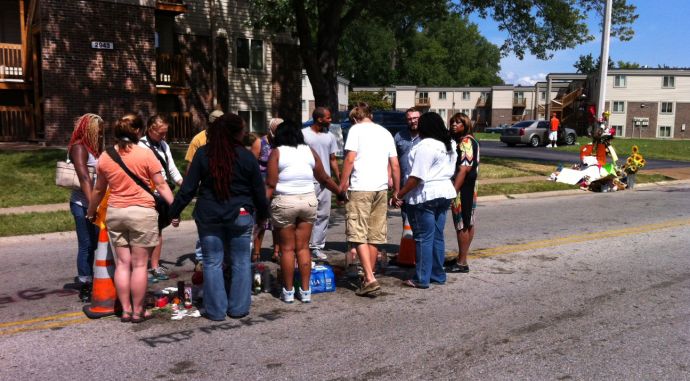
An impromptu memorial marks the area where Michael Brown was killed in Ferguson, Mo. Photo by Matt Miofsky
Pastor: Grand jury ruling calls for 'courageous compassion'
FERGUSON, Mo. (UMNS) — by the Rev. F. Willis Johnson, FERGUSON, Mo. (UMNS)
For more than 90 days — a length of time past expiration for some, not long enough for others—our community lives in suspense while suspicion grows. We await the decision of whether a grand jury will indict Darren Wilson, a white Ferguson police officer, for fatally shooting unarmed, 18-year-old Michael Brown on August 9.
In anticipation, the Ferguson-Florissant School District and adjacent school districts plan to close schools when the grand jury releases its decision. According to reports, the Ferguson Police Department is stockpiling teargas, grenades and other weaponry to use in the event civil disorder follows a grand jury decision not to indict Wilson. Nearby law enforcement agencies are likewise preparing for civil unrest. These are unnerving indicators that law enforcement are preparing a response to civil disorder with violence.
Certain circumstances lead to civil disorder. Stress and strain cause us to shout, and predicaments like Ferguson require remonstration. This is true not only in Ferguson; it’s true in every place where people are pained and protracted problems persist.
A just society is to be judged by how well it treats the weakest, poorest and pained of its members. The church, not only society, must remain answerable to a similar critique. Our systems are malignant and myopic, able only to label or categorize. The cultural practice is to make caricatures of individuals based on assumptions, biases and stereotypes, rather than celebrating our divinely given personhood.
Be sure to add the alt. text
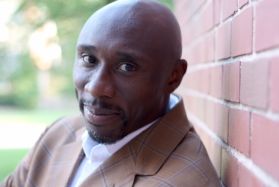 The Rev. F. Willis Johnson. Photo courtesy of Johnson.
 Opportunity to listen
In the days following this tragedy, our work has afforded the opportunity to listen to people across the spectrum: youth, corporate executives, educators, journalists, national leaders, even philanthropists. There is a shared heaviness of heart regarding the shooting death by police of yet another young, black person. However, few bear the burden of such heaviness more than a parent.
I was recently speaking with the mother of a biracial young adult son who said, “When my son says he intends to resist authority [police], my first impulse is to tell him he is wrong because of my fear for his physical being.” She quickly followed with a peppering of questions: “What about his spirit? How to respect his anger and still encourage him to stay safe? How to prepare him for racism and injustice without it turning into self-fulfilling expectations?” More importantly, the mother proceeded to become introspective, “What is my own fear about…how can my own fear and anger be translated into positive action? What questions can I ask so he can discover his own understanding, not mine?”
After an unprofessional sigh and exclamation of, “Whoa,” I commented that it not wrong to feel. Under no pretense does anyone deserve to lose his or her life. Nor should he or she have his or her personhood ever discounted. Not feeling something is not human. Some have felt moved to respond. Others are immobilized by the weight of their emotions. Many profess their feelings of pain and angst publicly through protest. There are also those who lament privately.
Prayer and protest
Each of these methods is a uniquely profound and necessary form of expression. For instance, prayer and protest are the voice of the unheard and unexamined. There is no one manner in which to think or act. People who are hurting need to be affirmed in their hurt; people who are angry need to be affirmed in their anger. This way of listening and hearing one another is called empathy, a core value of human relationship and community.
The conversation highlights our inability at times to move or feel. Daily, we struggle to maintain efforts to coexist, understand, listen, trust or sustain hope in systems, leaders and practices. This is true whether in Ferguson, Missouri; our family; or our church. Such is the challenge of exercising “courageous compassion.” Courageous compassion is risk-taking… it is daring to care. Courageous compassion defies convention. Courageous compassion seeks equity and justice through ministering at the margins — demonstrating divine commitment.
Respecting that decisions and actions may not produce the results many expect or want — hope is not lost. Justice is promised, and peace will be given. Peace may exist beyond our understanding, but is not beyond our grasp. Regardless of the outcomes we are called — for such a time as this — to be courageously compassionate towards all.
Johnson is pastor of Wellspring Church, a United Methodist congregation in Ferguson, Missouri.
News media contact: Heather Hahn at (615) 742-5470 or newsdesk@umcom.org.
____________________________
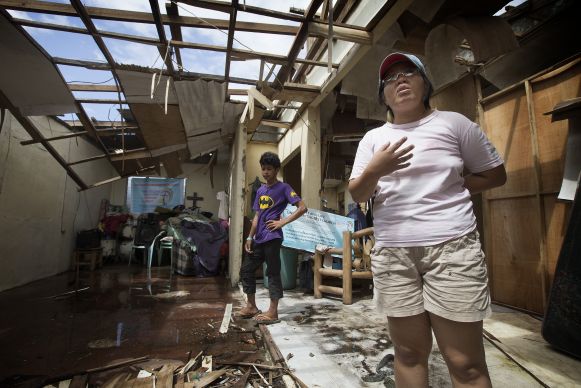
Pastor Iris Picardal Terana describes how floodwaters from the 2013 typhoon washed through Light and Life United Methodist Church in Tacloban, Philippines.
Commentary: Is the Philippines ready for an earthquake? by April Grace G. Mercado, QUEZON CITY, Philippines (UMNS) — As deadly and fierce as Typhoon Yolanda was, historic records indicate a possible 7.2 magnitude earthquake could hit Manila within our lifetime.
Are we ready?
Unlike storms and typhoons, earthquakes can be predicted but not forecast.
In a nation where on average 20 storms strike the South Pacific islands annually, Typhoon Yolanda (also called Typhoon Haiyan) was one for the record books when it stuck on Nov. 8, 2013.
“It's been a year since Typhoon Yolanda landed and shook our lives and faith in God, but still through it all—God is so good!” said the Rev. Iris Picardal Terana of Light and Life United Methodist Church in Tacloban City. The church was destroyed in the storm and for a while it was thought the pastor and her family were missing.
“In praising and thanking God for all he has done … for us to survive and move on in our faith journey filled with hope, more faith, joy and love—all glory be unto Him,” she said.
Surviving and moving on
One year later, volunteers, the government and other nonprofit organizations are working to be better prepared for the Philippines’ next calamity.
One of those groups is Oplan Hatid (Operation Drop Off). Thousands of volunteers rushed to the aid of the 14 million people affected by the storm including many “angels” like Junep Ocampo. Ocampo mobilized a group of 2,000 volunteers to lend their vehicles to bring 17,000 typhoon survivors to safety last year.
On Nov. 5, the group reunited to celebrate stories of hope and survival and talk about ways to capture the spirit of volunteerism to create disaster-resilient communities.
The group adopted the slogan, “It’s more than transport; it’s support.”
“Its purpose is to get the citizenry together where the government can’t provide,” said James Deakin, spokesperson for Oplan Hatid.
Government and non-government agencies are looking at ways to be better prepared. The Metro Manila Development Authority, the Philippine National Red Cross and the Armed Forces of the Philippines are three of many agencies gearing up for the next calamity.
“Disaster preparedness is everybody’s responsibility. All stakeholders should work together and consciously contribute in building a resilient Metro Manila,” says Francis Toleninto, development authority chairperson.
“It is better to plan when it is not needed, than not have planned when it was necessary,” added Tolentino.
Master plan in place
Last Oct. 30, Philippine President Benigno Aquino III signed and approved the $3.8 billion (170.9 billion Philippine pesos) master plan to rebuild Yolanda-hit areas in Central Visayas. Resettlement of the displaced families will require the biggest funding; nearly half the money, about $1.7 billion (75.6 billion pesos) will go to this effort. The remainder will be used for infrastructure, economic development, and social services. A total of 18,400 projects are involved in rebuilding Central Visayas.
For a country plagued by corruption, the biggest challenge to the rehabilitation efforts is to keep public funds from ending up in officials’ pockets. Many Filipino and international organizations, as well as citizens, remain vigilant in fighting for accountability and transparency during the rehabilitation.
As we commemorate the first-year anniversary of Yolanda, may we never forget the countless people who lost their homes and loved ones, and may we never forget those who are still struggling to make ends meet. May we also never forget all the people who, in big or small ways, continue to help the displaced get back on their feet.
For those who survived, life will never be the same. And as they attempt to deal with the aftermath of Yolanda, let us continue to help them in rebuilding what they lost and continue to bring them hope for their future.
*Mercado is the United Methodist Communications field representative in the Philippines. For more information about this article, contact Vicki Brown at (615) 742-5470 ornewsdesk@umcom.org.
____________________________
United Methodist joins NCC staff
WASHINGTON (UMNS) — National Council of Churches welcomes two new staff members
Washington, November 7, 2014: The National Council of Churches of Christ in the USA (NCC) announces the hiring of two new staff members. Rev. Aundreia Alexander, Esq., comes to the NCC from the American Baptist Home Mission Societies, American Baptist Churches, USA, and will begin her new position as an Associate General Secretary for Action and Advocacy for Justice and Peace in early January. Rev. Steven D. Martin, the NCC’s Director of Communications and Development, begins immediately.
Alexander brings a wealth of expertise and experience to the NCC. Rev. Alexander comes to the NCC from the American Baptist Churches, USA’s Office of Immigration and Refugee Services. She leads the denominational efforts to advocate for a comprehensive humane immigration law in the United States. For the past several years she has also advocated for human rights and religious liberty issues related to the diaspora of the ethnic peoples of Burma. She has recently worked closely with the World Council of Churches and the United Nations on addressing the plight of stateless persons. She also brings her background in law and conflict resolution to the NCC as an advocate for peace and justice.
“I am excited beyond measure to join the NCC staff,” Alexander stated. “In my new position I will be able to merge my passions for social justice, ecumenism and peace building all into one ministry portfolio, thereby living out my personal mission statement: To combat systems and structures that debase others and to serve as a catalyst to help the marginalized reach their greatest God-given potential.”
Aundreia is looking forward to moving to Washington DC, where “there is no end to cultural enrichment and exploration,” she says.
Rev. Martin is an ordained Elder in the United Methodist Church. For the past eight years he has led Vital Visions, a non-profit focused on creating media for the purpose of peacemaking and understanding, and has produced films shown on PBS stations nationwide. He, along with Richard Cizik and David Gushee, is also a co-founder of the New Evangelical Partnership for the Common Good. He is best known for his three films that detail the role of Christian leaders during the early years of the Nazi regime, all in the permanent collections at the United States Holocaust Memorial Museum and Yad Vashem. Martin’s experience leading both local communities and national initiatives, his capacity as a leader and fundraiser for non-profits, plus his knowledge of the mainline Protestant denominations along with Evangelical leaders and institutions, adds significant strength to the NCC’s ability to communicate its message of ecumenism, justice, and peace.
Martin and his wife, Jana, are the proud parents of four children.
NCC Chair Roy Medley stated, “The addition of these two staff members brings the National Council of Churches to a place where we can now engage the important issues of our time with a full complement of skills and abilities. I’m very optimistic about the church’s future and the part the NCC will play in that future.”
“Aundreia and Steve bring a lot of talent and energy to the National Council of Churches,” adds Jim Winkler, President and General Secretary. “Aundreia’s background as an attorney combined with her years of experience in refugee resettlement, immigration policy, and conflict transformation, makes her an ideal choice for the NCC. Steve’s experience as a pastor, media producer, and entrepreneur, along with his knowledge of the Evangelical community, expands our capacity to engage all corners of our society. We are thrilled to have them as part of our leadership.”
____________________________
Looking ahead
Here are some of the activities ahead for United Methodists across the connection. If you have an item to share, email newsdesk@umcom.org and put Digest in the subject line.
Sunday, Nov. 17
New missionaries commissioned — 11 a.m. ET. The United Methodist General Board of Global Ministries will commission seven new missionaries for service around the world. The new missionaries come from South Korea, the United States, Paraguay and the Philippines and will be serving in Tanzania, Côte d'Ivoire, Honduras, the United States and Taiwan. Bishop Silvio Cevallos of the Evangelical United Methodist Church will preach at the service in Quito, Ecuador.
New missionaries commissioned — 11 a.m. ET. The United Methodist General Board of Global Ministries will commission seven new missionaries for service around the world. The new missionaries come from South Korea, the United States, Paraguay and the Philippines and will be serving in Tanzania, Côte d'Ivoire, Honduras, the United States and Taiwan. Bishop Silvio Cevallos of the Evangelical United Methodist Church will preach at the service in Quito, Ecuador.
Tuesday, Nov. 18
Free webinar "Engaging Families and Children with Special Needs" — 10 a.m. CT. In this interactive webinar, Elizabeth Christie of the New York Conference will present a broad overview of children and families who come to churches with special needs. She will offer tips for setting up classrooms and activities so that everyone is successful and engaged. Details.
Free webinar "Engaging Families and Children with Special Needs" — 10 a.m. CT. In this interactive webinar, Elizabeth Christie of the New York Conference will present a broad overview of children and families who come to churches with special needs. She will offer tips for setting up classrooms and activities so that everyone is successful and engaged. Details.
You can see more educational opportunities and other upcoming events in the life of the church here.
____________________________ United Methodist News Service is a ministry of:
United Methodist Communications
810 12th Avenue South
Nashville, Tennessee 37203-4704 United States
NewsDesk@umcom.org
Phone: (615)742-5400
____________________________

No comments:
Post a Comment