democracynow.org
Stories:

Trapped: New Film Follows the Providers Who Are Fighting to Keep Abortion Accessible in the South
As the Supreme Court prepares to hear a landmark abortion case that could gut Roe v. Wade, we look at a startling new documentary, "Trapped." The film addresses TRAP laws—Targeted Regulation of Abortion Providers—and their impact on abortion providers in the South. We are joined by the film’s director, Dawn Porter, as well as two of its subjects: Dr. Willie Parker of Jackson Women’s Health, the last abortion clinic in Mississippi, and June Ayers, owner and director of Reproductive Health Services in Montgomery, Alabama, one of the few remaining abortion clinics in the state.
TRANSCRIPT
This is a rush transcript. Copy may not be in its final form.
AMY GOODMAN: We broadcast from the Sundance Film Festival in Park City, Utah, returning to our conversation about the new film Trapped, which just premiered here at Sundance. It looks at the impact of anti-choice laws on abortion providers in the South. In this clip from Trapped, Dr. Willie Parker counsels a patient at the last remaining abortion clinic in Mississippi.
DR. WILLIE PARKER: We have information that the state has compiled in this packet of extra things, other things, information, that you can know that might help you with your decision. You can take this, if you want, but you don’t have to. But I’m obligated by law to offer it to you. I’m required by law to tell you that by having an abortion, it can increase your risk for breast cancer. There is no scientific evidence to support that. Now, the state requires me to tell you that if you were having this procedure, there is the risk of complications. I think that’s a good thing to know, the risk. The state requires me to tell you that you can have heavy bleeding that can be life-threatening, and it could require you to be transferred to the hospital and need a blood transfusion. If you’re having a bleeding that can only be controlled with removing your uterus, you’d have to have a hysterectomy, and you’d lose your ability to have babies in the future. Those are all the risks associated, but guess what. Those are the exact same risks that’s associated with having a baby. It is to say that you’re not taking any extra health risk. So abortion is extremely safe.
AMY GOODMAN: That’s Dr. Willie Parker counseling a patient at Jackson’s Women’s Health, the last abortion clinic in Mississippi. In this clip from the film, June Ayers, the owner and director of one of the last remaining independent abortion clinics in her state, in Alabama, sits in her kitchen poring over a packet of regulations.
JUNE AYERS: It says emergency lighting shall be provided in accordance with Section 7.9. And there is no 7.9. It’s like trying to work your own crossword puzzle. I work crossword puzzles very, very well. I just don’t do it when you have to make your own puzzle up. And that’s basically what this seems to be asking me to do, which doesn’t make a lot of sense. But, you know, a lot of this doesn’t make a lot of sense.
AMY GOODMAN: That was June Ayers from the new documentary Trapped, which had its world premiere here at the Sundance Film Festival last night. Well, June Ayers and Dr. Willie Parker join us now, and we’re joined by the film’s director, Dawn Porter. Dawn, why did you make this film?
DAWN PORTER: I found it so shocking that laws, that couldn’t do directly, couldn’t—you couldn’t ban abortion in America, but that across the country laws were closing clinics at such an alarming rate. I also was just so struck by the dedication of these clinic providers. They take their—you know, they risk their health and their safety to protect rights for all women. But there’s a particular impact on low-income women and women of color in abortion clinics. And these two providers and the other providers in Alabama are serving such an underserved population, and I felt like it was a story that hadn’t been explored in depth.
AMY GOODMAN: Dr. Willie Parker, you haven’t always provided abortions. You’re an ob-gyn. But talk about your own history.
DR. WILLIE PARKER: Well, someone said, when—to know is to become responsible. I’ve been an ob-gyn for 21 years, a doctor for 25. And when it became clear to me, in the scope of my work, that one in three women need abortion care in their reproductive lives and that disproportionately poor women and women of color were not having those services, it became important to me to guarantee access to these very important health services by moving back to my hometown in Birmingham and to provide services in the South. I am a person of color, I grew up in poverty, and I know what it means when these services aren’t available. So it made it important for me to prioritize these services for women in the South.
AMY GOODMAN: So you travel throughout the South. You go to Mississippi.
DR. WILLIE PARKER: Correct.
AMY GOODMAN: How is there only one clinic there? How many were there?
DR. WILLIE PARKER: I don’t know the actual access history of Mississippi. I’ve only been going there since 2012. But I’m told that as of the early '80s, there were as many as 15 clinics in Mississippi. And it was pretty much an attrition. People who courageously founded clinics and provided services, over time, as the regulations changed, as the hostility ramped up, they decided that it wasn't worth it for them. And so we ended up with one clinic left and one courageous owner making sure services remain available in that state.
AMY GOODMAN: Now, one of the regulations, these TRAP regulations—and again, Dawn, TRAP stands for?
DAWN PORTER: It’s Targeted Regulation of Abortion Providers.
AMY GOODMAN: TRAP—is doctors should have admitting privileges at the local hospital. You’re a doctor. What’s wrong with that? It sounds extremely reasonable. Women would want to know that their doctors—they see it as a kind of credential.
DR. WILLIE PARKER: Well, it passes the commonsense test, but it’s not—it doesn’t pass the muster with regard to the informed reality of how medicine works. First of all, in an emergent situation, you will be taken to any hospital, the nearest one that’s available, so whether the doctor has privileges there or not doesn’t matter. But more importantly, abortion is so extremely safe that the likelihood of needing to manage any complication related to abortion is extremely low. So, again, it passes the commonsense test and allows people who use these regulations to control access to abortion to gain public sentiment, but it’s really unnecessary.
AMY GOODMAN: And if a doctor travels, goes from one clinic to another and is out of state, they wouldn’t have admitting privileges at a particular local hospital?
DR. WILLIE PARKER: Well, you can get privileges. I would be eligible for privileges if I wasn’t doing abortions and if I were based in Mississippi.
AMY GOODMAN: What do you mean, if you weren’t doing abortions?
DR. WILLIE PARKER: Well, the targeted regulations of requiring doctors to have admitting privileges if they do abortions—the primary service that I provide in Mississippi is abortion care. So if I were not doing abortions and I were doing ambulatory care, there would be other doctors who would be willing to affiliate with me. I could have a freestanding practice. So, it is the fact that I provide specifically abortion care—where some hospitals have as a mission: If abortion care is what you provide, you’re not eligible for admitting privileges at my institution.
AMY GOODMAN: Dawn?
DAWN PORTER: Which shows you that the regulations, the state law, requires the physician to have admitting privileges. Dr. Parker applied to every hospital within the appropriate area, and they all denied access. So you see it’s this crazy catch-22. These are laws that you cannot comply with, and that’s the runaround around the Constitution.
AMY GOODMAN: June Ayers, tell us your story. How did you come to own an abortion clinic in Birmingham, Alabama?
JUNE AYERS: I’m in Montgomery.
AMY GOODMAN: I mean Montgomery.
JUNE AYERS: And—
AMY GOODMAN: In the town of Rosa Parks.
JUNE AYERS: In the town of Rosa Parks. I started 37 years ago. And my clinic is the oldest independent provider of abortions in the state. And it was something that I felt like I needed to do. It’s why I get up in the morning—patient care, helping women. And in—
AMY GOODMAN: You were born in Birmingham?
JUNE AYERS: I was born in Birmingham, yes.
AMY GOODMAN: And your own personal experience with the issue of abortion?
JUNE AYERS: When I was in high school, which was 1973—I graduated from high school in '73. In December of that year, I was pregnant. And it's something I’ve never forgotten, because I had a choice, and I exercised my right to have an abortion. If I had been pregnant 12 years before that, I wouldn’t have had—excuse me, 12 months before that, before Roe came along in January, I would have not had a choice. And I think, like a lot of other women, I would have been in a situation where I would have felt very desperate not to have that choice. So, that’s one of the things that motivates me, that my doors need to stay open so that women have a safe place to come, have somebody that cares about them and somebody that will help them through this crisis.
AMY GOODMAN: How difficult is it for you to keep this clinic open, with the TRAP laws? How does it affect you financially and otherwise?
JUNE AYERS: It’s certainly overwhelming financially, and it has been for all three of the independent providers in Alabama, just trying to pull together the pieces of any of the legislation and then actually make it come to fruition in the clinic. One of the things I talk about is that I have a closet door, literally a closet door, that costs $2,500 that had to be installed.
AMY GOODMAN: Why?
JUNE AYERS: And it’s those—because that was part of the regulation that came down.
AMY GOODMAN: Dawn?
DAWN PORTER: The states are giving, with incredible specificity, the—you know, June has a particular closet door that she has to install. In Texas, they had to install a negative ventilation pressure system in that clinic. Oxygen has to be in the wall. Medicines, expensive medicines, are required by state statute—medicines that are never used. It’s such an incredible waste of healthcare resources.
AMY GOODMAN: June Ayers, talk about the blue packet of state-mandated information that you have to give out to patients.
JUNE AYERS: We have to give out two booklets. One is a white resource directory, which is a very good book. But the blue "Did You Know?" booklet is—has information that’s misinformation in it. Initially, it did have that abortion causes breast cancer. We finally did get that removed, but it took a court case to get that removed. And it shows pregnancy two weeks—from two weeks to 40 weeks. And for me, I look at it as something very coercive to the patient. It is meant for the patient. They say—we get back to the semantics here—that it’s there for the patient’s information, and it’s there to help her know, you know, what direction she wants to go in. And I see it more as a punitive booklet.
AMY GOODMAN: June, you work in Montgomery. The chief justice of Alabama is Roy Moore, recently—most recently in the headlines around gay and [inaudible]—
JUNE AYERS: [inaudible] And he swings very much to the religious right. When they were—when I had a siege in Montgomery last summer, he actually spoke at their gathering. And we had several anti-abortion groups that came to Montgomery. More than 250 of them were parked across the street from the office and were obviously trying to prevent us from doing procedures, from getting patients in, from getting physicians in. And it’s very intimidating. And he is supporting them, and not only just supporting them, but, you know, is being a spokesman for them, too.
DAWN PORTER: Chief Justice Moore is also the past president—his wife is now the president—of an organization that funds anti-choice protesters, that pays their legal fees. So you have a situation where the chief justice, the administrative head, of the courts in Alabama, the courts where a minor is required to get judicial permission in order to have an abortion, so the man that leads the courts that will make those determinations is solidly anti-choice, and not only supports, you know, with his presence, but also funds anti-choice activists.
AMY GOODMAN: Dr. Willie Parker, researchers at the University of Texas, Austin, recently found as many as 240,000 women—that’s a quarter of a million women almost—had performed self-induced abortions in Texas over the past, what, five years. How dangerous is that?
DR. WILLIE PARKER: Well, we know abortion, when it is done in a medical setting under the guidance of healthcare providers on an evidence basis, is extremely safe for women. But women are desperate. And so, when they don’t have access to safe abortion care, they take desperate measures. The fact that women will resort to the same desperate measures that they did pre-Roe just confirms that when a woman is determined not to be pregnant, there’s no law, there’s no ability to shame, that will prevent her from trying to accomplish her goal of not being pregnant.
AMY GOODMAN: Talk about your grandmother, your maternal grandmother, Dr. Parker.
DR. WILLIE PARKER: My mother, her mother died when she was four years old. She was 37 years old and had recently given birth less than a year prior, and hemorrhaged to death trying to give birth to what would have been her eighth child. So, it’s in the back of my mind that I know what the extreme outcomes of women not having access to safe abortion care or even safe prenatal care mean.
AMY GOODMAN: We’re introduced to you in Dawn Porter’s film Trapped when you’re getting out of a car walking into a clinic. A man is screaming at you through a fence. He’s smoking a cigarette, and he’s saying you pretend to be a Christian and that you kill your own race. Do you face this all the time?
DR. WILLIE PARKER: Sadly, yes. But I’m undeterred by it. I don’t take it personally, because I know it’s really not about me. It’s about intimidating me or harassing me so that I will not be available for women. It’s also to double down on the moral high ground by trying to impugn my sense of Christian identity, because the people who are most opposed to abortion on the basis of their religious understanding assume that those of us who provide this care don’t have a moral basis or even a religious understanding. So, I choose not to take it personally, and understand that it is more strategic. But it makes it all the more important that I, as a person of color, provide this care, as well as as a person of faith.
DAWN PORTER: I take it extremely personally.
AMY GOODMAN: Why, Dawn?
DAWN PORTER: I’m not as—I’m not as forgiving as Dr. Parker.
AMY GOODMAN: Were you afraid when you were filming?
DAWN PORTER: You know, it is frightening, the things people yell at you. I think you see an increasing effort for anti-choice activists to inject race and to try and intimidate. There’s a protester who yells "Black lives matter!" They’re holding signs of black babies. It intimidates not only the patients, but also providers who are not minority providers, who are accused of committing black genocide. You know, so the effort to inject race into the conversation around abortion is in increasing frequency.
AMY GOODMAN: Are you concerned for your own life, Dr. Parker?
DR. WILLIE PARKER: Well, I have commonsense concern. I look both ways before crossing the street. But I choose to focus on what I’m doing. If I think too much about the risk, then I will be intimidated like anyone else. But I don’t spend a lot of time—I know what I live for, and I don’t spend time worrying about what other people might try and do for me—do to me.
AMY GOODMAN: June Ayers, can you talk about your daughter’s reaction to the film, Trapped?
JUNE AYERS: We had—I had the opportunity to view the film earlier, and I invited my daughter to watch it with me. And when the film was over—and my daughter—I have been with the clinic 37 years. My daughter is 24. So she grew up in the—knowing what I do and in the clinic. And when it was over, she turned and looked at me with tears in her eyes and said, "Mother, I just never understood exactly how all this impacts" not only me, but my patients and Dr. Parker and—because the film is very impactful. But it does—it does affect me and my family on a day-to-day basis. But it was an eye-opening film for even somebody who’s been sitting there watching, you know, for her whole life.
AMY GOODMAN: Do you ever think of just closing the clinic?
JUNE AYERS: No.
AMY GOODMAN: Why?
JUNE AYERS: No. It terrifies me to think that I would shut my doors and that the next person that knocked on them wouldn’t going to be able to come through.
AMY GOODMAN: And, Dr. Willie Parker, ever think of going back to not performing abortions?
DR. WILLIE PARKER: You can’t put Pandora back in a box. This feels—it’s, for me, for one of the first times in my life, my values, my chosen craft and my skills all come together. And so, this work is extremely meaningful for me. So I couldn’t imagine not doing it.
AMY GOODMAN: Can you imagine not having made this film, having not—known very little, you say, about this issue in this country, though you are a lawyer, you’re a filmmaker, you work on civil rights issues?
DAWN PORTER: You know, once you meet people like June Ayers, like Dr. Parker, I couldn’t—I couldn’t step away from this story. I feel like it’s actually one of the most important civil rights conversations that we should be having. And I hope that everyone who is sitting on the sidelines actually exercises their political opinion.
AMY GOODMAN: Well, Dawn Porter, I want to ask you to stay with us. We’re going to play a virtual reality piece called Across the Line, but then I want to talk to you about OscarsSoWhite, about the fact that no actor of color was nominated for an Oscar—Sundance is a kind of feeder into the Oscars—and what you think needs to be done to change Hollywood—well, maybe overall, to change the culture. Dr. Willie Parker and June Ayers, thank you so much for joining us. We’ll continue to follow you as you try to keep women’s access to healthcare, women’s access to abortion, open in the United States.
JUNE AYERS: Thank you for having us.
AMY GOODMAN: The film is called Trapped. It had its world premiere here at the Sundance Film Festival. Stay with us.
... Read More →
43 Years After Roe v. Wade, Supreme Court to Hear Case Threatening Women's Right to Choose
Friday marked the 43rd anniversary of Roe v. Wade, the landmark Supreme Court decision that legalized abortion nationwide. And just weeks from now, the Supreme Court is set to hear arguments in a case that could gut it. The case is called Whole Woman’s Health v. Cole. It challenges anti-choice restrictions passed by the Texas state Legislature in 2013, despite a people’s filibuster and a 13-hour stand by Texas State Senator Wendy Davis. Since the law passed, about half of the more than 40 abortion clinics in Texas have closed. If the court allows it to go into full effect, Texas could be left with about 10 abortion clinics. And it’s not just Texas that’s at stake. Since 2010, state legislatures across the country have enacted more than 280 restrictions on abortion. We are joined by two guests:
Dawn Porter, director of the new documentary "Trapped," which looks at how abortion providers in Alabama and Texas are fighting to care for their patients despite state restrictions aimed at shutting them down, and Nancy Northup, head of the Center for Reproductive Rights, which is arguing Whole Woman’s Health v. Cole.
TRANSCRIPT
This is a rush transcript. Copy may not be in its final form.
AMY GOODMAN: We’re broadcasting from the Sundance Film Festival in Park City, Utah. Friday marked the 43rd anniversary of Roe v. Wade, the landmark Supreme Court decision that legalized abortion nationwide. And just weeks from now, the Supreme Court is set to hear arguments in a case that could gut Roe v. Wade. The case is called Whole Woman’s Health v. Cole. It challenges anti-choice restrictions passed by the Texas state Legislature in 2013, despite a people’s filibuster and a 13-hour stand by Texas State Senator Wendy Davis. Since the law passed, about half of the more than 40 abortion clinics in Texas have closed. If the court allows it to go into full effect, Texas could be left with about 10 clinics. And it’s not just Texas that’s at stake. Since 2010, state legislatures across the country have enacted more than 280 restrictions on abortion.
But what do all of these numbers really mean? Well, a new documentary that just had its world premiere here at the Sundance Film Festival goes beyond the numbers to look at how abortion providers in Texas and Alabama are fighting to care for their patients despite state restrictions aimed at shutting them down. This is a trailer for Trapped.
PATIENT: I got a pregnancy test. And I called a best friend, and I just cried, like "I’m pregnant."
NURSE: Be encouraged. Be encouraged. Don’t let it destroy you.
JUNE AYERS: Sixty percent of the patients that I see are below poverty level. If abortion care collapses in Alabama because of the new legislation that’s out there, it would be disastrous.
NANCY NORTHUP: In the past three years, there have been over 300 restrictions passed.
STEPHANIE TOTI: Texas, Oklahoma, Arizona, North Dakota, Arkansas, Wisconsin, Alabama, Mississippi.
JUNE AYERS: We have to be compliant with whatever they’re asking us to do. You know, a lot of this doesn’t make a lot of sense.
DR. WILLIE PARKER: How wide your halls are, how many bathrooms you have.
MARVA SADLER: The drugs always expire, because we never use them.
JUNE AYERS: We’re looking, all total, probably at $35,000 worth of work.
NANCY NORTHUP: Every time the Legislature meets, there’s another restriction.
DIANE DERZIS: First we had to have a transfer agreement with a hospital, so we got that. Then they passed the—every doctor had to have admitting privileges, and that’s the one that we just couldn’t meet.
UNIDENTIFIED: We had to actually close down the practice entirely.
RACHEL MADDOW: Those new regulations that are set to reduce Texas to a state where there are only six clinics for the whole state, where there’s one reproductive health clinic per every 2.2 million women in the state.
STEPHANIE TOTI: It’s increasingly becoming the case that women’s constitutional rights are determined by their zip codes.
AMY HAGSTROM MILLER: There’s really no clinics in West Texas anymore at all.
DR. WILLIE PARKER: If there’s no clinic, if there’s no doctor, it doesn’t matter if abortion is legal or not.
MARVA SADLER: Like Roe v. Wade doesn’t even matter anymore.
AMY HAGSTROM MILLER: We’re seeing women self-induce with medications. We’re seeing women actually consciously induce violence physically to try to induce a miscarriage.
UNIDENTIFIED: I remember getting a call from a patient. She said, "I can’t get to San Antonio. So, what if I tell you what I have in my kitchen cabinet, and you tell me what I could do?"
DIANE DERZIS: Prior to Roe v. Wade, women were willing to risk their lives to terminate a pregnancy. They’re still willing to do that. Women have to have access to abortion.
DR. WILLIE PARKER: I’m Dr. Parker, one of two doctors who flies into Mississippi to provide abortion care for women. There are no doctors in Mississippi who will provide care. As you know, it’s a very hostile environment. My decision to go there was based on the fact, if nobody else will go, who’s going to go?
GOV. PHIL BRYANT: Today you see the first step in a movement, I believe, to do what we campaigned on: to say we’re going to try to end abortion in Mississippi.
DR. WILLIE PARKER: You might try to do so, but you should understand it’s not going to happen without a fight.
UNIDENTIFIED: We are going to continue to stand up for women, you know, standing next to each other and fighting for what’s right.
NANCY NORTHUP: It is not right that women should have to go to court to get the medical services that the Constitution guarantees them.
In the United States right now, there are over three dozen cases on access to abortion services going through the courts.
DIANE DERZIS: People don’t realize, you know, we’re going to continue to see these rights lost.
JUNE AYERS: Today it felt like somebody moved us back off the edge of a cliff.
NANCY NORTHUP: The Supreme Court is going to hear another one of these cases. It’s going to be a showdown.
DIANE DERZIS: Women should be in the streets on this.
ANTI-CHOICE ACTIVIST: The pro-life side has won. We’ve already won.
AMY HAGSTROM MILLER: I just want more people to start asking who’s benefiting from this.
NURSE: Father God, in the name of Jesus, Father God, give her peace, God. These and our blessings, the blessing your son, in Jesus’ name. Amen.
AMY GOODMAN: That’s the trailer—that’s the trailer for Trapped, which just had its world premiere last night here at the Sundance Film Festival.
We’re joined now by the film’s director, Dawn Porter, whose past films include Gideon’s Army, about public defenders in the South. And we’re joined by one the subjects of Trapped, Nancy Northup, head of the Center for Reproductive Rights, which is arguing Whole Woman’s Health v. Cole, the Supreme Court case that could reshape abortion access in the United States.
Nancy, I want to begin with you. Explain this Supreme Court decision that will be argued in March.
NANCY NORTHUP: So the issue before the Supreme Court on March 2nd is going to be whether Texas and these other states can pass pretextual laws that—
AMY GOODMAN: What does that mean?
NANCY NORTHUP: Well, that means laws that pretend to be about women’s health and safety—that’s what Texas has said, this is just a health and safety law—but in fact it’s been enacted to have the effect that it has had, which is to shut down clinics in the state of Texas. As you pointed out in your opening, half the clinics in Texas have already closed. And women are having to drive long distances. Some can’t get access at all. So what we want the Supreme Court to say is that that is an undue burden and that it is, you know, not constitutional for the state of Texas to try to do by the back door what they can’t do by the front. They can’t ban abortion, and they can’t take this runaround to try to do it in another way.
AMY GOODMAN: What is the runaround? What are the restrictions that are most often put on these clinics?
NANCY NORTHUP: Well, there are unnecessary—they’re unnecessary medical adjustment. So, they say they have to be mini hospitals, for example, when in fact you can do abortions safely in an outpatient facility in the first trimester. They say that the doctors have to have admitting privileges at a local hospital. The important thing to know is that the American Medical Association and other leading medical associations have come into this case to tell the Supreme Court these are unnecessary health regulations, and in fact they’re going to harm women’s health, because they’re not going to be able to get access to abortion.
AMY GOODMAN: And explain what Whole Woman’s Health is, the case that is the basis of this argument.
NANCY NORTHUP: Well, it’s a case about the fact that Texas passed this law, that these laws are unconstitutional.
AMY GOODMAN: But the clinic itself?
NANCY NORTHUP: Oh, the clinic itself, yes. Well, Whole Woman’s Health has run clinics throughout the state of Texas. And particularly there are clinics at issue here in the Rio Grande Valley, in McAllen, Texas, which serves a very poor population in that area. It also has had clinics in Austin, in San Antonio, in Fort Worth. And there are other clinics in the state of Texas, as well, that will be covered by this lawsuit. But what’s important to know, it’s not just Texas. What the Supreme Court does on March 2nd in the argument and then when they finally decide in June is going to affect throughout the United States the kind of restrictions that have been passed in recent years.
AMY GOODMAN: Dawn Porter, you’re a lawyer?
DAWN PORTER: I am, yes.
AMY GOODMAN: And you did Gideon’s Army. That’s how we first met.
DAWN PORTER: Yes.
AMY GOODMAN: Amazing documentary about public legal defenders in the South. Why this story? Then you went on to Spies [of] Mississippi.
DAWN PORTER: I have varied interests. I was shooting for Spies of Mississippi, I was doing interviews there in Jackson, and I read that there was only one clinic left in the entire state. And as a person who is pro-choice and who feels like—you know, I feel like I’m politically aware, I had no idea about the attacks on abortion clinics across America. And I found Dr. Willie Parker. I found these clinic owners willing to let me spend time with them. And I thought—I had no idea at the time that the case would end up before the Supreme Court. But so the timing of the film is really fantastic. I’m glad that it amplifies the legal restrictions that Nancy is speaking of. It’s a complicated issue. It’s complicated to explain to people why regulations that feel on their face as if they’re reasonable are actually intended to shut down clinics. And as the center argues, you know, the question before the court is whether that’s constitutional.
AMY GOODMAN: We’re going to go to a break, and when we come back, Dawn, you’re going to be joined by two healthcare providers, the owner of one of the only independent abortion clinics in Alabama, and we’re going to be speaking with Dr. Willie Parker. He is an abortion provider at the only, the last surviving abortion clinic in the entire state of Mississippi. Stay with us.
... Read More →
Wicked Jezebel Feminist! Users Witness Anti-Choice Abuse in Virtual Reality Film Across the Line
Last week saw a series of anti-choice protests surrounding the 43rd anniversary of Roe v. Wade. In Washington, D.C., protesters bearing photos of fetuses descended on the construction site for a new Planned Parenthood clinic. The protests forced the charter school next door to close for two days. A new project at the Sundance Film Festival puts you in the shoes of a woman passing through the gauntlet of anti-choice protesters to reach an abortion clinic. "Across the Line" is a seven-minute immersive virtual reality experience that uses real audio of anti-choice protesters. We speak with the project’s co-creator, Nonny de la Peña, known as the "godmother of virtual reality," and with executive producer, Dawn Laguens, executive vice president of Planned Parenthood Federation of America.
TRANSCRIPT
This is a rush transcript. Copy may not be in its final form.
AMY GOODMAN: We’re broadcasting from the Sundance Film Festival in Park City, Utah. Last week saw a series of anti-choice protests surrounding the 43rd anniversary of Roe v. Wade, the Supreme Court decision that assured women’s access to abortion all over the country in 1973. In Washington, D.C., protesters bearing photos of fetuses descended on the construction site for a new Planned Parenthood clinic. The protests forced the charter school next door to close for two days.
Well, we’re going to turn right now to a new project here at Sundance that puts you in the shoes of a woman passing through the gauntlet of anti-choice protesters to reach an abortion clinic. It’s called Across the Line. It’s a seven-minute immersive virtual reality experience that uses the real audio of anti-choice protesters. I spoke with the project’s co-creator, Nonny de la Peña, known as the "godmother of virtual reality"—she actually calls it immersive journalism—and with one of the executive producers, Dawn Laguens, the executive vice president of Planned Parenthood Federation of America. I started by asking Dawn to explain what Across the Line is.
DAWN LAGUENS: It is an opportunity for people to experience firsthand what women and men around the country go through, and providers, as they try sometimes to access healthcare at women’s health centers like Planned Parenthood. So in this virtual reality experience, you both get to observe someone as they are at a health center and some of their arrival there, but then you get to step actually into that person’s shoes and experience what it feels like to walk along a line of protesters and have them shout obscene and outrageous things at you while you just try and access reproductive healthcare.
AMY GOODMAN: Let’s go to a clip of Across the Line.
ANTI-CHOICE PROTESTER 1: Doesn’t anyone care about the life of the child? Doesn’t your child have rights? How can you say "protect the rights of the mom," if you’re not willing to protect the rights of the child?
ANTI-CHOICE PROTESTER 2: Shame on you, that you would just walk in here with a smile, right into a murder clinic. Shame on you. God’s going to destroy you in a lake of fire, and you won’t be smiling then. You’re going to be weeping, wailing and gnashing your teeth. Shame on you, you wicked, pathetic woman! Wicked Jezebel feminist! Yeah, you shouldn’t have been a whore. You shouldn’t have been sleeping with every guy at the club, you wicked Jezebel!
AMY GOODMAN: Among the things screamed at a woman as she’s going into a clinic, "Wicked Jezebel feminist." Talk about the reality of this virtual reality, Dawn.
DAWN LAGUENS: We really were wanting to show what really happens. So, in fact, we only went and taped actually what happened, the real audio of what people say. None of it is created or made up. So this is actually what women face as they walk into these health centers. And people are coming out of this experience, some of them in tears, many of them telling their own stories, many people saying, "I had no idea that that’s what happened. Like I knew people sometimes protested. I didn’t know that’s what it was like. And now I feel like I have to do something."
AMY GOODMAN: Nonny de la Peña, it is very powerful. In fact, you call this virtual reality piece, Across the Line, immersive journalism. Explain.
NONNY DE LA PEÑA: So, immersive journalism is a concept I came up with a number of years ago to describe the use of virtual reality to put people on scene as real events transpire. Across the Line is an interesting piece because it does a mix of 360 video and the computer-generated material. And the reason we chose the way that we put the piece together, because in an interesting way it’s a montage of voices from across the nation, the type of things that are yelled at young women all around this country, rather than just showing one independent scene. So when you’re having to walk the line, walk the gauntlet, in this piece, you’re being screamed at in a way that women all around the country are screamed at. So, it’s a kind of interesting amalgamation of pieces.
AMY GOODMAN: So, I mean, when I did this this weekend in this virtual reality kind of box, I put on the goggles, and suddenly I’m in a clinic. And I can turn my head either way, and I’m seeing the whole room, the doctor talking to the patient, who’s extremely disturbed because of the gauntlet she had to go through to get in. And the second one is kind of sitting in the backseat of the car of these two women. The driver is holding the hand of the woman who’s going into the clinic. And you see why she was so upset when she got into the clinic room, with a man who has got his head thrust at her by the window, telling her not to go into this clinic, not to kill babies.
PATIENT: I’m just not sure which building it is.
ANTI-CHOICE PROTESTER 3: Excuse me?
PATIENT: I’m not sure which building it is.
ANTI-CHOICE PROTESTER 3: The abortion clinic?
PATIENT: The healthcare clinic.
ANTI-CHOICE PROTESTER 3: It’s an abortion clinic, ma’am. They’ll do 20 to 30 abortions here today. Look, there’s a place that’s very safe down the street called Waterleaf. Please let me take you there. Please.
PATIENT: I can’t.
ANTI-CHOICE PROTESTER 3: Please. Look, I know you’re struggling with something, all right? But I don’t want to see you get hurt.
AMY GOODMAN: And then you’ve got the last one, where I actually walk along and being led by one of the clinic volunteers to try to make my way through the gauntlet to get into the clinic. Describe that one, because there I’m actually walking.
NONNY DE LA PEÑA: Yeah. So the new virtual reality headsets allow you to actually walk around. And it’s very difficult to describe how impactful that experience is. You get a sense of, you know, being present in this world, in the same way that you would in your natural day. You know, it’s not 100 percent, but it’s certainly very evocative. You know you’re here, but you feel like you’re there, too. And because you feel like you’re there, because you personally have to walk the line, and everything you’re hearing came from real voices across the country, you experience it in a way that’s very personal and very visceral.
ANTI-CHOICE PROTESTER 4: You’re a wicked woman, you know that? You’re a wicked woman. What do you think you’re doing here?
NONNY DE LA PEÑA: One of the designs of the pieces, it is predominantly white males who are yelling at young women. Right? It just is. And I don’t think that people understand how vitriolic the conversation is out there and how, you know—
AMY GOODMAN: Is that true, across the country—
NONNY DE LA PEÑA: Yeah, well—
AMY GOODMAN: —in these protests?
NONNY DE LA PEÑA: You do have women, but predominantly the people who are screaming are the white guys. And I have to say, the thing is that when you try to put people on scene, the idea is for them to kind of understand what’s happening. And if there’s a way to do that, perhaps we can make it into a much more civil conversation. It’s not about like, you know, who’s right or who’s wrong at this moment. You know, women do need to go into the health centers and get care. Right? This is—you know, low-income women are reliant on these centers, and it doesn’t seem appropriate that to go get healthcare, that you should experience that kind of vitriolic, angry, terrible stuff hurled at you. I mean, it’s awful. "You whore, you shouldn’t be sleeping with every guy at the club." I mean, it’s pretty nasty. So, the point of the piece is to kind of go, well, is there—you know, is this—this is what’s happening, so it’s journalistically appropriate that way. This is what we’re seeing out there. But also, does it then lend itself toward some way for the conversation to become more civil?
AMY GOODMAN: That’s Nonny de la Peña. She is known as the "godmother of virtual reality"—she calls it immersive journalism—co-creator of Across the Line, as well as Dawn Laguens, executive vice president of Planned Parenthood, who, together with Caren Spruch and others, executive-produced Across the Line. This is Democracy Now!, democracynow.org, The War and Peace Report. We’re broadcasting from the Sundance Film Festival here in Park City, Utah.
... Read More →
#OscarsSoWhite: Black Filmmakers Call Out Hollywood Racism, Exclusion as Calls for Boycott Grow
A growing number of actors and filmmakers are pushing for a boycott of the Oscars after no actors of color were nominated for a second year in a row. The largely white male Academy of Motion Picture Arts and Sciences responded by pledging to overhaul its voting requirements and to double membership of women and people of color by 2020. We discuss the boycott calls with two African-American filmmakers: Stanley Nelson, whose latest film is "The Black Panthers: Vanguard of the Revolution," and Dawn Porter, director of "Trapped," which just had its world premiere at the Sundance Film Festival. "This reminds me of when baseball was segregated—the Negro Leagues," Porter says. "Does anyone really think that all of the talent that was in the sport was being recognized?"
TRANSCRIPT
This is a rush transcript. Copy may not be in its final form.
AMY GOODMAN: A growing number of actors and filmmakers are pushing for a boycott of the Oscars after no actors of color were nominated; for a second year in a row, no actors of color were nominated for an Oscar. While movies about African Americans like Straight Outta Compton and Creed did receive nominations, they went to the white writers of Straight Outta Compton and white actor Sylvester Stallone for best supporting actor in Creed. The African-American directors and non-white actors were excluded. Director Spike Lee, actress Jada Pinkett Smith, actor Will Smith and others have said they plan to skip the February 28th award ceremony. Spike Lee appeared last week on Good Morning America.
SPIKE LEE: I have never used the word "boycott." All I said was my wife, my beautiful wife Tonya, we’re not coming. That’s it. Then I gave the reasons. So I’ve never used the word "boycott." I never have said to anybody—it’s like, do you. We’re not coming, not going. This whole Academy thing is a misdirection play.
GEORGE STEPHANOPOULOS: OK. How?
SPIKE LEE: We’re chasing the guy down the field; he doesn’t even have the ball. The other guy is high-stepping in the end zone. So, this goes—it goes further than the Academy Awards. It has to go back to the gatekeepers.
GEORGE STEPHANOPOULOS: Studios.
SPIKE LEE: Yes, the people who have the greenlight vote. Have you seen Hamilton yet?
GEORGE STEPHANOPOULOS: I have seen Hamilton. Unbelievable.
SPIKE LEE: You know the song, "You’ve Got to Be in the Room"?
GEORGE STEPHANOPOULOS: Yeah.
SPIKE LEE: We’re not in the room. We are not in the room. The executives, when they have these greenlight meetings, quarterly, where they look at the scripts, they look at who’s in it, and they decide what we’re making, what we’re not making.
GEORGE STEPHANOPOULOS: How about your own experience? You get—you make your movies. Do you feel like you’ve been snubbed, like you haven’t had a fair hearing?
SPIKE LEE: What won best film 1989?
GEORGE STEPHANOPOULOS: I don’t know, actually.
SPIKE LEE: Driving Miss F-in’ Daisy.
GEORGE STEPHANOPOULOS: And which film did you have in 1989?
SPIKE LEE: Do the Right Thing. That film is being taught in colleges, schools, all—no one’s watching this Driving Miss Daisy now. So it also shows you that the work is what’s important, because that’s the stuff that’s going to stand for years, not an award, not whether it be a Grammy, a Tony or whatnot.
GEORGE STEPHANOPOULOS: So, even if you don’t get the Oscar, there is some success, but there’s still a huge problem in the whole studio system.
SPIKE LEE: From top to bottom.
AMY GOODMAN: That’s Spike Lee being interviewed by George Stephanopoulos of ABC. The largely white male Academy of Motion Picture Arts and Sciences responded by pledging to overhaul its voting requirements and to double membership of women and people of color by 2020. The board of the Academy is currently 96 percent white and 71 percent white male. Here at Sundance, I spoke with award-winning documentary filmmaker Stanley Nelson and asked him about his thoughts on the Academy’s response to the boycott.
STANLEY NELSON: I think, you know, that helps to address the Academy’s problem, but I’m not sure if it addresses the problem overall in Hollywood, that, again, you know, is of a media that’s very dominated by white people, by white men. And those are the stories that they tell, and those are the stories that they’ve been telling for over a hundred years.
AMY GOODMAN: And how does that affect our culture?
STANLEY NELSON: Well, you know, I think it makes us kind of used to having a certain group be in the dominant role. You know, that’s who we’re used to seeing. And not only us, but that media travels all over the world, and that’s what the world sees. So I think it’s very—you know, Hollywood is very influential. So I think, you know, Hollywood has to want to change. And I think that what’s happening now that’s good is that people are saying to Hollywood, "You need to change." And so, hopefully it will.
AMY GOODMAN: What do you think of the boycott called for the Oscars?
STANLEY NELSON: Well, I mean, I think that individuals should do what they want. I mean, I know that I’d have a hard time, with what’s going on, to go there and sit there, you know, in my fancy dress and clap. So I think there’s a lot of people who just feel uncomfortable, and I think they should. And I think also the thing that’s important, too, is that white people join in. You know, if you care, then you need to also join in in this boycott and in making Hollywood change.
AMY GOODMAN: What would make Hollywood change? What do you think would change society?
STANLEY NELSON: I think the only thing that is going to make Hollywood change is the boycott and for somehow this to affect the bottom line of Hollywood. The problem with Hollywood and the success of Hollywood are the same. Hollywood is making more and more money every year, so why should they change? But once the bottom line is affected, then Hollywood will change.
AMY GOODMAN: Filmmaker Stanley Nelson, director of Black Panthers: Vanguard of the Revolution. It airs on PBS on February 16th. His other films include Freedom Riders and Freedom Summer.
Still with us here in Park City, Utah, is Dawn Porter, the director of Trapped, which just had its world premiere here at the Sundance Film Festival. And she has directed other films, Gideon’s Army, Spies of Mississippi. Your response here, Dawn? You know, when you saw the announcements of the Oscars, all 20 actors and actresses, not one a person of color.
DAWN PORTER: You know, it goes beyond actors and actresses. I mean, I think there’s also an appalling lack of recognition of screenwriters, of directors. I have to say that the day the Academy nominations came out, I had such a sinking feeling of despair. I really was hopeful last year with the #OscarsSoWhite hashtag, with the conversation, with everybody’s pledges to do better. Not only did they not do better, they did worse. How could it possibly be that in a year when so much fine work is emerging from actors, directors, producers, writers of color, that not—I mean, that no one is recognized for their artistic achievements? And I think that that’s a real problem.
AMY GOODMAN: There are feeders into the Oscars, like Sundance. Now, while there’s the hashtag #OscarsSoWhite, at Sundance it’s #SundanceNotSoWhite. Do you feel that’s true?
DAWN PORTER: I feel it’s absolutely true. I mean, you see coming into—in the documentary competition, which my film is competing, in which Trapped, which Gideon’s Army competed three years ago, there, 40 percent of the directors are women. And in—you also have—and you have directors of color. But, you see, once you move through that pipeline, those people disappear. It’s as if, you know, Sundance didn’t happen. So, a film festival, that is one of the premier film festivals in the country, where is all that talent being recognized?
AMY GOODMAN: Do you support a boycott of the Oscars?
DAWN PORTER: I absolutely support a boycott. You know, this reminds me of when baseball was segregated, you know, the Negro Leagues. Does anyone really think that all of the talent that was in the sport was being recognized? How can you possibly look at the films that are coming out and think that the best—you know, the Oscars are supposed to represent the best of what we have to offer. How can that possibly be, if none of these fine films are recognized?
AMY GOODMAN: And Spike Lee’s comment that it’s about the gatekeepers?
DAWN PORTER: I think it absolutely is about the gatekeepers, but I don’t think we should absolve the voting members of the Academy. I think that there’s a real focus on their—
AMY GOODMAN: Dawn Porter, thanks so much. Her film is called Trapped. It airs on PBS on—
DAWN PORTER: In June.
AMY GOODMAN: In June. And we will talk about it when it’s coming out.
That does it for our show. A very happy birthday to Charina Nadura. Democracy Now! has two job openings: director of finance and operations and development director. Visit democracynow.org for more information.
... Read More →Headlines:
Record-Breaking Snowstorm Pummels East Coast, Killing 30
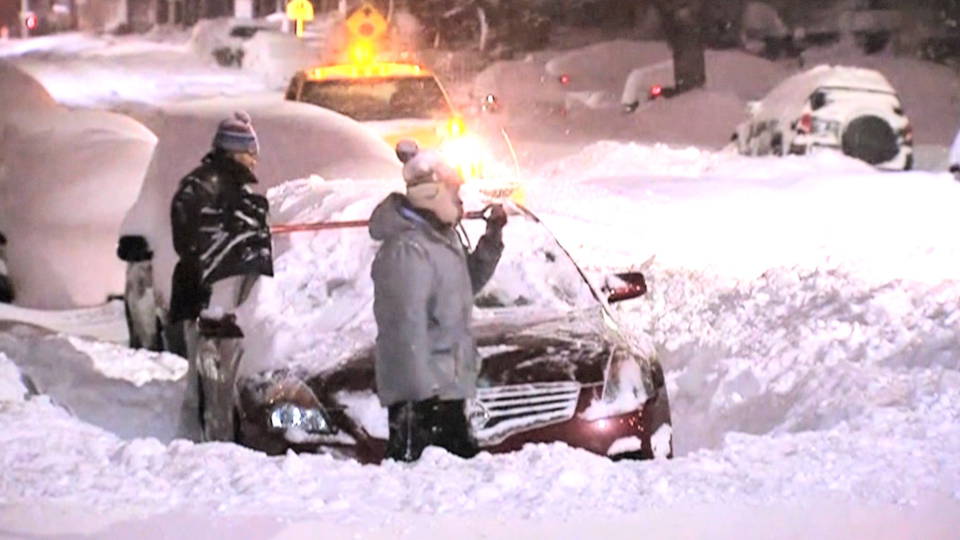
At least 30 people have died after a record-breaking snowstorm pummeled the Eastern Seaboard over the weekend. In Washington, D.C., federal offices remain closed today. The House of Representatives has postponed all votes this week. At least 12,000 flights have been canceled. Snowstorm Jonas was the single biggest snowstorm on record for at least six locations across the East Coast, including Baltimore, Maryland and Harrisburg, Pennsylvania. The highest total snowfall recorded was 42 inches—or three-and-a-half feet—in Glengary, West Virginia. The Weather Channel’s lead meteorologist Michael Palmer said, "It’s likely to go down as one of the most impressive blizzards we’ve seen on the Eastern Seaboard in recorded history."
Record Cold Sweeps Across Parts of Asia
The record snowstorm in the United States comes as parts of Asia also experienced record-cold weather. Hong Kong experienced its coldest day in 60 years Sunday. Islands across Japan also experienced their coldest days in decades, with one island, Amami Oshima, receiving snow for the first time in 115 years. In Vietnam, farmers are grappling with the coldest winter in more than 40 years. Vietnamese farmer Song a Vang said the freezing weather is killing crops and livestock.
Song a Vang: "Since I was born, I have never seen anything like this. This weather is badly affecting our society and my family’s economy. We are all in a difficult situation, because our cattle, pigs, chickens and farm are all dying. They all die from the cold."
French President Hollande Seeks to Extend State of Emergency

In France, President François Hollande plans to ask Parliament to extend the state of emergency for another three months. The emergency measures were approved following the November 13 attacks in Paris, giving Hollande a sweeping expansion of state powers, including measures that permit police raids without a warrant and allow the government to strip citizenship from dual passport holders convicted of terrorism. French police have conducted thousands of raids since the state of emergency began. It was slated to expire Tuesday, but an official statement released Friday says Hollande will seek a three-month extension. Meanwhile, the media center of the Islamic State has published a video purporting to show the last statements of the nine people who allegedly took part in the November 13 Paris attacks, which killed 130 people. The video published Sunday shows nine alleged attackers—three French men, four Belgian men and two Iraqi men. The video also threatens future attacks against Britain.
Syria: At Least 164 Killed in Assad and Russian Airstrikes
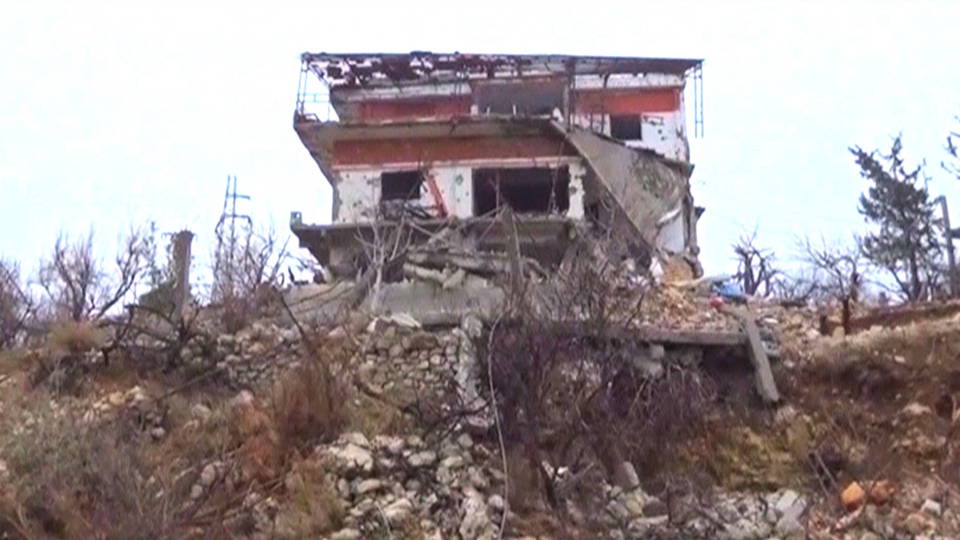
The Syrian Observatory for Human Rights says at least 164 people have died in Syria over the past three days in airstrikes by the Assad regime and the Russian military. The victims include more than 40 children. This comes as U.N. peace talks are supposed to begin in Geneva this week. The talks are likely to be delayed until Wednesday amid disagreements over who will represent the Syrian opposition.
45 People, Including 20 Children, Drown off Coast of Greece
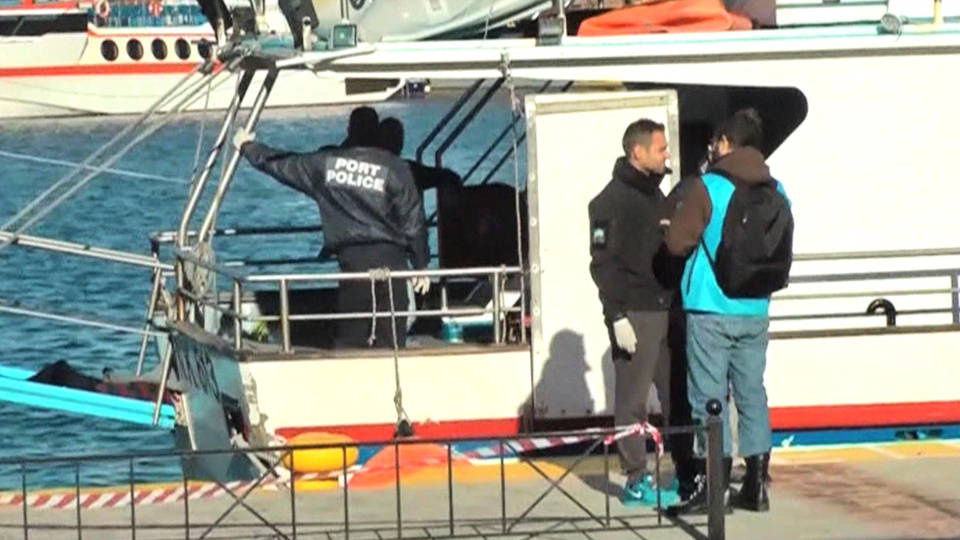
At least 45 people drowned after three boats capsized off the coast of Greece Friday, as refugees continue fleeing to Europe amid violence in Syria, Afghanistan, Iraq, Eritrea, Sudan and other war-torn countries. At least 20 children were among the dead.
British Opposition Leader Jeremy Corbyn Visits French Refugee Camp
Meanwhile, British opposition leader Jeremy Corbyn has called on the government to allow thousands of refugees living in the informal refugee camp in Calais, France, to enter Britain. This comes after Corbyn visited the camp on Saturday to meet with refugees. Thousands of pro-refugee demonstrators rallied in the town of Calais Saturday. The demonstration ended with police spraying tear gas and water cannons at some refugees who attempted to board a British ship.
France: Refugees Say Police & Right-Wing Attacks Are Increasing
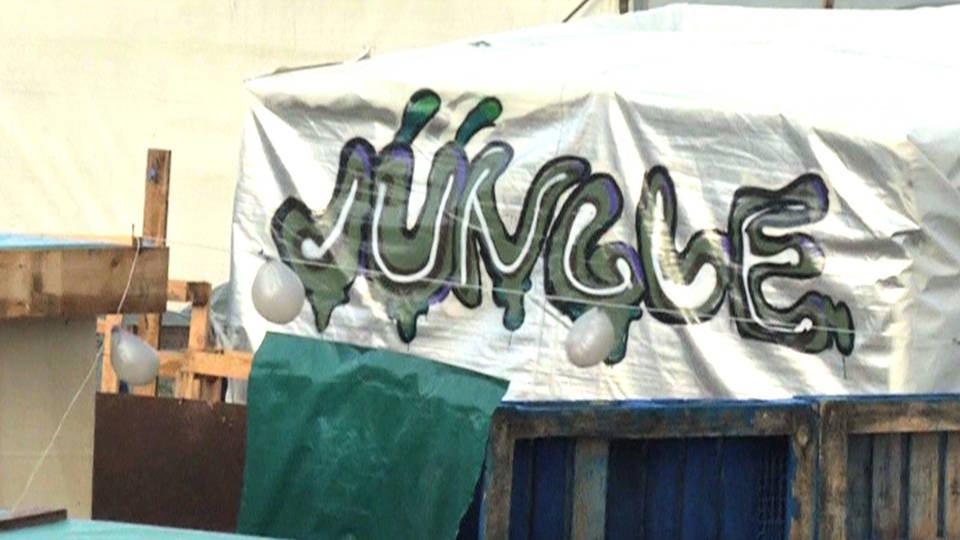
This comes as violence in the Calais refugee camp intensifies. Syrian refugee Majd said attacks by French fascists have increased in recent weeks.
Majd: "There is so much violence, from the police and from the fascists. If you went to the hospital, you will see a lot of people have been injured because of the police and the fascists, some really, really serious injuries. I mean, they need operations, and some people could die. Some refugees could die. And the hospital is full of refugees now."
To see our full interview with Majd and other refugees in Calais, as well as our interview with British opposition leader Jeremy Corbyn, go to our website democracynow.org.
Haiti: Protesters Demand Ouster of President Michel Martelly

In Haiti, massive street protests continue as residents demand the ouster of President Michel Martelly. This comes after protests succeeded in postponing Sunday’s presidential runoff vote amid a race mired in fraud. The runoff vote was slated to feature only one candidate, President Martelly’s handpicked successor, Jovenel Moïse, after his competitor, Jude Célestin, boycotted the election. The United States has been criticized for supporting the disputed October elections.
West Bank: Funeral Held for Palestinian Girl Killed by Israeli Forces
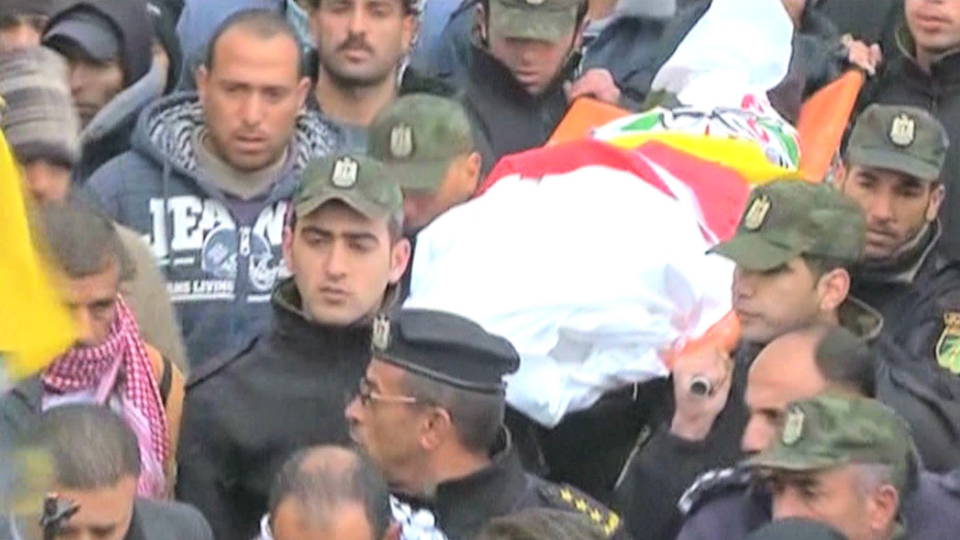
In the Israeli-occupied West Bank, residents gathered for the funeral of a 13-year-old Palestinian girl shot dead by Israeli security guards Saturday. Israeli police say Ruqayya Eid Abu Eid was killed after she tried to stab an Israeli guard at the Jewish-only settlement Anatot. This comes as Palestinians demand the release of the bodies of at least 10 Palestinians killed by Israeli security forces since October. On Thursday, families staged a symbolic funeral, carrying empty coffins on a march to the United Nations headquarters in the West Bank city of Ramallah, demanding the Israeli government return the bodies of Palestinians held in Israeli morgues.
Pentagon Asks Psychological Assoc. to Reconsider Ban on Interrogations
The Pentagon has asked the American Psychological Association to reverse its ban on involving psychologists in national security interrogations, including those at Guantánamo Bay and other prisons. In August, the APA approved the new rules barring its psychologists from participating in interrogations after an independent investigation showed how the APA leadership actively colluded with the Pentagon and the CIA torture programs. In a letter and memo, the Pentagon asked the APA, which is the nation’s largest professional organization for psychologists, to reconsider its decision. To hear our full broadcast from the APA vote in August, go to democracynow.org.
CBS Poll Shows Sanders Leading Clinton in Iowa by 1 Point
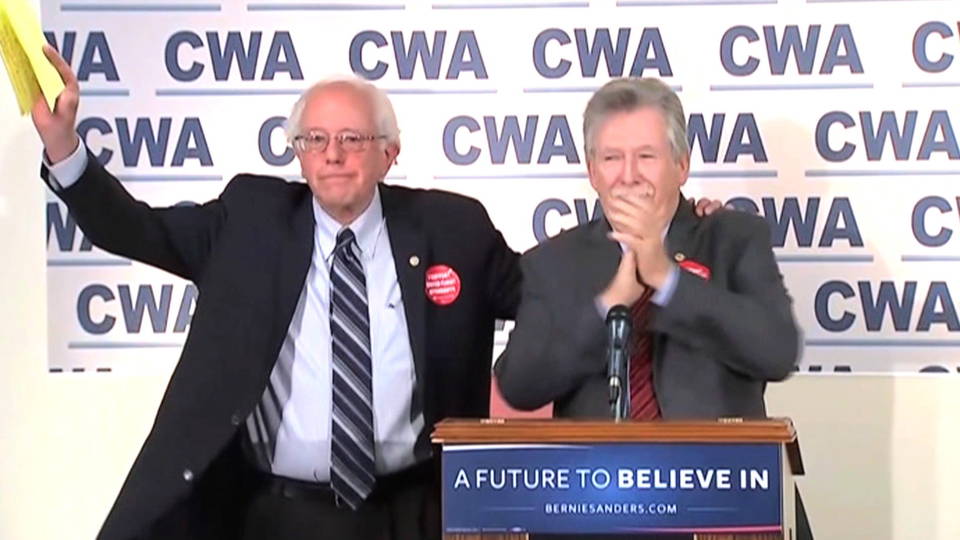
In news from the presidential race, a new CBS News poll shows Democratic presidential candidate Bernie Sanders with a one-point lead over former Secretary of State Hillary Clinton in Iowa. This comes exactly one week before the Iowa caucus. Sanders continues to hold a strong lead in New Hampshire, while Clinton is well ahead of Sanders in South Carolina. Meanwhile, former New York City Mayor Michael Bloomberg says he’s considering a potential third-party presidential run, saying he’d be willing to spend at least $1 billion of his fortune on a campaign. Bloomberg says he’ll make a final decision by early March.
Donald Trump Boasts He Could "Shoot Somebody" and Not Lose Votes

Meanwhile, Republican presidential candidate Donald Trump remains ahead in the polls in Iowa. Speaking in Sioux Center, Iowa, on Saturday, Trump boasted about being the front-runner, claiming he could "shoot somebody" and still not lose votes.
Donald Trump: "The people, my people, are so smart. And you know what else they say about my people, the polls? They say I have the most loyal people—did you ever see that?—where I could stand in the middle of Fifth Avenue and shoot somebody, and I wouldn’t lose any voters, OK? It’s like incredible."
Security Crackdown Marks Fifth Anniversary of Egyptian Revolution

And today marks the fifth anniversary of the Egyptian revolution, which ousted longtime ruler Hosni Mubarak. On January 25, 2011, thousands of Egyptians poured into Tahrir Square as the Arab Spring uprisings spread across the region. Today’s anniversary came amid a massive security crackdown in Cairo and deteriorating human rights and press freedom in Egypt, now ruled by former army chief Abdel Fattah el-Sisi. Human rights activist Dolly Bassiouny spoke out about the current repression.
Dolly Bassiouny: "We’ve experienced a setback that I never would have imagined we would reach. I know that the revolution was going to be battled and that many political currents would try to ride its wave; however, I never imagined that we would reach the stage where we are now. If we had 1 percent of freedom or 1 percent of economic power before the revolution, we no longer have this. This is because of the current regime, not because of the revolution."
Donate today:
Follow:


WEB EXCLUSIVE


A Tale of Two Grandmothers
WORK WITH DN!

Director of Finance and Operations
Director of Development
---------------------
207 West 25th Street, 11th Floor
New York, New York 10001, United States
---------------------
---------------------

No comments:
Post a Comment