democracynow.org
Stories:

Millions of New Yorkers Disenfranchised from Primaries Thanks to State's Restrictive Voting Laws
Voters head to the polls today in New York for both the Democratic and Republican primary in one of the most closely watched races of the election. But millions of New Yorkers won’t be able to vote, thanks to the state’s restrictive voting laws. The state has no early voting, no Election Day registration, and excuse-only absentee balloting. The voter registration deadline for the primary closed 25 days ago, before any candidate had even campaigned in New York. Meanwhile, independent or unaffiliated voters had to change their party registrations back in October—over 190 days ago—to vote in today’s closed Democratic or Republican primaries. Meanwhile, WNYC is reporting there are 60,000 fewer registered Democrats in Brooklyn and no clear reason why. This comes as a group of New Yorkers who saw their party affiliations mysteriously switched filed a lawsuit seeking to open the state’s closed primary so that they can cast a ballot. We speak to The Nation’s Ari Berman, author of "Give Us the Ballot: The Modern Struggle for Voting Rights in America."
TRANSCRIPT
This is a rush transcript. Copy may not be in its final form.
AMY GOODMAN: We are on the road as part of our 100-city tour. I’m Amy Goodman. We’re headed to Colorado today. Today we’re broadcasting from the PBS studios of KUED at the University of Utah in Salt Lake City, Utah. We’re headed to Colorado today. We’re broadcasting from the PBS studios at the University of Utah in Salt Lake City.
But back in New York, voters are heading to the polls today for both the Democratic and Republican primary in one of the most closely watched races of the election. In the Republican race, Donald Trump has a commanding lead in the polls. On the Democratic side, Vermont Senator Bernie Sanders has touted his Brooklyn roots and is hoping to pull a major upset in New York, keeping his streak of victories alive. He’s won eight of the last nine contests. But Hillary Clinton, who served eight years as a senator from New York, has remained in the lead in every opinion poll. On Monday, Clinton addressed supporters in Flushing, Queens.
HILLARY CLINTON: Well, we are so happy to be here and reaching out to every voter throughout Queens, throughout New York City, throughout the state, in order to turn people out to vote tomorrow, because the kind of future that we represent, where we break down barriers, we give people a chance to get ahead, and where we support immigrants and the dreams that immigrants have brought to our shores all of these years, is very different than what the other side offers. So, we hope everyone will come out and vote tomorrow.
AMY GOODMAN: While Hillary Clinton urged everyone to come out and vote today, that’s not an option for millions of New Yorkers, thanks to the state’s restrictive voting laws. Last week, Bernie Sanders admitted New York will be a tough primary, thanks to those voting rules.
SEN. BERNIE SANDERS: We have a system here in New York where independents can’t get involved in the Democratic primary, where young people who have not previously registered and want to register today just can’t do it. So this is going to be a tough primary for us.
AMY GOODMAN: That’s Senator Sanders speaking last week in front of 27,000 people in New York’s Washington Square Park. While Sanders has held a series of massive rallies in New York, many of his supporters can’t vote today in the state’s closed primary. Voting rights activists say New York has some of the most restrictive voting laws in the country. The state has no early voting, no Election Day registration, and excuse-only absentee balloting. The voter registration deadline for the primary closed 25 days ago, before any candidate had even campaigned in New York. Meanwhile, independent or unaffiliated voters had to change their party registrations back in October—over 190 days ago, before any debate or any primary or caucus—to vote in today’s closed Democratic or Republican primaries. This will reportedly disenfranchise nearly 30 percent of New Yorkers. Donald Trump’s own children did not manage to change their party registrations from independent to Republican in time to vote for their father.
Meanwhile, WNYC is reporting the number of registered Democrats in Brooklyn dropped by 60,000 since November, and there’s no clear reason why. During that same period, most counties in New York saw an increase in registered Democrats. This comes as a group of New Yorkers who saw their party affiliations mysteriously switched filed a lawsuit seeking to open New York’s closed primaries so that they can cast a ballot. The lawsuit is asking for an emergency declaratory judgment that would make today’s New York primary open, meaning any registered New York voter could cast a ballot in either party’s primary.
Well, for all this and more, we’re joined by Ari Berman, senior contributing writer for The Nation, where he covers voting rights. His latest book, Give Us the Ballot: The Modern Struggle for Voting Rights in America.
Welcome to Democracy Now!, Ari. You wrote a piece in The Nation, "27 Percent of New York’s Registered Voters Won’t Be Able to Vote in the State’s Primary." Can you explain this?
ARI BERMAN: Yes. Thanks for having me back, Amy. So, nearly a third of New Yorkers can’t participate in the primary because they are not registered with the Democratic or Republican Party, and New York has some of the most restrictive voter registration laws in the country, as you mentioned. People had to change their party affiliations back in October, when no one was paying attention to the New York primary. People had to register to vote 25 days before the election, before any candidate had campaigned in New York. And beyond that, New York has some of the worst voting laws in the country. Unlike 37 states, we don’t have early voting. Unlike 15 states, we don’t have Election Day registration. Our Constitution doesn’t even allow Election Day registration, because you have to register no later than 10 days before an election. We have excuse-only absentee ballots, meaning you have to prove you’re out of town and—or you to prove you have a disability to get an absentee ballot.
I think it’s sad that we are the fourth bluest state in the country but have some of the worst voting laws. We rank below Texas, below North Carolina, behind all of these states with new voting restrictions, in terms of voter turnout. We ranked 44th in voter turnout in 2012. We got a D-minus from the Center for American Progress on accessibility to the ballot. So, regardless of which candidate you’re for, regardless of whether you’re for open or closed primaries, we should be for making it much easier to vote in New York.
AMY GOODMAN: Why is this, Ari? Why are these laws so restrictive in New York? Who passed these laws, and when did they do it?
ARI BERMAN: Both parties want to protect the status quo in New York, Amy. Democrats, by and large, are happy with the system. Republicans, by and large, are happy with the system. They just want their slice of the pie, and they what to protect it. Incumbents who are in power want to stay that way. So, unlike states like Oregon and California, which have embraced reform, passing policies like automatic voter registration and Election Day registration, New York has not followed this trend for progressive reform. And I think that’s really unfortunate. The one good thing that could come out of this primary, with the Trump kids not being able to register, with so many Bernie supporters not being able to register, is that finally people are paying attention to just how bad New York’s voting laws really are, how many people are shut out of the democratic process here.
AMY GOODMAN: So, can you talk about this piece in the New York Daily News, which recently ran an article, "Hundreds of New York state voters to file suit calling the closed primary 'a threat to our democratic system' after claiming their party affiliation mysteriously changed." The article quotes Joanna Viscuso, a 19-year-old from Long Island. She said she registered to vote as a Democrat during her college orientation at Adelphi University in 2014. Then, she noticed last week that now her voter registration online says she’s not affiliated with a party. Viscuso reportedly called the Nassau Board of Elections, and they told her that she had filled out a form in September to change her party affiliation, and sent it in October. But she claims she never did that. She says she’s a first-time voter. She told the New York Daily News, "As soon as I noticed it was changed I was infuriated, and then when they said there was nothing I could do I was still infuriated. All of a sudden we can’t vote? That’s ridiculous!" she said. How is this possible?
ARI BERMAN: It’s a very mysterious situation. We’ve seen similar things happen in other states. In Arizona, where there were five-hour lines at the polls because they reduced so many polling places, a lot of people also had their voter registration switched without them knowing. So people waited in five-hour lines and still weren’t able to cast a ballot, because they were not registered. In New York, what these voters should do is cast a provisional ballot and try to have that ballot counted after the election. There is going to be a lawsuit this morning to try to open up New York’s primary. Regardless of whether or not that succeeds, people should go to the polls. They should vote today. They should cast a provisional ballot and try to get that counted afterwards.
AMY GOODMAN: A WNYC analysis of New York state voter enrollment statistics found that the number of active registered Democrats dropped there [in Brooklyn] by 63,558 voters between November 2015 and now, April 2016. That translates into a 7 percent drop in registered Democrats in the borough. According to the NPR station in New York, WNYC, no other borough in New York City nor county in the rest of the state saw such a significant decline in active registered Democrats. In fact, only seven of the state’s 62 counties saw a drop in the number of Democrats. Everywhere else saw the numbers increase. Can you explain what’s going on in Brooklyn?
ARI BERMAN: What the Board of Elections in Brooklyn said is that they had changed the number of voters from active to inactive, and that’s why there was such a big drop-off. But 60,000 people are a lot of voters to shift from active to inactive. So, it’s very possible that some active voters are going to be wrongly purged from the polls, and some people are going to show up to vote in Brooklyn, think they’re registered, think they’re active, and not be on the voting rolls. We have seen this in many other states, in Florida in 2000, in Ohio in 2004. I hope—
AMY GOODMAN: Ari, how do you become inactive?
ARI BERMAN: You become inactive—
AMY GOODMAN: What determines this?
ARI BERMAN: —by not voting in the past few elections. That’s how you become inactive. But sometimes people don’t vote for whatever reason and want to vote now. Other times, people are wrongly labeled inactive and wrongly purged from the voting rolls. So, we don’t know enough to say what happened here, but it’s disturbing that some people may have been put on inactive status if they are not in fact inactive.
AMY GOODMAN: Ari Berman, I want to thank you for being with us, senior contributing writer for The Nation, where he covers voting rights. His book is titled Give Us the Ballot: The Modern Struggle for Voting Rights in America. And we’ll link to your piece in The Nation magazine, "27 Percent of New York’s Registered Voters Won’t Be Able to Vote in the State’s Primary." We’ll link at democracynow.org.
This is Democracy Now!, democracynow.org, The War and Peace Report. When we come back, we stay here in Utah, and we look at, well, a very different outcome in a Republican Legislature when it comes to LGBT rights. Stay with us. ... Read More →

"The American People are on Our Side": Immigration Advocates Bullish on SCOTUS Immigration Case
The Supreme Court heard arguments Monday in what’s being called the most significant immigration case in decades. The case pits the Obama administration against 26 states led by Texas. The states filed suit to block Obama’s program DAPA, Deferred Action for Parents of Americans and Lawful Permanent Residents, which would protect more than 4 million undocumented immigrants from deportation. Following the death of Antonin Scalia, the court is divided with four liberal justices and four conservatives. A 4-4 split would leave in place a 2015 lower court ruling that threw out the president’s executive action. We speak to Rep. Luis Gutiérrez (D-IL), chair of the Immigration Task Force of the Congressional Hispanic Caucus.
TRANSCRIPT
This is a rush transcript. Copy may not be in its final form.
AMY GOODMAN: We are on the road in Salt Lake City, Utah, as part of our 100-city tour, headed to Colorado this afternoon.
In what’s being called the most significant immigration case in decades, the Supreme Court heard arguments Monday to determine if President Obama overstepped his authority when he took unilateral action to protect more than 4 million undocumented immigrants from deportation. The case pits the Obama administration against 26 states led by Texas. The states filed suit to block DAPA—that’s Deferred Action for Parents of Americans and Lawful Permanent Residents. Following the death of Antonin Scalia, the court is divided with four liberal justices and four conservatives. A 4-4 split would leave in place a 2015 lower court ruling that threw out the president’s executive action. Attorney Thomas Saenz of the Mexican American Legal Defense and Educational Fund was one of four attorneys to argue the case before the court. He spoke after the hearing.
THOMAS SAENZ: In defending the president’s exercise of his constitutional prerogative, as has been exercised by his many predecessors over the last 50 years, to set priorities in immigration enforcement, his guidance issued in November 2014 was simply an exercise of that long-standing authority. The justices this morning seemed very concerned, in vigorous questioning, about whether the state of Texas had standing or the right to even be in court to challenge that exercise of enforcement discretion.
AMY GOODMAN: Sophie Cruz, a six-year-old American citizen and child of an undocumented immigrant from Texas, may have been the youngest person watching the historic proceedings. She spoke at a news conference after the arguments ended.
SOPHIE CRUZ: I asked the judges to protect us children and all immigrants. Help us with DAPA, DACA and immigration reform for all. I have the right to protection. I have the right to live with my parents. I have the right to live without fear. I have the right to be happy.
AMY GOODMAN: For more, we’re joined by two guests. Congressmember Luis Gutiérrez represents Illinois in Congress. He is chair of the Immigration Task Force of the Congressional Hispanic Caucus. And Jose Antonio Vargas is with us, Pulitzer Prize-winning journalist and filmmaker who famously came out of the shadows in 2011 in The New York Times Magazine with his story, "My Life as an Undocumented Immigrant." He is the founder and editor of #EmergingUS and founder of Define American.
We welcome you both to Democracy Now! You both were in the Supreme Court yesterday. Congressmember Luis Gutiérrez, talk about the significance of this case. Lay out exactly what the Supreme Court is considering.
REP. LUIS GUTIÉRREZ: Oh, here’s what the Supreme Court is considering: whether or not you can give a driver’s license and a work permit to someone, because, really, when you listen—and I was there in New Orleans at the Fifth Circuit—and what has clearly been established is that the president does have the authority under the law to set priorities about who’s going to be deported or not. It was a lot clearer in New Orleans than it was yesterday, but it came through pretty resoundingly yesterday. In other words, as Judge Ginsburg says, they’re going to stay—something that I and my colleague have been saying for a long time. They are not going anywhere. And nothing yesterday is going to stop them from being deported. In other words, they get to stay.
But here’s what they’re really saying. What they’re saying is, "Yeah, we’re not here to challenge whether the president of the United States is going to deport them or not. Yeah, he’s not going to deport them. But we don’t want them to have a driver’s license. We do not want them to have a work permit. We want them to live in misery. We want them to live in such conditions that maybe they will leave." In other words, it’s very mean-spirited kind of contentions, because a driver’s license—as the justices said yesterday, "Hey, they are driving today. They are working today. Isn’t it better to put them on the books, have them go through a background check and drive with a driver’s license and insurance?" They’re here, and no one’s going to deport them.
I think we’re going to win, because, as in the past, if Roberts and Kennedy are consistent with their decision that they made on Arizona, in which they almost flippantly asserted it’s up to the state of Arizona whether they get a driver’s license or not, but, on the other hand, they cannot become involved in dictating immigration policy, that that is the purview of the federal government.
AMY GOODMAN: So, can you talk, Congressman Gutiérrez, about the significance of, well, you know, the death of Antonin Scalia, what it means for this case and what will happen in this 4-4—well, it’s not necessarily a 4-4 split on this—
REP. LUIS GUTIÉRREZ: Sure.
AMY GOODMAN: —but what the shape of the court looks like now?
REP. LUIS GUTIÉRREZ: Look, no one in the immigration movement ever expected Judge Scalia to vote and side with the immigrant community on this case or with the president, so that was never a concern. It was always going to be five to four, so now it will be five to three, maybe even six to two. It all really depends on the issue of standing and how it is the Supreme Court looks at this. It is clearly the purview of the federal government. And all of the—look, even when the lawyers for the Republican Party were asked yesterday whether or not they were there to force these deportations, they said no. That’s not even an issue. Moreover, when the attorney for Paul Ryan and the majority of Republicans in the House of Representatives came forward and tried to argue about the president overstepping his boundaries, he was clearly cut down by the justices of the Supreme Court.
But let me say one thing else, and that is, I got to tell you, if there was ever a reason for having parity and justice and equality between men and women, it was yesterday, because the women on the Supreme Court really took this one forward and were just vigorous and energetic, and asking the kinds of questions which I believe will lead to a victory of our community. So I say, let’s make sure we keep passing those laws to make sure that women and men have equality, even on the federal bench.
AMY GOODMAN: I want to turn to Texas Attorney General Ken Paxton speaking after Monday’s oral arguments before the Supreme Court.
ATTORNEY GENERAL KEN PAXTON: Today, our solicitor general, who’s standing next to me, argued the case strongly for the rule of law. If we allow a president, whether it’s this president or a future president, no matter what their political persuasion or their party, to make changes in the law without congressional approval, then we will end up with a perverted Constitution. So, today was a strong day for the Constitution, defending the rule of law.
AMY GOODMAN: Congressman Gutiérrez, your response?
REP. LUIS GUTIÉRREZ: Look, the president of the United States gets to set the priorities. They’re here. They didn’t sue under DACA. We can see, 750,000 DREAMers strong today, what a magnificent example of the positive nature of the president’s actions. The fact is that the American public—and, Amy, look, the law is on our side. It’s clear the law is on our side. The American people are on our side. And if they will allow a vote in the House or in the Senate today, this case will become moot. Moreover, 5 million American citizen children are on the minds of those Supreme Court justices. What will the legacy be for those millions of citizen children? One of happiness? One in which the government stood up and said, "Yes, your mom and dad, who are not a priority for deportation, are not a threat to the United States of America"? Because the Congress of the United States didn’t act—you know, are they going to continue to have a legacy in which they lived in fear? I think the Supreme Court is really going to judge all of that.
And look, maybe they’re not going to judge for justice, for fairness, for the immigrant children. Maybe they’re not going to do that. But they are going to say there’s going to be chaos if every time a state objected to an action of the president of the United States or the Congress of the United States, they would simply say, "Oh, we don’t like it, because that costs us too much money," because that’s really what they’re saying with drivers’ licenses, "It just costs us too much money." There would be chaos in the federal government, in the United States of America. I think we’re going to win on this case on the standing issue. They do not have standing to come before the Supreme Court and argue immigration. That is clearly in the federal purview.
AMY GOODMAN: Congressmember Gutiérrez, on this issue, how many times have you been arrested protesting around immigration reform—in fact, protesting your own president, protesting President Obama? And yet, in this case, you certainly stand on his side when it comes to the executive actions around DAPA and DACA.
REP. LUIS GUTIÉRREZ: Look, Amy, I stood with others in our immigrant community for years, arguing that the president had this authority. I always knew he had. I’m happy we’re on the same page. I voted in two primaries for Barack Obama and two general elections, and I voted for him when he became the senator from the state of Illinois. I always wanted Barack Obama to do well and to this become part of his legacy.
Let me share with you what I said to the president the night before he announced these priorities, while we were having dinner in the Roosevelt Room and he announced them. And he said, "Luis, what do you think?" And I said to him that day, "Because I have been one of your most ferocious critics, Mr. President, I think I have to be one of your greatest defenders, because I think you need to have balance." It can’t all just be about criticism, criticism, criticism. It also has to be about saying thank you and having a sense of gratitude. And I have a great sense of gratitude. Remember that in 1986, under the Ronald Reagan—and it was an amnesty act—3 million people fixed their immigration status. When we win, it will be over 5 million people, in the president’s executive order.
It isn’t everything we’re asking for. It isn’t everything we’re striving for. But it’s a great down payment. And it allows the American people to see and people to come out out of a different closet, right? But people to come and see Miguel and José and to see Margarita and to see people from Poland and Ireland and the Philippines in a new state, when they see them at work, when they come with a new smile on their face and say, "Hey, you know that old Social Security card? I have a new one, because I was undocumented," and for the American people to see there’s nothing to fear, that these are their co-workers, these are people they care about a lot. That is one of the greatest thing about the DREAMers, is to see the young people come forward and everybody embrace them as Americans. ... Read More →

Jose Antonio Vargas: There's Nothing More American Than Fighting for Immigration Reform
Journalist and immigrant rights activist Jose Antonio Vargas was also in the Supreme Court during Monday’s oral arguments in the case, United States v. Texas. The case pits the Obama administration against 26 states which filed suit to block Obama’s action to protect more than 4 million undocumented immigrants from deportation. The Pulitzer Prize-winning journalist famously came out of the shadows in 2011 in The New York Times Magazine with his story, "My Life as an Undocumented Immigrant."
TRANSCRIPT
This is a rush transcript. Copy may not be in its final form.
AMY GOODMAN: Congressmember Luis Gutiérrez, you’re standing next to Jose Antonio Vargas there in the Cannon Rotunda in the congressional building.
REP. LUIS GUTIÉRREZ: Yes.
AMY GOODMAN: Jose, you, too, were there yesterday at the Supreme Court. This, to say the least, personally affects you and your community of—well, for so long undocumented. You famously came out of the shadows. You’re a Pulitzer Prize-winning journalist. You were working, among other places, at The Washington Post. Your bosses, your colleagues did not know, most of them, that you were undocumented. And then you made your stand. Talk about what DACA is, what DAPA is, for those who are saying, "This is just a lot of alphabet soup; I don’t know what they’re talking about," and what this case means to you.
JOSE ANTONIO VARGAS: Well, I mean, I think, for me, it’s about dignity. I think that’s probably the first thing I would say.
The second thing is family. So, if I get DACA, DACA-plus, I would be able to, hopefully, see my mom, who I haven’t seen for 23 years this August. I have a sister. When I left the Philippines, she was about a year and a half; she’s almost 24. And I have a half-brother that I’ve never met. I’m just a person that sends money every month, like a lot of immigrant families. So I really want to see them. You know, I want to be able to reunite with my family and kind of make up for lost time in whatever way we can, right?
For many of us, work authorization—right?—is really, really important. I have to say, by the way, as an undocumented immigrant in this country, I’m actually now a job creator. I employ about 20 people through Define American and #EmergingUS. So if I get deported, what’s going to happen to these 20 American citizens who rely on me for their living? Right? We’re not only the ones actually working; we’re actually also the ones creating jobs, entrepreneurs. I mean, to be immigrant in this country—is there anything more entrepreneurial than being immigrant?
I have to say, though, by the way, Amy, I had the privilege yesterday of sitting next to Sophie and her mom at the Great Hall of the Supreme Court. I just have to say, as kind of a—as kind of a political geek, it’s probably the greatest honor of my life to sit in that hall yesterday and to see the kind of intellectual rigor that goes on when people debate ideas, when the justices debate ideas. It is so what’s lacking in most of the conversation, particularly in the Republican Party, when it comes to this issue. So that was a great privilege. And to see Sophie—she actually at one point wrote down, with her mom, the names of all the justices. And I was to her left, and she turned to me, and she’s like, "So how many do we need?" I said, "Well, it can’t be split."
AMY GOODMAN: She’s six years old.
JOSE ANTONIO VARGAS: She’s six, Amy. I’m like, "Well, you know, Sophie, it can’t be a split, so we’re hoping, you know, maybe—maybe 6-2." And then she said, "Well, who do we need?" And I—
AMY GOODMAN: Now, explain that. Jose, explain that, why 4-4 is not enough.
JOSE ANTONIO VARGAS: Split is not enough, because the decision of the lower court—right?—the unjust decision of the lower court, would stay. And we can’t have that. So, and it has to be for us, hopefully, a convincing victory. So this little girl knows this. And she’s an American citizen sitting in the Great Hall of the Supreme Court next to her mom. Right? Is there anything more American than that? I wish, by the way, that everybody could see this young woman, this eloquent young woman, who is not only fighting for her family, but is fighting for so many families in this country.
AMY GOODMAN: Can you talk about DAPA and DACA, overall; even if this case came down in your favor, what you’re looking for, what you see lacking?
JOSE ANTONIO VARGAS: Well, I mean, I think the congressman made a really great point about this is a down payment. Right? I mean, this is not everything. This is not amnesty. I was just on Fox News last night talking to Megyn Kelly about this. This is not amnesty. Right? Let’s get that right and clear.
But what it does mean—so this is my only piece of ID from the government. It’s my California driver’s license. It actually says "federal limits apply." So, apparently, I can’t use it in North Carolina, when I get there tomorrow, which I would love to drive in North Carolina. And wouldn’t North Carolina want me to rent a car at Avis or something, and then drive it and like get some gas? But hey, I guess North Carolina is not going to get my money in that way. So I can’t use this, according to my many lawyers, in North Carolina. But this is one of the things that we could get. Now, only 12 states allow us to get this. Texas is home to 1.2 million undocumented Texans, who are working and contributing billions of dollars to the Texan economy. I don’t know. Is there a good subway system in Texas? How do they think undocumented Texans get around? Right?
I mean, that’s why, for me, this is way more than just DACA and DAPA. This is a greater understanding of what it means to be an undocumented person in this country, to survive and to work. And, you know, every day—I have to tell you, just sitting in that courtroom yesterday, surrounded by all these undocumented people, of many different backgrounds—a lot of Mexican, Central American, Korean—sitting there, it was—it was like we can’t undo that. We’re not going anywhere. We’re not going anywhere. This is our country. And there’s nothing more American for us than to fight for it.
REP. LUIS GUTIÉRREZ: And, Amy, what your audience should understand is that it’s 4 million people that are undocumented. They need to have been here five years or more.
JOSE ANTONIO VARGAS: Yeah.
REP. LUIS GUTIÉRREZ: And just so that we understand, half of them have been here 10 years or more. But they need—
JOSE ANTONIO VARGAS: Twenty years.
REP. LUIS GUTIÉRREZ: Thank you, 20 years. But they need to have been here five years or more. Then, at their own expense, they have to go through a rigorous background check. And let me—ask any of the DREAMers how rigorous that background check is. So they submit their fingerprints. They have to show they have committed no crime whatsoever. Then, on top of that, they have to prove all of the five years. And that’s—everybody thinks it’s easy to prove you’ve been here the last five years. No, you’ve got to really look through records, especially when you’re undocumented, submit that, and then guess what you get. You get a work permit. You get a work permit, which allows you to work and pay all your federal taxes and get on the books.
I don’t understand why, if the Republicans understand they’re not going to be deported, why we don’t—would not want to put them on the books, because they do not represent a threat. Then, we can take what the Supreme Court justices said yesterday—hey, by the way, you only get money for 400,000 deportations a year, and there’s 12 million of them. Doesn’t it make sense to prioritize who you’re going to deport? Then you can use those resources to go after gangbangers, drug dealers, murderers, people who are causing real—I like to say that everybody that shows up here is a foreigner, but they don’t all come as immigrants. Immigrants come to work, to sweat and to toil. And there are some foreigners, yes, Amy, we should go after them and cleanse our society of them, so that we all live a freer—in a freer society. ... Read More →

Rep. Luis Gutiérrez: U.S. Exceeding King George III's Despotism in Current Treatment of Puerto Rico
Last week, Oklahoma Senator Jim Inhofe proposed reopening a U.S. military base in Puerto Rico as Congress considers legislation to address Puerto Rico’s debt crisis. For decades, Puerto Rico was host to a slew of U.S. military bases, where the Navy conducted bombing practices and war games, dumped old munitions, leading to lasting environmental damage, and napalmed the island. We speak with Rep. Luis Gutiérrez (D-IL), who has been arrested protesting the U.S. military bases.
TRANSCRIPT
This is a rush transcript. Copy may not be in its final form.
AMY GOODMAN: Congressmember Gutiérrez, I want to ask you about Puerto Rico before we go. Last week, Republican Oklahoma Senator Jim Inhofe recommended reopening the U.S. military base on Vieques in Puerto Rico, as Congress considers legislation to address Puerto Rico’s debt crisis. For decades, the Navy used nearly three-quarters of Vieques for bombing practice, war games, dumping old munitions, leading to lasting environmental damage, napalming the island. The Navy ended training operations in 2003, following massive civil disobedience. Senator Inhofe said reopening the base at Vieques would benefit the U.S. military and the Puerto Rican economy. I want to play for you what he said.
REP. LUIS GUTIÉRREZ: Sure.
SEN. JIM INHOFE: I would think that any kind of a deal that is made is going to have to include consideration for the training that is still available. I mean, there’s still no range like Vieques anywhere in the Western Hemisphere. What can be done in Vieques cannot be done on one location by a joint force.
AMY GOODMAN: Congressman Gutiérrez, your response?
REP. LUIS GUTIÉRREZ: Well, first of all, Amy, the last time the federal magistrate sentenced me to a year of probation, they were very clear that if I participated once again in protesting in Vieques and trespassing on federal lands there, that I would be sent to jail. Should they ever open that, I will protest, along with thousands of others, to stop the bombing of Vieques. We’ve won that fight and that battle. If they want, they can bomb the coast of Florida. They can bomb the coast of Georgia. They can bomb a lot of different coasts. But what does the senator say? "Oh, no"—from Oklahoma—"Let’s not bomb Oklahoma. Let’s just bomb those poor Puerto Ricans, because that’s a perfect place that we can do it."
And we can do it because, as been established by these hearings, Amy, something that—if my dad in 1950 in Puerto Rico would have said that Puerto Rico was a colony of the United States, he would have been jailed under the Smith Act as it was interpreted in Puerto Rico, La Ley de la Mordaza in Puerto Rico, their version of the Smith Act. And yet, today, clearly, the Congress of the United States has established that Puerto Rico is ruled under the territorial clause of the Constitution of the United States. You know what that means, Amy? That means that Puerto Rico is owned by, is a property of the United States, but not a part of the United States, and that the Congress has plenary powers over the people of Puerto Rico. Here’s what I say: You know, Inhofe, it seems to me that King George III, if he were to look at the Congress of the United States and see you, Senator, he would say to himself, "God, I thought I was the despot. I thought I was the tyrannical person over the 13 colonies. You guys are exceeding anything that I did, as King George III, with my 13 colonies." No, we fought a war against colonialism. We need to fight that same war against the colony of Puerto Rico and free it, free it, so that it can become everything that it can be.. ... Read More →

As Anti-LGBT Laws Sweep U.S., How Did GOP-Led Utah Pass a Landmark Nondiscrimination Bill?
As North Carolina and Mississippi have passed sweeping anti-LGBT laws, with similar measures under consideration elsewhere, we look at a landmark law Utah passed last year that goes the other way. You might not expect it of one of the reddest states in the nation, but last year Utah was the only state to advance statewide nondiscrimination protections for LGBT people. Backed by the Mormon Church and passed with a Republican supermajority, the new law, dubbed "the Utah compromise," sought to protect LGBT people from housing and employment discrimination. We speak with two people who played a key role in the law’s passage: Utah Democratic State Senator Jim Dabakis, the only openly gay member of the Utah Legislature, and Troy Williams, executive director of Equality Utah.
TRANSCRIPT
This is a rush transcript. Copy may not be in its final form.
AMY GOODMAN: This is Democracy Now!, [democracynow.org], The War and Peace Report. Yes, we are on the road again, as Willie Nelson is singing, part of our 100-city tour. Today we’re broadcasting from the PBS studios of KUED, the studios at the University of Utah here in Salt Lake City. I’m Amy Goodman.
As North Carolina and Mississippi have passed sweeping anti-LGBT laws, with similar measures under consideration elsewhere, I want to turn to a landmark law here in Utah, which passed last year, that goes the other way. You might not expect it in one of the reddest states in the nation, but last year Utah was the only state to advance statewide nondiscrimination protections for LGBT people. Backed by the Mormon Church and passed with a Republican supermajority in the Legislature, the new law, dubbed "the Utah compromise," sought to protect LGBT people from housing and employment discrimination. The Republican governor, Gary Herbert, spoke at the law’s signing.
GOV. GARY HERBERT: This has been something of a collaborative effort that’s brought us to this historic occasion, and I have no doubt that the eyes of the nation are upon us, as we have shown a way to resolve a somewhat contentious issue in a very satisfactory manner. And I do believe that what we’ve done here will become a model for the rest of the country of how they, too, can resolve these issues in their own respective states, as we find the right balance necessary to discourage discrimination, while protecting religious liberty.
AMY GOODMAN: Many have criticized the Utah compromise for not going far enough to protect LGBT rights. In an article for Slate, three law professors wrote, quote, "[T]he Utah legislation should not become a model for the nation. The bill contains troubling exemptions for religious groups, allowing them to continue to discriminate in ways that would be impermissible in many other states and under federal law. In particular, the Utah law specifically exempts religiously affiliated nonprofits such as schools, hospitals, and social service organizations."
Well, for more, we’re joined by two guests who played a pivotal role in the passage of the LGBT antidiscrimination law here in Utah. State Senator Jim Dabakis is the only openly gay member of the Utah state Legislature. And we’re joined by Troy Williams, executive director of Equality Utah, formerly a very popular radio talk show host on KRCL, which is the community radio station where Democracy Now! broadcasts in Salt Lake City.
We welcome you both to Democracy Now!
TROY WILLIAMS: Thanks.
AMY GOODMAN: So, State Senator Dabakis, explain this law. You’re watching Mississippi. You’re watching North Carolina. You have a Republican supermajority in the Legislature, yet you passed this compromise. Explain what it is.
SEN. JIM DABAKIS: The roots go back to 2009 after Prop 8. And the church—the LDS Church, the Mormon Church, contacted me and said, "We would like to talk to the homosexual community." And it had been after long years of us asking them. And a group of five of us sat down and began a dialogue, that continues to this day, where we have been able to build up some trust and build up relationships and build up a civic dialogue, to the point where, when negotiating, what we were negotiating got very dicey and very difficult, and it looked like it was going to fall off the table, and the lawyers were arguing de Tocqueville and Nazis and the rest. We were able to pull out the strength that we had gained over two or three years of regular communication and get a bill that passed the muster on our side as well as theirs.
AMY GOODMAN: And that bill says?
SEN. JIM DABAKIS: That bill says that it is illegal in the state of Utah for employees to be discriminated because they are LGB or T. And also, people cannot be discriminated in housing based on those classes, as well.
AMY GOODMAN: In housing or in employment. What about public accommodations?
SEN. JIM DABAKIS: We’re not there yet. I had a bill for public accommodation this last session.
AMY GOODMAN: And explain what public accommodations are.
SEN. JIM DABAKIS: Public accommodation just means anywhere the public goes—in a restaurant, in a hotel, renting a car. If you have a license to do business, you can’t discriminate. That hasn’t happened yet, but I’m an optimistic, hopeful guy, and I think we’re going to get there, as well.
AMY GOODMAN: Troy Williams, you’re head of the largest LGBT organization in Utah, Equality Utah. Your assessment of this bill? And talk about what it meant to get it passed.
TROY WILLIAMS: Yeah, it was called the Utah compromise in the press, and I don’t think that’s a fair analysis. It was really the Utah collaboration. Something unprecedented had happened in the state. We had the ceasefire in the culture war, and we all came together, Republicans and Democrats, religious people, nonreligious people, gay people, straight people, transgender people. And we worked together to pass a law to bring fairness for all. And that collaboration, that sitting around the table hashing out differences, focusing on our commonalities, that was the breakthrough. What are the things that we share in common? And when we were able to sort of hit those points, then we were able to make progress.
AMY GOODMAN: So, how have you managed, State Senator Dabakis, to prevent the passage of anti-LGBT legislation like we’ve seen in other states? Actually, you recently made headlines for staging a filibuster by sneezing in the Utah state Senate in order to stall an anti-LGBT law?
SEN. JIM DABAKIS: Well, all of the—all of the negative bills—the Indiana bills, the North Carolina bills, the Mississippi bills—that element is in our Legislature. And they’re always sneaking around trying to do their little bad deeds. Our sessions are 45 days. They must end exactly at midnight, no exceptions. And a bill—an innocuous bill that we had sent from the Senate over to the House, with just cleaning up work, had been added, very sneakily—the words "married couple" had been replaced with "man and woman," and they did it when no Republicans [sic] were in the committee room. And so—
TROY WILLIAMS: No Democrats.
AMY GOODMAN: No Democrats.
SEN. JIM DABAKIS: Yeah, no Democrats, yeah, were in the committee room. So, it passed there, came back over to the House—back over to the Senate for final passage. And it was so innocuous, nobody really looked at it. And it was pulled off the board at two minutes before midnight. And I just, for some reason—maybe divine inspiration, I’m not sure—I flipped up the bill and happened to see those words. So, we had two minutes to debate it, and it’s a roll call vote. And so they started, Adams and Bramble, and when it came to me, I just looked around, and the woman who was doing the roll call called my name twice and then three times and then four times. The president of the Senate, the presiding officer, figured it out, what was going on. And he said, "Pass him! Pass him! Pass him! Pass him." And I just stood there. The woman didn’t quite understand "Pass him." And I started sneezing. And by the time I was done sneezing and clearing my throat, the time was up, and the president hit the gavel, and that was the end of the session. So... ... Read More →

Rep. Luis Gutiérrez on Hamilton Pulitzer: When We Get to Write, the Script is Very Different
On Monday, the 100th Pulitzer Prizes were announced, and Puerto Rican composer, director and actor Lin-Manuel Miranda won the Pulitzer for best drama for the Broadway musical hit “Hamilton,” a retelling of the story of Alexander Hamilton that features all actors of color. We get reaction from Representative Luis Gutiérrez (D-IL).
TRANSCRIPT
This is a rush transcript. Copy may not be in its final form.
AMY GOODMAN: Any comment, Congressmember Luis Gutiérrez, on a fellow Puerto Rican, on Lin-Manuel Miranda winning the Pulitzer Prize for Hamilton?
REP. LUIS GUTIÉRREZ: You know, pride. What can I say? I’m going to be very, very super Puerto Rican. I’m so proud of him, so proud of his accomplishments. Isn’t it a difference when we get to write the scripts for the Broadway plays? The depiction in West Side Story of me and fellow young Puerto Ricans, and today the depiction of us as a community when we get to write the scripts, it’s very, very different. I’m so proud that I live in both the America in which a West Side Story showed us as gangbangers, as foreigners, as people that weren’t from here, and someone who writes about the history of the United States, Hamilton, in a way that all Americans celebrate. I am so proud of him and so proud of all of the Puerto Ricans and their contributions to this nation. Pride.
AMY GOODMAN: I want to say thank you so much to both of you, joining us from the Cannon Rotunda in the congressional offices in Washington, D.C. Congressmember Luis Gutiérrez and Jose Antonio Vargas, the Pulitzer Prize-winning journalist who famously came out as undocumented.
This is Democracy Now!, democracynow.org, The War and Peace Report. When we come back, how is it so many New Yorkers, millions of them, cannot participate in today’s New York primary? Stay with us. ... Read More →

Will the Mormon Church Take Over The Salt Lake Tribune, Silencing an Independent Voice?
Utah State Senator Jim Dabakis is part of a group of people seeking to buy The Salt Lake Tribune in order to prevent the Mormon Church from taking control of the major independent newspaper. "For many years, since the ‘50s, The Salt Lake Tribune has been the big, independent, progressive voice and the Mormon Church had the Deseret News," Dabakis says. "We’re in the position now where it looks like The Salt Lake Tribune will be a daily or once-a-week supplement inside the [Deseret News] without an independent voice, and there will be one voice in our community, and it will be the voice of the Mormon Church."
TRANSCRIPT
This is a rush transcript. Copy may not be in its final form.
AMY GOODMAN: Well, Democratic State Senator Jim Dabakis is part of a group of five people who want to try to buy The Salt Lake Tribune here in Salt Lake City, Utah. The Tribune is run through a joint operating agreement with the Deseret News, which is owned by the Mormon Church. Senator Dabakis, if you could explain the history of the paper? Is the Mormon Church trying to buy this paper? And what are you trying to do? Also, I understand, others are competing to get a hold of the paper.
SEN. JIM DABAKIS: So, for many years, since the ’50s, The Salt Lake Tribune has been the big independent, progressive voice, and the Mormon Church had the Deseret News. Always the circulation and the ad revenue is much bigger in the Tribune than in the Deseret News. Through a series of circumstances, now the Deseret News believes that it has a right of veto power over who can own The Salt Lake Tribune and is—
AMY GOODMAN: Which means the Mormon Church believes this.
SEN. JIM DABAKIS: Which means the Mormon Church has the ability to veto the owner of The Salt Lake Tribune, they say. The Department of Justice doesn’t necessarily agree, but a big hedge fund in New York that’s been paid off is in the middle of all of this.
AMY GOODMAN: And it’s called?
SEN. JIM DABAKIS: It’s called Alden Global Capital. So, we are in the position now where it looks like The Salt Lake Tribune will be a daily or once-a-week supplement inside the [Deseret News], without an independent voice. And there will be one voice in our community, and it will be the voice of the Mormon Church.
AMY GOODMAN: The former presidential candidate, Jon Huntsman, is also part of a group that’s trying to buy it?
SEN. JIM DABAKIS: They gave up, apparently. And it’s his father who had tried. So, we have a group of five very prominent members of the community. And we’re saying, "Look, we’ve got the—we’ve got the money. We’ve got the expertise. We love the community. We will buy that paper." But they may not want those editorial views in the community at any price. That’s what we’re fighting about.
AMY GOODMAN: Well, we’re going to continue to follow this. It’s a major paper in this country. I want to thank you, State Senator Jim Dabakis and Troy Williams of Equality Utah.
That does it for our broadcast. As we continue on our 100-city tour, we’ll be in Idaho Springs and Denver, Colorado, today, speaking at noon and in the evening, then on Thursday at the Boulder Theater. On Friday, I’ll be speaking at Colorado College in Colorado Springs, then on to Eagle, Carbondale, Paonia and Salida through the weekend in Colorado, and then we’re moving on to New Mexico and other places. Check our website for the tour. We have job openings. ... Read More →
Headlines:New York Voters Head to Polls Today in Closely Watched Primary
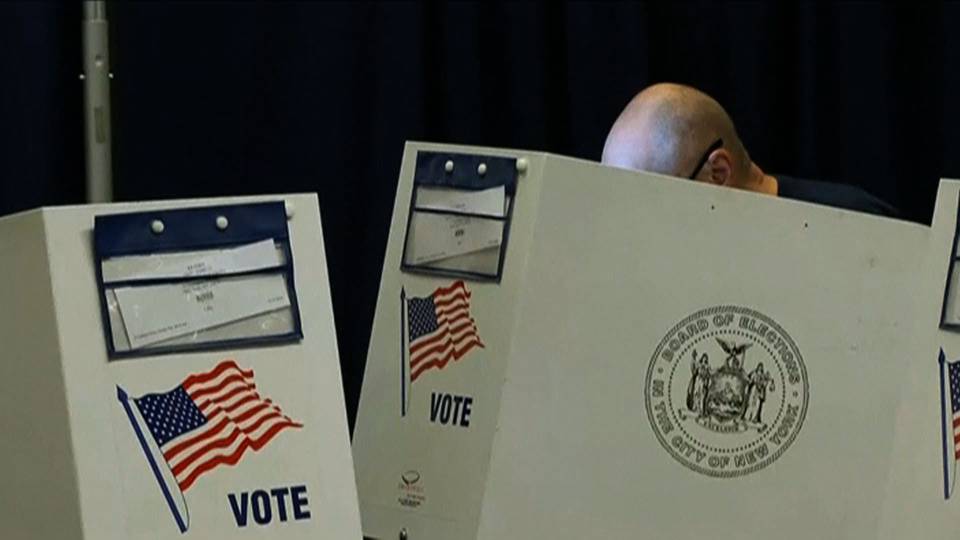
Voters in New York are heading to the polls today for one of the most closely watched races of the election. Donald Trump is leading on the Republican side, while Bernie Sanders and Hillary Clinton are locked in an increasingly tight race for the Democratic contest. Sanders has won eight of the last nine contests, but Hillary Clinton enjoys wide support in parts of New York, where she served as a senator for eight years. At least 3 million New Yorkers—27 percent of the state’s population—cannot vote today because they are not registered as either Democrats or Republicans, and are therefore barred from voting in the closed primary. The deadline to switch party affiliation was back in October. Meanwhile, more than 200 New Yorkers who saw their party affiliations mysteriously switched are filing a last-minute lawsuit to try to make today’s primary open. We’ll have more on the New York primary later in the broadcast.
TOPICS:
New York
2016 Election
#DemocracyAwakening: 300 Arrested in D.C. to Protest Money in Politics
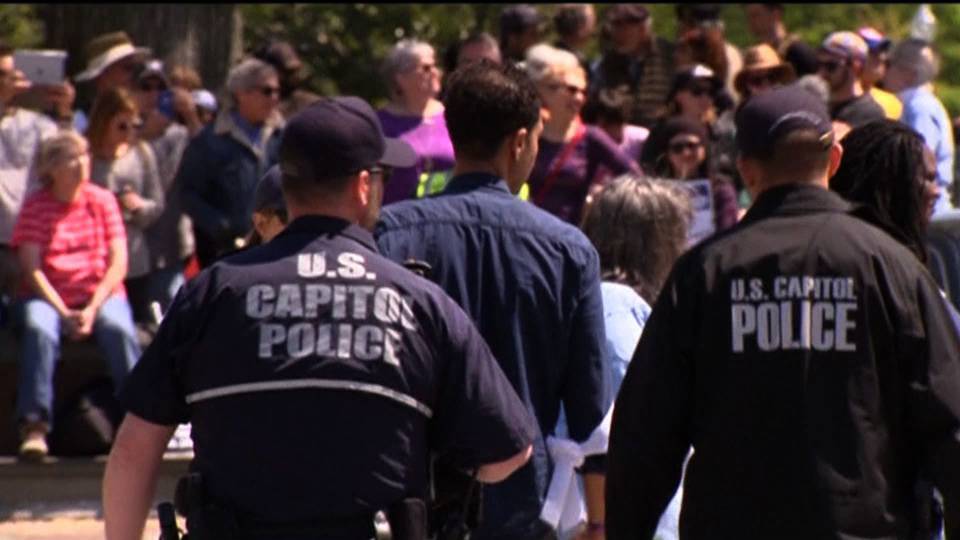
Meanwhile, more than 300 people were arrested Monday in Washington, D.C., in a mass civil disobedience to protest against the influence of big money and corporate lobbying in politics. Monday’s demonstration, dubbed "Democracy Awakening," caps a week of massive protests in which about 1,200 people were arrested in total. Among those arrested Monday were NAACP President Cornell William Brooks, Moral Monday organizer Reverend William Barber and Greenpeace USA Director Annie Leonard. To see our interview with Reverend Barber before his arrest, go to democracynow.org.
TOPICS:
Money & Politics
Protests
Hundreds of Refugees Feared Dead After Boat Capsizes in Mediterranean

Hundreds of refugees from Eritrea, Ethiopia and Somalia are feared to have died after their boat capsized in the Mediterranean en route to Italy on Monday. Survivors say that up to 500 people may have drowned, although the reports are still unconfirmed. The number of people trying to cross from Libya to Italy has surged after a controversial new deal took effect in March that calls for all refugees arriving in Greece to be deported to Turkey. Monday’s disaster comes nearly one year after a refugee boat capsized in the Mediterranean on April 19, 2015, killing as many as 800 people. After Monday’s news broke, Doctors Without Borders tweeted: "2016, the Mediterranean is a mass grave."
TOPICS:
Refugees
Syrian Opposition Quits Peace Talks Amid Assad's Ceasefire Violations
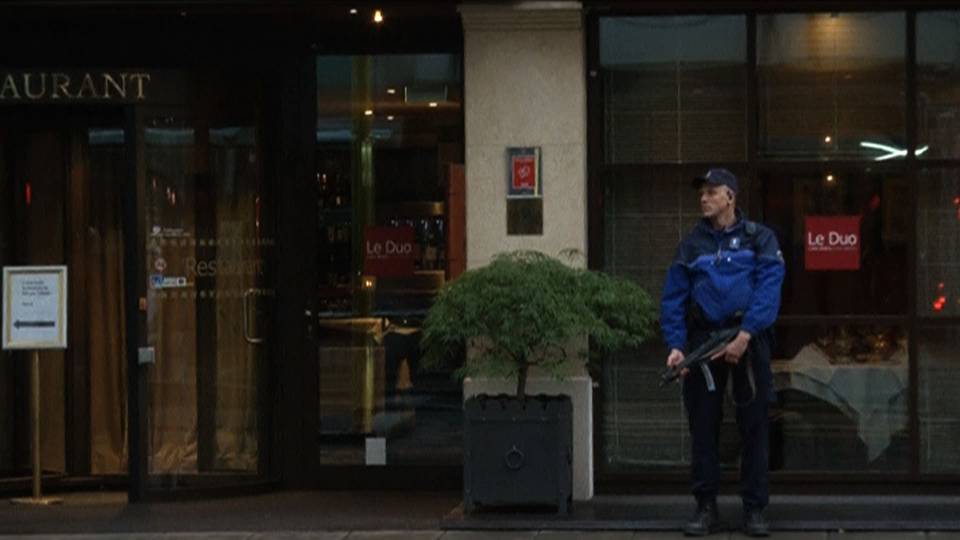
This comes as the latest round of Syrian peace talks are close to collapse in Geneva, after the opposition pulled out of the formal negotiations in protest of ceasefire violations by Syrian President Bashar al-Assad’s regime and its backers. Senior opposition negotiator Mohammed Alloush spoke out.
Mohammed Alloush: "When there are 70 airstrikes and when there is mobilizing of troops, when Iran sends further armed men and Russia sends a large group of rockets and unmanned planes, all this tells us that there is no real will for a political solution that ensures the safety and stability in the country and ensures transition of political power."
TOPICS:
Syria
Afghanistan: Taliban Attack in Kabul Kills 28
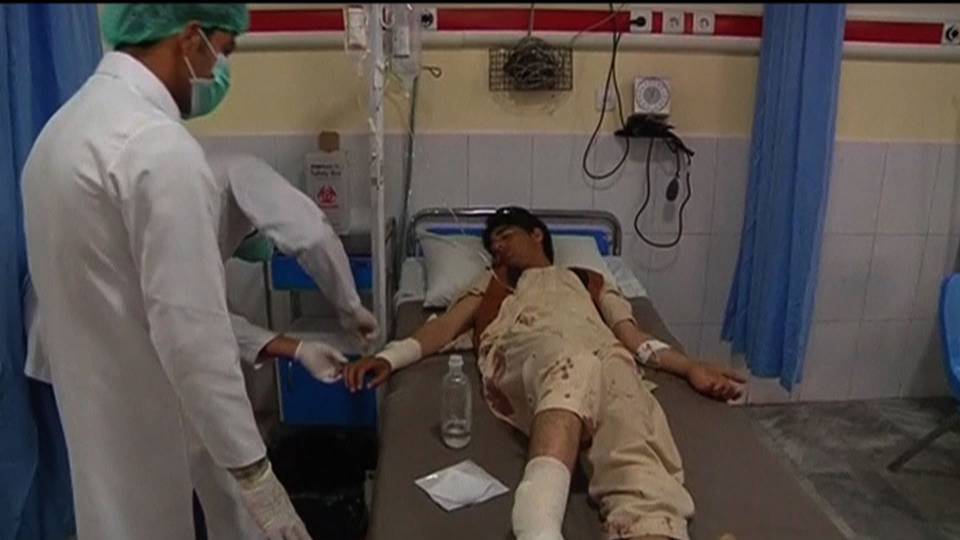
In Afghanistan, a Taliban attack in Kabul has killed at least 28 people and wounded more than 300. Afghan officials say the morning rush-hour attack included both a car suicide bomb and multiple gunmen. The majority killed were civilians. After more than 15 years of the U.S. war in Afghanistan, the Taliban currently controls more territory than at any time since the 2001 U.S. invasion.
TOPICS:
Afghanistan
Ecuador: Death Toll from Earthquake Rises to 413
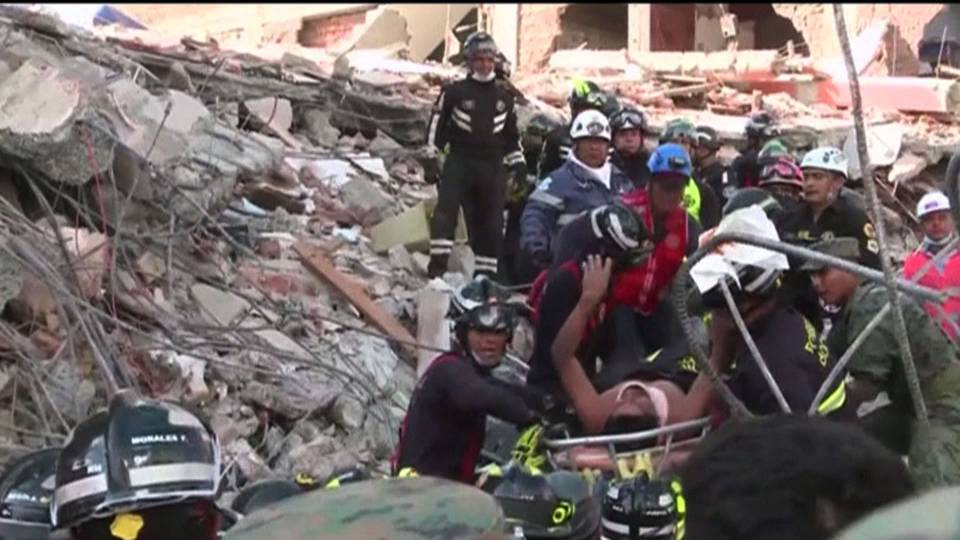
Ecuadorean officials say the death toll from Saturday’s 7.8-magnitude earthquake has risen to at least 413 people, as first responders continue to search for survivors. Nearby Latin American countries, as well as the Palestinian National Authority, have sent emergency responders. The help from Palestine comes after Ecuador sent humanitarian aid to Gaza following Israel’s 2014 offensive.
TOPICS:
Ecuador
Texas Gov. Declares State of Emergency Amid Unprecedented Flooding
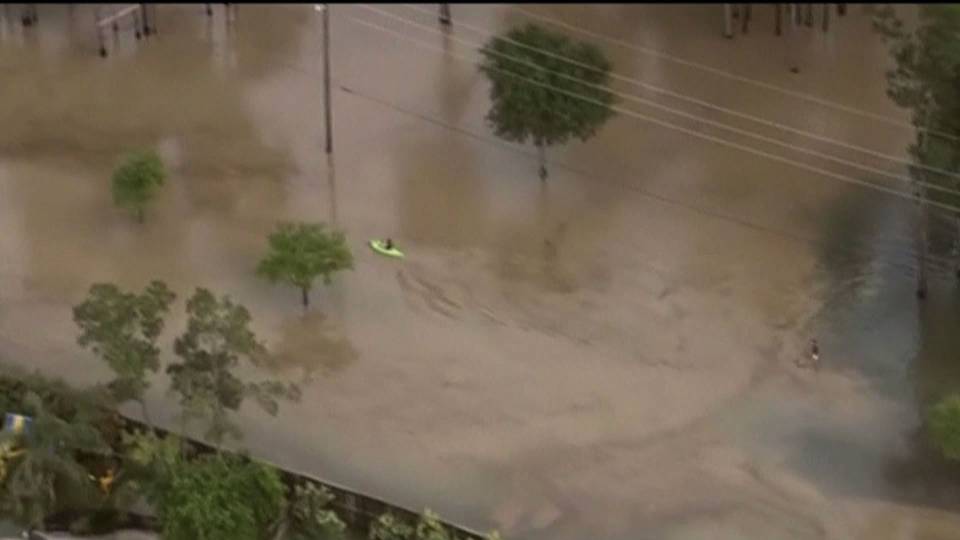
Texas Governor Greg Abbott has declared a state of emergency in nine counties after unprecedented flooding killed five people and inundated thousands of homes in the Houston area. More than 20 inches of rainfall were recorded in some areas.
TOPICS:
Texas
Israeli Police Say 21 Injured in Bomb Explosion on Jerusalem Bus

Israeli police say 21 people were injured after a bomb exploded on a bus in Jerusalem Monday. No one was killed. No one has claimed responsibility for the attack.
TOPICS:
Israel
L.A. Public School Opens District's First Gender-Neutral Bathroom
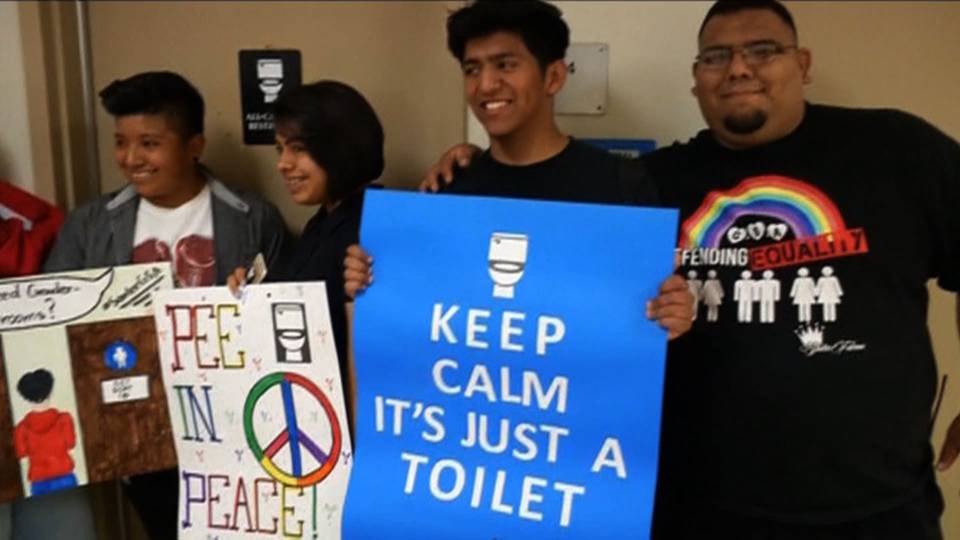
The Los Angeles public high school Santee Education Complex has opened the school district’s first gender-neutral bathroom, following months of student organizing. Student activist Johnny Ramos spoke out about the bathroom’s significance.
Johnny Ramos: "So, this restroom is important so all students can feel comfortable, not just LGBT students or not just minority students. It’s for all students, so everyone could feel welcome. This is our school, and we’re eight hours here. At a certain point in time, we’re going to have to use the restroom. And, you know, it’s just unfair that some of these kids have to hold the restroom, and it honestly sucks."
This comes amid the passage of anti-transgender laws in North Carolina and Mississippi.
TOPICS:
California
LGBT
Maryland: Black Trans Woman Keyonna Blakeney Murdered
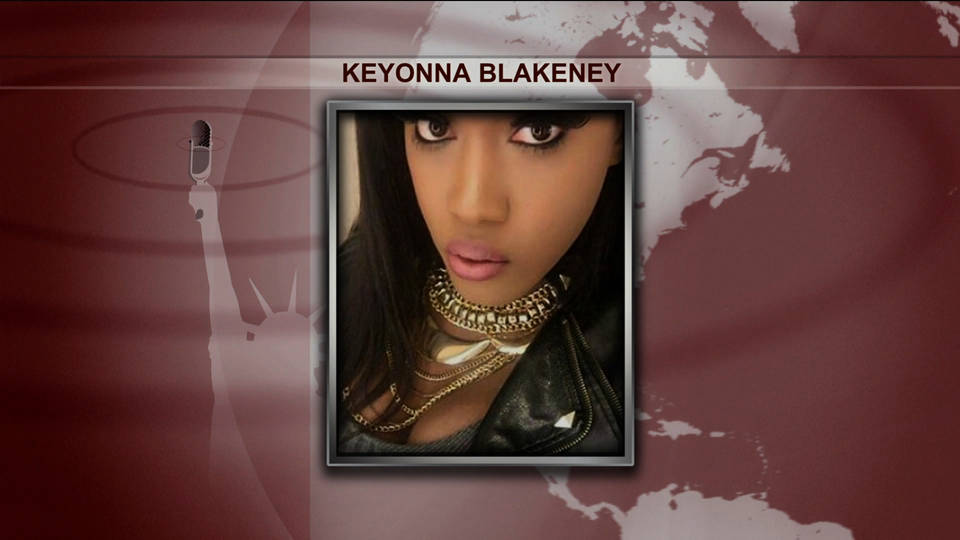
A 22-year-old black transgender woman has been killed in Montgomery County, Maryland. Keyonna Blakeney was killed Saturday at the Red Roof Inn. Police are investigating her murder. Keyonna is the ninth trans person to be murdered this year.
TOPICS:
LGBT
Chicago: Father Takes Sanctuary in Church to Protect from Deportation

In Chicago, a father of five American children has taken sanctuary in a church to protect himself from deportation. Thirty-four-year-old Jose Juan Federico Moreno has spent seven years fighting deportation after he was convicted of a DUI in 2009. On Monday, Moreno said, "Leaving my children behind is not a choice I can make. ... All I am asking for is a chance to see my children grow and support my family." This comes as the Supreme Court heard arguments in one of the most significant immigration cases in decades. We’ll have more on the Supreme Court case after headlines.
TOPICS:
Chicago
Immigration
Baltimore Youth Wins Goldman Environmental Prize

In Baltimore, 20-year-old Destiny Watford has become one of the youngest winners of the Goldman Environmental Prize in the award’s history for organizing to stop a trash incinerator from being built in Baltimore’s Curtis Bay neighborhood, which already has the worst air pollution in the city. She began the campaign when she was only 17 years old.
Destiny Watford: "I’ve always been a bit shy. But when I joined the group, I was really challenged to come out of that comfort zone. And I went up to this man’s door, and I told him about the incinerator. He just said, 'What you kids are doing is pointless; Curtis Bay is and always will be a dumping ground, and you're not going to change that.’ And it was a disheartening moment, but it also lit this sort of fire."
Other 2016 winners of the prestigious environmental prize include a Slovak lawyer who shut down a toxic waste dump, a Cambodian activist who went undercover to expose illegal logging, a Puerto Rican who established a new nature reserve on the island, a Tanzanian man who developed a new way to grant land titles to indigenous communities rather than to individuals, and a Peruvian farmer who fought a gold and copper mine from taking her land.
TOPICS:
Environment
Pulitzer Prize Awarded to AP Investigation "Seafood from Slaves"
And the 100th annual Pulitzer Prizes have been announced. The Washington Post won for the series "Fatal Force," which tracked 990 police killings throughout 2015. Lin-Manuel Miranda won best drama for "Hamilton." Ken Armstrong of The Marshall Project and T. Christian Miller of ProPublica won for the investigation "An Unbelievable Story of Rape," which chronicles a botched rape investigation. And the Associated Press won the Pulitzer Prize for public service for the investigative series "Seafood from Slaves," which uncovered slavery in the Southeast Asia fishing industry—a major supplier of seafood to the United States. I sat down with two of the AP reporters, Robin McDowell and Martha Mendoza, last week in Los Angeles.
Amy Goodman: "This issue of third-party suppliers, Martha, what do you say to companies that say, 'We can't be responsible for going right back to the beginning of where a fish is caught. If these men are slaves, certainly we don’t condone that, but how would we know?’"
Martha Mendoza "Well, we’re a couple of moms, we are news reporters, and we found this. I don’t buy it. A major corporation that really cares and is really committed to keeping human trafficking out of their supply chain can get meticulous, get on the ground, talk to people, figure out where their products come from. And it may be a little bit more expensive for them, and their profit margin may be a little smaller, but it’s entirely doable for them to follow their product from the producer right onto their store shelves."
The Pulitzer Prize to AP went to an all-woman team. To see our full interview with Pulitzer Prize-winning reporters Robin McDowell and Martha Mendoza, go todemocracynow.org.
TOPICS:
JournalismDonate today:
Follow:


SPEAKING EVENTS

4/19 Idaho Springs, CO
4/19 Denver, CO
4/20 Denver, CO
4/21 Boulder, CO
4/22 Colorado Springs, CO
4/23 Eagle, CO
4/23 Carbondale, CO
4/23 Paonia, CO
4/24 Salida, CO
4/24 Taos, NM
4/25 Albuquerque, NM
4/26 Los Alamos, NM
4/26 Santa Fe, NM
more
NEW BOOK

WATCH: Tavis Smiley Interviews Amy Goodman About Her New Book & 20 Years ofDemocracy Now!
WORK WITH DN!

Broadcast Engineer
Director of Finance and Operations
WEB EXCLUSIVE

A New Nuclear Arms Race Feared as U.S. & Others Aim to Build Smaller, "More Usable" Nukes
-------
Democracy Now! Daily Digest: A Daily Independent Global News Hour with Amy Goodman & Juan González for Wednesday, April 20, 2016
democracynow.org
Stories:

Battle for New York: Clinton & Trump Win as NYC Voters Report Chaos & "Irregularities" at the Polls
On Tuesday, Republican Donald Trump and Democrat Hillary Clinton each scored decisive victories in New York, moving both candidates closer to becoming their respective parties’ presidential nominees. In the Republican race, Trump is poised to win 89 of the 95 delegates up for grabs. In the Democratic race, former New York Senator Hillary Clinton beat Senator Bernie Sanders by a margin of 58 to 42 percent. Sanders won the majority of counties in the state, but Clinton won big in the metropolitan New York area. We speak to former Manhattan Borough President Virginia Fields and economist Mark Weisbrot of the Center for Economic and Policy Research.
TRANSCRIPT
This is a rush transcript. Copy may not be in its final form.
AMY GOODMAN: This is Democracy Now!, democracynow.org, The War and Peace Report. We’re on the 100-city tour marking Democracy Now!'s 20th anniversary. I'm Amy Goodman in Denver, Colorado. Juan, you are in New York, Juan González, and you were there yesterday for the New York primary.
JUAN GONZÁLEZ: Yes, I was, Amy, and welcome to all of our listeners and viewers around the country and around the world. Well, Republican Donald Trump and Democrat Hillary Clinton scored decisive victories in New York, moving both candidates closer to becoming their respective parties’ presidential nominees. In the Republican race, Trump crushed his rivals Ted Cruz and John Kasich. He appears poised to win 89 of the 95 delegates up for grabs in New York. Trump spoke to supporters last night at Trump Tower in New York City.
DONALD TRUMP: We don’t have much of a race anymore, based on what I’m seeing on television. Senator Cruz is just about mathematically eliminated. And we’ve won another state. As you know, we have won millions of more votes than Senator Cruz, millions and millions of more votes than Governor Kasich. We’ve won, and now, especially after tonight, close to 300 delegates more than Senator Cruz. We’re really, really rocking.
AMY GOODMAN: In the Democratic race, former New York Senator Hillary Clinton beat Bernie Sanders by a margin of 58 to 42 percent. Sanders won the majority of counties in the state, but Clinton won big in the metropolitan New York area. The election results came close to mirroring the 2008 race, when Clinton beat Barack Obama by a margin of 57 to 40 percent. Hillary Clinton spoke last night in Manhattan.
HILLARY CLINTON: And to all the people who supported Senator Sanders, I believe there is much more that unites us than divides us. ... You know, we started this race not far from here, on Roosevelt Island, pledging to build on the progressive tradition that’s done so much for America, from Franklin Roosevelt to Barack Obama. And tonight, little less than a year later, the race for the Democratic nomination is in the home stretch, and victory is in sight.
JUAN GONZÁLEZ: Bernie Sanders was in Pennsylvania Tuesday night campaigning ahead of that state’s primary next Tuesday.
SEN. BERNIE SANDERS: So, we lost tonight, but there are five primaries next week. We think we’re going to do well. And we have a path toward victory, which we are going to fight to maintain. While I congratulate Secretary Clinton, I must say that I am really concerned about the conduct of the voting process in New York state, and I hope that that process will change in the future. And I’m not alone about my concerns. The comptroller of the City of New York talked today about voter irregularities and about chaos at the polling places.
AMY GOODMAN: We’re joined in New York by two guests. Virginia Fields is president and CEO of the National Black Leadership Commission on AIDS. She is the former borough president of Manhattan. And Mark Weisbrot is with us, co-director of the Center for Economic and Policy Research, and president of Just Foreign Policy. Weisbrot’s new book is called Failed: What the Experts Got Wrong About the Global Economy.
Virginia Fields, we’re going to start with you. Can you talk about the significance of Hillary Clinton’s victory?
VIRGINIA FIELDS: Well, I think it was very significant, because it really did kind of solidify a base, and I think that it also gave her the support that she needs now in moving forward. It continues to confirm that in metropolitan areas, certainly, Hillary Clinton—or I should say Secretary Hillary Clinton, presidential candidate—is very well known in New York. She has worked New York as our U.S. senator. So, I thought that—I expected her to win. And I think the win really kind of solidified her base, as well as touched highly upon her experience. And I think it also pointed out the difference between she and Senator Sanders as we have been moving forward. So I think it was significant on all fronts.
JUAN GONZÁLEZ: Well, I’d like to ask you, following up on that, the gap between the two candidates was larger than most people had expected or, in the polls, had been predicting. Why do you think that’s so? And also, why do you think that this persistent difference in the base of support between young people for Bernie Sanders and the white male Democrats versus the African-American, Latino and larger female support among older Democrats that Hillary Clinton has?
VIRGINIA FIELDS: Can’t speak to the white males. But I’ve spoken with some of the younger-generation people who are supporting Hillary. And some of them have said things like, the only things they have known are the failure of the banks, big corporation, inequalities. And so, the message that Senator Sanders has obviously made central to his campaign, speaking about these issues day in and day out, has resonated more with them. They have not focused so much, based, again, on young people I’ve talked with, certainly those even in my family, who are supporting Senator Sanders, that they’ve not had experienced other good times that led up to a lot of these fallouts that they have experienced, and the possibilities of returning to those. So I think a lot of that resonated with them just based on life experiences. I think here in New York, again, it was—Senator Clinton, in terms of relationships with African Americans in the Latino communities, is much stronger, certainly, than that of Senator Sanders here in the state of New York. And I think we’re seeing—
AMY GOODMAN: I wanted to ask—
VIRGINIA FIELDS: We’re seeing that play out nationally.
JUAN GONZÁLEZ: Mark—
AMY GOODMAN: I wanted—
JUAN GONZÁLEZ: Mark, I wanted to ask you, in terms of these results, the astonishing map that you see of this New York primary is that Bernie Sanders won all of upstate, with the exception of the cities of Buffalo, Syracuse and Rochester and the metropolitan area of New York, both the City of New York and the suburbs. So it’s a remarkably different sort of a base of support among Democrats that he had versus Clinton.
MARK WEISBROT: Yes. Well, you know, there’s a big group excluded. I mean, he wins very big among independents. And, you know, in New York, they had to—if you wanted to register as a Democrat, you had to do that back before—back in October of last year. So, you excluded a big part of the base that usually votes for him, and, of course, the biggest bloc in the general election. So I think that’s part of the story.
You know, with regard to the demographic divide, I think that’s a lot—you know, the media likes to say that it’s because young people are naïve and idealistic. But I think they actually can see things that the people—you know, Hillary is really only getting majority of people in over 45—in some polls, over 50. And I think that’s because they’re more stuck in this Cold War narrative. You know, you don’t have any polling data that really says—that asks Democrats, "Who you would vote for if you thought the Democrats were going to win in the general election for sure?" But there’s a lot of exit polling data that indicates that Sanders would win overwhelmingly on that. You see these—for example, people voting for Hillary are much more driven by fear, fear of losing—of them losing to—of the candidate losing to Donald Trump, which, of course, the polling data indicates the opposite—and it makes sense, because he wins the independent voters—and fear of terrorism, for example. And you don’t have those same fears. You don’t have that whole Cold War—Cold War ideas that he can’t win because, you know, he calls himself a democratic socialist. You don’t see that as much with young people, and I think that’s because it’s a different country, really, and they’re actually right, because they haven’t grown up in this period where these things would have determined the race.
VIRGINIA FIELDS: And just a comment on the one word, "idealism," because we’ve all heard that, too. But I’ve never looked at the young people as just being idealistic. I mean, they’re really serious, and they’ve looked at these issues. And as you said, too, it hasn’t been their experience in terms of growing up. And they do believe the possibility is there, the hope is there, like the audacity of hope for change.
JUAN GONZÁLEZ: Amy?
AMY GOODMAN: You know, talking about movements, Mark Weisbrot, Bernie Sanders lost by, what, 16, 17 percent. Now, after break, we’re going to talk about voter irregularities. I mean, this is quite astounding, 125,000 people in Brooklyn alone purged from the voter rolls. We’ll talk about that in a minute and get both of your reaction to what has taken place in New York. But, clearly, what Bernie Sanders represents is more than himself. He has tapped into a movement. And I’m wondering where this movement goes from here.
VIRGINIA FIELDS: I think we’re going to see it continue. And even as a staunch supporter of Secretary Clinton, I do see that it certainly did bring to the forefront a lot more people and the issues. I think there’s been much less attention to the amount of dollars that go into campaigns. The whole Citizens United issue has been in the fold. People are really talking about that now. And I think that they better understand how campaigns are driven or supported. I also think he’s brought to the forefront issues, including, quite frankly, Donald Trump, the whole delegate selection process. People have not really focused on that so much. How do you become a delegate to be a part of a political process as we move to presidential nominees? So I think we’re going to see the movement continue because of the issues.
JUAN GONZÁLEZ: And, Mark, your comments—
AMY GOODMAN: And Mark Weisbrot?
JUAN GONZÁLEZ: Your comments on this, and also the fact that, certainly, Secretary Clinton has moved to the left on a lot of issues as a result of this enormous—
MARK WEISBROT: Yeah.
JUAN GONZÁLEZ: —campaign of Bernie Sanders?
MARK WEISBROT: No, she sure has. And, you know, even The New York Times editorial board, which endorsed Hillary, had an editorial saying Bernie should stay in 'til the end, you know? And it was because of the issues and because even they appreciated—and I think they maybe were split on the endorsement, but they appreciated what he's done. But I think it is—this is a social movement. This is very real. I mean, this is—I mean, just even the $6 million donation, in small donations, driving this, you’ve never had anything like this before. And you have had other insurgent candidacies, and people hoped that social—you know, the movement would continue after the election. It didn’t happen with the Nader campaign—campaigns. It didn’t happen with the Jesse Jackson campaigns. But this one, I think, the candidate is very committed to that. He said it very many times. And I think definitely something will come out of this, because it’s a huge shift. It’s a big political shift in the base of the Democratic Party, among independents. I mean, he’s just put these issues on the—couldn’t break through these media barriers before. That’s really what’s happened. Now that they have, they’re not going to go away.
VIRGINIA FIELDS: And I would just—
AMY GOODMAN: We’re going to break and come back to this discussion. And we’re also going to talk about what took place in New York. You know, when the vast majority of people don’t vote in primaries, then, in particular, when you have people purged from the polls, it has an enormous impact. We’re talking to Mark Weisbrot, who’s with the Center for Economic and Policy Research, as well as Virginia Fields, National Black Leadership Commission on AIDS. We’ll be back with them in a moment. ... Read More →

New York Primary: Chaos at Polling Sites, Broken Scanners & Whole Blocks Purged from Voter Rolls
Tuesday’s voting in the New York primary was marked by chaos, particularly in Brooklyn, as tens of thousands of voters found their names had been removed from the polling rolls or that they were unable to vote at their polling station. The New York City Elections Board has confirmed that more than 125,000 Brooklyn voters had been removed from the voter rolls since November 2015. There were also reports that polling staff were unable to operate voting machines, gave out conflicting information and erroneously directed voters to alternate sites. In a statement, New York City Mayor Bill de Blasio said, "It has been reported to us from voters and voting rights monitors that the voting lists in Brooklyn contain numerous errors, including the purging of entire buildings and blocks of voters from the voting lists." We speak to Kristen Clarke, president and executive director of the national Lawyers’ Committee for Civil Rights Under Law.
TRANSCRIPT
This is a rush transcript. Copy may not be in its final form.
AMY GOODMAN: We’re on the road on our 100-city tour in Denver, Colorado. Juan González is in New York.
JUAN GONZÁLEZ: Well, voting in New York City was marked by considerable chaos, particularly in Brooklyn, as tens of thousands of voters found their names had been removed from the rolls or that they were unable to vote at their polling station. The New York City Elections Board has confirmed that more than 125,000 Brooklyn voters had been removed from the rolls since November of 2015. There were also reports that polling staffs were unable to operate voting machines, gave out conflicting information and erroneously directed voters to alternate sites. New York City Mayor Bill de Blasio issued a statement Tuesday decrying the disenfranchisement, writing, quote, "It has been reported to us from voters and voting rights monitors that the [voting] lists in Brooklyn contain numerous errors, including the purging of entire buildings and blocks of voters from the voting lists." Democratic candidate Bernie Sanders expressed concerns about New York’s voting process late on Tuesday, after rival Hillary Clinton won the state’s primary.
SEN. BERNIE SANDERS: While I congratulate Secretary Clinton, I must say that I am really concerned about the conduct of the voting process in New York state, and I hope that that process will change in the future. And I’m not alone about my concerns. The comptroller of the City of New York talked today about voter irregularities and about chaos at the polling places.
AMY GOODMAN: New York City Comptroller Scott Stringer said his office had received reports of polling stations that failed to open on time and poll workers who were unable to tell voters when they would be operational. Stringer ordered an audit of New York’s election authorities, citing deep concern over widespread reports of poll site problems and irregularities.
For more, we’re joined by Kristen Clarke, president and executive director of the national Lawyers’ Committee for Civil Rights Under Law. The lawyers’ committee leads the Election Protection program, which operates a voter hotline during elections. Still with us, Virginia Fields, president of the National Black Leadership Commission, as well as Mark Weisbrot, who is co-director of the Center for Economic and Policy Research.
Kristen, lay out for us what you understand took place yesterday. I mean, the admission by the city authorities that 125,000 voters were purged from the polls in one of New York City’s five boroughs alone, Brooklyn?
KRISTEN CLARKE: Yeah, this was far from a smooth election. Through our Election Protection effort, we operate a hotline, 866-OUR-VOTE, where we field complaints from voters across the state, across the country, during elections. We heard from over 900 voters across the state who reported issues that range from, you know, poll sites that opened late, arrival to poll sites where they were directing voters elsewhere because of technical problems. We heard from voters who have been longtime affiliated with one party, but were told that they were ineligible to participate in the party primary yesterday. It’s clear that there were breaks in the system and that more work needs to be done to ensure that we have a smooth process that allows every eligible voter to cast a ballot.
JUAN GONZÁLEZ: Well, you know, I’ve been covering New York City politics now for close to 30 years. And I want to ask Virginia Fields to comment on this, because she’s a veteran of the political wars. And while it’s certainly true that there’s a lot of questions about what happened in Brooklyn, I would counsel people not to jump to conclusions about some kind of a suppression operation, because the New York City Board of Elections is notoriously incompetent. Virtually every election, there seem to be problems—small elections, large elections—with the handling of voters and registration. Virginia Fields, I’d like you to comment on that, as well.
VIRGINIA FIELDS: Well, first of all, I think it’s outrageous, what we heard about yesterday, over 125,000 voters. With so many changes that have taken place in terms of locations where people vote, not being able to vote if you have moved from one election district to another election district, even though it might be across the street, I think, at this stage, with technology and all we know, that the Board of Elections should be in better control in terms of communicating these changes far in advance. Here in New York state this year, as you know, we have four elections: yesterday, one in June for congressional, our regular primary in September, then the general election in November. There has been sufficient time to address these issues. And I think the Board of Election must be held accountable, and changes need to take place from the top down. I don’t accept what I’ve heard.
AMY GOODMAN: Can you, Kristen Clarke—Kristen Clarke, can you talk about why New York’s voting system seems especially bad? I mean, how does it compare to the rest of the country?
KRISTEN CLARKE: We are bottom of the list. We are—you know, New York is consistently at the bottom of the list when it comes to turnout and participation. When you look at election reforms that exist in other states, like same-day registration, preregistration opportunities for 16- and 17-year-olds, the ability to cast absentee ballots if you wish, none of those rules exist in New York. I’m really pleased that the comptroller has expressed an interest in shining a light on the New York City Board of Elections, but we’ve got to remember that that’s a band-aid solution. What we need is real reform out of Albany. We need lawmakers to finally follow through on election reforms that have been on the table for a long, long time and that are needed to bring New York into the 21st century. And looking at the numbers of votes cast yesterday, it appears that roughly 33 percent of voters turned out to vote. And that’s abysmal. Even in Maricopa County, where some voters had to endure wait times of up to five hours, you saw a voter turnout rate of about 50 percent. New York is always at the bottom of the list when it comes to turnout, and it’s time for real reform.
JUAN GONZÁLEZ: And when you talk about real reform, I remember just a few years ago, after a particularly contentious congressional race to a challenge of Charles Rangel in Harlem, there were City Council hearings, there were promises of reform of the Board of Elections. What do you think needs to happen to be able to finally fix New York’s broken electoral system?
KRISTEN CLARKE: Well, we need all of these folks who are expressing angst today, and the comptroller, the mayor, to really direct that energy towards Albany. We need lawmakers in Albany to finally, finally follow through on the need for an election overhaul in New York. We need same-day registration. We need automatic voter registration, so that people can be added to the rolls and their information can be easily updated. We need preregistration opportunities for 16- and 17-year-olds. We need real in-person early voting opportunities. And it is simply shameful that in 2016 we don’t have those kinds of reforms in place in New York. So, all of this angst today, I think, needs to not be directed on issuing reports and shining a spotlight on all of the issues that we already know are there and are broken. It’s time for real reform to come out of Albany, and time for lawmakers to put pen to paper and bring New York into the 21st century.
AMY GOODMAN: Kristen Clarke, we’ve talked about the 125,000 people purged from the polls, but what about this issue that it’s a closed primary in New York? Who determines that? Why do they determine that? And what exactly this means, that, you know, you—if you wanted to vote in this primary, for independents, for example, they had to have switched their party affiliation, say, to Democrat, by early October? This is before any debates. This is before any primaries. Of course, someone like Bernie Sanders, his large attraction is with independent voters. It had a huge effect on who could vote, outside of the 125,000 purged in just one borough.
KRISTEN CLARKE: Right. So, there are about half the country—about half of states around the country have closed primaries or some version of a closed primary. You know, the issue in New York is that we don’t have real notice and communication, clear communication, to voters about the rules and about the deadlines. And often these deadlines are so far out that voters aren’t even focused on the process. Part of this election overhaul needs to be putting more resources into the hands of local boards of elections, so that they can be held accountable and so that they have the ability to give and impart accurate and clear information to voters, so that they know what the rules are and know what the deadlines are.
The New York City Board of Elections, I think that it’s been a fiasco this cycle. They issued notice to about 42,000 new voters, advertising the primary election in the fall. That notice had the wrong date. They issued a second notice that had the correct date of the primary but failed to mention yesterday’s primary happening on April 19th, and then had to do a third notice to voters that made clear the April 19th primary and the primary happening this fall. These kinds of problems are intolerable. They lock people out of the process. If people don’t have accurate and clear information about when to vote and what they need to vote, then we ultimately are disenfranchising voters, and that should not be tolerated. So, part of this election overhaul that we need requires putting more hands into local boards of elections, putting more resources into local boards of elections, so that they have the ability to do their job right.
JUAN GONZÁLEZ: And finally, Mark Weisbrot, I’d like to ask you about this issue of the closed primary. There are those who say, "Well, political parties exist as separate organizations, and if you want to participate in the selection of that party’s candidate, you should be a member of the party." You know, now, admittedly, a year beforehand is far too long for someone to be able to switch their registration. But the issue of whether parties should be able to restrict, as some states do, the selection of their candidates only to party members?
MARK WEISBROT: Yeah, I think—I think it’s much better if you have more participation in the country, especially—you know, you can make a case if this were more of a parliamentary system or you didn’t have this two-party system, where they’re basically like state institutions in the sense that it’s so difficult, almost impossible, for a third party to have a chance. Then, you really should have these primaries as open as possible. And, you know, this country really is what it is today in a large part because of disenfranchisement. If you had voter participation rates like you have in Europe or even some, you know, middle-income developing countries, you’d have a very different electorate. And, of course, the Republican Party knows that. That’s their main strategy for survival, is all about disenfranchisement. You know, they use the control over the state legislatures and the governors to redistrict and to—you know, this big offensive to disenfranchise people. That’s their strategy for going forward. And so, we really need voter reform, I would say, at least as much as campaign finance reform. We’d really see a very different politics in this country if we—if people voted.
AMY GOODMAN: Well, we want to thank you all for being with us, Kristen Clarke in Washington, president and executive director of the national Lawyers’ Committee for Civil Rights Under Law, lawyers’ committee leading the Election Protection program, which operates a voter hotline during elections; also, Virginia Fields, president and CEO of the National Black Leadership Commission on AIDS, former borough president of Manhattan; and, finally, Mark Weisbrot, co-director of the Center for Economic and Policy Research, and president of Just Foreign Policy. His book, Failed: What the Experts Got Wrong About the Global Economy.
Mark, we’d like to ask you to stay, because we’re going south next, from Brooklyn to Brazil, to the impeachment of Brazil’s president. Is it a coup? That’s what we’ll be talking about in New York and Rio de Janeiro. This is Democracy Now! We’ll be back in a minute. ... Read More →

Is the U.S. Backing Rousseff's Ouster in Brazil? Opposition Holds Talks in D.C. as Obama Stays Quiet
On Sunday, Brazil’s lower house of Congress voted 367 to 137 to start impeachment proceedings against President Dilma Rousseff. Early next month, Brazil’s Senate will vote on whether to put Rousseff on trial on allegations of manipulating budget accounts. On Tuesday, Rousseff said attempts to impeach her constituted a "coup" and an "original sin." Brazil has been engulfed in a major corruption scandal, but Dilma Rousseff herself has not been accused of any financial impropriety. However, 318 members of the Brazilian Congress, including many who backed her impeachment, are under investigation or face charges. Leading the impeachment process has been Brazil’s Speaker of the House Eduardo Cunha, who has been accused of squirreling away $5 million into Swiss bank accounts.
Meanwhile, The Intercept is reporting a key Brazilian opposition leader has traveled to Washington, D.C., to partake in closed-door meetings with various U.S. officials and lobbyists. Sen. Aloysio Nunes of Brazil’s center-right PSDB party reportedly is meeting with the chair and ranking member of the Senate Foreign Relations Committee, Republican Bob Corker of Tennessee, and others to discuss the situation in Brazil. He also apparently attended a luncheon hosted by the Washington lobbying firm Albright Stonebridge Group, headed by former Clinton Secretary of State Madeleine Albright and Kellogg Company CEO Carlos Gutierrez. We speak to The Intercept’s Andrew Fishman in Brazil and economist Mark Weisbrot, co-director of the Center for Economic and Policy Research.
TRANSCRIPT
This is a rush transcript. Copy may not be in its final form.
AMY GOODMAN: I’m Amy Goodman, on the road on our 100-city tour, in Denver. We’ll be headed to Boulder and Colorado Springs and beyond through the weekend. Check democracynow.org. Juan González is sitting there right in the studios of New York.
JUAN GONZÁLEZ: Well, we turn now to the political crisis in Brazil. On Sunday, Brazil’s lower house of Congress voted 367 to 137 to start impeachment proceedings against President Dilma Rousseff. Early next month, Brazil’s Senate will vote on whether to put Rousseff on trial on allegations of manipulating budget accounts. On Tuesday, President Rousseff said attempts to impeach her constituted a "coup" and an "original sin."
PRESIDENT DILMA ROUSSEFF: [translated] What I feel is unjustifiable is the attempt to diminish the fact, the necessity for a legal basis to propose and seek the impeachment of the president of the republic. So I ask you all, why then is this not a coup? It is a coup. It is a coup dressed as original sin, which is the fact that there is no legal basis for my impeachment.
JUAN GONZÁLEZ: Brazil has been engulfed in a major corruption scandal, but President Rousseff herself has not been accused of any financial impropriety. However, 318 members of the Brazilian Congress, including many who backed her impeachment, are under investigation or do face charges. Leading the impeachment process has been Brazil’s Speaker of the House Eduardo Cunha, who has been accused of squirreling away $5 million in Swiss bank accounts.
Meanwhile, The Intercept is reporting a key Brazilian opposition leader has traveled to Washington, D.C., to participate in closed-door meetings with various U.S. officials and lobbyists. Senator Aloysio Nunes of Brazil’s center-right PSDB party is reportedly meeting this week with the chairman and ranking member of the Senate Foreign Relations Committee, Republican Bob Corker of Tennessee, and others to discuss the situation in Brazil.
AMY GOODMAN: Well, for more, we go to Rio de Janeiro, Brazil, where we’re joined by Andrew Fishman, researcher and reporter for The Intercept. Along with Glenn Greenwald and David Miranda, he wrote the piece, "After Vote to Remove Brazil’s President, Key Opposition Figure Holds Meetings in Washington."
And we’re joined in New York by Mark Weisbrot, co-director of the Center for Economic and Policy Research. Weisbrot’s recent article for The Huffington Post titled "Brazilian Coup Threatens Democracy and National Sovereignty." His new book, Failed: What the Experts Got Wrong About the Global Economy.
We welcome you both to Democracy Now! Mark, why don’t we start with you? What do you believe is happening right now in Brazil?
MARK WEISBROT: Well, I think it is—it is definitely a coup. And, you know, the international media has actually shifted in the last couple of months, and especially more recently. They had been like the Brazilian media, just really reporting it from a pro-opposition point of view as though this were a legitimate impeachment. And now you see more and more they’re saying it’s not legitimate, of course, because there’s no real charges against the president that would warrant impeachment. And it’s really an attempt by the opposition to reverse the results of the 2014 election, to take advantage of the fact that the economy is in recession and go after her.
I think that, you know, that article in The Intercept was very important, and Andrew will talk about it. But one point that they made about the visit of Senator Nunes from the opposition in Brazil to Washington this week was—is it didn’t get attention from the media, but it really should, because he met with Tom Shannon. And Tom Shannon is the most influential person on Latin America in the State Department. He’s going to be the one telling—recommending to Secretary of State Kerry what he should do, what—where the U.S. should come down on this process. And that’s extremely important, because Shannon didn’t have to meet with him. He’s just a senator, you know? By meeting with him, he sends a message to everybody who’s paying close attention in Brazil that the U.S. is OK with this process. It’s very similar to the coup in Honduras. You know, anybody paying close attention to that and everybody in Washington knew the very first day of the coup, when the White House put out a statement that didn’t say one bad thing about the coup, well, that’s the strongest statement you could make in support of a coup, a military coup, in the 21st century. And so, it’s a very similar thing. The media totally ignored it, but that was a signal. And I think it shows what we already know: The United States really does want to get rid of the Workers’ Party and always has.
JUAN GONZÁLEZ: And, Mark, what specifically are the charges against President Rousseff?
MARK WEISBROT: Well, specifically, she’s charged with using money from the—not using the money, but in an accounting sense, counting money from the public banks to lower the—or increase the primary fiscal surplus—so, in other words, to make the national accounts look better by using money from the public banks, by counting that in the budget balance. But it’s really—you know, an example I like to give is 2013 in the United States, when the Republicans were, you know, threatening to default on the debt, and there was a deadline for when the debt ceiling would be reached, and the U.S. Treasury just kept changing that deadline by accounting manipulations, you know, and—
JUAN GONZÁLEZ: So she’s not specifically accused of bribes or—
MARK WEISBROT: No, nothing.
JUAN GONZÁLEZ: —or of any kind of a personal enrichment.
MARK WEISBROT: No, no. And what the media did for a long time, both national and international, was made it look like, so I’m sure most of your listeners believe that her impeachment has something to do with a corruption scandal. And, in fact, it doesn’t.
AMY GOODMAN: I want to turn to Andrew Fishman in Rio de Janeiro in Brazil. Andrew, the piece in The Intercept that you wrote, headlined "After Vote to Remove Brazil’s President, Key Opposition Figure Holds Meetings in Washington," talk about his significance and what’s happened.
ANDREW FISHMAN: Good morning. Senator Aloysio Nunes is the chair of the Senate Foreign Relations Committee in Brazil. He was the vice-presidential candidate for the opposition party that lost to Dilma Rousseff in 2014. He’s been one of the leading opponents of Dilma Rousseff’s government and the Workers’ Party. And when he was—when he became the head of the Senate Foreign Relations Committee, one of his core tenets was that he wanted to bring Brazilian foreign policy closer to the United States, which had been damaged after the Snowden revelations that the United States, that the NSA was spying on Petrobras and on Dilma specifically. And it’s been—it’s been a very tense relationship since then.
His trip, he says that he was—he had planned to go previously, but he acknowledges that Michel Temer, who’s the vice president, who will take over if Dilma Rousseff is removed from office, which seems likely, at least temporarily—he said that president—Vice President Temer called him, asked—said that the international press was giving a bad image to the impeachment process, and he wanted him to go to Washington and give it a—it’s basically a PR trip.
JUAN GONZÁLEZ: Andrew, you’ve written in one of your articles that Brazil’s extraordinary political upheaval shares some similarities with the Trump-led political chaos in the United States. Could you explain?
ANDREW FISHMAN: Yeah. This is a very strange moment in Brazil. It’s not common that such tensions and such strong feelings are felt on the streets of the country. I mean, because of this political scandal that’s going on right now, there have been fistfights in the street over politics. I went to a protest on Sunday on Copacabana Beach in Rio. And they had one scheduled early in the morning for—in support of the government, some—or at least in support of democracy, depending on who you ask. And they put up a barricade in the middle of Copacabana and ended the protest early, so that later in the day the pro-impeachment protest could come onto the streets and there wouldn’t be any overlap, so that—to reduce the potential for any violence. This is very strange in Brazil. This is not, you know, something that’s happened in living memory. And in that way, the high tensions, the high potential for violence, the extreme rhetoric is very similar to what’s happening with the Trump phenomenon in the United States.
AMY GOODMAN: The Intercept’s Glenn Greenwald, who you wrote this piece with, Andrew, recently interviewed the former Brazilian president, Lula da Silva. Lula described the situation in Brazil also as a coup.
LUIZ INÁCIO LULA DA SILVA: [translated] I’ll tell you why it is a coup. It is a coup because while the Brazilian Constitution allows for impeachment, it’s necessary for the person to have committed what we call high crimes and misdemeanors. And President Dilma did not commit a high crime nor misdemeanor. Therefore, what is happening is an attempt by some to take power by disrespecting the popular vote. That’s why I think the impeachment is illegal. There is no high crime or misdemeanor. As a matter of fact, I believe that these people want to remove Dilma from office by disrespecting the law, carrying out, the way I see it, a political coup. That’s what it is, a political coup.
AMY GOODMAN: So, that was the former president of Brazil, Luiz Inácio Lula da Silva, being interviewed by Glenn Greenwald. Now, they’re attempting to charge him, too, right? And so, the president, the current president, Rousseff, has appointed him to work for her so that he would share immunity. Andrew, can you talk about his role right now and also what the media is doing in Brazil?
ANDREW FISHMAN: Yes. So, President Dilma brought Lula back in to be her chief of staff a few weeks ago. That was—that was approved, then blocked, and approved, then blocked, and it’s this whole back-and-forth. And right now he’s still not officially in the position. That will be decided by the Supreme Court, I believe, today. She brought him in ostensibly to help build a coalition to push back against the move for impeachment. In the lower house, that didn’t work. But he’s been doing a lot of behind-the-scenes dealings and trying to offer ministries or different positions, or doing the backroom dealings that—that’s basically how Brasília works and most politics works in the world.
He said that this process is a coup. Most of the international observers that are—that have been paying attention to this agree with him that this is an anti-democratic movement. The New York Times, The Guardian, even The Economist, the secretary general of the OAS and of UNASUR, both of them—all of them have said that this is—there’s no basis—there’s no legal basis for impeachment. He has not—Dilma’s crimes, if they are crimes, have not reached the level of high crimes and misdemeanors, which is the standard for impeachment, and therefore this is an legitimate, anti-democratic motion. I don’t call it a coup necessarily, nor do most of those people, because a coup, in the common parlance, generally connotes some sort of either a military group suddenly taking power—they are using the judiciary and the legal processes to do this action, but they’re doing it in a way that has no basis in legality.
JUAN GONZÁLEZ: And, Mark, I’d like to ask you how we got to this point in Brazil. For years, Brazil had become a darling of international finance, was seen as an economic miracle, even during the period when a avowed socialist and workers’ leader, Lula, was president of the country. And now, how is—if this is not a truly legal situation that’s happening with the Congress, why is there so little apparent support for Dilma in the rest of the country?
MARK WEISBROT: Well, there is support. I mean, there’s a base within the Workers’ Party, and they’re in the streets, too. And the media was ignoring them for quite a while, and still does to a large extent. So—but I think the reason—well, the media is a huge part of the thing. I mean, imagine if we had—Fox News was, you know, 70 percent, 80 percent of the media here. Would Obama even have gotten elected, you know? So, that’s a huge, huge part of it. Again, they could convince the whole country that she’s tied up in corruption, and Lula is, too, and all that kind of thing.
I think the biggest part of it is really the recession. And, you know, the economy did very well for 12—you know, for really all the way 'til a couple of years ago, under the Workers' Party. It was an enormous change, you know? They reduced poverty by 55 percent, extreme poverty by 65 percent, doubled the real minimum wage, reduced inequality significantly. And this had not happened. Brazil had 23 years with almost no growth of income per person, you know, prior to their election. So they did extremely well. And I think they made mistakes. And, actually, Lula said this the other day, that Dilma made a mistake by trying to please the banks. And that’s been their problem in the last few years. Basically, they implemented austerity policies, raised interest rates, cut public investment enormously, and really pushed the economy further into recession. That’s the big mistake they made. They wouldn’t be having these problems if it weren’t for that.
AMY GOODMAN: I wanted to ask Andrew Fishman about the role of former secretary of state under President Bill Clinton, Madeleine Albright, and also the CEO of Kellogg Corporation.
ANDREW FISHMAN: Yes. Senator Aloysio Nunes is in Washington. Yesterday, he was hosted in a private luncheon by the Albright Stonebridge Group, which is Madeleine Albright’s firm, and the former CEO of Kellogg is also the co-chair of the firm. We’ve tried to get in contact with them. We asked them who would be attending. They said it’s a closed-door meeting, with no media access, for Washington political leaders and for business leaders. One of the—one of the senior advisers affiliated with the Albright Stonebridge Group has been—is the leader of an organization down here that’s very involved in the push against the Dilma government. And so, as Mark was saying, it seems that while the U.S. government hasn’t made any official stance on their opinion with—in terms of Lula and Dilma and impeachment, it seems pretty obvious as to what their stance is and which side they’re supporting or would support.
AMY GOODMAN: I want to thank you both for being with us. Andrew Fishman, researcher and reporter for The Intercept, we’ll link to your piece, "After Vote to Remove Brazil’s President, Key Opposition Figure Holds Meetings in Washington," co-authored with Glenn Greenwald and David Miranda. And thanks so much to Mark Weisbrot, co-director of the Center for Economic and Policy Research, president of Just Foreign Policy.
That does it for our show. Yeah, we’re on the road, and we’re here in Colorado. On Thursday, I’ll be speaking at Boulder College and then—I’ll be speaking at the Boulder Theater; and then, on Friday, Colorado Springs; Saturday, Eagle, Colorado, then Carbondale and Paonia; Salida, then Taos, New Mexico, on Sunday; Albuquerque Monday; Santa Fe on Tuesday. Go to our website at democracynow.org. We have two job openings: a broadcast engineer and director of finance and operations. Check our website. ... Read More →
Headlines:Trump and Clinton Win New York Primary, Amid Voter "Irregularities"
Former Secretary of State Hillary Clinton and real estate mogul Donald Trump scored significant victories in New York Tuesday, in a primary marked by widespread reports of voter disenfranchisement and "irregularities" at polling sites. On the Republican side, Donald Trump won 60 percent of the vote. He appears poised to win 89 of the 95 delegates up for grabs in New York. Ohio Governor John Kasich came in second, with 25 percent of the vote. Meanwhile, on the Democratic side, Hillary Clinton won 57.9 percent of the vote statewide, with Bernie Sanders winning 42.1 percent of the vote. Sanders won the majority of counties in the state, but Clinton won big in the metropolitan New York area. The contest in New York City was marked by chaos, particularly in Brooklyn, as tens of thousands of voters found their names had been removed from the polling rolls or that they were unable to vote at their polling station. The New York City Elections Board has confirmed that more than 125,000 Brooklyn voters had been removed from the voter rolls since November 2015. New York City Mayor Bill de Blasio issued a statement Tuesday decrying the voter disenfranchisement, writing: "It has been reported to us from voters and voting rights monitors that the voting lists in Brooklyn contain numerous errors, including the purging of entire buildings and blocks of voters from the voting lists." At one polling site at Brooklyn Borough Hall, the coordinator estimated 10 percent of those who showed up to vote were unable to do so because their names had been purged. New York City Comptroller Scott Stringer vowed to audit the New York City Board of Elections. We’ll have more on the New York primary after headlines.
TOPICS:
2016 Election
Bernie Sanders
Hillary Clinton
Donald Trump
NYPD Officer Who Killed Akai Gurley Will Serve No Jail Time
In Brooklyn, a judge has sentenced former NYPD officer Peter Liang to serve no jail time for killing unarmed African-American father Akai Gurley. In 2014, Liang shot 28-year-old Gurley in the darkened stairwell of a Brooklyn housing project. Gurley was walking down the stairs with his girlfriend because the elevator was broken. Following the shooting, Liang first texted his union representative before making a radio call for help as Gurley lay dying. Liang had faced up to 15 years in prison on second-degree murder charges. But on Tuesday, Judge Danny Chun sentenced him to serve only five years’ probation and 800 hours of community service. Judge Chun also made the rare decision to reduce Officer Liang’s verdict from manslaughter charges to the lesser charge of criminally negligent homicide. Following the announcement, Akai Gurley’s aunt, Hertencia Petersen, spoke out.
Hertencia Petersen: "This is not justice. This is not justice. My family is going to continue, we’re going to continue to be in these streets. We’re going to continue to march 'til we get justice. We're going to continue until all black lives matter. How on Earth can you guys say it’s OK to murder and not be held accountable?"
After the announcement, protesters gathered outside the home of Brooklyn District Attorney Ken Thompson, who had recommended Officer Liang serve no jail time.
Protesters: "Ken Thompson will not sleep tonight! Police murders must stop! Serve jail time! Killer cops, go to jail!"
Seven people were arrested protesting outside District Attorney Thompson’s house. Thompson has said he’ll appeal the decision to reduce Officer Liang’s conviction from manslaughter to criminally negligent homicide.
TOPICS:
Police Brutality
New York
Syria: Regime Airstrikes Kill 40; Partial Ceasefire Collapses
In Syria, the partial ceasefire between Bashar al-Assad’s regime and opposition groups has collapsed, after airstrikes killed about 40 people in a crowded market in the rebel-held town of Maarat al-Noaman in Idlib province. The market had been the site of protests against the Assad regime in recent weeks. The strikes are the latest in a series of ceasefire violations by the Assad regime. U.S. State Department spokesperson John Kirby confirmed Tuesday’s strikes were likely carried out by Assad’s forces and that strikes compromise the ongoing Geneva peace talks.
John Kirby: "It is our understanding at this time that it was most likely regime forces, but information is still coming in. Obviously, when there still continues to be violations of the cessation and there continues to still be people that are being barrel-bombed and gassed and denied basic food, water and medicine, that makes it very difficult for the opposition to participate fully in these talks."
Earlier this week, the main opposition group pulled out of the Geneva peace talks, citing ceasefire violations by Assad’s regime and "no real will for a political solution."
TOPICS:
Syria
Obama and Defense Secretary Carter Visit Saudi Arabia
President Obama and Defense Secretary Ashton Carter are flying to Saudi Arabia today, where they are slated to meet with King Salman and leaders of the Gulf Cooperation Council. The antiwar group CodePink is planning to stage a mock beheading at the White House later today to pressure President Obama to intervene on behalf of Saudi youth, including Ali al-Nimr, who are facing death sentences for participating in protests. Earlier this year, Saudi Arabia faced massive protests after carrying out a mass execution of 47 people, including prominent Shiite cleric Sheikh Nimr al-Nimr.
TOPICS:
Saudi Arabia
Human Rights
Justice Dept. to Investigate Tax Avoidance, Following Panama Papers
The Department of Justice has launched a criminal investigation into tax avoidance following the massive data leak known as the "Panama Papers." The leak revealed how the Panama-based Mossack Fonseca law firm set up a global network of shell companies for heads of state and other elites to store money offshore to avoid taxes and oversight. The leak revealed at least 200 U.S. citizens who used the firm to set up shell companies. The firm also set up more than 1,000 shell companies inside the United States—600 in Nevada alone.
TOPICS:
Panama Papers
Tax Havens
Michigan AG to Announce Criminal Charges over Flint Water Crisis
Michigan Attorney General Bill Schuette is reportedly planning to announce criminal charges for at least two officials involved in the Flint water contamination crisis. The water crisis began when Flint’s unelected emergency manager, appointed by Governor Rick Snyder, switched the source of the city’s drinking water from the Detroit system to the corrosive Flint River. The water corroded Flint’s aging pipes, causing poisonous levels of lead to leach into the drinking water.
TOPICS:
Michigan
Flint Water Crisis
Detroit Artists Face 4 Years Prison over "Free the Water" Graffiti
Meanwhile in Detroit, two street artists are heading to court today to fight felony charges for allegedly painting the words "Free the Water" and a large black fist on the Highland Park water tower in 2014. Artists Antonio Cosme and William Lucka are facing up to four years in prison on charges of malicious destruction of property. Detroit has faced its own water crisis in recent years, as the city has cut off running water from tens of thousands of families. The United Nations has condemned Detroit’s ongoing water shutoffs as a violation of international human rights law.
TOPICS:
Detroit
Art & Politics
Water
Virginia Court Rules Trans Student Has Right to Use Men's Bathroom
A Virginia appeals court has ruled in favor of a transgender student, saying that the federal law Title IX protects the rights of students to use the bathroom that corresponds with their gender identity. Student Gavin Grimm has been fighting for two years for the right to use the male restroom at his school. He spoke with TV station WTKR when the suit was first filed in 2014.
Gavin Grimm: "It was terrifying to come out. I worried for my safety. You know, I was scared, but I came to find out that I didn’t have anything to be afraid of. It’s just simply that I need to use the restroom like any other human being. And I shouldn’t be forced to use a restroom that I don’t belong in."
Tuesday’s ruling is the first time a federal appellate court has ruled that Title IX protects transgender students’ right to use the bathroom that corresponds to their gender identity. LGBT activists say the ruling could have major impacts on recently passed anti-trangender laws, such as North Carolina’s House Bill 2, known as the "bathroom bill."
TOPICS:
LGBT
Man Sentenced to 12 Years for Killing Trans Woman Islan Nettles
Meanwhile, a Brooklyn court has sentenced a man to 12 years in prison for killing 21-year-old transgender woman Islan Nettles in 2013. James Dixon attacked Nettles in Harlem after he began flirting with her and then realized she was transgender. He punched her, knocking her down, and then continued beating her while she lay on the pavement. She later died in the hospital of head injuries. Her brutal murder sparked a series of vigils and protests against the violence transgender women face. On Tuesday, her mother, Delores Nettles, told the court the 12-year sentence was too short, saying, "How can you sleep at night? How can you rest? I can’t rest."
TOPICS:
LGBT
Argentina: Thousands March in Protest of Macri's Economic Reforms
In Argentina, thousands marched in Buenos Aires Tuesday to protest sweeping layoffs and austerity cuts imposed by Argentina’s new right-wing President Mauricio Macri. His economic reforms include a sharp devaluation of the Argentine peso, the dismissal of nearly 20,000 unionized public sector workers and the elimination of taxes for mining corporations. President Macri has also cracked down on press freedoms. Eduardo Belliboni of the Workers’ Party spoke out.
Eduardo Belliboni: "We have come from the poorest neighborhoods of the suburbs, which have no water, no electricity, and have a problem with rate hikes. There are tremendous problems of joblessness, especially among youngsters. We are marching precisely for that claim—for work."
TOPICS:
Argentina
Non-Tenured Professors at U. of Illinois Launch Two-Day Strike
Non-tenured professors at the University of Illinois at Urbana-Champaign are launching a two-day strike today to demand a contract. The professors have been trying to negotiate for a contract since October 2014, when the non-tenured professors’ union was first recognized.
TOPICS:
Education
Labor
Columbia Students Occupy Library, Demanding Fossil Fuel Divestment
And at Columbia University, a student occupation of Low Library has entered its sixth day to demand Columbia University President Lee Bollinger endorse fossil fuel divestment. The occupation has garnered support from presidential candidate Bernie Sanders, who tweeted on Monday: "Let us stand in solidarity with the students at Columbia and NYU for demanding their schools divest from fossil fuels. #KeepItInTheGround."
TOPICS:
Student Protests
Climate Change
Donate today:
Follow:
SPEAKING EVENTS
4/20 Denver, CO
4/21 Boulder, CO
4/22 Colorado Springs, CO
4/23 Eagle, CO
4/23 Carbondale, CO
4/23 Paonia, CO
4/24 Salida, CO
4/24 Taos, NM
4/25 Albuquerque, NM
4/26 Los Alamos, NM
4/26 Santa Fe, NM
4/27 Flagstaff, AZ
more
NEW BOOK
WATCH: Tavis Smiley Interviews Amy Goodman About Her New Book & 20 Years ofDemocracy Now!
WORK WITH DN!
Broadcast Engineer
Director of Finance and Operations
WEB EXCLUSIVE

Criminal Charges Filed in the Poisoning of Flint's Water Supply
207 West 25th Street, 11th Floor
New York, New York 10001, United States
---------------------
---------------------

No comments:
Post a Comment