Editor's Note:
Dear Friend,
Mother’s Day is coming! Schoolchildren throughout the United States are designing greeting cards, retailers are advertising gifts, and restaurants are tallying up brunch reservations.
Interestingly, the second Sunday of May is also Rosh Chodesh—the day when the new crescent moon begins to appear in the sky. The connections between the moon and motherhood are many. Both follow a monthly cycle, both have their ups and downs, and both provide a soft and tender light that brightens up the darkest of nights.
In fact, did you know that Rosh Chodesh is often viewed as a mini-holiday just for women? So when you gather with family and friends to celebrate a special woman in your life, come prepared with somespecial texts or activities, and make it into a Rosh Chodesh celebration.
Happy Rosh Chodesh!
The Chabad.org Editorial Team
P.S. How do you celebrate Rosh Chodesh? Please leave a comment and let us know.

G-d's Question
Before He brought the cosmos into being, all that now exists was no more than a question in His mind, a counterpoint of ideas, pondering, “Should it be? Or should it not?”
Then, from that thought, He created all things, and out of all things He formed Adam.
“And He breathed into his nostrils the breath of life, and Adam became a living being.”
So Adam awoke and he began to ponder: Is there really a world? Should there be a world? Why should there be anything at all? Is it worthwhile?
And now that is struggle within each of us.[Maamar Zeh Hayom 5741, s’if 5.]
This Week's Features:
Printable Magazine

Conscious Cuisine
Once I was hooked on raw food, the awful restrictions seemed like a privileged progress towards a higher plane of sensitivity and consciousness -- precisely the Jewish view of G‑d's restrictions. by Rochel Holzkenner In the early 1900s, there were only a handful of Chabad chassidim living in America. When a chassid from Poland came to America for a short visit, he met up with a close friend who had immigrated a few years earlier. They embraced and caught up on missed time.
“What’s with the kippah?” The Polish Jew noticed that his American friend was wearing a large-sized kippah that nearly covered his entire head, akippah not customarily worn amongst Chabad chassidim.
“Ahh, the kippah . . . You see, I figured that in secular America my evil inclination would become more demanding. I anticipated a barrage of new internal requests to lessen my ‘old-fashioned,’ European standard of Judaism. So I figured that if I’d wear this kippah, my evil inclination would immediately find something to attack. And I’d rather it work to erode the size of my kippahand not the integrity of my mitzvot.”
I’ve always thought I was the health-conscious type. I tend to eat a nutritious and well-balanced diet. All of a sudden I didn’t feel so health-conscious anymoreBut that all changed when my friend Chaya came for a visit. She’d gone raw. Really raw! She eats uncooked fruits and vegetables, lots of nuts and seeds, and some other superfoods like goji berries, hemp protein and spirulina. All of a sudden, I didn’t feel so health-conscious anymore.
Initially, I pitied her for living with such restrictions. But Chaya seemed so impassioned about her foods. In fact, her enthusiasm was contagious. Raw eaters seem to be always looking to improve, even though improving usually entails more food restrictions. They’re busy sprouting, dehydrating, detoxing, and cutting dead food out of their lives.
After hanging out with her for a week, it even seemed enticing. Then, before she left, she challenged me to a three-week raw cleanse.
I never turn down a good challenge.
It was hard to radically change my eating style, but surprisingly it wasn’t miserable—not at all. In fact, I experienced deep pleasure in knowing that my food was saturated with active enzymes and teeming with antioxidants.
Once I was hooked on raw food, the awful restrictions seemed like a privileged progress towards a higher plane of sensitivity and consciousness.
We will leave the decision as to the healthfulness of eating raw foods to the medical experts, but there is a powerful lesson in this experience, because that is precisely the Jewish view ofOnce these restrictions are seen as sacred, they don’t feel repressiveG‑d’s restrictions. The boundaries form a space conducive to optimal wellbeing, spiritual and psychological. The restrictions become a way in.
Once these restrictions are seen as sacred, as gifts, they don’t feel repressive. To the contrary, if the restrictions are the Divine keys to sensitivity and G‑d-consciousness, we’d look to buttress their boundaries.
In the book of Leviticus (18:30), G‑d explicitly encourages us to safeguard His boundaries. After spelling out the moral guidelines for intimate relationships, G‑d concludes, “You shall guard what I have guarded that you shall not do any of the abominable practices.”
When G‑d says, “You shall guard what I have guarded,” He is instructing the sages to carefully protect Divine danger zones. To this effect, the sages passed further legislation to lessen the possibility of violating His prohibitions. G‑d gave legal authority to the sages to create boundaries around the prohibitions in the Torah.
The Torah’s many explicit instructions are what we call mitzvot d’Oraita(biblical obligations). The sages, acting upon the Divine mandate to secure boundaries around the Torah, created additional laws around them. These instructions are called mitzvot d’Rabbanan (rabbinic obligations).
So G‑d asks us not to create a fire on Shabbat, and the sages instructed us not to pick up a box of matches. G‑d asks us not to eat milk and meat together, and the sages say to wait six hours after eating meat before drinking milk. G‑d says not to have an intimate relationship with anyone aside from your spouse; the sages say don’t even seclude yourself with someone of the opposite sex.
There are two ways to look at these added restrictions.
On one hand, it’s bad enough that there are so many restrictions in the Torah; why add more? Let’s look for a way out.G‑d has given us tools to elevate our lives to a higher plane
On the other hand, if G‑d has given us tools to elevate our lives to a higher plane, and He implores me to make a buffer zone around these tools, then protection is my way in.
Aside for the compulsory mitzvot d’Rabbanan, there are opportunities to voluntarily enhance mitzvot. When G‑d’s boundaries are seen as the template for higher consciousness living, greater adherence breeds more vibrant results. So throughout the ages, many soul-seekers have challenged themselves to go beyond even the letter of the law.
People who are looking for a higher plane of sensitivity tend to be extrakosher. Even more, they are not slaves to their food. They don’t even thinkabout business on Shabbat. They try to be modest and not flirtatious when they converse.
But it doesn’t even say that in the Torah! And yet the beyond-the-letter folk seem to find deep pleasure in guarding the Divine constraints that create sacred space in life.1
FOOTNOTES
1.Based on the Rebbe’s teachings, recorded in Likkutei Sichot, vol. 1.
Conscious Cuisine
Once I was hooked on raw food, the awful restrictions seemed like a privileged progress towards a higher plane of sensitivity and consciousness -- precisely the Jewish view of G‑d's restrictions. by Rochel Holzkenner
In the early 1900s, there were only a handful of Chabad chassidim living in America. When a chassid from Poland came to America for a short visit, he met up with a close friend who had immigrated a few years earlier. They embraced and caught up on missed time.“What’s with the kippah?” The Polish Jew noticed that his American friend was wearing a large-sized kippah that nearly covered his entire head, akippah not customarily worn amongst Chabad chassidim.
“Ahh, the kippah . . . You see, I figured that in secular America my evil inclination would become more demanding. I anticipated a barrage of new internal requests to lessen my ‘old-fashioned,’ European standard of Judaism. So I figured that if I’d wear this kippah, my evil inclination would immediately find something to attack. And I’d rather it work to erode the size of my kippahand not the integrity of my mitzvot.”
I’ve always thought I was the health-conscious type. I tend to eat a nutritious and well-balanced diet. All of a sudden I didn’t feel so health-conscious anymoreBut that all changed when my friend Chaya came for a visit. She’d gone raw. Really raw! She eats uncooked fruits and vegetables, lots of nuts and seeds, and some other superfoods like goji berries, hemp protein and spirulina. All of a sudden, I didn’t feel so health-conscious anymore.
Initially, I pitied her for living with such restrictions. But Chaya seemed so impassioned about her foods. In fact, her enthusiasm was contagious. Raw eaters seem to be always looking to improve, even though improving usually entails more food restrictions. They’re busy sprouting, dehydrating, detoxing, and cutting dead food out of their lives.
After hanging out with her for a week, it even seemed enticing. Then, before she left, she challenged me to a three-week raw cleanse.
I never turn down a good challenge.
It was hard to radically change my eating style, but surprisingly it wasn’t miserable—not at all. In fact, I experienced deep pleasure in knowing that my food was saturated with active enzymes and teeming with antioxidants.
Once I was hooked on raw food, the awful restrictions seemed like a privileged progress towards a higher plane of sensitivity and consciousness.
We will leave the decision as to the healthfulness of eating raw foods to the medical experts, but there is a powerful lesson in this experience, because that is precisely the Jewish view ofOnce these restrictions are seen as sacred, they don’t feel repressiveG‑d’s restrictions. The boundaries form a space conducive to optimal wellbeing, spiritual and psychological. The restrictions become a way in.
Once these restrictions are seen as sacred, as gifts, they don’t feel repressive. To the contrary, if the restrictions are the Divine keys to sensitivity and G‑d-consciousness, we’d look to buttress their boundaries.
In the book of Leviticus (18:30), G‑d explicitly encourages us to safeguard His boundaries. After spelling out the moral guidelines for intimate relationships, G‑d concludes, “You shall guard what I have guarded that you shall not do any of the abominable practices.”
When G‑d says, “You shall guard what I have guarded,” He is instructing the sages to carefully protect Divine danger zones. To this effect, the sages passed further legislation to lessen the possibility of violating His prohibitions. G‑d gave legal authority to the sages to create boundaries around the prohibitions in the Torah.
The Torah’s many explicit instructions are what we call mitzvot d’Oraita(biblical obligations). The sages, acting upon the Divine mandate to secure boundaries around the Torah, created additional laws around them. These instructions are called mitzvot d’Rabbanan (rabbinic obligations).
So G‑d asks us not to create a fire on Shabbat, and the sages instructed us not to pick up a box of matches. G‑d asks us not to eat milk and meat together, and the sages say to wait six hours after eating meat before drinking milk. G‑d says not to have an intimate relationship with anyone aside from your spouse; the sages say don’t even seclude yourself with someone of the opposite sex.
There are two ways to look at these added restrictions.
On one hand, it’s bad enough that there are so many restrictions in the Torah; why add more? Let’s look for a way out.G‑d has given us tools to elevate our lives to a higher plane
On the other hand, if G‑d has given us tools to elevate our lives to a higher plane, and He implores me to make a buffer zone around these tools, then protection is my way in.
Aside for the compulsory mitzvot d’Rabbanan, there are opportunities to voluntarily enhance mitzvot. When G‑d’s boundaries are seen as the template for higher consciousness living, greater adherence breeds more vibrant results. So throughout the ages, many soul-seekers have challenged themselves to go beyond even the letter of the law.
People who are looking for a higher plane of sensitivity tend to be extrakosher. Even more, they are not slaves to their food. They don’t even thinkabout business on Shabbat. They try to be modest and not flirtatious when they converse.
But it doesn’t even say that in the Torah! And yet the beyond-the-letter folk seem to find deep pleasure in guarding the Divine constraints that create sacred space in life.1
FOOTNOTES
1.Based on the Rebbe’s teachings, recorded in Likkutei Sichot, vol. 1.
-------
YOUR QUESTIONS

Was the Holocaust a Punishment from G‑d?
Why can we say that biblical tragedies were punishments, yet contemporary ones are "the mysterious way of G-d"? Have today's rabbis changed their perception of G-d to fit what's politically correct? by Tzvi Freeman
 Question:
There seems to be a tendency these days to shy away from describing the suffering of individuals and peoples as Divine punishment for their sins. I see this especially in the literature on the Holocaust—virtually all your articles on the subject speak about how “G‑d works in mysterious ways” and we, finite creatures, using the finite tool of our intellect, cannot presume to understand His “reasons.” At most, one sees references to some cosmic tikkun (“correction”) that is achieved through suffering and tragedy, whose precise workings are beyond our ken.
I wonder: have today’s rabbis and Jewish thinkers changed their perception of G‑d to fit what’s politically correct?
As Have today’s rabbis changed their perception of G‑d to fit what’s politically correct?far as I can see, throughout the Jewish tragedies in history our responses were quite different. The sages tell us that the Second Templewas destroyed because we strayed from G‑d, that Rabbi Akiva’s students died because they were wicked to one another—and the list goes on and on. Why can we say that biblical tragedies were punishments, yet contemporary ones are “the mysterious way of G‑d”?
P.S.: I hope I don’t sound as if I think 6,000,000 Jews deserved to die; I just think this is an issue that should be explained.
Answer:
You’re right, this is an important question—because it brings us face to face with the profound realism of Torah and our concept of a compassionate G‑d.
Let’s start with the archetype of Jewish tragedy, the background for the seminal event of our history, the Exodus. What sin did the Jewish people commit to deserve slavery in Egypt? Even Moses demands of G‑d, “Why have You done evil to this people?” The Midrash describes Moses’ complaint in poignant terms:
“I took the Book of Genesis. I read it. I saw the deeds of the generation of the Deluge, and how they were judged. This was justice. I saw the generation that built the Tower of Babel, and the Sodomites, and how they were judged. This was justice. But this nation, what have they done to be oppressed more than any generation before them?”
When Moses arrived on the scene in Egypt, did he say to the people, “You are being punished for your sins. Repent and you will be redeemed!”? No—first he risked his own life to redeem them by confronting Pharaoh, and risked even more by challenging G‑d; he put up with all their kvetching for forty years and only then, in his last days, finally tells them off. But nowhere do we see him justifying G‑d for their enslavement.
In Certainly G‑d has reasons for all that He does . . . but not necessarily reasons that we can understand or swallowour Yom Kippur prayers we describe the ten great sages who were tortured to death by the Romans nearly 2,000 years ago. The Talmud paints a picture of G‑d revealing to Moses every generation and its teachers. Moses sees the greatness of Rabbi Akiva and his colleagues. Then he sees how Rabbi Akiva screams “Shema Yisrael” as the Romans flay him alive with metal combs. Moses protests, “This is Torah and this is its reward?!”
G‑d’s retort? “Quiet! This is what I have decided.”
Obviously, if there were sins that could explain the punishment, G‑d would not have withheld that explanation from Moses. Certainly G‑d has reasons for all that He does. But not necessarily reasons that we can understand or swallow.
It’s true that we say in our prayers, “Because of our sins we were exiled from our land.” It’s also true that the Torah and the prophets include calamities that come (or are threatened to come) as Divine retribution, and that Maimonidesexhorts us that when tragedy strikes we should search our deeds and repents our failings.
But many centuries before political correctness, the sages of Israel insisted that something much deeper than punishment is going on here. Time and again, they reiterate that not everything can be explained under the narrow lens of reward and retribution.
Let’s take a closer look at the examples you cite:
“Rabbi Akiva’s students died because they were wicked to one another.”
The Centuries before political correctness, the sages of Israel insisted that something much deeper than “punishment” is going on here . . .actual words the Talmud uses arelo nahagu kavod zeh lazeh—meaning: “they did not grant one another due honor.” Yes, that could be interpreted as a statement that there was something not right in their behavior. But could we really imagine that 24,000 young men that the Talmud describes as students of Rabbi Akiva would deserve death on such a scale because “they did not grant one another due honor”? A much less problematic reading is that their lack of honor for one another detracted from the power of their Torah study that would otherwise have saved them from the plague.
Similarly the statement, “The Second Temple was destroyed because we strayed from G‑d.” Concerning the First Temple, there were prophets who gave warnings for over a hundred years. Concerning the Second Temple, you can feel the rabbis groping desperately for some explanation when they ask, “The Second Temple, when Jews were keeping mitzvahs and learning Torah, why was it destroyed?” And what do they come up with? Sin’at chinam—unwarranted hatred.
What sort of horrible, unwarranted hatred could have caused such a thing? While there were plenty of ugly things going on at the time, the actual example the Talmud cites seems quite benign. The Talmud tells a story of a party where one individual—who turned out to be a rabidly spiteful rascal—was not permitted into a party, and the sages did not protest. If only such incidents would be of our worst sins today!
It is readily apparent that something much deeper than punishment is going on here. Think about it: Does the punishment fit the crime? What rehabilitative measure is there in scattering a nation over the face of the earth for almost 2,000 years? Has it helped reform us? Punishment, the sages of the Talmud tell us, begins most harshly and then, as it has its effect, becomes lighter as time moves on. If anything, our exile has become harsher and more intense with time. Especially the exile of the soul: it is hard to imagine a generation more spiritually confused and frustrated than ours.
This Most interesting is the Talmudic statement, “The only reason the Jewish people were scattered among the nations was to increase in the number of converts”is what prompted the great Kabbalist Rabbi Isaac Luria—the “HolyAri,” who lived five hundred years ago—to teach that the destruction of the Second Temple was not a punishment, but a tikkun. And long before, it was Rabbi Akiva who taught that G‑d Himself wept at the destruction of His Temple and the suffering of His people. Most interesting is the Talmudic statement, “The only reason the Jewish people were scattered among the nations was to increase in the number of converts”—which Rabbi DovBer of Lubavitch (1773–1827) interpreted in a Lurianic sense: In order to gather the sparks of holiness from every part of the world, so that all the world would become a G‑dly place.
Certainly there is justice in the world—a Higher Power that rewards the righteous and punishes the wicked (indeed, this is one of the 13 fundamental principles of Judaism). And there are many instances throughout the era of the judges and the kings where prophets told the Jews clearly, “Because of all your sins, these things have come upon you!” And certainly, it is a good idea to repent when bad things befall you.
But to stand up and pronounce judgment on someone else—and especially to say that I know G‑d’s will and G‑d’s mind, and I know that this happened because of this, or that if you people continue this way such-and-such will, G‑d forbid, befall you—that’s something only a prophet can do. And even then, only as part of an explicit mission from Above.
In fact, the sages tell us, even Isaiah was punished when he said to G‑d, “I live among a people whose lips are impure.” Here the sages describe G‑d’s response:
“Isaiah, you are permitted to say ‘I am a man of impure lips.’ But when you say, ‘I live among a people of impure lips’—that I will not tolerate!”
And so, immediately an angel came with a coal and burnt his lips. G‑d said, “Burn the lips of this person who speaks accusations against My children!”
Concerning The Rebbe regarded the idea of the Holocaust as a Divine punishment an intolerable affront not only to the Jewish people, but to their G‑d . . .the Holocaust, I know that here too there are those who would read this as, G‑d forbid, a punishment. But the Rebbe regarded that an intolerable affront not only to the Jewish people, but to their G‑d. As the Rebbe once put it, “It is impossible that the Holocaust was a punishment for sins. Even the Accusing Angel himself could never find sufficient sins in that generation to justify the extermination of six million holy martyrs with such unspeakable cruelty.”
(I even wonder who has more faith: the heretic who cannot accept the existence of G‑d after the Holocaust, or the believer who attributes such horrors to G‑d’s appetite for punishment. The “heretic” believes that if there is a G‑d, He must be compassionate—and he cannot square the Holocaust with that belief; the “believer,” on the other hand, has lost his faith in compassion . . . The alternative may or may not be heresy, but the “retribution for sins” approach is an unbearable affront to the holy Jewish nation and their G‑d.)
In our individual lives and in our view of history, we have a choice concerning how we wish to relate to G‑d. Big Meanie in the Sky, or Loving Father? We have a choice in how we relate to G‑dWe can see Him as that Big Meanie in the Sky, and interpret accordingly. Or we can see a deep relationship happening between Man and G‑d—something we cannot always fathom, but believe in with unalterable faith.
Torah gives you that freedom. In which world do you want to live?
Sources[Much of what is written above is taken from, based on or inspired by the Rebbe’s talk on ShabbatParshat Vayechi, 5751.]
-------

What’s the Big Deal About the Death of Rabbi Akiva’s Students?
Why do we make such a big deal about this tragedy in particular? by Yehuda Shurpin
Question:Was the Holocaust a Punishment from G‑d?
Why can we say that biblical tragedies were punishments, yet contemporary ones are "the mysterious way of G-d"? Have today's rabbis changed their perception of G-d to fit what's politically correct? by Tzvi Freeman
Question:There seems to be a tendency these days to shy away from describing the suffering of individuals and peoples as Divine punishment for their sins. I see this especially in the literature on the Holocaust—virtually all your articles on the subject speak about how “G‑d works in mysterious ways” and we, finite creatures, using the finite tool of our intellect, cannot presume to understand His “reasons.” At most, one sees references to some cosmic tikkun (“correction”) that is achieved through suffering and tragedy, whose precise workings are beyond our ken.
I wonder: have today’s rabbis and Jewish thinkers changed their perception of G‑d to fit what’s politically correct?
As Have today’s rabbis changed their perception of G‑d to fit what’s politically correct?far as I can see, throughout the Jewish tragedies in history our responses were quite different. The sages tell us that the Second Templewas destroyed because we strayed from G‑d, that Rabbi Akiva’s students died because they were wicked to one another—and the list goes on and on. Why can we say that biblical tragedies were punishments, yet contemporary ones are “the mysterious way of G‑d”?
P.S.: I hope I don’t sound as if I think 6,000,000 Jews deserved to die; I just think this is an issue that should be explained.
Answer:
You’re right, this is an important question—because it brings us face to face with the profound realism of Torah and our concept of a compassionate G‑d.
Let’s start with the archetype of Jewish tragedy, the background for the seminal event of our history, the Exodus. What sin did the Jewish people commit to deserve slavery in Egypt? Even Moses demands of G‑d, “Why have You done evil to this people?” The Midrash describes Moses’ complaint in poignant terms:
“I took the Book of Genesis. I read it. I saw the deeds of the generation of the Deluge, and how they were judged. This was justice. I saw the generation that built the Tower of Babel, and the Sodomites, and how they were judged. This was justice. But this nation, what have they done to be oppressed more than any generation before them?”
When Moses arrived on the scene in Egypt, did he say to the people, “You are being punished for your sins. Repent and you will be redeemed!”? No—first he risked his own life to redeem them by confronting Pharaoh, and risked even more by challenging G‑d; he put up with all their kvetching for forty years and only then, in his last days, finally tells them off. But nowhere do we see him justifying G‑d for their enslavement.
In Certainly G‑d has reasons for all that He does . . . but not necessarily reasons that we can understand or swallowour Yom Kippur prayers we describe the ten great sages who were tortured to death by the Romans nearly 2,000 years ago. The Talmud paints a picture of G‑d revealing to Moses every generation and its teachers. Moses sees the greatness of Rabbi Akiva and his colleagues. Then he sees how Rabbi Akiva screams “Shema Yisrael” as the Romans flay him alive with metal combs. Moses protests, “This is Torah and this is its reward?!”
G‑d’s retort? “Quiet! This is what I have decided.”
Obviously, if there were sins that could explain the punishment, G‑d would not have withheld that explanation from Moses. Certainly G‑d has reasons for all that He does. But not necessarily reasons that we can understand or swallow.
It’s true that we say in our prayers, “Because of our sins we were exiled from our land.” It’s also true that the Torah and the prophets include calamities that come (or are threatened to come) as Divine retribution, and that Maimonidesexhorts us that when tragedy strikes we should search our deeds and repents our failings.
But many centuries before political correctness, the sages of Israel insisted that something much deeper than punishment is going on here. Time and again, they reiterate that not everything can be explained under the narrow lens of reward and retribution.
Let’s take a closer look at the examples you cite:
“Rabbi Akiva’s students died because they were wicked to one another.”
The Centuries before political correctness, the sages of Israel insisted that something much deeper than “punishment” is going on here . . .actual words the Talmud uses arelo nahagu kavod zeh lazeh—meaning: “they did not grant one another due honor.” Yes, that could be interpreted as a statement that there was something not right in their behavior. But could we really imagine that 24,000 young men that the Talmud describes as students of Rabbi Akiva would deserve death on such a scale because “they did not grant one another due honor”? A much less problematic reading is that their lack of honor for one another detracted from the power of their Torah study that would otherwise have saved them from the plague.
Similarly the statement, “The Second Temple was destroyed because we strayed from G‑d.” Concerning the First Temple, there were prophets who gave warnings for over a hundred years. Concerning the Second Temple, you can feel the rabbis groping desperately for some explanation when they ask, “The Second Temple, when Jews were keeping mitzvahs and learning Torah, why was it destroyed?” And what do they come up with? Sin’at chinam—unwarranted hatred.
What sort of horrible, unwarranted hatred could have caused such a thing? While there were plenty of ugly things going on at the time, the actual example the Talmud cites seems quite benign. The Talmud tells a story of a party where one individual—who turned out to be a rabidly spiteful rascal—was not permitted into a party, and the sages did not protest. If only such incidents would be of our worst sins today!
It is readily apparent that something much deeper than punishment is going on here. Think about it: Does the punishment fit the crime? What rehabilitative measure is there in scattering a nation over the face of the earth for almost 2,000 years? Has it helped reform us? Punishment, the sages of the Talmud tell us, begins most harshly and then, as it has its effect, becomes lighter as time moves on. If anything, our exile has become harsher and more intense with time. Especially the exile of the soul: it is hard to imagine a generation more spiritually confused and frustrated than ours.
This Most interesting is the Talmudic statement, “The only reason the Jewish people were scattered among the nations was to increase in the number of converts”is what prompted the great Kabbalist Rabbi Isaac Luria—the “HolyAri,” who lived five hundred years ago—to teach that the destruction of the Second Temple was not a punishment, but a tikkun. And long before, it was Rabbi Akiva who taught that G‑d Himself wept at the destruction of His Temple and the suffering of His people. Most interesting is the Talmudic statement, “The only reason the Jewish people were scattered among the nations was to increase in the number of converts”—which Rabbi DovBer of Lubavitch (1773–1827) interpreted in a Lurianic sense: In order to gather the sparks of holiness from every part of the world, so that all the world would become a G‑dly place.
Certainly there is justice in the world—a Higher Power that rewards the righteous and punishes the wicked (indeed, this is one of the 13 fundamental principles of Judaism). And there are many instances throughout the era of the judges and the kings where prophets told the Jews clearly, “Because of all your sins, these things have come upon you!” And certainly, it is a good idea to repent when bad things befall you.
But to stand up and pronounce judgment on someone else—and especially to say that I know G‑d’s will and G‑d’s mind, and I know that this happened because of this, or that if you people continue this way such-and-such will, G‑d forbid, befall you—that’s something only a prophet can do. And even then, only as part of an explicit mission from Above.
In fact, the sages tell us, even Isaiah was punished when he said to G‑d, “I live among a people whose lips are impure.” Here the sages describe G‑d’s response:
“Isaiah, you are permitted to say ‘I am a man of impure lips.’ But when you say, ‘I live among a people of impure lips’—that I will not tolerate!”
And so, immediately an angel came with a coal and burnt his lips. G‑d said, “Burn the lips of this person who speaks accusations against My children!”
Concerning The Rebbe regarded the idea of the Holocaust as a Divine punishment an intolerable affront not only to the Jewish people, but to their G‑d . . .the Holocaust, I know that here too there are those who would read this as, G‑d forbid, a punishment. But the Rebbe regarded that an intolerable affront not only to the Jewish people, but to their G‑d. As the Rebbe once put it, “It is impossible that the Holocaust was a punishment for sins. Even the Accusing Angel himself could never find sufficient sins in that generation to justify the extermination of six million holy martyrs with such unspeakable cruelty.”
(I even wonder who has more faith: the heretic who cannot accept the existence of G‑d after the Holocaust, or the believer who attributes such horrors to G‑d’s appetite for punishment. The “heretic” believes that if there is a G‑d, He must be compassionate—and he cannot square the Holocaust with that belief; the “believer,” on the other hand, has lost his faith in compassion . . . The alternative may or may not be heresy, but the “retribution for sins” approach is an unbearable affront to the holy Jewish nation and their G‑d.)
In our individual lives and in our view of history, we have a choice concerning how we wish to relate to G‑d. Big Meanie in the Sky, or Loving Father? We have a choice in how we relate to G‑dWe can see Him as that Big Meanie in the Sky, and interpret accordingly. Or we can see a deep relationship happening between Man and G‑d—something we cannot always fathom, but believe in with unalterable faith.
Torah gives you that freedom. In which world do you want to live?
Sources[Much of what is written above is taken from, based on or inspired by the Rebbe’s talk on ShabbatParshat Vayechi, 5751.]
-------
What’s the Big Deal About the Death of Rabbi Akiva’s Students?
Why do we make such a big deal about this tragedy in particular? by Yehuda Shurpin
I read on your site about the 24,000 disciples of Rabbi Akiva who, due to their lack of respect for each other, died between the holidays of Passover andShavuot. I read that as a result of this there are special laws of mourning during this period, such as not getting haircuts or holding weddings. One thing, however, I don’t get. Yes, 24,000 students dying is indeed a tragedy, but unfortunately we Jews have had much greater tragedies throughout our history, and we don’t have unique mourning periods for them. So why do we make such a big deal about this tragedy in particular?
Reply
Unfortunately, you’re right. We’ve had many tragedies throughout our long and torrid history. Some of these tragedies even took place during the very same mourning period between Passover and Shavuot.
Before getting to the crux of the issue, it is worth noting some of the additional reasons given for the Omer mourning period, if only to further strengthen the question.
According to one opinion in the Mishnah, the judgment of the wicked inGehinnom (often translated as Hell) takes place between Passover and Shavuot.1
It is a time of severity and judgment pertaining to crops (which is one reason why the Omer offering is brought at that time).2
From the First Crusade to the pogroms and blood libels, the period between Passover and Shavuot was especially brutal for the Jews, with entire communities of tens of thousands of Jews killed.3
The mystics teach that these days are days of judgment and severity.4
Yet none of these are given as the classic reason for this mourning period. This leads us back to your question: What was so unique about those 24,000 students dying?
Tradition Almost Wiped Out
The answer to this can be found by examining a key phrase in the Talmud’s account of the death of Rabbi Akiva’s disciples:
It was said that Rabbi Akiva had 12,000 pairs of disciples from Gabbatha to Antipatris; all of them died at the same time, because they did not treat each other with respect. The world remained desolate [of Torah] until Rabbi Akiva came to our rabbis in the south and taught them Torah. These were Rabbi Meir, RabbiYehuda, Rabbi Yossi, Rabbi Shimon and Rabbi Elazar benShammua, and it was they who revived the Torah at that time. Atanna taught: All of them died between Passover and Shavuot. Rabbi Chama bar Abba, or some say Rabbi Chiya bar Avin, said: All of them died a cruel death. What was it? Rabbi Nachman replied: Croup.5
Rabbi Akiva was a master teacher, and a key link in the oral tradition stretching back all the way to Moses—so much so that the Talmud relates that whenever we encounter an anonymous statement in the Mishnah,Tosefta, Sifra or Sifri, it is one of Rabbi Akiva’s (new) students recounting a teaching that he heard from Rabbi Akiva.6
Rabbi Akiva (c. 20–c. 137 CE) lived through the destruction of the second Holy Temple, and his students passed away sometime after the destruction. While the destruction and subsequent exile was a major blow to the Jewish nation, there was always the Torah that kept us strong, giving us vital energy to survive as a nation throughout this long and bitter exile. And yet, because of the lack of respect between Rabbi Akiva’s disciples, the world was left barren and almost completely bereft of this key to our very survival as a nation.
This is the reason why we still mourn their passing. It’s not so much the number of people who died. After all, as you point out, while any single person dying is a tragedy, unfortunately this is far from a unique occurrence. Rather, it is the blow to our very essence and vitality as a nation that we mourn.
And yet, from tragedy springs hope. After this incident, not only did Rabbi Akiva not give up teaching Torah, but some of our greatest rabbis, includingRabbi Shimon bar Yochai and Rabbi Meir, are listed among his new disciples, thus ensuring the continuity of our Torah traditions.
FOOTNOTES
1.See Chok Yaakov to Shulchan Aruch, Orach Chaim 493:3.
2.See Mishnah, Eduyot 2:10; see also Chok Yaakov ibid.
3.Aruch ha-Shulchan, Orach Chaim 493:1.
4.Pri Eitz Chaim, Shaar Sefirat ha-Omer 7; Shaar ha-Kavanot, Sefirat ha-Omer 12.
5.Talmud, Yevamot 62b.
6.Talmud, Sanhedrin 86a.
-------

Why Do We Count Up the Omer?
Why do we count up to Shavuot during the Omer instead of counting down? Isn't it a countdown from Passover to Shavuot? by Malkie Janowski
Why do we count up to Shavuot during the Omer instead of counting down? Isn’t it a countdown from Passover to Shavuot?
Answer:
A countdown is when all you have standing between you and your goal is a certain amount of days. When the time passes, the goal is automatically achieved. You’re simply counting down the days to indicate how much time is left.
But the Omer is not a countdown. When the Jews left Egypt, they were entrenched in the immorality of the land. Think of a prince traveling on a lonely road and suddenly falling into a deep pit from which he cannot emerge. He manages to survive for months and months in the pit, and is eventually rescued by a mighty king. The king is impressed with the prince and offers him his daughter’s hand in marriage. But the prince has just been released from a deep hole. He is filthy, bruised and unkempt. He needs to bathe, cleanse his wounds, groom, and change his clothes before he can marry the princess.
So too, G‑d rescued the Jewish nation from the pit of Egyptian bondage and offered us an eternal bond with the Torah. But we had become so dirty from the Egyptian way of life that we were in no condition to receive the Torah just then. The 49 days until Shavuot were given as a time to cleanse ourselves and prepare for this most monumental of marriages. We counted up because each day we grew a level higher, each day we took one step closer to becoming G‑d’s chosen nation.
Each year we count up again, because the Omer is a time of spiritual refinement. We are not counting down the days that pass. Rather, we are counting up, climbing one step higher each day. You can read more about how we achieve this on a practical level here.
-------

My Teenager Doesn’t Share My Values
Is there anything I can do to turn things around at this late date, or is it just too late? by Sarah Chana Radcliffe
My 15-year-old daughter doesn’t seem to share my values. I believe that family togetherness is very important, and she would rather spend all her time with her friends. I believe that dressing modestly is essential, and she believes that fashion rules and anything goes. I was raised to show the utmost respect to parents and elders, and she seems to have no filter and no desire for one. I feel like I’ve failed with this child. I find myself constantly criticizing her, and at this point our interactions are almost always unpleasant. Is there anything I can do to turn things around at this late date, or is it just too late?
Too Late?
Dear Too Late,
It’s never too late! Children are always in need of parental approval, and whenever parents provide it, they lap it up as if to quench a parched throat—only in this case, it is a parched heart!
It seems you have entered the dreaded “negative cycle” with this young lady. This cycle starts with a child’s unacceptable behavior, and moves to parental complaint and criticism, which fuels more unacceptable Children are always in need of parental approvalbehavior, which elicits more complaint and criticism. Because there is a dearth of acceptable behavior, after a while it becomes harder and harder for the parent to break the cycle. Instead the child enters a downhill slide, moving further and further away from the behaviors the parent is looking for.
The one who must break the cycle is the parent. The parent is older and wiser, and responsible for guiding the child. Therefore, you must be the one to bring positivity into the relationship, even before your daughter “deserves” it. Moreover, positivity is absolutely necessary, because without it guidance becomes impossible. One is obligated to rebuke with love.1 When the child feels your rejection rather than your love and approval, you no longer have educational power.
Of course, the question is, how can you offer love to someone you are truly disapproving of at the moment? The answer is: the same way that G‑d offers love to all of us, despite our many spiritual failings. G‑d sees us as children, pure and good, who are in the school of life, learning step by step how to reveal the full beauty of our soul. We make many mistakes along the way, but G‑d is forgiving and patient, and waits for us to learn. Sefer Tomer Devorahurges us to emulate these traits of G‑d, and by doing so, elevate ourselves in the process. In other words, your ability to help your children along their spiritual path actually moves you along your own as well. It’s a win-win situation.
Your daughter needs to feel that you like her and love her, before you provide any further criticism and correction. Therefore, suspend “education” for the time being, and concentrate on being kind and warm to her. Remind yourself that you have been entrusted by G‑d to look after one of His children. Therefore, strive to be worthy of G‑d’s trust in you! When you hand When your child feels rejected, you no longer have educational poweryour child over to a kindergarten teacher, you don’t want the teacher to be too strict of a disciplinarian; rather, you hope that she will guide your child with love and kindness. Do the same for your own children at whatever age they are.
Connect to your daughter through positive feedback (“Thanks for clearing the table, sweetie,” “Your hair looks great today, honey,” etc.), interesting conversation (“So who would you vote for in the upcoming election?”) and humor (“I have to tell you the funniest thing that happened today . . .”). In other words, develop a relationship with her that has nothing to do with changing her. Take her as she is and become closer. Talk to her about your own issues and daily struggles as a way to help her relax and share a little with you about herself. When she does, refrain from giving advice. Instead, do a lot of sympathetic nodding and listening. Empathy, rather than education, will bond her closer to you and your values than any parental speech or lecture could ever do. But be patient; the healing process doesn’t happen overnight.
Continue building your relationship indefinitely. As your relationship improves, it will be possible to talk about more difficult subjects, such as the differences of opinion she holds. Instead of “laying down the law” (which hasn’t been working at all), listen to understand. Reflect her views back to her. Try to learn about her thinking process. Why, for example, is modesty not important to her? When you hear her out, you’ll probably find that she does, in fact, have a standard of modesty—just not the same as the one you hold by. However, it is possible to find points of agreement even when you are not perfectly aligned. Looking for a way to come closer to her view will, in the long run, help her look for a way to come closer to yours. Moreover, her desire to spend more time with friends may shift as well.
Right now, her friends are easier and more pleasant to be with than you are: they listen without judgment, they accept her and they have fun with her. Parents can’t do all of that in exactly the same way, but they The scope of your influence is foreverneed to do a lot of it in order for kids to choose their company. You will find that even basic respect will improve when you show more respect for her as a person, treating her the way you would treat other people who don’t happen to think exactly as you do.
People tend to be inordinately critical and bossy toward their kids. However, you’re probably able to be pleasant to colleagues, neighbors and other acquaintances who don’t agree with all of your personal values. So don’t try to control your daughter; instead, seek to educate and inspire.
The foundation of your influence is your positive relationship. The scope of your influence is forever.
Rachel
FOOTNOTES
1.See Love Your Neighbor, by Rabbi Zelig Pliskin, for the many laws pertaining to rebuking others.
-------
PARSHAH

"Pass the Salt, Please..."
How does one simultaneously dwell in two contradictory worlds—the world of the spirit and the world of the flesh? Sprinkling every area of life with salt is the solution. by Naftali Silberberg
Feeling spiritual on Yom Kippur is easy. No eating, no business, no spousal relations, and long hours praying in the synagogue are conducive to intense angelic sensations. It’s no wonder that so many religions place a premium on asceticism, demanding that their most devoted adherents divorce themselves completely from the temptations offered by the world. Celibacy, long hours of meditation, fasting, and life in a secluded monastery are the surest path to a life of spirituality."Pass the Salt, Please..."
How does one simultaneously dwell in two contradictory worlds—the world of the spirit and the world of the flesh? Sprinkling every area of life with salt is the solution. by Naftali Silberberg
The Torah, however, has a very different perspective. This week’s portion starts with a mention of Nadav and Avihu’s deaths—partially a punishment for their spiritually motivated decision to remain celibate. G‑d wants us to walk a thin tightrope. He wants us to be married, go to work, and partake of lavishShabbat and holiday meals—and at that very moment to be at the pinnacle of spirituality and holiness. A daunting task, to say the least. How does one simultaneously dwell in two contradictory worlds—the world of the spirit and the world of the flesh?
Every mitzvah is comprised of a body and soul. How does one simultaneously dwell in the world of the spirit and the world of the flesh?The body is the physical act which we are commanded to do, or which we are instructed to avoid. The soul is the lesson the mitzvah imparts, its message which we must implement in our lives.1 The prohibition against consuming blood, which is also discussed in this week’s Parshah,2 as well as the process of its removal, teaches a powerful lesson pertaining to our approach to our relationship with the world.
We are not always fortunate enough to contend with the divine, or even with “humanity.” On a daily basis we also have to deal with the “animalistic,” completely non-spiritual aspects of regular life. Consumption of animal flesh is a metaphor for these moments of the day. Blood represents warmth, life and passion. The Torah enjoins us to remove all the “blood” from our worldly activities: to be involved in the world, to partake of its flesh, but without excessive enthusiasm or excitement.
How, you ask, is this possible? Through salt. Blood is removed from meat via a thorough salting process.
The Torah describes the covenant between G‑d and His nation as a “salt covenant.”3 The commentators explain that salt never decays; it remains eternally fresh, much as our relationship with G‑d never expires or even becomes slightly stale.
Interestingly, the symbol of our relationship with G‑d is a food item which is independently inedible—its primary purpose is to add wonderful taste to practically all other foods. Similarly, our relationship with G‑d is not an end within itself; rather, it is meant to give a spiritual “flavor” and meaning to all other aspects of our life.
We have to liberally “sprinkle salt” on every part of our life—on our workplace, on our dinner table, on our gym, and even on our vacation destinations. When our love for G‑d and our desire to serve Him with every fiber of our being is our leading motivation, then all we do is for Him. We eat and exercise so that we have the strength to serve Him; we work to have the means to serve Him; etc.
And when life is salty, there’s no need to run away to a monastery.
FOOTNOTES
1.This is also why the Torah is eternal, although there are many mitzvot which are nonapplicable today—such as the mitzvot associated with the Temple service. Only the bodies of these mitzvot are (temporarily) defunct; the soul of every mitzvah is eternal and ever-meaningful.
2.Leviticus 17:12.
3.Leviticus 2:13.
-------

Acharei In Depth
A condensation of the weekly Torah portion alongside select commentaries culled from the Midrash, Talmud, Chassidic masters, and the broad corpus of Jewish scholarship.
Parshat Acharei In-Depth
Leviticus 16:1-18:30
Parshah Summary
After the deaths of Nadav and Avihu, who "came close to G‑d and died", G‑d tells Moses to instruct Aaron...that he should not enter, at all times, into the holy, inside the Parochet (the "veil" that separated the "Holy of Holies" from the rest of the Sanctuary), before the Kaporet (cover) that is upon the Ark--lest he die; for in a cloud I appear above the Kaporet...
Only on the holiest day of the year--Yom Kippur--and after bringing a series of specially ordained offerings, should the Kohen Gadol ("high priest") purify himself, put on white linen garments, and enter the chamber housing the Ark:
He shall take a pan-full of fiery coals from atop the altar that is before G‑d, and the fill of his hands of finely-ground ketoret(incense), and bring them inside the Parochet.
And he shall place the ketoret upon the fire before G‑d; and the cloud of incense shall cover up the Kaporet that is on [the Ark of] the Testament...
Our Parshah then goes on to detail the service performed by the Kohen Gadol on Yom Kippur to secure atonement for his people. Among the offerings of the day were two male goats:
And Aaron shall cast lots upon the two goats: one lot for G‑d, and one lot for Azazel.
The goat that which the lot determined to be "For G‑d" is brought as an offering and its blood is sprinkled in the Holy of Holies. The one deemed for "Azazel" is "dispatched by the hand of an appointed man into the wilderness; and the goat shall bear upon it all their sins to a barren land."
And he shall make atonement for the holy place, over the defilements of the children of Israel, over their transgressions in all their sins. And so shall he do for the Tent of Meeting, which dwells amongst them in the midst of their defilement...
And this shall be an everlasting statute for you: in the seventh month, on the tenth day of the month, you shall afflict your souls, and do no work at all, the home born or the stranger that sojourns among you.
For on this day will He will atone for you, to cleanse you, that you may be clean from all your sins before G‑d... once a year.
The Parshah of Acharei also warns against bringing offerings to G‑d anywhere but in the Holy Temple, forbids the consumption of blood, and details the laws prohibiting incest and other deviant sexual behaviors.
From Our Sages
After the death of the two sons of Aaron (Leviticus 16:1)
Rabbi Elazar ben Azaria would explain this with a parable: A sick person was visited by a physician, who said to him: "Do not eat cold food and do not lie in the damp, lest you die." There then came a second physician who said to him: "Do not eat cold food and do not lie in the damp, lest you die as so-and-so died." The second one influences him more than the first. Thus it says: "After the death of the two sons of Aaron."
(Rashi)
more
Who came close to G‑d and died (16:1)
They approached the supernal light out of their great love of the Holy, and thereby died. Thus they died by "divine kiss" such as experienced by the perfectly righteous; it is only that the righteous die when the divine kiss approaches them, while they died by their approaching it... Although they sensed their own demise, this did not prevent them from drawing near to G‑d in attachment, delight, delectability, fellowship, love, kiss and sweetness, to the point that their souls ceased from them.
(Ohr HaChaim)
And he shall bathe his flesh in water, and clothe himself in them (16:4)
On that day, the Kohen Gadol immersed (in a mikvah) five times, and washed his hands and feet from the kiyyor ("basin") that stood before the Sanctuary ten times: each time he changed his clothes, he was required to immerse once, and wash twice (once before removing the first set of clothes, and again after dressing in the second set).
For there were five sets of services performed by him on that day: 1) The regular morning services, performed in the "golden garments" (worn by the Kohen Gadol throughout the year). 2) The special services of the day (reciting the confession over the Yom Kippur offerings, casting the lots, entering the Holy of Holies to offer the ketoret and to sprinkle the blood of the Yom Kippur offerings)--performed in the linen garments. 3) The two rams brought as "ascending offerings" and the day's musafofferings--in the golden garments. 4) returning to the Holy of Holies to remove the pan of burning incense--in linen garments. 5) the regular afternoon services--in the golden garments.
(Talmud, tractate Yoma)
Two he-goats (16:5)
They should be identical in appearance, height and price, and should be acquired together.
(Talmud, Yoma 62b)
more
And so shall he do for the Tent of Meeting, which dwells amongst them in the midst of their defilement (16:16)
Also when they are in a state of defilement, theShechinah (Divine Presence) dwells with them.
(Talmud; Rashi)
more
"For on this day, He shall atone for you (16:30)
On Yom Kippur, the day itself atones... as it is written, For on this day... shall atone for you."
(Maimonides)
more
-------
VIDEO

Counting Down
When counting the fifty days between Passover and Shavuos, instead of counting “Today is the first day of the omer” and so on, we count, “Today is one day of the omer.” This isn’t just semantics. The days of the omer correspond to the days which led up to the giving of the Torah.
 Watch (5:56)
http://www.chabad.org/therebbe/livingtorah/player_cdo/aid/3296361/jewish/Counting-Down.htm
http://www.chabad.org/3296361
-------

Where Is G-d? For That Matter, Where Are We?
A father and son have a candid conversation about the important things in life. by David Aaron
Watch (2:01)
Where Is G-d? For That Matter, Where Are We?
A father and son have a candid conversation about the important things in life. by David Aaron
Watch (2:01)
http://www.chabad.org/3296361
-------

What Impact the Zodiac Can Have On You
For thousands of years people have looked at the zodiac for direction. But while these signs have power, constellations are controlled by G-d who can decide to bypass their predictions. by Shifra Sharfstein
Watch (52:16)
<script language="javascript" type="text/javascript" src="http://embed.chabad.org/multimedia/mediaplayer/embedded/embed.js.asp?aid=3247886&width=auto&height=auto"></script><span style="clear:both;" class="lb" id="lbdiv">Visit <a href="http://www.chabad.org/multimedia/default_cdo/aid/591213/jewish/Video.htm">Jewish.TV</a> for more <a href="http://www.chabad.org/multimedia/default_cdo/aid/591213/jewish/Video.htm">Jewish videos</a>.</span>
-------
OMER INSIGHTS


Grain, Growth and Goodness
We are inclined to believe that all intellectual and artistic endeavors are inherently positive. There are those who would argue that untrammeled intellectual and artistic expression is itself a fundamental good... by Shlomo Yaffe
OMER INSIGHTS
Grain, Growth and Goodness
We are inclined to believe that all intellectual and artistic endeavors are inherently positive. There are those who would argue that untrammeled intellectual and artistic expression is itself a fundamental good... by Shlomo Yaffe
On the second day of Passover we are commanded by the Torah to bring a measure – an "Omer" – of the first cutting of our barley harvest to the Holy Temple in Jerusalem as an offering to G‑d, and not to partake of that year's grain crop until that offering is made. We then count 49 days, and on the 50th day, which is Shavuot, we bring the first of our wheat harvest as an offering to G‑d, and we do not use of the year's wheat crop for Temple offerings until this is done.
Hence, the 49-day count leading from Passover to Shavuot is called "the Counting of the Omer"—a reference to the omer of barley that was brought on the first day of the count.
As always in the Torah, there are eternal personal and societal insights to be gleaned from particular public ritual.
We are inclined to believe that all intellectual and artistic endeavors are inherently positiveIn biblical tradition, barley is primarily animal food. Wheat is the key and ideal human food.
The Hebrew word for offering, "korban," means "to draw near." This 49-day period of the Sefirat ha'Omer (the Omer count), the arc between these two offerings of barley and wheat, is an opportune time for spiritual and ethical self development. It represents the opportunity to draw close to G‑dliness the entire universe of the human personality, from the most basic drives for self-preservation to them most subtle intellectual and artistic insight.
Each one of us contains a broad range of emotional and intellectual characteristics. Regarding the emotional aspects, most of us would agree that a "barley offering" is in order. The animalistic appetites for physical pleasure and expression of ego must be controlled and tamed by connecting them to the Divine. We must offer up our physical drives and desires to control by G‑d lest they get the better of us. We see every day the harm caused to individuals and those around them, as well as to whole societies, by the untrammeled expression of the animal drives.
When it comes to our intellectual and creative side, however, we are inclined to believe that all intellectual and artistic endeavors are inherently positive, inasmuch as they are uniquely human and intrinsically refined. There are those who would argue that untrammeled intellectual and artistic expression is itself a fundamental good.
Torah rejects this premise. We must also bring an offering of our "wheat" – our human endeavors, the uniquely human aspects of our soul – to G‑d. If we do not bind our intellect and creativity to the unchanging and transcendent G‑dly values articulated by Torah and fed into our consciousness by the G‑dly soul, then – no matter how profound our musings or how refined our aesthetic – we risk creating and inspiring falsehood, evil and destruction. Not all art inspires positive behavior or attitudes, not every music uplifts the soul, nor is every philosophy helpful or even benign.
Not all art inspires positive behavior or attitudes, not every music uplifts the soul...Indeed, there is nothing more destructive than negative concepts, beliefs and societal paradigms. All the worst evils of a terribly violent and inhumane 20th century stemmed not from misused "barley" – greed and base animal passions – but from misused "wheat"—malignant ideologies.
Archimedes of Syracuse famously said, "Give me a place to stand upon, and with a lever I will move the whole world." That place exists; it is the human mind. The only question is— "to whence be the movement?" The ideas in those minds can lift the world up to the heights of virtue and peace or cast it down to the depths of depravity and destruction. Only by shining the light of G‑dliness into our souls can we distinguish between the ideas and creations that refine humanity and those that pollute it.
The process of counting and living the Omer-arc gives us the ability and clarity to begin each step of our intellectual, creative, societal or political endeavor by asking: "Does this essay or poem or work of art or piece of music or speech or campaign to mold public opinion, move us closer to unity by expressing a G‑dly vision of a harmonious, uplifted, and refined world?
If we do, it will.
-------

Peaks and Plateaus
We seek specialness. Everything else just is, and as such, is unworthy of our energy or attention. But is that how we really are? Or is there another, perhaps deeper, self that thrives on routine and regularity? by Yanki Tauber
It’s interesting how we humans use time. We take one-365th part of it, outline it in red crayon, and call it our “birthday.” Other fractions are defined as “wedding anniversary,” “vacation” and an assortment of holidays and remembrance days. Each is appropriately designated for happiness, relaxation, sadness, whatever.Peaks and Plateaus
We seek specialness. Everything else just is, and as such, is unworthy of our energy or attention. But is that how we really are? Or is there another, perhaps deeper, self that thrives on routine and regularity? by Yanki Tauber
Instead of learning how to merge our lives with its flow, we prefer to relate only to bits and pieces of it. Instead of connecting to the totality of time, we focus on the few small, heavily bordered segments to which we can ascribe some unique quality or function.
We are looking for specialness. Everything else just is, and as such, is unworthy of our energy or attention. For the human psyche, routine is synonymous with tedium, regularity with vacuity.
Is that really how we are? It is, but only on the surface. Delve deeper, and you will find that the truly satisfying areas of our lives, the things which we most value, are the routine, perpetual parts. Consciously, we seek the special; subconsciously (more correctly, supra-consciously) our deepest strivings are for the regular.
The spiritual time to which our souls tick likewise consists of both peaks and plateaus.
Employing our sense of specialty and occasion are the divinely ordained “appointments in time”: Shabbat inserts a bubble of tranquility into our lives’ ceaseless churning; Passover introduces freedom into our lives, Rosh Hashanah imbues them with awe, Simchat Torah invigorates them with joy. We have once-a-week mitzvot, once-a-month mitzvot, once-a-year mitzvot, even once-in-a-lifetime mitzvot. The rarity of their occurrence make them “special events” in our lives, and as such, that much more meaningful and impactful.
And then there are the “regular” mitzvot—prayer, Torah study, tefillin, kashrut—that become interwoven into our lives’ routine. These ensure that our spiritual self is not elevated/banished to the sublimity of specialness, but is made part and parcel of our basic, daily self.
There is one mitzvah, however, that straddles both these time-modes, drawing on both the specialty of the occasional and the realness of the regular.
The mitzvah is the “Counting of the Omer” with which we annually re-experience our forefathers’ 49-day spiritual journey from the Exodus to Sinai. Every evening for seven weeks, from the second night of Passover to the eve of Shavuot, we verbalize the day’s number in the count, accumulating the day’s distinct contribution toward the endeavor of perfecting the 49 powers of our souls and becoming fit receptacles for the divine gift of Torah.
As a mitzvah associated with a particular time of the year, the Counting of the Omer evokes in us the sense of occasion that is the hallmark of the seasonal mitzvah. At the same time, for a period spanning seven full weeks, this annual event becomes a fixed part of our daily schedules.
Therein also lies the specialty of the month of Iyar, which begins about a week after the Passover festival. The entire month of Iyar falls within the Omer count. This means that while the other months of the Jewish year serve as the background for their special days, the month of Iyar is its special days. In other months there are spiritual highs surrounded by a plain of ordinariness; in Iyar, the everyday becomes special and specialness becomes routine.
-------
LOOKING BACK AT THE HOLOCAUST

Growing up in the Shadow of the Holocaust
I once brought a friend over for a Shabbat meal at Bubby’s house. Had I realized my friend was a picky eater, I might have chosen to bring along a different guest, or at least warn my friend of my Bubby’s background. But I realized my mistake too late. by Sari BlumA hush fell over our noisy 11th-grade classroom as our principal walked in. She informed us that we would have a guest speaker the following day, the grandmother of one of our classmates, who would share her Holocaust experience with us. It was clear from my peers’ responses that they were quite eager to hear her story. I found their quiet anticipation somewhat perplexing . . . didn’t they all know their own grandparents’ Holocaust stories? What was so exciting about hearing one more?
When our native Yiddish speaker arrived the next“Yellow is a terrible color. We don’t wear yellow.”day, I could tell that many of my friends were hearing a survivor’s story for the first time. This was a shocking revelation for me! Not everyone’s grandparents were survivors? Didn’t all grandparents come from Europe and go through the war? And if all four of my grandparents were survivors, did that make my background unique?
Growing up in the shadow of the Holocaust, my siblings and I inevitably—although unintentionally—triggered traumatic memories for my grandparents. I recall one such episode when I was 9 or 10; I tried on my newest Shabbatattire for one of my grandmothers. “Ich!” she said, to my surprise. “Yellow is a terrible color. We don’t wear yellow.” And with that response she walked away with a look of sheer disgust. I stood there speechless, with tears starting to gather in my eyes. My mother quickly came to my rescue and explained, “Sari. Don’t worry, you look very pretty. It’s just that in Europe your grandmother had to wear a yellow star, and since that time she cannot tolerate the color yellow.” How could I have known that I was upsetting her with my yellow dress? I quickly went back to my room to change, and that was the last time I ever wore yellow.
For most of my grandparents, tears were an unavoidable part of every family event or occasion. As I got older, I learned that the tears meant different things for each grandparent. My zaide felt guilty that he survived and merited to haveYiddishe nachas (Jewish pride from one’s children and grandchildren) while the rest of his family perished. Bubby couldn’t experience any happy occasion without being reminded of all the suffering she went through to reach that point. My other bubby cried tears of gratitude to G‑d for allowing her to survive. And my fourth grandparent, my maternal grandfather, did not display any emotion at all; it was always hidden behind an impenetrable wall. The only time I ever saw him cry was when his older sister died when he was in his 80s. He felt that as the last remaining member of his nuclear family, he was now truly alone.
I recall being given a third-grade assignment to write about a hero we knew, someone we wanted to emulate. I chose one of my bubbies, explaining that she was an expert at recycling, washing even her disposable plastic cups and cutlery for future use. Although my teacher didn’t make any overt comments, I recall that she didn’t seem impressed, and in my third-grade mind I didn’t understand why. It was only years later that I realized this behavior wasn’t normal; it was a result of a scrimping mentality many survivors struggled with. Never mind that later in life Bubby had no financial concerns, and walked around with jewelry that cost enough to cover my family’s living expenses for half a year; that scrimping mentality, which was typical of many Holocaust survivors, never left her.
I once brought a friend over for a Shabbat meal at Bubby’s house. Had I realized my friend was a picky eater, I might have chosen to bring along a different guest, or at least warn my friend of my bubby’s background. But I realized my mistakeI realized my mistake too late too late. When my friend left the crust of the challah on her plate, eating only the soft white center, she was given a lecture about wasting food. My friend was clearly embarrassed. I never brought another friend along with me to Bubby’s for a meal.
I once went with Bubby to her doctor’s office for a routine appointment, only to find out they had made a mistake in the scheduling and didn’t have room to see her that day. As it was a considerable effort for us to get there—having hired a driver to take us back and forth—she was none too pleased. The secretary apologized for causing her so much anguish, to which Bubby told her, “You call this anguish? This is an inconvenience. I went through the Holocaust, and that was real anguish.”
The secretary was so surprised that she ran to tell the doctor what Bubby had said. The doctor himself came out, saying, “Mrs. Blum, did you really survive the Holocaust? I have never met a survivor before.”
I don’t remember if he agreed to see Bubby that day, but I do recall that Bubby found the entire incident quite comical later on.
Being what they called “greenhorns,” my grandparents greatly valued education and getting ahead in American society. In fact, the only valid excuse my sister and I had for getting out of household chores was studying for exams or writing school reports. When I graduated college, I had no interest in attending my graduation, which consisted of many hours of monotonous speeches. But Bubby was horrified when she heard this, telling me, “But I want to attend a college graduation!” Of course, I then had no choice, and went in order to give my grandparents the nachas they felt they deserved. I think Bubby was one of the few people who stayed awake for the duration of the program, later quoting some of the dean’s “brilliant words” at our Shabbat table.
Recently, when my mother broke her wrist and needed surgery, my grandmother called me up. “Sari, I think your mother is not telling me the truth, and hurt herself more than she is letting on. What really People think the Holocaust ended in 1945, but its impact is still being felthappened?”
This phenomenon of my parents shielding their own parents was a game I grew up with. I always struggled when put in situations like this; after all, didn’t my grandparents have a right to know what was going on? But perhaps my parents understood their own parents’ vulnerabilities better, and it was not my place to tell the truth? Ultimately, my siblings and I were trained to ask: “Do the grandparents know about this, and what should we tell them if they ask?” Of course, there were times when we slipped and revealed things we shouldn’t have.
Most people think the Holocaust ended in 1945. But for survivors and their descendents, even generations later, its impact is still being felt.
LOOKING BACK AT THE HOLOCAUST
Growing up in the Shadow of the Holocaust
I once brought a friend over for a Shabbat meal at Bubby’s house. Had I realized my friend was a picky eater, I might have chosen to bring along a different guest, or at least warn my friend of my Bubby’s background. But I realized my mistake too late. by Sari BlumA hush fell over our noisy 11th-grade classroom as our principal walked in. She informed us that we would have a guest speaker the following day, the grandmother of one of our classmates, who would share her Holocaust experience with us. It was clear from my peers’ responses that they were quite eager to hear her story. I found their quiet anticipation somewhat perplexing . . . didn’t they all know their own grandparents’ Holocaust stories? What was so exciting about hearing one more?
When our native Yiddish speaker arrived the next“Yellow is a terrible color. We don’t wear yellow.”day, I could tell that many of my friends were hearing a survivor’s story for the first time. This was a shocking revelation for me! Not everyone’s grandparents were survivors? Didn’t all grandparents come from Europe and go through the war? And if all four of my grandparents were survivors, did that make my background unique?
Growing up in the shadow of the Holocaust, my siblings and I inevitably—although unintentionally—triggered traumatic memories for my grandparents. I recall one such episode when I was 9 or 10; I tried on my newest Shabbatattire for one of my grandmothers. “Ich!” she said, to my surprise. “Yellow is a terrible color. We don’t wear yellow.” And with that response she walked away with a look of sheer disgust. I stood there speechless, with tears starting to gather in my eyes. My mother quickly came to my rescue and explained, “Sari. Don’t worry, you look very pretty. It’s just that in Europe your grandmother had to wear a yellow star, and since that time she cannot tolerate the color yellow.” How could I have known that I was upsetting her with my yellow dress? I quickly went back to my room to change, and that was the last time I ever wore yellow.
For most of my grandparents, tears were an unavoidable part of every family event or occasion. As I got older, I learned that the tears meant different things for each grandparent. My zaide felt guilty that he survived and merited to haveYiddishe nachas (Jewish pride from one’s children and grandchildren) while the rest of his family perished. Bubby couldn’t experience any happy occasion without being reminded of all the suffering she went through to reach that point. My other bubby cried tears of gratitude to G‑d for allowing her to survive. And my fourth grandparent, my maternal grandfather, did not display any emotion at all; it was always hidden behind an impenetrable wall. The only time I ever saw him cry was when his older sister died when he was in his 80s. He felt that as the last remaining member of his nuclear family, he was now truly alone.
I recall being given a third-grade assignment to write about a hero we knew, someone we wanted to emulate. I chose one of my bubbies, explaining that she was an expert at recycling, washing even her disposable plastic cups and cutlery for future use. Although my teacher didn’t make any overt comments, I recall that she didn’t seem impressed, and in my third-grade mind I didn’t understand why. It was only years later that I realized this behavior wasn’t normal; it was a result of a scrimping mentality many survivors struggled with. Never mind that later in life Bubby had no financial concerns, and walked around with jewelry that cost enough to cover my family’s living expenses for half a year; that scrimping mentality, which was typical of many Holocaust survivors, never left her.
I once brought a friend over for a Shabbat meal at Bubby’s house. Had I realized my friend was a picky eater, I might have chosen to bring along a different guest, or at least warn my friend of my bubby’s background. But I realized my mistakeI realized my mistake too late too late. When my friend left the crust of the challah on her plate, eating only the soft white center, she was given a lecture about wasting food. My friend was clearly embarrassed. I never brought another friend along with me to Bubby’s for a meal.
I once went with Bubby to her doctor’s office for a routine appointment, only to find out they had made a mistake in the scheduling and didn’t have room to see her that day. As it was a considerable effort for us to get there—having hired a driver to take us back and forth—she was none too pleased. The secretary apologized for causing her so much anguish, to which Bubby told her, “You call this anguish? This is an inconvenience. I went through the Holocaust, and that was real anguish.”
The secretary was so surprised that she ran to tell the doctor what Bubby had said. The doctor himself came out, saying, “Mrs. Blum, did you really survive the Holocaust? I have never met a survivor before.”
I don’t remember if he agreed to see Bubby that day, but I do recall that Bubby found the entire incident quite comical later on.
Being what they called “greenhorns,” my grandparents greatly valued education and getting ahead in American society. In fact, the only valid excuse my sister and I had for getting out of household chores was studying for exams or writing school reports. When I graduated college, I had no interest in attending my graduation, which consisted of many hours of monotonous speeches. But Bubby was horrified when she heard this, telling me, “But I want to attend a college graduation!” Of course, I then had no choice, and went in order to give my grandparents the nachas they felt they deserved. I think Bubby was one of the few people who stayed awake for the duration of the program, later quoting some of the dean’s “brilliant words” at our Shabbat table.
Recently, when my mother broke her wrist and needed surgery, my grandmother called me up. “Sari, I think your mother is not telling me the truth, and hurt herself more than she is letting on. What really People think the Holocaust ended in 1945, but its impact is still being felthappened?”
This phenomenon of my parents shielding their own parents was a game I grew up with. I always struggled when put in situations like this; after all, didn’t my grandparents have a right to know what was going on? But perhaps my parents understood their own parents’ vulnerabilities better, and it was not my place to tell the truth? Ultimately, my siblings and I were trained to ask: “Do the grandparents know about this, and what should we tell them if they ask?” Of course, there were times when we slipped and revealed things we shouldn’t have.
Most people think the Holocaust ended in 1945. But for survivors and their descendents, even generations later, its impact is still being felt.
-------

The Girl From Auschwitz
When the Russian Army approached Auschwitz in the beginning of 1945, the Nazis evacuated the death camp. More than 15,000 are estimated to have died on this march... by Chaya Sarah SilberbergWhen the Russian army approached Auschwitz in the beginning of 1945, the Nazis evacuated the death camp. The inmates were forced to march towards Germany, on what would become known as the Death March. The Nazis shot anyone who fell behind, could no longer walk (and there were so many . . .), or just because. More than 15,000 are estimated to have died on this march.
The young girl from Auschwitz survived the march, and ended up in Neustadt Glewe, near Frankfurt-on-Oder in Germany. It was officially a “work camp,” but she was very sick, probably with typhus, running a high temperature and barely able to move, and certainly in no condition to work. The Jewish woman in charge of the barracks suggested that she go to the infirmary; if she was registered in the infirmary, she would be exempt from work.
The infirmary was a distance of about three blocks from the barracks, but in her feverish and emaciated state it took the girl almost two hours to get there. When she arrived, she saw the patients, half-dead, lying naked on the cots, since when a patient came to the infirmary the doctors would take her filthy clothes and burn them. The girl had a nightgown in the barracks that she had somehow salvaged from Auschwitz. There was no way she would lie there naked, so she turned around and dragged her weakened body back to the barracks—another two hours—to retrieve the precious garment.
The barracks leader saw her, and suggested that she lie down to rest a while before she returned to the infirmary. Since the girl had no strength to move anyway, she took this advice. A short while later the barracks leader returned and told her that there was no longer any need to return to the infirmary. The Nazis had taken out all the patients and had murdered them . . .
Less than a month later, the girl was liberated. She lived to marry and have children, grandchildren and great-grandchildren.
The girl is my mother, Perel Schulkind, may she live and be well.
-------
LIFESTYLE

Traditional Soft, Fluffy Challah for Shabbat by Miriam SzokovskiAre you baking challah for Shabbat? With Pesach over, you have a couple of days to stock up on flour and yeast, pull out your mixing bowls and turn out some braided loaves of soft, pillowy goodness. Trust me, it’s well worthwhile! (And I say that having made it four days before (!) Pesach, after a series of mini–kitchen disasters.)
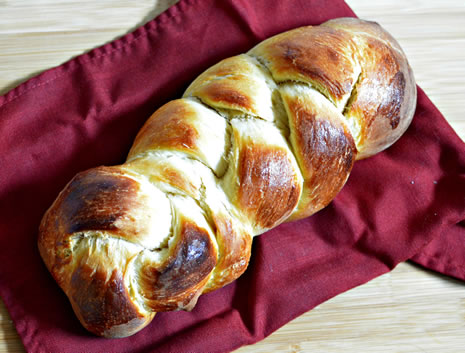
Sick of cooking? Whip up some creamy spinach dip to go along with the bread, put up a pot of chicken soup and enjoy a simple Shabbat. Take a break after all the holiday cooking and let the challah shine.

Choose a very large bowl. This recipe yields enough dough for six loaves, and the dough needs enough space to double in size while rising.
Pour 2 cups of warm water into the bowl and sprinkle the yeast on top, with 2 tbsp. sugar. Mix briefly until combined (it’s okay if it’s a little lumpy), and let the mixture sit for about 15 minutes before continuing.
Add the rest of the warm water, oil, honey, eggs and salt. Mix. Start adding the flour, several cups at a time. Mix and watch a loose batter form. Keep adding flour and mixing until the dough begins to come together. You may not need all 18 cups of flour, so go slowly towards the end. Alternatively, you may need slightly more. The dough should be soft but not sticky. Once the dough has enough flour, knead it for a couple of minutes. I do this in the bowl. (You can do this recipe by hand or with a mixer. I prefer to do it by hand, to end up with less cleaning afterwards.)

Cover the bowl with plastic wrap or a damp towel and put it in a warm place to rise for about an hour and a half. In the summertime, I sometimes put the dough outside in a sunny spot. In the winter, I start preheating my oven and put the bowl on the stovetop. The heat comes up and creates a warm space for the dough. After an hour and a half, the dough should be double its original size and ready to work with.
You can see from my pictures that my bowl was not large enough, so after making the dough I transferred it to a large disposable pan to rise.
Punch the dough down and let it rest for 10 minutes before doing themitzvah of separating challah. Say the blessing, separate a small piece of dough, and set it aside to burn after the challah has finished baking. For more about this mitzvah, and a step-by-step guide, watch this quick do-it-yourself clip.
Now divide the dough into six relatively equal pieces. I roll the dough into a line and cut it with a knife. Each of the six pieces will make one challah.

This recipe makes six braided loaves, or you can use some of the dough to make rolls. I made four full-sized challahs and eight rolls.
Ready to start? Pick up one of your chunks of dough, roll it out and cut into three (as pictured). Then roll out each of the three pieces, and you’ll be ready to braid.

Pinch the three strands together at one end and begin to braid. If you’ve ever braided hair, you know how to braid challah. It’s exactly the same. It’s a repetitive motion of crossing the outer strands over the middle strand. Start with the right strand and pull it over the middle so it’s now in the center. Now pull the left strand over the new center strand, and again pull the right strand over the middle. Repeat until the loaf is fully braided, then pinch the ends together tightly. For a neater, rounder look, tuck both ends under the loaf (see the difference in the picture).
Making challah rolls is a bit simpler. Instead of cutting the dough into three pieces, cut it into four. Roll each one up individually as pictured. Tuck the ends under when done—this will stop them from unrolling.

If you’re finding the braiding tricky, you can use the roll technique to make large round challahs as well. Simply roll one of the original six chunks of dough into a line, roll up as pictured and tuck the end underneath.
Place the challahs on lightly greased pans, and make sure to leave space around them, because they will spread and grow while baking.
Put the pans in a warm place and let the challah rise a second time, for about 40 minutes.

Combine the egg wash ingredients and brush over the loaves. If you don’t have a brush, you can use the back of a spoon. Bake for approximately 45 minutes at 375° F. You’ll know they’re ready when the bottoms of the loaves feel hard and the tops appear golden brown. The rolls need much less time—about 20–25 minutes. For best results, let the loaves sit for about 10 minutes, then transfer them to a cooling rack until fully cooled.
Dips and spreads are delicious on challah. My favorites are hummus, olive spread or some of this spinach dip. It’s easy to whip up while the dough is rising or while the challahs are in the oven.
Sauté 1 diced onion and 2 chopped garlic cloves in 2 tbsp. olive oil until golden. Add ½ cup chopped spinach and sauté until soft. Blend with ¼ cup mayonnaise and 1 tsp. salt (this works best in a food processor). Adjust mayonnaise and salt amounts to taste. Spread on challah and enjoy!

Dough Ingredients:
4 tbsp. dry yeast
2 tbsp. sugar
5 cups very warm water
5 large eggs
1¼ cups honey
1 cup oil (canola or light olive oil)
2 tbsp. salt
Approximately 18 cups flour
For the egg wash:
1 egg
2 tbsp. honey
1 tbsp. oil
Directions:
In a very large bowl, dissolve yeast and sugar in 2 cups warm water and let sit about 15–20 minutes until thick and frothy.
Add the rest of the ingredients and half the flour. Mix until a loose batter forms. Add the rest of the flour a couple of cups at a time until the dough is soft but not sticky.
Cover the dough with a wet towel or plastic wrap and put it in a warm place to rise for about 1½ hours. Dough should double in size.
Punch the dough down and let it rest for 10 minutes. Divide into 6 equal pieces.
Braid according to pictures and directions above. Place loaves on lightly greased pans and let rise for another 40 minutes.
Egg wash the loaves and bake at 375° F for approximately 45 minutes. Loaves should be golden brown and firm on the bottom.

There is a tradition in some Jewish communities to make shlissel challahthe week after Pesach. Shlissel means “key,” and the custom involves either baking the challah in the shape of a key, or wrapping ones real house (or business) key in foil and pressing it into the underside of the challah before baking. The key is removed before the challah is eaten, and the tradition is considered a segulah (spiritually propitious) for livelihood.
Have you made challah before? Or do you have bread-baking-phobia (not uncommon, even among seasoned cooks)? What’s your favorite way to eat challah? Do you have a special dip you like to spread on it? Leave a comment and let me know. I’d love to hear your ideas.
Traditional Soft, Fluffy Challah for Shabbat by Miriam SzokovskiAre you baking challah for Shabbat? With Pesach over, you have a couple of days to stock up on flour and yeast, pull out your mixing bowls and turn out some braided loaves of soft, pillowy goodness. Trust me, it’s well worthwhile! (And I say that having made it four days before (!) Pesach, after a series of mini–kitchen disasters.)
Sick of cooking? Whip up some creamy spinach dip to go along with the bread, put up a pot of chicken soup and enjoy a simple Shabbat. Take a break after all the holiday cooking and let the challah shine.
Choose a very large bowl. This recipe yields enough dough for six loaves, and the dough needs enough space to double in size while rising.
Pour 2 cups of warm water into the bowl and sprinkle the yeast on top, with 2 tbsp. sugar. Mix briefly until combined (it’s okay if it’s a little lumpy), and let the mixture sit for about 15 minutes before continuing.
Add the rest of the warm water, oil, honey, eggs and salt. Mix. Start adding the flour, several cups at a time. Mix and watch a loose batter form. Keep adding flour and mixing until the dough begins to come together. You may not need all 18 cups of flour, so go slowly towards the end. Alternatively, you may need slightly more. The dough should be soft but not sticky. Once the dough has enough flour, knead it for a couple of minutes. I do this in the bowl. (You can do this recipe by hand or with a mixer. I prefer to do it by hand, to end up with less cleaning afterwards.)
Cover the bowl with plastic wrap or a damp towel and put it in a warm place to rise for about an hour and a half. In the summertime, I sometimes put the dough outside in a sunny spot. In the winter, I start preheating my oven and put the bowl on the stovetop. The heat comes up and creates a warm space for the dough. After an hour and a half, the dough should be double its original size and ready to work with.
You can see from my pictures that my bowl was not large enough, so after making the dough I transferred it to a large disposable pan to rise.
Punch the dough down and let it rest for 10 minutes before doing themitzvah of separating challah. Say the blessing, separate a small piece of dough, and set it aside to burn after the challah has finished baking. For more about this mitzvah, and a step-by-step guide, watch this quick do-it-yourself clip.
Now divide the dough into six relatively equal pieces. I roll the dough into a line and cut it with a knife. Each of the six pieces will make one challah.
This recipe makes six braided loaves, or you can use some of the dough to make rolls. I made four full-sized challahs and eight rolls.
Ready to start? Pick up one of your chunks of dough, roll it out and cut into three (as pictured). Then roll out each of the three pieces, and you’ll be ready to braid.
Pinch the three strands together at one end and begin to braid. If you’ve ever braided hair, you know how to braid challah. It’s exactly the same. It’s a repetitive motion of crossing the outer strands over the middle strand. Start with the right strand and pull it over the middle so it’s now in the center. Now pull the left strand over the new center strand, and again pull the right strand over the middle. Repeat until the loaf is fully braided, then pinch the ends together tightly. For a neater, rounder look, tuck both ends under the loaf (see the difference in the picture).
Making challah rolls is a bit simpler. Instead of cutting the dough into three pieces, cut it into four. Roll each one up individually as pictured. Tuck the ends under when done—this will stop them from unrolling.
If you’re finding the braiding tricky, you can use the roll technique to make large round challahs as well. Simply roll one of the original six chunks of dough into a line, roll up as pictured and tuck the end underneath.
Place the challahs on lightly greased pans, and make sure to leave space around them, because they will spread and grow while baking.
Put the pans in a warm place and let the challah rise a second time, for about 40 minutes.
Combine the egg wash ingredients and brush over the loaves. If you don’t have a brush, you can use the back of a spoon. Bake for approximately 45 minutes at 375° F. You’ll know they’re ready when the bottoms of the loaves feel hard and the tops appear golden brown. The rolls need much less time—about 20–25 minutes. For best results, let the loaves sit for about 10 minutes, then transfer them to a cooling rack until fully cooled.
Dips and spreads are delicious on challah. My favorites are hummus, olive spread or some of this spinach dip. It’s easy to whip up while the dough is rising or while the challahs are in the oven.
Sauté 1 diced onion and 2 chopped garlic cloves in 2 tbsp. olive oil until golden. Add ½ cup chopped spinach and sauté until soft. Blend with ¼ cup mayonnaise and 1 tsp. salt (this works best in a food processor). Adjust mayonnaise and salt amounts to taste. Spread on challah and enjoy!
Dough Ingredients:
4 tbsp. dry yeast
2 tbsp. sugar
5 cups very warm water
5 large eggs
1¼ cups honey
1 cup oil (canola or light olive oil)
2 tbsp. salt
Approximately 18 cups flour
For the egg wash:
1 egg
2 tbsp. honey
1 tbsp. oil
Directions:
In a very large bowl, dissolve yeast and sugar in 2 cups warm water and let sit about 15–20 minutes until thick and frothy.
Add the rest of the ingredients and half the flour. Mix until a loose batter forms. Add the rest of the flour a couple of cups at a time until the dough is soft but not sticky.
Cover the dough with a wet towel or plastic wrap and put it in a warm place to rise for about 1½ hours. Dough should double in size.
Punch the dough down and let it rest for 10 minutes. Divide into 6 equal pieces.
Braid according to pictures and directions above. Place loaves on lightly greased pans and let rise for another 40 minutes.
Egg wash the loaves and bake at 375° F for approximately 45 minutes. Loaves should be golden brown and firm on the bottom.
There is a tradition in some Jewish communities to make shlissel challahthe week after Pesach. Shlissel means “key,” and the custom involves either baking the challah in the shape of a key, or wrapping ones real house (or business) key in foil and pressing it into the underside of the challah before baking. The key is removed before the challah is eaten, and the tradition is considered a segulah (spiritually propitious) for livelihood.
Have you made challah before? Or do you have bread-baking-phobia (not uncommon, even among seasoned cooks)? What’s your favorite way to eat challah? Do you have a special dip you like to spread on it? Leave a comment and let me know. I’d love to hear your ideas.
-------
JEWISH NEWS

Yeshivah Gedolah: A 50-Year Educational Powerhouse in Australia
Jump-started by a group of rabbinical students dispatched to Melbourne by the Rebbe 50 years ago, a small post-high-school yeshivah program has grown to educate the majority of rabbis in Australia today. by Menachem Posner
Yeshivah Gedolah: A 50-Year Educational Powerhouse in Australia
Jump-started by a group of rabbinical students dispatched to Melbourne by the Rebbe 50 years ago, a small post-high-school yeshivah program has grown to educate the majority of rabbis in Australia today. by Menachem Posner

In the weeks before Passover, students at the Yeshivah Gedolah in Melbourne, Australia, devoted time to packaging and distributing thousands of hand-baked shmurah matzahs.
Rabbi Mattis Kantor remembers when he left Australia in 1959 at the age of 15 to learn abroad.
“There was no yeshivah in Australia, so I went to public school and learnedTalmud in the afternoons, but that wasn’t enough,” says the rabbi and author, who has served congregations in Australia and New York. “I enrolled in the Telshe Yeshivah in Cleveland since they had a dormitory that could accommodate out-of-towners.
“Others went to New York to learn at the Central Lubavitz Yeshiva in Brooklyn and other yeshivahs. It was a far trip. A letter home took two weeks to arrive and another two weeks for the reply to come; no one even dreamed of making phone calls, which needed to be booked weeks in advance and cost a fortune.”By 1970, when he returned with his wife to lead the fledgling Hillel House in Sydney, “an entire Jewish atmosphere had grown in [his] absence.” He says the change was largely due to the presence of the Rabbinical College of Australia and New Zealand.
The college, more commonly known as Yeshivah Gedolah (the “Great Yeshivah”), was established on Feb. 1, 1966 (11 Shevat5726). It has been a teaching powerhouse for 50 years, educating post-high-school rabbinical students, between 17 and 20 years of age.
It was founded under the direction of Rabbi Zalman Serebryanski, one of the Russian-born Chassidim who formed the basis of the Chabad community in Australia. Known to all as “Reb Zalman,” his character was forged in the Chabad underground network in the U.S.S.R and the Red Army, where he managed to survive, all the while maintaining fealty to Judaism.

Rabbi Zalman Serebryanski, known to all as “Reb Zalman”
After slipping through the Iron Curtain to war-ravaged France, he was among a group of Chassidim dispatched by the previous Lubavitcher Rebbe—Rabbi Yosef Yitzchak Schneersohn, of righteous memory—in 1949 to bolster Judaism in Australia. The group of salted Chassidim and their families came at the behest of Kantor’s maternal grandfather, Rabbi Moshe Zalman Feiglin, whose trailblazing efforts for Judaism in his small farming colony near Shepparton—about 180 kilometers northeast of Melbourne—earned him the moniker, “Abraham of Australia.”
The efforts of Feiglin, Serebryanski and their cohorts bore fruit when the Yeshivah College, which they had founded and was led by American-born Rabbi I.D. Groner, had a graduating class of six young men who were ready to pursue advanced, post-high school Judaic studies—and do so locally.
Sole Purpose to Study Torah
“Reb Zalman found a house that was waiting to be demolished, and we were set to begin learning there after our January summer holidays,” recalls Rabbi Mottel Gutnick, whose father, Rabbi Chaim Gutnick, was a leading Australian rabbi and among the founders of the Rabbinical College. “We were a small group, and we felt somewhat alone, knowing that we were far from the great overseas yeshivahs we’d heard about.”
The founding rosh yeshivah (lecturer) was Rabbi Lazer Herzog.
Gutnick recalls that he and his fellows were inspired by the lively correspondence they carried on with the Rebbe—Rabbi Menachem M. Schneerson, of righteous memory—who encouraged them to remain in Australia.
A year later, their ranks were bolstered when the Rebbe dispatched six senior North American rabbinical students to join them.

The majority of Australia's rabbis are graduates of the Yeshivah Gedolah of Melbourne, now located in a rambling mansion built in the 1880s that had once been the home of royalty. It also had ample study space and residential accommodation for students, a far cry from its humble beginnings 50 years ago.
“We had no idea of what to expect,” says Rabbi Yosef Minkowitz, one of the six young men and today the head of school of Beth Rivkah Academy in Montreal, Canada. “For all we knew, we would be dodging kangaroos hopping along unpaved streets.”
The Rebbe’s instruction—conveyed via Rabbi Chaim Mordechai Aizik Hodakov—was that the group should travel as soon as possible, provided that they would be going on their own volition, had permission from a doctor and their parents, and had the necessary legal documents to do so.
In addition to Minkwitz, the group was made up of Avrohom Altein, Leibel Kaplan, Shloma Majeski, Hirshel Morozov and Hirshel Lipskier.
Before they departed, the Rebbe invited them twice to his office to receive his advice and blessing, and there gave them each Chassidic treatises and a symbolic bottle of vodka—marks of his appreciation.
In his talk to them, the Rebbe stressed to the young men that their sole purpose was to study Torah, both Talmud and Chassidic teachings, and that they would thus “conquer Australia.”
They boarded the plane together with Rabbi Eliyahu (Yaichel) Simpson, an elder Chassid who was going Australia to attend the wedding of his grandson, and Rabbi Pinchus Feldman, today the chief Chabad-Lubavitchrepresentative to Sydney.
“It was unprecedented,” recalls Gutnick, now rabbi at Ellwood Shul (his late father’s congregation), senior dayan of the Melbourne Beth Din, rabbinic administrator of Kosher Australia and president of the Rabbinical Council of Victoria. “When these six young men walked down the streets in their dark suits and hats, they turned heads. People would ask: “Is this an undertaker’s convention?’”

Rabbi Moshe Zalman Feiglin
Friendships, Learning, Personal Growth
The yeshivah found warm support from the Melbourne Jewish community, which had a significant contingent of Polish Holocaust survivors. Even as many of them had distanced themselves somewhat from Jewish observance, they remained deeply nostalgic for the rich Jewish lives they knew in Europe and were eager to help recreate it in their adopted homeland.
“Many of us were not from strictly religious homes,” says Avrohom Procel, executive director of the Yeshivah Gedolah, “but were inspired by the example of the American students, who were so normal and approachable, yet who clearly inhabited a higher, more spiritual world.”
While the notion of deferring college in order to study Torah was already accepted in the American observant community, it was still a novelty in Australia. Many a parent had their worries assuaged by Serybranski, who was said to have a close rapport with people across the spectrum of Jewish culture and observance.
In fact, it was Serybranski himself who attracted many students, includingShimon Allan, who hailed from New Zealand.
“I came to Melbourne in ’68 to study at a Jewish high school,” says Allan, who now lives in Melbourne with his family. “In those days, the observant community was still quite small and very heimish. It was Simchas Torah, and I went with a friend to a celebration in the home of the late Nathan Werdyger, who was actually Reb Zalman’s son-in-law. I walked in and people were sitting around the table, listening attentively as Reb Zalman spoke. I had no idea who he was, but I was drawn to him. I made inquiries and transferred to the Yeshivah Gedolah after I graduated.”
Allan recalls that the institution was a center of learning for many: During the holidays, overseas students visiting home would come by to study during the day, and university students would arrive in the evenings.
He says the atmosphere was in large part set by the shluchim and Reb Zalman—“a very warm and encompassing individual, who made everyone feel wanted and important.”
“In a snapshot, I have to say that that was a most wonderful time in my life,” he continues. “It was a time of great friendships being developed, great learning and great personal growth.”

The first shluchim (Avrohom Altein, Leibel Kaplan, Hirshel Lipskier, Shloma Majeski, Yosef Minkowitz and Hirshel Morozov) with Rabbi Eliyahu (Yaichel) Simpson, center, arriving at the airport in Australia.
Seeds for the Future
While the Chabad emissaries spent the lion’s share of their two years on the continent studying, they used their holiday vacation time traveling the country, spreading Jewish awareness and inspiration.
“I remember when I first saw my first yeshivah student, Rabbi Avrohom Altein who came to spend Shavuot in Sydney,” says Rabbi Aryeh Solomon, today campus rabbi at Moriah College in Sydney. “He was totally unaware of the tremendous impact he had on me and my fellows. It was a spiritual bomb that the Rebbe had dropped on Australia. Until then, our Judaic teachers were European men, mostly Holocaust survivors. They were very devoted, but we couldn’t relate to them. They were broken men with broken accents. Then we met 21-year-olds who spoke English but didn’t compromise on their Judaism even one iota.”
During that visit, Altein spoke to Solomon’s parents about sending their son to Melbourne, but they preferred to wait until he finished high school.
His second encounter was when two young men, Minkowitz and Morozov, came to Sydney for Sukkot. Working together with Feldman, who had recently established Chabad in Sydney, they visited heavily Jewish public schools, where they spoke to the students and gave them the opportunity to observe the holiday.
Years later, Solomon met Minkowitz and told him: “Do you even realize the tremendous impact you had? Of the young people in my class, three of us are Chassidim with large Chassidic families. You planted the seeds!”

At Yeshivah Gedolah, students study the daily lessons of the Rambam as an extra-curricular pursuit, in accordance with the Lubavitcher Rebbe’s guidelines.
Like Procel, Solomon credits Reb Zalman with influencing his parents to send him to Yeshivah Gedolah. “My parents were very impressed by him,” he remembers. “Even though he was an elderly man from a different culture—an authentic, old-world Chassid who davened for hours—he had a unique ability to relate to them in a very personable way, and they were very taken by him.”
In time, the institution grew. When the first cohort of shluchim completed their two-year term in Australia, they were replaced by others, selected from the Chabad yeshivahs in Montreal, Canada; Morristown, N.J.; and Brooklyn, N.Y. In addition to native Melburnians, a steady stream began to come from Sydney.
The Rabbinical College was originally located on Goathlands Street in East St Kilda and then moved to Kalymna Grove. In 1969, Rabbi Chaim Gutnick—together with his brother, Rabbi Schulim Gutnick, and Reb Chaim Serebryanski—purchased the house at 11 Meadow St., East St Kilda, in an attempt to settle the college. Yet because of Council objections, Yeshivah Gedolah was not to stay there for long, and a new location had to be sought.

At the podium is Rabbi Chaim Gutnik, a leading Australian rabbi and among the founders of the Rabbinical College, giving a class at the yeshivah.
On Yud Tes Kislev 5731 (December 1970), after Rabbi Chaim Gutnick contacted and received the Rebbe’s encouragement and blessing to go ahead with it, a large and luxurious property on Alexandra Street was purchased for the yeshivah. A rambling mansion built in the 1880s, it had once been the home of royalty and had a large hall that was perfectly suited to become a study hall. It also had ample residential accommodation for students.
Added Staff Over the Years
Due to an increase in numbers at the college, the need arose for more staff. In 1971, Rabbi Avrohom Blesofsky was appointed to strengthen the learning program in Chabad Chassidus and provide daily guidance for the students.
In 1974, the yeshivah welcomed Rabbi Binyomin Cohen to take the place asrosh yeshivah.
Reb Zalman retired from active work at the Yeshivah Gedolah in 1977, after 25 years of community service in Australia. A Silver Jubilee Dinner lauding his accomplishments over the years was held at the Southern Cross Hotel, with the 39thpremier of Victoria—the Hon. R.J. Hamer—as guest of honor.
At that same time, Procel was appointed to take his place.
In 1989, Rabbi Yaakov Winner arrived with his family from New York to assume the position ofmashpia (spiritual mentor) and lecturer in Chassidic studies. It was at this time that many overseas students were attracted to study in Melbourne.

Students brought the joy of Purim to local businesses, eateries, residencies, hospitals, senior-citizen homes, schools, childcare centers and prisons. They also assisted and participated in various events conducted by local synagogues, Chabad Houses and community organizations.
“Rabbi Winner brought something fresh and exciting to the place,” says RabbiElisha Greenbaum, today the spiritual leader of Moorabbin Hebrew Congregation and co-director of L’Chaim Chabad in Moorabbin, Victoria. “He was young and dynamic. He could explain a deep Torah concept using an analogy from sport, something we were attracted to.”
In 1993, the Rabbinical College became Victoria’s first tertiary Jewish college to be formally approved by the State Training Board of Victoria as a registered private provider of vocational education and training. It has seen steady enrollment ever since.
Even today, with air travel cheaper and easier than ever before, many Melbournian students choose to remain in Y.G., as it is affectionately known, for a year or two before continuing their studies overseas. Among the student body of 70 is a significant minority of students from the United States, Canada, the United Kingdom and South Africa, attracted by the school’s reputation as a yeshivah where students can grow as scholars, Chassidim and individuals in an environment of Torah, respect and positivity.
Fifty years since its founding, the fruits of Yeshivah Gedolah can be readily seen across the Australian content, where the majority of the country’s rabbis are alumni, and six young men in beards and black hats would hardly raise eyebrows in Melbourne or Sydney—or even in the country’s capital of Canberra.

Taking time to wrap tefillin with Jewish men and boys over the age of 13

The Chabad-Lubavitch shluchim of 1973 with Zalman Shazar, the third president of Israel

American-born Rabbi I.D. Groner at left

Rabbi Lazer Herzog, the founding rosh yeshivah second from left

Shimon Allan, third from right, from New Zealand came to Melbourne in 1968, and soon began learning at the yeshivah.

Studying with Reb Zalman at right

Davening at the Yeshivah Gedolah

The Kalymna Grove location

The Meadow Street location

The main study hall of Yeshivah Gedolah

Tennis courts for outdoor exercise

The graduating class of 5775 (2015)
-------

Some Very Special Kids Await Some Very Special New Bikes
Friendship Circle partners with manufacturers and donors to give away a record number of bicycles. by Carin M. Smilk

Rabbi Tzvi Schectman, family coordinator at the Friendship Circle in Michigan, delivers a bike to a child after last year’s annual “Great Bike Giveaway” national contest.
The families of some 200 children are waiting, as patiently as they can, for a prize they won in a very special contest.
For the fifth consecutive year, the Friendship Circle of Michigan sponsored“The Great Bike Giveaway” named in memory of Michaela Noam Kaplan, a 5-year-old girl from the Detroit area with cerebral palsy who passed away in 2009. Despite her limitations, she “loved her adaptive bicycle,” noted her family.
To be sure, so will this year’s recipients. Charlize Schifsky, all of 4, cannot walk or talk, but she realizes that she won a bike. “She smiles and laughs when we talk about it,” says her mother, Jo Schifsky. “She knows that good stuff is coming.”
Charlize, who lives in Minnesota with her parents and three older siblings, has holoprosencephaly, or HPE (insert an “o” for the name of an organization called “Families for HoPE” to help support those dealing with this rare condition). About 3 percent of babies survive birth, according to Schifsky, and of this number, some 1 percent live beyond six months.
Charlize is their “miracle baby.” Today, she is in a pre-kindergarten special-education class at a public school.
Her new bike will be adapted to her individual needs and look quite different from the wheelchair she uses. Not only will it allow her added mobility and the chance to spend more time outside, the exercise—the back-and-forth patterning—will strengthen her body and benefit her cognitive development, explains her mother.

Trenton Whiteman, 17, of Oregon just got his bike; his father took him for a first spin.
“She’ll be able to pedal it herself. She can’t walk on her own, but she’ll be able to pedal. It will be hugely empowering,” says Schifsky, who notes that a handlebar built into the back also allows someone to push her. “We’re looking forward to her having a sense of freedom, a sense of normalcy—to be a kid like any other.”
The bikes have the added benefit of helping make the users more approachable, especially for other children.
“I don’t think people are aware of bikes this specialized,” says Schifsky. “They are very elaborate and very expensive—much too expensive to purchase on one’s own. Most of the time, you see them in therapy centers.”
‘Generates Huge Awareness’
Rabbi Tzvi Schectman, family coordinator at the Friendship Circle who directs the program, says adaptive bikes can cost anywhere from $300 to $8,000. They are geared to match an individual’s needs—for example, some are wheelchair-style for those with less mobility—but the purpose of them all is the same: to get kids out and moving.

The smile says it all.
This year’s contest, which was open to the general public, gave away a record number of bikes by vote or raffle: 170 (compared with 18 bikes in 2011, the first year of the contest, and 145 last year). But even though the giveaway is technically over, people can still contribute online for more children to receive them. To date, an additional 53 children have gotten bikes by having third parties help purchase them outright.
The contest rules changed a little this year. First, the contest capped the number of applicants at 600; previous years saw as many as 1,800 applying. (Former entrants were notified of the changes and given an opportunity to be part of the contest, though not all of last year’s registrants decided to try again, according to Friendship Circle). Second, each entrant had to have 10 “ambassadors” (family, friends and others) supporting them, publicly and financially. The first 600 kids with 10 ambassadors made up the applicant pool.
“That means there were 6,600 people out there trying to vote, donate and get the word out,” says Schectman.
The national contest is partnered with a number of bike-company makers and brands, including Freedom Concepts, Rifton, Buddy Bikes, Ambucs, Triad, Flaghouse, Mobo Cruisers, Strae Sports, the Duet and Strider Bikes. The companies donate some bikes and offer others at reduced costs.

Raffle winner Trenton with his parents, Ryan and Linette Whiteman
Schectman says the contest generates enormous awareness for all those involved. The children’s bicycle needs are listed by city and state; local communities often take up these campaigns afterwards.
Not only that, some heartwarming outcomes arise from the publicity. A child in Bend, Ore., made the local news for not winning an adaptive bike. That prompted a 24-hour fundraiser resulting in $4,000—enough to purchase one. (The Jewish reporter who covered the story even wound up attending aPassover seder with Rabbi Yitzchok and Mimi Feldman, the Chabad-Lubavitch emissaries in Bend.)
The Chabad-run Friendship Circle, with hundreds of chapters around the country, is a nonprofit organization that brings together Jewish teenage volunteers and children with special needs, as well as offers programs and support to their families.

Raffle winner Charlize Schifsky, 4, from Minnesota

With her parents, Jo and Toby Schifsky, and three siblings: Roman, Lily and Simone
‘He’s Going to Be Involved’
The Whitemans, of Redmond, Ore., heard about the contest last year on Facebook (though had never heard of Chabad before) and entered on behalf of their son, Trenton. They didn’t win, so they tried again this year.
And sure enough, the news came that they will be receiving “the Duet,” designed with a wheelchair in front and a bike in the back for another person to pedal. The wheelchair detaches for multiple use.
“It’s all very exciting,” says Trenton’s mother, Linette Whiteman. “He clapped when he heard; he claps when he gets excited.”
The 17-year-old—who enjoys riding fast in his chair and feeling the wind in his face, according to his family—was born with a genetic disorder called BSFL syndrome. He cannot walk, but can roll, sit up and pull himself up. “He gets to where he wants to be,” says Whiteman, “but this will bring him a lot of freedom. It will help him move more. We’re going to be able to go to the grocery store together and the park. Everything is very close by, and now he’s going to be involved.”
She says Trenton would not have the ability to ride a bike on his own; even the model they are getting needed some extra adjustments. They plan on putting it to good use—and plan on having it for a long time.
“It’s so neat!” declares Whiteman. “We wish we had it yesterday.”

Charlize will receive the Freedom Concepts bike.
-------

Jamaican Prime Minister Connects With Chabad
Newly elected official meets with rabbi who arrived there last year. by Chabad.org Staff

Prime Minister Andrew Holness of Jamaica, center, hosted, from left: Rabbi Zushe Wilhelm, principal of Oholei Torah Mesivta High School in Brooklyn, N.Y.; community member Michael Mintz; and Rabbi Yakov Raskin, director of Chabad of Montego Bay.
Recently elected Prime Minister Andrew Holness of Jamaica met last week with Chabad-Lubavitch representatives in advance of the Passover holiday.
Holness hosted Rabbi Yakov Raskin, director of Chabad of Montego Bay in Jamaica; Raskin’s father-in-law, Rabbi Zushe Wilhelm, principal of OholeiTorah Mesivta High School in Brooklyn, N.Y.; and community member Michael Mintz.
“Jamaica is a diverse country,” noted Holness, who took office on March 3. “With the multiplicity of religion, cultures and races here in Jamaica, we can truly say”—citing the Jamaican national motto—“out of many, we are one.”

Raskin presented the prime minister with books about the Rebbe—Rabbi Menachem M. Schneerson, of righteous memory—on 11 Nissan, the anniversary of his birth.
---------------------

No comments:
Post a Comment