democracynow.org
Stories:

#BernieOrBust: Sanders Fans Debate Whether to Vote for Clinton If She is Democratic Nominee
As Democratic challengers Bernie Sanders and Hillary Clinton press on in the Democratic primary, Sanders trails in the pledged delegate count by more than 300. Add in superdelegates, and Clinton is just under 200 delegates shy of the number needed to clinch the nomination. Even as Sanders maintains his commitment to stay in the race, voters looking for political revolution are facing the question of whether or not to support his rival Hillary Clinton if she becomes the Democratic nominee for president. We host a debate between Kshama Sawant, Socialist city councilmember in Seattle and member of Socialist Alternative, who is a Sanders supporter and says she will not support Clinton; and Mike McGinn, former mayor of Seattle from 2010 to 2013, who hosts a podcast on social change called "You, Me, Us, Now." He is a Bernie Sanders supporter, but will back Hillary Clinton if she becomes the nominee.
TRANSCRIPT
This is a rush transcript. Copy may not be in its final form.
AMY GOODMAN: We’re the road at Bellevue College near Seattle, Washington. With the departure of Senator Ted Cruz and John Kasich, Donald Trump is the presumptive Republican nominee for president. Meanwhile, Democratic challengers Bernie Sanders and Hillary Clinton are pressing on to next week’s West Virginia primary. Despite Sanders’ recent win in Indiana, he trails Clinton in the pledged delegate count by more than 300. Add in superdelegates, and Clinton is just under 200 delegates shy of the number needed to clinch the nomination. But neither Sanders nor his supporters seem ready to concede. At a news conference Sunday, Sanders appealed to the Democratic Party’s superdelegates.
SEN. BERNIE SANDERS: It is virtually impossible for Secretary Clinton to reach the majority of convention delegates by June 14th with pledged delegates alone. She will need superdelegates to take her over the top at the convention in Philadelphia. In other words, the convention will be a contested contest. ... We believe that we are in a very strong position to win many of these remaining contests, and we have an excellent chance to win in California, the state with far and away the most delegates. ...
Where Secretary Clinton and I strongly agree, and where every delegate to the Democratic convention strongly agrees, is that it would be a disaster for this country if Donald Trump or some other right-wing Republican were to become president of the United States. Therefore, in my view, it is incumbent upon every superdelegate to take a hard and objective look at which candidate stands the better chance of defeating Donald Trump and other Republican candidates. And in that regard, I think the evidence is extremely clear that I would be the stronger candidate to defeat Trump or any other Republican.
AMY GOODMAN: Today we’re going to take a look at the new movement called "Bernie or Bust." A recent McClatchy-Marist poll found one out of four Sanders supporters say they would not back Clinton in a general election. About 70 percent say they would support her. Speaking last week at a victory rally after winning primaries in Pennsylvania, Maryland, Connecticut, Rhode Island and Delaware, Hillary Clinton appealed to Sanders’ supporters.
HILLARY CLINTON: Because whether you support Senator Sanders or you support me, there is much more that unites us than divides us. We all agree that wages are too low and inequality is too high, that Wall Street can never again be allowed to threaten Main Street, and we should expand Social Security, not cut or privatize it. We Democrats agree that college should be affordable to all, and student debt shouldn’t hold anyone back. We Democrats agree that every single American should and must have quality, affordable healthcare. We agree that our next president must keep our country safe, keep our troops out of another costly ground war in the Middle East. And we Democrats agree that climate change is an urgent threat, and it requires an aggressive response that can make America the clean energy superpower of the 21st century. And we Democrats agree on defending all of our rights—civil rights and voting rights, workers’ rights and women’s rights, LGBT rights and rights for people with disabilities.
AMY GOODMAN: The division among Democrats who support Bernie Sanders versus Hillary Clinton recalls the 2008 presidential campaign and the staunch Clinton supporters who joined together under the acronym PUMAs, or Party Unity My Ass, they said, vowing never to back her then-rival Barack Obama.
Well, for more, we’re joined by two guests. Mike McGinn is the former mayor of Seattle, serving from 2010 to ’13. He hosts a podcast on social change called You, Me, Us, Now. He is a Bernie Sanders supporter, but will support Hillary Clinton if she becomes the nominee. Kshama Sawant is a Socialist city councilmember in Seattle, member of the Socialist Alternative, a nationwide organization of social and economic justice activists. She also is a Bernie Sanders supporter, who says she will not support Clinton.
We welcome you both to Democracy Now! Kshama Sawant, let us begin with you, because you really started this whole Bernie or Bust campaign. Explain what it is.
KSHAMA SAWANT: So, I just wanted to clarify: Myself and Socialist Alternative, we did not launch the "Bernie or Bust" campaign. We launched what was called Movement4Bernie, Movement4Bernie.org website. But we are very much in sympathy with the sentiments that have been expressed by the people who have initiated Bernie or Bust, which is that it’s really kind of a bankrupt strategy to say that all the people, the millions of young people who have been politicized, you know, for the first time in their lives because of Sanders’s message of a political revolution against the billionaire class, should now all hunker down and support Clinton. And, you know, I think the analysis that we need to have really has to flow from some essential points. One is, this is a historic movement—moment, and a historic movement, really, since the Occupy movement. What we are seeing is a tremendous fundamental shift in American consciousness, and that is an anger against corporate politics and a desire to fight against the establishment.
On the other hand, you’re also seeing the ascendancy of Trump, which is, I think, on everybody’s mind—the rise of this right-wing ideology, Islamophobia, bigotry. And I absolutely find it terrifying. But my problem is that if we are looking for a real strategy to break working people away from Trump, then what we have to do is present a real alternative. And Sanders is right, Bernie is right: In poll after poll, repeatedly and systematically, he has done remarkably well in terms of the fact that if he was to be the Democratic candidate, he would deliver a thumping defeat to Trump. Why is the Democratic Party establishment not doing everything in their power to promote his campaign? That’s the question that people should be asking. And that’s why I would say, as a Socialist, that we need an independent party for the 99 percent. And a fantastic way to begin that process would be for Bernie to run as an independent throughout November.
AMY GOODMAN: Have you talked to him about this?
KSHAMA SAWANT: I have talked to him personally, yes. And I think that at this moment, as we all know, he has said that he will—he has indicated that he will probably endorse Clinton. And Clinton herself is, you know, understandably, talking about how his supporters need to support her.
But I would challenge this idea that all the supporters that were behind her, you know, supporting Obama, that’s the same thing as Bernie supporters supporting Hillary this year. I don’t think it’s fundamentally the same situation at all. Bernie is calling for a political revolution against the billionaire class; Hillary is the epitome of the political establishment that has promoted the interests of the billionaire class to the detriment of the interests of working people. Bernie is calling for single-payer healthcare; Clinton is the woman who said, "Well, you can’t do single-payer healthcare." And she is being honest. That’s a rare moment of honesty for her, because on the basis of supporting her and the establishment, no, you cannot win single-payer healthcare. Unfortunately, though, for us, on the basis of supporting her and the Democratic establishment, you can’t defeat the right, either.
AMY GOODMAN: Mike McGinn, you are a die-hard Bernie Sanders supporter, but you feel differently if it was Hillary Clinton who would be the nominee: You would support her.
MICHAEL McGINN: Yes, that’s right. And I’m definitely an early Bernie Sanders supporter and, I would say, a die-hard one. I’m not a die-hard Democrat, by any means. And that’s one of the reasons I supported Bernie. In fact, I believe I endorsed Kshama in her re-election campaign just this past year here in Seattle. But the reason is, is that I look at the differences between Clinton and Trump, and what a disaster Trump would be. And I want to see—I look back on the election where—you know, I remember us thinking then that Al Gore, he was just too corporate, and he was just too Washington. And as I look at the lack of progress under Bush, all of the mistakes that happened under Bush, you know, I would have liked to have Gore.
And one of the things I would say to Sanders’ supporters is that the presidential race, it’s not the game, it’s just the scoreboard. And this is a high watermark right now for, you know, the movement that Kshama stands for and many of the things that I believe in, in that we need to return power to working people and address racism and get really serious about climate change. And that energy can move to a lot of other places besides this election. And clearly, the differences between Clinton and Trump lead me to support Clinton in this election.
AMY GOODMAN: What is most distinct for you in the differences between Clinton and Trump?
MICHAEL McGINN: I mean, to quote Sherman Alexie, you know, the dog whistle became an air horn on racism in the Republican Party. And I just find that absolutely horrifying. You know, I look at our city and how wonderfully diverse it is and how we’re struggling to work together to address problems—and there are big divisions. I just look at a Trump presidency as being so divisive and wrong for this country. And, you know, Hillary Clinton clearly has shifted positions over the years. But a powerful movement, I believe, can lead and push her to the places where we’d like to see the country go.
AMY GOODMAN: We’re going to break, then come back to this discussion. We are talking to Mike McGinn, who’s the former mayor of Seattle, and Kshama Sawant, who is a Socialist city councilmember here in Seattle, Washington. This is Democracy Now! We’ll begin—we’ll come back to this discussion about Bernie or Bust in a moment.
[break]
AMY GOODMAN: Sole, "Capitalism," here on Democracy Now!, democracynow.org, The War and Peace Report. I’m Amy Goodman. We’re on our 100-city tour. Today we are in, well, Bellevue College, we’re broadcasting from. I’ll be speaking at Seattle Town Hall tonight. Then we’re moving on tomorrow to Mount Vernon. On Sunday, we’ll be in Eugene, Oregon, in the afternoon and in Portland, Oregon, in the evening. And then we’re on to Minneapolis on Monday, Cambridge on Tuesday, back home in New York on Wednesday. We urge you folks to keep listening and watching Democracy Now! as we discuss the presidential election.
In February, Republican presidential front-runner Donald Trump came under criticism for wavering on whether or not he wants the support of the former Ku Klux Klan leader David Duke. He was speaking on CNN’s State of the Union with Jake Tapper. Trump refused to disavow Duke’s support or the support of other white supremacists.
DONALD TRUMP: Well, just so you understand, I don’t know anything about David Duke. OK? I don’t know anything about what you’re even talking about with white supremacy or white supremacists. So, I don’t know. I mean, I don’t know—did he endorse me, or what’s going on, because, you know, I know nothing about David Duke. I know nothing about white supremacists. And so, when you’re asking me a question, that I’m supposed to be talking about people that I know nothing about.
JAKE TAPPER: But I guess the question from the Anti-Defamation League is—even if you don’t know about their endorsement, there are these groups and individuals endorsing you. Would you just say, unequivocally, you condemn them, and you don’t want their support?
DONALD TRUMP: Well, I have to look at the group. I mean, I don’t know what group you’re talking about. You wouldn’t want me to condemn a group that I know nothing about. I’d have to look. If you would send me a list of the groups, I will do research on them, and certainly I would disavow if I thought there was something wrong.
JAKE TAPPER: The Ku Klux Klan?
DONALD TRUMP: But you may have groups in there that are totally fine, and it would be very unfair. So give me a list of the groups, and I’ll let you know.
JAKE TAPPER: OK, I mean, I’m just talking about David Duke and the Ku Klux Klan here, but...
DONALD TRUMP: I don’t know any—honestly, I don’t know David Duke. I don’t believe I’ve ever met him.
AMY GOODMAN: That is Donald Trump being challenged by Jake Tapper on CNN, whether he would unequivocally disavow support from David Duke and the Ku Klux Klan. Our guests are the former mayor of Seattle, Mike McGinn, a Bernie Sanders supporter, who, though, if the nominee were Hillary Clinton, will support her. We’re also joined by Kshama Sawant, who is a Socialist city councilmember here in Seattle. She supports the Bernie or Bust campaign. So, here you have the Republican front-runner, the presumptive nominee, Kshama Sawant, who can’t quite get himself to say he wouldn’t accept the support of a Klan leader.
KSHAMA SAWANT: This is absolutely horrifying, the idea that a right-wing, misogynist, racist, bigot, anti-immigrant, Islamophobic multibillionaire could gain any traction in the minds of regular people. And what I find about this remarkable is not only that it is stomach-turning, but it is also really terrifying in the potential it might hold, not just for Trump ascending in any given way—I don’t think he’s going to win; I think, you know, statistically speaking, I think Clinton is likely to win—but what’s scary about this, I think, is what—most scary is the fact that any space for this kind of right-wing, hateful agenda that is given in politics, in the political discussion and discourse, what it means is that there is a potential for building an ongoing base for right-wing ideology, and that’s what scares me the most.
In fact, history is a guide. If you look at what happened with the tea party ascending in 2010, the reason they made such gains is not because America is turning right-wing. The mass of America is not right-wing. The mass of America is actually well to the left of U.S. Congress and well to the left of the Clinton-dominated Democratic establishment. What has happened, though—and that’s what the tea party’s ascendancy shows—is that people are angry at the establishment, angry at the bailout of the bankers, the very bankers who almost completely destroyed the economy, and working people losing day after day. And people are looking for—you know, grasping for a way to fight back.
And Bernie Sanders’s campaign, the fact that tens of millions of people have rallied around his message for a political revolution, this is absolutely historic. Some of the speeches Bernie has made are probably the most radical on mainstream television since MLK gave his Riverside speech, you know, many years ago, decades ago. And so—
AMY GOODMAN: Speaking out against the war in Vietnam.
KSHAMA SAWANT: Against the war, against the war in Vietnam, you know, the speech that really transformed politically and radicalized an entire generation at that time. We’re seeing a similar phenomenon, where an entire generation of working people, and young people especially, teenagers, who are getting politically transformed and radicalized.
And it’s not just Bernie. Bernie is—you know, his campaign’s real—the echo he has received is a sign that we are at a historic moment. And that is why I would say that for people who are scared of Trump—and I am one of them—I think we have to think intelligently about this. And supporting the very establishment that allowed a space to be created for the right wing is like saying you’re going to double down on a strategy that has failed in the past. I mean, you know, Mike said—made a very good point. He did support my campaign, as a Socialist, but I was running as a Socialist Alternative candidate in 2013 and 2015, both campaigns that we won, as a challenge in defiance of the Democratic Party establishment that controls this city. Look at what happened in the state of Washington. All the superdelegates in the state of Washington are doubling down behind Hillary. But what happened in the primaries? You know? Every county in the state of Washington went to Bernie Sanders in huge numbers.
AMY GOODMAN: So why are these superdelegates going for Clinton?
KSHAMA SAWANT: That really captures the character of the Democratic Party establishment. The bulk of the establishment, you look at the senators, the congressmembers, superdelegates, all of whom are all on the side of Clinton, virtually all of them; virtually none of them, very few of them, on the side of Bernie. That shows you that the party, the Democratic Party, is out of touch with the base of tens of millions of people who are looking for a shift away from corporate politics.
AMY GOODMAN: Well, Mike McGinn, you support Bernie Sanders, but you’ll support Hillary Clinton if she gets the nomination. Does that concern you, this utter alienation from the majority of people in your state who supported Bernie Sanders in the poll here, in the caucus here?
MICHAEL McGINN: It does—excuse me—it does concern me quite a bit, and that’s one of the reasons I’m a supporter of Sanders. And I was really looking for a word that I could disagree with, with what Kshama was saying. The alienation of regular voters and regular people from the Democratic Party is a huge problem, and this—this election has really exposed it. In fact, the amount of success that Sanders has is absolutely astounding. And it’s only going to become more and more as the years progress, if you look at the demographics of who his supporters are.
But again, that energy can be used in so many different places to elect local elected officials, to push for changes, you know, in state houses, as well, and to bring pressure to bear on Congress and a new president. And that’s why I’m going to repeat what I said earlier, which is that the presidential election isn’t the game, it’s just the scorecard. And this is a high watermark, and this is indeed an historic moment. I was—as a young man, I was working for a U.S. congressman in the Reagan era. And this is—it really feels like it’s changing. And I can also say, as an elected official who was not the darling of the Democratic establishment in the city of Seattle—you know, anybody who follows us knows that, because I was pushing really hard for change—I needed the people behind me to make change happen.
AMY GOODMAN: Explain how you won. You beat an incumbent.
MICHAEL McGINN: I beat an incumbent. I raised questions about a megaproject, a major boondoggle, which was supported by the Chamber and all the powerful interests. And I did beat an incumbent and win. I did not get much support from Democratic elected leaders, but I got support from voters because of my platform. But in office, I needed that pressure from the public in order to go where I wanted to go and to accomplish the things I wanted to accomplish. So does Kshama, and so will any elected official. So, it’s the movement that matters, ultimately, more than the elected officials. So I am 100 percent with Kshama that this movement has to continue against inequality and racism and our anti—the anti-immigrant stuff that we’re seeing from Trump.
But I would say to Sanders’ supporters that the most movement here will be in ensuring we have a Democrat who might listen to us, than having a Republican who we can be assured won’t, but take that energy to the state and local elections, take it to the ballot, which has been—seen great successes here in Seattle, which is the thread of the public voting directly. And I don’t think this is the high watermark. I don’t think the Sanders campaign is the high watermark. It’s the sign of an advancing tide. And we’re going to continue to see change into the future, changes that the Democratic Party will have to respond to or become irrelevant.
AMY GOODMAN: Last month, ahead of the New York primary, I went to cover a Bernie Sanders rally in the South Bronx. Thousands turned out for it. And afterwards, I spoke to Rosario Dawson, who had been one of those who introduced him, and I asked her about Sanders’ path to victory.
ROSARIO DAWSON: This is it. You know, I’m seeing a lot of people already going and starting to, you know, talk to their superdelegates and talk to these different people and going, "Hey, like, this is not OK." You know, this is what happened. What happened was, Hillary lost in 2008 because of her Iraq War vote, and she lost because a lot of election politics that went on that left a really sour taste in people’s mouths. And she lost because of the delegates. And so, rather than go, "Let’s take that out of the system," she just started to work for it and started to get them on her side. And she started, before the primaries, having over like 400 delegates pledged to her. That is not OK.
AMY GOODMAN: So, that was Rosario Dawson. And a few weeks ago, actress Susan Sarandon caused a bit of controversy when she appeared on MSNBC with Chris Hayes and she talked about Donald Trump perhaps being a better option than Hillary Clinton—though she says she was misinterpreted. This is Chris Hayes speaking with Susan Sarandon.
CHRIS HAYES: Isn’t the question always in an election about choices? Right? I mean, I think a lot of people think to themselves, "Well, if it’s Donald Trump and Hillary Clinton..." And I think Bernie Sanders probably would think this, that—
SUSAN SARANDON: I think Bernie would probably encourage people, because he doesn’t have any ego in this thing. But I think a lot of people are, "Sorry, I just can’t bring myself to do that."
CHRIS HAYES: How about you, personally?
SUSAN SARANDON: I don’t know. I’m going to see what happens.
CHRIS HAYES: Really?
SUSAN SARANDON: Really.
CHRIS HAYES: I cannot believe that as you’re watching the rise of Donald Trump as an entity—
SUSAN SARANDON: Well, you know, some people feel Donald Trump will bring the revolution immediately. If he gets in, then things will really, you know, explode.
CHRIS HAYES: Oh, you’re saying the Leninist model of "heighten the contradictions"?
SUSAN SARANDON: Yeah, yeah. Yeah, yeah, yeah. Some people feel that.
CHRIS HAYES: I think that’s—don’t you think that’s dangerous?
SUSAN SARANDON: I think that what’s going on now—if you think that it’s pragmatic to shore up the status quo right now, then you’re not in touch with the status quo. The status quo is not working, and I think it’s dangerous to think that we can continue the way we are, with a militarized police force, with privatized prisons, with the death penalty, with a low minimum wage, with threats to women’s rights, and think that you can’t do something huge to turn that around.
AMY GOODMAN: That was Susan Sarandon, a major Bernie Sanders supporter, speaking on MSNBC. Talk about this whole approach, Kshama.
KSHAMA SAWANT: Well, first of all, I think we have to be very, very clear: It would actually be dangerous and completely toxic for Trump, someone like Trump, to be the head of this country, for us to have any version of a just society, of a humane society. I think that is—the idea of having Trump in the White House is completely antagonistic to the idea of building anywhere towards a just society.
But I think the problem here is this. The problem is that the base of support that Trump has succeeded in getting, that base is regular working people who are angry at corporate politics, who are angry at the trade deals, who are angry at the fact that they are facing joblessness and low-wage jobs and that the billionaires got bailed out. And it’s an irony that another billionaire is the one who is trying to, you know, drive them towards the—towards a right-wing ideology. But I think what’s happening here is that—again, as you look at the example of the tea party, is that the logical fallacy of merely presenting Clinton as the alternative to Trump—here’s the logical fallacy: Despite a reservoir of racism and real bigotry that Trump is, you know, latching onto, the vast majority of people who are supporting him are supporting him because they hate establishment politicians like Clinton. So it makes no logical sense for us to then turn around and say that the way to peel off all those working people who are supporting Trump is to present the very epitome of that establishment that they are so angry about.
AMY GOODMAN: So you’re saying both Trump and Bernie Sanders represent the anti-establishment?
KSHAMA SAWANT: I think Trump, not intentionally, I mean, in a very cynical way, yes, in the sense that the vast majority of people who are drawn towards Sanders or towards Trump are people are angry at the establishment. And really, what—if we fear the fact that Trump is experiencing a rise—and I fear that as much as anyone else does—then what we need to do is provide a left alternative to Trump. And Sanders is that alternative.
AMY GOODMAN: What do you see is his path to the presidency, Sanders?
KSHAMA SAWANT: Well, right now, I think there is—the media pundits are right about one thing, which is, if you look at the numbers in terms of getting the Democratic Party nomination, I don’t think that is likely to happen. And so, the question is: How do we move forward? I do agree with Michael that it is not just about this presidential election year. But then, we have to think about: What is the correct way to move our movement forward? Where do we take our movement from this moment that we are here, where Sanders is unlikely to win the presidential nomination? Does it make sense for us to simply say that, "Well, now we should all hunker down and support Clinton"?
What I am saying is that in order to build a real movement, first of all, we have to understand that there are no shortcuts. Just supporting one presidential candidate is not the answer. And I would go so far as to say that even if Bernie Sanders were, in some alternate reality, to become the president this year, that would not be enough. We would have to actually build a real mass movement below. But the question is: What makes sense for this movement that we are trying to build in terms of where—what strategy we use for the presidential election? And that is where I’m differing from people who are saying that if you’re worried about Trump, support Clinton.
AMY GOODMAN: So, who would you—
KSHAMA SAWANT: What I’m saying: If you’re worried about Trump, let’s build a left alternative. And the first step is for Bernie to run all the way, if—as an independent, if necessary.
AMY GOODMAN: And if he doesn’t run?
KSHAMA SAWANT: If he doesn’t run, we have to—
AMY GOODMAN: As an independent, if—
KSHAMA SAWANT: We have to—yeah, I mean, this is not about Bernie.
AMY GOODMAN: Who would you vote for?
KSHAMA SAWANT: Well, I will vote for, if—I will vote for the most viable, most powerful left challenge to the Democratic and Republican party establishments.
AMY GOODMAN: Like who?
KSHAMA SAWANT: And so, if that is Jill Stein from the Green Party, then that’s who I will be supporting. But at this moment, my concern is: Can we build a really powerful left challenge? And if there was any possibility of Sanders and Stein running together on a Green Party ticket, let me tell you something: That would be absolutely historic, and I would wholeheartedly support that.
AMY GOODMAN: Mike McGinn?
MICHAEL McGINN: So my approach on primaries is always, in the primary, you pick the candidate you love and you really want to advance, and in the general, you just have to pick between who you think you like better. And that’s kind of the way the process works. And then you have to take that energy and try to get that next person to win a primary and come out of it. You want to get the people you love into positions that they can win. And that takes a lot of work between elections.
Again, I reflect back on the Gore-Bush race. And we were all skeptical. Many people were skeptical of Gore, that he was too tied to the establishment. And I remember back then, you know, how uncomfortable it was to defend him against an attack from the left, from Nader, that he was too tied to the big money and the status quo way of doing things. But I look at the Iraq War, I look at the lack of progress on climate. I think Al Gore would have had some convictions that we could have benefited from, as compared to Bush. And that would be my fear here. You know, I believe Hillary Clinton has some convictions that we could benefit from. And I think Trump has some convictions that scare the hell out of us.
AMY GOODMAN: As a Bernie Sanders supporter, what advice do you have for Hillary Clinton?
MICHAEL McGINN: I think she needs to listen to the fact that the—that young people, in particular, are just fed up and disgusted with a system that’s leaving them with so few choices, that lower-class, you know, working-class people are getting hammered. We have a looming climate crisis. It’s time for some boldness. It’s time to listen to the voices of the people that are really getting it hard right now, and listen to the kids who are going to have to grow up in this future we’ve created. Listen to them and change—and go there. Go towards the future, not towards protecting what’s been, but where we need to go.
AMY GOODMAN: Bernie Sanders says he would support Hillary Clinton if she were the nominee. You disagree with your own candidate, Kshama Sawant?
KSHAMA SAWANT: I disagree with Bernie on several things. And this is—
AMY GOODMAN: We have 20 seconds.
KSHAMA SAWANT: —one of those things I disagree on. I mean, Mike mentioned the question of climate change and convictions to fight Big Oil. But where is the conviction on the part of Hillary Clinton? She has defended the fracking industry over and over again, and she has doubled down on that. So if we are really looking to fight climate change, we need a strategy to break away from Big Oil. That is why we need to start building an independent party for the 99 percent. So I would urge everybody to go to Movement4Bernie.org, where I have my petition there urging Sanders to run as an independent. And if he does not, then we have to continue building our movement for independence from the Democratic Party establishment and from the Republican Party.
AMY GOODMAN: We’re going to have to leave it there, and I want to thank you both for being with us, Mike McGinn, former mayor of Seattle, and Kshama Sawant, the Socialist Seattle city councilmember. We are broadcasting from Seattle, Washington.
This is Democracy Now!, democracynow.org, The War and Peace Report. When we come back, a major court decision here in Washington that could hold those who were responsible for torture at CIA black sites, at Guantánamo, responsible—or at least some of them. Stay with us. ... Read More →

After a Landmark Legal Ruling, Will CIA Torture Victims Finally Have Their Day in Court?
A federal judge has allowed a landmark lawsuit to proceed against two psychologists who designed and implemented the CIA’s torture program. Psychologists James Mitchell and Bruce Jessen reaped more than $80 million for designing torture techniques used by the agency. The case was brought by Suleiman Abdullah Salim and Mohamed Ben Soud, two survivors of the program, along with the family of Gul Rahman, who froze to death at a CIA black site in Afghanistan. All three men were subjected to torture techniques that Mitchell and Jessen created and helped implement, including beatings, being held in coffin-sized boxes and being hung from metal rods. We speak with ACLU lawyer Dror Ladin, who filed a lawsuit on behalf of torture victims, and with former intelligence officer Col. Steven Kleinman, who knew psychologists Mitchell and Jessen from his time at the SERE school in Spokane. SERE—Survival, Evasion, Resistance, Escape—is a secretive program which teaches soldiers to endure captivity in enemy hands. Mitchell and Jessen reverse-engineered the tactics taught in SERE training for use on prisoners held in the CIA’s secret prisons.
TRANSCRIPT
This is a rush transcript. Copy may not be in its final form.
AMY GOODMAN: This is Democracy Now!, democracynow.org, The War and Peace Report. I’m Amy Goodman. We’re on the road, broadcasting from the television studios of Bellevue College, just outside Seattle, Bellevue College, home of community radio station KBCS, as well.
Well, here in Washington state last month, Federal Judge Justin Quackenbush allowed a landmark lawsuit to move forward against the two psychologists who designed and implemented the CIA’s torture program. Psychologists James Mitchell and Bruce Jessen reaped more than $80 million for designing the torture techniques used by the CIA. The case was brought by Suleiman Abdullah Salim and Mohamed Ben Soud, two survivors of the CIA program, along with the family of Gul Rahman, who froze to death at a CIA black site in Afghanistan. All three men were subjected to torture techniques that Mitchell and Jessen created and helped implement for the CIA. Among the torture techniques were beatings, being held in coffin-sized boxes and being hung from metal rods.
This is Suleiman Abdullah Salim speaking to the ACLU about the long-term impacts of the torture he endured.
SULEIMAN ABDULLAH SALIM: Every time I think of prison, flashback come. I can’t sleep. I can’t eat. I can’t smell. Flashback come. Flashback come many time, you know. So much it make you crazy. I’m in so much pain. I don’t understand anything. I have headache. Too much headache. I want to vomit. I’m innocent. Why they beat like that?
AMY GOODMAN: That’s torture victim and plaintiff Suleiman Abdullah Salim speaking to the ACLU. The headquarters of the psychologists’ secretive military contracting firm, Mitchell Jessen and Associates, was headquartered here in Washington state near the Fairchild Air Force Base in Spokane. Beginning in 2002, the CIA hired the psychologists to train interrogators in brutal techniques, including waterboarding, sleep deprivation and pain. Both of the men had years of military training in a secretive program known as SERE. That’s SERE—Survival, Evasion, Resistance, Escape—which teaches soldiers to endure captivity in enemy hands. Mitchell and Jessen reverse-engineered the SERE tactics for use on prisoners held in the CIA secret prisons.
For more, we’re joined in New York by ACLU lawyer Dror Ladin, who has filed suit on behalf of torture victims. And in Santa Barbara, California, we’re joined by former intelligence officer, Colonel Steve Kleinman, who knew psychologists James Mitchell and Bruce Jessen from his time at the SERE school in Spokane. He worked with them.
We welcome you both to Democracy Now! I want to go first to Dror in New York. Explain the significance of this lawsuit and the judge’s ruling.
DROR LADIN: In every previous CIA lawsuit involving the CIA’s torture program, the government had always intervened, even before the suit got underway, to shut it down. They had always claimed that no matter how much information had previously been made public about CIA torture, that it was just too secret for courts to handle. This lawsuit, that didn’t happen.
So this is the first lawsuit that was filed after the Senate released its torture report, in which the Senate Subcommittee on Intelligence exposed an enormous amount of information about the CIA’s torture program. And after that came out, our clients decided that they could finally try to seek justice for what was done to them. And so, this report both disclosed the torture of our clients as well as describing the role of Mitchell and Jessen in designing and implementing and profiting from their pain.
And amazingly, in this lawsuit, the government did not try to shut it down, which meant that Mitchell and Jessen were the ones who had to try and shut it down. And so, we were in court two weeks ago to hear argument about Mitchell and Jessen’s attempt to get the case dismissed. And in the first time ever, the district judge, Judge Quackenbush, denied entirely the defendants’ motion to dismiss, and the case is moving forward to discovery, which has never happened before.
AMY GOODMAN: And explain who the plaintiffs are, Dror.
DROR LADIN: So, there’s Suleiman Abdullah Salim. He is a Tanzanian fishermen. He lives in Zanzibar. He never—not only did he never pose a threat to the United States, you don’t even have to take our word for it, because the Department of Defense gave him a certificate, after he had been held for five years, after he had been tortured. And the certificate said that Mr. Salim does not pose a threat to U.S. forces or interests. But even so, you know, they destroyed his life with torture. And he is now living in Zanzibar with his wife and child.
The second plaintiff is Mohamed Ahmed Ben Soud. He is a marble worker in Libya. He also never posed any threat to the United States, and he was never charged with any crime.
Unfortunately, the third plaintiff, it’s his family that’s the plaintiff, because Gul Rahman was killed during his torture, so he never got to go home and try to rebuild his life. He froze to death on a bare floor. After he had been tortured for days, he finally succumbed to hypothermia. And all of that is detailed in the Senate report.
AMY GOODMAN: Steven Kleinman, Colonel Steven Kleinman, former military intelligence officer, you worked with Mitchell and Jessen at the SERE school here in Washington state in Spokane. Can you explain who they were and what your interactions were with them?
STEVEN KLEINMAN: I’d be happy to. And this may come as a surprise to most of your listeners, because it’s easy to really portray this as as some Greek tragedy where there’s evil spirits moving across this geopolitical landscape, when in fact both retired lieutenant colonels, Bruce Jessen and Jim Mitchell, they were instrumental in creating arguably the best resistance-to-interrogation program in the world. And they were motivated by the mission of returning with honor. You mentioned earlier, in the introduction, about they ultimately then reverse-engineered. And, see, that’s where the problem lies. It’s not really a reverse-engineering, because what we do at a SERE school, what we portray is what was called a communist interrogation model. And again, Bruce Jessen and Jim Mitchell were instrumental in developing—deconstructing what went on in the most brutal, austere circumstances, and then helping to design strategies to resist. And that’s—but that’s the extent—although it’s very important, that’s the extent of their experience.
The problem is, they are two very bright individuals and, again, decorated veterans of the United States Air Force, but what they didn’t understand was they were not interrogators. They had never observed a real-world interrogation. They weren’t involved with intelligence operations. They weren’t involved with Islamic or Arabic or Middle Eastern cultural issues. But they found themselves, by the approval, literally, of the director of central intelligence, in the middle of a—what I describe as a torture program, without hesitation. So it’s interesting. If their story had ended upon their retirement from the Air Force, I think we would sing them as heroes, rightfully so. But they—I’m not going to question their intentions. I mean, I’m quite certain they thought they were going to keep America safe. But their methods, as just been described by your first guest, were brutal and heinous, inexcusable. And above all that, they’re not effective in terms of eliciting useful information from detainees.
AMY GOODMAN: I wanted to turn to VICE News in 2014. James Mitchell was interviewed and asked if the CIA’s so-called enhanced interrogation techniques, or EIT, were designed to get actionable intelligence. This was his response.
JAMES MITCHELL: It was to facilitate getting actionable intelligence by making a bad cop, that was bad enough that the person would engage with a good cop. I would be stunned if they found any kind of evidence to suggest that EITs, as they were being applied, yielded actionable intelligence.
AMY GOODMAN: That was—that was Jessen [sic] speaking to VICE News. That was Mitchell speaking to VICE News. I want to go to the second part of that clip.
JAMES MITCHELL: To me, it seems completely insensible that slapping KSM is bad, but sending a Hellfire missile into a family’s picnic and killing all the children and, you know, killing Granny and killing everyone is OK, for a lot of reasons. One of the reasons is: What about that collateral loss of life? And the other is, is that if you kill them, you can’t question them.
AMY GOODMAN: That’s James Mitchell. Can you respond to that, Dror Ladin?
DROR LADIN: What you have there is an admission that all they were doing was trying—you know, for all the scientific language it was all dressed up in, with learned helplessness and experiments that go back decades, really all it was was about inflicting an enormous amount of pain on people, with the idea that if you abuse them enough and you broke them down enough, they’d do whatever you wanted. And, you know, whether you’re talking about a bad cop in a Chicago PD basement or whether you’re talking about a secret black site, that’s what this was. It was hurting people so much that they would do whatever you told them to do. You know between that and—I don’t think it exonerates, you know, Mitchell’s program in any way to say that drone strikes are also bad. Drone strikes are—you know, that kill innocent people, are—of course they’re bad. But that doesn’t make torture good.
AMY GOODMAN: Colonel Steven Kleinman, were you always against torture?
STEVEN KLEINMAN: Absolutely, absolutely. I mean, I have a moral code. I’m a second-generation military officer. My father was a principled World War II vet. He taught me how to sort out life.
And torture—let’s look at it from a couple different perspectives. Let’s say, in fact, I had no moral compass whatsoever, and I was just an intelligence officer interested in getting reliable information as quickly as possible. Even then, torture would not even be an option, because we can demonstrate over and over again how pain, how physical, psychological, emotional pain inflicted on another person, will lead to a degradation of their—what we call executive functions, what behavioral scientists refer to it—I mean, memory, judgment, decisions, the ability to follow logical thought. And the early—the early pioneers, if you will, who studied some of the most horrific forms of interrogation, after the Korean War and so forth, Albert Biderman and others, they were shocked, I mean, literally, by their own writings, shocked at how quickly things like isolation, sensory deprivation could undermine—could introduce psychoses, and thereby undermine really the validity of a detainee as a reporter. I mean, you can’t accept the fact that—you can’t cherry-pick, if they provide bits of information to be true and you have to find it within fansical recalls of things that were generated by—again, by isolation and so forth. So, torture—
AMY GOODMAN: Before we run out of time—
STEVEN KLEINMAN: Go ahead.
AMY GOODMAN: I want to just ask you: Do you think it’s enough to hold Mitchell and Jessen accountable, these two psychologists?
STEVEN KLEINMAN: Absolutely, absolutely not. You know, I’m not going to defend for a moment what they did, but what I will defend is, they did not—they did not create policy in this country. We have a gentleman, Director Tenet, George Tenet, of the CIA. Why didn’t he say, "Wait a second, you’re proposing a program for which we have no data to support it, and you have no experience in interrogation"? So, there are people so far above doctors Jessen and Mitchell who made this possible, and without them being held accountable, if we’re giving them, in fact, Medals of Freedom to move on to their life, it’s a travesty, I think.
AMY GOODMAN: We’re going to have to leave it there. Colonel Steven Kleinman, former military intelligence officer, who trained in interrogation, trained soldiers in interrogation. And I want to thank Dror Ladin of the ACLU.
And that does it for this program. I’ll be speaking tonight at Seattle Town Hall at 7:30; Saturday at Mount Vernon at noon at the Lincoln Theatre; Sunday in Eugene, Oregon, University of Oregon, and in Portland at 7:30 at the Aladdin Theater. You can go to our website at democracynow.org. ... Read More →
Headlines:Syria: At Least 30 Killed in Airstrike on Refugee Camp

Dozens of civilians have been killed in an airstrike on a camp for internally displaced Syrians in Idlib province, near the border with Turkey. At least 30 people were reportedly killed, some of them children, and dozens more wounded. U.N. humanitarian affairs chief Stephen O’Brien said the strike could be a war crime. It’s still unclear who carried it out, with reports it was either Syrian or Russian planes. A witness condemned the attack.
Witness: "We are displaced people, and people were set on fire. They set tents in a restricted space ablaze. He set them on fire. May God burn them as they burned these people."
The attack followed the announcement of an expanded truce brokered by Russia and the United States, which brought a degree of calm to the embattled city of Aleppo. But in a message to Russian President Vladimir Putin, Syrian President Bashar al-Assad said he still sought a total victory over rebels in Aleppo, where fighting over the past two weeks has killed about 300 people.
TOPICS:
Syria
House Speaker Paul Ryan Says He's Not Ready to Endorse Trump

House Speaker Paul Ryan, the highest-ranking elected Republican in the country, says he is not ready to endorse presumptive Republican presidential nominee Donald Trump. Ryan made the comments in response to a question from Jake Tapper onCNN.
Jake Tapper: "You have said throughout this process that you will support the Republican presidential nominee. Now you have a presumptive nominee: Donald Trump. Will you support him?"
Speaker Paul Ryan: "Well, to be perfectly candid with you, Jake, I’m just not ready to do that at this point. I’m not there right now. And I hope to, though, and I want to, but I think what is required is that we unify this party. And I think the bulk of the burden on unifying the party will have to come from our presumptive nominee."
Responding to Ryan, Trump said in a statement: "I am not ready to support Speaker Ryan’s agenda. Perhaps in the future we can work together and come to an agreement about what is best for the American people."
TOPICS:
Republican Party
2016 Election
Romney, Bushes, McCain to Skip GOP Convention
In a further sign of division, 2012 Republican presidential nominee Mitt Romney said Thursday he will skip the Republican National Convention in July. Former Presidents George W. Bush and George H.W. Bush will also skip the event, as will former candidate Jeb Bush and 2008 Republican nominee Senator John McCain.
TOPICS:
2016 Election
Republican Party
Trump Posts "I Love Hispanics" with Taco Bowl Photo; Twitter Responds

Donald Trump, who has sparked protests by calling Mexicans rapists and vowing to make Mexico pay for a border wall, posted a photo of himself on social media Thursday eating a taco bowl in honor of Cinco de Mayo. The holiday commemorates the Mexican army’s victory over French forces in 1862. Trump’s caption read: "The best taco bowls are made in Trump Tower Grill. I love Hispanics!" Journalist Erin Gloria Ryan tweeted: "Of course Donald Trump eats taco bowls, the only Mexican food that comes with a wall built around it."
TOPICS:
Donald Trump
2016 Election
Report: Clinton Team Seeks to Court Bush Donors

Democratic presidential candidate Hillary Clinton’s supporters have reportedly been targeting Bush family donors in an effort to convince them to support Clinton over Trump. Politico reports the Clinton team’s top targets include Jeb Bush’s former finance chair, New York Jets owner Woody Johnson.
TOPICS:
Hillary Clinton
Democratic Party
Hundreds Protest Clinton's Policies, Honduras Coup Role in East Los Angeles
Speaking Thursday in East Los Angeles, Clinton criticized Trump’s remarks on immigrants.
Hillary Clinton: "We also not only have to work for comprehensive immigration reform, we have to recognize that the kind of language coming from Donald Trump is hateful, and we need to repudiate it."
Meanwhile, hundreds of protesters descended on East Los Angeles College to protest Clinton’s policies, including her remarks calling some youths "superpredators" in the 1990s and her role in the 2009 Honduras coup. One protester was escorted out of Clinton’s event while chanting, "She killed Berta," a reference to environmentalist Berta Cáceres, who was assassinated in Honduras last month.
Protester: "You killed Berta! You killed Berta! You killed Berta! She killed Berta! She killed her!"
Before her death, Berta Cáceres herself had singled out Clinton for criticism over her role in the 2009 Honduras coup.
Sanders Targets Opiate Epidemic During West Virginia Campaign Stop
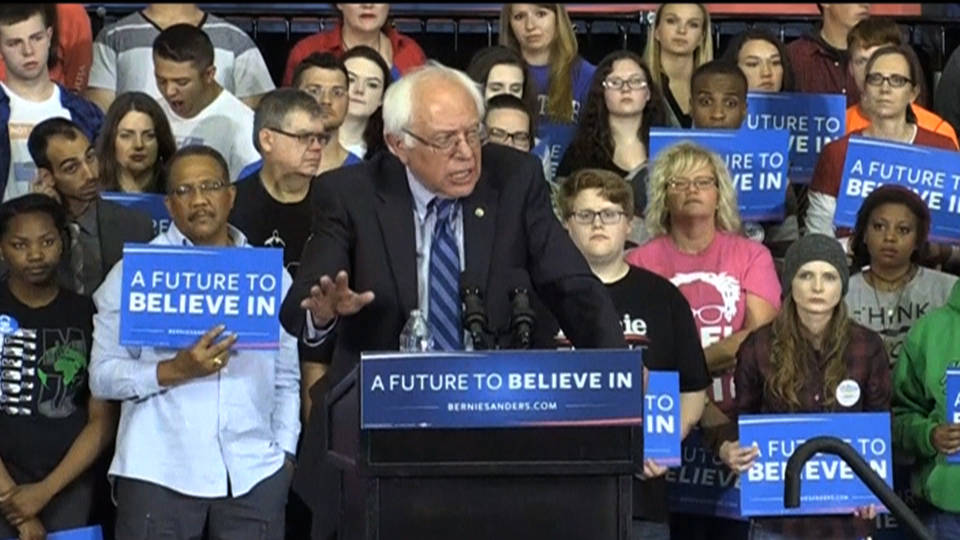
In the race for the Democratic nomination, Clinton leads in the delegate count, but her rival, Vermont Senator Bernie Sanders, has vowed to remain in the race until the final primaries in mid-June. Sanders campaigned in West Virginia Thursday ahead of next week’s primary there.
Sen. Bernie Sanders: "We have a major crisis. We have an epidemic of opiate addiction and heroin addiction. I mean, what I heard this morning in McDowell County was that almost all of the crime down there in one way or another was related to drugs—people needing money to feed their habits going out and stealing and so forth and so on. Now, this is a crisis which we cannot turn away from. We’ve got to deal with it. But in my view, the most effective way to deal with that is to understand that addiction is a health issue, not a criminal issue."
TOPICS:
Democratic Party
Bernie Sanders
Hillary Clinton
Reports: Prince Suffered from Addiction to Painkillers

Bernie Sanders’ remarks on the opiate epidemic come amid reports the late musical artist Prince suffered from an addiction to painkillers. New reports say his friends sought urgent help from an addiction doctor one day before Prince’s death last month. The doctor, Howard Kornfeld, dispatched his son, who was among those to discover Prince’s lifeless body in the elevator at his estate. Test results about the cause of Prince’s death are still pending.
TOPICS:
Addiction
Canada: Alberta Wildfire Grows Tenfold in Size

In the Canadian province of Alberta, a massive wildfire exploded to 10 times its previous size on Thursday. The fire has forced all 88,000 residents to flee Fort McMurray, in the heart of Canada’s oil sands. About 16 percent of Canada’s crude oil production is offline as companies have cut operations. Over the course of one day, the fire spread from about 18,000 acres to more 210,000 acres—that’s an area about 10 times the size of Manhattan. Scientists have linked increased wildfires to climate change.
TOPICS:
Canada
Palestinian Woman Killed by Israeli Tank Shell

A Palestinian woman has been killed and a number of others wounded in Gaza amid a flare-up of violence between Palestinian militants and Israeli forces. Israeli forces launched airstrikes in southern Gaza earlier this week, saying they were responding to mortar attacks on Israeli troops. A woman in her fifties was reportedly killed by an Israeli tank shell.
TOPICS:
Israel & Palestine
Brazil Court Suspends Lawmaker Who Led Impeachment Bid Against Rousseff
Brazil’s Supreme Court has ordered the lawmaker who has led the attempt to impeach President Dilma Rousseff to step down. House Speaker Eduardo Cunha has led the charge against Rousseff, despite facing trial for corruption. His suspension appears unlikely to stop impeachment proceedings against Rousseff. Brazil has been engulfed in a major corruption scandal, but Rousseff herself has not been accused of any financial impropriety. This week, Vice President Michel Temer, who would take over for Rousseff, was ordered to pay a fine for violating campaign finance limits.
TOPICS:
Brazil
Turkish Prime Minister Resigns as President Erdogan Cements Power
Turkey’s prime minister has resigned in what’s seen as the latest move by President Recep Tayyip Erdogan to expand his power. The prime minister, Ahmet Davutoglu, had split with Erdogan over his attempts to increase presidential authority. Turkey’s main opposition leader criticized the prime minister’s resignation.
Kemal Kilicdaroglu: "I should sadly express that Mr. Davutoglu paved way for authoritarianism by surrendering to the May 4 palace coup. However, the right thing to do in favor of democracy was to defend the duty he was commissioned for by 23 million people. He should have stood by the national will and said, 'I was brought to helm by people, and only they can ask me to step down.' He should have openly resisted the May 4 palace coup."
TOPICS:
Turkey
Obama Commutes Sentences of 58 Federal Prisoners
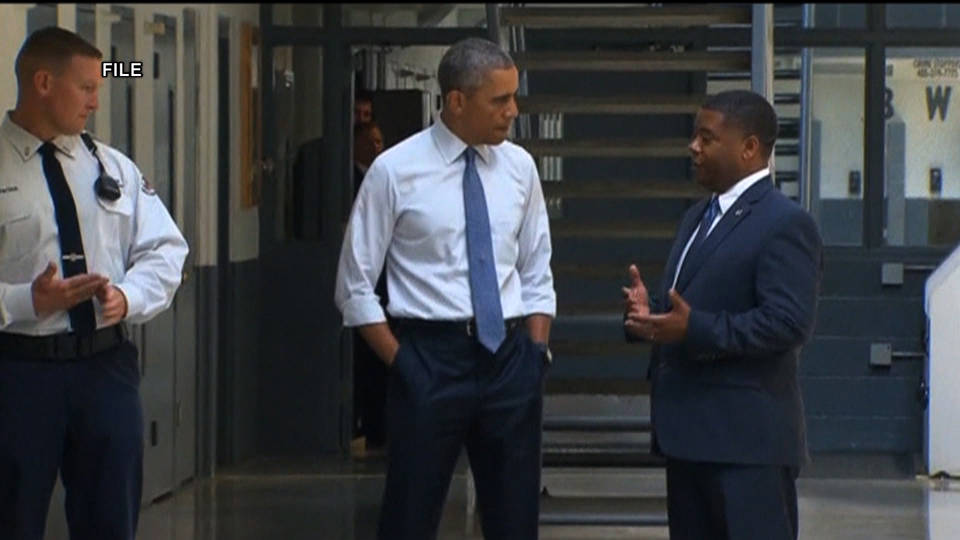
President Obama has commuted the sentences of 58 federal prisoners as part of his push to ease harsh mandatory sentences for nonviolent drug offenses. Thursday’s announcement brings the total number of Obama’s commutations to more than 300, about a third of whom were serving life sentences.
TOPICS:
Prison
Obama
Chicago Prosecutor Withdraws from Laquan McDonald Shooting Case
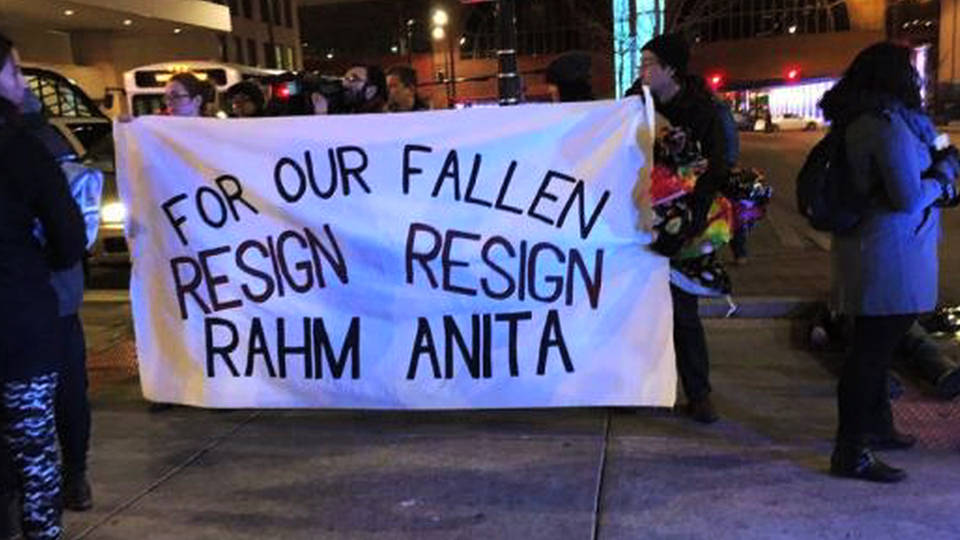
In Illinois, Cook County State’s Attorney Anita Alvarez has recused herself from the prosecution of Chicago police officer Jason Van Dyke for the fatal shooting of African-American teenager Laquan McDonald. McDonald was shot 16 times in October 2014, but it took more than a year for Alvarez to announce murder charges against Officer Van Dyke. Alvarez has requested a special prosecutor in the case. She lost her re-election battle in March following an activist campaign to oust her over her handling of the shooting.
TOPICS:
Chicago
Police Brutality
Alabama Lawmakers Pass Bill to Regulate Abortion Clinics Like Sex Offenders
Alabama Governor Robert Bentley is expected to sign into law a measure banning abortion clinics from operating within 2,000 feet of a K-8 public school. It’s the same rule applied to sex offenders in Alabama. The law would force at least two clinics in Alabama to close. The Alabama Women’s Center in Hunstville, Alabama, is located across from a school: It was forced to move there to comply with the state’s sweeping anti-choice restrictions.
Italian Court: Homeless Man's Theft of Food Not a Crime
And Italy’s highest appeals court has ruled stealing small amounts of food if you’re hungry is not a crime. The case concerned a homeless man who was convicted of theft and sentenced to six months in jail for stealing $4.50 worth of cheese and meat. The court overturned his conviction, saying he had taken the food "in the face of the immediate and essential need for nourishment."
TOPICS:
Italy
Poverty
Donate today:
Follow:


SPEAKING EVENTS

5/6 Seattle, WA
5/7 Mount Vernon, WA
5/8 Eugene, OR
5/8 Portland, OR
5/9 Minneapolis, MN
5/10 Cambridge, MA
5/11 Montclair, NJ
5/12 New York, NY
5/13 Washington, DC
5/14 Portland, ME
5/14 Bangor, ME
5/15 Bar Harbor, ME
5/17 Chicago, IL
5/18 Madison, WI
5/19 Toronto, ON
5/20 Toronto, ON
more
NEW BOOK


"Remembering Father Dan Berrigan, a Prophet of Peace" by AMY GOODMAN DENIS MOYNIHAN
A prophet of peace has passed. Daniel Berrigan, a Catholic Jesuit priest, a protester, a poet, a dedicated uncle and brother, died last weekend at the age of 94. His near-century on Earth was marked by compassion and love for humanity, and an unflinching commitment to justice and peace. He spent years in prison for his courageous, peaceful actions against war, living and practising the gospel that he preached. He launched movements, inspired millions, wrote beautifully and, with a wry smile, shared his love of life with family, friends and those with whom he prayed and fought for peace.
Dan’s brother Philip Berrigan and several others peacefully raided a draft board in 1967 and poured their own blood on the records to signify the blood being spilt in the war. A year later, on May 17, 1968, just weeks after the assassination of Martin Luther King Jr., they and seven others famously removed draft records from the Catonsville, Maryland draft board, and set fire to them with homemade napalm, singing a hymn around the pyre until they were arrested.
"Our apologies, good friends, for the fracture of good order, the burning of paper instead of children, the angering of the orderlies in the front parlour of the charnel house," Dan Berrigan wrote in the statement released by the group before the action, as they knew they would be arrested. "We could not, so help us God, do otherwise."
The actions of the Catonsville Nine, as the group would come to be known, ratcheted up the intensity of anti-war actions everywhere. Some individuals had burned their draft cards before then, but after the Catonsville action, it became an iconic and increasingly common tactic to demonstrate actual and symbolic opposition to the war. "We have chosen to be powerless criminals in a time of criminal power. We have chosen to be branded as peace criminals by war criminals," he said.
Daniel Berrigan was convicted and, before turning himself in to serve his prison sentence, went underground. Despite being placed on the FBI’s Most Wanted list, Berrigan popped up around the country, giving anti-war speeches. He spoke at a large rally at Cornell University, where he was the campus chaplain. Afterward, as the FBI and police closed in on him, Berrigan hid inside one of the Bread & Puppet political theatre troupe’s giant puppets. Thus disguised, he exited Cornell’s Barton Hall, eluding arrest. Authorities finally caught up to him on Block Island, off the coast of Rhode Island, and arrested him. A famous photo captured the moment, as a smiling Father Berrigan is shown being led, handcuffed, by two joyless FBI men who were on the island posing as bird-watchers.
"Given the fact that the American machine is not working well, either in its inner gears, or in its meshing with the world, good men must take action," he wrote in his memoir, No Bars to Manhood. "Some of them ... must be willing to go to jail."
In 1980, Berrigan, again with his brother Phil and others, broke into a General Electric missile plant in King of Prussia, Pennsylvania. They hammered on missile nose cones, damaging them beyond repair, and poured their blood on the damaged parts. Their action that day launched the Plowshares Movement, which has grown into a global movement. Plowshares actions are inspired by a line from the Old Testament, Isaiah 2:4:
"They will hammer their swords into plowshares and their spears into pruning hooks. Nation will no longer fight against nation, nor train for war anymore."
Dan Berrigan’s fight for peace challenged the U.S. government, the Pentagon and his own Catholic Church’s hierarchy. For that last sin, he was banished by the church from the United States. His exile included trips to Latin America and South Africa, which, far from curing him of his commitment to fight injustice, only strengthened it.
We last saw Berrigan, who we and so many others affectionately called "Father Dan," two years ago in the retirement home for elderly Jesuits, at Fordham University in the Bronx. At 93, he was frail, but his eyes twinkled when we gave him his favorite food: ice cream. His devotion to ice cream and social justice earned him his own flavor of Ben & Jerry’s, as well as a lifetime supply of their ice cream for him and for the Catholic Worker movement that he so loved.
Daniel J. Berrigan lived his life true to his calling, literally practising what he preached. Rest in peace, Dan Berrigan, just as you lived.
WORK WITH DN!

Video News Production Fellowship
Internships
WEB EXCLUSIVE

"A Moral Giant": ADemocracy Now! Special on the Life & Legacy of Father Daniel Berrigan
207 West 25th Street, 11th Floor
New York, New York 10001, United States
---------------------
---------------------

No comments:
Post a Comment