democracynow.org
Stories:

In Honor of Berta Cáceres, Rep. Hank Johnson Introduces Historic Bill to Stop U.S. Aid to Honduras
In an unprecedented move, a group of congressmembers are calling on the United States to suspend all military aid to Honduras until the country addresses its gross human rights violations. On Tuesday afternoon, Democratic Congressmember Hank Johnson of Georgia introduced the bill in Congress demanding the U.S. halt all funds to Honduras for their police and military operations, including funds for equipment and training. The United States currently provides hundreds of millions of dollars in aid to Honduras through the Northern Triangle’s Alliance for Prosperity Plan. The legislation is named after indigenous and environmental leader Berta Cáceres, who was murdered in Honduras in March. We speak with Georgia Representative Hank Johnson about his landmark bill.
TRANSCRIPT
This is a rush transcript. Copy may not be in its final form.
JUAN GONZÁLEZ: I want to turn now to Honduras. In an unprecedented move, a group of congressmembers are calling on the United States to suspend all military aid to Honduras until the country addresses its gross human rights violations. On Tuesday afternoon, our guest, Democratic Congressman Hank Johnson of Georgia, introduced a bill in Congress demanding the U.S. halt all funds to Honduras for their police and military operations, including funds for equipment and training. The United States currently provides hundreds of millions of dollars in aid to Honduras through the Northern Triangle’s Alliance for Prosperity Plan.
AMY GOODMAN: The legislation is called the Berta Cáceres Human Rights in Honduras Act, named in honor of slain indigenous environmental leader Berta Cáceres. In March, she was murdered in her own home in La Esperanza, Honduras. For a decade, she led the struggle against the Agua Zarca Dam, planned along a river sacred to the Lenca people. Honduran authorities have charged five people in connection with her death, including a Honduran army major and employees of DESA, the company behind the dam. But Cáceres’s family has called for an independent investigation.
Congressmember Hank Johnson of Georgia, talk about this legislation, what you’re calling for and why you’re involved with this.
REP. HANK JOHNSON: Well, this legislation would suspend financial aid to the republic of Honduras for military operations and training and also weaponry equipment. It would suspend U.S. financial assistance to Honduras for those purposes until such time as the republic of Honduras can demonstrate that it has adequately and transparently investigated and taken action on the many killings, unlawful and extrajudicial killings, of human rights activists, environmental activists, LGBT activists, human rights defenders in Honduras. There’s been a scourge of killings. The killings have been linked to the corrupt police and security forces and also the military units within Honduras. And it’s time for action. It’s time for the United States to stop supporting these kinds of regimes. Quite frankly, they’re illegal. This is an illegal regime that overthrew a duly elected president. And since that time, this kind of violence has rained down on human rights defenders in Honduras. And it’s time for the United States to stop its support for those kinds of activities by that government.
JUAN GONZÁLEZ: And you named the bill after Berta Cáceres. Could you—did you have a connection, prior connection, to her, before she was killed?
REP. HANK JOHNSON: Yes, I happened to have met Berta when she came to Washington, D.C., about 11 months before her assassination. And we knew her to be a staunch advocate for the Lenca people, a staunch advocate for the environment, against the exploitation of land by transnational corporations who came into Honduras to try to set up hydroelectric dams on rivers that, quite frankly, the Lenca people have historically depended on for their welfare, for their basic food, water, and for their living conditions. And so, for transnational corporations to come in, appropriate Lenca land for their uses, and without any consultation with the Lenca people—and Berta Cáceres was one of those who stood up to oppose that and, quite frankly, had been quite successful in doing so prior to her assassination. That’s what led to her assassination.
And there are indications that the assassination plot goes higher up than just simply people working for these transnational companies. It appears that the military, as well as security units within Honduras, were complicit in this assassination. And it needs to be investigated, and there have been calls for an international independent investigation of the killing. And I’m hopeful that progress can be made in that regard.
AMY GOODMAN: Congressmember Hank Johnson, you have mentioned that, you know, this aid has continued, through the first coup against Mel Zelaya, who was the democratically elected president. Juan, you got a chance to question Hillary Clinton, the presumptive presidential nominee of the Democratic Party, at the New York Daily News editorial board meeting. She was secretary of state at the time, very quickly recognized the coup at the time and tried to get other Latin American countries to support the new government.
JUAN GONZÁLEZ: Yes, and I specifically asked Secretary Clinton of about the—about her particular role in terms of seeking—of not seeking to cut off the aid. She tried to make a distinction between a military coup and, in essence, a political removal of President Zelaya. I’m wondering your view of what kind of coup it actually was in Honduras?
REP. HANK JOHNSON: Well, it’s clear that the democratically elected president was removed, and it was against the will of the people. And that individual was not allowed to participate in the new election that resulted in the installation of the current president. And so, in my opinion, when the will of the people is not addressed, then we have problems. And I believe that we’ve got problems in Honduras that stem from that transfer of power. And I look forward to the time when Hondurans are actually happy and satisfied. I’m not talking about just the top 1 percent, but I’m talking about all of the people in Honduras, are satisfied and supportive of their government.
AMY GOODMAN: Congressmember—
REP. HANK JOHNSON: And I don’t—I don’t see how that can happen when the government is involved in the assassination of human rights activists and people who speak out against government policies. That’s something that the United States should not be supporting.
AMY GOODMAN: Democratic Congressmember Hank Johnson of Georgia, thanks very much for bringing—for talking to us, co-sponsor of a bill that was just introduced to the House to suspend all U.S. military support to Honduras. It’s called the Berta Cáceres Human Rights in Honduras Act, named after the recently assassinated Honduran indigenous environmental leader. When we come back from break, we’ll speak with her successor, Tomás Gómez Membreño, who is in Washington, D.C., right now. Stay with us. ... Read More →

Successor to Honduran Activist Berta Cáceres: Her Death Is Tied to "Capitalist Neoliberal Policies"
Today is a global day of action calling for "Justice for Berta"—to remember the slain Honduran activist Berta Cáceres. In at least nine cities across the United States and 10 countries across the world, protesters are gathering today to call on the U.S. to stop funding the Honduran military, over accusations that state security forces have been involved in human rights violations, extrajudicial killings—and the murder of environmentalists like Berta Cáceres. Before her death, Berta and her organization, COPINH, were long the targets of repression by elite Honduran security forces and paramilitary groups. Only hours before she was killed, Berta Cáceres accused the military, including the U.S.-funded special forces TIGRES unit, of working on behalf of international corporations. We speak with Tomás Gómez Membreño, who replaced Cáceres as leader of COPINH.
TRANSCRIPT
This is a rush transcript. Copy may not be in its final form.
JUAN GONZÁLEZ: A global day of action is being organized today calling for "Justice for Berta," to remember the slain Honduran activist Berta Cáceres. In at least nine cities across the United States and 10 countries across the world, protesters are gathering to call on the U.S. to stop funding the Honduran military, over accusations that state security forces have been involved in human rights violations, extrajudicial killings and the murder of environmentalists like Berta Cáceres. Before her death, Berta and her organization, COPINH, was long the target of repression by elite Honduran security forces and paramilitary groups. Only hours before she was killed, Berta Cáceres accused the military, including the U.S.-funded special forces TIGRES unit, of working on behalf of international corporations.
BERTA CÁCERES: [translated] We have to understand why these projects are so important. The government has all of its institutions at the service of these companies, because they are capable—as in Río Blanco, in the defense that we had in Gualcarque—because these businesses are capable of moving antiterrorism commandos, like the TIGRE commandos, the military police, the national police, security guards, hit men, etc.
AMY GOODMAN: To talk more about Honduras, we’re joined by Tomás Gómez Membreño, the new general coordinator of COPINH. He’s a member of the Lencan people, like Berta, the indigenous community in the southwest of Honduras. Membreño became the leader of COPINH after the assassination of Berta Cáceres, his dear friend.
Welcome for the first time to Democracy Now!, Tomás Gómez Membreño. Can you respond first—first, though, of course, condolences on the death of Berta. But can you respond to what Congressmember Hank Johnson has just announced, the introduction of a bill to stop all U.S. military aid to Honduras?
TOMÁS GÓMEZ MEMBREÑO: [translated] Thank you very much for the opportunity to be on this program for the first time. I think that it’s very important for us, as COPINH, and as the Lenca people to learn about a bill that is aimed at clarifying the assassination of our colleague Berta Cáceres. This is one of the points that we’ve been demanding, that here in the United States—that there might be a bill here in the United States to pressure the government of Honduras with the Inter-American Commission on Human Rights, which we think is important in order to make sure that there’s a resonance of this issue in the U.S. Congress. And it’s very important to know that a bill that has to do with several points we’ve been analyzing, but our goal is to clear up what happened in the assassination of our colleague Berta Cáceres.
I think it has to do primarily with the capitalist neoliberal policies that are implemented by multinational corporations as well as national corporations. These are capitalist policies to the detriment of our territory. There is a dispossession of people from the land. This violates our sovereignty. This violates the cosmovision and spirituality of our people with respect to our rivers and our livelihoods. It’s very important that we, as the Lenca people, can see that the members of Congress, who are the representatives of the state and represent the interests of the population—it’s important to see such an initiative, because this economic support that the United States provides to the Honduran military and security forces comes from the tax dollars paid by U.S. citizens. And that cannot be sent to a state where we are assassinated, which is what happens in Honduras. The military and the police carry out so much repression against our people.
JUAN GONZÁLEZ: Tomás—Tomás Gómez, what is the state right now of human rights in Honduras? Are the death squads back in Honduras?
TOMÁS GÓMEZ MEMBREÑO: [translated] I think that now they have become institutionalized. That is to say, it is these squads—well, Battalion 3-16 is what it was called in the 1980s. And today they’re operating in the military and in the police. Today, this modus operandi has become institutionalized with impunity from the state. For example, with the assassination of our colleague Berta Cáceres, we can identify that a member of the army, an adviser to the military police, is one of the persons who’s been implicated in the assassination of our compañera Berta Cáceres. And the head of the army has also been part of this institutional structure involved. And there’s another—so there’s another nuance. Today, all of this has become institutionalized in the face of a strong struggle to uphold the interests of the population. So this police force and this army answer to the economic interests of the transnational corporations and the economic and political power centers of this country.
AMY GOODMAN: Are you concerned for your own life? It is incredibly brave of you to assume the leadership of COPINH. You have Berta Cáceres who was killed. Then you have, as well, another COPINH member, Nelson García, who was killed. Are you concerned for your own life, Tomás Gómez?
TOMÁS GÓMEZ MEMBREÑO: [translated] Well, I think that those of us who are engaged in this struggle in defense of the territory, in defense of life, each and every one of us is worried in Honduras, because a war is being waged against those who defend the common goods of nature, particularly those engaged in direct defense of the interests of the population, which is the case of us in COPINH, but also the case specifically of the Lenca people. We’ve seen, before the assassination of Berta Cáceres, we were receiving many death threats from the private company, but also pressure from the politicians of Honduras. And in the wake of her assassination, there have been more death threats, but also the extermination of an indigenous people struggling to defend the common good. So we stand up for life, and the state of Honduras is bringing about a genocide against our indigenous communities.
AMY GOODMAN: Tomás Gómez Membreño, we want to thank you very much for being with us, look forward to speaking to you again. All the best luck. Now the new general coordinator of COPINH. COPINH is the indigenous organization that Berta Cáceres led, until her assassination in her home in La Esperanza, Honduras.
This is Democracy Now! When we come back, we head directly to San Juan, Puerto Rico. Twenty-three of the 49 people killed in the Orlando massacre were Puerto Rican. We’ll get the mayor of San Juan’s response, and then we’ll talk about legislation in the U.S. Congress that will determine the fate of Puerto Rico. Stay with us. ... Read More →

Puerto Rico Is Being Left Voiceless: San Juan Mayor Condemns Bill to Create "Colonial Control Board"
We turn to Puerto Rico. The Senate is set to consider a bill to create a federally appointed control board with sweeping powers to run Puerto Rico’s economy to help the island cope with its crippling debt crisis. The bill, known as PROMESA, passed the House last week by a bipartisan vote of 297 to 127, but opponents have decried the measure as antidemocratic. "We’re engaged today in a wholly undemocratic activity in the world’s greatest democracy," said Rep. Rep. Luis Gutiérrez. In the Senate, Robert Menendez, Dick Durbin and Bernie Sanders have come out against the bill, and any one of them could filibuster the legislation. Sen. Elizabeth Warren’s stance on the bill remains unknown. The debate in the Senate comes as the Supreme Court has issued two major decisions about Puerto Rico. On Monday, in a 5-2 decision, the high court rejected Puerto Rico’s bid to revive its own bankruptcy law that would have let the island’s public utilities restructure about $20 billion those entities owe to bondholders. That decision came just days after the Supreme Court ruled against Puerto Rico in a separate case ruling regarding the island’s sovereignty. We speak to Carmen Yulín Cruz, the mayor of San Juan, Puerto Rico, and Natasha Lycia Ora Bannan, president of the National Lawyers Guild and associate counsel at LatinoJustice PRLDEF.
TRANSCRIPT
This is a rush transcript. Copy may not be in its final form.
AMY GOODMAN: In a moment, we’ll get the comments of the mayor of San Juan in Puerto Rico on the deaths at the Orlando massacre, where 23 of the 49 people killed at the Pulse nightclub were Puerto Rican. But first we turn to another issue involving Puerto Rico.
JUAN GONZÁLEZ: Well, the Senate is set to consider a bill to create a federally appointed control board with sweeping powers to run Puerto Rico’s economy to help the island cope with its crippling debt crisis. The bill, known as PROMESA, passed the House last week by—in a bipartisan vote of 297 to 127. Democratic Congressman Luis Gutiérrez spoke out against the bill.
REP. LUIS GUTIÉRREZ: We’re engaged today in a wholly undemocratic activity in the world’s greatest democracy. We’re debating how we will take power from the people, who are virtually powerless already. ... Think about it. You are imposing a junta—because that’s what they’re calling it. There will be no difference between this junta and the junta of Pinochet in Chile, as far as the international community is concerned.
AMY GOODMAN: But many of Luis Gutiérrez’s longtime allies in the Congressional Progressive Caucus back the bill, including New York Congressmembers José Serrano and Nydia Velázquez, as well as Arizona Congressmember Raúl Grijalva, who said the bill was needed to address Puerto Rico’s humanitarian crisis.
REP. RAÚL GRIJALVA: H.R. 5278 is not the bill I would have drafted or the colleagues on my side of the aisle would have drafted. The oversight board is too powerful. The board is yet another encroachment on the sovereignty of the people of Puerto Rico, and rightfully so, they find it offensive. ... So here is the bottom line: Puerto Rico is drowning in debt, and H.R. 5278 is a lifeline. This is the only bill that will attract enough support from my Republican colleagues on that side of the aisle to pass in Congress, a Congress they control. Many of the provisions I oppose are the very provisions that will probably attract Republican support. We have worked for months, across the aisle and with the administration, and this is the compromise with the best opportunity to pass. ... When measured against a perfect bill, this legislation is inadequate. When measured against the worsening humanitarian crisis in Puerto Rico, this legislation is necessary.
JUAN GONZÁLEZ: In the Senate, Robert Menendez, Dick Durbin and Bernie Sanders have come out against the bill, and any one of them could filibuster the legislation. The debate in the Senate comes as the Supreme Court has issued two major decisions about Puerto Rico. On Monday, in a 5-to-2 decision, the high court rejected Puerto Rico’s bid to establish its own bankruptcy law that would have let the island’s public utilities restructure about $20 billion those entities owe to bondholders. That decision came just days after the Supreme Court ruled against Puerto Rico in a separate case, a ruling regarding the island’s sovereignty—its sovereignty rights in criminal cases.
AMY GOODMAN: To talk more about these political and judicial developments, we’re joined by two guests. From San Juan, Puerto Rico, we’re joined by the city’s mayor, Carmen Yulín Cruz. And here in New York, we’re joined by Natasha Lycia Ora Bannan, president of the National Lawyers Guild and associate counsel at LatinoJustice. Her latest article for The Huffington Post is "The United States Makes the Case for Why Puerto Rico is Still Its Colony."
Let’s go first to San Juan to the mayor. Your response to the legislation right now in Congress?
MAYOR CARMEN YULÍN CRUZ: Well, first of all, good morning to everyone, and greetings from San Juan, Puerto Rico. You don’t add up a democratic situation. You don’t put fuel to a fire. And what the Congress has done, what the president of the United States has done, what the judicial system has done, is they have unveiled to everyone, the international community and everyone in Puerto Rico, that we are a colony of the United States. PROMESA is a broken promise to the people of Puerto Rico. They have put their backs towards the rights of Puerto Rican people, and they cannot move forward an agenda which will help the development of the Puerto Rican economy. Since 1952, the U.S. has admitted, based on the actions, that it has perpetrated a fraud on the international community when it asked for Puerto Rico to be taken out of the list of colonies. So, we are a colony.
That being said, what are we going to do in Puerto Rico? And what are the representatives—and I have to thank Luis Gutiérrez for standing his ground and standing with the people of Puerto Rico on this. But what cannot happen, and what people need to know is, while in the U.S. people are fighting to increase minimum wage to $15 an hour, this colonial control board will lower minimum wage in Puerto Rico for people 25 or under at $4.25 an hour. This colonial control board could sell our natural resources. And this colonial control board will have sovereign powers to revoke anything that our next governor, our next Legislature or any public official of the Puerto Rican government, elected by the democratic vote of the Puerto Rican people, will do. So, we have no voice, because we have been left to be voiceless by those that claim to be the beacon of democracy in all of the world.
JUAN GONZÁLEZ: And, Mayor Yulín, I wanted to ask you—this control board has been compared to the D.C. control board that was established when the District of Columbia was in financial problems, but that control board required all the members—I mean, that legislation required all the members of the board to be residents of the District of Columbia, and also the federal government came in with financial aid by assuming all the pension liabilities of the District of Columbia, whereas this legislation doesn’t provide any kind of federal assistance, only a control board, six of whose seven members can be from the United States, not from Puerto Rico. Why do you call it a colonial control board?
MAYOR CARMEN YULÍN CRUZ: Well, it’s a—when the power resides in a group of people that have not been elected in another country, that is the definition of a colony. When you cannot even declare bankruptcy and the U.S. negates the right of the Puerto Rican people to produce a piece of legislation that will allow us to orderly declare bankruptcy, that is by definition what a colony is.
Now, it’s interesting. People may think that this colonial control board allows for a structure of the debt in Puerto Rico. That is not true. The majority of its members now will have to decide, based on whatever they want and whatever issues and variables they want to put forth, if—if, not when—if our debt will be restructured. So this is basically a control board done for the hedge funds of the world, for the hedge funds that, in a manner—knowing that Puerto Rico was in a crisis, gave money to the Puerto Rican people. Now, we have our own responsibility on this. We have to reform our government. We have to restructure what our priorities are. And we have to restructure the colonial relationship between Puerto Rico and the United States. So there is a shared, silent cooperation that went on to produce the perfect crisis.
Now, it’s also important to note that the Puerto Rican people will have to pay $370 million to this control board for it to be functional. So not only are they taking democracy away from Puerto Rico, but they’re also doing the following: It’s costing us money to inflict pain on our own people. And that is totally unreasonable. I cannot think of anything more un-American than that.
AMY GOODMAN: I wanted to bring Natasha Lycia Ora Bannan into the conversation, the president of the National Lawyers Guild and associate counsel at Latino PRLDEF—Latino Justice PRLDEF. In addition to this legislation, PROMESA, the PROMESA Act, you’ve got two Supreme Court, U.S. Supreme Court, decisions involving Puerto Rico. Explain.
NATASHA LYCIA ORA BANNAN: So, as you said, Amy, in the last week, we’ve had two decisions by the Supreme Court that have dealt with the issue of Puerto Rico, but fundamentally deal with the issue that the mayor was talking about, which is the political relationship between the United States and Puerto Rico. This is the first time in a very long time, and perhaps ever, that every branch of the federal government has spoken clearly about the political status of Puerto Rico and has exposed the colonial relationship. So you had the decision in the—what’s known as the Sanchez Valle case by the Supreme Court last week, that was an issue of double jeopardy that went up, that essentially said that, you know, you can’t be charged for the same crime by two sovereigns, where the Supreme Court said Puerto Rico has no separate sovereignty, other than that granted, ceded to it by the United States Congress, that ultimately the United States Congress is the ultimate source of all authority regarding Puerto Rico. And, of course, it doesn’t say that it’s a colony, but it says that it has no separate sovereignty, it has no separate autonomy, which is the political and legal fiction that had been created in 1952.
JUAN GONZÁLEZ: Well, Natasha, both of these decisions, I read them both, both the majority decisions and the dissenting opinions, and I was struck especially by the Breyer dissent in the Sanchez Valle decision, where he really goes into exposing not only the historical relationship, but also the fact that the United States went before the international community and said, hey, in 1952, we—Congress granted Puerto Rico self-government, and that this, in effect, is now contradicting what the United States told the international community when the commonwealth of Puerto Rico was first created.
NATASHA LYCIA ORA BANNAN: That’s exactly right. I mean, Breyer really looks at a less kind of textualist interpretation and says, "Let’s look at in practice." In practice, Puerto Rico has supposedly implemented some aspects of self-determination, self-governance, autonomy. But it’s really the United States’s position—on the oral argument, Breyer raised this question, as well, to the counsel and said, you know, "What is the United States’s position before the international community after this case, after you’ve filed your—a brief in this case explicitly saying that you don’t believe that Puerto Rico has any sovereignty?"
You know, this Monday is the annual hearing before the U.N. Decolonization Committee on Puerto Rico, where the United States has consistently said Puerto Rico does not need to be reviewed by this body because it doesn’t belong there—it has aspects of autonomy, it has aspects of self-governance and sovereignty. And for the first time, the governor of Puerto Rico will be going before this committee now on Monday, specifically because every branch of government has said, "Puerto Rico is a colony. You have no governance." And to—the international community, the United Nations has been very clear that colonialism is not welcome in the international community. It is immoral, it is unjust, it is unlawful. And there needs to be a process towards decolonization.
AMY GOODMAN: Mayor Carmen Yulín Cruz in San Juan, can you respond to the Supreme Court decisions? But also describe the effects of the Puerto Rican debt crisis on the ground, the austerity measures that have been imposed.
MAYOR CARMEN YULÍN CRUZ: Well, two things. First—
AMY GOODMAN: It looks like—we have have her back. We’re just having a little trouble.
MAYOR CARMEN YULÍN CRUZ: —think that President Obama can do to start that decolonization process, which should be a self-determination process from the people of Puerto Rico and its—
AMY GOODMAN: We’re having some satellite problems connecting from New York to San Juan. It looks like Mayor Yulín is back again. Go ahead, Mayor Yulín.
MAYOR CARMEN YULÍN CRUZ: —injure anything. So that is an act of good faith that could happen right now, today, and there is no reason and no need to wait.
AMY GOODMAN: Sorry, we lost you on the satellite. What is the act of goodwill?
MAYOR CARMEN YULÍN CRUZ: But Puerto Rico definitely is having a crisis. We have been [inaudible]—
AMY GOODMAN: What is the act of goodwill?
MAYOR CARMEN YULÍN CRUZ: —at the municipality to be able to work the finances, where we have gone from a deficit of $104 million, when I became mayor, to a surplus of $24 million last year, and expect it to be surplus of more than $30 million this year. We’ve done it without laying off people, and we’ve done it increasing services.
But that has not been the faith of the central government. And, of course, when one Puerto Rican suffers, we all suffer. We have had increased number of problems with health reform and health issues. People in the United States should know that we pay the same Medicare tax that you pay, but we get less of the benefits, which, again, is highly unfair and [quite] un-American. Aren’t we supposed to all be getting the same for what we pay for? Right? So, we get less. That means that a lot of the doctors are leaving the island. We have had an exodus of more than 300,000 people in the past seven years. And, of course, that decreases our income bases, which in turn—it’s a wheel that goes round and round. People are losing their homes, because jobs are leaving.
Now, that started with the ending of Section 936 of the IRS Code, where companies could repatriate the earnings that they made in Puerto Rico back into the United States without having to pay federal income tax. Puerto Rico has one of the corporate tax rates that is the lowest in the world. It’s 4 percent, and it was just recently added. So there’s about $32 million that are—$32,000, I’m sorry—$32 billion, with a B, that are taken away from Puerto Rico every year without these companies paying one single cent of taxes and contributing that way to the Puerto Rican economy. Just recently, a couple of weeks ago, the air ambulance service was shut down because the government had no money to pay. Sometimes there is not enough equipment to conduct the surgeries that are necessary.
So, it is a crisis that we have seen increasing, and that is putting a lot more strain on the 78 municipalities of Puerto Rico. Some of them, like the larger municipality, which San Juan is, we have been able to weather the storm. But some other smaller municipalities are really hurting and are in—at the door of having to perhaps not lay off employees, but having to reduce their income. There is one municipality, Ponce, on the lower south end side of the island, that has had its employees working half-time because it isn’t able to pay for all its payroll. So, there is a humanitarian crisis.
AMY GOODMAN: We need—we need to—
MAYOR CARMEN YULÍN CRUZ: But we need to do three things. ... Read More →

"Our Nation is Under Attack": Lawmakers Push Laws to End "Scourge of Gun Violence on Our Streets"
On Tuesday night, hundreds of people gathered at a church in Orlando, Florida, to mourn the 49 victims of Sunday’s attack on an LGBT nightclub, the deadliest mass shooting in modern U.S. history. Following the massacre, President Obama called for the reinstatement of the assault weapons ban and measures to prevent suspected terrorists from obtaining guns. One of the two guns used by Orlando shooter Omar Mateen was an AR-15 semiautomatic assault rifle, the same style used in the massacres in San Bernardino, California; Aurora, Colorado; and Newtown, Connecticut. On Tuesday, Democratic members of the House Judiciary Committee signed a letter pushing legislation to reinstate a lapsed ban on automatic assault weapons. The lawmakers wrote, "Make no mistake about it: our nation is under attack. We are under attack by the scourge of gun violence—on our streets and in our homes, on a daily basis." We speak to one of the signatories of the letter, Rep. Hank Johnson (D-GA).
TRANSCRIPT
This is a rush transcript. Copy may not be in its final form.
JUAN GONZÁLEZ: On Tuesday night, hundreds of people gathered at a church in Orlando, Florida, to mourn the 49 victims of Sunday’s attack on an LGBT nightclub, the deadliest mass shooting in modern U.S. history. Following the massacre, President Obama called for the reinstatement of the assault weapons ban and measures to prevent suspected terrorists from obtaining guns. One of the two guns used by Orlando shooter Omar Mateen was an AR-15 semiautomatic assault rifle, the same style used in the massacres in San Bernardino, California; Aurora, Colorado; and Newtown, Connecticut.
AMY GOODMAN: We begin today’s show in Washington, D.C., where we’re joined by Georgia Congressmember Hank Johnson. On Tuesday, he and other Democrats on the House Judiciary Committee signed a letter to committee chair Bob Goodlatte to consider legislation to reinstate a lapsed ban on automatic assault weapons. In the letter, the lawmakers write, quote, "Make no mistake about it: our Nation is under attack. We are under attack by the scourge of gun violence—on our streets and in our homes, on a daily basis," unquote.
Georgia Congressmember Hank Johnson, welcome to Democracy Now! Talk about what you’re calling for right now.
REP. HANK JOHNSON: Yes, it’s a pitiful shame that here in America at this time it’s easier to buy an assault weapon than it is to board an airplane. You have to go through all kinds of security and have all kinds of ID in order to fly, but in order to buy, all you need is an internet connection or a entry into what’s called a gun show, where you can buy from an unlicensed firearm dealer, and you don’t have to go through a background check. And so, that’s called the gun show loophole, and it allows these assault weapons to proliferate on the streets of America. And we’re seeing a proliferation of homicides and mass murders that are committed with these high-capacity assault weapons, that were made and manufactured to kill people in mass numbers quickly. And so we need to replace the ban on assault weapons that expired in 2004, and we need to reinstate that ban, so that we can start getting a handle on the proliferation of these assault weapons on the streets of America.
JUAN GONZÁLEZ: And, Congressman Johnson, why specifically was the law allowed to lapse? And what has been the lineup in the battle to get it reinstated?
REP. HANK JOHNSON: Well, it was the pressure on lawmakers by the National Rifle Association, which represents gun manufacturers and gun retailers. They have contributed so much money, largely to the Republican Party or members of the Republican Party. About 83 percent of their funding goes to Republicans for Congress. And with that kind of influence, with that kind of money in politics, it has resulted in the NRA being able to prevail when it comes to commonsense gun regulation. They support no effort to control firearms in the hands of anyone in this country. And so, until we can break the back of the NRA lobby and get that dark money out of politics and do something about campaign finance reform, we’re going to have these anomalies that continue to exist in America. And people are dying as a result of these policies, or the lack of policy, by Congress. And it’s something that we need to change.
AMY GOODMAN: There’s a joke going around online, and I hate to joke on a day like this, but it says, "'Can I get two boxes of Sudafed?' 'Sorry, by law, you can only buy one at a time.' 'OK, then just the one box of Sudafed and these seven guns.'"
REP. HANK JOHNSON: Well, it’s a fact of life that one can go into a gun show and purchase unlimited amounts of weaponry and ammunition and high-capacity clips, no questions asked. This is the 21st century. This is the year 2016 in America. And after repeated mass murders at the hands of persons wielding assault weapons, when will we wake up and take action? Just simply doing a moment of silence every time something like this occurs in Congress has appeased some lawmakers. Some of them think that that’s all that we need to do. But I think the American public are starting to wake up. They want us to take action. If—if we are to do our jobs, we must take these kinds of situations, like that which occurred in Orlando, and use them to galvanize public opinion and public pressure on these recalcitrant lawmakers who are in the pockets of the NRA and, quite frankly, are afraid to move without permission. It’s time to act. It’s time to act now.
And it’s not just these mass murders. There are just instances of homicides throughout the country, single people, two people being killed at a time. We can’t forget about those. It’s easy to look away from those that are occurring every weekend in cities and in towns throughout America. People are losing their lives to gun violence. Guns are ending up in the hands of people who have no right—or should have no right—to possess them. And so, without any kind of regulations, we will continue to see this influx of weaponry onto the streets. We will see misuse of that weaponry, and innocent people will lose their lives as a result. And so, Congress has a responsibility to stand up and do something about it.
JUAN GONZÁLEZ: Congressman, I wanted to play for you part of Donald Trump’s remarks on Monday following the Orlando massacre.
DONALD TRUMP: When I’m elected, I will suspend immigration from areas of the world where there is a proven history of terrorism against the United States, Europe or our allies, until we fully understand how to end these threats. ... We cannot continue to allow thousands upon thousands of people to pour into our country, many of whom have the same thought process as this savage killer.
JUAN GONZÁLEZ: Congressman Hank Johnson, your response to the presumptive Republican candidate’s, for president, remarks?
REP. HANK JOHNSON: Well, conveniently for Donald Trump, he wants to forget that this individual who perpetrated the mass murder in Orlando is an American-born American citizen. And most of the mass murders that have taken place in America since the removal of the assault weapons ban in 2004—and, in fact, before then—most of the perpetrators have been American-born. And so, it’s wrong to try to demonize refugees, people trying to escape mass murder, mass incarceration in their home countries. It’s wrong to blame those people for the scourge of violence that is happening in America. ... Read More →

Puerto Rico in Mourning: Nearly Half of the Orlando Massacre Victims were from the Island
Puerto Rico Gov. Alejandro García Padilla has declared Friday an official day of mourning after learning that 23 of the 49 victims in the Orlando massacre were Puerto Rican. On Tuesday, more than 300 people gathered in the capital of San Juan to honor those killed. Hundreds more gathered in Ponce. We speak to San Juan Mayor Carmen Yulín Cruz and Natasha Lycia Ora Bannan, president of the National Lawyers Guild and associate counsel at LatinoJustice PRLDEF.
TRANSCRIPT
This is a rush transcript. Copy may not be in its final form.
AMY GOODMAN: We need to ask—before we get to the end of this, we have to go to the shooting massacre in Orlando, the horror that took place there, 23 of the 49 victims Puerto Rican. On Tuesday, more than 300 people gathered in the capital of San Juan to honor those killed. Hundreds more gathered in Ponce. Puerto Rico’s governor has declared Friday an official day of mourning. Natasha Lycia Ora Bannan and Mayor Yulín, our deepest condolences, and Juan, for all of the victims. First, Mayor Yulín, your response? We only have 30 seconds.
MAYOR CARMEN YULÍN CRUZ: —hear you.
AMY GOODMAN: Mayor Yulín, your response to the Pulse nightclub attack? Well, let’s ask Natasha.
NATASHA LYCIA ORA BANNAN: It’s an absolute tragedy. And I think that—I mean, the Puerto Rican community has been largely affected by this because, as you mentioned, half of the victims were Puerto Rican. Many of them had migrated from the island precisely because of the economic and humanitarian crisis that the mayor spoke about, in search of jobs, seeking more safety, seeking more stability, and encountered this horrific act of violence and homophobia and hatred. The community continues to mourn, not only in Puerto Rico, but in the diaspora.
AMY GOODMAN: And, Mayor Yulín, your response to the killings in Orlando?
MAYOR CARMEN YULÍN CRUZ: It is—we stand with the people of Orlando. We stand with those families of those 24 Puerto Ricans that were killed because of the horror of those that believe that love is only love when it’s done how they want it to be. I have this watch with the colors of the LGBT community, and those are colors that we should all have ingrained in our mind and in our conscience. And to all those people out there, being Puerto Rican or not, hate is not the way. And we need to move forward. We need to accept people for who they are. And everyone has a right to love whom they want to love, because love is love.
AMY GOODMAN: We must leave it there. Thank you so much, San Juan Mayor Carmen Yulín Cruz and Natasha Lycia Ora Bannan, associate counsel at LatinoJustice PRLDEF. ... Read More →
Headlines:Orlando Survivor Says Shooter Wanted U.S. to Stop Bombing Afghanistan
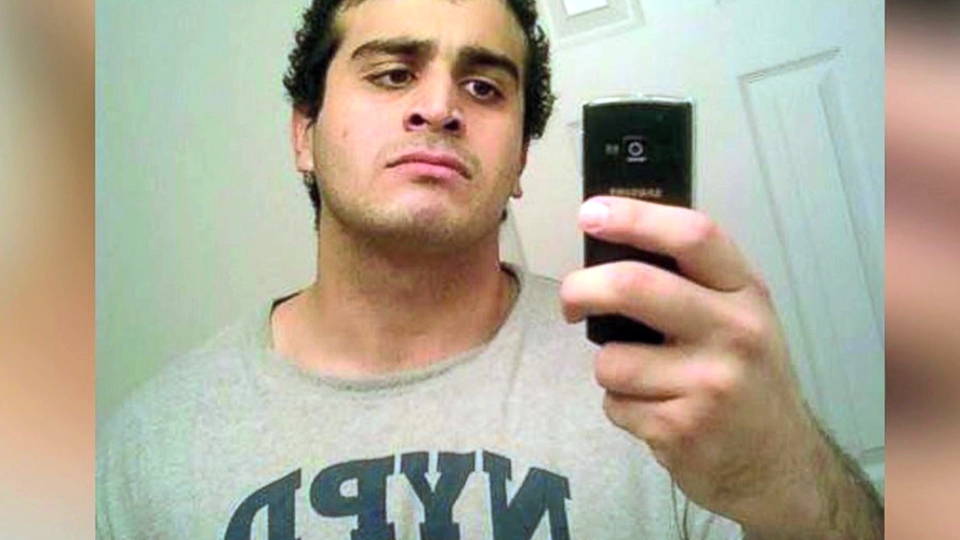
Hundreds of people gathered at a church in Orlando, Florida, Tuesday night to mourn the 49 victims of Sunday’s attack on an LGBT nightclub, the deadliest mass shooting in modern U.S. history. More information has begun to emerge about the shooting at the Pulse nightclub as survivors of the attack tell their stories. Patience Carter was shot in both legs but survived, after being trapped in a bathroom with the shooter, Omar Mateen. She says she heard Mateen call 911 to say he was carrying out the massacre because he wanted the United States to stop bombing "his country." Mateen was born in the United States; his parents are from Afghanistan. Carter gave her account on Tuesday.
Patience Carter: "And after that, he even spoke to us directly in the bathroom. He said, 'Are there any black people in here?' I was too afraid to answer, but there was an African-American male in the stall where most of my body was, majority of my body was, had answered, and he said, 'Yes, there are about six or seven of us.' And the gunman responded back to him saying that, 'You know, I don't have a problem with black people. This is about my country. You guys suffered enough.’ And he just—he made a statement saying that it wasn’t about black people. This isn’t the reason why he was doing this. But through the conversation with 911, he said that the reason why he was doing this is because he wanted America to stop bombing his country."
TOPICS:
Afghanistan
Orlando Massacre
Orlando Survivor Delivers Poem: "The Guilt of Being Alive is Heavy"
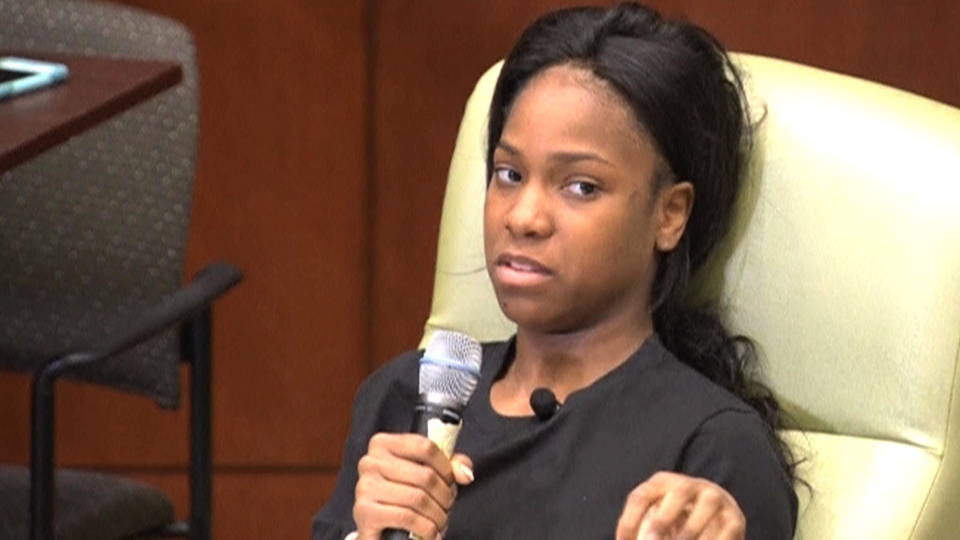
Patience Carter was at the club with a friend, Tiara Parker, and the friend’s cousin, 18-year-old Akyra Murray, who perished in the attack. Murray and Carter had initially escaped the club, but went back in to look for Parker. All three were shot, Murray fatally. Carter delivered a poem about the guilt she felt for surviving.
Patience Carter: "The guilt of feeling lucky to be alive is heavy / It’s like the weight of the ocean’s walls / Crushing uncontrolled by levies / It’s like being dragged through the glass / With a shattered leg and thrown on the back of a Chevy / It’s like being rushed to the hospital / And told you’re going to make it / When you lay beside individuals / Whose lives were brutally taken / The guilt of being alive is heavy."
TOPICS:
Orlando Massacre
Orlando Shooter Omar Mateen's Wife Could Face Charges
Meanwhile, the shooter’s wife could face criminal charges if authorities establish she knew about the attack in advance. Noor Zahi Salman has reportedly told agents she tried to talk Mateen out of the shooting. Multiple sources have said Mateen was a regular at the Pulse nightclub and had contacted people on gay dating apps like Grindr. But the club has denied he was ever a patron.
TOPICS:
Orlando Massacre
Obama Blasts Trump's Call for Banning Muslims from Entering U.S.
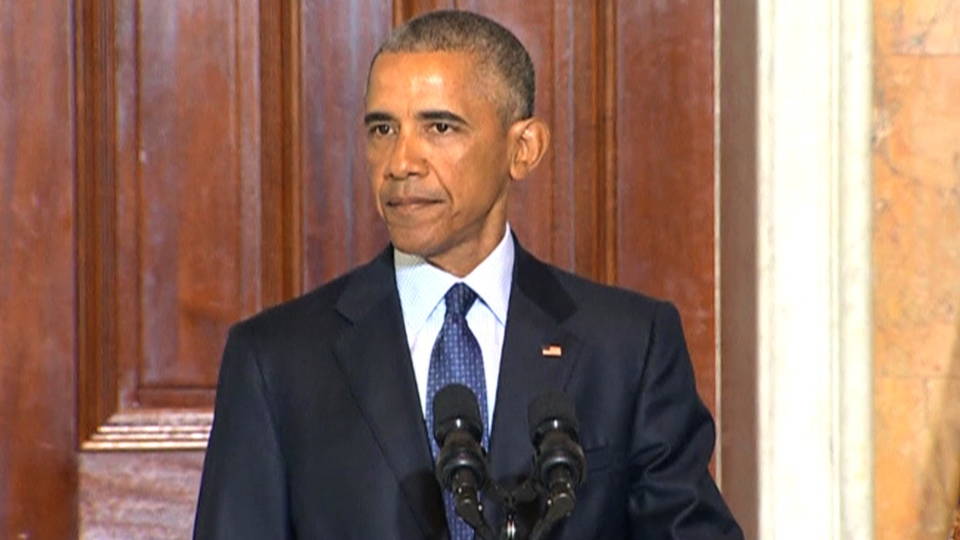
President Obama has taken aim at presumptive Republican presidential nominee Donald Trump over Trump’s vow to ban Muslims from entering the United States. Following the Orlando attacks, Trump expanded his call for a ban, saying he would apply it to any country with a history of terrorism against the U.S. and its allies. The Orlando shooter was born in New York City. Speaking Tuesday, President Obama blasted Trump’s remarks.
President Barack Obama: "We hear language that singles out immigrants and suggests entire religious communities are complicit in violence. Where does this stop? The Orlando killer, one of the San Bernardino killers, the Fort Hood killer, they were all U.S. citizens. Are we going to start treating all Muslim Americans differently?"
TOPICS:
Obama
Muslim
Donald Trump
Trump Accuses Obama of Being Angrier with Him Than Orlando Shooter
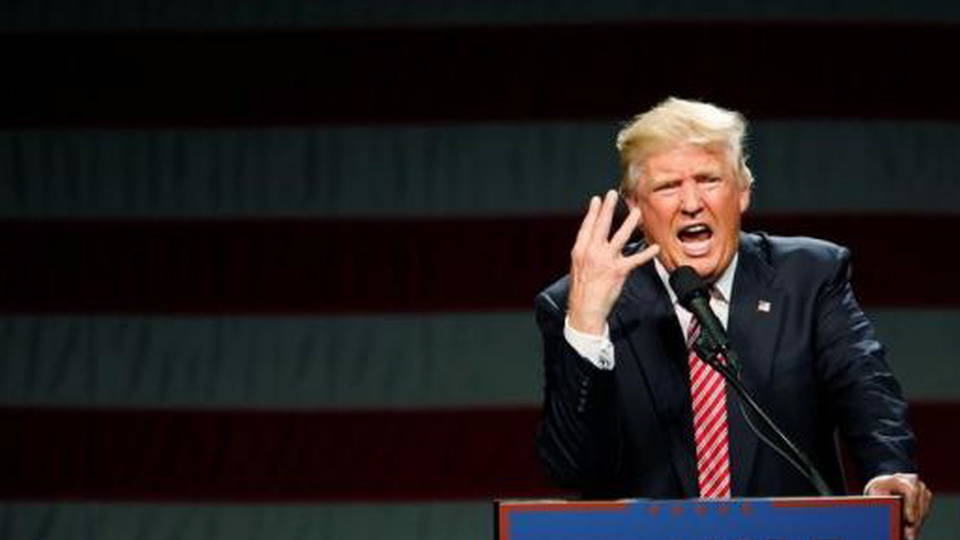
In an email to the Associated Press, meanwhile, Trump accused Obama of "priorit[izing] our enemy over our allies, and for that matter, the American people." Speaking in Greensboro, North Carolina, Trump also accused Obama of being angrier at him than the Orlando shooter.
Donald Trump: "And I watched President Obama today, and he was more angry at me than he was at the shooter. And many people said that. One of the folks on television said, 'Boy, has Trump gotten under his skin.' But he was more angry—and a lot of people have said this. The level of anger, that’s the kind of anger he should have for the shooter and these killers that shouldn’t be here."
TOPICS:
Donald Trump
Obama
Orlando Massacre
Paul Ryan: Trump's Ban on Muslims Not "In Our Country's Interest"
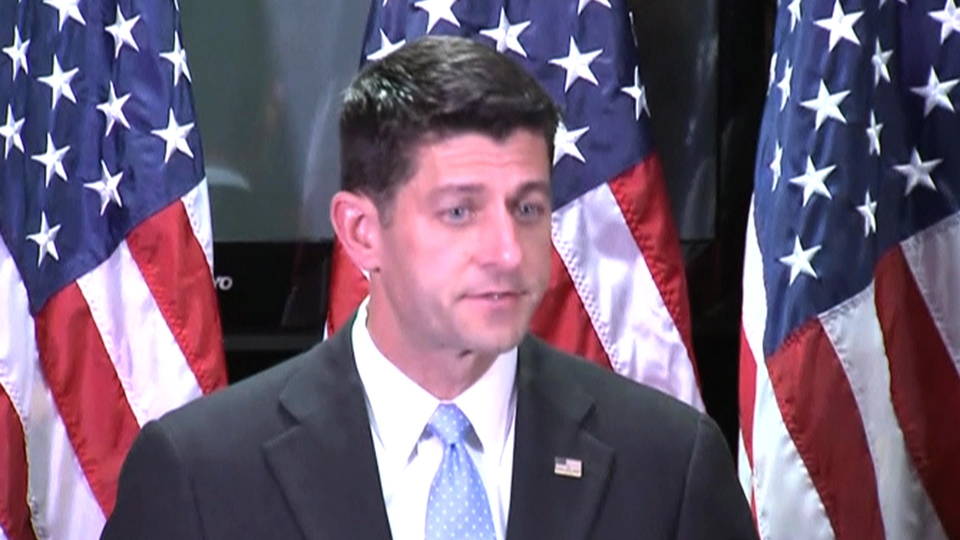
Top Republicans have sought to distance themselves from Trump’s remarks on Muslims. Senate Majority Leader Mitch McConnell refused to answer questions about Trump at his weekly news conference, but told The Huffington Post Trump’s ban is a "bad idea" and there are "an awful lot of patriotic, loyal American Muslims." House Speaker Paul Ryan also criticized Trump’s remarks.
House Speaker Paul Ryan: "I do not think a Muslim ban is in our country’s interest. I do not think it is reflective of our principles, not just as a party, but as a country. And I think the smarter way to go, in all respects, is to have a security test and not a religious test."
TOPICS:
Republican Party
Donald Trump
Paul Ryan
Muslim
Hundreds Protest Outside NRA Headquarters to Call for Assault Weapons Ban
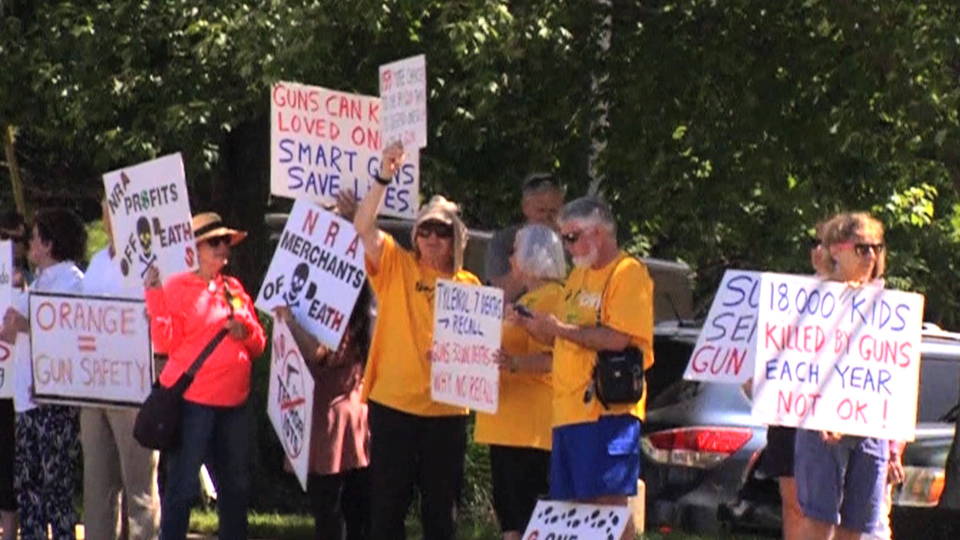
Following the Orlando massacre, President Obama has called for the reinstatement of the assault weapons ban and measures to prevent suspected terrorists from obtaining guns. One of the two guns used by Orlando shooter Omar Mateen was an AR-15 semiautomatic assault rifle, the same style used in the massacres in San Bernardino, California; at a movie theater in Aurora, Colorado; and at Sandy Hook Elementary School in Newtown, Connecticut. On Tuesday, hundreds of people gathered outside the headquarters of the National Rifle Association in Fairfax, Virginia, to call for gun control measures. Troy Petenbrink was among them.
Troy Petenbrink: "We need the assault weapon ban to be back in place. We need to keep these guns off the street and unavailable. We’re not talking about hunting rifles. We’re not talking about your basic guns that you need for protection. That’s all fine and good. We all support that. What we don’t support is literally weapons of mass destruction—49 people killed in a matter of minutes."
TOPICS:
Gun Control
Orlando Massacre
Report: More Than 90% of Terror Suspects Were Cleared to Buy Guns

California Democratic Senator Dianne Feinstein has released new statistics showing more than 90 percent of known or suspected terrorists who have attempted to buy a gun since 2004 have passed a background check and been cleared to do so. The data from the Government Accountability Office shows between 2004 and 2015 nearly 2,500 people on the watch list applied to purchase weapons; nearly 2,300 of them were approved. Last year, individuals on the terrorist watch list were involved in background checks to purchase firearms 244 times — only 21 of those were denied.
TOPICS:
Orlando Massacre
Gun Control
Clinton Wins D.C. Primary, Holds Meeting with Sanders
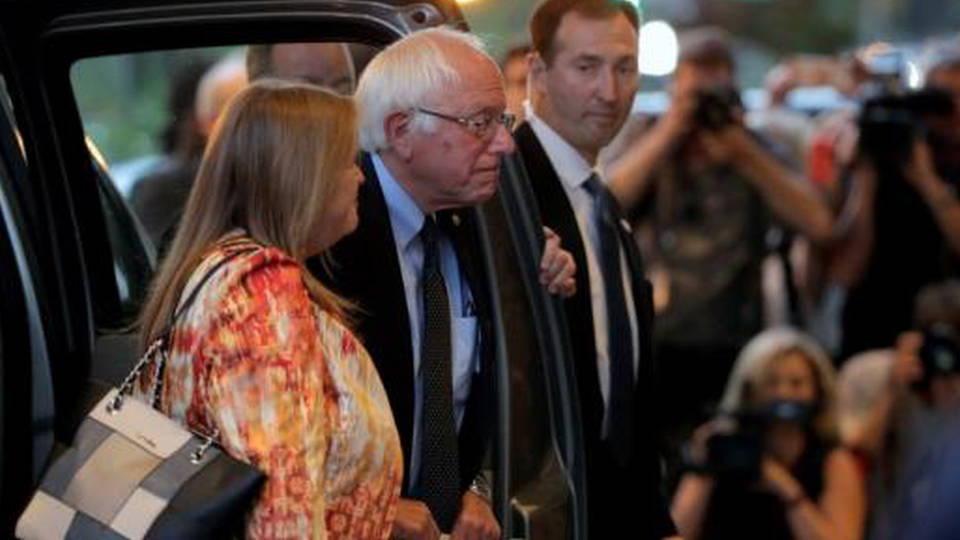
Hillary Clinton has won the final Democratic primary in Washington, D.C. Clinton met with rival Bernie Sanders for nearly two hours Tuesday night. In statements afterwards, the campaigns said they had agreed to work together on a "progressive agenda" for the Democratic Party platform in July. Sanders had issued a series of demands ahead of the meeting, including an end to the superdelegate system, the removal of DNC Chair Debbie Wasserman Schultz, and the most progressive Democratic platform in the party’s history. Sanders is expected to address his supporters by video message Thursday night.
TOPICS:
Hillary Clinton
Bernie Sanders
Democratic Party
2016 Election
Jill Stein Wins Green Party Primary, Calls for Inclusion in Debates
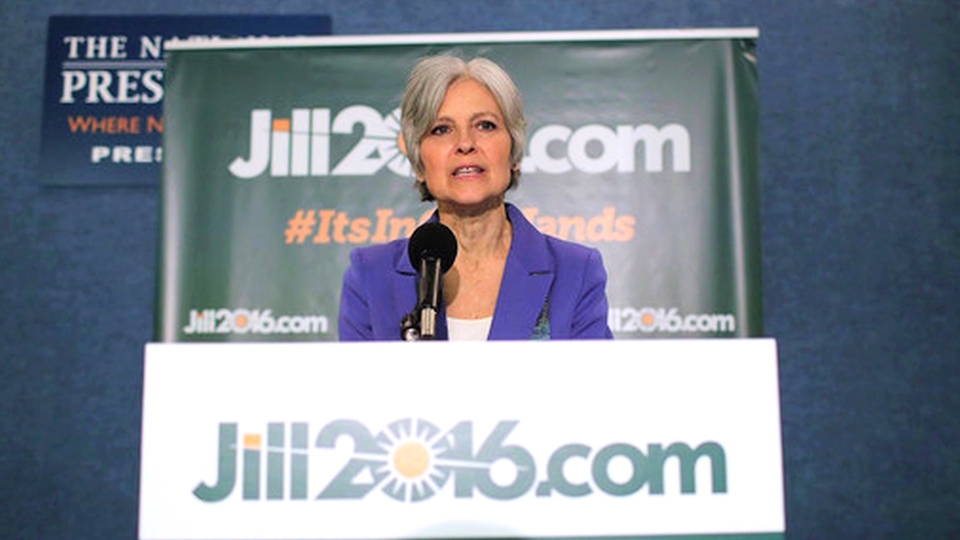
Meanwhile, Green Party presidential candidate Jill Stein’s campaign has announced she has secured enough delegates to secure the Green Party’s nomination. After winning the majority of Green Party delegates in California, New York and Maryland, Stein has the support of 203 delegates, enough to secure the nomination at the party’s convention in August. Stein says a recent poll shows her with 5 percent support nationally. She has called for opening up the upcoming presidential debates to include third-party candidates.
TOPICS:
Green Party
2016 Election
Report: Russian Hackers Broke into DNC Networks, Stole Info on Trump
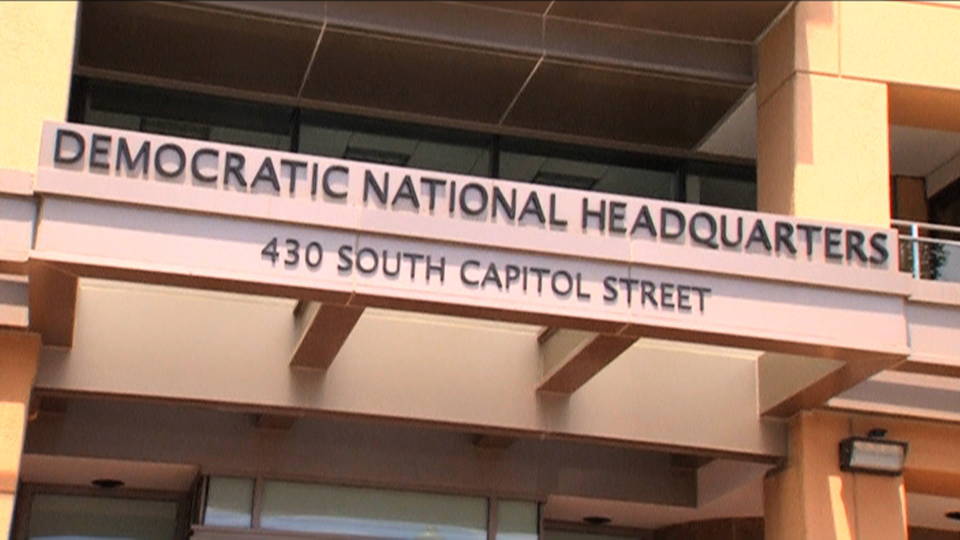
The Washington Post reports Russian government hackers broke into the computer networks of the Democratic National Committee, accessing the DNC’s entire database of opposition research on Donald Trump. The hackers were reportedly able to read all email and chat traffic, and some had access to the network for about a year.
TOPICS:
Russia
Democratic Party
In Win for Net Neutrality, Court Rules Internet Can Be Regulated as a Utility

In a victory for advocates of the open internet, a federal court has ruled high-speed internet can be defined as a utility. The decision affirms the Obama administration’s moves to protect net neutrality by preventing corporate service providers from blocking access to websites, slowing down content or providing paid fast lanes for internet service. The FCC approved the rules last year after receiving a record 4 million public comments. In a statement, the group Free Press called Tuesday’s ruling "a huge victory for the millions and millions of internet users who have fought for years for Net Neutrality." The telecom companies who oppose the rules may appeal to the Supreme Court.
TOPICS:
Net Neutrality
Internet
Judge in Stanford Rape Case Removed from Similar Case After Outcry

In California, a judge who gave a former Stanford University swimmer a six-month sentence after he was convicted of sexually assaulting an unconscious woman has been removed from a similar case. Judge Aaron Persky sparked a national outcry and an effort to recall him, after expressing concern a longer prison term could have a "severe impact" on Brock Allen Turner. At the request of prosecutors, Persky has been removed from another case involving a male nurse accused of sexually assaulting an anesthetized patient. Click here to see our report on how, moments before sentencing Brock Turner, Judge Persky dealt another light sentence to a domestic violence abuser.
TOPICS:
Rape
Sexual Assault
California
CIA Files Show Prisoner Waterboarded 83 Times Would Have Cooperated Before Torture
A cache of declassified documents has revealed new details about the CIA’s torture program. Among other findings, the records show a prisoner who was waterboarded 83 times was likely willing to cooperate with interrogators before the torture. The account from medical personnel who helped with the first waterboarding of Abu Zubaydah deals a major blow to the CIA’s insistence it gained crucial information through torture.
TOPICS:
CIA
Torture
Guantánamo Prisoner Gets Hearing After 9 Years Without an Attorney
Meanwhile, an Afghan prisoner at Guantánamo received a hearing before a review board Tuesday after advocates say he went nine years without an attorney. The group Reprieve said Haroon al-Afghani, who has never been charged, has gone without an attorney since arriving at Guantánamo in 2007. Reprieve attorney Shelby Sullivan Bennis represented al-Afghani at Tuesday’s hearing after meeting him for the first time last week. In a statement, Sullivan Bennis said, "Very little is known to the world about Haroon, and Guantánamo’s secrecy laws currently ban me from filling in the blanks. I can say that my new client is every bit as heartbroken by the senseless violence in Orlando as I am, and presented for his Monday meeting with tears in his eyes."
TOPICS:
Guantanamo
Afghanistan
Donate today:
Follow:


SPEAKING EVENTS
Hundreds of people gathered at a church in Orlando, Florida, Tuesday night to mourn the 49 victims of Sunday’s attack on an LGBT nightclub, the deadliest mass shooting in modern U.S. history. More information has begun to emerge about the shooting at the Pulse nightclub as survivors of the attack tell their stories. Patience Carter was shot in both legs but survived, after being trapped in a bathroom with the shooter, Omar Mateen. She says she heard Mateen call 911 to say he was carrying out the massacre because he wanted the United States to stop bombing "his country." Mateen was born in the United States; his parents are from Afghanistan. Carter gave her account on Tuesday.
Patience Carter: "And after that, he even spoke to us directly in the bathroom. He said, 'Are there any black people in here?' I was too afraid to answer, but there was an African-American male in the stall where most of my body was, majority of my body was, had answered, and he said, 'Yes, there are about six or seven of us.' And the gunman responded back to him saying that, 'You know, I don't have a problem with black people. This is about my country. You guys suffered enough.’ And he just—he made a statement saying that it wasn’t about black people. This isn’t the reason why he was doing this. But through the conversation with 911, he said that the reason why he was doing this is because he wanted America to stop bombing his country."
TOPICS:
Afghanistan
Orlando Massacre
Orlando Survivor Delivers Poem: "The Guilt of Being Alive is Heavy"
Patience Carter was at the club with a friend, Tiara Parker, and the friend’s cousin, 18-year-old Akyra Murray, who perished in the attack. Murray and Carter had initially escaped the club, but went back in to look for Parker. All three were shot, Murray fatally. Carter delivered a poem about the guilt she felt for surviving.
Patience Carter: "The guilt of feeling lucky to be alive is heavy / It’s like the weight of the ocean’s walls / Crushing uncontrolled by levies / It’s like being dragged through the glass / With a shattered leg and thrown on the back of a Chevy / It’s like being rushed to the hospital / And told you’re going to make it / When you lay beside individuals / Whose lives were brutally taken / The guilt of being alive is heavy."
TOPICS:
Orlando Massacre
Orlando Shooter Omar Mateen's Wife Could Face Charges
Meanwhile, the shooter’s wife could face criminal charges if authorities establish she knew about the attack in advance. Noor Zahi Salman has reportedly told agents she tried to talk Mateen out of the shooting. Multiple sources have said Mateen was a regular at the Pulse nightclub and had contacted people on gay dating apps like Grindr. But the club has denied he was ever a patron.
TOPICS:
Orlando Massacre
Obama Blasts Trump's Call for Banning Muslims from Entering U.S.
President Obama has taken aim at presumptive Republican presidential nominee Donald Trump over Trump’s vow to ban Muslims from entering the United States. Following the Orlando attacks, Trump expanded his call for a ban, saying he would apply it to any country with a history of terrorism against the U.S. and its allies. The Orlando shooter was born in New York City. Speaking Tuesday, President Obama blasted Trump’s remarks.
President Barack Obama: "We hear language that singles out immigrants and suggests entire religious communities are complicit in violence. Where does this stop? The Orlando killer, one of the San Bernardino killers, the Fort Hood killer, they were all U.S. citizens. Are we going to start treating all Muslim Americans differently?"
TOPICS:
Obama
Muslim
Donald Trump
Trump Accuses Obama of Being Angrier with Him Than Orlando Shooter
In an email to the Associated Press, meanwhile, Trump accused Obama of "priorit[izing] our enemy over our allies, and for that matter, the American people." Speaking in Greensboro, North Carolina, Trump also accused Obama of being angrier at him than the Orlando shooter.
Donald Trump: "And I watched President Obama today, and he was more angry at me than he was at the shooter. And many people said that. One of the folks on television said, 'Boy, has Trump gotten under his skin.' But he was more angry—and a lot of people have said this. The level of anger, that’s the kind of anger he should have for the shooter and these killers that shouldn’t be here."
TOPICS:
Donald Trump
Obama
Orlando Massacre
Paul Ryan: Trump's Ban on Muslims Not "In Our Country's Interest"
Top Republicans have sought to distance themselves from Trump’s remarks on Muslims. Senate Majority Leader Mitch McConnell refused to answer questions about Trump at his weekly news conference, but told The Huffington Post Trump’s ban is a "bad idea" and there are "an awful lot of patriotic, loyal American Muslims." House Speaker Paul Ryan also criticized Trump’s remarks.
House Speaker Paul Ryan: "I do not think a Muslim ban is in our country’s interest. I do not think it is reflective of our principles, not just as a party, but as a country. And I think the smarter way to go, in all respects, is to have a security test and not a religious test."
TOPICS:
Republican Party
Donald Trump
Paul Ryan
Muslim
Hundreds Protest Outside NRA Headquarters to Call for Assault Weapons Ban
Following the Orlando massacre, President Obama has called for the reinstatement of the assault weapons ban and measures to prevent suspected terrorists from obtaining guns. One of the two guns used by Orlando shooter Omar Mateen was an AR-15 semiautomatic assault rifle, the same style used in the massacres in San Bernardino, California; at a movie theater in Aurora, Colorado; and at Sandy Hook Elementary School in Newtown, Connecticut. On Tuesday, hundreds of people gathered outside the headquarters of the National Rifle Association in Fairfax, Virginia, to call for gun control measures. Troy Petenbrink was among them.
Troy Petenbrink: "We need the assault weapon ban to be back in place. We need to keep these guns off the street and unavailable. We’re not talking about hunting rifles. We’re not talking about your basic guns that you need for protection. That’s all fine and good. We all support that. What we don’t support is literally weapons of mass destruction—49 people killed in a matter of minutes."
TOPICS:
Gun Control
Orlando Massacre
Report: More Than 90% of Terror Suspects Were Cleared to Buy Guns
California Democratic Senator Dianne Feinstein has released new statistics showing more than 90 percent of known or suspected terrorists who have attempted to buy a gun since 2004 have passed a background check and been cleared to do so. The data from the Government Accountability Office shows between 2004 and 2015 nearly 2,500 people on the watch list applied to purchase weapons; nearly 2,300 of them were approved. Last year, individuals on the terrorist watch list were involved in background checks to purchase firearms 244 times — only 21 of those were denied.
TOPICS:
Orlando Massacre
Gun Control
Clinton Wins D.C. Primary, Holds Meeting with Sanders
Hillary Clinton has won the final Democratic primary in Washington, D.C. Clinton met with rival Bernie Sanders for nearly two hours Tuesday night. In statements afterwards, the campaigns said they had agreed to work together on a "progressive agenda" for the Democratic Party platform in July. Sanders had issued a series of demands ahead of the meeting, including an end to the superdelegate system, the removal of DNC Chair Debbie Wasserman Schultz, and the most progressive Democratic platform in the party’s history. Sanders is expected to address his supporters by video message Thursday night.
TOPICS:
Hillary Clinton
Bernie Sanders
Democratic Party
2016 Election
Jill Stein Wins Green Party Primary, Calls for Inclusion in Debates
Meanwhile, Green Party presidential candidate Jill Stein’s campaign has announced she has secured enough delegates to secure the Green Party’s nomination. After winning the majority of Green Party delegates in California, New York and Maryland, Stein has the support of 203 delegates, enough to secure the nomination at the party’s convention in August. Stein says a recent poll shows her with 5 percent support nationally. She has called for opening up the upcoming presidential debates to include third-party candidates.
TOPICS:
Green Party
2016 Election
Report: Russian Hackers Broke into DNC Networks, Stole Info on Trump
The Washington Post reports Russian government hackers broke into the computer networks of the Democratic National Committee, accessing the DNC’s entire database of opposition research on Donald Trump. The hackers were reportedly able to read all email and chat traffic, and some had access to the network for about a year.
TOPICS:
Russia
Democratic Party
In Win for Net Neutrality, Court Rules Internet Can Be Regulated as a Utility
In a victory for advocates of the open internet, a federal court has ruled high-speed internet can be defined as a utility. The decision affirms the Obama administration’s moves to protect net neutrality by preventing corporate service providers from blocking access to websites, slowing down content or providing paid fast lanes for internet service. The FCC approved the rules last year after receiving a record 4 million public comments. In a statement, the group Free Press called Tuesday’s ruling "a huge victory for the millions and millions of internet users who have fought for years for Net Neutrality." The telecom companies who oppose the rules may appeal to the Supreme Court.
TOPICS:
Net Neutrality
Internet
Judge in Stanford Rape Case Removed from Similar Case After Outcry
In California, a judge who gave a former Stanford University swimmer a six-month sentence after he was convicted of sexually assaulting an unconscious woman has been removed from a similar case. Judge Aaron Persky sparked a national outcry and an effort to recall him, after expressing concern a longer prison term could have a "severe impact" on Brock Allen Turner. At the request of prosecutors, Persky has been removed from another case involving a male nurse accused of sexually assaulting an anesthetized patient. Click here to see our report on how, moments before sentencing Brock Turner, Judge Persky dealt another light sentence to a domestic violence abuser.
TOPICS:
Rape
Sexual Assault
California
CIA Files Show Prisoner Waterboarded 83 Times Would Have Cooperated Before Torture
A cache of declassified documents has revealed new details about the CIA’s torture program. Among other findings, the records show a prisoner who was waterboarded 83 times was likely willing to cooperate with interrogators before the torture. The account from medical personnel who helped with the first waterboarding of Abu Zubaydah deals a major blow to the CIA’s insistence it gained crucial information through torture.
TOPICS:
CIA
Torture
Guantánamo Prisoner Gets Hearing After 9 Years Without an Attorney
Meanwhile, an Afghan prisoner at Guantánamo received a hearing before a review board Tuesday after advocates say he went nine years without an attorney. The group Reprieve said Haroon al-Afghani, who has never been charged, has gone without an attorney since arriving at Guantánamo in 2007. Reprieve attorney Shelby Sullivan Bennis represented al-Afghani at Tuesday’s hearing after meeting him for the first time last week. In a statement, Sullivan Bennis said, "Very little is known to the world about Haroon, and Guantánamo’s secrecy laws currently ban me from filling in the blanks. I can say that my new client is every bit as heartbroken by the senseless violence in Orlando as I am, and presented for his Monday meeting with tears in his eyes."
TOPICS:
Guantanamo
Afghanistan
Donate today:
Follow:
SPEAKING EVENTS


Watch: Michael Ratner Memorial
WEB EXCLUSIVE

Just Before Giving Stanford Rapist 6 Months, Judge Dealt Another Light Sentence to Domestic Abuser
WORK WITH DN!

News Producer
Office Coordinator
Senior TV Producer
207 West 25th Street, 11th Floor
New York, New York 10001, United States
---------------------
---------------------

No comments:
Post a Comment