Editor's Note:
Dear Friend,
I’m grappling with shocking news. Rabbi Daniel Moscowitz, my father’s friend and colleague, whom I had known literally since I was born, suddenly passed away at the age of 59, leaving behind nine children and hundreds of congregants. As a family friend, I was in shock. As a reporter at Chabad.org/News, I immediately began collecting data for our obituary for the man who led Chabad in Illinois for as long as I’ve been alive. All throughout the night, my mind kept on wandering, thoughts drifting back to the bereaved family and the nightmare that was just beginning for them.
Among the seven bookcases that adorn my living room, there is one section dedicated to various editions of the Torah (yes, we have a lot). One edition is especially precious to me. It was my first sefer (holy book), a gift from Rabbi and Mrs. Moscowitz on the occasion of my upsherin (third birthday and first haircutting).
Tonight, I think I will take the slim red volume with the peeling binding down from the bookshelf and use it to learn with my kids.
It will be my way to perpetuate a life that was dedicated to Torah and Judaism.
Menachem Posner,
on behalf of the Chabad.org Editorial Team
Do you have something to say about this note? Please click here to leave a response or ask a question.
Daily Thought:
UnApocalypse
This world was not created for some apocalyptic finale; its magnificence was not formed to dissipate into ionized gas. Each thing was formed for the glory of its Maker who stands forever.
Only the darkness must wind itself to its end, and it must be robbed of the treasures it holds. For the most precious things of this world are held in darkness.
That is why we must struggle with the darkness now and not run from it. All the torment it gives us, all our toil to overcome it, to tame it and to dig out the diamonds it conceals, all is with meaning and purpose.
For each obstacle that meets us on our uphill battle, each was made for the glory of its Maker.
-------
This Week's Features:
It’s All About the Timing
Did you ever wonder what would happen if the bird got there too early? by Sholom Kesselman

There’s an old English proverb: “The early bird catches the worm.” The earlier you get started, the better your shot at success.
But did you ever wonder what would happen if the bird got there too early? If the worm hasn’t emerged yet, then being early is not an advantage.
In life, we are often impatient. We are eager to move on to the next big thing, and we rush to get there as soon as we can. We feel like that next milestone must be met today and that next goal needs to be achieved now.
But is this really a healthy urge? Do we sometimes fall into the trap of “arriving” too early?
This year, in the Jewish calendar, is a leap year. We add an extra month (Adar I) so that Passover will fall during the spring.
The Jewish months are based on the cycle of the moon, with every month being just about 29.5 days. Twelve such months give you 354 days—11 days less than the solar year of 365 days. After three such years, we are 33 days ahead of the solar year, and thus Passover would fall out during the late winter instead of spring.
To avoid falling into this trap, we have the leap year. We add an extra month of Adar, thereby slowing us down and timing the arrival Passover to coincide perfectly with the spring.
There is a profound lesson here: rushing ahead is not always advantageous.
When our forefather Abraham set out to sacrifice his son Isaac, we are told, “And Abraham woke up early in the morning.” The Talmud learns from this that one should always set out to perform a mitzvah at the soonest possible time—like Abraham, who woke up earlier than usual and set out to fulfill the special commandment he received from G‑d.
But if so, why didn’t he leave in middle of the night?
The answer is the same. Early is good, but too early is not. Abraham needed to be well rested for his long journey, and leaving in the middle of the night could have jeopardized the whole mission. Also, travelling at night can be dangerous.
So although eager to set out in fulfillment of G‑d’s wishes, Abraham knew that it would be wiser to wait until morning.
Back to Passover.
Passover is the festival of freedom. We went from being slaves to a foreign power to becoming our own sovereign nation. Every year on Passover we are reborn and get the chance to start over. One can become an entirely new person and begin a brand new spiritual life.
It is only appropriate for this holiday to be in the spring. Spring is that season of new beginnings. During winter the trees stand bare, everything comes to a standstill and there is little movement or growth. With spring, a whole new life emerges. Trees put out leaves, flowers begin to bloom--a new year is ushered in.
Winter is simply not the optimal time for making big changes and new beginnings. The atmosphere is cold and people are gloomy. If we would attempt to get ahead and experience the festival of freedom too early, in middle of the winter, we might find ourselves lacking the motivation, and therefore despairing--never again to attempt such a change.
But if we get the timing right and make the new beginning in the spring, when the atmosphere is bright and people’s spirits high, we have a much better shot at success. “Keep the month of spring, and make Passover to the L‑rd, your G‑d” the Torah tells us. It is the right time for the holiday of Passover.
The same is true in life. Just because something is good, it doesn't mean it's good for you now. One has to make sure the timing is right before setting off in pursuit of a dream.
Getting married and starting a family is a major milestone. It is a dream we all share and a goal we all aspire to. But one needs to be ready. If one is not yet mature, it's probably best to wait before deciding upon a soul-mate.
Accepting a promotion at work can be a wonderful opportunity. But again, the timing has to be right. If as a result, the person won't have the time for family, it’s probably best to wait. Maybe once children have grown up and become more independent, the time will be right to accept it.
When it comes to raising children, this lesson cannot be overstated. Many parents have the urge to push their children to do too much. Every accomplishment has to make sense for the child at his or her age, and the timing has to be right.
Let’s heed the message of the leap year to slow down and live life in the present, without always rushing ahead to the next big thing. Let’s appreciate what we have now and keep in mind – it’s all about the timing.
Rabbi Sholom Kesselman lives in Los Angeles CA. He teaches Chassidus at the Yeshiva Ohr Elchonon Chabad and advanced Talmud at the Cheder Menachem junior high.
© Copyright 2014, all rights reserved.
-------
PARSHAH
Food for Growth
Split hooves, cud chewing, fins and scales, a tradition of edible birds—as lessons in parenting. by Chana Weisberg

Judy is expecting her first child, and is doing everything she can to guarantee its healthy growth. Judy prepares her meals carefully to ensure a sufficient supply of essential nutrients. She swallows her daily prenatal vitamins and exercises regularly as per her doctor’s recommendations. Naturally, Judy never smokes, and tries to avoid inhaling secondhand smoke. When Judy reads about the benefits of exposing her unborn baby to music, she begins playing evocative, aesthetic melodies. Recently, Judy became aware of a study about the benefits of reading stories to babies in utero. Judy or her husband, Jim, now dutifully read nightly to their baby. Judy doesn’t regard her behavior as extreme or fanatical. Neither do her husband or her friends. They feel it is natural to do the utmost for one’s unborn baby. In fact, Judy is constantly seeking out more ways to nurture the physical, emotional or spiritual development of her child. In this week’s Torah reading, Shemini (Leviticus 9–11), G‑d commands the kosher laws, identifying the animal species permissible and forbidden for consumption. Land animals may be eaten only if they have split hooves and chew their cud, while fish must have fins and scales. There are no signs for kosher fowl, but rather a tradition affirming which species are not kosher. “We are what we eat” is a popular adage. Our physical food is transformed into blood and flesh, becoming an integral part of our being. As parents, we monitor our children’s physical nourishment and recognize the influence of environment—even for a fetus within its mother’s womb. Spiritually, too, the intrinsic qualities within our food help mold our spiritual persona. The Torah prohibits non-kosher foods to prevent us from assimilating the negative characteristics of those foods. What are the traits of kosher animals, embodied by their signs of kashrut? And, what do these signs indicate about which positive qualities to cultivate within our children? a) Kosher land animals have split hooves and chew their cud. A closed, unsplit hoof represents rigidity, being closed off and untouched by the plight of others. The split hoof, on the other hand, symbolizes approachability and sensitivity to others’ suffering and needs. It also epitomizes a receptiveness to further growth. Foster within your child an openness and awareness of others. Sustain his interest for continual learning and growing. The kosher animal that chews its cud symbolizes a thoughtfulness and “chewing over” of teachings and circumstances. Teach your child to think over a situation before reacting in the heat of anger, recklessness or impatience. Show him how to take a step back and consider a proper response or course of action. Shape him into a more insightful individual by analyzing wisdom with him and showing him how to internalize it. b) Kosher fish have fins and scales. Scales, which cover the fish like a protective armor, signify the quality of integrity and morality. Develop within your child the ability to stay true to his inner self. Teach him how to protect himself from outside temptations. Fins, propelling the fish forward, represent ambition. Maximize your child’s talents and capabilities by feeding his ambition to advance and improve himself. The Talmud teaches that all fish that have scales also have fins, but some fish with fins do not have scales and are not kosher. Having fins (ambition) without scales (morality) can lead to less-than-kosher behavior. Too many people, in their climb to success, abandon their values along the way. Encourage your child to use his drive—but charted by a moral guide. c) Kosher fowl do not have specific signs, but are determined by our tradition, which affirms which species are kosher. The fowl reminds us of the need for tradition and a higher guidance. There are times when every individual, no matter how intelligent or talented, will gain from seeking the guidance of those wiser or more experienced. Instill within your child the value of consulting a mentor, and you will help him bypass many faulty courses in life. What emotional or spiritual profile would you like to build in your child? Sensitivity, thoughtfulness and consideration are indispensable qualities. A drive to accomplish tempered by moral integrity is also an essential life skill. Add the ability to know when to seek guidance, and you have a winning combination. The food we consume has a profound affect on our wellbeing. In your efforts to nourish your child’s personality, appreciate the profound spiritual effect of his food on his developing psyche. Chana Weisberg is the editor of TheJewishWoman.org. She lectures internationally on issues relating to women, relationships, happiness, self-esteem and the Jewish soul. She has authored 5 books and her latest, Listening to the Whispers – Stories that Speak to the Heart and Soul has just been released to rave reviews. About the artist: Sarah Kranz has been illustrating magazines, webzines and books (including five children’s books) since graduating from the Istituto Europeo di Design, Milan, in 1996. Her clients have included The New York Times and Money Marketing Magazine of London. © Copyright 2014, all rights reserved.
________________________________________
More in Parshah:
• On the Essence of Circumstance (Based on the teachings of the Lubavitcher Rebbe)

Benevolence and truth are met together; righteousness and peace have kissed.--Psalms 85:11
“Benevolence”—this is Aaron; “truth”—this is Moses. “Righteousness” is Moses; “peace” is Aaron.
Midrash Rabbah
Can Truth and Benevolence indeed meet? Where and how do Righteousness and Peace converge? Do not Moses and Aaron represent intrinsically incompatible realities?
Truth is resolutely objective, while benevolence is gloriously subjective. Peace advocates compromise, which is anathema to rightness. Yet for forty years Moses and Aaron jointly led the people of Israel. The Torah (which freely reports on the negative occurrences within the Israelite camp, including failings on the part of both Moses and Aaron), describes the relationship between the brothers as one of mutual regard and unflagging harmony. In the formative period between their exodus from Egypt and their entry into the Land of Israel, the people of Israel were guided by a leader who conveyed to them the absolute, immutable truth of the divine wisdom and will, and simultaneously led by one who empathized with their human equivocality, and was a master peacemaker and compromiser, resolving conflicts “between a man and his fellow and a man and his wife.”
To understand the relationship between Moses and Aaron, we must examine the single instance in which their respective modes of leadership did come into conflict. For the Torah records one occasion on which the brothers were in disagreement—a disagreement in which Moses was provoked to anger, but then conceded to Aaron.
The Uneaten Offering
It was first of Nissan of the year 2449 from Creation (1312 BCE), two weeks before the first anniversary of the Exodus—the day on which the Sanctuary was erected and dedicated. Actually, the Sanctuary had already been in operation for seven days, but these were “training” days, in which Aaron and his sons were initiated into the priesthood. It was on this, the eighth day, that Aaron assumed his role as kohen gadol (high priest), and the manifest presence of G‑d (the Shechinah) came to dwell in the Sanctuary.
But then tragedy struck. Aaron’s two elder sons, Nadav and Avihu, “offered strange fire before G‑d, which G‑d had not commanded. A fire came forth from before G‑d and consumed them, and they died before G‑d” (Leviticus 10:1–2). G‑d commanded that the dedication of the Sanctuary should not be disrupted. Although Aaron and his two remaining sons now had the status of first-day mourners (onenim), who are ordinarily forbidden to eat the holy meat of the offerings, they were expressly commanded to partake of the special offerings which were brought that day for the dedication of the Sanctuary.
This Aaron, Elazar and Itamar did. But there was also another offering brought that day, one that was not connected with the dedication per se. This was the goat which is brought on the first of every month as a sin-offering. It was over this offering that Moses and Aaron had their disagreement.
Moses saw that the flesh of the goat had been burned, as the law mandates should be done with an offering which for whatever reason cannot be eaten. He angrily demanded why it wasn’t eaten as G‑d had commanded concerning the other sacrifices.
Aaron explained that he had drawn a distinction between kodshei shaah, offerings which G‑d commands to bring on a one-time basis under special circumstances, and kodshei dorot, regularly scheduled offerings which apply equally to all generations. If G‑d commanded something concerning the one-time offerings brought for the Sanctuary’s dedication, argued Aaron, one should not deduce that the same is to apply to the monthly sin-offering. Here the regular laws, which forbid its consumption by a mourner, should apply.
Moses listened to Aaron’s argument and conceded that he was right. He freely admitted that the distinction had escaped him, and that Aaron had concluded correctly.
Absolutism and Vicissitude
Here we have the confrontation between Truth and Benevolence, between Righteousness on the one hand and Peace on the other. Moses, as transmitter of Torah—truth par excellence—saw no reason to distinguish between kodshei shaah and kodshei dorot, between something that is a product of the specialty of the moment and that which is routine in man’s service of G‑d. What is true and right is always true and right, regardless of the circumstances.
Aaron, on the other hand, was the high priest of Israel, the very embodiment of a people’s striving to come close to and serve their G‑d. He understood that man’s service of G‑d is an offering of the sum total of what man possesses, a giving of the utmost of his or her subjective self. He appreciated that there are up and downs in the life of man, and that which is expected of him in his finest, most inspired hours does not necessarily apply to his routine, everyday self.
Hence the conflict. On one side stands Moses, conveying the divine truth and will—a truth and will as unequivocal as their conceiver. On the other side stands Aaron, leading a people’s endeavor to approach that very truth and that very will with the tools of their human selves—a subjective mind with which to seek, an equivocal heart with which to feel, and actions subject to the circumstances under which they are undertaken.
And what happens? Moses agrees with Aaron! Absolute truth grants legitimacy to the “sub-truths” of a relative world.
Indeed, what did happen? How has this seemingly irresolvable contradiction been resolved?
Points of Contact
What happened was that Moses gained a deeper understanding into the nature of truth.
When contemplating and discussing our own, decidedly subjective, reality, we freely use the adjective “truth.” We speak of our “true feelings” and our “true desires”; we claim to “truly understand” something, or to have discovered “the true facts” surrounding a certain occurrence. But if we define “truth” as a reality that is absolute and unequivocal, it would seem that the term could be correctly applied to only to the consummate truth of the divine. Are all applications of term to our circumstantial reality nothing more than self-deceptions?
Chassidic teaching says not. Indeed, the prophet (Jeremiah 10:10) proclaims, “G‑d is truth”; but the chassidic masters understand this to mean not only that G‑d is the essence of truth, but also that He is the source of all that goes by the name of “truth” in our world. His truth is absolute; all other “truths” are relative, with no inherent reality other than that which He chooses to grant them. But it is He who created these subjective realities, and in doing so, He has imparted a legitimacy and truth to their existence. So, if we find relative truths in His creation, these are expressions (albeit imperfect expressions) of His all-pervading truth—-as manifested within the bounds of the many “worlds” or realities which He has created.
In other words, when a person gives it his “all,” his ultimate, he attains a personal absolute—something which, within the context of his subjective personal world, is true. And all truth, including such subjective truths, are expressions of a deeper truth that is their source and empowerer—the truth of their Creator. So, his personal truth touches the truth of G‑d.
This is the joint legacy of Moses and Aaron: that we must strive towards the truth, guided by the directives of Torah and utilizing the talents and resources which we have been granted. We need not be dissuaded from our quest by the finitude of our understanding, the subjectivity of our feelings and the circumstantiality of our deeds. If our efforts are true—albeit “true” only within the context of our relative existence—then “Moses” will concede to “Aaron” that this truth is part and parcel of the Absolute Truth toward which we strive.
Based on the teachings of the Lubavitcher Rebbe, Rabbi Menachem Mendel Schneerson; adapted by Yanki Tauber.
Originally published in Week in Review.
Republished with the permission of MeaningfulLife.com. If you wish to republish this article in a periodical, book, or website, please email permissions@meaningfullife.com.
© Copyright 2014, all rights reserved.
-------
• Do We Love Too Much? (By Yanki Tauber)
short/ cir/cuit (elect.): an abnormal, usually unintentional, condition of relatively low resistance between two points of different potential in a circuit, usually resulting in a flow of excess current.
Random House Dictionary of the English Language

Do we love too much?
Apparently we do. Many marriages fail for a dearth of love; an equal number are suffocated by an overabundance of the same.
So desirous are we for connection, so hungry for communion with another human being, that we forget that for love to endure it must be complemented with an equal measure of restraint. So eager are we to give of ourselves to the one we love—be it a spouse, a child or a friend—that we often give without consideration of the needs and desires of the recipient of our love.
When passion is mitigated with a degree of inhibition, when intimacy is tempered with a modicum of reserve, love flourishes. But when all limits are betrayed, love burns out.
A love relationship can thus be compared to an electrical circuit. In a circuit, the attraction between the positive and negative charges creates a current of energy joining the two; the current meets with a certain degree of resistance as it passes through the circuit, delimiting its intensity. The natural tendency of this attraction is to seek the shortest possible route, carrying the highest possible current, to join the attracted charges. But should this tendency be indulged—should the “resistance” fall—the circuit will “short”: the current will escalate, ultimately causing the destruction of the circuit and the breakdown of the very connection which the current seeks to create.
The book of Leviticus speaks of the tragic death of Aaron's two elder sons, Nadav and Avihu.
After many months of labor and anticipation, the Sanctuary had finally been set up in the Israelite camp, and the Divine Presence came to rest within it. Amidst the joyous dedication ceremonies, “Nadav and Avihu each took his censer, and put fire in it, and put ketoret (incense) on it, and offered strange fire before G‑d, which He commanded them not. A fire went out from G‑d, and consumed them, and they died before G‑d” (Leviticus 10:1–2).
In his commentary on the Torah, the great sage and mystic Rabbi Chaim ibn Attar explains that Nadav and Avihu died from an overdose of love.
Once a year, on Yom Kippur, the high priest would enter the innermost chamber of the Sanctuary, the Holy of Holies, to offer ketoret to G‑d. This occasion—on which the most spiritual human being performed the most sacred service in the holiest place in the world on the holiest day of the year—was the point of utmost intimacy with G‑d attained by man. Nadav and Avihu were priests, but not high priests (though they would have been, had they lived to succeed their father in that office); it was a very special occasion, marked by special offerings to G‑d, but it was not Yom Kippur. But their thirst for intimacy with G‑d could not be satisfied by anything less than the ultimate. They wanted to get closer yet, though “He commanded them not.”
Human life is a love affair between the soul and her G‑d. Our passion for life is a craving for the “spark of G‑dliness” implicit within every one of G‑d’s creations; ultimately, everything we do is motivated by our soul’s desire to draw closer to our Source. So powerful is this desire that it can lead us to do things that are contrary to G‑d’s will—things that violate the bounds of our love and destroy it.
For our marriage to live and thrive, we must feed our passion for life; but we must also know when to hold back. As in every truly loving relationship, we must learn to love in the manner that our beloved needs and desires to be loved.
By Yanki Tauber; based on the teachings of the Rebbe.
© Copyright 2014, all rights reserved.
-------
• Shemini Poem (By Chana Engel)
There are days when we feel like saving the world,
So morally conscious and good.
And there are days when we just want to indulge,
Have a good bite to eat if we could.
There are moments of feeling so connected to G‑d,
We just stop in our tracks and pray.
But there are down times too, when we’re simply mundane,
Just trudging through life day by day.
This push and this pull, this up and this down,
These are really two forces around.
Ratzo—the desire to cleave close to G‑d,
Shov—the pull back to the ground.
One is the lofty, the other is grounded,
Idealistic versus practical.
There’s a head in the clouds, or feet on the ground,
In short—Spiritual against Physical.
Which one to choose? The former, of course!
That’s what G‑d wants, it would seem.
Aharon’s sons thought so too, Nadav and Avihu,
When they offered up incense to Him.
But this offering was strange and foreign to G‑d,
That He hadn’t commanded them to burn.
And so a fire came forth and roasted them whole,
And to heaven they did return.
So strong was their yearning to come close to G‑d,
That their souls flew out of their bodies, on high.
To be right by His throne—well, that’s what they got;
Natural consequence—they died.
Weren’t they spiritual? Yes. Holy? No doubt!
Sanctified? G‑d Himself said so!
But they forgot that we’re meant to serve G‑d down on earth,
To heaven we aren’t running to go.
Excess ratzo—you named it, their problem precisely,
“Out of this world,” literally,
But if you lean towards shov, like most of us here,
It’s a life shallow and empty.
We need to find the balance between these two extremes,
The point where heaven and earth meet.
To draw the spiritual down into the mundane,
Turn inspiration into something concrete.
It’s the fusion between the ideal and reality,
To take on something too good to be true,
And hope for it, believe in it, sit down and plan it,
That is the role of a Jew.
So when you feel that yearning to plug in above,
Make a blessing on the apple you eat.
Don’t just meditate on His infinite greatness,
But offer your friend a seat.
And with your head reaching high into the clouds,
Yet feet planted firmly on the ground,
By stretching yourself from one extreme to the next,
A giant of a person can be found.
Chana Engel grew up in Melbourne, Australia, and shares her poems with a wide-ranging circle of Jews. She is currently studying in Israel.
© Copyright 2014, all rights reserved.
-------
• Shemini in a Nutshell

On the eighth day, following the seven days of their inauguration, Aaron and his sons begin to officiate as kohanim (priests); a fire issues forth from G‑d to consume the offerings on the altar, and the divine presence comes to dwell in the Sanctuary.
Aaron’s two elder sons, Nadav and Avihu, offer a “strange fire before G‑d, which He commanded them not” and die before G‑d. Aaron is silent in face of his tragedy. Moses and Aaron subsequently disagree as to a point of law regarding the offerings, but Moses concedes to Aaron that Aaron is in the right.
G‑d commands the kosher laws, identifying the animal species permissible and forbidden for consumption. Land animals may be eaten only if they have split hooves and also chew their cud; fish must have fins and scales; a list of non-kosher birds is given, and a list of kosher insects (four types of locusts).
Also in Shemini are some of the laws of ritual purity, including the purifying power of the mikvah (a pool of water meeting specified qualifications) and the wellspring. Thus the people of Israel are enjoined to “differentiate between the impure and the pure.”
© Copyright 2014, all rights reserved.
-------
VIDEO
Why Are Things Going Wrong?
A candid texting conversation between a teen and a rabbi about the big questions we all have but are afraid to ask.
Watch (3:11)
<script language="javascript" type="text/javascript" src="http://embed.chabad.org/multimedia/mediaplayer/embedded/embed.js.asp?aid=2497018&width=auto&height=auto"></script><div style="clear:both;">Visit <a href="http://www.chabad.org/multimedia/default_cdo/aid/591213/jewish/Video.htm">Jewish.TV</a> for more <a href="http://www.chabad.org/multimedia/default_cdo/aid/591213/jewish/Video.htm">Jewish videos</a>.</div>
________________________________________
More in Video:
• Divided for the Sake of Heaven
<script language="javascript" type="text/javascript" src="http://embed.chabad.org/multimedia/mediaplayer/embedded/embed.js.asp?aid=2498797&width=auto&height=auto"></script><div style="clear:both;">Visit <a href="http://www.chabad.org/multimedia/default_cdo/aid/591213/jewish/Video.htm">Jewish.TV</a> for more <a href="http://www.chabad.org/multimedia/default_cdo/aid/591213/jewish/Video.htm">Jewish videos</a>.</div>
-------
• Can a Snake Become Kosher? (Aaron L. Raskin)
<script language="javascript" type="text/javascript" src="http://embed.chabad.org/multimedia/mediaplayer/embedded/embed.js.asp?aid=1822516&width=auto&height=auto"></script><div style="clear:both;">Visit <a href="http://www.chabad.org/multimedia/default_cdo/aid/591213/jewish/Video.htm">Jewish.TV</a> for more <a href="http://www.chabad.org/multimedia/default_cdo/aid/591213/jewish/Video.htm">Jewish videos</a>.</div>
-------
YOUR QUESTIONS
I Have a Great Job, but It Requires Me to Work on Shabbat . . .
In this industry, I have only Saturday and Sunday to conduct business. by Moshe Goldman

Question:
I have a dilemma. I have just started a new employment position. In this industry, I have only Saturday and Sunday to conduct business. I hate it. This means that, yes, I am violating all the Shabbat rules.
But at the same time, this job is the best thing that has happened to me. This job is the culmination of all my hard work in school, and the company is great. I love the job, and I have something I have never had before: friends. I am making money and I finally have a life, a life with friends.
Do I leave the job, or is there some sort of compromise I can make?
Answer:
I’m doing my best to relate to your situation, never having been in such a predicament. And from what I can muster, I can already see how difficult it must be. Long-awaited success on so many levels, versus the high price you must pay.
I cannot make the decision. But let me provide some perspective.
Your worry stems from the fact that you finally got what you’ve been hoping for, and it would be tough to give it up. But the One who made it happen for you now, can make it happen again. Why He would decide to give you such a difficult test, only He knows. But your responsibility is to realize that there are other jobs out there—which doesn’t imply that it will be easy, just feasible.
A word about your challenge: The Lubavitcher Rebbe once told someone who was engaged to a non-Jewish woman, “I envy you.” The man was understandably shocked. The Rebbe explained as follows: “You have been given an enormously difficult test. The spiritual and moral growth you will experience if you successfully withstand the test far exceeds anything I can imagine. I envy the opportunity you have to develop your soul’s muscles.” I think the same can apply to you.
You are facing the challenge of Shabbat, a test that Jewish immigrants to the USA faced in the first half of the 20th century. Those who withstood the test were able to inspire their children to follow in their footsteps, because they had experienced the battle and won. They could honestly tell their children that Shabbat was of utmost importance, and their words were meaningful—they had their lost jobs to back them up. Others didn’t find the strength to withstand the monumental test. What happened to their children? What legacy did they impart to the next generation?
Again, I’m not judging you or them—I’m just trying to give a little perspective, the larger picture.
You stand at the threshold now. Hang in there and make the right choice.
Rabbi Moshe Goldman for Chabad.org
Rabbi Moshe Goldman is the Director of Chabad of the Waterloo Region in Waterloo, Ontario. He is also a member of the Chabad.org Ask the Rabbi team.
© Copyright 2014, all rights reserved.
________________________________________
More in Your Questions:
• Why Is It Taking So Long to Find the Right One? (By Aron Moss)

Question:
I have friends who got engaged to the first person they ever dated, and are now married with kids. Yet here I am, many years and many, many dates later, and I still haven’t met the right person. Have I done something wrong, maybe in a past life, to deserve this as punishment?
Answer:
There are many possible reasons why you haven’t found the right one yet. But the mere fact that you are still waiting doesn’t mean there is something wrong with you.I still haven’t met the right person
The Talmud compares the miracle of finding one’s soulmate to the miracle of G‑d splitting the Red Sea. Most people assume that the sages simply meant to illustrate the magnitude of the miracle. In fact, there’s more to the comparison than meets the eye.
You’re probably familiar with the basics, but there are a few details about that great crossing you may not know. For instance, the Red Sea is not along the direct route from Egypt to Israel. G‑d led the Israelites on a detour simply to give them a glimpse of His power. Walking on the dry seabed with the waters standing as walls on each side was a revelation that dwarfed the miracles they had witnessed in Egypt. The Israelites left the sea a changed nation.
Another little-known fact is that the Israelites didn’t actually cross the sea. Their path was a big U-shape, beginning and ending on the same bank. This meant that not everyone spent the same amount of time “in the water.” Those who were on the inside lane had a short sojourn in the dried-up sea, while those in the outer lanes had a longer trek.
Why were some in the sea longer than others? Some find the direct path; other take the scenic routePerhaps some people needed to bask longer in G‑d’s miracle to truly absorb it. Or perhaps they had the spiritual depth to be able to handle more divine revelation. The longer they spent in the sea, the deeper the experience of divine wonder. Either way, each person witnessed as much of the miracle as he or she needed to.
So it is with the miracle of marriage. Some find the direct path to their soulmates; others take the scenic route. Hold on tight. You, too, will get through the sea. Even if there’s no end in sight, keep the faith. Your intended may be just around the next bend.
Aron Moss is rabbi of the Nefesh Community in Sydney, Australia, and is a frequent contributor to Chabad.org.
© Copyright 2014, all rights reserved.
-------
STORY
Can Hair Grow on the Hand’s Palm?
G-d’s ways are indeed mysterious. by Chana Weisberg

Dear readers,
At our Friday night meal, my daughter shared with us an incredible story that she heard in school (taken from the book Aleinu L’Shabe’ach).
Yitzchak Slutzky was a 16-year-old boy whose family was murdered by the Nazis. He and his little sister managed to escape and hide in a dank underground cellar. Yitzchak would venture outside only to find provisions.
One time, Yitzchak returned to find his sister missing. His neighbors confirmed his worst fears, pointing to the Nazi headquarters at the center of the village.
Disregarding his own safety, Yitzchak burst into the building screaming, “Bring me my sister, now!”
Contemptuously, the Nazi commander replied, “I’ll give you back your sister on one condition. Open your palm and show me that there is hair on it.”
Obediently, Yitzchak held out his hand. The commander nearly fainted. There was hair growing on his palm!
“Give him his sister,” the frightened commander shouted. “And get him out of here immediately!”
Yitzchak and his sister survived the war.
Nine years earlier, Yitzchak had injured his hand and was rushed to the hospital. The doctor performed a skin graft, but the transplanted skin had hair growing from it, and hair continued to grow from his palm ever since.
“My mother was very grateful that my hand healed, but was distressed by its abnormal appearance. She would tell me to hide my hand in my pocket,” Yitzchak recalled. “My friends would tease me, and I was so embarrassed by its strange sight. Only G‑d knew that the hair growing on my hand’s palm would one day save my little sister.”
G‑d’s ways are indeed mysterious.
There are times in our lives when we can look back at a chain of events and finally understand why it had to happen. Sometimes, it can take many years—nine for Yitzchak—until comprehension dawns. And sometimes, we may never merit understanding. We are just left with our belief that our Creator seeks only our good.
This week we celebrated the holiday of Purim. The Jews in Persia merited to clearly see how the intricate chain of events was the prelude to their miraculous victory.
This week on TJW, we begin an amazing new blog by Chana Scop called Simply Special: A Mother’s Endless Love for Her Special-Needs Son. Through her poignant and deep posts, Chana teaches us so much about finding the good even in the challenging moments of our lives.
In Me Vs. We, Penina Taylor describes what she learned about the Jewish community through her parent’s tragic passing.
May the day quickly dawn when we too can understand how the stage of exile has been set only for our benefit, as we prepare for the ultimate redemption.
Chana Weisberg,
Editor, TJW
Join the Discussion
Chana Weisberg is the editor of TheJewishWoman.org. She lectures internationally on issues relating to women, relationships, happiness, self-esteem and the Jewish soul. She has authored 5 books and her latest, Listening to the Whispers – Stories that Speak to the Heart and Soul has just been released to rave reviews.
© Copyright 2014, all rights reserved.
-------
WOMEN
Welcome

Welcome to Simply Special, a blog about a mother’s endless love for her special-needs son. by Chana Scop
Seven years ago, our family welcomed our special-needs son, Chaim Boruch, into our lives. I remember the tubes, wires, monitors, all connected to my baby. I remember the team of doctors, the surgeons, the medications, and the tense atmosphere in the Intensive Care Unit at UCSF. I remember looking at my child with the heart-wrenching tightness that filled my every cell. I remember the oxygen flowing to my child. I remember the oxygen I learned to breathe on that 14th floor of my nightmarish days.
I actually thought I knew how to breathe up until that point in my life. But I didn’t. I also thought I knew what “faith” and “trust” meant. But I didn’t.
Until that special day.
I say “special” now, and didn’t know it then. I, too, went through all the “healthy” phases of such a challenging moment. Anger. Self-pity. Denial. Frustration. Wonder. Yet, after time, tears and deep reflection, I can now call that day “special.”
I’m not the same woman, wife and mother that I was. And even my heart beats differently, a rhythm that I didn’t know existed. I have learned the beauty of being open, of letting go, of loving what is different, of acceptance, of forgiveness—both of myself and others. I am learning about myself, my essence, my soul. I am on a journey, embracing a life of simplicities that only we can perceive. Dancing to a melody only we can create. Just Chaim Boruch and I.
And for this alone, I will always be grateful.
So, dear friends, I welcome you to join me on my journey. A journey that vacillates between the rock-bottom moments and the sky-high, euphoric milestones.
Of everything different. Of everything the same.
Of everything simple. Of all things special.
Welcome to Simply Special, a blog about a mother’s endless love for her special-needs son.
Chana is a proud wife and mother of seven living in Mill Valley, California. She is inspired by the colors and textures of everyday life, and loves sharing her creative ideas with her community. Chana writes DIY projects, crafts and recipes celebrating her Jewish life and shlichus on her blog Chana’s Art Room, and is the co-director of Chabad of Mill Valley with her husband, Rabbi Hillel Scop. To read more about Chaim Boruch, and Chana’s journey, take a look at her personal special needs blog: Life of Blessing.
© Copyright 2014, all rights reserved.
______________________________________
More in Women:
• 4 Easy Steps for Dealing with Negative People (By Naomi Ruth Freeman)

Dear Rachel,
There is a woman in my social circles who seems to have an agenda to create conflict with anyone around her. This can range from sneers, to derogatory remarks, to a strategic and manipulative picking apart and tearing down of a person’s very psyche and being. Oddly, some people actually seem to enjoy her behavior and, strangely, seem to “get a kick” out of it. I am not one of them. I feel intimidated and threatened, and I even find myself changing my plans just to avoid this person.
Please help. I don’t want to live in fear and apprehension of this person. I don’t think anything about it is right. But I don’t know how to make it stop. If I confront her, it just adds fuel to the fire, as she loves confrontation. I feel I can’t even go to events and celebrations without the foreboding dread of having to cross paths with this woman. This can’t be healthy. What can I do?
Thanks,
Tired of Being Afraid
Dear Tired of Being Afraid,
Probably, we all have at least one person in our life who just brings us down and creates negativity, and you are wise to search for an answer to your challenge. And you’re right, no one should have to live in constant fear or apprehension of another person. Leviticus 25:17 says, “You shall not wrong one another.” This has traditionally been interpreted as wronging a Some people actually seem to enjoy her behaviorperson with speech. So, how do you handle individuals who consistently cause you conflict and pain with their words?
You may want to avoid this woman, but that may impede your ability to live and enjoy life. Additionally, you certainly don’t do yourself any favors by running from life’s challenges.
So, how do you handle this type of situation?
Before you can effectively deal with someone who causes conflict and pain in your life, you need to come to the realization that this person, your “opponent,” is not really your opponent.
Often, the behaviors we exhibit as adults are rooted in our childhood. For example, a child acts out in school and receives (negative) attention. Or a child gets hurt, and the adults make a fuss over him. And now, all of a sudden, that child now stands out. He feels, in a sense, special.
Sooner or later, most children realize that this type of “specialness” is an ill-gotten identity, and they understand that they can do better than that.
But, for various reasons, not all children get past this stage. Even as adults, they continue to reinforce their identity with the pain they feel or the trouble they cause. If people don’t give them enough attention, then they seek it out. After all, their very being needs it, craves it, feels as if they can’t survive without it. This can take on many forms, including an individual who is always bemoaning his situation, or someone who is always attacking others.
So, you are not dealing with an opponent, but rather with an opponent’s created negative identity. Once that is understood, half the battle is already won.
The second step is to be very present when your paths cross. Don’t think about the past, don’t think about the future; only absorb the moment you are in. Be cognizant of the fact that all that exists is energized by G‑d, as it says in Psalms 46:11: “Be still and know that I am G‑d.” Listen to your breathing; be aware of your heart’s beat and the life that pulses through you. Be quiet, be calm, be aware and alert.
The third step is to be very, very careful not to judge. You don’t know, and may never know, where that person is coming from and why she is the way she is. It is really tempting to judge, but don’t act on it—just let it go.
The fourth step is to surrender. In the Shemoneh Esrei prayer, we say, “To those who curse me, let my soul be silent; let my soul be like dust to everyone.” Initially, this seems like a very weak stance to take, and you may wonder how you are going to overcome anything with this type of outlook. But, truly, it is the most powerful stance. Martial arts use the same concept: “Yield to overcome.” Rather than resisting a person’s negativity, which just energizes it, let that person’s negativity just pass you by. With nowhere to go, the negativity will “boomerang” back to its source in a weakened state.
There are many ways to yield to overcome, but to give an example, I once saw a hot-tempered restaurant owner who was unjustly and fiercely berating his employee. The employee was a very good worker, but the owner had had a bad day and was taking it out on his employee. The employee The owner had had a bad day and was taking it out on his employeecalmly listened to his tirade and just let it pass by her like water. She then calmly thanked him for his input and stated that she understood his angst, but since she was doing her best, and it still was not satisfactory, she would go ahead and find alternative employment. She did it so calmly, and without judgment or sarcasm, that it stopped the restaurant owner in his tracks. After stumbling about for words, he became apologetic and never treated his employee like that again. In fact, he became her biggest fan.
Another beautiful example was skillfully demonstrated by a young man who was explaining his Judaism in his classroom at school, when another student began to taunt the young man. “You are Jewish only because your parents brainwashed you. It’s all fake, you don’t know anything!” the fellow student sneered.
The young man could have angrily lashed back, feeding further into the conflict. But he retained his composure, remained alert and present in the moment, and allowed his mind to not judge his accuser or himself, but to simply observe the accusation.
The young man then yielded to the accusation and realized that he was brainwashed. His parents had brainwashed him to have respect for other people and for himself, to value his integrity and to do his best, and they enriched his life with love, faith, character, and so many other powerfully good things. The young man then felt sorry for his accuser that he didn’t have parents who also gave him those values. He then wielded the very words of his accuser to neutralize the conflict, and simply stated, “You can call it brainwashing if you want; that’s fine. I call it teaching.”
To recap, just keep to these steps:
Understand that you are not dealing with your opponent, but rather your opponent’s conflict-based identity.
Be very present. Be calm and focused.
Do not judge, just observe.
Yield to overcome.
Now that you are aware of these steps, you may be able to apply them to many other situations that cause conflict and pain in your life. It may just take you by surprise how the conflict and pain will finally be healed.
Naomi Ruth Freeman is from the Black Hills of South Dakota. A lifelong scholar of the Bible and religion, she eventually decided to convert to Judaism. She now resides on the East Coast of the U.S. and is the founder of New Run Athletic and N. R. Freeman Design. She can be contacted via her website.
© Copyright 2014, all rights reserved.
-------
JEWISH NEWS
19th-Century Documents Uncover Origins of the Rebbe’s Hereditary Honor
Research for a new book on the life of the Rebbe—Rabbi Menachem M. Schneerson, of righteous memory—has uncovered mid-19th century records in the Russian State Historical Archive in St. Petersburg that shed important light on a chapter of Lubavitch history long clouded by the mists of time.
Chabad.org Staff

Copy of the certificate bestowing Hereditary Honored Citizen upon the Tzemach Tzedek and his descendants, signed by five officials and members of the Russian Senate: “In our order of April 10, 1832, we established the title of Honored Citizen, with the accompanying rights. “Since the faithful Honored Citizen, the Jew Mendel son of Shachna Schneerson, merchant of the second guild, has proven through documents his right to the title Hereditary Honored Citizen, the citizen, the Jew Mendel son of Shachna Schneersohn and his wife Mushka, and their children… shall be raised to the status of Hereditary Honored Citizen. Now by our order, all his descendants may make use of all privileges granted by this title, just as he himself can.” (Photo: JEM)
Research for a new book on the life of the Rebbe—Rabbi Menachem M. Schneerson, of righteous memory—has uncovered mid-19th century records in the Russian State Historical Archive in St. Petersburg that shed important light on a chapter of Chabad-Lubavitch history long clouded by the mists of time. The documents reveal the origins of the Rebbe’s status as “Honorary Hereditary Citizen” of the Tsarist Empire and offer new insight into how Chabad’s 19th-century leaders dealt with the challenges of their times.
The new information was discovered as part of a multi-year research project into the seventh Rebbe’s early life. Spearheaded by Chabad’s audio-visual preservation and production agency, Jewish Educational Media (JEM), the fruits of this meticulous fact-finding effort are chronicled in a new book titled “The Rebbe’s Early Years,” which will be published in July.
“The goal of the project,” explains Rabbi Levi Greisman, the project’s manager, is to “offer a 360-degree picture of the Rebbe’s early life by presenting every extant document,” including government records, letters, diaries and school papers.
The completed work will include facsimiles of primary sources, an explanatory commentary in English, and copious citations and cross-references.
Refusing to rely on tradition or second-hand testimony, the team decided not to take any fact for granted. Upon encountering the appellation “Hereditary Honored Citizen” in the Rebbe’s birth certificate, Greisman set out to find the documentation behind the title. As it turned out, his insistence proved not so trivial after all.

This page from the Jewish community’s Registration Book of Jewish Births of 1902-1903 in Nikolayev, Ukraine is the record of the Rebbe Rabbi Menachem Mendel Schneerson’s birth. The middle entry reads: “Jewish date of birth: 11 Nissan. Circumcised, 18. Place of Birth: Nikolayev. Parents’ Names and Rank: Father – Hereditary Honored Citizen Levi son of Zalman, Schneerson. Mother – Chana. Name and gender of child: Boy, Menachem Mendel.” (Photo: JEM)
Trove of Czarist Documents
The records newly unearthed in St. Petersburg date from the days of the Rebbe’s 19th-century namesake and ancestor, Rabbi Menachem Mendel of Lubavitch (1789-1866), the third Rebbe of Chabad, commonly referred to as the “Tzemach Tzedek.”
The history of the title, which in Imperial Russia was the highest rank short of titular nobility, finds its origins in the recently discovered imperial documents from the court of Czar Nicholas I.
These documents invoke a little-known law entitling anyone who settled more than 100 Jews on their own land to seek Hereditary Honored Citizenship. As his father-in-law, the second Chabad Rebbe, had done before him, and his grandfather, Chabad’s founder, had done before him, Rabbi Menachem Mendel assisted Jews to own and settle land as a way to advance their tenuous economic and political situation.
![First page of letter from the Tzemach Tzedek to the Governor of the Mogilev region
“Based on the fact that I have complied with all the above requirements of the law, I request… that you refer [to the Senate] on my behalf that I earned the title Hereditary Honored Citizen, for myself, and for my entire family.” (Photo: JEM)](http://w3.chabad.org/media/images/807/rpXb8079499.jpg)
First page of letter from the Tzemach Tzedek to the Governor of the Mogilev region “Based on the fact that I have complied with all the above requirements of the law, I request… that you refer [to the Senate] on my behalf that I earned the title Hereditary Honored Citizen, for myself, and for my entire family.” (Photo: JEM)
Dated between the years 1849 and 1852, the documents note that in 1846, Rabbi Menachem Mendel purchased an estate—named Schedrin —of 17.5 square kilometers, lying slightly southeast of Babruysk, Belarus. He settled 60 Jewish families on the land, provided them with building materials and other necessary equipment, and ceded them each a rent free agricultural allotment for a period of 25 years.
In recognition of these services to the community, records show, the Governing Senate of the Russian Empire designated Rabbi Menachem Mendel a Hereditary Honored Citizen.

Last page of letter from the Tzemach Tzedek to the Governor of the Mogilev region. The letter is signed in Russian by the Tzemach Tzedek. (Photo: JEM)
This status—which Rabbi Menachem Mendel obtained for himself and all members of his family and descendants in perpetuity—would protect generations of Chabad leaders from the draft and from other forms of prosecution, as well as enable them to act as more effective ambassadors for Jews and for Judaism in the offices of the Imperial bureaucracy.
Tireless Research Bears Rich Fruit
This insight into the Rebbe’s family background is one part of the decade-long effort by a dedicated research and editorial team to document the Rebbe’s early life.

Rabbi Menachem Mendel, known as the Tzemach Tzedek, was the third-great-grandfather and namesake of the Rebbe. (Photo: JEM)
In 1998, Rabbi Baruch Oberlander, Ph.D., a noted scholar of Jewish law and history who is the head Chabad rabbi in Hungary, began compiling a list of primary sources related to the Rebbe’s early years. A few years later, JEM began collecting information and interviewing people for its My Encounter with the Rebbe oral history project.
Rabbi Elkanah Shmotkin, executive director of JEM and the book's co-author, and Oberlander decided to join forces, and also gained the active cooperation of Rabbi Shalom DovBer Levine, chief librarian of the Central Chabad-Lubavitch Library in New York. For more than a decade, the team has utilized the technical skills of professional researchers and academics to scour archives across Europe, making a number of remarkable discoveries.
Professor Carol Shyman, a researcher affiliated with the University of Paris (UPMC, formally the Sorbonne), has been involved in JEM’s project since 2006. It was Shyman who combed through page after page of university records to find the Rebbe’s enrollment in courses at the Sorbonne in 1937 and 1938.
![First page of Letter of recommendation from the residents of Schedrin.
“We the Jewish agriculturists here in the town of Schedrin… [attest that] from the day in 1846 when we settled on the land of our landowner, the Honored Citizen Mendel son of Shachna Schneerson, until today, he did not receive any payment from us for his land, but rather he helped us every year with acquiring animals, working the land, and with our other business needs…
Therefore we compose this letter of recommendation… that he should receive [the title] he deserves by law… which will enable him to continue to assist us.”](http://w3.chabad.org/media/images/807/KuEk8079501.jpg)
First page of Letter of recommendation from the residents of Schedrin. “We the Jewish agriculturists here in the town of Schedrin… [attest that] from the day in 1846 when we settled on the land of our landowner, the Honored Citizen Mendel son of Shachna Schneerson, until today, he did not receive any payment from us for his land, but rather he helped us every year with acquiring animals, working the land, and with our other business needs… Therefore we compose this letter of recommendation… that he should receive [the title] he deserves by law… which will enable him to continue to assist us.”
“Compared to other research projects,” Shyman says, the JEM team displays an unmatched “sense of preciousness” towards every piece of data. “They encouraged me to delve further and further until I had found every last detail.”
In late 2011, when Greisman decided to find out why the title came to appear of the Rebbe’s birth record, he commissioned Ifrah Abramov, a St. Petersburg historian and genealogist who has worked for JEM on a number of assignments, to seek additional information in the Russian State Historical Archive.

Second page of letter of recommendation from the residents of Schedrin. (Photo JEM)
“After several months of work,’’ says Greisman, “Ifrah reported that he had found a file that might solve the puzzle of the Rebbe’s honorary hereditary citizenship. Finally, we received high-quality reproductions of an entire cache of documents and czarist records.”

The Rebbe as a child. (Photo: JEM)
Many more discoveries will soon be published in “The Rebbe’s Early Years,” a comprehensive work on the Rebbe’s life, writings, travels, activities and studies that covers the years from the Rebbe’s birth in 1902 until his departure from France in 1941.
“The details of the Rebbe’s early life and his years in Europe are waiting to be told,” says Shmotkin. “We want to empower readers and scholars by putting every piece of this fascinating story directly into their hands.”
© Copyright 2014, all rights reserved.
________________________________________
More in Jewish News:
• Reb Mottel der Shoichet, 97, Survived and Detailed Life in the Gulag (By Menachem Posner)

In 1987 Reb Boruch Mordechai Lifshitz, right—or Mottel der Shoichet as he was affectionately known—received a lulav and etrog set for the holiday of Sukkot as a gift from the Rebbe.
In 1987 Reb Boruch Mordechai Lifshitz, right—or Mottel der Shoichet as he was affectionately known—received a lulav and etrog set for the holiday of Sukkot as a gift from the Rebbe.
Mottel der Shoichet, 97, was a fierce survivor of decades-long Soviet persecution. Exiled to the Soviet gulags for seven years for the crime of Torah study and his connections to Chabad, he went on to serve for decades as Moscow’s only shochet (kosher slaughterer) and mohel (circumciser).
Boruch Mordechai Lifshitz—or Mottel, as he was affectionately known—was born in Kiev in the summer of 1916, just months before the Russian Revolution swept through the region, bringing with it the oppressions and challenges that would come to shape so many Jewish lives, including his. His parents, Zalman and Frume Sarah Lifshitz, were both from families that had been adherents of the Rebbes of the Chernobyl Chassidic dynasty for generations.
Orphaned from his father at a young age, Mottel was a student at the secret chadarim (schools) organized by Chabad Chassidim in his hometown. The students would hide in synagogue attics, remaining as quiet as possible lest the authorities get wind of their presence, which they knew would spell incarceration or death for their teachers. Among Mottel’s teachers at that time were rabbis Avrohom Drizin (Mayorer), Binyamin Lipman and Yonah Zhitomerer, who inspired him with their warmth, love of Judaism and deep connection to their Rebbe—the sixth Lubavitcher Rebbe, Rabbi Yosef Yitzchak Schneersohn, of righteous memory.
Later, Mottel would also study in Yeshivah Tiferes Bachurim, a study program founded by Rabbi Yosef Yitzchak for older students who would devote their after-work hours to Torah study.
Mottel was also active on a communal level. He raised funds for Chassidim who had been arrested for their “illegal” activities on behalf of Judaism, helped create secret mikvahs (ritual baths) and Torah schools, and carried on a correspondence with his beloved Rebbe.
Then the inevitable happened. Just three days after he became engaged to be married, 23-year-old Mottel was arrested by the secret police.
Solitary in Siberia
He was accused of several serious “crimes,” including the offenses of “holding a substantial written correspondence with an agent of the Polish secret police named Schneersohn” and “gathering youth to study the banned talks and discourses of Schneersohn.” The damning evidence included Chassidic texts that he owned and a photograph of himself that he had sent to the Rebbe.

Reb Mottel was sentenced to forced labor in Siberia for spreading Judaism.
Throughout his interrogation, Reb Mottel made sure to remain silent about his comrades and their activities, only sharing the names of older men he was sure the authorities already knew.
Reb Mottel was sentenced to forced labor in Siberia, felling trees.
In his memoirs, which have been published in Yiddish, Reb Mottel wrote about the time his mother sent him a package of matzah for Passover. He decided to share them with his Jewish barrack mates, many of whom had been high-level Communist officials, victims of Stalin’s purges.
Upon touching and tasting the matzahs, many said they were flooded with memories of their Jewish upbringing in the shtetl.
“It is impossible to transcribe the emotions that those pieces of matzah brought out in these Jewish souls,” he wrote. “It was not Passover, but rather a wonderful Yom Kippur.”
Reb Mottel’s refusal to work on Shabbat cost him dearly, earning him 10 days in “kartzer”: solitary confinement in an unheated porous cell, into which the biting Siberian winds blew, until the agonized prisoner was allowed to warm up near an oven before being sent out again.
Ultimately, he was removed from “kartzer,” only to be punished for his crime of feigning illness to avoid work on Shabbat by being sent by cattle car to the goldmines of Kolyma in the Arctic Circle, where he and his comrades would work in temperatures of 50 degrees (Celcius) below zero, equivalent to 58 degrees below zero Fahrenheit, fighting with the stubborn earth.
Upon discovering their destination, many people hurtled themselves from the moving cattle car, preferring sudden death as opposed to the painful frozen starvation that awaited them—after which they would be thrown to the polar bears.
Kolyma proved to be as terrible as expected. In his memoirs, Reb Mottel described being worked for 30 hours in the biting cold, and seeing his fellow prisoners drop dead from exhaustion and malnourishment.
At family gatherings 70 years later, he often told his children and grandchildren: “While in Kolyma, my only prayer was that I would somehow be buried as a Jew, and not thrown to the beasts—and even that I did not expect. That I would one day have a family of my own was simply beyond my wildest imagination.”

Reb Mottel speaking at Chabad of Midtown Manhattan with his grandson, Rabbi Levi Haskelevich.
During the excruciating workdays, the workers sang folk songs to themselves. Reb Mottel wrote that he quietly sung the Chassidic melodies he had learned in yeshivah—most notably, the hauntingly sweet Poltava Niggun.
Saved, and Then a New Chapter
During the exceptionally cold winter of 1941-42, Reb Mottel was saved by the most extraordinary circumstances. Having gotten frostbite on his toe, he was admitted into the hospital, where his toe was partially amputated (without anaesthesia). As he recovered, he made himself useful serving the needs of other patients. By the time he was released back to his work brigade, he discovered that the camp was almost deserted—during the months he had spent in the not-as-frigid hospital, most of his fellow slave-laborers had died from the bitter cold.
For a portion of his time in Kolyma, Reb Mottel was able to avoid working on Shabbat through the help of the Jewish camp doctor, who wrote notes saying that he was ill. Eventually, the doctor stopped out of fear that the pattern would be discovered.
Although his sentence ended in 1942, Reb Mottel wasn’t able to leave the gulag until 1946, when he returned to Kiev only to discover that his friends and family were gone. His mother, sister-in-law Chana, and nephews Ben Zion and Yisroel had been killed by the Nazis in the woods of Babi Yar. His brother, Chaim Gedalya, had died on the front.
Many of his Chabad friends never returned alive from the clutches of the KGB.
Eventually, Reb Mottel learned that many Chabad Chassidim had gathered in Lemberg (Lviv), hoping to sneak under the Iron Curtain with forged Polish passports. He hastened to join them, only to discover that he was too late. The window of opportunity had clanged shut.

Reading the ketuba at the marriage of a refusenik couple in Soviet Russia.
Making peace with the situation, Reb Mottel married and started a family. His son Schneur Zalman and his daughter Chaya Sarah (Haskelevich) were born in Lviv. His daughter Shaindel (Wiener) was born later.
He later relocated to Kharkov to serve as a shochet (a skill he had learned in Chernovitz in 1949), standing in the market place unobtrusively serving slaughtering chickens for whomever came his way.
In 1957 he moved to Moscow to learn at the newly formed Yeshiva Kol Ya’akov, where he was certified as a shochet for both fowl and mammals. It was there that he also learned the craft of milah, circumcision.
Rabbi Yehuda Levin, chief rabbi of Moscow who headed the Moscow yeshivah, advised Reb Mottel to move to Frunze (Bishkek), in Kyrgyzstan, where he would put his skills to work at the service of the local Jewish community.
Eventually, the KGB caught wind of his “illegal” activities and threatened Reb Mottel with lengthy prison time unless he would start working for them as an informer. Determined never to cause harm to his fellow Jews, Reb Mottel decided to leave Kyrgyzstan, which was a problem because the KGB had his passport. A well-placed 10,000 rubles got him back his passport, and Reb Mottel was on the road back home to Kharkov—but not for long.
A Leader and an Example
Again, Levin charged him with another mission: to serve as rabbi, chazzan, shochet and mohel in the Jewish community of Sverdlovsk (Yekaterinburg), Russia, which he did until the local authorities forced him to leave.
In 1967, Levin invited Reb Mottel to join him in Moscow, where he would serve as shochet and mohel, a position he would hold for a quarter century, even as his children left the Soviet Union and settled in New York.

Rabbi Levi Haskelevich and Reb Mottel with Benjamin Nathans, professor of history at the University of Pennsylvania.
In 1973, his new son-in-law, Rabbi Berel Haskelevich, asked the Rebbe if Reb Mottel could perhaps visit for the High Holidays and Sukkot. The Rebbe demurred, asking how he would be able to leave the city of Moscow bereft of a “shochet, etc.?” (Apparently, the Rebbe did not want to write “mohel” since it was a much bigger crime in the eyes of the Soviets and might cause him harm should the note fall into the wrong hands).
Yuli Edelstein, an Israeli politician who currently serves as Speaker of the Knesset, described a circumcision he once attended in Moscow in the early 1980s. Family and friends were gathered in a basement with windows blackened by sheets. A few minutes before the ceremony was scheduled to begin, the KGB arrived banging on the door and dispersed the terrified crowd.
Reb Mottel, the mohel, had seen the commotion and waited across the street. Minutes after the KGB agents left, Reb Mottel strode in, performed the brit and left as quickly as he had come.

Reb Mottel with Yuli Edelstein, the Israeli politician and former refusenik who currently serves as Speaker of the Knesset.
Speaking at Lubavitch House at University of Pennsylvania, served by Reb Mottel’s grandchildren—Rabbi Levi and Nechama Haskelevich—Edelstein spoke of how he and his fellow refuseniks learned to stay strong in prison, despite tremendous pressure, by emulating Reb Mottel’s example.
In his memoirs, Reb Mottel wrote glowingly about messengers from the free world who would visit from time to time, singling out Rabbi Pinchas Teitz from Elizabeth, N.J., who brought him transcripts of the Rebbe’s talks, and Moshe Davidovitch, from Antwerp, who brought kosher necessities and Judaica supplies.
Rabbi Shalom Dovber Levine, chief librarian of the Library of Agudas Chassidei Chabad, whom the Rebbe sent to visit Moscow in 1988, recalls the warm greeting he received from Reb Mottel, who had learned with Levine’s father back in Kiev half-a-century earlier. “He was more than just the shochet,” he says. “He was the leader of the community in the Archipova [Choral] synagogue.”
Upon hearing how much Reb Mottel wished to read Kfar Chabad magazine—a weekly Hebrew-language publication with teachings and news relevant to the Chabad community—so that he could keep abreast of the Rebbe’s talks and initiatives, Levine surreptitiously left a copy under a book at Reb Mottel’s place in the synagogue.
Chabad Rabbi Berel Lazar, chief rabbi of Russia, remembers his first time meeting Reb Mottel back in 1987. “The situation was still quite bleak and dangerous,” he recalls. “People were afraid to speak to us foreigners, but not Reb Mottel. He came right up to me and asked if I had an Algemeiner Journal [a Yiddish-language newspaper published in New York]. Only later, after he knew that I could be trusted, did he call me into his office and explained that he did not care for the news in the paper; he just wanted to read the Rebbe’s talks that the newspaper carried, something he could not safely request from a stranger.”
Twenty years after Reb Mottel left Moscow, Lazar says he still meets people who speak of how Reb Mottel arranged Jewish weddings for them and otherwise helped them live as Jews.
“He was a brave man who risked his own safety for Judaism,” says Lazar. “At that time, the Archipova synagogue was full of informers—from the clergy to the officers. Most of the Chabad Chassidim preferred Marina Roscha synagogue, where you knew you were safe when the spies left. Reb Mottel was never afraid to be there throughout the day. His deep faith was what allowed him to survive.”
Accordingly, Reb Mottel was the address for young people wishing to learn about Jewish observance and traditions.
“When Reb Mottel would sing a niggun, you just sat and listened; it was an experience all of its own,” remembers Lazar. “He would often sing a well-known Chabad melody in which a Chassid longingly asks when he will be reunited with his Rebbe.”
In 1987, after training another shochet to temporarily take his place, Reb Mottel finally visited the Rebbe for the High Holidays—meeting his spiritual mentor for the first time. In his memoirs, he described his delight at moments that include receiving an aliyah in the Rebbe’s presence, standing near the Rebbe for the blowing of the shofar, and even receiving a lulav and etrog set for the holiday of Sukkot as a gift from the Rebbe.
In 1993, satisfied that his position would no longer go vacant, he consulted with the Rebbe and moved permanently to Brooklyn, N.Y., to be near his daughter, Chaya Sarah. He would become a fixture in the Crown Heights community for the next 21 years.
He was often seen on Thursday nights in a small room at Lubavitch World Headquarters, sitting with Russian-speaking students over a bowl of chopped tomatoes and onions, and a small bottle of vodka. In addition to learning with them, he shared inspiration and his memories from long, long ago.
Frank Neuman, a retired businessman who lives in New York and Valencia, Spain, says visiting Reb Mottel in his Brooklyn apartment this past winter was an “absolutely unforgettable” experience.
“His room was full of books, and he was studying when we came in,” says Neuman, who dropped in with Lazar for a Shabbat-afternoon visit. “He stood up to greet us and was just so thrilled to have visitors. He wanted to cut the cake, pour drinks, and do everything for us, as if we were his honored guests. There was this tremendous energy just sparkling from him. He was a beautiful representative of the Judaism that he suffered for, and I am sure that he is still doing the same, praying and fighting for those of us down here.”
Reb Mottel passed away in his 98th year, full of faith, vigor and spirit until the very end.
He is survived by his children, Schneur Zalman Lifshitz, Chaya Sarah Haskelevich, Shaindel Weiner, and dozens of grandchildren and great-grandchildren.
© Copyright 2014, all rights reserved.
-------
• Rashi Minkowicz, Mother of Eight, Role Model for Many, Passes Suddenly at 37 (By Menachem Posner)
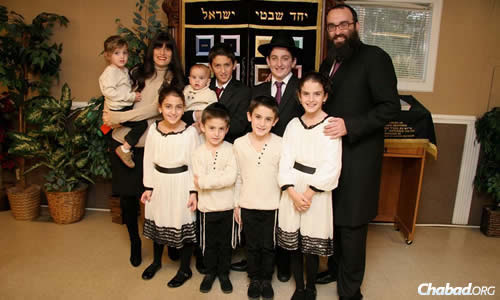
Rashi Minkowicz, Chabad emissary to Fulton County, Ga., mother of eight and mentor to many, passed away suddenly on March 11. She was 37 years old.
Together with her husband, Rabbi Hirshy Minkowicz, she built a vibrant community from the ground up since arriving in the Atlanta suburb of Alpharetta in 1998.
“She was the spine of our community,” recalls Anthony Shapiro, who credits his family’s return to Torah observance to the Minkowicz family. “She was an inspiration, not just as a rebbetzin, but as a mother and a friend—never criticizing for what we were not doing, but pointing out and celebrating what we did do.”
Born in Brooklyn, N.Y., to Rabbi Chaim Meir and Sara Lieberman, Minkowicz grew up as one of 17 siblings in a home that was open to long- and short-term guests around the clock. After graduating from Associated Beth Rivkah Schools (directed by her future father-in-law) in Brooklyn, she went on to study at the Bais Chaya Mushka Seminary in Montreal, Canada.
After her marriage, she and her husband set out to bring the passion and joy of Judaism to Alpharetta, an affluent suburb north of Atlanta with a population of nearly 60,000. “When they first arrived, there was no Torah community here,” says Shapiro. “Now there are probably 20 families that keep Shabbat, and many others who have been drawn in due to their teaching and inspiration.”
“She was a leader in so many ways—most often, by gentle example. People would watch the way she did simple things—like how she dressed her kids—and do the same. You could see how people acted differently in her presence," he says. "When my wife, Tracy, and I decided that we were ready to take on the added mitzvah of [eating] cholov Yisroel [strictly supervised kosher dairy items], Rashi brought over a beautiful dish to be used with our cholov Yisroel dairy foods.”
A Real Trailblazer
Minkowicz’s cousin, Levi Margolin, says she was a real trailblazer. “She was the first of our cousins to get married and the first to go out on shlichus,” he says. “Immediately, she started having her siblings, cousins, friends and even strangers visit and help out with whatever was going on. We were—and still are—all so proud of what she and Hirshy were doing. She was a true shlucha of the Rebbe [Rabbi Menachem M. Schneerson, of righteous memory], and lived every moment for her family and community. It's amazing to see the positive vibe and growth that they have created in Alpharetta.”
An active leader, she led the community in building a beautiful state-of-the art mikvah, which she then operated with pride and care. She also directed the community’s Gan Israel summer day camp and its Hebrew school, as well as planned and executed countless women’s events and holiday programs.
In the midst of preparing Purim celebrations for both children and adults, the busy mother of eight passed away suddenly on Tuesday night.
As the community learned of the news, Shapiro says they are turning to Minkowicz’s example for guidance. “It was just recently that she told us how her grandfather [Rabbi Hersh Gansbourg] danced and sang on Simchat Torah, shortly after losing his wife. Like him, she just wouldn’t want tragedy to get in the way of living life as a Jew and as a Chassid.”
In addition to her husband, Minkowicz is survived by their eight young children: Mendel, Yoel, Henya, Tonia, Naftali, Shaya, Dovid and Alter.
She is also survived by her parents; her in-laws, Rabbi Laime and Shoshana Minkowicz; and 16 siblings: Rabbi Moshe Lieberman (shliach in Newton, Mass.); Rabbi Yossi Lieberman (shliach in West Hempstead, N.Y.); Bluma Marcus (shlucha in Los Alamitos, Calif.); Mendy Lieberman, (Brooklyn, N.Y.); Levi Lieberman (Redondo Beach, Calif.); Esty Majesky (Brooklyn, N.Y.); Henya Friedman (Brooklyn, N.Y.); Shaya Lieberman, (Brooklyn, N.Y.); Doba Raskin (Brooklyn, N.Y.); Mushka Shusterman (Los Angeles, Calif.); Shalom Lieberman; Tirtzah Lieberman; Chani Lieberman; Shmulie Lieberman; Zalmy Lieberman; and Nissi Lieberman.
Her funeral procession will pass by her childhood home, and then Lubavitch World Headquarters at 770 Eastern Parkway, in the Crown Heights neighborhood of Brooklyn, N.Y., on Thursday, March 13, at 10:30 a.m. It will proceed to the Old Montefiore Cemetery, where interment will take place at 11:15 a.m.
Those wishing to support Rashi Minkowicz's legacy may do so at www.chabadnf.org/donate.
© Copyright 2014, all rights reserved.
-------
COOKING
Passover Pulled Brisket
Jngredients
1 (3–4 pound) second cut brisket
1 tbsp. prepared horseradish
1 tbsp. imitation mustard
½–1 cup ketchup, to taste
1 cup water
2 tsp. garlic, chopped
¼ cup brown sugar
¼ cup vinegar
salt, to taste
pepper, to taste
Directions
Preheat oven to 425° F.
Combine all ingredients except for the brisket in a 4-quart saucepan and cook over low heat for 10 minutes, stirring occasionally.
Place brisket into a roasting pan; pour sauce over meat in pan. Cover and seal pan tightly. Bake for 15 minutes.
Reduce oven temperature to 200° F. Bake overnight or at least 6 hours. Remove pan from oven and set aside until cool enough to handle. Wearing disposable gloves if desired, remove fat from meat and discard.
Use two forks to shred the meat. Rewarm in sauce.
For a great variation of this recipe, make crepes and fill with pulled brisket.
Yields: 6–8 servings
Recipe from A Taste of Pesach. A Taste of Pesach contains over 150 tried-and-true amazingly diverse recipes for Pesach and year round. All recipes have been triple tested to allow you to cook with confidence, and the clear design includes full-color photographs of every recipe. Almost all recipes are gluten-free and non-gebrokts.
© Copyright 2014, all rights reserved.

_____________________________________
More in Cooking:
• Post-Purim Winter Salad (By Miriam Szokovski)
Although “indulging in copious amounts of junk food” is not one of the four Purim mitzvahs, in many homes it has become synonymous with the holiday. Probably 90% of the food gifts that are exchanged involve cookies, cake, candy, soda and other not-good-for-you foods.
The combination of the sugar intake and the heavy evening Purim feast can leave us feeling tired and lethargic—and the week is just beginning! I think this definitely calls for a pick-me-up energizing winter salad.
If you can’t get all the ingredients, feel free to substitute. It’s a very forgiving salad, and the dressing is the hero—it’s thick and creamy without any mayonnaise.
So, where does it get its thickness? From an onion. That’s right—an onion. A small raw onion is blended with the other dressing ingredients, and the end product has a beautiful color, smell and texture. If you’re anything like me, you’ll go from thinking, “Wow, that’s weird,” to “Oh, how interesting,” to “Oh my, that’s fantastically awesome” in the span of about 60 seconds, or however long it takes to blend your ingredients.
Salad Ingredients:
2 bags spring mix salad
1 orange pepper, diced
10 mushrooms, sliced
1 Asian pear, diced
½ cup pomegranate seeds
½ cup candied pecans, chopped
Dressing Ingredients:
1 small raw onion
⅓ cup vinegar
¼ cup sugar or honey
¾ cup olive oil
2 tbsp. mustard
½ tsp. salt
Directions:
Mix salad ingredients together.
Using a blender, food processor, or even a good immersion blender, blend dressing ingredients.
Dress immediately before serving.
Note: This dressing is very potent. I recommend starting with just a little, and adding more to taste. Refrigerate the rest of the dressing—it lasts for more than a week in my experience, and can be used on other salad combinations as well.
Now that Purim’s over, it’s time to start thinking about Pesach (Passover). Which recipes would you like to see on this blog for Passover? Leave a comment and let me know—I’d love to hear from you.
Miriam Szokovski is the author of historical novel Exiled Down Under, and a member of the Chabad.org editorial team. She enjoys tinkering with recipes, and teaches cooking classes to young children. Miriam shares her love of cooking, baking and food photography on Chabad.org’s food blog, Cook It Kosher and in the N'shei Chabad Newsletter.
© Copyright 2014, all rights reserved
-------
ART
Holy Letters
The holy letters of the Alef-Bet. A colorful interpretation.

Watercolor - Digitally Enhanced
Artwork by Esther Rosen. Esther is a chief executive homemaker living in Brooklyn with her husband and young assistants. During quieter moments, Esther explores various art forms and creative processes, and welcomes opportunities to share her work with others.
© Copyright 2014, all rights reserved.
|

No comments:
Post a Comment