Editor's Note:
Dear Friend,
My most treasured Yom Kippur moment is at the very end of the day, during the Ne’ilah prayer. Ne’ilah means “closing,” and is a reference to the shutting of the heavenly gates at the conclusion of the holy day. According to chassidic teachings, the gates lock us in, as opposed to out, as we stand alone with G‑d. More often than not, I cry during those prayers, as I find them to be very moving.
And I think of the Yom Kippurs I spent in my youth in 770, the synagogue where the Rebbe, Rabbi Menachem M. Schneerson, of righteous memory, prayed. Despite the crush of people, we were able to pray with devotion and awareness. That awareness reached a crescendo when we cried out the Shema together: Hear O Israel, the L‑rd our G‑d, the L‑rd is One .
The unity, awe and joy which permeated the air were palpable and incredibly special.
And then, after the shofar heralded the end of Yom Kippur, the Rebbe would face the crowd, still wearing his tallit , and start the melody known as Napoleon’s March. The crowd would sing and sing with mounting intensity as the Rebbe swung his arms and encouraged the singing, bringing it to unimaginable heights. I can still feel the energy of those moments. I can picture the expressions on the Rebbe’s face, the victory, the elation, the holiness . . .
No matter where I spend subsequent Yom Kippurs, during Ne’ilah I was and still am always transported back to those incredible moments.
And they remain the highlight of my Yom Kippur . . . every single year.
May you be sealed and inscribed in the Book of Life for a good year,
Chani Benjaminson,
on behalf of the Chabad.org Editorial Team
P.S.: What is your favorite Yom Kippur moment? Please share in the comments section.
Daily Thought:
Return with Love
Don’t waste a good sin.
“All that G‑d does is good, even the wicked person on the day of his wickedness.” (Proverbs 16:4)
Why did a G‑d who hates evil create a world where evil can take charge of a human being? Only so that this human being would be driven yet higher than could ever be reached without sin.
Return from fear, and the sin has not accomplished its goal. It is a wasted sin.
Return from love, and the night has found its day. It has driven you higher.
This Week's Features

Yom Kippur Minisite
Virtually everything you need to know about Yom Kippur, the holiest day on the Jewish calendar
Yom Kippur |
October 3–4, 2014 |
Yom Kippur is the holiest day of the year—the day on which we are closest to G‑d and to the quintessence of our own souls. It is the Day of Atonement—“For on this day He will forgive you, to purify you, that you be cleansed from all your sins before G‑d” (Leviticus 16:30).
For nearly twenty-six hours—from several minutes before sunset on 9 Tishrei to after nightfall on 10 Tishrei—we “afflict our souls”: we abstain from food and drink, do not wash or anoint our bodies, do not wear leather footwear, and abstain from marital relations.
|
| Quick Links: Holiday Times | Find a Service | Holiday E-Cards | Tishrei in Ten | Sukkot / Simchat Torah |
|
| |||||||
|
| |||||||
|
|


 Yom Kippur Toolkit
 How Is Yom Kippur Observed?
An overview of Yom Kippur’s traditions and customs
Yom Kippur commemorates the day when G‑d forgave the Jewish people for the sin of the Golden Calf. Forty days after hearing G‑d say at Mount Sinai, “You shall not have the gods of others in My presence; you shall not make for yourself a graven image,” the Jews committed the cardinal sin of idolatry. Moses spent nearly three months on top of the mountain pleading with G‑d for forgiveness, and on the tenth of Tishrei it was finally granted: “I have pardoned, as you have requested.”
From that moment on, this date, henceforth known as the Day of Atonement, is annually observed as a commemoration of our special relationship with G‑d, a relationship that is strong enough to survive any rocky bumps it might encounter. This is a day when we connect with the very essence of our being, which remains faithful to G‑d regardless of our outward behavior.
And while it is the most solemn day of the year, we are also joyful, confident that G‑d will forgive our sins and seal our verdict for a year of life, health and happiness.
For nearly twenty-six hours—from several minutes before sunset on 9 Tishrei until after nightfall on 10 Tishrei—we “afflict our souls”: we abstain from food and drink, do not wash or anoint our bodies, do not wear leather footwear, and abstain from spousal intimacy. We are likened to the angels, who have no physical needs. Instead of focusing on the physical, we spend much of our day in the synagogue, engaged in repentance and prayer.
Preparations
On the day before Yom Kippur, the primary mitzvah is to eat and drink in abundance. Two festive meals are eaten, one earlier in the day, and one just prior to the onset of Yom Kippur. Some of the day’s other observances include requesting and receiving honey cake, in acknowledgement that we are all recipients in G‑d’s world and in prayerful hope for a sweet year; begging forgiveness from anyone whom we may have wronged during the past year; giving extra charity; and the ceremonial blessing of the children.
Before sunset, women and girls light holiday candles, and everyone makes their way to the synagogue for the Kol Nidrei services.
On Yom Kippur
In the course of Yom Kippur we will hold five prayer services: 1) Maariv, with its solemn Kol Nidrei service, on the eve of Yom Kippur; 2) Shacharit—the morning prayer; 3) Musaf, which includes a detailed account of the Yom Kippur Temple service; 4) Minchah, which includes the reading of the Book of Jonah.
Finally, in the waning hours of the day, we reach the climax of the day: the fifth prayer, the Neilah (“locking”) prayer. The gates of heaven, which were open all day, will now be closed—with us on the inside. During this prayer we have the ability to access the most essential level of our soul. The Holy Ark remains open throughout. The closing Neilah service climaxes in the resounding cries of “Hear O Israel . . . G‑d is one.” Then joy erupts in song and dance (a Chabad custom is to sing the lively “Napoleon’s March”), followed by a single blast of the shofar, and the proclamation, “Next year in Jerusalem.”
After the fast we partake of a festive after-fast meal, making the evening after Yom Kippur a yom tov (festival) in its own right. We immediately begin to look forward to the next holiday and its special mitzvah: the construction of the sukkah.
Click here for more detailed Yom Kippur guides.
© Copyright, all rights reserved. If you enjoyed this article, we encourage you to distribute it further, provided that you comply with Chabad.org's copyright policy.
___________________________________
More in Yom Kippur Toolkit:
A Mother’s Yom Kippur Survival Guide(By Chaya Shuchat)
 It has been many years since I spent the day in shul on Yom Kippur. As a teenager and young adult, I was accustomed to attending the lengthy service, praying and following along with the congregation. After my children were born, my focus on Yom Kippur changed, from attending shul to attending to my children.
It was not an easy adjustment at first. It was not so much that I resented being at home, but that I didn’t quite know what to do with myself. I was not doing the things that I usually associated with Yom Kippur: praying, meditating, transcending worldliness. Instead, I was spending the day It was not an easy adjustment at firstenmeshed in very earthly concerns—what to serve the kids for lunch, how to break up the endless fights, how not to spend Yom Kippur in one fit of impatience after another . . .
Over the years, through trial and error and discussions with many mothers, I have come up with a number of techniques that make Yom Kippur with young children not only survivable, but a meaningful and spiritual experience:
1. Have a schedule in mind or write one out before Yom Kippur. Your schedule can be flexible, and you may not get to every item, but it’ll keep you from feeling that the day is stretching on endlessly.
2. Alternate with another adult. Men are obligated to pray, while women are exempt from some aspects of prayer in order to care for their children. For this reason, it is usually the mother who stays home with the children while the father goes to shul. However, there are parts of the Yom Kippur service that are not obligatory for men either. Ask your rabbi for advice on how to divide the prayers so that both parents can attend services at least some of the time. Another suggestion is to invite a friend with young children to sleep over on Yom Kippur, so you can take turns watching the children while the other one goes to shul. You can also hire a babysitter.
3. Take your kids to shul. If your children can walk on their own, or your community has an eruv, try taking them to shul for brief periods. If your shul does not offer a children’s program, lobby for one. Even if it is only for a few hours, it will give parents as well as children a welcome opportunity to participate in the Yom Kippur service for at least part of the day.
4. Buy your children their own machzor and hold a mini-service. There are many illustrated children’s machzorim with selected prayers. Children will enjoy having their own Yom Kippur service using their own machzor, supplemented by your favorite Yom Kippur melodies. Children especially enjoy belting out “Baruch Shem” after “Shema” (since it is said quietly during the year and out loud on Yom Kippur).
5. Read the story of Jonah. The story of Jonah is read in the synagogue on Yom Kippur during the afternoon service. It is also a fascinating and exciting story that children readily relate to. If you have the energy and want to be creative, have the children act out different parts of the story (“Who wants to be the giant fish?”). The story has great depth and can be understood on many levels. With older children, spend some time exploring the themes in Jonah that relate to Yom Kippur, Have the children act out different parts of the storysuch as finding our purpose in the world, G‑d’s love for all His creations, and helping others do teshuvah (repentance).
6. Play holiday-themed games. Before Yom Kippur, visit your local Jewish bookstore (or shop online!) and stock up on holiday-themed activities, such as card games, memory games and story books. Buy a few new toys and pull them out strategically during the day. This is also an excellent time to review any Yom Kippur-related art projects or worksheets they did in school. (Note: Arts-and-crafts activities are not permitted on Yom Kippur.)
7. Keep meals simple. Prepare food in advance so that you don’t have to exert too much effort. (And who wants to prepare food when you’re fasting?) A simple and nutritious lunch could include rolls, cottage cheese, hard-boiled eggs and sliced vegetables. You can also prepare snacks such as crackers, rice cakes and fruit slices, and keep them where kids can help themselves.
8. Take a nap if possible. After lunch, settle your kids down and go to sleep with them. It will help break up the day and enable you to preserve your strength.
9. Don’t worry about the mess. In fact, don’t worry about anything. Yom Kippur is a long day, and fasting is exhausting. Don’t waste your energy stressing over how the house looks. Toys can be picked up the next morning, when you feel more rested.
10. Let go of expectations for how a “real” Yom Kippur should look like. There are many ways to honor and celebrate Yom Kippur, and each year will be different, depending on the ages and needs of your children, as well as your own physical and emotional capabilities. Intense prayer may be out of the question for you, but you will still be experiencing Yom Kippur to its fullest.Each year will be different
The sages tell us that on Yom Kippur, itzumo shel yom mechaper—the essence of the day atones for us. Regardless of our prayers, meditation or hard work, Yom Kippur itself reveals that part of us that is always connected to G‑d, the part that doesn’t need to do anything or be anything other than what it is. This is our etzem, our essence.
Spending the day caring for your children is no less G‑dly than spending it in the synagogue. Wherever you are, you are at one with G‑d.
________________________________
 Yom Kippur Reading
 “What to Do with Sinners?”
When G-d consulted a panel of four: a philosopher, a prophet, the Torah and Himself. Based on the teachings of the Lubavitcher Rebbe
The Midrash recounts the following dialogue on the significance of sin:
Wisdom was asked: What is the fate of the transgressor? Wisdom replied: “Evil pursues iniquity” (Proverbs 13:21).
Prophecy was asked: What is the fate of the transgressor? Prophecy replied: “The soul that sins, it shall die” (Ezekiel 18:20).
The Torah was asked: What is the fate of the transgressor? Torah replied: He shall bring a guilt offering, and it shall atone for him (Leviticus, ch. 5).
G‑d was asked: What is the fate of the transgressor? G‑d replied: He shall do teshuvah, and it shall atone for him.
1) The Philosophical Perspective
The concept of “reward and punishment” is one of the fundamental principles of Jewish faith. But punishment for wrongdoing, say our sages, is no more G‑d’s “revenge” than falling to the ground is divine retribution for jumping out the window or frostbite is G‑d’s punishment for a barefoot trek in the snow. Just as the Creator established certain laws of cause and effect that define the natural behavior of the physical universe, so too did He establish a spiritual-moral “nature,” by which doing good results in a good and fulfilling life and doing evil results in negative and strifeful experiences.
This is the philosophical perspective on sin and punishment, expressed by King Solomon in the above-quoted verse from Proverbs. “Evil pursues iniquity”—the adverse effects of sin are the natural consequences of acts that run contrary to the Creator’s design for life.
2) The Prophet’s View
Prophecy, which is G‑d’s empowerment of man to cleave to and commune with Him, has a deeper insight into the significance of sin.
The essence of life is connection with G‑d. “You who cleave to G‑d,” says Moses to the people of Israel, at the end of their physically and spiritually perilous 40-year journey through the desert, “are all alive today.” “Love the L-rd your G‑d,” he also enjoins them, “for He is your life.”
So a transgression is more than a spiritually “unhealthy” deed—it is an act of spiritual suicide. In the words of the prophet Ezekiel, “The soul that sins, it shall die,” for to transgress the divine will is to sabotage the lifeline of vitality that connects the soul to its source. Our sages echo the prophetic perspective on sin when they state: “The wicked, even in their lifetimes, are considered dead . . . The righteous, even in death, are considered alive.”
3) The Guilt Offering
The Torah has yet a more penetrating view on the dynamics of transgression. It, too, recognizes that the essence of a person’s life is his relationship with G‑d. But the Torah also perceives the superficiality of evil—the fact that “a person does not sin unless a spirit of insanity enters into him.”
The soul of man, which is “literally a part of G‑d above,” “neither desires, nor is able, to separate itself from G‑d.” It is only a person’s animal self—the material and selfish drives which overlie his G‑dly soul—who might, at times, take control of his life and compel him to act in a manner that is completely at odds with his true self and will.
Because the Torah perceives the superficiality of sin, it can guide the transgressor through a process by which he can undo the negative effects of his transgression—a process by which the transgressor recognizes the folly and self-destructiveness of his deed and reinstates his true, G‑dly self as the sovereign of his life. This process culminates with the transgressor’s bringing of a korban (animal sacrifice) as an offering to G‑d, signifying his subjugation of his own animal self to the spark of G‑dliness within him.
In this way, the “guilt offering” achieves atonement for sin. Only the most external self was involved in the transgression in the first place; by renouncing the deed as “animal behavior” and subjugating the beast within to serve the soul’s G‑dly aims, the transgressor restores the integrity of his relationship with the Almighty.
4) What G‑d Sees
There is one thing, however, that the philosophical, prophetic and Torahitic perspectives on sin have in common: the transgression was, and remains, a negative phenomenon.
“Wisdom” sees it as the harbinger of evil in a person’s life. “Prophecy” sees it as antithetical to life itself. Torah delves deeper yet, revealing the root cause of sin and providing the key to the transgressor’s rehabilitation; but even after the atonement prescribed by the Torah, the transgression itself remains a negative event. Torah itself defines certain deeds as contrary to the divine will, so nothing in Torah can change the fact that a transgression constitutes a betrayal of the relationship between G‑d and man.
G‑d, as the author of wisdom, the bestower of prophecy and the commander of Torah, is the source of all three perspectives. But He also harbors a fourth vision of sin, a vision that is His alone: sin as the potential for teshuvah.
The Forbidden Realm
The commandments of the Torah categorize the universe into two domains: the permissible and the forbidden. Beef is permissible, pork is forbidden; doing work on the first six days of the week is permissible, to do so on Shabbat is not; the trait of compassion is to be cultivated, and that of haughtiness is to be eliminated.
Chassidic teaching explains that this is more than a list of dos and don’ts: it is also a catalog of realizable and unrealizable potentials. Every created entity possesses a “spark” of divine energy that constitutes its essence and soul—a spark that embodies its function within the divine purpose for creation. When a person utilizes something—be it a physical object or force, a trait or feeling, or a cultural phenomenon—toward a G‑dly end, he brings to light the divine spark at its core, manifesting and realizing the purpose for which it was created.
While no existence is devoid of such a spark—indeed, nothing can exist without the pinpoint of divinity that imbues it with being and purpose—not every spark can be actualized through man’s constructive use of the thing in which it is invested. There are certain “impregnable” elements—elements with which the Torah has forbidden our involvement, so that the sparks they contain are inaccessible to us.
Thus, for example, one who eats a piece of kosher meat and then uses the energy gained from it to perform a mitzvah thereby “elevates” the spark of divinity that is the essence of the meat, freeing it of its mundane incarnation and raising it to a state of fulfilled spirituality. However, if one would do the same with a piece of non-kosher meat—meat that G‑d has forbidden us to consume—no such elevation would take place. Even if he applied the energy to positive and G‑dly ends, this would not constitute a realization of the divine purpose in the meat’s creation, since the consumption of the meat was an express violation of the divine will.
This is the deeper significance of the Hebrew terms asur and muttar employed by halachah (Torah law) for the forbidden and the permissible. Asur, commonly translated as “forbidden,” literally means “bound”; this is the halachic term for those elements whose sparks the Torah has deemed bound and imprisoned in a shell of negativity and proscription. Muttar (“permitted”), which literally means “unbound,” is the halachic term for those sparks which the Torah has empowered us to extricate from their mundane embodiment and actively involve in our positive endeavors.
Obviously, the “bound” elements of creation also have a role in the realization of the divine purpose outlined by the Torah. But theirs is a “negative” role—they exist so that we should achieve a conquest of self by resisting them. There is no Torah-authorized way in which they can actively be involved in our development of creation, no way in which they may themselves become part of the “dwelling for G‑d” that we are charged to make of our world. Of these elements it is said, “Their breaking is their rectification.” They exist to be rejected and defeated, and it is in their defeat and exclusion from our lives that their raison d’être is realized.
The Man in the Desert
These are the rules that govern our existence and our service of G‑d. One who lives by these rules, establishing them as the supreme authority over his behavior, attains the status of tzaddik (“perfectly righteous”). Yet our sages tell us that there is an even higher level of closeness to G‑d—that “in the place where baalei teshuvah (“returnees”; penitents) stand, utter tzaddikim cannot stand.”
The tzaddik is one who has made the divine will the very substance of his existence. Everything that becomes part of his life—the food he eats, the clothes he wears, the ideas and experiences he garners from his surroundings—are elevated, their “sparks” divested of their mundanity and raised to their divine function. And he confines himself to the permissible elements of creation, never digressing from the boundaries that Torah sets for our involvement with and development of G‑d’s world.
The baal teshuvah, on the other hand, is one who has digressed; one who has ventured beyond the realm of the permissible and has absorbed the irredeemable elements of creation into his life. His digression was a wholly negative thing; but, having occurred, it holds a unique potential—the potential for teshuvah, “return.”
Teshuvah is fueled by the utter dejection experienced by one who wakes to the realization that he has destroyed all that is beautiful and sacred in his life; by the pain of one who has cut himself off from his source of life and wellbeing; by the alienation felt by one who finds himself without cause or reason to live. Teshuvah is man’s amazing ability to translate these feeling of worthlessness, alienation and pain into the drive for rediscovery and renewal.
The baal teshuvah is a person lost in the desert whose thirst, amplified a thousandfold by the barrenness and aridity of his surroundings, drives him to seek water with an intensity that could never have been called forth by the most proficient well-digger; a person whose very abandonment of G‑d drives him to seek Him with a passion the most saintly tzaddik cannot know. A soul who, having stretched the cord that binds it to its source to excruciating tautness, rebounds with a force that exceeds anything experienced by those who never leave the divine orbit.
In this way, the baal teshuvah accomplishes what the most perfect tzaddik cannot: he liberates those sparks of divinity imprisoned in the realm of the forbidden. In his soul the very negativity of these elements, their very contrariness to the divine will, becomes a positive force, an intensifier of his bond with G‑d and his drive to do good.
This is teshuvah, “return,” in its ultimate sense: the reclaiming of the “lost” moments (or days, or years) and energies of a negative past; the restoration of sparks imprisoned in the lowliest realms of creation; the magnified force of a rebounding soul.
Good and Evil
But what of the “bindings” that imprison these sparks? If the tzaddik were to employ a forbidden thing toward a positive end, he would fail to elevate it; indeed, the deed would drag him down, distancing him from, rather than bringing him closer to, the G‑d he is presuming to serve. From where derives the baal teshuvah’s power to redeem what the Torah has decreed “bound” and irredeemable?
In its commentary on the opening verses of Genesis, the Midrash states:
At the onset of the world’s creation, G‑d beheld the deeds of the righteous and the deeds of the wicked . . . “The earth was void and chaotic . . .”—these are the deeds of the wicked. “And G‑d said: ‘Let there be light’”—these are the deeds of the righteous. But I still do not know which of them He desires . . . Then, when it says, “G‑d saw the light, that it is good,” I know that He desires the deeds of the righteous, and does not desire the deeds of the wicked.
In other words, the only true definition of “good” or “evil” is that “good” is what G‑d desires and “evil” is what is contrary to His will. The fact that we instinctively sense certain deeds to be good and others to be evil—the fact that certain deeds are good and certain deeds are evil—is the result of G‑d having chosen to desire certain deeds from man and to not desire other deeds from man. We cannot, however, speak of good and evil “before” G‑d expressly chose the “deeds of the righteous.” On this level, where there is nothing to distinguish right from wrong, we cannot presume to know what G‑d will desire.
Therein lies the difference between the tzaddik and the baal teshuvah.
The tzaddik relates to G‑d through his fulfillment of the divine will expressed in the Torah. Thus, his achievements are defined and regulated by the divine will. When he does what G‑d has commanded to be done, he elevates those elements of creation touched by his deeds. But those elements with which the divine will forbids his involvement are closed to him.
The baal teshuvah, however, relates to G‑d Himself, the formulator and professor of this will. Thus, he accesses a divine potential that, by Torah’s standards, is inaccessible. Because his relationship with G‑d is on a level that precedes and supersedes the divine will—a level on which one “still does not know which of them He desires”—there are no “bound” elements, nothing to inhibit the actualization of the divine potential in any of G‑d’s creations. So when the baal teshuvah sublimates his negative deeds and experiences to fuel his yearning and passion for good, he brings to light the sparks of G‑dliness they hold.
To Be and to Be Not
What enables the baal teshuvah to connect to G‑d in such a way? The tzaddik’s ability to relate to G‑d through the fulfillment of His will was granted to each and every one of us when G‑d gave us the Torah at Mount Sinai. But what empowers the baal teshuvah to reach the “place where utter tzaddikim cannot stand” and tap the “pre-will” essence of G‑d?
The thrust of the baal teshuvah’s life is the very opposite of the tzaddik‘s. The tzaddik is good, and the gist of everything he does is to amplify that goodness. The baal teshuvah had departed from the path of good, and the gist of everything he does is to deconstruct and transform what he was. In other words, the tzaddik is occupied with the development of self; the baal teshuvah, with the negation of self.
Thus the tzaddik’s virtue is also what limits him. True, his development of self is a wholly positive and G‑dly endeavor—he is developing the self that G‑d wants him to develop, and by developing this self he becomes one with the will of G‑d. But a sense of self is also the greatest handicap to relating to the essence of G‑d, which tolerates no camouflaging or equivocation of the truth that “there is none else besides Him.”
The baal teshuvah, on the other hand, is one whose every thought and endeavor is driven by the recognition that he must depart from what he is in order to come close to G‑d. This perpetual abnegation of self allows him to relate to G‑d as G‑d is, on a level that transcends G‑d’s specific projection of Himself formulated in His Torah.
The Fourth Dimension
This is G‑d’s perspective on sin: sin as the facilitator of teshuvah. “Wisdom,” “Prophecy” and “Torah” are all part of a reality polarized by good and evil; they can perceive only the damage inflicted by sin, or at most (as in the case of Torah), the manner by which it might be undone. G‑d’s reality, however, is wholly and exclusively good. “No evil resides with You,” sings the Psalmist. In the words of Jeremiah, “From the Supernal do not stem both evil and good.”
From G‑d’s perspective, there is only the positive essence of transgression—the positive purpose for which He created man’s susceptibility to evil and his capacity for sin in the first place. As viewed by its Creator, transgression is the potential for a deeper bond between Himself and man—a bond borne out of the transformation of evil into good and failure into achievement.
___________________________________
More in Yom Kippur Reading:
Uncle Irv(By Jay Litvin)
Mysticism first attracted me to Chabad. I like contemplating the higher spheres, the altered realities, the complex cosmic worlds that meander downward on well organized pathways to finally emerge in what we call material existence.
What a delight! From such vistas we can view the world and gain perspective and breadth of understanding and transcendental advantage over mundane existence!
That's why on each Yom Kippur, I have always been disappointed by the simple prayer of the Kohen Gadol ("High Priest") at the conclusion of his regal and mystical preparation to enter, finally, the Holy of Holies. After taking this life-threatening journey, during which the slightest mis-act or -thought could result in catastrophe, he says: "Send rain. Good crops. And don't let the women miscarry or the cattle lose their young."
What a letdown! Where are the glorious mystical heights? The transcendent spiritual utterances expected on the Holiest day of the year, in the holiest place in the world? Is this the most there is to pray for? Is this the best he can come up with?
Sukkot this year fell on Friday. I came home in a bad mood and sharp quips flew from my mouth until I succeeded in creating a menacing atmosphere in the kitchen. I affronted my wife with no other provocation than the poisonous anger that coursed independently through my body.
The next day I mentioned to my rabbi that I had been a real jerk the day before. He told me that the eve of a holy day such as Shabbat or a festival is a favorite time of the yetzer hara (the "evil inclination" residing within every person's heart). "It likes nothing more than ruining a holy day," he said. "You have to be very careful."
Yet I knew that I had given my yetzer grist for the mill. And it wasn't the first time. The yetzer had only been my ally in destruction, not the cause. The responsibility and blame was mine.
My Aunt Betty died last week. I was sad not to have seen her nor to have gone to her funeral nor to have shared the event with my sisters and uncles, especially her husband, my Uncle Irv.
After receiving word of her passing in an email from my sister, I called Uncle Irv.
We spoke for a while and then he said, "I didn't want much. Just another five years with her would have been enough. Just another five years."
My sister told me that during her eulogy the speaker had mentioned how my Uncle Irv and Aunt Betty were known for their daily bickering with each other. He said that because they bickered each day, they never had a big fight. Their marriage was never threatened.
"I was sure she wouldn't go before me," Uncle Irv said to me on the phone. "I was sure I'd go first and she would have taken care of me."
I could hear the loneliness and fear in his voice as he thought about his future, alone. I could hear him wonder, Who would be in the house by his side as he had been these past months at hers?
"She was such a pack rat," he said. "I don't know what to do with all her stuff. But I guess I don't have to think about that right now, do I?" he asked me.
"No," I said. "Not right now," and I promised myself to call Uncle Irv real soon, just so he wouldn't feel so alone.
When you get chemotherapy at Tel Hashomer Hospital in Israel, you sit in a big room filled with people receiving the same treatment. You sit there for hours, as the medicine slowly drips into your vein.
The room is always too crowded. It would be better if there were less people there.
Even though there is nothing to do while you receive the treatment, most people, including me, do little to fill the time. There's something in the atmosphere and experience that takes away the ability to concentrate or focus. One's greatest desire is simply not to be there, not to be doing this, and to have it be over with as quickly as possible. Unable to choose any of the alternatives, we just drift away.
There are two groups of people in the room. Those who, like me, have their wives or husbands sitting by their side. And those who are alone.
Just as most people don't read, most people don't talk either. The patients get their medicine. Their spouses - for those who are in this lucky group - sit reading or knitting. Every once in a while the couples exchange a few words or the companion will get up to get his or her spouse a glass of water or a cookie or to tell the nurse that this or that needs to be adjusted.
I rarely talk to my wife, either. I barely have my eyes open. I attempt to retreat to a deep, private and very quiet place within. But I know the second she gets up to go buy a newspaper. I despise even those few moments while I lay there by myself without her. My loneliness and fear, which I am able to hold at bay while she sits by my side, suddenly rise ferociously to the surface. And when she returns, I often feel guilty that I am not more entertaining, that I don't at least talk to her every once in a while. And then I retreat again, self-absorbed, trying to deal with my nausea and discomfort.
When I do manage to open my eyes and look around, I feel bad for the people who are there by themselves. I can't imagine it. They seem so sad to me, so alone. They sit, sick, receiving medicine that is making them feel even sicker, with no one to get them a pillow or adjust their covers or care whether they are thirsty or not.
This last time, especially after talking to my Uncle Irv, I lay on my bed, needle in my vein, and felt such love and gratitude for my lifelong companion sitting by my side. Tiny, gentle tears escaped the corners of my eyes as suddenly my heart was able to open, to hear and to believe that someone loved me and cared about me and was sitting by my side in my time of need. Just that fact seemed like such a miracle, such a blessing. Because I know myself enough to know that being loved isn't something I earned and deserved. I am the same jerk who made my wife's life miserable on Sukkot eve, yetzer hara or no yetzer hara. I did it that night. I had done it before. I might do it again (G-d forbid). I knew it. And she knew it, too.
Yet, there I was with my companion by my side and I could not imagine anything greater in the entire universe, anything more important, more precious. And in spite of my love of mysticism and Chassidut, I knew that if I were now given the opportunity to enter the Holy of Holies my requests would be simple: Please G-d let her be there always as I grow old. Let me have my companion, my wife, throughout my life. Please G-d, keep the yetzer from my house and the anger from my heart. Let there be rain. Let the crops grow. Let no woman miscarry.
And let all young couples know the meaning of marriage and of life; of family and commitment; of the profound difference between one and two.
_____________________________
 On the Calendar
 What Are the Ten Days of Repentance?
During these days, additional prayers are recited, and we are especially careful in fulfilling mitzvot.
Out of His great love for His people, G-d seeks to be merciful and would prefer that man repent rather than perish so that He might grant him good in the end.
He therefore awaits and anticipates the repentance of those who transgress. In His abundant mercy, he granted us special days when He is closest to us so that our penitence might be immediately accepted.
As the verse (Isaiah, 55:6) states: Seek G-d when He is to be found, call out to Him when He is near.
Our Sages commented: This teaches us that there are times when G-d is to be found and times when G-d is not to be found, times when He is near and times when He is not near. When is He to be found and near? In the ten days between Rosh Hashanah and Yom Kippur.
Therefore, even though repentance and prayer are always appropriate, they are especially appropriate in the ten days between Rosh Hashanah and Yom Kippur, and are immediately accepted.
During these days, additional prayers are recited, and we are especially careful in fulfilling mitzvot. In some communities, special Selichot [penitential prayers] are said before dawn.
It is fitting for a person to decrease his involvement with wordly occupations during these days and to increase his study of Torah and practice of charity.
The pious and G-d-fearing take care of their debts and obligations before Yom Kippur.
Scrupulous people who are eager to perform mitzvot make a point of buying an especially beautiful etrog early, during these ten days.
During the entire period of the Ten Days of Repentance, some have the custom of adding a word to the Kaddish prayer, the word L'eila ["beyond"] is repeated, and we say "L'eila u'leila." Others, for example the Chabad community, add the word only during the Neilah prayer on Yom Kippur.
The year-round wording alludes to the exaltation of G-d beyond all earthly benediction; the doubled usage for the ten days of repentance bespeaks an even greater Divine exaltation, in keeping with the central motif of the Days of Awe - the acceptance of Divine sovereignty. In addition, since the specified total number of words in the Kaddish has a particular significance, we contract two other words, so that the total number of words remains constant [instead of min kol birchata, we say mi-kol birchata].
Excerpted from: The Book of Our Heritage. Published and copyright by Feldheim Publications
© Copyright, all rights reserved. If you enjoyed this article, we encourage you to distribute it further, provided that you comply with Chabad.org's copyright policy.
____________________________
Women
 Rebbetzin Chana Schneerson (1880–1964)
Rebbetzin Chana Schneerson, mother of the Lubavitcher Rebbe, Rabbi Menachem M. Schneerson, left a remarkable legacy.

|
| ||
|
| ||
|
| ||


More in Women:
 |
| Art by James Stock |
Editor’s Note: Speaking on the anniversary of the passing of his mother,Rebbetzin Chana Schneerson, theRebbe would often point out that the initial letters of the three mitzvahsespecially entrusted to women—challah,niddah and hadlakat neirot—correspond to the letters of his mother’s name, “Chana.” In her memory, he would encourage all women and girls to strengthen their commitment to these mitzvahs, and to Torah observance in general. In honor of this great woman we dedicate the following overview of these three mitzvahs, their application and deep spiritual meaning.
The woman, the pillar of the Jewish home, has been gifted with three specialmitzvot that are the foundation of Jewish living.
These mitzvot are:
- kindling the Shabbat and festive candles;
- taking challah, and by extension, the laws of keeping kosher;
- the laws of family life.
While both men and women are obligated in these fundamental mitzvot, the Jewish woman has been given precedence and carries the authority in ensuring their proper fulfillment. As the backbone of her home, she sets the tone and imbues her environment with its inner spiritual mission.
The Shabbat candles ushering in the holy day of Shabbat transform our mundane weekday into a time of peace and sanctity. The challah taken from our loaves of bread reminds us that our sustenance comes from G‑d and, like the laws of kosher food, demonstrate that even the seemingly mundane activity of eating is a G‑dly act. And the laws governing family life reflect how even our bodily drives can be holy.
The common theme weaving through each of these mizvot is the feminine ability to uncover, kindle and nurture the spark of holiness and G‑dliness found within every part of our world.
At the vanguard of what is most dear to us as a nation, the Jewish woman carries the torch of tradition and passes on the chain of continuity to the next generation. She nurtures her inner space and her home, and fans the light of G‑dliness to create a better world.
Shabbat Candles
Darkness is settling upon the world; the workweek is coming to a close. But as the sun goes down, a new day is being ushered in: the day for which we toiled the entire week, a day of rest and tranquility, the holy Shabbat.The light we generate can actually be seen
Every mitzvah introduces light into the world, but with certain mitzvot the light we generate can actually be seen. Women and girls across the globe greet the Shabbat (and also Jewish holidays) by lighting candles.
The Shabbat is the day that brings illumination to our world, which so often seems to be dark and negative. Candles are a metaphor for Torah and for the human soul, and represent the light and holiness we bring to the world.
The first woman to light Shabbat candles was our matriarch Sarah. While the mitzvah of lighting Shabbat candles rests upon all members of the household, the woman has been charged with the actual lighting. (If no adult woman is present, however, a man should light the candles.) The time of candle-lighting is an especially auspicious time for private prayer. As a woman lights her candles, she ushers in peace and blessing into her home and G‑dly energy into our world.

Art by Michoel Ogince
Procedure
The candles should be placed on or near the Shabbat dinner table.
Put some coins in a charity box before lighting. Dressed in Shabbat finery, at least 18 minutes before sunset, light the candles (before marriage, women and girls light one candle; post-marriage, at least two candles).
Cover the flames with your hands, then cover your eyes while saying:
Blessed are You, L‑rd our G‑d, King of the universe, who has sanctified us with His commandments and commanded us to light the holy Shabbat candles.
Baruch a-ta A-do-nai Elo-hei-nu me-lech ha-o-lam a-sher ki-de-sha-nu be-mitz-vo-tav ve-tzi-va-nu le-had-leek neir shel Sha-bat ko-desh.
Uncover your eyes, look at the flames, and greet your family with “GoodShabbos” or “Shabbat Shalom.” No weekday activities are to be done from that point on.
More on the Shabbat candles here.
Watch a DIY video here
Challah
The first portion of your kneading, you shall separate as a dough offering(challah) . . . In all your generations, give the first of your kneading as an elevated gift to G‑d. (Numbers 15:20–21)Life in its totality is a sacred endeavor
When the Jewish people first entered and settled the Land of Israel, one of the gifts they were commanded to give to the kohanim, the priestly tribe, was challah—a portion of dough separated from their kneading bowl every time they baked bread.
Today, we do not actually give the challah to the kohen. However, we still observe the mitzvah by burning the challah portion, as its sacredness prohibits us from using it.
The mitzvah of separating challah can be done by every Jew. Traditionally, however, this has been one of the special mitzvot entrusted to the Jewish woman, who is so influential in shaping the values and attitudes of her family,
Taking challah expresses the belief that all our sustenance comes to us through G‑d. Whatever we are given is not for our use alone. If we have wisdom, money or good health, our first step is to put them towards a G‑dly purpose. The hand that separates the dough as a gift to G‑d reminds us that even while kneading the most pedestrian components, we must suffuse our world with its G‑dly mission.
By extension, the kosher laws are also considered part of a woman’s special mitzvot, and she is entrusted with ensuring that these laws and all their details are properly kept. The observance of kashrut has been a hallmark of Jewish identity. Like the mitzvah of challah, it conveys that holiness is not confined to holy places; rather, life in its totality is a sacred endeavor. Even the seemingly mundane activity of eating is a G‑dly act and a uniquely Jewish experience.

Art by Raiza Malka Gilbert
Procedure for Challah
Challah is taken from dough made from wheat, rye, barley, oat or spelt batches that use at least 59 ounces of flour. If you use less than this but more than 44 ounces, take challah, but don’t recite the blessing.
The liquid mixed with the flour should be mostly water. (If not, add a drop of water, and then take challah without reciting a blessing.)
After kneading the dough, before it is shaped into loaves, place the dough in a single bowl and recite:
Blessed are You, L‑rd our G‑d, King of the universe, who has sanctified us with His commandments and commanded us to separate challah.
Baruch a-ta A-do-nai Elo-hei-nu me-lech ha-o-lam a-sher ki-de-sha-nu be-mitz-vo-tav ve-tzi-va-nu le-hafrish cha-la.
Separate a small piece of dough, approximately one ounce, and say: “This ischallah.” Wrap the challah in foil and burn in the oven.
Read more about challah here.
Watch a DIY video here.
Read more about the laws of kosher here.
Family Life and Mikvah

Art by Sara Seldowitz
The laws of family life reflect the Torah’s view that the physical union between man and woman is holy and G‑dly. The mandatory separation times fosters feelings of longing, desire and a sense of appreciation, which are followed by the excitement of reunion. It offers couples the possibility of repeated “honeymoons” during the course of their marriage. The times of physical separation also ensure that the relationship sets time to nurture not only physical closeness but also strong emotional bonds.
Most Jews see the synagogue as the central institution in Jewish life, but Jewish law states that constructing a mikvah takes precedence. Both a synagogue and a Torah scroll, Judaism’s most venerated treasure, may be sold to raise funds for the building of a mikvah. It is no exaggeration to state that the laws of family life and mikvah which are entrusted to the Jewish woman are the touchstone of Jewish life and the portal to a Jewish future.
Procedure
From the onset of menstruation until seven days after its end, couples may not engage in any direct physical contact, or even physical manifestations ofMany women use this auspicious time for personal prayeraffection. After nightfall of the seventh day, the woman visits the mikvah. Today’s mikvah looks like a fashionable spa, with luxurious bathrooms, vanities, fresh towels, disposable slippers, a comfortable robe and all other essentials.
After a relaxing and thorough bathing, the woman then enters the pristine, warmmikvah waters. After immersing once, while standing in the waters of the mikvah, the woman recites the blessing
Blessed are You, L‑rd our G‑d, King of the universe, who has sanctified us with His commandments and commanded us about the immersion.
Baruch a-ta A-do-nai Elo-hei-nu me-lech ha-o-lam a-sher ki-de-sha-nu be-mitz-vo-tav ve-tzi-va-nu al ha-te-vi-la.
In accordance with widespread custom, she then immerses twice more. Many women use this auspicious time for personal prayer and communication with G‑d. After immersion, the couple resume marital relations.
The aesthetic beauty of the facility, along with the rejuvenation and spiritual boost experienced, explains why the mikvah is frequented by many who practice no other formal Jewish observance.

Art by Shayna Denburg
Notes: For more information, and a worldwide directory and virtual tours ofmikvahs around the world, see Mikvah.org. See also our Family Purity section for more information. The above is only a basic and very incomprehensive treatment of this subject. Studying with a rebbetzin or mentor experienced in this field is the way to gain familiarity with this mitzvah.
© Copyright, all rights reserved. If you enjoyed this article, we encourage you to distribute it further, provided that you comply with Chabad.org's copyright policy.
Lessons from My Miscarriage(By Elana Mizrahi)
 After eight weeks of pregnancy, my second ultrasound confirmed my fears: there was a sac, but no heartbeat or fetus. A blighted ovum, a miscarriage. My heart sank.
Now, I have to explain to you that I am Mrs. Natural. Not only is it my lifestyle, as far as eating healthfully and exercising, it’s what I do for a living as a reflexologist, massage therapist and doula. I don’t like pills or drugs, and am somewhat afraid of hospitals. The thought of having a medical procedure to remove the sac terrified me. So I tried everything. I there was a sac, but no heartbeat or fetustried herbs and castor oil packs. I went to acupuncture and did reflexology. I went running and mopped my floors with vigor. Nothing worked. I just kept feeling more and more nauseous and tired.
By now I was ten weeks into this nonexistent pregnancy, so I finally succumbed to the procedure. I told my husband, “I tried everything, and ironically I find myself in the exact place where I didn’t want to be. I tried to run away from it, and I’m here.” I was fasting, since the procedure would be done under general anesthesia. I was hungry, tired and very frightened. When my turn came, I whispered a prayer as I drifted off to sleep . . .
A strange thing happened after I woke up. I felt so so much better. Not just because the nausea was gone, but because I felt a sense of acceptance, a sense of “this is truly from G‑d.” I had tried everything to do it one way, and it was simply not His will. I felt a sense of growth and a sense of true closeness to Him. Part of me also questioned, “Why didn’t you just do the procedure two weeks ago and save yourself all this heartache and pain?” But I knew that I had to go through that process. I needed the clear revelation that this was G‑d’s will. I needed to transform and learn acceptance.
When we left the hospital, I told my husband, “Mazel tov! We had a baby. We don’t get to take home the body, but we were partners in creating a soul, and after 120 years when we are up in the heavens, that soul will be dancing with us.”
And now, six months later, I am fasting once again. But this time the circumstances are totally different. This time it’s Yom Kippur, the holiest day of the year, and I am not fasting alone. I am fasting with my entire nation. Dressed in our finest, we make our way to the synagogue to pray. The prayer of Kol Nidrei starts. I hear the cantor, see the people dressed in white. The synagogue is packed, and there is an energetic buzz in the room. With emotion, everyone begins the evening service of Maariv. The silent Amidah prayer is said along with a confession. You would think that with all the energy and emotion, all the initial desire to change and improve, that this would be enough. But no, this same prayer and confession is repeated the next morning during Shacharit; after the Torah reading, during Musaf; and again in the afternoon service of Minchah. And on Yom Kippur, there is also a fifth service, Ne’ilah.
As the day goes on, people start to feel more and more lightheaded. By the afternoon, it’s harder to concentrate, and you don’t feel the same buzz as you did the evening before, when Yom Kippur started. And then something very, very special happens as Ne’ilah, which means “closing gate,” begins. The entire congregation is rejuvenated. The energy comes back, and people straighten up. They pray with such emotion and fervor. It’s the fifth and final service, and the gates are closing. You say the same words, the same confession, but after a whole day of fasting, after a whole day of praying and reflecting and—G‑d willing—connecting, you are not the same person standing. And this is what teshuvah, repentance or returning to G‑d, is about. It’s about a process. You can’t skip a stage or an experience. Each step brings you closer and has the potential to make you into a better person.Why are You doing this to me?
This process of Yom Kippur, highlighted by the Ne’ilah service, is a process of a lifetime. It’s a journey that we go through with each test and challenge that we face. It’s not about looking to find an answer to “Why did this happen to me?” or “Why are You doing this to me?” But rather, “What can I learn from this? How can I grow from this? How can I use this to change?” It’s a process of acceptance of that which is beyond our control because it comes from a Higher Source. And no matter what we could have done or should have done, it doesn’t really matter. Because in the end, you have to see where you are standing at that moment and know that whatever you had to go through, it got you to where you are. Now, just ask yourself, “What should I do now that I am standing here? Do I change? Do I reach out? Do I seize the opportunity of Ne’ilah? Do I become a stronger person? A more thoughtful person? A person who can accept, and forgive and go on?” It’s powerful, the process of change. It would be such a waste not to open your eyes to it . . .
____________________________
The Loftiest Tear(By Chana Perman)
 Yom Kippur. The holiest date on the Jewish calendar. A time for reflection and quiet introspection. A day for fervent, heartfelt prayer and stocktaking. A moment when our fate for the coming year is decided, as the words of the haunting prayer Unetanneh Tokef express:
How many shall pass away and how many shall be born,
Who shall live and who shall die,
Who shall reach the end of his days and who shall not,
Who shall perish by water and who by fire . . .
The grownups in shul are praying, and the children are, well, being children. All told, the shul sounds like a playground at high noon. A cluster of small children fumble with a bag of snacks, its mysterious contents crackling alongside the chazzan’s baritone.
Inevitably, a skirmish breaks out. Argumentative little voices rise, followed by the admonishing shhhhs of shul-going adults.A skirmish breaks out
Honey-colored wisps of hair swirl around her open, earnest face. Large green eyes framed with impossibly thick lashes glitter with unshed tears. My daughter is suddenly standing beside me, a troubled expression upon her usually joyous face. There is something she badly wants to know.
“Mommy?”
“Yes?”
With hesitation, she asks, “Mommy, if someone says ‘weirdo,’ would that be lashon hara (negative speech)?”
“Who was the one who said ‘weirdo,’ and to whom?”
Backing away, fighting tears, she whispers, “I don’t want to say. That would be lashon hara.”
“Dassy, you can tell Mommy. It’s my job to take care of you and protect you. And,” I add fiercely, “if anyone is being rude, I need to know so I can Teach. Them. A. Lesson.”
“No one called me a weirdo, Mommy. Someone told me that someone else is a weirdo.”
“I see. Why are you crying?”
Stifling a sob, Dassy answers, “I just think that the person would feel so bad if she found out.”
“Yes, she would feel bad. Maybe you can tell me who said it so I can speak to her about being more careful with her words.”
“But Mommy, then you would make her feel bad,” Dassy says, concerned.
“Hmmm. Well, then, maybe you could speak to her?”
“Yes. Good idea.”She is equally concerned about the feelings of the offender
Dassy quietly walks toward the circle of young children, shoulders squared, a smile restored to her angelic face.
I return to my prayers. As I was saying, G‑d . . . as I was saying . . .
I feel myself pulled again in my daughter’s direction. She confidently stands within the circle of little girls, intently sharing her message.
I am humbled by the sensitivity and compassion of my daughter. She is crying tears of sadness at the very thought of another human being hurt by an insult. Incredibly, she is equally concerned about the feelings of the offending child.
From the corner of my eye, I see my daughter’s joyous expression. The circle of girls has tightened. A harmonious dynamic restored.
I turn to my prayerbook once again, and quietly add another heartfelt request: the ability to grow up, but never grow beyond.
___________________________________
Multimedia
 The Secret Shema of Yom Kippur
In our prayers, the verse Shema Yisrael is followed by a verse that appears nowhere in the Torah. What is its origins? Why do we whisper it all year long and why do we say it out loud on Yom Kippur? Aaron L. Raskin
Watch Watch (43:45)
<script language="javascript" type="text/javascript" src="http://embed.chabad.org/multimedia/mediaplayer/embedded/embed.js.asp?aid=1640958&width=auto&height=auto"></script><div style="clear:both;">Visit <a href="http://www.chabad.org/multimedia/default_cdo/aid/591213/jewish/Video.htm">Jewish.TV</a> for more <a href="http://www.chabad.org/multimedia/default_cdo/aid/591213/jewish/Video.htm">Jewish videos</a>.</div>
___________________________________
More in Multimedia:
A Chazan Sings: Kol Nidrei(By Aryeh Leib Hurwitz)
<script language="javascript" type="text/javascript" src="http://embed.chabad.org/multimedia/mediaplayer/embedded/embed.js.asp?aid=2700873&width=auto&height=auto"></script><div style="clear:both;">Visit <a href="http://www.chabad.org/multimedia/default_cdo/aid/591213/jewish/Video.htm">Jewish.TV</a> for more <a href="http://www.chabad.org/multimedia/default_cdo/aid/591213/jewish/Video.htm">Jewish videos</a>.</div>
___________________________________
What Are We Doing on Yom Kippur?(By Aryeh Weinstein)
http://www.chabad.org/multimedia/media_cdo/aid/318881/jewish/Asking-for-Forgiveness.htm
javascript:;
____________________________________
Jewish News
 As Lenin Statue Comes Tumbling Down, Kharkov Jews Watch and Wait
In a border city split 50-50 between pro-Ukranian and pro-Russian residents, the Jewish community of Kharkov is grateful to be spared the major violence and mass exodus of their neighbors to the south, but remain anxious about instability. By Dovid Margolin
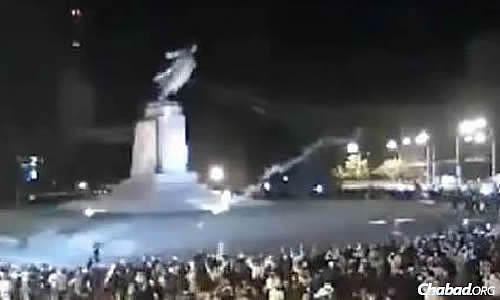 |
| A statue of Vladimir Lenin in Kharkov's Freedom Square was pulled down on Sunday by a cheering crowd of 8,000 Ukrainian nationaliists. |
KHARKOV, Ukraine–The early-morning Kiev-Kharkov intercity express train glides into Kharkov’s central railroad station, entering a city a world away from the one it left behind just five hours earlier.
These days, Kiev is covered with pro-Ukrainian slogans and signs, the yellow and blue of Ukraine’s flag popping out at everywhere. “Unified Homeland; Glory to Ukraine” one reads. In an area on the outskirts of Kiev, young volunteers paint rusting street guards yellow and blue, while also walking among cars in the street with a box hoping to collect money from drivers to offset the cost of the paint.
Kharkov is noticeably different. Sitting as it does only 40 kilometers away from the Russian border to the east, it is almost completely absent of patriotic signs, hinting at the vast difference of opinion between Ukraine’s two largest cities. An intellectual city known for its universities, Kharkov was once the Soviet capital of Ukraine—Kiev having been deemed at the time “too Ukrainian” to remain of such importance during an era of increased Ukrainian nationalism in the 1920s.
The situation in Kharkov—even more than in the rest of the country—remains unstable, with each new day unveiling its own circumstances. Possibly in response to the city’s perceived lack of Ukrainian patriotism and openness to Russia, Sunday saw a gathering of about 8,000 pro-Ukrainian protesters in central Kharkov. At the end of the protest, the crowd marched towards Freedom Square’s 20-meter-high statue of Bolshevik Revolution leader Vladimir Lenin; once there, protesters wearing masks and Ukrainian colors began sawing at the massive monument’s feet. Although pro-Russians vigorously defended the statue from attack in February, on Sunday evening, after hours of work that went unimpeded by police, Lenin came tumbling down.“You can never know here,” explains the city’s chief rabbi and head Chabad emissary RabbiMoshe Moskovitz, as a local Jewish businessman who has just put on tefillin walks out of his office. “It’s split 50-50. Some people here want to look towards Europe, others towards Russia.”

Although Kharkov (here spelled Kharkiv) is close to the Russian border, it has been spared the battles, airstrikes and devastation experienced in cities like Luhansk and Donetsk more to the south.
“It’s a miracle that what happened in Donetsk and Lugansk hasn’t happened here,” acknowledges Moskovitz. “When the Maidan [Maidan Nezalezhnosti, the central square of Kiev that was the site of pro-Europe protests] was attacked in Kiev and our mayor left the city, it was a very serious time. All of that could have easily led to a situation similar to the one in Donetsk.”
In those early days of the conflict before anyone could have predicted the war that continues to devastate the east, a Kharkov People’s Republic was declared in the city and a Russian flag hoisted over its city hall in March. When Mayor Gennady Kernes—formerly a political ally of ousted Ukrainian President Viktor Yanukovych—returned to the city and soon declared himself to be for a united Ukraine, quiet was restored. By the time he was shot and nearly killed at the end of April while out on a morning run, clear measures had been instituted to block Russian protesters from being brought into the city from just over the border. Direct flights between Moscow and Kharkov were suspended at that time and have yet to resume.
“That first week, right after Shabbos, someone called my house frantically, saying that protesters were marching towards the synagogue,” says Moskovitz’s wife,Miriam, who together with her husband arrived in Kharkov in the middle of 1990, just before the disintegration of the Soviet Union. “No one knew what was happening, so I called up the shul and told my husband to make sure everyone stays inside while the group passes.”

Morning prayer services at the central synagogue in Kharkov.
The throng ended up turning onto another street, and the panic that it engendered has since faded. Today, most Jewish community members spoken to say they continue holding their breath, attributing Kharkov’s current peaceful status only to Divine providence.
“Kharkov is a special city,” says Alexander Kaganovsky, editor-in-chief of Geulahmagazine and the president of the Kharkov Jewish Community for almost 20 years. “Kharkov is a city that did not have even one anti-Jewish pogrom in its history, so maybe that has helped. There is no other logical explanation.”
The Specter of War
Although thankful that pro-Russian separatist activity was unable to take hold long enough to plunge their city into turmoil, Kharkov natives—Kharkovchiani, as they’re known—have, notwithstanding Sunday’s events, not been gripped with the same patriotic Ukrainian fervor as those in cities such as Kiev and Dnepropetrovsk, as the lack of various nationalist signs attests to.
Some are for a Ukrainian pivot towards Europe, while others continue to support close ties with Russia, for both financial and historical reasons. The difference of opinion, says Rabbi Moskovitz, reveals itself within the Jewish community in Kharkov as well.

Rabbi Levi Raices, who heads theYeshiva Ketana in Kharkov, points toTorah scrolls that were recently brought out of Lugansk and are being held at the yeshivah for safekeeping.
While many businesspeople want closer ties with Europe, a significant number feel that given the state of its economy and infrastructure, Russia is simply the more realistic trading partner for Ukraine. Additionally, there are those who wish to align with Russia for ideological reasons and who fear Ukrainian nationalism.
Nevertheless, one thing people are trying to avoid is actual war. When Russian troops began mobilizing on the Russian side of the eastern border in March, a heavy buildup was detected in nearby Belgorad, just a 75-minute drive away from Kharkov. Having since witnessed events unfold in Donetsk and Lugansk, and what is regarded by most, including NATO, as an open Russian invasion in the direction of Mariupol further south, fear of invading Russian troops has risen distinctly.
“Whatever the Russians want to do, they’ll do,” says one community member standing in the synagogue’s parking lot, echoing a commonly heard sentiment within the country. “If they’d like, they can be here within the day.”
Subtle Signs of Unrest
The fact that an actual war with exchanges of heavy artillery and rocket fire is taking place in the east of the country is for the most part unfelt in other parts of Ukraine. While almost everyone has considered what they would do if the violence ever reaches them, life continues as normal in Kiev, Kharkov and Dnepropetrovsk.

The train station in Kharkov, a city that has kept its normalcy despite its proximity to Russia and the violent turmoil taking place in much of eastern Ukraine.
Visible signs of war are the draft notices that young, eligible Ukrainian men have begun receiving—notices that are commonly ignored by the drafted, especially by those living in the eastern part of the country where the future is so uncertain; road blocks set up on highways that require drivers to stop, be questioned or have their vehicles searched; and traces of European inspectors. Over the weekend, a large group of Organization for Security and Cooperation in Europe officials was observed in Kharkov, the OSCE staff identifying themselves as monitoring officers headquartered in Lugansk.
The greater—at times, almost invisible—sign of war, however, are the refugees. Hundreds of thousands have fled the war-torn east, among them some 18,000 Jews. Refugees can today be found almost everywhere in the country, Kharkov among them. Some choose Kharkov because they had relatives there, or it was the first place they could go; others arrived because it has an Israeli consulate, where they could begin the application process to Israel.
“Sometimes, we’ll get a call from the local shaliach in that city to tell us that someone’s coming and asking if we could help somehow; other times, they’ll just walk into shul looking for a place to sleep or at least eat,” reports Miriam Moskovitz. “Until just recently, we had 15 people living in the yeshivah building on Chebotarskaya Street.”

A late-night "farbrengen," or informal Chabad gathering, at the central synagogue in Kharkov prior toSelichot services on the Saturday night before Rosh Hashanah.
Yehoshua Sagirov, a refugee from Donetsk, arrived in Kharkov with his family six weeks ago. An unassuming man who worked as a broker in Donetsk, the 28-year-old now lives with his wife, newborn daughter, in-laws, mother, grandmother, sister and aunt in a small apartment lent to him by a friend. Also sharing the space is his nephew Misha, whose mother returned to Donetsk, despite the danger, to try and keep her job.
Sagirov, born and bred in Donetsk, says that for the last month he worked from home rather than going into the office. “I would go out during the day, but at night, it’s better not to go anywhere at all,” he says, referring to marauders that have appeared in the anarchy of the situation.
He had another problem. His wife was pregnant, and he worried how they would safely get to a hospital, especially at night. In the end, she did give birth at night, and while at first he was told by some that his daughter would become a citizen of the Donetsk People’s Republic (DPR), she was, in fact, registered as a Ukrainian citizen by the hospital in Donetsk.
Six days later—after the couple received support from the city’s rabbi and Chabad emissary, Rabbi Pinchas Vishedski—they hired a bus and left the city immediately.
“It should take only four hours to Kharkov, and it took us around seven because you can’t take any of the main roads, so you have to go around,” he says. “Even just leaving is dangerous; the DPR soldiers could easily have grabbed me and demanded I fight for them. Not much you can answer back to them because they can just shoot you up a bit, too.”

Miriam Moskovitz (seated in the back), wife of the city’s chief rabbi and head Chabad emissary Rabbi Moshe Moskovitz,leads a challah-making class at the central synagogue in Kharkov. Irina, from Lugansk, sits at the table on the right.
Sagirov says as difficult as it was to leave home, the older generation now with him needed to be sat down and convinced to join them.
For the time being, Sagirov is staying put in Kharkov, with no immediate plans to move to Israel or return to Donetsk. “We’ll see what tomorrow brings. I think for me to return to Donetsk there needs to be no war, quiet, and it needs to be Ukraine. I won’t go back if it’s DPR territory, and I think most of the young people will return in that case. But I really don’t know when we’re going back; I have no prognosis for the future.”
‘We Just Prayed’
Not long after Sagirov left synagogue following morning prayers recently, Irina, 49, from Lugansk, arrived for a women’s pre-Rosh Hashanah challah-baking class. She fled Lugansk on Aug. 3 in a convoy of cars with white flags—towels, actually—tied to the rear bumper to show that they were peaceful.

A large group of Organization for Security and Cooperation in Europe (OSCE) officials—their identifiable trucks parked in town—was observed recently in Kharkov.
“A lot of people want our region to be Russia,” Irina says. “Probably half want to live in Ukraine. Some people thought the same thing would happen in our region as happened in Crimea—a referendum and that’s it. I personally may not like certain things about Ukraine, but I don’t want Russia. But after a month of living in a basement under shelling, I’m ready to live anywhere.”
Her home in Lugansk sits a few kilometers away from the airport, the sight of intense fighting. She says that both sides are using heavy munitions, and that she and her family can tell which side did the shooting by the direction from where it came. She also revealed her newfound skill of being able to recognize grads from mortars by sound.
Irina remembers the events that led to their decision to leave: “A grad rocket fell on a neighbor’s two-floor home, and the top floor burst into flames. Mobile phones were still working, so we called the fire department, and they came and put it out. A few weeks later, the same thing happened, but this time we had no phones to call anyone, and four houses were turned to ash. By that time, we had already been living in our basement without electricity for a month.”

Fortified checkpoints dot the highways in eastern Ukraine. This one has been set up on the road from Kharkov to Dnepropetrovsk.
Joining a convoy that was leaving Lugansk, Irina says the drive took hours longer than usual because they went along side roads. “We heard shooting all around, and I didn’t see anything to the right or left, only the car in front of me. We just prayed.”
Wiping tears from her eyes, Irina unfolds her wallet and pulls out a Tefilat HaDerech [“Prayer for Travel”] card, featuring a photo of each of the Chabad Rebbes.
“I had this with me because I thought it would help,” she murmurs. “It seems like it did.”
More in Jewish News:
It’s a Wee Jewish Community in Cork That’s Getting a Yom Kippur Boost(By Menachem Posner)
 |
| Members of Cork, Ireland's small Jewish community, along with Shlomo Rothstein, center left; Levi Golomb, center right; and the community's leader, 87-year-old Fred Rosehill, center. |
In the 87 years that Fred Rosehill has lived in Cork, Ireland, he has seen the local Jewish community decline from several hundred strong in the 1930s to just a handful of individuals.
Local legend has it that the Cork Jewish community began with a boatload of New York-bound Lithuanian Jews, who were duped into debarking in southern Ireland with assurances that they had reached the New World.
Whether or not the story is true, what’s on the record books is that the city once had an active, if small, Jewish community that maintained its own kosher abattoir, cemetery, synagogue and a host of other social organizations.
“We’ve reached the stage where we cannot get together a minyan [a quorum of 10 Jewish men to pray] on our own,” Rosehill says with a hint of pain in his voice.As the years progressed, the Irish-born children of the immigrants—many of whom eked out a living as peddlers—followed educational and economic opportunities to other parts of Ireland, in addition to England,Israel and even the United States.
“Through Rabbi Zalman Lent in Dublin, we’ve had Chabad boys from London and Manchester [England] come for the High Holidays to help. They do everything, from leading services to whatever else is required.”
The rabbi is co-director of Chabad Lubavitch of Ireland with his wife, Rivkah.

Aaron Rosenbaoum, left, and Yiddi Frishman saying "kiddush levana" (the monthly sanctification of the moon) in Cork, Ireland.
For the past five years, the leader of the group of seven “boys” Rosehill mentioned has been 22-year-old Levi Golomb, who first came to Cork when he was a 15-year-old student in the Chabad school in Manchester. In addition to leading many of the prayers, Golomb shops for the kosher foodstuffs they take along, recruits the participants and books the travel arrangements.
“Freddy is a very special person,” attests Golomb. “He really goes out of his way to make sure that we are well taken care of. In addition to paying for the expense of our trip, which can include ferries over the Irish Sea or airfare, he just makes sure that we are hosted in a large and comfortable facility, and feel good about coming over.”
Last year, Rosehill’s wife, Patricia, passed away just after Rosh Hashanah. ThatYom Kippur, Golomb—who grew up in Sheffield, England, and is familiar with the holiday tunes as those used in the Irish synagogue—says he made an extra effort to make things special for the elder man.
“I made sure to pray with extra heart and reach out to him in my talks—to make it personal for him,” he notes.
‘Keep the Congregation Going’
For his part, Rosehill says he “derives solace from knowing that I am doing whatever I can to keep our congregation going. Our ancestors have been here since 1881, so if I can stretch things out for one more year, that gives me satisfaction.”

Some of Cork's Jewish community with the young men from England
The synagogue holds Friday-night services—attended by a handful of regulars—once a month and Rosehill works closely with “Roving Rabbis,” who come every year to visit Jewish people all over the “Emerald Isle,” sharing and comparing contacts.
At one point, the student minyan-makers would travel to Cork for Rosh Hashanah and then again for Yom Kippur. However, the synagogue’s dwindling finances have meant that in recent years, they have only been able to bring the students, who receive no monetary recompense, for Yom Kippur only.
While there are not many surviving local descendants of the original cohort of Lithuanian Jews who built the modest synagogue in the city center, a number of Jewish people reside in the surrounding areas, and many come for services, or at least pop in during the course of the holy day for a little while. Golomb says that between 47 and 52 people made their way through the sanctuary doors last year during the course of the 25-hour fast.
“It’s a long drive, and it’s tiring,” says Golomb, who has developed a personal connection with many of the locals, “but if we can help one more community hold services, we thank G‑d for the opportunity.”

For years now, a group of young Chabad students has been traveling to Cork to help the diminishing Jewish community make a minyan for the High Holidays.

The route taken to Cork often involves a long drive from England, as well as a ferry.
Volunteers to Spend Their High Holidays in Prison(By Bryan Schwartzman)
 |
| Anna Koozmin, a 20-year-old junior at the University of Maryland, will spend Yom Kippur at a women's prison, along with many other college-aged volunteers. |
Anna Koozmin, a 20-year-old junior at the University of Maryland, loves the Netflix series “Orange Is the New Black” for the way it delves into the back stories and lives of inmates at a federal women’s prison. A behavioral- and community-health major who volunteers at a juvenile prison in Washington, D.C., she finds the show entertaining, but is under no illusions that it fully or accurately portrays life at the Federal Correctional Institution in Danbury, Conn.
Now, Koozmin is about to find out for herself what the place is like—at least for a day.
She will be spending Yom Kippur, which begins on the evening of Oct. 3, at the prison that inspired the best-selling memoir and popular television series. Koozmin is organizing a group of six women—all college students—who plan drive to Connecticut, sleep in an RV, and help lead Kol Nidre and Yom Kippur day services for Jewish inmates. She says it’s an opportunity to combine her interest in working with vulnerable populations with a desire to have a more meaningful holiday experience.
“A lot of the themes of Yom Kippur the inmates can relate to,” says Koozmin. “They have all had their judgment day.”Inmates, she believes, should not be forgotten. They deserve a holiday experience, as well a chance to connect with the Jewish tradition and other Jews, just like anyone else. Koozmin notes that the Yom Kippur themes of repentance and changing for the better may resonate in a deeply personal way for inmates.
Loving Every Jew
A total of 38 University of Maryland students have signed up to volunteer at seven separate correctional institutions. Their commitment is part of a much larger effort being spearheaded by the Aleph Institute, based in Surfside, Fla. The Chabad-Lubavitch-affiliated nonprofit organization, which is more than 30 years old, serves both the military and the incarcerated, in addition to their families. According to its website, it also helps create “solutions to significant issues relating to [the U.S.] criminal-justice system.”
Aleph is organizing full High Holiday services on Rosh Hashanah and Yom Kippur at 40 state and federal prisons nationwide. It is also sending honey and prayerbooks, in addition to meeting with prisoners individually at some 400 prisons, according to Rabbi Menachem Katz, director of prison and military outreach.

Chabad Rabbi Menachem Katz (second from right, blowing shofar), director of prison and military outreach for the Florida-based Aleph Institute, has been visiting prisons during the High Holidays for more than 20 years.
Katz has been visiting prisons on the High Holidays for more than 20 years now. These days, he is also leading the national effort of organizing volunteers—including Chabad emissaries, rabbinical students and lay people like Koozmin—and matching them with existing needs. Aleph is spending at least $100,000 on airline tickets, getting folks where they need to go.
All volunteers receive at least some training from Aleph beforehand. One question they are told never to ask: “So, what are you in for?”
The guiding principle driving Aleph’s prison outreach is the idea of loving each and every Jew, regardless of his or her past deeds. The community has a responsibility, insists Katz, to let prisoners know that they are not alone, and that someone cares about them.
Inmates, he continues, may be isolated from their families, can face anti-Semitism behind bars or feel in danger of losing their sense of self.
“It is actually very fulfilling,” Katz says of spending the High Holidays in prison. “You’ve got all the ingredients to make it a very meaningful or selfless experience.”
The key to running services on the holidays is just like the key to all prison work, he adds: Don’t be judgmental.
Still, things haven’t always run smoothly. Two years ago, before holding Rosh Hashanah services at a New Jersey prison, he was asked to move his car. He explained he was not allowed to drive on a holy day, but it did little good. His car was towed, and with it, all of thetallises he had planned to bring into the prison.
Still, he carried on.
‘Changed My Whole Outlook’
Achiezer Langsam, a 20-year-old rabbinical student at the Rabbinical College of America in Morristown, N.J., was looking forward to spending the holidays with his family in the Crown Heights neighborhood of Brooklyn, N.Y. But when he a fellow student asked him if he’d like to volunteer during the High Holidays, his instincts wouldn’t let him refuse.
Langsam will be co-leading Rosh Hashanah and Yom Kippur services at a minimum security prison in Miami. He’ll be staying at a hotel that’s about a 40-minute walk from the facility. In between the holidays, he has also arranged to help a local Chabad emissary with preparations.
“I am a little bit nervous,” he acknowledges. “But nervousness is a good thing. It pushes you to give it all you got.”
Yosef Junik, a rabbinical student from London studying at Chabad-LubavitchWorld Headquarters in Crown Heights has volunteered in prisons for four years running. This year, he has signed on to conduct services at the Fort Dix U.S. Army base in New Jersey.
The experience, he notes, is good training for what he hopes to do next—become a shaliach, a Chabad-Lubavitch emissary.
“I’m not looking at it as a scary situation. Inmates want to be part of and have a Jewish community,” he says. “For the most part, they are very happy. They don’t have a lot of visitors.”
“They are Jewish people. They are still people at the end of the day,” he continues. “Doing this has changed my whole outlook on people in general.”
Koozmin, the University of Maryland student, says she’s still waiting to hear how much time her group will have with the women prisoners on Yom Kippur. Aleph is pushing for five hours on the day of Yom Kippur, but the group might not get that long.
Whatever happens, she gets a sense this may be the most powerful Yom Kippur of her young life.
“I think it will be a really meaningful experience for both sides,” she says. “Sometimes, we forget how important this holiday really is. And this experience will shed new light and meaning behind it.”

Katz in an Aleph Institute file photo. “It is actually very fulfilling,” he says of spending the High Holidays in prison. “You’ve got all the ingredients to make it a very meaningful or selfless experience.”
Lifestyle
 Bake Pre Yom Kippur Honey Cake
On the day before Yom Kippur it is customary to ask for and receive lekach (sweet cake— signifying a sweet year) from someone—usually one's mentor or parent. By Miriam Szokovski
On the day before Yom Kippur it is customary to ask for and receive lekach(honey cake—signifying a sweet year) from someone—usually one’s mentor or parent. One of the reasons given for this custom is that if it had been decreed, G‑d forbid, that during the year we should need to resort to a handout from others, the decree should be satisfied with this asking for food.
I’ve always loved this tradition, but I do not love honey cake. I was determined to “fix” traditional honey cake, but none of my efforts have come close to this fabulous recipe for Majestic and Moist Honey Cake by Marcy Goldman, from her cookbook A Treasury of Jewish Holiday Baking. It takes everything you thought you knew about honey cake and turns it on its head, so in case you haven’t yet chanced upon it, I’m sharing it with you.

It’s also very easy to make. Simply whisk the flour, baking powder, baking soda, salt, cinnamon, cloves and allspice together. Make a well in the center and add the rest of the ingredients. Mix until you have at thick, smooth batter. Pour into a greased pan. Depending on which size pan you use, you might have extra batter to make another small cake or a few cupcakes. I used a bundt pan, and did have some extra batter.

Make sure you grease your pans well. I like to use the baking sprays which have flour in them, or you can grease and flour the pan yourself. I strongly suggest taking the extra minute to properly prepare the pan, because it’s highly disappointing when half the cake gets stuck in the pan after all that hard work!
Bake at 350° F until a skewer or toothpick comes out clean. Oven temperatures vary tremendously, and the type of pan you use also influences baking time, so do the toothpick test rather than relying on the clock. Let the cake cool slightly, then tip out onto a wire rack to cool completely. Freezes well. Before serving, dust the cake with confectioners’ sugar.

Ingredients:
- 3½ cups all-purpose flour
- 1 tablespoon baking powder
- 1 teaspoon baking soda
- ½ teaspoon salt
- 4 teaspoons ground cinnamon
- ½ teaspoon ground cloves
- ½ teaspoon ground allspice
- 1 cup vegetable oil
- 1 cup honey
- 1½ cups granulated sugar
- ½ cup brown sugar
- 3 eggs
- 1 teaspoon vanilla extract
- 1 cup warm coffee or strong tea
- ½ cup orange juice
- ¼ cup whiskey (I have successfully substituted this with either coffee, tea, orange juice or applesauce)
Directions:
- In a large bowl whisk together flour, baking powder, baking soda, cinnamon, cloves, salt and allspice. Make a well in the center and add the rest of the ingredients. Using a strong wire whisk or an electric beater on low speed, mix until you get a thick, smooth batter.
- Pour batter into well-greased pans. This recipe makes quite a lot of batter, so depending on the size pans you use, you may have some left over. You can pour the leftover batter into another pan, or into a cupcake tin and make some honey cupcakes.
- Bake at 350° F until a skewer comes out clean, approximately 50–60 minutes for a bundt pan. Oven temperatures vary tremendously, and the type of pan you use also influences baking time, so do the toothpick test rather than relying on the clock.

Are you familiar with the tradition of asking for lekach? Do you do it in your house? For a more in-depth look at this custom, see Lekach and Asking for Honey Cake on the Eve of Yom Kippur.
Wishing you all an easy and meaningful fast.
___________________________________More in Lifestyle:
Craft a Yizkor Remembrance Bookmark(By Abbey Wolin)
 What Is Yizkor?
Yizkor, a special memorial prayer for the departed, is recited in the synagogue four times a year, following the Torah reading on the last day of Passover, on the second day of Shavuot, on Shemini Atzeret and on Yom Kippur.
Yizkor, in Hebrew, means “Remember.” It is not only the first word of the prayer, it also represents its overall theme. In this prayer, we implore G‑d to remember the souls of our relatives and friends who have passed on.1
Why a Bookmark?
Each time I prepare myself for the Yizkor service, I review all the people whom I must include in my prayer. I began saying Yizkor after my father passed away when I was just 11 years old. Since then, as more special people have left this world, I have added them to my mental Yizkor list.
This past May, I lost my beloved sister. The first Yizkor service following her passing was merely a few weeks later, on Shavuot. When I left the service I asked my younger sister if she was okay, and she responded, “Oh! I forgot to include Aunt Karen.” When I saw my brother, he also mentioned that he forgot to include one of our relatives. We were so focused on the emotional task of saying Yizkor for our sister that we simply forgot people whom we have included for years.
For those of you who recite Yizkor, have you ever stood there in synagogue—about to honor the departed—when their Hebrew name suddenly slipped your mind?
At jCreate, we wanted to find a solution to this problem, so your mind can rest at ease and focus on the important task of honoring your relatives and friends.
My team and I have created a beautiful Yizkor bookmark that you can print off your own computer. Write down all the names that need to be included for yourself. Once it is all filled in, take it to your store and laminate the card so you can use it year after year. You can reprint to add new names when needed. It makes a wonderful bookmark for your machzor.
Print your bookmark here..
FOOTNOTES
1.More information about Yizkor here..
_____________________________

No comments:
Post a Comment