United Methodist News Service Weekly Digest for Friday, 3 October 2014
United Methodist News Service Weekly Digest for Friday, 3 October 2014
NOTE: This is a digest of news features provided by United Methodist Communications for Sept. 29-Oct. 3. It includes summaries of United Methodist News Service stories and additional briefs from around the United Methodist connection. Full versions of the stories with photographs and related features can be found at umc.org/news.
Top Stories
Ebola killing more people than those with virus KENEMA, Sierra Leone (UMNS) - On the day Sento Conteh's 14-year-old son died, so did eight other people, all just outside the doors of Kenema Hospital in Sierra Leone. None of them had Ebola but Ebola contributed to all their deaths because the outbreak has caused a collapse in the health care system in Sierra Leone and Liberia. Kathy Gilbert reports for UMNS.
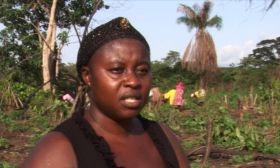
Sento Conteh, a facilitator for the West Africa Initiative, lost her 14-year-old son to appendicitis because she could not get medical care for him.
Ebola killing more people than those with virus
by Kathy L. Gilbert, UMNS
On the day Sento Conteh’s 14-year-old son died, so did eight other people, all just outside the doors of Kenema Hospital.
None of them had Ebola, but Ebola contributed to all their deaths because the outbreak has caused a collapse in the health care system in Sierra Leone and Liberia, said Winston Carroo. Carroo is a program consultant with Agricultural Missions Inc., an ecumenical organization that addresses the root causes of poverty in rural areas.
Sento Conteh, a facilitator for the West Africa Initiative, lost her 14-year-old son to appendicitis because she could not get medical care for him
“On that day … in that community … more people died (of other causes) than those who have Ebola,” he said.
Conteh is one of the facilitators for the West Africa Initiative – a rural development program supported by several denominations in the United States, including the United Methodist Committee on Relief. She works with 100 farming families in the communities of Mugomeh, Kangama and Amuloma in the Kenema District.
She emailed Carroo and said, “My son died tonight.”
He probably died when his appendix ruptured, Carroo said. “She said her son woke up with a terrible stomach ache. She waited with him (outside the hospital) all day, he was crying in pain, and he died that evening.”
HOW YOU CAN HELP
Contributions may be made to AMI via PayPal at www.agriculturalmissions.org or by check made payable to Agricultural Missions, Inc. 475 Riverside Drive, Suite 700; New York, NY 10115.
Farmers planted in March, April and May before Ebola really hit the radar screen. Now that it is harvest time they cannot get their goods to market because of quarantines, soaring transportation costs and the closing of markets, he said.
“Their purchasing power and income have really gone down. The cost of medicine, such as aspirin, has doubled. Most micro-credit groups are women who have something to do with trading and because the markets have closed, that has ground to a halt,” he said.
When you have no money, you can’t travel and you can’t buy the necessary supplies that the government is requiring for each home and church.
“You cannot go and tell people they must wash their hands in chlorine bleach when they don’t have chlorine bleach,” Carroo said.
The West Africa Initiative is starting a campaign to raise $46,000 to address three priorities they have identified for farmers and their families served by their organization in Sierra Leone and Liberia:
Basic sanitation supplies recommended by the Ministries of Health for Ebola prevention, including soap, chlorine bleach and buckets, disposable gloves.
Seeds for the dry season farming which begins in October.
School supplies for children when school reopen—projected for January 2015.
At the end of September, more than 6,500 cases of Ebola and more than 3,000 deaths have been documented in the countries of Guinea, Sierra Leone and Liberia. Liberia has the highest number of infections and deaths.
The current outbreak is the largest ever recorded and it is the first time the disease has been documented in West Africa. The outbreak is now reaching densely populated urban areas where containment is a huge challenge.
Helping rural communities
For the past six years, Agricultural Missions Inc. has been working with local partners in Liberia and Sierra Leone to implement the West Africa Initiative. There are currently 22 active groups in Sierra Leone and 10 in Liberia, supporting more than 1,000 families.
Facilitators for the West Africa Initiative have been working with local communities with education about Ebola preventive measures. They have also been making food available during this time of crisis.
“The WAI program has the on-the-ground presence, credibility, and organizational structure to reach rural communities with the message and material assistance, but lacks the needed supplies and funds for transportation. While there are travel restrictions in some areas, the WAI facilitators have been able to get permission, where necessary, to travel the villages in which the groups are located,” Carroo said.
Gilbert is a multimedia news reporter for United Methodist News Service. Contact her at (615) 742-5470 or newsdesk@umcom.org.
By Phileas Jusu Oct. 2, 2014 | LUMLEY, Sierra Leone (UMNS)
The message is simple: You can survive Ebola.
But what if you have never heard of any of the life-saving ways to avoid getting the horrific virus?
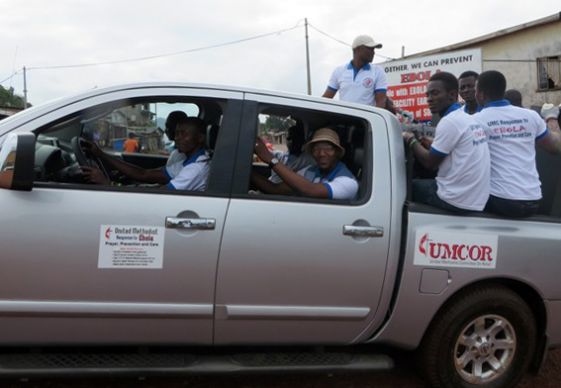
Using drama and song, young adults from The United Methodist Church in Sierra Leone are taking the urgent messages about Ebola to drivers and motorcyclists, market vendors, street hawkers, footballers and people who live in some of the country’s poorest areas.
Rolling down the roads in the back of a pickup truck equipped with a loud PA system, the young people attract everyone’s attention – drawing people in with the skits and music.
In one of the skits, a man with traditional headdress claims to have the power to cure Ebola. A young man comes to him with his sick brother. The sick brother dies and so does the herbalist. The first young man becomes sick and goes to a hospital for treatment. He survives.
The message: no superstitious power can cure Ebola; contact with an infected person can lead to infection; and chances for survival are best if one seeks professional medical care immediately.
Infection rates rising
New infection rates of Ebola reached a record high, with more than 6,500 infections in Sierra Leone, Liberia and Guinea, according to the World Health Organization. More than 3,000 have died. The one-day infection rates show how fast the disease is spreading – on Sept. 29, laboratory tests confirmed 90 people positive of the Ebola virus in Sierra Leone alone.
The skits performed in parks, markets and football fields deal with prevention, what to do when infected and how to treat Ebola-infected people with love while keeping the ABC rule – Avoid Body Contact.
“Not everybody in Sierra Leone can read and write; a drama presents a good way to reach out to that large category of people. Through drama done in Krio, the most common language spoken in Sierra Leone, we are sure to reach out to as many people as possible,” said Finda Quiwa, a United Methodist Board of Global Ministries regional missionary. Her ministry supports the young adults’ Ebola fight with funding from United Methodist Women.
The young people get accurate information through the Sierra Leone Annual Conference and are trained to use that knowledge to reach the public.
“We provide them with enough Ebola education materials and knowledge,” said the Rev. Sylvester Holima, director of youth and young adults.
The messages come through loud and clear—don’t hide; seek medical treatment if you have a fever; wash your hands often; wear protective clothing if you have contact with a sick person; don’t touch the bodies of people who may have died from Ebola.
Passion and creativity
The young people are free to develop the skits on their own.
“And because it is coming from them, they put their all in it – passion, creativity and time,” Holima, said.
The young adults have composed several Ebola education songs that are being aired on radio as part of the United Methodist response in the Ebola fight.
The group enters communities with the songs blasting. Then they offer prayers as people gather.
Prayers are precious in the lives of Sierra Leoneans, Holima said. Public prayers were the best way to attract people during the country’s 11-year civil strife and the strategy seems to be working again during the ongoing Ebola outbreak, he added.
Short and simple
One goal is always kept in mind when crafting and delivering the Ebola message.
“We keep it short, basic and simple because our target is the common people who for a large part of their time are busy eking out a living,” Holima said.
“I didn’t imagine the level of success when we conceived the idea. It can be rated as a huge success. People have been calling me on the phone; the news is on the radio and TV,” Quiwa said.
In most of the communities the groups visited in Freetown, people told them this was the first time they had seen the Ebola message dramatized live in their communities, Holima said.
“I am pleased that we were able to reach a lot of people who cannot read or write. I know this because I could see people crowding around us in their numbers in all the places we went. At Lumley, a woman nearly shed tears when she saw the way an Ebola patient in the play was wrapped and whisked away in the ambulance,” Holima said.
“At Tombo Park in eastern Freetown, a huge number of people gathered and we repeatedly told them not to cluster. They spaced out and continued to listen as we prayed with them. A thunderous `AMEN’ repeatedly echoed back at us and we felt so pleased,” Holima said.
With more support and funding, Quiwa hopes to take the new initiative to other parts of the country.
Some help coming in
Meanwhile a Chinese medical team that recently arrived in the country has established a new holding center at the Sierra Leone-China Friendship Hospital in eastern Freetown. That’s in addition to a mobile Ebola laboratory brought in as the Chinese government supports Sierra Leone’s effort to fight the hemorrhagic fever.
This latest Chinese effort will ease the burden of taking all Ebola suspected cases to Kenema, which used to have the only equipped laboratory to test all viral diseases including Ebola.
Health care workers listen intently during a panel discussion at the United Methodist Church's Mercy Hospital in Bo, Sierra Leone in advance of the Ebola virus outbreak.
Community education about the disease, health worker protection and psychosocial counseling for affected people and their families are the strategy’s three prongs, said Dr. Olusimbo Ige, of Global Health, which, like UMCOR, is under the direction of the General Board of Global Ministries.
Ige, a medical doctor who specializes in infectious diseases, said the approach seeks to address two “major concerns” that are essential for containing Ebola.
“First,” she said, “is the capacity of local health networks to respond to sick cases. Currently there are not enough medical personnel to follow up with people complaining of symptoms. These people then go home to their families, and the disease spreads. Once a critical number of cases is passed, the disease spreads exponentially,” she warned.
Second, Ige said, are belief systems. “People in the affected countries distrust their health systems, their government systems and foreign organizations. So, messages about Ebola containment from these sources are not taken seriously. People often will hide their sick relatives rather than bring them to the hospital.
“It is a peculiarity of this outbreak that people don’t take it seriously and don’t seek care,” she continued. “When they do, it is often too late.”
In the six months since the World Health Organization (WHO) was notified of the Ebola outbreak, 6,263 cases of the disease have been confirmed or suspected in five countries, with most occurring in Liberia, Sierra Leone and Guinea. As of September 21, there have been 2,917 deaths attributed to the disease.
WHO, in a recent report, said that over the course of these six months, the outbreak has evolved into “the largest, most severe and most complex outbreak in the history of the disease.” And, it indicated, “The epidemic of EVD [Ebola Virus Disease] is still spreading.”
Executing the strategy
“Our approach is to work closely with United Methodist health boards in affected countries, listening closely to them as they identify needs and strategies we can support,” said Rev. Jack Amick, UMCOR executive who heads the organization’s International Disaster Response unit.
Amick is in charge of disbursing UMCOR emergency funds, while Ige advises that distribution in the case of the Ebola response. Together, they hold a weekly conversation by telephone with the United Methodist health boards in Liberia and Sierra Leone.
To date, UMCOR has channeled more than $400,000 in emergency funds to confront Ebola, chiefly to Liberia and Sierra Leone. It also has provided funds to the health board of Cote d’Ivoire to assist its efforts to promote awareness and take preventive measures to keep Ebola at bay.
In Liberia and Sierra Leone, UMCOR funds are helping to keep United Methodist hospitals and clinics open and to train personnel to respond to the disease.
In addition, said Ige, “We are ensuring that health workers, who are most at risk of contracting and succumbing to Ebola, have all the personal protective equipment, all the training and all the resources they need to help patients and to link them with nationally designated treatment centers.”
According to WHO, 373 health workers in Sierra Leone, Liberia, Guinea and Nigeria have contracted Ebola since the outbreak began, and 208 health workers have died of the disease.
UMCOR funding also supports psychosocial care and community messaging about prevention and treatment. “We are telling people that Ebola is an infection not witchcraft,” Ige said. “If you don’t acknowledge it is an infection, you won’t take precautions.”
She underscored the critical role faith communities play in getting this message across. “People trust religious communities more than other institutions. There is huge potential for religious communities and figures to impact behavior. When a bishop urges people to seek care, it resonates,” she said.
“Our approach is to rely on messaging from the church and to encourage religious leaders to speak out about the need for prevention. Community awareness campaigns by respected members also can have a big impact.”
How you can help
“UMCOR’s goal is always to alleviate suffering. We support people as they cope with the effects of a disaster, or, when a disaster is ongoing, we seek to help them avoid continual impact,” said Amick. “As long as the Ebola epidemic persists in West Africa, UMCOR will continue to partner with United Methodist health boards to provide appropriate responses to the disaster.”
Ige concurred and invited all people of faith and humanitarian concerns who are interested in responding to the Ebola crisis to coordinate with UMCOR, “so we are all working in the same direction,” she said.
She stressed that disaster response in the event of a disease outbreak such as Ebola is very specific. “The important thing is to break the chain of transmission,” she said. “To do this, supplies must have specific qualities. They must be infection-control grade, meet national and international standards, and they must be needed by the impacted communities.”
Echoing Amick’s words , she underscored UMCOR’s close work with local health boards, which are working with their governments to contain the further spread of Ebola. This close relationship positions UMCOR well to hear and respond to specific needs.
Liberia UMW feeds minds, stomachs during Ebola crisis
By Julu Swen and Kathy L. Gilbert, MONROVIA, Liberia (UMNS)
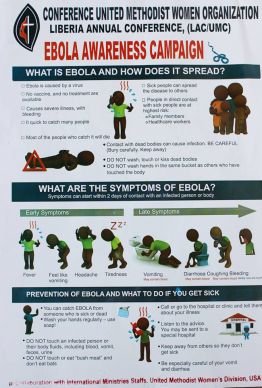
United Methodist Women in Liberia are handing out love, food and information to communities stricken by Ebola where the denomination has churches.
Sarah Q. Nah, president of the United Methodist Women in the Liberia Annual Conference, said they are especially concerned about the Kakata-Farmington District where 18 church members, including two pastors and the president of the United Methodist Men’s group, have died.
UMW started distributing rice, vegetable oil and other staples to communities quarantined by the government’s attempt to stop the spread of Ebola. The women also conducted training sessions on preventative measures, such as hand-washing and avoiding contact with the sick or bodies of those who died from Ebola.
“Please extend the work of the church beyond the church and its doors to all Liberians that you encounter during your anti-Ebola campaign,” the Rev. Rudolph Merab, conference lay leader of the Liberia Annual Conference, told the women.
“Women are the most powerful entity in the church,” Merab said. “We trust you will touch lives where we did not make any impact and lift the name of The United Methodist Church of Liberia to higher heights.”
Nah said the food packages will give hope to people afflicted by the Ebola virus, especially quarantined family members.
She cited Dolo Town, which was quarantined by the Liberian government because so many people living there are infected with Ebola, as one community the women want to reach.
“Our sisters overseas want you to know that they stand with you as you fight the Ebola virus,” Nah said.
Funding comes from the mission giving of United Methodist Women members throughout the United States. Funds are administered by International Ministries staff in the national office of United Methodist Women, said Selby Ewing, communications director for United Methodist Women.
Carol Van Gorp, executive for International Ministries, said supporting Ebola outreach through women makes sense “because women are the ones who are caring for the sick and the dead.”
"Through the work of United Methodist Women Regional Missionary Finda Quiwa, a grant has also been given to the youth and young adult department of the Liberia Annual Conference to widen the church's educational outreach in that area.
"United Methodist Women are honored to be able to walk with them through funding, regular prayers and encouragement," Gorp said.
United Methodist Women of the Liberia Annual Conference have received $6,300 for Ebola Virus Education to help prevent this incurable disease from spreading further. Donations can be made online to project #3019240to make emergency grants like this possible.
UMW is one of the divisions in The United Methodist Church in Liberia diverting their budgets to fight Ebola. Others include the human rights monitor, community services, deaf program and children’s ministries.
HOW YOU CAN DONATE
Donate online to the United Methodist Women's efforts to fight Ebola.
The United Methodist Committee on Relief has to date sent $400,000 in grants to Sierra Leone and Liberia. Donate online.
As the outbreak continues to worsen in West Africa, the United Methodist Committee on Relief has sent nearly $400,000 in grants to Sierra Leone and Liberia. Funds support the construction of holding units and the purchase of tents, personal protective equipment, training for health staff, public messaging about Ebola and safe handling of bodies.
UMCOR executive Francesco Paganini says that whenever possible, funds are sent to United Methodist health boards to purchase healthcare and other supplies locally.
United Methodist missionaries, Helen Roberts-Evans, who serves in Liberia, and Beatrice Gbanga, who serves in Sierra Leone, say life has changed because of the Ebola crisis. “The markets are closed. Schools are closed. Public gatherings are cancelled,” reports Roberts-Evans.
The bishops have asked UMCOR to help manage the supplies going to West Africa to provide quality control, standardized shipments and to avoid clogging ports with unmonitored shipments, said Melissa Hinnen, director of content and public information for the United Methodist General Board of Global Ministries.
Messages of hope
The anti-Ebola information campaign was launched on Aug. 22 with funding from United Methodist Communications. The $10,000 grant was used to print banners, T-shirts, flyers, vehicle stickers and recorded radio messages in English and in various local vernaculars.
The Rev. George D. Wilson, Jr., director of connectional ministries and chair of the Ebola task force for the Liberia Conference, said task force members have distributed the resources to households, in market places and to commercial drivers and motorcyclists.
“In some cases it became unsafe when crowds would swarm around us to receive printed material,” he said.
Wilson estimates the printed resources have reached more than 500,000 and radio messages were heard by 70 percent of the population of 3 million.
“Candidly speaking, Ebola remains a major health challenge for the people of Liberia. We count on your usual moral support and prayers as we fight the deadly Ebola virus. The Crisis Communication Grant proved very helpful in the fight against the virus but what is critically needed now is to help those who until now cannot afford to purchase basic materials such as buckets, chlorine, etc. needed to help prevent the disease.”
Swen is the United Methodist Communicator for the Liberia Annual Conference. Gilbert is a multimedia reporter for United Methodist News Service in Nashville, Tenn.
News media contact: Kathy Gilbert, Nashville, Tenn. (615) 742-5470 or newsdesk@umcom.org.
Working for redemption in Ferguson FERGUSON, Mo. (UMNS) - Tensions remain high, and United Methodists in the St. Louis area warn that it will take a long time to build community and trust between law enforcement and people of color. But leaders across the denomination agree that churches have a role to play in the arduous healing process ahead. Heather Hahn has the story.
Great American novelist had Methodist background DALLAS (UMNS) - When young Stephen Crane went to family reunions, nearly every man there was a Methodist preacher. At one such event in 1874, 14 of them attended, including his father and maternal grandfather and a great uncle who was a bishop. The writer of the "The Red Badge of Courage" would go the other way, living fast and hard while creating a groundbreaking body of literature. Sam Hodges reports for UMNS.
Creation care team brings global perspective NEW YORK (UMNS) - Sotico Pagulayan knows firsthand how the acceleration of extreme drought and flooding in Cambodia has made life harder for many, including farmers. That is why he is one of six regional representatives on the creation care team organized by the United Methodist Board of Global Ministries. Linda Bloom reports for UMNS.
Church agency heads meet with White House staff WASHINGTON (UMNS) - Top executives with United Methodist agencies met with White House staff for more than hour to discuss how church resources can help improve the lives of children at risk, prevent sexual violence on campus and respond to global humanitarian concerns. Those concerns include the displacement of Christians in the Middle East.
A dream come true for prison ministry BRADENTON, Fla. (UMNS) - After nearly 40 years of helping ex-offenders get on their feet, Jim Russo Prison Ministries - founded by a former prison inmate - is opening a new center. Susan Green of the Florida Conference reports on how the ministry has grown and is changing lives even after the death of its founder.
CBS special looks at redemption after prison NEW YORK (UMNS) - The Rev. Douglas Walker, National Coordinator for Criminal Justice Reform, United Methodist Board of Church and Society, is featured in "Crime, Punishment & Redemption," a CBS-TV Interfaith Special airing Sunday, Oct. 5. The documentary looks at how the faith community helps returning citizens and their family members put their lives back together after incarceration. Check local listings for broadcast time.
Hong Kong Methodists call for calm HONG KONG (UMNS) - The Rev. Tin-Yau Yuen, president of the Methodist Church in Hong Kong, has called for the government to "keep calm and not to abuse force" in the wake of continuing protests, reports the Rev. Howard Mellor, pastor of the Methodist International Church there. The Chinese Methodist Church in Wan Chai has become "a place of sanctuary" for protestors, he added.
Academy marks 10 years of shaping young Hispanic/Latino leaders NASHVILLE, Tenn. (UMNS) - The Hispanic Youth Leadership Academy has become a United Methodist leadership initiative that provides an intensive summer leadership academy and long-term mentoring and guidance around topics of higher education, Hispanic/Latino identity, God's calling and United Methodist studies.
Two conferences ponder merger DENVER (UMNS) - Leaders of the Rocky Mountain and Yellowstone Conferences received a task force recommendation this week to enter into a serious conversation about merging. Mountain Sky Area Bishop Elaine J. W. Stanovsky explains the process to consider a merger. The two conferences include about 400 churches.
New pastor, merger offer hope for historic Dallas church DALLAS (UMNS) - St. Paul United Methodist Church is one of the oldest African-American churches in Dallas, and it's in a historic, recently restored building. But the congregation has dwindled as African Americans have moved from the downtown area. Now a new pastor is offering hope, in part because he's bringing along the congregation from an interdenominational church he started. James Ragland, a columnist for The Dallas Morning News, reports on this creative merger and appointment in the North Texas Conference.
LEVITTOWN, Pa. (UMNS) - Emilie United Methodist Church cashed in on the ice bucket challenge, an online fundraising fad, to bolster the congregation's apportionment payments while having some fun. A member agreed to donate $25 for all who poured a bucket of ice water over their own head and $25 for every bucket of ice water poured over the pastor's head. John Coleman, the Eastern Pennsylvania Conference communications director, has the story.
A pastor's call to speak out WASHINGTON (UMNS) - How does a pastor fulfill the call to be a prophetic voice? The Rev. Clayton Childers, director of conference relations for the United Methodist Board of Church and Society, offers tips for positive, effective preaching on challenging subjects or social issues.
Foodies flock to North Carolina's hot dog church GREENSBORO, N.C. (UMNS) - Foodies come from hundreds of miles away to sample the dressed dogs and secret chili recipe served every Saturday by Carraway United Methodist Church - nicknamed "the hot dog church." The cooks say the secret behind their red-hot success is no mystery: they give away every dime and dollar they make.
Future of Missouri Conference camps uncertain COLUMBIA, Mo. (UMNS) - Next summer, the four camps owned by the Missouri Conference will be closed, and the conference has dismissed the camps' directors. Conference officials say there will be camping ministries next year, just done in a new way. Still, a number of United Methodists oppose the camps' closure.
Five most difficult questions for pastors MONUMENT, Colo. (UMNS) - United Methodist pastors often get questions after worship on a Sunday morning, from a phone call on a Tuesday afternoon, or across the table at a church dinner. Some queries are straightforward, but others are far tougher to address. The Rev. Joe Iovino, associate pastor of Tri-Lakes United Methodist Church, writes about the five most difficult questions pastors get.
Appalachian Trail chaplain nears end of trek ALCOA, Tenn. (UMNS) - At age 69, the Appalachian Trail chaplain David Smith from Holston Conference is on target to complete his 2,200-mile, seven-month hike on Oct. 8. Annette Spence of the Holston Conference's The Call has the story.
APPALACHIAN TRAIL CHAPLAIN AIMS TO COMPLETE SEVEN-MONTH HIKE ON OCT. 8
By Annette Spence
David Smith reaches Mount Katahdin, Maine, on Sept. 10.
At age 69, the Appalachian Trail chaplain from Holston Conference is on target to complete his 2,200-mile hike on Oct. 8.
David Smith’s concluding steps won’t take place on chilly Mount Katahdin, however. The trailblazer actually topped the iconic summit in Maine on Sept. 10. Now, he’s hiking the remaing 240 miles in east Tennessee and western North Carolina that he skipped when an injury forced him to leave the trail in late March.
“I knew it would be easier to catch the lost miles on the end of the hike, rather than trying to hike Katahdin in October or November,” he said.
After a March 6 kick-off on Springer Mountain, Ga., Smith is the second-ever chaplain sent by Holston Conference to hike the trail, but he may be the first to conquer the trail. The first-ever chaplain, 26-year-old Josh Lindamood, halted his six-month expedition, 500 miles shy of completion, when his grandmother died in October 2013. Prior to that, Lindamood battled a debilitating rash that delayed his quest to “thru-hike” the trail.
“Not finishing this was never a consideration for me,” Smith said. However, he admits he was worried enough when back and leg pain sent him home to Knoxville, Tenn., to see a physical therapist in March.
“I knew I was in such pain that I didn’t want to run the risk of becoming disabled in the Smokies, which is a hard place to get out of.”
After 10 physical therapy sessions of “pure pain and torture,” Smith returned to the trail near Damascus, Va., on April 14 with trepidation. He was not only conscious of his most recent pain but also a fall that caused a shoulder break when he attempted to hike the trail in 2013.
“I knew that the end of the hike could come with any step,” Smith said. “So I started every day with a prayer: Lord, give me the focus and attention to stay upright.” His wife, Lala, prayed the same prayer.
Reaching Katahdin was more of a relief than a celebration, Smith said, as he felt progressively more fatigued and overnight lows in New England dipped to the mid- to upper-30s. “But that was nothing compared to overnights in the teens in southern Virginia.”
On Sept. 23, Smith reconvened his A.T. journey in Roan Mountain, Tenn. His friend and fellow church member from Cokesbury United Methodist, Max Brewer, will accompany him for part of the hike through territory that’s closer to home.
On Oct. 8, Smith hopes to hoof 18 miles from Cades Cove, Tenn., to Fontana Dam, N.C., where he will be greeted by his wife and members of the Appalachian Trail Outreach Ministry Team. Then, with sore feet and a victory few can claim, he will begin to share his stories of the people he met and the faith he witnessed.
On Oct. 29, Smith will celebrate his 70th birthday.
"New A.T. chaplain, age 69, starts six-month hike on March 6" (The Call, 2/2/14)
How World Communion Sunday makes a difference DAKAR, Senegal (UMNS) - As a community developer, Adolpe Lumuna Kimanwa tackled problems like poverty, inequality and food security issues. With the support of a scholarship funded through donations to World Communion Sunday, the student from the Democratic Republic of Congo plans to complete a master's degree in economic policy and development management at the United Nations Africa Institute in Dakar. World Communion Sunday is Oct. 5.
FOR ADOLPHE LUMUNA KIMANWA, POVERTY IS NOT JUST ABOUT LACKING MONEY. WORLD COMMUNION SUNDAY IS OCTOBER 5.
It is about social exclusion: racism, gender marginalization, bad government, injustice and limited access to education. e United Methodist Church thinks Kimanwa is the type of leader to tackle hose very problems.
Intersection of development and theology
Kimanwa, of the Democratic Republic of Congo, is using his degree in development planning and economic management to fight poverty and inequality and to establish food security and water sanitation. His scholarship — made possible through generous giving on World Communion Sunday — will allow him to complete a master’s degree in economic policy and development management at the United Nations Africa Institute in Dakar, Senegal. “This World Communion scholarship I have been granted has given me an opportunity I could not pursue without the church and the people of God,” Kimanwa said. “The scholarship has enhanced and equipped me with resources, which will enable me to acquire the knowledge and sciences which will be used for the building of God’s kingdom and to end poverty.”
Strategic advancement
Kimanwa has been a community developer for more than 20 years. An active member of The United Methodist Church in the Southern Congo Episcopal Area, he will return to his home country upon completing his degree. There he will work in the community development office, focusing on socioeconomic policies, strategies and politics for church self-reliance and Christian well-being. “My vision is to revitalize an agro-pastoral center, the Kingandu Center, in southwest Lubumbashi, my home town,” he said. He will also initiate projects and plan training seminars in small project planning, management, evaluation and monitoring for lay and clergy leaders in the church.
Teaching other world transformers
Once he earns his master’s degree, he will become a senior lecturer, teaching community development management at the Centre Interdisciplinaire pour l’Education et le Développement, Département du Katanga. Eventually, he hopes to earn a doctorate and become a full professor. “There is a growing need for teachers of socioeconomic politics and project management in my conference,” he said, “so to have one more in this country will contribute a lot to the training of students and the education of the community.” Adding that the Democratic Republic of Congo is one of the most underdeveloped African nations, he said, “Being a teacher at a university is one of the best ways to bring back what I got by grace from God.”
Responding to God’s grace
Kimanwa is open to God’s leading. “I am ready to go wherever the church may judge important for me to go for the global mission. I am a Christian of everywhere and a worldwide missionary,” he continued. “As Wesley has said, ‘The world is my parish.’” International students like Kimanwa are equipped to serve through the generous contributions of church members on World Communion Sunday, typically celebrated on the first Sunday in October. Of his scholarship, Kimanwa said, “It has given me an occasion to use my potential and talent which God has blessed me with for the sake of the neighbor.” Please encourage your leaders and congregations to give to the World Communion Sunday offering.
TOGETHER, WE ENABLE NATIONAL AND INTERNATIONAL GRADUATE STUDENTS TO CHANGE THE WORLD.
World Communion Sunday is October 5, 2014
Around the globe, countless gifted and qualified people face financial obstacles that hinder them from preparing for the vocation God has given them, especially youth and young adults. For ethnic students who will be the first generation in their families to attend college, or for those people of color who haven’t historically had access to resources that make higher education possible, the road toward education has often been unwieldy. What would it look like if the church today imitated Jesus’ affirmation of the full dignity and God-given potential of all women and men—especially those who’ve historically been assigned to the world’s margins? On World Communion Sunday your giving helps to provide scholarships for national and international graduate students whom God has gifted to learn and to serve. Equipping Disciples Like Mary Grace to Serve in Jesus’ Name As a small child Mary Grace Galapon labored as a housemaid in exchange for food and clothing. Yet, allowed to attend church, she found hope. As a member of the United Methodist Church, your giving on World Communion Sunday has allowed this deaconess, of the Mindanao Phillipines Annual Conference, to pursue an education that is now changing her community as she works to eliminate poverty. Mary Grace’s work, and the impact of hundreds more like her, are possible because you give. Will You Equip World-Changers? Will you give generously on World Communion Sunday to make education and vocational impact possible for more students, like Mary Grace? Will you equip gifted and qualified students from around the globe to become the world-changers God created them to be? Nelson Mandela said, “Education is the most powerful weapon you can use to change the world.” And because the People of the United Methodist Church believe that all of God’s children have been created and gifted to build the kingdom Jesus ushered in, we’re resourcing them to do just that. Because of your giving on World Communion Sunday, the most powerful tool to change the world is in more hands. Read a story about the impact you are making with your gifts. Give Now!
As one of two sacraments of The United Methodist Church, Holy Communion has become a practice repeated time and time again to receive nourishment for the journey of being a Christian. MaryJane Pierce-Norton shares its meaning in this video meditation which you can watch and download to reflect on how this holy meal nourishes your own faith journey.
Script:
(Voice of MaryJane Pierce-Norton, General Board of Discipleship) It’s our Show and Tell time from God, where God took very ordinary elements—the bread, the juice, the water—and took those and imbued them with deep, deep meaning.
Outdoor Congregation: “Blessed is he who comes in the name of the Lord.”
And it is very much a communal act. We receive strength from each other, we gather together, we’re joined together.
It’s the Lord’s table and all are welcome here. So that’s a core concept for us as United Methodists.
We believe that all are welcome no matter their age, no matter their intellectual abilities, no matter their physical abilities, we are all welcome at the table.
It actually comes from a Latin term that talked about a vow that is taken, a promise. And so in communion, we make a promise of being united to God, united to one another, for the bringing of God’s kingdom into the world.
In the United Methodist Church, the statement that most explains communion for us is called this Holy Mystery because…it takes us out of those things we may be able to explain into the mystery of God in a way that we may never be able to explain…but we can claim.
There is no rule that says you can take it too frequently. In fact, John Wesley, in the formative years of Methodism, took it as many as four or five times a week, and he said to the people called Methodists at that time, take communion as often as you can. It is food for the journey.
I really like the reason we started World Communion Sunday. I don’t know that many people are aware but, it started in 1933 by a Presbyterian church. It was a time where people felt without hope, they felt divided. And the idea sprang out of this church was, we need a Sunday were all who are Christians gather at a table and remember we are one.
I think about that a lot and how it came out of a time of hopelessness and fear, and I wonder if it’s that different from what we may feel today as we listen to what’s going around the world and strength that comes of knowing we are united.
The images in this video were taken by photographers from various United Methodist conferences and agencies.
This video was first posted on October 2, 2014.
Looking ahead
Here are some of the activities ahead for United Methodists across the connection. If you have an item to share, email newsdesk@umcom.org and put Digest in the subject line.
Monday, Oct. 6 Early-bird registration deadline for Reach New Disciples Conference:"Taking Church to the Community"- Lewis Center for Church Leadership Conference is 9:30 a.m. to 1 p.m. ET Saturday, Nov. 1 at Wesley Theological Seminary, Washington. $40. Details
Sunday, Oct. 12 Children's Sabbath - The United Methodist Board of Discipleship offers prayers and hymnscelebrating the sacredness of children. This year's theme is "Precious in God's Sight: Answering the Call to Cherish and Protect Every Child."
 Health care workers listen intently during a panel discussion at the United Methodist Church's Mercy Hospital in Bo, Sierra Leone in advance of the Ebola virus outbreak.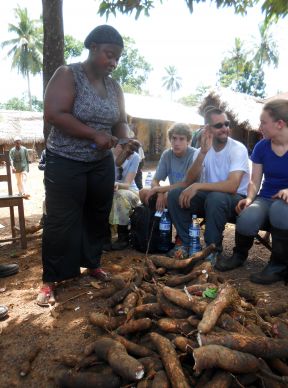








No comments:
Post a Comment