Chabad Magazine for Tuesday, Tevet 22, 5775 · January 13, 2015
|
Editor's Note:
Dear Friend,
We’ve once again seen the face evil.
First, innocent magazine staff members were murdered because of a caricature that appeared in a satirical publication. In the twisted minds of the terrorists involved, it somehow made sense to kill people who dared to express an opinion deemed “disrespectful.”
Then, on Friday, 20 people were held captive and four Jews wound up killed in a kosher supermarket. Yoav, Yohan, Philippe, François-Michel—and all the other men and women trapped inside—were targeted in the midst of their Shabbat shopping just because they were Jewish.
Anti-Semitism had reared up its ugly head yet again.
The following morning, Jews all around the world gathered in synagogues and heard the weekly Torah portion. There, we read of perhaps the first instance of anti-Semitism. The children of Israel were living in Egypt. They were not breaking any laws, had not harmed anyone and had no intention of doing so. Yet, Pharoah and his people saw them as enemies. And so the Israelites were enslaved and ordered to be killed; the Egyptians used every means at their disposal to destroy them.
And right there, lies the answer to anti-Semitism. “The more they oppressed them, the more they proliferated and spread.”
They tried to cut us down. We will increase.
They tried to frighten us. We will stand tall.
They hate us because we are Jewish. We will take pride in our identity.
They attacked a kosher grocery. We will cherish keeping kosher even more.
#JeSuisJuif, #JeSuisCacher
The nation of Israel will live on forever.
And to the mourning families in Paris: We share your pain and are crying with you. May G‑d bring the day when all tears will be wiped away from the Earth for good!
The Chabad.org Editorial Team
|

In His Presence
What is it that brings a thinking being to abandon the Master for the servant, to serve a single star rather than He who sprinkles out galaxies as dust, to play with spiritual forces and energies rather than connect to the Source of Life, to follow the commands of his own ephemeral cravings above the wishes of He who alone is real and true?
It is because in the worship of these we may delude ourselves that we too are something great, and perhaps all these are made for our glory At the very least, we are something that must be reckoned with. We exist.
But in the presence of the Infinite Light, there is no room for any other being to exist.
This the inheritance we have from Abraham, our father: The readiness to sacrifice our claim to existence so we may stand in the presence of the Infinite.
In this, we transcend the very act of being.[Maamar Bayom Ashtei Asar, 5731]

By Yehuda Shurpin
Your Questions
Can I Buy Something if I Plan to Return It?
By Yehuda Shurpin
|

Question
When I recently went on a road trip with my family, a friend suggested that I “buy” a portable DVD player for the kids to watch during the long trip. He suggested that I buy it from a store with a 60-day no-questions-asked return policy, and then simply return it after the trip. I told him that I didn’t think it was ethical, and I didn’t do it. However, this got me thinking: From the perspective of Jewish law, what are the guidelines for returning items that I purchased?
Answer
Let start with the basics.
Once a sale is complete and you’ve acquired the item, the sale is final, and in the absence of a specific return policy, neither the seller nor the buyer can nullify the transaction.
However, if the item is later found to have a defect—even if it’s a few years later—you are permitted to cancel the sale and ask for a refund, on the condition that you didn’t use the item once the defect was discovered. If you did continue to use the item, it is as if you forgave the seller for the flaw, and you are no longer eligible for a refund.
The above applies even if the merchandise was sold at a reduced price, but the buyer was not made aware of the item’s defects.
Before returning an object, there are a number of things that one needs to be aware of:
- Definition of a defect—Unless there was a specific agreement to the contrary, only flaws that are generally considered serious enough in that specific locale to be grounds for returning an object have the power to nullify a transaction. (One example may be the slight fading of color, which in many locales may not be viewed as that serious, while in others it would be grounds for a refund).
- Transaction is completely nullified—When a defect is found and the merchandise is returned, neither the seller nor the buyer can force the other to accept a partial refund or discount in which the buyer retains the item and the seller pays the difference for the defected item, in lieu of a full refund. The seller can simply say, “Either return the item for a full refund, or keep the item with no refund.”
- Store policy trumps all—As is the case with most monetary issues, if there is an official policy that the purchaser agreed to when buying the item (e.g. there is a sign displayed clearly in the store), we follow that policy.
Having established that unless the item is flawed, neither the buyer nor the seller can simply renege on the sale, the question remains: What if the store has a no-questions-asked return policy. In keeping with that policy, can you buy something with the intention of returning it later?
No-Questions-Asked Return Policy
In general, it is forbidden for one to ask a seller the price of an item if one has absolutely no intention of buying the item. Doing so is considered a violation of the prohibition “And you shall not wrong one man his fellow, and you shall fear your G‑d, for I am the L‑rd, your G‑d.” By asking the price, you are essentially raising the merchant’s hopes that you are a potential customer, only to dash his hopes when he realizes that you never had any intention to buy anything.
This would also apply if you “buy” something from a store when you have no intention of keeping it and every intention of returning it.
Another consideration is that when you return an object to the store, even if it is in perfect condition, the store has to pay to restock it, and it is often not possible to sell it as a brand new item. Thus, the store incurs a loss for you having used the item, and your using the item can be considered a form of damage.
In addition to the above concerns, since you just plan on having the item for a short while before you return it—but you have no real intention of actually buying the item—this may be considered as if you are just planning on “borrowing” the item. However, as far as the store is concerned, the intention is to sell you the item, not lend it. This raises the issue of not only deceiving the owner and/or damaging the object, but stealing as well. For the law is that if one “borrows” an object without the knowledge of the owner, even if it does not result in any damages, it is considered as if he stole the object.
Nevertheless, despite the above concerns, there are stores (usually bigger chain stores) that, based on their own research, have come to the conclusion that it pays for them to let you “buy” an item even if your intention is to return it in a few days. They reason that in the end, there are many who will either change their minds and decide to keep the item, or who will forget to return it. Therefore, some stores have a policy that allows you to try and outsmart them by buying an item with the intention of returning it, knowing full well that in the end, many times it is the buyer who is ultimately outsmarted when he fails to return the item.
In conclusion, unless you know for sure that the store has a specific policy that permits the practice of buying something even when the buyer’s intention is to return it, it is forbidden to buy an item with the intention of using it a bit and then returning it.
Rabbi Yehuda Shurpin responds to questions for Chabad.org's Ask the Rabbi service.
© Copyright 2015, all rights reserved.
|
|  |
|
TERROR IN PARIS
|
|
|
Terror in Paris
Chabad.org's French Editor Shares His Experience
By Emmanuel Mergui
|

Friday, January 9th, 2015 3:30 PM. Paris.
The world was frozen. After two terrorist attacks that left 13 people dead this week, a hateful terrorist was holding hostage some 20 people, including women and young children, in Hyper Cacher (read Hyper Kasher), a Jewish grocery store in Paris. We did not know who he was, but we knew he was there to kill.
We were all home, fervently reciting Psalms for the well-being of the hostages while frantically searching for news on the internet and social media. Alarming messages kept aggravating the anguish, telling Jews not to go out at any cost, that the police had asked to cancel Shabbat services that evening.
Then I walked past the kitchen and I saw my wife. She was, like me, holding her smartphone with one hand, scanning through social media and news reports, while talking on the home phone stuck between her chin and shoulder.
But she had something else in her right hand that seemed totally disconnected from the situation: a ladle. There she was, swirling in the kitchen from the sink to the stove and from the oven to the cutting board. It was a French 9/11, the world was exploding, and she felt it. But Shabbat was coming and she was – also – preparing for Shabbat.
She reminded me of the story in the Talmud that when, after a fierce battle against the defenders of Jerusalem, the Babylonian troops burst into the Holy Temple in order to wreak havoc in it and burn it to the ground, they found the Kohanim doing the daily offerings as usual.
And here, there was a drama unfolding, there was the terrorist and there was the terror, palpable. But there was also life, there was the sanctity of Shabbat and this monster was not able to damage it. At that time, my wife appeared to me as the High Priest in the Holy of Holies. Stricken by fear, but accomplishing her holy duty with passion.
She was personifying the words I once read in a letter by the Lubavitcher Rebbe, of righteous memory: “Am Yisrael chai, the Jewish nation is alive, and his Torah is a ‘living Torah’, about the commandments of which is said ‘one shall live by them’ and it was given by the ‘living G‑d.””
So we French Jews will keep on going about our simple and quiet everyday lives, in the very fashion that G‑d commanded us to do so. We will keep on buying our kosher products in kosher grocery stores; we will keep on sending our children to Jewish day schools; we will keep on attending services at our synagogues. And we will keep on living and thriving and contributing to the society at large.
The evil Haman from the story of Purim sought to annihilate the Jewish people, but instead ended up giving them an extra holiday, and a most joyous one at that.
Those terrorists, while causing so much suffering with the murder of those innocent victims, did something else they hadn’t planned to. They just gave our simple, quiet, everyday life so much more value.
From now on, for French Jews, every daily routine Jewish act will openly be the reflection of the unwavering commitment of the Jewish soul to its Creator.
Rabbi Emmanuel Mergui is an educator and the editor of our French website, fr.chabad.org.
© Copyright 2015, all rights reserved.
|
Terror in Paris
French Jewry Vows to Stand Strong and Proudly Show Identity
By Faygie Levy
|
 |
| In the midst of more than 1.5 million people at the rally on Sunday, Chabad-Lubavitch emissaries, students and volunteers were out in full force. Here, Rabbi Yosef Yitzchok Amar wraps tefillin and talks with a man in the crowd. |
After what is believed to have been the largest rally ever in France after terror attacks rocked the city of Paris for a week—including the participation of more than 1.5 million people, and 40 presidents and prime ministers from around the world—French citizens have returned to work and school with a question that looms over daily life: What next?
For Chabad-Lubavitch leaders, the answer is clear: Jews cannot be afraid or concerned about being there, and should proudly exhibit their Jewish identity and increase in the performance of mitzvahs.
“You cannot put your head down; you have to keep going and keep up hope,” says Rabbi Mendel Azimov, co-president of Chabad-Lubavitch in Paris. “As a Chabad rabbi, you know that people are looking up to you. Someone asked me, ‘Why don’t you close for Shabbat’? But closing a shul is not just a matter of opening and closing for two hours.”
Rather, “it is a symbol of Jewish life.”
At the behest of law-enforcement officials, the Great Synagogue of Paris did close for services on Shabbat—the first time since World War II—yet Chabad shuls remained open and used the opportunity to increase their prayers.
“We didn’t want to close because we didn’t want to give another victory to our enemies,” states Rabbi Chaim Shneur Nisenbaum of the school Complexe Scolaire Beth Haya Moushka in Paris, which houses a popular local synagogue.
“We said extra prayers and recited Tehillim (Psalms),” adds Azimov. “And there were more Jews that came on Shabbat day than usual because they wanted to pray and to do something in honor of the situation.”
1 Million Mitzvah Campaign
Taking their cue from the Lubavitcher Rebbe, Rabbi Menachem M. Schneerson, of blessed memory—who taught to focus on increasing in goodness—French Jewry is also spearheading a campaign to garner mitzvahs in honor of the victims.
Chabad in France is spearheading a campaign to garner mitzvahs in honor of the victims of the Hyper Cacher supermarket attack. “The goal is to have 1 million people accept an additional mitzvah or good deed,” says Rabbi Chmouel Lubecki.
“The goal is to have 1 million people accept an additional mitzvah or good deed,” explains Chabad Rabbi Chmouel Lubecki, co-director of Beth Loubavitch in Rouen in northern France. “The idea is spreading through social media such as Facebook and WhatsApp, and we see tremendous traction, as people seek to channel their grief into concrete positive action.”
There is also a drive in the Jewish community in France to raise money for the families of the four victims of the attack on the Hyper Cacher grocery store.
At the massive rally on Sunday, many Jewish men and boys embraced the opportunity to don tefillin, as a group of Chabad rabbis, students and volunteers ambled through the crowd offering help to those who wished to partake in the mitzvah, demonstrating their proud, public identification as Jews.
Those who wrap tefillin during such times, says Azimov, “feel it’s a way they can participate and show their Jewish identity.”
On a Facebook posting on Monday morning, Rabbi Yosef Yitzchok Amar of Beth Chabad Seine et Marne in France called for a million Jews to wear their kipahs visibly.
“It is prohibited to bow before terror,” the rabbi wrote, adding that “the freedom to worship is an important value in France. If they want to kill us … we will respond and react as Jews by adding in the practice of mitzvot. …”
“People must keep their pride of being Jews,” stresses Nisenbaum. “If we are afraid, then we are giving a victory to our enemies, and this is impossible. We have to be better Jews, stronger Jews and more confident Jews than ever.”
For Chabad-Lubavitch leaders, the answer is clear: Jews cannot be afraid or concerned about being there, and should exhibit their Jewish identity and increase in the performance of mitzvahs.
Security Concerns Remain on Minds
The national soul-searching in France focuses on what can be done to stop terrorism and anti-Semitism, which has been plaguing the country for some time now. Though it was vividly highlighted this past week, the problems have been ongoing, and have included vandalism and attacks on synagogues, and more.
In just the first half of 2014, more than 500 attacks against Jews were reported in France. The situation heightened in intensity this summer during Israel’s war with Hamas in Gaza. An estimated 500,000 Jews live in France, many of them in the Paris metropolitan area, and smaller cities such as Marseille, Strasbourg, Lyon and Toulouse.
But the recent turn of events made international headlines everywhere: First on Wednesday, with terrorists murdering 12 people at the offices of the satirical magazine Charlie Hebdo; followed on Thursday by the killing of a female police officer; and ending the work week on Friday with an armed gunman holding Shabbat shoppers hostage in a grocery store, resulting in the deaths of four Jewish men—and his own.
Citizens show solidarity with the four Jewish men killed in the grocery attack, including signs that read: "Je Suis Hyper Cacher."
Jewish community leaders met Sunday morning with French President François Hollande, who promised to increase security around Jewish synagogues, schools and sites, while members of the Jewish community vowed to stand strong and proud.
“Everybody is asking for more security,” says Rabbi Chaim Shneur Nisenbaum of the school Complexe Scolaire Beth Haya Moushka in Paris. “In all the Jewish schools now, the parents are asking for more security because there is a risk. People won’t continue to send their children to the Jewish schools because they are afraid, so we have to give them assurances that everything will be all right—and we are doing that.”
On Monday, France dispatched more than 10,000 additional police and security personnel to Jewish school and other sensitive sites.
The meeting between communal leaders and the French president took place hours before the massive unity rally that saw more than 1.5 million people take to the streets of Paris, along with the leaders of some 40 other countries, including Israeli Prime Minister Benjamin Netanyahu, German Chancellor Angela Merkel and British Prime Minister David Cameron.
Similar rallies were held in other cities; estimates suggest that some 4 million people participated in such demonstrations across the country.
Nisenbaum notes that he and others attended the mass rally—believed to be the biggest such public display in France since World War II—to show that the terrorists weren’t just out to destroy the French ideal of “liberté, egalité, fraternité [liberty, equality, fraternity],” but also to destroy Jews and Jewish life itself.
On a Facebook posting on Monday morning, Rabbi Yosef Yitzchok Amar of Beth Chabad Seine et Marne in France called for a million Jews to wear their kipahs visibly.
A Show of Solidarity
For many Jews, even those who weren’t directly affected by the week’s events, this past Shabbat came with unique challenges.
On Saturday night, Rabbi Mendy Mergui of Chabad of Maisons Alfort in Creteil, France, hosted two survivors of the harrowing siege for a special Chassidic gathering, during which words of inspiration were interspersed with stirring Chassidic melodies. Most appropriately, the assembled sang the Chabad melody, “Padah Beshalom,” a song of thanksgiving sung to commemorate miraculous delivery from harm.
“This Shabbat was a very painful one,” recounts one woman associated with the Jewish school system in Paris. “At first, we heard the happy news that the terrorists,” including the two brothers who on Wednesday killed 12 people at the offices of Charlie Hebdo magazine, “were shot. Shortly after that, we heard that a few of our brothers were taken as well. We are all bleeding for the families of the lives that were lost.”
“It is our family,” the woman went on to say. “We are all one family.”
And it is a family that, in some fashion, at least temporarily, appears to be gaining supporters.
Following the deadly terrorist attack at the Hyper Cacher kosher grocery, the observance of kashrut (kosher laws) was emphasized, and became part of signs and logos declaring “Je Suis Cacher” (“I Am Kosher”).
Across the city and on social media, French citizens held banners and sent messages that read “Je Suis Juif” (“I Am Jewish”) and “Je Suis Cacher” (“I Am Kosher”). The wording echoes a similar campaign undertaken on Thursday after the slaughter of 12 people at the offices of Charlie Hebdo when people began posting messages that said “Je Suis Charlie” (“I Am Charlie”).
But will such solidarity last?
“We’ll have to see in the future how people think [about anti-Semitism],” sums up Nisenbaum. “The whole of Europe has a problem with such things, and they don’t know how to look at it …
“We have to tell them that these people are fighting against the values of the free world. They don’t want liberty or democracy, and they don’t like any differences. They want only what they want.”
© Copyright 2015, all rights reserved.
|
Terror in Paris
Brief Profiles of the Men Killed at the Kosher Market in Paris
Chabad.org Staff
|
The four Jewish men who were killed on Friday, victims of the terrorist attack on the Hyper Cacher grocery store in Paris before the start of Shabbat, are expected to be laid to rest on Tuesday in Israel.
The victims—who range in age from their 20s to their 60s—were killed by a terrorist wielding a gun inside the store. Authorities eventually stormed the market, saving 15 hostages who had been held captive for hours.
Yoav Hattab
The youngest of the victims, 21-year-old Yoav Hattab, was the son of Rabbi Betto Hattab, rabbi of Le Grande Synagogue in Tunis, Tunisia, and the director of the Pinson Jewish School there. Originally from La Goulette, Tunisia, and one of nine children, Hattab was in France pursuing his studies. He had just returned there following a Birthright Israel trip and was said to have dreamed of making aliyah. He was at the market often, buying food or gifts for others for Shabbat; it was his usual Friday-afternoon routine. During the attack, he apparently tried to take a gun from the terrorist and was shot.
Yohan Cohen
Cohen, 22, may well be remembered as a hero—the supermarket employee who tried to stop the gunman holding him and more than a dozen other people hostage for hours. The gunman had apparently threatened the life of a little boy, spurring Cohen into action. In a scuffle for control of the terrorist’s weapon, Cohen was killed; however, the 3-year-old boy survived. Cohen had been working at Hyper Cacher to save money for his upcoming wedding to his fiancee, Sharon Seb.
Philippe Braham
Philippe Braham, 40, and a father of four, had stopped at the store to pick up some groceries for his wife, Valerie. One of his sons studies at a Jewish day school run by Chabad of Montrouge, a community in the suburbs of southern Paris. Rabbi David and Hava Mimoun, co-directors of Chabad of Montrouge, spent Shabbat comforting the Braham family. Braham’s ex-wife and teenage son live in Israel, and father and son were reportedly very close. This was not the first tragedy for the family; another son passed away three years ago and is buried in Israel.
François-Michel Saada
François-Michel Saada, 64, was a pension-fund manager and the father of two grown children who live in Israel. Born in Tunisia, Saada had arrived at the kosher market just as the store gate was being lowered. Unaware of situation unfolding inside the store, he reportedly asked to be let inside so he could pick up challah for Shabbat. He was killed instantly.
© Copyright 2015, all rights reserved.
|
|
| |
PARSHAH
|
|
|
Parshah
Moses to G-d: Why Have You Caused Them Evil?
Based on the teachings of the Lubavitcher Rebbe
|
Last week's Parshah concluded with the epochal exchange between Moses and G-d over the mystery of human suffering. Moses protested, "My G-d, why have You done evil to this people?"; and G-d replied: "Now you shall see what I will do to Pharaoh; for with a strong hand shall he let them go, and with a strong hand shall he drive them out of his land."
This week's reading, the Parshah of Vaeira ("And I made Myself seen"), opens with a new communication from G-d to Moses, in which G-d says:
"I am G-d (Y-H-V-H). I made Myself seen to Abraham, to Isaac and to Jacob, by the name of El Sha-dai, but by My name, Y-H-V-H, I did not make Myself known to them."
G-d then goes on to reiterate His promise to the Patriarchs to give the Land of Canaan to their descendents, evoking the "four expressions of redemption -- "I will bring you out, I will save you, I will redeem you, I will take you" -- which chronicle the various stages of the redemption, culminating in Israel's election as G-d's chosen people at Mount Sinai.
The commentaries see this divine communication as the continuation of the exchange between G-d and Moses at the end of the previous Parshah. G-d's mention of His relationship with the Patriarchs -- Abraham, Isaac and Jacob -- is interpreted as a rebuke to Moses:
G-d said to Moses: I regret the loss of those who have passed away and are no longer found. Many times I revealed Myself to Abraham, Isaac and Jacob; they did not question My ways, nor did they say to me, "What is Your name?" You, on the other hand, asked from the start, " What is Your name?" and now you are saying to Me, "You have not saved Your people!" (Talmud, Sanhedrin 111a).
You questioned My ways; unlike Abraham, to whom I said, "Isaac shall be considered your seed" and then I said to him, "Raise him up to Me as an offering" -- and still, he did not question Me (Rashi)
G-d also says: "By My name, Y-H-V-H, I did not make Myself known to them." This is understood by the commentaries as G-d saying to Moses: "I did not reveal My quintessential truth," represented by the divine name Y-H-V-H, to the Patriarchs; they knew Me only by the name El Sha-dai which represents a more limited manifestation of My being. They accepted that they could never comprehend My infinite, unknowable essence. You, on the other hand, to whom I have revealed My truth, question My ways (Rashi; Nachmanides).
This is how the opening verses of Vaeira are interpreted by the Midrash, Talmud and the biblical commentaries. The Chassidic masters delve deeper into these verses, and find there more than a rebuke to Moses: in G-d's words they also see an answer (of sorts) to Moses' question, and also a justification of his outcry.
The Pendulum of Life
All life, say the Kabbalists, is characterized by a to-and-fro movement called ratzo v'shov (running forth and drawing back) or mati v'lo mati (reaching and retreating). The heart contracts and expands; the lungs exhale and inhale; the body sleeps, extinguishing its more elevated faculties (cohesive thought, sight, hearing, etc.), in order to rejuvenate its energies; the mind meditates, emptying itself of prior conceptions in order to receive fresh insight; the earth enters night and winter, enduring periods of darkness and hibernation in order to attain a new dawn or spring.
The same is also true of the flow of vitality from G-d to His creation: this flow also pulsates, running forth and drawing back, reaching and retreating. And the more elevated the bestowal is, the more intense is the withdrawal to precede it. Thus, times of extraordinary illumination from Above are always preceded by periods of profound spiritual darkness.
Thus Rabbi Schneur Zalman of Liadi explains G-d's words to Moses regarding the difference in the quality of His relationship with the Patriarchs and His newly unveiled revelation of the divine name Y-H-V-H.
To the Patriarchs -- G-d is saying to Moses -- I revealed Myself only as El Sha-dai, relating to them only via the constraints and limitations that define My investment within the created reality. But to you and your generation I shall reveal, for the very first time, "My name Y-H-V-H," the name that connotes "My quintessential truth." For the purpose of the Exodus (as G-d said to Moses at the burning bush) is the revelation at Mount Sinai and the communication of My Torah, which is the very embodiment of My wisdom and will.
You ask why My people must suffer so terribly in their exile. You ask why is My face hidden, why I have seemingly withdrawn My providence over their lives. But this seeming withdrawal is an integral part of the tremendous revelation to come, which shall herald a new, unprecedented intimacy between man and G-d.
Indeed, adds the Lubavitcher Rebbe, the revelation of the Exodus and the concealment that preceded it are two faces of the same reality. In order for the people of Israel to relate to the quintessential truth of G-d revealed at Sinai, they first had to unearth their own quintessential truth -- which could manifest itself only in the nadir of their Egyptian galut.
"Truth" is that which is consistent and unchanging, the core reality of a thing that remains unaffected by all external circumstances. The quintessential truth of the Jewish soul is its loyalty and attachment to G-d; but loyalty and attachment to G-d under conditions of spiritual enlightenment and material prosperity cannot, in themselves, attest to this truth. There is no indication that the relationship would endure under less ideal conditions. But when the Jewish soul perseveres in its loyalty and attachment to G-d in the darkest hour of galut, it manifests the truth of its bond with G-d, demonstrating that this loyalty and attachment is, in fact, the unalterable core of its being.
"I am Y-H-V-H," said G-d to Moses. I am in the process of revealing My quintessential self to you. But the only part of you that can apprehend this revelation is your own quintessential self. And your own quintessential self rises to the surface of your souls only under the terrible conditions of galut.
Mind and Heart
The difference between Moses and the Patriarchs is also explained by the Chassidic masters as deriving from the different places they occupy within the total "body" of Israel. Abraham, Isaac and Jacob are identified with the attributes of "love," "awe" and "harmony" ( chessed, gevurah and tiferet), while Moses represents the attribute of "wisdom" ( chochmah). Otherwise stated, the Patriarchs are the heart of the Jewish people, while Moses is the mind of Israel.
Often, a person who calmly accepts the painful realities of life is described as "taking it philosophically," while one who agonizes over his own or others' troubles is seen as "being emotional." Behind these categorizations is the notion that, in purely rational terms, the cause, or even need, for human suffering can be explained. On the other hand -- goes this line of thinking -- a person with a sensitive heart will not accept any rationalization of evil, however undeniable its logic.
The truth, says the Lubavitcher Rebbe, is the very opposite. Indeed, the difference between one who cannot reconcile himself to the existence of evil and suffering in G-d's world and the one who can accept it is the difference between mind and heart; but it is the mind-driven person who incessantly questions and challenges the way things are, whereas it is the one with "heart" who can find it in himself to accept the most terrible of incomprehensibilities.
It is true that logical explanations for evil and suffering have been presented by a succession of philosophers and theologians. For example, it is proposed that suffering refines the human being, teaching him compassion and sensitivity. It has also been explained that there is no greater satisfaction than the overcoming of adversity and no greater pleasure than the conquest of pain. The philosophical mind can also appreciate that a persons finest and most potent abilities are unleashed only under conditions of challenge and trial. Finally, there can be no denying the axiom that without a truly free choice between good and evil, nothing we do could possibly be of any significance.
These explanations are all valid, in their way; indeed, we have presented one such "explanation" in the first part of this article. But when they are approached from a purely rational standpoint, the mind of the believer will not be satisfied by any of them. Because after all is said and done, after each of these explanations is examined and the questions that can be asked on them are posed and resolved, there remains one final question: Why must it be this way?
All these explanations -- the mind will inevitably argue -- are predicated upon our understanding of human and universal nature. But You, G-d, are the creator of nature and logic; You could have made the nature of things to be other than what they are. You could have made significant what logic dictates is of no significance. You could have created a reality in which there is gain without pain, in which the best in man could be realized without the threat and challenge of evil, in which the highest peaks of life could be scaled without the momentum of its lowest descents.
This perfectly logical question has no logical answer. Thus, the mind of the believer will never accept the "necessity" for evil and pain.
The heart also perceives the pain -- indeed, it senses it more deeply than the aloofly objective mind. But while the mind categorizes reality into compatible and non-compatible suppositions, the heart tolerates contradiction. Can you "prove" to a mother that her child is undeserving of her love? It's not that she is blind to his deficiencies and transgressions -- it's simply that they are irrelevant to her love. Outrage and devotion, judgment and acceptance, pain and pleasure -- a heart that loves has room for them all, simultaneously, in its warm embrace.
This, says the Rebbe, is the deeper significance of G-d's evocation of the unquestioning faith of the Patriarchs in His words to Moses. Moses, G-d is saying, you are the mind of My people -- the mind that is the instrument for apprehending My truth and, with it, illuminating the world. You will even comprehend "higher" aspects of My truth than did the Patriarches. But as a "mind," you question My creation of evil and suffering, and can find no rationally satisfying answer. Yet you, too, are a child of Abraham, Isaac and Jacob. You, too, have inherited from them the Jewish heart the intrinsic bond with your G-d that cannot be shaken by the most terrible of contradictions.
Seeing is Believing
Therein also lies the significance of the word vaeira -- "and I made Myself seen" -- with which G-d describes His relationship with the Patriarchs, and which give our Parshah its name in the Torah.
There are many ways that a person may come to believe in a certain truth. He may hear of it from a reliable source, it may be proven to him logically, or he may see it himself. Yet there is an essential difference between the perception of sight and all other senses. The other senses are refutable -- they merely prove something to the person; subsequent developments can undermine the initial conviction. But sight is absolute. The thing perceived may be denied by the entire world, it may be utterly illogical, but the person who has seen it knows it is true. He saw it.
Faith can exist on many levels -- faith comparable to the conviction in something that is heard, for example, or faith as powerful as a logical fact. But the most powerful faith is faith on the level of sight. Faith as sight is absolute; the most blatant rational contradictions cannot shake it. The Patriachs, the "heart of Israel", saw G-d. That is why their faith in Him was not shaken by even the most agonizing "contradictions"
This also explains a puzzling passage in Rashi's commentary on our Parshah's opening verse. On the words "I made Myself seen," Rashi comments: "To the fathers." But the verse itself says, "I had made Myself to be seen to Abraham, Isaac and Jacob...", and every schoolchild knows that Abraham, Isaac and Jacob are the three fathers of the Jewish nation. What is Rashi telling us?
The Jewish people are suffering, and G-d's promises seem to only make things worse. To Moses' anguished words, G-d replies "Abraham, Isaac and Jacob never lost faith, they saw Me." Yet Moses and his people are obviously not Abraham, Isaac and Jacob -- that's why they reacted the way they did. So what is G-d telling them?
So Rashi explains: G-d's response to Moses is that He "made Himself seen" to the fathers. Abraham, Isaac and Jacob are the progenitors of the Jewish people in every sense of the word. Just as a child inherits the physical and psychological characteristics of his parents, in the same way, each and every Jew inherits the qualities of Abraham, Isaac and Jacob. Their every trait, experience, and achievement are stamped in our spiritual genes.
Because our fathers' faith in G-d was as absolute and unequivocal as sight, the potential for such faith exists within each and every one of us. No matter what our more external senses perceive, we can delve into our own selves for the inherent ability to see G-d: to sense His commitment to us even in the "darkest" of times.
© Copyright 2015, all rights reserved.
|
Parshah
Frog People Are the Worst of Them All
By Mendel Kalmenson
|

Kalman Cowl, a music professor at Columbia University, became friendly with some chassidim and would often visit them in 770.
Once, he was persuaded by his friends to sign up for a meeting with the Rebbe.
He was apprehensive about the meeting, though, for in his own words, “Although I felt fiercely Jewish, I didn’t believe in G‑d.”
At their meeting, after exchanging pleasantries, Kalman told the Rebbe, “I appreciate the privilege of being taught more about my heritage here in 770, but I don’t want to be here under false pretenses. I have no faith.”
The Rebbe thought for a few moments and said simply, “As long as you are concerned about that, I’m not worried.”
Frog-Fest
G‑d said to Moses: Come to Pharaoh and say to him, “So said G‑d: Let My people go, so that they may serve Me. But if you refuse to let [them] go, behold, I will smite all your borders with frogs.”
“If not for the [plague of the] frog, how would G‑d have punished the Egyptians?”—The Midrash
A strange statement, that one, if not outright heretical.
The implication is that if not for The Frog, Pharaoh could not have been vanquished. But aren’t there “many agents of G‑d”? Is His task force not huge and varied? And weren’t the other nine plagues equally—if not more—effective in bringing Pharaoh to his knees?
The Three Stooges
In Biblical lore (to generalize) we find three ideologies, professed by three notorious characters, each of whom rubbed G‑d the wrong way, in varying degrees.
The individuals (listed non-chronologically) are: Balaam, Pharaoh, and Sennacherib.
Balaam was a complicated man.
A believer he was. After all, he was a prophet. And which prophet in his right mind would deny the existence of the G‑d for whom he claimed to speak? Rather than believing merely abstractly or theoretically, he well understood, and would later re-learn, the fact that G‑d is heavily interested and involved in world affairs. This we know from his own candid admission: “If Balak will give me his house full of silver and gold, I cannot transgress the word of the L‑rd, my G‑d, to do anything, small or great . . .”
But his belief system was nuanced and complex. He took issue with the unity, though not the existence, of G‑d . . . but that’s for a separate discussion.
On the other extreme we have Sennacherib the atheist, who denied the existence of a Higher Being, going so far as to make a point of cursing G‑d. His disbelief in G‑d took the form of active atheism. He was a religious non-believer, passionate and committed to discounting faith in a Creator.
In this way, both he and Balaam shared common ground; they were both equally disturbed by the notion of G‑d, especially one who supervises the world. They differed, though, in how they chose to deal with their respective frustrations: Balaam reluctantly resigned himself to G‑d’s dominion, while Sennacherib spent a lifetime campaigning against it.
Pharaoh, however, charted new ground.
He is the Bible’s very first deist, believing that even if G‑d existed, He had nothing to do with the world’s administration. The world’s maintenence was man’s domain.
In other words, in Pharaoh’s books, the question of G‑d’s existence was theoretical and removed from practical life. It made for great debate in the halls of the academy, but had no business being discussed in the streets or bars, let alone shaping government policy.
That this was Pharaoh’s philosophy is clear from his very first words to Moses, “Who is G‑d that I should heed His voice to send out Israel?” which could be understood to mean, “Since when is G‑d involved in what goes on downstairs?”
Pharaoh’s weltanschauung becomes more evident from Moses’ words to him on G‑d’s behalf, “If you do not let my people go, behold, I will incite against you, and against your servants, and against your people, and in your houses, a mixture of wild beasts . . . so that you will know that I am G‑d in the midst of the land.”
Apparently, Pharaoh needed convincing that G‑d was chief not just in heaven but on earth as well, “in the midst of the land.”
So in sum, we have Balaam the (befuddled) Theist, Pharaoh the (makes-no-difference-to-me) Deist, and Sennacherib, the (angry) Atheist or Anti-Theist.
If you were judging these men and their philosophies, which would you rank the greatest threat to the institution of faith?
Perhaps unexpectedly, G‑d voted Pharaoh worst of the bunch.
For you’re bound to hear G‑d’s name in conversation with both Balaam and Sennacherib. Granted, when talking to Sennacherib, you’ll hear it louder and fiercer; but let’s face it, He’s on both of their minds.
Talk to Pharaoh and you’d never know there’s a G‑d.
From both the theist’s arguments for, and the atheist’s or anti-theist’s arguments against, the existence of G‑d, one is informed of a power to be reckoned with. They’re both G‑d-fearing, if you know what I mean.
To the deist, G‑d isn’t even up for discussion.
Pharaoh gave G‑d the cold shoulder, and that’s what singled him out for special attention.
And here’s where the frog jumps in.
Animals can be broken down into three groups: those that benefit mankind, those that harm mankind, and those that seem irrelevant to mankind.
Dogs provide security and companionship. We like them. They’re a creation of G‑d that is meaningful to us. Poisonous snakes can cause death. This lends the snake a definite character too. And if the person poisoned was wicked, there’s some meaningful justice in a snakebite.
Then there’s the frog, which (other than Kermit from the Muppets) seems to serve no purpose at all. It bears no indication of a design or a Designer. The frog, like Pharaoh, when encountered or observed, says nothing about its Creator.
Therefore it was chosen to bring punishment upon Pharaoh. As if to say, even this “random” creature has a purpose in this world. No creation is meaningless or unnecessary. The Creator of our world is also its Conductor. And in His ensemble, even a frog’s croak is a song of praise.
What’s In It for Me?
“The opposite of love is not hate, it’s indifference. The opposite of art is not ugliness, it’s indifference. The opposite of faith is not heresy, it’s indifference. And the opposite of life is not death, it’s indifference between life and death.”—Elie Wiesel (US News & World Report, Oct. 27, 1986)
More for Me . . .
According to a recent Pew Forum report, “The number of people who say they are unaffiliated with any particular faith today (16.1%) is more than double the number who say they were not affiliated with any particular religion as children. Among Americans ages 18–29, one in four say they are not currently affiliated with any particular religion.”
The terms “uninitiated Jew” or “unaffiliated Jew” must be written out of the Jewish lexicon and experience. The “relationship status” of today’s Jewish Facebook page must begin to read: “Engaged,” “In a relationship,” even “It’s complicated”—so long as it reads something.
(Based on Likkutei Sichot, vol. 21, pp. 38-44)
Rabbi Mendel Kalmenson is the rabbi of Beit Baruch and executive director of Chabad of Belgravia, London, where he lives with his wife, Chana, and children. Mendel was an editor at the Judaism Website—Chabad.org, and is also the author of a popular book titled Seeds of Wisdom.
© Copyright 2015, all rights reserved.
|
|
| |
YOUR QUESTIONS
|
|
|
Your Questions
Is There Mystical Meaning in Klezmer?
By Tzvi Freeman with Baruch Shalom Davidson
|

Question:
It seems that Hebrew music is always in minor. Is that correct, and if so, is there a spiritual significance?
Answer:
I also found this intriguing. Even more intriguing is the explanation I found in Shaarei Teshuva, a mystical work written by Rabbi Dov Ber of Lubavitch in the early 19 th century.
First of all, some preface: Western music is generally divided into major and minor modalities. Music in minor can express sadness, yearning, bitterness or some such dark mood, whereas music in major expresses joy, victory, strength and the like. (To keep it simple: major modes are those with major thirds, while minors have minor thirds.)
Generally speaking, you are right about the repertoire of Jewish music with which most of us are familiar. While there are many traditional melodies in the major modes, the minor modes (including something called Dorian and another called Moorish) certainly seem dominant.
On the other hand, Arabic and East Indian music have many more of those qualities that give the minor modes their melancholy and yearning tone. Thinking about it, the music with which Jewish people generally identify seems to fall somewhere smack in between European and Arabic culture. It's true that this is where we have been for the past 2000 years--dancing back and forth between these two mega-cultures. And it's true that much of Jewish-identified music comes from southeastern Europe, an area occupied by the Ottoman Empire for centuries, and heavily influenced by Turko-Arabic culture. Yet it's hard not to think that there must be much more to it than that.
Music & Soul
The music of a people reflects its soul. Plato and Aristotle believed that you could overturn an entire nation simply by changing the modalities of its music. The music with which we identify as a people should give us some major clue as to who we are at a soul level. This is where the commentary from Shaarei Teshuva comes in:
The Zohar tells us that the souls of the Jewish People are split into two branches: Those related mostly to Abraham and those most related to Isaac. The Abraham souls descended into exile among the spiritual descendants of Esau--meaning Christendom and European culture, while the Isaac souls are exiled among the spiritual descendants of Ishmael--meaning the world of Islam and Arabic culture.
Abraham, Isaac and Jacob reflect the three principal modalities of the sefirot: Abraham embodies Chesed—a positive, giving flow of light . Isaac embodies the Divine aspect of Gevurah--a negative, powerful restraining of light. Jacob, who embodies the entire Jewish People, also embodies the middle path of beauty, compassion and truth, which harmonizes and synthesizes Abraham and Isaac as one.
Here's how Ishmael and Esau fit into the picture: They are the modalities of their respective fathers gone wild. Ishmael is the son of Abraham, so he takes this positive flow to an extreme, being "a wild man, his hand on all others and their hand on him." Esau is the son of Isaac, and he takes Isaac's negative, restraining power to its extreme, with a powerful drive to conquer and subdue.
It would seem then, that Ishmael should love upbeat, joyful music and Esau should be attracted to harsh and bitter music--yet in fact, we see the opposite. But this is the way things work: Enjoyment always comes from opposites. Just like on a hot day, an ice cream is pleasurable, and on a cold day, a hot chocolate does the job, so too the hot, exuberant soul of Ishmael finds pleasure in cold, bitter music and the cold, harsh soul of Esau finds pleasure in hot, sweet music.
Now, you ask, what are the positively charged souls of Abraham doing among the negatively charged souls of Esau, while the negatively charged souls of Isaac are stuck within the positively charged souls of Ishmael? The answer is that they are there to heal them, and healing can only come from an opposing force.
After all, the problem of Esau and Ishmael is that they are extremists. Placing their opposites among them is meant to temper and heal that extremism. The other, related problem is that their joy and pleasure is by nature directed selfishly. This too, can be healed through their music.
The Abraham souls living with Esau, take his music and play it in a deeper, tempered way. Esau is rejoicing over his own happiness and wealth, and Jews play back that music rejoicing in the sweetness of the soul and of life, tempered with a touch of melancholy. Meanwhile, the Isaac souls living among Ishmael take his unending bitterness over the tragedies that affect him and play it back to express the bitterness of the soul over the tragedy of its descent to this world, far from its home--tempered with hope that its longing will be fulfilled and it shall return.
Diatonic World
Although the U.N. lists 192 nations, the Torah lists seventy families of humankind. This, R. Dov Ber writes, is because there are ten facets of seven different modes of emotion. Each people has its particular facet, reflected in its flavor of music. In order for the world to reach its ultimate messianic state, each nation's music must be uplifted and refined. Esau and Ishmael are simply the two branches of chesed and gevurah upon which all these smaller branches grow.
Ultimately, through a refinement of Esau and Ishmael and all their branches, the mission of the Jewish People for which they entered exile is complete, and their time of redemption arrives. The Shaarei Teshuva concludes:
"With all this, we understand how at the end of this era, the ultimate redemption is not through the seed of Abraham, but through the seed of Isaac who are in the exile of Ishmael, singing their melancholy melodies…"
"Even though most of the exiles live among the nations of Edom and Yavan [Rome and Greece--meaning Western culture] etc., nevertheless, the main redemption depends upon the fall of the angel appointed over Ishmael, as written in the Zohar. And this is sufficient for those that understand."
I can't say I am really among "those that understand," but what I do get is that:
- Jewish music is the music of the nations among whom we live, invested with a Jewish soul to temper that music. If so, the music of Ashkenazi Jews, living in Europe, will be slightly more minor than the music of the people around them.
- The principal purpose of Jewish music is to refine and transform humanity, thereby bringing the messianic era. This is accomplished chiefly through the minor mode, which elevates the side of gevurah and transforms Ishmael.
Let me know if this is as fascinating to you as it is to me.
If you are looking for selections of Jewish music on our site, you'll find that at our music site. And here's a list of more essays on music, including the Kabbalistic perspective.
Source: Shaarei Teshuvah 89d
Rabbi Tzvi Freeman, a senior editor at Chabad.org, also heads our Ask The Rabbi team. He is the author of Bringing Heaven Down to Earth. To subscribe to regular updates of Rabbi Freeman's writing, visit Freeman Filessubscription.
Rabbi Baruch S. Davidson is a member of the Chabad.org Ask the Rabbi team.
All names of persons and locations or other identifying features referenced in these questions have been omitted or changed to preserve the anonymity of the questioners.
© Copyright 2015, all rights reserved.
|
|
ESSAY
|
|
|
Essay
Did You Ask to Be Born?
By Yanki Tauber
|

Once upon a time there was a village full of disgruntled people. All day long they walked around with these sour faces, each bemoaning his troubles, each jealous of her neighbor's successes.
One day, a wise old man arrived in the village. He assembled them all in the village square and said to them: "I want you each to go and bring your most precious possession, the thing you cherish most in your life, and place it here in middle of the square." Soon there was a large pile of bundles and packages, of all shapes and sizes, in the center of the village square.
"Now," instructed the wise man, "you may each select for yourselves any one of these gifts. The choice is yours--take any package you desire."
Every man, woman and child in the village did exactly the same thing. Each chose his own bundle.
The Torah, as we all know, begins at the beginning, describing G-d's creation of the heavens and the earth, the continents and the oceans, vegetation and animal life. Then, in its 26th verse, we proceed to the creation of man. "And G-d said," we read, "Let us make man in our image, after our likeness..."
G-d is asking a council of human souls if He should create the human soul!Let us? Up to this point--and from here on through the rest of the Torah--G-d is spoken of as the ultimate singularity. He is the Boss, the exclusive source and mover of all. But in this single instance, there is an "us," a choir of opinions, a supernal boardroom before which the Creator places a proposal and asks for approval.
With whom did G-d consult when He desired to create the human being? Our sages offer a number of explanations. One is that G-d asked the angels, so as to temper their later criticisms of the failings of mortal man. Another explanation is that G-d was involving all elements of the universe, or all aspects of His infinitely potentialed being, in the formation of the multi-faceted soul of man. All these explanations, of course, raise at least as many questions as they answer. Indeed, it is regarding this particular verse that the sages have stated: "The Torah says it thus; anyone who wishes to misunderstand, let him misunderstand..." Obviously, there is an important message here to us--important enough that the Torah insists on this particular phraseology despite the fact that it allows for (encourages?) misunderstanding.
But there is one interpretation of this verse which presents us with a conundrum of a paradox. The Midrash offers the following explanation: "With whom did He consult? With the souls of the righteous." G-d is asking a council of human souls if He should create the human soul!
The plot thickens. Who are these "righteous" (tzaddikim) with whom G-d consulted? According to the prophet Isaiah, "Your people are all tzaddikim." We each posses the soul of a tzaddik (regardless of the extent to which we allow its expression). In other words, G-d asked each and every one of us if we desire to be created, if we choose to accept the challenge of earthly life. Only then did He proceed to create us.
If asking a soul whether it wants to be created sounds like a catch-22, this paradox in fact resolves a much deeper paradox--the paradox of divine decree and human choice.
G-d is forever telling us what to doG-d is forever telling us what to do. Indeed, the very word Torah means "instruction," and that's basically what the Torah is: a series of instructions from on high. And yet we are told that "a fundamental principle of the Torah" is that "freedom of choice has been granted to man." What exactly are our choices, if G-d is constantly instructing us?
The question runs deeper. Let us assume that, in any given situation, under any set of circumstances, the choice is ours as to how we should act. But what kind of choice is this, if no one asked us if we want to be in that situation and under those set of circumstances in the first place? What kind of "choice" is there, if we didn't choose whether or not we should be presented with that choice?
So the Torah reveals to us this amazing secret: that ultimate choice was made by us, before we even existed. Before G-d emanated your soul and breathed it into your body, you were asked if you should be. So in every situation in which you find yourself, in every challenge you face in your life--you are there because you chose to be placed in that life.
The life we have is the life we wantWe go through life complaining, "I didn't ask to be born...!" But a thousand times a day we refute that claim. With countless choices and actions, we affirm that the life we have is the life we want.
Of course we do. After all, we chose it.
By Yanki Tauber; based on the teachings of the Rebbe.
About the artist: Sarah Kranz has been illustrating magazines, webzines and books (including five children’s books) since graduating from the Istituto Europeo di Design, Milan, in 1996. Her clients have included The New York Times and Money Marketing Magazine of London.
© Copyright 2015, all rights reserved.
|
|
WOMEN
|
|
|
Women
The Hole in My Heart
By Blumie Abend
|

My baby is as big as a plum.
That’s a good thing. It means I’ve reached the 12-week mark, where the chance of miscarriage is significantly lower, where I’m nearing the end of the dreaded first trimester. My pregnancy hormones should calm down somewhat and give me a bit of a break.
I’ve been feeling nauseous. And tired. And irritable. And frustrated.
And worried.
My baby is as big as a plum“Worried” is too kind.
“Anxious” is a credible substitute. At the beginning, it was “terrified.”
The first week that I suspected, and then confirmed, that I was pregnant, I barely ate. I couldn’t sleep well. I had a pit in my stomach and what felt like a log lodged in my throat.
I thought you were ready.
I was ready!
But now, I’m not.
And no, another month wouldn’t help. Another two months wouldn’t help. Three, four, five—even a year. The desperation to have a child might have grown, but the terror when it actually happened wouldn’t have lessened.
Every baby is a miracle. Every button-nosed, blue-eyed, little-hands-and-toes bundle is a work of art, a piece of Creation. And I know that.
I know it too well.
Because I learned it the hard way.
I already have one child. A child I love to the heavens and back, a child I would give my life for. A child who fills my heart with such an intense feeling of pure joy and gratitude that it hurts, it takes my very breath away.
That child is now 20 months old and is growing, maturing, navigating her tender way through life. She is no longer a tiny bundle, and I marvel at her growth, reveling in her simple happiness and limitless energy.
I adore her with my entire being. Yet her birth—and the slap across the face that came with it—ensured that I would never be the same.
My sweet piece of heaven was born with a cleft lip palate and three short fingers on her left hand. She had a literal hole in her face.
I look back now at pictures. Her beauty, her purity looks back at me, her crystal blue eyes two shining seas. But there was no denying she had a terrifying face. I had to pick her up in certain ways, look at her only at certain angles. The feelings her face evoked make me cry even now.
It took four surgeries to “redo” Layla’s face. Today, Layla is the prettiest, sweetest, most outgoing child on the block. She is stopped by every passerby—or stops every passerby herself—to say, “Hi.” Comments such as, “She is such a pretty girl!” “Oh my goodness, she is too cute,” “What a perfect little face!” make me swell with pride and laugh inside all at once. If only they knew, I think to myself.
Those comments hold so much more meaning than that passerby would ever know. They are a balm to my wounds. They are my triumph, my victory over the journey with a cleft.
And now, here I am. Twelve weeks pregnant. The stark differences between my first, innocent pregnancy and this second one are heavily apparent in every step of my day, in every emotion, in every thought.
I read the week-by-week pregnancy guide, and the wheels start turning frantically in my mind.
Your little one's mouth can open and close at this point in gestation, so your baby's time might be filled with sucking, yawning and swallowing amniotic fluid.
Layla couldn’t suck until she was almost a year old, once her palate was closed. How do they know this baby inside of me can suck?
Your baby's fingers will soon begin to open and close.
How many fingers? Are there ten. Maybe. Maybe not.
She has tiny earlobes, and her mouth, nose and nostrils are more distinct.
What is distinct? A whole mouth? An entire nose? Are they separate? Or are they one big, gaping contraption, a pit of gum and tissue?
And then, at the end, I read:
Note: Every baby develops a little differently, even in the womb. Our information is designed to give you a general idea of your baby's development.
Thank you.
Thank you very much.
I don’t blame birthing classes, nurses, midwives, doctors for failing to mention that no, things are not always hunky-dory, and life is not always a bowl of cherries. It was G‑d’s will that, despite an ultrasound, I didn’t know of any storm clouds on the horizon. There were no warning signals to take heed of.
This is life. Lessons are learned. We draw courage from our challenges and try to use them as a rung to ascend higher.
But what about the fear?
There is no denying the fear. The “what if’s” and the envisioned scenarios. The imagined disclosures. The dread. At this point, I am powerless in this creation, I am powerless to have any say or take any part in the tiny being that is already a fully formed human inside of me. I am full of doubts. Thoughts and worries plague me relentlessly.
I don’t know what he or she will look like. I don’t know if this one will be a tiny bundle of pure joy who will leave me gasping through tears of disbelief and happiness, or if this one will be another challenge. The same challenge, a different one. Who knows? The walls in my mind are all torn down, and I entertain the entire scope of the “what if” spectrum, my heart pounding at the possibilities of a challenge that may be in store for me.
It is indeed terrifying to feel utterly helpless on a path that you chose to journey on.
Sometimes, I manage to “let go” and anticipate a journey of peace and serenity. But I’m finding that unless I pretend there is nothing inside of me right now, no seed of life that is already showing it’s presence on my waistline, I’m ill at ease.
All I can do is prayBy the time this article goes to print, I will probably have had my 20-week ultrasound. I will know (due to extra, extensive testing) if my baby has a complete mouth and nose. I will know if it has working organs, healthy kidneys, appropriate growth. I will know if it has ten fingers, ten toes and a straight spine.
That ultrasound will probably be one of the most terrifying experiences in my young life, one that I know I will both dread and await eagerly.
All I can do is pray.
Blumie Abend is a wife and mother currently living in Crown Heights. She has a passion for writing and currently works as a freelance writer.
© Copyright 2015, all rights reserved.
|
Women
Exchanging Supermom for Everywoman
By Shimona Tzukernik
|

About a year ago, I spoke to a group of women in Pittsburgh. The topic was, “Will the Real Jewish Woman Please Stand Up?” The energy was already upbeat and intimate by the time I made reference to the famous text, “Eishet Chayil” (“Woman of Strength”), which Jews customarily sing at the Friday night meal. Before I could work my way into the point I intended to make, a woman blurted out something to the effect of, “I hate that song.” I turned to her, inviting her to elaborate.
“Well . . . she’s just so . . . perfect! I feel like a complete failure every Friday night. I mean, do you know anyone like her?” Laughter all around.
I love when that happens—a real, visceral response to the topic at hand (especially when it resonates with my own inner passion, hesitancy or conflict around a particular idea). How many times had I balked at the words?! Using the Hebrew letters as a springboard, it is a veritable alphabet soup of perfection. I won’t overwhelm you with all the details, but how’s this for starters?
- Alef—She’s an eishet chayil, a “strong” woman. The word “chayil” connotes the power of war. She’s a warrior. And a spiritual one too, with all the attributes needed to carry out any task at hand. Friday night rolls around, we haven’t even gotten past verse one, and I’m up against Kosher Tiger Mom!
- Bet—“Batach bah lev ba’alah,” “Her husband’s heart trusts in her.” Hmm. I can count on one hand (okay, two fingers) the number of girlfriends whose husbands are at peace with their wives’ take on life and what’s best for them. Verse two, and I’m dealing with not only a powerhouse, but someone who’s wise and gentle enough to inspire confidence in her mate!
- Gimmel—”Gemalthu tov,” “She imparts goodness and kindness to him, never evil.”
Who is this gal?
The Kosher Tiger Mom
In short, a brief read-through of the song reveals that Kosher Tiger Mom has a loving, trusting husband; she’s an entrepreneur and successful business woman; she’s industrious, charitable, wise, empathic and intuitive. To boot, she’s well-groomed (read: manicures, facials and Saks Fifth Avenue, if not Vera Wang) and even has the time and cash to buy gorgeous bedroom linens in mindful attention to her intimate life.
Is it any wonder the second phrase, in breathless pursuit of the eishet chayil, asks, “Who can find (her)?” She is not me! All of which leaves me with the question of how to read and apply King Solomon’s song to my life—along with the implications it has for my role not only as wife, but as daughter to my mother, and mother to my own children.
The Cosmic Everywoman
It seems to me that the eishet chayil is “Everywoman,” an archetype of us all. No, I’m not just looking for a backdoor escape from my perfectionism, a way to avoid the reflections of the flaws I encounter on a daily basis. I ask myself whether she represents an attainable goal. Certainly, in a utopian era, we may each come to embody the eishet chayil described by King Solomon, but in the here and now of life as we know it, I’ve yet to meet the woman who lives up to the persona King Solomon portrays. Rather than describe one single Supermom, it seems to me that the text serves to connect us with the universal image of wife and mother. After all, the passage has been interpreted as a metaphor for the Shechinah (the Divine Presence), the Sabbath, the Torah and the soul. Doesn’t it make sense that the acrostic, spanning all twenty-two letters of the Hebrew alphabet, alludes not to one woman’s all-encompassing virtues (Supermom) but to our collective identity (Everywoman)?
Just before my marriage, a spiritual midwife told me, “King Solomon says, ‘The wisdom of a woman builds her home.’ The literal translation, though, states, ‘The wisdom of women (plural) builds her home (singular).’ You will build your home on the wisdom of many women. Pay attention to how they live and what they have to say.”
How right she was. I have enriched myself and my home through the collective wisdom and experience of the thousands of women I’ve merited to connect with. I carry them within me and am personally empowered by who they are. As Eishet Chayil is sung each Friday night, it affords me some brief moments of contemplation to rejoin with them, and also to be eased by the knowledge that our physical and spiritual interconnectedness mitigates my own flaws, enabling me to bring their lights into my home.
By extension, I have access to the larger, cosmic Everywoman; namely, the energies and insights of the women who have come before me, all the way back to Sarah. (In fact, one reading of Eishet Chayil is as the eulogy Abraham said for Sarah before he buried her.) It may be a span of thousands of years between me and my first mother, but that’s only around 175 generations.
That’s not an impossible divide. I want some of the wisdom and joy of the women between the two of us. I now know how far from the truth my youthful stereotype of the shtetel Bubby—naïve, somewhat simple, lacking emotional subtlety—is. Today, I’d love to have her over for brunch and glean her insights and tools on how to handle my life. The same goes for all the women throughout those interceding generations, each of whom has her own shining letter from the alphabet soup of perfection to impart to me. As their daughter and granddaughter, I am bound with their point of perfection. Thereby, at some level, despite the fact that I’m no Supermom, the eishet chayil is in my home each Friday night. And I can even carry her, the collective “Everywoman,” within my own being.
In this way, I gain access to a dimension of myself that is way beyond my highest personal aspirations. For if the totality of who I can be is purely a result of my own endeavors, I will be very small indeed. Rather, it is in surrendering to my imperfections and humbly admitting the bigness of eishet chayil that I open the window to the full expanse of who I am.
G‑d-Like Mothers
But to me, the collective gestalt of Jewish womanhood embodied by the eishet chayil allows us even more than access to this larger, truer self. In addition to this priceless gift, she affords us the possibility to reconfigure our relationship with our mothers. I know, easier said than done. The most potent reaction I ever got to a presentation was a lecture called “Moms, the Magic and the Madness.” The audience—and yours truly—wasn’t quite sure whether to laugh or weep. Our relationship with our mothers is incomparably multi-dimensional and complex, overlaid with love and with anger. It’s a real big one to navigate, but one which we are nonetheless expected to manage and even heal.
It’s not that we can disregard the relationship if it’s uncomfortable for us. “Honor your father and mother” made it to fifth on the list of the Big Ten! Yet for many, this instruction on how we ought to relate to our parents is something they find absurd. I can hear the disdain: “My mom hangs out at the gym all day and gossips non-stop. She’s dishonest in business, self-centered—nay, narcissistic—and materialistic. She never had the courage to face her wounds, so I get to be the beneficiary of her dysfunctional inheritance! Yadda, yadda . . .” Alright, this is Everymom we’re talking about. But you get the idea. How are we to honor and respect our moms despite their often startling imperfections?
Ultimately, the reason we honor them has nothing to do with their personal or moral stature. G‑d’s directive is rooted in the fact that at the moment of conception, our parents take on something of the Divine. They become co-creators with G‑d in bringing us into being. That’s why honoring our parents is immutable. It’s not about the gym or manicures, how they do or don’t pay taxes and show up in life. It’s about the fact that in relation to us they are G‑d-like in a certain respect. That’s the ground-zero of honoring our parents, and until we get it, most nothing else we say or hear will be of use to us in moving the relationship forward.
Reframing the Relationship
But this immutable point of greatness aside, each Friday night the eishet chayil reminds us of two key ideas which can change the way we negotiate our very first relationship. The first is that, as mentioned, none of us is perfect— and that’s okay! The second is that in some mysterious way we can, if we choose to, receive what we need through the collective Everywoman. In this way, we learn to lower the bar on our mothers. We don’t have to hold them to an impossible standard. Whew! In fact, we can begin to accept our mother for who she is and learn to get our needs met elsewhere if she is not able to do so. We can stop blaming our unhappiness on someone who would not—or, more accurately, could not—come to the table in the way we needed her to. Eishet chayil, Everywoman, becomes a reservoir of healing and nourishment for our being.
Through this forgiving of our mother for her imperfections, we are able to release the aspects of our own emotional and mental inheritance we’d rather do without. One of the first things we learn about our father Abraham is that he smashed his parents’ idols! I am embarrassed to admit it, but it was only well into my thirties that I realized I had to do the same. I have been the beneficiary of an incredibly rich inner life from my parents. But I’d also spent decades bowing to their false beliefs, accepting it as fact that I was doomed for time everlasting to live with the limitations those beliefs generated. Then one day the teaching about Abraham took hold in my mind with a vigorous vitality. I took an inventory of what I’d inherited. In addition to the abundant goodness and wonder, it included beliefs about how much I was likely to earn, how to respond when angered, what the appropriate response to suffering is, who I am and a whole lot more. I trust you get what I’m talking about. How liberating to realize that I could systematically smash those idols—without betraying my parents! I was not being faithless to them in subscribing to different truths and happiness.
The catch in doing so is to disown the false beliefs yet remain in the relationship and in touch with the wonder and goodness at the same time. Abraham smashed Terach’s idols but he continued to live with him—for another seventy-two years. Granted, Terach came around to Abraham’s way of thinking, but our first father would have managed to negotiate the relationship regardless. I believe that is because connection with G‑d was the singular driving force in his life. As such, he was able to see his father’s flaws, but not take them personally and not feel limited by them, thereby being able to detach with love so that he could actually help Terach. He was able to not own another’s dysfunction (in other words, make the other responsible for their shtick) and yet remain connected to the one he loved.
To accomplish this mode of conduct, we must discover a new mental set and learn to shift our reading of the events and relationships in our lives. Most of our pain in relation to our parents (and pretty much everything else) has to do with our own perception. We interpret things to mean what they are not. As such, we tend to live in the rather unhappy space between the way things are and the way we think they should be. We walk around grumbling about the sins of G‑d and others in our life. And of course, we know our mothers’ sins best of all! To be whole with her, we must find that new mental set which allows us to let go of the expectations we have of her as well as of our interpretation of the interactions between us. For me, the eishet chayil enables me to at least begin to navigate this. She teaches me that a) I am not perfect but that that’s okay; b) I no longer have to hold my mom to an impossible standard; and c) I can be enriched by my universal family of sisters and mothered by generations of women whose sterling qualities are inestimable. In other words, although I’m not Supermom, I have access to the superlative perfection of Everywoman. Turns out that Kosher Tiger Mom liberates me through the abundant truth that although none of us is perfect, we have access to a flawlessness that is way beyond pearls.
Shimona Tzukernik is the creator of The Method, a therapeutic application of Kabbalah for individuals and corporations seeking spiritually based transformation. Known as “The Kabbalah Coach,” she has counseled hundreds of individuals, and now offers coaching certification in The Method. She is also an internationally recognized speaker and author for the Rohr JLI. Shimona has been featured in media around the world including a documentary by National Geographic and NickMom’s “Take Me to your Mother.”
© Copyright 2015, all rights reserved.
|
|
| |
VIDEO
|
|
|
The Torah is more than a history book. It is G-d’s instructions to humanity. It tells us how to maximize our potential on this earth.<script language="javascript" type="text/javascript" src="http://embed.chabad.org/multimedia/mediaplayer/embedded/embed.js.asp?aid=388766&width=auto&height=auto"></script><span style="clear:both;" class="lb" id="lbdiv">Visit <a href="http://www.chabad.org/multimedia/default_cdo/aid/591213/jewish/Video.htm">Jewish.TV</a> for more <a href="http://www.chabad.org/multimedia/default_cdo/aid/591213/jewish/Video.htm">Jewish videos</a>.</span>
|
|
More in Video:
|
| | • The Educator’s Secret http://www.chabad.org/therebbe/livingtorah/player_cdo/aid/2808271/jewish/The-Educators-Secret.htm
http://www.chabad.org/2808271 |
| | • The Plague of Blood in Your Life <script language="javascript" type="text/javascript" src="http://embed.chabad.org/multimedia/mediaplayer/embedded/embed.js.asp?aid=1396286&width=auto&height=auto"></script><span style="clear:both;" class="lb" id="lbdiv">Visit <a href="http://www.chabad.org/multimedia/default_cdo/aid/591213/jewish/Video.htm">Jewish.TV</a> for more <a href="http://www.chabad.org/multimedia/default_cdo/aid/591213/jewish/Video.htm">Jewish videos</a>.</span> |
| |
VOICES
|
|
|
Voices
The Beggar my Grandmother Saved
By Nancy Hochman
|

“All ‘dings’ in the refrigerator,” my grandmother told anyone who came to visit.
Perhaps unsure where all the “dings” (things) were hiding, my father, the youngest of seven brothers and one sister, would climb up on a chair to search the mostly empty shelves. All “dings” turned out to be a little butter, small containers of sweet and sour cream, a loaf of brown bread and a bag of potatoes.
It’s notAll ‘dings’ in the refrigerator that my grandmother was blind to her poverty. At the height of the Great Depression, my grandfather had lost his job at a tailor shop and saw only the occasional client in his home. And each night, there were children who left the dinner table still hungry.
So how did my grandmother envision a fully stocked refrigerator? Perhaps it was her generosity that allowed her to think only in terms of plenty. Besides, she could still put a meager spread on the table, which was more than many could do during the depths of the Depression. And there was always a way to stretch what they had when someone knocked on the door, hungry.
And knock on her door they did. Beggars in her primarily non-Jewish neighborhood, many of them family men, learned of my grandmother’s open door. No one asking for a cup of coffee and a slice of bread was ever turned away. One of the beggars, I’m told, had not eaten anything in four days. He was haggard and dirty, and no one had been willing to feed him. By giving him a roll spread with butter, and a warm cup of coffee and sweet cream, he said, my grandmother had saved his life. After eating, he and the others stayed, sometimes for close to an hour, to talk to the lady who always made them feel welcome. You see, it wasn’t only their stomachs that she filled.
I never met my grandmother, who died a month or so before I was born. I heard this story, and the myriad other stories that my aunts, uncles and older cousins told about my grandmother’s kindness, second hand. Although each story may have its own slight deviation from the truth, I can conclusively say that my grandmother both gave and inspired great love. To me, these stories transmit a legacy, a view of the world. Perhaps my grandma would have worded her legacy something like this: Each heart is an ocean capable of bestowing gifts, large and small, on its shores.
Given that both my parents modeled the values of chesed (kindness) while I was growing up, as a young child it was easy to incorporate my grandma’s legacy into my life. It was natural to see my father, a podiatrist, sometimes carrying trays of lasagna through our front door. I knew that the food had been given by a patient as both a “thank you” and in lieu of payment. It was commonplace, when I came home from school, to see my mother busily involved in sorting donations for various charities for which she canvassed the neighborhood. And when my young friends objected to my saying thank you to our housekeeper before she left, I relayed the lessons I had already learned and embodied: that politeness is something we offer to everyone.
Growing up in the sixties and seventies in a spiritually rich but primarily secular home located in a secular neighborhood, I often found that kindness was considered a dispensable commodity. The older I grew, the more I noticed how rare my family’s type of kindness was. At that time, the stress was on moving away from our parents’ and their generations’ norms, becoming uniquely oneself . . . as long as that self more or less conformed to everyone else’s self. And where I lived, in the suburbs, ego, self-composure and aptitude were more highly valued than watching out for the down-and-out kid who sat next to you in class.
As time went on, I found myself attempting to make sacrifices and compromises to the gods of popularity: choosing the “right” friends, wearing the “right” clothes. I even went so far as to blame my parents for my feeling of being different, for being brought up with a worldview that seemed “other worldly.” A worldview that was contrary to the society around me.
It wasn’t until years later, and very gradually, that I found a larger context for my grandmother’s (and parents’) kindness. My mostly dormant Jewish soul, unaware of observance and tradition in any conscious way, had showed itself only culturally. (Having been given the decisive vote about attending Hebrew school, I happily opted out).
Yet, I continually put myself, often without intending to, in Jewish surroundings. When I dug deep for who I was as a writer, and what type of stories I wanted to cover, I found at my core a Jew drawn to Jewish journalism. While covering cultural and community topics for Jewish newspapers and magazines, I learned about an opening for a school secretary in an Orthodox synagogue, a place where men wore kippahs and humble women volunteered in the office. Motivated in part by the atmosphere in the school, I began a clothing drive for Ethiopian Jews who were being brought to Israel. Here and there I took courses on Judaism, and I became a member of the social action committee of my Reform temple where, with a group of lovely and like-minded friends, I was fed what I now view as a rather light Jewish diet. I wanted more.
I believe she would be proud of meHaving earned a teaching degree, I started out (not surprisingly) as a teacher in a religious girls’ school. While my seventh grade girls were, well, seventh grade girls, there was still a sensitivity they had towards one another, a simple wholeness and purity of character that sometimes brought tears to my eyes. Later, as a public high school English teacher, I became close friends with a warm, Orthodox Jewish colleague who corrected several old canards about Judaism that I had mistakenly held onto: 1) Judaism, at heart, is not spiritual; and 2) the world of materialism and physicality is more highly valued than the world of spirituality. My friend explained to me how Judaism emphasizes faith and adherence to something far greater than ourselves, personal growth, ethics, and yes, kindness and sensitivity to others as a cornerstone of Jewish belief. Jewish spirituality, I began to realize, is embedded in the daily lives of practicing Jews.
It took several more years, and meetings with some extraordinary Chabad rabbis, before I became observant. In the process, I learned that not all Jews, observant or otherwise, have, like I imagine my grandmother did, a beautiful heart. However, Judaism does give us the knowledge and power to learn magnificent behavior through its laws, teachings and customs. And in adhering to Jewish law, I’ve found not only my spiritual home, I’ve found my spiritual community.
Although I never met my grandmother, I believe that if she could see me, she would be proud that I have continued her legacy of kindness—one that is deeply embedded in the Judaism she practiced.
Nancy K.S. Hochman is a freelance journalist and essayist, a creative writing teacher and an admission essay writing coach. Her work has appeared in The New York Times, Newsday, Child, Seventeen Magazine, Hadassah Magazine, B'Nai B'rith Jewish Monthly, Na'amat Woman, and many other publications.
© Copyright 2015, all rights reserved.
|
Voices
I Took the Road Less Traveled—and Stayed There
By Jolie Greiff
|

“You’re going to sit home ALONE instead of driving to shul to be with other Jews at Shabbat services?!” my parents demanded.
I was twenty years old, and had come home from a year in Israel as a different person—one who was now “shomer Shabbat,” Sabbath observant. That meant not turning on or off lights, not shopping, and not even driving with my parents to services on Shabbat.
Over"You’re going to sit home ALONE?!" the previous year, while I was studying at Hebrew University, I had decided to re-claim the observance of past generations. I had committed to not desecrate the Sabbath. This included not doing any of the thirty-nine prohibited melachot,categories of creative activities derived from those used to build the Tabernacle.
In fact, it was the restrictions observed on Shabbat which drew me to observance.
I was a study-aholic. Before I went to Israel, I attended UC Berkeley. I used to head for the university library at 10:00 a.m. Saturday mornings, right after breakfast. I would sit and study until 5:00 p.m. My mother would say, “Jolie, if you’re going to spend a long time studying, take out ten minutes every hour. It will make your studying more effective.” I responded, “But if I did that, I’d lose more than an hour of study time!”
So the idea of having a day off when I could put down my pen and leave the library behind was liberating for me beyond belief.
Before I went to Israel, I’d heard that all Orthodox girls were clique-y and snobby. I thought it would be best to keep away from them, if I did meet any. But then on a school trip in the Sinai desert, I heard someone say, with a strong New York accent, “I need a milkshake! Where’s the nearest McDonald’s?!” The girl behind the voice, I was to learn, was an Orthodox girl from Manhattan, who was not only very funny, but also friendly, kind, and accepting. She didn’t meet that stereotype at all—and neither did the other Orthodox girls I met.
The non-observant kids spent Friday nights at the disco on campus, or studying in their rooms. Not the religious kids. They got together for potluck meals for Friday night dinner and Saturday afternoon lunch. One brought the grape juice for Kiddush, another brought the challahs. Some made a salad, another two brought grilled chickens from the market on campus. Usually there was fruit salad and cake for dessert, and different side dishes—a feast!
They sang Shabbat songs, and exchanged stories and jokes. Best of all, they accepted me into their group, even though I was not Sabbath observant.
After a few months of sharing in the Shabbat fun, I thought I would just trykeeping Shabbat in the traditional way. I didn’t really want go all out—I needed to listen to my music, of course. I needed to be able to write letters home. And, of course, I needed to write papers for school. Indeed, I had a term paper due on Sunday—a regular school day in Israel.
So that week I stayed up late Thursday night working on my paper, and I spent hours on Friday finishing it. When the sun set Friday afternoon, I put down my pen and lit Shabbat candles.
My non-observant friends were busy working on their papers. I relaxed and enjoyed Shabbat. It was a freedom I had never experienced. I was free from schoolwork, and I didn’t have to feel guilty! I was free from the telephone, free from worrying about weekday concerns. I never picked up a pen on Shabbat after that.
But the trouble started when I got back home. My parents, who kept a kosher-style home and went religiously to shul on Friday nights, felt I had rejected their values.
How could I not drive with them to shul?! How could I? Actually, one time I did walk to shul and back, as they drove slowly beside me. It was tricky for me, trying to bend but not break.
Then,It was tricky trying to bend but not break after the summer, I returned to Berkeley. I had a non-Jewish roommate, who I’d made up to share an apartment with before I became observant. I didn’t think that she would mind my religious observance so much, since I wasn’t rejecting her values. But I only told her after we’d moved into the apartment that I wouldn’t be turning on or off lights on Shabbat, and would need the bathroom light left on. And by the way, I kept strictly kosher now, and that would mean some adjustments in our kitchen. Nelly had wrangled herself a job at the local donut shop, and she’d be working all day Saturday, so the Shabbat thing didn’t seem to faze her too much.
But I wondered how I would hold fast to the commitments I made to keep Shabbat. It would be so hard away from that community of fun and welcoming kids I’d met in Israel. Indeed, a few of my friends had become Sabbath observers during that year in Israel, and over time they slid back to their secular lifestyle.
But thankfully, I found my way to the Berkeley Chabad House, not far from my apartment, right in the middle of “fraternity row.” There, I could again be swept up in the Shabbat spirit, with services, lively singing and delicious food. But at Chabad House it wasn’t potluck. Every week the cook prepared delicious homemade meals—for free! And everyone was invited.
I didn’t just hang on to my religious observance. My anchor of Chabad, and the friends I made there (several of whom I’m still friends with today, decades later), buoyed me. I grew in my Jewish observance and knowledge, and I felt, again, part of a special, accepting community.
Someone asked me recently how I managed to “stay frum”—to keep up religious observance—after I’d come back from living in the bubble of a Jewish university in Israel where it wasn’t hard to keep Shabbat. My answer: staying connected to a Jewish community. It was those connections which helped me stick to my commitments and deepen my understanding and love of Jewish life and observance.
It’s been a long time since I was at the Berkeley Chabad House. But if I close my eyes and concentrate, I can conjure up the smell of a delicious cholent simmering on the stove, and the memories of camaraderie and deep discussions which helped keep me on the path I chose, and continue to choose every day.
Jolie Greiff is a journalist and a mother. She lives with her husband and two children in Ramat Beit Shemesh, Israel.
© Copyright 2015, all rights reserved.
|
|
STORY
|
|
|
Story
The Caving Walls of the Study Hall
Talmud, Bava Metzia 59a-b
|

[An oven] that was cut into parts and sand was placed between the parts, Rabbi Eliezer maintained that it is pure (i.e., not susceptible to ritual impurity). The other sages said that it is susceptible to ritual impurity....
On that day, Rabbi Eliezer brought them all sorts of proofs, but they were rejected. Said he to them: "If the law is as I say, may the carob tree prove it." The carob tree was uprooted from its place a distance of 100 cubits. Others say, 400 cubits. Said they to him: "One cannot prove anything from a carob tree."
Said [Rabbi Eliezer] to them: "If the law is as I say, may the aqueduct prove it." The water in the aqueduct began to flow backwards. Saidthey to him: "One cannot prove anything from an aqueduct."
Said he to them: "If the law is as I say, then may the walls of the house of study prove it." The walls of the house of study began to cave in. Rabbi Joshua rebuked them, "If Torah scholars are debating a point of Jewish law, what are your qualifications to intervene?" The walls did not fall, in deference to Rabbi Joshua, nor did they straighten up, in deference to Rabbi Eliezer. They still stand there at a slant.
Said he to them: "If the law is as I say, may it be proven from heaven!" There then issued a heavenly voice which proclaimed: "What do you want of Rabbi Eliezer -- the law is as he says..."
Rabbi Joshua stood on his feet and said: "'The Torah is not in heaven!'" ... We take no notice of heavenly voices, since You, G-d, have already, at Sinai, written in the Torah to "follow the majority."
Rabbi Nathan subsequently met Elijah the Prophet and asked him: "What did G-d do at that moment?" [Elijah] replied: "He smiled and said: 'My children have triumphed over Me, My children have triumphed over Me.'"
Image by chassidic artist Shoshannah Brombacher. To view or purchase Ms. Brombacher’s art, click here.
© Copyright 2015, all rights reserved.
|
|
LIFESTYLE
|
|
|
Lifestyle
Our Cookbook Review, Favorite Recipe and Free Giveaway!
By Miriam Szokovski
|
The kosher cookbook market continues to flourish, and it can be difficult to know which cookbooks are the right match for each home cook. We all have our own strengths and weaknesses in the kitchen, some like to try varied international cuisines while others prefer to stick with the more familiar, and, of course, some people are happy to spend time making complex recipes but others are staunchly in the quick-and-easy-only camp.
From time to time, I'll be reviewing different cookbooks here, giving you a little glimpse inside each one, to help you decide which ones might be a good investment for you.
Have you heard about the new Secret Restaurant Recipes cookbook? It has been exceedingly popular so far, and the publishers have sent me a copy to review. We also have a second copy for one lucky reader!
So, what's special about this cookbook? Authors Leah Schapira and Victoria Dweck have gone behind the scenes at more than 70 kosher restaurants from across the United States, Canada, Israel, England , Italy, Mexico and even Panama, to bring us some of the top chefs' tips, tricks and recipes. A novel concept, indeed!
|
Photography
Every single recipe in this book has a full-page, full-color photo—arguably one of the most important characteristics of any cookbook. With a picture, you know what to expect and what to aim for. I, for one, am a lot quicker to try a recipe with a photo, than a recipe without. The pictures also show how to plate the dishes elegantly.
While I was happy to see so many pictures, I did find some of them wanting. Many of the photos are stunning, but some of the food styling and photography definitely could have been improved.
|
Cuisine
I'd say Secret Restaurant Recipes includes predominantly American-style food (eg. short ribs, basil fries, chicken fingers with cranberry dipping sauce), with a sprinkling of Mexican (eg. chermoula chicken breast, huevos motulenos), French (eg. cote de bouef, popover potatoes) and American-Style Chinese (eg. sesame chicken, Mongolian beef) . There are also several dairy pasta dishes (eg. totelloni, cannelloni, fettuccine tri funghi) and desserts (financiers, creme brulee, praline brownies).
I would have liked to have seen a broader spectrum of cuisines covered—maybe some authentic Chinese and Indian curries—but, all in all, there's certainly a good selection here.
|
Tips 'n Tricks
The cookbook begins with a short chapter explaining important techniques such as emulsifying, using hot pans, and keeping herbs fresh and bright for garnishing.
The recipes are also peppered with tips from some of the best chefs in the kosher industry.
"Of all the rules of the kitchen that I have learned and followed over the years, I feel the most important one is if you enjoy cooking, then you do it right. Try not to cook if in a foul mood. And just have fun."
-Daniel Gilkarov, Segal’s Oasis Grill
"Season and re-season at every stage of cooking. If you sweat onions, add salt and pepper. When you add other ingredients, add salt and pepper as well. As a chef I always season in layers, adding a little at a time.”
- Chef Aryeh Goldenson, Estréia
If you're looking to take your cooking to the next level, you will very much enjoy this feature.
|
Who Will Enjoy this Cookbook?
While I can't promise that you will or won't enjoy Secret Restaurant Recipes, I'll give some general suggestions.
- If you enjoy eating out, and have eaten at lots of kosher restaurants, you will probably find this book thrilling. You may find some of your favorites in here, or some interesting tidbits about the eateries you enjoy. If, like me, you're not big on eating out, you'll probably still find some great new recipes, but you may also find the book a little less intriguing.
- If you're looking for quick and simple, this is not the book for you. Most of these recipes are slightly more complex and time consuming, and some call for hard-to-find ingredients. If you're an adventurous cook, or looking to branch out, give it a go!
- If you're a healthy cook, this book will have limited options for you. There are some healthier recipes, but on the whole there is a lot of deep frying and a lot of refined sugars and sweet sauces. You can, of course, try to lighten up the recipes yourself, but then you may be disappointed with the outcome and wonder why it doesn't taste the like the restaurant version...
|
Braised Short Ribs
One of the dishes which caught my eye was these Braised Short Ribs from Estreia in Lakewood, NJ, and I'm sharing the recipe with thanks to Artscroll/Mesorah publications. It looks positively mouthwatering and is definitely one of the easier recipes.
Yields: 4 servings
|
Ingredients
- 4 (2 x 8-inch pieces) boneless flanken
- kosher salt, for sprinkling
- coarse black pepper, for sprinkling
- oil, for sautéing
- 1½ cups barbecue sauce
- 1½ cups apple juice
|
Directions
- Preheat oven to 300°F. Season flanken with salt and pepper on both sides.
- Heat oil in a sauté pan over medium-high heat. When oil is hot, add flanken and sear, about 2 minutes per side. Transfer meat to a baking pan.
- In a small bowl, whisk together barbecue sauce and apple juice. Pour over flanken. Cover baking pan with a double layer of plastic wrap, then cover the plastic wrap with a double layer of aluminum foil. Be sure to crimp the edge of the foil over the plastic wrap, covering it completely to prevent plastic wrap from melting. (It is preferable to use heavy-duty plastic wrap when using this technique. Ordinary plastic wrap can be used, although it does not hold up as well; it will tear easily as you remove it from the pan. This technique will help seal in the moisture.)
- Bake for 3 hours. Remove from oven.
- Raise oven heat to 375°F. Before serving, brush ribs with a thin layer of additional barbecue sauce and bake, uncovered, for an additional 20-30 minutes. Serve over Yukon Gold mashed potatoes and crispy onions.
So, is Secret Restaurant Recipes a cookbook you'd love to own? We are giving away a free copy to one lucky reader! It could be you! Do you like eating out or do you prefer a home-cooked meal? Which kosher restaurant dish do you wish you could recreate? Leave a comment and let us know.
NOTE: Cookbook can only be shipped in the U.S. Entries must be made by 11:59pm EST on Wednesday, January 21, 2015. Winner will be chosen at random on Thursday, January 22, 2015.
Miriam Szokovski is the author of historical novel Exiled Down Under, and a member of the Chabad.org editorial team. She enjoys tinkering with recipes, and teaches cooking classes to young children. Miriam shares her love of cooking, baking and food photography on Chabad.org’s food blog, Cook It Kosher and in the N'shei Chabad Newsletter.
Recipes from Secret Restaurant Recipes by Leah Schapira and Victoria Dwek. Reprinted with permission from the copyright holders: ArtScroll/Mesorah Publications.
© Copyright 2015, all rights reserved.
|
|
Lifestyle
Photo of the Week
Photo by Oneinfocus
|
 Everything descends from Above, but man must fashion the receptacle.
The wider the receptacle, the sweeter the blessing!
Michoel is an innovative educator, outdoor enthusiast and avid photographer. Michoel grew up in Australia where he used the 'Outback' to refine his photography skills. He pursued studies at Mayanot in Israel, the Rabbinical College of America in New Jersey and Rabbinical studies at Kollel Menachem in Brooklyn NY. He lives in Brooklyn with his wife, Sarah, and daughter. Read more about his organization at Oneinfocus.org.
© Copyright 2015, all rights reserved.
|
|
|
| |
JEWISH NEWS
|
|
|
Jewish News
Refugees Themselves, East Ukraine Chabad Emissaries Strive On
By Dovid Margolin
|
 |
| Rabbi Sholom Gopin, standing in center, chief rabbi and Chabad emissary of Lugansk, Ukraine, spends time in Ashdod, Israel, during Chanukah with former members of his community who left because of the war back home. |
The second of two articles on Jewish life in war-torn eastern Ukraine.
The fighting was heavy when Maya and her family fled this summer from Lugansk, Ukraine. When she recently returned after three months in Moscow, her pantry was empty. Hungry neighbors had raided her home, taking any food products they could get their hands on. Canned goods, preserves, tea; all of it was gone. Nothing was spared, not even a few bunches of dill she had been drying to use for seasoning.
“The only thing left in her kitchen were two forks,” recalls Svetlana, a friend of Maya’s who works for the Lugansk Jewish community, and asked that she be identified by a pseudonym due to the volatile situation. “There isn’t marauding yet; they left her other valuables, but what happened to her is not uncommon.”
While intense fighting has continued unabated in the vicinity of Donetsk—sometimes spilling into the city itself—Lugansk has remained relatively quiet. The sounds of war can be heard in the distance, but the city itself has been untouched for months. Still, as it has become increasingly isolated from the rest of Ukraine, daily life has become more difficult.
“Right now, there are no trains going into the city,” continues Svetlana, who, in her communal position remains in regular contact with Rabbi Sholom Gopin, the city’s exiled rabbi and Chabad emissary. “They say they might restart them soon, but for now, you have to go to a nearby town and then take a bus in. We’ll see if that changes. All we’ve been hearing and seeing is less and less connection with Ukraine.”
Like other Jewish communities in Ukraine, Lugansk and its residents has been thrown a lifeline by the crucial support of the International Fellowship of Christians and Jews, headed by Rabbi Yechiel Eckstein. From funding Chabad-run refugee camps during the most intense months of war to sending thousands of care packages throughout the battered Donbass region, the International Fellowship has by all accounts been a vital agent of help for the Jews of Ukraine. Likewise, the continued support of Ohr Avner and the Rohr Family Foundation has been essential to the survival of these communities.
Luganskers now living in Israel celebrate Chanukah there this year.
As food and produce becomes scarcer, the regular care packages the organization has supplied—among other forms of assistance—through the local Chabad synagogues and centers have become crucial.
“Just a few months ago, it took us around two-and-a-half hours to get the packages from Severodonetsk [a city in Lugansk region under Ukrainian control] to Lugansk. Now it can take six or seven hours, going around the dangerous areas and driving through all the checkpoints,” explains Svetlana, adding that the aid is only let through with the help of a Ukrainian humanitarian nongovernmental organization. “There is heavy fighting around Stanytsia Luganska, which until recently was a big source of fresh vegetables for Lugansk; there was a milk-products factory there, too. Because of the fighting and the weather, produce from there hasn’t come into the city in weeks.”
The war has taken a heavy toll on the morale of the city’s population at large, including its Jewish community. Nevertheless, this year Jewish men, women and children gathered once again in their unheated synagogue to celebrate Chanukah, lighting a large menorah inside and on the building’s front steps, and receiving envelopes of financial aid packaged as traditional Chanukah gelt.
The warmth and joy that filled Lugansk’s synagogue—drawn from the candles and frequently refilled shots of vodka—was a fitting reminder of Chanukah’s message: the victory of light over darkness.
Eastern Ukraine (Map: Google maps)
‘We All Miss Home’
Far away in Israel, when in past years he would have been lighting the menorah in Lugansk’s city center, Gopin and his wife, Chana, were celebrating with dozens of their closest community members in Ashdod.
Like the rest of his fellow emissaries in the Donbass, Gopin was forced to flee his home and community during the intense summer of fighting in Ukraine. With his family now temporarily living in Kfar Chabad, Israel, Gopin makes the three-and-half-hour flight back and forth to Ukraine often, visiting community members and ensuring that help gets through to those still in Lugansk.
As weeks of conflict have turned into months, Gopin has watched as some of the most vibrant members of his community have disembarked in Israel, knowing that each arrival, while positive for the family, is a blow to Lugansk’s close-knit Jewish community.
“Of course, I’m happy for them that they left; this is good for them and their families,” shares Gopin. “But for our community, this is still a very big hit. People are leaving who never planned on it. Many of them were the backbone of our community.”
After a night of catching up, dreidel-playing and menorah-lighting in Ashdod, the Gopin family—the couple has seven children—flew to Ukraine to spend Shabbat together with displaced Lugansk Jews, joining Donetsk’s Shabbaton in Kiev.
Gopin and his family, who for the time being have moved to Kfar Chabad, Israel, shuttle back and forth to meet the needs of those in Lugansk. Here, they get together with fellow Ukrainians in Jerusalem over the holiday.
The Gopin family returned to Jerusalem for the last day of Chanukah, where the rabbi and his wife arranged another program for Lugansk’s Jews living near the capital. That night in Jerusalem, 35 recently transplanted Luganskers prayed together at the Western Wall, toured the tunnels that run alongside the wall underneath adjacent Arab homes and then sat down for a festive meal.
Unable to return home to Lugansk, the Gopins continue to work. Fifteen years ago, Chana Gopin founded The World of the Jewish Woman, a monthly Russian-language magazine. Throughout the ongoing situation in Ukraine and in whichever city she has found herself, she has continued to edit the magazine, ensuring every issue is published.
“It’s not easy,” says Gopin. “Our house, our car, everything we have … it’s all in Lugansk. Our children are in school in Kfar Chabad—and it’s a good school—but we all miss home. In the last five months, we’ve lived in 10 apartments. We desperately want to return to Lugansk in the next few months. Will that happen? I really don’t know.”
This young man, a refugee from Lugansk, moved to Boryspil, near Kiev and the Boryspil International Airport. The community has been scattered in different parts of Ukraine and beyond.
New Lifestyle Exceedingly Challenging
In the world of Chabad, shlichus is considered a permanent posting. Young couples wave goodbye to their families and set out on their assignments, filled with enthusiasm and a sense of mission. They build and work, buy homes, found schools, dig mikvahs and open synagogues. However difficult the years ahead may be, the vast majority remain for life, sure in their convictions that they have a job to accomplish in their chosen communities.
It was no different for the emissaries who settled in eastern Ukraine, and who, aside from the American Jewish Joint Distribution Committee’s local Chesed social-services branches, together made up the sole infrastructure of Jewish life in that part of the country. Although the emissaries and their families have received personal aid from Ohr Avner, the Rohr Family Foundation and the International Fellowship, the dramatic change in lifestyle—and the uncertainty that has followed—has been exceedingly challenging.
Until late June of 2014, Rabbi Eliyahu and Hadassa Kramer, and their 12 children, served the Jewish Community in Makeevka, a city of 350,000 people about 15 minutes away from Donetsk. A confluence of family celebrations brought the entire Kramer family to New York in June, but by the time they made plans to return to Makeevka, they were told the situation had become too dangerous.
Donetsk and Makeevka (Maps: Google maps)
“We weren’t even running away when we left,” Kramer says by phone from Jerusalem, where he is now staying with his family, and where his wife gave birth to their 13th child. “I spoke to Rabbi [Pinchas] Vishedski [co-director of Chabad-Lubavitch of Donetsk and the eastern city’s chief rabbi] and to other rabbis, and they told me not to go back.”
While Makeevka itself does not have a very sizeable Jewish community, Kramer also served isolated Jews living in surrounding towns. When he recently called a contact to find out if he should send him a Chanukah menorah and candles, the man declined, telling Kramer that he was afraid to leave his house to pick it up at the post office.
“This has not been easy,” says Kramer. “Traveling from one place to the other … my parents, my in-laws, and now in a small apartment in Jerusalem. You’re not here, and you’re not there. We are all waiting to get back to our shlichus, and we all hope we can do that. It’s been difficult, but G‑d helps us.”
Altogether 17 emissary families have been displaced by the war. They are couples who years ago relocated to faraway cities in order to help build the vision of the Lubavitcher Rebbe—Rabbi Menachem M. Schneerson, of righteous memory—putting down roots, raising families and subsequently becoming vital catalysts for Ukraine’s Jewish rebirth. Today, these emissaries, rabbis and leaders of the Jewish communities of the Donbass find themselves in a state of transience, crammed into temporary apartments and hoping for the peaceful conclusion of a conflict with no end in sight.
Mariupol: The New Front Line
Most of the Donbass region is under the control of pro-Russian separatists, with little access to the outside world and where justice has become meted out in “people’s courts” by popular vote. In contrast, Mariupol—the 10th largest city in Ukraine—remains in Ukrainian hands; however, with war on its doorstep, the city has become the front line of the country’s war in the east. Just outside the boundaries of the port city, the Russian military has steadily been doing battle with Ukrainian defense forces, with rocket fire and shells often falling within the city limits. It’s been this way since September, and today, the threat of imminent warfare hangs heavy over Mariupol.
Rabbi Mendel Cohen, rabbi of Mariupol, Ukraine, and co-director of Chabad there with his wife, Ester, did not hold an outdoor public menorah-lighting this year, but did host numerous holiday events for all age groups.
“People are scared. You hear shooting on a daily basis, see troop movements, injured soldiers—that’s what you see in Mariupol,” says Rabbi Mendel Cohen, who serves as the city’s rabbi and, together with his wife, Ester, co-directs Chabad in Mariupol. “My situation is better than everyone else’s because at least I can go back and forth into my city because it is still Ukraine, but the circumstances are extremely dangerous. I pray for safety each time I enter and exit the city. ”
A boy in the after-school program at the Jewish community center in Mariupol receives a toy for Chanukah.
Like the rest of his fellow emissaries, Cohen and his family are living in less-than-ideal circumstances in Israel, far from their own beds, clothes and toys for the children. They’re not home and don’t know when they will be able to return. “Emotionally, this has been a very difficult time for me and for my family,” he acknowledges.
While the presence of an actual government has sustained a semblance of normalcy in the seaside city, Mariupol remains a tinderbox waiting to explode. “On the eighth day of Chanukah, the day I went back to Israel, an important railway bridge into the city was blown up,” reports Cohen, adding that it remains unknown if it was the work of saboteurs or hooligans. “Now, I’m going back to Mariupol in about a week, but no trains can take you directly into the city.”
Mariupol’s Jewish community has continued to function despite the war, and even as stress—both economic and psychological—continues to bear down on all of the city’s residents, a minyan(the quorum of 10 Jewish men needed to pray publically) gathers daily; the kindergarten remains open; and an afterschool program takes place at the Jewish community center each day.
“Chanukah was really amazing,” says Cohen, who is in Mariupol for about one week each month. “People were so happy to see us; that we were there, celebrating together. We had events every evening of Chanukah—for the elderly, for young people and for families with children. Our young people also visited the homes of elderly and sick people to help them participate in Chanukah.”
Kids at the Jewish after-school program in Mariupol show off their Chanukah presents.
Cohen says that for seven years, Mariupol has had a public menorah in its center, but this year he was advised not to assemble large crowds in open areas.
“It’s too dangerous, and I didn’t want to take that chance,” says Cohen. “It was painful when I drove by the place we usually do it. Hopefully, pulling back this year will lead to something even bigger next year.”
As he sat in a car on his way out of Mariupol, passing through multiple stringent Ukrainian military checkpoints, Cohen’s thoughts turned to the Jews of Mariupol. “We had such a nice Chanukah, old and young; it was beautiful. There was so much hope. How long can people live under the tremendous pressure they are experiencing now? Only G‑d knows how this will all end.”
The first of two articles on Jewish life in war-torn eastern Ukraine can be found here.
The children's part of a Chanukah concert in Mariupol. Rabbi Cohen says “Chanukah was really amazing. People were so happy to see us; that we were there, celebrating together.”
A Chanukah meal for families in Mariupol; its Jewish community, including a kindergarten and daily minyan at synagogue, continue to function despite the war.
Cohen notes that young members of the community visited the homes of the elderly and the sick to help them participate in the eight-day holiday. They also enjoyed traditional fried foods, like jelly doughnuts.
Members of the “EnerJew” group for young people, a semblance of normality. Even though the presence of an actual government still exists in the seaside city, Mariupol remains a tinderbox waiting to explode.
Jewish community members of Lugansk met in the city during Chanukah for a bit of a reprieve.
An outdoor menorah was lit in Lugansk in the backdrop of a city struggling under war.
© Copyright 2015, all rights reserved.
|
Jewish News
Scattered Among States, Donetsk Jewish Community Inches Into 2015
By Dovid Margolin
|
 |
| For the first time in two decades, no public Chanukah celebration took place this year in the center of Donetsk, Ukraine. But some 400 people emerged from their homes to gather in the city's Jewish community center to celebrate, with a large menorah illuminating the social hall. |
The first of two articles on Jewish life in war-torn eastern Ukraine.
For the first time in two decades, no public Chanukah celebration took place this year in the center of Donetsk, Ukraine. Gone was the towering menorah on Pushkin Boulevard surrounded by thousands of men, women and children from the city’s Jewish community; in its stead was the echo of artillery fire, fear and darkness.
Yet in a way, the Donetsk Jewish community marked this Chanukah on an even larger scale than usual. In Donetsk, which serves as the capital of the self-proclaimed separatist Donetsk People’s Republic, 400 people emerged from their homes to gather in the warmth of the city’s Jewish community center to celebrate, a large menorah illuminating the social hall. Some 700 kilometers away in Kiev, multiple Chanukah events for internally displaced families—in addition to a Shabbaton—were held, drawing the exiled Jews of Donetsk to their community’s temporary focal point. And in Israel, Donetsk Chanukah celebrations in Karmiel, Holon and Ashdod assembled together those who have made the difficult decision to begin their life anew in the Jewish homeland.
“It was a very emotional Chanukah for all of us,” states Rabbi Pinchas Vishedski, who, as co-director of Chabad-Lubavitch of Donetsk and the eastern city’s chief rabbi, has struggled to hold his community together through months of unexpected war. “We are no longer a community connected to one city; we are a community spread out in many cities around the world. This is obviously a great challenge.”
A video posted to the Jewish community’s website illustrates Vishedski’s words, with community members sending emotional Chanukah well-wishes to their hometown neighbors and friends from places as far-flung as Lawrence, Kan.; New York City; Lod, Israel; and Magdeburg, Germany.
“I wish that next year we can once again light the candles like we always did on Pushkin Boulevard,” a young woman sitting on a public square tells the camera. “ Chag Chanukah Sameach from Warsaw!” she adds, before lighting two candles on a small silver menorah.
Rabbi Aryeh Schvartz lights the menorah during a Chanukah celebration at the Jewish community center in Donetsk.
Despite the difficult circumstances, Vishedski and his wife, Dina, who have been Chabad emissaries to Donetsk since 1993, have continued their work unabated. With a full staff operating out of an office in the center of Kiev, the Vishedskis’ activities have only increased as they continue to direct their Jewish center in Donetsk, while simultaneously coordinating help—both material and spiritual—for thousands of Donetsk Jewish refugees around the world.
A Thing of the Past
Donetsk is the capital of the industrial Donbass region that comprises much of separatist-controlled eastern Ukraine. Until recently, it served as a major economic and scientific hub in the country, and was home to 1 million inhabitants. Its Jewish community, too, was the largest in the region, with an Ohr Avner Jewish school system, Beth Menachem synagogue, community center and soup kitchen.
Today, Donetsk is governed by internationally unrecognized pro-Russian rebels and remains under heavy fire. Nevertheless, because of its prewar size, industry and influence, many of its citizens have stayed, and many of those who had left during the summer months have returned. They hope they can somehow manage to hold on to their homes, jobs and possessions, and one day again live in a peaceful and flourishing city.
A young family attends the Chanukah event in the Donetsk Jewish community center.
“We spent the month of August in Zaporizhia, but then we came back home,” explains Malka, a pensioner who lives with her husband in Donetsk, and whose two sons have left for Israel. “We wanted to be with our friends, our home, our community. This is where our roots are.”
Daily life in Donetsk is hard; each day, 250 Jewish community members show up at the community center’s kitchen to receive what may well be their one hot meal of the day. More than 12,000 meals have been served to date. “Many of them eat their meals there; others take more food home for dinner or give food to family members who can’t come themselves,” Nadiya Goncharuk, of the Donetsk Jewish community, writes in an email. “When we started this project, we saw people who were starving for weeks.”
During this unprecedented crisis, one of the most vital sources of help for Ukraine’s Jewish community has been the International Fellowship of Christians and Jews, headed by Rabbi Yechiel Eckstein, which thus far has allocated millions of dollars of funding for emergency relief. Much-needed support has similarly come from Ohr Avner, the Rohr Family Foundation and the Meromim Fund.
Still, with Ukraine’s currency continuing to plummet and the corresponding destruction of Ukraine’s previously emerging upper-middle class, financial stability for the Donetsk Jewish community has become a thing of the past.
“Our center and synagogue in Donetsk continues to work every day—nothing has stopped,” says Dina Vishedski. “Of course, now we have the additional expenses and responsibility to run programs in Kiev, where everything is much more expensive than Donetsk ever was, and in Israel, too. Our work here has in no way ended; it has just changed.”
Rabbi Pinchas Vishedski, co-director of Chabad-Lubavitch of Donetsk and the eastern city’s chief rabbi, who was out of the country visiting dispersed members of the Donetsk Jewish community, addresses the crowd back home on Google-plus.
‘You Just Get Used to It’
While the plight of Donetsk no longer makes international headlines, heavy fighting continues in and around the city and its environs. Parents have lost children, and children their parents. Blood soaks the Donbass, and as the harshness of winter takes root, no end to the violence remains in sight.
“It’s frightening to live here,” explains Malka by phone from Donetsk. “You hear explosions every day; the shooting rattles all the windows. All we can do is say psalms and pray that we should survive. Where can you turn? Only to G‑d.
“All of us who live here, we don’t think about it anymore. A person’s nature is to acclimate. So if you’re outside and you hear shooting, you stop, listen, if you see it’s over, you continue on your way. You just get used to it. It goes to show you how we can become used to anything.”
Nevertheless, Malka describes a Jewish community that continues to gather regularly to celebrate and support one another. “We miss the rabbi and Dina very much, but they continue to help us and provide for us, even if it now through Skype. They are still here for us, and we are thankful to them from the bottom of our hearts.
Lighting Chanukah candles at the Shabbaton
“We come together each Shabbat and for the holidays, like Chanukah, and when we walk into the synagogue, you forget the war. Inside, there is no war; there is only joy and hope and happiness,” says Malka. “We’re together, and this has all brought our community even closer together. If you would have seen the social hall on Chanukah, you would not have known there was a war outside.”
Each Shabbat, Malka and her husband walk an hour to the synagogue in Donetsk’s center. “We are not afraid that something will happen to us. We both feel safe, and if we’re walking to synagogue, G‑d will protect us,” she believes. “When we get back home, as night sets in, that’s usually when you hear fighting begin again.
“There is a saying: ‘If you will protect Shabbat, Shabbat will protect you.’ I believe that.”
Back in Kiev …
Chanukah in Kiev? The Vishedskis could never have imagined it. After two decades, Donetsk’s Chanukah festivities had become legendary, an event that drew even those Jews who didn’t otherwise participate in community activities. Fireworks, flags, doughnuts, dancing—it was the event no one wanted to miss. And this year, everyone missed it.
“This year was a very difficult one for us,” laments Rabbi Vishedski. “The feeling for me and for my wife, it weighed down upon our souls. After 20 years, your plans for Chanukah, for everything … they’re all forced to change.”
Traditionally in Donetsk, Chanukah celebrations began three weeks before the holiday itself, with the office preparing and sending out thousands of menorah and candle kits to its members. This year was no different, except that the shipments were made from Kiev and were now sent around the world.
Then, on Chanukah itself, two events for Donetsk refugees were held in Kiev—one for kids in a science museum, and the other for families at an entertainment venue.
A child takes care to kindle the Chanukah candles.
Additionally, a Shabbaton brought more than 150 people together for one memorable Shabbat—the majority of them from Donetsk, but also including a representation of Jews from Lugansk, the further-east city that has suffered great devastation as a result of the war. In addition to Vishedski and Lugansk’s Rabbi Sholom Gopin, and their families, guests included Eckstein of the International Fellowship and Israeli Minister of Immigrant Absorption Sofa Landver.
“It was a beautiful Shabbos together,” relates Vishedski. “People from our community came together from various cities for the first time in two months, and they sat together from the beginning until the end. It was something very special, both materially and spiritually. We did not want to be in this situation. But, thank G‑d, even in this difficult period, we were able to make Chanukah.”
Before the war, Donetsk had 13 emissary families involved with various parts of the Jewish community. Today, three families are working alongside the Vishedskis in Kiev, the rest having temporarily relocated to Israel.
“Most of them are in Israel, and they are planning to live there until the situation has changed,” says Vishedski, whose family itself has been uprooted from their home, and is now living in an apartment in Kiev. “We are, of course, trying to help them however we can, but this is emotionally a very difficult crisis for all of us. They made plans to live on shlichus forever; they now have many children and are settled; and their plans have suddenly been forced to change. It is impossible to explain how difficult this is for them.”
Women light candles before the arrival of Shabbat.
For most of the families, their apartments and homes in Donetsk were all they had. Now they are squeezing in together with family and friends, or in rented apartments, not knowing whether they should again invest in all the regular comforts of home that they already possess elsewhere.
“How long can this all continue?” Malka asks, repeating the question. “I can’t answer that, only G‑d knows. The Jewish people know about miracles; we’ve had so many in our history. That’s what we need now.”
Next: Refugees Themselves, Chabad Emissaries in East Ukraine Maneuver Dangerous Territory
Rabbi Vishedski attends the Shabbaton with the Donetsk and Lugansk communities.
About 150 people participated in the Chanukah-focused program, complete with Shabbat dinner.
Children visit a science museum in Kiev as part of a Chanukah event for Donetsk Jews; here, they watch a menorah-lighting.
Kids experiment with exhibits at the science museum.
Daily life in Donetsk has gotten hard; each day, 250 Jewish community members show up at the community center’s kitchen to receive what may well be their only hot meal of the day.
To date, more than 12,000 hot meals have been served to Donetsk residents, many of them elderly.
© Copyright 2015, all rights reserved.
|
Jewish News
Lunchtime Means Learning Time With Rabbis the World Over
By Bryan Schwartzman
|
 |
| Rabbi Chayim B. Alevsky, co-director of family and youth programs at Chabad of the West Side in New York City, runs weekly Torah lunches at a kosher restaurant in Midtown Manhattan. |
While there’s no wrong time for studying Torah, an argument can be made that now is an especially good time, with a stretch between major Jewish holidays and winter in full swing in much of the world.
For those not involved, Chabad has always been a central place to get started. It is the movement’s raison d’ être—the core initiative of the Rebbe, Rabbi Menachem M. Schneerson, of righteous memory.
For those already involved, it has served as a way to get in touch not only with their Judaism, but with themselves, their professions and other people.
Take, for example, Robin Lowey, a 60-something Philadelphia psychologist. She was still mourning the loss of her father when she got a flier in the mail advertising a six-week lunchtime course focusing on the Jewish view of death and dying.
Somewhere deep down, Lowey was seeking to connect with Jewish learning and observance; she spends all day talking to patients and says she can’t muster the mental energy to study at night. But this series of classes—taught by Rabbi Yochonon Goldman, leader of Historic Congregation B’nai Abraham and director of adult education at Lubavitch of Center City—met at a law office right down the street from her own.
Lowey went and checked it out. Now, some two years later, she find herself signing up for every lunch-and-learn he runs.
“It was comforting,” Lowey said of the initial class focusing on Jewish teachings regarding death, dying and mourning. “It helped me to feel like I can continue to have a bond with those people who are no longer here. It also helped me to develop more of a respect for the Orthodox and Chassidic communities.”
Philadelphia psychologist Robin Lowey
Across the country, busy professionals like Lowey are taking a break in their days, gathering in small groups and engaging in Jewish study. In many ways, the idea of people flocking to lunchtime classes in person is counterintuitive; after all, contemporary society values people working through lunch, checking their email via phone or tablet while shoving down enough fuel to get back to their desks and pick up where they left off. That is, if they leave their desks at all.
There’s the added fact that engaging with Judaism online is easier than ever. Indeed, Chabad—through its web site and multimedia outlets—has been a pioneer in making all kinds of Jewish content available at the touch of a button. Still, students and rabbis note that many benefits—personal connections, an intimacy, the chance to hash matters out with others—come from a physical classroom that just cannot be experienced virtually.
Goldman’s themed lunchtime courses typically run once a week for six weeks, and are designed by Chabad’s Rohr Jewish Learning Institute (JLI), headquartered in Brooklyn, N.Y. Participants typically bring a bagged lunch to the 90-minute class.
“It takes tremendous discipline for a person to make this a priority and take a chunk out of their day. It’s not easy,” acknowledges Goldman. “I am inspired by people who are willing to do to that.”
In fact, Philadelphia was one of the original places where such one-on-one study took place for busy professionals. Back in the 1970s, Rabbi Abraham Shemtov—regional director of Chabad-Lubavitch in Philadelphia and chairman of Agudas Chassidei Chabad, the umbrella organization of the Chabad-Lubavitch movement—jump-started learning with individuals in America’s fifth-largest city, which was filled with attorneys and accountants. Rabbis in other urban centers did the same.
Participants bring bagged lunches to a 90-minute daytime class given in Philadelphia by Rabbi Yochonon Goldman, leader of Historic Congregation B’nai Abraham and director of adult education at Lubavitch of Center City. (Photo: Gerald Spivack)
Over the years, the idea took on momentum. In 1985, the Rebbe launched a vigorous campaign to “institute Torah study classes throughout all facets of modern society,” including the growing suburbs where Jewish families and individuals were moving, and in the workplace. By the 1990s, lunchtime learning, as well as at other times during the workday, was taking places at thousands of offices around the country, spearheaded by Chabad rabbis and rabbinical students.
The objective was to introduce or reinforce classical texts like the Chumash (five books of Moses), Talmud and Mishnah to Jews in their work environments, where many spent just as much time as they did at home during the week. Chassidic history and thought accompanied the lessons.
‘Feed the Mind and Soul’
For the last seven years, Rabbi Chayim B. Alevsky, co-director of family and youth programs at Chabad of the West Side in New York City, has run weekly Torah lunches at a kosher restaurant in Midtown Manhattan.
His inspiration for doing so comes from the Torah itself: “It is the ultimate guide for our lives, and taking a short break to study Torah right in the midst of the work day is simply refreshing. It reconnects us with the values we need in the workplace—and in life itself.”
Goldman’s themed lunchtime courses typically run once a week for six weeks. (Photo: Gerald Spivack)
He points out a requirement in Jewish law to study Torah twice a day, and it is taught that Jews should study Torah whenever they have free time. Offering a class in the middle of the day, he says, was also a way to help fulfill a mitzvah.
“People like to get out their workplace. What better way to do so than to combine it with an elevating experience?” poses Alevsky. “We are all good people striving to do better and progress, and the Torah helps us do that.”
Some people, he attests, “are just workaholics.” But across the spectrum of Jewish observance and knowledge, Alevsky feels that many are looking for ways “to feed not just the body, but the mind and the soul.”
New York City features the largest number of midday Torah-study classes run by Chabad, and has for decades.
But the person who prompted Alevsky to start these New York lunches is Laurent Morali, 39, a native of Nancy, France, who now lives on the Upper West Side and works in real estate. “Everyone takes a break to grab something to eat in New York, so why not use the time once a week to study? It’s convenient to study during the day. We started with a few people; set a time, a date (Thursdays) and a place; and it grew from there.”
He says that even though participants come from varying backgrounds and levels of Jewish knowledge, the rabbi “makes it interesting for everybody. It’s accessible to anyone. Often, we would talk about the parsha of the week or an upcoming holiday. Or the rabbi starts with a topic, then someone asks a question, and it progresses from there.”
The group at Cafe K, where class was held for the first five years. Laurent Morali, who initiated the lunch-and-learn sessions, is seated at top left.
While Morali grew up very involved with Judaism and with his local Chabad center in France, he acknowledges a learning curve. “Chabad challenges you to do a just a little more; they have such energy. They push you in such a way that you want it. They see the spark in every Jew; they’re able to see it and make a bigger fire.”
Serge Zenin, a 28-year-old lawyer, was born in Moscow and raised in Brooklyn. Growing up, he says that he encountered virtually no Judaism in the home, and that the yeshivah he attended for a time left him feeling distant.
Yet in 2012, when he was living on the Upper West Side, a friend invited him to Chabad of the West Side for Shabbat services. Then he found out that the rabbi’s lunch-and-learn class happened to meet down the street from Zenin’s law firm. Before long, Zenin was attending virtually every week.
For two years, he would study the Torah portion in advance and then go to class. He also encouraged friends and co-workers to attend.
“It became more and more interesting,” he says of Torah study. “A lot of it has to do with the fact that Rabbi Alevsky would get us talking, asking: ‘What do you think Moshe [Moses] was doing here?’ or ‘Why is it written this way?’ ”
Now, he makes a point of having Shabbat dinner with his mother and grandparents in Brooklyn nearly every week. He also wound up hanging mezuzahs on all of the doorways in his father’s New Jersey home, as well as fix one that was hanging upside-down.
Right after doing so, he recalls that “there was this crazy storm. And then a rainbow shined into the pool [outside his father’s home]. What are the chances of that happening? It was a unique moment in my life. I thought, ‘Wow, I am doing something right.’ ”
These days—at a new law firm about 10 blocks from the restaurant meeting place and with a busier court schedule—he doesn’t get to go to the class every week. And when he can’t make it, he admits to getting upset: “Going to class motivates me to read parsha. Every time you read the parsha, you read something you haven’t read before.”
The group at Taam-Tov, where class has been held for the past two years. Russ Wenger is seated at the top right, and Serge Zenin is seated at bottom right, both next to Alevsky.
‘Learning From Other’s Experiences’
Russ Wenger, a 50-something father of three, first met Alevsky through his now 15-year-old son, who struggles with Attention Deficit Disorder. The boy was having trouble preparing for his bar mitzvah and connecting with a teacher; he ended up working with Alevsky.
Needless to say, all turned out well, and the rabbi asked Wenger if he’d like to drop by a lunch-and-learn. Wenger, who identifies as Modern Orthodox, works just a few blocks from the restaurant and ended up going. Now, he drops in to classes two to three times a month.
“Sometimes, we talk about the Torah portion. Sometimes, we talk about issues in Judaism unrelated to the parsha,” he says. “It’s fun, educational, and I recommend it.”
In Philadelphia, 76-year-old lawyer Gerald Spivack has been taking part in Goldman’s lunchtime classes for 10 years. It’s all part of his 25-year odyssey to learn more about Judaism. (He also regularly studies over the phone through the Partners in Torah program.)
“They are more classes about life, rather than specific topics like Talmud or something,” says Spivack, who often hosts the classes at his Center City office.
Lowey, the psychologist, says she had never felt truly connected to Jewish sources or practices until she began attending the lunch-and-learn sessions. She lived in Israel from 1974-81, but says she engaged in almost nothing religiously while there.
She says she has really benefited from the collective group environment. “There is something about learning from other people’s experiences. I get something I might not get if I was listening to a lecture,” she explains. “There is also a sense of bonding.”
Engaging in Jewish study, she feels, has also made her a better counselor to her patients.
“I work with a lot of crime victims. People ask, ‘Why did this happen to me? How can I get beyond this?’” relates Lowey. “What we do is very spiritual. It is not just science, not just writing a prescription for a pill. Sometimes, people are struggling to find meaning in something that has happened to them.”
© Copyright 2015, all rights reserved.
|
Jewish News
International Arrivals: 8 Torah Scrolls Dedicated to Victims of Terror in Israel
By Carin M. Smilk
|
 |
| These Torahs were commissioned in honor of the three Israeli teenage boys abducted and killed by Palestinians this past June. Holding them, from left, are Yankel Yankelowitz; Bentzion Chanowitz, who runs the Torah Gemach, a project of Merkos Suite 302; Yerachmiel Paskin; and sofer (Torah scribe) Rabbi Daniel Dovid Dahan. |
Eyal Yifrach, Naftali Frenkel and Gilad Shaar will not be forgotten. In so many ways, the worldwide Jewish community has made it a point over the last six months to remember the names and the lives of these three Israeli teenagers kidnapped and murdered by terrorists in June.
The tributes have run the gamut—from the Jewish National Fund dedicating a forest of trees and creating gardens in memory of the boys to a family in Brooklyn, N.Y., naming their newborn son after them.
Also in Brooklyn, the Beis Yisroel Torah Gemach—a project of Merkos Suite 302 at Chabad-Lubavitch World Headquarters in New York—immediately got to work getting three Torahs named in honor of the teens and deployed on loan to different Chabad Houses.
“In Jewish tradition, dedicating a Sefer Torah in memory of the deceased is a most fitting tribute,” said Rabbi Mendy Kotlarsky, executive director of Merkos Suite 302.“The Torah is called ‘a Tree of Life,’ and through gathering communities and reading these Torahs dedicated in their names, the lives of Eyal, Gilad and Naftali will carry on, sharing holiness and unity amongst the Jewish people.”
A small Torah went to Chabad of the Big Island in Kailua Kona, Hawaii, co-directed by Rabbi Avremal and Rivka Chazanow. Two larger Torahs have been sent to Chabad of Olney in Maryland, co-directed by Rabbi Bentzy and Devorah Stolik; andto Chabad-Lubavitch of Solano County in Vacaville, Calif., co-directed by Rabbi Chaim and Aidel Zaklos. The black-velvet covers edged in gold fringe include the names of all three boys (and their fathers’ first names), as they would have been called to the Torah: Eyal ben Uri, Naftali ben Avraham and Gilad ben Ofir.
Rabbi Berry Nash, right, co-director of Chabad Lubavitch of Missoula, Mont., met mohel Moshe Roth at the airport in August when he arrived from New York to perform the brit milah for the Nashes' newborn son. Nash's father also flew in with a Torah lent out by the Beis Yisroel Torah Gemach in Brooklyn, N.Y., contained in the blue backpack.
Rabbi Zaklos says his Torah arrived shortly before Rosh Hashanah, and that “it was very, very meaningful” when he presented it to the community. He says he saw tears in some people’s eyes when they heard that it honored the three Israeli teens.
A congregant also told him: “I feel like this is the children’s lives coming alive through this Torah and in this community.”
The Chabad House—about a half-hour from Sacramento in northern California—serves a few hundred Jews, according to the rabbi, who had been using a borrowed Torah for services. When a regular attendee researched the possibilities of getting a Torah on loan and discovered the Torah Gemach online, he says “at first, I couldn’t believe it. It was too good to be true.”
“We are a young Chabad House,” he explains, “and we weren’t in the position to purchase a Torah. Plus, we were in the midst of a campaign to buy a building,” which, in fact, they did just last week. This past Shabbat was the first time the Torah was used in the new building.
Plans are underway for the writing of Chabad of Solano’s own permanent Sefer Torah.
Leibish Nash flew into Montana with a well-packed Torah, dedicated to the 66 Israel Defense Forces soldiers killed in Israel's summer war with Hamas in Gaza.
‘Special and Meaningful’
Another Torah—in honor of the 66 Israel Defense Forces soldiers who lost their lives in Israel’s summer war with Hamas in Gaza—was commissioned and sent to Chabad Lubavitch of Missoula, Mont., co-directed by Rabbi Berry and Shayna Nash. They serve students at the University of Montana and the local Jewish community.
The rabbi’s father, Leibish Nash, traveled from New York to Montana with the Torah in tow, literally, in a backpack. It came in time for the brit milahof the Nashes’ baby son, Mendel, on Aug. 21 (they also have a 2-year-old daughter, Riva), which was the first minyan they had since establishing the Chabad center in May.
The war ended five days later, with a cease-fire on Aug. 26.
“To us, the Torah is very special and meaningful,” says Rabbi Berry Nash. “It makes us feel like we aren’t missing out on the special brachos [blessings] that we can elicit from on high. Someone from here was so excited he even prepared Maftir [the Haftorah portion] to read one week.
“We try to arrange a minyan once monthly,” he notes. “We don’t get one every time, but it’s coming along. We’ll get there soon.”
The donor of the above four Torahs, who would like to remain anonymous, is from New York’s Upper West Side.
Chanowitz holds the small Torah named for the Israeli teens, which was sent to Chabad of the Big Island in Kailua Kona, Hawaii.
According to Bentzion Chanowitz, who runs the Torah Gemach, four more Torahs are getting ready to be sent to Chabad centers that need them. These are in honor of the rabbis murdered in mid-November by Palestinian terrorists in a synagogue in the Jerusalem neighborhood of Har Nof: Rabbi Moshe Twersky, 59; Rabbi Kalman Levine, 55; Rabbi Avraham Shmuel Goldberg, 68; and Rabbi Aryeh Kupinsky, 43.
“The lives lost in Israel in the second half of 2014 were beyond tragic,” says Chanowitz, “but their names have been connected to Torahs now being used and read by Jews in different parts of the world on a regular basis. We thank the donors and honor the families.”
© Copyright 2015, all rights reserved.
|
Chabad.org Magazine - Editor: Yanki Tauber
|
| |
|


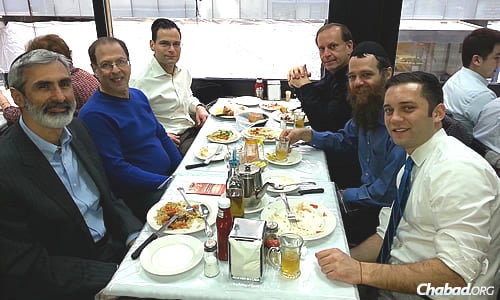
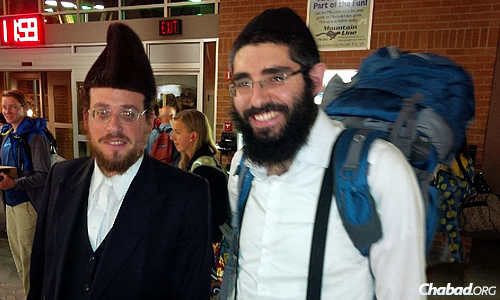
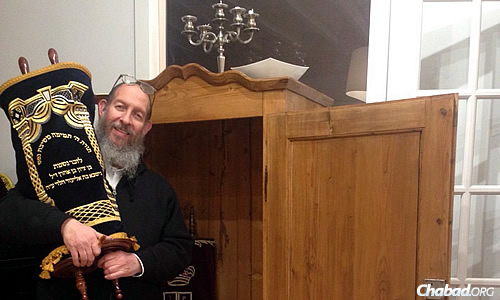


No comments:
Post a Comment