 "Peter replied, 'Master, to whom would we go? You have the words of real life, eternal life. We’ve already committed ourselves, confident that you are the Holy One of God.'"(John 6:68-69)
Friday of the Second week in Ordinary Time
Feast of the Day: Week of prayer for Christian unity
Saint of the Day:
SAINT JOHN THE ALMONER
Patriarch of Alexandria
(+ c. 620)
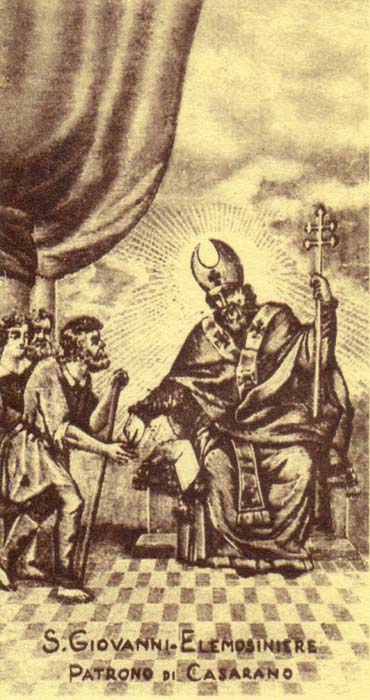 St. John was married, but when his wife and two children died he considered it a call from God to lead a perfect life. He began to give away all he possessed in alms, and became known throughout the East as the Almoner. He was appointed Patriarch of Alexandria; but before he would take possession of his see he told his servants to go over the town and bring him a list of his lords-meaning the poor. They brought word that there were seventy-five hundred of them, and these he undertook to feed every day.
On Wednesday and Friday in every week he sat on a bench before the church, to hear the complaints of the needy and aggrieved; nor would he permit his servants to taste food until their wrongs were redressed. The fear of death was ever before him, and he never spoke an idle word. He turned those out of church whom he saw talking, and forbade all detractors to enter his house. He left seventy churches in Alexandria, where he had found but seven.
A merchant received from St. John five pounds weight of gold to buy merchandise. Having suffered shipwreck and lost all, he had again recourse to John, who said, "Some of your merchandise was ill-gotten," and gave him ten pounds more; but the next voyage he lost ship as well as goods. John then said, "The ship was wrongfully acquired. Take fifteen pounds of gold, buy corn with it, and put it on one of my ships." This time the merchant was carried by the winds without his own knowledge to England, where there was a famine; and he sold the corn for its weight in tin, and on his return he found the tin changed to finest silver.
St. John died in Cyprus, his native place, about the year 620.
Lives of the Saints, by Alban Butler, Benziger Bros. ed. [1894]
Friday of the Second week in Ordinary Time
Letter to the Hebrews 8:6 Now Christ has been appointed to serve as a priest in a much better way, and he has given us much assurance of a better agreement.
7 If the first agreement with God had been all right, there would not have been any need for another one. 8 But the Lord found fault with it and said,
“I tell you the time will come,
when I will make
a new agreement
with the people of Israel
and the people of Judah.
9 It won’t be like the agreement
that I made
with their ancestors,
when I took them by the hand
and led them out of Egypt.
They broke their agreement
with me,
and I stopped caring
about them!
10 “But now I tell the people
of Israel
this is my new agreement:
‘The time will come
when I, the Lord,
will write my laws
on their minds and hearts.
I will be their God,
and they will be
my people.
11 Not one of them
will have to teach another
to know me, their Lord.'
“All of them will know me,
no matter who they are.
12 I will treat them with kindness,
even though they are wicked.
I will forget their sins.”
13 When the Lord talks about a new agreement, he means that the first one is out of date. And anything that is old and useless will soon disappear.
Psalms 85:8 I will listen to you, Lord God,
because you promise peace
to those
who are faithful
and no longer foolish.
10 Love and loyalty
will come together;
goodness and peace
will unite.
11 Loyalty will sprout
from the ground;
justice will look down
from the sky above.
12 Our Lord, you will bless us;
our land will produce
wonderful crops.
13 Justice will march in front,
making a path
for you to follow.
Holy Gospel of Jesus Christ according to Saint Mark 3: Jesus Chooses His Twelve Apostles
13 Jesus decided to ask some of his disciples to go up on a mountain with him, and they went. 14 Then he chose twelve of them to be his apostles,[a] so that they could be with him. He also wanted to send them out to preach 15 and to force out demons. 16 Simon was one of the twelve, and Jesus named him Peter. 17 There were also James and John, the two sons of Zebedee. Jesus called them Boanerges, which means “Thunderbolts.” 18 Andrew, Philip, Bartholomew, Matthew, Thomas, James son of Alphaeus, and Thaddaeus were also apostles. The others were Simon, known as the Eager One,[b] 19 and Judas Iscariot,[c] who later betrayed Jesus.[Footnotes:
3.14 to be his apostles: These words are not in some manuscripts.
3.18 known as the Eager One: The Greek text has “Cananaean,” which probably comes from a Hebrew word meaning “zealous” (see Luke 6.15). “Zealot” was the name later given to the members of a Jewish group that resisted and fought against the Romans.
3.19 Iscariot: This may mean “a man from Kerioth” (a place in Judea). But more probably it means “a man who was a liar” or “a man who was a betrayer.”]
Friday of the Second week in Ordinary Time
Commentary of the Day:
Saint Augustine (354-430), Bishop of Hippo (North Africa) and Doctor of the Church
Sermon 311, 2
"He appointed twelve that they might be with him and he might send them forth to preach"
The blessed apostles… were the first to see Christ hanging on the cross. They mourned his death and were seized with fear before the miracle of his resurrection but, very soon, transported by love at this manifestation of his power, they no longer hesitated to shed their own blood to prove the truth of what they had seen. Now think, my brethren, of what was asked of these men: to go out into the whole world preaching that a dead man was raised and ascended into heaven, suffering for the preaching of this truth whatever pleased an enraged world: privations, chains, torments, burnings, wild beasts, cross and death. Was this for some unknown cause?
Was it for his own glory that Peter died ? For his own advantage that he preached? He would die; another than he was glorified. He was put to death; another worshipped. Only the burning flame of charity joined to conviction of the truth can explain a courage like this! What they preached they had seen. People don’t die for some truth of which they are not sure. Or should they have denied what they had seen? They did not deny it: they preached that death which they knew while living; they knew for what life they were despising the present life. They knew for what happiness they were bearing transitory trials, for what reward they were treading underfoot all these sufferings. Their faith! It weighed more in the scales than the whole world.
____________________________

No comments:
Post a Comment