 "Peter replied, 'Master, to whom would we go? You have the words of real life, eternal life. We’ve already committed ourselves, confident that you are the Holy One of God.'"(John 6:68-69)
Saturday of the Second week in Ordinary Time
Feast of the Day: Week of prayer for Christian unity
Saint of the Day:
SAINT FRANCIS OF SALES
Bishop and Doctor of the Church
(1566-1622)
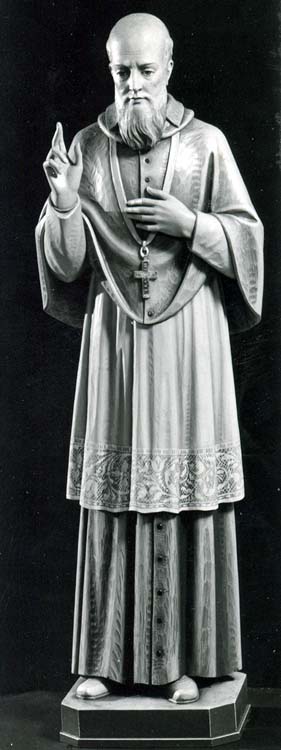 Francis was born of noble and pious parents, near Annecy, 1566, and studied with brilliant success at Paris and Padua. On his return from Italy he gave up the grand career which his father had marked out for him in the service of the state, and became a priest.
When the Duke of Savoy had resolved to restore the Church in the Chablais, Francis offered himself for the work, and set out on foot with his Bible and breviary and one companion, his cousin Louis of Sales. It was a work of toil, privation, and danger. Every door and every heart was closed against him. He was rejected with insult and threatened with death. But nothing could daunt or resist him, and ere long the Church burst forth into a second spring. It is stated that he converted 72,000 Calvinists.
He was then compelled by the Pope to become Coadjutor Bishop of Geneva, and succeeded to the see in 1602. At times the exceeding gentleness with which he received heretics and sinners almost scandalized his friends, and one of them said to him, "Francis of Sales will go to Paradise, of course; but I am not so sure of the Bishop of Geneva: I am almost afraid his gentleness will play him a shrewd turn." "Ah," said the Saint, "I would rather account to God for too great gentleness than for too great severity. Is not God all love? God the Father is the Father of mercy; God the Son is a Lamb; God the Holy Spirit is a Dove-that is, gentleness itself. And are you wiser than God?"
In union with St. Jane Frances of Chantal he founded at Annecy the Order of the Visitation, which soon spread over Europe. Though poor, he refused provisions and dignities, and even the great see of Paris.
He died at Avignon, 1622.
Lives of the Saints, by Alban Butler, Benziger Bros. ed. [1894]
Saturday of the Second week in Ordinary Time
Letter to the Hebrews 9:2 The first part of the tent was called the holy place, and a lampstand, a table, and the sacred loaves of bread were kept there.
3 Behind the curtain was the most holy place.
11 Christ came as the high priest of the good things that are now here.[a] He also went into a much better tent that wasn’t made by humans and that doesn’t belong to this world. 12 Then Christ went once for all into the most holy place and freed us from sin forever. He did this by offering his own blood instead of the blood of goats and bulls.
13 According to the Law of Moses, those people who become unclean are not fit to worship God. Yet they will be considered clean, if they are sprinkled with the blood of goats and bulls and with the ashes of a sacrificed calf. 14 But Christ was sinless, and he offered himself as an eternal and spiritual sacrifice to God. That’s why his blood is much more powerful and makes our[b] consciences clear. Now we can serve the living God and no longer do things that lead to death.[Footnotes:
9.11 that are now here: Some manuscripts have “that were coming.”
9.14 our: Some manuscripts have “your,” and others have “their.”]
Psalms 47:2 The Lord Most High is fearsome,
the ruler of all the earth.
3 God has put every nation
under our power,
6 Sing praises to God our King,
7 the ruler of all the earth!
Praise God with songs.
8 God rules the nations
from his sacred throne.
9 Their leaders come together
and are now the people
of Abraham’s God.
All rulers on earth
surrender their weapons,
and God is greatly praised!
Holy Gospel of Jesus Christ according to Saint Mark 3: Jesus and the Ruler of Demons
20 Jesus went back home,[a] and once again such a large crowd gathered that there was no chance even to eat. 21 When Jesus' family heard what he was doing, they thought he was crazy and went to get him under control.[Footnotes:
3.20 went back home: Or “entered a house” (perhaps the home of Simon Peter).]
Saturday of the Second week in Ordinary Time
Commentary of the Day:
Saint Thomas Aquinas (1225-1274), Dominican theologian, Doctor of the Church
Instructions for the feast of the Body and Blood of Christ
Jesus gives himself wholly even to giving his body and blood
The enormous blessings with which our Lord has lavishly gifted his christian people raise them to an immeasurable dignity. Indeed, there is not, and never has been, a nation whose gods were so close as our God is to us (cf. Dt 4,7). God's only Son, intending to make us participators in his divinity, assumed our nature and became man to make us divine. All that he borrowed from us he placed at the service of our salvation. For he offered his body to God the Father on the altar of the cross for our reconciliation, and he shed his blood as a ransom to reclaim us from our condition of slavery and purify us from all our sins through the washing of regeneration.
To believers he has left his body as food and blood as drink under the species of bread and wine, so that the remembrance of such great blessing might remain continually amongst us. O wonderful and precious feast that conveys salvation and contains sweetness in its all its fullness! What could there be more precious than this meal where, not the flesh of calves and bulls, but Christ, true God, is offered us?
____________________________

No comments:
Post a Comment